
By Sherry Bunting, Editorial in Farmshine May 30, 2025
While the landmark MAHA Commission was working on its initial report released May 22 on the chronic childhood disease crisis, Pennsylvania state lawmakers have been assembling a “Healthy PA Package” that includes five bills – H.B. 1130, 1131, 1132, 1133, and 1134 – that would either ban or require specific labeling for foods containing certain artificial dyes and preservatives; provide statutory definitions for terms like “ultra-processed foods,” designate August as Wellness Month, and provide incentives for cover crops based on their use in producing healthier crops using less chemical herbicide…
But there is one state bill that should be part of this Healthy PA Package, and that is S.B. 463, the “Allowing Whole Milk in PA Schools Act,” reintroduced in March by State Senator Michele Brooks, a Republican representing Mercer County. It would simply allow Pennsylvania schools to purchase and serve whole and 2% milk produced within the state instead of being limited to offering only 1% and fat-free milk.
After all, the MAHA Report describes whole milk as “a rich source of calcium, vitamin D and bioactive fatty acids, which support bone health, help regulate inflammation and may reduce the risk of type two diabetes.” And the MAHA Report could reform some key elements of the anti-fat Dietary Guidelines. But it was lawmakers in Washington in 2010 that specifically singled out whole and 2% milk in a passage within the Healthy Hunger Free Kids Act and states are left to bow down to King Vilsack, who drove the school bus on that deal.
In the previous session of the Pennsylvania State Senate, Sen. Brooks’ bill on whole milk had been reported out of the State Senate Ag Committee but never made it to the Senate floor for a vote. In the House, Rep. John Lawrence’s companion bill was passed by the full House last session, but was never approved by the Senate before the legislative session ended in Dec. 2024. At that time, there were murmurings of USDA canceling state school lunch reimbursements or other state funds from mighty USDA after a certain general farming publication mentioned the stance of Vilsack’s USDA in terms of the legality or illegality of such a state measure.
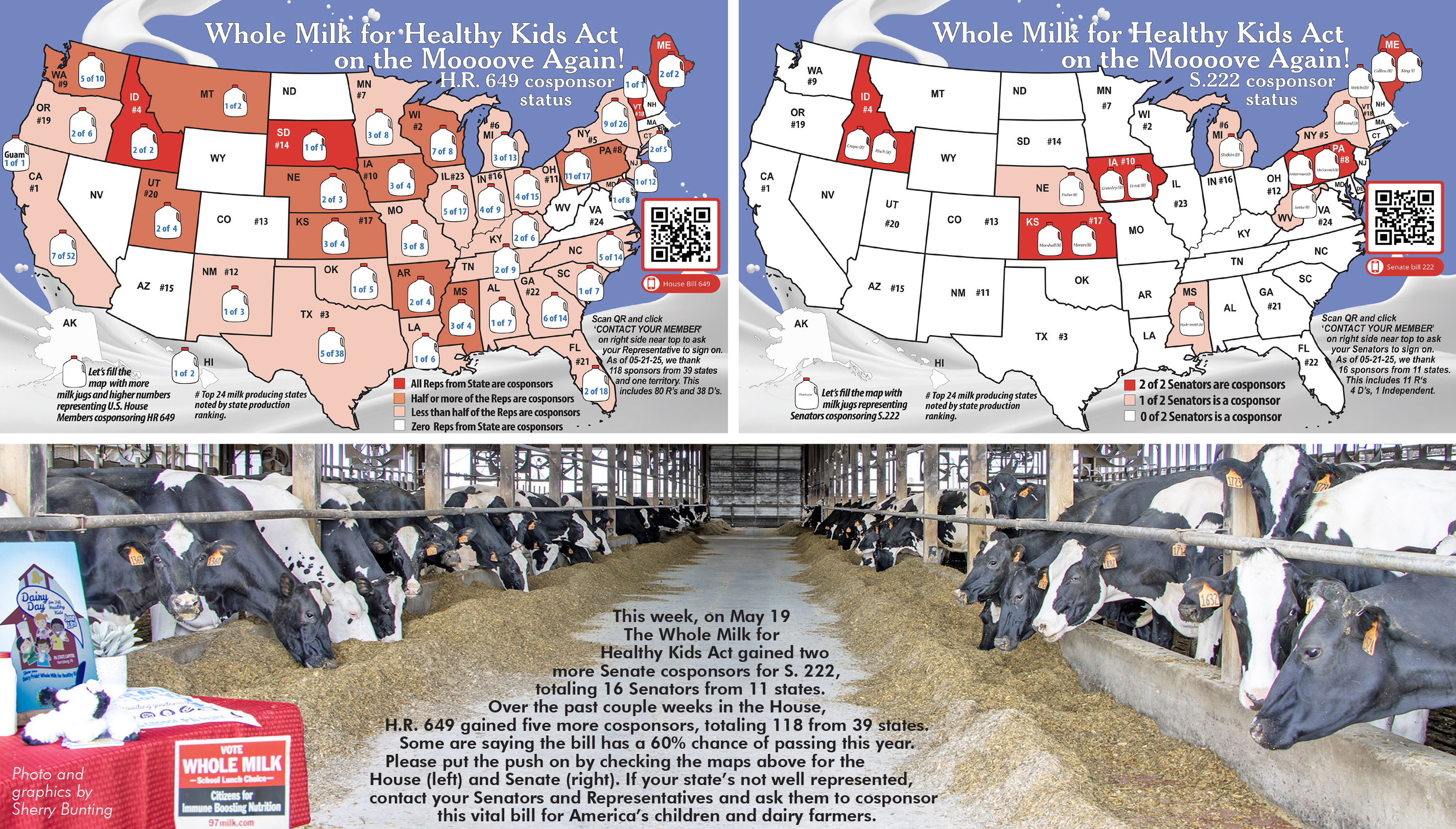
Meanwhile, Tennessee and North Dakota have passed state legislation to pave a path for whole milk in their schools. If more states did this, even if it is tough to implement, it sends a message, and perhaps the leadership log-jam in Washington would break down and run the Whole Milk for Healthy Kids Act and get-it-done already. It appears to have broad bipartisan support, at least that’s what all of the lawmakers seem to want to portray in front of the cameras.
So, here we are in the 2025-26 legislative session at the state and federal levels having to start all over again, covering the same ground, talking the same talk, pointing out the same points that have been discussed, written about and testified to numerous times over the past 10-plus years.
“The (federal) Healthy, Hunger-Free Kids Act of 2010 put restrictive regulations on the consumption of whole milk in schools. In the first two years this legislation was enacted, 1.2 million fewer students drank milk with their lunch, yet still had access to sugary drinks that offer no nutritional value. This not only has terrible health and nutrition impacts on children, but major economic impacts, especially in Pennsylvania,” writes Sen. Brooks in her memo to colleagues seeking cosponsors for reintroduction.
In her memo, she cites testimony from a Senate Majority Policy Committee public hearing in June of 2021, in which the Grassroots Pennsylvania Dairy Advisory Committee volunteers and 97 Milk supporters testified, along with other industry leaders and officials.
She cites dairy’s economic importance to the Commonwealth, and the testimony showing the improved physical and brain health that whole milk’s unique matrix of fatty acids provides, noting “this fat is necessary in the daily diet and energy to support cell growth. Other health benefits of milk include improved bone health, lower blood pressure, and reduced risk of cardiovascular disease and Type 2 diabetes.”
Again, here we are with words upon words but no one’s running the votes upon votes to get it done.
Let’s stop talking and just do it. Lawmakers in Harrisburg and Washington can talk until they are blue in the face about doing something for dairy farmers or doing something to feed hungry children or deliver better childhood health and nutrition. They can come up with all kinds of elaborate schemes to make factions happy or align the stars on the curious realities of milky politics.
My message to folks at both Capitols is simple: We live in the United States of America — land of the free and home of the brave, where our valiant soldiers have fought and died to give and maintain our liberty – yet their children, grandchildren, great-grandchildren, and great-great grandchildren are prohibited from choosing whole milk as an option with school meals they rely on two meals a day, five days a week, three-quarters of the year. Heck, even our soldiers are limited because mess halls have to subscribe to those low-fat dogmas as well.
One of the biggest obstacles for this bill early on was that most Americans laugh in disbelief when you tell them this. Absurd! They say. My kids have milk at their school, they laugh. And the federal government pays for all that milk to go straight into the trash… Oh, tell me more.
Can I be frank? My husband hears me talk on the phone about whole milk in schools and he laughs at the absurdity that I’m still talking and nothing has been accomplished. I am just one of many. As more voters see the absurdity, respect for elected officials wanes. I find it absurd that we are still talking about something that should have been finished long ago already. If we can’t do the simple stuff that has obvious bipartisan support, how in the world are we ever going to do the tough stuff? What’s the hold up? Is it industry? Is it leadership? Is it lip-service? Is it PETA? Is it Vegans? Is it the brainwashing game of the Heart Association as a pawn of Big Food and Big Pharma? What gives?
After 10-plus years, farmers, children, parents, teachers, school boards, and communities that have worked on this issue deserve an answer. Fess up to the real reason it’s still stymied or VOTE for goodness sakes – VOTE in both chambers – now—so these federal and state whole milk bills can get to the President’s and Governor’s desk in time for schools to actually put it in their food plans for the next school year. Time is running out. And the delays are now tiresome.
If these chambers aren’t going to vote, then they better tell us what the real holdup is and start naming names. Some of us have children and grandchildren who are anxiously waiting and hoping. Some of us have cows that are offended to know their nature’s most perfect food can’t be offered to children without being fooled around with. And some owners of those cows need to have hope that the hard work they do to provide high quality whole milk is reflected in what America’s children get to choose at school where they spend most of their time and eat two meals a day, five days a week, three-quarters of the year.
Get it done, or start ‘splainin.’
-30-
 Ag Moos