
By Sherry Bunting, Farmshine, February 2025
STATE COLLEGE, Pa. — Forward-looking presentations from farm to processing and promotion were highlights of the 20th Pennsylvania Dairy Summit attended by over 350 people at the Penn Stater Conference Center Feb. 5-6.
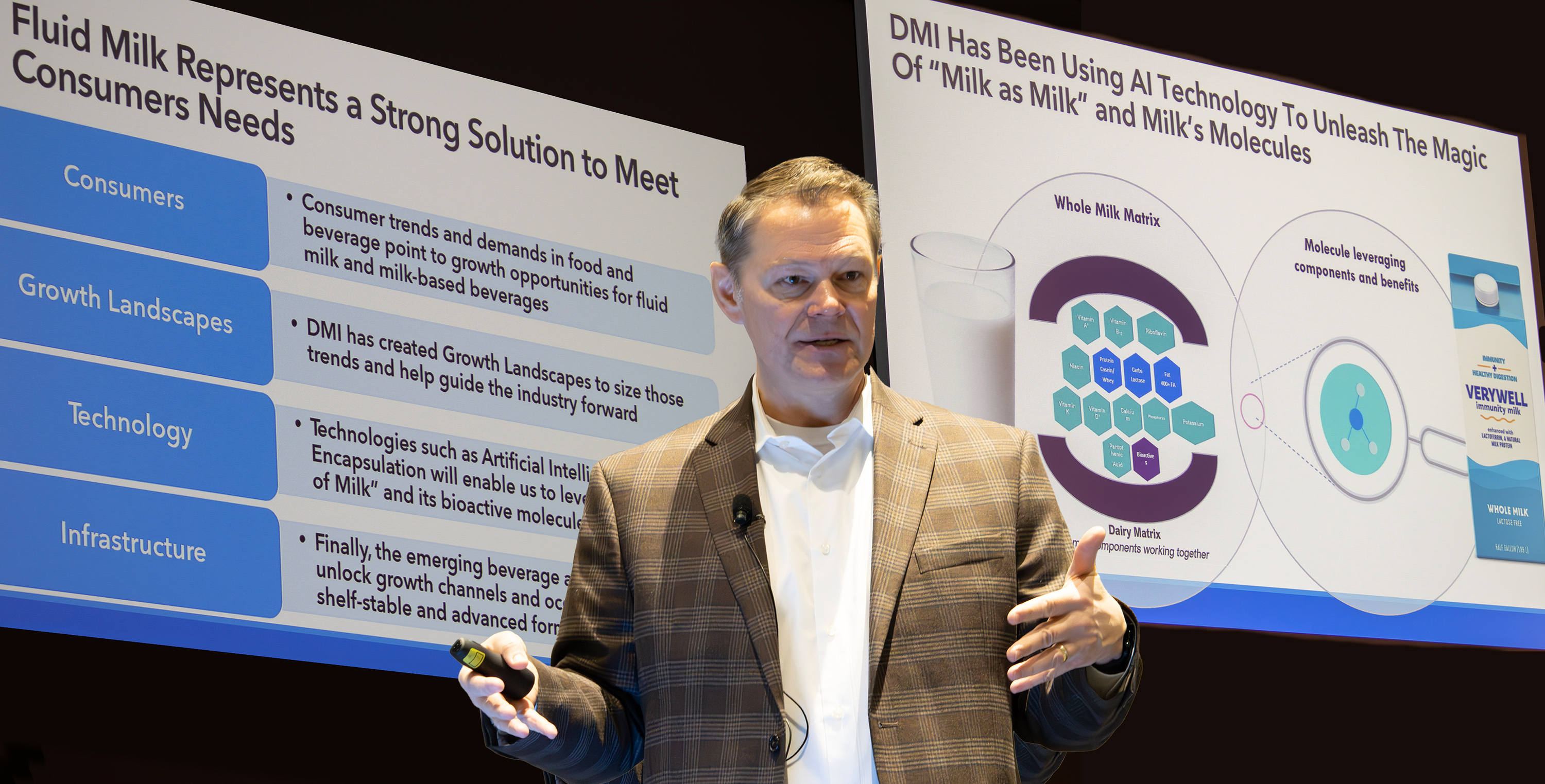
Many questions and much discussion came from the general session panel on the second day, entitled “Emerging Market for Fluid Dairy: Aseptic Milk and Milk Molecule Maximization.”
Sponsored by American Dairy Association Northeast, it was presented by Paul Ziemnisky, the head of wellness, innovation and business development for Dairy Management Inc (DMI), and Rebecca Shaw Pfeffer, brand manager for Maola Local Dairies — positioned as “embracing innovation and pursuing new market opportunities for fluid milk.”
Several attendees expressed how uplifted they were by this presentation. Others had thought-provoking questions that were not entirely answered.
DMI has had a seven-year partnership with the industry through the Fluid Milk Innovation task force’s response to fluid milk demand “that has struggled.” The response has focused on milk molecule separation for value-added growth – all of which starts with extended shelf life (ESL), ultra-pasteurized, aseptic, shelf-stable milk, as the base beverage or gateway to the opportunities.
The bottom-line is dairy checkoff is focused on guiding the industry into new spaces in the beverage category, such as health and wellness. DMI develops concepts and prototypes to help guide industry investments, using its proprietary artificial intelligence (AI) database to “unlock the growth opportunities.”
Ziemnisky reported that DMI has implemented the Milk Molecules Initiative, or MMI, which focuses on the functional benefits in milk and uses an AI platform for dairy research and development.
He said DMI’s AI model has identified 6300 molecules in milk, and the MMI is just getting started on what to target, and how.
“We are seeing growth in ultra-pasteurized and value-added, and we are taking our space back with the molecules and magic of milk,” said Ziemnisky, who oversees DMI’s domestic growth programs, much of it hinging on checkoff-funded health and wellness research, including 41 active projects with Mayo Clinic.
Part of this work is identifying the health and other associations linked to specific molecules, like lactoferrin. “We identify them and size the trends to see how to attack the spaces,” he said.
MMI is the innovation plan to get dairy past the 15% it currently holds of the $159 billion retail beverage category. To that end, Ziemnisky talked about changes in technologies that DMI is working on to “take advantage of the bioactives in milk through separation and put them back in milk or other products, using AI to accelerate our learning, faster.”
He confirmed $10 billion in new processing coming online in the U.S. in the next two years, saying “a lot of this is in the fluid milk space, using filtration and separation for functionality.”
DMI has broken the market into three categories: snacking and entertainment, vital performance, and clinical cuisine. Ziemnisky spent much of his time on the latter as the new and growing ‘food as medicine’ trend.
He talked about DMI partnering with the Calm App to produce a prototype that would add the separated molecule of tryptophan to ESL milk, for a prototype ‘calm’ or ‘sleep’ beverage.
However, Ziemnisky spent much of his time talking about the lactoferrin molecule and the technology to encapsulate and separate it during dairy processing to be added to milk to make “immunity milk” with a Very Well brand prototype.
He talked of Nestle’s new ESL lactose free milk, marketed as high protein, low sugar, called Pioneer Pastures, and available only at Target, as well as DFA’s new Milk 50 beverage as slim and fit.
He talked about how shelf-stable milk is the vehicle to deliver wellness or vitamin claims, like has been done with water drinks.
DMI is also working on bringing MMI into the arena of competing with bone health supplements in the vitamin aisle.
“We’ve baked the cake and are looking for the products to use this technology to steal market share from these areas,” he said.
“We’re looking at the molecules in the whole milk matrix,” he explained, highlighting lactoferrin with 1758 health associations in the scientific literature.
“But you’d have to drink 20 glasses of milk, so we’ll take it out and put it back into one glass of milk and call it ‘immunity milk,’” he said.
In fact, DMI has created a ‘family tree’ of milk’s natural bioactives to then pick channels, to size the growth potential, design prototypes, and look for partners.
According to Ziemnisky, DMI has 46 proposals for women’s health, alone, and there is talk of building lactoferrin processing capacity as this molecule is also being looked at for beauty and skin health.
“But we have to make sure it doesn’t lose its bioavailability in the processing,” he said, referencing the encapsulation technology, similar to what is used to make infant formula, which is needed “to protect the molecule, and put it back into dairy.”
By combining milk with MMI technology, Ziemnisky said a molecule can be targeted, extracted, and then added back into the milk at a higher volume for a wellness claim.
“Now we can marry it out to the big retail beverage growth spaces, where there is $159 billion in consumer spending to show the industry where we (milk) can play,” he said.
“We’re adding milk to milk with some of these concepts, with a different look and a huge value. We are testing concepts with consumers and learning how to talk about it, and patenting our technology for our farmers,” he continued.
“People ask, why not just promote whole milk?” Ziemnisky noted.
His answer? “Only 17% of the market is ‘traditionalist.’ We have to innovate the category and do the research to understand what our consumers need. We’ve been baking the cake, working with the industry, doing the concepts to gain share in the top demand-moments that we only have a 15% share of now. MMI represents a really strong opportunity for us to do that.”
Extended shelf life, ultrapasteurized, and aseptic shelf-stable milk processing is the gateway to this ‘promised land,’ according to Ziemnisky, and DMI is testing proof of concept, working with startups and processors to get geared up to move prototypes from concept to consumer.
“People are realizing the value of milk,” he said. “Our biggest opportunity is making sure there is a good intro marketing plan for retailers to drive the products. If we can win the first six months, we usually can stay on the shelf. That’s our biggest opportunity to make sure they have a plan to drive awareness and trial the products.”
DMI and MilkPEP are working with companies and retailers on this, providing tools and tactics to get the higher-level consumer engagement. This includes developing the sell-story to new buyers.
“Milk is on fire in the category, and we often look at conventional milk, which is 82% controlled by the retailer,” Ziemnisky stated, emphasizing that DMI tells processors that they have to educate the retailers. “Using our analytics, there is a piece of winning even on the conventional milk side in this trajectory. Everything we’ve touched in the industry has grown.”
He showed the value-added products on the market today that were prototyped through checkoff, including high protein, lactose free, and flavored.
“Conventional has held us back because, again, we have to get the retailers using the health and wellness playbook to educate the consumers,” Ziemnisky said, noting that value-added is more than 30% of the fluid milk category dollars and when he started at DMI nearly a decade ago, it was less than 10%. (Note that value-add products are more expensive, so dollar growth does not necessarily correspond to volume growth, and that conventional whole milk is already a large volume of the category that has been consistently growing).
In part two from this discussion, we look at what DMI is doing with protein in the fluid milk space, and our question about what DMI is doing in terms of research to ensure protein structure is protected from impacts of ultra-pasteurization.
 Ag Moos
Pingback: ESL milk panel: Innovation? Market optimizers? | Ag Moos
Pingback: Seeds of doubt being sown, Part III: Will it reduce butterfat supply and impact industry’s cheese-focused future? | Ag Moos
Pingback: Seeds of doubt being sown, Part One, Confusion: ‘Will this bill really improve milk prices?” | Ag Moos