
Farmers’ mandatory checkoff funds paid for it, and the evolving GHG models and data collection raise questions about where farmers ever had a direct voice in any of what they were forced to pay for and then be governed by.
By Sherry Bunting, Sept. 4, 2026 Farmshine
ARLINGTON, Va. — When dairy farmers were invited to comment by Oct. 2, 2026 on proposed Farmers Assuring Responsible Management (FARM) Animal Care and Workforce Development changes for 2028, one major FARM component was absent: Environmental Stewardship (ES).
During the Aug. 7 National Dairy FARM Program webinar, Farmshine asked: When have dairy farmers had — or when will they have — an opportunity to weigh in directly on FARM Environmental Stewardship?
The answer revealed a program with a different history and development process than FARM Animal Care — one that reaches back to dairy farmers’ mandatory checkoff dollars and now produces greenhouse-gas data collection and modeling that can move through cooperatives and processors into dairy supply-chain reporting.
From checkoff to FARM
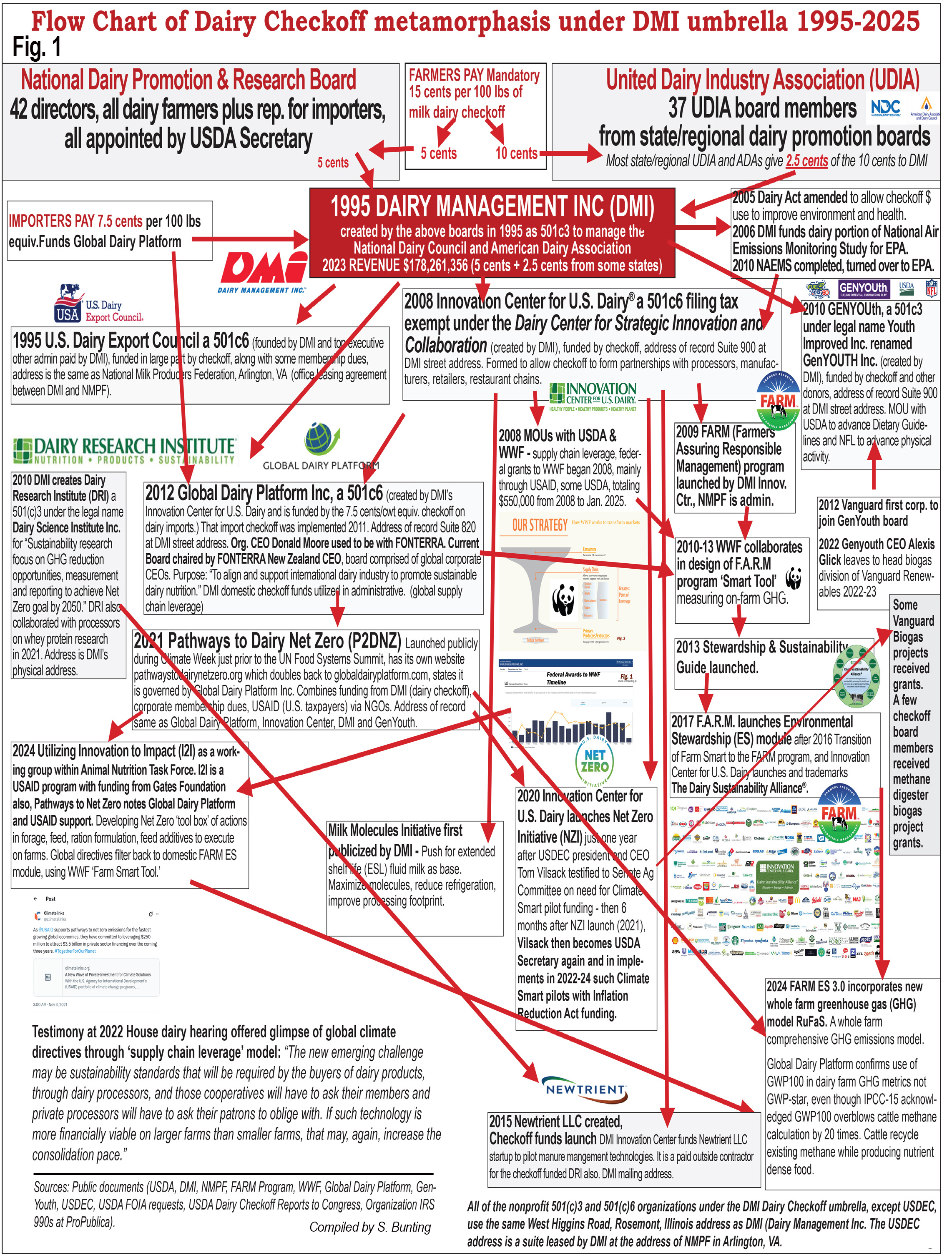
FARM Environmental Stewardship (ES) did not originate within FARM or through farmers’ milk cooperatives. Its roots began when Dairy Management Inc (DMI) created the Innovation Center for U.S. Dairy in 2008, even noting its work has been funded primarily by dairy farmers and importers through DMI’s administration of the mandatory national checkoff program. At the time, this launch involved two Memorandums of Understanding (MOUs), one with USDA under then Secretary of Agriculture Tom Vilsack and a second with World Wildlife Fund (WWF).
That was the beginning of FARM ES.
In 2016, the National Milk Producers Federation (NMPF) announced it would assume management of Farm Smart, a carbon-footprint modeling tool created by the Innovation Center alongside World Wildlife Fund (WWF) and managed by checkoff-funded DMI. Its science and methodology were incorporated into FARM ES, which launched in 2017.
The chain is worth understanding: Farmers mandatorily fund the national checkoff. The checkoff created and funds the Innovation Center. The Innovation Center developed the environmental framework and original carbon-footprint tool. NMPF brought that tool under FARM. And today cooperatives and processors use FARM ES to collect data from their dairy farmers and use the tool to aggregate this data for others.
So when do farmers get to comment on FARM ES?
Nicole Ayache, chief sustainability officer for NMPF, pointed to several ways farmers have participated in the FARM ES development.
“We had a number of farmers pilot the program and the update we did in 2024,” she said, “and we have working groups and task forces that provide ongoing feedback. We don’t have public comment on the science. That does go through a peer review scientific process. The science sort of is not something that NMPF creates. It’s created by researchers and scientists.”
So, the answer then is “no.” Farmers at-large have not had the opportunity to comment on the FARM ES that their cooperatives and processors have been implementing by collecting their data, and which was developed through DMI with their mandatory checkoff funds.
That differs from FARM Animal Care, where proposed changes to standards are currently laid out for an open public-comment period before final decisions are made.
Changes were introduced this year, but no comment period?
“The metrics themselves are not, at least today, they’re not being proposed for revision for 2028. So because the metrics are staying the same, it’s not going in this public comment,” Ayache said, again referring back to “the science” being something that does not get opened for comment anyway.
However, she did note that farmers can still provide feedback when they encounter situations that don’t fit the platform.
“Really, we save public comment for when there’s a change in the metrics or what’s going to be aggregated or collected at a cooperative processor level within the program,” Ayache said.
That last phrase is significant because FARM describes the ES module as both a farm-level environmental assessment and customer-assurance program. Cooperatives and processors can aggregate FARM ES results to report emissions to dairy buyers (even though Scope 3 emissions reporting is not required in the U.S. The SEC and EPA under two administrations backed away from this).
Ayache said they used to measure energy use, but now model greenhouse gas emissions. It is also “voluntary,” she said.
‘Voluntary’ — for whom?
The program is technically voluntary for the cooperative or processor, but not necessarily voluntary for the individual farmer supplying the milk and data to the enrolled cooperative or processor. This, despite the fact that the cooperative or processor can do a random sample using a specific protocol or elect to gather data on 100% of their shippers, according to the Environmental Stewardship Handbook.
A farmer’s practical ability to decline an ES evaluation or data collection may depend on what the farmer’s cooperative, processor or milk customer requires. Are they doing the ‘sampling’ method? Or are they modeling 100% of their milk supply?
The webinar did not address whether an individual producer can decline FARM ES participation or use of the farm’s data when a milk buyer requires it — or what happens to the farmer’s milk market if that producer says no.
This is relevant given the program’s origins. Farmers are required to fund the national dairy checkoff that created the environmental framework. The resulting FARM ES program is described as voluntary, while cooperatives and processors can use it to meet environmental reporting demands from downstream customers in the dairy supply chain.
Who develops what?
FARM is administered by NMPF, but FARM’s Version 3 development materials state that NMPF, DMI and the Innovation Center for U.S. Dairy collaborated on updating the greenhouse-gas (GHG) model powering FARM ES.
DMI’s environmental research team leads scientific research used to keep the model current, working with academic and research institutions. Programmatic updates and accountability measures move more directly through the FARM Environmental Stewardship Task Force, NMPF Environmental Issues Committee, and NMPF Board.
The Innovation Center itself represents a broader dairy value chain — including farmers, cooperative leadership, processors, downstream supply chain customers, and allied industry.
A model, not a meter
The GHG footprint produced for an individual farm is important to understand: It is modeled, not directly measured.
FARM ES now uses the Ruminant Farm Systems, or RuFaS, model, a whole-farm simulation developed by Cornell University researchers and collaborators that takes the Smart Tool a step farther by integrating information about animal classes, feed, manure, crops, and soils on the whole farm in order to estimate environmental outcomes.
FARM ES uses the model to calculate GHG emissions expressed as pounds of carbon-dioxide equivalent per pound of fat- and protein-corrected milk. The result therefore depends on both the farm information entered and the scientific model interpreting or “modeling” those inputs, and that model continues to evolve.
Version 3 moved to RuFaS in 2024. Then in May 2026, additional RuFaS updates were incorporated into FARM ES, including homegrown feeds in the total farm footprint, changes to how youngstock manure is calculated, and making manure-storage emissions more responsive to temperature. None of these changes have engaged producers with a comment period or explanatory webinar.
“FARM ES continues to adapt as science and technology advance within the dairy sector,” Ayache said when the May update was announced. RuFaS itself is open-source and peer-reviewed, designed to be updated as research and technology advance. Its development continues beyond the changes already incorporated into FARM ES, and again, this is “the science” so it’s not opened up for farmers to have public comment.
Cornell University lists a $1.49 million RuFaS project running from November 2025 through October 2027, with support from DMI. The work includes further development for GHG emissions, water quality and economic outcomes, as well as use in conservation and policy programs and dairy value-chain environmental reporting.
That brings the public-comment distinction into sharper focus: The environmental metric can remain the same while the scientific model used to calculate a farm’s result changes.
Ayache said FARM does not put those scientific changes out for public comment. They move through research and scientific peer review.
Beyond the farm gate
The importance of these calculations is growing and the CO2 equivalents are still the subject of scientific debate. More than 1700 FARM ES Version 3 evaluations were completed in 2025, covering farms in 46 states and herd sizes ranging from 10 to more than 38,000 lactating cows, according to FARM’s annual report.
FARM has also partnered with California Dairies Inc. and Athian on a carbon-intensity protocol designed to quantify and verify greenhouse-gas reductions, potentially monetize them for farmers and help address dairy supply-chain Scope 3 emissions.
Checkoff funds are part of this GHG reduction and monetization, yet checkoff funds were intended by Congressional authorization for dairy promotion, education and research. The purpose, says DMI, is to expand global opportunities for dairy and to “tell dairy’s story” to consumers.
For farmers, questions extend beyond the scientific validity of the model to the funding, governance, consent, and data use. The farmers’ mandatory checkoff dollars helped launch this environmental work before most even knew about it, now handed off to fund scientists to continually develop and update the model that the FARM ES applies to the farmer’s data.
So, where in this farmer-funded chain do dairy farmers themselves have a direct voice — including the ability to say yes or no — in how their funds are used to develop a system by which the proprietary data generated from their farms are defined, collected, aggregated and ultimately used?
How, where and when to comment
While Environmental Stewardship is not included in this public-comment period that ends Oct. 2, 2026, dairy farmers can weigh in now on proposed FARM Animal Care and Workforce Development changes for Version 2028.
For FARM ES, Ayache said ongoing feedback is welcomed. There is a spot on the survey for general feedback. For farmers with questions about how FARM ES calculates their footprint, how their data are used, or what “voluntary” means in their milk market, those questions are not part of the Oct. 2 survey — but they remain questions worth asking.
The survey is available at nationaldairyfarm.com. Farmers can comment on Animal Care, Workforce Development or both and do not have to answer every question. A hard-copy option is also available. Comments must be submitted by midnight Oct. 2.
-30-
CAPTION
This diagram is the result of an investigation and timeline of the various 501c3 and 501c6 nonprofit organizations created by the national dairy checkoff program via DMI since 2008 around the environmental and greenhouse gas emissions part of what is known today as FARM ES. Compiled by Sherry Bunting

