How will DOGE review of USDA impact dairy? It’s complicated.

By Sherry Bunting, Farmshine, Feb. 21, 2025 (with updates after print publication)

WASHINGTON – Upon reading the Feb. 14 news release about USDA’s 78 terminated contracts totaling $132 million, as identified in the ongoing review by the Department of Government Efficiency (DOGE), we noticed only 10 examples were given, totaling only $4.21 million. Reports had surfaced about Conservation Districts receiving project or program termination notices via email, and a few farmers communicated their concern about frozen funding for grant reimbursements.

So, we looked into it.

One email notice that Farmshine was able to view, dated Feb. 14, for a project in a Colorado Conservation District, stated the reason in the subject line: “The project no longer effectuates agency priorities regarding diversity, equity, and inclusion programs and activities.” 

However, the notice also clearly stated that final payments would be made on work already conducted for the terminated project — as long as the final reports and final payment requests are submitted within 120 calendar days of the notice.

We emailed the USDA press office on Feb. 18, as follows:

“A few farmers have communicated about canceled contracts or frozen funds related to conservation projects, some in which projects were started or planned, and these farmers were expecting reimbursement through grants. The news release about the $132 million in canceled contracts lists 10 things as examples outside of the core mission of USDA, but these examples only total $4.21 million, not $132 million. Where can we find a list of the balance?”

The press office turned our request over to the Freedom of Information Act (FOIA) officer at the USDA Farm Production and Conservation Business Center, who promptly responded by email on the very same day, Feb. 18, directing us to a government information specialist who could help us file an official FOIA request.

The specialist answered our call on the first try that same day (Feb. 18). Our official FOIA request was modified to seek a listing of the 78 terminated contracts referenced in the USDA press release. This experience runs contrary to what some in the mainstream media have reported about FOIA officers being “gone.”

In fact, we received a follow up email the next morning (Feb. 19) with additional information and a link to https://doge.gov/savings, where all terminated contracts throughout all federal agencies will be updated twice a week. USDA ranks 5th in the top 10 federal agencies in amount of savings as of Feb. 18.

A look at the listing shows zero terminations of any on-farm conservation project contracts. 

Furthermore, $100 million of the $132 million is accounted for in the four separate $25 million contracts with four separate consulting companies, mostly located in the Capitol region, for “Diversity, Equity, Inclusion and Accessibility (DEIA) Assessment and Training Services” within the USDA’s Food and Nutrition Service, or FNS.
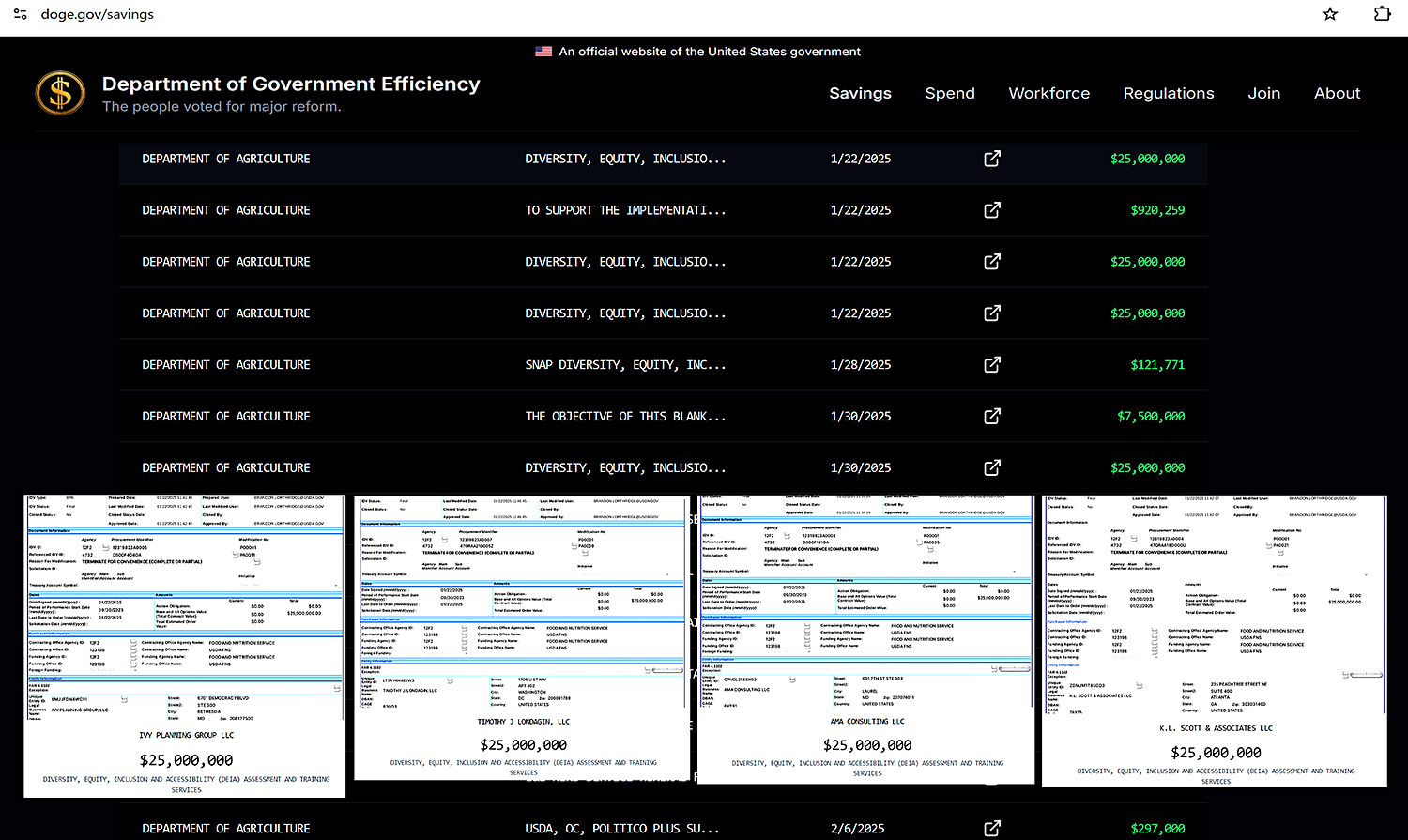
(Just think how much of the currently banned whole milk — which former Ag Sec. Vilsack said schools cannot afford anyway — could be purchased for the FNS-controlled National School Lunch Program with such savings!)

Also terminated was a contract with a Vermont consulting firm for “Environmental Compliance Services for the implementation of Partnership for Climate-Smart Commodities.” Even though this $8.2 million award had already been paid, the termination prevents additional orders. 

While the government information specialist cannot answer abstract questions, she did indicate that conservation projects through EQIP and NRCS — that are attributed to the farm bill — are not included in the contract terminations. However, Climate Smart projects under the Inflation Reduction Act (IRA) were included in the funding that was ‘on hold’ for review.

Then USDA announced in a Feb. 20 press release that, “Secretary Rollins will honor contracts that were already made directly to farmers. Specifically, USDA is releasing approximately $20 million in contracts for the Environmental Quality Incentive Program, the Conservation Stewardship Program, and the Agricultural Conservation Easement Program.”

This is the first tranche released from the ‘pause’ as USDA continues to review IRA funding “to ensure that we honor our sacred obligation to American taxpayers—and to ensure that programs are focused on supporting farmers and ranchers, not DEIA programs or far-left climate programs,” the press release stated.

We also learned from other sources that commodity checkoff programs are part of the broader DOGE review of all USDA activities for the purpose of evaluating, and potentially reforming both spending and policy in agriculture.

The dairy promotion and research program, funded by the 15 cents per cwt checkoff, is one of 22 such mandatory commodity programs overseen by USDA AMS. According to repeated statements by dairy checkoff leaders over the past five years, this oversight involves USDA AMS reviewing all checkoff-funded activities, including for USDA staff attending all DMI meetings “even conference calls.”

This oversight comes at a cost. Of the 2022 and 2023 financial statements available for Dairy Management Inc (DMI), National Dairy Promotion and Research Board (NDB) and the consolidated United Dairy Industry Association (UDIA) and National Dairy Council (NDC), only the NDB listed USDA Oversight as a line item under its operating costs, totaling just under $1 million annually, along with a collections and compliance line item totaling just over $500,000.

How might the DOGE algorithms decipher these costs and engagements, given both USDA and DMI have contracted with NGOs like World Wildlife Fund (WWF)?

How might it interpret WWF’s published playbook of leveraging the supply-chain of 300 to 500 companies controlling 70% of consumer food choices?
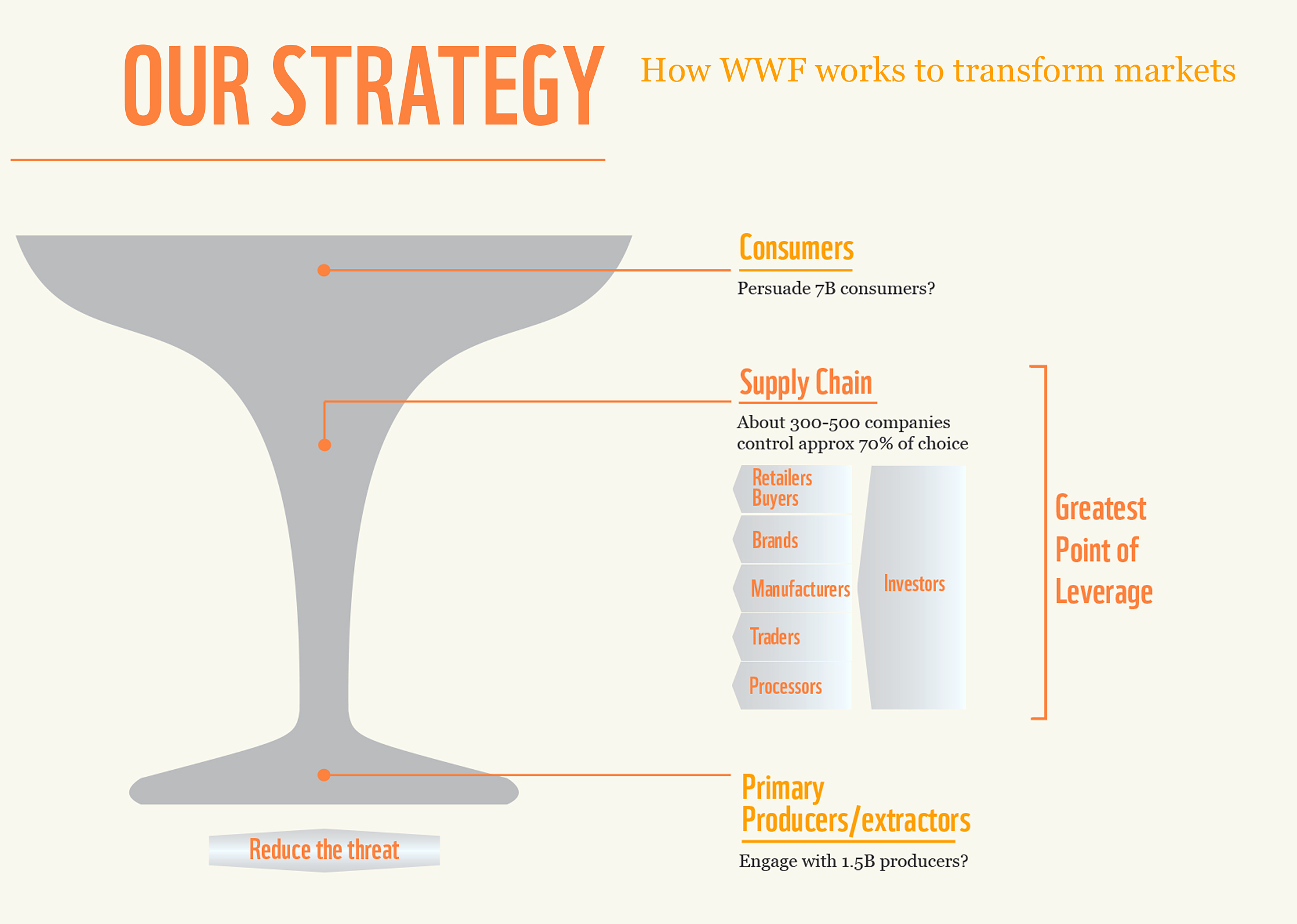
WWF’s playbook uses the consolidation in the middle (above) to move the much larger number of food producers and food consumers toward implementing their sustainability goals, the so-called ESGs (Environmental, Social, Governance) that focus on DEI, biodiversity, and their particular take (and flawed math) on the climate impact of methane emissions from cattle, disregarding the carbon cycle that is the essence of life.

In fact, upon being provided with the link to USA Spending as part of the response we received from the current administration regarding our FOIA request, we found that the federal government has awarded the NGO World Wildlife Fund (WWF) more than $500 million since the start of the Obama administration in 2009. The bulk of the funds were awarded in 2022-24 during the Biden administration.
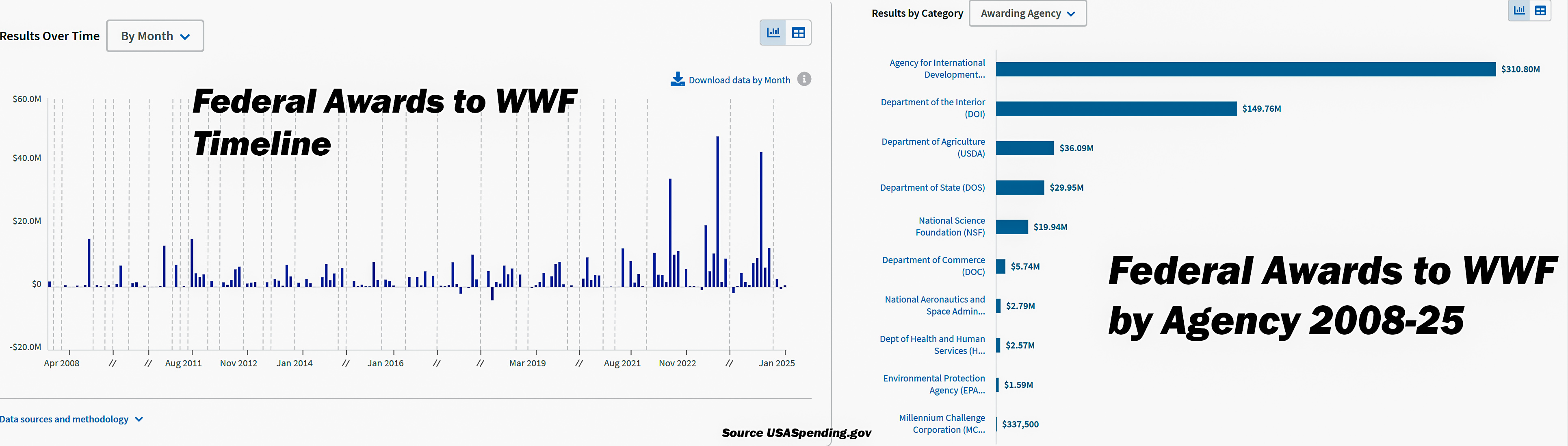
Of the over $500M, USAID awarded WWF $310M; the Department of Interior awarded WWF $149M; and USDA awarded WWF $36M, with other federal agencies rounding out the total. ($500M is a large sum that the mainstream media refer to as “merely a rounding error” next to the $36T (trillion) in national debt, but where else do these layers lead in terms of money and policy?)

We already know that the dairy and beef checkoffs began their alliances with WWF in the 2008 to 2010 time frame — when the work to develop their Net Zero and Sustainability platforms for dairy and beef producers began, and really ratcheted up by 2021.

Contracts with NGOs in other departments of the federal government have also been terminated through the DOGE reviews, especially via USAID, according to repeated press reports. What more may we learn from the DOGE review on potential entanglements between USDA, checkoff programs, NGO’s like WWF, and the food industry — that are not truly farmer-led but impact farmers?

To-date, there are no indications that the USDA AMS administration of the Federal Milk Marketing Orders are part of the DOGE review; however, it’s possible, depending on how these FMMO administration costs are allocated. 

According to the Congressional Research Service (CRS), the 1937 Agricultural Marketing Agreement Act gives USDA several authorities in Federal Milk Marketing Orders (FMMO) that are administered through Dairy Programs under AMS. The associated costs of FMMO administration, according to the CRS “are partly covered by an assessment levied on handlers at no more than five cents per cwt., which is often passed on as deductions on farm milk checks.

-30-
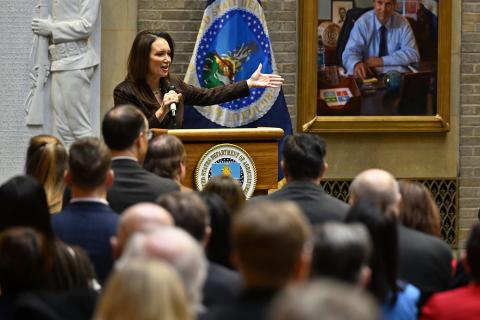
Rollins confirmed 33rd Ag Secretary; Aggressive agenda unfolds

USDA photo

By Sherry Bunting, Farmshine, Feb. 21, 2025

WASHINGTON, D.C. – The U.S. Senate confirmed Brooke Rollins 72-28 on February 13th as the 33rd Secretary of Agriculture, and the second woman to lead the USDA. On Friday, Feb. 14, she was sworn in and addressed a gathering of over 400.

Rollins pledged to bring greater efficiency to the USDA to better serve farmers, ranchers and the agricultural community. 

“We welcome the DOGE efforts because its work makes us better, stronger, faster and more efficient,” said Rollins of the review of USDA already underway by the Department of Government Efficiency (DOGE), headed by Elon Musk.

She announced an end to identity politics, pledging equal dignity. 

Rollins also said the USDA will be “returned to its basic purpose,” with a focus on its core missions of supporting American farming, ranching, and forestry.

In a Feb. 14 news release, Rollins noted that the DOGE review continues to be comprehensive and announced the first tranche in a series of reforms.

USDA is currently reviewing more than 1000 contracts for possible termination. The department has already terminated 78 contracts, which totaled more than $132 million. Some of these contracts were proposed procurements that were discontinued before they went into effect, according to the news release.

The news release gave 10 examples of terminated contracts, which totaled just $4.21 million. Ending Politico subscriptions at $2.77 million, represented the bulk of the money in the examples. Other items listed ranged $30,00 to $300,000, such as Diversity, Equity and Inclusion (DEI) ‘onboarding’ specialist, Diversity Dialogue Workshops, a Brazilian Forest and Gender Consultant, a Women and Forest Carbon Initiative Mentorship Program, an international training and education for women to increase their participation in climate change adaptation, and a Central American Gender Assessment Consultant.

Rollins also rescinded all DEI programs, including 948 employee trainings focused on DEI, Environmental Justice, and gender ideology.

The Department is pursuing an aggressive plan to “optimize its workforce by eliminating positions that are no longer necessary, bringing its workforce back to the office, and relocating employees out of the National Capital region into our nation’s heartland to allow our rural communities to flourish,” she said.

On her second (Feb. 15), Rollins met with farmers at the Championship Tractor Pull in Kentucky, then traveled to southwest Kansas Monday (Feb. 17) to tour dairy and beef operations and have a producer roundtable with Senator Roger Marshall, M.D., prime sponsor of the Whole Milk for Healthy Kids Act in the U.S. Senate. 

Reform of the Dietary Guidelines was mentioned in a tweet from these discussions, something Secretary Rollins will work on jointly with HHS Secretary Robert F. Kennedy Jr., also confirmed Feb. 13 in a narrow Senate vote.

At the Top Producer Summit in Kansas City, Mo., Tuesday, Feb. 18, Rollins addressed expanding trade access and cutting regulatory red tape for farmers. She also announced looking toward federal policy to prevent China from buying U.S. farmland.

USDA Secretary Rollins was also appointed this week by the Trump Administration to work together with National Economic Council Director Kevin Hassett — collaborating with scientists and global experts — to spearhead a new avian influenza strategy that moves away from mass euthanization of infected poultry flocks to prioritize enhanced biosecurity measures and medication to control spread.

-30-

‘Farmers will be at the table’ (Rollins confirmed Ag Secretary)

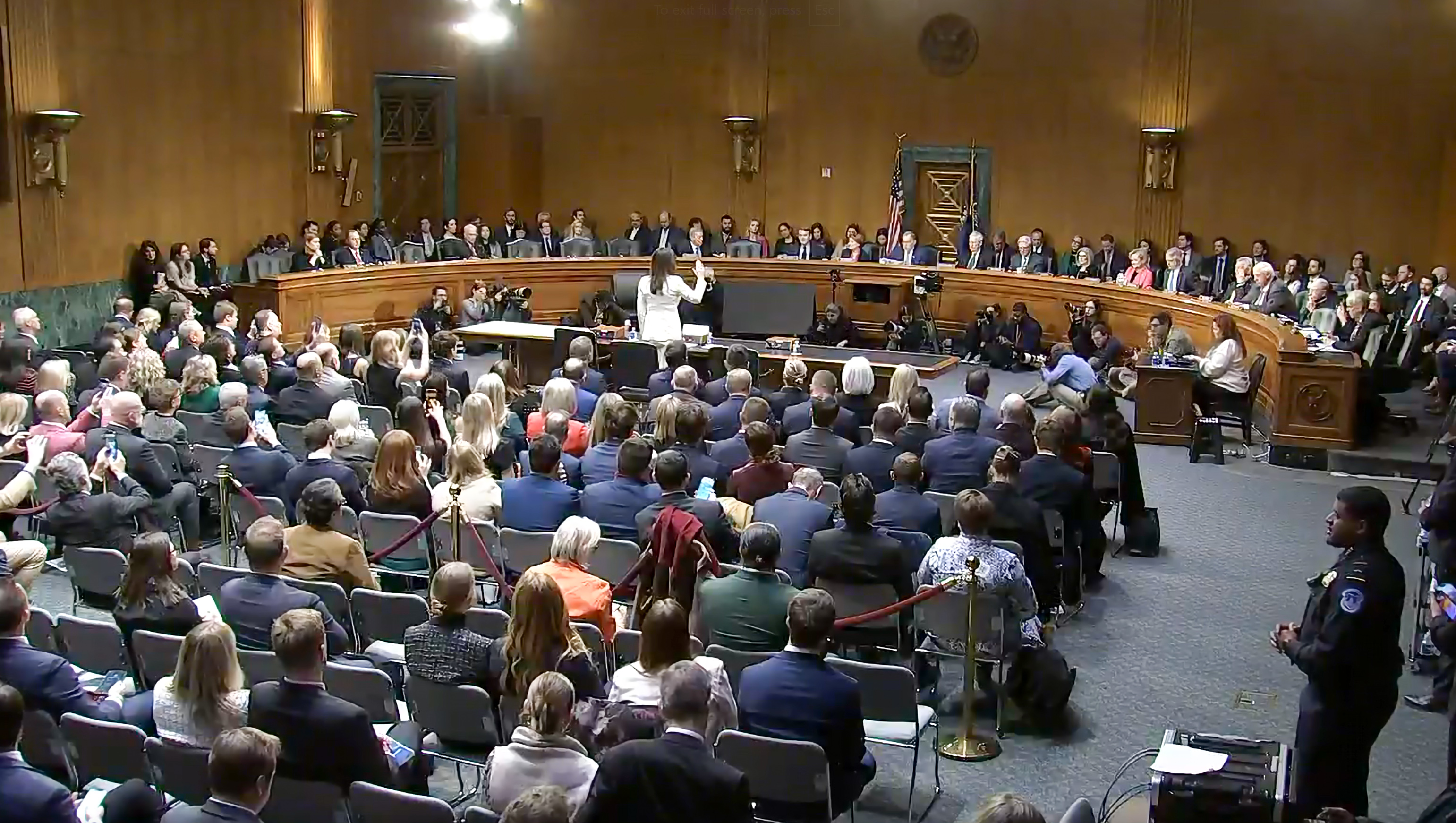
Brooke Rollins — now on Feb. 13, 2025 confirmed as the next Secretary of Agriculture and the second woman ever to lead the USDA — stands to be sworn in for testimony during her confirmation hearing before the U.S. Senate Ag Committee back on Jan. 23. She was joined by a room full of family, friends, colleagues, her high school Ag teacher, fellow 1990-91 state FFA officers, the little league softball team she coaches, and a pastor from Georgia who prayed with her and her family that morning. Senate Agwebsite livestream screen capture by Sherry Bunting

Rollins pledged ‘fast and furious’ first 100 days.

By Sherry Bunting, Farmshine, Jan. 24, 2025

WASHINGTON, D.C. — The growing U.S. Agriculture trade deficit was a key topic when on Jan. 23, President Trump’s nominee for Secretary of Agriculture, Brooke Rollins, gave testimony and answered four hours of questions before the U.S. Senate Committee on Agriculture, Nutrition and Forestry. 

(UPDATE: Rollins was confirmed by the full Senate on Feb. 13, 2025)

Along with the trade deficit, Senators were keen to talk about Trump’s trade policies and tariffs, while also asking questions that covered everything from immigration and the ag workforce, to biofuels, the farm bill, SNAP, WIC, and other feeding programs, as well as revitalization of rural communities and preparing the next generation.

Rollins even had an important exchange with Senator Roger Marshall, a medical doctor from Kansas, about bringing the choice of whole milk back to schools. (See related story here.)

Both Texas Senators John Cornyn and Ted Cruz introduced Rollins, calling her nomination “a no-brainer.”

She grew up in the small agricultural town of Glen Rose, Texas, where she was a barrel racer, a state FFA officer, helped make hay on the ranch, and raised and showed cattle in 4-H. She also spent some summers on the farm of extended family in Minnesota.

An admitted “policy wonk,” she earned her Ag Leadership and Development degree at Texas A&M and her Law degree, with honors, at the University of Texas School of Law.

“Everyone who knows Brooke, loves Brooke, and I know you will too as you get to know her,” said Sen. Cornyn.

Sen. Cruz highlighted her proven leadership, “profound appreciation for the challenges and rewards of life in agriculture,” reputation as an “independent policy thinker” and as a person who can “bring people together to accomplish major policy objectives.”

In her opening testimony, Rollins acknowledged that farmers and ranchers are currently facing  “extraordinary challenges.” 

She credited her FFA years for putting her on a course for where she is today and said it would be her great honor to “serve the men and women, who daily without pause or complaint provide our great nation and the world with the best food, fiber and fuel. It is clear farmers and ranchers are the cornerstone of our communities, and I will do everything in my ability to make sure (they) thrive.” 

When asked to describe her first 100-days, she used the words “fast and furious,” especially in delivering into the hands of farmers and ranchers the disaster and economic relief recently passed by Congress.

On biofuels, she noted the President included year-round E15 fuels in his energy emergency proclamation.

Pressed for hope on the current $45 billion U.S. Ag trade deficit. Rollins said a key priority will be to expand access to export markets.

“We are vision-boarding to hit the ground running to bring that trade deficit down. It is up 42% in the last year,” she said. “Agriculture is in a tough spot right now in moving our products out. The USMCA is up for renegotiation, and other trade agreements.” 

Rollins stressed that she will be working with Congress to be sure the White House and partners across agencies have what they need “to work across the world to bring in new trade partners to expand access to new markets.” 

At the same time, she addressed questions about the Trump tariff agenda, saying “This is no surprise. He believes it is a tool to bring America back to the forefront of the world. He also understands the potential devastating impact to farmers and ranchers. I have spoken with Sonny Perdue on how that was managed in the first term for something similar, to close any potential temporary holes.” 

Keenly aware that farmers “want trade not aid,” that they want to “grow markets not government payments,” Rollins said: “President Trump is a consummate deal maker. I believe that his skill and intense focus is on making deals for his people, not only for America, but for the Ag community that supported him at 90%. He knows that these are the people who have been with him the longest.”

Rollins served in the last Trump White House in key domestic policy roles. She is well versed in how Trump’s inter-agency process works, how discussions are handled, what the oval office meetings look like, and says she “will ensure our Agriculture community is strongly represented at that table.”

She gave the example of working with the incoming Labor Secretary, if confirmed, on the immigration and ag workforce needs, and asked the Senate to quickly confirm nominated undersecretaries to get the ball rolling.

Several Senators said they see Rollins, if confirmed, bringing this “value add” to the Ag cabinet position as someone who has been with the President for nine years. She knows how his White House process works and pledges to make sure “farmers will be at that table” with her job making sure “Agriculture is front and center where decisions are made.”

From trade and immigration to land management and regulation and from nutrition and hunger to preparing agriculture’s next generation, Rollins was clear: “We will follow the data, and we will listen to our farmers and ranchers as this is moving forward. We as leaders, as Agriculture, we will work together to understand and solve for these problems.”

Rollins cited these immediate priorities if confirmed as Ag Secretary:

— Ensuring disaster and economic relief that was passed by Congress at the end of 2024 is deployed quickly into the hands of farmers and ranchers;

— Working with the men and women of USDA and state leaders on animal disease outbreaks such as H5N1 in poultry and dairy cattle;

— Dedicating timely technical assistance to ensure a modernized farm bill moves forward that meets the needs of farmers and ranchers;

— Modernizing, restructuring, and re-aligning the U.S. Department of Agriculture;

— Supporting rural development to ensure rural communities are equipped and benefit from development of strong markets, including export markets;

— Eliminating burdensome and costly regulations;

— Preparing the next generation in agriculture; and

— Ensuring efficient nutrition programs for a healthy next generation.

-30-

Whole milk choice for schools takes center stage

Whole Milk for Healthy Kids Act reintroduced in style!

‘Most nutritious drink known to humankind’ takes center stage at Ag Secretary confirmation hearing

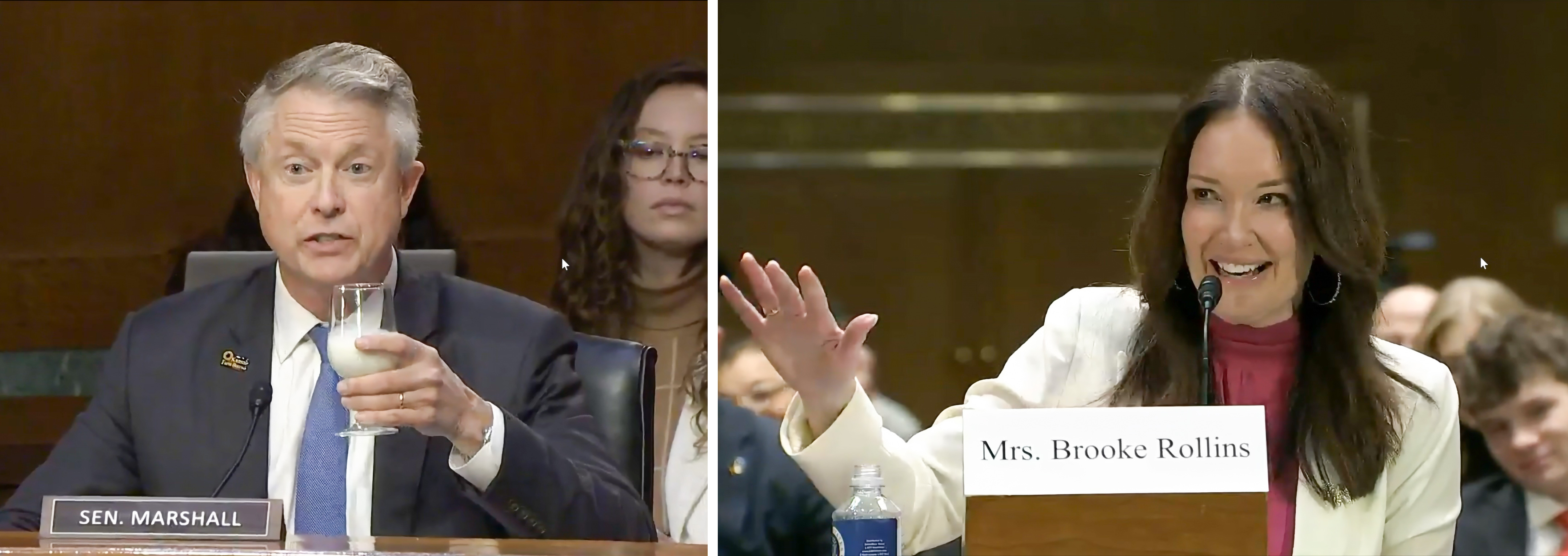
This split-screen moment captures Sen. Roger Marshall, M.D. and Agriculture Secretary Nominee Brooke Rollins during their confirmation hearing exchange on bringing whole milk choice back to schools. Sen. Marshall always comes prepared with THE MILK! Livestream screen capture by Sherry Bunting

From grassroots volunteers to halls of Congress, ‘hat’s off to 97 Milk’

By Sherry Bunting, Farmshine, January. 31, 2025

WASHINGTON, D.C. – It was the high point of the four-hour confirmation hearing on Jan. 23rd for President Trump’s Ag Secretary nominee Brooke Rollins, when Senator Roger Marshall, MD (R-Kan.) poured himself a glass of whole milk in front of the television cameras, and said:

Ms. Rollins, welcome. I want to know if you agree with me that whole milk is the most nutritious drink known to humankind and belongs in our school lunches.”

He then promptly took a big swig of nature’s nutrition powerhouse that American children have been banned from consuming at school meals since 2012.

Yes, there was a ripple of good-natured laughter throughout the room at the absurdity of it all – the absurdity that this nutrition powerhouse has actually been banned for 13 years on school grounds to even be bought with one’s own money from midnight before the start of the school day to 30 minutes after the end of the school day, per the 12-years of King Vilsack that Secretary Perdue’s interruption even failed to overturn.

The new Ag Secretary nominee Rollins responded with a hand motion to her mother two rows back among the family, friends, colleagues, ag teacher, fellow former FFA state officers and current little league team she coaches in attendance for the confirmation hearing, as she replied with a hearty and all-too-knowing laugh:

“Senator, I don’t know that you have met my mom – yet. But this is all we had in our refrigerator growing up – not anything else – just whole milk. She is absolutely never going to let us forget this – the fact that this is coming up! But yes, this hits home to me very quickly,” said Rollins.

On the very same day, whole milk champion U.S. Representative Glenn ‘GT’ Thompson (R-Pa.) with prime cosponsor and pediatrician Rep. Kim Schrier (D-Wash.), along with Senator Marshall and prime cosponsoring Senators Peter Welch (D-Vt.), Dave McCormick (R-Pa.) and John Fetterman (D-Pa.) led the re-introduction of the bipartisan, bicameral Whole Milk for Healthy Kids Act of 2025, known as H.R. 649 in the House with 90 total cosponsors to-date, and S. 222 in the Senate with 12 total cosponsors to-date.

The bill in its fifth attempt will allow unflavored and flavored whole (3.25 to 3.5% fat) and reduced-fat (2%) milk to once again be offered in school cafeterias, which are currently only permitted to have fat-free and 1% milk available for growing children, much of which is shunned or thrown away.

“Federal policy, based on flawed, outdated science has kept whole milk out of school cafeterias for more than a decade,” said Rep. Thompson in a Jan. 23rd press statement. “Milk provides 13 essential nutrients for growth and health, two key factors contributing to academic success. The Whole Milk for Healthy Kids Act of 2025 provides schools the flexibility they need to offer a variety of options, while supporting students and America’s hard-working dairy farmers.”

“As a pediatrician, I know how important a balanced and nutritious diet is for children’s health, well-being, and development,” added Rep. Schrier. “A healthy diet early in life leads to proper physical growth and improved academic performance and can set the foundation for lifelong healthy eating habits. Milk contains essential nutrients… This bill simply gives schools the option of providing the types of milk most kids prefer to drink.”

Sen. Marshall was blunt, saying, “(It) should never have been excluded from the National School Lunch Program. Now, 13 years after its removal, nearly 75% of children do not receive their recommended daily dairy intake. I believe in a healthier future for America, and by increasing kids’ access to whole milk in school cafeterias, we will help prevent diet-related diseases down the road, as well as encourage nutrient-rich diets for years to come.”

“Milk provides growing kids with key nutrients they need. Dairy is also an important part of Vermont’s culture and local economy, which is why our bipartisan bill to expand access to whole milk in our schools is a win for Vermont’s students and farmers,” said Sen. Welch.

Sen. McCormick said the bill “puts milk back in schools that growing kids actually want to drink. Pennsylvania’s dairy farmers supply this country (with it)… allowing schools to serve (it) in the lunchroom is just commonsense.

“Kids need it,” said Sen. Fetterman. “Let’s give them the option to enjoy whole milk again in schools – it’s good for them, they’ll actually drink it, and it supports our farmers. This bill is a simple solution that benefits everyone.”

Both National Milk Producers Federation (NMPF) and International Dairy Foods Association (IDFA) rushed to the forefront singing the bill’s praises and promptly issuing press releases, something that in past attempts took a little time.

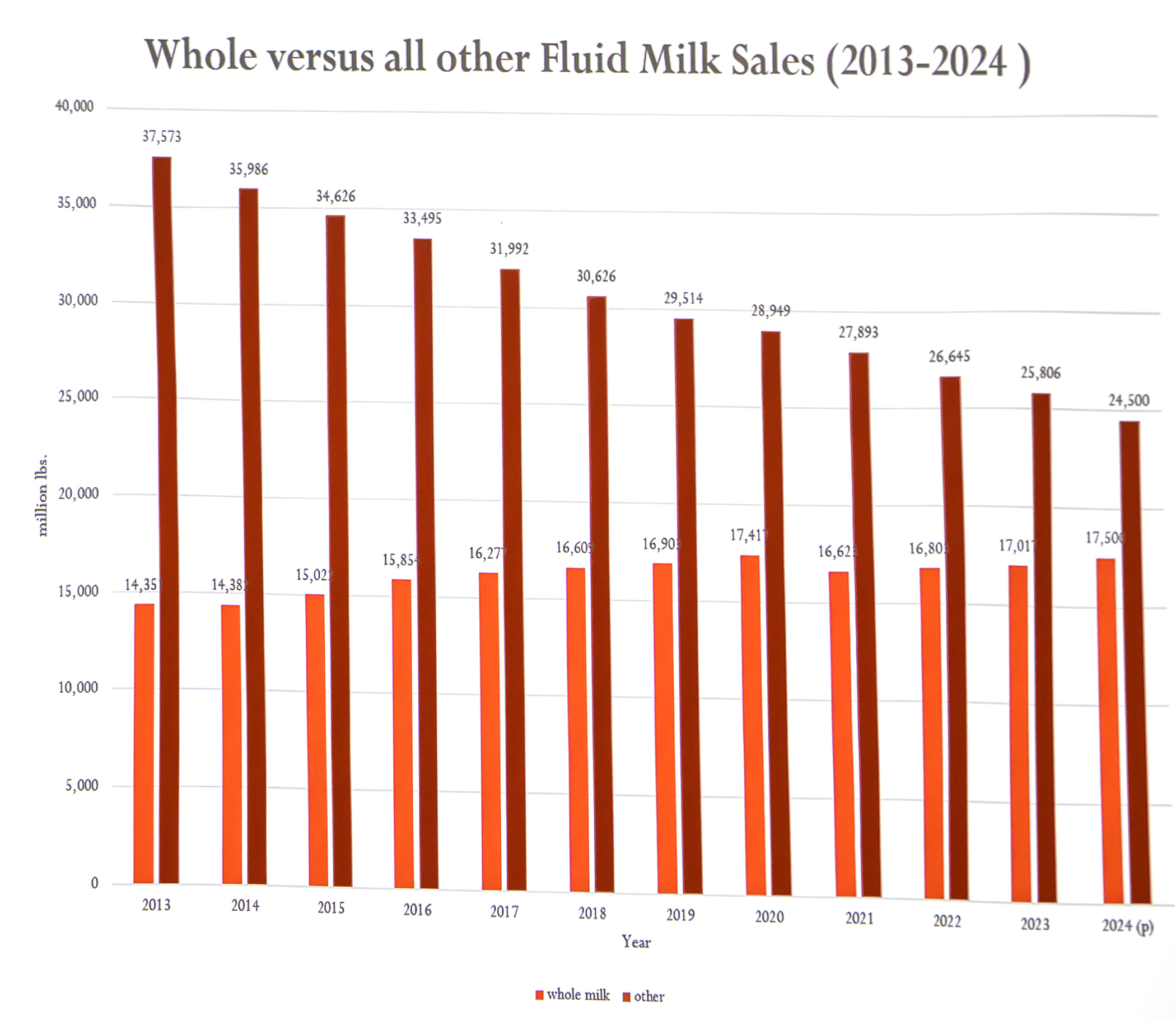
As longtime milk market guru Calvin Covington noted at the R&J Dairy Consulting seminar in eastern Lancaster County Jan. 28th, kudos go to the grassroots efforts. He showed the increase in whole milk sales nationally, while other fluid milk categories have declined. This has somewhat stabilized the steep losses the entire fluid milk category has suffered most steeply in the past 14 years. 

“My hat’s off to all of you and what you have done here in Pennsylvania, throughout the state and country, in promoting whole milk. I just wish other dairy farmers would be grassroots like you are and get involved,” said Covington. “Your work has paid off. Look at this graph. In 2013, whole milk sales were a little over 14 billion pounds. Last year (2024 with 11 months of data) I’m estimating 17.5 billion pounds. Whole milk is coming up, and everything else is going down.”

Covington dug into the graph (above) further to show that in 2019, the amount of whole milk sold was 16.9 billion pounds. “But look what happened in 2020, it jumped up to 17.4 and then back down to 16.62 in 2021. That was the pandemic. People were home. Schools were closed,” he said.

“When they were home, they drank good-tasting milk, but unfortunately when the schools opened back up, they had to go back to the other stuff. But my hat’s off to what you’ve done here. We’re selling more whole milk, and one thing people forget is that 100 pounds of Class I milk sales with higher fat content — last year it averaged 2.4 in this market compared to what it was 15 years ago when it averaged less than 2% — the more fat sold in Class I milk, the more income for you as dairy farmers. Class I butterfat is worth more than butterfat in the other markets, so my hat’s off to what you’re doing.”

(Author’s Note: Yes, Covington is speaking of the good work, the hard work, of 97 Milk volunteers who formed the non-profit in 2019 after dairy farmer Nelson Troutman’s painted bales began appearing. This good work is sustained by a handful of volunteers and donations. Just think what could be accomplished with more involvement. One of those volunteers is Jackie Behr of R&J, who puts her marketing skills to work for 97 Milk. She reminded farmers that donations are needed to keep the milk education movement going. An Amish Wedding Feast fundraiser is scheduled for Feb. 8 at Solanco Fairgrounds, with sponsorships still available. The next 97 Milk meeting open to all dairy farmers is March 25 at Durlach-Mt. Airy Fire Hall near Ephrata, Pennsylvania. Check out 97milk.com to learn more about the milk education movement, and hit the donate tab to find out how you can help.)

-30-

What’s the future for fluid milk?

Fluid milk sales are up, Whole Milk for Healthy Kids Act is moving. Meanwhile industry globalists put big bets on ESL, shelf-stable, with favor from Vilsack  

By Sherry Bunting, Farmshine, October 18, 2024

EAST EARL, Pa. — Protein is all the rage right now, and consumers are turning back to real milk as they realize its natural high quality protein benefits. Year-to-date fluid milk sales continue to outpace year ago, and that’s good news. Here are some key factors in the future of fluid milk in the U.S.

Fluid milk sales up!

July’s total packaged fluid milk sales more than recovered the June slump — in a big way, and August looks promising too.

USDA estimated packaged fluid milk sales at 3.4 billion pounds in July, up 4.3% year-on-year (YOY). This amplifies the pivotal year-to-date trend above year ago for the first time in decades (except the 2020 pandemic year).

Specifically, USDA’s Estimated Fluid Milk Product Sales Report for July, released in late September, noted conventional fluid milk sales total 3.7% higher YOY, with organic up 11.7%.

Conventional unflavored whole milk sales were up 4.7% YOY in July, while organic whole milk sales were up 17.1%.

Flavored whole milk sales were mixed because these sales rely upon what processors are willing to make and offer on store shelves, not necessarily reflecting what consumers want to buy. When fewer packages of whole flavored milk are offered, the full potential of sales are restrained.

Year-to-date (YTD) sales of all fluid milk products for the first seven months of 2024, at 24.7 billion pounds, are up 0.7% YOY, adjusted for Leap Year. Of this, YTD conventional whole milk sales for the first seven months of 2024, at 8.8 billion pounds, are up 2.1% and organic whole milk sales at 914 million pounds are up 12.6%.

The August report to be released in the coming weeks is shaping up similarly. August Class I utilization pounds reported last week by USDA are up 1.1% YOY and 1.1% YTD (Jan-Aug).

Making more fat, importing it too?

Meanwhile, the monthly World Agricultural Supply and Demand Estimates (WASDE) released Oct. 9 reduced its milk price forecasts for the rest of 2024 and into 2025, expecting Class III prices to fall from September highs as cheese price declines are expected to more than offset the higher whey prices.

This report is looking at all the major new cheese capacity coming online in the next 12 months, which is expected to saturate the cheese market to drive prices lower so that U.S. cheese makers can be globally competitive and continue exporting record amounts of cheese.

But is the milk available to do this? Likely not without robbing from Classes I, II and IV channels. Still, the WASDE forecasts lower Class IV prices also due to the abruptly declining butter price being only partially offset by the higher nonfat dry milk prices.

In short, dairy farms are making higher-fat milk, and the food industry is importing more milkfat, especially in the form of whole milk powder. WMP imports have been up by a record amount YOY in each of the past four years, especially 2024.

Restoring whole milk choice for kids!

Now would be a particularly good time for whole milk choice to be restored in our nation’s schools since we apparently have too much milkfat and not enough skim. Given this scenario, how can anyone in this industry still believe the whole milk in schools would hurt the industry’s ability to make enough butter and cheese. 

Unless it is excess butter and cheese that is needed to push prices down in order to continue beating record exports at reduced prices paid to farmers. 

Getting whole milk choice into schools would help. IDFA has been touting the Whole Milk for Healthy Kids Act. NMPF says they are on board too. This means the industry is united, right?

What are the chances that GT Thompson’s bill to bring whole milk choice back to schools will finally make it all the way to the President’s desk?

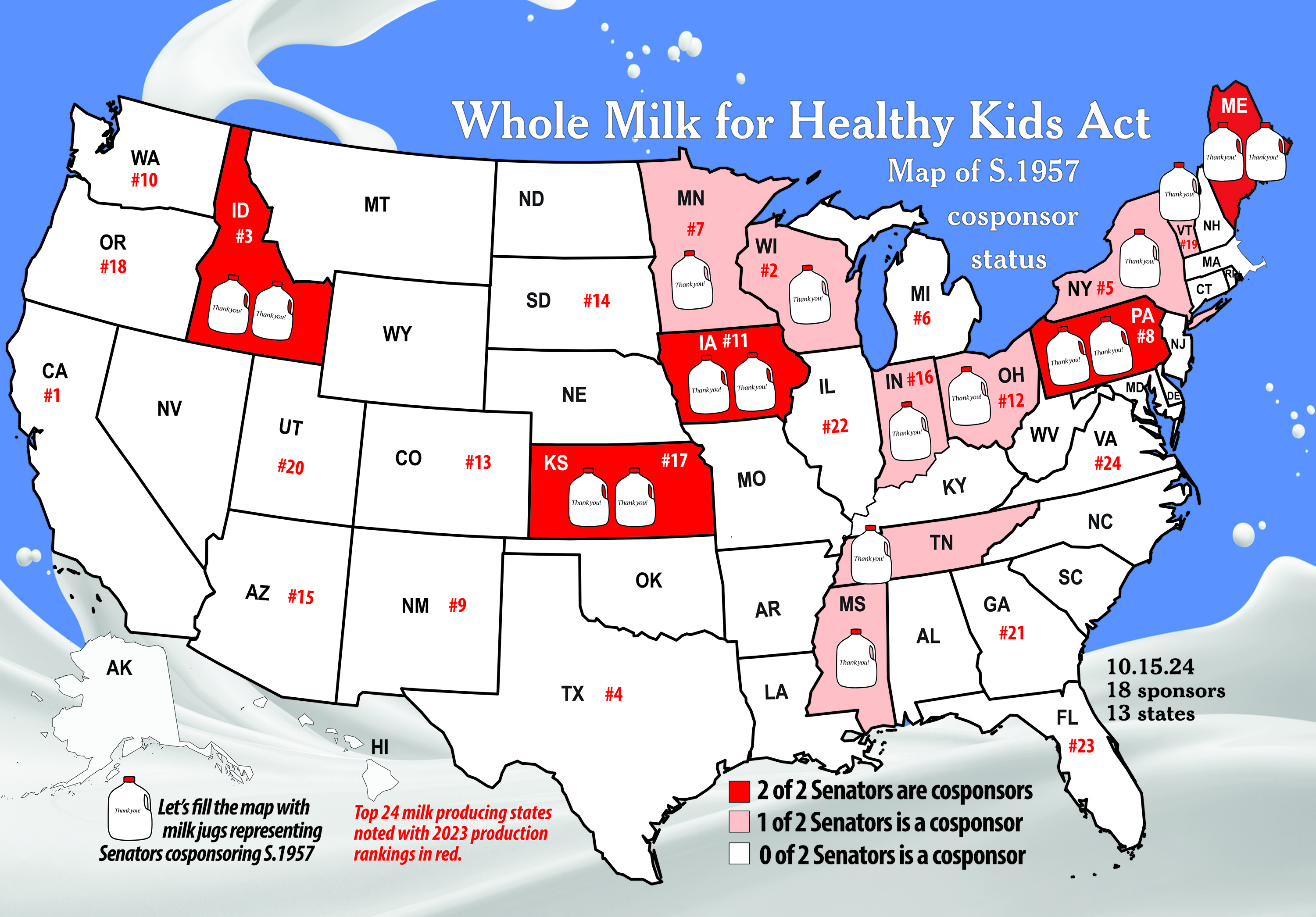
For starters, it passed the House by an overwhelming bipartisan majority last December. The Senate bill, S. 1957, has 11 Republicans, one Independent and five Democrats signed on, including notable Democrats such as Amy Klobuchar of Minnesota, Peter Welch of Vermont, Kirsten Gillibrand of New York, and John Fetterman of Pennsylvania who chairs the Senate Ag Subcommittee on Nutrition. 

The main sponsor is Republican Senator Roger Marshall of Kansas, a doctor. States represented are Pennsylvania, Vermont, Wisconsin, Idaho, New York, Iowa, Ohio, Indiana, Tennessee, Maine, and Mississippi.

In fact, Pennsylvania now has both Senators signed on. Senator Bob Casey Jr. (D-Pa.) is late to the party, but he has finally signed on as a cosponsor of S. 1957 on Sept. 19. It’s nice to see both senatorial milk jugs filled on the map for the Keystone State, but the bill needs more cosigners to fend off the blockade by Senate Ag chairwoman Debbie Stabenow (D-Mich.).

GT has included the Whole Milk for Healthy Kids Act in the House Ag Committee-passed farm bill. Word from Washington over the past few weeks is that a new farm bill is expected to get done after the elections in the lame duck session, and that GT will fight to keep the Whole Milk for Healthy Kids Act in the bill. Let’s hope so.

USDA: two movers for Class I?

Also related to Class I fluid milk sales, the dairy industry awaits a final decision on USDA’s proposed changes to federal milk pricing formulas, which includes a surprise for fluid milk: splitting the baby and adding a fifth class of milk in the form of two Class I mover announcements each month. 

The hearing record is woefully inadequate. No proposal. No evidence. No testimony. No analysis. No parameters. No definition. Even USDA’s own static analysis shows these two movers would be as much as $1 or more apart in any given month.

Fresh, conventionally processed (HTST) milk would go back to being priced by the the higher of the Class III or IV advance pricing factors to determine the Class I skim milk base price portion of the mover. 

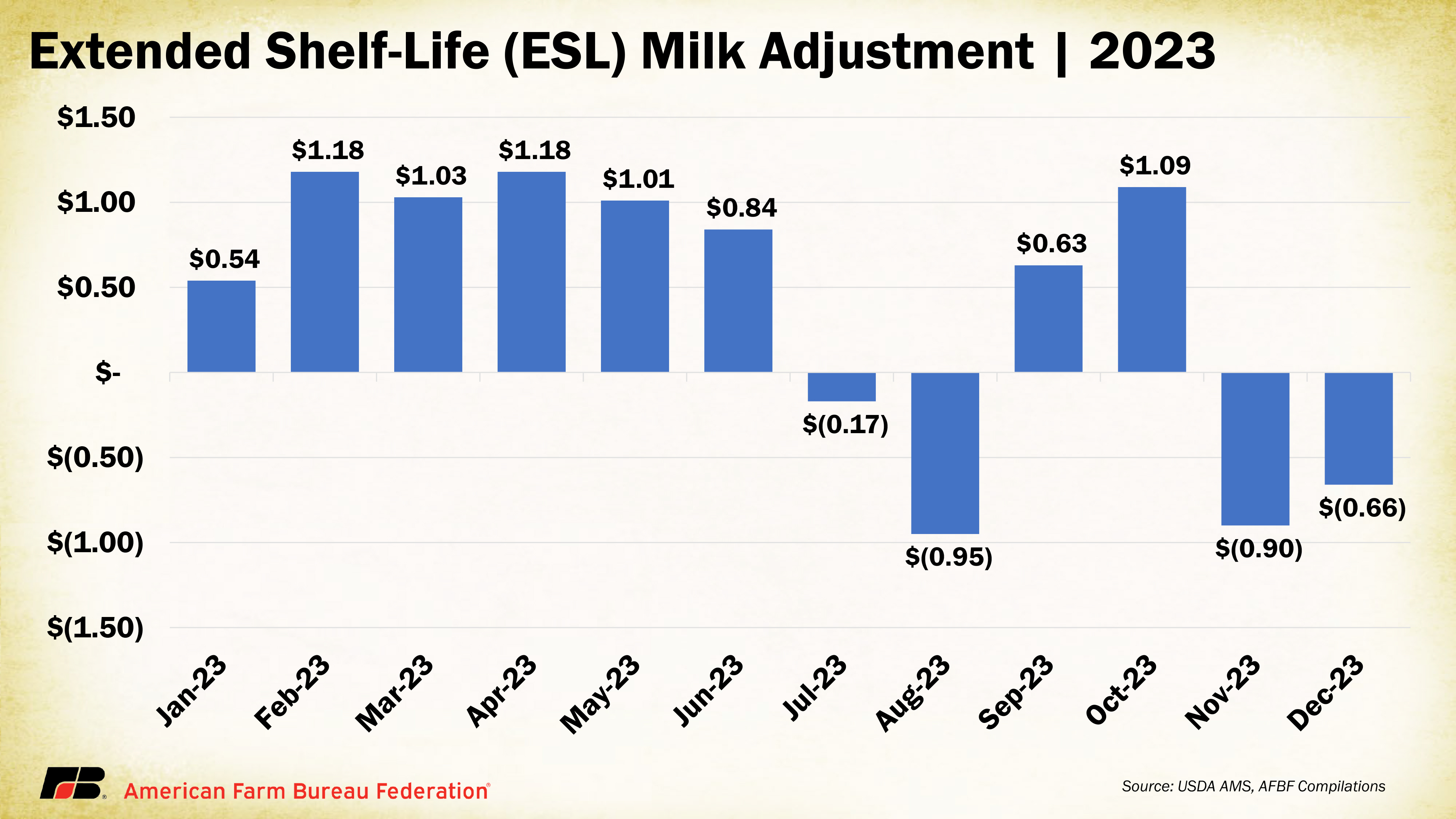
However, milk used to make extended shelf life (ESL) fluid milk products, defined only as “good for 60 days or more,” would continue to be priced using the average of these two pricing factors, plus-or-minus a rolling adjuster of the difference between the higher-of and average-of for 24 months, with a 12-month lag.

With two movers, fluid milk costs could be different for plants in the same location based on shelf life, with no clear definition for the new class, nor parameters established to qualify. Could we see label changes to move between movers?

Processors will know the rolling adjuster 12 months in advance, due to the “lag.” They will know the two advance-priced calculations (higher-of and average-of) a month in advance. They will have it charted in an algorithm no doubt and make decisions accordingly.

Farmers, on the other hand, will find out how their milk was used and priced two weeks after all their milk for the month was shipped. Those milk checks will be even less transparent than they are now.

Big bets on ESL, shelf stable

The dairy checkoff has openly identified ESL, especially shelf stable aseptically packaged milk, as its “new milk beverage platform,” using dairy farmer funds to research and promote it and to study and show how consumers can be “taught” to accept it.

The whole deal is driven by the net-zero sustainability targets. So, follow the money.

Dr. Michael Dykes of IDFA, at the Georgia Dairy Conference in January 2024, told dairy producers that “this is the direction we (processors) are moving… to get to some economies of scale and bring margin back to the business.”

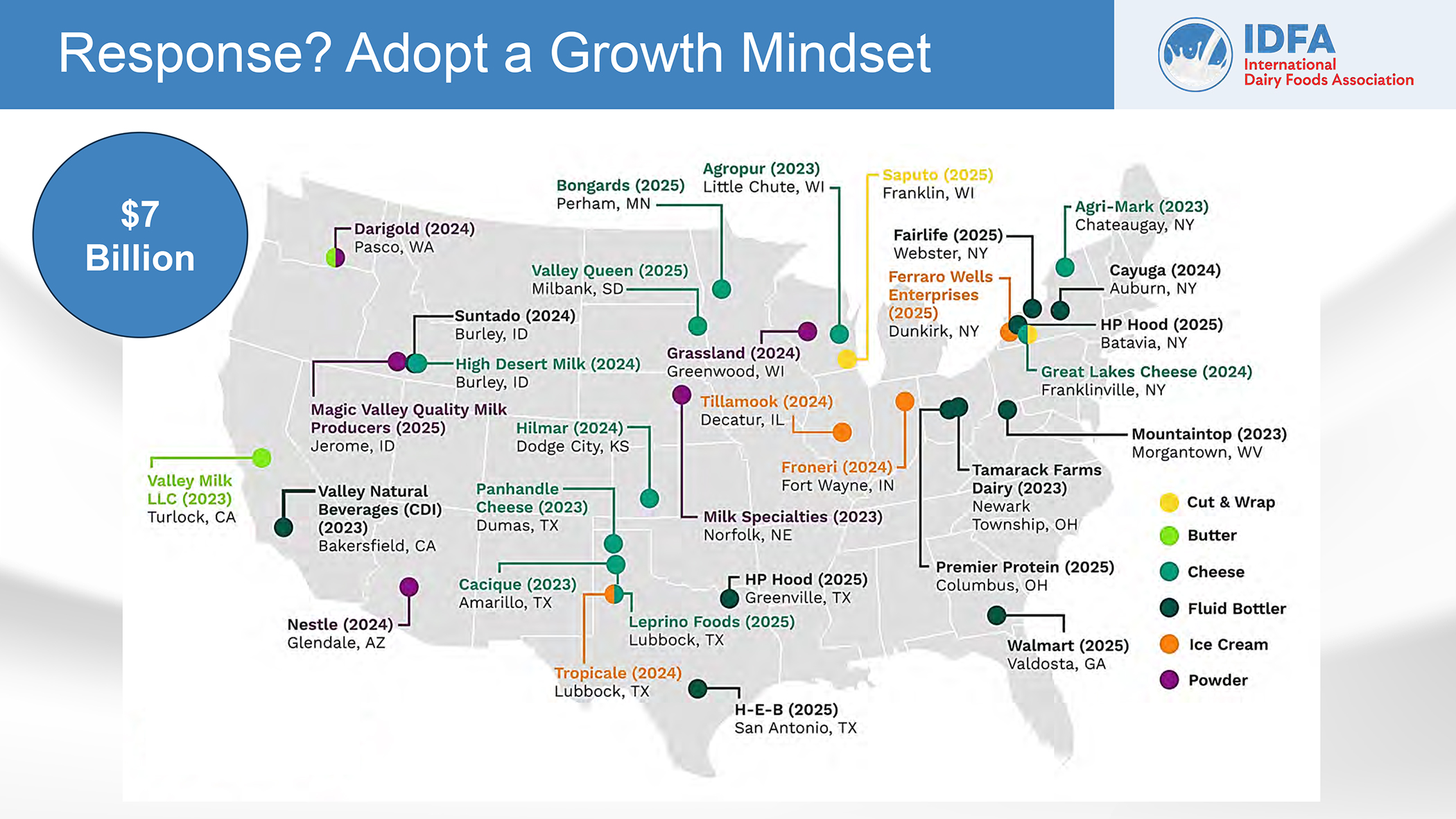
He said the planned new fluid milk processing capacity investments are largely ultra-filtered, aseptic, and ESL — 10 of the 11 new fluid plants on the IDFA map he displayed are ESL. Some will also make ultrafiltered milk, and some will make plant-based beverages also.

Meanwhile, the linchpin of regional dairy systems is conventionally pasteurized (HTST) fluid milk, prized as the freshest, least processed, most regionally local food at the supermarket.

To be sure, this two-mover proposal fits the climate and export goals set forth by the current Ag Secretary Tom Vilsack when he was working as the highest paid dairy checkoff executive in between the Obama and Biden administrations. 

The pathway to rapidly consolidate the dairy industry to meet those goals is to tilt the table against fresh fluid milk, something he already put a big dent in when removing whole milk from schools.

They decided thou shalt drink low-fat milk and like it. Apparently, they are equally convinced about ESL / shelf stable milk as the way of the future and will continue using mandatory farmer checkoff funds to figure out how to get consumers to like that too.

Just this week, the food writer for The Atlantic did a piece on shelf-stable milk, calling it “a miracle of food science” and lamenting in her Op-Ed that it’s a product “Americans just can’t learn to love.”

Author Ellen Cushing took jabs at America’s preference for fresh natural milk from a global perspective, without a thought for the local dairy farms and regional food systems that are tied to fresh milk. She states that by worldwide standards, other countries have gone shelf-stable milk, which she describes as “one of the world’s most consumed, most convenient and least wasteful types of dairy.”

Processors are making big bets on consumer conversion to ESL and shelf-stable.  There are cards to play in every hand. TO BE CONTINUED!

-30-

There is NO basis for two Class I movers in FMMO recommended decision!

AUTHOR’S NOTE: Who’s the wizard behind the curtain on USDA’s last-minute milk pricing surprise, the splitting of the Class I baby to favor ESL? Vilsack, of course, with a little help from his checkoff cronies at Midwest Dairy and DMI — masquerading as ‘dairy farmers.’

By Sherry Bunting

USDA’s recommended decision on Federal Milk Marketing Order Class I (fluid milk) formulas brought a big surprise getting very little attention. That surprise: “splitting the Class I baby” and adding what constitutes a “fifth Class” of milk — TWO Class I movers announced each month.

ZERO proposals to divide Class I into a two-mover system were aired at the national hearing. Even USDA’s analysis shows the two movers would differ by as much as $1 apart — or more — in any given month.

The hearing record is woefully inadequate, indeed completely void of testimony for a second Class I mover. No proposal. No evidence. No testimony. No analysis. No parameters. No definition.

What does this surprise two-mover decision mean? 

Fresh, conventionally processed (HTST) milk would go back to being priced by the prior method, using the higher of the Class III or IV advance pricing factors to determine the Class I skim milk base price portion of the mover. 

On the other hand, milk used to make extended shelf life (ESL) fluid milk products, defined only as “good for 60 days or more,” would continue to be priced using the average of these two pricing factors, plus-or-minus a rolling adjuster of the difference between the higher-of and average-of for 24 months, with a 12-month lag.

Confused yet? 

The industry is calling this surprise two-mover twist ‘innovative’ and ‘creative’, even ‘brilliant.’ But let’s hold the horses a moment. 

With two movers, fluid milk costs could be different for plants in the same location based on shelf life. Could processors change the label to move between the movers and pay whichever mover was lower? Who knows? There is no clear definition for the new class, and the parameters to qualify are non-existent.

ESL processors will know the rolling adjuster 12 months in advance, due to the “lag.” They will know the two advance-priced movers a month in advance. They will have it charted in an algorithm no doubt, and make decisions accordingly.

Dairy farmers, on the other hand, will find out how their milk was used and priced two weeks after all their milk for the month was trucked off the farm. If the two-price Class I system becomes law, dairy producers’ milk checks will be even less transparent than they are now!

Not only does the USDA hearing record and decision fail to clearly define ESL, the industry doesn’t even have an exact and generally-accepted definition or standard for ESL.

ESL is both a loose and specific term.

Generally speaking, ESL is a term covering a broad range of products — ranging from UHT (ultra high temperature) or ultra pasteurization, aseptic packaging, to the inclusion of a process that combines microfiltration, skim separation, and indirect heating (in stages). These processes yield what is more specifically referred to as ESL fresh milk with a longer shelf life in refrigeration, but is not shelf-stable.

What’s at the root here?

Dairy checkoff personnel have openly identified ESL — especially shelf stable aseptically packaged milk — as its “new milk beverage platform.” Dairy farmers’ promotion funds are being used to research and promote ESL milk, as well as studying and showing how consumers can be “taught” to accept it.

For the past few years, the four research centers supported by the checkoff have been drilling into milk’s elements to sift, sort, and test different combinations to reinvent milk as new beverages.

In 2023, North Carolina State researcher Dr. MaryAnne Drake —speaking at the 2023 Georgia Dairy Conference — talked about this “new milk beverage platform. We are after a shelf-stable milk that tastes great and meets our consumer’s sensory needs and our industry’s sustainability needs,” she said.

Bingo. Dairy checkoff funds for ESL are being driven by the net-zero sustainability targets. And now USDA’s federal milk order changes are proposing to lower dairy farmers’ Class I income and/or competitively favor, and in a way subsidize, ESL processors over fresh HTST fluid milk processors. Follow the money.

Dr. Michael Dykes of IDFA, at the Georgia Dairy Conference in January 2024, told dairy producers that “this is the direction we (processors) are moving… to get to some economies of scale and bring margin back to the business.” He said the planned new fluid milk processing capacity investments are largely ultra-filtered, aseptic, and ESL — 10 of the 11 new fluid plants on the IDFA map he displayed are ESL. Some will also make ultrafiltered milk and plant-based beverages too.

The linchpin to regional dairy systems and markets for milk from farms that fit USDA’s description of small businesses is the processing of fresh, conventionally pasteurized (HTST) fluid milk.

Meanwhile, dairy checkoff overseers, in cahoots with processors, are making big bets that consumers will embrace the obvious conversion underway to the consolidating shelf stable ESL milk, emboldened by the average-of pricing that has failed farmers miserably over the past five years and is now part of the proposed two-price Class I system mysteriously added to the USDA recommended decision when a two-price Class I system was never noticed as part of the hearing scope.

In the recommended decision, USDA notes that ESL currently represents 8 to 10% of total fluid milk sales but does not present the full picture of how the industry began aggressively converting to ESL since 2019 when Class I average-of was implemented. More of these accelerated investments will become operational in 2024-26.

Before we know it, the industry will have converted to ESL, and dairy farmers will once again experience disorderly marketing, depooling, and the basis risk of the mysterious average-of mover.

Dairy farmers have seen this movie before. 

In 2018, the average-of method — which changed how the Class I base was calculated — was portrayed by National Milk and the IDFA as “revenue neutral.” But at the recent national milk order hearing, testimony revealed that farmers experienced Class I revenue losses totaling nearly $1.25 billion from May 2019 through July 2024… and other impacts. 

Disorderly markets via the ‘average-of’ continue to result in losses and disrupt performance of risk management tools that fail to protect farmers against the intervals of extreme basis risk.

Proponents say the proposed rolling 36-to-13-month ESL adjuster on the second mover in USDA’s decision provides compensation to farmers for the difference between average-of and higher-of. However, that occurs gradually — over time — with a lagged interval. If tight milk supplies boost commodity prices and drive up all classes of milk, then dairy farmers’ incomes will at least partially lag years behind real-time markets!

ESL processors like Nestle and fairlife testified that the average-of method over the past five years allowed them to use Class III and IV hedges on the CME to offer flat 9- to-12-month pricing to wholesale customers and increase their sales. Nice to know the big corporations made money on that inequitable Class I pricing system.

Would a two-mover system ultimately reduce farmers’ access to milk markets in some regions and diminish the food security of those consumers? Watch the impact of a new, unregulated ESL plant now being built in Idaho!

Many legitimate questions lack answers

Milk is commonly prized as the freshest, least processed, most regionally local food at the supermarket. Will the USDA recommended decision accelerate consolidation and a reduction in fresh fluid milk availability for consumers?

Has USDA considered the purpose of the FMMO system is to promote orderly marketing and the adequate supply of fresh fluid milk? Will consumers accept the taste of the not-so-fresh ESL, or migrate faster to other beverages if fresh fluid milk is less available to them?

How will the two-mover system impact dairy farms located outside of the industry’s very specific identified growth centers? 

Will this perpetuate the wide divergence between Classes III and IV that has been an issue since 2019, further punishing dairy farmers with disorderly marketing and opportunistic depooling?

Who knows? The hearing failed to define, examine, or obtain evidence on any such questions… or any other questions that the hearing process is meant to be open to because this decision falls outside of the hearing scope!

Vilsack strikes again?

This proposal — a price break favoring ESL milk — fits the climate and export goals set forth by Ag-Secretary-then-DMI-executive-then-Secretary-again, Tom Vilsack. The pathway to rapidly consolidate the dairy industry to meet those goals is to tilt the table against fresh fluid milk. This is something Vilsack already put a big dent in by removing whole milk from schools.

It’s like one well respected veterinarian in the industry observed recently in conversation: “Someone decided: Thou shalt drink low-fat milk and like it.”

That “someone” is apparently equally convinced that the industry shall move to ESL and aseptic milk processing… while using dairy farmers’ checkoff funds to figure out how to get consumers to like that too.

-30-

Dairy biosecurity risks highlighted in two H5N1 data briefs

By Sherry Bunting, Farmshine, June 21, 2024

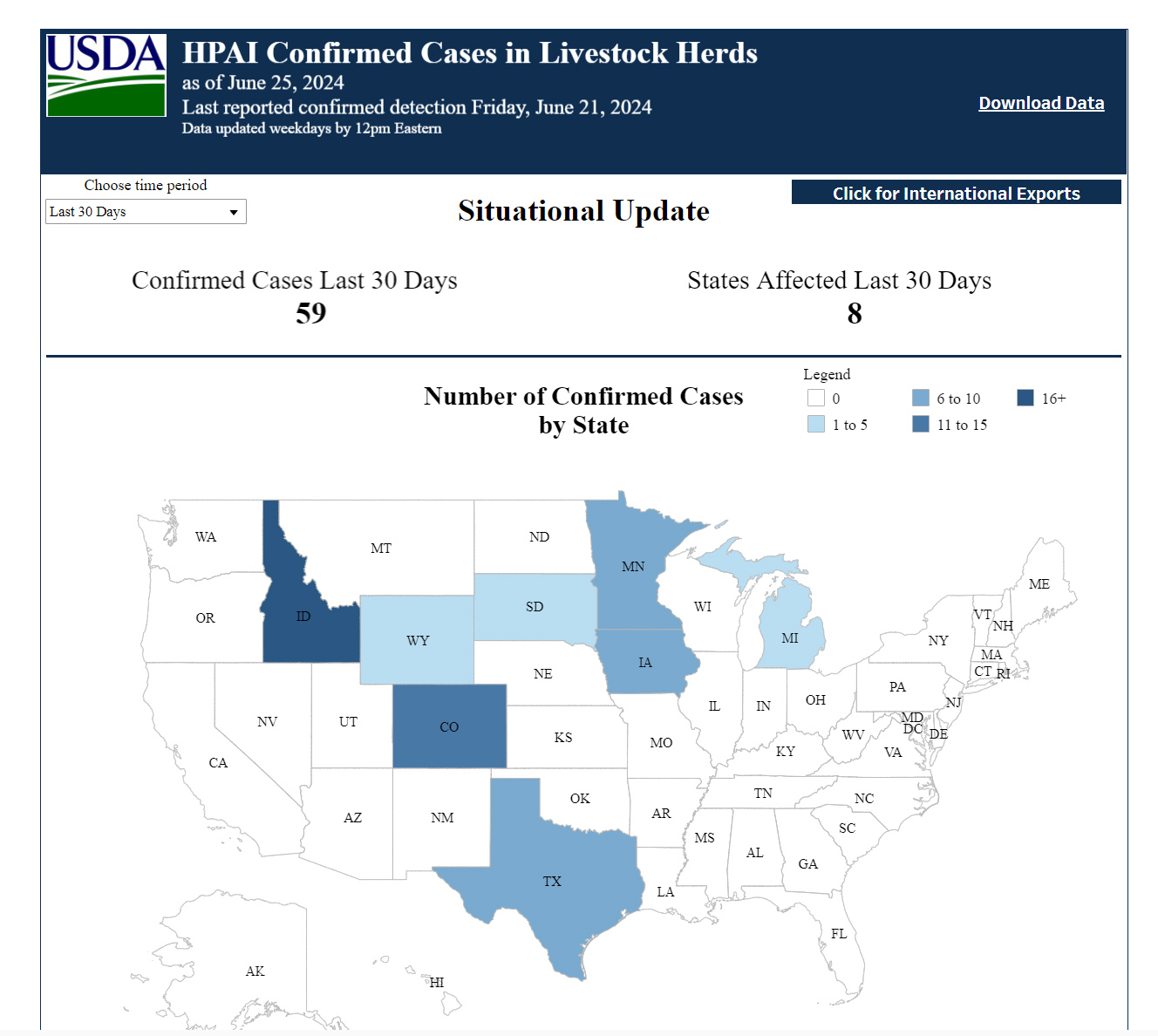
WASHINGTON – While 30-day detections of ‘bird flu’ in dairy have dropped to 59 herds in just 8 states (down from 116 in 12 states cumulatively), two epidemiologic studies published recently shed more light on dairy biosecurity risks.

Nationally, epidemiologic data were available for slightly more than half of the dairy herd premises affected by highly pathogenic avian influenza (HPAI), known as Bovine Influenza A / H5N1 in dairy cattle. These data reveal linkages reported June 8th in a National Brief, which reported “no genomic or epidemiologic evidence that wild birds are spreading H5N1 to cattle, but it cannot be ruled out.”

In fact, the key takeaway is that H5N1 spread in dairy cows — between states — is linked to cattle movements, not to independent wild bird introductions, with further local spread between dairy farms occurring in some states.

A similar epidemiologic investigation looked at Michigan data, alone. Published June 13, this report also showed that migratory waterfowl were not culprits in independently spreading H5N1 to cattle in Michigan.

Both Briefs note the disease spread between dairy cattle herds is likely multi-faceted with both direct and indirect transmission. Biosecurity remains the key to mitigation.

The National Brief reveals more than 20% of farms with HPAI detections in the data set had moved cattle into the herd within 30 days of clinical signs, and 60% of those farms continued to move cattle after the onset of clinical signs.

The linkages revealed by the Michigan report show it began via movement of infected cattle from a Texas herd, before H5N1 had been detected in that herd. It is then believed to have spread to other herds through cattle movement and other direct and indirect transmission.

Other linkages were discussed, such as visitors, shared vehicles and equipment and shared workers. (Fig. 4 below)

Employees working at more than one dairy farm or working at both dairy and poultry farms, and employees from one dairy or poultry farm sharing housing with employees working on a different dairy or poultry farm have also been noted in the epidemiologic linkages.

Operations sharing equipment and livestock trailers (62% of affected premises) have also been implicated in disease transmission as only 12% of those operations reported cleaning trailers between uses.

The National Brief reports more than 20% of the affected dairies have chickens or poultry present with nearly all of those farms observing sick or dead poultry.

In the national investigation, researchers report that more than 80% of affected farms have cats present, with over 50% of these farms observing sick or dead cats. However, the Brief provided no data — one way or the other — on whether the HPAI H5N1 genotype B3.13 was detected in cats on these premises.

The Michigan study, on the other hand, confirmed the HPAI H5N1 genotype B3.13 in wildlife and other somewhat domestic species on affected dairies.

Despite collecting a large number of samples from wild birds and animals on these dairies (such as cats, racoons, opossums, foxes, pigeons and starling), the number of individual animals and species detected was small. Whether they were affected by their access to cattle or are fomites in transmission to cattle is hard to say, particularly since the large sampling yielded only a small number of confirmed findings in comparison to the larger numbers of cows confirmed on these affected farms.

Both Briefs indicate risk from manure appears to be low, but more research is needed.

-30-

Pennsylvania announces voluntary bulk tank monitoring program as ‘bird flu’ spreads to Iowa, Minnesota

Status of H5N1 in dairy herds (cumulative with last date of detection noted) as of June 12, 2024

By Sherry Bunting, Farmshine, June 14, 2024

WASHINGTON – Bovine Influenza A / H5N1, known in birds and domestic poultry as highly pathogenic avian influenza (HPAI), has spread to dairy herds in three more states — Iowa, Minnesota, and Wyoming.

As part of emergency response plans, as many as 16 states, including Pennsylvania, are rolling out voluntary bulk tank monitoring programs as supported by USDA’s May 31 announcement for a federal pilot program.

As of June 12, 2024 (updated to June 21), there are no detections of H5N1 in dairy herds and no active HPAI in poultry flocks in Pennsylvania.

The USDA APHIS website confirmed 93 detections in dairy herds in 12 states since March 25, of which 47 have been confirmed in the past 30 days (as of June 12) in just 8 states (in order of most recent detection): Idaho, Minnesota, Iowa, Wyoming, Texas, Michigan, South Dakota, and Colorado. 

Of the other four states, Ohio and North Carolina are beyond 60 days since detection. Kansas and New Mexico reached 60 days on June 16.

During the monthly Center for Dairy Excellence call on June 12, Pennsylvania State Veterinarian Dr. Alex Hamberg said herd detections in other states have come primarily from “either sick cows or through epidemiologic tracing from positive farms.”

“It appears this is still a single bird to cow spillover that occurred in late 2023 and was not found until early 2024, so it spread out from there, and we’re now trying to catch up,” he said.

“Equipment, people, and cattle — that’s how this spreads. I can’t stress this strongly enough,” said Dr. Hamberg. Iowa is testing cattle close to positive poultry operations to provide data on species transfer risk.

Hamberg announced a Pennsylvania bulk tank monitoring program, supported by USDA. “This will be voluntary. The goal is to provide data of the status of the virus in Pennsylvania, or more likely the lack of it,” he said.

“We also need this data for quicker response time, and to protect nearby poultry farms. Even more important, is to provide a platform to engage concerned consumers and stakeholders to show we are addressing this proactively, that we are looking for it, that we have a plan, have it under control, and that pasteurized dairy products continue to be safe and wholesome,” he explained.

The status-enrollment period is three weeks, during which bulk tank and other samples will be taken. After three consecutive weeks of negative results, the dairy farm would achieve enrolled monitored herd status and continue weekly bulk tank samples thereafter to maintain that status.

An enrolled monitored herd with negative status would be able to move cattle without pre-movement testing, according to Dr. Hamberg.

“We are flying the plane while building it,” he said, noting early enrollment in the voluntary bulk tank testing program has already begun, so the testing can begin during the week ending June 21.

Those interested in enrolling can email RA-Ag_StateVet@pa.gov or call 717-307-3258. Or, to complete a web form for enrollment, go directly to this link 

The Center for Dairy Excellence has posted a downloadable enrollment form.

“We will then get back to you with an enrollment packet,” said Hamberg.

Hamberg said the May Exhibition Quarantine Order does not go into effect unless HPAI reaches dairies in Pennsylvania. However, effective now: Dairies within 3 kilometers (1.7 miles) of an HPAI-infected poultry flock cannot show dairy cows at fairs and shows. Currently, there are no active poultry infections in Pennsylvania.

Dr. Ernest Hovingh, director of the PADLS said testing is currently well under capacity and prepared to handle bulk tank monitoring.

For PADLS updates, visit http://padls.agriculture.pa.gov/InnerPages/HPAICattle.html

For details from the CDE call, to hear a recording, and see links to resources, visit https://www.centerfordairyexcellence.org/hpai-industry-call/

 -30-

USDA announces $824 million for H5N1, dairy herd monitoring pilot program launched as alternative to pre-movement testing

Status of H5N1 in dairy herds (cumulative with last date of detection noted) as of June 4, 2024

By Sherry Bunting, Farmshine, June 7, 2024

USDA announced new actions and $824 million in emergency funding from the Commodity Credit Corporation (CCC) to focus on highly pathogenic avian influenza (HPAI) known as Bovine Influenza A in dairy cattle, which is the H5N1 virus.

Call it what you will, these funds target HPAI in dairy cattle through data collection, surveillance, diagnostics, as well as vaccine research, and food safety studies to better understand and mitigate outbreak risk.

In the May 31 announcement, USDA also launched a new Voluntary H5N1 Dairy Herd Status Pilot Program to monitor the health of dairy herds and allow enrolled farms to move cows more quickly, while providing on-going testing that would expand USDA’s herd surveillance capabilities.

Dairy farms that enroll in the recently announced voluntary monitoring program would sign Herd Monitoring Plan Agreements to do weekly bulk tank testing, enabling them to move dairy cows across state lines without doing the individual pre-movement testing – as long as their weekly bulk tank tests show three consecutive weeks of negative results, and as long as they agree to continue the tests weekly going forward.

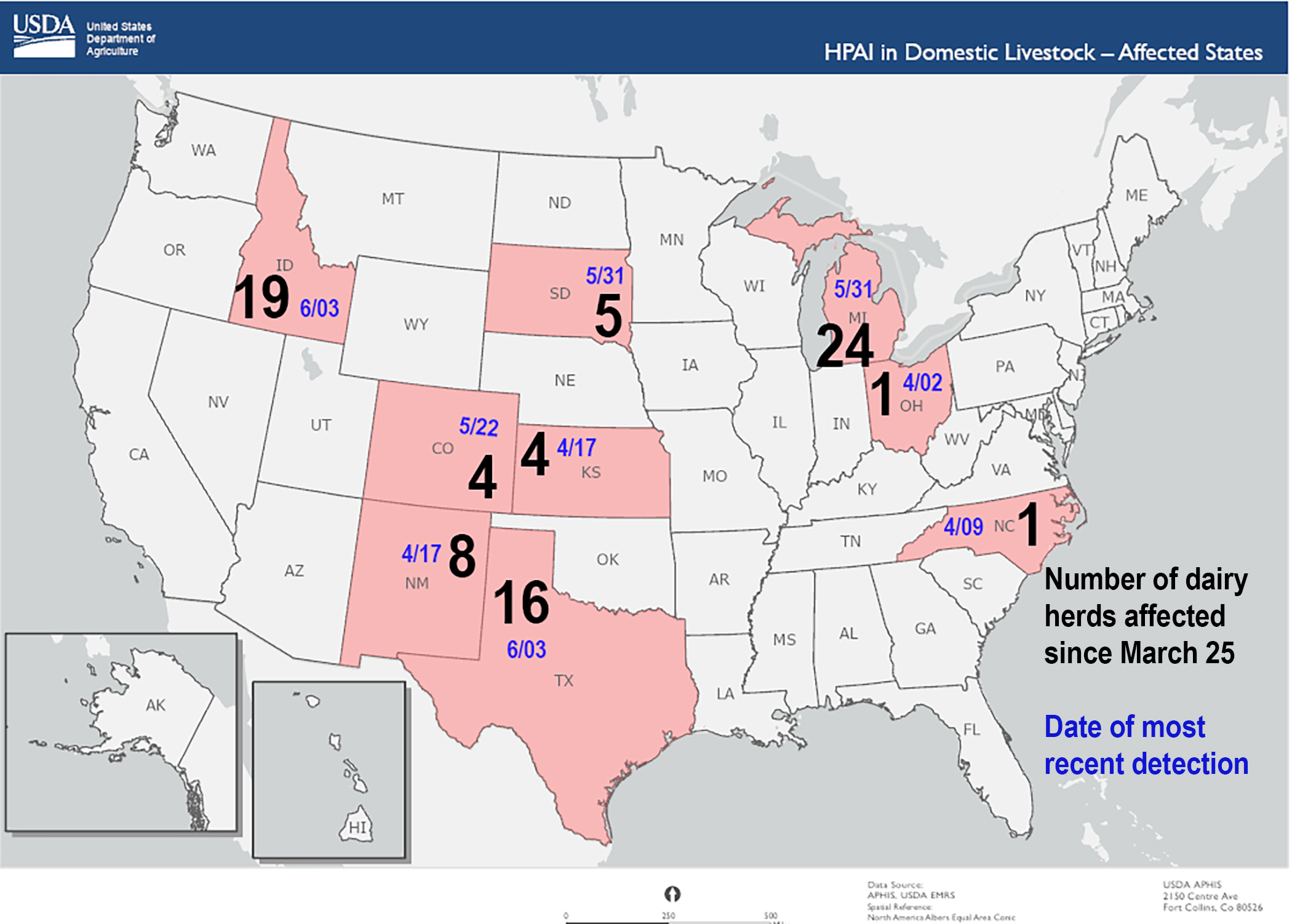
As of June 5, 2024, the APHIS website shows 82 total HPAI detections in dairy herds in 9 states since the first detection in Texas on March 25. 

Topping the list is Michigan with 24 detections, the most recent on May 31. Idaho saw a slew of new detections over the past 10 days with 19 total, the most recent on June 3. Texas has had 16 detections, the most recent on June 3; followed by South Dakota with 5 detections, the most recent May 31; and Colorado with 4, the most recent May 22.

States that have seen no new detections since April include New Mexico (8) and Kansas (4) with their last new detections on April 17; Ohio and North Carolina each only had one dairy herd detection on April 2 and April 9, respectively.

According to USDA, the new voluntary monitoring program will enable the Department to increase its monitoring and surveillance of herds that are currently not known to be infected.

APHIS is working with state animal health officials to identify states that want to participate in a pilot phase of the program. Producers from participating states can start enrolling this week (June 3), by contacting their State Veterinarian and signing a Herd Monitoring Plan Agreement.

USDA says high participation will help them establish state and/or regional “disease-free statuses” that could further ease compliance with the current Federal Order.

Those herds not enrolled in the pilot program would continue to follow the interstate testing and movement requirements published in the Federal Order. More specific guidance on the new voluntary monitoring program, including how to enroll and how to obtain and maintain a herd status, will be made available on the APHIS website in the future or by contacting state animal health officials.

USDA expects to see increased testing, yielding increased positive detections, through this voluntary monitoring, which they will analyze to learn how HPAI may spread between herds.

To-date, three people who worked with infected cows (two in Michigan and one in Texas) have tested positive with the H5N1 influenza. The symptoms were similar to pinkeye, and they recovered in a few days.

Meanwhile, the Federal Government has already put $200 million in additional funds into surveillance, testing, PPE, and vaccine development with indications they will ask Congress for more ‘bird flu’ funding.

Authorities still deem the risk to the general public as very low because pasteurization deactivates the virus, and no detections have been found in any retail meat samples. In addition, milk from sick cows is discarded and cattle at beef plants are inspected.

The $824 million will also support anticipated diagnostics, field response, other necessary surveillance and control, surveillance in wildlife (APHIS), work by the Agricultural Research Service’s (ARS) in developing vaccines for HPAI in cattle, turkeys, pigs, and goats, and food safety studies conducted by ARS and the Food Safety and Inspection Service (FSIS).

The Secretary is authorized to transfer funding from available resources including the CCC to address emergency outbreaks of animal and plant pests and diseases. The new $824 million is focused primarily on dairy cattle in addition to previously approved $1.3 billion in emergency funding to address nationwide HPAI detections in wild birds and commercial poultry operations.

More information is available at the designated APHIS page at https://www.aphis.usda.gov/livestock-poultry-disease/avian/avian-influenza/hpai-detections/livestock

States are moving to issue their own additional emergency response plans. In  Pennsylvania, for example, the Department of Agriculture recently issued its General Quarantine Order for the Exhibition of Dairy Cattle, which would apply to all dairy cows traveling to shows and exhibitions. This would ONLY take effect IF a detection is confirmed anywhere in the state. It would apply to all dairy cows traveling to shows and exhibitions. 

If that happens, the Order would require testing through the PADLS system within 7 days of the date of arrival at any animal exhibition grounds. Prior to arrival those dairy cows would have to be part of a biosecure assembled group for 30 days prior to testing with no new cattle added to that assembly.

Other quarantine measures are also detailed in the Pennsylvania Order, but again, would only be implemented IF HPAI is detected in dairy cattle in Pennsylvania.

The Center for Dairy Excellence will have its monthly conference call on the subject June 12 at 1:00 p.m. For information, go to the special events page at https://www.centerfordairyexcellence.org/about-the-center/upcoming-events/event/weekly-hpai-calls/

Feb. 16, 2024 Milk Market Moos in Farmshine: SHRINKFLATING DAIRY — steep loss of dairy farms, down 40%, and much, much more

By Sherry Bunting, Farmshine Weekly Column

Carrot… and stick?

Opening the Feb. 14th House Ag Committee hearing with USDA Secretary Tom Vilsack, Committee Chairman G.T. Thompson of Pennsylvania said the clear message he has heard as he has traveled across the country on farm bill listening sessions is that, “Agriculture needs government to work for them, not against them.”

Vilsack was pressed at least 8 times by 8 different members of the Committee for clarity and details on the Climate Smart deal. Representatives wanted an update on how the billions of dollars in Inflation Reduction Act (IRA) funds for conservation programs and Climate Smart Partnerships are making it directly to farmers.

Rep. Mary Miller of Illinois went so far to say the climate cult is a scam and pointed to what is happening in Europe, airing her concerns about incentives for solar panels on good farmland pricing farms out of rented acres. She expressed concern about getting farmers reliant on “environmental payments” instead of a food system that allows farms to succeed producing food, and she wondered about being beholden to the global climate-cult, which means (I’m paraphrasing) she is concerned about the stick that follows the climate-smart carrot.

While the purpose of these conservation and Climate-Smart IRA funds, said Vilsack, is to ‘get money to farmers,’ his update acknowledged that, “There’s a lot of work to do. We’re assisting and guiding (farmers) into participating,” he said.

“We’ve increased the number of people working at NRCS (1500 new hires, total 4000 new hires planned). We’ve entered into cooperative agreements so we have a broader reach (hire estimated 3000 technical staff through conservation partners), so that those who might not be able to understand that they qualify for the program are finding out,” Vilsack explained, noting that this is necessary in order to actually implement the Inflation Reduction Act.

(Translation: Money hasn’t gone directly to farmers so much as it has gone to program infrastructure, such as more USDA staff, partnership staff, and developing the herding routines to get farmers ‘guided’ on board for Climate Smart data collection and monitoring. In contrast, the IRA funds going to traditional and oversubscribed conservation program EQIP have largely been obligated to farmers at this point.)

“Roughly 85 to 88% of farmers in this country today require off farm income to be able to keep the farm. It’s about people who love what they’re doing and frankly want to do more of it, but they don’t have the income streams to support it, so they have to have an off farm job,” said Vilsack, defending the deal.

“To me, the key here is to create opportunities for that farm to generate more revenue,” he added.

Rep. Marie Gluesenkamp Perez of Washington State made the point that, “Farmers should not have to rely on value added ventures to survive, like agro-tourism or solar panel installations. These are ventures in their own right and should not be necessary for farmers to continue and pass on their farms to the next generation,” she said.

Rep. Doug LaMalfa of California pushed the point that farmers like the traditional conservation programs, like EQIP, but the IRA-funded Climate-Smart Partnerships deal for “tying up carbon is going to require them to jump through hoops,” he said, noting that no-till and cover crops aren’t possible on some types of farms, like rice production.

Vilsack countered: “It’s voluntary. It gives us the opportunity to figure out what works and what doesn’t work, and it doesn’t necessarily put people at a competitive disadvantage.”

He maintains that these projects “do not require farms to go through hoops and in some cases, it’s actually paying them for what they’re already doing.

“The idea here is to measure, monitor and verify the results so that we know what works and what doesn’t work, so that we don’t invest in what doesn’t work,” said Vilsack.

Congresswoman Abigail Spanberger of Virginia gave the example of a farmer in her district doing no-till and cover crops. Vilsack nodded and replied: “There is an opportunity, potentially, for that farm to qualify for ecosystem market payments. So, now, instead of just a crop, they’re going to get an environmental payment.”

That’s the carrot, where are they hiding the stick?

40% decline and a loss of 15,866 dairy farms in 5 years.

The number of dairy farms in the U.S. declined by 40%. That’s 4 in 10 dairies lost over 5 years. The 2022 Census of Agriculture Report released Tues., Feb. 13 held a bit of a surprise not seen on available summaries. Clicking through the ‘quick stats’, we learn that the number of dairy farms with milk sales on December 31, 2022 totaled 24,082, and the number of farms with milk sales but no milk cows or calves in inventory at the end of 2022 was 388 for a total 24,470 dairy farms with milk sales in the U.S. at the end of 2022.

It’s also 3,462 fewer dairy farms than the 27,932 licensed dairies reported as an average number for 2022 last February as part of the January 2023 milk production report.

(Note: The 2023 annual average dairy data that was included in the January 2024 Monthly Milk Production Report Feb. 21 pegged the average number of licensed dairies in the U.S. in 2023 at 26,290, down 6% from the annual report filed for 2022. The Census and NASS Milk Production Reports count some types of multi-site dairies under the same ownership differently. By the way, USDA revised the entire 2023 year of production lower yet for the fourth time, now revising 11 of the 12 months of prior data reported for milk production, cattle numbers, and output per cow. We questioned the figures all last year, asking where the cattle were coming from, pointing to cattle inventory numbers on heifer replacements a year ago indicating a shortage of freshening 2-year-olds, etc., and pointing to the substantial increase in Whole Milk Powder Imports into the U.S. and other factors USDA may have left unaccounted for in prior estimations.)

In Pennsylvania, dairy farm numbers declined from 6,914 on Dec. 31, 2017 to 4,027 on Dec. 31, 2022, that’s a 42% decline over 5 years. It’s also 973 short of the average number of licensed dairies reported by USDA NASS for the 2022 year.

The 2022 Census of Ag also shows that of the 24,470 farms with milk sales, 3,439 accounted for 59% of milk sales and 1012 accounted for 46%. This compares with the 2017 Census, which reported 3819 farms accounted for 55% of milk sales and 793 farms accounted for 43%.

We will dig into the national and state by state 2022 Census data relative to dairy in a future report.

In agriculture, overall, the 2022 Census of Ag shows a loss of 142,000 farms (down 7%) and a loss 20 million farm acres (down 3%) in the past 5 years.

Between 2017 and 2022, the number of U.S. agricultural producers held steady at 3.4 million, while the number of farms continued to decline at 1.9 million covering 880.1 million acres that generated food, fiber and fuel. Average age of farmers was up at 58 years. But the number of beginning farmers (over 1 million), increased also, according to the Report.

The number of small and mid-sized farms across all commodities declined between 2017 and 2022. Large (sales $1-5 million) and very large farms (sales of $5 million or more) increased in number. The 105,384 farms in those top two categories (sales of $1 million or more) represented fewer than 6% of all U.S. farms and sold more than 75% of all agricultural products. The largest farming operations and a small number of states accounted for the majority of agricultural production and sales.

The overall value of agricultural production and income increased between 2017 and 2022, according to the Ag Census. 2022 was a high year in agricultural price cycles, and government payments were still part of the economic calculus through prior CFAP and Pandemic Assistance. Milk made it into the top 5 commodities (at No. 5). Combined, the top 5 — accounted for two-thirds of the value of all agricultural production.

The value of crop production was $281 billion, up 45% in 2022 vs. 2017, while the value of livestock production (including dairy) was $262 billion, up 35% over the same period.

Shrinkflation this, shrinkflation that

The January Consumer Price Index (CPI) released Tues., Feb. 13 increased 0.3% on a seasonally adjusted basis. Over the last 12 months, the all items index increased 3.1% before seasonal adjustment. The food index, up 0.4% in January, increased 2.6% over the last 12 months. The food at home index was up 0.4% in January, and up 1.2% over 12 months, while the food away from home index rose 0.5% over the month and 5.1% over 12 months. The dairy and related products index is up 0.2% in January, down 1.1% over 12 months.

In contrast, the energy index fell 0.9% over the month, down 4.6% on the year due mainly to the decline in the gasoline index.

The Biden Administration announced intentions to investigate supermarkets for over-charging as the food index has not followed energy lower. What further complicates the food inflation indexes is that food commodities like milk and eggs have moderated while processed consumer packaged goods continue to inflate.

Another ripple is captured in the new term coined by food, ag, and business analysts — “shrinkflation” — meaning smaller packages, same price.

For farmers, shrinkflation is a good way to describe what is happening to milk margins. Yes the central feed and energy costs are moderating, but many other fixed and adjustable costs — from interest rates and insurance to supplies and services — continue to move higher, shrinkflating profit margins.

Meanwhile, the Census of Ag data showed big gains for farm revenue and net income in 2022 vs. 2017, but this unique comparison does not factor in the margin-squeeze in 2023, nor the impact of losing the last of the CFAP and Covid pandemic assistance payments that were still trickling into 2022.

In the dairy sector, the milk markets send mixed messages as the Class IV milk price sits $4 above Class III, with cheese being the market dog for the past 12 months. Yet milk is not moving from Class III manufacturing (cheese/whey) to Class IV (butter/powder). Why? New Class III manufacturing capacity has come online and will continue, needing to run full to turn a profit.

At the recent Pennsylvania Dairy Summit in a presentation about navigating the future, Phil Plourde of Ever.Ag highlighted the critical importance of exports to the industry. “Export or perish!” he said, focusing the admonition on the opportunities to export more cheese, including mozzarella.

IDFA CEO Michael Dykes in a presentation in January, issued the challenge to producers to fill the production gap that $7 billion in planned processing investments will bring online in the next three to five years.

Meanwhile, U.S. dairy farmers are seeing price pressure from a buildup of cheese via lackluster exports suffering from what are seen as inadequate trade policies and lack of new trade agreements.

Reflecting on the recently concluded FMMO hearing of 21 milk pricing proposals — some of which seek to reduce regulated minimum milk prices — we see processors are focused on a shrinkflated milk pricing system, shrink prices and inflate capacity because growth has got to happen.

They say USDA sets the regulated minimum prices too high, which must be reduced to ‘market clearing’ levels so they can have the freedom and band width to then be able to pay market premiums to their farmers.

On the eve of the Pennsylvania Dairy Summit Feb. 6, Cornell economist Dr. Chris Wolf talked about the recent FMMO hearing, noting that, “Regulated minimum prices are the whole deal right now. Premiums are gone.”

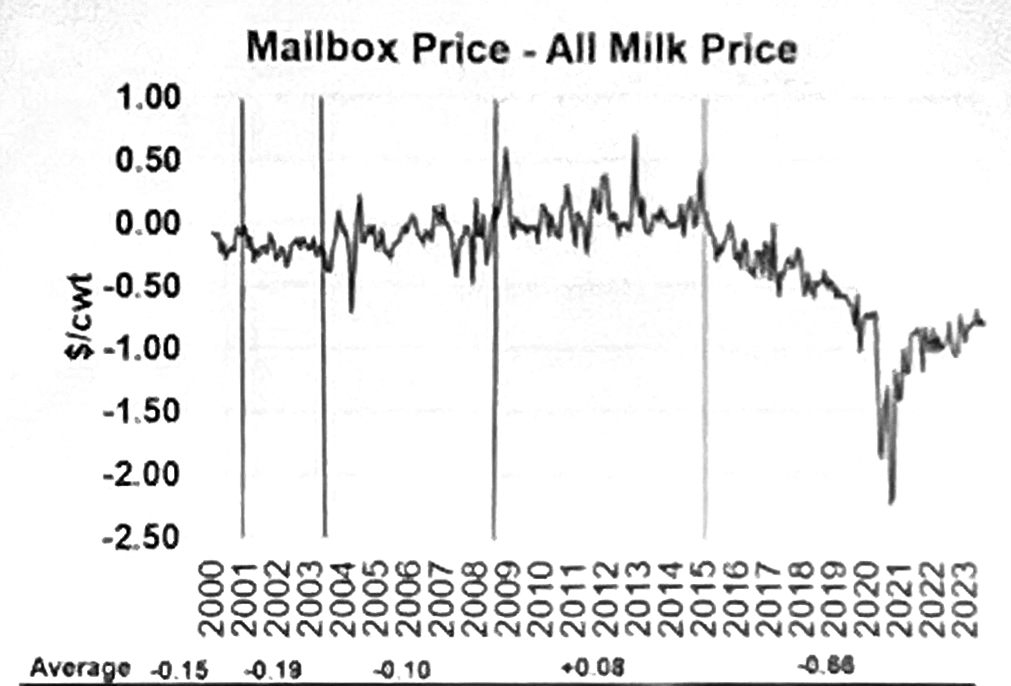
He showed charts tracking the difference between the All Milk price and Mailbox price (above), progressively negative since 2015, reflecting higher transportation costs and evaporation of over-order premiums, not to mention milk check assessments, marketing adjustments, balancing fees.

If regulated minimum prices are reduced, will processors voluntarily fill that gap by paying more premiums so producers have the financial wherewithal to fill the production gap?

Things are pretty bad for farmers right now in the milk markets that are based on cheese, where capacity has ramped up in the Central U.S., and where tough discussions are being had around kitchen tables about operating margins and the future.

Milk futures move lower

Milk futures were unevenly lower this week, with most of the downward pressure on first-half 2024 contracts for both Class III and IV milk. The spread between Class III and IV milk — according to this week’s CME futures markets continues to be range between $2.20 and $4.00 per cwt in every single month of 2024, well above the $1.48 mark where the ‘averaging’ formula is a loser for orderly marketing compared with the ‘higher of.’ On the close Wed., Feb. 14, Class III milk futures for the next 12 months averaged $17.91, down 10 cents from the previous Wednesday. Class IV milk contracts average was $20.57 — down 7 cents.

Back on the see-saw

The daily CME spot market for dairy products was mixed and mostly lower this week, except dry whey was higher and barrel cheese fully steady. Spot butter was pegged at $2.7175/lb, down a nickel from a week ago with zero loads trading. Grade A nonfat dry milk was $1.18/lb, down 4 cents with a single load changing hands. On the Class III side, 40-lb block Cheddar gave up 7 cents in Wednesday’s session, alone, when declining bids with no trades left the spot price pegged at $1.5150/lb, down 11 cents from the previous week. Barrel trade had moved higher earlier in the week, but a 2-penny loss Wednesday left the spot price firm on the week at $1.5750/lb with 2 loads trading. Dry whey at 52 cents/lb was 3 cents higher than a week ago with no trades.

-30-