Unknown's avatar

About Agmoos

I am a journalist writing primarily about agriculture for various newspapers over the past 30 years...and before that, I milked cows and tended calves and heifers. I am also a mother and grandmother with three grown children: A teacher, restaurateur and homemaker. Our two sons and one daughter all like to cook and they are food conscious... not paranoid. My "foodographic" Agmoos blog is a place to find stories and photos of the people and places behind the food we eat and for commentary and analysis on food, farm and marketing issues facing producers and consumers.

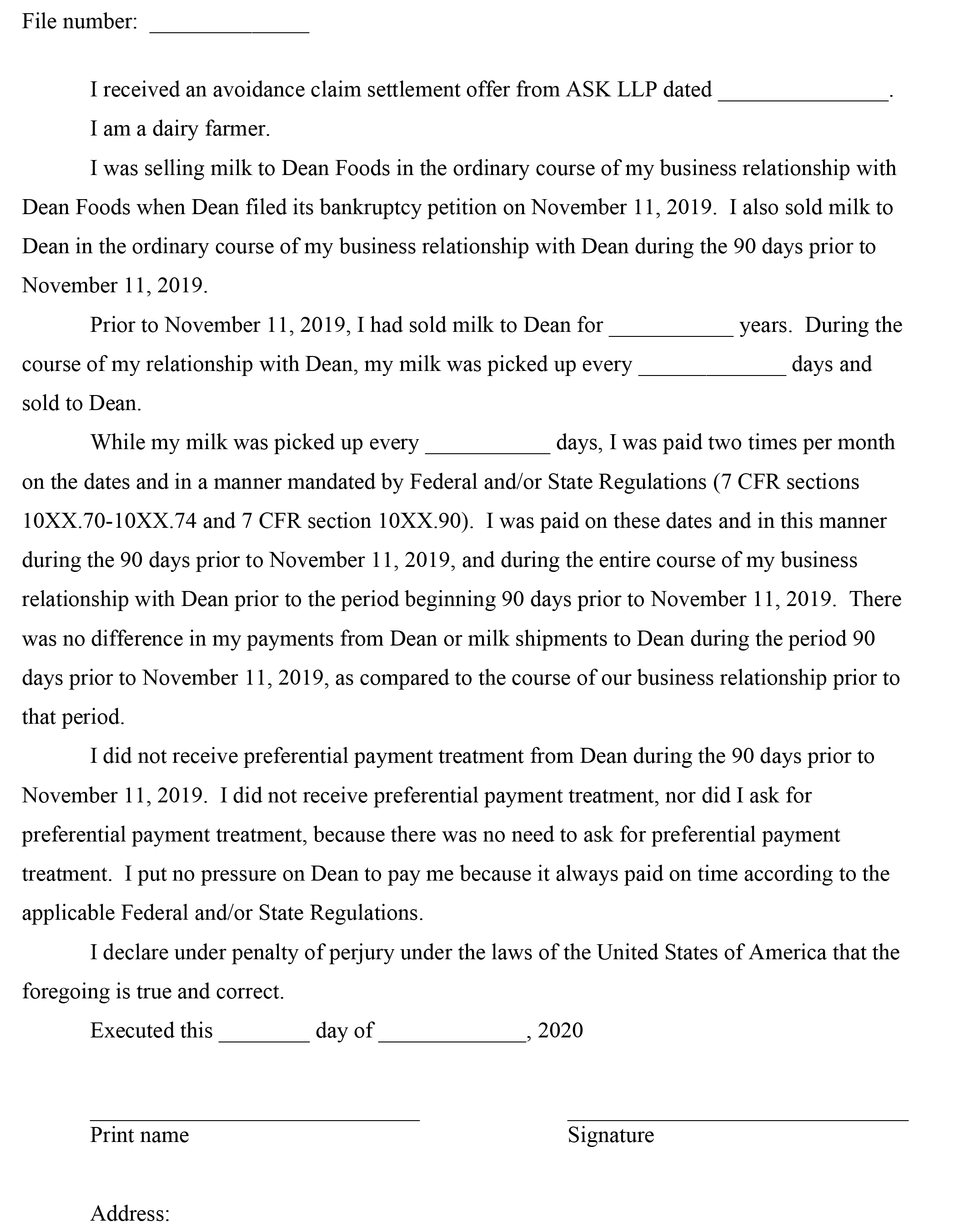
Did you get a ‘Dean estate’ demand letter from ASK LLP? Respond with this simple, approved ‘Declaration’

By Sherry Bunting, Farmshine, December 18, 2020

HARRISBURG, Pa. — U.S. Dairy producers and haulers who received letters from ASK LLP — the Dean Foods estate trustee seeking money back from producers and haulers paid prior to Dean’s bankruptcy filing Nov. 12, 2019 — should not pay, but will need to act on those letters. Many of the letters were received right before or after Thanksgiving and had deadlines of December 19 or 24.

Dairy producers and milk haulers have an air-tight defense, and now there is a simple one-page Declaration Letter any producer or hauler from any state can use as their response to ASK LLP. Explanation and form are downloadable at the Pa. Milk Marketing Board (PMMB) website at www.mmb.pa.gov or call the PMMB at 717-836-3115. (See below also.)

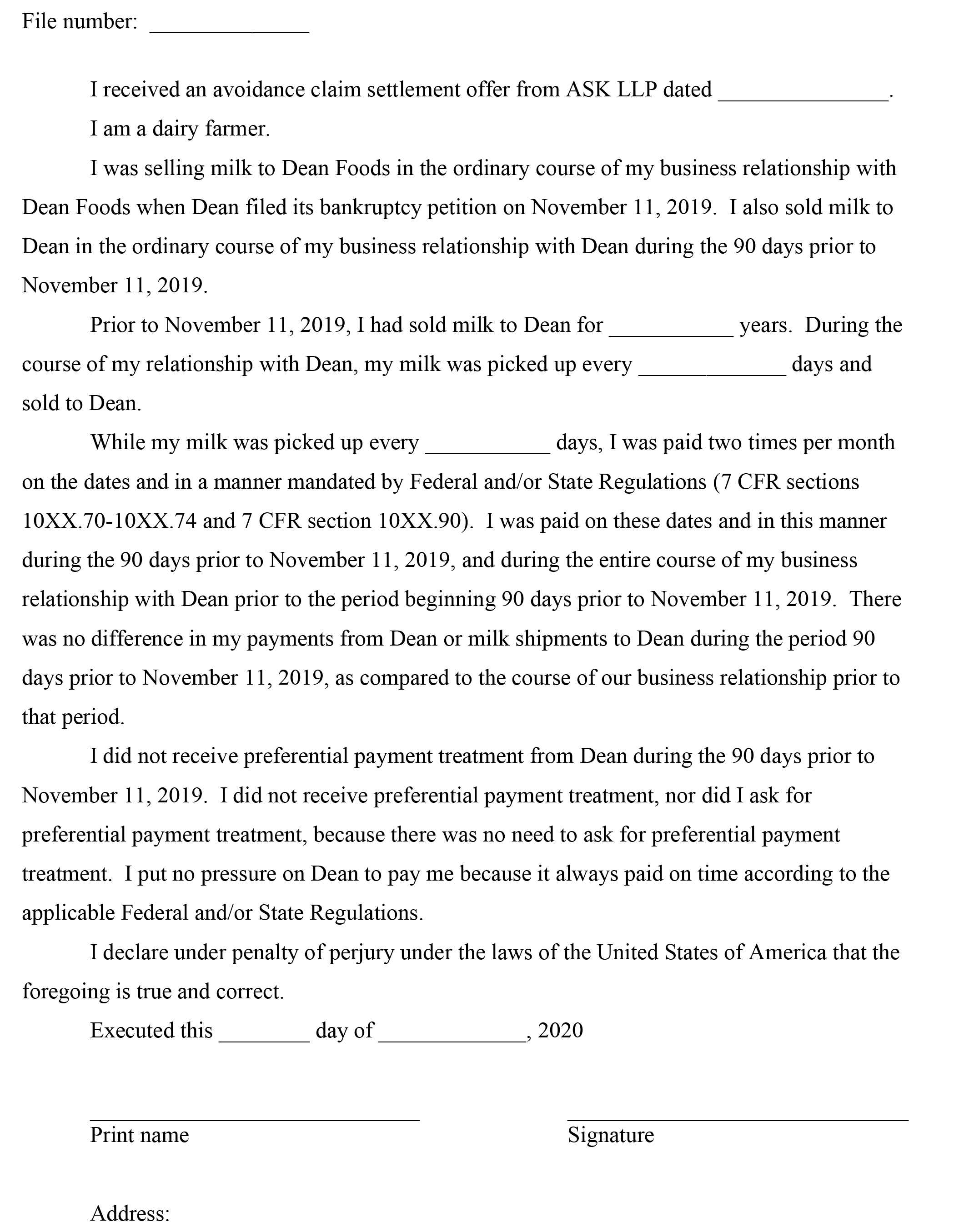
The Declaration Letters — one for producers (here at this link and pictured below) and one for haulers (here at this link) — were designed by PMMB chief counsel Doug Eberly — working with the state Attorney General’s office and verbally approved by ASK LLP for use by producers and haulers in all states.
“Please, please, please complete this Declaration Letter because it gets you off the hook. You will complicate matters if you don’t send them back,” said PMMB chairman Rob Barley in a Center for Dairy Excellence industry conference call December 10. “It will release you from this if you fill it out. We know it is an inconvenience, but if you don’t fill out the Declaration, you could risk losing that money.”

With hundreds of farmers on the Dec. 10 call, Eberly and others gave updates and answered questions. Here’s what you need to know:

1. Dairy farmers and milk haulers have an air-tight defense.

2. The Declaration Letters developed by PMMB for use in all states demonstrate this defense. Just fill in the blanks about how often milk was picked up and how long you shipped milk to Dean Foods, sign it and email or fax it back to ASK LLP.

3. The Declaration describes how payments for milk and transport are “ordinary course” of business.

4. The legal letters sent by ASK LLP to dairy farmers and haulers are ‘avoidance claims.’ These arise when a business nears the end of a bankruptcy proceeding. All payments made to creditors — including vendors and suppliers — in the 90 days prior to filing are liable for recovery, unless the recipient can show the payments they received were not preferential.

Eberly explained the theory is that some creditors of Dean Foods could have had bargaining power to get money pre-bankruptcy that was not available then to other creditors. This is known in bankruptcy law as “trustee avoidance.”

Bottomline: “ASK needs some kind of documentation from you because they have an obligation to the bankruptcy court to show — pursuant to the bankruptcy code — the things they are charged with doing as the trustee have been done,” said Eberly.

“Farmers kept shipping milk in good faith and kept getting paid for the milk in order for Dean to stay in business,” said Eberly. “If you are a producer or hauler, you received payments in ordinary course of business with Dean. They picked up your milk every day or every other day or you shipped it to them … and they paid you twice a month as the Federal and State Milk Marketing Orders specify. We wrote this in the Declaration that you can fill out, sign and send back to ASK LLP. Doing this, you will demonstrate to the trustee that you do not owe this money back because you were not paid in any preferential way when you got paid.”

In addition to the state Attorney General’s office, PMMB worked with the Pa. Secretary of Agriculture, Center for Dairy Excellence, American Farm Bureau and organizations and individuals from other states.

“ASK LLP has taken a lot of heat on this, and they want to get this behind them because farm groups came together to back the farmers,” said Barley. “We’ve worked with anyone who is able to help as we reached out to other states and they reached out to us and this helps them as well. We are unique to have PMMB in Pennsylvania, and this is a time it has shown brightly to have this in Pennsylvania.”

Eberly noted the insurance bond held by Dean, as is law in Pennsylvania, has already been exercised during the bankruptcy to pay producers, so it would not have been available to help farmers in this situation.

Pa. State Representative Frank Ryan of Lebanon County was also on the call. He specialized in bankruptcy as a certified public accountant before being voted into the state legislature. “These types of ‘demand letters’ are common in bankruptcies,” said Ryan. “They are trying to determine a ‘preference period’. I can’t imagine that any dairy producer got any preference payment or was treated better than someone else (ahead of the bankruptcy).”

Ryan gave an example: “Say I am owed money by Dean for services (as a CPA) on a 90-day invoice. And say you as a farmer did a contemporaneous exchange of something of value (milk) for payment and you are paid every 14 days. You get preference over me. That’s ordinary business. But, if Dean paid me ahead as a CPA for a 90-day invoice instead of you for that contemporaneous exchange of milk for payment, then the trustee would come back to me for payment.

“The Declaration Letters are intended to help producers demonstrate that they do not have to pay that money back,” he said.

If someone went ahead and paid the settlement offer in the ASK LLP letter, Ryan said it may be difficult to get that money back. Using the Declaration and hiring an attorney might be successful to get a settlement payment back. American Farm Bureau and others are looking into this to determine if any producers paid the settlement offer in the letter.

Specific questions and answers handled in the group call Dec. 10 include:

Q.  Do the documents on the PMMB website at www.mmb.pa.gov only apply to Pennsylvania, or can other farms from other states send them in?

A. “It is very important that everyone know about these forms because farmers and haulers from other states can use them,” Barley answered.

“We did not make these forms PA-specific,” said Eberly, noting that he has talked with folks from the Kentucky Dairy Development Council, Vermont Attorney General’s office, Michigan Department of Agriculture, and AgriVoice on behalf of several entities in Tennessee.

Q. If I filed a critical vendor contract with the bankruptcy court to be paid during the bankruptcy, is that enough to prove I did not get preferential payments before the bankruptcy?

A. Short answer: No. Eberly stated he is not giving legal advice; however, the critical vendor agreements signed by dairy producers and haulers were standard forms that do not address the points ASK is asking for. On the other hand, the Declarations PMMB got approved are specific to the way milk plants do business with farmers and haulers.

“If you are a dairy producer, the way you prove you did not get preferential payments is you either send all the records that ASK LLP has asked you for, or you send in the Declaration Letter we put together to take care of it. This Declaration Letter is the most efficient way to do that,” said Eberly.

Q.   Do the Declaration Letters PMMB provided need to be submitted by an attorney?

A.  The Declaration Letter is designed in a way that a dairy producer or hauler can simply fill it out and send it back by email, fax or postal mail — on their own.

Eberly explained that while a person or corporation can’t really represent itself in bankruptcy court, only through an attorney, these Declaration Letters are not going directly to the bankruptcy court. They are going to the law firm (ASK LLP) and will be part of what they show as fulfilling their obligation with the court as trustee.

Q. Who, specifically should the Declaration be sent to?

A. At the top of every demand letter received from ASK LLP is the name, phone number and email address for the paralegal to which your file number has been assigned. Different letters have different names their ‘matter’ has been assigned to. Email your signed Declaration to that person, said Eberly.

There is also a fax number on your packet. That number is 651.406.9676. “Be sure to put the fax to the attention of the paralegal that has been assigned to your particular file,” said Eberly. (If using postal mail, get delivery confirmation or certify the letter.)

Q. Who should sign the Declaration?

A. Whomever has authority to sign on behalf of the farm or hauling business — whether as a single-family sole proprietor, multi-owner LLC or incorporated business — should sign the Declaration.

In general, said Eberly, if three members of an LLC sign other documents for the farm, then they would sign this. If one person for an incorporated farm signs other types of documents, then that’s the person who would sign this. If a farm received separate letters for separate farm locations, return a Declaration Letter in response to each letter received from ASK LLP.

If more than one person legally signs documents for the farm, just cross out ‘I’ and write in ‘we’ with a pen. Do not retype the Declaration, according to Eberly.

Q. Do I need to send anything with the Declaration?

A. The PMMB’s understanding is that filling out the one page Declaration Letter, alone, is sufficient.

Q. What happens if we do not respond to the letter from ASK LLP? Is it possible the entire claim will be dropped on its own?

A. Everyone on the call stated that ignoring the letter is unwise and risky.

“I would caution you not to ignore the letter,” said Rep. Ryan. “Absent the response with this Declaration, it will be in the hands of the court. If you ignore it, and they determine you owe the money, you will get an immediate judgment against you and they (the bankruptcy court) have incredibly powerful ways to get those funds.”

With the Declaration available, there’s no reason to ignore this. Dairy producers and haulers have an efficient, simple way to take a big step to put this behind them.

Q. What is the deadline to submit the Declaration Letter?

A. Submit it by the date on your letter from ASK LLP. Some say Dec. 19, others Dec. 24. Whatever your date is, submit your Declaration by that date. As Dean estate trustee, ASK LLP, will begin filing these claims with the bankruptcy court in January.

Q. Do I need to submit a Declaration Letter if I provided a paralegal with their requested information already?

A. “I would call the paralegal and ask if they had a chance to look at it and make a determination, and I would also submit the Declaration Letter just to be on the safe side,” said Eberly.

Q. What should lenders and others do who received assignments from milk checks direct from Dean Foods if they received these letters?

A. Since everyone is operating under the belief that producers won’t owe money back, then their assignees should not owe money back either because the assign would not have been paid except for the farmer getting paid.

Eberly noted that lenders have access to legal people and accountants to answer questions for them, but producers who had money paid directly to someone out of their milk check should contact them to see if they got a letter and tell them what is being done. Contact the paralegal listed on the ASK letter and let that person know your assignee got a letter and to piggyback your Declaration to cover them as an assignment from your milk check.

A longer version of this article appears here.

-30-
Announcing Vilsack as Ag Sec pick, Biden admits: ‘He helped develop my rural plan’

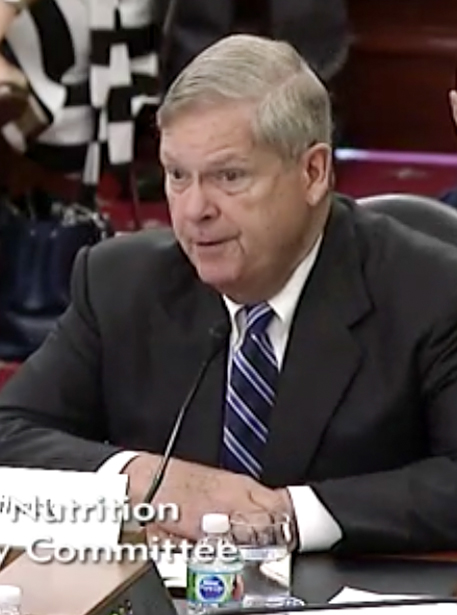
Tom Vilsack is pictured here testifying before the Senate Ag Committee in spring 2019 announcing ‘It’s time to get to net-zero.’ He was testifying then as a dairy checkoff executive for DMI serving as president and CEO of USDEC and defacto leader of DMI’s Innovation Center. This week he was officially announced by President-Elect Joe Biden to come back for another term as U.S. Agriculture Secretary, where ‘It’s time to get to net-zero’ is the Biden rural plan Vilsack helped develop while pulling a $1 million salary from mandatory dairy farmer checkoff. Photo by Sherry Bunting

By Sherry Bunting, republished from Farmshine, Friday, December 18, 2020

BROWNSTOWN, Pa. — President-elect Joe Biden this week officially nominated former Iowa Governor and former U.S. Agriculture Secretary Tom Vilsack, a lawyer by trade, to return as Ag Secretary in his administration. This nomination will likely be a fast walk through Senate confirmation, given the supportive words this week from American Farm Bureau and prominent Ag Senators from both sides of the aisle. 

But some responses from a few organizations and grassroots efforts, as well as some Senators, are less than supportive or outright aiming to stop the confirmation. Some, because they see the choice as one that does not make diversity, equality, and feeding programs a priority. Some, because he talked about antitrust issues but did nothing when Secretary under Obama. Others, because they remember Vilsack’s role in removing whole milk (and 2% milk and 1% flavored milk) from school menus and prohibiting it from a la carte offerings. 

Still others, are being more methodical in thinking through how to deal with a third round of Secretary Vilsack.

Throughout the Biden-Harris campaign for the presidency, Biden made it clear that his slogan — Build Back Better — had as much to do with climate change and new farm and energy policy as anything else. In several stump speeches, Biden drew from the rural policy he admitted this week was in part developed by Vilsack, himself, to talk about paying farmers to put land in ‘land banks’, now being referred to as ‘conservation’ and to plant crops ‘we want you to grow,’ now being called ‘cover crops.’

The terms ‘conservation’ and ‘cover crops’ are familiar terms that put farmers at ease. They plant cover crops already to stabilize ground between main crops and to produce grazing or harvested forage for dairy cows and livestock. Farmers know what payments to idle land can mean for landlords retired from farming. But what does it mean for dairy farmers renting that land? I guess we will soon find out.

Here’s the deal. While introducing Vilsack as his Ag Secretary pick, Biden stated publicly that, “(Vilsack) helped develop my rural plan for rural America in the campaign, and he now has the dubious distinction of having to carry it out,” said Biden with a laugh. “It’s a good plan that includes making American agriculture the first in the world to achieve net zero emissions and create new sources of income for farmers in the process.”

Wait a minute, Tom Vilsack helped develop president-elect Biden’s rural plan for rural America while he was being paid a million dollar salary through mandatory dairy farmer checkoff? 

When farmers have asked him to say even one positive word about bringing whole milk back to schools during his private citizen tenure with producer-funded dairy checkoff, the response from DMI was: ‘Sorry, we can’t lobby on government policy.”

But did we just hear Biden properly? We did. He said the top-paid DMI executive Tom Vilsack “helped develop” government farm policy for a partisan presidential campaign candidate who is now president-elect Biden. This policy at the Biden campaign website states ‘the Green New Deal is the framework’. It is policy that aligns directly with what the global, multinational food corporations want. These companies  pay membership into the U.S. Dairy Export Council (USDEC) of which Vilsack was president and CEO since January 2017.

In fact, as Biden and Vilsack shared the podium Tuesday, when the Ag Secretary pick was announced officially, they described a USDA and rural plan that fits within the World Economic Forum’s Great Reset (which also uses the Build Back Better tagline).

At the core of the Great Reset are the same huge global food manufacturers and purveyors who are part of USDEC (adding their membership fees to the mandatory producer checkoff funds to have influence). The USDEC, which Vilsack oversaw the past four years is joined at the hip with DMI’s Innovation Center for U.S. Dairy, which was founded by checkoff in 2008 when then Sec Vilsack struck Memorandums of Understanding between USDA and DMI to chart a course for sustainability and to start the low-fat dietary indoctrination of children via GENYOUth.

This train of globalism has been rolling. It slowed down a bit the past four years when the U.S. withdrew from the Paris Climate Treaty and nixed the Trans Pacific Trade Partnership, called out China, and revamped NAFTA.

But the consolidating globalist food transformation train does keep rolling no matter which political party is in power.

“The one bipartisan thing getting done in Washington is this: their ability to work on and move forward the globalization of food and agriculture,” said Mike Eby, a Gordonville, Pa. farmer and executive director of Organization for Competitive Markets (OCM).

 He notes the concern of OCM and others that Vilsack has a track record of doing nothing on the antitrust and anti-competitive market issues in agriculture, that he could ignore checkoff referendum requests that will be brought to USDA with the appropriate number of signatures in the next year, just as he ignored the law while Secretary and did not forward the annual reports about the dairy checkoff to Congress for four years. Another concern is that Vilsack’s return to USDA brings an entrenched globalization end-game with no path forward for country of origin labeling.

“Under Republicans, we saw a push toward consolidation, but under this Democratic rural policy developed by Vilsack and now to be fulfilled by Vilsack, we see the choke point at the center of food production through qualifications of standardization determining who can participate and how,” says Eby, who also serves as chairman of the National Dairy Producers Organization (NDPO) and on the Grassroots PA Dairy Advisory Committee that is active in the Drink Whole Milk 97% Fat Free campaign.

“With a net zero or environmental choke point in place, and specific benchmarks, consumers may only have the ability to purchase from the middleman that says the milk or beef meets the ‘net zero’ standard,” Eby continues. “It is a linear goal, either way, that makes it difficult for competitive markets and independent producers to survive.”

Vilsack’s own words in accepting the President-elect’s nomination to return him to his former post as Ag Secretary paint a bit of a picture: “One of our first orders of business is to do all that is possible at Department to aid in the pandemic response, reviving rural communities and economies, addressing dire food shortages and getting workers and producers the relief they need to hang on and come back stronger,” he said.

But read what he said next: “When we emerge from this (pandemic) crisis, we will have an incredible opportunity before us — to position U.S. agriculture to lead our nation and the world in combating climate change. Reaping new good-paying jobs and farm income will come from that leadership.”

He touted Abraham Lincoln’s words when he first established the USDA. Lincoln called it “The People’s Department.”

But in essence, Tom Vilsack is part of an elite class that believes they know best for the people. Through pandemic and climate fear, they are counting on the masses to be scared into submission about food and jobs so systems for the food transformation can be redesigned the way the global organizations, billionaire tech sector investors and multinational companies are planning.

The agenda was crystallized and set in motion in the 2007 to 2009 time period. First, importers were given influence in dairy and beef checkoff messages by including them in the checkoff deduction. Next, the MOU’s between USDA and checkoff etched in stone a path of transformation that throws competitive markets and country of origin labeling to the side in favor of farmers conforming to certain standards. It all begins with things farmers already do and as they get comfortable, the vice their own money places them in starts to squeeze.

The agenda was perpetuated when Dietary Guidelines – the tip of the food transformation iceberg – were adopted in 2015 without full consideration of the science on fats. Again for 2020, the low fat and fat free vegetarian style eating patterns continue, even though current Secretary Sonny Perdue has not yet rubber-stamped them. Vilsack will, of course.

With the low-fat / fat-free emphasis of the DGAs, the new Bioengineered labeling rules, and the FDA Nutrition Innovation Strategy, the dilution of animal proteins with plant- and lab-based lookalikes has an easy road.

Without country of origin labeling, globalized food supply chains are created and sustained to give a few large multinational corporations control. 

With dairy and beef checkoff programs continually funded by farmers with importers paying something to be at the table to douse domestic marketing, these global companies are able to sit at a secret, or proprietary table where pre-competitive ‘innovations’ are hatched and the ‘choke points’ of farming practices and production standards in “producer programs” like FARM are decided.

Vilsack’s replacement to head the USDEC (as well as defacto head of the various global partnerships that make up the Innovation Center for U.S. Dairy) is Krysta Harden. DMI announced this week that Harden will be promoted to Vilsack’s vacated post from her current role as DMI’s executive vice president of global environmental strategies.

Harden and Vilsack worked together on the Net Zero Initiative for two of the past four years, and they worked together before that at USDA. When Vilsack was previously Ag Secretary under President Obama, Harden was installed as Deputy Undersecretary for 2013 through 2016.

One thing Biden said Tuesday that really sinks in: “I asked (Tom Vilsack) to serve again in this role because he knows the USDA inside and out. He knows the government inside and out. We need that experience now.”

He might have easily added that Vilsack knows China inside and out as well. While USDA Secretary, Vilsack participated in the joint commission on commerce and trade between the U.S. and China, meeting in 2015 in Chicago. He flowed that right into USDEC with the dairy industry global supply chain companies and will flow them right back to the USDA as he goes back to being Secretary again.

Yes, dairy and agriculture relationships with China are important, but so too is the concept that free trade needs to also be fair trade. Global supply chains don’t care whether U.S. family farms make it. They have an agenda and are using climate-change ‘philanthropy’ to achieve it.

Biden and Vilsack talked about new possibilities, new revenue, new jobs, via a ‘new’ charter for USDA as a climate agency.

With a four-year interruption in the so-called climate agenda seeking farm, food, and energy transformation that was begun 12 years ago, we can expect things to move fast – very fast – on the globalization and transformation of food once Vilsack resumes his former USDA post, especially if the Democratic party gains control of the Senate in addition to already having control of the House and the incoming office of the President of the United States.

-30-

Milk producers, haulers, MUST respond to ‘Dean’ letters; PMMB Declaration Letters can be used by those affected in ALL states

By Sherry Bunting

There is good news for dairy farmers and milk haulers who received the notices of intended litigation and settlement offers from ASK LLP, a Minnesota law firm representing the Dean Foods estate. The Pennsylvania Milk Marketing Board (PMMB), working with the State Attorney General’s office, and the American Farm Bureau, working through internal and external attorneys, are heroes in bringing resolution to this troubling issue reported on extensively here at the AgMoos blog as well as in Farmshine and at the Milksheds Blog

BUT… Don’t ignore the letters. Dairy producers and haulers will still need to act on these letters. 

The good news is, they can simply fill out the one page DECLARATION LETTER developed by PMMB’s chief counsel Doug Eberly with help from the state Attorney General’s office and verbally approved by ASK LLP. 

According to Doug Eberly, chief counsel for PMMB, the Declaration Letters were approved by ASK LLP after a conference call last Friday and can be used by affected dairy producers and haulers from ALL STATES — not just Pennsylvania. There are two separate declaration forms – one for producers and one for haulers. 

An explanation of the forms, with instructions can be read and downloaded at: Avoidance Claim Declarations Explanation.pdf (pa.gov) .

A copy of the Producer Declaration Letter appears below, and it can also be downloaded from this direct link: Farmer Declaration Nov 12.pdf (pa.gov) .

A copy of the Hauler Declaration Letter can be downloaded at this direct link: Hauler Declaration November 12.pdf (pa.gov) .

“Please, please, please complete this Declaration Letter because it gets you off the hook, you will complicate matters if you don’t send them back,” said PMMB chairman Rob Barley in a Center for Dairy Excellence industry conference call December 10. “The (Declaration Letter) will release you from this if you fill it out. We know it is an inconvenience, but if you don’t fill out the Declaration (or handle this your own way with your own attorney), you will risk losing that money.”

Barley said it was the hard work of many people to bring this to resolution.

“We emphasize that it is vitally important that farmers and haulers return the completed declarations to ASK LLP as soon as possible,” the PMMB urged in a press statement Wednesday, Dec. 9, two days after releasing the explanation and the forms at its website https://www.mmb.pa.gov/

American Farm Bureau has sent a letter from attorneys to ASK LLP demanding the letters about preference claims be reversed and withdrawn within 10 days. This an important backstop to the PMMB action in order to be sure no farmers or haulers pay money the Dean estate has no right to. Farm Bureau called the move a “predatory shakedown in legalese.”

Attorneys for Farm Bureau have threatened legal action against ASK LLP if the letters are not withdrawn. However, there is no indication that ASK LLP will withdraw the letters, nor that they can withdraw them because of their trustee obligation to the bankruptcy court.

PMMB’s Eberly says he will be glad when every affected farmer has sent in the Declaration and receives absolution back in writing from the Dean estate trustee ASK LLP. 

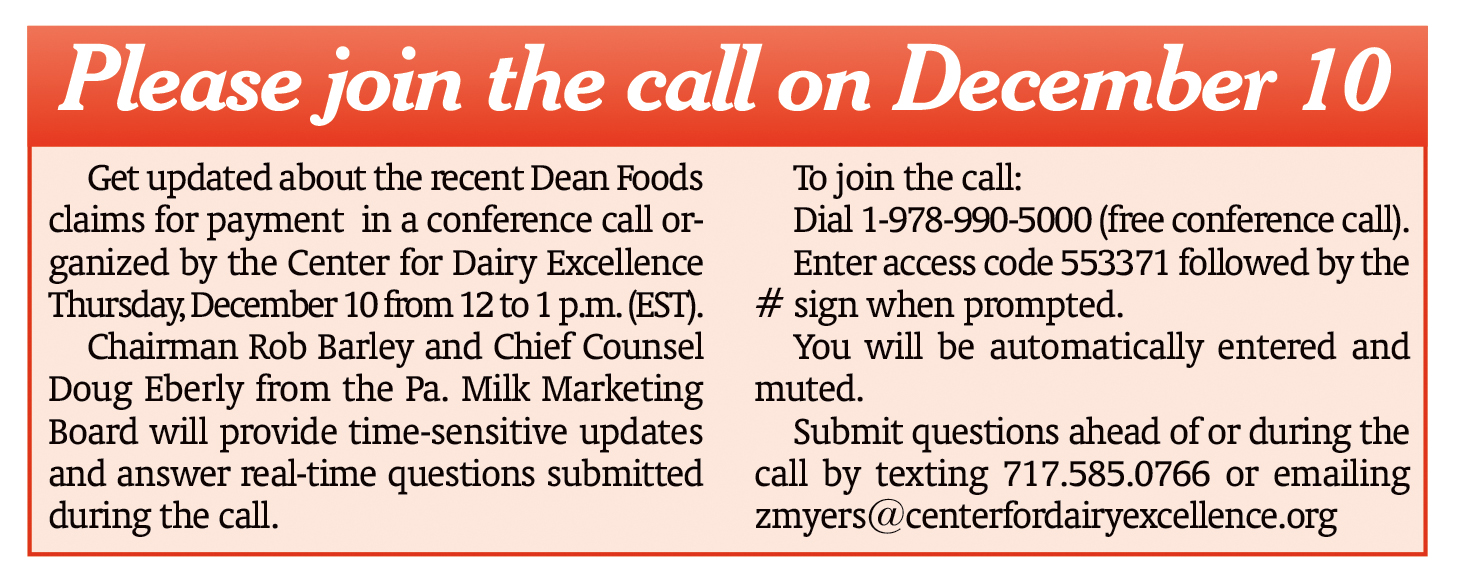
During a Center for Dairy Excellence call Thursday (Dec. 10) with hundreds of farmers on the line, Eberly and others from the PMMB board and staff gave an update and answered questions.

Here’s what you need to know:

1. Dairy farmers and milk haulers have an air-tight defense.

2. The Declaration Letters developed by PMMB for use in ALL STATES show this defense by filling in the blanks regarding how often your milk was picked up and how long you shipped milk to Dean Foods.

3. The Declaration Letter describes how milk payments are “ordinary course” of business.

4. The PA Milk Marketing Board made the Dean trustee letters a priority for the board and the staff to get taken care of, and they have been working as fast as they can to do so.

5. The letters received by dairy farmers and haulers are ‘avoidance claims.’ These arise when a business files for bankruptcy protection. All payments the business made to creditors – including vendors and suppliers – in the 90 days immediately prior to filing are liable to be recovered in order to be used to pay other creditors.

PMMB chief counsel Doug Eberly stated that the PA State Attorney General’s office has the expertise on bankruptcy law and has been involved in the Dean Foods bankruptcy for 13 months because of the seven Dean Foods milk plants that are regulated by PMMB to receive milk from PA farms. They have explained the situation and they have interceded in a way that will help all affected dairy farms and haulers from ALL STATES.

Eberly explained the theory behind these letters from ASK LLP is that some creditors of Dean Foods could have had bargaining power to get money from Dean pre-bankruptcy that was not available then to other creditors.

The Declaration Letters producer can send in show that the payments they (and haulers) received were NOT preferential but represented “ordinary course of business.”

“Farmers kept shipping milk in good faith and kept getting paid for the milk in order for Dean to stay in business,” said Eberly.

“If you are a producer or hauler, you received payments in ordinary course of business with Dean. They picked up your milk every day or every other day or you shipped it to them every day or every other day and they paid you twice a month as the Federal and State Milk Marketing Orders specify,” Eberly explained. “We wrote this in the declaration that you can fill out, sign and send back to ASK LLP – without all of the other things the letter you got was asking for.”

BOTTOM LINE, said Eberly: “ASK needs some kind of documentation from you because they have an obligation to the bankruptcy court to show — pursuant to the bankruptcy code – the things they are charged with doing have been done.”

Sending the Declaration Letter back to ASK LLP shows the unsecured creditor committee that as a farmer or hauler, “you have demonstrated to the trustee that you were paid in the ordinary course of business and do not owe this money back, because you weren’t paid in any preferential way when you got paid.”

PMMB chairman Barley, thanked Eberly for the work he has done. “He took the lead on this and reached out to whoever he needed to and brought this to a quick resolution,” said Barley, noting that the PMMB worked with the state Attorney General’s office, the Secretary of Agriculture, Center for Dairy Excellence, American Farm Bureau and organizations and individuals from other states.

“ASK LLP has taken a lot of heat on this and they want to get this behind them because farm groups came together to back the farmers (and haulers),” said Barley. “We’ve worked with anyone who is able to help as we reached out to other states and they reached out to us and this helps them as well. We are unique to have PMMB in Pennsylvania, and this is a time it has shown brightly to have this in Pennsylvania.”

Eberly noted that the insurance bond held by Dean in the state of Pennsylvania is gone. It has already been exercised during the bankruptcy to pay producers, so it would not have been available to help farmers in this situation.

Eberly’s phone rings a lot these days, but he is diligent to get back to everyone. His phone number is on the explanation page with the Declaration Letters and he freely gives it out.

“You can call me at 717.836.3115. I am getting a lot of phone calls but I will get  back to you as soon as I can,” he said.

BELOW ARE SPECIFIC QUESTIONS AND ANSWERS handled on the group call Dec. 10. (Recording is also available here)

Q. If I filed a critical vendor contract with the bankruptcy court to be paid during the bankruptcy, is that enough to prove I did not get preferential payments before the bankruptcy?

A. No. Eberly stated he is not giving legal advice; however, the critical vendor agreements signed by dairy producers and haulers were standard forms that had ways to modify them so they don’t address the points ASK is asking for. The declaration forms PMMB has gotten approved for farmers and haulers are specific to the way milk plants do business with farmers and haulers.

“If you are a dairy producer, the way you prove you did not get preferential payments is you either send all the records that ASK LLP has asked you for, OR you send in the declaration letter we put together to take care of it, and this declaration form is the most efficient way to do that,” said Eberly.

Q.   Do the Declaration Letters PMMB provided need to be submitted by an attorney or how does a dairy producer or hauler submit them?

A.  The bottom line is that the PMMB with the help of the Attorney General’s office worked with ASK LLP to set up these Declaration Letters in a way that a dairy producer or hauler could simply fill it out and send it back by email, fax or postal mail – ON THEIR OWN.

Eberly explained that while a person or corporation can’t really represent itself in bankruptcy court, only through an attorney, these Declaration letters are NOT going to the bankruptcy court (on their own). They are going to the law firm (ASK LLP) that is trustee for the Dean estate and will be part of what ASK shows as fulfilling their obligation with the court on seeking preferential payments.

As for who signs the Declaration Letter? Anyone with authority to sign something on behalf of their farm or hauling business – whether as a single family sole proprietor, multi owner LLC or incorporated business – can sign the Declaration Letter.

“It never hurts to have a lawyer to check with to make sure what you are doing is the right thing to do,” said Eberly. But in general, he said, if three members of an LLC sign other documents, then they would sign this. If one person for an incorporated farm signs other types of documents on behalf of the farm, they would sign this. If a farm received separate letters for separate farm locations, return a Declaration Letter in response to each letter received from ASK LLP.

Q.  Do the documents on the PMMB website at www.mmb.pa.gov only apply to Pennsylvania, or can other farms from other states send them in?

A. PMMB chairman Barley said “It is very important that everyone know about these forms because farmers and haulers from other states can use them. We want to get this information out to every farmer or hauler who received a notice from Dean through ASK LLP so they can use this form. We have shared the forms with other state organizations and with Farm Bureau.”

Eberly earlier stated in an email to Farmshine that ASK LLP will accept these Declaration Letters from producers and haulers in ALL STATES, even though PA Milk Marketing Board is the entity to have constructed them, working with the Attorney General’s office and ASK LLP.

“We did not make these forms PA-specific,” said Eberly, noting that he has talked to the Kentucky Dairy Development Council, the Vermont Attorney General’s office, the Michigan Department of Agriculture, and AgriVoice on behalf of several entities in Tennessee. He said that private individuals have called and are sending the Declaration Letters around and that Farm Bureau is contacting people as well.

Q.  In talking with ASK LLP, is there a way to get a list of all the producers and haulers who got Avoidance Claims letters from ASK so they can be directly contacted and informed to use the Declaration Letters?

A.  Carol Hardbarger, PMMB executive secretary, said that their office has a spreadsheet of producers who shipped milk to the former Dean Foods that represented 125 to 150 names. She said nationwide the number could be 1000, but that they don’t have such a list. She said it is possible that some producers and haulers many have already paid the settlement offer in the letters from ASK LLP.

“We can send information out to individuals on the list we have for Pennsylvania, but we don’t have names from other states,” she said.

PA Representative Frank Ryan (a former CPA who specialized in bankruptcy, now a state lawmaker) noted that a list of all creditors, and those the trustee is asking for money back would be at the Dept. of Justice website. He said a state Attorney General’s office would be able to access that list to determine who needs to be notified in their state.

Meanwhile, many efforts are being made to get the word out through farm media and word of mouth.

Rep. Ryan stated that while he is not an attorney, he did specialize in bankruptcy as a CPA before being voted into the PA state legislature. “These types of ‘demand letters’ are common in bankruptcies,” said Ryan. “They are trying to determine a ‘preference period’. I can’t imagine that any dairy producer got any preference payment or was treated better than someone else (ahead of the bankruptcy).”

Ryan explains: “Say I am owed money by Dean for services (as a CPA) on a 90-day invoice. And say you as a farmer did a contemporaneous exchange of something of value (milk) for payment and you are paid every 14 days. You get preference over me. That’s ordinary business. But, if Dean paid me as a CPA instead of you for that contemporaneous exchange of milk for payment, then the trustee would come back to me for payment.”

He gave this example to further show that it is hard to imagine a case where a dairy producer, or milk hauler, would be liable for paying back this money because they continued to ship milk and be paid.

“In all likelihood, a farmer or hauler should not have to pay any money back. The Declaration Letters are intended to help those producers demonstrate that they do not have to pay that money back,” he said.

Now, if someone went ahead and paid the settlement offer, Ryan said it may be difficult to get that money back. But he said using the Declaration Letter and hiring an attorney to get it back might be successful.

Q. Who, specifically should the Declaration Letters be sent to?

A. At the top of every demand letter sent by ASK LLP is the name, phone number and email address for the paralegal to which your file number has been assigned. That is who you email your signed Declaration Letter to. If using postal mail, get proof such as delilvery confirmation or certify the letter. There is also a fax number on your packet. That number is 651.406.9676. Be sure if faxing to put the name of the paralegal assigned to your file on cover sheet with your Declaration Letter when faxing. Your Declaration Letter has a spot to fill in your File Number so they can handle your case quickly.

Eberly explained that the letters from ASK LLP to producers and haulers “have a paralegal assigned to your file. That is the name and email address to send to, and it will be different for different farmers.”

Eberly notes that some farmers who don’t have email can fax the Declaration letter back. The ASK LLP fax number is on the letterhead. It is 651.406.9676. Be sure to put the fax to the attention of the paralegal that has been assigned to your particular file, says Eberly.

“On your letter from ASK, it will say ‘this matter is assigned to’ and then a name of a person and their phone number and email. This is the person you want to get your Declaration Letter to,” said Eberly. “Get it to the person you are assigned to so that you hear back faster. Until you hear back from them, you will still be wondering about this, and we want to get you to not wondering as quick as we can.”

Q. Do I need to send anything with the Declaration?

A. Eberly said it is their understanding that the Declaration Letter, itself, is sufficient.

Q. Should the dairy producer retype the Declaration to reflect their operation or just fill in the blank? For example, should we retype to change “I” to “We”

A. According to Eberly, there is no need to retype. In fact, don’t retype. Just cross out “I” and write above it “We”. He said “do it with a pen.”

Q. What do I do if I sold milk to Dean for 30 years through a cooperative and 7 years as an independent? Which number do I put down for the number of years?

A. Eberly said in a case like that, just put what is recent. If you shipped milk for the past 7 years as an independent producer and the letter is addressed to you, enter 7 years on that line. “Seven years is good enough. As a dairy farmer, you are not in the position to bargain for special treatment (prior to bankruptcy) so what you are showing in this Declaration is that your treatment in those 90 days before Dean filed bankruptcy was no different than your treatment by Dean at any other time in the course of your relationship with Dean Foods.”

Q. What happens if we simply do not respond to the letter we received from ASK LLP? Is it possible the entire claim will be dropped on its own?

A. Everyone on the call from Eberly to Barley to Ryan stated that ignoring the letter is unwise and risky. “I would caution you about not answering the letter,” said Rep. Ryan. “Absent the response with this Declaration Letter, it will be in the hands of the court. If you ignore it, and they determine you owe the money, you will get an immediate judgement against you and they (bankruptcy court) have incredibly powerful ways to get those funds, so I caution you not to ignore the letter.”

With these Declaration Letters developed by PMMB and approved by ASK LLP, there’s no reason to ignore this. Dairy producers and haulers have an efficient way to take a big step to put this behind them.

Q. Does the American Farm Bureau have standing to bring legal action if Dean does not meet their demand to retract these claims?

A. No one on the call wanted to really address that, except to say that in Pennsylvania, even with the state Attorney General’s office being involved in navigating this issue, a state AG can only take a case and pursue it under certain circumstances.

Instead of waiting for some sort of court action when bankruptcy courts have so many powers we don’t understand, the easiest thing to do to put this behind us is fill out the Declaration Letter and be done with it. Obviously, if producers and haulers do this, and end up still having a problem, that meets a higher threshold for others to get involved in representing farmers at a higher level.

“If you fill out the Declaration Letter and send it back in, that will provide your defense and you should not need further action,“ said Barley.

Q. What is the deadline to submit the Declaration Letter?

A. Best answer is: Submit it by the date on your letter from ASK LLP. Some packets say December 19, others December 24. Whatever your date is, submit your Declaration by that date.

That said, Eberly noted that for those wanting their attorney to look at it, they do have a little flexibility on that date because the trustee (ASK LLP) will not begin filing these claims with the bankruptcy court until January, and those they believe to be farmers will not be in the first group they file.

You see, this is why Declaration Letters are needed and must be sent back quickly. ASK LLP as trustee will file with the court any entity that was paid in that 90 days for the bankruptcy court to take action against. Your Declaration Letter protects you and it protects the Dean estate trustee by showing that they contacted you about the money you were paid and you exercised your defense in this efficient manner.

“You are not being asked to compile all the records that were in that letter from ASK, you just have to download this form, fill it out and sign it and email or fax it back and be done with it,” said Eberly.

Q. Do I need to submit a declaration letter if I provided a paralegal with their requested information already?

A. “I would call the paralegal and ask if they had a chance to look at it and make a determination, and I would also submit the Declaration Letter just to be on the safe side,” said Eberly.

Q. What should lenders and others do who received assignments from milk checks direct from Dean Foods if they received these letters?

A. Since everyone is operating under the belief that producers and haulers won’t owe money back, then their assignees should not owe money back because the assign would not have been paid except for the farmer getting paid.

Eberly noted that lenders have access to legal people and accountants to answer questions for them. But if you are a producer who has money paid directly to someone out of your milk check, contact them to see if they got a letter and tell them what you are doing. Contact the paralegal listed on your letter and let them know that your assignee got a letter too and piggyback your Declaration Letter to cover them by having that conversation.

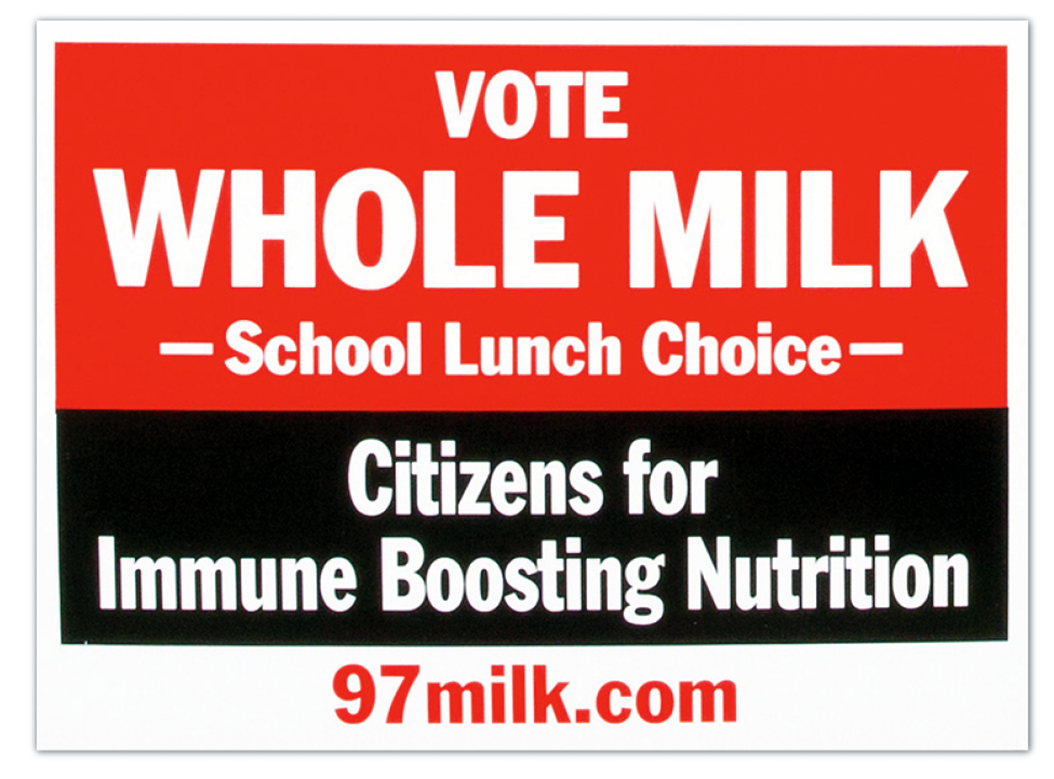
‘Vote’ Whole Milk School Lunch Choice: Comment to USDA by Dec. 28, 2020

EPHRATA, Pa. –  Want whole milk choice in school? Become a citizen for immune-boosting nutrition and comment at this link by Dec. 28, 2020: https://www.regulations.gov/comment?D=FNS-2020-0038-0001

Below is a sample comment, you can personalize in the official public comment section at this link  https://www.regulations.gov/comment?D=FNS-2020-0038-0001 by Dec. 28, 2020:

Dear USDA,

We appreciate the flexibilities rule, but it does not go far enough to benefit the healthy choices of our school children. WHOLE MILK should be offered as a choice at school meals because children and teens in trials preferred whole milk 3 to 1 over low-fat milk, meaning they drank it and consumed the nutrients instead of discarding! Store sales of whole milk during the pandemic are up 14% (while other classes are down). Parents are choosing whole milk for their families because it is nutritious and offers better absorption of important fat-soluble vitamins and other immune-supporting advantages. 

Research shows whole milk consumption among healthy children was associated with higher (immune-boosting) Vitamin D stores and lower body mass index, a 40% reduction in risk of becoming overweight! Children and teens love whole milk so they will drink it instead of throwing it away. 

In fact, a high school/middle school trial in Pennsylvania last year showed that when all fat percentages of milk were offered, milk consumption grew by 65% and the volume of milk being wasted / discarded declined 95%! 

Current rules and “flexibilities” don’t even allow schools to offer whole milk or 2% reduced fat milk a la carte. We want to see flexibility that allows children to choose 2% milk and whole milk, which is standardized to 3.25% fat, so they can benefit from the healthy nutrition they love instead of being limited to fat-free and 1% low-fat milks that they throw away. Students discard the fat-free and low-fat milk then buy drinks devoid of nutrition and sweetened with a combination of high fructose corn syrup and artificial sweeteners! At middle and high school levels, USDA rules allow the choice of caffeinated energy drinks — but not whole milk! That’s a win for big beverage and foodservice companies, but not for our children. Let the health of our children win with whole milk choice.

BACKGROUND: USDA Food Nutrition Services (FNS) published a proposed rule in the Federal Register Nov. 27 that would ‘maintain’ the flexibility for school meals related to milk, grains, and sodium. 

For the milk portion, the proposed rule would make permanent the choice of flavored low-fat 1% milk in child nutrition programs — without waivers. Back in 2010, low-fat flavored milk was eliminated along with whole and 2% reduced-fat white milk. This rule is a small step to solidify the change made by USDA Secretary Sonny Perdue to at least provide schools with flexibility to allow the choice of 1% low-fat flavored milk in 2017. At that time, flavored milk in schools was required to be fat-free.

The recent new rule up for comment was issued as an administrative step to insure that USDA is complying with a 2018 court ruling that challenged these flexibilities. The ruling required a comment period for the rule. Schools currently have this flexibility temporarily in all USDA child nutrition programs through June 30, 2021, in response to the COVID-19 national emergency.

USDA says it is “committed to listening to and collaborating with customers, partners, and stakeholders to make these reforms as effective as possible, and encourages all those who are interested in school meals to share their comments and recommendations for improvement through regulations.gov.”

This is an opportunity for communities to respond and ask USDA for better flexibilities.

The Grassroots PA Dairy Advisory Committee and 97 Milk will post to Regulations.gov docket — again — the 30,000-name petition with hundreds of comments supporting the choice of whole milk in schools. As customers, partners and stakeholders in child nutrition programs, parents, teachers, school foodservice staff, farmers and community in general have a stake in what USDA allows and doesn’t allow as beverage choices in schools.

Here is the link to the full docket regarding the USDA school lunch flexibility rule https://www.regulations.gov/docketBrowser?rpp=25&so=DESC&sb=commentDueDate&po=0&dct=PS&D=FNS-2020-0038

-30-

UPDATE on Dean trustee letters demanding payment from farmers. Don’t pay. Gather records. Fight back.

BREAKING UPDATE (events on Dec. 4 after this article was published): Farm Bureau issued statement, stands up for producers. Farm Bureau attorneys sent a letter to ASK LLP and Dean Estate seeking withdrawal of preference demand letters within 10 days. The Pennsylvania Milk Marketing Board (PMMB) is working with the State Attorney General’s office and ASK LLP to resolve avoidance claim settlement offers received by dairy farmers and milk haulers. PMMB says ‘be patient, don’t sign anything and don’t write any checks.’ PMMB expects to provide specific guidance to dairy farmers and haulers prior to the December 10 Dairy Industry Conference Call sponsored by the Center for Dairy Excellence. The call will be open to dairy producers outside of Pa. as well.

Don’t ignore these letters. But don’t pay the settlement offers. Sit tight. Gather records.

AUTHOR’S NOTE: I am not a lawyer, and this is not legal advice. This is more of ‘what we know now’ in a rapidly evolving story. The Pennsylvania Attorney General is involved. Other states are mobilizing to perhaps work together. USDA AMS Dairy Programs is now referring all inquiries to the Department of Justice. American Farm Bureau is taking action. Please know that as dairy farmers, you have produced milk that was paid for according to federal and state milk marketing laws, that provided nourishment to families and that has enabled the Dean Foods Company to continue to operate until it was sold. Without you and those payments to you, Dean would have had to abruptly close, and the estate would have nothing.

By Sherry Bunting, Farmshine, Dec. 4, 2020

BROWNSTOWN, Pa. — Most of the letters descended on dairy farms the day before and after Thanksgiving with due dates of December 19 or December 24. More were received this week, and it is expanding to include assignees. No, these are not Happy Thanksgiving and Merry Christmas John and Jane Q. Dairy Farmer. These are thinly veiled attempts at blackmail — demands to pay the Dean Foods Company estate a portion of milk checks from August 14 through November 12, 2019 in order to avoid being sued for much larger, scarier, sums of money.

ASK LLP, the St. Paul, Minn. law firm approved in September to be the Dean estate trustee, conjured up the ‘ghost of milk payments past’ to extort money from dairy farmers for the big bottler’s bankrupt estate by threatening lawsuits to reclaim payments to dairy farmers during what is known as the ‘preference’ period.

These are called ‘preference action recovery’ or ‘trustee avoidance’ claims. This is the legal basis for the action the letters threaten will occur if farmers don’t pay the ‘settlement offer’ or negotiate it with a satisfactory defense by the due date.

In layman’s terms, the claim is that a defendant farmer (Dean Foods creditor) could have received a pre-bankruptcy payment for milk that could have been a better deal than the ‘trustee’ would have divvied out.

Wrong. Federal and state law set forth dates and formulas for milk payments as a requirement for Class I beverage milk companies to operate. That money has already been spent by dairy farmers keeping cows fed and keeping lights on at farms already beleaguered by five years of marginal and below breakeven prices. No windfall there.

The intimidating letters show ways to assert a defense — through hiring a bankruptcy attorney and showing 15 to 18 months worth of invoices. But it’s cumbersome for farmers. They don’t invoice for their milk!

Of course, they want producers to just pay the settlement offer at a reduced rate, as stated in the letter, to avoid legal action commencing the week after the due date. (Don’t.)

Did I mention the due dates are December 19 for some; December 24 for others?

Did I mention farmers have 21 days from the date of the letter to respond with a defense and 30 days (now down to 14 to 20 days remaining) to sign the ‘settlement offers’ with checks payable to Dean Foods Company or risk – says the letter – paying amounts 5 to 6 times higher? People are still receiving these letters, given the Thanksgiving holiday and backlogged post offices. Some producers may not have opened them. The envelopes are non-descript.

In one example, a family milking 100 cows received a packet with a settlement offer of $20,000 placed next to the threat of paying over $110,000. Larger family farms face even larger sums. This is predatory intimidation to push farmers to send money that the bankrupt Dean estate is not entitled to. Yes, it is extortion.

So what happened? On the day before and after Thanksgiving, notices of Intended Litigation and Settlement Offers were received by dairy farmers from ASK LLP representing the Dean Foods Company estate. The action covers payments by the former Dean Foods to independent dairy farmers for raw milk sales from August 14 to November 12, 2019 — the 90 days prior to Dean’s filing on Nov. 12, 2019 for Chapter 11 bankruptcy protection and sale.

This is a little-known part of bankruptcy law where the estate trustee can go back 90 days before a filing to collect payments believed to be ‘preferential.’

Farmshine has confirmed letters were received by Dean Dairy Direct producers in numerous states — including Pennsylvania, Ohio, New York, Kentucky, Tennessee, and assuredly others. 

The letters list payment transactions (on the Federal Order specified dates), a total claim amount the farmer will be sued for, and a settlement offer at about 15 to 20% of that amount due December 19 or 24, 2020 (depending on the date of the letter).

Under Southern Foods Group LLC, case number 19-36313 in the bankruptcy court of Houston, Texas, with Judge David R. Jones presiding, the Dean Chapter 11 reorganization is headed to an omnibus hearing scheduled for Dec. 11, 2020 and disclosure hearing Jan. 11, 2021. Debtor filed its Plan of Reorganization Nov. 30 as file number 3230 on the docket at https://dm.epiq11.com/case/dnf/info (The Milksheds blog offers additional happenings of context and perspective here.)

If you are a dairy farmer who received a ‘demand package’ from ASK LLP representing the Dean estate, don’t ignore this, but don’t panic, don’t pay anything, don’t sign anything, sit tight for a bit, get prepared by gathering records (milk statements, contracts) and know that many trustworthy, well-situated people are working on this.

These letters are an intimidating threat to see what ‘other people’s money’ the law firm can shake loose for the Dean estate after the fire sale in which the bulk of assets were sold to Dairy Farmers of America (DFA).

In an email Wednesday, DFA, a large supplier of former Dean plants they now own, indicated that they did not receive these legal preference action letters.

“As part of the Asset Purchase Agreement, and as a result of a broad release of claims against each other, Dean Foods released DFA from these potential claims,” a DFA representative stated. “Ultimately, we had no idea that the Dean estate was planning to make these claims against independent producers. It’s disappointing that they sould take this kind of aggressive action against hard-working dairy farm families who supplied them with milk prior to the filing.”

The cooperative indicated in a statement that it “DFA does not control the actions or decisions of Dean Foods in its bankruptcy liquidation and was not involved with the decision to pursue these claims.”

Among other cooperatives doing business with the former Dean plants, at least one regional cooperative executive confirmed receiving a letter six weeks ago for dairy ingredient sales (cream and condensed milk) during the 90-day pre-bankruptcy time-period. They have not agreed to nor negotiated any settlement, but they provided their volumes and documentation of these sales to ASK LLP through their bankruptcy attorneys — and are monitoring the situation.

This source also believes other regional cooperatives received letters pertaining to pre-bankruptcy raw milk and ingredient sales.

On Tuesday, we confirmed that a milk hauler received a letter, and at least two entities receiving “assignments” direct from a producer’s milk check have received letters. This goes deep, and it is getting deeper.

The letters mention two potential defenses in a separate “additional instructions” piece, urging producers to “make a copy of this letter and all enclosures to send to your attorney should you choose to defend this matter rather than settle and return the payments.”

Even the ‘instructions’ intimidate the dairy farmer to feel they might have some financial obligation to the Dean Estate (absurd).

The instructions state: “Under certain circumstances you may have a defense warranting settlement of this action at less than the settlement offer extended. We will be happy to consider your defense and ‘explore’ settlement.”

Media calls and emails to several undersigned representatives at ASK LLP have gone unanswered.

Questions posed to USDA AMS Dairy Programs have been met with a blanket response that they are looking into the situation and would be providing a general ‘official’ description of how Federal Orders govern payments for Class I milk in relation to producers showing ‘ordinary course of business’ defense. After all, USDA FMMO market administrators have the specified dates and regulations posted at each of the 11 FMMO websites, and the dates correspond with the payments made to producers as listed in these predatory preference action letters.

USDA has not confirmed nor denied whether market administrators received similar letters regarding payments Dean made to producer settlement funds in the pre-bankruptcy period.

Late Tuesday evening, USDA stated in an email that, “We’re forwarding all media inquiries on this matter to the Department of Justice press office.” This indicates the DOJ is potentially also looking at the concerns surrounding these predatory attempts to intimidate farmers into sending payments to Dean Foods.

In Pennsylvania, where over 100 dairy farmers are affected by the letters, the State Attorney General is involved. Pennsylvania has the added layer of Class I pricing regulation through the Pa. Milk Marketing Law enforced by the Pa. Milk Marketing Board (PMMB).

“The PMMB wants to make sure every Pa. dairy farmer is treated fairly,” states Rob Barley, chairman. “I have complete trust in the PMMB staff in consultation with the Attorney General that this will ultimately happen. We will do all we can in our power to ensure that it does.”

Expressing her concern for dairy farmers receiving these letters with a short time-frame for response at a difficult time, Carol Hardbarger, PMMB executive secretary confirmed late Monday that, “The Pennsylvania State Attorney General’s office is aware of these letters.”

Hardbarger noted that the PMMB board and staff sprang into action with a joint meeting Monday morning after learning about the legal actions over the weekend. They have been working on it ever since. She provided at Farmshine’s request a description of how payments to Pennsylvania farms by Pennsylvania-regulated plants are governed at the state level — in addition to Federal Order rules.

“Dairy farmers selling milk to a dairy processor and being paid per federal and state regulations is a paradigm that is ordinary course of business for the industry,” states PMMB chief counsel Doug Eberly. As with anything, he adds, there may be the odd deviation in that, but he can’t think of any leading to a trustee avoidance claim. 

Both Eberly and Hardbarger stressed that the PMMB is working on this within the scope of their authority and working with the State Attorney General’s office as several producers in the eastern and western parts of the state have stepped forward to provide copies to PMMB of the legal packets they received. 

More will be discussed as regards Pennsylvania producers at the upcoming Dairy Industry Conference call next Thursday, Dec. 10 where Eberly and Barley will speak.

Other state organizations are reaching out to Farmshine as they learn what Pennsylvania is doing. Even without a milk marketing board, producers and their organizations in other states can contact their Agriculture Secretaries or Commissioners, even lawmakers, and ask that their State Attorneys General look into these surprise legal notices and payment demands and the predatory nature of them.

While stopping short of giving legal advice, Eberly said there are some general points for producers to know within this rapidly evolving situation: 

1)      Absolutely don’t pay anything now. (And don’t sign anything without consulting an attorney.

2)      Start gathering deposit records for the 3-month period identified in the letter (Aug. 14 – Nov. 12, 2020) and the 15 months prior to that (as stated in the letter), so you have this information ready. 

3)      Don’t worry about putting anything into the requested formats mentioned in the letter, just get these items together for now.

4)      Know that the Pennsylvania State Attorney General’s office is aware of these letters. 

“The ordinary course of business affirmative defense means that the vast majority of farmers most likely will owe nothing, we just have to get them there in the most efficient way possible,” said Eberly.

More key takeaways for dairy farmers in this rapidly evolving situation here:

-30-

Milk payment process officially described, relevant to Dean trustee ‘avoidance claims’ seeking partial payback from farmers.

By Sherry Bunting, Farmshine, December 4, 2020

BROWNSTOWN, Pa. – In addition to dairy producers, those receiving assigned amounts directly from producer milk checks, such as haulers, have begun receiving these letters of ‘preference action recovery.’ The wide net being cast by ASK LLP as trustee for the Dean Foods Company estate — in search of money to pay bankruptcy administration costs — may become a web of entanglement.

USDA AMS Dairy Programs has not confirmed nor denied whether Market Administrators for the 11 Federal Milk Marketing Order (FMMO) Producer Settlement Funds (PSF) have received letters from ASK LLP or whether Dean’s pre-bankruptcy payments to them have been made subject to these trustee avoidance claims. If so, this would produce another wrinkle.

While USDA AMS is now referring to the Department of Justice all inquiries about the bankrupt Dean Foods estate trustee letters intimidating farmers to repay a portion of their Aug – Nov 2019 milk checks, the USDA did respond late Wednesday evening to Farmshine’s request for a general official description of FMMO milk payment procedures and dates.

This could be helpful to affected dairy producers because the twice monthly transaction dates listed in the letters correspond directly with these official descriptions — showing pre-bankruptcy payments to farmers, and their milk check assignees, are not only ‘ordinary course of business’ and ‘customary for the industry’, but also regulated by Federal Orders.

In Pennsylvania, there is the added layer of the Pennsylvania Milk Marketing Law enforced by the Pa. Milk Marketing Board (PMMB).

PMMB executive secretary Carol Hardbarger provided a synopsis from state statute regarding how PA-regulated plants pay farmers for milk. There are seven Dean plants that are licensed dealers regulated under PMMB, four of these plants are located in Pennsylvania. All seven are now owned by Dairy Farmers of America (DFA) as part of the Southern Foods Group LLC (Dean Foods and holdings) bankruptcy sale.

The PMMB is recommending that farmers do not pay the settlement offers in these letters, and sit tight for further guidance. In Pennsylvania, the State Attorney General is involved. The PMMB chief counsel and Attorney General’s office plan to communicate with ASK LLP this week.

USDA’s FMMO milk payment description follows:

In general, handlers report monthly to the FMMO (Federal Milk Marketing Orders) their receipts and utilization of producer milk from the previous month. The receipts include the skim and fat pounds of the milk, as well as its average monthly component tests (protein, other solids, nonfat solids) in the component orders. Utilization reports include how such butterfat and skim milk (including components) were used during that month.

The FMMO office computes the uniform butterfat price and the uniform skim milk price in the four fat and skim pricing orders (FO 5, FO 6, FO 7, and FO 131) and the producer price differential (PPD) in the seven component pricing orders. These prices are computed based upon the total value of milk in the producer milk received and utilized by all handlers pooling on the Order for the month.

Reporting and price announcement dates are set in regulation and vary by order (see attached chart). For example, for Orders 5, 6, and 7 (Southeast, Florida and Appalachian Orders), producer prices are released on or before the 11th of the month for the previous month, while the announced producer prices for the Northeast order could occur as late as the 17th of the month for the previous month.

Each handler with pooled milk for the marketing period receives an accounting from the Market Administrator, indicating their plant(s) use value for the month along with the associated payments due to producers for that milk. If a plant use value is greater than the producer payments, the difference is due to the Producer Settlement Fund (PSF) of that respective Order.

“A handler whose plant use value is lower than the producer payments owed will receive a payment from the PSF to allow them to make the producer payments in a timely fashion. Th above reporting and payment date chart lists when payments are due to and from the PSF.

Final payments to producers and cooperatives are made a day or two after the payments from the producer settlement fund are made.

Each of the 11 orders requires (advance) payments by handlers for the milk received during the first 15 days of the month a week or two after the 15th of the month.

For Pennsylvania regulated plants, payment due dates are outlined in Milk Marketing Law Regulation 143.12 as follows:

§ 143.12. Terms of payment.

“(a)  Producers shall be paid not later than the 26th day of each month and the 17th day of the following month, as follows:

“(1)  Payment that covers the approximate value of milk or cream purchased from the first to the 15th of each month shall be made not later than the 26th day of each month. This payment need not be accompanied by an itemized statement. This payment shall be at least the lowest announced class price for the previous month for the number of pounds purchased or received during the first 15 days of the month.

“(2)  Final settlement for all milk and cream purchased during any month shall be made not later than the 17th day of the following month. The final settlement shall include any balances due for the first 15-day period and shall be accompanied by a statement to each producer setting forth the information required under §  143.14 (relating to monthly statement to producers).

Ghost of milk payments past invoked as intimidating letters seek money from farmers for big bottler’s bankrupt estate: Don’t pay. Don’t panic. Don’t sign anything. Sit tight. Gather records.

BREAKING NEWS UPDATES 4:00 – 9:00 p.m. Dec 2: Updates after the essential background article below, appear in separate articles here and here.

USDA is forwarding inquiries about ‘preference action’ letters to DOJ. In PA, the Attorney General’s office is involved.

By Sherry Bunting for Farmshine

Disclaimer: I am not a lawyer, and this is not legal advice, but researched information based on many people working on the issue. This is a ‘what we know now’ pre-press preview of a rapidly evolving story, check Friday’s Farmshine and this link for updates, including information about a conference call for dairy farmers in Pennsylvania and open to affecte producers outside of PA (call details here); other states also mobilizing!

BROWNSTOWN, Pa. —  Notices of Intended Litigation and Settlement Offers have been received by dairy farmers last week from ASK LLP, a law firm in St. Paul, Minn., seeking payment to the Dean Foods Company Estate under what is known as preference action recovery or trustee avoidance claims covering payments to dairy farmers for raw milk (and co-ops for ingredients) from August 14 to November 12, 2019 — the 90 days prior to Dean’s Nov. 12, 2019 filing for Chapter 11 bankruptcy protection and sale.

We have confirmed these predatory letters have been received by Dean Dairy Direct producers in numerous states – including Pennsylvania, Ohio, New York, Kentucky, Tennessee and assuredly others — on the day before and after Thanksgiving. These letters contain a record of payment transactions (on the Federal Order specified dates), list a total claim amount the farmer will be sued for, and a settlement offer at about 15 to 20% of that amount due December 19 or 24, 2020 (depending on the date of the letter).

Under Southern Foods Group LLC, case number 19-36313 in the bankruptcy court of Houston, Texas, with Judge David R. Jones presiding, the Dean Chapter 11 reorganization is headed to an omnibus hearing scheduled for Dec. 11, 2020 and disclosure hearing Jan. 11, 2021. Debtor filed its Plan of Reorganization as file number 3230 today, Nov. 30, on the docket at https://dm.epiq11.com/case/dnf/info

If you are a dairy farmer who received a ‘demand package’ from ASK LLP representing the Dean Foods Company Estate, don’t ignore the letter, but don’t panic, don’t pay anything, don’t sign anything, sit tight for a bit, get prepared, and know many trustworthy, well-situated people are working on this.

The letters and legal packets are an intimidating threat to see what ‘other people’s money’ the law firm can shake loose for the Dean Foods Estate after the fire sale in which the bulk of assets were sold to Dairy Farmers of America (DFA). For its part, DFA as the new owner of the bulk of Dean’s plants issued a statement that it does not control Dean’s decisions on their bankruptcy and did not participate in this decision.

The letters do mention two potential defenses in a separate “additional instructions” piece, urging producers to “make a copy of this letter and all enclosures to send to your attorney should you choose to defend this matter rather than settle and return the payments.”

The instructions go on to state: “Under certain circumstances you may have a defense warranting settlement of this action at less than the settlement offer extended. We will be happy to consider your defense and ‘explore’ settlement.”

Even in that statement the ‘instructions’ intimidate the dairy farmer receiving it to feel they might have some financial obligation to the Dean Estate (absurd).

Please know that as dairy farmers, you have produced milk that was paid for according to federal and state milk marketing laws, that provided nourishment to families and that has enabled the Dean Foods Company to continue to operate until it was sold.

What’s happening and what dairy farmers should know:

First. Know that you are not alone and stay tuned. A range of emotions and reactions are no doubt happening on receipt of these letters.

Second. Don’t panic, don’t pay, don’t sign, and hold off in hiring an attorney. If you already have a trusted attorney advisor, talk to them, but these letters are concerning from a collective perspective. They name individual farms as defendants and demand a refund of a portion of what they were paid for milk they produced and shipped to Dean, that was bottled by Dean and sold by Dean in the 90 days BEFORE Dean filed for bankruptcy protection.

The situation may ultimately require farms to individually hire a bankruptcy attorney to assert a defense and prove qualification for exemption. But, well-situated sources indicate that it is also possible that collective group action could occur. More answers are needed by authorities and interested parties.

Yes, this preference recovery action is a loophole in bankruptcy law with farms caught in the shakedown net cast by the law firm working for the Dean Estate. There are concerning aspects based on how dairy farms are paid via federal and state laws that preclude the normal business activities of “invoicing.”

In Pennsylvania, the Pa. Milk Marketing Board is looking into this, and the State Attorney General’s office is aware of these letters. Dairy farmers selling milk to a dairy processor and being paid per federal/state regulations is ordinary course of business.

Third. Sit tight but use this time to be prepared by gathering milk statements for the past 15 to 18 months. Many trustworthy and reputable people are working on this issue affecting hundreds of independent dairy farms, and entities to which portions of their milk checks were assigned.

Sources indicate regional cooperatives may have received such letters for raw milk sales, though none have confirmed this. USDA has not confirmed nor denied whether market administrators received similar letters regarding producer settlement fund payments in the pre-bankruptcy period.

One regional cooperative executive has confirmed receiving a letter six weeks ago in relation to ingredient sales during the 90-day pre-bankruptcy time-period and indicates other regional co-ops have as well. They have not agreed to nor negotiated any settlement, but they provided their volumes and documentation of these sales to the soliciting law firm through their bankruptcy attorneys — and are monitoring the situation.

Dairy farmers can do the same.

  1. Absolutely don’t pay or sign anything right now.
  2. Start gathering deposit records for the 3-month period (Aug 14 – Nov 12, 2019) plus the 15 months before that as stated in the letter’s instructions about potential defense assertions.
  3. Don’t worry about putting any of this information into the requested spreadsheet or other formats mentioned in the letter, just get these items together for now.
  4. The Pennsylvania Attorney General’s office is aware of these letters. Producers in other states could look at involving the offices of their Secretaries of Agriculture and/or Attorneys General.
  5. The ordinary course of business affirmative defense means that the vast majority of farmers most likely will owe nothing, and people are working on how to get producers to that point in the most efficient way possible.

Fourth. Know that USDA AMS Dairy Programs has been contacted and is looking into the matter. Know that every one of the Federal Milk Marketing Order websites shows the strict dates and procedures concerning payment for milk. Dean Foods – or Southern Foods Group LLC as it is named covering all holdings in the bankruptcy case #19-36313 – could not have operated nor could it have been sold to yield any funds for the estate had the farmers not been paid for the milk sold.

Fifth. Know that in Pennsylvania, the Pa. Milk Marketing Board (PMMB) became involved immediately. The board and staff started their day Monday morning with a joint meeting on this issue that was brought to their attention over the weekend. Know that they have begun a conversation with Pennsylvania’s State Attorney General who is looking into this and is already familiar with some of the elements having been involved in getting final payments arranged using the mandatory bond insurance Pennsylvania requires all licensed milk dealers to carry. Know that in Pennsylvania, milk plants follow state payment and bonding regulations in addition to federal orders. Know that there are seven Dean Foods plants regulated by PMMB because they receive milk produced on Pennsylvania farms, and four of these plants are located in Pennsylvania.

Know that producers outside of Pennsylvania can band together and through their state dairy organizations or Secretaries of Agriculture – ask their State Attorneys General to look at this.

Sixth. Know that other well-situated people are looking into a way for all affected producers to fight this together instead of each farm going it alone and having the expense of hiring legal counsel with bankruptcy experience to “assert” their defense in writing to the law firm ASK LLP (aka Ebenezer Scrooge).

Seventh. Know that answers to various questions and concerns are being sought. More will be learned in the coming days, and the situation is one that is rapidly evolving.

Eighth. Know that ASK LLP should know better. The Dean estate trustee should already know that these dairy farmer critical vendor payments are not “preferential” payments warranting trustee avoidance claims. Not only should they know the critical vendors of Dean Foods — since the bankruptcy judge issued orders that dairy farmers be paid as critical vendors during the proceedings so Dean could operate and be sold – they should know that Judge David R. Jones in hearings on several occasions stated his big concern that school children would continue to receive their milk and dairy farmers would continue to be paid during the bankruptcy proceedings.

ASK LLP should know that the very charts they included in their ‘demand packages’ — showing all transfers from Dean plants to individual ‘defendant’ dairy farmers — are made on the precise same dates twice a month as is the regulation for milk payments under Federal Orders.

Ninth. Know that Bankruptcy Judge David R. Jones’ office in Houston, Texas has been notified of the ‘demand packages’ sent to dairy farmers for the pre-petition period. Several high-profile members of the U.S. House and Senate Agriculture Committees have also been notified.

BACKGROUND: The letters descended on dairy farms the day before and after Thanksgiving with due dates of December 19 or December 24.  No, these were not Happy Thanksgiving and Merry Christmas John and Jane Q Dairy Farmer, these were thinly veiled attempts at blackmail – demands to pay Dean Foods Company Estate a portion of milk checks from August 14 through November 12, 2019 in order to avoid being sued for much larger sums of money.

Ebenezer Scrooge (ASK LLP) conjured up the ghost of Dean Bankruptcy Past to insinuate that monetary transfers from Dean to dairy farmers — or their assigns — in return for milk they received, processed and sold, were ‘preferential’ resulting in what are called Trustee Avoidance claims by the law firm purported to represent Southern Foods Group LLC the conglomerate name for the bankruptcy and sale of Dean and all of its holdings.

A Trustee Avoidance claim – the legal action that the letters state will occur after the due date for payment of the settlement offer – indicate that such payments to farms could have been ‘preferential’ to avoid the bankruptcy trustee making sure all creditors are treated fairly. In layman’s terms, the claim is that a defendant farmer’s payment for milk pre-bankruptcy could have been a ‘better deal’ than the ‘trustee’ would have divvied out.

Wrong. Federal and state law set forth dates and formulas for milk payments as a requirement for milk companies to operate. That money has already been spent by dairy farmers keeping cows fed and keeping lights on at farms already beleaguered by five years of marginal and below breakeven prices. No windfall there.

Sure, the intimidating packet shows ways a recipient can assert their defense – through hiring a bankruptcy attorney. They can show invoices for those three months – and the 15 months before that – to show “ordinary course of business.” They can assert their defense with milk check statements the scrooge law firm says must be supplied in Excel spreadsheets requiring certain types of entries and documentation. Or they can just pay the settlement offer at a reduced rate to avoid legal action commencing the week after the due date.

Did I mention the due dates are December 19 for some; December 24 for others?

Did I mention farmers have 21 days from the date of the letter to sign and pay the ‘settlement offers’ with checks payable to Dean Foods Company or risk – says the letter – paying amounts 5 to 6 times higher?

Yes. This is what intimidation looks like, a shakedown to see what they can get away with, what money can be extorted, to improve their cut on the deal by threatening hard-working, nose-to-the-grindstone dairy farmers with big numbers, big words, and big assumptions.

They know better, and if they don’t, they should.

-30-

Gratitude offers a path to our resilience

This has been a year for the history books. A pandemic of global proportions, storms and wildfires leaving ruins, economic upheaval, political divide, social injustice, civil unrest, and in dairy and agriculture supply chain disruptions, bankruptcies, dispersals, consolidations and exits.

God’s promises are the blessings through all personal and public loss. This year, we saw loss, but we also saw courage, care and giving. 

Whether or not we know someone who recovered from or was lost to Covid-19, we are reminded daily of the rising death toll, the rising number of positive cases. We are reminded daily of families facing evictions, still unemployed, of small businesses having to close, many for good. We see the rise in dairy herd dispersals and farm sales that were underway even before the pandemic. We see the shifting sands of rural landscapes. 

It’s a lot to take in, what 2020 has delivered. But notice how folks in the midst of ruin are often more thankful than those going about their daily lives without a problem or care?

A family losing home, belongings and memories to a disaster hold each other close in thankfulness. Citizens of a community devastated by storm help each other pick up the pieces. When a farmer is gravely ill, neighbors gather to harvest the crops. When lives are lost, loved ones are lifted up and memories are shared.

A thankful heart does not change the circumstances or stop the pain of loss, rather gratitude offers a path to our resilience. Without gratitude, there can be no hope. The bird that sings in the midst of a storm is no doubt thankful for its perch and made stronger by its song.

The act of giving thanks strengthens us.

As we celebrate Thanksgiving 2020, it will be different for many of us. For some, the normal family gatherings will occur, for others it will not. Some will mark a first Thanksgiving without a loved one. Others will be celebrating the addition of new family members. Many will be separated from gathering if a family member is under quarantine for the virus. Some will spend the day working in earnest to get a home or barn under roof before winter after devastating summer storms. Some will find it difficult to buy groceries and prepare a meal. Some will navigate political differences that have sharp edges and create splinters.

For my mother, it will be the first Thanksgiving without my younger sister. And, because of the pandemic, and a member of our family’s exposure to the virus, with her underlying health, mom will spend Thanksgiving alone — except for telephone, ‘hugs’ (and a meal) through the glass door, and prayer. Many of our elders will see Thanksgiving 2020 this way.

We are accustomed to the traditions of gathering around a meal – representing a celebration of harvest. We are accustomed to gathering as family, extended family, friends and community, of having the opportunity to look around at family, friends, home, hearth, sustenance, to readily count our blessings in conversation, see our blessings in the faces of children, feel them in the warmth of a hug.

But to give thanks in ALL things is an action we are reminded to engage in despite our circumstances.

The first Thanksgiving in 1621 was such an occasion after profound loss. The community meal with prayer and thanksgiving came after a first successful harvest, which had been preceded by the plague of disease, hunger and fear, followed by a spring and summer of drought. Faith continued. A harvest sustained them, and they gave thanks.

We live in a world today of high-tech distractions from the things that are most important. 2020 brought events that got our attention. Time stood still, and families spent time together.

Whether we are in the storm or seeing our way clear of it, a thankful heart opens us to faith, hope and optimism. A thankful heart gives strength to sing instead of sitting quietly to dwell in the dark.

“In everything give thanks; for this is the will of God in Christ Jesus for you.” I Thessalonians 5:18

“The Lord is my strength and my shield; in Him my heart trusts, and I am helped; my heart exults, and with my song I give thanks to Him.” Psalms 28:7

-30-

DMI-led, DFA-made: ‘siips’ is new ‘teen milk’, but…

But… when given the opportunity, teens choose regular fresh whole milk

siips: Siimply Perfect. Real Milk. Real Good. You Be You. These are the descriptive taglines for SIIPS, a shelf-stable, aseptically-packaged, ultrapasteurized, lowfat milk packaged by DFA in an 8-oz. aluminum can as a new “teen milk” based on DMI’s research of what it takes to make milk relevant to teens again. And DMI says more ‘innovations’ or ‘reinventions’ or ‘relevant products’ are on the way from other partners. All of this money and time spent to answer a question teens and pre-teens and elementary-aged students could have told us quickly, cheaply and easily, given the opportunity to choose whole milk – without the fancy packaging and processing that puts it neatly into a global supply chain instead of a local or regional fresh food system.

By Sherry Bunting (Farmshine, Nov. 13, 2020)

HARRISBURG, Pa. – On one hand they say they are not involved in reinventing school milk and then, well, they say they are.

Siips is the new low-fat, shelf-stable grab-and-go “teen milk” from Dairy Farmers of America (DFA). According to Dairy Management Inc (DMI), checkoff led the way on the innovation and test launch in selected locations over summer.  

Siips is a result of DMI’s fluid milk revitalization efforts and is targeted to improving the youth milk experience with relevant packaging and flavors,” according to a recent edition of Your Checkoff News.

During last week’s Center for Dairy Excellence industry conference call, a portion of the hour was devoted to questions and answers with DMI leaders, and we learned more about revitalization, innovation, and reinvention.

According to Paul Ziemnisky, executive vice president for global innovation partnerships at Dairy Management Inc. (DMI), DMI has been working since last summer to “understand perceptions of milk in schools.”

He said products like siips represent what DMI has learned from students in a variety of demographics so that milk can compete again.

Siips is grab-and-go milk in an aluminum 8-oz. can in the flavors of caramel, mocha and chocolate,” he explained. “Products like this will make milk competitive in the school ala carte area, and we are working with other partners for other ala carte grab and go products.”

Ziemnisky noted that DMI is also working with processors and technology companies to develop dispensers like those used in foodservice where students can choose their milk ‘formula’ or ‘flavors’. He said Covid set the test launch back for those, but they are coming.

The bottom line is, he said: “We are looking at new packaging systems… aseptic sustainable packaging, all in the process of starting up. We are working with the industry to line up 6 to 7 tests in key systems to create a catalytic effect across the whole industry.”

A dairy producer submitted this question: “We are seeing grants from checkoff to develop a ‘kids milk’ at Cornell. We already have a ‘kids milk.’ It is called whole milk. We are frustrated. Why would our checkoff spend money on this rather than spending money to get whole milk back in schools?”

DMI president Barb O’Brien replied that she is “not familiar with the ‘kids milk’ project. We are not involved in specialized formulation for school milk,” she said. “But we can tell you about the research programs we have invested in.”

Ziemnisky picked up from there to explain that, “Everything we do has to start with consumers to make sure what we do is relevant.”

He said DMI’s partners, including MilkPEP, are the experts in marketing and advertising while DMI is the expert on consumer research and insights.

O’Brien and Ziemnisky explained that what DMI does is “back-end strategy with brands to advance U.S. Dairy’s priorities.”

They said the brand partners spend “10 to 20 times our investment in bringing to market these innovations.”

“Three years ago, the milk revitalization alliance was formed,” said Ziemnisky. “By partnering with brands, we unlock new platforms and then leverage that to access their customers.”

O’Brien said that’s how DMI has managed what is essentially a $300 million state and national budget to become the equivalent of $3 billion in consumer access and increased per capita dairy sales.

Ziemnisky reported that whole milk sales grew by $1.8 billion on a value basis over the past five years to 41% of net sales at retail. He owed this to what he said were DMI’s “57 whole milk studies.”

(We can’t find any whole milk studies on the list of 57 studies, just a few studies related to full-fat cheese.)

The problem with 40 years of declining overall fluid milk sales, said Ziemnisky is that “the sector has gone 40 years without innovation.”

(The sector has also gone 40 years under what have become increasingly fat-restrictive USDA enforcement of its Dietary Guidelines, but that wasn’t mentioned.)

Ziemnisky pointed out that the gains made in whole milk sales have come at the expense of fat-free milk sales.

“We have a fix for that too,” he said. “Our goal is to make milk relevant again with high protein, low carb, portability, as well as reinvention at schools, foodservice and e-commerce to fit changing consumer lifestyles.”

As for the simple choice of whole milk in schools? DMI leaders were asked if they would fund and support a research trial like the one done last year at one middle/high school in Pennsylvania showing 65% gains in milk sales and sustainable reductions in waste of 95%.

O’Brien was “thrilled” to hear about that study and said exceptions can be granted for research, but quickly turned the conversation over to Ziemnisky to talk about the research and innovation of school milk DMI is already investing in.

Look for more in the next edition on DMI’s partnership with DFA on plant-based blends – why and how and other topics.

-30-

Grassroots dairy meet with Rep. Thompson, a champion for Ag; Dietary Guidelines, whole milk in schools top the agenda

Congressman G.T. Thompson (center) is flanked on left by Dale Hoffman of Potter County and Sherry Bunting of Lancaster County and on his right by Bernie Morrissey of Berks County, Krista Byler of Crawford County and Nelson Troutman of Berks County. The Grassroots PA Dairy Advisory Committee involved in the 97 Milk effort met with Rep. Thompson this week on dairy issues.

By Sherry Bunting, Farmshine, October 30, 2020

BELLEFONTE, Pa. — From the Dietary Guidelines and whole milk choice in schools to dairy checkoff and milk pricing formula concerns, five members of the Grassroots PA Dairy Advisory Committee involved in the 97 Milk effort from across northwestern, northern tier and southeast Pennsylvania met with U.S. Congressman Glenn “G.T.” Thompson (R-15th) in Bellefonte, Pa. this week to talk about dairy.

Rep. Thompson helped lead the writing of a letter signed by 53 members of the U.S. House, including Ag Committee Chairman Collin Peterson (D-Minn.) and Ranking Member Mike Conaway (R-Texas) to Secretary of Agriculture Sonny Perdue asking for a delay on the decision about final Dietary Guidelines for Americans (DGAs) for 2020-25 until all of the science on saturated fat is considered.

Despite the bipartisan letter, Thompson indicated that USDA and Health and Human Services (HHS) will move ahead to finalize the guidelines by the end of the year.

Thompson shared his thoughts about the disconnect between the legislative branch and a bureaucratically appointed DGA Committee in formulating the DGAs which have so much impact on children and Pennsylvania’s rural economy.

With the election next week in the balance, Thompson said he is looking at introducing language that would give the legislative branch some role in advise and consent with regard to the DGAs. He also praised his colleagues from Pennsylvania as many have cosponsored the Whole Milk for Healthy Kids Act and the Give Milk Act. These bills would allow whole milk as an option at school and in the WIC program.

Under the current House leadership, the bill on school milk is not moving as it has not been taken up by the chair of the Committee on Education and Labor.

“As you know, our office made recommendations for members of the DGA Committee, but that didn’t happen,” said Thompson. “It’s hard to believe that the modern-day science is being ignored on this issue of whole milk. We need checks and balances, not only to serve the needs of children in school, to give them this choice, but also because of the damage these rules do to our rural economy.”

It goes without saying that if the Republicans are able to gain a majority in the House, there would be a better pathway to moving on some of these issues surrounding the way whole milk (and even 2% milk for that matter) are banned from school choices while other less nutritional beverages are offered unchecked. With Democrats in the majority for the past three years, there has been no movement on the bills.

Grassroots PA Dairy Advisory Committee member Krista Byler of Spartansburg, Crawford County, reported to the Congressman that while the beverages offered ala carte at school are calorie controlled per serving, there are no limits on how many of these beverages a student can purchase. At the middle and high school level, sports drinks, diet tea coolers, diet soda, and energy drinks are all allowed.

“But students can’t purchase even one serving of whole milk,” she said. “They simply aren’t allowed.”

“We need to get back to where milk is not tied to the school meal calculation and let it stand alone, and give students the choice,” said Thompson.

Byler serves as head chef and foodservice director for Union City School District, and her husband Gabe operates a 125-cow dairy farm with his father and brother, along with beef cattle and grain crops.

She explained that schools are afraid to move outside of the USDA edicts based on the Dietary Guidelines because of financial repercussions, and it’s difficult to get others to see the issue because so many people are generally unaware that children are limited to only fat-free and 1% low-fat milk options at school.

Five members of the Grassroots PA Dairy Advisory Committee from around the state talked about dairy issues with Congressman Thomspon, especially the Dietary Guidelines and getting whole milk choice in schools.

The group discussed ideas for how to obtain waivers from USDA to do a statewide trial where schools could simply offer all fat levels of milk and collect the data. One such trial, done quietly in Pennsylvania during the 2019-20 school year, revealed that when students at the middle and high school level were given the choice, they chose whole milk 3 to 1 over low-fat. At the same time total milk consumption rose by 65%, and the volume of milk discarded daily by students declined by 95%.

“That’s huge,” said Byler, a constituent of the Congressman. “We don’t need to reinvent a new ‘kids milk,’ we already have one that students will choose if given the opportunity.”

Thompson agreed, stating that, “Now is the time to look at something like this because what have families been turning to in this pandemic? Whole milk,” he said.

This is supported by the most recent USDA data through June showing that both whole milk and 2% milk sales made big gains in June as supply chains worked through the early Covid issues – pushing total fluid milk sales up 2.2% over year ago year-to-date January through June with whole and 2% unflavored white milk together accounting for more than 70% of all fluid milk sales categories, and whole milk alone being the largest selling category.

“Whole milk is what families are seeking when the choice is up to them,” said Thompson, indicating that while consumers are seeing the science on whole milk, the DGA committee is not.

“All of the doctors interviewed on news programs during this pandemic are talking about Vitamin D as boosting the immune system,” said Bernie Morrissey of the Grassroots PA Dairy Advisory Committee.

Thompson observed that with Vitamin D and other nutrients being fat soluble, the DGAs are missing the boat.

Morrissey and Troutman are working with businesses and organizations buying and distributing “Vote Whole Milk School Lunch Choice, Citizens for Immune Boosting Nutrition – 97milk.com” yard signs that are proliferating across the countryside. A link at the 97 Milk website lets citizens know how to get involved, and a second link provides information to get involved in delaying the 2020-25 Dietary Guidelines until all the science is considered on saturated fat.

Concerns about the transparency and accountability of the dairy checkoff program were also discussed, and Thompson was receptive to looking at ways to turn this around.

The Grassroots PA Dairy Advisory Committee suggested ending the influence of importers by ending the import checkoff of 7.5 cents per hundredweight equivalent. This seemed like a good idea when it was implemented in 2007, but in retrospect has set the globalization direction of the national dairy checkoff’s unified marketing plan and ended the practice of promoting Real Seal, made in the U.S. products.

The committee was also looking at the promotion order asking the Secretary of Agriculture, who can amend the order at any time, or to work legislatively to clarify producer rights under the law in where their ‘local’ dime portion of the checkoff is assigned for education and promotion.

Nelson Troutman, a dairy farmer in Richland, Berks County, who started the Drink Whole Milk 97% Fat Free ‘baleboards’ noted that the corn and soybean growers have periodic review of their checkoff programs, and asked if there is a way for dairy farmers paying the mandatory checkoff to have more say on whether it should continue, or more transparency to see all of the expenditures and the plans submitted by DMI to USDA.

The Committee also suggested evaluating the way the boards are formed and even noted that the language of the order suggests the Secretary can call for a referendum even without a petition by 10% of the producers and importers. 

They noted that fresh fluid milk and other fresh dairy products are a critical market for Pennsylvania producers, but the emphasis of the industry appears to be moving in a different direction. Education, promotion and research are important, but the current direction of the national drivers is in question.  

Dale Hoffman of Hoffman Farms, Shinglehouse, Potter County and Troutman both shared the economic conditions in milk pricing and marketing of milk, especially the extreme difference between high protein value and CME cheese markets since June compared with what dairy farmers in the Northeast are actually seeing in their milk checks as negative PPDs subtract the value of their milk components.

In fact, the official Dairy Margin coverage margin for Pennsylvania is running $1 to $3 behind the U.S. average for June through September, when normally Pennsylvania runs with the U.S. average or 20 to 50 cents above it. The divergence makes it hard for producers to use risk management tools and have them function as intended.

Hoffman noted that producers have lost their ability to market their milk competitively in the region – especially in the north and west of the state — and their voice in how milk is priced is lacking. He observed that even Farm Bureau is recognizing this issue with some new recommendations.

Thompson welcomed the idea for a national hearing on milk pricing, especially as the next Farm Bill is not far off, and these issues need to be on the table early.

But first, there’s an election to get past. It is hoped that after November 3, these issues can be looked at. This has certainly been a difficult year on many fronts for all Americans, and the Grassroots PA Dairy Advisory Committee was grateful to speak with the Congressman about their concerns.

Dale and Carol Hoffman of Hoffman Farms took “Vote Whole Milk” yard signs home to Potter County.

-30-