Dairy imports and exports are the tail that is wagging the dog

USDA production and cow number revisions reveal how very small changes in domestic production now have very large and disproportionate impact on milk prices
By Sherry Bunting, Farmshine, November 3, 2023

EAST EARL, Pa. – The editorial opinion/analysis on the cover of the Oct. 27 Farmshine tells only part of the story after reviewing the USDA NASS downward revisions of five months of previous milk production data on Oct. 19 and looking at the monthly USDA Economic Research Service Supply and Utilization Report, released Oct. 16.

From a supply and demand perspective, there have been more positive fundamentals this year than the spring and summer milk prices would have led us to believe.

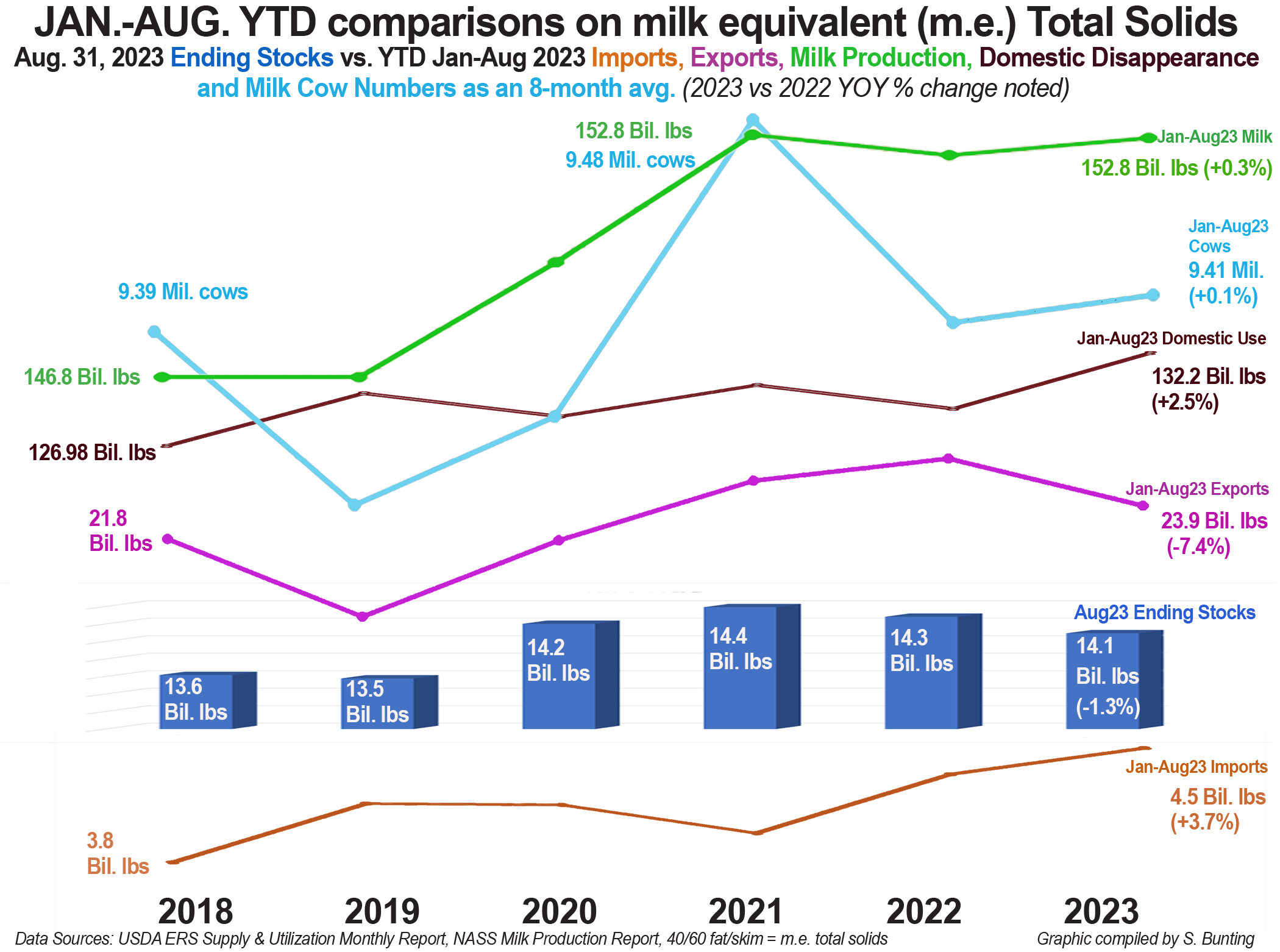
The graph shows it all. 

We went back to 2018 to calculate January through August year-to-date (YTD) total solids on a milk equivalent (m.e.) basis for the supply side: milk production, imports, beginning stocks on January 1st and ending stocks on August 31 in each of the six years 2018 through 2023. We also took this approach with the demand side: exports and domestic disappearance.

Here’s what we found:

First and foremost, beginning stocks of dairy products came into January 2023 up 0.5% above year ago. Milk production also came into the first quarter on an upswing of just slightly more than 1%. After the USDA revisions of previously reported April through August data, cumulative milk production Jan-Aug 2023 is 152.8 billion pounds, up 0.3% from Jan-Aug 2022 but unchanged from Jan-Aug 2021.

Meanwhile, exports started the year on a higher note before slipping through the middle months to be down 7.4% as a cumulative total for the Jan.-Aug. period compared with the year-to-date totals for Jan.-Aug. 2022. The cumulative export volume total for those months was also 3.96% lower than Jan-Aug 2021, but nearly 6.5% above 2020 and 2018 and nearly 24% above 2019.

Simultaneously, dairy imports ended the period 3.7% higher than a year ago, and back in the January through April period —precipitating the steep drop in farm level milk prices — we saw cumulative total solids imports up a whopping 15.3% above year ago.

By April 30th, ending stocks had crept 3.3% higher than the previous year, but domestic disappearance was still beating the previous year by 1 to 4%, except January’s domestic disappearance was off 1.5%. For the Jan-Aug 2023 period, domestic disappearance is up 2.5% vs. the same period in 2022.

By August, ending stocks dropped to levels 1.3% below year ago and the lowest August ending stocks on m.e. solids basis since 2019.

Given these numbers, we see precious little space to maneuver in these markets when changes in exports and imports become the tail wagging the entire dog. Combined, they can make such a big difference to the farm-level milk price – even in the face of domestic demand beating year ago every month and what has turned out to be flattish cumulative milk production.

Since April 2023, not only have milk production and cow numbers now declined after several months of disastrous prices, the USDA has now also re-evaluated and revised lower its previously reported numbers. (We said from the beginning the cattle inventory just wasn’t there to support the earlier-reported milk cow numbers, so either USDA under-estimated the biannual inventory or over-estimated the monthly milk cow numbers).

The accelerated imports were a wild card this year from January through April before slowing down in May through August. The cumulative year-to-date total for January through August is 3.7% higher than a year ago after being double-digits higher at the end of April. 

Still, when we factor in the 8% gain in imports in 2022 vs. 2021, the total of 4.5 billion pounds (milk equivalent) for the first eight months of 2023 beats the same period in 2021 by 12%. That’s significant.

Ending stocks were higher each month this year until July and August; however, exports were also holding steady to strong through May. 

It is the continued year over year increases in domestic disappearance that support the uptrend in milk prices since mid-July.

Bottom line, U.S. dairy producers have just weathered a storm where even though cow numbers were not a whole lot different from a year ago, and even though milk production and beginning stocks were not so out of whack, and even though exports were generally stable until July, we saw prices this spring and summer fall 37% below the previous year, and the DMC margin fell to a record low $3.52 in July, fully 63% below the milk margin of $9.92 the previous year.

This illustrates how tiny the margins are in these supply and demand equations that can make big dents in the farm level milk price. 

Increasing the national herd by a mere 5,000 cows deals a much bigger blow when it is coupled with modest gains in milk production per cow. And, even though exports are about four to six times greater in volume than imports, a sudden increase in those imports – even while exports are steady or higher – can bump the market disproportionately lower.

The good news in these graphs is that ending stocks have trended lower through the year, dipping under year ago since July, while domestic use has trended higher than a year ago every month but January. Yes, export volumes have now slowed, but so have import volumes and milk production.

The trouble I see for the future is this: As dairy farmers become more efficient, producing more milk per cow, and against this backdrop of more imports and volatile exports… the risk of extreme volatility becomes even greater whenever a new 5,000 head dairy expansion starts up or a new 10,000 to 20,000 cow dairy is built. Current replacement cattle prices at their highest level since 2015 and record high culling values for beef further push consolidation. Renewable Natural Gas credits push the type of expansions at a minimum 2500 to 7000 cow clip, replacing the diversity of farm sizes in the dairy industry at a more rapid pace.

Against this backdrop of the disproportionate impact of imports and exports on dairy markets today, the entire industry is now disproportionately more vulnerable to small changes in cow numbers. All it takes today is one large-scale business decision to flip the switch and wreck the train and bump more small- and mid-sized family dairies off the track.

It’s to the point where milk production forecasts need a microscope for the minutia, not a telescope to see the planetary alignments.

Most of the information for this report was derived from the USDA Economic Research Service data that are reported around the 16th of every month. The report includes both the dry milk powder and whey stocks as well as cold storage butter and cheese. The monthly ERS Supply and Utilization of Dairy Products by Category reports the imports, exports, and ending stocks on a milk equivalent basis separately for fat and skim solids. Using the 40/60 ratio, we figured the milk equivalence (m.e.) on a total solids basis to generate the graphs. We also updated the milk production totals to reflect the NASS revisions two weeks ago, which were not yet updated in the available ERS reports.

-30-
Walmart to build $350M milk plant in south Georgia, where milk supply is growing, and producers eye FMMO future

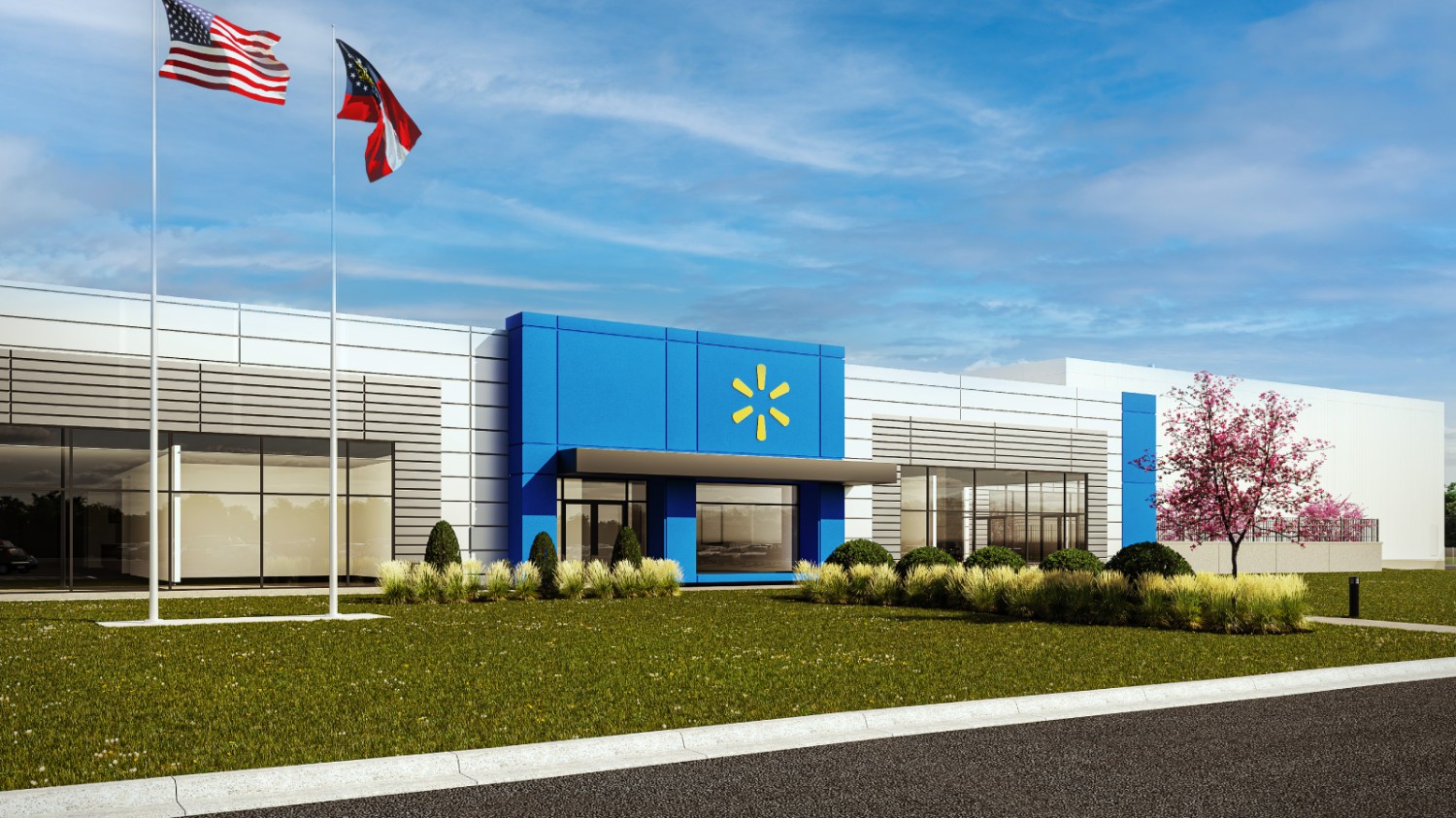
Walmart photo provided

By Sherry Bunting, updated from Farmshine, October 13, 2023

VALDOSTA, Ga. – Walmart announced it will break ground later this year on a $350 million milk processing plant in rural south Georgia, according to a company statement released Oct. 11 by vice president of manufacturing Bruce Heckman and senior vice president of beverage merchandising Tyler Lehr.

The new facility will serve more than 750 Walmart stores and Sam’s Clubs in the Southeast.

The joint statement highlighted innovation, stating that the new plant “will bolster our capacity to meet the demand for high-quality milk, while making our supply chain more resilient, and building even more transparency around sourcing.” 

The move is seen by the company as a milestone to control more of the factors around delivering a grocery staple – milk – that is high quality at low prices.

Using ingredients it says will be sourced from local farmers, the new Walmart facility will process and bottle a variety of milk options including gallon, half gallon, whole, 2%, 1%, skim and 1% chocolate milk for Walmart’s Great Value and Sam’s Club’s Member’s Mark brands.

The new facility is expected to create nearly 400 Walmart jobs in the Valdosta, Georgia community. Walmart seeks more vertical integration in staple commodities, having added beef facilities in Georgia and Kansas and initiated long-term agreements on beef and vertical farming.

Walmart opened its first milk processing facility in Fort Wayne, Indiana in 2018, triggering a ripple effect in farm contract terminations by then Dean-owned milk bottling plants serving the affected areas from Indiana and Ohio to Pennsylvania, New York, Kentucky, Tennessee and the Carolinas. Today, most of the former Dean Foods bottling plants are either owned and operated by the DFA milk cooperative or the Prairie Farms milk cooperative or have been closed.

Currently, there is a dearth of milk processing in Georgia relative to the rate at which milk production is growing, making up for the production in Florida that is slowing. Dean Foods closed the Braselton plant in 2018. Other plants have also closed over the past five years. Publix has two plants in Georgia, one expanded in 2017.

At the 2022 Georgia Dairy Conference in Savannah, former Southeast Milk Inc. CEO Calvin Covington noted in his dairy outlook that the 10 southeastern states have lost 8 fluid milk plants in the past 2 years.

“That’s done some damage,” he said. “The major challenge for milk markets in the Southeast is we need more of them. A lot of the fluid milk products that are sold in the Southeast are not processed here. If we are going to have a viable dairy industry in the Southeast, we need growing and stable markets for milk produced in the Southeast.”

In December 2022, USDA listed 39 pool distributing plants for the three southeastern Federal Milk Marketing Orders — down from 44 a year earlier. Most of the loss in fluid milk plants has occurred in Order 7. This includes Georgia, which currently has the fewest number of fluid milk plants — down to just two.

As the new leader in southeastern milk production, Georgia’s growth — combined with having just two milk plants at present — leaves producers with a per-capita fluid milk surplus of 53 pounds in 2022, according to Covington.

Together, the 10 southeastern states remain milk deficit, he said, but the relationship between milk supply and fluid milk demand is steadier across the region. Producers made 101 pounds of milk per person across the 10 southeastern states in 2022 compared with fluid milk consumption at 133 pounds per person, leaving the Southeast region at a 32-pound per person deficit, he reported. 

On the same day (Oct. 11) that Walmart announced the new $350 million milk plant in south Georgia, Covington happened to be testifying in USDA’s Federal Milk Market Order hearing in Indiana. He responded to questions about the Class I differentials and alignments to move milk into the Florida peninsula and questions on why milk production is growing in south Georgia.

He said Georgia’s nearly 90 dairy farms include some young and passionate producers who “know how to make milk and know how to make money. They know how to manage a dairy farm, and they are passionate about dairy.”

They are expanding to multiple sites in an area of the state where there is not much else that can be done with the land. They have a good water source for irrigation, are triple-cropping and producing good forage. They excel in cow comfort and milk quality and have far fewer environmental or permitting obstacles than in neighboring Florida, he observed.

Covington noted land cost is much less in rural south Georgia as compared with Florida. Much of the growing milk supply produced in southern Georgia currently goes to Florida, he added.

“There’s growth potential there… These producers are young with an entrepreneurial spirit, and if we can’t keep them competitive to serve the fluid markets in Florida, I think longer term they could look for other alternatives,” said Covington, adding that Southeast producers are looking closely at the results of the national FMMO hearing and the previous regional hearing in making their future economic and business decisions.

-30-

Dairy farmers speak out about fair pricing, fear of retribution as FMMO hearing continues

By Sherry Bunting, Farmshine, October 13, 2023

CARMEL, Ind. — “Fear of retribution” has been mentioned by some of the dairy farmers who have testified at the federal milk pricing hearings over the past seven weeks in Carmel, Indiana.

“I cannot believe predatory milk pricing is happening in America,” said Brenda Cochran, a Tioga County, Pennsylvania dairy farmer.

Cochran was among the producers testifying Friday, Sept. 29. She, like others, stated they are speaking for thousands of other farmers who are “unrepresented and voiceless” because “they fear losing their milk market for speaking out.”

She said she dedicated her time to speak for them and to speak for “the memory of those farmers who have already lost their farms, their families, and, some of them, their lives because of this decades-long catastrophe of low milk prices.”

Cochran noted the “blindingly abstruse complexities” of federal milk pricing and the hearing process that “seem to presume the impacted farmers possess economics credentials at the PhD level.”

The room full of administrators, accountants, economists, and lawyers listened as she spoke virtually from home, saying that as an average dairy farmer, she finds it “impossible to comprehend the ‘dairy industry’ language.” She noted that “the ‘dairy industry’ is all anyone focuses on.

“There are some dairy farmers who believe milk pricing is deliberately made complicated to keep dairy farmers in the dark about how their milk is priced,” said Cochran. “Others believe the low milk prices are part of an effort to displace farmers from their land.”

She asked USDA to truly look at what this hearing can do “to fix broken milk-pricing formulas for the farmers.

“When was the last time U.S. dairy farmers were given a ‘cost of living’ adjustment?” she asked. “How are dairy farmers supposed to dig out from debt and cover basic farm and family living expenses if ‘make allowance increases’ for processors take more money away from the paltry milk checks that are also being drained by higher transportation charges and the incessant monetary hemorrhage of capricious ‘market adjustment fees’ that are never included in Dairy Margin Coverage (DMC) payments?”

Like others who have testified, Cochran pointed out: What is done to dairy farmers also decimates the rural communities that have been “laid waste by over 40 years of degrading milk prices.”

Last Friday, Oct. 6, John Painter, also of Tioga County, Pennsylvania, testified for Farm Bureau’s positions. He cited the loss of dairy farms and cow numbers in Pennsylvania. 

“While there are multiple factors leading dairy farmers to sell their herds, one of the main reasons is pricing. In Pennsylvania, our milk pricing is twice as complicated… but the outdated FMMOs certainly do not help,” said Painter.

“I can attest that farmers are leaving the dairy industry, especially Class I producers, simply because the money and labor just is not there. We have a chance to change that narrative by amending the FMMO system to meet the economic needs of our farmers,” he explained.

Painter noted that both the Pennsylvania Farm Bureau and the AFBF support NMPF’s proposal (13) to return to the ‘higher of’ calculation for the Class I ‘mover’ and to raise the Class I differentials as outlined by NMPF in proposal 19.

AFBF also does not want to see any increase in make allowances to processors without a mandatory and audited cost survey. The NMPF proposal would raise all four product make allowances to net a roughly 50 cents per hundredweight loss to farmers; whereas IDFA’s proposal would raise make allowances to net a roughly $1.25/cwt. loss to farmers. 

NMPF and IDFA reportedly support AFBF’s request that Congress in the farm bill authorize USDA to do mandatory audited FMMO cost surveys.

NMPF also includes yield composition factors and other pieces of their package of proposals to both ‘give’ and ‘take’ to get pricing alignments to better perform the FMMO pooling functions without negatively impacting farmers.

NMPF’s economist Peter Vitaliano admitted earlier in the hearing — with regard to the Class I change made legislatively to the averaging formula — they had previously supported it, but, he said: “The market taught us a very severe lesson.”

Painter noted the Class I mover change is top of mind for producers. Furthermore, he noted the Class I differentials under NMPF’s proposal 19, would add more positivity in all locations.

This stands in direct conflict with the Milk Innovation Group’s proposal to subtract $1.60 per hundredweight from the base Class I differential, to negatively affect every dairy farmer in every area. 

The Milk Innovation Group is made up of fluid processors that market value-added milk or milk-based beverages, including ultrafiltered, organic, aseptic and ESL.

This is the group that put several company CEOs on the stand to support keeping the “average of” method for calculating the Class I mover, but use a rolling adjuster or “adder” that is floored. 

The CEO of fairlife said the models show the MIG proposal on the Class I mover would benefit farmers longterm by $1.43/cwt. What wasn’t mentioned was the MIG proposal to subtract $1.60 from differentials at the same time.

Also not mentioned is the fact that when wide swings occur, they produce severe losses that lead to dairy farm exits, depooling of milk from FMMOs due to misaligned pricing, and disorderly marketing that disproportionately affects pooled producer that serve the Class I market, creating both individual and geographic impacts.

Another farmer testifying Friday, Oct. 6 was Mark McAfee, of Fresno County, California. As vice president of both the California Dairy Campaign and California Farmers Union, he has heard from organizations that few if any dairy farmers want to volunteer to testify due to “fear of retaliation by processors.

“Dairy farmers are scared and live in fear of processors and loss of contracts,” said McAfee.

Supporting the prior testimony of CDC’s Lynn McBride and Joaquin Contente on the addition of mozzarella cheese to the FMMO Class III pricing survey, McAfee explained why this is vital and why producers are so afraid to speak out on it.

Mozzarella (4.49 billion pounds produced and sold) is now much larger than cheddar cheese (3.96 billion pounds) in the U.S., but it is not used in the Class III formula, he explained.

“The moisture levels are much higher. If added to the pricing formula, farmers would be paid a much higher price. This is being ignored and overlooked,” said McAfee.

He said that adding mozzarella to the pricing survey could be a key to “structural price change (that) will return a substantial amount of value to farmers that are currently being paid $15/cwt., when breakeven is at least $23 to $27/cwt.”

Processors are dead-set against this, as was apparent in the testimony and cross examination of representatives for Leprino a few weeks ago. They bemoaned USDA whey make allowances as “too low.” They blamed USDA for upsetting the supply and demand scenario by setting farm milk class minimum prices “too high.”

They said they might not build any more plants (after the Lubbock plant that is currently under construction) nor invest in capacity in the U.S. in the future if this is not remedied.

USDA AMS’s Erin Taylor had questioned Leprino reps, asking if they build cheese plants to make whey or to make mozzarella cheese? She also asked if there are other factors that might lead to increased milk production — other than the processors’ contention that USDA has minimum prices set “too high.”

It’s clear from such exchanges that the largest global processors, like Leprino, want to cash flow plants on the make allowance of byproduct whey, leaving their unsurveyed mozzarella cheese as an area of unaccountable profit that another testifying farmer – Joaquine Contente also of California – said is made on the backs of farmers.

In an attempt to respond, Leprino reps said the whey and the cheese come out of the same hundredweight of milk. This seems to make clear the model of cash-flowing a plant on the whey make allowance, while the mozzarella remains unreported gravy, and none of its value translates back to the milk.

On the “too high” FMMO minimum milk prices provoking “too much production,” processor reps acknowledged there are other factors, which they would not name, but they kept pointing out the dumping of milk and the negative premiums, and sales of loads at $10 under Class III minimum this summer as “proof” that USDA sets FMMO minimum prices too high.

In essence, they walked right into the CDC point that milk pricing should match profitable growth with profitable demand.

(In a two-part series in June and July 2023, Farmshine reported that the record whole milk powder imports in the first half of 2023, and the proliferation of new manure-methane-driven dairy expansions together produced what was seen as a regional glut of milk this summer that drove everyone’s prices lower. Now, magically, there’s not enough milk and spot loads sell above minimum as global dairy supplies recede, and in the U.S. imports decline and whole herds have been sold to high beef and dairy replacement prices. An update of that report can be found at https://wp.me/p329u7-2N2)

McAfee launched into some root causes for where we are today. (More on that in the future.) 

He cited how processors are moving to more heavily processed milk beverages, but consumer research shows the public wants milk that is unfooled-around-with.

The availability and orderly marketing of fresh, unfooled-around-with milk is essentially why FMMOs exist. However, as a product, its benefits are not being promoted, nor are they naturally innovated, said McAfee.

The dairy innovation solution is always to do more processing, and this has created a bifurcation in how milk is priced. The more processed the milk, the more longterm the pricing; whereas fresh milk remains a month to month pass-through sale.

The checkoff push to ‘think beyond the jug’ or break the ‘jug habit’ has now created a pricing dilemma for the FMMOs.

-30-

Hearing looks at fluid milk pricing differences for fresh vs. ESL

By Sherry Bunting, Farmshine, October 6, 2023

CARMEL, Ind. – USDA’s federal milk pricing hearing continued into its 7th week on Wednesday, Oct. 4, and USDA announced another virtual farmer testimony session for Friday for Oct. 6, with the signup notice and link posted at the hearing website with just three days notice on Oct. 3.

Farmer testimony was heard virtually also on Friday, Sept. 29, including from two Pennsylvania producers and a third from the Keystone State testified in person on Tues., Oct. 3. More on their testimonies in a future edition.

Here are some observations as I’ve listened on and off over the past several weeks as the testimony and cross-examinations dug into this issue of the Class I mover formula.

As one can imagine, daily testimony from 8 to 5 with exhibits and cross-examination add up to a lot of material for USDA to parse through.

This is particularly daunting with the introduction of significant testimony about the CME futures, hedging, risk management and other such business management by farms and processors and how FMMO changes affect these practices.

Last week, Pittsburgh milk bottler Chuck Turner of Turner Dairy Farms testified in support of the Milk Innovation Group’s concept of modifying the current ‘average of’ method for calculating Class I to create a floor under which the add-on adjuster cannot fall below.

The fairlife CEO also testified about the MIG proposal for the Class I mover last week, explaining that fairlife relies on hedging so the company can offer 9 to 12 month pricing of extended shelf life fluid milk products to foodservice, institutional food buyers and convenience stores that purchase plant-based alternatives and other beverages with annual contracts.

He explained that if the Class I price goes back to the ‘higher of’, companies like fairlife and Nestle (also testified), and others will not be able to hedge that annual price without introducing increasingly volatile price risk to their businesses.

The Nestle rep noted that Nesquick sales increased since late 2019. That’s when they started offering buyers longer-term pricing because the Class I mover was changed to the averaging formula in 2019.

For his part, even Turner said hedging on the CME butter, powder and cheese markets might work to build a protected price for selling fresh fluid milk to schools and other buyers that want longer term pricing.

He was asked several questions about the role of the Pennsylvania Milk Marketing Board in his payment of farmers and competition in the state and region.

Here’s the problem: Grocery stores still largely receive fresh milk a few times a week direct-ship to stores.

On the other hand, the extended shelf life milk, aseptically packaged (shelf stable) milk, and various milk based innovations are shipped to a warehouse. They are not treated the same as fresh fluid milk from a pricing and supply standpoint.

Additionally, the foodservice, institutional, convenience stores, and schools want to know a price for 6 months, 9 months, one year. Bottlers say they can’t offer that if they can’t protect their risk.

So, to minimize risk for processors, the ‘average of’ formula for the Class I mover was put into legislative language in the 2018 Farm Bill with the acknowledgment that it could be changed in two years by a USDA hearing process like the one in Indiana the past six weeks.

That change ended up introducing significant risk to dairy farmers, who found their ability to hedge THEIR risk was jeopardized.

Just as there are two classes of Class I processors — fresh milk and ESL fluid products, there are two classes of dairy farmers. On the one hand, producers whose milk routinely goes to Class I fluid milk plants or pool distributing manufacturing plants cannot be depooled, but milk routinely going to manufactured dairy products can be depooled.

When manufacturing class prices are higher than the Class I mover, a ripple effect occurs that disrupts the class pricing alignments. When higher priced milk is depooled, the processors can keep that money, or pass it on to their own shippers — disrupting one of the functions of the FMMOs to have orderly marketing and uniform pricing.

As one market analyst noted in her testimony last week, it’s like the story of Goldilocks and the Three Bears. These alternate Class I mover proposals are complicated with rolling adjusters to be added to the averaging formula.

For the function of the FMMOs, the ‘just-right’ porridge is the ‘higher of’ for the Class I mover, many have testified.

Trouble is, some regions may see more processors leave the FMMOs if they can’t make it work for them, and the bifurcation in the Class I fluid milk market will leave some processors unable to adapt to long-term pricing for large institutional buyers.

Which way is fluid milk consumption heading? That may be the question to answer first.

In the Eastern U.S., one thing’s for sure, the current flat milk production is being soaked up by strong bottling demand, and the market is paying above class prices right now to get milk for other uses.

The Class I pricing question, along with the other proposals in the lengthy USDA hearing, are being looked at by USDA through the lens of the FMMO’s purpose, especially “orderly marketing.”

However, USDA has no concrete definition for orderly marketing. Will we see that intuitive definition change? What do farmers have to say about it?

For its part American Farm Bureau Federation has been orderly in its presentation of testimony. Economists Roger Cryan and Danny Munch have testified. Farm Bureau members have testified.

This week, Cryan testified on removing the “advance pricing” from the Class I and II formula as this function of using two weeks of product prices to determine four weeks of pricing the following month is another piece of the puzzle bringing more volatility into the equation that can lead to depooling.

However, processors say they want advance pricing, and they want long-term hedging too! They want it all!

According to AFBF data presented at the hearing, advanced pricing has disrupted the orderly marketing of milk and led to unfair marketing conditions for dairy farmers. This disruption is caused when the price of other classes of milk rises above the announced advanced price of Class I and Class II milk. A full explanation of advanced pricing is available via AFBF’s Market Intel.

AFBF supports several proposals by the National Milk Producers Federation, which would increase Class I prices, drop barrel cheese from the Class III price formula, and return to the “higher-of” Class I formula. AFBF also supported in testimony its proposals to add salted butter and 640-lb block cheese to the pricing survey.

The hearing website posts updates at https://www.ams.usda.gov/rules-regulations/moa/dairy/hearings/national-fmmo-pricing-hearing

Government is the problem, cows are the solution

By Sherry Bunting, Farmshine, September 29, 2023

WASHINGTON – Several important amendments aimed at limiting USDA and FDA powers in the administration’s climate agenda, nutrition mandates, even an amendment on checkoff transparency, peppered the hotly debated FY2024 Ag Appropriations bill in an overnight marathon at the end of September as House of Representatives worked to avoid a government shut-down Oct. 1.

Some amendments passed and others failed.

Perhaps most notable was the Spartz Amendment (76) related to commodity checkoff transparency. It passed on a voice vote in the near midnight hour Sept. 26, but a recorded vote was requested by the opposition, and it was soundly defeated 326 to 72 in the late afternoon on Wednesday.

Here’s what we’ve learned from C-SPAN coverage and other sources about key agricultural amendments that are included and excluded.

The defeated Spartz Amendment would have prohibited use of taxpayer funds to carry out, administer or oversee the 22 commodity checkoff programs.

Other amendments that succeeded would prohibit USDA’s use of the appropriated funds to carry out the administration’s “climate agenda” via a long list of executive orders. Some amendments that passed prohibit USDA’s use of appropriated funds to enforce certain school meal rules, such as a proposed to ban chocolate milk in elementary schools and the current 14-year ban on whole milk at all grade levels.

A half-dozen amendments targeted specific USDA and FDA bureaucrat’s salaries by using the Holman Rule to cut down to $1 the salaries of, for example, the USDA Food Nutrition Services deputy under secretary for her role in expanding SNAP eligibilities beyond congressional intent and in expanding USDA diet-police tactics in schools by implementing the whole milk ban from a la carte offerings in 2012.

On the failure side, in addition to the Spartz amendment, another amendment offered by Wyoming Congresswoman Harriet Hageman would have undone the USDA mandate for electronic cattle identification. It would have left the funding in place for farmers and ranchers wanting to use the electronic ID (EID) system, but would have removed the mandate language.

Said Hageman: “Ireland required this. Today, a year later, there are untold numbers of reports they must fill out for the government, and Ireland now is considering killing off 1.3 million head of cattle to reach their ‘climate targets.’ Their EID mandate will help them carry out this slaughter.”

She said mandatory EID “will cost ranchers millions in compliance cost, causing smaller farms to sell out and accelerating vertical integration so the farmers and ranchers will be nothing but serfs. This is supported primarily by the four big packers — two of which are owned by Brazil and by China.

In opposition to the EID amendment, Chairman of the House Ag Committee, Glenn G.T. Thompson (R-Pa.), said technology and innovation are needed to protect livestock agriculture from disease outbreaks.

On the Spartz checkoff amendment, Thompson said the place to handle this is in the farm bill, not appropriations.

In defense of her approps amendment, Indiana Congresswoman Victoria Spartz said: “I am a farmer, and my cosponsor is a farmer, and we want to stand with the farmers.

“Farmers used to pay a checkoff voluntarily to promote the commodities. Then Congress made it mandatory, and there is no transparency,” she said. “If you are going to force farmers to pay the money, they should know where their money goes. Do they promote commodities? Or do they promote very wealthy jobs?”

She explained further that her amendment had two parts. One calls for checkoff transparency language in the farm bill. The other sought to be included in the Ag Appropriations, simply stating that no taxpayer funds can be used to carry out or oversee checkoff programs.

“It’s a simple amendment, but the special interests have gone on the attack saying: ‘How can Congress ask us what we’re doing with the money?’” said Spartz. “Now it has become imperative since they are now lobbying with this money against this amendment and against transparency.

“They say they aren’t using taxpayer money… So, just clarify this to Congress — that no taxpayer dollars are going to these boards that who knows where they spend the money,” she explained.

Cosponsoring the amendment, Rep. Tom Massie of Kentucky said: “This program has gone rotten and no longer serves farmers. In fact, we just sent a bipartisan letter to Secretary Vilsack reminding him that the USDA is required to report annually to Congress on the disbursement of these funds and show a third-party audit of their effectiveness.”

Massie noted that these reports to Congress have not been filed since 2018 for dairy, during which time dairy farmers paid over $1 billion, and more than 6000 have gone out of business.

Thompson stressed that the debate on checkoff transparency “should be reserved for the farm bill, not appropriations.” He said taxpayer funds are not being used in checkoff programs nor to oversee them.

Thompson expressed caution that some recent challenges to checkoff programs can be a veiled attack by animal rights groups that see this as an opportunity to weaken livestock agriculture. He said the farm bill is the place, “where conversations are already occurring, to improve these programs, to refine them, and to make them more transparent. I see the farm bill process as the appropriate path forward for achieving this transparency.”

“They should already want to be transparent to show this great thing they do for farmers,” Spartz countered. “But they are serving large monopolies, contributing to more consolidation so the little guy cannot survive.”

Spartz noted that Congress should “not be afraid to challenge these programs… to be the lobby for the people.”

For the three days leading up to the vote on the Spartz amendment, many agricultural groups with close ties and joint programs with commodity checkoff organizations amassed a barrage of lobbying efforts in opposition.

National Milk Producers Federation and National Cattlemen’s Beef Association spearheaded these efforts, including a letter signed by 130 organizations, saying that the Spartz amendment “unfairly targeted ‘producer-led’ checkoff programs that only use funds collected from proceeds of sale of these commodities – not taxpayer funds.

Here’s how I see it… If that premise is true, then what are the lobbyists opposing it so afraid of? No foul, no harm, right?

Perhaps they are afraid of the auditing that may be required to prove to Congress that no taxpayer funds are used to carry out checkoff programs. In fact, at the 11th hour, the Ag Environmental Coalition signed on to the letter opposing the Spartz amendment that was sent broadly to congressional offices urging a ‘no’ vote.

Could it be that taxpayer funds in the USDA coffers are being coughed up to further so-called ‘net-zero’ pathways initiated by the national dairy checkoff via DMI and its various tentacles?

It was USDA Secretary Vilsack, himself, who was first to announce Dairy Net Zero while testifying to the U.S. Senate in 2019 — asking them to fund Net Zero pilot programs. At that time, he was employed by checkoff, pulling down a million dollar salary via checkoff.

Now, Net Zero is the centerpiece of DMI’s “U.S. Dairy transformation” and the USDA ‘climate agenda’.

In fact, during a debate on an amendment offered by Florida Congresswoman, Kat Cammack, she cited a recent report citing Vilsack’s coordination with Arabella Advisors, a Soros-funded group, on “transforming the U.S. food system.”

She said the U.S. “can’t produce and process food for this country and abroad if we can’t rely on fuel and food systems not to be hijacked by the extremest climate agenda” and noted “many of these radical things do more harm than good to our environment. Our farmers and ranchers are the best in the world, and this amendment prevents the Biden administration from pushing its climate initiatives. It safeguards farmers and ranchers from these misguided policies.”

Could there be some blurred lines between taxpayer and checkoff funds piled into the climate-smart wheel-of-fortune?

Is there some leakage of taxpayer funds into certain checkoff industry structures and pre-competitive proprietary partnerships that create winners and losers among farms, among processors, among regions?

Certainly, Secretary Vilsack’s salary has been drawn from two pockets over the past 15 years (taxpayer, then checkoff, then taxpayer). This raises eyebrows as do the shared pathways to the same destination (net-zero) being paved with funds from both pockets. Each may fund a different track, but moving in unison to the same destination: putting the cow in the loser column so that Big Food and Big Tech can collect Big Money with the tools to move her over to the winner column (temporarily, folks, because cows don’t stop belching).

The way I see it, DMI and its many tentacles have charted a path for dairy that deems the cow a loser while developing the pathway to be her savior — to turn her into a winner and then tell her story. They promote the RNG projects, feed additives and sustainability practices that reduce her natural methane emissions, but forget to promote the fact that

With or without these pathways to Net Zero, the cow is already a winner! Cows are not the problem! A cow’s global warming potential (GWP) is not new, it is a constantly recycled baseline in a natural biochemical cycle that is as old as life itself. Math matters here!

Meanwhile, some of the checkoff-promoted tools deemed to make her loser-methane a “winner” will actually consolidate the dairy industry even more rapidly.

Large new production sites hinge on huge Renewable Natural Gas (RNG) projects that hinge on lucrative renewable fuel credits. Each permit recorded over the past two years and forward for the next five equals 2500 to 10,000 cows in expansions and new dairy sites.

These operations are less dependent on the level of the milk price to cash-flow, and they are bound by contracts to milk large numbers of cows to produce quantities of methane to then offset via RNG production to then generate credits for the exchanges.

At the federal milk pricing hearing in Indiana, we have heard processors lament that the FMMO minimum prices are too high. They’ve said the proof is the negative premiums and dumped milk this summer.

Are they really looking at getting the milk price minimums low enough that they can pay for those large new and expanded farm methane credits for their own scope 3 portfolios? Some processor testimony has mentioned sustainability costs in the make allowance part of the FMMO hearing. Do they want to weaken FMMO uniform pricing so they can cut farms that don’t measure up and use creative methane math to buy credits from others via milk premiums built on lower FMMO minimum prices?

We even have a global processor in New York State already doing a ‘pilot’ right now to monitor methane by analyzing their shippers’ Dairy One milk test data to benchmark farm methane emissions and make “recommendations.”

There’s a lot of money to be made by keeping cows in the loser column, and then building the consolidated pathways to move her into the Net Zero winner column.

Unfortunately, the math doesn’t add up, and the real losers will be our beloved cows – foster mothers of the human race — and our children and grandchildren who are already deprived of the very best our cows have to offer during 2 meals a day, 5 days a week, 9 months a year at school.

Farmshine editor and publisher Dieter Krieg hit the nail on the head in his editorial in the September 22 edition. The anti-animal agenda is real, and that fox is has been inside our henhouse with an agenda that began in 1995 when DMI was created to manage both halves of the checkoff structure, and it has become more obvious since 2008, when the Innovation Center for U.S. Dairy was created. This is also the year the whole milk ban train started rolling and DMI began conspiring with USDA to “advance the dietary guidelines” via a memorandum of understanding that initiated GENYOUth.

We’ve reported extensively on the murky methane math, the ten-fold typographical errors, the worsening dietary guidelines that ignore science, and the progressively more restrictive fat rules for school meals that are now morphing to anti-cow climate considerations.

More recently, we’ve reported on how the bubble-up in milk production in the Central U.S. that led to dumping of milk and unforeseen disastrous prices this summer was largely fueled by new RNG projects like are promoted by checkoff to help our very-bad, no-good cows become good for the planet.

The misappropriation of math and science has been staggering. Government is the problem, not the solution. Cows are the solution, not the problem. Newsflash: cows are already good for the planet, and they provide us with optimum natural nutrition we enjoy.

FMMO hearing update: ‘We made it to the moon, we can figure out this little equation’

Milk pricing formulas and ‘make allowances’ can feel like rocket science, farmers point out the pitfalls in ignoring the impact of mozzarella and the rising costs on dairy farms. Georgia and California producers among those testifying on make allowances, along with economists, including Dr. Mark Stephenson

Previous FMMO hearing updates can be found here and here

By Sherry Bunting, Farmshine, September 15, 2023

CARMEL, Ind. — “It’s really simple. We made it to the moon back in the late 60s… if you tell me that we can’t figure this little (mozzarella) equation out, we got something wrong,” said Joaquin Contente, the son of Portugese immigrants and a lifelong dairy farmer near Hanford, California as he gave virtual testimony Friday, Sept. 8 during the ongoing USDA Federal Milk Market Order (FMMO) hearing in Carmel, Indiana.

Contente serves on the California Dairy Campaign (CDC) board, which is a member of California Farmers Union (CFU) and National Farmers Union (NFU) as well as Organization for Competitive Markets (OCM). His son and daughter today run the 1100-cow multi-generational dairy farm in California’s San Joaquin Valley.

“Mozzarella should no longer be ignored. This issue was raised in 2000, and the volume and demand have grown dramatically since then,” he said, referencing CDC’s proposal and citing USDA data showing mozzarella production last year was nearly 5 billion pounds while cheddar was short of 4 billion pounds, and all cheeses totaled just over 14 billion pounds.

“I represent myself and many other producers who are reluctant to step up and speak out in opposition to what is being said by milk handlers, out of fear of retribution,” he reported. “It is essential to include the largest cheese category – mozzarella. The volume has significantly exceeded cheddar, and the Class III price should be modified to reflect these market conditions.”

Contente noted comments about the change in the Class I base price from ‘higher of’ to ‘average of’ costing farmers $1 billion over four years’ time.

“This mozzarella issue, if you understand the formulas and yield factors, is costing dairy farmers more, annually, well over $1 billion — and that’s a conservative number I am using,” he said.

“We have situations where the milk price drops dramatically, 30 or 38%, so you have to look at this discrepancy going on over a couple of decades. Nobody is talking about it… you’ve got to be a little bit quiet about mozzarella because you don’t want to upset ‘the mozzarella people,’” said Contente, noting that mozzarella production is 12% larger than cheddar with very high yields. 

“There is information that needs to be collected, and that is the roadblock right now. It’s the largest category, and yet there is no reference to it, and the yields are so high that these cheesemakers are making product that they’re not getting charged for. It’s for free — off our backs,” he said. “We are in a system that requires price discovery of the uses of milk, and here we have the highest (volume of cheese) use in mozzarella, and we just turn the other way… why?”

The past two weeks of the daily 8 to 5 hearing sessions have been quagmired in the nuts and bolts of multiple proposals on what’s included or excluded from the pricing surveys as well as the corresponding make allowances as the hearing moved into its fourth week Wednesday (Sept. 13).

Like other producers testifying so far, Contente detailed the loss of dairy farms around him and the discrepancy between milk prices and cost of production leading to mass exodus of dairy farms currently. 

Economists from academia and from cooperatives later showed numbers revealing the hard reality that the farm-well for pulling out more processor investment money is running dry.

In fact, Contente pointed out that the processor make allowance cost surveys include “return on investment,” something he said is lacking for dairy farmers in their milk prices. This was corroborated in later testimony by Cornell’s Dr. Chris Wolf and DFA’s Ed Gallagher.

During Dr. Mark Stephenson’s testimony Tuesday (Sept. 12), we learned that the current voluntary make allowance cost surveys include “opportunity cost” for plant assets used to make the products included in the survey.

“As farmers, we don’t get a return on investment,” said Contente. (And the numbers put up by expert witnesses show farmers don’t get ‘opportunity cost’ either.)

In fact, Gallagher said it’s important for USDA to consider the impact of its hearing decisions on farmers because if they can’t reinvest in their operations, it affects the infrastructure, the lending and the farmers’ access to capital — putting the milk supply at risk.

While Contente’s testimony focused on the mozzarella proposal supported by CDC, CFU, NFU and OCM, he also voiced their opposition to any increase in make allowances for processors.

On the latter, American Farm Bureau Federation agrees. AFBF also opposes any increase in make allowances based on voluntary surveys without first seeing results of a mandatory and audited processing cost survey. 

AFBF’s chief economist Roger Cryan on cross-examination asked Contente if NFU opposes the make allowance increases due to the voluntary and unaudited nature of the cost surveys. “Yes,” was his response. “Very good,” said Cryan.

The IDFA make allowance proposal would reduce farm milk prices by $1.25 per hundredweight initially and even more down the road.

For Class I producers, the net result is an embedded make allowance deduct as large as $3.60/cwt at current make allowance levels, which could rise above $5.00 in a few years if the IDFA proposal is approved. 

This producer loss is embedded in the Class I price even though Class I processors are not even asked by USDA to provide their cost data. 

Georgia milk producer Matt Johnson testified in support of NMPF’s various proposals, which include returning to the ‘higher-of’ Class I base price and increasing the differentials. On the issue of make allowances, he said the NMPF proposal is preferred because it makes smaller adjustments.

“I understand that make allowances are an important aspect in determining Federal Order class prices, and from time to time, there is a regulatory need to adjust them,” said Johnson; however, “my milk price will go down when make allowances go up. I ask that when increasing make allowances, the Secretary consider the impact on dairy farm milk prices… and profitability. NMPF has proposed more modest changes to the make allowances, which are projected to lower farm milk prices by about $0.50 per hundredweight (not $1.25).”

During cross-examination, Johnson was specifically asked by USDA AMS administrator Erin Taylor to explain how the make allowances affect him as his farm’s milk goes mainly to Class I markets in Florida and the Southeast, not to manufacturing.

“It’s all negative,” he replied. “The make allowances are used in the prices used to figure the base Class I milk price. I don’t know who gets that draw, but for me, it’s all negative.”

In addition to CDC’s proposal to add mozzarella, American Farm Bureau defended its proposal to add 640-lb block cheddar and bulk unsalted butter, and NMPF defended its proposal to remove 500-lb barrel cheddar.

Several days of detailed accounting testimony were heard, and the kicker was when representatives for Leprino and IDFA stated that barrels should be kept in the survey as a ‘market clearing’ product that is ‘storable’, but that bulk mozzarella should not be added because it’s a higher moisture, fresh cheese, not storable like cheddar, making it a product that is not a ‘market clearing’ product. (This idea of ‘what is market clearing’ was further explored this week as needing a new definition now that there is no dairy price support program or government storage of dairy products).

Interestingly, in cross examination, we learned that barrel cheese — which Leprino and IDFA want to keep in the survey — is also a relatively fresh cheese, not all that different from bulk mozzarella, as only 4- to 30-day-old barrel cheddar is reported. 

At one point, cheese industry representatives suggested the spread between blocks and barrels is used to price ‘basis’ and to price exported products, while block cheddar is mostly used to price other cheeses. Witnesses indicated some processors use barrel movement to price cheeses, such as mozzarella.

Some expert witnesses contended that other products can’t be added to the FMMO pricing formula because they are not traded on the CME. AFBF’s Cryan retorted that the CME should not be running this show, and he noted that dry whey wasn’t traded on the CME until after it was added to the FMMO formulas.

In fact, CME futures hedging, CME cash spot markets and the risk management tools that use these exchanges were a contentious point. Some witnesses said USDA formula changes will ‘disturb’ risk management contracts, and must be delayed 15 additional months after a USDA final decision to avoid such disturbance. 

On a similar note, economist Dr. Stephenson, while providing academic processor cost survey information this week, was cross-examined by economist Dr. Marin Bozic for Edge cooperative. Bozic asked Stephenson if the disturbance of risk management practices would ‘fit’ his understanding of ‘disorderly marketing’.

Stephenson replied: “No… I am not sure hedgers or speculators should be first or foremost in the minds of FMMO personnel. That’s not what we are here to do.”

-30-

Fluid milk processors say they can’t recoup higher protein value

NMPF, NAJ say higher solids worth more nutritionally, Seek FMMO updates to avoid misalignments and disorderly marketing

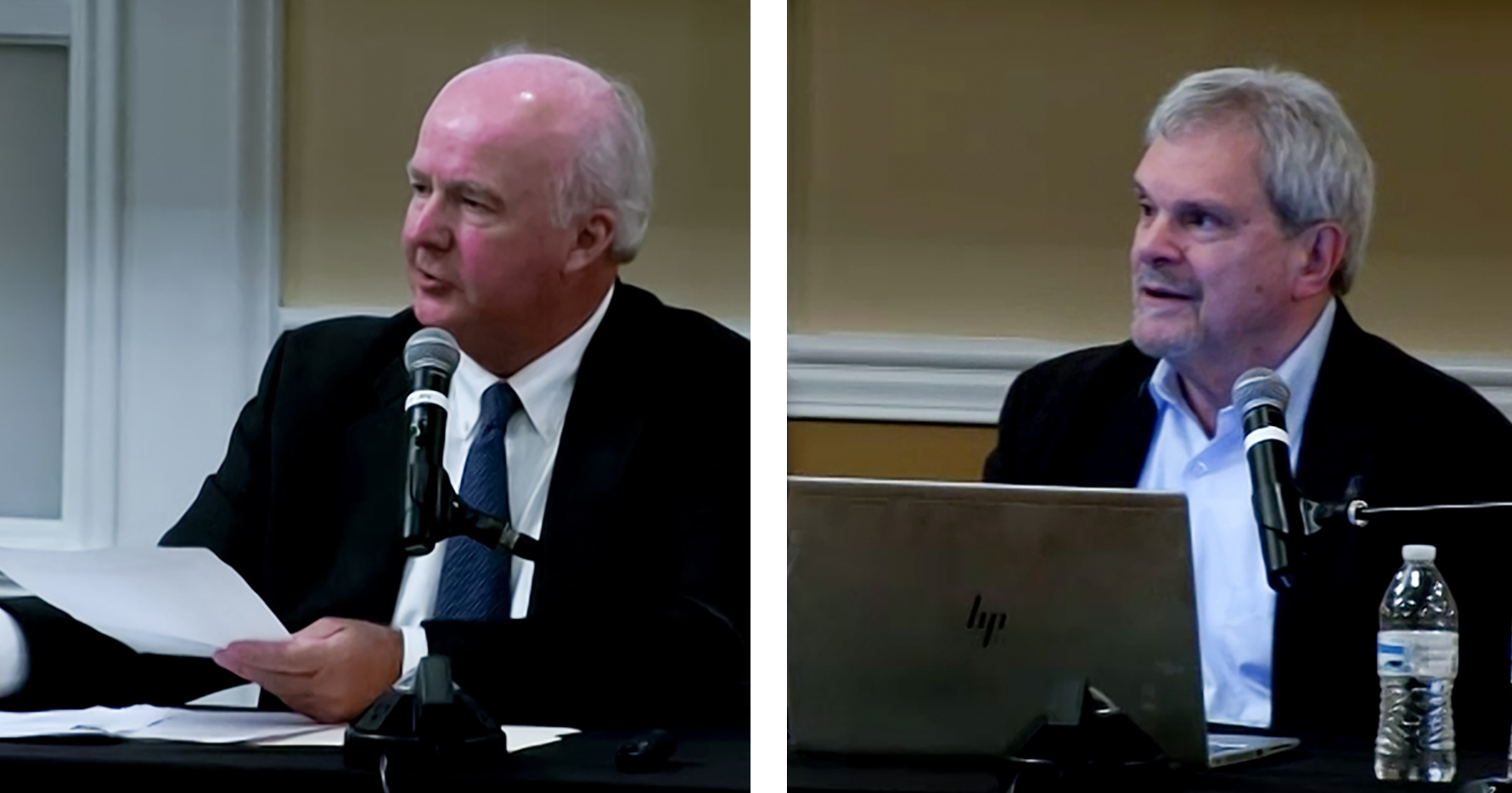
Calvin Covington (left) for Southeast Milk and Peter Vitaliano for National Milk Producers Federation testified on what the outdated skim milk component standards mean in terms of underpaying farmers and eroding producer price differentials (PPD), leading to disorderly marketing. This occurs because the skim portion of the milk that is utilized in manufactured products (Class III and IV) is paid per pound of actual protein, solids nonfat and other solids; whereas the skim portion of the milk bottled for fluid use (Class I) is paid on a per hundredweight basis using the outdated standard skim solids levels. The fat portion is not an issue because it is already paid per pound in milk class uses. Screen captures, hearing livestream

By Sherry Bunting, Farmshine, Sept. 8, 2023

CARMEL, Ind. – The national Federal Milk Marketing Order hearing completed two weeks of proceedings, so far, in Carmel, Indiana. The entire hearing is expected to last six to eight weeks, covering 21 proposals in five categories.

Picking up the livestream online, when possible, gives valuable insight into a changing dairy industry and how federal pricing proposals could update key pricing factors.

The first week dug into several proposals to update standard skim milk components to reflect today’s national averages in the skim portion of the Class I price. 

Here is a bite-sized piece of that multi-day tackle.

National Milk Producers Federation (NMPF) put forward several witnesses to show what the outdated component levels mean in terms of underpaying farmers, and how paying for the skim portion based on outdated component levels has eroded producer price differentials (PPD), leading to disorderly marketing.

IDFA’s attorney Steven Rosenbaum grilled NMPF economist Peter Vitaliano on this. He tried on seven attempts to establish that the fat/skim orders in the Southeast don’t have component levels as high as the national average, suggesting this change would “overpay” producers in some markets.

In his questioning, Rosenbaum stressed that fluid milk processors can’t recoup the updated skim component values if those components do not “fill more jugs.”

Vitaliano responded to say that protein beverages are a big deal to consumers, and some milk marketing is being done on a protein basis. Rosenbaum asked for a study showing how many fluid processors are actually doing this.

Attorneys for opposing parties kept going back to this theme that the skim solids should not be updated because the FMMOs are based on “minimum” pricing. They contend that processors can pay “premiums” for the extra value if they have a way of recouping the extra value by making more product or marketing what they make as more valuable.

Vitaliano disagreed, saying that even though many processors do not choose to market protein on the fluid milk label, “more protein makes fluid milk more valuable to consumers.”

Attorney Chip English went so far as to ask Calvin Covington on the stand: Why should my clients (Milk Innovation Group) have to pay more for the additional solids in the milk when they are removing some of those solids by removing the lactose?

“Consumers don’t want lactose,” English declared.

Covington, representing Southeast Milk and NMPF, responded to say: “I don’t know that to be true. It is unfair to suggest all.”

Bottomline, said Covington, raising standard skim solids to reflect the composition of milk today vs. 25 years ago adds money to the pool to assist with the PPD erosion so that Federal Orders can function as they were intended and so producers are paid for the value.

As English further questioned whether consumers even care about the higher skim solids and protein levels of milk today, Covington replied: “Skim milk solids have a value in Class I, or fluid milk. People don’t buy milk for colored water. The solids give it the nutritional value. That’s the reason they buy milk. That’s why FDA set minimum standards in some states. Why would you drink milk if not for the nutritional value?”

He also pointed out that the increase in solids nonfat over the past 20-plus years has improved the consistency of lower fat milk options. As noted previously, the milkfat is a separate discussion and is not included in this proposal because farmers are already paid per pound for their actual production of butterfat in all classes, including Class I.

Under cross examination, Covington explained that the Class I price in all Federal Orders pays for skim on a standardized per hundredweight basis and pays for fat on actual per pound basis. Meanwhile, the manufacturing classes pay for both skim and fat on a per pound of actual components basis. 

As skim component levels have risen in the milk, the alignment of Class I to the manufacturing classes narrows because of the differences in how the skim is paid for. When this happens, it becomes more difficult to attract milk to Class I markets. That’s one example of disorderly marketing. PPD erosion and depooling of more valuable manufacturing class milk is another example. 

Covington explained the impact of this misalignment on moving milk from surplus markets to deficit Class I markets, that the lower skim value becomes a disincentive.

Vitaliano explained the depooling issue as “creating disorderly marketing conditions also, and great unhappiness when one farm is paid a certain price and another handler pays a different price (in the same marketing area). That’s disorderly unhappiness for the Federal Order program,” he said.

He noted that the fundamental reason for pooling is to take the uses in a given area with different values to achieve marketwide pooling where producers in that Federal Milk Marketing Area are paid similarly, regardless of what class of product their milk goes into.

“This removes the incentive for any one group to undercut the marketwide price to get that higher price (for themselves),” he said. “The Orders create orderly marketing with a uniform price. Depooling undermines that fundamental purpose that is designed to create orderly marketing.”

Either way, whether indirectly paying to bring supplemental milk into Class I markets from markets with higher manufacturing use, or in the case of depooling, the dairy farmers end up paying for the fallout from this erosion of the PPD.

Since the beginning, even before 2000 Order Reform, figuring the Class I base milk price had to begin somewhere, according to Covington. Federal pricing has always used the manufacturing class values in determining that base fluid milk price.

The trouble today is that Class III and IV handlers pay farmers per pound of actual skim components in the milk they receive, while the Class I handlers pay per hundredweight based on an arbitrary outdated national average skim component standard. Thus, the “opportunity cost” of moving this now higher component milk to manufacturing classes that pay by the actual pound of protein, for example, instead of by the old standard average protein levels is not accounted for in the Class I price that still uses the old standard average levels.

Pressed again on how it makes sense to raise Class I prices by raising the component level of the skim to more adequately reflect the national average today, Covington said: “It adds to the nutrition, and I stand by that. In proposal one, the price will go up (estimated 63 cents per cwt or a nickel per gallon). I am comfortable charging that extra price to Class I processors.”

Attorney English, representing MIG, retorted that, “The handlers who buy milk and then by adding a neutralizing agent remove the lactose, they’re going to pay more for the milk that they then have to process to subtract the lactose.”

Covington responded that, “There are consumers who think about lactose. There are consumers who buy lactose-free products, yes, because it is on the shelf, but it’s not all consumers.”

On the higher protein, English asked Covington how Class I processors are supposed to monetize that protein in a label-less commodity, a commodity that is declining in its share of total milk utilization?

“We are still selling 45 billion pounds of packaged fluid milk (annually) in this country,” said Covington. “Consumers wouldn’t buy that 45 billion pounds if it wouldn’t have some nutrition.”

English argued that milk is sold as whole, 2%, 1% and non-fat. It is not sold by its protein, so isn’t it “so highly regulated in ways that alternatives are not that any increase in price hinders sales of fluid milk?”

Covington acknowledged that, “yes, it is regulated, but I’m not convinced that this proposal will hinder fluid milk sales. Again, (higher components) add to the nutrition and I stand by that.”

Opponents kept coming back to these value questions, while proponents focused on the price alignment issue and orderly marketing.

To link up with the hearing livestream 8 to 5 weekdays, to read testimony and exhibits, and to respond to the virtual farmer testimony invitations made every Monday for the following Friday, visit the Hearing Website at https://www.ams.usda.gov/rules-regulations/moa/dairy/hearings/national-fmmo-pricing-hearing

-30-

Rocky start for National FMMO hearing amid calls for broader scope, intense cross-examination on data, exhibits

By Sherry Bunting, Farmshine, August 23, 2023

CARMEL, Ind. — USDA’s much anticipated national public hearing of 21 proposals on amendments to uniform pricing formulas for all 11 Federal Milk Marketing Orders (FMMO) had a rocky start on Wednesday, Aug. 23 in Carmel, Indiana. The first day kicked off amid objections  to the hearing scope as fluid milk processors were seeking to get their excluded Class I proposals onto the docket.

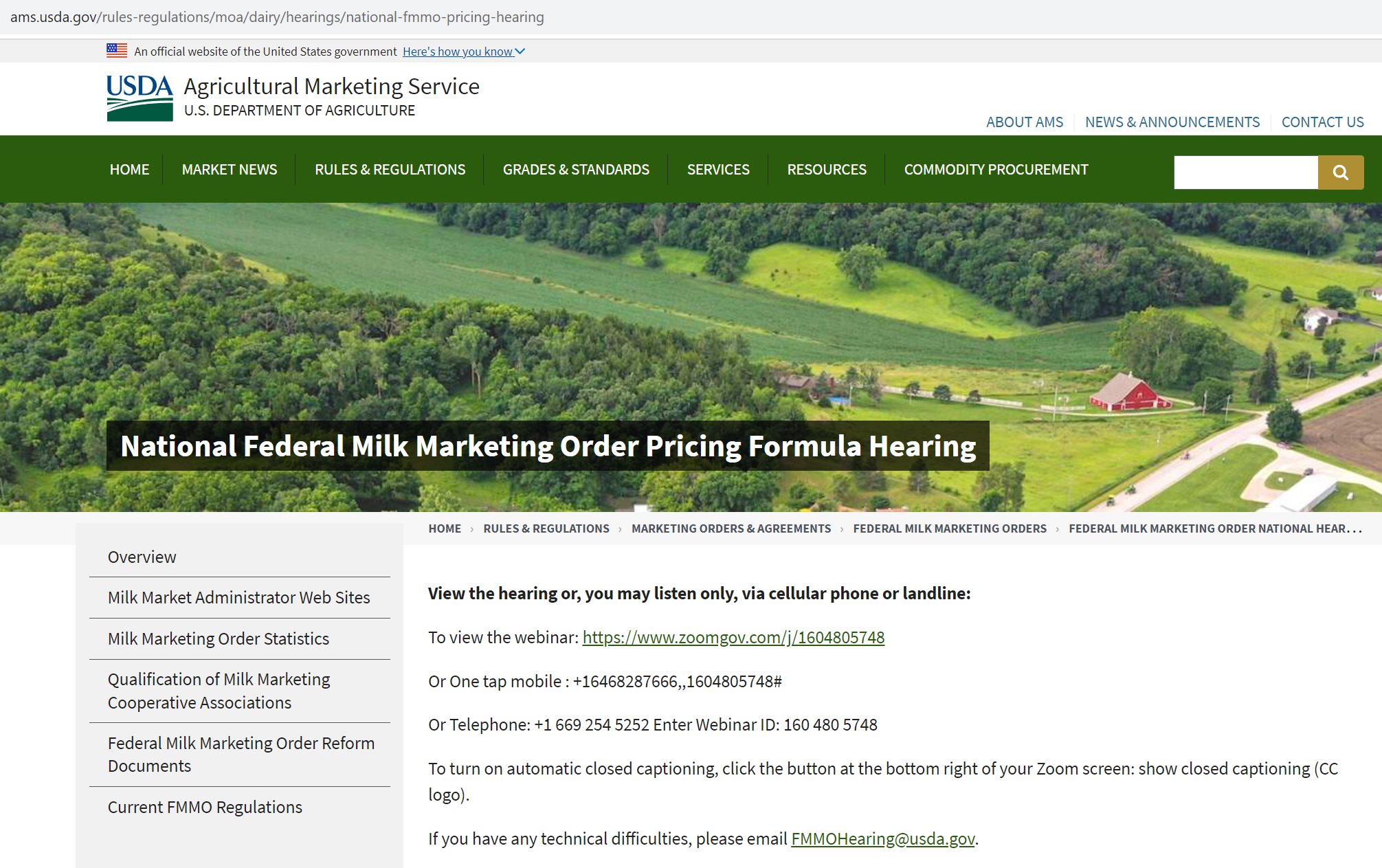
The presiding administrative law judge set the stage for what he said will be an estimated 7-week hearing, held 8 to 5 ET every weekday with virtual farmer testimony on Fridays. (It is being livestreamed for watching by zoom or listening by phone. Look for that information in the graphic above, or find the links and numbers at the end of this article or at the hearing webpage).

The judge stated his authority to interrupt for comments or testimony outside of the hearing scope. “I will not issue a decision,” he said. “USDA will take the information to render a decision.”

Once a recommended decision is put forward by USDA, expected in February or March 2024, a comment period follows before the final decision is issued in June or July and made fully effective in the fall of 2024. Some proposals call for a 12-month delay in implementation, so the full effect of potential decisions could be delayed until fall of 2025.

Given the rocky start to the hearing, even this timetable could be prolonged, but USDA is under a Congressional mandate to render decisions within 18 months of a petition it agrees to hear.

Immediately following the setting of the stage, Chip English, attorney for the Milk Innovation Group (MIG) put forward an objection and a motion seeking reversal of USDA’s decision that excluded two of its Class I pricing proposals from the hearing announcement. One of the excluded proposals would exempt organic milk from FMMO pools and the other deals with ‘shrink’ in the extended shelf life category.

Attorney Chip English for the Milk Innovation Group (MIG) kicks off federal milk pricing hearing with objections to scope, saying two of their Class I pricing proposals were improperly excluded. Screen capture from livestream of first day of 7-week national public hearing on federal milk pricing formulas

“It’s all coming in whether you like it or not,” said English, “because at the end of the hearing, we’re going to be talking about raising Class I, and these are issues that have to be part of that.”

Attorney John Vetne for National All Jersey joined in the objection on procedural grounds because NAJ also had its proposal to make all 11 FMMOs use multiple component pricing was rejected from the hearing. Currently, the 3 southern marketing areas and Arizona are fat/skim priced, whereas the other 7 marketing areas use multiple component pricing (MCP). USDA excluded this proposal since the 4 fat/skim priced marketing areas must regionally call for the change to MCP pricing.

Within the first hour and a half of the first day, the hearing went “off record” into private discussion about handling the objections and handling the exhibits.

In addition to the hearing scope objections, there was extensive cross-examination of USDA AMS Dairy Program staff on its fulfillment of data requests and various exhibits provided by USDA — in some cases calling into question the comparability or reliability of some of the data.

For example, much was made of the differences between the USDA mailbox milk price report as compared to the Federal Order price announcement. Mr. English probed USDA staff on how these reports are audited, how the data is collected, what is included and what it is based on. He did what he has done in Pennsylvania Milk Marketing Board (PMMB) hearings in the past to discredit the comparability of the mailbox price report to state or federal “announced price” reports — because of the differences in the “auditing”.

As each exhibit on pooling figures and other data was put under the cross-examination microscope, the issue of “restricted” data came up due to “confidentiality,” which USDA staff explained is necessary when 2 or fewer companies are in a marketing area — be they plants or farms. In the rapidly consolidating dairy industry, what does this foretell of future market transparency if data are not available for price discovery and market transparency because of too few operators in a region?     

There were attempts to keep some exhibits from being included in the hearing record. Most of these discussions were put on hold to be explored through further cross-examination at a later time with future witnesses.

In many ways the sense of this round of cross-examination on exhibits felt a bit like cutting the legs out from under future presentation of proposal testimony even before they get to the floor. Basically, much legal maneuvering on data before the first proposal is even heard and testified to.

If the first day is any indication of what is in store, expect to see many attempts to push the scope boundaries, and expect the judge to err on the side of making sure USDA has all of the information it needs to render decisions, so some latitude will likely be given for these boundary explorations by attorneys.

Attorney English, is well known to any Pennsylvania dairy farmer who has ever sat in on a PMMB hearing in Harrisburg. He has represented Dean Foods and the Pennsylvania Milk Dealers in past years on the price-setting hearings conducted by the PMMB. In fact, the esteemed milk accountants of Herbein and Co. in Pennsylvania are providing material for some of the MIG opposition arguments to come. Cheap Class I milk is the name of the current game.

The MIG will be working overtime through Mr. English to make sure Class I prices are not raised, and in fact are lowered at the farm level since one of their proposals that WAS accepted by USDA is to remove the base Class I price differential of $1.60/cwt from every FMMO — across the board.

Who is the MIG? The Milk Innovation Group members include Anderson Erickson Dairy Co., Inc.; Aurora Organic Dairy; Crystal Creamery; Danone North America; Fairlife; HP Hood LLC; Organic Valley/CROPP Cooperative; Shamrock Foods Company; Shehadey Family Foods, LLC (Producers Dairy Foods, Inc.; Model Dairy, LLC; Umpqua Dairy Products Co.); and Turner Dairy Farms.

After lunch, some high points of the first day included Dr. Roger Cryan for American Farm Bureau Federation requesting volume data on all of the salted and unsalted butter that is graded by USDA AMS for retail. This, he said, is four numbers and should be readily available. It is germane to AFBF’s proposal to include unsalted butter in the product price survey used in the Class IV pricing formula.

Testimony began late in the afternoon on the first proposal from NMPF to raise component levels in the uniform pricing formulas to more accurately reflect today’s protein and other solids levels.

Peter Vitaliano, NMPF’s vice president for economic policy and market research, laid out the proposal and was subjected to intense cross-examination with the promise of hours more of cross examination on the second day by Mr. English before even getting to the first expert fact witness — Calvin Covington, for Southeast Milk and NMPF.

While NMPF witnesses will show the outdated component levels are giving a ‘deal’ to Class I processors paying less for skim that is more valuable today in terms of components, IDFA’s attorney Steven Rosenbaum grilled Vitaliano on this. He tried on seven attempts to establish that the fat/skim orders in the Southeast don’t have component levels as high as the national average by asking for this breakout in seven differently-phrased questions, all the while discreetly suggesting that this change would “overpay” producers in fat/skim orders.

He also questioned how fluid milk processors are supposed to recoup that value if it doesn’t “fill more jugs of milk”. Vitaliano responded to say that protein beverages are a big deal to consumers, and some milk marketing is being done on a protein basis. Rosenbaum asked for a study showing how many fluid processors are doing that, and then basically said, in lawyer speak, the equivalent of ‘never mind,’ as Vitaliano interjected that it’s more valuable to consumers.

In this reporter’s mind, the thought that kept popping up during that exchange was this: If IDFA and MIG are so intent on suppressing the Class I price to avoid paying for the improved value of milk, then maybe they should then start forking over their cost data in audited surveys to the USDA to justify the $3.60 per hundredweight they are getting subtracted from the base Class I price in the form of Class III and IV make allowances that do not even apply to them, but they get that deal anyway.

These are just a few thoughts from an intense first day of the national FMMO hearing that NMPF is calling the “first in a generation opportunity” to make key adjustments to the milk pricing formulas to reflect a changing dairy industry. It appears that many of their proposals will help farmers… We’ll see over the next 6 to 8 weeks where it’s all going.

In the meantime, Congress may want to think about fixing the Class I mistake it made in the 2018 farm bill by changing four simple words from ‘average plus 74 cents’ to ‘higher of’ and at least get that done timely.

This hearing could leave that objective in the dust if the first day is an indication of what is to come.

Information to tune in by livestream through zoom or to dial-in and listen from a cell phone or landline has just been announced.

View the hearing at this link: https://www.zoomgov.com/j/1604805748  and enter Webinar ID 160 480 5748

Or listen via one tap mobile: +1.646.828.7666, using ID 1604805748#

Or listen via landline telephone: +1.669.254.5252 and enter ID 160 480 5748

The hearing schedule will proceed in this order to consider accepted proposals under these categories, according to USDA:

1. Milk Composition (component yield) proposals.

2. Surveyed Commodity Prices (removing or adding commodities to the weekly price surveys used in the class and component pricing formulas).

3. Class III and IV Formula Factors, which includes various ‘make allowance’ proposals as well as butterfat recovery factors, and farm-to-plant shrink.

4. The Base Class I Skim Price (Mover) Formula (6 proposals, 3 favoring return to ‘higher of’, including 2 that also favor eliminating ‘advanced pricing’ of Class I. )

5. Class I and II Differentials.

Copies of the notice, a list of proposals being considered, guidelines for how to participate, the hearing schedule, and corresponding hearing record can be found and followed on the Hearing Website at https://www.ams.usda.gov/rules-regulations/moa/dairy/hearings/national-fmmo-pricing-hearing

For technical difficulties, please email FMMOHearing@usda.gov

-30-

USDA will hear 21 milk pricing proposals beginning Aug. 23; Front-and-center: May 2019 change in Class I (without a hearing) costing farmers $1 bil. over 52 mos.

By Sherry Bunting, Farmshine

WASHINGTON –- USDA officially announced Monday (July 24) the national public hearing to consider proposals seeking to amend the uniform pricing formulas across all 11 Federal Milk Marketing Orders (FMMO). The hearing begins Wednesday, August 23, 2023 at 9:00 a.m. at the 502 East Event Centre, 502 East Carmel Drive, Carmel, Indiana.

Farmers will be able to testify in person at any time, or virtually on Fridays by pre-registering.

Approximately 40 proposals were submitted by 12 organizations and were explained during a webinar in mid-June. Of those, 21 will be considered within the uniform pricing scope of the hearing, according to the USDA notice. Copies of the notice, a list of proposals being considered, guidelines for how to participate, the hearing schedule, and corresponding hearing record can be found and followed on the Hearing Website.

The Class I mover formula will be addressed in the national hearing’s scope, including the proposals from National Milk Producers Federation and American Farm Bureau to go back to the ‘higher of’ method. The change from ‘higher of’ to ‘average of’ was made legislatively in the 2018 farm bill without a hearing.

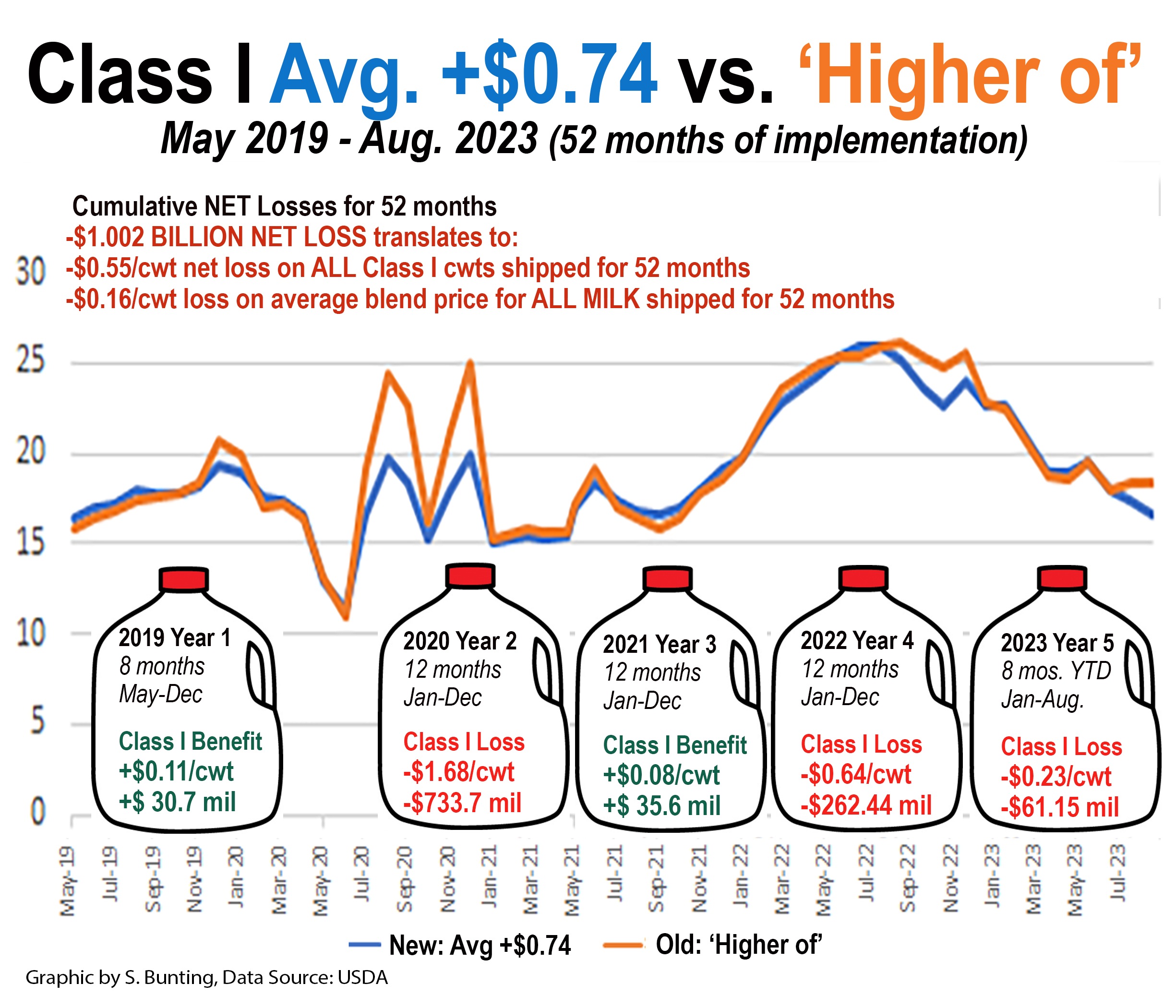
Since USDA implemented the ‘average of’ method in May 2019, net losses from this change are projected to exceed $1 billion after August 2023 milk is paid for in September.

On July 19, USDA announced the August advance Class I price mover at $16.62. If the previous ‘higher of’ method had been used, the Class I base price would have been $18.29. That’s a $1.67 per hundredweight loss on all Class I milk next month. July’s Class I mover was also calculated substantially lower (by $1.02) using the ‘average of’ vs. the ‘higher of.’ These losses will impact August and September milk checks for July and August milk.

Around 28% of all milk produced in the U.S. is Class I fluid use, so farmers stand to lose an additional 47 cents per hundredweight on all of the milk they market in August and 29 cents on all the milk they market in July — just from this formula change. This is on top of the market declines in the class and component prices. The loss to blended prices will be greater in some Federal Orders and less in others, and this does not include the impacts from de-pooling of higher-value Class IV milk.

The impact of the two-week Class I advance pricing factors is compounded by the ‘average of’ method, which is quite notable for July and August. Cheese and whey were in a tailspin lower; however, on the very next day after the August Class I base price mover had been averaged and locked-in on July 1-15 pricing factors, the dairy product markets began a huge rally, with cheese gaining nearly 40 cents in 8 trading sessions. This boosts the other class and component values much higher for the latter half of the month.

Over the 52 months of its implementation, the ‘average of’ formula has effectively removed an estimated 55 cents per hundredweight from farmer payment for all Class I milk, according to USDA data. On a blended uniform price, this comes out to a national average loss of 16-cents on every hundredweight of all milk used in all classes of products shipped from May 2019 through August 2023. That is like paying another checkoff for 52 months.

Among the other proposals included in the national hearing is the American Farm Bureau (AFBF) Class I and II proposal that seeks return to the ‘higher of’ with additional adjustments such as eliminating the two-week ‘advanced’ pricing.

IDFA’s Class I proposal seeks to keep the ‘average of’ and use either the current 74-cent-adjuster or a ‘rolling adjuster’ based on a calculated difference over 24 months, whichever is higher.

Milk Innovation Group’s (MIG) proposal seeks to keep the ‘average of’ but change the ‘adjuster’ monthly via a 24-month look-back with a 12-month lag.

Two Edge Cooperative proposals are included, one being a Class III-plus formula. The other would use the ‘higher of,’ but would base it on end-of-month four-week announced class and component prices instead of the two-week prior month advance pricing.

The hearing docket also contains four proposals on Class I differentials, including NMPF’s proposal to increase them in all locations by varying amounts as well as MIG’s proposal to lower them across the board by $1.60.

Two proposals from NMPF and National All Jersey will be heard to update milk component factors.

Six proposals will be heard on Class III and IV pricing formulas. Three are separate proposals from NMPF, IDFA and Wisconsin Cheesemakers to update processor credits, known as ‘make allowances,’ as well as three from Select Milk Producers on butterfat recovery, farm to plant shrink and nonfat solids yield.

In addition, the hearing scope includes four proposals on how dairy commodity products are surveyed, including NMPF’s proposal to remove 500-lb barrel cheese from the weekly survey, AFBF’s proposal to add bulk 640-lb block cheese and unsalted bulk butter, while California Dairy Campaign’s proposal would add mozzarella.

Dairy farmers can testify in-person at any time during the hearing, or virtually on Fridays. Beginning Fri., Sept. 1 and for each Friday thereafter until the hearing concludes, dairy farmers may testify virtually in 15-minute time slots beginning at Noon ET. There will be 10 slots for virtual testimony each Friday.

To be included, farmers must pre-register. The pre-registration for each Friday’s time slots will be available starting Monday of the same week at the USDA Hearing Website. For example, the link to testify on Fri., Sept. 1 will be available on Mon., Aug. 28. To submit exhibits for the record, email them to FMMOHearing@usda.gov by 8:00 a.m. ET on the day of testimony.

Those participating in the hearing in person should notify a USDA official upon arrival at the hearing. For additional information, contact Erin Taylor, Director, Order Formulation and Enforcement Division, USDA/AMS/Dairy Program at Erin.Taylor@usda.gov.

Does a watched pot boil? National Refuge proposal ‘paused’ in NW PA and SW NY; Fish and Wildlife says new draft coming

AUTHOR’S NOTE: National Wildlife Refuge designations and land protection plans are long-simmering recipes, so it’s important to keep eyes on the pot while the heat is presumed to be turned down. Will a watched pot boil? One thing to keep in mind is to look overseas at the Netherlands, where the government, thrown this week into disarray to where the farmer-citizen party may gain strength, has been using climate-based targets to begin pushing buyout or closure of an estimated 3000 farms. Dutch farms have been zoned for a range of production-cuts from 15 to 90% with options to sell their land to the government. The Dutch farms identified for the largest production cuts of 75 to 90% would obviously be economically unsustainable and therefore more apt to sell. These are the farms that are located closest to EU Nature Preserves that were designated decades ago. When I spoke with a Dutch dairy farmer last year about this, he explained that the nature they have has been built, improved, by the farmers, but those close to the network of EU preserves are in the current crosshairs. Yes, these are long-simmering recipes. Here in the U.S., Northwest Pennsylvanians are being told it will take decades to complete a land protection plan if a French Creek National Wildlife Refuge is eventually designated for the watershed by the U.S. Fish and Wildlife Service Director. They are told that farming can continue, that they want to ‘help’ local conservancy efforts and that only willing sellers would be pursued. That’s not how it went when the Erie Refuge was completed at the center of the French Creek watershed in the 1970s. Some saw farmland fall to eminent domain two decades after that Refuge was established.
Bottomline: Keep an eye on the pot, even if doing so draws accusations of claiming a tepid pot is about to boil. Every cook knows what happens when looking away. Here’s an update since the meeting between elected officials and the U.S. Fish and Wildlife Service.

By Sherry Bunting, Farmshine

MEADVILLE, Pa. – The U.S. Fish and Wildlife Service (USFWS) has “committed to a ‘pause’ and will draft a new proposal that could potentially limit the size and scope of a National Wildlife Refuge in the French Creek watershed,” according to a press release from Congressman Mike Kelly’s office.

The proposed refuge and concerns shared by farmers were first reported in the June 30 Farmshine, followed by a more detailed report in the July 7 edition.

Congressman Kelly and elected officials from affected counties met on July 6 at the Crawford County Courthouse in Meadville to discuss the proposed Refuge with USFWS representatives Vicki Muller, the project manager, and Mark Maghini, a realty chief.

This comes after the ‘public scoping’ phase where opposition and concerns were raised by farmers, members of Congress, county leaders, local residents, as well as questions about its necessity being raised by those involved in local land trusts and conservation efforts already operating in the watershed.

The ‘planned Refuge’ would create new federal ownership and oversight of lands in the watershed of nearly 800,000 acres along the 117-mile French Creek through portions of Crawford, Erie, Mercer and Venango counties, Pennsylvania and Chautauqua County, New York.

According to Congressman Kelly’s office, the USFWS acknowledged it did not properly engage and inform the communities of impact and will include elected officials in future planning.

“A pause on the proposed French Creek National Wildlife Refuge is absolutely necessary. Officials from the U.S. Fish and Wildlife Service have told us there is no official plan or size for this refuge, and I believe that’s exactly the problem — this has been a solution in search of a problem with farmers and landowners caught in the middle. The federal government does not need to have control of French Creek,” said Rep. Kelly in the statement.

“We all support a healthy and vibrant French Creek, but I believe local conservation efforts are already accomplishing what the USFWS is trying to do,” he noted.

Nothing to see here. Just go about your business…

Meanwhile, Maghini, the realty chief (land acquirer) for the Northeast region of the Fish and Wildlife Service indicated in an email to the Meadville Tribune that there is “no proposal,” pointing to a June 4 update at the special webpage for the project with these words highlighted in bold type.

He insists that the goal of the meetings and input-gathering this spring was to “identify whether there’s a role USFWS can play in the French Creek watershed.”

However, the agency’s own documents at the site show it already has a plan and has identified the next steps, which indicate it is already in the process of evaluating those public comments to develop a final proposal, which had a summer 2023 timeline.

Specifically, the “Schedule for Establishing the Proposed French Creek National Wildlife Refuge” on the second page of the May 9 FAQ document at the project webpage, is as follows:

1) Develop draft Land Protection Plan (LPP) and Environmental Assessment (EA) in the Spring of 2023;

2) Conduct public review and comment on proposal in the Spring of 2023; and

3) Evaluate the comments and develop the final plan for approval in the summer of 2023.

The customary procedure is for comments from the public scoping phase to be used when USFWS develops a land protection plan and environmental assessment. The ‘pause’ may extend this schedule to allow more time for the agency to evaluate the comments it received and to include elected officials in its planning.

Whenever a final plan is developed, the public then has 45 days to review and comment before it is ultimately left to the USFWS director, who has the sole authority to approve or disapprove a plan, according to the agency’s FAQ.

Residents tell Farmshine they hope a new draft provides more detail and a much smaller scope, but they also hope the ‘pause’ allows time for more public input on whether or not the Refuge designation is even needed.

The designation of the French Creek as 2022 River of the Year by Pennsylvania Organization for Watersheds and Rivers came largely due to the success of the existing local conservation efforts in promoting the health and biodiversity of French Creek in the first place, they say.

This brings the feeling that one can farm for generations, keep the working lands clean and natural, and then find out this can lead to being more, not less, vulnerable to having a Refuge designation with potential impacts for the future.

Pennsylvania Farm Bureau legislative director Nick Mobilia said as much to the Corry Journal: “I feel we have presented our issues with the refuge as positively as we can. We asked what USFWS thought was wrong with the waterway — they did not have any areas of concern.

“We as a local collective maintain French Creek and take pride in it — of course we are going to fight for it to be left as it is,” he said. “I think this was realized on (July 6) and (USFWS) will walk away from French Creek and focus on waterways that do need the government’s help.”

Will USFWS walk away? Doubtful.

Maghini, the USFWS realty chief for the region told the Meadville Tribune Friday (July 7) that the agency “looks forward to working with local officials once a plan that incorporates local feedback already collected has been prepared.”

Interestingly, the title of the FAQ document on the project webpage refers to the project as a “Proposal to Expand Refuge Lands in the French Creek Watershed.” 

This reference to “expansion” is significant. At the center of the land protection plan “areas of interest” on the USFWS conceptual map (above) lies the already existing Erie National Wildlife Refuge (shaded pink within the green). Previously managed by Muller, the existing Erie National Refuge encompasses 8,777 acres of the 798,000-acre French Creek watershed.

At public meetings this spring, a farmer recalled his family’s farmlands eventually falling into eminent domain in the 1970s – more than a decade after private lands within what is today the Erie National Wildlife Refuge were originally designated by the USFWS in the late 1950s. 

According to local newspaper accounts, Muller responded by telling the crowd that the USFWS “doesn’t do that anymore.”

The other significant aspect of ‘expanding’ an existing refuge vs. declaring a new one is that the Inflation Reduction Act provided climate resiliency and biodiversity funds for 2023 through 2026, including more than $121 million to the USFWS for restoration, rebuilding and expansion of existing wildlife refuges and $125 million for endangered species recovery.

The latter identifies 32 initial plant and animal species to be recovered “wherever found.” One, for example, is the snufflebox mussel with one area shown on its map as the French Creek watershed.

Will the public get more input? Will it help?

USFWS documents explain that when land protection plans are drafted and approved, they include land acquisition timelines that follow a “Landscape Conservation Design to ensure actions contribute to the landscape-level vision.”

Will a ‘pause’ give farmers, landowners and communities more say in the vision for their landscape, one they want to retain locally? Will the USFWS commitment to include elected officials in the planning happen before or after the new draft is presented?

Revamped ‘live text’ at the special webpage for the proposal notes that the USFWS review of public comments in April and May boil down to the following beliefs held by residents that USFWS says it agrees with: 

1) Residents have a deep affection for French Creek; 

2) They believe maintaining use of prime agricultural lands is important; 

3) They value the rural character of the watershed and want to ensure its persistence; and 

4) They value local land trusts within the community and trust them in their land protection efforts.

USFWS states further that a National Refuge designation is what authorizes the agency to pursue the land acquisitions from willing sellers and that it does not detail how USFWS would manage the lands it acquires through fee-title or easement. 

USFWS also states that it does not fund local conservation efforts because it must show a dollar of federally-acquired land for every federal dollar it spends.

However, within this two-page “Proposal to Expand Refuge Lands,” the agency lists goals for “new refuge lands” (beyond the existing Erie National Refuge) that would allow the agency to “protect and manage the French Creek and its tributaries and wetlands.”

It also purports to “help” local conservancies by adding federal acquisitions to local acquisitions since none of these entities have access to unlimited funds. The only way it can “help” is to federally acquire land.

The U.S. Fish and Wildlife Service is a Bureau within the U.S. Department of Interior that operates in a quasi-independent fashion, having federal authority to establish and manage protected lands within its National Wildlife Refuge System, and to complete approved land protection plans over subsequent years, through its Land Acquisition and Realty division.

According to that division’s section of the USFWS website, funding for land acquisition comes from the Migratory Bird Conservation Fund through federal Duck Stamps and import duties on arms and ammunition as well as through the Land and Water Conservation Fund from offshore oil and gas leases.

In 2021, at the start of the Biden Administration, the USFWS updated its “Climate Adaptation Strategy” to be a framework that is part of the Administration’s “U.S. Climate Resilience Toolkit.” 

Several documents available at the USFWS website explain that this toolkit has now equipped USFWS to “take immediate action to build ecosystem resilience in the face of climate challenges.”  

As noted in the previous Farmshine articles, this is a process that moves at a snail’s pace — with or without a ‘pause.’ 

The ‘pause’ is expected to move the project from the front-burner to the back-burner — for now — amid the public heat surrounding it, but this doesn’t mean it is off the stove.

National Wildlife Refuge designations and land protection plans are long-simmering recipes, so it’s important to keep eyes on the pot while the heat is presumed to be turned down. Does a watched pot boil?

-30-

Photos by Sherry Bunting