Leaving boots in the mud to seek new ground on Tuesday


Editorial Comments by Sherry Bunting, Farmshine, Friday, Nov. 4, 2016

flag19Agriculture is at a crossroads, and so is America. But the choice of paths that lie before us are neither clear nor direct.

When we go to the polls on Tuesday, it will be with mixed thoughts and emotions.

As the mainstream media analyze and over analyze every breaking news story, every “narrative,” every campaign “spin,” every poll, every issue that they deem important, there is much that gets left on the cutting room floor — important issues that no one really talks about, and yet they are harbingers of our future.

What they don’t talk about – of course – is agriculture. What they don’t talk about is the backbone of our economy, the original resource from which all other facets of the economy are made possible.

Take, for example, Hillary Clinton’s speech to financial institutions, where she said she dreams of one world, one economy, without borders. When pressed on that issue, her response was to say that, ‘Oh, that speech! I was talking about the energy economy, a worldwide energy grid. I want the U.S. to be the renewable energy super-power of the world.’

A convenient response to a concept that should give us all pause — in and outside of agriculture.

In talking with farm folk who volunteer for missions or projects in third-world countries where helping to establish indigenous agriculture practices and infrastructure is deemed so important, it hit me: We will be that third-world country — maybe not in my lifetime – but nevertheless that is one path on this crossroads if we do not take care to protect our farms and our farmers. Not only is their stewardship of the land vital to regional food security, but they are the place-holders for the essence of our liberty as a nation. Private property rights and ownership are the keys to our freedom as a nation, as a people.

Globalization is happening at a rapid pace. Running parallel to globalization is market concentration as mergers and acquisitions put more and more power into the hands of the few when it comes to food and agriculture. And then those ‘too big to fail’ entities are being sold off to foreign nations, like China, who already owns, according to the Department of the Treasury, $1.24 trillion in bills, notes and bonds (about 30%) of the over $4 trillion in Treasury bills, notes and bonds held by foreign countries.

That, my friends, is the auctioneer’s gavel on our national debt. True to form as a businessman, Donald Trump is talking about the national debt. Hillary Clinton is not.

Exports are said to be necessary for all agriculture commodity markets, especially dairy, and while I believe exports are important, they are not the end-all, be-all – except to the multi-national companies that view us as though they are on a satellite in space counting their dots on the globe: production units or consumption units, bars on a graph, slices on a pie-chart, numbers on a sales report, quarterly statements to shareholders.

In these third world countries I referenced earlier — where the good folk of the USA help farmers establish themselves — one of the first realizations is that when we throw cheap food at them, through exports, they have difficulty getting their own agriculture established to have the food security we Americans enjoy and truly take for granted.

Think about that for a moment. Are we not in danger, ourselves, of going down a path that could leave us food insecure?

The trade agreements that give our farmers market access to foreign markets also give our domestic market away to foreign imports. The give and the take are contrived and uneven. Winners and losers are made, created.

There is nothing fair or free about world trade because nations are losing the ability to care for and protect their own – particularly the U.S. – and we don’t even realize it. We are focused on the tantalizing allure of what we can sell … so that we are blinded to being sold-out.

The magician’s trick. Watch the elaborate thing I am doing with my left hand while I fool you with my right.

Many of these trade agreements are not free and fair trade, but rather a march forward to globalization, where the World Trade Organization and the United Nations become a higher power than our own Congress, our own President.

We saw just a tiny inkling of this, firsthand, when Congress quickly repealed the Country of Origin Labeling (COOL) last March, and when the administration lifted the ban on Brazilian beef in August, and when the first boatload of beef hit Philadelphia, via JBS, just three weeks ago, followed by a rapid downturn in cattle prices here at home.

We’ve already seen foreign interests, namely China, purchase Smithfield and Syngenta, to name a few. This week, the Dallas News reported that a team of Chinese bankers and a Chinese dairy are considering a possible takeover bid for Dean Foods, our nation’s largest milk bottler that handles 35% of the raw farm milk produced in this country.

What does this have to do with Tuesday’s presidential and congressional election? Plenty.

You won’t hear Hillary Clinton or Donald Trump talk about agriculture, specifically, but listening to their differing outlooks, overall, a few things are clear and have helped me make my choice for next Tuesday.

For me, voting for a third party candidate or writing in a name like John McCain (as previous candidate and Ohio governor John Kasich did) is not an option. Neither is it an option to write in Mickey Mouse or to leave that part of the ballot blank.

Folks, this is serious. This presidential election – for all of its circus acts – is no circus. This is our future. This is the future we are handing to our children and grandchildren. I, for one, cannot trust it to a candidate who has spent the past 30 years in the political realm as a profitable public servant, and has wasted so much of that time on her own agenda with such disregard for the rules others live by as to again be under investigation.

I will vote between the two major party candidates based on what I know about their outlook on the future along with what my gut tells me about the investigations into their pasts and what it says about what they could or would do with the power of the Presidency in the future.

Neither candidate lives like we do out here in middle and rural America. But, at least one of the two candidates lives outside of the political realm.

We are governed by career politicians embroiled in endless self-perpetuation. The more paralyzed they are in their elected offices, the more power is diverted to the longstanding and quite powerful bureaucracy whom are elected by no one.

Everyone complains about the gridlock inside the beltway, like nothing ever gets done.

Wrong.

Plenty of work is getting done in Washington D.C., it is just mainly the work of career bureaucrats that exercise more control and make us weaker, tearing at our moral fabric, eating away at the base of our economy, ripping through our roots, and chipping away at our freedoms.

There is a power- and land-grab underway in this country. Most all agriculture commodities are at prolonged below-breakeven prices while the political elite is poised to push yet another trade agreement, the Trans Pacific Partnership, into the mix.

Meanwhile, we have a hammer of political correctness keeping us in our place, not daring to be free thinkers. Many voices are silenced as the economic and moral decay are inextricably linked.

Take, for example, the way we accept how the government imposes ridiculous rules on what our children can eat for lunch at school. All things are connected so that local communities cannot even feed their children the way they see fit. Those rules, incidentally, create winners and losers. And in so doing, the voices of the affected are silenced.

We have a runaway EPA with the implementation and flawed interpretation of the Waters of the United States (WOTUS) legislation that threatens to create a second wave of land-grab after the market pushes a first wave of farmers off the land.

And then there is the Humane Society of the U.S. (HSUS) and their silver-tongued Wayne Pacelle. He is campaigning for Hillary Clinton. Her animal rights agenda dovetails with the candidate and Democratic Party’s obsession with climate change — right down to the livestock and dairy cattle on our farms.

There is so much more I could say, but to summarize, consider this: Who better to tackle over-regulation, unfair trade agreements, national food security, a vital agriculture, family farms and small businesses besieged by a labyrinth of complexities foisted upon them by a government run by self-perpetuating career politicians and ever-present, accountable-to-no-one bureacrats than a business man — a man that for all of his faults, at least does not live and has not spent 30-plus years operating in the self-perpetuation of the D.C. beltway.

We need to break free of the career politician mentality and breathe fresh air and common sense into the mix as well as to toss a bit of our sensitivity and political correctness to the side to break the cycle we are in and alter the path down which we are being led.

For all of his faults, Donald Trump is the only one of the two less than optimal choices we have in this election that fits that description.

Even on immigration reform, he is the one to have the best chance of getting it done. Only after our border is secured will our divided nation have a chance to come together with compassion for the illegal workers who are here today, working hard, making a contribution and raising their families that were born here. I have listened to Trump on this issue, and I get it. He is leaving room for that conversation after the border is secured and the estimated two million illegal immigrants that have committed crimes are properly dealt with. He will consult the American people on the next move after that first important move.

Election after election, candidates promise to shake things up, bring about change, bring people together, work for the people, protect our country.

Meanwhile, the beltway fills with sludge and slow-motion sets in to the point where boots are stuck.

Instead of standing fast, I’m leaving the boots in the mud, these bare feet are seeking new ground next Tuesday.
‘Bred-and-owned’ declared best of best at 50th WDE

By Sherry Bunting, Farmshine, Oct. 14, 2016 (Photos by author except where noted)

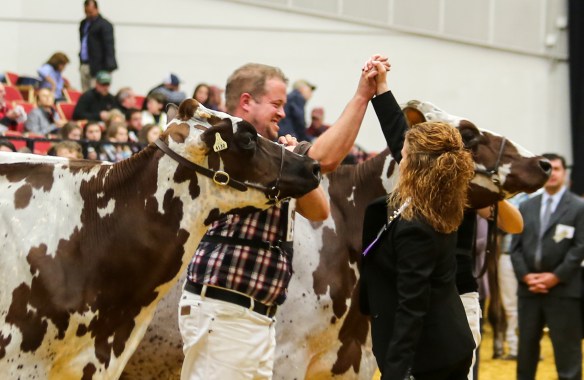
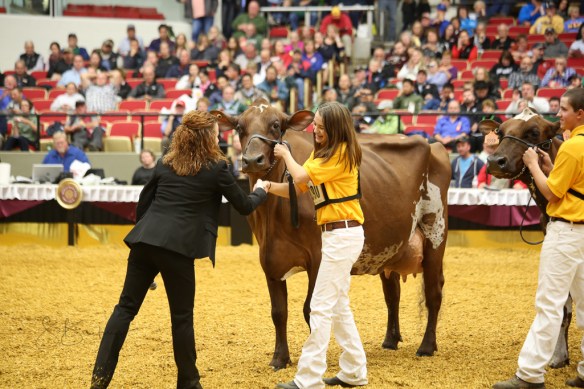
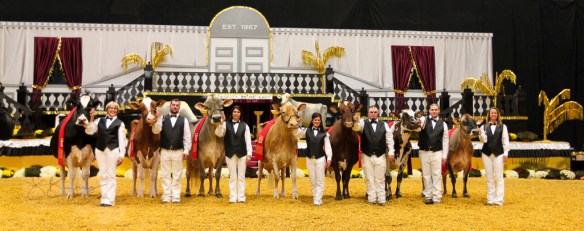
MADISON, Wis. — As the World Dairy Expo celebrated 50 years earlier this month, nostalgia could be found both in and out of the showring. For starters, the five days of shows for seven breeds yielded grand champions that were predominantly bred-and-owned, many with their breeder-owners at the halter.

In fact, six of seven open grands and four of seven junior grands were bred and owned. Let’s take them in alphabetical breed order!

day-5-96.JPG

Throughout the week, judges recognized how difficult it is to get to this show and win, and even more so to breed the animal and get her here and win. Exhibitors, judges and breeders, alike, point out in their own way that there is as much art as there is science to breeding a top cow… but also a bit of luck.

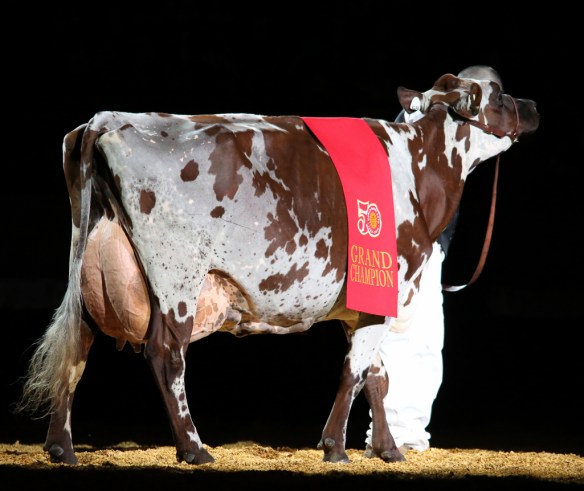
Take for example, the grand champion of the International Ayrshire Show: Margot Patagonie was bred, owned and exhibited by Expo first-timer Ferme Margot of Ste Perpétue, Quebec, Canada.

day-5-86.JPG

The striking thing about this grand champion is that not only did Ferme Margot breed the winning cow, they also bred her dam and her sire! What an achievement for the visiting World Ayrshire Conference to witness during their time in Madison, where they also saw the Expo’s largest Ayrshire show ever, with 321 entries, reportedly 60 more entries than the previous record.

AyrshireOpen(B&O)2401.jpg

In the junior Ayrshire competition, Erin Curtis-Szalach of Cedarcut Farms, Cazenovia, New York, knabbed grand champion honors for the second straight year with her bred-and-owned Cedarcut Burdette Clove Colatta.

day-4-53.JPG

She also made a strong honorable mention grand champion and total performance winning in the Open Show where entries were up by 60.

DayFive1503.jpg

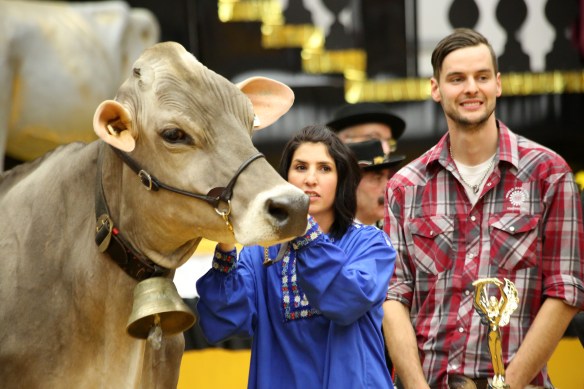
In the Brown Swiss competition, which also topped previous records with 385 entries, both grand champions were repeat show-toppers as well as bred-and-owned with owners at the halter.

DayThree2107.jpgBrown Heaven Glenn Fantasy topped the open show with Josee Charron from Ferme Brown Heaven, Vercheres, Quebec at the halter.
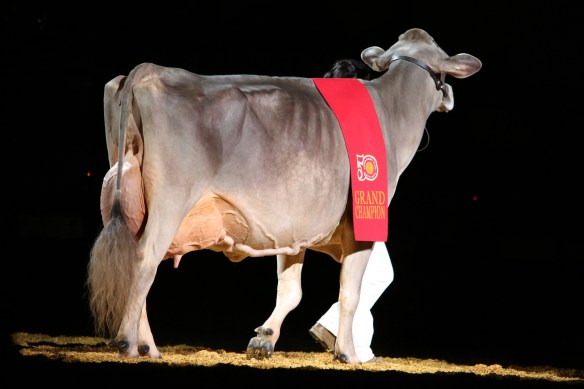
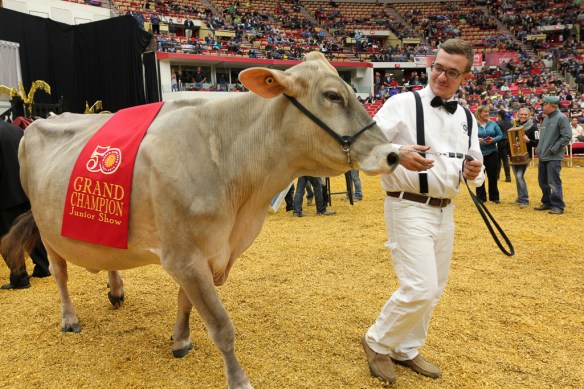
DayFive3491.jpgKyle Barton, grandson of Ken Main of Elite Dairy, Copake, New York, earned the grand champion banner in junior competition for the second year with homebred Cutting Edge T Delilah (below).

wJrBrownSwiss3096w.jpgShe went on to be reserve supreme of the Junior Show, and she was reserve grand champion of the open Brown Swiss Show, second only to Fantasy (above).
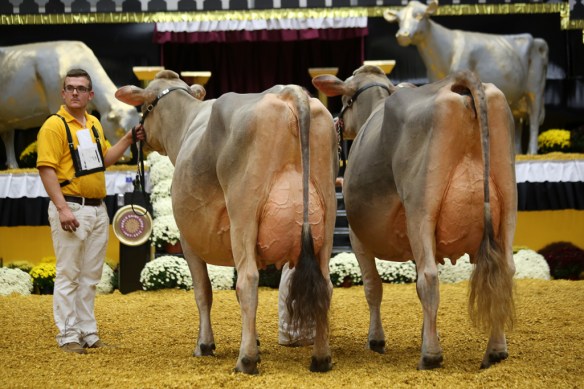
day-2-12.JPGKyle and his older brother Mickey have done quite well over the years and their grandfather is pleased that they enjoy the cattle among their other activities.
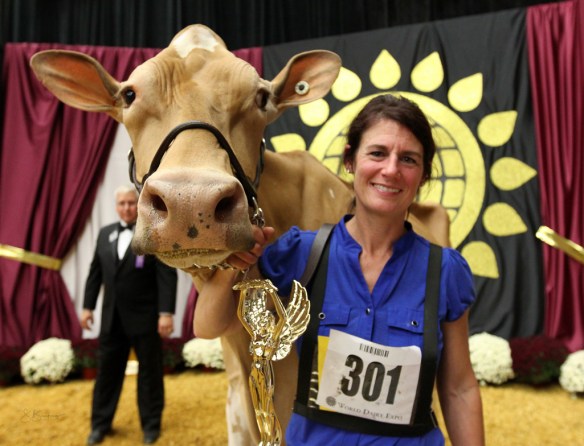
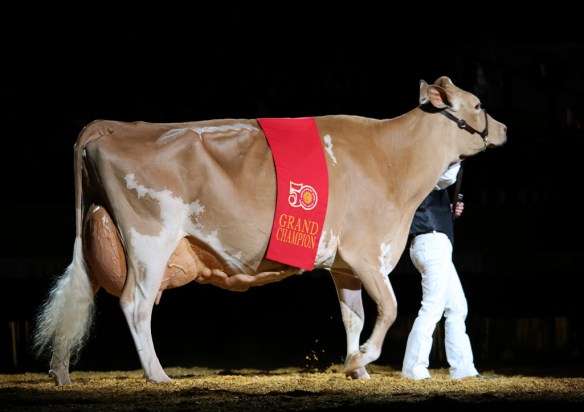
day-5-69.JPGAmong the Guernseys, it was bred-and-owned Flambeau Manor Ro Lauren-ET to go grand in the Open Show. With Tracy Mitchell again at the halter, Lauren repeated her 2014 performance as grand champion for Gary and Steve Van Doorn of Flambeau Manor, Tony, Wisconsin.
day-1-55

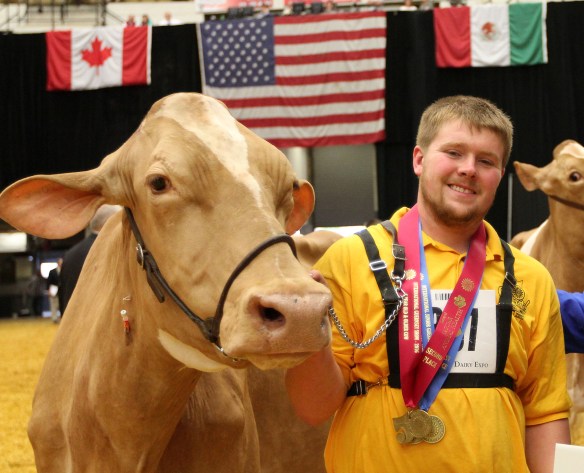
day-5-88.JPGAmong the juniors, Austin and Landen Knapp of Epworth, Iowa threepeated with the homebred Knapps Regis Tambourine-ET. The Knapps are premier breeders.
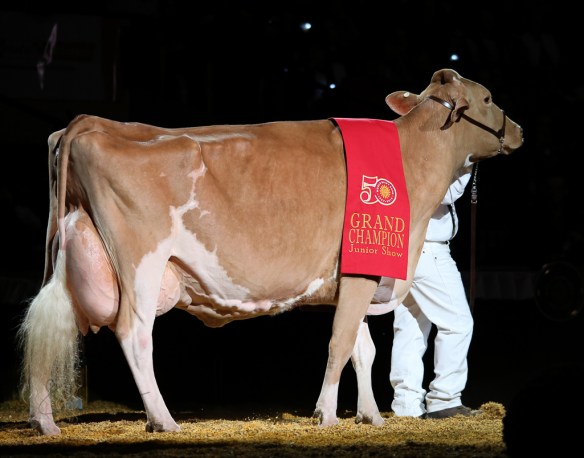
guernseyjuniorbo0109

day-5-75.JPGA large field of Holsteins narrowed down to grand champion Sheeknoll Durham Arrow. She impressed judge Pat Conroy as a cow that “lets you know she does not need to be pampered.” With Jeannette Sheehan at the halter, the aged cow moved through the ranks to achieve a storybook ending for her leadswoman, whose father Vernon Hupf — a lifelong farmer who attended every World Dairy Expo but this one as a spectator — had passed away in June.
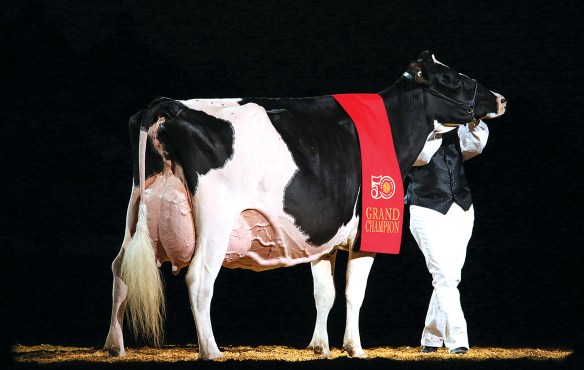
“To win the show that Dad idolized is just amazing,” said Jeannette after “Thomas” (as the cow is affectionately known to all after a grandson dubbed her as a calf in honor of Thomas the Train) went reserve supreme of the International Open Shows Saturday night.

DayFive3589.jpg“Each time the judge picked her out, I was surprised, but I didn’t have time to process what was happening. I was pretty much just trying to hang on to the cow. At one point it just felt like Dad was here, on my shoulder telling me what to do, right down to that look out of the corner of the eye.”
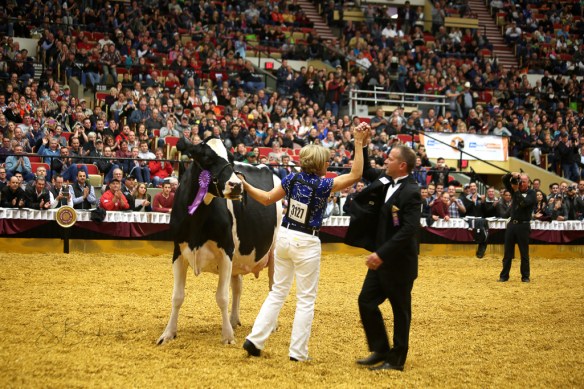
day-5-58Not only did the Sheehan family have a winner, they did so with a bred and owned animal in a highly competitive Holstein show. “We are still a little stunned. You don’t come here with expectations because this show will humble you in a hurry,” Jeannette’s husband Robert added just after her reserve supreme honors were awarded Saturday evening. “The whole thing is unbelievable. We like to breed  nice cows, the kind of cows we like to milk. Breeding is science and art with luck involved. The match has to work and every once in a while you get a cow like this.”
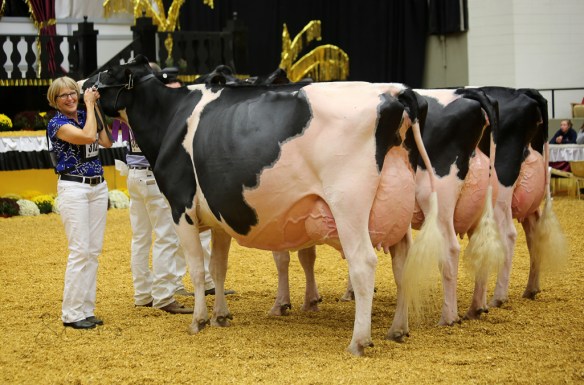
Thomas has shown a lot in the last 4 to 5 years. “This year she blossomed and matured into the kind of cow we thought she could be.” he added.

Robert and his brothers Jim and Jerome and their wives Karen, Mary and Jeannette are partners at Sheeknoll Farms, with the next generation also involved. They milk 300 cows at the farm in Rochester, Minnesota, and are known by their peers to treat them all like queens with great cow comfort and attention to detail. In fact, the mantra on their Facebook page says it all: “If we take care of the cows, they will take care of us.” They were thankful for the total team effort taking care of the EX 96 97MS Thomas in her grand journey to this surreal finish.

day-5-59.JPGSheeknoll Durham Arrow (aka Thomas) had an exciting path to her grand champion honors at the 50th World Dairy Expo, having won the 2016 Minnesota State Fair and other shows leading up to it.
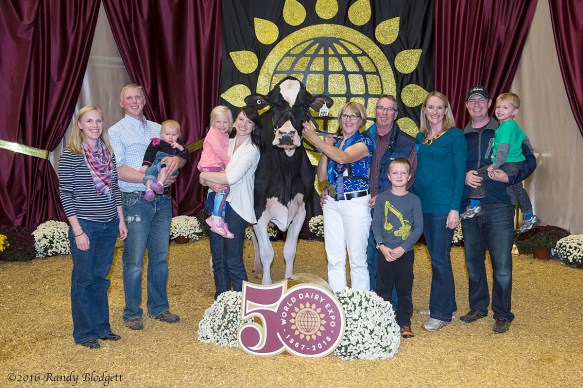
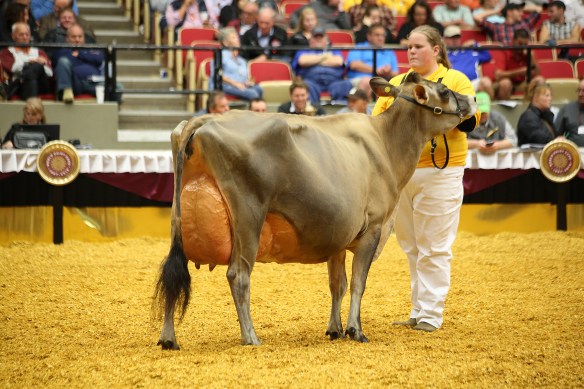
sheehanfam

Photo courtesy Randy Blodgett, Blodgett Communications

The Sheehan family, friends and Thomas’ fans watched as judge Pat Conroy and his associate Yan Jacobs placed Thomas first aged cow, best bred-and-owned, best udder, production cow, senior and grand champion, over a competitive field including last year’s supreme champion Katrysha and over this year’s reserve and honorable mention grand champions, the latter exhibited by Glamourview Farms of Walkersville, Maryland.

jerseyjuniorbo1164In the junior Jersey competition it was Cora and Cari of Darlington, Wisconsin. The homebred Red Rock View Cari was the grand champion Jersey of the Junior Show, with Cora Carpenter at the halter.
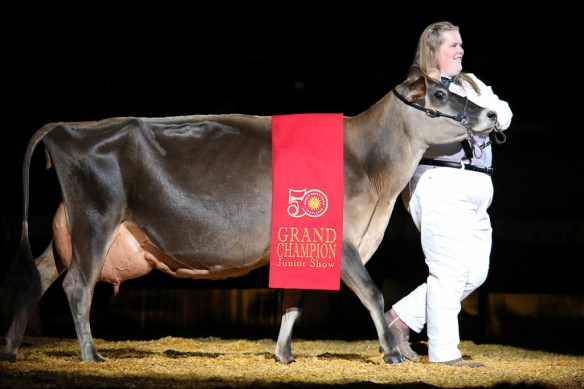
day-5-78.JPGThe Carpenter family was overjoyed to see their daughter and homebred Jersey do so well.
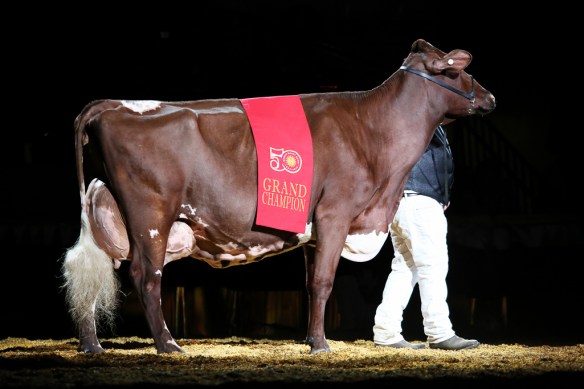
Earlier in the week, the grand champion Milking Shorthorn of the open show was Cates Ruben Tulsa-Time-EXP, bred, owned and exhibited by Peter Cate of Cornish Flats, New Hampshire for the second straight year.

day-5-91.JPGThe Milking Shorthorn Show at World Dairy Expo has grown and lasted into Wednesday evening, but was quite exciting.
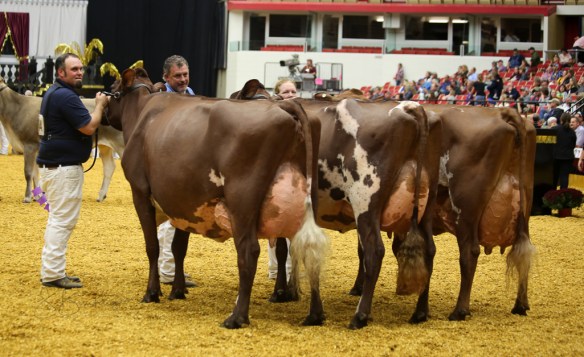
day-2-70.JPGIn the International Red & White show, Pheasant Echo’s Turvy-Red-ET was grand champion with breeder-owner Kenny Stambaugh, Westminster, Maryland, at the halter.
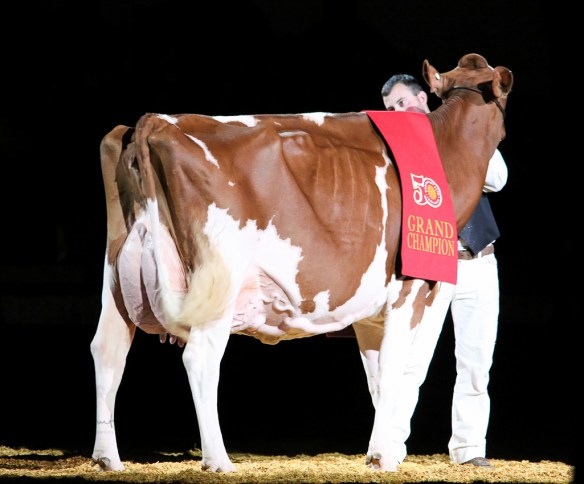
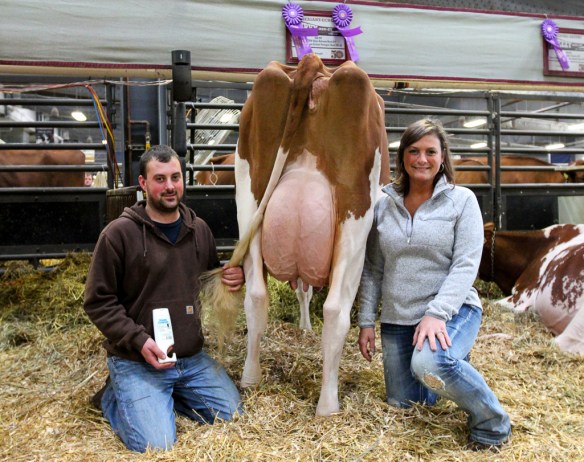
day-5-93When Kenny Stambaugh’s homebred Turvy was named grand champion of the International Red & White Show on Friday, his sister Crystal Edwards was there in person to celebrate. Most of the rest of the family could probably be heard hooting-and-hollering over a thousand miles away in Westminster, Maryland as they gathered around the television to watch Kenny show and be victorious in the online live-feed of the showring proceedings.
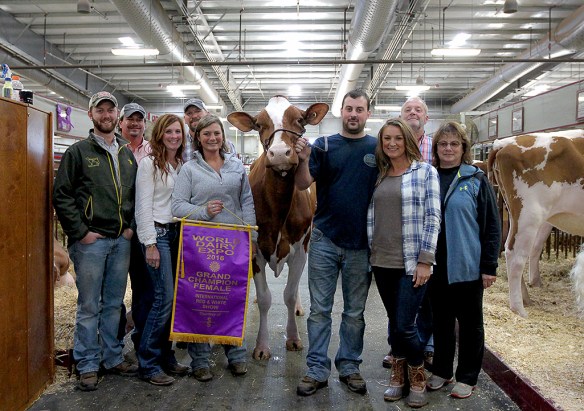
What they did next, as you might imagine, is figure out how to get everyone out there by the next afternoon to see Kenny and Turvy vie for supreme in the closing ceremonies Saturday evening.

By 9:00 p.m. Friday evening, they had secured a flight that got Kenny’s parents, siblings and spouses to Madison by 2:30 p.m. Saturday — just three hours before the closing ceremonies – to surprise Kenny, who had no idea they were coming out.

day-5-21.JPG

The Stambaugh family (photo by Sherry Bunting)

Kenny confessed he was pretty nervous in the ring, but it never showed because he had faith his cow stacked up pretty well against the competition.

When asked what gave Turvy the edge in a competitive Red & White class, Kenny and Crystal agreed: “It was her youthful udder and big frame,” said Kenny. Turby is classified EX-94 with a 96-point mammary system.

day-5-0.JPG“She also walks on an awesome set of feet and legs,” Crystal added. “But after three calves at five years old, to have that youthful udder is pretty special.”
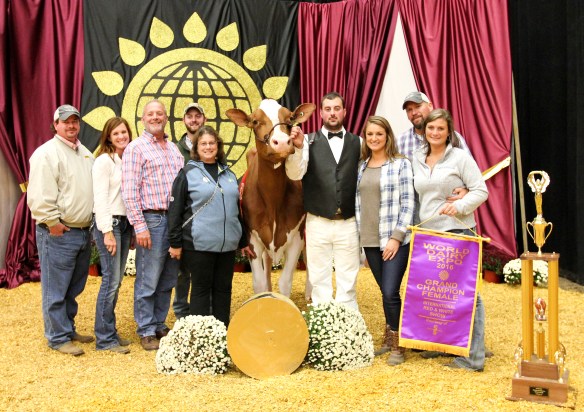
What makes the win even more special for the family is that Turvy’s dam was the Stambaugh family’s first homebred Red & White Holstein. To have a World Dairy Expo grand champion in a daughter of their first homebred Red & White just makes the win belong to everyone on the farm.

When Barney and Debbie Stambaugh started farming on their own in 1991, they purchased some Red & Whites and over the years bred them to some top black and white Holstein genetics, which yielded a red line within the herd.

“Dad had worked for Peace and Plenty as a kid, and that really sparked it in him,” Crystal recounted.

She describes the breeding philosophy at Pheasant Echo’s as one that allows them to have “a lot of old cows. We are fortunate that way,” she said. “Between the genetics and cattle care, we want cows that hang around, breed back and have productive life.”

The family sold an Armani heifer out of Turvy in the Apple Mania Sale and another out of this family at the National Red & White Convention Sale when that sale was hosted at the farm during the convention week in Maryland last summer.

Turvy had previously placed second in the junior competition at the 2014 World Dairy Expo and 7th in the open competition that year. “She has really come into her own,” said Crystal of the cow that likes to swish her tail.

“Nothing makes me happier than being able to come out and look at good cows when it’s time to milk,” said Kenny. “It sure makes it easier to get up at 3 a.m.,” Crystal added.

Kenny and Crystal agree that this will now be their favorite show memory. Prior to this win, it was the grand champion win at the 2014 All-American Dairy Show in Harrisburg.

But nothing tops winning at the 50th World Dairy Expo with a bred-and-owned cow, and being the leadsman at the halter to boot.

DayFive1751.jpg

Kenny Stambaugh and his wife Nicole and homebred WDE grand champion Pheasant Echo’s Turvy-Red are flanked by parents Byron (“Barney”) and Debbie (right) and siblings and spouses from left, Bud Stambaugh, CJ and Tanya Miller and Dan and Crystal Edwards. Photo by Sherry Bunting as appeared on Cover of Farmshine Oct. 14, 2016


-30-


Looking back… and forward: Troxel dairy herd dispersal 10/20 at 10:20 at farm.

By Sherry Bunting (portions reprinted from Farmers Exchange 10/14/16 and portions reprinted from Farmshine 10/14/16)

HANNA, Ind. — Amid the difficult economics of dairy and beef production these days, many farm families are going through tough decisions about the future — along with uncertainty about the interest or ability their next generation may have for continuing the business. America’s dairy and livestock farms have raised generations of cattle that nourish our bodies, our rural economies and the land… not to mention raising generations of young people with the skills, work ethics and passion that take them far in their on-and-off-farm pursuits.

Herd dispersals are on the rise among family farms of all sizes. And while it is sad to see some of these farms mark an end to an era, there is reason for hope. The largest obstacle, in my view, is the current pricing systems and the concentration of power in a more vertically-integrated marketplace for both milk and beef. Consumers can help change this direction by caring where their food comes from and asking their grocers to identify country of origin as is done with fruits and vegetables — but that is a story for another day.

Today, I want readers to know about the Troxel Dairy Farm and their upcoming herd dispersal sale on Thursday, October 20th at 10:20 a.m. (10/20 and 10:20!) taking place at their farm at 17808 S 600 W, Hanna, Indiana.

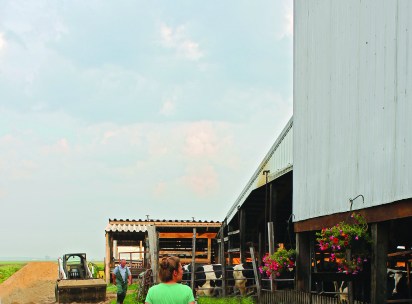
Having known Dr. Tom and LuAnn Troxel for several years and having benefited from their hospitality through all seasons of the year on trips West, I am always in awe of the morning pace at their farm, which is also homebase for Dr. Tom’s South County large animal veterinary practice. And I admire the joy they have that rises above these tough decisions.

Troxel8443.jpg

Mornings here have always kept me stepping as I would be out and about with my camera while Dr. Tom was busy in the milkhouse and cleaning pens or putting fresh bedding and feed out for the cows, LuAnn would be back and forth tending calves, answering vet calls, taking second rounds of coffee out to the barn, keeping a breakfast skillet moving forward… and so much more.

Busy mornings are to be expected when two busy people love what they do and when what they do is dairy farming alongside a large animal veterinary practice. Both can be demanding 24/7 jobs, and for 33 years of marriage, Dr. Tom Troxel has pulled double duty — wife LuAnn right there with him in the trenches and taking time to advocate for agriculture.

troxel0007cmyk

On this particular sunny autumn morning last week as we talked about the upcoming dispersal, veterinary customers stopped by for supplies, the milk truck backed into the lane for what will soon be the last daily pickup, workers made sale preparations, cows curiously spectated, while the resident peacocks strutted their stuff, adding their own brilliance to the splashes of color in LuAnn’s gardens that frame the cow pens, milk house and calf hutches.tom-troxel-dvm

LuAnn says she is thankful that after next week, Dr. Tom will have only one job to do.

The cows will be gone, but the South County Veterinary practice continues.

“Dairy isn’t something you just do, it is something that defines you,” said LuAnn during my visit last Monday morning, as she and Tom and son Rudy were finishing chores and preparing for the Oct. 20 complete dispersal of the milking and registered herd.

Her easy smile hid the uncertainty of the transition ahead. “Part of me is really sad, and part of me wonders about new opportunities we’ll find in this next phase.”

Tom confessed: “We’ll miss it. I’m kind of a workaholic so I’ll have to rethink things and find things to do that are more valuable than work.”

trox1861x

The sale plans were set into motion a year ago, when Tom and LuAnn knew that of their four sons — Rudy, Ned, Josh and Jackson — there would be no next generation to take the reins.

Rather than sell the herd immediately, they waited to calve-in some of the genetic progress Rudy made in his work with the herd over the past four years. This way they are able to sell animals of known value with genomic testing behind them and see some two-year-olds freshen and milk to get a glimpse of what would have been a great foundation herd for the future, that Rudy had developed — before passing the animals on to their new homes.

The Troxel Dairy herd dispersal is slated for 10:20 a.m. CDT on Thursday, October 20 at the farm. About 215 cattle will sell, including 113 cataloged cow and heifer lots, plus half-lot calves and embryos. Many are registered Holsteins, with solid genomic numbers, especially for productive life (PL), daughter pregnancy rate (DPR), somatic cell count (SCC), and milk components.

In fact, this milking herd of 140 cows produces high quality milk with somatic cell count consistently under 100,000. The current average is 75,000! Healthy animals and high quality milk have always been high priorities here.

troxel1832

The sale includes a unique range: predominantly registered Holstein cattle of all ages, including Polled, dominant/variant Red and Outcross genetics, as well as over a dozen Jerseys of all ages, some type Holsteins and 100 commercial grade milking cows and springing heifers.

“The genetic improvement has been quite something, considering that four years ago we had just one registered Holstein, and today we have 130 that are registered,” said Dr. Tom, crediting son Rudy’s skill and zeal for genetics. “With good genomic tests, these animals would have been a good foundation for the future, but now they can be a benefit to someone else.”

Rudy’s philosophy in transitioning the herd from grade to registered dovetailed with his parents’ longstanding emphasis on healthy cattle and preventive care. He bred not for show, but for working cattle “to exemplify the true working Holstein,” he explained the science-driven approach to breeding a true commercial cow. “We have rarely bred a cow under 1 or 2 in their DPR, and we have cattle at 5, 6, 7, even over 8 in productive life.”

troxel0021

While Rudy finds some satisfaction in having built a young herd with a few cow families that hold a lot of promise, he noted that around 30 of the registered animals are milking and over 75 are “the best that was yet to come.”

He points out the Ross cow they purchased from Clear Echo at the Summer Event Sale in Wisconsin in 2012. She is lot 13, with over 20 direct descendants selling, plus additional calves. The Dreamar cow is another he identifies as he thumbs through the catalog. She has nine direct descendents selling right along, plus embryos.

“Rudy took the (genetics) ball and ran with it,” said Tom with a smile.

With sale day fast approaching, LuAnn reflects on the decision to discontinue the dairy. “It was something that took weeks, even months to accept,” she said.

“We’ve ridden these cycles up and down for over 30 years,” the couple agreed. “We haven’t invested in new facilities. The dairy needs infrastructure and improvements. Our next generation made their family decisions not to buy the dairy farm.”

“We weren’t ready for the next generation,” Tom interjected. “Look around. We have lean to’s, not a new 21st Century building.”

Together they wondered, aloud, if investing in new facilities years ago may have produced a different outcome.

“We were so busy working and raising a family that we didn’t really take the time to plan that,” said LuAnn when asked what advice she might have for other farm families with next-generation uncertainty. “We always wanted our sons to make their own decisions on this. We love our four boys, their wives and their families and respect their decision to do what is best for their families.”

troxelUC.jpg

Planning for the next-generation is a challenge, “but I would recommend long term planning, not waiting like we did when it was too late for the planning to help,” she says.

Rudy, who graduated from Purdue with a degree in ag education, has taken an area sales manager position with Genex-CRI to follow the genetics path, which was seeded in junior high with his poultry projects and blossomed with his hand in the dairy herd over the past four years.

“This farm has been going since 1949 and has raised two families,” said Tom. His parents, Phil and Mary Troxel, started farming here almost 70 years ago. His mother was raised on a dairy farm and ahead of her time as a “dairy girl,” taking predominant care of the herd. Tom, one of eight children, was immersed in the farm early after his father suffered a stroke while he was still in high school.

Tom and LuAnn eventually took over the dairy after they married, and have operated both the dairy and Tom’s large animal practice here ever since.

trox1807

Standing in the October sunshine discussing the upcoming sale, the curious cows walk right up and LuAnn reflects on the bond between a dairy producer and the cows. “I fed every one of these individually as calves,” she said, noting that while they can seem like children or grandchildren at times, “there’s a difference.”

troxel4361

“But you do spend more time with the cattle than the grandkids,” Tom interrupted, grinning at the reality of daily cattle care.

For years, the dairy has hosted media, consumer events, school field trips and trainings for vet tech students. (Below: On the left, LuAnn is constantly promoting and advocating for the dairy industry. Two years ago she snapped a photo of twin Jersey x Holstein heifers. Both heifers calved this past July. They and their calves will be sold in the Oct. 20 dispersal. On the right, Rudy shares information about dairy cows with local schoolchildren during a tour at the farm last fall. He will miss the farm and the cows, but is excited to get more involved in genetics as he takes a position with Genex-CRI.)

Both Dr. Tom and LuAnn have served on numerous boards over the years. In addition to serving as a past president of Indiana Dairy Producers (IDP) and currently on the board of the Dairy Girl Network (DGN), LuAnn also serves on the American Dairy Association-Indiana board — a position that will end when the milking ends, as has Tom’s former position on the Foremost Farms cooperative board.

While there may be fewer opportunities to be involved in organizations that promote dairy, the Troxels want to be involved wherever they can in the dairy industry they love. “The people in this industry are special. With few exceptions, dairy producers are honest, hardworking people who care about things other than themselves,” LuAnn points out.

“People say ‘it’s in your blood,’ and I guess that’s because dairying is systemic. It will be a little challenging to define who I am because everything from family relationships to daily routines to friendships and service have been within the context of the dairy farm. I’m not sure what it will be like, but I think it will be fine.”

The Oct. 20 dispersal is managed by Courtney Sales. The Troxels’ church will provide a delicious lunch, prepared with love, for a free will offering to benefit the Harvest Call Haiti Dairy Program.

All are welcome. For more information about the sale and the farm, and to see a catalog, visit www.troxeldairy.com.

*****

The Troxel family from left Jackson and Paige, Dr. Tom and LuAnn holding Olivia, Maryana, Rudy (holding Nolan) and Rosario, Nathan, Ned and Alyssa, Josh (holding Declan) and Chelsie. Photo by Chelsie Troxel

Troxel25.jpg

troxel03trox1852Troxel8491(Oct2013).jpgtrox1779.jpgtroxel1864troxel4323

Determination defined.

By Sherry Bunting, Farmshine, Sept. 23, 2016

HARRISBURG, Pa. — Before the March homecoming, Reese Burdette told the medical staff “I’ve got to get home to my cows.”

And so she did. Her cow Pantene, in fact, had just had a heifer calf she named Pardi-Gras. It was Mardi-Gras time of year and she was looking forward to a homecoming party.

When Reese Burdette did come home to Windy-Knoll-View farm after those 662 days at Johns Hopkins Children’s Center Pediatric Intensive Care Unit (PICU), she was so anxious to get back to her cows and the dairy industry she loves that she wanted to get right out on the gator with her papap to look them over.

Reese03That didn’t happen immediately, but not long after she was home, she sure did.

A few days after her March homecoming. Reese was already setting new goals for herself.

Sitting at the kitchen table on the day of our visit in mid-March, taking a break from “virtually” attending school, Reese said, matter-of-factly, and with a radiant smile (as her mother and momo exchanged glances):

“I want to be walking good enough to lead Pardi-Gras in Harrisburg in September.”

And so she did. She sure did.dsc_1142

reesepeptalkdadIt was something she had worked for daily with the support of her family, friends, therapists… and a last minute pep talk from dad, Justin Burdette.
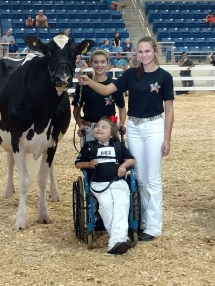
In fact, not only did she lead Pardi-Gras to a 4th place finish in her class Monday, Sept. 19 during the All-American Dairy Show at the Farm Show Complex in Harrisburg, Pa., she also led Pardi-Gras’ dam, Reese’s prize 4-year-old cow Pantene to a 1st place finish in her class… and the honors that followed as Reserve Grand Champion Holstein of the Premier National Junior Show.

Perhaps Pa. Holstein Association executive director Ken Raney put it best in a post acknowledging all of the great people and families the association works with across Pennsylvania. “It’s been my goal to share the accomplishments and recognize many people for what they do for the dairy industry, but today was different,” he wrote. “Today, we got to witness a young lady who has shown great determination and a will to not only survive but return to the industry and cows she loves. Congratulations and thank you Reese Burdette for showing us what true determination is all about.”

reesepantenereschampReese was surrounded Monday by her support team of friends and family, including friends from Johns Hopkins, who came to Harrisburg to witness how much Reese loves the dairy industry and how this dairy industry family continues to support her and her family. Her ever-faithful cousin Regan Jackson and friend Lane Kummer helped make it possible to also lead her cow Pantene.

In a video interview with The Bullvine, Reese’s mother Claire Burdette said that people wonder how they can be so strong through this journey of over two years. She said, “It’s people surrounding us that make us strong.” She described Reese’s sense of humor and tenacity that stayed with her throughout this journey.

00aareese0022As for Reese, her family, favored cow Pantene, and all who continue to support and love her… the joy of the day and its milestones was plain to see.
As expected, this tenacious 10-year-old has already set the next goal for herself (and loves to think in timelines): To attend school without the part-time assistance of the wheelchair by the end of the year.

We continue to root for this amazing and inspirational young lady and agree wholeheartedly with Ken Raney’s comment: “You made us all proud ‘Miss Tuff Girl!’” as she is affectionately known these days.

***

Thank you to Laura Jackson, Jean Kummer and Randy Blodgett for some of the photos above. Below, Reese’s Pantene also made the Supreme parade lineup Thursday as Grand Champion Holstein in the open competition, shown by her mom Claire Burdette.00aaPantene9930.jpg


00aachampionudders9953.jpg


00aajudges9973.jpg


00aaReese0024.jpg

00aachampsbo0042


‘The Patriot’s blood is the seed of Freedom’s tree’

flag.jpg“The Patriot’s blood is the seed of Freedom’s tree.”
Revolutionary War era poet Thomas Campbell paid tribute to the soldiers who fought in the American Revolutionary War with these words that serve as reminders for us today that we would not have the freedoms we hold dear were it not for the sacrifice of our country’s patriots.

We should remember these heroes every day, but today on Memorial Day, we most particularly hold thoughts for those soldiers who have paid the ultimate price — giving their very lives so that we may be free.

Time-honored traditions began early in the morning in local communities across the nation. Flags adorned headstones, bands played, streets are lined with banners, anthems sung.

In today’s situations of disillusionment and lack of faith in our government, Mark Twain’s words come to mind:

“Patriotism is supporting your country all the time and your government when it deserves it.”

We are reminded with these words that it doesn’t matter whether we agree or not with the politics of the governing class or the party in power. The bottom line as Americans is that our loyalty and love of country — and the freedom, faith and fortitude on which it stands — never wane.

Above all, that we remember our soldiers who have paid the price, and remember them with the highest of honor — and honor them with the deepest of gratitude, a gratitude that allows us to find ways to give back, however small our token, in the name of Freedom and Patriotism.


A world without cattle?

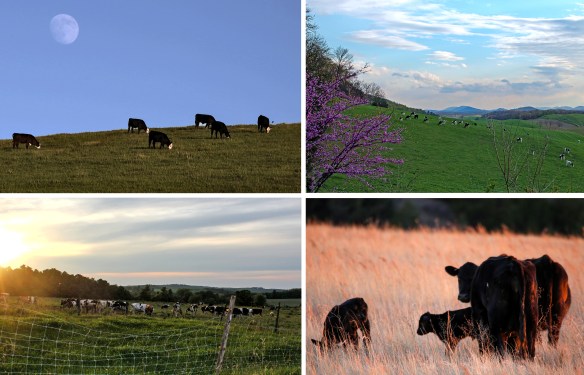
GL45-Earth Day(Bunting).jpgCaption: The health of the dairy and livestock economies are harbingers of the economic health of rural America … and of the planet itself. Here’s some food for thought as we celebrate Earth Day and as climate change discussions are in the news and as researchers increasingly uncover proof that dietary animal protein and fat are healthy for the planet and its people.
By Sherry Bunting, published April 22 Register-Star (Greene Media)

A world without cattle… would be no world at all.

How many of us still believe the long refuted 2006 United Nations Food and Agriculture Organization (FAO) report, which stated that 18 percent of all greenhouse gas emissions, worldwide, come from livestock, and mostly from cattle?

This number continues to show up in climate-change policy discussion even though it has been thoroughly refuted and dismissed by climate-change experts and biologists, worldwide.

A more complete 2006 study, by the top global-warming evaluators, the Intergovernmental Panel on Climate Change, stated that the greenhouse gas emissions from all of agriculture, worldwide, is just 10 to 12 percent. This includes not only livestock emissions, but also those from tractors, tillage, and production of petroleum based fertilizers, pesticides and herbicides.

Hence, the UN Environmental Program disputed the UN FAO assertion to state the percentage of emissions from total agriculture, worldwide, is just 11%, and that cattle — as a portion of that total — are responsible for a tiny percentage of that 11%. While cattle contribute a little over 2% of the methane gas via their digestive system as ruminants (like deer, elk, bison, antelope, sheep and goats), they also groom grasslands that cover over one-quarter of the Earth’s total land base, and in so doing, they facilitate removal of carbon dioxide from the atmosphere to be tied up in renewable grazing plant material above and below the ground — just like forests do!

Think about this for a moment. The UN Environmental Program and the Intergovernmental Panel on Climate Change are in agreement that cattle and other livestock are not the problem the anti-meat and anti-animal-ag folks would have us believe. In fact, they are in many ways a major solution.

Think about the fact that man’s most necessary endeavor on planet Earth — the ongoing production of food — comes from the agriculture sector that in total accounts for just 11 percent of emissions!

Why, then, are major environmental groups and anti-animal groups so fixated on agriculture, particularly animal agriculture, when it comes to telling consumers to eat less meat and dairy as a beneficial way to help the planet? Why, then, has the U.S. Dietary Guidelines Council pushed that agenda in its preliminary report to the U.S. Departments of Agriculture and Health and Human Services, that somehow the Earth will be better sustained if we eat less meat?

They ignore the sound science of the benefits livestock provide to the Earth. In fact, it is no exaggeration to say what Nicolette Niman has written in her widely acclaimed book “Defending Beef” that, “Cattle are necessary to the restoration and future health of the planet and its people.”

Niman is a trained biologist and former environmental attorney as well as the wife of rancher Bill Niman. She has gathered the data to overturn the myths that continue to persist falsely in the climate-change debate, and her book is loaded with indisputable facts and figures that debunk the “sacred cows” of the anti-animal agenda:

  • Eating meat causes world hunger. Not true. In fact, livestock are not only a nutrient dense food source replacing much more acreage of vegetation for the same nutritive value, livestock are deemed a “critical food” that provides “critical cash” for one billion of the planet’s poorest people — many of whom live where plant crops cannot be grown.
  • Eating meat causes deforestation. Not true. Forests, especially in Brazil, are cleared primarily for soybean production. Approximately 85 percent of the global soybean supply is crushed resulting in soybean oil used to make soy products for human consumption and byproduct soybean meal for animal consumption. A two-fer.
  • Eating meat, eggs and full-fat dairy products are the cause of cardiovascular disease. Not true. Researchers are re-looking at this failed advice that has shaped 40-years of American dietary policy. Its source was the 1953 Keys study, which actually showed no causative link! Meanwhile, excessive dietary carbohydrates have replaced fats in the diet, which turn to more dangerous forms of fat as we metabolize them than if we had consumed the natural saturated fats themselves. When healthy fats from nutrient-dense animal proteins are removed from the diet, additional sugars and carbs are added and these have led us down the road to increased body mass and diabetes.
  • Cattle overgrazing has ruined the western prairies. Not true. While improper grazing can have a localized detrimental effect, the larger issue is the pervasive negative effect that is largely coming from not grazing enough cattle. Higher stocking densities that are rotated actually improve the health of grasslands. Large herds provide the activity that loosens, aerates and disperses moisture along with the nutrients the cattle return to the soil — for more vigorous grass growth and soil retention — much as 30 million buffalo and antelope groomed the prairies two centuries ago. Meanwhile, the Bureau of Land Management has favored controlled burns over grazing and is taking away land rights our federal government once shared with ranchers. BLM reductions in allowable stocking densities have initiated a land-grabbing cycle of ranchers losing their land and livelihoods while the land is robbed of its benefits.

The anti-animal agenda continues — groundless, yet powerful. Rural economies, farm families, consumers and the Earth pay the price.

The majority of the lifecycle of supermarket beef and dairy products is rooted in grooming the grasslands and forage croplands that are vital to the Earth and its atmosphere. In addition, farmers and ranchers reduce tillage by planting winter cattle forage to hold soil in place, improve its organic matter and moisture-holding capacity, provide habitat for wildlife while providing temporary weed canopy between major crop plantings. Not only do cattle eat these harvested winter forages, they dine on crop residues and a host of other food byproducts that would otherwise go to waste.

Our planet needs livestock and the farmers and ranchers who care for them. They not only feed us — with more high quality dietary protein with all of the necessary amino acids, calcium, zinc, iron and other nutrients per serving than plant-based sources alone — they also feed the planet by providing necessary environmental benefits.

Enjoy your meat and dairy products without fear — certainly without guilt — and with gratefulness and appreciation for the gift of life given by the animals and because of the hard work and care they have been given by the men and women who work daily caring for the land and its animals. This Earth Day, we are grateful for the circle of life and the farmers and ranchers and their cattle, which sustain our existence, our economies, and our environment.

A former newspaper editor, Sherry Bunting has been writing about dairy, livestock and crop production for over 30 years. Before that, she milked cows. She can be reached at agrite2011@gmail.com

Learn more about the latest research to measure emissions due to the dairy and livestock industries.

-30-

Images by Sherry Bunting

‘Udderly innovative’


lingen2921

By Sherry Bunting

BALATON, Minn. — In conjunction with the Central Plains Dairy Expo in Sioux Falls, South Dakota recently, The Lingen family hosted a “pizza-and-demonstration” seminar attended by 25 producers and milking employees representing 12 dairies ranging from 80 to 800 cows.

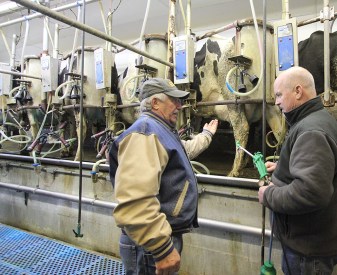
They came out April 1st to see the ‘udderly innovative’ Udder Comfort Spray Gun system that is used on all fresh cows at Lingen Dairy and to hear from Josh Lingen, along with New York dairy producer Chuck Worden, who has the same system at his Wormont Dairy, Cassville. Before getting to the parlor to test drive the spray gun, Worden showed a video of its use at Beer Farms in northern Indiana, where 150 first-calf heifers freshen monthly.

At Lingen Dairy, Balaton, Minnesota, cows are milked robotically, but fresh cows are started in the parlor. Josh Lingen has been using the spray gun system for 18 months.


lingen2878Attendees gathered at noon to have pizza and ice cream, followed by a video on the spray gun system and comments from Worden, who has been using the spray gun system for one year, which is set up in his swing parlor on a hose reel for easy pull-down access. The gun works on the parlor air supply.
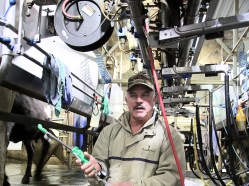
 

Worden5273Worden has developed a “0 to 100 in 7 days” protocol, where fresh cows and heifers receive a fast minimal application of Udder Comfort through the spray gun for the first seven days post-calving. He concentrates the application to the udder floor and up the crease in one swift motion front to rear, after each milking, before fresh animals exit the parlor.
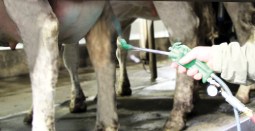
“We have reduced our somatic cell counts to be consistently below 200,000 for the first time in our 30-plus years of dairying,” said Worden. “We have Hispanic milking employees, along with family members milking, and everyone finds the gun easy to use, as well as fast, efficient and effective.”

Worden5297.jpgThe purpose of post-fresh applications is to reduce swelling and set the cow up to fulfill her genetic potential, according to Worden. He and his wife Vanessa and sons Wayne, Mark and Eric operate their 260-cow dairy in central New York.
I liken this to a runner with a swollen foot, being free to perform to his potential once that swelling is removed,” said Worden. “Likewise, for fresh cows, a simple application for the first seven days after calving — using the most innovative udder spray system in the industry — is all it takes to accomplish the goal.”

Lingen7215Lingen Dairy is home to 250 milk cows with a rolling herd average of 31,500 pounds. Cows average 94 pounds per day up to 100 pounds, and SCC runs consistently around 120,000. The farm is operated by Randy and Denice Lingen and their son Josh and his fiancé Andrea Guio Monje. Josh’s sister Hailey also helps in the milking parlor, where fresh cows and heifers are milked before moving to the adjacent Lely robotic facility.
“I love it,” said Lingen. “This spray gun system makes the application process so easy and we use 30 percent less product for the same coverage.”

LINGEN-High-14cmyk.jpgLingen sprays the udders of fresh cows after each milking in the parlor for the first three to seven days after calving. Then, in the robot barn, he spot-sprays, with the conventional spray bottles, any cow with an elevated conductivity on the robotic system printout each morning.

“She’s doing her part, so we’ve got to be doing ours. We want to free her to reach her milking potential and produce the highest quality milk at the same time,” said Worden about the importance of fresh cow comfort to their future performance. “Transition success is like a three-legged stool. We focus on a healthy uterus and a healthy rumen, and of course the third leg being a healthy udder.

“That’s where comfort really matters,” he added. “We’re finding out that a little Udder Comfort goes a long way. By focusing on the bottom the udder and the crease, with a small application after each milking for a week, we have found better results than coating the entire udder for just a few milkings. This also conserves on our product use, making it faster and more cost-effective for large dairies with faster parlor throughputs.”

“This is a premium product, and when we bought our first 15-gallon drum, we had sticker-shock, but we actually use about $100 worth of product per month on our fresh cows and heifers with the efficiency of the spray gun,” Lingen reported. “Our milk quality bonus more than pays for the product we use to achieve it.”

For more information about obtaining a free Udder Comfort Spray Gun with the purchase of five- and 15-gallon containers, and to find a local distributor, contact Udder Comfort International at 888.773.7153 and visit uddercomfort.com.


-30-


Captions

Seminar7238

Josh Lingen of Lingen Dairy, Balaton, Minnesota starts every fresh cow and heifer in the parlor where they receive Udder Comfort for the first three to seven days before coming to the robot barn, where Josh also follows up on any animal with a high conductivity on the daily printout from the robots. Photo by Sherry Bunting

Seminar2916

Andrea Guio Monje has her veterinary degree and helps her fiancé Josh Lingen to manage the Lingen Dairy herd. Here, she is explaining to fellow Minnesota dairy producers, Rick Lingen and Brody Alderson, how the spray gun system works.

Seminar2898

Rick Lingen (left) and Chuck Worden (center) talk about the system as Dick Kidman of Kidman Dairy tries the spray gun on a few selected cows ranging from 48 hours fresh to two weeks fresh for comparison.

 Seminar2924

Josh Lingen demonstrates the Udder Comfort Spray Gun system on six cows ranging from 48 hours to two weeks fresh.

Seminar2878

Chuck Worden of Cassville, New York, talks about the Udder Comfort Spray Gun system during a “pizza-and-demonstration” meeting at Lingen Dairy, Balaton, Minnesota attended by 25 dairy producers and milking employees, representing 12 farms ranging from 80 to 800 cows. Attendees had the opportunity to try the gun installed at the farm after lunch.


Reinventing milk… promotion

MilkMarketMoosHeader070914.jpg

Reprinted from FARMSHINE, April 8, 2016

Fewer Americans eat breakfast today, adding to the milk consumption woes created when families stopped eating sit-down dinners, for the most part. Both were the staples of commodity fluid milk consumption that have been diminishing over the past two generations and four decades to where we are today.

Forecasters say it will only get worse. They are projecting continued declines in ‘white milk’ consumption while consumption of milk alternatives is predicted to increase dramatically through 2021.

A major reason is that the majority of urban consumers — up to 90% — do not view white milk (aka Vit. D whole milk) as a protein drink, when clearly it is the original, the natural protein drink.

But what is DMI working on? Alternatives. Checkoff dollars continue to flow through DMI to alternatives milks. Yes they are dairy products, but they are further processed, as in the case of Fairlife, which is ultrafiltered, for example.

I have had dairymen involved in these boards excitedly tell me: “We finally have a product consumers want!”

If they are referring to Fairlife, that may be true for consumers we’ve lost to Muscle Milk (which does contain some whey) or Almondmilk (which is the equivalent of eating an almond and chasing it with water full of thickeners, sugar and chemically added calcium and vitamins.)

But I find myself confused. Isn’t dairy promotion supposed to promote what contributes most to the dairy farmer’s milk check? I mean, it is the dairy farmer’s money, is it not?

As long as the Federal Order milk pricing scheme puts the value on Class I utilization, then the milk checkoff organizations should be most diligently promoting regular, straight-from-the-cow (pasteurized of course and maybe even flavored) milk as the healthy high-protein beverage it is, naturally, because I’m sorry to tell you friends, consumers just don’t know this information.

Milk: The protein drink that’s right under our noses and costs a lot less than fancy packaged and advertised alternatives — some of them complete frauds in that they are not even milk!

Why is it that milk alternatives can claim all sorts of things, but milk is not even allowed to advertise itself as 96.5% fat free! Why can’t the milk bottle say “8 times more protein than almondmilk per 8 oz serving!”

Why can’t it say: “Want Protein? Get Milk!”

Do we really need Coca Cola to revolutionize our branding? Or should dairy farmers take the bull by the horns and demand great packaging, savvy catch phrases, eye-catching point-of-purchase education, head-on comparisons to the fraudulent beverages that so wish to be milk that they call themselves milk.

No, USDA does not allow dairy farmers to promote their product comparatively with those other commodities that have stolen some of their market share by stealing the name milk. You dairy folks must play nice of course!

That’s hardly fair since dairymilk is losing market share. If you can’t defend your own market turf with your own collected monies, then what’s the point of collecting the money? All of these joint partnerships to sell cheese on pizza and mixes through frappes at McDonalds might move some more milk, but the value is in the Class I fluid milk, so unless we’re going to change the complicated milk pricing formula and glean more value and a guaranteed minimum for the manufacturing milk via its products, then we might just as well use the money to buy-back our own fluid milk and donate it to the poor to keep the demand for Class I tight vs. the supply.

Or put the money in a kitty to develop better fluid milk labels. Make them cool and splashy with P-R-O-T-E-I-N in large letters.

Milk: The original protein drink!

Milk: Protein drink of champions!

Milk: Why pay more? We’ve got what your looking for!

I could go on all day.

If the growth of our Class I milk markets rely on the USDA school lunch program, then we’re sunk and USDA is once again to blame for this dismal failure by tying the hands of school districts who want to serve 2% and whole milk.

Analysts say that the strong growth in the milk markets of emerging countries like Chile is attributed to their school milk programs.

In the U.S., milk is stigmatized as a “commodity.” We sure don’t help that with plain white bottles and lackluster graphics.

Milk alternatives such as soymilk and almondmilk (aren’t they so tricky in creating their own new words by paring their commodity to the word milk as one word) are increasingly viewed as ‘fashionable drinks’ and a more health-conscious choice compared to white milk.

Let’s reverse this trend by making dairymilk fashionable again!

Let’s call it dairymilk (a tricky combined word!) and come up with a new standard of identity that allows us to say 96.5% fat free instead of “whole.”

Maybe even come up with a standard for protein and say to call it dairymilk it must meet that protein standard and then colorfully package and protein-promote the heck out of it.

Analysts say that consumers like innovation in their drinks and they are finding “innovation” in the “newer milk categories” which are so much more attractive than the “mature” white milk category.

Okay then, let’s give the consumer what they want. Great tasting real milk but let’s reinvent the packaging and the promotion and the name… not the beverage itself.

Just think how much money we can save on fancy equipment if all we have to do is reinvent the promotion of milk, not reinvent the milk itself. After all, it is nature’s most nearly perfect food.

Maybe instead of fighting each other for Class I sales by moving milk all over to get the best price and utilization (see chart on page 13 showing that picture for the beleagured Northeast Order)… we should be fighting, instead, together, to save our beverage from its continued depreciation at the hands of internal politics, external politics, USDA rules upon rules, fraudulent not-milk-milks whom regulators ignore and even patronize, and other assorted casts of characters.

‘I’ve got to get home to my cows’

With courage and grace, Reese comes home after 22 months

By Sherry Bunting, reprinted from FARMSHINE March 25, 2016
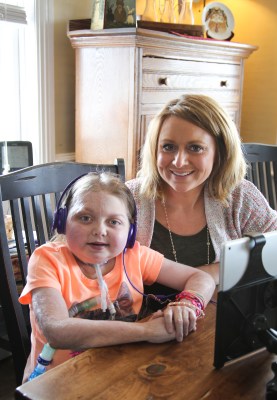
Reese03Author’s Note: It has been almost a month since Reese’s homecoming and she is getting back to the precious rhythms of life on the farm: Greeting her little sister off the bus on sunny afternoons, feeding her prize cow’s new calf, riding the gator with her grandfather, having tea parties with sister and cousins on Sunday afternoons, getting together with school friends, still attending school virtually via “Double,” her robot, even going to the dentist! Her journey continues to inspire. I am grateful for the opportunity to interview Reese and her mother and grandmother on the quiet first Monday after her arrival home Friday, March 18, 2016. Get ready to be inspired by this young lady, and by her family and the local farming community and worldwide dairy community who continue to think of her. Thank you to Jean Kummer, Laura Jackson and Jennifer DiDio for providing some of the photos here.
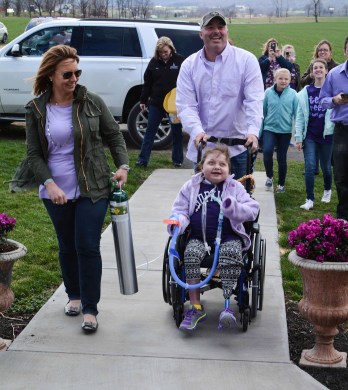
 

MERCERSBURG, Pa. — Nina Burdette tells the story of granddaughter Reese teaching her cow Pantene to lead when she was a calf five years ago. Reese was four at the time, and Nina told her “Don’t let go.”

“That calf pulled her around, and at one point she was flat on her back holding on, until that calf wrapped itself around a post,” Nina recalls she had rope burns on her hands.

Reese never let go.

So it was two years later, on May 26, 2014, when Reese arrived at Johns Hopkins Children’s Center, where she would spend the next 662 days in the Pediatric Intensive Care Unit (PICU) recovering from burns over 35 percent of her body and smoke damage to her heart and lungs after a fire at the home of her grandmother Patricia Stiles, who also recovered from significant trauma carrying her from the burning room.

Reese never let go.

Reese01

Today, she is back home at Windy-Knoll View farm in rural Franklin County, Pa., with her sister Brinkley and their parents Justin and Claire Burdette, and of course her cow Pantene and her three heifers Pretzel, Panzee and Pardi Gras.

Over and over, Reese told her doctors: “I’ve got to get home to my cows.”

Words spoken from the heart of a true dairy farmer. “Oh she has her mind set on that, just like her mom and dad,” says Nina. “We call her the junior manager.”

Driving through Mercersburg to the Burdette home on Monday, purple still proclaimed Reese’s homecoming parade from the preceding Friday. Purple and white cows stood in yards and driveways, purple balloons, welcoming TeamReese banners, home-made signs of love and support, purple bows tied to trees, poles and fence posts all along the route of young Reese Burdette’s drive home from Baltimore to Mercersburg — the 200-mile trek her family has traversed between the home farm and their second home at Johns Hopkins for nearly two years.

Reese had set a goal to be home for her 9th birthday, which she celebrated with family and friends — at home — on Sunday, March 20.

“Friday was surreal,” said Mom, Claire, during Monday’s Farmshine interview as Reese sat in the next room attending school via her robot, screen and headphones. Brinkley, 5, had also gone off to school that morning, and Reese was eager to be on the porch in a couple hours to see her little sister get off the bus — something she had envisioned for months.

A return to the ordinary rhythms of life on the farm is just what this child has longed for as she recovered from that fateful day.

Friday had dawned brisk and sunny as Claire and Justin and Brinkley waited with Reese for morning rounds. “When the doctor said ‘you’re free to go,’ it felt so good to hear those words we had waited and prayed to hear for so long,” Claire recalls.

A sendoff party was attended by hundreds the night before at Johns Hopkins where Reese has become quite the celebrity in what everyone referred to as “the sunshine room” where there was no room for worry. She shared her games, was known for her aim in shooting foam darts at a deer on the doorway, and had a machine for making snowballs and popcorn for sale with lines out the door to her room some days. Her PICU room had been transformed into a rehab that looked as much like home as possible for the past year. Toward the end of her stay, Reese surprised her family with a video of her journey.

“She’s not afraid to talk about the fire,” said Claire, noting that the hospital has learned from Reese as they tried processes for the first time with her burns. Jim tells of the time she consoled a grandmother whose granddaughter was getting a tracheotomy, explaining to her there is nothing to fear. She had become quite the advocate for her own care, face-timing Dr. Kristen Nelson about medicines and earning the name “Dr. Reese” among the residents in training (RTs).

In fact, Dr. Kristen, as she is known, is quick to point out that, “Reese has surprised me in so many ways about perseverance and strength and hope and grace and bravery, and I am forever a part of her life.”

On Friday morning, an entourage of 25 doctors, nurses, RTs, and custodians, escorted her to the white SUV sporting the large purple bow.

And so, they began their journey back home to a new normal.

Claire said the sight was “amazing. There are no words to describe riding up and seeing people after people after people.”

A sea of purple lined the streets. “There was so much joy… and tears. People were waving and hugging each other,” she said.

This slideshow requires JavaScript.

The local fire company brought every piece of equipment for the homecoming escort. They drove through the high school, where the band played, and then through the middle school and through two elementary schools where children and adults lined the streets and filled the parking lots and rooftops with banners and balloons and smiles and waves.

In town, the First National Bank closed for 15 minutes as every employee, donning purple, came out to cheer Reese homeward as the Burdette family drove by. The John Deere dealership, car dealerships, and other businesses decorated profusely in purple to welcome their hometown hero.

“I thought she was going to jump out of the car, she was so excited. Of course, we had to stop at the barn first,” Claire said with a smile. “She wanted to see her cow Pantene, and the new heifer calf she had on Tuesday.”

Reese had already named the calf Pardi-Gras because she was born during Mardi-Gras, and last week was a ‘Pardi-Gras,’ of sorts, for the two dairy families of Waverly Farms and Windy-Knoll-View… Reese was finally coming home.

“Only Reese would get another heifer calf,” her mother noted. That’s three heifers in a row for Pantene. Reese smiled at the thought. “Ha! My dad’s been getting bulls!”

Her Momo and Papap — Jim and Nina Burdette — had spent much of the past two years at the hospital. Jim says he had envisioned Reese’s homecoming a thousand times.

“It is such a great relief to have her home. We went up to the parade in town, and then beat it back home quick,” Jim said. “I wanted to be here on that porch looking down and seeing her pull in.” After which, he says, “I promptly beat it down the stairs to see her.”

He had spent some time getting Pantene all cleaned up. “We knew that’s who she’d want to see first,” Jim said. “It was too cold to take Reese into the barn, so Justin brought Pantene out to the car.”

It was a poignant moment for Justin as a father to see his young daughter greet her special cow — the cow she had shared with hundreds of Johns Hopkins staff through a photo book Nina made and through a visit by Pantene, along with coolers full of chocolate milk, at the hospital last year during June Dairy Month.

Having seen Pantene and her calf, it was time to get home. Within minutes, she was sitting proudly in her purple chair, reading with her sister, talking of everything she wanted to do.

“She fell right back into life here, as though she never left,” Claire observes.

Having ‘face-timed’ from the hospital during milking, Reese knows her cows and fought to come home to them.

“I spoiled Pantene,” a smiling Reese admits. “She leads good for me, but not so good for anybody else. You know, once a cow gets to know you, she really likes you.”

The purple sign proclaiming “Keep calm and love cows,” that hung in her hospital room, now hangs at home, next to the words from a song the medical staff would hum before every surgery: “Every little thing gonna be alright.”

The dairy community, local community, faith community and the medical staff that have become like family, have all rallied to support Reese not just because her injuries were so severe, but to celebrate the inspiration of the toughness and grace with which she has persevered, and the way God has worked in her life and through her to help others.

“It feels really good that maybe we have given something that people want to give back,” Jim says with emotion. “So many people have done so many things to help this family. We knew Justin and Claire needed to be with Reese and we would do whatever was necessary to keep the farm going for Reese to come home to.”

Their part-time employee went full-time, they hired another helper, and Nina got back into milking again, sore knees and all, but they would never have made it these past two years, says Jim, without the help of others.

“We are part of a good and kind dairy industry and the best small-town America you can find,” Nina adds. “People taking care of people.”

Claire tells of the thousands of letters and messages her daughter Reese has received. Letters that told stories of how Reese’s battle back from the fire inspired others to face their own battles. She tells of three women in the tri-state region who each sent a card to Reese faithfully every week for nearly 100 weeks. In fact, Reese asked the nurse to check her mail before departing Friday. Claire said every piece of mail has been saved, and as Reese faces new goals and challenges, the letters will be read and re-read.

And the way people rallied to help with medical bills through selling and re-selling cattle, and the various groups and clubs and fund drives too numerous to list here.

The challenges will continue. “We’ve closed one chapter and opened another,” says Claire of her daughter’s journey which continues now at home.

Getting her completely off the ventilator will be the next challenge. But she is home and off to a good start. By her second day home, she was already pestering her Papap to get her back out on the Kubota to pick up her driving lessons right where she left off two years ago. She wanted to ride through the fields and tell him every weed she saw. She wanted to walk through the cattle, and tell her Dad and Papap what they should do with this one or that one.

Her next goal? “I want to be walking good enough to lead Pardi-Gras in the All-American at Harrisburg in September,” she said with a radiant smile.

Asked what she would want to say to readers more than anything, she replied: “Thank you so much for thinking of me.”

-30-

Reese01

All smiles, Justin and Claire Burdette bring their daughter Reese to the front door of home after 662 days of surgeries and recoveries at Johns Hopkins. Photo by Jean Kummer

Reese02 or 04

First stop before stepping over the home threshold, was the barn to see Pantene. It was a bit cold Friday, so Justin brought his daughter’s cow right to the car window. Photo by Jean Kummer

Reese03

Getting back to the rhythms of daily life at home, Reese takes a break from the screen that transports her to school via robot every day for a picture with her mother Claire Burdette. Photo by Sherry Bunting

Reese05

The families of Windy-Knoll View, Mercersburg, Pa. and Waverly Farms, Clear Brook, Va., join the crowds of hometown folk lining the streets of Mercersburg for Reese’s homecoming parade. Photo by Laura Jackson

Reese06

Jim Burdette envisioned this day thousands of times over the past 22 months. He knew he wanted to be on the second story porch watching his granddaughter come home. But then he beat it down the stairs for a hug. Photo by Laura Jackson

Reese07

Reese’s cow Pantene had a sign of her own for Reese’s homecoming. Photo by Laura Jackson

Reese08

Pantene’s third heifer calf Pardi-Gras was born just three days before Reese came home. Photo by Jean Kummer

Reese09

At the one end of Reese Way (left), put in between the two home farms when she was born, is Reese’s home. At the other end of the lane (right) is the entrance to Windy-Knoll View. When the Fast Signs company that made all the TeamReese signs came to put this one up, Jim Burdette told them, “Don’t cover the farm sign, Reese will love seeing Pledge, Pala, and Promise here to greet her.” Photo by Sherry Bunting

Reese10 and/or 12 and/or 14

The land is awakening. Cattle are out grazing. A special cow has a new heifer calf. And a special young lady — ReeseBurdette — has returned home to the joy of her farm and everyday life after 22 months of recovery at Johns Hopkins. Photo by Sherry Bunting

Reese11

Reese and Brinkley share a special moment at the hospital on the morning of Reese’s homecoming. Photo by Jean Kummer

Reese13

Justin and Claire Burdette with daughters Reese and Brinkley before Reese’s most recent surgery before Christmas. Photo courtesy Jennifer DiDio Photography


New meets old at Lehi Creek

By Sherry Bunting, reprinted from Farmshine, March 25, 2016

webOpenHouse2492(Stutzman).jpg

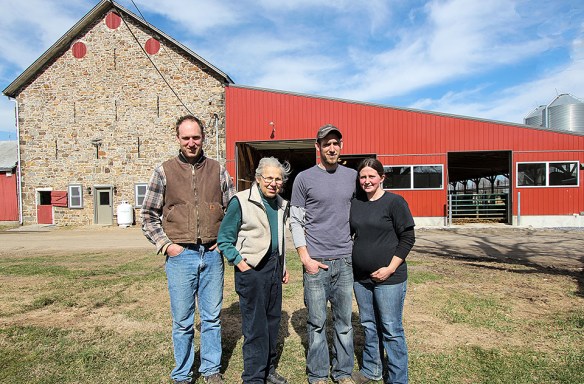
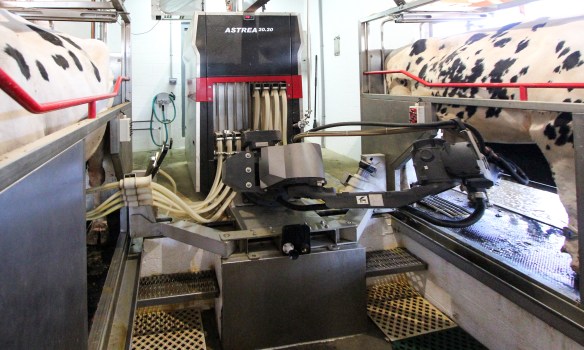
The Stutzman family hosted an open house for the new robotic dairy facility, featuring the two-box / one-arm AMS-Galaxy-USA Astrea 20.20 at their Lehi Creek Farm, Mertztown, Pa. on Thursday, April 7.

Naomi and her late husband Marlowe Stutzman started the dairy at Lehi Creek Farm in 1972, but dairying goes back four generations in the Stutzman family previously in Bucks County. Today, Naomi operates the farm with her sons Mike and Matt and Matt’s wife Steph.

“I’m glad not to have more of the same. I was tired of patching and making do and always being at the back,” she reflects. “I never thought we would have something like this, and I’m amazed at how it works. I like not having to be here at a set time to get all these cows milked!”

The Stutzmans started milking robotically on November 2, 2015. The cows are up in milk by 10 to 20 pounds at 85 to 88 pounds/cow/day, milking voluntarily 2.9 times per day with the Astrea 20.20 robot. The herd has grown from 65 to 80 cows, on its way to 110, which will be handled with just one robot serving two boxes — keeping the per-cow cost of the new facility and technology within their reach.

Stutzman2639

Milk quality has also improved with SCCs consistently around 200,000. Mike observes fewer cases of mastitis, as the cows are in new quarters with top-notch ventilation, automatic scrapers, improved cow comfort, and getting milked more often now on a voluntary basis.

Mike and Matt trace the start of their farm’s modernization to 2005, when they built the new heifer barn. Penn State extension educator and engineer Dan McFarland came out and helped them site that barn. He looked at the space taken up by the old earthen manure lagoon and made suggestions.

In 2008, Naomi lost her husband Marlowe in a tragic car accident. She expresses her gratefulness that she and her sons made it through those tough times and were able to continue operating the dairy farm.

By 2013, the Stutzmans were working with NRCS to put in a raised tank to reduce the manure storage footprint while at the same time improving environmental quality.

“That’s when we started really planning for the future,” says Matt.

“The buildings, the parlor, everything was worn out, and we had no air quality in there,” Naomi recalls. “Dan McFarland came out again, and he gave us good advice. We also had Tim Beck help us with the evaluation for the financial side. They helped lead us in a good direction.”

At first, they were going to build a parlor, but that would have brought the addition out into the yard. Then, a year ago they decided to go robotic. Matt and Steph had attended Corner View’s open house, and then pursued the Astrea further during Ag Progress Days.

This decision allowed the Stutzmans to begin expanding their herd internally to an eventual 100-110 cows on the same footprint of the worn out barn, building and milkhouse they had previously for just 60-65 cows.

They chose the Astrea because they liked the idea of one robot serving two boxes. “We were impressed by the availability of parts and service and the support system of the Technical Services Center,” Mike observes. That’s where he and Matt trained before the robot was installed.

Naomi is quick to credit God and the advice of helpful consultants: “It’s only through God’s grace that we were able to work out the details better than I could have imagined.”

Last summer, the old buildings were torn down, except for the 200-year-old stone barn, which was converted from freestalls to house the new office, utility room, milk tank and equipment room. The robot barn was built around it, with the rear of the existing structure opened up for a well-ventilated dry cow area. When cows are ready to calve, they move across the feed alley to calving pens adjacent to the robot room.

While construction was underway, they were still able to milk their cows. “E&F Ag Systems was great to work with as a contractor. They organized it so the milking parlor was the last thing torn down. They built the robot barn addition right up to that point,” Naomi explains. “We kept the cows out on pasture and walked them to the parlor, eight at a time, for milking.”

That is, until Nov. 2, when the parlor and milk house were torn down and the robotic system was fired up.

By the time the spring grazing season is underway, the cows will have been confined to the new barn the prerequisite six months, and the Stutzmans will then activate the auto-ID gate to allow cows access to outside pasture. The gate will be programmed to control cow flow so that a cow can only go outside after she has milked.

The robot is already programmed to keep a minimum five-hour interval between milkings.

With her sons taking care of the feeding, bedding, repairs, maintenance and fieldwork, Naomi does all the breeding and Steph helps wherever she is needed, including herd health and heifer care. Everyone pitches in to keep the automated smart technology humming on auto-pilot.

The cow identification system includes activity monitors, along with information from the robot on milk deviations and conductivity.

“The first two weeks, I came out here with my notebook and wrote everything down,” Naomi says, admitting she had no computer experience. “I don’t use the notebook any more. I can pull up the reports I need and work right from the computer. It’s freeing.”

Stutzman2505

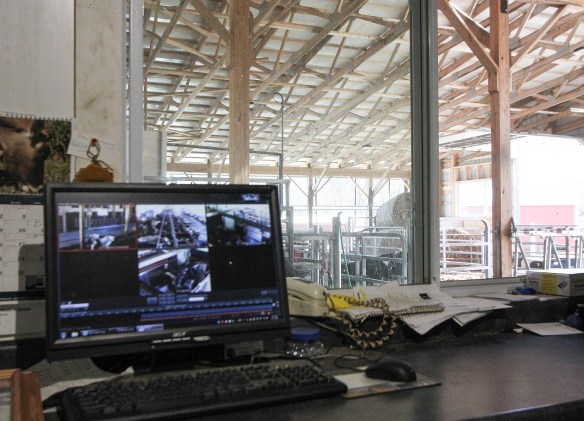
Mike and Matt like the “dashboard” feature of the Saturnus 20.20 TIM. This total farm automation software integrates all aspects of the facility and the cattle care and performance. The program allows them to set the lights, curtains, doors and fans to operate automatically with the weather.

On the dashboard, they can see, at a glance, the feeding, activity, milking performance, and attention list. Naomi concentrates on the cows in heat and Steph looks at the attention list. They also get reports on their phones, which Matt and Mike appreciate when they are out doing fieldwork.

The brothers admit it was “mind-boggling” while training before the robot was installed, but now they see how it all works together. Mike does maintenance and repairs and says it’s important to fix a problem when he sees it and not to let it go.

“We have gotten to know everyone at Lancaster Dairy Farm Automation and AMS-Galaxy-USA. They are easy to work with and were here for two weeks for our start up,” says Matt.

“It took just a couple days for the cows to realize there’s feed in the robot room, and two weeks to a month to settle into their own routines,” said Steph. “We probably fetched more cows than we needed to in the beginning. The attention cows are the only ones we go out and get now.”

As the herd grows into its new facilities, Mike and Matt have incorporated more spring forages into their double-cropping. They grow corn silage and alfalfa, and have added triticale and wheatlage as forage extenders.

“Before, we were milking twice a day for three hours, and scraping and feeding. Now everything gets done faster and better,” says Mike. “We are advancing our skills through technology, and the cows are much calmer.”

“We are still out here, but the work is different,” adds Matt.

For information about AMS-Galaxy-USA, call 800.422.4587 or visit amsgalaxyusa.com


-30-   CAPTIONS BELOW


Stutzman2636

In the AMS-Galaxy-USA Astrea 20.20 robotic milking setup, the cow on the left is milking simultaneously while the cow on the right is being prepped by the single robotic arm serving both milking boxes. Its only job is to prep the udder and attach the teatcups, which then detach automatically on their own, one at a time into sanitizing cupholders, followed by a separate pop-up spray-wand that applies the post-dip. The manual-attach option is easy for doing fresh cows and attention cows. Photos by Sherry Bunting

Stutzman2492

Naomi Stutzman and her sons Mike (left) and Matt and his wife Steph, operate Lehi Creek Farm, where a new robotic facility was built around their 200-year-old stone barn for 110 cows. An open house is planned for April 7.

Stutzman4892

This lazer gives a whole new meaning to the term ‘red eye.’ All day, all night it locates teats for prepping and attachment!

Stutzman2761 and/or Stutzman4951 and/or Stutzman2745

Old meets new at Lehi Creek Farm, where the Stutzman family began robotic milking last November and will host an open house on April 7.

Stutzman2497

Matt and Mike Stutzman like the way the Saturnus 20.20 TIM software provides reports and a dashboard screen where they can see at a glance how the herd and facility are doing.

Stutzman2580

Cows are calm and associate the robotic arm with feed flowing into the dish as prepping and milking begin.

Stutzman2731 and/or Stutzman2735

Milk cows, calving pens and robot room are on the left, and the dry cows and utility rooms are on the right, still utilizing the 200-year-old stone barn in the modernization.

Stutzman 2705

Cows in front have finished milking and are drinking at the trough while two of their herdmates milk simultaneously with one robotic arm in the background.

Stutzman2503

Naomi Stutzman shows an older photograph of the farm before the new manure storage and modernized robotic milking facility were completed.