What’s the future for fluid milk?

Fluid milk sales are up, Whole Milk for Healthy Kids Act is moving. Meanwhile industry globalists put big bets on ESL, shelf-stable, with favor from Vilsack  

By Sherry Bunting, Farmshine, October 18, 2024

EAST EARL, Pa. — Protein is all the rage right now, and consumers are turning back to real milk as they realize its natural high quality protein benefits. Year-to-date fluid milk sales continue to outpace year ago, and that’s good news. Here are some key factors in the future of fluid milk in the U.S.

Fluid milk sales up!

July’s total packaged fluid milk sales more than recovered the June slump — in a big way, and August looks promising too.

USDA estimated packaged fluid milk sales at 3.4 billion pounds in July, up 4.3% year-on-year (YOY). This amplifies the pivotal year-to-date trend above year ago for the first time in decades (except the 2020 pandemic year).

Specifically, USDA’s Estimated Fluid Milk Product Sales Report for July, released in late September, noted conventional fluid milk sales total 3.7% higher YOY, with organic up 11.7%.

Conventional unflavored whole milk sales were up 4.7% YOY in July, while organic whole milk sales were up 17.1%.

Flavored whole milk sales were mixed because these sales rely upon what processors are willing to make and offer on store shelves, not necessarily reflecting what consumers want to buy. When fewer packages of whole flavored milk are offered, the full potential of sales are restrained.

Year-to-date (YTD) sales of all fluid milk products for the first seven months of 2024, at 24.7 billion pounds, are up 0.7% YOY, adjusted for Leap Year. Of this, YTD conventional whole milk sales for the first seven months of 2024, at 8.8 billion pounds, are up 2.1% and organic whole milk sales at 914 million pounds are up 12.6%.

The August report to be released in the coming weeks is shaping up similarly. August Class I utilization pounds reported last week by USDA are up 1.1% YOY and 1.1% YTD (Jan-Aug).

Making more fat, importing it too?

Meanwhile, the monthly World Agricultural Supply and Demand Estimates (WASDE) released Oct. 9 reduced its milk price forecasts for the rest of 2024 and into 2025, expecting Class III prices to fall from September highs as cheese price declines are expected to more than offset the higher whey prices.

This report is looking at all the major new cheese capacity coming online in the next 12 months, which is expected to saturate the cheese market to drive prices lower so that U.S. cheese makers can be globally competitive and continue exporting record amounts of cheese.

But is the milk available to do this? Likely not without robbing from Classes I, II and IV channels. Still, the WASDE forecasts lower Class IV prices also due to the abruptly declining butter price being only partially offset by the higher nonfat dry milk prices.

In short, dairy farms are making higher-fat milk, and the food industry is importing more milkfat, especially in the form of whole milk powder. WMP imports have been up by a record amount YOY in each of the past four years, especially 2024.

Restoring whole milk choice for kids!

Now would be a particularly good time for whole milk choice to be restored in our nation’s schools since we apparently have too much milkfat and not enough skim. Given this scenario, how can anyone in this industry still believe the whole milk in schools would hurt the industry’s ability to make enough butter and cheese. 

Unless it is excess butter and cheese that is needed to push prices down in order to continue beating record exports at reduced prices paid to farmers. 

Getting whole milk choice into schools would help. IDFA has been touting the Whole Milk for Healthy Kids Act. NMPF says they are on board too. This means the industry is united, right?

What are the chances that GT Thompson’s bill to bring whole milk choice back to schools will finally make it all the way to the President’s desk?

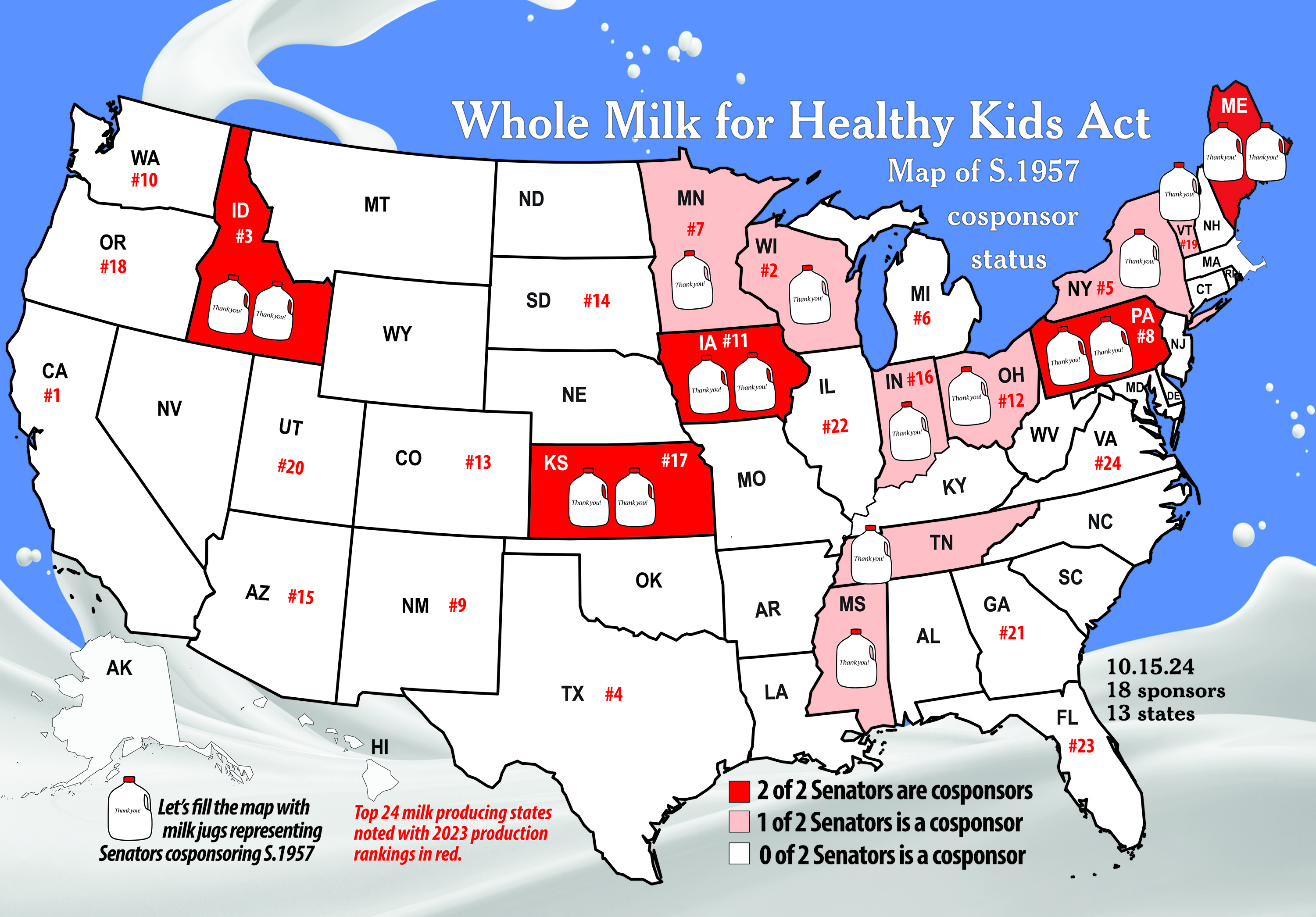
For starters, it passed the House by an overwhelming bipartisan majority last December. The Senate bill, S. 1957, has 11 Republicans, one Independent and five Democrats signed on, including notable Democrats such as Amy Klobuchar of Minnesota, Peter Welch of Vermont, Kirsten Gillibrand of New York, and John Fetterman of Pennsylvania who chairs the Senate Ag Subcommittee on Nutrition. 

The main sponsor is Republican Senator Roger Marshall of Kansas, a doctor. States represented are Pennsylvania, Vermont, Wisconsin, Idaho, New York, Iowa, Ohio, Indiana, Tennessee, Maine, and Mississippi.

In fact, Pennsylvania now has both Senators signed on. Senator Bob Casey Jr. (D-Pa.) is late to the party, but he has finally signed on as a cosponsor of S. 1957 on Sept. 19. It’s nice to see both senatorial milk jugs filled on the map for the Keystone State, but the bill needs more cosigners to fend off the blockade by Senate Ag chairwoman Debbie Stabenow (D-Mich.).

GT has included the Whole Milk for Healthy Kids Act in the House Ag Committee-passed farm bill. Word from Washington over the past few weeks is that a new farm bill is expected to get done after the elections in the lame duck session, and that GT will fight to keep the Whole Milk for Healthy Kids Act in the bill. Let’s hope so.

USDA: two movers for Class I?

Also related to Class I fluid milk sales, the dairy industry awaits a final decision on USDA’s proposed changes to federal milk pricing formulas, which includes a surprise for fluid milk: splitting the baby and adding a fifth class of milk in the form of two Class I mover announcements each month. 
The hearing record is woefully inadequate. No proposal. No evidence. No testimony. No analysis. No parameters. No definition. Even USDA’s own static analysis shows these two movers would be as much as $1 or more apart in any given month.

Fresh, conventionally processed (HTST) milk would go back to being priced by the the higher of the Class III or IV advance pricing factors to determine the Class I skim milk base price portion of the mover. 

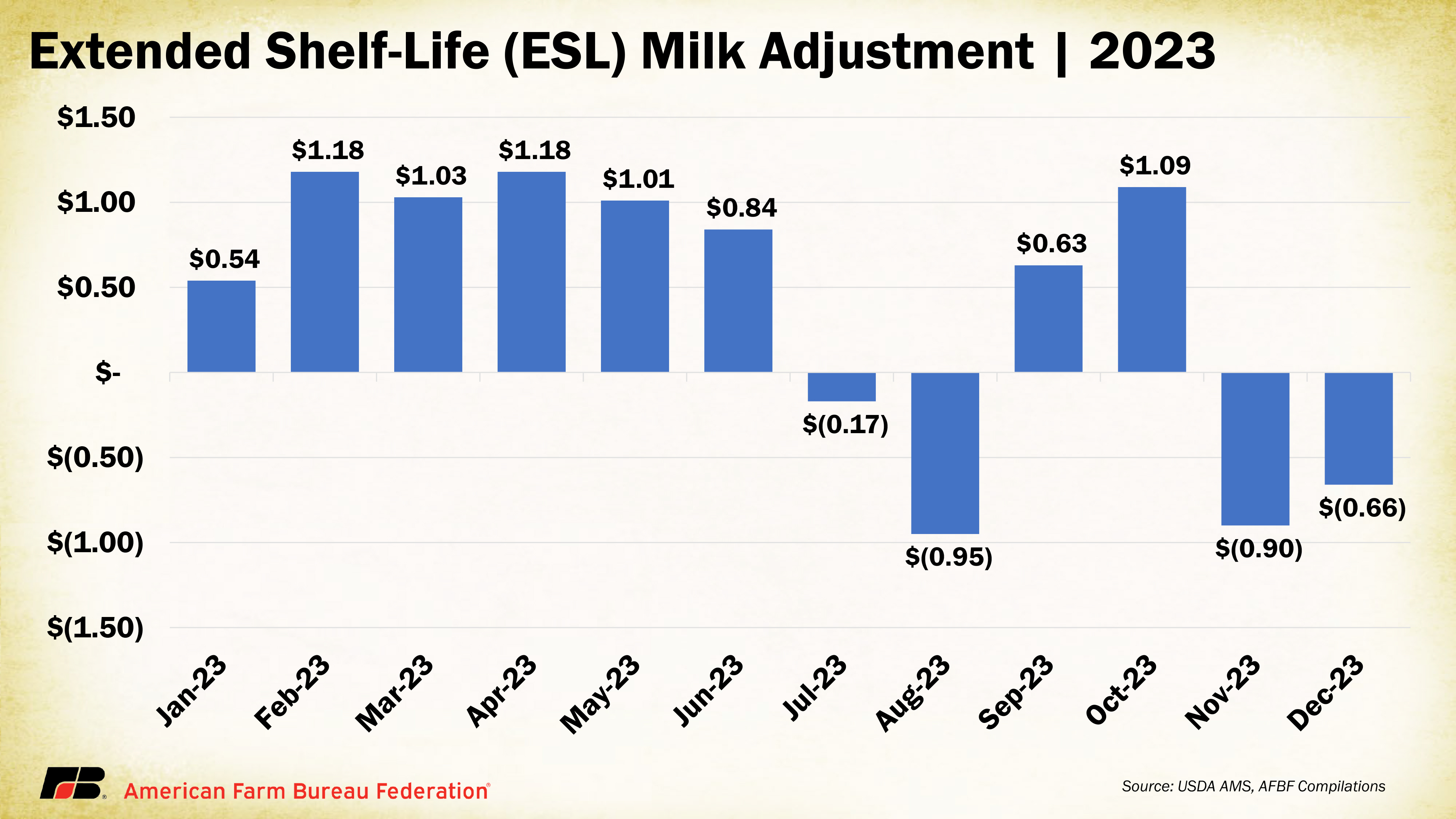
However, milk used to make extended shelf life (ESL) fluid milk products, defined only as “good for 60 days or more,” would continue to be priced using the average of these two pricing factors, plus-or-minus a rolling adjuster of the difference between the higher-of and average-of for 24 months, with a 12-month lag.

With two movers, fluid milk costs could be different for plants in the same location based on shelf life, with no clear definition for the new class, nor parameters established to qualify. Could we see label changes to move between movers?

Processors will know the rolling adjuster 12 months in advance, due to the “lag.” They will know the two advance-priced calculations (higher-of and average-of) a month in advance. They will have it charted in an algorithm no doubt and make decisions accordingly.

Farmers, on the other hand, will find out how their milk was used and priced two weeks after all their milk for the month was shipped. Those milk checks will be even less transparent than they are now.

Big bets on ESL, shelf stable

The dairy checkoff has openly identified ESL, especially shelf stable aseptically packaged milk, as its “new milk beverage platform,” using dairy farmer funds to research and promote it and to study and show how consumers can be “taught” to accept it.

The whole deal is driven by the net-zero sustainability targets. So, follow the money.
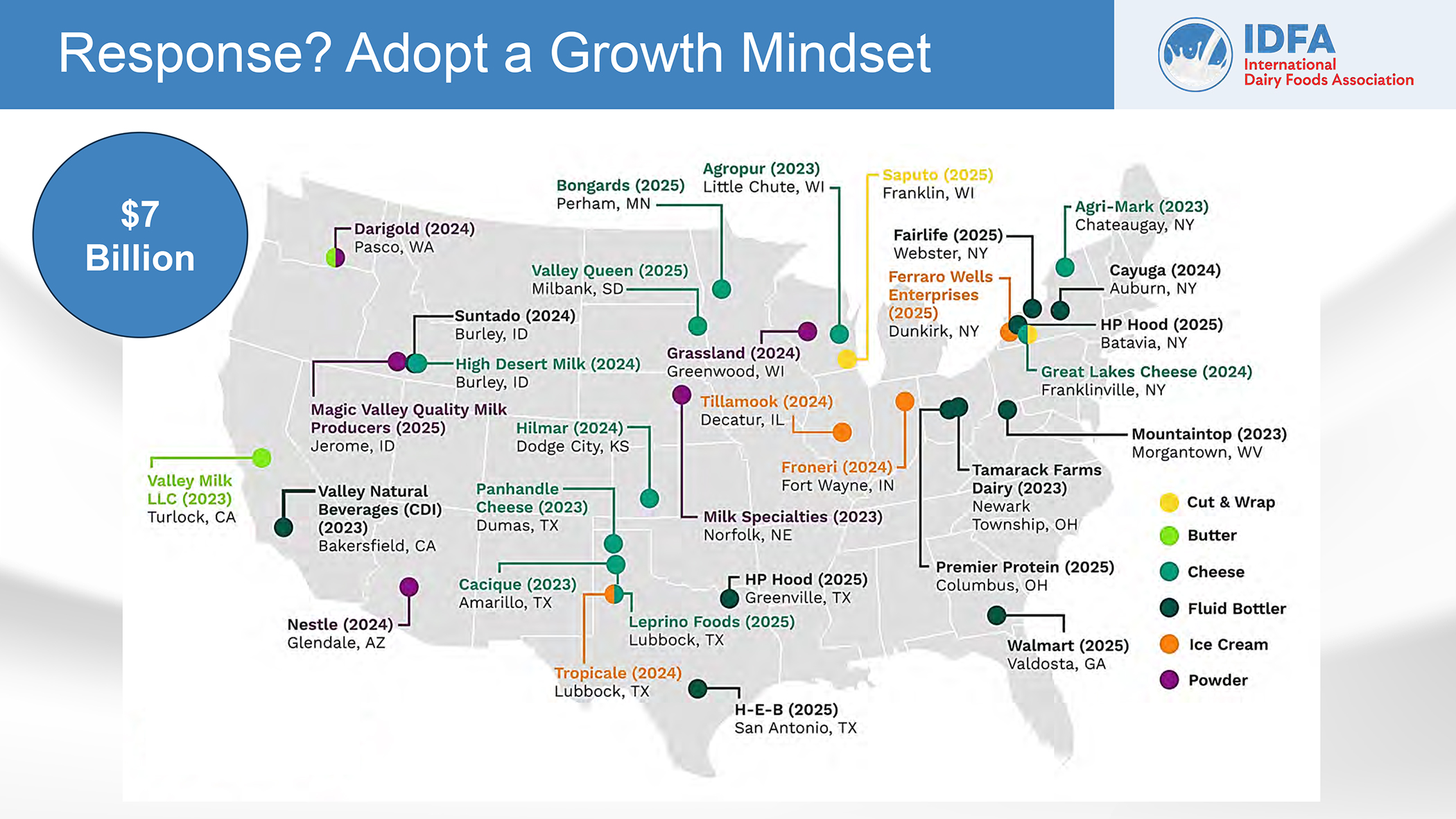
Dr. Michael Dykes of IDFA, at the Georgia Dairy Conference in January 2024, told dairy producers that “this is the direction we (processors) are moving… to get to some economies of scale and bring margin back to the business.”

He said the planned new fluid milk processing capacity investments are largely ultra-filtered, aseptic, and ESL — 10 of the 11 new fluid plants on the IDFA map he displayed are ESL. Some will also make ultrafiltered milk, and some will make plant-based beverages also.

Meanwhile, the linchpin of regional dairy systems is conventionally pasteurized (HTST) fluid milk, prized as the freshest, least processed, most regionally local food at the supermarket.

To be sure, this two-mover proposal fits the climate and export goals set forth by the current Ag Secretary Tom Vilsack when he was working as the highest paid dairy checkoff executive in between the Obama and Biden administrations. 

The pathway to rapidly consolidate the dairy industry to meet those goals is to tilt the table against fresh fluid milk, something he already put a big dent in when removing whole milk from schools.

They decided thou shalt drink low-fat milk and like it. Apparently, they are equally convinced about ESL / shelf stable milk as the way of the future and will continue using mandatory farmer checkoff funds to figure out how to get consumers to like that too.

Just this week, the food writer for The Atlantic did a piece on shelf-stable milk, calling it “a miracle of food science” and lamenting in her Op-Ed that it’s a product “Americans just can’t learn to love.”

Author Ellen Cushing took jabs at America’s preference for fresh natural milk from a global perspective, without a thought for the local dairy farms and regional food systems that are tied to fresh milk. She states that by worldwide standards, other countries have gone shelf-stable milk, which she describes as “one of the world’s most consumed, most convenient and least wasteful types of dairy.”

Processors are making big bets on consumer conversion to ESL and shelf-stable.  There are cards to play in every hand. TO BE CONTINUED!

-30-

USDA recommends changes to milk pricing formulas and other Milk Market Moos

By Sherry Bunting, Milk Market Moos column in Farmshine, July 5, 2024 (with updates)

USDA issued a 332-page recommended decision on July 1 for changes to pricing formulas in all 11 Federal Milk Marketing Orders, which was later published in the Federal Register July 15.

The bottom line is a mixed bag of positives, negatives, and questions requiring further study.

USDA AMS professionals did yeoman’s work with the 49 hearing days across five months of proceedings on 21 proposals, yielding 500 exhibits; more than 12,000 pages of transcripts of testimony from farmers, cooperatives, processors and others, along with cross-examination; and over 30 post hearing briefs and correspondence.

Once the draft decision is officially published in the Federal Register in the coming weeks, the 60-day public comment period begins, followed by 60 days of USDA evaluation of the feedback, followed by a final rule, followed by a producer referendum.

According to the FAQ section at the USDA AMS national hearing website, only producers who are pooled in the selected representative month in each Federal Order will be eligible to vote. Each of the 11 Orders votes separately.

If two-thirds of those eligible dairy farmers OR two-thirds of the pooled volume they represent in an Order vote “yes,” then that Order continues, as amended. If neither two-thirds threshold is met, then that Order is terminated. *AMS answered our question on the two-thirds determination that it is determined by the number of eligible (pooled) producers who actually participate in the vote, stating: “If a producer receives a ballot but does not return it, the producer is not included in either the numerator or the denominator of the two-thirds calculation.”

Here’s what’s in the USDA recommended decision package:

1) Milk Composition Factors: USDA recommends updating the milk composition factors to 3.3% true protein, 6.0% other solids, and 9.3% nonfat solids. This would mainly affect Class I in all Orders and the other Class prices in the fat/skim priced Orders.

2) Surveyed Commodity Products: The recommendation here is to remove the 500-pound barrel cheese prices from the Dairy Product Mandatory Reporting Program survey and rely solely on the 40-pound block cheddar cheese price to determine the monthly average cheese price used in the Class III and protein formulas. National Milk Producers Federation (NMPF) proposed this and International Dairy Foods Association (IDFA) opposed it. American Farm Bureau Federation (AFBF) had proposed adding unsalted butter and 640-lb block cheddar to the survey, and California Dairy Campaign had proposed adding bulk mozzarella. Neither of these proposals were included in USDA’s recommended decision.

AFBF chief economist Roger Cryan discussed this recently on Farm Bureau Newsline, where he also talked about USDA decision not to include AFBF’s proposal to raise the Class II differential.

3) Class III and Class IV Formula Factors: USDA chose to recommend make allowance increases that fall in between the lower increase proposed by NMPF and the higher increase proposed by IDFA and Wisconsin Cheesemakers. The USDA recommendation is to raise these manufacturing allowances from current levels to these new levels: Cheese: $0.2504; Butter: $0.2257; NFDM: $0.2268; and Dry Whey: $0.2653. The recommended decision also proposes updating the butterfat recovery factor to 91%.

By our calculations, the proposed make allowance increase would equate to roughly an additional 80 cents per hundredweight deduction from milk checks embedded in the pricing formulas. Current make allowances total up to about $2.75 to $3.60 per hundredweight, depending on product mix. New make allowances would total up to about $3.25 to $4.50 per hundredweight, depending on product mix.

AFBF economist Danny Munch was interviewed by Brownfield Ag on July 2, noting the increase is 5 to 7 cents per pound. “When we loop that into a per-hundredweight value, that means farmers will be seeing 75 cents to 87 cents less per hundredweight on their milk checks because of the increased make allowance.” He says the data used for the make allowances was based on voluntary cost of production surveys. 

Farm Bureau president Zippy Duvall did not mince words: “We strongly believe make allowances should not be changed without a mandatory, audited survey of processors’ costs. Our dairy farmers deserve fairness in their milk checks and transparency in the formula, but the milk marketing order system can’t deliver that unless make allowances are based on accurate and unbiased data,” he said in an AFBF news release.

American Dairy Coalition CEO Laurie Fischer also weighed in: “We are disappointed that USDA has proposed higher make allowance credits for processors, which are — in effect — deductions from farmer milk checks that are embedded within the pricing formulas. The industry does not yet have mandatory, audited cost surveys, and there is no connection between increased processor credits and a transparent, adequate price paid to farmers,” she said in an ADC news release, adding that these two elements have been key policy priorities for ADC since January of 2022.

4) Class I differentials: USDA recommends updating Class I differential values to reflect the increased cost of servicing the Class I market. The base differential for all counties stays at $1.60, and the county-specific Class I differentials are specified in the decision at levels higher than they are currently, but by less than the increases that had been proposed by NMPF.

5) Base Class I Skim Milk Price: USDA recommends going back to the higher-of the advanced Class III or Class IV skim milk prices to set the Class I mover each month. However, the Department did not go with Farm Bureau’s request to do this on an emergency expedited basis.

And, here’s where it gets tricky, the higher-of method would only apply to fresh fluid milk, while adopting a rolling monthly adjuster that incorporates the average-of for milk that is used to make extended shelf life (ESL) fluid products, including shelf-stable milk.

This means ESL milk would be priced differently from conventional fresh fluid milk within the same Class I category. A simple averaging method would be used as part of this special ESL adjuster, which would incorporate a 24-month rolling average (with a 12-month lag) of the difference between the higher-of minus the average-of, which is added to the current month simple average-of, and then the current month higher-of is subtracted from that sum. This adjuster could be either a positive or negative number.

In fact, we’ve learned that this ESL adjuster, using months 13 through 36 counting backward from the implementation date, would allow milk for ESL products to recoup, over time, some of the very large prior losses experienced by all dairy farmers during the average-of method that has been in place since May 2019. Because a simple average is used for the adjuster calculation, without the 74 cents, more would be recouped than the actual loss difference experienced under the years of the average plus 74 cents method. On the other hand, the rolling adjuster look back will include months in which a smaller make allowance was in effect than could be the case in the future if USDA’s make allowance recommendation becomes final.

Meanwhile, producers of milk bottled as ‘regular’ fresh fluid milk would start right out of the implementation gate at the higher-of and recoup zero prior loss endured under the current form of average-of, and be subjected to the higher make allowance, which is built into the advance pricing factors. (More on this feature of the USDA recommended decision in a future article.)

In its ‘notice to trade,’ USDA states that the ESL adjuster was developed to “provide for better price equity for ESL products whose marketing characteristics are distinct from other Class I products.”

Meanwhile, in his July 3rd CEO’s Corner, NMPF’s Gregg Doud appears to embrace what is essentially a fifth milk class given the different pricing methods proposed in the recommended decision for Class I — depending on shelf-life classification.

Doud writes: “Recognizing the need to restore orderly milk marketing, USDA decided to go back to the higher-of, with an accommodation for extended shelf-life milk, thus granting NMPF’s request for the vast majority of U.S. fluid milk. USDA’s solution is, frankly, as innovative as it is fair – a classic case of two sides not getting all that everyone wanted, but everyone getting what they most needed.”

Splitting the baby was not part of any hearing proposal that we could find; apparently processors made their case with USDA as to needing the average-of method (with calculated adjuster) to sell ESL milk products deemed the new milk beverage platform.

During the national hearing in Carmel, Indiana, representatives from Nestle, a major maker of ESL fluid milk products, said their sales increased once the average-of method was implemented in May 2019 through legislative language in the 2018 farm bill. They testified that they could manage risk when providing 9 to 12 month future pricing on shelf-stable fluid products to foodservice and convenience stores. They lamented that losing the average-of would hurt their sales.

Representatives for fairlife testified that forward pricing of their ESL products was critical to their ability to grow sales and that losing the average-of would impact future plans, including the size of the new plant being planned for New York State and other expansions elsewhere in the future.

However, since this bifurcation of Class I was not a proposal subject to vetting, no one had the opportunity to present evidence on future impacts.

Public comments on the recommended proposals will be accepted for 60 calendar days after the decision is published in the Federal Register. Comments should be submitted at the Federal eRulemaking portal: http://www.regulations.gov or the Office of the Hearing Clerk, U.S. Department of Agriculture, 1400 Independence Ave., SW, Stop 9203, Room 1031, Washington, DC 20250-9203; Fax: (844) 325-6940.

OTHER MOOS — July 3, 2024

Milk futures swap trends: Cl. IV up, III down

Class III milk futures moved lower this week especially on August and Sept. 2024 contracts; while Class IV milk futures were higher on 2024 contracts, steady to firm for 2025. On Tues., July 2, Class III milk futures for the next 12 months averaged $19.28, down 24 cents from the previous Wednesday. The 12-month lass IV milk futures average was $21.19, up 14 cents. This put the spread between Class IV over III at nearly $2.00 per cwt.

Block cheese, whey higher

Pre-holiday trade was firm to higher with little volume moved on most products. But nonfat dry milk lost ground, and the 500-lb barrel cheese trade was active at lower prices.
The 40-lb block Cheddar price was pegged at $1.90/lb on Tues., July 2, up 2 cents from the previous Wednesday, with just 2 loads trading the first 2 days. The 500-lb barrel cheese market lost 2 cents, pegged at $1.88/lb Tuesday with 12 loads trading the first two days. (Update gained it back July 3 at $1.9025/lb with 2 loads trading). Dry whey gained a half-penny on the week at 49 cents/lb; one load traded.

Butter higher, powder weak

The butter market saw no trades the first two days this week. By Tues., July 2, the daily CME spot price was pegged nearly a nickel higher at $3.1375/lb. Grade A nonfat dry milk lost a penny and a half at $1.17/lb Tuesday with 4 loads changing hands. (Update, NFDM up July 3 at $1.18/lb, 2 loads traded)

May All-Milk $22.00, DMC margin $10.52

USDA announced the All-Milk price for May at $22.00, up $1.50 from April and $2.90 higher than a year ago. The national average fat test was 4.17, up 0.02 from the previous month and up 0.11 from a year ago. The Pennsylvania All-Milk price for May, at $22.50, was just 70 cents higher than for April, and fat test fell by 0.10 from April to May.

USDA announced the May Dairy Margin Coverage (DMC) margin at $10.52/cwt, up 92 cents from April and up a whopping $5.69 per cwt from the May margin a year ago. This is the third consecutive month in which no DMC margin payments were triggered as the margin remains above the highest coverage level of $9.50/cwt. The $1.50/cwt gain in the national average All-Milk price in May outpaced the 58 cents/cwt increase in feed cost.

H5N1 detections fall to 57 in just 7 states

As of July 2, 2024, the confirmed cases of H5N1 in dairy cows decreased to 57 herds in now just 7 states as South Dakota moved past the 30-day window and off the active map. Colorado has the most detections at 23 in the past 30 days, 27 cumulatively since April 25. This has created some questions as it represents 20 to 25% of the 110 herds in the 13th largest milk-producing state. Colorado is followed by Iowa (12), Idaho (9), Minnesota (6), Texas (5), while Michigan’s previously high numbers over 25 have dropped to one, and Wyoming still has just one. Michigan and Wyoming will be past their 30 days on July 7 and 12, respectively, if no new detections are confirmed.

AFBF seeks ‘whisper of hope’ in request for USDA emergency decision on Class I mover

Farm Bureau economist Danny Munch closes FMMO hearing Jan. 30, 2024 with emergency request for USDA to return Class I ‘mover’ formula to ‘higher of’


By Sherry Bunting, Farmshine, Feb. 2, 2024

CARMEL, Ind. – Over 5 months and 500 exhibits have gone by in the nearly 50 hearing days since the long-awaited national hearing on Federal Milk Marketing Order modifications began Aug. 23, 2023. It ended Tuesday, Jan. 30th with a last-minute witness bringing forward American Farm Bureau’s request for an emergency decision by the USDA Secretary to restore the ‘higher of’ method for calculating the skim portion of the Class I ‘mover’ price.

This hearing went on longer than expected, and the implementation of any final decisions from a multitude of proposals in various areas of FMMO milk pricing are at least 12 to 18 months away under ordinary post-hearing processes, hence the AFBF request for emergency decision-making on the Class I mover to go back to the higher of.

“If USDA would implement this on an emergency basis, it helps with the confidence and perception piece of it. So, if there is a whisper of hope, to see that there will be a positive outcome coming soon, an optimistic change that is coming that fuels them. Do they see things getting better? Or are things going to stay the way they are? ” said AFBF economist Danny Munch while being cross-examined after reading into evidence the letter signed by Sam Kieffer, AFBF vice president of public policy.

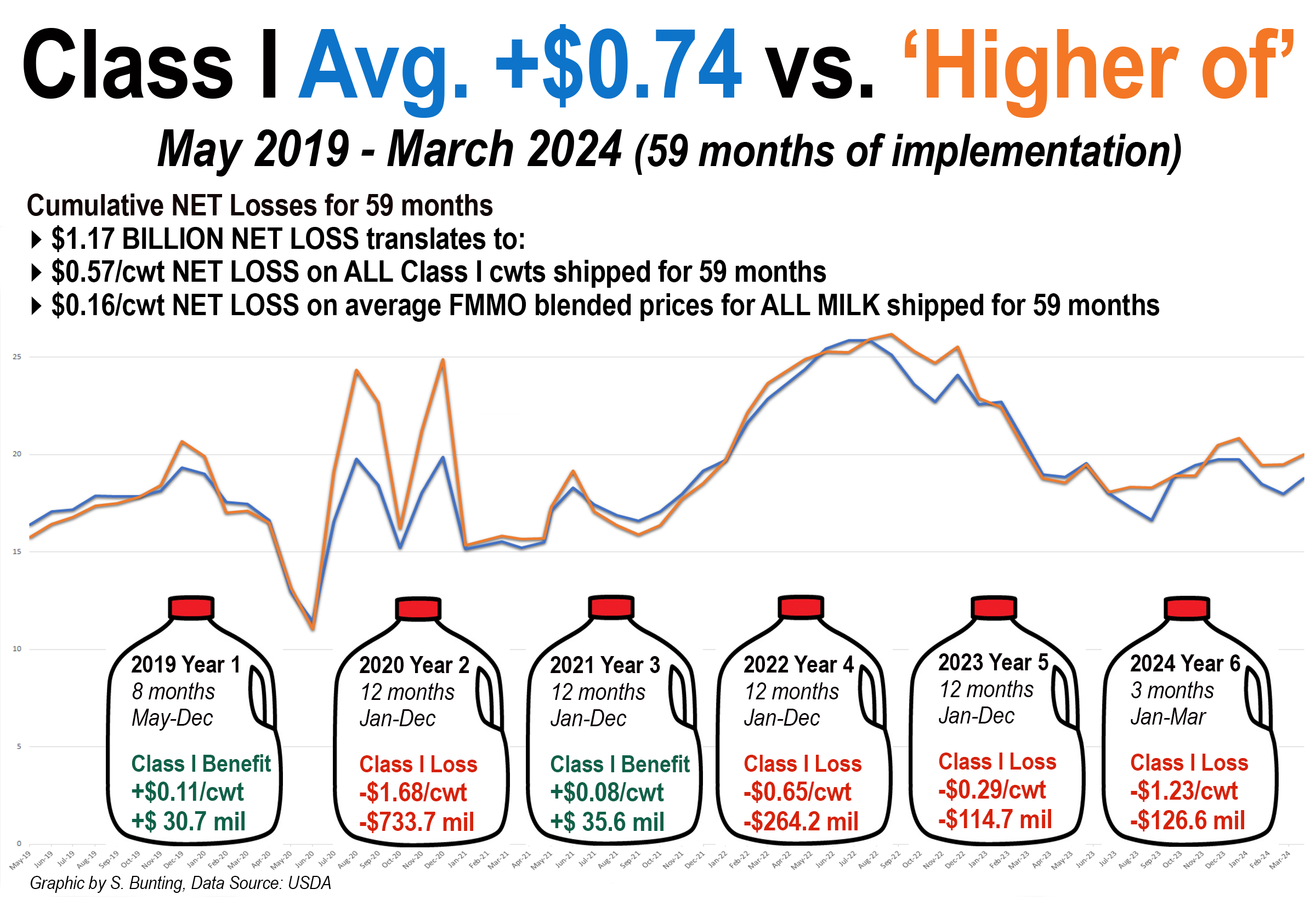
The letter stressed that FMMO reform is in step 5 of a 12-step process and a long way from a final rule. Meanwhile, the change in the Class I mover formula was intended to be revenue neutral to farmers, but farmers have lost over $1 billion in 56 months of implementation. This does not even include further losses from depooling of manufacturing milk when the Class I fluid milk price has been out of alignment in FMMO revenue-sharing pools.

“The comprehensive process of amending federal orders, though important, means dairy farmers remain stuck with current pricing regulations until USDA publishes a final rule,” Kieffer wrote in the letter Munch read into evidence. “The current Class I mover was a well-intentioned policy misstep that has reduced dairy farmers’ checks, with little relief in sight. Emergency implementation of the ‘higher-of’ Class I mover formula will help buffer against persistent losses associated with mistaken and outdated policies that have left dairy farmers struggling to make ends meet.”

Munch noted that members re-affirmed going back to the ‘higher of’ calculation in policy meetings during the AFBF National Convention last week, and they voted to make it a priority of urgency.

“Dairy farmers are facing closure. A lot of our members are facing the hard decision about whether to sell their cattle or not. That’s a little window into what our members mentioned last week,” said Munch.

The other reality that is setting in is the fact that large losses are mounting quickly again. The Class IV over III divergence is quite wide – ranging $3 to $4.00 per hundredweight – and the futures markets show it could be above the $1.48 per cwt threshold through the end of 2024.

Farmshine’s Market Moos columnist Sherry Bunting has updated the graph showing how the supposedly revenue-neutral change from the ‘higher of’ to an averaging formula for the Class I mover May 2019 through March 2024 will have reduced Class I value in farm milk checks over 59 months of implementation. This graph of cumulative and year-to-year losses does not include additional losses many farmers have incurred when manufacturing class milk is out of alignment with Class I, and is depooled, with the revenue excluded from the FMMO pools and benchmarks.

In fact, the Class I mover prices announced for January and February 2024 could produce well over $80 million in losses in just the first two months of 2024 once the pounds of Class I milk are sold and counted.

Munch also took the opportunity to remind everyone that when AFBF held the dairy stakeholders forum in Kansas City in October 2022, returning the Class I mover calculation to the ‘higher of’ was the main item that got consensus from every table in the room.

When the difference between the manufacturing classes exceeds $1.48 per cwt, then pooled producers receive less money for their milk under the averaging formula compared with the previous ‘higher of’ formula. When the difference between Class III and IV is $3.48, for example, that lowers the Class I price by $1.00 per cwt. In an FMMO with 75% Class I utilization, that’s a 75-cent loss on all of the milk, not just Class I. In an FMMO with 25% Class I utilization, that’s a 25-cent loss on all of the milk.

Even members of Congress have been doing the math and have talked about putting reversion language in the Farm Bill. They are aware of their role in putting what they were told was a “revenue neutral” change into the 2018 Farm Bill that IDFA and NMPF at the time agreed upon, while adding language that USDA could hold a hearing in two years to vet it for the future. 

We are now nearly five years into this change, and it is just one piece of the hearing that just concluded, which included many proposed modifications from milk composition and price surveys, to make allowances and differentials.

Without emergency decision-making by USDA on the Class I mover piece, any potential changes from this hearing are a good 12 to 18 months away, depending on how the post-hearing processes move along, from post-hearing briefs due April 1st to rebuttles, draft decisions, comment periods, referendums, final decisions, and there are proposals that have asked for further delays after the process plays out to avoid “affecting” exchange-traded risk management instruments. 

Dairy farmers are just looking for some relief and transparency for the future, according to Munch. 

Meanwhile, IDFA and Milk Innovation Group (MIG) have opposed returning to the ‘higher of’ and have proposed several averaging methods for the Class I mover that would continually look backward to compare and change adjusters to make up past losses gradually out into the future.

Farmers have testified that this doesn’t help if it takes two to three years to get that money back after they’ve already lost the farm.

What it boils down to on the Class I mover is the industry wants to move toward more fractionation of milk, more aseptic and shelf-stable beverages, and away from fresh fluid milk. These are the products that can sit in a warehouse for 9 months and for which processors testified they do 9-to-12-month pricing contracts largely with foodservice and convenience stores. Fresh fluid milk already has advance pricing that aligns with the turnaround of that product so hedging on the futures markets is not typically done, and averaging is not needed.

When asked whether AFBF has looked at how the spread may continue in the future to make the averaging formula a loser for farmers, he said Class IV will likely persist above Class III, and yes, they expect the spread to remain large.

Earlier testimony by processor witnesses blamed these Class I formula losses on Covid disruptions, food box programs and large government cheese purchases, but as Munch pointed out, the driver of these losses is something else. When Class IV is over III, we don’t see it in a negative PPD, but milk is depooled, and the full extent of the depooling losses are incurred by farmers, they just aren’t easily enumerated.

“In 2020, the losses (in Class I value, alone, without including the impact of depooling) were over $700 million. In December 2023, the losses crossed over $1.05 billion as they have continued to add up,” said Munch. “The financial detriment is not solely due to a ‘black swan’ event. Some of our farmers were waiting to see if it showed markets shifting. Now, years later, this is still an issue.

“That’s another reason why we are asking for an emergency decision on this right now, and why it came up at our meeting at the convention last week,” Munch testified. “It was intended to be revenue neutral, but it has turned out not to be.”

During cross-examination, Munch also confirmed there hasn’t been much trust by producers to believe processors will replace the dollars they are asking to be removed from FMMO pricing by paying over-order premiums, instead.

“There is a lack of trust and not knowing where their price comes from. There has been a lot of concern about how their milk checks are calculated,” Munch related. “That’s one of the proposals that the American Farm Bureau put forward is more uniform, clear milk checks. There is a perception that things in milk checks have been manipulated. There is a perception of mistrust.

“If there are ways we can build back the trust, and if one of those ways that our farmers have targeted is switching back to the ‘higher of,’ then it’s easier for farmers to understand that calculation, and it has shown, in the most current of times, to be more advantageous to them.”

“It is my pleasure at 10:18 a.m. on 2024 January 30 to determine that this Hearing has ended,” said U.S. Administrative Law Judge Jill Clifton after 506 exhibits have been entered into evidence for and against 21 proposals in various areas of FMMO pricing modification during the 49 Hearing days that stretched over 5 months since its start on Aug. 23, 2023 in Carmel, Indiana. Screen captured from Hearing livefeed

-30-

Fluid milk processors say they can’t recoup higher protein value

NMPF, NAJ say higher solids worth more nutritionally, Seek FMMO updates to avoid misalignments and disorderly marketing

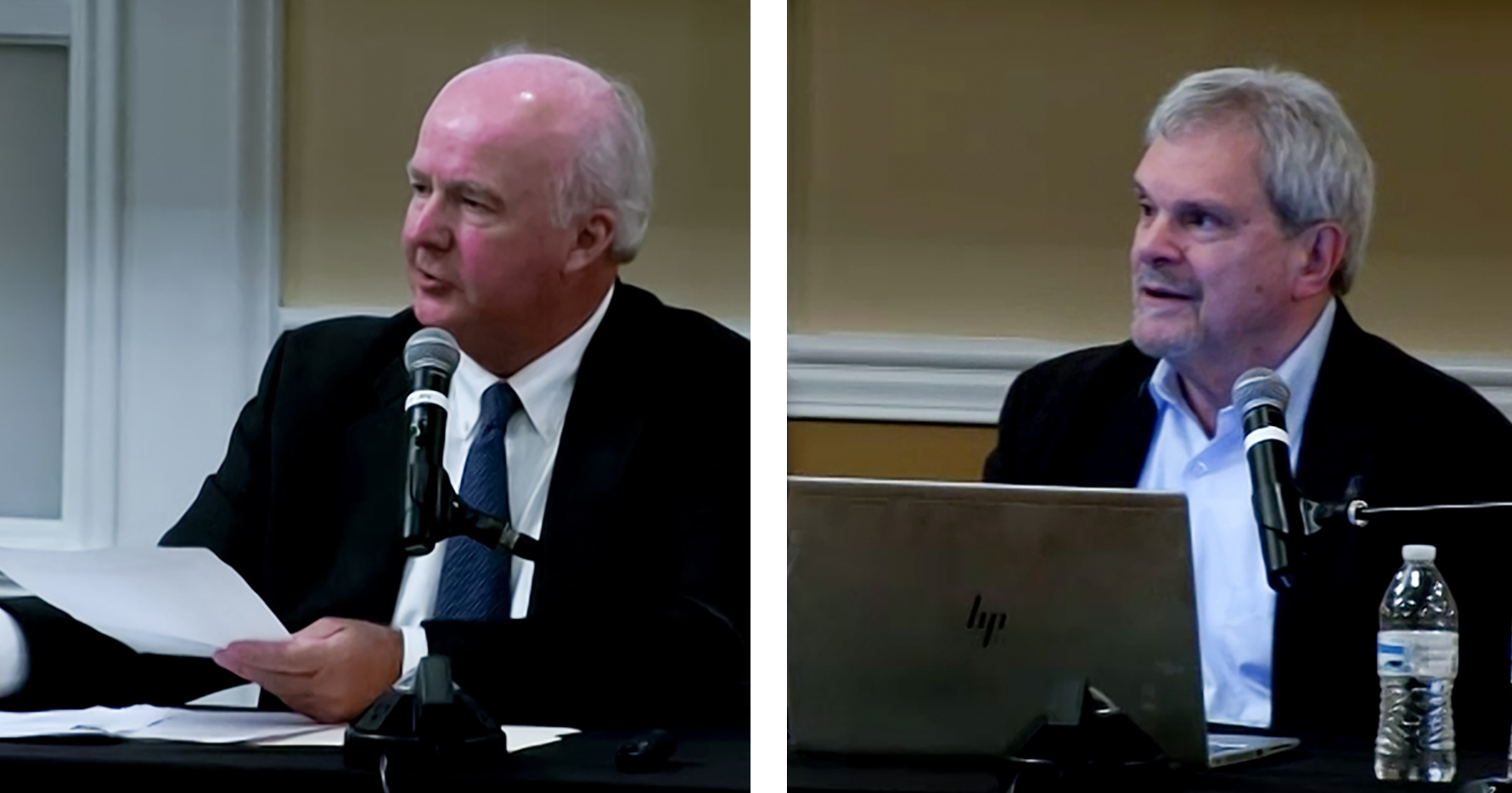
Calvin Covington (left) for Southeast Milk and Peter Vitaliano for National Milk Producers Federation testified on what the outdated skim milk component standards mean in terms of underpaying farmers and eroding producer price differentials (PPD), leading to disorderly marketing. This occurs because the skim portion of the milk that is utilized in manufactured products (Class III and IV) is paid per pound of actual protein, solids nonfat and other solids; whereas the skim portion of the milk bottled for fluid use (Class I) is paid on a per hundredweight basis using the outdated standard skim solids levels. The fat portion is not an issue because it is already paid per pound in milk class uses. Screen captures, hearing livestream

By Sherry Bunting, Farmshine, Sept. 8, 2023

CARMEL, Ind. – The national Federal Milk Marketing Order hearing completed two weeks of proceedings, so far, in Carmel, Indiana. The entire hearing is expected to last six to eight weeks, covering 21 proposals in five categories.

Picking up the livestream online, when possible, gives valuable insight into a changing dairy industry and how federal pricing proposals could update key pricing factors.

The first week dug into several proposals to update standard skim milk components to reflect today’s national averages in the skim portion of the Class I price. 

Here is a bite-sized piece of that multi-day tackle.

National Milk Producers Federation (NMPF) put forward several witnesses to show what the outdated component levels mean in terms of underpaying farmers, and how paying for the skim portion based on outdated component levels has eroded producer price differentials (PPD), leading to disorderly marketing.

IDFA’s attorney Steven Rosenbaum grilled NMPF economist Peter Vitaliano on this. He tried on seven attempts to establish that the fat/skim orders in the Southeast don’t have component levels as high as the national average, suggesting this change would “overpay” producers in some markets.

In his questioning, Rosenbaum stressed that fluid milk processors can’t recoup the updated skim component values if those components do not “fill more jugs.”

Vitaliano responded to say that protein beverages are a big deal to consumers, and some milk marketing is being done on a protein basis. Rosenbaum asked for a study showing how many fluid processors are actually doing this.

Attorneys for opposing parties kept going back to this theme that the skim solids should not be updated because the FMMOs are based on “minimum” pricing. They contend that processors can pay “premiums” for the extra value if they have a way of recouping the extra value by making more product or marketing what they make as more valuable.

Vitaliano disagreed, saying that even though many processors do not choose to market protein on the fluid milk label, “more protein makes fluid milk more valuable to consumers.”

Attorney Chip English went so far as to ask Calvin Covington on the stand: Why should my clients (Milk Innovation Group) have to pay more for the additional solids in the milk when they are removing some of those solids by removing the lactose?

“Consumers don’t want lactose,” English declared.

Covington, representing Southeast Milk and NMPF, responded to say: “I don’t know that to be true. It is unfair to suggest all.”

Bottomline, said Covington, raising standard skim solids to reflect the composition of milk today vs. 25 years ago adds money to the pool to assist with the PPD erosion so that Federal Orders can function as they were intended and so producers are paid for the value.

As English further questioned whether consumers even care about the higher skim solids and protein levels of milk today, Covington replied: “Skim milk solids have a value in Class I, or fluid milk. People don’t buy milk for colored water. The solids give it the nutritional value. That’s the reason they buy milk. That’s why FDA set minimum standards in some states. Why would you drink milk if not for the nutritional value?”

He also pointed out that the increase in solids nonfat over the past 20-plus years has improved the consistency of lower fat milk options. As noted previously, the milkfat is a separate discussion and is not included in this proposal because farmers are already paid per pound for their actual production of butterfat in all classes, including Class I.

Under cross examination, Covington explained that the Class I price in all Federal Orders pays for skim on a standardized per hundredweight basis and pays for fat on actual per pound basis. Meanwhile, the manufacturing classes pay for both skim and fat on a per pound of actual components basis. 

As skim component levels have risen in the milk, the alignment of Class I to the manufacturing classes narrows because of the differences in how the skim is paid for. When this happens, it becomes more difficult to attract milk to Class I markets. That’s one example of disorderly marketing. PPD erosion and depooling of more valuable manufacturing class milk is another example. 

Covington explained the impact of this misalignment on moving milk from surplus markets to deficit Class I markets, that the lower skim value becomes a disincentive.

Vitaliano explained the depooling issue as “creating disorderly marketing conditions also, and great unhappiness when one farm is paid a certain price and another handler pays a different price (in the same marketing area). That’s disorderly unhappiness for the Federal Order program,” he said.

He noted that the fundamental reason for pooling is to take the uses in a given area with different values to achieve marketwide pooling where producers in that Federal Milk Marketing Area are paid similarly, regardless of what class of product their milk goes into.

“This removes the incentive for any one group to undercut the marketwide price to get that higher price (for themselves),” he said. “The Orders create orderly marketing with a uniform price. Depooling undermines that fundamental purpose that is designed to create orderly marketing.”

Either way, whether indirectly paying to bring supplemental milk into Class I markets from markets with higher manufacturing use, or in the case of depooling, the dairy farmers end up paying for the fallout from this erosion of the PPD.

Since the beginning, even before 2000 Order Reform, figuring the Class I base milk price had to begin somewhere, according to Covington. Federal pricing has always used the manufacturing class values in determining that base fluid milk price.

The trouble today is that Class III and IV handlers pay farmers per pound of actual skim components in the milk they receive, while the Class I handlers pay per hundredweight based on an arbitrary outdated national average skim component standard. Thus, the “opportunity cost” of moving this now higher component milk to manufacturing classes that pay by the actual pound of protein, for example, instead of by the old standard average protein levels is not accounted for in the Class I price that still uses the old standard average levels.

Pressed again on how it makes sense to raise Class I prices by raising the component level of the skim to more adequately reflect the national average today, Covington said: “It adds to the nutrition, and I stand by that. In proposal one, the price will go up (estimated 63 cents per cwt or a nickel per gallon). I am comfortable charging that extra price to Class I processors.”

Attorney English, representing MIG, retorted that, “The handlers who buy milk and then by adding a neutralizing agent remove the lactose, they’re going to pay more for the milk that they then have to process to subtract the lactose.”

Covington responded that, “There are consumers who think about lactose. There are consumers who buy lactose-free products, yes, because it is on the shelf, but it’s not all consumers.”

On the higher protein, English asked Covington how Class I processors are supposed to monetize that protein in a label-less commodity, a commodity that is declining in its share of total milk utilization?

“We are still selling 45 billion pounds of packaged fluid milk (annually) in this country,” said Covington. “Consumers wouldn’t buy that 45 billion pounds if it wouldn’t have some nutrition.”

English argued that milk is sold as whole, 2%, 1% and non-fat. It is not sold by its protein, so isn’t it “so highly regulated in ways that alternatives are not that any increase in price hinders sales of fluid milk?”

Covington acknowledged that, “yes, it is regulated, but I’m not convinced that this proposal will hinder fluid milk sales. Again, (higher components) add to the nutrition and I stand by that.”

Opponents kept coming back to these value questions, while proponents focused on the price alignment issue and orderly marketing.

To link up with the hearing livestream 8 to 5 weekdays, to read testimony and exhibits, and to respond to the virtual farmer testimony invitations made every Monday for the following Friday, visit the Hearing Website at https://www.ams.usda.gov/rules-regulations/moa/dairy/hearings/national-fmmo-pricing-hearing

-30-