AFBF seeks ‘whisper of hope’ in request for USDA emergency decision on Class I mover

Farm Bureau economist Danny Munch closes FMMO hearing Jan. 30, 2024 with emergency request for USDA to return Class I ‘mover’ formula to ‘higher of’


By Sherry Bunting, Farmshine, Feb. 2, 2024

CARMEL, Ind. – Over 5 months and 500 exhibits have gone by in the nearly 50 hearing days since the long-awaited national hearing on Federal Milk Marketing Order modifications began Aug. 23, 2023. It ended Tuesday, Jan. 30th with a last-minute witness bringing forward American Farm Bureau’s request for an emergency decision by the USDA Secretary to restore the ‘higher of’ method for calculating the skim portion of the Class I ‘mover’ price.

This hearing went on longer than expected, and the implementation of any final decisions from a multitude of proposals in various areas of FMMO milk pricing are at least 12 to 18 months away under ordinary post-hearing processes, hence the AFBF request for emergency decision-making on the Class I mover to go back to the higher of.

“If USDA would implement this on an emergency basis, it helps with the confidence and perception piece of it. So, if there is a whisper of hope, to see that there will be a positive outcome coming soon, an optimistic change that is coming that fuels them. Do they see things getting better? Or are things going to stay the way they are? ” said AFBF economist Danny Munch while being cross-examined after reading into evidence the letter signed by Sam Kieffer, AFBF vice president of public policy.

The letter stressed that FMMO reform is in step 5 of a 12-step process and a long way from a final rule. Meanwhile, the change in the Class I mover formula was intended to be revenue neutral to farmers, but farmers have lost over $1 billion in 56 months of implementation. This does not even include further losses from depooling of manufacturing milk when the Class I fluid milk price has been out of alignment in FMMO revenue-sharing pools.

“The comprehensive process of amending federal orders, though important, means dairy farmers remain stuck with current pricing regulations until USDA publishes a final rule,” Kieffer wrote in the letter Munch read into evidence. “The current Class I mover was a well-intentioned policy misstep that has reduced dairy farmers’ checks, with little relief in sight. Emergency implementation of the ‘higher-of’ Class I mover formula will help buffer against persistent losses associated with mistaken and outdated policies that have left dairy farmers struggling to make ends meet.”

Munch noted that members re-affirmed going back to the ‘higher of’ calculation in policy meetings during the AFBF National Convention last week, and they voted to make it a priority of urgency.

“Dairy farmers are facing closure. A lot of our members are facing the hard decision about whether to sell their cattle or not. That’s a little window into what our members mentioned last week,” said Munch.

The other reality that is setting in is the fact that large losses are mounting quickly again. The Class IV over III divergence is quite wide – ranging $3 to $4.00 per hundredweight – and the futures markets show it could be above the $1.48 per cwt threshold through the end of 2024.
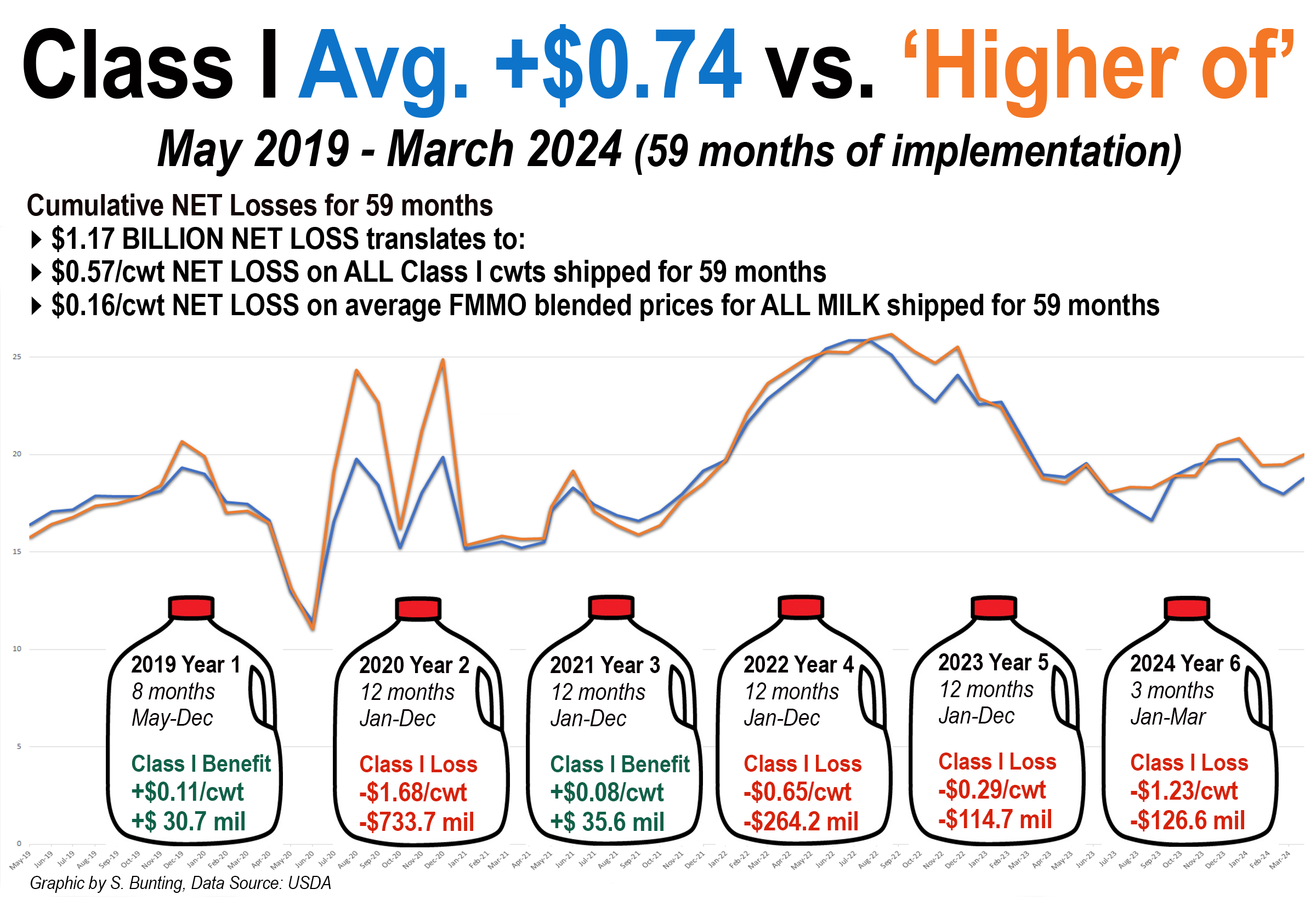
Farmshine’s Market Moos columnist Sherry Bunting has updated the graph showing how the supposedly revenue-neutral change from the ‘higher of’ to an averaging formula for the Class I mover May 2019 through March 2024 will have reduced Class I value in farm milk checks over 59 months of implementation. This graph of cumulative and year-to-year losses does not include additional losses many farmers have incurred when manufacturing class milk is out of alignment with Class I, and is depooled, with the revenue excluded from the FMMO pools and benchmarks.

In fact, the Class I mover prices announced for January and February 2024 could produce well over $80 million in losses in just the first two months of 2024 once the pounds of Class I milk are sold and counted.

Munch also took the opportunity to remind everyone that when AFBF held the dairy stakeholders forum in Kansas City in October 2022, returning the Class I mover calculation to the ‘higher of’ was the main item that got consensus from every table in the room.

When the difference between the manufacturing classes exceeds $1.48 per cwt, then pooled producers receive less money for their milk under the averaging formula compared with the previous ‘higher of’ formula. When the difference between Class III and IV is $3.48, for example, that lowers the Class I price by $1.00 per cwt. In an FMMO with 75% Class I utilization, that’s a 75-cent loss on all of the milk, not just Class I. In an FMMO with 25% Class I utilization, that’s a 25-cent loss on all of the milk.

Even members of Congress have been doing the math and have talked about putting reversion language in the Farm Bill. They are aware of their role in putting what they were told was a “revenue neutral” change into the 2018 Farm Bill that IDFA and NMPF at the time agreed upon, while adding language that USDA could hold a hearing in two years to vet it for the future. 

We are now nearly five years into this change, and it is just one piece of the hearing that just concluded, which included many proposed modifications from milk composition and price surveys, to make allowances and differentials.

Without emergency decision-making by USDA on the Class I mover piece, any potential changes from this hearing are a good 12 to 18 months away, depending on how the post-hearing processes move along, from post-hearing briefs due April 1st to rebuttles, draft decisions, comment periods, referendums, final decisions, and there are proposals that have asked for further delays after the process plays out to avoid “affecting” exchange-traded risk management instruments. 

Dairy farmers are just looking for some relief and transparency for the future, according to Munch. 

Meanwhile, IDFA and Milk Innovation Group (MIG) have opposed returning to the ‘higher of’ and have proposed several averaging methods for the Class I mover that would continually look backward to compare and change adjusters to make up past losses gradually out into the future.

Farmers have testified that this doesn’t help if it takes two to three years to get that money back after they’ve already lost the farm.

What it boils down to on the Class I mover is the industry wants to move toward more fractionation of milk, more aseptic and shelf-stable beverages, and away from fresh fluid milk. These are the products that can sit in a warehouse for 9 months and for which processors testified they do 9-to-12-month pricing contracts largely with foodservice and convenience stores. Fresh fluid milk already has advance pricing that aligns with the turnaround of that product so hedging on the futures markets is not typically done, and averaging is not needed.

When asked whether AFBF has looked at how the spread may continue in the future to make the averaging formula a loser for farmers, he said Class IV will likely persist above Class III, and yes, they expect the spread to remain large.

Earlier testimony by processor witnesses blamed these Class I formula losses on Covid disruptions, food box programs and large government cheese purchases, but as Munch pointed out, the driver of these losses is something else. When Class IV is over III, we don’t see it in a negative PPD, but milk is depooled, and the full extent of the depooling losses are incurred by farmers, they just aren’t easily enumerated.

“In 2020, the losses (in Class I value, alone, without including the impact of depooling) were over $700 million. In December 2023, the losses crossed over $1.05 billion as they have continued to add up,” said Munch. “The financial detriment is not solely due to a ‘black swan’ event. Some of our farmers were waiting to see if it showed markets shifting. Now, years later, this is still an issue.

“That’s another reason why we are asking for an emergency decision on this right now, and why it came up at our meeting at the convention last week,” Munch testified. “It was intended to be revenue neutral, but it has turned out not to be.”

During cross-examination, Munch also confirmed there hasn’t been much trust by producers to believe processors will replace the dollars they are asking to be removed from FMMO pricing by paying over-order premiums, instead.

“There is a lack of trust and not knowing where their price comes from. There has been a lot of concern about how their milk checks are calculated,” Munch related. “That’s one of the proposals that the American Farm Bureau put forward is more uniform, clear milk checks. There is a perception that things in milk checks have been manipulated. There is a perception of mistrust.

“If there are ways we can build back the trust, and if one of those ways that our farmers have targeted is switching back to the ‘higher of,’ then it’s easier for farmers to understand that calculation, and it has shown, in the most current of times, to be more advantageous to them.”

“It is my pleasure at 10:18 a.m. on 2024 January 30 to determine that this Hearing has ended,” said U.S. Administrative Law Judge Jill Clifton after 506 exhibits have been entered into evidence for and against 21 proposals in various areas of FMMO pricing modification during the 49 Hearing days that stretched over 5 months since its start on Aug. 23, 2023 in Carmel, Indiana. Screen captured from Hearing livefeed

-30-

NMPF’s FMMO Modernization Plan hits high note on Cl. I mover, but eliminating barrel cheese from protein formula is head-scratcher

By Sherry Bunting, Farmshine, October 28, 2022 (updated with additional information after publication)

The National Milk Producers Federation (NMPF) Board gets high marks for passing a Federal Milk Marketing Order Modernization Plan this week at its annual meeting in Denver, Colorado that includes returning the Class I mover to the previous ‘higher of’ formula — a virtually unanimous consensus item that came out of the Farm Bureau Forum in Kansas City earlier in the month.

However, the NMPF modernization plan also includes a few items that were not fully discussed, items that seem to run counter to what dairy farmers were prioritizing, and it leaves out a few items the consensus-builders were vocal about in Kansas City.

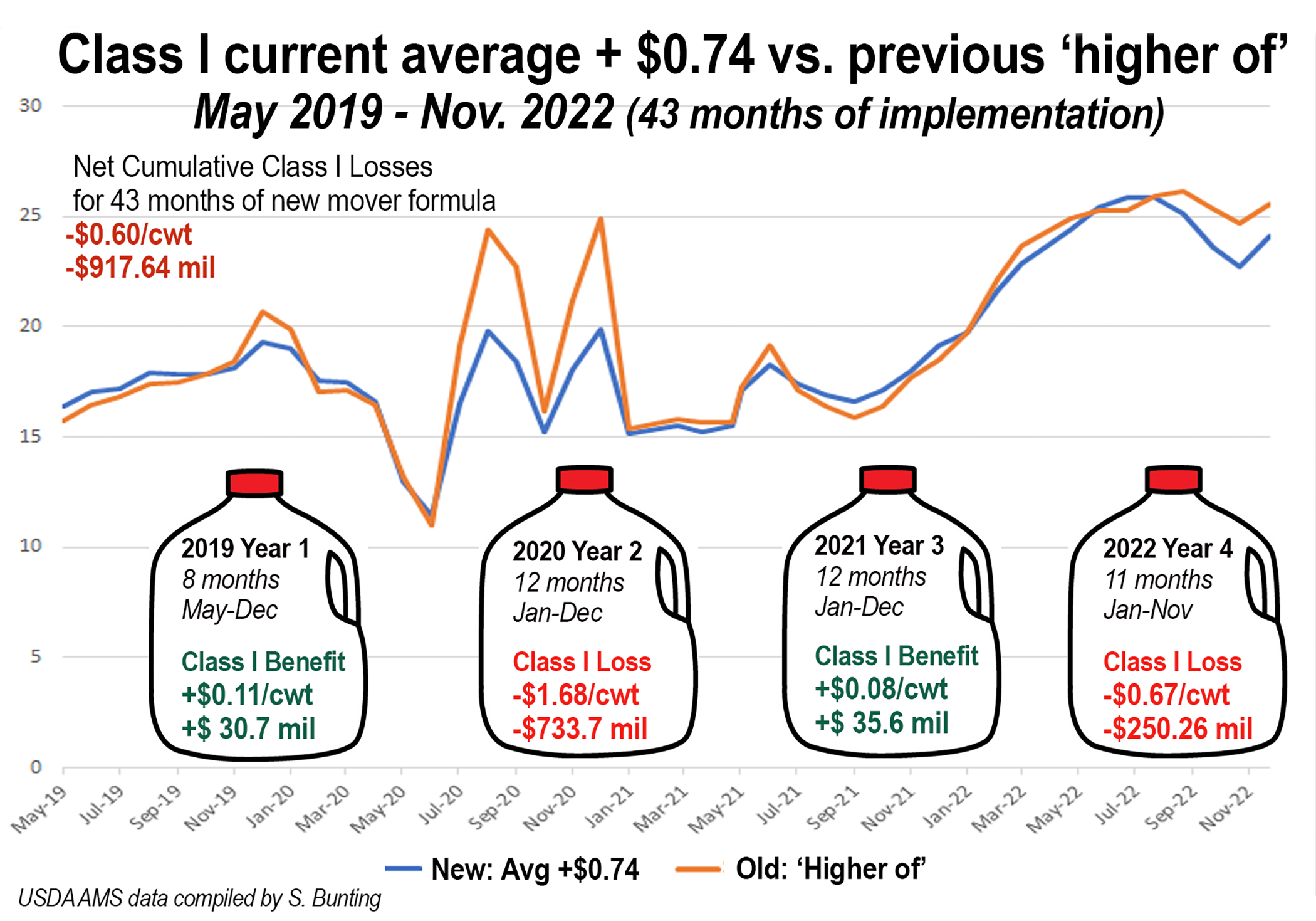
The recommendation to return to the higher of Class I mover is an important response by NMPF to dairy farmer concerns. That ball has been in USDA’s court after the first two years of implementation, according to the farm bill language that changed it to an averaging method in the first place. Four years and nearly $1 billion in cumulative Class I net value losses have passed (see chart), but Ag Secretary Tom Vilsack said he needed to see “consensus” before allowing a hearing to be opened.

In post-conference interviews, several Farm Bureau Forum attendees said this was their main priority for participating  – to show Secretary Vilsack there is consensus to “fix the mistake.”

For NMPF to include it in their plan is a win.

Another item in the NMPF plan is to develop a process to ensure make allowances are reviewed more frequently through legislation directing USDA to conduct mandatory processor cost studies every two years and to update the make allowances contained in the USDA milk pricing formulas.

There was general agreement from stakeholders in Kansas City that processor costs need to be evaluated and make allowances updated. Over half of the table-groupings identified this. There was also healthy discussion of some ways to do this to minimize the sudden impact on farmer milk checks – all good points for developing a process and for a USDA hearing process to fully evaluate it.

Of the bones to pick, one NMPF recommendation that runs counter to what more than half of the table-groupings prioritized in Kansas City concerns expansion of the pricing survey to include more products. NMPF’s task force decided not to add any products to the price survey, and in fact they are recommending dropping one. 

On the chopping block is the 500-pound barrel cheese price in the protein calculation for Class III.

Initially, NMPF’s task force committees looked at adding unsalted butter, skim milk powder (a higher value more standardized product than nonfat dry milk), and they looked at mozzarella cheese. In all three cases, the task force chose not to recommend additional products.

The fact that they are recommending elimination of a product from the pricing survey is curious.

Less than one-third of the Kansas City table-groupings listed elimination of barrel cheese pricing as a priority. Few people questioned NMPF economist Peter Vitaliano on the sensibility of this recommendation – except for yours truly.

I asked this question: “On the blocks and barrels, what do you foresee happening if the barrels are dropped? Right now we’ve got barrels doing more trading than blocks. We’re really not seeing much trading at all in blocks on the CME spot market. Also, would this mean that the cost of making those barrels will be backed out of the processing cost survey in terms of establishing new make allowances?

Vitaliano gave this answer: “That’s an interesting question. I’ve heard different interpretations of what’s going to happen to barrels if they are not used in the formula. Some folks feel they’ll just be priced at a discount to blocks, and the cash market for barrels will go away. I’m not sure I buy into that totally because barrel cheese is becoming a different product.”

The NMPF economist continued with his answer: “Under current quality standards, barrel cheese is the only major way that you can get uncolored whey, which is demanding a premium in the marketplace because all of these nutrition products, these high value nutrition products in demand by millennials and others, they don’t want to show ‘bleached whey’ on the label, they want the white uncolored whey powder that comes from barrel cheese production.” 

Apparently, yellow whey from block Cheddar production is less desirable. But we’ve known this for at least 15 years.

In other words, according to Vitaliano, there is right now a ‘subsidy’ effect from the premium paid for the higher value of the uncolored whey that creates the environment to produce more barrel cheese – regardless of what the cheese market is doing. 

Vitaliano noted that FDA is going to consider some changes that might alter how this cross-product scenario is playing out by allowing microfiltered milk to be used in plants producing standard-of-identity cheese, but the bottom line is that barrel processors making whey protein concentrate as co-products benefit from the white-whey premium whereas block cheese processors do not. 

When the two are averaged together in the Class III protein formula, they represent different markets when they historically moved together, said Vitaliano.

Interestingly, however, barrels have traded higher — not lower — than blocks on the CME for most of this year.

In the purely cheese market history, barrels and blocks moved together more closely, then in times of market shocks beginning in 2009, we would see periods of wide spreads and inversions, sometimes barrels over blocks and most of the time blocks over barrels. During intervals in 2016-17, barrels sold at 10 to 20-cent discounts to blocks. Since 2018, we’ve seen long intervals of barrels over blocks by up to 25 cents and then the flipside with blocks over barrels.

This year (2022), barrels have sold at a premium to blocks consistently since April. The barrel premium over blocks stood at 15 cents per pound last week. That’s a significant impact on farm-level milk prices — to the good.

Coincidentally, barrel prices crashed this week, losing 22 cents, where blocks lost a nickel, thereby pushing barrels under blocks by a few cents on Oct. 25, the same day that the NMPF Board voted unanimously to endorse the multi-pronged modernization plan that includes dropping 500-lb barrel cheese out of the FMMO end-product pricing formula.

For the year (2022), barrels will likely average a nickel above blocks.

There is also the question of price discovery. For the year, we have seen more barrels traded on the CME compared with the volume of blocks.

When following up in a question about what happens to price discovery if the barrels are eliminated from the pricing formula, Vitaliano responded that 15% of the cheese reported in USDA’s weekly price survey is barrel cheese. Rather than reduce the weighted average to reflect that, and rather than including mozzarella in the pricing survey (a higher volume and value item than cheddar), NMPF is simply recommending the elimination of barrels to avoid the block/barrel spread.

Vitaliano said pricing formulas are based on the USDA price survey, not on the CME spot market. However, the CME spot market is used to set pricing for the USDA-reported sales.

Vitaliano also noted that price discovery on the CME spot market is achieved even if no product changes hands because it is a marginal market-clearing trade in the first place.

“The whole industry is watching that market, so if that block price is, let’s say, overvalued, and I have extra blocks and I think that market is high, anybody can go to that market and sell; or if you think it’s undervalued, you can go to that market to buy,” he said. “Just because there’s not a lot of trading, doesn’t mean it’s not necessarily representative of the market… we just have to trade the marginal excess or shortage.”

According to Vitaliano, even the regulators have looked at this and concluded that since the whole industry watches that market — everybody has the opportunity to jump in, and they are not shy if they have a different idea about what the market should be, they can go in and make bids or offers. Those bids and offers move the market whether or not a trade is completed.

Even in light of these explanations, the NMPF recommendation to eliminate barrels from the pricing formula remains a bit of a head-scratcher and needs more discussion and evaluation.

NMPF also wants to expand the forward pricing window for whey and nonfat dry milk (NFDM) price-reporting to 45 days instead of 30 in order to “capture more of the global market in the pricing formula.”

However, when asked why NMPF is not seeking to expand the price reporting to include skim milk powder (SMP) – the globally traded powder – as a means of capturing more of the higher-value global market, Vitaliano said SMP is sold at differing standardized protein rates as a value-added product. NFDM, on the other hand, often has more protein in it, but it’s variable and a lower-priced bulk commodity. It’s a true bulk product that is made to soak up excess milk, he explained. 

Vitaliano also noted that NFDM is used by domestic cheese makers, whereas SMP is not. 

Ditto the answer for unsalted butter. While the sales of unsalted rival salted butter in volume, and it is a bulk product more consistent with higher-value global markets, the NMPF task force perspective is that the unsalted butter is also a step up as a value-added product for a specific market in foodservice, not a commodity bulk product a plant would make with excess milk.

Ditto for mozzarella, which NMPF maintains is already priced off the USDA-reported cheddar price even though the U.S. sells more mozzarella than cheddar today.

Next week, we’ll dig into the yield factor changes in the NMPF plan and the glaring absence of a recommendation on depooling issues across the country. Solving the depooling conundrum was a priority listed by over half of the consensus-building table-groupings at the Farm Bureau Forum and producers from multiple regions were vocal about it throughout the three-day meeting.

-30-