Under the DMI umbrella: Fonterra CEO to chair Global Dairy Platform, Danone sustainability strategist to join GDP operating committee

Global Dairy Platform launched Pathways to Dairy Net Zero Initiative in September 2021, one year after DMI’s Innovation Center for U.S. Dairy launched the Dairy Net Zero Initiative (NZI) in October 2020 (A year prior to that in 2019, the current and former Ag Secretary Tom Vilsack testified to the Senate Ag Committee as a dairy-checkoff executive, serving then as president of the U.S. Dairy Export Council, and he foretold the nuts and bolts of the not-yet launched Dairy Net Zero Initiative and asked Congress to fund pilot farms. GDP has governance in and manages the Dairy Sustainability Framework that underpins what U.S. farmers, and their cows, will have to live up to — including how livestock methane is calculated, mitigated and monitored, which may be based on inaccurate math and science in terms of CO2 equivalents.

By Sherry Bunting, Farmshine, Friday, May 5, 2023

ROSEMONT, Ill. — Fonterra CEO Miles Hurrell has been named the new board chairman of the Global Dairy Platform (GDP), a non-profit industry association representing the international dairy sector. A portion of its revenue is from membership dues, but also from the 7.5-cents per hundredweight equivalent checkoff on U.S. dairy imports as well as grants for research and program services from Dairy Management Inc (DMI).

Fonterra’s Hurrell will replace Hein Schumacher, who is leaving his position as CEO of Royal FrieslandCampina to become CEO of Unilever.

In the April 26 news release, Hurrell cites Schumacher’s leadership in “accelerating climate action via the ground-breaking Pathways to Dairy Net Zero Initiative.” 

Announced in the same release is the appointment to the GDP operational committee of French multinational Danone’s senior vice president of sustainability strategy.

According to its 501(c)6 non-profit tax filings, “GDP is a pre-competitive collaboration,” and its governance groups — the board and the operational committee — “manage a ‘Dairy Sustainability Framework’ to unify the approach being taken by dairy organizations to the broad challenges of sustainability from environmental, social, and economic perspectives.”

The Dairy Sustainability Framework is part of the Dairy Sustainability Alliance of the Innovation Center for U.S. Dairy, another non-profit founded and funded by dairy checkoff organizations under the DMI umbrella. The Innovation Center sets U.S. Dairy Stewardship Commitments that are implemented through the FARM program and reviewed every three to five years to show U.S. dairy is, according to its website, “moving the needle toward achieving the Sustainable Development Goals (SDGs) of the United Nations.”

DMI, its Innovation Center, Dairy Sustainability Alliance, Dairy Sustainability Framework, and U.S. Dairy Stewardship Commitments are all located at Suite 900, 10255 W Higgins Road, Rosemont, Illinois, and the Global Dairy Platform (GDP) address of record is Suite 820 at the same street address.

Along with New Zealand’s Fonterra, CEOs from these top-15 dairy multinationals serve on the GDP Board: Dairy Farmers of America (DFA), headquartered in Kansas; Arla Foods, headquartered in Denmark; Leprino, headquartered in Colorado; China’s Mengniu Dairy Company; Moringa Milk Industry, headquartered in Japan; Royal FrieslandCampina, headquartered in the Netherlands, and Saputo, headquartered in Canada.

Along with the board of directors, the GDP operational committee provides governance and includes sustainability executives for Arla, DFA, Fonterra, Land O’Lakes, Meiji Holdings and FrieslandCampina.

In a separate April 2023 bulletin, GDP announced the May 1, 2023 retirement of Dr. Greg Miller from his position as research lead for GDP since its inception. Known as ‘Dr. Dairy’, Miller has served as the chief science officer for the National Dairy Council for nearly 32 years and as executive vice president of research, regulatory and scientific affairs for DMI. Miller will continue as a member of the UN Food and Agriculture Organization Scientific Advisory Committee.

Key paid staff for GDP is Donald Moore, the executive director since 2010. Before that, he was a Fonterra senior executive in business development and ingredients marketing for 20 years.

Moore also serves as chairman of the governance group for the Dairy Sustainability Framework since its inception in 2013.

With Fonterra’s CEO as the new board chairman of the GDP, and with a former Fonterra senior executive serving 13 years to-date as the executive director of the GDP and the chair of the governance group for the Dairy Sustainability Framework, it’s worth noting that Fonterra announced six months ago its new start-up company for alternative dairy ingredients. According to the October 2022 press release, Fonterra has partnered with Royal DSM, a Dutch company, in creating this start-up “to accelerate the development and commercialization of (animal-free) fermentation-derived proteins with dairy-like properties.” 

With Danone’s senior vice president of sustainability strategy now appointed to the GDP operational committee, it’s worth noting that in October 2022, Danone announced it would use artificial intelligence to reformulate 70% of its plant-based fake-milk products. This followed the 2021 earnings call where Danone executives outlined new fake-milk and dairy product launches with plans to use “new dairy-like technology” to “win over” the 60% of U.S. consumers not in the plant-based category because of taste and texture. The Danone executives told shareholders their Renew strategy identifies the U.S. as a “key plant-based market.” In January 2023, Danone announced it is eyeing sale of Horizon Organic, saying it falls outside of their key areas of focus.

Global Dairy Platform (GDP) was formed in 2006 as an alliance, according to its website. Its tax filings confirm incorporation as a 501(c)6 non-profit in 2012 and its address of record at Suite 820 at 10255 W Higgins Road, Rosemont, IL 60018.

According to the GDP’s most recent IRS 990s that are publicly available for 2017 through 2019, the years when former DFA CEO Rick Smith was its chairman, GDP had revenues between $3.7 and $4.2 million annually. This increased to $4.7 million in 2020, according to an available summary of the IRS 990 for that year.

The tax returns show approximately $1 million in GDP revenue came from membership dues and approximately $2.7 million annually from granted program services and research funds (checkoff). 

The GDP revenue also included approximately $500,000 in ‘import assessments.’ The 7.5-cent import checkoff, which was implemented in 2011 amid formation of the Innovation Center and its resulting alliances and frameworks.

GDP’s executive director Donald Moore is paid a salary package of nearly $600,000 annually. The top three independent contractors in 2018-19 included DMI receiving over $800,000 annually for program services and administration; Massey University in New Zealand $451,000; Emerging Ag in Calgary, Alberta, Canada $600,000 (for UN access), and Lindsey Consulting, in the UK nearly $300,000 with Brian Lindsey serving as the GDP’s sustainability lead.

According to GDP, its membership consists of more than 95 corporations, companies, associations, scientific bodies, and other partners, with operations in more than 150 countries, collectively accounting for approximately one-third of global milk supplies.

DMI manages the national nickel from the 15 cents per hundredweight checkoff deducted from U.S. milk checks for research, education, and promotion. DMI also manages the unified marketing plan many state and regional checkoff organizations contribute toward, and DMI manages the 7.5 cents per hundredweight equivalent import checkoff, handed off to the GDP.

DMI states in its 501(c)6 non-profit tax filing that it is “investing dairy producer checkoff funds in strategic, coordinated marketing programs designed to increase consumption of U.S. dairy products domestically and internationally.”

The Innovation Center for U.S. Dairy was initiated in 2008, but according to its tax filings, was incorporated as a 501(c)6 non-profit in 2012 under the name: The Dairy Center for Strategic Innovation and Collaboration Inc., doing business as Innovation Center for U.S. Dairy.

In 2017, DMI trademarked the names ‘Innovation Center for U.S. Dairy’ and ‘Dairy Sustainability Alliance.’

Leprino CEO Mike Durkin was elected chairman of the board of the Innovation Center in January 2023.

-30-

AUTHOR’S NOTE: Why do these connections matter? Because the UN Food and Agriculture Organization is getting ready to make a decision about how livestock methane is calculated using GWP100, a 30 year old measure that the Intergovernmental Panel on Climate Change even agreed overblows the problem by 3 to 4 times, or GWP*, which includes not just the sources but also the natural sinks for methane as a short-lived greenhouse gas. Dr. Frank Mitloehner has written about this, and Farmshine readers have read my many articles about the differences between the calculations and what they mean for our cows in the future. The Global Dairy Platform put out a bulletin a few months ago and pinned it to their website exploring the differences in these calculations, saying that “GWP* is not appropriate as a benchmarking tool at less than a global level.” This is concerning because it means that global dairy multinationals have oversight through dairy checkoff non-profits and alliances into formulating and deciding what U.S. dairy farmers — and their cows — will be expected to live up to, even when the science behind the decision is highly debatable. As we now know, even scientists are becoming frustrated. It’s important to know that multinational companies investing in competing animal-free fermentation-produced DNA-altered dairy-like ingredients are in leadership positions in these collaborations.
Is the dairy checkoff getting its methane math right? Nope!

Study says dairy should aim for climate neutrality, not net-zero carbon. Dr. Frank Mitloehner explains meaningful metric, achievable goal post during webinar

Sherry Bunting, previously published in Farmshine

BROWNSTOWN, Pa. — Net-zero carbon, net-zero GHG, net-zero GHG footprint, carbon neutrality, GHG neutrality… These terms are being used to describe the dairy checkoff’s 2050 commitments via DMI’s Net Zero Initiative.

But do they consider the warming impact of methane from dairy cows over time? 

Bottomline, the so-called “Net-Zero Initiative” of DMI is a set up to be always chasing the cow’s biology without measuring her methane as the flow gas it really is — without considering the short-lived nature of methane and the biogenic cycle cattle are a part of.

If net-zero carbon is the goal, and if methane is measured on carbon dioxide equivalency without considering its short-lived cycle, then dairy farmers could find themselves in the position of unnecessarily and continually chasing the natural biology of their cows without a meaningful and accurate metric and without an achievable goal post that satisfies what all industries around the world are really being asked to do, and that is to limit additional warming.

A new study by foremost animal scientists and air quality specialists Dr. Frank Mitloehner and Dr. Sara Place is calling for the U.S. dairy industry to aim for climate neutrality (net-zero warming) rather than net-zero carbon or net-zero GHG.

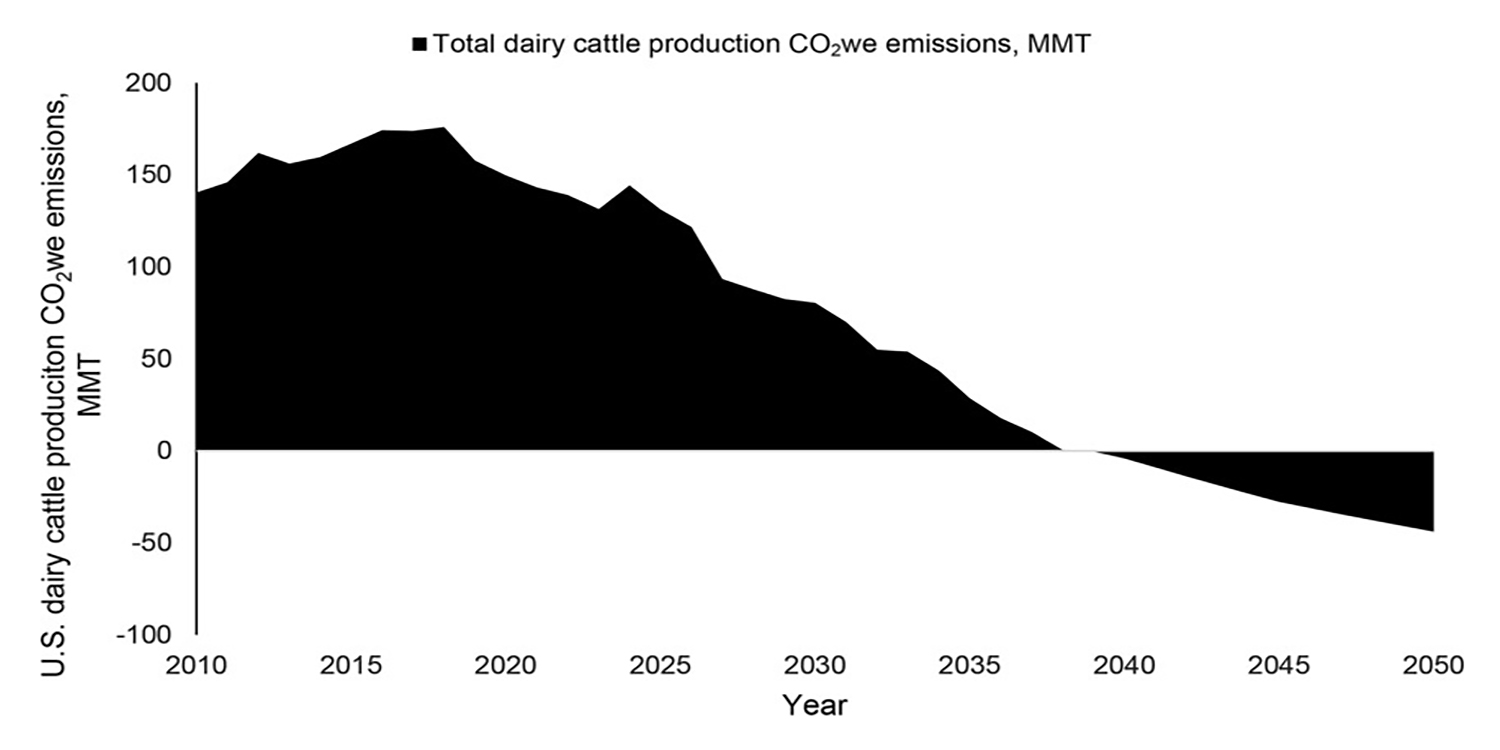
The peer-reviewed study from the University of California-Davis CLEAR Center and Elanco Animal Health was published recently in the Journal of Dairy Science. It outlines a path for the U.S. dairy industry to reach climate neutrality by 2041 with small methane reductions every year, and even sooner with more aggressive reductions.

Dr. Mitloehner brought dairy farmers up to date and took questions during the American Dairy Coalition’s annual meeting by webinar in December.

One important take-home message was for dairy producers to understand that how methane’s global warming potential is quantified (whether GWP100 or GWP*) “has a profound impact on the predicted warming of your industry. The only way you can become climate neutral is by using a metric fit for purpose, one that predicts the warming, and that is GWP*,” said Mitloehner.

He explained how methane is an important and powerful greenhouse gas (GHG), but it is different from other gases because it is the only one that undergoes atmospheric removal in a chemical process that takes about a decade. This does not occur for carbon dioxide or nitrous oxide, which are stock gases that remain in earth’s atmosphere for 1000 and 100 years, respectively.

“Methane is the most important gas for agriculture, so its removal must be included in the calculation also,” he confirmed, noting that GWP* does that. “Methane is fast and furious. It has a good punch that is 28 times more trapping of heat from the sun (vs. carbon dioxide), but it is also fast. It doesn’t stay in the atmosphere for long.”

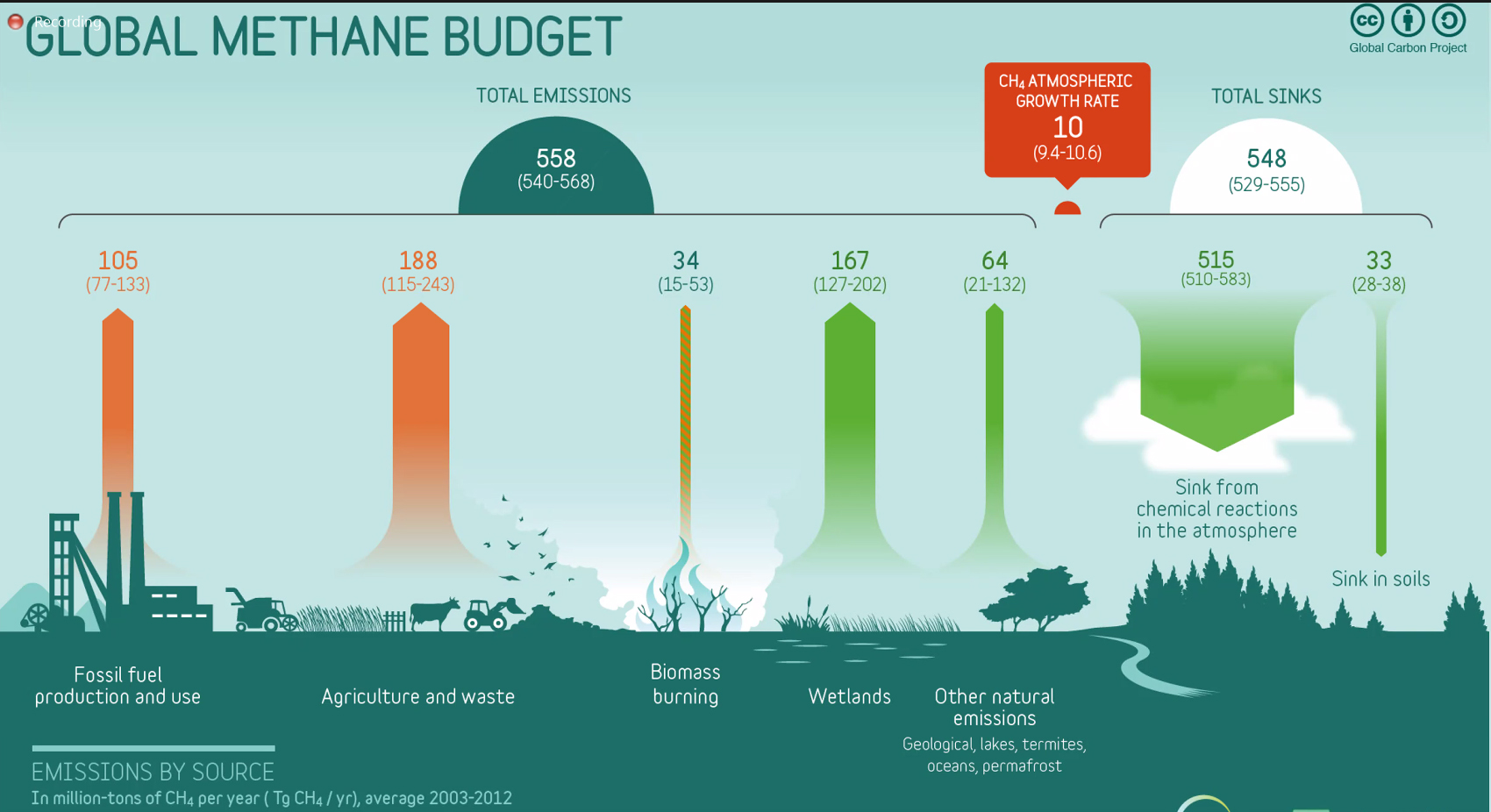
In a slide showing all global methane sources and sinks, Mitloehner noted that nearly 560 terragrams of methane are produced worldwide annually, and at the same time 550 are destroyed by this natural atmospheric process.

In terms of atmospheric growth, “the net is then 10. This is still a number we want to reduce, but it is not 560,” he said.

As the DMI Innovation Center’s Sustainability goals, Net Zero Initiative and FARM program are on the cusp of calculating these things at the farm level, both the measurement and the goal matter.

A net-zero carbon or GHG commitment poses a problem for dairy farmers. This is compounded by the CO2 equivalency for methane being calculated using GWP100. 

The GWP100 metric has been around since the 1990s, but it describes stock gases, whereas methane is a flow gas.

Using GWP100 with a net-zero carbon commitment is not only unnecessary, it’s problematic.

“It means the belches from your cows are (being calculated) in addition to what they belched last year, and the year before that, and so forth 10 years from now,” said Mitloehner. “In reality, constant herds are a constant source of methane that generates a constant warming, not a new warming. That’s what the Paris Treaty asks all sectors to do – to limit additional warming.”

Aiming for climate neutrality or net-zero warming instead of net-zero carbon would put the focus where it needs to be — on the warming impact of the emitted methane over time. This is important because methane makes up 62% of the estimated total GHG for dairy, according to the CLEAR Center study.

“If we use GWP100 to describe a relatively constant source, to characterize that methane, then we are overblowing its impact by a factor of 3 to 4, and we are overlooking the ability for the U.S. dairy industry to reduce warming when we reduce methane,” said Mitloehner, citing page 173 of the Intergovernmental Panel on Climate Change (IPCC) 2021 Assessment Report 6.

The metric GWP-star (GWP*) is also mentioned on this page of the IPCC report. GWP* was developed by the University of Oxford. It is based on GWP100, but it looks at how methane warms the planet over time. It characterizes methane as the flow gas that it is and calculates it based on CO2 warming equivalents (CO2we), not as accumulating CO2 stock equivalents (CO2e).

A white paper published with the peer-reviewed CLEAR Center study explains it this way:

“Net zero carbon refers to a state where carbon is removed from the atmosphere (through carbon sinks or other offsets) at a rate equal to carbon being emitted into the atmosphere. This balance between carbon emission and removal creates a ‘net-zero’ carbon output. Climate neutrality, on the other hand, focuses on temperature impacts from emission sources, referring to the point in which no additional warming is added to the atmosphere.”

The paper goes on to explain how “climate neutrality is analogous to net-zero carbon when dealing with long-lived greenhouse gases such as carbon dioxide, but short-lived pollutants like methane do not need to reach net-zero carbon to be climate-neutral.”

“Is it new and additional carbon being added to the atmosphere? Do constant herds add new warming? No, they do not,” said Mitloehner.

“Belched out methane is the number one source in agriculture, but again, it doesn’t stay in the atmosphere for 1000 or even 100 years like carbon dioxide and other GHG,” he explained while also noting the pathway of the carbon in this methane is already present in the atmosphere, is captured by plants, then consumed by cows. Some of this consumed carbon (energy) is converted to carbohydrate and some of it is emitted in the methane by the cow in a continuous cycle. 

Unlike fossil fuel emissions, this is not ancient carbon brought out of the ground and into the atmosphere as a one-way-street, he explained: “Do not fall for the people who are comparing cars to cows. The University of Oxford says this is a mischaracterization, and I agree.”

What is exciting, “is if we reduce methane, we can come to a point where we produce negative warming or a cooling effect. That’s what my work is about (Fig. 4). If we do a couple of things to reach no new warming, and if we then get aggressive to go further, we can sell credits as offsets,” said Mitloehner, referencing the implications, limitations and conclusions of the CLEAR Center study.

As innovations related to managing cattle diets are being developed, the good news is emerging tools show the promise of steering more of that carbon, that energy, toward milk yield and components and less of it to methane that is belched back into the cycle.

In contrast, a net-zero carbon or net-zero GHG goal that measures methane as a stock gas (GWP100) and does not accurately describe its warming impact and flow-gas status in the way GWP-star (GWP*) does, would leave dairy farmers needlessly and continually chasing what under the GWP100 scenario are accumulated and continuing belches from their cows. 

If the industry continues to chart net zero carbon, will dairy farms be forever chasing their belching cows with tech investments and offsets?

“In my opinion, you will never reach net zero carbon. Your cows will always produce methane no matter how aggressive you are. You will over promise and leave stakeholders disappointed. We are dealing with a biological system, the microbial fermentation in the rumen. It is not feasible and I have advised the industry in the past against it, but that is the direction it goes – in general,” said Mitloehner.

As for unintended consequences on the path to ‘net zero,’ Dr. Mitloehner was clear to say: “What matters is climate neutrality. If you tell the world you want to be climate neutral with no new warming and achieve it through annual reductions of 0.3 to 0.5%, you will indeed be climate neutral in less than 20 years. At a 1% per year reduction in methane, you will accelerate that timeline. But you will never achieve it with GWP100. It’s not possible and not necessary to go that way of treating methane as if it were a stock gas. It doesn’t account for the reduction.”

A piece of good news, he said, is that GWP-star (GPW*) can be used parallel to GWP100. The maitrix is a more scientific predictor of what you (dairy) has to do to bend that curve and how strongly.

“The excel spreadsheet calculator in the white paper helps you identify when in the future as a creamery or a statewide association reach the point that you are no longer creating additional warming, and that should be the goal,” Mitloehner explains.

Net zero carbon or net zero GHG is a setup to always be chasing the cow’s biology without acknowledging her gas is a flow gas, not a stock gas. It does not accumulate. Some will say “you can use offsets” for the cow’s biology. But why? They are not necessary as offsets and could be viewed as solutions if the dairy industry gets its math right. (We’ve seen this movie before)