Milk Market Moos, Nov. 29, 2024

USDA Standoff?

DTN policy editor Chris Clayton is reporting that a standoff could be brewing at the USDA between current Ag Secretary Tom Vilsack and the Trump transition team. Vilsack has urged the Trump team to sign “key ethics documents required by the Presidential Transition Act as soon as possible” so they can start the process of “educating folks… about what they are walking into,” and so the next Secretary of Agriculture “can be fully prepared for the job she is undertaking.”

After 12 years at the helm of USDA, with a 4-year intermission between the Obama and Biden Administrations, pulling a cool million in dairy checkoff salary, Sec. Vilsack has watered down dairy in the WIC program, mangled the recently completed Dietary Guidelines Advisory Committee selection and recommendation process, further deflated whole milk and dairy’s position in the school lunch and other nutrition programs, and has been tightly tied to his pet projects, especially the climate-smart partnerships he lobbied the Senate for in 2019 while working for DMI, given the ‘slush fund’ appropriated through the so-called Inflation Reduction Act that many describe as the undercover Green New Deal.

For that initiative, alone, Vilsack told the House Ag Committee a year ago he was hiring 4000 new USDA employees and that 4000 more would be needed at local levels to gather data, do the monitoring, and herd farmers into the data-collection squeeze chute to participate in climate-smart projects. The House Ag Committee expressed their concern about funds getting to actual farmers. (See Feb. 16, 2024 Milk Market Moos ‘carrot and stick’)

Hog wrestling strategy?

One could say there are a lot of pigs at the USDA climate trough. The whole deal needs a good auditing to see how much of what was spent or promised is getting into the hands of actual farmers and their on-farm contractors vs. going into the black hole of bureaucracy.\

While Trump’s Ag Secretary-Designate Brooke Rollins, still to be confirmed by the Senate, is only the second woman nominated to head the USDA, don’t let her femininity fool you. One thing we learned watching Rollins, 52, as a guest on legendary football coach Lou Holtz’s Nov. 4th Show about faith and leadership, this Texas Aggie was a hog wrestling champion.
Holtz asked Rollins about the hog wrestling title. It was 10 years ago when she and her sister Ann went to Bandera, Texas for an annual festival. They decided that year to enter the annual Wild Hog Explosion Contest. They won, even set a record, against younger women in the competition.

Rollins recalled: “We had a strategy and a plan, which seems to be a common theme in my life. You always have to have a strategy, and you always have to have a plan. We had a plan to wrestle that wild hog — and he was a wild, big hog — and put him into a bag and drag him across the finish line.”

A mom-coach could do wonders

USDA Secretary nominee Rollins also revealed that while coaching her daughter’s softball team a few years back when she was 10, they wrote their own mission statement that hung on the fence for every game. “Coaching is a reflection of life, to be our best, work as a team, have a common goal, never give up, and go for the win, every time.”

Rollins and Holtz talked of her leadership style to “find amazing people” to build teams that work together “not caring who gets the credit, but what gets accomplished.”

When asked the Bible verse most meaningful in her life, she said for this season in time “with the arrows slinging every which way,” Joshua 1:9 “Be strong and courageous. Do not be afraid; do not be discouraged, for the Lord your God will be with you wherever you go.”
One that strikes a chord throughout her life is: Matthew 25:40: “Whatever you did for one of the least of these brothers and sisters of mine, you did for me.”

When it comes to USDA’s failed nutrition policy, this verse rings true. It’s also worth noting that Rollins is a mother. That may be just what USDA needs at the top! Mom’s understand the school meal and school milk issue! Can we imagine how many more hungry children could be nourished if USDA devoted funds to the food that are now going to the bureaucrats calculating fat percentages and other criteria to regulate schools so they don’t violate the fat limits; and how much better off those children most reliant on school meals would be if they could choose nutrient-dense delicious whole milk, 3.25% healthy fat.

What’s up with milk production?

USDA Dairy Market News reports that milk availability is still tight for processors. Some processors expect milk availability to loosen in coming weeks, as plants slow production or shut down during the week of Thanksgiving. Class I bottling is strong as demand from schools is steady up to the coming holiday, and consumer demand increases. Demand from Class III is strong. Cheesemakers report that some plants are running as much as possible. Component levels are reported to be strong across the board. We’ll did into the report next week.

The USDA NASS milk production report released late Wednesday showed total U.S. milk production was up 0.2% in October vs. year ago. Meanwhile, milk production in the 24 major milk producing states gained 0.4% over year ago. For Q3, USDA reports total U.S. milk producers virtually flat with a year ago.

This indicates that states and regions that are expanding milk production rapidly in the Plains from western Minnesota, Iowa, South Dakota south to Texas, have large expansion units coming online — and their own circular systems for heifer-rearing are geared up to fill new stalls to supply new cheese processing that is coming online — perhaps not at all impacted by the overall tight supplies of milk cows, springing heifers, and bred heifers in today’s marketplace.

Remember, the current Secretary of Agriculture, Tom Vilsack, canceled the July 2024 mid-year All Cattle and Calf Inventory, so the industry won’t get a look at dairy and beef numbers until the end of January 2025.

In the East and Mideast, October’s milk production was generally steady vs. year ago. USDA estimates for Northeast and Midatlantic: Pennsylvania up 0.6%, New York up 0.2%, Vermont and Virginia down 0.5%; In the Southeast, Florida down 0.6% and Georgia up 1.9%; In the Mideast: Michigan up 0.5%, Indiana up 0.3% and Ohio down 0.2%.

Midwestern milk production slipped 0.2% and 0.5% in Wisconsin and Minnesota, but grew across the Central Plains, up 3.3% in Iowa, up 4.2% in Kansas, up 9.6% in South Dakota.
Southwest milk production grew a substantial 8.8% vs. year ago in the No. 3 milk producing state of Texas, while New Mexico continued its decline, off 4.4%.

California is in the midst of an escalation in bird flu with production down 3.3% vs. year ago. USDA APHIS reports 261 herds have had the virus in the past 30 days in California, 436 since the first outbreak there in September.

Dec. Class I mover drops $0.90 at $21.43

The December advance Class I base price mover was announced at $21.43 on Wed., Nov. 20 for a loss of 90 cents per hundredweight below November’s Class I mover, but up $1.67 per cwt. above a year ago.The USDA NASS milk production report showed total U.S. milk production was up 0.2% in October vs. year ago. Meanwhile, milk production in the 24 major states gained 0.4% over year ago. For Q3, USDA estimates total U.S. milk production virtually flat vs. year ago.

Class III milk slips lower despite less cheese

Despite USDA again reporting cheese stocks smaller than a year ago for the 8th straight month, dwindling to levels 8% below year ago, the CME spot cheese price headed south this week, dragging Class III milk futures lower too. On Tues., Nov. 26, Class III milk future averaged $18.77 for the next 12 months (Nov24-Oct25), losing 29 cents/cwt — more than was gained last week. Class IV milk futures were mixed, but the 12-month average fell a dime to $20.85.

CME dairy lower, but whey skyrockets

Dairy product prices on the CME daily spot market lost ground across the board this week, except dry whey gained an unprecedented nickel per pound, reaching just shy of what would be a near record 70 cents per pound.

On Tues., Nov. 26, the ‘market clearing’ dry whey price on the spot CME was a whopping 69 cents/lb with 6 loads trading over the 4 days pre-holiday. That’s more than a dime per pound higher than the weekly USDA National Dairy Product Sales Report price that has lagged all year and is the one used in the Federal Milk Marketing Order pricing formulas. Whey is usually the commodity to watch in relation to future milk prices, but it’s not translating. The 40-lb block cheddar price was pegged 4 cents lower at $1.6950/lb with just 2 loads trading over 4 days. Pegged at $1.64/lb, the 500-lb barrel cheese price lost 9 cents per pound with 8 loads trading across the 4 days.

On the Class IV side, the spot butter price fell 11 cents per pound, pegged at $2.4850/lb with 18 loads trading. Nonfat dry milk lost the penny gained last week, pegged at $1.39/lb with 21 loads trading in 4 days.

Live cattle imports from Mexico ‘paused’

USDA APHIS will halt cattle imports from Mexico due to a detection of New World screwworm (NWS) in Mexico Nov. 22. It was discovered in a cow at an inspection checkpoint close to Mexico’s border with Guatemala. USDA reports that around 5% of feeder cattle placements come from south of the border, meaning this pause in live cattle imports will further tighten beef supplies. The USDA cold storage report indicates red meat supplies continue to run below year ago levels.
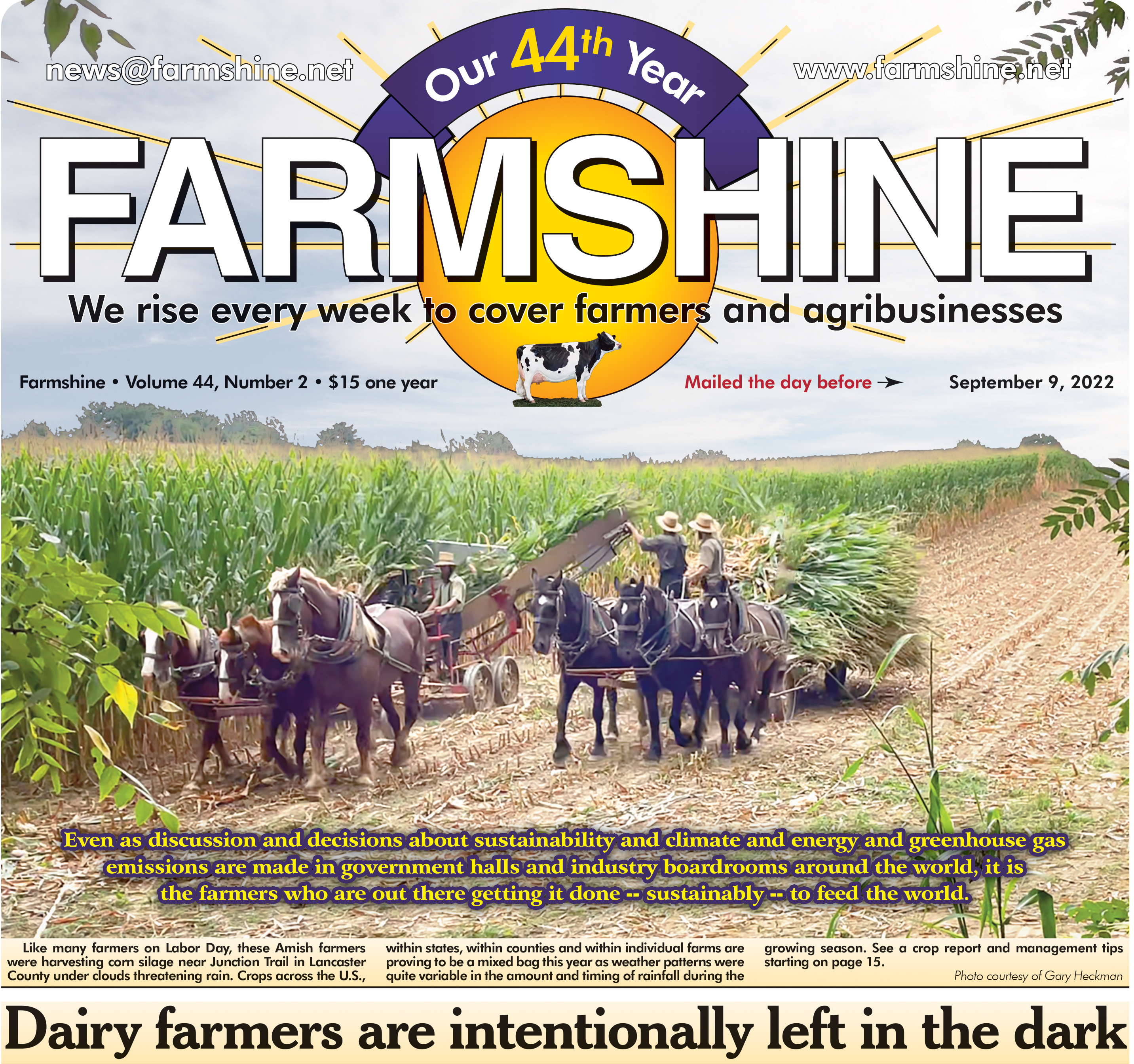
Vilsack is de facto architect as Climate Bill dovetails with DMI Net Zero

Methane tax exempts agriculture, for now… Meanwhile the energy sector impact will affect farm cost of production

By Sherry Bunting, Farmshine, Sept. 9, 2022

WASHINGTON — Make no mistake about it, the dairy industry via DMI’s Innovation Center for U.S. Dairy — is and has been moving toward a future that rank-and-file dairy farmers have had no real voice in and in many cases are just waking up to.

From the annual World Economic Forum (WEF) meetings at Davos to the UN COP26, high-ranking DMI staff have been at the table

In fact, the current U.S. Ag Secretary Tom Vilsack, who President Biden credited for writing the agricultural piece of his Build Back Better campaign platform (same tagline used by the WEF), was the first to announce a Net Zero Initiative during a Senate climate hearing in June of 2019 while he was at the time the highest paid dairy checkoff executive at DMI before round-two as Ag Secretary.

When news of DMI’s Net Zero Initiative spread, farmers were told this would be voluntary, and that DMI was making sure companies understood that it has to be profitable for the farms.

But it is rapidly becoming apparent that requests for on-farm data from milk buyers and co-ops, guidelines for environmental practices under the FARM program are voluntarily mandatory through the member co-ops of National Milk Producers Federation (NMPF) and the privately owned plants that join the alliance and pledge get on board the Net Zero train.

All of this dovetails neatly with the Inflation Reduction Act (IRA) passed by Congress and signed by President Biden in August. Loosely referred to as ‘the climate bill’, NMPF is “thumbs up” on the deal, calling it “a milestone for dairy” as the industry “moves forward.”

(Others in-the-know who wish to remain anonymous call these billions a ‘slush fund’ for Secretary Vilsack.)

During the past 12 to 14 years, DMI has portrayed itself as representing U.S. dairy farmers (because after all, every U.S. dairy farmer pays into DMI, mandatorily by law of course). All the while plotting, planning, partnering and aligning with World Wildlife Fund using the middle of the supply chain as the leverage point to move consumers and farmers to where they want them to go.

They are proud to be working to “get you money” for what you are doing for the environment.

What we hear now is the manure technology and sustainability that checkoff dollars are used to promote brings new income streams to the dairy farm so they are less reliant on the volatile milk price. 

We are told that dairy farmers will make money from manure, from farming the carbon markets, perhaps even farming new climate-related USDA programs some of the $20 billion “for agriculture” will be spent on. 

According to NMPF, this is right in line with where the dairy industry is moving and “supports” the industry’s Net Zero Initiative and “other pledges.”

What pledges?

Did you, Mr. and Mrs. Dairy Producer pledge to do something or agree on the value and cost?

The government is making these pledges in global treaties. The industry as a collective whole through this DMI Innovation Center is making pledges to the investment bankers and global companies who are driving the monetization of climate through ESG — Environmental, Social and Governmental benchmarks.

This all has a very “contractual” feel to it – something that must be measured and recorded and monitored and reported, something that includes various scopes from the center point of one’s business to all of its downstream vendors.

There has been little if any open discussion of parameters, of value, of costs and of consequences. 

There has been little if any democratic process to determine pledge participation. This ESG-driven change is happening at a quickening pace all while most of us don’t know what the acronym stands for, what it means, what it entails, how it is measured, what is its value, who will profit from it, what it will truly accomplish, and how much consolidation it will create of the already consolidating market power in food and energy.

Control of carbon is what we are talking about here, and that means control of life itself.

University of Minnesota economist Marin Bozic mentioned this concern when questioned by members of the House Ag Committee at the farm bill dairy hearing in June.

Processors talked about the ESGs and the downstream impacts of businesses dealing with “Scope 3”. Members of Congress wanted to understand the impact on family farms, and Bozic was asked for his observations.

“In solving the climate, we should not allow the pace of consolidation to pick up in the dairy industry,” he responded.

“Congress should look to the industry for advice on how to make sure smaller family farms are not left behind in implementing the (sustainability) requirements they will need to meet to remain in business. Some of these technologies work better when you have more animals to spread fixed costs over more (cattle),” Bozic observed.

When this question came up a third time in Bozic’s direction, he took another swing, encouraging the House Ag Committee to “help the smaller farms meet these standards that the processors will require over the next 5 to 7 years as far as sustainability. It may be more difficult for some of them to meet that, and I would hate to see increased consolidation pace because of the sustainability standards.”

Does the IRA package do that? A deeper dive is required to fully answer that question. So far, there hasn’t been much open discussion about how these ‘standards’ will affect the farms and how much of these funds go to support vs. monitoring.

Industry insiders from processing to marketing have complained anonymously that they are concerned about what the retailers are expecting, what the largest processors are moving toward.

Some of it seems illogical and counter-productive, they say. All of it is being decided in boardrooms and back hallways – not in an open forum, not in a democracy.

Take for example NMPF’s proclamation that the IRA (climate bill) now signed into law is good for the industry, that the methane tax it includes is harmless and will not affect farmers.

Really? What parallel universe are industry executives living in?

Farms – especially dairy farms – are some of the biggest downstream users of fuel and fertilizer producing nutrient-dense food. If those companies are taxed for methane emissions, with graduated scales based on meeting pledges, farmers downstream from that will be incorporated into these pledged targets.

Who among us believes this won’t affect fuel and energy costs on the dairy farm? How will this impact decisions made about milk transportation, even though farmers pay for the hauling of their milk, ultimately. What are the downstream impacts of this tax? 

Congressional staffers admit the downstream impacts have yet to be calculated, but it has been passed into law.

There’s an even bigger question lurking in the smoke from that backroom where deals are made.

Reading through the Congressional Research Service explanation of the IRA package it’s clear that whether the methane tax does or does not pertain to agriculture is – well – unclear, and highly subjective.

There is zero language to ‘carve out’ an exemption for agriculture and food production. What the language does say is that the methane tax applies to fuel and energy sourced methane emissions because these industries are already required to be monitored for these emissions, and to report them.

Surprise.

Some of the $20 billion in the IRA “for agriculture” will go to EPA and USDA to ‘support’ methane reducing practices – but also to monitor them and develop reporting consistency.

Once measuring, monitoring and reporting of methane emissions occurs consistently in agriculture, it is a small step by a future President or EPA head to slip agricultural methane emissions into the scope of the now passed-into-law methane tax.

Again, no carve-out language in that bill, no specifically mentioned exemption for agriculture or for cattle.

However, interest is growing as a hearing in the Senate Committee on Environment and Public Works Sept. 7 dug into this a bit.

Scott VanderHal, American Farm Bureau Federation vice president was among those testifying Wednesday. The hearing pertained to a series of ‘protective’ bills for everything from livestock to motorsports in terms of the Clean Air Act through which emissions monitoring and reporting falls.

Interest is now even higher for bills like S. 1475 to protect livestock operations from permits being granted based on emissions. This now takes on a whole new meaning when contemplating a methane tax in the IRA package that is – for now – limited to industries that are monitored and required to report.

Expect to see stepped up interest from Farm Bureau as the methane tax falls into EPA’s warm embrace.

In conversations with congressional staffers, it’s also clear that new leadership in Washington, a new Congress, a new President, can make some changes to executive orders that have come to pass under the current administration, but changing the laws that have passed in this Congress will be more difficult.

However, the scope of the implementation process for the IRA funding (2023-26) will be greatly influenced by the 2023 Farm Bill reauthorization. Those funds will not have been spent yet, and can be rescinded or reallocated by Congress to other areas within the 2023 Farm Bill.

These laws are open to interpretation, so the executive branch has the power to take things in a positive or negative direction where agriculture is concerned.

What does all of this mean for dairy farmers?

First, it is possible that a portion of the $20 billion for agriculture and the environment will fund good programs that are positive for farmers and the environment. But at the same time, look at where the emphasis has been on the part of NMPF and the Innovation Center for U.S. Dairy under DMI’s umbrella. 

The emphasis is on revenue streams for dairy farms from something other than milk. The emphasis is on digesters and renewable energy. The emphasis can also be on regenerative agriculture, but this is an area that doesn’t produce much profit for others, so will it gain traction?

What happens when these government billions and industry / checkoff pledges become embedded at the farm level? What happens to the farms of the small to mid-sized scale under 3000 cows that are not going to be able to capitalize on the California goldrush to RNG fuels from methane digesters?

As good as digester technology can be in the situations where it provides positives – it is not the panacea, and it leaves most of today’s dairy producers on the sidelines from a revenue standpoint, while setting a standards bar that they may or may not be able to reached by other means – and should they have to honor these pledges they did not make?

In many cases, obtaining a milk market may rely upon participation in these pledges, which means small to mid-sized processors outside of the 800-lb gorilla are beginning to sit up and take notice too.

Yes. This most definitely impacts dairy. The industry via DMI and NMPF and their partners say dairy is moving forward to embrace the Vilsack ‘slush fund’ the Congress and President Biden have made available. They call it a partnership.

Instead of government rules, you, Mr. and Mrs. Dairy Producer are getting government help, support and partnership. You are getting a government that sees the value in what you are doing and will pay you for it. 

That’s what we are being told, but we aren’t being told about the monitoring and reporting and the consequences thereafter.

NMPF says the $20 billion for agriculture in the IRA will assist and support and partner with farmers to value their sustainability. That is all well and good until the carrot transforms into a stick. It all depends on where the drivers of the pledges are going.

Can we please have an open discussion of the pledges before making them?

My advice for farmers? Do what is good and right for your farm, for your community, your animals, the environment around you, within your means, and yes, government programs that help cost-share a beneficial practice are a good thing, a win-win.

But when the talk turns into pledges and deadlines and terms that sound contractual, beware. 

When asked for proprietary information about your farm, ask the asker how it will be used and what its value is. Ask for this in writing. Don’t sign anything without taking time to understand it or have an attorney perhaps review it.

When you are asked tough questions about your farm, ask the questioner tough questions about why they want to know.

Be polite, engage in a discussion, and make them explain it. Then tell them you’ll want to think it over. 

President Ronald Reagan said it best. “The top nine most terrifying words in the English Language are: I’m from the government, and I’m here to help.”

As much as we may want to believe the collective “they” are here to help, take nothing for granted.

-30-