The good, bad, and unknown of new FMMO pricing formulas ‘approved’ by producer referendum

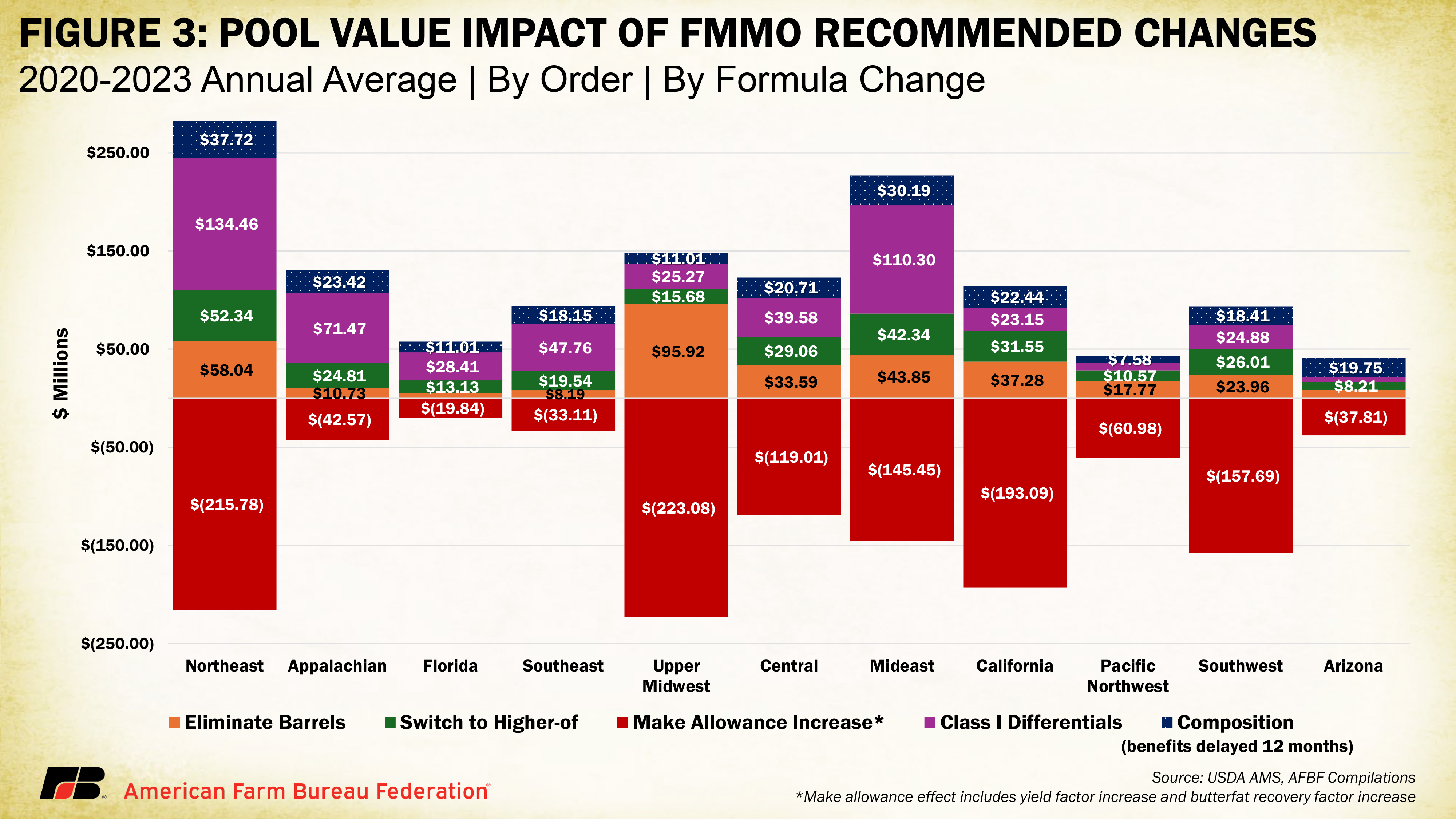
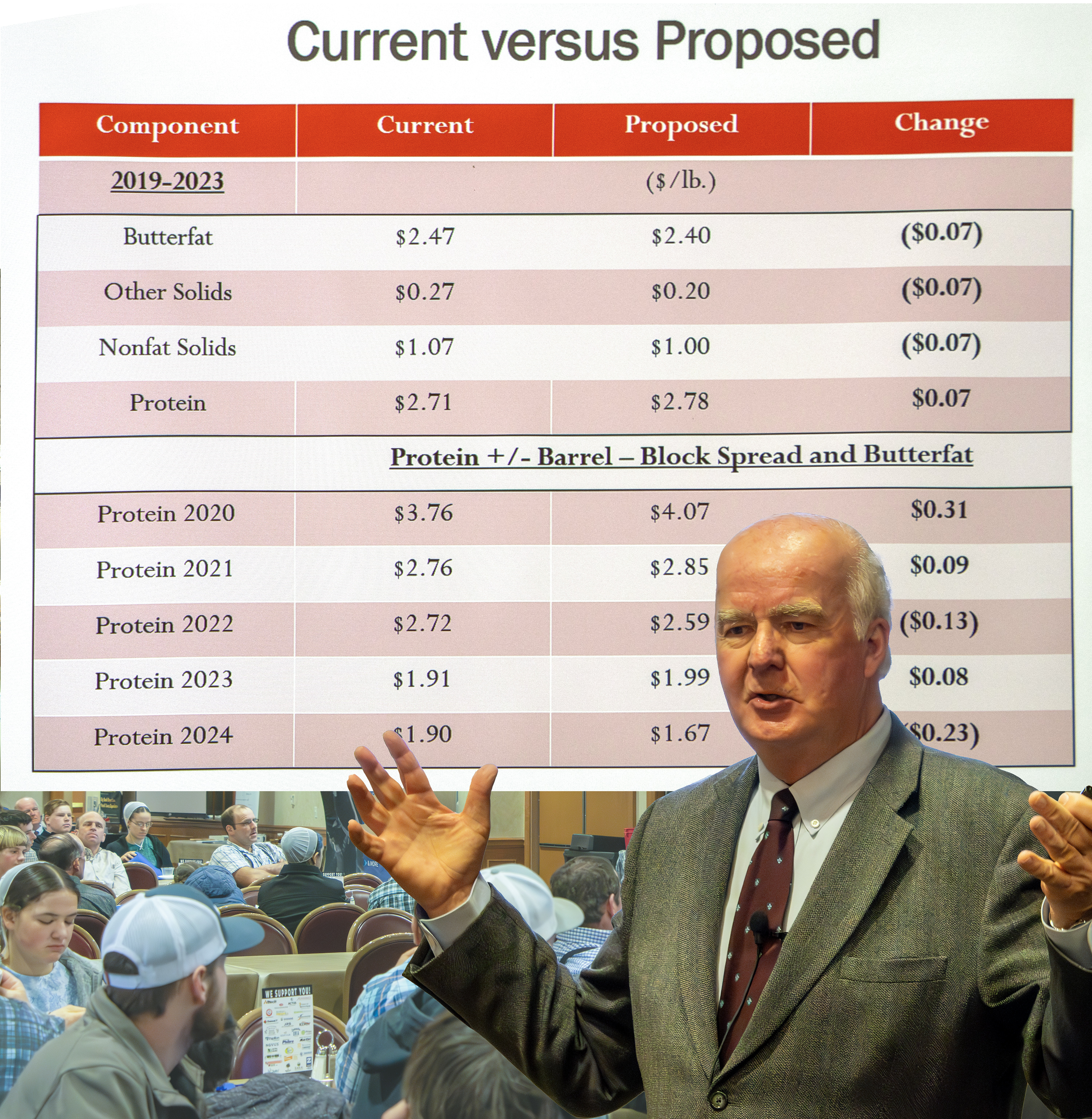
Calvin Covington shared that the collective impact of all the FMMO changes on the Northeast Order farms is likely to be neutral to slightly beneficial, while farms in the three Southeast Orders will benefit the most because of bigger Class I differentials and greater Class I utilization. Butterfat and other solids prices will be lowered, and the wild card will be protein because barrel cheese prices moved higher than blocks in 2024, but the barrel price will no longer be used in the protein price formula after June 1st. Photo by Sherry Bunting

By Sherry Bunting, Farmshine, Jan. 31, 2025

SAVANNAH, Ga. and EAST EARL, Pa. — As part of his annual outlook for Southeast milk markets, and also in his look ahead for the milk market nationally and in the Northeast, well-respected retired milk co-op executive Calvin Covington broke down the final USDA Federal Milk Marketing Order (FMMO) formula changes into three categories: The positive, the negative, and the unknown. (Plus, there is also the ‘unvetted.’)

Covington spoke to over 300 attendees from 10 states at the 2025 Georgia Dairy Conference in Savannah on Jan. 20th, just a few days after USDA’s announcement that producers in each of the 11 FMMOs approved the final rule. Then, on January 28th, he was in eastern Lancaster County, Pennsylvania speaking to 250 dairy farmers on this topic at R&J Dairy Consulting’s 18th Annual Dairy Seminar at Shady Maple Smorgasbord.

The FMMO changes will be implemented June 1, 2025, except for the increased milk composition factors, which will be delayed six months due to impacts on “risk management.”

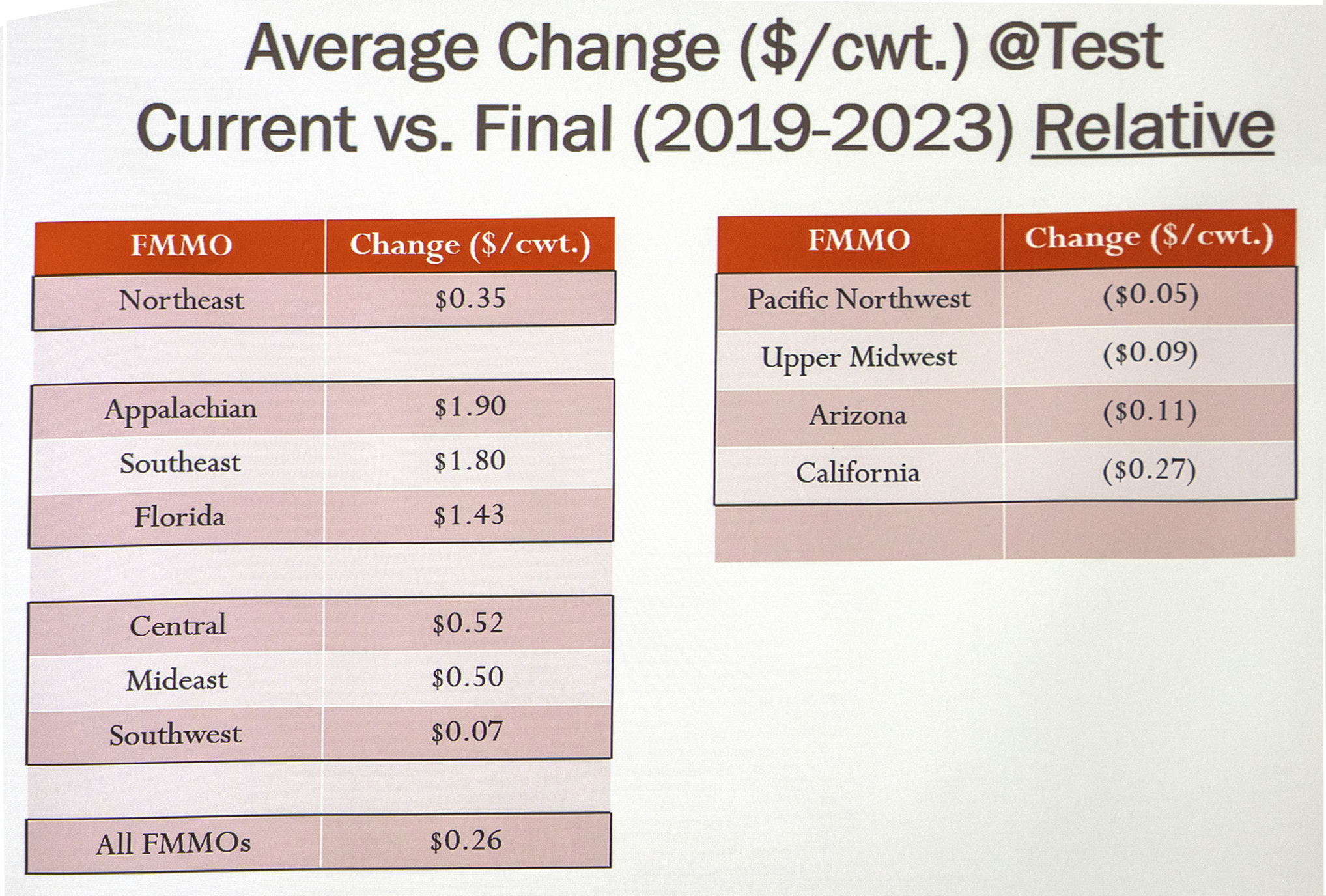
Covington shared collective analysis based on USDA’s backward-looking data (2019-23), showing that all six pricing changes, combined, would have benefited producers by 26 cents per hundredweight across all FMMOs, nationwide, during those years.

“But, like the disclaimer on a financial prospectus, ‘past performance is not an indicator of future results.’ It is all relative,” he said. “The three Orders of the Southeast are by far the biggest beneficiaries, but going forward, there are a lot of things we just don’t know.”

Calvin Covington shared analysis of how the recently approved FMMO milk pricing changes could collectively impact each of the 11 Orders, but warned that analysis based on past performance, may not be an indicator of future results.

Orders with estimated negative net impact at test are: Pacific Northwest (124) -5 cents; Upper Midwest (30) -9 cents; Arizona (131) -11 cents; and California (51) -27 cents.

Orders with estimated positive impacts at test are: Appalachian (5) +$1.90; Southeast (7) +$1.80; Florida (6) +$1.43; Central (32) +52 cents; Mideast (33) +50 cents; Northeast (1) +35 cents; and Southwest (126) +7 cents.

The good

“The Southeast will see the majority of benefit, with the updated Class I differentials,” Covington reported, illustrating how they vary by location for an average increase of $1.42 per cwt across the country – but only for Class I milk. The three Orders of the Southeast will see more of this benefit because they have the largest Class I differential increases and their blend prices are predominantly Class I.

A University of Wisconsin-Madison study had previously looked at where the plants are and where the milk is, in order to think about moving milk from where it more is produced to where it is needed.

The highest differential increase is along the route 85 corridor, beginning near Atlanta, up into West Virginia, where there are plants but no milk. Interestingly, his chart showed that the smallest increases for the region are in Florida locations as well as Valdosta, Georgia, where the new Walmart milk plant is being built.

In the Northeast, Covington said dairy farmers will have to get used to what this looks like on their milk check, and they will also see more incentive to move milk South under these new differentials.

“Each county has a differential assigned to it,” he said, pointing to the area of the R&J Meeting, near New Holland seeing a $1.40 per cwt. increase in Class I differential, but this is a smaller increase compared to the much larger increase put on at Boston, Mass.

“That big increase in Boston is because there’s not any milk around there, and it’s raised to get the milk to move to the people there,” he said. This means that even though the new Class I differential will raise the Class I price in New Holland, “farmers will have to get used to seeing their location differential as a bigger negative on the milk check,” because the increased differential in Boston is so much bigger.

The milk composition factor updates are straightforward, he said, yielding about a 35 cents per cwt benefit to the Class I milk price in all FMMOs, and will raise the standardized skim value of the other classes in the three southeastern Orders that are still priced as fat/skim instead of by multiple component pricing.

The bad

The make allowance increases will lower the price for butterfat and other solids value, he said, “but we don’t know what will happen with the protein price because of the elimination of the barrel cheese prices from the formula.”

This will manifest as lower butterfat and other solids component prices for the Northeast, he said. “We would expect the protein price to be higher, based on history, but that depends upon the block to barrel price spread and its relationship to the butterfat price.

The unknown

Historically, the 500-pound barrel cheese price was lower than 40-pound block price.

Last year, however, barrels have been higher, so we don’t know,” said Covington.

Also in the unknown category is the return to the ‘higher-of’ as USDA’s method for setting the base Class I skim price.

“In the past five years, the average-of method cost dairy farmers millions of dollars, but we don’t know going forward if the skim factors (Class III vs. Class IV) will get back to being closer together, which would lower prices. If the spread stays wide, this change to the higher-of will increase prices,” he explained.

When asked if the Covid pandemic created the loss in Class I value under the average-of vs. higher-of, Covington said the Covid period — while most obvious — only accounts for one year out of five years in which the spreads between Class III and Class IV and between block and barrel cheese were detrimental.

“The thing going forward is, we just don’t know,” he said.

The unvetted

The sixth change is not listed separately in the Jan, 16th USDA notice to trade, and it was not part of any hearing proposal. Covington said he views the extended shelf life (ESL) adjuster as “a new class of milk.”

“The ESL adjuster is only on Class I. You’ll have a Class I mover skim price that will be calculated for conventional milk based on the higher-of III or IV,” he said. “Then you need a big spreadsheet to show what’s going to happen next. They’ll look 36 months previous to 12 months previous at the difference between the higher-of and the average-of, and that will be the adjuster to use for ESL milk that month.”

He estimates the ESL adjuster would have averaged -30 cents in 2024, but for some months it would have been a plus.

“My initial analysis is that it will not make a whole lot of difference in the short term, but we just don’t know going forward if some will try to manipulate this,” he said. “My concern is that it was not proposed at the hearing at all, and there’s no definition for extended shelf life. I know being in this business all these years, if there is a way to work around it for a benefit, they will find a way to do it.”

When asked about the competitive issues between conventional and ESL fluid milk and between out-of-area packaged ESL milk competing with in-area fresh milk, Covington observed potential competitive issues between conventional and ESL milk in the same area.

“You’ll have two different costs at the same location. What has always been the beauty of the Federal Order system is having the same raw product costs at the same location,” he said, adding that new ESL plants are being built and others are expanding.

“As ESL grows… there could be some months with a price advantage,” Covington suggested, pegging that difference historically to be as much as $1.00 per cwt in some months. “That kind of difference can create disparity between conventional and ESL milk.

“The thing is, we just don’t know, going forward, what it’s going to look like.”

Covington urged farmers to pay attention and be involved. Federal Order reforms are a slow process involving a lot of time and compromise. Changes this big only happen about every 25 years, he said.

He noted that Farmshine has kept dairy farmers “well-informed” with effective reporting on the markets and the FMMO process.

He said that as more manufactured products are sold and less fluid milk, compared with 25 years ago, the future could look different if future administrations and lawmakers feel differently about the pricing of milk. If manufacturers perhaps choose not to participate, FMMOs could some day be looked to primarily for handling the payments and test weights.

However the future plays out, Covington urged: “Stay informed and be involved because it is your milk check.”

-30-

USDA to complete producer vote before new administration comes to town

Final FMMO rule adds more to make allowances, shortens delay on composition updates, restores higher-of, keeps controversial ESL adjuster.

By Sherry Bunting, Farmshine, Nov. 15, 2024

WASHINGTON, D.C. – The USDA released on Nov. 12 the Secretary’s nearly 400-page final decision on the Federal Milk Marketing Order (FMMO) price formula changes, with a few changes from the July ruling.

USDA rejected comments seeking to forestall the make allowance increases or to reduce their size. All make allowances are further raised in the final rule vs. preliminary rule by a fraction of a penny for marketing costs. Also, USDA has added more than a penny per pound to its earlier decision on the nonfat dry milk make allowance. These are milk check deductions that are embedded in the class and component formulas.

USDA also plans to stick with its earlier decision to introduce a rolling adjuster for extended shelf life (ESL) milk, which creates essentially two-movers for Class I that was not part of the hearing scope. The Department further defined ESL milk by processing method to be all milk using ultra-pasteurization, not just relying on the shelf life designation of 60 days or more.

The broad range of changes in the proposed final rule are the result of the national hearing and rulemaking process that began in 2023. It will be made final for implementation after dairy producers vote to approve these changes in the Order-by-Order referendum that will be completed before the new administration takes office on January 20th.

USDA AMS will mail voting ballots to eligible producers and qualified cooperative associations — which may bloc-vote on behalf of their eligible members — after the final rule is published soon in the Federal Register. Ballots must be returned with a postmark of December 31, 2024 or earlier and be received by the Department by January 15, 2025 in order to be counted.

Not all producers in a Federal Order will be eligible to vote. Only producers with milk pooled on a Federal Order in the month of January 2024 are eligible to vote in that Federal Order.

A ‘yes’ vote accepts all parts of the final rule. A ‘no’ vote rejects the changes but also rejects the continuation of that Order. Any of the 11 Federal Orders that does not meet the two-thirds majority requirement for acceptance of these changes will be terminated. The two-thirds majority is calculated among eligible producers in the Order who return a ballot.

USDA AMS will host three public webinars to further inform stakeholders of the changes and referendum process on Nov. 19 and Nov. 25 at 11:00 a.m. ET and Nov. 21 at 3:00 p.m. ET. A link to access the webinars will be provided at the AMS hearing website along with supplementary educational documents. 

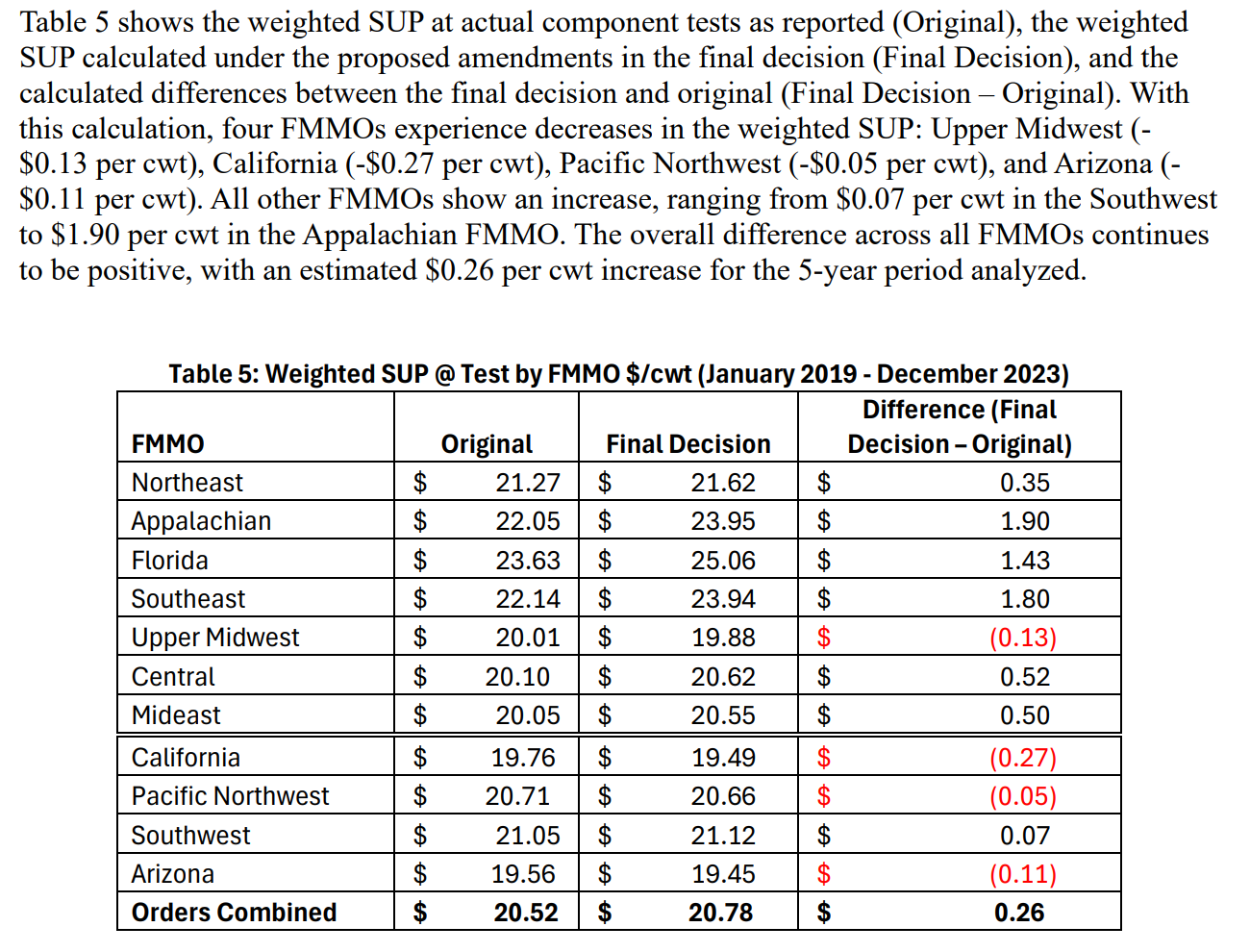
Using its backward-looking analysis of applying the changes to actual 2019-23 pool test data, the combined net benefit for all 11 Federal Orders of all the changes in the final rule is estimated at +$0.26 per hundredweight. However, an average does not tell the full story, and it does not include the positive orderly marketing impact of restoring the higher-of method for calculating the Class I base price mover.

USDA’s Table 5 above is the backward-looking static analysis of the weighted Statistical Uniform Price (SUP) – at actual pool component test – showing net benefits for the following Orders: Appalachian +$1.90 per hundredweight, Southeast +$1.80, Florida +$1.43, Central U.S. +$0.52, Mideast +$0.50, Northeast +$0.35, Southwest +$0.07. 

Table 5 shows net-negative impact for California -$0.27, Upper Midwest -$0.13, Arizona -$0.11, and Pacific Northwest -$0.05.

However, this analysis does not factor-in the positive impact of restoring the higher-of method for calculating Class I. The Orders showing net negative impacts above have more liberal policies for jumping in and out of FMMO pools. Since USDA did not quantify the benefit of its restoration of the higher-of method for the Class I mover, it’s important to note that this can soften the blow. 

According to experts consulted by Farmshine on this matter, the potential average benefit for the same 2019-23 period of orderly marketing under the higher-of method in a low-Class-I FMMO like the Upper Midwest is 7 to 10 cents per hundredweight.

More importantly, the orderly marketing restored by this part of the final rule has a protective effect on the month-to-month hits taken by pooled producers from opportunistic depooling and negative PPDs. Why? Because the higher-of method — used for two decades, before the legislative change in 2019 — encourages functional class price relationships that promote orderly marketing.

In short, producers should realize that the restoration of the higher-of reduces the prevalence of very large negative PPDs that can disrupt performance of their risk management tools and treat pooled producers inequitably during black swan events and times of major market imbalances — like have been experienced over the past five years under the average-of method. This is a benefit that is difficult to quantify, but is contained in this decision nonetheless.

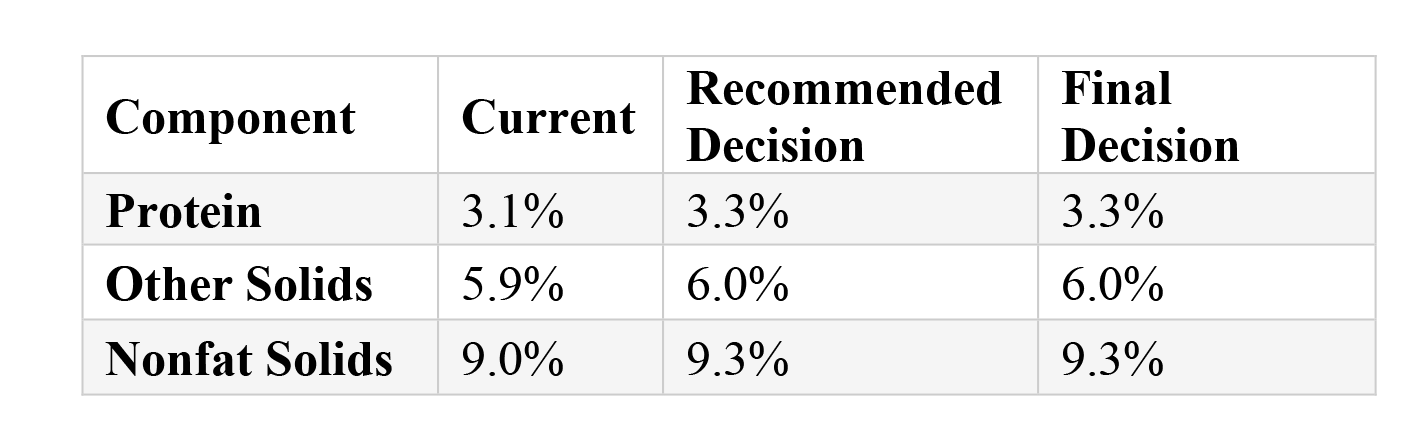
On the positive side for dairy farmers, the USDA will also shorten the delay from 12 months to six months for implementing the updated skim milk composition factors. These updates are shown above, which witnesses testified would raise Class I prices in all Federal Orders by an estimated 70 cents per hundredweight (based on 2022 data), while also increasing the manufacturing class prices in the four fat/skim Orders.

Raising the skim component standards helps bring the Class I, III, and IV in alignment, reduces the frequency of negative PPDs, and reduces the incentives for depooling that undermine orderly marketing.

The manufacturing class prices in the other seven Orders that use multiple component pricing are already paid on actual components, not by standardized levels.

Standardized butterfat composition at 3.5% will not be updated in this decision because this is a paper number that does not affect how producers are actually paid. Each pooled producer’s individual minimum price in all Federal Orders is already based on their actual butterfat test for pounds shipped.

The updates to county-by-county Class I location differentials were also tweaked in places, compared with the July preliminary decision, and the base differential for all counties at $1.60 per hundredweight remains in place.

Butterfat recovery within class and component formulas will be updated from 90% to 91%. Several proposals had requested a larger increase.

The Secretary’s final decision on the Class I base price mover remains unchanged from July.

USDA will restore the higher-of formula, which had been changed to an average-of formula in the 2018 farm bill. USDA is also sticking with the ESL adjuster, creating what is essentially a two-mover system for fluid milk.

Processors will separately report sales of conventionally processed (HTST) and ultra-pasteurized (ESL) fluid milk product sales each month. The higher-of method will set the base price mover, and USDA will apply the new ESL adjuster to the sales of ultra-pasteurized milk to determine their final pool obligation.

The ESL adjuster represents the difference between the higher-of vs. the average-of the Class III and IV advance pricing factors over a 24-month period with a 12-month lag. USDA states that it sees this adjuster “stabilizing” the difference between HTST and ESL over time.

USDA also rejected comments that had raised competitive concerns, stating: “The record does not contain evidence to support the implication that manufacturers of dairy products, the majority of which do not manufacture ESL products, would make business decisions to gain an advantage in the fluid market where they do compete.”

On the negative side for dairy farmers, the large increases in processor make allowance credits were made a bit larger, not reduced, after the 60-day public comment period.

USDA relied on the voluntary surveys of processor costs that were presented at the hearing as customary data sources from past make allowance adjustments. While USDA did not fully meet the requests of International Dairy Foods Association (IDFA) and Wisconsin Cheesemakers Association (WCMA), it does recommend much larger make allowances than what National Milk Producers Federation (NMPF) had proposed.

Make allowances represent the costs of converting raw milk into the four manufactured dairy products surveyed by USDA. They are embedded in the pricing formulas, not line items on a milk check, and they aggregate to an impact of 75 cents to $1.00 per hundredweight — depending on product mix and Class utilization.

USDA responded to processor comments about marketing costs, adding $0.0015/lb to its previously proposed processor make allowance credits for cheese, butter, nonfat dry milk, and dry whey. USDA also responded favorably to the processors’ request to adjust the nonfat dry milk make allowance to be more than a penny per pound higher than previously proposed.

The final decision will raise the make allowances on the four products used in class and component pricing – per pound — as follows:

Cheddar cheese will be increased from the current make allowance of $0.2003 to $0.2519 per pound; dry whey from $0.1991 to $0.2668; butter from $0.1715 to $0.2272, and nonfat dry milk from $0.1678 to $0.2393.

In its rationale, USDA stated that NMPF member-cooperative-processors supported the NMPF proposal as “a more balanced approach” to consider impacts on producers and processors. However, they also testified that the smaller increases proposed by NMPF “did not cover their costs.”

This put USDA in the position of having to rely only on the cost data provided by IDFA and WCMA because NMPF offered no cost data to support their smaller proposal. USDA said it rejected consideration of the impact on dairy farmers because the Agricultural Marketing Agreement Act does not include producer profitability as a factor for the Secretary’s consideration on this matter.

USDA chose not to wait for the mandatory and audited cost of processing survey that Congress is expected to authorize and require USDA to utilize in the future. This language is included in all versions of the new farm bill and is reportedly supported by NMPF, IDFA and American Farm Bureau Federation (AFBF).

The final rule also removes 500-pound barrel cheese prices from the protein and Class III formulas, meaning only 40-pound block Cheddar price surveys will be used going forward. USDA rejected proposals that sought to add 640-pound block Cheddar, bulk mozzarella cheese, and unsalted butter to the pricing survey.

-30-

‘Make allowance’ among hot topics ahead of producer vote on USDA’s proposed milk pricing changes

35 dairy farmers, industry representatives, and farm media attended “Winners and Losers: a discussion about USDA’s proposed milk pricing reforms,” hosted by the American Dairy Coalition during the 57th World Dairy Expo in Madison, Wisconsin October 3rd.

By Sherry Bunting, Farmshine, October 11, 2024

MADISON, Wis. – “I’m in Wisconsin, and on the graph (below) it looks like producers in Order 30 are having to decide between less money with an Order or even less money without an Order. Am I wrong and is there a silver lining?”

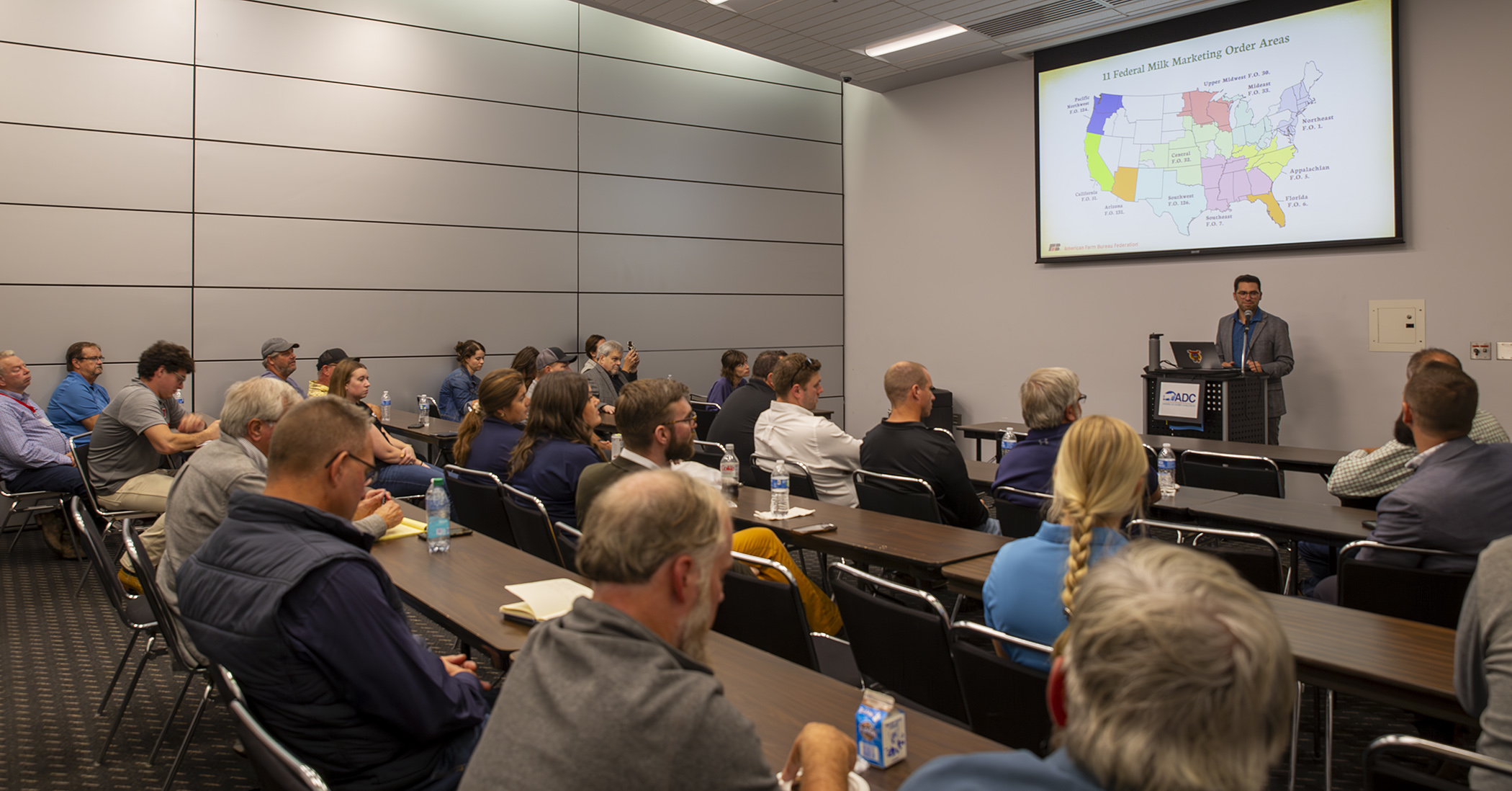
That was the crux of the question one dairywoman asked during the American Dairy Coalition’s (ADC) ‘Winners and Losers’ seminar and press conference Oct. 3 at World Dairy Expo. Over 35 farmers, industry representatives, and media professionals gathered to hear insights about USDA’s recommended decision on changes to Federal Milk Marketing Order (FMMO) price formulas.

American Farm Bureau economist Danny Munch was the invited presenter, followed by time for questions, moderated by Kim Bremmer of Ag Inspirations, and opportunities for networking and farmer-to-media connections during the remainder of the two hours.

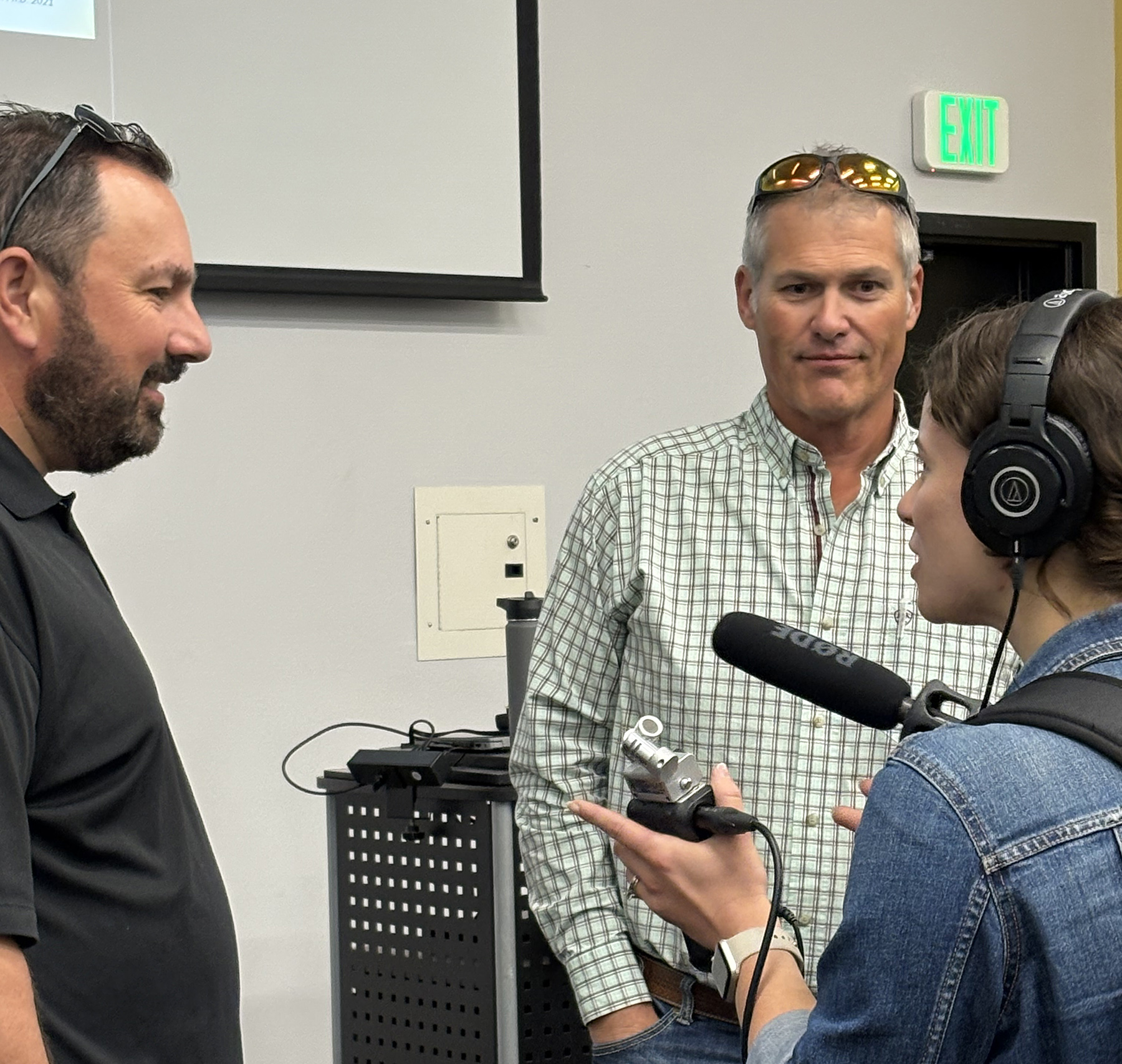
Dairy farmers attending ADC’s press conference gave interviews after the discussion on USDA’s proposed milk pricing changes.

At issue was the impact on FMMOs with more cheese and less fluid milk, that would experience the negative impacts of a proposed hike in processor make allowances without the positive buffer of higher Class I location differentials.

Bremmer said over 126 individuals and organizations provided comments to USDA. The comment period ended Sept. 13. 

During his visit to Expo on Oct. 4, Ag Secretary Tom Vilsack said USDA would issue a final decision in mid-November. Also on Oct. 4, USDA held a webinar explaining the producer referendum expected in January. (Look for more specifics in a future Farmshine, and check out the Farm Bureau recap here)

The short answers to the above question appear to be yes, yes, and yes. With an Order, producers in some regions will see lower FMMO blend prices. Without an Order, they would lose minimum prices altogether and other important FMMO functions.

The silver lining? Munch pointed to better competition currently for milk, and he sees opportunity for milk in the future as consumers focus on protein.

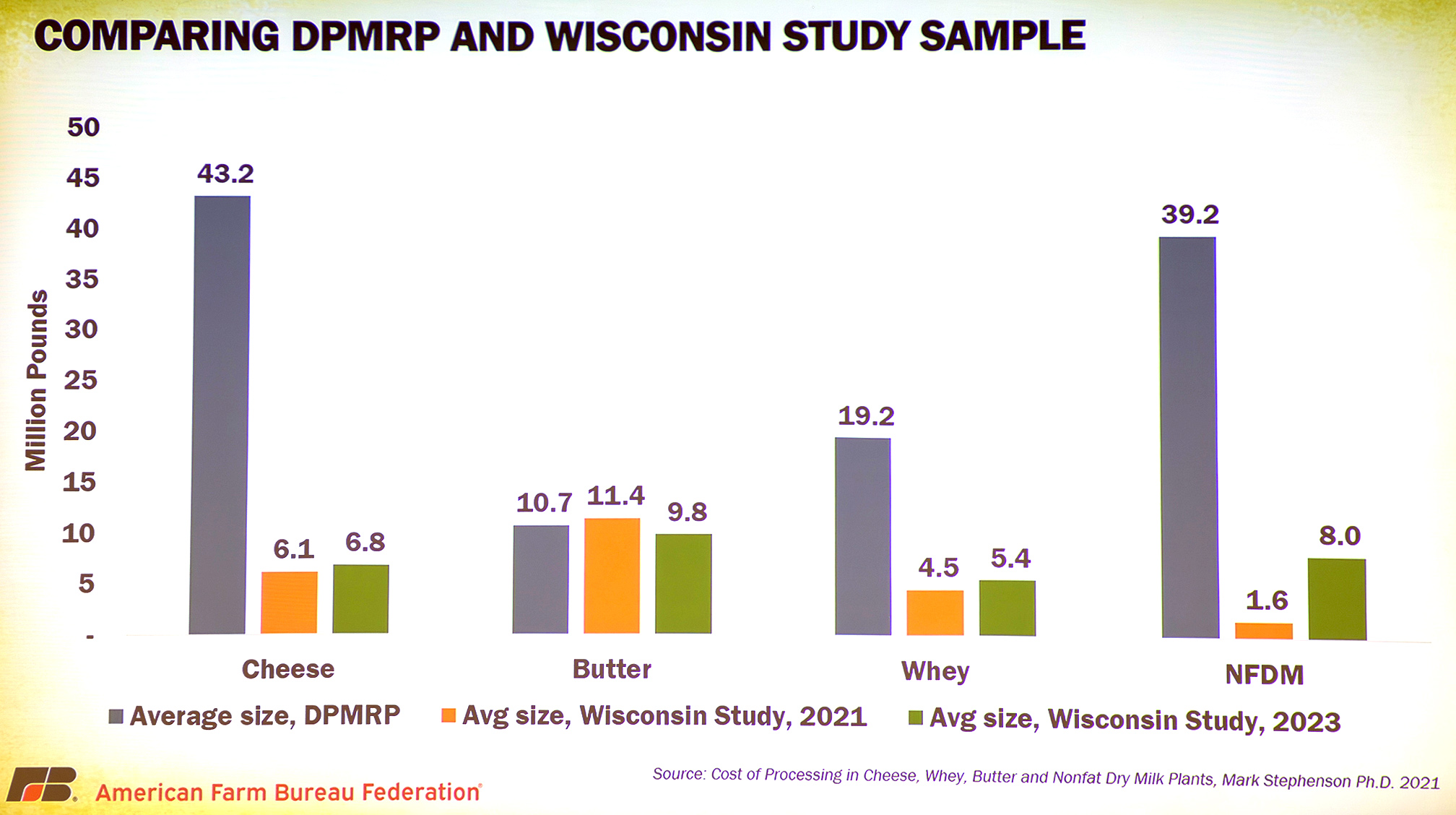
New to the discussion was make allowance data compiled by AFBF for its official comment at the Federal Register showing the average plant size of processors participating voluntarily in the Stephenson Survey relative to the average plant size of processors reporting to the NASS Dairy Product Manufacturing Survey (below)

The average size and volume of the plants in the voluntary cost of processing survey is 5 to 20 times smaller than the size and volume of plants reporting to USDA on price and production. This is further evidence that mandatory surveys are the only fair way to examine and set make allowance levels.

ADC reports that farmers have called with questions and concerns about the FMMO changes they will vote on. Part of ADC’s mission is to inform dairy farmers and help them understand factors like this that affect their businesses, said Bremmer.

For example, it’s helpful for farmers to realize that current make allowances equate to $2.17 to $3.17 per hundredweight in deductions already in the pricing formulas to cover the cost of converting milk to butter, cheddar cheese, nonfat dry milk, and dry whey. 

The proposed new make allowances add 70 cents to $1.00, depending on class utilization, bringing the total deduction to about $2.89 to $4.07 per hundredweight, maybe more.

The splitting of Class I into a two-mover pricing system is also causing discontent and concern. On the one hand, USDA would restore the ‘higher-of’ method for conventionally pasteurized fluid milk but use an ‘average-of’ method with a rolling and delayed adjuster for the extended shelf life (ESL) fluid milk products. This new milk class was not vetted nor defined during the hearing.

Also of concern is the delay in implementing positive updates to milk composition standards that have not been updated since Order Reform in 2000.

USDA’s recommended decision applies to all 11 FMMOs nationally but will be voted on by eligible (pooled) producers in each Order, individually.

A two-thirds ‘yes’ vote within each individual Order continues that Order with the changes. If the two-thirds threshold is not met by either producer numbers or volume in an Order, then the result is termination of that Order. 

Producers do not have the option of voting separately on the five pieces of the USDA decision, nor do they have the option of voting to keep the FMMO pricing formulas as they are currently.

Economists with National Milk Producers Federation have stated previously that 65 to 70% of the U.S. milk supply is marketed through cooperatives that tend to bloc vote for their producers, but this percentage can vary on an individual Order basis.

USDA determines voting eligibility, based on whether milk was pooled in the reference period selected by each Market Administrator. 

“When we get down the road to the vote, and if we vote ‘no,’ that will dissolve the Order, right?” asked one dairy farmer. “What opportunity does any geography have to reorganize a new Order to fit what works for them?”

Munch said producers could start a process to create a new Order, but it would still be required to use the same price formula rules because these will apply to ALL Orders uniformly. In contrast, he noted that USDA leaves pooling and depooling rules to be decided individually by each Order.

One member of the media pressed Munch to speculate on what happens if a western Order votes no, but an eastern Order votes yes?

“People always want me to speculate on what happens if California or the Upper Midwest vote out their Order(s). What we’ve seen in the past in unregulated areas, or areas with state orders — they still base a lot of their pricing on the nearby Federal Order system,” he responded.

“If we remove more milk out of the Federal Order system, does that system then play less of a role in pricing milk, and does that unregulated market start to dictate and suck milk out of the regulated areas, if you’ve taken out some of the large milk production states? That’s just some speculation, something to think about in the long term,” he said.

On a more immediate basis, Munch said that if an Order is terminated by this vote, “farmers lose protections like timely payments and component verifications, and the minimum prices. You could end up with a patchwork.”

He pointed out that USDA did not raise make allowances by the full amount requested by processors, but also did not go with the more modest increases requested by the cooperatives.

In their post-hearing comments, processors voiced great unhappiness with the decision, he said, because they didn’t get the multi-year increases to even higher levels.

“We don’t blame USDA for trying to come up with a middle ground… we just don’t have the data. The way hearing processes work is they collect this data brought by stakeholders and try to come up with a compromise that works for everybody,” Munch explained. “Our argument is that the data may not reflect market conditions, and we want to make sure that it does. We can’t get that assurance until there’s an audited, mandatory survey.”

As a standalone piece, AFBF estimates that USDA’s proposed increase in make allowances would remove an additional $1.25 billion annually from producer pool revenue, nationwide, based on past pooling data. However, USDA proposes a one-year delay in implementing the milk composition updates that would contribute $200 million annually in producer pool revenue nationwide.

Munch sees the 12-month delay in implementing the milk composition standards and the splitting of the Class I mover with an ESL adjuster as two things that appear to be “thrown in there,” with a lot of groups voicing discontent and confusion.

When asked by a reporter if the add-ons to Class I will create consumer resistance to what could be a 25-cents-per-gallon increase in retail fluid milk prices, Munch cited the hearing record where economists testified to the relative inelasticity of fluid milk demand.

He also sees great opportunity for milk: “When I go to the gym, I used to see no one drinking milk. Now I see tons of people drinking milk, protein shakes, and other things, and it’s not plant-based products. I think milk can take advantage of marketing the protein benefits that people in my generation are looking for and are willing to pay for.”

Munch was asked if AFBF will recommend how its dairy members should vote.

“We will not make that recommendation. We take positions based on our policy, which includes opposing any make allowance updates until we have mandatory cost of processing surveys, and other aspects related to our policy book,” he replied. “It’s up to our members to make those voting decisions, and there is a regionality to this, so we don’t get involved at that level.”

Florida producers, for example, “will be okay with the new rules” because the over 80% Class I utilization brings with it higher location differentials. The Upper Midwest, on the other hand, has been at roughly 5% Class I and 93% Class III, so there is very little benefit from the Class I changes, but those producers are subjected to the highest make allowance deductions for Class III products, which is 95% of their blend price.

-30-

Why the proposed 33.3% raise in the whey make allowance is way too big without a ‘snubber’

By Sherry Bunting, Milk Market Moos in Farmshine, Aug. 9, 2024

USDA’s weekly National Dairy Product Sales Report (NDPSR) is out of whack on whey. The NDPSR is the mandatory processor survey of prices on the four commodities used in Federal Milk Marketing Order (FMMO) end-product pricing formulas.

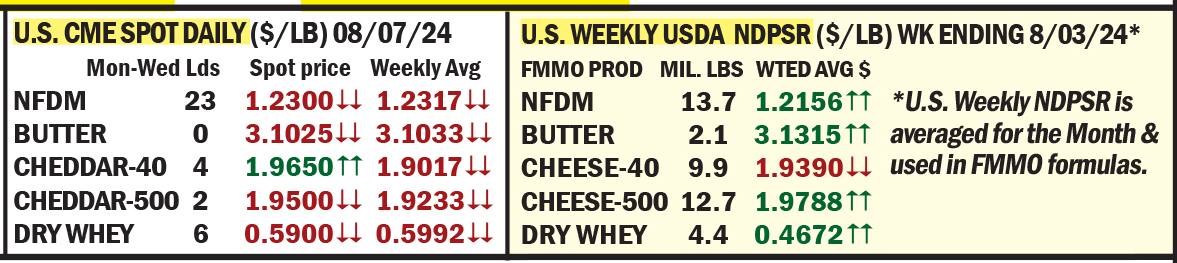
The NDPSR price for dry whey for the week ending Aug. 3 was $0.4672/lb, a modest improvement of a half penny over the previous week’s NDPSR, but still 10 to 14 cents lower than the past three weeks of weighted average spot prices, and a nickel lower today than even at the start of the spot market rally six weeks ago.

The NDPSR should have caught up closer to the spot market by now, considering that only sales that are forward priced within 30 days can be reported.

The CME spot market is what processors touted during FMMO hearing testimony as the ‘market clearing’ price that they use as a baseline to price commodities for export and non-formula, non-reported ‘value added’ products.

They also lamented — at length — that USDA is setting producer minimum prices too high, some threatening to modify future expansion plans if they don’t get to ‘market clearing levels’ with higher make allowances deducted for their rising costs — including ‘sustainability costs’, they want covered.

If these dry whey ‘market clearing’ CME spot values we have been seeing of late are not translating to the NDPSR used in FMMO class and component price formulas over a three to six week period, then maybe we should all be questioning the 33.3% raise the processors will be getting from dairy farmers’ milk checks in the dry whey make allowance that USDA proposes to increase from the current $0.1991/lb to $0.2653/lb. That is, if the proposed rule announced July 1st survives the 60-day comment period, 60-day review, and producer referendum early next year.

I wonder if USDA underestimates how fed-up the farmers are in the Upper Midwest with being the worst-paid in the nation seeing the biggest make allowance bite coming right at them in this proposal — and very little Class I benefit to offset it. After 5 years of disrupted pooling by the ‘average of’ method, Order 30 has developed some bad pool-jumping habits that could linger in that region — even when fluid milk pricing returns to the higher of. Who knows?

If a two-thirds ‘yes’ vote is not achieved in Order 30, or any Order for that matter, the Market Administrator’s office there closes, immediately.

There is so much value in whey today, and it’s a byproduct of the cheesemaking process to begin with. It’s hard for this observer to resolve conflicts of logic in the size of this raise that USDA justifies based on voluntary surveys in which only a fraction of the plants that price report would offer their cost of processing data to determine.

In fact, even Dr. Mark Stephenson said it was more challenging this time to separate-out the costs for other products that are not price reported, but made in the same plants. He said today’s plants are more complex than in 2006 when the model was used on voluntary data to set the current make allowances that were implemented in 2008, the last time they were raised.

But folks, there’s no snubber, and for dry whey, that’s a problem. When farmers were losing their shirts last summer, they would have been giving away the ‘other solids’ in their milk for free — or paying processors a small fee to take them as though worthless — because the dry whey price at that time was equal to or fractionally less than what the new proposed dry whey make allowance would be!

It happened the last time make allowances were raised in 2008, just ahead of the 2009 dairy crisis. I’ll not soon forget farmers asking me if there is some way to avoid sending the ‘other solids’. Of course, that’s silly, but we get the point, and it’s sharp.

This is significant in the Upper Midwest, where it impacts over 90% of the milk because it’s a Class III market. But this also affects all Orders to some degree, depending on pool composition. With new processing capacity coming online, much of it cheese, in the next 12 to 24 months, other milk marketing areas will see Class III growth change their blend prices too.

The other thing to think about is USDA proposes to implement the new make allowances for all four commodities right away after the referendum in early 2025, but some of the other parts of the proposed rule will be delayed because of risk management impacts. Yet make allowances also impact risk management. They are also part of the formula for the Class III and IV milk prices — so this change also would immediately affect the futures board. In fact, that’s part of what happened in 2008.

Can you imagine an immediate $0.75 to $1.00 drop on the futures board due to higher processor credits? What’s the calculus there? The make allowance for dry whey affects the ‘other solids’ value as well as the Class III price.

And then we have the added insult of ‘pizza cheese’ being billed as ‘like mozzarella’ just moister because it’s a second process of the whey and water to congeal some secondary curd. It is essentially whey cheese with a different melting texture (I notice it browns cardboard-flaky on frozen pizza before the dough is done, but keeps some moisture. I don’t buy my once favorite frozen pizza brands anymore suspecting that’s the problem). It’s also used as a crust filler.

So, how much real mozzarella is being displaced, and how much near-mozz value are they selling this whey product for? That’s a price that never gets reported because it’s — well — not dry whey. It’s a proprietary value-added product.

The ubiquitous whey protein concentrates and isolates found in so many high protein drink and snack preparations are another hot ticket not getting price reported. And yet, here’s dry whey at 50 to 60 cents/lb for 6 weeks on the market-clearing CME, and the price going into the FMMO formulas is hanging back at 43 to 47 cents/lb over the same 6 week period.

Spot market red, not as bad as it looks

The whey market traded 6 loads on the CME spot sessions this week with a penny loss at 59 cents/lb Wed., Aug. 7 vs. the prior Wednesday. The weighted average for the week is still at just about 60 cents/lb.

The CME spot cheese market was mostly quiet again this week, but prices for blocks moved higher Wed., Aug. 7, when 40-lb block Cheddar was pegged at $1.9650 — up 4 cents from the prior Wednesday, with 4 loads trading the first three days. The 500-lb barrel cheese price, pegged at $1.95/lb was down 2 1/2 cents compared with a week ago; 3 loads traded. The NDPSR for week ending Aug. 3 was reported in reverse with a 4-cent barrel over block advantage at $1.9788/lb and $1.9390/lb, respectively.

Butter melted off 2 cents after last week’s 39-load haul came to a grinding halt Aug. 1st. Nothing traded from Aug. 2 through 7, and the spot butter price remained at $3.1025/lb Wed., Aug. 7. The weighted average was steady at just over $3.10/lb, off 3 cents from the NDPSR price of $3.1315/lb for week ending Aug. 3.

Grade A nonfat dry milk trade remained active the first three days this week with a whopping 23 loads changing hands, and the spot price pegged at $1.23/lb Wed., Aug. 7, down a penny and a half from the prior Wednesday. The weighted average for stood at $1.2317, and the NDPSR price continued to lag the past few weeks of spot market levels by three cents.

We see these headlines that the recent gains in farm milk prices are taking away the U.S. competitive advantage on the world market. Don’t believe them, folks. While it is true that nonfat dry milk is running above the global skim milk powder price, the reason is because we are not making nearly as much milk powder in the U.S. because milk is tight, cheese capacity has expanded, and cheese-vats are pulling in the available milk. Fluid milk sales are also up year over year. We are also not building powder inventory, so of course this means we’ll export less.

On the cheese and whey, there’s plenty of wiggle room between U.S. and global prices, judging by the recent Global Dairy Trade auction.

Global Dairy Trade index up 0.5%

The GDT biweekly internet auction on Tues., Aug. 6 added value to the mid-July gain — up 0.5% vs, July 16.

Here’s the kicker. The cheese index for Sept. 2024 through Feb. 2025 delivery was higher than the current U.S. market-clearing block and barrel prices. Meanwhile, lactose outpaced the current NDPSR drag on whey.

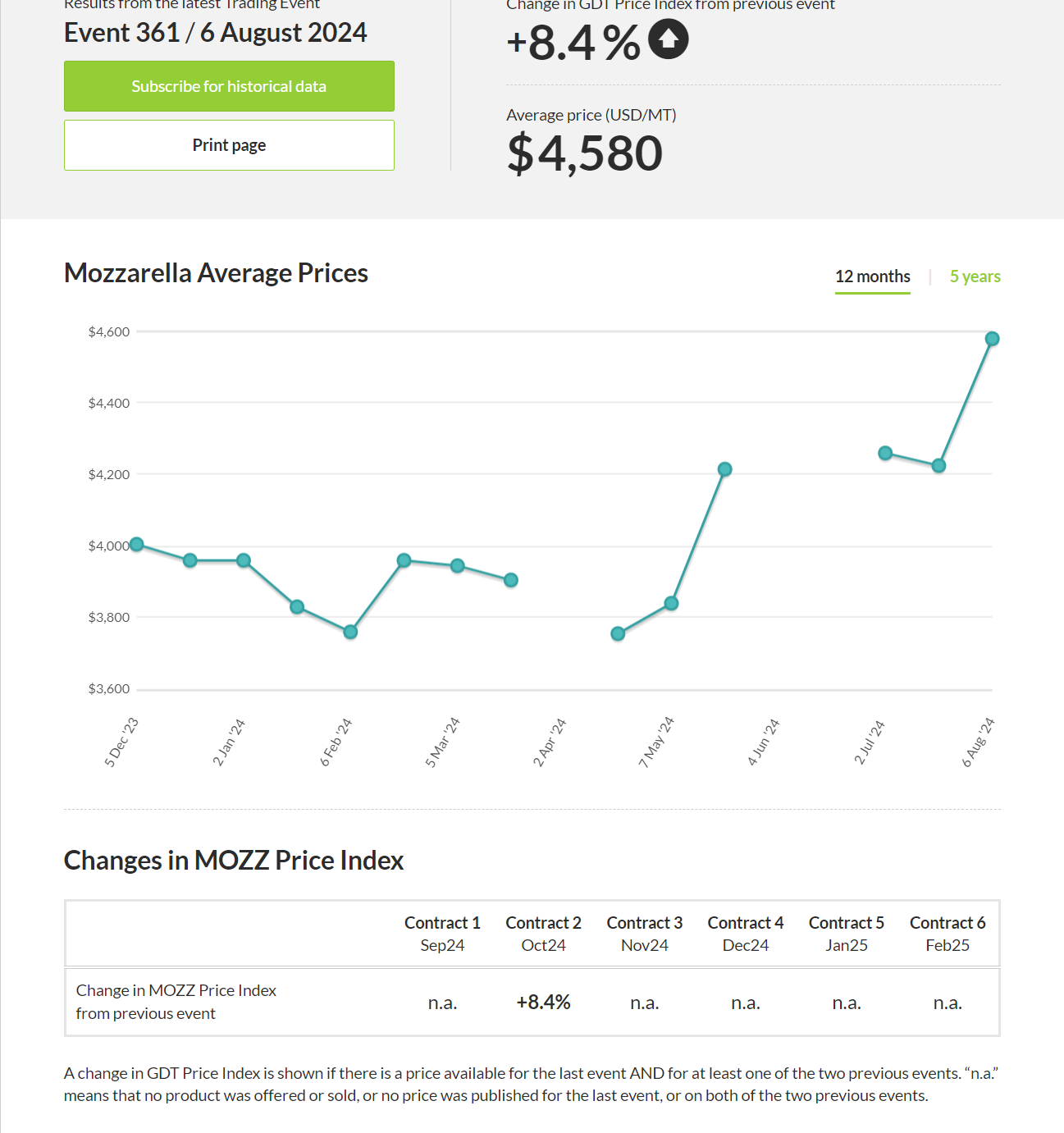
The big story is bulk mozzarella was up a record 8.4% with all sales contracted for delivery October 2024. The bulk mozzarella contracts are new. They have only been trading on the GDT since December 2023. Tuesday’s sales — all for Oct. 2024 delivery — are, by far, the highest yet of the 15 sessions in which bulk mozzarella was offered. The CME does not have a U.S. ‘clearing market’ for mozzarella. Furthermore, USDA does not include bulk mozzarella in the mandatory NDPSR weekly survey because mozzarella prices are not used in the FMMO milk pricing formulas. A proposal to add this was rejected by USDA in its recommended decision July 1st.

The GDT Industrial bulk cheddar index was up 1.3% compared with three weeks ago at an average $1.94/lb — 2 cents higher than the weighted weekly average on CME barrels and 4 cents over CME blocks. September delivery cheddar averaged $1.90/lb and October dipped to $1.89/lb, but product for delivery Nov. through Feb. moved toward $1.98/lb.

Meanwhile, USDA agreed with NMPF’s proposal to remove the 500-lb barrel cheese price from the weighted average used in the FMMO formulas. This will mean only the 40-lb block cheddar price will be used in the future to calculate the protein and Class III milk prices. Barrels have been trading over blocks recently, and during the FMMO hearing, IDFA witnesses (opposing the change) said they use the barrel price and dry whey price as the basis for pricing U.S. mozzarella for export sales.

Higher GDT indexes were also achieved Tuesday on the following products: Whole milk powder up 2.4%, averaging $1.48/lb; Anhydrous milkfat powder (AMF) up 1.2%, averaging $3.14; Lactose up a whopping 16%, at 42 cents/lb. Lower indexes were reported on Skim Milk Powder (SMP) down 2.7%, averaging $1.15/lb; and Butter down 2.4%, averaging $2.99/lb.

Milk futures mixed

Class III milk futures were generally steady this week, except near-term September took a 45-cent hit and 2025 contracts were mostly firm to a nickel higher, spots up 15 cents. Class IV futures were steady through 2024, but 10 to 30 cents lower on 2025 contracts. On Wed., Aug. 7, Class III milk futures for the next 12 months (Aug24-Jul25) averaged $19.41, down 3 cents from the same 12 months averaged on the previous Wednesday. The 12-month Class IV average at $20.82 was down a dime.

June DMC margin $11.66, up $8.00 above year ago program lows

As expected, the June DMC margin came in at $11.66, which is $2.16 above the highest tier one coverage level of $9.50/cwt. Announced August 2nd, the June margin was based on an 80-cent higher All-Milk price at $22.80/cwt and a 34-cent drop in feed cost at $11.14/cwt for a DMC margin that was deemed $1.14 higher than May and up by a whopping $8.00/cwt above year-ago program lows set in June and July 2023 at $3.65 and $3.52.

30-day H5N1 detections at 36 in 6 states, Colorado continues to be a breaking hot-spot, Iowa drops from the list, South Dakota returns

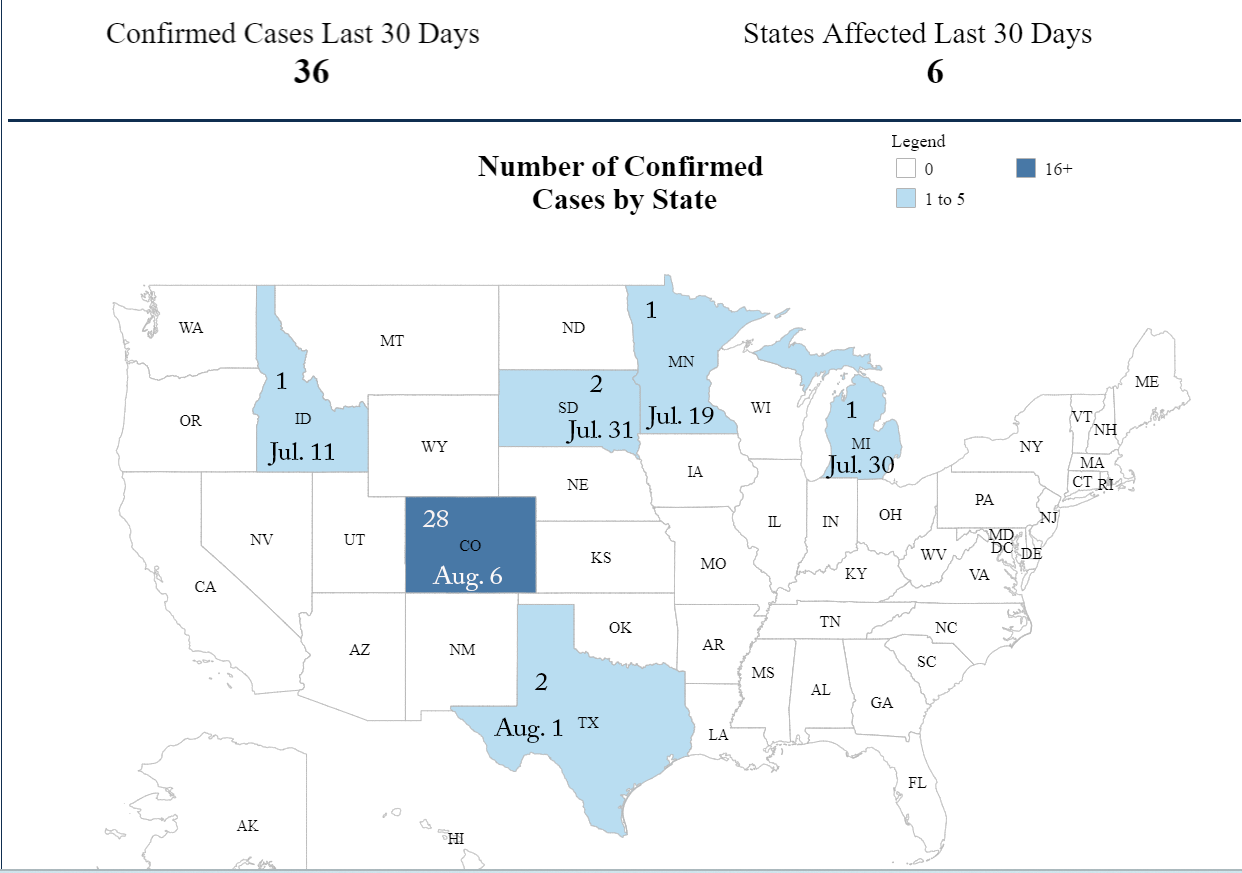
As of August 9, 2024, the current confirmed cases of H5N1 in dairy cows within the past 30 days stand at 36 herds in 6 states. Of these, 28 are in Colorado, where the most recent slew of 12 detections were reported for Aug. 5 and 6. Colorado remains the hot spot by a long shot. The state issued an order July 22nd to require mandatory bulk tank milk testing.

Iowa dropped from the 30-day list this week, but South Dakota returned to the list with 2 detections. Other states with confirmed cases within the past 30 days are: Minnesota (1), Idaho (1), Texas (2), and Michigan (1). Cumulatively, since the beginning of the outbreak on March 25, 2024, there have been 190 detections in 13 states.

Enrollments in the national voluntary dairy herd status bulk tank testing include 24 herds: Michigan (10), New Mexico (4), Pennsylvania (3), and 1 herd each in Kansas, Nebraska, North Carolina, Ohio, South Dakota, Tennessee, and Texas. Colorado herds (110) are now all being bulk-tank tested due to the state’s mandatory ruling on July 22.

Milk Market Moos: Could farmers be PAYING processors to take milk’s ‘other solids’ like in 2009 after the last ‘make allowance’ raise?

By Sherry Bunting, Farmshine, August 2, 2024

No ‘snubber’ on USDA’s higher whey make allowance proposal

The whey market is the one to watch right now as the daily CME spot market sped higher again this week, and the dry whey spot price is now above the 60-cents-per-poind mark!

No ‘snubber’ on new whey make allowance means farmers would have PAID processors to take the ‘other solids’ in their milk last summer.

One thing for the industry and USDA to keep in mind regarding the proposed rule announced July 1 is that the higher make allowances, if implemented, include a nearly 7-cents-per-pound raise in the dry whey processor credit. That can be a real bully when markets go south — considering there is no ‘snubber’ to keep farmers from having to give away these ‘other solids’ or to PAY processors to take them as though worthless.

USDA is proposing to increase the dry whey make allowance from $0.1991/lb to $0.2653/lb — a nearly 7 cents per pound jump.

Farmers would have PAID processors to take other solids last summer

Guess what? If we were having this conversation a year ago, looking at July 2023 Class and Component price announcements, we would be writing in this column that your ‘other solids’ price would be essentially zero, meaning processors would get the lactose and whey free, and last August, if the proposed new whey make allowance was in effect, farmers would have paid processors $0.003 to take these components as if they are worthless.

If the proposed 7-cents-per-pound increase in the dry whey make allowance were in effect in July and August 2023, the new $0.2653/lb make allowance would have been at or slightly higher than the dry whey price for those two months.

When the make allowances were raised in 2008, we saw months in 2009 when farmers literally paid their milk buyers to take the other solids in their milk because the dry whey price had fallen below the then-new make allowance, and there was no snubber to stop the bleeding at zero.

July Butterfat up at $3.57, Protein slips to $1.95

USDA announced mixed trends on July 31 for the Class and Component prices used in Federal Milk Marketing Orders for July milk. Class II and IV at $21.82 and $21.31, respectively, were around 20 cents per cwt higher than a month ago and 20 to 70 cents higher than the July Class I base price ‘mover.’

Class III milk, at $19.79, slipped 8 cents from June and continues to be the lowest of the four classes as it has been for most of the past two and a half years.

All components were higher, except for protein, which slipped 10 cents per pound back under the $2 mark at $1.95/lb. Butterfat gained 3 cents at $3.57 for July. Solids nonfat also gained, valued at just over $1.00 per pound for July.

Other solids also gained, at 26 cents/lb. This is derived from the dry whey price vs. make allowance.

June All-Milk price up 80 cents at $22.80, fully $5/cwt above year ago

USDA announced the All-Milk price for June at $22.80, up 80 cents from May and fully $5 higher than a year ago. The national average butterfat test moved down 0.07 at 4.10, but was still 0.09 above year ago. The Pennsylvania All-Milk price for June, at $23.30, was also 80 cents higher than the previous month, and fat test fell by 0.06, reported at 4.01, just 0.01 above year ago. The June DMC margin was not published or available by press-time, but with a higher All-Milk price for June announced at 3 p.m. July 31st, and moderating feed costs, the June DMC margin is likely to be well above the $9.50 trigger margin at around $11.50/cwt. (Update, June DMC margin was announced Aug. 2 at $11.66).

Milk futures mostly higher, especially Class IV

Class III milk futures were mostly higher this week, except near-term September and October were down a few cents per hundredweight. Class IV futures were steady to higher across the board. On Wed., July 31, Class III milk futures for the next 12 months (Aug24-Jul25) averaged $19.44, down 2 cents from the Jul24-Jun25 average on the previous Wednesday. The 12-month Class IV average at $20.92 for the 12 months Aug24-Jul25, also 2 cents below the Jul24-Jun25 average a week ago.

Whey and powder skyrocket, but formula price survey lags

Trade was active with high volume movement on Class IV products, butter and nonfat dry milk powder. Trade was light for Class III products cheese and whey.

The whey market is again the big story as the daily CME spot market continues trading at price levels well above the weekly National Dairy Product Sales Report (NDPSR). The NDPSR prices are the ones that USDA collects in mandatory processor pricing surveys to use in the Federal Milk Marketing Order end-product pricing formulas. The NDPSR whey price is the one USDA AMS plugs into the FMMO pricing formula for Class III and ‘other solids.’

While spot bids for dry whey rallied to a whopping 62 cents per pound Wednesday, July 31, with 3 loads trading the first three days this week, and the weekly average price at 60 cents… the NDPSR for week ending July 27 is still back at 46 cents/lb — a 14-cent per pound deficit vs. the spot market, and 9 cents lower than the previous week’s spot market.

The CME spot market for cheese was mixed with the barrel premium over blocks widening to 7 cents per pound this week as barrels traded firm while blocks moved lower. In the weekly NDPSR, barrels are a scant half-penny higher than blocks.

The CME daily spot market for 40-lb block Cheddar was pegged at $1.9150/lb Wed., July 31 ($1.93/lb average for the week). This is 2 1/2 cents lower than the prior Wednesday with 3 loads trading the first three days this week. The 500-lb barrel cheese price, pegged at $1.9750/lb was unchanged compared with a week ago; 3 loads traded Monday through Wednesday.

The NDPSR for week ending July 27 pegs block cheese at $1.9482/lb and barrels at $1.9533/lb.

In the Class IV product complex, butter firmed up to move higher this week, shrugging off the Cold Storage Report indicating inventories were running 7% above year ago at the end of June. A whopping 26 loads of butter were traded on the CME cash market Monday through Wednesday this week. On Wed., July 31, the spot price was $3.1275/lb — up nearly 4 cents from the previous Wednesday with the weighted average for the week just over $3.10/lb — right where the NDPSR butter price landed for the week ending July 27.

Grade A nonfat dry milk trade was active again this week on the CME spot market, advancing to $1.2450/lb by Wed., July 31, up another penny from a week ago with a whopping 20 loads changing hands the first three days.

Contrary to historical patterns, the NDPSR moved the opposite direction. Again, this is the price used in FMMO pricing formulas. Nonfat dry milk for the week ending July 27 hung back at the $1.18 mark, declining a penny from the prior week despite the 7-cent spot market advance last week. CME spot prices are now at a 6-cents-per-pound premium over the NDPSR.

Total packaged fluid milk sales in May continue outpacing year ago

U.S. fluid milk sales continued outpacing year ago in May, according to the USDA’s Estimated Total Packaged Fluid Milk Sales Report released last Friday, July 19.

The report showed May sales were up 0.3% compared with a year ago, following the big 5.9% jump in April. In fact, fluid milk sales have been higher year-over-year (YOY) for six of the past eight months.

Year-to-date (YTD) sales continue to beat year ago, up 1.3% for the Jan-May period, and when adjusted for Leap Year, YTD 2024 sales are up 0.6% vs. 2023.

Leading the charge again is the largest volume category: conventional whole milk sales, up 1.8% YOY in May, plus organic whole milk sales, up 28% YOY in May.

Conventional whole flavored milk sales were down 13% from a year ago in May — a function of what fat percentage is offered, not necessarily what consumers may have selected — as the reduced fat (2%) flavored milk sales rose 3.5% in May. By contrast, organic whole flavored milk sales were up 31% YOY in May.

Total Organic fluid milk sales of all fat levels were up 6.3% in May YOY and up 7.8% (Leap Year Adjusted) for the first five months of 2024 vs. year ago. They represent 7% of the YTD total of all fluid milk sales.

The ‘other fluid milk products’ category continues to make double-digit percentage gains, up 45% YOY in May and up 37% (Leap Year Adjusted) YTD vs. year ago. This category represents 2.2% of total fluid milk sales. The report does not separate out the ESL products in each fat percentage; however, lactose-free milk brands are included in the ‘other products’ category.

Year-to-date milk production down 1%

U.S. milk production fell 0.8% in June compared with a year ago, despite the national herd reportedly having 2000 more milk cows than a year ago, according to USDA’s monthly milk report this week. The report also revised the May total lower by another 0.2% or 30 million pounds.

Year-to-date milk production for the first half of 2024 is down 0.3% compared with the first half of 2023 even with an extra day of production in 2024! When adjusted for Leap Year, first half 2024 milk production trailed year ago by 1%. It would not be surprising to see USDA come back and trim the June tally lower, later.

In the Northeast and Midatlantic Milkshed, Pennsylvania’s production fell 2.2%, Vermont down 2.8%, and New York down 1.2%.

In the Southeast, Florida gained 4.9% with 4000 more cows while Georgia dropped 8.1%, losing 8,000 cows, and Virginia saw a 4.3% drop in production vs. year ago.

The Mideast Milkshed declined with Michigan down 0.9%, Ohio 0.6%, and Indiana 1.6%, with just a 1000-head loss in cow numbers across the three states.

In the Upper Midwest and Central Plains, Iowa grew production by 1.2%, despite being hit with bird flu in June, Minnesota was down 1%, South Dakota up 8.3%, and Wisconsin up 0.9%.

Western States saw production declines, except for Texas up 3.1% with 13,000 more milk cows than a year ago.

DMI / NMPF talk supply and demand

Fluid milk, yogurt, butter and other than American-type cheese all posted positive annual growth in domestic commercial use during the March-May 2024 period, according to the July edition of the joint DMI and NMPF market report released July 23rd. The report cites significant export growth for all types of cheese and whey protein concentrate and isolate. However, when looking at domestic and export sales of all products combined, the usage is described as “relatively flat to lower” in the March through May period.

The DMI / NMPF report observes that U.S. milk production has nearly had a year’s worth of volumes charting below prior year levels, but “continued increases in average component composition of producer milk has enabled U.S. dairy farmers to supply available demand for dairy products while keeping inventories of key products relatively stable,” the report stated.

Overall supply-and-demand balance in the industry has been good enough to move dairy product and dairy farm prices and margins higher in recent months, without significantly reversing the gradual reduction trend in retail dairy product prices that has occurred over the past year, according to the report.

While dry skim milk usage is down 48% in the March-May period, this is a function of the lower production of skim milk powder (down 24.5%) and nonfat dry milk (down 12.5%). Inventories at the end of May trailed year ago by 4%. Domestic and export markets can only ‘use’ what is ‘produced’ and available in a commodity category in the first place.

But the DMI / NMPF market report did not even mention imports… So here’s the deal:

The U.S. imported 41% more Whole Milk Powder in first-half 2024 vs. 2023,
up 150% vs. 2022
!

While U.S. milk production has trailed year-ago levels for the past 10 consecutive months, U.S. food manufacturers have been quietly ramping up imports of whole milk powder (WMP), which is essentially whole milk, dried.

WMP imports were running 170% above year ago, cumulatively, for the first four months of 2024. May and June totals have slowed down from the huge front-loaded volumes January through April. Still, the cumulative year-to-date WMP import volume at 5.5 million pounds for the first six months of 2024 is 41% greater on a volume basis compared with a year ago.

This is a stunning increase because the Jan-June 2023 WMP import volume was already 77% greater than the first six months of 2022. This means Jan-June Whole Milk Powder (WMP) imports have grown 150% in two years. That’s a volume increase of 1.49 million kgs or 3.29 million pounds. WMP is basically farm milk from another country, in bulk dried form, not a specialized product. It can be used in processing virtually any dairy product, containing all of the milk components — both fat and skim solids.

Total non cheese imports at 10.4 million kgs (21 million pounds) for the first half of 2024 are up 5.9% vs. 2023 and up 41.4% vs. 2022.

Cheese imports, on the other hand are up slightly from a year ago (1.4%) and down 6.27% from 2022.

On the export side of the ledger, the U.S. sold 2% less total milk solids volume overseas in May, which is mainly because skim milk powder, whole milk powder, and other milk protein powder exports were down 8 to 12% from a year ago. Butterfat exports were down 16%.

Cheese exports, on the other hand, were up 27% in May and dry whey product exporter were up 6%. Fluid milk and cream exports were up 2%.

This makes sense because the U.S. dairy processing paradigm has shifted. The U.S. is making less butter and powder (Class IV) and more cheese and dry whey (Class III).
The U.S. is consequently exporting less milk powder and butterfat (Class IV) and exporting more cheese and dry whey products (Class III); while at the same time importing more whole milk powder and non cheese products, while cheese import volumes remain stable.

30-day H5N1 detections drop to 33 in 6 states, hot spot Colo. requires milk testing

As of July 31, 2024, the current confirmed cases of H5N1 in dairy cows within the past 30 days decreased to 33 herds in 6 states. Of these, 24 are in Colorado, the hot spot by a long shot. The state issued an order July 22nd to require mandatory bulk tank milk testing, except raw milk dairies, which are encouraged to do so voluntarily.

Other states with confirmed cases within the past 30 days are: Minnesota (3), Idaho (2), Texas (1), Iowa (1), and Michigan (1). Cumulatively, since the beginning of the outbreak on March 25, 2024, there have been 173 detections in 13 states.

Enrollments in the national voluntary dairy herd status bulk tank testing include 21 herds: Michigan (7), New Mexico (4), Pennsylvania (3), and 1 herd each in Kansas, Nebraska, North Carolina, Ohio, South Dakota, Tennessee, and Texas.

Will we see PA milk bills moove?

The Pennsylvania State Assembly has a few dairy bills waiting to moove on through both chambers again towards the end of a two-year legislative session. We’ve seen this movie before, where the House votes to allow Pennsylvania whole milk produced on Pennsylvania dairy farms to be served in Pennsylvania schools, and where the House votes to allow the state-mandated Pa. Over Order Premium (OOP) to be collected and distributed to farms by the state instead of leaving it open to loopholes that strand the dollars through creative cross-border deals.

In prior years, such milk bills would move through Committee and even get passed by the House, only to be stuck in a chairman’s desk drawer in the Senate. If we look back far enough in the history of milk bills in the Pennsylvania legislature, we see on other occasions a long awaited milk bill passed the Senate only to be stalled out in the House. Will this year be any different? Who knows? Election years are funny-seasons.

Earlier this month, Senators Elder Vogel and Judy Schwank, the chair and ranking member, respectively, of the Senate Ag Committee introduced legislation to allow the state to collect the state-mandated OOP and distribute it to farmers. A similar bill had been introduced in the past two legislative sessions on the House side by Rep. John Lawrence, but Vogel and Schwank were unconvinced to move it in the Senate.

This time, Vogel and Schwank are introducing the measure after many years of multiple hearings, task forces, and other such discussions of what on earth to do about the state-mandated OOP to make sure all of it — 100% — gets into the pockets of Pennsylvania dairy farmers, as intended.

The Vogel-Schwank rendition would “empower” the Pennsylvania Milk Board (formerly known as the Pennsylvania Milk Marketing Board) to administrate the process of collecting and distributing the premium with involvement of the Pa. Dept. of Revenue. The state would distribute the funds to farmers, milk handlers and dealers using a formula that includes cost of production, price received, and other measures.

The current method of distribution only follows the $1 premium for milk that is produced, processed, and sold in Pennsylvania, but consumers pay this $1.00/cwt premium within the minimum retail price set by the Pa. Milk Board for ALL milk sold at retail in Pennsylvania — no matter where it comes from.

For decades the debate over the Pa. OOP has had its moments where farmers thought a change would come to prevent significant gamesmanship stranding millions of dollars in premiums intended for the dairy farmers.

Yes, I am cynical. We are five months away from the end of a 2-year legislative session and four months away from an election / re-election. Forgive my gut reaction: Ho-hum…. here we go again… time and money spent on spinning this wheel of fortune. Not buying it. Stay tuned.

In June, the Senate Ag Committee passed SB 1229, which would allow the Pa. Dept. of Agriculture to provide financial assistance to dairy farmers who enroll in the federal dairy margin coverage (DMC) program.

USDA recommends changes to milk pricing formulas and other Milk Market Moos

By Sherry Bunting, Milk Market Moos column in Farmshine, July 5, 2024 (with updates)

USDA issued a 332-page recommended decision on July 1 for changes to pricing formulas in all 11 Federal Milk Marketing Orders, which was later published in the Federal Register July 15.

The bottom line is a mixed bag of positives, negatives, and questions requiring further study.

USDA AMS professionals did yeoman’s work with the 49 hearing days across five months of proceedings on 21 proposals, yielding 500 exhibits; more than 12,000 pages of transcripts of testimony from farmers, cooperatives, processors and others, along with cross-examination; and over 30 post hearing briefs and correspondence.

Once the draft decision is officially published in the Federal Register in the coming weeks, the 60-day public comment period begins, followed by 60 days of USDA evaluation of the feedback, followed by a final rule, followed by a producer referendum.

According to the FAQ section at the USDA AMS national hearing website, only producers who are pooled in the selected representative month in each Federal Order will be eligible to vote. Each of the 11 Orders votes separately.

If two-thirds of those eligible dairy farmers OR two-thirds of the pooled volume they represent in an Order vote “yes,” then that Order continues, as amended. If neither two-thirds threshold is met, then that Order is terminated. *AMS answered our question on the two-thirds determination that it is determined by the number of eligible (pooled) producers who actually participate in the vote, stating: “If a producer receives a ballot but does not return it, the producer is not included in either the numerator or the denominator of the two-thirds calculation.”

Here’s what’s in the USDA recommended decision package:

1) Milk Composition Factors: USDA recommends updating the milk composition factors to 3.3% true protein, 6.0% other solids, and 9.3% nonfat solids. This would mainly affect Class I in all Orders and the other Class prices in the fat/skim priced Orders.

2) Surveyed Commodity Products: The recommendation here is to remove the 500-pound barrel cheese prices from the Dairy Product Mandatory Reporting Program survey and rely solely on the 40-pound block cheddar cheese price to determine the monthly average cheese price used in the Class III and protein formulas. National Milk Producers Federation (NMPF) proposed this and International Dairy Foods Association (IDFA) opposed it. American Farm Bureau Federation (AFBF) had proposed adding unsalted butter and 640-lb block cheddar to the survey, and California Dairy Campaign had proposed adding bulk mozzarella. Neither of these proposals were included in USDA’s recommended decision.

AFBF chief economist Roger Cryan discussed this recently on Farm Bureau Newsline, where he also talked about USDA decision not to include AFBF’s proposal to raise the Class II differential.

3) Class III and Class IV Formula Factors: USDA chose to recommend make allowance increases that fall in between the lower increase proposed by NMPF and the higher increase proposed by IDFA and Wisconsin Cheesemakers. The USDA recommendation is to raise these manufacturing allowances from current levels to these new levels: Cheese: $0.2504; Butter: $0.2257; NFDM: $0.2268; and Dry Whey: $0.2653. The recommended decision also proposes updating the butterfat recovery factor to 91%.

By our calculations, the proposed make allowance increase would equate to roughly an additional 80 cents per hundredweight deduction from milk checks embedded in the pricing formulas. Current make allowances total up to about $2.75 to $3.60 per hundredweight, depending on product mix. New make allowances would total up to about $3.25 to $4.50 per hundredweight, depending on product mix.

AFBF economist Danny Munch was interviewed by Brownfield Ag on July 2, noting the increase is 5 to 7 cents per pound. “When we loop that into a per-hundredweight value, that means farmers will be seeing 75 cents to 87 cents less per hundredweight on their milk checks because of the increased make allowance.” He says the data used for the make allowances was based on voluntary cost of production surveys. 

Farm Bureau president Zippy Duvall did not mince words: “We strongly believe make allowances should not be changed without a mandatory, audited survey of processors’ costs. Our dairy farmers deserve fairness in their milk checks and transparency in the formula, but the milk marketing order system can’t deliver that unless make allowances are based on accurate and unbiased data,” he said in an AFBF news release.

American Dairy Coalition CEO Laurie Fischer also weighed in: “We are disappointed that USDA has proposed higher make allowance credits for processors, which are — in effect — deductions from farmer milk checks that are embedded within the pricing formulas. The industry does not yet have mandatory, audited cost surveys, and there is no connection between increased processor credits and a transparent, adequate price paid to farmers,” she said in an ADC news release, adding that these two elements have been key policy priorities for ADC since January of 2022.

4) Class I differentials: USDA recommends updating Class I differential values to reflect the increased cost of servicing the Class I market. The base differential for all counties stays at $1.60, and the county-specific Class I differentials are specified in the decision at levels higher than they are currently, but by less than the increases that had been proposed by NMPF.

5) Base Class I Skim Milk Price: USDA recommends going back to the higher-of the advanced Class III or Class IV skim milk prices to set the Class I mover each month. However, the Department did not go with Farm Bureau’s request to do this on an emergency expedited basis.

And, here’s where it gets tricky, the higher-of method would only apply to fresh fluid milk, while adopting a rolling monthly adjuster that incorporates the average-of for milk that is used to make extended shelf life (ESL) fluid products, including shelf-stable milk.

This means ESL milk would be priced differently from conventional fresh fluid milk within the same Class I category. A simple averaging method would be used as part of this special ESL adjuster, which would incorporate a 24-month rolling average (with a 12-month lag) of the difference between the higher-of minus the average-of, which is added to the current month simple average-of, and then the current month higher-of is subtracted from that sum. This adjuster could be either a positive or negative number.

In fact, we’ve learned that this ESL adjuster, using months 13 through 36 counting backward from the implementation date, would allow milk for ESL products to recoup, over time, some of the very large prior losses experienced by all dairy farmers during the average-of method that has been in place since May 2019. Because a simple average is used for the adjuster calculation, without the 74 cents, more would be recouped than the actual loss difference experienced under the years of the average plus 74 cents method. On the other hand, the rolling adjuster look back will include months in which a smaller make allowance was in effect than could be the case in the future if USDA’s make allowance recommendation becomes final.

Meanwhile, producers of milk bottled as ‘regular’ fresh fluid milk would start right out of the implementation gate at the higher-of and recoup zero prior loss endured under the current form of average-of, and be subjected to the higher make allowance, which is built into the advance pricing factors. (More on this feature of the USDA recommended decision in a future article.)

In its ‘notice to trade,’ USDA states that the ESL adjuster was developed to “provide for better price equity for ESL products whose marketing characteristics are distinct from other Class I products.”

Meanwhile, in his July 3rd CEO’s Corner, NMPF’s Gregg Doud appears to embrace what is essentially a fifth milk class given the different pricing methods proposed in the recommended decision for Class I — depending on shelf-life classification.

Doud writes: “Recognizing the need to restore orderly milk marketing, USDA decided to go back to the higher-of, with an accommodation for extended shelf-life milk, thus granting NMPF’s request for the vast majority of U.S. fluid milk. USDA’s solution is, frankly, as innovative as it is fair – a classic case of two sides not getting all that everyone wanted, but everyone getting what they most needed.”

Splitting the baby was not part of any hearing proposal that we could find; apparently processors made their case with USDA as to needing the average-of method (with calculated adjuster) to sell ESL milk products deemed the new milk beverage platform.

During the national hearing in Carmel, Indiana, representatives from Nestle, a major maker of ESL fluid milk products, said their sales increased once the average-of method was implemented in May 2019 through legislative language in the 2018 farm bill. They testified that they could manage risk when providing 9 to 12 month future pricing on shelf-stable fluid products to foodservice and convenience stores. They lamented that losing the average-of would hurt their sales.

Representatives for fairlife testified that forward pricing of their ESL products was critical to their ability to grow sales and that losing the average-of would impact future plans, including the size of the new plant being planned for New York State and other expansions elsewhere in the future.

However, since this bifurcation of Class I was not a proposal subject to vetting, no one had the opportunity to present evidence on future impacts.

Public comments on the recommended proposals will be accepted for 60 calendar days after the decision is published in the Federal Register. Comments should be submitted at the Federal eRulemaking portal: http://www.regulations.gov or the Office of the Hearing Clerk, U.S. Department of Agriculture, 1400 Independence Ave., SW, Stop 9203, Room 1031, Washington, DC 20250-9203; Fax: (844) 325-6940.

OTHER MOOS — July 3, 2024

Milk futures swap trends: Cl. IV up, III down

Class III milk futures moved lower this week especially on August and Sept. 2024 contracts; while Class IV milk futures were higher on 2024 contracts, steady to firm for 2025. On Tues., July 2, Class III milk futures for the next 12 months averaged $19.28, down 24 cents from the previous Wednesday. The 12-month lass IV milk futures average was $21.19, up 14 cents. This put the spread between Class IV over III at nearly $2.00 per cwt.

Block cheese, whey higher

Pre-holiday trade was firm to higher with little volume moved on most products. But nonfat dry milk lost ground, and the 500-lb barrel cheese trade was active at lower prices.
The 40-lb block Cheddar price was pegged at $1.90/lb on Tues., July 2, up 2 cents from the previous Wednesday, with just 2 loads trading the first 2 days. The 500-lb barrel cheese market lost 2 cents, pegged at $1.88/lb Tuesday with 12 loads trading the first two days. (Update gained it back July 3 at $1.9025/lb with 2 loads trading). Dry whey gained a half-penny on the week at 49 cents/lb; one load traded.

Butter higher, powder weak

The butter market saw no trades the first two days this week. By Tues., July 2, the daily CME spot price was pegged nearly a nickel higher at $3.1375/lb. Grade A nonfat dry milk lost a penny and a half at $1.17/lb Tuesday with 4 loads changing hands. (Update, NFDM up July 3 at $1.18/lb, 2 loads traded)

May All-Milk $22.00, DMC margin $10.52

USDA announced the All-Milk price for May at $22.00, up $1.50 from April and $2.90 higher than a year ago. The national average fat test was 4.17, up 0.02 from the previous month and up 0.11 from a year ago. The Pennsylvania All-Milk price for May, at $22.50, was just 70 cents higher than for April, and fat test fell by 0.10 from April to May.

USDA announced the May Dairy Margin Coverage (DMC) margin at $10.52/cwt, up 92 cents from April and up a whopping $5.69 per cwt from the May margin a year ago. This is the third consecutive month in which no DMC margin payments were triggered as the margin remains above the highest coverage level of $9.50/cwt. The $1.50/cwt gain in the national average All-Milk price in May outpaced the 58 cents/cwt increase in feed cost.

H5N1 detections fall to 57 in just 7 states

As of July 2, 2024, the confirmed cases of H5N1 in dairy cows decreased to 57 herds in now just 7 states as South Dakota moved past the 30-day window and off the active map. Colorado has the most detections at 23 in the past 30 days, 27 cumulatively since April 25. This has created some questions as it represents 20 to 25% of the 110 herds in the 13th largest milk-producing state. Colorado is followed by Iowa (12), Idaho (9), Minnesota (6), Texas (5), while Michigan’s previously high numbers over 25 have dropped to one, and Wyoming still has just one. Michigan and Wyoming will be past their 30 days on July 7 and 12, respectively, if no new detections are confirmed.

New ‘cost of processing’ report could boost make allowances by almost $1.00 per cwt

By Sherry Bunting

WASHINGTON, D.C. — The USDA released the long-anticipated study on milk price ‘make allowances’ recently. These are embedded in the end-product pricing formulas.

Make allowances are processor credits for transforming raw milk into the four base commodities – cheddar, butter, nonfat dry milk and dry whey that are used in end-product pricing formulas for Federal Milk Marketing Order (FMMO) Class and Component prices as well as the Class I Mover price.

During ADC’s Future of Federal Milk Pricing Forum Feb. 15, set make allowances were cited by panelist Mike McCully as margin guarantees that “encourage commodity production and deter innovation.”

He believes ‘value-added’ products are the path to return more dollars to farmers in the future for all classes, including Class I fluid milk.

“If (FMMO) end-product pricing continues, then the make allowances will have to be raised, and this will come at a cost to producers,” said McCully, referencing the Cost of Processing study commissioned in 2019 by USDA and completed in 2022 by Dr. Mark Stephenson, dairy economics professor at University of Wisconsin-Madison.

In a USDA AMS webinar Feb. 23, Dr. Stephenson talked about the report as well as previous reports in 2006-08 when make allowances were last raised. He observed that today’s plants are more complex with a wider range of products and innovations. Therefore, isolating the costs for the four basic commodities was more difficult this time.

He said 80% of the data came from participation by processing plants owned by cooperatives. Many proprietary plants chose not to participate.

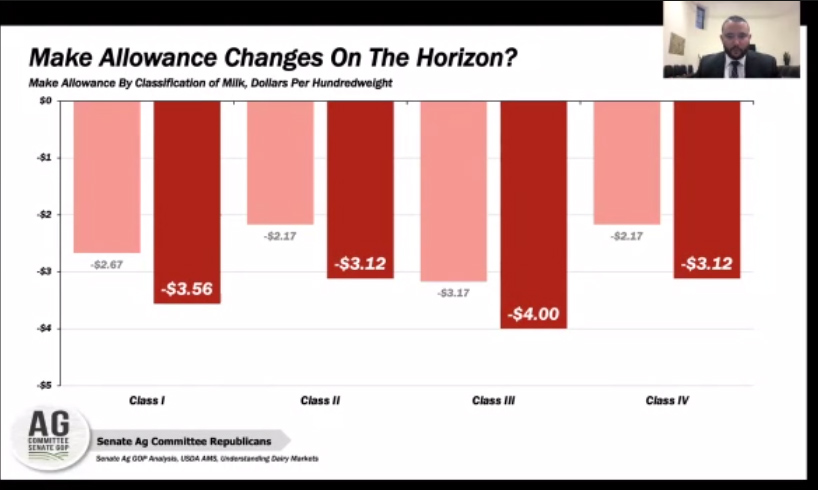
The Class III make allowances for cheese and whey currently total $3.17 per hundredweight, and the Class IV make allowances for butter and nonfat dry milk total $2.17, according to Dr. John Newton, chief economist for the U.S. Senate Agriculture Committee Republicans.

Newton said the new Cost of Processing report shows these make allowances could go up to $4.00 for Class III and $3.12 for Class IV, which represents a nearly $1.00 impact in Federal Order minimum class price reductions if implemented.

“The ultimate result is a reduction in farm milk checks,” said Newton speaking virtually to Kentucky dairy producers at their annual Dairy Partners conference Wed., Feb. 23 in Bowling Green.

“The make allowances are designed to cover the costs of taking raw milk and converting it to these products, where the component value is captured in end-product pricing,” said Newton, observing that they haven’t been raised for more than 10 years, but this hasn’t stopped explosive growth in product production and significant re-blending of farm milk prices in recent years.

“Processors have opportunities to add value in the many other product streams outside of the make allowance and end-product pricing formula, already,” said Newton, noting some of the cumulative numbers and describing this as “effectively a subsidy from farmers to processors to process their milk.”

“This will be a very tough debate, and hopefully farmers are at the table as this debate happens,” he said.