My thoughts on the ABC’s of PA’s state-mandated OOP

By Sherry Bunting, published in Farmshine, May 5, 2023

The purpose of Pennsylvania’s 1930s Milk Marketing Law was to regulate and support the Commonwealth’s dairy industry. Today, it continues to set a retail minimum price for milk through the Pennsylvania Milk Marketing Board (PMMB) while most other states have zero protection against supermarkets using milk as a loss-leader to attract shoppers. 

To me, that’s the real problem. Nationwide, consumers don’t know or appreciate the true value of milk after years of rampant and extreme loss-leading. I’m not talking about random sales to clear inventory, I’m talking about day-in-day-out well-below-cost prices as a retail business model.

Supermarkets chains have gotten into doing their own milk bottling or refuse to pay for services or quality as a way to avoid eating all of the cost of their own decisions to knock the price of milk back several dollars per gallon. They know milk is in 95% of shopping baskets. It’s a staple. If their store brand is the cheapest around, they’ll get your business and sell other high margin items at the same time.

Dairy farmers and milk bottlers, quite frankly, should not be on the hook for that. Period. But indirectly they are.

At the federal level, no one wants to address this because USDA also benefits when it comes to buying cheap (skimmed) milk for food programs like school lunch, where they also reimburse Impossible not-burger, nacho chips and pop-tarts — but not whole milk, only skimmed.

Is it any wonder consumers balk at spending $5 for a gallon of milk in Pennsylvania but will pay $1.50 for a cup of water, even more for a cup of water with artificial additives? 

Is it any wonder consumers don’t think of milk’s nutritional value next to other protein and vitamin drinks? Intrinsically, the higher margin drinks are perceived as more valuable because the price is higher. Milk is perceived as worth less than water!

This makes Pennsylvania a sitting duck in a national, no, a global market. Why? Because Pennsylvania sets a minimum retail and wholesale milk price each month.

Pennsylvania’s Milk Marketing Law prevents supermarkets from selling milk under the monthly announced state-minimum price. The over-order premium (OOP) portion of this price was intended to help Pennsylvania farmers. The Milk Marketing Law already gives the retailers and bottlers a 2.5 to 3.5% profit margin over average industry costs within that set minimum-price buildup.

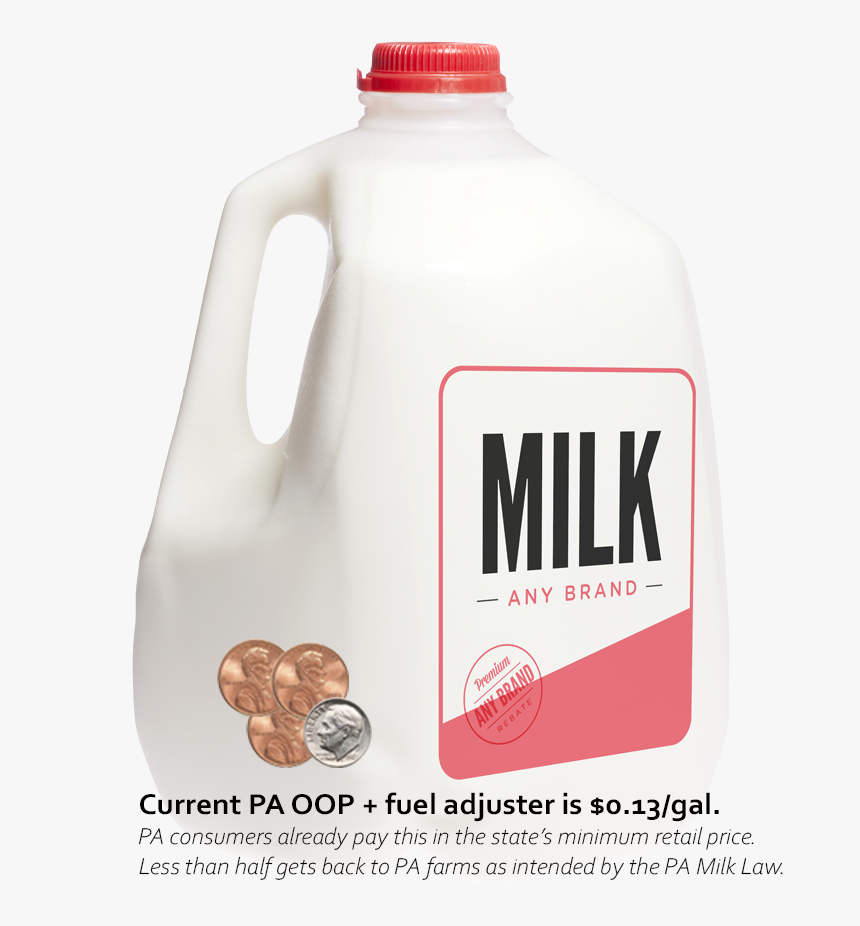
The OOP is currently set by the PMMB at $1.00 per hundred pounds of milk plus a 44-cent per hundredweight fuel adjuster. This come out to 13 cents per gallon paid within the state minimum retail price that is meant to be the farmer’s over-order premium (OOP).

A variety of loopholes have diminished how much of the state-mandated OOP gets back to Pennsylvania dairy farmers as intended by the law. It has encouraged interesting business models that involve more out-of-state milk coming in to displace Pennsylvania milk in some Pennsylvania stores (and some creative accounting for sure).

Whether in tankers or packages, more out-of-state milk is competing with an unfair advantage when the built-in OOP is either collected and not paid to farmers or remains completely undocumented — floating around and up for grabs by the supply chain.

Senate Ag Minority Chair Judy Schwank had an interesting exchange with Chuck Turner of Turner Dairy near Pittsburgh during the recent Senate Ag hearing on the matter. She asked whether or not the aseptically processed, shelf-stable milk, which she buys, has the OOP built into its price.

Good question.

Turner explained that for the members of the Pennsylvania Association of Milk Dealers, the OOP is factored in as a cost that they incur when they procure milk within the state and then return this OOP to their Pennsylvania farmers based on their sales of Class I fluid milk products within the state.

On the other hand, when a Nestle or some other company, like fairlife, makes a shelf-stable flavored milk that ends up in a retail dairy case in Pennsylvania, the OOP doesn’t enter into their thought process on these products coming most likely from Indiana (and New York), he said. To his mind, that means it does not “collect” OOP.

In reality, such out-of-state packaged fluid milk products that fall into the Class I fluid milk category are ‘collecting’ the OOP — even ultrafiltered and aseptically packaged milk. These products compete for Pennsylvania consumer dollars. Whether out-of-state fluid milk products are unflavored or flavored, fresh or shelf-stable, they are part of the unknown number Schwank said the Senate Ag Committee needs to know.

It doesn’t matter if the milk is sold above state-minimum price, the OOP is in there.

Take for example the fresh fluid milk brands that are bottled in Pennsylvania — that are not shelf-stable – but are priced on supermarket shelves above the state minimum retail price.

This happens when stores like Walmart and Costco want to differentiate their private label store brands as the lowest-price. What do they do? They put other brands higher.

Since supermarkets in Pennsylvania cannot go below the state’s minimum price to “loss-lead” with their in-house private label, they bump-up the price on competing name brands instead.

In some cases, this pressures sales volume even lower for name brands that are produced, processed and sold in Pennsylvania, reducing the OOP that goes back to the Pennsylvania farms. At the same time, some of the private-label store brands sold at state-minimum fall into the category of breaking the chain of produced, processed and sold in Pennsylvania, which affords them the ability to keep the farmer’s OOP.

Here’s my bottom line from the recent Pennsylvania Senate Ag hearing on the OOP:

For 15 years grassroots dairy producer groups have been grappling with the concerns shared at the hearing, and how the OOP may be affecting the use of Pennsylvania-produced milk in Pennsylvania consumer markets. The embarrassment of not knowing definitively how much fluid milk is sold in the state and how much premium is stranded off-record or on-record has been the subject of meetings, hearings, estimates, emotion, stonewalling and bickering for over 15 years!

Attempts have been made by lawmakers like former State Senator Mike Brubaker and current State Representative John Lawrence repeatedly putting forward bills that would have penetrated the armor surrounding this issue.

Now, in the past 12 to 18 months, we have the Pennsylvania Farm Bureau on high-alert, the Department of Agriculture now is involved and has come up with a plan. 

The CDE and PDMP are studying the issues around the premium and the obstacles to processing investment with the help of a Cornell economist. 

And the Senate Ag Chairman and Minority Chair offered their data-driven bills last session and will offer them again, because, of course, they are paralyzed by still needing that data they’ve been needing for 15 years!

Now, as the fluid milk market is in steep decline over the past 15 years (ironically the same 15 years in which whole milk and 2% milk have been federally prohibited as choices in schools and daycares)…

Now as most of the milk bottling assets, nationally, are owned by cooperatives and most of the rest by retailers…

Now as fluid milk plants are closing to the south and the west, while Pennsylvania has managed to hold on to a core of independent bottlers…

Now as the state courts the favor of Coca-Cola / fairlife or other new processors to invest in Pennsylvania … (Coca-Cola announced May 9 that New York will get the new plant).

Now as everyone is sitting up noticing that the tens of millions of Pennsylvania-paid ‘stranded’ OOP annually over the past 15-plus years may have been fueling growth beyond Pennsylvania’s borders while Pennsylvania’s own farms have been stagnated by more stringent supply management programs due to lack of processing capacity…

Here we are, back to the question of needing the data. Senators were interested in doing something, but Chairman Elder Vogel, said threading the needle will be difficult, and Minority Chair Schwank said “we have to have the data.”

Pennsylvania is enduring erosion on one hand in part because of the OOP and/or the minimum pricing, while on the other hand, these structures are believed by some to provide a stabilizing effect for the Class I bottlers that remain.

And so, the cats keep chasing their tails around the milk bowl!

Meanwhile, more producers have strived to get some of their milk outside of this game by selling it raw – an entirely separate market. The PMMB reached out to a number of them last year telling them they had to be licensed and do monthly reports, then backed off a bit for the time being. They are not the problem. Their milk is not pasteurized, and it is not part of the system in Federal Milk Marketing Orders either.

My biggest questions after the recent hearing, after 15 years of following this and for a time helping farmers who were involved in seeking changes more than a decade ago: Where would we be today if in any of the prior legislative bills, meetings, hearings, plans, would have moved forward in some fashion? 

And yes, this too is related: Where would we be today if whole milk had not been removed from schools?

One thing is clear on the first question, we would by now have solved the math equation of A + B = C instead of estimating, stonewalling, bickering…

On the second question? We might be selling more milk.

Read Part One and Part Two of the PA Senate Ag Hearing about the ABC’s of the OOP here and here

-30-
Part Two: Digging into the PA Senate Ag hearing on the PMMB over-order premium

By Sherry Bunting, Farmshine, May 5, 2023

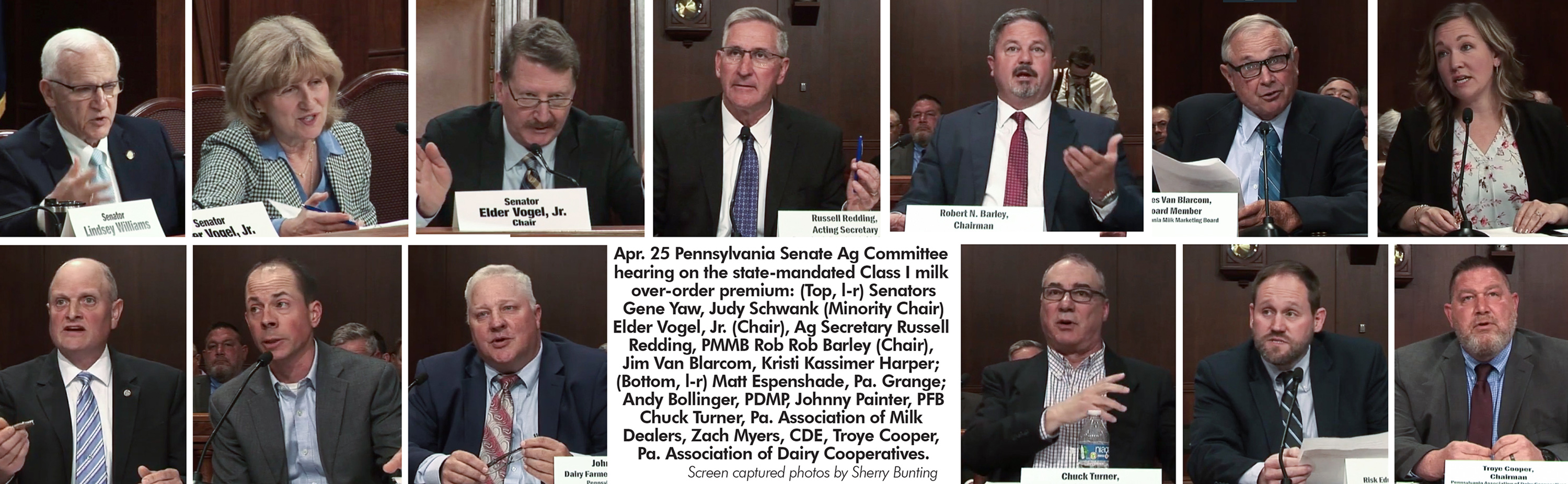
HARRISBURG, Pa. — As reported in Part One, published in Farmshine’s April 28th edition, the Pennsylvania Senate Agriculture Committee held a three-hour hearing on April 25 about the state’s mandated Class I milk over-order premium (OOP), which is part of the state’s minimum milk price per gallon set by the Pennsylvania Milk Marketing Board (PMMB).

Agriculture Secretary Russell Redding offered this equation to describe what is known and unknown about the estimated $30 million or more in annual OOP paid by Pennsylvania consumers: A+B=C.

‘A’ was confirmed by PMMB auditor supervisor Gary Golsovich to be $23.6 million collected by processors in 2022. But, he said, only $14.5 million of this collected OOP was documented as paid to Pennsylvania farms for milk that could demonstrate all three criteria: produced, processed and sold in Pennsylvania.

Golsovich gave an example: A processor sourcing 50% of its milk from Pennsylvania farms with 50% of its sales being consummated in Pennsylvania only has the obligation to pay 25% of the OOP to the Pennsylvania farms. This was something the PMMB tried to change 10 years ago, seeking to require processors to pay up to the percentage of in-state sales that matched in-state sources, but a constitutional interstate commerce challenge in the courts caused the state to back down.

‘B’, said Redding, is the additional $5 to $10 million in OOP that is paid by Pennsylvania consumers but is presently unaccounted for. Examples are packaged milk from out-of-state and other cross-border transactions. Legislation such as Senate Bills 840 and 841 from last session would capture this information, and Senate Ag Chairman Elder Vogel Jr. and Minority Chair Judy Schwank said they intend to re-introduce these bills in the current legislative session.

He estimates the total ‘C’ would be around $30 million, or more, but last year less than half that amount was paid to the intended beneficiaries: Pennsylvania farms.

The only way to fix the leakage, said the Secretary, is to “break the chain,” to remove the OOP from the minimum price and make it a fee collected at retail and remitted to the Department of Revenue into a designated fund. This would also require legislation.

“Pennsylvania has a system that is like no other,” said PMMB Chairman Rob Barley, a farmer in Lancaster and York counties. “The system worked well when people were drinking a lot of milk produced by Pennsylvania dairy producers. That’s changing. The system needs an adjustment.”

When the Senate Ag Chairman pressed the PMMB Chairman for specific ideas, Barley said the Secretary’s proposal, “while not ideal, is probably the only way to do it.”

He mentioned the potential for a tiered or scaled system where smaller farms could receive more and larger farms less, much like the federal Dairy Margin Coverage has a tiered program based on annual milk production history. 

“We want to work with the legislature on this — to benefit everyone,” said Barley.

The consumer member of the PMMB board, Kristi Kassimer Harper from Fayette County, noted examples in her area of western Pennsylvania, where the OOP works among a variety of independent bottlers that buy Pennsylvania milk, process it in Pennsylvania and sell most of it in Pennsylvania.

She cited studies by St. Joseph’s University indicating consumers don’t give much thought to where their milk comes from, but a survey of Pennsylvania consumers showed that two-thirds would pay a 10-cent premium if the premium gets back to the farmers. (They are already paying a 13-cent OOP plus fuel adjuster embedded in the milk price, but less than half of it is getting back Pennsylvania farms.)

In his back-and-forth discussion with Vogel, Barley said a formula could be developed that would prioritize producers that are currently serving the Class I fluid milk market, using a graduated scale. This idea turned Chairman Vogel’s head. He said it’s the first time he’s heard this approach mentioned.

Something like this would address the concerns of milk dealers who are currently upholding the spirit of the law and the testimony from the State Grange, urging caution about diluting the meaningful amount of OOP 15 to 20% of Pennsylvania farms currently receive.

“Consumers are already paying this, it’s not a tax, but if we collected it from Pennsylvania retailers as a fee and put it in a restricted fund, we can avoid the constitutional issues with interstate commerce,” said Senator Gene Yaw. “We do this all the time, collect funds and put it toward programs we want to support. In this case, the people are already paying it, and if the money is in one place, we can audit it.”

The “mechanics” of how to distribute it, he said, can be worked out with the Board and the industry. But at the same time, Yaw and other Senators said they want to help more of the state’s farmers access what was intended for them, without harming those already receiving some.

Meanwhile, the Department of Agriculture’s plan mentions ‘uniform distribution,’ as do the policy points endorsed by Pennsylvania Farm Bureau.

PMMB board member Jim Van Blarcom, a farmer from Bradford County, stated that in his nine years on the Board, he has heard the concerns of producers across the state. He noted the geographic and generational diversity of the PMMB Board, and their ability to understand how different parts of the state have different experiences with the OOP. 

“The OOP was put in place to help dairymen recoup some costs,” said Van Blarcom, explaining to lawmakers that the Milk Marketing Law already has built into it a 2.5 to 3.5% profit margin for bottlers and retailers. “Since then, the industry has changed, making it outdated and less effective. As a board member, it is getting more difficult to weigh the benefits for the farmers who receive a useful OOP vs. farmers who receive very little to none. When consumers pay a mandated 8 to 12 cents on every gallon of milk sold, this becomes a large sum of money, of which some is unaccounted for.

“During my time on the Board, I have heard over and over about the tanker loads of New York milk coming in and displacing Pennsylvania farmers’ milk. The primary reason these companies do this is they can take advantage of the OOP… We are essentially encouraging this to happen,” he explained.

Recounting testimony at a Board hearing from a dairy farmer milking 90 cows, he said the amount of OOP that farm received wass equivalent to one bag of milk replacer a month.

“I don’t believe one bag of calf feed keeps that farmer in business, but rather his tenacity and commitment to the family farm,” said Van Blarcom.

He also recounted testimony at a Board hearing from Pennsylvania Representative John Lawrence, who cited the accurate accounting on mandated fees for alcohol and fuel.

“This is not happening with the mandated milk OOP. It will continue to become more difficult to defend as a program with funds that are not accurately accounted for and not fairly distributed,” Van Blarcom asserted, adding that consumers will also “become more aware of the unfairness to themselves.”

Meanwhile, when laying out the Department of Agriculture’s plan, the Secretary talked about “a collective investment in PA Dairy,” such as using some of these funds to invest in processing.

Andy Bollinger, a Lancaster County dairy farmer testifying for PDMP said the organization has not taken a position on reforming the OOP because they want to see the facts and the results of a study they are working on with a third-party economist.

Zach Myers from the Center for Dairy Excellence also mentioned a study CDE is involved in to understand the obstacles to processing investment within the state. He cited the impact on farms from supply management programs placed on them based on processing capacity.

“We come to you and ask for investments,” Secretary Redding told lawmakers. “Here’s one that’s already done in the marketplace, and we’re failing to bring those dollars back specifically to reinvest in PA Dairy.”

-30-

Little bit new, little bit Dé-jà vu – PA Senate Ag hearing digs into ABC’s of milk OOP

Data and reform needed, but is Secretary eyeing portion of estimated $30 million-plus for ‘dairy reinvestment’?

By Sherry Bunting, Farmshine, April 27, 2023

HARRISBURG, Pa. – Little bit new, little bit Dé·jà vu. (That’s French for ‘the feeling of having experienced this situation before.’) 

Those first thoughts came to mind listening to the Pennsylvania Senate Ag Committee’s hearing Tuesday (April 25) on reforming the state’s mandated over-order premium (OOP) that is part of the state’s minimum wholesale and retail milk prices, set by the Pennsylvania Milk Marketing Board (PMMB).

Ag Secretary Russell Redding laid out for state lawmakers the Department of Agriculture’s plan to seek reforms that: 1) uniformly and fairly distribute the OOP, 2) ensure the amounts charged to Pennsylvania consumers substantially equal amounts distributed back to farmers, and 3) uses a distribution system that does not have incentives to avoid paying Pennsylvania producers by selling milk from across state lines.

He said the Department is a “reluctant participant” but sees the need to make the “collective case” for the “composite of Pennsylvania Dairy.”

“We believe there are inequities, and we see division and growing farmer mistrust,” said Redding. “We knew there were data gaps in our petition last year… Think about the OOP as an equation: A + B = C.

“What we know today is that of the $23.6 million in OOP collected by processors in 2022, $14 million was required to go back to farmers. That’s A. 

“B is generated in the marketplace but not collected,” he explained. “Our belief is that this is another $5 to $10 million (annually). 

“C is the total that we believe is in the neighborhood of $28.6 to $33 million. The question is, what do we do about it?” he asked.

He answered to say the only way to fix this is to change the system and begin removing the OOP from the minimum price buildup and instead have the PMMB establish a retail-based premium, collected at that point of sale and remitted to the Department of Revenue into a designated fund.

This would require the legislation.

“The General Assembly could then appropriate direct payments to producers and to reinvestment in dairy processing,” said Redding.

The Secretary called it an “embarrassment that we don’t have this number (B)” to complete the A + B = C equation, but as he talked about the PDA’s plan, we heard articulated for the first time this idea that once numbers can be put to the equation and legislative authority for the Board to devise a formula, the OOP could become a “milk tax.” 

The difference being that many consumers don’t know they are already paying the OOP, but when pulled out of the minimum price buildup, it becomes a known quantity.

“We trust the state to do this with liquor, cigarettes and liquid fuel. The legislature could decide how these funds would be used, and a portion could be used to help processors invest or reinvest,” said Redding.

In fact, Zach Myers for the Center for Dairy Excellence said a study is underway to assess the obstacles that are preventing processing investment and reinvestment in Pennsylvania.

PMMB Chairman Rob Barley noted that, “It’s certainly time to evaluate how the OOP dollars get back to farmers and not pick winners and losers. The over $800 million that has gone back to dairy farmers since 1988, especially when the majority of it did, no doubt made a positive difference, but that is changing,” he said. “Fluid milk sales have dropped in half (since then), and it is difficult to account for the dollars with the current tools that we as a Board have.”

Barley noted that if the process moves forward to reform the structure, perhaps other products could be eventually added.

“Right now we don’t have the authority to do any of this. Going back to the 1988 testimony, the primary reason the over-order premium was added (to Class I) is that was the practical point, that was the mechanism already in place for fluid milk. There is no such system for other classes, and Class I is also more of a localized product, which I think is still true today,” Barley explained.

Going forward, he said, the choices for the Board are “to get rid of what we have, which is a choice many are not in favor of, or to have legislation to change the OOP without violating interstate commerce, or to develop a new system that strengthens the Pennsylvania dairy industry to benefit all sectors.”

Redding stressed the point that, “This is all about the dairy farmer, how do we incentivize what we need? Keeping our eye on the farmer and understanding we can do something extraordinary here, we have this opportunity to extract this premium from the marketplace and get (the OOP) back to farmers and for the purposes of reinvestment…”

That’s the New. Now for the Dé·jà vu…

The next thought to emerge in this reporter’s mind after hearing the new twist on OOP as ‘milk tax’ and a portion for ‘reinvestment’ was this: Everyone is at the table now, sitting up, alert, paying attention, and offering solutions after 15-plus years of meetings, hearings and discussions. But the same bottomline emerges: everyone still wants a dip of the farmer’s elusive cream.

Not 15 minutes later, after PMMB board member Jim Van Blarcom testified, his Senator Gene Yaw of the northern tier counties shared a similar thought about how this may be already happening within the minimum price buildup in a rapidly changing industry.

“We made this so complicated and there are too many fingers in this pie, frankly,” said Yaw, asking whether processors get any of this money, now.

PMMB auditor supervisor Gary Gojsovich answered that the OOP is currently collected by processors through their sales, and they pay it back to Pennsylvania producers only when the milk is produced, processed and sold in Pennsylvania, all three must apply.

“In the simplest terms, it sounds like we need to change how the premium is collected and the point of where it is collected,” Senator Yaw responded.

Senator Judy Schwank representing parts of Berks County said: “We need the data. We have to have the data.”

So, we are back to the data. 

The Secretary called it an “embarrassment that we don’t have this number.”

Chairman Elder Vogel and ranking member Schwank said they plan to reintroduce their bills that did not move forward in the last legislative session that would give PMMB authority to license distributors, a move that would account for all packaged milk sales coming into Pennsylvania from out-of-state and other cross-border transactions, which ‘strand premiums.’

A quick history

For decades, there have been meetings and hearings and discussions about the future of the Pennsylvania Milk Marketing Law and the PMMB that sets minimum wholesale and retail milk prices. The law dates back to the 1930s, but the mandated OOP was introduced to the existing structure during a year of drought and high feed prices in 1988.

At that time, the state’s OOP was set by the Board at $1.05 per hundredweight (9 cents per gallon). Today it is $1.00 plus a 50-cents per hundredweight fuel adjuster (combined is 13 cents per gallon). 

At intervals before 2018, the OOP was as high as $3.00 plus a fuel adjuster (over 26 cents per gallon). In 2017, it was nearly $2.00 (17 cents per gallon), but was abruptly cut in half in December of 2017 due to the pressure of out-of-state milk — a harbinger of things to come just four months before Dean Foods announced it was ending contracts with 130 dairy farms in 8 states, 42 of them in Pennsylvania and five months before the startup of the Walmart bottling plant in Indiana.

Also included in the minimum resale and retail milk price buildups are the Federal Order price benchmarks, which vary geographically because Pennsylvania is split between two different Federal Orders. To this minimum federal benchmark price, the OOP is added, translating now to about 13 cents per gallon. 

Also added are the average cost recovery amounts for bottlers and retailers as determined by annual hearings for each area of the state, along with adding the 2.5 to 3.5% profit margin the Milk Marketing Law guarantees milk bottlers and retailers on top of the average cost recovery.

What has come under fire, especially since 2009, is the producer OOP, how it is collected and passed back to farmers, how some of it is stranded and how the changing dairy industry has impacted the real and perceived equity of the distribution of these funds.

Lawmakers made it clear that they look at this as two distinctly separate things, the collection is one issue, and the distribution quite another.

Among those testifying, the amount of the current OOP at $1.50 including fuel adjuster that is received on their farms ranged from 6 cents to 50 cents.

The bottomline is for all of the PMMB’s efforts to expand communication and transparency with the tools available, even board member Van Blarcom conceded that it is becoming more difficult to justify the OOP to his peers.

For his part, Matt Espenshade, a Lancaster County dairy farmer representing the State Grange, told lawmakers that producers and cooperatives that are ‘in’ the Class I market take risks and have requirements other class markets do not experience. 

He cautioned against reforms that would dilute the premium for the 15 to 20% of state farmers currently receiving a meaningful amount because they have costs and risks associated with that reward.

Johnny Painter, a Tioga County dairy farmer testifying for the Pennsylvania Farm Bureau advocated for a uniform distribution of the OOP in reforms that would have the state collect it all. He said farmers in all classes of milk have the same quality standards to meet. 

When pressed by Senator Schwank on why PFB made policy to end the OOP, Painter said it was a tactic to get the dialog started.

Troye Cooper for the Pennsylvania Association of Dairy Cooperatives and a member services director for Maryland and Virginia Cooperative said those receiving very little OOP are part of the 3500 Pennsylvania dairy farms shipping milk through cooperatives that perform essential “balancing” services for the fluid milk market. As coop members, they share in the cost of that.

However, what remained unspoken in his testimony is that the current minimum wholesale and retail milk price buildups now include a roughly 25-cent ‘co-op procurement cost’ for these balancing services along with the requirement that cooperatives list on member milk checks how much of the producer OOP was included. 

Representing the Pennsylvania Association of Milk Dealers, Chuck Turner of Turner Dairy near Pittsburgh, pointed out that fluid milk sales are declining, and other class products are increasing. He asked how bottlers can continue cutting checks to the Federal Orders to bring up the payments for other class milk while reducing the payments to their own shippers when their own fluid milk market volumes are shrinking.

“The fluid milk business is in tough shape. Sales volume has trended downward for 13 years by more than 20%. That’s 1 gallon in 5 lost, 1 plant in 5 closed. It can’t bear the burden for the other classes. It seems particularly unfair with sales growing in the other categories,” said Turner, noting that plants outside of Pennsylvania have been closing “at an astonishing rate.” 

He said the number of independent milk processors in the U.S. fell from 69% to 44% in 2020, whereas in Pennsylvania, independent bottlers still represent 62% of the fluid milk, and he credited the PMMB system for that difference.

Myers noted that Pennsylvania is the state with the second most dairy farms and the fourth smallest average herd size, with production costs that are higher than in some neighboring states. 

He cited loss of market premiums, including quality premiums, the impacts of other price erosion such as Federal Order make allowances that a potential hearing could further degrade. 

Compared to the U.S. All-Milk price published monthly by USDA, Myers noted the Pennsylvania All-Milk price used to be higher than the U.S. average, but this gap has narrowed significantly in the past 15 years.

“It was $1.73 per hundredweight from 2008 to 2012, averaged $1.29 from 2013 to 2017, and in the last five years, it has narrowed to just 49 cents, on average,” said Myers.

In fact, during the pandemic in 2020-21, the Pennsylvania All-Milk price averaged 18 cents less than the U.S. All-Milk price, according to Myers.

“There are several factors for this narrowing, but it’s safe to say it can’t be fixed by increasing the premiums,” said Myers, noting that 80% of the milk produced in Pennsylvania is marketed through cooperatives, and there are cooperative base programs limiting expansion on Pennsylvania farms.

These coop base programs and penalties affect the dairy farms and are in part tied to the limits in processing capacity.

Meanwhile, there were several references by testifiers citing milk coming from New York into Central Pennsylvania for processing and sale and displacing milk produced in that area. The OOP, of course, stays with that retailer, processor and/or cooperative as part of their business model to expand their state’s markets into Pennsylvania so their producers can grow.

“When that premium goes back to New York, that’s exactly what is playing out, and it feels like an injustice to be asking our consumers to pay it without regard to that investment,” said Redding. “We want to capture that premium and put it back into our Pennsylvania dairy farmers.”

The problem, said Barley, is the PMMB can’t just “grab that money and give it to Pennsylvania farmers if the milk is not produced, processed and sold in-state without being challenged in court as in the past on the grounds of violating the interstate commerce clause.”

Senator Yaw interjected that, “If the milk is sold here, we should give the premium back to our farmers. If the milk came from New York, those farmers should not benefit from what we are doing to support Pennsylvania farmers.”

Redding said lawmakers “do not have to wait for the data. The bill on licensing distributors could go forward along with a bill to set up a structured system, assuming the amount to be around $30 million, and we believe it to be higher, to decide how to distribute that revenue.”

Redding said his fear is that as the frustration undertow grows, Pennsylvania will lose this premium without action.

He pointed out that his committee “kept its promise” to get everyone around the table to hear ideas, but that it will be “difficult to thread this needle and it will require collaboration.”

Ranking member Schwank said everything hinges on getting the data that is needed to know how to proceed.

Click to read Part Two.

-30-

‘Got milk, PA? Ag Sec awards $400,000 Farm-to-School, but where’s the milk?

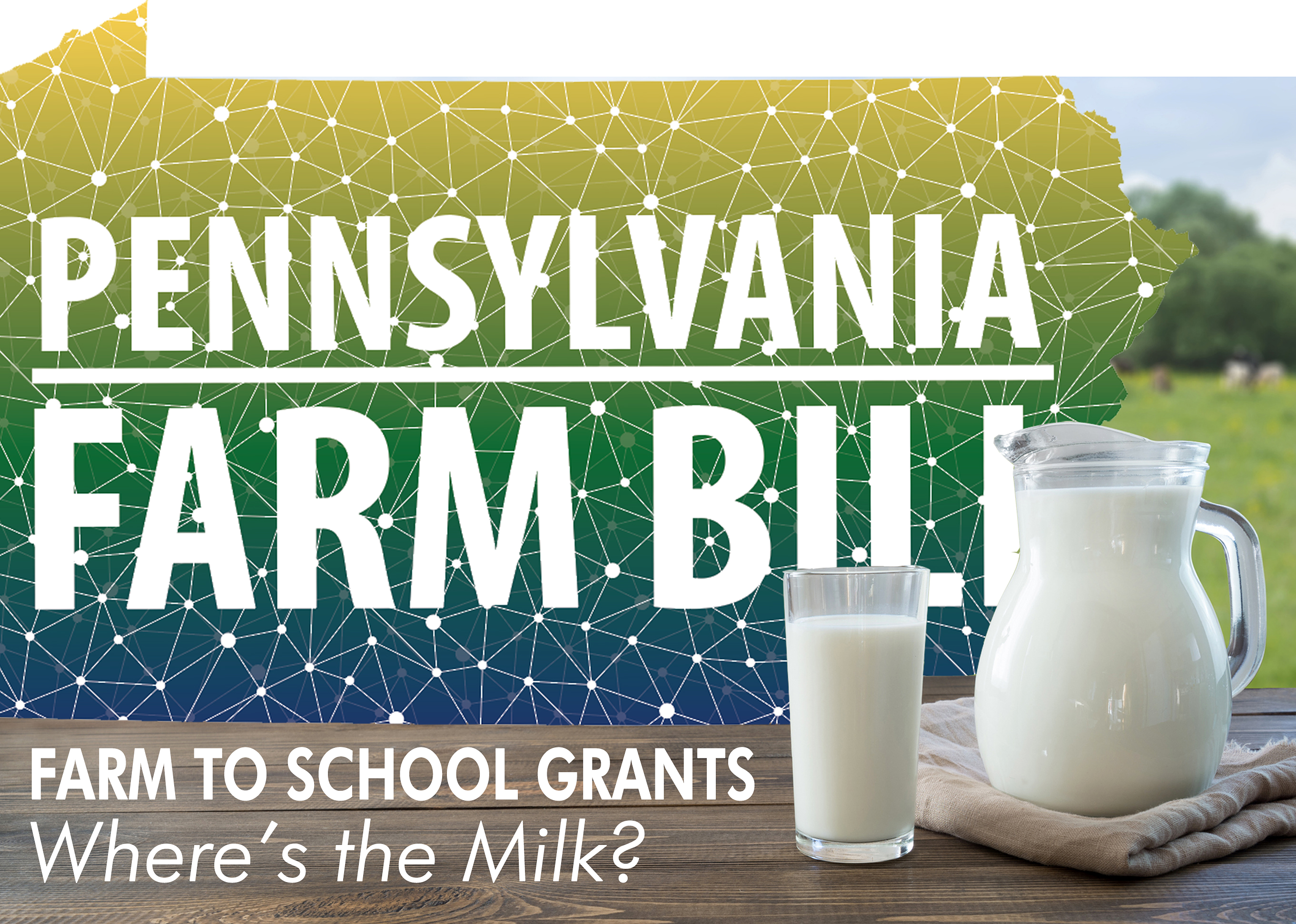
PA Farm Bill Farm-to-School education grants aim to bridge the gap between children and the food system by connecting them to the fresh, healthy food available from Pennsylvania agricultural producers in their community and the surrounding areas. The 39 grants announced April 30th, totaling $400,000 for 2020-21, and they are thin on real dairy even though real dairy is 37% of Pennsylvania’s agricultural economy. Composite image by Sherry Bunting

By Sherry Bunting, Farmshine, May 14, 2021

HARRISBURG, Pa. — Increasing childhood nutrition and agricultural awareness is the stated purpose of $400,000 in grant awards made recently as part of the Pennsylvania Farm Bill.

On April 30th, Pennsylvania Secretary of Agriculture Russell Redding announced 39 Farm to School grants of up to $15,000 each “to improve access to healthy, local foods and increase agricultural awareness opportunities for children pre-kindergarten through fifth grade.”

The trouble is, among the 39 projects receiving the total of $400,000, dairy is not mentioned, even though the Secretary recently confirmed when asked by state senators that dairy accounts for 37% of the Commonwealth’s agricultural backbone.

(As reported in Farmshine April 23, the Secretary also evaded Senate questions about legalizing whole milk as a simple choice for children in Pennsylvania schools, citing instead that the Dietary Guidelines maintain three servings of dairy a day and that the industry should focus on all the dairy products in school meals.)

“The children of today are the future of Pennsylvania agriculture,” said Redding in a press release announcing the $400,000 in Farm to School grants that are part of the PA Farm Bill’s 2020-21 budget cycle.

“Reviewing these 39 projects, and their goals to invest in programming that not only improves childhood nutrition but gives them opportunities for first-hand agricultural experiences to grow their knowledge and awareness, I see a bright future for the industry that feeds Pennsylvania,” Redding stated.

According to the Pa. Department of Agriculture statements, this grant program “aims to enrich the connection communities have with fresh, healthy food and local producers by changing food purchasing and education at schools and early childhood education sites.”

Any school district, charter school or private school with pre-kindergarten classes, kindergarten, or elementary through fifth grade was eligible to apply.

This week, Farmshine questioned the Pa. Department of Agriculture about the glaring absence of milk in the list of 39 grants awarded. Most of the grants involved school gardens and were tied to local produce grown in Pennsylvania. Some were projects linking to local poultry and eggs.

Dairy and beef were not mentioned at all. The only (not really) dairy reference in the Department’s press release was a grant to the Dubois Area School District in conjunction with Danone North America.

Before thinking Danone represents dairy in this case, think again.

Dubois is home to Danone’s flagship plant-based dairy-free alternative ‘yogurt’, ‘cheese’ and powdered ‘nutritional’ beverage plant.

In fact, Danone’s 180,000 square foot facility on 24 acres of the former airport in Clearfield County is the largest plant-based dairy-alternative plant in the United States.

At the 2019 ribbon-cutting ceremony for Danone’s multi-million-dollar plant-based expansion, the facility’s director, Chad Stone, highlighted “flexitarian” eating patterns as “people are interested in lessening their impact on the environment through diet.”

This plant-based “environmental” theme is already being pushed into school curricula and school foodservice at the national level (see related article in this edition of Farmshine).

In the Pa. Department of Agriculture’s response to our questions about the Farm to School grants lacking dairy, spokesperson Shannon Powers replied to identify five of the 39 grants as “including a dairy component in their application.”

One of the five she highlighted is the Clearfield County grant of $14,985 to the Dubois Area School District for “experiential learning and curricula” that includes “life on a dairy farm” via a field trip to a dairy farm (Kennis Farm was identified in the application). Powers also identified Danone as “a major dairy producer” but indicated that this grant provides experiential learning and curricula through the Danone facility in Dubois “that produces plant-based foods and beverages.”

Instead of using real local milk to make real yogurt, cheese and nutritional beverage powders, this Danone plant specializes in bringing in almonds, coconuts and cashews to make dairy substitutes as a so-called means of reducing “environmental impact” with new “choices” on grocery shelves.

(It’s hard to imagine how the almonds, cashews and coconuts listed in the Vega Protein, So Delicious and Silk brand yogurt, cheese and powder made at the Dubois plants could be locally-grown in Pennsylvania, a top-10 real dairy milk-producing state that is admittedly in ‘search’ of more dairy processing capability).

As for the other four Farm to School grants the Department identified in an email response as containing a dairy component, they are as follows:

In Erie County, a grant for $15,000 to the U.S. Committee for Refugees and Immigrants will do an experiential learning project that includes a dairy field trip.

In Lawrence County, the LCSS Healthy Start Micro Farm Project received $10,000 for a project that includes the purchase of local cheeses and other foods along with a school garden to supply the school kitchen.

In Lackawanna County, a grant of $3,356 to the Bright Future Learning Center was awarded to distribute Community Supported Agriculture (CSA) boxes to preschool children and includes farm field trips. The application noted that fresh local milk would be included in the CSA produce boxes.

In Tioga and Bradford counties, a $15,000 grant was awarded to Stepping Stones Preschool and includes a field trip to a dairy farm to learn about the cheese-making process.

“The PA Farm Bill’s Farm to School grants are awarded to schools and other educational entities to foster early interest in and exposure to agriculture careers and to encourage students to consume fresh, locally-produced foods and develop healthy eating habits,” writes Powers in her Pa. Department of Agriculture response to Farmshine’s questions.

She notes that while dairy is not specifically mentioned in applicants’ proposals, “dairy destinations and themes are included among field trips, and dairy is part of curricula schools develop with grant funds.”

Dairy products are already “virtually always among PA-produced foods served in schools but getting locally-sourced produce into school lunch programs is a greater challenge,” Powers as Pa. Dept. of Agriculture spokesperson stated.

While dairy has been a predominantly ‘local’ product in schools over the years, today, local dairy’s position in Pennsylvania schools is waning. A good example is the removal of the choice of whole milk from schools in 2010 when the federal government tied school lunches more closely to USDA’s flawed Dietary Guidelines.

The most local dairy product available to any school is whole milk. Instead, today, with only fat-free and 1% low-fat milks permitted in schools, and a complex set of rules for meals to mandatorily conform to Dietary Guidelines, large foodservice companies – including PepsiCo – promise ‘guaranteed compliant’ meals and beverages, and schools are moving toward this type of sourcing.

In fact, the beverages students purchase after discarding fat-free and 1% low-fat milk are anything but local or nutritious, but they meet USDA government guidelines because they contain no fat and are formulated with high fructose corn syrup and artificial sweetener combinations to meet calorie thresholds.

According to the Pa. Department of Agriculture, there were 57 applicants for this second round of Farm to School grants. The Farm to School grants were created under the 2019 PA Farm Bill and were funded again in 2020 and proposed for re-funding in the Governor’s 2021-22 budget.

When asked about grant applications that were denied, Powers replied: “Applicants not awarded grants did not meet the criteria or submitted incomplete applications. None of those applications included a dairy element.”

Our questions to the Center for Dairy Excellence, asking if they were aware of any Farm to School grants applications that involved curricula to highlight dairy or connect schools with local dairy, were not immediately answered; however, the Pa. Department of Agriculture in its response was quick to point out its other programs for dairy, as follows:

“The PA Dairy Investment Program in 2019 and Dairy Indemnity Program in 2020 are examples of state funding that has been available exclusively for dairy producers,” writes Powers. “In addition, the PA Farm Bill and Ag research grants include research dollars devoted to developing healthy, economical feed and bedding and controlling disease; conservation dollars to help improve soil and water quality and ensure future productivity; an Agricultural Business Development Center to help connect farmers with funding, grant resources, transition planning and a host of other support that benefits all Pennsylvania producers, including dairy.”

Powers also mentioned “Preferential tax programs like Clean & Green, REAP, Beginning Farmer Tax Credits, and a number of grants from other departments, including the departments of Environmental Protection and Community & Economic Development are available to dairy farmers” and reminds dairy producers seeking financial and planning resources from the state and private partners to “contact the PA Agricultural Business Development Center or the Center for Dairy Excellence, another state-funded entity created specifically to support the needs of PA dairy farmers.”

In a nutshell, the Department of Agriculture views dairy products in schools as already being local and is focusing Farm to School grants on getting other local products, especially produce, into schools. The Department was quick to identify a handful of the 39 Farm to School grants that will include a dairy farm field trip component. One grant the Department highlighted includes experiential learning by visiting a dairy farm and then visiting a plant-based alternative dairy replacement processing facility. And, the Department believes it is providing considerable financial and resource help to dairy farmers to improve their sustainability and to diversify or “transition.”

-30-

PA Ag Secretary Redding sidesteps school milk question, cites other priorities

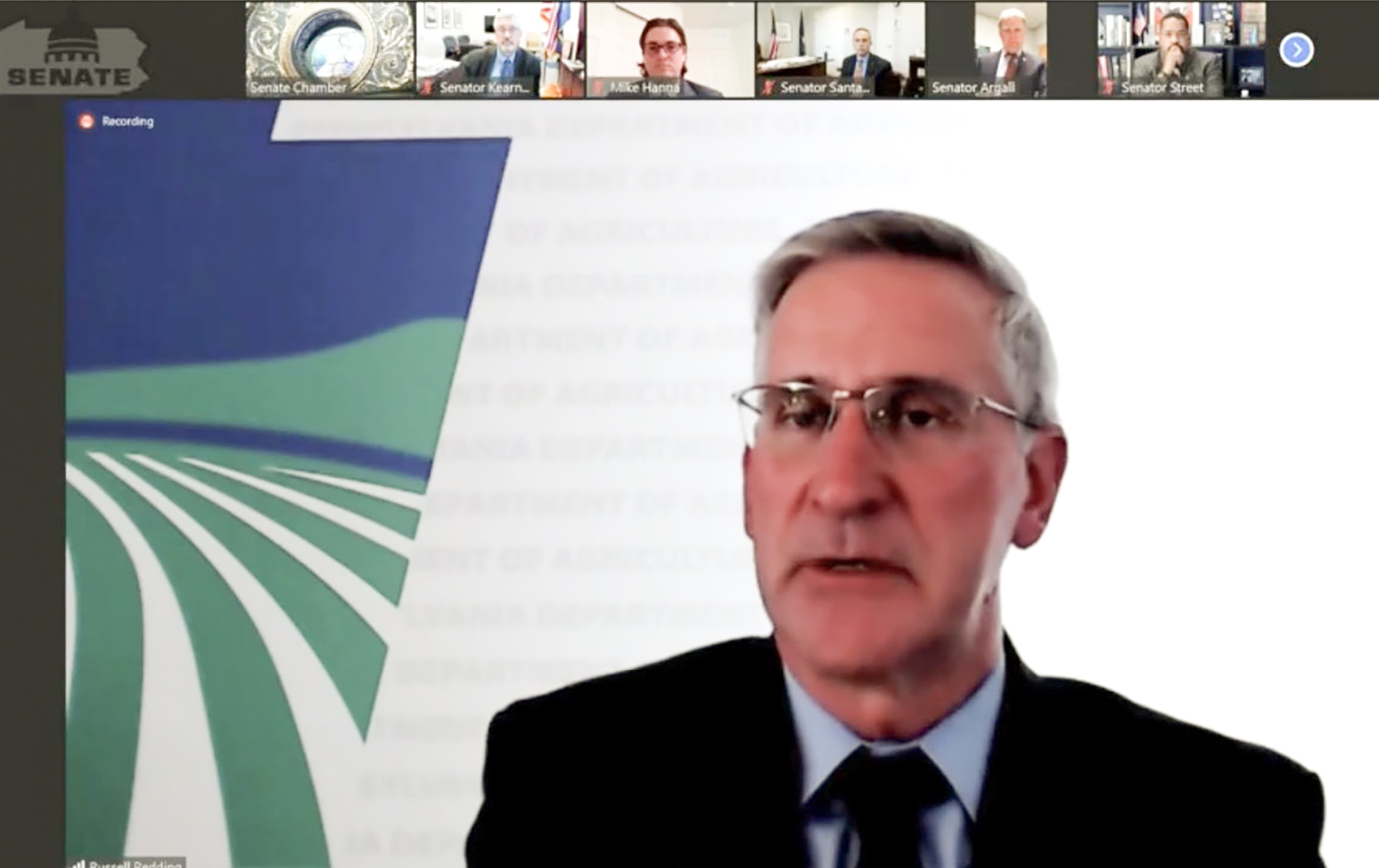
Pa. Agriculture Secretary Russell Redding sidestepped questions about school milk during State Senate budget hearings. He listed other priorities of advocacy in the “federal conversation” and cited the need for new processing for Pennsylvania’s dairy future. Screenshot photo of hearing on zoom

By Sherry Bunting, Farmshine, April 23, 2021

HARRISBURG, Pa. – During the Pennsylvania Senate budget hearings in April, in a question-and-answer exchange with Senator David Argall, representing Berks and Schuylkill counties, Agriculture Secretary Russell Redding talked about advocating for trade agreements, pricing policies, dairy investment and nutrition in “the federal conversation.”

However, on the question of advocating to legalize whole milk choice in schools? Asked twice. Not answered.

In fact, the Secretary’s entire agriculture budget testimony included just one small paragraph about dairy — something Sen. Argall picked up on and questioned. He asked Redding what portion of overall Pennsylvania agriculture is represented by dairy, to which the Secretary replied “about 37%.”

When pushed on what the department is doing, Redding said: “I can tell you dairy is about 37% of my conversations — even though the testimony doesn’t reflect that.”

“We have made real progress in dairy and have been part of that conversation, but there is still more to do for dairy to remain viable and remain at 37%,” said Redding, citing the work of the Dairy Futures Commission, but few details.

Asked to look five to 10 years down the road, the Secretary said the dairy industry has had some “really incredible years in the last five and some incredibly bad years in the last five. It is always going to be sustainable,” he said, “but the question is: Are we going to have those good years to make up for the bad years?”

(It has been seven years since a truly good year was experienced by dairy producers.)

The Secretary pinned the hopes of the future for dairy in Pennsylvania on “getting new processing.” 

Redding stated: “We can compete on the farm. We can compete as a state. But we have to compete at the marketplace too. I remain encouraged by what we’re doing, but we have to keep pressing to make sure we get the right state and federal policies.”

However, there is one federal policy at the core of fluid milk marketing that the Secretary evaded.

Sen. Argall pointed out the 2010 federal policy that removed whole milk from schools.

“Do you see a solution to that issue, and is that really a big part of the overall problem?” the Senator asked.

“I think it is certainly a contributor, and I hear it all the time about whole milk. But what I try to encourage the dairy industry is to look at where total dairy consumption is — the 1%, the 2%, the whole milk — and can you get more cheese, get more yogurt in, can you get more dairy products into that school diet,” Redding replied.

“I think that’s probably what we have to keep our eye on,” he continued. “It’s going to take all of that product mix for us to turn this trend around of just dairy consumption generally. It’s a complicated equation. All of us need to keep pressing on the Congress to do more, to keep our trade agreements in place, and I can tell you… we’ve had some difficult (trade) steps for the last several years.”

(The last several years saw record volumes of exports. Tom Vilsack, current U.S. Ag Secretary and former U.S. Dairy Export Council president wrote in a blog post that 2018 was “a banner year for dairy exporters.” We all recall what 2018 was like for dairy farmers.)

Sec. Redding also referenced the negative PPDs on milk checks as an issue. He stated that, “The price difference between Class III and IV has cost Pennsylvania dearly, so that’s also part of the federal conversation.”

Sen. Argall picked up on the Secretary’s mention of ‘federal conversation,’ asking a second time about whole milk in schools.

“Are you working with anyone across the country to try to repeal that portion of the (federal) act that has greatly reduced the number of students (allowed) to drink whole milk in the schools?” the Senator asked.

“We have not been engaged in repeal. We have been engaged in what I mentioned earlier, about making sure that the Dietary Guidelines include dairy, and they do continue the three a day,” said Redding. “We have continued to advocate for continued investment in dairy, making sure that we do the trade (exports), making sure we have the pricing pieces.”

The Secretary went on to say; “We are advocating at a lot of different levels for dairy on the nutrition side and also the dairy investment side.”

In regard to new processing, after years of discussion, two dairy bills were passed by the House in the 2019-20 session, only to die in the Senate Ag Committee. One was a dairy keystone opportunity zones bill and the other was a bill dealing with transparency and distribution of state-mandated over-order premiums. Both bills, sponsored by Rep. John Lawrence had passed unanimously or nearly unanimously in the House last session.

During a meeting last week of the Grassroots PA Dairy Advisory Committee, Berks County dairy farmer Nelson Troutman, a committee member, noted a dairy redevelopment project in his county that looked to be a sure thing, only to be dropped.

Meanwhile, Pennsylvania has dropped from fifth to seventh, and now eighth in the nation in dairy production.

“This has gone on as the dairy industry consolidates,” said Mike Eby, a Lancaster County farmer, member of the grassroots committee, chairman of National Dairy Producers Organization and executive director of Organization for Competitive Markets.

“The Secretary mentions the momentum we have from fluid milk consumption rising recently. Increased sales of whole milk are a key to that increase. Legalizing whole milk choice in schools makes sense for children and dairy farmers,” Eby explained.

“Everything is political in this. Why do we not have whole milk in schools? People have no clue how important this is for dairy farmers. We have already lost a generation of milk drinkers,” notes Dale Hoffman, a Potter County dairy producer and member of the grassroots committee having worked on this issue for several years. 

Even the Pennsylvania Dairy Futures Commission, which was referenced by Sec. Redding in his comment about “making progress,” addressed the issue of whole milk in schools. 

The Commission was established by the state assembly in 2019 and issued its lengthy report in Aug. 2020 on a broad range of dairy issues. In one area of the report, the Commission made recommendations to improve the school milk experience, specifically stating: “Federal school milk program standards should allow the flexibility to offer a choice in flavored and unflavored milk, including whole milk.”

While several key state lawmakers report they are looking for an opening to do something on this at the state level, Secretary Redding evades the question, even changing the subject when asked about whether he is advocating for this in the federal conversation.

Instead, the Secretary responded by saying the Department advocates in the federal conversation for trade agreements, pricing pieces, and on the nutrition side being satisfied to have the ‘3-a-day’ in the school diet.

Here are a few questions Pennsylvania dairy producers may want to ask Pa. Ag Secretary Redding, by contacting the Pa. Department of Agriculture at 717-787-4737.

— Why does the Secretary advocate for ‘trade’ while completely sidestepping the question about advocating for whole milk choice in schools?

— Does the Secretary support Congressman Glenn “G.T.” Thompson’s bill H.R. 1861 Whole Milk for Healthy Kids Act to legalize whole milk choice in schools?

— Will the Dept. of Agriculture advocate for the health of children and the Commonwealth’s ag community by advocating for the bipartisan efforts to bring the choice of whole milk back to schools?

— In the budget hearing, Sec. Redding again identified the need for more processing in Pennsylvania. With properties up for redevelopment over the past few years in the heart of dairy areas, what is being done to encourage redevelopment projects for dairy processing?

— Given at least one such project was underway and then abandoned, what are the influences and obstacles?

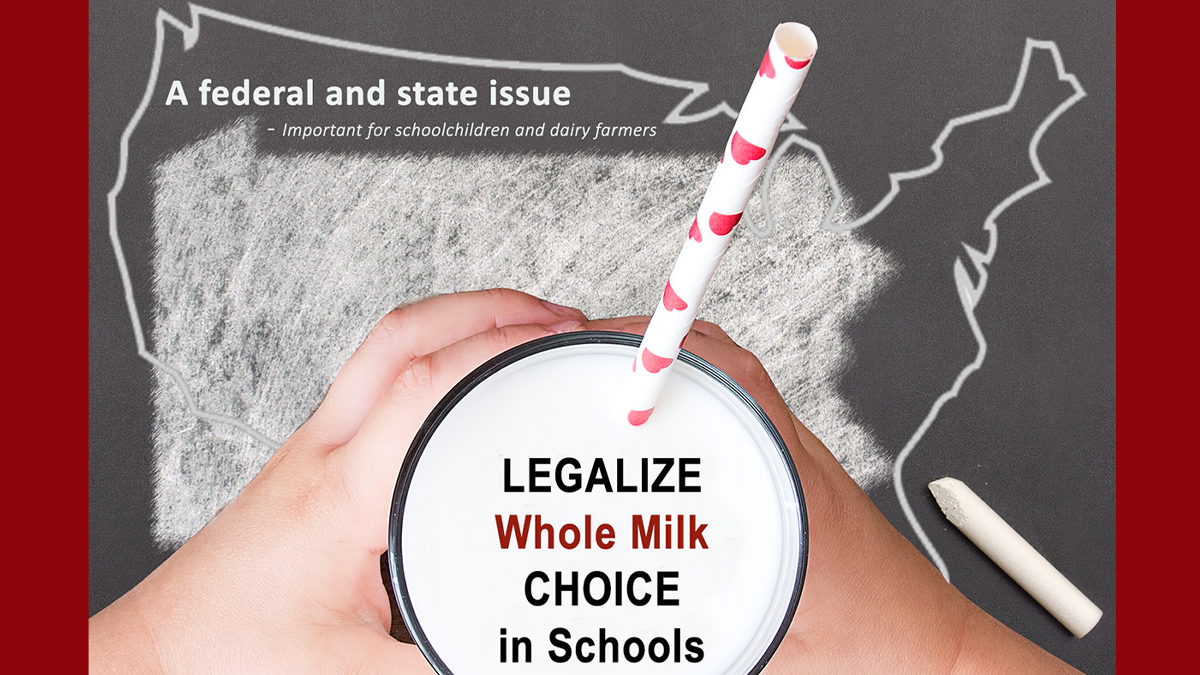
The effort to legalize the choice of whole milk in schools is a federal and state issue. Public awareness has been increased over the past two years through the joint efforts of the Grassroots PA Dairy Advisory Committee and 97 Milk, including a petition that is being revitalized as the U.S. Congress and State Assembly begin a new legislative session. Graphic by Sherry Bunting