‘Farmers will be at the table’ (Rollins confirmed Ag Secretary)

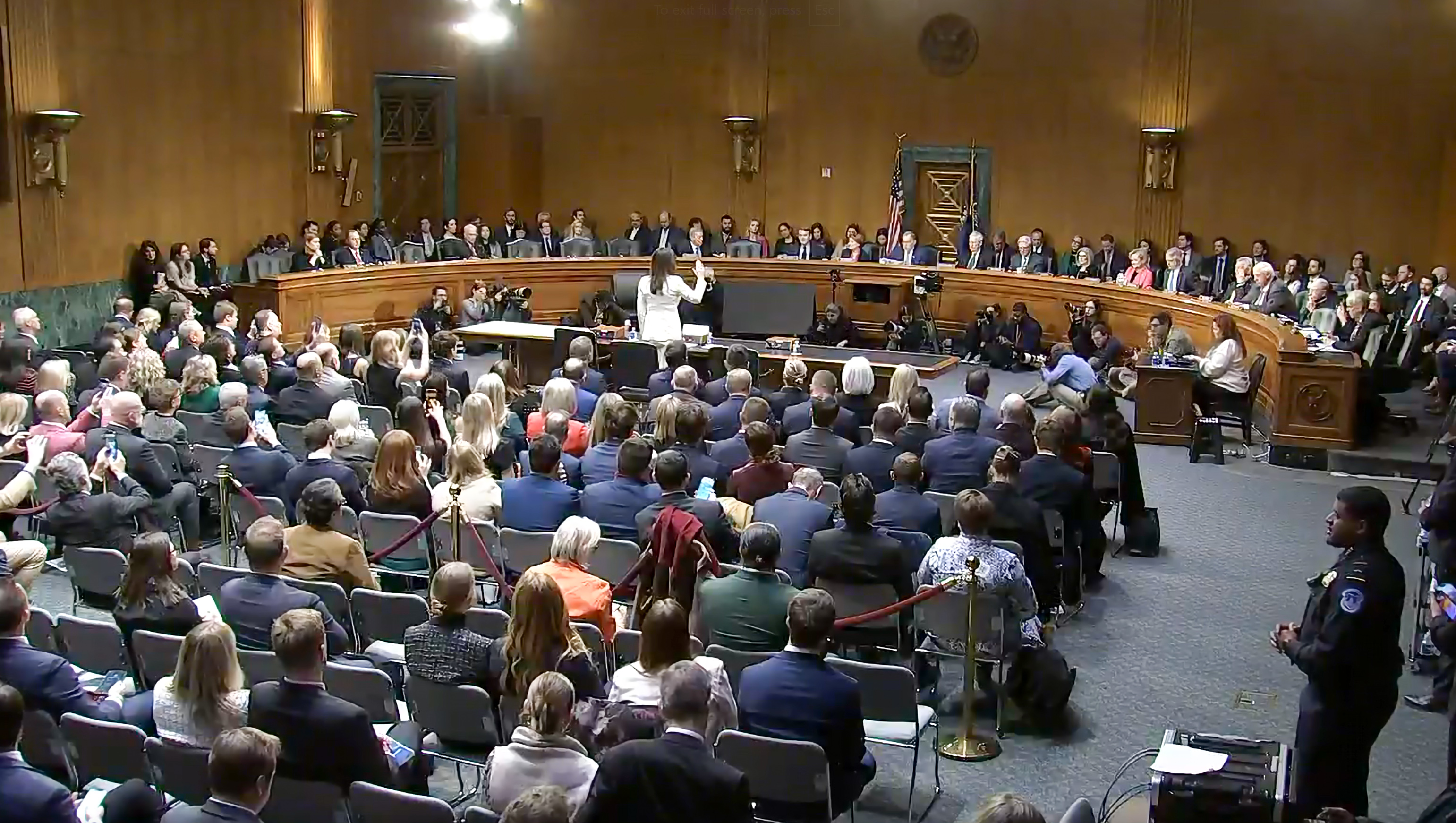
Brooke Rollins — now on Feb. 13, 2025 confirmed as the next Secretary of Agriculture and the second woman ever to lead the USDA — stands to be sworn in for testimony during her confirmation hearing before the U.S. Senate Ag Committee back on Jan. 23. She was joined by a room full of family, friends, colleagues, her high school Ag teacher, fellow 1990-91 state FFA officers, the little league softball team she coaches, and a pastor from Georgia who prayed with her and her family that morning. Senate Agwebsite livestream screen capture by Sherry Bunting

Rollins pledged ‘fast and furious’ first 100 days.

By Sherry Bunting, Farmshine, Jan. 24, 2025

WASHINGTON, D.C. — The growing U.S. Agriculture trade deficit was a key topic when on Jan. 23, President Trump’s nominee for Secretary of Agriculture, Brooke Rollins, gave testimony and answered four hours of questions before the U.S. Senate Committee on Agriculture, Nutrition and Forestry. 

(UPDATE: Rollins was confirmed by the full Senate on Feb. 13, 2025)

Along with the trade deficit, Senators were keen to talk about Trump’s trade policies and tariffs, while also asking questions that covered everything from immigration and the ag workforce, to biofuels, the farm bill, SNAP, WIC, and other feeding programs, as well as revitalization of rural communities and preparing the next generation.

Rollins even had an important exchange with Senator Roger Marshall, a medical doctor from Kansas, about bringing the choice of whole milk back to schools. (See related story here.)

Both Texas Senators John Cornyn and Ted Cruz introduced Rollins, calling her nomination “a no-brainer.”

She grew up in the small agricultural town of Glen Rose, Texas, where she was a barrel racer, a state FFA officer, helped make hay on the ranch, and raised and showed cattle in 4-H. She also spent some summers on the farm of extended family in Minnesota.

An admitted “policy wonk,” she earned her Ag Leadership and Development degree at Texas A&M and her Law degree, with honors, at the University of Texas School of Law.

“Everyone who knows Brooke, loves Brooke, and I know you will too as you get to know her,” said Sen. Cornyn.

Sen. Cruz highlighted her proven leadership, “profound appreciation for the challenges and rewards of life in agriculture,” reputation as an “independent policy thinker” and as a person who can “bring people together to accomplish major policy objectives.”

In her opening testimony, Rollins acknowledged that farmers and ranchers are currently facing  “extraordinary challenges.” 

She credited her FFA years for putting her on a course for where she is today and said it would be her great honor to “serve the men and women, who daily without pause or complaint provide our great nation and the world with the best food, fiber and fuel. It is clear farmers and ranchers are the cornerstone of our communities, and I will do everything in my ability to make sure (they) thrive.” 

When asked to describe her first 100-days, she used the words “fast and furious,” especially in delivering into the hands of farmers and ranchers the disaster and economic relief recently passed by Congress.

On biofuels, she noted the President included year-round E15 fuels in his energy emergency proclamation.

Pressed for hope on the current $45 billion U.S. Ag trade deficit. Rollins said a key priority will be to expand access to export markets.

“We are vision-boarding to hit the ground running to bring that trade deficit down. It is up 42% in the last year,” she said. “Agriculture is in a tough spot right now in moving our products out. The USMCA is up for renegotiation, and other trade agreements.” 

Rollins stressed that she will be working with Congress to be sure the White House and partners across agencies have what they need “to work across the world to bring in new trade partners to expand access to new markets.” 

At the same time, she addressed questions about the Trump tariff agenda, saying “This is no surprise. He believes it is a tool to bring America back to the forefront of the world. He also understands the potential devastating impact to farmers and ranchers. I have spoken with Sonny Perdue on how that was managed in the first term for something similar, to close any potential temporary holes.” 

Keenly aware that farmers “want trade not aid,” that they want to “grow markets not government payments,” Rollins said: “President Trump is a consummate deal maker. I believe that his skill and intense focus is on making deals for his people, not only for America, but for the Ag community that supported him at 90%. He knows that these are the people who have been with him the longest.”

Rollins served in the last Trump White House in key domestic policy roles. She is well versed in how Trump’s inter-agency process works, how discussions are handled, what the oval office meetings look like, and says she “will ensure our Agriculture community is strongly represented at that table.”

She gave the example of working with the incoming Labor Secretary, if confirmed, on the immigration and ag workforce needs, and asked the Senate to quickly confirm nominated undersecretaries to get the ball rolling.

Several Senators said they see Rollins, if confirmed, bringing this “value add” to the Ag cabinet position as someone who has been with the President for nine years. She knows how his White House process works and pledges to make sure “farmers will be at that table” with her job making sure “Agriculture is front and center where decisions are made.”

From trade and immigration to land management and regulation and from nutrition and hunger to preparing agriculture’s next generation, Rollins was clear: “We will follow the data, and we will listen to our farmers and ranchers as this is moving forward. We as leaders, as Agriculture, we will work together to understand and solve for these problems.”

Rollins cited these immediate priorities if confirmed as Ag Secretary:

— Ensuring disaster and economic relief that was passed by Congress at the end of 2024 is deployed quickly into the hands of farmers and ranchers;

— Working with the men and women of USDA and state leaders on animal disease outbreaks such as H5N1 in poultry and dairy cattle;

— Dedicating timely technical assistance to ensure a modernized farm bill moves forward that meets the needs of farmers and ranchers;

— Modernizing, restructuring, and re-aligning the U.S. Department of Agriculture;

— Supporting rural development to ensure rural communities are equipped and benefit from development of strong markets, including export markets;

— Eliminating burdensome and costly regulations;

— Preparing the next generation in agriculture; and

— Ensuring efficient nutrition programs for a healthy next generation.

-30-
Whole milk choice for schools takes center stage

Whole Milk for Healthy Kids Act reintroduced in style!

‘Most nutritious drink known to humankind’ takes center stage at Ag Secretary confirmation hearing

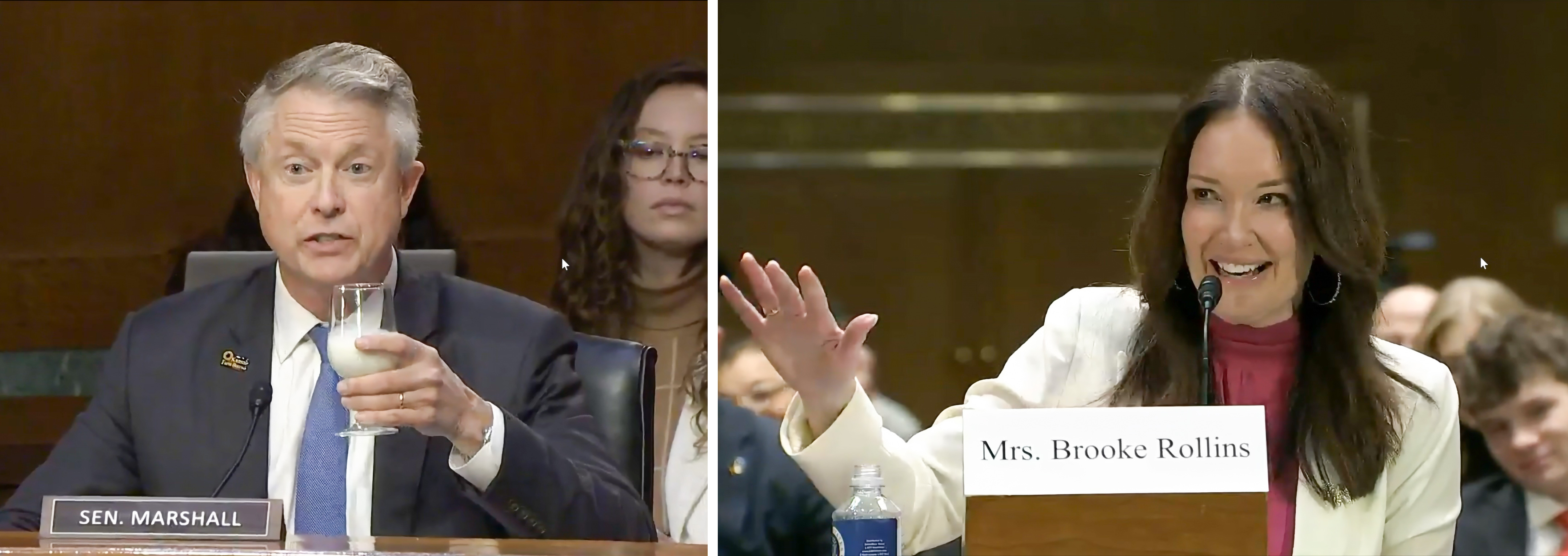
This split-screen moment captures Sen. Roger Marshall, M.D. and Agriculture Secretary Nominee Brooke Rollins during their confirmation hearing exchange on bringing whole milk choice back to schools. Sen. Marshall always comes prepared with THE MILK! Livestream screen capture by Sherry Bunting

From grassroots volunteers to halls of Congress, ‘hat’s off to 97 Milk’

By Sherry Bunting, Farmshine, January. 31, 2025

WASHINGTON, D.C. – It was the high point of the four-hour confirmation hearing on Jan. 23rd for President Trump’s Ag Secretary nominee Brooke Rollins, when Senator Roger Marshall, MD (R-Kan.) poured himself a glass of whole milk in front of the television cameras, and said:

Ms. Rollins, welcome. I want to know if you agree with me that whole milk is the most nutritious drink known to humankind and belongs in our school lunches.”

He then promptly took a big swig of nature’s nutrition powerhouse that American children have been banned from consuming at school meals since 2012.

Yes, there was a ripple of good-natured laughter throughout the room at the absurdity of it all – the absurdity that this nutrition powerhouse has actually been banned for 13 years on school grounds to even be bought with one’s own money from midnight before the start of the school day to 30 minutes after the end of the school day, per the 12-years of King Vilsack that Secretary Perdue’s interruption even failed to overturn.

The new Ag Secretary nominee Rollins responded with a hand motion to her mother two rows back among the family, friends, colleagues, ag teacher, fellow former FFA state officers and current little league team she coaches in attendance for the confirmation hearing, as she replied with a hearty and all-too-knowing laugh:

“Senator, I don’t know that you have met my mom – yet. But this is all we had in our refrigerator growing up – not anything else – just whole milk. She is absolutely never going to let us forget this – the fact that this is coming up! But yes, this hits home to me very quickly,” said Rollins.

On the very same day, whole milk champion U.S. Representative Glenn ‘GT’ Thompson (R-Pa.) with prime cosponsor and pediatrician Rep. Kim Schrier (D-Wash.), along with Senator Marshall and prime cosponsoring Senators Peter Welch (D-Vt.), Dave McCormick (R-Pa.) and John Fetterman (D-Pa.) led the re-introduction of the bipartisan, bicameral Whole Milk for Healthy Kids Act of 2025, known as H.R. 649 in the House with 90 total cosponsors to-date, and S. 222 in the Senate with 12 total cosponsors to-date.

The bill in its fifth attempt will allow unflavored and flavored whole (3.25 to 3.5% fat) and reduced-fat (2%) milk to once again be offered in school cafeterias, which are currently only permitted to have fat-free and 1% milk available for growing children, much of which is shunned or thrown away.

“Federal policy, based on flawed, outdated science has kept whole milk out of school cafeterias for more than a decade,” said Rep. Thompson in a Jan. 23rd press statement. “Milk provides 13 essential nutrients for growth and health, two key factors contributing to academic success. The Whole Milk for Healthy Kids Act of 2025 provides schools the flexibility they need to offer a variety of options, while supporting students and America’s hard-working dairy farmers.”

“As a pediatrician, I know how important a balanced and nutritious diet is for children’s health, well-being, and development,” added Rep. Schrier. “A healthy diet early in life leads to proper physical growth and improved academic performance and can set the foundation for lifelong healthy eating habits. Milk contains essential nutrients… This bill simply gives schools the option of providing the types of milk most kids prefer to drink.”

Sen. Marshall was blunt, saying, “(It) should never have been excluded from the National School Lunch Program. Now, 13 years after its removal, nearly 75% of children do not receive their recommended daily dairy intake. I believe in a healthier future for America, and by increasing kids’ access to whole milk in school cafeterias, we will help prevent diet-related diseases down the road, as well as encourage nutrient-rich diets for years to come.”

“Milk provides growing kids with key nutrients they need. Dairy is also an important part of Vermont’s culture and local economy, which is why our bipartisan bill to expand access to whole milk in our schools is a win for Vermont’s students and farmers,” said Sen. Welch.

Sen. McCormick said the bill “puts milk back in schools that growing kids actually want to drink. Pennsylvania’s dairy farmers supply this country (with it)… allowing schools to serve (it) in the lunchroom is just commonsense.

“Kids need it,” said Sen. Fetterman. “Let’s give them the option to enjoy whole milk again in schools – it’s good for them, they’ll actually drink it, and it supports our farmers. This bill is a simple solution that benefits everyone.”

Both National Milk Producers Federation (NMPF) and International Dairy Foods Association (IDFA) rushed to the forefront singing the bill’s praises and promptly issuing press releases, something that in past attempts took a little time.

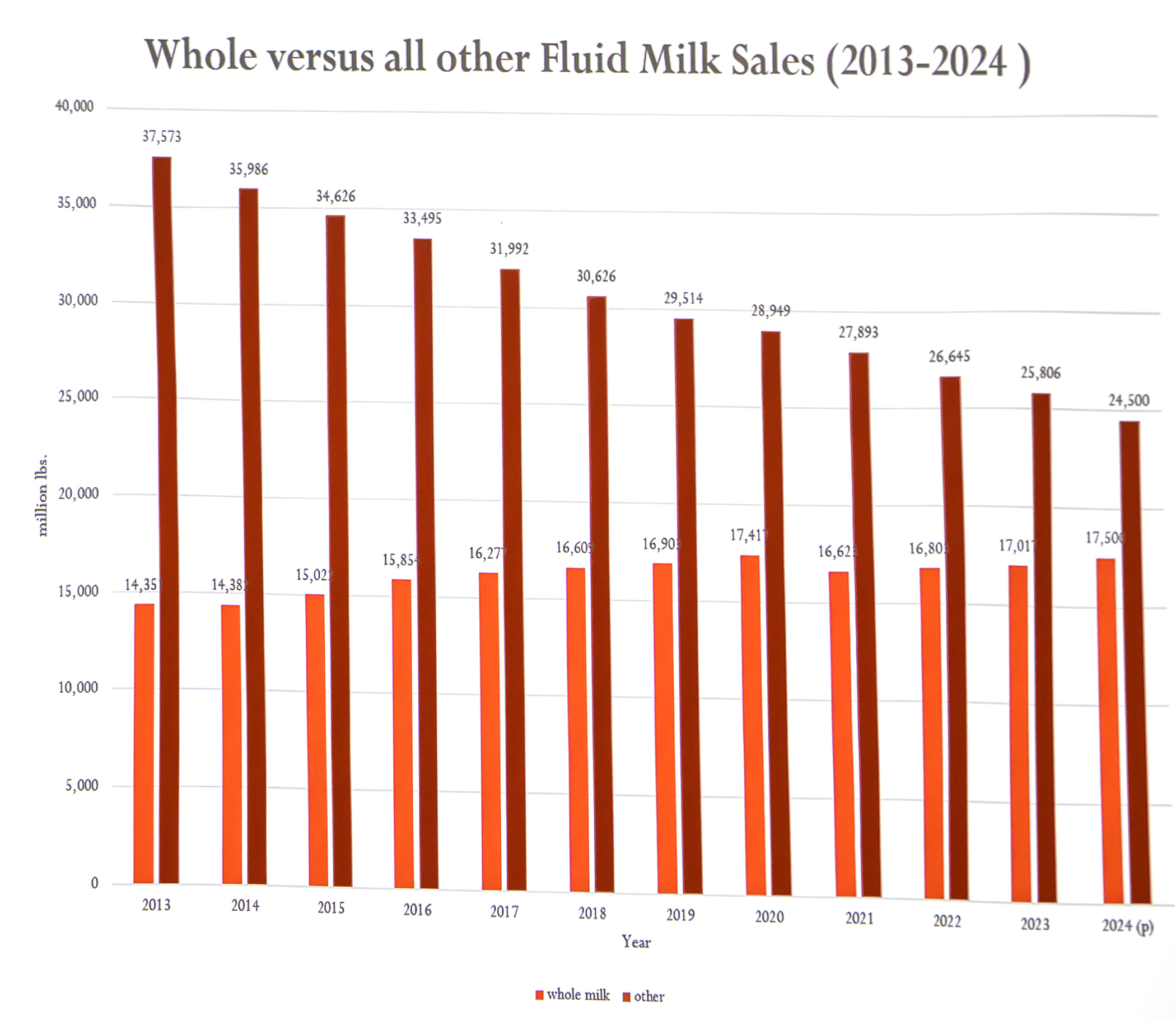
As longtime milk market guru Calvin Covington noted at the R&J Dairy Consulting seminar in eastern Lancaster County Jan. 28th, kudos go to the grassroots efforts. He showed the increase in whole milk sales nationally, while other fluid milk categories have declined. This has somewhat stabilized the steep losses the entire fluid milk category has suffered most steeply in the past 14 years. 

“My hat’s off to all of you and what you have done here in Pennsylvania, throughout the state and country, in promoting whole milk. I just wish other dairy farmers would be grassroots like you are and get involved,” said Covington. “Your work has paid off. Look at this graph. In 2013, whole milk sales were a little over 14 billion pounds. Last year (2024 with 11 months of data) I’m estimating 17.5 billion pounds. Whole milk is coming up, and everything else is going down.”

Covington dug into the graph (above) further to show that in 2019, the amount of whole milk sold was 16.9 billion pounds. “But look what happened in 2020, it jumped up to 17.4 and then back down to 16.62 in 2021. That was the pandemic. People were home. Schools were closed,” he said.

“When they were home, they drank good-tasting milk, but unfortunately when the schools opened back up, they had to go back to the other stuff. But my hat’s off to what you’ve done here. We’re selling more whole milk, and one thing people forget is that 100 pounds of Class I milk sales with higher fat content — last year it averaged 2.4 in this market compared to what it was 15 years ago when it averaged less than 2% — the more fat sold in Class I milk, the more income for you as dairy farmers. Class I butterfat is worth more than butterfat in the other markets, so my hat’s off to what you’re doing.”

(Author’s Note: Yes, Covington is speaking of the good work, the hard work, of 97 Milk volunteers who formed the non-profit in 2019 after dairy farmer Nelson Troutman’s painted bales began appearing. This good work is sustained by a handful of volunteers and donations. Just think what could be accomplished with more involvement. One of those volunteers is Jackie Behr of R&J, who puts her marketing skills to work for 97 Milk. She reminded farmers that donations are needed to keep the milk education movement going. An Amish Wedding Feast fundraiser is scheduled for Feb. 8 at Solanco Fairgrounds, with sponsorships still available. The next 97 Milk meeting open to all dairy farmers is March 25 at Durlach-Mt. Airy Fire Hall near Ephrata, Pennsylvania. Check out 97milk.com to learn more about the milk education movement, and hit the donate tab to find out how you can help.)

-30-