
By Sherry Bunting
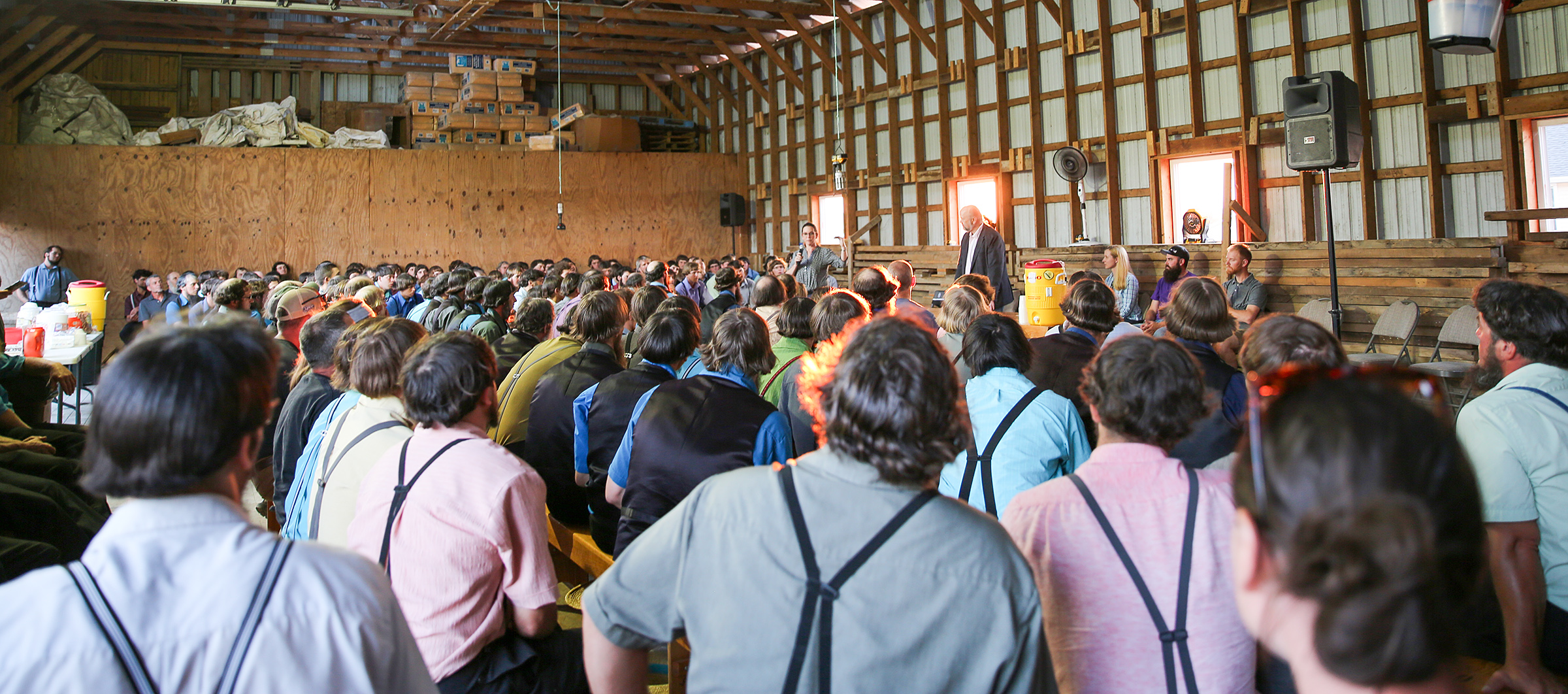
QUARRYVILLE, Pa. — It was a clear, balmy evening that farmers could have spent in field work, but over 300 people arrived by buggy, van, and on foot to hear from two men and their legal team at 7 p.m. Thursday, June 13 on an Amish dairy farm in southern Lancaster County, Pennsylvania. (Click here to read author’s analysis/opinion)
The meeting came just one month after Rusty Herr and Ethan Wentworth were released from prison, having served the 30 days on contempt charges for failing to provide names, addresses, and records as part of a 2021 subpoena from the Bureau of Professional and Occupational Affairs (BPOA) on behalf of the State Veterinary Board.
The 2021 subpoena was set in motion by a 2020 petition from the Pennsylvania Veterinary Medical Association targeting Rusty and Ethan for continuing to perform veterinary practice without a license by ultrasounding livestock.
The majority of attendees were from the Amish community, half of them dairy farmers, and half business owners, tradesmen, who have horses. A sprinkling of non-Amish farmers were also in attendance.
One could hear a pin drop while Rusty and Ethan talked separately of their time in prison, highlighting what the prayers and support of family, friends, colleagues, and customers have meant to them and crediting their team of employees for stepping up in their absence and their wives and families for all they have done and endured.
They talked of how their faith in God grew stronger over those 30 days, and of their steadfast resolve to continue serving this community.
Attorney Robert Barnes of Barnes Law LLP talked about two of the exceptions in Section 32 of the Vet Practice Act of 1974, as amended in 1986: “This Act does not apply to (32. 4) Any person or his or her regular employee or agent while practicing veterinary medicine on his or her own animals… and (32. 7) Any person performing normal husbandry practices on bovine, porcine, caprine, ovine or equine animals or avis.”
Neither ‘agent’ nor ‘normal husbandry practices’ are defined in the list of terms in the Act’s introduction.
According to Webster’s the definition of ‘husbandry’ is “the care, cultivation, and breeding of crops and animals,” and the definition of ‘agent’ is “a person who acts on behalf of another person or group.”
‘Agent’ is actually a legal term used to describe “a person that has been entrusted with important powers or responsibilities that are to be carried out on behalf of another person.”
A legal basis for the term ‘normal husbandry’ is traditionally understood as a combination of the producer’s self-interest (economic sustainability) and duties of humane treatment for the animals on which we depend. The two go hand in hand.
“There is a war on the small farmers around the world. The Amish are caught in the middle. They bring essential value and high-quality food from a farming community that seeks to protect a way of life,” said Barnes, who also represents Amos Miller in the raw milk case brought by the Pennsylvania Department of Agriculture.
Barnes called the April 2024 arrests of Rusty and Ethan an “abuse of power” treating civil contempt as though criminal through incarceration.
He called this an example of using regulatory process to bolster “new and novel interpretations of the law.” Other examples he gave involved access to water, takings of food, and animal welfare interpretations that, according to Barnes, use the court system to create new definitions for ‘normal farming.’
“They pick people who are in an isolated position, where it is hard to afford a legal defense,” he said.
Barnes also spoke of power and control, referring to ‘Big Food’ and ‘Big Pharma.’ He said “corporate interests” want to define normal farming and husbandry as it applies to food distribution and animal care in such a way that small independent farms find it difficult to comply or economically unfeasible to survive in the future.
“People are having more chronic diseases, dying earlier, and living less happy lives, but this (Amish) community is not relying on (the world) for your cultural values. This community is a beacon, and so is your independent food system,” he declared.
One attendee spoke up to say: “We need both. We need our veterinarians, and we need NoBull (breeding management services).”
In light of a shortage of vets and the much smaller number of animals on farms like his, this man wondered how a middle ground can be reached by working together.
Farmers who spoke privately after the meeting echoed the same thought to this reporter. When asked what their vets think of this, they said they can’t even discuss it with their veterinarians for fear of losing their services altogether.
They said they have their vets come regularly for herd check and will even list a cow that may have already been checked timely when the breeder was there.
“Why would I call the vet to check one animal (in between herd checks), when my breeder is already here? Would they even come (timely) for one animal?” a farmer noted, shaking his head.
To protect the farms in this equation, Barnes said clarity in the law is required.
“We want the court to rule on the law… to establish the farmer’s right to do these practices and do them through an employee or ‘agent’, as the law states,” said Barnes. “This is the start of a long process. If they (NoBull) are shut down, who will be next? It’s about the impact this can have to small farmers across the country… and on this community. This is a consequential case.”
Pennsylvania State Representative Wendy Fink (R-94th), covering part of York County, also attended the June 13 meeting. She has been closely following the case and spoke briefly about it, citing the abundance of phone calls that have poured into her office and other legislators’ offices. She said she hopes a similar meeting will be held soon in York County and one in the future with additional State lawmakers.
“Your phone calls are important. Keep doing what you’re doing. We support these two gentlemen. Most people would cower… but these two are putting themselves out there. They’re standing up for you. This starts at our local government, so keep the pressure on to make sure that they are abiding by the laws as they’ve been written,” she said.
-30-
 Ag Moos