AFBF seeks ‘whisper of hope’ in request for USDA emergency decision on Class I mover

Farm Bureau economist Danny Munch closes FMMO hearing Jan. 30, 2024 with emergency request for USDA to return Class I ‘mover’ formula to ‘higher of’


By Sherry Bunting, Farmshine, Feb. 2, 2024

CARMEL, Ind. – Over 5 months and 500 exhibits have gone by in the nearly 50 hearing days since the long-awaited national hearing on Federal Milk Marketing Order modifications began Aug. 23, 2023. It ended Tuesday, Jan. 30th with a last-minute witness bringing forward American Farm Bureau’s request for an emergency decision by the USDA Secretary to restore the ‘higher of’ method for calculating the skim portion of the Class I ‘mover’ price.

This hearing went on longer than expected, and the implementation of any final decisions from a multitude of proposals in various areas of FMMO milk pricing are at least 12 to 18 months away under ordinary post-hearing processes, hence the AFBF request for emergency decision-making on the Class I mover to go back to the higher of.

“If USDA would implement this on an emergency basis, it helps with the confidence and perception piece of it. So, if there is a whisper of hope, to see that there will be a positive outcome coming soon, an optimistic change that is coming that fuels them. Do they see things getting better? Or are things going to stay the way they are? ” said AFBF economist Danny Munch while being cross-examined after reading into evidence the letter signed by Sam Kieffer, AFBF vice president of public policy.

The letter stressed that FMMO reform is in step 5 of a 12-step process and a long way from a final rule. Meanwhile, the change in the Class I mover formula was intended to be revenue neutral to farmers, but farmers have lost over $1 billion in 56 months of implementation. This does not even include further losses from depooling of manufacturing milk when the Class I fluid milk price has been out of alignment in FMMO revenue-sharing pools.

“The comprehensive process of amending federal orders, though important, means dairy farmers remain stuck with current pricing regulations until USDA publishes a final rule,” Kieffer wrote in the letter Munch read into evidence. “The current Class I mover was a well-intentioned policy misstep that has reduced dairy farmers’ checks, with little relief in sight. Emergency implementation of the ‘higher-of’ Class I mover formula will help buffer against persistent losses associated with mistaken and outdated policies that have left dairy farmers struggling to make ends meet.”

Munch noted that members re-affirmed going back to the ‘higher of’ calculation in policy meetings during the AFBF National Convention last week, and they voted to make it a priority of urgency.

“Dairy farmers are facing closure. A lot of our members are facing the hard decision about whether to sell their cattle or not. That’s a little window into what our members mentioned last week,” said Munch.

The other reality that is setting in is the fact that large losses are mounting quickly again. The Class IV over III divergence is quite wide – ranging $3 to $4.00 per hundredweight – and the futures markets show it could be above the $1.48 per cwt threshold through the end of 2024.
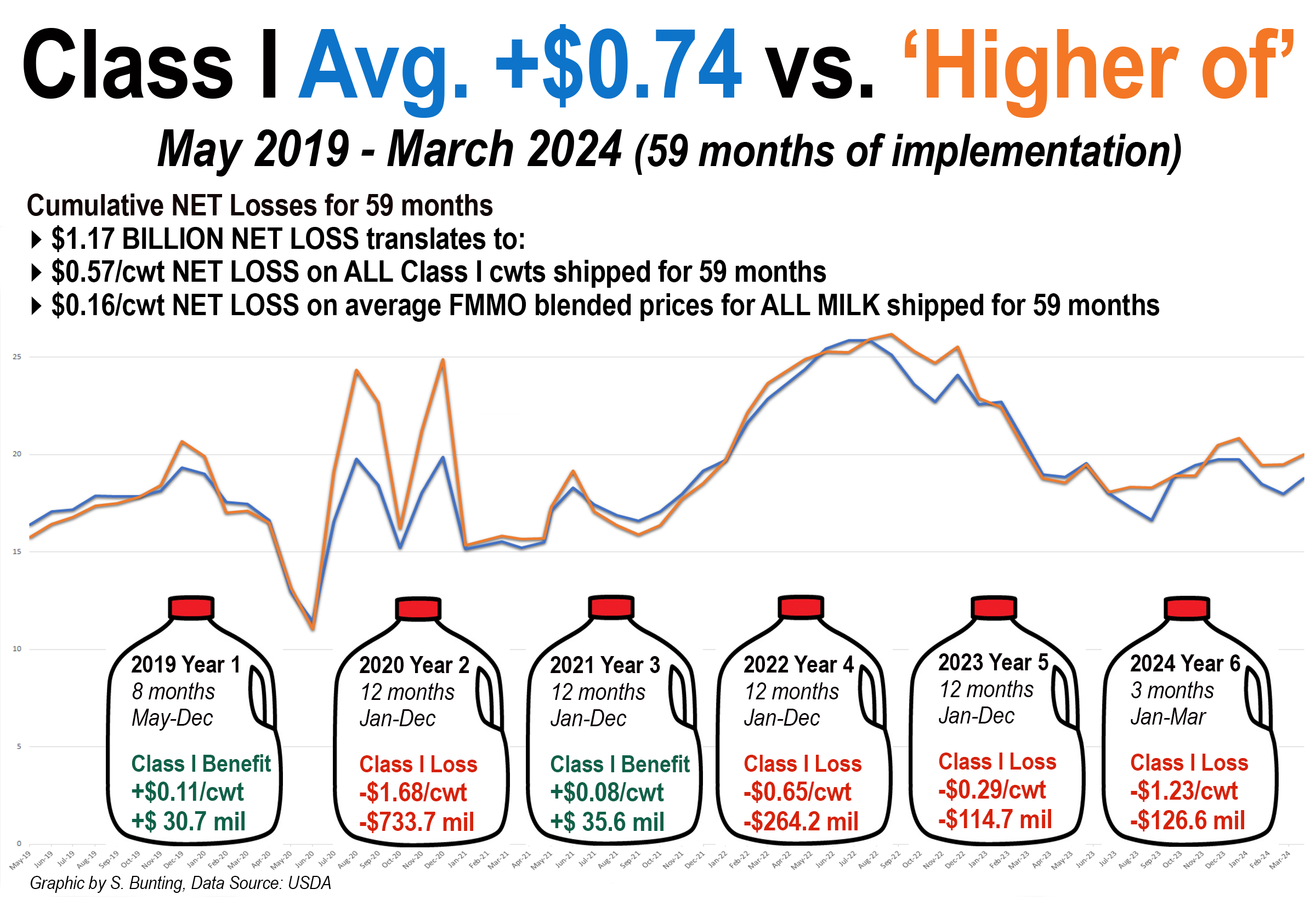
Farmshine’s Market Moos columnist Sherry Bunting has updated the graph showing how the supposedly revenue-neutral change from the ‘higher of’ to an averaging formula for the Class I mover May 2019 through March 2024 will have reduced Class I value in farm milk checks over 59 months of implementation. This graph of cumulative and year-to-year losses does not include additional losses many farmers have incurred when manufacturing class milk is out of alignment with Class I, and is depooled, with the revenue excluded from the FMMO pools and benchmarks.

In fact, the Class I mover prices announced for January and February 2024 could produce well over $80 million in losses in just the first two months of 2024 once the pounds of Class I milk are sold and counted.

Munch also took the opportunity to remind everyone that when AFBF held the dairy stakeholders forum in Kansas City in October 2022, returning the Class I mover calculation to the ‘higher of’ was the main item that got consensus from every table in the room.

When the difference between the manufacturing classes exceeds $1.48 per cwt, then pooled producers receive less money for their milk under the averaging formula compared with the previous ‘higher of’ formula. When the difference between Class III and IV is $3.48, for example, that lowers the Class I price by $1.00 per cwt. In an FMMO with 75% Class I utilization, that’s a 75-cent loss on all of the milk, not just Class I. In an FMMO with 25% Class I utilization, that’s a 25-cent loss on all of the milk.

Even members of Congress have been doing the math and have talked about putting reversion language in the Farm Bill. They are aware of their role in putting what they were told was a “revenue neutral” change into the 2018 Farm Bill that IDFA and NMPF at the time agreed upon, while adding language that USDA could hold a hearing in two years to vet it for the future. 

We are now nearly five years into this change, and it is just one piece of the hearing that just concluded, which included many proposed modifications from milk composition and price surveys, to make allowances and differentials.

Without emergency decision-making by USDA on the Class I mover piece, any potential changes from this hearing are a good 12 to 18 months away, depending on how the post-hearing processes move along, from post-hearing briefs due April 1st to rebuttles, draft decisions, comment periods, referendums, final decisions, and there are proposals that have asked for further delays after the process plays out to avoid “affecting” exchange-traded risk management instruments. 

Dairy farmers are just looking for some relief and transparency for the future, according to Munch. 

Meanwhile, IDFA and Milk Innovation Group (MIG) have opposed returning to the ‘higher of’ and have proposed several averaging methods for the Class I mover that would continually look backward to compare and change adjusters to make up past losses gradually out into the future.

Farmers have testified that this doesn’t help if it takes two to three years to get that money back after they’ve already lost the farm.

What it boils down to on the Class I mover is the industry wants to move toward more fractionation of milk, more aseptic and shelf-stable beverages, and away from fresh fluid milk. These are the products that can sit in a warehouse for 9 months and for which processors testified they do 9-to-12-month pricing contracts largely with foodservice and convenience stores. Fresh fluid milk already has advance pricing that aligns with the turnaround of that product so hedging on the futures markets is not typically done, and averaging is not needed.

When asked whether AFBF has looked at how the spread may continue in the future to make the averaging formula a loser for farmers, he said Class IV will likely persist above Class III, and yes, they expect the spread to remain large.

Earlier testimony by processor witnesses blamed these Class I formula losses on Covid disruptions, food box programs and large government cheese purchases, but as Munch pointed out, the driver of these losses is something else. When Class IV is over III, we don’t see it in a negative PPD, but milk is depooled, and the full extent of the depooling losses are incurred by farmers, they just aren’t easily enumerated.

“In 2020, the losses (in Class I value, alone, without including the impact of depooling) were over $700 million. In December 2023, the losses crossed over $1.05 billion as they have continued to add up,” said Munch. “The financial detriment is not solely due to a ‘black swan’ event. Some of our farmers were waiting to see if it showed markets shifting. Now, years later, this is still an issue.

“That’s another reason why we are asking for an emergency decision on this right now, and why it came up at our meeting at the convention last week,” Munch testified. “It was intended to be revenue neutral, but it has turned out not to be.”

During cross-examination, Munch also confirmed there hasn’t been much trust by producers to believe processors will replace the dollars they are asking to be removed from FMMO pricing by paying over-order premiums, instead.

“There is a lack of trust and not knowing where their price comes from. There has been a lot of concern about how their milk checks are calculated,” Munch related. “That’s one of the proposals that the American Farm Bureau put forward is more uniform, clear milk checks. There is a perception that things in milk checks have been manipulated. There is a perception of mistrust.

“If there are ways we can build back the trust, and if one of those ways that our farmers have targeted is switching back to the ‘higher of,’ then it’s easier for farmers to understand that calculation, and it has shown, in the most current of times, to be more advantageous to them.”
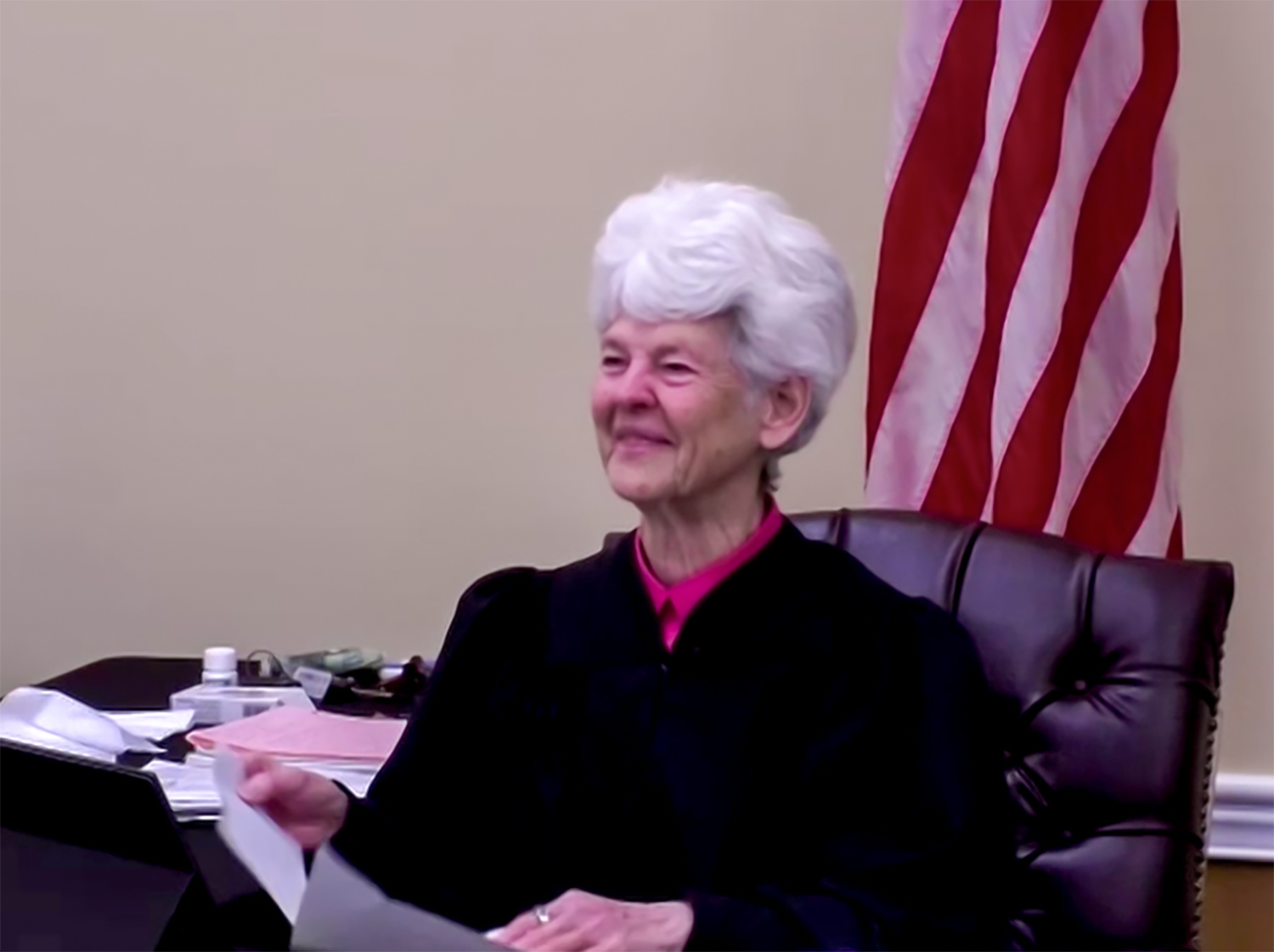
“It is my pleasure at 10:18 a.m. on 2024 January 30 to determine that this Hearing has ended,” said U.S. Administrative Law Judge Jill Clifton after 506 exhibits have been entered into evidence for and against 21 proposals in various areas of FMMO pricing modification during the 49 Hearing days that stretched over 5 months since its start on Aug. 23, 2023 in Carmel, Indiana. Screen captured from Hearing livefeed

-30-

Feb. 16, 2024 Milk Market Moos in Farmshine: SHRINKFLATING DAIRY — steep loss of dairy farms, down 40%, and much, much more

By Sherry Bunting, Farmshine Weekly Column

Carrot… and stick?

Opening the Feb. 14th House Ag Committee hearing with USDA Secretary Tom Vilsack, Committee Chairman G.T. Thompson of Pennsylvania said the clear message he has heard as he has traveled across the country on farm bill listening sessions is that, “Agriculture needs government to work for them, not against them.”

Vilsack was pressed at least 8 times by 8 different members of the Committee for clarity and details on the Climate Smart deal. Representatives wanted an update on how the billions of dollars in Inflation Reduction Act (IRA) funds for conservation programs and Climate Smart Partnerships are making it directly to farmers.

Rep. Mary Miller of Illinois went so far to say the climate cult is a scam and pointed to what is happening in Europe, airing her concerns about incentives for solar panels on good farmland pricing farms out of rented acres. She expressed concern about getting farmers reliant on “environmental payments” instead of a food system that allows farms to succeed producing food, and she wondered about being beholden to the global climate-cult, which means (I’m paraphrasing) she is concerned about the stick that follows the climate-smart carrot.

While the purpose of these conservation and Climate-Smart IRA funds, said Vilsack, is to ‘get money to farmers,’ his update acknowledged that, “There’s a lot of work to do. We’re assisting and guiding (farmers) into participating,” he said.

“We’ve increased the number of people working at NRCS (1500 new hires, total 4000 new hires planned). We’ve entered into cooperative agreements so we have a broader reach (hire estimated 3000 technical staff through conservation partners), so that those who might not be able to understand that they qualify for the program are finding out,” Vilsack explained, noting that this is necessary in order to actually implement the Inflation Reduction Act.

(Translation: Money hasn’t gone directly to farmers so much as it has gone to program infrastructure, such as more USDA staff, partnership staff, and developing the herding routines to get farmers ‘guided’ on board for Climate Smart data collection and monitoring. In contrast, the IRA funds going to traditional and oversubscribed conservation program EQIP have largely been obligated to farmers at this point.)

“Roughly 85 to 88% of farmers in this country today require off farm income to be able to keep the farm. It’s about people who love what they’re doing and frankly want to do more of it, but they don’t have the income streams to support it, so they have to have an off farm job,” said Vilsack, defending the deal.

“To me, the key here is to create opportunities for that farm to generate more revenue,” he added.

Rep. Marie Gluesenkamp Perez of Washington State made the point that, “Farmers should not have to rely on value added ventures to survive, like agro-tourism or solar panel installations. These are ventures in their own right and should not be necessary for farmers to continue and pass on their farms to the next generation,” she said.

Rep. Doug LaMalfa of California pushed the point that farmers like the traditional conservation programs, like EQIP, but the IRA-funded Climate-Smart Partnerships deal for “tying up carbon is going to require them to jump through hoops,” he said, noting that no-till and cover crops aren’t possible on some types of farms, like rice production.

Vilsack countered: “It’s voluntary. It gives us the opportunity to figure out what works and what doesn’t work, and it doesn’t necessarily put people at a competitive disadvantage.”

He maintains that these projects “do not require farms to go through hoops and in some cases, it’s actually paying them for what they’re already doing.

“The idea here is to measure, monitor and verify the results so that we know what works and what doesn’t work, so that we don’t invest in what doesn’t work,” said Vilsack.

Congresswoman Abigail Spanberger of Virginia gave the example of a farmer in her district doing no-till and cover crops. Vilsack nodded and replied: “There is an opportunity, potentially, for that farm to qualify for ecosystem market payments. So, now, instead of just a crop, they’re going to get an environmental payment.”

That’s the carrot, where are they hiding the stick?

40% decline and a loss of 15,866 dairy farms in 5 years.

The number of dairy farms in the U.S. declined by 40%. That’s 4 in 10 dairies lost over 5 years. The 2022 Census of Agriculture Report released Tues., Feb. 13 held a bit of a surprise not seen on available summaries. Clicking through the ‘quick stats’, we learn that the number of dairy farms with milk sales on December 31, 2022 totaled 24,082, and the number of farms with milk sales but no milk cows or calves in inventory at the end of 2022 was 388 for a total 24,470 dairy farms with milk sales in the U.S. at the end of 2022.

It’s also 3,462 fewer dairy farms than the 27,932 licensed dairies reported as an average number for 2022 last February as part of the January 2023 milk production report.

(Note: The 2023 annual average dairy data that was included in the January 2024 Monthly Milk Production Report Feb. 21 pegged the average number of licensed dairies in the U.S. in 2023 at 26,290, down 6% from the annual report filed for 2022. The Census and NASS Milk Production Reports count some types of multi-site dairies under the same ownership differently. By the way, USDA revised the entire 2023 year of production lower yet for the fourth time, now revising 11 of the 12 months of prior data reported for milk production, cattle numbers, and output per cow. We questioned the figures all last year, asking where the cattle were coming from, pointing to cattle inventory numbers on heifer replacements a year ago indicating a shortage of freshening 2-year-olds, etc., and pointing to the substantial increase in Whole Milk Powder Imports into the U.S. and other factors USDA may have left unaccounted for in prior estimations.)

In Pennsylvania, dairy farm numbers declined from 6,914 on Dec. 31, 2017 to 4,027 on Dec. 31, 2022, that’s a 42% decline over 5 years. It’s also 973 short of the average number of licensed dairies reported by USDA NASS for the 2022 year.

The 2022 Census of Ag also shows that of the 24,470 farms with milk sales, 3,439 accounted for 59% of milk sales and 1012 accounted for 46%. This compares with the 2017 Census, which reported 3819 farms accounted for 55% of milk sales and 793 farms accounted for 43%.

We will dig into the national and state by state 2022 Census data relative to dairy in a future report.

In agriculture, overall, the 2022 Census of Ag shows a loss of 142,000 farms (down 7%) and a loss 20 million farm acres (down 3%) in the past 5 years.

Between 2017 and 2022, the number of U.S. agricultural producers held steady at 3.4 million, while the number of farms continued to decline at 1.9 million covering 880.1 million acres that generated food, fiber and fuel. Average age of farmers was up at 58 years. But the number of beginning farmers (over 1 million), increased also, according to the Report.

The number of small and mid-sized farms across all commodities declined between 2017 and 2022. Large (sales $1-5 million) and very large farms (sales of $5 million or more) increased in number. The 105,384 farms in those top two categories (sales of $1 million or more) represented fewer than 6% of all U.S. farms and sold more than 75% of all agricultural products. The largest farming operations and a small number of states accounted for the majority of agricultural production and sales.

The overall value of agricultural production and income increased between 2017 and 2022, according to the Ag Census. 2022 was a high year in agricultural price cycles, and government payments were still part of the economic calculus through prior CFAP and Pandemic Assistance. Milk made it into the top 5 commodities (at No. 5). Combined, the top 5 — accounted for two-thirds of the value of all agricultural production.

The value of crop production was $281 billion, up 45% in 2022 vs. 2017, while the value of livestock production (including dairy) was $262 billion, up 35% over the same period.

Shrinkflation this, shrinkflation that

The January Consumer Price Index (CPI) released Tues., Feb. 13 increased 0.3% on a seasonally adjusted basis. Over the last 12 months, the all items index increased 3.1% before seasonal adjustment. The food index, up 0.4% in January, increased 2.6% over the last 12 months. The food at home index was up 0.4% in January, and up 1.2% over 12 months, while the food away from home index rose 0.5% over the month and 5.1% over 12 months. The dairy and related products index is up 0.2% in January, down 1.1% over 12 months.

In contrast, the energy index fell 0.9% over the month, down 4.6% on the year due mainly to the decline in the gasoline index.

The Biden Administration announced intentions to investigate supermarkets for over-charging as the food index has not followed energy lower. What further complicates the food inflation indexes is that food commodities like milk and eggs have moderated while processed consumer packaged goods continue to inflate.

Another ripple is captured in the new term coined by food, ag, and business analysts — “shrinkflation” — meaning smaller packages, same price.

For farmers, shrinkflation is a good way to describe what is happening to milk margins. Yes the central feed and energy costs are moderating, but many other fixed and adjustable costs — from interest rates and insurance to supplies and services — continue to move higher, shrinkflating profit margins.

Meanwhile, the Census of Ag data showed big gains for farm revenue and net income in 2022 vs. 2017, but this unique comparison does not factor in the margin-squeeze in 2023, nor the impact of losing the last of the CFAP and Covid pandemic assistance payments that were still trickling into 2022.

In the dairy sector, the milk markets send mixed messages as the Class IV milk price sits $4 above Class III, with cheese being the market dog for the past 12 months. Yet milk is not moving from Class III manufacturing (cheese/whey) to Class IV (butter/powder). Why? New Class III manufacturing capacity has come online and will continue, needing to run full to turn a profit.

At the recent Pennsylvania Dairy Summit in a presentation about navigating the future, Phil Plourde of Ever.Ag highlighted the critical importance of exports to the industry. “Export or perish!” he said, focusing the admonition on the opportunities to export more cheese, including mozzarella.

IDFA CEO Michael Dykes in a presentation in January, issued the challenge to producers to fill the production gap that $7 billion in planned processing investments will bring online in the next three to five years.

Meanwhile, U.S. dairy farmers are seeing price pressure from a buildup of cheese via lackluster exports suffering from what are seen as inadequate trade policies and lack of new trade agreements.

Reflecting on the recently concluded FMMO hearing of 21 milk pricing proposals — some of which seek to reduce regulated minimum milk prices — we see processors are focused on a shrinkflated milk pricing system, shrink prices and inflate capacity because growth has got to happen.

They say USDA sets the regulated minimum prices too high, which must be reduced to ‘market clearing’ levels so they can have the freedom and band width to then be able to pay market premiums to their farmers.

On the eve of the Pennsylvania Dairy Summit Feb. 6, Cornell economist Dr. Chris Wolf talked about the recent FMMO hearing, noting that, “Regulated minimum prices are the whole deal right now. Premiums are gone.”

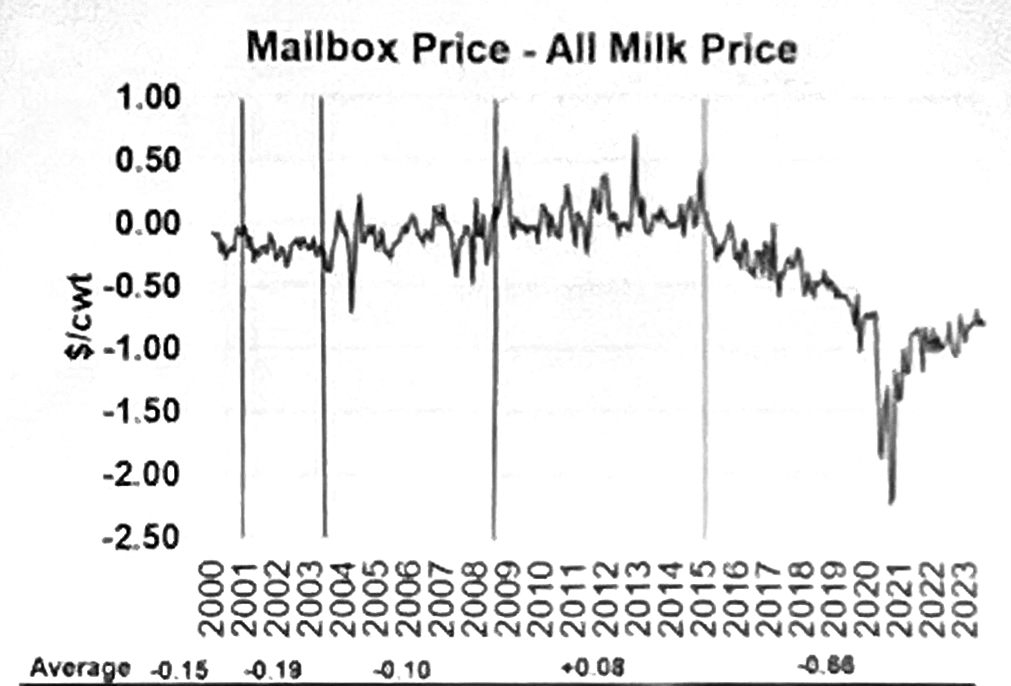
He showed charts tracking the difference between the All Milk price and Mailbox price (above), progressively negative since 2015, reflecting higher transportation costs and evaporation of over-order premiums, not to mention milk check assessments, marketing adjustments, balancing fees.

If regulated minimum prices are reduced, will processors voluntarily fill that gap by paying more premiums so producers have the financial wherewithal to fill the production gap?

Things are pretty bad for farmers right now in the milk markets that are based on cheese, where capacity has ramped up in the Central U.S., and where tough discussions are being had around kitchen tables about operating margins and the future.

Milk futures move lower

Milk futures were unevenly lower this week, with most of the downward pressure on first-half 2024 contracts for both Class III and IV milk. The spread between Class III and IV milk — according to this week’s CME futures markets continues to be range between $2.20 and $4.00 per cwt in every single month of 2024, well above the $1.48 mark where the ‘averaging’ formula is a loser for orderly marketing compared with the ‘higher of.’ On the close Wed., Feb. 14, Class III milk futures for the next 12 months averaged $17.91, down 10 cents from the previous Wednesday. Class IV milk contracts average was $20.57 — down 7 cents.

Back on the see-saw

The daily CME spot market for dairy products was mixed and mostly lower this week, except dry whey was higher and barrel cheese fully steady. Spot butter was pegged at $2.7175/lb, down a nickel from a week ago with zero loads trading. Grade A nonfat dry milk was $1.18/lb, down 4 cents with a single load changing hands. On the Class III side, 40-lb block Cheddar gave up 7 cents in Wednesday’s session, alone, when declining bids with no trades left the spot price pegged at $1.5150/lb, down 11 cents from the previous week. Barrel trade had moved higher earlier in the week, but a 2-penny loss Wednesday left the spot price firm on the week at $1.5750/lb with 2 loads trading. Dry whey at 52 cents/lb was 3 cents higher than a week ago with no trades.

-30-

Whole Milk for Healthy Kids Act S. 1957 needs more cosponsors: We need your help! Please contact your state’s two U.S. Senators

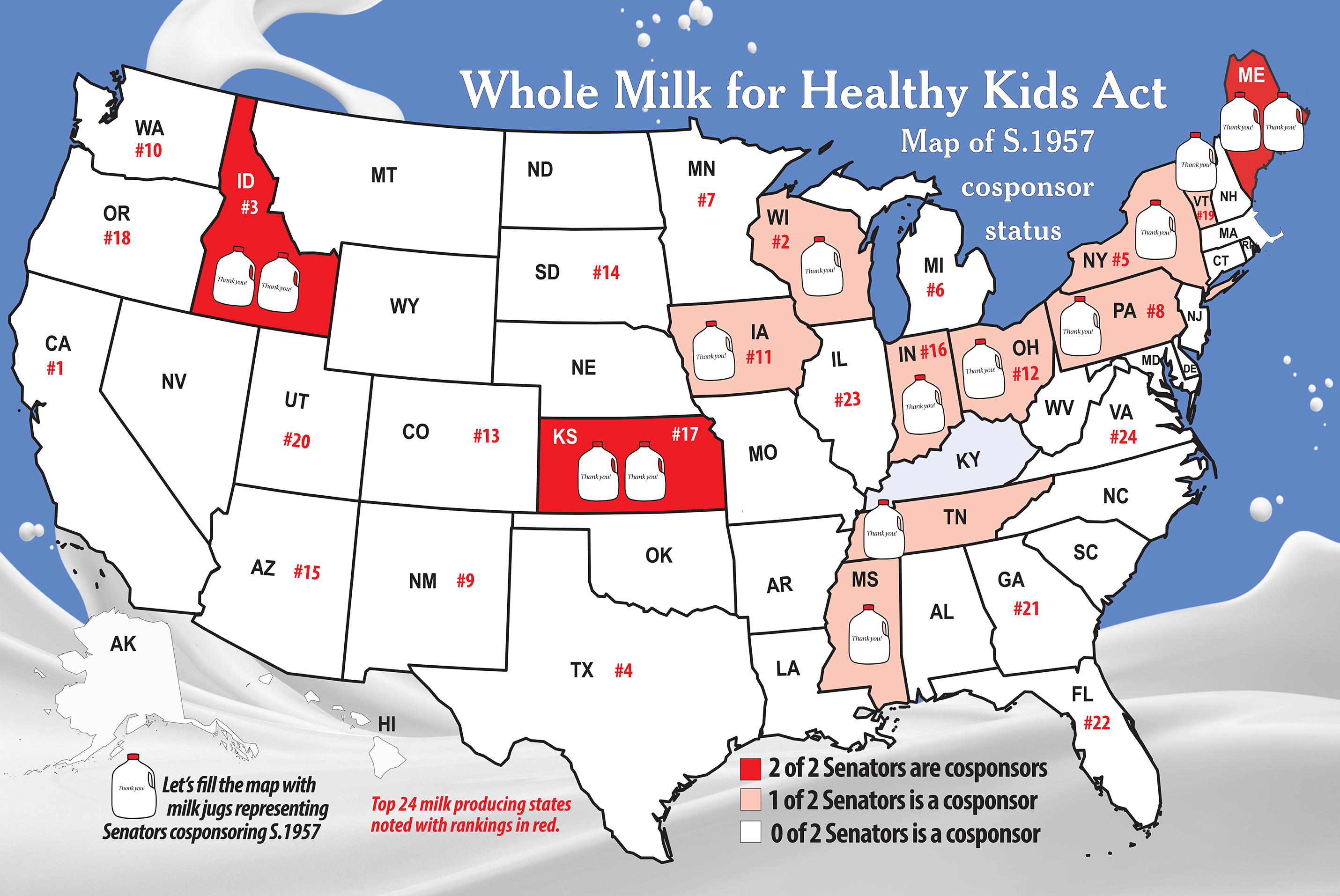
The Whole Milk for Healthy Kids Act has moooved to the Senate. S. 1957 is identical to H.R. 1147. As of Feb. 21, 2024, the Senate bill has 15 sponsors from 12 states. This map shows what states have both Senators or one Senator signed on and which states have none. We need more cosponsors to get this bill out of the Ag Committee and onto the Senate floor for a successful vote. Will YOU call or write TWO? Map by Sherry Bunting

By Sherry Bunting, Farmshine, January 26, 2024 (Cosponsor data updated Feb. 21, 2024)

WASHINGTON — The Whole Milk for Healthy Kids Act is now up to the Senate, where more cosponsors are definitely needed to push it past some barriers and get it to the floor for a successful vote.

Senate bill S. 1957 is not a mandate for whole milk. This bill ends a mandate against whole milk, which is federally banned from schools (2% reduced fat milk is also prohibited. Only fat-free and 1% low-fat milk are allowed to be offered with meals or a la carte or in vending machines).  

In December, Senator Debbie Stabenow (D-Mich.) blocked the unanimous consent motion by Senator Roger Marshall (R-Kan.). Marshall was seeking an immediate Senate vote on H.R. 1147 – Congressman G.T. Thompson’s bill – on Dec. 14, 2023, just one day after it was overwhelmingly passed in the House of Representatives by a bipartisan 330-99 vote. It was previously passed in the House Education Committee in a bipartisan 26 to 13 vote.

Marshall chugged a glass of whole milk and gave an inspiring speech about getting the bill to the President’s desk for Christmas. Sen. Marshall is a medical doctor, an obstetrician, and a member of the Senate Ag Committee.

“This is a slam-dunk for American families,” he said.

Sen. Stabenow played the role of the Grinch stealing the opportunity for immediate whole milk passage in the Senate on the heels of the overwhelming House vote as she objected to the unanimous consent request on Dec. 14.

But that’s not the end of this story, just the beginning.

An identical Senate bill, S. 1957, The Whole Milk for Healthy Kids Act was introduced in June 2023. It was read twice on the Senate floor and referred to the Senate Agriculture Committee, chaired by — you guessed it — Sen. Stabenow of Michigan. This means she is in a ‘gate-keeper’ position for this bill. If it doesn’t come before her committee, it will have trouble getting to the floor.

This is where we can help by raising the number of Senate cosponsors! There are 15 sponsors as of Feb. 21 (updated). We need to get to one-third or one-half of the Senate. That’s 35 to 50.

While news reports indicate Sen. Stabenow will retire after this term and is not seeking re-election, her legacy in caring about childhood nutrition and agriculture may be important to her. She stated on the Senate floor that these decisions about milk in school should be made by the scientific committees. She wants to “keep having these conversations.”

Let’s take her up on that by having conversations with our Senators to cosponsor S. 1957. The Dietary Guidelines Advisory Committee has for three cycles and over 15 years refused to consider the preponderance of sound evidence about the benefits of milkfat that the USDA keeps screening out of their deliberations process. 

The DGA Committee is meeting right now for 2025-30 DGAs that seek to refine the current dietary patterns, not re-evaluate them. Even the DGA Committee in 2020 admitted their recommended dietary patterns are deficient in key nutrients that milk delivers.

Here’s the bottom line: S. 1957 was introduced in June 2023 by Sen. Marshall (R-Kan.), along with Senators Peter Welch (D-Vt.), Kirsten Gillibrand (D-N.Y.), Ron Johnson (R-Wis.), John Fetterman (D-Pa.), Chuck Grassley (R-Iowa), Cindy Hyde-Smith (R-Miss.), James Risch and Mike Crapo (both R-Idaho), Susan Collins (R-Maine), and Angus King (I-Maine).

Four more cosponsors have been gained, they are Senators J.D. Vance (R-Ohio), Jerry Moran (R-Kan.), Marsha Blackburn (R-Tenn.), and Mike Braun (R-Ind.)

As of January 24, 2024, S. 1957 has 14 sponsors from 11 states in the U.S. Senate. Of these 15, seven are on the Senate Ag Committee (Marshall, Hyde-Smith, Gillibrand, Fetterman, Welch, Grassley, Braun). 

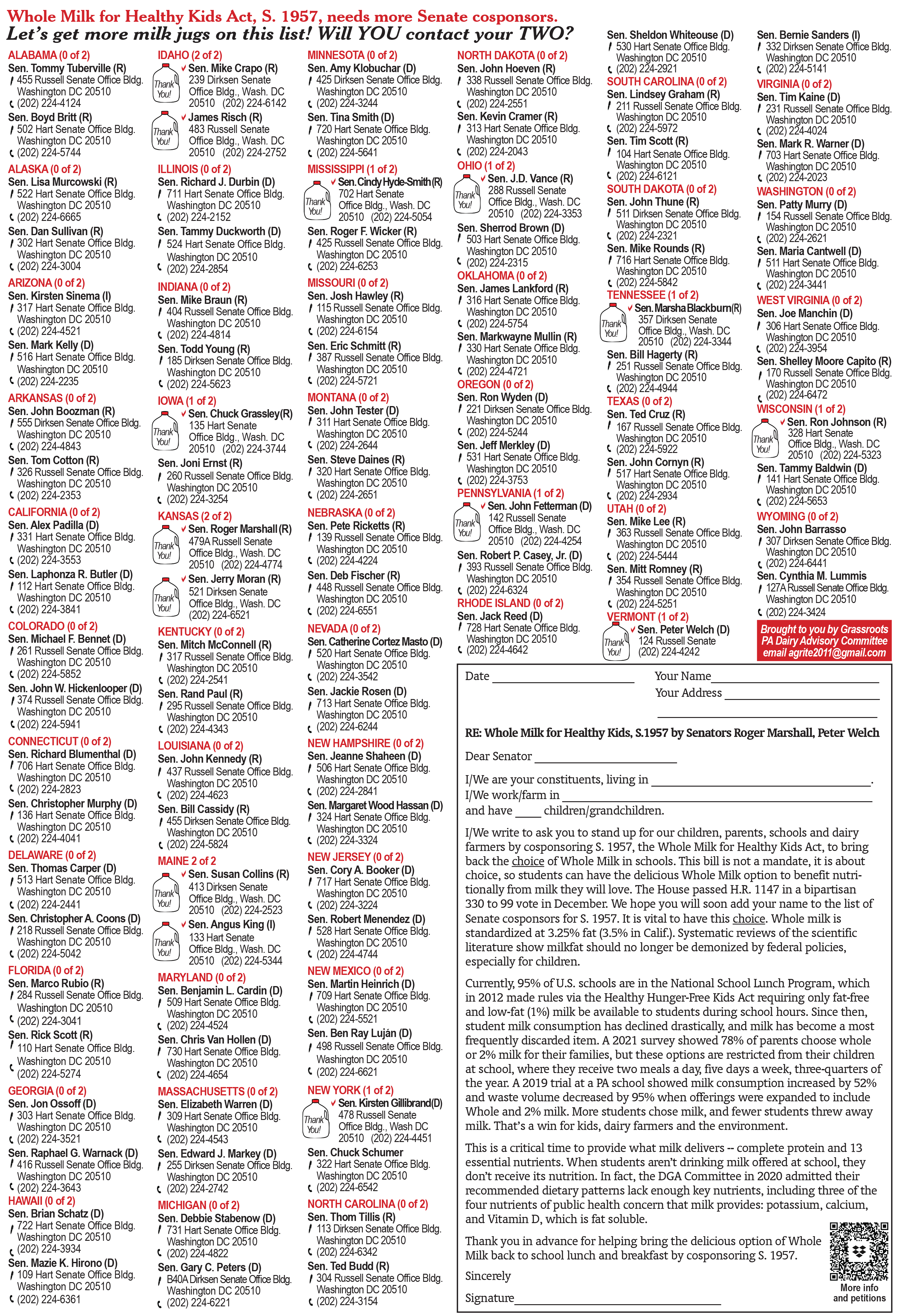
We need the rest of the Ag Committee, including Ranking Member John Boozman (R-Ark.). If you live in Arkansas, contact him. If you live in Minnesota, contact Ag Committee Senators Amy Klobuchar and Tina Smith; in Illinois, Sen. Richard Durbin; in Ohio, Sen. Sherrod Brown; in Kentucky, Sen. Mitch McConnell; in Iowa, Chuck Grassley has already signed on, but Joni Ernst has not; in North Dakota, talk with Sen. John Hoeven; in South Dakota, Sen. John Thune; in Nebraska, Sen. Deb Fischer; in Georgia, Sen. Raphael Warnack; in New Mexico, Sen. Ben Ray Lujan; in Alabama, Sen. Tommy Tuberville; in Colorado, Sen. Michael Bennet; and in New Jersey, Sen. Cory Booker.

No matter where you live, contact your state’s two U.S. Senators. We need as many Senate cosponsors as possible, and we need Senators motivated to speak with Chairwoman Stabenow, to ask her to please stop putting the ego and agenda of Washington bureaucrats above the health and welfare of America’s children and the economic stability of America’s dairy farmers.

This bill is about choice. It is not a mandate. It simply allows schools to offer whole and 2% flavored and unflavored milk at school lunch and breakfast without financial penalties for exceeding outdated milkfat limits that are unnecessary or even harmful to children.

If we want children to benefit from the nutrition milk delivers, then we need to deliver the permission for our children to be able to choose milk they will love at school where they have two meals a day, five days a week, three-quarters of the year. That’s how they actually benefit from the complete protein and 13 essential nutrients milk delivers.

Let’s stay positive. We can’t afford to lose ANOTHER generation of milk drinkers and think we will still have a dairy industry in many parts of the U.S. The Whole Milk for Healthy Kids Act is an opportunity for dairy farmers to revitalize and renew fluid milk demand, but more importantly, it’s an opportunity for schoolchildren to choose milk they will love for life and health. It’s also an opportunity to drastically cut the amount of wasted milk in school cafeterias, a win for stewardship of resources and the environment.

A 2021 survey by IDFA showed that 78% of American parents who described themselves as voters, choose 2% or Whole Milk for their families as the most delicious and nutritious option, but their children can choose neither 2% nor Whole milk at school where they have two meals a day, five days a week, three-quarters of the year.

This survey is consistent with what a Pennsylvania school trial in 2019 showed. The students preferred Whole Milk 3 to 1 over the 1% low-fat milk. When 2% and Whole Milk were offered in the coolers, students consumed 52% more total milk and the average daily volume of discarded milk was reduced by 95%. This means more students took the offered milk instead of refusing it, and fewer students threw away the milk they took with their meals.

The Grassroots Pennsylvania Dairy Advisory Committee, under chairman Bernie Morrissey’s leadership, has launched a letter-writing and phone-calling campaign seeking cosponsors for S. 1957. They have put together the tools, but grassroots farmers and citizens must be the ones to carry it out and send the letters and make the calls.

We need to help Senate Ag Committee Chairwoman Debbie Stabenow understand this issue is about lifting the federal school lunch and breakfast ban that was placed on delicious nutritious whole milk in 2012 so that school districts, parents and students can make healthy milk choices that are enjoyed and not discarded.

This bill is not a mandate for whole milk. This bill ends a mandate against whole milk.  

This is about options, choice, and a future for kids and dairy farms. Will YOU call or write your TWO?

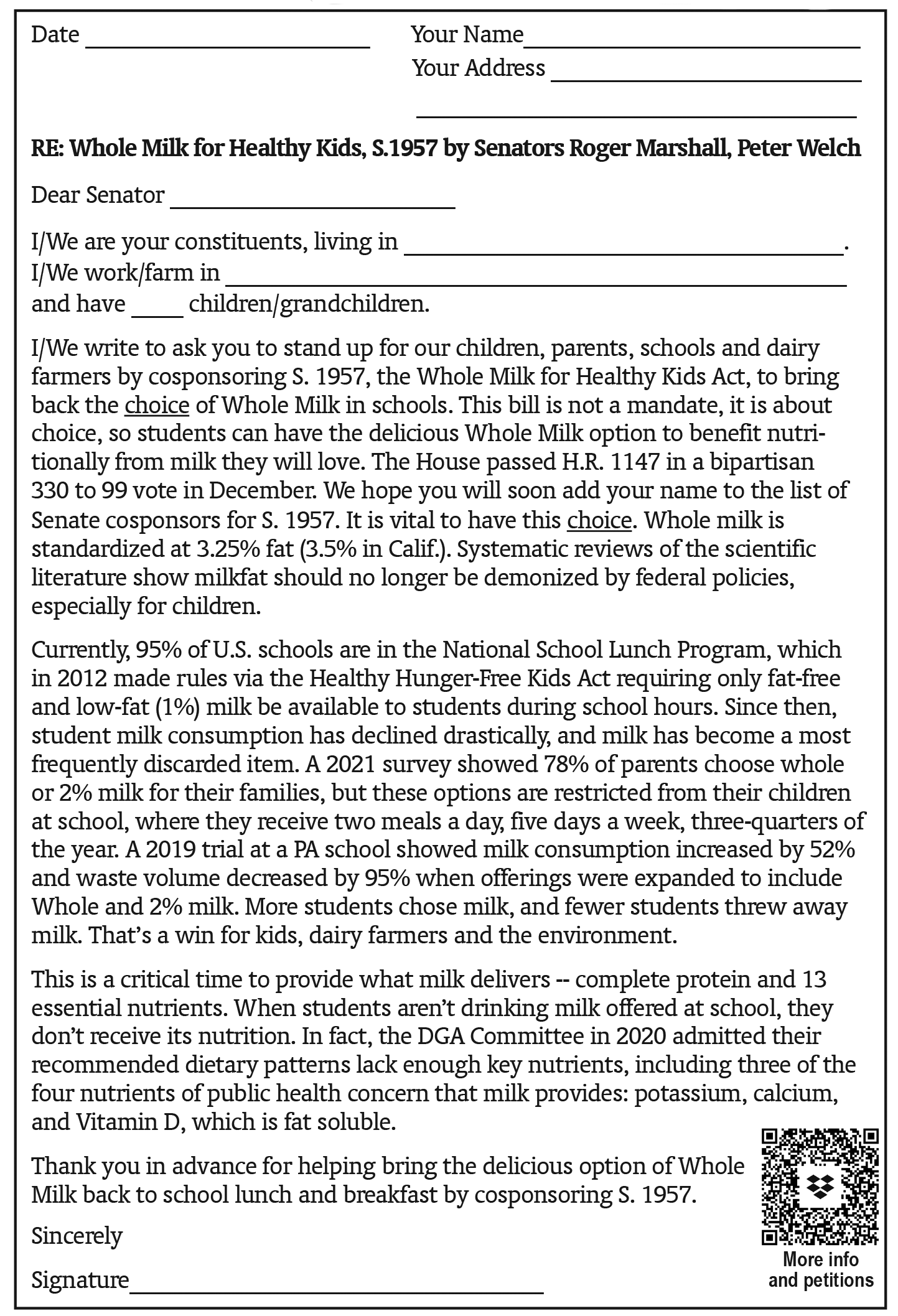
Let’s keep this bill moooving. Every state has two U.S. Senators. Click here for a sample letter.

Find the Washington addresses and phone numbers for your state’s Senators at https://www.senate.gov/ – Click the icon in the top left corner, select your state from drop-down menu to see how to contact them. Or look for your state in this printable directory.

For a more detailed letter, like the one sent by the Grassroots PA Dairy Advisory Committee to Senator Robert Casey, Jr. of Pennsylvania, click here.

For a simple phone message guide for contacting Senate Ag Committee Chairwoman Debbie Stabenow, Majority Leader Chuck Schumer and Minority Leader Mitch McConnell (and if in PA Senator Robert Casey) click here.

See the complete Action Packet and find some additional resources in a folder here

To email your Senators: Go to https://democracy.io/ – type in your address, city and zip code, click submit. Your two Senators and one Rep. will show up with red check marks. Click ‘Write to them.’ Then, on the next screen, write the body of your letter. If you want, you can start with who you are, where you live, what you do. You can also mention if you have school-aged children or grandchildren. Then copy and paste from the text below or write your own message simply asking your Senators to cosponsor S. 1957 The Whole Milk for Healthy Kids Act

**************

RE: Whole Milk for Healthy Kids, S.1957 by Senators Roger Marshall and Peter Welch

I write to ask you to cosponsor S. 1957, the Whole Milk for Healthy Kids Act, to bring back the choice of Whole Milk in schools. This bill is not a mandate, it is about choice, so students can have the delicious Whole Milk option to benefit nutritionally from milk they will love. The House passed this in a 330 to 99 vote in December. We hope you will soon add your name to the list of cosponsors for the Senate. Whole milk is standardized at 3.25% fat (3.5% in Calif.). Systematic reviews of the scientific literature show milkfat should no longer be demonized by federal policies, especially for children.

Currently, 95% of U.S. schools are in the National School Lunch Program, which in 2012 made rules requiring only fat-free and low-fat (1%) milk be available to students during school hours. Since then, student milk consumption has declined drastically, and milk has become a most frequently discarded item. A 2021 survey showed 78% of parents choose whole or 2% milk for their families, but these options are restricted at school, where kids receive two meals a day, five days a week, three-quarters of the year. A 2019 school trial showed milk consumption increased by 52%, and waste volume decreased by 95%, when offerings were expanded to include Whole and 2% milk. More students chose milk, and fewer students threw away milk. That is a win for kids, dairy farmers and the environment.

This is a critical time to provide what milk delivers — complete protein and 13 essential nutrients. When students aren’t drinking the milk offered at school, they don’t receive its nutrition. In fact, the Dietary Guidelines Committee in 2020 admitted their recommended dietary patterns lack enough key nutrients, including three of the four nutrients of public health concern that milk provides: potassium, calcium, and Vitamin D, which is fat soluble.

Thank you in advance for helping bring the nutritious, delicious option of Whole Milk back to school lunch and breakfast by cosponsoring S. 1957.

**************

-30-