Unknown's avatar

About Agmoos

I am a journalist writing primarily about agriculture for various newspapers over the past 30 years...and before that, I milked cows and tended calves and heifers. I am also a mother and grandmother with three grown children: A teacher, restaurateur and homemaker. Our two sons and one daughter all like to cook and they are food conscious... not paranoid. My "foodographic" Agmoos blog is a place to find stories and photos of the people and places behind the food we eat and for commentary and analysis on food, farm and marketing issues facing producers and consumers.

Sen. Gillibrand’s plans for Dairy Subcommittee hearing are moving forward

By Sherry Bunting, Farmshine, July 9, 2021

WASHINGTON, D.C. — Senator Kirsten Gillibrand (D-NY), chair of the Senate Agriculture Subcommittee on Dairy, Livestock, Poultry, Local Food Systems, Food Safety and Security, told reporters in late May that she is working on milk pricing legislation and wants to have dairy pricing hearings in her subcommittee before the August congressional recess. 

According to a document obtained by Farmshine, the Senator has been granted the request to hold the hearing in her subcommittee. The American Dairy Coalition (ADC) reports their appreciation for Senator Gillibrand moving forward on this, noting her office has established the hearing scope and is contacting testifiers. A date is anticipated for late summer 2021, though not yet confirmed on the Senate Ag calendar.
“We cannot lose the ability to feed our own people,” Gillibrand said during her May press conference. “If you have a market that’s fundamentally flawed and are constantly leaving producers unable to survive in the industry, there’s a problem. So, I think we need a very thorough investigation of my concerns.”

At that time, Gillibrand also talked about a multi-part scenario where this hearing could be followed by an investigation. Since 2003, the U.S. has lost almost half its licensed herds with milk price returns declining 23% in the past five years, according to USDA.

In addition to pricing and competitive market concerns over the past decade, the billions of dollars in dairy farm losses due to negative producer price differentials (PPDs) and de-pooling are part of the hearing equation.
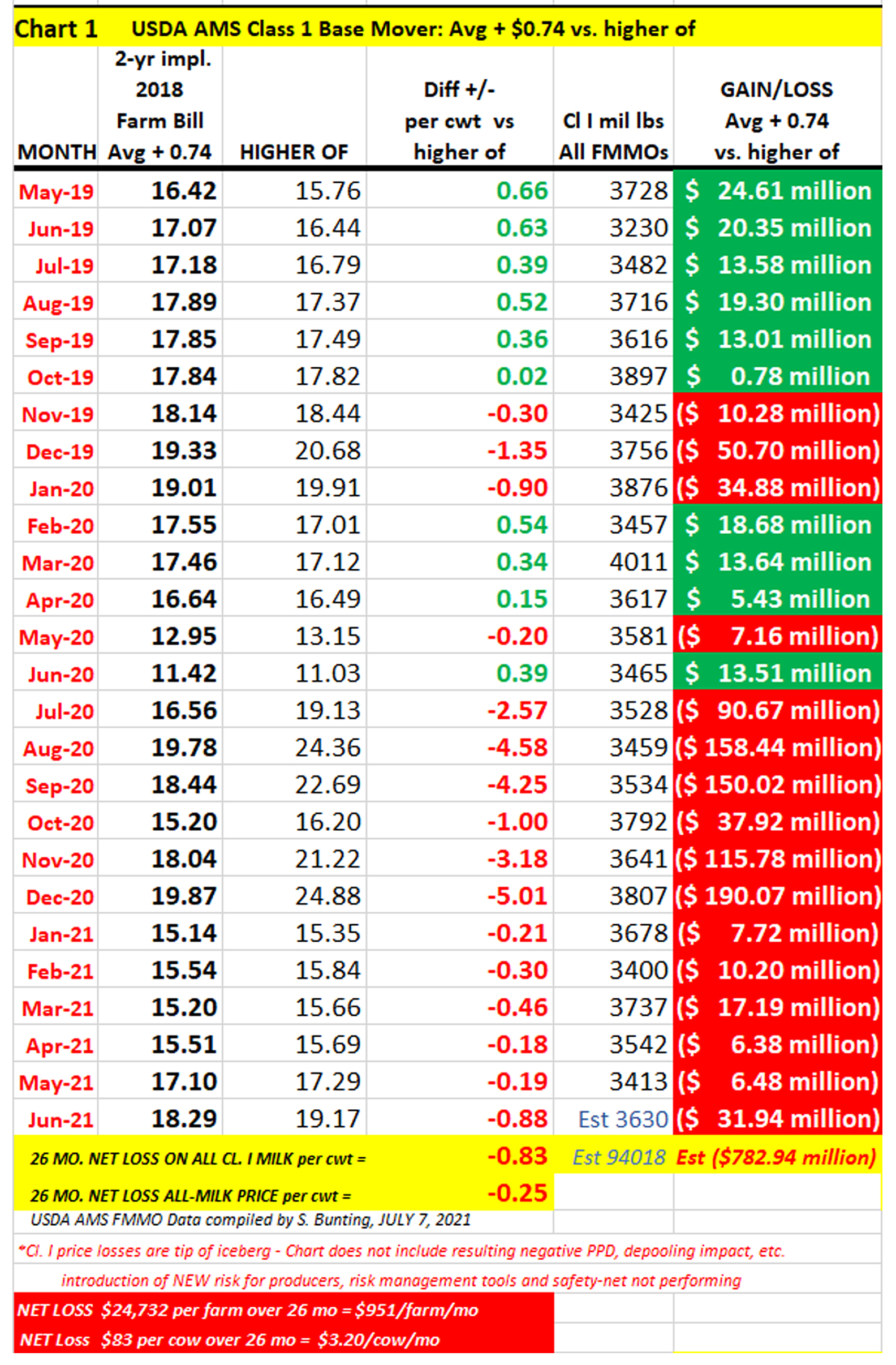
Of this, a documented $783 million in net losses have accrued over 26 months directly tied to the reduced Class I price for beverage milk under the new averaging method implemented by USDA in May 2019 (See Chart 1). 

That equates to a straight average loss of nearly $25,000 per farm or $83 per cow, but the Class I value losses would be greatest in milk marketing areas with a higher percentage of Class I use. Other types of losses were incurred by producers in milk marketing areas that have a lower Class I utilization but experienced large volumes of Class III milk de-pooled, making the much lower Class IV price a bigger portion of the blended price paid to farmers.

At the height of these losses being incurred, the American Dairy Coalition worked to bring dairy producers together through conference calls and emails, driving a letter signed by hundreds of producers and organizations to National Milk Producers Federation and International Dairy Foods Association. The March letter requested a seat at the table for producers to address the Class I method.

NMPF and other groups came out with statements about potential FMMO hearing requests, which did not materialize.

In May, ADC worked with Senators in supporting Senator Gillibrand’s letter to Ag Secretary Tom Vilsack, seeking use of available CFAP and PAP funds to assist dairy farm families with these losses. 

Secretary Vilsack recently responded to questions from Senator Patrick Leahy (D-Vt.) during an Ag Appropriations hearing to say USDA is working on a plan to compensate Class I and Class III differential losses, but no details have been forthcoming. Producers are also waiting for details from USDA about the enhanced Dairy Margin Coverage base payments approved by Congress in December.

Sen. Gillibrand has observed the extreme volatility in milk prices over the past decade of her service as a member of the Senate Ag Committee. Dairy farm revenues have steadily declined due to a combination of trade wars, increased production costs, and competition from non-dairy alternatives leading to reduced consumption of fluid milk.

Other seismic shifts have also occurred in the dairy market landscape over the past five years, including shockwaves of rapid cooperative and plant mergers, plant closings, farms and small cooperatives losing milk markets since 2015, Walmart opening its own fluid milk processing plant in 2018, and the bankruptcy filing in 2019 and sale of plants in 2020 by the nation’s largest milk bottler, Dean Foods.

Multiple factors have also converged around the pandemic to create further losses for dairy farm families operating on already razor-thin margins and struggling to attain equitable markets and revenue.

Even the risk management tools purchased by producers did not function as designed because they are based on market values that most farmers did not receive in their actual milk checks. That’s like filing an insurance claim for a fire, but the adjuster looks at someone else’s intact property to determine your damages.

The upcoming hearing will likely look at all of this in relation to the change in the Class I pricing method for fluid milk, which was added to the 2018 Farm Bill without being vetted through a hearing process. The hearing is also expected to look at ways to address the Class I change and the FMMO hearing process, as well as FMMO pooling and de-pooling rules and dairy cost of production.

FMMO revenue sharing pools are the mechanism for how the usually higher Class I base price and normally positive differentials are shared with producers across a milk marketing area, no matter what class of products their milk is used in.

However, when the Class I price — due to the new averaging method — fell below Class III for 16 of the past 26 months, an estimated 85 billion pounds of Class III milk normally associated with FMMOs was kept out of the revenue-sharing pools, dropping the Class III portion to less than half its normal size from May 2019 through May 2021, and ultimately depressing milk check returns to producers. Some handlers may have paid their own shippers a portion of this de-pooled value, most did not.

In effect, the equitable method became inequitable when pricing turned upside-down, and risk management, at a time when farmers needed it most, failed.

Additionally, the USDA Farmers to Families Food Box cheese purchase effects on markets in relation to Class I pricing, are also expected to be part of the hearing.

The Food Box program included cheese, milk and other dairy products to help struggling families and at the same time was intended to support struggling farmers that were having to dump milk and be docked further penalties by milk buyers and cooperatives as ‘balancing costs’ or ‘market adjustments’ to handle milk supplies during the disruptions of the Coronavirus pandemic.
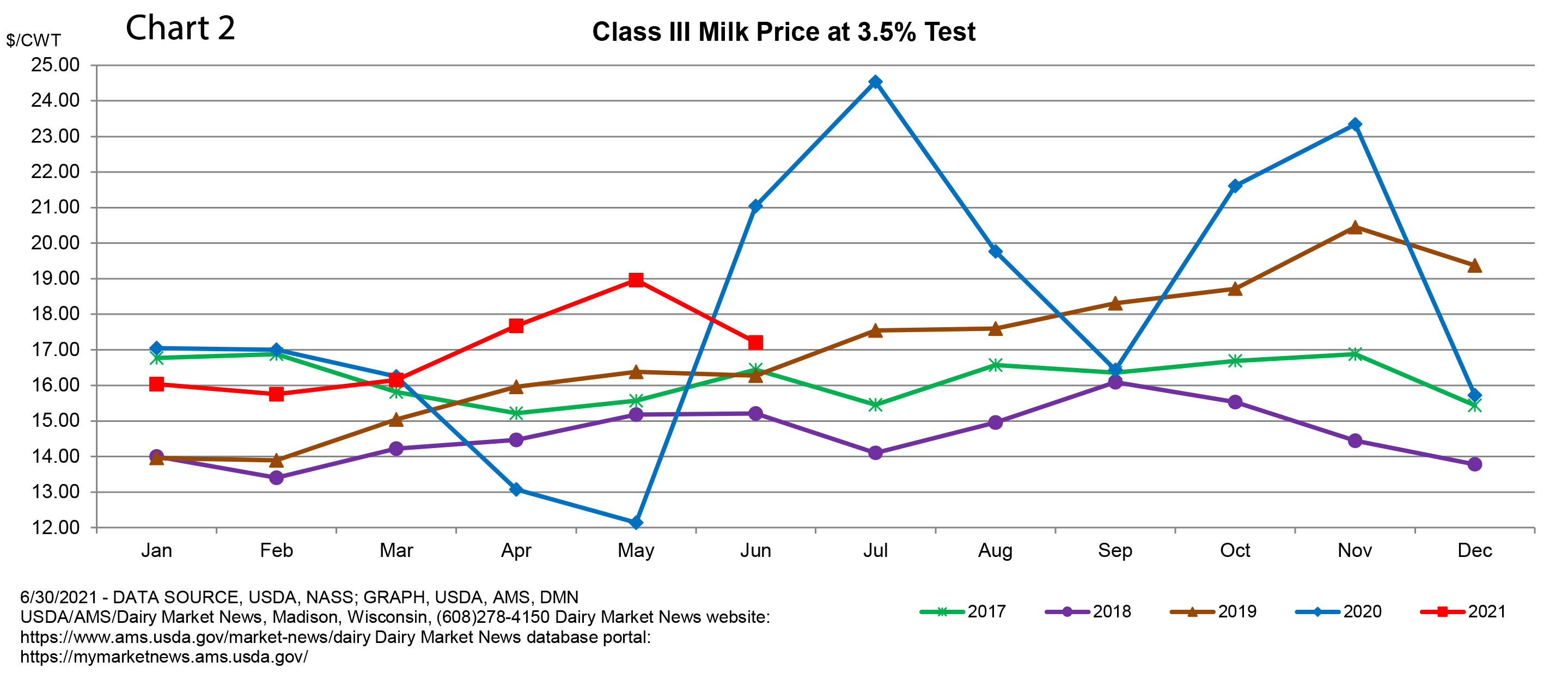
These purchases prompted cheese market rallies, followed by intervals of higher Class III milk prices (see Chart 2). However, this support became inequitable in large part due to the Class I pricing change, alongside a record large spread between the Class III and Class IV prices of $5 to $10 per hundredweight. This spread was affected on one side by record-large butter imports and inventories (Class IV), a slowdown in milk powder exports (Class IV) and on the other side by cheese sales (Class III) rising because of active exports and government cheese purchases for food boxes during the pandemic.

Even though every food box contained a gallon of fluid milk, there is no way to determine the ‘market value’ of Class I fluid milk, apart from the manufacturing class and component values. This is because fluid milk is treated as a base commodity. It is present in 95% of shopping carts, and thus used by large retailers as a loss-leader on the one hand, while on the other hand, the USDA regulates Class I fluid milk handlers as the only class that must pay a minimum FMMO price to farmers.

The hearing is also expected to look at processor ‘make allowances’ that are built into USDA’s end-product pricing formulas for bulk surveyed commodities: cheddar and dry whey (Class III) and butter and powder (Class IV).

Make allowances and yield factors currently add up to $3.17 per hundredweight on the Class III milk price and $2.17 per hundredweight on Class IV, according to a 2018 presentation by John Newton, formerly the chief economist for Farm Bureau who was hired this year by the Senate Ag Committee, explained make allowances as part of a risk management conference in Pennsylvania.

In effect, the make allowances are deducted from the milk component values as a ‘processor credit’ per pound of product, and the yield factors are applied, determining the number of pounds of product made per hundredweight of milk. Processors are indicating the make allowances should be raised because of the “circular” nature of end-product pricing.

But there’s another way to look at that ‘circularity.’ While it’s true that 12 years have passed since make allowances and yield factors were last updated (2008), it also true that in those 12 years vast amounts of value-added manufacturing have been added that benefit from these make allowances but are not part of the end-product-pricing ‘circle’ back into the farm milk price. The cost of making those products can be easily passed up the supply chain instead of back to the farmers. 

For the plants making the four USDA-surveyed bulk commodities that determine class and component prices — cheddar, butter, nonfat dry milk and whey — the issue may be ‘circular’. However, if make allowances are too high and too rigid, then there’s too much incentive to make product for storage that further depresses raw milk prices through end-product-pricing. So make allowances can be circular in that way also.

Dairy pricing is complicated and intricate — a huge topic. But then again, maybe what can come out of a Senate Subcommittee hearing is a simple straightforward message about making milk pricing simple and straightforward.

Pennies per pound here and there across milk volumes mean millions for big players, and when they add up to nickels and dimes that turn into dollars per hundredweight in the farm milk price, the intricacies become something farmers should be able to see and understand.

In a word: Transparency.

As indicated in her May press conference, Senator Gillibrand is looking to have each part of the dairy sector represented to offer their unique perspectives in the upcoming hearing, which is expected to have two panels, the first being dairy farmers and the second panel bringing in cooperatives, processors and an expert on dairy policy and economics.

In May, Senator Gillibrand made it clear she wants to see a multi-part evaluation of current and longstanding dairy issues, with this hearing being a first step to get a look at the lay of the land.

Stay tuned.

-30-
The long and the short of it

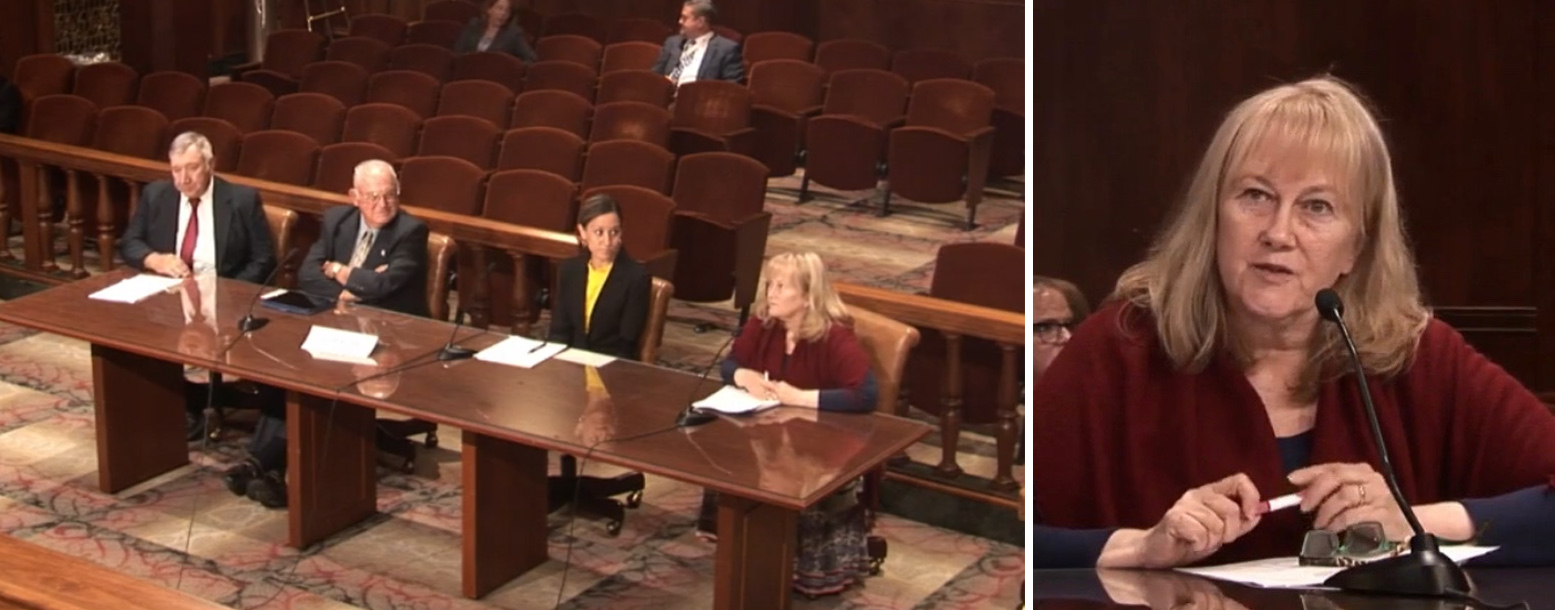
In all, 11 people testified during the Pennsylvania Senate Majority Policy Committee’s public hearing about the federal prohibition of whole milk in schools. I testified (right) in one of three panels, which also included (l-r) Nelson Troutman, Bernie Morrissey and Jackie Behr.
Below is the shorter, oral version of my full written testimony for the June 16, 2021 public hearing.

By Sherry Bunting

Good morning Honorable Chairman Scavello and Senate Committee. Thank you for inviting me to testify on whole milk choice in schools. My name is Sherry Bunting. As an ag journalist 40 years and former Eastern Lancaster County School Board member 8 years, not to mention as a mother and a nana, I see this from many sides.

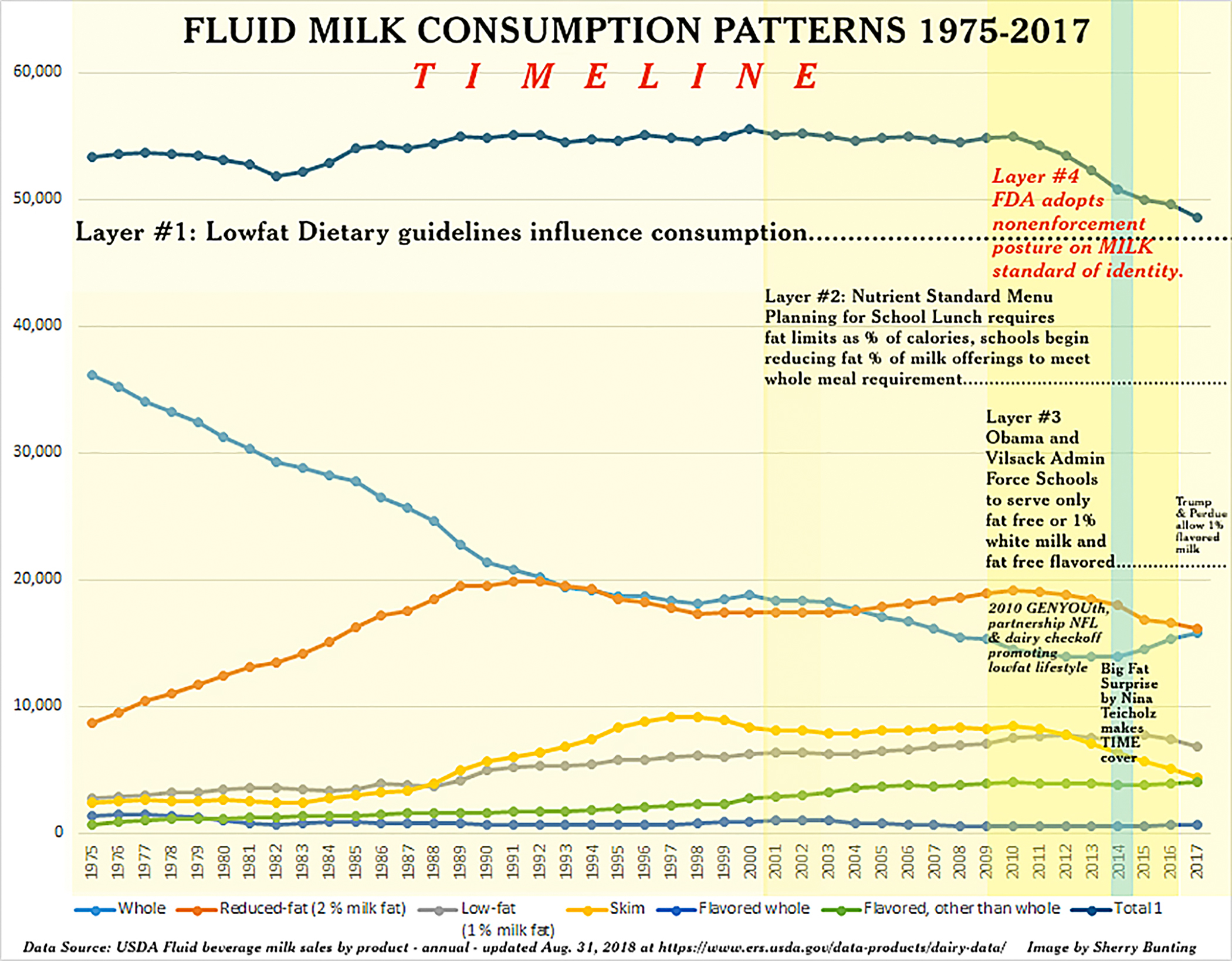
From the dairy side, fluid milk sales had their steepest decline over the past decade as seen in the chart (above) with my written statement. There was a decline slowly before that, but you can see the drop off after 2010.

That was the year Congress passed the Healthy Hunger-Free Kids Act.

Two years prior, the national dairy checkoff, which farmers must pay into, signed a memorandum of understanding with USDA to advance the department’s Dietary Guidelines using the checkoff’s Fuel Up to Play 60 program in schools — promoting only fat-free and low-fat dairy.

(Note: This was confirmed in a May 2021 dairy checkoff press conference, stating that “DMI has been focusing on the youth audience ever since making its commitment to USDA on school nutrition in 2008,” and that Gen Z is the generation DMI has been working on since the launch of Fuel Up to Play 60, which was followed by the formation of GENYOUth and the signing of the memorandum of understanding, MOU, with USDA Secretary Tom Vilsack in that 2008-10 time period.)

By 2011, USDA had their data showing schools that voluntarily gave up whole and 2% milk were meeting the Department’s Dietary Guidelines more consistently — on paper — as far as fat content across the ‘served’ meals and the ‘a la carte’ offerings, combined.

With this data, USDA targeted whole and 2% milk, specifically, for mandatory removal from school grounds during school hours by 2012.

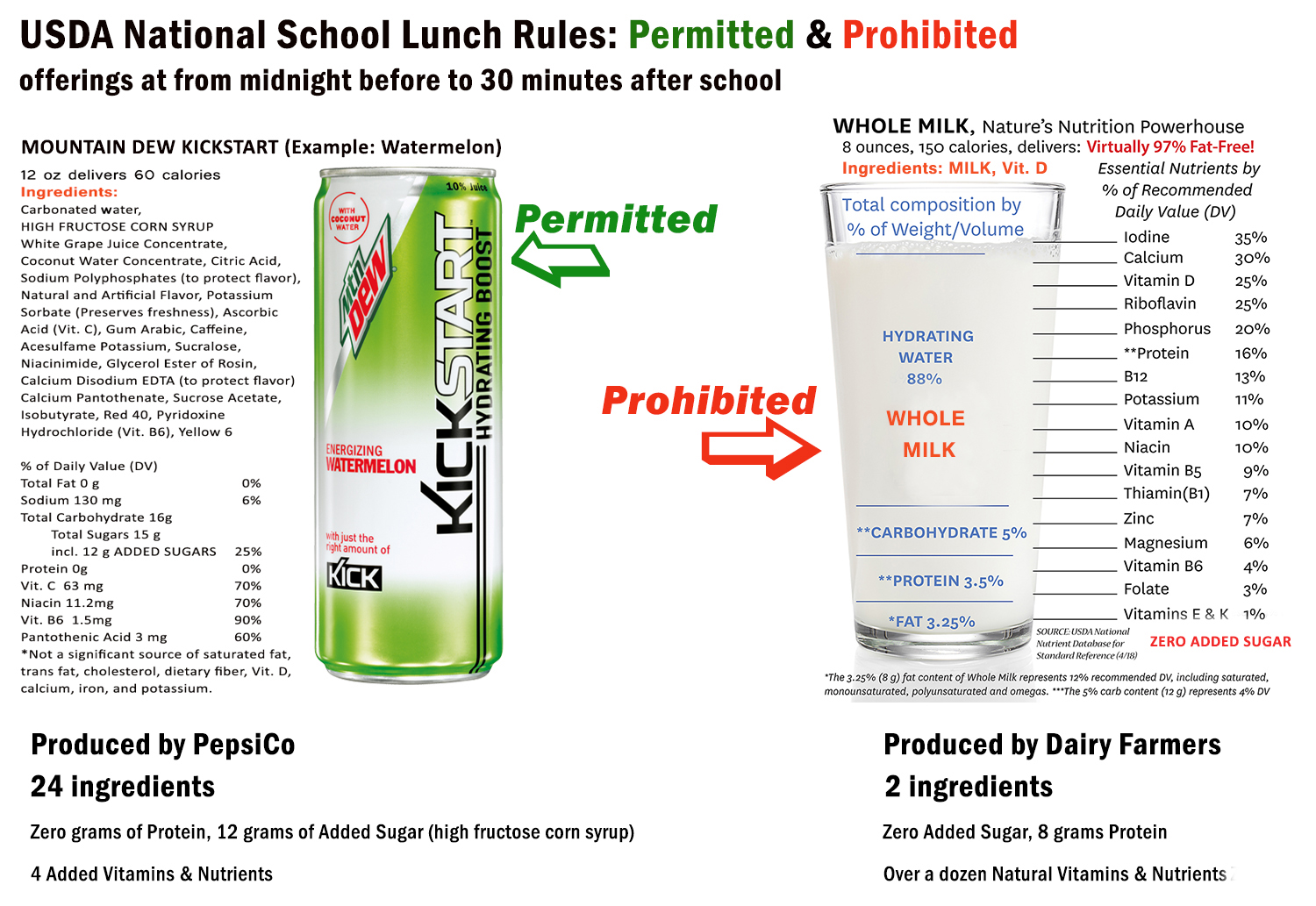
In fact, the ‘competing foods’ regulatory language at the time stated that even if you wanted to have a vending machine (with whole milk) as a fundraiser for FFA, it could only be open for two weeks for the fundraiser, maybe three. The rest of the time it had to be closed between the hours of midnight before the start of the school day and 30 minutes after the end of the school day.

This is how we are treating whole milk.

That looked good on paper, but the reality? Since 2008, the rate of overweight and diabetes has climbed fastest among teens and children after a decade of stipulations that you can only have whole milk until you’re 2 years old — and in the poorest demographics, who rely the most on school lunch and breakfast. This fact was acknowledged during a U.S. Senate Ag hearing on Childhood Nutrition in 2019, where senators even referenced a letter from 750 retired Generals sounding the alarm that young adults are too overweight to serve.

This is a federal and state issue, and I might add, a national security issue. Our state has an interest in the outcomes.

An example…

While Pennsylvania school doors are closed to whole milk — a fresh product most likely to be sourced from Pennsylvania farms — their doors are wide open to processed drinks profiting large global beverage and foodservice companies.

What the kids buy after throwing away the skimmed milk does not come close, as you’ve heard, to offering the minerals, vitamins and 8 grams of complete protein in a cup of whole milk. What’s on paper is not being realized by growing bodies, brains and immune systems. Not to mention the milkfat satiates and helps with absorption of some of those nutrients. A wise foodservice director who saw this coming told me in the late 1990s, while I was serving on the School Board, he said: “when too much fat is removed from a child’s diet, sugar craving and intake increase.” Some of the latest data show he was right.

School milk sales are 6 to 8% of total U.S. fluid milk sales. However, this represents, as you’ve heard, the loss of a whole generation of milk drinkers in one decade.

The Northeast Council of Farmer Cooperatives looked at school milk sales from 2013 through 2016 and reported that 288 million fewer half pints of milk were sold in schools during that period. This does not include half-pints that students were served but then discarded.

This situation impacts Pennsylvania’s milk market, farm-level milk price, and future viability — a factor in Pennsylvania losing 1,974 farms; 75,000 cows and 1.8 billion in production since 2009 – rippling through other businesses, ag infrastructure, revenue and jobs. We are, actually now, 8th in milk production in the U.S. If you go back 15 years, we were 4th. As of last year, we were passed by Minnesota.

The fat free / low fat push devalues milkfat as a component of the price paid to farms, making it a cheaper ingredient for other products. Our kids can have whole milk. There is no shortage of milk fat because if there was, producers would be paid a fairer price that reflected its value.

While the flaws in the Dietary Guidelines process would take a whole hearing in itself, Pennsylvania consumers see the benefits of milk fat in study after study and are choosing whole milk for their families. Redner’s Warehouse Markets, for example, reported to me their whole milk sales volumes are up 14.5%. Nationally, whole milk sales surpassed all other categories in 2019 for the first time in decades. So parents are choosing whole milk, and we saw that during Covid, and even before Covid.

Today, children receive one or two meals at school, and there’s a bill actually being considered by Congress to make three meals and a snack universal at school. Then what?

Many parents don’t even know that whole milk choice is prohibited. Even the New York State Senate Agriculture Committee, during a listening session on various issues, had a request brought up to legalize whole milk in schools. Three of the senators expressed their shock. One asked the person testifying — who is both a dairy farmer and an attorney — how could this be true? They thought she was joking.

(In fact, skepticism prompted Politifact to investigate. They confirmed, indeed, Lorraine Lewandrowski’s statement — “Make it legal for a New York state student to have a glass of fresh whole milk, a beautiful food from a beautiful land” — received the completely true rating on Politifact’s Truth-O-Meter because, yes, there is a federal prohibition of whole milk in schools.)

There’s just not enough people understanding that this is happening. Many people think the kids do have the choice, but they don’t.

My petition, that I started in late 2019, has nearly 25,000 signatures online. The links are with my written statement — and 5000 were mailed to me by snail-mail — so over 30,000 total. Nearly half of those are from Pennsylvania, and New York would be second as far as signatures, but we have signatures from every state in the nation.

When I looked through to vet it, to balance it and make sure we didn’t have people from other countries in these numbers, I started to see who was signing, from all walks of life — from farmers, to parents, to teachers, doctors, and on and on. Even state lawmakers, I recognized some names on there. The whole milk choice petition has opened eyes.

Thank you for this hearing, and please help bring the choice of whole milk back to our schools. Our children and dairy farmers are counting on us.

If I could just have a couple more seconds here, this is personal for me, as a grandmother. One of my grandchildren is lactose intolerant, or I should say, that’s how it would seem, but she has no trouble drinking whole milk at home. Her doctor says she may be lactose intolerant because she keeps coming home from school and having stomach problems at the end of the day. She now is not drinking the milk at school, just drinking whole milk at home. She can’t drink the skimmed milk, and there’s really some science behind that.

A professor in North Carolina (Richard C. Theuer, Ph.D.) mentioned this role of milk fat actually slowing the rate of carbohydrate absorption — which is the lactose. (As a member of the National Society for Nutrition and Adjunct Professor in the Department of Food, Bioprocessing and Nutrition Sciences at North Carolina State University, Theuer addressed this in at least two public comments on the Dietary Guidelines Federal Register docket, once in 2018 and then again in 2019.)

I’ll end my comment here, sorry I went a little over.

— At the conclusion of my time, Pennsylvania Senate Majority Policy Committee Chairman Mario Scavello said this was a good place for me to end my testimony because “what we’ve heard here today is children are not drinking the skim milk and the low-fat milk. We’ve got to get this corrected, the more I listen to this,” he said. Then, turning to Nelson Troutman on the panel in regard to the 97 Milk education effort, Scavello added: “By the way, I did see that 97 percent bale. Thank you for explaining it because I thought, what is this about? I could see the bales while driving on I-80.”

-30-

From GENYOUth to Gen-Z, dairy checkoff’s strategic integration game revealed

In what was billed as a “National Dairy Month” zoom news conference May 26, Gen Z was the focus as DMI activated its new thing: ‘strategic integration.’ Speaking were clockwise from top left, Scott Wallin, VP Industry Media Relations; Anne Warden, Exec. VP Strategic Integration; Barb O’Brien, DMI President; Jordan Maron (aka Captain Sparklez), popular Minecraft gamer; Nevin Lemos, Gen Z California dairy producer.

Who plays? Who pays? Who wins?

By Sherry Bunting, Farmshine, May 28, 2021

ROSEMONT, Ill. — Strategic integration. Gen Z Gamers. Point of origin for innovation. Dairy-‘based’ positioning. Virtual authenticity. Over a decade of planning.

My head is spinning after a DMI press conference this week on three new “activations” for June Dairy Month in the digital world of video games, including “Beat the Lag,” a gamer-recipe contest and the integration of Fuel Up to Play 60 into the virtual world of video gaming exercise.

Dairy Management Inc. (DMI) has been on a 12- to 13-year path to streamline, dilute, blend and innovate dairy with a focus squarely on Gen Z since 2008 in the schools, now integrating rapidly into the digital spaces where dairy checkoff leaders say Gen Z is changing the world of marketing for companies globally.

According to DMI, Gen Z is not interested in facts like vitamins and minerals. They want to know how foods and beverages will make them feel.

On the other hand, DMI leaders described Gen Z as “very capable of discovering facts,” of “looking deeper” for “authenticity” and “relatability,” that when communicating with Gen Z “you want to be really factual and transparent and tap into the emotions that they care about.”

(The paradox of virtual authenticity is hard to overlook.)

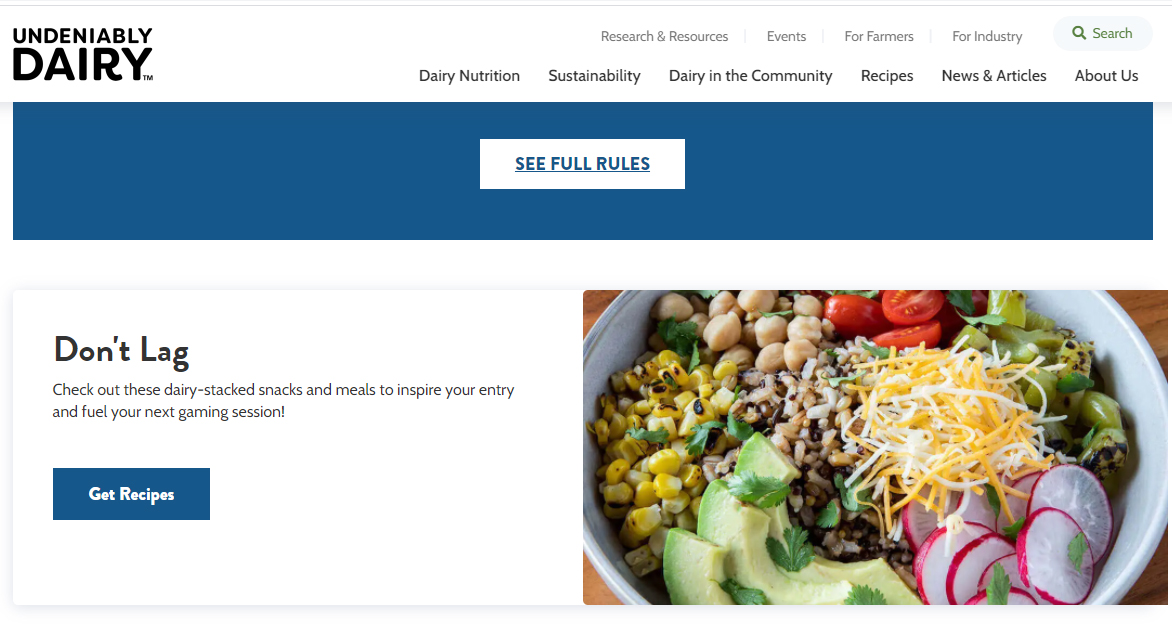
Taking center stage at DMI’s Undeniably Dairy website (usdairy.com) was the Beat the Lag Gen Z gamer competition in which this photo is the recipe contest centerpiece from which DMI will glean pathways to “launch future dairy innovations.” That tiny sprinkle of cheese makes this a dairy-based snack, says DMI in a special National Dairy Month media conference by zoom on May 26. usdairy.com screenshot

Dairy-based or ‘sprinkled’ is the future, some cheese on a pizza or snack. Butter in a cookie, splash of milk in a smoothie, a bit of cream added to a soda, a half ultrafiltered low-fat milk / half almond beverage blend. A little here, a little there. Don’t confuse or interrupt DMI’s ‘strategic integration’ flow by talking about having a glass of whole milk or a piece of cheese. DMI’s website has a few posts lately talking about how blending is the future of dairy — tailor-made for flexitarian messaging in the confusing and not-quite-factual climate-impact comparisons and discussion.

It’s all about innovation of new products, integrating (and diluting) milk as a component of beverages. Looking deeper, it’s really all about increasing margins for processors beyond the farmgate in the ramped up $100 billion dollar global “functional beverage” space, also known as ‘designer beverages.’

Gen Z has been DMI’s target for over a decade as the gateway, the point of origin for how strategic integration innovation will be accomplished with dairy farmer checkoff funds.

Anne Warden, executive vice president of Strategic Integration for DMI spoke in the zoom press conference May 26, explaining how DMI has been “focusing on the youth audience ever since making its commitment to USDA on school nutrition (in 2008).”

In fact, in a May 25, 2021 blog post by Warden, she talks about the future of dairy in schools, that Gen Z wants flashy packaging, unique combinations and sustainable dispensers.

According to Warden, Gen Z is the generation DMI has been working on since the launch of Fuel Up to Play 60, which was followed by the formation of GENYOUth and the signing of the memorandum of understanding (MOU) with USDA under Secretary Tom Vilsack in that 2008-10 time period.

This is the very same time period in which the option of whole milk as a beverage choice was removed from schools, even in the Smart Snacks rules governing ala carte beverage purchases and vending machines – paving the way for strategic integration. Put some milk in that soda, maybe? (That will make sense in a few minutes).

Last fall, Farmshine reported on the “partnering” DMI did with Gen Z ‘gamers’ in the popular Minecraft game, which included three dairy farms hosting three gamers to see how dairies operate. But the partnership that is now moving into integration warp-speed through three June Dairy Month “activations” has been years in the making.

Warden was hired by DMI in May of 2019 to head the strategic integration. Prior to that date, she spent three years at Edelman with DMI’s strategic integration as her primary project for Edelman. Warden’s resume at Linked-In notes DMI as one of Edelman’s largest and most integrated services clients.

This means ‘strategic integration’ — courtesy of all-knowing Edelman — has been underway at DMI for more than 5 years. Have we ever heard of it before now? No, because this is what the ‘precompetitive’ Innovation Center works on, where future strategies are decided upon via DMI’s ‘industry partners’ and quietly implemented with dairy farmer dollars.

Warden laid out the rationale for the three activations aimed at using Gen Z’s “love of video games to capture their attention and show how dairy products fit well within their gaming occasions during the day.”

DMI president Barb O’Brien stressed the point that DMI is looking at gaming as a platform with the objectives of communication and “research.”

“The work that’s coming through now with new product concepts, make this a consumer research method to understand where Gen Z will place their dollars in considering new products,” O’Brien related. “So it’s fantastic. (Gaming) is a channel, an occasion and a communications vehicle. It’s all about contemporizing how we do the work of the checkoff. It is the new advertising. Television is one-way. This is interactive.”

(Authentic, relatable, interactive content is deemed the key to communicating with Gen Z in a virtual digital world of gaming to bring forth new products. Let that paradox sink in.)

One of three activations discussed was “Beat the Lag.”

Lag is a term used to describe the frustration that happens when a video game’s graphics won’t load fast enough so the gamer has to wait (like the frustration of your computer screen freezing). DMI is taking that concept, partnering with Jordan Maron, known as Captain Sparklez to his 11 million followers to address “human lag.”

Over the past six weeks (ending May 29), DMI has been running a gaming recipe conest through Maron, soliciting “dairy-based” snack, beverage and recipe ideas from his followers, what do they eat to ‘Beat the Lag?’

DMI wants Gen Z to bring the ideas. “We don’t want to tell them what to eat (or drink),” said Warden.

During the press conference Maron noted that he got involved when approached by DMI because he “eats a lot of dairy.”

“One of my favorite foods is pizza,” said Maron. “I’m an especially huge fan of drinks that have added milk or cream in them, like sodas with cream added… They’re delicious. I love them.”

(A splash of milk or cream in a soda is something that had a hey-day three generations ago. Apparently, it’s making a comeback.)

Maron talked about doing some focus group work for DMI on “new product innovations” last fall along with a virtual farm tour.

“Me, and a few people who are followers of mine, got together in a call, and DMI shared their ideas for products they want to roll out down the line,” said Maron. “We took it to my focus group of three people and then turned that into Instagram story slides I was able to share out with a wider range of followers, and they were able to give their feedback as to what products would interest them, that they would buy or eat in the future.”

Maron said he hoped that his focus group gave DMI “some good insight.”

The press conference moderator, Scott Wallin of DMI, promptly steered away from the product innovation revelation and brought the conversation back to the farm tours and sustainability, saying DMI hopes to show Gen Z gamers the dairy story through Captain Sparklez and others.

Wallin introduced Gen Z dairy farmer Nevin Lemos of California. The 24-year-old fourth generation dairyman started his own 400-cow Jersey herd on a rented farm near his family’s dairy at the age of 20. Lemos admitted he doesn’t have much time for gaming over the past 10 years as his time and passion are spent working his dairy business.

Lemos observed that Gen Z is a generation able to “look behind the façade, to look deeper.”

Calling Gen Z a “savvy audience,” Warden said they exist almost entirely in the digital world, moving between multiple devices and media platforms daily, with 90% of Gen-Zers gaming.

They are aware of what companies are doing for good – beyond making money — and will turn away from products that “don’t match their values and their desire for authenticity,” said Warden, emphasizing Gen Z’s interest to know what companies are doing for the environment.

“We’re going to make sure farmers they can relate to (like Lemos) are showing up in their social media feeds to tell that story,” she said.

Gen Z gamer Maron talked about what it was like last fall to do the virtual farm tour with Gen Z dairyman Lemos, seeing how cows live and are fed and having one named after him: Sparklez.

The activation of DMI’s “Beat the Lag” is aimed at more than sustainability, said Warden, it is to “help re-position milk and dairy to meet Gen Z’s wellness needs.

“It’s about balance,” she continued. “Gen Z is less interested in the particulars of vitamins and minerals in their food or beverage. They are more interested in what that food is going to do for their bodies, how it is going to make them feel.”

Warden said DMI’s research shows that, “Some of dairy’s biggest opportunities with Gen Z are positioning as a food that will sustain their energy throughout the day or let them feel relaxed and recharged while doing the things that they love.”

“Beat the Lag” is themed around “dairy-based foods and beverages giving gamers an energy boost or a tasty pick-me-up after a long stretch of gaming,” said Warden. “We’re not going to tell them what to eat, we’re letting Jordan Maron (Captain Sparklez) and Rosanna Pansino, a gamer and culinary influencer, get gamers suggesting the ideas in ways they can relate to.”

Maron talked about ‘gamer fuel up’ youtube videos he did with Pansino, one being pizza pockets (with cheese).

“This is a contest, and when the (Beat the Lag) contest is all wrapped up, we’ll look at the recipes submitted,” he said, indicating that the winners will be shown in stages through the Minecraft game and win gaming prizes.

In addition to pizza pockets, other snack recipe ideas at the usdairy.com website under “Game On” and “Beat the Lag” include a bowl of vegetables and avocados, with the tiniest sprinkling of grated cheese. A demonstration is posted there also for making “Pixel Jam Heart” cookies. 

During the videos, Maron and Pansino talk about the contest suggesting smoothies, dips, protein drinks and things made with yogurt as ideas for creative contest submissions.

DMI’s O’Brien said: “This is today’s new form of advertising. It’s an opportunity to set the record straight on the nutritional side (vs. major advertising in all venues by plant-based dairy alternatives.)”

She said this avenue allows for “the exchange of factual information,” but was quick to point out that those nutrition facts “are not what is driving Gen Z’s choices.”

Bottom line? The virtual digital world of Gen Z gamers is, according to DMI president O’Brien, “the forum for putting forward innovation, for putting forward innovative products that are relevant to today’s lifestyle. We will be leading with products that are designed for gamers, by gamers, we know will have a much bigger appreciation beyond just gamers…

“We’ll see those products at retail. We’ll see those products at traditional foodservice. This is the point of origin for that innovation, and the inspiration,” she stated matter-of-factly.

There’s a lot to digest here, pieces of a dairy transformation agenda funded by farmers through checkoff. It’s important to know what checkoff dollars are doing in the integration phase of a 12 to 13 year plan to join the milk-disruptors with dairy-based innovations, now putting Gen Z gamers virtually in charge of how DMI’s products that are ready to roll down the line, come to market.

Meanwhile, a Hartman Group survey recently showed Gen Z prefers fast food and familiar tastes with a much lower attention paid to local, fresh products than prior generations. It’s no wonder. This generation has been worked over by PepsiCo, Domino’s, Sodexo, General Mills, brought into schools by USDA via the MOU marriage of low-fat / high-carb Dietary Guidelines and low-fat / high-carb promotion through Dairy Checkoff’s ‘school wellness foundation’ GENYOUth.

In this game, the obvious questions are: Who plays? Who pays? And who wins? 

After that trip into virtual authenticity, I need a tall cold glass of real whole milk to relax and recharge.

-30-


‘Got milk, PA? Ag Sec awards $400,000 Farm-to-School, but where’s the milk?

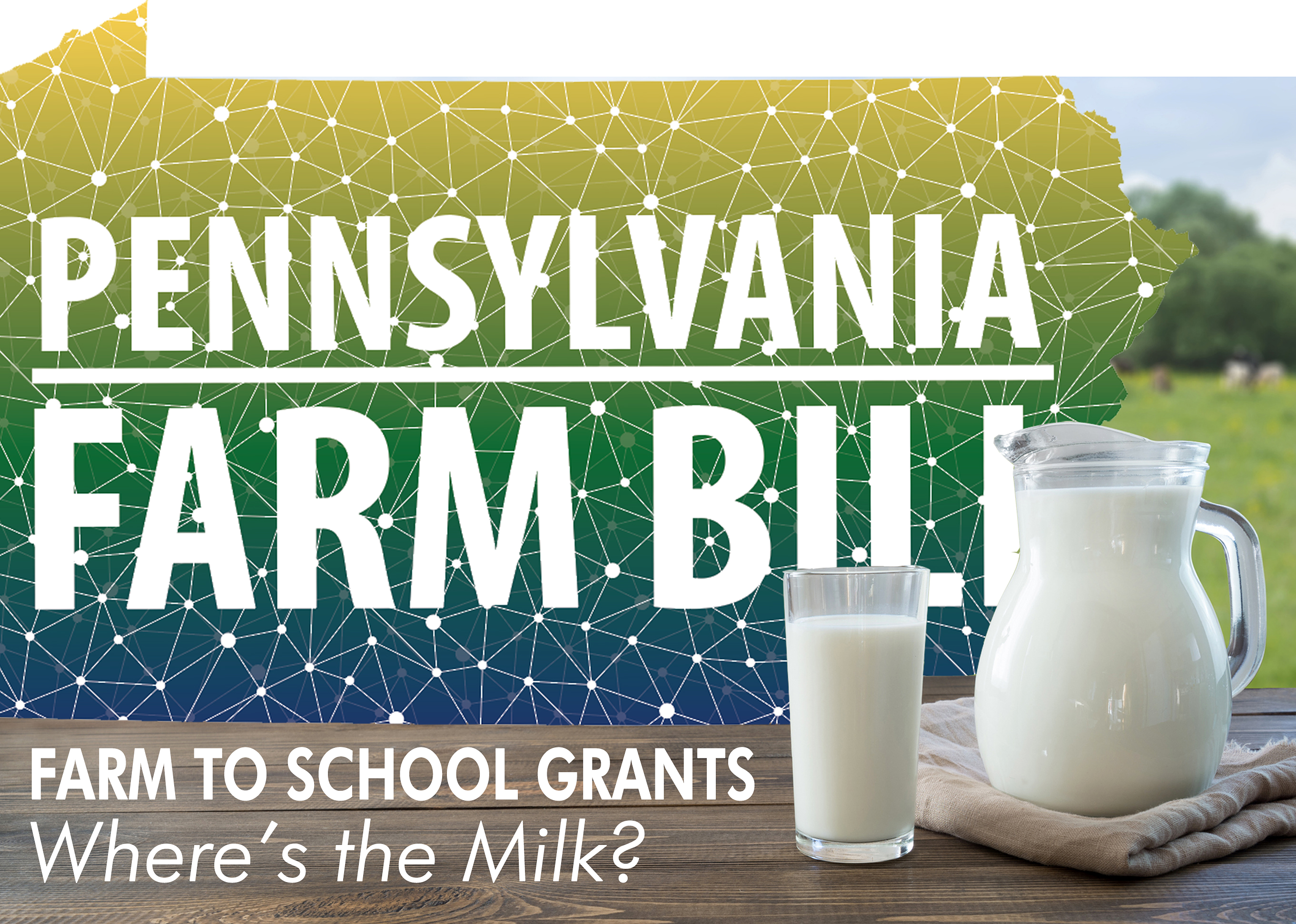
PA Farm Bill Farm-to-School education grants aim to bridge the gap between children and the food system by connecting them to the fresh, healthy food available from Pennsylvania agricultural producers in their community and the surrounding areas. The 39 grants announced April 30th, totaling $400,000 for 2020-21, and they are thin on real dairy even though real dairy is 37% of Pennsylvania’s agricultural economy. Composite image by Sherry Bunting

By Sherry Bunting, Farmshine, May 14, 2021

HARRISBURG, Pa. — Increasing childhood nutrition and agricultural awareness is the stated purpose of $400,000 in grant awards made recently as part of the Pennsylvania Farm Bill.

On April 30th, Pennsylvania Secretary of Agriculture Russell Redding announced 39 Farm to School grants of up to $15,000 each “to improve access to healthy, local foods and increase agricultural awareness opportunities for children pre-kindergarten through fifth grade.”

The trouble is, among the 39 projects receiving the total of $400,000, dairy is not mentioned, even though the Secretary recently confirmed when asked by state senators that dairy accounts for 37% of the Commonwealth’s agricultural backbone.

(As reported in Farmshine April 23, the Secretary also evaded Senate questions about legalizing whole milk as a simple choice for children in Pennsylvania schools, citing instead that the Dietary Guidelines maintain three servings of dairy a day and that the industry should focus on all the dairy products in school meals.)

“The children of today are the future of Pennsylvania agriculture,” said Redding in a press release announcing the $400,000 in Farm to School grants that are part of the PA Farm Bill’s 2020-21 budget cycle.

“Reviewing these 39 projects, and their goals to invest in programming that not only improves childhood nutrition but gives them opportunities for first-hand agricultural experiences to grow their knowledge and awareness, I see a bright future for the industry that feeds Pennsylvania,” Redding stated.

According to the Pa. Department of Agriculture statements, this grant program “aims to enrich the connection communities have with fresh, healthy food and local producers by changing food purchasing and education at schools and early childhood education sites.”

Any school district, charter school or private school with pre-kindergarten classes, kindergarten, or elementary through fifth grade was eligible to apply.

This week, Farmshine questioned the Pa. Department of Agriculture about the glaring absence of milk in the list of 39 grants awarded. Most of the grants involved school gardens and were tied to local produce grown in Pennsylvania. Some were projects linking to local poultry and eggs.

Dairy and beef were not mentioned at all. The only (not really) dairy reference in the Department’s press release was a grant to the Dubois Area School District in conjunction with Danone North America.

Before thinking Danone represents dairy in this case, think again.

Dubois is home to Danone’s flagship plant-based dairy-free alternative ‘yogurt’, ‘cheese’ and powdered ‘nutritional’ beverage plant.

In fact, Danone’s 180,000 square foot facility on 24 acres of the former airport in Clearfield County is the largest plant-based dairy-alternative plant in the United States.

At the 2019 ribbon-cutting ceremony for Danone’s multi-million-dollar plant-based expansion, the facility’s director, Chad Stone, highlighted “flexitarian” eating patterns as “people are interested in lessening their impact on the environment through diet.”

This plant-based “environmental” theme is already being pushed into school curricula and school foodservice at the national level (see related article in this edition of Farmshine).

In the Pa. Department of Agriculture’s response to our questions about the Farm to School grants lacking dairy, spokesperson Shannon Powers replied to identify five of the 39 grants as “including a dairy component in their application.”

One of the five she highlighted is the Clearfield County grant of $14,985 to the Dubois Area School District for “experiential learning and curricula” that includes “life on a dairy farm” via a field trip to a dairy farm (Kennis Farm was identified in the application). Powers also identified Danone as “a major dairy producer” but indicated that this grant provides experiential learning and curricula through the Danone facility in Dubois “that produces plant-based foods and beverages.”

Instead of using real local milk to make real yogurt, cheese and nutritional beverage powders, this Danone plant specializes in bringing in almonds, coconuts and cashews to make dairy substitutes as a so-called means of reducing “environmental impact” with new “choices” on grocery shelves.

(It’s hard to imagine how the almonds, cashews and coconuts listed in the Vega Protein, So Delicious and Silk brand yogurt, cheese and powder made at the Dubois plants could be locally-grown in Pennsylvania, a top-10 real dairy milk-producing state that is admittedly in ‘search’ of more dairy processing capability).

As for the other four Farm to School grants the Department identified in an email response as containing a dairy component, they are as follows:

In Erie County, a grant for $15,000 to the U.S. Committee for Refugees and Immigrants will do an experiential learning project that includes a dairy field trip.

In Lawrence County, the LCSS Healthy Start Micro Farm Project received $10,000 for a project that includes the purchase of local cheeses and other foods along with a school garden to supply the school kitchen.

In Lackawanna County, a grant of $3,356 to the Bright Future Learning Center was awarded to distribute Community Supported Agriculture (CSA) boxes to preschool children and includes farm field trips. The application noted that fresh local milk would be included in the CSA produce boxes.

In Tioga and Bradford counties, a $15,000 grant was awarded to Stepping Stones Preschool and includes a field trip to a dairy farm to learn about the cheese-making process.

“The PA Farm Bill’s Farm to School grants are awarded to schools and other educational entities to foster early interest in and exposure to agriculture careers and to encourage students to consume fresh, locally-produced foods and develop healthy eating habits,” writes Powers in her Pa. Department of Agriculture response to Farmshine’s questions.

She notes that while dairy is not specifically mentioned in applicants’ proposals, “dairy destinations and themes are included among field trips, and dairy is part of curricula schools develop with grant funds.”

Dairy products are already “virtually always among PA-produced foods served in schools but getting locally-sourced produce into school lunch programs is a greater challenge,” Powers as Pa. Dept. of Agriculture spokesperson stated.

While dairy has been a predominantly ‘local’ product in schools over the years, today, local dairy’s position in Pennsylvania schools is waning. A good example is the removal of the choice of whole milk from schools in 2010 when the federal government tied school lunches more closely to USDA’s flawed Dietary Guidelines.

The most local dairy product available to any school is whole milk. Instead, today, with only fat-free and 1% low-fat milks permitted in schools, and a complex set of rules for meals to mandatorily conform to Dietary Guidelines, large foodservice companies – including PepsiCo – promise ‘guaranteed compliant’ meals and beverages, and schools are moving toward this type of sourcing.

In fact, the beverages students purchase after discarding fat-free and 1% low-fat milk are anything but local or nutritious, but they meet USDA government guidelines because they contain no fat and are formulated with high fructose corn syrup and artificial sweetener combinations to meet calorie thresholds.

According to the Pa. Department of Agriculture, there were 57 applicants for this second round of Farm to School grants. The Farm to School grants were created under the 2019 PA Farm Bill and were funded again in 2020 and proposed for re-funding in the Governor’s 2021-22 budget.

When asked about grant applications that were denied, Powers replied: “Applicants not awarded grants did not meet the criteria or submitted incomplete applications. None of those applications included a dairy element.”

Our questions to the Center for Dairy Excellence, asking if they were aware of any Farm to School grants applications that involved curricula to highlight dairy or connect schools with local dairy, were not immediately answered; however, the Pa. Department of Agriculture in its response was quick to point out its other programs for dairy, as follows:

“The PA Dairy Investment Program in 2019 and Dairy Indemnity Program in 2020 are examples of state funding that has been available exclusively for dairy producers,” writes Powers. “In addition, the PA Farm Bill and Ag research grants include research dollars devoted to developing healthy, economical feed and bedding and controlling disease; conservation dollars to help improve soil and water quality and ensure future productivity; an Agricultural Business Development Center to help connect farmers with funding, grant resources, transition planning and a host of other support that benefits all Pennsylvania producers, including dairy.”

Powers also mentioned “Preferential tax programs like Clean & Green, REAP, Beginning Farmer Tax Credits, and a number of grants from other departments, including the departments of Environmental Protection and Community & Economic Development are available to dairy farmers” and reminds dairy producers seeking financial and planning resources from the state and private partners to “contact the PA Agricultural Business Development Center or the Center for Dairy Excellence, another state-funded entity created specifically to support the needs of PA dairy farmers.”

In a nutshell, the Department of Agriculture views dairy products in schools as already being local and is focusing Farm to School grants on getting other local products, especially produce, into schools. The Department was quick to identify a handful of the 39 Farm to School grants that will include a dairy farm field trip component. One grant the Department highlighted includes experiential learning by visiting a dairy farm and then visiting a plant-based alternative dairy replacement processing facility. And, the Department believes it is providing considerable financial and resource help to dairy farmers to improve their sustainability and to diversify or “transition.”

-30-

PA Ag Secretary Redding sidesteps school milk question, cites other priorities

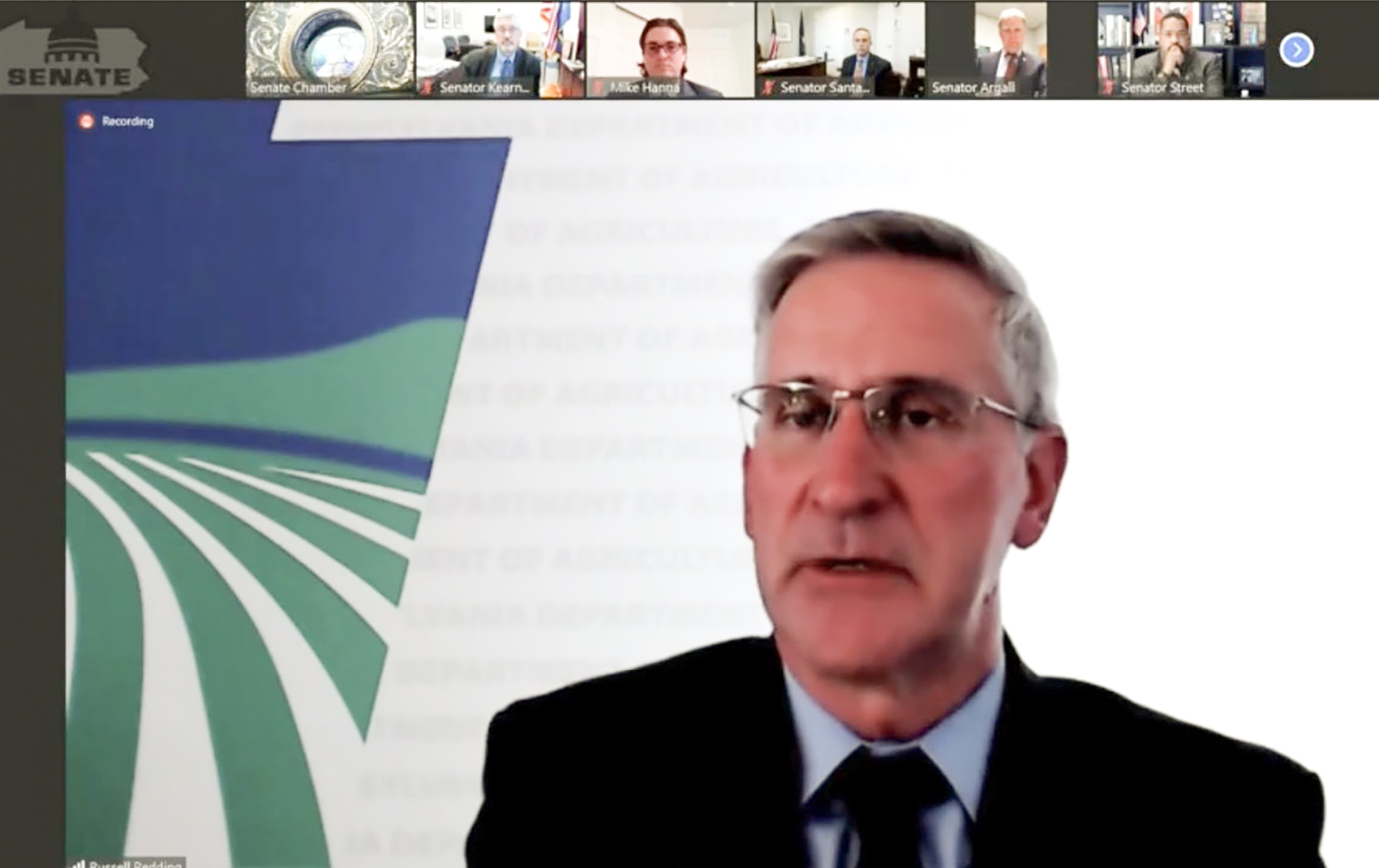
Pa. Agriculture Secretary Russell Redding sidestepped questions about school milk during State Senate budget hearings. He listed other priorities of advocacy in the “federal conversation” and cited the need for new processing for Pennsylvania’s dairy future. Screenshot photo of hearing on zoom

By Sherry Bunting, Farmshine, April 23, 2021

HARRISBURG, Pa. – During the Pennsylvania Senate budget hearings in April, in a question-and-answer exchange with Senator David Argall, representing Berks and Schuylkill counties, Agriculture Secretary Russell Redding talked about advocating for trade agreements, pricing policies, dairy investment and nutrition in “the federal conversation.”

However, on the question of advocating to legalize whole milk choice in schools? Asked twice. Not answered.

In fact, the Secretary’s entire agriculture budget testimony included just one small paragraph about dairy — something Sen. Argall picked up on and questioned. He asked Redding what portion of overall Pennsylvania agriculture is represented by dairy, to which the Secretary replied “about 37%.”

When pushed on what the department is doing, Redding said: “I can tell you dairy is about 37% of my conversations — even though the testimony doesn’t reflect that.”

“We have made real progress in dairy and have been part of that conversation, but there is still more to do for dairy to remain viable and remain at 37%,” said Redding, citing the work of the Dairy Futures Commission, but few details.

Asked to look five to 10 years down the road, the Secretary said the dairy industry has had some “really incredible years in the last five and some incredibly bad years in the last five. It is always going to be sustainable,” he said, “but the question is: Are we going to have those good years to make up for the bad years?”

(It has been seven years since a truly good year was experienced by dairy producers.)

The Secretary pinned the hopes of the future for dairy in Pennsylvania on “getting new processing.” 

Redding stated: “We can compete on the farm. We can compete as a state. But we have to compete at the marketplace too. I remain encouraged by what we’re doing, but we have to keep pressing to make sure we get the right state and federal policies.”

However, there is one federal policy at the core of fluid milk marketing that the Secretary evaded.

Sen. Argall pointed out the 2010 federal policy that removed whole milk from schools.

“Do you see a solution to that issue, and is that really a big part of the overall problem?” the Senator asked.

“I think it is certainly a contributor, and I hear it all the time about whole milk. But what I try to encourage the dairy industry is to look at where total dairy consumption is — the 1%, the 2%, the whole milk — and can you get more cheese, get more yogurt in, can you get more dairy products into that school diet,” Redding replied.

“I think that’s probably what we have to keep our eye on,” he continued. “It’s going to take all of that product mix for us to turn this trend around of just dairy consumption generally. It’s a complicated equation. All of us need to keep pressing on the Congress to do more, to keep our trade agreements in place, and I can tell you… we’ve had some difficult (trade) steps for the last several years.”

(The last several years saw record volumes of exports. Tom Vilsack, current U.S. Ag Secretary and former U.S. Dairy Export Council president wrote in a blog post that 2018 was “a banner year for dairy exporters.” We all recall what 2018 was like for dairy farmers.)

Sec. Redding also referenced the negative PPDs on milk checks as an issue. He stated that, “The price difference between Class III and IV has cost Pennsylvania dearly, so that’s also part of the federal conversation.”

Sen. Argall picked up on the Secretary’s mention of ‘federal conversation,’ asking a second time about whole milk in schools.

“Are you working with anyone across the country to try to repeal that portion of the (federal) act that has greatly reduced the number of students (allowed) to drink whole milk in the schools?” the Senator asked.

“We have not been engaged in repeal. We have been engaged in what I mentioned earlier, about making sure that the Dietary Guidelines include dairy, and they do continue the three a day,” said Redding. “We have continued to advocate for continued investment in dairy, making sure that we do the trade (exports), making sure we have the pricing pieces.”

The Secretary went on to say; “We are advocating at a lot of different levels for dairy on the nutrition side and also the dairy investment side.”

In regard to new processing, after years of discussion, two dairy bills were passed by the House in the 2019-20 session, only to die in the Senate Ag Committee. One was a dairy keystone opportunity zones bill and the other was a bill dealing with transparency and distribution of state-mandated over-order premiums. Both bills, sponsored by Rep. John Lawrence had passed unanimously or nearly unanimously in the House last session.

During a meeting last week of the Grassroots PA Dairy Advisory Committee, Berks County dairy farmer Nelson Troutman, a committee member, noted a dairy redevelopment project in his county that looked to be a sure thing, only to be dropped.

Meanwhile, Pennsylvania has dropped from fifth to seventh, and now eighth in the nation in dairy production.

“This has gone on as the dairy industry consolidates,” said Mike Eby, a Lancaster County farmer, member of the grassroots committee, chairman of National Dairy Producers Organization and executive director of Organization for Competitive Markets.

“The Secretary mentions the momentum we have from fluid milk consumption rising recently. Increased sales of whole milk are a key to that increase. Legalizing whole milk choice in schools makes sense for children and dairy farmers,” Eby explained.

“Everything is political in this. Why do we not have whole milk in schools? People have no clue how important this is for dairy farmers. We have already lost a generation of milk drinkers,” notes Dale Hoffman, a Potter County dairy producer and member of the grassroots committee having worked on this issue for several years. 

Even the Pennsylvania Dairy Futures Commission, which was referenced by Sec. Redding in his comment about “making progress,” addressed the issue of whole milk in schools. 

The Commission was established by the state assembly in 2019 and issued its lengthy report in Aug. 2020 on a broad range of dairy issues. In one area of the report, the Commission made recommendations to improve the school milk experience, specifically stating: “Federal school milk program standards should allow the flexibility to offer a choice in flavored and unflavored milk, including whole milk.”

While several key state lawmakers report they are looking for an opening to do something on this at the state level, Secretary Redding evades the question, even changing the subject when asked about whether he is advocating for this in the federal conversation.

Instead, the Secretary responded by saying the Department advocates in the federal conversation for trade agreements, pricing pieces, and on the nutrition side being satisfied to have the ‘3-a-day’ in the school diet.

Here are a few questions Pennsylvania dairy producers may want to ask Pa. Ag Secretary Redding, by contacting the Pa. Department of Agriculture at 717-787-4737.

— Why does the Secretary advocate for ‘trade’ while completely sidestepping the question about advocating for whole milk choice in schools?

— Does the Secretary support Congressman Glenn “G.T.” Thompson’s bill H.R. 1861 Whole Milk for Healthy Kids Act to legalize whole milk choice in schools?

— Will the Dept. of Agriculture advocate for the health of children and the Commonwealth’s ag community by advocating for the bipartisan efforts to bring the choice of whole milk back to schools?

— In the budget hearing, Sec. Redding again identified the need for more processing in Pennsylvania. With properties up for redevelopment over the past few years in the heart of dairy areas, what is being done to encourage redevelopment projects for dairy processing?

— Given at least one such project was underway and then abandoned, what are the influences and obstacles?

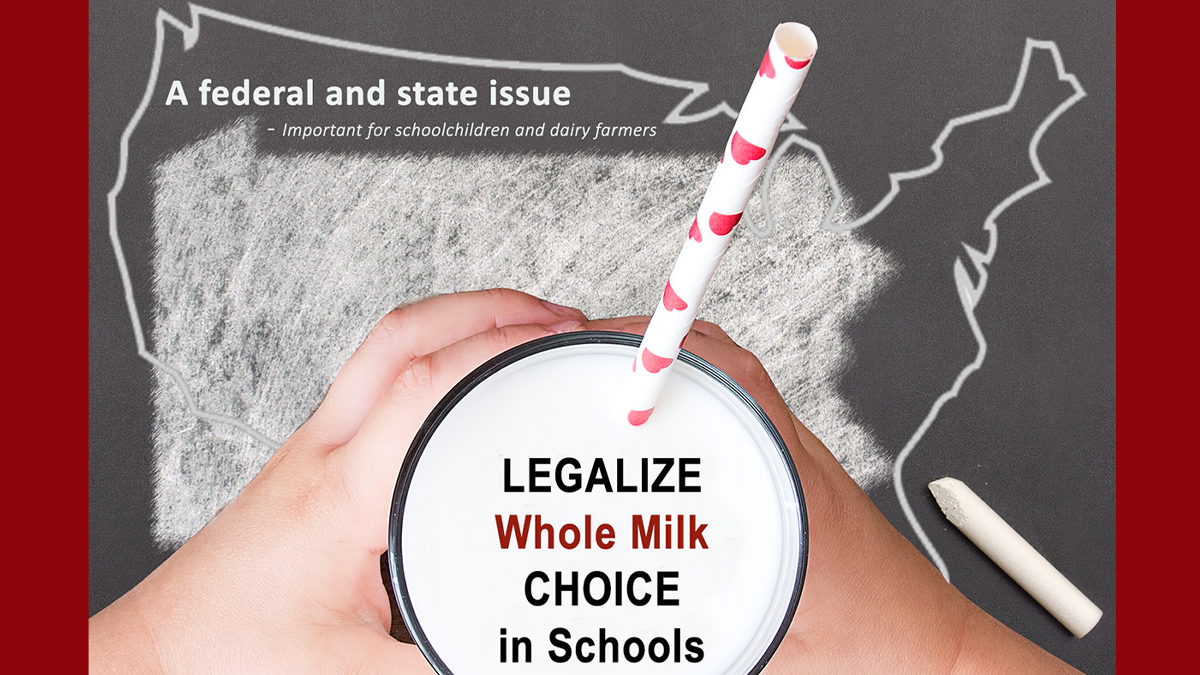
The effort to legalize the choice of whole milk in schools is a federal and state issue. Public awareness has been increased over the past two years through the joint efforts of the Grassroots PA Dairy Advisory Committee and 97 Milk, including a petition that is being revitalized as the U.S. Congress and State Assembly begin a new legislative session. Graphic by Sherry Bunting

Milk Market Moos, June 25, 2021

By Sherry Bunting, published weekly in Farmshine Newspaper

Cutting through consumer confusion

Consumers and producers of food and beverages — anything in the protein market — are going to see a disruptor explosion of new products. As I look through the food-related publications coming across my desk and into my email inbox — Culinology, Progressive Grocer, Food Navigator, Meat + Poultry, Dairy Foods, Food and Beverage, and the list goes on — the sudden onslaught of animal-free cellular agriculture, portrayed as dairy and meat without the animals, is stunning.

Even Facebook pop-up ads push Nick’s ice cream every day in my Facebook ‘newsfeed’ — with the tagline ‘dairy without the cow’ courtesy of Perfect Day Foods.

They use ‘climate’ to generate interest from companies wanting to reduce a carbon footprint by incorporating the excrement of genetically-altered yeast to replace a portion of real dairy protein in the dairy manufacturing space. It’s an easy swap, Perfect Day founders say, and according to the USDA Bio-engineered labeling regulations that became official last January, the stuff doesn’t have to be labeled BE because the genetically-altered yeast are not being consumed — just their excrement harvested from the fermentation vats.

“We ran the numbers, and if we partnered with the dairy industry to use Perfect Day protein in just 5% of their products, we’d save 12.3 million metric tons of greenhouse-gas emissions – equivalent to the carbon emitted from every single car registered in the city of Los Angeles,” says Nicki Briggs, Perfect Day’s vice president of corporate communications in a Berkeleyside online interview on the third day of June 2021. Ms. Briggs was formerly an employee of Chobani.

There are other dairy turncoats and straddlers moving between real and fake and seeking to blend them to some sort of climate / carbon standard. But data like that of Ms. Briggs doesn’t tell the whole cow story. Just like the data Impossible Foods is using to coax schools to replace 50% of their beef with Impossible Burger — now that it has the coveted USDA Child Nutrition Label — are figures that do not consider the entire cycle of cattle for a net figure on GHG.

It is maddening. This onslaught of bright packaging with new and clever names and claims populating the meat, dairy and seafood offerings — starting with plant-based concentrates and chemical combinations and leading to cells growing in bioreactors and yeast excreting protein in fermentation vats. Big Tech is the new wannabe farmer, and Big Ag, Big Food, Big Finance, and Big ole Uncle Sam are in for the deal.

Consumers will begin to feel like they are stuck inside a pinball machine, or to be more current with my analogy, a warp-speed version of a video game bombarded by bangs, pops and whistles.

That’s what Gen Z wants, they all say. And yet, a survey by the Hartman Group recently showed Gen Z — just like the Millennials before them — are most comfortable with the food choices they grew up with, but unlike Millennials who still had a preference for local, seasonal and farm-to-table, Gen Z-ers have a preference for fast food and foods with familiar tastes.

We’ve got some work to do to navigate all of this with a straight forward message that cuts through the climate half-truths and outright lies about cows, that penetrates the government dietary restrictions based on outdated and incomplete reviews of the scientific literature on dietary fat.

We’ve got our work cut out for us to keep educating others, giving them the facts that are being ignored and bullied out of the national, even global, conversation about food as the industry grows its margins for investors through consumer confusion at the expense of consumer’s knowing what’s real.

USDA joins global school lunch deal

USDA can’t even get U.S. school lunch right, but now plans to lead America’s joining into a “global coalition” called the “School Meals: Nutrition, Health and Education for Every Child.”
There’s also a bill before Congress seeking to make three meals and a snack universal for all children through school.

As for the global coalition, this is right up Secretary Vilsack’s alley. In a press release Wed., June 23 about USDA’s leadership in joining the global deal, Vilsack talked about “powerful incentives” and “building resilience to future shocks” by focusing on improving the nutrition, health, and education of vulnerable children and adolescents worldwide. Sounds good, right? Who can argue with words like that? But like everything else out of USDA these days, where’s the details? And what’s it really mean?

The global coalition is centered around education and school meals and will launch at the United Nations’ Food Systems Summit in September. Like the 30 x 30, the Net Zero initiatives, and everything else coming through the pipeline from World Economic Forum, the goal line for this, too, is 2030 — making nutritious meals available for all children by 2030, with other benchmarks set for 2022.

Who can argue with nutritious meals for all children? There’s not a single person who doesn’t want all children to have nutritious meals. The problem is this: Who defines what is nutritious? How will the systemization child-feeding change the future of food and agriculture?

Details, please, because the track record so far where USDA is concerned is marred by lack of logic and reduced application of current nutrition science via institutions like the Dietary Guidelines and restrictive policies for feeding children.

“We look forward to bringing our expertise to bear, expanding our reach, and benefiting millions more vulnerable children by partnering with the World Food Program and other like-minded countries as part of this important coalition,” said Vilsack in Wednesday’s press release.

Okay, let’s hear those details.

Will USDA do dairy?

In a June 15 press release about previously authorized aid for dairy, USDA announced $580 million for Dairy Margin Coverage base changes and $400 million for Dairy Donation Program would be implemented within the next 60 days, but we’ve yet to see the details.

As part of that news release, USDA also noted that, “Additional Pandemic Assistance for Producers (PAP) payments would be targeted to dairy farmers who have demonstrated losses not covered by previous payments.” No details on that either.

However, on the same day of that press release — June 15 — Senator Patrick Leahy, Chairman of the Senate Appropriations Committee, asked USDA Secretary Tom Vilsack about delivering urgently needed relief to dairy farmers. Vilsack replied to say that USDA was announcing that day (again without details).

In the exchange between Vilsack and Leahy during a Senate hearing, Vilsack said: “We are creating a program to help reduce the differential that occurred between Class I and Class III milk pricing because of the disproportionate number of purchases of cheese during the Food Box effort. That distorted the market, and it caused a lot of harm to smaller producers. We’re putting resources in to reimburse those producers for some of the loss they incurred.”

Those ‘differential’ discrepancies have not been outlined yet by USDA, but here are several manifestations Farmshine and other publications have been documenting:

  1. Due to the new Class I base calculation that uses a III / IV averaging method instead of the prior ‘higher of’, which was implemented by USDA in May 2019, over $750 million in cumulative Class I value was lost from May 2019 through May 2021.
  2. As much as $3.5 billion was potentially withheld or represented as inequitable transmission of milk value when massive volumes of Class III milk were withdrawn from FMMOs, as further reflected in severely negative PPDs. This would be a net loss after months of positive PPDs are applied; however, even positive PPDs in some months were smaller than normal.
  3. Both 1 and 2 contributed to the inequitable transmission of Class III value to many producer milk checks
  4. These losses affected the performance of purchased risk management tools, meaning that a change in Class I pricing that was supposed to help dairy processors manage their risk, had the resulting effect of making it more difficult or impossible for dairy farmers to manage their risk — during a time when they needed it most.

Conundrum: U.S. milk production up 4.6% in May

But here is the conundrum in regard to USDA dragging its feet on details for ‘dairy aid’: May milk production nationwide was up a whopping 4.6% over year ago — so says the USDA report released June 22. April production was up over 3% vs. year ago.

USDA looks at this as though dairy producers are doing so well that they are expanding their herds. In fact, in May, there were 145,000 more milk cows in the U.S. than a year ago. Could this be another sign of the inequitable transfer of value in the milk pricing formulas?

More insight on the production report next week’s Market Moos.

July Class I advance $17.42

The July advance Class I base price, or ‘mover,’ was announced Wednesday (June 23) at $17.42. This is 87 cents lower than June’s Class I base price and 86 cents higher than a year ago. The July 2021 Class I base price at $17.42 — using the current formula of average plus 74 cents — is 34 cents higher than it would have been if figured using the previous ‘higher of’ method at $17.08.

July 2021 marks the first time in 12 straight months that the new calculation method resulted in a higher Class I base price than the old method. However, there’s a lot of ground to make up, considering that for 16 of the 27 months since the new method was implemented, the difference between the new ‘average plus’ and the old ‘higher of’ was lower and only 11 months were higher.

In fact, the Class I base value losses for 16 months averages to $3.28 per hundredweight while the value gains (including upcoming July 2021) for 11 months averages to just 39 cents.

Class III/IV milk futures plunge

Class III and IV milk futures were all lower across the board this week. The only green in the sea of red, was the Class III current month gained a dime heading into the last week of June contract trading, but the Class III July contract lost 15 cents and August plunged by $1.00 below week ago, with the rest of the board on Class III milk ranging 10 to 50 cents lower. On the Class IV board, the losses were more evenly spread ranging 20 to 50 cents lower across all 12 months.

As all four dairy commodities trended lower on the CME spot market this week, the 12-month futures average lost 29 cents on both classes, equally, by midweek, so the spread between Class III and IV 12-month future contract averages remained exactly at 67 cents on Wednesday, June 23 — right where it was a week ago and still well below the $1.48 mark.

On Wed., June 23, Class III milk futures for the next 12 months averaged $17.67, down 29 cents from the previous Wednesday’s average, the 7th straight week the 12-month Class III futures price average was lower than the prior week. Class IV contracts averaged $17.00 — down 29 cents from the 12-month average on the previous Wednesday.

Dairy commodities all lower

Butter slid lower almost daily, on the CME daily spot market. By Wed., June 23, the price was pegged at $1.73/lb — down 7 cents from the previous Wednesday with 6 loads trading.

Grade A nonfat dry milk (NFDM) also slipped this week. On Wed., June 23, the CME spot market price was pegged at $1.2575/lb, a penny lower than a week ago with a single load trading.

Cheddar trade plunged lower on the CME, then firmed up a penny or two at midweek. Barrels took the brunt of the decline and by Wed., June 23, both the 40-lb block Cheddar and 500-lb barrel cheese were pegged at $1.49/lb on the spot market with 2 loads of blocks and a single load of barrels changing hands. This was a net 3-cent loss for the week on blocks and a 15-cent loss on barrels.

Whey price was firm on the CME spot market, pegged at 59 1/2 cents with zero loads trading.

Feeling good about milk

By Sherry Bunting, Farmshine, June 11, 2021

“The beverage industry is savage.”

So says Rohan Oza, an American businessman, investor, and marketing expert behind several large brands. He was with Coca Cola until 2002 and in the past 19 years has the distinction of being a brand mastermind behind Vitaminwater, Smartwater and Bai beverages, among others, and he has been a recurring guest on Shark Tank, a television show where entrepreneurs pitch their fledgling businesses to several investor “sharks” in hopes of getting an investment deal for a percentage of equity in their businesses.

In an archived episode of Shark Tank from 2018 when a husband and wife pitched their apple cider drink, known today as Poppi, Oza had other pearls of wisdom to share about the beverage industry.

He said the largest companies aren’t creating the drinks, they’ve perfected the manufacturing and distribution. Instead, they rely on entrepreneurs to have the vision to bring a new beverage to market.

Packaging and marketing matter. Information is power. Flavor is king.

Oza said consumers want beverages they can feel good about.

That’s what has been missing over four decades in the milk industry, especially the past decade since 2010 when fluid milk sales took the sharpest nosedive. This has stabilized a bit in the past two years as whole milk sales rose 1% and 2.6% in 2019 and 2020, respectively, providing a bit of a safety net to overall fluid milk losses.

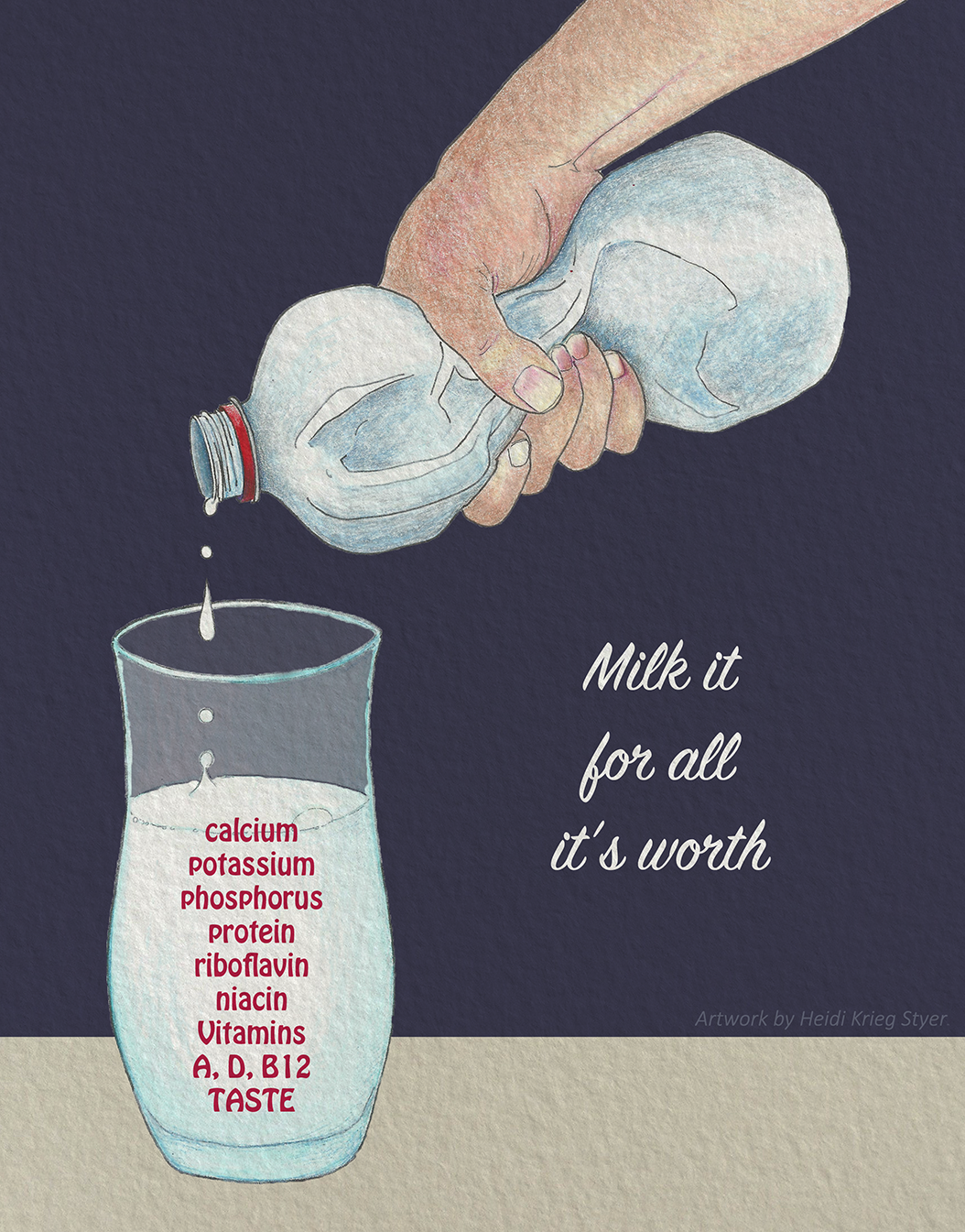
There is an innovative and entrepreneurial trend in bringing to market new dairy-based beverages that contain dairy protein, or ultrafiltered low-fat milk as an ingredient. However, MILK, itself, as a beverage, lost its power to make people feel good because people were not empowered with good information, and children were robbed of opportunities to choose the good milk — whole milk — at schools and daycares.

What milk itself lost as a beverage was the power to make people feel good about drinking it — because people lost touch with what they were getting from milk, what whole milk actually does for them. One big reason? GenZ-ers (and to some degree millennials) have grown up drinking (or tossing) the low-fat or fat-free milk as their only choices in school, and then found themselves searching for something else to drink in the a la carte line.

That’s changing. Research, studies and scientific papers keep coming forward, identifying the benefits of whole milk. When people try it, a common reaction is, “this is the good milk.”

Yes, whole milk is winning customers. Efforts by dairy producers — at large and through organizations like 97 Milk — have been focusing lately on giving the public the information they need about whole milk to make informed choices. It’s about giving people the opportunity to know what whole milk can do for them, and we hope that bills in the United States Congress as well as conversations with the Pennsylvania State Senate bear fruit in the ongoing effort to legalize the choice of whole milk in schools… so future generations can feel good about milk too.

We notice that if USDA can give the coveted Child Nutrition label to the Impossible Burger — a fake meat product with more saturated fat (8 grams) in a 4 ounce patty than whole milk (5 grams) in an 8 ounce glass and more sodium (370 mg for Impossible vs. 120 for whole milk) and more calories, then surely USDA can loosen its grip on the fat content of the milk choices for children in schools. Incidentally, the USDA approval of Impossible for school lunch is really a head scratcher next to 85/15 real beef because the real thing has less saturated fat, less sodium, and fewer calories.

Yes, USDA qualified Impossible Burger for reimbursement with taxpayer funds in the National School Lunch Program, but still outright forbids the choice of whole milk in schools.

USDA and Congress are moving toward universal free lunch and breakfast (even supper and snack) for all kids. FDA is in the procedural phase of developing a “healthy” symbol for foods that “earn” it — according to whom? Dietary Guidelines! The trend in government is toward giving consumers less information on a label, not more.

This is why milk education and freedom of choice are more important than ever. Even the Hartman Group young consumer insights cited at PepsiCo’s K-12 foodservice website state that GenZ-ers show a preference for ‘fast food’ and ‘familiar tastes.’ Millennials and GenZ-ers both show high preference for foods they grew up with.

Kids need to grow up able to choose the good milk — whole milk — not have that choice forbidden. That’s why the milk kids get to choose at school where they get 1, 2, even 3 meals a day is so important.

Give them the choice of the good milk that is good for them, and the power of information, and they’ll remember feeling good about milk.

Happy June Dairy Month! A big thanks to dairy farmers for all they do.

USDA to invest over $5 bil. in food supply chain, focus is transformation, not relief; Public comments due June 21

By Sherry Bunting, Farmshine, June 11, 2021

WASHINGTON — Long on transformation framework and short on meaningful details, USDA announced this week (June 8) that it will invest more than $4 billion to strengthen critical supply chains. This follows the June 4 announcement of over $1 billion for ‘healthy food’ and security infrastructure.

What these words mean is still the subject of USDA gathering input through public comments due June 21 and a series of stakeholder meetings. The first one was a 30-minute webinar attended virtually by over 3000 people representing food and agriculture organizations the day after the funding announcement (June 9).

These announcements are billed by Agriculture Secretary Tom Vilsack as part of the “Build Back Better” initiative to be funded by the Consolidated Appropriations Act of 2021 (passed by the 116th Congress and signed by President Trump in January) and the American Rescue Plan Act (passed by the 117th Congress and signed by President Biden in March.)

Vilsack will co-chair, along with Secretaries of Commerce and Transportation, the Biden administration’s new Supply Chain Disruptions Task Force for a “whole of government response.”

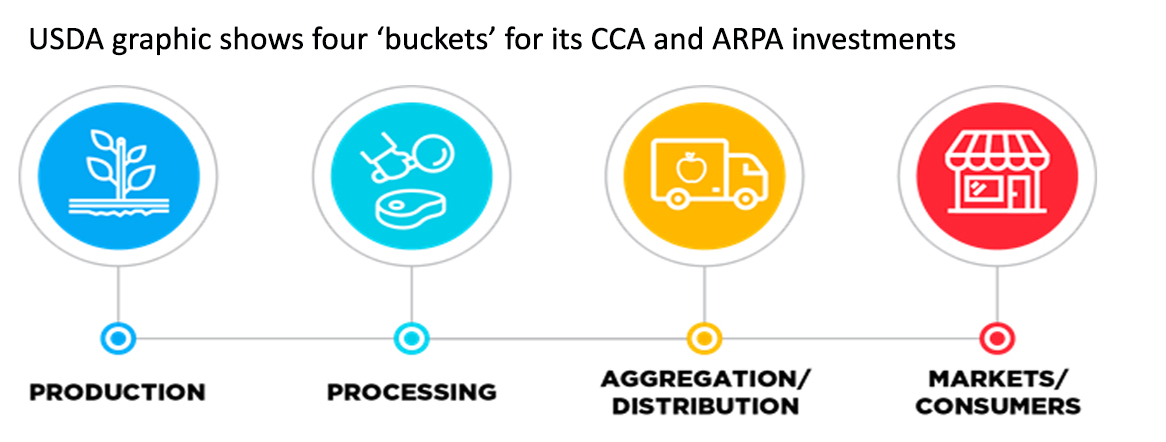
According to USDA, its investment announcements will include a mix of grants, loans and “innovative financing mechanisms” for the food production, processing, distribution and market access priorities that will “tackle the climate crisis and help communities that have been left behind.”

It has been six months since CAA funds were appropriated and three months since ARPA funding was authorized. These relief and support funds passed by two sessions of Congress and signed by two Presidents are now sitting in wait of a task force establishing supply chain transformation priorities after public comments and industry stakeholder meetings.

Meanwhile, dairy producers and other sectors of agriculture are still waiting for details about relief that was to some degree spelled out in the prior congressional language of these Acts. 

This includes waiting for USDA’s implementation of what was supposed to be an expanded base option for dairy producers in the Dairy Margin Coverage program; waiting for participation details for the Dairy Donation Program that is supposed to be retroactive; and waiting for a response from USDA to the bipartisan request by Senators seeking relief payments for dairy farmers for the first half of 2021 retroactive to January 1.

In the detailed request for public comment, USDA is making it clear that the CAA and ARPA funds will be spent on transformation, not relief. Guiding the transformation is President Biden’s February Executive Order 14017 America’s Supply Chain.

USDA says it is interested in comments spanning everything from animal, soil, plant and climate health, traceability, monitoring and technologies to agricultural inputs, energy, markets, storage, distribution, and digital security.

“We always knew this, but the pandemic really highlighted it for the rest of the country: Our food system is brittle, and any shock to it can have devastating effects down the chain. Now is the time — not to go back to normal — but to build a new normal,” said Mae Wu, Deputy Under Secretary of Marketing and Regulatory Programs during the first stakeholder webinar this week.

“Before we dealt with the pandemic, we had a food system in which nearly 90% of our farms did not generate the majority of the income for the farm families operating those farms. We had a food and farm system in which soil erosion was occurring at 10 times the rate that soil was being replenished,” said Vilsack as the first stakeholder webinar kicked off.

“We all know we have a substantial number of waterways that are currently impaired, and we also appreciate the fact that we had a food system that was prepared to address climate change but not yet fully embracing the opportunity side of that claim,” Vilsack continued. “So we had a system that needed help. We had a system that also was seeing rapid consolidation and a lack of competition. Then Covid hit and by virtue of Covid we learned that what we thought was a resilient system, really wasn’t resilient at all and had a difficult time shifting from food going into foodservice to going into food assistance.”

Citing the President’s February Executive Order, Vilsack said the focus of the new task force, he co-chairs, is to strengthen supply chains by “beginning the process of transformation.”

In the Federal Register document, USDA states: “(Our) initial thinking includes, but is not limited to, funding, through a combination of grants or loans, for needs such as: supply chain retooling to address multiple needs at once (i.e., achieving both climate benefits and addressing supply gaps or vulnerabilities concurrently), expansion of local and regional food capacity and distribution (e.g., hubs, cooperative development, cold chain improvements, infrastructure), development of local and regional meat and poultry processing and seafood processing and distribution, and food supply chain capacity, building for socially disadvantaged communities.”

In one subsection, USDA notes that it is interested in comments on “the availability of substitutes or alternative sources for critical goods and materials…” For example, USDA says it “encourages commenters to consider agricultural products that could be domestically grown but are not practically available today for various reasons, and to describe whether and how such products (or their alternatives) could be made available through supply chain resilience efforts.”

To-date, there are 297 public comments on the docket. A quick look through 55 that are viewable presently includes many food banks and feeding programs, some mentioning dairy, but few comments are logged from dairy organizations to-date.

For its part, the National Farmers Organization attached a document and stated: “The farmer dumping milk needs a market today, not in the long run. The person standing in a food line needs something to eat today, not in the long run. We need to look more carefully at what is going on if we are to understand, and effectively address, the dilemma of too much milk on one end of the supply chain and not enough dairy products on the other.”

Vilsack (who worked as a dairy checkoff executive for the four years between being Ag Secretary in the Obama and Biden administrations) also referenced milk dumping, saying the dairy industry had bottlenecks as foodservice demand shut down while retail demand for consumer-packaged goods skyrocketed.

In fact, in a recent Fortune magazine interview, Vilsack said the cost of $1.50 per gallon to put milk in a jug created a disincentive to donate excess milk instead of dumping it.

However, in reality, there was more to it than that in parts of the country where Governors brought the curtain down on the economy to strict degrees of people ordered to stay home, while also scolding them in public service announcements for buying too much food. Retailers hit the brakes by putting purchase limits on milk, butter and other dairy products, just as processors loaded up the silos with milk for the retail surge, only to find their retail orders came to a screeching halt as the purchase limits contributed to backing milk up from plant storage into farm pipelines faster than donation efforts could get organized or find facilities to bottle or process.

Facility issues were also cited at the time, in terms of separated cream filling storage silos with nowhere to go as butter capacity was busy switching to pull bulk butter from storage and convert it to print butter, and butter imports skyrocketed. It took a while to unwind the institutional governance of low-fat milk into making more whole milk available as consumers could choose. And it took a while for governments to allow institutions (like schools) to temporarily give whole milk. The result, in the Northeast especially, was a huge volume of dumped milk.

Among the viewable comments to USDA at the Federal Register, so far, are groups citing industry concentration and consolidation.

In its comments, the Montana Cattlemen’s Association pointed out that Secretary Vilsack, along with then Attorney General Eric Holder, held concentration and antitrust listening sessions across the U.S. during the Obama administration, and nothing ever came of it. One of those USDA / DOJ national listening sessions was on dairy, specifically, in Madison, Wisconsin in 2009.

The National Grocers Association echoed these concerns, detailing the way a few global companies already control food retail, foodservice, food processing and distribution, and how this affects farmers and ranchers, independent retailers and restaurants, and thereby affects regional food supply chains, and ultimately consumers and America’s security.

Both the cattlemen and grocers call for specific actions that would increase competition, regional processing and market access and thereby make the U.S. food system more secure and critical supply chains more resilient.

During the stakeholder webinar, Vilsack addressed a question on market competition by saying USDA will “first make sure the markets that do exist are as open and transparent as possible” by looking at the current rules along with other federal agencies and taking any steps to rectify. But he also pointed to developing new markets.

At the other end of the public comment spectrum, groups like the Good Food Institute, a lobbying organization for plant-based and cell-cultured replacements for animal-sourced foods, paint a picture of how their streamlined lab-style production through pop-up bioreactors and fermentation vats in rural, suburban and urban areas can be built to provide supply chain resiliency and food security. GFI also claims that their models would be a climate mitigation strategy.

GFI addressed each of the USDA bullet points on supply chain resilience, climate action and new market opportunities to describe why the CAA and ARPA funds should be used for research and infrastructure that shifts away from animal agriculture to plant-based and cell-cultured through digital and genetic technologies that are already within the USDA Agricultural Research Service wheelhouse.

GFI lays out their description of how recombinant proteins and GMOs, along with the storability of frozen cells and dry plant-based powders, can be turned into food quickly, and in exact amounts needed, and can be grown and manufactured anywhere — without waiting for animals to grow — leaving land available for so-called ‘climate strategies’ and biodiversity. 

But, they say, research and infrastructure are needed to make their science-fiction novel come true. This, despite the huge investments of tech industry billionaires in these replacement technologies, and the way the largest meat and dairy processors are diversifying, to brand – and blend – such alternatives to look, taste, and feel like the real thing.

Interestingly, the food economy is, right now, dealing with supply chain disruptions and inflationary price hikes on animal-sourced products from eggs and milk to bacon, beef, and chicken wings. The price squeeze is having a big impact on independent grocers, independent restaurants, and consumers. At the same time, prices paid to dairy and livestock producers are turning lower just as farmers and ranchers were hoping to get back on their collective feet.

That paradox is not sustainable nor resilient for producers or consumers, but growing cells in bioreactors or harvesting yeast-excrement from fermentation vats — instead of animals on farms —simply gives even more control of food to even fewer entities that would control the genetic alterations that make it scientifically possible.

USDA states in its press release that it wants to address competition and small and medium sized processing capacity and that it wants fairness, competition, equity, and access for producers and consumers, while accomplishing climate mitigation at the same time. 

The question is: What do these buzz words actually mean? The June 9 stakeholder webinar gave a glimpse.

Vilsack explained that USDA is putting the series of funding announcements into a series of four supply chain ‘buckets’: production, processing, distribution / aggregation and markets / consumers.

He said USDA will begin by providing assistance for beginning farmers and socially disadvantaged farmers, including the debt relief for farmers of color.

“We’ll look for ways to provide assistance for those who work on the farms and those who work in the processing facilities. We’ll look for how we can encourage those transitioning from conventional to organic agriculture if they choose to do so,” said Vilsack. “All of this will be designed to create greater resilience in terms of the number of people available to farm and the types of farming systems that we have. You’ll also see investments in urban agriculture.”

Vilsack said on the food processing side, USDA is “very focused” on ways to create more options for farmers by “shoring up and expanding” existing small and medium size processing to create more markets for farmers.

He highlighted “food hubs” in the distribution bucket and “access to healthy foods” in the consumer bucket.

Answering a question later about how government grant-writing is beyond the scope of most farms, especially small farms, Vilsack said: “One way for folks to get expertise and capacity is to join with others who are similarly situated to form a food hub to aggregate products. There is money for food hubs in this.”

Calling the Dairy Donation Program an investment in the production / producer bucket, and referencing it four times in the webinar, Vilsack said the DDP “will enable producers to more quickly shift in the event of a disruption from foodservice or retail that might not be available for whatever reason into food assistance mode.”

He identified the need to “significantly invest in storage and refrigeration infrastructure to accept significant quantities of food to be stored for a period of time and distributed over a period of time. Right now, we are not equipped to handle a great influx of meat, and produce all at one time, and as a result, animals were destroyed and milk was dumped,” he said.

Vilsack said another way to look at USDA’s incremental roll out of the CAA and ARPA funds is that it reflects “how we are going about the transformation of our food and farm system. We need to continue to invest to make sure there are multiple ways for people to get into the farming business and to stay in business.”

To be profitable, he said, “means we need to develop more new and better markets to be invested in. We want to make sure it is sustainable, circular, regenerative in its approach. We want to make sure it is equitable in its application so that people of all races, ethnicities, gender and so forth are able to access the programs completely at USDA,” said Vilsack.

For producers, allied industry, consumers and organizations, now is the time to visit the USDA Federal Register Docket at https://www.regulations.gov/document/AMS-TM-21-0034-0001 to read the guidelines for commenting and submit a “Supply Chain Comment” referencing Docket AMS-TM-21-0034-001 by June 21, 2021.

Comments may also be sent to Dr. Melissa R. Bailey, Agricultural Marketing Service, USDA, Room 2055-S, STOP 0201, 1400 Independence Avenue SW, Washington, DC 20250-0201. For further information about how to comment and the guidelines for commenting, contact Dr. Bailey by phone at 202-205-9356 or email melissa.bailey@usda.gov

(Author’s Note: The pandemic revealed that the institutional feeding models replete with anti-fat rules based on un-scientific Dietary Guidelines are part of the supply chain disruption problem. Governmental and non-governmental organizations continue to try to systemize food distribution into dietary lanes that don’t reflect the science or consumer attitudes about healthy fat and animal protein. Now ‘climate’ is being used as a potential animal-dilution driver. When someone wants to give families a gallon of whole milk (instead of fat-free or low-fat) when they pick up the school lunches for their children during a pandemic, the last thing any governmental or non-governmental organization should be telling them is “you can’t do that, it’s against the rules,” or pushing them into an adjacent parking lot so they aren’t “next to” the institutionally rule-inundated food. That is just one aspect I plan to write about in commenting to the USDALoosen those dietary restraints that give all the power to the global consolidators in foodservice, processing and distribution. Let free-enterprise and good will work for good.)

-30-

DMI’s DS4G sees dairy feed, cropping, cow care as ‘big hammers’ for net-zero

‘Grant’ will start ‘measuring’ air, soil around dairy cropping practices in nine U.S. regions

This is the third and final part of the multi-part series about DMI’s Net Zero Initiative and Dairy Scale for Good implementation. Parts one and two in Farmshine covered some of the 12- to 13-year history, the ‘scale’ approach for getting the industry to net zero faster, and the impact of manure processing, digester models, and renewable energy policies and technologies in the NZI scheme.

By Sherry Bunting, Farmshine, May 7, 2021

ROSEMONT, Ill. — How dairy feed and forage are produced are the “biggest hammers” that are “ripe for innovation in dairy emissions reduction,” said Caleb Harper, executive director of DMI’s Net Zero Initiative (NZI) Dairy Scale for Good (DS4G) implementation.

He and Dr. Mike McCloskey, chairman of the DMI Innovation Center for U.S. Dairy’s Sustainability Initiative, presented information about the Net Zero Initiative (NZI) and ‘implementation on the farm’ during last month’s Balchem real science lecture series.

Much of the presentation used the ‘spreadsheet exercise’ of the World Wildlife Fund (WWF) white paper laying out the “business case for getting to net zero faster”, based on a 3500 cow dairy (a Fair Oaks site with 3000 milking and 500 dry). In fact, Harper’s DS4G work will exclusively pilot and model on dairies about this size.

After explaining that the DS4G goal is to make maximum impact on the entire supply of milk in the short-term using “the consolidation going on in the industry” and the idea of “scale to drive down the risk … and spread the benefit across the industry,” Harper dug into each area and showed how the models tend to work best when multiple areas are combined.

Harper said no till farming, cover crops, innovative crop rotations, renewable fertilizer, precision agriculture all fall into this feed production area of emissions.

“It all boils down to measuring the emissions,” he said, showing a slide of boxes in potato fields in Idaho, where USDA ARS has a project that monitors the air around the crop to show the emissions from a field and mitigation that can be attributed to cropping practices. He said DMI has a grant to do the same thing with dairy cropping practices beginning this year.

The key, according to Harper, is to show that the emissions are being reduced. In addition to boxes in fields measuring emissions around crops, Harper said soil core samples will be taken to determine carbon sequestration of dairy feed cropping strategies.

“This is open science, (meaning still in the proving stage),” said Harper, known for his Open Ag science project growing food in computer controlled boxes at M.I.T. That project ended amid controversy last April a few weeks before Harper was hired by DMI to lead its NZI DS4G.

During the real science lecture in April, Harper said DMI has a grant program starting this year, along with Foundation for Food and Agriculture, to do this type of field box emissions monitoring and soil core sequestration monitoring across nine different U.S. geographies to test conservation tillage practices in terms of carbon emissions and sequestration over the next five years.

Harper said he sees this area as “huge” for innovation and for generating carbon credits that are valued by markets and for reducing one-third of dairy’s ‘field to farm’ emissions while improving soil health and the ability of soil to hold water.

He projects the bottom line potential annual farm revenue on this at $70,000, saying the industry will have to combine this with other strategies, like manure processing, renewable energy generation and such to get the combination of environmental impact toward ‘net-zero’ GHG and the economic revenue stream impact for the dairies.

“Some strategies are more impactful than others,” he said about the WWF models.

In this diagram, which was also shared by DMI leaders in a Pa. Dairy Summit breakout session about what dairy checkoff has done for producers lately, Harper illustrated how WWF models show farms will have to combine areas to merge emissions reduction potential with revenue potential. This shows feed production represents 26% of field to farm emissions reduction potential but just 3% of farm revenue potential; Cow care encompassing feed additives, efficient rations and genetics represents 33% of emissions reduction potential and just 5% of farm revenue potential; but conversely, renewable energy production on the farm represents just 5% of emissions reduction potential and 23% of farm revenue potential.

The ‘hammers’ on the emissions side do not line up with hammers on the revenue side, and the question remains, where will individual dairy farms sit in terms of decision-making as supply chains scale these combinations.

Yet again, the question arises around selling or monetizing the carbon credits generated by the farm once these cropping practices are “measured” and added to models. How does the sale of these credits, or bundling with sales of milk, then change the carbon profile of the farm selling the credits vs. the buyer in the dairy supply chain. Again, as mentioned in Part II on manure technologies and energy generation, this is an important detail that the WWF, NZI and DS4G modeling has not dealt with or worked through.

So, while discussions have already progressed to model how carbon credits and milk could be bundled to milk buyers, with pilots funded by supply chain grants to model how scale can spread impact over the industry and the entire milk supply, the holes in the value proposition are more obvious in this area where farms are already doing great things for land, air and water, by keeping something green and growing on the land as part of dairy feed production: How do farmers get credit for what they are already doing?

Harper also said “amazing things” are happening in the feed additive aspect of reducing enteric emissions, but he acknowledged “it’s early” on the carbon credit side for that.

This area of feed production and feed additives in the DS4G ‘value proposition’ has been spreadsheet-modeled to account for one-third of dairy’s field to farm CO2 equivalent emissions, and yet, at the same time, carbon credits based on this area are still in the research and measurement stage, needing documentation to be ‘monetized.’ 

Harper cited an example paper from University of California-Davis showing significant reductions in enteric emissions in beef cattle with certain feed additives.

As this work in the area of feed production and feed additives continues, said Harper: “Continuing to optimize rations (for production efficiency) remains important, while feed additives and selecting genetics for lower emissions will become important.”

Author’s Notebook:

The WWF Markets Institute released the dairy business ‘case study’ for scaling to net-zero faster on Jan. 27, 2021. A mid-February Farmshine report revealed the WWF mathematical error that had inflated the magnitude of CO2 equivalent pounds contributed by all U.S. milk production. WWF on Feb. 25, 2021, corrected its baseline to show the much smaller collective impact of 268 billion pounds CO2 equivalent (not 2.3 trillion pounds).

Both Harper and McCloskey serve on the WWF Market Institute’s Thought Leadership Group.

DMI confirms that dairy checkoff had a memorandum of understanding (MOU) with WWF from the inception of the Innovation Center for U.S. Dairy around 2008 through 2019. McCloskey has chaired the Innovation Center’s Sustainability Initiative since 2008.

In 2008-09, two MOU’s were signed between DMI and USDA via former U.S. Ag Secretary Tom Vilsack — the Sustainability Initiative and GENYOUth. At the end of the Obama administration, Sec. Vilsack was hired by DMI dairy checkoff to serve as president and CEO of USDEC 2016-2021, and earlier this year he became Secretary of Agriculture again after President Joe Biden said Vilsack ‘practically wrote his rural platform and now he can implement it.”

Aside from both serving on the WWF Market Institute’s Thought Leadership Group, McCloskey and Harper have another connection. According to the Sept. 2019 Chronicles of Higher Education, Caleb Harper’s father, Steve Harper, was a grocery executive. He was senior vice-president of marketing and fresh product development, procurement and merchandising from 1993 to 2010 for the H-E-B supermarket chain based in Texas. According to a 2020 presentation by Sue McCloskey, H-E-B was their first partner in the fluid milk business in the 1990s, followed by Kroger. According to the Houston Chronicle, the McCloskeys also partnered with H-E-B in 1996 during Steve Harper’s tenure to produce Mootopia ultrafiltered milk, an H-E-B brand. This was the pre-cursor to fairlife, the ultrafiltered milk beverage line in which DMI invested tens of millions of dollars in checkoff funds through the Innovation Center for U.S. Dairy partnering with the McCloskeys, Select, and Coca Cola.

Harper also previously served as a member of the Board of Directors for New Harvest for at least three years (2017-19). New Harvest is a global nonprofit building the field of cellular agriculture, funding startups to make milk, meat and eggs without animals.

-30-

DMI’s NZI DS4G eyes climate policies, supply chain partners in net zero fastlane: but who gets the carbon credits?

Author’s Note: This is part two in a multi-part series about DMI’s Net Zero Initiative and Dairy Scale for Good implementation. Part one previously covered some of the 12- to 13-year history as well as the ‘scale’ approach for getting the industry to net zero faster. 

By Sherry Bunting, Farmshine, April 30, 2021

ROSEMONT, Ill. — The official launch of DMI’s Net Zero Initiative (NZI) in October 2020, and World Wildlife Fund’s (WWF) dairy net zero case study published in January 2021 (and corrected in February for a math error that overestimated the industry’s total CO2 equivalent emissions) are two of the mile-markers in farm visits and partnership development since Caleb Harper was hired by checkoff in May 2020 as executive director of Dairy Scale for Good (DS4G).

In those 11 months, Harper reports visiting 100 dairy farms representing over 500,000 cows in 17 states, processing 350 manure samples, and gathering over 8000 ‘data points.’

Earlier this month, Harper, along with Dr. Mike McCloskey, presented a “value proposition” for the dairy industry during a Balchem real science lecture about ‘net zero carbon emissions implementation on the farm.’

McCloskey of Fair Oaks Farm, Fairlife and Select Milk Producers has chaired the DMI Innovation Center for U.S. Dairy’s Sustainability Initiative since inception 12 to 13 years ago.

In short, DS4G pilots are setting up through “sponsorships” from large dairy-buying partners on large farms within their own supply chains. DMI’s former MOU sustainability partner, the WWF, makes the case in its report that “achieving net zero for large farms is possible with the right practices, incentives and policies within five years (by reducing) emissions in enteric fermentation, manure management, feed production and efficiency, and energy generation and use.”

“This value proposition for dairy cuts two ways,” said Harper. Farms of 2500 cows or more can go toward digesters tied to renewable fuel production, while farms 2500 cows and fewer can move toward a digester model that handles food waste, receives tipping fees and generates electricity.

Both models will depend on a combination of government subsidies, low carbon renewable fuel standards, electrification of the U.S., supply chain sponsorship and sale of resulting carbon-credits, according to information presented by Harper and McCloskey.

NZI aligns with climate policies announced and anticipated from the Biden administration, which mirrors what is coming out of the United Nations’ Food Summit, and World Economic Forum (WEF) Great Reset.

WWF has long been tied closely with WEF setting a global agenda and with the World Resources Institute (WRI) that evaluates science-based targets for companies making net zero commitments to “transform” food and agriculture.

“Innovative models are just now starting to bear fruit,” said Harper, citing McCloskey as a forerunner of “building out” the anaerobic digester concept.

For his part, McCloskey said they “counted on incentives” back in 2008 to be able to grow and “be the catalyst.” He talked about a future sustained by marketing the new products created as substitutes for fossil fuels, mined fertilizers and other products, as well as continuing to take in other carbon sources instead of landfills.

“We have the vision to set this all up, to perfect the technology and get it cheaper… so when we’re all doing the same things, incentives won’t be needed,” said McCloskey looking 10 to 20 years down the road when he sees this “surviving on its own.”

Harper described distributive models from the WWF report. One “being born” in California incorporates separate large scale dairies in a cluster – up to 20 or 30 farms within a 20-mile radius — each with its own digester that can “drop compressed methane into a transmission line to a centralized gas cleaning facility.” In this model, dairies either have a manure or land lease contract or an equity position in the operation.

This model, he said, relies on “societal values of green energy.”

Another distributive model being born in Wisconsin is described as a central digester with adjacent gas cleaning and upgrading. In this model, the manure from multiple farms is sent to the centralized digester by pipe or truck.

“These dairy clusters become ‘green’ clusters,” Harper elaborated. “So, it’s not just about the milk. They become a primary source of green energy inside of a state or nation.”

Food waste co-digestion is part of a different DS4G model driven by states adopting regulatory policy to keep organic material out of landfills. Harper said dairy farms can take advantage of such policies by centralizing waste collection for co-digestion.

“As we think about reducing emissions… a big part of that is bringing things grown off farm on farm, destroying their greenhouse gas potential, and taking credit for that ‘sink,’” Harper explained. 

However, in this example, the co-digestion is what gives the dairy its carbon credits, so technology that can handle higher waste-to-manure ratios and state / local regulations allowing farms to handle the off-farm waste are necessary. Such details were not discussed by Harper, and are presumed to be what large scale dairy pilots address.

The WWF case study showed bottom line profit and loss of $500,000 annually for a 3500-cow dairy. Harper believes this is a “conservative” estimate based on electricity production. With the right policies in place, the renewable natural gas value proposition would produce higher returns, according to Harper.

The renewable natural gas market will still be building over the next five to 10 years, he said, so these models also rely on renewable fuel credits and other fixtures they expect to be part of the Biden administration’s climate policies.

Manure handling technologies apart from the digesters were also discussed, which according to the WWF case study, represent one-third of both emissions-reduction and income potential.

Harper is actively engaged in studying the differing chemical profiles of manure between farms, regions, and states — saying he wants to “understand manure” — with and without digester.

Looking at scale, Harper talked about adapting municipal human waste treatment systems for processing manure on large dairies. He highlighted what is called the “omni processor” — a Bill Gates investment to separate small scale municipal waste and create drinking water using a spindle with multiple discs heated to where nonvolatile solids are in the dry matter and the rest are captured as they volatize.

One “off the shelf technology” Harper is focusing on is already in use to produce discharge quality water. It is the membrane system of ultrafiltration (UF) and reverse osmosis (RO) — the same UF RO technology McCloskey pioneered in milk processing to remove water from milk for transport and refine elements for value-added products.

Stressing the large amount of water in dairy manure, Harper said UF RO “is a process designed exactly for de-watering.” Whether this process occurs before or after the digester, he said it is part of “the technology train, so whatever you are tagging onto is working more efficiently, processing less water and more nutrients and refining more things to find value in.”

All of these technologies, according to Harper, can build on each other and tie together with “electrifying” the United States, strengthening low carbon renewable fuel standards, adopting renewable fertilizer standards, and monetizing carbon. 

One unsettled aspect in this regard, however, appears on page 9 of the WWF case study and was not mentioned by McCloskey or Harper in their presentation. 

What happens to farmers when their carbon reductions and removals become part of the supply chain in which they sell their milk, or are sold to companies as part of a milk contract?

The WWF report makes this observation: “There could be significant interest from large dairy buyers in reducing embedded carbon in their products by purchasing value-added carbon ‘insets’ directly from farmers or cooperatives within their supply chains. Were companies to work closely with the dairy industry to advance these initiatives and enable greater GHG reductions, they could potentially use these measures toward meeting their own reduction targets … and incentivize dairies to embrace net zero practices through long-term contracts or other purchase or offtake agreements.”

That’s an aspect of the tens of millions of dollars in dairy pilot partnerships pledged by Nestle, Starbucks and potentially others for their own supply chains through DMI’s NZI DS4G.

WWF explains further in its report that, “Such agreements could provide stability and collateral as dairies consider investing in technology like anaerobic digesters. Some of these companies might even be interested in finding ways to bundle and purchase carbon credits produced on dairy farms where they buy milk.”

Such incentives, contracts and bundling – starting with DS4G pilots — leave dairy farms exactly where in the supply chain?

The WWF report states it this way: “Such purchases would shift the emissions reductions from the farmer to the company. This would result in the dairy essentially selling the credits that would enable its net zero status, as the emissions reductions cannot be double counted. 

“So, if the reductions are sold, the farmer can no longer be considered net-zero. This is a conundrum that is beyond the scope of this paper,” the WWF report admits.

This important detail in the NZI DS4G implementation was not mentioned by Harper or McCloskey.

Meanwhile, these initiatives also rely on climate policy, with former DMI executive Tom Vilsack now having crossed back over into government as U.S. Ag Secretary just 20 months after seeking pilot farm funding and Net Zero target policies when he testified before the Senate Ag Committee in June of 2019 while employed by checkoff as CEO of the U.S. Dairy Export Council.

President Joe Biden has said USDA is a key department in his administration’s climate action policies.

To be continued

-30-