Covering Ag since 1981. The faces, places, markets and issues of dairy and livestock production. Hard-hitting topics, market updates and inspirational stories from the notebook of a veteran ag journalist. Contributing reporter for Farmshine since 1987; Editor of former Livestock Reporter 1981-1998; Before that I milked cows. @Agmoos on Twitter, @AgmoosInsight on FB #MilkMarketMoos
EDITORIAL: This time it’s Senators Chuck Schumer of New York and Ben Luján of New Mexicoblocking forward progress in the Senate
By Sherry Bunting, Farmshine, Aug. 15, 2025
EAST EARL, Pa. – Congressman Glenn “GT” Thompson has been busy. He recently held a Pennsylvania Ag Republicans webinar, then hosted his 7th annual Ag Summit in Pleasant Gap on Aug. 11, before heading to Ag Progress Days Aug. 12-14.
At these events, Thompson updated farmers on the farm bill — 80% completed in the One Big Beautiful Bill Act passed in June — and efforts to finish the remaining 20%, dubbed the “skinny” farm bill or “farm bill 2.0.” He reminded participants that SNAP “cuts” are really a return to pre-pandemic levels with measures to ensure states enforce work requirements that are already on the books.
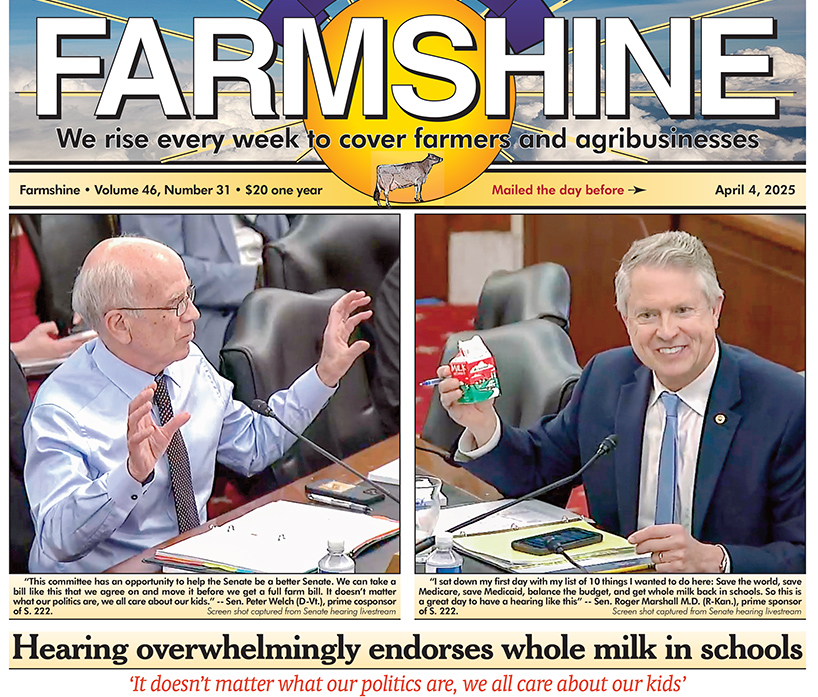
Thompson also addressed his signature legislation: the Whole Milk for Healthy Kids Act. H.R. 649 passed the House Education and Workforce Committee in February and the Senate version (S. 222) cleared the Senate Agriculture Committee in late June, three months after a warm bipartisan reception during an April 1 hearing.
At that hearing, Sen. Peter Welch (D-Vt.) urged colleagues to fast-track the bill to the Senate floor to prove the chamber can act on bipartisan measures.
The Senate version (S. 222) includes an amendment allowing “nutritionally equivalent” milk alternatives in schools — a concession meant to secure the 60 votes needed in the Senate.
Even Senate Majority Leader Chuck Schumer (D-N.Y.) has told New York dairy farmers he’s “not against” the bill. But he’s not helping move it forward either!
Despite these facts, here we sit, with the bill stalled — again — in the Senate.
During a July webinar before the August Congressional recess, GT said the bill was “sitting on Chuck Schumer’s desk.” Senate leaders from both parties would need to agree to “hotline” the measure — sending it directly to the House for a vote without floor objections. The House previously passed the bill 330–99 in December 2023 and must vote again in the current Congress.
Instead, Thompson shared Monday at the Ag Summit that three Senate Democrats are holding the bill hostage, led by Sen. Ben Ray Luján of New Mexico.
Luján reportedly wants to trade his support for expanding universal free school meals, despite praising whole milk in the April hearing and recalling drinking raw whole milk as a child.
My thoughts are this: “Good for you, Sen. Luján! But what about the kids in your state receiving two meals a day, five days a week at school? Where is their whole milk choice?”
S. 222 passed the Senate Ag Committee, where Luján is a member, on a voice vote with no objections. Now, he’s among those blocking its forward progress.
Scott Holcomb, District 1 manager for USJersey, attended Monday’s Summit and noted that the bill “is being stalled by the Senator from New Mexico.” He assured GT that USJersey fully supports the measure, joining a growing list of dairy and nutrition groups with official policy supporting it and taking time to speak out.
In 2019, over 30,000 signatures from every state were also presented to Congress in support of whole milk choice in schools. Surveys show more than 80% of parents prefer whole or 2% milk for their children (both are federally prohibited in schools).
New York dairyman Dale Covert reported to Farmshine that he recently received a letter from Sen. Schumer thanking him for his support of S. 222 and outlining the bill’s history.
Schumer wrote, “I will continue to monitor the progress of this bill and any related legislation that comes before the Senate.”
At the time, the bill was literally on his desk!
The rest of Schumer’s three-page letter listed his legislative record on school meals, SNAP, and WIC, ending with a swipe at the Trump Administration over “cuts to hunger assistance” and vowing to “fight for funding hunger assistance.”
Children from low-income households rely on school meals as their primary source of nutrition — two meals a day, five days a week, most of the year. Others may get to drink whole milk at home, but disadvantaged kids may only get offered the skim milk they get at school, which many discard.
The result? Wasted nutrition, wasted taxpayer dollars. The USDA buys the milk, schools pay for waste removal. Kids do not benefit.
Restoring whole milk choice could improve intake and student health without new spending. But first, it must be made legal, then we get to work on more education for schools and creative solutions.
This issue dates back to 2012, when federal rules quietly removed whole milk from schools, even locking up or changing the contents of FFA vending machines containing whole milk for sale.
Grassroots volunteers have tirelessly pushed for its return ever since this clandestine act of prohibition was discovered.
America’s children are watching, and they are not impressed that D.C. can’t even get simple things done — simple truths that are self-evident!
While Congress is in recess, constituents should press their Senators to act, especially in New York and New Mexico.
Contact Sen. Schumer via schumer.senate.gov or call 202-224-6542, fax 202-228-3027.
Messages should be short, polite, and clear: Support the Whole Milk for Healthy Kids Act so children can choose milk they’ll drink, not waste. Millions of kids are depending on it. If you want to help them so much, then get this done.
WASHINGTON, D.C. – We need to be the change-makers that our students and farmers both need. We need to bring back the ability to offer milk fat choice in schools, including nutrient dense whole milk – which, by the way, is just 3.25 to 3.5% fat,” said Krista Byler, a witnesses during the hearing by the U.S. Senate Committee on Agriculture, Forestry, and Nutrition to “review the Whole Milk for Healthy Kids Act, S. 222, and improve children’s health.”
April 1st, the day of the hearing, was a great day for America’s children and dairy farmers, and that’s no April Fools joke!
The livestreamed hearing opened with a reminder from Senate Ag Chairman John Boozman (R-Ark.) that the whole milk bill had passed the House in the last Congress “by an impressive 330 to 99 vote” and his desire to “make progress in the Senate.”
Ranking Member Amy Klobuchar (D-Minn.) expressed her support for the bill and thanked Sen. Roger Marshall (R-Kan.) for introducing it. She also set the stage to broaden the hearing to other school nutrition matters. (To be covered in a separate article at another time).
The hearing ended with universal expressions of bipartisan support, thanking the Senate’s ‘milkman’ Marshall. Several Senators urged moving the bill forward as a standalone without delay.
“If we can do something that’s good, let’s do it, and then we’ll do the next thing that’s good,” said Senator Peter Welch (D-Vt.), the bill’s prime cosponsor, addressing the Chair. “This committee has an opportunity to help the Senate be a better Senate, we can take a bill like this that we agree on and move it before we get a full farm bill. It doesn’t matter what our politics are, we all care about our kids. I hope as we pursue this whole milk opportunity for our kids and our farmers that it’s the beginning of a real commitment to nutritious, locally produced, natural foods.”
In between the open and close, the Senate Ag Committee heard from and questioned five witnesses, spending the first chunk of time with Dr. Eve Stoody, Director of the Nutrition Guidance and Analysis Division at the Center for Nutrition Policy, within the Food Nutrition Service of the USDA.
She is tasked with supporting the development of the Dietary Guidelines (DGA) since the 2010 edition and is the self-described career subject matter expert on the DGA process.
She revealed that 90% of Americans don’t consume the daily recommended amount of dairy, a statistic that has worsened over time, setting the stage for nutrient shortfalls.
“Across the board… whatever the form is, we need to have greater consumption of dairy,” she said, citing national survey data showing that on any given day, the percentage of adolescents reporting drinking milk was 75% in the 1970s, just under 50% in the early 2000s, and about 35% in the most recent data.
Chairman Boozman asked what justification was used to remove whole and 2% milk from schools in 2010?
Instead of addressing that question, specifically, Dr. Stoody said the current Dietary Guidelines recommend “most” dairy be low-fat or fat-free, but the guidelines (10 years later) in 2020 were constructed as overall dietary patterns with more flexibility.
“It’s also a reality that we kind of have a number of calories that individuals should consume, so across the guidelines we recommend consuming foods from all of those different food groups and that most should have little to no added sugars or saturated fat to help us stay within those calorie limits,” she said. “We don’t have a lot of room in the calories of the diet to consume milk and dairy with higher fat.”
Stoody parsed this as a population-level guideline: “That doesn’t mean whole milk and higher fat dairy can’t be part of a healthy diet, but it’s really important to look at the overall diet. The DGAs are there to provide flexibility based on needs and preferences.”
(This confusing ambiguity opened the door for the next panel to walk through, even though only two of the remaining four witnesses talked about the whole milk bill, while the other two talked exclusively about USDA’s recent cuts to programs like the local farm-to-school cooperative grants and concern about changes to how school lunch eligibility. Even those witnesses agreed that simplifying regulations and providing flexibility allows schools to focus on the quality of the meals instead of being bogged down by red tape.)
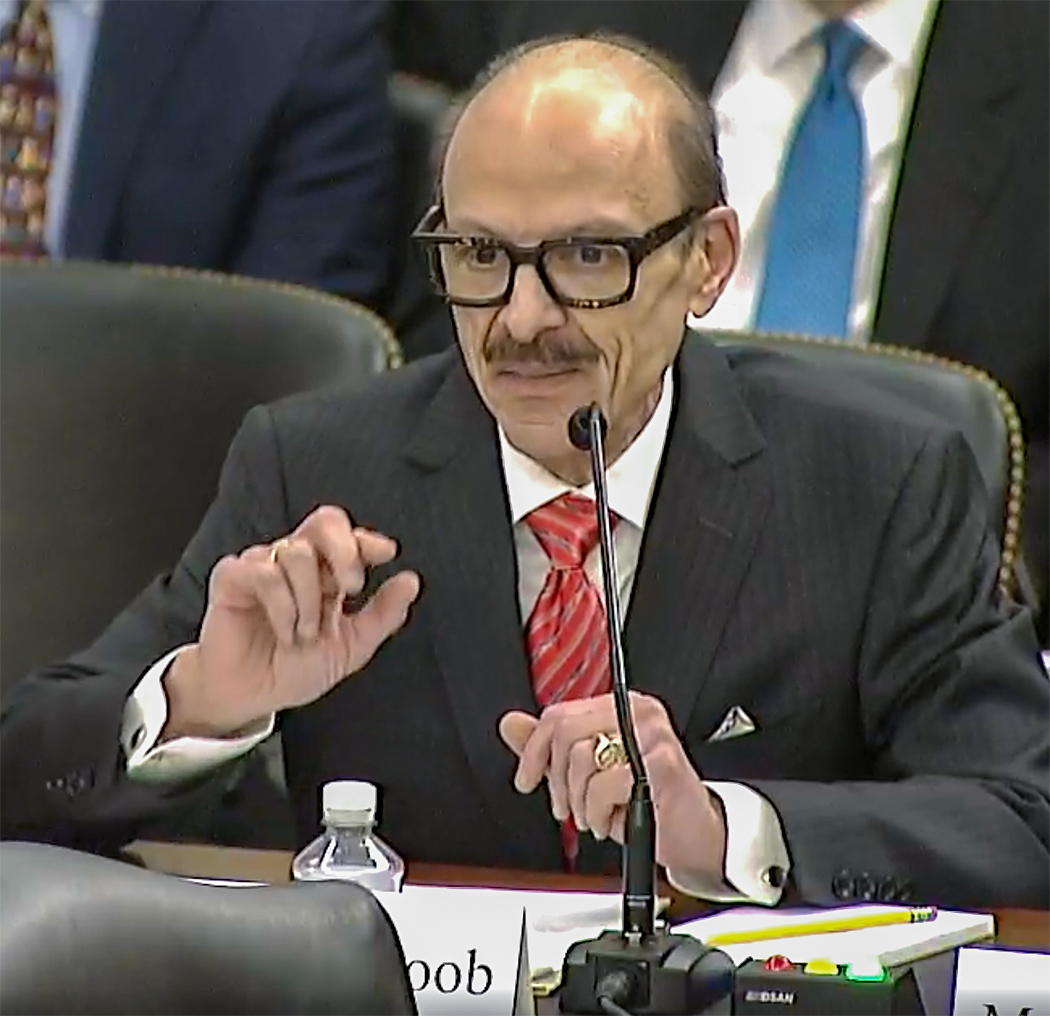
“I’m here because this issue matters to the children I serve, so it matters to me,” said witness Dr. Keith Ayoob, Associate Professor of Pediatric Nutrition at the Albert Einstein College of Medicine in New York City. He runs a diagnostic and treatment clinic working with mostly low-income children, and their families, in the Bronx.
“A plethora of research demonstrates consumption of cow’s milk provides children with better bone health, a lower risk of type II diabetes, and a lower risk for cardiovascular disease,” he shared, as he zeroed-in on milk’s 13 essential nutrients, including 3 of the 4 under consumed nutrients calcium, potassium and Vitamin D.
He said saturated fat does not occur in foods in isolation, and new research shows the protein-fat matrix “behaves differently” in the body. “While other foods that are lower in saturated fat can also lower cardiometabolic risk, they can’t deliver the 13 essential nutrients in milk. Milk delivers a package I’ve not been able to find in any other food or beverage.”
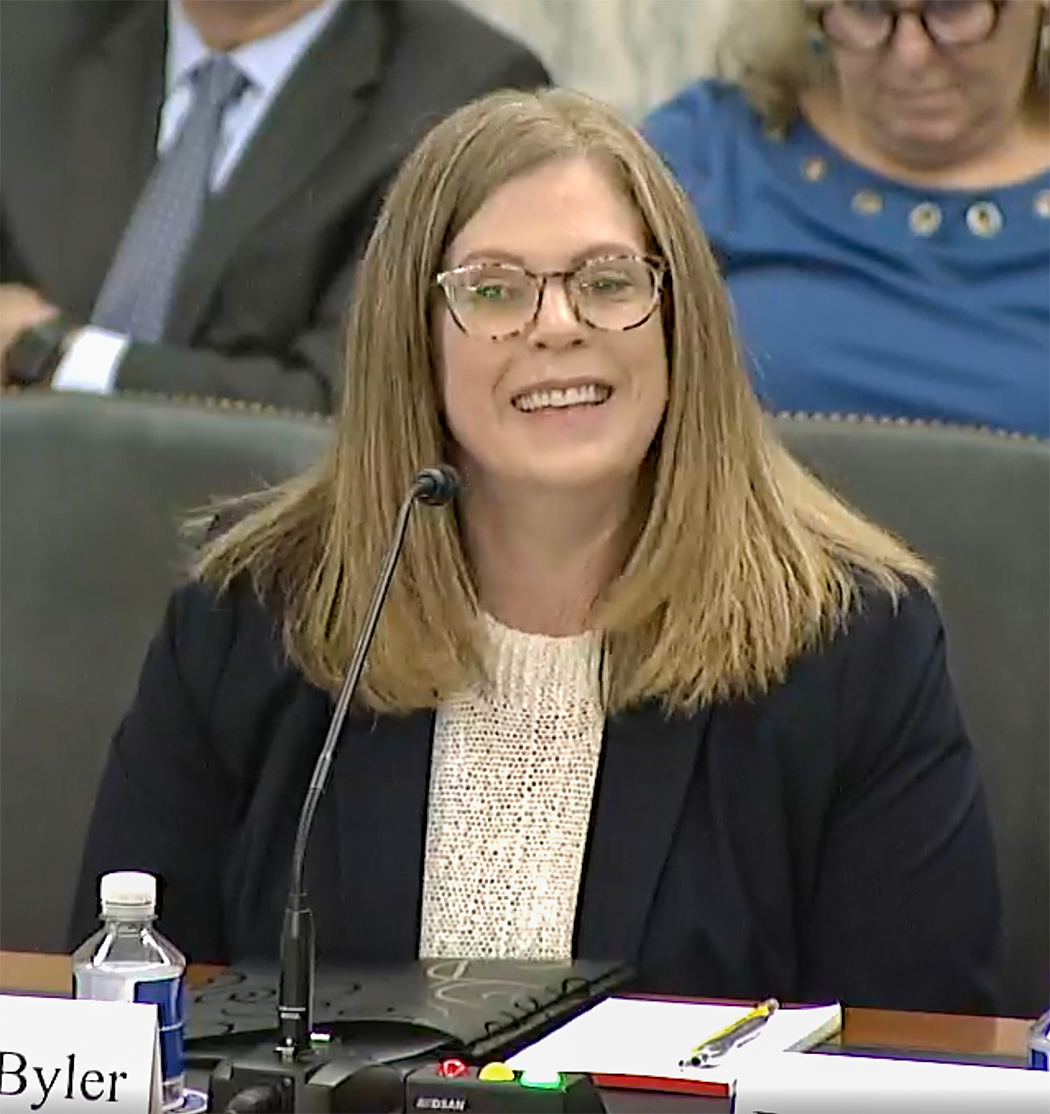
Krista Byler of Spartansburg, Pennsylvania testified next. She is the Foodservice Director and District Chef for the past 20 years at Union City Area School District, or as she puts it: “The professional chef turned lunch lady.”
The granddaughter and wife of former dairy farmers, she was the one witness to bring a combined experience in dairy farming, culinary arts, and childhood nutrition, saying she believes “access to good quality nutrient dense whole food is a basic right of education.”
Byler spoke from the heart, bringing experience and data. She described the impact of the 2010 Childhood Nutrition Reauthorization’s school milk changes on students and dairy farm families.
“It was heartbreaking… we were seeing a huge increase in waste and a huge decline in the amount of milk that I was actually ordering because our children were not choosing to take the milk,” she said.
In 2018, Byler attended an event with the School Nutrition Association where she met Rep. Glenn ‘GT’ Thompson (R-Pa.) – the decade-long champion for The Whole Milk for Healthy Kids Act.
At that meeting, Byler said she heard her peers also talking about the large amounts of waste. She was later introduced to the Grassroots Pennsylvania Dairy Advisory Committee of dairy farmers and school-involved parents, affiliated with what later became the separate milk education nonprofit 97 Milk.
(The Grassroots PA Dairy Advisory Committee is chaired by Bernie Morrissey, with current participants that include dairy farmers Nelson Troutman of Berks County (the Milk Baleboard painter), along with Dale Hoffman and Tricia Adams of Potter County, certified RN school nurse Christine Ebersole of Blair County, Dr. Ed Silverman, a retired internal medicine physician, Mike Sensenig of Sensenig’s Feed Mill, and this reporter who helps in communication. Like the separate board comprising 97 Milk, all the work is done by volunteers without compensation.)
This grassroots committee invited Byler to do some data collection. She explained that in the 2019-20 school year, with the blessing of her school board of directors, they conducted a school milk choice trial at the middle and high school, offering all levels of milkfat, both flavored and unflavored.
“The results are astounding.” Byler said, referencing her written testimony to find more complete data and survey results.
“What I want to really drive home are two main data points: The 50% increase in milk consumption (evidenced by ordering more milk) and the 95% — that’s right – the 95% reduction in milk waste, just because we offered a variety of milk choices that fit our students’ needs,” she said to the visibly astonished Senators who had previously unsuccessfully asked the first witness from USDA for such data.
“That’s incredible. It’s amazing when we give a little education and we give the choices, eventually the consumer makes the right choice,” said Sen. Marshall who is a medical doctor and prime sponsor of the bill in the Senate. He described his frustration in seeing the impact of osteoporosis and osteopenia, when bone density has not been built in the first 26 to 28 years of life.
Byler explained that the school student council helped collect, measure, and document the waste, and they “took a little heat after the 2020 school year when we (ended the trial) and went back to not being able to offer the variety. Overwhelmingly, students said they want something that is satisfying. Athletes, especially, were very vocal about wanting something that sticks with them. It’s a perfect recovery drink.”
Dr. Ayoob agreed: “My kids in my clinic have said that they find skim milk ‘watery.’ They may take that carton of milk. The school will get reimbursed. But I’m concerned that they drain that carton, not just take a few sips. Not only is there less food waste but more nutrition goes into the children.”
Sen. Ben Ray Lujan (D-Calif.) reminisced that he didn’t grow up with much money in the bank, but was blessed to have a dairy down the street. “Today when I get a carton of milk at the store, my habit is still to shake it because growing up that cream rose to the top, and we knew we had to shake it if we were going to enjoy it.”
“Our kids want to do better. They want to eat better. We have their attention,” said Sen. Jim Justice (R-W.V.), who spent his days with students as a longtime coach. “We have an opportunity here to step up. I am absolutely, wholeheartedly in favor of moving forward with whole milk.”
Every Senator present and asking questions expressed or implied support from both sides of the aisle.
With a nod to “the milkman Sen. Marshall,” Sen. Dick Durbin (D-Ill.) said he had to read through the list he had been provided of the organizations that are opposed to the bill, including the American Heart Association, American Academy of Pediatrics, and American Academy of Nutrition and Dietetics. He then asked the USDA representative what health organizations are for it? Dr. Stoody said she didn’t have that information.
(Perhaps more to the point, were her continued circular answers that forced this realization: The “population-level guidelines” get drilled down to individuals in governmental feeding environments, which then feed into the health and nutrition organizations and back again. Meanwhile, individual health and nutrition practitioners are out there seeing real people as individuals every day, wondering how to get off the spinning merry-go-round.)
Chairman Boozman asked Dr. Ayoob how policymakers have gotten it so wrong in drawing a correlation between whole milk and obesity?
“Actually, the correlation is inverse,” Dr. Ayoob declared. “A review of the studies in my written testimony show that greater consumption of dairy foods, including whole fat milk, has been associated with less obesity and less cardiometabolic risk.”
He said in 2010 when whole and 2% milk were first removed from school meals, obesity prevalence was about 17%. Since that removal, it has increased. “It’s now 21%, and it’s higher, about 25%, in black and Hispanic children, the population that I work with.”
Ranking Member Klobuchar came back to calcium, asking Dr. Ayoob to explain why it’s so important at this stage.
“We don’t have our whole lives to build our bone bank. We have the first 25-ish years,” he replied. “If they skip milk in school, that might seem like it’s no big deal for a day, maybe even for a week. But if they forgo a glass of milk every day they are in school for 12 years, we’re going to graduate kids with a diploma and not very good bones. We owe our kids better than that. Osteoporosis and osteopenia are really pediatric diseases with adult consequences.”
Sen. Marshall drove this point home in his questions for all witnesses. He talked about the milk fat as carrying key vitamins and facilitating absorption. He and Dr. Ayoob talked back and forth about how replacement beverages, like soda, take the missed opportunity with milk and add further negative impacts.
“No matter what type of milk is offered in school, none of it is nutritious until students drink it, and they don’t drink it often enough, which presents nutrition and dietary gaps, especially in low-income groups, where 77% of a child’s opportunity for milk intake is from school meals,” said Dr. Ayoob.
“Chef Byler, what’s your advice to us as we look at bringing whole milk back to schools?” asked Sen. Marshall.
“It’s been said very well by others today, that we can do better,” she replied. “If we just bring back the milk choice to schools, we would see a huge increase in consumption, a huge decrease in waste, and satisfaction for our students would be through the roof.”
Whole Milk for Healthy Kids Act reintroduced in style!
‘Most nutritious drink known to humankind’ takes center stage at Ag Secretary confirmation hearing
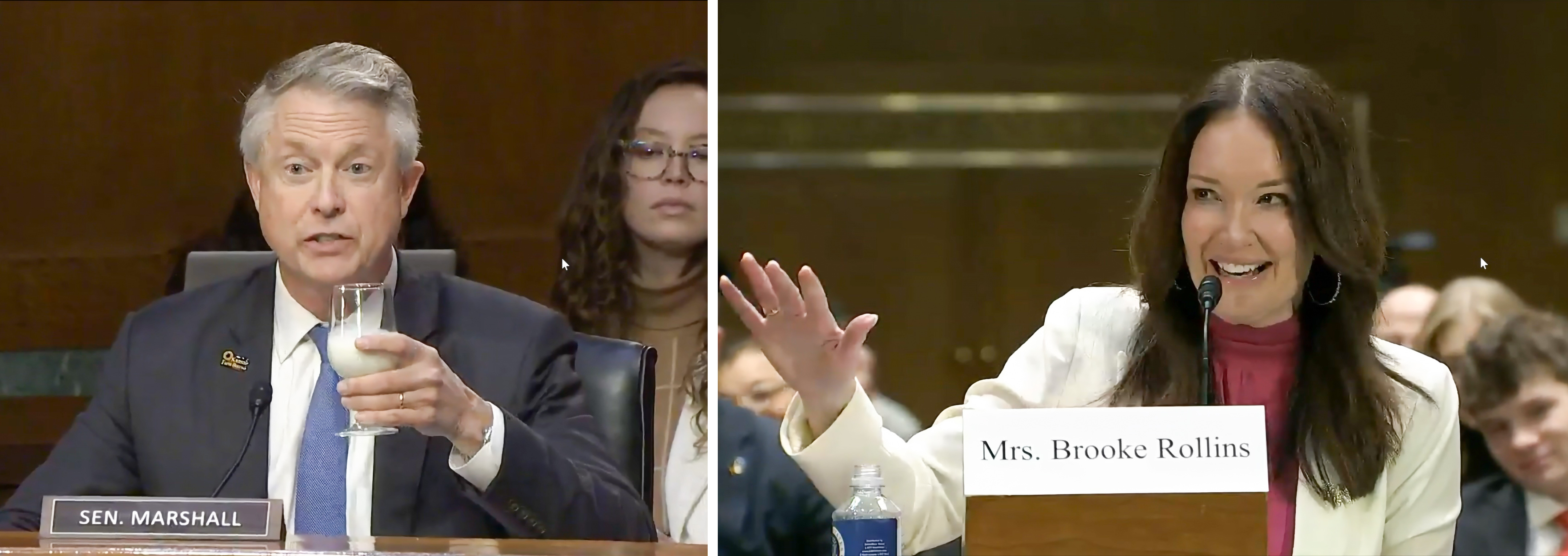
This split-screen moment captures Sen. Roger Marshall, M.D. and Agriculture Secretary Nominee Brooke Rollins during their confirmation hearing exchange on bringing whole milk choice back to schools. Sen. Marshall always comes prepared with THE MILK! Livestream screen capture by Sherry Bunting
From grassroots volunteers to halls of Congress, ‘hat’s off to 97 Milk’
WASHINGTON, D.C. – It was the high point of the four-hour confirmation hearing on Jan. 23rd for President Trump’s Ag Secretary nominee Brooke Rollins, when Senator Roger Marshall, MD (R-Kan.) poured himself a glass of whole milk in front of the television cameras, and said:
Ms. Rollins, welcome. I want to know if you agree with me that whole milk is the most nutritious drink known to humankind and belongs in our school lunches.”
He then promptly took a big swig of nature’s nutrition powerhouse that American children have been banned from consuming at school meals since 2012.
Yes, there was a ripple of good-natured laughter throughout the room at the absurdity of it all – the absurdity that this nutrition powerhouse has actually been banned for 13 years on school grounds to even be bought with one’s own money from midnight before the start of the school day to 30 minutes after the end of the school day, per the 12-years of King Vilsack that Secretary Perdue’s interruption even failed to overturn.
The new Ag Secretary nominee Rollins responded with a hand motion to her mother two rows back among the family, friends, colleagues, ag teacher, fellow former FFA state officers and current little league team she coaches in attendance for the confirmation hearing, as she replied with a hearty and all-too-knowing laugh:
“Senator, I don’t know that you have met my mom – yet. But this is all we had in our refrigerator growing up – not anything else – just whole milk. She is absolutely never going to let us forget this – the fact that this is coming up! But yes, this hits home to me very quickly,” said Rollins.
On the very same day, whole milk champion U.S. Representative Glenn ‘GT’ Thompson (R-Pa.) with prime cosponsor and pediatrician Rep. Kim Schrier (D-Wash.), along with Senator Marshall and prime cosponsoring Senators Peter Welch (D-Vt.), Dave McCormick (R-Pa.) and John Fetterman (D-Pa.) led the re-introduction of the bipartisan, bicameral Whole Milk for Healthy Kids Act of 2025, known as H.R. 649 in the House with 90 total cosponsors to-date, and S. 222 in the Senate with 12 total cosponsors to-date.
The bill in its fifth attempt will allow unflavored and flavored whole (3.25 to 3.5% fat) and reduced-fat (2%) milk to once again be offered in school cafeterias, which are currently only permitted to have fat-free and 1% milk available for growing children, much of which is shunned or thrown away.
“Federal policy, based on flawed, outdated science has kept whole milk out of school cafeterias for more than a decade,” said Rep. Thompson in a Jan. 23rd press statement. “Milk provides 13 essential nutrients for growth and health, two key factors contributing to academic success. The Whole Milk for Healthy Kids Act of 2025 provides schools the flexibility they need to offer a variety of options, while supporting students and America’s hard-working dairy farmers.”
“As a pediatrician, I know how important a balanced and nutritious diet is for children’s health, well-being, and development,” added Rep. Schrier. “A healthy diet early in life leads to proper physical growth and improved academic performance and can set the foundation for lifelong healthy eating habits. Milk contains essential nutrients… This bill simply gives schools the option of providing the types of milk most kids prefer to drink.”
Sen. Marshall was blunt, saying, “(It) should never have been excluded from the National School Lunch Program. Now, 13 years after its removal, nearly 75% of children do not receive their recommended daily dairy intake. I believe in a healthier future for America, and by increasing kids’ access to whole milk in school cafeterias, we will help prevent diet-related diseases down the road, as well as encourage nutrient-rich diets for years to come.”
“Milk provides growing kids with key nutrients they need. Dairy is also an important part of Vermont’s culture and local economy, which is why our bipartisan bill to expand access to whole milk in our schools is a win for Vermont’s students and farmers,” said Sen. Welch.
Sen. McCormick said the bill “puts milk back in schools that growing kids actually want to drink. Pennsylvania’s dairy farmers supply this country (with it)… allowing schools to serve (it) in the lunchroom is just commonsense.
“Kids need it,” said Sen. Fetterman. “Let’s give them the option to enjoy whole milk again in schools – it’s good for them, they’ll actually drink it, and it supports our farmers. This bill is a simple solution that benefits everyone.”
Both National Milk Producers Federation (NMPF) and International Dairy Foods Association (IDFA) rushed to the forefront singing the bill’s praises and promptly issuing press releases, something that in past attempts took a little time.
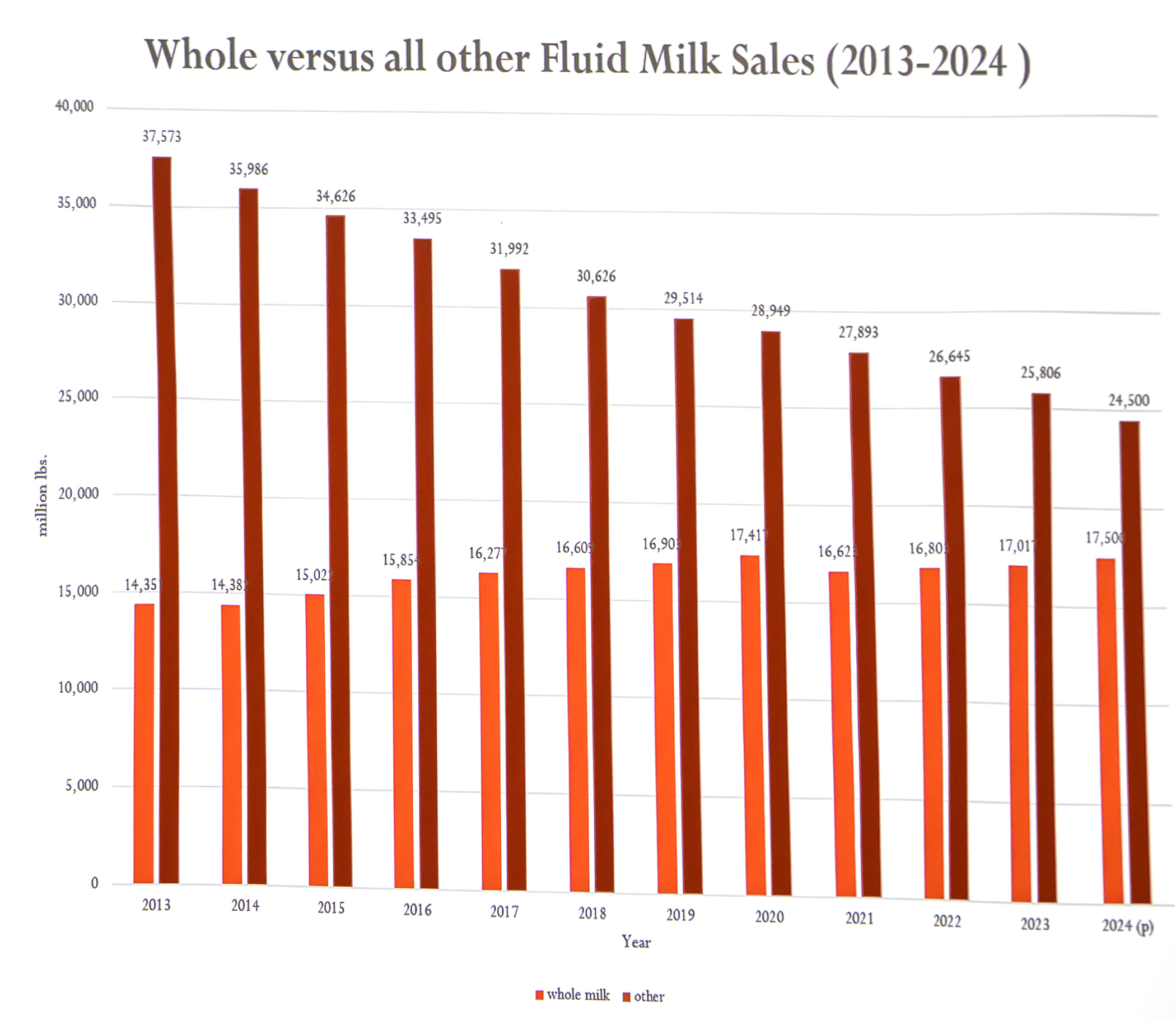
As longtime milk market guru Calvin Covington noted at the R&J Dairy Consulting seminar in eastern Lancaster County Jan. 28th, kudos go to the grassroots efforts. He showed the increase in whole milk sales nationally, while other fluid milk categories have declined. This has somewhat stabilized the steep losses the entire fluid milk category has suffered most steeply in the past 14 years.
“My hat’s off to all of you and what you have done here in Pennsylvania, throughout the state and country, in promoting whole milk. I just wish other dairy farmers would be grassroots like you are and get involved,” said Covington. “Your work has paid off. Look at this graph. In 2013, whole milk sales were a little over 14 billion pounds. Last year (2024 with 11 months of data) I’m estimating 17.5 billion pounds. Whole milk is coming up, and everything else is going down.”
Covington dug into the graph (above) further to show that in 2019, the amount of whole milk sold was 16.9 billion pounds. “But look what happened in 2020, it jumped up to 17.4 and then back down to 16.62 in 2021. That was the pandemic. People were home. Schools were closed,” he said.
“When they were home, they drank good-tasting milk, but unfortunately when the schools opened back up, they had to go back to the other stuff. But my hat’s off to what you’ve done here. We’re selling more whole milk, and one thing people forget is that 100 pounds of Class I milk sales with higher fat content — last year it averaged 2.4 in this market compared to what it was 15 years ago when it averaged less than 2% — the more fat sold in Class I milk, the more income for you as dairy farmers. Class I butterfat is worth more than butterfat in the other markets, so my hat’s off to what you’re doing.”
(Author’s Note: Yes, Covington is speaking of the good work, the hard work, of 97 Milk volunteers who formed the non-profit in 2019 after dairy farmer Nelson Troutman’s painted bales began appearing. This good work is sustained by a handful of volunteers and donations. Just think what could be accomplished with more involvement. One of those volunteers is Jackie Behr of R&J, who puts her marketing skills to work for 97 Milk. She reminded farmers that donations are needed to keep the milk education movement going. An Amish Wedding Feast fundraiser is scheduled for Feb. 8 at Solanco Fairgrounds, with sponsorships still available. The next 97 Milk meeting open to all dairy farmers is March 25 at Durlach-Mt. Airy Fire Hall near Ephrata, Pennsylvania. Check out 97milk.com to learn more about the milk education movement, and hit the donate tab to find out how you can help.)
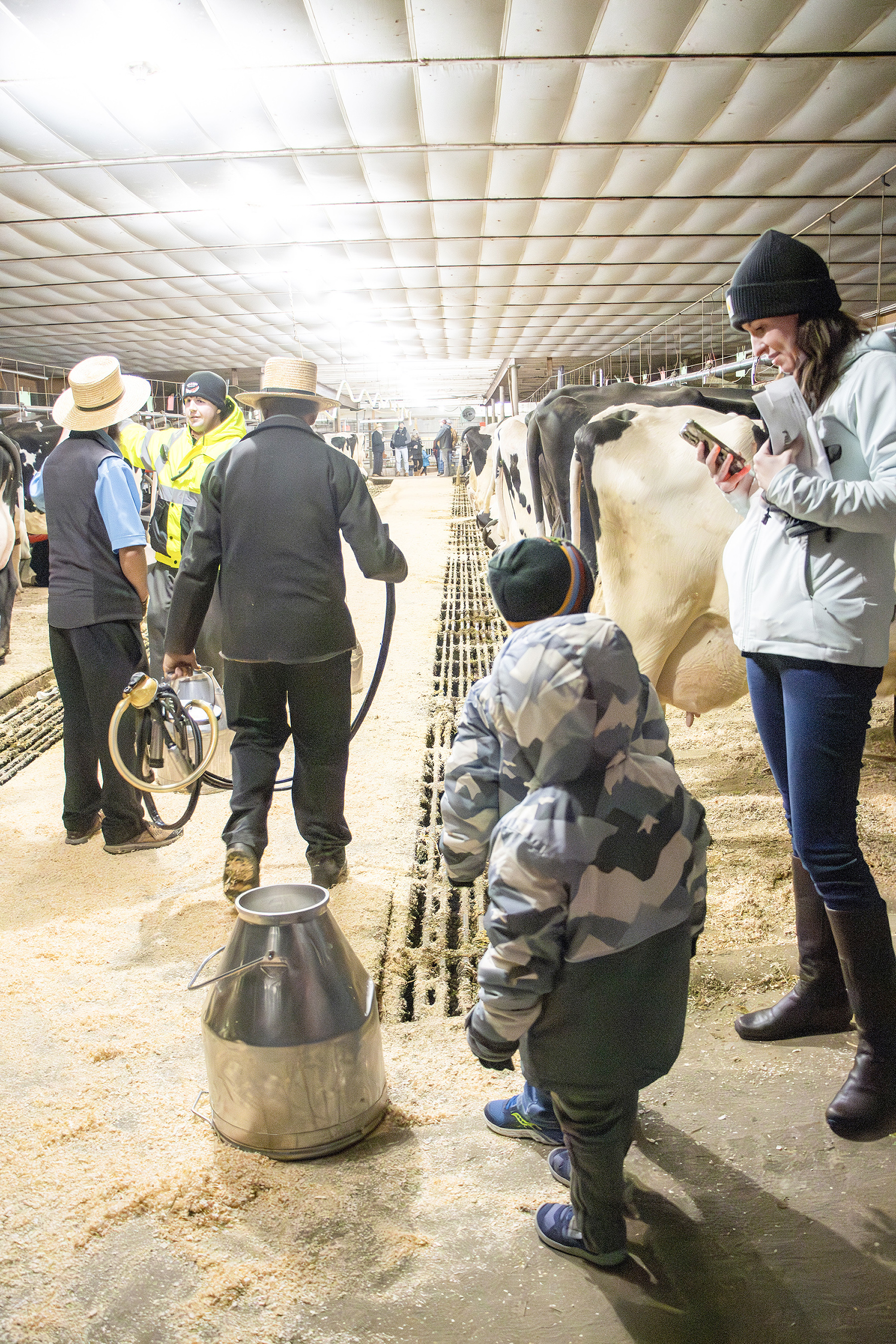
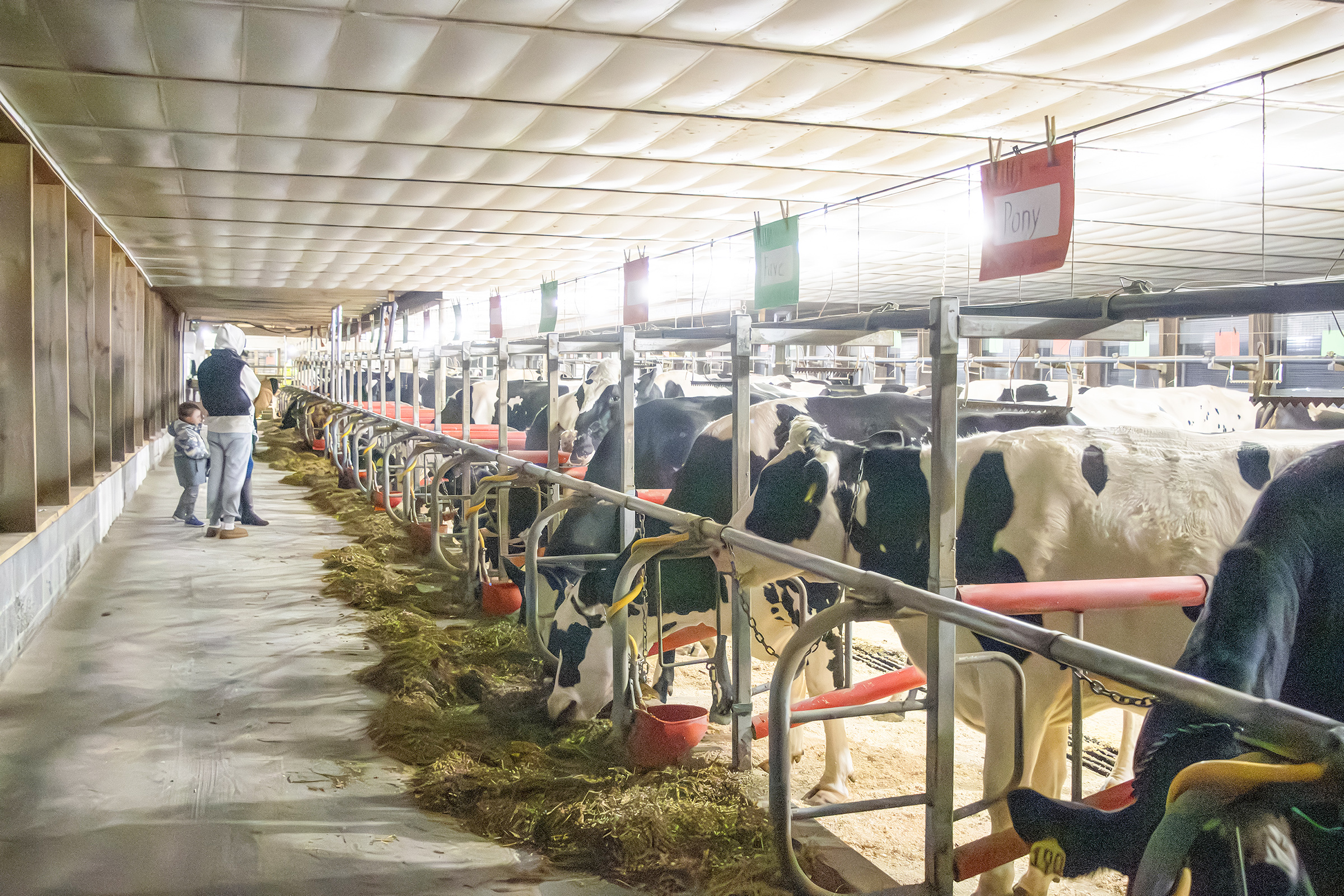
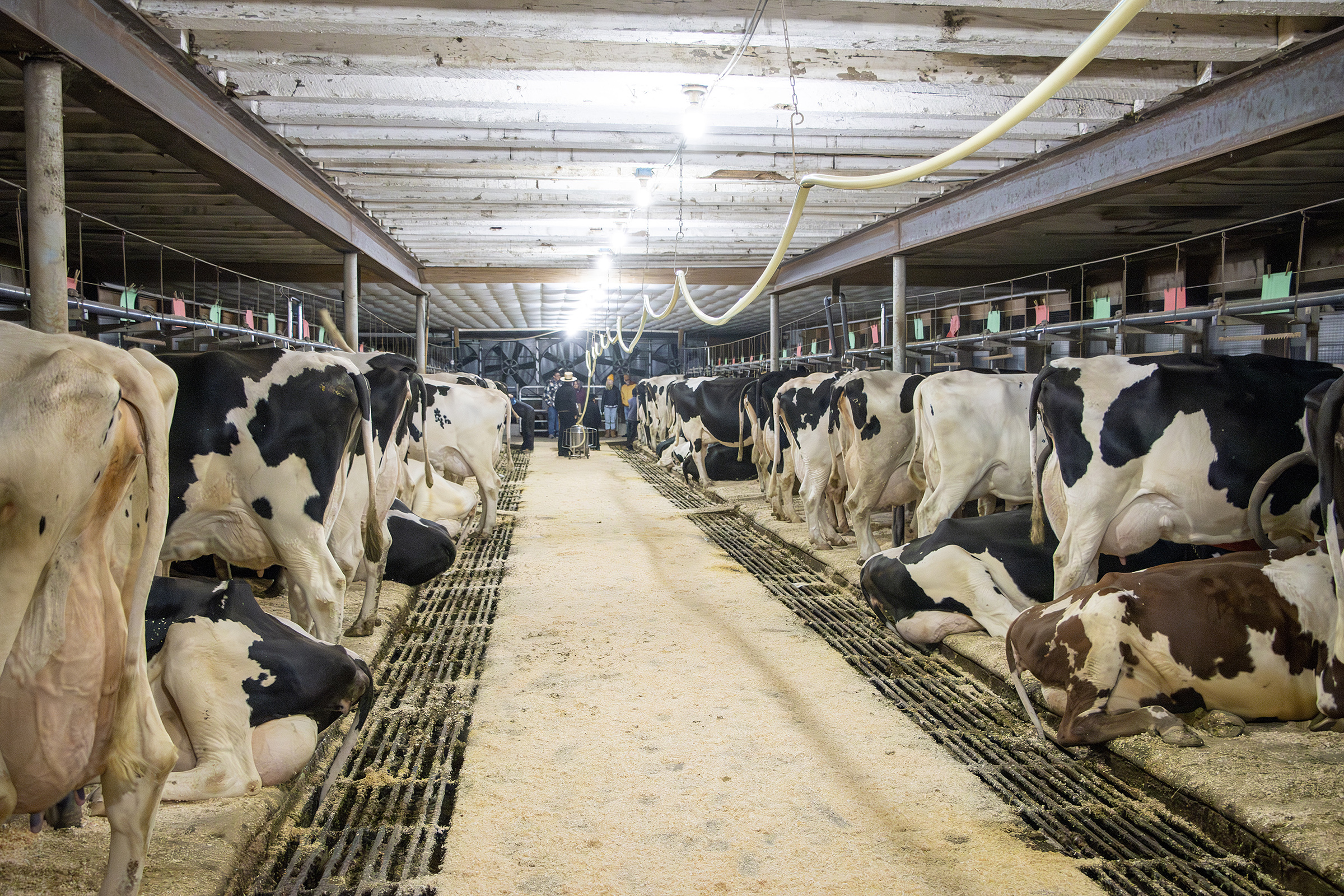
RONKS, Pa. – What better place to be on a chilly evening 12 days before Christmas than in a stable with cows as a family goes about their evening milking and feeding? How fitting to remind the public not just about where their milk comes from, but also the way the Lord Jesus entered this world as a baby, wrapped in a manger, in a stable, with cattle lowing His lullaby.
The second annual Christmas with the Cows at the Melvin Stoltzfoos farm was a big hit, drawing double the attendance of 380 people from six states to the 50-cow dairy in Ronks, Pennsylvania.
While many visitors came from all around Lancaster and nearby counties, many also came from other parts of the state as well as New Jersey; Long Island, New York; a few from Delaware and Maine; and an over-the-road trucker brought his family from Houston, Texas after seeing the signs.
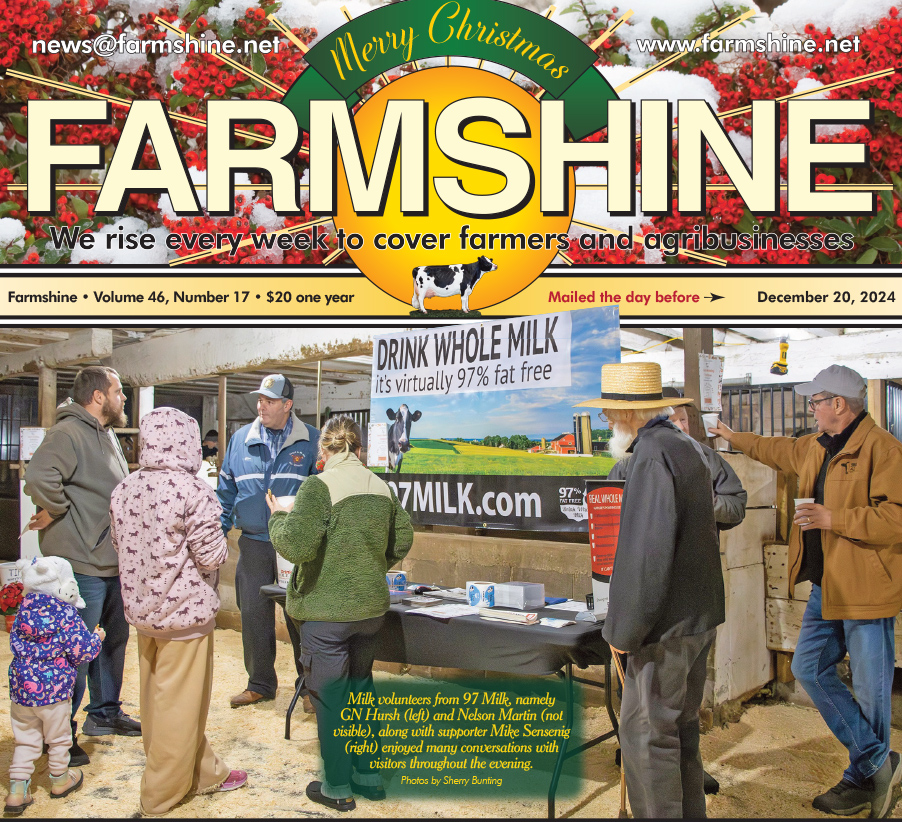
Local attendees like Bridgette Zell of Nottingham said they saw the event posted on Facebook. She brought her two young boys to see what it was all about. Bridgette had the quote of the night as she stopped by the 97 Milk table, where GN Hursh of Ephrata and Nelson Martin of Robesonia were the volunteers handing out stickers, 6×6 cards, small magnets, and other informative goodies.
“I get so tired of people saying milk is not for humans,” she said. “When I was growing up, if any of us didn’t feel well or had something wrong, my mother would tell us: ‘Drink a glass of milk see how you feel!’”
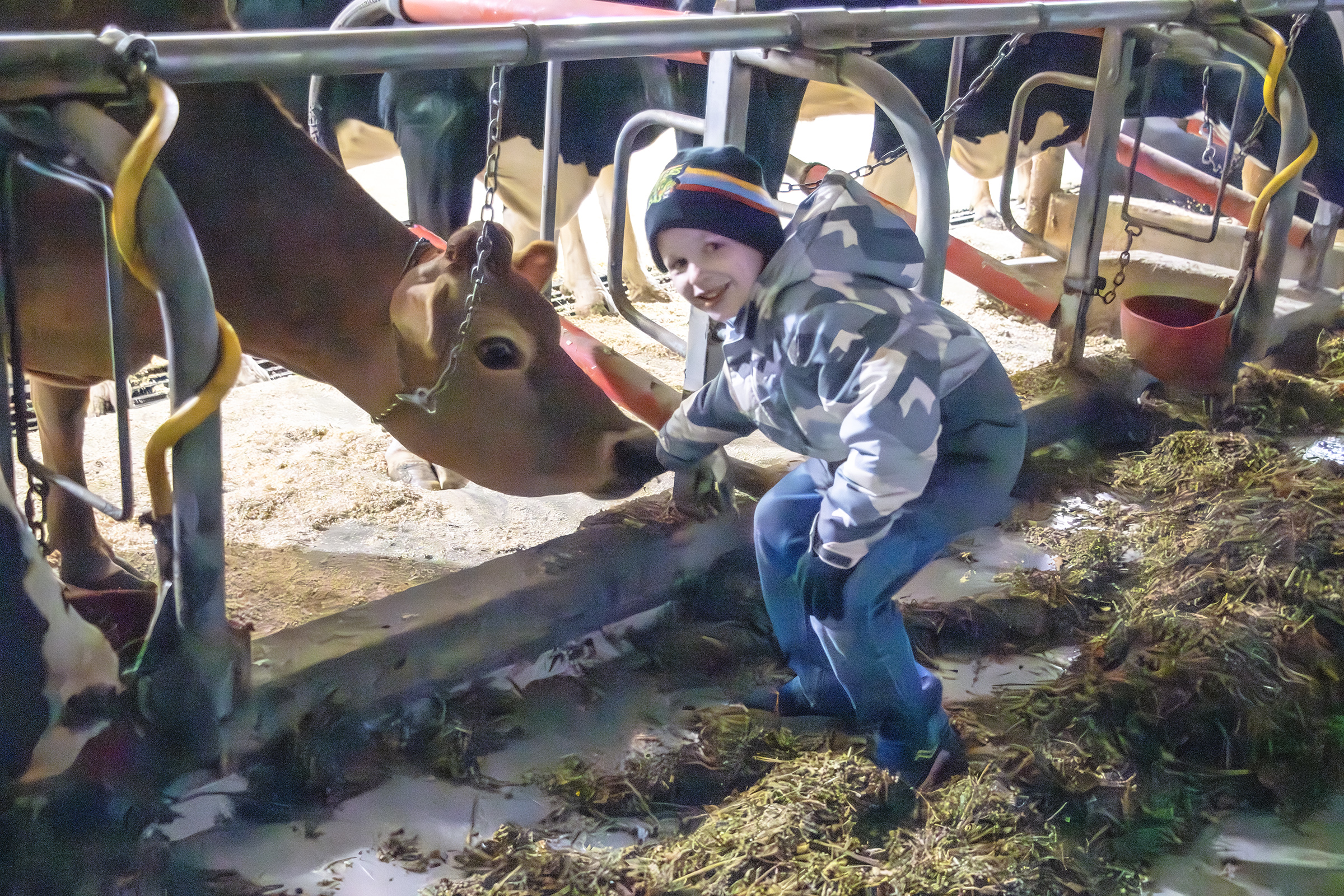
One of her boys, Dylan, was thrilled to pet his first cow. He quickly learned the Jerseys were more curious to bring their noses right up to his hand. “This one must give chocolate milk!” he said about the brown cows, flashing a great big smile.
“Well, they are more curious than their black and white herd mates,” I responded while capturing his photo, “and their milk is richer in fat and protein, but we still have to add the chocolate.”
The whole event is a leisurely walk around the barn during chore time, culminating at a table with whole milk, chocolate milk and homemade Christmas cookies.
This was not a fancy event, but rather a time to simply take in the serenity while the Stoltzfoos family — from the littles on up — shared the blessing of their stable routines with the public.
“People ask me what do we get out of it? It’s really just seeing people have fun. Seeing people have fun with the cows is what we get out of it. Everyone I talked to was happy and in a good mood. People were tickled to have the opportunity to just be in a barn,” says Melvin.
And along the way, they learn something too. Upon entering, visitors are given a paper with fun facts about Agriculture and the nutrition of delicious whole milk, along with a welcome note with facts about the farm — names of the draft horses, facts about Holsteins and Jerseys in the herd, fun facts about cows and what they eat. Visitors also receive a thank you card with the Christmas story as told in Luke 2:11-16 and the Reason for the season as told in John 3:16-17.
Melvin and his family truly love doing this. They are already thinking about next year’s Christmas with the Cows, marked on the calendar for Dec. 12, 2025.
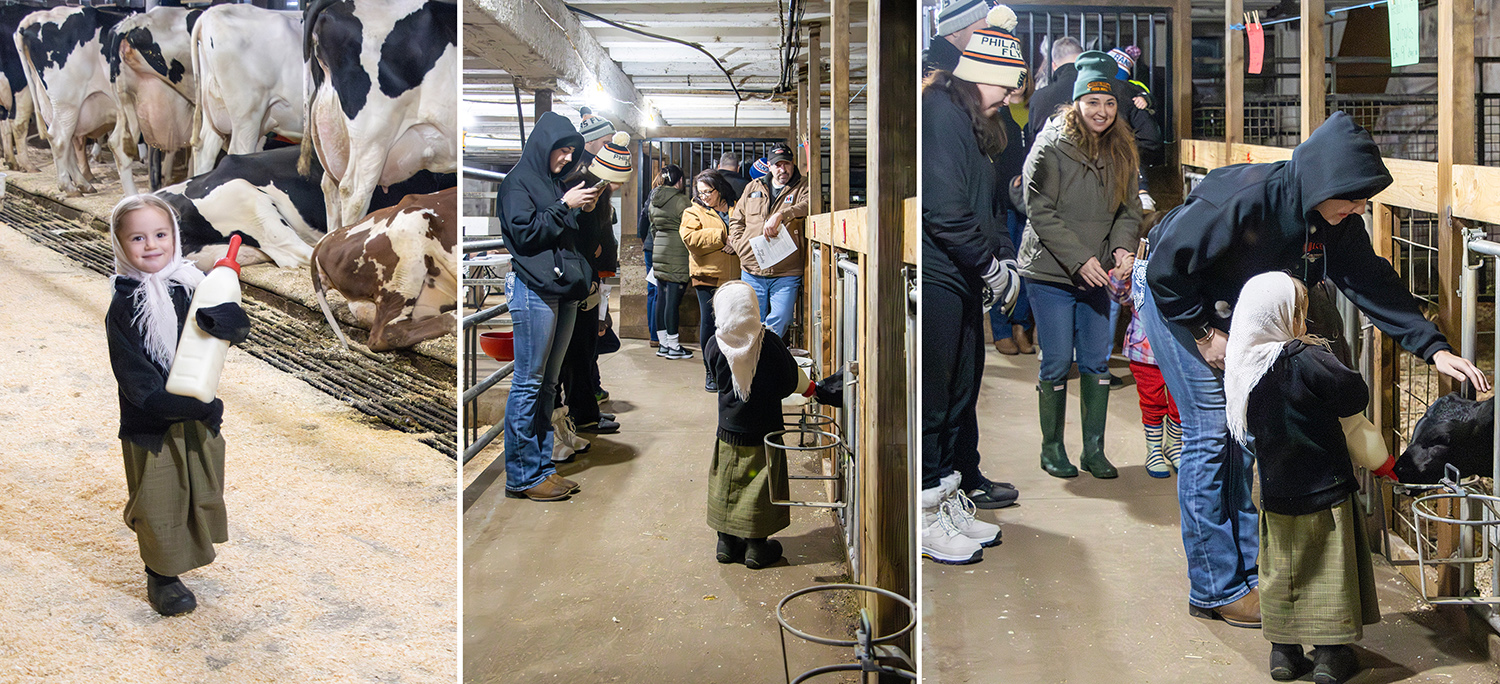
The host family’s youngest daughter is pleased to have the calf feeding responsibility.
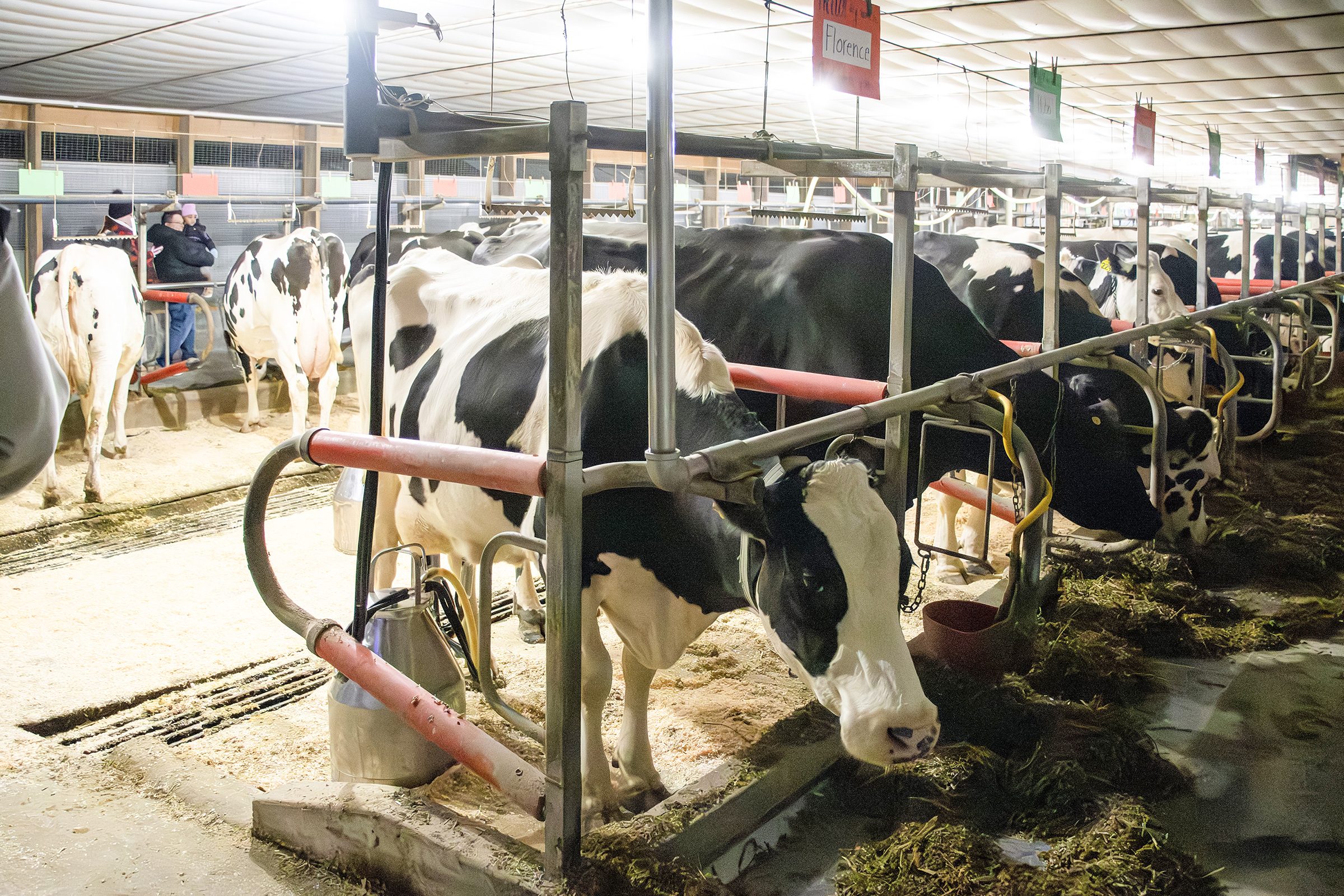
Feeling blessed to be dairying, Melvin and his family want to share this gift with others — the quiet rhythms of milkers pulsating and cows munching, the soft sounds of their lowing, the nickers from the horse stalls, the rustling of calves at feeding time, the sight of clean, contented, cows in their stalls, placidly chewing their cuds as the family moves the milkers down the row, amid casual conversations answering any questions the visitors may have.
“It’s not about us,” says Melvin. “It’s about the cows. It’s about people having the opportunity to see the cows.”
The largest crowd came early, lined up right at the start of the evening milking at 4:30 p.m. Visitors continued to flow in steadily right up until the advertised ending time of 7:30 p.m. The family rented portable toilets and tower lights, placed outside. They cleaned and emptied the loafing pen to make way for the 97 Milk table and refreshments.
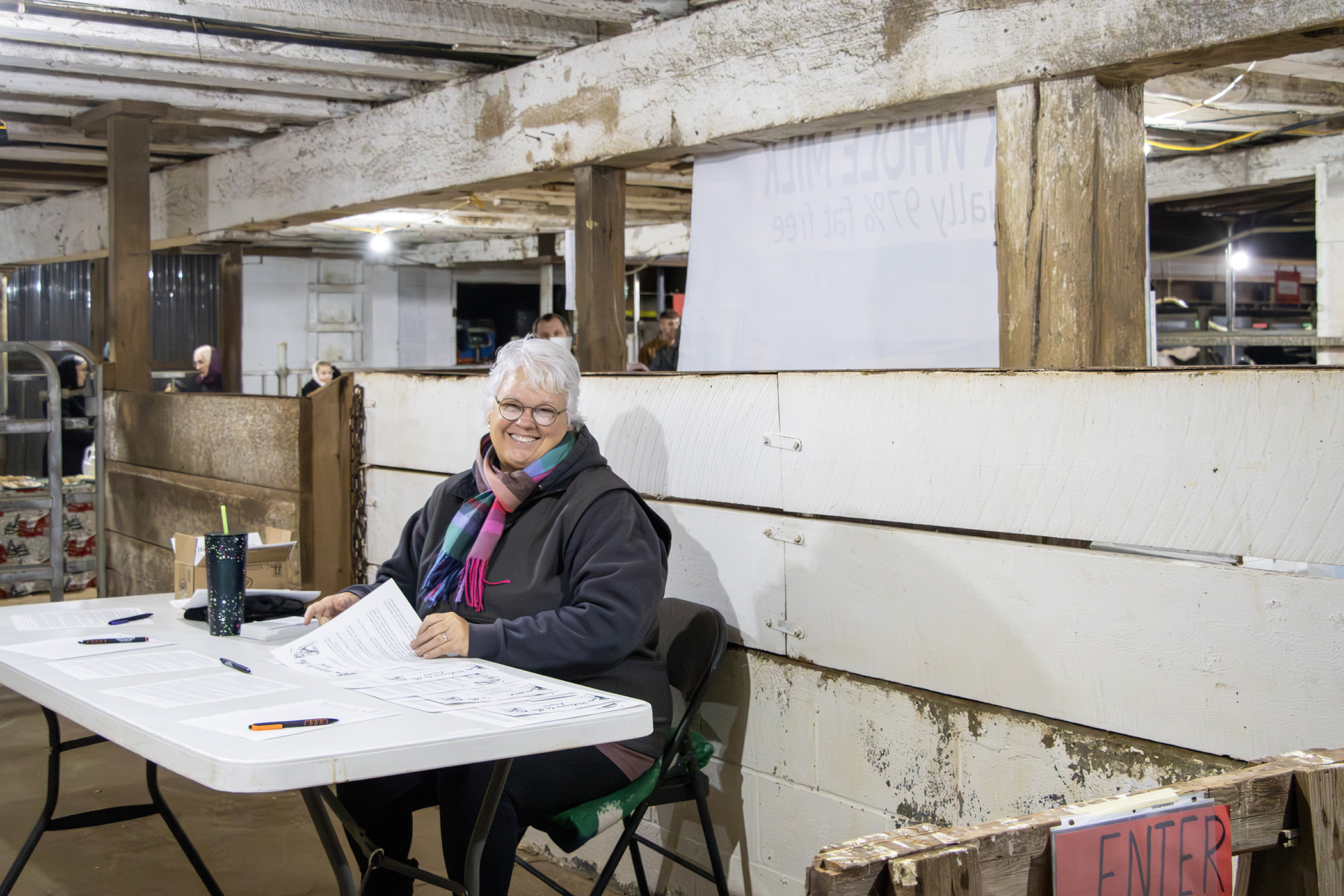
Half a dozen people from Sensenig’s Feed Mill in New Holland volunteered their time too. Nancy Sensenig manned the registration table, drawing people in with her ready smile and outgoing nature, while dairy nutritionists Kyle Sensenig, Steve Morris and Justin Brenneman answered questions about dairy cows and what they eat.
Other volunteers guided traffic to parking, and Mike Sensenig was encourager in chief – walking around all smiles throughout the evening, talking with visitors.
“Melvin does a really good job here, and we support this because it’s grassroots,” says Kyle. “We like to get behind grassroots efforts that are an outreach to our community and consumers.”
He observed a few repeat families who came out last year, but mostly, he shares: “We saw a lot of new faces tonight.”
When asked what tough questions he may have encountered, he says it was really a relaxed evening, people were here out of genuine curiosity to experience something new that dairy farmers see and do every day.
He did get questions about grass-fed dairies and took the opportunity to broaden that discussion to recognize not all feeding systems are the same. He shared that these cows were getting grasses in their feedstuffs, and that cows are superheroes, able to utilize a wide variety of feedstuffs to make nutrient dense milk.
“The important thing is we want to have healthy and content cows, and that’s really what drives every dairy farmer,” he relates.
As I walked through with a group of visitors from southern Lancaster and Chester counties, the conversation turned to A2 milk. Melvin talked about his own progress toward a herd now 75% A2 through the bulls he selects for breeding. In his quiet manner, he demonstrated the reassuring message about how dairy farmers are always looking to improve and put their best quality forward.
97 Milk is a 501(c)3 non-profit. Donations are tax deductible.
By Sherry Bunting, Farmshine, November 22, 2024
EPHRATA, Pa. – Farmshine readers are no-doubt aware of the work of the volunteers operating the 97 MILK education efforts. But awareness and thank you’s don’t pay the bills.
First of all, 97 MILK is a 501c3 non profit, meaning donations are tax deductible.
Secondly, 97 MILK is managed and operated by volunteers. Not a single person doing any of this great work is paid a dime or a nickel (not even a penny) for their time and only in some cases are personal expenses for projects reimbursed
97 MILK has made huge strides on literally a shoestring budget.
However, even the frugal cannot survive without donations because printers have to be paid for printing materials like the popular and eye-opening 6×6 cards.
Website hosts and programmers have to be paid to keep the platform up and running.
When whole milk isn’t donated for an event, it has to be purchased.
When dieticians or other experts are interviewed for a Q&A at the website or on social media platforms, they expect their expert time to be paid.
Boosting the best and most informative ad posts on facebook also comes at a cost.
The list goes on, and it doesn’t even cover the things 97 MILK wants to do that are expensive, like BILLBOARDS.
There’s a reason Nelson Troutman started this movement by painting a wrapped round bale, or BALEBOARD — because the billboards were too expensive, but wouldn’t it be nice to amplify the good work of 97 MILK with a few larger than life billboards?
These are tangible costs that surround the small but strong and dedicated army of 97 MILK volunteers.
When it comes to the content created, the daily social media posts, the educational printed materials, the interactions with followers to answer their questions on social media, the constant monitoring of social media conversations, along with the answering of emailed questions at the website question desk, the compiling of new information for the website designer to keep it refreshed, the staffing of booths at consumer-facing events, the painting of bales, the miles driven, time spent talking to consumers, time spent designing eye catching ads to show consumers, time spent actually communicating with consumers – that is all done by volunteers who take time away from their paid livelihoods to voluntarily promote whole milk education, often not even being reimbursed their personal costs for supplies.
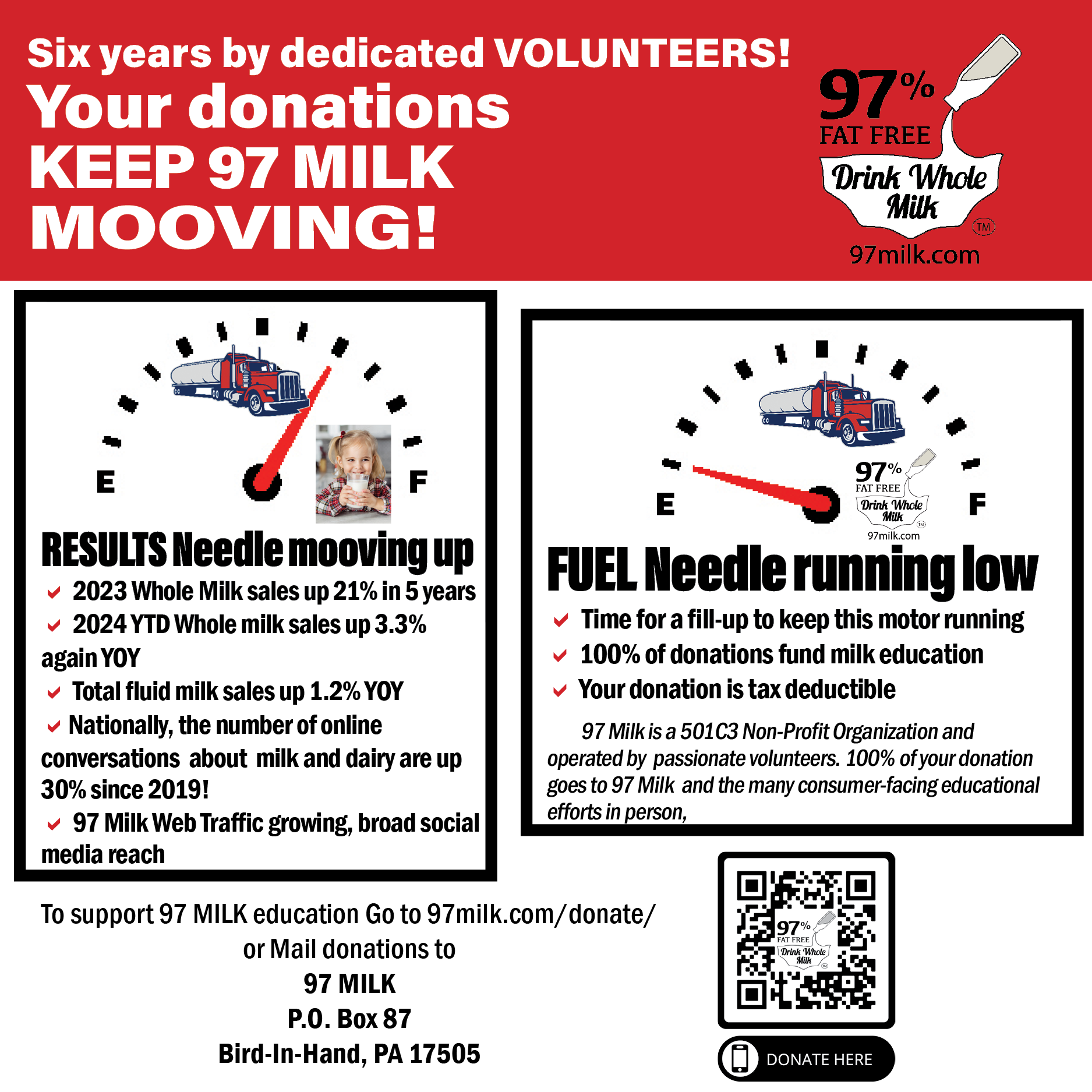
We are in the season of Thanksgiving. A great way to show some gratitude to the hardworking 97 MILK volunteers is to help keep the boat afloat with a donation. Apart from a few regular givers, donations have not come into this volunteer effort for a long time, and the shoestring is baring thread, despite the important advances this educational effort has made for dairy farmers and the many agribusinesses that serve and depend on them.
A recent Dairy Foods Magazine website panel discussed the State of the Dairy Industry in 2024. One panelist observed that their monitoring data show a 30% increase in social media conversations about milk and dairy products. We can chalk some of that gain up to 97 MILK, posting six days a week and reaching hundreds of thousands of consumers every quarter, with many reacting and having conversations with 97 MILK volunteers — engaging directly.
The website, alone, is averaging 200 users per day, most of them new users. That’s a big number.
Total page views at 97milk.com were 11,000 over the past 30 days – another big number.
Facebook reached tens of thousands of people last week, without any paid ads, but reaches tens of thousands more with boosting. Of these numbers, the nationwide reach is broad. Nope, they don’t all come from Pennsylvania. The places with the highest views register as California and Texas, along with states all in between East to West and North to South.
Of the website interactions, the No. 1 draw is the Milk Facts section. Visitors to the website spend an average of 2 minutes and 40 seconds there. In today’s fast-paced digital world, that’s a long visit!
97 MILK is doing things right.
And guess what? Have you read the Oct. 16, 2024 Farmshine story about fluid milk trends? Do you read Market Moos keeping you up to date on the monthly estimated packaged fluid milk report by USDA?
Fluid milk sales are UP year-to-date over year ago, and have been trending this way since partway through last year. In fact, the long-term fluid milk sales downturn was slowed and flattened ever since 97 MILK was formed in February 2019. But in the past 18 months, it’s turning slightly higher. There is momentum now — enough that industry trade organizations and other farm publications are beginning to take notice.
This is spurred by the big increases in whole milk sales as one of the main categories turning the trend around when looking at the volume, not just the percentage of increase on a smaller volume category. Whole milk sales are up 21% since 2019 when 97 MILK was formed.
Consumers want to eat and drink more healthfully. They want to know about milk!
97 MILK has caught their attention, piqued their curiosity to learn more, and helped reveal the details about the nutrition in a glass of whole milk. Not to mention, the Whole Milk for Healthy Kids Act that passed the House of Representatives 330 to 99 last December got this far because of one thing: Whole Milk Education.
Whole milk bill champion, Representative G.T. Thompson, Chair of the House Ag Committee, said it best during a 97 MILK meeting attended by farmers in 2021, and he’s repeated similar statements at other meetings and panels where the subject of whole milk in schools comes up:
“Keep doing what you are doing with the well-designed combination of influencing, marketing and providing factual information. Keep up the education. It’s working,” said G.T.
I personally want to thank each and every person who has donated funds and / or donated their time to help keep this whole milk education movement going. Thank you 97 MILK for all you’ve done for America’s dairy farmers and consumers – and above all for America’s children!
So, what are you waiting for? Want 97 MILK to continue and do more? If so, go to https://www.97milk.com/donate/ and prove it, or mail your donation to 97 MILK, PO Box 87, Bird In Hand, PA 17505.


 Ag Moos