Covering Ag since 1981. The faces, places, markets and issues of dairy and livestock production. Hard-hitting topics, market updates and inspirational stories from the notebook of a veteran ag journalist. Contributing reporter for Farmshine since 1987; Editor of former Livestock Reporter 1981-1998; Before that I milked cows. @Agmoos on Twitter, @AgmoosInsight on FB #MilkMarketMoos
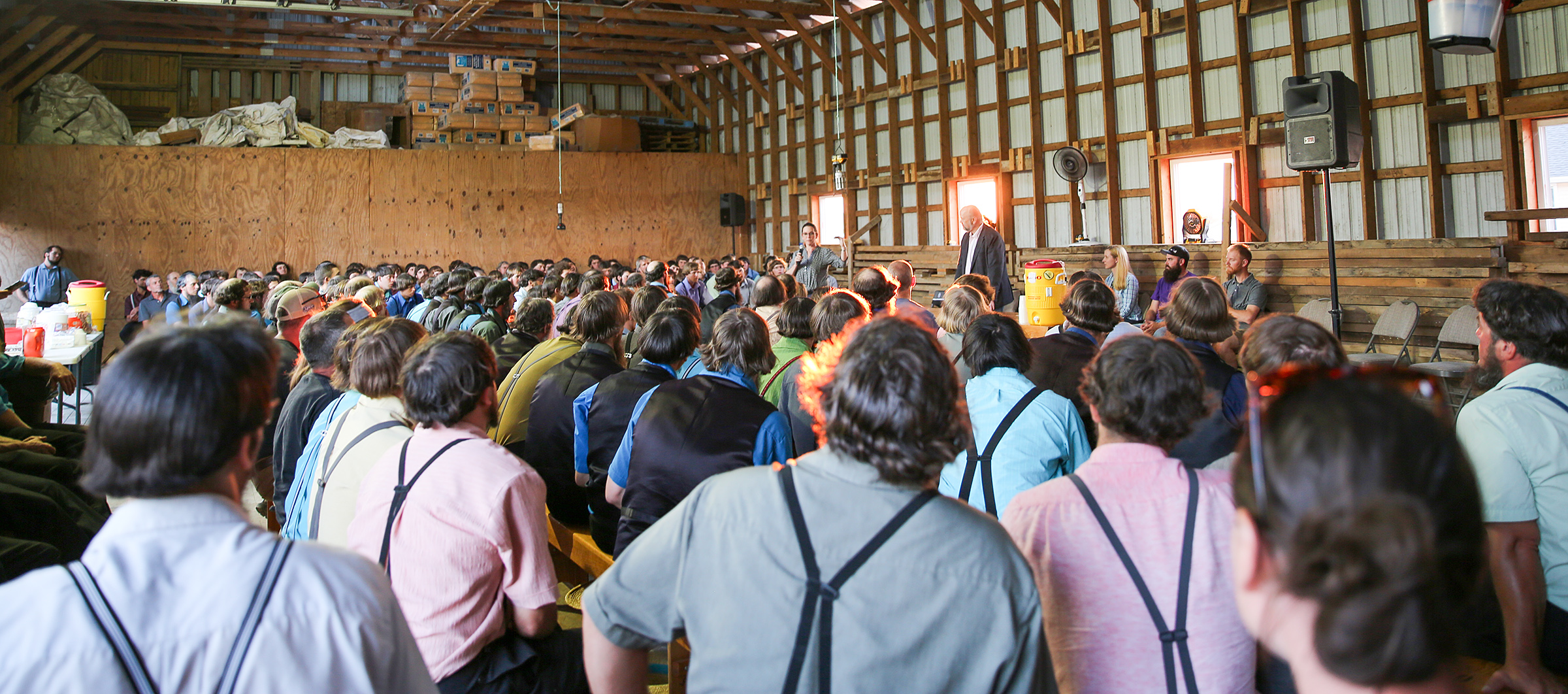
On the evening of June 13th, 300 people, mainly Amish dairy farmers and business owners with horses, came to a farm near Quarryville, Pennsylvania to hear from and show support for Rusty Herr and Ethan Wentworth (far front right and second from right). Their attorney Robert Barnes (standing), spoke about the case and their quest to get clarity on the law. Also speaking briefly (standing left) was Pennsylvania State Representative Wendy Fink of York County. Photo by Sherry Bunting
By Sherry Bunting
QUARRYVILLE, Pa. — It was a clear, balmy evening that farmers could have spent in field work, but over 300 people arrived by buggy, van, and on foot to hear from two men and their legal team at 7 p.m. Thursday, June 13 on an Amish dairy farm in southern Lancaster County, Pennsylvania. (Click here to read author’s analysis/opinion)
The meeting came just one month after Rusty Herr and Ethan Wentworth were released from prison, having served the 30 days on contempt charges for failing to provide names, addresses, and records as part of a 2021 subpoena from the Bureau of Professional and Occupational Affairs (BPOA) on behalf of the State Veterinary Board.
The 2021 subpoena was set in motion by a 2020 petition from the Pennsylvania Veterinary Medical Association targeting Rusty and Ethan for continuing to perform veterinary practice without a license by ultrasounding livestock.
The majority of attendees were from the Amish community, half of them dairy farmers, and half business owners, tradesmen, who have horses. A sprinkling of non-Amish farmers were also in attendance.
One could hear a pin drop while Rusty and Ethan talked separately of their time in prison, highlighting what the prayers and support of family, friends, colleagues, and customers have meant to them and crediting their team of employees for stepping up in their absence and their wives and families for all they have done and endured.
They talked of how their faith in God grew stronger over those 30 days, and of their steadfast resolve to continue serving this community.
Attorney Robert Barnes of Barnes Law LLP talked about two of the exceptions in Section 32 of the Vet Practice Act of 1974, as amended in 1986: “This Act does not apply to (32. 4) Any person or his or her regular employee or agent while practicing veterinary medicine on his or her own animals… and (32. 7) Any person performing normal husbandry practices on bovine, porcine, caprine, ovine or equine animals or avis.”
Neither ‘agent’ nor ‘normal husbandry practices’ are defined in the list of terms in the Act’s introduction.
According to Webster’s the definition of ‘husbandry’ is “the care, cultivation, and breeding of crops and animals,” and the definition of ‘agent’ is “a person who acts on behalf of another person or group.”
‘Agent’ is actually a legal term used to describe “a person that has been entrusted with important powers or responsibilities that are to be carried out on behalf of another person.”
A legal basis for the term ‘normal husbandry’ is traditionally understood as a combination of the producer’s self-interest (economic sustainability) and duties of humane treatment for the animals on which we depend. The two go hand in hand.
“There is a war on the small farmers around the world. The Amish are caught in the middle. They bring essential value and high-quality food from a farming community that seeks to protect a way of life,” said Barnes, who also represents Amos Miller in the raw milk case brought by the Pennsylvania Department of Agriculture.
Barnes called the April 2024 arrests of Rusty and Ethan an “abuse of power” treating civil contempt as though criminal through incarceration.
He called this an example of using regulatory process to bolster “new and novel interpretations of the law.” Other examples he gave involved access to water, takings of food, and animal welfare interpretations that, according to Barnes, use the court system to create new definitions for ‘normal farming.’
“They pick people who are in an isolated position, where it is hard to afford a legal defense,” he said.
Barnes also spoke of power and control, referring to ‘Big Food’ and ‘Big Pharma.’ He said “corporate interests” want to define normal farming and husbandry as it applies to food distribution and animal care in such a way that small independent farms find it difficult to comply or economically unfeasible to survive in the future.
“People are having more chronic diseases, dying earlier, and living less happy lives, but this (Amish) community is not relying on (the world) for your cultural values. This community is a beacon, and so is your independent food system,” he declared.
One attendee spoke up to say: “We need both. We need our veterinarians, and we need NoBull (breeding management services).”
In light of a shortage of vets and the much smaller number of animals on farms like his, this man wondered how a middle ground can be reached by working together.
Farmers who spoke privately after the meeting echoed the same thought to this reporter. When asked what their vets think of this, they said they can’t even discuss it with their veterinarians for fear of losing their services altogether.
They said they have their vets come regularly for herd check and will even list a cow that may have already been checked timely when the breeder was there.
“Why would I call the vet to check one animal (in between herd checks), when my breeder is already here? Would they even come (timely) for one animal?” a farmer noted, shaking his head.
To protect the farms in this equation, Barnes said clarity in the law is required.
“We want the court to rule on the law… to establish the farmer’s right to do these practices and do them through an employee or ‘agent’, as the law states,” said Barnes. “This is the start of a long process. If they (NoBull) are shut down, who will be next? It’s about the impact this can have to small farmers across the country… and on this community. This is a consequential case.”
Pennsylvania State Representative Wendy Fink (R-94th), covering part of York County, also attended the June 13 meeting. She has been closely following the case and spoke briefly about it, citing the abundance of phone calls that have poured into her office and other legislators’ offices. She said she hopes a similar meeting will be held soon in York County and one in the future with additional State lawmakers.
“Your phone calls are important. Keep doing what you’re doing. We support these two gentlemen. Most people would cower… but these two are putting themselves out there. They’re standing up for you. This starts at our local government, so keep the pressure on to make sure that they are abiding by the laws as they’ve been written,” she said.
While the nation’s largest dairy farms may have economies of scale, smaller dairies have traditionally had a level playing field in tools available for herd management and husbandry.
This is changing as the dairy industry continues to evolve and bifurcate.
All sizes of dairies are essential, especially in Pennsylvania, where the average herd size is 94 cows, and the number of dairy farms was 4,940 in 2023, according to USDA — down 67% in the past decade.
To survive and thrive today means honing management and diversifying income. Smaller herds also benefit from a supportive community to be less isolated as part of a collective ‘milk-presence.’
From timely breeding and a focus on longevity to minimize the cost of raising replacement heifers, to the beef-on-dairy trend for income from more valuable calf sales, reproductive efficiency is critical. It is no wonder small dairy farms are looking to keep up in this evolving area of husbandry.
But here’s the problem: The nation’s largest dairies have the ability to employ vet techs, including those placed as employees on large farms by veterinary practices, as well as those training under a farm owner or manager, or who attend a multi-day husbandry school to learn.
Many articles in dairy trade journals over the past decade tout the increasingly available tool of ultrasound technology in the hands of ‘regulars’ who are on the farm daily, or often, to breed cows and/or manage repro— not only from an economic standpoint to breed timely and avoid wasting semen, costly mistakes, and unnecessary culling decisions, but also to positively impact herd management. In group discussions, herd owners even talk about what tools will improve the ultrasounding capabilities of their employees or provide a more comfortable experience for them.
The recent 30-day incarcerations of NoBull Solutions’ founders Rusty Herr of Christiana and Ethan Wentworth of Airville, Pennsylvania brought to light the bifurcation in how portions of the Pennsylvania Vet Practice Act are interpreted, and how interpretations may impact smaller farms inequitably.
The Department of State’s (DOS) Bureau of Professional and Occupational Affairs (BPOA) explained in an April Farmshine interview that the State Veterinary Board adjudications clarify the law with the authority granted them by the legislature, and the legislature is the body to consult for the Section 32 exceptions.
A debate now brews not just on how ultrasounding in conjunction with breeding service is being interpreted as veterinary practice, but also on the Section 32 exemptions. Where is the middle ground?
Robert Barnes, Esq. of Barnes Law LLP and the 1776 Law Center told farmers at a meeting on June 13 that not only were Rusty and Ethan never named party to a case, but their arrests were also unconstitutional, violated state and federal laws, and the state agencies and Commonwealth Court did not have jurisdiction in the first place.
Beyond that, the legal team wants the law clarified in the courts as Rusty and Ethan are back to work, providing breeding services to owners of dairy cows and horses, largely in the Amish Community.
HARRISBURG, Pa. – The legal battle continues for NoBull Solutions LLC partners Rusty Herr of Lancaster County and Ethan Wentworth of York County. Both Pennsylvania men have been jailed in their respective county prisons since April 10 and 11, respectively.
They were arrested for contempt of court after failing to respond to a May 2023 contempt order and failing to comply with a 2021 investigative subpoena seeking the name and address of NoBull’s custodian of records as well as the names and addresses of all members, managers, and other persons who direct its activities, according to the recently unsealed docket 325-MD-2021.
Herr and Wentworth will have served their 30-day commitments by this weekend (May 10 and 11, 2024).
According to counsel Robert Barnes, Esq. of Barnes Law LLP, a Petition for Writ of Habeas Corpus has been filed with the Pennsylvania Supreme Court after a Commonwealth Court Judge denied their motion for immediate release and unsealed the docket in two separate actions on April 29, 2024.
Barnes maintains that certain procedures must be followed in a civil contempt action.
“To our knowledge those were not followed here. Wentworth and Herr were not given an opportunity to purge contempt in order to secure their release from prison – an essential requirement of civil contempt, which makes this de facto criminal contempt – a violation of Pennsylvania law,” Barnes states in an email response to Farmshine.
Even though the 30-day sentences will have been completed as they wait for the State Supreme Court to hear their appeal, Barnes says his office will “pursue the appeal to restore proper jurisdictional basis and to force the state agencies to adhere to the Pennsylvania Constitution and the Administrative Procedures Act.”
Former Pennsylvania Department of Agriculture counsel and current staff attorney with the Penn State Center for Agricultural and Shale Law Brooke Duer, Esq. told WPMT-Fox43 that the now unsealed docket shows the “civil processes for contempt are all there and were followed.”
The April arrests stemmed from prior actions by the State Board of Veterinary Medicine, which led to a Feb. 2020 complaint filed by the Pennsylvania Veterinary Medical Association (PVMA) one month before the Covid shutdown.
The PVMA alleged that Herr and Wentworth continued practicing veterinary medicine by ultrasounding other farmers’ cows in connection with NoBull’s breeding management service. PVMA asked for contempt charges through Commonwealth Court as part of that 2020 complaint.
The Department of State initiated its investigation in early 2021, issuing a subpoena order for the names and addresses of custodian of records and all parties involved in or directing activities in the business.
Both men failed to comply with the subpoena or to challenge it, according to the now unsealed docket.
“Some of us thought this had more-or-less gone away,” said Duer in the televised interview on May 2. “So, it’s kind of surprising. All of a sudden it’s back on again?”
Duer said there is no evidence that the men responded in any way or represented themselves since 2021.
(Prior dockets show they did represent themselves in prior State Vet Board actions, Herr in 2010 while he was still milking his own dairy herd, and Wentworth in 2018 while he was employed as an AI technician by Select Sires.)
“They had not only a few opportunities to come forward and prevent this kind of an outcome, but those opportunities were multiple…,” said Duer.
According to the unsealed documents, a Commonwealth Court judge signed “Orders to Commit” on October 6, 2023, which resulted in the April 2024 arrests.
The more immediate question is: Were they given the opportunity to purge the contempt at the time of arrest and incarceration, as would appear to be the process with civil contempt, according to an ACLU – Pennsylvania guide to contempt proceedings.
The deeper questions center around the future: What will happen next in terms of a level playing field for smaller farms looking to gain the benefits of integrating ultrasound into breeding management, but are not large enough to have employees trained to do it or vet practices willing to station their vet techs at small farms to do it.
Of the NoBull customers who have contacted this reporter, nearly 90% want this integration, while they still intend to maintain their veterinary relationships through regular herd checks.
The Department of State says veterinary medical practice is further defined by the State Vet Board through adjudications.
The PVMA says a pregnant / not pregnant ‘diagnosis’ is a food safety concern because the not-pregnant diagnosis can involve recommendations for hormone treatments, or recommendations for culling open cows for the beef market.
PVMA also maintains that pregnancy diagnosis “by any mode or method” is veterinary practice. Yet blood and milk sample testing for pregnancy by other companies has been used and celebrated in Pennsylvania since at least 2015.
Several dairy trade magazines have published articles over the past 12 years about the differences in the laws between states and the trend toward laypersons doing ultrasound as the machines are widely available, and the technology has improved. A 2007 USDA survey of (larger) dairies in the West showed that nearly one-third (31.7%) of those performing pregnancy diagnosis used someone other than a veterinarian via ultrasound for breeding purposes. That was 17 years ago.
At least one Pennsylvania dairy producer reports that a veterinary practice places vet techs as employees on larger farms for training, and they do those ultrasounds to provide timely information between herd checks at a discount.
A January 2024 Progressive Dairy articleby a Genex consultant examined how integrating ultrasound with breeding management is revolutionizing reproduction on U.S. dairies that are faced with the need for swift information to make economic decisions in a highly competitive, tight-margin dairy business.
Small dairy farmers continue to contact this reporter wondering what they can do about this. “How can we help?” they ask.
Virtually all of them continue their relationships with their veterinarians for regular monthly herd checks, in addition to having NoBull do ultrasound in connection with breeding service to achieve those same efficiencies in between.
Pictured are (l-r) Ben Masemore, Ethan Wentworth and Rusty Herr at their NoBull Sires booth during the World Dairy Expo. Today, Masemore is fielding calls from dairy farmers across Pennsylvania and the nation as Herr and Wentworth have been jailed for ultrasounding cows they do not own and making diagnoses without a veterinary license as part of their NoBull Solutions LLC breeding services. They have not seen a judge, had no due process, were denied bail, and were arrested by local law enforcement in the respective counties in which they live for contempt of court after ignoring a 2010 and 2018 cease and desist order from the State Board of Veterinary Medicine having not been able to present a defense. Barnes Law LLP has accepted the case, and Robert Barnes says the arrest warrants did not come from a court — a bureaucratic veterinary board is not a court. Funds have been set up to accept donations for their legal defense to get them home to their families, their animals, and the dairy farmers they serve. Photo provided
By Sherry Bunting, a developing story special for Farmshine in mailboxes and online at Farmshine.net, April 19, 2024 edition
CHRISTIANA, Pa. — In a move that has shocked members of the local and distant dairy farming community this week, word spread of the Pennsylvania State Veterinary Board’s action through the Department of State, Professional Compliance Office, executing a “contempt of court” order through local law enforcement when none of these agencies are actual courts.
Rusty Herr of Christiana and Ethan Wentworth of Airville have been in prison since their arrest last week, without seeing a judge, without due process, and being denied bail… for what?
For ultrasounding dairy cows and horses – without a veterinary license — as part of their NoBull Solutions breeding service. (Imprisoned ultimately on contempt of court).
They are two of the three men that were named in the State Vet Board’s cease-and-desist orders as recently as 2018 and 2020.
With this enforcement, the state is essentially considering pregnancy a disease even though federal courts have found, in humans, pregnancy is a condition, not a disease, and even though the Veterinary Medicine Practice Act in Pennsylvania does not mention pregnancy, but latitude is given to the State Board. No definition of diagnosis nor mention of pregnancy or ultrasound appears in the Board Regulations.
According to the nationally-known Barnes Law LLP, serving as the NoBull legal defense team hired April 17, one week after their arrests, “Pregnancy is not a disease. Pregnancy is not an illness. Likewise, confirming pregnancy or successful reproduction is not a diagnosis. Medicinal definitions are clear: Identification of disease is termed diagnosis, the solution design is called treatment planning, and treatment where appropriate is then implemented as the solution.”
In addition, there are dozens of known technicians using ultrasound with livestock in conjunction with reproductive services in the state of Pennsylvania. Yet for this, Herr and Wentworth are being kept away from their families, already imprisoned for one week, and have been told they will be in jail for 30 days.
Furthermore, the circumstances of their arrests are troubling.
Wentworth was told to go to the Courthouse (in York) on the morning of April 10 to pay a fine. He was told he would see a judge. Instead, he was arrested, and seven days later has still not seen a judge, according to friend and associate Ben Masemore, a dairy farmer associated with a sister business NoBull Sires LLC.
Herr was arrested the very next morning, April 11, at 6:30 a.m. at his home in Christiana. He was handcuffed and taken away in front of his wife and children, says Masemore in a Farmshine phone interview.
The new lead attorney for the Herr/Wentworth and NoBull Solutions defense, Robert Barnes, Esquire, even makes the case that the arrest warrants were not “facially valid” because they did not come from a court.
“There is no actual court on it. It is not a court document. Some bureaucratic official sent it to a prothonotary (court clerk), and now these people are sitting in prison because high ranking state bureaucrats have conspired with incompetent local sheriffs to illegally and unlawfully imprison them,” says Barnes.
This amounts to “some rogue officer and agency in Pennsylvania deciding ‘we want to arrest and imprison people whenever we want, with no limitations.’ The statute doesn’t authorize it. The Constitution of Pennsylvania doesn’t authorize it. In fact, it violates both the State and Federal Constitutions,” Barnes explains in his April 17 Viva Locals podcast about the case.
He adds that they must think “These are just some ordinary folks helping the Amish and (that they) can get away with it. Maybe they thought they were Amish, and they’d never sue.”
Barnes further notes that, “Somebody at the (state vet board) got the idea to create something that calls itself ‘arrest warrant,’ make it look like it came from a local court, create a docket number at the top, refer to (their) board’s activities as ‘The Court,’ call it ‘contempt,’ and have these people ordered arrested interminably in prison.”
Robert Barnes, Esq. of Barnes Law LLP has taken the NoBull Solutions Defense case, vowing to get justice for Ethan and Rusty and their families. He talked about it on his Viva Locals podcast April 17, saying “a whole bunch of folks are about to get sued” and citing unlawful detainment and civil rights precedents, among others. Screen capture by Sherry Bunting
In fact, visiting the Pennsylvania Veterinary Medical Association (PaVMA) website under “advocacy,” Farmshine has learned that the contempt-of-court charge was the suggestion made in the PaVMA’s recent complaint it filed on Herr and Wentworth for ignoring previous fines and cease-and-desist orders from the State Veterinary Board.
Farmshine has learned that these fines were ignored on advice of their former attorney, so as not to admit guilt. After all, why should Herr and Wentworth admit guilt for actions that have become commonplace and are open to interpretation of the state’s vague and archaic veterinary law in regard to defining ‘diagnosis’ — especially since pregnancy is not a disease to be diagnosed, but rather a condition to be observed?
There is also the issue of targeted enforcement.
The State Vet Board was prompted to act in the first place by PaVMA filing a complaint seeking to specifically target “three individuals” with fines and cease-and-desist orders for “illegal practice of veterinary medicine by unlicensed individuals.”
These original orders specifically named them as individuals employed with NoBull Solutions LLC and its “all encompassing reproductive management for dairy farms.”
The “documentary evidence” in the official PaVMA complaint was in the form of two pages of Facebook posts that “show non-veterinarians using ultrasounds and making diagnoses.”
Again, what are we talking about here? Ultrasounding cows in conjunction with breeding service — something dozens of proficient ultrasound machine users and breeding technicians do with cattle, horses, and other livestock across the state and around the country.
What is the difference between “diagnosis of pregnancy” through ultrasound vs. blood test and milk samples offered by companies in the area?
In today’s times, we have breeding technicians using ultrasound in conjunction with pregnancy and reproductive observation that are the lifeblood of a dairy farm. We have hoof trimmers providing essential services that involve observation and treatment of hoof and foot problems, but the state vet law only specifically exempts equine farriers. We have nutritionists body scoring cows for herd nutritional and health status observation and advice. We have FARM program auditors scoring hocks, scoring lameness, scoring body condition and other potential veterinary diagnoses that are referred to as observation.
But somehow, observing pregnancy and reproductive performance through ultrasound is illegal without a veterinary license? All of these examples – including repro ultrasound — show how it takes a village to run a dairy farm these days. How many times do we go to meetings and hear experts tell farmers to get outside eyes observing the cattle on their farms?
Farmers, themselves, wear many hats. They observe, diagnose, and treat many conditions in their own herds. The law recognizes a farmer’s ability to diagnose and treat their own animals and to allow their hired employees to do it for them.
With this action, the state is basically saying small and mid-sized farms cannot pay for the services of others, not being large enough to hire full-time staff to do it.
This reporter received phone calls from half a dozen farmers, many of them Amish dairy farmers, while completing this report on April 17. One farmer from eastern Lancaster County said “hundreds of farmers in the county don’t know where they would be without Rusty Herr.”
Another from Oxford explained how much Herr has taught him about his livestock, so much more than a veterinarian would have time to teach. He noted Herr’s “calm personality and precise work,” and how others, including himself, are “now being impacted by not having him on their farms” while he is in jail.
Another from Quarryville said Herr and Wentworth “are keenly missed. They are great people who did a great job and provided great service. This is affecting my dairy farm. I have appreciated how they walked into my barn and did their utmost to help me out with dairy breeding decisions.”
Pennsylvania, with a small average herd size of 95 cows, has lost 46% of its dairy farms in the five years between the 2017 and 2022 Census of Agriculture. More dairy exits have occurred in 2023 and so far in 2024. Total herd dispersals have become commonplace as the low margins in dairy are a barrier for many farms to continue into the next generation.
How can farm families survive amid rapid consolidation of this industry, if there is not a level playing field? The very largest mega dairy operations in this country can hire full-time staff veterinarians, nutritionists, and technicians as employees and receive the blessing of the law, while small to mid-sized farms stand to lose the service of good people hired independently?
As for the PaVMA complaint that started all of this by citing state veterinary law, that law makes no mention of ultrasound or pregnancy.
It’s important to note that the PaVMA stepped up its drive to get targeted action from the state. According to a February 21 post at the PaVMA website, the organization listed the ultrasound concern as an advocacy position under the heading “Illegal Practice of Veterinary Medicine.”
In the post (see screenshot below), PaVMA states that it “has received many reports of bovine technicians engaging in the practice of veterinary medicine without a license, specifically performing ultrasounds and issuing diagnoses. In the past, the state of Pennsylvania fined three individuals and ordered them to cease and desist their activities. We have received reports that some of these individuals have not stopped and flagrantly promote their use of ultrasounds on Facebook. We have filed a complaint with the Department of State, Professional Compliance Office.”
The organization called its members to action, providing downloadable blank forms and instructions as follows: “We encourage all PVMA Members who have knowledge of these activities to also file complaints. A complaint form and copies of the cease-and-desist orders are available for download. Please reference the docket and case numbers in your complaint. The docket and case number are located on each cease-and-desist order. After filing a complaint, please email us at Membership@PaVMA.org and let us know so we can keep track of our members who have joined us in making the state aware of this problem.”
Screen capture by Sherry Bunting
Parallels can be drawn to other points in the long and legendary history of dairy cattle reproductive progress, whereby the establishment have used interpretations of archaic and vague laws to target progressive individuals, who were helping dairy farmers improve their herds.
One such case was in Canada in the 1980s, as chronicled by Holstein International. The article entitled “Allowing great sires to go everywhere” in the March 2021 edition makes this point:
“Unfortunately, disruption in any established industry does not come without controversy, and in 1987 a charge was made against Transfer Genetics (and its owner) by the Ontario Government for the illegal delivery of semen. The law from the 1950s required semen to be delivered by a licensed Ontario A.I. centre. A fine for this ‘violation’ was suggested, but a guilty plea would delegitimize Transfer Genetics forever. In July 1987 Transfer Genetics was charged – resulting in the closure of Transfer Genetics’ semen distribution.”
After setting up opportunities for farmers to learn to breed their own cows and enduring more than a year fighting this battle, the case was won for farmers, and the achievements for modern-day genetics are well-documented.
Instead of giving in to the intimidation, this entrepreneur, with the help of others in the dairy community, persevered, and the results of those early matings of well-bred Canadian cow families to top U.S. sires of the 1980s have produced legendary lines looked to today.
If that entrepreneur, who went on to be recognized as 2022 World Dairy Expo International Person of the Year, had simply paid his fine in 1987, stopped ruffling feathers, and gone back to the sidelines, who knows what the impact would have been?
Where the similarities are to this Pennsylvania case is that he also chose not to pay fines levied on him and his company by the government as this would “delegitimize (his business) forever.” The rest, as they say, is history.
In the case of Herr and Wentworth using ultrasound, their friend Masemore notes: “There is no guilt because this is an antiquated, vague law. The reality is that times change. Anyone, anywhere, today can buy an ultrasound machine and become extremely proficient in it. This is very commonplace. There are at least 15 to 20 individuals in this state using ultrasound without a vet license. I have dozens of friends, nationwide, that I know personally, who have ultrasound machines. It is a common thing on farms.
“Rusty has a winsome personality and is a man of humility, who is a servant, a hero to farmers as long as I’ve known him,” Masemore observes, adding that dairy farmers in Pennsylvania and around the country have flooded his phone over the past seven days for information on Herr and Wentworth, while their wives worked to retain another attorney. “The phone calls I have received from distraught farmers are overwhelming.”
These calls, he says, show appreciation for the breeding services of these two now-incarcerated men, who are being kept from their families, their animals, and their livelihoods.
Members of the close-knit dairy community in Southeast and Southcentral Pennsylvania — and across the state and nation, in fact — are expressing concern, and a desire to help.
Farmshine’s calls and emails to the offices of the York and Lancaster County District Attorneys have not yet been returned. Messages left for the State Veterinary Board and PaVMA have also not yet been returned.
NoBull Defense Funds have been set up at two local banks with checks payable to the wives of the two men, as noted below, for donations to assist with their legal defense to get them home to their families, their animals, and the dairy farmers they serve.
Cash donations are discouraged, and all monies unused for bail and/or legal fees will be returned to donors on a percentage basis. Please note in the memo line of the check ‘NoBull Defense Fund.’
The first is at Univest Bank. Checks should be made payable to Heather Herr and mailed to Univest, 1135 Georgetown Rd., Suite 200, Christiana, PA 17509.
The second is at People’s Bank. Checks should be made payable to Gabrielle Wentworth and mailed to People’s Bank, Brogue Financial Center, 2510 Delta Rd., Brogue, PA 17309.



 Ag Moos