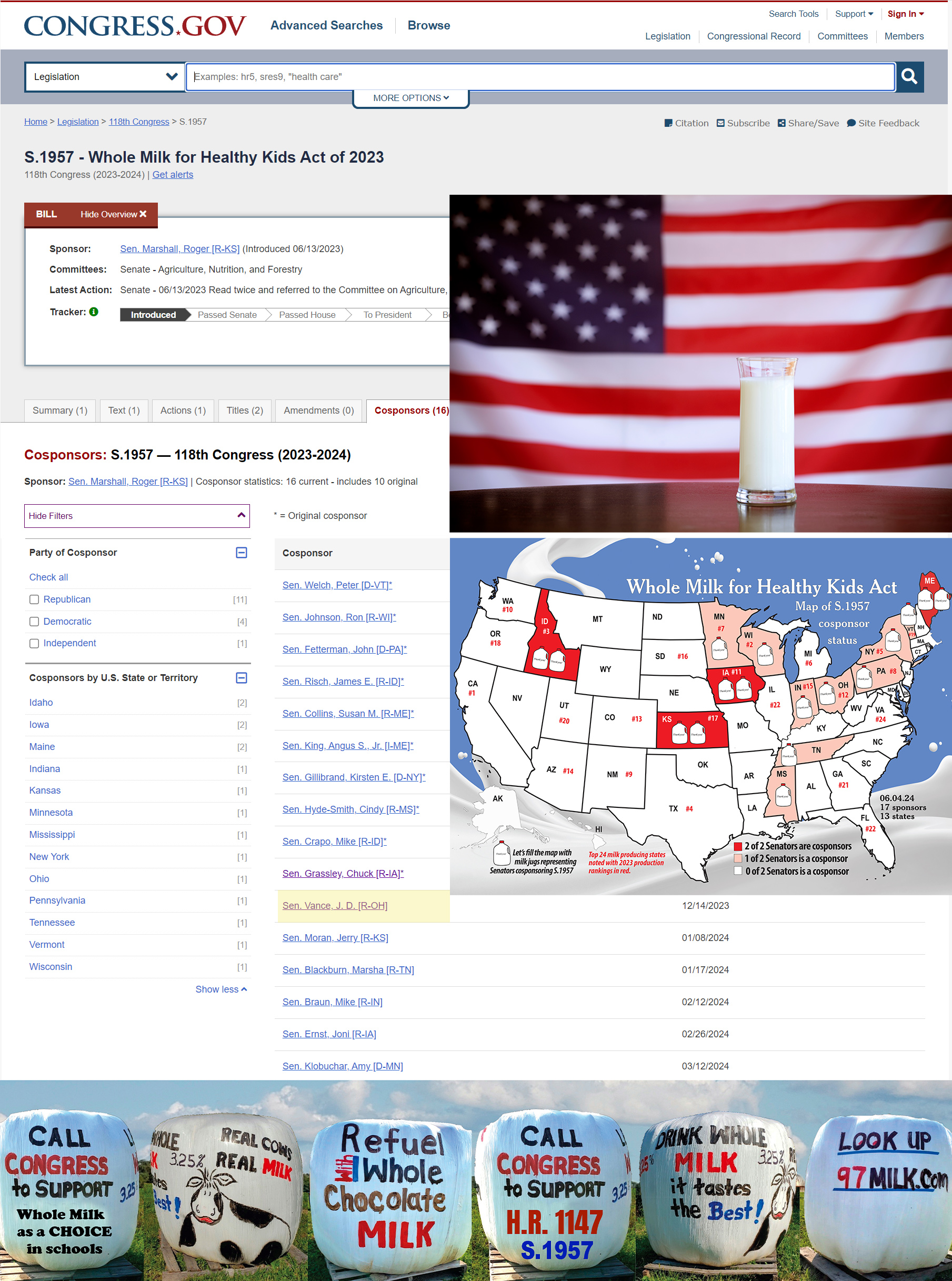
Editorial: ‘Wouldn’t it be great if we could unite the country with whole milk?”

By Sherry Bunting, Farmshine July 26, 2024

‘Wouldn’t it be great if we could unite the country with whole milk?”

Those words were messaged to me by a friend and colleague a year ago, right after the Whole Milk for Healthy Kids Act had passed the House Education Committee in bipartisan fashion before the overwhelming passage on the House floor Dec. 13, 2023 and before Senate Ag Chair Debbie Stabenow (D-Mich.) blocked it the next day, Dec. 14, 2023.

This was my first thought, when former President Donald Trump announced Senator J.D. Vance of Ohio as his running mate in the Republican campaign. (Vance is an early cosponsor of S. 1957, the Senate’s whole milk bill.)

Like others, I’ve been involved in the effort to bring the choice of whole milk back to schools for more than a decade. It’s about natural, simple goodness — to simply strip away the federal ban and allow hungry, learning children to be nourished by milk they will love. 

Looking back at the years of this long fight, I realize that if it’s so painstakingly hard to get something so simple and so right accomplished for America’s children and farmers, we’ve got problems in this country.

With President Joe Biden now withdrawing from the campaign for a second term, and Vice President Kamala Harris as presumptive nominee launching her campaign this week in the Dairyland State, I’m reminded of where she stands on such things.

Harris is no friend to livestock agriculture. She was an original cosponsor of the Senate version of “The Green New Deal.” She has strong positions on climate change that may lead to harsher rules on methane emissions and water consumption in the dairy industry, while perhaps promoting methane digesters, which are not an equitable nor necessary solution. Cows are NOT the problem!

Some in the dairy industry are on record stating that this would be good for dairy because the DMI Net Zero goals fall in-line and tout some of the same objectives. But no matter how you slice and dice all the fancy offsets, insets, innovations, grants, projects and the billions of dollars, the bottom line leaves cattle holding the bag. 

Cattle are in the crosshairs of a very long game set to control land, food and people.

Harris has already indicated she would use the Dietary Guidelines to reduce red meat consumption on the basis of this erroneous climate impact claim about cattle that we are all being brainwashed to quite literally buy into.

As a presidential candidate in 2019, in a CNN town hall, she was specifically asked: “Would you support changing the Dietary Guidelines to reduce red meat specifically to reduce emissions?”

“Yes, I would,” Harris replied, with a burst of laughter.

It’s not funny.

Earlier, she had said she “enjoys a cheeseburger from time to time,” but the balance to be struck is “what government can and should do around creating incentives, and then banning certain behaviors… that we will eat in a healthy way, and that we will be educated about the effect of our eating habits on our environment. We have to do a much better job at that, and the government has to do a much better job at that.”

Read those words again: “creating incentives and then banning certain behaviors.” In plain English, that means dangling the carrot and then showing us the stick.

Harris joins Senators like Ag Chair Stabenow, as well as Bob Casey from Pennsylvania, as card-carrying members of perennial Ag Secretary Vilsack’s food and climate police.

Not only is Ag Chair Stabenow blocking the whole milk bill in her Committee, she is dragging her feet on the critical farm bill. 

As President Biden’s approval ratings fell, there were indications she would bring her side of the aisle to the table to negotiate a compromise to get the farm bill done this year.

Now that Biden has withdrawn from the race, and the pundits, media, and party organizers are breathless with excitement over Harris as presumptive nominee, it appears that the farm bill negotiations between the Committee-passed House version, the Republican Senate version and the Democrat Senate version have fallen apart.

House Ag Chair G.T. Thompson (R-Pa.) has called upon his colleagues to get to the table and do the work because a perfect storm is brewing in Rural America as net farm income is forecast to fall by 27% this year on top of the 19% decline last year. 

Meanwhile, there is political upheaval everywhere we look. Seeing Vance picked as Trump’s running mate and knowing he was among the early cosponsors of Senate Bill 1957 – The Whole Milk for Healthy Kids Act – offers some hope.

That bill — in true bipartisan spirit — was introduced in the U.S.Senate in June 2023 by Senator Dr. Roger Marshall (R-Kan.) with prime cosponsors Peter Welch (D-Vt.), Ron Johnson (R-Wis.), Kirsten Gillibrand (D-N.Y.), Chuck Grassley (R-Iowa), John Fetterman (D-Penna.), Mike Crapo and James Risch (R-Idaho), Susan Collins (R-Maine), Angus King (I-Maine), and Cindy Hyde-Smith (R-Miss.). The bill eventually earned cosponsorship from other Senators, including the influential Democrat from Minnesota, Amy Klobuchar.

Vance signed on as cosponsor on December 14, 2023, one day after the U.S. House of Representatives had passed their version of the bill by an overwhelming bipartisan majority of 330 to 99.

The Senate bill 1957 is identical to the successful House whole milk bill H.R. 1147, which was authored by Pennsylvania’s own Representative GT Thompson.

GT is a man of courage, conviction, compassion, of humility and humanity. I’ve heard him say more than once: “God gave us two ears and only one mouth for a reason.”

He is a determined man, doing the work. He included whole milk bill in the House Committee-passed farm bill. He’s standing firm on his pledge to put the farm back in the farm bill. He is concerned about the financial crisis in agriculture on the horizon, and held a hearing July 23 with witnesses from agriculture and banking giving stark warnings.

Even though whole milk choice in schools seems like a minor issue in the grand scheme of things today, it is really a linchpin. If we could just get something with broad bipartisan support accomplished, this could lead to other steps on common ground. 

Cows are not the climate problem. Cows are a solution. Cows are part of a carbon cycle, they don’t take carbon out of the ground and put new carbon into the air. 

Carbon is essential to life. It seems that those seeking full control of land, food, and people, are starting with carbon. 

As the whole milk choice remains hung up in the Senate, let’s pause to think about how ridiculous it is that we adults get to choose, but our growing children do not. For them, whole milk is banned at two meals a day, five days a week, three-quarters of the year at school. (The federal government, via USDA school lunch rules, only allows fat-free and 1% milk to be offered with the meal or even a la carte.)

Maybe the Harris ticket would like to ban food choice behaviors for adults as well.

We have Republicans and Democrats supporting whole milk choice in schools. Both parties say they care about our nation’s farmers and ranchers who feed us and are the backbone of our national security.

Let’s take that and run with it.

-30-

Under the DMI umbrella: Fonterra CEO to chair Global Dairy Platform, Danone sustainability strategist to join GDP operating committee

Global Dairy Platform launched Pathways to Dairy Net Zero Initiative in September 2021, one year after DMI’s Innovation Center for U.S. Dairy launched the Dairy Net Zero Initiative (NZI) in October 2020 (A year prior to that in 2019, the current and former Ag Secretary Tom Vilsack testified to the Senate Ag Committee as a dairy-checkoff executive, serving then as president of the U.S. Dairy Export Council, and he foretold the nuts and bolts of the not-yet launched Dairy Net Zero Initiative and asked Congress to fund pilot farms. GDP has governance in and manages the Dairy Sustainability Framework that underpins what U.S. farmers, and their cows, will have to live up to — including how livestock methane is calculated, mitigated and monitored, which may be based on inaccurate math and science in terms of CO2 equivalents.

By Sherry Bunting, Farmshine, Friday, May 5, 2023

ROSEMONT, Ill. — Fonterra CEO Miles Hurrell has been named the new board chairman of the Global Dairy Platform (GDP), a non-profit industry association representing the international dairy sector. A portion of its revenue is from membership dues, but also from the 7.5-cents per hundredweight equivalent checkoff on U.S. dairy imports as well as grants for research and program services from Dairy Management Inc (DMI).

Fonterra’s Hurrell will replace Hein Schumacher, who is leaving his position as CEO of Royal FrieslandCampina to become CEO of Unilever.

In the April 26 news release, Hurrell cites Schumacher’s leadership in “accelerating climate action via the ground-breaking Pathways to Dairy Net Zero Initiative.” 

Announced in the same release is the appointment to the GDP operational committee of French multinational Danone’s senior vice president of sustainability strategy.

According to its 501(c)6 non-profit tax filings, “GDP is a pre-competitive collaboration,” and its governance groups — the board and the operational committee — “manage a ‘Dairy Sustainability Framework’ to unify the approach being taken by dairy organizations to the broad challenges of sustainability from environmental, social, and economic perspectives.”

The Dairy Sustainability Framework is part of the Dairy Sustainability Alliance of the Innovation Center for U.S. Dairy, another non-profit founded and funded by dairy checkoff organizations under the DMI umbrella. The Innovation Center sets U.S. Dairy Stewardship Commitments that are implemented through the FARM program and reviewed every three to five years to show U.S. dairy is, according to its website, “moving the needle toward achieving the Sustainable Development Goals (SDGs) of the United Nations.”

DMI, its Innovation Center, Dairy Sustainability Alliance, Dairy Sustainability Framework, and U.S. Dairy Stewardship Commitments are all located at Suite 900, 10255 W Higgins Road, Rosemont, Illinois, and the Global Dairy Platform (GDP) address of record is Suite 820 at the same street address.

Along with New Zealand’s Fonterra, CEOs from these top-15 dairy multinationals serve on the GDP Board: Dairy Farmers of America (DFA), headquartered in Kansas; Arla Foods, headquartered in Denmark; Leprino, headquartered in Colorado; China’s Mengniu Dairy Company; Moringa Milk Industry, headquartered in Japan; Royal FrieslandCampina, headquartered in the Netherlands, and Saputo, headquartered in Canada.

Along with the board of directors, the GDP operational committee provides governance and includes sustainability executives for Arla, DFA, Fonterra, Land O’Lakes, Meiji Holdings and FrieslandCampina.

In a separate April 2023 bulletin, GDP announced the May 1, 2023 retirement of Dr. Greg Miller from his position as research lead for GDP since its inception. Known as ‘Dr. Dairy’, Miller has served as the chief science officer for the National Dairy Council for nearly 32 years and as executive vice president of research, regulatory and scientific affairs for DMI. Miller will continue as a member of the UN Food and Agriculture Organization Scientific Advisory Committee.

Key paid staff for GDP is Donald Moore, the executive director since 2010. Before that, he was a Fonterra senior executive in business development and ingredients marketing for 20 years.

Moore also serves as chairman of the governance group for the Dairy Sustainability Framework since its inception in 2013.

With Fonterra’s CEO as the new board chairman of the GDP, and with a former Fonterra senior executive serving 13 years to-date as the executive director of the GDP and the chair of the governance group for the Dairy Sustainability Framework, it’s worth noting that Fonterra announced six months ago its new start-up company for alternative dairy ingredients. According to the October 2022 press release, Fonterra has partnered with Royal DSM, a Dutch company, in creating this start-up “to accelerate the development and commercialization of (animal-free) fermentation-derived proteins with dairy-like properties.” 

With Danone’s senior vice president of sustainability strategy now appointed to the GDP operational committee, it’s worth noting that in October 2022, Danone announced it would use artificial intelligence to reformulate 70% of its plant-based fake-milk products. This followed the 2021 earnings call where Danone executives outlined new fake-milk and dairy product launches with plans to use “new dairy-like technology” to “win over” the 60% of U.S. consumers not in the plant-based category because of taste and texture. The Danone executives told shareholders their Renew strategy identifies the U.S. as a “key plant-based market.” In January 2023, Danone announced it is eyeing sale of Horizon Organic, saying it falls outside of their key areas of focus.

Global Dairy Platform (GDP) was formed in 2006 as an alliance, according to its website. Its tax filings confirm incorporation as a 501(c)6 non-profit in 2012 and its address of record at Suite 820 at 10255 W Higgins Road, Rosemont, IL 60018.

According to the GDP’s most recent IRS 990s that are publicly available for 2017 through 2019, the years when former DFA CEO Rick Smith was its chairman, GDP had revenues between $3.7 and $4.2 million annually. This increased to $4.7 million in 2020, according to an available summary of the IRS 990 for that year.

The tax returns show approximately $1 million in GDP revenue came from membership dues and approximately $2.7 million annually from granted program services and research funds (checkoff). 

The GDP revenue also included approximately $500,000 in ‘import assessments.’ The 7.5-cent import checkoff, which was implemented in 2011 amid formation of the Innovation Center and its resulting alliances and frameworks.

GDP’s executive director Donald Moore is paid a salary package of nearly $600,000 annually. The top three independent contractors in 2018-19 included DMI receiving over $800,000 annually for program services and administration; Massey University in New Zealand $451,000; Emerging Ag in Calgary, Alberta, Canada $600,000 (for UN access), and Lindsey Consulting, in the UK nearly $300,000 with Brian Lindsey serving as the GDP’s sustainability lead.

According to GDP, its membership consists of more than 95 corporations, companies, associations, scientific bodies, and other partners, with operations in more than 150 countries, collectively accounting for approximately one-third of global milk supplies.

DMI manages the national nickel from the 15 cents per hundredweight checkoff deducted from U.S. milk checks for research, education, and promotion. DMI also manages the unified marketing plan many state and regional checkoff organizations contribute toward, and DMI manages the 7.5 cents per hundredweight equivalent import checkoff, handed off to the GDP.

DMI states in its 501(c)6 non-profit tax filing that it is “investing dairy producer checkoff funds in strategic, coordinated marketing programs designed to increase consumption of U.S. dairy products domestically and internationally.”

The Innovation Center for U.S. Dairy was initiated in 2008, but according to its tax filings, was incorporated as a 501(c)6 non-profit in 2012 under the name: The Dairy Center for Strategic Innovation and Collaboration Inc., doing business as Innovation Center for U.S. Dairy.

In 2017, DMI trademarked the names ‘Innovation Center for U.S. Dairy’ and ‘Dairy Sustainability Alliance.’

Leprino CEO Mike Durkin was elected chairman of the board of the Innovation Center in January 2023.

-30-

AUTHOR’S NOTE: Why do these connections matter? Because the UN Food and Agriculture Organization is getting ready to make a decision about how livestock methane is calculated using GWP100, a 30 year old measure that the Intergovernmental Panel on Climate Change even agreed overblows the problem by 3 to 4 times, or GWP*, which includes not just the sources but also the natural sinks for methane as a short-lived greenhouse gas. Dr. Frank Mitloehner has written about this, and Farmshine readers have read my many articles about the differences between the calculations and what they mean for our cows in the future. The Global Dairy Platform put out a bulletin a few months ago and pinned it to their website exploring the differences in these calculations, saying that “GWP* is not appropriate as a benchmarking tool at less than a global level.” This is concerning because it means that global dairy multinationals have oversight through dairy checkoff non-profits and alliances into formulating and deciding what U.S. dairy farmers — and their cows — will be expected to live up to, even when the science behind the decision is highly debatable. As we now know, even scientists are becoming frustrated. It’s important to know that multinational companies investing in competing animal-free fermentation-produced DNA-altered dairy-like ingredients are in leadership positions in these collaborations.