New Year, New Hope: 2024 will be year of reckoning, Part One

From whole milk in schools to farm bill to climate-warped food transformation, scientists and lawmakers are getting busy, farmers need to get busy too

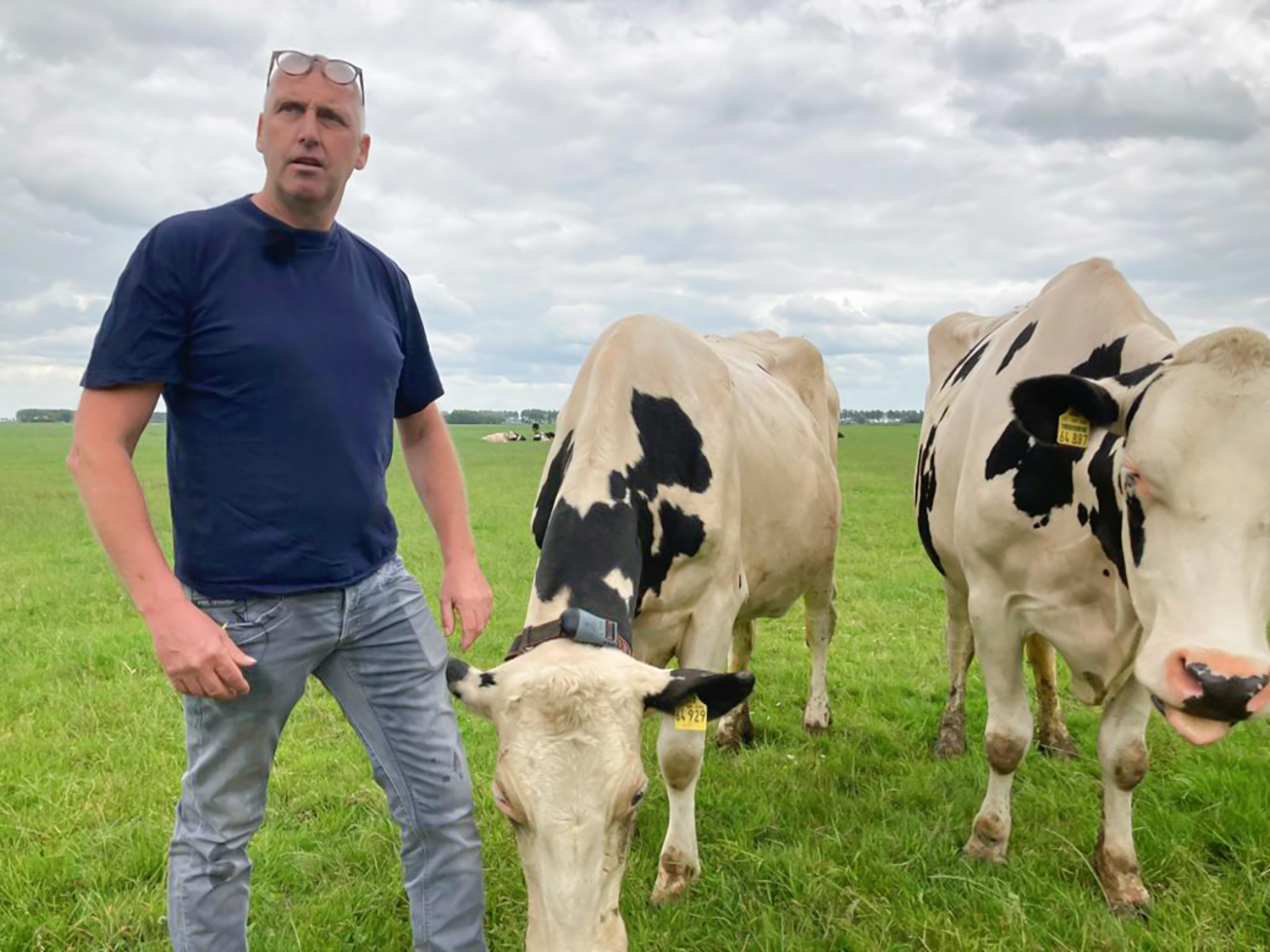
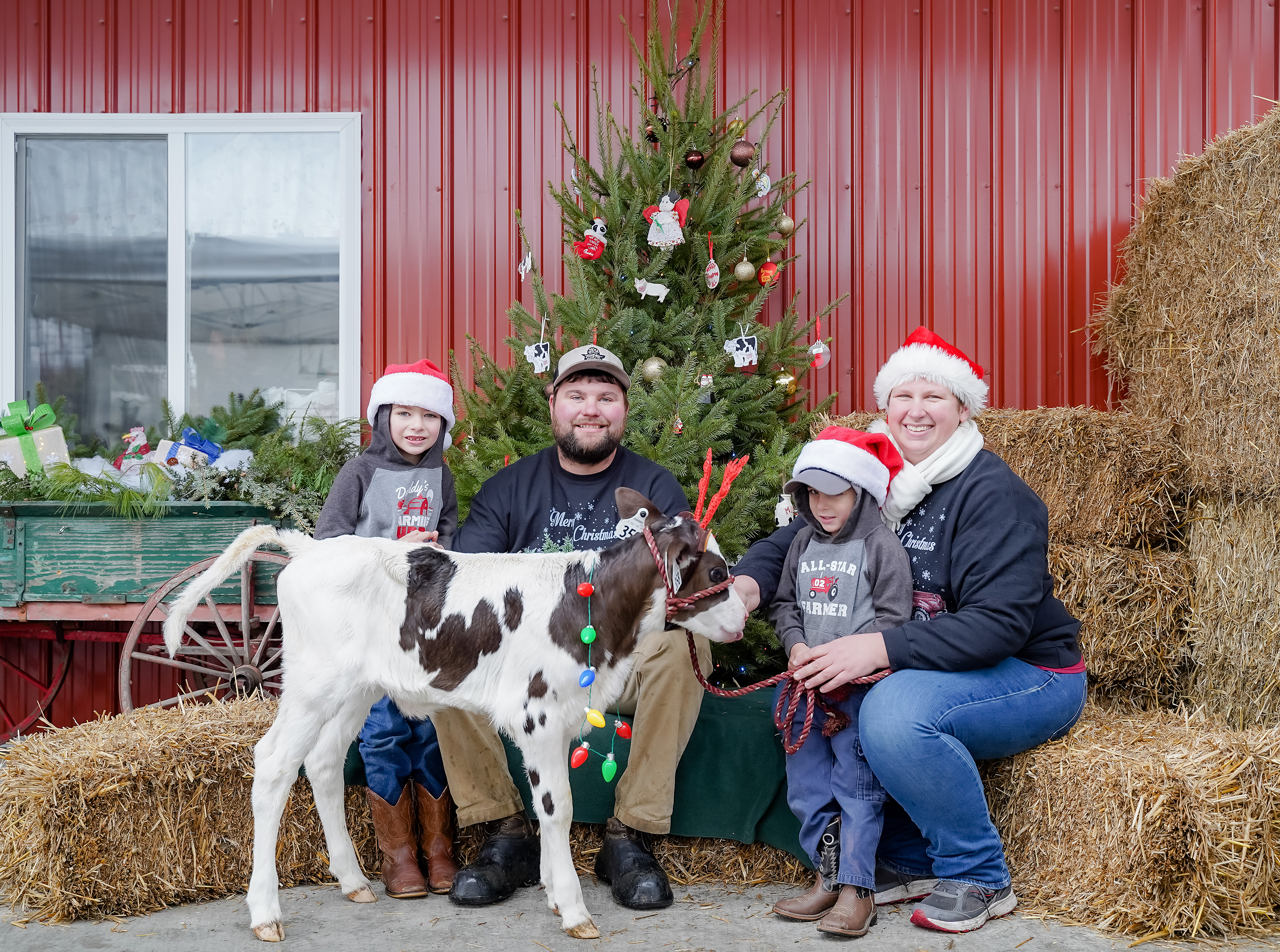
In the global anti-animal assault, real science must lock horns with political science and defend American farmers — the climate superheroes that form the basis of our national security. Photo by Sherry Bunting

By Sherry Bunting, Farmshine, Jan. 5, 2024

EAST EARL, Pa. – It’s a New Year, and we have new hope on several fronts that are all linked together, in my analysis.

Top 2023 headlines for dairy farmers revolved around dairy markets that underperformed, successes and challenges in the quest to get Whole Milk choice back in schools, a plethora of draft USDA and FDA proposals that dilute real dairy, farm losses and governmental hearings on federal milk pricing, negotiations and extensions for the farm bill, and acceleration of ‘climate-smart’ positives and negatives buckling down for business in an area where political science is trumping real science on the rollercoaster ride ahead.

All of these headlines are inextricably linked. There is a global anti-animal assault underway, but people are wising up to the not-so-hidden agenda that is grounded in climate transitions and food transformation that give more power and control over food to global corporations while diminishing what little power farmers have in Rural America where our national security is at risk.

Real science locks horns with political science

As we head into 2024, a bit of good news is emerging as scientists are mobilizing to defend the nutritional, environmental and social honor of livestock — especially the much-maligned cow.

After an international summit of scientists in October 2022, work has been underway to bring together an international pact.

Dubbed the Dublin Declaration of Scientists, experts around the world have authored and are getting colleagues to sign-on to this document that calls for governments, companies, and NGOs to stop ignoring important scientific arguments when pushing their anti-animal agendas in the name of climate, transformation, and the Global Methane Pledge.

To date, nearly 1200 scientists have signed the Dublin Declaration, aimed foremost at the Irish government’s proposal to slaughter cows to meet methane targets. The Dublin Declaration represents the work of scientists across the globe for a global audience beyond Ireland.

Here in the U.S., we are sitting on the cusp of Scope 3 emissions targets of global milk buyers that have been hastily formulated based on the science of greed, not the science of greenhouse gas emissions. It’s time for the dairy organizations and land grant universities that represent, serve and rely on farmers to drink up on their milk and strengthen their spines.

Farmshine has brought readers the news about what has been happening in Europe, such as in the Netherlands and Ireland, regarding proposed farm seizures and cow slaughter, and the response of farmers there has been to challenge the political establishment.

The U.S. is not far behind. At COP28 recently, American cattle industries were criticized, and even Congressional Ag Leaders are miffed by what they heard. 

Still, some of our dairy organizations brag about being at COP26, 27, 28 and taking part. Even the dairy farmers’ own checkoff program is caught flat-footed. They’ve already caved to the Danone’s, the Nestles, the Unilevers, and such.

In fact, DMI’s yearend review touted its increase in U.S. Dairy Stewardship Commitment adopters to 39 companies representing 75% of the milk supply with membership in the Dairy Sustainability Alliance standing at 200 member companies and organizations. But what are they doing with those relationships to STAND UP ON SCIENCE FOR THE COWS?

The Stewardship Commitment includes DMI’s Net-Zero Initiative, where the cyclical short-lived nature of methane and the role of cattle in the carbon cycle is still not appropriately accounted for and is one of the points made in the Dublin Declaration of Scientists.

In the U.S. dairy industry, the trend on GHG revolves around DMI’s Innovation Center for U.S. Dairy, which placates large multinational corporations in the development of voluntary programs, telling farmers they are in control with their organizations as a sort of gatekeeper. That is, until those programs become mandatorily enforced by those milk buying corporations, while the science on methane and the cow’s role in the carbon cycle as well as U.S. data vs. global data continue to be ignored when they are sitting in the midst of UN Food Transformation Summits, COP26, 27 and 28, and the WEF at Davos.

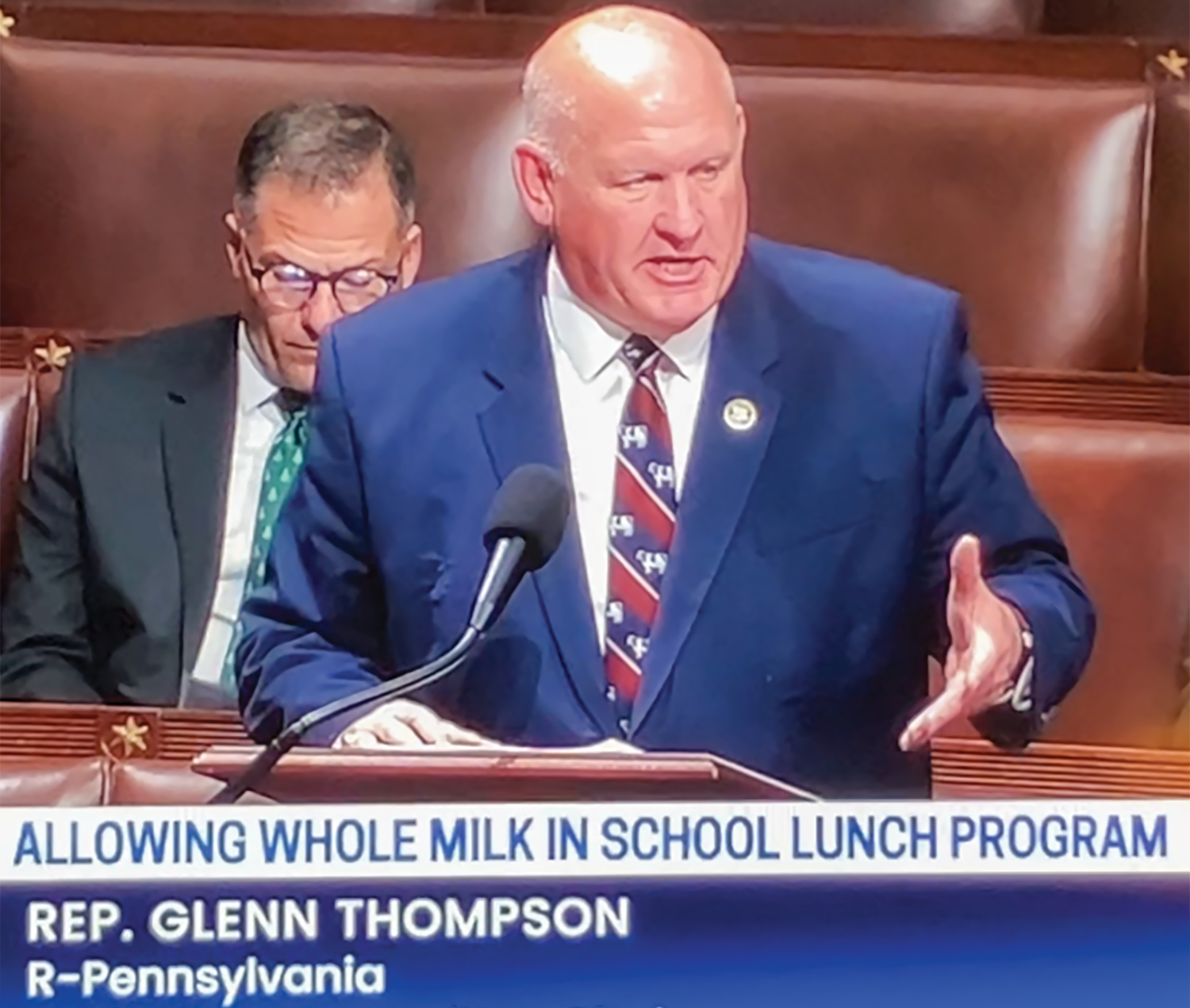
In fact, during the annual meeting webinar of American Dairy Coalition in December, U.S. House Ag Chairman G.T. Thompson of Pennsylvania was asked his thoughts on some of the statements that came out of COP28 recently criticizing American dairy and livestock consumption.

“My first response was to find it laughable because it really shows you the difference between political science and real science,” he said. “It’s sad when people are so illiterate about the industry that provides food and fiber that they don’t understand how livestock contribute to carbon sequestration.

“We have a real battle,” Thompson said, adding that those putting out such statements criticizing American livestock “don’t even know which end the methane comes from. The world needs more U.S. farmers and less UN if we want a better world. The facts and the science are on our side. Let’s not let the other side control the narrative.”

Bottomline for Thompson is this: “The American farmers are climate heroes sequestering 10% more carbon that we emit. No one does it better anywhere in the world. Let’s be speaking up and speaking out. We can push it back with the facts and the science. I would encourage each of us to do that and become effective just telling that story,”

In the same ADC webinar in December, Trey Forsythe, professional staff for Senate Ag Committee Ranking Member John Boozman of Arkansas agreed.

“The language coming out of COP28, a likely European-led effort, shows what we are up against from people with no background on the role of dairy and livestock. We have to keep beating that drum on the efficiency of U.S. dairy and livestock farms,” he said.

In the same accord, scientists are getting busy, and we all need to get more involved.

In a dynamic white paper released last year, scientists made 10 critical arguments on this topic of livestock greenhouse gas emissions (GHG). Here’s what the scientists behind the Dublin Declaration are saying and why it’s so important for our land grant university scientists to sign on.

“Livestock agriculture creates GHG emissions, which is a serious challenge for future food systems. However, arguing that climate change mitigation requires a radical dietary transition to either veganism or vegetarianism, or the restriction of meat and dairy consumption to very small amounts is overly simplistic and possibly counterproductive,” the scientists wrote in a recent description of the Dublin Declaration.

“Such reasoning overlooks that dietary change has only a modest impact on fossil fuel-intensive lifestyle budgets, that enteric methane is part of a natural carbon cycle and has different global warming kinetics than CO2, that the rewilding of agricultural land would generate its own emissions and that afforestation comes with many limitations, that global data should not be generalized to evaluate local contexts, that there are still ample opportunities to improve livestock efficiency, that livestock not only emit but also sequester carbon, and that foods should be compared based on nutritional value. Such calls for nuance are often ignored by those arguing for a shift to plant-based diets,” they continued, listing these 10 Arguments with scientific explanations for each one.

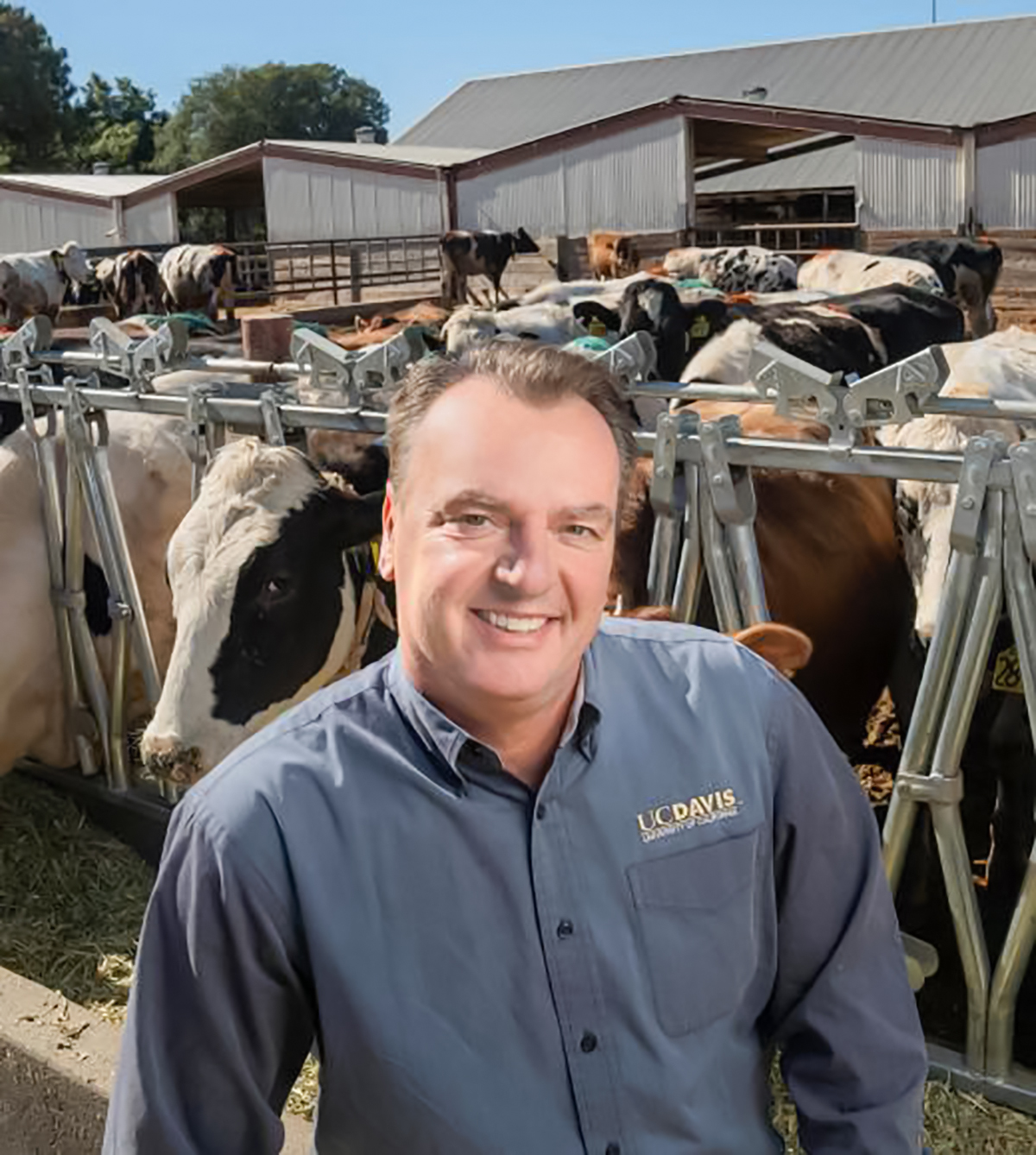
Here is how the growing number of international scientists, including Dr. Frank Mitloehner of UC-Davis, situate the problem:

Argument 1 – Global data should not be used to evaluate local contexts

Argument 2 – Further mitigation is possible and ongoing

Argument 3 – Only a relatively small gain can be obtained from restricting animal source foods

Argument 4 – Dietary focus distracts from more impactful interventions

Argument 5 – Nutritional quality should not be overlooked when comparing foods

Argument 6 – Co-product benefits of livestock agriculture should be accounted for

Argument 7 – Livestock farming also sequesters carbon, partially offsetting its emissions

Argument 8 – Rewilding comes with its own climate impact

Argument 9 – Large-scale afforestation of grasslands is not a panacea

Argument 10 – Methane should be evaluated differently than CO2  

These arguments take nothing away from the technologies that are being developed to help dairy and livestock producers further reduce emissions and sequester carbon. Technology has a role in amplifying the cow’s position as a solution, not to cure a problem she does not have! And farmers deserve to get credit for what they’ve already achieved.

Farm, food, and national security interdependent

The 2018 Farm Bill was extended for another year at the end of 2023, but the urgency to complete a new one continues as a big priority for House Ag Committee Chairman G.T. Thompson. In the recent ADC annual meeting webinar, he said: “You don’t want us writing farm bill legislation — or any legislation — just listening to voices inside the Beltway in Washington. It would not work out well.”

He thanked and encouraged farmers for being part of the process, saying there’s more to do.

“We’re building this farm bill listening to your voices, the voices of those who produce, those who process, and those who consume — all around the country,” said Thompson, noting nearly 40 states were visited for nearly 80 listening sessions over 2.5 years on the House side.

“This farm bill is about farm security. It’s about food security. And it’s about national security – all three of those are interdependent,” he added.

The extension and funding of the current farm bill for another year — while Congress works on the new one — means programs like Dairy Margin Coverage will continue for 2024, but the enrollment announcement has not yet been made by USDA.

In past years, the enrollment began in October of the previous year and ended at the end of January for that program year. When DMC first replaced the precursor MPP, enrollment was announced late and continued into March of the first program year (2019). At that time, farms could sign up for five years through 2023 or do it annually.

In 2023, DMC paid out a total of $1.27 billion in DMC payments for the first 10 months of the year.

Chairman Thompson noted that effective farm policy is the key, and the extension means no disruptions, he said: “We attached good data for dairy with policy changes, including for DMC, and some positive changes for the nutrition title within the debt ceiling discussion.”

On DMC, the supplemental production history was added in the legislation extending the current farm bill that was signed by the President at the end of November.

“It provides our dairy farmers the certainty that their additional production will be covered moving forward,” Thompson confirmed, adding that they are looking at moving up the tier one cap to be more reflective of the industry.

The farm bill is also being crafted to use no new tax dollars by reworking priorities, looking at the Inflation Reduction Act (IRA) funds, administrative funds and shoring up funds from the Commodity Credit Corporation (CCC) priorities to secure the farm bill baseline for the future.

The $20 billion in IRA funds being thrown about for conservation and environmental programs as well as ‘climate-smart’ grants is already down to $15 billion without spending a dime because of how it is designed to phase down and go away in 2031 and the fact that USDA is believed to not have the authority to keep these funds outside of the farm bill, Thompson explained. Negotiations are considering bringing this into the farm bill baseline so that it is there – and used for farmers – now and in the future.

“(The IRA) is not a victory if agriculture does not get the full benefit of these dollars. We can make that happen in this farm bill,” said Thompson. “Reinvesting the IRA dollars into the farm bill baseline will allow us to perpetually fund conservation in the future.”

Conservation programs are historically oversubscribed and underfunded.

Thompson expects crafting and advancing of the next farm bill to continue in earnest. He hopes to have a chairman’s mark of the bill released by the end of January and have it before the House by the end of February. Much of this timeline depends on House leadership, and the Senate has its own time frame, said Thompson.

He urged dairy farmers to spread the word to their members of Congress that farm security and food security are national security.

He also noted that the nutrition title had some of its toughest elements ironed out during the continuing resolution process in which the farm bill was extended. 

“I’ve managed this in such a way that we’ve accomplished already the hard things in that title,” said Thompson.

Deploying dairy farmers on legislative efforts

“Passage of the Whole Milk for Healthy Kids Act is good for kids good for the dairy industry, and good for the economy. It simply restores the option, the choice, of whole milk and flavored whole milk, and holds harmless our hardworking school cafeteria folks by making sure the milkfat does not count toward the meal recipe limitations,” Thompson reported.

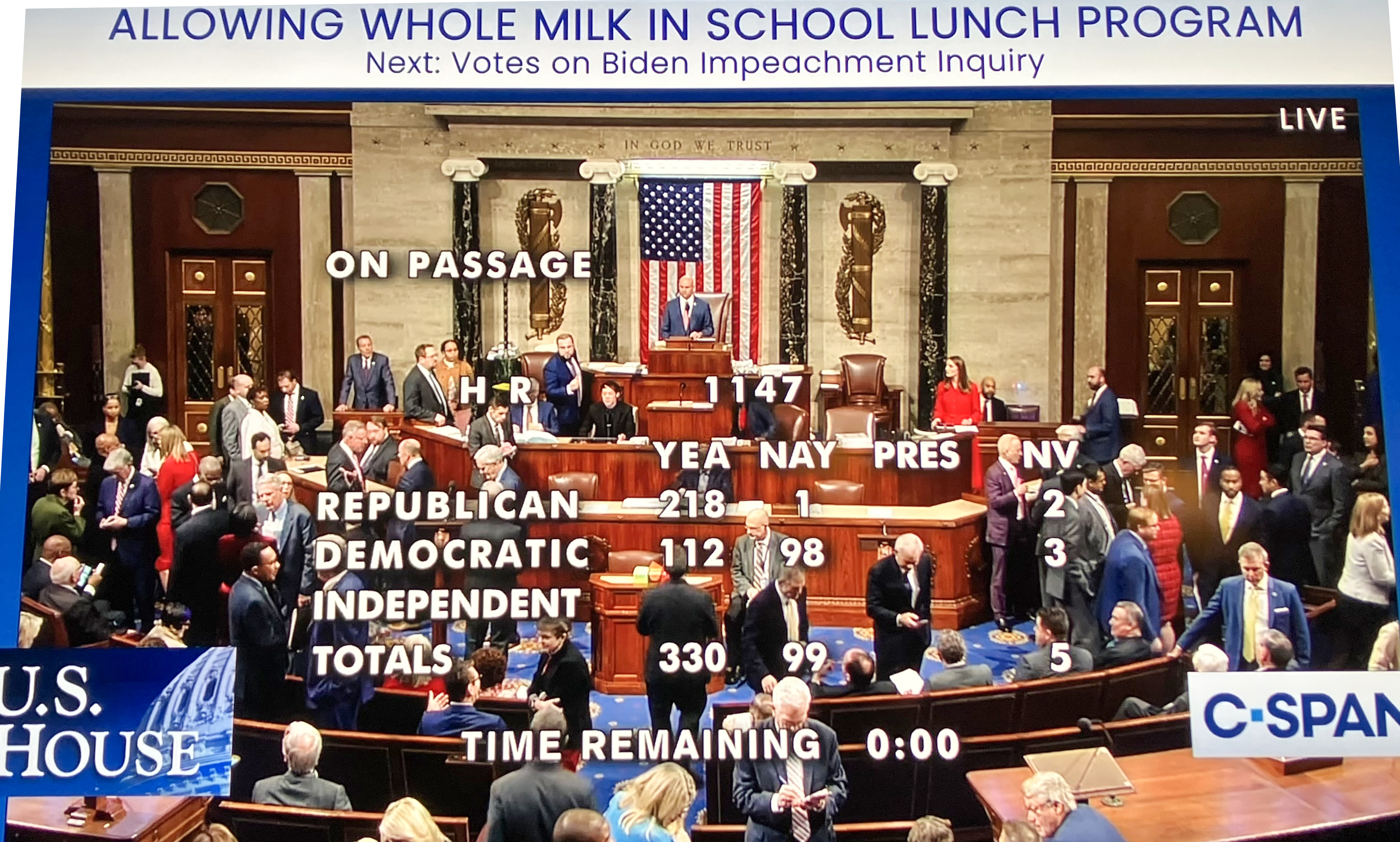
He wanted well over 300 votes for H.R. 1147 in the House to send a strong message to the Senate. On Dec. 13, the House gave him 330 ‘yes’ votes for Whole Milk for Healthy Kids.

“I would like to deploy you now on the Senate. The bill in the Senate (S. 1957) has the same language and it is tri-partisan with Republican Senator Roger Marshall, a medical doctor, Democrat Peter Welch and Independent Angus King as original sponsors,” said Thompson to dairy farmers gathered virtually for the ADC annual meeting webinar.

“There are other co-sponsors as well (12), and from my state of Pennsylvania, Senator John Fetterman is a cosponsor. Our other Senator (Bob Casey, Jr.) has not cosponsored and seems to be in opposition to it,” he said. “We need you to weigh in with your senators that this is about nutrition and health of our kids and the health of our rural communities. You are in a good position to tell the story of what happened in 2010 when fat was taken out of the milk in schools.”

Thompson noted that, “As you are doing that, you are developing relationships that will help us in the farm bill also. On the farm bill, talk about return on investment, the number of jobs and economic activity and taxes from agribusinesses, about the food security and national security and environmental benefits, science, technology and innovation in agriculture,” he said. 

“Less than 1.75% of what we spend nationally is the farm bill. That’s a big return on investment, again, for food security and national security.”

Questioned about the milk labeling bill of Pennsylvania Congressman John Joyce, a doctor, Thompson said it is a strong bill. He confessed his dismay with USDA caving on this question and called FDA “a problem child” on milk labeling. 

“This bill is not self-serving for dairy. This is about consumers having the information to make proper decisions on their nutrition,” he said.

To be continued
House passes Whole Milk for Healthy Kids 330-99!

Education Chair Virginia Foxx: ‘Let’s end the war on milk. Pass the bill!’

Ag Chair G.T. Thompson praised as champion who doesn’t give up

Bill mooves on to U.S. Senate

By Sherry Bunting, Farmshine, December 15, 2023

WASHINGTON — Wednesday, December 13th was a big day for dairy farmers and schoolchildren! After clearing the House Rules Committee Mon., Dec. 11, the Whole Milk for Healthy Kids Act, H.R. 1147, passed overwhelmingly in the U.S. House of Representatives.

The strong bipartisan 330 to 99 vote moves the choice of whole milk closer to school cafeterias across the nation with momentum for the next stop: the U.S. Senate, where S. 1957 has 12 bipartisan sponsors from 10 states – and more are needed.

“Students across the nation deserve school lunches that are both enjoyable and nutritious, and this legislation achieves these goals,” said Whole Milk for Healthy Kids Act champion Glenn ‘G.T.’ Thompson (R-PA-15), Chairman of the House Agriculture Committee and senior member of the Education and Workforce Committee as he testified before the Rules Committee Monday.

“Milk is an essential building block for a well-rounded and balanced diet, offering 13 essential nutrients and numerous health benefits. However, outdated and out-of-touch federal regulations have imposed restrictions … Students are not able to access any of the milk’s essential nutrients if they won’t drink the milk being served to them. As we have seen over the last decade, there has been a steady decline in school milk consumption. This bill does not mandate anything. It gives schools, parents, and students the option of whole milk,” said Thompson.

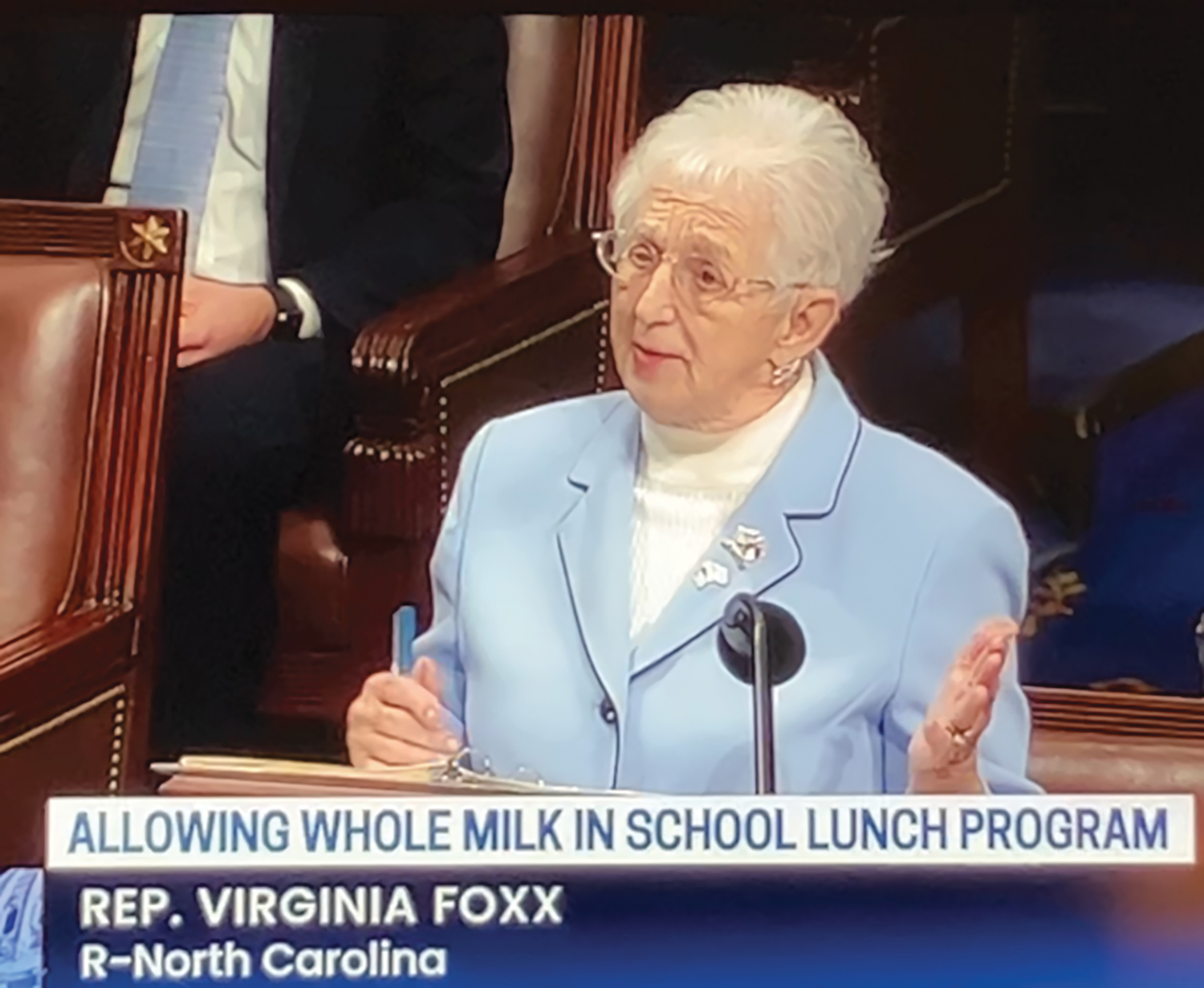
Education Committee Chairwoman Virginia Foxx (R-NC-5) was blunt on the House floor: “Whole milk isn’t just a beverage; it’s a vital source of nutrients essential for children’s growth. Denying access to its calcium, vitamin D, and protein threatens to inhibit their development. To the anti-milk advocates, I have one thing to ask of you: What do you have against milk? Let’s end this war on milk. Pass the bill!”

And they did. Resoundingly, the People’s House sent a strong message to the opposition that hung their hats on the flawed Dietary Guidelines for Americans (DGAs) as the end-all, be-all.

Education Committee Ranking Member Bobby Scott (D-VA-3rd) re-litigated his argument that was previously defeated in bipartisan Committee passage of H.R. 1147 in June. He kept referring to the DGAs. He insisted skim milk is the same as whole milk, nutritionally, but disregarded the roles of milkfat in key vitamin absorption and flavor to keep those nutrients from going down the drain.

Congress tied school meals closer to the DGAs in 2010, and the Obama-era USDA developed beverage rules in 2012 that banned whole milk — leading to the loss of a generation of milk drinkers and unprecedented increases in childhood obesity and diabetes — to the point where an April 2019 U.S. Senate hearing noted concern from U.S. military generals on fitness of recruits.

The Rules Committee asked why whole milk is being handled as a separate bill instead of within a Childhood Nutrition Reauthorization package. Thompson explained that the reauthorization has not occurred since the 2010 Healthy Hunger Free Kids Act created the issue.

“There is widespread bipartisan support in the Education and Workforce Committee, on the beverage part of this, milk in particular, because studies have shown the BMIs have gone up from what was a baseline prior to removing whole milk. Part of the urgency here is the significant impact that has had on the health of our youths,” he said.

Thompson cited the case study analysis of annual body mass index (BMI) data aggregated by Christine Ebersole RN, BSN, CSN, a school nurse from Martinsburg, Pennsylvania. She shared her data on 7th to 12th graders in a 97 Milk / Grassroots Pennsylvania Dairy Advisory Committee education session in Washington in June 2023 and in a State Senate hearing in Harrisburg in 2021

Her data showed the percentage of students in the overweight and obese categories, combined, grew from 39% in 2008 to 52% in 2021. This mirrors national trends demonstrating the anti-milkfat approach has not helped and may have harmed. The trends in fact have worsened ever since DGAs were created to infiltrate institutional feeding programs.

According to the latest National Survey of Children’s Health at the CDC website, the percentage of 10- to 17-year-olds with BMI in the obese category, alone, increased nationally from 15.4% in 2006 to 19.7% in 2018. In 1970 to 1980, it was 5%. This doubled eight years after the DGAs were born to 10% in 1988, then rose to 15.4% by 2006 after six years of USDA school lunch saturated fat caps were implemented, then stabilized at just over 15% from 2008 to 2012, then grew to 19.7% by 2018 — six years into the USDA ban on whole milk in schools.

The big milestone for whole milk in schools comes on the 5-year anniversary of Berks County, Pennsylvania dairyman Nelson Troutman placing his first painted roundbale “Drink Whole Milk (virtually) 97% Fat Free” in a pasture by a crossroads, which led to questions, publicity, and the creation of 97 Milk.

The 97 Milk educational organization has worked alongside the Grassroots Pennsylvania Dairy Advisory Committee on the legislative side. As a team, they continue to lead the charge for children to have the choice of whole milk once again at school. They are pleased to have worked with the Nutrition Coalition, founded by Nina Teicholz, author of Big Fat Surprise, and to see other national dairy and farm organizations join in support in recent years — from the American Dairy Coalition and Farm Bureau to National Milk Producers Federation and International Dairy Foods Association.

“We are grateful for this bill’s champion, the honorable G.T. Thompson. We thank him for not giving up,” said 97 Milk Baleboard originator Nelson Troutman in a Farmshine phone interview about the bill. “So many legislators get pounded from the top down, and they give up… and really, G.T. didn’t have a lot to gain out of this except helping the people. He did this for the kids, for the people, for the farmers. This is not a mandate. This is a choice, and I cannot emphasize the word choice enough.”

“The reason we got here is G.T.’s dedication to children having nutritious and delicious milk choices, and he brought it to the finish line in the House,” said Bernie Morrissey, chairman of the Grassroots PA Dairy Advisory Committee. “We have to keep working on the Senate, and 97 Milk has been a major part of educating people about this choice kids will have when the Whole Milk for Healthy Kids Act becomes law. The people on our grassroots committee and 97 Milk – we are a team. Our teams help each other. When you have a great team and teamwork, that’s how things get done.”

“This is a strong step in the right direction, and we have to keep going to our total destination,” said G.N. Hursh, Lancaster County, Pa. dairy farmer and chairman of 97 Milk. “We at 97 Milk totally support this bill. Whole milk choice in schools is clearly a national improvement for our future leaders. This is a win for good taste and excellent nutrition!”

Dale Hoffman and his daughter Tricia Adams, also members of the Grassroots Pennsylvania Dairy Advisory Committee expressed their gratitude. Three generations operate Hoffman Farms in Potter County, Pa.

“G.T. has really fought for this and put a lot of work into this. We appreciate what he has done in helping out the kids and the farmers,” said Dale in a phone interview. “When you look at the health situation, the trends have gone the other way without whole milk in the schools. Kids are dumping the milk, and you can’t blame them. They need those nutrients physically and mentally. Milk is one of nature’s most perfect foods. We produce it and grew up with it. Children should be able to choose it.”

Grassroots committee member Krista Byler, of Spartansburg, Pa. is a Union City school foodservice director and head chef. She said the Whole Milk for Healthy Kids Act “is huge for me because I have seen this from the startup, and I finally seeing movement in the school nutrition organizations. I see the whole picture coming together. I am amazed to see it reach this point that now students are much closer to having a milk choice that meets their nutritional needs,” she said.

Byler notes that the milk carton shortage affecting school districts this year has been a catalyst for support among her peers for the expansion of choices in milkfat levels.

“It’s sad to say, but as we struggle on the milk carton shortage, it forces people in my position to think outside the box and look at alternative service methods,” said Byler. “We are seeing students asking for other milkfat options, such as whole milk.”

She says she sees more of her peers today are excited about this bill and how it is worded in a way that makes it possible for them, as school foodservice directors, to implement — to actually offer whole milk as an option for students and not be financially penalized by the federal government for exceeding arbitrary and outdated fat percentages on the meal.

“I’m excited to be closer to having this choice to meet students’ needs in a way that is nutritious and that they find delicious. My students will be so excited,” said Byler. “When it becomes law, it will be a huge win for kids everywhere, and our waste will certainly go down.”

Look for more in Farmshine about this milestone, what’s next, and the three amendments that were offered and approved along with the bill. They are: 1) allowing school milk to be either organic or non-organic, 2) preventing school milk from Chinese state-owned enterprises, and 3) prohibiting USDA from doing its proposed elementary school ban on flavored milk.

Fluid milk processors say they can’t recoup higher protein value

NMPF, NAJ say higher solids worth more nutritionally, Seek FMMO updates to avoid misalignments and disorderly marketing

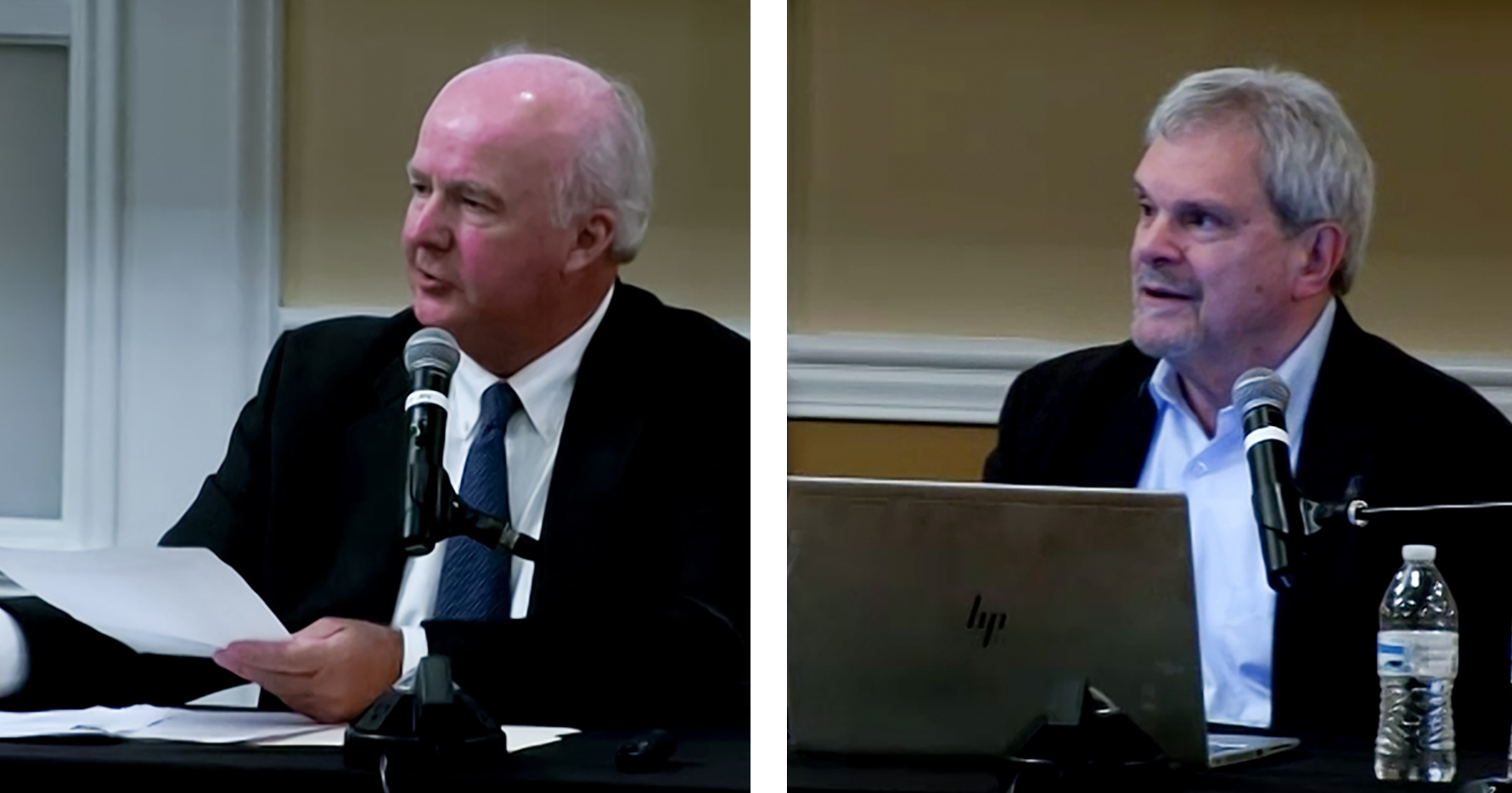
Calvin Covington (left) for Southeast Milk and Peter Vitaliano for National Milk Producers Federation testified on what the outdated skim milk component standards mean in terms of underpaying farmers and eroding producer price differentials (PPD), leading to disorderly marketing. This occurs because the skim portion of the milk that is utilized in manufactured products (Class III and IV) is paid per pound of actual protein, solids nonfat and other solids; whereas the skim portion of the milk bottled for fluid use (Class I) is paid on a per hundredweight basis using the outdated standard skim solids levels. The fat portion is not an issue because it is already paid per pound in milk class uses. Screen captures, hearing livestream

By Sherry Bunting, Farmshine, Sept. 8, 2023

CARMEL, Ind. – The national Federal Milk Marketing Order hearing completed two weeks of proceedings, so far, in Carmel, Indiana. The entire hearing is expected to last six to eight weeks, covering 21 proposals in five categories.

Picking up the livestream online, when possible, gives valuable insight into a changing dairy industry and how federal pricing proposals could update key pricing factors.

The first week dug into several proposals to update standard skim milk components to reflect today’s national averages in the skim portion of the Class I price. 

Here is a bite-sized piece of that multi-day tackle.

National Milk Producers Federation (NMPF) put forward several witnesses to show what the outdated component levels mean in terms of underpaying farmers, and how paying for the skim portion based on outdated component levels has eroded producer price differentials (PPD), leading to disorderly marketing.

IDFA’s attorney Steven Rosenbaum grilled NMPF economist Peter Vitaliano on this. He tried on seven attempts to establish that the fat/skim orders in the Southeast don’t have component levels as high as the national average, suggesting this change would “overpay” producers in some markets.

In his questioning, Rosenbaum stressed that fluid milk processors can’t recoup the updated skim component values if those components do not “fill more jugs.”

Vitaliano responded to say that protein beverages are a big deal to consumers, and some milk marketing is being done on a protein basis. Rosenbaum asked for a study showing how many fluid processors are actually doing this.

Attorneys for opposing parties kept going back to this theme that the skim solids should not be updated because the FMMOs are based on “minimum” pricing. They contend that processors can pay “premiums” for the extra value if they have a way of recouping the extra value by making more product or marketing what they make as more valuable.

Vitaliano disagreed, saying that even though many processors do not choose to market protein on the fluid milk label, “more protein makes fluid milk more valuable to consumers.”

Attorney Chip English went so far as to ask Calvin Covington on the stand: Why should my clients (Milk Innovation Group) have to pay more for the additional solids in the milk when they are removing some of those solids by removing the lactose?

“Consumers don’t want lactose,” English declared.

Covington, representing Southeast Milk and NMPF, responded to say: “I don’t know that to be true. It is unfair to suggest all.”

Bottomline, said Covington, raising standard skim solids to reflect the composition of milk today vs. 25 years ago adds money to the pool to assist with the PPD erosion so that Federal Orders can function as they were intended and so producers are paid for the value.

As English further questioned whether consumers even care about the higher skim solids and protein levels of milk today, Covington replied: “Skim milk solids have a value in Class I, or fluid milk. People don’t buy milk for colored water. The solids give it the nutritional value. That’s the reason they buy milk. That’s why FDA set minimum standards in some states. Why would you drink milk if not for the nutritional value?”

He also pointed out that the increase in solids nonfat over the past 20-plus years has improved the consistency of lower fat milk options. As noted previously, the milkfat is a separate discussion and is not included in this proposal because farmers are already paid per pound for their actual production of butterfat in all classes, including Class I.

Under cross examination, Covington explained that the Class I price in all Federal Orders pays for skim on a standardized per hundredweight basis and pays for fat on actual per pound basis. Meanwhile, the manufacturing classes pay for both skim and fat on a per pound of actual components basis. 

As skim component levels have risen in the milk, the alignment of Class I to the manufacturing classes narrows because of the differences in how the skim is paid for. When this happens, it becomes more difficult to attract milk to Class I markets. That’s one example of disorderly marketing. PPD erosion and depooling of more valuable manufacturing class milk is another example. 

Covington explained the impact of this misalignment on moving milk from surplus markets to deficit Class I markets, that the lower skim value becomes a disincentive.

Vitaliano explained the depooling issue as “creating disorderly marketing conditions also, and great unhappiness when one farm is paid a certain price and another handler pays a different price (in the same marketing area). That’s disorderly unhappiness for the Federal Order program,” he said.

He noted that the fundamental reason for pooling is to take the uses in a given area with different values to achieve marketwide pooling where producers in that Federal Milk Marketing Area are paid similarly, regardless of what class of product their milk goes into.

“This removes the incentive for any one group to undercut the marketwide price to get that higher price (for themselves),” he said. “The Orders create orderly marketing with a uniform price. Depooling undermines that fundamental purpose that is designed to create orderly marketing.”

Either way, whether indirectly paying to bring supplemental milk into Class I markets from markets with higher manufacturing use, or in the case of depooling, the dairy farmers end up paying for the fallout from this erosion of the PPD.

Since the beginning, even before 2000 Order Reform, figuring the Class I base milk price had to begin somewhere, according to Covington. Federal pricing has always used the manufacturing class values in determining that base fluid milk price.

The trouble today is that Class III and IV handlers pay farmers per pound of actual skim components in the milk they receive, while the Class I handlers pay per hundredweight based on an arbitrary outdated national average skim component standard. Thus, the “opportunity cost” of moving this now higher component milk to manufacturing classes that pay by the actual pound of protein, for example, instead of by the old standard average protein levels is not accounted for in the Class I price that still uses the old standard average levels.

Pressed again on how it makes sense to raise Class I prices by raising the component level of the skim to more adequately reflect the national average today, Covington said: “It adds to the nutrition, and I stand by that. In proposal one, the price will go up (estimated 63 cents per cwt or a nickel per gallon). I am comfortable charging that extra price to Class I processors.”

Attorney English, representing MIG, retorted that, “The handlers who buy milk and then by adding a neutralizing agent remove the lactose, they’re going to pay more for the milk that they then have to process to subtract the lactose.”

Covington responded that, “There are consumers who think about lactose. There are consumers who buy lactose-free products, yes, because it is on the shelf, but it’s not all consumers.”

On the higher protein, English asked Covington how Class I processors are supposed to monetize that protein in a label-less commodity, a commodity that is declining in its share of total milk utilization?

“We are still selling 45 billion pounds of packaged fluid milk (annually) in this country,” said Covington. “Consumers wouldn’t buy that 45 billion pounds if it wouldn’t have some nutrition.”

English argued that milk is sold as whole, 2%, 1% and non-fat. It is not sold by its protein, so isn’t it “so highly regulated in ways that alternatives are not that any increase in price hinders sales of fluid milk?”

Covington acknowledged that, “yes, it is regulated, but I’m not convinced that this proposal will hinder fluid milk sales. Again, (higher components) add to the nutrition and I stand by that.”

Opponents kept coming back to these value questions, while proponents focused on the price alignment issue and orderly marketing.

To link up with the hearing livestream 8 to 5 weekdays, to read testimony and exhibits, and to respond to the virtual farmer testimony invitations made every Monday for the following Friday, visit the Hearing Website at https://www.ams.usda.gov/rules-regulations/moa/dairy/hearings/national-fmmo-pricing-hearing

-30-

Understanding the factors as action on FMMO ‘modernization’ unfolds

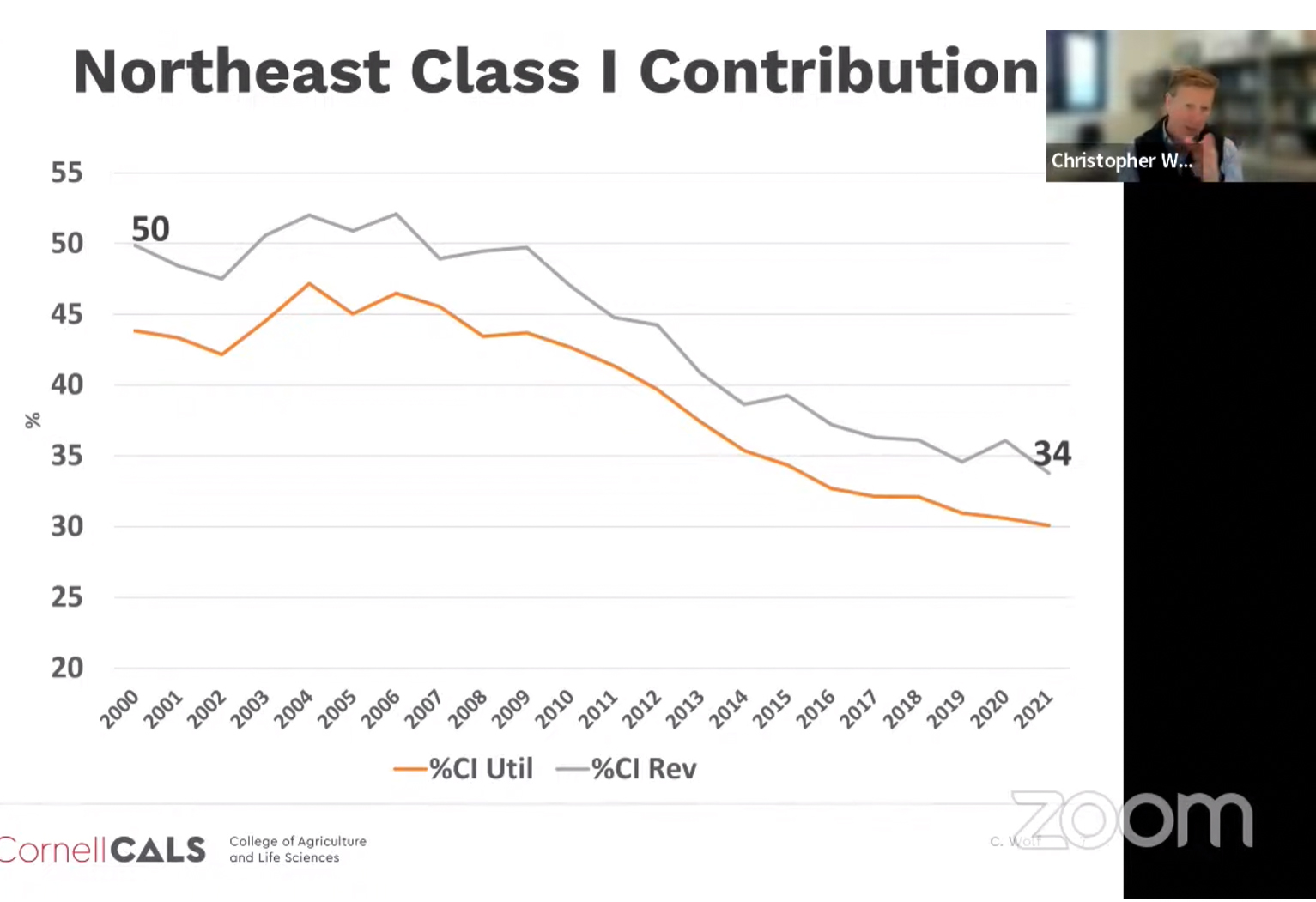
Using the Northeast as an example of a multiple component pricing Federal Milk Marketing Order that still has significant Class I utilization, Dr. Chris Wolf showed how long-term trends and other factors have reduced the Class I utilization and Class I revenue from 50% in 2000 to 34% in 2021 in FMMO 1. The most dramatic part of this decline occurred after 2010 — leaving not enough money to go around with less Class I value in the pool. FMMOs were structured for Class I fluid markets not for the dairy product and export markets where growth is occurring today. Screen capture from Center for Dairy Excellence Protecting Your Profits webinar with CDE’s Zach Myers and his guest Dr. Chris Wolf, Cornell University dairy economist.

By Sherry Bunting

WASHINGTON – There are irons in two fires when it comes to federal milk pricing and dairy policy. One is to do modernization through the Federal Milk Marketing Order (FMMO) hearing petition process. The other is to make some adjustments or seek authorizing language through the dairy title of the 2023 Farm Bill.

On the farm bill front, the May 12 CBO baseline score shows this could be the first trillion-dollar farm bill. Food assistance programs, like SNAP, are eating into the capacity to do other things, say top-level staff for the Senate Ag Committee. 

For dairy and livestock, the Dairy Margin Coverage (DMC) baseline now includes $1 billion in additional outlays projected over the 10-years, while livestock disaster outlays have doubled – even without making any changes in these programs that some are suggesting.

Still, farmers and organizations that represent them are seeking some expansion for the DMC, livestock disaster, and other programs and safety nets, and some are seeking language to instruct the Secretary to do hearings on the Class I ‘mover’, or to expand the flexibility of the scope of a hearing, or to require mandatory reporting germaine to things like raising make allowances. 

The jury is out on whether a farm bill gets done by September 2023 after the May 12 baseline was announced by CBO in the current political environment, but members of the House and Senate Ag Committees and their chairpersons are gathering information in earnest toward that goal.

On the FMMO hearing front, as previously reported in Farmshine, the USDA responded April 28 to the March 30 petitions from two processor organizations by asking for more information instead of granting or denying a hearing on their make allowance update request.

The two petitions from International Dairy Foods Association (IDFA) and Wisconsin Cheese Makers Association (WCMA) both requested a hearing focused exclusively on updating the ‘make allowances’, which are processor credits that are subtracted from the wholesale end-product prices used to derive farm level milk class and component prices.

Make allowances were last updated in 2008 using 2006 plant cost data.

Four days later on May 2, the National Milk Producers Federation (NMPF) submitted its petition seeking an FMMO hearing on a range of national amendments.

NMPF is petitioning USDA for a hearing on these five items:

1.     Increase make allowances in the component price formulas to the following levels: Butter   $0.21 per pound, Nonfat dry milk $0.21 per pound, Cheese  $0.24 per pound, Dry Whey $0.23 per pound 

2.     Discontinue use of barrel cheese in the protein component price formula

3.     Return to the “higher-of” Class I mover

4.     Update the milk component factors for protein, other solids, and nonfat solids in the Class III and Class IV skim milk price formulas

5.     Update the Class I differential pricing surface throughout the U.S.

Not noted within this list is a point that NMPF’s board approved on the legislative front, and that is to seek language in the 2023 farm bill directing USDA to do periodic mandatory and audited plant cost surveys instead of voluntary surveys for future hearings on make allowances.

The American Farm Bureau Federation took a positive approach in their response letter to USDA, showing support for the fact that NMPF’s petition is comprehensive and includes areas of strong consensus among farmers such as returning the Class I mover to the ‘higher of.’

However, AFBF president Zippy Duvall also points out in the response letter that the Secretary of Agriculture already has the authority under the Agricultural Marketing Agreement Act to require processors to provide information relevant to FMMO pricing. This could include mandatory surveys of plant cost data when used to determine the processor credit, or make allowance, in the pricing formulas.

It is Farm Bureau’s position that make allowances should only be updated based on mandatory and audited plant cost surveys.

This leaves a bit of a loophole in the discussion about how to acquire the data to make current or future updates. The Secretary may have the authority to require data from plants that participate in FMMOs. However, it is unclear if the Secretary has this authority to require cost data from plants that do not participate in the FMMOs.

The end-product pricing formulas are based on wholesale prices that are collected mandatorily by USDA AMS on a weekly basis through the Livestock Mandatory Reporting Act on only those products that are used in FMMO formulas. This includes butter, nonfat dry milk, dry whey and 40-lb block and 500-lb barrel cheddar cheese.

The USDA AMS weekly National Dairy Product Sales Report surveys 168 plants for this price data. Therefore, if make allowances are updated as processor credits against those prices, then all 168 plants should have to report their costs, and only the costs that pertain to those specific products, whether or not they participate in FMMOs. In a recent voluntary cost survey, more than 70% of those plants did not report their cost data.

During a Center for Dairy Excellence Protect Your Profits zoom call recently, risk management educator Zach Myers had as his guest Cornell dairy economist Dr. Chris Wolf to talk about the FMMO reform process and background from an economist’s perspective.

Dr. Wolf gave some important and relevant background and statistics.

The FMMOs have been around for 85 years and were created because of disorderly milk marketing conditions. Their primary function is to make markets function “smoothly” with a second stated objective to provide price stability.

“If we were to re-do them today, I would say price adequacy should be addressed,” Wolf opined, noting that “we have times that the milk prices are very stable, but not very adequate.”

Other stated objectives of FMMOs are to assure adequate and wholesome supplies of fluid milk and equitable pricing to farmers.

“These things are still important today,” Wolf suggests, adding that the auditing, certification and a certain level of market information that is provided by the FMMOs benefits all participants and contributes to the public good.

He explained that FMMOs are changing.

“The primary sources of dissatisfaction with FMMOs in recent years arise because there is not enough money to go around, and some of this is related to the longer-term trends (in Class I sales),” Wolf explains.

He showed that while per capita dairy consumption has been increasing roughly three pounds per person per year, the decline in Class I fluid milk is the underlying factor.

“It really is startling how much of that decline (in Class I) in most areas really happened since 2010,” Wolf illustrated with graphs.

Not only did per-capita fluid milk sales decline more rapidly since 2010 than the already long-term decline charted since 1980, but population growth in the U.S. also stalled — so the total Class I sales have been hit with a double-whammy.

“This relates back to where the value is in the Orders, with most of the decline in the past 20 years occurring in that second half, — since 2010,” he explains.

(The Healthy Hunger Free Kids Act of 2010 was the precursor to USDA removing whole and 2% unflavored and flavored milk from schools and requiring flavored milk to be fat-free. Today, USDA has a proposed rule that could eliminate flavored milk until grade 9 as reported previously in Farmshine).

Because Class I has to participate in FMMOs, the FMMOs were “intentionally structured” in a way that the Class I revenue has always tended to be the highest class price because the FMMOs are in place to structure the fluid milk market, and so Class I accounted for at least 50% of the pool revenue – until 2010.

“We finished 2021 at 34% (down from 50%),” Wolf notes. “So there’s not enough money to go around with less (Class I) value in there.”

What changed? Wolf notes some of the long-term trends.

“First, exports are now 18% of U.S. milk solids production when it used to be that the U.S. exported about 5%… Milk beverage consumption is down while cheese, butter and yogurt are all up. We are still importing 4 to 5%, but as a large net-exporter now,” he says, “The U.S. is basing bulk commodity product prices off the world market. This introduces more outlet for milk but brings back the issues that come with international price-setting, overall,” he explains.

Another change, according to Wolf, is the level of consolidation at every level of the supply chain.

Wolf went over some of the make allowance data based on existing voluntary surveys as well as a prior California state order audited survey. He showed there is a wide range in costs between older and smaller plants vs. larger and newer plants. When determining where to set make allowances – as an ‘average’ or at a percentile of this wide range — there are regional impacts to consider, he suggests.

Wolf also took webinar attendees through the steps of a hearing that can take at least a year or more to complete and he dug into the make allowances from an economic perspective and some of the other pieces of potential reform. Over the next few weeks, we’ll continue to examine them in this series.

The Center for Dairy Excellence Protecting Your Profits webinar with Zach Myers and Dr. Chris Wolf can be heard as a podcast at https://www.centerfordairyexcellence.org/pyp/ or viewed on YouTube at https://www.youtube.com/watch?v=YEMDA4iWyNw

My thoughts on the ABC’s of PA’s state-mandated OOP

By Sherry Bunting, published in Farmshine, May 5, 2023

The purpose of Pennsylvania’s 1930s Milk Marketing Law was to regulate and support the Commonwealth’s dairy industry. Today, it continues to set a retail minimum price for milk through the Pennsylvania Milk Marketing Board (PMMB) while most other states have zero protection against supermarkets using milk as a loss-leader to attract shoppers. 

To me, that’s the real problem. Nationwide, consumers don’t know or appreciate the true value of milk after years of rampant and extreme loss-leading. I’m not talking about random sales to clear inventory, I’m talking about day-in-day-out well-below-cost prices as a retail business model.

Supermarkets chains have gotten into doing their own milk bottling or refuse to pay for services or quality as a way to avoid eating all of the cost of their own decisions to knock the price of milk back several dollars per gallon. They know milk is in 95% of shopping baskets. It’s a staple. If their store brand is the cheapest around, they’ll get your business and sell other high margin items at the same time.

Dairy farmers and milk bottlers, quite frankly, should not be on the hook for that. Period. But indirectly they are.

At the federal level, no one wants to address this because USDA also benefits when it comes to buying cheap (skimmed) milk for food programs like school lunch, where they also reimburse Impossible not-burger, nacho chips and pop-tarts — but not whole milk, only skimmed.

Is it any wonder consumers balk at spending $5 for a gallon of milk in Pennsylvania but will pay $1.50 for a cup of water, even more for a cup of water with artificial additives? 

Is it any wonder consumers don’t think of milk’s nutritional value next to other protein and vitamin drinks? Intrinsically, the higher margin drinks are perceived as more valuable because the price is higher. Milk is perceived as worth less than water!

This makes Pennsylvania a sitting duck in a national, no, a global market. Why? Because Pennsylvania sets a minimum retail and wholesale milk price each month.

Pennsylvania’s Milk Marketing Law prevents supermarkets from selling milk under the monthly announced state-minimum price. The over-order premium (OOP) portion of this price was intended to help Pennsylvania farmers. The Milk Marketing Law already gives the retailers and bottlers a 2.5 to 3.5% profit margin over average industry costs within that set minimum-price buildup.

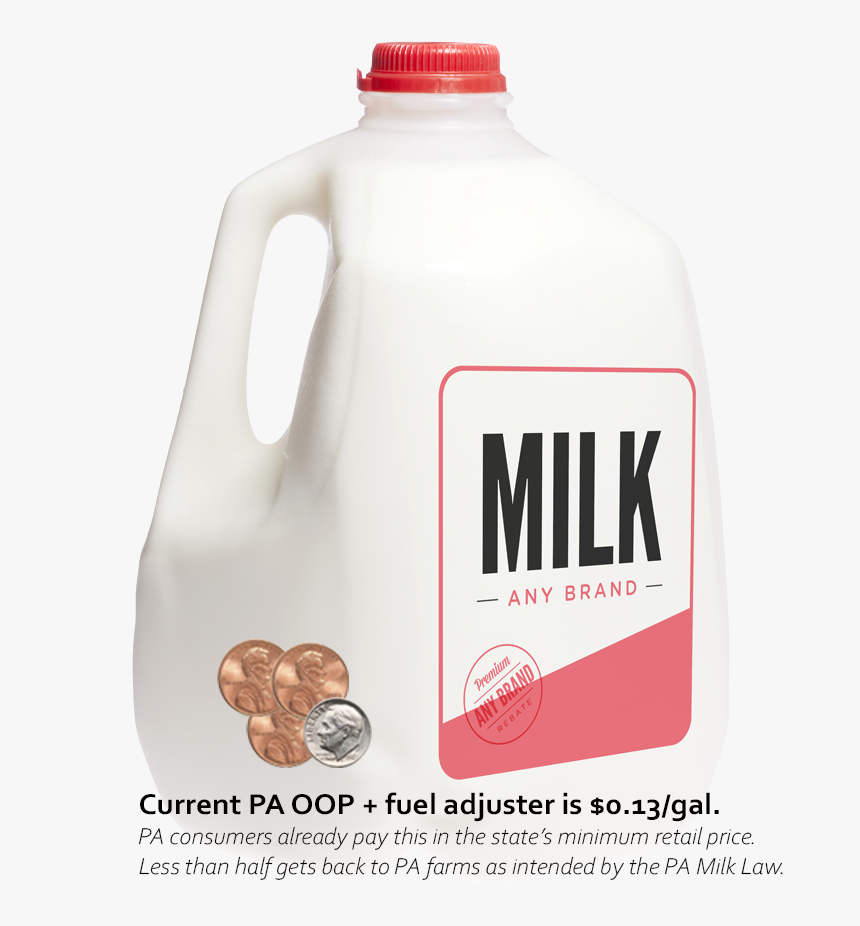
The OOP is currently set by the PMMB at $1.00 per hundred pounds of milk plus a 44-cent per hundredweight fuel adjuster. This come out to 13 cents per gallon paid within the state minimum retail price that is meant to be the farmer’s over-order premium (OOP).

A variety of loopholes have diminished how much of the state-mandated OOP gets back to Pennsylvania dairy farmers as intended by the law. It has encouraged interesting business models that involve more out-of-state milk coming in to displace Pennsylvania milk in some Pennsylvania stores (and some creative accounting for sure).

Whether in tankers or packages, more out-of-state milk is competing with an unfair advantage when the built-in OOP is either collected and not paid to farmers or remains completely undocumented — floating around and up for grabs by the supply chain.

Senate Ag Minority Chair Judy Schwank had an interesting exchange with Chuck Turner of Turner Dairy near Pittsburgh during the recent Senate Ag hearing on the matter. She asked whether or not the aseptically processed, shelf-stable milk, which she buys, has the OOP built into its price.

Good question.

Turner explained that for the members of the Pennsylvania Association of Milk Dealers, the OOP is factored in as a cost that they incur when they procure milk within the state and then return this OOP to their Pennsylvania farmers based on their sales of Class I fluid milk products within the state.

On the other hand, when a Nestle or some other company, like fairlife, makes a shelf-stable flavored milk that ends up in a retail dairy case in Pennsylvania, the OOP doesn’t enter into their thought process on these products coming most likely from Indiana (and New York), he said. To his mind, that means it does not “collect” OOP.

In reality, such out-of-state packaged fluid milk products that fall into the Class I fluid milk category are ‘collecting’ the OOP — even ultrafiltered and aseptically packaged milk. These products compete for Pennsylvania consumer dollars. Whether out-of-state fluid milk products are unflavored or flavored, fresh or shelf-stable, they are part of the unknown number Schwank said the Senate Ag Committee needs to know.

It doesn’t matter if the milk is sold above state-minimum price, the OOP is in there.

Take for example the fresh fluid milk brands that are bottled in Pennsylvania — that are not shelf-stable – but are priced on supermarket shelves above the state minimum retail price.

This happens when stores like Walmart and Costco want to differentiate their private label store brands as the lowest-price. What do they do? They put other brands higher.

Since supermarkets in Pennsylvania cannot go below the state’s minimum price to “loss-lead” with their in-house private label, they bump-up the price on competing name brands instead.

In some cases, this pressures sales volume even lower for name brands that are produced, processed and sold in Pennsylvania, reducing the OOP that goes back to the Pennsylvania farms. At the same time, some of the private-label store brands sold at state-minimum fall into the category of breaking the chain of produced, processed and sold in Pennsylvania, which affords them the ability to keep the farmer’s OOP.

Here’s my bottom line from the recent Pennsylvania Senate Ag hearing on the OOP:

For 15 years grassroots dairy producer groups have been grappling with the concerns shared at the hearing, and how the OOP may be affecting the use of Pennsylvania-produced milk in Pennsylvania consumer markets. The embarrassment of not knowing definitively how much fluid milk is sold in the state and how much premium is stranded off-record or on-record has been the subject of meetings, hearings, estimates, emotion, stonewalling and bickering for over 15 years!

Attempts have been made by lawmakers like former State Senator Mike Brubaker and current State Representative John Lawrence repeatedly putting forward bills that would have penetrated the armor surrounding this issue.

Now, in the past 12 to 18 months, we have the Pennsylvania Farm Bureau on high-alert, the Department of Agriculture now is involved and has come up with a plan. 

The CDE and PDMP are studying the issues around the premium and the obstacles to processing investment with the help of a Cornell economist. 

And the Senate Ag Chairman and Minority Chair offered their data-driven bills last session and will offer them again, because, of course, they are paralyzed by still needing that data they’ve been needing for 15 years!

Now, as the fluid milk market is in steep decline over the past 15 years (ironically the same 15 years in which whole milk and 2% milk have been federally prohibited as choices in schools and daycares)…

Now as most of the milk bottling assets, nationally, are owned by cooperatives and most of the rest by retailers…

Now as fluid milk plants are closing to the south and the west, while Pennsylvania has managed to hold on to a core of independent bottlers…

Now as the state courts the favor of Coca-Cola / fairlife or other new processors to invest in Pennsylvania … (Coca-Cola announced May 9 that New York will get the new plant).

Now as everyone is sitting up noticing that the tens of millions of Pennsylvania-paid ‘stranded’ OOP annually over the past 15-plus years may have been fueling growth beyond Pennsylvania’s borders while Pennsylvania’s own farms have been stagnated by more stringent supply management programs due to lack of processing capacity…

Here we are, back to the question of needing the data. Senators were interested in doing something, but Chairman Elder Vogel, said threading the needle will be difficult, and Minority Chair Schwank said “we have to have the data.”

Pennsylvania is enduring erosion on one hand in part because of the OOP and/or the minimum pricing, while on the other hand, these structures are believed by some to provide a stabilizing effect for the Class I bottlers that remain.

And so, the cats keep chasing their tails around the milk bowl!

Meanwhile, more producers have strived to get some of their milk outside of this game by selling it raw – an entirely separate market. The PMMB reached out to a number of them last year telling them they had to be licensed and do monthly reports, then backed off a bit for the time being. They are not the problem. Their milk is not pasteurized, and it is not part of the system in Federal Milk Marketing Orders either.

My biggest questions after the recent hearing, after 15 years of following this and for a time helping farmers who were involved in seeking changes more than a decade ago: Where would we be today if in any of the prior legislative bills, meetings, hearings, plans, would have moved forward in some fashion? 

And yes, this too is related: Where would we be today if whole milk had not been removed from schools?

One thing is clear on the first question, we would by now have solved the math equation of A + B = C instead of estimating, stonewalling, bickering…

On the second question? We might be selling more milk.

Read Part One and Part Two of the PA Senate Ag Hearing about the ABC’s of the OOP here and here

-30-

Rep. G.T. Thompson: Whole Milk and Dairy Pride bills ‘more urgent than ever’

By Sherry Bunting, Farmshine, March 3, 2023

WASHINGTON — Pennsylvania has dairy champions in Congress. Not only has Rep. Glenn ‘G.T.’ Thompson (R-15th) introduced the Whole Milk for Healthy Kids Act, and made it better, Rep. John Joyce (R-13th) is getting ready to launch the House version of the Dairy Pride Act to uphold real milk’s standard of identity.

It’s “more urgent than ever” that Congress act on these bills, in light of recent USDA and FDA proposed rules, said Thompson in a Farmshine phone interview as Congress returned to session Monday (Feb. 27).

The bipartisan 2023 Whole Milk for Healthy Kids Act, H.R. 1147, has been introduced for just over one week, and already the number of congressional cosponsors grows daily at 43 to-date, including prime sponsor Rep. Thompson, a Republican from Pennsylvania and prime cosponsor Rep. Kim Schrier, a Democrat and pediatrician from Washington state. 

The other 41 cosponsors so far represent both sides of the aisle from 22 states.

“I’m very honored to reintroduce this whole milk legislation. We made some real progress in the 117th Congress with not quite 100 cosponsors and broad bipartisan support. That’s what it takes to get things done,” said Thompson. “But we had headwinds with the Republicans not having the majority and the Democratic party owning the demonization of milkfat and the removal of whole milk and flavor from the school system.”

What will be different this time? 

Thompson explained it’s a new Congress and he has the support of the new Education and Workforce Committee chair Virginia Foxx, a Republican from North Carolina.

“She is very excited about this bill and has had me speaking on it at a number of events over the past year,” said Thompson.

In addition to being chairman of the House Agriculture Committee, Thompson is also a senior member of the Education and Workforce Committee through which the Whole Milk bill must pass first.

Thompson believes it will be put on the House agenda, and he is optimistic that it will get passed off the House floor.

He is also looking for a sponsor for companion legislation in the Senate.

He said he appreciated former Senator Pat Toomey of Pennsylvania who had previously introduced a version of the bill.

“With Senator Toomey’s retirement from the Senate, we now have to find someone to take the lead in the Senate,” he said.

The fact that the number of cosponsors has grown quickly for the House bill, within the first few days, is a good sign. 

This response so far has happened without Thompson “working the floor” yet.

This “speaks to the significant need that this legislation addresses,” he said.

“This bill is about providing the best nutrition for children and addressing the economic impact on rural America,” he explained. “When the Democrats did what they did in 2010 with the nutrition standards, it was a crushing blow to dairy farmers. Dairy is the number one ag commodity in my home state of Pennsylvania, and agriculture is the number one industry. This is the case not just in Pennsylvania.

“This topic comes up everywhere I go and in every state,” he added. “Part of the reason is the awareness as many people and organizations, and quite frankly the 97 Milk grassroots effort, has impacted nationally and internationally by speaking to this need.”

Thompson improved the bill with what he calls a “common sense addition.” 

He acknowledged former Senator Toomey for articulating language that would allow whole and 2% milk to fit within the meal calculation for saturated fat since the milk has been included in the meal calculation since 2010. 

This way, not only does the Whole Milk for Healthy Kids Act proclaim the permission for whole and 2% unflavored and flavored milk options in school meals, it expands the saturated fat limit to accommodate these options so school foodservice directors are empowered to actually offer them.

“Milk is the only beverage that is regulated within the meal. Meanwhile, students may have access to non-nutritious beverages with high fructose corn syrup and caffeine that are not regulated, so we’re making sure we do not have a situation where the milkfat counts against the meal,” said Thompson.

“Whole milk is only 3 to 3.5% fat compared to the low-fat milk being 1%. That means whole milk is 96.5 to 97% fat free. That extra milkfat is a positive thing in the lives of those young people,” Thompson declared, with a nod to the mountain of scientific evidence.

As the White House is moving rapidly in its proclaimed “whole of government approach” to implement the Biden-Harris Hunger, Nutrition and Health National Strategy, a flurry of bureaucratic actions could further affect milk access for children via USDA and FDA.

USDA just published proposed school nutrition rules, with comment period ending April 10, 2023, which could remove access to flavored milk in elementary and potentially middle schools, while further etching in concrete the fat-free and 1% sole options. 

FDA’s healthy labeling proposed rule also presents obstacles for whole milk, and that comment period recently ended. 

Plus, FDA last week issued draft guidance allowing imitation non-dairy beverages to be labeled as ‘milk’ with only a ‘voluntary’ recommendation that companies describe shortfalls in key nutrients. That public comment period ends April 24, 2023 (see related article in this week’s Farmshine).

Will the Whole Milk for Healthy Kids Act force revisions of any of these proposed rules?

Rep. Thompson was outspoken on this question.

“I don’t believe they have the authority to do what they are doing now,” he stated. 

“These moves are an outgrowth of the White House summit that they weren’t serious about. They failed to invite Republicans, including the Ranking Member of the Ag Committee until 48 hours before the conference. They didn’t want our input. It is more political science than science, and it is really frustrating,” he related.

“It is the Congress that determines nutritional standards, not the bureacrats. While the Whole Milk for Healthy Kids bill is mostly in the Education and Workforce Committee, I will do all I can in the Ag Committee to make sure science, not political science, is foremost.

“Science shows whole milk and whole milk with flavor added, are the most nutritious beverage available,” said Thompson.

On the FDA draft guidance for labeling fake-milk alternatives as ‘milk’, Thompson was even more blunt.

“The Dairy Pride Act is being reintroduced by Rep. John Joyce (R-PA). This bill is more important than ever given the insane draft guidance of the Biden-FDA. It is urgent to pass this one also,” said Thompson, confirming later that the Dairy Pride Act, which was introduced in the Senate this week will also be introduced in the House shortly by Rep. Joyce, along with a bipartisan cosponsor.

Thompson lamented the bombardment of parents and kids with marketing for alternative fake-milk beverages that are proliferating rapidly.

“I have a lot of friends among almond growers and soybean growers, and I like almonds, but this is about truth in advertising. The word ‘milk’ communicates a certain level of nutrition, and FDA has even acknowledged this. If FDA is going to mislead people by allowing the labeling of something as milk that is not milk, then they should be required to truly define the differences,” he said, adding that he’s not surprised.

“This administration can’t define what a woman is, and now it can’t define what milk is,” Thompson declared.

Stay tuned to Farmshine for updates!

-30-

Is the dairy checkoff getting its methane math right? Nope!

Study says dairy should aim for climate neutrality, not net-zero carbon. Dr. Frank Mitloehner explains meaningful metric, achievable goal post during webinar

Sherry Bunting, previously published in Farmshine

BROWNSTOWN, Pa. — Net-zero carbon, net-zero GHG, net-zero GHG footprint, carbon neutrality, GHG neutrality… These terms are being used to describe the dairy checkoff’s 2050 commitments via DMI’s Net Zero Initiative.

But do they consider the warming impact of methane from dairy cows over time? 

Bottomline, the so-called “Net-Zero Initiative” of DMI is a set up to be always chasing the cow’s biology without measuring her methane as the flow gas it really is — without considering the short-lived nature of methane and the biogenic cycle cattle are a part of.

If net-zero carbon is the goal, and if methane is measured on carbon dioxide equivalency without considering its short-lived cycle, then dairy farmers could find themselves in the position of unnecessarily and continually chasing the natural biology of their cows without a meaningful and accurate metric and without an achievable goal post that satisfies what all industries around the world are really being asked to do, and that is to limit additional warming.

A new study by foremost animal scientists and air quality specialists Dr. Frank Mitloehner and Dr. Sara Place is calling for the U.S. dairy industry to aim for climate neutrality (net-zero warming) rather than net-zero carbon or net-zero GHG.

The peer-reviewed study from the University of California-Davis CLEAR Center and Elanco Animal Health was published recently in the Journal of Dairy Science. It outlines a path for the U.S. dairy industry to reach climate neutrality by 2041 with small methane reductions every year, and even sooner with more aggressive reductions.

Dr. Mitloehner brought dairy farmers up to date and took questions during the American Dairy Coalition’s annual meeting by webinar in December.

One important take-home message was for dairy producers to understand that how methane’s global warming potential is quantified (whether GWP100 or GWP*) “has a profound impact on the predicted warming of your industry. The only way you can become climate neutral is by using a metric fit for purpose, one that predicts the warming, and that is GWP*,” said Mitloehner.

He explained how methane is an important and powerful greenhouse gas (GHG), but it is different from other gases because it is the only one that undergoes atmospheric removal in a chemical process that takes about a decade. This does not occur for carbon dioxide or nitrous oxide, which are stock gases that remain in earth’s atmosphere for 1000 and 100 years, respectively.

“Methane is the most important gas for agriculture, so its removal must be included in the calculation also,” he confirmed, noting that GWP* does that. “Methane is fast and furious. It has a good punch that is 28 times more trapping of heat from the sun (vs. carbon dioxide), but it is also fast. It doesn’t stay in the atmosphere for long.”

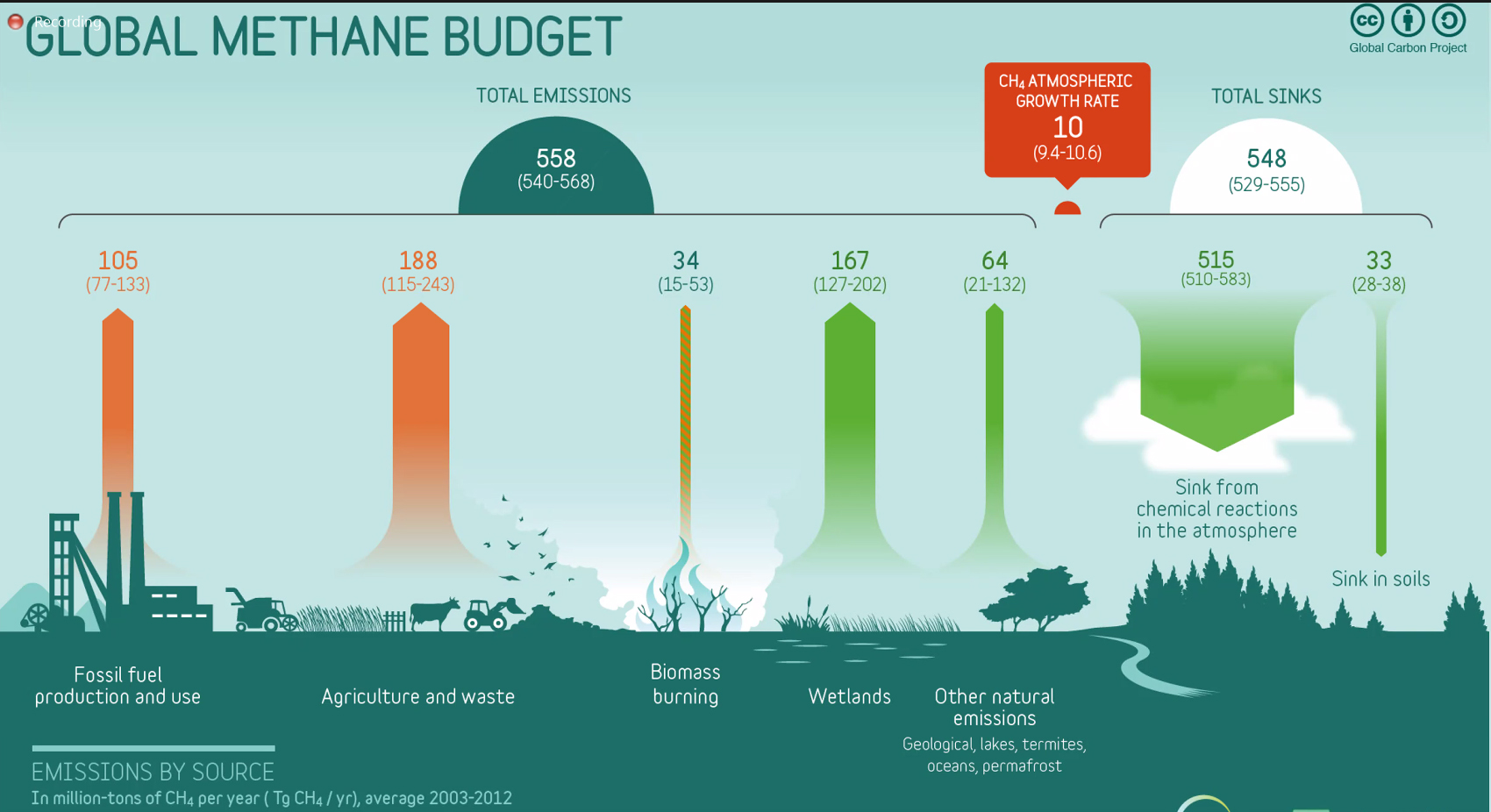
In a slide showing all global methane sources and sinks, Mitloehner noted that nearly 560 terragrams of methane are produced worldwide annually, and at the same time 550 are destroyed by this natural atmospheric process.

In terms of atmospheric growth, “the net is then 10. This is still a number we want to reduce, but it is not 560,” he said.

As the DMI Innovation Center’s Sustainability goals, Net Zero Initiative and FARM program are on the cusp of calculating these things at the farm level, both the measurement and the goal matter.

A net-zero carbon or GHG commitment poses a problem for dairy farmers. This is compounded by the CO2 equivalency for methane being calculated using GWP100. 

The GWP100 metric has been around since the 1990s, but it describes stock gases, whereas methane is a flow gas.

Using GWP100 with a net-zero carbon commitment is not only unnecessary, it’s problematic.

“It means the belches from your cows are (being calculated) in addition to what they belched last year, and the year before that, and so forth 10 years from now,” said Mitloehner. “In reality, constant herds are a constant source of methane that generates a constant warming, not a new warming. That’s what the Paris Treaty asks all sectors to do – to limit additional warming.”

Aiming for climate neutrality or net-zero warming instead of net-zero carbon would put the focus where it needs to be — on the warming impact of the emitted methane over time. This is important because methane makes up 62% of the estimated total GHG for dairy, according to the CLEAR Center study.

“If we use GWP100 to describe a relatively constant source, to characterize that methane, then we are overblowing its impact by a factor of 3 to 4, and we are overlooking the ability for the U.S. dairy industry to reduce warming when we reduce methane,” said Mitloehner, citing page 173 of the Intergovernmental Panel on Climate Change (IPCC) 2021 Assessment Report 6.

The metric GWP-star (GWP*) is also mentioned on this page of the IPCC report. GWP* was developed by the University of Oxford. It is based on GWP100, but it looks at how methane warms the planet over time. It characterizes methane as the flow gas that it is and calculates it based on CO2 warming equivalents (CO2we), not as accumulating CO2 stock equivalents (CO2e).

A white paper published with the peer-reviewed CLEAR Center study explains it this way:

“Net zero carbon refers to a state where carbon is removed from the atmosphere (through carbon sinks or other offsets) at a rate equal to carbon being emitted into the atmosphere. This balance between carbon emission and removal creates a ‘net-zero’ carbon output. Climate neutrality, on the other hand, focuses on temperature impacts from emission sources, referring to the point in which no additional warming is added to the atmosphere.”

The paper goes on to explain how “climate neutrality is analogous to net-zero carbon when dealing with long-lived greenhouse gases such as carbon dioxide, but short-lived pollutants like methane do not need to reach net-zero carbon to be climate-neutral.”

“Is it new and additional carbon being added to the atmosphere? Do constant herds add new warming? No, they do not,” said Mitloehner.

“Belched out methane is the number one source in agriculture, but again, it doesn’t stay in the atmosphere for 1000 or even 100 years like carbon dioxide and other GHG,” he explained while also noting the pathway of the carbon in this methane is already present in the atmosphere, is captured by plants, then consumed by cows. Some of this consumed carbon (energy) is converted to carbohydrate and some of it is emitted in the methane by the cow in a continuous cycle. 

Unlike fossil fuel emissions, this is not ancient carbon brought out of the ground and into the atmosphere as a one-way-street, he explained: “Do not fall for the people who are comparing cars to cows. The University of Oxford says this is a mischaracterization, and I agree.”

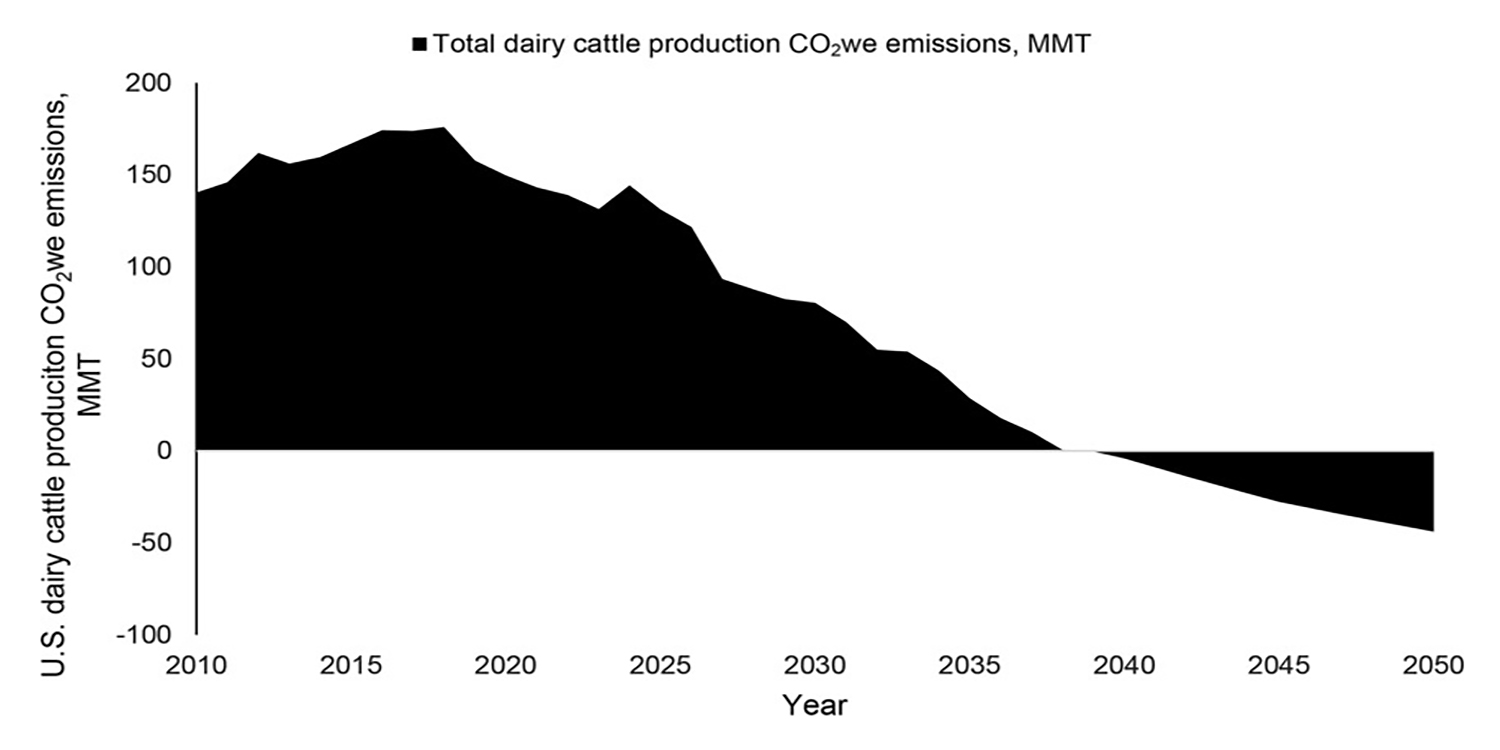
What is exciting, “is if we reduce methane, we can come to a point where we produce negative warming or a cooling effect. That’s what my work is about (Fig. 4). If we do a couple of things to reach no new warming, and if we then get aggressive to go further, we can sell credits as offsets,” said Mitloehner, referencing the implications, limitations and conclusions of the CLEAR Center study.

As innovations related to managing cattle diets are being developed, the good news is emerging tools show the promise of steering more of that carbon, that energy, toward milk yield and components and less of it to methane that is belched back into the cycle.

In contrast, a net-zero carbon or net-zero GHG goal that measures methane as a stock gas (GWP100) and does not accurately describe its warming impact and flow-gas status in the way GWP-star (GWP*) does, would leave dairy farmers needlessly and continually chasing what under the GWP100 scenario are accumulated and continuing belches from their cows. 

If the industry continues to chart net zero carbon, will dairy farms be forever chasing their belching cows with tech investments and offsets?

“In my opinion, you will never reach net zero carbon. Your cows will always produce methane no matter how aggressive you are. You will over promise and leave stakeholders disappointed. We are dealing with a biological system, the microbial fermentation in the rumen. It is not feasible and I have advised the industry in the past against it, but that is the direction it goes – in general,” said Mitloehner.

As for unintended consequences on the path to ‘net zero,’ Dr. Mitloehner was clear to say: “What matters is climate neutrality. If you tell the world you want to be climate neutral with no new warming and achieve it through annual reductions of 0.3 to 0.5%, you will indeed be climate neutral in less than 20 years. At a 1% per year reduction in methane, you will accelerate that timeline. But you will never achieve it with GWP100. It’s not possible and not necessary to go that way of treating methane as if it were a stock gas. It doesn’t account for the reduction.”

A piece of good news, he said, is that GWP-star (GPW*) can be used parallel to GWP100. The maitrix is a more scientific predictor of what you (dairy) has to do to bend that curve and how strongly.

“The excel spreadsheet calculator in the white paper helps you identify when in the future as a creamery or a statewide association reach the point that you are no longer creating additional warming, and that should be the goal,” Mitloehner explains.

Net zero carbon or net zero GHG is a setup to always be chasing the cow’s biology without acknowledging her gas is a flow gas, not a stock gas. It does not accumulate. Some will say “you can use offsets” for the cow’s biology. But why? They are not necessary as offsets and could be viewed as solutions if the dairy industry gets its math right. (We’ve seen this movie before)

Dutch farmer protest update: What if you woke up tomorrow and learned your farm is to be reduced or closed based on climate targets that use fuzzy math?

When food is plentiful, and climate reduction targets kick-in… How do farmers attract the strong public support they need to continue?

By Sherry Bunting, previously published in Farmshine

NETHERLANDS — Headlines here in the U.S. indicate the Dutch government is offering buy-out of up to 3000 farms and other so-called ‘peak polluters’ to reduce ammonia and nitrous oxide emissions to bring the country into compliance with EU pledged targets. They say farms will be offered more than 100% of their value to quit, but the value of these farms is now reduced by the reduction targets. 

A November 30 article in The Guardian quotes the Dutch nitrogen minister Christianne van der Wal saying “there will be a stopping scheme that will be as attractive as possible,” and that forced buyouts will follow next year if the voluntary measures this year fail. 

Some may read these headlines and figure Holland is such a progressive agricultural powerhouse that the number of planned closures is but a dent. 

Think again.

Farms in Holland and around the world are the thin green line. Challenging them with inflated climate data and restrictive targets puts world food security at risk.

Consider that the BBC reported recently that Ireland is also looking at agricultural emissions, namely methane from cattle and sheep, in terms of meeting its Climate Action Plan targets of a 25% reduction by 2030. Estimates vary on how much culling would need to occur to meet these targets, how the methane is measured, and how fast various feed additives can help farms meet new targets. The most glaring concern is how carbon equivalents and methane are measured.

What if you woke up tomorrow and learned that your farm is targeted for similar reductions or closure based on the location of your farm on a map, based on climate targets set by your state or your milk buyer or the federal government, based on making cuts from where you are now — not from where you might have been before whatever improvements you’ve already made?

We reached out to Dutch dairy farmer Ad Baltus this week for an update from Holland, having interviewed him six months ago for the story about the Dutch farmer protests in July 2022.

Baltus farms 170 acres in the village of Schermerhorn with his wife and 7-year-old daughter. They milk 130 dairy cows, grazing in summer and growing corn and collecting fresh grass and dry hay from fields as well.

In July, he reported that his farm is one of the “luckier” ones. He is in a location in North Holland that will have to reduce the amount of nitrogen (or sell cows) by 10 to 15%. Some zones have been designated to reduce by up to 75 to 90%. The percentages are to meet reduction targets, and are not based on what a farm is measured to produce. Building and infrastructure projects can’t move forward without near-term offsets, which is why the situation has reached this extreme point in the Netherlands.

“It feels like the government throws figures in the air, and they wait to see what will happen,” says Baltus. “In my point of view, they try to make farmers worried as a tactic of smoking them out. That’s what you see now. The farms (targeted for higher reductions based on location) nearby the nature areas are getting tired of it, and they sell. I see the last couple of months a lot of farms, nice farms, being sold, and that worries me. If they stop farming, and go abroad, what will be left in Holland?”

He observes that the older farmers stay on the farm until they stop for retirement.  “But when the young farmers stop and go abroad — that’s the future leaving. The young farmers are the future. The young farmers don’t want to wait for what is clear and what is going to happen. The problem is now — in the next five years,” he says, indicating a cycle of new targets that never seems to end. “Every time the government throws new figures out. This time it’s the nitrogen, then it’s the water quality, and then it’s the biodiversity, then there is CO2. Every time there comes new regulation, young farmers worry about their future.”

He sees agriculture in his country at a crossroads and warns that if this can happen in Holland, where agriculture is so progressive, it can happen anywhere.

“It could go the right way, and they will begin to appreciate farming in Holland, or it could go the other way, and farming may be over in 10 or 20 or 30 years. My biggest worry is you need some minimum amount of farmers to let the companies behind the farms live. I see it that when you have a feed company, they need a certain amount of farms to deliver their feeding products. When it comes down below some level, they say that is too small for us, and it is a spiral going down. That’s a worry for me, that we make it difficult for too many farmers, and they stop.”

Baltus confirms that the large Dutch farmer protests of the summer have quieted down, but the efforts and periodic protests continue on a different scale. “We are not giving up. We are struggling ’til the end, but it is a hard battle to convince (the government) that this is not the good way to go.

“We also see the farm groups talking to the government. We see the (symbolic) red handkerchief. The Dutch flags turned upside down for a month got attention. The protest is maybe not as loud as it was, but it is still there, and a little spark to the gunpowder barrel, it will explode again,” he says, noting that there are elections in March 2023.

As for the big picture, Baltus describes it as Dutch farmers having to ‘catch up’ quickly to the long-time networks built by the NGOs.

“Farmers have been too long on their own farms, and now you see things changing. Since 2019, when the first farmer protests began, you see farmers are now talking more to the media. They get a better speech to government officials,” says Baltus.

On the other hand, the NGOs, like Greenpeace, and a variety of others, are a small number of people relative to the population of Holland, but they have already been working 20 to 30 years on this. They are well-organized, well-funded, and have people throughout all levels of government and media, he explains.

“We are just now three or four years fighting against that, and it takes a time to change and get that understanding of nature and practice to the government,” Baltus relates, adding that it also takes time for new technologies to come to market that will help farms make further reductions, though European farms are already pretty progressive that way.

Baltus sees European farmers coming together more for each other now — even if their respective governments are not. As other countries in the EU are beginning to experience similar pressures of emissions targets that could essentially reduce dairy and livestock numbers or put farms out of business, solidarity is on the rise among those farmers who are paying attention.

Farming is hard work with a lot of risk, but as Baltus points out, Holland is a good place to farm, with good soil, good logistics, and a good climate for crops and livestock.

“It is one of the best jobs in the world. I love what I do. I want the adventure that every day is different. I like working in nature, working outside,” he says. “When the younger generation doesn’t have to worry about all of the things which are not farming, then they will go to farming because the work is that good. It is only the things that come from outside into the farm that make it hard.”

One part of a future solution is exemplified in something Baltus has done at his farm for 30 years — providing a school on the farm to teach young children how to make cheese and to make jam. His cheese school reaches a few thousand children each year.

“We do it so the children learn how much work it is to make that little piece of cheese and that little pot of jam,” he says. “When they learn the effort that goes into food, they appreciate it more, I think.”

The children get a bucket of milk, and in two hours they go home with a little cheese. They have to turn in 14 days and put on a little salt, and in another 14 days they eat their own cheese. When Baltus started the cheese school 30 years ago, maybe one or two farms did this kind of thing.

Today, more farms are doing similar memorable learning experiences. Baltus sees more farms connecting with the public in recent years. Some have cabins on the farm that they rent to the public. Others provide daycare on the farm, so children can grow up with some real-world attachment to farming. In his neighborhood, there are four farms with daycare. 

“The new generation learns what it is to farm, so maybe they will be farming or an advocate. If they go to work as a plumber or a trucker, but as a child lived a few years on a farm at a daycare, it’s good for when they are older, even if they work in other things,” he explains.

“The solution is also that everyone you speak with — say to them what you are doing. When you are at a party or on holiday, say you are a farmer, say how you do things, why you do things — explain it,” Baltus suggests. “People come to appreciate these things when they know about them. There are things (farmers) can do better, but when we explain that we need 5 or 10 years (as technology develops), they accept we’re not perfect but are working to make it more perfect.”

In general, Baltus has found the public has a good opinion of farmers. When he meets someone from the city, they say “Oh, you’re a farmer. That is good of you.” And that’s that. They think well of farmers, but have no reason to worry about food, and therefore don’t make the connection to the impact of the threat the farmers face.

“People have other worries. Do I have a job next year? Can I pay my bills for electricity? Will my children have a good education? But food? There is always food. People will worry about food when there is no food,” he says.

As it stands now in Holland, “What is happening with farms is not really their business. People can go to the supermarket, and most everything they want they can buy there,” Baltus observes, saying he understands this disconnection.

Even if there are changes to the mix of foods available in stores and restaurants, there is no fear of finding food to eat. While Holland is considered a large agricultural exporter, Baltus notes that his country is a net-importer of food when looking at it on a protein and energy needs basis. 

“We have the cheese and potatoes and cabbage, but we don’t have the coffee, the cocoa and the citrus. I see it in the way of trading. When that balance is lost, what happens when there is a shortage and we don’t have the cheese or potatoes to export?”

The bottom line, says Baltus, is that “When you are a carpenter or a plumber and there is, every day, food in the supermarket, why would you have to worry about food?

“In Africa, they know food is important. They know what it is like to not have food. But in the western world, there is food everywhere. You can pick up the phone, and in 30 minutes have a pizza on your plate.”

-30-

Measure every decision by cow comfort and know your numbers: ‘That’s how you fight inflation’

By Sherry Bunting, Farmshine, December 23, 2022

NEW HOLLAND, Pa. – “Too much money chasing too few assets,” that’s the definition of inflation, said Gary Sipiorski, ag lender and financial consultant from Wisconsin.

He didn’t have to tell the over 250 dairy farmers attending Homestead Nutrition’s dairy seminar at Yoder’s Restaurant in New Holland on December 7 that inflation is real, because they are feeling it.

His bottom line is to measure every decision by its impact on cow comfort and manage the net income the cows generate.

As president and CEO of Citizens State Bank of Loyal, Wisconsin, Sipiorski is also an advisor to the Federal Reserve Board of Chicago. He expected the Fed would raise interest rates another half a percent, and several days later, that’s what they did.

Raising interest rates is meant to slow things down enough to curb that inflation, and as farmers, “you’re feeling the effects of both,” he said.

Sipiorski described the effects of both the disease and the cure as something that creeps up gradually to squeeze the margin.

“You can be taking good care of things and don’t see this happening, as the temperature gradually increases. It sneaks in slowly,” he said. “The war on inflation will continue for at least the next 12 months, and we are likely to see interest rates continue higher before stabilizing around the middle of next year.”

The good news for dairy, he said, is that even though consumers are drinking a little over half as much milk per capita as they did 50 years ago (18 gallons vs. 30 per person per year), they are eating more than double the gallons of milk in the form of all dairy products, combined.

In 2021, Americans consumed 667 pounds (77 gallons) of dairy products per capita. That’s 12 more pounds per capita than in 2020.

“We didn’t drink the 77 gallons, we ate it,” said Sipiorski, adding that dairy exports have also become crucial.

“By the end of this year, 20% of your milk production will be going elsewhere,” he said. “That shows the faith the rest of the world has in the superior product you make.”

Inflation, rising interest rates and supply disruptions are slowing the rate of dairy expansion, as the industry focus turns inward to manage margins even more tightly as feed costs have doubled, cropping costs have quadrupled, lines of credit cost more and are harder to get, machinery and parts cost more and are harder to find, and some farms must deal with a milk base program from their milk co-op or buyer — putting penalties on overbase milk in the output side of that margin equation.

Sipiorski shared his insights on the most important things the top 30% of dairy producers do in a talk he titled ‘Chasing inflation with a cow.’

The top third of dairy producers double-down on managing these primary areas: feed, debt, labor, cow comfort, and knowing their numbers.

Minimize feed shrink

With feed and cropping costs so much higher, Sipiorski told dairy farmers the 10 to 20% they can be losing in feed shrinkage is a significant area to manage.

“Losing 10 to 20% of the feed from field to rumen is a big cost to the dairy,” he said. “We are seeing more investment in feed storage sheds, bringing the mixing indoors and thinking about how you mix the feed, in what order.”

Pay down lines of credit, not term debt

Choosing carefully what debt to pay down at this time of rising rates is also critical. Paying down lines of credit that have adjustable interest rates and keeping some of that cash liquidity may make more sense than paying additional principal on longer-term fixed rate loans.

“Your thought process may be to pay down that term debt, but if the rate is locked-in, and you pay it down, that money is gone, and you may need that money later, and then pay a higher interest rate for it,” Sipiorski explained, advising farmers to talk with their lenders about their debt structure.

Push pencil on machinery

“Do the math on whether to lease or buy machinery,” Sipiorski urged. “If it is something you use three months of the year, can you afford it? Can you afford the cost to have and maintain that piece of equipment?”

He noted that the top dairy farms push the pencil to compare costs of owning new equipment, leasing it, or hiring custom operators for segments of their field work.

Time is money, spend it wisely

In addition to dealing with hired labor cost and availability, Sipiorski advised farmers to “count your steps and measure your time.”

In other words, know what your time is worth and find ways to streamline chores for yourself and your employees. One example he gave was to put tools around where they will be used to minimize time spent going back and forth for tools needed.

Keep improving cow comfort

“Cow comfort is a place to keep improving to fight that inflation with that dairy cow,” Sipiorski declared.

It’s the accumulation of a lot of simple little things the top third of producers do, such as providing enough space at the feedbunk, waterer and in the dry cow area.

“The dry cows are working just as hard for you, so don’t cheat them” he said, adding that top producers are absolutely passionate about cow comfort.

The cows require a lot of investment, and the top producers benchmark the investment per cow at $8,000 to $20,000, while benchmarking gross income per cow at $5,000.

“Cow comfort is an area of investment that brings you the most return. Every decision you make, ask yourself, are you making money with that decision?” he said. In other words, “are you making cows more comfortable with that decision?”

Keep improving milk components, quality

Producing milk with higher component levels and lower somatic cell counts (SCC) is what the top third of producers are doing, said Sipiorski.

“This is even more important if your co-op has a base program. If you can’t produce more milk, make the milk you are producing better,” he said, noting that components drive value.

Quality as measured in SCC will also increasingly drive value and market access. Sipiorski sees the industry getting to the place where milk will eventually have to be under 150,000 SCC.

While he didn’t specifically mention transformation in the processing sector, it’s becoming clear that ultrafiltration and microfiltration in some of the newer dairy plants is aimed at removing the lactose from the milk to be used in making cheese, other dairy products and lactose-free high protein milk beverages.

Those working with this technology have repeatedly said it requires farm-level SCC thresholds to be even lower because, as the water and lactose are removed through membranes and reverse osmosis, the remaining solids are condensed. This includes the SCC being concentrated with those valuable solids, so those processors expect a lower-SCC limit at the starting point.

Get educated on marketing

Sipiorski advised farmers to be “educating yourself on marketing and risk management.”

He noted that milk markets are volatile, and marketing through a broker or a cooperative program or other risk management can be good or bad.

“You won’t know if it’s a good deal or not, if you don’t know your cost of production, your margin,” he said.

Know the numbers, focus on high quality forage production, and look at areas where changes and investments can help fight inflation, he advised.

One thing he has seen more farms moving toward – to reduce marketing costs – is to increase milk storage to go from once a day to every-other-day pickup to reduce fuel costs, transportation and ‘stop’ charges.

This is something that has been occurring at the retail end for years, with less frequent deliveries from processors to retailers becoming the norm today.

Benchmark against industry or self

Benchmarking the dairy to itself year over year or to industry averages is important financial management, according to Sipiorski.

The numbers that are needed to do this are found on the balance sheet, income statement, and accrual accounting of yearend income – not the IRS tax return. 

He said that doing a business plan with projected cash flows helps make better financial decisions.

Sipiorski gave farmers some financial benchmarks to keep in mind, noting again that the numbers need to be based on accrual accounting, not the year end IRS tax return.

“In that tax return, you have prepayments and depreciation,” he said. This skews the cost of production calculation, for example, because the cost of inputs are not directly aligned with the output revenue.

Sipiorski ticked through some industry benchmarks to be aware of: Equity position (50%), liquidity (2:1), net profit margin (10%), cost of production ($17-22.00/cwt), operating expense as a percentage of gross income (65-80%), and debt to revenue ratio (1:1).

The bottom line, he said, is “you need to produce 100 pounds of milk for less than you sell it for.”

On that point, he noted the most recent USDA forecasts at the end of November are for Class III milk to average $19.80 in 2023 with the All-Milk price next year forecast to average $22.70, while the cost of production in 2022 is averaging $20 to $22.00 across the industry, but the range is wide.

“Pennies (per hundredweight) are a big deal,” he said, showing that the 47-pennies per hundredweight difference in a Q2 2022 comparison of the net margin per hundredweight of $6.64 for all herds vs. $7.11 for the ‘top 30% of herds’ amounts to just shy of $113 per cow annually.

“That’s $2800 on 25 cows, $11,280 for a 100-cow dairy. That’s how we fight inflation with a cow,” he said. “Who in this room wouldn’t want another $11,000 in the pocket to fight inflation?”

Sipiorski described dairy as a dynamic business full of chaos and volatility, but with that comes lots of opportunities.

He sees a ‘barbell-shaped’ future for dairy, where there will be opportunities for small and mid-sized family dairies even if a large portion of the milk supply comes from much larger dairies.

-30-

Gary Sipiorski, a lender from Wisconsin, talked about dairy financial management in these inflationary and volatile times. Despite the chaos and consolidation, he sees opportunities for small and mid-sized family dairies in the future, even if a large portion of the milk supply comes from much larger dairies. Photo by Sherry Bunting

Dream in progress at BAD Farm, where they DON’T live up to their name

‘Tis the season for something special. Their story began with raw milk sales over 10 years ago, today it is becoming so much more.

By Sherry Bunting, Farmshine, December 16, 2022

KEMPTON, Pa. — ‘Tis the season for something special. It’s Christmastime, and diversified consumer-facing dairy farms are featuring special products, memories and events, complete with decorations, milk (or hot chocolate) and cookies, wagon rides, Christmas settings and on-site photographers for on-the-spot family Christmas portraits – you name it, and dairy farmers are doing it.

Recently Jason and Kacey Rice (and sons Emmit, 6, and Ellis, 4) had such a “Christmas on the farm” event at their BAD Farm near Kempton, Pennsylvania. Delicious dairy products, made with the milk from their 60 cows, were combined with holiday festivities, opportunities to see a working farm, visits with Santa, and, yes, portrait sessions with a holiday setting, a festively outfitted calf and a photographer.

Almost 100 people dodged the raindrops on the first Saturday in December to attend the event at the store the Rice’s built on the farm in 2020 as they began offering more products.

But their journey began with selling just raw milk and eggs more than a decade earlier.

In addition to the store, BAD Farm products are sold at pop-up farmers markets in Emmaus and Lehighton. Jason’s dad manages the meat sales. His mom is the point person for the farmers markets, staying in touch with Kacey, who runs the on-farm processing of the items they do on-site and ordering those products that are processed for them elsewhere — all using the milk from their own cows.

The farm’s name gets some attention, notes Jason during a Farmshine visit Monday (Dec. 12).

His parents, Beth and Dave Rice (the original B and D Farm) found themselves and others abbreviating the initials BAD. Jason’s middle name is Dave and his wife Kacey’s middle name is Beth – so they kept the acronym after transitioning the farm.

Today, BAD Farm milk and dairy labels state the motto: “Where we DON’T live up to our name.”

“It’s a conversation starter at the farmers’ markets,” says Jason. “People remember it.”

When he came home from SUNY Mohrsville in 2009, it was a rough time for dairy farms. He already had a vision for the farm to get closer to consumers, and his parents already had done the work for a raw milk permit.

For more than 10 years, they sold raw milk and eggs in a tiny outbuilding by the barn and did freezer beef as well. Today, the coolers in the new farm store hold fruited regular and Greek yogurts as well as aged cheeses and cheese curds in some popular flavors — all made with their farm’s milk by two different processors. 

The beef in the freezer is from their own Holstein calves that are fed out at another location. The eggs are from their own chickens, cage-free but in a poultry building on the farm due to their location at the base of Hawk Mountain. The prepared meals are made for them by a commercial kitchen, featuring items like shepherd’s pie, meatloaf, quiche Lorraine – all dishes that use the dairy, eggs and beef produced at BAD Farm.

This year, they realized a dream making their own ice cream and chocolate milk.

In Pennsylvania, raw milk can be sold with a permit, but raw milk cream cannot. Jason’s ultimate dream of making their own chocolate milk and Kacey’s dream to make their own ice cream, from scratch, became reality when a Pa. Department of Agriculture innovation grant helped them invest in this processing infrastructure.

Previously, these products were made for them elsewhere. They have also started a line of coffee creamers, with peppermint in the cooler for the holidays, pumpkin spice in the fall, and traditional vanilla and salted caramel. They now do pasteurized creamline milk in addition to raw milk, and they offer yogurt sMOOthies, which are a big seller in fruit flavors, mocha, and a peppermint for the holidays.

For Jason, the chocolate milk is the big one. His enthusiasm about it is clear. It’s an area he has always believed the industry can do better. 

“We wanted to make a really good chocolate milk — something people can be proud to put on their dinner table,” he says.

(Yes, they succeeded. BAD Farm’s chocolate milk is super GOOD. I brought some home, and found it has a really smooth and silky finish to go with that creamy texture. I also took along a Mocha Morning yogurt sMOOthie, which was quite a treat, finishing it before I was 5 miles down the road.) 

As for the BAD Farm chocolate milk, it is a pasteurized non-homogenized creamline chocolate milk. It is 90% whole milk with 10% heavy cream added. They don’t standardize the whole milk, and their herd test is right around 4.0 butterfat.

“We found we could really pull back on the added sugar this way,” Jason reports.

With the processing infrastructure, Kacey was able to start making old-fashioned ice cream. “I always wanted to do ice cream from scratch, and the innovation grant helped with that,” she says. 

Kacey works with seven ice cream flavors, rotating in some seasonal specials. Her philosophy is to focus on quality and marketing and “getting the products to the people,” rather than trying to make every flavor under the sun. 

They shoot for memorable ice cream experiences. Their chocolate blast uses three kinds of chocolate for a signature blend. They work with orchards on custom flavors. They offer peaches and cream in the summer and apple pie ala mode in the fall. They rotate core flavors to keep it interesting. 

Neither Jason, nor Kacey, studied dairy processing specifically in college, but they learned concepts that contributed to their vision. They read, and ask questions, talk to peers and seek advice from those who’ve done it. They are constantly learning and looking for trends and ways to extend what comes from their farm — milk, eggs and beef – and turn it into what consumers are looking for. 

“We don’t have hired help except one high school employee to help milk,” says Kacey.  “Instead, we pay people to process some of the products we offer that are made with our milk while we are focusing on building our connection to consumers.” And they are gradually doing more of their own processing also.

“To do this, you have to want to talk to people. You have to want to have those consumer conversations. Our store is right in the middle of everything on the farm. People can see the cows as they walk down to the calf barn. They can see the farm tractors coming and going through the seasons. They see it all,” says Jason, noting that they don’t do group tours, as such, but “we’re here, and we’re available. We could be in the middle of doing corn silage and someone stops and has a question. We need to stop what we’re doing and talk to them. It’s a priority. That’s the commitment we make.”

And that’s okay with Jason and Kacey because connecting with consumers has been part of their vision for the farm since the transition began. 

With their on-farm self-serve store completed in April 2020, just as the Covid pandemic hit, the couple had to pivot quickly to meet customer demand for more staples and more products as consumers were faced with shortages in stores and became more tuned-into where their food comes from and were looking for things to do, places to go.

Being somewhat off the beaten trail, BAD Farm is a destination, not a quick stop on the way home from work, but the raw milk sales on the farm and the connections made at the farmers’ markets off the farm give the Rices core customer bases to build on.

The store is built on the other side of the barn toward the house. The dairy innovation grant helped the Rices add processing with three uniquely incorporated trailers.

Jason’s grandfather David Rice, an electrician and retired contractor, came back for a long visit from Nebraska where he had moved many years ago (helping Jason’s uncle, Dan Rice, when he was still a partner in Prairieland Dairy, before the processing part of that business was sold).

The Rices had purchased a ‘processing trailer’ and revamped it with some new equipment to do the pasteurized creamline milk, chocolate milk and ice cream. They purchased a frozen foods trailer and turned it into their refrigerated storage cooler and another trailer for their storage freezer. The infrastructure adaptations are smart and practical. The three trailers back up into the back of the store building, with a buffer area for storage in between — and each with its own sets of sealed entry doors.

While grandfather David helped with the electrical work and mapping out the flow in processing, storage and retail, grandmother Gloria painted country art for the vintage displays of old farm and dairy equipment interspersed between coolers — giving the space that country store feel. 

Jason and Kacey have known each other since high school. He went to SUNY Mohrsville for animal science and ag business management. She went to Penn State for ag education. For the past 10 years, Kacey was an ag teacher, until August 2022. Now she is full time at the farm, where she enjoys the processing and marketing. They have two young boys, Emmit, 6, and Ellis, 4, keeping them busy as well.

As their dream progresses, the Rices are methodical, taking incremental steps with eyes on how they invest and where they put their focus to continue diversifying, while staying rooted in using the dairy, eggs and beef produced on BAD Farm, where they DON’T live up to their name. To be continued.