
By Sherry Bunting, Farmshine, June 21, 2024
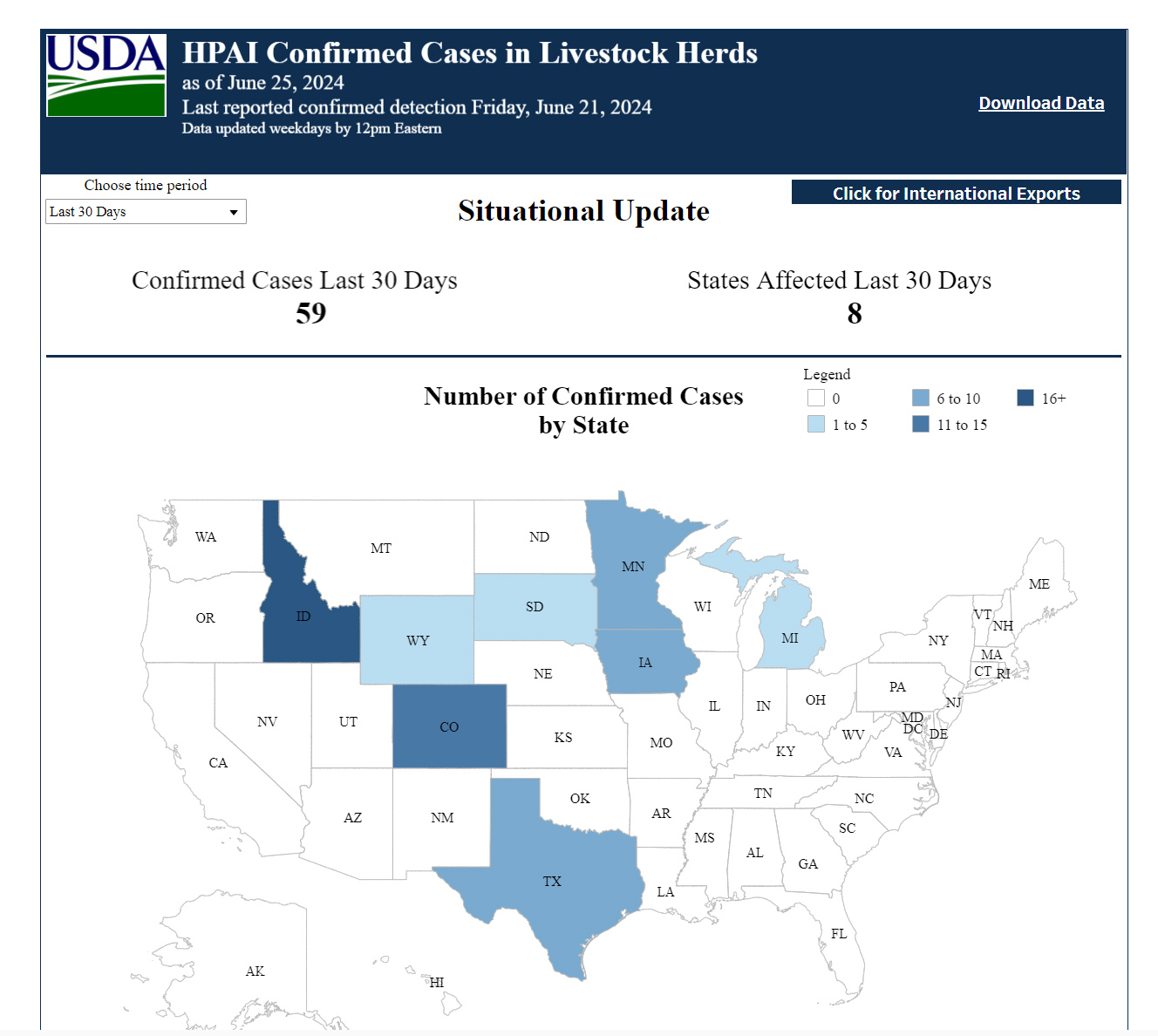
WASHINGTON – While 30-day detections of ‘bird flu’ in dairy have dropped to 59 herds in just 8 states (down from 116 in 12 states cumulatively), two epidemiologic studies published recently shed more light on dairy biosecurity risks.
Nationally, epidemiologic data were available for slightly more than half of the dairy herd premises affected by highly pathogenic avian influenza (HPAI), known as Bovine Influenza A / H5N1 in dairy cattle. These data reveal linkages reported June 8th in a National Brief, which reported “no genomic or epidemiologic evidence that wild birds are spreading H5N1 to cattle, but it cannot be ruled out.”
In fact, the key takeaway is that H5N1 spread in dairy cows — between states — is linked to cattle movements, not to independent wild bird introductions, with further local spread between dairy farms occurring in some states.
A similar epidemiologic investigation looked at Michigan data, alone. Published June 13, this report also showed that migratory waterfowl were not culprits in independently spreading H5N1 to cattle in Michigan.
Both Briefs note the disease spread between dairy cattle herds is likely multi-faceted with both direct and indirect transmission. Biosecurity remains the key to mitigation.
The National Brief reveals more than 20% of farms with HPAI detections in the data set had moved cattle into the herd within 30 days of clinical signs, and 60% of those farms continued to move cattle after the onset of clinical signs.
The linkages revealed by the Michigan report show it began via movement of infected cattle from a Texas herd, before H5N1 had been detected in that herd. It is then believed to have spread to other herds through cattle movement and other direct and indirect transmission.
Other linkages were discussed, such as visitors, shared vehicles and equipment and shared workers. (Fig. 4 below)

Employees working at more than one dairy farm or working at both dairy and poultry farms, and employees from one dairy or poultry farm sharing housing with employees working on a different dairy or poultry farm have also been noted in the epidemiologic linkages.
Operations sharing equipment and livestock trailers (62% of affected premises) have also been implicated in disease transmission as only 12% of those operations reported cleaning trailers between uses.
The National Brief reports more than 20% of the affected dairies have chickens or poultry present with nearly all of those farms observing sick or dead poultry.
In the national investigation, researchers report that more than 80% of affected farms have cats present, with over 50% of these farms observing sick or dead cats. However, the Brief provided no data — one way or the other — on whether the HPAI H5N1 genotype B3.13 was detected in cats on these premises.
The Michigan study, on the other hand, confirmed the HPAI H5N1 genotype B3.13 in wildlife and other somewhat domestic species on affected dairies.
Despite collecting a large number of samples from wild birds and animals on these dairies (such as cats, racoons, opossums, foxes, pigeons and starling), the number of individual animals and species detected was small. Whether they were affected by their access to cattle or are fomites in transmission to cattle is hard to say, particularly since the large sampling yielded only a small number of confirmed findings in comparison to the larger numbers of cows confirmed on these affected farms.
Both Briefs indicate risk from manure appears to be low, but more research is needed.
-30-
 Ag Moos