Feb. 16, 2024 Milk Market Moos in Farmshine: SHRINKFLATING DAIRY — steep loss of dairy farms, down 40%, and much, much more

By Sherry Bunting, Farmshine Weekly Column

Carrot… and stick?

Opening the Feb. 14th House Ag Committee hearing with USDA Secretary Tom Vilsack, Committee Chairman G.T. Thompson of Pennsylvania said the clear message he has heard as he has traveled across the country on farm bill listening sessions is that, “Agriculture needs government to work for them, not against them.”

Vilsack was pressed at least 8 times by 8 different members of the Committee for clarity and details on the Climate Smart deal. Representatives wanted an update on how the billions of dollars in Inflation Reduction Act (IRA) funds for conservation programs and Climate Smart Partnerships are making it directly to farmers.

Rep. Mary Miller of Illinois went so far to say the climate cult is a scam and pointed to what is happening in Europe, airing her concerns about incentives for solar panels on good farmland pricing farms out of rented acres. She expressed concern about getting farmers reliant on “environmental payments” instead of a food system that allows farms to succeed producing food, and she wondered about being beholden to the global climate-cult, which means (I’m paraphrasing) she is concerned about the stick that follows the climate-smart carrot.

While the purpose of these conservation and Climate-Smart IRA funds, said Vilsack, is to ‘get money to farmers,’ his update acknowledged that, “There’s a lot of work to do. We’re assisting and guiding (farmers) into participating,” he said.

“We’ve increased the number of people working at NRCS (1500 new hires, total 4000 new hires planned). We’ve entered into cooperative agreements so we have a broader reach (hire estimated 3000 technical staff through conservation partners), so that those who might not be able to understand that they qualify for the program are finding out,” Vilsack explained, noting that this is necessary in order to actually implement the Inflation Reduction Act.

(Translation: Money hasn’t gone directly to farmers so much as it has gone to program infrastructure, such as more USDA staff, partnership staff, and developing the herding routines to get farmers ‘guided’ on board for Climate Smart data collection and monitoring. In contrast, the IRA funds going to traditional and oversubscribed conservation program EQIP have largely been obligated to farmers at this point.)

“Roughly 85 to 88% of farmers in this country today require off farm income to be able to keep the farm. It’s about people who love what they’re doing and frankly want to do more of it, but they don’t have the income streams to support it, so they have to have an off farm job,” said Vilsack, defending the deal.

“To me, the key here is to create opportunities for that farm to generate more revenue,” he added.

Rep. Marie Gluesenkamp Perez of Washington State made the point that, “Farmers should not have to rely on value added ventures to survive, like agro-tourism or solar panel installations. These are ventures in their own right and should not be necessary for farmers to continue and pass on their farms to the next generation,” she said.

Rep. Doug LaMalfa of California pushed the point that farmers like the traditional conservation programs, like EQIP, but the IRA-funded Climate-Smart Partnerships deal for “tying up carbon is going to require them to jump through hoops,” he said, noting that no-till and cover crops aren’t possible on some types of farms, like rice production.

Vilsack countered: “It’s voluntary. It gives us the opportunity to figure out what works and what doesn’t work, and it doesn’t necessarily put people at a competitive disadvantage.”

He maintains that these projects “do not require farms to go through hoops and in some cases, it’s actually paying them for what they’re already doing.

“The idea here is to measure, monitor and verify the results so that we know what works and what doesn’t work, so that we don’t invest in what doesn’t work,” said Vilsack.

Congresswoman Abigail Spanberger of Virginia gave the example of a farmer in her district doing no-till and cover crops. Vilsack nodded and replied: “There is an opportunity, potentially, for that farm to qualify for ecosystem market payments. So, now, instead of just a crop, they’re going to get an environmental payment.”

That’s the carrot, where are they hiding the stick?

40% decline and a loss of 15,866 dairy farms in 5 years.

The number of dairy farms in the U.S. declined by 40%. That’s 4 in 10 dairies lost over 5 years. The 2022 Census of Agriculture Report released Tues., Feb. 13 held a bit of a surprise not seen on available summaries. Clicking through the ‘quick stats’, we learn that the number of dairy farms with milk sales on December 31, 2022 totaled 24,082, and the number of farms with milk sales but no milk cows or calves in inventory at the end of 2022 was 388 for a total 24,470 dairy farms with milk sales in the U.S. at the end of 2022.

It’s also 3,462 fewer dairy farms than the 27,932 licensed dairies reported as an average number for 2022 last February as part of the January 2023 milk production report.

(Note: The 2023 annual average dairy data that was included in the January 2024 Monthly Milk Production Report Feb. 21 pegged the average number of licensed dairies in the U.S. in 2023 at 26,290, down 6% from the annual report filed for 2022. The Census and NASS Milk Production Reports count some types of multi-site dairies under the same ownership differently. By the way, USDA revised the entire 2023 year of production lower yet for the fourth time, now revising 11 of the 12 months of prior data reported for milk production, cattle numbers, and output per cow. We questioned the figures all last year, asking where the cattle were coming from, pointing to cattle inventory numbers on heifer replacements a year ago indicating a shortage of freshening 2-year-olds, etc., and pointing to the substantial increase in Whole Milk Powder Imports into the U.S. and other factors USDA may have left unaccounted for in prior estimations.)

In Pennsylvania, dairy farm numbers declined from 6,914 on Dec. 31, 2017 to 4,027 on Dec. 31, 2022, that’s a 42% decline over 5 years. It’s also 973 short of the average number of licensed dairies reported by USDA NASS for the 2022 year.

The 2022 Census of Ag also shows that of the 24,470 farms with milk sales, 3,439 accounted for 59% of milk sales and 1012 accounted for 46%. This compares with the 2017 Census, which reported 3819 farms accounted for 55% of milk sales and 793 farms accounted for 43%.

We will dig into the national and state by state 2022 Census data relative to dairy in a future report.

In agriculture, overall, the 2022 Census of Ag shows a loss of 142,000 farms (down 7%) and a loss 20 million farm acres (down 3%) in the past 5 years.

Between 2017 and 2022, the number of U.S. agricultural producers held steady at 3.4 million, while the number of farms continued to decline at 1.9 million covering 880.1 million acres that generated food, fiber and fuel. Average age of farmers was up at 58 years. But the number of beginning farmers (over 1 million), increased also, according to the Report.

The number of small and mid-sized farms across all commodities declined between 2017 and 2022. Large (sales $1-5 million) and very large farms (sales of $5 million or more) increased in number. The 105,384 farms in those top two categories (sales of $1 million or more) represented fewer than 6% of all U.S. farms and sold more than 75% of all agricultural products. The largest farming operations and a small number of states accounted for the majority of agricultural production and sales.

The overall value of agricultural production and income increased between 2017 and 2022, according to the Ag Census. 2022 was a high year in agricultural price cycles, and government payments were still part of the economic calculus through prior CFAP and Pandemic Assistance. Milk made it into the top 5 commodities (at No. 5). Combined, the top 5 — accounted for two-thirds of the value of all agricultural production.

The value of crop production was $281 billion, up 45% in 2022 vs. 2017, while the value of livestock production (including dairy) was $262 billion, up 35% over the same period.

Shrinkflation this, shrinkflation that

The January Consumer Price Index (CPI) released Tues., Feb. 13 increased 0.3% on a seasonally adjusted basis. Over the last 12 months, the all items index increased 3.1% before seasonal adjustment. The food index, up 0.4% in January, increased 2.6% over the last 12 months. The food at home index was up 0.4% in January, and up 1.2% over 12 months, while the food away from home index rose 0.5% over the month and 5.1% over 12 months. The dairy and related products index is up 0.2% in January, down 1.1% over 12 months.

In contrast, the energy index fell 0.9% over the month, down 4.6% on the year due mainly to the decline in the gasoline index.

The Biden Administration announced intentions to investigate supermarkets for over-charging as the food index has not followed energy lower. What further complicates the food inflation indexes is that food commodities like milk and eggs have moderated while processed consumer packaged goods continue to inflate.

Another ripple is captured in the new term coined by food, ag, and business analysts — “shrinkflation” — meaning smaller packages, same price.

For farmers, shrinkflation is a good way to describe what is happening to milk margins. Yes the central feed and energy costs are moderating, but many other fixed and adjustable costs — from interest rates and insurance to supplies and services — continue to move higher, shrinkflating profit margins.

Meanwhile, the Census of Ag data showed big gains for farm revenue and net income in 2022 vs. 2017, but this unique comparison does not factor in the margin-squeeze in 2023, nor the impact of losing the last of the CFAP and Covid pandemic assistance payments that were still trickling into 2022.

In the dairy sector, the milk markets send mixed messages as the Class IV milk price sits $4 above Class III, with cheese being the market dog for the past 12 months. Yet milk is not moving from Class III manufacturing (cheese/whey) to Class IV (butter/powder). Why? New Class III manufacturing capacity has come online and will continue, needing to run full to turn a profit.

At the recent Pennsylvania Dairy Summit in a presentation about navigating the future, Phil Plourde of Ever.Ag highlighted the critical importance of exports to the industry. “Export or perish!” he said, focusing the admonition on the opportunities to export more cheese, including mozzarella.

IDFA CEO Michael Dykes in a presentation in January, issued the challenge to producers to fill the production gap that $7 billion in planned processing investments will bring online in the next three to five years.

Meanwhile, U.S. dairy farmers are seeing price pressure from a buildup of cheese via lackluster exports suffering from what are seen as inadequate trade policies and lack of new trade agreements.

Reflecting on the recently concluded FMMO hearing of 21 milk pricing proposals — some of which seek to reduce regulated minimum milk prices — we see processors are focused on a shrinkflated milk pricing system, shrink prices and inflate capacity because growth has got to happen.

They say USDA sets the regulated minimum prices too high, which must be reduced to ‘market clearing’ levels so they can have the freedom and band width to then be able to pay market premiums to their farmers.

On the eve of the Pennsylvania Dairy Summit Feb. 6, Cornell economist Dr. Chris Wolf talked about the recent FMMO hearing, noting that, “Regulated minimum prices are the whole deal right now. Premiums are gone.”
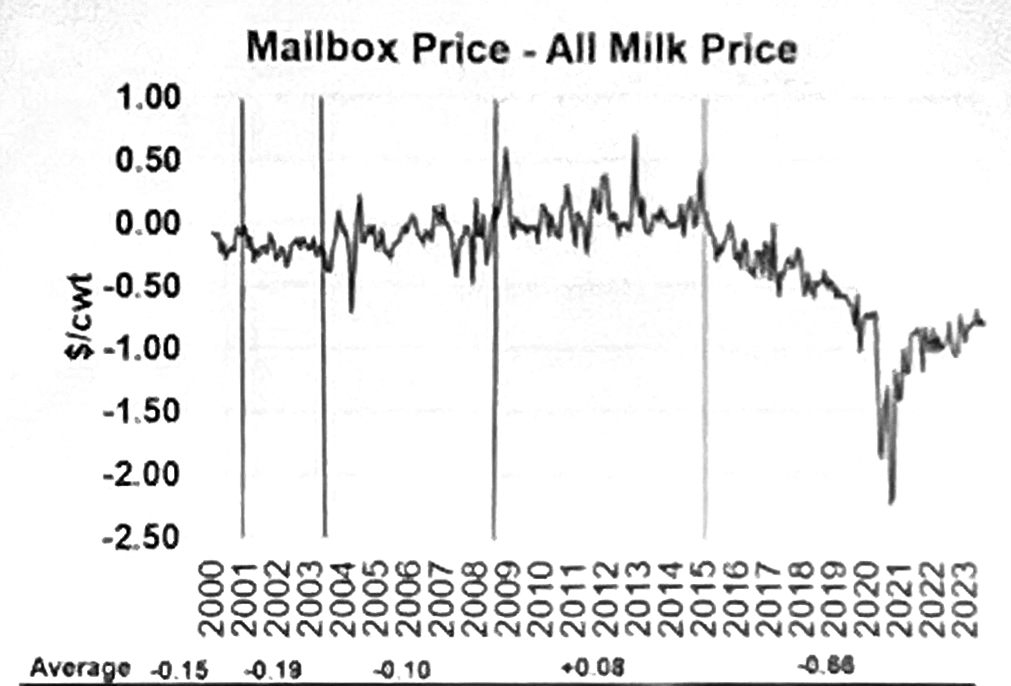
He showed charts tracking the difference between the All Milk price and Mailbox price (above), progressively negative since 2015, reflecting higher transportation costs and evaporation of over-order premiums, not to mention milk check assessments, marketing adjustments, balancing fees.

If regulated minimum prices are reduced, will processors voluntarily fill that gap by paying more premiums so producers have the financial wherewithal to fill the production gap?

Things are pretty bad for farmers right now in the milk markets that are based on cheese, where capacity has ramped up in the Central U.S., and where tough discussions are being had around kitchen tables about operating margins and the future.

Milk futures move lower

Milk futures were unevenly lower this week, with most of the downward pressure on first-half 2024 contracts for both Class III and IV milk. The spread between Class III and IV milk — according to this week’s CME futures markets continues to be range between $2.20 and $4.00 per cwt in every single month of 2024, well above the $1.48 mark where the ‘averaging’ formula is a loser for orderly marketing compared with the ‘higher of.’ On the close Wed., Feb. 14, Class III milk futures for the next 12 months averaged $17.91, down 10 cents from the previous Wednesday. Class IV milk contracts average was $20.57 — down 7 cents.

Back on the see-saw

The daily CME spot market for dairy products was mixed and mostly lower this week, except dry whey was higher and barrel cheese fully steady. Spot butter was pegged at $2.7175/lb, down a nickel from a week ago with zero loads trading. Grade A nonfat dry milk was $1.18/lb, down 4 cents with a single load changing hands. On the Class III side, 40-lb block Cheddar gave up 7 cents in Wednesday’s session, alone, when declining bids with no trades left the spot price pegged at $1.5150/lb, down 11 cents from the previous week. Barrel trade had moved higher earlier in the week, but a 2-penny loss Wednesday left the spot price firm on the week at $1.5750/lb with 2 loads trading. Dry whey at 52 cents/lb was 3 cents higher than a week ago with no trades.

-30-

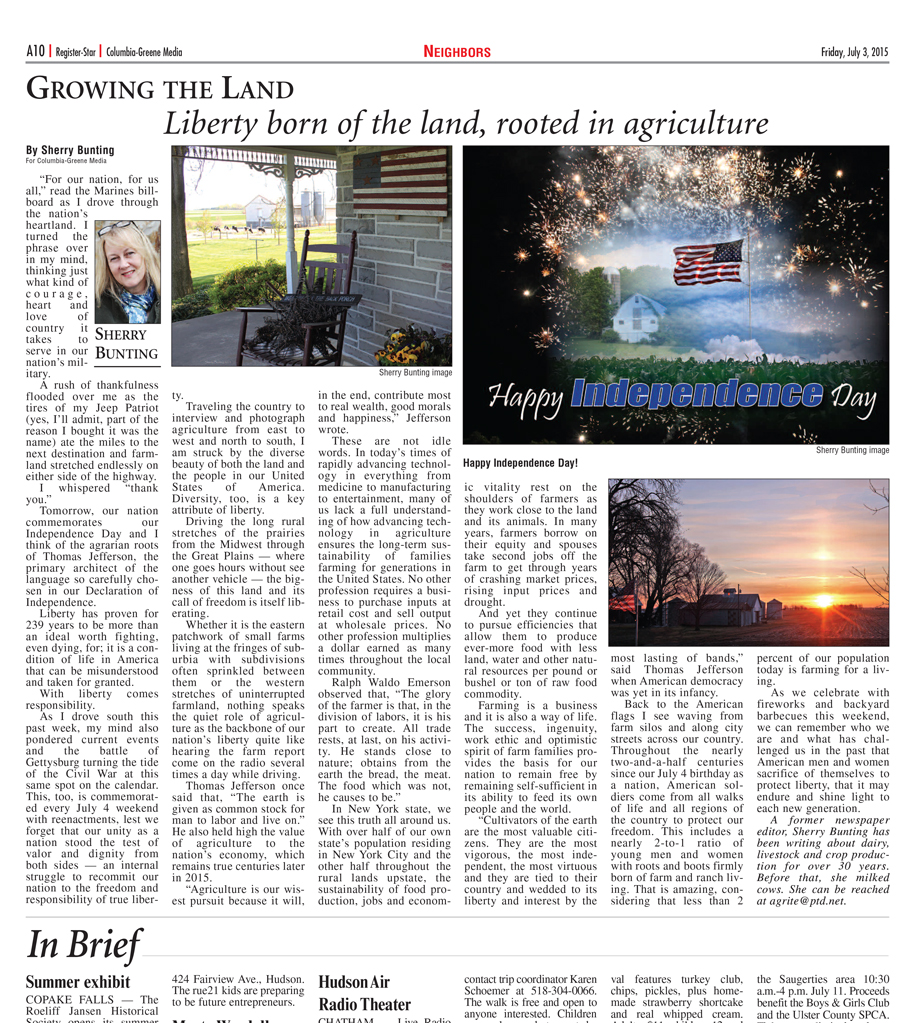
Liberty born of the land, rooted in agriculture

By Sherry Bunting (Growing the Land in July 3, 2015 Register-Star)

“For our nation, for us all,” read the Marines billboard as I drove through the nation’s heartland. I turned the phrase over in my mind, thinking just what kind of courage, heart, and love of country it takes to serve in our nation’s military.

A rush of thankfulness flooded over me as the tires of my Jeep Patriot (yes, I’ll admit, part west-texas-sunsetof the reason I bought it was the name) ate the miles to the next destination,
and farmland stretched endlessly on either side of the highway.

I whispered ‘thank you.’

Tomorrow, our nation commemorates our Independence Day, and I think of the agraweb063A8492rian roots of Thomas Jefferson, the primary architect of the language so carefully chosen in our Declaration of Independence.

Liberty has proven for 239 years to be more than an ideal worth fighting — even dying — for, it is a condition of life in America that can be misunderstood and taken for granted.

With liberty, comes responsibility.WestPA7331

As I drove South this past week, my mind also pondered current events and the battle of Gettysburg turning the tide of the Civil War at this same spot on the calendar. This too is commemorated every July 4th weekend with re-enactments, lest we forget that our unity as a nation stood the test of valor and dignity from both sides — an internal struggle to recommit our nation to the freedom and responsibility of true liberty.063A1117xx

Traveling the country to interview and photograph agriculture from East to West and North to South, I am struck by the diverse beauty of both the land and the people in our United States of America. Diversity, too, is a key attribute of liberty.

Roundup7357x

Driving the long rural stretches of the prairies from the Midwest through the Great Plains — where one can go hours without see another vehicle — the bigness of this land and its call of freedom is, itself, liberating.

Whether it is the eastern patchwork of small farms living at the fringes of suburbia with subdivisions often sprinkled between them or the King6373western stretches of uninterrupted farmland — nothing speaks the quiet role of agriculture as the backbone of our nation’s liberty quite like hearing the farm report come on the radio several times a day while driving.

wElmFarms(IL)9570

Thomas Jefferson once said that, “The earth is given as common stock for man to labor and live on.” He also held high the value of agriculture to the nation’s economy, which remains true centuries later in 2015.

“Agriculture is our wisest pursuit because it will, in the end, contribute most to real wealth, good morals and happiness,” Jefferson wrote.

wfinke9634

These are not idle words. In today’s times of rapidly advancing technology in everything from medicine to manufacturing to entertainment, many of us lack a full understanding of how advancing technology in agriculture ensures the long term sustainability of families farming for generations in the U.S. No other profession requires a business to purchase inputs at retail cost and sell output at wholesale prices. No other profession multiplies a dollar earned as many times throughout the local community.

063A6426xxx

Ralph Waldo Emerson observed: “The glory of the farmer is that, in the division of labors, it is his part to create. All trade rests, at last, on his activity. He stands close to nature; obtains from the earth the bread, the meat. The food which was not, he causes to be.”

In the East, we see this truth all around us. With over half of the New York State population residing in New York City and the other half throughout the rural lands upstate, the sustainability of food production, jobs and economic vitality rest on the shoulders of farmers as they work close to the land and its animals. In many years, farmers borrow on their equity and spouses take second jobs off the farm to get through years of crashing market prices, rising input prices and drought.

chitt-alto-

And yet, they continue to pursue efficiencies that allow them to produce ever-more food with less land, water and other natural resources per pound or bushel or ton of raw food commodity.

ElmFarms9596xx

Farming is a business, and it is also a way of life. The success, ingenuity, work ethic and optimistic spirit of farm families provides the basis for our nation to remain free by remaining self-sufficient in its ability to feed its own people and the world.

“Cultivators of the earth are the most valuable citizens. They are the most vigorous, the most independent, the most virtuous and they are tied to their country and wedded to its liberty and interest by the most lasting of bands,” said Thomas Jefferson when American democracy was yet in its infancy.

flag5

Back to the American flags I see waving from farm silos and along city streets across our country…  Throughout the nearly two-and-a-half centuries since our July 4th birthday as a nation, American soldiers come from all walks of life and all regions of the country to protect our freedom. This includes a nearly 2-to-1 ratio of young men and women with roots and boots firmly born of farm and ranch living. That is amazing, considering that less than two percent of our population today is farming for a living.

flage

As we celebrate with fireworks and backyard barbecues this weekend, we can remember who we are and what has challenged us in the past that American men and women sacrifice of themselves to protect liberty, that it may endure and shine light to each new generation.

A former newspaper editor, Sherry Bunting has been writing about dairy, livestock and crop production for over 30 years. Before that, she milked cows. She can be reached at agrite@ptd.net.

cropped-cropped-flag-4323.jpg
-30-

RegisterStar070315web

PHOTO CAPTION: Happy Independence Day! Sherry Bunting image.

How dairy farmers dealt with ‘Polar Vortex’

By Sherry Bunting, Farmshine, January 10, 2014

BROWNSTOWN, Pa. — While some of the photos posted by dairy farmers on their farm Facebook pages and Twitter were downright beautiful, others spoke volumes about the extreme challenges and dedication put forth to care for animals on farms this week during what is being called the “polar vortex.”

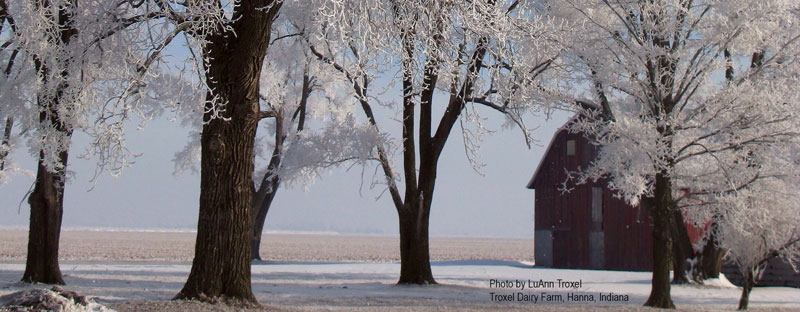
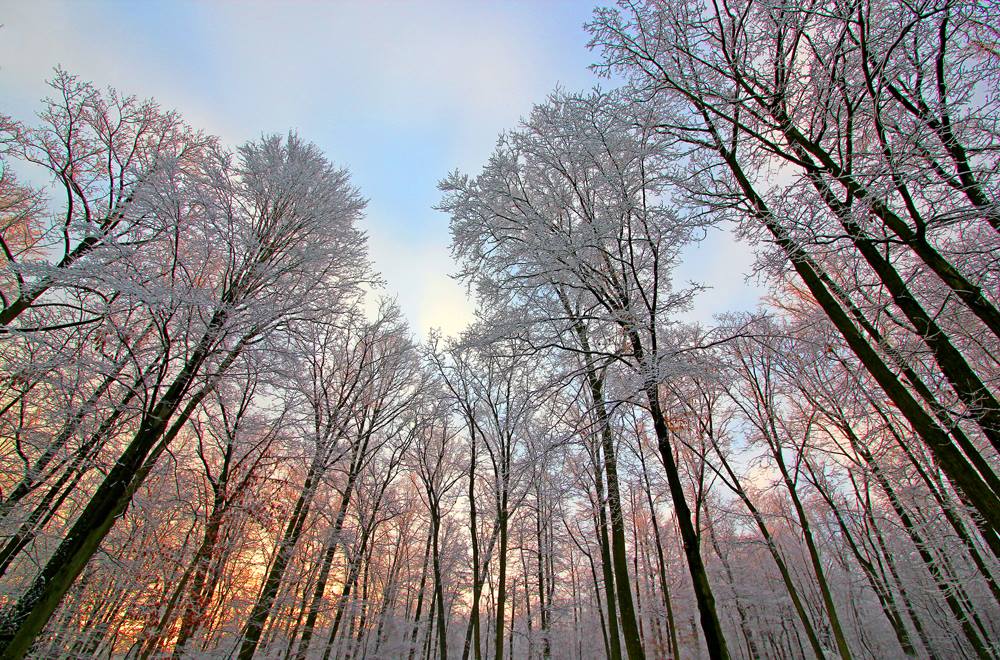
LuAnn Troxel captured this beautiful image at Troxel Dairy Farm. Behind the beauty was more snow and extreme temps.

LuAnn Troxel captured this beautiful image at Troxel Dairy Farm. Behind the beauty was more snow and extreme temps.

The extreme temperatures Tuesday and Wednesday were the talk of both the Pennsylvania Farm Show in Harrisburg and of farmers who were able to get away and attend the Keystone Farm Show in York, Pa. this week.

Frozen waterers, vacuum pumps, manure removal equipment and difficulty starting feeding equipment were the most commonly reported concerns shared by producers from New York, Pennsylvania, Maryland and Virginia who were able to get to the show in York.

Further North and West into the lake regions of the Upper Midwest, through Northern Indiana and Ohio into western New York and Northwest Pennsylvania, the “polar vortex” was amplified by the snow storm preceding it.

Thankfully, by the time you read this, warmer temperatures are forecast to prevail and bring relief to cattle and caretakers as well as equipment and transportation.

The mantra this week for farm families was to not only take care of their animals but to communicate what they were doing with their farm and non-farm “followers” on Facebook,

“There are no ‘snow days’ on the farm,” wrote Tricia Adams at her family’s Hoffman Farms page on Facebook. Three generations of the Hoffmans milk 700 cows near Shinglehouse, Potter County, Pennsylvania.

3 generations of the Hoffman family operate the 700-cow dairy.

3 generations of the Hoffman family operate the 700-cow dairy.

“The extreme weather makes us feel like we are surviving it and not thriving in it!” she said in an email interview Wednesday, reporting Tuesday’s low at Hoffman Farms was -18 with a high of -4. The mercury fi nally reaching a high of 12 degrees Wednesday. They are thankful to be spared the additional 3-feet of snow that fell just north of them in New York.

As for the polar temps and wind chills, “we run a heater in the parlor to help with frozen milkers but even that was icing up,” said Tricia, adding that the conditions for the cows in the freestall barns were “very slippery.”

The Hoffmans, like other farmers dealing with these conditions, did their best to cope with frozen, caked manure in the walkways, barns and parlor — not to mention frozen waterers, feed mixers and tractors freezing up as the off-road diesel gummed up.

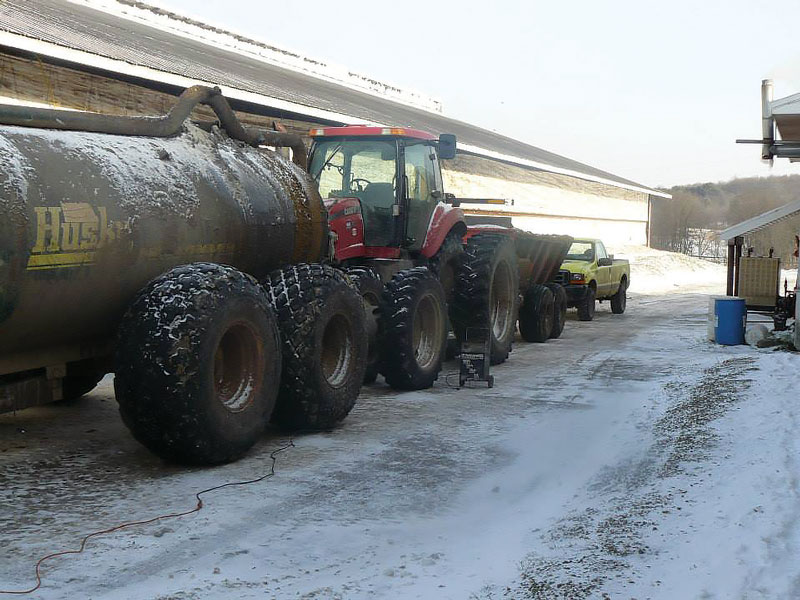
Starting equipment and dealing with manure were difficult in double-digit below zero weather, not to mention the wind chill.

Starting equipment and dealing with manure were difficult in double-digit below zero weather, not to mention the wind chill.

“We changed fuel fi lters and used additives to thin the fuel and keep our equipment running,” Tricia explained. “Winter is tough, and up here we are prepared for it; but when it gets this extreme, you know there is only so much you can prevent. What you can’t prevent you just have to deal with as it happens.”

Much attention was paid to the especially important job of “tricky calvings.” At Hoffman Farms, Tricia used heated boxes for the newborn calves.

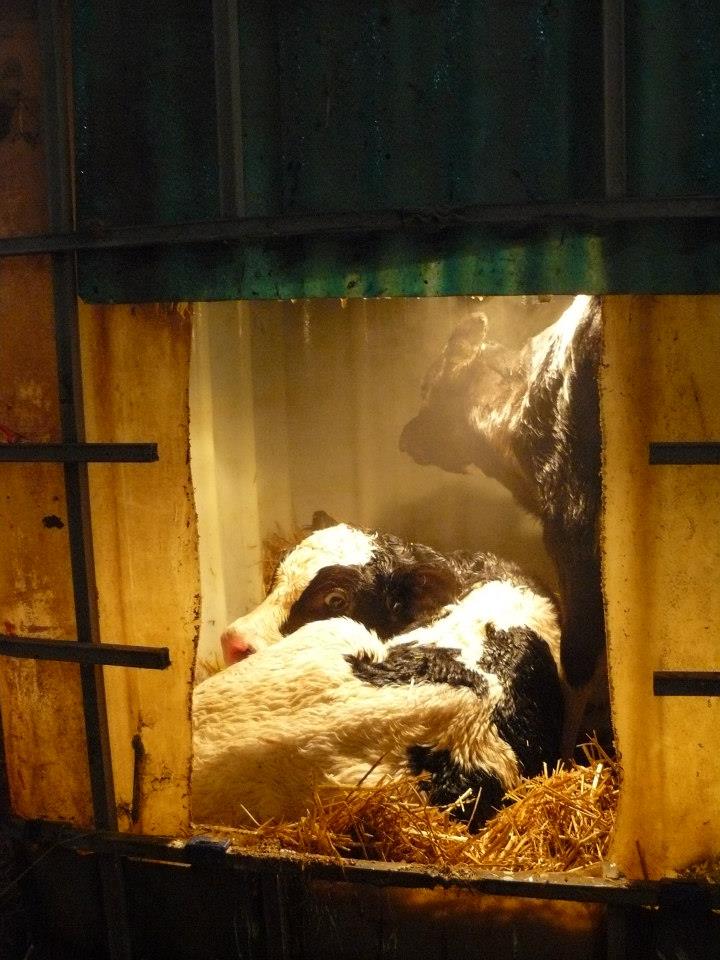
Tricia Adams pictures one of the heated boxes for newborn calves at Hoffman Farms

Tricia Adams pictures one of the heated boxes for newborn calves at Hoffman Farms

Over in Bradford County near Milan, Pa. Glenn and Robin Gorrell were thankful for the 45 degrees and rain over the weekend to melt the snow at their 600-cow dairy before the sub-zero temperatures arrived Tuesday.

Glenn reported temperatures ranging -10 to -20 depending on location in the hills or valleys.

“I think that we were lucky here and we are always happy the rest of our team helps get us through,” said Glenn in an email interview Wednesday.

“The wind was the killer. It can really drive the cold everywhere,” he said, adding that they had frozen pipes in the employee house for the first time ever.

“In the tie-stall barn we were like everybody else: Bowls on the west side were frozen. The milk house froze for the first time in years. We thought we had all the equipment ready with new fi lters and more fuel conditioner, but we were wrong,” he explained. “We needed to cut more with kerosene and put tarps around hoods of the loader tractor and feed mixer.”

The calves and youngstock at Gorrell Dairy got extra bedding and a little more grain to get them by.

“Robin always has calf jackets on them once it is below 50 degrees anyway,” Glenn reported. “We tried to double up feeding our heifers so we would have less equipment to start in the extreme cold.”

At Troxel Dairy Farm Laporte County, near Hanna, Indiana, conditions were quite severe, with extreme low temps in line with what farmers were seeing in northern Wisconsin and Minnesota this week.

Facebook followers commented that the cows must be “milking ice cream” as they read LuAnn Troxel’s posts about dairying in temps that had fallen to -12 and -17 with wind chills as low as -53 in northern Indiana on the heels of over 1-foot of snow.

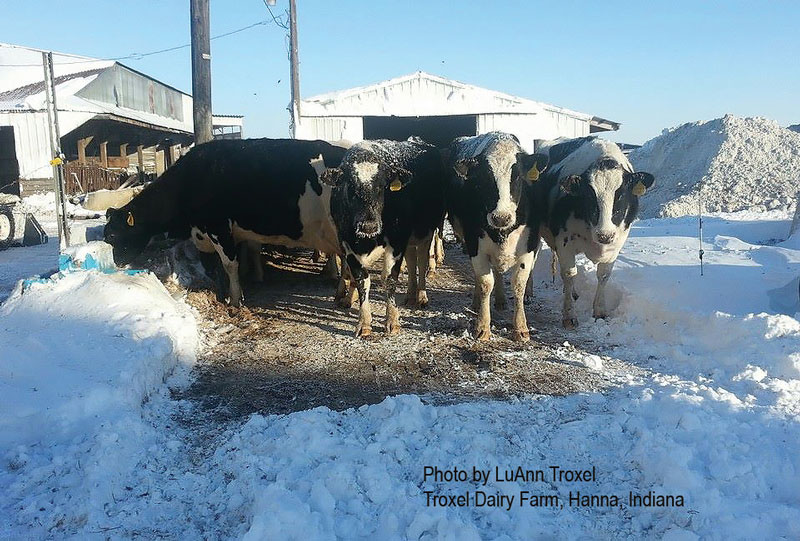
The cows were "good sports" but after three days, the extreme cold wore think on man and beast.

The cows were “good sports” but after three days, the extreme cold wore think on man and beast.

Calling the cows “good sports,” LuAnn acknowledged how tough this week has been for man and beast. She and husband Tom and son Rudy, operate the 100-cow dairy.

“Cold weather management is really not too complicated,” said Tom Troxel, DVM, who in addition to the dairy farm has South County Veterinary practice.

“Cows need to have plenty of feed and water, be out of the wind, and have a dry place to lie down. If they have these things, they can survive an awful lot,” he explained in an email interview Wednesday.

“Calves need the same thing, including increased feed (calories),” Tom advised. “But sometimes the threat of scours keeps feeders from increasing milk to calves. There is no question that cold stress can cause younger animals to be more susceptible to scours and pneumonia, but careful monitoring and feeding electrolytes can help a lot.

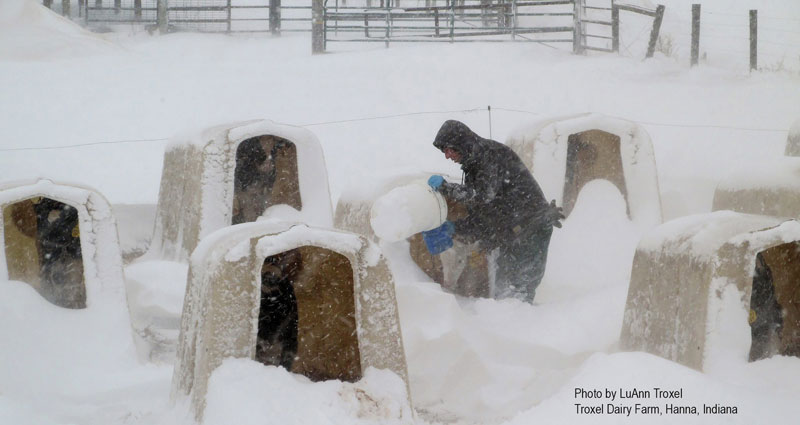
While it's tempting to do the bare minimum when temps are -17 with a -53 wind chill and there's 14 inches of snow on the ground, LuAnn was out feeding her calves at Troxel Dairy farm MORE frequently to keep up their energy reserves. Snow drifts also help insulate and inside the hutches they are cozy warm with fresh bedding.

While it’s tempting to do the bare minimum when temps are -17 with a -53 wind chill and there’s 14 inches of snow on the ground, LuAnn was out feeding her calves at Troxel Dairy farm MORE frequently to keep up their energy reserves. Snow drifts also help insulate and inside the hutches they are cozy warm with fresh bedding.

“It’s more important to increase feed to cold, young calves. Also, try hand feeding starter grain to young calves that are at least 2 days old,” he suggested.

As for cow nutrition during extreme cold, it comes down to “energy, energy, energy,” said dairy consultant Ray Kline, during an interview at the Keystone Farm Show in York, Pa. Wednesday. Ray has retired from the Agri-Basics team of nutritionists but is as passionate as ever about cattle nutrition.

“Feeding calves more often — 3 to 4 times a day — also helps because they do not have a rumen to heat them up,” he observed. “With the cows, the ration can be adjusted for higher energy, but without losing fiber. Cows normally eat more when it is cold, but a more dense ration also helps get more energy to them.”

He suggests picking out the “barometer cows” in the herd and watching them for Body Condition Score to know if ration adjustments to the whole herd are needed. Ray also urged dairymen to pay attention to waterers and keep them running.

“After an event like this, we can see it in the repro,” said Ray. “The cow will take care of herself first; so what she eats will go to maintaining herself through the severe weather.”

The seasoned dairy consultant also noted that “life spins its pattern back to years before.” While the “polar vortex” this week was new for some generations on the farm, others have experienced it before.

“If you look at history, we’ve had winters like this, but you have to go a long way back,” said Ray.

As for the milking equipment and transportation, Gib Martin, general manager of Mount Joy Farmers Cooperative in Pennsylvania noted that milk pickup and transport required more time and labor this week.

“We had some issues with tank compressors and one truck down, but no major interruptions in the flow of milk,” said Gib during an interview at Tuesday.

Ken Weber recommends using a heat lamp to keep compressors going for cooling the milk. Weber is retired from service calls but still works with BouMatic equipment. He suggests paying close attention to vacuum pumps outside.

“They are the last thing the dairyman uses to wash the pipe line and that moisture in there can cause them to freeze up,” he said during an interview at the Keystone Farm Show in York, Pa. Tuesday. “Just take a pipe wrench and work it back and forth to loosen it and consider using supplemental heat like a heat lamp to keep the pump warm.”

snowtrees