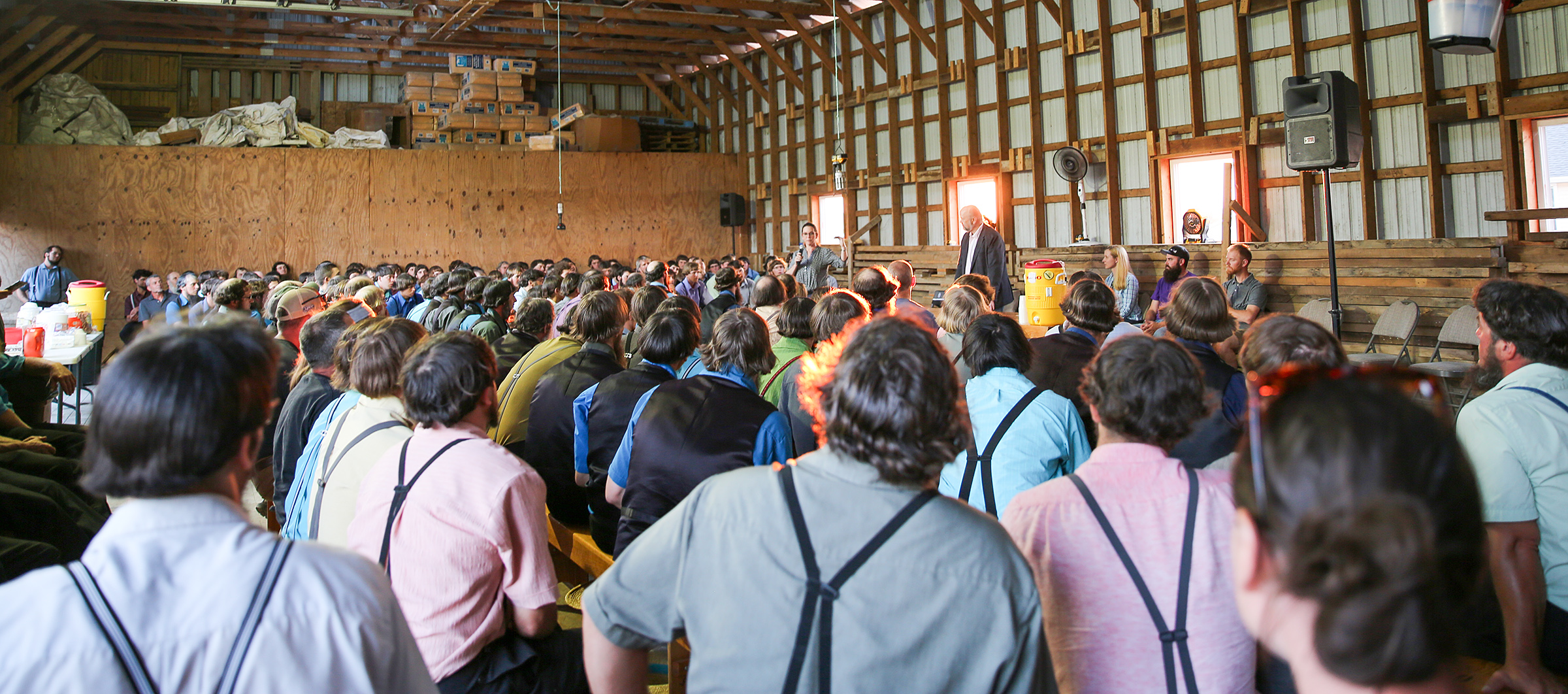
Meeting on case involving ultrasound of livestock draws 300, mainly Amish

On the evening of June 13th, 300 people, mainly Amish dairy farmers and business owners with horses, came to a farm near Quarryville, Pennsylvania to hear from and show support for Rusty Herr and Ethan Wentworth (far front right and second from right). Their attorney Robert Barnes (standing), spoke about the case and their quest to get clarity on the law. Also speaking briefly (standing left) was Pennsylvania State Representative Wendy Fink of York County. Photo by Sherry Bunting

By Sherry Bunting

QUARRYVILLE, Pa. — It was a clear, balmy evening that farmers could have spent in field work, but over 300 people arrived by buggy, van, and on foot to hear from two men and their legal team at 7 p.m. Thursday, June 13 on an Amish dairy farm in southern Lancaster County, Pennsylvania. (Click here to read author’s analysis/opinion)

The meeting came just one month after Rusty Herr and Ethan Wentworth were released from prison, having served the 30 days on contempt charges for failing to provide names, addresses, and records as part of a 2021 subpoena from the Bureau of Professional and Occupational Affairs (BPOA) on behalf of the State Veterinary Board.

The 2021 subpoena was set in motion by a 2020 petition from the Pennsylvania Veterinary Medical Association targeting Rusty and Ethan for continuing to perform veterinary practice without a license by ultrasounding livestock.

The majority of attendees were from the Amish community, half of them dairy farmers, and half business owners, tradesmen, who have horses. A sprinkling of non-Amish farmers were also in attendance. 

One could hear a pin drop while Rusty and Ethan talked separately of their time in prison, highlighting what the prayers and support of family, friends, colleagues, and customers have meant to them and crediting their team of employees for stepping up in their absence and their wives and families for all they have done and endured.

They talked of how their faith in God grew stronger over those 30 days, and of their steadfast resolve to continue serving this community.

Attorney Robert Barnes of Barnes Law LLP talked about two of the exceptions in Section 32 of the Vet Practice Act of 1974, as amended in 1986: “This Act does not apply to (32. 4) Any person or his or her regular employee or agent while practicing veterinary medicine on his or her own animals… and (32. 7) Any person performing normal husbandry practices on bovine, porcine, caprine, ovine or equine animals or avis.”

Neither ‘agent’ nor ‘normal husbandry practices’ are defined in the list of terms in the Act’s introduction.

According to Webster’s the definition of ‘husbandry’ is “the care, cultivation, and breeding of crops and animals,” and the definition of ‘agent’ is “a person who acts on behalf of another person or group.”

‘Agent’ is actually a legal term used to describe “a person that has been entrusted with important powers or responsibilities that are to be carried out on behalf of another person.”

A legal basis for the term ‘normal husbandry’ is traditionally understood as a combination of the producer’s self-interest (economic sustainability) and duties of humane treatment for the animals on which we depend. The two go hand in hand.

“There is a war on the small farmers around the world. The Amish are caught in the middle. They bring essential value and high-quality food from a farming community that seeks to protect a way of life,” said Barnes, who also represents Amos Miller in the raw milk case brought by the Pennsylvania Department of Agriculture.

Barnes called the April 2024 arrests of Rusty and Ethan an “abuse of power” treating civil contempt as though criminal through incarceration.

He called this an example of using regulatory process to bolster “new and novel interpretations of the law.” Other examples he gave involved access to water, takings of food, and animal welfare interpretations that, according to Barnes, use the court system to create new definitions for ‘normal farming.’

“They pick people who are in an isolated position, where it is hard to afford a legal defense,” he said.

Barnes also spoke of power and control, referring to ‘Big Food’ and ‘Big Pharma.’ He said “corporate interests” want to define normal farming and husbandry as it applies to food distribution and animal care in such a way that small independent farms find it difficult to comply or economically unfeasible to survive in the future.

“People are having more chronic diseases, dying earlier, and living less happy lives, but this (Amish) community is not relying on (the world) for your cultural values. This community is a beacon, and so is your independent food system,” he declared.

One attendee spoke up to say: “We need both. We need our veterinarians, and we need NoBull (breeding management services).”

In light of a shortage of vets and the much smaller number of animals on farms like his, this man wondered how a middle ground can be reached by working together.

Farmers who spoke privately after the meeting echoed the same thought to this reporter. When asked what their vets think of this, they said they can’t even discuss it with their veterinarians for fear of losing their services altogether.

They said they have their vets come regularly for herd check and will even list a cow that may have already been checked timely when the breeder was there.

“Why would I call the vet to check one animal (in between herd checks), when my breeder is already here? Would they even come (timely) for one animal?” a farmer noted, shaking his head.

To protect the farms in this equation, Barnes said clarity in the law is required.

“We want the court to rule on the law… to establish the farmer’s right to do these practices and do them through an employee or ‘agent’, as the law states,” said Barnes. “This is the start of a long process. If they (NoBull) are shut down, who will be next? It’s about the impact this can have to small farmers across the country… and on this community. This is a consequential case.”

Pennsylvania State Representative Wendy Fink (R-94th), covering part of York County, also attended the June 13 meeting. She has been closely following the case and spoke briefly about it, citing the abundance of phone calls that have poured into her office and other legislators’ offices. She said she hopes a similar meeting will be held soon in York County and one in the future with additional State lawmakers.

“Your phone calls are important. Keep doing what you’re doing. We support these two gentlemen. Most people would cower… but these two are putting themselves out there. They’re standing up for you. This starts at our local government, so keep the pressure on to make sure that they are abiding by the laws as they’ve been written,” she said.

-30-

My thoughts on the livestock ultrasounding case in PA: Law needs clarified to find the middle ground

By Sherry Bunting, opinion / analysis

While the nation’s largest dairy farms may have economies of scale, smaller dairies have traditionally had a level playing field in tools available for herd management and husbandry. 

This is changing as the dairy industry continues to evolve and bifurcate.

All sizes of dairies are essential, especially in Pennsylvania, where the average herd size is 94 cows, and the number of dairy farms was 4,940 in 2023, according to USDA — down 67% in the past decade.

To survive and thrive today means honing management and diversifying income. Smaller herds also benefit from a supportive community to be less isolated as part of a collective ‘milk-presence.’

From timely breeding and a focus on longevity to minimize the cost of raising replacement heifers, to the beef-on-dairy trend for income from more valuable calf sales, reproductive efficiency is critical. It is no wonder small dairy farms are looking to keep up in this evolving area of husbandry.

But here’s the problem: The nation’s largest dairies have the ability to employ vet techs, including those placed as employees on large farms by veterinary practices, as well as those training under a farm owner or manager, or who attend a multi-day husbandry school to learn. 

Many articles in dairy trade journals over the past decade tout the increasingly available tool of ultrasound technology in the hands of ‘regulars’ who are on the farm daily, or often, to breed cows and/or manage repro — not only from an economic standpoint to breed timely and avoid wasting semen, costly mistakes, and unnecessary culling decisions, but also to positively impact herd management. In group discussions, herd owners even talk about what tools will improve the ultrasounding capabilities of their employees or provide a more comfortable experience for them.

The recent 30-day incarcerations of NoBull Solutions’ founders Rusty Herr of Christiana and Ethan Wentworth of Airville, Pennsylvania brought to light the bifurcation in how portions of the Pennsylvania Vet Practice Act are interpreted, and how interpretations may impact smaller farms inequitably.

The Department of State’s (DOS) Bureau of Professional and Occupational Affairs (BPOA) explained in an April Farmshine interview that the State Veterinary Board adjudications clarify the law with the authority granted them by the legislature, and the legislature is the body to consult for the Section 32 exceptions.

A debate now brews not just on how ultrasounding in conjunction with breeding service is being interpreted as veterinary practice, but also on the Section 32 exemptions. Where is the middle ground?

Robert Barnes, Esq. of Barnes Law LLP and the 1776 Law Center told farmers at a meeting on June 13 that not only were Rusty and Ethan never named party to a case, but their arrests were also unconstitutional, violated state and federal laws, and the state agencies and Commonwealth Court did not have jurisdiction in the first place.

Beyond that, the legal team wants the law clarified in the courts as Rusty and Ethan are back to work, providing breeding services to owners of dairy cows and horses, largely in the Amish Community.

-30-

Commonwealth Court denies immediate release, unseals docket, Supreme Court appeal next step for Herr, Wentworth

By Sherry Bunting, Farmshine, May 3, 2024

HARRISBURG, Pa.  —   It has been three weeks since Rusty Herr and Ethan Wentworth of NoBull Solutions, LLC were arrested on April 10 and 11 and separately incarcerated in Lancaster and York County Prisons — their respective counties of residence in Pennsylvania.

A motion for immediate release has been heard and denied by the Commonwealth Court of Pennsylvania.

“The Commonwealth Court failed to correct their error, so we are taking the case directly to the Supreme Court,” said Robert Barnes, Esq. in a Farmshine interview after the decision.

Judge Michael Wojcik also unsealed the docket in a separate decision.

He heard oral arguments for the motion filed by Barnes Law LLP on behalf of Herr and Wentworth as well as the answer to this request by the Department of State (DOS) Bureau of Professional and Occupational Affairs (BPOA) on April 29, 2024, at 1:30 p.m. via WebEx video conferencing.

According to the docket 325-MD-2021, the BPOA opposed the motion, stating that on May 16, 2023, the court had adjudicated NoBull Solutions in contempt of a previous order dated Nov. 30, 2021, related to enforcement of an investigative subpoena, with conditions for NoBull to purge its contempt through a monetary civil penalty, and that failure to purge may result in issuance of a warrant for their arrest and incarceration.

NoBull Solutions did not show cause why they should not be held in contempt on Nov. 30, 2021, did not appear or comply, and on May 16, 2023, the enforcement order was made absolute requiring NoBull to “purge its contempt,” including providing the BPOA with the name and address of its custodian of records as well as the names and addresses of all members, managers, and other persons who direct its activities.

“At no point during these proceedings has Mr. Wentworth and Mr. Herr challenged BPOA’s allegations that they are the principal members of NoBull Solutions and are directing its activities or made any attempt to purge the Court’s finding of contempt,” the docket reads.

The bottomline here is that Herr and Wentworth are making a stand for the right to assist farms in reproductive management. Through the 15 phone calls from customers, it’s clear they believe ultrasound makes breeding service more effective and efficient for their small farms that are not in a position to be blessed by the law’s exception for hired employees doing this work on larger farms.

Dairy farmers have continued to call into this reporter, explaining that both men, and NoBull collectively, help them be better managers and learn to do more breeding work on their own, even when it means they are purchasing fewer services from NoBull. 

Fully 12 of the 15 calls to-date affirmed they maintain a relationship and regular herd checks with their licensed veterinarians and gave clear examples of how the use of ultrasound with breeding service through NoBull had minimized their waste of costly semen, improved their knowledge, and provided information they needed for timely breeding and culling decisions made on the farm in between regular herd checks.

At issue for Herr and Wentworth, according to Barnes Law, are the Constitutional rights in the handling of the contempt enforcement. With the docket unsealed, a paper trail – including the state’s request for a default judgment that had been denied in 2021 – have been unsealed. 

The initiation of these previously sealed contempt proceedings began in 2021, 18 months after the 2020 Pennsylvania Veterinary Medical Association complaint that had requested contempt charges be pursued by the DOS, alleging both men as principals in NoBull Solutions LLC were continuing to practice veterinary medicine without a license, continuing to do and direct ultrasounding of livestock in connection with their breeding and reproductive management services. 

At this juncture, it appears that Herr and Wentworth will either have their appeal for immediate release heard by the State Supreme Court or serve out their 30 days, whichever happens first.

Then, the real work may begin. Is there a middle ground for these services in conjunction with breeding? Is the assistance providing a level playing field in a low-margin, highly competitive dairy industry where scale affords some farms the avenues to accomplish these services via employees who are proficient in ultrasound vs. smaller farms paying an independent technician for the same.

Since the Department of State maintained in a prior interview that State Veterinary Board adjudications clarify the law with the authority granted them by the legislature, and that the legislature is the body to consult for the exceptions, there’s much here to wade through from the State Capitol to the Administrative Boards and Offices to the Commonwealth Court.

-30-