Good news may trump bad nutrition policies

Editorial Analysis: Tumultuous 2024 spills over into 2025 – Part One

By Sherry Bunting, Farmshine, January 3, 2025

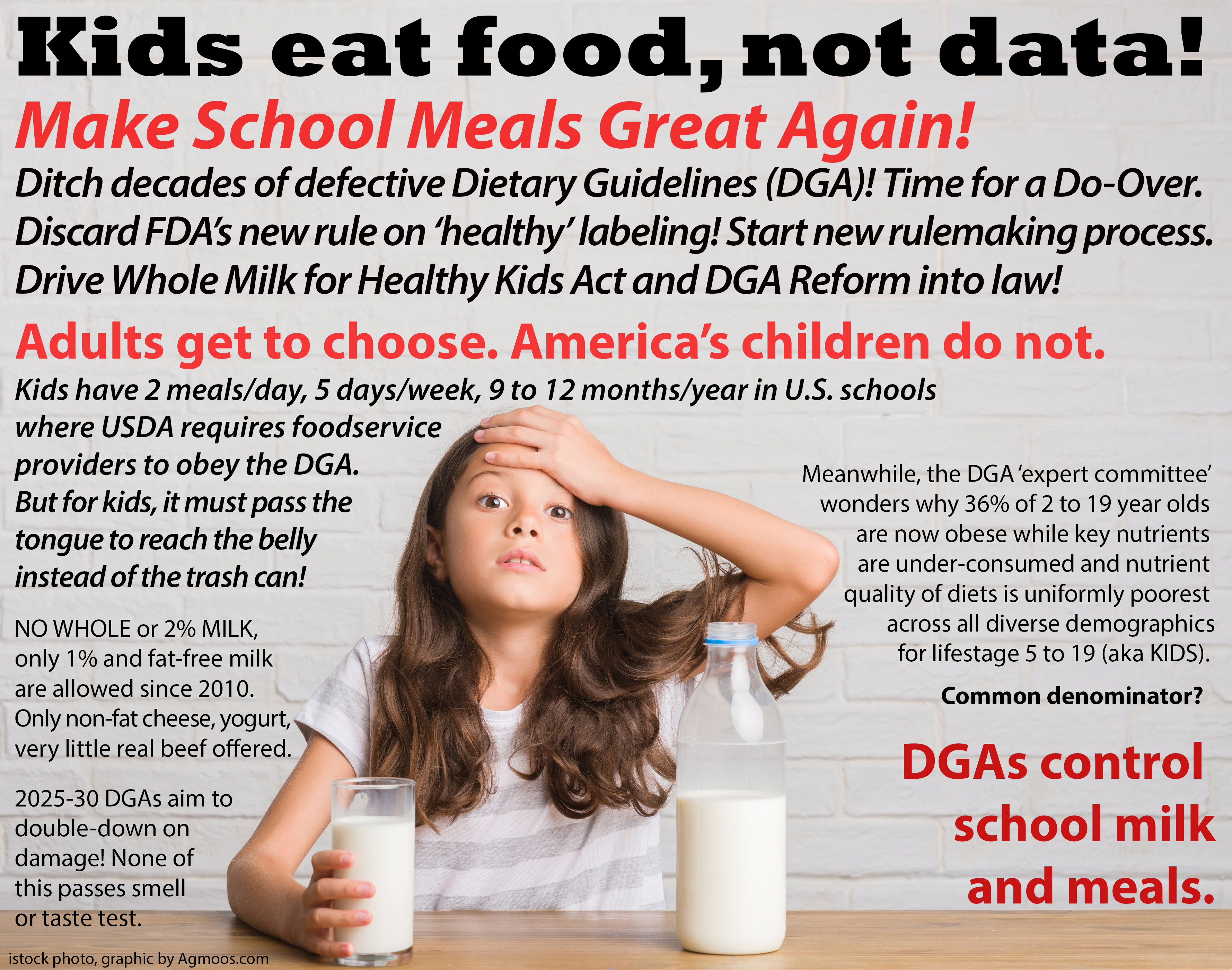
EAST EARL, Pa. – Year 2024 was tumultuous, and 2025 is shaping up to be equally, if not more so. Spilling over from 2024 into 2025 are these three areas of potential for good news to trump bad nutrition policies that are having negative impacts on dairy farmers and consumers.

Farm bill and whole milk bill

Both the farm bill and the whole milk bill showed promise at the start of 2024. No one championed the two pieces of legislation more than House Ag Committee Chairman Glenn ‘GT’ Thompson (R-15th-Pa.). He even found a way to tie them together — on the House side.

The Whole Milk for Healthy Kids Act made it farther than it ever has in the four legislative sessions in which Thompson introduced it over the past 8 to 10 years. It reached the U.S. House floor for the first time! But even the overwhelming bipartisan House vote to approve it 330 to 99 at the end of 2023 was not enough to seal the deal in 2024.

That’s because over in the U.S. Senate, then Ag Committee Chairwoman Debbie Stabenow (D-Mich.) blocked it from consideration — despite over half her committee signing on as cosponsors.

GT Thompson, found a workaround to include it in the House farm bill, which passed his Ag Committee on a bipartisan vote in May. The language was also part of the Senate Republicans’ draft farm bill under Ranking Member John Boozman (R-Ark.)

It too fell victim to Stabenow dragging her feet in the Senate. By the time the Ag Chairwoman released a full-text version of the Senate Democrats’ farm bill, little more than 30 days remained in the 2023-24 legislative session.

Key sticking points were the House focus on dollars for the farm side of the five-year package. It put the extra USDA-approved Thrifty Food Plan funding into the overall baseline for SNAP dollars and brought Inflation Reduction Act climate-smart funds under the farm bill umbrella while removing the methane mandates to allow states and regions to prioritize other conservation goals, like the popular and oversubscribed EQIP program.

Attempts to broker a farm bill deal failed, and on Dec. 20, another one-year extension of the current 2018 farm bill was passed in the continuing resolution that keeps the government funded into the first part of 2025, without amendments for things like whole milk in schools. However, Congress did manage to provide $110 billion of disaster relief for 2022-24 hurricanes, wildfires, and other events. Of this, roughly $25 billion will go to affected farmers and ranchers, plus another $10 billion in economic disaster relief for agriculture.

Looking ahead, there is good news for the farm bill and whole milk bill in the new 2025-26 legislative session. The House Ag Committee will continue under Rep. GT Thompson’s leadership as Chairman. On the Senate side, whole milk friendly Boozman will chair the Ag Committee. With Stabenow retiring, Sen. Amy Klobuchar (D-Minn.) will serve as Ranking Member, and she previously signed on as a Whole Milk for Healthy Kids Act cosponsor in March 2024.

The whole milk bill will have to start over again in the Education and Workforce Committee with another vote on the House floor. It was enthusiastically supported by prior Education Committee Chairwoman Virginia Foxx (R-5th-N.C.). Her years of chairing this committee have expired, but the good news is Rep. Tim Walberg (R-5th-Mich.) will step in, and he was an early cosponsor of the Whole Milk for Healthy Kids Act in the 2021-22 and 2023-24 legislative sessions.

New Dietary Guidelines

The 2025-30 Dietary Guidelines Advisory Committee (DGAC) submitted its ‘Scientific Report’ to the outgoing USDA and HHS Secretaries on Dec. 19, 2024 — just 40 days before they head out the door to be replaced by incoming Trump appointees.

The Report is the guidance of the so-called ‘expert committee’ that reviews evidence and makes recommendations for the Secretaries of USDA and HHS to formalize into the 2025-30 Dietary Guidelines for Americans (DGAs). This process occurs every five years.

The DGAs are used in all USDA feeding programs, including school lunch, childhood daycare, and eldercare institutional feeding, as well as military mess halls. They also inform food offerings in many other controlled settings. 

The bad news is the Report has gone from being increasingly pro-plants over the past nine cycles to being outright anti-animal in this 10th cycle.

The good news is that dairy keeps its special spot on the so-called ‘My Plate.’ The bad news is that despite acknowledging evidence about the benefits of milkfat in nutrient dense milk and dairy foods, the DGAC rated the evidence as ‘limited’ – largely because USDA screened much of it out of the review process.

In the section on under-consumed nutrients of public health concern, especially for children and elders, the DGAC noted that whole and 2% milk were top sources of three of the four: Vit. D, calcium and potassium. Even this was not enough to persuade them to loosen the anti-fat grip that governs milk in schools, daycares and eldercare.

The DGAC states in its Report that their ‘limited access’ to research showing positive relationships between higher fat dairy and health outcomes was “too limited to change the Guidelines.”

They even doubled-down on the beverage category by recommending against flavor-sweetened fat-free and low-fat milk and that water be pushed as the primary beverage. 

In the Report, the DGAC also doubled-down on saturated fat with recommendations to “reduce butter, processed and unprocessed red meat, and dairy for replacement with a wide range of plant-based food sources, including plant-based protein foods, whole grains, vegetables, vegetable (seed) oils and spreads.”

This opens the door for more non-dairy substitutes beyond soy-milk, which is already allowed in the dairy category. In fact, the Report looks ahead to future cycles changing the name of the dairy category to broaden what qualifies as makers of new dairy alternatives improve their nutrition profiles via ultra-processing. At the same time, the DGAC punted the ball on the question they were given about “ultraprocessed” foods and beverages, stating they didn’t have access to enough evidence on health outcomes to answer that question. (The next HHS Secretary might have something to say about that.)

Other animal-based foods such as meat and eggs took a big hit this cycle. The 2025-30 Report uses stronger methods for discouraging consumption. They recommend moving peas, beans and lentils out of the vegetable category and into the protein category and listing them FIRST, followed by nuts and seeds, followed by seafood, then eggs, and lastly meat.

Once again ‘red meat’ is mentioned throughout the report as being lumped in with ‘processed meat’ even though not one stitch of research about negative health relationships with processed meats included any unprocessed red meat in the studies! Clearly, consumption of whole, healthy foods from cattle is in the crosshairs. This 10th edition of the Scientific Report just continues the trend. 

As in past cycles, a whole core of research on the neutral to beneficial relationships between consumption of saturated fat in high-protein, nutrient-dense foods was screened out of the DGAC’s review process by current Ag Secretary Vilsack’s USDA.

This Report essentially sets the stage for ultra-processed plant-based and bioengineered alternative proteins to play a larger role in the institutional meal preps of American schools, daycares, eldercare, and military.

But here’s the good news! The DGAC was late in finishing its 2025-30 Scientific Report!

The law requires a 60-day public comment period before USDA and HHS formulate the actual Guidelines for 2025-30. This mandatory comment period ends Feb. 10, 2025. Comments can be made at the Federal Register link at https://www.regulations.gov/document/HHS-OASH-2024-0017-0001

By the time the comment period ends, Vilsack and company will have left town. Let’s hope Senators confirm Trump appointees before the public comment period ends on Feb. 10 so their eyes are on this before the bureaucracy finishes the job.

This is a golden opportunity for the dairy and livestock sectors, along with health and nutrition professionals and health-conscious citizens to weigh-in. (Look for ways to participate in a future Farmshine.)

Meanwhile, commenters can remind the incoming Secretaries of how flawed the DGA process has become; how Americans, especially children, have become increasingly obese with increasing rates of chronic illness and underconsumption of key fat-soluble nutrients during the decades of the DGA’s increasingly restrictive anti-fat, anti-animal dogma.

Commenters should point out the fact that the Committee was not provided with all of the evidence on saturated fat. This is a message that is likely to land well with USDA Secretary designate Brooke Rollins and HHS Secretary designate Robert F. Kennedy Jr. In fact, RFK Jr. is on record opposing the low-fat dictates and has said nutrition will be among his first priorities, if he is confirmed by the Senate for the HHS post.

FDA’s final rule on ‘healthy’ labeling

In the mad rush at the end of 2024, the FDA released its final rule about using the term “healthy” on the label of foods and beverages.

This process was outlined in the White House National Strategy on Hunger, Nutrition and Health. FDA’s preliminary ‘healthy’ labeling rule was released on Sept. 28, 2022, on the first day of the first White House Nutrition Conference since the 1980s.

At that Conference, Ag Secretary Vilsack said: “The National Strategy’s approach is a whole of government approach that involves the entire federal family.” And President Biden said: “We have to give families a tool to keep them healthy. People need to know what they should be eating, and the FDA is using its authority around healthy labeling so you know what to eat.”

In short, the FDA’s role here is to restrict healthy label claims to foods and beverages that meet its criteria and allow them to also use a new FDA ‘healthy’ symbol that is still under development.

“Nutrient-dense foods that are encouraged by the Dietary Guidelines – vegetables, fruits, whole grains, fat-free and low-fat dairy, lean game meat, seafood, eggs, beans, peas, lentils, nuts, and seeds – with no added ingredients except for water, automatically qualify for the ‘healthy’ claim because of their nutrient profile and positive contribution to an overall healthy diet,” the FDA final rule states.

No surprise that whole milk (3.25% fat) will not qualify, nor will real full fat cheeses, yogurts, and other dairy foods that are not fat-free or low-fat (1%). Natural, unprocessed beef, pork and poultry are off the ‘healthy’ list too.

Specifically, the FDA’s final rule states: “To meet the updated criteria for the ‘healthy’ claim, a food product must: 1) contain a certain amount of food from at least one of the food groups or subgroups (such as fruit, vegetables, grains, fat-free and low-fat dairy and protein foods) as recommended by the Dietary Guidelines for Americans, and 2) meet specific limits for added sugars, saturated fat, and sodium. 

The fat and sodium criteria are a double-whammy against most real dairy cheeses. A single 1-oz slice of American, Swiss, or Cheddar won’t make the cut on saturated fat or sodium; even part-skim Mozzarella is slightly over the limit. Furthermore, low-fat, high-protein cottage cheese barely makes the cut on saturated fat, but far exceeds the new limit on sodium. Likewise, a typical yogurt cup only qualifies if it is low-fat or non-fat, and fruited yogurts must steer clear of added sugars.

Dairy can’t win in this labeling scheme unless products are made with virtually no saturated fat and far less sodium. To sell flavorless cardboard and chalk water that fails to deliver key fat-soluble nutrients, products will undergo more ultra-processing, and Americans will consume more artificial sweeteners.

Under dairy products, FDA’s final rule for ‘healthy’ label claims states: 1) Must contain a minimum of 2/3 cup food group equivalent of dairy, which includes soy; and 2) Each serving must have under 2.5 g of added sugar, under 230 mg sodium, and under 2 g saturated fat.

This means even a serving size of exactly 2/3 cup (6 oz) of 2% milk might barely squeak by, and a full cup (8 oz) of 1% or fat-free milk would be – you guessed it – ‘healthy’. Flavoring the fat-free and low-fat milk will not qualify, except by using artificial sweeteners to stay within added sugar limits.

Under protein foods, the FDA is even more restrictive. The only protein foods listed in the ‘healthy’ labeling final rule are: game meat, seafood, eggs, beans, peas, lentils, seeds, nuts, and soy products. Furthermore, these options must meet the criteria of less than 1 g added sugars, less than 230 mg sodium and less than 1 to 2 g saturated fat.

But here’s the good news! This FDA final rule (21 CFR Part 101, RIN 0910-AI13) falls under the Department of Health and Human Services (HHS). It’s not likely to sit well with HHS Secretary designate RFK Jr. The rule becomes effective Feb. 25, 2025. The compliance date is three years later, so there is hope of requesting HHS initiate a new rulemaking process under new HHS leadership.

Bottom line is all three of these bad nutrition policies impact consumer health and dairy farm economic health and are rooted in the flawed Dietary Guidelines process.

There is good news on that front in Congress as well. House Ag Committee Chairman GT Thompson included DGA reform and oversight in the farm bill that had passed his Committee in the 2023-24 legislative session. It is critical that this issue be part of the new farm bill that moves forward in the 2025-26 legislative session.

Part II in a future Farmshine will look at the tumultuous 2024 dairy markets and margins spilling over into 2025.

-30-
Global Symposium: Milky Way Study reinforces why children should be allowed to choose whole milk

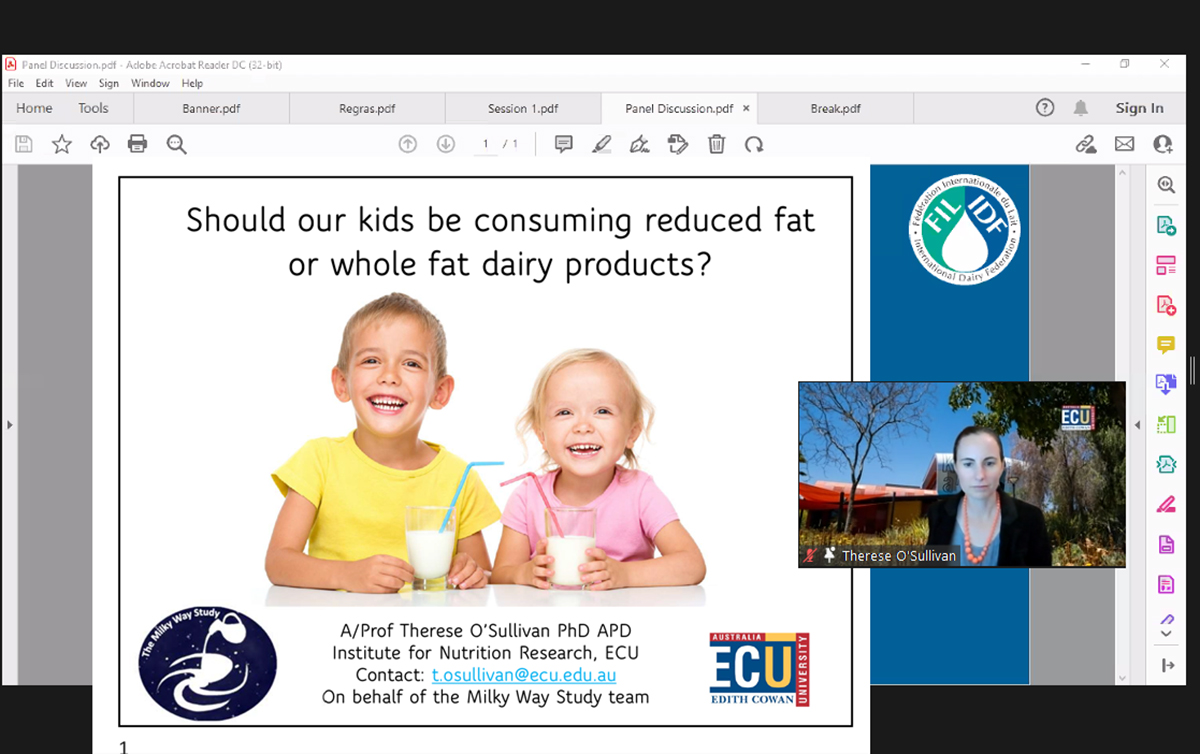
Therese O’Sullivan, professor of nutrition and dietetics at Edith Cowan University in western Australia shared results from the Milky Way Study, answering the question: “Should our children be consuming reduced fat or whole fat dairy products?” The short answer, according to the evidence: “Let them choose!” IDF Symposium screen capture

Other countries are taking note, when will the U.S. get it right?

By Sherry Bunting

BRUSSELS — A new double-blind randomized study of children consuming whole fat vs. low fat milk and dairy reinforces the already accumulated evidence that the choice should be allowed, especially for children, according to Professor Therese O’Sullivan in nutrition and dietetics at the Edith Cowan University in western Australia.

“The Milky Way Study suggests healthy children can safely consume whole fat dairy without concern. Future dietary guidelines can and should recommend either whole or reduced fat dairy,” O’Sullivan confirmed as she presented the study’s results during the Nutrition and Health Symposium organized by the International Dairy Federation in Brussels, Belgium last Thursday (May 12).

The virtual event was attended by over 200 nutrition and health professionals from all over the world. They heard from eight experts and two moderators from various regions of the world, focusing on the role dairy plays across life stages. The first five sessions of the daylong event focused on the role of dairy in maternal diets and for children and teens. The last half focused on aging adults.

The Milky Way Study is deemed the first ‘direct dairy intervention’ study, and it supports the already accumulating evidence that children should be able to choose whole fat milk and dairy as there is no scientific or health reason not to let them choose, O’Sullivan indicated.

The study was costly and time intensive as a double-blind randomized intervention in which the whole fat dairy group consumed more milkfat during the study than their normal consumption had been before the study, and the low fat dairy group consumed less.

Continual testing during the study period showed no statistical differences in key health and nutrition biomarkers except the whole fat milk group’s BMI percentile declined during the study period. This is a key result because this is the first “intervention” study to test “causation” in what the already accumulated evidence shows.

The push by dietary guidelines to limit milkfat in countries like the U.S. and Australia was mentioned during panel discussion in relation to the Milky Way Study, supporting studies, and meta-analysis, with experts noting these guidelines need revisited.

“There is no evidence to suggest that moving to low fat dairy helps,” O’Sullivan said, noting there were no significant differences between the whole fat and low fat study groups when it came to the children’s daily caloric intake, blood pressures, blood cholesterol and lipids, cardiometabolic disease — or any other measure.

However, O’Sullivan did observe a slight trend toward a reduction in BMI (body mass index) percentile in the study group consuming whole fat milk and dairy vs. low-fat milk and dairy.

As the primary researcher on the Milky Way Study, O’Sullivan found it interesting that the daily calorie intakes of both groups were equal, even though the group of children consuming whole fat milk and dairy were getting more calories in their dairy servings because the fat was left in.

“This showed us that as the calories came out of milk in the low fat group, the kids replaced those calories with something else,” O’Sullivan reported.

The sodium intakes were also higher in the low-fat milk group, suggesting the “replacement calories” came from snacks.

O’Sullivan noted that another “very interesting finding was that we didn’t see any improvement in blood lipids in the low fat group that we would expect to see based on the theory of saturated fat increasing lipids,” she said.

Bottom line, she noted: “Whole milk and dairy had a neutral or beneficial effect on cardiovascular (biomarkers) with no difference in lipids, and a small decrease in LDL (bad cholesterol) in the whole fat dairy group.”

She also observed that as the calories came out of the milk in the low fat group, the children were coming up in their consumption of other foods that – depending on their choices — could have an impact on lipid profiles.

(This basically supports the tenet that whole fat milk and dairy is satiating, satisfying, and because it is nutrient dense, children may be less likely to keep ‘searching’ for needed nutrition via salty, sweet and high-carb snacks. The Milky Way study supports what many have long said should be changed in dietary guidelines to increase and make more flexible the saturated fat limits and return the choice of whole fat milk and dairy to schools and daycare centers.)

“High fat dairy foods are not detrimentally affecting adults, children or adolescents,” said O’Sullivan in discussing supporting research and meta-analysis. She noted that her three-month Milky Way Study could be repeated for 12 months for more data, but that it is in line with other evidence.

During the panel discussion, nutrition experts talked about some of the issues in vegan / vegetarian dietary patterns, noting that even when given vitamin and mineral supplements, studies show children and teens could not get their levels where they needed to be in many cases, especially true for B12 and calcium, key nutrients found in milk.

One attendee asked why saturated fats are always ‘the bad guys’ in the dietary guidelines, wondering if there was any associated health risk effect in going from the whole fat to the low fat in the first place.

“Similar to other studies, we saw the kids were good at regulating their food intake to appetite and as we take away the fat, they replace it with something else for the calories to be the same,” O’Sullivan replied. “In one group, they ate more tortillas, in another we noticed sodium intakes went up, suggesting they ate more snack foods (when the fat was removed from the milk and dairy).”

She reminded attendees that there are also other types of fats in milk, including Omega 3 fatty acids.

“Kids do not have much Omega 3 in their diets because they are not as likely to be eating oily fish,” said O’Sullivan. “In the low fat group (in the Milky Way Study), when Omega 3 status went low, they were not replacing it.”

This means the whole fat milk group had an advantage in maintaining Omega 3 status also.

O’Sullivan explained that researchers looked at the membranes of the red blood cells and saw the long chain fats were also down, so if they stayed on that (low fat) diet, and did not have increased Omega somewhere else in the diet, “they may have a health impact down the line.”

An attendee from India noted their government is planning to introduce milk into the supplemental feeding programs for children, with milk programs in schools, beginning with elementary schools.

Increasingly, the global focus is on milk in schools, and this means the type of milk recommended by government dietary guidance is so important.

Attendees also wanted to know “How much saturated fat would be recommended daily for children?”

(In the U.S., schools, daycares and other institutional settings are required to keep calories from saturated fat below 10% of total calories of the meal with the milk included, and of the milk as a competing a la carte beverage, with no attention paid to nutrient density.)

O’Sullivan indicated the answer lies in looking more at the food source of the saturated fat and the level of nutrients accompanying it.

“We need food-focused dietary guidelines,” she said, noting the evidence shows it’s important to change the focus from ‘dietary’ saturated fat ‘levels’ to looking at “the whole food matrix, the overall matrix of the food and the nutrients when the saturated fat is contained in that matrix.”

Good nutrition is key for health and wellbeing throughout life and can help us live our lives to the fullest, said Symposium organizers. They noted that dairy products are nutrient-rich and are a source of protein, B vitamins, iodine, calcium, phosphorus, vitamin A, zinc and potassium – making them an excellent choice for nutritional needs at all ages and stages of life. The unique combination of nutrients and bioactive factors, and how they interact with each other in the dairy matrix, combine to produce the overall effect on health.

In fact, during panel discussion, some noted there is so much emphasis now on maternal nutrition and the first 1000 days of life, whereas not enough attention has been paid to children and teens.

“Intervention is required in the three later phases: middle childhood (5-9 years), when infection and malnutrition constrain growth; adolescent growth spurt (10-14 years) and the adolescent phase of growth, brain maturation and consolidation (15-19 years) if a child is to achieve his full potential as an adult – an important but often overlooked area being the diet”, noted Professor Seema Puri from Delhi University, India.

Professor Lisanne Du Plessis from Stellenbosch University, South Africa explained that food-based dietary guidelines are a key way to provide healthy eating guidance in every life stage. 

However, she said, only a few countries such as South Africa, Kenya and Nigeria have guidelines tailored to the specific nutritional needs of children.

In fact, this was a glaring concern in the Australian and U.S. guidelines — given the emphasis on avoiding milkfat leaving children and teens missing out on the key nutrients if they didn’t consume the required low-fat and fat-free products.

Talking about what type of milk children can and should drink seemed like a basic area of discussion that needs intervention.

“Changing to reduced-fat dairy does not result in improvements to markers of adiposity (high body mass index) or cardiometabolic disease risk in healthy children,” O’Sullivan stated.

Contrary to popular belief, she said, “there are no additional health benefits to consuming low-fat or fat-free dairy for children.”

Not only did conclusions from the Milky Way Study back this up, but also comparisons to other supporting evidence were shared.

-30-

Homemade ads about milk reveal and surprise community

By Sherry Bunting, published in Farmshine, Friday, January 4, 2019

“Everything helps… Anything helps,” said Nelson Troutman. The Pennsylvania dairy farmer gave consumers in his area an early Christmas gift, and this gift of knowledge keeps giving in the New Year.

Frustrated by the forced emphasis on low- and non-fat milk promotion and seeing the need to draw attention to the simple healthy truth about milk, while planting the seed that consumers can ask for local milk, Troutman came up with his own promotion idea.

On December 11, he painted a wrapped round bale with the words “Drink LOCAL Whole MILK 97% FAT FREE!”

Then he placed the round bale in his pasture, where it is visible at the intersection of Wintersville and Stouchsburg Road near Richland, in the Lebanon/Berks area of Pennsylvania.

After all, whole milk is standardized to 3.25% fat content, making it virtually 97% fat-free — a point on the minds of consumers that milk labels and checkoff promotion have not been able to tap into.

“It was the cheapest and easiest thing to do, and I’ve gotten a lot of very nice and interesting comments,” said Troutman in an interview with Farmshine. “Today, I saw two ladies walking down the street. They had just passed the bale. I had no idea who they were. They saw me coming out the farm lane and waved. I am sure they were talking about the bale.”

Nearly three weeks after his round bale billboard was placed for the community and those passing through to see, Troutman said the gift keeps giving with new and continuing conversations.

“I am amazed at talking to people about this educational bale,” Troutman said Monday (Dec. 31). “People say to me that they did not know any milk is 97% fat-free, much less that the whole milk is 97% fat-free!”

Troutman uses their surprise at this revelation as a teachable moment.

“I explain that fat-free milk is 100% fat-free, 1% milk is 99% fat-free, 2% milk is 98% fat-free and whole milk — at 3.25% fat — is basically 97% fat-free. They are astounded,” he affirms. “So, I ask them what they thought any milk is, and they tell me that they never thought about it. When I ask them what they think the fat percentage of whole milk is, most answers were 10% to 20% fat. I actually had one man say he thinks whole milk is 50% fat! His wife made him drink 2% milk for that reason.”

So what is being gained with this message? Troutman gives an example. He said the man who confessed that he thought whole milk was 50% fat — upon hearing the truth — said he will never again drink 2% milk and has switched to whole milk while also being made aware of the local ties and how to find local brands.

What does all the milk confusion tell us about the success — or failure — of mandatory checkoff promotions? People are confused about so many things where milk is concerned. But the fat content should not continue to be one of their confusions. It is standardized and easy to demystify with a simple message, a simple sign, that opens the door to conversations that matter.

Troutman said he knows that the dairy farmers’ mandatory checkoff promotion organizations of American Dairy Association Northeast (ADANE) and Dairy Management Inc (DMI) — and even Allied Milk Producers — cannot advertise milk as 97% fat-free. He says there are government rules about putting this on the label or in a checkoff-funded campaign.

But, he believes it is high time for a grassroots promotion.

“We farmers can do this! It’s real education, and it sure beats the price of the milk mustache. Advertising is expensive, but we farmers have an edge. We live along roads and highways where we can put up signs, use our bales, silage bags, silos, barns, and wagons,” says Troutman.

“We also have friends that have agribusinesses in town that could use a sign. And there is Facebook, which is very powerful to the consume. We need the consumers in Pennsylvania to ask for whole Pennsylvania-produced milk at our restaurants, schools and stores,” he adds.

Troutman is definitely on to something, as people across the state and in other regions as well have complained all year on social media and at meetings and with photos of supermarket dairy shelves that whole milk is often not stocked to the density of the fat-free, low-fat and reduced fat milks.

In fact, as one producer in northern Pennsylvania noted recently, she has to order whole milk on ahead at her local store if she wants more than three gallons for an event. When asking the store manager why whole milk is not made more available in the dairy case, the store owner told her the reason is because it isn’t as healthy and contains too much fat!

Nelson Troutman’s simple idea is borne of frustration but with education and truth at its core, and it is easy to implement.

He says that dairy farmers are fed up with decades of their product being thrown under the bus by dietary guidelines and promotion restrictions leading people to believe — over time — that whole milk is full of fat. The labels do not even say 3.25% fat! And this has led to people having all kinds of inflated ideas about how much fat is in whole milk to begin with.

It is no wonder that even well-educated pediatricians mindlessly follow blindly the lies of omission — telling mothers to put their children on lower fat milks at age two because they falsely believe whole milk is more than 10% fat!

Troutman made his round bale sign and placed it in his pasture by a busy intersection to educate his community and to encourage other farmers and agribusinesses to use his idea to educate their communities.

“Maybe they want to do something on a bale or a wagon or a silage bag,” he said. “Everything helps… anything helps.”

-30-