Good news may trump bad nutrition policies

Editorial Analysis: Tumultuous 2024 spills over into 2025 – Part One

By Sherry Bunting, Farmshine, January 3, 2025

EAST EARL, Pa. – Year 2024 was tumultuous, and 2025 is shaping up to be equally, if not more so. Spilling over from 2024 into 2025 are these three areas of potential for good news to trump bad nutrition policies that are having negative impacts on dairy farmers and consumers.

Farm bill and whole milk bill

Both the farm bill and the whole milk bill showed promise at the start of 2024. No one championed the two pieces of legislation more than House Ag Committee Chairman Glenn ‘GT’ Thompson (R-15th-Pa.). He even found a way to tie them together — on the House side.

The Whole Milk for Healthy Kids Act made it farther than it ever has in the four legislative sessions in which Thompson introduced it over the past 8 to 10 years. It reached the U.S. House floor for the first time! But even the overwhelming bipartisan House vote to approve it 330 to 99 at the end of 2023 was not enough to seal the deal in 2024.

That’s because over in the U.S. Senate, then Ag Committee Chairwoman Debbie Stabenow (D-Mich.) blocked it from consideration — despite over half her committee signing on as cosponsors.

GT Thompson, found a workaround to include it in the House farm bill, which passed his Ag Committee on a bipartisan vote in May. The language was also part of the Senate Republicans’ draft farm bill under Ranking Member John Boozman (R-Ark.)

It too fell victim to Stabenow dragging her feet in the Senate. By the time the Ag Chairwoman released a full-text version of the Senate Democrats’ farm bill, little more than 30 days remained in the 2023-24 legislative session.

Key sticking points were the House focus on dollars for the farm side of the five-year package. It put the extra USDA-approved Thrifty Food Plan funding into the overall baseline for SNAP dollars and brought Inflation Reduction Act climate-smart funds under the farm bill umbrella while removing the methane mandates to allow states and regions to prioritize other conservation goals, like the popular and oversubscribed EQIP program.

Attempts to broker a farm bill deal failed, and on Dec. 20, another one-year extension of the current 2018 farm bill was passed in the continuing resolution that keeps the government funded into the first part of 2025, without amendments for things like whole milk in schools. However, Congress did manage to provide $110 billion of disaster relief for 2022-24 hurricanes, wildfires, and other events. Of this, roughly $25 billion will go to affected farmers and ranchers, plus another $10 billion in economic disaster relief for agriculture.

Looking ahead, there is good news for the farm bill and whole milk bill in the new 2025-26 legislative session. The House Ag Committee will continue under Rep. GT Thompson’s leadership as Chairman. On the Senate side, whole milk friendly Boozman will chair the Ag Committee. With Stabenow retiring, Sen. Amy Klobuchar (D-Minn.) will serve as Ranking Member, and she previously signed on as a Whole Milk for Healthy Kids Act cosponsor in March 2024.

The whole milk bill will have to start over again in the Education and Workforce Committee with another vote on the House floor. It was enthusiastically supported by prior Education Committee Chairwoman Virginia Foxx (R-5th-N.C.). Her years of chairing this committee have expired, but the good news is Rep. Tim Walberg (R-5th-Mich.) will step in, and he was an early cosponsor of the Whole Milk for Healthy Kids Act in the 2021-22 and 2023-24 legislative sessions.

New Dietary Guidelines

The 2025-30 Dietary Guidelines Advisory Committee (DGAC) submitted its ‘Scientific Report’ to the outgoing USDA and HHS Secretaries on Dec. 19, 2024 — just 40 days before they head out the door to be replaced by incoming Trump appointees.

The Report is the guidance of the so-called ‘expert committee’ that reviews evidence and makes recommendations for the Secretaries of USDA and HHS to formalize into the 2025-30 Dietary Guidelines for Americans (DGAs). This process occurs every five years.

The DGAs are used in all USDA feeding programs, including school lunch, childhood daycare, and eldercare institutional feeding, as well as military mess halls. They also inform food offerings in many other controlled settings. 

The bad news is the Report has gone from being increasingly pro-plants over the past nine cycles to being outright anti-animal in this 10th cycle.

The good news is that dairy keeps its special spot on the so-called ‘My Plate.’ The bad news is that despite acknowledging evidence about the benefits of milkfat in nutrient dense milk and dairy foods, the DGAC rated the evidence as ‘limited’ – largely because USDA screened much of it out of the review process.

In the section on under-consumed nutrients of public health concern, especially for children and elders, the DGAC noted that whole and 2% milk were top sources of three of the four: Vit. D, calcium and potassium. Even this was not enough to persuade them to loosen the anti-fat grip that governs milk in schools, daycares and eldercare.

The DGAC states in its Report that their ‘limited access’ to research showing positive relationships between higher fat dairy and health outcomes was “too limited to change the Guidelines.”

They even doubled-down on the beverage category by recommending against flavor-sweetened fat-free and low-fat milk and that water be pushed as the primary beverage. 

In the Report, the DGAC also doubled-down on saturated fat with recommendations to “reduce butter, processed and unprocessed red meat, and dairy for replacement with a wide range of plant-based food sources, including plant-based protein foods, whole grains, vegetables, vegetable (seed) oils and spreads.”

This opens the door for more non-dairy substitutes beyond soy-milk, which is already allowed in the dairy category. In fact, the Report looks ahead to future cycles changing the name of the dairy category to broaden what qualifies as makers of new dairy alternatives improve their nutrition profiles via ultra-processing. At the same time, the DGAC punted the ball on the question they were given about “ultraprocessed” foods and beverages, stating they didn’t have access to enough evidence on health outcomes to answer that question. (The next HHS Secretary might have something to say about that.)

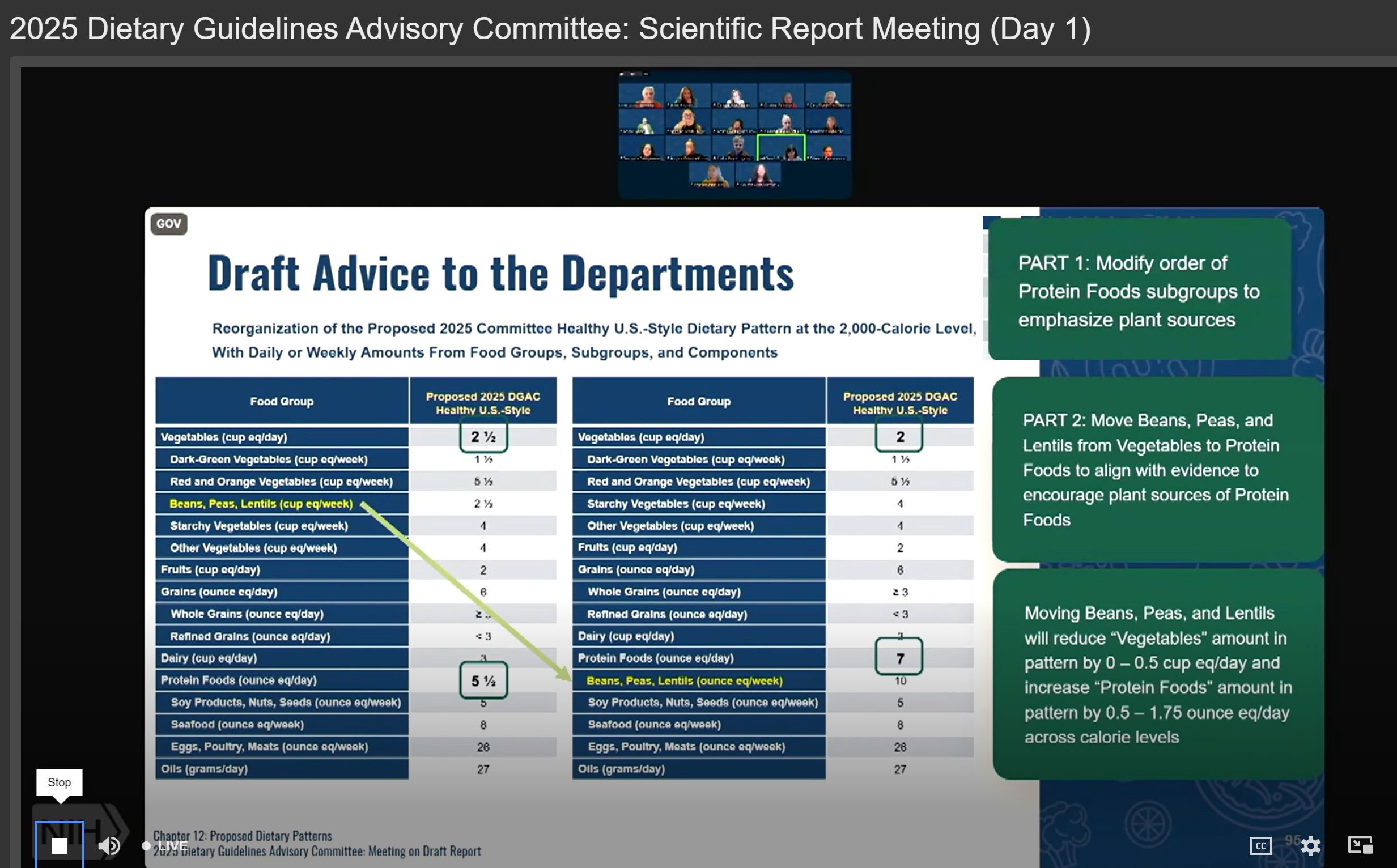
Other animal-based foods such as meat and eggs took a big hit this cycle. The 2025-30 Report uses stronger methods for discouraging consumption. They recommend moving peas, beans and lentils out of the vegetable category and into the protein category and listing them FIRST, followed by nuts and seeds, followed by seafood, then eggs, and lastly meat.

Once again ‘red meat’ is mentioned throughout the report as being lumped in with ‘processed meat’ even though not one stitch of research about negative health relationships with processed meats included any unprocessed red meat in the studies! Clearly, consumption of whole, healthy foods from cattle is in the crosshairs. This 10th edition of the Scientific Report just continues the trend. 

As in past cycles, a whole core of research on the neutral to beneficial relationships between consumption of saturated fat in high-protein, nutrient-dense foods was screened out of the DGAC’s review process by current Ag Secretary Vilsack’s USDA.

This Report essentially sets the stage for ultra-processed plant-based and bioengineered alternative proteins to play a larger role in the institutional meal preps of American schools, daycares, eldercare, and military.

But here’s the good news! The DGAC was late in finishing its 2025-30 Scientific Report!

The law requires a 60-day public comment period before USDA and HHS formulate the actual Guidelines for 2025-30. This mandatory comment period ends Feb. 10, 2025. Comments can be made at the Federal Register link at https://www.regulations.gov/document/HHS-OASH-2024-0017-0001

By the time the comment period ends, Vilsack and company will have left town. Let’s hope Senators confirm Trump appointees before the public comment period ends on Feb. 10 so their eyes are on this before the bureaucracy finishes the job.

This is a golden opportunity for the dairy and livestock sectors, along with health and nutrition professionals and health-conscious citizens to weigh-in. (Look for ways to participate in a future Farmshine.)

Meanwhile, commenters can remind the incoming Secretaries of how flawed the DGA process has become; how Americans, especially children, have become increasingly obese with increasing rates of chronic illness and underconsumption of key fat-soluble nutrients during the decades of the DGA’s increasingly restrictive anti-fat, anti-animal dogma.

Commenters should point out the fact that the Committee was not provided with all of the evidence on saturated fat. This is a message that is likely to land well with USDA Secretary designate Brooke Rollins and HHS Secretary designate Robert F. Kennedy Jr. In fact, RFK Jr. is on record opposing the low-fat dictates and has said nutrition will be among his first priorities, if he is confirmed by the Senate for the HHS post.

FDA’s final rule on ‘healthy’ labeling

In the mad rush at the end of 2024, the FDA released its final rule about using the term “healthy” on the label of foods and beverages.

This process was outlined in the White House National Strategy on Hunger, Nutrition and Health. FDA’s preliminary ‘healthy’ labeling rule was released on Sept. 28, 2022, on the first day of the first White House Nutrition Conference since the 1980s.

At that Conference, Ag Secretary Vilsack said: “The National Strategy’s approach is a whole of government approach that involves the entire federal family.” And President Biden said: “We have to give families a tool to keep them healthy. People need to know what they should be eating, and the FDA is using its authority around healthy labeling so you know what to eat.”

In short, the FDA’s role here is to restrict healthy label claims to foods and beverages that meet its criteria and allow them to also use a new FDA ‘healthy’ symbol that is still under development.

“Nutrient-dense foods that are encouraged by the Dietary Guidelines – vegetables, fruits, whole grains, fat-free and low-fat dairy, lean game meat, seafood, eggs, beans, peas, lentils, nuts, and seeds – with no added ingredients except for water, automatically qualify for the ‘healthy’ claim because of their nutrient profile and positive contribution to an overall healthy diet,” the FDA final rule states.

No surprise that whole milk (3.25% fat) will not qualify, nor will real full fat cheeses, yogurts, and other dairy foods that are not fat-free or low-fat (1%). Natural, unprocessed beef, pork and poultry are off the ‘healthy’ list too.

Specifically, the FDA’s final rule states: “To meet the updated criteria for the ‘healthy’ claim, a food product must: 1) contain a certain amount of food from at least one of the food groups or subgroups (such as fruit, vegetables, grains, fat-free and low-fat dairy and protein foods) as recommended by the Dietary Guidelines for Americans, and 2) meet specific limits for added sugars, saturated fat, and sodium. 

The fat and sodium criteria are a double-whammy against most real dairy cheeses. A single 1-oz slice of American, Swiss, or Cheddar won’t make the cut on saturated fat or sodium; even part-skim Mozzarella is slightly over the limit. Furthermore, low-fat, high-protein cottage cheese barely makes the cut on saturated fat, but far exceeds the new limit on sodium. Likewise, a typical yogurt cup only qualifies if it is low-fat or non-fat, and fruited yogurts must steer clear of added sugars.

Dairy can’t win in this labeling scheme unless products are made with virtually no saturated fat and far less sodium. To sell flavorless cardboard and chalk water that fails to deliver key fat-soluble nutrients, products will undergo more ultra-processing, and Americans will consume more artificial sweeteners.

Under dairy products, FDA’s final rule for ‘healthy’ label claims states: 1) Must contain a minimum of 2/3 cup food group equivalent of dairy, which includes soy; and 2) Each serving must have under 2.5 g of added sugar, under 230 mg sodium, and under 2 g saturated fat.

This means even a serving size of exactly 2/3 cup (6 oz) of 2% milk might barely squeak by, and a full cup (8 oz) of 1% or fat-free milk would be – you guessed it – ‘healthy’. Flavoring the fat-free and low-fat milk will not qualify, except by using artificial sweeteners to stay within added sugar limits.

Under protein foods, the FDA is even more restrictive. The only protein foods listed in the ‘healthy’ labeling final rule are: game meat, seafood, eggs, beans, peas, lentils, seeds, nuts, and soy products. Furthermore, these options must meet the criteria of less than 1 g added sugars, less than 230 mg sodium and less than 1 to 2 g saturated fat.

But here’s the good news! This FDA final rule (21 CFR Part 101, RIN 0910-AI13) falls under the Department of Health and Human Services (HHS). It’s not likely to sit well with HHS Secretary designate RFK Jr. The rule becomes effective Feb. 25, 2025. The compliance date is three years later, so there is hope of requesting HHS initiate a new rulemaking process under new HHS leadership.

Bottom line is all three of these bad nutrition policies impact consumer health and dairy farm economic health and are rooted in the flawed Dietary Guidelines process.

There is good news on that front in Congress as well. House Ag Committee Chairman GT Thompson included DGA reform and oversight in the farm bill that had passed his Committee in the 2023-24 legislative session. It is critical that this issue be part of the new farm bill that moves forward in the 2025-26 legislative session.

Part II in a future Farmshine will look at the tumultuous 2024 dairy markets and margins spilling over into 2025.

-30-
‘Stop feeding us lies’ say protesters as Dietary Guidelines Committee unbelievably doubles down against animal fat, protein

Dietary Guidelines have most negatively impacted children and youth.

Dietary Guidelines Advisory Committee holds final meeting. Draft recommendations include: Reductions in total protein; Less protein from animals, more from plants; Dairy emphasis still low-fat, non-fat; Implementation recommendations include food supply leverage

By Sherry Bunting, Farmshine, October 25, 2024

WASHINGTON, D.C. – This week is National School Lunch Week, and on Oct. 22 while USDA Secretary Tom Vilsack kicked off the so-called “largest federal-led summit in support of healthy school meals” in Las Vegas, the 2025-30 Dietary Guidelines Advisory Committee (DGAC) met publicly by zoom to gamble away the nutrients children need for the development of their brains, bodies and long-term health.

This was the seventh and final meeting of the DGAC after 22 months of subcommittee meetings and periodic full committee meetings, yielding a draft “scientific report” that is increasingly vegetarian.

Its recommendations to USDA and HHS are to develop 2025-30 Guidelines that significantly decrease the role of nutrient dense animal foods, even though they spent the first hour of the 12-hour, two-day virtual meeting puzzling over how to solve the nutrient deficiencies in their analysis.

The recommendations merge the three current DGA patterns (Vegetarian, Mediterranean and Healthy U.S.) into one dietary pattern with a draft name of “Healthy Flex U.S. Diet.” The flexibility part, according to the DGAC discussion, is the ‘how much’ and ‘how to’, which relies on ‘food pattern modeling’ and more specific strategies on how to replace animal based foods with plant based foods. 

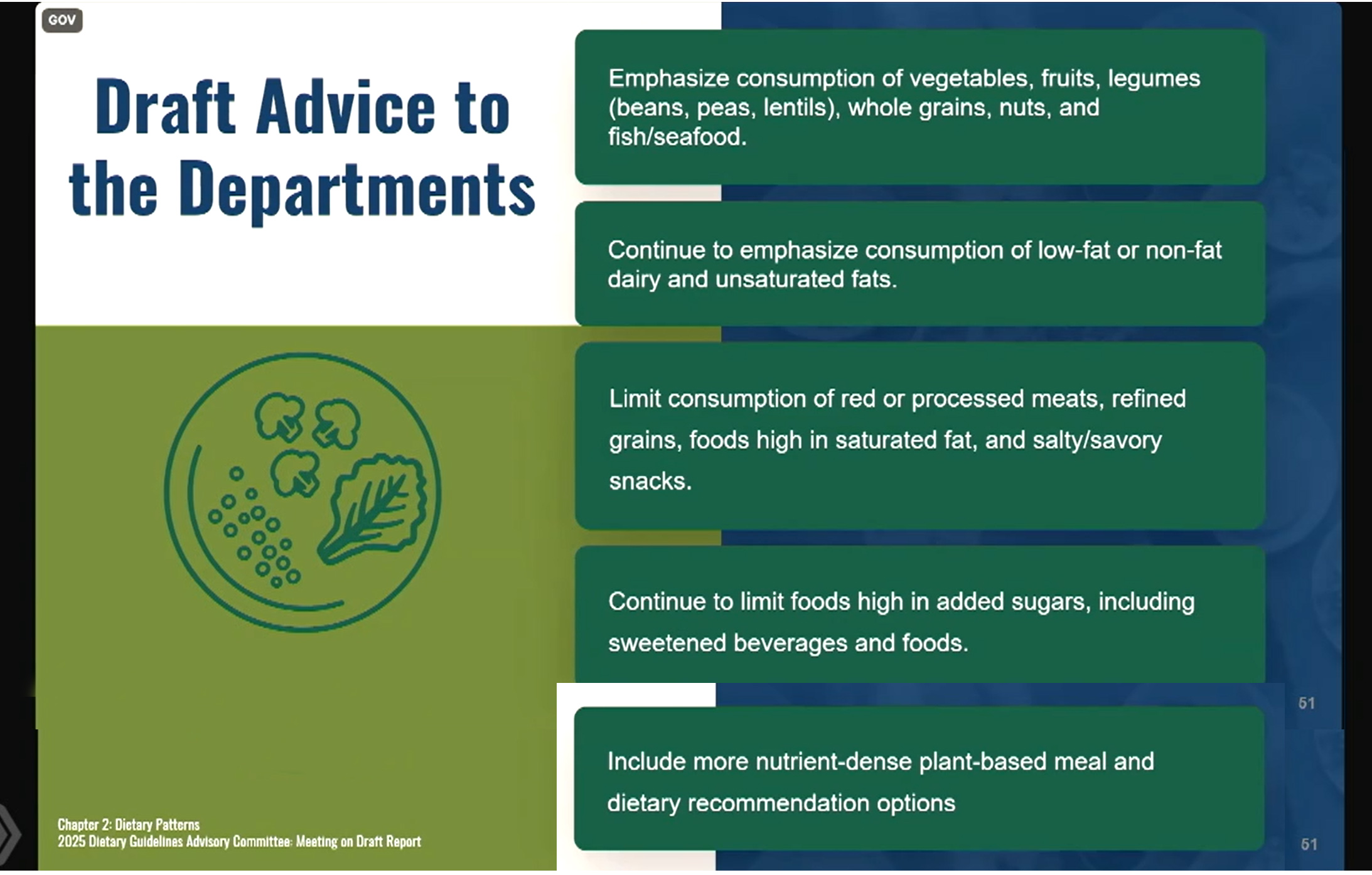
The DGAC aims to improve its poor performance on the under-consumed nutrients by “including more nutrient-dense plant-based meal and dietary recommendation options” in its advice for 2025-30 Dietary Guidelines. 

The draft advice aims to continue to “emphasize consumption of low-fat or non-fat dairy and unsaturated fats; limit consumption of red or processed meats and foods high in saturated fat; and limit foods like sweetened beverages.”

Some committee members raised the concern that further addressing one problem (fat, salt, and sugar) leads to other problems in other areas (under-consumption of key nutrients, over-consumption of carbohydrates, and impacts on metabolic health). 

In fact, a week before the DGAC met, the first ever Change the Dietary Guidelines protest drew hundreds of people to the nation’s capitol — with Nina Teicholz, author of Big Fat Surprise, as emcee. It was organized by Metabolic Revolution with the mission of asking the Administration to “STOP FEEDING US LIES.”

Nutrition Coalition photo

Meanwhile, in the DGAC meeting, at least one member at the end of the first day noted how animal foods, specifically mentioning dairy, have all of these essential nutrients and that the bioavailability of the nutrients is important.

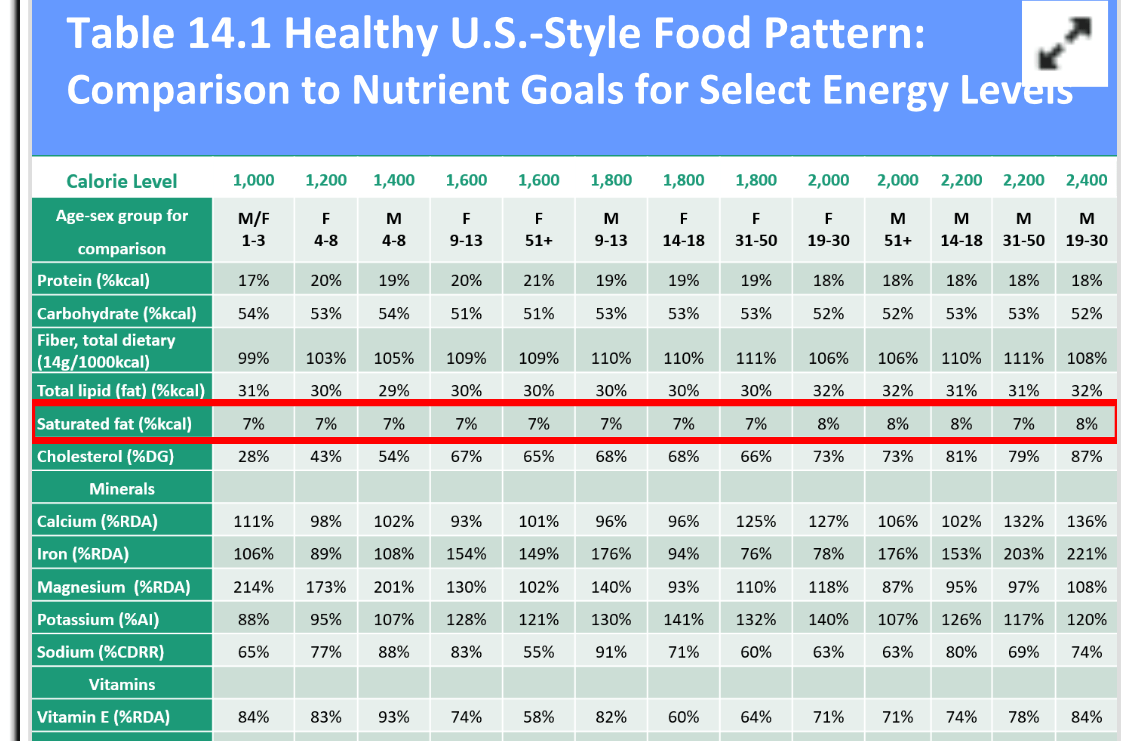
This didn’t make much difference. On the question of saturated fat restrictions, the 2025-30 DGAC doubled-down. These restrictions began with the first edition in 1980, and the quantitative recommendation of “limit saturated fat intake to less than 10% of calories per day starting at age 2 and replacing it with unsaturated fat, particularly poly-unsaturated” began in 2005.

The Committee’s biggest justification was that, “This has been confirmed by several previous DGACs based on the relationship between saturated fat intake and cardiovascular disease risk.” Basically saying it has been previously decided, and “we’re sticking with it.” Essentially, all evidence to the contrary was again ignored.

The Committee stated that only 1 in 5 Americans implement this limitation; so, food replacement strategies, cultural diet pathways, and diet simulations were recommended to show how to get more nutrient density from plant sources. Pre-packaged and pre-portioned implementation strategies and plated combinations of plant-based meals are suggested as ways to ensure nutrients without the fat.

This high-level academic exercise means very little to everyday Americans making choices about food, but it could fundamentally change what is available to choose from — if the “systems science, implementation science, and behavioral science” the DGAC is also recommending pushes diets even more toward highly processed, pre-packaged, pre-portioned options designed by global food giants.

Bottomline: the DGAC will recommend to the USDA and HHS to further reduce animal-based protein consumption and to further increase plant-sourced consumption in the 2025-30 Guidelines, while continuing to limit dairy to non-fat and low-fat options.

For dairy, the DGAC is also recommending that USDA update nutrition composition and dairy reference guides to reflect what they say are ‘improved’ plant-milks, and to use ‘diet simulators’ to show Americans how to be more ‘flexible’ in replacing animal foods with plant foods.

The DGAC also changed the wording of its 2025-30 mission to “reduce the focus on chronic disease risk reduction, to instead focus more on promoting growth and development and improving the healthspan.”

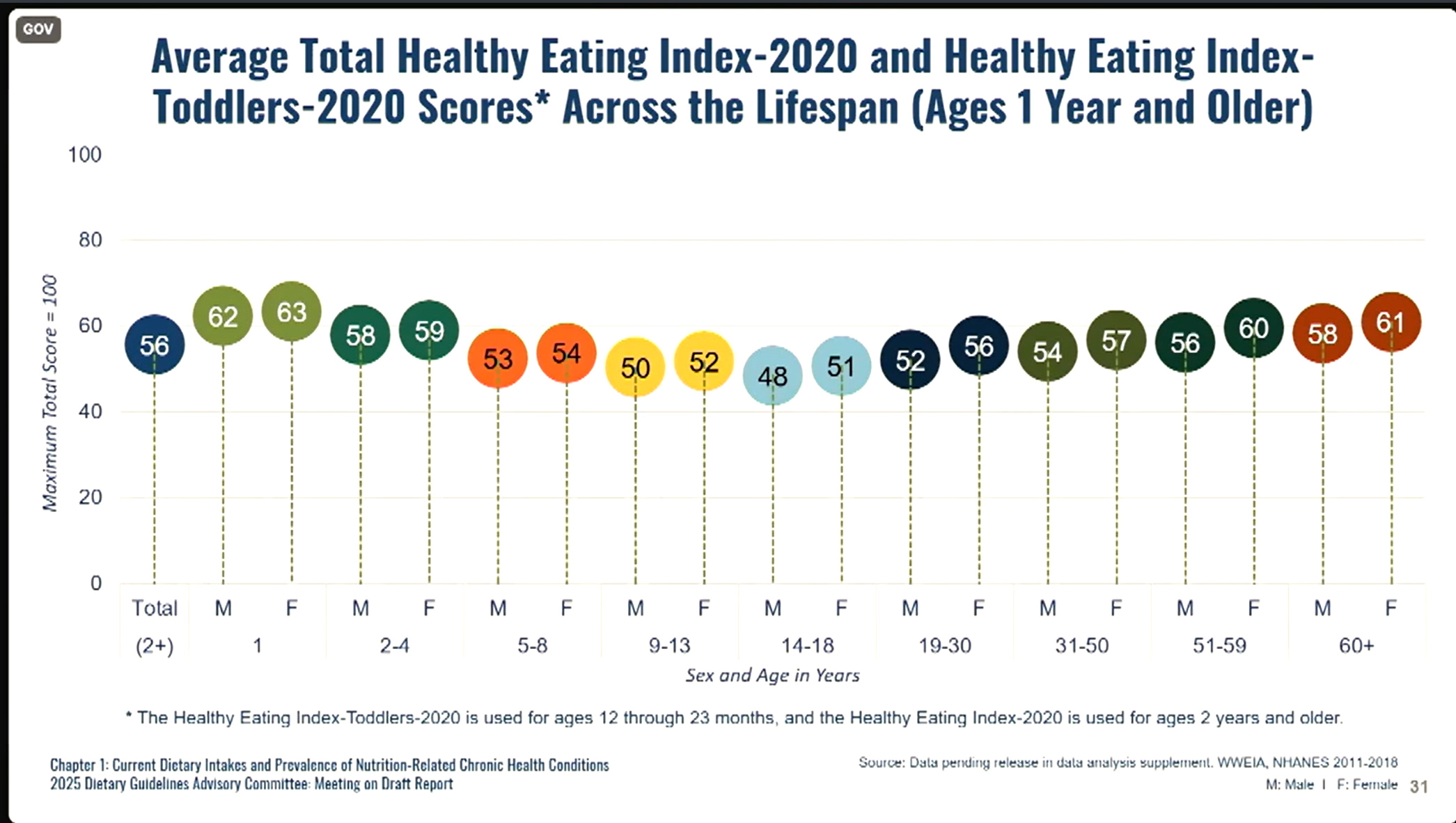
These are key takeaways despite the Committee spending the first hour of the first day stupefied by the analysis showing — uniformly across all socio-economic and cultural demographics — children ages 5-19 had the nutritionally poorest diets in terms of under-consuming key nutrients at this most critical lifestage.

Even when they picked up their Health Equity Lens to look at the data, it was uniformly bad.

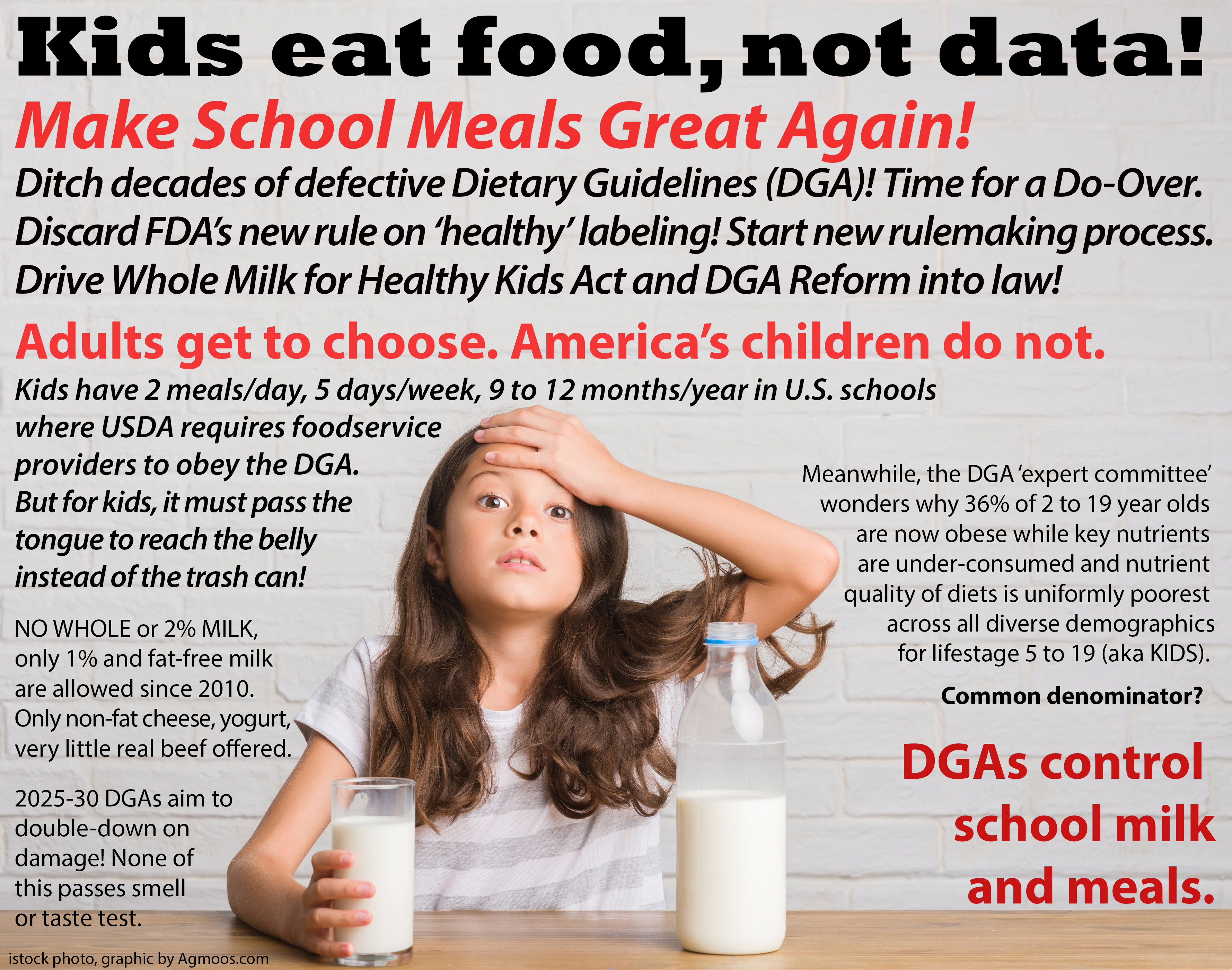
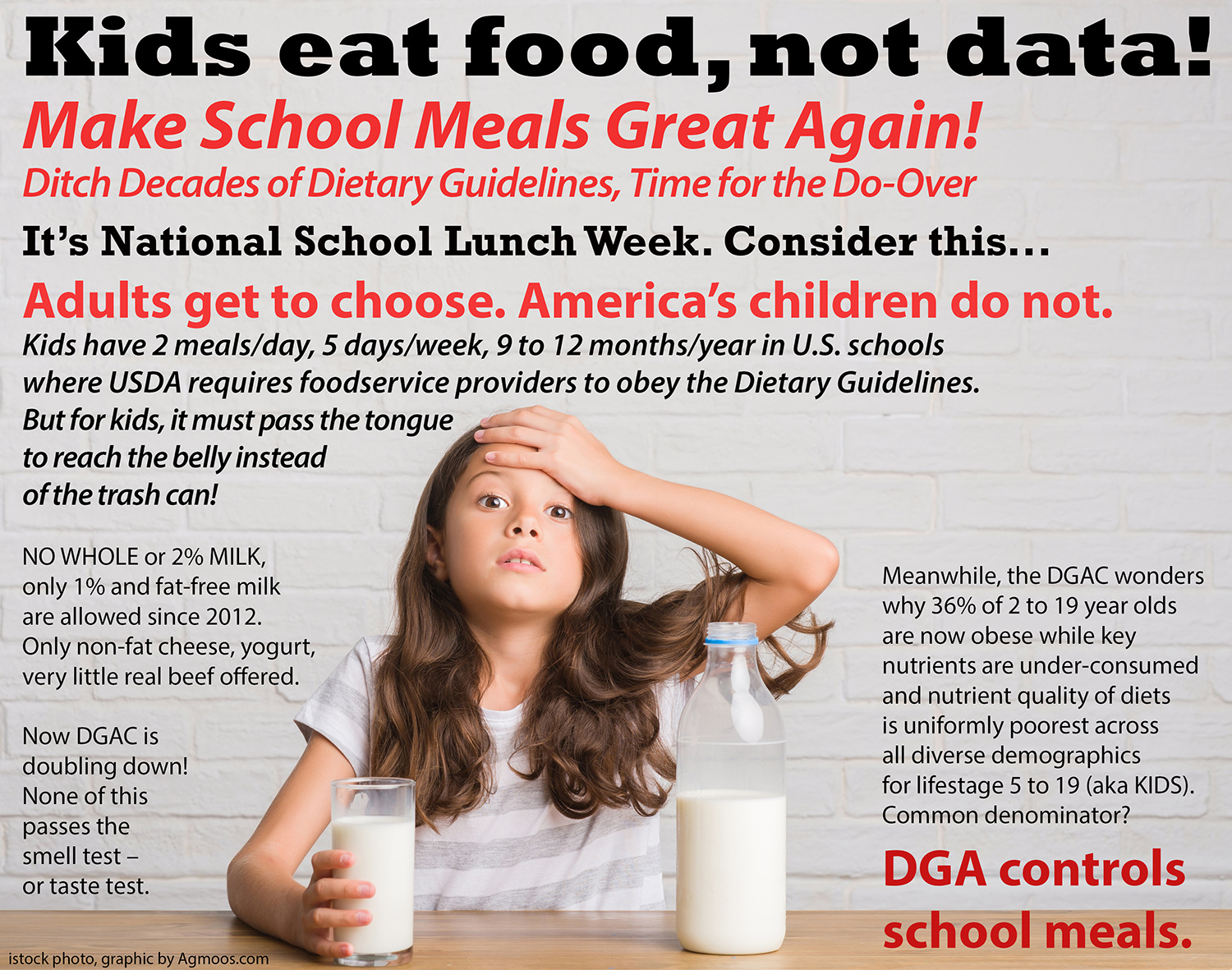
The DGAC could not understand why the healthy eating index showed such uniformly poor performance in the under-consumption of key nutrients, especially among children ages 5 to 19 across all populations. (Simple. It’s because the anti-fat DGAs are enforced at school meals twice a day, five days a week, most of the year for this life stage. Kids do not get to choose; adults do.) Oct. 21 screenshot DGAC meeting 

Their interpretation? I will paraphrase: Parents need help understanding how to feed their children.

My interpretation? The Dietary Guidelines are, themselves, the problem because they are used rigidly to formulate the meals that the age 5 to 19 lifestage (kids) are presented with twice a day, five days a week, nine to 12 months of the year – at school! The body will keep snacking until it gets the nutrients it seeks. 

“Obesity is a major public health issue, impacting 36% of children ages 2 through 19 years and 41% of adults ages 20 and older,” according to the DGAC.

However, by the end of the two days, the DGAC showed it would stay on the anti-fat path and give USDA and HHS the “expert” advice to double-down on saturated fat restrictions that have prevailed over the years while Americans become less healthy, more obese, with more chronic disease, at ever younger ages. Do they not wonder why this was not the situation pre-Guidelines? So much valuable research on saturated fat and health was again left off the table.

One of many draft advice slides for 2025-30 Dietary Guidelines emphasizing non-fat and low-fat dairy and unsaturated fats; addressing nutrient density by increasing plant-based meal options and decreasing animal-based. Oct. 21 DGAC meeting 

Impacts of the DGAC draft report on Dairy:

1) Dairy’s ‘place’ in the diet remains somewhat intact, but the committee advises things like not referring to soy milk as an “alternative” because it is part of the dairy grouping. They also are questioning if ‘Dairy’ is the right term for the Dairy group. The DGAC also will advise USDA to update nutrient composition and daily reference amounts to reflect the current state of nutrition art in “plant-milks” and to use diet simulations to show Americans how to be more flexible in replacing animal-based with plant-based.

2) Nonfat and low-fat dairy will continue to be the recommendation (3 milk cup equivalents), although they mentioned that there was not enough evidence to make this a strong conclusion for ages 2 through 5. Perhaps this leaves a door open for daycares and WIC to expand to 2% and whole fat milk up to age 5 instead of the current age 2, but schoolchildren are still out of luck. Dairy fat and butter were mentioned as being consumed mostly in processed foods.

3) The Protein category has been flipped on its lid. The DGAC moved beans, peas and lentils from the vegetable category to the protein category and increased the daily quantities for beans, peas, lentils, seeds, soy, nuts, and fish, while reducing the allowance for meat, poultry and eggs. In fact, they will represent this visually by listing first in the protein category the plant sources, followed by fish, then eggs, then poultry, and lastly, red meat. The DGAC pointed to the dairy group as a source of protein that is not in the protein group, so protein level importance in plant-based comparisons can be reduced. (Several Committee members indicated their belief that Americans consume too much protein, so they wanted to show these crossovers differently.)

4) The additional considerations chapter is of particular concern for the future, advising USDA and HHS to: a) Encourage shifts to nutrient-dense plant-based meals; b) Put stricter limits on foods and beverages high in added sugars, sodium, and saturated fat; c) Use sugar limitations to exclude foods from the dietary pattern (with implications for flavored milk and dairy products); d) Make sodium reduction targets mandatory not voluntary (may impact the cheesemaking process for schools and other institutional feeding); e) Avoid referring to soy milk as “alternative”; Research name change for Protein group and determine if ‘Dairy’ is the right term for the Dairy group.

This draft report ends the DGAC’s work. In the coming days, it will be edited to reflect the discussion for submission as final recommendations to USDA and HHS.

A joint team of staff from both Departments will prepare this DGAC Scientific Report for posting at DietaryGuidelines.gov, along with data analysis, food pattern modeling and other supplemental documents. 

USDA and HHS will then open a new public comment period.

In 2025, the Secretaries of USDA and HHS (whoever they end up being), along with their joint team, will review the DGAC scientific report and the public comments to develop the actual 2025-30 Dietary Guidelines for Americans.

Expect these DGAs to continue most negatively impacting America’s schoolchildren and elderly in senior centers where meals must follow them.

However, it will have some impact on all of us if the Departments use the DGAC recommendation to implement food system science at the food supply level. We can already see what happens to choices for consumers and markets for farmers when the middlemen decide what can be put on grocery store shelves or in the dairy or meat case.

Not only did we not see a serious effort to address the need for more nutrient dense foods in the dietary pattern, the new pattern will double-down against saturated fat, along with salt and added sugar, and erode protein levels, while continuing to search for the missing nutrition profile of its increasingly vegetarian recommendations. 

None of this passes the smell test, and likely not the taste test. Kids eat food not data. Nutrients must pass the tongue to reach the belly. Look for more on that in terms of action next week from the Grassroots Pennsylvania Dairy Advisory Committee and 97 Milk.

***

Additional information:

In its report, The Nutrition Coalition notes: “The collective shift toward emphasizing more plant-based foods has lowered the quality and quantity of protein in our diets. It is time to pause and question whether these changes are endangering health in the U.S., especially among children and the elderly. Still, with plant-based advocates dominating the public comments, plant-based industries and interests lobbying the USDA, and plant-based proponents on the expert committee itself, we may see further reductions of this important macronutrient in the 2025 Dietary Guidelines.”

Nina Teicholz, Ph.D. explains that these draft recommendations “fly in the face of our knowledge that plant proteins are of lower quality than animal proteins. With the exception of soy, all plant proteins lack all the necessary amino acids to make muscle tissue (as well as perform other critical functions in the human body). Reducing the total amount of protein and replacing animal proteins with plant proteins are both harmful changes. These alterations will mean that anyone receiving USDA-funded meals, such as kids consuming school lunches, the women and infant children on the WIC program, and the elderly will receive fewer complete proteins. Also, reductions in meat, dairy and eggs are sure to exacerbate nutritional deficiencies in the guidelines, which currently fail to meet basic targets iron, vitamin D, vitamin E, choline, and folate. The Dietary Guidelines are already deficient in complete proteins. The erosion of protein in the guidelines has been happening for decades, as we wrote about in this post.”

-30-

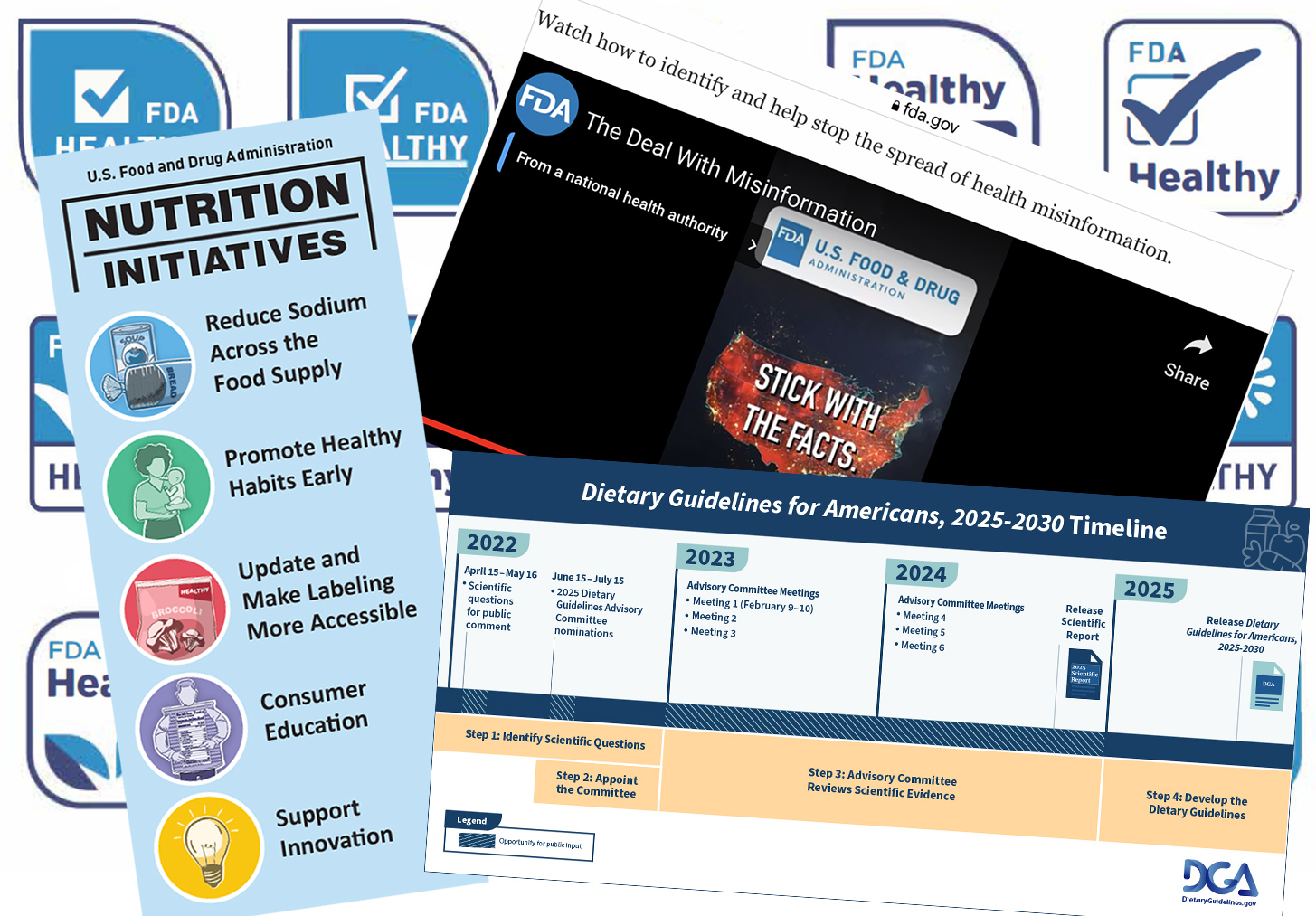
FDA launches ‘rumor control’ hub, will this eventually include its ‘nutrition initiatives’?

By Sherry Bunting, Farmshine, May 19, 2023

WASHINGTON D.C. — The Food and Drug Administration (FDA) launched a new “rumor control” webpage on May 16, described as the hub to stop what the FDA calls “false, inaccurate, or misleading health information” that is “negatively impacting the public’s health.” 

How does FDA define misinformation? “It’s information, spread intentionally and unintentionally, that is false, inaccurate, or misleading according to the best available evidence at the time,” the announcement explains.

Who decides what is the best available evidence at the time? An info-graphic recommends checking sources and cross-referencing the information with reliable sources.

What is a reliable source? FDA describes it in one section as “the federal government and its partners” and describes it in another section as “a non-profit fact-checking source or government resource.”

A video narrator at FDA rumor-control explains the next step is to read beyond the headlines on the internet for context and to “understand the purpose of the post.” 

Scrolling to the bottom of the landing page are instructions to report misinformation.

“We face the challenge of an overabundance of information related to our public health. Some of this information may be false and potentially harmful,” the FDA rumor control webpage states. “If you see content online that you believe to be false or misleading, you can report it to the applicable platform.” 

These words are followed by icons to click for administrators at Twitter, Facebook, TikTok, Instagram, LinkedIn, YouTube, and WhatsApp.

FDA has posted to this hub its ‘fact documents’ on several hot topics such as vaccines, dietary supplements, and sunscreen, stating that more topics will be added in the future.

Will nutrition become one of them, now that the Administration has placed a priority on FDA’s role as purveyors of the Dietary Guidelines as gospel?

Case in point, just three weeks prior to launching the rumor-control hub, the FDA announced it is “prioritizing nutrition initiatives to ensure people in the U.S. have greater access to healthier foods and nutrition information to identify healthier choices more easily… to improve eating patterns and, as a result, improve everyone’s health and wellness.”

These FDA initiatives came out of the “whole of government approach” pledged by President Biden and Ag Secretary Vilsack in the White House Strategy on Hunger, Nutrition and Health.

“People need to know what they should be eating, and the FDA is already using its authority around healthy labeling, so you know what to eat,” said the President during the White House Conference where the Biden-Harris National Strategy was unveiled in September 2022. 

The FDA proposed rule on ‘healthy labeling’ came out on the same day. Comments ended months ago but the final rule has not yet been published in the Federal Register.

The FDA nutrition initiatives are being pursued “to help accelerate efforts to empower consumers with information and create a healthier food supply.”

According to the FDA news release, the federal government currently believes obesity and chronic diet-related diseases are on the rise because American eating patterns are not aligning with the federal Dietary Guidelines. The press release states that most people consume too much saturated fat, sodium and added sugar, and the FDA nutrition initiatives aim to correct this.

FDA’s nutrition priorities in progress, include:

1)    Developing an updated definition and a voluntary symbol for the ‘healthy’ nutrient content claim, front-of-package labeling, dietary guidance statements and e-commerce labeling, and

2)    Supporting innovation by changing standards of identity such as labeling requirements for plant-based foods.

In addition to issuing its controversial plant-based milk labeling rule earlier this year, which would allow the pattern of fake milk proliferation to simply continue, the FDA in the first four months of 2023 sent letters of ‘no objection’ to three companies in their respective requests for GRAS (generally regarded as safe) status for cellular lab-created meat. 

Several ferrmentation-vat dairy protein analog makers — including Perfect Day with its genetically-altered yeast excrement posing as dairy protein — received their ‘no objection’ to GRAS letters from FDA in 2020.

As reported in Farmshine over the past several years, the FDA has been on its “multi-year nutrition innovation strategy” since 2018. However, the pace has accelerated since September 12, 2022, when Executive Order 14081 was signed by President Biden just 10 days before the White House Conference on Hunger, Nutrition and Health.

Entitled Advancing Biotechnology and Biomanufacturing Innovation for a Sustainable, Safe and Secure American Bioeconomy, the Presidential EO 14081 states: “For biotechnology and biomanufacturing to help us achieve our societal goals, the United States needs to invest in… and develop genetic engineering technologies and techniques to be able to write circuitry for cells and predictably program biology in the same way in which we write software and program computers; unlock the power of biological data, including through computing tools and artificial intelligence; and advance the science of scale‑up production while reducing the obstacles for commercialization so that innovative technologies and products can reach markets faster.”

(AUTHOR’S NOTE: All roads lead back to the umbrella of the Dietary Guidelines. The current DGA Committee began meeting recently in the process of formulating the 2025-30 DGAs. Entrenched in four decades of low-fat dogma, the USDA and HHS, along with the 2010, 2015 and 2020 DGA Committees, repeatedly left out of the discussion dozens of scientific papers, even research by the National Institutes of Health, that showed the neutral to beneficial impact of saturated fats on human health and the positive role of nutrient dense foods that are high in protein and essential nutrients but also contain saturated fat such as whole milk, full-fat dairy, and unprocessed red meat. Given the fact that childhood obesity and chronic diet-related disease incidence are rising rapidly, an objective fact-checker could easily determine that the Dietary Guidelines, themselves, are health misinformation. Clearly, children are the sector of the population whose eating patterns closely align with the Dietary Guidelines since 2010. They don’t have a choice. Most children today eat two meals a day, five days a week, three quarters of the year at school where the Dietary Guidelines rule with an iron hand. Let’s not forget the 2020 DGA Committee admitted that all of the DGA eating patterns came up short in essential nutrients found in animal foods, but when a committee member warned of this on final public reading, the saturated fat subcommittee chair mentioned taking vitamin pills and noted ‘new designer foods are coming.’)

Global Symposium: Milky Way Study reinforces why children should be allowed to choose whole milk

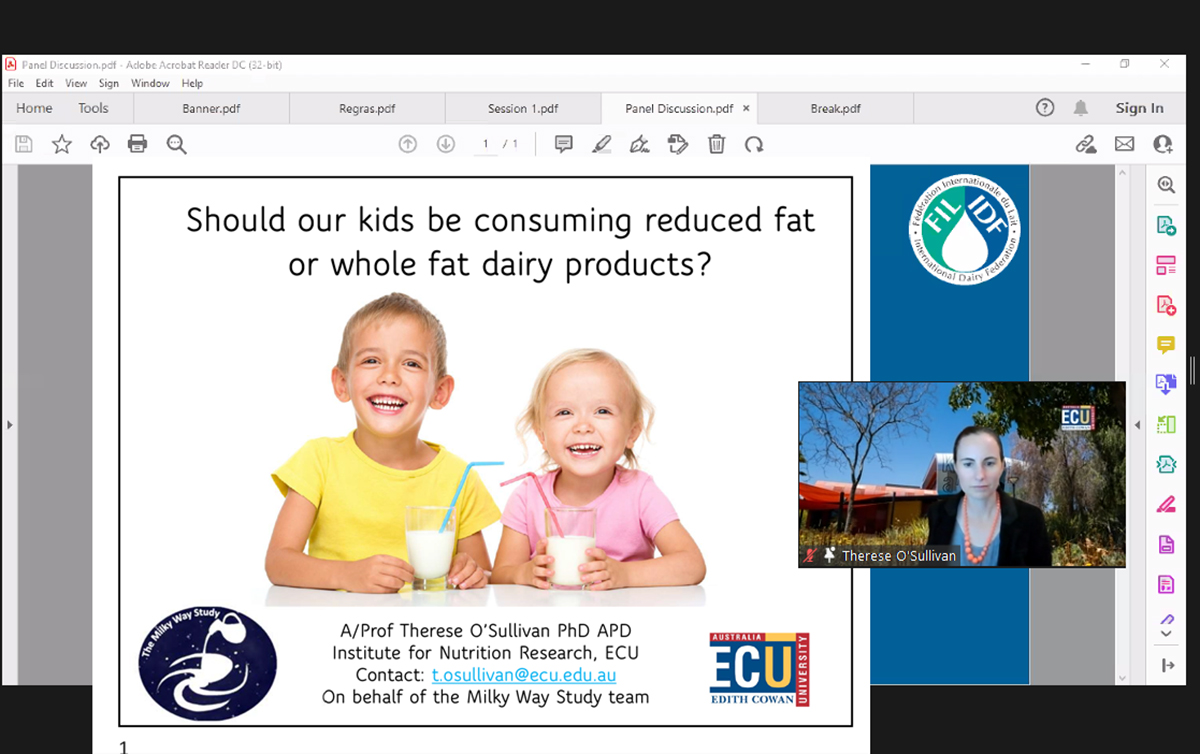
Therese O’Sullivan, professor of nutrition and dietetics at Edith Cowan University in western Australia shared results from the Milky Way Study, answering the question: “Should our children be consuming reduced fat or whole fat dairy products?” The short answer, according to the evidence: “Let them choose!” IDF Symposium screen capture

Other countries are taking note, when will the U.S. get it right?

By Sherry Bunting

BRUSSELS — A new double-blind randomized study of children consuming whole fat vs. low fat milk and dairy reinforces the already accumulated evidence that the choice should be allowed, especially for children, according to Professor Therese O’Sullivan in nutrition and dietetics at the Edith Cowan University in western Australia.

“The Milky Way Study suggests healthy children can safely consume whole fat dairy without concern. Future dietary guidelines can and should recommend either whole or reduced fat dairy,” O’Sullivan confirmed as she presented the study’s results during the Nutrition and Health Symposium organized by the International Dairy Federation in Brussels, Belgium last Thursday (May 12).

The virtual event was attended by over 200 nutrition and health professionals from all over the world. They heard from eight experts and two moderators from various regions of the world, focusing on the role dairy plays across life stages. The first five sessions of the daylong event focused on the role of dairy in maternal diets and for children and teens. The last half focused on aging adults.

The Milky Way Study is deemed the first ‘direct dairy intervention’ study, and it supports the already accumulating evidence that children should be able to choose whole fat milk and dairy as there is no scientific or health reason not to let them choose, O’Sullivan indicated.

The study was costly and time intensive as a double-blind randomized intervention in which the whole fat dairy group consumed more milkfat during the study than their normal consumption had been before the study, and the low fat dairy group consumed less.

Continual testing during the study period showed no statistical differences in key health and nutrition biomarkers except the whole fat milk group’s BMI percentile declined during the study period. This is a key result because this is the first “intervention” study to test “causation” in what the already accumulated evidence shows.

The push by dietary guidelines to limit milkfat in countries like the U.S. and Australia was mentioned during panel discussion in relation to the Milky Way Study, supporting studies, and meta-analysis, with experts noting these guidelines need revisited.

“There is no evidence to suggest that moving to low fat dairy helps,” O’Sullivan said, noting there were no significant differences between the whole fat and low fat study groups when it came to the children’s daily caloric intake, blood pressures, blood cholesterol and lipids, cardiometabolic disease — or any other measure.

However, O’Sullivan did observe a slight trend toward a reduction in BMI (body mass index) percentile in the study group consuming whole fat milk and dairy vs. low-fat milk and dairy.

As the primary researcher on the Milky Way Study, O’Sullivan found it interesting that the daily calorie intakes of both groups were equal, even though the group of children consuming whole fat milk and dairy were getting more calories in their dairy servings because the fat was left in.

“This showed us that as the calories came out of milk in the low fat group, the kids replaced those calories with something else,” O’Sullivan reported.

The sodium intakes were also higher in the low-fat milk group, suggesting the “replacement calories” came from snacks.

O’Sullivan noted that another “very interesting finding was that we didn’t see any improvement in blood lipids in the low fat group that we would expect to see based on the theory of saturated fat increasing lipids,” she said.

Bottom line, she noted: “Whole milk and dairy had a neutral or beneficial effect on cardiovascular (biomarkers) with no difference in lipids, and a small decrease in LDL (bad cholesterol) in the whole fat dairy group.”

She also observed that as the calories came out of the milk in the low fat group, the children were coming up in their consumption of other foods that – depending on their choices — could have an impact on lipid profiles.

(This basically supports the tenet that whole fat milk and dairy is satiating, satisfying, and because it is nutrient dense, children may be less likely to keep ‘searching’ for needed nutrition via salty, sweet and high-carb snacks. The Milky Way study supports what many have long said should be changed in dietary guidelines to increase and make more flexible the saturated fat limits and return the choice of whole fat milk and dairy to schools and daycare centers.)

“High fat dairy foods are not detrimentally affecting adults, children or adolescents,” said O’Sullivan in discussing supporting research and meta-analysis. She noted that her three-month Milky Way Study could be repeated for 12 months for more data, but that it is in line with other evidence.

During the panel discussion, nutrition experts talked about some of the issues in vegan / vegetarian dietary patterns, noting that even when given vitamin and mineral supplements, studies show children and teens could not get their levels where they needed to be in many cases, especially true for B12 and calcium, key nutrients found in milk.

One attendee asked why saturated fats are always ‘the bad guys’ in the dietary guidelines, wondering if there was any associated health risk effect in going from the whole fat to the low fat in the first place.

“Similar to other studies, we saw the kids were good at regulating their food intake to appetite and as we take away the fat, they replace it with something else for the calories to be the same,” O’Sullivan replied. “In one group, they ate more tortillas, in another we noticed sodium intakes went up, suggesting they ate more snack foods (when the fat was removed from the milk and dairy).”

She reminded attendees that there are also other types of fats in milk, including Omega 3 fatty acids.

“Kids do not have much Omega 3 in their diets because they are not as likely to be eating oily fish,” said O’Sullivan. “In the low fat group (in the Milky Way Study), when Omega 3 status went low, they were not replacing it.”

This means the whole fat milk group had an advantage in maintaining Omega 3 status also.

O’Sullivan explained that researchers looked at the membranes of the red blood cells and saw the long chain fats were also down, so if they stayed on that (low fat) diet, and did not have increased Omega somewhere else in the diet, “they may have a health impact down the line.”

An attendee from India noted their government is planning to introduce milk into the supplemental feeding programs for children, with milk programs in schools, beginning with elementary schools.

Increasingly, the global focus is on milk in schools, and this means the type of milk recommended by government dietary guidance is so important.

Attendees also wanted to know “How much saturated fat would be recommended daily for children?”

(In the U.S., schools, daycares and other institutional settings are required to keep calories from saturated fat below 10% of total calories of the meal with the milk included, and of the milk as a competing a la carte beverage, with no attention paid to nutrient density.)

O’Sullivan indicated the answer lies in looking more at the food source of the saturated fat and the level of nutrients accompanying it.

“We need food-focused dietary guidelines,” she said, noting the evidence shows it’s important to change the focus from ‘dietary’ saturated fat ‘levels’ to looking at “the whole food matrix, the overall matrix of the food and the nutrients when the saturated fat is contained in that matrix.”

Good nutrition is key for health and wellbeing throughout life and can help us live our lives to the fullest, said Symposium organizers. They noted that dairy products are nutrient-rich and are a source of protein, B vitamins, iodine, calcium, phosphorus, vitamin A, zinc and potassium – making them an excellent choice for nutritional needs at all ages and stages of life. The unique combination of nutrients and bioactive factors, and how they interact with each other in the dairy matrix, combine to produce the overall effect on health.

In fact, during panel discussion, some noted there is so much emphasis now on maternal nutrition and the first 1000 days of life, whereas not enough attention has been paid to children and teens.

“Intervention is required in the three later phases: middle childhood (5-9 years), when infection and malnutrition constrain growth; adolescent growth spurt (10-14 years) and the adolescent phase of growth, brain maturation and consolidation (15-19 years) if a child is to achieve his full potential as an adult – an important but often overlooked area being the diet”, noted Professor Seema Puri from Delhi University, India.

Professor Lisanne Du Plessis from Stellenbosch University, South Africa explained that food-based dietary guidelines are a key way to provide healthy eating guidance in every life stage. 

However, she said, only a few countries such as South Africa, Kenya and Nigeria have guidelines tailored to the specific nutritional needs of children.

In fact, this was a glaring concern in the Australian and U.S. guidelines — given the emphasis on avoiding milkfat leaving children and teens missing out on the key nutrients if they didn’t consume the required low-fat and fat-free products.

Talking about what type of milk children can and should drink seemed like a basic area of discussion that needs intervention.

“Changing to reduced-fat dairy does not result in improvements to markers of adiposity (high body mass index) or cardiometabolic disease risk in healthy children,” O’Sullivan stated.

Contrary to popular belief, she said, “there are no additional health benefits to consuming low-fat or fat-free dairy for children.”

Not only did conclusions from the Milky Way Study back this up, but also comparisons to other supporting evidence were shared.

-30-

Dear Secretary Vilsack, please extend Dietary Guidelines public comment past May 16 and open saturated fat limits for course-correction review!

Screen capture from https://www.dietaryguidelines.gov/

‘Preponderance of evidence’ screams for a Dietary Guidelines course-correction to expand flexibility and increase, not reduce, saturated fat limits as well as to examine the nutrient deficiencies of currently approved dietary patterns in all life stages, and to examine the effects of these overly-prescriptive one-size-fits-all patterns on vulnerable populations in government feeding situations such as children obtaining most of their nourishment at school where DGAs rule.

Editorial opinion by Sherry Bunting, Farmshine, May 6, 2022

Recently, USDA and HHS launched the 2025-30 cycle of the Dietary Guidelines for Americans (DGA). Trouble is, the first and undeniably most important part of the process that will shape WHAT can be amended and the research-screening process for doing so are the “scientific questions” to be examined.

A paltry 30-day public comment period about these already-prepared questions was announced April 15 and expires May 16, 2022.

By the time you read this, there will be fewer than 10 days to comment. To read the USDA HHS proposed scientific questions, click here and to submit a comment to the docket, click here

In addition to the links above, comments can be mailed to Janet M. de Jesus, MS, RD, Office of Disease Prevention and Health Promotion (ODPHP) Office of the Assistant
Secretary for Health (OASH), HHS; 1101 Wootton Parkway, Suite 420; Rockville, MD 20852. Be sure to reference HHSOASH-2022-0005-0001 on the submission.

Lack of time to comment on the questions is not the only problem with the 2025-30 DGA launch. The commenting instructions state: “HHS and USDA will consider all public comments posted to Regulations.gov in relation to the specified criteria. Comments will be used to prioritize the scientific questions to be examined.”

These instructions do not leave much opening to amend the already-prepared scientific questions.

I encourage others to join me in requesting an extension of this comment period to 90 days and to open the process into a course-correcting complete re-evaluation of saturated fat limits — to drive home the point that the “preponderance of evidence” screams for higher, more flexible, saturated fat limits (especially for children), to review the science on saturated fat consumption at all life stages on not only cardiovascular health, but also weight management and diabetes, cognitive health, and other areas, including how current saturated fat limits affect under-consumption of essential nutrients, how these limits affect school meal patterns where most children receive most of their nourishment most of the year — considering the 2020-25 DGA Committee admitted the three government sanctioned dietary patterns are deficient in key nutrients of concern for all age groups.

Join me in asking USDA and HHS to educate the public about the true impact of the DGAs on our most vulnerable populations (children and the elderly) and to avoid prescriptive one-size-fits-all dietary patterns.

People don’t seem to pay much attention to the DGA process because there has been no full disclosure of the true impacts of these so-called “guidelines.” People say, oh, they’re “just guidelines.” Maybe that’s true for you and I, but what about the children? What about the elderly? They are under the ruthless thumb of USDA HHS DGA implementation in feeding programs for America’s most vulnerable ages and demographics.

The ink is barely dry on the 2020-25 DGAs, leaving many to believe there is plenty of time to comment on the next round — later — when the process is fully underway. After all, USDA reminds us this is a five-step process, and they are “committed” to providing plenty of opportunities to be heard.

Wrong. This first step is in many ways the most important for public comment because it shapes how the other four steps unfold. It shapes what research will be screened in and out of the process. It shapes what areas of the DGAs can be amended and specific criteria for how they can be amended — no matter how earthshaking a dietary revelation.

This first step also shapes how your future comments will be considered. For example, many comments, even research in the screening process, will be ignored as this 2025-30 DGA cycle unfolds when it is deemed to fall outside of the specific criteria set in the scientific questions of step-one — right now — for this 2025-30 cycle.

USDA and HHS have already formulated the 2025-30 “scientific questions,” leaving most of the failed guidelines ‘base’ pretty much moving forward — as-is.

One area the Departments announced will run parallel is on ‘planetary diets.’

The USDA HHS announcement notes that the 2025-30 DGAs won’t incorporate DIRECTLY any ‘climate-related’ dietary recommendations, stating: “Sustainability and the complex relationship between nutrition and climate change is an important, cross-cutting, high priority topic that also requires specific expertise. HHS and USDA will address this topic separate from the Committee’s process to inform work across the Departments.”

That’s about as clear as mud. In this statement, USDA seems to tie nutrition and climate change together with the term “cross-cutting,” and describes the “relationship” as a “high priority topic,” assuring us that USDA and HHS will handle this separately and then “inform.”

After looking through the scientific questions in the areas of systematic review and dietary patterns, below is my citizen’s comment: 

————————–

Dear Secretary Vilsack:

To use the phrase you used repeatedly in a Congressional hearing about the 2015-20 Dietary Guidelines, the ‘preponderance of evidence’ on saturated fat limits for all ages — and for children and adolescents in particular — should be up for a complete re-evaluation in the 2025-30 DGAs.

Study after study show our government-sanctioned dietary patterns are failing our children who receive most of their nourishment at school under the thumb of USDA-HHS Dietary Guidelines. USDA even threatens to financially penalize any school that dares make nutritious, wholesome, satiating, healthful whole milk available — even for students to buy from a vending machine run by an FFA chapter seeking to raise funds for agriculture programs, simply because the calories and percent of calories from saturated fat in that nutrient-dense superior beverage exceed your arbitrary, unscientific DGA limit.

But that’s okay, say the HHS USDA DGA, just have a Mountain Dew Kickstart or a sugar-free Gatorade Zero. PepsiCo thanks you, dear USDA, for caring about the profitability of the Smart Snacks empire they and others have built on your say-so, while children become fatter, sicker and sadder and under-consume key nutrients for health and brain power.

Meanwhile, farmers wonder what on earth they can do to get the nutritious, natural, beautiful, local whole milk product they produce to the children in need of nourishment at school, while doctors bemoan under-consumption of nutrients of concern like calcium, vitamin D and potassium (abundant in milk, better absorbed with the fat).

Even the 2020-25 DGA Committee admitted that all three dietary patterns leave all age groups deficient in key nutrients. That’s okay, just get in line for our vitamin pills, right?

It’s even more concerning to see the diets in reality are even worse than they are on paper, if that’s possible, as students pass-over the obligatory skimmed milk in favor of big-brand junk drinks devoid of nutrition, or they take the skimmed milk and toss it into the trash.

USDA’s own study in 2013 showed that in the first year after the Smart Snacks regulations tied competing beverages to the DGAs — outright prohibiting whole milk and 2% milk from schools — student selection of milk fell 24%, and the amount of milk discarded by students increased by 22%. Other studies since 2012 show milk is among the most frequently discarded items at schools. World Wildlife Fund issued a report saying one way to reduce this waste is to educate schools on the fact that they are not forced to serve milk, they can offer it and educate students not to take the milk if they aren’t going to drink it.

What does that solve? It still leaves children and youth without the nourishment USDA touts in the school lunch program on paper even as the school meal situation has become an increasingly restrictive maze of fat limits and thresholds that schools give up managing it and leave it to the ‘Big Daddy’ institutional foodservice corporations with their pre-packaged, highly-processed deals that come with ‘USDA compliance guarantees.’

Why is the Biden Administration fast-tracking this agenda? There are four bipartisan bills before Congress dealing with school milk and others dealing with childhood nutrition. There are bills about allowing whole milk in schools at the state level in Pennsylvania and New York, with lawmakers in at least two other states watching closely to perhaps do the same.

The Whole Milk for Healthy Kids Act to repeal your whole milk prohibition has 93 cosponsors in 32 states. City schools, rural schools, town mayors, boards, teachers, parents, coaches, dieticians, doctors, nurses, farmers — people from all walks of life — and, yes, food and nutrition scientists are increasingly appalled at the school milk and school lunch issues — all under the thumb of the DGAs.

The DGAs are designed in a way that each 5-year cycle builds on the one before it — since 1990! The scientific questions are formulated to keep moving that way instead of looking back and re-evaluating or re-examining nutritional aspects USDA considers ‘settled science.’

In reality, however, there is nothing settled about the DGA ‘science’ on saturated fat. This build-upon process is flawed.

In fact the ‘preponderance of evidence’ would tell us the process should be opened up for a more thorough and reflective review, toward more flexible saturated fat limits — especially to expand overly-restrictive saturated fat limits that are creating concerns for children and youth and, in effect, keep nutrient-dense whole milk and 2% milk, as well as full-fat dairy products out of schools. By these standards, the DGAs actually embrace artificially-created highly processed beverages and foods — even Impossible Burger over Real Beef.

The preponderance of evidence is undeniable. The DGA saturated fat limits are a straight-jacket for schools, imprisoning children into poor nutritional health outcomes that can stay with them the rest of their lives and may affect their abilities to learn. Our future as a nation, the health of our children, the economic standing of our food producers, our nation’s food security, our national security itself are all rooted in these DGAs that are still centered on false narratives about saturated fat that the preponderance of evidence has disproven.

Please extend this comment period to 90 days and expand the input considerations and the process, especially as relates to saturated fat limits for all life stages and evaluate the current patterns for under-consumption of nutrients of concern for all life stages. Simply amending a failed base product is unproductive at best and creates more negative health consequences at worst. We need a DGA course correction, a re-do, rigorous scientific debate, acknowledgment that the science is not settled against fat with the preponderance of evidence moving toward the healthfulness of dietary fat.

Finally, we need a Dietary Guidelines product that serves more broadly as just that — guidelines — not a prescriptive one-size-fits-all straight-jacket that obviously is failing the majority of Americans.

Public discussion about the process is needed in a more open, thoughtful, comprehensive manner before the 2025-30 DGAs get underway.

-30-

U.S. ‘Dietary Guidelines’ released in wake of continued failures, Checkoff and industry organizations ‘applaud’

More than a decade of research on saturated fat is again ignored: A look at the reality of where we are and how we got here.

On the surface, the broad brush language of the 2020-25 Dietary Guidelines looks and sounds good. But the devil is in the details.

By Sherry Bunting, Farmshine, January 15, 2021

WASHINGTON, D.C. – “Make every bite count.” That’s the slogan of the new 2020-25 Dietary Guidelines for Americans (DGA), released Tuesday, December 29 by the U.S. Departments of Agriculture (USDA) and Health and Human Services (HHS).

In the webcast announcement from Washington, the focus was described as helping Americans meet nutritional needs primarily from nutrient-dense ‘forms’ of foods and beverages. However, because of the continued restriction on saturated fat to no more than 10% of calories, some of the most nutrient-dense foods took the biggest hits.

For example, the 2020-25 DGA executive summary describes the Dairy Group as “including fat-free or low-fat milk, yogurt and cheese and/or lactose-free versions, and fortified soy beverages and yogurt.” 

Even though the 2020-25 Dietary Guidelines exclude important dairy products from the Dairy Food Group and continue to restrict whole milk and full-fat cheese with implications for school meals, the checkoff-funded National Dairy Council says “Dairy organizations applaud.” Screenshot at https://www.myplate.gov/eat-healthy/dairy

At the newly re-launched MyPlate website, exclusions are listed, stating “the Dairy Group does not include foods made from milk that have little calcium and a high fat content, such as cream cheese, sour cream, cream, and butter.”

In fact, the webcast announcement flashed a slide of MyPlate materials showing consumers how to customize favorite meals for so-called ‘nutrient density’. The example was a burrito bowl, before and after applying the DGAs. Two recommended ‘improvements’ were to remove the sour cream and to replace ‘cheese’ with ‘reduced-fat cheese.’

For the first time, the DGAs included recommendations for birth to 2 years of age. The new toddler category is the only age group (up to age 2) where whole milk is recommended.

The 2020-25 DGAs “approve” just three dietary patterns for all stages of lifespan: Heathy U.S., Vegetarian, and Mediterranean. Of the three, two include 3 cups of low-fat or fat-free dairy and one includes 2 to 2.5 cups low-fat and fat-free dairy. Protein recommendations range 2 to 7 ounces. All 3 dietary patterns are heavy on fruits, vegetables and especially grains. 

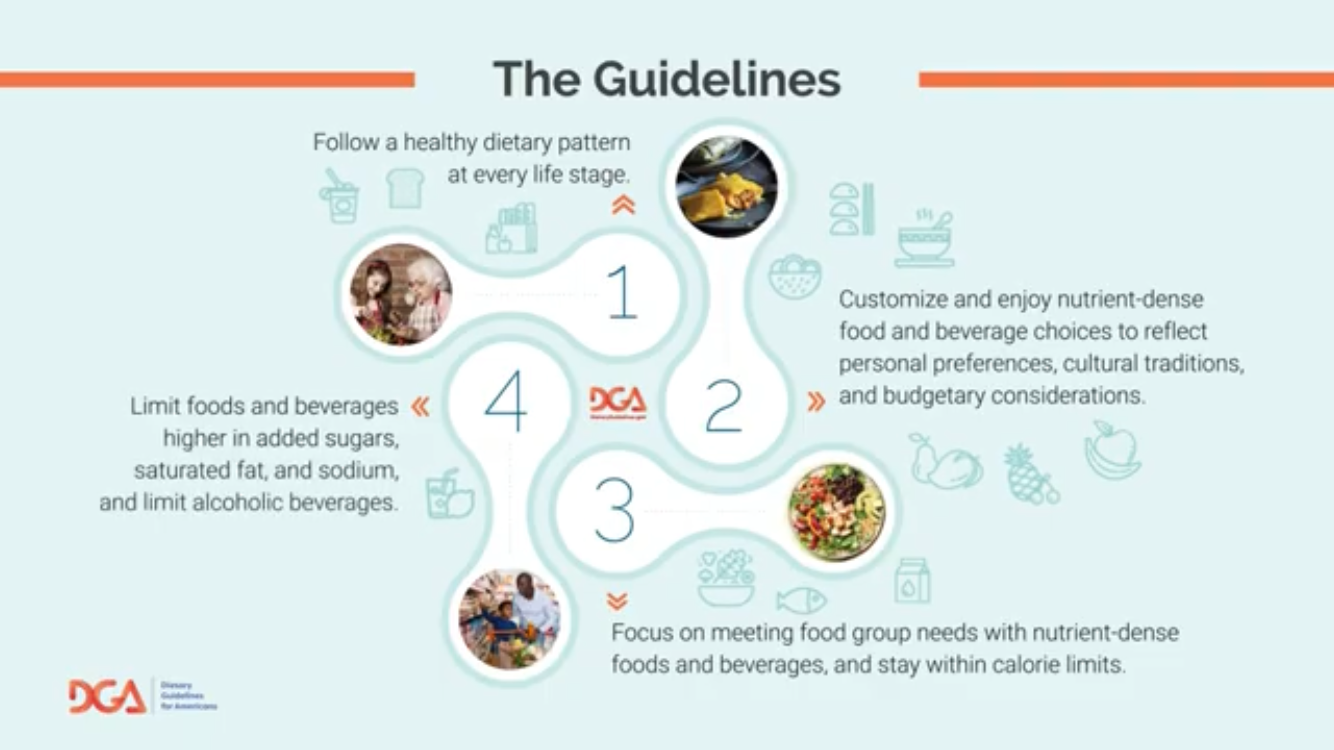
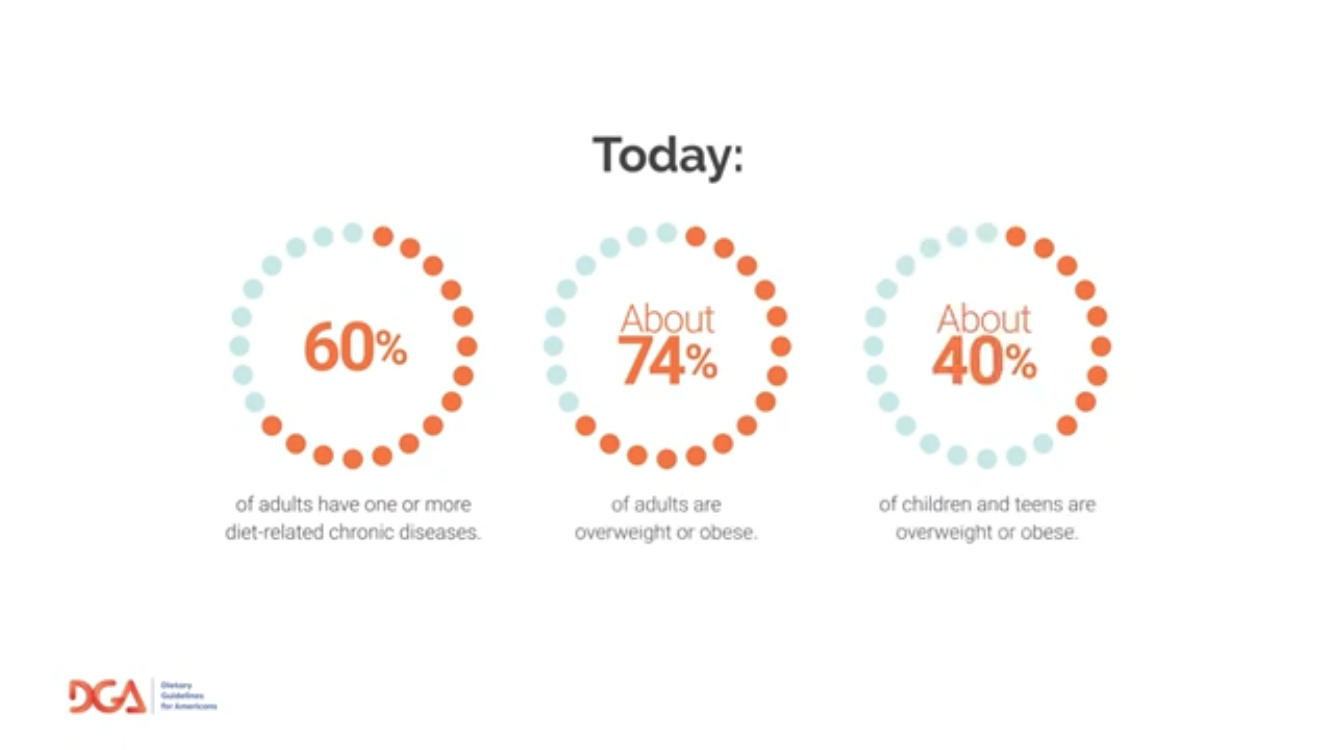
In short, the DGA Committee, USDA and HHS collectively excluded the entire past decade of research on saturated fat. Throughout the DGA process, many in the nutrition science and medical communities asked the federal government to add another dietary pattern choice that is lower in carbohydrates and higher in protein with a less restrictive saturated fat level — especially given the government’s own numbers shared in the Dec. 29 announcement that, today, 60% of adults have one or more diet-related chronic illnesses, 74% of adults are overweight or obese, and 40% of children are overweight or obese.

USDA and HHS shared these statistics during the announcement of the new 2020-25 Dietary Guidelines. The next slide stated the reason for the worsening obesity and chronic diet-related disease rates is that Americans are not following the Guidelines. And yet, this progression has a marked beginning with the 1980s start of Dietary Guidelines and has accelerated in children during the 10 years since USDA linked rules for school and daycare meals more directly to the Guidelines in 2010.

Ultimately, the 2020-25 DGAs fulfilled what appears to be a predetermined outcome by structuring its specific and limiting questions to set up the research review in a way that builds on previous cycles. This, despite letters signed by over 50 members of Congress, hundreds of doctors, as well as a research review conducted by groups of scientists that included former DGA Committee members — all critical of the DGA process. 

As current research points out, saturated fat is not consumed by itself. It is part of a nutrient-dense package that supplies vitamins and minerals the DGA Committee, itself, recognized their approved dietary patterns lack. Full-fat dairy foods and meats have complex fat profiles, including saturated, mono and polyunsaturated fats, CLAs and omegas.

But USDA and HHS chose to ignore the science, and the dairy and beef checkoff and industry organizations ‘applauded.’

National Dairy Council ‘applauds,’ NCBA ‘thrilled’

Both the checkoff-funded National Dairy Council (NDC) and checkoff-funded self-described Beef Board contractor National Cattleman’s Beef Association (NCBA) were quick to respond with public statements.

An NCBA spokesperson was quoted in several mainstream articles saying beef producers are “thrilled with the new guidelines affirming lean beef in a healthy diet.”

NDC stated in the subject line of its news release to media outlets that “dairy organizations applaud affirmation of dairy’s role in new Dietary Guidelines.”

The NDC news release stated: “Daily inclusion of low-fat and fat-free dairy foods is recommended in all three DGA healthy dietary patterns. Following the guidelines is associated with reduced risk of chronic diseases like cardiovascular disease and type 2 diabetes.”

The dairy checkoff news release also identified nutrient deficiencies that are improved by consuming dairy but failed to mention how fat in whole milk, full-fat cheese and other dairy products improves nutrient absorption.

Checkoff-funded NDC’s news release described the DGAs as “based on a sound body of peer-reviewed research.” The news release further identified the guidelines’ continued saturated fat limits at no more than 10% of calories but did not take the opportunity to mention the excluded peer-reviewed research showing saturated fat, milkfat, whole milk and full-fat dairy foods are beneficial for health, vitamin D and other nutrient absorption, all-cause mortality, satiety, carbohydrate metabolism, type 2 diabetes and neutral to beneficial in terms of cardiovascular disease and certain cancers.

They did not take the opportunity to encourage future consideration of the ignored body of research. Even National Milk Producers Federation (NMPF) included a fleeting mention of its hopes for future fat flexibility in its own DGA congratulatory news release.

The checkoff-funded NDC news release did reveal its key priority: Sustainability. This topic is not part of the guidelines, but NDC made sustainability a part of their news release about the guidelines, devoting one-fourth of their communication to this point, listing “sustainable food systems” among its “dietary” research priorities, and stating the following:

“While these Guidelines don’t include recommendations for sustainable food systems, the U.S. dairy community has commitments in place to advance environmental sustainability,” the National Dairy Council stated in its DGA-applauding news release. “Earlier (in 2020), the Innovation Center for U.S. Dairy announced the 2050 Environmental Stewardship Goals, which include achieving carbon neutrality or better, optimizing water usage and improving water quality.”

(Remember, DMI CEO Tom Gallagher told farm reporters in December that “sustainable nutrition” will be the new phrase. It is clear that the dairy checkoff is on-board the ‘planetary diets’ train).

International Dairy Foods Association (IDFA) and National Milk Producers Federation (NMPF) also issued news releases praising the inclusion of low-fat and fat-free dairy in the DGAs and upholding the guidelines as ‘science-based.’

According to the Nutrition Coalition, and a panel of scientists producing a parallel report showing the nutrient-dense benefits of unprocessed meat and full fat dairy as well as no increased risk of heart disease or diabetes, the 2020-25 DGAs excluded more than a decade of peer-reviewed saturated fat research right from the outset.

The exclusion of a decade or more of scientific evidence sends a clear message from the federal government — the entrenched bureaucracy — that it does not intend to go back and open the process to true scientific evaluation. In this way, the DGAs dovetail right into ‘sustainable nutrition’ and ‘planetary diets’ gradually diluting animal protein consumption as part of the World Economic Forum’s Great Reset for food transformationEAT Lancet style.

So, while dairy checkoff is applauding the DGAs, dairy producers are lamenting the way the guidelines rip key products right out of the dairy food group.

Saturated fat and added sugars combined

A less publicized piece of the DGA combines saturated fat and added sugars. In addition to no more than 10% of each, the new DGAs state no more than 15% of any combination of the two.

The 2020-25 DGAs limit saturated fat and added sugar each to 10% of calories; however, both are combined at 15% of daily calories.

This detail could impact the way schools, daycares and other institutional feeding settings manage the calorie levels of both below that 10% threshold to comply with USDA oversight of the combined 15%.

These two categories could not be more different. Saturated fat provides flavor plus nutritional function as part of nutrient-dense foods, whereas added sugar provides zero nutritional function, only flavor. 

USDA and HHS fail

During the DGA webcast announcement, Ag Secretary Sonny Perdue said: “The new Dietary Guidelines are focused on nutrient dense foods and are based on a robust body of nutritional scientific evidence to make every bite count.”

However, Perdue failed to acknowledge any role for the robust scientific evidence that was completely excluded from consideration in the process, nor did he acknowledge the stacked-against-fat formation of the DGA Committee, especially the subcommittee handling the 2020 dietary fats questions.

Perdue talked about how the guidelines are there to help Americans make healthy choices. He repeatedly used the term “nutrient dense foods” to describe dietary patterns that are notably lacking in nutrient dense foods – so much so that even the DGA Committee admitted in its final live session last summer that the approved dietary patterns leave eaters, especially children and elderly, deficient in key vitamins and minerals.

(Last summer in their final session, members of the DGA Committee said Americans can supplement with vitamin pills, and one noted there are ‘new designer foods’ coming.)

“We are so meticulous and careful about developing the DGAs because we use them to inform food and federal programs,” said Admiral Brett Giroir of HHS during the DGA announcement.

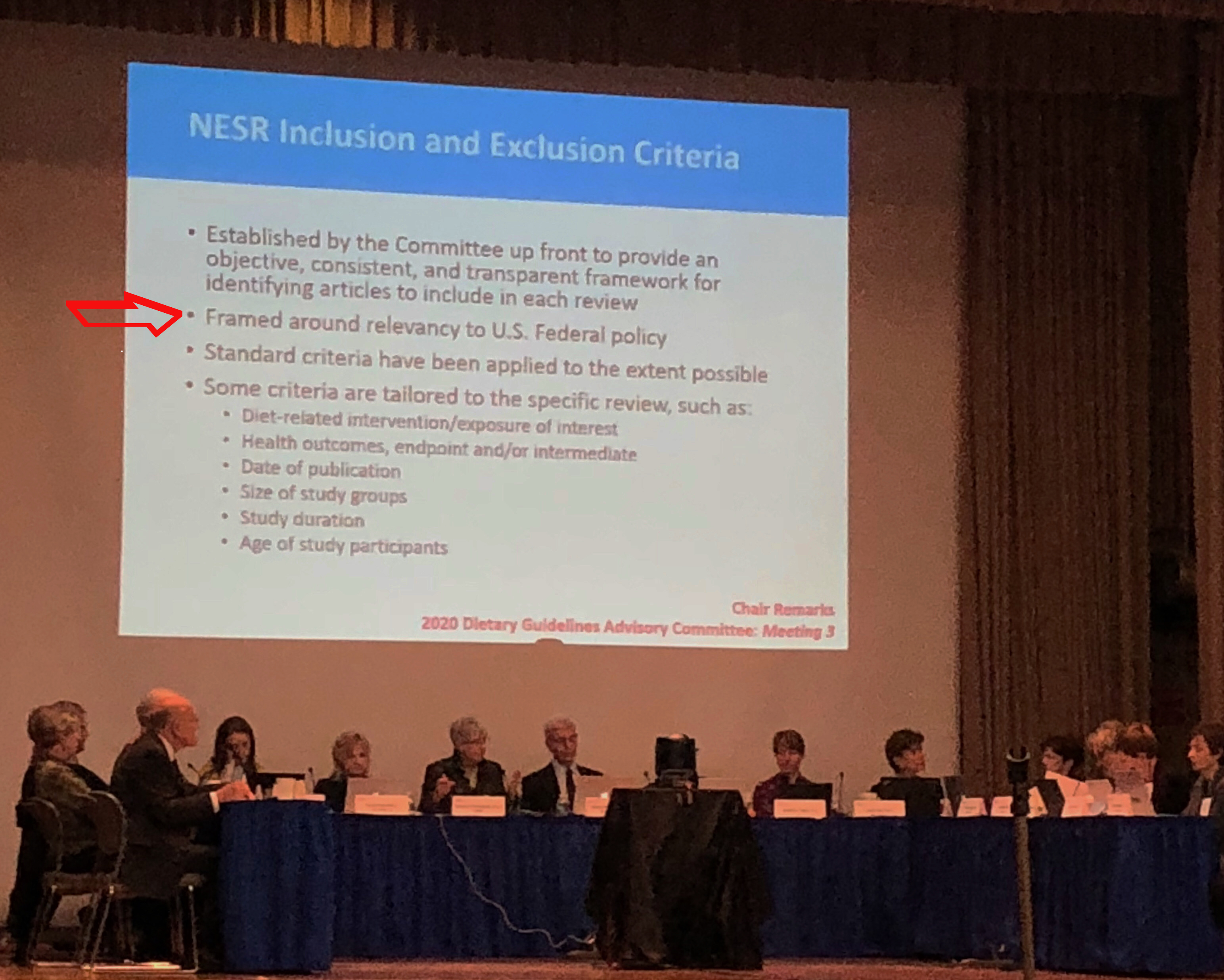
Part of the screening process used by USDA for science that will be included or excluded from Dietary Guidelines Advisory Committee consideration is this curious item shown above: “Framed around relevancy to U.S. Federal  Policy”. Committee members in October 2019 asked for more information on this research screening criteria. USDA explained it to them in the public meeting, stating that this bullet item “refers to including only the research that ALIGNS with current federal policy.”

At least Admiral Giroir was honest to remind us that the DGAs are more than ‘guidelines’, the DGAs are, in fact, enforced upon many Americans — especially children, elderly, food insecure families, and military through government oversight of diets at schools, daycares, retirement villages, hospitals, nursing homes, military provisions, and government feeding programs like Women Infants and Children.

“The 2020-25 DGAs put Americans on a path of sustainable independence,” said USDA Food Nutrition Services Deputy Undersecretary Brandon Lipps during the Dec. 29 unveiling.

Lipps was eager to share the new MyPlate website re-launch — complete with a new MyPlate ‘app’ and ‘fun quizzes and challenges.’ He said every American, over their whole lifespan, can now benefit from the DGAs. In addition, the MyPlate ‘app’ will record dietary data for the government to “see how we are doing.”

Congress fails

In the postscript comments of the 2020-25 report, USDA / HHS authorities say they intend to look again at ‘preponderance’ of evidence about stricter sugar and alcohol limits in future DGA cycles but made no mention of looking at ‘preponderance of evidence’ on loosening future saturated fat restrictions.

The ‘preponderance’ threshold was set by Congress in 1990. Then, in 2015, Congress took several steps to beef up the scientific review process for 2020.

During an October 2015 hearing, members of Congress cited CDC data showing the rate of obesity and diabetes in school-aged children had begun to taper down by 9% from 2006 to 2010, but from 2010 to 2014 the rates increased 16%.

2010 was the year Congress passed the Healthy Hunger Free Kids Act to tie the most fat-restrictive DGAs to-date more closely to the schools and other government-subsidized feeding. 

USDA, under Tom Vilsack as former President Obama’s Ag Secretary at the time promulgated the implementation rules for schools, outright prohibiting whole and 2% milk as well as 1% flavored milk for the first time — even in the a la carte offerings. These ‘Smart Snacks’ rules today govern all beverages available for purchase at schools, stating whole milk cannot be offered anywhere on school grounds from midnight before the start of the school day until 30 minutes after the end of the school day.

In the October 2015 Congressional hearing, lawmakers from both sides of the aisle grilled then Secretaries Tom Vilsack (agriculture) and Sylvia Burwell (HHS) about the Nutrition Evidence Library (NEL) that is housed at USDA, asking why large important studies on saturated fat funded by the National Institute of Health (NIH) were left out of the 2015-20 DGA consideration.

That 2015 hearing indicates why we are where we are in 2020 because of how each 5-year cycle is structured to only look at certain questions and to build on previous DGA Committee work. This structure automatically excludes some of the best and most current research. On saturated fat in 2020, the DGA Committee only considered new saturated fat evidence on children (of which very little exists) or what met previous cycle parameters.

This, despite Congress appropriating $1 million in tax dollars in 2016 to fund a review of the DGA process by the National Academy of Sciences, Engineering and Medicine. That review was particularly harsh in its findings, and the 2020-25 DGA process ignored the Academy’s recommendations.

Opinion, not fact

During the 2015 Congressional hearing, then Secretary of Agriculture Tom Vilsack was asked why 70% of the DGA process did not use studies funded by the National Institutes of Health (NIH).

“The (DGA) process starts with a series of questions that are formulated and then information is accumulated, and it goes through a process of evaluation,” Vilsack replied.

Answering a charge by then Congressman Dan Benishek, a physician from Michigan who was concerned about the 52% of Americans in 2015 that were diabetic, pre-diabetic and carbohydrate intolerant in regard to the fat restrictions, Vilsack replied:

“The review process goes through a series of mechanisms to try to provide an understanding of what the best science is, what the best available science is and what the least biased science is, and it’s a series of things: the Cochrane Collaboration, the Academy of Nutrition and Dietetics, the aging for health care equality, data quality, all part of the Data Quality Act (2001 under Clinton Admin). That’s another parameter that we have to work under, Congress has given us direction under the Data Quality Act as to how this is to be managed.”

Unsatisfied with this answer, members of Congress pressed further in that 2015 hearing, stressing that fat recommendations for children have no scientific basis because all the studies included were on middle aged adults, mainly middle-aged men.

https://www.c-span.org/video/standalone/?c4932695/user-clip-excerpt-preponderance-evidence

Vilsack admitted that the DGAs are “opinion” not “scientific fact.” He explained to the members of Congress how “preponderance of evidence” works in the DGA process.

“In some circumstances, you have competing studies, which is why it’s important to understand that this is really about well-informed opinion. I wish there were scientific facts. But the reality is stuff changes. The key here is taking a look at the preponderance, the greater weight of the evidence,” said then Sec. Vilsack in 2015. “If you have one study on one side and you have 15 on another side, the evidence may be on this side with the 15 studies. That’s a challenge. That’s why we do this every five years to give an opportunity for that quality study to be further enhanced so that five years from now maybe there are 15 studies on this side and 15 studies on this side. It’s an evolving process.”

What now?

What we are seeing again in 2020 is what happens when ‘preponderance’ is affected by structures that limit what research is included to be weighed.

Stay involved and engaged. The grassroots efforts are making inroads, even though it may not appear that way.

For their part, the checkoff and commodity organizations ‘applauding’ the latest guidelines would benefit from drinking more whole milk and eating more full-fat cheese and beef to support brain function and grow a spine.

-30-

Preposterous ‘preponderance’

While left hand says it’s busy building ‘mountain’ of evidence, right hand has already moved the nutrition definition goal post

By Sherry Bunting, Farmshine, Dec. 23, 2020

BROWNSTOWN, Pa. — Preponderance of the evidence. We hear that phrase over and over when it comes to the Dietary Guidelines for Americans (DGAs) and the effort to reverse 40 years of increasingly strict rules on dietary fat affecting children in schools and daycares, the military, seniors in nursing care or retirement villages, food-insecure families relying on government feeding programs like WIC, and countless other insidious prohibitions on healthy choices when it comes to whole milk, butter, full-fat cheese, dairy products like sour cream and cream cheese as well as other animal protein foods containing fat.

But the whole concept of ‘preponderance’ is really preposterous when applying the legal definition.

Let’s review.

Last March at a DMI forum on a Chester County dairy farm, DMI chair Marilyn Hershey and executive vice president Lucas Lentsch described the ‘preponderance of evidence’ standard as “building a mountain of evidence.” They said the National Dairy Council is building that mountain, but it takes time to keep pushing more evidence forward “until we have enough.”

When former Ag Secretary Tom Vilsack gave the 2015-20 Dietary Guidelines his stamp of approval, a Congressional hearing took the USDA and HHS secretaries to task, grilling them on science that was not considered then (nor is it now in the 2020 version of the DGAs). Remember, former Ag Sec. Vilsack promptly became the current top-paid dairy checkoff executive for four years (Jan. 2017 to present) and is now poised (again) as President-Elect Biden’s Ag Secretary pick 2021 forward.

During that 2015 congressional grilling, then Secretary Vilsack said “It’s the preponderance of the evidence that is the standard, and we know stuff is always changing so there has to be a cutoff.”

On whole milk (which he helped remove from schools in 2010), then Secretary Vilsack, when confronted in 2015 with what he called “emerging” science on saturated fat — said “the preponderance of evidence still favors the recommendation for fat-free and low-fat dairy.”

Much of the saturated fat discussion during the 2020 DGA Committee work used the 2015 DGA’s body of science, that was one of the screening criteria. The cutoff bar didn’t move.

In 2015, then Secretary Vilsack explained the ‘science’ of the DGAs this way:

“Well, the process starts with a series of questions that are formulated and then information is accumulated and it goes through a process of evaluation,” he said.

Answering a charge by then Congressman Benishek, a physician from Michigan who was concerned about the 52% of Americans who are diabetic, pre-diabetic and carbohydrate intolerant as regards the fat caps and the exclusion of science available — even in 2015 — on low carb, higher fat diets, then Sec. Vilsack stated in 2015:

“The review process goes through a series of mechanisms to try to provide an understanding of what the best science is, what the best available science is and what the least biased science is, and it’s a series of things: the Cochrane Collaboration, the Academy of Nutrition and Dietetics, the aging for health care equality, data quality, all part of the Data Quality Act (2001 under Clinton Admin). That’s another parameter that we have to work under, Congress has given us direction under the Data Quality Act as to how this is to be managed.”

On a further point of contention in 2015, Vilsack stated the following as a definition of how “preponderance” works.

Vilsack said (2015): “In some circumstances, you have competing studies, which is why it’s important to understand that this is really about well-informed opinion. I wish there were scientific facts. But the reality is stuff changes. The key here is taking a look at the preponderance. The greater weight of the evidence. If you have one study on one side and you have 15 on another side, the evidence may be on this side with the 15 studies. That’s a challenge. That’s why we do this every five years to give an opportunity for that quality study to be further enhanced so that five years from now maybe there are 15 studies on this side and 15 studies on this side. It’s an evolving process.”

During a recent dairy checkoff yearend news conference with reporters, DMI CEO Tom Gallagher answered a question about consumer health attitudes and checkoff research targets for 2021. Whole milk was never mentioned in the question, but here is Gallagher’s answer as he, too, cites the “preponderance” criteria:

Gallagher said (2020): “Our research plan (for 2021) is very robust at our centers. The primary research that we focus on is whole milk because we are, number one, the only group to be pushing the research on whole milk and taking it to the scientific community so the scientific community does more research because the Dietary Guidelines will never change until the preponderance – not the best – evidence, but the preponderance of the research is in favor of whole milk. We’re helping to move that needle to that point.”

I looked up the legal definition of this ‘preponderance of the evidence’ phrase, this standard for the DGAs as determined by Congressional statute. It is clear that DMI’s assertion of building a mountain of evidence is not needed to achieve a preponderance, according to the legal definition.

According to the law.com legal dictionary, ‘preponderance of the evidence’ is a lower burden of proof than other evidentiary burdens. It only requires a better than 50% chance that it’s true! 

In fact, the law.com definition states “Preponderance of the evidence is based on what is the more convincing evidence and its probable truth or accuracy NOT on the amount of evidence.” An example is given where one credible witness outweighs a pile of other evidence! It’s not the amount of research, then, it is the more convincing in terms of probable truth.

The word preponderance itself means “quality or fact of being greater in number, quantity, OR importance.” Yes, importance and quality can trump quantity to achieve preponderance!

Mountain-building is a stalling tactic by the left hand of industry and government, while their combined right hand is moving the goal post. (In fact, mountain-building is futile because the USDA structure on Dietary Guidelines has not allowed new evidence to be considered on certain dietary fiction it deems as settled science. There are fancy ‘mechanisms’ that have kept credible science out of the equation in 2015 and again in 2020).

Who are the attorneys advising USDA and dairy checkoff as to the meaning of “preponderance of the evidence?” Could it be Mr. Vilsack, an attorney by trade, going from USDA Secretary to top-paid DMI executive and back again potentially as the next Ag Secretary? 

Clearly, Mr. Vilsack and his colleagues at DMI are fond of citing “preponderance” as a stalling tactic for fat flexibility in the DGAs. But contrary to Gallagher’s point during this yearend news conference, the legal definition of “preponderance of evidence,” really does mean the BEST evidence can trump the MOST evidence.

It’s not about which theory has the most evidence, but which one has the best and most convincing evidence. This definition suggests that you don’t need 15 studies on one side to match 15 studies on the other side. To add flexibility on school milk choice or to reverse the saturated fat caps set at 10% of calories, a mountain of evidence is NOT needed, and a lot of good and convincing evidence keeps getting excluded from the process anyway.

The saturated fat question and the casting aside of research feels like being forced to doggy paddle in an olympic swimming competition.

The problem is agenda and bias. Who is standing up for producers and consumers?

Ahead of the 2015 DGA cycle, scientists and investigative journalists, like Nina Teicholz, exposed the weak scientific basis for Dr. Ancel Keys’ diet-heart hypothesis that these DGAs have been built on for over 40 years. Not to mention the many studies back then that were buried, once Keys became the dietary darling, and not to mention all of the newer studies that show saturated fat is not the health demon it has been made out to be, and in fact is necessary in diets to prevent chronic diet-related illness.

Here’s a look at where nutrition science is going next.

Yes, they have moved the goal post via climate change. And yes, they are telling us that consumers are more concerned about climate change after Covid-19.

Basing DMI’s 2021 plan assertions on a Kearney report (April 2020), Gallagher said: “Covid-19 has made people more hyper-sensitive to things, like the environment. 58% of consumers are more concerned about the environment since Covid, and 50% want companies to respond to climate change with the same level of urgency as responding to the pandemic.”

When asked where consumers ranked health in that particular survey — given a recent report on CNBC business news about corporations trying to get consumer ‘buy-in’ on sustainability benchmarks and finding the only way to achieve it is to link sustainability to health.

You guessed it. Gallagher was ready with the answer.

“Sustainable nutrition is the phrase you’re going to hear going forward. You’re going to see those two things inextricably tied,” he replied during the yearend and look ahead news conference by phone.

We recall in October 2019, Gallagher telegraphed a message during the 53rd World Dairy Expo that the dairy checkoff simply accepts waiting another five years until 2025 (not the current cycle) as the year that the saturated fat caps could be reversed. The 2020 DGA committee was only just partway into the process back in Oct. 2019 with a whole year of work ahead — and already the head of dairy checkoff was being quoted in the Oct. 14, 2019 Hoard’s article broadcasting that the fat issue could likely happen by the NEXT DGA cycle (2025), not this one (2020).

Gallagher further indicated in that Oct. 2019 Hoards article that the “forest” must be “populated with more trees.” (Again this idea that preponderance is based on the amount of studies, not the importance or reliability of the studies and not acknowledging that half the trees in that so-called forest are being ignored by USDA and the DGA committee — screened out of consideration at the outset. Not one of the checkoff or ag commodity group was standing up for producers and consumers on this score at the START of the 2020 DGA cycle, nor the finish).

However, we now know that the new goal post will be entrenched by 2025: ‘Sustainable nutrition’ will be the new phrase, the new goal post, according to Gallagher’s response during the December 2020 news conference.

Make no mistake about this: As much as the sustainability overlords talk about farmers being paid to plant cover crops (most already plant cover crops after corn harvest) or to recover nutrients and methane through other practices and technologies, paying for offsets and dilution of animal foods in diets are two strategies already on deck. We heard a little of this also during the December 2020 news conference as Gallagher and DMI president Barb O’Brien talked about how their partners are getting into ‘competitors’ (fake dairy lookalikes) because when a family of four comes in to eat, one may want a new taste experience, and DMI partners have to provide that ‘new experience’ to keep from losing the entire family.

DMI is working for its corporate partners like Nestle and Starbucks, both giving the DMI Innovation Center’s Net Zero Initiative up to $10 million over multiple years to pilot sustainable technologies and practices on dairy farms.

Gallagher described the situation this way: “Health, taste, price – those things are still important, but as more and more companies are offering things that are competitive, what we’re seeing people saying is ‘Well, I’m going to look at sustainability as a difference maker in who I purchase from and what I purchase,’” he said.

“The days of 10 to 15 years ago — where things like sustainability were believed to be made up by retailers for marketing — are over,” Gallagher added.

“Everyone gets it. We are past that. The beautiful part is the U.S. dairy industry has the best sustainability story in the world to tell, and we’re telling it,” he said.

As promised, a follow up email provided more details on Gallagher’s whole milk research assertion, stating: “Dairy farmers have been funding research led by National Dairy Council on the role of whole milk dairy foods and wellness for over a decade. In fact, around 70 studies have been published, adding to the growing body of evidence indicating that consuming dairy foods, regardless of fat content, as part of healthy eating patterns is not linked with risk of heart disease or type 2 diabetes. The paradigm shift to more fat flexibility in the dairy group is already happening in the real world as demonstrated through the many actions of consumers and thought leaders.”

Three research items were specifically mentioned in the email — all published within the past 6 to 24 months:

1) A Science Brief: Whole and reduced-fat dairy foods and cardiovascular disease. Upon following the link published January 17, 2019, we find it begins as a regurgitation of 2015-20 Dietary Guidelines with all references to dairy qualified as ‘low-fat and fat-free’, but then goes on to discuss: “Emerging research also indicates that saturated fat intake on its own may be a poor metric for identifying healthy foods or diets.” A downloadable PDF summarizes this “emerging” research on dairy fat at: Science Brief: Whole and Reduced-Fat Dairy Foods and CVD | U.S. Dairy

2) Posted in Sept. 2019 is this resource where National Dairy Council’s Dr. Greg Miller talks about “landmark shifts” and states that, “As the research continues to grow, a preponderance of evidence (exists linking milk, cheese and yogurt, regardless of fat level, with lower risk of chronic diseases like type 2 diabetes and cardiovascular disease. This one is found at: Ask Dr. Dairy: Can Whole Milk-Based Dairy Foods Be Part of Healthy Eating Patterns? | U.S. Dairy

3) The third item posted June 2020 in connection with DMI’s Dietary Guidelines comment talks about dairy consumption lowering risk of high blood pressure and diabetes and cites a study that, “indicates there may be room for fat flexibility in peoples’ dairy group choices to include dairy foods like milk, cheese and yogurt – at a variety of fat levels – as part of healthy eating patterns in the U.S. and worldwide.”

We can see the tight rope being walked, hinging everything on this idea of slowly building a mountain of evidence as though this is the definition of what is needed to fulfill the “preponderance” standard. But as we know from the legal definition, the amount of evidence is not what’s important, but rather what is credible and convincing. The available evidence is already preponderant. Whole milk, at 41% of market share, has grown by leaps and bounds over the past two years, and is now the largest selling product in the milk category because consumers are convinced. In the past two years, they have moved toward choosing health instead of allowing the government to choose for them — at least when they CAN choose.

Thinking on the many topics that were part of the fairy checkoff yearend news conference, some clear themes take us into the new year in terms of the 2021 dairy checkoff plans.

Gallagher, O’Brien and Hershey talked about “moving milk” differently because of Covid, of working in Emergency Action Teams to unify the supply chain with these top priorities in mind: 

1) Feeding food insecure people, 

2) Responding to climate change

3) Developing a deeper and closer relationship with Amazon into e-commerce and milk portability, and 

4) Developing tools and promotions for corporate partners.

On the latter, Gallagher was proud to give the example of DMI’s funding for Domino’s “contactless delivery” in Japan during the early days of Covid. He said this partner (named as Leprino, DFA and Domino’s) would not have been in a position to move so much pizza cheese when the pandemic hit the U.S. had it not been for DMI’s funding of that contactless delivery innovation first in Japan and then used here.

(Contactless delivery is used by almost every restaurant doing takeout today in the Covid era. It simply means ordering and paying online, texting when arriving, and having your food placed in your car. Not rocket science.)

Since 2008, DMI and USDA — through Vilsack-era Memorandums of Understanding — have a hand-in-glove relationship on GENYOUth and Sustainability. DMI works for its partners and has adopted a role for itself as global supply-chain integrator — the prime mover of milk.

Increasingly, there is the sense that the dairy checkoff bus has morphed into a ride for its key partners, while rank-and-file producers keep paying the fare, just hoping for a lift.

Look for more yearend checkoff review in a future edition of Farmshine.

One-sided bias evident as DGAC edges fat ‘caps’ lower, even our toddlers aren’t safe

Over 500 pages, 250,000 reports screened-out, nutrient deficiencies ignored, and now toddler food patterns included

IMG-8568By Sherry Bunting, Farmshine, June 19, 2020 edition
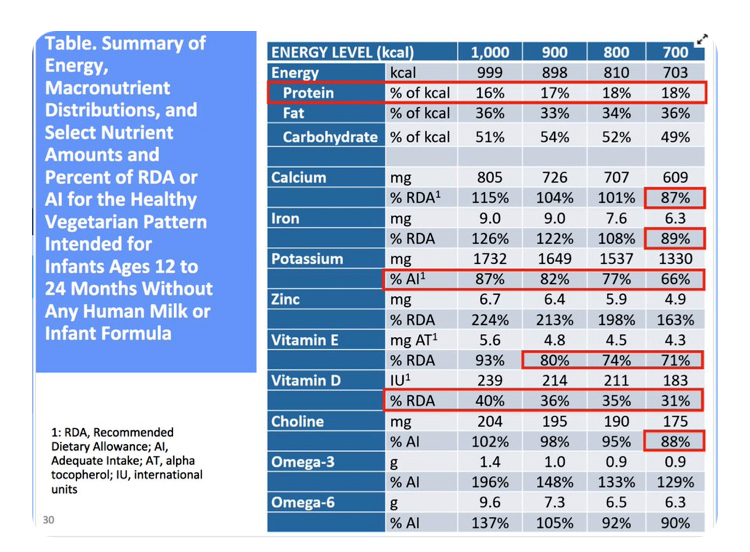
WASHINGTON, D.C. — The big news from the final Dietary Guidelines Advisory Committee (DGAC) meeting in which they presented their 500-plus page report Wednesday, June 17, is that the current saturated fat caps — at less than 10% of calories — will stand. But at the same time, the saturated fat subcommittee detailed its true recommendations, pegging saturated fat levels to be at 7 to 8% of calories, and these charts are the ones that will likely be forced on schools and daycares and nursing homes and military diets. (More detail on this to come.)

After 7 hours of subcomittee presentations, in an online virtual format, covering all facets of the 2020-25 DGAC ‘expert’ report, it was hard to choose which of the many eyebrow-raising moments was most concerning. In fact, DGAC comments were at times actually humorous, if this was not such a serious matter.

Perhaps it was the moment when the subcommittee handling the saturated fat questions decided to go backwards from 2015. Not only are they edging the saturated fat caps lower in their forward-looking recommendations, they want to bring cholesterol caps back into the mix. That’s right folks, we’re going back to cholesterol caps “because humans have no need for dietary cholesterol,” they declared matter of factly.

That’s the mentality. No need for cholesterol, which is essential for every single cell in the body and especially important in hormone synthesis, not to mention brain function. But, then again, the DGAC never was happy about giving up those cholesterol caps in 2015, especially since the anti-animal agenda of noted DGAC vegetarian leanings have found they need more than saturated fat caps to hang their hats on — especially since the 2020 DGAC included toddler food patterns in their report for the first time.

That discussion was also perplexing. No less than a full hour was spent going through every diet formulation the subcommittee could conjure up in order to get toddler food patterns closer to a “healthy vegetarian diet”, the one of three currently government-approved dietary patterns favored by the DGAC, now being recommended for children UNDER 2 years of age.

Each combination of foods they walked through (because the new way of presenting these patterns is to have actual foods listed to avoid) had them facing a big dilemma. Within the amount of calories a toddler will consume, there was no way to deliver the nutrients they need for life without more animal protein foods. In each case, the toddler patterns did not provide all the essential nutrients needed for brain development, growth, and health.

Iron was just one of them. When it was pointed out by one DGAC member that animal protein delivers absorbable iron — critical for toddlers — unlike a handy-dandy supplement pill, vegan-leaning Linda Van Horn from the saturated fat committee chimed in with a bizarre comment. She said it was not a concern because research she couldn’t put her fingers on at that moment suggests vegetarian adults have the ability to absorb more iron from supplements and other foods, so, she said, “kids of vegetarian parents could have this ‘accelerated absorption’ capability from their parents.”

Inherited vegetarian genetics? Eye-roll.

Another committee member politely suggested that, yes, there is research showing vegetarians absorb more iron from supplements and other food sources “because they are deficient in iron in the first place.”

66686

DGAC says healthy vegetarian pattern for toddlers is good to go even though it doesn’t meet their needs for essential nutrients for life. No solution was given by DGAC for this problem. Sadly, in fact, children in schools and daycares were referenced as a group that can “adhere” to the diets  due to government p.

Unfazed, the committee ignored any attempt at logic on the many questions of these diets missing quite a few “nutrients of concern.” They simply moved on… next slide.

Throughout the discussions of dietary patterns, saturated fat caps, and such, the “nutrients of concern” not being met in the food patterns — mainly fat soluble vitamins like D and A found naturally and more absorbable in whole milk vs. fat free and low fat dairy, for example — they just kept moving on in their direction away from animal foods, comforted by their cherry-picked research.  It wasn’t just vitamins D and A and iron, but also iodine, choline, B12 (in adults), potassium, and more. Throughout the daylong presentations, this problem with nutrients not being met kept cropping up for each “life stage” the DGAC was addressing. What was new this time was the addition of food patterns for pregnant and lactating women and children from birth to 24 months of age.

In a more detailed look at the report next week, a few ‘good news’ points for dairy as a food category can be shared, but this underlying avoidance of saturated fat put all things dairy squarely in the fat-free and low-fat zone, and the new and stricter recommendations for added sugars and beverage calories were another concern for children and the dairy sector. Yep, you guessed it. Coke and Pepsico will be happy as their high fructose corn syrup mixed with artificial sweetener concoctions will be looked upon favorably vs. nutrient-dense chocolate milk. (More on that next week.)

Other mentally exhausting moments occurred when subcommittees made recommendations based on limited evidence, or conversely, graded evidence as strong when it was based purely on observational studies. When these concerns were brought up, the answer was to point at the work of the 2015 DGAC that considered “so many more studies” and that the DGAC had decided at the outset to “build on the 2015 report” — more or less picking up where they left off — when it came to the question of dietary fats.

That was the ‘magic wand’ applied throughout the day.

In fact, as Nina Teicholz, author of Big Fat Surprise and founder of the Nutrition Coalition, pointed out in her blow-by-blow twitter feed throughout the day, the movement to subtly edge saturated fat caps lower happened on the very day that a major new review was published on saturated fats to the contrary. The authors of that report — unconsidered by the DGAC of course — included the chair and another member of the former 2005 DGAC.

“Their findings are quite opposite of those by the current one-sided 2020 DGAC,” wrote Teicholz.

Another eyebrow-raising moment came when the committee debated how to “harmonize” the food listings on their charts taken from studies where they had different meanings or included different foods.

Dairy was one example. Whole milk bad, fat-free good, and yet ‘milk’ as an entity showed up with so many positive influences in combined research charts (including cardiovascular disease, all cause mortality, obesity, type 2 diabetes, immune status and more). But the committee didn’t know which milk was in the study, and that distinction is important!

Similarly, they lumped red meat and processed meat together on one chart (the negatives), and then on another chart showing positives, they listed ‘lean meat’ but said they didn’t know if that category included lean red meat or just poultry and fish — even though the same chart had separated poultry and fish into their own categories!

It all seemed like nonsense the DGAC should have taken time to figure out before rushing their report to print.

Even though a letter signed by nearly 300 doctors and medical professionals, letters from dietician groups, letters from members of Congress and others had requested a delay, the DGAC was in a hurry to do the June 17 presentation. In fact, when registering to participate in the presentation online, a note was sent back stating that “this is only a draft and it will have a comment period.”

Trouble is, the expert report is now out, and it’s going to be difficult to put that jack back in the box with a 30-day or 60-day comment period after USDA and HHS formalize it — because so much science was excluded from the beginning. A do-over with a new committee is needed.

This committee took time Wednesday to explain the litany of poor reasons why favorable fat studies were excluded from their cadre. The federal staff that screened for each subcommittee went through a total of 270,000 reports and whittled it down to 1500 on all pertinent questions for this DGAC cycle. That is a story in itself because rigorous evidence was ignored in favor of “associated” studies.

Another concerning moment came early in the day’s presentations when committee members talked about promoting federal diet-tracking, biomarkers and monitoring. Americans will love that kind of intrusion. And in the course of the behavioral recommendations they made, the schoolchildren were their go-to for such monitoring. A captive group of guinea pigs!

But perhaps it was the concluding remarks Wednesday evening at 7:30 p.m. as the daylong meeting came to a close that really stood out. Chairwoman Barbara Schneeman, Ph.D. talked about the enormous task the DGAC had completed over the past 15 months. She said the committee would put its report in final form over the next two weeks, present it to USDA and HHS by the end of June and then USDA and HHS would “formulate it” into recommendations that can be posted for public comment by July 15 and they would be a done deal for implementation by the end of 2020 for the next five years.

Schneeman also went on to talk about how the government nutrition programs needed to be working on how to get more Americans “adhering to these diets”, with emphasis on restricting fat, added sugars and salt while still maintaining positive energy balance and meeting nutrient needs even though the DGAC had not even the slightest answer for the dilemma of meeting nutritient targets with these patterns and recommendations, especially for children.

The clincher. Schneeman pointed out how the COVID-19 pandemic shows just how much the current state of chronic dietary-related diseases put certain populations in the most vulnerable position for infectious diseases like Coronavirus.

But that’s okay, the reason we have an obesity and diabetes epidemic as well as other chronic conditions is because, she said “Americans have never followed our dietary guidelines.”

Begging to differ with their federal statistics, the record is clear that per-capita consumption has declined among the foods DGAC set out over the years to have Americans increasingly avoid. These chronic conditions have worsened with each 5-year cycle moving us further in the fat-free and low-fat direction. So much so, that many of us don’t even realize how we are impacted, and especially how our children are impacted. Now, even the toddlers won’t be safe.

Get involved by sending or phoning a comment to YOUR members of Congress and the Secretaries of Agriculture (USDA) and Health and Human Services (HHS) at this link https://www.nutritioncoalition.us/take-action/

Look for more details in part two.

Past articles on this blog about the DGAC process are listed below

Dietary Guidelines Committee must be stopped… 

Call to action: Feds ignore science on saturated fats… 

Dairy advisory committee formed… 

There is a war to win for our farmers and our children… 

Nutrition politics: Kids and cattle caught in crossfire…