
New owner is global giant with $47 billion portfolio

By Sherry Bunting, Farmshine, Jan. 5, 2024
PARIS — On the first day of 2024, another brand of fluid milk was sold to a private equity firm.
This time was no surprise: Paris, France-based Danone announced on Jan.1st its agreement to sell organic dairy businesses, including flagship Horizon Organic, to Platinum Equity, based in Los Angeles, California.
The sale is said to be part of the Renew Danone Strategy announced in March 2022 and is mentioned in Danone’s 2023 Climate Transition Plan.
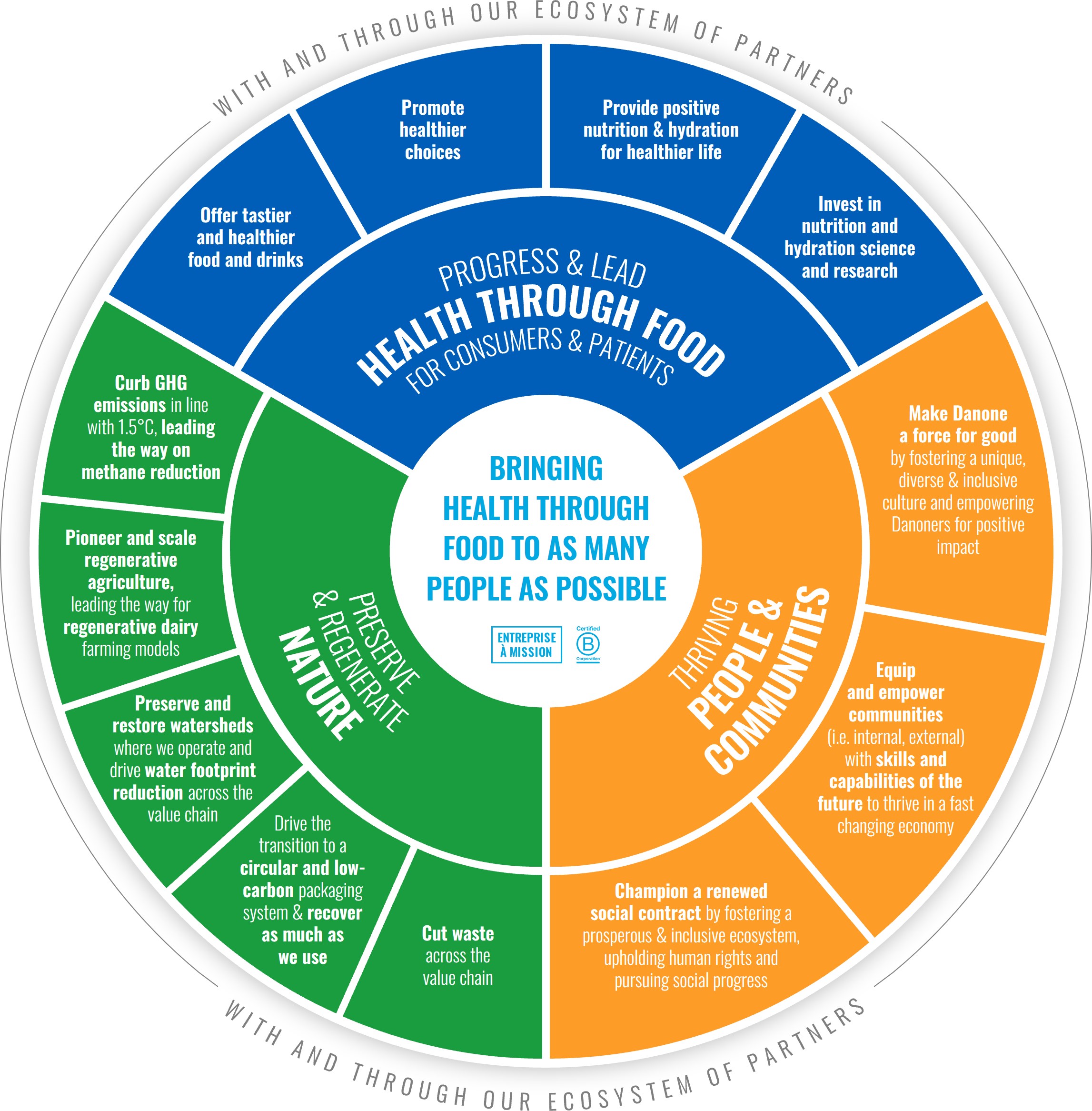
The company reported its organic dairy sector represented approximately 3% of its global revenues in 2022 and had a “dilutive impact” on sales growth and operating margin.
But mainly, said CEO Antoine de Saint-Affrique, the organic dairy business “fell outside our priority growth areas of focus,” he said, reiterating his very words to investors a year ago when he first announced “eyeing sale” of Horizon Organic and Wallaby.
Terms of sale were not disclosed, but Danone will retain a non-consolidated minority stake in the business, executives said. The closing of the transaction is subject to customary conditions and regulatory approvals.
“Today marks an important milestone in delivering this (Renew Danone) commitment while giving the Horizon Organic and Wallaby businesses the opportunity to thrive under new leadership. This sale, once completed, will allow us to concentrate further on our current portfolio of strong, health-focused brands and reinvest in our growth priorities,” said de Saint-Affrique.
According to Platinum Equity’s New Year’s Day announcement of the acquisition, Horizon Organic is deemed the largest organic fluid milk company in the world and the first brand of organic milk available coast to coast in the United States. It has since grown to include organic creamers, yogurt, cheese and butter.
Platinum Equity Co-President Louis Samson said the acquisition will “build on that legacy and support Horizon Organic’s growth as a standalone company.”
Horizon Organic became the first public organic food company in 1994 and was purchased by Dean Foods in 2004, where it became part of WhiteWave holdings alongside International Delight, Silk and other fake-milk brands. A 2012 spin-off separated WhiteWave from Dean, taking former Dean CEO Gregg Engles with it as the WhiteWave CEO. In April of 2017, Danone purchased WhiteWave, and Engles continued as a current Danone S.A. board member.
Wallaby is an Australian-style organic yogurt found mostly in natural food stores as well as the Whole Foods chain throughout the U.S.
Platinum Equity estimates that the total U.S. dairy category is valued at $68 billion in sales with fluid milk comprising approximately $17 billion of that total. Of that $17 billion in packaged fluid milk sales, organic milk sales comprised 6.7% of the volume for the first 10 months of 2023, according to the most recent USDA Monthly Packaged Fluid Milk Sales Report.
Meanwhile, Danone has launched full-force into expanding the fake side of its 2017 WhiteWave purchase, adding products and launching new brands of plant-based and AI-engineered biological concoctions of fake-milk, fake-yogurt, fake-cheese, and other fake-dairy products in its quest for so-called “Climate Transition” and “Food Transformation.”
The sale of Horizon to a global private equity firm that specializes in mergers and acquisitions also comes on the heels of Danone’s December 2021 decision to end contracts with all of its New England and eastern New York dairy farms after sourcing milk from larger organic farms to the west and south.
After the sale of Horizon Organic is completed, Danone will be able to completely withdraw from Federal Milk Marketing Orders (FMMO) to do Cost Performance Model (CPM) pricing with a much smaller number of dairy farms, just like with other ingredient sources. Only Class I fluid milk sales are required to participate in FMMOs, and the sale of Horizon Organic to Platinum Equity ends Class I milk sales for Danone because the rest of their former WhiteWave beverage holdings are plant-based.
While Danone moves on to grow its fake-dairy business, owning the largest plant-based manufacturing facility in the world located in northern Pennsylvania and launching new plant-based alternatives to disrupt the dairy case, the Managing Director of Horizon Organic’s new owner, Adam Cooper, sees organic and value-added products as the “premium offerings” that are “driving growth in the dairy milk category.
“Horizon Organic is a pioneer of that segment and is in position to continue capitalizing on and accelerating the trend,” said Cooper.
Platinum Equity has completed more than 450 acquisitions over the past 28 years, and today operates about 50 global businesses that have been shaken loose from larger corporate entities. The global firm’s current $47 billion portfolio includes a few other companies in the food and beverage sector, such as biscuits, wine, seafood, packaged meat and bakery products, and food ingredients distribution.
“We are excited about Horizon Organic’s potential as an independent business with a renewed sense of focus and a commitment to investing in its success,” said Cooper. “We look forward to partnering with Horizon Organic’s management team to ensure a seamless transition and chart a path for continued growth and expansion.”
Already deemed a “component stock of leading sustainability indexes,” Danone’s ambitions are entrenched with ESG investors, the Global Methane Pledge, Climate Transition, Food Transformation and aspirations to be the publicly-traded global company that is B-Corp certified at the global level in 2025. (Danone is already B-Corp certified in the U.S.)
Over the past seven years, Danone North America has moved toward branding its ‘sustainability’ as increasingly plant-based.
In 2022, Danone North America received a $70 million USDA Climate-Smart grant, which the company says will be used to: 1) reduce methane emissions for dairy through innovative manure management, 2) create infrastructure to sustainably grow and trace U.S. food-grade oats and soybeans, and 3) build processing for traceable organic soy.
During the White House Conference on Hunger, Nutrition and Health in September 2022, Danone announced a $22 million investment by 2030 to improve access to, and availability of, “nutritious and health-promoting foods,” the bulk of these funds will be used to “educate consumers and healthcare providers” (aka, marketing).
Shortly thereafter, the FDA Milk Labeling Proposed Rule hit the Federal Register for comment requiring only voluntary compliance for nutrition comparisons on labels of fake-milk using the term ‘milk.’ This rule has not been finalized as FDA continues to look the other way when it comes to milk and dairy label standards of identity abuses.
(Rest assured, Danone’s big goal is to become ‘net zero’ by 2050 by transforming food. Sound familiar?)
DANONE FOOD TRANSFORMATION TIMELINE
July 2016, Danone launched the Dannon Pledge for non-GMO verified, positioning its conventional milk supply around a concept of ‘almost-organic.’
Apr. 2017, Danone purchased the Dean WhiteWave spinoff, which included Horizon Organic and Silk, So Delicious, and Alpro plant-based brands. The DOJ Antitrust Division required Danone to simultaneously divest its Stonyfield Farms subsidiary.
Apr. 2018, Danone quietly notified smaller Horizon Organic dairy farms in the western states that their future contracts would not be renewed amid a glut of organic milk and differences in how USDA’s organic livestock origin rules were being applied. Some of these producers were offered conventional non-GMO milk contracts using Danone’s proprietary Cost Performance Model (CPM). Some found other markets, and many exited the business. According to Danone’s 2021 Regenerative Agriculture Report, more than half of all U.S. milk collected by Danone now comes from farms with CPM contracts.
Feb. 2019, Danone completed construction of the world’s largest plant-based yogurt factory in Dubois, Pennsylvania, where other non-dairy lookalike products are also made.
Feb. 2020, Danone told investors the rising global temperature is a business opportunity, and the company would accelerate food transformation with climate at the core of its growth strategy.
Oct. 2020, Danone announced its partnership with a bioscience startup to use artificial intelligence to explore new formulations to improve taste and texture of plant-based dairy alternatives.
Jan. 2021, Danone’s So Delicious launched its first plant-based cheese and Danone S.A. was acknowledged as the largest plant-based company in the world with 10% of total sales coming from plant-based dairy alternatives. The company told investors it would grow this with further acquisitions and a “plant-based acceleration unit.”
Apr. 2021, Danone and the EAT Lancet Commission announced a strategic partnership to promote a so-called “healthier and more sustainable food system by driving a change to planetary diets.” Danone pledged to use its ‘One Planet. One Health’ framework to “accelerate this food revolution.”
July 2021, Danone announced three new plant-based fake-milk launches for 2022, along with a list of other lookalikes. During the July 2021 earnings call, Danone executives identified the U.S. as a “key plant-based market,” but noted 60% of U.S. consumers are not in the category because of product taste and texture. They announced a plan to win them over “with new dairy-like technology under Silk NextMilk, under So Delicious Wondermilk and under Alpro Not Milk.”
Aug. 2021, Danone sent letters notifying all 89 of its organic dairy farms in New England and eastern New York that their milk contracts would be terminated in 12 months’ time. Later, under pressure from organic groups, officials and consumers, Danone agreed to a Feb. 2023 extension.
Jan. 2022, Danone launched the three new fake-milks: NextMilk, Wondermilk, and Not Milk.
(Interestingly, the Silk NextMilk Whole Fat has 6 grams of saturated fat from processed coconut and seed oils. That’s more saturated fat per serving than Real Whole Dairy Milk naturally from cows. Danone’s Silk NextMilk is packaged in red and white cartons with the words ‘Whole Fat’ appearing directly under the brand name to mimic the Whole Milk appearance. Interestingly, the FDA’s proposed healthy labeling rule sets a tougher threshold for saturated fat in dairy products compared to saturated fats from plant-sources.)
Mar. 2022, Danone described its Horizon Organic and “traditional dairy” holdings as “troubled offerings,” telling investors: “There are no sacred cows,” as they “keep pruning” the portfolio to “boost growth” and “distance” the company from “underperformance”… by investing more in “winning products” and selling existing brands or buying new ones.
May 2022, Danone launched its “Dairy & Plants Blend” baby formula (60% plant-based, 40% dairy) “to expose children to food tastes early in life that can help shape their future food preferences… while shifting toward plant-rich diets and embracing alternative sources of protein to help reduce carbon emissions.”
Sept. 2022, Danone joined the White House Conference on Hunger, Nutrition, and Health to announce a $22 million ‘nutrition and health’ investment by 2030 with $15 of the $22 mil. Earmarked “to further nutrition education for consumers and healthcare providers.” (Sounds like marketing). This includes Danone’s new pledge to increase the nutrient density of its plant-based beverages.
Sept. 2022 — Danone was part of a team that was awarded a $70 million USDA Climate Smart grant for projects that include: 1) Reducing methane emissions for dairy through innovative manure management, 2) Creating the infrastructure to sustainably grow and trace U.S. food-grade oats and soybeans, 3) Building processing for traceable organic soy.
Oct. 2022, Danone announced it would use artificial intelligence through its bioscience partner BrightSeed, to reformulate over 70% of its plant-based fake-milk alternatives to reduce added sugars and increase nutrient density. At the same time, it allocated $15 million to “partner with retailers on healthy eating education” and $7 million to partner with community-based programs that provide nutritious foods.
(Timing is everything: Danone is among the financial supporters of the infamous Tufts University Food Compass, launched recently into the federal nutrition policy arena through the Biden-Harris Hunger, Health and Nutrition Strategy and the FDA proposed rule on “healthy labeling.” The Food Compass nutrition profiling algorithm rates nonfat dairy yogurt high as an encouraged food, along with plant-based fake-milks; but real milk and cheese are rated lower as foods to moderate or discourage. More artificial intelligence, to be sure.)
Jan. 2023, Danone announced it was looking for a buyer for Horizon Organic, saying it fell outside of their growth areas of focus.
Feb. 2023, Contract extensions ended for terminated Horizon Organic dairy farms in the Northeast. Some have gone out of business. Others have gone to Stonyfield or Organic Valley, which eventually agreed to take on the remaining Northeast farms facing Horizon termination, along with 40 organic dairies cut last year by Maple Hill in New York.
Mar. 2023, Danone launched a fake-milk-mustache campaign for its Silk NextMilk brand using children, nieces, and nephews of three original real-milk-mustache celebrities to twist the knife.
Apr. 2023, Danone launched an organic alternative beverage: ‘So Delicious Organic Oatmilk’ in ‘original’ and ‘extra creamy.’
May 2023, Danone launched So Delicious Dairy-Free Yogurt
Jan. 2024, Danone announced its agreement to sell organic dairy businesses — Horizon Organic fluid milk and Wallaby yogurt to Platinum Equity.
-30-
 Ag Moos