Milk Market Moos, Nov. 29, 2024

USDA Standoff?

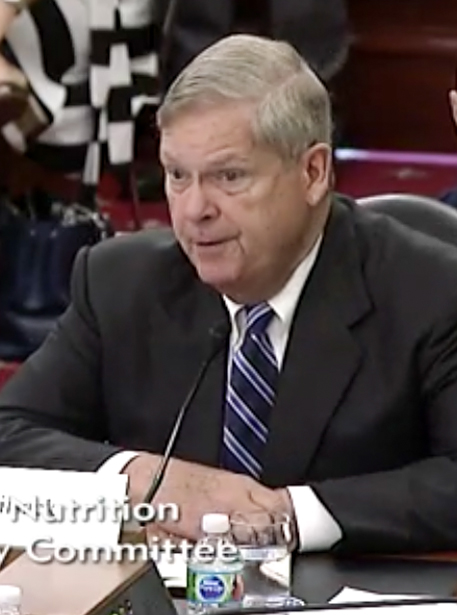
DTN policy editor Chris Clayton is reporting that a standoff could be brewing at the USDA between current Ag Secretary Tom Vilsack and the Trump transition team. Vilsack has urged the Trump team to sign “key ethics documents required by the Presidential Transition Act as soon as possible” so they can start the process of “educating folks… about what they are walking into,” and so the next Secretary of Agriculture “can be fully prepared for the job she is undertaking.”

After 12 years at the helm of USDA, with a 4-year intermission between the Obama and Biden Administrations, pulling a cool million in dairy checkoff salary, Sec. Vilsack has watered down dairy in the WIC program, mangled the recently completed Dietary Guidelines Advisory Committee selection and recommendation process, further deflated whole milk and dairy’s position in the school lunch and other nutrition programs, and has been tightly tied to his pet projects, especially the climate-smart partnerships he lobbied the Senate for in 2019 while working for DMI, given the ‘slush fund’ appropriated through the so-called Inflation Reduction Act that many describe as the undercover Green New Deal.

For that initiative, alone, Vilsack told the House Ag Committee a year ago he was hiring 4000 new USDA employees and that 4000 more would be needed at local levels to gather data, do the monitoring, and herd farmers into the data-collection squeeze chute to participate in climate-smart projects. The House Ag Committee expressed their concern about funds getting to actual farmers. (See Feb. 16, 2024 Milk Market Moos ‘carrot and stick’)

Hog wrestling strategy?

One could say there are a lot of pigs at the USDA climate trough. The whole deal needs a good auditing to see how much of what was spent or promised is getting into the hands of actual farmers and their on-farm contractors vs. going into the black hole of bureaucracy.\

While Trump’s Ag Secretary-Designate Brooke Rollins, still to be confirmed by the Senate, is only the second woman nominated to head the USDA, don’t let her femininity fool you. One thing we learned watching Rollins, 52, as a guest on legendary football coach Lou Holtz’s Nov. 4th Show about faith and leadership, this Texas Aggie was a hog wrestling champion.
Holtz asked Rollins about the hog wrestling title. It was 10 years ago when she and her sister Ann went to Bandera, Texas for an annual festival. They decided that year to enter the annual Wild Hog Explosion Contest. They won, even set a record, against younger women in the competition.

Rollins recalled: “We had a strategy and a plan, which seems to be a common theme in my life. You always have to have a strategy, and you always have to have a plan. We had a plan to wrestle that wild hog — and he was a wild, big hog — and put him into a bag and drag him across the finish line.”

A mom-coach could do wonders

USDA Secretary nominee Rollins also revealed that while coaching her daughter’s softball team a few years back when she was 10, they wrote their own mission statement that hung on the fence for every game. “Coaching is a reflection of life, to be our best, work as a team, have a common goal, never give up, and go for the win, every time.”

Rollins and Holtz talked of her leadership style to “find amazing people” to build teams that work together “not caring who gets the credit, but what gets accomplished.”

When asked the Bible verse most meaningful in her life, she said for this season in time “with the arrows slinging every which way,” Joshua 1:9 “Be strong and courageous. Do not be afraid; do not be discouraged, for the Lord your God will be with you wherever you go.”
One that strikes a chord throughout her life is: Matthew 25:40: “Whatever you did for one of the least of these brothers and sisters of mine, you did for me.”

When it comes to USDA’s failed nutrition policy, this verse rings true. It’s also worth noting that Rollins is a mother. That may be just what USDA needs at the top! Mom’s understand the school meal and school milk issue! Can we imagine how many more hungry children could be nourished if USDA devoted funds to the food that are now going to the bureaucrats calculating fat percentages and other criteria to regulate schools so they don’t violate the fat limits; and how much better off those children most reliant on school meals would be if they could choose nutrient-dense delicious whole milk, 3.25% healthy fat.

What’s up with milk production?

USDA Dairy Market News reports that milk availability is still tight for processors. Some processors expect milk availability to loosen in coming weeks, as plants slow production or shut down during the week of Thanksgiving. Class I bottling is strong as demand from schools is steady up to the coming holiday, and consumer demand increases. Demand from Class III is strong. Cheesemakers report that some plants are running as much as possible. Component levels are reported to be strong across the board. We’ll did into the report next week.

The USDA NASS milk production report released late Wednesday showed total U.S. milk production was up 0.2% in October vs. year ago. Meanwhile, milk production in the 24 major milk producing states gained 0.4% over year ago. For Q3, USDA reports total U.S. milk producers virtually flat with a year ago.

This indicates that states and regions that are expanding milk production rapidly in the Plains from western Minnesota, Iowa, South Dakota south to Texas, have large expansion units coming online — and their own circular systems for heifer-rearing are geared up to fill new stalls to supply new cheese processing that is coming online — perhaps not at all impacted by the overall tight supplies of milk cows, springing heifers, and bred heifers in today’s marketplace.

Remember, the current Secretary of Agriculture, Tom Vilsack, canceled the July 2024 mid-year All Cattle and Calf Inventory, so the industry won’t get a look at dairy and beef numbers until the end of January 2025.

In the East and Mideast, October’s milk production was generally steady vs. year ago. USDA estimates for Northeast and Midatlantic: Pennsylvania up 0.6%, New York up 0.2%, Vermont and Virginia down 0.5%; In the Southeast, Florida down 0.6% and Georgia up 1.9%; In the Mideast: Michigan up 0.5%, Indiana up 0.3% and Ohio down 0.2%.

Midwestern milk production slipped 0.2% and 0.5% in Wisconsin and Minnesota, but grew across the Central Plains, up 3.3% in Iowa, up 4.2% in Kansas, up 9.6% in South Dakota.
Southwest milk production grew a substantial 8.8% vs. year ago in the No. 3 milk producing state of Texas, while New Mexico continued its decline, off 4.4%.

California is in the midst of an escalation in bird flu with production down 3.3% vs. year ago. USDA APHIS reports 261 herds have had the virus in the past 30 days in California, 436 since the first outbreak there in September.

Dec. Class I mover drops $0.90 at $21.43

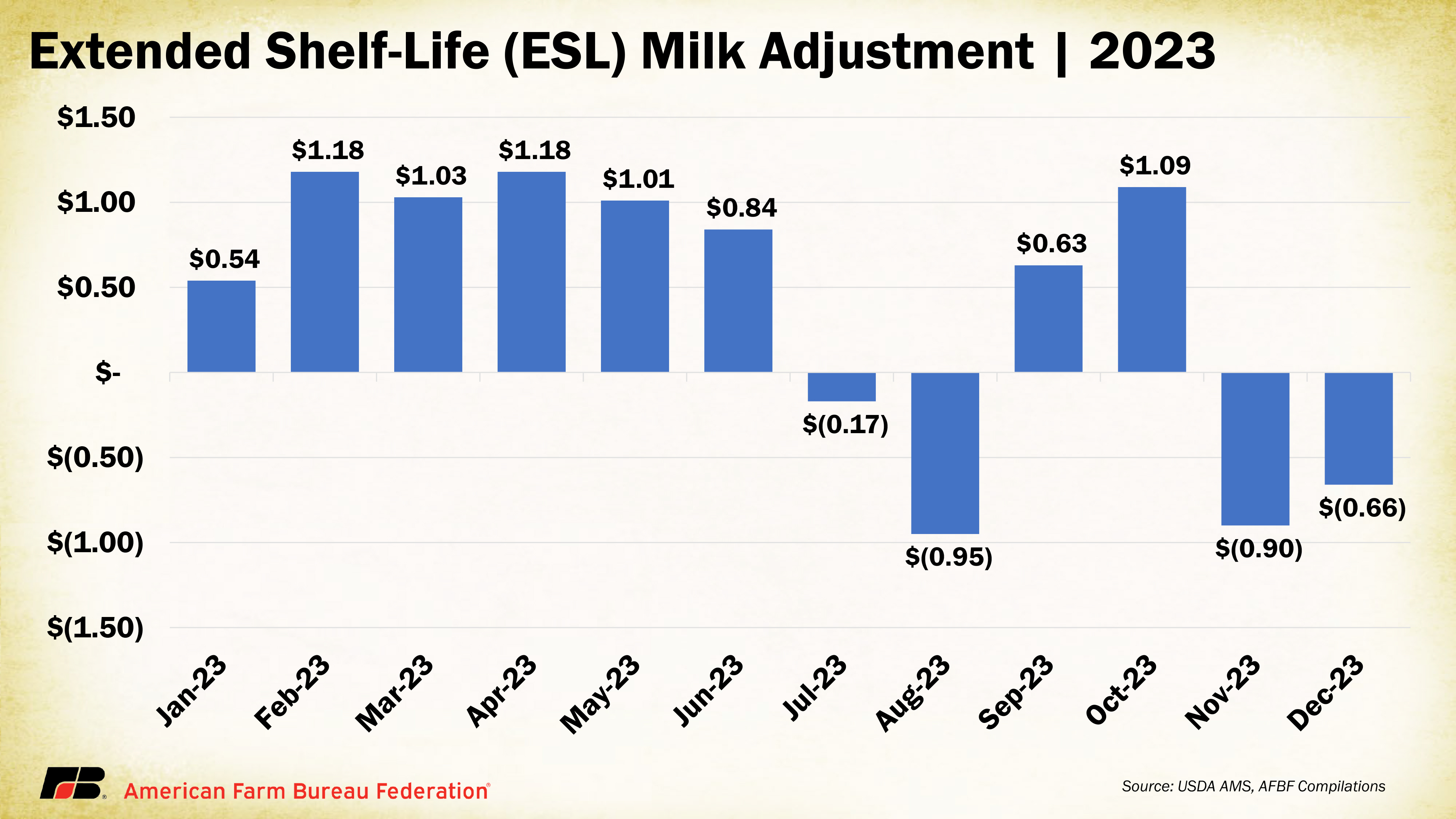
The December advance Class I base price mover was announced at $21.43 on Wed., Nov. 20 for a loss of 90 cents per hundredweight below November’s Class I mover, but up $1.67 per cwt. above a year ago.The USDA NASS milk production report showed total U.S. milk production was up 0.2% in October vs. year ago. Meanwhile, milk production in the 24 major states gained 0.4% over year ago. For Q3, USDA estimates total U.S. milk production virtually flat vs. year ago.

Class III milk slips lower despite less cheese

Despite USDA again reporting cheese stocks smaller than a year ago for the 8th straight month, dwindling to levels 8% below year ago, the CME spot cheese price headed south this week, dragging Class III milk futures lower too. On Tues., Nov. 26, Class III milk future averaged $18.77 for the next 12 months (Nov24-Oct25), losing 29 cents/cwt — more than was gained last week. Class IV milk futures were mixed, but the 12-month average fell a dime to $20.85.

CME dairy lower, but whey skyrockets

Dairy product prices on the CME daily spot market lost ground across the board this week, except dry whey gained an unprecedented nickel per pound, reaching just shy of what would be a near record 70 cents per pound.

On Tues., Nov. 26, the ‘market clearing’ dry whey price on the spot CME was a whopping 69 cents/lb with 6 loads trading over the 4 days pre-holiday. That’s more than a dime per pound higher than the weekly USDA National Dairy Product Sales Report price that has lagged all year and is the one used in the Federal Milk Marketing Order pricing formulas. Whey is usually the commodity to watch in relation to future milk prices, but it’s not translating. The 40-lb block cheddar price was pegged 4 cents lower at $1.6950/lb with just 2 loads trading over 4 days. Pegged at $1.64/lb, the 500-lb barrel cheese price lost 9 cents per pound with 8 loads trading across the 4 days.

On the Class IV side, the spot butter price fell 11 cents per pound, pegged at $2.4850/lb with 18 loads trading. Nonfat dry milk lost the penny gained last week, pegged at $1.39/lb with 21 loads trading in 4 days.

Live cattle imports from Mexico ‘paused’

USDA APHIS will halt cattle imports from Mexico due to a detection of New World screwworm (NWS) in Mexico Nov. 22. It was discovered in a cow at an inspection checkpoint close to Mexico’s border with Guatemala. USDA reports that around 5% of feeder cattle placements come from south of the border, meaning this pause in live cattle imports will further tighten beef supplies. The USDA cold storage report indicates red meat supplies continue to run below year ago levels.

What’s the future for fluid milk?

Fluid milk sales are up, Whole Milk for Healthy Kids Act is moving. Meanwhile industry globalists put big bets on ESL, shelf-stable, with favor from Vilsack  

By Sherry Bunting, Farmshine, October 18, 2024

EAST EARL, Pa. — Protein is all the rage right now, and consumers are turning back to real milk as they realize its natural high quality protein benefits. Year-to-date fluid milk sales continue to outpace year ago, and that’s good news. Here are some key factors in the future of fluid milk in the U.S.

Fluid milk sales up!

July’s total packaged fluid milk sales more than recovered the June slump — in a big way, and August looks promising too.

USDA estimated packaged fluid milk sales at 3.4 billion pounds in July, up 4.3% year-on-year (YOY). This amplifies the pivotal year-to-date trend above year ago for the first time in decades (except the 2020 pandemic year).

Specifically, USDA’s Estimated Fluid Milk Product Sales Report for July, released in late September, noted conventional fluid milk sales total 3.7% higher YOY, with organic up 11.7%.

Conventional unflavored whole milk sales were up 4.7% YOY in July, while organic whole milk sales were up 17.1%.

Flavored whole milk sales were mixed because these sales rely upon what processors are willing to make and offer on store shelves, not necessarily reflecting what consumers want to buy. When fewer packages of whole flavored milk are offered, the full potential of sales are restrained.

Year-to-date (YTD) sales of all fluid milk products for the first seven months of 2024, at 24.7 billion pounds, are up 0.7% YOY, adjusted for Leap Year. Of this, YTD conventional whole milk sales for the first seven months of 2024, at 8.8 billion pounds, are up 2.1% and organic whole milk sales at 914 million pounds are up 12.6%.

The August report to be released in the coming weeks is shaping up similarly. August Class I utilization pounds reported last week by USDA are up 1.1% YOY and 1.1% YTD (Jan-Aug).

Making more fat, importing it too?

Meanwhile, the monthly World Agricultural Supply and Demand Estimates (WASDE) released Oct. 9 reduced its milk price forecasts for the rest of 2024 and into 2025, expecting Class III prices to fall from September highs as cheese price declines are expected to more than offset the higher whey prices.

This report is looking at all the major new cheese capacity coming online in the next 12 months, which is expected to saturate the cheese market to drive prices lower so that U.S. cheese makers can be globally competitive and continue exporting record amounts of cheese.

But is the milk available to do this? Likely not without robbing from Classes I, II and IV channels. Still, the WASDE forecasts lower Class IV prices also due to the abruptly declining butter price being only partially offset by the higher nonfat dry milk prices.

In short, dairy farms are making higher-fat milk, and the food industry is importing more milkfat, especially in the form of whole milk powder. WMP imports have been up by a record amount YOY in each of the past four years, especially 2024.

Restoring whole milk choice for kids!

Now would be a particularly good time for whole milk choice to be restored in our nation’s schools since we apparently have too much milkfat and not enough skim. Given this scenario, how can anyone in this industry still believe the whole milk in schools would hurt the industry’s ability to make enough butter and cheese. 

Unless it is excess butter and cheese that is needed to push prices down in order to continue beating record exports at reduced prices paid to farmers. 

Getting whole milk choice into schools would help. IDFA has been touting the Whole Milk for Healthy Kids Act. NMPF says they are on board too. This means the industry is united, right?

What are the chances that GT Thompson’s bill to bring whole milk choice back to schools will finally make it all the way to the President’s desk?

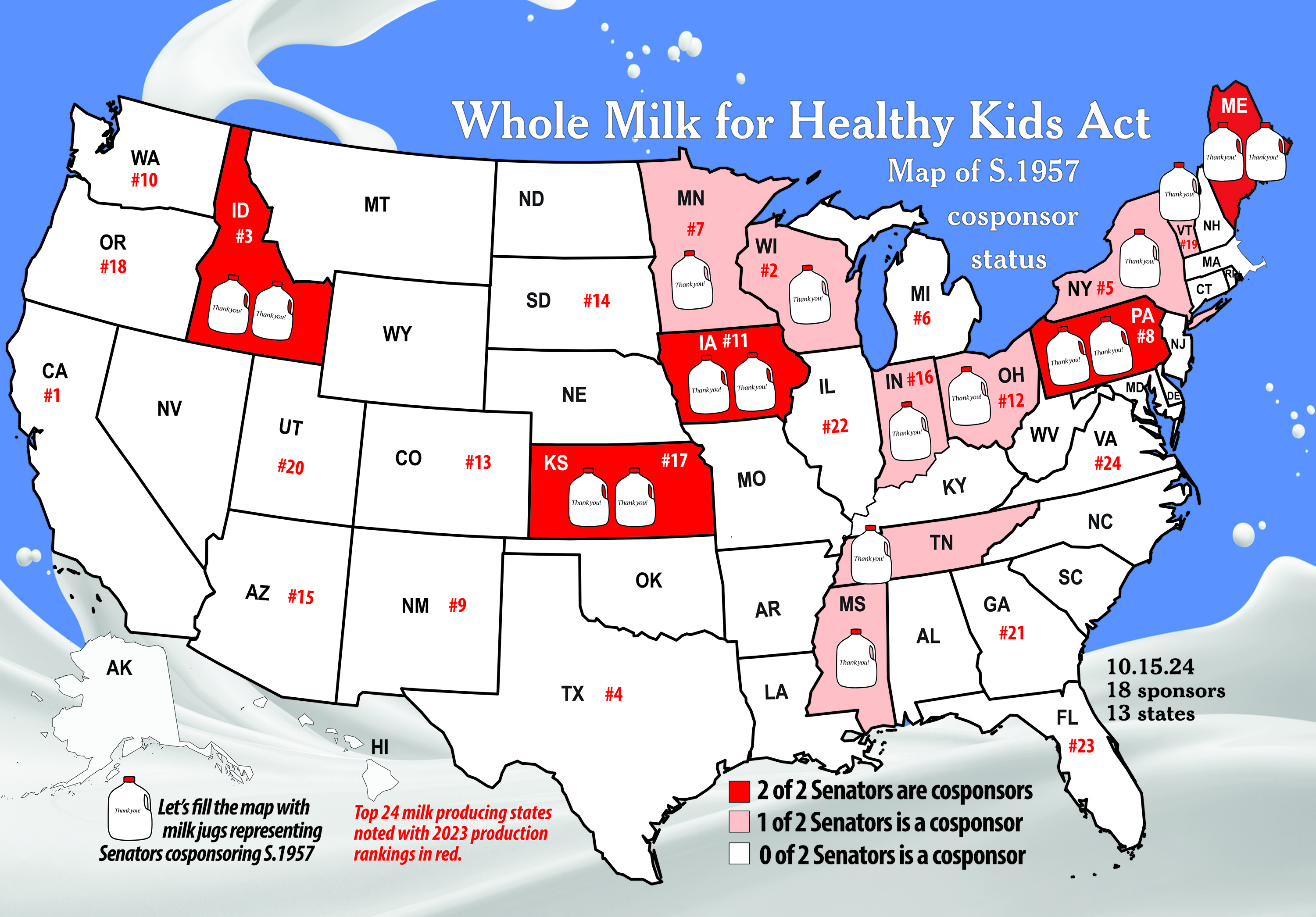
For starters, it passed the House by an overwhelming bipartisan majority last December. The Senate bill, S. 1957, has 11 Republicans, one Independent and five Democrats signed on, including notable Democrats such as Amy Klobuchar of Minnesota, Peter Welch of Vermont, Kirsten Gillibrand of New York, and John Fetterman of Pennsylvania who chairs the Senate Ag Subcommittee on Nutrition. 

The main sponsor is Republican Senator Roger Marshall of Kansas, a doctor. States represented are Pennsylvania, Vermont, Wisconsin, Idaho, New York, Iowa, Ohio, Indiana, Tennessee, Maine, and Mississippi.

In fact, Pennsylvania now has both Senators signed on. Senator Bob Casey Jr. (D-Pa.) is late to the party, but he has finally signed on as a cosponsor of S. 1957 on Sept. 19. It’s nice to see both senatorial milk jugs filled on the map for the Keystone State, but the bill needs more cosigners to fend off the blockade by Senate Ag chairwoman Debbie Stabenow (D-Mich.).

GT has included the Whole Milk for Healthy Kids Act in the House Ag Committee-passed farm bill. Word from Washington over the past few weeks is that a new farm bill is expected to get done after the elections in the lame duck session, and that GT will fight to keep the Whole Milk for Healthy Kids Act in the bill. Let’s hope so.

USDA: two movers for Class I?

Also related to Class I fluid milk sales, the dairy industry awaits a final decision on USDA’s proposed changes to federal milk pricing formulas, which includes a surprise for fluid milk: splitting the baby and adding a fifth class of milk in the form of two Class I mover announcements each month. 

The hearing record is woefully inadequate. No proposal. No evidence. No testimony. No analysis. No parameters. No definition. Even USDA’s own static analysis shows these two movers would be as much as $1 or more apart in any given month.

Fresh, conventionally processed (HTST) milk would go back to being priced by the the higher of the Class III or IV advance pricing factors to determine the Class I skim milk base price portion of the mover. 

However, milk used to make extended shelf life (ESL) fluid milk products, defined only as “good for 60 days or more,” would continue to be priced using the average of these two pricing factors, plus-or-minus a rolling adjuster of the difference between the higher-of and average-of for 24 months, with a 12-month lag.

With two movers, fluid milk costs could be different for plants in the same location based on shelf life, with no clear definition for the new class, nor parameters established to qualify. Could we see label changes to move between movers?

Processors will know the rolling adjuster 12 months in advance, due to the “lag.” They will know the two advance-priced calculations (higher-of and average-of) a month in advance. They will have it charted in an algorithm no doubt and make decisions accordingly.

Farmers, on the other hand, will find out how their milk was used and priced two weeks after all their milk for the month was shipped. Those milk checks will be even less transparent than they are now.

Big bets on ESL, shelf stable

The dairy checkoff has openly identified ESL, especially shelf stable aseptically packaged milk, as its “new milk beverage platform,” using dairy farmer funds to research and promote it and to study and show how consumers can be “taught” to accept it.

The whole deal is driven by the net-zero sustainability targets. So, follow the money.

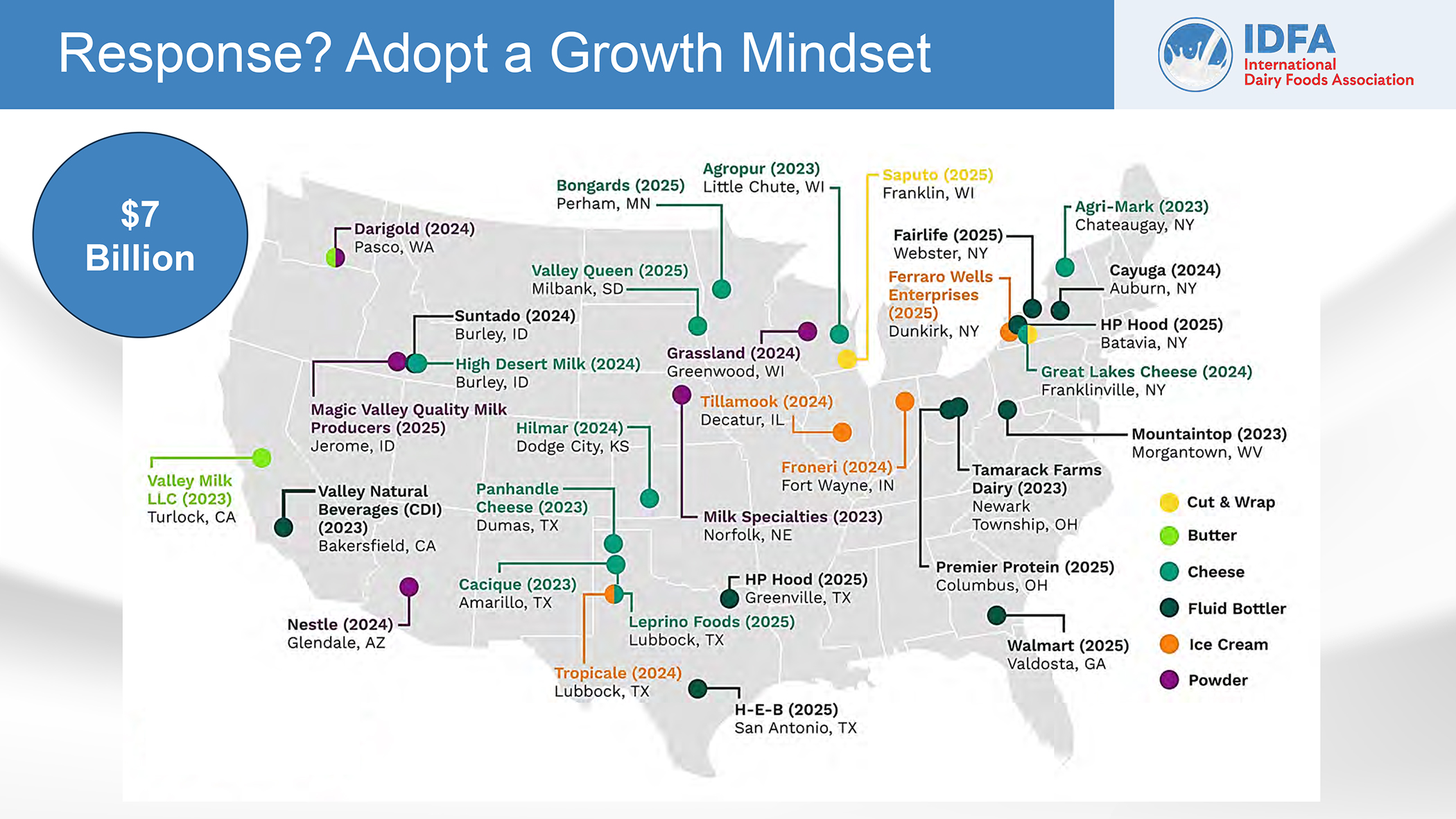
Dr. Michael Dykes of IDFA, at the Georgia Dairy Conference in January 2024, told dairy producers that “this is the direction we (processors) are moving… to get to some economies of scale and bring margin back to the business.”

He said the planned new fluid milk processing capacity investments are largely ultra-filtered, aseptic, and ESL — 10 of the 11 new fluid plants on the IDFA map he displayed are ESL. Some will also make ultrafiltered milk, and some will make plant-based beverages also.

Meanwhile, the linchpin of regional dairy systems is conventionally pasteurized (HTST) fluid milk, prized as the freshest, least processed, most regionally local food at the supermarket.

To be sure, this two-mover proposal fits the climate and export goals set forth by the current Ag Secretary Tom Vilsack when he was working as the highest paid dairy checkoff executive in between the Obama and Biden administrations. 

The pathway to rapidly consolidate the dairy industry to meet those goals is to tilt the table against fresh fluid milk, something he already put a big dent in when removing whole milk from schools.

They decided thou shalt drink low-fat milk and like it. Apparently, they are equally convinced about ESL / shelf stable milk as the way of the future and will continue using mandatory farmer checkoff funds to figure out how to get consumers to like that too.

Just this week, the food writer for The Atlantic did a piece on shelf-stable milk, calling it “a miracle of food science” and lamenting in her Op-Ed that it’s a product “Americans just can’t learn to love.”

Author Ellen Cushing took jabs at America’s preference for fresh natural milk from a global perspective, without a thought for the local dairy farms and regional food systems that are tied to fresh milk. She states that by worldwide standards, other countries have gone shelf-stable milk, which she describes as “one of the world’s most consumed, most convenient and least wasteful types of dairy.”

Processors are making big bets on consumer conversion to ESL and shelf-stable.  There are cards to play in every hand. TO BE CONTINUED!

-30-

Vilsack is de facto architect as Climate Bill dovetails with DMI Net Zero

Methane tax exempts agriculture, for now… Meanwhile the energy sector impact will affect farm cost of production

By Sherry Bunting, Farmshine, Sept. 9, 2022

WASHINGTON — Make no mistake about it, the dairy industry via DMI’s Innovation Center for U.S. Dairy — is and has been moving toward a future that rank-and-file dairy farmers have had no real voice in and in many cases are just waking up to.

From the annual World Economic Forum (WEF) meetings at Davos to the UN COP26, high-ranking DMI staff have been at the table

In fact, the current U.S. Ag Secretary Tom Vilsack, who President Biden credited for writing the agricultural piece of his Build Back Better campaign platform (same tagline used by the WEF), was the first to announce a Net Zero Initiative during a Senate climate hearing in June of 2019 while he was at the time the highest paid dairy checkoff executive at DMI before round-two as Ag Secretary.

When news of DMI’s Net Zero Initiative spread, farmers were told this would be voluntary, and that DMI was making sure companies understood that it has to be profitable for the farms.

But it is rapidly becoming apparent that requests for on-farm data from milk buyers and co-ops, guidelines for environmental practices under the FARM program are voluntarily mandatory through the member co-ops of National Milk Producers Federation (NMPF) and the privately owned plants that join the alliance and pledge get on board the Net Zero train.

All of this dovetails neatly with the Inflation Reduction Act (IRA) passed by Congress and signed by President Biden in August. Loosely referred to as ‘the climate bill’, NMPF is “thumbs up” on the deal, calling it “a milestone for dairy” as the industry “moves forward.”

(Others in-the-know who wish to remain anonymous call these billions a ‘slush fund’ for Secretary Vilsack.)

During the past 12 to 14 years, DMI has portrayed itself as representing U.S. dairy farmers (because after all, every U.S. dairy farmer pays into DMI, mandatorily by law of course). All the while plotting, planning, partnering and aligning with World Wildlife Fund using the middle of the supply chain as the leverage point to move consumers and farmers to where they want them to go.

They are proud to be working to “get you money” for what you are doing for the environment.

What we hear now is the manure technology and sustainability that checkoff dollars are used to promote brings new income streams to the dairy farm so they are less reliant on the volatile milk price. 

We are told that dairy farmers will make money from manure, from farming the carbon markets, perhaps even farming new climate-related USDA programs some of the $20 billion “for agriculture” will be spent on. 

According to NMPF, this is right in line with where the dairy industry is moving and “supports” the industry’s Net Zero Initiative and “other pledges.”

What pledges?

Did you, Mr. and Mrs. Dairy Producer pledge to do something or agree on the value and cost?

The government is making these pledges in global treaties. The industry as a collective whole through this DMI Innovation Center is making pledges to the investment bankers and global companies who are driving the monetization of climate through ESG — Environmental, Social and Governmental benchmarks.

This all has a very “contractual” feel to it – something that must be measured and recorded and monitored and reported, something that includes various scopes from the center point of one’s business to all of its downstream vendors.

There has been little if any open discussion of parameters, of value, of costs and of consequences. 

There has been little if any democratic process to determine pledge participation. This ESG-driven change is happening at a quickening pace all while most of us don’t know what the acronym stands for, what it means, what it entails, how it is measured, what is its value, who will profit from it, what it will truly accomplish, and how much consolidation it will create of the already consolidating market power in food and energy.

Control of carbon is what we are talking about here, and that means control of life itself.

University of Minnesota economist Marin Bozic mentioned this concern when questioned by members of the House Ag Committee at the farm bill dairy hearing in June.

Processors talked about the ESGs and the downstream impacts of businesses dealing with “Scope 3”. Members of Congress wanted to understand the impact on family farms, and Bozic was asked for his observations.

“In solving the climate, we should not allow the pace of consolidation to pick up in the dairy industry,” he responded.

“Congress should look to the industry for advice on how to make sure smaller family farms are not left behind in implementing the (sustainability) requirements they will need to meet to remain in business. Some of these technologies work better when you have more animals to spread fixed costs over more (cattle),” Bozic observed.

When this question came up a third time in Bozic’s direction, he took another swing, encouraging the House Ag Committee to “help the smaller farms meet these standards that the processors will require over the next 5 to 7 years as far as sustainability. It may be more difficult for some of them to meet that, and I would hate to see increased consolidation pace because of the sustainability standards.”

Does the IRA package do that? A deeper dive is required to fully answer that question. So far, there hasn’t been much open discussion about how these ‘standards’ will affect the farms and how much of these funds go to support vs. monitoring.

Industry insiders from processing to marketing have complained anonymously that they are concerned about what the retailers are expecting, what the largest processors are moving toward.

Some of it seems illogical and counter-productive, they say. All of it is being decided in boardrooms and back hallways – not in an open forum, not in a democracy.

Take for example NMPF’s proclamation that the IRA (climate bill) now signed into law is good for the industry, that the methane tax it includes is harmless and will not affect farmers.

Really? What parallel universe are industry executives living in?

Farms – especially dairy farms – are some of the biggest downstream users of fuel and fertilizer producing nutrient-dense food. If those companies are taxed for methane emissions, with graduated scales based on meeting pledges, farmers downstream from that will be incorporated into these pledged targets.

Who among us believes this won’t affect fuel and energy costs on the dairy farm? How will this impact decisions made about milk transportation, even though farmers pay for the hauling of their milk, ultimately. What are the downstream impacts of this tax? 

Congressional staffers admit the downstream impacts have yet to be calculated, but it has been passed into law.

There’s an even bigger question lurking in the smoke from that backroom where deals are made.

Reading through the Congressional Research Service explanation of the IRA package it’s clear that whether the methane tax does or does not pertain to agriculture is – well – unclear, and highly subjective.

There is zero language to ‘carve out’ an exemption for agriculture and food production. What the language does say is that the methane tax applies to fuel and energy sourced methane emissions because these industries are already required to be monitored for these emissions, and to report them.

Surprise.

Some of the $20 billion in the IRA “for agriculture” will go to EPA and USDA to ‘support’ methane reducing practices – but also to monitor them and develop reporting consistency.

Once measuring, monitoring and reporting of methane emissions occurs consistently in agriculture, it is a small step by a future President or EPA head to slip agricultural methane emissions into the scope of the now passed-into-law methane tax.

Again, no carve-out language in that bill, no specifically mentioned exemption for agriculture or for cattle.

However, interest is growing as a hearing in the Senate Committee on Environment and Public Works Sept. 7 dug into this a bit.

Scott VanderHal, American Farm Bureau Federation vice president was among those testifying Wednesday. The hearing pertained to a series of ‘protective’ bills for everything from livestock to motorsports in terms of the Clean Air Act through which emissions monitoring and reporting falls.

Interest is now even higher for bills like S. 1475 to protect livestock operations from permits being granted based on emissions. This now takes on a whole new meaning when contemplating a methane tax in the IRA package that is – for now – limited to industries that are monitored and required to report.

Expect to see stepped up interest from Farm Bureau as the methane tax falls into EPA’s warm embrace.

In conversations with congressional staffers, it’s also clear that new leadership in Washington, a new Congress, a new President, can make some changes to executive orders that have come to pass under the current administration, but changing the laws that have passed in this Congress will be more difficult.

However, the scope of the implementation process for the IRA funding (2023-26) will be greatly influenced by the 2023 Farm Bill reauthorization. Those funds will not have been spent yet, and can be rescinded or reallocated by Congress to other areas within the 2023 Farm Bill.

These laws are open to interpretation, so the executive branch has the power to take things in a positive or negative direction where agriculture is concerned.

What does all of this mean for dairy farmers?

First, it is possible that a portion of the $20 billion for agriculture and the environment will fund good programs that are positive for farmers and the environment. But at the same time, look at where the emphasis has been on the part of NMPF and the Innovation Center for U.S. Dairy under DMI’s umbrella. 

The emphasis is on revenue streams for dairy farms from something other than milk. The emphasis is on digesters and renewable energy. The emphasis can also be on regenerative agriculture, but this is an area that doesn’t produce much profit for others, so will it gain traction?

What happens when these government billions and industry / checkoff pledges become embedded at the farm level? What happens to the farms of the small to mid-sized scale under 3000 cows that are not going to be able to capitalize on the California goldrush to RNG fuels from methane digesters?

As good as digester technology can be in the situations where it provides positives – it is not the panacea, and it leaves most of today’s dairy producers on the sidelines from a revenue standpoint, while setting a standards bar that they may or may not be able to reached by other means – and should they have to honor these pledges they did not make?

In many cases, obtaining a milk market may rely upon participation in these pledges, which means small to mid-sized processors outside of the 800-lb gorilla are beginning to sit up and take notice too.

Yes. This most definitely impacts dairy. The industry via DMI and NMPF and their partners say dairy is moving forward to embrace the Vilsack ‘slush fund’ the Congress and President Biden have made available. They call it a partnership.

Instead of government rules, you, Mr. and Mrs. Dairy Producer are getting government help, support and partnership. You are getting a government that sees the value in what you are doing and will pay you for it. 

That’s what we are being told, but we aren’t being told about the monitoring and reporting and the consequences thereafter.

NMPF says the $20 billion for agriculture in the IRA will assist and support and partner with farmers to value their sustainability. That is all well and good until the carrot transforms into a stick. It all depends on where the drivers of the pledges are going.

Can we please have an open discussion of the pledges before making them?

My advice for farmers? Do what is good and right for your farm, for your community, your animals, the environment around you, within your means, and yes, government programs that help cost-share a beneficial practice are a good thing, a win-win.

But when the talk turns into pledges and deadlines and terms that sound contractual, beware. 

When asked for proprietary information about your farm, ask the asker how it will be used and what its value is. Ask for this in writing. Don’t sign anything without taking time to understand it or have an attorney perhaps review it.

When you are asked tough questions about your farm, ask the questioner tough questions about why they want to know.

Be polite, engage in a discussion, and make them explain it. Then tell them you’ll want to think it over. 

President Ronald Reagan said it best. “The top nine most terrifying words in the English Language are: I’m from the government, and I’m here to help.”

As much as we may want to believe the collective “they” are here to help, take nothing for granted.

-30-

Preposterous ‘preponderance’

While left hand says it’s busy building ‘mountain’ of evidence, right hand has already moved the nutrition definition goal post

By Sherry Bunting, Farmshine, Dec. 23, 2020

BROWNSTOWN, Pa. — Preponderance of the evidence. We hear that phrase over and over when it comes to the Dietary Guidelines for Americans (DGAs) and the effort to reverse 40 years of increasingly strict rules on dietary fat affecting children in schools and daycares, the military, seniors in nursing care or retirement villages, food-insecure families relying on government feeding programs like WIC, and countless other insidious prohibitions on healthy choices when it comes to whole milk, butter, full-fat cheese, dairy products like sour cream and cream cheese as well as other animal protein foods containing fat.

But the whole concept of ‘preponderance’ is really preposterous when applying the legal definition.

Let’s review.

Last March at a DMI forum on a Chester County dairy farm, DMI chair Marilyn Hershey and executive vice president Lucas Lentsch described the ‘preponderance of evidence’ standard as “building a mountain of evidence.” They said the National Dairy Council is building that mountain, but it takes time to keep pushing more evidence forward “until we have enough.”

When former Ag Secretary Tom Vilsack gave the 2015-20 Dietary Guidelines his stamp of approval, a Congressional hearing took the USDA and HHS secretaries to task, grilling them on science that was not considered then (nor is it now in the 2020 version of the DGAs). Remember, former Ag Sec. Vilsack promptly became the current top-paid dairy checkoff executive for four years (Jan. 2017 to present) and is now poised (again) as President-Elect Biden’s Ag Secretary pick 2021 forward.

During that 2015 congressional grilling, then Secretary Vilsack said “It’s the preponderance of the evidence that is the standard, and we know stuff is always changing so there has to be a cutoff.”

On whole milk (which he helped remove from schools in 2010), then Secretary Vilsack, when confronted in 2015 with what he called “emerging” science on saturated fat — said “the preponderance of evidence still favors the recommendation for fat-free and low-fat dairy.”

Much of the saturated fat discussion during the 2020 DGA Committee work used the 2015 DGA’s body of science, that was one of the screening criteria. The cutoff bar didn’t move.

In 2015, then Secretary Vilsack explained the ‘science’ of the DGAs this way:

“Well, the process starts with a series of questions that are formulated and then information is accumulated and it goes through a process of evaluation,” he said.

Answering a charge by then Congressman Benishek, a physician from Michigan who was concerned about the 52% of Americans who are diabetic, pre-diabetic and carbohydrate intolerant as regards the fat caps and the exclusion of science available — even in 2015 — on low carb, higher fat diets, then Sec. Vilsack stated in 2015:

“The review process goes through a series of mechanisms to try to provide an understanding of what the best science is, what the best available science is and what the least biased science is, and it’s a series of things: the Cochrane Collaboration, the Academy of Nutrition and Dietetics, the aging for health care equality, data quality, all part of the Data Quality Act (2001 under Clinton Admin). That’s another parameter that we have to work under, Congress has given us direction under the Data Quality Act as to how this is to be managed.”

On a further point of contention in 2015, Vilsack stated the following as a definition of how “preponderance” works.

Vilsack said (2015): “In some circumstances, you have competing studies, which is why it’s important to understand that this is really about well-informed opinion. I wish there were scientific facts. But the reality is stuff changes. The key here is taking a look at the preponderance. The greater weight of the evidence. If you have one study on one side and you have 15 on another side, the evidence may be on this side with the 15 studies. That’s a challenge. That’s why we do this every five years to give an opportunity for that quality study to be further enhanced so that five years from now maybe there are 15 studies on this side and 15 studies on this side. It’s an evolving process.”

During a recent dairy checkoff yearend news conference with reporters, DMI CEO Tom Gallagher answered a question about consumer health attitudes and checkoff research targets for 2021. Whole milk was never mentioned in the question, but here is Gallagher’s answer as he, too, cites the “preponderance” criteria:

Gallagher said (2020): “Our research plan (for 2021) is very robust at our centers. The primary research that we focus on is whole milk because we are, number one, the only group to be pushing the research on whole milk and taking it to the scientific community so the scientific community does more research because the Dietary Guidelines will never change until the preponderance – not the best – evidence, but the preponderance of the research is in favor of whole milk. We’re helping to move that needle to that point.”

I looked up the legal definition of this ‘preponderance of the evidence’ phrase, this standard for the DGAs as determined by Congressional statute. It is clear that DMI’s assertion of building a mountain of evidence is not needed to achieve a preponderance, according to the legal definition.

According to the law.com legal dictionary, ‘preponderance of the evidence’ is a lower burden of proof than other evidentiary burdens. It only requires a better than 50% chance that it’s true! 

In fact, the law.com definition states “Preponderance of the evidence is based on what is the more convincing evidence and its probable truth or accuracy NOT on the amount of evidence.” An example is given where one credible witness outweighs a pile of other evidence! It’s not the amount of research, then, it is the more convincing in terms of probable truth.

The word preponderance itself means “quality or fact of being greater in number, quantity, OR importance.” Yes, importance and quality can trump quantity to achieve preponderance!

Mountain-building is a stalling tactic by the left hand of industry and government, while their combined right hand is moving the goal post. (In fact, mountain-building is futile because the USDA structure on Dietary Guidelines has not allowed new evidence to be considered on certain dietary fiction it deems as settled science. There are fancy ‘mechanisms’ that have kept credible science out of the equation in 2015 and again in 2020).

Who are the attorneys advising USDA and dairy checkoff as to the meaning of “preponderance of the evidence?” Could it be Mr. Vilsack, an attorney by trade, going from USDA Secretary to top-paid DMI executive and back again potentially as the next Ag Secretary? 

Clearly, Mr. Vilsack and his colleagues at DMI are fond of citing “preponderance” as a stalling tactic for fat flexibility in the DGAs. But contrary to Gallagher’s point during this yearend news conference, the legal definition of “preponderance of evidence,” really does mean the BEST evidence can trump the MOST evidence.

It’s not about which theory has the most evidence, but which one has the best and most convincing evidence. This definition suggests that you don’t need 15 studies on one side to match 15 studies on the other side. To add flexibility on school milk choice or to reverse the saturated fat caps set at 10% of calories, a mountain of evidence is NOT needed, and a lot of good and convincing evidence keeps getting excluded from the process anyway.

The saturated fat question and the casting aside of research feels like being forced to doggy paddle in an olympic swimming competition.

The problem is agenda and bias. Who is standing up for producers and consumers?

Ahead of the 2015 DGA cycle, scientists and investigative journalists, like Nina Teicholz, exposed the weak scientific basis for Dr. Ancel Keys’ diet-heart hypothesis that these DGAs have been built on for over 40 years. Not to mention the many studies back then that were buried, once Keys became the dietary darling, and not to mention all of the newer studies that show saturated fat is not the health demon it has been made out to be, and in fact is necessary in diets to prevent chronic diet-related illness.

Here’s a look at where nutrition science is going next.

Yes, they have moved the goal post via climate change. And yes, they are telling us that consumers are more concerned about climate change after Covid-19.

Basing DMI’s 2021 plan assertions on a Kearney report (April 2020), Gallagher said: “Covid-19 has made people more hyper-sensitive to things, like the environment. 58% of consumers are more concerned about the environment since Covid, and 50% want companies to respond to climate change with the same level of urgency as responding to the pandemic.”

When asked where consumers ranked health in that particular survey — given a recent report on CNBC business news about corporations trying to get consumer ‘buy-in’ on sustainability benchmarks and finding the only way to achieve it is to link sustainability to health.

You guessed it. Gallagher was ready with the answer.

“Sustainable nutrition is the phrase you’re going to hear going forward. You’re going to see those two things inextricably tied,” he replied during the yearend and look ahead news conference by phone.

We recall in October 2019, Gallagher telegraphed a message during the 53rd World Dairy Expo that the dairy checkoff simply accepts waiting another five years until 2025 (not the current cycle) as the year that the saturated fat caps could be reversed. The 2020 DGA committee was only just partway into the process back in Oct. 2019 with a whole year of work ahead — and already the head of dairy checkoff was being quoted in the Oct. 14, 2019 Hoard’s article broadcasting that the fat issue could likely happen by the NEXT DGA cycle (2025), not this one (2020).

Gallagher further indicated in that Oct. 2019 Hoards article that the “forest” must be “populated with more trees.” (Again this idea that preponderance is based on the amount of studies, not the importance or reliability of the studies and not acknowledging that half the trees in that so-called forest are being ignored by USDA and the DGA committee — screened out of consideration at the outset. Not one of the checkoff or ag commodity group was standing up for producers and consumers on this score at the START of the 2020 DGA cycle, nor the finish).

However, we now know that the new goal post will be entrenched by 2025: ‘Sustainable nutrition’ will be the new phrase, the new goal post, according to Gallagher’s response during the December 2020 news conference.

Make no mistake about this: As much as the sustainability overlords talk about farmers being paid to plant cover crops (most already plant cover crops after corn harvest) or to recover nutrients and methane through other practices and technologies, paying for offsets and dilution of animal foods in diets are two strategies already on deck. We heard a little of this also during the December 2020 news conference as Gallagher and DMI president Barb O’Brien talked about how their partners are getting into ‘competitors’ (fake dairy lookalikes) because when a family of four comes in to eat, one may want a new taste experience, and DMI partners have to provide that ‘new experience’ to keep from losing the entire family.

DMI is working for its corporate partners like Nestle and Starbucks, both giving the DMI Innovation Center’s Net Zero Initiative up to $10 million over multiple years to pilot sustainable technologies and practices on dairy farms.

Gallagher described the situation this way: “Health, taste, price – those things are still important, but as more and more companies are offering things that are competitive, what we’re seeing people saying is ‘Well, I’m going to look at sustainability as a difference maker in who I purchase from and what I purchase,’” he said.

“The days of 10 to 15 years ago — where things like sustainability were believed to be made up by retailers for marketing — are over,” Gallagher added.

“Everyone gets it. We are past that. The beautiful part is the U.S. dairy industry has the best sustainability story in the world to tell, and we’re telling it,” he said.

As promised, a follow up email provided more details on Gallagher’s whole milk research assertion, stating: “Dairy farmers have been funding research led by National Dairy Council on the role of whole milk dairy foods and wellness for over a decade. In fact, around 70 studies have been published, adding to the growing body of evidence indicating that consuming dairy foods, regardless of fat content, as part of healthy eating patterns is not linked with risk of heart disease or type 2 diabetes. The paradigm shift to more fat flexibility in the dairy group is already happening in the real world as demonstrated through the many actions of consumers and thought leaders.”

Three research items were specifically mentioned in the email — all published within the past 6 to 24 months:

1) A Science Brief: Whole and reduced-fat dairy foods and cardiovascular disease. Upon following the link published January 17, 2019, we find it begins as a regurgitation of 2015-20 Dietary Guidelines with all references to dairy qualified as ‘low-fat and fat-free’, but then goes on to discuss: “Emerging research also indicates that saturated fat intake on its own may be a poor metric for identifying healthy foods or diets.” A downloadable PDF summarizes this “emerging” research on dairy fat at: Science Brief: Whole and Reduced-Fat Dairy Foods and CVD | U.S. Dairy

2) Posted in Sept. 2019 is this resource where National Dairy Council’s Dr. Greg Miller talks about “landmark shifts” and states that, “As the research continues to grow, a preponderance of evidence (exists linking milk, cheese and yogurt, regardless of fat level, with lower risk of chronic diseases like type 2 diabetes and cardiovascular disease. This one is found at: Ask Dr. Dairy: Can Whole Milk-Based Dairy Foods Be Part of Healthy Eating Patterns? | U.S. Dairy

3) The third item posted June 2020 in connection with DMI’s Dietary Guidelines comment talks about dairy consumption lowering risk of high blood pressure and diabetes and cites a study that, “indicates there may be room for fat flexibility in peoples’ dairy group choices to include dairy foods like milk, cheese and yogurt – at a variety of fat levels – as part of healthy eating patterns in the U.S. and worldwide.”

We can see the tight rope being walked, hinging everything on this idea of slowly building a mountain of evidence as though this is the definition of what is needed to fulfill the “preponderance” standard. But as we know from the legal definition, the amount of evidence is not what’s important, but rather what is credible and convincing. The available evidence is already preponderant. Whole milk, at 41% of market share, has grown by leaps and bounds over the past two years, and is now the largest selling product in the milk category because consumers are convinced. In the past two years, they have moved toward choosing health instead of allowing the government to choose for them — at least when they CAN choose.

Thinking on the many topics that were part of the fairy checkoff yearend news conference, some clear themes take us into the new year in terms of the 2021 dairy checkoff plans.

Gallagher, O’Brien and Hershey talked about “moving milk” differently because of Covid, of working in Emergency Action Teams to unify the supply chain with these top priorities in mind: 

1) Feeding food insecure people, 

2) Responding to climate change

3) Developing a deeper and closer relationship with Amazon into e-commerce and milk portability, and 

4) Developing tools and promotions for corporate partners.

On the latter, Gallagher was proud to give the example of DMI’s funding for Domino’s “contactless delivery” in Japan during the early days of Covid. He said this partner (named as Leprino, DFA and Domino’s) would not have been in a position to move so much pizza cheese when the pandemic hit the U.S. had it not been for DMI’s funding of that contactless delivery innovation first in Japan and then used here.

(Contactless delivery is used by almost every restaurant doing takeout today in the Covid era. It simply means ordering and paying online, texting when arriving, and having your food placed in your car. Not rocket science.)

Since 2008, DMI and USDA — through Vilsack-era Memorandums of Understanding — have a hand-in-glove relationship on GENYOUth and Sustainability. DMI works for its partners and has adopted a role for itself as global supply-chain integrator — the prime mover of milk.

Increasingly, there is the sense that the dairy checkoff bus has morphed into a ride for its key partners, while rank-and-file producers keep paying the fare, just hoping for a lift.

Look for more yearend checkoff review in a future edition of Farmshine.

Politics of whole milk, part 2: Vilsack banned whole milk in schools, gets dairy checkoff’s top pay

By Sherry Bunting, Farmshine, Dec. 13, 2019

The former Ag Secretary instrumental in removing whole milk from schools is now the highest-paid executive at Dairy Management Inc. (DMI) whose virtual $1 million/year in 2018 came from dairy farmers who are going bankrupt.

Farmshine Editor’s Note: Sherry Bunting has written a lengthy, well researched commentary on how the dairy economy and dairy product promotion and marketing evolved over the past decade with Tom Vilsack at the helm. Vilsack served as USDA Secretary in the Obama Administration and is the current chief of the U.S. Dairy Export Council (USDEC), an affiliate of Dairy Management, Inc. Wherever he has been since 2009, Vilsack is unquestionably one of America’s most powerful influencers when it comes to dairying. And the outcome has seldom been favorable to the nation’s milk producers. Part I of this reportappeared in the December 6th edition of Farmshine, page 20. Part II follows

In my journalistic pursuits of the past decade, two statements by checkoff-paid executives and dairy checkoff board members now reverberate in my mind:

1) On milk as a beverage: “Fluid milk is dead, we have to stop beating that horse and innovate for these new beverage markets.” – 2016 during questions after a presentation by a USDEC checkoff-paid employee at a meeting of dairy policy analysts and economists.

2) On dietary guidelines and school milk: “They are a different breed. We have our own plan. We have a friend inside the White House. We are already working with someone on this. And we finally have a drink that consumers want (fairlife).” — 2015 phone call to me from a DMI board member who also served on DFA’s board, challenging an article I had written that year. In the course of our conversation, he made this comment in response to my question to him asking why the dairy industry was being silent on the 2015 Dietary Guidelines that year, and why dairy was not joining forces with beef to push the solid science on animal fat as revealed in Nina Teicholz’s book Big Fat Surprise. I had also asked him why they weren’t supporting the beef industry’s opposition to the “sustainability” driven parts of the 2015 dietary guidelines.

In his Ag Secretary role in 2010, Vilsack was instrumental in the creation of GENYOUth through the MOU signed between USDA, National Dairy Council (Dairy Checkoff) and the NFL. (In fact, as Ag Secretary, Vilsack appointed some of the current Dairy Board members who then hired him at the end of the Obama administration as a DMI executive vice president and CEO of USDEC.)

Fuel Up and Play 60

USDA Photo from Feb. 4, 2011 where then Agriculture Secretary Tom Vilsack spoke to young people at the Fuel Up to Play 60 (FUTP60) event held at the Sheraton Hotel in Dallas, Texas before the 2011 Super Bowl, the same day that the MOU was signed between NFL, USDA, Dairy Checkoff and GENYOUth to focus on ending childhood obesity with fat-free / low-fat foods and beverages and 60 minutes of daily exercise. And so, a decade later… here we are so much farther down this wrong road.

Today, GENYOUth is the bus on which more companies each year are hitching a ride into the schools — paid for primarily by dairy farmers in effect funding their own demise. Meanwhile, dairy farmers are the only ones not free to fully promote their best product, being relegated and regulated to government speech on fat-free / low-fat.

When Vilsack was presented the Vanguard Award during the 2017 GENYOUth Gala aboard the U.S.S. Intrepid in New York City Harbor, former President Bill Clinton spoke his accolades, and congratulated him on being the one to overcome the hurdle of getting beverage calories included in the school meal calculations. It is the very thing the current Senate Bill seeking to allow whole milk in schools would reverse.

Bill Clinton, a vegan, went on in his 2017 GENYOUth Gala speech to emphasize how beverages were a “huge” problem in the obesity epidemic, that we don’t think about how many calories kids consume in a drink, and that regulating school beverages was a big step forward on that front.

He was talking about whole milk. Whole milk is named, specifically, on the list of beverages prohibited from sale on school grounds during school hours.

And yet plenty of PepsiCo beverages — made specially to meet the 60-calorie threshold with a combination of high fructose corn syrup and sucralose, including Gatorade and Mountain Dew Kickstart — are welcomed on those school lunch “smart snacks” acceptable beverage lists.

Vilsack started with DMI six days after the Obama Administration ended in January 2017. But 2018 was his first full year as a DMI executive, and he has been busy earning his highest-paid status.

In May, Vilsack wrote about how the U.S. dairy industry would meet its new goals to export 20% of production, and he praised the record level of exports in 2018 as “a banner year for exporters.” (We all know 2018 was anything BUT banner for dairy farmers paying his salary. In fact, export volumes were higher in 2018 than in 2017 and 2019 while prices paid to farmers were lower in 2018 than in 2017 and 2019.)

In June, Vilsack testified before Congress that the government should partner with the dairy industry to pay ‘pilot farms’ to develop and test the innovations “U.S. Dairy” will need in order to reach the Net Zero emissions goal he has been instrumental in setting. In fact, Senators referred to him as ‘the president of dairy innovation.’

The ultimate vehicle for those practices after they are tested on pilot farms will be the dairy checkoff-funded and NMPF-administrated FARM program initiated through the Innovation Center for U.S. Dairy.

At that “sustainability” hearing of the Senate Ag Committee in June, Vilsack earnestly stated that the Net Zero project – and government assistance for pilot farms to find the practices to achieve it — was essential for the U.S. dairy industry to have an edge in international markets.

In November, Vilsack endorsed former vice president Joe Biden for President of the United States and praised his candidacy “for including a path to addressing climate change while at the same time helping the rural economy and creating jobs by investing in green infrastructure, renewable fuels and low-carbon manufacturing,” according to an article about the Vilsack endorsement of Biden in the Nov. 23 edition of the Des Moines Register.

In fact, the Register article stated that Vilsack “helped write Biden’s plan for rural America.” But that’s not political involvement by a checkoff executive, is it?

It is interesting that when dairy checkoff board members are asked by the farmers paying the checkoff why they can’t stand up for whole milk in schools, the response they always get is: “That’s politics, and we can’t get into that.” Of course, the rules and regs of USDA overseeing checkoff are then cited forward and backward.

But, when it comes to Vilsack’s hands in the political pie – not to mention dairy farmers’ pockets – there are no rules and it’s all good. In fact, it’s encouraged because it’s part of the plan, the future of dairy, of food.

Vilsack is, after all, the dairy checkoff’s highest-paid executive, who is most culpable in his former position as Ag Secretary for putting the last nail in the fluid milk coffin. His policies on milk in schools and the fat-free / low-fat ‘government speech’ that now defines milk promotion, have at the very least contributed to – if not accelerated — the loss of fluid milk sales in the past decade of steepest decline.

In 2015, when confronted with what investigations have revealed about the science on animal fat, especially milk fat – according to the new and previously buried research — Vilsack said the preponderance of the evidence still favored low-fat diets. And with that proclamation, he signed the 2015 Dietary Guidelines that accelerated taking dairy markets – and our nation’s children – down the wrong road.

Think about this. From 2010 to 2018, the era in which the alliance between Vilsack’s USDA and the dairy checkoff was initiated and bloomed and in which he is now the highest paid executive – DMI controlled $140 to $159 million annually in mandatory dairy farmer funds. In that pool of funds, 25% went to salaries and other costs associated with core operations and another 30% went to contractors for promotion in ways that could be considered ‘core operations.’

In 2018, as in previous years, the NFL received $5 million; Edelman, the world’s largest PR firm, received $16 million; Fairlife $8 million, Domino’s $9 million, a marketing firm for GENYOUth with ties to Edelman $4 million, McDonald’s $5 million, and Vilsack got his virtual million.

Yes, folks, hindsight is 20/20. And here we are on the eve of 2020 with former Ag Secretary Vilsack – who was paid a $999,421 salary in 2018 from mandatory dairy producer checkoff funds and is now the top-paid DMI executive — to thank for the removal of whole milk and whole dairy products from our schools. And no one cares to ask him to testify to Congress about why whole milk should be allowed in schools, but he is politically involved in so many other discussions.

The dairy industry had and has Tom Vilsack — or vice versa.

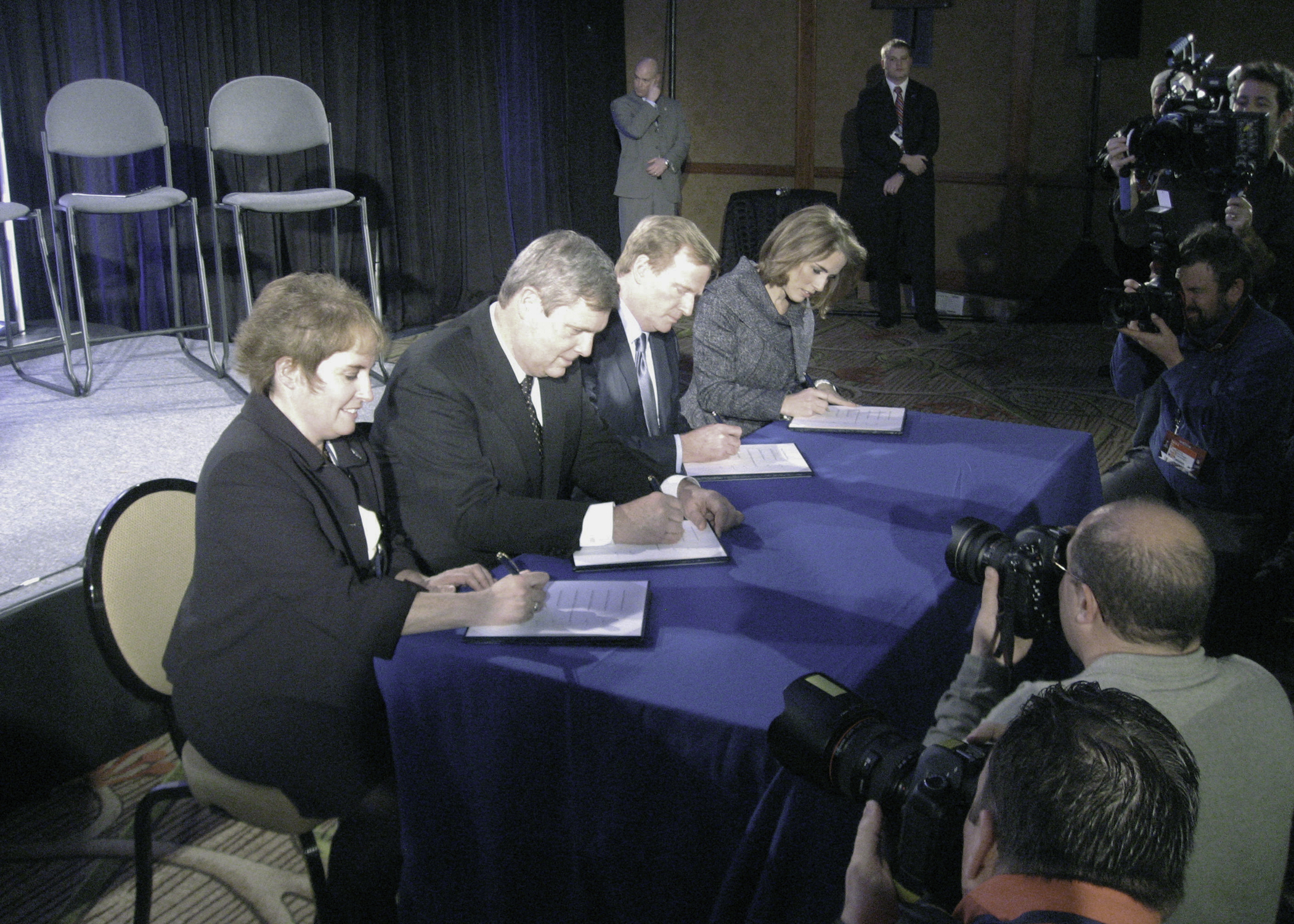
110206_OSEC_AL_1642

Memorandum of Understanding (MOU) was signed on Friday, Feb. 4, 2011 at Sheraton Hotel in Dallas, TX. The MOU outlines the joint commitment of the National Football League (NFL), Department of Agriculture, National Dairy Council (NDC), and Gen YOUth Foundation, to end childhood obesity. (Signing L to R President of the National Dairy Council Jean Regalie, Agriculture Secretary Tom Vilsack, NFL Commissioner Roger Goodell, and GENYOUth Foundation CEO Alexis Glick) 

Today, DMI IRS 990 forms show that Dairy Checkoff pays Tom Vilsack just shy of $1 million/year as DMI’s highest paid executive; Dairy Checkoff pays the world’s largest PR firm Edelman $15 to $17 million/year as the purpose-driven brain-trust behind the GENYOUth and Innovation Center ‘sustainability’ concepts; Dairy Checkoff pays the GENYOUth CEO over $200,000/year to run the foundation; Dairy Checkoff pays the core operations of GENYOUth to the tune of $1.5 million; Dairy Checkoff has USDA attorneys at every meeting and on every conference call to approve promotion projects and messages (government speech); and Dairy Checkoff pays the NFL $5 to $7 million annually for their part in this “promotion.” Meanwhile, NFL promotes its brand through flag-football sets to FUTP60-participating schools; USDA markets and enforces dietary guidelines with the financial assistance of dairy farmers through the checkoff; and other companies participating in GENYOUth, most notably PepsiCo, are able to market their own pet projects, products, brands and influence to kids while the dairy farmers are regulated to government speech. Dairy Checkoff touts the FUTP60 breakfast carts as serving milk with every breakfast, but only fat-free and 1% are promoted and permitted, and USDA’s own studies show that this fat-free and 1% low-fat school milk is among the most frequently discarded items. The entire deal ignores the fact that the dietary guidelines have exacerbated the obesity and diabetes trend, that children are not getting the valuable nutrients from the milk they are served if they don’t like the taste of fat-free and 1% and throw it away to buy something else. And the deal further ignores studies showing that body fatness was lower and Vit. D status higher in children drinking whole milk as compared with children drinking 1% low-fat milk. What will it take to see positive change when the very government figure who was influential in getting us here is now the dairy industry leader that the industry organizations revere and who is looked at by USDA, Congress and other policymakers as speaking for dairy? If he took whole milk out of the schools, and he now ‘speaks for dairy’ and is ‘believed’ to be so concerned about kids, who else matters in the discussion? Does the government care about the over 15,000 online and 5000 by mail signatures of dairy farmers, parents, grandparents, students, teachers, coaches, school boards, town boards, county commissioners, state lawmakers, health experts, nutrition experts, athletes, nurses, doctors, and generally comcerned citizens among these signatures asking for the choice of whole milk in schools

-30-

Politics of whole milk: Dairies go bankrupt, Vilsack gets top pay

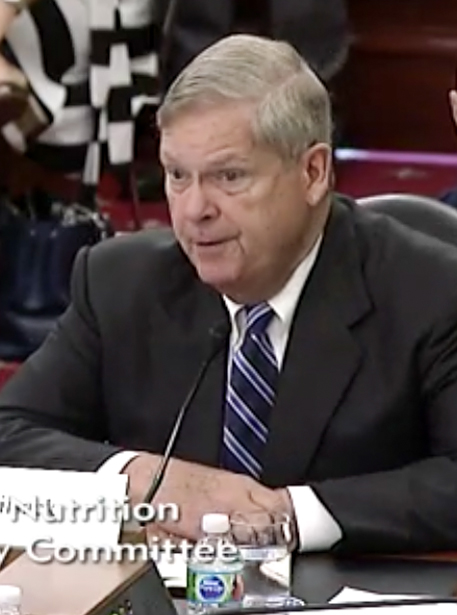
When it comes to ‘politics,’ DMI talks out of both sides of the mouth: Top paid executive Tom Vilsack shown here in June asking Senate Ag Committee for government ‘support’ to pay DMI’s ‘pilot farms’ to develop practices for ‘U.S. Dairy’ to reach Net Zero emissions. But ask if DMI can  support whole milk in schools and the response is: “Oh no, that is ‘political’ and we aren’t ‘allowed’ to be ‘political.'” Truth is, DMI’s current top-paid executive — Tom Vilsack — is the one who while serving as Ag Secretary, spearheaded the removal of whole milk from schools in the first place.

By Sherry Bunting, Farmshine, Friday, Dec. 6, 2019

The former Ag Secretary who was instrumental in removing Whole Milk from schools is now the highest-paid executive at Dairy Management Inc. (DMI) whose virtual $1 million/year in 2018 came from mandatory checkoff funds paid by dairy farmers who are going bankrupt. 

On Monday (Dec. 2), the Milwaukee Journal Sentinel reported that their early look at DMI’s IRS 990 forms for fiscal 2018 show that Tom Vilsack became the highest paid DMI executive earning $999,921 in 2018, which was his first full year as an executive vice president of DMI, president and CEO of DMI’s U.S. Dairy Export Council (USDEC), and defacto leader of the Net Zero Project and sustainability and innovation platforms of the Innovation Center for U.S. Dairy.

Let’s go back a decade. Think back to 2009. The bottom fell out of the dairy markets. It was arguably the worst of economic times in memory for dairy farmers as farm level milk prices fell to $10, and equity in the value of cow herds plummeted. 

As farmers were busy trying to save their farms, and the industry and lawmakers were busy outwardly debating National Milk’s version of “supply management” in the Farm Bill that year, dairy leaders and regulators holding overlapping former and current positions within USDA, DMI, NMPF, DFA and IDFA, began charting a future for dairy in terms of pursuing international dominance, developing “sustainability” frameworks, partnering for “innovation”, and focusing on the zone of investment for consolidating the milk production footprint with ultrafiltration technology as the way to move milk without the water.

It all fits together, like pieces of a puzzle — with no picture on the box to show outwardly what it will all look like when complete.

Back in 2010, the Innovation Center for U.S. Dairy was busy on “sustainability” and getting fairlife ‘the better milk’ up and going, with the DMI Innovation Center’s sustainability council leader being none other than Fair Oaks’ / fairlife’s Dr. Mike McCloskey. 

Then Secretary of Agriculture Tom Vilsack was busy too that year. In addition to restricting school milk to fat-free and 1% and promulgating rules that listed Whole Milk as “prohibited” on school grounds during school hours, Vilsack was signing Memorandums of Understanding (MOU’s) with National Dairy Council to create GENYOUth to promote that dogma, and with DMI to link the “sustainability” framework of Vilsack’s USDA to the “sustainability” framework of DMI’s fledgling Innovation Center for U.S. Dairy.

Dairy farmers were coming out of 2008-09 devastation — starved for good news — and were encouraged by all this talk of innovation and sustainability and international markets because they thought it meant the industry was looking to sell more milk and dairy products in such a way as to raise prices paid to them for their milk. 

Who could question this high pursuit of innovation and sustainability and exports – right? That’s the trifecta, the holy grail.

2014’s high milk prices seemed to validate that all was going to be right with the dairy world. But most were not paying attention to the USDA / DMI alliance that was formed and growing — and what it might mean for the future.

Quietly – without much fanfare or protest – USDA began tightening milk restrictions in the school lunch program during this time. In fact, so quiet was this shift that many parents to this day do not realize their kids are getting watered-down milk, cheese, imitation butter, and half-beef-half-soy patties at school.

As the 2010 Dietary Guidelines were implemented, a democrat-controlled Congress passed the Healthy Hunger-Free Kids Act – under the avid lobbying efforts of President Obama’s USDA Secretary Tom Vilsack for the legislation that would tighten school lunch screws even more.

The dairy checkoff had already been called “government speech” in its 2005 Supreme Court defense, so with USDA’s blessing and encouragement – under Vilsack – the low-fat and fat-free dogma became entrenched and proliferated through the GENYOUth alliance. 

And it set the stage for a new era in dairy that today’s leaders speak of. We are hearing it now. A recent DFA newsletter tells members “milk must evolve to remain relevant.” DFA / NMPF chairman Randy Mooney stated last month that the industry needs to consolidate plants to make new products. Northeast DFA leaders heard from a food science writer and DMI contractor about how dairy proteins will complete plant-based diets during their recent meeting in Syracuse. Dairy dilution is all around us. And the industry points to Dean Foods’ bankruptcy as proof that Real Whole Milk isn’t good enough, isn’t sustainable. (Well, of course not, no one is truly marketing it and the government thanks to Vilsack is prohibiting kids from having it. This is not rocket science folks.)

Yes, folks, hindsight is 20/20. And here we are on the eve of 2020 with former Ag Secretary Vilsack – who was paid a $999,421 salary in 2018 from mandatory dairy producer checkoff funds and is now the top-paid DMI executive — to thank for the removal of Whole Milk and whole dairy products from our schools.

And no one cares to ask him to testify to Congress about why Whole Milk should be allowed in schools, but he is politically involved endorsing presidential candidates and writing their rural platforms, testifying in so many other discussions, including climate change and sustainability and seeking Senate approval of funds for Net Zero pilot farms.

Yes, folks, the dairy industry had and has Tom Vilsack — or vice versa.

See part two.

-30-

DMI umbrella covers seen and unseen

New tax-exempt entities form — some with aliases — as checkoff funds flow to partnerships

By Sherry Bunting, Farmshine, Sept. 20, 2019

CHICAGO, Ill. — The Dairy Management Inc. (DMI) umbrella keeps expanding to include a growing number and assortment of tax-exempt 501c3 and 501c 6 organizations, all having addresses of record being either DMI headquarters at 10255 W. Higgins Road, Suite 900, Rosemont, Illinois, or National Milk Producers Federation (NMPF) headquarters at 2107 Wilson Blvd., Suite 600, Arlington, Virginia.

Several file their public IRS 990 forms under alias names, so these forms are a challenge to find. Some of the boards of these related organizations are not announced except on these IRS forms.

In reviewing IRS 990’s, many of these boards are comprised of the executive staff of prominent multinational dairy supply chain companies as well as executive staff and board chairs for prominent dairy cooperatives based in the U.S. and from other countries.

In addition to those IRS forms we could find for 2016-17, there are new organizations that are being formed since 2016-17, for which no IRS forms are yet publicly available.

One up-and-coming new organization is the so-called Center for Dairy Excellence, which is the product of the U.S. Dairy Export Council and the Innovation Center for U.S Dairy under their Dairy Sustainability Initiative and Dairy Sustainability Alliance.

At a recent dairy risk management seminar in Harrisburg, Pa., a panel of DMI staff mentioned the new “Center for Dairy Excellence”, which they said is unrelated to Pennsylvania’s Center for Dairy Excellence, it just happens to use the same name.

An internet search shows the information about this new center is available in the password-protected “members-only” area of USDEC’s website, but the word is that it will be a new hub for product innovation and sustainability.

One point the DMI panelists made really hit home: “We want to move consumers away from the ‘habit’ of reaching for the jug and get them to be looking for these new and innovative products.”

Products that are rooted in what is increasingly the very hands-on work of national dairy checkoff through these proprietary partnerships that are facilitated by this growing series of related tax-exempt organizations that are then able to push decisions about how checkoff funds are used further into the proprietary pre-competitive hands of the global dairy supply chain and multinational corporations that serve on these related boards.

The companies involved benefit from DMI’s ability to use tax-exempt status to conduct new product research and market testing paid for by dairy farmers under entities such as the Dairy Research Institute — a 501c3 organization that files under the alias name of Dairy Science Institute Inc. and includes several university laboratory sites, including Cornell, where the new fake butter made with water and 10% milkfat was recently discovered and paid for by New York dairy promotion dollars (reported in Farmshine Sept. 6, 2019).

The Dairy Research Institute is referenced at the websites for National Dairy Council and the Innovation Center for U.S. Dairy, but most of the links to their work are in a password-protected “members-only” area. Attempts to sign up to view this information were denied.

Yes, dairy farmers pay for the research, the market testing, and so forth, and the companies then bring these products into the marketplace via the national dairy checkoff funding stream via the tax-exempt status of the Innovation Center for U.S. Dairy.

Having gathered as many related IRS 990 forms as we could find (due to the confusing use of alias names), there are some interesting things to learn about how the vehicle of dairy industry consolidation and trends in promotion and research have been forming since 2008 — right under our noses — and how the mandatory dairy farmer checkoff continues to fuel the global supply chain engine.

IRS 990 forms show how executive staff for large multi-national companies – some of them based in other countries – are influential in charting this course under the mantra of “pre-competitive collaboration”, which of course makes it all confidential and proprietary.

These related organization boards include leaders of companies and cooperatives based not just in the U.S. but also in New Zealand, China, Netherlands, Canada and Denmark as they acquire assets and form joint ventures in the U.S.

The 2011 implementation of the 7.5-cent import promotion checkoff that perhaps gave entities like Fonterra the entitlement to help shape this direction, leading UDIA to transfer ownership of the Real Seal to NMPF, which now charges companies a licensing fee to use the Real Seal. (More on that another day.)

While a main focus of the USDEC and U.S. Dairy efforts is to increase exports, it is interesting to note that these gains have had a reverse effect on dairy farm milk price revenue, according to a recent study by dairy economist and supply chain expert Chuck Nicholson (more on that, too, another day).

Suffice it to say for now that export volumes were higher in 2016 and 2018 compared with 2017 and 2019, while dairy farm level milk prices were lower in 2016 and 2018 compared with 2017 and 2019. In fact, former Ag Secretary Tom Vilsack called 2018 “a banner year for exporters.” For dairy farmers, 2018 was anything but banner.

Meanwhile, Tom Vilsack, president and CEO of USDEC and a primary leader on the board of U.S. Dairy, is heavily promoting two of DMI’s new internal campaigns: 1) The “Next Five Percent” campaign wants to move exports from 15% of U.S. milk production to 20% within the next two years, and 2) The Net Zero Initiative wants the entire dairy supply chain at net zero emissions by 2050.

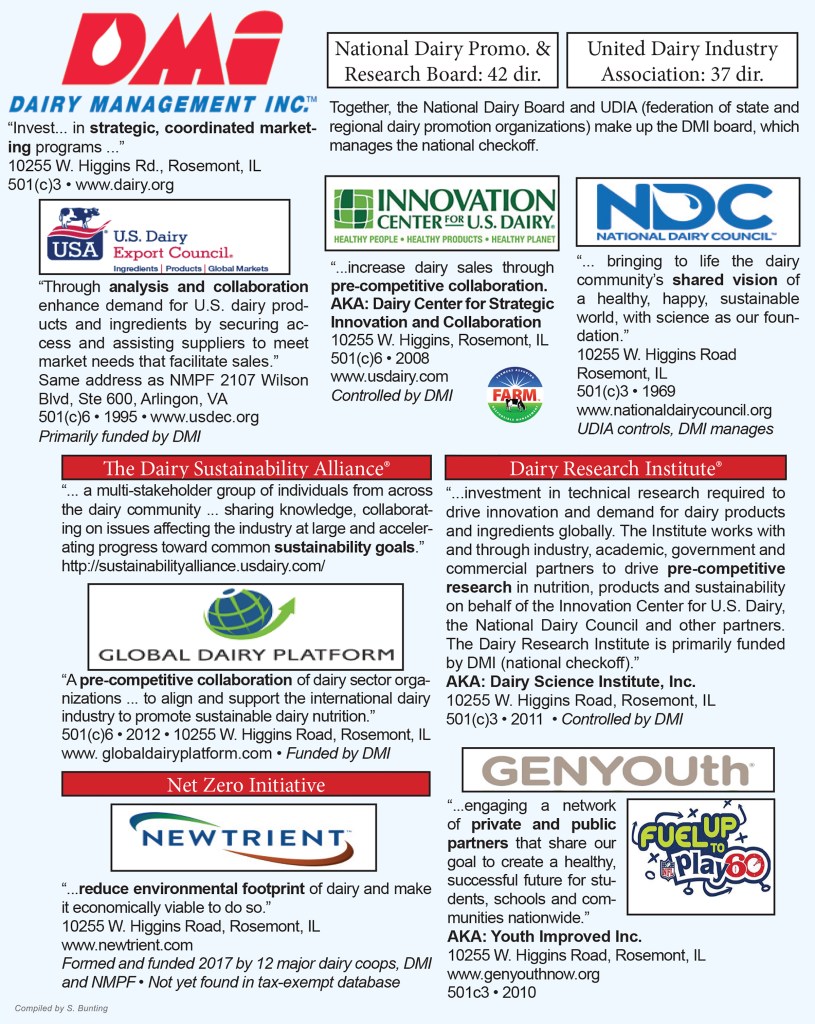
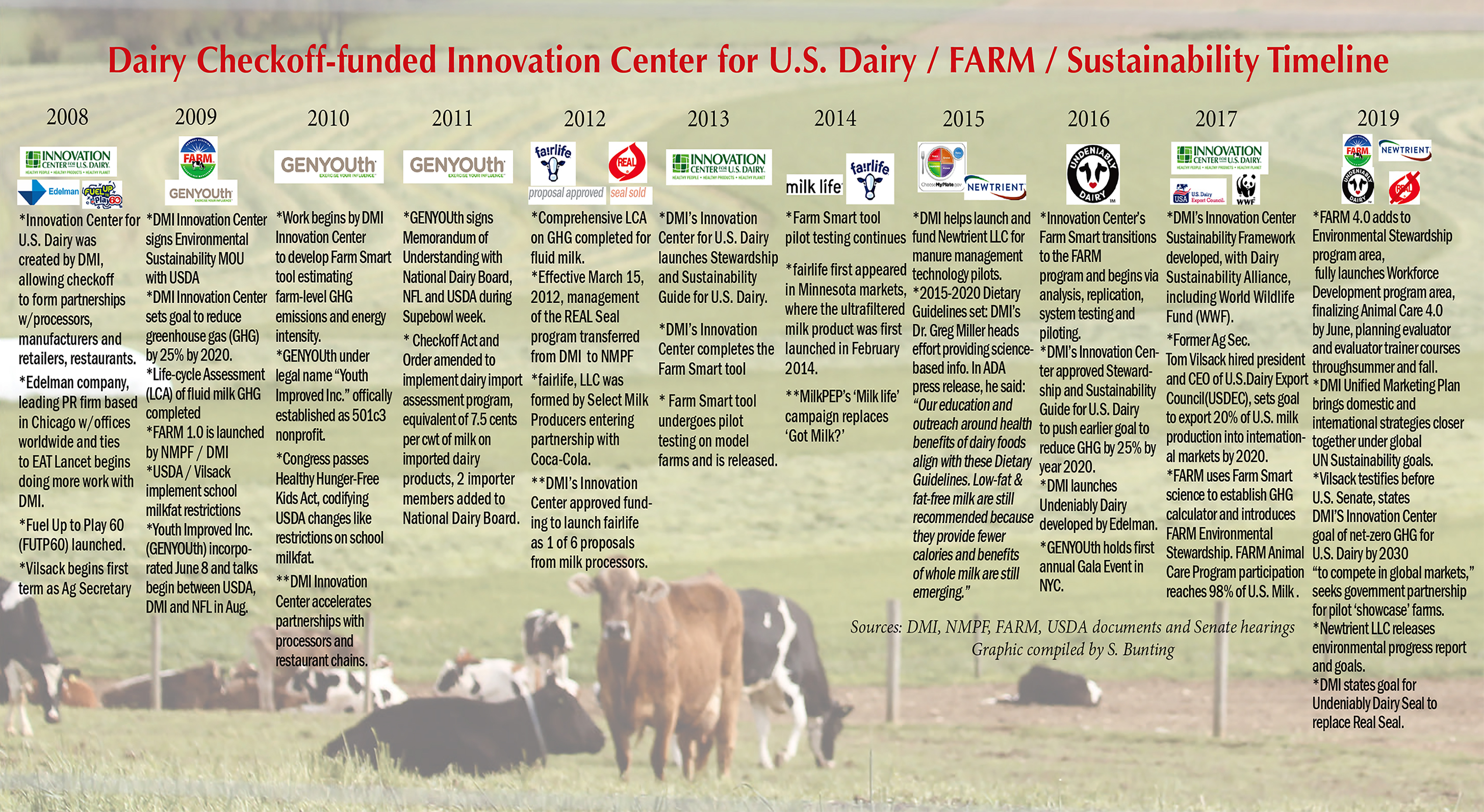
Let’s open the DMI umbrella with a short summary on some of the DMI-funded 501c3’s and 6’s by their known names and aliases. (We published a timeline for some of the major pieces under the umbrella in Keep in mind that NMPF is intrinsically involved in at least two: USDEC and Innovation Center for U.S. Dairy. These are the two organizations spawning a growing number of new tax-exempt organizations under DMI’s umbrella.

U.S. Dairy Export Council

USDEC and NMPF share offices at 2107 Wilson Blvd., Suite 600, Arlington, Virginia, just outside of Washington D.C., according to forms filed with the IRS. According to financial audits, DMI and NMPF trade and buy services from each other, and NMPF rented offices from DMI in Arlington until 2016 when these offices were sold.

In 2017, USDEC listed NMPF as an independent contractor paid $1.85 million for “trade services”.

USDEC paid DMI $6.5 million for management services in 2017, while also listing $6.4 million in salaries and employee compensation.

USDEC’s total revenue was $24.6 mil in 2017, of which $1.43 mil came from membership dues, $5.7 mil from government grants and $17.1 mil from DMI. This means that USDEC received 71% of its funding from national mandatory dairy checkoff and 23% from government grants with just 6% of its funding coming from the membership dues paid by the corporations and cooperatives that are significantly represented on the USDEC board of 140 directors.

The chief financial officer for USDEC in 2017 was Carolyn Gibbs, who was also listed as the CFO for the Innovation Center for U.S. Dairy. Halfway through 2017, she left this position to become a principal officer of Newtrient LLC, another related organization formed under the DMI umbrella in 2017. IRS forms for this organization are not yet publicly available.

Before coming to DMI, Gibbs spent 13 years at Kraft Foods, Inc. Her consulting work today with Newtrient LLC is described as “industry outreach, strategy, Net Zero Initiative, and project continuity.”

Innovation Center for U.S. Dairy

The Innovation Center for U.S. Dairy — a 501c6 formed in 2008 — is officially known to the IRS as Dairy Center for Strategic Innovation and Collaboration doing business as Innovation Center for U.S. Dairy. The national dairy checkoff organizations increasingly refer to this organization simply as “U.S. Dairy,” and the website for some of its activities is USDairy.com.

According to DMI’s IRS 990 form, this organization is directly controlled by DMI.

The “collaboration” has a small budget of around $115,000 for each of the past three years and no paid staff. But it is the hub of new tax-exempt organizations as well as trademarked initiatives.

Innovation Center for U.S. Dairy describes its reason for tax-exempt status on the 990 forms, as follows: “…to provide a forum for the dairy industry to identify opportunities to increase dairy sales through pre-competitive collaboration. It combines the collective resources of the dairy industry to provide consumers with nutritious dairy products and foster industry innovation for healthy people, healthy products and a healthy planet.”

On its 990 forms, U.S. Dairy lists its board of directors — a who’s who of chief executive officers and board chairs for prominent dairy cooperatives as well as multinational dairy processors. The board also includes DMI CEO Tom Gallagher and of course Vilsack.

The Dairy Sustainability Alliance

A key subset of The Innovation Center for U.S. Dairy is The Dairy Sustainability Alliance, trademarked by DMI in June 2017. A search for The Dairy Sustainability Alliance at guidestar.org, a database of non-profits, brings up Global Dairy Platform Inc.

Global Dairy Platform Inc.

Global Dairy Platform is a tax-exempt organization formed and incorporated as a 501c6 in 2012 and it lists its physical address as DMI headquarters in Rosemont, Illinois.

It describes its tax-exempt justification as follows: “A pre-competitive collaboration of dairy sector organizations, the Global Dairy Platform works with its global membership, scientific and academic leaders and other industry collaborators to align and support the international dairy industry to promote sustainable dairy nutrition.”

Chaired by Rick Smith, president and CEO of Dairy Farmers of America (DFA), the Global Dairy Platform (GDP), has a board of 12 executives representing the following corporations, cooperatives and organizations: Fonterra (New Zealand), Saputo (Canada-based multinational), Leprino (multinational), Land O’Lakes, Meiji Holdings Ltd. (China), FrielandCamprino (Dutch multinational), Arla (Denmark multinational), China Mengniu Dairy Company and the International Dairy Federation.

Donald Moore was paid nearly $600,000 as GDP executive director in 2016, the most recent IRS 990 form available. Moore currently also serves as chairman of the International Agri-Food Network and the Private Sector Mechanism to the United Nations Committee on World Food Security.

DMI senior vice president Dr. Greg Miller is listed as the research lead for the GDP, and he is currently also serving on a food and sustainability committee with the UN World Health Organization. He was the highest paid DMI executive in 2017 at $1.49 mil (including benefit package and deferments).

GDP had revenue of $3.74 million from DMI in 2017 — $2.6 mil for program services and $1.12 mil in the form of grants in 2016. According to the IRS 990, $583,329 of this revenue came from the import checkoff assessment. Research projects accounted for $1.85 million of expenses.

Newtrient LLC

Until July of 2017, Carolyn Gibbs was listed as chief financial officer of USDEC and the Innovation Center for U.S. Dairy, where she assisted with the launch of Newtrient LLC, another tax-exempt 501c6 formed in 2018, according to Gibbs’ bio at newtrient.com.

Newtrient falls under the Dairy Sustainability Alliance (Global Dairy Platform), which comes under the Dairy Sustainability Initiative.

No IRS 990 forms are available yet for Newtrient LLC.

Newtrient is described at its website (newtrient.com) as “an entity focused on turning waste into renewable energy and other commercially viable products, while reducing dairy’s environmental footprint and improving economic returns for dairy farmers.”

Dairy Research Institute

The Dairy Research Institute is a name trademarked by DMI, but the IRS recognizes this 501c3 as Dairy Science Institute Inc. doing business as Dairy Research Institute with a physical address at DMI headquarters in Rosemont, Ill.

The Institute describes its tax-exempt status to the IRS as “created to strengthen the dairy industry’s access to and investment in the technical research required to drive innovation and demand for dairy products and ingredients globally. The Institute works with and through industry, academic, government and commercial partners to drive pre-competitive research in nutrition, products and sustainability on behalf of the Innovation Center for U.S. Dairy, the National Dairy Council and other partners.”

The Institute is primarily funded by DMI with reported revenue of $1 million in 2016 and $785,935 in 2017. However, from 2013 through 2017, the Institute received a total of $24.3 million from DMI, including it’s first-year startup grant of $19.16 mil. in 2013.

Its officers are listed as Dr. Gregory Miller, president, Tom Gallagher, chairman and Carolyn Gibbs, CFO through July 2017 (before heading over to Newtrient and being replaced by Quinton Bailey).

Dr. Miller is also the research lead for Global Dairy Platform and chief science officer for the National Dairy Council (NDC), a 501c3 tax-exempt organization formed in 1969 and today controlled by United Dairy Industry Association (UDIA) and managed by DMI.

GENYOUth

While the sustainability organizational rollouts have been ongoing since 2009-10 memorandums were signed between USDA and DMI, another organization was simultaneously formed while Tom Vilsack was Ag Secretary in 2010 through a three-way memorandum of understanding between National Dairy Council, USDA and the National Foodball League.

This 501c3, of course, is Youth Improved Inc. doing business as GENYOUth, describing its tax-exempt status as “activating programs that create healthy, active students and schools, empowering youth as change-agents in their local communities, engaging a network of private and public partners that share our goal to create a healthy, successful future for students, schools and communities nationwide.”

DMI is listed as GENYOUth’s controlling organization and paid one of its partners, the NFL, $5.6 million for promotion in 2017, according to IRS filings. 

At the same time, in 2017, GENYOUth’s most expensive “charitable activity” was listed as Fuel Up to Play 60, costing $5.4 million and giving considerable advertising exposure to the NFL among future fans. That year, the NFL contributed less than $1 million to GENYOUth, and that year the NFL also received $5.6 million from DMI.

Alexis Glick, a television personality until 2009, has been GENYOUth’s CEO since its inception in 2010. In both 2016 and 2017, she was paid $259,584 as “compensation for services provided under an independent contractor agreement.”

Other employee compensation totaled $517,165, including vice president Mark Block, at $221,000. Pension plans and other employee benefits totaled $110,026 and other professional fees paid to contractors totaled $2.36 million.

Since 2010, the organization has brought donors to the table including some of the multinational dairy and foodservice corporations DMI is working with in other tax-exempt product innovation and ‘sustainability’ ventures.

-30-

Vilsack reveals ‘Net-Zero Project’ in Senate testimony, Climate policy table set

Vilsack lays out plan for USDA to partner in ‘Net Zero’ pilot farms, using results to set governmental policies and incentives

By Sherry Bunting, Farmshine, May 24, 2019

(Above) DMI’s checkoff-funded Innovation Center for U.S. Dairy was formed in 2008, the year Tom Vilsack became U.S. Secretary of Agriculture. This timeline shows the events from 2008 to 2019 around the Innovation Center, sustainability programs, FARM program and various MOU’s with USDA while Vilsack was Secretary and after he became president and CEO of U.S. Dairy Export Council in 2017. 

WASHINGTON, D.C. — FARM program evaluations over the past few months have yielded reports from dairy producers on new questions they are being asked about their feeding practices and usage, nutrient management plans, manure management systems and cropping practices, feed rations by class of cattle, livestock and feed inventories on the farm and heifer inventories raised off the farm, milk receipts and receipts for cattle sold for beef purposes, energy and fuel usage and costs, specific questions about wetlands on farm properties as well as new questions about human resources.

Over the past two years, the National Dairy Farmers Assuring Responsible Management (FARM) has added new ‘silos’ to the 4-part program. In addition to Animal Care, the newer portions are Environmental Stewardship, Antibiotic Stewardship, and Workforce Development. With all four in place, virtually every management aspect of a dairy farm falls under the FARM umbrella.

The FARM program is funded by the mandatory dairy checkoff through DMI’s Innovation Center for U.S. Dairy. FARM is administrated by National Milk Producers Federation (NMPF).

98% of milk enrolled

According to its 2018 Report, 98% of the milk produced in the U.S. is enrolled in FARM. The Animal Care silo is mandatory for all 115 participating cooperatives and processors, and 20 of the 115 adopted the Environmental Stewardship module by the beginning of this year.

Development of the Environmental Stewardship (ES) module began at FARM’s inception in 2009 but did not become a ‘silo’ in FARM until 2017. The FARM website states that this portion is currently “voluntary for program participants.”

This simply means that the 115 cooperatives and processors that are participating in FARM can voluntarily add the ES module. When added by the participating cooperative or processor, the components of the module become — in effect — mandatory for the farms.

The FARM materials clearly state that FARM is not a legal document. And yet, its modules have expanding levels of authority beyond a milk shipper’s legal milk contract obligations, without expanding compensation.

FARM’s Environmental module was developed, according to the 2018 annual report, as “a tool participants (co-ops and processors) can use to communicate progress towards reducing their carbon and energy footprint.”

The report says further that the Environmental portion of FARM is geared toward assuring dairy customers and consumers of the dairy industry’s commitment to “ongoing environmental progress (by) asking a set of questions to assess a farm’s carbon and energy footprint and then providing farmers with reliable, statistically robust estimates.” It also “tracks advances in dairy production efficiency.”

The questions and data are evaluated based on a life-cycle assessment (LCA) of fluid milk conducted by the Applied Sustainability Center at the University of Arkansas, incorporating modeling piloted on 500 example dairy farms across the country.

Checkoff-funded GHG calculator

This LCA development was launched in 2009 at the inception of FARM. By 2010, the greenhouse gas (GHG) LCA was completed, and by 2012, the comprehensive environmental LCA was completed. The program’s ‘Farm Smart’ tracking tool was piloted on the ‘model’ farms in 2013-14.

Farm Smart became a transitional tool in 2016 during a period of analysis, replication, system testing and piloting. In 2017, the FARM program added the Environmental module and began using this ‘Farm Smart science’ to establish the GHG calculator.

FARM environmental audits

For those producers who are being asked these new questions during their FARM evaluations in the past few months, their answers are recorded, and farm data are entered into a spreadsheet, from which annual Environmental audits will be randomly selected.

A video at the FARM website explains the process evaluators use to enter the farm name, zipcode and most recent daily milk shipment in pounds of fat and energy-corrected milk.

The spreadsheet automatically groups these farms by 3-digit zipcode and automatically ranks them within their geographic area by production quartiles — the top 25% of farms with the largest daily milk shipments are in quartile 1 and the smallest 25% are in quartile 4 with the other two quartiles automatically segregated.

Another built-in formula then sorts the farms by 3-digit zipcode and then by production quartile to break out ‘subset’ lists from which 33% of each subset will be randomly selected for annual audits.

Evaluators are told in this training video that the information they are collecting is “purely informational and will be used by National Milk Producers Federation (NMPF) at a later time.”

So, as FARM evaluators come to the dairy farm, ask new questions and record new information to develop profiles of farms to run through a Farm Smart GHG calculator, the tracking of the milk supply is well on its way.

This tracking eventually becomes a point of oversight and internal regulation to reach the goals set by the checkoff-funded DMI Innovation Center for U.S. Dairy.

Checkoff sets GHG goals

During a Senate hearing on Agriculture and Climate Change this week (May 21), former USDA Secretary and current president and CEO of the checkoff-funded U.S. Dairy Export Council stated that “U.S. Dairy” is “on pace” to meet its goal (set while he was Secretary in 2009) of reducing GHG by 25% by 2020.

Vilsack also announced that the new benchmark set by DMI’s Innovation Center for U.S. Dairy is net-zero emissions (by 2030).

When introducing Vilsack at the hearing, the Senate Ag Committee leadership referred to him not only as the honorable Secretary, but as president and CEO of the dairy “exports and innovation.”

The former Ag Secretary in his current role is instrumental in DMI’s Innovation Center for U.S. Dairy as this entity partners with multi-national corporations operating global supply chains sourcing dairy products and ingredients.

In fact, Vilsack spent much of his time in front of the Senate Ag Committee Tuesday pressing for government support and partnership in setting up pilot farms where all technologies for meeting the net-zero benchmark can be “measured, verified, cost-assessed and then marketed.”

He said the dairy industry needs a “showcase” of pilot farms and ecosystem markets, and he said business opportunities and jobs will follow. Vilsack also indicated that a net-zero achievement is necessary so “U.S. Dairy has a marketing advantage to be competitive in global markets.”

In the past, the ‘showcase’ dairies for the various pursuits of DMI’s Innovation Center for U.S. Dairy, have included Fair Oaks, and Mike McCloskey of Fair Oaks, based in northern Indiana has been a key driver in DMI’s Innovation Center for U.S. Dairy, headquartered an hour or so north in Chicago. The Innovation Center also provided funding for fairlife as a startup over the past decade of these developments.

Vilsack involved from inception

The Innovation Center for U.S. Dairy was implemented by DMI in 2008. The FARM program came under that umbrella in 2009. Both the GENYOUth and the Sustainability Memorandums of Understanding (MOU) were signed by DMI and USDA in 2009 and 2010 near the beginning of Vilsack’s 8-year tenure as Secretary. And, in 2010, DMI’s Innovation Center set a goal to reduce the already tiny carbon footprint of dairy by 25% by 2020. As now DMI employee Vilsack testified Tuesday, the Innovation Center’s new goal is net-zero by 2030.

In fact, in the final days of the Obama administration, on January 13, 2017, former Secretary Vilsack stepped from the office of the USDA Secretary on Independence Avenue, Washington D.C., and just 11 days and 4 miles later on January 24, 2017 stepped into his current office as president and CEO of the checkoff-funded U.S. Dairy Export Council, sharing offices with National Milk Producers Federation (NMPF) on Wilson Boulevard, Arlington, Virginia.

As noted, the dairy checkoff — under the increased guidance of the Edelman public relations and marketing firm — started down this road in 2008 with the formation of the Innovation Center for U.S. Dairy and the close working relationship with Vilsack while he was Secretary of Agriculture.

Through the MOU’s signed with USDA at that time, it is clear that DMI and its fledgling Innovation Center for U.S. Dairy was working closely with the USDA for all eight years Vilsack was Secretary and has carried the same direction and workload over to his employment with DMI in continuing to set benchmarks for dairy ahead of the current anti-cow discussions that have percolated over that same time within federal agencies through the influence of activist non-governmental organizations.

The DMI Innovation Center partnership with World Wildlife Fund became solidified in 2016, as Vilsack’s term as Ag Secretary was expiring.

Barely two years into his employment through dairy checkoff, Vilsack is back before the Senate Ag Committee talking about net-zero emissions, pilot farms, ecosystem markets and other concepts that align with the Green New Deal outlook on cows as a problem that needs to be solved by meatless Monday and have its methane button turned off in order to be acceptable in the EAT Lancet world where billionaires have invested in the replacement technologies of fake meat and fake dairy while simultaneously investing in U.S. global policy initiatives that were initiated while Vilsack was Secretary and were referenced by Senator Bob Casey (D-Pa.) during Tuesday’s hearing (that’s another story).

Again, instead of partnering with the private sector and organizations that understand the already small emissions of cattle when looking at the complete carbon cycle, dairy checkoff has aligned with groups like the World Wildlife Fund (WWF) and companies with technologies that are geared toward capturing methane and achieving net-zero GHG emissions.

This all sounds good, right? But what does it really amount to?

Net-zero by the numbers

The current benchmark set by DMI and USDA via the MOU in 2009-10 set the goal of reducing U.S. Dairy’s GHG by 25% by 2020. U.S. GHG inventories — according to the Environmental Protection Agency (EPA) — show that total agriculture accounts for 9%. Dairy and livestock, combined, account for half of agriculture’s contribution at 3.9%. Dairy, alone, is at 1.9% on its way, presumably, to 1.5% by 2020.

Even at that point, 25% of 2 is a savings of 0.5% of total U.S. GHG. Part of the FARM program’s tracking of GHG is to look at the number of animals culled for beef so that a portion of their GHG calculation can be pushed over onto the beef footprint and out of the dairy footprint. Can we see how the minutia goes on and on over tiny fractions of impact vs. standing tall to tell the true story about how small the cow’s impact really is?

Vilsack (above): ‘It’s time to get to net-zero’. Mitloehner (below): ‘Cattle do not increase global warming’.

Methane facts vs. fiction

Scientists are pointing out how the methane focus on cattle is being misplaced, or at least not evaluated properly. They point out in a new report that methane is a ‘flow’ emission, not a ‘stock’ emission. In other words, it doesn’t stick around or build up.

Slightly muted Tuesday was the expert testimony given by Dr. Frank Mitloehner, world renowned GHG expert and professor at University of California – Davis. He separated fact from fiction on the carbon footprint of livestock and dairy.

More importantly, he described methane, which is the main GHG of concern for agriculture and especially livestock and dairy. He explained how methane differs from the other two greenhouse gases – carbon dioxide and nitrous oxide – that together make up total GHG.

“For example, carbon dioxide lives for 1000 years, once we emit CO2 with our vehicles, let’s say, it stays there for 1000 years, same for nitrous oxide,” Mitloehner testified. “But methane is very different… with a lifespan of only 10 years.”

He described how a 1000-cow dairy after 10 years, for example, is no longer an emitter of new methane because the methane emitted is also being destroyed at the same rate, becoming part of the carbon cycle through plant photosynthesis, ruminant consumption of these plants and so forth on a continuum.

He explained this destruction process – hydroxyl oxidation – that “occurs constantly,” saying that, “Any kind of discussions that I am part of is a discussion where that fact is left out, and it shouldn’t be left out because it’s critical.”

In fact, Senator Joni Ernst of Iowa said “Some of us are pretty struck today because we have heard that methane is horrible, we need to reduce our livestock herds, and we should have meatless Mondays. We’ve heard that time and time again. It’s been done in various federal agencies in past administrations.”

Mitloehner pointed out that while methane is an important climate pollutant and almost 30 times more potent than CO2, “If we maintain constant livestock herds and flocks, then we are not increasing methane and therefore not increasing global warming as a result of that.”

In that context, mitigating methane becomes a tool to counteract global warming, which is a different discussion and one that gives the methane mitigation a valuation for potential compensation.

Surprisingly, Mitloehner’s contribution received far fewer questions from Senators than one would expect. Most of the Senators gave Vilsack multiple opportunities to come back to his theme of driving dairy and agriculture to net-zero and the business opportunities and marketing advantages this would provide for “U.S. Dairy” in global markets.

Meanwhile, a growing number of scientists are agreeing with a more realistic perspective on methane, that a more ideal approach would be aimed at zero emissions for stock pollutants that are long-lived such as carbon dioxide (through a combination of energy efficiency, more food per lower energy inputs and carbon sequestration through crops, grasses and forages) while aiming for flow pollutants like methane to be low and stable instead of zero because methane is short-lived and part of a continuous sun-powered carbon cycle in which cows are already an integral part on the positive side.

GHG tracking

With dairy farms representing 1.9% of total U.S. GHG and the transportation sector representing 80%, who is then calculating the GHG impact of transportation in a consolidating industry where the new term coined by Vilsack of ‘ecosystem markets’ substitute on a larger scale for the ‘environmentally-friendly’ concepts of regional food systems and eating ‘local.’

On the methane tracking in this deal, a split in thought processes is beginning to emerge.

Meanwhile, the Innovation Center for U.S. Dairy — and its birthing of the FARM program — provide the vehicle to meet the net-zero benchmark this checkoff-funded entity has set. The pilot farms the former Secretary wants the government to partner in supporting would develop another template of practices and technologies farms can implement to meet new Environmental FARM criteria so the net-zero benchmark can be met and marketed over the next 10 years.  

While achieving, marketing and capitalizing on net-zero emissions sounds great, what does it mean for all of the farms being forced to pay into the dairy checkoff with expectations that this money is for promotion and research of the milk they produce and the care they have always taken of the resources they steward?

When benchmarks, streamlining vehicles, government cross-over specialists, evolving science, assumed needs and fuzzy baselines, converge and align, where does this leave the single-family farm of 50 to 200 cows or multi-generational dairy farm of 300 to 1500 cows?

Will they be credited for destroying as much methane as they produce by keeping their herds fairly stable in size?

Without the financial incentives or compensation to implement template technologies to achieve net-zero, how will their tiny profiled-and-tracked GHG emissions be handled in FARM Environmental Stewardship audits and mandatory correction plans in 2020, 2025, 2030?

The drive toward installation of methane digesters to actually capture the methane is great science, and it works for some farms, but not others. It’s a pathway to net-zero, and yet it is unclear whether these other factors regarding methane will be highlighted in the Farm Smart GHG calculator developed by the DMI Innovation Center for the NMPF FARM implementation. Once in place, this GHG calculator will track dairy farm GHG progress as their cooperatives and processors add the Environmental ‘silo’ to the FARM requirements of shippers.

From Innovation Center documents and USDA MOU’s and WWF partnerships documents, the descriptions of the work done between 2010 and 2016 on the GHG calculator have a tracking focus on the same thing the anti-cow folks are focusing on, and that is methane’s 30-times greater heat-trapping capabilities compared with carbon dioxide, and totally ignoring the fact that the methane is short-lived at 10 years vs. carbon at 1000 years so the livestock and dairy industries have already dramatically reduced methane by having fewer animals producing more food today than 30 and 40 years ago.

Will appropriate credit be given to small and mid-sized dairy farms that have had modest growth rates over decades or generations putting them in a place of zero new methane? Or will they need to capture methane to satisfy the net-zero benchmark their checkoff program has set in order to make space for new cows to be added in the rapid growth and industry consolidation areas of the country?

In fact, as part of a flow pattern that involves plants (feed) and cows in reducing the GHG heat-trapping potential of carbon dioxide and methane, combined (see fig. 2), what’s newsworthy is  science does support more accurate modeling to credit the sequestration of long-lasting carbon and accounting for short-lived methane destruction.

On methane, Dr. Mitloehner stated that the mere fact that there are 9 million dairy cattle today compared with 24 million in 1960 and producing three times more milk shows that dairy producers are collectively not only emitting zero new methane, they are reducing total methane as old methane and carbon are eradicated by the carbon cycle and less new replacement methane is emitted.

The problem may be this: Year-over-year cow numbers for the U.S. creeped higher from 2014 to 2018 before backing off a bit in 2019. While still much lower than three or four decades ago, the issue emerging for DMI’s Innovation Center for U.S. Dairy is how to accommodate growth of the new and consolidating dairy structures to attain the expanded global export goal if dairy farms in other areas remain virtually constant in size or are grow modestly by comparison.

To reach the Innovation Center’s new net-zero goal, cows would have to leave one area in order to be added in another area, or they will all have to have their methane buttons turned off or the methane captured because now the emissions are being tracked in order to meet one collective “U.S. Dairy” unit goal under the DMI Innovation Center and NMPF / FARM. Dr. Frank Mitloehner testified that dairies already create zero new methane but this can be tricky when cattle move from one area to another (as we see in the industry’s consolidation).

Will all dairy farms have to get to net-zero to survive over the next 10 years under the GHG calculator developed by the checkoff-funded Innovation Center, which has now been added to the FARM program? That’s the big question.

Before the Senate, Vilsack repeatedly went back to his main premise that the Net Zero Project is  “critical for U.S. dairy.” His written testimony specified that the Net Zero Project comes out of the collaborative work of several dairy checkoff-funded entities along with various global dairy food companies, including DMI’s Innovation Center for U.S. Dairy in combination with DMI-funded U.S. Dairy Export Council, and checkoff-supported Newtrient LLC, as well as an industry consortium called the Global Dairy Platform.

According to Vilsack, the Net Zero Project presents a  “global marketing advantage for U.S. dairy,” he said.  “This is how U.S. Dairy will compete.”

-30-