Editorial: Get it done or start ‘splainin’

By Sherry Bunting, Editorial in Farmshine May 30, 2025

While the landmark MAHA Commission was working on its initial report released May 22 on the chronic childhood disease crisis, Pennsylvania state lawmakers have been assembling a “Healthy PA Package” that includes five bills – H.B. 1130, 1131, 1132, 1133, and 1134 – that would either ban or require specific labeling for foods containing certain artificial dyes and preservatives; provide statutory definitions for terms like “ultra-processed foods,” designate August as Wellness Month, and provide incentives for cover crops based on their use in producing healthier crops using less chemical herbicide…

But there is one state bill that should be part of this Healthy PA Package, and that is S.B. 463, the “Allowing Whole Milk in PA Schools Act,” reintroduced in March by State Senator Michele Brooks, a Republican representing Mercer County. It would simply allow Pennsylvania schools to purchase and serve whole and 2% milk produced within the state instead of being limited to offering only 1% and fat-free milk.

After all, the MAHA Report describes whole milk as “a rich source of calcium, vitamin D and bioactive fatty acids, which support bone health, help regulate inflammation and may reduce the risk of type two diabetes.” And the MAHA Report could reform some key elements of the anti-fat Dietary Guidelines. But it was lawmakers in Washington in 2010 that specifically singled out whole and 2% milk in a passage within the Healthy Hunger Free Kids Act and states are left to bow down to King Vilsack, who drove the school bus on that deal.

In the previous session of the Pennsylvania State Senate, Sen. Brooks’ bill on whole milk had been reported out of the State Senate Ag Committee but never made it to the Senate floor for a vote. In the House, Rep. John Lawrence’s companion bill was passed by the full House last session, but was never approved by the Senate before the legislative session ended in Dec. 2024. At that time, there were murmurings of USDA canceling state school lunch reimbursements or other state funds from mighty USDA after a certain general farming publication mentioned the stance of Vilsack’s USDA in terms of the legality or illegality of such a state measure. 

Meanwhile, Tennessee and North Dakota have passed state legislation to pave a path for whole milk in their schools. If more states did this, even if it is tough to implement, it sends a message, and perhaps the leadership log-jam in Washington would break down and run the Whole Milk for Healthy Kids Act and get-it-done already. It appears to have broad bipartisan support, at least that’s what all of the lawmakers seem to want to portray in front of the cameras.

So, here we are in the 2025-26 legislative session at the state and federal levels having to start all over again, covering the same ground, talking the same talk, pointing out the same points that have been discussed, written about and testified to numerous times over the past 10-plus years.

“The (federal) Healthy, Hunger-Free Kids Act of 2010 put restrictive regulations on the consumption of whole milk in schools. In the first two years this legislation was enacted, 1.2 million fewer students drank milk with their lunch, yet still had access to sugary drinks that offer no nutritional value. This not only has terrible health and nutrition impacts on children, but major economic impacts, especially in Pennsylvania,” writes Sen. Brooks in her memo to colleagues seeking cosponsors for reintroduction.
 
In her memo, she cites testimony from a Senate Majority Policy Committee public hearing in June of 2021, in which the Grassroots Pennsylvania Dairy Advisory Committee volunteers and 97 Milk supporters testified, along with other industry leaders and officials.

She cites dairy’s economic importance to the Commonwealth, and the testimony showing the improved physical and brain health that whole milk’s unique matrix of fatty acids provides, noting “this fat is necessary in the daily diet and energy to support cell growth. Other health benefits of milk include improved bone health, lower blood pressure, and reduced risk of cardiovascular disease and Type 2 diabetes.”

Again, here we are with words upon words but no one’s running the votes upon votes to get it done.

Let’s stop talking and just do it. Lawmakers in Harrisburg and Washington can talk until they are blue in the face about doing something for dairy farmers or doing something to feed hungry children or deliver better childhood health and nutrition. They can come up with all kinds of elaborate schemes to make factions happy or align the stars on the curious realities of milky politics.

My message to folks at both Capitols is simple: We live in the United States of America — land of the free and home of the brave, where our valiant soldiers have fought and died to give and maintain our liberty – yet their children, grandchildren, great-grandchildren, and great-great grandchildren are prohibited from choosing whole milk as an option with school meals they rely on two meals a day, five days a week, three-quarters of the year. Heck, even our soldiers are limited because mess halls have to subscribe to those low-fat dogmas as well. 

One of the biggest obstacles for this bill early on was that most Americans laugh in disbelief when you tell them this. Absurd! They say. My kids have milk at their school, they laugh. And the federal government pays for all that milk to go straight into the trash… Oh, tell me more.

Can I be frank? My husband hears me talk on the phone about whole milk in schools and he laughs at the absurdity that I’m still talking and nothing has been accomplished. I am just one of many. As more voters see the absurdity, respect for elected officials wanes. I find it absurd that we are still talking about something that should have been finished long ago already. If we can’t do the simple stuff that has obvious bipartisan support, how in the world are we ever going to do the tough stuff? What’s the hold up? Is it industry? Is it leadership? Is it lip-service? Is it PETA? Is it Vegans? Is it the brainwashing game of the Heart Association as a pawn of Big Food and Big Pharma? What gives?

After 10-plus years, farmers, children, parents, teachers, school boards, and communities that have worked on this issue deserve an answer. Fess up to the real reason it’s still stymied or VOTE for goodness sakes – VOTE in both chambers – now—so these federal and state whole milk bills can get to the President’s and Governor’s desk in time for schools to actually put it in their food plans for the next school year. Time is running out. And the delays are now tiresome.

If these chambers aren’t going to vote, then they better tell us what the real holdup is and start naming names. Some of us have children and grandchildren who are anxiously waiting and hoping. Some of us have cows that are offended to know their nature’s most perfect food can’t be offered to children without being fooled around with. And some owners of those cows need to have hope that the hard work they do to provide high quality whole milk is reflected in what America’s children get to choose at school where they spend most of their time and eat two meals a day, five days a week, three-quarters of the year.

Get it done, or start ‘splainin.’

-30-
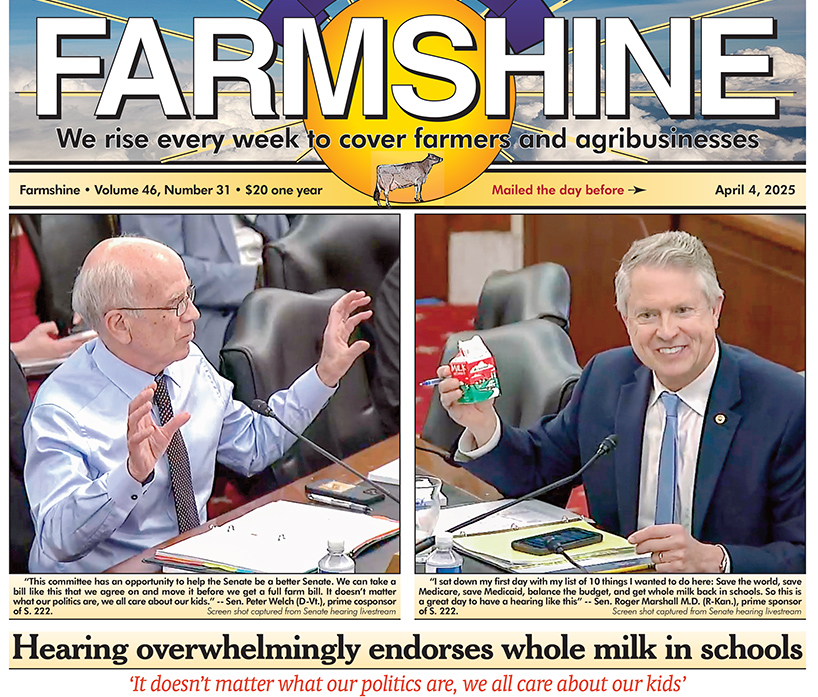
Senate Ag hearing overwhelmingly endorses whole milk in schools

By Sherry Bunting, Farmshine, April 4, 2025

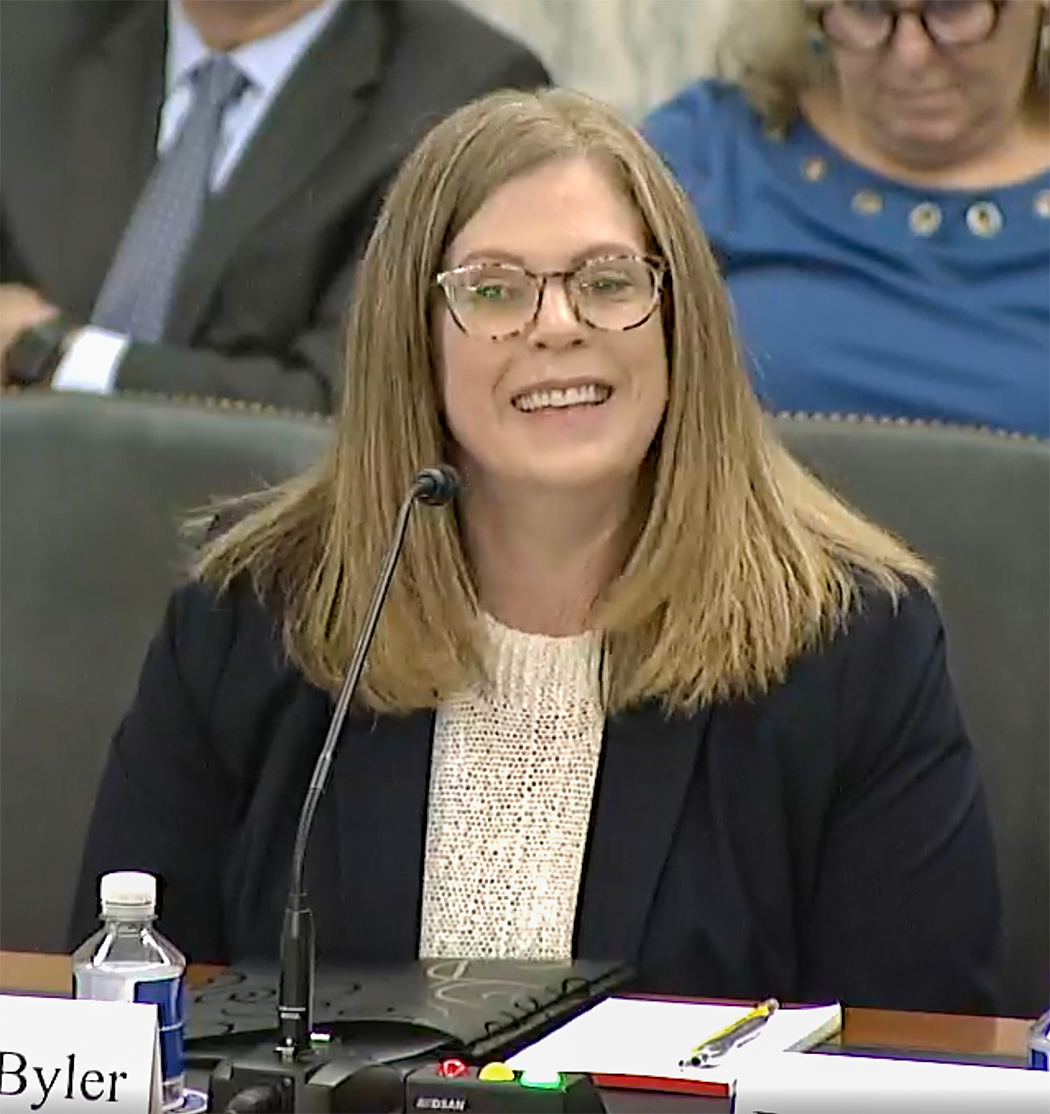
WASHINGTON, D.C. – We need to be the change-makers that our students and farmers both need. We need to bring back the ability to offer milk fat choice in schools, including nutrient dense whole milk – which, by the way, is just 3.25 to 3.5% fat,” said Krista Byler, a witnesses during the hearing by the U.S. Senate Committee on Agriculture, Forestry, and Nutrition to “review the Whole Milk for Healthy Kids Act, S. 222, and improve children’s health.”

April 1st, the day of the hearing, was a great day for America’s children and dairy farmers, and that’s no April Fools joke!

The livestreamed hearing opened with a reminder from Senate Ag Chairman John Boozman (R-Ark.) that the whole milk bill had passed the House in the last Congress “by an impressive 330 to 99 vote” and his desire to “make progress in the Senate.” 

Ranking Member Amy Klobuchar (D-Minn.) expressed her support for the bill and thanked Sen. Roger Marshall (R-Kan.) for introducing it. She also set the stage to broaden the hearing to other school nutrition matters. (To be covered in a separate article at another time).

The hearing ended with universal expressions of bipartisan support, thanking the Senate’s ‘milkman’ Marshall. Several Senators urged moving the bill forward as a standalone without delay.

“If we can do something that’s good, let’s do it, and then we’ll do the next thing that’s good,” said Senator Peter Welch (D-Vt.), the bill’s prime cosponsor, addressing the Chair. “This committee has an opportunity to help the Senate be a better Senate, we can take a bill like this that we agree on and move it before we get a full farm bill. It doesn’t matter what our politics are, we all care about our kids. I hope as we pursue this whole milk opportunity for our kids and our farmers that it’s the beginning of a real commitment to nutritious, locally produced, natural foods.”

In between the open and close, the Senate Ag Committee heard from and questioned five witnesses, spending the first chunk of time with Dr. Eve Stoody, Director of the Nutrition Guidance and Analysis Division at the Center for Nutrition Policy, within the Food Nutrition Service of the USDA. 

She is tasked with supporting the development of the Dietary Guidelines (DGA) since the 2010 edition and is the self-described career subject matter expert on the DGA process.

She revealed that 90% of Americans don’t consume the daily recommended amount of dairy, a statistic that has worsened over time, setting the stage for nutrient shortfalls.

“Across the board… whatever the form is, we need to have greater consumption of dairy,” she said, citing national survey data showing that on any given day, the percentage of adolescents reporting drinking milk was 75% in the 1970s, just under 50% in the early 2000s, and about 35% in the most recent data.

Chairman Boozman asked what justification was used to remove whole and 2% milk from schools in 2010?

Instead of addressing that question, specifically, Dr. Stoody said the current Dietary Guidelines recommend “most” dairy be low-fat or fat-free, but the guidelines (10 years later) in 2020 were constructed as overall dietary patterns with more flexibility.

“It’s also a reality that we kind of have a number of calories that individuals should consume, so across the guidelines we recommend consuming foods from all of those different food groups and that most should have little to no added sugars or saturated fat to help us stay within those calorie limits,” she said. “We don’t have a lot of room in the calories of the diet to consume milk and dairy with higher fat.”

Stoody parsed this as a population-level guideline: “That doesn’t mean whole milk and higher fat dairy can’t be part of a healthy diet, but it’s really important to look at the overall diet. The DGAs are there to provide flexibility based on needs and preferences.”

(This confusing ambiguity opened the door for the next panel to walk through, even though only two of the remaining four witnesses talked about the whole milk bill, while the other two talked exclusively about USDA’s recent cuts to programs like the local farm-to-school cooperative grants and concern about changes to how school lunch eligibility. Even those witnesses agreed that simplifying regulations and providing flexibility allows schools to focus on the quality of the meals instead of being bogged down by red tape.)

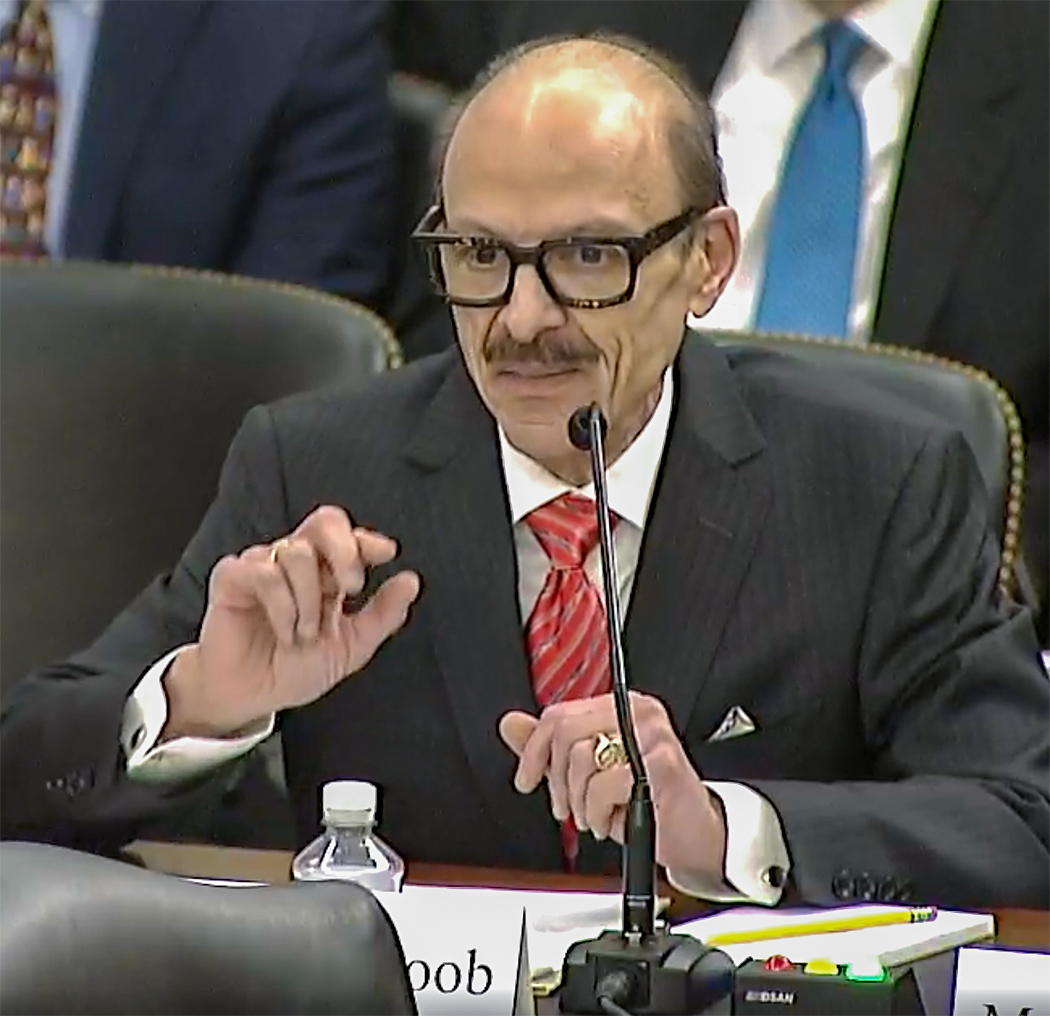
“I’m here because this issue matters to the children I serve, so it matters to me,” said witness Dr. Keith Ayoob, Associate Professor of Pediatric Nutrition at the Albert Einstein College of Medicine in New York City. He runs a diagnostic and treatment clinic working with mostly low-income children, and their families, in the Bronx.

“A plethora of research demonstrates consumption of cow’s milk provides children with better bone health, a lower risk of type II diabetes, and a lower risk for cardiovascular disease,” he shared, as he zeroed-in on milk’s 13 essential nutrients, including 3 of the 4 under consumed nutrients calcium, potassium and Vitamin D.

He said saturated fat does not occur in foods in isolation, and new research shows the protein-fat matrix “behaves differently” in the body. “While other foods that are lower in saturated fat can also lower cardiometabolic risk, they can’t deliver the 13 essential nutrients in milk. Milk delivers a package I’ve not been able to find in any other food or beverage.”

Krista Byler of Spartansburg, Pennsylvania testified next. She is the Foodservice Director and District Chef for the past 20 years at Union City Area School District, or as she puts it: “The professional chef turned lunch lady.”

The granddaughter and wife of former dairy farmers, she was the one witness to bring a combined experience in dairy farming, culinary arts, and childhood nutrition, saying she believes “access to good quality nutrient dense whole food is a basic right of education.”

Byler spoke from the heart, bringing experience and data. She described the impact of the 2010 Childhood Nutrition Reauthorization’s school milk changes on students and dairy farm families.

“It was heartbreaking… we were seeing a huge increase in waste and a huge decline in the amount of milk that I was actually ordering because our children were not choosing to take the milk,” she said.

In 2018, Byler attended an event with the School Nutrition Association where she met Rep. Glenn ‘GT’ Thompson (R-Pa.) – the decade-long champion for The Whole Milk for Healthy Kids Act. 

At that meeting, Byler said she heard her peers also talking about the large amounts of waste. She was later introduced to the Grassroots Pennsylvania Dairy Advisory Committee of dairy farmers and school-involved parents, affiliated with what later became the separate milk education nonprofit 97 Milk.

(The Grassroots PA Dairy Advisory Committee is chaired by Bernie Morrissey, with current participants that include dairy farmers Nelson Troutman of Berks County (the Milk Baleboard painter), along with Dale Hoffman and Tricia Adams of Potter County, certified RN school nurse Christine Ebersole of Blair County, Dr. Ed Silverman, a retired internal medicine physician, Mike Sensenig of Sensenig’s Feed Mill, and this reporter who helps in communication. Like the separate board comprising 97 Milk, all the work is done by volunteers without compensation.)

This grassroots committee invited Byler to do some data collection. She explained that in the 2019-20 school year, with the blessing of her school board of directors, they conducted a school milk choice trial at the middle and high school, offering all levels of milkfat, both flavored and unflavored.

“The results are astounding.” Byler said, referencing her written testimony to find more complete data and survey results.

“What I want to really drive home are two main data points: The 50% increase in milk consumption (evidenced by ordering more milk) and the 95% — that’s right – the 95% reduction in milk waste, just because we offered a variety of milk choices that fit our students’ needs,” she said to the visibly astonished Senators who had previously unsuccessfully asked the first witness from USDA for such data.

“That’s incredible. It’s amazing when we give a little education and we give the choices, eventually the consumer makes the right choice,” said Sen. Marshall who is a medical doctor and prime sponsor of the bill in the Senate. He described his frustration in seeing the impact of osteoporosis and osteopenia, when bone density has not been built in the first 26 to 28 years of life.

Byler explained that the school student council helped collect, measure, and document the waste, and they “took a little heat after the 2020 school year when we (ended the trial) and went back to not being able to offer the variety. Overwhelmingly, students said they want something that is satisfying. Athletes, especially, were very vocal about wanting something that sticks with them. It’s a perfect recovery drink.”

Dr. Ayoob agreed: “My kids in my clinic have said that they find skim milk ‘watery.’ They may take that carton of milk. The school will get reimbursed. But I’m concerned that they drain that carton, not just take a few sips. Not only is there less food waste but more nutrition goes into the children.”

Sen. Ben Ray Lujan (D-Calif.) reminisced that he didn’t grow up with much money in the bank, but was blessed to have a dairy down the street. “Today when I get a carton of milk at the store, my habit is still to shake it because growing up that cream rose to the top, and we knew we had to shake it if we were going to enjoy it.”

“Our kids want to do better. They want to eat better. We have their attention,” said Sen. Jim Justice (R-W.V.), who spent his days with students as a longtime coach. “We have an opportunity here to step up. I am absolutely, wholeheartedly in favor of moving forward with whole milk.”

Every Senator present and asking questions expressed or implied support from both sides of the aisle.

With a nod to “the milkman Sen. Marshall,” Sen. Dick Durbin (D-Ill.) said he had to read through the list he had been provided of the organizations that are opposed to the bill, including the American Heart Association, American Academy of Pediatrics, and American Academy of Nutrition and Dietetics. He then asked the USDA representative what health organizations are for it? Dr. Stoody said she didn’t have that information.

(Perhaps more to the point, were her continued circular answers that forced this realization: The “population-level guidelines” get drilled down to individuals in governmental feeding environments, which then feed into the health and nutrition organizations and back again. Meanwhile, individual health and nutrition practitioners are out there seeing real people as individuals every day, wondering how to get off the spinning merry-go-round.)

Chairman Boozman asked Dr. Ayoob how policymakers have gotten it so wrong in drawing a correlation between whole milk and obesity?

“Actually, the correlation is inverse,” Dr. Ayoob declared. “A review of the studies in my written testimony show that greater consumption of dairy foods, including whole fat milk, has been associated with less obesity and less cardiometabolic risk.”

He said in 2010 when whole and 2% milk were first removed from school meals, obesity prevalence was about 17%. Since that removal, it has increased. “It’s now 21%, and it’s higher, about 25%, in black and Hispanic children, the population that I work with.” 

Ranking Member Klobuchar came back to calcium, asking Dr. Ayoob to explain why it’s so important at this stage.

“We don’t have our whole lives to build our bone bank. We have the first 25-ish years,” he replied. “If they skip milk in school, that might seem like it’s no big deal for a day, maybe even for a week. But if they forgo a glass of milk every day they are in school for 12 years, we’re going to graduate kids with a diploma and not very good bones. We owe our kids better than that. Osteoporosis and osteopenia are really pediatric diseases with adult consequences.”

Sen. Marshall drove this point home in his questions for all witnesses. He talked about the milk fat as carrying key vitamins and facilitating absorption. He and Dr. Ayoob talked back and forth about how replacement beverages, like soda, take the missed opportunity with milk and add further negative impacts.

“No matter what type of milk is offered in school, none of it is nutritious until students drink it, and they don’t drink it often enough, which presents nutrition and dietary gaps, especially in low-income groups, where 77% of a child’s opportunity for milk intake is from school meals,” said Dr. Ayoob.

“Chef Byler, what’s your advice to us as we look at bringing whole milk back to schools?” asked Sen. Marshall.

“It’s been said very well by others today, that we can do better,” she replied. “If we just bring back the milk choice to schools, we would see a huge increase in consumption, a huge decrease in waste, and satisfaction for our students would be through the roof.” 

-30-

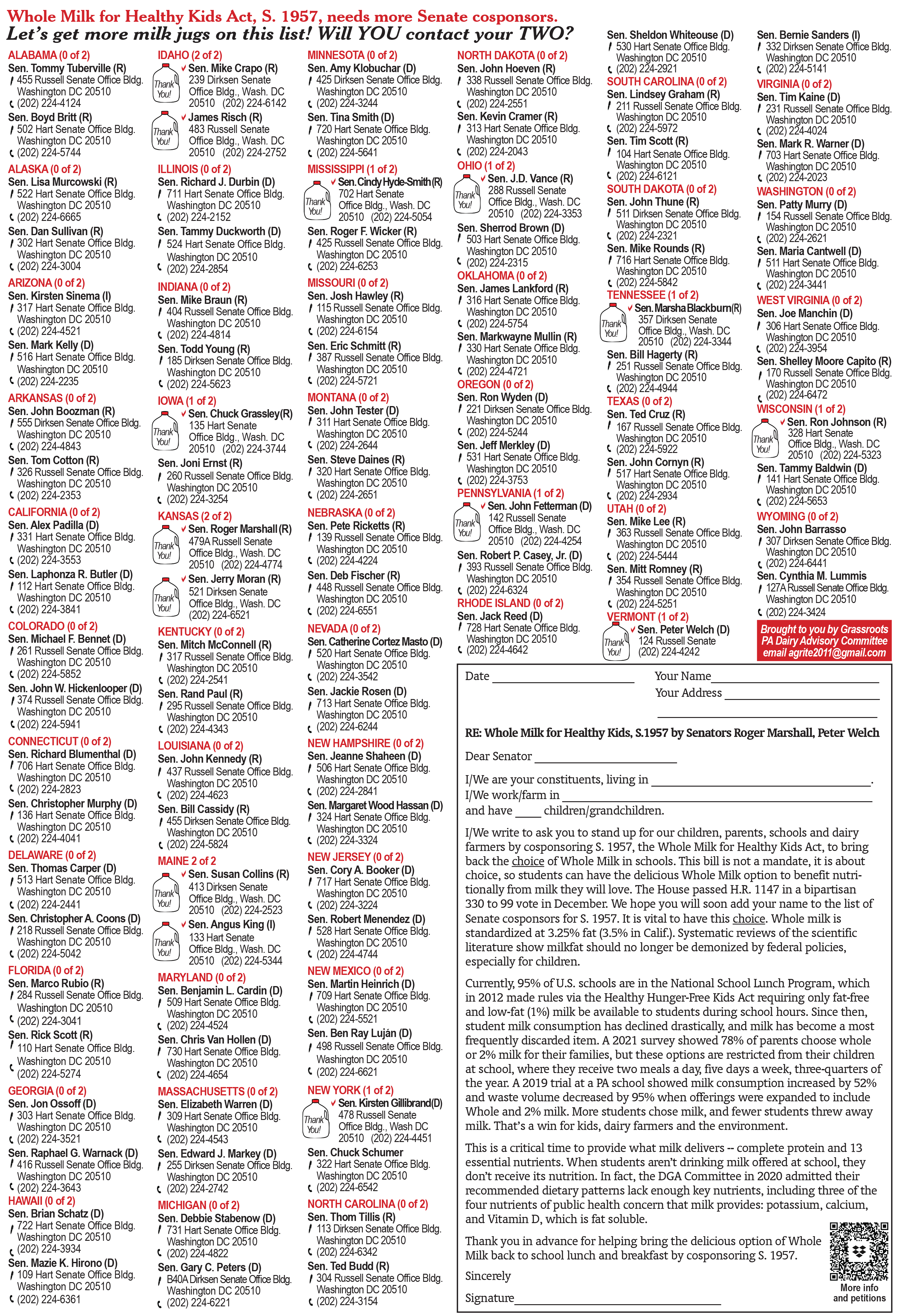
Whole Milk for Healthy Kids Act S. 1957 needs more cosponsors: We need your help! Please contact your state’s two U.S. Senators

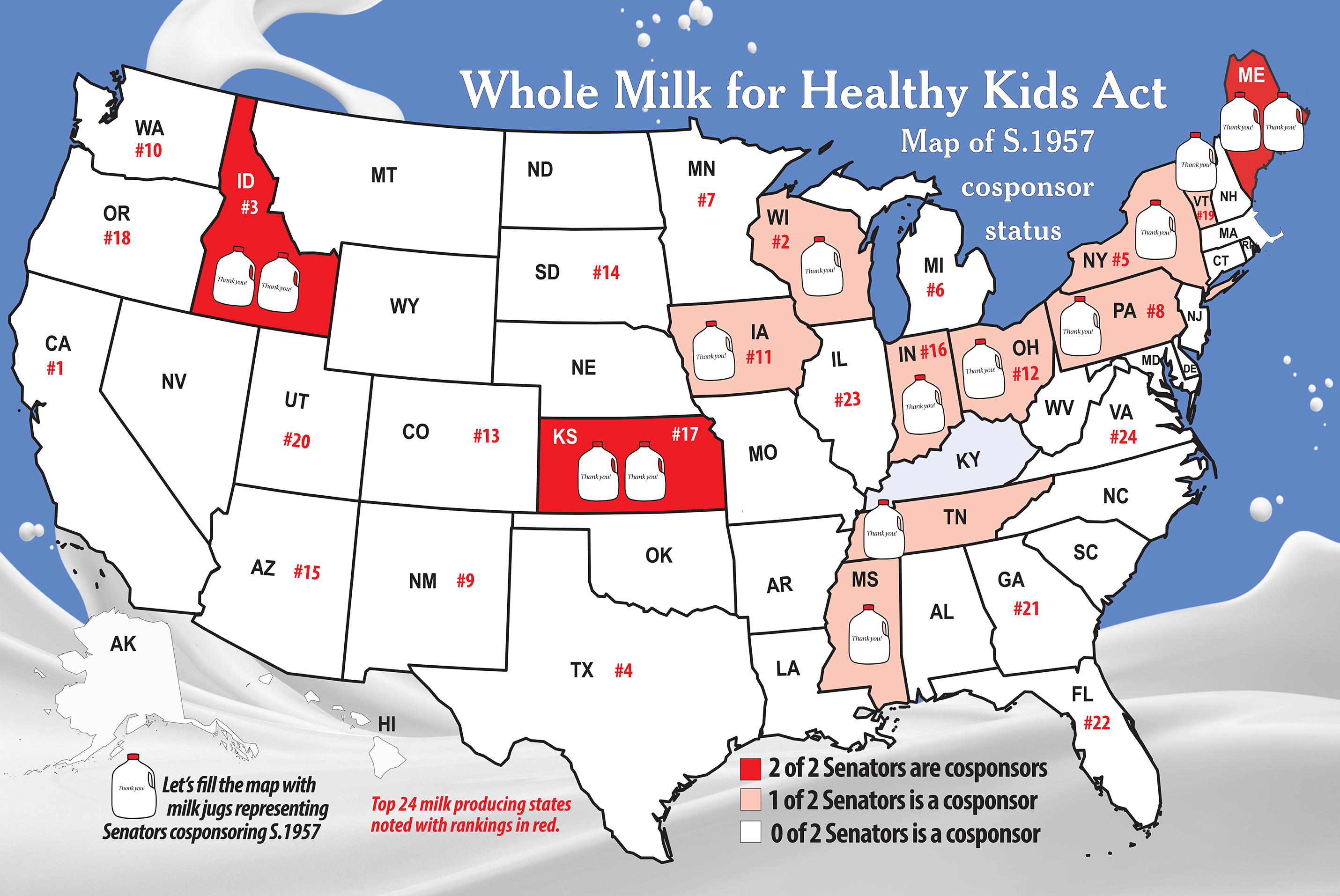
The Whole Milk for Healthy Kids Act has moooved to the Senate. S. 1957 is identical to H.R. 1147. As of Feb. 21, 2024, the Senate bill has 15 sponsors from 12 states. This map shows what states have both Senators or one Senator signed on and which states have none. We need more cosponsors to get this bill out of the Ag Committee and onto the Senate floor for a successful vote. Will YOU call or write TWO? Map by Sherry Bunting

By Sherry Bunting, Farmshine, January 26, 2024 (Cosponsor data updated Feb. 21, 2024)

WASHINGTON — The Whole Milk for Healthy Kids Act is now up to the Senate, where more cosponsors are definitely needed to push it past some barriers and get it to the floor for a successful vote.

Senate bill S. 1957 is not a mandate for whole milk. This bill ends a mandate against whole milk, which is federally banned from schools (2% reduced fat milk is also prohibited. Only fat-free and 1% low-fat milk are allowed to be offered with meals or a la carte or in vending machines).  

In December, Senator Debbie Stabenow (D-Mich.) blocked the unanimous consent motion by Senator Roger Marshall (R-Kan.). Marshall was seeking an immediate Senate vote on H.R. 1147 – Congressman G.T. Thompson’s bill – on Dec. 14, 2023, just one day after it was overwhelmingly passed in the House of Representatives by a bipartisan 330-99 vote. It was previously passed in the House Education Committee in a bipartisan 26 to 13 vote.

Marshall chugged a glass of whole milk and gave an inspiring speech about getting the bill to the President’s desk for Christmas. Sen. Marshall is a medical doctor, an obstetrician, and a member of the Senate Ag Committee.

“This is a slam-dunk for American families,” he said.

Sen. Stabenow played the role of the Grinch stealing the opportunity for immediate whole milk passage in the Senate on the heels of the overwhelming House vote as she objected to the unanimous consent request on Dec. 14.

But that’s not the end of this story, just the beginning.

An identical Senate bill, S. 1957, The Whole Milk for Healthy Kids Act was introduced in June 2023. It was read twice on the Senate floor and referred to the Senate Agriculture Committee, chaired by — you guessed it — Sen. Stabenow of Michigan. This means she is in a ‘gate-keeper’ position for this bill. If it doesn’t come before her committee, it will have trouble getting to the floor.

This is where we can help by raising the number of Senate cosponsors! There are 15 sponsors as of Feb. 21 (updated). We need to get to one-third or one-half of the Senate. That’s 35 to 50.

While news reports indicate Sen. Stabenow will retire after this term and is not seeking re-election, her legacy in caring about childhood nutrition and agriculture may be important to her. She stated on the Senate floor that these decisions about milk in school should be made by the scientific committees. She wants to “keep having these conversations.”

Let’s take her up on that by having conversations with our Senators to cosponsor S. 1957. The Dietary Guidelines Advisory Committee has for three cycles and over 15 years refused to consider the preponderance of sound evidence about the benefits of milkfat that the USDA keeps screening out of their deliberations process. 

The DGA Committee is meeting right now for 2025-30 DGAs that seek to refine the current dietary patterns, not re-evaluate them. Even the DGA Committee in 2020 admitted their recommended dietary patterns are deficient in key nutrients that milk delivers.

Here’s the bottom line: S. 1957 was introduced in June 2023 by Sen. Marshall (R-Kan.), along with Senators Peter Welch (D-Vt.), Kirsten Gillibrand (D-N.Y.), Ron Johnson (R-Wis.), John Fetterman (D-Pa.), Chuck Grassley (R-Iowa), Cindy Hyde-Smith (R-Miss.), James Risch and Mike Crapo (both R-Idaho), Susan Collins (R-Maine), and Angus King (I-Maine).

Four more cosponsors have been gained, they are Senators J.D. Vance (R-Ohio), Jerry Moran (R-Kan.), Marsha Blackburn (R-Tenn.), and Mike Braun (R-Ind.)

As of January 24, 2024, S. 1957 has 14 sponsors from 11 states in the U.S. Senate. Of these 15, seven are on the Senate Ag Committee (Marshall, Hyde-Smith, Gillibrand, Fetterman, Welch, Grassley, Braun). 

We need the rest of the Ag Committee, including Ranking Member John Boozman (R-Ark.). If you live in Arkansas, contact him. If you live in Minnesota, contact Ag Committee Senators Amy Klobuchar and Tina Smith; in Illinois, Sen. Richard Durbin; in Ohio, Sen. Sherrod Brown; in Kentucky, Sen. Mitch McConnell; in Iowa, Chuck Grassley has already signed on, but Joni Ernst has not; in North Dakota, talk with Sen. John Hoeven; in South Dakota, Sen. John Thune; in Nebraska, Sen. Deb Fischer; in Georgia, Sen. Raphael Warnack; in New Mexico, Sen. Ben Ray Lujan; in Alabama, Sen. Tommy Tuberville; in Colorado, Sen. Michael Bennet; and in New Jersey, Sen. Cory Booker.

No matter where you live, contact your state’s two U.S. Senators. We need as many Senate cosponsors as possible, and we need Senators motivated to speak with Chairwoman Stabenow, to ask her to please stop putting the ego and agenda of Washington bureaucrats above the health and welfare of America’s children and the economic stability of America’s dairy farmers.

This bill is about choice. It is not a mandate. It simply allows schools to offer whole and 2% flavored and unflavored milk at school lunch and breakfast without financial penalties for exceeding outdated milkfat limits that are unnecessary or even harmful to children.

If we want children to benefit from the nutrition milk delivers, then we need to deliver the permission for our children to be able to choose milk they will love at school where they have two meals a day, five days a week, three-quarters of the year. That’s how they actually benefit from the complete protein and 13 essential nutrients milk delivers.

Let’s stay positive. We can’t afford to lose ANOTHER generation of milk drinkers and think we will still have a dairy industry in many parts of the U.S. The Whole Milk for Healthy Kids Act is an opportunity for dairy farmers to revitalize and renew fluid milk demand, but more importantly, it’s an opportunity for schoolchildren to choose milk they will love for life and health. It’s also an opportunity to drastically cut the amount of wasted milk in school cafeterias, a win for stewardship of resources and the environment.

A 2021 survey by IDFA showed that 78% of American parents who described themselves as voters, choose 2% or Whole Milk for their families as the most delicious and nutritious option, but their children can choose neither 2% nor Whole milk at school where they have two meals a day, five days a week, three-quarters of the year.

This survey is consistent with what a Pennsylvania school trial in 2019 showed. The students preferred Whole Milk 3 to 1 over the 1% low-fat milk. When 2% and Whole Milk were offered in the coolers, students consumed 52% more total milk and the average daily volume of discarded milk was reduced by 95%. This means more students took the offered milk instead of refusing it, and fewer students threw away the milk they took with their meals.

The Grassroots Pennsylvania Dairy Advisory Committee, under chairman Bernie Morrissey’s leadership, has launched a letter-writing and phone-calling campaign seeking cosponsors for S. 1957. They have put together the tools, but grassroots farmers and citizens must be the ones to carry it out and send the letters and make the calls.

We need to help Senate Ag Committee Chairwoman Debbie Stabenow understand this issue is about lifting the federal school lunch and breakfast ban that was placed on delicious nutritious whole milk in 2012 so that school districts, parents and students can make healthy milk choices that are enjoyed and not discarded.

This bill is not a mandate for whole milk. This bill ends a mandate against whole milk.  

This is about options, choice, and a future for kids and dairy farms. Will YOU call or write your TWO?

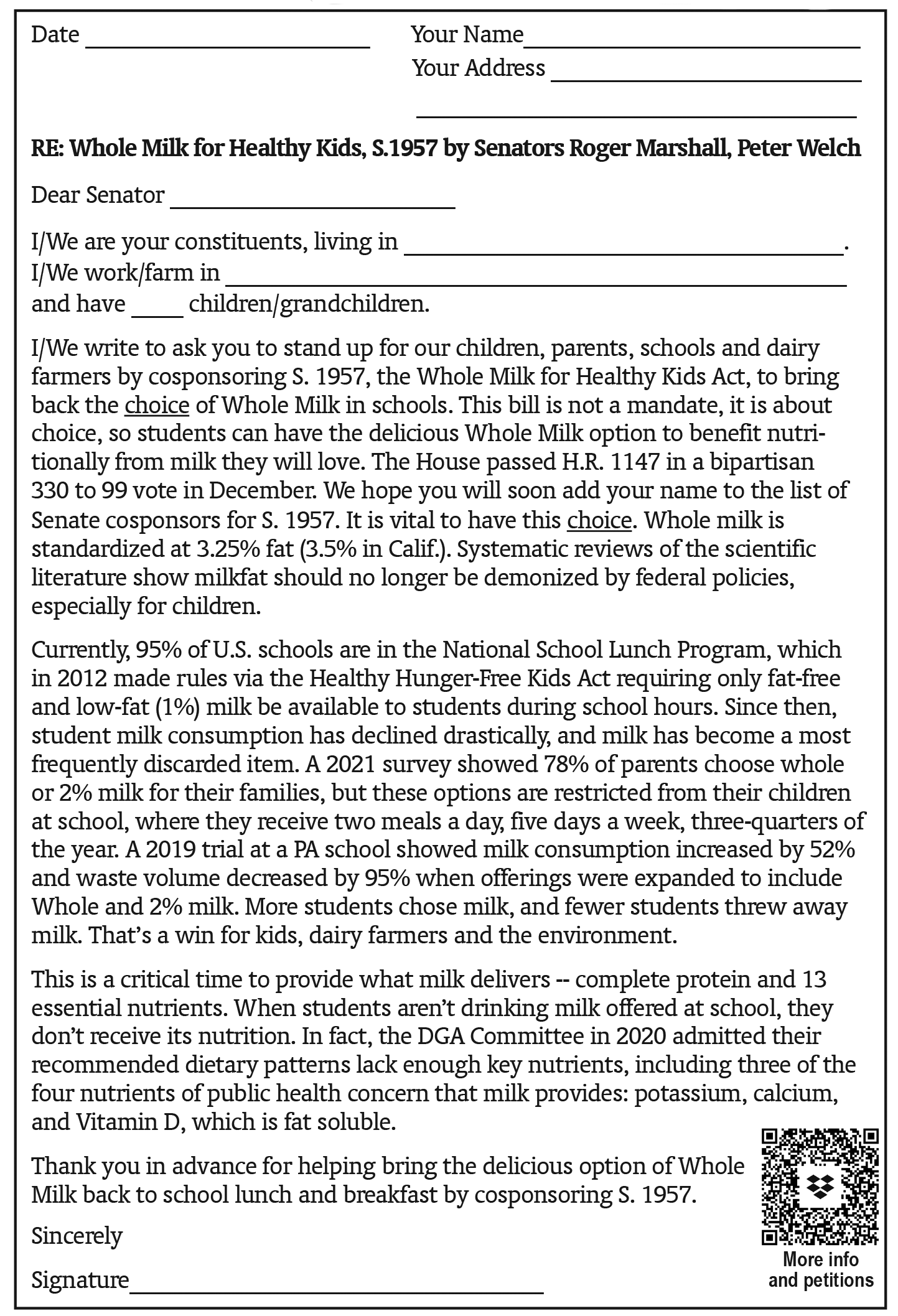
Let’s keep this bill moooving. Every state has two U.S. Senators. Click here for a sample letter.

Find the Washington addresses and phone numbers for your state’s Senators at https://www.senate.gov/ – Click the icon in the top left corner, select your state from drop-down menu to see how to contact them. Or look for your state in this printable directory.

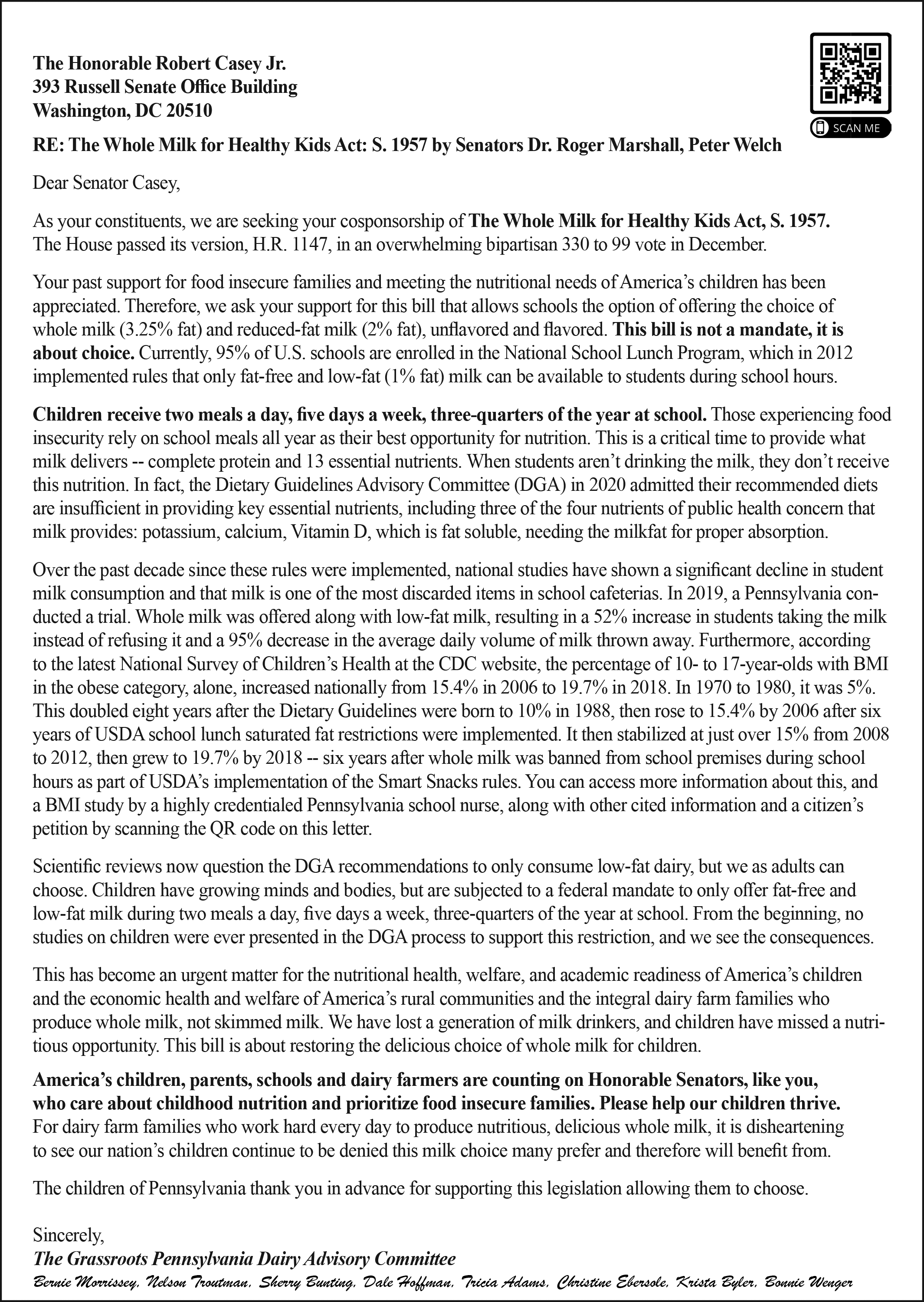
For a more detailed letter, like the one sent by the Grassroots PA Dairy Advisory Committee to Senator Robert Casey, Jr. of Pennsylvania, click here.

For a simple phone message guide for contacting Senate Ag Committee Chairwoman Debbie Stabenow, Majority Leader Chuck Schumer and Minority Leader Mitch McConnell (and if in PA Senator Robert Casey) click here.

See the complete Action Packet and find some additional resources in a folder here

To email your Senators: Go to https://democracy.io/ – type in your address, city and zip code, click submit. Your two Senators and one Rep. will show up with red check marks. Click ‘Write to them.’ Then, on the next screen, write the body of your letter. If you want, you can start with who you are, where you live, what you do. You can also mention if you have school-aged children or grandchildren. Then copy and paste from the text below or write your own message simply asking your Senators to cosponsor S. 1957 The Whole Milk for Healthy Kids Act

**************

RE: Whole Milk for Healthy Kids, S.1957 by Senators Roger Marshall and Peter Welch

I write to ask you to cosponsor S. 1957, the Whole Milk for Healthy Kids Act, to bring back the choice of Whole Milk in schools. This bill is not a mandate, it is about choice, so students can have the delicious Whole Milk option to benefit nutritionally from milk they will love. The House passed this in a 330 to 99 vote in December. We hope you will soon add your name to the list of cosponsors for the Senate. Whole milk is standardized at 3.25% fat (3.5% in Calif.). Systematic reviews of the scientific literature show milkfat should no longer be demonized by federal policies, especially for children.

Currently, 95% of U.S. schools are in the National School Lunch Program, which in 2012 made rules requiring only fat-free and low-fat (1%) milk be available to students during school hours. Since then, student milk consumption has declined drastically, and milk has become a most frequently discarded item. A 2021 survey showed 78% of parents choose whole or 2% milk for their families, but these options are restricted at school, where kids receive two meals a day, five days a week, three-quarters of the year. A 2019 school trial showed milk consumption increased by 52%, and waste volume decreased by 95%, when offerings were expanded to include Whole and 2% milk. More students chose milk, and fewer students threw away milk. That is a win for kids, dairy farmers and the environment.

This is a critical time to provide what milk delivers — complete protein and 13 essential nutrients. When students aren’t drinking the milk offered at school, they don’t receive its nutrition. In fact, the Dietary Guidelines Committee in 2020 admitted their recommended dietary patterns lack enough key nutrients, including three of the four nutrients of public health concern that milk provides: potassium, calcium, and Vitamin D, which is fat soluble.

Thank you in advance for helping bring the nutritious, delicious option of Whole Milk back to school lunch and breakfast by cosponsoring S. 1957.

**************

-30-