Is there a middle ground for the greater good? Ultrasound operators still jailed, State provides some answers; Legal team responds

By Sherry Bunting, special for Farmshine, April 26, 2024 edition

HARRISBURG, Pa. — It has been two weeks since Rusty Herr, 43, of Christiana and Ethan Wentworth, 33, of Airville were arrested on April 10 and 11 and separately incarcerated in Lancaster and York County Prisons — their respective counties of residence.

As of April 24, both men are still in jail, without bail, and without seeing a judge.

“This is an unprecedented case of lawless persecution against two farmers who help other farmers with standard breeding practices, as is their right,” said Robert Barnes, Esq. of Barnes Law LLP, who accepted the case on April 17.

“The Pennsylvania Veterinary trade organizations conspired to protect their own monopoly in violation of the law and in a manner that has hurt farmers throughout Pennsylvania. The Pennsylvania Department of State (DOS), in a secret star chamber proceeding, ordered the unlawful imprisonment of Rusty Herr and Ethan Wentworth, who have still never seen an arrest warrant, heard the charges against them, had a hearing, or seen a judge,” Barnes continued in a statement provided to Farmshine Wed., April 24.

“In short, their due process rights have been obliterated. I will seek justice for Wentworth, Herr, and their families to the fullest extent of the law,” Barnes asserted.

The only dockets available for prior orders last week were two found on the website of the Pennsylvania Veterinary Medical Association (PVMA) as part of a package on their “advocacy” page asking members to file complaints with DOS by referencing the provided docket numbers, and then report back to PVMA so they can keep track. One was a 2010 docket with Herr as respondent and the other 2018 naming Wentworth. Both orders stated civil penalty, not criminal.

All other court and DOS system searches yielded nothing, and even those docket numbers came up “nonexistent.” 

In a PVMA press release dated April 19, the veterinary trade organization stated: “PVMA is unaware of the circumstances surrounding the arrest of two individuals on April 10 and 11 for contempt of court.”

And yet, in their 2020 Complaint that they had posted at their website before it was removed this week, the PVMA specifically stated: “Since these individuals continue to practice veterinary medicine without a license after their initial order to cease and desist, we request that the state file contempt charges with the Commonwealth Court. PVMA is able to supply additional witnesses upon request.”

Farmers, veterinarians and others in the dairy industry are discussing the case. Calls, texts and emails pour in from dairy farmers who appreciate NoBull Solutions and rely on them for breeding service.

Calls, texts and emails have also come in to make further accusations against the imprisoned men — none of which are mentioned in the PVMA complaint or their links to two previous civil orders, nor in any documentation provided now by the DOS.

After initiating a request for an interview on April 15 and submitting questions to the State Board of Veterinary Medicine on April 16, Farmshine received a few answers on April 24 from the Department of State (DOS).

On the current situation, the DOS responds: “We can neither confirm nor deny the existence of an investigation or matter.”

On the question of what hearing process may or may not have been available to Herr and Wentworth regarding past civil penalties and cease and desist orders, dockets were provided, one with Herr as the respondent in 2010, and one with Wentworth and another individual who has not been arrested named together as respondents in 2018.

“Speaking generally, the Department reviews every potential license violation of which it becomes aware, whether that is through a complaint filed directly to the Department, a notification from local law enforcement or through media reports. After review, a determination is made as to whether formal action is warranted,” the DOS press office explained in their email response. 

The long and short of the DOS response here is that all respondents have due process at some point, which includes notice and an opportunity to participate in those original proceedings, call witnesses, introduce evidence, and testify on their own behalf.

Herr and Wentworth did so, on their own behalf, without legal counsel, in 2010 and 2018, respectively, according to the documents provided by the DOS.

However, they were not noticed since then by the DOS, and nowhere in the responses from DOS or the adjudications they provided is an automatic 30-day prison term without bail stated as a consequence for “continuing to violate the Act” by ultrasounding cows they do not own. No proof of the process has been shown in the responses from the DOS apart from the 2010 and 2018 actions.

On the question about where pregnancy and diagnosis are linked in the law or regulations, the bottomline is they are not. The State Board of Veterinary Medicine decides this through adjudication and orders as the legislature grants the Board this authority.

“The Board adopted the position that, ‘both the performance of a surgical procedure, such as the Gymer/Stemer Toggle Suture Repair, and the diagnosis of a physical condition, such as detecting through ultrasound whether an animal is pregnant, constitute practice of veterinary medicine,’” the DOS reported, adding that the Act contains an exception for any person or an employee of that person or agent while practicing veterinary medicine on his or her own animals. (What constitutes an ‘agent’?)

The DOS included a copy of an Amended Adjudication and Order, Docket No. 2296-57-09, which came before the State Vet Board with Herr as respondent in May of 2010. Performance of toggle on six animals he didn’t own and performing ultrasound for detection of pregnancy on animals he didn’t own were both listed specifically in the determination of civil penalty.

This was 14 years ago, and the docket from 2010 confirms that Herr responded to say he is “no longer toggling other people’s cows.”

The amended adjudication goes on to explain “should the respondent continue to violate the Act, he may be subject to the imposition of a $10,000 civil penalty per act or practice.” 

Nowhere does it mention automatic 30 days in prison for continuing to detect pregnancy through ultrasound.

For Wentworth, the docket history supplied by the DOS began Sept. of 2017 while he and another named individual, who has not been arrested, were previously employed by Select Sires. Docket No. 1928-57-17, simply states “Respondents engaged in the practice of veterinary medicine without being properly licensed to do so under the Act” and describes this as “performed pregnancy examinations on cattle using ultrasound equipment.”

Both responded, and this led to a formal hearing, eventually in April of 2018, when the state’s expert witness, a University of Pennsylvania professor, could be available. 

Both respondents appeared without representation. They testified on their own behalf and were cross-examined. In May 2018, the matter was closed and determinations were made that both men used ultrasound equipment to “determine pregnancy of customers’ cows” and to “determine if cows were in heat or had other medical issues.”

Noted in the history is this statement that begs more questions: “The economic savings to the cow’s owner, based on a positive pregnancy or negative heat result, are outweighed by the risk of harm to the cow posed by the unlicensed practice (of ultrasound).”

That brings us to April 2024, which the DOS will not comment on.

What we are left with on that is a downloaded copy of the PVMA complaint requesting contempt charges via the Commonwealth Court. Attached to the complaint were pictures from the arrested men’s facebook pages showing ultrasound pregnancy detection.

Bottomline, according to the DOS response: “The State Board of Veterinary Medicine is responsible for enforcing the Veterinary Medicine Act as enacted by the General Assembly. Questions about the provisions of the Act (including the exception in 63 Stat 485.32) should be directed to the legislature.”

This response makes the timing and manner of the arrests more curious, coming six months after the Pennsylvania House Ag Committee opened discussion to look at ways to address the statewide shortage of large animal veterinary practitioners, including the Veterinary Practice Act to see if modifications are needed for a “middle tier” to help Pennsylvania farmers cope.

For veterinary practices, the economics are increasingly difficult in attracting and keeping practitioners and vet technicians in the large animal domain. Their financial and time investments are significant, often graduating $250,000 in debt, and the trend is for more to go into small animal practice with pets to realize a return.

“No large animal practitioner is doing this — for the money,” said one central Pennsylvania vet.

Farmers identify with that. They have significant investments, see their costs rising, and in much of the state, see fewer large animal vets and prohibitive costs for basic services from consolidating companies on small farms vs. large ones, so they look for options, including doing more themselves.

“We have good vets, and I have done some ultrasounding with Rusty, but my vet comes in for herd health, and I keep a good relationship with my vet,” said a dairy farmer from Kirkwood in a Farmshine call April 24.

“Rusty is not trying to take work from vets. He is just trying to help the farmers and provide service for them. He has supported me 100% to help me make breeding decisions in my herd. He will even suggest a mating to a bull outside of his genetic lineup. Instead of just trying to get more business for himself, he highly encouraged and helped teach me how to inseminate my own cows. He’s a mentor and true hero. If anything, he’ll come out of this stronger,” the Kirkwood dairyman continued.

There must be middle ground here. Clarity, transparency and solutions are needed.

“As farmers, we put our bodies and souls into this. As everything consolidates in this industry, how do we compete? This is what extinction looks like,” said Ben Masemore, an eastern Pennsylvania dairy farmer and friend of Herr and Wentworth, who is involved in NoBull Sires, a separate business from NoBull Solutions.

He shared a partial statement written by Herr from his prison cell.

“To this day, we have never once had a farmer or caretaker complain to the state about any single issue. I know that we have a tremendous amount of support behind us, and I realize this will all get resolved. I will be a better husband, father, and person because of this entire experience, and for that I am grateful,” wrote Herr.

He expressed his hope that fair-minded people “can come together… to create a level playing field, one in which we can all work together for the greater good of the industry… I hope and pray that good can come out of this and that someday we can all look back on this time as a steppingstone for meaningful and lasting change.”

Thanking the NoBull team and supporters, and grieving what the families are enduring, Herr wrote: “Thank you all so very much for your coveted prayers and support. Thank you for your financial generosity. Keep the faith and be strong, God is always good. This will all be over soon.”

NoBull Defense Funds have been set up at two local banks to help with legal defense to get them home. Separately, an online fund has raised over $17,000 so far at https://www.givesendgo.com/nobull?utm_source=sharelink&utm_medium=copy_link&utm_campaign=nobull

-30-

‘Pregnancy is not a disease’: Two men jailed without bail for contempt in repro ultrasounding of dairy cows

Pictured are (l-r) Ben Masemore, Ethan Wentworth and Rusty Herr at their NoBull Sires booth during the World Dairy Expo. Today, Masemore is fielding calls from dairy farmers across Pennsylvania and the nation as Herr and Wentworth have been jailed for ultrasounding cows they do not own and making diagnoses without a veterinary license as part of their NoBull Solutions LLC breeding services. They have not seen a judge, had no due process, were denied bail, and were arrested by local law enforcement in the respective counties in which they live for contempt of court after ignoring a 2010 and 2018 cease and desist order from the State Board of Veterinary Medicine having not been able to present a defense. Barnes Law LLP has accepted the case, and Robert Barnes says the arrest warrants did not come from a court — a bureaucratic veterinary board is not a court. Funds have been set up to accept donations for their legal defense to get them home to their families, their animals, and the dairy farmers they serve. Photo provided

By Sherry Bunting, a developing story special for Farmshine in mailboxes and online at Farmshine.net, April 19, 2024 edition

CHRISTIANA, Pa. — In a move that has shocked members of the local and distant dairy farming community this week, word spread of the Pennsylvania State Veterinary Board’s action through the Department of State, Professional Compliance Office, executing a “contempt of court” order through local law enforcement when none of these agencies are actual courts.

Rusty Herr of Christiana and Ethan Wentworth of Airville have been in prison since their arrest last week, without seeing a judge, without due process, and being denied bail… for what? 

For ultrasounding dairy cows and horses – without a veterinary license — as part of their NoBull Solutions breeding service. (Imprisoned ultimately on contempt of court).

They are two of the three men that were named in the State Vet Board’s cease-and-desist orders as recently as 2018 and 2020.

With this enforcement, the state is essentially considering pregnancy a disease even though federal courts have found, in humans, pregnancy is a condition, not a disease, and even though the Veterinary Medicine Practice Act in Pennsylvania does not mention pregnancy, but latitude is given to the State Board. No definition of diagnosis nor mention of pregnancy or ultrasound appears in the Board Regulations.

According to the nationally-known Barnes Law LLP, serving as the NoBull legal defense team hired April 17, one week after their arrests, “Pregnancy is not a disease. Pregnancy is not an illness. Likewise, confirming pregnancy or successful reproduction is not a diagnosis. Medicinal definitions are clear: Identification of disease is termed diagnosis, the solution design is called treatment planning, and treatment where appropriate is then implemented as the solution.”

In addition, there are dozens of known technicians using ultrasound with livestock in conjunction with reproductive services in the state of Pennsylvania. Yet for this, Herr and Wentworth are being kept away from their families, already imprisoned for one week, and have been told they will be in jail for 30 days.

Furthermore, the circumstances of their arrests are troubling.

Wentworth was told to go to the Courthouse (in York) on the morning of April 10 to pay a fine. He was told he would see a judge. Instead, he was arrested, and seven days later has still not seen a judge, according to friend and associate Ben Masemore, a dairy farmer associated with a sister business NoBull Sires LLC.

Herr was arrested the very next morning, April 11, at 6:30 a.m. at his home in Christiana. He was handcuffed and taken away in front of his wife and children, says Masemore in a Farmshine phone interview.

The new lead attorney for the Herr/Wentworth and NoBull Solutions defense, Robert Barnes, Esquire, even makes the case that the arrest warrants were not “facially valid” because they did not come from a court.

“There is no actual court on it. It is not a court document. Some bureaucratic official sent it to a prothonotary (court clerk), and now these people are sitting in prison because high ranking state bureaucrats have conspired with incompetent local sheriffs to illegally and unlawfully imprison them,” says Barnes.

This amounts to “some rogue officer and agency in Pennsylvania deciding ‘we want to arrest and imprison people whenever we want, with no limitations.’ The statute doesn’t authorize it. The Constitution of Pennsylvania doesn’t authorize it. In fact, it violates both the State and Federal Constitutions,” Barnes explains in his April 17 Viva Locals podcast about the case.

He adds that they must think “These are just some ordinary folks helping the Amish and (that they) can get away with it. Maybe they thought they were Amish, and they’d never sue.”

Barnes further notes that, “Somebody at the (state vet board) got the idea to create something that calls itself ‘arrest warrant,’ make it look like it came from a local court, create a docket number at the top, refer to (their) board’s activities as ‘The Court,’ call it ‘contempt,’ and have these people ordered arrested interminably in prison.”

Robert Barnes, Esq. of Barnes Law LLP has taken the NoBull Solutions Defense case, vowing to get justice for Ethan and Rusty and their families. He talked about it on his Viva Locals podcast April 17, saying “a whole bunch of folks are about to get sued” and citing unlawful detainment and civil rights precedents, among others. Screen capture by Sherry Bunting

In fact, visiting the Pennsylvania Veterinary Medical Association (PaVMA) website under “advocacy,” Farmshine has learned that the contempt-of-court charge was the suggestion made in the PaVMA’s recent complaint it filed on Herr and Wentworth for ignoring previous fines and cease-and-desist orders from the State Veterinary Board.

Farmshine has learned that these fines were ignored on advice of their former attorney, so as not to admit guilt. After all, why should Herr and Wentworth admit guilt for actions that have become commonplace and are open to interpretation of the state’s vague and archaic veterinary law in regard to defining ‘diagnosis’ — especially since pregnancy is not a disease to be diagnosed, but rather a condition to be observed?

There is also the issue of targeted enforcement.

The State Vet Board was prompted to act in the first place by PaVMA filing a complaint seeking to specifically target “three individuals” with fines and cease-and-desist orders for “illegal practice of veterinary medicine by unlicensed individuals.”

These original orders specifically named them as individuals employed with NoBull Solutions LLC and its “all encompassing reproductive management for dairy farms.”

The “documentary evidence” in the official PaVMA complaint was in the form of two pages of Facebook posts that “show non-veterinarians using ultrasounds and making diagnoses.”

Again, what are we talking about here? Ultrasounding cows in conjunction with breeding service — something dozens of proficient ultrasound machine users and breeding technicians do with cattle, horses, and other livestock across the state and around the country.

What is the difference between “diagnosis of pregnancy” through ultrasound vs. blood test and milk samples offered by companies in the area?

In today’s times, we have breeding technicians using ultrasound in conjunction with pregnancy and reproductive observation that are the lifeblood of a dairy farm. We have hoof trimmers providing essential services that involve observation and treatment of hoof and foot problems, but the state vet law only specifically exempts equine farriers. We have nutritionists body scoring cows for herd nutritional and health status observation and advice. We have FARM program auditors scoring hocks, scoring lameness, scoring body condition and other potential veterinary diagnoses that are referred to as observation.

But somehow, observing pregnancy and reproductive performance through ultrasound is illegal without a veterinary license? All of these examples – including repro ultrasound — show how it takes a village to run a dairy farm these days. How many times do we go to meetings and hear experts tell farmers to get outside eyes observing the cattle on their farms?

Farmers, themselves, wear many hats. They observe, diagnose, and treat many conditions in their own herds. The law recognizes a farmer’s ability to diagnose and treat their own animals and to allow their hired employees to do it for them.

With this action, the state is basically saying small and mid-sized farms cannot pay for the services of others, not being large enough to hire full-time staff to do it. 

This reporter received phone calls from half a dozen farmers, many of them Amish dairy farmers, while completing this report on April 17. One farmer from eastern Lancaster County said “hundreds of farmers in the county don’t know where they would be without Rusty Herr.”

Another from Oxford explained how much Herr has taught him about his livestock, so much more than a veterinarian would have time to teach. He noted Herr’s  “calm personality and precise work,” and how others, including himself, are “now being impacted by not having him on their farms” while he is in jail.

Another from Quarryville said Herr and Wentworth “are keenly missed. They are great people who did a great job and provided great service. This is affecting my dairy farm. I have appreciated how they walked into my barn and did their utmost to help me out with dairy breeding decisions.” 

Pennsylvania, with a small average herd size of 95 cows, has lost 46% of its dairy farms in the five years between the 2017 and 2022 Census of Agriculture. More dairy exits have occurred in 2023 and so far in 2024. Total herd dispersals have become commonplace as the low margins in dairy are a barrier for many farms to continue into the next generation.

How can farm families survive amid rapid consolidation of this industry, if there is not a level playing field? The very largest mega dairy operations in this country can hire full-time staff veterinarians, nutritionists, and technicians as employees and receive the blessing of the law, while small to mid-sized farms stand to lose the service of good people hired independently?

As for the PaVMA complaint that started all of this by citing state veterinary law, that law makes no mention of ultrasound or pregnancy.

It’s important to note that the PaVMA stepped up its drive to get targeted action from the state. According to a February 21 post at the PaVMA website, the organization listed the ultrasound concern as an advocacy position under the heading “Illegal Practice of Veterinary Medicine.”

In the post (see screenshot below), PaVMA states that it “has received many reports of bovine technicians engaging in the practice of veterinary medicine without a license, specifically performing ultrasounds and issuing diagnoses. In the past, the state of Pennsylvania fined three individuals and ordered them to cease and desist their activities. We have received reports that some of these individuals have not stopped and flagrantly promote their use of ultrasounds on Facebook. We have filed a complaint with the Department of State, Professional Compliance Office.”

The organization called its members to action, providing downloadable blank forms and instructions as follows: “We encourage all PVMA Members who have knowledge of these activities to also file complaints. A complaint form and copies of the cease-and-desist orders are available for download. Please reference the docket and case numbers in your complaint. The docket and case number are located on each cease-and-desist order. After filing a complaint, please email us at Membership@PaVMA.org and let us know so we can keep track of our members who have joined us in making the state aware of this problem.”

Screen capture by Sherry Bunting

Parallels can be drawn to other points in the long and legendary history of dairy cattle reproductive progress, whereby the establishment have used interpretations of archaic and vague laws to target progressive individuals, who were helping dairy farmers improve their herds.

One such case was in Canada in the 1980s, as chronicled by Holstein International. The article entitled “Allowing great sires to go everywhere” in the March 2021 edition makes this point:

“Unfortunately, disruption in any established industry does not come without controversy, and in 1987 a charge was made against Transfer Genetics (and its owner) by the Ontario Government for the illegal delivery of semen. The law from the 1950s required semen to be delivered by a licensed Ontario A.I. centre. A fine for this ‘violation’ was suggested, but a guilty plea would delegitimize Transfer Genetics forever. In July 1987 Transfer Genetics was charged – resulting in the closure of Transfer Genetics’ semen distribution.”

After setting up opportunities for farmers to learn to breed their own cows and enduring more than a year fighting this battle, the case was won for farmers, and the achievements for modern-day genetics are well-documented.

Instead of giving in to the intimidation, this entrepreneur, with the help of others in the dairy community, persevered, and the results of those early matings of well-bred Canadian cow families to top U.S. sires of the 1980s have produced legendary lines looked to today.

If that entrepreneur, who went on to be recognized as 2022 World Dairy Expo International Person of the Year, had simply paid his fine in 1987, stopped ruffling feathers, and gone back to the sidelines, who knows what the impact would have been?

Where the similarities are to this Pennsylvania case is that he also chose not to pay fines levied on him and his company by the government as this would “delegitimize (his business) forever.” The rest, as they say, is history.

In the case of Herr and Wentworth using ultrasound, their friend Masemore notes: “There is no guilt because this is an antiquated, vague law. The reality is that times change. Anyone, anywhere, today can buy an ultrasound machine and become extremely proficient in it. This is very commonplace. There are at least 15 to 20 individuals in this state using ultrasound without a vet license. I have dozens of friends, nationwide, that I know personally, who have ultrasound machines. It is a common thing on farms.

“Rusty has a winsome personality and is a man of humility, who is a servant, a hero to farmers as long as I’ve known him,” Masemore observes, adding that dairy farmers in Pennsylvania and around the country have flooded his phone over the past seven days for information on Herr and Wentworth, while their wives worked to retain another attorney. “The phone calls I have received from distraught farmers are overwhelming.”

These calls, he says, show appreciation for the breeding services of these two now-incarcerated men, who are being kept from their families, their animals, and their livelihoods.

Members of the close-knit dairy community in Southeast and Southcentral Pennsylvania — and across the state and nation, in fact — are expressing concern, and a desire to help.

Farmshine’s calls and emails to the offices of the York and Lancaster County District Attorneys have not yet been returned. Messages left for the State Veterinary Board and PaVMA have also not yet been returned.

NoBull Defense Funds have been set up at two local banks with checks payable to the wives of the two men, as noted below, for donations to assist with their legal defense to get them home to their families, their animals, and the dairy farmers they serve. 

Cash donations are discouraged, and all monies unused for bail and/or legal fees will be returned to donors on a percentage basis. Please note in the memo line of the check ‘NoBull Defense Fund.’

The first is at Univest Bank. Checks should be made payable to Heather Herr and mailed to Univest, 1135 Georgetown Rd., Suite 200, Christiana, PA 17509. 

The second is at People’s Bank. Checks should be made payable to Gabrielle Wentworth and mailed to People’s Bank, Brogue Financial Center, 2510 Delta Rd., Brogue, PA 17309.

An online NoBull Solutions Defense Fund has also been established to free Herr and Wentworth from prison at https://www.givesendgo.com/nobull?utm_source=sharelink&utm_medium=copy_link&utm_campaign=nobull

-30-

Pa. orders dairy cattle movement restrictions, testing to protect against HPAI spread; detections now in 8 states

By Sherry Bunting, Farmshine, April 12, 2024

HARRISBURG, Pa. – Add North Carolina to the list of states with confirmed detections of bird flu in dairy cattle. 

While the USDA APHIS website had not yet updated its daily listing at 4 p.m. on April 10, the North Carolina Department of Agriculture and Consumer Services issued a press release at noon stating: “The National Veterinary Services Laboratory has detected Highly Pathogenic Avian Influenza (HPAI) in a dairy herd in North Carolina.”

This would bring the total to 19 dairy herds in 8 states: Texas (9), Kansas (3), New Mexico (2), Michigan (1), Idaho (1), Ohio (1), North Carolina (1), and South Dakota (1). (South Dakota was added to the list after Farmshine went to press)

“This is an evolving situation, and we are waiting for more diagnostics from NVSL and will work collaboratively with our federal partners and dairy farmers in North Carolina,” said Agriculture Commissioner Steve Troxler. “It is important to note the FDA has no concern about the safety or availability of pasteurized milk products nationwide.”

Introduction of HPAI A(H5N1) to dairy cattle has been shown to be by migratory birds, and USDA epidemiological studies show it may also be spreading between cows.

“Both are sources of introduction,” said Pennsylvania’s Assistant State Veterinarian Dr. Erin Luley, answering questions during the second Center for Dairy Excellence (CDE) weekly HPAI update conference call April 10.

USDA, in fact, reported on April 5 during a UN Food and Agriculture Organization (FAO) virtual meeting of scientists that they “have not seen any true indication that cows are actively shedding the virus and exposing it to other animals, or that it is replicating within the body of the cow — other than within the udder.”

This is why lactating dairy cattle are the focus of multiple state orders in recent days regarding restrictions, testing, and quarantine of interstate dairy cattle movement.

“The virus might be transmitted from cow to cow in milk droplets on dairy workers’ clothing or gloves, or in the suction cups attached to the udders for milking,” Dr. Mark Lyons, USDA Director of Ruminant Health, shared during the international meeting, according to a University of Nebraska Medical Center (UNMC) report.

The UNMC report also noted that dairy cattle are frequently transported from the southern parts of the country to the Midwest and north in the Spring. They are floating the possibility — without naming specific herds or locations — that all affected cows may trace back to a single farm. In fact, the confirmed positives in Idaho, Michigan, Ohio and now North Carolina are on premises where cattle had previously been brought in from Texas.

“The virus appears to replicate in mammary tissue, so those cattle that are not lactating do not have a high viral load for transmitting the virus,” noted Dr. Luley in the CDE call.

According to the epidemiologic data released by USDA, she said, the early cases, especially in Texas, New Mexico, and Kansas, show that HPAI was predominantly introduced by wild birds.

“For a few other detections, including in Michigan and Ohio, the main source seems to be the movement of animals from other states,” said Luley.

To prevent spread to dairy cattle in the Keystone State, the Pennsylvania Department of Agriculture issued an Interstate and International Quarantine Order on April 6 for the restriction of movement and pre-movement influenza testing of dairy cattle from states where HPAI has been detected in dairy cattle.

When asked how the Pennsylvania Order compares to what other states are doing, Dr. Luley said “ours is the most stringent. The goal is preventing the spread of this condition into our state — to proactively protect the animals in our state to the best of our ability.”

In short, the Pennsylvania Order applies to dairy cattle, not beef cattle. It restricts all movement of dairy cattle into the state for any reason from farms where HPAI has been detected.

Furthermore, dairy cattle coming into Pennsylvania for sale or show, must do pre-movement testing if they come from a non-affected farm in a state where HPAI has been detected. Those states to-date are Texas, Kansas, New Mexico, Idaho, Michigan, Ohio, and now North Carolina and South Dakota (updated by APHIS April 11).

The USDA APHIS website is updated daily and includes a map showing the states of HPAI detection in dairy herds at https://www.aphis.usda.gov/livestock-poultry-disease/avian/avian-influenza/hpai-detections/livestock

This should be consulted before movement of cattle from other states into Pennsylvania, to be sure the appropriate restrictions and pre-movement testing are applied.

Dairy cull cows from any state with a positive case, even if coming from a non-affected farm, that are destined for Pennsylvania slaughter facilities, are not subject to pre-movement testing if the animals are slaughtered within 72 hours of entry. However, they must go directly to a slaughter plant and cannot be commingled with other cattle at an auction center.

Calves under one year of age are considered low risk and are exempt from pre-movement testing at this time.

Pre-movement testing must be done through a laboratory in the national network, and the results must accompany the shipment. Acceptable test samples for non-lactating dairy cattle, such as bred heifers, are nasal swabs; however, the only acceptable test sample for a lactating animal is a milk sample. Again, this is because the mammary system is where HPAI viral replication is being seen.

“At present, the disease has not been shown to affect beef animals,” said Luley about why the Order is written only for dairy cattle.

She gave examples of how the Order is being implemented:

If a producer wants to import a group of bred heifers from Texas, and they come from a farm that had a confirmed positive, those heifers would not be allowed to come to Pennsylvania. If they come from a non-infected herd in Texas, they would need pre-movement testing with the farm’s veterinarian overseeing the sampling and the analysis done by a national network lab.

If a producer in Ohio wanted to move cull dairy cows directly to a slaughter facility in Pennsylvania, if they are coming from a currently unaffected farm in that state, no testing would be required. But, if they are from an affected farm in that state, those cull cows would not be permitted to come to a Pennsylvania slaughter facility.

If a producer from Virginia, where there have been no detections of HPAI, wanted to ship fresh heifers to Pennsylvania, there would be no requirement to test because no infection has been detected to-date in that state, so there is no movement restriction and no pre-movement testing requirement.

There are no quarantine orders on milk movement at this time; however, this would change if HPAI were detected anywhere in Pennsylvania. If that occurs, the state would enact its “Temporary Order Designating Dangerous Transmissible Diseases” provision, now amended to include “Influenza A Viruses in Ruminants.”

In such a scenario, a quarantine would be set up for an affected farm to work with animal health officials and their veterinarian to show appropriate biosecurity measures to qualify for a 30-day milk movement permit. With that permit, their milk could go only to a processing plant.

“The viral sequencing matches the circulating strains in the (migratory bird) flyways,” said Luley. “We can impose a quarantine, but we can’t apply it to migratory waterfowl, so that risk remains, and it is the reason why biosecurity is our best tool.”

USDA Wildlife Service biologists Tom Roland and Kyle Van Why said their winter surveillance of migratory waterfowl and raptors in the Susquehanna watershed, for example, shows the virus is here in these populations, but at lower numbers than last year.

Even though starlings and pigeons are not good transmitters of the disease, they do carry it, and the numbers of these birds are high, so they bear watching.

Roland said that with restrictions on how to handle migratory birds, including resident Canadian geese and vultures, farmers should contact the national hotline at 1.866.487.3297 to work with the Wildlife Service for case-by-case strategies to manage and mitigate bird use of the farm. They have tools that are not generally accessible.

Dr. Hayley Springer, Penn State extension veterinarian, said opportunities are available to help dairy farms build their own biosecurity plans. In-person open houses are being held across the state at county extension offices, check with yours.

“Everyday biosecurity is the first line of defense, and effective for Influenza A,” said Springer. Biosecurity Kits to assist are available from CDE.

According to Dr. Luley, one dairy farm in Pennsylvania reported signs that met the case definition closely enough to undergo the HPAI testing protocol, which thankfully turned out to be negative.

Dairy farmers seeing signs in their herd should contact their veterinarian. Clinical signs of HPAI in cattle, which the American Association of Bovine Practitioners this week announced it will rename as Bovine Influenza A, include:

1) a sudden drop in feed intake with concurrent decreased rumination and rumen motility;

2) a subsequent marked drop in herd level milk production with more severely affected cows having thickened milk that almost appears like colostrum or may have essentially no milk at all; and

3) changes in manure, especially tacky to dry manure.

Visit https://www.centerfordairyexcellence.org/hpai-industry-call/ for recordings and other valuable information.

Read Farmshine at farmshine.net for continuing coverage and previous articles April 5 and March 29

‘Bird flu’ expands to 13 dairy herds in 6 states

CDC confirms one worker in Texas recovered with mild symptoms; Cow-to-cow transmission ‘cannot be ruled out’, biosecurity paramount

By Sherry Bunting, for Farmshine’s April 5, 2024 edition

WASHINGTON — Detections of highly pathogenic avian influenza in dairy cows — HPAI A(H5N1) — have expanded to 13 herds in 6 states as of Wednesday, April 3: Texas (7), Kansas (2), Michigan (1), New Mexico (1), Idaho (1), and Ohio (1).

Some states, including but not limited to Nebraska, Idaho and Utah have begun issuing import permit requirements for cattle and/or restrictions on non-terminal and/or breeding cattle coming from specific areas. These instructions are available from state authorities, not USDA APHIS.

USDA’s APHIS has a new landing page for daily updates and other resources at https://www.aphis.usda.gov/livestock-poultry-disease/avian/avian-influenza/hpai-detections/livestock 

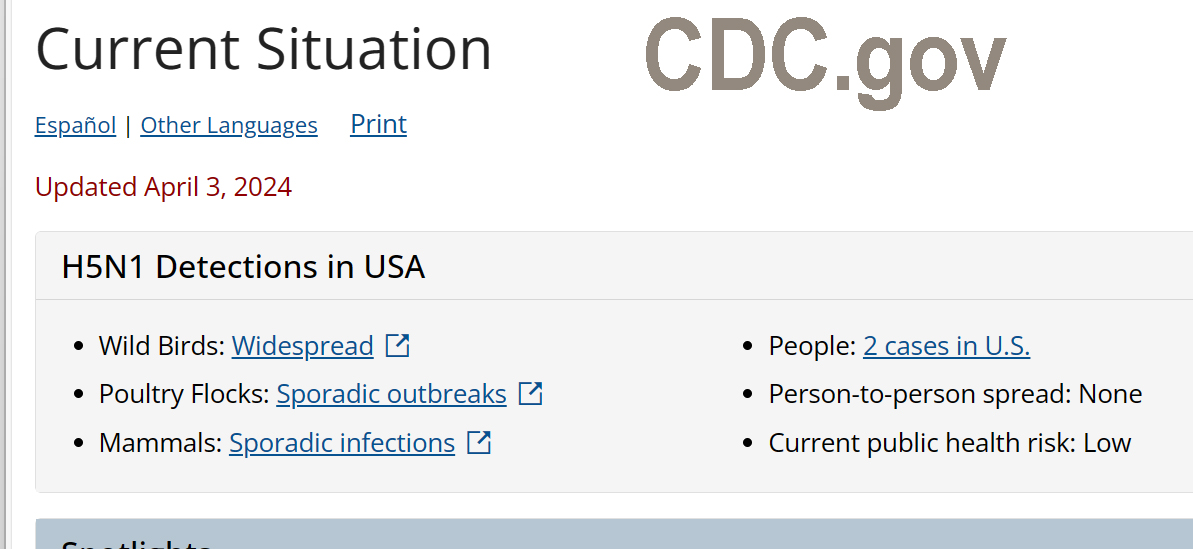
In addition, the CDC reported April 1 that a worker on a Texas Panhandle dairy, where HPAI was detected, has tested positive with mild flu symptoms, mainly conjunctivitis (pinkeye), and has recovered. The only other human case in the U.S. was a poultry farm worker in Colorado in 2022.

CDC ‘current situation’ screen capture April 3, 2024 at 4:30 pm ET

According to the CDC, their “human health risk assessment for the general public remains low. There continues to be no concern that this circumstance poses a risk to consumer health, or that it affects the safety of the commercial milk supply because products are pasteurized before entering the market,” and milk from infected animals is to be discarded.

New detections of the virus have not changed the primary belief that HPAI A(H5N1) is ‘seeded’ by migratory wild birds (emphasis on waterfowl and by association, vultures).

Cow-to-cow transmission questioned

Complicating the question of potential cow-to-cow transmission, it was reported that the two confirmed herds in Idaho and Michigan had recently received cattle from other states where HPAI A(H5N1) was detected.

APHIS officials stated on March 29 that, “Spread of symptoms among the Michigan herd also indicates that HPAI transmission between cattle cannot be ruled out; USDA and partners continue to monitor this closely and have advised veterinarians and producers to practice good biosecurity.”

During the April 3 Center for Dairy Excellence (CDE) industry call attended virtually by 189 people – the first such call to occur weekly on Wednesdays at Noon – the Pennsylvania State Veterinarian Dr. Alex Hamberg was asked: How is it being transferred?

Just minutes before the call, Dr. Hamberg had received word that a western Ohio dairy herd had tested positive, which he said “is a little too close for comfort.”

Still, his overall calm and practical demeanor comes from having dealt with Pennsylvania’s poultry industry that is well-acquainted with avian influenza at times through history since the early 1990s, and most recently in 2022-23.

“We’re operating under the bird-to-cow, largely waterfowl, migrating ducks and geese, and focusing on using biosecurity measures to keep them away from cattle,” said Dr. Hamberg. “They excrete virus in large amounts.”

He talked about the poultry farm pattern in Pennsylvania in 2022-23, which also suggests wild bird to farm transmission vs. farm-to-farm spread.

“There is some evidence that could suggest this could be cattle-to-cattle, but this would be novel and relatively new to the world,” said Hamberg, airing his doubts. “As we build a better picture of what it looks like and how it moves through a population, we can do more to protect our cattle. Either way, brush up your biosecurity plans.”

On transfer to people, Hamberg said: “What we know with this virus – as seen in birds – it can infect people, but rarely. Several dozen have been infected worldwide (over time), but what we don’t see is person-to-person transmission or concern for consumers.”

He noted that the Texas dairy employee confirmed positive this week makes two farm workers in history: “one from cattle and one from poultry.”

Wild waterfowl still the focus

The investigation so far has looked at a wide variety of data and didn’t find any common links, other than wild migratory waterfowl, said Dr. Hamberg, and it’s the same strain of the virus in these waterfowl in the Pacific and Central Flyways.

He also noted that the poultry industry’s experience has been that songbirds and starlings “are not effective transmitters. We’re focused on waterfowl.”

Dr. Hamberg advised:

1)  Keep a close eye on your cattle,

2) Ramp up your biosecurity,

3) Keep wild waterfowl away from ponds and standing water,

4) Keep cattle fenced off from water where wild waterfowl congregate,

5) Keep outdoor waterers clean and free of wild waterfowl,

6) Clean up roadkill and manage mortalities.

Penn State extension veterinarian Dr. Hayley Springer also mentioned roping off areas where wild bird feces proliferate to keep tractors from running through it between feed commodities and barn entry.

“There is no definitive evidence that this can move from cow to farm birds or vice versa, but still work on biosecurity to keep those populations separate on the farm,” said Hamberg. “If we get a case in cattle in Pennsylvania, we would quarantine that farm, with a minimum set of standards to ensure movement on and off farm does not cause increased risk to other farms in the community.”

For example, a quarantine may mean milk off farm might be permitted to go to a specific plant following specific biosecurity restrictions such as last stop on a run for the milk truck or feed truck – things of that nature. A quarantine would permit milk off the farm only for pasteurization. Such permits would be case by case IF a dairy herd in Pennsylvania would have detected HPAI A(H5N1).

Bottomline, said Hamberg, this virus deemed to be affecting cows is “remarkably unremarkable, and there is no evidence that it has become mammalian-adaptive,” he said. “Usually when we see spillover events, the transmission between animals tends to be very poor. There is no specific mutation identified in this strain to be mammalian adapted, and it is still unclear what that looks like going forward.”

Hamberg said department guidelines for cattle movement and biosecurity would be forthcoming for Pennsylvania and to find them at www.centerfordairyexcellence.com along with other resources, including advice from Dr. Hayley Springer, who gave practical tips for minimizing waterfowl risk on dairy farms.

Two days earlier, in the April 1 webinar put on by NMPF and attended virtually by around 1000 people, veterinarians noted that while HPAI is believed to be introduced by migratory wild birds, veterinarians do not yet understand the mode by which it entered dairy cattle systems for the first time in history, nor do they know how it may or may not be transferred between cows. (Listen to NMPF’s Jamie Jonkers who moderated the webinar discuss it on a podcast March 28.)

Investigations look for multiple ‘pathways’

It’s important to note that veterinarians are operating off the premise that they want to understand the entirety of the situation to be sure other pathways are not involved in the underlying illness in dairy cows causing decreased lactation, low appetite, and other clinical signs.

Toward that end, federal and state agencies continue to conduct additional testing in swabs from sick animals and in unpasteurized clinical milk samples from sick animals, as well as viral genome sequencing, to assess whether HPAI or another unrelated disease may be underlying any symptoms.

Dr. Mark Lyons, National Incident Health Coordination Director at USDA’s Ruminant Health Center, noted on the NMPF webinar that while HPAI A(H5N1) has been detected through the sampling, he suggested that it might not be the only disease or factor at play.

“I don’t think we have a clear picture to say that HPAI is causing the illness we’re seeing displayed in these cattle. I think there’s still a chance that we might be seeing multiple different pathways playing out,” said Lyons, adding that additional sampling needs to be done with the expertise of producers, industry persons, and veterinarians.

Because lateral transmission has been recognized, but the mode of transmission is unknown, biosecurity measures are the most proactive approach producers and industry personnel should be focusing on to protect herds, said Lyons.

When asked if the disease is being found in non-lactating animals, Lyons said that he was unsure of how much testing, if any, had been done on non-lactating cattle because it has been lactating animals that have exhibited clinical signs. 

On movement and biosecurity

While Dr. Lyons said USDA has no plans to ban or restrict cattle movement at this time, it is recommended to limit movements as much as possible and to test any animals destined for movement to be sure they are clear of HPAI at the time of movement. Animals moved should be quarantined.

USDA and its partners are now advising veterinarians and producers to:

1) Practice good biosecurity,

2) Test animals before necessary movements,

3) Minimize animal movements, and

4) Isolate sick (and new) cattle from the herd.

In the NMPF webinar, veterinarians said the focus of biosecurity should be protecting the dairy, preventing exposure to cattle and calves, and precautions for caretakers and veterinarians, including:

1) Manage birds and wildlife on the dairy,

2) Delay or stop movement of animals,

3) Quarantine animals for 21 days because the incubation period is unknown, 

4) Clean and disinfect trailers and equipment,

5) Delay or stop non-essential visitors,

6) Those who do come into the operation should wash hands, change clothes, clean boots, or use disposable boots,

7) Any equipment coming onto the farm should be disinfected before entering,

8) In “abundance of caution”, on farms where HPAI A(H5N1) has been confirmed or is suspected, milk intended to be fed to calves or other livestock (including pets) should be pasteurized or otherwise heat-treated,

9) The recommendation for caretakers and veterinarians working with confirmed or suspected animals is to wear gloves, N95 masks, eye protection and monitor themselves for respiratory or flu-like symptoms.

When asked about the safety of infected cows destined to be culled, Dr. Lyons said cows exhibiting signs should not be sent to slaughter. He noted that, “in an abundance of caution,” milk samples should be used to screen animals from affected herds before moving a cow to slaughter, whether or not signs are being shown.

With the strength of the federal meat inspection process, “we have no reason to believe the meat would be unsafe, and we have not found any virus presence in meat tissue. But, out of extreme caution, we want to do testing or limits. There are already parameters and buffers in place not to send sick animals into the slaughter system,” said Lyons. 

Experiences on affected dairies

APHIS reports that affected animals have recovered after isolation with little to no associated mortality reported.

Dr. Brandon Treichler, quality control veterinarian for Select Milk Producers has witnessed infected herds and has been in contact with others dealing with the disease firsthand. During the NMPF webinar, he shared the signs and symptoms of what they have experienced.

Initial signs are consistent among all the herds. Farms that have the monitoring capability to test conductivity in overall milk will see a spike because of the immune response occurring, he said.

Initially cows rapidly go off feed, stop ruminating or stop showing signs of chewing their cud, and their milk production is suddenly gone, he explained, noting that what milk they do have is thick and resembles colostrum. Not all four quarters are always affected this way, which is a curious finding in how the disease presents.

Other symptoms vary. Some cows have firm, “tacky” manure, which could be a secondary issue from dehydration or cows not being able to regulate fluid. Other cows exhibit systems of diarrhea. Various respiratory symptoms have been reported with the most common being clear nasal discharge and increased respiratory rate. Fevers have been reported in some herds while others have not. 

Secondary infections are also coming in behind the original HPAI A(H5N1), perhaps accounting for variability in reported symptoms.

Most severe cases are shown in older and mid-lactation cows, with some severe cases happening in first lactation or in fresh cows. There has been very little evidence of it impacting dry cows or young stock.

“That’s not to say they aren’t being affected, but the most obvious signs are decreased rumination and loss of milk production, so the signs might not be observed in non-lactating animals,” said Treichler.

This could also be why it doesn’t seem to be affecting beef animals whether cow/calf or feedlot. “It’s not to say they aren’t being affected at all, but it’s hard to see these severe cases in these (non-lactating) groups,” he said. 

“When people are talking about the 10-20% of the herd involved they’re talking about these severe cases. My personal clinical impression is that much of the lactating herd is impacted by this because when you look at things like rumination and milk production, they’re down overall on a herd level,” said Treichler. “At some point most of the cows in the herd are being impacted by this, so you’ll have mostly subclinical cows.” 

The reported production loss estimates range from 4 to 20 pounds/cow/day to 10 to 30 pounds/cow/day.

The worst of the cases appear to be within the first week of the outbreak. Affected cows begin to go back on feed within a few days, and herds go back to pre-infection milk production and SCC levels within a month of the initial outbreak. Some cows will recover, but there are some that will not recover, especially if secondary infections follow.

While cows might show clinical signs of mastitis or abnormal milk, it is not a mastitis pathogen that can be treated traditionally. It does not respond to antibiotics.

Additionally, abortions are being observed in herds that have been through the process, probably not due to the virus, but most likely from high fever in the immune response or metabolic stress that the cows went through. Future fertility or cyclicity problems could be expected. 

“Please don’t hesitate to report to your veterinarian. I know it’s scary, but it will help the whole industry if we can find out about it and learn from each case,” said Treichler.

Responding to a question about what treatment plans are working for sick cows, Dr. Treichler said supportive care includes keeping them hydrated and treating any obvious symptoms from secondary issues, and treating for fever if there is fever.

There is much yet to learn in this rapidly evolving situation. Biosecurity efforts are the best course to follow as more testing and epidemiological study is underway to understand all that is a part of it.

This story follows Farmshine’s coverage in the March 29 edition

-30-