Unknown's avatar

About Agmoos

I am a journalist writing primarily about agriculture for various newspapers over the past 30 years...and before that, I milked cows and tended calves and heifers. I am also a mother and grandmother with three grown children: A teacher, restaurateur and homemaker. Our two sons and one daughter all like to cook and they are food conscious... not paranoid. My "foodographic" Agmoos blog is a place to find stories and photos of the people and places behind the food we eat and for commentary and analysis on food, farm and marketing issues facing producers and consumers.

Is the dairy checkoff getting its methane math right? Nope!

Study says dairy should aim for climate neutrality, not net-zero carbon. Dr. Frank Mitloehner explains meaningful metric, achievable goal post during webinar

Sherry Bunting, previously published in Farmshine

BROWNSTOWN, Pa. — Net-zero carbon, net-zero GHG, net-zero GHG footprint, carbon neutrality, GHG neutrality… These terms are being used to describe the dairy checkoff’s 2050 commitments via DMI’s Net Zero Initiative.

But do they consider the warming impact of methane from dairy cows over time? 

Bottomline, the so-called “Net-Zero Initiative” of DMI is a set up to be always chasing the cow’s biology without measuring her methane as the flow gas it really is — without considering the short-lived nature of methane and the biogenic cycle cattle are a part of.

If net-zero carbon is the goal, and if methane is measured on carbon dioxide equivalency without considering its short-lived cycle, then dairy farmers could find themselves in the position of unnecessarily and continually chasing the natural biology of their cows without a meaningful and accurate metric and without an achievable goal post that satisfies what all industries around the world are really being asked to do, and that is to limit additional warming.

A new study by foremost animal scientists and air quality specialists Dr. Frank Mitloehner and Dr. Sara Place is calling for the U.S. dairy industry to aim for climate neutrality (net-zero warming) rather than net-zero carbon or net-zero GHG.

The peer-reviewed study from the University of California-Davis CLEAR Center and Elanco Animal Health was published recently in the Journal of Dairy Science. It outlines a path for the U.S. dairy industry to reach climate neutrality by 2041 with small methane reductions every year, and even sooner with more aggressive reductions.
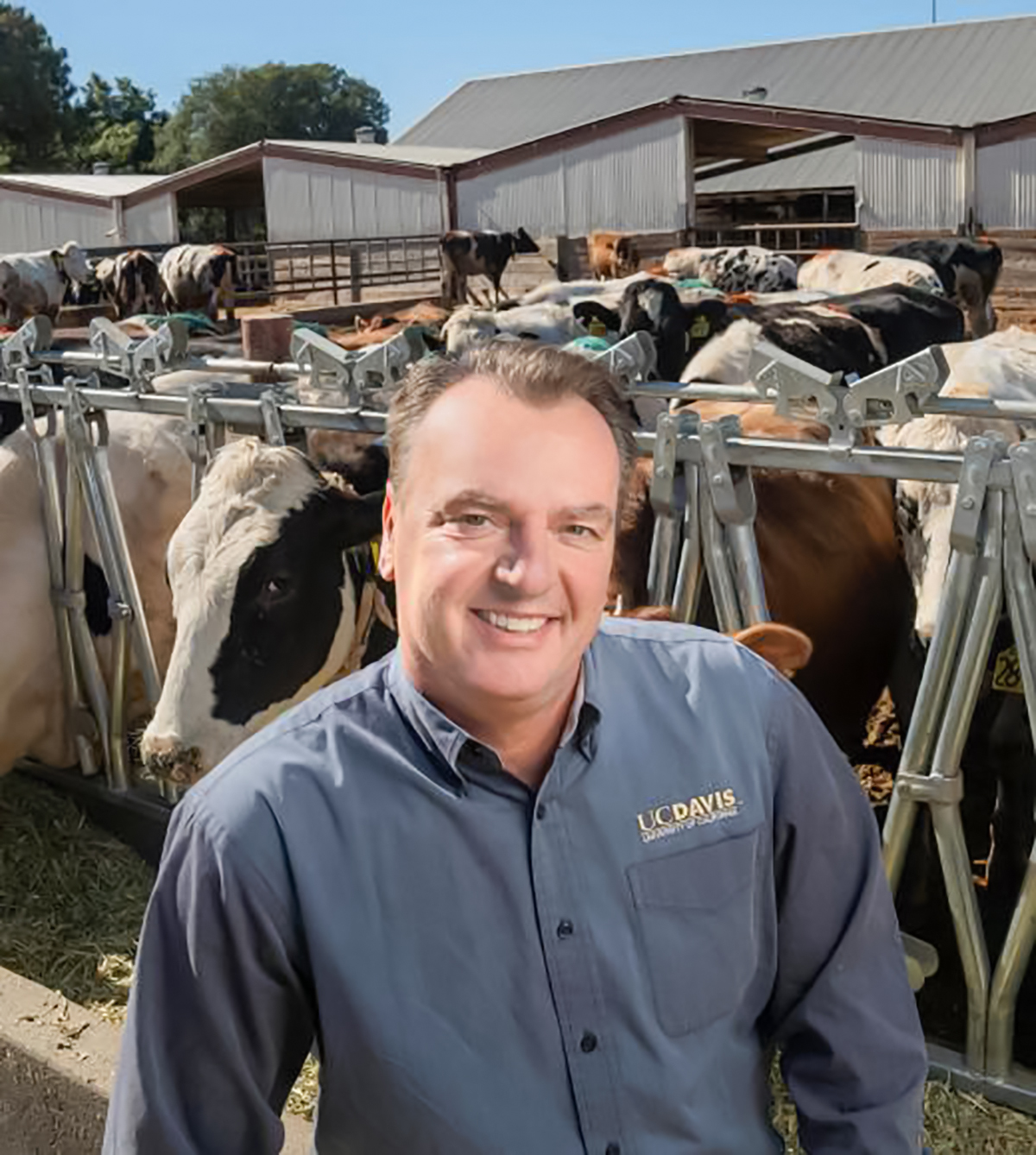
Dr. Mitloehner brought dairy farmers up to date and took questions during the American Dairy Coalition’s annual meeting by webinar in December.

One important take-home message was for dairy producers to understand that how methane’s global warming potential is quantified (whether GWP100 or GWP*) “has a profound impact on the predicted warming of your industry. The only way you can become climate neutral is by using a metric fit for purpose, one that predicts the warming, and that is GWP*,” said Mitloehner.

He explained how methane is an important and powerful greenhouse gas (GHG), but it is different from other gases because it is the only one that undergoes atmospheric removal in a chemical process that takes about a decade. This does not occur for carbon dioxide or nitrous oxide, which are stock gases that remain in earth’s atmosphere for 1000 and 100 years, respectively.

“Methane is the most important gas for agriculture, so its removal must be included in the calculation also,” he confirmed, noting that GWP* does that. “Methane is fast and furious. It has a good punch that is 28 times more trapping of heat from the sun (vs. carbon dioxide), but it is also fast. It doesn’t stay in the atmosphere for long.”
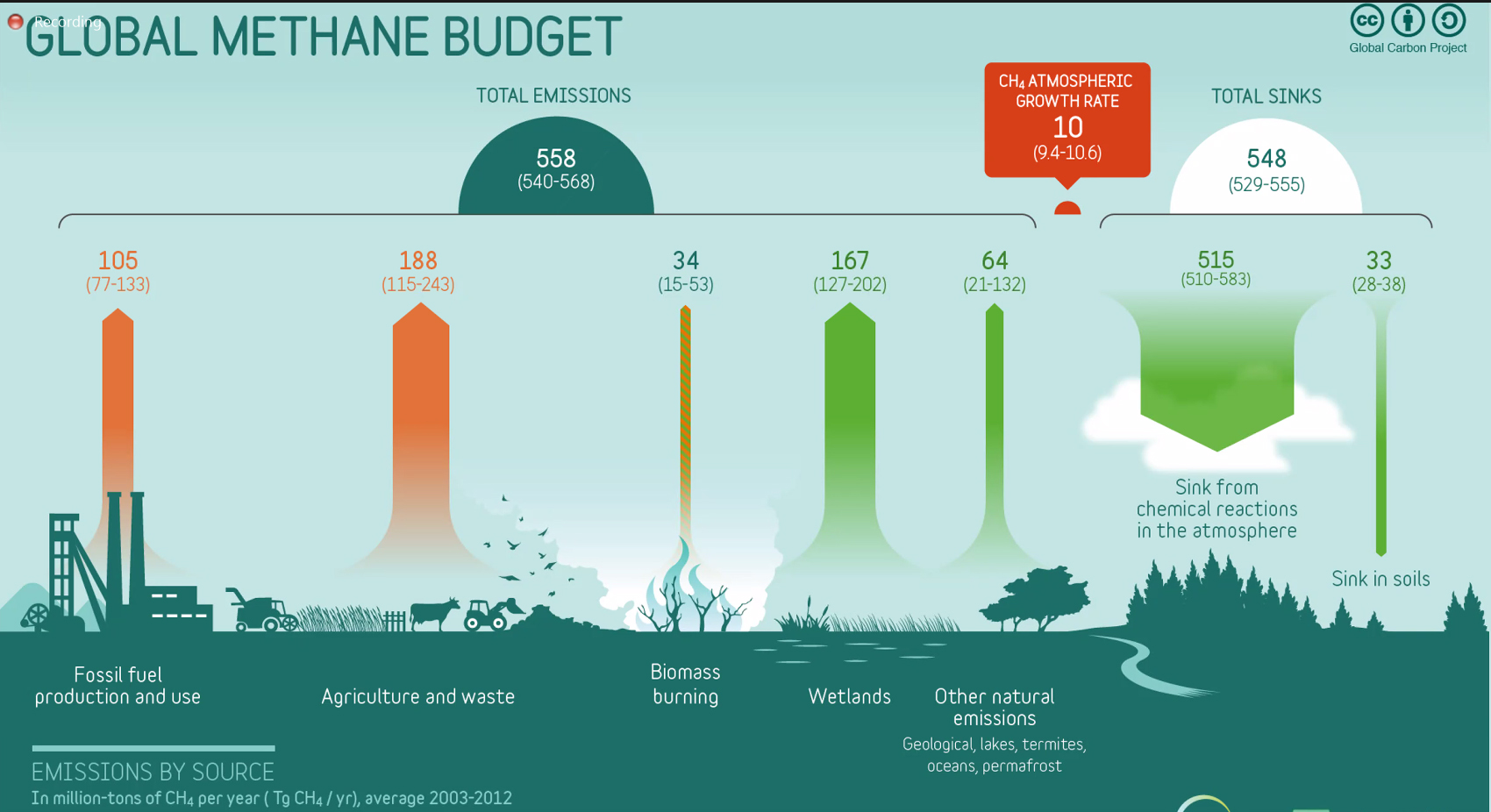
In a slide showing all global methane sources and sinks, Mitloehner noted that nearly 560 terragrams of methane are produced worldwide annually, and at the same time 550 are destroyed by this natural atmospheric process.

In terms of atmospheric growth, “the net is then 10. This is still a number we want to reduce, but it is not 560,” he said.

As the DMI Innovation Center’s Sustainability goals, Net Zero Initiative and FARM program are on the cusp of calculating these things at the farm level, both the measurement and the goal matter.

A net-zero carbon or GHG commitment poses a problem for dairy farmers. This is compounded by the CO2 equivalency for methane being calculated using GWP100. 

The GWP100 metric has been around since the 1990s, but it describes stock gases, whereas methane is a flow gas.

Using GWP100 with a net-zero carbon commitment is not only unnecessary, it’s problematic.

“It means the belches from your cows are (being calculated) in addition to what they belched last year, and the year before that, and so forth 10 years from now,” said Mitloehner. “In reality, constant herds are a constant source of methane that generates a constant warming, not a new warming. That’s what the Paris Treaty asks all sectors to do – to limit additional warming.”

Aiming for climate neutrality or net-zero warming instead of net-zero carbon would put the focus where it needs to be — on the warming impact of the emitted methane over time. This is important because methane makes up 62% of the estimated total GHG for dairy, according to the CLEAR Center study.

“If we use GWP100 to describe a relatively constant source, to characterize that methane, then we are overblowing its impact by a factor of 3 to 4, and we are overlooking the ability for the U.S. dairy industry to reduce warming when we reduce methane,” said Mitloehner, citing page 173 of the Intergovernmental Panel on Climate Change (IPCC) 2021 Assessment Report 6.

The metric GWP-star (GWP*) is also mentioned on this page of the IPCC report. GWP* was developed by the University of Oxford. It is based on GWP100, but it looks at how methane warms the planet over time. It characterizes methane as the flow gas that it is and calculates it based on CO2 warming equivalents (CO2we), not as accumulating CO2 stock equivalents (CO2e).

A white paper published with the peer-reviewed CLEAR Center study explains it this way:

“Net zero carbon refers to a state where carbon is removed from the atmosphere (through carbon sinks or other offsets) at a rate equal to carbon being emitted into the atmosphere. This balance between carbon emission and removal creates a ‘net-zero’ carbon output. Climate neutrality, on the other hand, focuses on temperature impacts from emission sources, referring to the point in which no additional warming is added to the atmosphere.”

The paper goes on to explain how “climate neutrality is analogous to net-zero carbon when dealing with long-lived greenhouse gases such as carbon dioxide, but short-lived pollutants like methane do not need to reach net-zero carbon to be climate-neutral.”

“Is it new and additional carbon being added to the atmosphere? Do constant herds add new warming? No, they do not,” said Mitloehner.

“Belched out methane is the number one source in agriculture, but again, it doesn’t stay in the atmosphere for 1000 or even 100 years like carbon dioxide and other GHG,” he explained while also noting the pathway of the carbon in this methane is already present in the atmosphere, is captured by plants, then consumed by cows. Some of this consumed carbon (energy) is converted to carbohydrate and some of it is emitted in the methane by the cow in a continuous cycle. 

Unlike fossil fuel emissions, this is not ancient carbon brought out of the ground and into the atmosphere as a one-way-street, he explained: “Do not fall for the people who are comparing cars to cows. The University of Oxford says this is a mischaracterization, and I agree.”
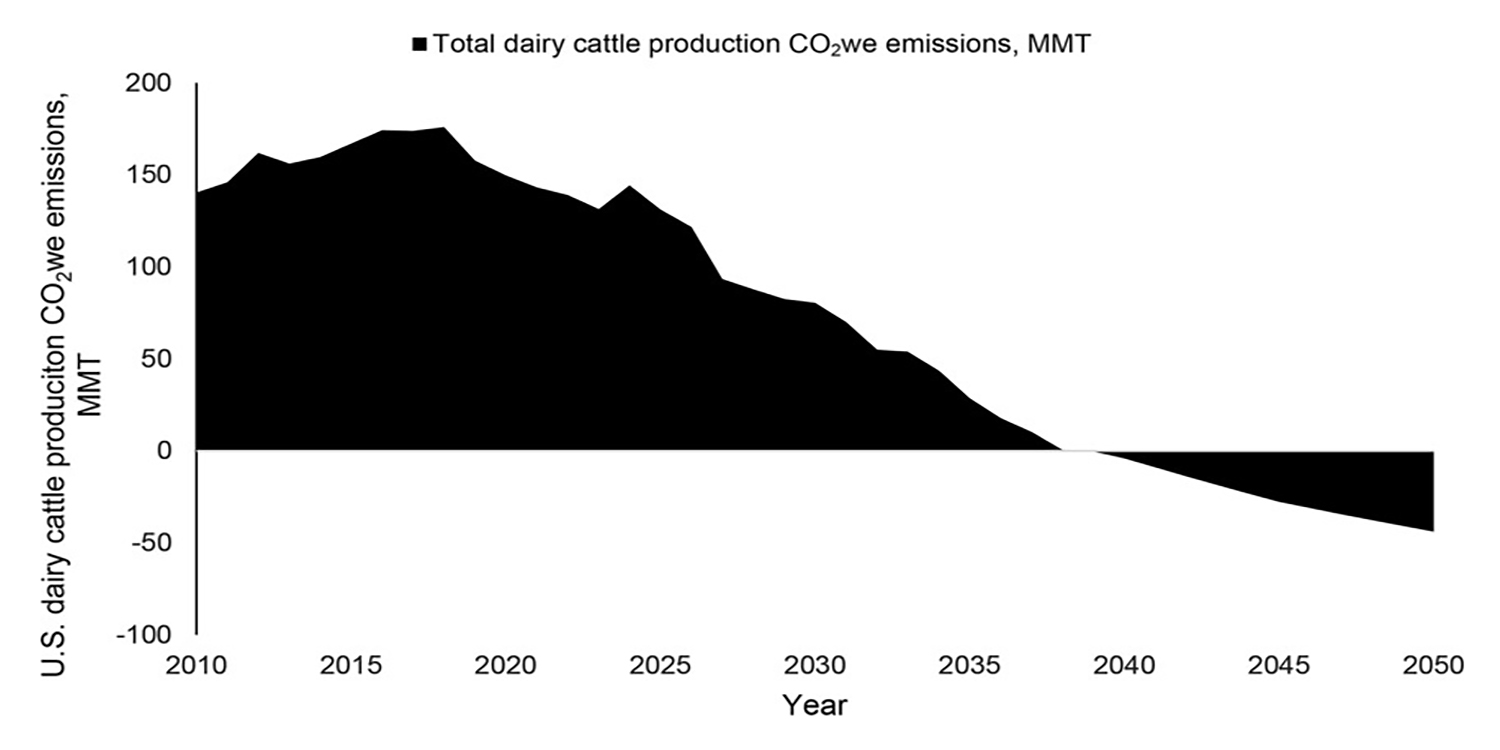
What is exciting, “is if we reduce methane, we can come to a point where we produce negative warming or a cooling effect. That’s what my work is about (Fig. 4). If we do a couple of things to reach no new warming, and if we then get aggressive to go further, we can sell credits as offsets,” said Mitloehner, referencing the implications, limitations and conclusions of the CLEAR Center study.

As innovations related to managing cattle diets are being developed, the good news is emerging tools show the promise of steering more of that carbon, that energy, toward milk yield and components and less of it to methane that is belched back into the cycle.

In contrast, a net-zero carbon or net-zero GHG goal that measures methane as a stock gas (GWP100) and does not accurately describe its warming impact and flow-gas status in the way GWP-star (GWP*) does, would leave dairy farmers needlessly and continually chasing what under the GWP100 scenario are accumulated and continuing belches from their cows. 

If the industry continues to chart net zero carbon, will dairy farms be forever chasing their belching cows with tech investments and offsets?

“In my opinion, you will never reach net zero carbon. Your cows will always produce methane no matter how aggressive you are. You will over promise and leave stakeholders disappointed. We are dealing with a biological system, the microbial fermentation in the rumen. It is not feasible and I have advised the industry in the past against it, but that is the direction it goes – in general,” said Mitloehner.

As for unintended consequences on the path to ‘net zero,’ Dr. Mitloehner was clear to say: “What matters is climate neutrality. If you tell the world you want to be climate neutral with no new warming and achieve it through annual reductions of 0.3 to 0.5%, you will indeed be climate neutral in less than 20 years. At a 1% per year reduction in methane, you will accelerate that timeline. But you will never achieve it with GWP100. It’s not possible and not necessary to go that way of treating methane as if it were a stock gas. It doesn’t account for the reduction.”

A piece of good news, he said, is that GWP-star (GPW*) can be used parallel to GWP100. The maitrix is a more scientific predictor of what you (dairy) has to do to bend that curve and how strongly.

“The excel spreadsheet calculator in the white paper helps you identify when in the future as a creamery or a statewide association reach the point that you are no longer creating additional warming, and that should be the goal,” Mitloehner explains.

Net zero carbon or net zero GHG is a setup to always be chasing the cow’s biology without acknowledging her gas is a flow gas, not a stock gas. It does not accumulate. Some will say “you can use offsets” for the cow’s biology. But why? They are not necessary as offsets and could be viewed as solutions if the dairy industry gets its math right. (We’ve seen this movie before)
Dutch farmer protest update: What if you woke up tomorrow and learned your farm is to be reduced or closed based on climate targets that use fuzzy math?

When food is plentiful, and climate reduction targets kick-in… How do farmers attract the strong public support they need to continue?

By Sherry Bunting, previously published in Farmshine

NETHERLANDS — Headlines here in the U.S. indicate the Dutch government is offering buy-out of up to 3000 farms and other so-called ‘peak polluters’ to reduce ammonia and nitrous oxide emissions to bring the country into compliance with EU pledged targets. They say farms will be offered more than 100% of their value to quit, but the value of these farms is now reduced by the reduction targets. 

A November 30 article in The Guardian quotes the Dutch nitrogen minister Christianne van der Wal saying “there will be a stopping scheme that will be as attractive as possible,” and that forced buyouts will follow next year if the voluntary measures this year fail. 

Some may read these headlines and figure Holland is such a progressive agricultural powerhouse that the number of planned closures is but a dent. 

Think again.

Farms in Holland and around the world are the thin green line. Challenging them with inflated climate data and restrictive targets puts world food security at risk.

Consider that the BBC reported recently that Ireland is also looking at agricultural emissions, namely methane from cattle and sheep, in terms of meeting its Climate Action Plan targets of a 25% reduction by 2030. Estimates vary on how much culling would need to occur to meet these targets, how the methane is measured, and how fast various feed additives can help farms meet new targets. The most glaring concern is how carbon equivalents and methane are measured.

What if you woke up tomorrow and learned that your farm is targeted for similar reductions or closure based on the location of your farm on a map, based on climate targets set by your state or your milk buyer or the federal government, based on making cuts from where you are now — not from where you might have been before whatever improvements you’ve already made?

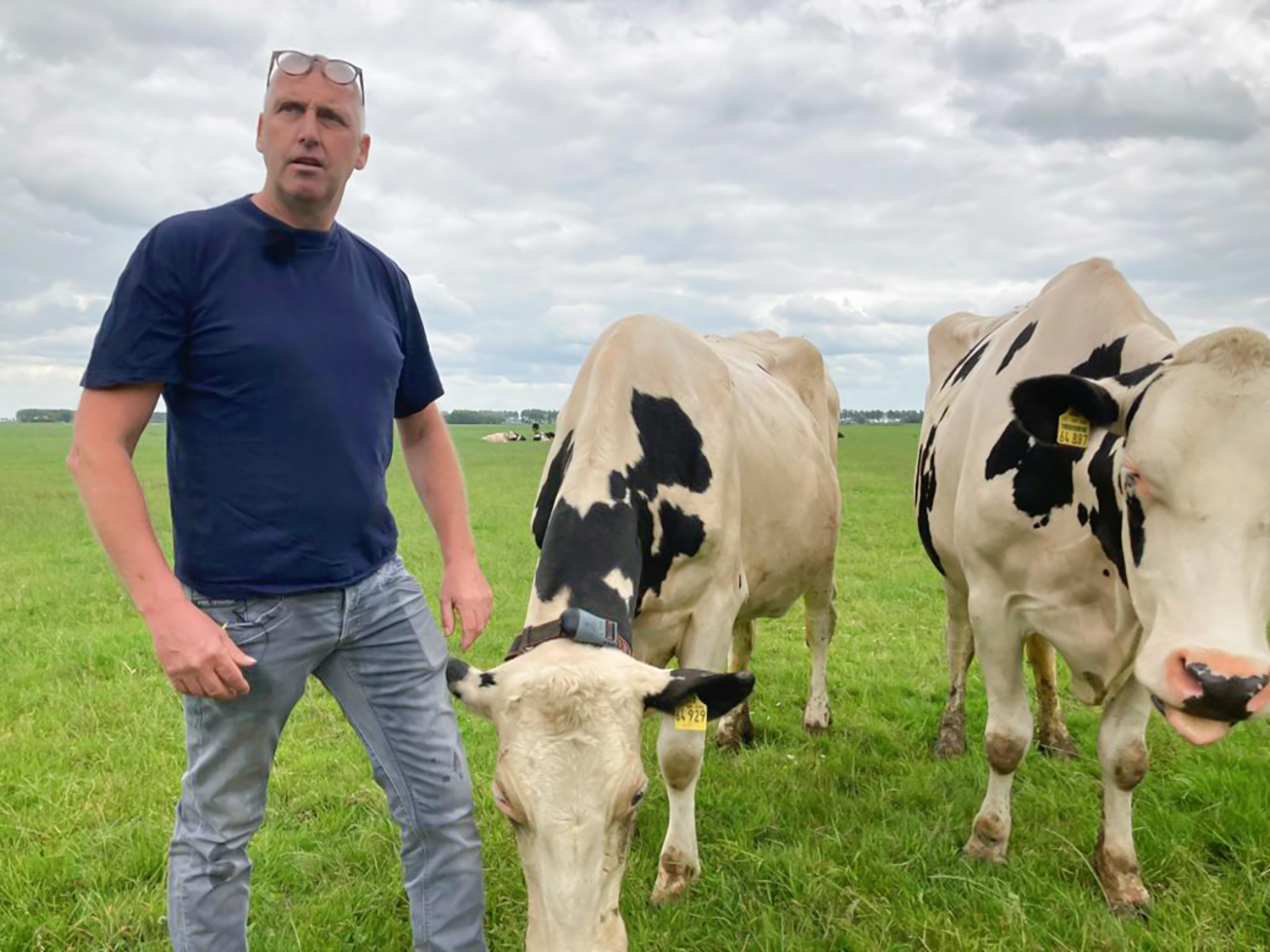
We reached out to Dutch dairy farmer Ad Baltus this week for an update from Holland, having interviewed him six months ago for the story about the Dutch farmer protests in July 2022.

Baltus farms 170 acres in the village of Schermerhorn with his wife and 7-year-old daughter. They milk 130 dairy cows, grazing in summer and growing corn and collecting fresh grass and dry hay from fields as well.

In July, he reported that his farm is one of the “luckier” ones. He is in a location in North Holland that will have to reduce the amount of nitrogen (or sell cows) by 10 to 15%. Some zones have been designated to reduce by up to 75 to 90%. The percentages are to meet reduction targets, and are not based on what a farm is measured to produce. Building and infrastructure projects can’t move forward without near-term offsets, which is why the situation has reached this extreme point in the Netherlands.

“It feels like the government throws figures in the air, and they wait to see what will happen,” says Baltus. “In my point of view, they try to make farmers worried as a tactic of smoking them out. That’s what you see now. The farms (targeted for higher reductions based on location) nearby the nature areas are getting tired of it, and they sell. I see the last couple of months a lot of farms, nice farms, being sold, and that worries me. If they stop farming, and go abroad, what will be left in Holland?”

He observes that the older farmers stay on the farm until they stop for retirement.  “But when the young farmers stop and go abroad — that’s the future leaving. The young farmers are the future. The young farmers don’t want to wait for what is clear and what is going to happen. The problem is now — in the next five years,” he says, indicating a cycle of new targets that never seems to end. “Every time the government throws new figures out. This time it’s the nitrogen, then it’s the water quality, and then it’s the biodiversity, then there is CO2. Every time there comes new regulation, young farmers worry about their future.”

He sees agriculture in his country at a crossroads and warns that if this can happen in Holland, where agriculture is so progressive, it can happen anywhere.

“It could go the right way, and they will begin to appreciate farming in Holland, or it could go the other way, and farming may be over in 10 or 20 or 30 years. My biggest worry is you need some minimum amount of farmers to let the companies behind the farms live. I see it that when you have a feed company, they need a certain amount of farms to deliver their feeding products. When it comes down below some level, they say that is too small for us, and it is a spiral going down. That’s a worry for me, that we make it difficult for too many farmers, and they stop.”

Baltus confirms that the large Dutch farmer protests of the summer have quieted down, but the efforts and periodic protests continue on a different scale. “We are not giving up. We are struggling ’til the end, but it is a hard battle to convince (the government) that this is not the good way to go.

“We also see the farm groups talking to the government. We see the (symbolic) red handkerchief. The Dutch flags turned upside down for a month got attention. The protest is maybe not as loud as it was, but it is still there, and a little spark to the gunpowder barrel, it will explode again,” he says, noting that there are elections in March 2023.

As for the big picture, Baltus describes it as Dutch farmers having to ‘catch up’ quickly to the long-time networks built by the NGOs.

“Farmers have been too long on their own farms, and now you see things changing. Since 2019, when the first farmer protests began, you see farmers are now talking more to the media. They get a better speech to government officials,” says Baltus.

On the other hand, the NGOs, like Greenpeace, and a variety of others, are a small number of people relative to the population of Holland, but they have already been working 20 to 30 years on this. They are well-organized, well-funded, and have people throughout all levels of government and media, he explains.

“We are just now three or four years fighting against that, and it takes a time to change and get that understanding of nature and practice to the government,” Baltus relates, adding that it also takes time for new technologies to come to market that will help farms make further reductions, though European farms are already pretty progressive that way.

Baltus sees European farmers coming together more for each other now — even if their respective governments are not. As other countries in the EU are beginning to experience similar pressures of emissions targets that could essentially reduce dairy and livestock numbers or put farms out of business, solidarity is on the rise among those farmers who are paying attention.

Farming is hard work with a lot of risk, but as Baltus points out, Holland is a good place to farm, with good soil, good logistics, and a good climate for crops and livestock.

“It is one of the best jobs in the world. I love what I do. I want the adventure that every day is different. I like working in nature, working outside,” he says. “When the younger generation doesn’t have to worry about all of the things which are not farming, then they will go to farming because the work is that good. It is only the things that come from outside into the farm that make it hard.”

One part of a future solution is exemplified in something Baltus has done at his farm for 30 years — providing a school on the farm to teach young children how to make cheese and to make jam. His cheese school reaches a few thousand children each year.

“We do it so the children learn how much work it is to make that little piece of cheese and that little pot of jam,” he says. “When they learn the effort that goes into food, they appreciate it more, I think.”

The children get a bucket of milk, and in two hours they go home with a little cheese. They have to turn in 14 days and put on a little salt, and in another 14 days they eat their own cheese. When Baltus started the cheese school 30 years ago, maybe one or two farms did this kind of thing.

Today, more farms are doing similar memorable learning experiences. Baltus sees more farms connecting with the public in recent years. Some have cabins on the farm that they rent to the public. Others provide daycare on the farm, so children can grow up with some real-world attachment to farming. In his neighborhood, there are four farms with daycare. 

“The new generation learns what it is to farm, so maybe they will be farming or an advocate. If they go to work as a plumber or a trucker, but as a child lived a few years on a farm at a daycare, it’s good for when they are older, even if they work in other things,” he explains.

“The solution is also that everyone you speak with — say to them what you are doing. When you are at a party or on holiday, say you are a farmer, say how you do things, why you do things — explain it,” Baltus suggests. “People come to appreciate these things when they know about them. There are things (farmers) can do better, but when we explain that we need 5 or 10 years (as technology develops), they accept we’re not perfect but are working to make it more perfect.”

In general, Baltus has found the public has a good opinion of farmers. When he meets someone from the city, they say “Oh, you’re a farmer. That is good of you.” And that’s that. They think well of farmers, but have no reason to worry about food, and therefore don’t make the connection to the impact of the threat the farmers face.

“People have other worries. Do I have a job next year? Can I pay my bills for electricity? Will my children have a good education? But food? There is always food. People will worry about food when there is no food,” he says.

As it stands now in Holland, “What is happening with farms is not really their business. People can go to the supermarket, and most everything they want they can buy there,” Baltus observes, saying he understands this disconnection.

Even if there are changes to the mix of foods available in stores and restaurants, there is no fear of finding food to eat. While Holland is considered a large agricultural exporter, Baltus notes that his country is a net-importer of food when looking at it on a protein and energy needs basis. 

“We have the cheese and potatoes and cabbage, but we don’t have the coffee, the cocoa and the citrus. I see it in the way of trading. When that balance is lost, what happens when there is a shortage and we don’t have the cheese or potatoes to export?”

The bottom line, says Baltus, is that “When you are a carpenter or a plumber and there is, every day, food in the supermarket, why would you have to worry about food?

“In Africa, they know food is important. They know what it is like to not have food. But in the western world, there is food everywhere. You can pick up the phone, and in 30 minutes have a pizza on your plate.”

-30-

Measure every decision by cow comfort and know your numbers: ‘That’s how you fight inflation’

By Sherry Bunting, Farmshine, December 23, 2022

NEW HOLLAND, Pa. – “Too much money chasing too few assets,” that’s the definition of inflation, said Gary Sipiorski, ag lender and financial consultant from Wisconsin.

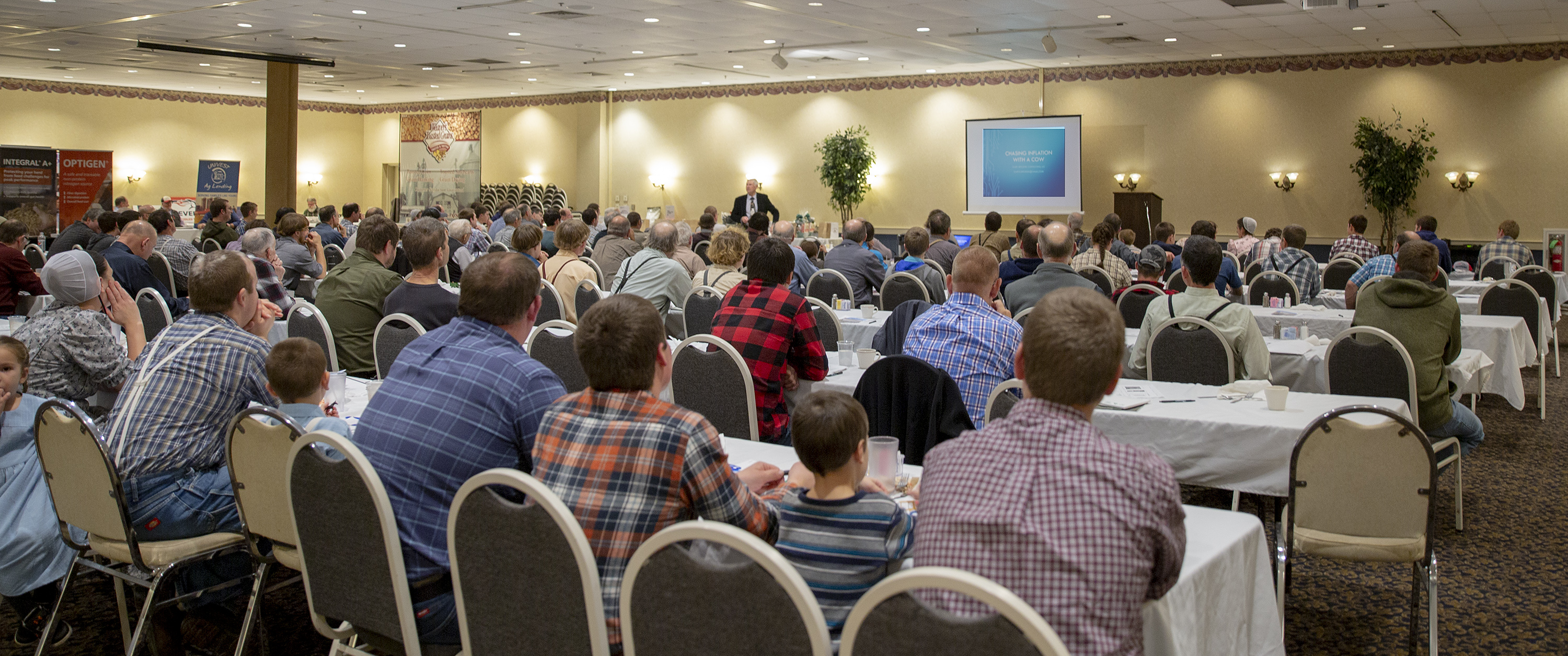
He didn’t have to tell the over 250 dairy farmers attending Homestead Nutrition’s dairy seminar at Yoder’s Restaurant in New Holland on December 7 that inflation is real, because they are feeling it.

His bottom line is to measure every decision by its impact on cow comfort and manage the net income the cows generate.

As president and CEO of Citizens State Bank of Loyal, Wisconsin, Sipiorski is also an advisor to the Federal Reserve Board of Chicago. He expected the Fed would raise interest rates another half a percent, and several days later, that’s what they did.

Raising interest rates is meant to slow things down enough to curb that inflation, and as farmers, “you’re feeling the effects of both,” he said.

Sipiorski described the effects of both the disease and the cure as something that creeps up gradually to squeeze the margin.

“You can be taking good care of things and don’t see this happening, as the temperature gradually increases. It sneaks in slowly,” he said. “The war on inflation will continue for at least the next 12 months, and we are likely to see interest rates continue higher before stabilizing around the middle of next year.”

The good news for dairy, he said, is that even though consumers are drinking a little over half as much milk per capita as they did 50 years ago (18 gallons vs. 30 per person per year), they are eating more than double the gallons of milk in the form of all dairy products, combined.

In 2021, Americans consumed 667 pounds (77 gallons) of dairy products per capita. That’s 12 more pounds per capita than in 2020.

“We didn’t drink the 77 gallons, we ate it,” said Sipiorski, adding that dairy exports have also become crucial.

“By the end of this year, 20% of your milk production will be going elsewhere,” he said. “That shows the faith the rest of the world has in the superior product you make.”

Inflation, rising interest rates and supply disruptions are slowing the rate of dairy expansion, as the industry focus turns inward to manage margins even more tightly as feed costs have doubled, cropping costs have quadrupled, lines of credit cost more and are harder to get, machinery and parts cost more and are harder to find, and some farms must deal with a milk base program from their milk co-op or buyer — putting penalties on overbase milk in the output side of that margin equation.

Sipiorski shared his insights on the most important things the top 30% of dairy producers do in a talk he titled ‘Chasing inflation with a cow.’

The top third of dairy producers double-down on managing these primary areas: feed, debt, labor, cow comfort, and knowing their numbers.

Minimize feed shrink

With feed and cropping costs so much higher, Sipiorski told dairy farmers the 10 to 20% they can be losing in feed shrinkage is a significant area to manage.

“Losing 10 to 20% of the feed from field to rumen is a big cost to the dairy,” he said. “We are seeing more investment in feed storage sheds, bringing the mixing indoors and thinking about how you mix the feed, in what order.”

Pay down lines of credit, not term debt

Choosing carefully what debt to pay down at this time of rising rates is also critical. Paying down lines of credit that have adjustable interest rates and keeping some of that cash liquidity may make more sense than paying additional principal on longer-term fixed rate loans.

“Your thought process may be to pay down that term debt, but if the rate is locked-in, and you pay it down, that money is gone, and you may need that money later, and then pay a higher interest rate for it,” Sipiorski explained, advising farmers to talk with their lenders about their debt structure.

Push pencil on machinery

“Do the math on whether to lease or buy machinery,” Sipiorski urged. “If it is something you use three months of the year, can you afford it? Can you afford the cost to have and maintain that piece of equipment?”

He noted that the top dairy farms push the pencil to compare costs of owning new equipment, leasing it, or hiring custom operators for segments of their field work.

Time is money, spend it wisely

In addition to dealing with hired labor cost and availability, Sipiorski advised farmers to “count your steps and measure your time.”

In other words, know what your time is worth and find ways to streamline chores for yourself and your employees. One example he gave was to put tools around where they will be used to minimize time spent going back and forth for tools needed.

Keep improving cow comfort

“Cow comfort is a place to keep improving to fight that inflation with that dairy cow,” Sipiorski declared.

It’s the accumulation of a lot of simple little things the top third of producers do, such as providing enough space at the feedbunk, waterer and in the dry cow area.

“The dry cows are working just as hard for you, so don’t cheat them” he said, adding that top producers are absolutely passionate about cow comfort.

The cows require a lot of investment, and the top producers benchmark the investment per cow at $8,000 to $20,000, while benchmarking gross income per cow at $5,000.

“Cow comfort is an area of investment that brings you the most return. Every decision you make, ask yourself, are you making money with that decision?” he said. In other words, “are you making cows more comfortable with that decision?”

Keep improving milk components, quality

Producing milk with higher component levels and lower somatic cell counts (SCC) is what the top third of producers are doing, said Sipiorski.

“This is even more important if your co-op has a base program. If you can’t produce more milk, make the milk you are producing better,” he said, noting that components drive value.

Quality as measured in SCC will also increasingly drive value and market access. Sipiorski sees the industry getting to the place where milk will eventually have to be under 150,000 SCC.

While he didn’t specifically mention transformation in the processing sector, it’s becoming clear that ultrafiltration and microfiltration in some of the newer dairy plants is aimed at removing the lactose from the milk to be used in making cheese, other dairy products and lactose-free high protein milk beverages.

Those working with this technology have repeatedly said it requires farm-level SCC thresholds to be even lower because, as the water and lactose are removed through membranes and reverse osmosis, the remaining solids are condensed. This includes the SCC being concentrated with those valuable solids, so those processors expect a lower-SCC limit at the starting point.

Get educated on marketing

Sipiorski advised farmers to be “educating yourself on marketing and risk management.”

He noted that milk markets are volatile, and marketing through a broker or a cooperative program or other risk management can be good or bad.

“You won’t know if it’s a good deal or not, if you don’t know your cost of production, your margin,” he said.

Know the numbers, focus on high quality forage production, and look at areas where changes and investments can help fight inflation, he advised.

One thing he has seen more farms moving toward – to reduce marketing costs – is to increase milk storage to go from once a day to every-other-day pickup to reduce fuel costs, transportation and ‘stop’ charges.

This is something that has been occurring at the retail end for years, with less frequent deliveries from processors to retailers becoming the norm today.

Benchmark against industry or self

Benchmarking the dairy to itself year over year or to industry averages is important financial management, according to Sipiorski.

The numbers that are needed to do this are found on the balance sheet, income statement, and accrual accounting of yearend income – not the IRS tax return. 

He said that doing a business plan with projected cash flows helps make better financial decisions.

Sipiorski gave farmers some financial benchmarks to keep in mind, noting again that the numbers need to be based on accrual accounting, not the year end IRS tax return.

“In that tax return, you have prepayments and depreciation,” he said. This skews the cost of production calculation, for example, because the cost of inputs are not directly aligned with the output revenue.

Sipiorski ticked through some industry benchmarks to be aware of: Equity position (50%), liquidity (2:1), net profit margin (10%), cost of production ($17-22.00/cwt), operating expense as a percentage of gross income (65-80%), and debt to revenue ratio (1:1).

The bottom line, he said, is “you need to produce 100 pounds of milk for less than you sell it for.”

On that point, he noted the most recent USDA forecasts at the end of November are for Class III milk to average $19.80 in 2023 with the All-Milk price next year forecast to average $22.70, while the cost of production in 2022 is averaging $20 to $22.00 across the industry, but the range is wide.

“Pennies (per hundredweight) are a big deal,” he said, showing that the 47-pennies per hundredweight difference in a Q2 2022 comparison of the net margin per hundredweight of $6.64 for all herds vs. $7.11 for the ‘top 30% of herds’ amounts to just shy of $113 per cow annually.

“That’s $2800 on 25 cows, $11,280 for a 100-cow dairy. That’s how we fight inflation with a cow,” he said. “Who in this room wouldn’t want another $11,000 in the pocket to fight inflation?”

Sipiorski described dairy as a dynamic business full of chaos and volatility, but with that comes lots of opportunities.

He sees a ‘barbell-shaped’ future for dairy, where there will be opportunities for small and mid-sized family dairies even if a large portion of the milk supply comes from much larger dairies.

-30-

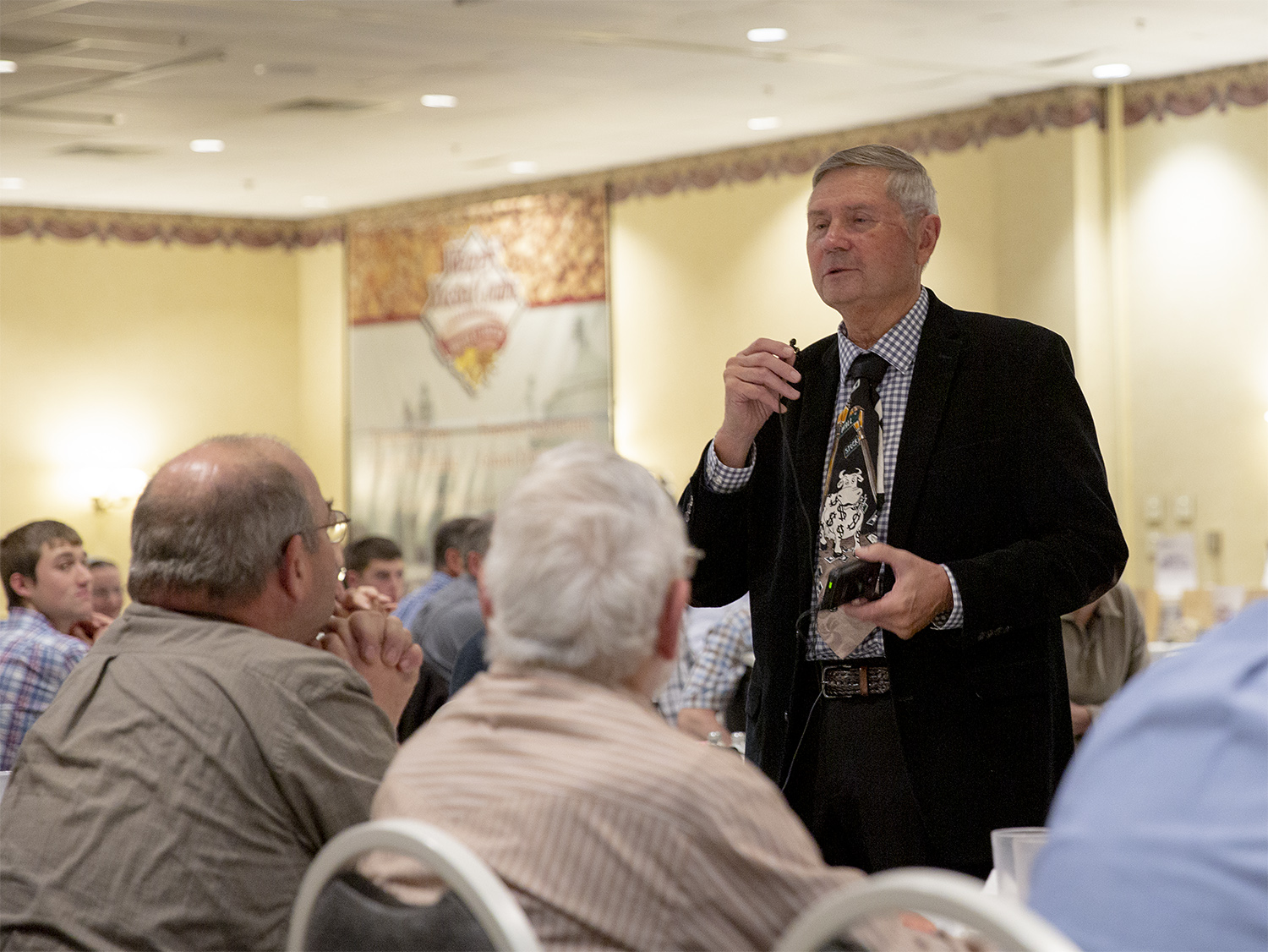
Gary Sipiorski, a lender from Wisconsin, talked about dairy financial management in these inflationary and volatile times. Despite the chaos and consolidation, he sees opportunities for small and mid-sized family dairies in the future, even if a large portion of the milk supply comes from much larger dairies. Photo by Sherry Bunting

Dream in progress at BAD Farm, where they DON’T live up to their name

‘Tis the season for something special. Their story began with raw milk sales over 10 years ago, today it is becoming so much more.

By Sherry Bunting, Farmshine, December 16, 2022

KEMPTON, Pa. — ‘Tis the season for something special. It’s Christmastime, and diversified consumer-facing dairy farms are featuring special products, memories and events, complete with decorations, milk (or hot chocolate) and cookies, wagon rides, Christmas settings and on-site photographers for on-the-spot family Christmas portraits – you name it, and dairy farmers are doing it.

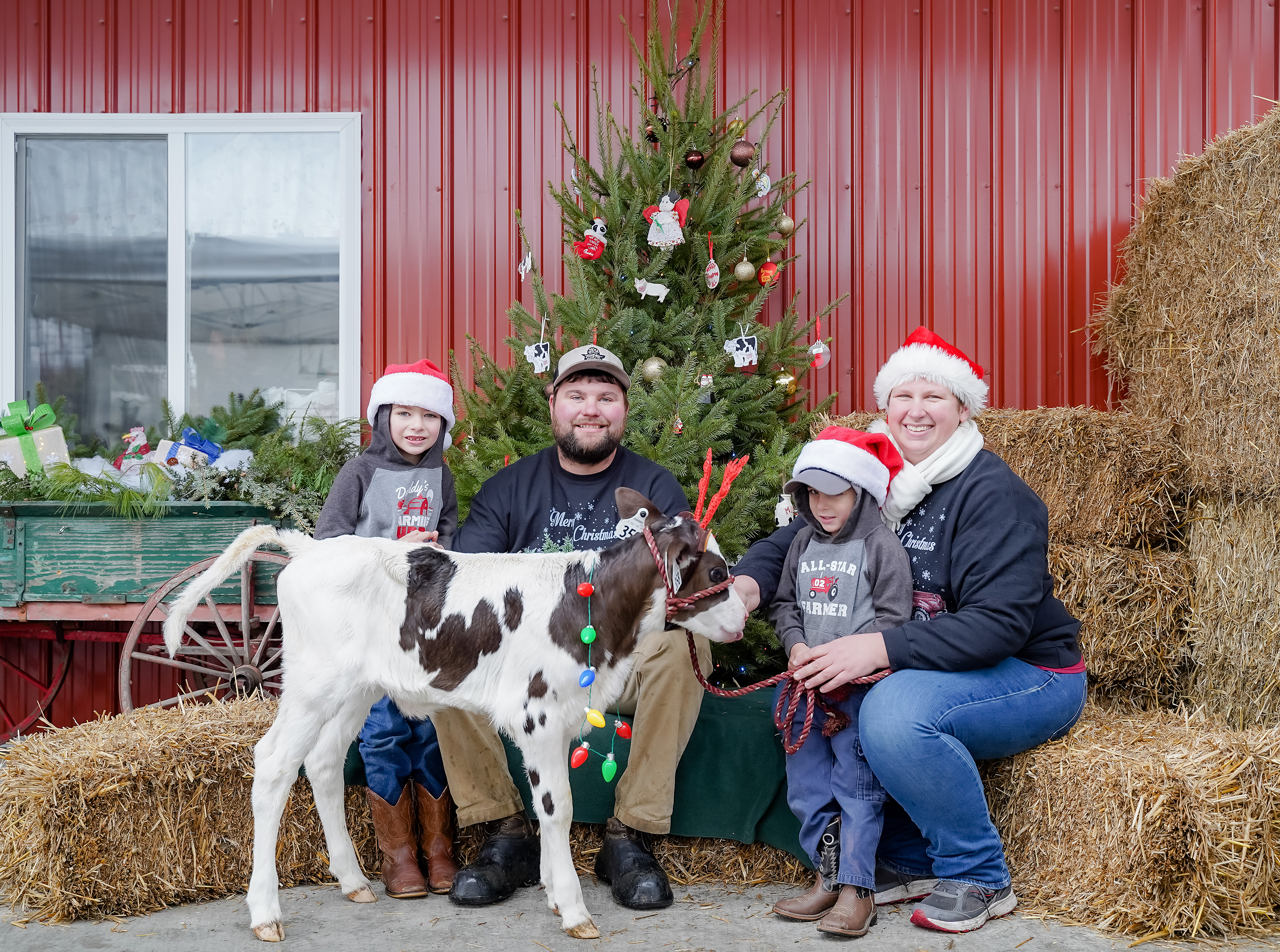
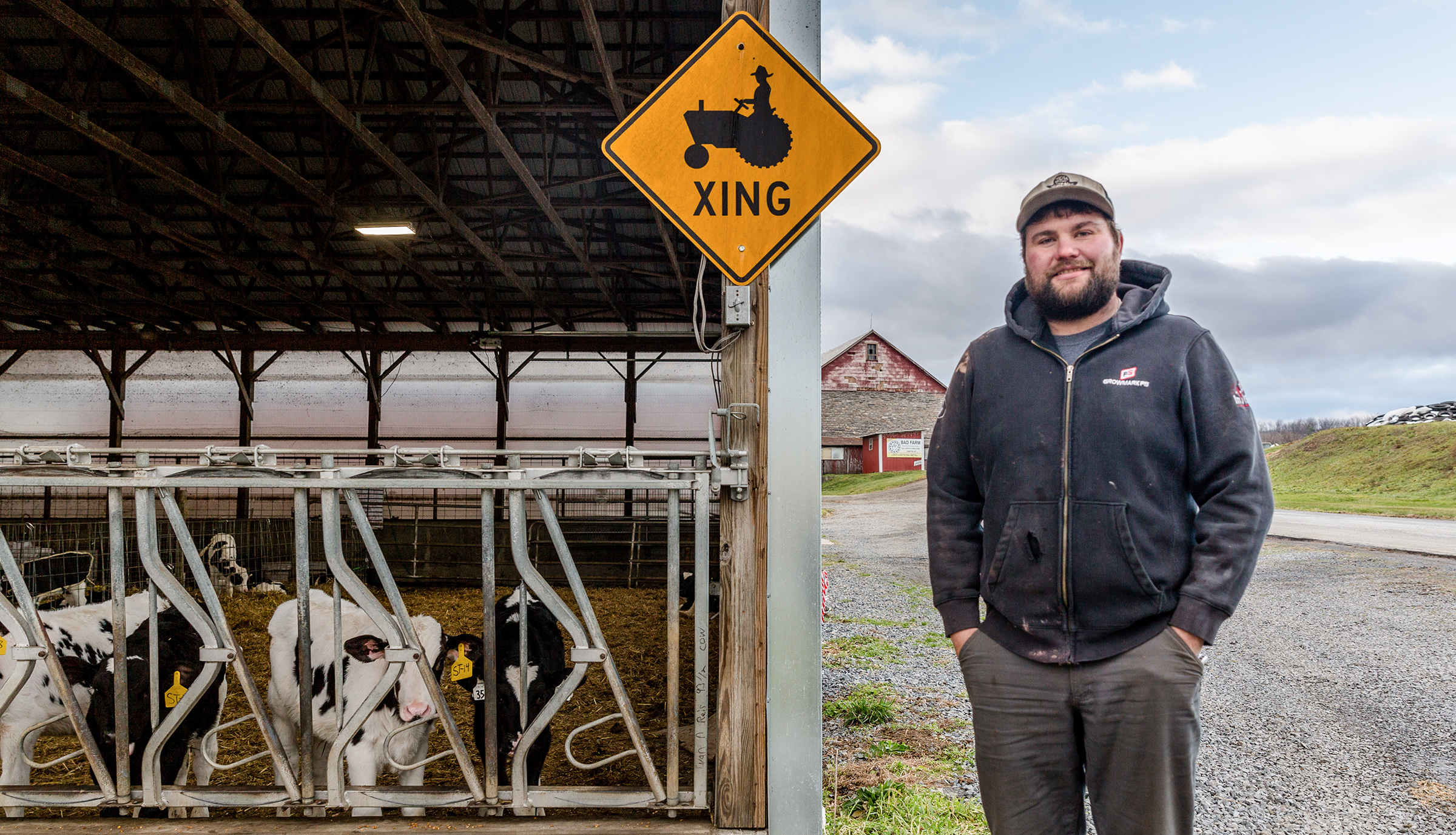
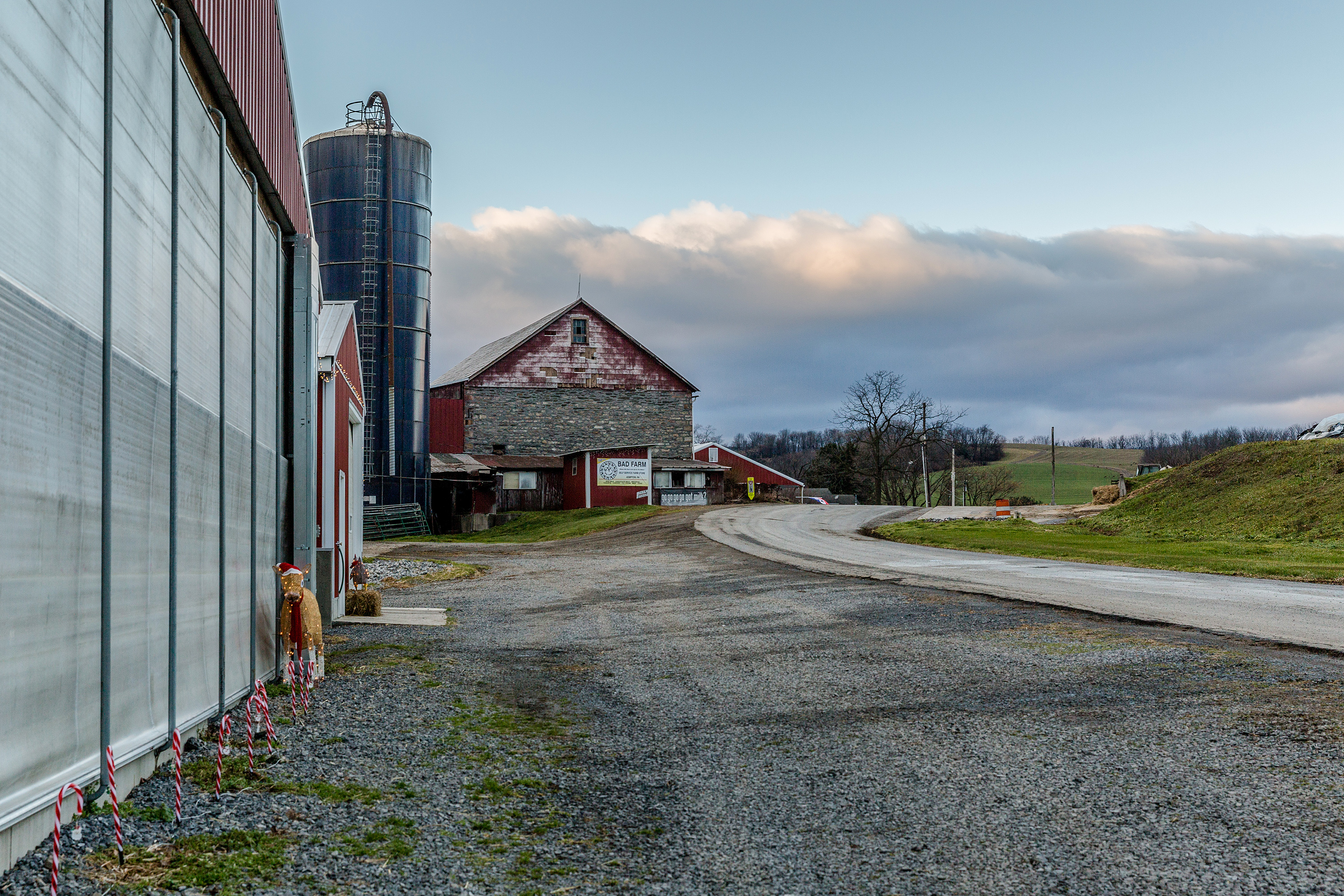
Recently Jason and Kacey Rice (and sons Emmit, 6, and Ellis, 4) had such a “Christmas on the farm” event at their BAD Farm near Kempton, Pennsylvania. Delicious dairy products, made with the milk from their 60 cows, were combined with holiday festivities, opportunities to see a working farm, visits with Santa, and, yes, portrait sessions with a holiday setting, a festively outfitted calf and a photographer.

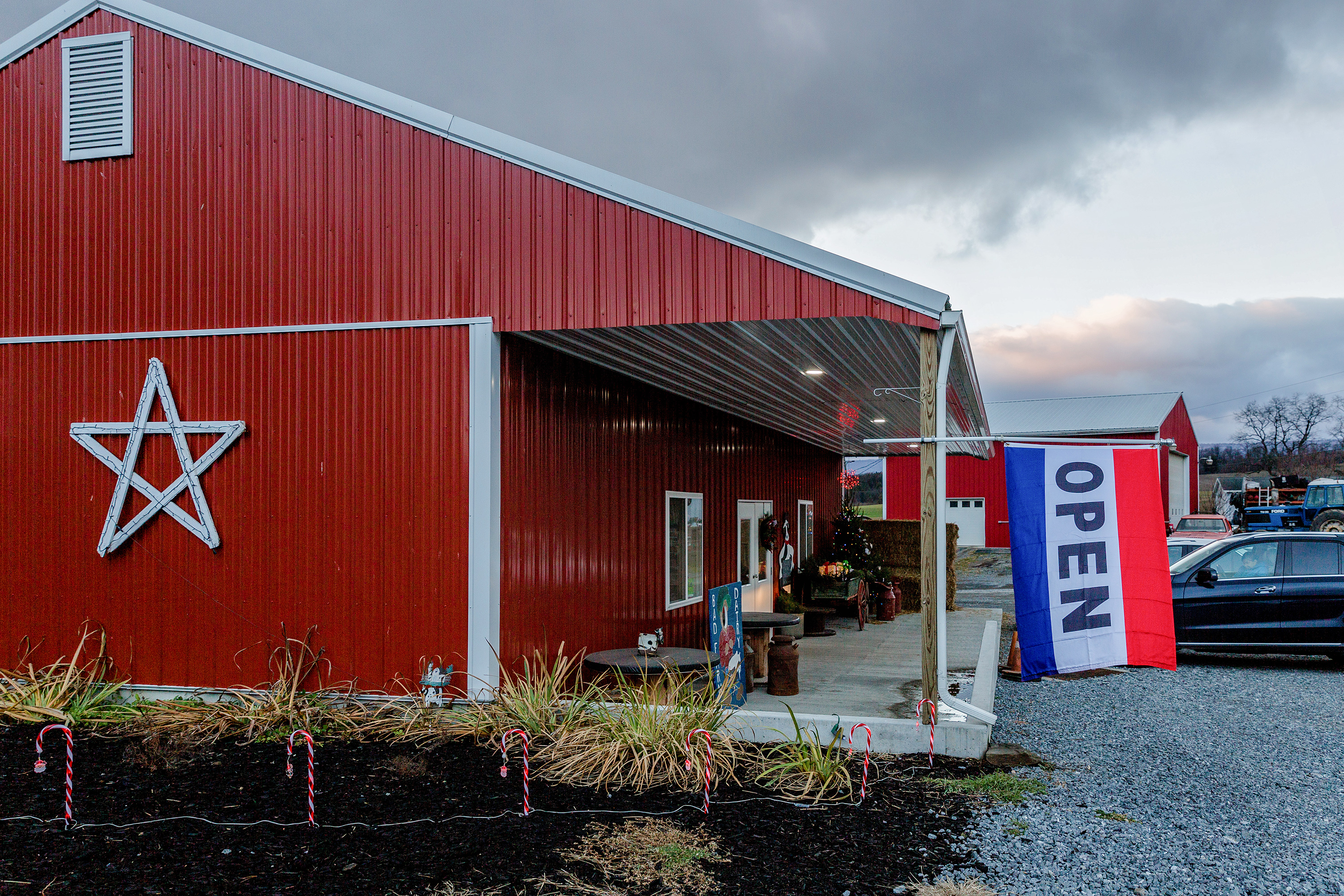
Almost 100 people dodged the raindrops on the first Saturday in December to attend the event at the store the Rice’s built on the farm in 2020 as they began offering more products.

But their journey began with selling just raw milk and eggs more than a decade earlier.

In addition to the store, BAD Farm products are sold at pop-up farmers markets in Emmaus and Lehighton. Jason’s dad manages the meat sales. His mom is the point person for the farmers markets, staying in touch with Kacey, who runs the on-farm processing of the items they do on-site and ordering those products that are processed for them elsewhere — all using the milk from their own cows.

The farm’s name gets some attention, notes Jason during a Farmshine visit Monday (Dec. 12).

His parents, Beth and Dave Rice (the original B and D Farm) found themselves and others abbreviating the initials BAD. Jason’s middle name is Dave and his wife Kacey’s middle name is Beth – so they kept the acronym after transitioning the farm.

Today, BAD Farm milk and dairy labels state the motto: “Where we DON’T live up to our name.”

“It’s a conversation starter at the farmers’ markets,” says Jason. “People remember it.”

When he came home from SUNY Mohrsville in 2009, it was a rough time for dairy farms. He already had a vision for the farm to get closer to consumers, and his parents already had done the work for a raw milk permit.

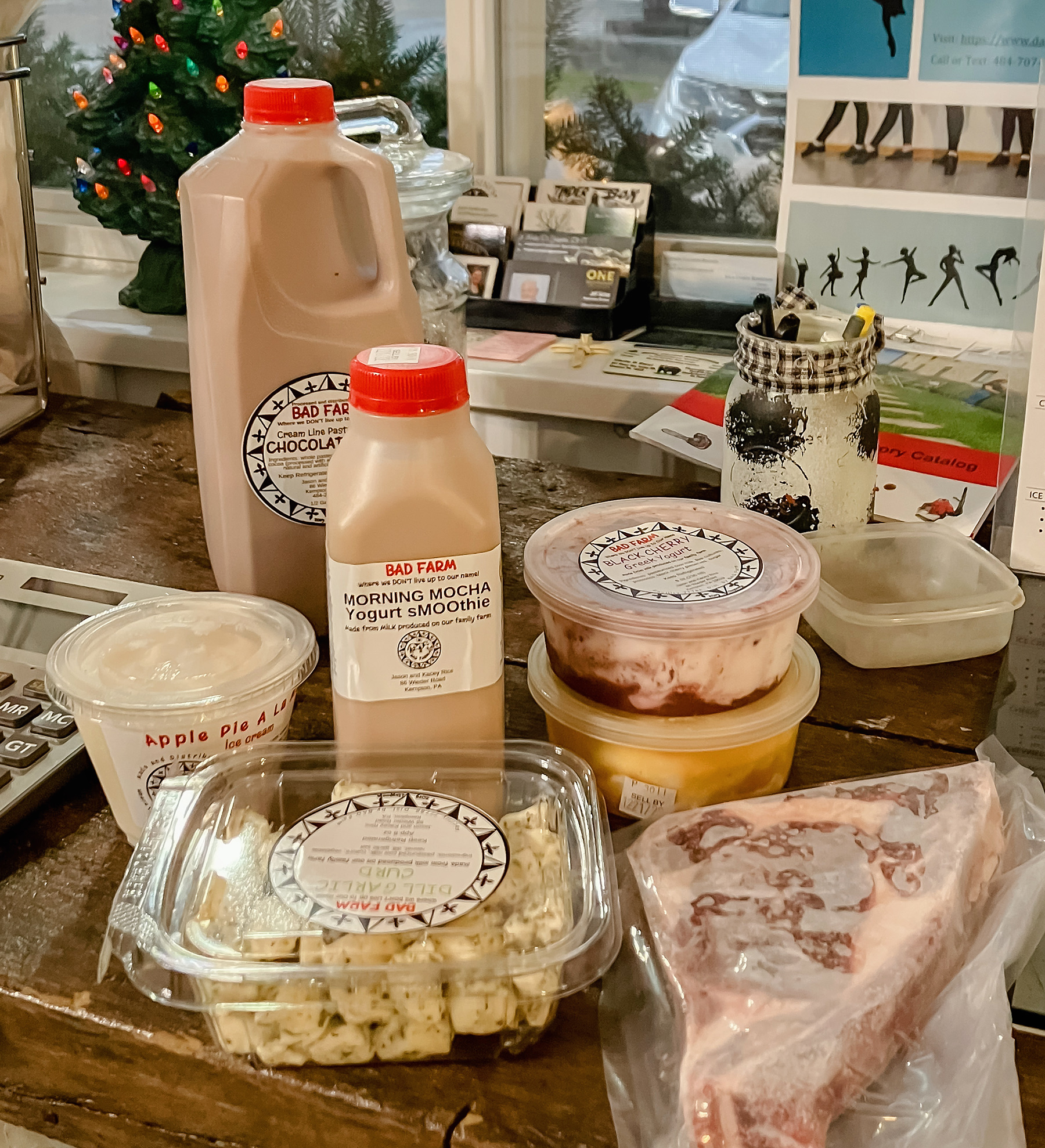
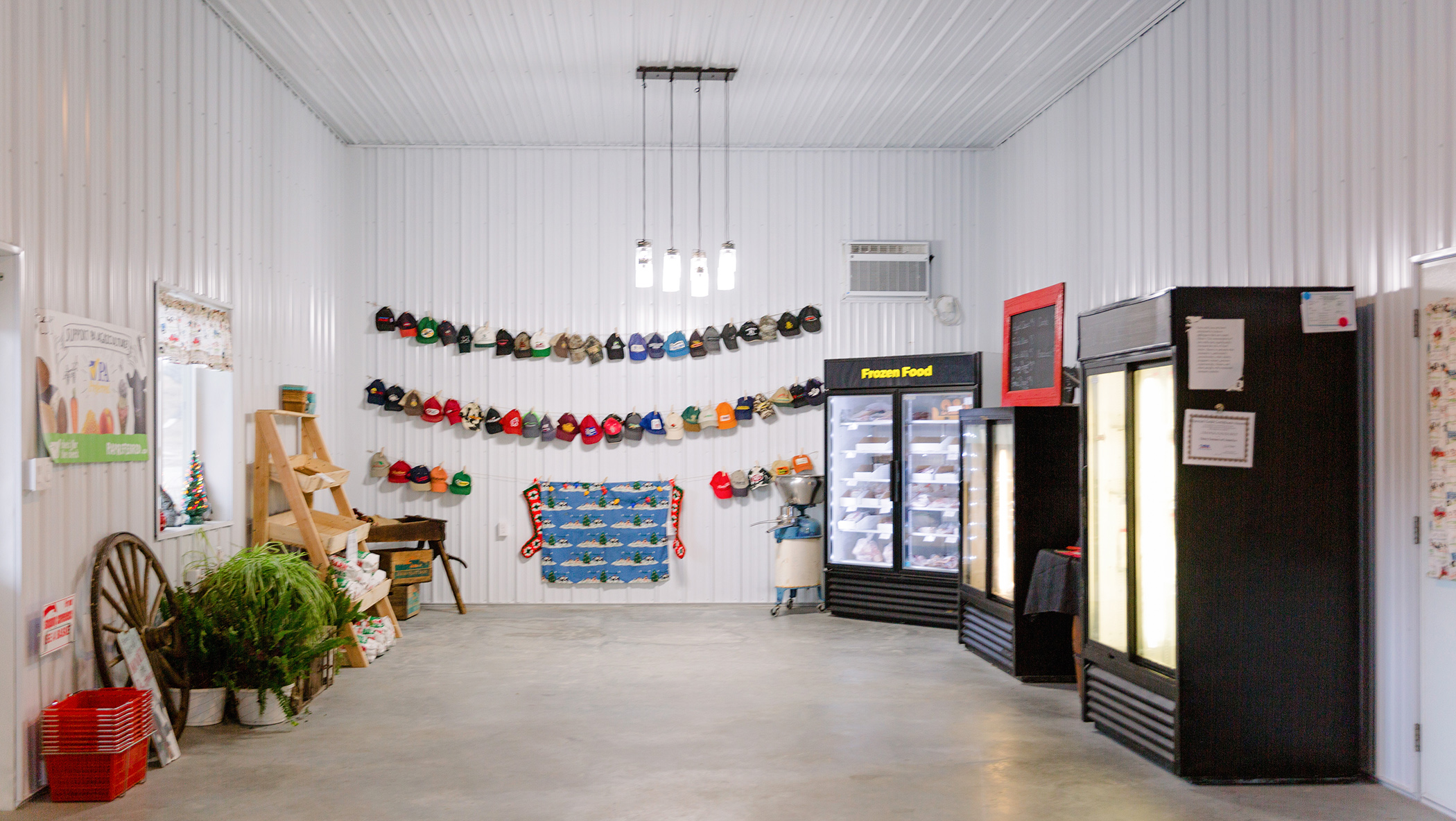
For more than 10 years, they sold raw milk and eggs in a tiny outbuilding by the barn and did freezer beef as well. Today, the coolers in the new farm store hold fruited regular and Greek yogurts as well as aged cheeses and cheese curds in some popular flavors — all made with their farm’s milk by two different processors. 

The beef in the freezer is from their own Holstein calves that are fed out at another location. The eggs are from their own chickens, cage-free but in a poultry building on the farm due to their location at the base of Hawk Mountain. The prepared meals are made for them by a commercial kitchen, featuring items like shepherd’s pie, meatloaf, quiche Lorraine – all dishes that use the dairy, eggs and beef produced at BAD Farm.

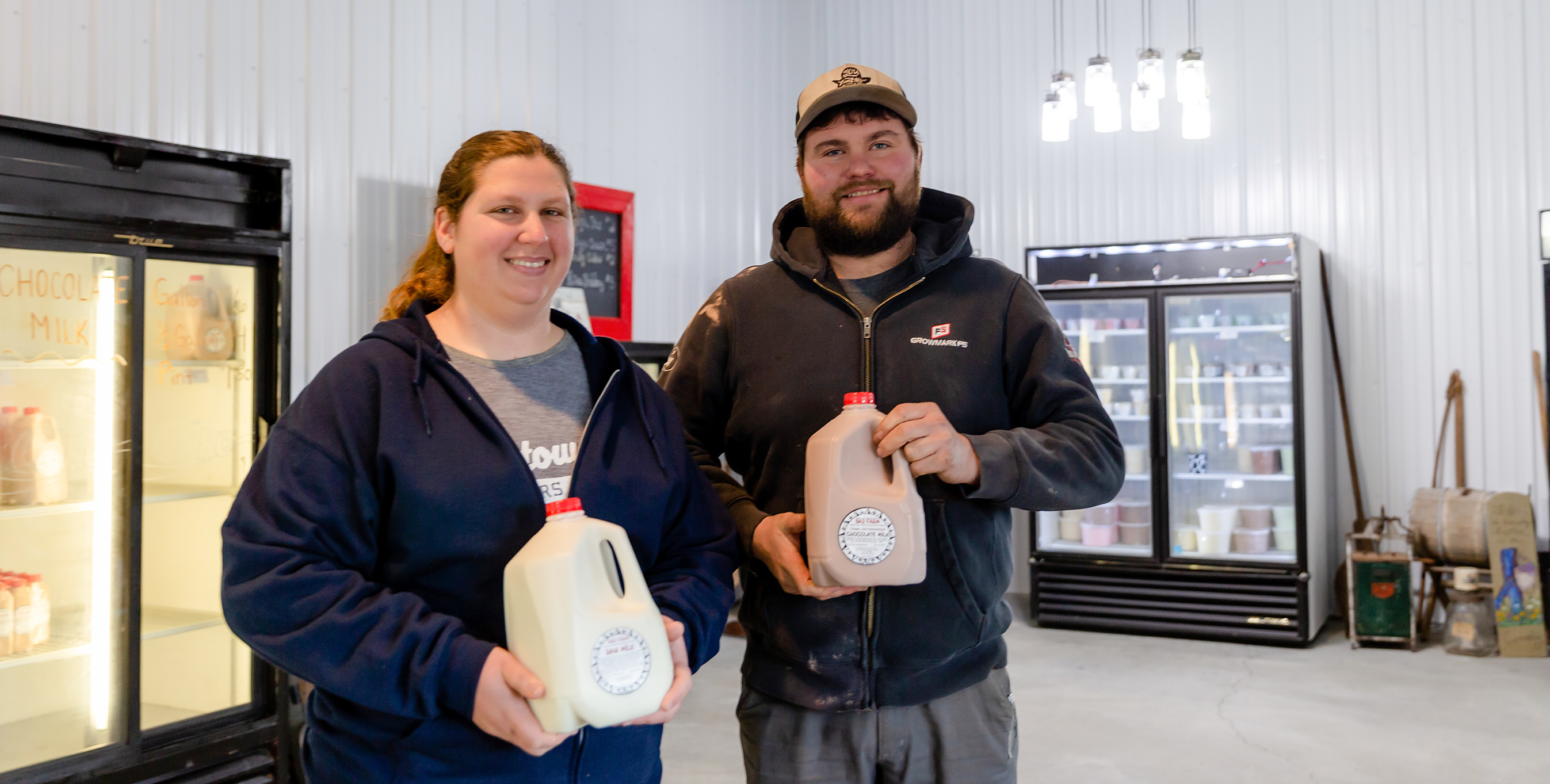
This year, they realized a dream making their own ice cream and chocolate milk.

In Pennsylvania, raw milk can be sold with a permit, but raw milk cream cannot. Jason’s ultimate dream of making their own chocolate milk and Kacey’s dream to make their own ice cream, from scratch, became reality when a Pa. Department of Agriculture innovation grant helped them invest in this processing infrastructure.

Previously, these products were made for them elsewhere. They have also started a line of coffee creamers, with peppermint in the cooler for the holidays, pumpkin spice in the fall, and traditional vanilla and salted caramel. They now do pasteurized creamline milk in addition to raw milk, and they offer yogurt sMOOthies, which are a big seller in fruit flavors, mocha, and a peppermint for the holidays.

For Jason, the chocolate milk is the big one. His enthusiasm about it is clear. It’s an area he has always believed the industry can do better. 

“We wanted to make a really good chocolate milk — something people can be proud to put on their dinner table,” he says.

(Yes, they succeeded. BAD Farm’s chocolate milk is super GOOD. I brought some home, and found it has a really smooth and silky finish to go with that creamy texture. I also took along a Mocha Morning yogurt sMOOthie, which was quite a treat, finishing it before I was 5 miles down the road.) 

As for the BAD Farm chocolate milk, it is a pasteurized non-homogenized creamline chocolate milk. It is 90% whole milk with 10% heavy cream added. They don’t standardize the whole milk, and their herd test is right around 4.0 butterfat.

“We found we could really pull back on the added sugar this way,” Jason reports.

With the processing infrastructure, Kacey was able to start making old-fashioned ice cream. “I always wanted to do ice cream from scratch, and the innovation grant helped with that,” she says. 

Kacey works with seven ice cream flavors, rotating in some seasonal specials. Her philosophy is to focus on quality and marketing and “getting the products to the people,” rather than trying to make every flavor under the sun. 

They shoot for memorable ice cream experiences. Their chocolate blast uses three kinds of chocolate for a signature blend. They work with orchards on custom flavors. They offer peaches and cream in the summer and apple pie ala mode in the fall. They rotate core flavors to keep it interesting. 

Neither Jason, nor Kacey, studied dairy processing specifically in college, but they learned concepts that contributed to their vision. They read, and ask questions, talk to peers and seek advice from those who’ve done it. They are constantly learning and looking for trends and ways to extend what comes from their farm — milk, eggs and beef – and turn it into what consumers are looking for. 

“We don’t have hired help except one high school employee to help milk,” says Kacey.  “Instead, we pay people to process some of the products we offer that are made with our milk while we are focusing on building our connection to consumers.” And they are gradually doing more of their own processing also.

“To do this, you have to want to talk to people. You have to want to have those consumer conversations. Our store is right in the middle of everything on the farm. People can see the cows as they walk down to the calf barn. They can see the farm tractors coming and going through the seasons. They see it all,” says Jason, noting that they don’t do group tours, as such, but “we’re here, and we’re available. We could be in the middle of doing corn silage and someone stops and has a question. We need to stop what we’re doing and talk to them. It’s a priority. That’s the commitment we make.”

And that’s okay with Jason and Kacey because connecting with consumers has been part of their vision for the farm since the transition began. 

With their on-farm self-serve store completed in April 2020, just as the Covid pandemic hit, the couple had to pivot quickly to meet customer demand for more staples and more products as consumers were faced with shortages in stores and became more tuned-into where their food comes from and were looking for things to do, places to go.

Being somewhat off the beaten trail, BAD Farm is a destination, not a quick stop on the way home from work, but the raw milk sales on the farm and the connections made at the farmers’ markets off the farm give the Rices core customer bases to build on.

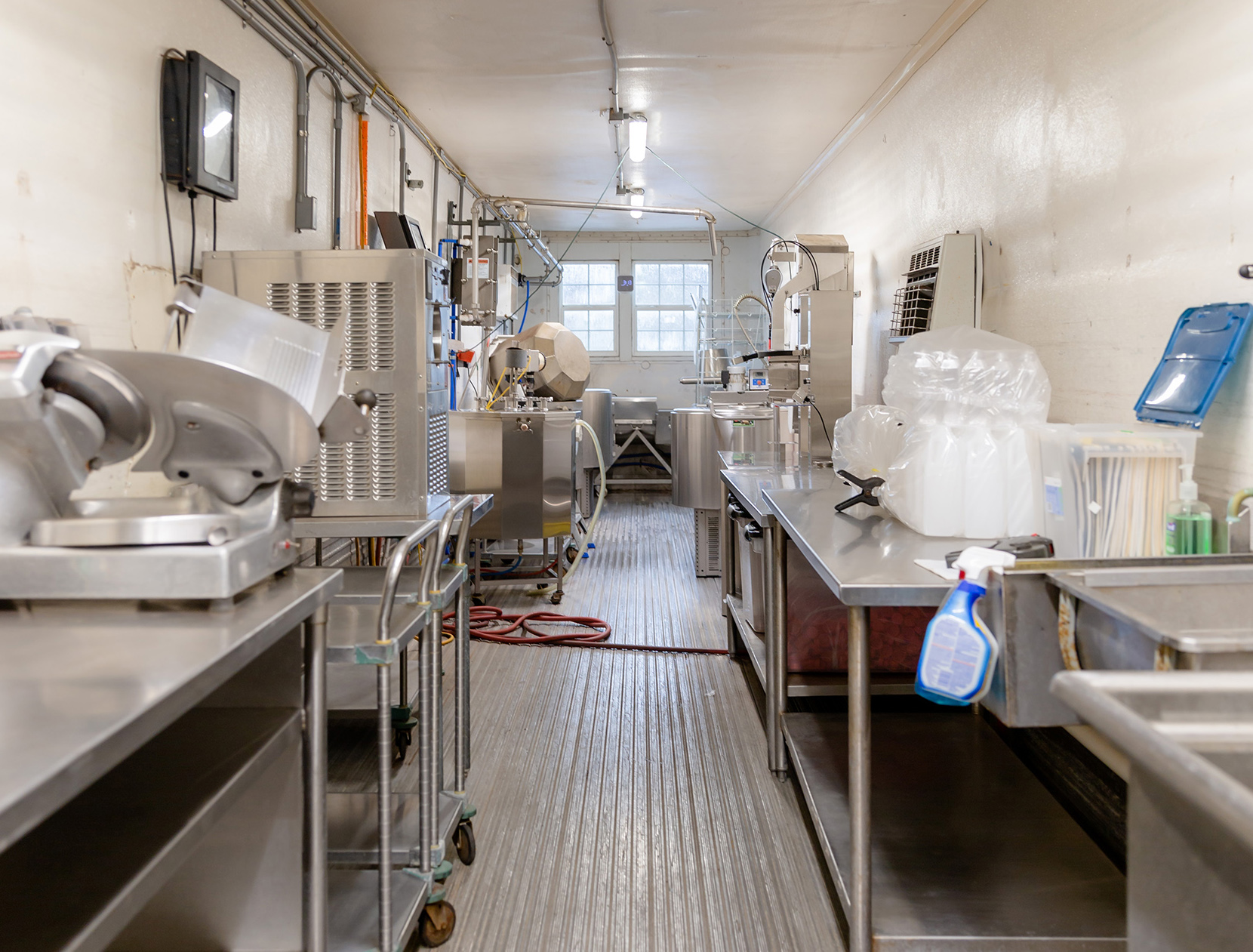
The store is built on the other side of the barn toward the house. The dairy innovation grant helped the Rices add processing with three uniquely incorporated trailers.

Jason’s grandfather David Rice, an electrician and retired contractor, came back for a long visit from Nebraska where he had moved many years ago (helping Jason’s uncle, Dan Rice, when he was still a partner in Prairieland Dairy, before the processing part of that business was sold).

The Rices had purchased a ‘processing trailer’ and revamped it with some new equipment to do the pasteurized creamline milk, chocolate milk and ice cream. They purchased a frozen foods trailer and turned it into their refrigerated storage cooler and another trailer for their storage freezer. The infrastructure adaptations are smart and practical. The three trailers back up into the back of the store building, with a buffer area for storage in between — and each with its own sets of sealed entry doors.

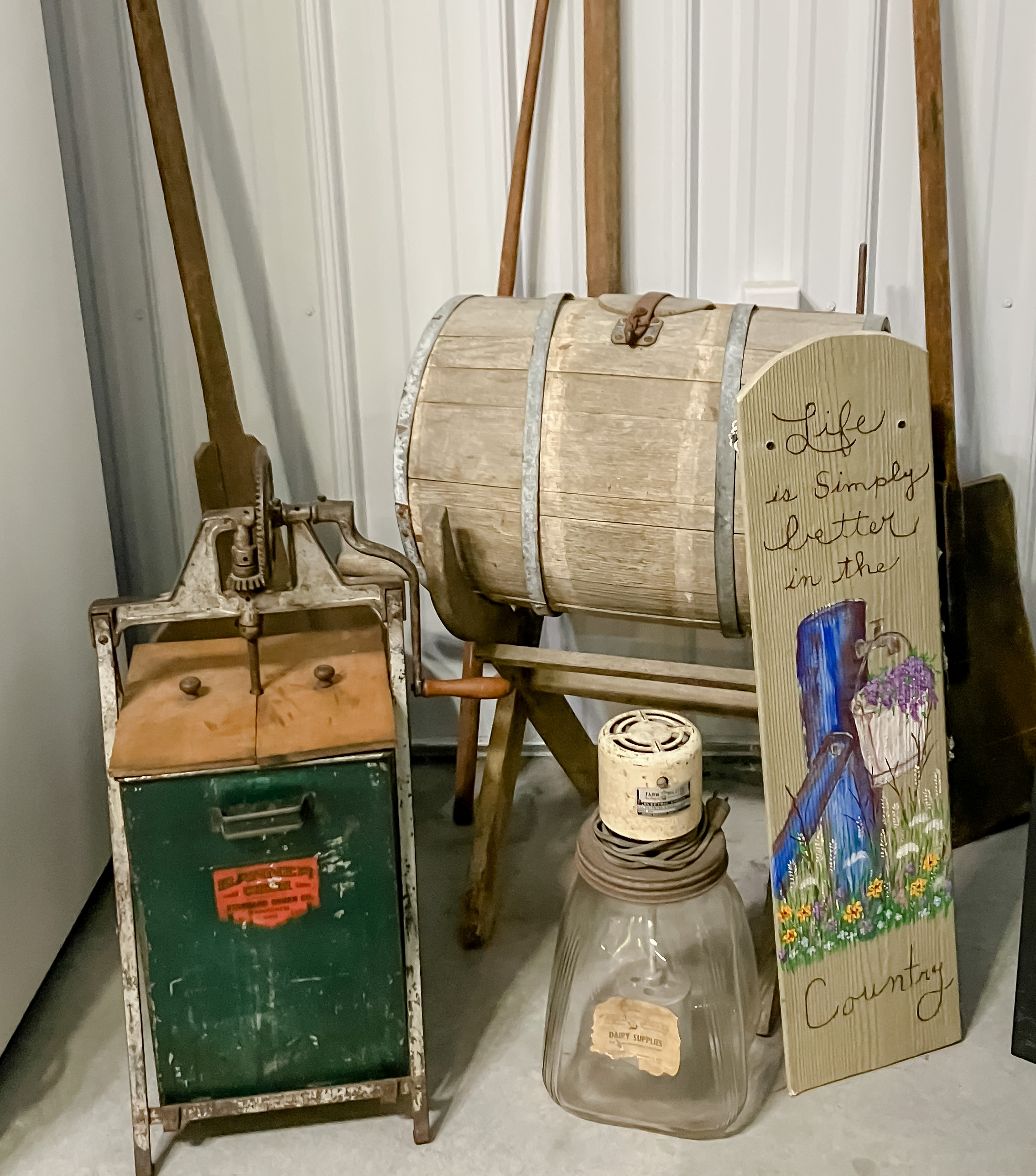
While grandfather David helped with the electrical work and mapping out the flow in processing, storage and retail, grandmother Gloria painted country art for the vintage displays of old farm and dairy equipment interspersed between coolers — giving the space that country store feel. 

Jason and Kacey have known each other since high school. He went to SUNY Mohrsville for animal science and ag business management. She went to Penn State for ag education. For the past 10 years, Kacey was an ag teacher, until August 2022. Now she is full time at the farm, where she enjoys the processing and marketing. They have two young boys, Emmit, 6, and Ellis, 4, keeping them busy as well.

As their dream progresses, the Rices are methodical, taking incremental steps with eyes on how they invest and where they put their focus to continue diversifying, while staying rooted in using the dairy, eggs and beef produced on BAD Farm, where they DON’T live up to their name. To be continued.

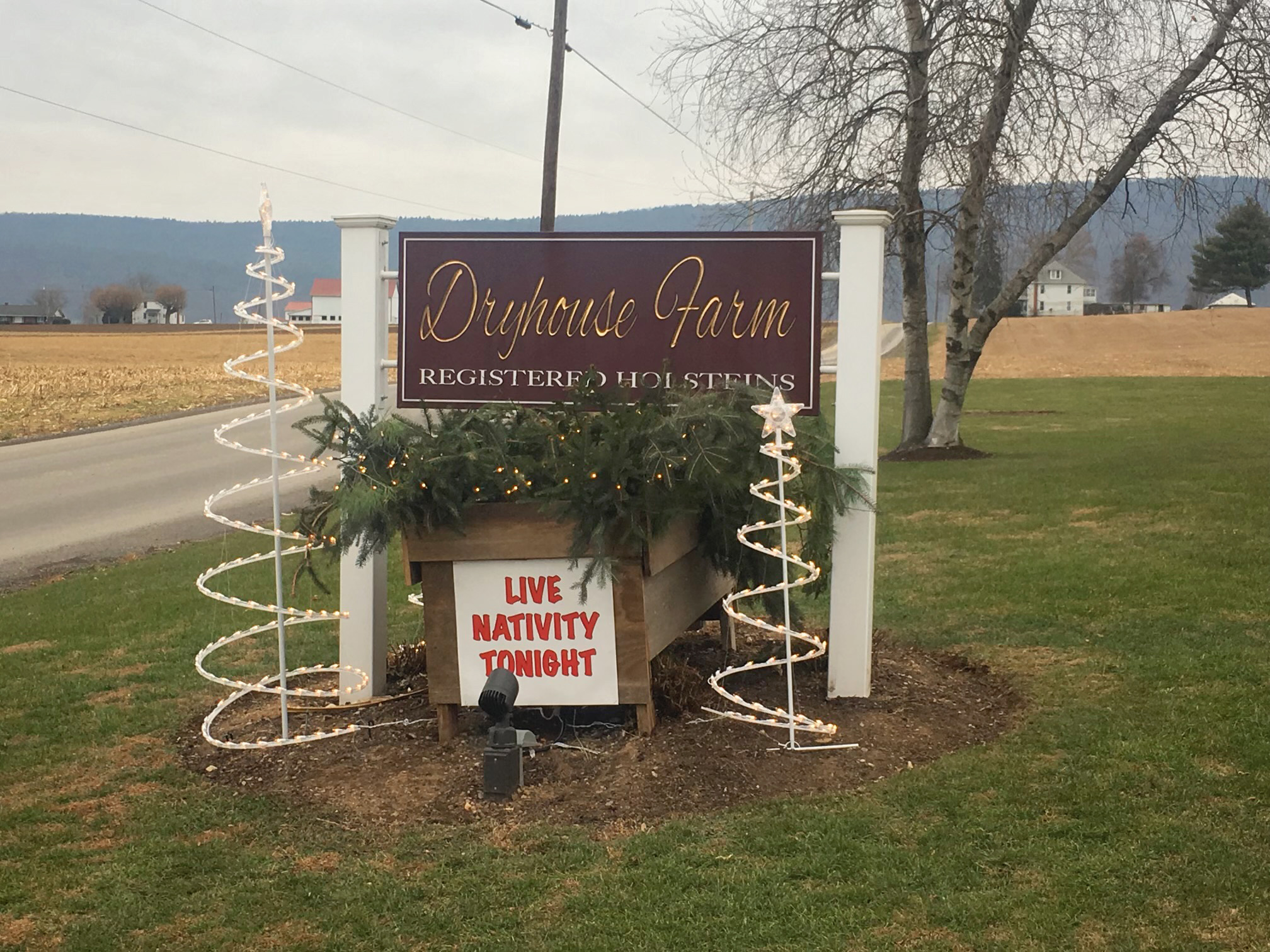
Live Nativity performed at Dryhouse Farm Dec. 22-23

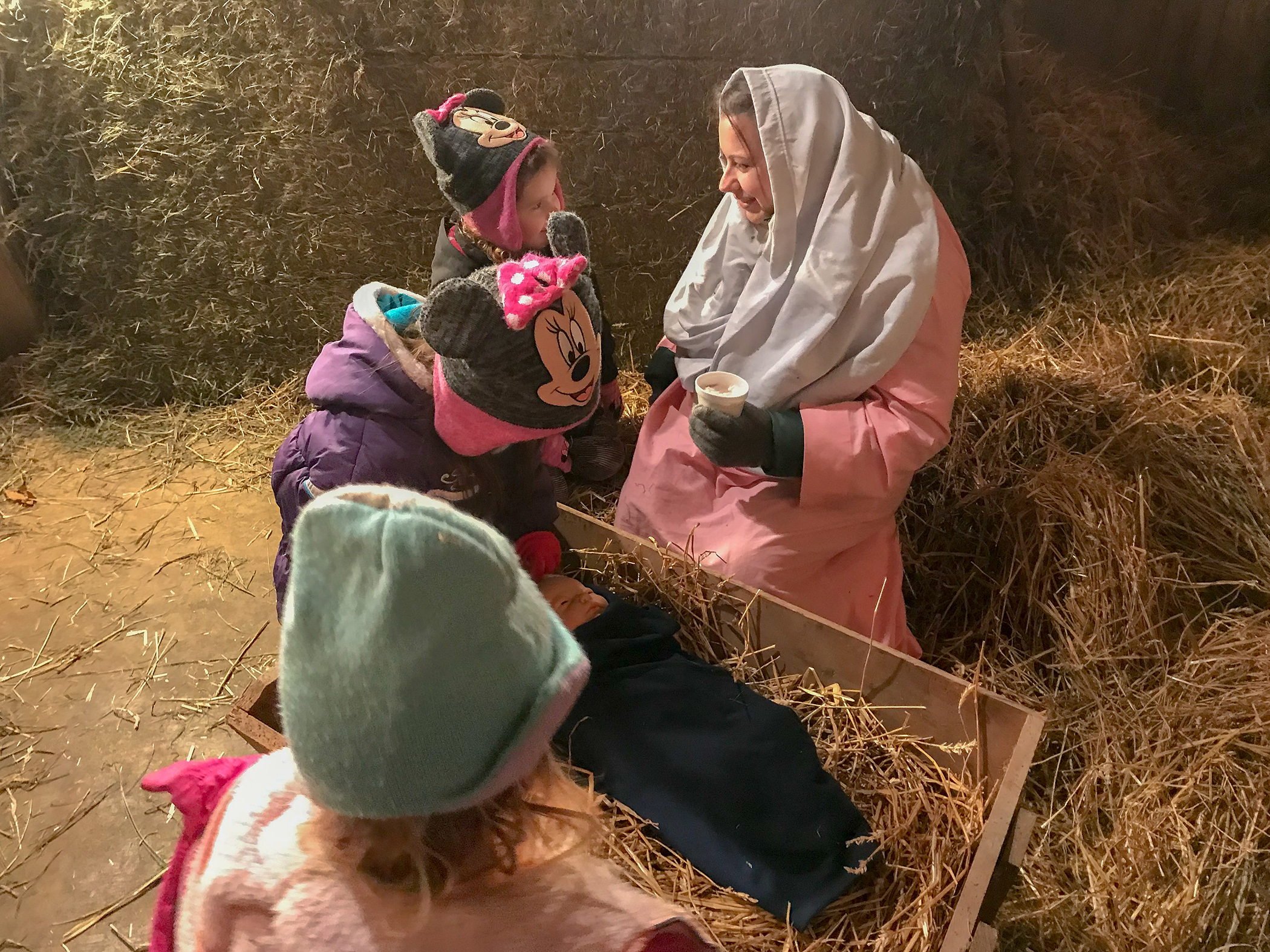
The ‘realness’ draws crowds as Christmas, cows, farming, fellowship are shared. Yoder family has been providing this free community experiences for 7 years.

By Sherry Bunting, Farmshine, December 16, 2022

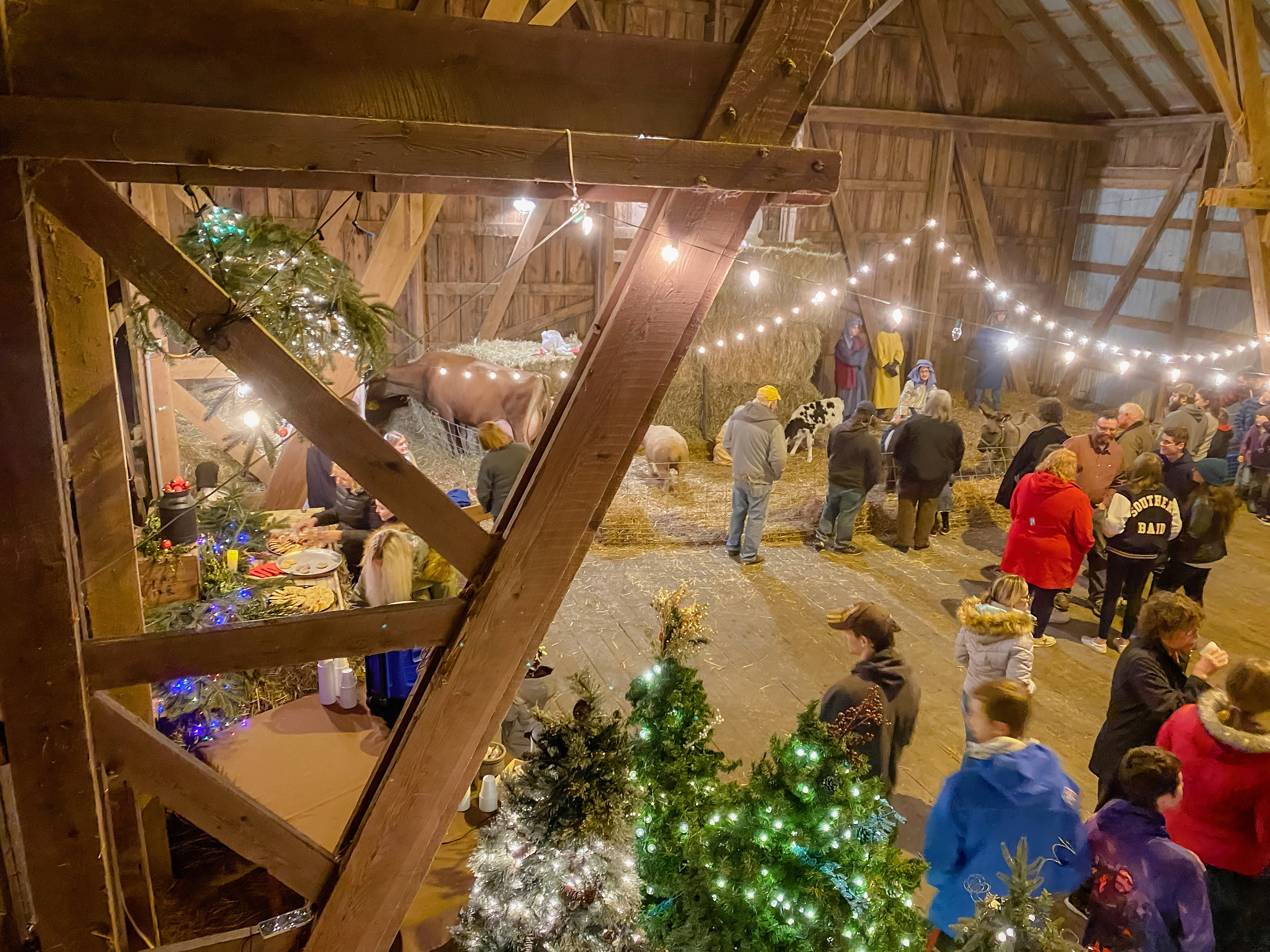
BELLEVILLE, Pa. – “As long as they keep coming, we’ll keep doing this,” says Mike Yoder about the Live Nativity in its seventh year at Dryhouse Farm near Belleville, Pennsylvania.

It’s always on the Thursday and Friday evenings before Christmas, with this year’s Live Nativity falling on December 22 and 23 leading right up to Christmas Eve and Christmas Day. The times both evenings are 5:00 to 8:00 p.m. (Update: Dec. 23 showing is canceled due to the storm on its way, Dec. 22 going on as planned)

“We like that we are bringing the public to the farm and have the chance to share part of our world with others,” says Mike in a Farmshine phone interview this week. “We also like that this is becoming part of the family Christmas traditions for many people. We get calls weeks and months ahead from people wanting to get the dates on their calendars.”

For Mike and Maria Yoder and their four children Natalie, Paul, Grant and Cade, the preparations are underway this week. They’ve started moving bales, sweeping and cleaning the bank barn, recruiting volunteers to take shifts being shepherds and cast, and there’s a lot of coordination with the refreshments – mainly cookies, hot cocoa and coffee, plus kettle corn this year.

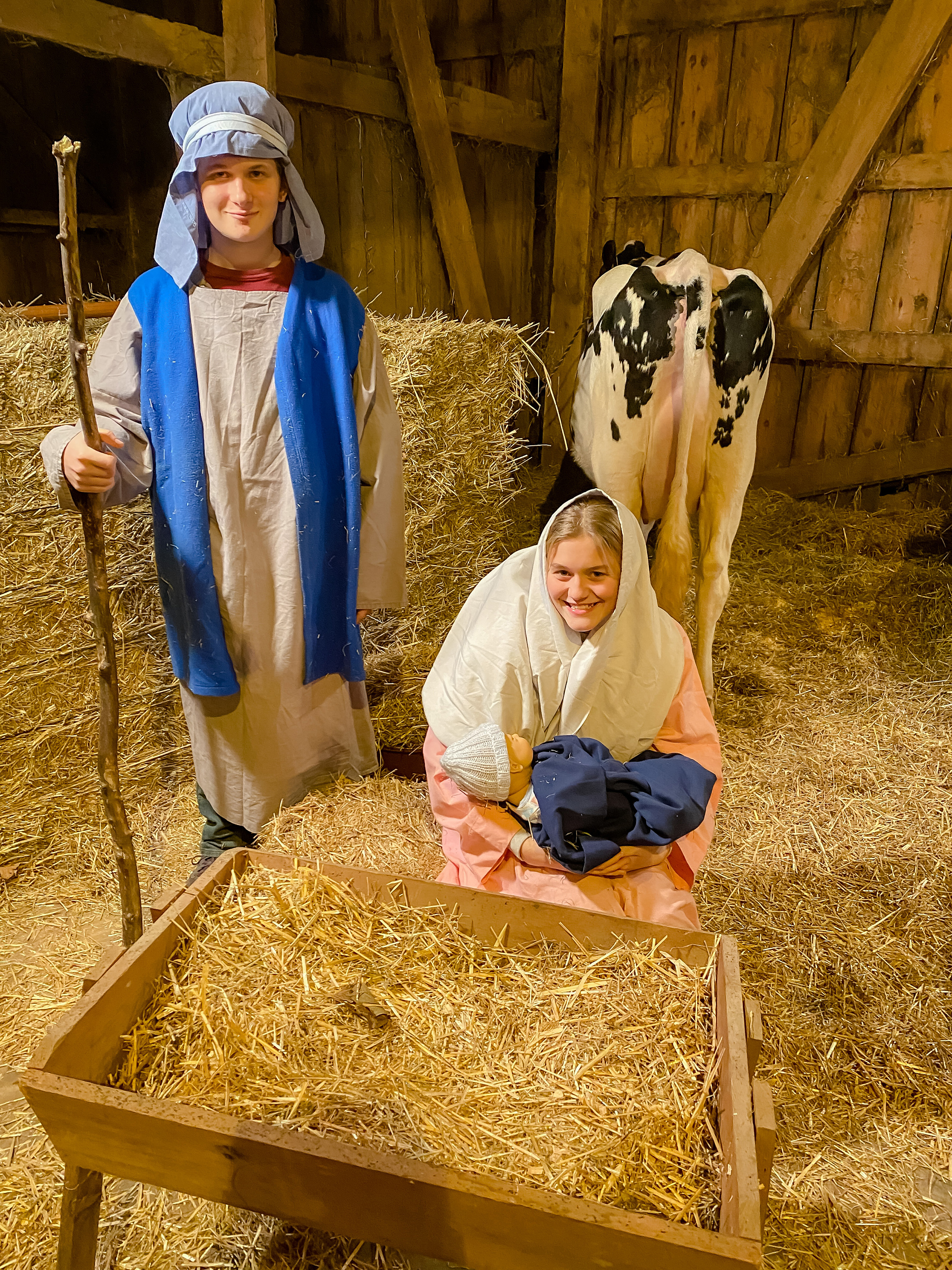
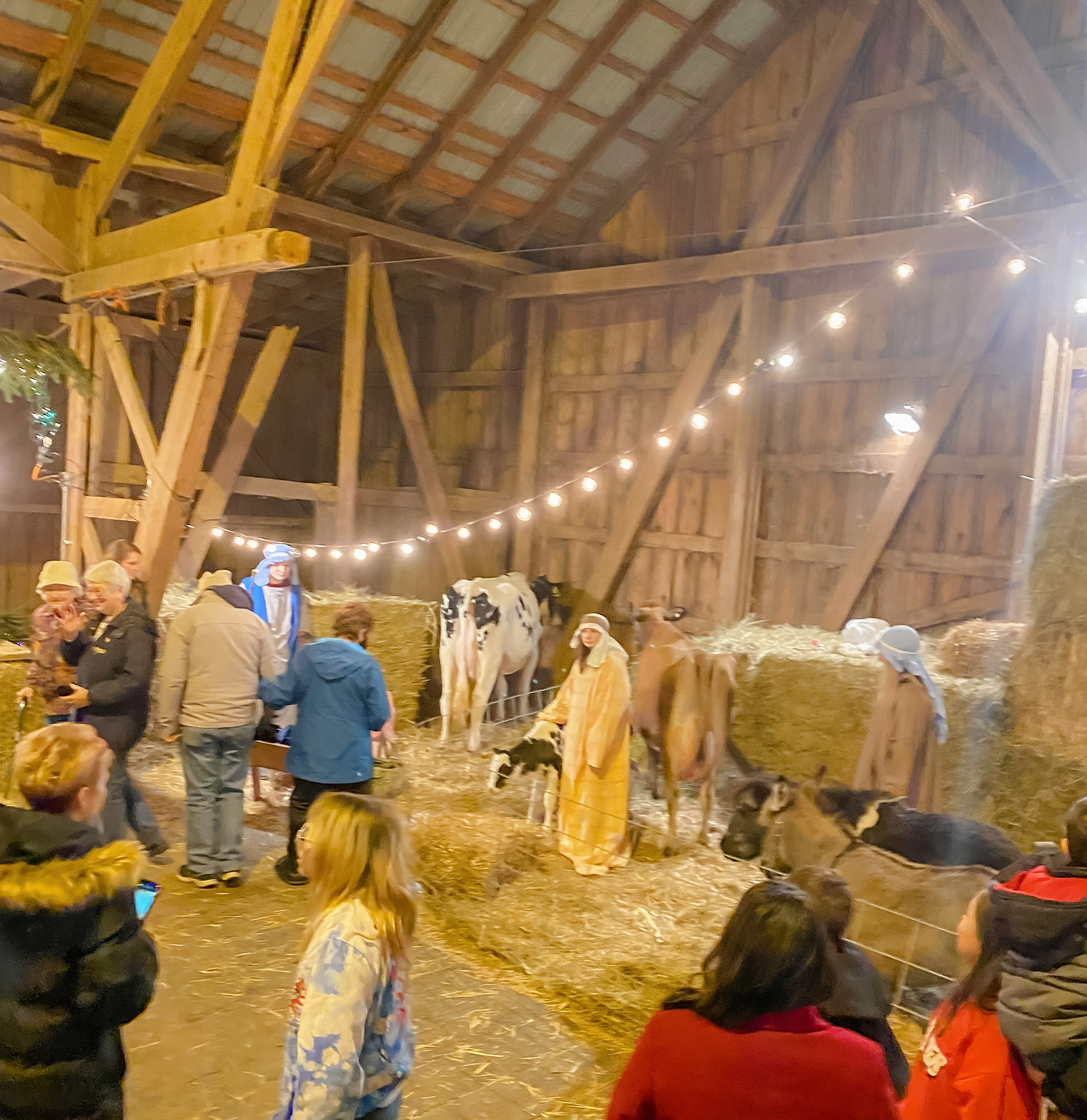
Mike makes a ‘show pack’ for the scene with a cow tied behind Mary and Joseph and several calves and the cast. They use a show cow that is accustomed to being handled on a show pack with crowds.

The main Nativity scene has a 3-foot wire fence around it, but people can reach in to pet the animals.

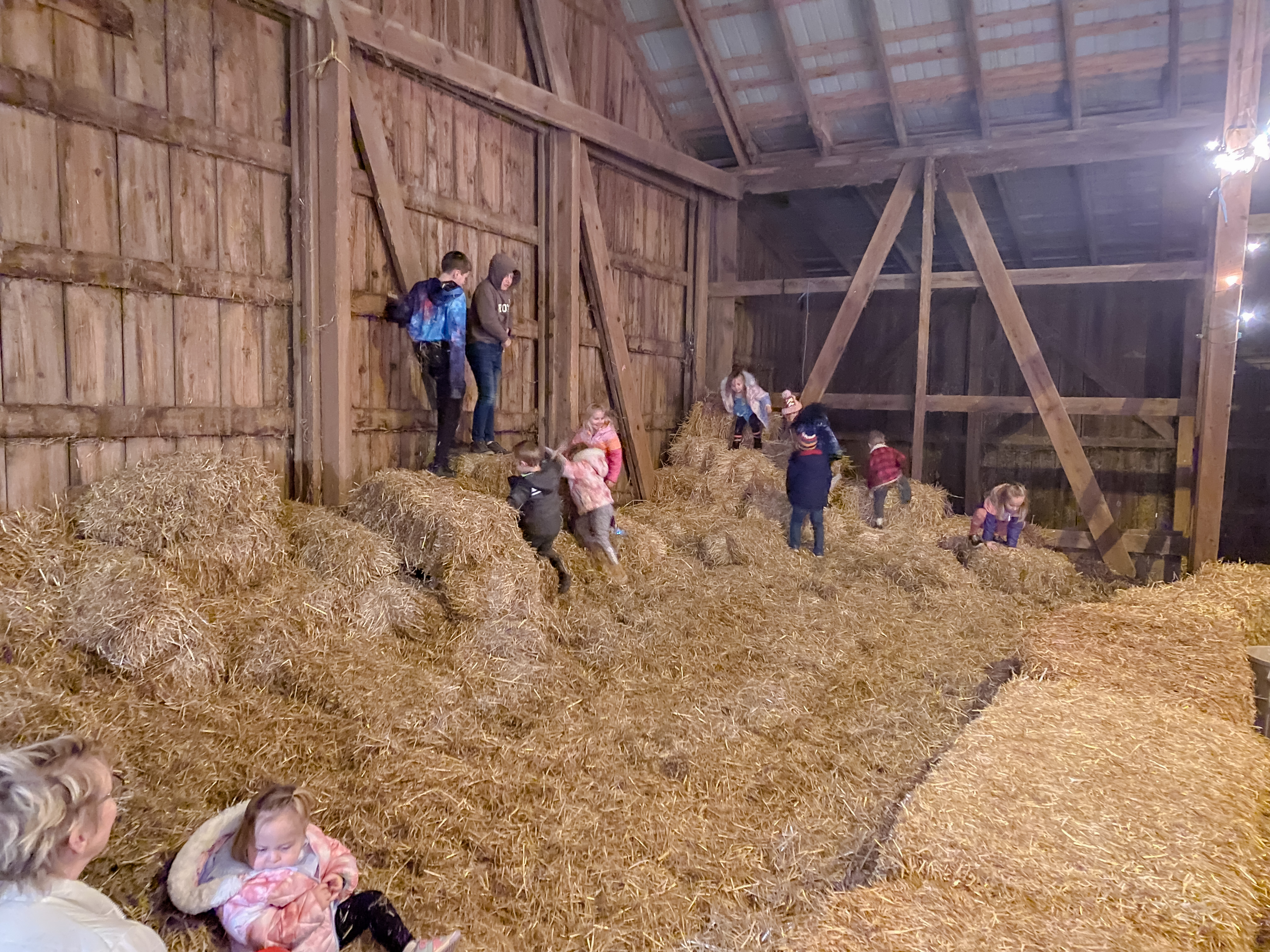
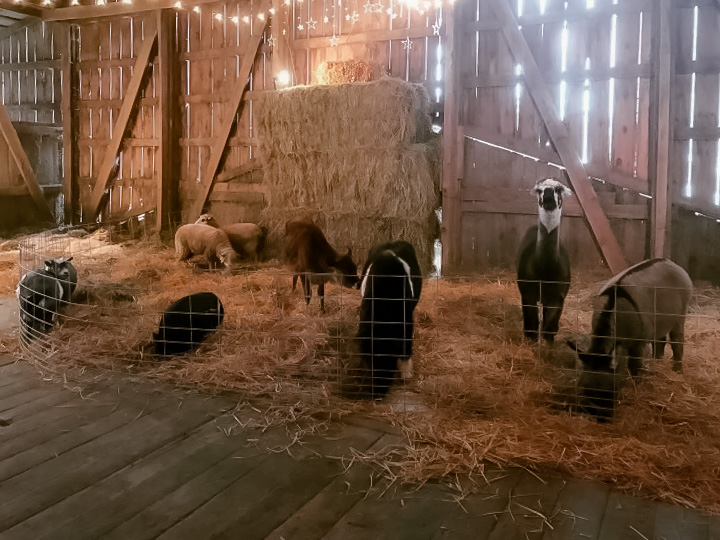
“We’ve added a petting area where kids actually get in with the animals, and we try to add some different animals every year,” says Mike, noting that last year, they had rabbits. “We also have a straw pit to play in.”

Christmas music plays in the background, some tables are set up for visiting, and the walk-through flow leads to refreshments at the welcome tent.

Of the nearly 700 people of all ages and backgrounds who attended last year, many were families with young children, and many come from the nearby retirement village and nursing home.

“The nursing home is close to us here, and we get a lot of older people from the cottages,” Mike confirms. “We have extended families coming together here, and we expect to have more of that this year. We have people come from two hours away, from southwest Pennsylvania, and we even had a family come down from New York to see it. We never know who is going to pop in.”

For the first few years, the Yoders advertised the Live Nativity in newspapers and on the radio, but now it is by word of mouth and through social media.

The event is free, and Mike says they firmly want to keep it that way.

“We have some that want to make donations, and in 2020, we gave those donations to the nursing staff at the local nursing home because we didn’t start this to charge for it,” he said.

What better celebration of the meaning of the season than with a Live Nativity — in a real barn on a real farm?

“It’s real for people in a barn. It’s cold, and there’s cobwebs, and there’s animals below us, and it smells like a barn, so it’s that realness,” says Mike.

People respond to this. It makes an impression. While the 190 milking and dry cows are housed in newer facilities, the youngstock are housed in the bank barn just below the event.

“The other part of this is the educational factor, getting people onto a farm,” Mike explains, “It’s amazing how many of these kids have never been up close with a cow.”

He makes another important observation, that the farm-to-consumer disconnect is not just an urban phenomenon, it’s within rural communities also.

“We don’t have big cities close to us,” Mike relates. “But even rural kids grow up without contact with cattle and other animals that we take for granted.”

While the family is busy running the dairy farm, and all four children play basketball at school, everyone knows “this is just what we do,” says Mike. “The kids’ friends often like to help and dress up, and we have people from our church wanting to help too.”

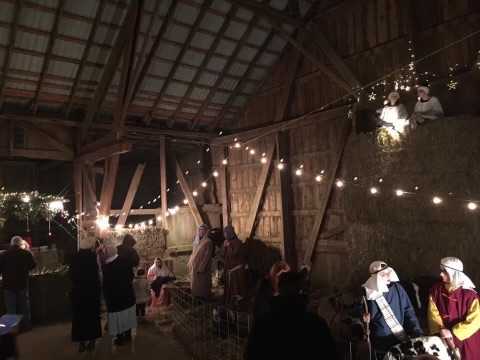
Everyone has a role and a job. The ‘angel’ sitting up high on stacked hay bales, for example, is the ‘counter’ to help keep track of attendance so they can plan each year for the growth in the number of people drawn in.

Why did the Yoders start doing the Live Nativity in 2016?

“At that time,” Mike recalls, “we had a donkey, a llama, some goats and a pony. Someone made a joke that we should do this, and that’s where it all began.”

The offhand suggestion got the wheels turning for Mike and Maria. They had the old bank barn where they have had events for church groups and the community. They thought, why not?

For the first couple years, they did the Live Nativity for just one night. As attendance grew, they added a second night.

During the Covid-19 pandemic in 2020, they did it as a drive-through, with stations set up in different themes around the farm, handing out cookies and hot chocolate as the cars went through. The first night was canceled that year due to a snowstorm blanketing the area with a foot of snow. But the next night, they were ready.

“We were surprised. We had 150 cars come through that one night. People were really looking for things to do that year,” Mike recalls.

In 2021, and again this year for 2022, they are back to the walk-through Live Nativity experience inside the bank barn.

The Yoders have been dairying here since they moved to Belleville in 2007, eventually taking over Dryhouse Farm for Ray and Lester Yoder (no relation), who were looking to transition out.

Mike and Maria worked for them for a year and rented the farm for four years. In 2013, they purchased the farm, having already purchased the original herd, which they grew to 190 cows. They also merchandise cattle and have sold bulls to A.I.

The Yoders bought into some good cow families and developed their Dryhouse-M prefix to keep their genetics separate from the original Dryhouse herd. There are several good cow families milking here, including one of cows they bought with the original herd that recently passed away at age 17. She was a 5E 93-point cow with numerous high scoring offspring on the farm today.

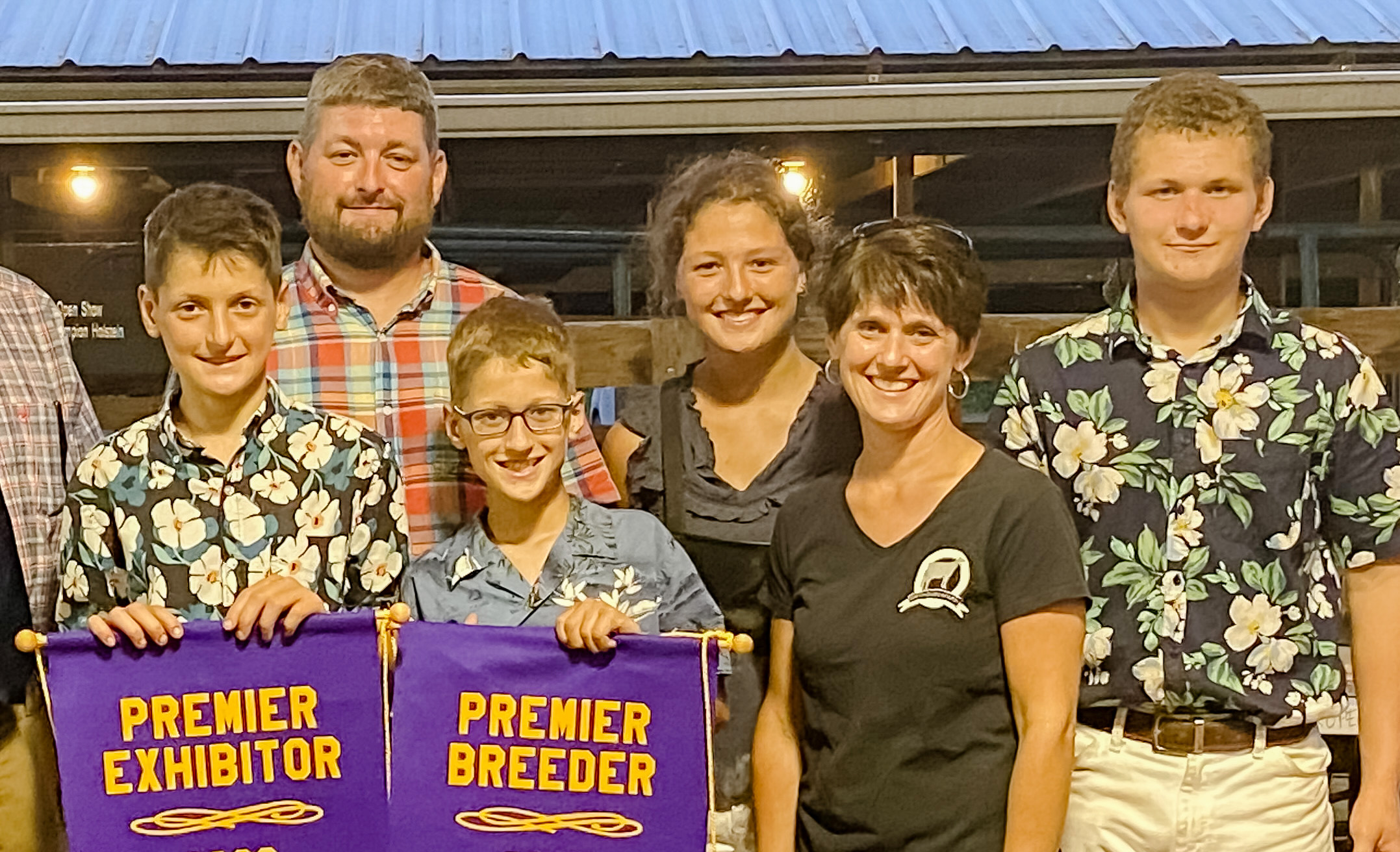
In addition to their registered Holsteins, the Yoders have gotten into some colored breeds as their children began showing. They go to the Mifflin County show, where they were premier breeder and exhibitor this year, and to the Central Pennsylvania Championship in Centre Hall, where they were premier exhibitor last year. They also show at Harrisburg every year, and in some years, they show at Louisville and Madison.

Aside from the Live Nativity at Christmastime, the Yoders have hosted other community and farm events.

This year, they had Mifflin County Farm Bureau’s third grade agriculture tour with 500 third graders on the farm all at once in September. They’ve hosted career events for the local school district, and they were a tour stop for the National Holstein Convention when it was in Pennsylvania in 2021.

-30-

On-time farm bill is Chairman Thompson’s top priority, areas of USDA oversight also rank high

By Sherry Bunting, (Nov. 25 interview has been updated since Thompson’s official caucus election to Ag Committee chairmanship)

WASHINGTON – With Republicans securing a slim majority in the U.S. House after the midterm elections, Congressman Glenn ‘G.T.’ Thompson (R-Pa.) is preparing to move from ranking member to chairman of the House Agriculture Committee when the 118th U.S. Congress is sworn in for the next legislative session on January 3, 2023.

The House Republican Steering Committee made it official December 7, selecting Thompson incoming Ag Committee Chair, the first from Pennsylvania since 1859.

Outgoing Chairman David Scott (D-Ga.) expressed his appreciation to fellow committee members, sharing in a statement: “As I prepare to hand the gavel over to Mr. Thompson… I am encouraged by the bipartisan work we have accomplished together, particularly around our shared interest in broadband and access to USDA programs for our new and small producers. Heading into the 2023 Farm Bill, I am hopeful and prayerful that the collegial spirit will continue and that the Agriculture Committee will be able to deliver a farm bill with strong Republican and Democratic bipartisan support.” 

A first order of business for incoming Chairman Thompson is to host his first official 2023 farm bill field hearing on the first Saturday of the Pennsylvania Farm Show, January 7 in Harrisburg.

Thompson has had a long history of holding listening sessions during the Farm Show and bringing with him some committee members from other states. This time, he’ll be looking at a larger venue at the complex, and he’s inviting all Democrat and Republican members of the House Ag Committee as well as prospects.

“The committees won’t be fully populated by then, but the chairmanship will be confirmed,” said Thompson in a recent Farmshine phone interview.

“The most important priority is the on-time completion of the 2023 farm bill as the current farm bill expires at the end of September 2023,” says Thompson. “Certainly, beyond that, we have oversight functions that are really important too.”

One of those areas of oversight, he explains, is the House and Senate Republican request already sent to USDA Secretary Tom Vilsack asking for an audit on “all the pots of money” in USDA that have come through executive actions and the spending in bills passed by the Democrat majority.

“We are asking for this audit because we believe it will be helpful going into the farm bill process to see those funds outside of the baseline,” Thompson explains. “We’ll be following up and looking forward to getting that information.”

In addition to bringing USDA in for oversight within and outside of the farm bill process, Thompson mentioned the leadership will want EPA Secretary Michael Regan to explain the things EPA has been advancing that are creating uncertainty and problems for America’s farmers and ranchers.

Outside of the funding for USDA conservation programs, Thompson says he is “absolutely opposed to making (the farm bill) a climate bill.”

It’s going to be busy in Washington D.C. after January 3, but he says he remains committed to bringing the Whole Milk for Healthy Kids Act forward again with potential legislative improvements.

“We’ll jump on whole milk right away, but it’s not in the farm bill, and it’s not in the Ag Committee, it’s in the Education and Workforce Committee,” Thompson explains, noting that he will be a senior member of that committee also, and will work with the chairman.

He reports that the Republicans had teed up a version of the childhood nutrition reauthorization last summer in that committee, but their bill and their amendments to allow whole milk and 2% milk in schools and in the WIC program did not make it into the version passed by the House on party lines.

The good news is the House Democrats’ version of the childhood nutrition reauthorization, without the whole milk provisions, also did not advance through the Senate, so it will be a do-over next session.

“Let’s hope the third time is the charm,” says Thompson. “I remain hopeful we can do it through that. My goal is to work hard to get it in as part of that base bill and go from there. We’ll need bipartisan support in the Senate, where the childhood nutrition reauthorization requires 60 votes.”

The Senate remains split down the middle with an edge to the Democrats in terms of committee leadership in the next Congress.

Back to the farm bill priorities, Thompson said protecting crop insurance as well as other crop and livestock protection products like Livestock Gross Margin (LGM) and LGM-Dairy as well as Dairy Margin Coverage (DMC) and support for DRP are front-burner. Enhancing them — where possible — ranks high on his list.

Along with that, he says the committee is learning from the disaster payments that have been made outside of the farm bill baseline to be looking at how to incorporate more of that relief in a way that provides certainty for farmers and ranchers and for the lenders providing them with access to capital.

Another priority will be to look at the Title I reference prices for commodities.

“With record high inflation, the challenge is not what is paid, but the margin left at the end of the day,” says Thompson.

“There’s really no part of the farm bill that’s ‘unimportant.’ The nutrition help is important to give a hand-up to those in need, and to be using this to provide access to career and technology education so people can rise above their financial struggles,” he explains.

When asked about milk pricing reforms in the farm bill, and the change made to the Class I mover in the previous farm bill, Thompson said: “It’s all on the table. No conclusions have been drawn yet. As we do these listening sessions and hearings, this is where we’ll decide what the tweaks will be to areas of the farm bill.”

Asked what he thinks about the talk coming out of the COP27 in Egypt this week, of the U.S. pledging to pay $1 billion in reparations to other countries for climate impacts – noting that China is being exempted from paying such reparations because of still being defined as a ‘developing’ nation — Congressman Thompson was blunt in his response.

“It is absolutely ridiculous. We should not be paying for that. The United States of America leads the way in the reduction of greenhouse gases, and a big part of that is because of our farmers and ranchers. They are our climate heroes, and they’re not getting enough credit for that, for what they are already doing,” he said.

In a follow up question about the ESG scoring and the Securities and Exchange Commission (SEC) proposed rule to track scope 3 emissions back to the farm level, Thompson observes: “Those are political-science driven policies with no place in American agriculture or American finance for that matter.”

When asked about the $11.4 billion in annual funding the President pledged at COP27 for climate transitions in other countries, Thompson added: “We would be funding some of the dirtiest economies in the world. It’s not our role to do that.”

The House controls the ‘purse strings’ so to speak, so this could be a show-down.

Given how CBO scoring of baselines is sometimes a hair-splitting mechanism in a farm bill negotiation, what was implied, without being specifically said by the incoming Chairman, is that some of these climate funds going elsewhere with no accountability might best go to making sure America’s farmers and ranchers have the certainty and backing they need to continue as American food producers. That, in itself, is good for climate and the environment.

Stay tuned.

-30-

COW TALK: Thoughts inspired by cows’ breath on cold morning

By Sherry Bunting, republished from Farmshine, November 18, 2022

These cows are wondering what’s going on. Five days ago, they enjoyed balmy 70-degree temps. This morning, they could see their own breath freezing in mid-air.

They’ve been listening to their farmer’s radio this week and heard that President Biden pledged to give $11.4 billion ANNUALLY to other countries for a climate transition. They heard that climate pledges were being made at COP27 that could make what is happening to some of their friends in Europe happen here in the U.S. to them too.

This got their attention because they’ve also been hearing how the methane in their burps is being overblown by a whopping 3 to 4 times its actual warming potential over 20 years.

(They could have told you that if they could talk).

Yep, they know they are getting a raw deal here. Even the world’s foremost authorities on what units of measure to use for methane agree that the GWP100 is overblowing the cow problem, whereas the GWP* they hear Dr. Frank Mitloehner talk about when their farmer has a zoom webinar airing within earshot is more accurate and gives them a chance to be the SOLUTION they know they are instead of the PROBLEM they know they are not.

But cows can’t talk, so they can’t stick up for themselves. Are we sticking up for them?

Bessie and her friends have heard that their farmer must pay 15 cents for every 100 pounds of milk they make to an organization in Chicago that is content to use the inflated unit, content to keep driving their net-zero talking points even though net-zero GHG is impossible because, well, because cows continue to breathe and burp, so getting the unit of measure correct may literally save their lives some day.

Even their tiny cow-sized brains are smart enough to know that inflating a problem to make a buck is not a good idea.

What is a good idea for the cows and their farmers, and for the world, is for the 15-cent-takers to change their narrative and talk about true warming potential and climate neutrality instead of net-zero, ad-nauseum.

One can sense these cows wish they could speak up to say: “Stop overblowing our burps please! It’s impolite!”

They might even say something like this: “Our ‘hot air’ is nothing compared to the steam rising off the loads of bull coming out of Washington, D.C. and COP27 in Egypt!”

These cows have also heard on their farmer’s radio station that the mid-term elections are still undecided as to what party will be in leadership of the People’s House. And yes, they’ll admit that over the past eight days, they’ve placed a few bets on the outcomes between mouthfuls of TMR at the feedbunk where they discuss current events.

They’ve even wondered if they should start a new political party of their own: the COW-MP party, which stands for Commonsense Organization of Whole Milk Producers. After all, some people think skim milk is their product. That one really gets them mooing.

This Thanksgiving, we’re thankful for our dairy farm families and the people of this industry who work hard every day to feed the world. But this year, we’re giving a special ode of gratitude to the bovine beauties, themselves, that make it all possible. Where would we be without the cows?

While the climate policy wonks, activists, even industry organizations perpetuate or allow this verbal abuse of our cows to continue, we’re thanking God for providing the essential irreplaceable cow.

We’re pretty sure He knew what He was doing a whole lot better than those in the ivory towers making policy, devising hoops for cows to jump through in order to exist and funding startups to make fake protein from fermentation vats in labs and factories under the mantra of saving the planet from the inflated overblown warming potential of our burping cows.

Even those of us with tiny cow-sized brains are smart enough to realize it’s really all about making money and controlling food.

Have a Happy Thanksgiving, and let’s think more about how we should be standing up for our cows.

For the love of cows

A girl and her heifer in the full-circle of a cow-loving community

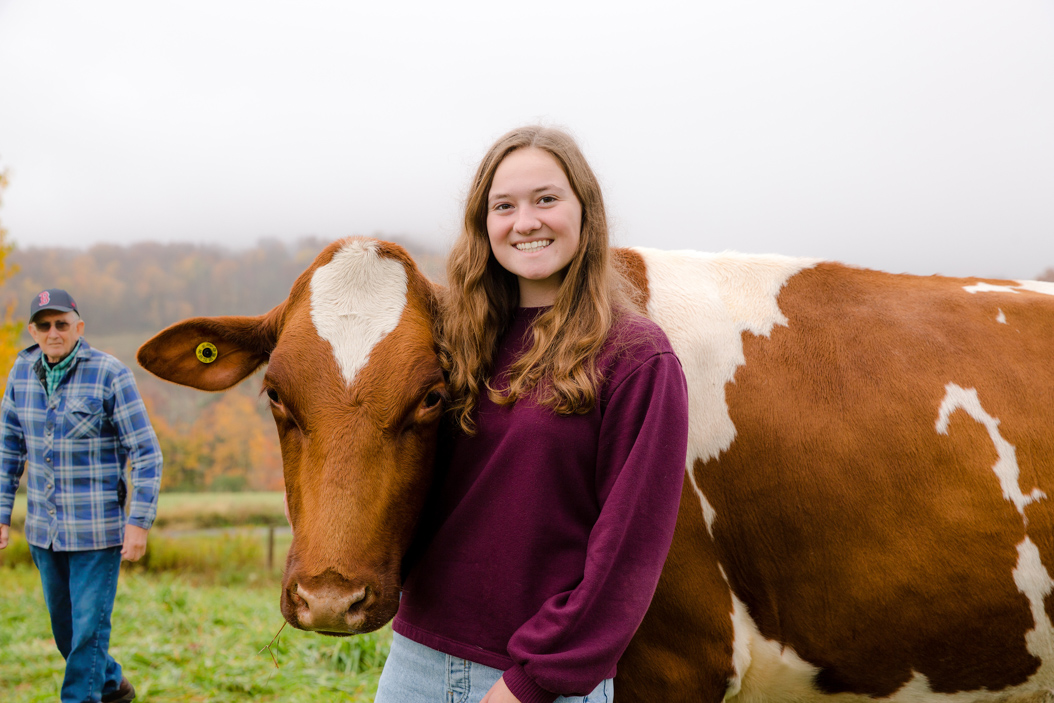
AUTHOR’S NOTE: Sometimes you hear something that strikes a chord and you want to know more… As we start this season of thanksgiving, there are young people all over the country who are thankful for the love of cows. They may have parents and grandparents who feel this way too. Some may operate dairy farms, others may rely on the older generation and a tight-knit cow-loving rural community, like the one in Susquehanna County, to make it possible. Such is the story of Delaney Curley and her Red and White winter yearling Curlydell Warrior Summer-Red — each with her own tale that would not be possible except for the love of cows.

By Sherry Bunting, Farmshine, November 4, 2022

IRISH HILL, Pa. – The past three years have been a dream come true for Delaney Curley as her family moved to Irish Hill just a mile or so from her grandparent’s farm outside of Montrose. 

Growing up, she would stay with Bob and Mary Curley for weeks at a time in the summer. Laura, her mother, recalls the crying the entire hour and a half drive home to Mountain Top. The Susquehanna County farm is where Delaney had her 4-H club, her cousins and friends with similar interests and the wide open spaces of the mountains, hunting and fishing, all of it calling her to pursue conservation science after she graduates from Elk Lake High School this year.

“We didn’t always live here. When we lived in Mountain Top, grandma and grandpa’s farm was a magical place for me. I love every part of it – working with the animals especially,” Delaney reflects. “Here, in this tight knit rural community, I found people like me.”

Bob sold his 60-cow milking herd in 2001. He is the fifth generation with 540 acres of crop, hay and pasture land. The main farm has been in his family since the Curleys came to America from Ireland in 1840. Today, he rents corn acres to a nearby farm and he and son Bill, Delaney’s father, manage the hay and pasture land with 20 to 30 heifers on hand, additional progeny of earlier purchases by the sixth generation for the seventh generation to show over the years, and some dry cows.

If not for Bob’s love of cows, this story would not be unfolding. It began when Delaney’s cousin Cali was the first of Bob’s grandchildren wanting show calves but having no home herd to draw from.

While the Jersey, Holstein and Red and White heifers start out at Bob’s farm until they become milk cows, breeding for Red Holsteins has special significance. Bill recalls his dad breeding for Reds before it was cool, but as a youth, Bill never won a class in all of his show years. Back then, Red and White Holsteins showed with Black and Whites, but the industry’s breeding focus for Reds came later.

When his niece Cali started showing, “that’s when our quest to be an owner-breeder began,”  Bill reflects. They got her started with a calf purchased at the Nittany Lion Fall Classic, and she raised her to be grand champion Holstein of the State Junior Show. Bill’s son Patrick and later his sister Delaney got started with a purchase of bred Jersey heifers from Luchsingers in New York, and a Jersey calf out of that developed into a champion. 

Those heifers calved and the 20 to 30 milk cows they became went to Joe Vanderfeltz’s 400-cow freestall herd for milking, so the Curleys could keep working toward that owner-bred herd, which today includes the Holsteins. Heifers are pasture bred by genomic bulls, and the milk cows at Vanderfeltz’s are AI-bred. Those calves come back to Curlydell.

For the love of cows, they didn’t want to just buy and show, but rather to breed for show. That was especially important to Delaney.

“We’ve always viewed the show animals as 4-H projects to go through to states and have the kids working with them and making those decisions… to take out to show what you are proud of,” says Bill.

Even for Patrick, who gravitates to the technology side of dairy data working for Ever.Ag, showing cows was fun, he says.

In Delaney’s case, however, it’s for the love of cows. 

It’s a foggy, drizzly morning on Irish Hill and the family reflects over breakfast on the move here and the owner-breeder herd that’s been developed over the decade of youth shows. For example, Delaney’s first Jersey ‘Ricki’ was purchased as a two-month-old calf and won banners as a 4-year-old in 2018. Today, she is 10 years old in the retired cow meadow.

Yes, for the love of cows they have a meadow for special retirees.

Throughout the mountains of Susquehanna County in Northeast Pennsylvania, there are families who still milk cows, but even more families who still love them, breed them, show them and care for them. 

The county show at the Harford Fair in New Milford is always quite competitive.

“Our county show is small, but the quality is always amazing,” Bill relates. “If we do well locally, we know we can be competitive to do well in Harrisburg. The competition is deep with so many top breeder herds right here in our county.”

In fact, three of the animals in the pull for junior champion at the 2022 Premier National Junior Show (PNJS) during the All American in Harrisburg in September came from Susquehanna County. 

“That’s a nice meter stick,” Bill affirms, noting that Delaney’s Summer was one of them. Her first-place winter yearling Curlydell Warrior Summer lived up to her name and gave Delaney a perfect undefeated summer from county to districts to states and nationals.

Further testament to the owner breeder herds of the area, when Delaney’s heifer earned bred and owned junior champion, all but two of the breeds had owner-breeder champions from Susquehanna County.

“They are all friends. To have that competition and friendship starting out in your home county, it really pushes you to up your game,” says Laura.

Summer was taken off pasture just 10 days before the county show, where she won her class and was reserve junior champion. Her dam Scarlet had done okay before her — winning districts and doing well in the state show against 30 other animals. 

But then she had this polled Warrior heifer.

“There’s something about when your animal that you own has her calf, it’s just more special,” says Delaney.

Summer did well as a winter calf last year. She started out small, born at 70 pounds as the offspring of a first-calf heifer, but nice and solid with show type. She had placings of 4th and 5th in her class and onlookers told Delaney she’d be one to beat the following year.

And so she was, this year winning her classes against Reds and Blacks.

“She’s the kind of heifer that the more you look at her, the more you like her, not a lot of flaws,” says Bob, knowingly.

With Scarlet’s second calf Sage, Delaney was excited to show produce of dam. The best feeling, she says, “is to win when you’re not expecting it.”

When Delaney and Summer entered the PNJS showring in Harrisburg, the judge took one look and moved right on. She recalls positioning Summer for another look, but figured she was written off. Then, halfway around the ring, “he pointed to me for the pull, and I thought he wasn’t interested.” 

That’s a thrill that is hard to describe, she recalls with a smile.

For Bill, the win was a full-circle of emotion involving Summer’s story that goes back to Bill’s longtime friend.

“We did the easy thing, breeding Scarlet to Warrior. You would have to go back to Starbuck for a bull that stamps them like that,” he says.

“But David Mattocks bred her mother. He did the hard work,” Bill recalls his good friend who lost his battle with cancer four years ago this month. Summer’s granddam was purchased from the Da-Vue dispersal.

It was Dave’s love of cows, his commitment to four decades of breeding until those last several months of his life, that also live on in this heifer, a heifer that Bill’s father has also bonded with.

Bill had intended to buy her as a bred heifer at the Da-Vue dispersal in 2018. He and Joe had picked two heifers on conformation.

“Then I looked at the pedigrees and saw one traced back to Dave’s first Excellent cow. That cow was all he talked about on our trips back and forth to Penn State,” Bill recalls their college years in the late 1980s.

“Dave had big dreams, we lost him way too soon,” says Bill. While they were in college, Dave was in partnership with his uncle, and he always talked about this cow Scenic-Vue Stewart Starr. She was Good Plus at the time and became his first Excellent cow.

When Bill got to the dispersal at Fisher’s, he ended up missing the heifer that went back six generations to that cow, but he bought three or four others, “just not the one I wanted.”

A couple weeks later Bill got a call from Dave Lentz, that a few animals were left over from the sale, and by some miracle Starr was one of them. 

“Dave (Mattocks) and I went down together to pick her up. His health was failing,” Bill recalls, explaining that the heifer represents so many ties – family, friendship, dreams, memories, past, future, all for the love of cows. 

It was definitely for the love of cows that Dave knew at age 10 he wanted to be a dairy farmer. He learned from his uncle before him and credited the dairy community around him in his welcome letter for the dispersal, writing: “There is no other industry that so abounds in people that would do anything  for you,” thanking those by name who helped when he was down. 

The sale was in February 2018 and in November that year, Dave was called to his heavenly home.

That bred heifer Bill bought — Da-Vue Reality Spirit-Red, granddam to Delaney’s Summer — now represents a blending of seven generations of Very Good and Excellent cows from Dave’s herd, his dreams and vision, now part of the owner-breeder herd at Curlydell with Summer and Sage from Spirit’s daughter Da-Vue Fusion Scarlet-Red.

“Her name was Spirit, and she was surely spirited,” Bob recalls the chase when she came off the truck the day Bill and Dave brought her to Irish Hill. Her first few weeks there in the tiestall and pasture, not quite a springer yet, were not without challenges.

“I try not to let any of her calves see an open barn door,” Bob laughs, remembering the time Spirit managed to get into the hay mow through the hay drop, and the devil of a time getting her out. He and Delaney baby the calves that have come from her. Today, Spirit is part of the flow of the freestall herd that suits her as a milking cow, making 40,000 pounds of milk at Vanderfeltz’s.

“He takes care of our milk cows like they are his own, and we consult on the breeding decisions,” says Bill, getting the calves back and returning them as milk cows. 

Making the move three years ago to Irish Hill was Delaney’s idea to be where her cows are, along with her 4-H club, her cousins and friends, her grandparents and the hunting and fishing. 

“If we were going to do it, that was the time, before she started high school,” says Bill. Leaving Mountain Top, where Laura grew up, was hard, but her parents had passed away and Bill’s parents are like her own. 

The entire family moved, first renting a place, then buying a home just down the road from the farm.

For the love of cows, Delaney is where she wanted to be, where she could double-down on her 4-H projects – her Jerseys and Holsteins, especially the Red and Whites.

“We’re glad we’re here on Irish Hill. It’s a place where life really hasn’t changed much. There is a good core of families and kids here all engaged in showing cows, a place where we can wake up and take the 4-wheeler to the barn. It’s hard to describe what that means,” Bill explains.

For the love of cows, they are home and the outdoors from the cow pastures to the mountain wilderness are what steer this Elk Lake High School senior to take her basketball skills and interest in conservation to Paul Smith’s College in the Adirondacks next fall.

While some cattle from the heifer meadow will be sold, Delaney wants to keep a core herd of pedigreed Jerseys and Red and Whites, to keep showing as an owner-breeder – even after 4-H.

“My grandfather did it all before we moved up here,” says Delaney.

“None of this would work without Dad. We could only do this with him. Some would call that elder-abuse,” Bill laughs, adding that living here gives him time he’s glad to have, even if it’s just 45 minutes a day doing chores with his dad and hearing stories… for the love of cows.

Laura relates how her father-in-law loves the baby calves, “even after they are weaned and two months old, he’s bringing warm water to them twice a day.”

Quietly listening, Bob puts it all into perspective.

“I’d be lost if I didn’t have it to do,” he said.

For the love of cows, adds Bill, “this is how we end up with retired cows living in a pasture.”

But more to the point, he says as the rest of the family nods in agreement: “Every single thing that we have here, or that the farm has, is owed to the cows. Period. I can’t imagine not having at least one, and so we do things that might not make sense but that we feel good about.”

If only the generations removed from farms could have this shared experience, to get in touch with this feeling… For the love of cows, they might not believe the cow blame-game regarding climate and the environment.

With her eye toward a future in the open spaces and conservation science, maybe this young lady — and others of her generation like her — can bring that love of cows to others and keep it going.

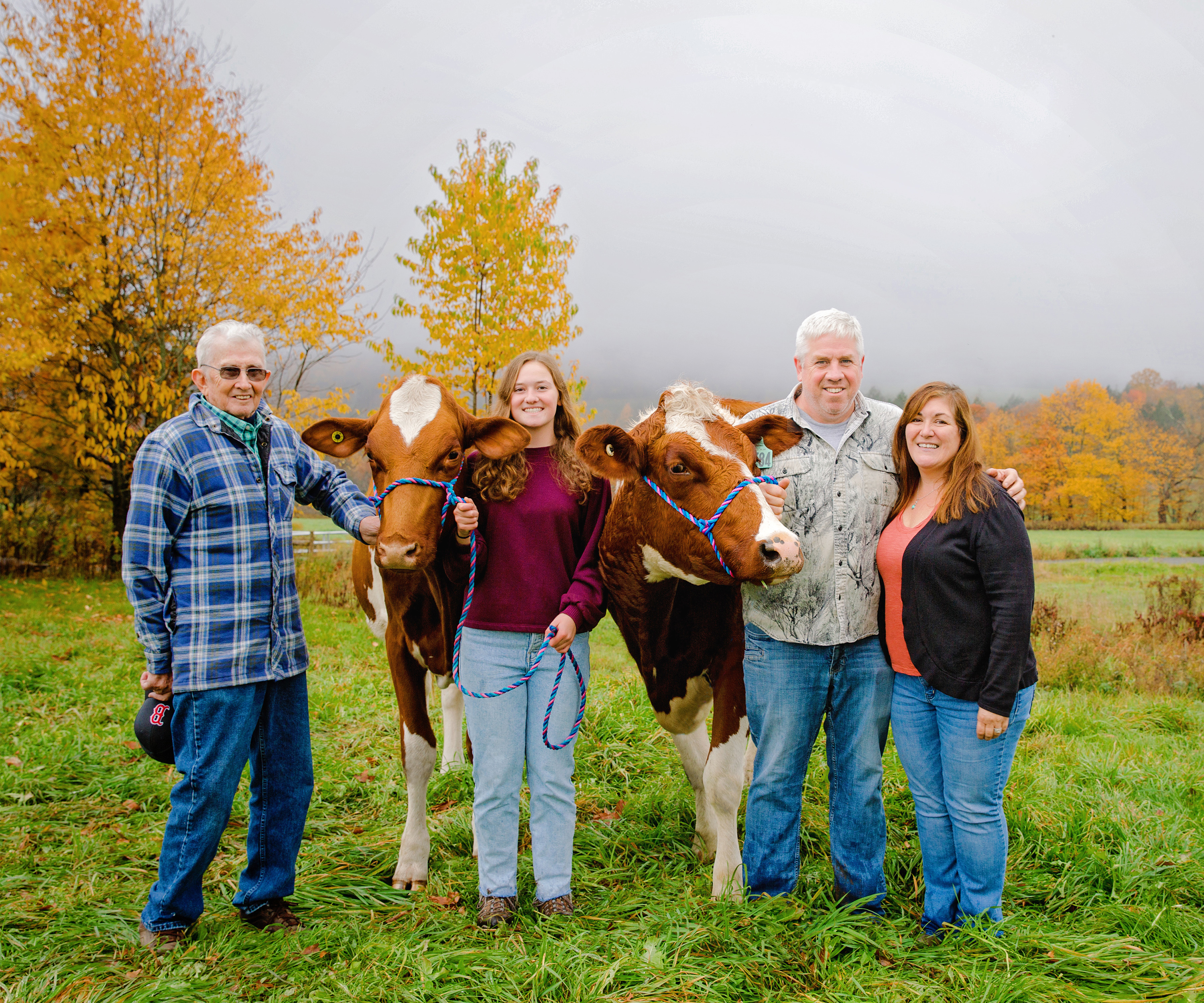
For the love of cows, family and friendships — three generations reminisce: Bob Curley and granddaughter Delaney with her undefeated homebred polled winter yearling Curleydell Warrior Summer-Red, and Delaney’s parents Bill and Laura with Summer’s dam, Da-Vue Fusion Scarlet-Red. Her dam Da-Vue Reality Spirit-Red is a productive milk cow at the nearby Vanderfeltz farm that Bill purchased as a bred heifer from the Da-Vue herd dispersal in 2018. She goes back to the first Excellent cow his longtime friend, Dave Mattocks would talk about during their college years driving back and forth to Penn State in the 1980s. Dave was called to his heavenly home in November 2018, nine months after the herd dispersal and his courageous battle with cancer. Photos by Sherry Bunting

World Dairy Expo honors trailblazers Shelly Mayer, John Ruedinger, Mark Comfort

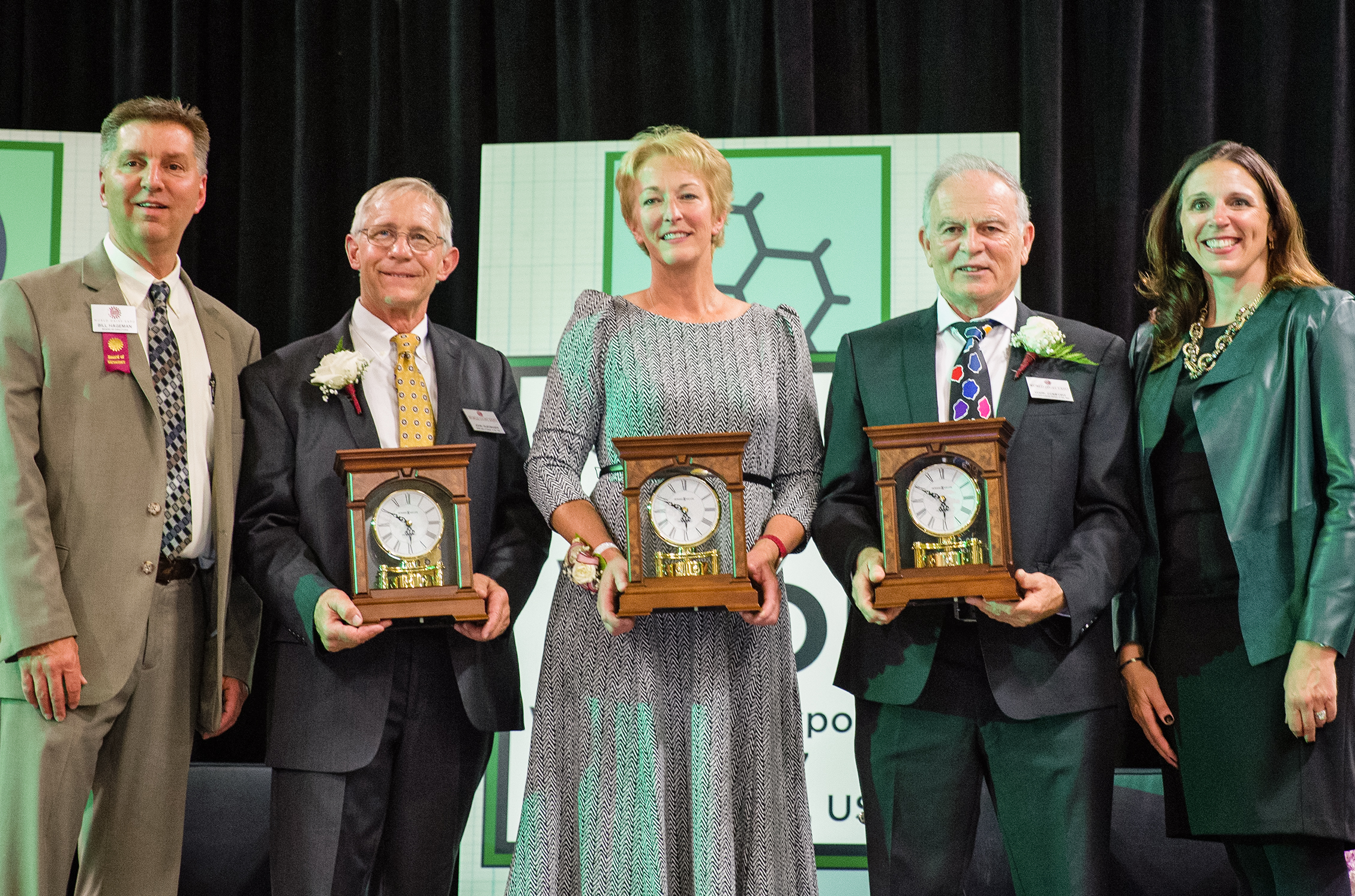
World Dairy Expo award recipients were honored at the Dinner with the Stars, (l-r) Expo Board President Bill Hageman, Producer of the Year John Ruedinger, Industry Person of the Year Shelly Mayer, International Person of the Year Mark Comfort, and Expo General Manager Laura Herschleb.

By Sherry Bunting, Farmshine Nov. 11, 2022

MADISON, Wis. — “The cows bring us together, but it’s always the people that make it impactful. This industry is great because we do it together,” said Shelly Mayer, executive director of Professional Dairy Producers of Wisconsin, based in Juneau as she accepted the 2022 World Dairy Expo Industry Person of the Year award at the Dinner with the Stars, October 5.

“Friendships and trust, so needed in today’s world, come in heaping portions here at World Dairy Expo. I’m just one piece of a much larger team,” said Mark Comfort, co-founder of Udder Comfort, Cardinal, Ontario, Canada, as he was awarded 2022 International Person of the Year.

Grateful for “the privilege of being able to represent dairy farmers in Wisconsin, the U.S. and around the world,” 2022 Dairy Producer of the Year, John Ruedinger of Ruedinger Dairy, Van Dyne, talked about the importance of the industry working together to move dairy forward.

The awards dinner was attended by over 200 people during the 55th World Dairy Expo last month in Madison. The annual event recognizes dairy trailblazers, mentors and those making longstanding impacts.

Shelly Mayer

In industry service, Mayer has been with PDPW since its start in 2001. The organization has grown to become the nation’s largest professional dairy group with 1700 members from 32 states and an impact on the industry primarily through education.

Citing this leadership and development among the founding principles that Mayer puts to work on her own family’s dairy farm, award presenters highlighted the mark she has left on the Wisconsin dairy industry and beyond through her “unmatched passion and servant leadership.”

Her passion for dairy began growing up on a farm in southwest Wisconsin and continued through Mayer’s education at the University of Wisconsin-Madison, where she received her degrees in ag journalism and dairy science and was recognized by National Dairy Shrine as an outstanding student.

Mayer was credited with the PDPW’s early work on animal well-being standards that later were incorporated in the FARM program as well as the ‘meat matters’ program on residue avoidance that later became an antimicrobial stewardship education for the dairy and livestock industries through the Food Armor Foundation.

Award presenters also noted Mayer’s influential part in the Dairy Innovation Hub, representing a $7.8 million investment by the state of Wisconsin in cutting edge research for the future of dairy. The ‘hub’ concept was born from a drawing she made in the office of Mystic Dairy when Mitch Breunig was PDPW’s president several years ago.

Breunig called Mayer’s work “truly inspirational,” helping dairy farmers learn to more professionally run their farms. “As we have fewer farms and fewer farmers, it’s going to take leadership from all of us,” he said.

Pointing out many of PDPW’s founders and her family in attendance, Mayer credited and thanked them, and especially the team of staff she works with for the organization’s far-reaching impact. In 2021 and 2022, alone, PDPW will have provided more than 220 days of education and outreach.

“Education is a powerful force that can change the world. It brings out the best in people and grows leaders who can ask the tough questions,” she said.

Mayer touched on the regenerative and sustainable agriculture story, telling attendees that, “this is the time to stand together, not at the sidelines, to tell that story. We’re so busy feeding the world, that we haven’t taken the time to share… to get out there and tell it.”

John Ruedinger

As Dairy Producer of the Year, Ruedinger was highlighted for his domestic and global contributions as a member of the board and former chairman of Genex, leading to the creation of Cooperative Resources International, the industry’s first combination of a dairy cattle breeding company and a dairy records provider and later URUS Group, the combination of both cooperative and private entities.

Ruedinger is a sought-after speaker at home and abroad on cooperative principles and industry leadership and was a founding board member of PDPW. Today he serves as vice chairman of URUS Group and on local boards for agribusiness leadership and Holstein breeders. He thanked the past and present members of the URUS Council who were present.

“The farmer spirit was never lost in the formation of URUS,” said Ruedinger, honored to have been part of the success, part of the process and part of the collaboration and humbled to receive the World Dairy Expo honor as a dairy producer who learned from his father the pride in his family, his dairy farm and his involvement in the cooperative system.

Also highlighted were Ruedinger’s accomplishments as the third generation at Ruedinger Dairy, which has transitioned to the fourth generation with 1500 cows milking over 90 pounds per day with somatic cell counts averaging 87,000.

A devastating fire in 1996 was a pivotal time, but the decision to move forward was made, and they’ve never looked back, with consistent growth every year since.

Mark Comfort

As International Person of the Year, Comfort’s four decades of impact in dairy genetics, market access, products and practices were recognized. Presenters highlighted his achievement of a dairy genetics-based crossborder relationship between Canada and the U.S., developing his former company Transfer Genetics in the 1980s, which later became part of Select Sires in 2000, as well as currently on the management side as co-founder of Udder Comfort and his continued work in genetics through Comfort Holsteins and Comfort Tunis sheep.

Award presenters traced Comfort’s early days showing dairy cattle and sheep with his grandfather by the time he was four, milking cows and raising livestock with his family, developing a keen interest in genetics and pursuing entrepreneurial ideas while studying at University of Guelph, where he revived the dairy cattle judging team and served as college Royal Show chairman. 

Comfort’s brother Neil and wife Margaret operate Brookturn Holsteins at the Niagara County farm that has been in the family since 1797.

Notably, Comfort was instrumental in changing Canadian law as he took on the AI regulations of the 1980s — and won. His early work also created the first process for Canadian dairy farmers to learn how to do their own AI, which helped open access to then emerging U.S. sires like Chief Mark, Blackstar, and Elevation.

Combined with the elite genetics of Canadian Holstein cow families and their owner-breeders ‘armed’ with the power to breed their own cows, proved to be a nexus for what legends are made of, including top sires and legacies of the World Dairy Expo, such as Braedale Goldwyn, and the millionaire sires of Comestar — and further impacts from the showring to the commercial cow management side today.

Award presenters thanked Comfort for Udder Comfort’s generosity, giving away pallets of product for exhibitors throughout the cattle barns, a tradition that began in 2007 and was followed in 2008 by sponsorship of the grand champion cash awards for all seven breed shows, followed by initiating in 2009 the cash awards for all seven breed grand champions in the junior show as well.

Comfort was quick to credit the people around him through the years, including his longtime friend and mentor the late George Miller of Select Sires. “Without incredible friends, people who believed in me and shared these goals, this would not be possible. I am humbled,” he said, introducing his family, friends, colleagues and the Udder Comfort team in attendance and thanking those who nominated him.

Citing World Dairy Expo as “truly the place where the global dairy industry meets, it all began here for us,” Comfort said with appreciation for the hundreds of dairy farmers who have shared their stories over the years.

“Your stories move us,” he said. “Your competitiveness and cooperation together inspire us, your friendships encourage us, and your feedback and suggestions help us raise the bar to improve how we deliver tools of progress and cow comfort.”

-30-

Biden, Vilsack pledge “whole of government approach” in scripted White House Nutrition Conference that converged with Tufts ‘Food Compass’ and FDA’s ‘healthy labeling’ rule; Fed. Reg. comments due Feb. 16, 2023

By Sherry Bunting, updated from original publication in Farmshine, Sept. 30, 2022

WASHINGTON — Get ready for unscientific nutrition bullying. Announced more than a year ago, the White House Conference on Food, Nutrition and Health Wednesday, September 28 was cloaked in secrecy until the eve of the event, when the 44-page “Biden-Harris Administration National Strategy on Hunger, Nutrition, and Health” was released Tuesday, September 27 around Noon. 

By 5:00 p.m., the Conference agenda appeared in the inbox of registered participants, and during the overnight hours, the Biden Administration released a fact-sheet announcing $8 billion in “new commitments” from over 100 private businesses, local governments and philanthropies for what it calls a “transformational vision.”

Taking a page from the World Economic Forum’s (WEF) Davos-style approach to food transformation, the White House solicited pledges to address the five “pillars” in its playbook. 

Of note among them are a $500 million investment by Sysco (foodservice vendor), nearly $50 million by Danone, $250 million from a collaboration of the Rockefeller Foundation and the American Heart Association on a ‘food as medicine’ initiative, and an undisclosed amount for a collaboration between Environmental Working Group, the James Beard Foundation, the Plant Based Foods Association and the Independent Restaurant Coalition to prompt more plant-based alternative and vegan offerings in foodservice — to name a few.

Then, at 9:15 a.m., just 15 minutes before USDA Secretary Vilsack was set to open the Conference ahead of President Joe Biden’s remarks, the Food and Drug Administration (FDA) announced its “proposed updated definition of a ‘Healthy’ claim on food packages to help improve diet and reduce chronic disease.”

Presto: FDA provided the ‘teeth,’ describing its proposal as aligning directly with the Dietary Guidelines. For the proposed rule, click here and to submit a comment by Dec. 28, 2022, (now updated as comment period ends Feb. 16, 2023): click here

This morsel had been under development over the past four years after public hearings in 2018-19 were reported by Farmshine and then deliberations went silent – until now.

The flurry of activity appeared in scripted fashion within the 24-hours prior to the start of the White House Nutrition Conference convening stakeholders. The first such conference was over 50 years ago and had served as the launch pad for what are known today as the infamous Dietary Guidelines for Americans (DGAs).

A Senate nutrition hearing exactly one year ago in November 2021 paved the way for the September 2022 White House Nutrition Conference.

CAPTION: “We have to give families a tool to keep them healthy. People need to know what they should be eating, and the FDA is already using its authority around healthy labeling so you know what to eat,” said President Biden. White House Conference screen capture

The Conference and follow up actions, said President Biden on Sept. 28, are being devoted to “nourishing the soul of America so that no child goes to bed hungry and no parent dies of a disease that can be prevented. We can do big things,” he said about the stated 2030 goals of ending hunger, increasing healthy eating and physical activity, and reducing diet-related illnesses and other nutrition-related health inequities.

“But,” Biden declared: “We have to give families a tool to keep them healthy. People need to know what they should be eating, and the FDA is already using its authority around healthy labeling so you know what to eat.”

The President continued: “We can use these advances to do more to be a stronger and healthier nation, to achieve ambitious goals. We must take advantage of these opportunities when we have these children in a whole of government, whole of society approach. We need to think in ways we never thought before.”

CAPTION: Ag Secretary Tom Vilsack told the White House Nutrition Conference crowd of more than 500 in-person and more than 6000 logged-in virtually that the Administration is looking to extend the child tax credits, provide more funds for more free school meals, and “take nutrition in a new direction using a whole of government approach that involves the entire federal family.” White House Conference screen capture

In his remarks ahead of the President, Ag Secretary Tom Vilsack stated that government programs feed 1 in 4 children. He and Biden both talked about expanding the child credit permanently. They talked about $2 billion in funding for food banks and schools, including $100 million for ‘incentives’ to make school meals healthier. They both noted funding to make free school meals available for 9 million additional children. A laundry-list of throwing money at a problem without re-evaluating the flawed guidelines that run the school meals and other USDA food programs despite preponderance of evidence that saturated fats are not the enemy.

There was talk of going “a new direction” but this is all process-based. There was no talk of reviewing the flawed Dietary Guidelines that helped get us here and that the Biden-Harris strategy puts so much emphasis on.

Parsing through the 44-page National Strategy, the bottom line is to expect more of the same drill-down on eliminating animal fats, only worse and with stiffer process, labeling and speech boundaries through FDA and the FTC.

We can expect nutrition bullying to commence — if we step outside of the still-vague but Dietary Guidelines-centered White House playbook. In fact, in addition to the FDA ‘Healthy’ label update, a small-print detail in the 44-page Strategy promises power and funding to the Federal Trade Commission (FTC) to scrutinize and penalize food marketing claims for being out-of-bounds on the Biden-Harris DGA-scripted nutrition field of play.

Vilsack noted the National Strategy’s approach is a “whole of government approach that involves the entire federal family.”

In preparation for the Conference, many have lamented the lack of transparency leading up to it. For months, the Conference website gave instructions on how to hold a ‘watch party,’ or a ‘satellite event,’ and how to rally support for nutrition and health ahead of time. But all of the necessary details were missing — until the day of the conference. 

Emailed invitations were sent to those who registered just three days before — requesting that they visit a web-portal and record an interview to provide input. There, people respond to White House questions and their faces are added to a streaming screen full of moving mouths — giving the appearance of broad input flowing in from Americans.

Made nervous by the lack of a published agenda or framework, over a dozen agricultural organizations had sent a letter to President Biden on September 8th asking for a “seat at the table.” Those organizations included American Farm Bureau and commodity groups for wheat, beef, sorghum, peanuts, canola, soybeans, barley, corn, sunflower, eggs and rice.

Dairy organizations were conspicuously absent from any of the pre-Conference letter-writing or other such public statements. But then, the dairy industry has its man Vilsack in play, and its DGA 3-a-day – so case-closed – can’t be bothered on the milkfat and whole milk issue.

On the agenda provided the day of the Conference, we found former DMI vice president of sustainability, Erin Fitzgerald — who now serves as CEO of the U.S. Farmers and Ranchers Alliance and who represented USFRA and referenced her boss at the dairy checkoff during a WEF panel in Davos earlier this year — leading a plenary session on “access to affordable foods.” Also, Chuck Conners of the National Association of Farmer Cooperatives led the plenary discussion on “empowering consumers to make healthy choices.”

(We learned after the Sept. Conference that National Milk Producers Federation and the National Dairy Council, funded by the mandatory dairy farmer checkoff, were invited to attend. They were represented, and they brought “student leaders” from GENYOUth. To read NMPF’s statement after the Conference, click here).

Key questions around “what are those healthy choices” to be compassed in tools and identified in FDA labeling went repeatedly unanswered as the discussions focused on approaches and processes, perhaps deeming the unsettled dietary science on fats to be settled science with no need for discussion.

Nutrition Coalition founder, advocate, author and investigative journalist Nina Teicholz has been writing about the Conference for weeks before it began, noting the lack of a pre-conference agenda and the refusal of the Administration to review the science on saturated fats ahead of this ‘landmark’ event.

She points out that the White House delegated Conference planning to the Dean of the Tufts Friedman School of Nutrition Science and Policy at Tufts University Professor Dariush Mozaffarian — developer of the Food Compass, which is a new method for rating and ranking foods in categories to be consumed frequently, modestly, and occasionally.

To understand what the Food Compass looks like — sugary cereals rank far ahead of the milk that goes in the bowl with them. And, nearly 70 brand-named cereals from General Mills, Kellogg’s, and Post are ranked twice as high as eggs cooked in butter! Alternative fake milk beverages, such as almond juice, rank ahead of skim milk and far ahead of whole milk. Potato chips (yes, potato chips) are an example of a food that ranks ahead of a simple hard-boiled egg and light-years ahead of whole milk, most cheeses and real beef.

In fact, the only cattle-derived product to get top sector ranking is plain non-fat yogurt. (Surprise: Danone was one of the Food Compass development sponsors). Meanwhile, most cheeses, whole milk, and beef ranked near or at the very bottom of the lowest categories.

Coincidentally, Mozaffarian’s department at Tufts also received a $10 million grant from USDA in November 2021 for a five-year project “to help develop cultivated meat” (aka lab-created meat) through assessment of consumer attitudes and development of K-12 curriculum.

Teicholz laments the lack of consideration by the White House, USDA, HHS and FDA as they ignore many reviews including the most recent state-of-the-art review on saturated fats, whose authors include five former members of the Dietary Guidelines Advisory Committee.

“These are the people who wrote the guidelines saying: ‘We got it wrong,’” writes Teicholz.

Their paper was published in the prestigious Journal of the American College of Cardiologists, whose Editor in Chief named it as one of the top 5 papers of the year. Science like this appears to be off the menu of the White House nutrition playbook.

The entire playbook hinges upon the main tenets of the current Dietary Guidelines for Americans even though the DGAs are being questioned by the scientific community… Even though the DGAs have screened out sound science on dietary animal fats and proteins for at least the past three cycles (15 years)… Even though the rates of American obesity and diet-related illnesses were mostly stable pre-DGA but have risen steadily since the DGA cycles began… And even though these consequences have risen dramatically among children and teens during the past decade since school meals, school milk and a la carte competing foods and beverages were further restricted to the low-fat levels of the DGAs.

What does the White House blame for this poor performance? The playbook cites the Covid pandemic food choices of Americans — stuck at home — for the deteriorated statistics. Unbelievable! These statistics have been deteriorating for decades, especially since 2012.

Looking over the playbook, it closely follows the pattern of FDA’s Multi-year Nutrition Innovation Strategy proceedings that have been quietly underway after public hearings in 2018-19 until the ‘Healthy’ label proposal was announced Sept. 28, 2022.

Appearing in the White House playbook is the proclamation that food and beverage packaging will move toward simpler nutrition guidance under FDA, that an easily recognizable ‘healthy symbol’ will be reserved for front-of-package labeling on those foods the government deems Americans should eat, and a potential ranking system for symbols will be developed for packaging of foods and beverages the federal government deems unhealthy.

This is all coincidentally similar to the Tufts Food Compass, and the substance behind these simplified ‘healthy’ (or not) symbols is a doubling-down on the low-fat DGAs as a primary base metric. Here is a deep dive into the Tufts Food Compass that Mozaffarian, the White House Nutrition Conference Chairman, had a critical role in developing to now be the formation of future food policy. Read the comprehensive analysis here

The National Strategy calls for even more adherence to the flawed DGAs among every sector of the economy beyond government feeding programs, schools, hospitals, and military diets to include foodservice offerings, supermarket layouts, online shopping algorithms, even licensing for all daycare or childcare providers and nutrition certification for these licensed childcare providers – not just those receiving government subsidies for food. 

This is so-called “stealth-health” at its best — or rather its worst.

The Biden Administration professes to be concerned about the 1 in 10 households experiencing food insecurity and the rise in diet-related diseases among the leading causes of death and disability in the U.S. The White House cites data showing 19 states have obesity prevalence at 35% or higher with 1 in 10 citizens having diabetes, 1 in 3 with cancer in their lifetime, and nearly 5 in 10 with high blood pressure. 

Yet, there is no pause for a comprehensive review of the very dietary guidance, the DGAs, that helped get us here. 

The National Strategy reveals how the Administration is assembling executive orders, legislative prompts, calls for action among food organizations, companies, agencies, academia and state and local governments to get everyone on the same page making Davos-style pledges and to conform to the federal playbook.

In the executive summary, the President writes: “Everyone has an important role to play in addressing these challenges: local, State, territory and Tribal governments; Congress; the private sector; civil society; agricultural workers; philanthropists; academics; and of course, the Federal Government.”

(Note Biden’s only reference to farmers or food producers is as “agricultural workers.”)

The playbook’s five pillars talk about improvement, integration, empowerment, support and enhancement. It coins phrases like ‘food as medicine’ and ‘prescriptions for food.’ Reading deeper, we see a launch pad for a new method of nutrition ranking and labeling with the primary factors listed as low-sodium, low-fat and reduced added sugars.

CAPTION: This diagram on page 6 of the 44-page Biden-Harris Nutrition Strategy, the White House ‘playbook,’ clearly identifies the very real concerns, but the pillars of this strategy double-down on perpetuating the problem by giving even more influence to the low-fat / high-carb Dietary Guidelines that many in the scientific community are questioning. The ‘playbook’ also increases the reach of the federal government into the diets of children in daycare and schools. 

The playbook’s diagrams show us the concerning impact of food insecurity and diet-related diseases in poor overall health, poor mental health, increased financial stress, decreased academic achievement, reduced workforce productivity, increased health care costs and reduced military readiness – but then doubles-down on the solution being more of the same low-fat / high-carb dietary path that got us here.

The White House playbook states that, “The vast majority of Americans do not eat enough vegetables, fruits or whole grains and eat too much saturated fat, sodium and added sugars.” But at the same time, on the saturated fat question, the data show per capita consumption of red meat has declined since the start of the DGAs, and milk consumption has substantially declined.

Americans are being called upon to “unify around a transformational vision,” said Biden. 

This vision includes more federal control of diets and nutrition education after failing miserably with the control it already possesses. There is no talk of revisiting the path we are on, just doubling-down on how to get more Americans onto that DGA path, to tell them what to eat, and to put the FDA stamp on ‘approved’ foods and beverages while having the FTC investigate health and nutrition claims that fall outside of the flawed DGAs.

Translation: Let the ‘nutrition bullying’ from the White House bully-pulpit begin. Some of us are ready to rumble.

-30-