From USDA to checkoff, no one in farmer’s corner

By Sherry Bunting, Farmshine, April 17, 2020

BROWNSTOWN, Pa.– From the fortress of the USDA to the ivory towers of the dietary command to the branches of the checkoff government-speech machine and the centralized, globalized food system ‘partners’ in between — No one is in the farmer’s corner. Not even the people paid by the farmers to be in their corner.

This much is crystal clear by now in the collapsing markets and stark realities laid bare by the COVID-19 pandemic.

The curtains have been opened.

And the usual players do what they do.

They pat themselves on the back, converse about their insights from within their echo-chamber, and lecture those who would dare call attention to the sight before us or deviate from the script.

Over the last week, dairy checkoff newsletters have bragged about what they are doing for dairy demand amid the deepening crisis; how DMI is “adjusting to move more dairy.”

Yep, the bulk butter and bulk cheese and bulk powder plants in growth areas are moving more dairy — right into the already bursting at the seams cold storage inventory warehouses.

Few if any reports from states with these large plants indicate any milk dumping whatsoever.

Butter inventories were already 25% higher than year ago heading into the COVID-19 pandemic and cheese inventory was already growing too.

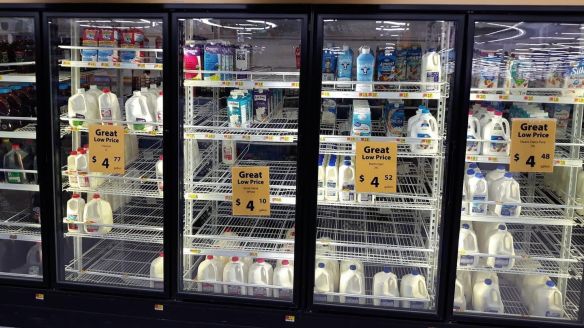
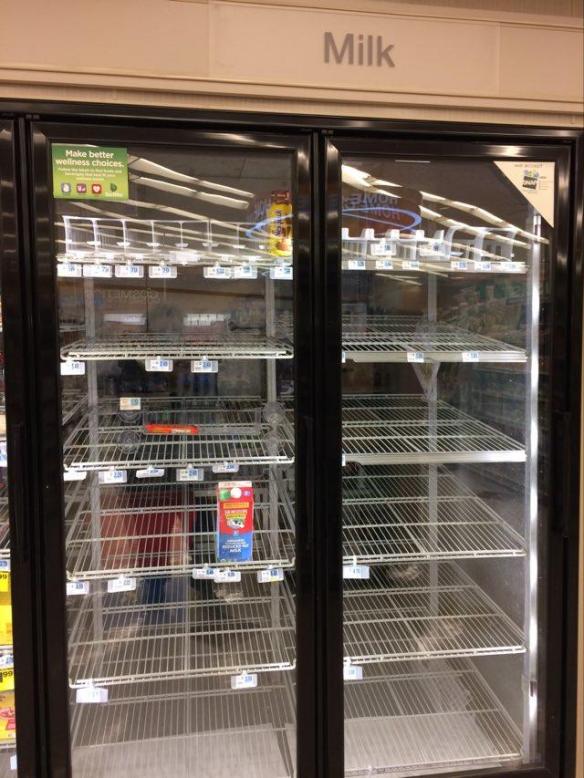
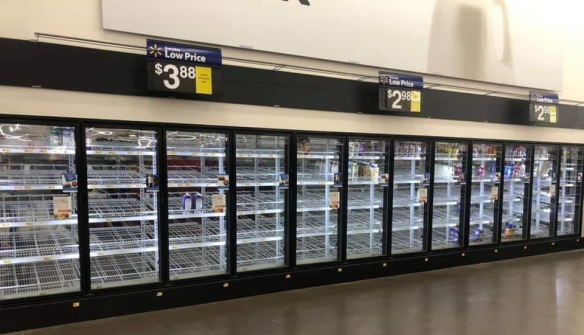
Reports indicate such fully functioning cheese and whey or powder plants are running full tilt, while a shopper has to store-hop through three or more establishments to find a package of butter, walk into Walmart and see rows of empty cheese racks, try to walk out of a Walmart or Sam’s Club with two gallons of milk and be forced to give one back.

Other supermarkets aren’t much better, except for the smaller family-owned markets. Pictures and texts continue to pour in, while our leaders assure us that the purchasing limits are really lifted.

Go to Kroger’s website (a DMI partner) and see their explanation of why they’ve raised the price of milk. It’s because there is a shortage, they say, while farms all around them are forced to dump milk. Just six weeks ago, a Kroger executive I spoke with said, ‘no we can’t raise the price of milk — it was $1.25/gal pre-COVID (not in PA of course but elsewhere).

I was making the point that we have loss-led and commoditized this deal long enough. Please respect the milk. “No,” I was told, “raise the price? How is that going to sell more milk?”

What is Kroger doing today (and Walmart and other heavy hitters for that matter)? NOW, they are raising the price, even canceling some orders without much to spare, as they are being asked to stop limiting sales.

Meanwhile farmers are forced to dump milk.

As the commodities crash with barrel cheese at around $1/lb and butter headed there too, are the food system heavy-hitters holding back to buy that higher-priced inventory on the cheap just to turn it around and charge more?

We are getting to see how the system works — how the losses and consolidation of a decade or more are threatening our farms and food security. But leaders and policymakers are still convinced this system is the best, and thanks to new stricter rules coming on animal proteins and fat, it’s about to get better, more diluted, and void.

Take the DMI update in the ADA Northeast newsletter from April 6, how proud they are of the “seven ways checkoff is working for you during COVID-19” and how they are “adjusting to move more dairy”, how GENYOUth is “keeping the meals flowing to students”, while in reality the real school chefs and lunch ladies — even bus drivers — are out on the front lines figuring it out for real on their own every day; how proud they are that the National Dairy Council “sorted through milk myths.”

Now that last one is a doozie. Here’s one of the seven ways checkoff is working for you: “National Dairy Council is among the expert organizations to debunk claims that milk can help ward off coronavirus.”

Remember the news about milk and it’s immune-building properties? Even Hoards Dairyman noted milk was “flying off the shelves” as consumers sought the health benefits and comfort of milk.

Remember how DMI tells us “you can’t educate people to drink what you want them to drink?” How “we want to move people away from the habit of reaching for the jug and toward the new innovative products?”

It wasn’t even a week after fluid milk sales skyrocketed 40% that the National Dairy Council helped debunk some of that immune-building “myth” in Reuters story.

And yes, rest assured, DMI is talking to “your (their) partners” to get them to “move more dairy”.

So here’s the clincher. Watching the President’s daily COVID-19 press conference Wednesday evening (April 15), it really hit home, bringing together so much of what I have seen and heard over the past few weeks and the months and years before that.

Agriculture Secretary Sonny Perdue was part of President Trump’s daily presser Wednesday, and I was hopeful when he went to the microphone that he would talk about impact to food and agriculture during the COVID-19 pandemic.

He told Americans that “Our food system is strong, resilient and safe,” despite the bare shelves and limits on purchases that people are seeing in supermarkets.

“In the United States, we have plenty of food for all of our citizens,” Perdue said. “I want to be clear, the bare store shelves that you may see in ‘some’ cities in the country are a demand issue, not a supply issue.” (Huh? At least he didn’t phrase it the way Pennsylvania’s Ag Secretary does, saying in a PDA public service announcement to radio and television stations that store limits, bare shelves and dumped milk are a ‘hoarding issue”, and saying in a dairy industry conference call: “this is what happens when people hoard food.”

No Mr. Secretaries, this is not hoarding and it’s not a ‘demand’ issue, it’s a centralized, consolidated, globalized food industry structure issue.

Back to Sec. Perdue’s moment before the American people… Perdue said simply that there has been a large shift from people eating in restaurants and fast food businesses, and now eating at home, which has spiked in the last few weeks and placed a high demand on grocery stores.

“Our supply chain is sophisticated, efficient, integrated and synchronized, and it’s taken us a few days to relocate the misalignment between institutional settings and grocery settings.” Perdue said.

Bingo. The accelerated creation of this machine over the past decade has been designed by government policy from the flawed dietary guidelines, to the government speech farmers are forced to pay for, to the mergers and acquisitions and antitrust behaviors, to the globalization and centralized decision-making, to the erosion of local/regional milksheds and foodsheds.

Yes, Mr. Secretary, that sophisticated, efficient, integrated, synchronized food supply chain has moved our country closer to cow islands and food deserts and fracturing of regional food security.

Some of the best minds in agriculture economics are seeing it. Consumers are waking up to the realization of what that means when the chips are down. They are watching their communities’ farmers dump milk, depopulate poultry flocks, send milk herds to slaughter.

This pandemic has peeled back the band-aid covering gaping wounds inflicted for years, and now when it is open and bleeding for all to see, the Secretary reassures the nation that this big beautiful bountiful ag food system simply needs to “relocate a misalignment.”

Tammy Goldammer, a cattle rancher friend of mine in Missouri put it bluntly in a social media post after listening. Here are some of her words:

“Production Ag People?

Did you happen to listen to US Ag. Sec. Perdue’s comments today at the Rona Update press conference? Were you reassured about your occupation of raising the highest quality protein sources to feed the world?

Did you find it interesting that there was no mention about “producers” and what is going on with what they raise to feed people?
1. There was no mention of the killing of millions of ready to harvest chickens and turkeys…to leave them to compost.
2. There was no mention of the dumping orders for milk and the orders to let cows go dry and to sell the dairy cow herds.
3. There was no mention of the shuttering of ethanol plants and the resulting depletion (no supply) of by-products utilized in the livestock feeding industries.
4. There was no mention of the Mercantile Exchanges and the crashing commodity prices for livestock, dairy and grain futures.
5. There was no mention of the bankruptcies and insolvencies of feeders who grow the nation and the world’s protein sources.
6. There was no mention of the sucking sound to the south of the beef cattle industry.
7. There was a mention there are a few “slaughter” plant closures due to Covid-19 being detected in some employees.
8. There was a mention that our nation’s food supply is abundant and there should be no fear about food availability.
Do you all like math? Mr. Perdue? Your commentary today to assure the American public was absolutely “void” of speaking to the producers/people who produce what you stated is in good shape and rest assured there are no shortages.
To say I was “stunned” at your “void” on the big picture, well, let’s say I was totally bewildered.”

But never fear oh sophisticated, efficient, integrated and synchronized food system, President Trump followed the Perdue comments with news that there is $15 billion in tariff money left in Sec. Perdue’s charge to help farmers who were targeted and he gave the Secretary the go ahead to use it.

Later this evening, word came that the government will begin buying milk and meat. Yes, as mentioned by Pennsylvania’s own Secretary in his PSA ‘stop hoarding food’… ‘food banks need the food’… ‘we have a system…’

Yes, the integrated centralized system is the proper channel while communities take care of their own with whatever resources they can muster. Good people in communities like mine right here in Lancaster County, Pa. are buying milk, giving it to the needy or seeking processors (for pay) to process milk headed to manure pits so it can be donated, only to bump up against that integrated system.

Kudos to those businesses in the community who are buying milk to give to the needy or stepping up to allow their smaller processing plants get milk ready for food banks before it is wasted.

The efficient, sophisticated, integrated, synchronized food system is not. But it will when the price is low enough and the government starts buying.

-30-

Call to action: Feds ignore science on saturated fats, poised to tighten restrictions in 2020-25 guidelines

Where is our dairy industry? No time to waste!

dga2

By Sherry Bunting, Farmshine, April 3, 2020

 WASHINGTON, D.C. — While Congress, USDA and HHS are all consumed by the health concerns of the COVID-19 pandemic, the Dietary Guidelines Advisory Committee is moving forward full-steam-ahead with what looks like more restrictions on saturated fats to be announced in May. Meanwhile, dairy leadership organizations sit on the sidelines, just letting it happen.

According to the Nutrition Coalition, and this reporter’s own following of the DGA Committee process, the process has been flawed from beginning and has reached a critical juncture. There is an urgent need for the public to pay attention and get involved.

Many had hoped the Committee would review and include the sound science and revelations about the flaws in the saturated fat limits in the current dietary guidelines to remove those restrictions or improve them in the 2020-25 guidelines. But the opposite is occurring.

As reported previously in Farmshine, some of the very best and most rigorous science on saturated fats and in relation to dairy fats vs. cardiovascular disease have been excluded from the review process from the very beginning.

Unfortunately, the process that began in 2019 is poised to move Americans even further down the wrong road with even more restrictive fat rules that will govern and inform all institutional feeding and which heavily influence the foodservice industry. Even worse, farmer checkoff funds are forced, by USDA, to help promote these unhealthy guidelines.

While National Milk Producers Federation, International Dairy Foods Association, Dairy Management Inc., and other industry organizations are silent, the Nutrition Coalition, founded by Nina Teicholz, author of The Big Fat Surprise, is sounding the alarm.

“We need your help to ensure that the federal government not continue to ignore large, government-funded rigorous clinical trials — the “gold standard” of evidence — that could reverse decades of misguided nutrition policy on the subject of saturated fats,” writes Teicholz in a recent communication.

She’s right. From the beginning, the DGA Committee was formed, and the research pre-screened by USDA, in such a way that many of the best studies and minds have been excluded.

Processed With Darkroom

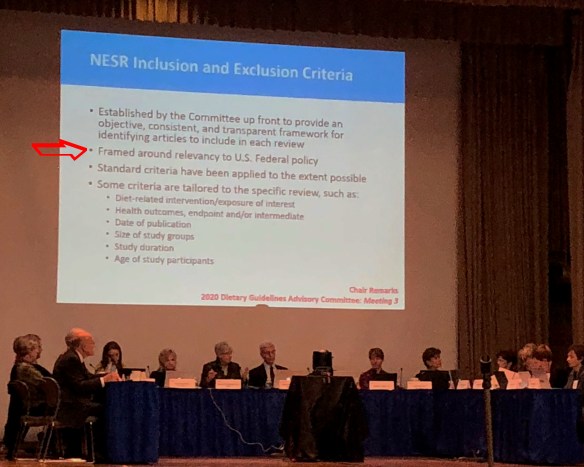
Part of the screening process used by USDA for science that will be included or excluded from Dietary Guidelines Advisory Committee consideration is this curious item shown above: “Framed around relevancy to U.S. Federal  Policy”. Committee members in October asked for more information on this research screening criteria. USDA explained it to them and those watching that this refers to including only the research that “aligns with current federal policy.”

Interestingly, one of the criteria for screening the research the Committee can consider is that it must “align with current federal policy.”

This dooms the entire process to a slanted view that is entrenched in the flawed bureacracy right from the start!

During the recent meeting of the DGA Committee in March — the last such meeting before release of the 2020 Dietary Guidelines for Americans (DGA) in May or June 2020 — the Committee failed to consider any of this evidence on saturated fat.

Instead, the committee announced it had found the link between saturated-fats consumption and cardiovascular disease to be “strong,” for both children and adults.

In fact, the committee recently proposed lowering the caps on saturated fat even further, from the current 10% of calories down to 7%!

“These conclusions ignore the entire last decade of science, during which a growing number of scientists have concluded that the caps on saturated fats are not supported by the science,” Teicholz points out.

She cites the work of a group of leading scientists who have reviewed the research on saturated-fats and released a consensus statement.

“Scientists are concluding that the most rigorous and current science fails to support a continuation of caps on saturated fats,” writes Teicholz. “So, why is the current DGA Committee — yet again — simply rubber-stamping the status quo and ignoring the science?”

The Nutrition Coalition is working fervently to expose the flaws in the process the DGA Committee is using under the USDA Food Nutrition Services umbrella. This in turn is what is used by USDA and HHS to govern what Americans eat.

These are not just “guidelines”, these are edicts to which everything from school lunches to military provisions are tied.

In fact, even farmers are tied to these guidelines as the dairy checkoff program leaders maintain they cannot promote whole milk because they are governed by USDA to stick to the guidelines, forcing farmers to mandatorily fund this completely flawed and unscientific “government speech.”

Americans deserve a recommendation on dietary saturated fat that is based on the most current and rigorous science available, and the Nutrition Coalition is issuing a call to action for Americans to join them in calling on the 2020 DGA Committee to critically review the most up-to-date evidence and modify its position on saturated fats accordingly.

“When we refer to “rigorous science,” we mean the data from well-controlled, randomized, clinical trials—the type of evidence that can demonstrate cause and effect,” writes Teicholz. “These trials were conducted on some 75,000 people addressing the question: do saturated fats cause heart disease? The results are that fats have no effect on cardiovascular or total mortality. This evidence has never been directly reviewed by any DGA committee.

“Ignoring evidence in order to preserve the status-quo is not acceptable,” she continues. “It’s not good policy, and it has not been good for the health of the American people. With the next iteration of the guidelines, your help is more crucial than ever to ensure that the USDA critically review the most up-to-date evidence and modify the government’s position on saturated fats to reflect the science accurately.”

Meanwhile, the dairy industry leaders continue to drag their collective feet.

As reported in Farmshine over the past few years, the call to action and support for healthy recommendations that consider the science on saturated fats and the goodness of whole milk, for example, has been largely pursued by grassroots efforts while industry organizations either fall in lockstep with the guidelines or stay neutral on the sidelines.

Once again, it will be up to the grassroots to get involved, for the public to be aware and get involved, for the Congress to be contacted, informed and involved.

How many times have we heard industry leaders shrug their shoulders and say “it all hinges on the Dietary Guidelines”?

dga1

When presented at the October DGA meeting with the first 12,000 names on the “Bring the choice of Whole Milk Back to Schools” petition (now numbering close to 30,000 online and by mail), Brandon Lipps, USDA Deputy Under Secretary of Food Nutrition Services, gave this response: “We have to see the science start coming together and be sure to bring everyone in… into the process.” Now it appears the Dietary Guidelines that control food at school, daycare, work settings, military, and many other foodservice and institutional feeding settings will be even MORE restrictive allowing even LESS of the healthy fat we — especially our children — need. The fat we eat is not the fat we get! Why is USDA moving us further in the wrong direction and excluding the science on this?! Act now. There are links in this article to speak out. Sign the Whole Milk in Schools petition also!

If there is even a chance that our children can have whole milk and healthy meals at school, that farmers can use their mandatory checkoff to promote the true healthfulness of whole milk and full-fat dairy foods, this biased process of DGA Committee guidelines has got to be challenged in a big way.

Here’s how you can help.

Contact your Senators and Representatives in Congress with a simple message. Ask them to please ensure that USDA is not ignoring the science on saturated fats.

Below is a message that the Nutrition Coalition suggests, which you or your organization can adapt and share with others in communicating with members of Congress:

Please urge the agencies in charge of the Dietary Guidelines for Americans (DGA), the USDA and HHS, to stop ignoring large clinical trials-the “gold standard” of evidence – that could reverse decades of misguided caps on saturated fats.

Shockingly, none of this evidence has ever been reviewed by any expert committee overseeing the science for the Guidelines. In fact, the current committee is pushing to lower the caps even further.

This is extremely alarming given that a growing number of prominent nutrition scientists have concluded the evidence shows that saturated fats have no effect on cardiovascular or total mortality. In fact, a recent panel of leading scientists reviewed the data and in a groundbreaking consensus statement, soon to be published in a medical journal, found that the science fails to support a continuation limits on saturated fats.

The current DGA committee appears to be one-sided and biased on this issue.

Please urge the USDA to stop ignoring the science and give serious consideration to lifting the caps on saturated fat for the upcoming 2020 DGA.

An easy way to do this online is available at this “take action” link https://www.nutritioncoalition.us/take-action

Or find the name and contact information for your Senators and Representative at this link and contact them that way https://www.govtrack.us/congress/members

Also, comment at the Federal Register docket for the DGA Committee by May 15, 2020. The sooner, the better, because the committee is expected to make its recommendations in May. Submit a comment to the Dietary Guidelines Advisory Committee here https://www.regulations.gov/docket?D=FNS-2019-0001

Also take this opportunity to sign this petition to “Bring the Choice of Whole Milk Back to Schools” at https://www.change.org/p/bring-whole-milk-back-to-schools

-30-

Regional milk and dairy food security in jeopardy

Widespread milk dumping continues, small regional co-ops face extinction

MilkTruck

Enter a caption

By Sherry Bunting, Farmshine, April 10, 2020

BROWNSTOWN, Pa. — As the dairy supply chain disruptions worsened this third week of COVID-19 pandemic stay-home orders in most states, large milk cooperatives continued rotating their milk dumping between members. For example, Dairy Farmers of America (DFA) — the nation’s largest cooperative — reports 12 to 15% less milk is needed under current conditions and wants to see the supply of milk they handle drop by 10% in the next several months to match the reduced demand for milk as processing and distribution capabilities have made seismic shifts amid the COVID-19 pandemic.

In this situation, small milk cooperatives and independent producers are finding themselves particularly vulnerable as a flurry of contract terminations fill voicemail and email, not to mention social media timelines.

This, from a family in Corry, Pennsylvania on their facebook page Monday (April 6): “Today we got it. The thing you know is possible but you just do not think it will be you. Not your farm. After all you have survived things for generations, it just cannot be you. But today it was.Today we got our letter, Rothenbühler Cheese Chalet canceled our contract. Today it all crashed down. Hope disappeared, and all our dreams vanished. We will be dumping our milk until we can figure it out how for 200-plus cows in the middle of a pandemic. No auctions, no sale barns, no options. It is heartbreaking to watch generations of work and dedication become meaningless. Wasted.”

The next day came the update that their 27-member cooperative in Northwest Pennsylvania has a few weeks to solve an abrupt concern, after previously being given three hours on a Friday afternoon — paperwork details that aren’t technically part of their milk contract that became effective March 1 with the Middlefield, Ohio cheese plant.

Farmers Union Milk Producers Association, based in Stoneboro, Pennsylvania, learned Tuesday (April 7) they have a few more weeks to address this paperwork request that had resulted in a contract termination email Friday (April 3) at 5:00 p.m. The cooperative has had a decades-long relationship with the Middlefield, Ohio cheese plant, but learned Friday at 2:00 p.m. that certain paperwork not detailed in their contract was required by 5 p.m.  that day to avoid termination.

“That’s three hours and not possible,” notes Lisa Royek. Her husband Walter is the current president of the cooperative.

Over the weekend, the co-op board went to work, received some legal advice, and asked the company for an opportunity to discuss the situation. Eventually, the company agreed to give Farmers Union until April 17 to meet this new request.

Even though it’s not in their current contract — signed last December and effective March 1 — Royek notes that, “We value this relationship and want to act in good faith in the hopes that the cheese plant will do the same.”

Despite this two week reprieve, some of the co-op’s members expressed concern Wednesday about milk sampling irregularities — leaving a few in jeopardy of their milk being excluded from pickup this week — and there were other questions about whether milk would be received from some of the member farms once it got to the plant.

But Farmers Union co-op is moving forward, doing what needs to be done, hoping to save their milk market with the plant they’ve done business with for as long as Royek can remember.

For producers in other small co-ops of northwest Pennsylvania and southwest and central New York, similar hurdles are being met.

Members of one small cooperative reported Wednesday that the cheese plant in Friendship, New York will no longer need their milk, indicating that Walmart had canceled orders.

While New York shippers for the Dean Foods bottling plant in Sharpsville, Pennsylvania often have their milk sent to the Friendship, N.Y. cheese plant, it is unclear whether a similar distribution status exists for the Middlefield, Ohio cheese plant in the Farmers Union cooperative situation.

The Dean Foods Sharpsville, Pa. bottling plant is one of 44 plants — nationwide — being purchased by DFA. Dean Foods receives a large share of its milk from DFA and this market accounts for a large share of the milk DFA ships. The 44-plant sale was approved by the court on Friday (April 3), pending final details before transition of assets after another hearing set for April 27.

Members of small co-ops shipping to the Middlefield, Ohio or Friendship, New York cheese plants were contacted for this report and did not know if their milk had ever been used to supply the Dean plant in Sharpsville or if these cheese plants ever supplied Class I markets in the Mideast Milk Marketing Order. Just the same, we called the plants and the Mideast Market Administrator to find out the pool status of these plants, and any recourse these producers might have. Our calls were not returned by either the plants or the Mideast Market Administrator.

Producers who are part of the small co-op cut off by the Saputo-owned Friendship, N.Y. plant, said the reason they were given was cancellation of orders by Walmart, Dollar General and others. Their members began dumping milk Wednesday (April 8) because there was no where for the milk to go.

IMG-3717

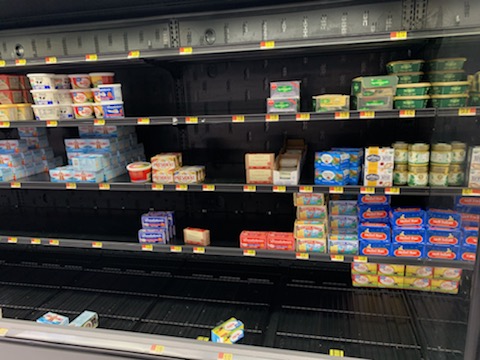
Just one of many photos submitted April 8-11 showing a continued shortage of real butter at Walmart stores in Pennsylvania, New York and Ohio, except for small quantities of unsalted or “lite”, and plenty of imitations and margarine.

On the very same day, no less than 20 texts, emails, and messages came in from people throughout Pennsylvania, New York and Ohio reporting that their Walmart stores were low on milk and had zero butter, sour cream or shredded cheese. Walmart and Sam’s Club shoppers also reported being limited to one or two gallons of milk with limits on other dairy products as well. (These reports persisted with documentation of empty Walmart butter shelves and limited or absent sour cream and shredded cheese, along with either no milk or very little milk, especially whole milk at Walmarts in Pennsylvania, New York and Ohio as recently as April 8-11.)

It is unclear what role Walmart’s Midwest supply chain via Prairie Farms, Great Lakes and Foremost — play in the Mideast Milk Marketing Order supply chain disruptions that are leaving small regional co-ops facing complete termination while at the same time the Walmart stores in the region show a stark lack of dairy products and depleted milk supplies for shoppers.

Walmart_PA_April_7

Walmart stores throughout the region, like this one in Kittanning, Pennsylvania on April 7, continue plowing through milk supplies rapidly. Meanwhile farms in the region continue to be forced to dump their milk or face the complete loss of their milk contracts. They are told it is because of a drop in dairy demand due to schools and restaurants closing and exports stalling. They are also told that retailers — like Walmart — are not increasing their orders, and are canceling some orders, despite the surge in consumer demand for real milk and dairy products.

The Dean Foods Sharpsville plant in western Pennsylvania is part of the USDA Mideast Milk Marketing Order that regulates Class I fluid milk in the western half of Pennsylvania, all of Ohio, all of Michigan, three-quarters of Indiana, most of West Virginia, and the northernmost part of Kentucky.

Pennsylvania also has a state-regulated milk marketing system. For the past three years, Walmart has been an approved ‘milk dealer/handler’ — not just a retailer in the Pennsylvania system, where the Milk Marketing Board (PMMB) sets minimum retail and wholesale prices for beverage milk that include an over-order premium intended by law for dairy farmers.

The state’s accounting system through PMMB only follows the over-order premium back to the farm level when the retail milk meets three specific criteria: produced, processed and sold in Pennsylvania. However, consumers pay this premium on all milk they buy in Pennsylvania — no matter what state it was produced in or processed, and no matter which side of the state border the wholesale warehouse transaction occurs.

These are all complicating factors of milk’s classified pricing system and large chunks of consolidating, centralized milk supply chain.

The Northeast Milk Marketing Order is having its share of problems also, and the Walmart stores in the Northeast are equally lacking in dairy products.

Reports surfaced this week from Central New York dairy producers that a small co-op downstate has been abruptly terminated by their milk processor in Menands, N.Y. until further notice.

In addition, Jefferson Bulk, a small upstate New York cooperative, had been able to market every drop of their milk since losing their contract with Kraft Cheese effective  January 1.

Jefferson Bulk’s marketing options in the region are now non-existent or very difficult to achieve amid the COVID-19 pandemic foodservice contract losses and as retailers — especially Walmart — are not providing enough milk, butter and other dairy products in their stores to keep up with surging consumer retail demand to feed their families at home.

As a national footprint cooperative with regional councils, the nation’s largest cooperative — DFA — answered questions last week about their assessment of the situation in the Northeast in comparison to the West in an email response to Farmshine Wednesday: “Like the coronavirus, this situation is not limited to one area of the country and is changing daily. At this time, we have requested that less than 10% of our members dispose of milk, as an absolute last resort. Primarily, disposal is happening in areas where a plant has reduced its schedule or has even shutdown, which forces us to try and quickly find a new home for our members’ milk.”

The explanation went on to say that, “There are times when there is no economical location to deliver milk, so in some regions, where there is no viable market for milk right now, we’ve had to ask some farms to dispose of raw milk, as a last resort.”

DFA also indicates that payments for the milk “will vary by region, as the marketing of milk is a very localized activity, DFA has provisions in place to compensate members for the milk that’s being disposed. Ultimately, an individual does not bear the cost of the disposal themselves, when they’re member of a cooperative, like DFA.”

Meanwhile, the widespread shortage of butter in supermarkets, especially Walmart stores, is going on three weeks now, so we turned to Land O’Lakes customer service for our inquiry due to the sheer number of consumer reports about these shortages of butter and limits on butter purchases.

Land O’Lakes is also a national footprint dairy cooperative with its famous butter brand and a significant butter/powder production plant in Carlisle, Pennsylvania.

Land O’Lakes has a base program that penalizes its farmer-members if they produce more than their base milk production amount. This program is being strictly enforced in the Northeast since early March. Some Land O’Lakes members in the Northeast also reported being forced to dump their milk last week. One farm was able to find another processor to take the milk strictly to make products for food banks.

By contrast, no base penalties have been reported by Land O’Lakes members in Minnesota, and dairy leaders in Minnesota report no milk has been dumped in their state, where Land O’Lakes is headquartered.

In fact, Farmshine could only verify one milk dumping occurrence west of the Mississippi in states where milk production has grown by leaps and bounds in recent years.

We asked Land O’Lakes customer service: Why are we seeing widespread butter shortages even though farmers are being penalized and forced to dump milk and even though USDA’s March 1 Cold Storage report pegged U.S. butter inventories to be 25% above year ago?

The answer we received in writing was this:

“We’re so sorry that you’re having difficulty finding our butter,” a Land O’Lakes customer service representative responded in a message. “Our whole co-op is working hard to make sure that your favorite products continue to be well-stocked, despite the business challenges posed by the COVID-19 outbreak. While our online product locator is helpful in finding stores that have recently sold our products, we know that supplies at the store shelf may vary over the next few weeks/months. We appreciate your patience and support during this trying time and wish the best to you and your family.”

-30-

92823124_1568862956610362_5176863088485335040_n

Dollar stores and pharmacies like this Rite Aid in Crawford County, Pa. April 10. Not only are dairy farms being forced to dump milk, small co-ops in the region face termination as milk suppliers.

Sudden impact. Dairy producers urged to document, communicate, re-evaluate, ‘manage what you control’

By Sherry Bunting

“It has been the suddenness of the impact. We’re going to have some losses, but our goal is to come out on the positive side at the other end of this. It’s going to take government, agribusiness, agri-lenders, and producers — all working together — to go through this situation,” said Dr. David Kohl, Virginia Tech professor emeritus, during a new PDPW Dairy Signal webcast Wednesday.

The Dairy Signal webcasts — insights for informed decisions — livestreamed Tuesday through Thursday Noon to 1:00 p.m. CDT and archived for viewing later. Check it out here.

What indicators is the world renown ag economics and finance expert watching?

  • Consumer sentiment index – Will it start coming back up toward fall? Will service industries — universities, sports complexes, etc. — begin coming back in the picture?
  • Value of the dollar – in relation to other countries.
  • Unemployment – How long it stays low, not how low it goes.
  • Weather in North and South America – input costs
  • Ethanol plants – Will oil price reduction war between Russia and Saudi Arabia drive them out? Energy resilience makes us strong.

He also urged producers to embrace these things:

  • Work together.
  • Keep detailed loss records.
  • Avoid knee-jerk reactions.
  • Use resources available to assist you.
  • Communicate with your lender.
  • Re-evaluate your goals: Where do you want to be in three years? What do you want your business to look like? How are current conditions changing what that might look like for you?
  • Manage what you control in business and in life — manage around the things you cannot control — tune out the noise.
  • Take time out and enjoy the simple things.

“Every producer should really get onto documenting everything. If you’re dumping milk, or your processor says we can’t handle the milk, you get those weights. You get those values. You document those losses,” said Kohl. “Having those good records is going to be very critical. Don’t let it slip through the cracks.”

According to PDPW executive director Shelly Mayer, who moderated the webcast, many questions came in on this topic of how to document milk dumped directly on the farm and not picked up by a handler.

Even though milk marketers have the responsibility for Federal Order measures and testing if the dumped milk is priced and pooled on the Order, measure and document your loss anyway. Even staff at USDA Dairy Programs told Farmshine recently that it is wise to measure and pull an agitated sample to do component and quality testing, especially when pulling the plug to dispose of the milk on your own farm without being picked up by a handler. If this wasn’t done for milk already dumped, be sure to record the next similar time frame of measurement, pull the next milk’s sample and get the previous milk’s data to come up with an average for your records.

“I like to err on more information being the better,” said Kohl. “Document everything that you can.”

In the PDPW webcast discussion, both Kohl and Jason Karszes, Cornell ag business management, agreed that getting a clear answer from the processor on what their “process” will be for documenting and covering dumped milk is a fair question to ask and expect an answer for. In the meantime, measure whatever you can measure about what you dumped, and get whatever records you can from the handler or processor so you can also document these losses.

This information will be important down the road so that lenders and producers and the agribusiness community — working together — can build the case for what is needed and be eligible for potential assistance at a later date, said Kohl.

“It is interesting as we go through this to see how we (as a people) are reacting and handling it,” Kohl observed, noting that the local creamery he is involved with in Virginia has seen the home-delivery waiting list quickly grow to 175. He also heard from a ‘cow-share’ producer that demand for his local un-processed milk has grown to where he could add 70 cows right now from new demand.

This observation about consumer behavior ties in with a more long-term webcast question:

“What will our world look like after we as a people walk through this?”

Speaking candidly, Kohl sees a move away from globalization to “selective globalization,” where we will see more industry move back into not just the U.S., but into North America, and where concentration and bigness will be challenged by consumers and politicians, bringing shock effects.

This is a good time for dairy operations to re-evaluate their goals, said Kohl. As producers make decisions about the future, he advised new considerations will be: assess consumer sentiment, available labor, management capacity, available milk market, and how these global-national-regional-local supply chain shifts might affect these factors.

-30-

Proposed Milk Crisis Plan would tie farm aid to production cuts, issue forgivable loans to processors, lift federal fat limits on school and WIC milk, funnel dairy inventory to needy

NMPF and IDFA jointly propose ‘Milk Crisis Plan’ for USDA. American Dairy Coalition and Minnesota Milk Producers have alternate proposal.

TankersDumpInSoutheast

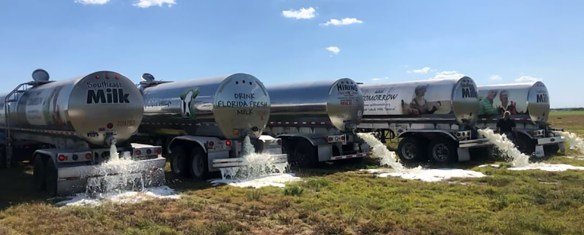
This photo posted on facebook April 2 by Colleen Larson of south Florida was reposted many times by others across social media platforms this week — one of many examples from New York to Florida and Wisconsin and Texas — where dairy farmers were forced to dump significant amounts of milk as COVID-19 pandemic restrictions disrupt supply chains as the industry shifts from foodservice to retail packaged goods. Meanwhile, stores are not well stocked, some are choosing to limit purchases instead of increasing orders, and food banks are receiving more requests as over 15 million people are newly out of work. Against this backdrop of upheaval, a Milk Crisis Plans was proposed by National Milk Producers Federation and International Dairy Foods Association this week, and an alternate plan was also put forward by Minnesota Milk Producers and American Dairy Coalition.       Photo by Travis Larson

By Sherry Bunting, Farmshine, April 10, 2020

WASHINGTON, D.C. — In the face of potential dairy industry collapse in what many are calling a “mixed up supply chain” and “upside down market” due to the impact of the COVID-19 pandemic on every aspect of American life, the National Milk Producers Federation (NMPF) and International Dairy Foods Association (IDFA) came together to propose a “Milk Crisis Plan for USDA,” released Tuesday, April 7.

It is a top to bottom overhaul of dairy production, processing and government feeding programs, including a price program for producers to cut 10% of their production over the next six months as well as removing all restrictions from school lunch programs and the WIC program to allow consumer choice of milk, cheese, yogurt, etc. – including all fat percentages of milk!

Specifically, one element of the plan asks USDA to stop requiring 1% low-fat or fat-free milk for persons over two years of age in government feeding programs – including the WIC program and school meals (provided in or out of school) — even asking USDA to allow servings over 8 ounces per meal for schoolchildren. This means schools could offer whole milk (3.25% fat) and 2% milk at least for calendar year 2020, if the proposal is adopted by USDA.

These industry organizations representing dairy cooperatives and processors cite “collapse of the foodservice industry, export disruptions and massive economic insecurity” as the demand factors that are now colliding with a “seasonally rising milk supply creating a massive gap.”

Their proposal estimates milk supply exceeding demand by “at least 10% — a gap that could widen as supply increases to its seasonal peak and as ‘shelter in place’ conditions endure.”

The dairy industry is navigating a major upheaval as the supply chain tries to adjust to plunging foodservice and institutional sales at the same time that retail demand surges at grocery stores.

NMPF and IDFA state that this is leading to a lack of orders for finished goods, several processing plants cutting or stopping operations and in general leading to “cancelled milk orders.”

In addition to the significant and continuing dumping of milk in the U.S. — something that has also begun this week in Canada – reports are coming in about processors terminating or potentially terminating small co-op contracts; processors and cooperatives seeking voluntary supply reductions from their producers; and some even looking for ways to encourage producers to consider quitting dairy altogether.

Indicative of the collapsing dairy market is this projection in the NMPF-IDFA proposal stating that second quarter Class III futures averaged $13.14 Monday while Class IV were in the $11s. Using the Dairy Margin Coverage (DMC) formula, NMPF projects a milk margin over feed cost getting close to that $5 catastrophic margin, estimated at $5.80 for the second quarter of 2020 and $6.76 for the third quarter according to Monday’s futures prices for milk. The highest insurable DMC margin is $9.50.

The industry organizations also point out that, “There is financial stress across the supply chain, and with more than 10 million Americans already losing jobs, food banks are seeing significant increases in demand, a trend that will likely only intensify in the weeks ahead.”

The NMPF-IDFA proposal aggregates many different tools with the objectives of providing aid to dairy producers, easing financial liquidity risks across the supply chain, stabilizing the dairy commodity markets and filling food banks with dairy products and removing restrictions that would limit the availability of dairy products in USDA feeding programs.

As for the aid to dairy producers? NMPF-IDFA want to “tie producer aid to limits in their production.”

The NMPF-IDFA proposal regarding dairy producers asks USDA to “offset the steep decline in farm milk prices and encourage producers to reduce excess supply” which they say is the result of “demand disappearance.”

Specifically, the proposal seeks to pay producers $3 per hundredweight (extra) on 90% of their milk production IF they cut production by 10% below their March 2020 baseline over the next six months of April through September 2020. Payments during any of those months would be suspended if the average of Class III and IV prices in that month exceeds $16/cwt.

An alternate plan put forward by the Minnesota Milk Producers Association (MMPA) and supported by the American Dairy Coalition would provide aid to dairy farmers differently as a more immediate lump sum payment of $3 per hundredweight on 100% of each operation’s March 2020 baseline for three months (April-June), irrespective of market prices, and paid in April. MMPA’s Dairy CORE plan calls for reassess of conditions in June to see if another round is needed for the next three months (July-Sept). ADC and MMPA contend this approach would be more fair to all regions of the U.S., including seasonal grazing dairies.

American Dairy Coalition noted in a statement Wednesday that direct payments should not be conditioned on arbitrary, top-down, one-size-fits-all production cutbacks. The organization believes that if producers receive a needed large, one-time direct payment, milk handlers and processors would then be in a better position to implement their own marginal incentives to “right-size” their own milk supplies.

The NMPF-IDFA Milk Crisis Plan also calls for a Temporary Milk Disposal Reimbursement to compensate handlers for milk that must be disposed of because of supply chain disruptions resulting from the COVID-19 pandemic. This would provide coverage of milk at the USDA Class IV (or lowest value class) price for three months – April through June 2020.

NMPF and IDFA want USDA AMS Milk Marketing Orders to administer these programs through their audit functions.

Their proposal also seeks recourse loan programs to expand the availability of “working capital” for dairy processors. This proposed program would allow firms to carry heavier-than-normal inventories and reduce systemic financial risk associated with those heavy inventories they would carry. In addition to specialty cheese products that are often inventoried longer anyway for aging, the proposal wants this to apply to as many other products as possible, namely basic commodities.

Also in the proposal for processors is the request for forgivable loan programs similar to the ones for small (non-ag) businesses in the CARES program being administered currently through the Small Business Administration. To qualify, processors would have to continue to purchase milk from dairy producers and maintain their employee staffing.

The NMPF-IDFA proposal also requests the immediate purchase of substantial volumes of dairy products for feeding programs and the aforementioned end to mandates on low fat levels of milk in feeding programs.

In addition, the proposal asks USDA to allow producers to retroactively sign up for 2020 Dairy Margin Coverage (DMC) with no premium discount for the latecomers.

Other aspects of the proposal deal with how to “maximize the buying power of SNAP (food stamps) recipients” at a time when the nation face double-digit unemployment and reliance on SNAP is expected to increase. At the same time supporting that with continued purchasing of butter, cheese, fresh milk and powdered milk to the tune of $525.5 million.

-30-


Farmers forced to dump milk while stores limit consumer purchases

AUTHOR’S NOTE: There is no single “reason” why farmers are being forced to dump their milk and why stores are largely still limiting the amount that consumers can purchase this week. The situation is complex, and two rumors are confirmed to be untrue. First, there is no health problem or health-related plant closure, nor is there a shortage of gallon jugs, according to Department of Agriculture sources. And no, milk jugs are NOT made in China. Most milk processing plants have their own plastic blow-molds and U.S. companies produce them as well.

Now that a few rumors are out of the way…  Here is the industry narrative for plunging farm-level milk prices and farms being forced to dump their milk. It goes something like this: “Schools are closed, foodservice demand is stalled and exports are drying up. The first two weeks of so-called “panic buying” at supermarkets settled into a third week into the COVID-19 national emergency finding consumers continuing to ‘buy’ more milk and dairy products, but “not buying enough to overcome” the aforementioned sales losses…”

It’s difficult to buy something that is not available or has store-level restrictions enforced on how much to buy. Schools account for 8% of fluid milk sales under normal conditions, and children are still served milk with grab-and-go meals offered, which keeps a portion of that 8% going. It is not a ‘panic buy’ when a family of four wants to buy 8 gallons of milk a week because all family members are home due to COVID-19. Interestingly, one week earlier, before store purchase limits were set, USDA reported Class I beverage milk usage quite differently and Nielson Global insights showed sales up exponentially (See more here and here)

While a full report is still in process, here’s my take below as filed for the midnight April 1 press deadline for Farmshine after exhaustive calls, emails, texts, messages, reports, and analysis of letters and forms that I am still pouring over for a more complete report for next week’s edition… One late breaking detail not found below, is that some farms were able to find private food pantries such as Blessings of Hope to take milk that was destined for dumping. In order to go to food banks, the milk needs a processor to pasteurize and bottle it or turn it into something like cheese. Another late-breaking detail not found below is the unofficial tally of milk dumped in the Northeast and Mid-Atlantic region north of 200 loads, and the Southeast could approach 150, meanwhile sources indicate large national footprint cooperatives handling nationwide farm milk supplies met a weekly demand increase in the East of twice that amount. The math isn’t adding up.


Younker_dump_milk

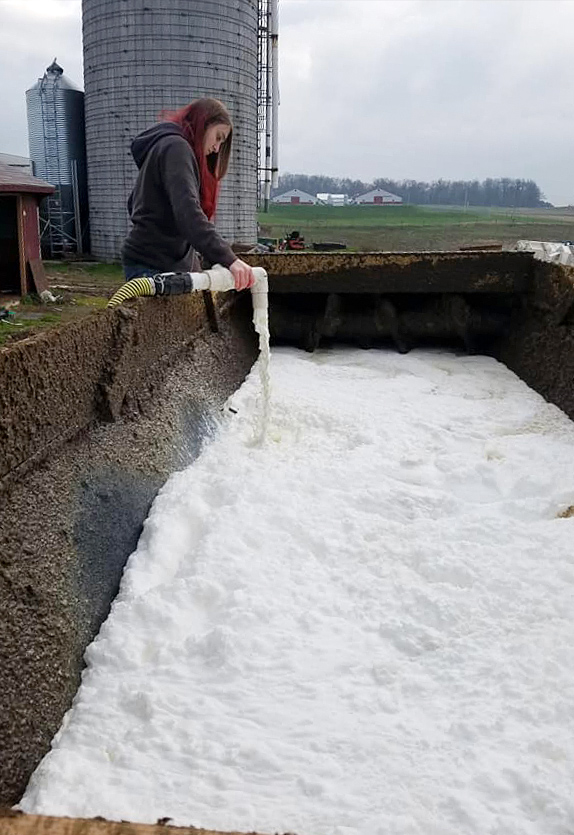
Stephanie Younker of Mohrsville, Berks County, Pa. watches as her family, along other farms shipping to Clover Farms Dairy in Reading, dump two days worth of milk early this week. According to the Northeast Market Administrator’s office, six to eight different milk ‘handlers’, many of them cooperatives, reported dumping milk at the end of March and that more reports are expected into the first week of April as stores continued limiting purchases with varying availability.

March ends with dairy supply chain bottlenecks, utilization management; Farmers forced to dump milk while stores limit dairy purchases

By Sherry Bunting, Farmshine, Friday, April 3 edition (updated)

BROWNSTOWN, Pa. — While most supermarkets placed limits on consumer purchases of milk, butter and other dairy products — with the majority still enforcing those limits through April 1 at this writing — dairy farmers were forced to dump unprecedented amounts of milk throughout the Mid-Atlantic, Northeast and Southeastern states. Reports late Wednesday indicate some dumping also began in Wisconsin this week.

On Wednesday, the Northeast Market Administrator’s office confirmed six to eight different handlers, principally cooperatives, had reported dumping milk at the end of March in the Northeast Federal Milk Marketing Order. (Payment, pricing and utilization of Class I beverage milk is regulated by the U.S. Department of Agriculture (USDA) under 11 Federal Milk Marketing Order regions across the country. Prices paid to farmers are based in part on the receipts and utilization reports that are filed by milk “handlers” at the end of each month — dividing the milk by how it was used into four classes of which Class I beverage milk is the highest priced, Class II is frozen and soft products, Class III is cheese, and Class IV is butter and powder and is typically the lowest class.)

USDA Dairy Programs in Washington had received numerous phone calls and inquiries from milk handlers (processing plants and cooperatives) last week and issued a notice late last Wednesday, March 25, stating that, “In response to questions from the dairy industry, USDA will be implementing allowable flexibilities … to meet the changing consumer demand within the Federal milk marketing order program. The flexibilities will meet changing needs of both the dairy farmer and dairy processor and manufacturing communities to ensure efficient milk movements from farm to table. USDA wants the public to feel reassured that retail outlets will have milk available.”

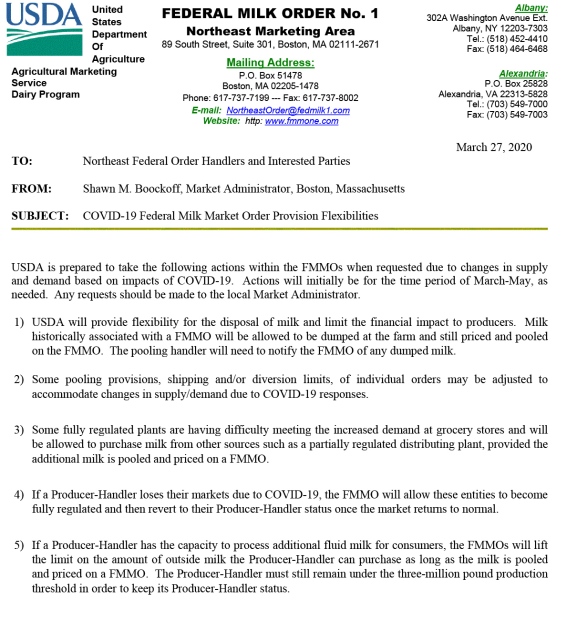
Microsoft Word - GEN-#522324-v1-Covid-19_Response_Letter-March_2This was followed by a letter (above) from the Northeast Milk Market Administrator, allowing flexibility for milk to move from unregulated non-pool dairy product plants into regulated Class I beverage or pool plants and between Milk Marketing Order areas to serve “increasing demand” for fluid milk. The same document states that milk disposal on farms that are “historically associated” with the Order can be dumped, pooled and priced on the Order as “other use” at the lowest Class value. (Clarification: Outside milk from other Orders going into Class I use would be pooled and priced on the Order from which the milk came.)

For March 2020, Class IV is the lowest value, with the price announced for all Federal Orders Wednesday, April 1 at $14.87 per hundredweight (100 pounds) or $1.27/gal. compared with the Class I beverage milk price in the Northeast for March at $20.71 ($1.78/gal). The more Class IV or dumped ‘other use’ milk priced on the order for March, the lower the blend price paid to all farmers for all uses combined. It is already looking like prices paid to farmers for the next three months could fall into the $13 to $14 / hundredweight ($1.16/gal) range or lower. Average breakeven price for farms to produce milk is $17/hundredweight or $1.45-$1.50/gal.)

What started with the news that Mount Joy Farmers Cooperative and the greater DFA cooperative would be forced to dump eastern Lancaster County milk into manure pits for lack of a plant to process it over the weekend (March 28-29), grew to include confirmation of farmers in Berks, Lebanon, Cumberland, Franklin and Perry Counties being forced to dump milk into early this week. And reports from western Pennsylvania indicate the same.

By Monday, all independent dairy farm producers for Clover Farms Dairy in nearby Reading, Pa. were receiving notices that they would have to dump 48 hours worth of month-end milk between Monday and Wednesday (March 30-Apr. 1).

Add to this, confirmation that DFA members were having to dump milk in New York and Vermont, and that small independent cooperatives in New York were either having to dump some of their milk or were being shut out of the ‘spot’ market and having to dump all of their milk. Farms in the Southeast states began reporting they, too, were being notified they would have to dump milk with no where for it to go.

Furthermore, Land O’Lakes member farms in Pennsylvania’s mid-state reported dumping significant milk loads Tuesday, after shipments to the Weis Markets bottling plant in Sunbury, Pa. were turned away despite the Weis Markets stores throughout the region having scant supplies of milk and still enforcing 2-gallon per shopper limits as of Wednesday, April 1.

Walmart

Walmart’s milk cooler in Hamburg, Berks County, Pa. on April 1, 2020

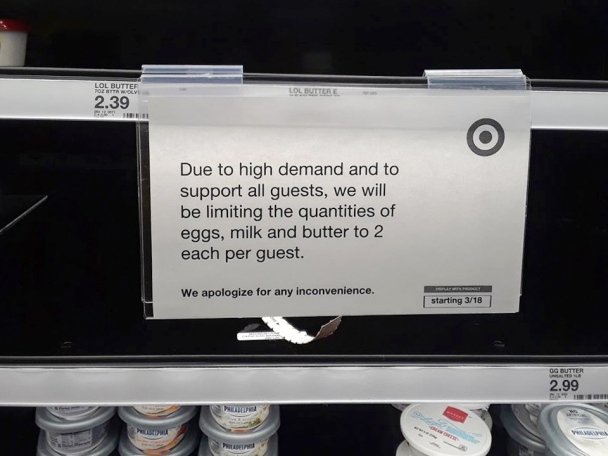
As Walmart, Weis, Aldi’s, Target, some Giant stores, and others were confirmed to have sparse or empty dairy coolers — and a few chains and small town stores reported good stocks of milk and some dairy products — farmers continued to be forced to dump their milk, being told the dairy plants were full, the stores were not ordering, and consumer demand had shrunk after being described by USDA the previous week as “exponentially higher” than a year ago and “extraordinary”, “haywire” and “overcoming inventories” the week before that.

target_butter

Signs like this one at Target were the rule, not the exception among many store chains this week, while nearby dairy farmers were forced to dump milk.

Adding to the complexity of the issue is milk silos and tanks full of cream that could not be moved as candy makers and bakeries closed or cut back, and foodservice and institutional trade came to a standstill.

As the industry supply chain adjusts product lines from schools, restaurants and other foodservice products to retail-packaged products, some plants reported not being able to process milk fast enough for two weeks of surging demand, bringing outside milk in — only to find the stores had started limiting consumer purchases or were spreading their risk of running out by stocking other brands. Difficulties unloading milk to stores in New York City was also cited.

In store dairy cases where milk was most scarce this week, store managers indicated issues with getting supplemental milk from other processors in other areas due to regulatory pricing “zones”, which they interpreted to mean that milk was being rationed so a more uniform distribution of available supplies would occur.

In terms of retail manufactured products, butter continues to be mostly unavailable at stores checked throughout the Mid-Atlantic region, and reports coming in from other areas indicate similar scant supplies and restricted purchases.

By Wednesday, April 1, some stores were re-stocked with milk and dairy products, and a few chains were lifting restrictions on gallons of milk, but they were the exception, not the rule. Almost universally, however, butter was absent or limited at retail outlets despite a cold storage bulk inventory report by USDA last week stating there was 25% more butter in storage than a year ago. Still, last week, processors made more bulk butter for foodservice that ended up in inventory, doing ‘print’ butter for retail on more of a hand-to-mouth basis, and the result is obvious in the lack of butter available to consumers seeking it at retail.

Jennifer Huson, senior director of communications for DFA Northeast reports that anyone having to dispose of milk should take measurements.

According to USDA Dairy Programs, producers should also collect an agitated sample. If not available, it is possible that missing samples can be quantified using previous and next samples in order to calculate protein and butterfat levels for the volumes of discarded milk that in most cases officials say will still be pooled and priced on the Federal Orders.

It is also apparent — according to Federal Order rules and the announced flexibilities — that Class I handlers have a clear financial incentive to price and pool this dumped milk on the Order because it will be priced at the lowest class value ($14.87 instead of $20.71), allowing them to draw from the pool while diluting the previously exponentially higher Class I utilization percentage experienced across the entire Northeast Federal Order the previous two weeks in terms of reducing the USDA blended price based on the milk handlers’ reports of receipts and utilization for March due around April 10 to the Market Administrator’s office.

While there are conflicting reports from some plants and handlers about whether farmers will be paid for the milk they are forced to dump, DFA says dumped milk will be pooled and paid, but they are tracking and looking at it from a comprehensive standpoint to see how to handle and aggregate it going forward.

“We want to make sure we are doing everything we can to fully understand our best opportunities moving forward through dynamics that are changing day by day and hour by hour,” said Huson. “Most importantly, in these uncertain times, we are working to make sure milk continues to be picked up, plants continue to operate, and wholesome dairy products continue to be available to consumers. We are not sure what is coming at us, and we want to make sure as this is evolving that we are doing all of those things.”

Look for a full and ongoing report next week in Farmshine.

Want to learn more or find out how to help? For an informative FAQ click here

More open bidding process, accelerated timetable underway for sale of Dean Foods plants

By Sherry Bunting, Farmshine, Friday, March 27, 2020

HOUSTON, Texas – Changes have officially been made to the bidding procedures originally sought by Dean Foods in the conglomerate’s Southern Foods Group Chapter 11 bankruptcy and sale in the Southern District of Texas.

In a very brief continuation of bidding procedures hearing on March 19, U.S. Judge David R. Jones said he would sign an order that outlined the new procedures and accelerated timetable for bankruptcy and sale proceedings. A cover story in last week’s Farmshine described the concerns and changes that led to the new order.

On the evening before the hearing, Dean withdrew its original proposal for Dairy Farmers of America (DFA) to be designated as stalking horse bidder, essentially dissolving key elements of the Feb. 17 Asset Purchase Agreement with DFA on 44 of Dean’s 57 plants.

This move to a “value maximizing” sale process opens the bidding to more opportunities for additional single- and multi-plant bids as well as a potential restructuring bid.

Bids are due by Noon CDT on March 30, 2020, with Dean declaring winners shortly thereafter.

Objections to a sale order or transaction are to be filed in writing by April 1, 2020 at Noon CDT.

A hearing to consider the proposed sale transaction will be held before Judge Jones on April 3, 2020 at 9:00 a.m. CDT.

Attorneys and consultants for interested parties worked together at the suggestion of Judge Jones to modify the original proposal after objections were raised by the creditors committee, potential buyers of Dean assets, and more than a half dozen dairy cooperatives. Their concerns focused on the lack of fairness and transparency in the previously proposed bidding process that sought to designate DFA as lead bidder with protections for its 44-plant bid.

The order at the case docket does not remove DFA as a potential bidder but opens the process by not designating DFA as the stalking horse bidder.

More information can be found at the website for the Southern Foods Group case at https://dm.epiq11.com/case/southernfoods/dockets and at https://deanfoodsrestructuring.com/

-30-

Market Moos: COVID-19 impacts how consumers are supplied with food

By Sherry Bunting, excerpt updated from Market Moos in Farmshine, March 27, 2020

Ten days into the 15-day COVID-19 “flatten the curve” mitigation strategy, supermarkets are still scrambling to remain supplied with in-demand food items — including milk, especially whole milk, dairy products, especially butter, eggs and beef.

Nielson data show nationwide fluid milk sales were up 32% last week, dairy products like butter (up 85%), cheese and yogurt up over 50%, egg sales up 44%, and beef sales, including ground beef, up 77%!

Walmart and other supermarkets have started setting limits on how many gallons of milk or cartons of eggs or packages of butter can be purchased per customer, meaning shoppers will be making more frequent trips to feed their families and supply their older loved ones.

In Pennsylvania, for example, Secretary of Agriculture Russell Redding sent a message out on various television news programs Wednesday evening, asking the state’s consumers to “stop hoarding food” and to “think of others who may need the food.”

Unlike toilet paper (and there’s more to that story too in terms of paper product imports), what we are seeing with food essentials is not “hoarding.”

What may not be clear to state and national ag and government leaders is that consumers are not hoarding food, they are buying what they need for a week at a time (to avoid multiple trips exposing them to multiple people). Their grocery lists are more full because for most of them, their whole families are home all day and evening with schools closed and all non-essential businesses shut down.

In addition, many shoppers are buying provisions for elderly parents or neighbors to leave on their porches for them.

This is not “food hoarding”, this is providing for one’s family now that families are not being institutionally-fed according to the government’s rules restricting calories derived from animal products at least one or two meals at least five days a week.

This is a major shift in where the supply chain needs to focus its distribution of the abundant milk and beef that farmers are producing, but is meeting a severe tamp-down in terms of base pricing, production penalties being deducted from milk checks, and over this past weekend even the dumping of milk due to what industry leaders say is “processing disruption” or “loss of foodservice and hospitality trade” despite huge increases in retail purchasing indicating supply chain shifts. (See more on that here.)

A dilemma for some farms that have transitioned into direct sales to get closer to end-users, is that their businesses often rely on people assembling through agro-tourism, farmer’s markets, events, and casual dining restaurants that are more geared to dining-in than taking-out.

Some of these diversified and direct-to-consumer dairy, beef and farmsteading operations have large and fairly recent processing equipment and marketing investments and now must limit access to the consumers their businesses served.

A provision in the $2 Trillion COVID-19 federal aid package is $9.5 billion for livestock, dairy, and specialty crop producers that are part of “local food systems” where their marketing is impacted by COVID-19.

Farms that have developed consumer-facing businesses may also qualify for “bridge” loans to small businesses that are also part of the package.

Meanwhile, dairy, beef and ag organizations are beginning to also raise a concern to USDA to be alert to price manipulation as sales and value to processors is rising rapidly with the surge in demand for dairy and beef, while the prices paid to dairy and beef producers is falling rapidly in the other direction as both milk futures and live cattle futures plunged.

American Farm Bureau Federation even raised this concern, along with transportation and labor as three points of vulnerability on farmers’ minds.

A spokesperson for National Cattlemen’s Beef Association expressed NCBA’s concerns in a CNBC business news interview indicating that farmers and ranchers selling cattle once a year as their income for the whole year, felt the huge drop in live cattle on the futures market for fats and feeders. This can break an operation selling cattle at this juncture, after the tough year last year.

Meanwhile, boxed beef prices are rising rapidly, to where processor margins are $600 profit per head, whereas farm losses are more than $100 per head. This also happened a year ago when the relationship between farm pricing and wholesale to retail pricing was equally inverse, showing massive profit-taking at the processing level and big losses for cattle producers for many months after a fire at one beef processing plant in Kansas.

-30-

When freed from institutional food-police, what are consumers choosing?

_DSC0830Bad news meets dairy good news as industry navigates COVID-19 pandemic

By Sherry Bunting, Farmshine, Friday, March 27, 2020

BROWNSTOWN, Pa. — We will get to the good news, but first, the bad news…

These are tough times for Americans, and dairy farmers are hearing from their cooperatives and industry in such a way as to put a black cloud of doom over 2020.

Farmers are getting letters and phone calls stating milk base penalties will be strictly enforced beginning this week, in the case of Land O’Lakes, MDVA, DFA — for example — which ask for “voluntary milk reductions” and make plans for dumping milk on farms and at plants as “potential plant closures” meet spring flush.

They indicate that the ability of plants to process milk could “worsen,” giving folks the sense that the ability to process all the milk is already bad. And the dairy industry is preparing its farmers for the possibility of no compensation for displaced / dumped milk.

National Milk Producers Federation’s bulletin and press releases this week state they are seeking three things from the federal government — asking to reopen 2020 Dairy Margin Coverage enrollment, to purchase additional dairy products for humanitarian feeding programs, and to compensate them for “milk disposal” they deem to be “a real possibility as logistical challenges on the farm and at manufacturing plants may create severe disruptions.”

In fact, just 11 days into the COVID-19 national emergency declaration, NMPF came out with an estimate that the dairy industry’s losses “may exceed $2.85 billion”. Analyst after analyst is coming out with new forecasts — projecting milk prices paid to farmers could fall well below pre-COVID-19 forecasts and conjuring up images of 2008-09.

While the pessimistic psychology in these letters, phone calls and industry proclamations is peppered with platitudes such as “we’re in this together” and “we’ll rise to the challenge”…  dairy farmers are already rising to the challenge all day every day producing the milk that consumers are turning to in their time of grave health concern.

The psychology in the letters and phone calls received by farmers stands in stark contrast to the good news.

Now for the good news…

A silver lining became obvious last week and is continuing this week. Consumers are reaching for the jug! In fact, they are reaching for so many jugs that some stores are reportedly limiting milk purchases to one gallon per shopper.

They are also reaching for cheese, butter, yogurt and other dairy products as stores and plants scramble to restock.

While the Dietary Guidelines Advisory Committee is poised to further clamp-down on the allowable percentage of calories from saturated fat (sources say new guidelines might drop to 7% instead of the current 10%!), what are consumers doing?

Consumers are currently free from the government’s flawed and unhealthy “food police” nonsense that the Dietary Guidelines foist upon us by dictating our nation’s institutional feeding and foodservice in schools, daycares, workplaces — even restaurants.

Those dairy farmers attending the dairy checkoff question and answer session in Chester County, Pa. on March 5 heard firsthand from DMI leaders that dairy checkoff foodservice “partners” — like McDonalds – “want to meet the dietary guidelines on saturated fat and calories,” which is why their meals, especially for children, only offer fat free or 1% milk and it’s why the cheeseburger is not on the Happy Meal board. (But you can get a slice of cheese on that kid’s burger if you ask for it, and you can get whole milk in your hot chocolate, they say, if you ask for it.)

In our collective American lives — pre-COVID-19 —  stealth-health according to government rules has been in effect more than we realized.

The point here is this: Supermarkets are where consumers get to choose what they want to feed their families when the menu is theirs to create. And consumers are learning that saturated fat is not to be so-feared, that Whole milk has less fat than they thought, and that Whole milk and dairy products provide more healthy benefits than they ever thought — including immune-building benefits.

Yes, milk education works. As soon as consumers get to choose freely, what are they choosing? They are choosing milk and dairy, and they are choosing whole milk over all other forms — when it is available.

While DMI leaders talk about “consumer insights” and “moving to where the consumers are” and “moving them away from the habit of reaching for the jug to try innovative new products”… what are we seeing when all the stealth-health controls are lifted and people are home choosing what they will feed their families during COVID-19 “social distancing” and “sheltering in place”?

We see them choosing the truly healthy comfort foods. They are choosing whole milk and 2% gallons and half-gallons, butter, full-fat cheeses and red meat for their families.

These items are quite literally “flying off the shelves.” This phrase is used in report after report this week about the demand pattern that is unfolding.

This supply-chain shift is something the dairy industry is wholly unprepared for, as the path charted for dairy processing and promotion has been so heavily linked to flawed dietary guidelines, institutional feeding, foodservice chain partners and new, more expensive, innovative products — that the concept of filling so many jugs with healthy, affordable, delicious milk is a bit off the charted path.

Even USDA Dairy Market News observed in its weekly report on Friday, March 20th what we also reported to you from our sources in Farmshine last week — that the surging demand at the retail level is more than overcoming reductions in sales to schools and foodservice. In fact, USDA DMN reports that retail milk demand is “overtaking inventories” and that retail orders are “heading into new territory.”

Pictures of empty dairy cases populate social media posts. And yes, USDA DMN confirms that Class I milk demand is ranging mostly from “strong” and “surging” in the West and Midwest, to “extraordinary” in the Northeast, to going “haywire” in the Southeast.

Given that the spring flush has begun, the current surge in fluid milk demand means less of this extra milk will go into manufacturing — as long as consumers continue the current level of fluid milk buying and as long as the milk is in the stores for them to buy.

This pattern should help the surplus butter situation, which was revealed again in last week’s February Cold Storage Report. Last year ended with inventories of butter up 18% compared with the end of 2018. The February report showed butter storage was still bursting at the seams.

But earlier this week, at a local grocery store, only a very local brand of butter was available. Zero Land O’Lakes butter could be found in the case.

USDA DMN in its March 20 weekly report stated that cream is widely available, which seemed to contradict the agency’s description of whole milk sales and its notation in the report that butter churns have strong orders from retailers for what they call “print” butter – butter for retail sale, not bulk inventory.

So what do the numbers look like?

It’s more difficult than ever to get timely information from USDA AMS about packaged fluid milk sales, but here’s what virtually every dairy analyst is reporting this week. They cite the Nielson supermarket data showing fluid milk sales were up 32% last week, that sales of whole and 2% are dominating, when available, and that retail sales of other dairy product classes were up double digits.

Milk and dairy products are a centerpiece of “comfort food” and in-home meals. Families are enjoying milk again. Will they keep enjoying it after they return to school and work? Or will they be back in rush zone of packaged carbs instead of cereal and milk, and back in the government’s “stealth-health” or “fake health” zone where fat is restricted and carbs are unlimited?

It will take some time to sort out the buying patterns that linger after the initial surge in dairy demand currently experienced at retail, but here’s some additional positive news to think about.

When consumers are educated and get the opportunity to seriously whet their appetite. When they tune-out the frivolous ‘sustainability’ banter about cows and climate and can ignore the rules about saturated fat… When they focus-in on their families, turn to milk for health, flavor and comfort, and remember or realize for the first time what they were missing… Who knows what they will choose going forward – when they are allowed to choose?

Even when families return to work and school, they may remember coming to dairy for immune-building properties, for comfort, for health.

Nielson has a chart at its public website tracking key consumer behavior thresholds in six quadrants: Reactive health management, pantry preparation, quarantine preparation, restricted living, and living a new normal. It shows their consumer insights on how buying patterns evolve during a health emergency of the scale of COVID-19, and how this peels away some of the frivolous drivel and constraints that influence consumer behavior in ordinary times.

In the sixth phase, “living a new normal,” Nielson describes how “people return to daily routines of work and school, but operate with a renewed cautiousness about health.” It goes on to state that this creates “permanent shifts in the supply chain.”

Citing the use of e-commerce and hygiene practices as examples, this sixth phase of “living a new normal” when returning to daily routines could also apply to food and beverage purchases as consumers returning to true health and comfort during the first five phases may continue to prioritize true health and comfort after those phases have passed.

What do consumers really want? Where are consumers moving when they are free to move?

Without institutional control of daily diets and promotion, we are seeing a glimpse of the answer to that question within the context of COVID-19 pandemic buying patterns. Real whole nutrition, foods that build immunity, awareness of Vitamin D deficiencies in our population affecting immune system response, the role of other elements in milk for immune-building, preference for local food that doesn’t travel so far, and a revitalized awareness of how regional food systems are critical to our food security — these are perspectives that could prevail to influence buying patterns into the foreseeable future.

Uncertainty prevails right now, but hope is alive, and the good news is that milk and dairy have much to offer.

-30-

Dairy industry navigates uncharted territory amid COVID-19 pandemic

By Sherry Bunting, Farmshine, Friday, March 20, 2020 (updated March 24)

BROWNSTOWN, Pa. — The ‘new normal’ brought on by the novel Coronavirus / COVID-19 global pandemic evolves rapidly as the U.S. is partway through the 15-day “flatten the curve” effort deemed critical by health officials. Federal, state and local governments worked together to launch the 15-day mitigation strategy early last week to blunt the trajectory of viral transmission so that it does not overwhelm medical and caregiving infrastructure when the virus is expected to reach its peak in 45 days.

The effort led to closures and cancellations of non-essential activities, with some large cities and highly affected states moving to “shelter in place” strategies.

National state of emergency

A national state of emergency was declared March 13. Alongside the more restrictive guidelines, new drive-through testing sites became available in all 50 states, and the Trump Administration cleared the way for certain anti-viral therapies used for other illnesses to move forward through FDA after trials showed positive results.

A 2 trillion-dollar response and aid package is also moving through Congress, and by March 18, President Donald Trump had invoked war powers to utilize military medical resources and ramp up private sector production of items needed to combat the virus.

A key difference from Influenza, say scientists, is COVID-19’s much more rapid rate of transmission and the current lack of management tools like vaccines and anti-viral therapies, making its burden to medical infrastructure a key concern.

Meanwhile, hospitals and health systems adopt strict visitation rules, take stock of bed and equipment capacity, and work through triage plans.

Markets and trade

Financial markets had steep losses again this week in response to the economy slowing to a virus-induced crawl. Travel restrictions and lack of availability of shipping containers are reported as just some of the disruptions to U.S. trade, including dairy. But remember, these disruptions are based on a viral epidemic that current steps are aimed at curtailing, so the longer-term impacts on human and economic health are hard to predict.

On March 18, President Trump and Canadian Prime Minister Trudeau announced the closing of the U.S-Canadian border to non-essential travel. Both leaders assured that trade crossings, especially food, fuel and medicines, will not be affected.

The dairy futures markets suggest that the brunt of the impact on product prices and farm-level milk prices will be felt after May, but this depends largely on what happens over the next two months.

Milk and dairy in demand

Meanwhile, gallon and half-gallon sales of Whole Milk and 2% — as well as cheese and butter and other dairy products — are experiencing surging demand at the retail level, more than overcoming reductions in sales to schools and restaurants to the point of retail milk demand overtaking inventories with retail orders heading into “new territory.”

Pictures of empty dairy case shelves populate social media posts, and USDA Dairy Market News reports Class I milk demand ranging mostly from “strong” and “surging” to “extraordinary” and “haywire.” Given the reported butter surplus in cold storage, the current surge in fluid milk demand means less milk for manufacturing to add to inventories as the spring flush builds.

Milk and dairy products are a centerpiece of “comfort food” and in-home meals. In fact, as families settle into a period of greater isolation, more families are sitting down to eat together. Children are relaxing in the absence of extra-curricular activity schedules, and we may just find milk coming back to tables.

Schools, supermarkets, and restaurants adjust 

State governors have closed schools for at least two consecutive weeks, and now restaurants in many states are closed, except for takeout meals.

As the overall economy grinds to a virus-induced stop, uncertainty prevails even as essential services gear up for what may lie ahead. Amazon, for example, seeks 100,000 additional workers while limiting their warehousing and shipping to be focused on medicines and high-demand essential items.

Supermarkets are working to restock essentials, and there is a universally-reported surge in demand for milk and dairy foods that started March 13 and has accelerated nationwide since then. Stores are modifying operations, and relaxed rules for USDA meal reimbursement allow schools to provide grab and go meals to more families as children are home, and many adults find themselves suddenly out of work.

Supply chain planning and liquidity

Anticipating demand surges to be followed by periods of pull-back, milk plants and cooperatives are monitoring and planning for rapidly changing milk dispatch conditions. Many are looking ahead to make milk and dairy products available to food banks, as they are able, and especially if school half-pints are in inventory and as the product mix in demand is dramatically changing from foodservice to in-home use.

Concerns about liquidity have prompted The Fed to reduce the target interest to zero to 0.25%, and at the agricultural level, Farm Credit and other lenders sent communications Tuesday about working with customers impacted by COVID-19 as the full effects are not yet known in terms of Ag marketing and supply chain challenges.

Dairy market forecasts

Some analysts are going public with forecasts that dairy markets will suffer an average decline over the next 12 months that could be anywhere from 3 to 8% or 20 to 25% below the industry’s pre-COVID-19 milk price forecasts. Some have gone so far as to say milk prices paid to farmers could fall to 2008-09 levels as global and U.S. recession concerns emerge.

However, the underlying fundamentals of the U.S. economy are strong and will prevail unless both the fear and reality of the virus have a deep and long-lasting impact – something that cannot be forecast at this juncture.

Global Dairy Trade (GDT)’s price index is down 8% since COVID-19 fears became prevalent when the situation in China became known and Europe’s cases emerged. And yet, trading volumes have not declined in the biweekly GDT auction. This suggests global dairy demand is holding up.

A big supply-and-demand swing is always China, and there is a bright spot on that score.

Dairy is essential

Dairy is essential to a healthy diet, especially in times like these, and Milk’s immune-building properties are being recognized. For example, in China, where the virus is reported to have peaked and may be leveling off, Chinese dairy associations worked with the Chinese government to issue guidelines to “increase dairy consumption to build immune resistance,” saying “fight COVID-19 with dairy.”

A report this week in Food Navigator details these new dairy consumption guidelines in China as well as specific elements in milk that help boost the immune system. The formal stated: “Milk and other dairy products are an excellent source of high-quality protein and can also provide a source of Vitamin B2, Vitamin A, calcium and other nutrients essential for the human body. So a higher intake of these products for those low in protein, especially when higher immune resistance is required to fight the novel coronavirus, will be very beneficial.”

Dairy industry navigates ‘new normal’

Meanwhile in the U.S., four dairy processors and three milk cooperatives reported in email responses to Farmshine this week that even though all schools, some daycares and many restaurants are closed or curtailed, sales of fluid milk are surging to more than compensate.

“Quick changes in demand require a different product mix (whole gallons instead of 1% chocolate half-pints, for example). From a production standpoint, we have been reinventing the wheel every day for almost a week,” writes Carissa Itle Westrick of Valewood Farms Dairy, Loretto, Pa.

Another western Pennsylvania milk bottler indicated there are no sure answers to any questions just now, but that retail demand is higher, and the hope is that the school grab and go meals in most communities will be able to consume half-pint inventories.

In short, everyone is figuring out their “new normal”, and the industry is shifting its product mix from foodservice and institutional-style demand to in-home use demand.

In the Southeast, where fluid milk sales have been “lackluster” over the past several months, the situation changed dramatically since Friday, March 13.

“Up until last Friday, we had not encountered any changes in overall routing of milk to our regular fluid customers,” notes SMI’s CEO Jim Sleper.  “Then beginning Friday and ever since, it seems like all of our customers have added on additional milk to keep up with the surging demand resulting from customers stocking up, and we are seeing these extra loads far exceed the number of loads lost from schools being out.”

This observation is national in scope as confirmed by numerous industry sources, including Dean Foods, nationally, and other processors in the Northeast.

The concern in the balance is how long will this continue as home-bound refrigerators become full but also have the people at home to consume it?

Supply chain management?

Concern was expressed by some sources as to how the demand pattern will unfold if schools remain closed beyond two weeks right into the spring flush, especially if plants are short on labor or unable to remain open for a time.

According to a notice shared with Farmshine this week, Land O’Lakes informed its eastern members that beginning March 23, its base program will be strictly enforced, assessing members $10/cwt for their production over their individual base allocation, and asking members to “voluntarily” reduce their milk production as well as to prepare to dump milk.

The accompanying letter from Land O’Lakes indicated “business as usual” otherwise, for the moment, but that the cooperative is “preparing for a potential reduction in employee availability at plants across the country,” citing the possibility of having to dump milk. The letter also indicated that daily recorded messages would be sent to members in each milk shed about each milk shed’s respective situation.

All industry sources interviewed expressed heightened levels of emergency preparedness to bring some stability. As SMI’s Sleper put it, “We are treating this uncharted territory similar to our regular Hurricane Preparedness planning.”

Like the daily governmental briefings, milk processors and cooperatives are doing daily, even multiple times a day, conference calls among staff and board to navigate.

Transportation, labor and pricing

In a paper released this week by Dr. Andrew Novakovic of Cornell, the key points of vulnerability for the dairy industry are transportation and labor.

“Transportation disruptions could quickly scale to an industry problem,” he writes.

He also noted that the health of the labor force in milk plants affects the availability of milk more quickly than that of an individual farm.

American Farm Bureau also expressed to USDA that labor, supply chain issues and possible price manipulation top the list of immediate issues farmers are raising.

Optimism and commitment as food providers

In a letter to Secretary of Agriculture Sonny Perdue, AFBF president Zippy Duvall pledged that, “America’s farmers and ranchers will be with you every step of the way, doing all that we can to help you win this fight and to ensure the health, safety and prosperity of all America.”

Sleper also expressed positivity. “Uncertainty seems to breed pessimism especially with the stock market and dairy commodity pricing,” he wrote in an email. “We will endure this like we have other situations.  For SMI, we encountered extremely low milk prices over the past four-plus years, a shortage of available labor, two major bankruptcies, and hurricanes. I’m amazed how resilient (our farmers) have become.”

Novakovic cites a few positives to think about: “Overall, I am optimistic that the food industry, beginning with farmers, will rise to this challenge,” he writes. “Given the longstanding concern and emphasis around animal health and food safety, I think agriculture and food businesses have a leg up in doing what is needed now.”

In fact, FDA released information this week stating that COVID-19 is NOT a foodborne pathogen, confirming that there is no evidence of food or food packaging being associated with any transmission of COVID-19.

“We are lucky in the dairy industry that the sanitation and food safety practices we have in place every day protect us from a variety of outside threats. We have expanded these plans, with an eye toward the unknown,” writes Itle-Westrick in an email. “But as a small business, the possibility of one employee becoming ill is something that would have a big impact on our production and distribution capability, so we are protecting against that.”

Even though schools are closed, their needs continue at a smaller, though increasing, scale. Numerous mainstream media outlets are picking up stories showing how schools are providing these grab and go meals (without congregating) in communities across America.

Krista Byler head chef of Union City Schools in Erie County, Pennsylvania says inventories allowed them to feed participating students for one week, and that they’ll need items like bread, rolls and milk for next week.

“We had sufficient milk on hand to handle breakfast and lunch for one week of service, and will be placing a milk order on Friday for the week of March 23rd,” said Byler in a Farmshine interview.

“I think every foodservice employee in this district is a mom, a grandma. We definitely have a heart for the children here, and we just want to make sure they have the food they need.”

Resources for dairy and agriculture

While there are likely many resource bulletins being put together for farmers and dairy producers,  two good ones include Pennsylvania’s Center for Dairy Excellence at https://www.centerfordairyexcellence.org/covid-19-farm-resources/ and Indiana’s Purdue University at https://www.purdue.edu/newsroom/releases/2020/Q1/a-guide-for-local-producers-to-navigate-the-covid-19-outbreak.html

Gratitude

AUTHOR’S NOTE: Instead of pessimism, a can-do spirit prevails as farm-to-table sectors navigate these unprecedented challenges, including restaurants that are on the front lines as vulnerable small businesses taking a huge hit but in many cases providing takeout meals, even at discounted prices, with an eye on the situation.

As dairy farmers continue their important work each day, we thank you — and all involved in the food supply chain — for your essential contributions

May God bless the medical professionals, caregivers, first-responders… and the farmers who feed us. Stay safe, have faith, and be well as we all pull together to stay apart and curb transmission to starve the enemy COVID-19.

-30-