Borden second major milk co. in 60 days to file Chapter 11

Borden-Dairy (1)

‘Business as usual’ motions face lender objections over how cash reserve is accessed and used. Judge grants Jan. 7 ‘interim’ relief with authority to pay pre-petition ‘critical vendors’, including producers supplying milk. A hearing on the final order in regard to critical vendor payments and cash management is set for Jan. 23.

 By Sherry Bunting, Farmshine, Friday, January 10, 2020

WILMINGTON, Del. — Citing unsustainable debt, including pension funds, negative dairy industry trends, fluid milk category declines as well as margin pressure in a loss-leading, commodity-driven market, the Borden Dairy Company, based in Dallas, Texas, but organized in Delaware, became the second major fluid milk bottler in the past 60 days to file for Chapter 11 bankruptcy protection.

Unlike the November Dean Foods filing with intentions to sell assets, Borden states its intentions are to use the Chapter 11 process to restructure its business for the future.

The company seeks to combine the bankruptcy filings of its 12 affiliated milk plants and one transport company stretching from Texas to Florida and north to Ohio under Borden Dairy Holdings LLC, owned by Acon Investments LLC,which had recapitalized these assets as recently as 2017 when purchased from Laguna Dairy after they were spun off from Grupo Lala.

Processing 500 million gallons of fluid milk annually for customers including supermarkets and schools, Borden employs 3300 people at milk plants in Alabama, Florida, Georgia, Kentucky, Louisiana, Ohio, South Carolina, and Texas. Milk is supplied by dairy producers and milk cooperatives in these and other states.

In addition to licensed brands Borden and Poinsettia, other brands involved include Coburg, Dairy Fresh, Dairymens, Flav-O-Rich, Kid Builder, Saba Sunburst, Sallie’s Southern Tea, Sunburst, and Velda. DFA separately owns the Borden brand license for cheese.

In Delaware District Bankruptcy Court, Wilmington, Judge Christopher S. Sontchi heard Borden’s first day bankruptcy pleadings on January 7.

“Concurrent to the decline of the number of milk producers, dairy processers have seen bottling margins decline due to competitive pressures from milk suppliers and large (and sometimes vertically integrated) customers. Couple this with the fact that … consumption has steadily declined, and it is no surprise that Borden and other dairy suppliers (such as Dean Foods) have begun to feel the same negative effects that have plagued dairy farmers for the past decade,” said Borden Chief Financial Officer Jason Monaco in his declaration with the court.

While all expected motions were filed to allow Borden to continue ordinary business while restructuring under bankruptcy protection — including motions to use a cash deposit reserve to pay pre-petition critical vendors such as dairy producers — attorneys for unsecured creditors objected Tuesday.

The lenders argued that, “(Borden) should not, and cannot, be allowed to use chaos of their own making to distract from the clear facts. There is no economic justification for… sudden chapter 11 filings, and the debtors cannot use the lenders’ (cash) collateral to finance an attempt by Acon to re-trade the out-of-court transaction,” that the parties had previously been negotiating.

The unsecured lenders contend that the bankruptcy filing occurred virtually on the eve of their out-of-court terms being ready for signatures. They contend that the $30 million cash deposit reserve is collateral and that other cash collateral Borden seeks access for operations are “insufficient.”

Acknowledging the importance of Borden continuing operations to preserve equity for all parties, the objecting lenders seek various protections from the court, including a position of consent with some oversight of budgets for the use of cash reserve and payment to critical vendors, including milk producers.

A day earlier, Borden CEO Tony Sarsam cited major milestones for Borden last year, including the revival of its spokescow Elsie, the brand’s reintroduction in Ohio and the launch of several innovative products such as state-fair inspired milk flavors and a new Kid Builder flavored milk line using 2% milk and containing 50% more protein and calcium with no added sugar.

Sarsam also explained in a press release that the company “continues to be impacted by the rising cost of raw milk and market challenges facing the dairy industry” that have contributed to “making our current level of debt unsustainable. He said ultimately, reorganization through court-supervision was the only solution “for the benefit of all stakeholders.”

Court documents reveal that Borden reported 2018 consolidated net sales of $1.181 billion with gross profit of $292 million but experienced operational income loss of $2.6 million and total net income loss of $14.6 million. These losses continued into 2019, with reported operational income loss of $22.3 million and total net income loss of $42.4 million from January 2019 through December 7, 2019, according to court documents.

Borden maintains that its situation differs from the Dean Foods bankruptcy.

“We believe that, from an operational standpoint, we are in a much better position than Dean Foods. Borden is EBITDA-positive and growing, which means we have solid earnings and are healthy,” Sarsam said in a public statement. “Borden intends to continue operations and strengthen our position … whereas Dean Foods announced its intention to sell substantially all of its assets. We are confident that, once we fix our balance sheet, we will be equipped to win together in the market.”

Documents also note Borden’s “need to raise new investor capital” to “continue to innovate with new products, modernize our facilities and equipment and improve Borden’s ability to compete in today’s market.”

The bankruptcy process is still in preliminary stages with more than 45 items filed on the docket within the first 48 hours.

Stating that this bankruptcy reorganization will not affect dairy producer contracts, Borden announced on Jan. 5 that it fully expects business as usual and to move quickly and efficiently through the bankruptcy process.

However, on Jan. 6 and 7, unsecured lenders filed the objections to many of the motions that would allow business as usual – creating potential ripples in that scenario.

As of Wednesday afternoon, Jan. 8, a signed interim order from the Jan. 7 hearing authorizes Borden to maintain its cash systems and bank accounts and provides interim relief to pay certain pre-petition obligations, such as payments to ‘critical vendor,’ including milk suppliers.

A hearing on the final order in regard to critical vendor payments and cash management is set for Jan. 23.

In the meantime, dairy producers supplying milk to Borden plants, are advised they may need to file a proof of claim with the court to be eligible for payment or otherwise consult an attorney for guidance.

The company’s claims agent, Donlin Recano, can provide appropriate forms once a deadline for filing claims has been set by the court. For more information on that, dairy producers can call the Borden restructuring information center toll free at 1 (877) 295-7345 or e-mail bordeninfo@donlinrecano.com.

A special Borden restructuring website contains various documents, including one that answers questions for raw milk suppliers at https://www.bordenfinancialreorg.com/

-30-
 

Coca-Cola now sole owner of fairlife, beyond the headlines

lead-fairlife (2)By Sherry Bunting, Farmshine, Friday, Jan. 10, 2020
CHICAGO, Ill.  The Coca-Cola Company announced Friday (Jan. 3) that it has acquired the remaining stake in fairlife LLC from its joint venture partner Select Milk Producers, a 99-member cooperative run and founded by Dr. Mike and Sue McCloskey. Mike McCloskey is also co-founder and chairman of the board of Fair Oaks Farms, and he was chairman of the Sustainability Initiative of DMI’s Innovation Center for U.S. Dairy in 2014, when fairlife was officially launched.

As a result of the recent transaction, Coca-Cola now owns 100% of fairlife, up from its previous 42.5% minority stake, according to company statements.

Financial terms were not disclosed.

According to a company statement, fairlife will continue to operate as a standalone business and will continue to be based in Chicago, where the brand got its start as a joint venture of Select Milk Producers and Coca-Cola, and received partnership grants for research and promotion through the Innovation Center of the checkoff-funded Dairy Management Inc. (DMI).

“We are excited for the next chapter of fairlife’s growth and innovation,” said fairlife CEO Tim Doelman in a press release, emphasizing the strength and scale of the Coca-Cola Company.

“It’s important for fairlife to continue to operate as a standalone business based in Chicago,” stated Jim Dinkins, president of Coca-Cola North America in a press release. “This will continue to give Tim and his team the space and running room they need to innovate and build the fairlife brand in a unique and fast-changing category.”

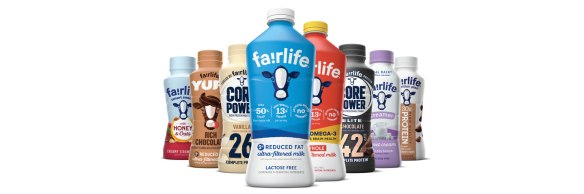
The fairlife LLC launched in 2012 to make use of a patented cold-filtration process known as ultrafiltration, which removes some natural sugars (lactose) while concentrating milk’s protein and calcium. The launch began with a high-protein milkshake called Core Power and has grown to offer a portfolio of products in what Coca-Cola calls “the fast-growing value-added dairy category in North America.”

In addition to Core Power, the line of products includes fairlife ultrafiltered milk with 50% more protein and 50% less sugar, fairlife DHA with DHA Omega-3 fatty acids, fairlife (drinkable) smart snacks, fairlife nutrition plan (shakes), and the new fairlife creamers for coffee.

Coca-Cola reports fairlife sales have grown by double-digits each year since 2014, playing a big role in what the company sees as steady growth of value-added dairy products in contrast with the traditional fluid milk category. The brand has been supported by the reach of Coca Cola’s distribution, both through the Minute Maid system and Coca-Cola bottlers across the country.

According to IRI data, fairlife’s first-year sales were $62 million, representing 0.36% of market share in 2014. According to Nielsen AMC, fairlife surpassed $500 million in retail sales last year, an 8-fold increase and representing just shy of 3% of market share.

A new fairlife milk facility is under construction in Goodyear, Arizona to expand production beyond its current plants in Waco, Texas and Coopersville, Michigan. In 2018, fairlife launched its products for sale in Canada and will begin local production and sourcing in Ontario this spring.

According to Dinkins, Coca-Cola “will continue to ensure that fairlife has the best distribution possible and will be here to provide resources and expertise in areas such as sustainability and supply chain management to make the brand stronger and better for the future.”

In the same week as the Coca-Cola announcement on acquiring whole ownership of fairlife, a joint public statement was released by fairlife and Fair Oaks Farms announcing their new and evolving four-part animal and worker care platform as their long term response to the animal abuse videos that became public last June involving one of the 12 separate dairies at Fair Oaks Farms. This was also mentioned in the ownership transaction press packet.

“To guide this journey, we’ve assembled a fairlife Animal Welfare Advisory Council to ensure we are both learning and leading for the short- and long-term,” Doelman stated in a public statement. “We’re working with our supplying farmers to outline more detailed animal welfare policies… investing with and in our farmers … And we continue to require that every farm in our supply chain is subject to regular third-party unannounced audits with clear action plans for learning and improvement after each audit.”

DMI officials have indicated funding promotion and exhibits at Fair Oaks Farms’ visitor center an hour south of Chicago in Indiana. However, DMI indicates that its financial grants to fairlife for promotion ended in 2019. To receive DMI promotion funding, companies with approved innovations must spend a comparatively larger amount of their own funds.

Available tax forms for 2017 and 2018 list DMI grants to fairlife of $8 million for promotion in each of those years, and prior support was available from affiliated research and development resources in the Chicago suburbs of Rosemont where DMI and Fonterra are both located.

Ultrafiltration is a process that can vary by dairy product application and is used around the world. A 2018 Transparency Market Research report pegged Coca-Cola among the companies it listed as “key players operating in the global ultrafiltered milk market, along with HP Hood LLC, Idaho Milk Products Inc., Fonterra Co-operative Group, Kerry Group, Tatura Milk Industries Ltd., Darigold Ingredients Company, Erie Foods International Inc., Enka Sut Company, Grassland Dairy Products and others.”

In 2017, the FDA said ultrafiltered milk could be used to make any fresh cheese product.

While fairlife milk is still considered a fresh product with a 90-day shelf-life, some products in the lineup are shelf-stable and aseptically packaged.

Dr. McCloskey confirmed in a presentation on “the road to innovation” at the 2016 Georgia Dairy Conference that fairlife ultrafiltered milk was at that time designated a Class I fluid milk product; however, some of the other beverages in the lineup are Class II.

-30-


Politics of whole milk, part 2: Vilsack banned whole milk in schools, gets dairy checkoff’s top pay

By Sherry Bunting, Farmshine, Dec. 13, 2019

The former Ag Secretary instrumental in removing whole milk from schools is now the highest-paid executive at Dairy Management Inc. (DMI) whose virtual $1 million/year in 2018 came from dairy farmers who are going bankrupt.

Farmshine Editor’s Note: Sherry Bunting has written a lengthy, well researched commentary on how the dairy economy and dairy product promotion and marketing evolved over the past decade with Tom Vilsack at the helm. Vilsack served as USDA Secretary in the Obama Administration and is the current chief of the U.S. Dairy Export Council (USDEC), an affiliate of Dairy Management, Inc. Wherever he has been since 2009, Vilsack is unquestionably one of America’s most powerful influencers when it comes to dairying. And the outcome has seldom been favorable to the nation’s milk producers. Part I of this reportappeared in the December 6th edition of Farmshine, page 20. Part II follows

In my journalistic pursuits of the past decade, two statements by checkoff-paid executives and dairy checkoff board members now reverberate in my mind:

1) On milk as a beverage: “Fluid milk is dead, we have to stop beating that horse and innovate for these new beverage markets.” – 2016 during questions after a presentation by a USDEC checkoff-paid employee at a meeting of dairy policy analysts and economists.

2) On dietary guidelines and school milk: “They are a different breed. We have our own plan. We have a friend inside the White House. We are already working with someone on this. And we finally have a drink that consumers want (fairlife).” — 2015 phone call to me from a DMI board member who also served on DFA’s board, challenging an article I had written that year. In the course of our conversation, he made this comment in response to my question to him asking why the dairy industry was being silent on the 2015 Dietary Guidelines that year, and why dairy was not joining forces with beef to push the solid science on animal fat as revealed in Nina Teicholz’s book Big Fat Surprise. I had also asked him why they weren’t supporting the beef industry’s opposition to the “sustainability” driven parts of the 2015 dietary guidelines.

In his Ag Secretary role in 2010, Vilsack was instrumental in the creation of GENYOUth through the MOU signed between USDA, National Dairy Council (Dairy Checkoff) and the NFL. (In fact, as Ag Secretary, Vilsack appointed some of the current Dairy Board members who then hired him at the end of the Obama administration as a DMI executive vice president and CEO of USDEC.)

Fuel Up and Play 60

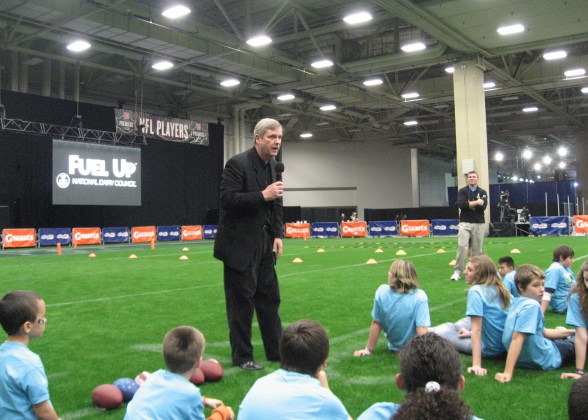
USDA Photo from Feb. 4, 2011 where then Agriculture Secretary Tom Vilsack spoke to young people at the Fuel Up to Play 60 (FUTP60) event held at the Sheraton Hotel in Dallas, Texas before the 2011 Super Bowl, the same day that the MOU was signed between NFL, USDA, Dairy Checkoff and GENYOUth to focus on ending childhood obesity with fat-free / low-fat foods and beverages and 60 minutes of daily exercise. And so, a decade later… here we are so much farther down this wrong road.

Today, GENYOUth is the bus on which more companies each year are hitching a ride into the schools — paid for primarily by dairy farmers in effect funding their own demise. Meanwhile, dairy farmers are the only ones not free to fully promote their best product, being relegated and regulated to government speech on fat-free / low-fat.

When Vilsack was presented the Vanguard Award during the 2017 GENYOUth Gala aboard the U.S.S. Intrepid in New York City Harbor, former President Bill Clinton spoke his accolades, and congratulated him on being the one to overcome the hurdle of getting beverage calories included in the school meal calculations. It is the very thing the current Senate Bill seeking to allow whole milk in schools would reverse.

Bill Clinton, a vegan, went on in his 2017 GENYOUth Gala speech to emphasize how beverages were a “huge” problem in the obesity epidemic, that we don’t think about how many calories kids consume in a drink, and that regulating school beverages was a big step forward on that front.

He was talking about whole milk. Whole milk is named, specifically, on the list of beverages prohibited from sale on school grounds during school hours.

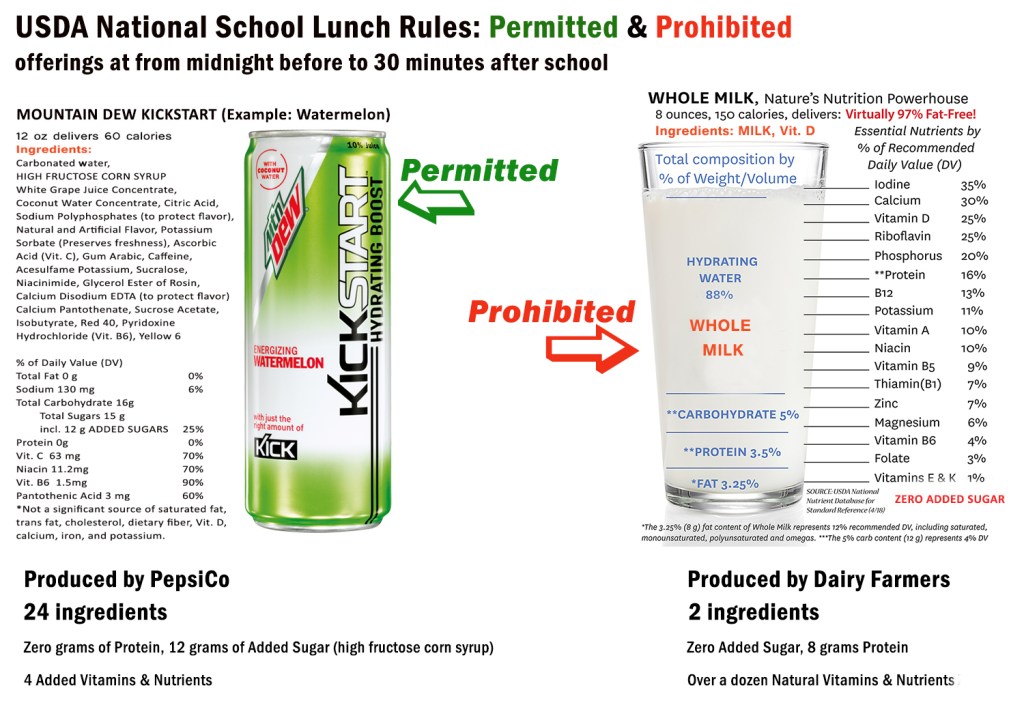
And yet plenty of PepsiCo beverages — made specially to meet the 60-calorie threshold with a combination of high fructose corn syrup and sucralose, including Gatorade and Mountain Dew Kickstart — are welcomed on those school lunch “smart snacks” acceptable beverage lists.

Vilsack started with DMI six days after the Obama Administration ended in January 2017. But 2018 was his first full year as a DMI executive, and he has been busy earning his highest-paid status.

In May, Vilsack wrote about how the U.S. dairy industry would meet its new goals to export 20% of production, and he praised the record level of exports in 2018 as “a banner year for exporters.” (We all know 2018 was anything BUT banner for dairy farmers paying his salary. In fact, export volumes were higher in 2018 than in 2017 and 2019 while prices paid to farmers were lower in 2018 than in 2017 and 2019.)

In June, Vilsack testified before Congress that the government should partner with the dairy industry to pay ‘pilot farms’ to develop and test the innovations “U.S. Dairy” will need in order to reach the Net Zero emissions goal he has been instrumental in setting. In fact, Senators referred to him as ‘the president of dairy innovation.’

The ultimate vehicle for those practices after they are tested on pilot farms will be the dairy checkoff-funded and NMPF-administrated FARM program initiated through the Innovation Center for U.S. Dairy.

At that “sustainability” hearing of the Senate Ag Committee in June, Vilsack earnestly stated that the Net Zero project – and government assistance for pilot farms to find the practices to achieve it — was essential for the U.S. dairy industry to have an edge in international markets.

In November, Vilsack endorsed former vice president Joe Biden for President of the United States and praised his candidacy “for including a path to addressing climate change while at the same time helping the rural economy and creating jobs by investing in green infrastructure, renewable fuels and low-carbon manufacturing,” according to an article about the Vilsack endorsement of Biden in the Nov. 23 edition of the Des Moines Register.

In fact, the Register article stated that Vilsack “helped write Biden’s plan for rural America.” But that’s not political involvement by a checkoff executive, is it?

It is interesting that when dairy checkoff board members are asked by the farmers paying the checkoff why they can’t stand up for whole milk in schools, the response they always get is: “That’s politics, and we can’t get into that.” Of course, the rules and regs of USDA overseeing checkoff are then cited forward and backward.

But, when it comes to Vilsack’s hands in the political pie – not to mention dairy farmers’ pockets – there are no rules and it’s all good. In fact, it’s encouraged because it’s part of the plan, the future of dairy, of food.

Vilsack is, after all, the dairy checkoff’s highest-paid executive, who is most culpable in his former position as Ag Secretary for putting the last nail in the fluid milk coffin. His policies on milk in schools and the fat-free / low-fat ‘government speech’ that now defines milk promotion, have at the very least contributed to – if not accelerated — the loss of fluid milk sales in the past decade of steepest decline.

In 2015, when confronted with what investigations have revealed about the science on animal fat, especially milk fat – according to the new and previously buried research — Vilsack said the preponderance of the evidence still favored low-fat diets. And with that proclamation, he signed the 2015 Dietary Guidelines that accelerated taking dairy markets – and our nation’s children – down the wrong road.

Think about this. From 2010 to 2018, the era in which the alliance between Vilsack’s USDA and the dairy checkoff was initiated and bloomed and in which he is now the highest paid executive – DMI controlled $140 to $159 million annually in mandatory dairy farmer funds. In that pool of funds, 25% went to salaries and other costs associated with core operations and another 30% went to contractors for promotion in ways that could be considered ‘core operations.’

In 2018, as in previous years, the NFL received $5 million; Edelman, the world’s largest PR firm, received $16 million; Fairlife $8 million, Domino’s $9 million, a marketing firm for GENYOUth with ties to Edelman $4 million, McDonald’s $5 million, and Vilsack got his virtual million.

Yes, folks, hindsight is 20/20. And here we are on the eve of 2020 with former Ag Secretary Vilsack – who was paid a $999,421 salary in 2018 from mandatory dairy producer checkoff funds and is now the top-paid DMI executive — to thank for the removal of whole milk and whole dairy products from our schools. And no one cares to ask him to testify to Congress about why whole milk should be allowed in schools, but he is politically involved in so many other discussions.

The dairy industry had and has Tom Vilsack — or vice versa.

110206_OSEC_AL_1642

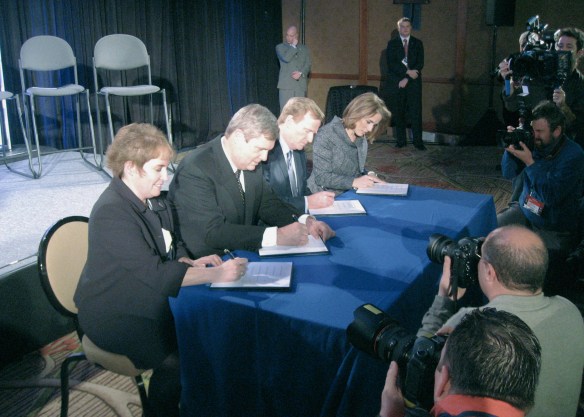
Memorandum of Understanding (MOU) was signed on Friday, Feb. 4, 2011 at Sheraton Hotel in Dallas, TX. The MOU outlines the joint commitment of the National Football League (NFL), Department of Agriculture, National Dairy Council (NDC), and Gen YOUth Foundation, to end childhood obesity. (Signing L to R President of the National Dairy Council Jean Regalie, Agriculture Secretary Tom Vilsack, NFL Commissioner Roger Goodell, and GENYOUth Foundation CEO Alexis Glick) 

Today, DMI IRS 990 forms show that Dairy Checkoff pays Tom Vilsack just shy of $1 million/year as DMI’s highest paid executive; Dairy Checkoff pays the world’s largest PR firm Edelman $15 to $17 million/year as the purpose-driven brain-trust behind the GENYOUth and Innovation Center ‘sustainability’ concepts; Dairy Checkoff pays the GENYOUth CEO over $200,000/year to run the foundation; Dairy Checkoff pays the core operations of GENYOUth to the tune of $1.5 million; Dairy Checkoff has USDA attorneys at every meeting and on every conference call to approve promotion projects and messages (government speech); and Dairy Checkoff pays the NFL $5 to $7 million annually for their part in this “promotion.” Meanwhile, NFL promotes its brand through flag-football sets to FUTP60-participating schools; USDA markets and enforces dietary guidelines with the financial assistance of dairy farmers through the checkoff; and other companies participating in GENYOUth, most notably PepsiCo, are able to market their own pet projects, products, brands and influence to kids while the dairy farmers are regulated to government speech. Dairy Checkoff touts the FUTP60 breakfast carts as serving milk with every breakfast, but only fat-free and 1% are promoted and permitted, and USDA’s own studies show that this fat-free and 1% low-fat school milk is among the most frequently discarded items. The entire deal ignores the fact that the dietary guidelines have exacerbated the obesity and diabetes trend, that children are not getting the valuable nutrients from the milk they are served if they don’t like the taste of fat-free and 1% and throw it away to buy something else. And the deal further ignores studies showing that body fatness was lower and Vit. D status higher in children drinking whole milk as compared with children drinking 1% low-fat milk. What will it take to see positive change when the very government figure who was influential in getting us here is now the dairy industry leader that the industry organizations revere and who is looked at by USDA, Congress and other policymakers as speaking for dairy? If he took whole milk out of the schools, and he now ‘speaks for dairy’ and is ‘believed’ to be so concerned about kids, who else matters in the discussion? Does the government care about the over 15,000 online and 5000 by mail signatures of dairy farmers, parents, grandparents, students, teachers, coaches, school boards, town boards, county commissioners, state lawmakers, health experts, nutrition experts, athletes, nurses, doctors, and generally comcerned citizens among these signatures asking for the choice of whole milk in schools

-30-

Politics of whole milk: Dairies go bankrupt, Vilsack gets top pay

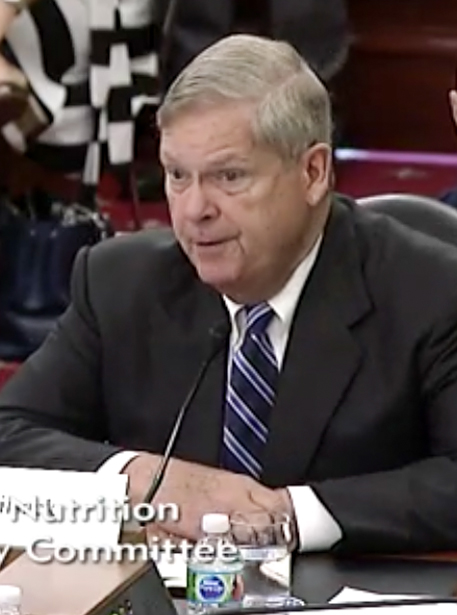
When it comes to ‘politics,’ DMI talks out of both sides of the mouth: Top paid executive Tom Vilsack shown here in June asking Senate Ag Committee for government ‘support’ to pay DMI’s ‘pilot farms’ to develop practices for ‘U.S. Dairy’ to reach Net Zero emissions. But ask if DMI can  support whole milk in schools and the response is: “Oh no, that is ‘political’ and we aren’t ‘allowed’ to be ‘political.'” Truth is, DMI’s current top-paid executive — Tom Vilsack — is the one who while serving as Ag Secretary, spearheaded the removal of whole milk from schools in the first place.

By Sherry Bunting, Farmshine, Friday, Dec. 6, 2019

The former Ag Secretary who was instrumental in removing Whole Milk from schools is now the highest-paid executive at Dairy Management Inc. (DMI) whose virtual $1 million/year in 2018 came from mandatory checkoff funds paid by dairy farmers who are going bankrupt. 

On Monday (Dec. 2), the Milwaukee Journal Sentinel reported that their early look at DMI’s IRS 990 forms for fiscal 2018 show that Tom Vilsack became the highest paid DMI executive earning $999,921 in 2018, which was his first full year as an executive vice president of DMI, president and CEO of DMI’s U.S. Dairy Export Council (USDEC), and defacto leader of the Net Zero Project and sustainability and innovation platforms of the Innovation Center for U.S. Dairy.

Let’s go back a decade. Think back to 2009. The bottom fell out of the dairy markets. It was arguably the worst of economic times in memory for dairy farmers as farm level milk prices fell to $10, and equity in the value of cow herds plummeted. 

As farmers were busy trying to save their farms, and the industry and lawmakers were busy outwardly debating National Milk’s version of “supply management” in the Farm Bill that year, dairy leaders and regulators holding overlapping former and current positions within USDA, DMI, NMPF, DFA and IDFA, began charting a future for dairy in terms of pursuing international dominance, developing “sustainability” frameworks, partnering for “innovation”, and focusing on the zone of investment for consolidating the milk production footprint with ultrafiltration technology as the way to move milk without the water.

It all fits together, like pieces of a puzzle — with no picture on the box to show outwardly what it will all look like when complete.

Back in 2010, the Innovation Center for U.S. Dairy was busy on “sustainability” and getting fairlife ‘the better milk’ up and going, with the DMI Innovation Center’s sustainability council leader being none other than Fair Oaks’ / fairlife’s Dr. Mike McCloskey. 

Then Secretary of Agriculture Tom Vilsack was busy too that year. In addition to restricting school milk to fat-free and 1% and promulgating rules that listed Whole Milk as “prohibited” on school grounds during school hours, Vilsack was signing Memorandums of Understanding (MOU’s) with National Dairy Council to create GENYOUth to promote that dogma, and with DMI to link the “sustainability” framework of Vilsack’s USDA to the “sustainability” framework of DMI’s fledgling Innovation Center for U.S. Dairy.

Dairy farmers were coming out of 2008-09 devastation — starved for good news — and were encouraged by all this talk of innovation and sustainability and international markets because they thought it meant the industry was looking to sell more milk and dairy products in such a way as to raise prices paid to them for their milk. 

Who could question this high pursuit of innovation and sustainability and exports – right? That’s the trifecta, the holy grail.

2014’s high milk prices seemed to validate that all was going to be right with the dairy world. But most were not paying attention to the USDA / DMI alliance that was formed and growing — and what it might mean for the future.

Quietly – without much fanfare or protest – USDA began tightening milk restrictions in the school lunch program during this time. In fact, so quiet was this shift that many parents to this day do not realize their kids are getting watered-down milk, cheese, imitation butter, and half-beef-half-soy patties at school.

As the 2010 Dietary Guidelines were implemented, a democrat-controlled Congress passed the Healthy Hunger-Free Kids Act – under the avid lobbying efforts of President Obama’s USDA Secretary Tom Vilsack for the legislation that would tighten school lunch screws even more.

The dairy checkoff had already been called “government speech” in its 2005 Supreme Court defense, so with USDA’s blessing and encouragement – under Vilsack – the low-fat and fat-free dogma became entrenched and proliferated through the GENYOUth alliance. 

And it set the stage for a new era in dairy that today’s leaders speak of. We are hearing it now. A recent DFA newsletter tells members “milk must evolve to remain relevant.” DFA / NMPF chairman Randy Mooney stated last month that the industry needs to consolidate plants to make new products. Northeast DFA leaders heard from a food science writer and DMI contractor about how dairy proteins will complete plant-based diets during their recent meeting in Syracuse. Dairy dilution is all around us. And the industry points to Dean Foods’ bankruptcy as proof that Real Whole Milk isn’t good enough, isn’t sustainable. (Well, of course not, no one is truly marketing it and the government thanks to Vilsack is prohibiting kids from having it. This is not rocket science folks.)

Yes, folks, hindsight is 20/20. And here we are on the eve of 2020 with former Ag Secretary Vilsack – who was paid a $999,421 salary in 2018 from mandatory dairy producer checkoff funds and is now the top-paid DMI executive — to thank for the removal of Whole Milk and whole dairy products from our schools.

And no one cares to ask him to testify to Congress about why Whole Milk should be allowed in schools, but he is politically involved endorsing presidential candidates and writing their rural platforms, testifying in so many other discussions, including climate change and sustainability and seeking Senate approval of funds for Net Zero pilot farms.

Yes, folks, the dairy industry had and has Tom Vilsack — or vice versa.

See part two.

-30-

The time has come to disrupt the disruptors

Opinion: Dean bankruptcy offers opportunity we should earnestly pursue

By Sherry Bunting, Farmshine, Friday, Nov. 29, 2019

If ever there was a time for state governments to sit down with their dairy farmers and agriculture infrastructure for a meeting of the minds… it is now.

The future is very much at stake with Dean Foods – the nation’s largest milk bottler – in Chapter 11 bankruptcy and sale proceedings, as the industry is largely signaling the buyer should be DFA.

But not so fast.

This could be an opportunity to look at the strength of Dean’s holdings and consider a different path forward, one that returns some of the regional branding power to farmers and consumers in the regions served by Dean’s 60 milk processing plants.

Dean Foods accounts for one-third of the milk bottled in the U.S., and the roots of its holdings go back to family operations with brands that were once – and some still are – household names.

In focus groups and shopper surveys, consumers demonstrate they understand what it means to buy local. They understand that buying local – especially fresh staples like milk – means keeping their dollars working in their communities. Consumers also say they want to help local farms. And they want to see clear labeling to know where their milk comes from.

Meanwhile, surveys show the gallon and half-gallon jug are still the most popular packaging among real milk buyers. Even though the category as a whole is declining, it is still a huge category and one that has not been tended or nurtured or cared for in more than a decade. In fact, the category has seen the deck stacked against it by government rules and government speech.

Taste is also important to consumers, as is nutrition. Where fluid milk is concerned, these two areas have also been lacking because checkoff-funded promotion became government speech that pushed fat-free and low-fat milk to the point where consumers have no idea what real milk tastes like – until they switch to whole milk, and they are.

Folks, this is an opportunity to chart a new path for fresh fluid milk, to breathe some life into it. We see it in whole milk sales that are rising. Just think what could be accomplished if significant resources were devoted to truly revitalizing milk.

As the dairy industry streamlines behind innovation and checkoff-funded partnerships to disrupt the dairy case — to be more like the plant-based non-dairy disruptors — there is still a majority of consumers choosing real milk, and more of them are choosing real whole milk as whole milk today is the top seller in the category, and whole flavored milk is growing by double-digits.

Can we disrupt all the disruption with a disruptive back-to-the-future original? I think so. But now is the time to hit it hard. A few years from now will be too late.

Dean Foods has the network and the facilities and the history a savvy consortium of buyers could tap into for going back to local or regional emphasis with brands. The DairyPure national branding experiment started out strong, but in the past few years has been squeezed-out by large retailers – and notably Walmart — pushing their own store brands with loss-leading strategies while hoisting the price of Dean DairyPure much higher.

And that’s part of the problem. Stores think it’s okay to loss-lead with milk, but they are not willing to eat that loss themselves. We need them at the regional dairy future table as well.

In the bankruptcy proceedings at hand, some of Dean Foods’ unsecured bondholders are protesting a rapid sale of assets to DFA in what they say equates to a “fire sale” that doesn’t maximize value. Did Dean receive a proposal from them too before filing bankruptcy? Sources indicate bondholders offered restructuring terms before the bankruptcy filing that would have changed the current picture for Dean Foods.

Will these bondholders that are opposing sale to DFA make an offer now? Can Dean Foods’ assets be sold piece by piece to be broken up more regionally? These questions don’t have clear answers at this time.

What is clear is that payments for milk by Dean to DFA are being delayed five business days as bondholders want to be sure they are truly ‘critical vendor’ payments and that there are no shenanigans between the would-be buyer and seller.

What is also clear is that Dean and DFA have a history, and that history includes the good, the bad, and yes, the ugly.

DFA was there every step of the way as mergers and acquisitions led Dean Foods on its path to become the nation’s largest milk bottler. DFA is Dean’s largest supplier of milk, and DFA leaders are on record stating that Dean Foods is the largest buyer of DFA milk.

If DFA purchases “substantially all” of Dean’s assets, we know more rapid consolidation of the fluid milk market will occur. DFA’s leaders — as well as the leaders of all the prominent organizations in the dairy industry, including the dairy checkoff — have been clear if we’re paying attention. The future they see is in moving away from investing in fresh fluid milk and moving toward ultrafiltration and aseptic packaging and blending and innovating for beverages that can be supplied to anywhere from anywhere without transporting milk’s water-volume by tanker.

Those are more of the ingredients for a monopolization of milk that may not even be considered by the Department of Justice. Without another offer or series of regional offers on the table, DFA would stand as the only option — other than complete failure of the firm under bankruptcy. This, alone, could put the sale to DFA on the fast track as sources talk about bankruptcy clauses that allow purchases to occur — without DOJ approval — when failure is the only other option.

So while consumers are consciously being pursued by the industry and dairy checkoff to move them away from their habit of reaching for that jug of milk and toward new beverages that contain milk — or are innovated new varieties of milk, or are blended and diluted with plant-based alternatives — what happens to the dairy producers in communities whose relevance is tied closely with retaining fresh fluid milk as a nurtured market and being a producer of a ‘local’ and fresh product? These producers are also forced to pay into the dairy checkoff that is developing these alternatives, not promoting or educating about fresh whole milk, and in effect funding their own demise.

Who will tend this store, nurture these customers, satisfy consumer desires to buy-local and ‘help farmers’ and their new-found eagerness to learn more about real fresh whole milk nutrition?

If states and regions don’t work to keep fresh milk facilities in their midst, the global message on ‘sustainability’, ‘carbon footprint’, ‘flexitarian diets,’ and ‘planetary boundaries’ will overtake the public consciousness, and the choices disrupting and diluting the dairy case will overtake fresh fluid milk.

In business today, that’s all we hear: Innovate and disrupt. Maybe it’s time to disrupt the disruptors, to put together a fresh fluid milk branding and packaging campaign that makes milk new again.

-30-

DEAN BANKRUPTCY: Court allows critical vendor payments; DFA’s Smith says ‘We are logical owner’

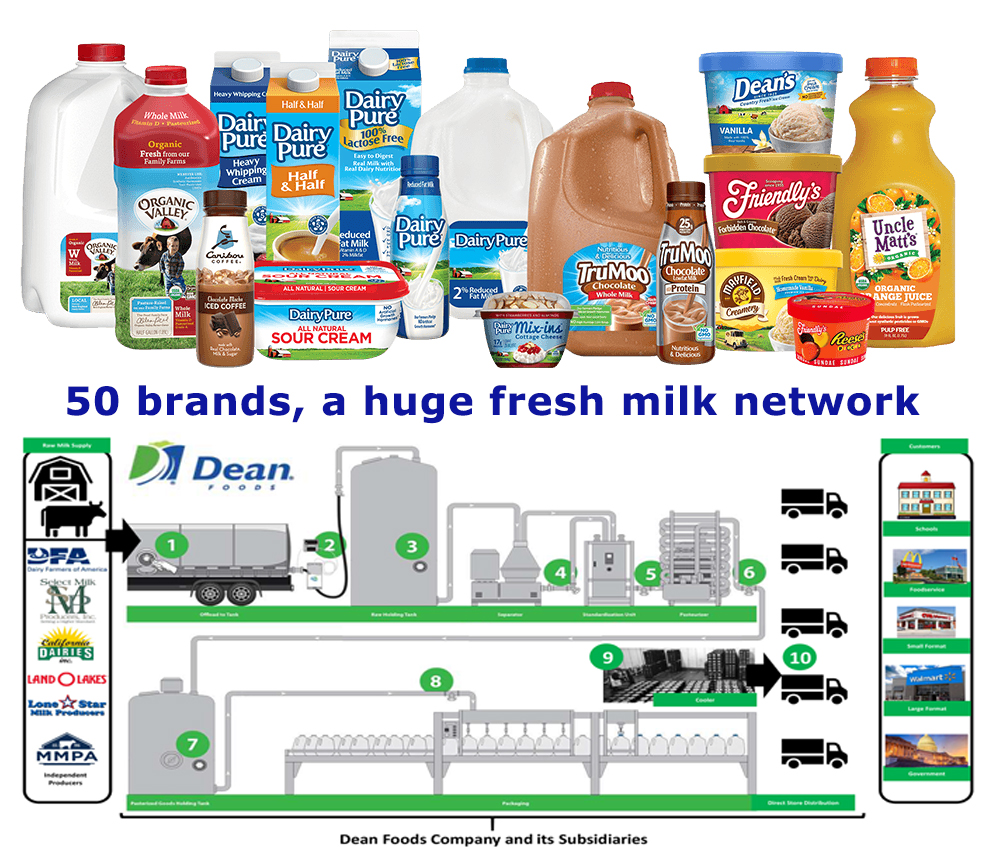
The level of transparency in the Dean Foods Chapter 11 bankruptcy is unprecedented.  Included in the Chapter 11 proceedings are Dean’s 60 dairy plants and numerous name brands, including: national brands DairyPure and TruMoo; along with regionally branded milks, as well as Friendly’s Ice Cream and other cream products. This graphic in the Dean Foods’ declaration to the bankruptcy court shows the implications for consumers, farmers, businesses throughout the nation, reinforcing the importance of Dean Foods continuing operations during the Chapter 11 bankruptcy proceedings and court-supervised sale of assets.

By Sherry Bunting, Farmshine, Friday, Nov. 22, 2019

BROWNSTOWN, Pa. – When a dairy firm files bankruptcy, the first concern is whether farmers will be paid for milk already shipped. That first hurdle was passed as independent shippers to Dean Foods plants in at least three states report receiving payment in full for October milk, though the settlement checks due Nov. 15 were deposited two to three days late, in many cases.

In Pennsylvania, because of its unique Milk Marketing Board that implements and oversees the state’s Milk Marketing Law, PMMB indicates they are following up to be sure payments are made every two weeks instead of waiting for normal periodic auditing. Pennsylvania’s mandatory over-order premium on fluid milk produced, processed and sold in Pennsylvania is part of the minimum price bottlers must pay, and there have been no actions by the board to adjust this in any way.

Other states’ producers also report receiving payments in full.

In fact, Dean Foods’ spokesperson Anne Divjak reported to Farmshine last week that it is “business as usual” for Dean Foods to keep the milk flowing from farms to schools and supermarkets during the Chapter 11 bankruptcy reorganization and sale. The first regulated payments for milk after filing bankruptcy encountered just a small delay as banks needed to be aware of honoring the payments after the bankruptcy court decision last Wednesday afternoon allowed “critical vendor” to be paid.

Multiple sources indicate that Dean focused on getting payments to independents first, then small cooperatives, then DFA. There is no confirmation on whether DFA’s milk shipments were paid in full or what portion of the $172.9 million attributed to DFA as a creditor in the bankruptcy filing represent milk shipments.

Orders signed by Judge David Jones of the Southern District of Texas bankruptcy court where Dean’s petition was filed, are what allowed Dean Foods to pay “critical vendors” for pre-petition purchases and to continue its operations by accessing cash on hand as well as having access to up to $475 million of the new $850 million in debtor-in-possession financing to keep the ship sailing for nine months as reorganization and sale are sorted out.

Included in the Chapter 11 proceedings are Dean’s 60 dairy plants and numerous name brands, including: national brands DairyPure and TruMoo; along with regionally branded names for example Swiss Premium and Lehigh Valley in Pennsylvania; Garelick in New York and New England; Mayfield and Purity in the Southeast; as well as the Land O’Lakes milk brand in the Central Plains, where Dean licenses the Land O’Lakes logo and name and the cooperative supplies those plants. It also includes Friendly’s Ice Cream and other cream products produced by Dean Foods.

As the nation’s largest milk bottler, Dean Foods accounts for roughly one-third of the U.S. fluid milk market but saw volume losses from various fronts in the past two years and stock shares had fallen below $1.00 with bonds also decreasing in value.

Overall fluid milk consumption is down. Private label store brands are a larger share of the down-trending market compared with brands. Walmart’s new plant in Fort Wayne last year affected their contracts to bottle Great Value and also changed the geography and position of Dean brands in several important Southeast and Mideast markets. 

Dean also suffered other contract losses last year, and as Walmart bottled its own store label brand in several states and worked with Midwestern cooperatives to accomplish and supplement that start up, Dean saw its DairyPure and TruMoo brands replaced by Prairie Farms in many of those stores, and other Walmart stores as well.

Divjak did confirm that Dean’s majority interest in Good Karma, a non-dairy alternative beverage made from flaxseed, is separate from their dairy holdings in the bankruptcy proceedings. Dean purchased the Good Karma majority share a year ago for $15 million.

Interestingly, on Tuesday, November 12, the day that Dean Foods announced its bankruptcy petition, DFA was holding its Northeast Dairy Leadership meeting in Syracuse. Part of Dean’s announcement indicated that the company is in “advanced” talks with DFA about purchase of “substantially all assets.”

Chicago-based food science writer Donna Berry, with ties to DMI, was in Syracuse that day as a guest speaker on dairy protein and how it can be used in innovative foods and beverages to make plant-based options better. According to her Berry on Dairy blog story two days later, entitled “Dairy protein completes plant-based foods,” the mood in Syracuse was “upbeat.”

“Let’s face it, too often dairy marketers take the conservative road when it comes to promoting their products. Dairy Pure was the best Dean Foods could do for fluid milk, and it was not enough, as we see in its bankruptcy filing this week.

Berry went on in her blog post to quote DFA CEO Rick Smith before “a room packed with about 500 Northeast members of DFA and suppliers of services to DFA” at Tuesday’s Syracuse meeting.

The news of Dean Foods’ bankruptcy filing had just broken that morning, and Smith was already stating that, “Everybody’s been telling me for years that we are the logical owner of Dean’s. And I’ve already gotten phone calls about people who want to partner with us. We will be interested in some assets, undoubtedly. And not interested in some, undoubtedly. Some (assets) should be closed. Some will require partners.”

The week before, DFA chairman Randy Mooney’s comments at the NMPF / DMI meeting in New Orleans were loaded with concern about dairy farmers going out of business and loss of rural towns and infrastructure and that NMPF’s priorities were trade and immigration.

But something else Mooney said at that convention the week before Dean’s bankruptcy filing was foreshadowing. He talked about looking at a map and seeing “milk plants on top of milk plants” and how the industry needs to “collectively consolidate” toward plants “capable of making the new and innovative products consumers want.”

Dairy checkoff has made it clear that the emphasis of the future is on innovative new beverages and other products. While we are told that consumers are ditching the gallon jug (although it is still the largest sector of sales in 94% of households) and we are told consumers are looking for these new products; at the same time, we are also told that it is dairy checkoff’s innovation strategy to work with industry partners to “move consumers away from the habit of reaching for the jug and toward looking for these new and innovative products” that checkoff dollars are launching.

Meanwhile, Mooney’s comments about consolidating plants gives us a window into how DFA might treat those Dean assets if the “advanced talks” with Dean about purchasing them come to fruition. DFA will be a prime mover in the further consolidation of fluid milk assets markets if history is a guide.

Other industry analysts are also indicating that potential sale of “substantially all” Dean assets to DFA would likely consolidate these regional fluid milk bottling plants and create major shifts in how fluid milk is supplied to consumers in the future.

Dairy checkoff weighed in just hours after Dean’s bankruptcy announcement, Scott Wallin, vice president of industry media relations and issues management for Dairy Management Inc. (DMI), sent a media statement that, “Dairy Farmers of America (DFA) is in discussions to purchase the assets,” and went on to point out that, “In a decade shaped by a constantly changing marketplace, U.S. dairy has and will continue to successfully navigate the current economic environment… well positioned to expand its growth through innovation to meet the changing tastes and needs of today’s consumers.”

Others make the point that the Dean bankruptcy signals a milk information problem, not a milk demand problem. Noted agriculture radio personality Trent Loos stated in a broadcast drawing on his history with dairy farmers over the past 20 years, stating: “progressive producers were on the cutting edge of consumer education,” but that “their associations and most of the processors” have pushed in the opposite direction, insisting that consumers want low-fat and skim milk and skim water. He talked about how this is affecting the health of our children and teenagers not consuming enough milk, especially whole milk.

“Now that the producers are filing bankruptcy, the milk processors are filing bankruptcy too. Where does the milk industry go from here? The consumer’s not always right when they don’t have all of the information,” Loos said.

Meanwhile, in the “first-day” hearing on the Dean Foods Chapter 11 bankruptcy in Houston, Texas last Wednesday, at least one attorney — representing one-third of Dean’s bondholders — equated the filing and potential sale to DFA as a “fire-sale” of the company’s assets to DFA and they opposed this move.

Whether other serious buyers emerge – or strategies to regionalize sales of assets – remains to be seen.

For now, farms who ship milk to Dean Foods as independents or cooperatives are operating under levels of transparency and “business as usual” that were not seen in dairy bankruptcies of the past. Stay tuned.

-30-

Dean Foods files bankruptcy, talks advance with DFA about assets

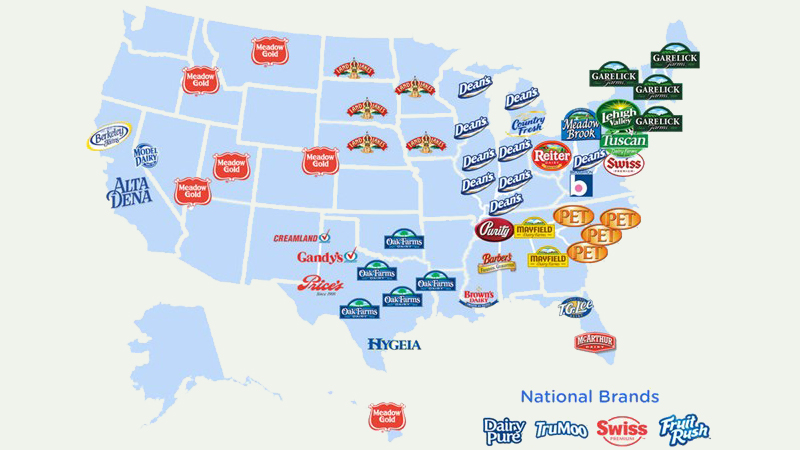
The map of Dean Foods’ plants around the U.S show regional brands of years gone by that are part of the Dean Foods national milk business. Some analysts observe that the refrigerated distribution network of the company make it an optionality for whole milk and full-fat dairy products as those sales are rising while overall fluid milk sales have continued declining and the company is further challenged by contract volume losses and margin losses to below-cost private-label milk wars. Alternative beverages, reduced cereal (and with it milk) consumption, and other factors are being blamed. But at least some in the industry are recognizing that as the industry’s associations and some processors, along with the government, have pushed fat-free and low-fat as what consumers want or should have, fluid milk sales suffer from an information  and education problem that has led to a consumption problem, and questions about where milk goes from here. More analysis on that next week.

By Sherry Bunting, Farmshine, Friday, Nov. 15, 2019

HOUSTON, Tex. — The dairy industry shake-up reached new levels Tuesday, Nov. 12 when Dean Foods, the nation’s largest milk bottler, filed voluntary Chapter 11 bankruptcy restructuring “for orderly and efficient sale.”

The announcement indicated that the sale of “substantially all” assets could most likely be to DFA as talks between the two parties have “advanced.”

The bankruptcy filing includes all Dean entities and holdings under one name — Southern Foods Group LLC d/b/a Dean Foods — in the bankruptcy court of the Southern District of Texas, where case judge David R. Jones signed an order the same day granting “complex Chapter 11 bankruptcy case treatment.”

The early morning announcement came just ahead of Dean’s scheduled third quarter earnings call, which was canceled, although Q3 SEC reports were filed. Dean Foods’ shares on the Stock Exchange have been halted.

A hearing of 17 motions — including provisions to pay for milk delivered in the 30 days prior to the bankruptcy filing — was slated for Wednesday afternoon, Nov. 13, where the judge granted Dean Foods’ request to pay “critical vendors” in order to continue operating during the Chapter 11 proceedings and sale.

In its pleadings, Dean specified the need to retain access to cash flow in order to pay suppliers and employees and other routine costs of doing business.

As for milk shipped after the Nov. 12 bankruptcy filing, new financing from existing lenders has been secured so that payments can be made going forward.

This is a court-supervised process, to which Dean Foods has filed a number of these customary motions seeking court authorization to continue to support its business operations, which includes paying for the milk. Dean states in the announcement that it expects to receive court approval for all of these requests and that it is officially filing bidding procedures with the court to conduct a sale.

“Our expectation, based on the motions Dean has filed and the hearing in Houston this afternoon (Nov. 13), that they will be allowed to pay for pre-petition milk shipments,” said PMMB chief counsel Doug Eberly in a Farmshine phone call Wednesday. He indicated that while any bankruptcy proceeding is unpredictable, the Board expects that the four Dean plants in Pennsylvania and the plants in other states, will continue operating and paying producers.

“This is a priority for the Board and our auditors to be out there first thing every two weeks when advance and final payments are due to make sure payments are made,” said Eberly. Pennsylvania’s Milk Securities Act administrated through the Pa. Milk Marketing Board ensures such auditing and bonding of milk dealers and handlers.

Not all states have this bonding protection; however, the motions before the bankruptcy court Nov. 13, if granted, would allow Dean to pay for the milk already shipped. Dean estimates having $100 million in commercial surety bonds, not enough to cover all of the payments to suppliers and employees and other required payments to continue operating, which is why there is an expectation that the motions that would allow the company to use cash on hand to do so would be uncontested and granted. Without this ability, the company would not be able to continue, the proceedings would become disorderly, and then no one’s interests would be ultimately served.

New financing to keep Dean operating

In order to keep the milk flowing, and to keep suppliers, vendors and employees paid in the future during the bankruptcy process, Dean has secured $850 million in new “debtor in possession” financial support on Nov. 11 from existing lenders, led by Rabobank.

Approximately half of the $850 million in new financing will be used to restructure current debt with those existing lenders and the other half, combined with cash on hand, would finance continued operations for nine months, including paying suppliers, vendors and employees “without interruption” as restructure and sale take place under Chapter 11 bankruptcy protection.

“Right now, it is business as usual for us,” notes Anne Divjak, vice president of government relations and external communications for Dean Foods in an email response to Farmshine Tuesday. “This means we are continuing to work with our raw milk suppliers so we can continue providing our customers an uninterrupted supply of dairy products.”

She notes that information about the restructuring is found at DeanFoodsRestructuring.com and additional information will be available from pleadings and motions as they are filed.

Will Dean assets be sold to DFA?

In announcing the bankruptcy filing, Dean Foods also announced it is engaged in “advanced discussions with Dairy Farmers of America, Inc. (DFA) regarding a potential sale of substantially all assets of the company.”

If the two parties reach agreement on terms of a sale, it would be subject to regulatory approval by the Department of Justice and the bankruptcy court and would be subject to higher or otherwise better offers in the bankruptcy, according to Dean announcements and statements made by DFA CEO Rick Smith in a letter to members, obtained by Farmshine Tuesday.

DFA’s largest customer

Dean Foods is DFA’s largest customer, according to Smith in his letter to DFA members, where he also indicated that DFA produces and delivers the vast majority of milk to Dean Foods.

According to the Chapter 11 bankruptcy docket, DFA is the third largest “non-insider” creditor owed $172.9 million.

In his letter to DFA members, Smith referenced this substantial amount owed to DFA as being for milk shipped prior to the bankruptcy filing, “You will receive milk checks without interruption, and milk will continue to be picked up as normal throughout this bankruptcy process,” Smith wrote.

In addition to pension funds and DFA as the top three creditors, others on the list of the top 30 “non-insider” creditors include USDA $16.8 million, Land O’Lakes $8.9 million, Saputo $8.9 million, California Dairies $7.4 million, Southeast Milk $6.5 million, and Select Milk Producers $6.2 million. Former Dean Foods CEO Ralph Scozzafava is also listed as a creditor for his unpaid employee severance of $5.4 million.

Smith explained that DFA has monitored Dean Foods’ financials closely and have “prepared for various scenarios to minimize the impact to DFA.” He also confirmed that DFA “decided to enter into discussions” about purchase of Dean’s assets.

Questions about how long DFA and Dean Foods have discussed potential sale of assets were unanswered, although previous reports indicate some level of discussion occurred prior to the bankruptcy filing and are now, according to Dean Foods, “advancing.”

Questions about how Dean Dairy Direct shippers would be handled in the event of a sale of assets to DFA, along with other questions, were not answered. Instead, a request for an interview was declined by DFA chief of staff Monica Massey, who responded to this reporter to say: “We will not be participating in an interview with you as, in the past, you have not been fair and balanced — or accurate — in your reporting.”

Dean Foods responded to questions to indicate their website will be updated frequently and their are frequently asked questions and answers there for producers and others, including a separate website devoted to the Dean restructure and sale.

As of mid-November, no Dean Direct shippers have reported any communication on any changes to their status as a result of these actions, and Dean’s spokesperson confirmed they are conducting “business as usual.”

At the root

Dean Foods had appointed a new CEO, Eric Beringause, on July 26, and then concluded a strategic review process announcing in September that a sale of the company would not be pursued, but instead work on other strategies as the company dealt with volume losses, contract losses and in the face of “rising commodity costs.”

Beringause, on the job less than four months, said in a public statement Tuesday that these actions “are designed to enable us to continue serving our customers and operating as normal as we work toward the sale of our business.”

He talked about Dean’s “strong operational footprint and distribution network, robust portfolio of leading national brands, extensive private label capabilities and 15,000 “dedicated employees.”

“Despite our best efforts to make our business more agile and cost-efficient, we continue to be impacted by a challenging operating environment, marked by continuing declines in consumer milk consumption,” Beringause said.

With a new management team in place, he noted that this bankruptcy for an orderly sale is the best path forward after taking a look at the challenges.

Look for more analysis in Milk Market Moos and stay tuned. Additional information is available at www.DeanFoodsRestructuring.com

In addition, court filings and other information related to the proceedings are available on a separate website administered by Dean Food’s claims agent, Epiq Corporate Restructuring, LLC, at https://dm.epiq11.com/SouthernFoods, or by calling Epiq representatives toll-free at 1-833-935-1362.

-30-

But who’s lifting? And who’s rising?

The theme for the 2019 GENYOUth Gala in Manhattan Dec. 4 will be “Rise, by lifting others.” It’s clear that dairy farmers are doing GENYOUth’s heavy lifting, but for whose priorities? And who is rising? Are our schoolchildren really better off? Are our farmers?

By Sherry Bunting for Farmshine, November 1, 2019

Tom Gallagher is “setting the record straight about the value of the annual GENYOUth Gala, which has garnered millions of dollars for our youth wellness efforts without spending any checkoff dollars,” according to the Oct. 24 weekly checkoff update emailed by American Dairy Association Northeast.

Gallagher is CEO of Dairy Management Inc. (DMI) and chairman of Youth Improved Inc., doing business as GENYOUth, and he writes about the Gala set for Dec. 4 in Manhattan. 

Let’s take a look.

Gallagher says the Gala “will resemble a Hollywood red carpet event” and tells us it’s understandable to see it as being “a bit on the extravagant side.” He states that the “formal-attire affair is held each year in New York City, drawing famous athletes and CEOs from some of the nation’s most recognized companies.”

Gallagher reminds us that this ‘formula’ mixes dairy farmers with corporate influencers!

“It’s a very different look and a very different strategy from the traditional efforts done to support dairy farmers’ priorities,” he writes, asking dairy farmers to “not get blinded by the glitz and glamour of the evening and instead look deeper into the strategic aspect.”

Okay, let’s look deeper.

By now, more dairy farmers are seeing the effects of the ‘strategic aspect’ in DMI’s ‘formula’ put into play over the past 10 years, beginning with deals (MOUs) struck between dairy checkoff and USDA under then Ag Secretary Tom Vilsack in 2008-10. Today, Vilsack collects $800,000 a year working for dairy checkoff.

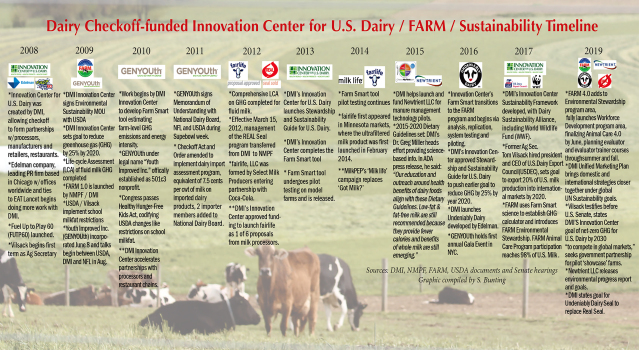
As reported in the September 20th edition of Farmshine, the ‘formula’ since 2008 has led to the creation of a growing number of tax-exempt organizations with aliases under the DMI umbrella, most of them through the Innovation Center, known to the IRS as Dairy Center for Strategic Innovation and Collaboration doing business as Innovation Center for U.S. Dairy.

The ‘formula’ brings certain multi-national corporations, dairy innovators and dairy production integrators into these tax-exempt organization boards that then influence how dairy farmer promotion dollars are spent via partnerships.

They’ve all got their eyes on our kids, you know. They want to shape those future consumers. But how? With ‘government speech.’

The ‘formula’ also brought in World Wildlife Fund (WWF) to be the stamp-of-approval partner for “sustainability” platforms, including the FARM program. And yet, WWF promotes vegan diets to solve climate change, and USDA, under Vilsack, was instrumental in pushing whole milk out of schools. Some partners, right?

In effect, the ‘formula’ is bringing these ‘foxes’ – a whole den to be precise – into the henhouse and using the hens’ own mandatory funds to do it.

It is disconcerting, to say the least, to hear DMI staff, who are paid with mandatory farmer-funds, speak at a September seminar in Pennsylvania stating that, “We want to move consumers away from the ‘habit’ of reaching for the jug and get them to be looking for these new and innovative products.”

They are talking about the products developed with industry partners using checkoff funds. Most believe that these products are aimed at consumers who are NOT in the habit of reaching for the milk jug, not the consumers who are!

You see, DMI is helping to shape future consumers toward the diluted diets the ‘thought leaders’ promote for our futures. These are touted by USDA through Dietary Guidelines and enforcement of ‘government speech’ in dairy promotion. Diet dilution is embraced by the Edelman company, via their sponsorship and social marketing assistance with the EAT FreSH Initiative that promotes “eating according to planetary boundaries,” meaning less dairy and animal products.

As a key link, Edelman, the purpose-driven social marketing company was instrumental in DMI’s formation of GENYOUth. (Edelman is paid $15 to $17 million a year in dairy checkoff funds as a contractor for DMI according to 2016-17 IRS 990s.)

The ‘strategic aspect’ is clear: Throw a Gala, bedazzle a few dairy producer board members to rub elbows with the elite corporate CEOs and ‘thought leaders’, and everyone goes home feeling good because they think they are working on shared ‘health’ and ‘sustainability’ goals.

Gallagher states in the checkoff update that dairy farmers have the number one health and wellness program in the schools. DMI chairwoman Marilyn Hershey has stated that “other companies would kill to have our what we have in the schools.”

One fox in the henhouse is PepsiCo. Did you know PepsiCo assisted USDA with the development of a Smart Snacks website where school foodservice directors go for lists of products and beverages that are designed to meet the USDA requirements for calories, fat, salt, etc.? Most of them courtesy of PepsiCo?

Guess what is not on the Smart Snacks list? Whole Milk. 

Guess what is on the list? Mountain Dew Kickstart energy drink, Gatorade, Doritos, Breakfast bars, Breakfast cookies, and on and on – courtesy of PepsiCo.

Gallagher states that the Gala “supports a goal that is near and dear to every dairy farmer I have ever met – childhood health and wellness.”

Meanwhile, how is the health and wellness of our kids at school with these diets?

Gallagher also tells us: “Not a single farmer checkoff dollar is used to put on the event. The Gala is underwritten through third-party sponsorships, table sales and on-site auction purchases.”

Well, that’s a relief, right? But think again.

According to IRS 990 forms, the supposed partner of dairy farmers in this effort – the NFL — has donated anywhere from less than $500,000 to a little over $1 million annually to GENYOUth, but at the same time, DMI paid the NFL $5 to $7 million annually for promotion !(according to 2016-17 IRS 990s)

In addition, over 50% of GENYOUth’s total annual expenditures as an organization comes from dairy farmers via their mandatory nickel and the dime. Yes, one can say those regional funds are linked to breakfast carts in schools, but the checkoff nickel portion funds the operating budget, and more.

Meanwhile, the kids. Who has been looking at their breakfast carts lately?

The carton of milk with every breakfast is the same fat-free and 1% milk that USDA’s own studies show is often discarded. The soupy sweet hot pink yogurt doesn’t come close to the real thing; many children turn away from it. The cheese, well they’ll eat that, but it too is fat-free.

What populates the breakfast cart heavily, according to children, is Quaker (PepsiCo) oatmeal bars with chocolate, breakfast cookies, a foil wrapped item similar to a pop-tart, and if you get there early – you’ll find apples or bananas.

Meanwhile, when corporates boarding the GENYOUth schoolbus for this “access” donate to buy ‘grab n go’ breakfast cars or sponsor a table at the Gala, and earmark funds for pet programs. When SAP donates, their funds go specifically for GENYOUth’s recent addition of the AdVenture Capital program, where students can learn about marketing and being entrepreneurs and leaders.

The USDA (MyPlate) is now concerned about students getting enough sleep, so the sleep industry, like Sleep Number, board the GENYOUth schoolbus with donations, and a new sleep program is added to GENYOUth messaging.

GENYOUth has become a marketing vehicle for the ‘foxes’ — cleverly disguised as a school health and wellness program — founded and primarily funded by the ‘hens.’

In fact, dairy farmers are the only ones involved in GENYOUth that are producing a truly healthful product but are not free to truly provide or promote it to the kids.

“One of the great responsibilities we have as your dairy checkoff is to use your investment as wisely and strategically as we can,” writes Gallagher. “This is why we seek globally recognized partnerships that can extend your commitment on goals that matter to you.”

At the Dec. 4, 2019 Gala in Manhattan, the theme will be “Rise, by lifting others.” It’s clear that dairy farmers are doing GENYOUth’s heavy lifting, but for whose priorities? And who is rising? Are our schoolchildren really better off? Are our farmers?

A decade of this ‘formula’ – and the millions spent by dairy farmers annually — have resulted in ‘partners’ profiting while dairy farmer freedom and competitive position diminishes. Meanwhile, new generations of children and adults do not know what real milk and dairy products taste like, and they know absolutely zero about the nutrition in them.

-30-

Addendum after publication:

The latest to board the GENYOUth schoolbus, complete with name and logo-swoosh for its program, is Nike with the “Nike Game Growers”. The program seeks to increase school sports participation — especially among middle-school-aged girls — by having a competition among student teams presenting their ideas for how to grow sports participation at their schools. The Womens National Basketball Association (WNBA) and National Basketball Association (NBA) are also involved in the Nike Game Growers platform. The swoosh has come under fire for its competitive dealings in high school team apparel contracts and recently by female athletes who’ve been sponsored by Nike in ‘elite’ camp teams telling of health impacts from dietary restrictions aimed at keeping them super thin.

The Dec. 4, 2019 GENYOUth Gala (Galabration) Host Committee is made up of: Tom Gallagher, DMI CEO; Alexis Glick, GENYOUth CEO; Roger Goodell, NFL Commissioner; Audrey Donahoe, National Dairy Council Chair; Richard Edelman, Edelman CEO; Carla Hall, former co-host, The Chew famed chef, author and TV personality; Howie Long, commentator, FOX Sports, NFL Hall of Fame; Jeff Miller, NFL EVP Health and Safety; Steve H. Nelson, former United Healthcare CEO; Donald “DJ” Paoni, SAP North America President; Claressa Shields, two-time Olympic Gold Medalist Boxer; DeMaurice Smith, NFL Players Association Executive Director; Selwyn Vickers, M.D., Dean, University of Alabama School of Medicine; Tom Vilsack, President and CEO U.S. Dairy Export Council and former Secretary of Agriculture; Russell Weiner, Domino’s COO and President; and Dr. David Satcher, 16th U.S. Surgeon General emeritus.

Milk education ‘heroes’: How 97 Milk came to be

AUTHOR’S NOTE: With proof of concept in place, the support of farmers and community running strong (see graphic), and the public response rewarding these efforts, there is something powerful here with the 97 Milk effort, and it is just the beginning. 

By Sherry Bunting from Farmshine, October 23, 2019

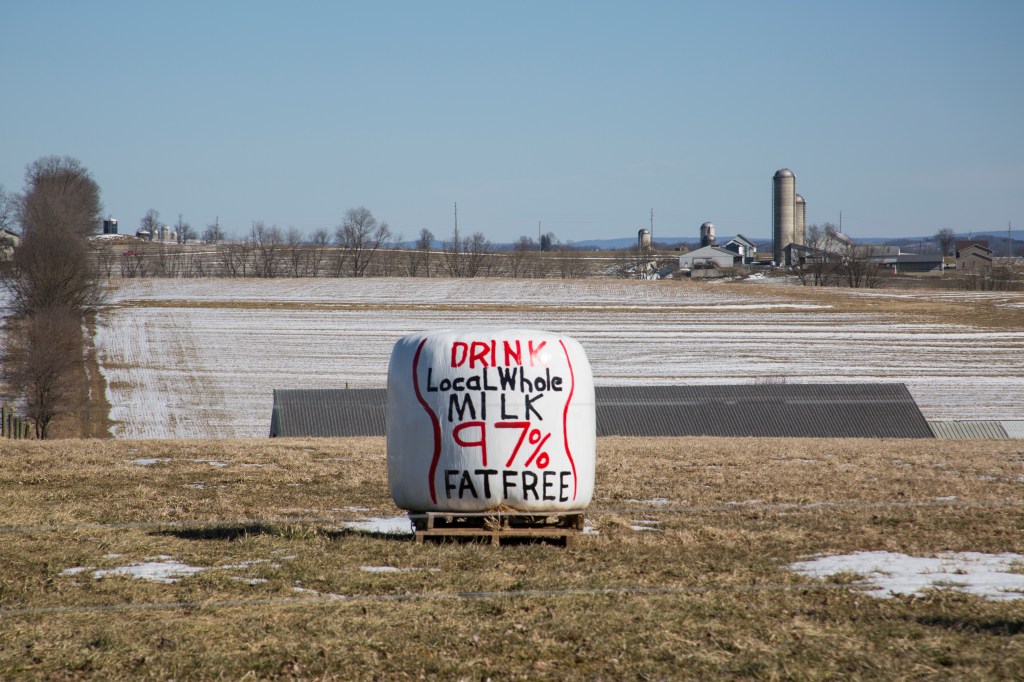
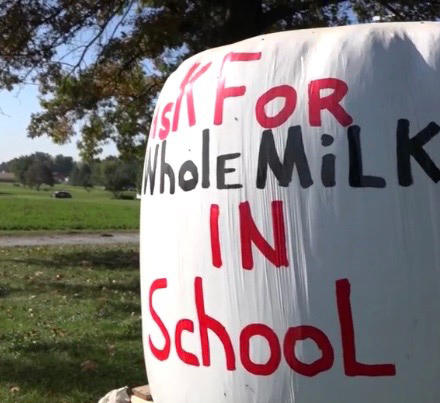
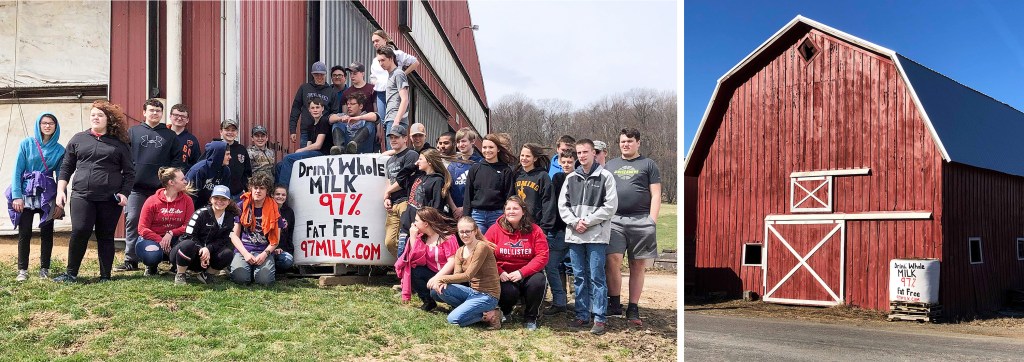
RICHLAND, Pa. — One farmer. One roundbale. And six painted words — Drink Whole Milk 97% Fat Free.

The excitement of the 97 Milk effort is contagious. What started with Nelson Troutman’s first painted roundbale in Richland, Pa., has rapidly multiplied into community-wide and nation-wide milk education efforts aimed at consumers on one hand and policymakers on the other.

Nelson Troutman placed his first “Milk Baleboard” in a pasture by an intersection.

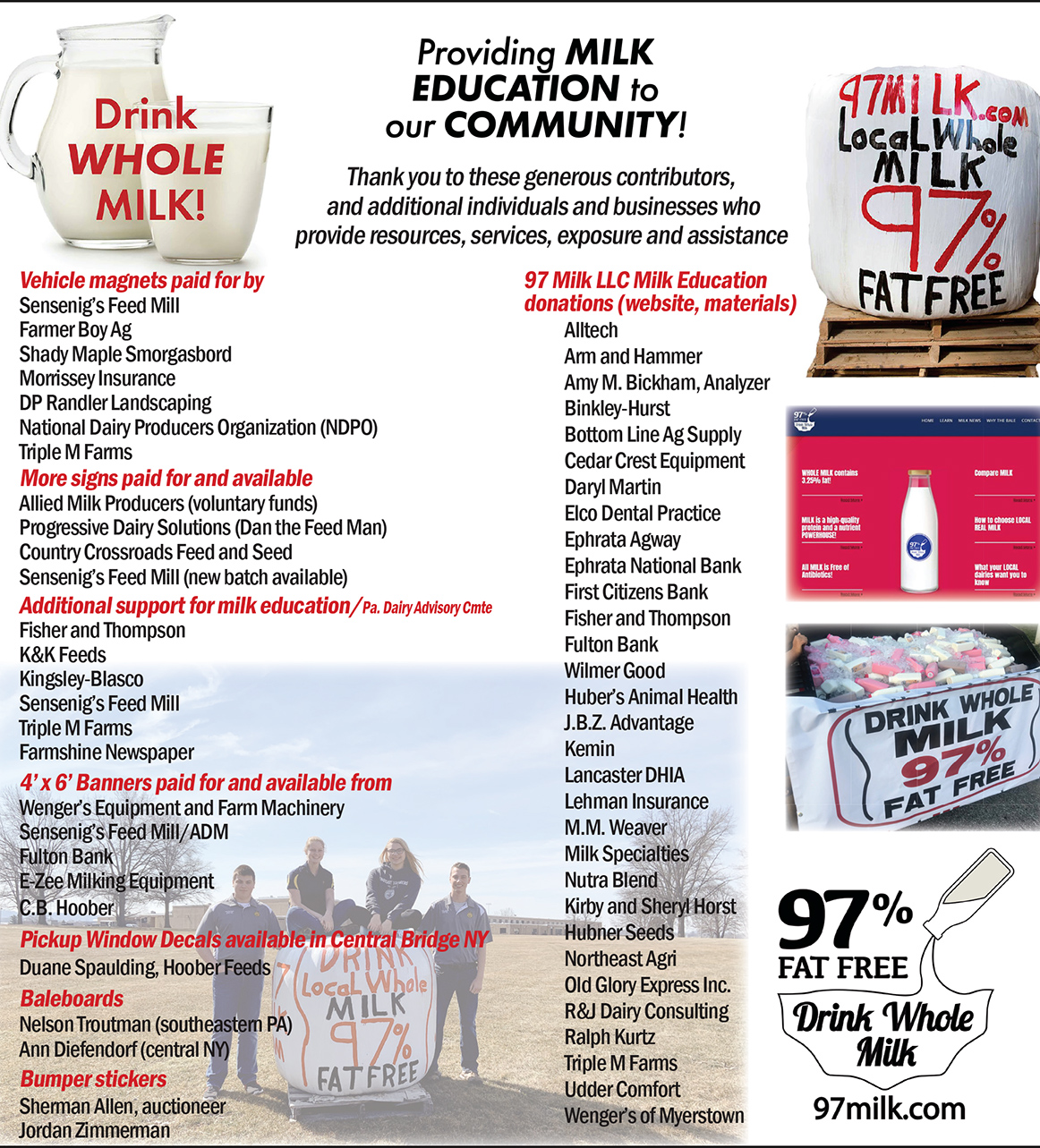
By February, retired agribusinessman Bernie Morrissey of Robesonia found five businesses to pay for the first 1000 magnetic 12” x 12” vehicle signs with the same message. Since then, more companies have joined in and some of the original businesses have printed more.

As legislators began to take notice, Morrissey and Troutman assembled a grassroots Pa. Dairy Advisory Committee of 10 farmers that meet monthly in person or by teleconference and interact with lawmakers, including the petition effort to bring whole milk back to schools. More agribusinesses joined in to help fund their expenses.

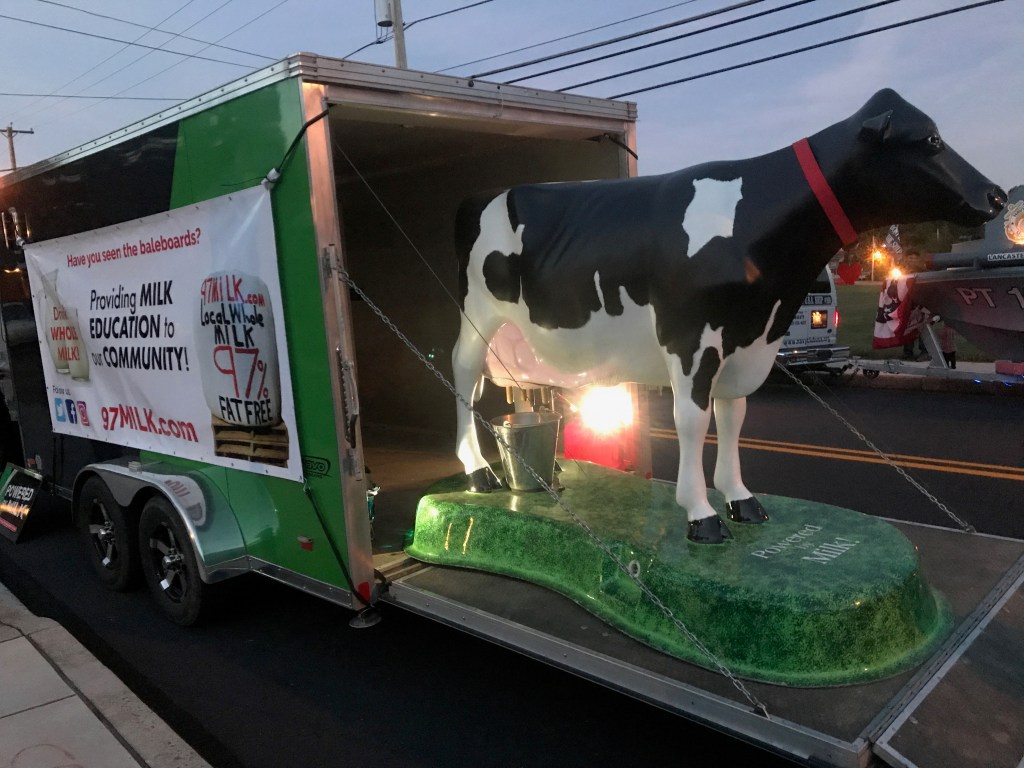
Then, 4’ x 6’ banners were created for places of high visibility and an effort to place them at stores is underway. A September Farmshine cover story helped spread the word. Morrissey reports the banners “are going like hotcakes” with additional businesses joining in to print more.

Another effort was underway simultaneously, when Rick Stehr invited a diverse group of farmers to a February meeting in Lancaster County to talk about milk education beyond the bale. Today, the joint efforts work together like two well-oiled machines comprised solely of volunteers.

Stehr recalls getting questions back in January. He invited Morrissey to talk about the milk baleboards at R&J Dairy Consulting’s winter dairy meeting. Noted expert Calvin Covington was the keynote speaker that day, and he told the 300 dairy farmers that promotion needs to focus on domestic demand, and that “we in the dairy industry need to talk about milkfat and not hide behind it not wanting things to change. Consumers want that taste, and we’re not talking about it,” he said.

Morrissey then told the crowd about Troutman’s “Drink Whole Milk 97% Fat Free” roundbales that were just starting to multiply at farms and businesses after a cover story appeared in Farmshine.

“As I talked with non-ag people, I realized many of them didn’t know quite what it meant,” says Stehr. “I thought the missing link is education. We needed to educate the public.”

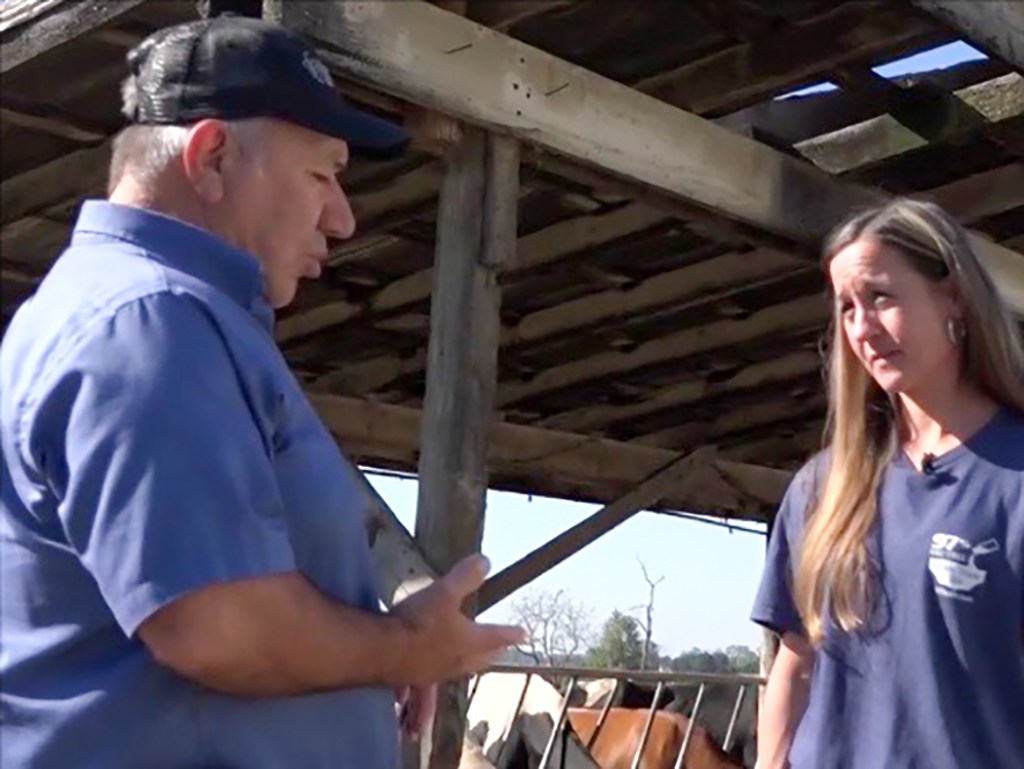
Nelson Troutman and Jackie Behr prepare for a television interview about 97 Milk.

Stehr’s daughter Jackie Behr has long believed milk sales suffer because milk education is missing. She has a marketing degree from Penn State and experience in non-ag positions before becoming R&J’s marketing manager.

Even Behr was surprised by her February focus group interviews with non-ag friends. “I was blown away by the obvious gap between dairy farms, milk nutrition and consumer perception,” she reports.

Behr shared the focus group responses at a February meeting of farmers that included Troutman. “It was an obvious eye-opener for everyone. These were educated women responding to my questions. How did we miss so much milk education all of these years?” Behr wondered.

They not only had zero knowledge of milk’s nutrition — other than calcium — their minds were full of information that was just plain false.

They said they drank organic milk because they ‘didn’t want to drink all those hormones.’ Or they chose almond beverage ‘because there are no antibiotics in it.’

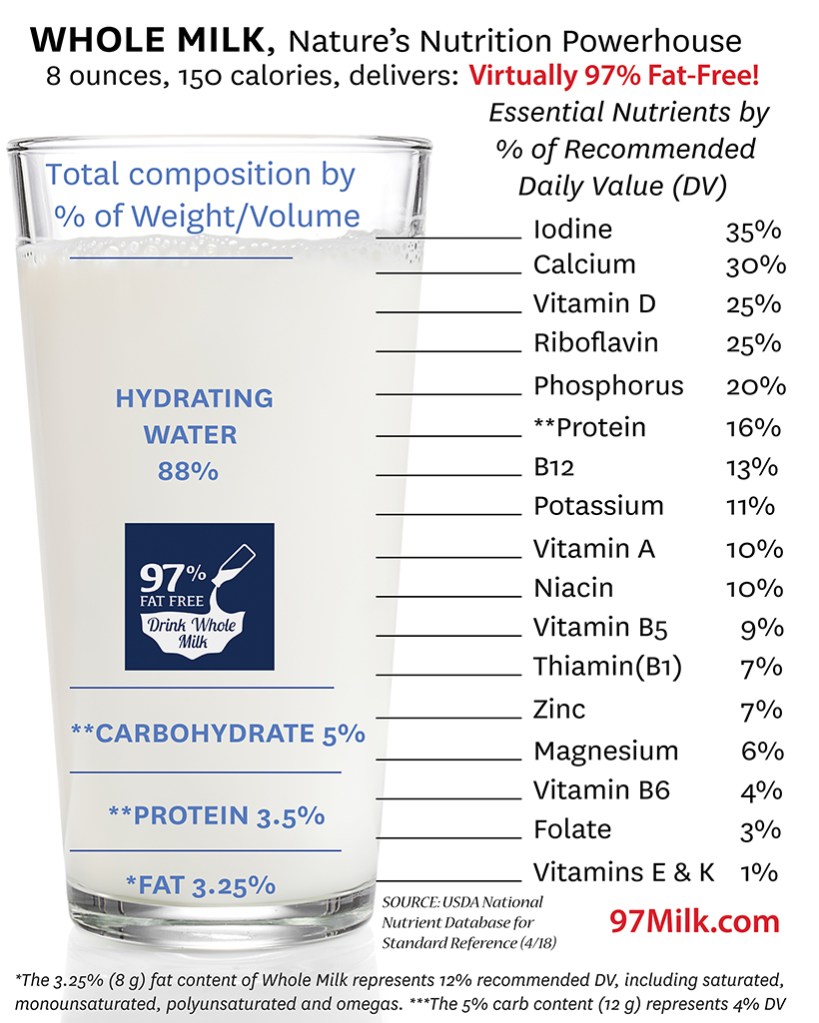
“The biggest misconception is how much fat they thought was in whole milk. Just like Nelson’s been saying. And when you tell them whole milk is standardized to 3.25% fat, their response is ‘Oh, wow!’ That alone is big,” says Behr.

Her marketing savvy kicked in. Ideas for a website were kicked around with obvious choices already taken.

Then one attendee said: “How about 97 Milk?”

It fit. And it captured attention. By the second meeting, they were ready to establish 97 Milk LLC and chose a volunteer board of Lancaster County farmers Mahlon Stoltzfus, Lois Beyer, Jordan Zimmerman and Behr, with GN Hursh serving as chairman.

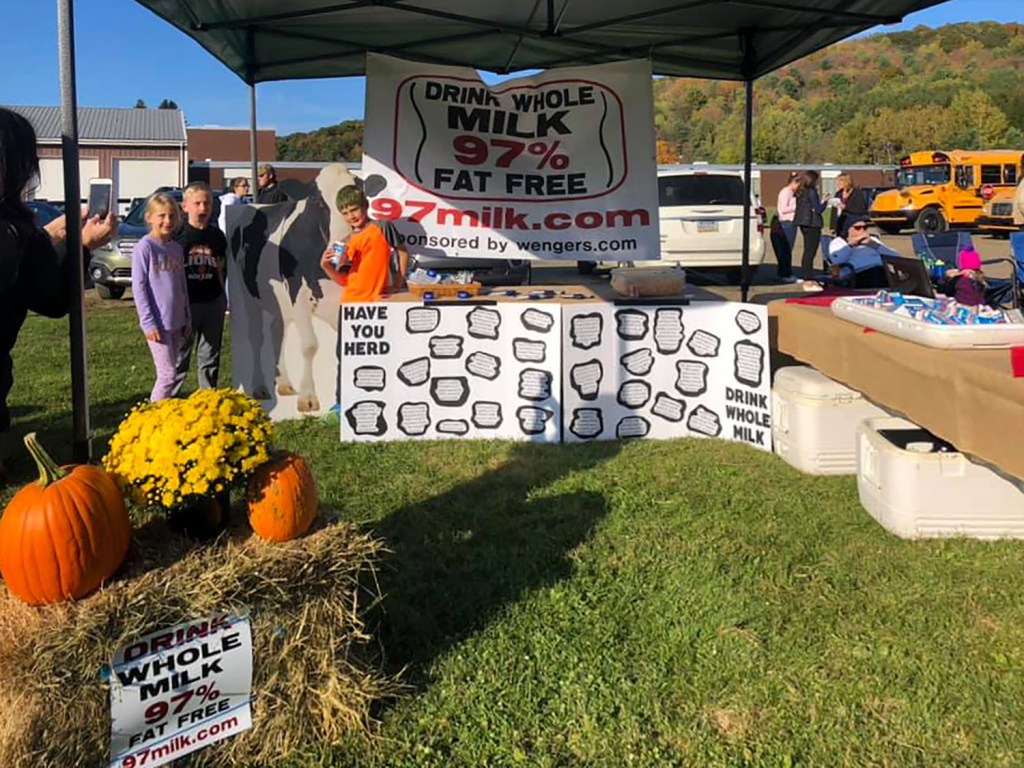
The website was up and running by the end of February with a Facebook page (@97Milk) that has gained more than 8,500 followers in less than eight months and a weekly average reach of over 150,000. Individual posts have reached up to 1.2 million through thousands of shares and hundreds of interactions. Twitter (@97Milk1) and Instagram (@97Milk) are also active.

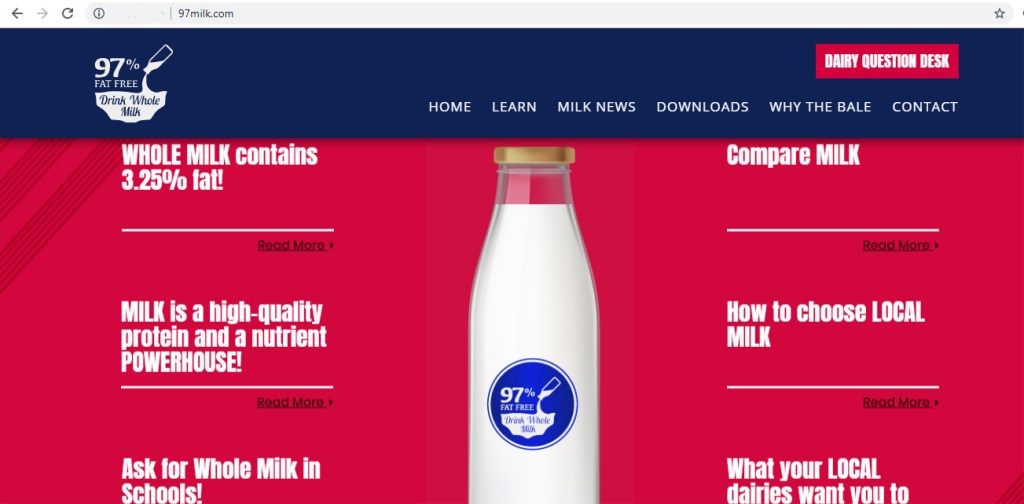
Behr says it all stems from what Troutman started, and he was happy to add 97milk.com to the bales with Morrissey making sure the website appears on signs and banners.

“To get someone to change their mind, you have to get the facts in front of them,” Behr observes. “We’ve got three seconds in front of their eyes to leave information that plants a seed.”

With some content help from others, Behr comes up with ideas, designs and coordinates Facebook posts six days a week.

The result? “People are shocked and come back and say, ‘I had no idea,’” Behr explains. “I am in the industry, and even I have learned so much about milk that I didn’t know before.”

“Now that 97 Milk has become a tool used by dairy farmers to educate the public about our product, the conversations that are happening are only the beginning,” Stehr observes. “We could have 97 Milk boards across the nation.”

As interest builds, 97 Milk LLC is looking into how different geographies could have their own chapters, with the website and materials providing some continuity.

“That’s where the power is, with the producers in each community or state,” says Stehr.

He credits Troutman and Morrissey for getting everyone’s attention and believes what they are doing creates the opportunity for the ‘beyond-the-bale’ education piece carried by 97 Milk LLC.

“The word milk has been used liberally, and the understanding of what it is has been diluted,” says Stehr. “We let that happen over the past 30 years and did nothing about it. We let them bash our product. Now we are educating people that the fat in milk is not bad, that there’s not 10% or 50% fat in whole milk, but 3.25%, that there is complete protein in milk and all of these other good things.”

From the baleboards, vehicle signs, banners and communications of the grassroots Pa. Dairy Advisory Committee, to the website, social media and educational events of 97 Milk LLC, a common bond unites these efforts — Troutman’s practical courage when he painted the first roundbale because he was frustrated and had had enough.

“We have lost market share, why? Because people don’t know what milk is and they don’t know what it tastes like,” says Troutman. “By promoting whole milk, we are opening their eyes and their tastebuds.”

While national co-ops think it’s “innovative” to develop a low-fat milk and nut juice blend, those involved in 97 Milk believe the response they see from diverse consumers tells a different story.

“People want to feel good about the products they are buying. The goal of 97 Milk is to share education, to share the dairy farmers’ stories,” says Behr. “You don’t pick up health magazines and see the benefits of milk. People need to see that positive information because they don’t know what milk provides.”

The Dairy Question Desk at the website fields a steady stream of five questions per week and when social media is included, 97 Milk fields 5 to 20 questions a day.

Every one of Behr’s original focus group have switched to whole dairy milk. The experience so far shows her consumers know very little about milk and have a real willingness to learn.

“All of our messages are simple. One fact. An infographic that’s simple to understand and that people can relate to,” says Behr. “Even if we have their eyes for just three seconds scrolling through, that little seed is huge.”

The posts fill other gaps. Behr believes people want to see that dairy farmers love their cows, that they care. The baleboard sightings and “cow kisses” have poured in for posting from several states.

The posts also help consumers fulfill a desire to be connected to their food, to buy local, and to support family-owned small businesses. “The simple fact that 97% of dairy farms are family-owned is a post that generated a lot of activity,” says Behr.

While she sees the environmental discussion as being big right now, she attributes this to the vegan activists driving it. By contrast, the 97 Milk facebook data and demographics reveal that 90% of consumers really want to hear about the health benefits, according to Behr.

She gives the example of the popular “yummy yogurt” infographic posted last week. It was visually attractive and simply listed a few health benefits.

“We get a few facts out on an infographic, and if you’re kind of hungry — or a mother like me trying to find healthy snacks for my kids — it hits,” says Behr. “It’s the simple things that get milk back in and help people feel good about buying milk products.”

The support from the agriculture community, and others, has been overwhelming.

“When someone calls, who you’re not even working with, to complement the work Jackie is doing, that’s rewarding,” says Stehr.

“When you see the response of a person in your community finding out they can drink whole milk and they really like it, that’s rewarding,” says Troutman.

“When legislators hold up a sign, or want their picture taken with a baleboard and say ‘this is the best thing going in dairy right now’, that’s rewarding,” says Morrissey.

“When people write into the Dairy Desk and we can answer their questions, that’s rewarding,” says Behr. “But most rewarding is hearing the excitement, seeing dairy farmers wanting to be involved, understanding the importance of marketing and seeing the results of getting involved. Receiving a simple note thanking us for positive messages, that’s rewarding.”

97 Milk LLC raised funds from more than 20 local and national businesses (see graphic) to cover expenses for the website and printed materials, and they’ve worked with Allied Milk Producers to have milk and dairy products available for parades, corn mazes, and other venues.

Meanwhile, individuals and communities take it upon themselves to paint bales, print bumper stickers, make signs, incorporate the message into corn maze designs, hometown parades, create farm tour handouts, initiate milk tents at athletic events, and more.

Young people are enthusiastic: FFA chapters, 4-H clubs and county dairy maids are printing their own banners and carrying the message at diverse public events. They love participating because it is real milk education, sharing the truth about milk and the life and work of America’s dairy farming families.

Morrissey and Troutman get calls from other states for banners and car magnets, and they’ve sent to these states at cost. Locally, the businesses paying for printing these items are giving them away (see graphic).

Behr has also designed items with the 97 Milk website logo, cows and farm scenes. These files are on the download area at 97milk.com and can be used to make banners, yard signs, license plates, bumper stickers, educational handouts, and more.

Troutman has added new baleboards for community events, including one that reads: Ask for Whole Milk in School. He and Behr recently did a television interview with a local PBS station.

Both the grassroots Pa. Dairy Advisory Committee and the 97 Milk LLC are running on shoestring budgets from donations (see graphic) with all volunteer effort, and the grassroots are blooming where planted to multiply the impact in ways too numerous to mention.

As a glimmer of hope, fluid milk sales nationally were up 0.2% in July, the first year-over-year increase in decades, with whole milk up 3.6% and flavored whole up 10.4%. Stores surveyed in southeastern Pennsylvania, where 97 Milk began, say whole milk sales are up significantly since January. It is also notable that many stores don’t seem to be able to keep enough whole milk on the shelves — a nationally obvious phenomenon.

Also being promoted is the petition to bring whole milk back to schools. This week, the online petition ( https://www.change.org/p/bring-whole-milk-back-to-schools ) topped 8000 signatures, plus 4000 were mailed in envelopes for a first-batch delivery in Washington Oct. 24, with a second batch goal to double that by January.

Reflecting on the past 10 months, Troutman says, “I thought if they’re not going to do it, someone has to, and here I am.”

And he’s happy. “Really, I’m thankful, thankful for so many who are helping make this work.” 

To contact the grassroots Pa. Dairy Advisory Committee about banners, magnetic vehicle signs and baleboards, call Bernie Morrissey at 610.693.6471 or Nelson Troutman at 717.821.1484.

To contact 97 Milk LLC about spreading the milk education to other communities, email 97wholemilk@gmail.com or call Jackie Behr at 717.203.6777 or write to 97 Milk LLC, PO Box 87, Bird in Hand, PA 17505, and visit www.97milk.com, of course.

 -30-

Hoffman Farms: ‘We do what we can to promote milk education’

By Sherry Bunting for Farmshine Nov. 8, 2019

Tricia (Hoffman) Adams planned her educational exhibit for months ahead of a multi-county cross country meet at the farm on October 15.

SHINGLEHOUSE, Pa. — Educating the public has long been a passion of the Hoffman family at Hoffman Farms in Potter County, Pennsylvania. The school and home communities of the two generations (five families) involved in the 1000-cow dairy are on both sides of the Pennsylvania / New York boundary.

In fact, Tricia (Hoffman) Adams gave a presentation back in 2006 on how they set up the learning components of their school tours at a Women in Dairy Conference that year. Attendees were inspired to find ways to invite the community in, and the family was later recognized with a Pa. Pacesetter Award in part because of progressive operations on the farm and in part because of their commitment to educating the community about milk and dairy farms.

Today, with tours, community events, a facebook page and the next generation so involved in school clubs and sports activities — in addition to showing dairy animals and market steers and pigs — the family has become a recognized source for their community to ask questions about dairy, livestock and agriculture, in general.

Earlier this year, the Hoffmans were among the many farms painting round bales and placing them in visible areas with the Drink Whole Milk 97% Fat Free message. They have always served whole milk, along with other dairy treats, when schools and community groups tour the farm. The Baleboards drew attention and gave Tricia an opening to answer questions people didn’t even know they had!

She reports that the schoolchildren on tours last spring loved the ‘milk baleboards’ and wanted their pictures taken with the “cool” roundbales.

In fact, the 97 Milk effort has revitalized Tricia’s educational resources, she says. She and her father Dale Hoffman are also both serving on the grassroots Pennsylvania Dairy Advisory Committee.

In September, Tricia worked with two vendors — Dan Rosicka of Progressive Dairy Solutions and Country Crossroads Feed and Seed to help share the good news about whole milk. Each vendor purchased 50 of the 12-inch x 12-inch magnetic vehicle signs with the 97 Milk message and website to make available in the community.

Tricia also acquired a 4-foot x 6-foot banner as well as other materials with the 97 Milk message and milk education information.

And then she added her own flare. She had been thinking about it and working on it on-and-off since summer. The farm was hosting a multi-school championship cross-country meet in October, and she was providing the “recovery” beverages – whole milk and whole chocolate milk — and other goodies.

“I’m not one to sit around and wait for help,” says Tricia. Like other dairy producers she is frustrated with the negativity surrounding milk and meat. “I am upset that our children have to suffer in their school diets, with the lack of milk choice and the meatless days. I decided our farm will do what we can to promote the ag industry through ag education, ag awareness and ag positivity!”  

Each time Hoffman Farms is asked to donate money to a school club or a team sport, they donate dairy products instead — “with a side of education,” says Tricia.

For the North Tier League Championship Cross-Country Meet on October 15 at Hoffman Farms, Tricia set up two tents and tables. In addition to the 97 Milk banner, she had a Chocolate Milk Refuel and Recovery banner. For the “side of education,” she created a large cutout cow and numerous ‘spots’ with questions and answers.

As a farm that buys their own materials for these events and tours, Tricia feels strongly that whole milk products should be served and serves them when the events are after school or at the farm so that the schools are not jeopardized in any way due to the flawed diet rules they have to live by during school hours.

She reports that the young people (and adults) say they look forward to having “the good milk.”

“Whole chocolate milk as a recovery drink after a race, whole milk cheese sticks or toasted cheese sandwich supplies to add to a sports concession stand — whatever helps our industry and our future generation of students is what we are going to focus on,” Tricia explains.

She’ll admit that some days, “It feels like an uphill battle, but we have had many clubs, organizations and businesses wanting to help as well,” says Trica.

“At the end of the day, I’m not sure how many people will benefit or even how much I can change, but I would rather try by doing something constructive.”

Three generations are involved in the award-winning 1000-cow dairy at Hoffman Farms in Potter County, Pa. The farm was founded by Dale and Carol Hoffman with 30 cows. Today their daughter Tricia and sons Keith, Brad, and Josh have transitioned into leadership and a third generation is also involved.

-30-