Cattle herd continues to shrink; Milk cows flat, dairy heifers down 1%

Editorial AnalysisTumultuous 2024 spills over into 2025 – Part Three

By Sherry Bunting, Farmshine, February 7, 2025 (updated with additional information after print edition published)

EAST EARL, Pa. – A tumultuous dairy and beef market in 2024 is bound to be even more so in 2025. The long-awaited Jan. 1 Cattle Inventory Report is in, and we all saw the kerfuffle about tariffs and trade this week.

The bottom lines are…

— The U.S. beef cow herd continues to shrink, while both the beef and dairy heifer replacement numbers are notably smaller, signaling less domestic beef production and stable, if not reduced milk production in the face of strong domestic demand for beef and dairy products.

— U.S. import volumes of live feeder cattle as well as beef and dairy products have climbed over the past five years.

— Uncertainty prevails about U.S. trade policy, but export volumes of beef and dairy have leveled off already in the past several years. Dairy exports are bound to get a boost in the short-term as U.S. prices are mostly trailing current global prices. Tariffs on Canada and Mexico and potential retaliations are paused.

— Will the dairy herd continue maintaining itself at these shrinking heifer ratios now that we are five years out from the time of plentiful heifers.

Report highlights include…

Milk cow inventory has remained relatively stable over the past five years, ranging from 9.34 million head on Jan. 1, 2020 to the 5-year high of 9.45 million head on Jan. 1, 2021, then back down to just shy of 9.35 million head on Jan. 1, 2024 and Jan. 1, 2025. However, the number of dairy replacement heifers has dropped by 16% over the past five years from 4.61 million head on Jan. 1, 2020 to 3.91 million head on Jan. 1, 2025. This number is down almost 20% — or nearly 1 million head — from the record high 4.81 million dairy replacement heifers recorded on Jan. 1, 2016.

Are milk cows milking longer? Is the average dairy cow getting 16 to 20% more productive life (an additional half lactation)? Is the age at first calving continuing to decline, and are herd culling rates also declining significantly enough to maintain the current cowherd size on 16 to 20% fewer heifers expected to calve vs. 5 and 10 years ago?

According to the Jan. 1, 2025 Cattle Inventory Report, there are not quite 27 heifers expected to calve this year for every 100 cows in the current U.S. dairy herd, and a national cull rate of 29% based on January through December 2024 dairy cow slaughter totals. Five years ago, there were just over 31 heifers expected to calve for every 100 milk cows in the similarly-sized U.S. dairy herd.

Will these trends collide at the 5-year mark this year, given the average productive life of a dairy cow based on the most recent data (2020) is not quite three lactations or roughly 5 years of age? How will the $5 to $10 billion in new processing capacity be filled, or will we see existing plant closures in their stead? Are the investor dairies that put up 10, 20, and 30,000 cow facilities each year filling new barns with milking animals raised on their own calf ranches coming in under the reporting-radar of USDA NASS? Or is the pace of dairies exiting the business on one end mirroring the growth on the other end?

One inescapable conclusion is that the milk cow herd remains relatively stable, while the dairy replacement heifer numbers have shrunk by 16% vs. five years ago and by 20% vs. 10 years ago, and the record-high prices paid for dairy replacements is proof of tight supplies.

This is part three in a four-part series. Part one was published Jan. 3, 2025; Part two on Jan. 17, 2025.
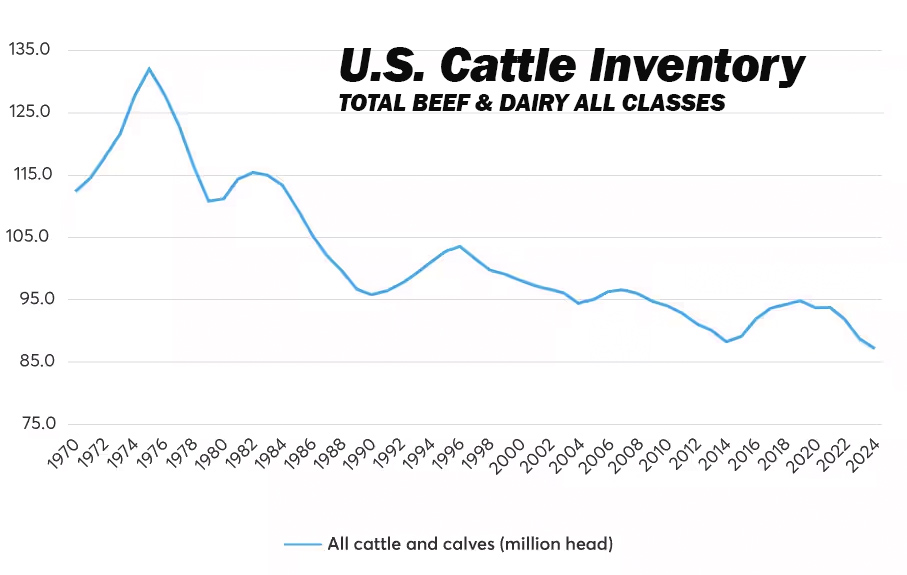
CME graph using USDA NASS Inventory data

U.S. cattle herd down… again

U.S. total cattle numbers on Jan. 1, 2025 are down 1% year-over-year (YOY), according to the All Cattle and Calf Inventory Report released by USDA on Fri., Jan. 31st.

At 86.66 million, the report counted 500,000 fewer head than last year’s total, which was already the smallest in 74 years (Jan. 1, 1951).

The total number of all cows and heifers that calved is down 0.4% YOY at 37.21 million head. That is 147,000 fewer beef and dairy cows on farms as compared with the revised-lower totals a year ago, which were already the smallest in 84 years (Jan. 1, 1941).

The total number of all heifers over 500 pounds on Jan. 1, 2025 (including heifers destined to become beef) was down 1% YOY at 18.18 million head. That’s 140,000 fewer head counted than on Jan. 1, 2024, which was already the smallest total heifer number in 34 years (Jan. 1, 1991).

In the Jan. 1, 2025 report, USDA NASS revised-lower its Jan. 1, 2024 and July 1, 2023 estimates of total animals that had calved, as well as the calf crop in those 12 to 18 month prior Inventory Reports. Statisticians went back and compared the prior estimates to the official slaughter data, the import and export data, and the relationship of this new survey information to the prior surveys.

This means the Jan. 1, 2025 numbers are now estimated at levels below the revised-lower prior reports that had already set records! (A mid-year 2024 inventory would have been helpful, but was canceled by former Ag Secretary Tom Vilsack, claiming insufficient USDA funds).

Chart compiled by S. Bunting with USDA NASS Inventory data

Milk cows flat, heifers shrink

The number of milk cows on Jan. 1, 2025 was essentially unchanged vs. year earlier, up only 2,500 to just shy of 9.35 million head.

However, the dairy replacement heifer total is down 1% YOY at 3.91 million head. At this rate, the number of heifers heading to careers as milk cows is 16% below the 5-year comparison on Jan. 1, 2020.

At 3.91 million head, there are 37,000 fewer dairy replacement heifers than a year ago, which was already the smallest number of dairy replacement heifers in 47 years (Jan. 1, 1978). 

As the graph above illustrates, milk cow numbers have held relatively stable over the past five years, while the number of dairy replacement heifers has significantly declined. Are cows experiencing longer productive life? Or are the multi-site investor dairies filling their own expansion sites via their own calf ranches, and escaping the USDA reporting radar?

According to the most recent data (2020), average dairy cow productive life in the U.S. is just shy of three lactations, roughly five years of age. With the number of dairy replacement heifers declining 16% over the past five years, will these two trends collide in the next 12 to 24 months to reduce the U.S. milking herd while escalating the already record high dairy replacement cattle prices? And, what role might HPAI H5N1 play as longer term impacts emerge?

USDA NASS reports that the average auction value of ‘average’ milking cows has increased by nearly $800 per head to $2650 for 2024 vs. $1890 for 2023; $1100 per head higher vs. the $1720 average for 2022; and double (+$1300) the average value reported at $1350 and $1300 per head four and five years ago for 2021 and 2020, respectively.

The average cost to raise dairy replacements has been estimated at $1700 to $2400 per head, which means the value of ‘average’ replacement heifers at $1720 to $2660 from 2022 to 2024 is finally starting to mirror the cost to raise them — on average.

Many dairy producers continue producing only the heifers they need, which is reducing the availability of heifers in the marketplace for those wanting to expand.

Producers continue to respond to the lure of the 3-day-old dairy-on-beef crossbred calves offering substantial margins of $800 to $1000 per head — with no investment, no rearing, no revenue-wait, and no risk.

Basically, a dairy cow can produce $800 to $1000 in revenue for the dairy as soon as she drops a live crossbred calf, no matter what the milk price or margins are doing, and with her whole lactation in front of her.

The Jan. 1 Inventory Report shows the U.S. beef herd continues to shrink, suggesting beef-on-dairy crossbreds will continue to offer bigger per-head margins than growing extra dairy heifers to sell as herd replacements — unless they are premium dairy heifers.

Expanding dairies are having to really plan ahead to raise the animals they need for growth or scramble to get them. Additional upward price momentum may be seen on dairy replacements in the next 12 to 24 months as the more abundant heifers available five years ago ‘age-out’ of the system, statistically speaking, at five years old, which is the industry average age of a milking cow in the U.S.

With the Jan. 1, 2025 U.S. milking herd holding steady at a level that is 1.1% smaller than it was in 2021, the expanding dairies are buying up the herds of the exiting dairies at high prices that make dairy farmers think about selling the cows and hanging on to the heifers, for now, if they do not have a next generation to continue the dairy.

Turnover of existing Holstein herds to include other breeds is also occurring, along with genetic improvement within the Holstein breed, as producers work to raise heifers that calve into the milking herd at younger ages, produce more component yield per hundredweight of milk, have improved productive life traits and fewer days open for a tighter average calving interval.

With a 2024 national dairy herd of 9.35 million milk cows and a 2024 national dairy cow slaughter of 2.726 million, the national culling rate last year was 29%. At that rate, even if the average age at first calving is 22-months, the U.S. dairy industry would need 28 dairy heifers to calve successfully in the next 12 months for every 100 milk cows — just to maintain the current size of the U.S. dairy herd.

According to the Jan. 1 Inventory Report, there are 2.5 million dairy heifers expected to calve in 2025 (down 0.4% or -9000 head). This calculates to 27 (actually 26.75) dairy replacement heifers expected to calve in 2025 for every 100 cows in the U.S. dairy herd as of Jan. 1st.

In 2016, when dairy replacement heifer numbers reached their peak at 4.81 million head, 3.11 million head were expected to calve that year, and the total U.S. dairy cow inventory was 9.31 million head, meaning there were 31 heifers expected to calve for every 100 cows in 2016. This has steadily eroded in part because dairy producers have stopped spending the money to grow extra heifers that were worth less than the cost to grow them until this year. They also worked to reduce age at first-calving, days open across the herd, higher component levels in the milk, reduced death loss, longevity, and began gradually re-introducing beef crossbreeding, which has become a pretty big deal over the past five years.

Some parts of the country are down significantly in heifer replacements as of Jan. 1, 2025, while others are up. For example, Pennsylvania has 15% more dairy replacement heifers on farms vs. year ago.

These estimates indicate milk production will be flat to lower for the next 12 to 24 months.

What this does not account for is the increasing milk component levels generating more dairy products per 100 pounds of milk and the increasing volume of dairy imports, particularly cheese, butter, and whole milk powder. But those increases can only do so much in the face of $5 to $10 billion in new processing assets coming online in the next 6 to 18 months.
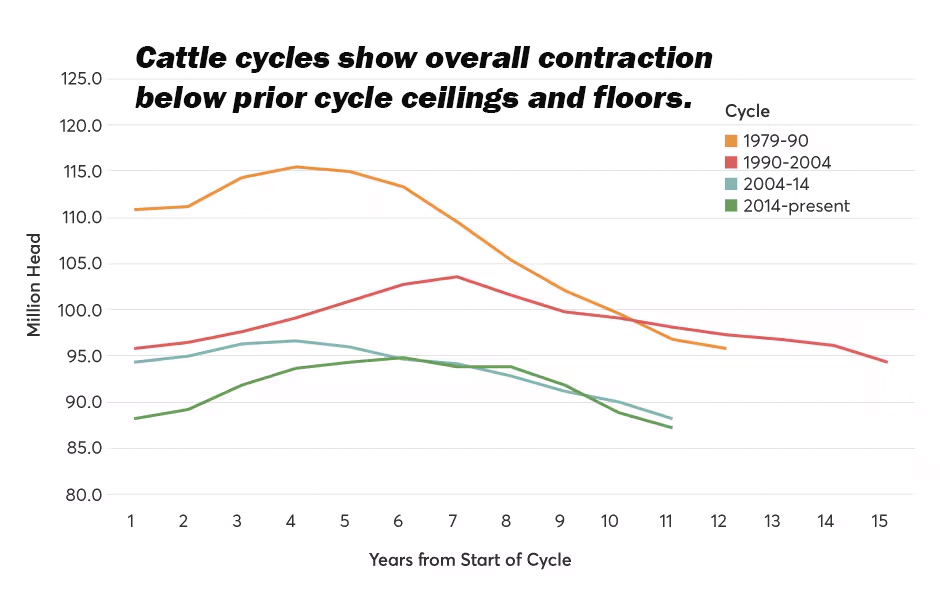
CME graph using USDA NASS Inventory data shows continued overall contraction of total cattle inventory as new cycles mostly fail to breach prior cycle ceilings, floors, and midpoints.

Beef herd shrinks more

The Jan. 1 Inventory shows the U.S. beef herd continues to shrink. At the national level, there are no signs of rebuilding, as the total number of heifers heading to careers as beef mama cows is down 1% YOY. However, in some parts of the country, such as Virginia, more heifers were retained as beef cow replacements and fewer were earmarked for feedlots.

At 4.67 million head, there are 46,000 fewer beef replacement heifers in the U.S. vs. year ago, setting another record low as the smallest number since 1948.

Even more striking is the beef replacement heifers that are expected to calve in 2025 are down a whopping 2% YOY (-50,000) nationally.

Meanwhile, the beef-on-dairy feedlot placements, while a growing segment of the beef industry, are not enough to reverse the downward beef production trend as evidenced by declines in the number of animals over 500 pounds on Jan. 1st heading to feedlots: Steers and bulls are both down 1% (-157,000 and -21,000 head YOY, respectively). Heifers over 500 pounds heading to feedlots are down 0.6%, and the number of cattle on feed as of Jan. 1, 2025 is down 1% YOY at 14.3 million head (-130,000 head).

The Inventory Report came on the heels of the January Cattle on Feed Report, which showed 3% fewer feedlot placements as of Jan. 1, perhaps because of the Mexican border closure to the live cattle imports, due to concerns about transmission of the screw-worm parasite.

Even the total number of all calves (heifers, bulls and steers) weighing under 500 pounds dropped 1% lower YOY at 13.46 million head (-30,000).

These estimates suggest domestic beef production will decline for at least the next 12 to 24 months, maybe longer.

What this does not account for are the number of live cattle crossing the border into U.S. feedlots from Mexico and Canada and the increasing amounts of beef the U.S. imports from other countries, including from Canada, Mexico and South America.
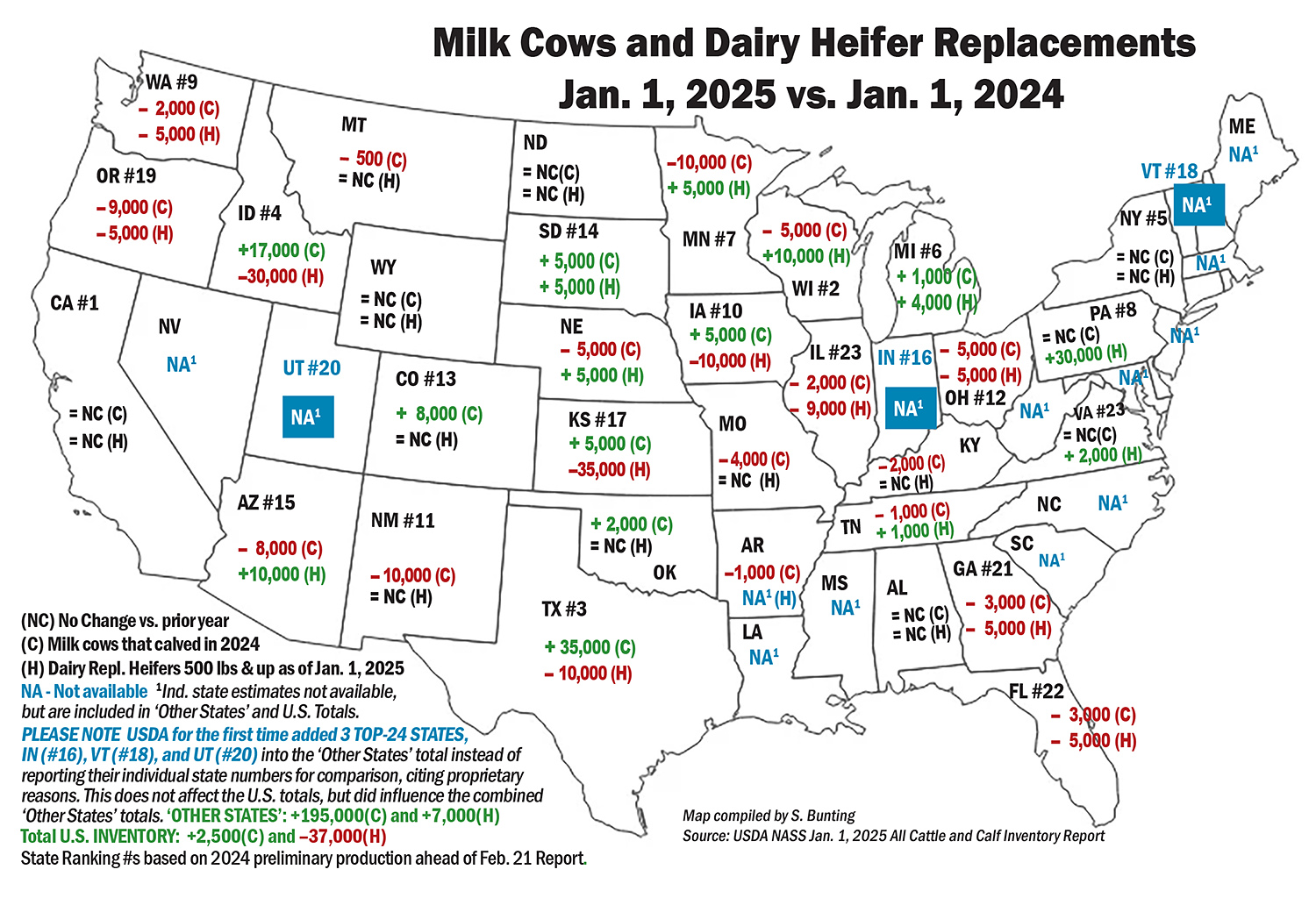
Map compiled by S. Bunting with USDA NASS Inventory data

Significant geographic dairy shifts

Breaking the dairy inventory numbers apart, we see big geographic shifts.

The West added 78,000 more milk cows in 2024 vs. 2023, except for California’s numbers being unchanged. On the other hand, the East and Upper Midwest had equal or fewer milk cows, down collectively more than 75,000 head YOY, except Michigan was up just 1000 head.

The biggest 2024 gains were tallied in Texas, up 35,000 head, and Idaho, up 17,000 head. Colorado grew by 8,000 head; Iowa, Kansas and South Dakota by 5,000 each; and Oklahoma by 2,000.

The biggest milk cow declines were in Minnesota and New Mexico, down by 10,000 head each; Oregon down by 9,000; Arizona by 8,000. Wisconsin, Ohio, and Nebraska by 5,000 each; Missouri by 4,000; Florida and Georgia by 3,000 each; Illinois, Kentucky, and Washington by 2,000 each; and Tennessee by 1,000. Smaller unranked states collectively accounted for the remainder of milk cow losses.

Interestingly, USDA pulled three Top-24 Milk Production States into the ‘Other States’ category, choosing not to report their cow and heifer numbers for proprietary reasons. They are Indiana (#16), Vermont (#18) and Utah (#20). Thus the ‘Other States’ category saw an increase of 195,000 cows simply because these three Top-24 states were included anonymously in the total.

The geographic breakdown is interesting when it comes to dairy replacement heifers as the growth is noted in the areas where the cow numbers have declined and vice versa. These shifts could reflect changes in the way heifers have tended to move across state lines for rearing, especially in light of the dairy-adapted B3.13 strain of HPAI H5N1.

Pennsylvania is the biggest outlier as the cow numbers are unchanged YOY, but farmers reported 30,000 more dairy heifers in the Commonwealth on Jan. 1, 2025 vs. year ago.

Elsewhere in the East, Virginia dairy heifer replacements are up 2,000 head; Tennessee up 1,000 head; New York and Kentucky unchanged; Georgia and Florida down 5,000 head each. Again, the ranked states of Indiana, Vermont and Utah had their replacement heifer numbers lumped into the ‘Other States’ category, which consequently showed a gain of 7,000 heifers vs. year earlier when those states were not included in that category.

Beef replacement heifers and feedlot heifers are down a combined 10,000 head in Pennsylvania, while Virginia showed signs of beef herd rebuilding, reporting 4,000 more beef replacement heifers and 4,000 fewer heifers heading to feedyards.

Looking at the Mideast, Michigan had 5,000 more dairy heifer replacements, while Indiana’s numbers were unreported. Ohio is down in dairy heifers by 5,000 head. Beef replacement heifers in that region are up by 7,000 head and feedlot heifers are up by 3,000 head.

The Upper Midwest grew their dairy replacement heifer numbers, while the West significantly decreased them. Wisconsin is up by 10,000 head YOY; while Minnesota and South Dakota grew by 5,000 head each.

In the West, the following states with significant growth in milk cow numbers had significant losses in dairy replacement heifer numbers: Kansas down a whopping 35,000 head in dairy replacement heifers; Idaho down by 30,000 head; Texas, Pacific Northwest and Iowa down 10,000 each. Dairies in Kansas, Idaho, Texas, and Iowa contended with avian influenza in 2024.

Meanwhile, in California, New Mexico, and Colorado (all three having dealt with H5N1) the number of dairy replacement heifers was reported as unchanged YOY, but Arizona, which has not had H5N1, grew its dairy heifer numbers by 10,000 head.
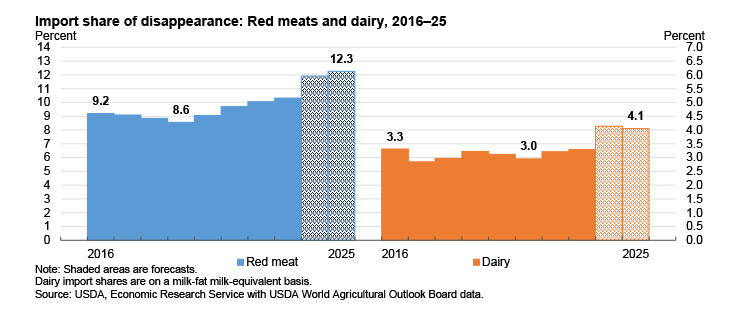
USDA Economic Research Service graph

Trade is uncertain (Imports up, Exports leveling off)

Dairy and beef imports are growing, and the industry is responding to ‘tariff talk’ with statements showing fear of trade wars harming farmers or possibly gaining concessions in the context of Agriculture’s current annual trade deficit of $45.5 billion. 

On Friday, Jan. 31, the spot cheese and Class III milk futures markets plunged lower in response to U.S. tariff announcements of 25% on goods from Canada and Mexico and 10% on goods from China.

This fear was short-lived, however, because the planned tariffs on goods from Canada and Mexico were promptly paused three days later on Monday, Feb. 3, when leaders agreed to support and combine efforts on U.S. border security, while putting teams together with the pledge to work through U.S. trade issues over the next 30 days.

The announced 10% tariffs on China went into effect Feb. 4, but discussions between the U.S. and China are said to be resuming for phase one of the trade deal struck in the prior Trump Administration just before the Covid pandemic hit globally.

Meanwhile, the total volume (not value) of dairy exports has leveled off on a total solids basis in the past two to three years as the U.S. exports more cheese and less skim milk powder and much less whey – the latter because we domestically produced less commodity SMP and far less commodity dry whey in 2024. Inventories are down for both, meaning domestic demand is using what is produced. 

On the flip-side, the U.S. imported more cheese, butterfat, and whole milk powder during the first 11 months of 2024 YOY.

We will take a closer look at the trends in U.S. dairy farm numbers, production, and trade after final 2024 trade and production data are released in late February, and with more information, perhaps, on how U.S. agricultural trade policy may be shaping up for 2025.

-30-
Editorial: What was really behind ‘rockier road’ this summer? USDA revisions show fewer cows, less milk June-August

By Sherry Bunting, Farmshine, October 27, 2023

EAST EARL, Pa. — In the June 30 and July 7 editions of Farmshine, we covered the milk market conditions behind the drama that sent farm-level milk prices spiraling lower. The two-part “rockier road for milk prices” series explored factors and asked questions about a situation that was not making sense.

Farmshine readers will recall that we questioned dubious math on the huge milk price losses in farm milk checks – far beyond the predictions for modest declines – in the April through August period. 

We questioned the accuracy of government milk production reports and the USDA’s World Ag Supply and Demand Estimates that kept telling us there would be more milk cows on farms and that milk production would continue higher for the year because of… more cows.

We doubted this was possible given the semiannual cattle inventory reports over the past year showing static to shrinking milk cow numbers and major shrinkage in the number of dairy heifer replacements (down 2% in Jan. 1 inventory, down 3% in mid-year inventory, a drop of over 100,000 head!). We have reported the escalating dairy replacement cattle prices setting multi-year record highs that are bearing these inventory numbers out.

We asked: Where are all these cattle coming from?

The June and July two-part series also indicated the 51% increase in the volume of Whole Milk Powder (WMP) imports coming into the U.S. compared with a year earlier in the January through May period — the highest volume for that 5-month period since 2016. (WMP is basically dehydrated milk for use in making any product or reconstitution.)

We also consulted Calvin Covington for his read of the situation. He reported to us that his calculations showed a 15% cumulative increase in total milk solids imported January through April, and that this extra volume was equal to 63% of the year over year increase in ending stocks on a total solids basis.

Well, what do you know! On Thursday, October 19, USDA issued its monthly milk production report for September. The report also went back and revised downward the previously reported totals for milk production and cow numbers for April through August.

Lo, and behold, in June and July while markets crashed, U.S. farms milked 13,000 and 34,000, respectively, fewer cows than a year ago. The September Milk Production report has now gone back to shave around 0.1% off of several months of previously reported milk production, and it has revised milk cow numbers lower than previously reported as follows: The May revision added 1000 head vs. prior report, the June revision shaved 4000 head off the prior report, July’s revision shaved 11,000 head, and August 14,000 head.

How convenient that while the Milwaukee Sentinel and area news stations were reporting five weeks of milk dumping in the sewers during June and July, and USDA Dairy Market News was reporting six to eight weeks of spot milk loads selling at $10 to $11 under the abysmal Class III price as it hit multi-year lows, the USDA reports had been telling us we were milking more cows than a year earlier, and those cows were making more milk.

Prices had plunged by more than 37%, and no one was talking about the scale-back of mozzarella cheese production and the ramp up of whole milk powder imports.

Sure, they were talking about the softening of dairy exports, and maybe that’s the point. The industry had to get the U.S. price levels below global levels in a hurry to honor the global goals set by the national dairy checkoff under previous USDEC president Tom Vilsack to keep growing exports on a Net-Zero pathway to get to 20% of milk production on a solids basis.

We wrote with concern in June and July about how even those prior numbers did not make sense at those previously incorrect levels, how a tiny change such as milking 7000 more cows in May vs. year ago and a little more milk per cow through the period could result in prices falling this hard in June and July. We have even more questions as even those small supply-margin factors have now been edited by USDA to be lower than previously reported for the April through August period.

Cow numbers have always been a driver for milk prices. Now we know there was an average of 21,000 fewer cows milked in the June-July period. And, by July, there were actually 34,000 fewer cows on U.S. farms vs. year ago.

For the Q-3 July through September period, the revisions show an average of 33,000 fewer cows nationwide compared with the third-quarter of 2022. Maybe this will also be revised lower in the future — as it includes the number of milk cows on U.S. farms in September that is now said to be 9.37 million as a preliminary figure.

In the space of six months, U.S. total milk production has gone from running 1% above year ago in Q-1 to nearly 1% (0.7%) below year ago in Q-3. But within that difference lies a revision that begs big questions about what was really going on while prices were plunging.

According to the tables in the September milk production report, the reality of the situation in June and July — while milk prices hit rock bottom and milk was being dumped and sold for $10 to $11 under class — we were already milking 13,000 fewer cows in June compared with a year ago and a whopping 34,000 fewer cows in July vs. year ago, according to these revised numbers. Now, in September, we’re milking 36,000 fewer cows in the U.S. vs. year ago.

In fact, these revised reports show that milk cow numbers have fallen by 74,000 head from the March 2023 high-tide – an unrevised and supposed 9.444 million head — to the August revised number of 9.376 million head and the September preliminary 9.37 million.

Think about this for a moment. We had unprecedented sets of proposals for milk pricing formula changes flowing into USDA in April and May with USDA announcing in June that a hearing of 21 proposals in five categories of formula changes would begin August 23rd.

While this was staging, we saw milk pricing drama unfold.

How useful this drama was for processors during the first eight weeks of the USDA Federal Milk Marketing Order hearing that has now been postponed due to “scheduling conflicts” to pick up where it left off on Nov. 27. 

How convenient it was for processor representatives to be able to point to dumped milk, below-class spot milk prices and negative premiums as justification for their proposals to increase make allowances while attempting to block farm-friendly formula changes — all in the name of investments needed in capacity to handle “so much more milk!”

(A year earlier, Leprino CEO Mike Durkin warned Congress in a June 2022 Farm Bill hearing that, “The costs in the formula dramatically understate today’s cost of manufacturing and have resulted in distortions to the dairy manufacturing sector, which have constrained capacity to process producer milk,” he said, calling the situation “extremely urgent” and warning that immediate steps needed to be taken to “ensure adequate processing capacity remains.”)

Fast forward to the first eight weeks of the USDA FMMO hearing in Carmel, Indiana in August, September and October. We listened as large global processing representatives (especially Leprino) pontificated about how the make allowances are set too low, saying USDA is setting the milk prices too high. They pointed to all of the drama this summer as proof that farmers are suffering because processors can’t afford to invest or retain capacity to handle “all this extra milk.”

Now here we are, September milk production nationwide is down 0.2% from a year ago, product inventories are tight to adequate, prices have improved… but along the way the industry managed to shake out hundreds of dairy farms — large and small — that have liquidated during the steep downhill slide this summer that so few were prepared for, as no one had a clue it would be this bad given the tight number of milk cows and replacements steadily reported in inventory.

What was really behind the dairy cliff we just experienced, where even USDA Dairy Market News recently reported a significant number of herds milking 200 cows or less have recently liquidated in the Upper Midwest?

With record WMP imports, a pull-back in fresh Italian cheese production, and other elements behind the scenes… was the fall-out of a so-called milk surplus manufactured to prove a point? (Remember, Leprino’s Durkin warned that if make allowances aren’t raised, sufficient processing capacity may not remain. And take note that other Leprino representatives warned during the USDA FMMO hearing last month that they may not invest in U.S. processing capacity in the future, if make allowances are not raised and FMMO minimum prices lowered.)

Or was the fall-out this summer manufactured to fulfill the dairy checkoff’s goals for exports? You see, we are told there was excess product in Europe and New Zealand, and our overseas sales were softening, but still well above 2020 and about even with 2021. The industry is driven to get the deals to secure more global market each and every year, even if the means to those ends are detrimental to how we serve our domestic market in the future.

Given the pullback in mozzarella production during this “rockier road for milk prices”, we have to wonder about the testimony of Leprino representatives in the FMMO hearings. They have been doing the loudest complaining.

Leprino is also a major strategic partner with DMI and the organizations under that umbrella: USDEC, Innovation Center for U.S. Dairy, Net Zero Initiative, and on and on.

They want FMMO milk prices lowered, they said, so they can pay premiums again (?), and they believe you, the farmers, should help pay for their sustainability pledges within the make allowance formulas as a cost of doing business.

They likely want to free up capital out of the FMMO pricing levels to pay for Scope 3 emissions insets from RNG-project dairies to compete with other industries that can buy those renewable clean fuel credits as offsets.

They likely want to use your milk money to pay for concentrated manure-driven expansion in the Net Zero wheel-of-fortune pathway that has been constructed with your checkoff money.

They want FMMO make allowances high enough to cash flow plant capacity investments based on byproduct whey, while they make mozzarella cheese that is not surveyed, is not price-reported, and is not included in the end product pricing formulas for dairy farm milk checks.

-30-

BEEF ON DAIRY, Part I: History and market dynamics to know as trend boosts dairy revenue

CAPTION: The USDA All Cattle and Calf Inventory shows declining numbers of beef and dairy cows. Significant is the 3% decline in both the number of dairy replacement heifers and beef replacement heifers as of Jan. 1, 2022 vs. year ago. More dairy farms are incorporating beef on dairy strategies into their business management.

EDITOR’S NOTE: May is Beef Month, and beef is becoming a bigger part of dairy today. In Part I in this series by Farmshine contributor Sherry Bunting — a former qualified live beef cattle grader, market reporter and past editor of the former Livestock Reporter — provides a helpful and experienced perspective on converging market dynamics that are opening doors to revenue for dairy farms.

By Sherry Bunting, Farmshine, May 13, 2022

EAST EARL, Pa. — The trend among dairy farms to breed a portion of dairy cowherds to beef sires is having a positive impact on revenue in several ways.

First, the bull calves bring more money. Week-old 90- to 120-pound crossbred dairy bull calves bring roughly double the price of a straight dairy calf at the livestock auctions. Last week, auctions in Lancaster County, Pennsylvania. sold crossbred calves averaging $300, while straight Holstein bull calves of the same weight averaged $150.

Many farms are also feeding some crossbreds for beef sales direct to consumers — a burgeoning cottage industry that faces some bottlenecks because of limited small butcher capacity in a consolidated beef industry.

Second, dairy replacement heifers and young cows today are worth more – a lot more. According to the May 6 USDA Monthly Comprehensive Dairy report, fresh cows nationwide averaged $1468 in April, compared with $1009 a year ago; bred cows averaged $1417 vs. $1039, and bred heifers $1363 vs. $985. That’s a 37% increase for bred replacements, 45% increase for fresh animals.

A portion of this gain can be attributed, of course, to the rise in milk prices, but one key factor is the beef on dairy trend that has blunted the expansion curve of gender selection for heifers through sexed semen. 

Specifically, there are 3% fewer dairy replacement heifers in the U.S. as of Jan. 1, 2022 compared with a year earlier, and 1% fewer milk cows, according to the January USDA semi-annual All Cattle and Calf Inventory report. The next look we’ll get at these numbers will be July.

Third, milk price gains are supported in the longer term by this restraint on what was previously a runaway train of increasingly available dairy heifers. Fewer replacements blunt the milk production expansion curve capability. 

This is happening not just in the United States, but also in New Zealand and Australia, according to analysts quoted in New Zealand’s Farmers Weekly, predicting continued strength in annual milk price — in part due to the limited expansion capability. As feed prices rise, having two commodities — dairy and beef — offers some ways to look at feeding efficiency, such as feeding milk cow refusals to beef animals. Diversification also helps spread risk.

Changing the equation

Like the dairy cow herd, the beef cow herd is in a cycle of decline. The Jan. 1 Inventory Report showed the number of cattle on feed for beef was up slightly, but beef cow numbers are down 2% and beef replacement heifer numbers are down 3%, just like for dairy. This trend is being exacerbated by further culling due to drought in some major beef regions and big concerns for cow-calf operators about concentrated market power in the beef industry.

Total U.S. cattle numbers (beef and dairy of all ages and types) are 91.9 million head as of Jan. 1, down 2%. Looking at cowherds, there are 30.1 million beef cows and 9.3 million dairy cows as of Jan. 1. The additional beef animals produced via crossbreeding on dairy farms is still just a fraction of a much larger beef industry — even as beef cowherd numbers and calf crop decline.

At the same time — contrary to the marketing strategies of elite plant-based globalists — consumers want beef. They want quality beef. And they are looking to source from local farms and small processors or brands.

Anyone who has shopped for beef at the large chain supermarkets in the past two years has found inconsistent availability and poor selection more often than not. A big part of the salable meat is roasts, and if they aren’t inherently tender, people must know how to cook them. Ground beef still reigns, but even that is a crapshoot if you’re shopping at a big box store.

People who taste good beef, will crave good beef, and more people today are starting to realize beef is good for us and the planet — regardless of what the globalists, climate controllers and food police are trying to force-feed us. 

The demand for off-farm beef sales has grown to the point where custom slaughter facilities are booked several months to a year in advance. This includes farms that want to process their market dairy cows through voluntary culling, for direct sales to consumers, marketing the circle-of-life concept of beef from dairy. This, along with the concerns about market transparency, is why we hear so much about revitalizing or creating regional infrastructure to expand USDA-inspected small processor capacity and state-inspected custom butchers. 

Strategies vary

So, what do ‘beef on dairy’ crossbreeding programs look like? This is something land grant universities are following with research on different breed combinations. Sessions about beef on dairy are well-attended at dairy conferences. The bull studs have been marketing beef sire genetics specifically for dairy, and Holstein USA has a program with the studs using an Angus-Simmental crossbred genetic pool showing how it matches up to Holstein.

How beef on dairy happens varies from farm to farm — 30 to 40 years ago, a dairy farmer would breed first-calving heifers to Angus for a smaller calf. Some also doubled as farmer-feeders with a small feedlot or pasture-growing feeder cattle. Back then, one could afford to feed the purebed Holstein steer to Choice grade with cheap corn. They take longer to finish to a high quality grade, especially when backgrounded on pasture for a few months of frame growth. 

But then came the boxed beef carcass-size discounts prevalent from 1994 through 2014. Feeding a backgrounded Holstein to grade at higher grain prices became inefficient and very costly. Veal sales also came under pressure. These combined trends made Holstein bull calves almost worthless for many years.

Today’s beef industry is increasing its tolerance for larger carcasses, appreciating the ability to sell more beef pounds per animal to spread fixed costs, as well as improve the ‘carbon footprint’. We don’t hear the ‘too big for the box’ mantra justifying horrendous carcass-size discounts anymore — as long as they grade — because consumers are returning to good beef, just like they are returning to butter and whole milk.

From Angus and Simmental to Charolais and Fleckvieh, there are beef on dairy strategies popping up everywhere. The black hide continues to be important in many markets where cattle are eventually sold to feedlots that sell to packers that utilize the Certified Angus Beef or other similar ‘House’ brands. 

Dietary Guidelines created problem

CAB is a USDA-Certified brand that emerged in the 1980s, when the Angus Association decided to do something about the problems USDA created for beef demand when the Department diluted the Choice quality grade to ‘align’ with emerging government Dietary Guidelines.

We are all familiar with what happened to milk, butter and other dairy products since the advent of the anti-fat Dietary Guidelines 40 years ago. It happened in beef too. 

In the late 1970s, USDA ‘widened’ the Choice grade to include the upper third of the ‘Good’ grade and renamed the ‘Good’ grade as ‘Select.’ They said they were responding to consumer demand for lean meat, but the name change and dilution appeared to be more of a stealth approach to herding consumers.

We know today this has backfired, but even back then, there was an almost immediate reaction from the higher value restaurant trade. They were getting ‘Choice’ beef that ranged from ‘old’ Choice to ‘new’ Choice, and that spread in marbling scores (intramuscular fat flecks) is huge. 

The lack of uniformity and the increase in unfavorable eating experiences were a problem. Those flecks of fat are what give the beef flavor and tenderness. Today, we know the intramuscular fat is not much different from olive oil in its healthfulness, but that’s another story.

By 1980, the Angus breeders had implemented their solution with Certified Angus Beef and marketed it to the unhappy restaurant trade and eventually industrywide.

More than ‘marketing’

Not only do cattle have to have a ‘predominantly’ black hide to qualify for the CAB-premium and brand, they must also grade in the top two-thirds of Choice on marbling score.

In effect, the Angus folks developed a brand that increased favorable eating experiences and brought back more uniformity by requiring the beef carrying the CAB brand to conform to the ‘old’ USDA Choice grading standards as they were before the anti-fat food police intervened.

Since they came up with the plan, of course, the black hide was important as the vehicle for their Angus genetics, and genetic work ensued to trace back and determine the traits (expected progeny differences, EPDs) that consistently delivered higher quality, more uniform beef grown efficiently and at a moderate frame size to fit the emerging ‘boxed beef’ trend.

As CAB took off and premiums were paid for qualifying cattle, almost every breed focused on developing lines with black hides and better marbling scores and moderate frame without the excess exterior fat. Similar ‘house brand’ Angus programs use some of the same criteria, but it was CAB that repudiated the USDA Choice grade change by creating their own certification program – something USDA graders implement at the slaughter plant for a fee. 

Because it solved a real quality problem, the fees paid to the graders and the premiums paid for the cattle were absorbed by the market because CAB could differentiate in a watered-down beef industry to a market hungry for those quality and reliability standards. Buyers wanted to know that if it was stamped Choice, it is Choice, the old Choice.

Fast forward to 2020, amid a global pandemic shutdown, supply chain disruptions, consumer concerns about where their food comes from, the growing awareness of the stranglehold four big meat packers have on the entire global beef business, label confusion, plant-based pushing, and the involvement of the Big-4 in future lab-created meats… All of these factors are opening a door that heretofore only a few dairymen pursued.

Today, dairy farms large and small can succeed with beef on dairy strategies.

Selecting what to cross

When selecting sires for beef on dairy to produce feeder calves or fat cattle that are auctioned or sold on a live basis to feedlots or packers, avoiding white on certain parts of the hide is important and a genetic consideration to avoid discounts. This is especially true at today’s rising corn prices because Holsteins are known to need more time on feed to finish, or a hotter diet fed at a younger age. Some Angus and Simmental genetics are designed to diminish occurrence of a white pattern, deemed a tip-off to buyers of cattle for feedlots that are concerned about feed efficiency differences between beef and dairy breeds.

Those crossbreeding with Charolais will find their dairy breeds produce what feedlots view as the desirable ‘smokey’ hide Charolais with muscling that compensates for the angular dairy frame when visually appraised.

But there’s another twist to this tale, in addition to traditional beef breeds, the unique heritage Wagyu is emerging. The genetics of full blood Wagyu are pricey, American Wagyu a bit less so, and F1 Wagyu x Dairy more affordable — relatively speaking.

In fact, in Japan, where the Wagyu breed originated and is a national treasure, the dairy cross is also popular as a more economical version of their most valued signature beef. 

Wagyu have some things in common with dairy breeds, especially Holsteins. They take longer to deposit the intramuscular flecks of fat (marbling), but the Wagyu don’t need a high-energy diet to do so, and the way the flecks are deposited is also compatible with dairy breeds. 

Wagyu beef has its high-quality flavor and tenderness reputation because of the even distribution of these smaller flecks of fat throughout the lean. Holsteins tend to marble this way also, but the Wagyu is the master on this score.

Prized for what’s ‘inside’

This heritage breed first arrived in the U.S. in the 1970s and went through a resurgence in the 1990s for its quality consistency in a time of dilution and wide variance. You might have seen it on a menu as Kobe beef, so named for a specific region in Japan where the most elite black-hided strain of the Wagyu is raised.

As the Wagyu is making its third come-back now in the U.S., the F1 cross (Wagyu x Holstein) is a ‘thing’ and quite popular among dairy producers in other countries, like Australia.

The caveat with Japanese and American Wagyu is they do not have quite the beefy outward appearance of a traditional European beef breed. Their conformation is described by breeders as dairy-like, more angular — wider in the front than rear, owing to a history of pulling carts in Japan. They are smaller framed and slower growing.

This means using Wagyu in a dairy crossbreeding program is successful when producers market the beef directly to consumers or sell the cattle to buyers who understand what they are buying. They won’t see what Wagyu are prized for by looking at them from the outside in an auction setting. The value is visible on the inside in how the flecks of fat are distributed for flavor and tenderness.

CAPTION: Dairy producers like Adam Light at Spotlight Holsteins, Myerstown, Pa., raise dairy on beef crossbred cattle right along with the dairy replacements to a certain age when dietary needs start to differ on a beef vs. dairy track. Adam and his cousin Ben have been building their Lightning Cattle Company raising Wagyu x Holstein beef for direct sales.

Making a go of it

For Adam Light of Spotlight Holsteins, Myerstown, Pennsylvania, dairy on beef using Wagyu genetics is very much a part of the operation. He and his cousin Ben Light, a landscaper, are partners in Lightning Cattle Company.

They started with three Wagyu, two bulls and a heifer, purchased from the Empire State Farm dispersal, bred by the late Donald ‘Doc’ Sherwood near Binghamton, New York four years ago. The Lights collected semen off the bulls and flushed the heifer for embryos.

Not only did they begin incorporating the Wagyu genetics into the dairy-on-beef strategy at the 220-cow robotic dairy farm Adam purchased from Ralph Moyer in 2020, they made semen available to other dairies for first-dibs on purchasing offspring, and leased bulls to beef cow-calf herds.

Adam Light grew up on a diversified crop, poultry and beef farm. Working for nearby dairy farms as a youth, he developed an interest in dairying and began renting a dairy barn on a farm his father had purchased for cropland. When the time came to move the operation forward, the Moyer farm was on the market. Adam sold his smaller registered tiestall herd to another dairyman now renting his former barn, and purchased Moyer’s larger herd, farm, and robotic facility.

Next week, we’ll talk with Adam and his cousin Ben about Lightning Cattle and the beef-on-dairy business… and eventually about his robotic dairy transition.

-30-