USDA FMMO hearing resumes, Dr. Stephenson testifies for MIG proposal to end $1.60 Class I base differential

USDA’s cross examination reveals possible flaw in simulator model result
By Sherry Bunting, Farmshine, Jan. 19, 2024

CARMEL, Ind. — Shadow pricing, demand elasticity, commoditized loss of prior incentives, balancing cost, give-up cost, base differential, uniform differential, market-clearing price…

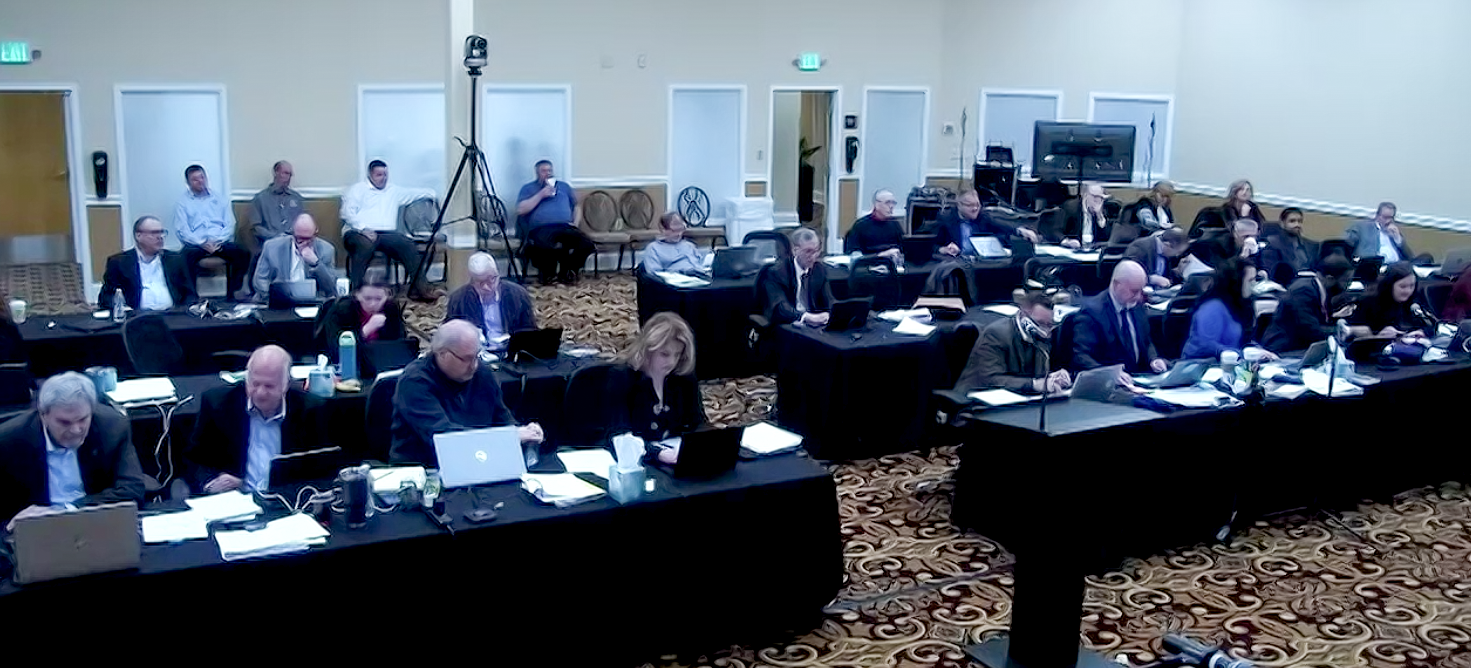
These terms ruled the day when the USDA National Hearing on Federal Milk Marketing Order (FMMO) proposals resumed in Carmel, Indiana this week after a more than four-week recess.

The hearing began in late August. It did not conclude by Fri., Jan. 19, so it will again recess until Jan. 29. 

American Farm Bureau estimates that another 270 days of post-hearing processes must follow before a USDA decision could be implemented, and even this is subject to proposals that seek a 15-month delay between decision and implementation due to potential impacts on CME futures-based risk management tools, such as Dairy Revenue Protection (DRP).

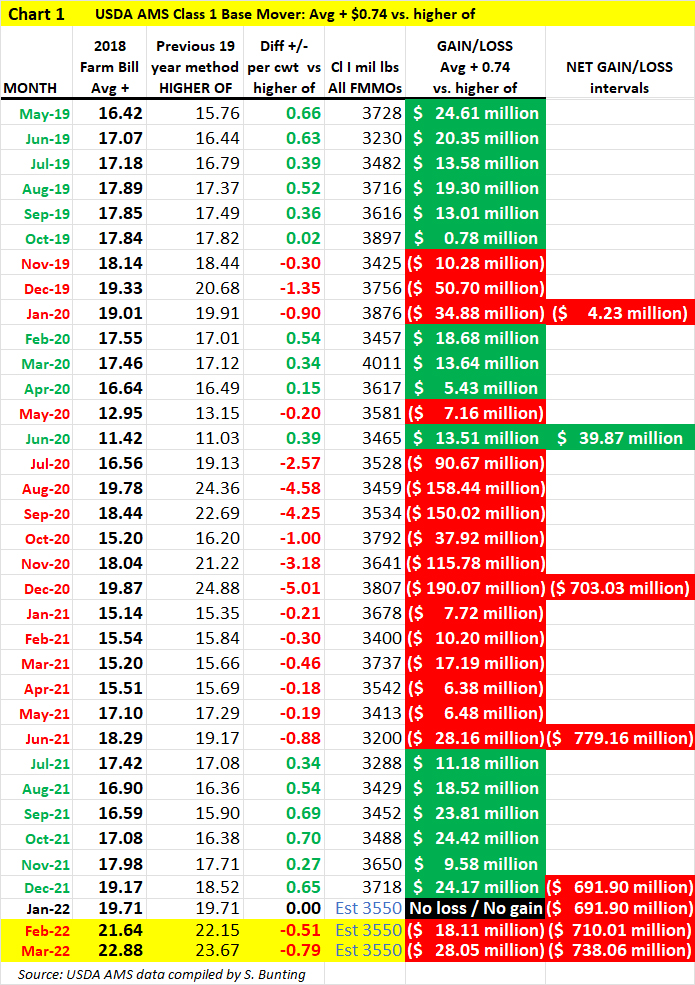
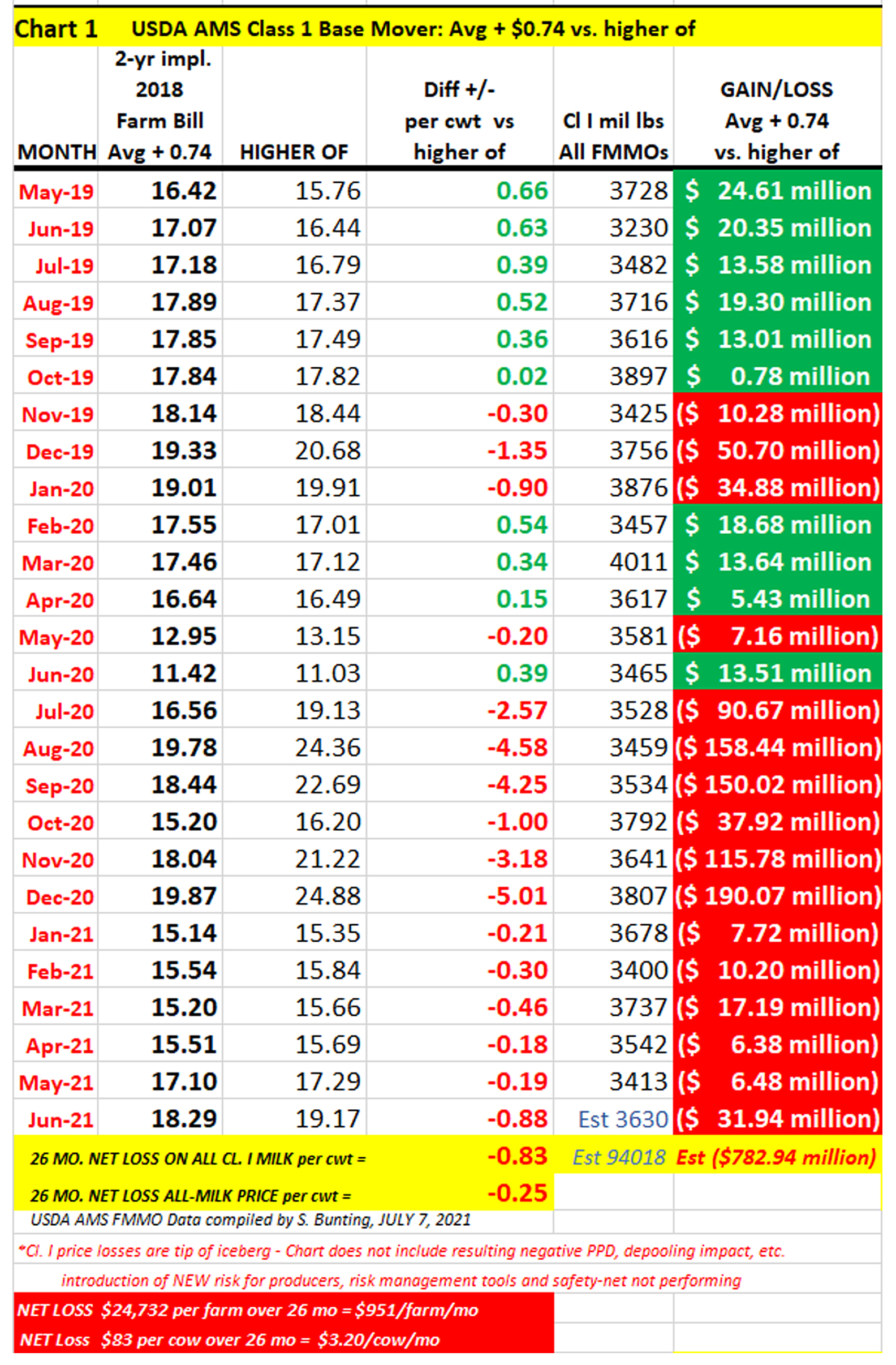
This is far from over, and hanging in the balance is the Class I price calculation, now based on an averaging method, under which farmers have lost more than $1.02 billion since May 2019 vs. the previous ‘higher of’.

Testimony Tues., Jan. 16 included Dr. Mark Stephenson, retired UW-Madison dairy economist on behalf of Milk Innovation Group (MIG), made up of ‘innovative’ and branded fluid milk processors, including fairlife, HP Hood, Anderson-Erickson, Danone North America, Shamrock, Organic Valley, Aurora Organic, and Pennsylvania’s own Turner Dairy Farms.

Dr. Stephenson delivered his bombshell for MIG that was based on analysis he did using 2016 data in a simulator model, from which he made “certain discoveries.”

First, Stephenson suggested that fluid milk is shifting to become price-elastic vs. the long-held belief that fluid milk sales are price-inelastic. This was followed up by fluid milk processor representatives showing post-Covid fluid milk sales volumes declined as prices rose.

Stephenson cautioned USDA to refrain from setting regulated prices too high, saying this would reduce returns to producers by reducing total fluid milk sales. 

This suggestion was challenged in cross examination. In fact, AFBF chief economist Dr. Roger Cryan noted the FMMO focus on fluid milk was originally partly predicated on its “public good” as a food staple, almost akin to a “public utility.”

In cross examination on Jan. 17, Stephenson also revealed he was paid by MIG to analyze the $1.60 base differential, and his work began before MIG finalized its proposal to remove the $1.60 per cwt. base differential all the way down to zero for all Class I milk, nationwide.

Currently, the $1.60 base differential is built uniformly into the Class I price for every regulated county across all FMMOs. The varied location differentials are added to the base differential and spread across the revenue-sharing pools.

Stephenson used the U.S. Dairy Sector Simulator Model (USDSS) to develop a map as though a “milk-dictator” could efficiently “move milk to its highest global use” through various constraints. 
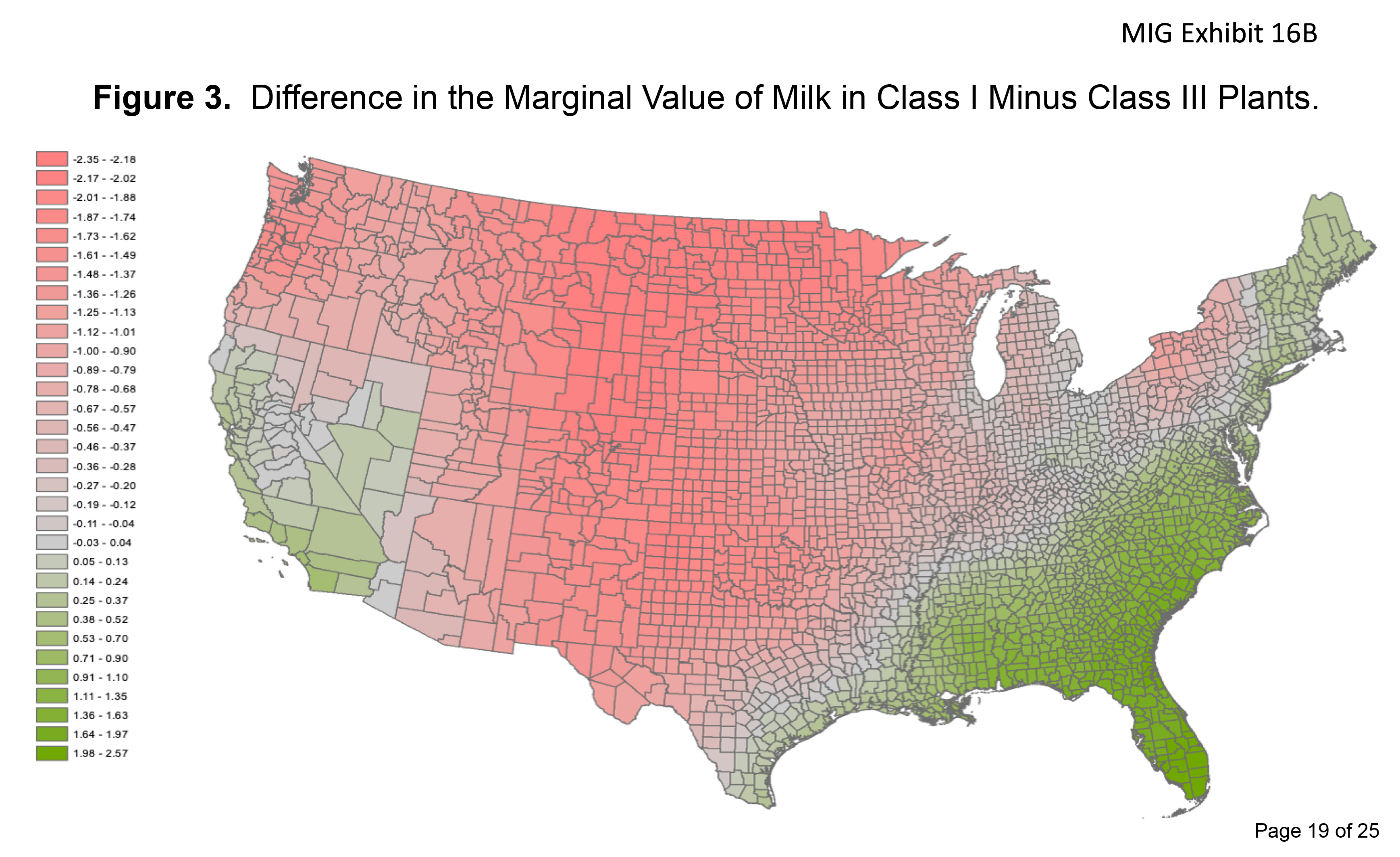
In the marginal value map result, Stephenson said the U.S. average value of the differences was minus-38 cents, indicating on a national average, it is more valuable (cost saving) to the model to have milk in a cheese plant than in a fluid plant in most counties. The range goes from somewhat more than $2 per cwt more favorable to a cheese plant (in red) to somewhat more than $2 per cwt more favorable to a fluid plant (in green) in the Southeast. From this “potent revelation,” Dr. Stephenson concludes that, “The model result bolsters the argument to not dilute the value of the $1.60 into the pool if that value represents a balancing cost for fluid and an opportunity cost (give-up) for manufacturing plants. Rather, require the fluid plants to pay the $1.60, but let the fluid plants pay that directly to the farms, cooperatives or manufacturing plants who supply the milk” to the fluid plant.

The map showed the incremental differences in ‘Class I minus Class III “shadow pricing,” across the country.

These marginal value differences, said Stephenson, reflect the opportunity costs of getting manufacturing plants to give up milk to fluid plants in the Central U.S., where milk production exceeds population vs. the cost to balance fluid milk markets in the East, particularly the Southeast, as well as in California and southern Nevada, where population exceeds milk production.
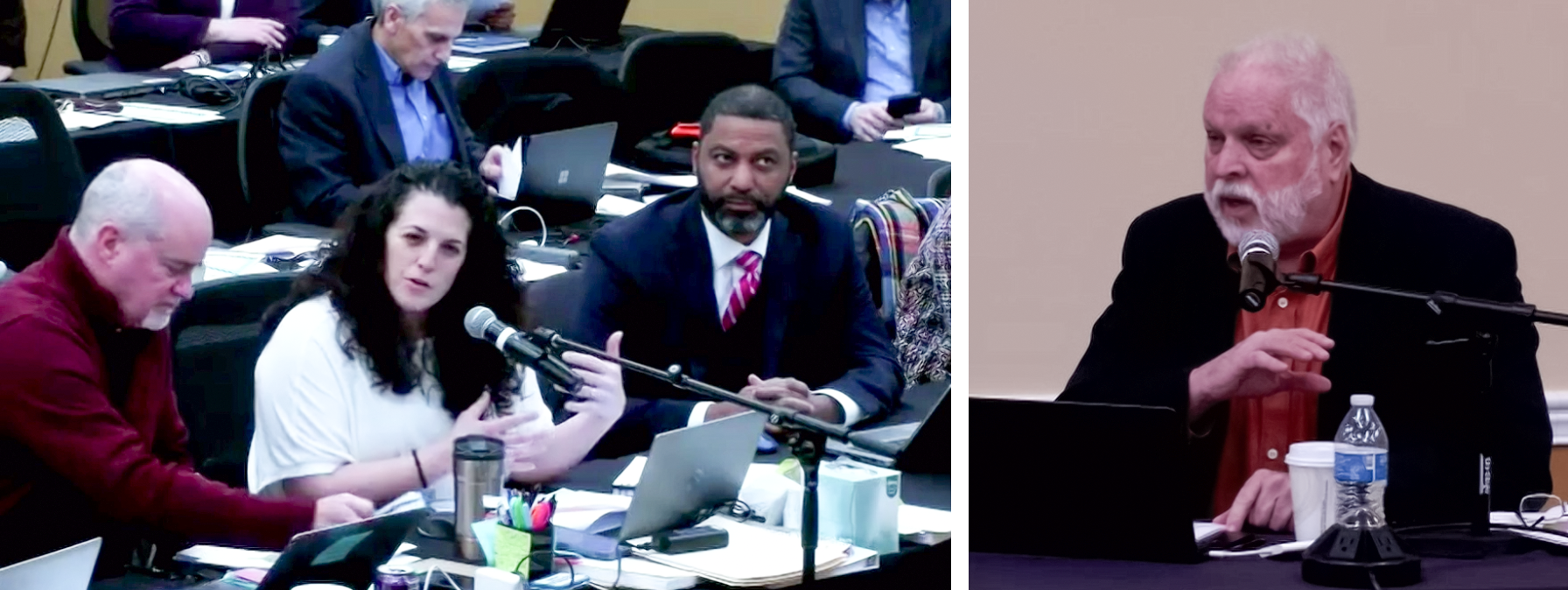
It was the questioning from USDA AMS administrator Erin Taylor on the ‘shadow pricing’ figures in various anchor cities that prompted Stephenson to concede: “You may have caught a major flaw in what I have done here, so I would want to look at this more carefully.”

Yes, he will be back to address such questions when the ever-lengthening hearing resumes on January 29.

Notwithstanding exposure of a possible flaw in the simulator analysis, Stephenson said the ‘market-clearing’ price is the target to aim at, and the system of setting regulated minimum prices “should err on the side of being too-low instead of too-high.”
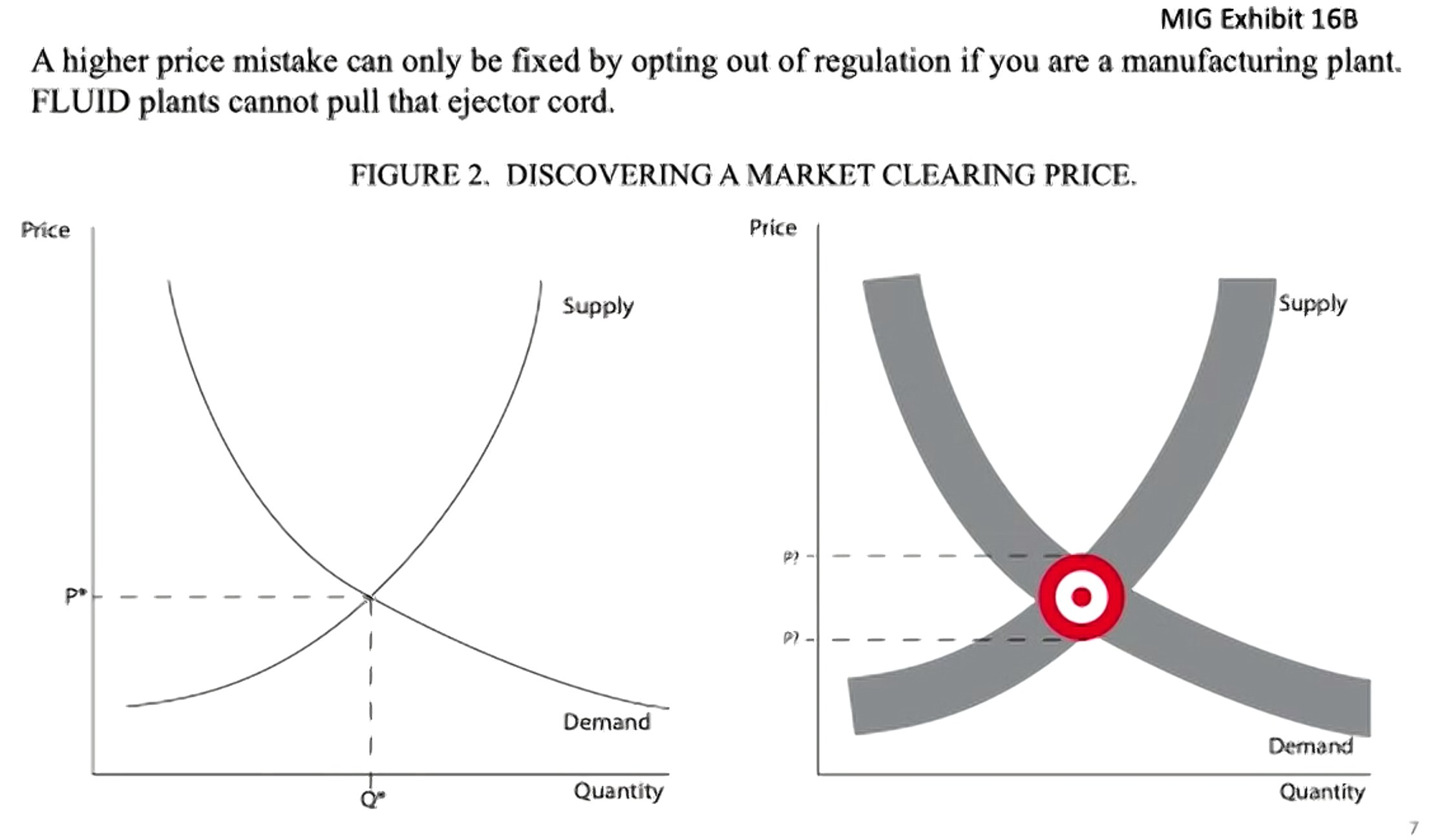
He said processors will pay premiums in the breach of a ‘too-low’ minimum price, but there are few options for processors to deal with a ‘too-high’ minimum price — other than to opt out of regulation for manufacturing plants (de-pool), but that fluid milk plants have no ability to opt out. They are required to remain regulated by FMMOs.

“Manufacturing is by far the largest use of milk in our dairy industry,” he said, noting that Class I fluid use at 18% of total U.S. milk production (regulated and unregulated). Therefore, he said, manufacturing use should no longer be treated in the FMMO system as “the trailing spouse in the marriage.”
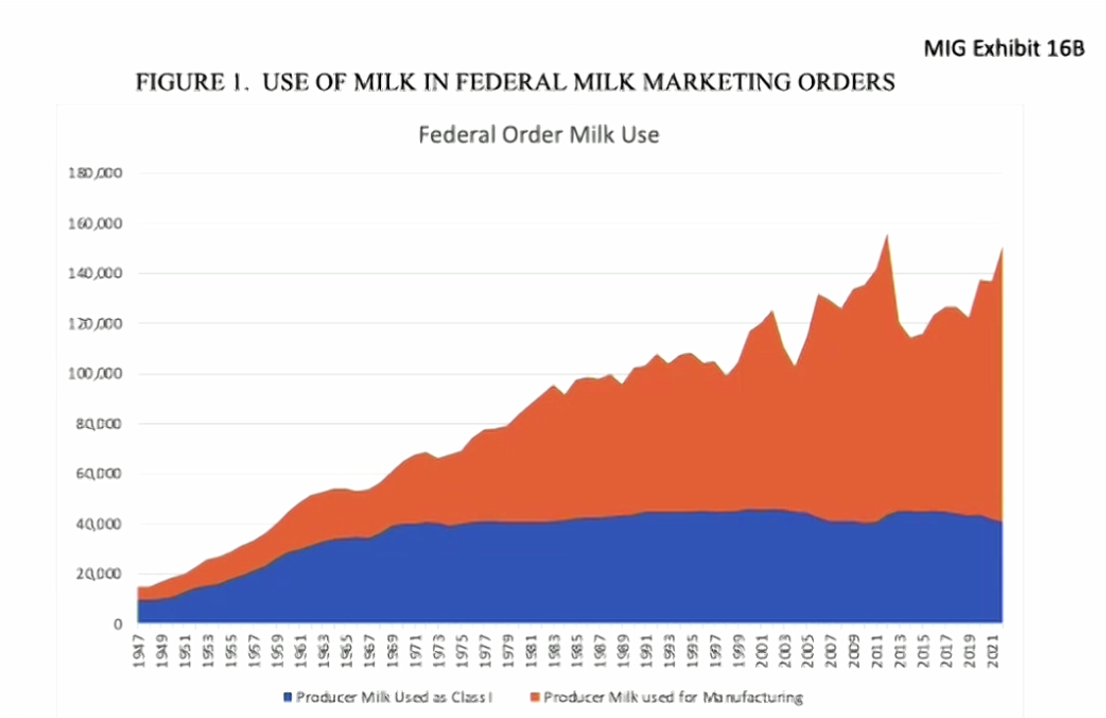
On MIG’s behalf, he introduced a new way of looking at the marginal value between Class III and Class I, and a mechanical change that could be made in how the $1.60 base differential is paid as needed directly to producers, cooperatives and plants that actually supply milk to Class I plants, instead of being paid to the FMMO pools.

The $1.60 became a uniform part of the Class I price in the 1999 Order Reform. About 40 cents of this $1.60 was included to represent the cost of farmers transitioning from Grade B to Grade A. The rest represents ‘give up’ costs from manufacturing to Class I and balancing costs to serve the fluid market.

Stephenson backed up MIG’s assertion that farmers don’t need any of this $1.60 base differential because virtually all milk produced today is now Grade A. During cross examination, NMPF attorneys brought up the cost farmers have to maintain Grade A status. Don’t their costs count here?

Undeterred, Stephenson suggested that these costs are accounted for in the classified pricing since all milk for all uses is Grade A, today. He said that USDA uses ‘minimum pricing’ as a tool so that the regulated price leaves space for voluntary premiums that processors can pay to “incentivize something else.”

“Being chronically above the market-clearing price creates a surplus product, which the market can’t clear,” said Stephenson. “Our dairy markets have always walked on a knife’s edge. Being plus or minus 1% on milk supplies can cause some pretty big swings in prices as the markets do attempt to clear that.”

As for removing the $1.60 uniform price differential either from the price or the pool, Stephenson said it is like “other premiums” that have become “commoditized.” 

He likened it to the rbST premium and milk quality premiums, saying those premiums have also become “commoditized.” 

For example, when farmers were first asked to give up rbST and sign pledges, a premium was offered. Now, that premium is not paid, he said, because the practice of abandoning rbST is now “commoditized.” 

Likewise, said Stephenson: “Milk quality (low SCC) has improved so much that those premiums are not there anymore. They have also become commoditized.”

So, the better dairy farmers get, the more their incentive premiums — and even big chunks of their regulated minimum price — are at risk to be cannibalized by milk buyers because the farmers have now done what they’ve been incentivized to do, so they don’t need to be paid to do it.

MIG also seeks to stop NMPF’s proposal to tweak and raise location differentials across the Class I surface map, putting on the stand some of their members to show how unfair competition arises between independent bottlers and cooperatively owned fluid milk plants in the same region.

For his part, Stephenson noted the concept of pulling the $1.60 base differential out of the pool may discourage non-productive distant pooling.

This week was certainly eye-opening as MIG is all about the processor costs with zero regard for producer costs. They even put an HP Hood representative on the stand who included the $120 million recently announced for expanding the Extended Shelf Life (ESL) plant in Batavia, NY as a “balancing cost,” that somehow justifies giving back the base differential to processors even though processors can pass their costs on to consumers, whereas farmers cannot. 
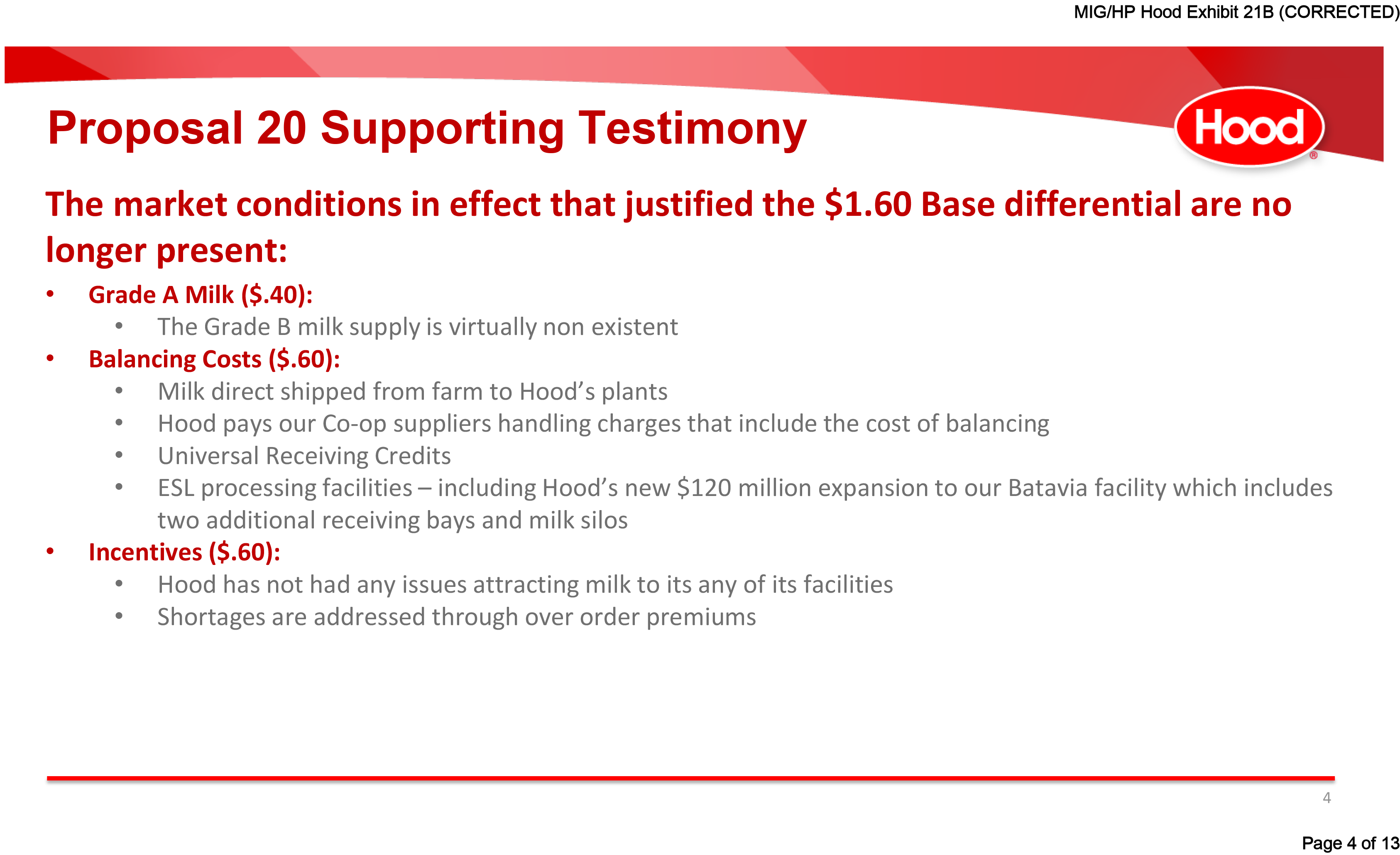
Under cross examination, Hood’s representative admitted that plant-based beverages are also bottled in those so-called ESL ‘milk balancing’ facilities, along with premium products like Lactaid.

Meanwhile farmers continue to incur costs associated with a whole host of improvements that were at one time incentivized. It appears the processors expect farmers to forgo being paid for those costs simply “because everyone’s doing it” and incentives are no longer needed.

The idea here is to deflate regulated minimum prices as much as possible in search of the elusive and not-well-defined Holy Grail: the market-clearing price. 

Processors want cheaper milk, and they’ve got multiple proposals to accomplish that. They want to deflate the regulated minimum milk price to free up their ability to pay premiums for “something else.”

In fact, in his testimony, Stephenson admitted that as these costs and premiums are “commoditized,” space is freed up to “pay premiums for something else.”

What is the “something else” that processors will pay to incentivize after they potentially succeed in reducing the regulated minimum price in multiple ways through multiple proposals?

Are climate premiums the next thing coming once the milk price is deflated far enough? Will USDA buy what MIG and IDFA are selling?

Stay tuned.

-30-
Dairy farmers speak out about fair pricing, fear of retribution as FMMO hearing continues

By Sherry Bunting, Farmshine, October 13, 2023

CARMEL, Ind. — “Fear of retribution” has been mentioned by some of the dairy farmers who have testified at the federal milk pricing hearings over the past seven weeks in Carmel, Indiana.

“I cannot believe predatory milk pricing is happening in America,” said Brenda Cochran, a Tioga County, Pennsylvania dairy farmer.

Cochran was among the producers testifying Friday, Sept. 29. She, like others, stated they are speaking for thousands of other farmers who are “unrepresented and voiceless” because “they fear losing their milk market for speaking out.”

She said she dedicated her time to speak for them and to speak for “the memory of those farmers who have already lost their farms, their families, and, some of them, their lives because of this decades-long catastrophe of low milk prices.”

Cochran noted the “blindingly abstruse complexities” of federal milk pricing and the hearing process that “seem to presume the impacted farmers possess economics credentials at the PhD level.”

The room full of administrators, accountants, economists, and lawyers listened as she spoke virtually from home, saying that as an average dairy farmer, she finds it “impossible to comprehend the ‘dairy industry’ language.” She noted that “the ‘dairy industry’ is all anyone focuses on.

“There are some dairy farmers who believe milk pricing is deliberately made complicated to keep dairy farmers in the dark about how their milk is priced,” said Cochran. “Others believe the low milk prices are part of an effort to displace farmers from their land.”

She asked USDA to truly look at what this hearing can do “to fix broken milk-pricing formulas for the farmers.

“When was the last time U.S. dairy farmers were given a ‘cost of living’ adjustment?” she asked. “How are dairy farmers supposed to dig out from debt and cover basic farm and family living expenses if ‘make allowance increases’ for processors take more money away from the paltry milk checks that are also being drained by higher transportation charges and the incessant monetary hemorrhage of capricious ‘market adjustment fees’ that are never included in Dairy Margin Coverage (DMC) payments?”

Like others who have testified, Cochran pointed out: What is done to dairy farmers also decimates the rural communities that have been “laid waste by over 40 years of degrading milk prices.”

Last Friday, Oct. 6, John Painter, also of Tioga County, Pennsylvania, testified for Farm Bureau’s positions. He cited the loss of dairy farms and cow numbers in Pennsylvania. 

“While there are multiple factors leading dairy farmers to sell their herds, one of the main reasons is pricing. In Pennsylvania, our milk pricing is twice as complicated… but the outdated FMMOs certainly do not help,” said Painter.

“I can attest that farmers are leaving the dairy industry, especially Class I producers, simply because the money and labor just is not there. We have a chance to change that narrative by amending the FMMO system to meet the economic needs of our farmers,” he explained.

Painter noted that both the Pennsylvania Farm Bureau and the AFBF support NMPF’s proposal (13) to return to the ‘higher of’ calculation for the Class I ‘mover’ and to raise the Class I differentials as outlined by NMPF in proposal 19.

AFBF also does not want to see any increase in make allowances to processors without a mandatory and audited cost survey. The NMPF proposal would raise all four product make allowances to net a roughly 50 cents per hundredweight loss to farmers; whereas IDFA’s proposal would raise make allowances to net a roughly $1.25/cwt. loss to farmers. 

NMPF and IDFA reportedly support AFBF’s request that Congress in the farm bill authorize USDA to do mandatory audited FMMO cost surveys.

NMPF also includes yield composition factors and other pieces of their package of proposals to both ‘give’ and ‘take’ to get pricing alignments to better perform the FMMO pooling functions without negatively impacting farmers.

NMPF’s economist Peter Vitaliano admitted earlier in the hearing — with regard to the Class I change made legislatively to the averaging formula — they had previously supported it, but, he said: “The market taught us a very severe lesson.”

Painter noted the Class I mover change is top of mind for producers. Furthermore, he noted the Class I differentials under NMPF’s proposal 19, would add more positivity in all locations.

This stands in direct conflict with the Milk Innovation Group’s proposal to subtract $1.60 per hundredweight from the base Class I differential, to negatively affect every dairy farmer in every area. 

The Milk Innovation Group is made up of fluid processors that market value-added milk or milk-based beverages, including ultrafiltered, organic, aseptic and ESL.

This is the group that put several company CEOs on the stand to support keeping the “average of” method for calculating the Class I mover, but use a rolling adjuster or “adder” that is floored. 

The CEO of fairlife said the models show the MIG proposal on the Class I mover would benefit farmers longterm by $1.43/cwt. What wasn’t mentioned was the MIG proposal to subtract $1.60 from differentials at the same time.

Also not mentioned is the fact that when wide swings occur, they produce severe losses that lead to dairy farm exits, depooling of milk from FMMOs due to misaligned pricing, and disorderly marketing that disproportionately affects pooled producer that serve the Class I market, creating both individual and geographic impacts.

Another farmer testifying Friday, Oct. 6 was Mark McAfee, of Fresno County, California. As vice president of both the California Dairy Campaign and California Farmers Union, he has heard from organizations that few if any dairy farmers want to volunteer to testify due to “fear of retaliation by processors.

“Dairy farmers are scared and live in fear of processors and loss of contracts,” said McAfee.

Supporting the prior testimony of CDC’s Lynn McBride and Joaquin Contente on the addition of mozzarella cheese to the FMMO Class III pricing survey, McAfee explained why this is vital and why producers are so afraid to speak out on it.

Mozzarella (4.49 billion pounds produced and sold) is now much larger than cheddar cheese (3.96 billion pounds) in the U.S., but it is not used in the Class III formula, he explained.

“The moisture levels are much higher. If added to the pricing formula, farmers would be paid a much higher price. This is being ignored and overlooked,” said McAfee.

He said that adding mozzarella to the pricing survey could be a key to “structural price change (that) will return a substantial amount of value to farmers that are currently being paid $15/cwt., when breakeven is at least $23 to $27/cwt.”

Processors are dead-set against this, as was apparent in the testimony and cross examination of representatives for Leprino a few weeks ago. They bemoaned USDA whey make allowances as “too low.” They blamed USDA for upsetting the supply and demand scenario by setting farm milk class minimum prices “too high.”

They said they might not build any more plants (after the Lubbock plant that is currently under construction) nor invest in capacity in the U.S. in the future if this is not remedied.

USDA AMS’s Erin Taylor had questioned Leprino reps, asking if they build cheese plants to make whey or to make mozzarella cheese? She also asked if there are other factors that might lead to increased milk production — other than the processors’ contention that USDA has minimum prices set “too high.”

It’s clear from such exchanges that the largest global processors, like Leprino, want to cash flow plants on the make allowance of byproduct whey, leaving their unsurveyed mozzarella cheese as an area of unaccountable profit that another testifying farmer – Joaquine Contente also of California – said is made on the backs of farmers.

In an attempt to respond, Leprino reps said the whey and the cheese come out of the same hundredweight of milk. This seems to make clear the model of cash-flowing a plant on the whey make allowance, while the mozzarella remains unreported gravy, and none of its value translates back to the milk.

On the “too high” FMMO minimum milk prices provoking “too much production,” processor reps acknowledged there are other factors, which they would not name, but they kept pointing out the dumping of milk and the negative premiums, and sales of loads at $10 under Class III minimum this summer as “proof” that USDA sets FMMO minimum prices too high.

In essence, they walked right into the CDC point that milk pricing should match profitable growth with profitable demand.

(In a two-part series in June and July 2023, Farmshine reported that the record whole milk powder imports in the first half of 2023, and the proliferation of new manure-methane-driven dairy expansions together produced what was seen as a regional glut of milk this summer that drove everyone’s prices lower. Now, magically, there’s not enough milk and spot loads sell above minimum as global dairy supplies recede, and in the U.S. imports decline and whole herds have been sold to high beef and dairy replacement prices. An update of that report can be found at https://wp.me/p329u7-2N2)

McAfee launched into some root causes for where we are today. (More on that in the future.) 

He cited how processors are moving to more heavily processed milk beverages, but consumer research shows the public wants milk that is unfooled-around-with.

The availability and orderly marketing of fresh, unfooled-around-with milk is essentially why FMMOs exist. However, as a product, its benefits are not being promoted, nor are they naturally innovated, said McAfee.

The dairy innovation solution is always to do more processing, and this has created a bifurcation in how milk is priced. The more processed the milk, the more longterm the pricing; whereas fresh milk remains a month to month pass-through sale.

The checkoff push to ‘think beyond the jug’ or break the ‘jug habit’ has now created a pricing dilemma for the FMMOs.

-30-

Understanding the factors as action on FMMO ‘modernization’ unfolds

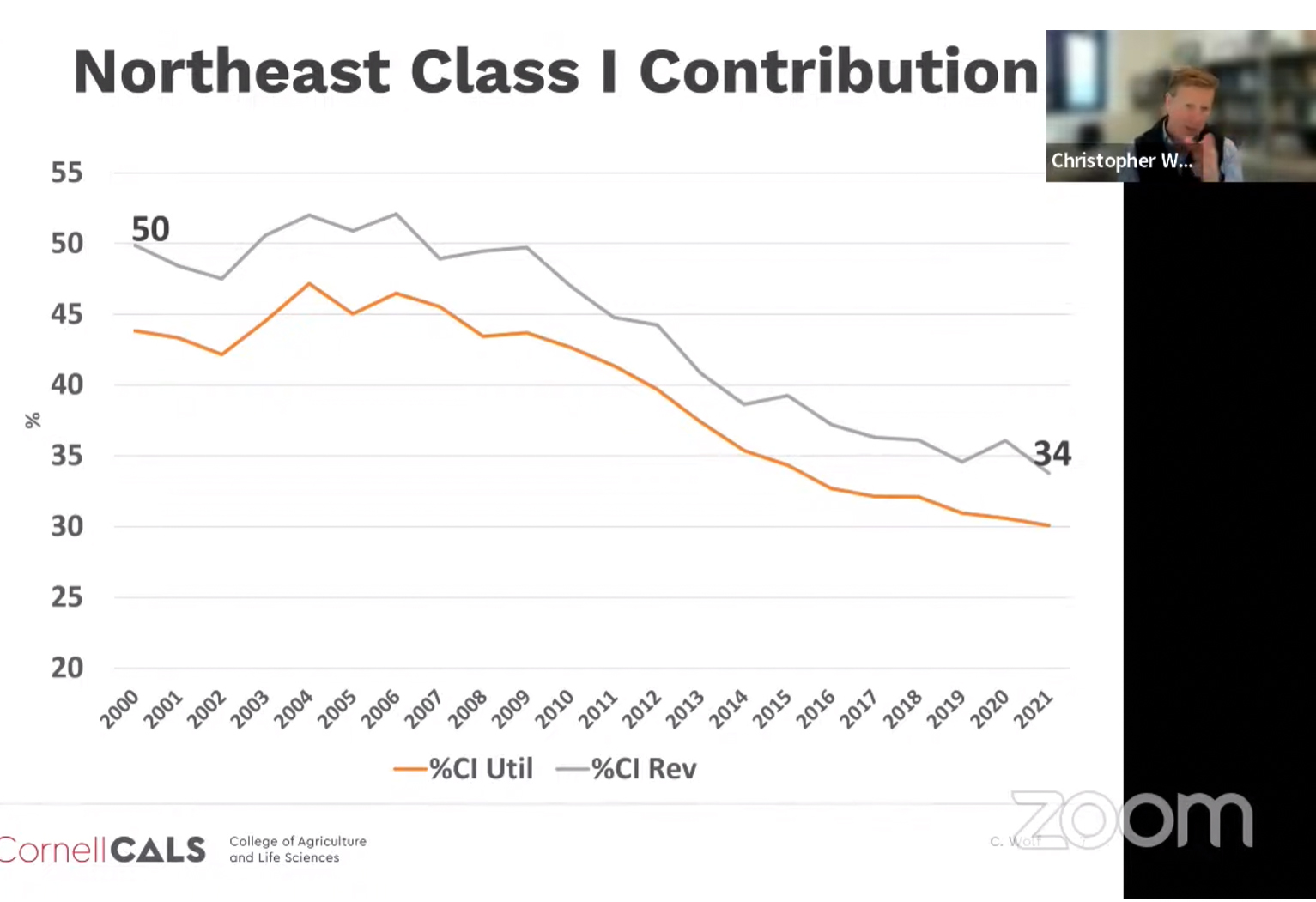
Using the Northeast as an example of a multiple component pricing Federal Milk Marketing Order that still has significant Class I utilization, Dr. Chris Wolf showed how long-term trends and other factors have reduced the Class I utilization and Class I revenue from 50% in 2000 to 34% in 2021 in FMMO 1. The most dramatic part of this decline occurred after 2010 — leaving not enough money to go around with less Class I value in the pool. FMMOs were structured for Class I fluid markets not for the dairy product and export markets where growth is occurring today. Screen capture from Center for Dairy Excellence Protecting Your Profits webinar with CDE’s Zach Myers and his guest Dr. Chris Wolf, Cornell University dairy economist.

By Sherry Bunting

WASHINGTON – There are irons in two fires when it comes to federal milk pricing and dairy policy. One is to do modernization through the Federal Milk Marketing Order (FMMO) hearing petition process. The other is to make some adjustments or seek authorizing language through the dairy title of the 2023 Farm Bill.

On the farm bill front, the May 12 CBO baseline score shows this could be the first trillion-dollar farm bill. Food assistance programs, like SNAP, are eating into the capacity to do other things, say top-level staff for the Senate Ag Committee. 

For dairy and livestock, the Dairy Margin Coverage (DMC) baseline now includes $1 billion in additional outlays projected over the 10-years, while livestock disaster outlays have doubled – even without making any changes in these programs that some are suggesting.

Still, farmers and organizations that represent them are seeking some expansion for the DMC, livestock disaster, and other programs and safety nets, and some are seeking language to instruct the Secretary to do hearings on the Class I ‘mover’, or to expand the flexibility of the scope of a hearing, or to require mandatory reporting germaine to things like raising make allowances. 

The jury is out on whether a farm bill gets done by September 2023 after the May 12 baseline was announced by CBO in the current political environment, but members of the House and Senate Ag Committees and their chairpersons are gathering information in earnest toward that goal.

On the FMMO hearing front, as previously reported in Farmshine, the USDA responded April 28 to the March 30 petitions from two processor organizations by asking for more information instead of granting or denying a hearing on their make allowance update request.

The two petitions from International Dairy Foods Association (IDFA) and Wisconsin Cheese Makers Association (WCMA) both requested a hearing focused exclusively on updating the ‘make allowances’, which are processor credits that are subtracted from the wholesale end-product prices used to derive farm level milk class and component prices.

Make allowances were last updated in 2008 using 2006 plant cost data.

Four days later on May 2, the National Milk Producers Federation (NMPF) submitted its petition seeking an FMMO hearing on a range of national amendments.

NMPF is petitioning USDA for a hearing on these five items:

1.     Increase make allowances in the component price formulas to the following levels: Butter   $0.21 per pound, Nonfat dry milk $0.21 per pound, Cheese  $0.24 per pound, Dry Whey $0.23 per pound 

2.     Discontinue use of barrel cheese in the protein component price formula

3.     Return to the “higher-of” Class I mover

4.     Update the milk component factors for protein, other solids, and nonfat solids in the Class III and Class IV skim milk price formulas

5.     Update the Class I differential pricing surface throughout the U.S.

Not noted within this list is a point that NMPF’s board approved on the legislative front, and that is to seek language in the 2023 farm bill directing USDA to do periodic mandatory and audited plant cost surveys instead of voluntary surveys for future hearings on make allowances.

The American Farm Bureau Federation took a positive approach in their response letter to USDA, showing support for the fact that NMPF’s petition is comprehensive and includes areas of strong consensus among farmers such as returning the Class I mover to the ‘higher of.’

However, AFBF president Zippy Duvall also points out in the response letter that the Secretary of Agriculture already has the authority under the Agricultural Marketing Agreement Act to require processors to provide information relevant to FMMO pricing. This could include mandatory surveys of plant cost data when used to determine the processor credit, or make allowance, in the pricing formulas.

It is Farm Bureau’s position that make allowances should only be updated based on mandatory and audited plant cost surveys.

This leaves a bit of a loophole in the discussion about how to acquire the data to make current or future updates. The Secretary may have the authority to require data from plants that participate in FMMOs. However, it is unclear if the Secretary has this authority to require cost data from plants that do not participate in the FMMOs.

The end-product pricing formulas are based on wholesale prices that are collected mandatorily by USDA AMS on a weekly basis through the Livestock Mandatory Reporting Act on only those products that are used in FMMO formulas. This includes butter, nonfat dry milk, dry whey and 40-lb block and 500-lb barrel cheddar cheese.

The USDA AMS weekly National Dairy Product Sales Report surveys 168 plants for this price data. Therefore, if make allowances are updated as processor credits against those prices, then all 168 plants should have to report their costs, and only the costs that pertain to those specific products, whether or not they participate in FMMOs. In a recent voluntary cost survey, more than 70% of those plants did not report their cost data.

During a Center for Dairy Excellence Protect Your Profits zoom call recently, risk management educator Zach Myers had as his guest Cornell dairy economist Dr. Chris Wolf to talk about the FMMO reform process and background from an economist’s perspective.

Dr. Wolf gave some important and relevant background and statistics.

The FMMOs have been around for 85 years and were created because of disorderly milk marketing conditions. Their primary function is to make markets function “smoothly” with a second stated objective to provide price stability.

“If we were to re-do them today, I would say price adequacy should be addressed,” Wolf opined, noting that “we have times that the milk prices are very stable, but not very adequate.”

Other stated objectives of FMMOs are to assure adequate and wholesome supplies of fluid milk and equitable pricing to farmers.

“These things are still important today,” Wolf suggests, adding that the auditing, certification and a certain level of market information that is provided by the FMMOs benefits all participants and contributes to the public good.

He explained that FMMOs are changing.

“The primary sources of dissatisfaction with FMMOs in recent years arise because there is not enough money to go around, and some of this is related to the longer-term trends (in Class I sales),” Wolf explains.

He showed that while per capita dairy consumption has been increasing roughly three pounds per person per year, the decline in Class I fluid milk is the underlying factor.

“It really is startling how much of that decline (in Class I) in most areas really happened since 2010,” Wolf illustrated with graphs.

Not only did per-capita fluid milk sales decline more rapidly since 2010 than the already long-term decline charted since 1980, but population growth in the U.S. also stalled — so the total Class I sales have been hit with a double-whammy.

“This relates back to where the value is in the Orders, with most of the decline in the past 20 years occurring in that second half, — since 2010,” he explains.

(The Healthy Hunger Free Kids Act of 2010 was the precursor to USDA removing whole and 2% unflavored and flavored milk from schools and requiring flavored milk to be fat-free. Today, USDA has a proposed rule that could eliminate flavored milk until grade 9 as reported previously in Farmshine).

Because Class I has to participate in FMMOs, the FMMOs were “intentionally structured” in a way that the Class I revenue has always tended to be the highest class price because the FMMOs are in place to structure the fluid milk market, and so Class I accounted for at least 50% of the pool revenue – until 2010.

“We finished 2021 at 34% (down from 50%),” Wolf notes. “So there’s not enough money to go around with less (Class I) value in there.”

What changed? Wolf notes some of the long-term trends.

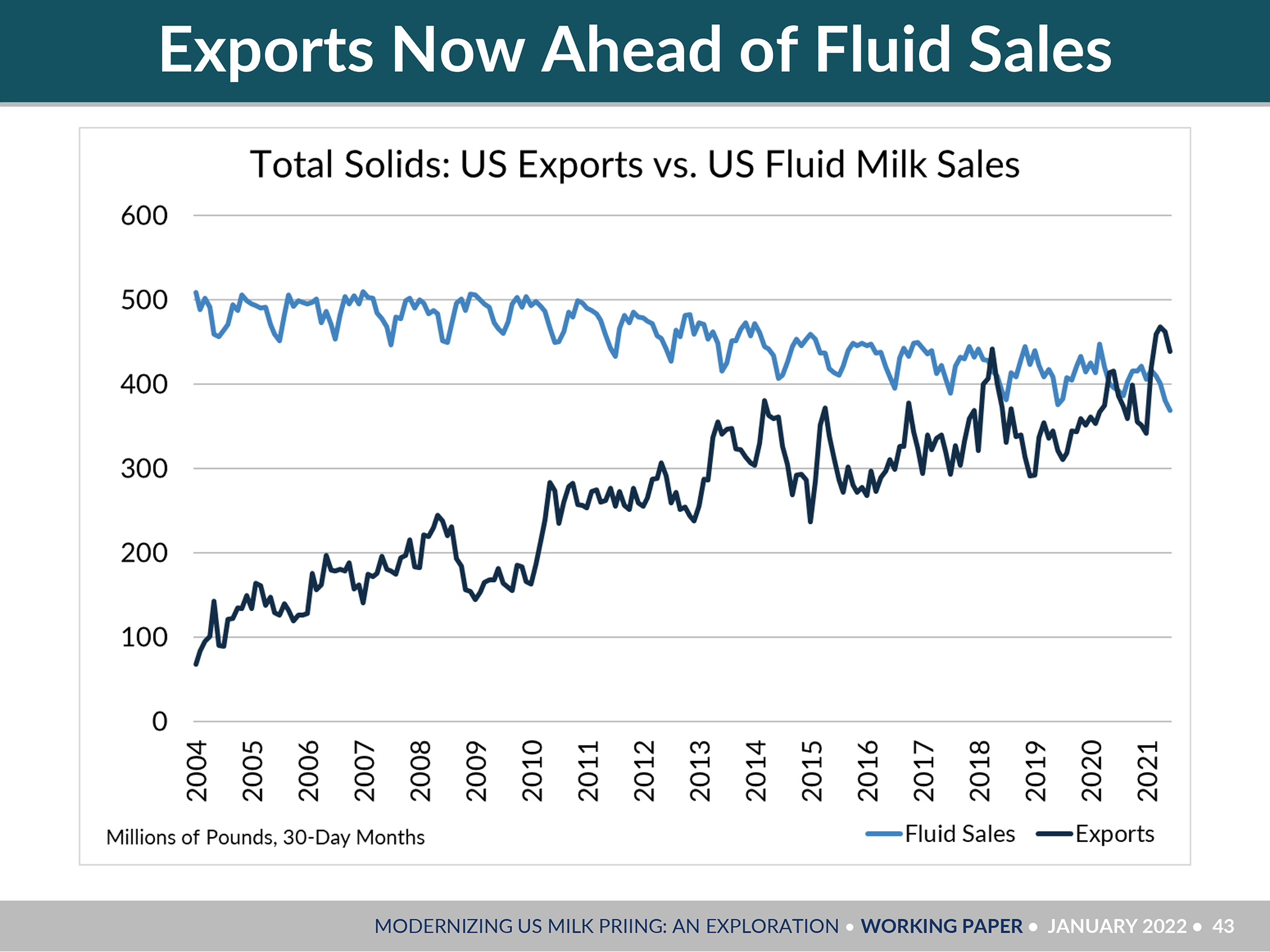
“First, exports are now 18% of U.S. milk solids production when it used to be that the U.S. exported about 5%… Milk beverage consumption is down while cheese, butter and yogurt are all up. We are still importing 4 to 5%, but as a large net-exporter now,” he says, “The U.S. is basing bulk commodity product prices off the world market. This introduces more outlet for milk but brings back the issues that come with international price-setting, overall,” he explains.

Another change, according to Wolf, is the level of consolidation at every level of the supply chain.

Wolf went over some of the make allowance data based on existing voluntary surveys as well as a prior California state order audited survey. He showed there is a wide range in costs between older and smaller plants vs. larger and newer plants. When determining where to set make allowances – as an ‘average’ or at a percentile of this wide range — there are regional impacts to consider, he suggests.

Wolf also took webinar attendees through the steps of a hearing that can take at least a year or more to complete and he dug into the make allowances from an economic perspective and some of the other pieces of potential reform. Over the next few weeks, we’ll continue to examine them in this series.

The Center for Dairy Excellence Protecting Your Profits webinar with Zach Myers and Dr. Chris Wolf can be heard as a podcast at https://www.centerfordairyexcellence.org/pyp/ or viewed on YouTube at https://www.youtube.com/watch?v=YEMDA4iWyNw

Little bit new, little bit Dé-jà vu – PA Senate Ag hearing digs into ABC’s of milk OOP

Data and reform needed, but is Secretary eyeing portion of estimated $30 million-plus for ‘dairy reinvestment’?

By Sherry Bunting, Farmshine, April 27, 2023

HARRISBURG, Pa. – Little bit new, little bit Dé·jà vu. (That’s French for ‘the feeling of having experienced this situation before.’) 

Those first thoughts came to mind listening to the Pennsylvania Senate Ag Committee’s hearing Tuesday (April 25) on reforming the state’s mandated over-order premium (OOP) that is part of the state’s minimum wholesale and retail milk prices, set by the Pennsylvania Milk Marketing Board (PMMB).

Ag Secretary Russell Redding laid out for state lawmakers the Department of Agriculture’s plan to seek reforms that: 1) uniformly and fairly distribute the OOP, 2) ensure the amounts charged to Pennsylvania consumers substantially equal amounts distributed back to farmers, and 3) uses a distribution system that does not have incentives to avoid paying Pennsylvania producers by selling milk from across state lines.

He said the Department is a “reluctant participant” but sees the need to make the “collective case” for the “composite of Pennsylvania Dairy.”

“We believe there are inequities, and we see division and growing farmer mistrust,” said Redding. “We knew there were data gaps in our petition last year… Think about the OOP as an equation: A + B = C.

“What we know today is that of the $23.6 million in OOP collected by processors in 2022, $14 million was required to go back to farmers. That’s A. 

“B is generated in the marketplace but not collected,” he explained. “Our belief is that this is another $5 to $10 million (annually). 

“C is the total that we believe is in the neighborhood of $28.6 to $33 million. The question is, what do we do about it?” he asked.

He answered to say the only way to fix this is to change the system and begin removing the OOP from the minimum price buildup and instead have the PMMB establish a retail-based premium, collected at that point of sale and remitted to the Department of Revenue into a designated fund.

This would require the legislation.

“The General Assembly could then appropriate direct payments to producers and to reinvestment in dairy processing,” said Redding.

The Secretary called it an “embarrassment that we don’t have this number (B)” to complete the A + B = C equation, but as he talked about the PDA’s plan, we heard articulated for the first time this idea that once numbers can be put to the equation and legislative authority for the Board to devise a formula, the OOP could become a “milk tax.” 

The difference being that many consumers don’t know they are already paying the OOP, but when pulled out of the minimum price buildup, it becomes a known quantity.

“We trust the state to do this with liquor, cigarettes and liquid fuel. The legislature could decide how these funds would be used, and a portion could be used to help processors invest or reinvest,” said Redding.

In fact, Zach Myers for the Center for Dairy Excellence said a study is underway to assess the obstacles that are preventing processing investment and reinvestment in Pennsylvania.

PMMB Chairman Rob Barley noted that, “It’s certainly time to evaluate how the OOP dollars get back to farmers and not pick winners and losers. The over $800 million that has gone back to dairy farmers since 1988, especially when the majority of it did, no doubt made a positive difference, but that is changing,” he said. “Fluid milk sales have dropped in half (since then), and it is difficult to account for the dollars with the current tools that we as a Board have.”

Barley noted that if the process moves forward to reform the structure, perhaps other products could be eventually added.

“Right now we don’t have the authority to do any of this. Going back to the 1988 testimony, the primary reason the over-order premium was added (to Class I) is that was the practical point, that was the mechanism already in place for fluid milk. There is no such system for other classes, and Class I is also more of a localized product, which I think is still true today,” Barley explained.

Going forward, he said, the choices for the Board are “to get rid of what we have, which is a choice many are not in favor of, or to have legislation to change the OOP without violating interstate commerce, or to develop a new system that strengthens the Pennsylvania dairy industry to benefit all sectors.”

Redding stressed the point that, “This is all about the dairy farmer, how do we incentivize what we need? Keeping our eye on the farmer and understanding we can do something extraordinary here, we have this opportunity to extract this premium from the marketplace and get (the OOP) back to farmers and for the purposes of reinvestment…”

That’s the New. Now for the Dé·jà vu…

The next thought to emerge in this reporter’s mind after hearing the new twist on OOP as ‘milk tax’ and a portion for ‘reinvestment’ was this: Everyone is at the table now, sitting up, alert, paying attention, and offering solutions after 15-plus years of meetings, hearings and discussions. But the same bottomline emerges: everyone still wants a dip of the farmer’s elusive cream.

Not 15 minutes later, after PMMB board member Jim Van Blarcom testified, his Senator Gene Yaw of the northern tier counties shared a similar thought about how this may be already happening within the minimum price buildup in a rapidly changing industry.

“We made this so complicated and there are too many fingers in this pie, frankly,” said Yaw, asking whether processors get any of this money, now.

PMMB auditor supervisor Gary Gojsovich answered that the OOP is currently collected by processors through their sales, and they pay it back to Pennsylvania producers only when the milk is produced, processed and sold in Pennsylvania, all three must apply.

“In the simplest terms, it sounds like we need to change how the premium is collected and the point of where it is collected,” Senator Yaw responded.

Senator Judy Schwank representing parts of Berks County said: “We need the data. We have to have the data.”

So, we are back to the data. 

The Secretary called it an “embarrassment that we don’t have this number.”

Chairman Elder Vogel and ranking member Schwank said they plan to reintroduce their bills that did not move forward in the last legislative session that would give PMMB authority to license distributors, a move that would account for all packaged milk sales coming into Pennsylvania from out-of-state and other cross-border transactions, which ‘strand premiums.’

A quick history

For decades, there have been meetings and hearings and discussions about the future of the Pennsylvania Milk Marketing Law and the PMMB that sets minimum wholesale and retail milk prices. The law dates back to the 1930s, but the mandated OOP was introduced to the existing structure during a year of drought and high feed prices in 1988.

At that time, the state’s OOP was set by the Board at $1.05 per hundredweight (9 cents per gallon). Today it is $1.00 plus a 50-cents per hundredweight fuel adjuster (combined is 13 cents per gallon). 

At intervals before 2018, the OOP was as high as $3.00 plus a fuel adjuster (over 26 cents per gallon). In 2017, it was nearly $2.00 (17 cents per gallon), but was abruptly cut in half in December of 2017 due to the pressure of out-of-state milk — a harbinger of things to come just four months before Dean Foods announced it was ending contracts with 130 dairy farms in 8 states, 42 of them in Pennsylvania and five months before the startup of the Walmart bottling plant in Indiana.

Also included in the minimum resale and retail milk price buildups are the Federal Order price benchmarks, which vary geographically because Pennsylvania is split between two different Federal Orders. To this minimum federal benchmark price, the OOP is added, translating now to about 13 cents per gallon. 

Also added are the average cost recovery amounts for bottlers and retailers as determined by annual hearings for each area of the state, along with adding the 2.5 to 3.5% profit margin the Milk Marketing Law guarantees milk bottlers and retailers on top of the average cost recovery.

What has come under fire, especially since 2009, is the producer OOP, how it is collected and passed back to farmers, how some of it is stranded and how the changing dairy industry has impacted the real and perceived equity of the distribution of these funds.

Lawmakers made it clear that they look at this as two distinctly separate things, the collection is one issue, and the distribution quite another.

Among those testifying, the amount of the current OOP at $1.50 including fuel adjuster that is received on their farms ranged from 6 cents to 50 cents.

The bottomline is for all of the PMMB’s efforts to expand communication and transparency with the tools available, even board member Van Blarcom conceded that it is becoming more difficult to justify the OOP to his peers.

For his part, Matt Espenshade, a Lancaster County dairy farmer representing the State Grange, told lawmakers that producers and cooperatives that are ‘in’ the Class I market take risks and have requirements other class markets do not experience. 

He cautioned against reforms that would dilute the premium for the 15 to 20% of state farmers currently receiving a meaningful amount because they have costs and risks associated with that reward.

Johnny Painter, a Tioga County dairy farmer testifying for the Pennsylvania Farm Bureau advocated for a uniform distribution of the OOP in reforms that would have the state collect it all. He said farmers in all classes of milk have the same quality standards to meet. 

When pressed by Senator Schwank on why PFB made policy to end the OOP, Painter said it was a tactic to get the dialog started.

Troye Cooper for the Pennsylvania Association of Dairy Cooperatives and a member services director for Maryland and Virginia Cooperative said those receiving very little OOP are part of the 3500 Pennsylvania dairy farms shipping milk through cooperatives that perform essential “balancing” services for the fluid milk market. As coop members, they share in the cost of that.

However, what remained unspoken in his testimony is that the current minimum wholesale and retail milk price buildups now include a roughly 25-cent ‘co-op procurement cost’ for these balancing services along with the requirement that cooperatives list on member milk checks how much of the producer OOP was included. 

Representing the Pennsylvania Association of Milk Dealers, Chuck Turner of Turner Dairy near Pittsburgh, pointed out that fluid milk sales are declining, and other class products are increasing. He asked how bottlers can continue cutting checks to the Federal Orders to bring up the payments for other class milk while reducing the payments to their own shippers when their own fluid milk market volumes are shrinking.

“The fluid milk business is in tough shape. Sales volume has trended downward for 13 years by more than 20%. That’s 1 gallon in 5 lost, 1 plant in 5 closed. It can’t bear the burden for the other classes. It seems particularly unfair with sales growing in the other categories,” said Turner, noting that plants outside of Pennsylvania have been closing “at an astonishing rate.” 

He said the number of independent milk processors in the U.S. fell from 69% to 44% in 2020, whereas in Pennsylvania, independent bottlers still represent 62% of the fluid milk, and he credited the PMMB system for that difference.

Myers noted that Pennsylvania is the state with the second most dairy farms and the fourth smallest average herd size, with production costs that are higher than in some neighboring states. 

He cited loss of market premiums, including quality premiums, the impacts of other price erosion such as Federal Order make allowances that a potential hearing could further degrade. 

Compared to the U.S. All-Milk price published monthly by USDA, Myers noted the Pennsylvania All-Milk price used to be higher than the U.S. average, but this gap has narrowed significantly in the past 15 years.

“It was $1.73 per hundredweight from 2008 to 2012, averaged $1.29 from 2013 to 2017, and in the last five years, it has narrowed to just 49 cents, on average,” said Myers.

In fact, during the pandemic in 2020-21, the Pennsylvania All-Milk price averaged 18 cents less than the U.S. All-Milk price, according to Myers.

“There are several factors for this narrowing, but it’s safe to say it can’t be fixed by increasing the premiums,” said Myers, noting that 80% of the milk produced in Pennsylvania is marketed through cooperatives, and there are cooperative base programs limiting expansion on Pennsylvania farms.

These coop base programs and penalties affect the dairy farms and are in part tied to the limits in processing capacity.

Meanwhile, there were several references by testifiers citing milk coming from New York into Central Pennsylvania for processing and sale and displacing milk produced in that area. The OOP, of course, stays with that retailer, processor and/or cooperative as part of their business model to expand their state’s markets into Pennsylvania so their producers can grow.

“When that premium goes back to New York, that’s exactly what is playing out, and it feels like an injustice to be asking our consumers to pay it without regard to that investment,” said Redding. “We want to capture that premium and put it back into our Pennsylvania dairy farmers.”

The problem, said Barley, is the PMMB can’t just “grab that money and give it to Pennsylvania farmers if the milk is not produced, processed and sold in-state without being challenged in court as in the past on the grounds of violating the interstate commerce clause.”

Senator Yaw interjected that, “If the milk is sold here, we should give the premium back to our farmers. If the milk came from New York, those farmers should not benefit from what we are doing to support Pennsylvania farmers.”

Redding said lawmakers “do not have to wait for the data. The bill on licensing distributors could go forward along with a bill to set up a structured system, assuming the amount to be around $30 million, and we believe it to be higher, to decide how to distribute that revenue.”

Redding said his fear is that as the frustration undertow grows, Pennsylvania will lose this premium without action.

He pointed out that his committee “kept its promise” to get everyone around the table to hear ideas, but that it will be “difficult to thread this needle and it will require collaboration.”

Ranking member Schwank said everything hinges on getting the data that is needed to know how to proceed.

Click to read Part Two.

-30-

Fluid milk’s precarious future can’t be ignored

Class I is at a tipping point, will future FMMO strategies strengthen or exploit it?

“Probably some of you have never recently met an independently owned fluid milk bottler. We are the only prisoners in the Federal Order system. Everybody else can opt in or opt out. Even now… our cooperative competitors don’t have to pay their member producers a minimum price — but we do. I just ask that you take into consideration not just what we can get from Class I … We are on a 13-year losing streak that fluid milk consumption has declined on a total basis. We are at a tipping point,” said Farm Bureau member Chuck Turner, Turner Dairy Farms, a third generation independent milk bottler near Pittsburgh, Pa.

By Sherry Bunting, Farmshine, October 28, 2022

KANSAS CITY, Mo. — The precarious future of Class I fluid milk was an underlying concern expressed in different ways at the AFBF Federal Milk Pricing Forum in Kansas City recently. Some have written off the future of fresh fluid milk and have turned sights elsewhere. Others recognize federal orders don’t fulfill their purpose when fresh fluid milk doesn’t get to where the people are. And then there’s the wedge product — aseptic milk — in the mix as some changes have already been made to promote investment in it.

Since the federal orders are based on regulation of Class I fluid milk, its future is most definitely at the core of the Federal Milk Marketing Order (FMMO) discussion. 

A critical point made by panelists is that more money is needed to get fresh milk to consumers in high population areas. Also mentioned was the restoration of higher over-order premiums to farmers in milk-deficit areas to keep these areas from becoming even more deficit.

But at the same time, Class I sales are declining relative to a growing dairy pie of other class products, and the flurry of fluid milk plant closures near population areas has caused further disruption. 

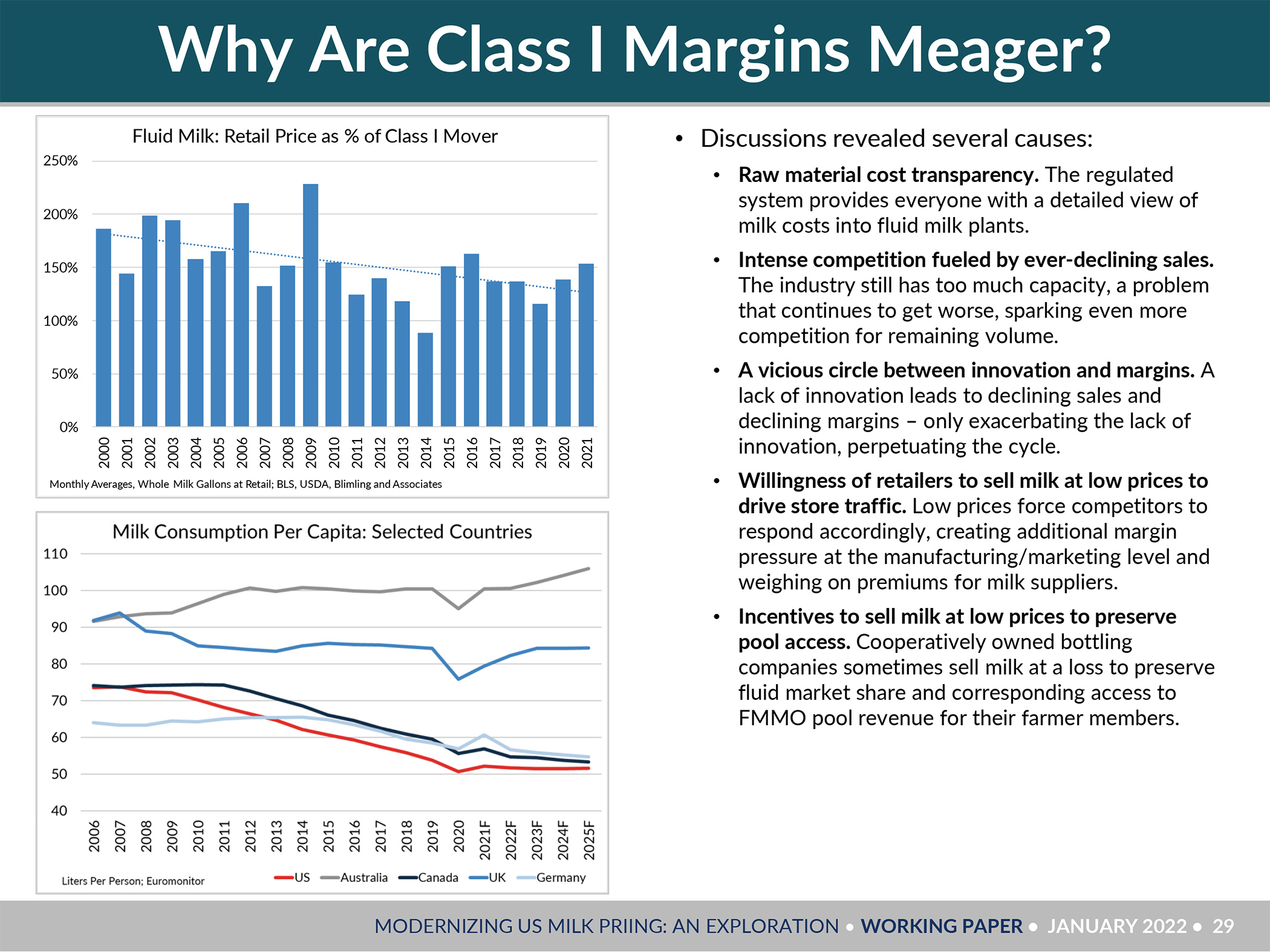
On day three of the forum in Kansas City, Phil Plourd of Ever.Ag attributed most of the fluid milk sales decline to the fact that “milk lost its best friend – cereal.” When asked, he did acknowledge that about one-third of the problem facing fluid milk is rooted in the low-fat school milk requirement. He also pointed out how the entire food industry is changing, and he warned about the lab-created dairy proteins made in fermentation tanks that can be ‘turned on and off.’

Bottom line is the growth markets are in other products, he said. The declining fluid milk sector can no longer shoulder all of the responsibility for the federal order system. 

He showed a bar-graph depicting the decline in the share of total U.S. production participating in federal or state revenue sharing pools. Using estimates of California’s pre-federal order mandatory state order, the percentage of U.S. milk production that was pooled exceeded 80% in 2018. In November of 2018, California became a federal order. Pooled volume vs. total production fell to just over 70% in 2019, the first year the new Class I mover formula was implemented. In 2020, during the pandemic, pooled volume fell to just over 60% and ticked a few points lower to 60% in 2021.

Several panelists, including Calvin Covington, confirmed that cooperatives, especially DFA, own the majority of the fluid milk plants in the U.S. today. This evolution has only increased with plant closures over the past 18 months, and cooperatives have payment and pooling flexibilities not enjoyed by proprietary plants.

As the Class I sector consolidates to roughly 80% owned by cooperatives and the balance owned by grocery chains and independents, there is another problem with federal orders that is easily overlooked. Who is it regulating? It does not regulate what cooperatives pay their members, therefore, it is regulating a declining number of participants in a growing global industry.

A milk bottler from Pennsylvania used the open-microphone between panels to address this 800-pound gorilla in the room full of consensus-builders doing their level-best to ignore it.

“I am sort of an ‘odd duck’ here. Probably some of you have never recently met an independently owned fluid milk bottler. We are the only prisoners in the Federal Order system,” said Chuck Turner, a long-time Farm Bureau member and third-generation milk bottler from Pittsburgh.

“Everybody else can opt in or opt out. Even now, with recent developments, our cooperative competitors don’t have to pay their member producers a minimum price — but we do,” he confirmed.

Turner asked the room of consensus-builders to “take into consideration not just what we can get from Class I — but let’s think more about what we need to do to sell it. We are on a 13-year losing streak with Class I — 13 years that fluid milk consumption has declined on a total basis. We are at a tipping point,” said Turner.

While half of the forum’s table groupings agreed Class I differentials need to be increased, others wondered how much more money can be extracted from Class I without killing it?

Joe Wright, former president of Southeast Milk Inc., laid out the problem as a “downward spiral” — making it more difficult to attract milk to populated areas in the Southeast. He said it started with the Dean and Borden bankruptcies and continues with more plant closings announced every few months.

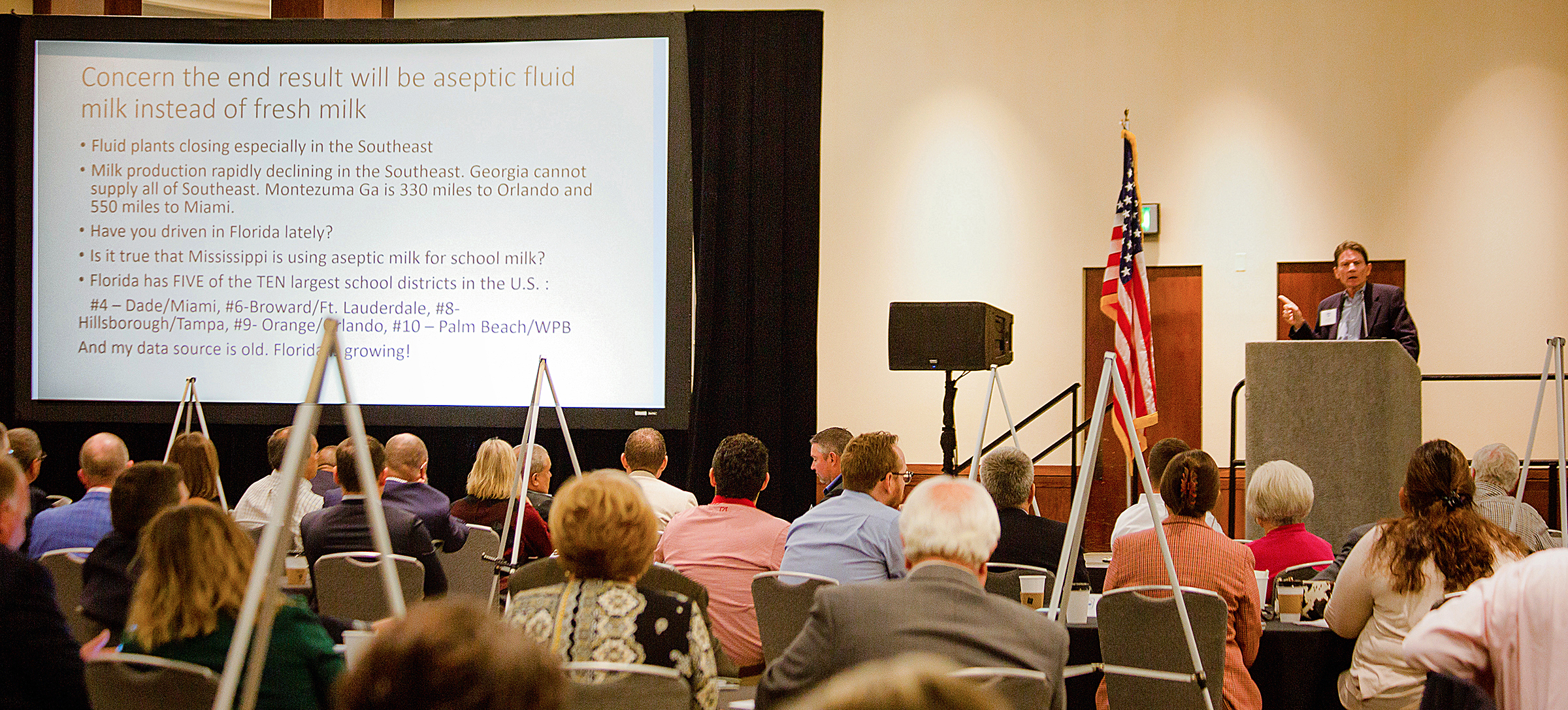
In the Southeast, said Wright, it’s to the point where school kids won’t get fresh milk in some areas because no one will bring it.

He noted that the over-order premiums in Florida have decreased by $1.50 per hundredweight. Some 30 years ago, it was $3.00. “We don’t have that now,” said Wright, noting this makes it difficult for farms to continue producing milk for the Class I market in the face of encroaching subdivisions and other pressures to sell.

“There are 9 million people just from Miami to Orlando,” said Wright. “But if we don’t do something soon, we’ll have no dairy farms left in Florida. Do we want the answer to be a push to aseptic milk? Total milk consumption was stable until 2010. That’s when the government gave us low-fat, low-taste milk in schools. Now, we’re going to start them with low-fat, low-taste, aseptic milk? That is going to kill fluid milk.”

He also noted that fluid milk sales are not helped when dairy shelves are empty, showing slide after slide of empty Walmart dairy cases in the same town in Florida in December – three years straight (pre-Covid, during Covid, and post-Covid). When he asked attendees if they have seen this in their own areas, many hands were raised.

He pointed out that when the fresh milk is completely missing on store shelves, it is the aseptic or ESL milk – and plant-based alternatives – that are available. This has a cumulative effect on fresh fluid milk sales.

Again, the topic of aseptic, shelf stable, warehoused milk was brought up with feelings of ambivalence as milk producers are both drawn to it as a hedging mechanism to even-out the supply and demand swings in areas like the Southeast, but on the other hand offended by the prospect that this product can be considered by bottling retailers like Kroger as an innovative “value added” growth category, while the original fresh fluid milk is treated like the Cinderella sister – a low-margin commodity non-growth category.

As more aseptic packaging comes on line, and as schools go without milk and stores short customers on the availability of fresh milk, a transition is being signaled toward packaged milk that is capable of moving farther without refrigeration cost — from anywhere to anywhere – right along with Coke or Pepsi for that matter.

“How do we fix the empty case syndrome that has gotten worse over the years? It’s all about being accountable,” said Wright, giving some history on how this was handled in the past and voicing his hope that having the Dean plants under DFA and Prairie Farms ownership could help.

“Can they push back on Walmart on stocking? I don’t know. There has to be margin in that relationship, but these are correctable problems that affect milk sales,” he said.

For its part, Kroger also closed a plant last year that was running half-full, according to Mike Brown, senior VP of Kroger’s dairy supply chain. 

Milk bottling is consolidating rapidly to run the remaining plants at or above capacity to capitalize on throughput and improve margin.

“The reality,” says Wright, “is we are seeing a downward spiral, and milk is not always available where the people are. The question is, what are we going to do about it?”

Brown noted that the Class I mover formula change, which was an agreement by IDFA and NMPF in the 2018 farm bill, was intended to make fluid milk pricing “more predictable.” This was deemed necessary to attract investment to make fluid milk “more durable and transportable.”

In short, the Class I change was done to attract investment in expensive aseptic packaging to make shelf-stable milk and milk-based high protein beverages. 

Going forward, said Brown: “Risk management is important and especially for specialty products such as extended shelf-life and aseptic milk, which are growing more than the plant-based beverages for Kroger. We have to be sure we nurture these new products because they are value-added growth markets for fluid milk.”

On the other hand, farmers in Kansas City voiced their concern for what happens to fresh fluid milk, that it matters for consumers and it matters for their dairy farms, and it also matters for the continuation of the federal orders. 

Aseptic milk is experiencing growth, but why? Is necessity the mother of invention or is the investment driving the necessity. 

After all, it is the regional and perishable nature of fresh fluid milk that led to the development of the federal orders in the 1930s. Aseptically-packaged and warehoused milk is not fresh enough — and may not be local enough — to be the product that helps extend the viability of the federal orders. 

AFBF milk pricing forum draws 200 stakeholders to KC, some consensus gained, high priority given to return Class I ‘mover’ to ‘higher of’ formula

By Sherry Bunting, Farmshine, October 21, 2022

KANSAS CITY, Mo. — It was intense, productive, enlightening, and at times a bit emotional. And, yes, there was consensus on some key points during the American Farm Bureau Federation (AFBF) Federal Milk Marketing Order (FMMO) Forum in Kansas City last weekend (Oct. 14-16).

The event was a first of its kind meeting of the minds from across the dairy landscape, involving mostly dairy farmers, but also other industry stakeholders. It was planned by a 12-member committee representing state Farm Bureaus from coast-to-coast, working with AFBF economist Danny Munch.

Farm Bureau president Zippy Duvall kicked things off Friday afternoon, urging attendees to get something done for the future of the dairy industry, to stay cool, leave friendly, and set a pattern for continuing conversations.

“We have the people in this room who I hope can come up with guiding principles,” said Duvall, noting that a meeting like this is something he has dreamed about for years, even prayed for. He talked about his background as a former dairy farmer and assured attendees that milk pricing is a topic he is very interested in.

He challenged the group to come at it with “an open mind. The answers are sitting in this room, not on Capitol Hill. There are some geniuses in this room, people who really understand this system,” said Duvall.

“We all have ideas, and we can lend an ear to other ideas. We learn a lot if we listen to each other,” he said, noting a few of the existing Farm Bureau dairy policy principles: that FMMOs should be market oriented, with better price discovery. They should be fair and transparent, and farmers should be able to understand and compare milk checks.

Hearings not legislation

Duvall noted AFBF agrees with NMPF that future FMMO changes should go through the normal USDA hearing process, not through Congressional legislation. By Sunday, this seemed to be a point of consensus, along with the recognition that FMMOs need updating, but they are still vital for farmers and the industry. 

On the Class I ‘mover,’ specifically, Munch noted Farm Bureau already adopted the recommendation through its county, state and national grassroots process to return to the ‘higher of’ — plus 74 cents. The addition of the 74 cents is to make up for the unlimited losses incurred over the past four years.

For NMPF’s part, chief economist Peter Vitaliano and consultant Jim Sleper laid out a series of updates the economic committee’s task force is recommending to the NMPF board, which will vote at the annual meeting at the end of October.

These recommendations include going back to the simple ‘higher of’ for the Class I ‘mover,’ updating make allowances and yield factors, doing a pricing-surface study to update Class I differentials, making changes in the end-product pricing survey to allow dry whey price reporting of sales up to 45 days earlier, not 30 days, and eliminating the 500-pound barrel cheese sales from the Class III cheese price formula to base it only on the block cheese.

Intense, informative, valuable

The three days were intense, covering a lot of information, and were shepherded by expert panels and ‘cat herder in chief’ Roger Cryan, AFBF’s chief economist since October 2021.

Munch served as the emcee — akin to the ghost of milk pricing Past (Friday), Present (Saturday) and Future (Sunday). He introduced the various panels and provided economic snapshots and questions for the 25 breakout tables to discuss, decide and deliver.

Meeting organizers reshuffled the deck of 200 attendees from 36 states and representing nearly 150 state and national producer organizations, Farm Bureau chapters, regulatory agencies, farms, co-ops, processors, financial and risk management firms, and university extension educators.

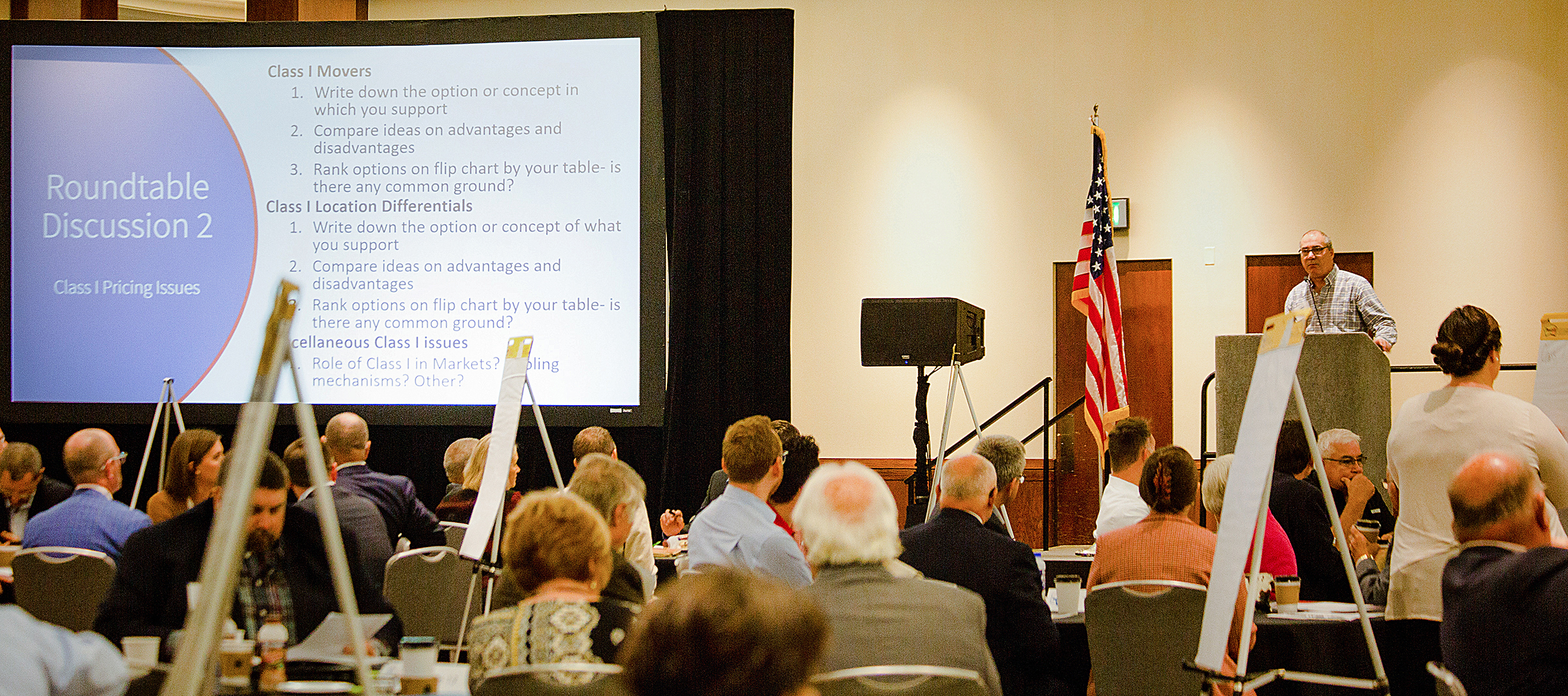
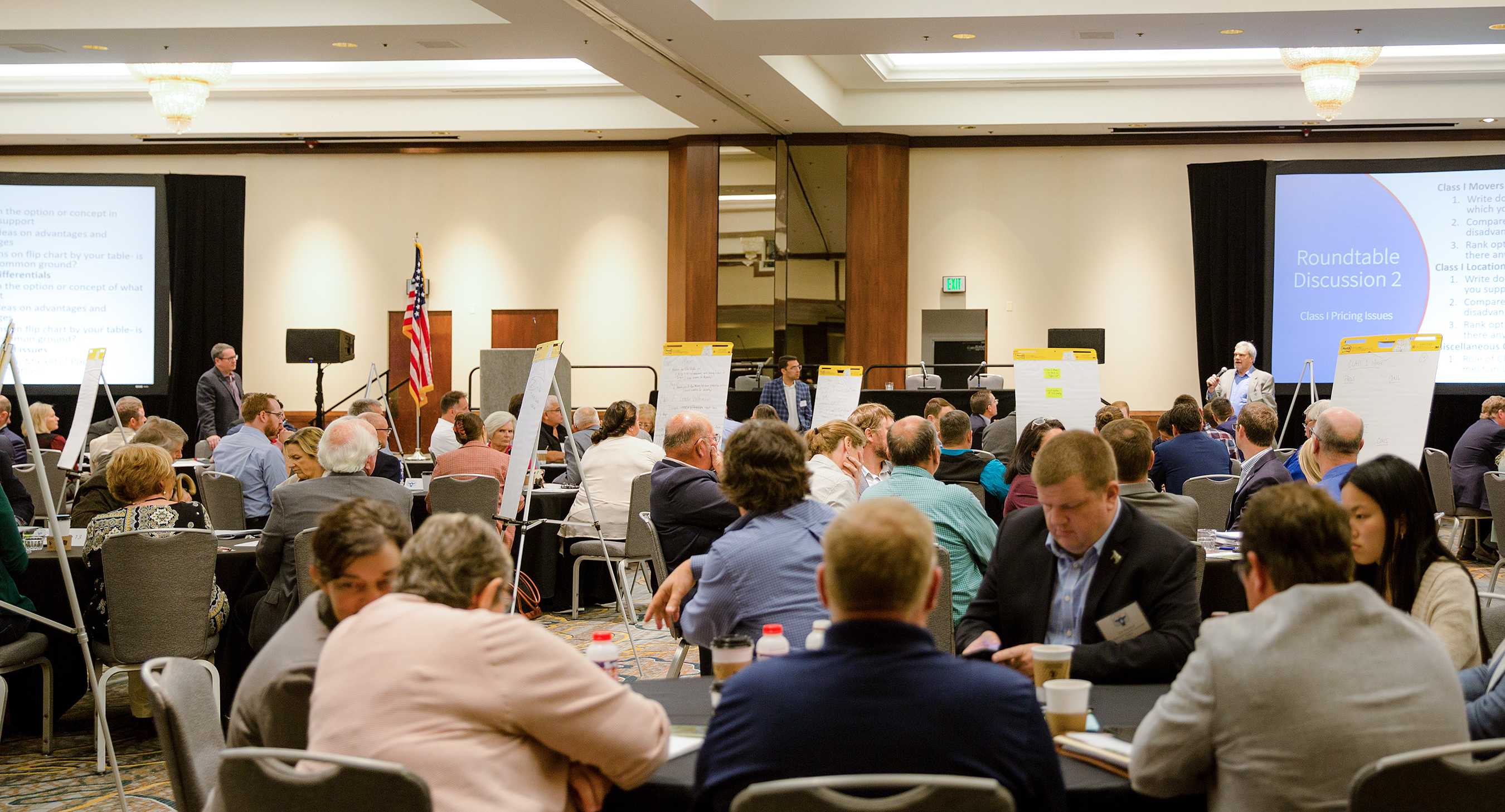
Attendees were assigned tables with a number on the back of each name tag. The goal was to mix the table-groupings for varied geographic and industry perspectives. Each table was equipped with its own large flip tablet mounted on an easel. 

According to Munch, Farm Bureau will scan and collate the information from all of the large tablets and issue a preliminary report to attendees followed by a public report later this year.

On Sunday, the open microphone was lively and most tables reported from their flip tablets. Overwhelmingly, attendees said they found value in the meeting and appreciated the platform. They reported a desire to keep the conversations going, to do this again, not just every 20 years, and not just in response to a problem, but to be forward-looking with the many challenges on the dairy horizon.

Platform for next big issue

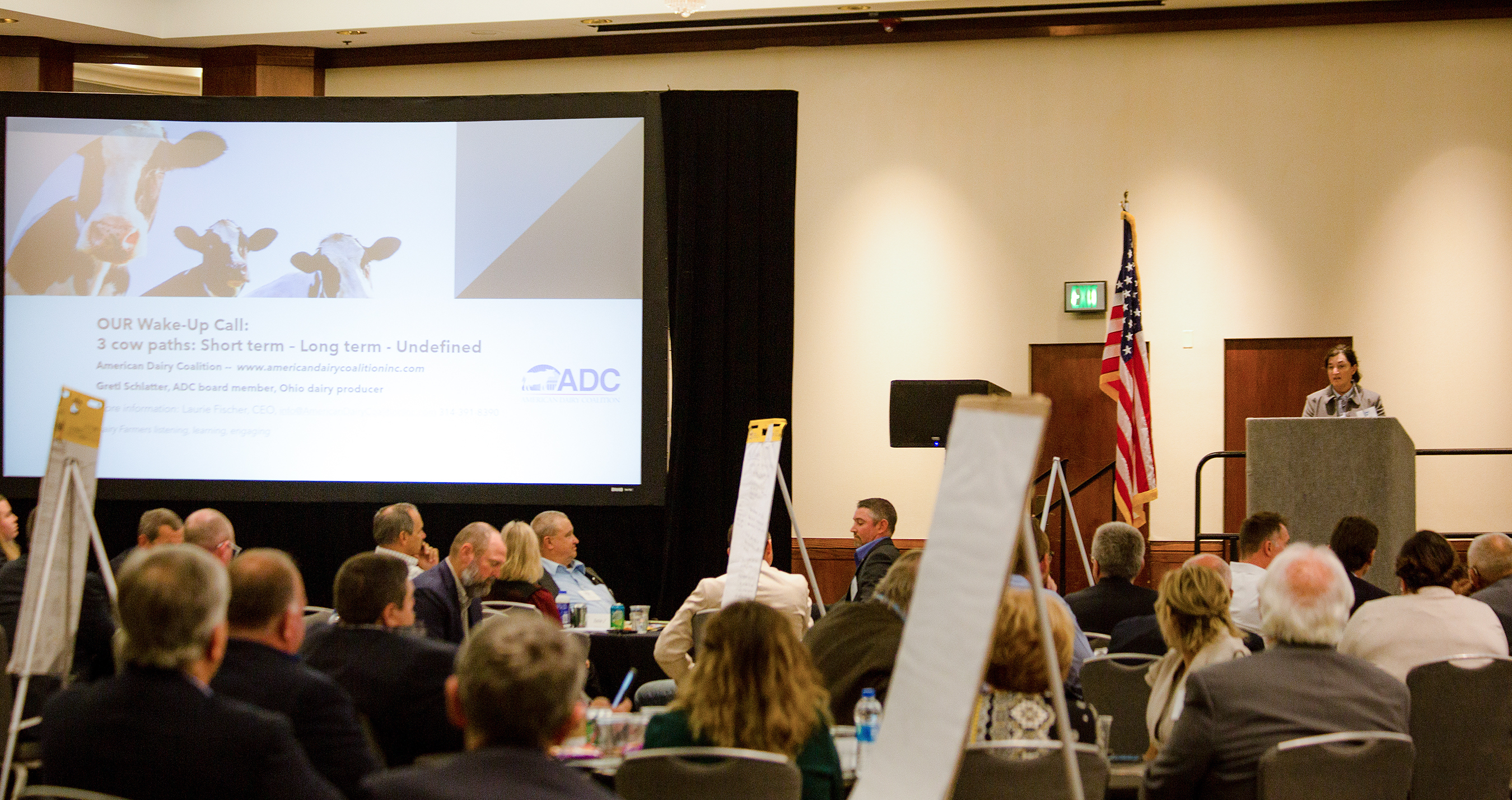
For example, Gretl Schlatter, an Ohio dairy producer on the board of American Dairy Coalition (ADC) noted that only Class I milk is mandated to participate in FMMOs, and that today, the FMMOs are weakened with only 60% of U.S. milk production participating in the revenue-sharing pools.

“Where will we be in five years? We do not want to give up on fluid milk – our nutrition powerhouse,” she said. “The issue now is federal milk pricing but the next one coming — fast — is the sustainability benchmarks, the climate scores. We need to keep meeting like this as an industry, keep talking to each other, and get ready for the next big thing affecting our farms and family businesses.”

This was touched upon by Duvall and others, but Cryan reminded everyone that, “Federal Orders are complicated enough without adding the sustainability discussion to it.”

Duvall reminded attendees that this meeting was Farm Bureau’s response to the words of Ag Secretary Tom Vilsack last year, when he said there would be no USDA hearing until the dairy industry reaches some “consensus” on solutions.

This set into motion an already dairy-active Farm Bureau that had formed its own task force, responding to grassroots dairy policy coming up from the county and state levels to national through AFBF’s grassroots process.

In fact, NMPF’s Vitaliano, noted that, “having Roger Cryan at Farm Bureau makes it easier to do this,” to partner on formulating dairy policy because of his background. Prior to coming to Farm Bureau a year ago, Cryan was an economist for NMPF and then for USDA AMS Dairy Programs.

The first hour of the first day included a recorded message from Secretary Vilsack and an in-person presentation by Gloria Montano Green, USDA deputy undersecretary for Farm Production and Conservation.

They encouraged attendees to work together and told them what the Biden-Harris administration has done and is doing for dairy. Primarily, they went through a list of funding and assistance, including the improved Dairy Margin Coverage, the PMVAP payments, Dairy Revenue Protection, Livestock Gross Margin, dairy innovation hub grants and the recent funding for conservation and climate projects that includes 17 funded pilots involving dairy. 

They told attendees that the dairy industry is “far ahead” on climate and conservation because it has been involved in these discussions and is already mapping that landscape.

Dana Coale, deputy administrator of USDA AMS Dairy Programs, took attendees through the FMMO parameters. She engaged with the largely dairy farmer crowd in a frank discussion of what Federal Orders can and cannot do. The headline here is that this current time period before a hearing is a time when she and her staff can talk freely and give opinions. Once a hearing process begins, she and her staff are subject to restrictions on ex parte communications.

Consensus to go back to ‘higher of’ formula

If there was one FMMO “fix” that achieved a clear consensus and was given priority, it was support for going back to the Class I ‘mover’ formula using the ‘higher of’ Class III or IV skim price instead of the current average plus 74 cents method that was changed in the 2018 farm bill.

Since implementation in May 2019 through October 2022, the new method will have cost dairy farmers $868 million in net reduced Class I revenue, which further erodes the mandatory Class I contribution to the uniform pricing among the 11 Federal Milk Marketing Orders (FMMO), setting off a domino effect that has led to massive de-pooling of milk from FMMOs and decreased Federal Order participation.

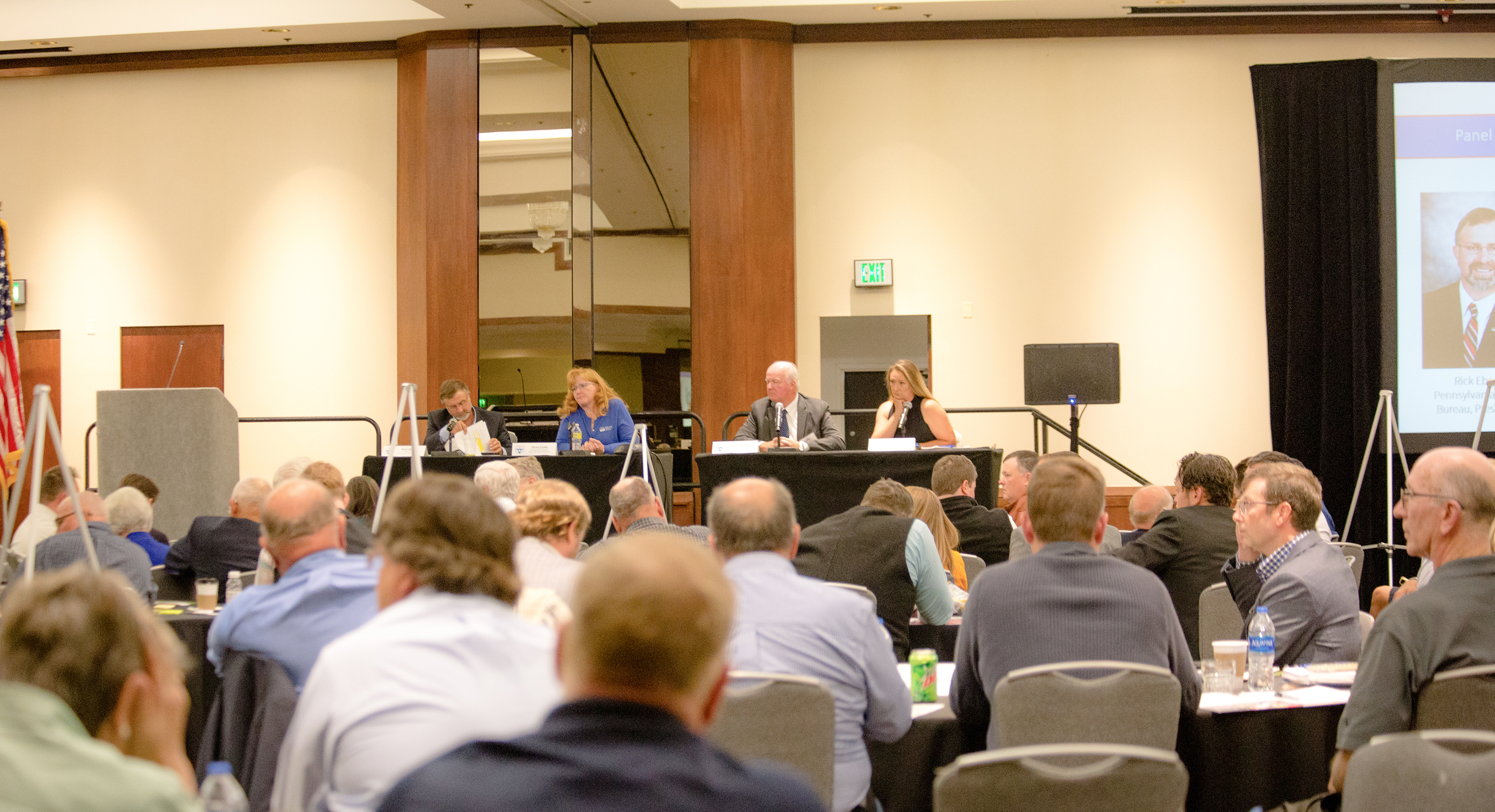
Pa. Farm Bureau presiden Rick Ebert (left), moderated the first panel Friday afternoon (l-r) Dana Coale, deputy administrator USDA AMS Dairy Programs; Calvin Covington, CEO emeritus, Southeast Milk; Anja Raudabaugh, CEO Western United Dairies. After this panel, during the first open-microphone and roundtable breakout, attendees were urged not to leave their flip tablets blank. “Groups with blank boards will have to drink the almond juice in the back,” said AFBF economist Danny Munch, taking note of the hotel offering and to have real milk on-site — provided Saturday and Sunday by Hiland Dairy.

During his presentation Friday, retired Southeast Milk CEO, Calvin Covington, said dairy farmers lost $69 million in revenue for the first 8 months of post-Covid 2022, alone. That figure will rise to an estimated $200 million when September and October Class I milk pounds are tallied. 

Noting NMPF’s task force recommends the board approve petitioning USDA to go back to the ‘higher of,’ Vitaliano cited “asymmetric risk” as the reason.

This risk scenario was also explained by others. ADC’s Schlatter, for example, noted the current averaging formula “caps the upside at 74 cents, but the downside is unlimited.”

Vitaliano noted that whenever there is a ‘black swan’ event or new and different market factors, this downside risk becomes unacceptable for farmers, and he indicated these market events that create wide spreads in manufacturing classes are likely to continue into the future.

Dr. Marin Bozic, University of Minnesota assistant professor of applied economics, observed the way this downside ‘basis’ risk becomes unmanageable via new and traditional risk management tools. In his futuristic talk on Sunday, producers asked questions, to which he responded that, “Yes, farmers show me that they can’t use the Dairy Revenue Protection because of this basis risk.”

Bozic is also founder and CEO of Bozic LLC developing and maintaining the intellectual property for risk management programs like DRP. 

He also spoke about the concerns of the Midwest as FMMO participation declines. 

Presenting his own ideas and separately the ideas of Edge Dairy Farmer Cooperativ, Bozic said Edge is seeking a consensus to support two or three lines in the upcoming farm bill to simply “enable” FMMO hearings to introduce flexibility on an Order by Order basis, so that uniform benefits can be shared instead of a uniform price. Flexibility, they believe, would enable new ‘uniform benefits’ discussion that can help maintain or encourage FMMO participation in marketing areas with low Class I utilization.

Early in the Class I formula loss scenario of 2020-21, Edge had suggested a new Class III-plus formula to determine the ‘mover.’ Bozic said that “the idea of returning to the ‘higher of’ is not a deal breaker for Edge in the short-term.”

Even Mike Brown, senior supply chain manager for Kroger, unofficially indicated IDFA “could be open to the idea” of reverting back to that previous ‘higher of’ formula. As dairy supply chain manager on everything from Kroger’s milk plants to its new dairy beverages, cheese procurement, and so forth, Brown was asked if the averaging formula allowed him to ‘hedge’ fluid milk to manage risk as a processor.

The answer? Not really. Brown said there are ways for processors to manage risk under the ‘higher of’ formula also, but that they haven’t done any hedging under the averaging formula with fresh fluid milk – and very little risk management with their new aseptically packaged, shelf-stable milks and high protein drinks.

Incidentally, he said, the aseptic, ultrafiltered, shelf-stable dairy beverage category “is growing faster than plant-based” in their retail sales.

This exchange and other discussions suggested the averaging formula may have been geared more toward price stability that would encourage processors to invest in expensive aseptic, ultrafiltered and shelf-stable milk-based beverage technologies that result in a storable product needing risk management. 

Fresh fluid milk is already advance-priced and quite perishable with a fast turnaround. Aseptic, ultrafiltered and shelf-stable products, on the other hand, can be packaged under one set of raw milk pricing conditions and sold to retail or consumers up to nine months later under another set of raw milk pricing conditions.

Frankly, it appears that the consumer-packaged goods companies (CPGs) may be driving such shifts, just as we heard from Phil Plourde of Blimling/Ever.Ag that CPGs are “all-in” on the climate scoring — the next big thing on the dairy challenge list.

Tacking de-pooling – regional or national?

Attendees came back to the specific concern about de-pooling, which Vitaliano and Cryan both described as an issue to be handled regionally and not through a national hearing.

This did not seem to satisfy some who raised the concern. Toward the conclusion Sunday, Cryan explained it this way: 

“De-pooling is a national issue in principle but a regional issue in detail. Every region will have different ideas, needs and situations. If there is consensus (on pooling rules) in a region, then changes could move forward quickly,” he said.

Make allowances are sticky wicket

Attendees appeared to agree that make allowances should be addressed or evaluated through a hearing, but ideas on how to handle this sticky-wicket varied.

Attendees questioned panelists, pointing out that if a farmer’s profit margin on milk is only around $1.00 per hundredweight, then raising make allowances an estimated $1.00 per hundredweight is going to be a tough pill to swallow.

Vitaliano said NMPF is commissioning an economic study with their go-to third-party economist Scott Brown at University of Missouri to show the actual milk check impact of raising make allowances that are embedded into the end-product pricing formulas for the four main products: cheddar, butter, nonfat dry milk and dry whey. 

He said the discussions about make allowances as a cost to farmers are “purely arithmetic” but that the “true impact” is not a straight math calculation. Instead, he said, when make allowances are set appropriately, dairy producers ultimately benefit, so in his opinion, it’s not a penny for penny subtraction.

Several other panelists and attendees observed that processors and cooperatives have been creating their own ‘make allowances’ through assessments, loss of premiums, and other milk check adjustments.

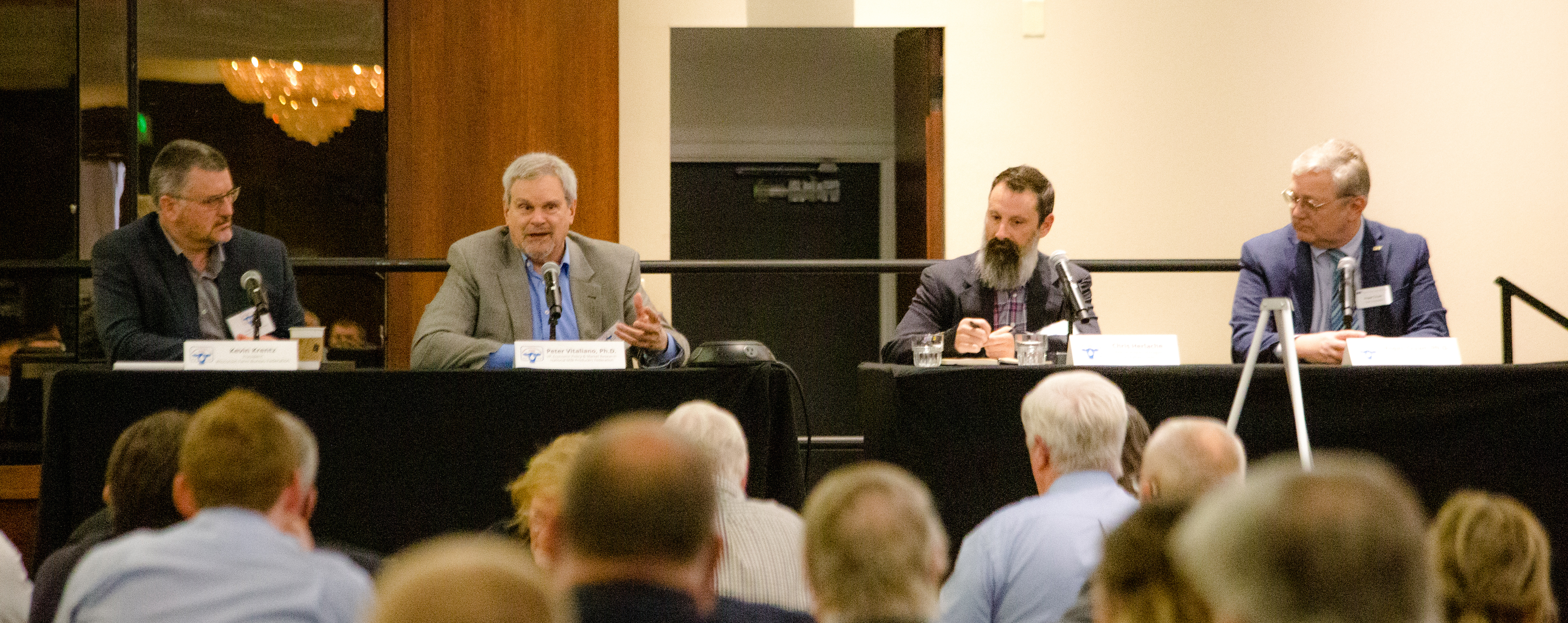
The Saturday afternoon panel of (l-r) Kevin Krentz, Peter Vitaliano, Chris Herlache, and Roger Cryan dove into Class III and IV pricing topics including make allowance formulations and structures.

Vitaliano stressed that when make allowances are set properly, the industry is stronger and better able to compensate producers. Initially, he said, raising make allowances would have a negative impact on expansion, which in turn would have a positive impact on producer prices.

When asked if raising make allowances would mean lost premiums would return to farmer milk checks, he responded by saying “that depends, and it won’t happen right away.”

In other words, raising make allowances will be painful in the short term, but in the long-term (to paraphrase) that pain leads to gain. 

Some panelists and attendees referenced an idea of “phasing in” a future raise in make allowances.

Others wondered why it is necessary with the amount of innovation happening in the 15 years since they were last raised as processors make a wider variety of dairy products – not just those bulk items that are surveyed for end-product pricing formulas.

One idea suggested by a Wisconsin dairy producer was to tie make allowance increases to plant size — much the same way that dairy farmers are only assisted up to a production cap of 5 million annual milk pounds. Cryan said he heard a similar proposal previously to use a graduated scale for make allowance increases according to plant size and presumably age.

This is the crux of the make allowance issue because the new state of the art plants produce many types of products, both commodity and value-added; whereas some of the smaller and older plants that are still vital to the dairy industry are more apt to specialize in producing a bulk commodity with a more limited foray into value-added non-surveyed products.

Modified bloc voting?

While there appeared to be consensus that changes to the FMMOs should be done by USDA petition through the administrative hearing process, not through Congressional legislation, some of the discussion at tables and the open-microphone noted the importance of a producer vote after hearings and USDA final decisions. Many felt farmers should have an individual vote on FMMO changes. 

Currently, cooperatives bloc vote for their members to assure that FMMOs are not ended inadvertently by lack of producer interest in following-through on a vote. 

One compromise suggested by Bozic was to have a preliminary non-binding vote by individual producers, followed by the binding vote done in its usual way.

This, he said, would at least increase accountability and transparency in the FMMO voting process and bring producer engagement into the FMMO hearing process. To be continued

-30-

More Borden plants close under ‘great consolidator’ Gregg Engles

Checkoff cites ‘uncontrollable circumstances’  bringing shelf-stable milk to schools

With an uncertain future for five remaining Borden plants after five plant closures, one partial closure (Class I) and three sell-offs since April, what does the future hold for fluid milk markets in the South and the iconic Elsie? Screen capture, bordendairy.com

By Sherry Bunting, Farmshine, Aug. 12, 2022

DALLAS, Tex. — Last week, yet another round of plant closures was announced by Borden, well-timed as a factor said to be driving shelf-stable milk into schools and other venues in affected regions like the Southeast; however, an industry “innovation” shift to the convenience, “experience ” and reduced deliveries (carbon/energy cost and intensity) said to be associated with lactose-free extended shelf-life and aseptically-packaged milk has been gradually in the making for months, if not years.

The Dallas-based Borden, owned by two private equity firms, will close fluid milk plants in Dothan, Alabama and Hattiesburg, Mississippi “no later than Sept. 30, 2022, and will no longer produce in these states,” the company said.

The Aug. 3 announcement represents Borden’s fifth and sixth plant closures in as many months.

A string of sell-offs and closings since April have occurred under “the great consolidator” — former Dean Foods CEO Gregg Engles. Engles has been CEO of ‘new Borden’ since June 2020, when his Capital Peak Partners, along with Borden bankruptcy creditor KKR & Co., together purchased substantially all assets to form New Dairy OpCo, doing business as Borden Dairy.

“While the decision was difficult, the company has determined that it could no longer support continued production at those locations,” Borden said in the Aug. 3 statement that was virtually identical to the statement released April 4 announcing previous closures of its Miami, Florida and Charleston, South Carolina plants by May 31, including a stated withdrawal from the South Carolina retail market as well.

In addition to ending fluid milk processing at six of its 14 plants — four in the Southeast, two in the Midwest — Borden announced in late June its plans to sell all Texas holdings to Hiland Dairy, including three plants in Austin, Conroe and Dallas, associated branches and other assets.

Hiland Dairy, headquartered in Kansas City, Missouri, is jointly owned by the nation’s largest milk cooperative Dairy Farmers of America (DFA), headquartered in Kansas City, Kansas, and Prairie Farms Dairy, a milk cooperative headquartered in Edwardsville, Illinois that includes the former Wisconsin-based Swiss Valley co-op.

DFA already separately owns the Borden brand license for cheese.

Also in June, Borden announced an end to fluid milk operations in Illinois and Wisconsin at two former Dean plants the company purchased jointly with Select Milk Producers in June 2021 after a U.S. District Court required DFA to divest them.

Borden closed the Harvard (Chemung Township), Illinois plant in July, and local newspaper accounts note the community is hopeful a food processing company other than dairy will purchase the FDA-approved facilities. Borden also ceased bottling at De Pere, Wisconsin on July 9, but continues to make sour cream products at that location.

The combined plant closures and sales by Borden now stand at nine of the 14 plants, leaving an uncertain future for the remaining five plants in Cleveland, Ohio; London, Kentucky; Decatur, Georgia; Lafayette, Louisiana; and Winter Haven, Florida. The sales and closures, including announced withdrawals from some markets, having combined effects of funneling more market share to DFA and to some degree Prairie Farms and others against a backdrop of additional Class I milk plant closures and reorganizations during the 24 months since assets from number one Dean and number two Borden were sold in separate bankruptcy filings.

“Borden products have a distribution area which covers a wide swath of the lower Southeast, including the Gulf’s coastal tourist areas. The Dutch Chocolate is a favorite of milk connoisseurs, and their recent introductions of flavored milks have received great reviews,” an Aug. 6 Milksheds Blog post by AgriVoice stated. A number of Georgia, Tennessee, Alabama and Mississippi farms may be affected by the most recent closures.

Meanwhile, the closures are affecting milk access for schools and at retail. According to its website, Borden serves 9,000 schools in the U.S.  

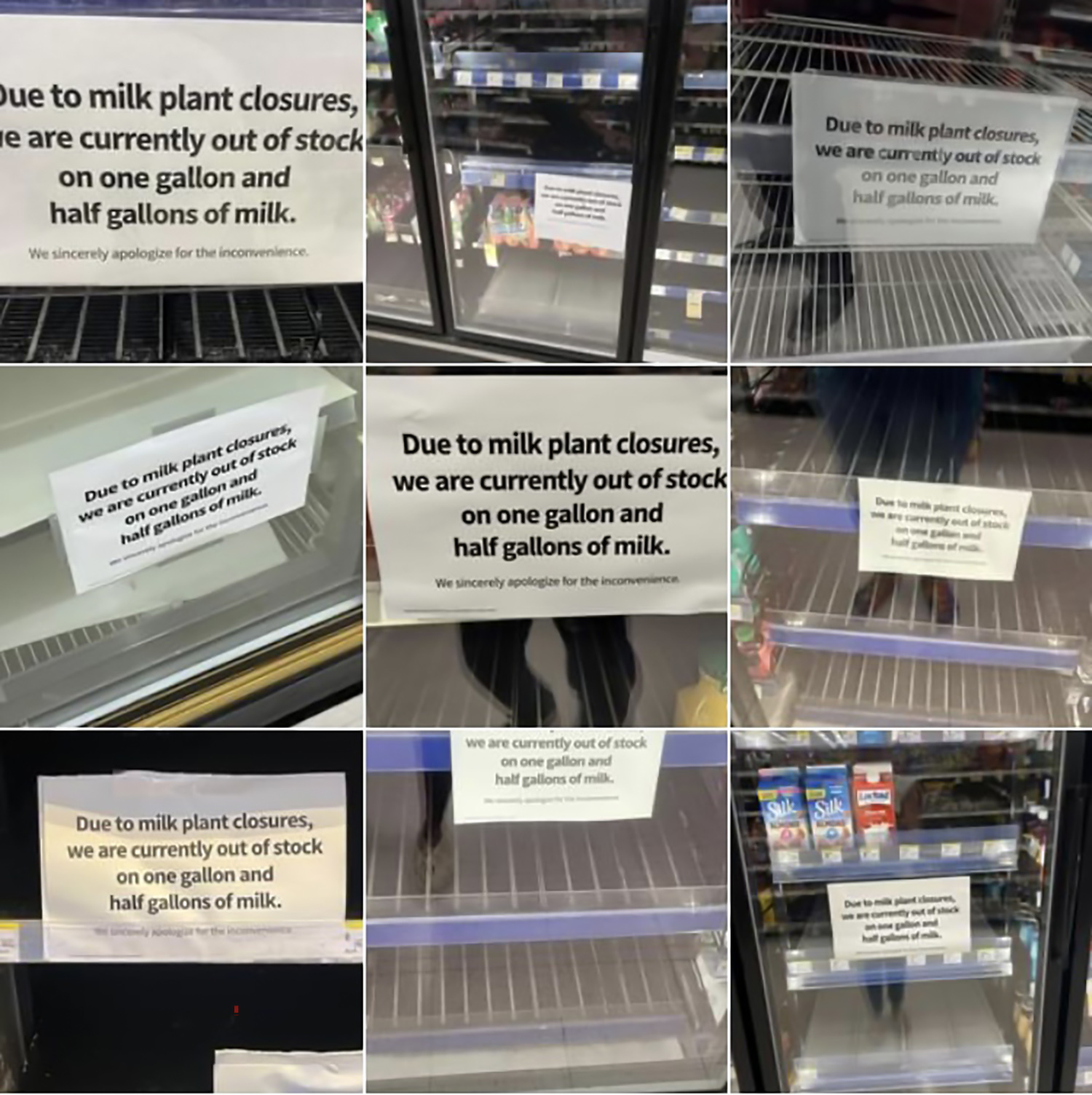
A random sampling of the many Facebook-posted photos by individuals from northern Illinois to Green Bay, Wisconsin from July 15 to the present after Borden and Select closed two former Dean plants in Illinois and Wisconsin that they jointly purchased from DFA in June 2021. Screen capture, Facebook

In recent weeks, photos have been circulating of empty dairy cases in the Green Bay, Milwaukee and greater Chicago region with signs stating: “Due to milk plant closures, we are currently out of stock on one gallon and half gallons of milk.”

School milk contracts in that region are also reportedly impacted.

However, most notable is the impact on school milk contracts in the Southeast as students begin returning to classrooms.

According to the Aug. 5 online Dairy Alliance newsletter to Southeast dairy farmers, the regional checkoff organization confirmed the latest round of Borden closures are plants that “currently provide milk to 494 school districts… and use around 95 million units a school year.”

The Dairy Alliance reported it is working with schools “to keep milk the top choice for students… We do not want schools to apply for an emergency waiver that would exempt them from USDA requirements of serving milk until they find a supplier.

“These uncontrollable circumstances will lead to more aseptic milk in the region, but this is better than losing milk completely in school districts that have little or no options,” the newsletter stated.

Southeast dairy farmers report their mailed copy of a Dairy Alliance newsletter in July had already forecast more shelf-stable milk coming to schools as part of the strategic plan to protect and grow milk sales by ensuring milk accessibility and improving the school milk experience. In addition to the Borden plant closures, the report cited school milk “hurdles” such as inadequate refrigerated space requiring multiple frequent deliveries amid rising fuel and energy costs and labor shortages.

Southeast dairy farmers were informed that the Dairy Alliance School Wellness Team was already working to mitigate bidding issues with shelf-stable milk for school districts in Alabama, Georgia, South Carolina and Virginia.

Diversified Foods Inc. (DFI), headquartered in New Orleans, was identified as the main supplier of this shelf-stable milk to schools in the region, reportedly sourcing milk through Maryland-Virginia, DFA and Borden.

In addition, DFI is a main sponsor of the Feeding America conference taking place in Philadelphia this week (Aug 9-11), where it is previewing for nutrition program attendees their new lactose-free shelf-stable chocolate milk. DFI also sponsored the School Nutrition Association national conference in Orlando earlier this summer, and social media photos of the booth show the shelf-stable, aseptically packaged versions of brands like DairyPure, TruMoo, Borden and Prairie Farms, along with DFI’s own ‘Pantry Fresh’ shelf-stable milk in supermarket and school sizes.

Coinciding with the flurry of Borden closings and shelf-stable milk hookups for schools, DFA announced last week (Aug. 1) that it will acquire two extended shelf-life (ESL) plants from the Orrville, Ohio based Smith Dairy. The SmithFoods plants will operate under DFA Dairy Brands as Richmond Beverage Solutions, Richmond, Indiana and Pacific Dairy Solutions, Pacific, Missouri. A SmithFoods statement noted the transfer would not affect the farms or employees associated with these plants.

This acquisition aligns with DFA’s similar strategy to “increase investment and expand ownership in this (shelf-stable) space… and create synergies between our other extended shelf-life and aseptic facilities,” the DFA statement noted.

-30-

March Class I mover higher, but marks second straight month of value loss under current formula

Weekly MARKET MOOS, by Sherry Bunting, Farmshine, Feb. 18, 2022

March Class I ‘mover’ $22.88 instead of $23.67

The March Class I base price, or ‘mover’, was announced Wed., Feb. 16 at $22.88. This is $1.24 higher than the Feb. Class I ‘mover’ and $7.60 higher than a year ago. This marks the 6th consecutive month of Class I mover gains.

However, for the second consecutive month, the Class I mover is at a level lower than it would have been under the previous ‘higher of’ formula. Announced at $22.88 for March 2022 using the average-plus method, this is 79 cents lower than the $23.67 it would have been under the previous ‘higher of’ formula.

As shown above, the net loss in Class I value since the new formula was implemented in May 2019 is over $738 million. This could continue for the foreseeable future if this week’s futures markets are an indication.

Near term futures diverge by $2 to $3; 12-mo. Cl. III avg. $21.34, IV $23.28

Class III milk contracts came under pressure at midweek while Class IV surged solidly higher. This created more divergence between the two this week — to spreads beyond the $1.48 ‘magic number’ for all but three of the next 12 month contracts. ($1.48 is the point when the Class I price set by the current average-plus method becomes a loss compared to the previous ‘higher of’ method.)

We already saw this occur for the February and March 2022 Class I mover (above).
But the good news is the overall price levels are the highest in 8 years for most of these months — just not as much higher as they would have been using the ‘higher of’ method.

The average spread between the two milk contracts for the next 12 months Feb. 2022 through Jan. 2023 stands at $1.94/cwt this week.

Class III milk futures averaged $21.34 for the next 12 months, 8 cents lower than the average a week ago.

Class IV futures averaged $23.28 for the next 12 months, gaining 47 cents on top of last week’s 67-cent gain, now up fully $2.00 compared with a month ago.

CME spot dairy products all higher, except whey slips a penny

CME spot dairy prices moved higher on all products this week, except whey slipped another penny. Butter made the biggest gains, followed by block cheddar.

On Wed., Feb. 16, butter was pegged at $2.80/lb with 7 loads trading. This is up a whopping 27 cents compared with a week ago but 7 cents below the high for the week at 2.87/lb on the previous day.

Grade A nonfat dry milk (NFDM) hit $1.90 this week, then lost a penny Wed., Feb. 16, pegged at $1.89/lb — still a 2 1/2 cent gain over a week ago with a single load changing hands.

On the Class III side of the ledger Wed., Feb. 16, 40-lb Cheddar blocks were pegged at $1.9825/lb, up 8 cents from the previous Wednesday with 3 loads trading; 500-lb barrels at $1.92 are up 6 cents from a week ago with 3 loads trading.

The spot market for dry whey lost another penny this week, but remains above the 80-cent mark. On Wed., Feb. 16, a single load traded and the price was pegged at 81 cents/lb.

Jan. blend up $1.50-$2.00: Class IV tops Class I in all 7 MCP Orders

January’s uniform prices announced in each of the 11 Federal Milk Marketing Orders (FMMO) over the past several days were $1.50 to $2.00 higher across the board for the third consecutive month. In the 7 multiple component pricing (MCP) FMMOs, the Class IV price topped the Class I minimums (including differentials) and in some FMMOs, the Class I minimums were the lowest class price.

Statistical reports show the spreads incentivized some de-pooling of Class II and IV milk. In the Northeast FMMO for January, Class IV and Class II, combined, accounted for 40% of utilization and Class I accounted for 31%, contributing to a blend price that was $2.36 above the Class III price. PPDs were positive throughout all MCP Orders because Class III was the lowest price. (PPD = blend price minus Class III.)

January’s uniform prices moved higher for the third straight month — across the board — as follows:

FMMO 1 (Northeast) SUP $22.74 PPD +$2.36
FMMO 33 (Mideast) SUP $20.38 PPD +$0.96
FMMO 32 (Central) SUP $21.09 PPD +$0.71
FMMO 30 (UpperMW) SUP $20.59 PPD +$0.21
FMMO 126 (So. West) SUP $21.63 PPD +$1.25
FMMO 124 (Pacific NW) SUP $21.49 PPD +$1.11
FMMO 51 (California) SUP $21.25 PPD +$0.87
FMMO 5 (Appalachian) uniform price $23.72
FMMO 7 (Southeast) uniform price $22.28
FMMO 6 (Florida) uniform price $25.49
FMMO 131 (Arizona) uniform price $24.17

PA Dairy Summit tackles milk pricing: Bozic digs into Class I, FMMO system

Dr. Marin Bozic at the PA Dairy Summit Feb. 2

By Sherry Bunting, published in Farmshine, Feb. 11, 2022

LANCASTER, Pa. — “The Federal Milk Marketing Order (FMMO) system is built around Class I fluid milk… if no changes are made, they can just collapse, west of the Mississippi,” said Dr. Marin Bozic, a University of Minnesota associate professor of applied economics speaking to over 300 farm and industry attendees of the Pennsylvania Dairy Summit in Lancaster on Feb. 2.

Dr. Bozic showed how the U.S. is now exporting more milk on a solids basis than is being sold in the domestic beverage category. This development is sending shockwaves through a Federal Milk Marketing Order system in which only Class I fluid milk handlers are required to participate.

Fluid milk sales are declining and being overtaken by the increasing export category — leading processors to lose interest in FMMO participation, he said.

Class I fluid milk handlers are the only ones required to participate in FMMOs. It is voluntary for all others.

As markets shift, Bozic predicts continued reductions in producer price differentials, forecasting the average Northeast PPD to decline by more than 20% over the next eight years. 

He also cited the impact of inefficient milk movement stimulated by FMMO pool access provisions. This could also apply to state-regulated over-order premiums. Location-based Class I premiums can fuel inefficient movement of packaged fluid milk from more distant lower-cost-of-production areas. (When local milk is displaced, hauling costs go up.)

“What can we do to give FMMOs a new lease on life?” Bozic asked, observing that future reforms should prepare them to survive in a time when the U.S. is increasingly exporting more milk on a solids basis than in the beverage category.

Bozic said national hearings on FMMO changes could happen after the midterm elections but may not happen until after the 2023 Farm Bill, and NMPF and IDFA are working on their positions.

He referenced a working paper about modernizing U.S. milk pricing and how pricing is done in other countries. Bozic authored the paper together with Blimling and Associates, and it was released at the IDFA convention in January. It is available and anticipating feedback at https://www.idfa.org/wordpress/wp-content/uploads/2022/01/Modernizing_US_Milk_Pricing_Working_Paper_012522.pdf

Right now, he said, “Milk is being priced like it’s 1999, but it’s 2022.”

For starters, he said, the standard component test should be raised to reflect current national averages that are higher than in 1999. Butterfat, for example, stands at an average 4.0, but standard test is still 3.5. 

Bozic also predicted that over the next two years, the embedded make allowances in the pricing formulas will be increased. He said processors are already re-blending pay prices to accomplish a higher ‘make allowance’ internally. He cited New Zealand’s system that frequently updates manufacturing costs used to determine producer prices.

He was quick to point out that when make allowances are adjusted, it would be tools like the monthly Milk Check Transparency Report that Bozic is working on — along with some ideas for contract fairness — that would put processors on notice that they can’t just re-blend their pay prices on top of a make allowance adjustment. That would be double-dipping.

Answering questions about producer ‘cost of production’ and ‘cost-plus’ pricing, Bozic explained that in the UK, retailers are starting to use a ‘Fairness for Farmers’ label by doing a cost-plus contract model where they use accountants to measure dairy farm costs of production, along with a consumer price index, to price milk three months at a time. 

One key difference, however, is the interstate commerce clause in the U.S. Constitution makes it impossible to keep milk from areas with a lower cost of production from moving to undercut price structures in areas with a higher cost of production. Feed cost could be used, which is a bit more universal, but still varies by region. 

With dairy farms in the UK similarly sized with similar cost structures to farms in the Class I markets of the eastern U.S., such ideas are worth exploring, he said, noting that fluid milk prices in the UK are more stable.

This slide from a working paper co-authored by Dr. Marin Bozic and Blimling and Associates was discussed at the PA Dairy Summit. Dairy farmer Nelson Troutman noticed the fluid milk consumption graph showed the UK (lighter blue line under gray line) doing much better in per-capita fluid milk trends the past 15 years compared with the U.S. (red line), and he asked about it. Australia (gray line) is also doing better.

Referencing Bozic’s graph showing fluid milk consumption trends for various countries, Berks County dairy farmer Nelson Troutman asked about the notably different trend in the UK compared with the U.S. 

“Why is their fluid milk not going down like here?” Troutman asked. “Over there, they talk about ‘the blue milk’ (a reference to the package color of whole milk in the UK). Is it because their whole milk is higher fat than ours? They don’t take it down to 3.25%, and I think their schools can still serve it. It’s no wonder fluid milk sales are falling here.”

Bozic responded to say he thinks “it’s atrocious that we make school kids drink milk without fat,” going on to mention new technology that can convert the lactose into a dietary fiber. 

“If that is successful,” said Bozic, “Then flavored milk (for schools) can be developed to have no additional calories (even with the full fat).”

In that aspect, Bozic talked about how to stimulate fluid milk brand innovation, promotion, and packaging investment in a regulated Class I pricing environment.

“We cling to the FMMO structure because we think that without it, milk pricing will be like the Wild West,” said Bozic.

“There’s some truth to that,” he acknowledged, noting that farms with fewer than 3000 cows are not sure if processors will want to work with them in the future, and the regulated pricing affords some structure for those small and mid-sized farms “to feel safe.”

In reality, however, Bozic said the Wild West is already happening, and it starts at the retail level, which then pushes losses through the system and milk all over the map.

He explained that the Class I price announcements give retailers a price in advance, and these pricing structures show them the costs of bottling, so they know how hard they can squeeze those bottlers, and they are squeezing them.

It’s within this context that Bozic put forth the idea of a fluid milk innovation premium or credit, where the Class I price could be lifted, maybe $2 per hundredweight, and processors could get this premium back — IF they innovate their brand packaging, marketing and promotion.

A key part of this concept is the cost of innovation would be within the Class I price. It would have to be earned, but would be protected from the retailer price squeeze.

“This could encourage fluid milk bottlers to do brand innovation and promotion, to invest in packaging, while making it not so easy for retailers to squeeze them to where they can’t do it,” said Bozic.

“Consumers would pay a little more for milk, but that’s fine,” he explained, citing research that shows the demand reaction to promotion is much larger than the demand reaction to price.

Outside of Pennsylvania, the 99-cent and $1.25, $1.50 gallons seen in supermarkets reflect Class I value loss that is not being borne solely by those discounting retailers. The losses are pushed back through the system, especially now that there is more cooperative ownership of Class I bottling plants, post-Dean. 

Cooperatives are not required to pay Class I minimums to their milk suppliers the way that private milk buyers must.

One attendee asked about the roughly $2.50 in make allowance equivalents that are, by default, subtracted from the Class I price. Could this money be used for innovation and promotion credits since Class I bottlers are not making cheese, butter, nonfat dry milk and whey that the make allowances pertain to?

Bozic replied that the make allowances aren’t extractable because they are “embedded” in the FMMO formulas that currently determine the value of milk components.

For producers in regulated Class I areas — namely the Northeast and Southeast — Bozic said it will be important for them to “lead the way” in an open debate on how fluid milk prices can be stabilized and how the other benefits of FMMOs in payment timeliness, weights and measures, price benchmarking and such can be preserved.

When asked specifically about going back to the ‘higher of’ for calculating the Class I base price, Bozic said: “In the Northeast and Southeast, Class I is still a big deal. If you want it, and if IDFA can’t make a strong argument against it, then go for it.”

More importantly, he said: “We need to build a grand coalition. Transparency is part of that. If building a broader coalition brings us back to discussion about the ‘higher of’, then maybe that’s part of it.”

But the bigger issue he alluded to is this: Doing nothing, and letting it all just happen, could lead to Federal Orders collapsing in other parts of the country, without enough Class I to keep them together, and the system could begin to unravel, anyway, without producer input as to what functions should be saved and how to save them.

Look for part two next week on other aspects of the milk pricing discussion, and more details about what Bozic is doing on Milk Check Transparency, including how producers can participate by writing to him at marin@bozic.io

Last week’s Farmshine (Feb. 4, 2022) had a brief overview of the discussion. Check it out here

Sen. Gillibrand’s plans for Dairy Subcommittee hearing are moving forward

By Sherry Bunting, Farmshine, July 9, 2021

WASHINGTON, D.C. — Senator Kirsten Gillibrand (D-NY), chair of the Senate Agriculture Subcommittee on Dairy, Livestock, Poultry, Local Food Systems, Food Safety and Security, told reporters in late May that she is working on milk pricing legislation and wants to have dairy pricing hearings in her subcommittee before the August congressional recess. 

According to a document obtained by Farmshine, the Senator has been granted the request to hold the hearing in her subcommittee. The American Dairy Coalition (ADC) reports their appreciation for Senator Gillibrand moving forward on this, noting her office has established the hearing scope and is contacting testifiers. A date is anticipated for late summer 2021, though not yet confirmed on the Senate Ag calendar.

“We cannot lose the ability to feed our own people,” Gillibrand said during her May press conference. “If you have a market that’s fundamentally flawed and are constantly leaving producers unable to survive in the industry, there’s a problem. So, I think we need a very thorough investigation of my concerns.”

At that time, Gillibrand also talked about a multi-part scenario where this hearing could be followed by an investigation. Since 2003, the U.S. has lost almost half its licensed herds with milk price returns declining 23% in the past five years, according to USDA.

In addition to pricing and competitive market concerns over the past decade, the billions of dollars in dairy farm losses due to negative producer price differentials (PPDs) and de-pooling are part of the hearing equation.

Of this, a documented $783 million in net losses have accrued over 26 months directly tied to the reduced Class I price for beverage milk under the new averaging method implemented by USDA in May 2019 (See Chart 1). 

That equates to a straight average loss of nearly $25,000 per farm or $83 per cow, but the Class I value losses would be greatest in milk marketing areas with a higher percentage of Class I use. Other types of losses were incurred by producers in milk marketing areas that have a lower Class I utilization but experienced large volumes of Class III milk de-pooled, making the much lower Class IV price a bigger portion of the blended price paid to farmers.

At the height of these losses being incurred, the American Dairy Coalition worked to bring dairy producers together through conference calls and emails, driving a letter signed by hundreds of producers and organizations to National Milk Producers Federation and International Dairy Foods Association. The March letter requested a seat at the table for producers to address the Class I method.

NMPF and other groups came out with statements about potential FMMO hearing requests, which did not materialize.

In May, ADC worked with Senators in supporting Senator Gillibrand’s letter to Ag Secretary Tom Vilsack, seeking use of available CFAP and PAP funds to assist dairy farm families with these losses. 

Secretary Vilsack recently responded to questions from Senator Patrick Leahy (D-Vt.) during an Ag Appropriations hearing to say USDA is working on a plan to compensate Class I and Class III differential losses, but no details have been forthcoming. Producers are also waiting for details from USDA about the enhanced Dairy Margin Coverage base payments approved by Congress in December.

Sen. Gillibrand has observed the extreme volatility in milk prices over the past decade of her service as a member of the Senate Ag Committee. Dairy farm revenues have steadily declined due to a combination of trade wars, increased production costs, and competition from non-dairy alternatives leading to reduced consumption of fluid milk.

Other seismic shifts have also occurred in the dairy market landscape over the past five years, including shockwaves of rapid cooperative and plant mergers, plant closings, farms and small cooperatives losing milk markets since 2015, Walmart opening its own fluid milk processing plant in 2018, and the bankruptcy filing in 2019 and sale of plants in 2020 by the nation’s largest milk bottler, Dean Foods.

Multiple factors have also converged around the pandemic to create further losses for dairy farm families operating on already razor-thin margins and struggling to attain equitable markets and revenue.

Even the risk management tools purchased by producers did not function as designed because they are based on market values that most farmers did not receive in their actual milk checks. That’s like filing an insurance claim for a fire, but the adjuster looks at someone else’s intact property to determine your damages.

The upcoming hearing will likely look at all of this in relation to the change in the Class I pricing method for fluid milk, which was added to the 2018 Farm Bill without being vetted through a hearing process. The hearing is also expected to look at ways to address the Class I change and the FMMO hearing process, as well as FMMO pooling and de-pooling rules and dairy cost of production.

FMMO revenue sharing pools are the mechanism for how the usually higher Class I base price and normally positive differentials are shared with producers across a milk marketing area, no matter what class of products their milk is used in.

However, when the Class I price — due to the new averaging method — fell below Class III for 16 of the past 26 months, an estimated 85 billion pounds of Class III milk normally associated with FMMOs was kept out of the revenue-sharing pools, dropping the Class III portion to less than half its normal size from May 2019 through May 2021, and ultimately depressing milk check returns to producers. Some handlers may have paid their own shippers a portion of this de-pooled value, most did not.

In effect, the equitable method became inequitable when pricing turned upside-down, and risk management, at a time when farmers needed it most, failed.

Additionally, the USDA Farmers to Families Food Box cheese purchase effects on markets in relation to Class I pricing, are also expected to be part of the hearing.

The Food Box program included cheese, milk and other dairy products to help struggling families and at the same time was intended to support struggling farmers that were having to dump milk and be docked further penalties by milk buyers and cooperatives as ‘balancing costs’ or ‘market adjustments’ to handle milk supplies during the disruptions of the Coronavirus pandemic.

These purchases prompted cheese market rallies, followed by intervals of higher Class III milk prices (see Chart 2). However, this support became inequitable in large part due to the Class I pricing change, alongside a record large spread between the Class III and Class IV prices of $5 to $10 per hundredweight. This spread was affected on one side by record-large butter imports and inventories (Class IV), a slowdown in milk powder exports (Class IV) and on the other side by cheese sales (Class III) rising because of active exports and government cheese purchases for food boxes during the pandemic.

Even though every food box contained a gallon of fluid milk, there is no way to determine the ‘market value’ of Class I fluid milk, apart from the manufacturing class and component values. This is because fluid milk is treated as a base commodity. It is present in 95% of shopping carts, and thus used by large retailers as a loss-leader on the one hand, while on the other hand, the USDA regulates Class I fluid milk handlers as the only class that must pay a minimum FMMO price to farmers.

The hearing is also expected to look at processor ‘make allowances’ that are built into USDA’s end-product pricing formulas for bulk surveyed commodities: cheddar and dry whey (Class III) and butter and powder (Class IV).

Make allowances and yield factors currently add up to $3.17 per hundredweight on the Class III milk price and $2.17 per hundredweight on Class IV, according to a 2018 presentation by John Newton, formerly the chief economist for Farm Bureau who was hired this year by the Senate Ag Committee, explained make allowances as part of a risk management conference in Pennsylvania.

In effect, the make allowances are deducted from the milk component values as a ‘processor credit’ per pound of product, and the yield factors are applied, determining the number of pounds of product made per hundredweight of milk. Processors are indicating the make allowances should be raised because of the “circular” nature of end-product pricing.

But there’s another way to look at that ‘circularity.’ While it’s true that 12 years have passed since make allowances and yield factors were last updated (2008), it also true that in those 12 years vast amounts of value-added manufacturing have been added that benefit from these make allowances but are not part of the end-product-pricing ‘circle’ back into the farm milk price. The cost of making those products can be easily passed up the supply chain instead of back to the farmers. 

For the plants making the four USDA-surveyed bulk commodities that determine class and component prices — cheddar, butter, nonfat dry milk and whey — the issue may be ‘circular’. However, if make allowances are too high and too rigid, then there’s too much incentive to make product for storage that further depresses raw milk prices through end-product-pricing. So make allowances can be circular in that way also.

Dairy pricing is complicated and intricate — a huge topic. But then again, maybe what can come out of a Senate Subcommittee hearing is a simple straightforward message about making milk pricing simple and straightforward.

Pennies per pound here and there across milk volumes mean millions for big players, and when they add up to nickels and dimes that turn into dollars per hundredweight in the farm milk price, the intricacies become something farmers should be able to see and understand.

In a word: Transparency.

As indicated in her May press conference, Senator Gillibrand is looking to have each part of the dairy sector represented to offer their unique perspectives in the upcoming hearing, which is expected to have two panels, the first being dairy farmers and the second panel bringing in cooperatives, processors and an expert on dairy policy and economics.

In May, Senator Gillibrand made it clear she wants to see a multi-part evaluation of current and longstanding dairy issues, with this hearing being a first step to get a look at the lay of the land.

Stay tuned.

-30-