USDA to complete producer vote before new administration comes to town

Final FMMO rule adds more to make allowances, shortens delay on composition updates, restores higher-of, keeps controversial ESL adjuster.

By Sherry Bunting, Farmshine, Nov. 15, 2024

WASHINGTON, D.C. – The USDA released on Nov. 12 the Secretary’s nearly 400-page final decision on the Federal Milk Marketing Order (FMMO) price formula changes, with a few changes from the July ruling.

USDA rejected comments seeking to forestall the make allowance increases or to reduce their size. All make allowances are further raised in the final rule vs. preliminary rule by a fraction of a penny for marketing costs. Also, USDA has added more than a penny per pound to its earlier decision on the nonfat dry milk make allowance. These are milk check deductions that are embedded in the class and component formulas.

USDA also plans to stick with its earlier decision to introduce a rolling adjuster for extended shelf life (ESL) milk, which creates essentially two-movers for Class I that was not part of the hearing scope. The Department further defined ESL milk by processing method to be all milk using ultra-pasteurization, not just relying on the shelf life designation of 60 days or more.

The broad range of changes in the proposed final rule are the result of the national hearing and rulemaking process that began in 2023. It will be made final for implementation after dairy producers vote to approve these changes in the Order-by-Order referendum that will be completed before the new administration takes office on January 20th.

USDA AMS will mail voting ballots to eligible producers and qualified cooperative associations — which may bloc-vote on behalf of their eligible members — after the final rule is published soon in the Federal Register. Ballots must be returned with a postmark of December 31, 2024 or earlier and be received by the Department by January 15, 2025 in order to be counted.

Not all producers in a Federal Order will be eligible to vote. Only producers with milk pooled on a Federal Order in the month of January 2024 are eligible to vote in that Federal Order.

A ‘yes’ vote accepts all parts of the final rule. A ‘no’ vote rejects the changes but also rejects the continuation of that Order. Any of the 11 Federal Orders that does not meet the two-thirds majority requirement for acceptance of these changes will be terminated. The two-thirds majority is calculated among eligible producers in the Order who return a ballot.

USDA AMS will host three public webinars to further inform stakeholders of the changes and referendum process on Nov. 19 and Nov. 25 at 11:00 a.m. ET and Nov. 21 at 3:00 p.m. ET. A link to access the webinars will be provided at the AMS hearing website along with supplementary educational documents. 

Using its backward-looking analysis of applying the changes to actual 2019-23 pool test data, the combined net benefit for all 11 Federal Orders of all the changes in the final rule is estimated at +$0.26 per hundredweight. However, an average does not tell the full story, and it does not include the positive orderly marketing impact of restoring the higher-of method for calculating the Class I base price mover.
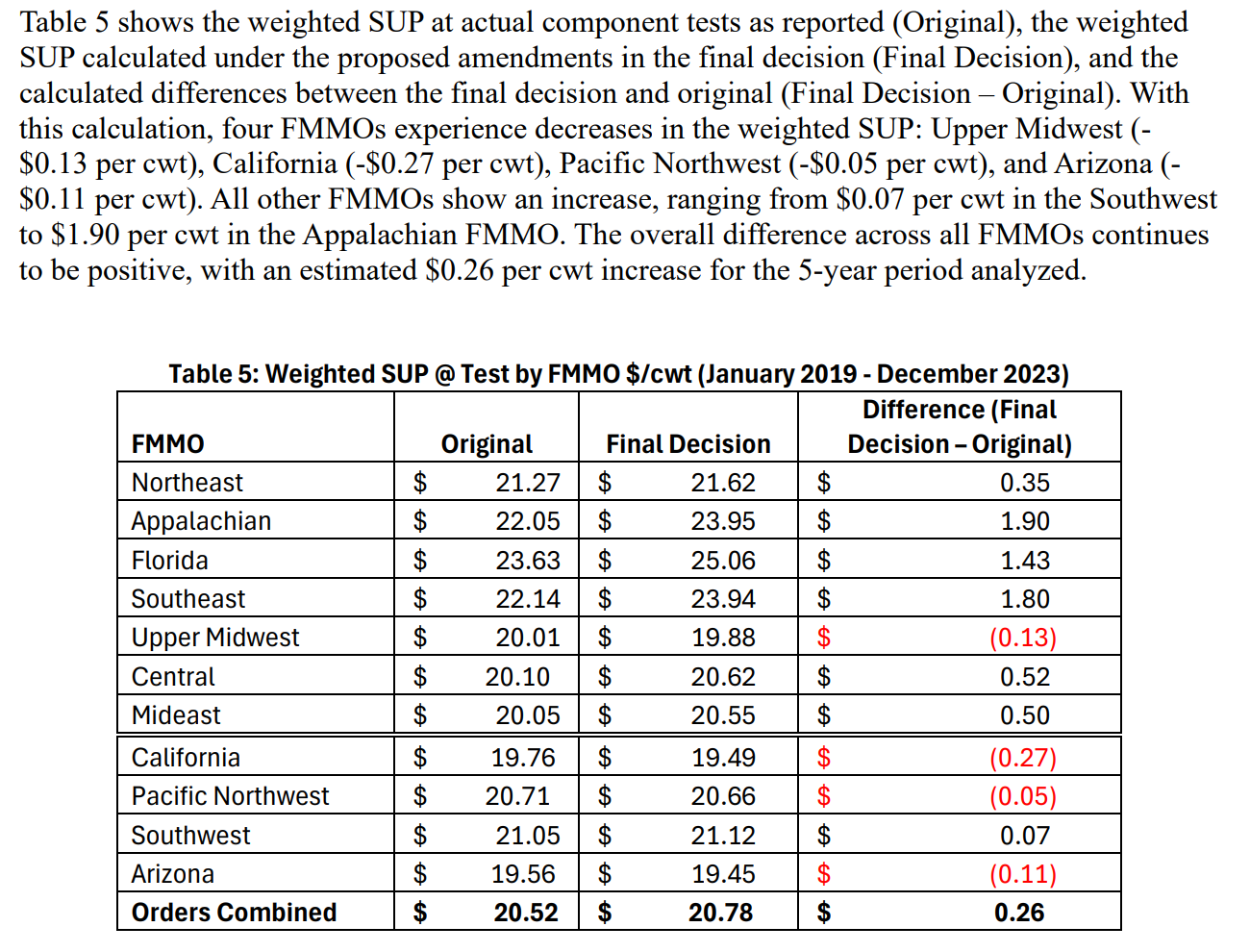
USDA’s Table 5 above is the backward-looking static analysis of the weighted Statistical Uniform Price (SUP) – at actual pool component test – showing net benefits for the following Orders: Appalachian +$1.90 per hundredweight, Southeast +$1.80, Florida +$1.43, Central U.S. +$0.52, Mideast +$0.50, Northeast +$0.35, Southwest +$0.07. 

Table 5 shows net-negative impact for California -$0.27, Upper Midwest -$0.13, Arizona -$0.11, and Pacific Northwest -$0.05.

However, this analysis does not factor-in the positive impact of restoring the higher-of method for calculating Class I. The Orders showing net negative impacts above have more liberal policies for jumping in and out of FMMO pools. Since USDA did not quantify the benefit of its restoration of the higher-of method for the Class I mover, it’s important to note that this can soften the blow. 

According to experts consulted by Farmshine on this matter, the potential average benefit for the same 2019-23 period of orderly marketing under the higher-of method in a low-Class-I FMMO like the Upper Midwest is 7 to 10 cents per hundredweight.

More importantly, the orderly marketing restored by this part of the final rule has a protective effect on the month-to-month hits taken by pooled producers from opportunistic depooling and negative PPDs. Why? Because the higher-of method — used for two decades, before the legislative change in 2019 — encourages functional class price relationships that promote orderly marketing.

In short, producers should realize that the restoration of the higher-of reduces the prevalence of very large negative PPDs that can disrupt performance of their risk management tools and treat pooled producers inequitably during black swan events and times of major market imbalances — like have been experienced over the past five years under the average-of method. This is a benefit that is difficult to quantify, but is contained in this decision nonetheless.
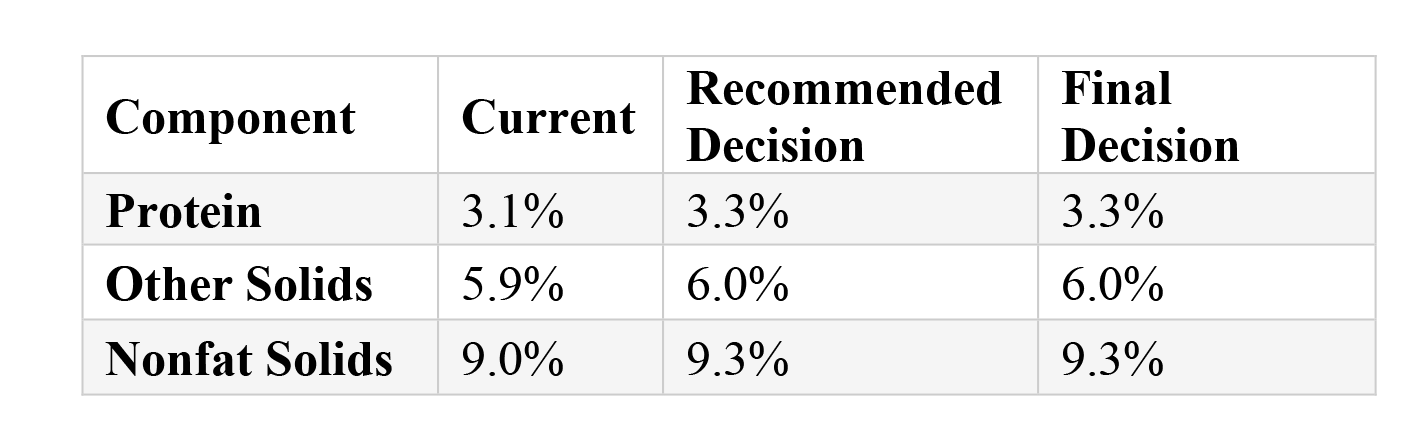
On the positive side for dairy farmers, the USDA will also shorten the delay from 12 months to six months for implementing the updated skim milk composition factors. These updates are shown above, which witnesses testified would raise Class I prices in all Federal Orders by an estimated 70 cents per hundredweight (based on 2022 data), while also increasing the manufacturing class prices in the four fat/skim Orders.

Raising the skim component standards helps bring the Class I, III, and IV in alignment, reduces the frequency of negative PPDs, and reduces the incentives for depooling that undermine orderly marketing.

The manufacturing class prices in the other seven Orders that use multiple component pricing are already paid on actual components, not by standardized levels.

Standardized butterfat composition at 3.5% will not be updated in this decision because this is a paper number that does not affect how producers are actually paid. Each pooled producer’s individual minimum price in all Federal Orders is already based on their actual butterfat test for pounds shipped.

The updates to county-by-county Class I location differentials were also tweaked in places, compared with the July preliminary decision, and the base differential for all counties at $1.60 per hundredweight remains in place.

Butterfat recovery within class and component formulas will be updated from 90% to 91%. Several proposals had requested a larger increase.

The Secretary’s final decision on the Class I base price mover remains unchanged from July.

USDA will restore the higher-of formula, which had been changed to an average-of formula in the 2018 farm bill. USDA is also sticking with the ESL adjuster, creating what is essentially a two-mover system for fluid milk.

Processors will separately report sales of conventionally processed (HTST) and ultra-pasteurized (ESL) fluid milk product sales each month. The higher-of method will set the base price mover, and USDA will apply the new ESL adjuster to the sales of ultra-pasteurized milk to determine their final pool obligation.

The ESL adjuster represents the difference between the higher-of vs. the average-of the Class III and IV advance pricing factors over a 24-month period with a 12-month lag. USDA states that it sees this adjuster “stabilizing” the difference between HTST and ESL over time.

USDA also rejected comments that had raised competitive concerns, stating: “The record does not contain evidence to support the implication that manufacturers of dairy products, the majority of which do not manufacture ESL products, would make business decisions to gain an advantage in the fluid market where they do compete.”

On the negative side for dairy farmers, the large increases in processor make allowance credits were made a bit larger, not reduced, after the 60-day public comment period.

USDA relied on the voluntary surveys of processor costs that were presented at the hearing as customary data sources from past make allowance adjustments. While USDA did not fully meet the requests of International Dairy Foods Association (IDFA) and Wisconsin Cheesemakers Association (WCMA), it does recommend much larger make allowances than what National Milk Producers Federation (NMPF) had proposed.

Make allowances represent the costs of converting raw milk into the four manufactured dairy products surveyed by USDA. They are embedded in the pricing formulas, not line items on a milk check, and they aggregate to an impact of 75 cents to $1.00 per hundredweight — depending on product mix and Class utilization.

USDA responded to processor comments about marketing costs, adding $0.0015/lb to its previously proposed processor make allowance credits for cheese, butter, nonfat dry milk, and dry whey. USDA also responded favorably to the processors’ request to adjust the nonfat dry milk make allowance to be more than a penny per pound higher than previously proposed.

The final decision will raise the make allowances on the four products used in class and component pricing – per pound — as follows:

Cheddar cheese will be increased from the current make allowance of $0.2003 to $0.2519 per pound; dry whey from $0.1991 to $0.2668; butter from $0.1715 to $0.2272, and nonfat dry milk from $0.1678 to $0.2393.

In its rationale, USDA stated that NMPF member-cooperative-processors supported the NMPF proposal as “a more balanced approach” to consider impacts on producers and processors. However, they also testified that the smaller increases proposed by NMPF “did not cover their costs.”

This put USDA in the position of having to rely only on the cost data provided by IDFA and WCMA because NMPF offered no cost data to support their smaller proposal. USDA said it rejected consideration of the impact on dairy farmers because the Agricultural Marketing Agreement Act does not include producer profitability as a factor for the Secretary’s consideration on this matter.

USDA chose not to wait for the mandatory and audited cost of processing survey that Congress is expected to authorize and require USDA to utilize in the future. This language is included in all versions of the new farm bill and is reportedly supported by NMPF, IDFA and American Farm Bureau Federation (AFBF).

The final rule also removes 500-pound barrel cheese prices from the protein and Class III formulas, meaning only 40-pound block Cheddar price surveys will be used going forward. USDA rejected proposals that sought to add 640-pound block Cheddar, bulk mozzarella cheese, and unsalted butter to the pricing survey.

-30-

There is NO basis for two Class I movers in FMMO recommended decision!

AUTHOR’S NOTE: Who’s the wizard behind the curtain on USDA’s last-minute milk pricing surprise, the splitting of the Class I baby to favor ESL? Vilsack, of course, with a little help from his checkoff cronies at Midwest Dairy and DMI — masquerading as ‘dairy farmers.’

By Sherry Bunting

USDA’s recommended decision on Federal Milk Marketing Order Class I (fluid milk) formulas brought a big surprise getting very little attention. That surprise: “splitting the Class I baby” and adding what constitutes a “fifth Class” of milk — TWO Class I movers announced each month.

ZERO proposals to divide Class I into a two-mover system were aired at the national hearing. Even USDA’s analysis shows the two movers would differ by as much as $1 apart — or more — in any given month.

The hearing record is woefully inadequate, indeed completely void of testimony for a second Class I mover. No proposal. No evidence. No testimony. No analysis. No parameters. No definition.

What does this surprise two-mover decision mean? 

Fresh, conventionally processed (HTST) milk would go back to being priced by the prior method, using the higher of the Class III or IV advance pricing factors to determine the Class I skim milk base price portion of the mover. 

On the other hand, milk used to make extended shelf life (ESL) fluid milk products, defined only as “good for 60 days or more,” would continue to be priced using the average of these two pricing factors, plus-or-minus a rolling adjuster of the difference between the higher-of and average-of for 24 months, with a 12-month lag.

Confused yet? 

The industry is calling this surprise two-mover twist ‘innovative’ and ‘creative’, even ‘brilliant.’ But let’s hold the horses a moment. 

With two movers, fluid milk costs could be different for plants in the same location based on shelf life. Could processors change the label to move between the movers and pay whichever mover was lower? Who knows? There is no clear definition for the new class, and the parameters to qualify are non-existent.

ESL processors will know the rolling adjuster 12 months in advance, due to the “lag.” They will know the two advance-priced movers a month in advance. They will have it charted in an algorithm no doubt, and make decisions accordingly.

Dairy farmers, on the other hand, will find out how their milk was used and priced two weeks after all their milk for the month was trucked off the farm. If the two-price Class I system becomes law, dairy producers’ milk checks will be even less transparent than they are now!

Not only does the USDA hearing record and decision fail to clearly define ESL, the industry doesn’t even have an exact and generally-accepted definition or standard for ESL.

ESL is both a loose and specific term.

Generally speaking, ESL is a term covering a broad range of products — ranging from UHT (ultra high temperature) or ultra pasteurization, aseptic packaging, to the inclusion of a process that combines microfiltration, skim separation, and indirect heating (in stages). These processes yield what is more specifically referred to as ESL fresh milk with a longer shelf life in refrigeration, but is not shelf-stable.

What’s at the root here?

Dairy checkoff personnel have openly identified ESL — especially shelf stable aseptically packaged milk — as its “new milk beverage platform.” Dairy farmers’ promotion funds are being used to research and promote ESL milk, as well as studying and showing how consumers can be “taught” to accept it.

For the past few years, the four research centers supported by the checkoff have been drilling into milk’s elements to sift, sort, and test different combinations to reinvent milk as new beverages.

In 2023, North Carolina State researcher Dr. MaryAnne Drake —speaking at the 2023 Georgia Dairy Conference — talked about this “new milk beverage platform. We are after a shelf-stable milk that tastes great and meets our consumer’s sensory needs and our industry’s sustainability needs,” she said.

Bingo. Dairy checkoff funds for ESL are being driven by the net-zero sustainability targets. And now USDA’s federal milk order changes are proposing to lower dairy farmers’ Class I income and/or competitively favor, and in a way subsidize, ESL processors over fresh HTST fluid milk processors. Follow the money.

Dr. Michael Dykes of IDFA, at the Georgia Dairy Conference in January 2024, told dairy producers that “this is the direction we (processors) are moving… to get to some economies of scale and bring margin back to the business.” He said the planned new fluid milk processing capacity investments are largely ultra-filtered, aseptic, and ESL — 10 of the 11 new fluid plants on the IDFA map he displayed are ESL. Some will also make ultrafiltered milk and plant-based beverages too.

The linchpin to regional dairy systems and markets for milk from farms that fit USDA’s description of small businesses is the processing of fresh, conventionally pasteurized (HTST) fluid milk.

Meanwhile, dairy checkoff overseers, in cahoots with processors, are making big bets that consumers will embrace the obvious conversion underway to the consolidating shelf stable ESL milk, emboldened by the average-of pricing that has failed farmers miserably over the past five years and is now part of the proposed two-price Class I system mysteriously added to the USDA recommended decision when a two-price Class I system was never noticed as part of the hearing scope.

In the recommended decision, USDA notes that ESL currently represents 8 to 10% of total fluid milk sales but does not present the full picture of how the industry began aggressively converting to ESL since 2019 when Class I average-of was implemented. More of these accelerated investments will become operational in 2024-26.

Before we know it, the industry will have converted to ESL, and dairy farmers will once again experience disorderly marketing, depooling, and the basis risk of the mysterious average-of mover.

Dairy farmers have seen this movie before. 

In 2018, the average-of method — which changed how the Class I base was calculated — was portrayed by National Milk and the IDFA as “revenue neutral.” But at the recent national milk order hearing, testimony revealed that farmers experienced Class I revenue losses totaling nearly $1.25 billion from May 2019 through July 2024… and other impacts. 

Disorderly markets via the ‘average-of’ continue to result in losses and disrupt performance of risk management tools that fail to protect farmers against the intervals of extreme basis risk.

Proponents say the proposed rolling 36-to-13-month ESL adjuster on the second mover in USDA’s decision provides compensation to farmers for the difference between average-of and higher-of. However, that occurs gradually — over time — with a lagged interval. If tight milk supplies boost commodity prices and drive up all classes of milk, then dairy farmers’ incomes will at least partially lag years behind real-time markets!

ESL processors like Nestle and fairlife testified that the average-of method over the past five years allowed them to use Class III and IV hedges on the CME to offer flat 9- to-12-month pricing to wholesale customers and increase their sales. Nice to know the big corporations made money on that inequitable Class I pricing system.

Would a two-mover system ultimately reduce farmers’ access to milk markets in some regions and diminish the food security of those consumers? Watch the impact of a new, unregulated ESL plant now being built in Idaho!

Many legitimate questions lack answers

Milk is commonly prized as the freshest, least processed, most regionally local food at the supermarket. Will the USDA recommended decision accelerate consolidation and a reduction in fresh fluid milk availability for consumers?

Has USDA considered the purpose of the FMMO system is to promote orderly marketing and the adequate supply of fresh fluid milk? Will consumers accept the taste of the not-so-fresh ESL, or migrate faster to other beverages if fresh fluid milk is less available to them?

How will the two-mover system impact dairy farms located outside of the industry’s very specific identified growth centers? 

Will this perpetuate the wide divergence between Classes III and IV that has been an issue since 2019, further punishing dairy farmers with disorderly marketing and opportunistic depooling?

Who knows? The hearing failed to define, examine, or obtain evidence on any such questions… or any other questions that the hearing process is meant to be open to because this decision falls outside of the hearing scope!

Vilsack strikes again?

This proposal — a price break favoring ESL milk — fits the climate and export goals set forth by Ag-Secretary-then-DMI-executive-then-Secretary-again, Tom Vilsack. The pathway to rapidly consolidate the dairy industry to meet those goals is to tilt the table against fresh fluid milk. This is something Vilsack already put a big dent in by removing whole milk from schools.

It’s like one well respected veterinarian in the industry observed recently in conversation: “Someone decided: Thou shalt drink low-fat milk and like it.”

That “someone” is apparently equally convinced that the industry shall move to ESL and aseptic milk processing… while using dairy farmers’ checkoff funds to figure out how to get consumers to like that too.

-30-

Hearing looks at fluid milk pricing differences for fresh vs. ESL

By Sherry Bunting, Farmshine, October 6, 2023

CARMEL, Ind. – USDA’s federal milk pricing hearing continued into its 7th week on Wednesday, Oct. 4, and USDA announced another virtual farmer testimony session for Friday for Oct. 6, with the signup notice and link posted at the hearing website with just three days notice on Oct. 3.

Farmer testimony was heard virtually also on Friday, Sept. 29, including from two Pennsylvania producers and a third from the Keystone State testified in person on Tues., Oct. 3. More on their testimonies in a future edition.

Here are some observations as I’ve listened on and off over the past several weeks as the testimony and cross-examinations dug into this issue of the Class I mover formula.

As one can imagine, daily testimony from 8 to 5 with exhibits and cross-examination add up to a lot of material for USDA to parse through.

This is particularly daunting with the introduction of significant testimony about the CME futures, hedging, risk management and other such business management by farms and processors and how FMMO changes affect these practices.

Last week, Pittsburgh milk bottler Chuck Turner of Turner Dairy Farms testified in support of the Milk Innovation Group’s concept of modifying the current ‘average of’ method for calculating Class I to create a floor under which the add-on adjuster cannot fall below.

The fairlife CEO also testified about the MIG proposal for the Class I mover last week, explaining that fairlife relies on hedging so the company can offer 9 to 12 month pricing of extended shelf life fluid milk products to foodservice, institutional food buyers and convenience stores that purchase plant-based alternatives and other beverages with annual contracts.

He explained that if the Class I price goes back to the ‘higher of’, companies like fairlife and Nestle (also testified), and others will not be able to hedge that annual price without introducing increasingly volatile price risk to their businesses.

The Nestle rep noted that Nesquick sales increased since late 2019. That’s when they started offering buyers longer-term pricing because the Class I mover was changed to the averaging formula in 2019.

For his part, even Turner said hedging on the CME butter, powder and cheese markets might work to build a protected price for selling fresh fluid milk to schools and other buyers that want longer term pricing.

He was asked several questions about the role of the Pennsylvania Milk Marketing Board in his payment of farmers and competition in the state and region.

Here’s the problem: Grocery stores still largely receive fresh milk a few times a week direct-ship to stores.

On the other hand, the extended shelf life milk, aseptically packaged (shelf stable) milk, and various milk based innovations are shipped to a warehouse. They are not treated the same as fresh fluid milk from a pricing and supply standpoint.

Additionally, the foodservice, institutional, convenience stores, and schools want to know a price for 6 months, 9 months, one year. Bottlers say they can’t offer that if they can’t protect their risk.

So, to minimize risk for processors, the ‘average of’ formula for the Class I mover was put into legislative language in the 2018 Farm Bill with the acknowledgment that it could be changed in two years by a USDA hearing process like the one in Indiana the past six weeks.

That change ended up introducing significant risk to dairy farmers, who found their ability to hedge THEIR risk was jeopardized.

Just as there are two classes of Class I processors — fresh milk and ESL fluid products, there are two classes of dairy farmers. On the one hand, producers whose milk routinely goes to Class I fluid milk plants or pool distributing manufacturing plants cannot be depooled, but milk routinely going to manufactured dairy products can be depooled.

When manufacturing class prices are higher than the Class I mover, a ripple effect occurs that disrupts the class pricing alignments. When higher priced milk is depooled, the processors can keep that money, or pass it on to their own shippers — disrupting one of the functions of the FMMOs to have orderly marketing and uniform pricing.

As one market analyst noted in her testimony last week, it’s like the story of Goldilocks and the Three Bears. These alternate Class I mover proposals are complicated with rolling adjusters to be added to the averaging formula.

For the function of the FMMOs, the ‘just-right’ porridge is the ‘higher of’ for the Class I mover, many have testified.

Trouble is, some regions may see more processors leave the FMMOs if they can’t make it work for them, and the bifurcation in the Class I fluid milk market will leave some processors unable to adapt to long-term pricing for large institutional buyers.

Which way is fluid milk consumption heading? That may be the question to answer first.

In the Eastern U.S., one thing’s for sure, the current flat milk production is being soaked up by strong bottling demand, and the market is paying above class prices right now to get milk for other uses.

The Class I pricing question, along with the other proposals in the lengthy USDA hearing, are being looked at by USDA through the lens of the FMMO’s purpose, especially “orderly marketing.”

However, USDA has no concrete definition for orderly marketing. Will we see that intuitive definition change? What do farmers have to say about it?

For its part American Farm Bureau Federation has been orderly in its presentation of testimony. Economists Roger Cryan and Danny Munch have testified. Farm Bureau members have testified.

This week, Cryan testified on removing the “advance pricing” from the Class I and II formula as this function of using two weeks of product prices to determine four weeks of pricing the following month is another piece of the puzzle bringing more volatility into the equation that can lead to depooling.

However, processors say they want advance pricing, and they want long-term hedging too! They want it all!

According to AFBF data presented at the hearing, advanced pricing has disrupted the orderly marketing of milk and led to unfair marketing conditions for dairy farmers. This disruption is caused when the price of other classes of milk rises above the announced advanced price of Class I and Class II milk. A full explanation of advanced pricing is available via AFBF’s Market Intel.

AFBF supports several proposals by the National Milk Producers Federation, which would increase Class I prices, drop barrel cheese from the Class III price formula, and return to the “higher-of” Class I formula. AFBF also supported in testimony its proposals to add salted butter and 640-lb block cheese to the pricing survey.

The hearing website posts updates at https://www.ams.usda.gov/rules-regulations/moa/dairy/hearings/national-fmmo-pricing-hearing

USDA will hear 21 milk pricing proposals beginning Aug. 23; Front-and-center: May 2019 change in Class I (without a hearing) costing farmers $1 bil. over 52 mos.

By Sherry Bunting, Farmshine

WASHINGTON –- USDA officially announced Monday (July 24) the national public hearing to consider proposals seeking to amend the uniform pricing formulas across all 11 Federal Milk Marketing Orders (FMMO). The hearing begins Wednesday, August 23, 2023 at 9:00 a.m. at the 502 East Event Centre, 502 East Carmel Drive, Carmel, Indiana.

Farmers will be able to testify in person at any time, or virtually on Fridays by pre-registering.

Approximately 40 proposals were submitted by 12 organizations and were explained during a webinar in mid-June. Of those, 21 will be considered within the uniform pricing scope of the hearing, according to the USDA notice. Copies of the notice, a list of proposals being considered, guidelines for how to participate, the hearing schedule, and corresponding hearing record can be found and followed on the Hearing Website.

The Class I mover formula will be addressed in the national hearing’s scope, including the proposals from National Milk Producers Federation and American Farm Bureau to go back to the ‘higher of’ method. The change from ‘higher of’ to ‘average of’ was made legislatively in the 2018 farm bill without a hearing.

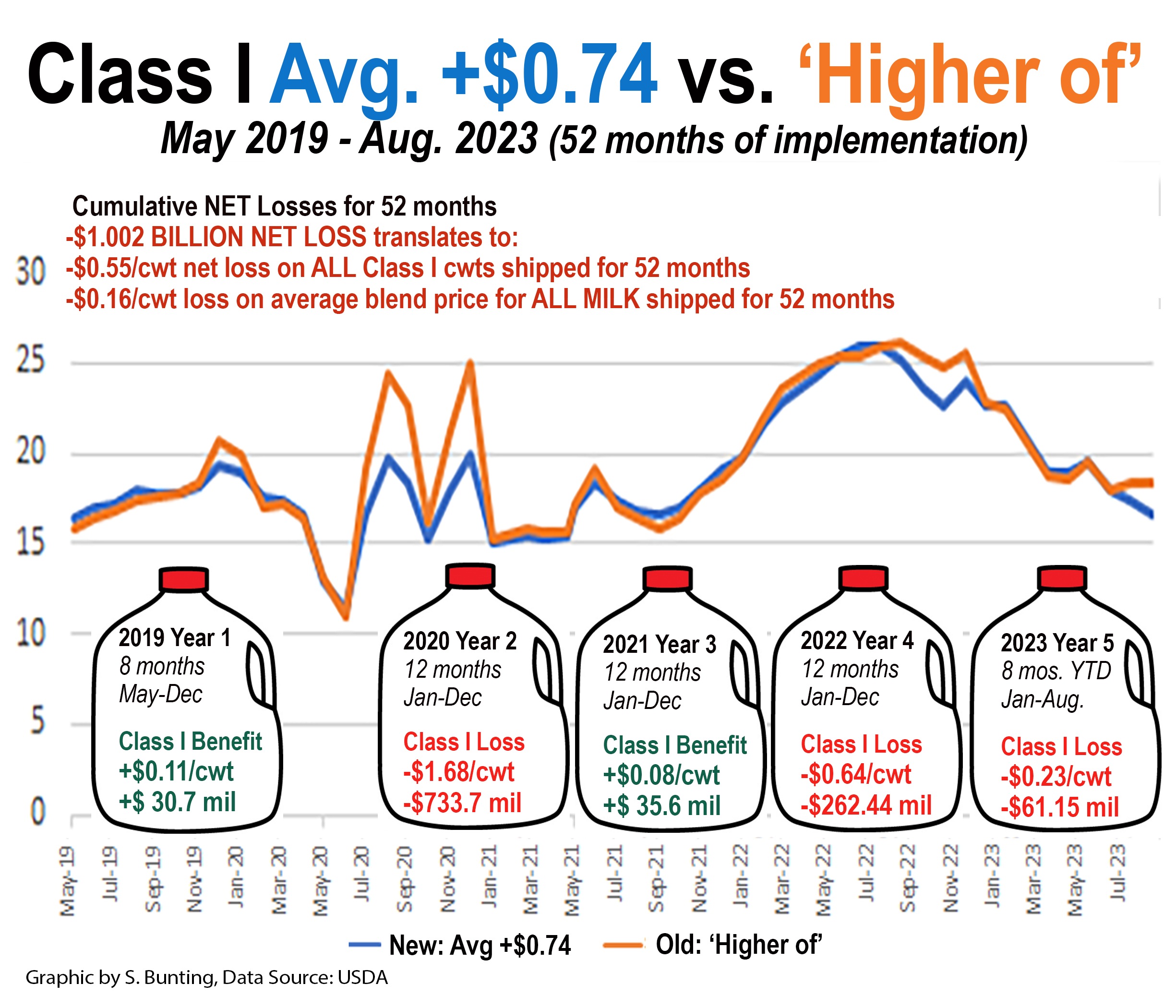
Since USDA implemented the ‘average of’ method in May 2019, net losses from this change are projected to exceed $1 billion after August 2023 milk is paid for in September.

On July 19, USDA announced the August advance Class I price mover at $16.62. If the previous ‘higher of’ method had been used, the Class I base price would have been $18.29. That’s a $1.67 per hundredweight loss on all Class I milk next month. July’s Class I mover was also calculated substantially lower (by $1.02) using the ‘average of’ vs. the ‘higher of.’ These losses will impact August and September milk checks for July and August milk.

Around 28% of all milk produced in the U.S. is Class I fluid use, so farmers stand to lose an additional 47 cents per hundredweight on all of the milk they market in August and 29 cents on all the milk they market in July — just from this formula change. This is on top of the market declines in the class and component prices. The loss to blended prices will be greater in some Federal Orders and less in others, and this does not include the impacts from de-pooling of higher-value Class IV milk.

The impact of the two-week Class I advance pricing factors is compounded by the ‘average of’ method, which is quite notable for July and August. Cheese and whey were in a tailspin lower; however, on the very next day after the August Class I base price mover had been averaged and locked-in on July 1-15 pricing factors, the dairy product markets began a huge rally, with cheese gaining nearly 40 cents in 8 trading sessions. This boosts the other class and component values much higher for the latter half of the month.

Over the 52 months of its implementation, the ‘average of’ formula has effectively removed an estimated 55 cents per hundredweight from farmer payment for all Class I milk, according to USDA data. On a blended uniform price, this comes out to a national average loss of 16-cents on every hundredweight of all milk used in all classes of products shipped from May 2019 through August 2023. That is like paying another checkoff for 52 months.

Among the other proposals included in the national hearing is the American Farm Bureau (AFBF) Class I and II proposal that seeks return to the ‘higher of’ with additional adjustments such as eliminating the two-week ‘advanced’ pricing.

IDFA’s Class I proposal seeks to keep the ‘average of’ and use either the current 74-cent-adjuster or a ‘rolling adjuster’ based on a calculated difference over 24 months, whichever is higher.

Milk Innovation Group’s (MIG) proposal seeks to keep the ‘average of’ but change the ‘adjuster’ monthly via a 24-month look-back with a 12-month lag.

Two Edge Cooperative proposals are included, one being a Class III-plus formula. The other would use the ‘higher of,’ but would base it on end-of-month four-week announced class and component prices instead of the two-week prior month advance pricing.

The hearing docket also contains four proposals on Class I differentials, including NMPF’s proposal to increase them in all locations by varying amounts as well as MIG’s proposal to lower them across the board by $1.60.

Two proposals from NMPF and National All Jersey will be heard to update milk component factors.

Six proposals will be heard on Class III and IV pricing formulas. Three are separate proposals from NMPF, IDFA and Wisconsin Cheesemakers to update processor credits, known as ‘make allowances,’ as well as three from Select Milk Producers on butterfat recovery, farm to plant shrink and nonfat solids yield.

In addition, the hearing scope includes four proposals on how dairy commodity products are surveyed, including NMPF’s proposal to remove 500-lb barrel cheese from the weekly survey, AFBF’s proposal to add bulk 640-lb block cheese and unsalted bulk butter, while California Dairy Campaign’s proposal would add mozzarella.

Dairy farmers can testify in-person at any time during the hearing, or virtually on Fridays. Beginning Fri., Sept. 1 and for each Friday thereafter until the hearing concludes, dairy farmers may testify virtually in 15-minute time slots beginning at Noon ET. There will be 10 slots for virtual testimony each Friday.

To be included, farmers must pre-register. The pre-registration for each Friday’s time slots will be available starting Monday of the same week at the USDA Hearing Website. For example, the link to testify on Fri., Sept. 1 will be available on Mon., Aug. 28. To submit exhibits for the record, email them to FMMOHearing@usda.gov by 8:00 a.m. ET on the day of testimony.

Those participating in the hearing in person should notify a USDA official upon arrival at the hearing. For additional information, contact Erin Taylor, Director, Order Formulation and Enforcement Division, USDA/AMS/Dairy Program at Erin.Taylor@usda.gov.

USDA inches closer to a national FMMO hearing

Consensus evident on some key proposals, such as returning the Class I mover formula to the ‘higher of’; but 10 packages contain over 30 variations and a few new biggies.

New to the party are:

  • AFBF wants to end ‘advance’ pricing of Class I;
  • NAJ wants uniform component-based pricing of Class I in all Orders;
  • MIG, made up of 7 fluid processors want organic exemptions, an assortment of new credits, and they want to knock $1.60 off the Class I differentials, forgetting they already get over $3.00 in ‘make allowance’ credits while not incurring those costs
  • California Dairy Campaign seeks an extension to consider alternative pricing formulas
  • Some proposals want to drop products (500-lb barrel cheese) from the FMMO formulas and price surveys, others want to add products (ie. 640-lb block cheese, mozzarella, unsalted butter)
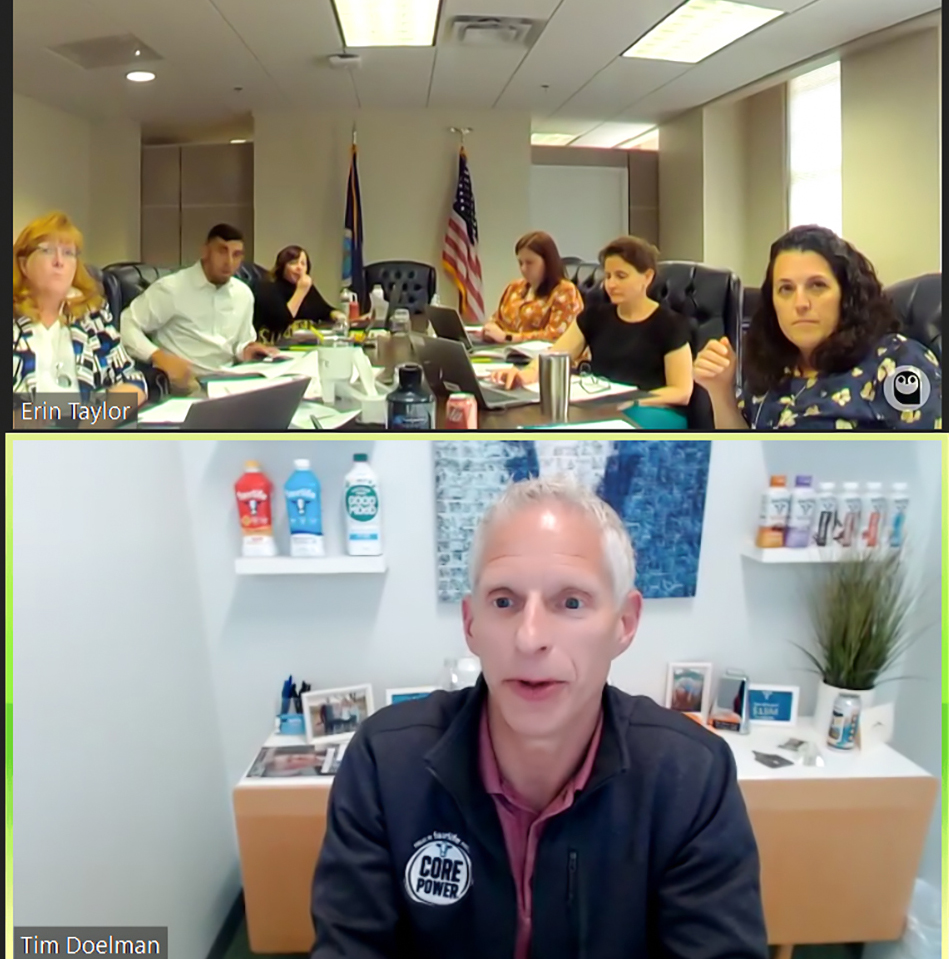
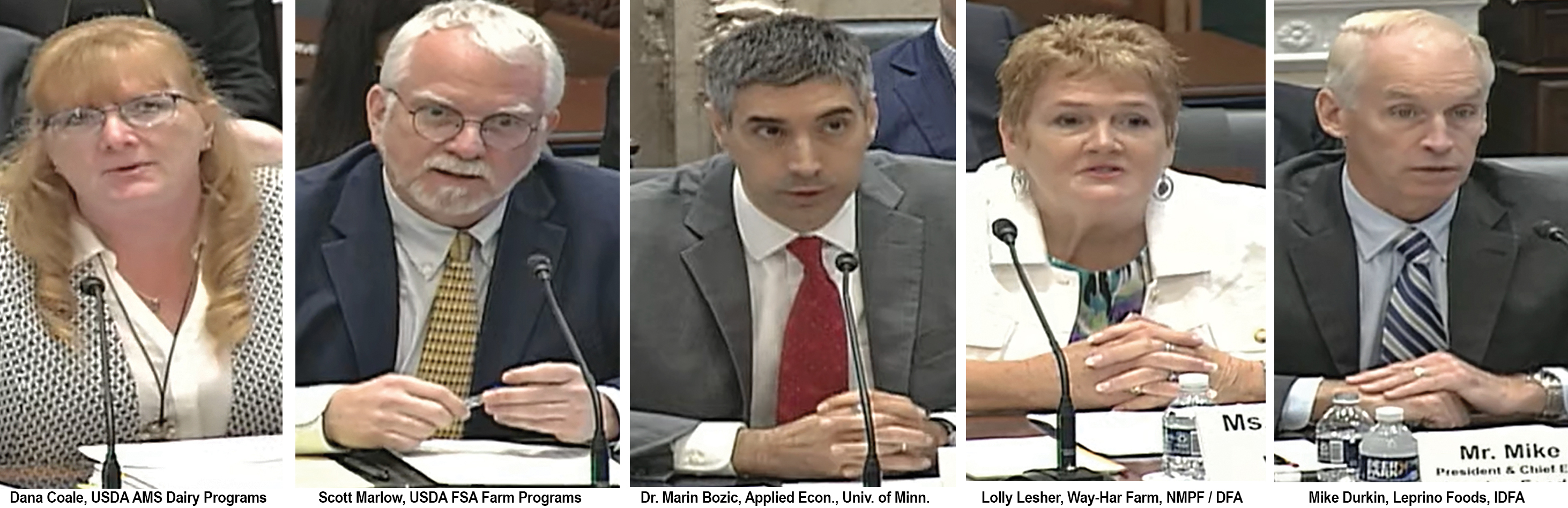
Dana Coale, Deputy Administrator (top, left) and Erin Taylor, Director (top, right) and their USDA Dairy Division staff engaged with leads for 30 hearing proposals contained in packages submitted by 10 organizations in the pre-hearing information session Friday, June 16. Tim Doelman (bottom), CEO of Fairlife, a Coca-Cola subsidiary, explains one of the Milk Innovation Group’s (MIG) proposals that bucks the consensus on going back to the ‘higher of’ in setting the Class I mover. MIG wants to keep the averaging method with their ‘Floored Adjuster” proposal. He said returning to the ‘higher of’ prevents processors from forward-pricing their milk like soda and other beverage companies do for other ingredients. MIG also wants to knock $1.60/cwt off the current Class I differentials, and they want an assortment of new credits (obviously forgetting that fluid milk processors already get more than $3/cwt in various Class III and IV product manufacturing credits. These so-called ‘make allowances’, are built in as credits on the Class I and II prices also, for costs that fluid processors do not incur.) Zoom screen capture

By Sherry Bunting, Farmshine, June 23, 2023

WASHINGTON – In preparation for a potential national Federal Milk Marketing Order (FMMO) hearing, the Dairy Division of USDA’s Agricultural Marketing Service had a pre-hearing information session Friday, June 16. During the day-long session, held virtually through zoom, Deputy Administrator Dana Coale, Director Erin Taylor and others heard presentations of the more than 30 pieces contained in proposals submitted by 10 organizations, and they engaged in questions for clarification as well as accepting requests for data before the 10 proposals were to be modified for final submission June 20.

While the Secretary of Agriculture has not yet declared a hearing, the AMS Dairy Division has publicized the timelines and action plan.

Coale stated that mandated time frames by Congress, govern the amount of time from the point at which a proposal is received to the end of a hearing 120 days later. “All of our proposed time frames are based on keeping us focused to meet the 120-day mandate,” she said.

“Once submitted, USDA will further evaluate them, and the Secretary will make the determination,” said Coale. “If the Secretary intiates rulemaking, you will see a hearing notice containing all proposals to be heard. This will be mid- to late-July, and we would expect to move forward – if a hearing is initiated – on Aug 23 as the start of that hearing.”

The location will be Carmel, Indiana, and because of the new time constraints, new procedures will be put in place, she said.

“Expect to see a very different process than customarily done to create a very efficient process while maintaining transparency and a robust evidentiary record,” she explained, noting this includes a process for submitting testimony in advance, and a naming vs. numbering convention for exhibits.

After the hearing is noticed, there will be another information session, said Coale.

“It takes an entire village,” she stressed. “Ex parte communication does not begin until a hearing is noticed, so if you have questions or need explanation or discussion on data for submitted proposals, contact us at fmmohearing@usda.gov

The marquis proposal is the comprehensive package submitted by National Milk Producers Federation (NMPF) that set into motion the Secretary’s call for other proposals. The NMPF package has five proposals, previously reported in Farmshine through various articles since the October stakeholders meeting hosted by American Farm Bureau in Kansas City in October 2022.

Retired cooperative executive Calvin Covington is the lead on one of the five NMPF proposals, which seeks to update skim components to more accurately reflect the percentage of protein, nonfat solids and other solids in a hundredweight of milk today.

Covington said he also expects to testify on the NMPF proposal to raise Class I differentials with a new pricing surface map, something that has not been done since 2007-08, and the proposal to return the Class I base price ‘mover’ to the ‘higher of’. The current average plus 74 cents method has been in place since May of 2019, which produced unintended consequences and losses for dairy farmers.

In a phone interview Tuesday, June 20, Covington explained that after more than a year of task force meetings and discussions via NMPF with its members and their farmer members, “We’ve gotten this far, and we have got a consensus,” he said of the NMPF package.

In addition to updating skim components and Class I differentials and changing the Class I ‘mover’ back to the ‘higher of,’ the NMPF package includes a proposal to modestly update make allowances and to discontinue the barrel cheese price in the Class III protein formula while allowing 45-day forward-priced nonfat dry milk and dry whey to be included in the formula price survey instead of the current 30-day forward-price limit.

“It took a year, and that’s pretty good, to have coast-to-coast consensus on five major proposals,” said Covington. “Then you also read the Farm Bureau’s proposal and there’s pretty good consensus there too.” 

Central to both the NMPF package and AFBF package of proposals is strong support for returning the Class I mover formula back to the previous ‘higher of’ method.

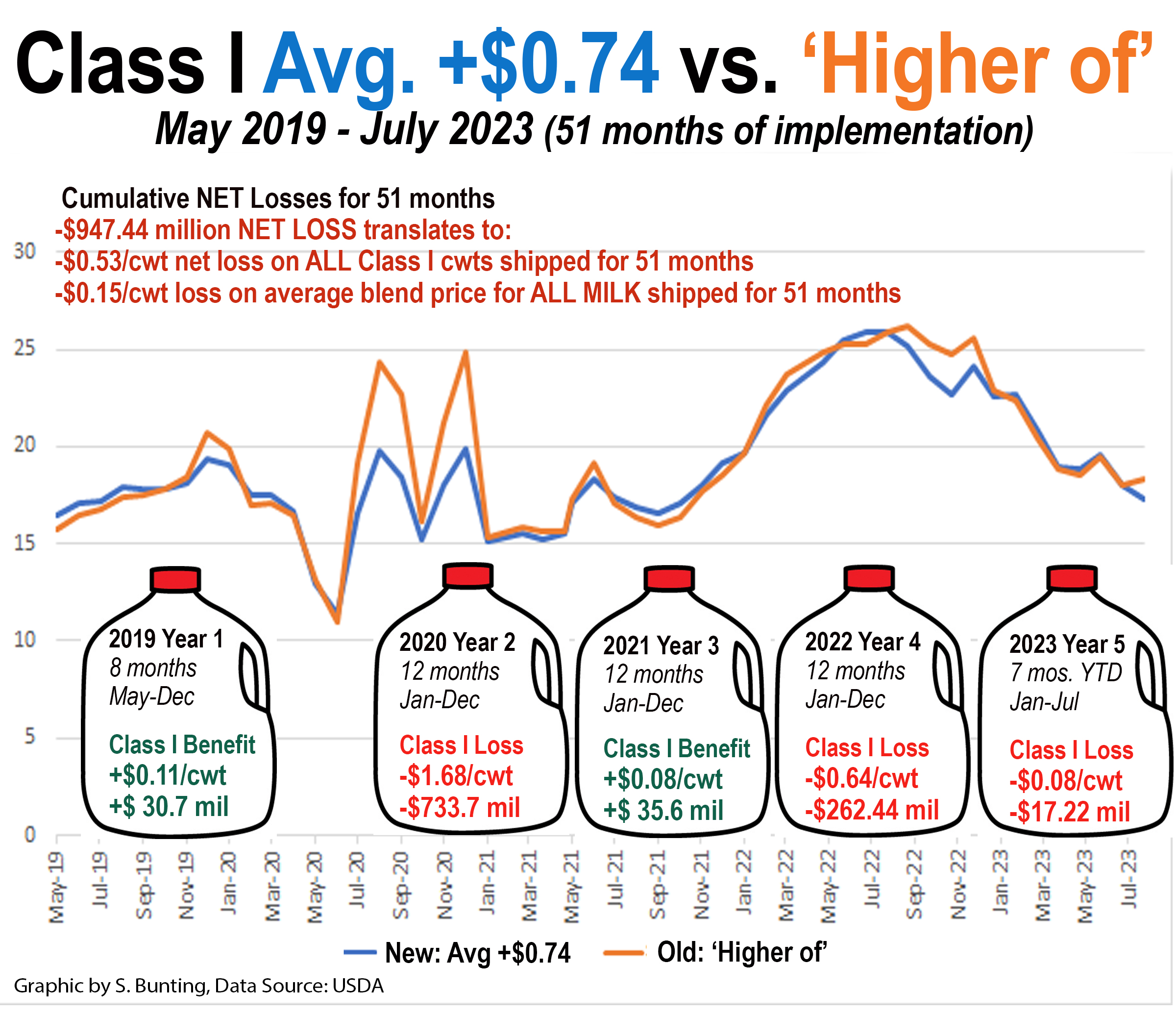
(Farmers have had a cumulative net loss of nearly $950 million, equivalent to losing 53 cents on every hundredweight of milk shipped for Class I use for the past 51 months or 15 cents per hundredweight on the FMMO blend price for all milk across all 51 months — since the change to ‘average of’ was made in May 2019 via the 2018 Farm Bill. In fact, the July 2023 Class I mover was announced June 22, 2023 at $17.32, which is a whopping $1.02 below the $18.34 it would have been under the ‘higher of’ method.)

AFBF supports NMPF’s proposal to restore the Class I mover to the ‘higher of’ Class III or IV, to drop the barrel cheese price from the Class III component and price calculation, to update component values into Class III and IV formulas, and to update Class I differentials, but notes this should be done through careful review where changes are based on a transparent record.

AFBF chief economist Roger Cryan stated that AFBF will defer to NMPF for substantiation on the Class I mover change, but if by any chance NMPF would back away from this proposal, Farm Bureau wants it kept on the table and will defend it.

On adjustment to Class III and IV product make allowances, AFBF supports this under the same logic as the NMPF proposal, but states that “such adjustment cannot be fairly undertaken except in using the data from a mandatory and audited USDA survey of, at least, those plants participating in the National Dairy Product Sales Report (NDPSR) survey.” 

The difference is NMPF says it will seek mandatory surveys through legislation, whereas AFBF sees USDA as already having the authority to do this.

AFBF’s package includes some “new” proposals as well. One would add 640-pound block cheese to the Class III component and price formula and the NDPSR survey and another would add unsalted butter to the butterfat and protein calculation and the NDPSR survey.

AFBF includes a proposal to update the Class II differential to $1.56 to account for current drying costs and to adjust formula product yields and include an adjustment to the ‘make allowances’ for cooperatives and plants that “balance the market.”

The AFBF package also cites “universal milk check transparency requirements” regarding clarity to be shared on producer milk checks regarding pooled volume, Order value and actual payment for pooled and nonpooled milk.

AFBF seeks a seasonal Class I differential adjustment to “address seasonal differences in supply and demand.”

The most notably divergent AFBF proposal is one that seeks to eliminate the advanced pricing of Class I milk and components and the advanced pricing of Class II skim milk and components. It would base both on the 4-week “announced” Class III and IV components and prices instead of the 2-week “advanced” pricing factors. The advanced factors are calculated for a given month during the first two weeks of the previous month and have been part of FMMO pricing for decades.

Edge Dairy Farmer Cooperative, representing farmers in nine Midwest states shipping to 34 processors also proposes ending advanced pricing of Class I.

A newsflash proposal came from the Milk Innovation Group, which was formed within the last few years and testified at the recent Southeast FMMO hearings. 

MIG is made up of seven companies — Anderson Erickson Dairy, Aurora Organic Dairy, Danone North America, Fairlife, HP Hood, Organic Valley/ CROPP Cooperative, and Shamrock Foods.

They want to REDUCE Class I differentials, whereas NMPF and AFBF support updates that increase them. 

MIG companies want to establish Class I differentials that remove the “Grade A compensation” portion that has been built into all Class I differentials from the beginning, as well as removing the “market balancing compensation.” 

Together, these removals would account for the $1.60 per hundredweight base differential that all FMMOs receive. As explained in the pre-hearing session, this would have the net effect of reducing Class I differentials (and producer pay prices) by $1.60 per hundredweight across all FMMOs.

In their justification, MIG writes that it is “far past time for the base Class I differential to be reconsidered in light of market changes, including the exploding growth of dairy beverage alternatives… and the exponential growth of non-fluid milk products often sold in the export market.”

(In this reporter’s analysis and opinion, reducing Class I differentials instead of raising them, ignores the fact that every Class I fluid milk processor – including the aseptic, ultrapasteurized, organic, ultrafiltered and other ‘specialty’ fluid milks – are already getting more than $3.00 per hundredweight embedded as a processor credit in the Class I base price mover by virtue of the cumulative sum of all product make allowances on the Class III and/or IV pricing factors used to establish that mover, but since they don’t make Class III and IV product, they don’t incur these costs. Now they want $1.60 more, plus “assembly” and other credits?)

The MIG also proposes exempting processors of Class I organic milk from paying into FMMO pools as long as they show they pay their producers at least the minimum FMMO price. There are a few other guard rails to this. 

They also want to receive “assembly credits,” specialty credits, and a higher shrink credit (forgetting that they already get make allowance credits that don’t even apply to them).

Citing the “unequivocal decline in Class I sales,” the MIG sets the stage with its package of proposals to transition further away from pricing mechanisms that support local fresh milk in favor of aseptic, extended shelf-life milks and specialty products. Some of the companies in the MIG are making dairy beverages that are not even Class I, and several are getting big into plant-based and other non-milk alternatives and blends. (Is that a conflict of interest?)

USDA AMS also accepted further information on the prior petition by the International Dairy Foods Association (IDFA) and Wisconsin Cheese Makers Association (WCMA) to update make allowances. With this additional information, their petitions are back on the table and are based on voluntary cost surveys.

Additionally, IDFA submitted a proposed alternative method for establishing the Class I mover they call the “Floored Class I Mover proposal.” This is IDFA’s response to NMPF’s proposal to return Class I to the ‘higher of.’

The IDFA alternative is described as using the current simple average of the Class III and IV advance pricing factors to set the base Class I price, and floor the adjuster at the current 74 cents — while allowing that adjuster to increase if a two-year look-back shows it was deficient vs. the higher of. This is a complex two-years back “making producers whole” in the two-years forward with the adjuster always being floored to go no lower than 74 cents even if it turns out that this method benefited farmers vs. the ‘higher of.’

The IDFA Class I proposal contains several pages of justification for the averaging method built around “preserving price hedging and risk management” for processors, particularly those in the ‘value-added’ category,” such as ultrafiltered and aseptic Class I milk products.

But it doesn’t end there…

National All Jersey (NAJ) brought forward its proposal, explained by Erick Metzger. “One mirrors NMPF’s proposal to update skim component factors in the Class III and IV formulas, except we want to see it be a simple annual update based on the previous year’s average, with an appropriate lag time to address risk management tools instead of being based on a three-year average,” he said.

In addition, NAJ proposes that FMMOs 5, 6, 7 and 131 (the Southeastern Orders and Arizona) become multiple component pricing (MCP) Orders instead of pricing on a fat/skim basis.

NAJ also proposes Class I payment requirements to be based on MCP pricing instead of skim / butterfat in all FMMOs, nationally.

“We are proposing uniform pricing across all orders — both on how processors pay for components and how producers are paid for components,” said Metzger. “Extensive updates are needed to Orders 5, 6, 7 and 131, and the needed Order language already exists in the other Orders.”

The NAJ proposal notes that Class I should be paid on actual solids, instead of valuing the skim on a skim basis. “In our proposal, it would be valued or priced on actual skim components,” he said.

What this means is if a dairy farm’s actual components processed (in Class I) were below the standard components in the Class III or IV formulas, the processor obligation would be less; and if the farm’s skim components are greater than the standard, then the obligation of Class I processors to the pool would be more. In short, accounting for actual skim components in the NAJ proposal, would replace the current pricing of Class I skim on a pounds of skim basis.

Select Milk Producers cooperative submitted proposals to update product yields to reflect “actual farm-to-plant shrink,” to update the butterfat recovery factor and to update nonfat solids yields. According to their own limited 5-year-average analysis the three proposals combined would net 13 cents/cwt on the Class III price and 42 cents/cwt on the Class IV price, but they’ve requested more data from USDA AMS to analyze — if their proposals are accepted for a hearing.

For its part, Edge Cooperative states in a cover letter to its proposals that a hearing should occur after the farm bill. “There is no imminent crisis that would present a compelling reason to initiate a hearing before the next farm bill is enacted,” the proposal states.

In the farm bill, Edge seeks a mandatory cost of processing survey before make allowance updates could be heard. Edge also seeks legislative language to expand flexibility to base individual FMMOs around something other than uniform pricing, to be determined on an Order by Order basis. This “flexibility” was explained by Lucas Sjostrom and Marin Bozic at the Farm Bureau stakeholders meeting in Kansas City last October.

However, Farm Bureau’s package of proposals asserts that there is no reason to hold off on a hearing while waiting for a farm bill, and indeed seeks the fastest resolution to the Class I ‘mover’ issue. Furthermore, Congress previously mandated timelines that don’t allow “waiting” once proposals are received by USDA. This process is in motion, unless Secretary Vilsack refuses a hearing on any of the proposals.

AFBF, in fact, cited areas of the Agricultural Agreement Act that give USDA authority to do mandatory cost surveys, without further legislation, because the Secretary has discretion to require any reporting deemed necessary from FMMO participating plants.

On the Class I ‘mover, Edge proposes two options, either a Class III-plus option if the ‘advanced pricing’ is retained or if the ‘higher of’ option is used, then to base it on final 4-week announced skim milk prices each month. This option would effectively end the 2-week advanced pricing factors and advance pricing of the Class I ‘mover,’ which has also been proposed by AFBF.

The Edge proposals include a request to align make allowance changes so that they don’t impact ‘risk management tools’ and a proposal to add Order formulation language about the information handlers shall furnish to producers with the intent of “transparency in producer milk checks.”

The California Dairy Campaign’s proposal asks USDA to extend the proposal deadline and to add mozzarella to the Class III component and price formula and the NDPSR survey. They also want consideration of “alternative pricing formulas that guarantee dairy farmers are paid according to current market rates.”

The California proposal includes a National Farmers Union (NFU) Dairy Policy Reform Special Order of Business that was passed at the 2023 NFU Convention in San Francisco. It states opposition to the call for a federal milk marketing order hearing, noting that, “If a hearing is granted, it is essential that any modifications to the federal order minimum pricing formulas take into account the volume and value of all dairy products, particularly high-moisture cheeses such as mozzarella.”

Dairy Pricing Association (DPA) submitted a few proposals explained by Wisconsin dairy farmer Tom Olson. One seeks to pay Grade B milk at FMMO minimums, but without a producer price differential (PPD).

DPA also proposes a supply-balancing feature, whereby milk handlers notify farms at least 7 days prior to milk disposal action, stating the baseline production needs, how much to reduce production, and for how long, with farmers making this reduction by dumping (or not producing) this milk.

In effect, the DPA proposal includes a processor-led supply management program, not a government intervention. But to do it, the FMMOs would be the arbiter, and therefore all Orders would have to be amended to require 100% mandatory participation and pooling of all U.S. milk. Something like that may require legislation since a producer referendum bloc-voted by cooperatives could vote it down, and it’s unclear how unregulated areas would be included since states like Idaho already voted the FMMOs out.

Currently, only Class I milk handlers are required to participate in FMMOs within marketing areas that have FMMOs. Participation is voluntary for most Class II, III and IV processors. Over the past three years, roughly 60% of total U.S. milk production has been pooled on FMMOs.

-30-

NMPF’s FMMO Modernization Plan hits high note on Cl. I mover, but eliminating barrel cheese from protein formula is head-scratcher

By Sherry Bunting, Farmshine, October 28, 2022 (updated with additional information after publication)

The National Milk Producers Federation (NMPF) Board gets high marks for passing a Federal Milk Marketing Order Modernization Plan this week at its annual meeting in Denver, Colorado that includes returning the Class I mover to the previous ‘higher of’ formula — a virtually unanimous consensus item that came out of the Farm Bureau Forum in Kansas City earlier in the month.

However, the NMPF modernization plan also includes a few items that were not fully discussed, items that seem to run counter to what dairy farmers were prioritizing, and it leaves out a few items the consensus-builders were vocal about in Kansas City.

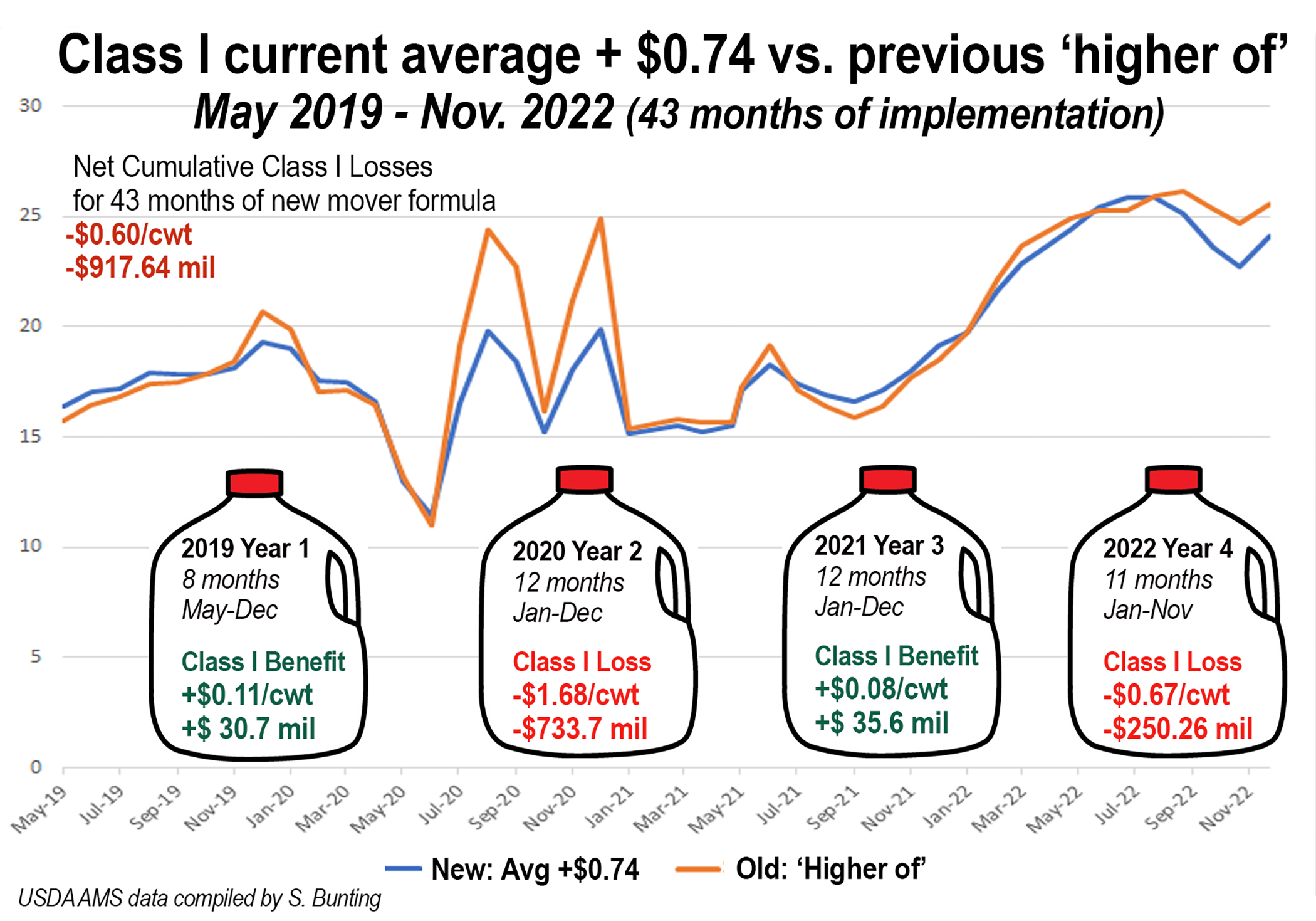
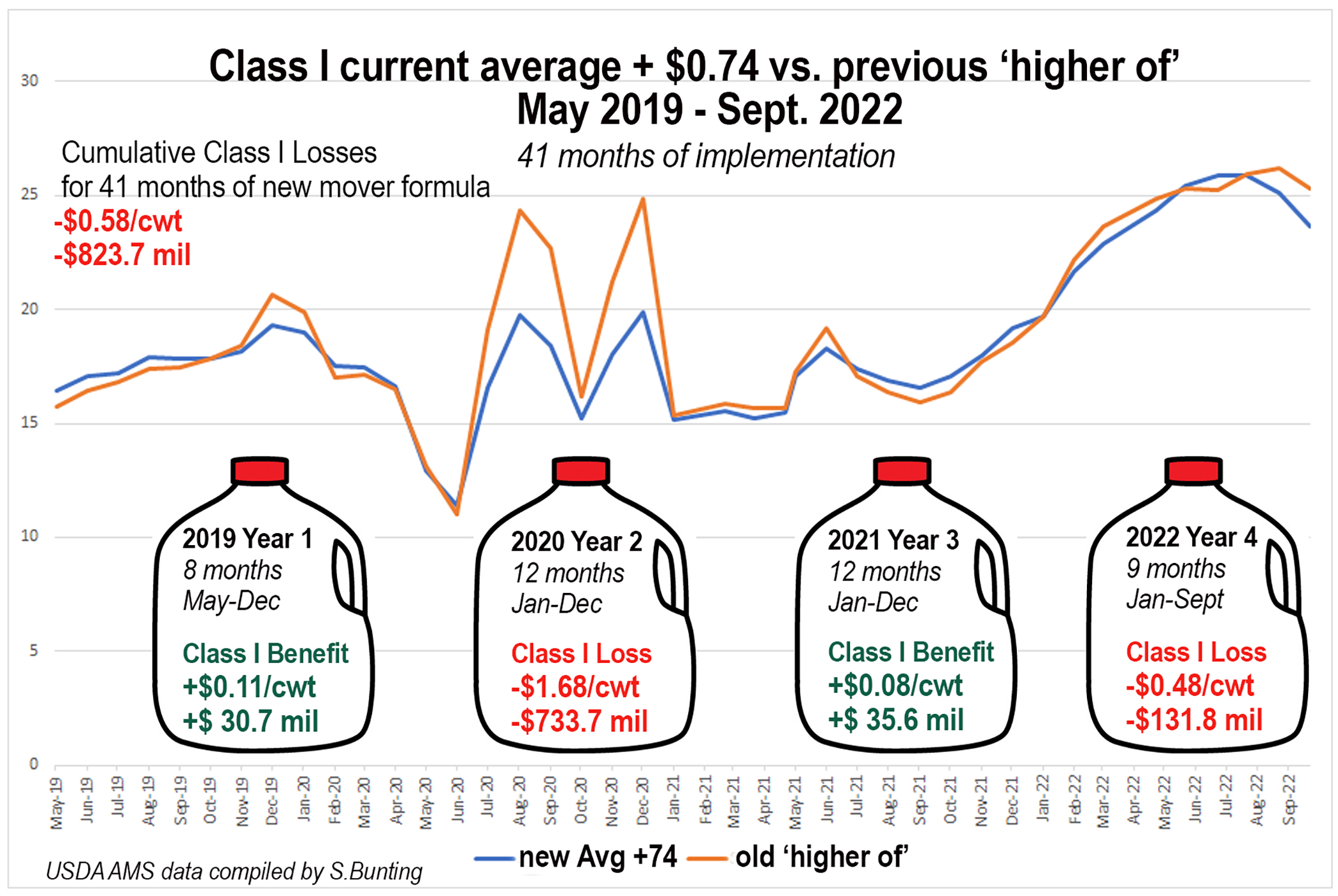
The recommendation to return to the higher of Class I mover is an important response by NMPF to dairy farmer concerns. That ball has been in USDA’s court after the first two years of implementation, according to the farm bill language that changed it to an averaging method in the first place. Four years and nearly $1 billion in cumulative Class I net value losses have passed (see chart), but Ag Secretary Tom Vilsack said he needed to see “consensus” before allowing a hearing to be opened.

In post-conference interviews, several Farm Bureau Forum attendees said this was their main priority for participating  – to show Secretary Vilsack there is consensus to “fix the mistake.”

For NMPF to include it in their plan is a win.

Another item in the NMPF plan is to develop a process to ensure make allowances are reviewed more frequently through legislation directing USDA to conduct mandatory processor cost studies every two years and to update the make allowances contained in the USDA milk pricing formulas.

There was general agreement from stakeholders in Kansas City that processor costs need to be evaluated and make allowances updated. Over half of the table-groupings identified this. There was also healthy discussion of some ways to do this to minimize the sudden impact on farmer milk checks – all good points for developing a process and for a USDA hearing process to fully evaluate it.

Of the bones to pick, one NMPF recommendation that runs counter to what more than half of the table-groupings prioritized in Kansas City concerns expansion of the pricing survey to include more products. NMPF’s task force decided not to add any products to the price survey, and in fact they are recommending dropping one. 

On the chopping block is the 500-pound barrel cheese price in the protein calculation for Class III.

Initially, NMPF’s task force committees looked at adding unsalted butter, skim milk powder (a higher value more standardized product than nonfat dry milk), and they looked at mozzarella cheese. In all three cases, the task force chose not to recommend additional products.

The fact that they are recommending elimination of a product from the pricing survey is curious.

Less than one-third of the Kansas City table-groupings listed elimination of barrel cheese pricing as a priority. Few people questioned NMPF economist Peter Vitaliano on the sensibility of this recommendation – except for yours truly.

I asked this question: “On the blocks and barrels, what do you foresee happening if the barrels are dropped? Right now we’ve got barrels doing more trading than blocks. We’re really not seeing much trading at all in blocks on the CME spot market. Also, would this mean that the cost of making those barrels will be backed out of the processing cost survey in terms of establishing new make allowances?

Vitaliano gave this answer: “That’s an interesting question. I’ve heard different interpretations of what’s going to happen to barrels if they are not used in the formula. Some folks feel they’ll just be priced at a discount to blocks, and the cash market for barrels will go away. I’m not sure I buy into that totally because barrel cheese is becoming a different product.”

The NMPF economist continued with his answer: “Under current quality standards, barrel cheese is the only major way that you can get uncolored whey, which is demanding a premium in the marketplace because all of these nutrition products, these high value nutrition products in demand by millennials and others, they don’t want to show ‘bleached whey’ on the label, they want the white uncolored whey powder that comes from barrel cheese production.” 

Apparently, yellow whey from block Cheddar production is less desirable. But we’ve known this for at least 15 years.

In other words, according to Vitaliano, there is right now a ‘subsidy’ effect from the premium paid for the higher value of the uncolored whey that creates the environment to produce more barrel cheese – regardless of what the cheese market is doing. 

Vitaliano noted that FDA is going to consider some changes that might alter how this cross-product scenario is playing out by allowing microfiltered milk to be used in plants producing standard-of-identity cheese, but the bottom line is that barrel processors making whey protein concentrate as co-products benefit from the white-whey premium whereas block cheese processors do not. 

When the two are averaged together in the Class III protein formula, they represent different markets when they historically moved together, said Vitaliano.

Interestingly, however, barrels have traded higher — not lower — than blocks on the CME for most of this year.

In the purely cheese market history, barrels and blocks moved together more closely, then in times of market shocks beginning in 2009, we would see periods of wide spreads and inversions, sometimes barrels over blocks and most of the time blocks over barrels. During intervals in 2016-17, barrels sold at 10 to 20-cent discounts to blocks. Since 2018, we’ve seen long intervals of barrels over blocks by up to 25 cents and then the flipside with blocks over barrels.

This year (2022), barrels have sold at a premium to blocks consistently since April. The barrel premium over blocks stood at 15 cents per pound last week. That’s a significant impact on farm-level milk prices — to the good.

Coincidentally, barrel prices crashed this week, losing 22 cents, where blocks lost a nickel, thereby pushing barrels under blocks by a few cents on Oct. 25, the same day that the NMPF Board voted unanimously to endorse the multi-pronged modernization plan that includes dropping 500-lb barrel cheese out of the FMMO end-product pricing formula.

For the year (2022), barrels will likely average a nickel above blocks.

There is also the question of price discovery. For the year, we have seen more barrels traded on the CME compared with the volume of blocks.

When following up in a question about what happens to price discovery if the barrels are eliminated from the pricing formula, Vitaliano responded that 15% of the cheese reported in USDA’s weekly price survey is barrel cheese. Rather than reduce the weighted average to reflect that, and rather than including mozzarella in the pricing survey (a higher volume and value item than cheddar), NMPF is simply recommending the elimination of barrels to avoid the block/barrel spread.

Vitaliano said pricing formulas are based on the USDA price survey, not on the CME spot market. However, the CME spot market is used to set pricing for the USDA-reported sales.

Vitaliano also noted that price discovery on the CME spot market is achieved even if no product changes hands because it is a marginal market-clearing trade in the first place.

“The whole industry is watching that market, so if that block price is, let’s say, overvalued, and I have extra blocks and I think that market is high, anybody can go to that market and sell; or if you think it’s undervalued, you can go to that market to buy,” he said. “Just because there’s not a lot of trading, doesn’t mean it’s not necessarily representative of the market… we just have to trade the marginal excess or shortage.”

According to Vitaliano, even the regulators have looked at this and concluded that since the whole industry watches that market — everybody has the opportunity to jump in, and they are not shy if they have a different idea about what the market should be, they can go in and make bids or offers. Those bids and offers move the market whether or not a trade is completed.

Even in light of these explanations, the NMPF recommendation to eliminate barrels from the pricing formula remains a bit of a head-scratcher and needs more discussion and evaluation.

NMPF also wants to expand the forward pricing window for whey and nonfat dry milk (NFDM) price-reporting to 45 days instead of 30 in order to “capture more of the global market in the pricing formula.”

However, when asked why NMPF is not seeking to expand the price reporting to include skim milk powder (SMP) – the globally traded powder – as a means of capturing more of the higher-value global market, Vitaliano said SMP is sold at differing standardized protein rates as a value-added product. NFDM, on the other hand, often has more protein in it, but it’s variable and a lower-priced bulk commodity. It’s a true bulk product that is made to soak up excess milk, he explained. 

Vitaliano also noted that NFDM is used by domestic cheese makers, whereas SMP is not. 

Ditto the answer for unsalted butter. While the sales of unsalted rival salted butter in volume, and it is a bulk product more consistent with higher-value global markets, the NMPF task force perspective is that the unsalted butter is also a step up as a value-added product for a specific market in foodservice, not a commodity bulk product a plant would make with excess milk.

Ditto for mozzarella, which NMPF maintains is already priced off the USDA-reported cheddar price even though the U.S. sells more mozzarella than cheddar today.

Next week, we’ll dig into the yield factor changes in the NMPF plan and the glaring absence of a recommendation on depooling issues across the country. Solving the depooling conundrum was a priority listed by over half of the consensus-building table-groupings at the Farm Bureau Forum and producers from multiple regions were vocal about it throughout the three-day meeting.

-30-

AFBF milk pricing forum draws 200 stakeholders to KC, some consensus gained, high priority given to return Class I ‘mover’ to ‘higher of’ formula

By Sherry Bunting, Farmshine, October 21, 2022

KANSAS CITY, Mo. — It was intense, productive, enlightening, and at times a bit emotional. And, yes, there was consensus on some key points during the American Farm Bureau Federation (AFBF) Federal Milk Marketing Order (FMMO) Forum in Kansas City last weekend (Oct. 14-16).

The event was a first of its kind meeting of the minds from across the dairy landscape, involving mostly dairy farmers, but also other industry stakeholders. It was planned by a 12-member committee representing state Farm Bureaus from coast-to-coast, working with AFBF economist Danny Munch.

Farm Bureau president Zippy Duvall kicked things off Friday afternoon, urging attendees to get something done for the future of the dairy industry, to stay cool, leave friendly, and set a pattern for continuing conversations.

“We have the people in this room who I hope can come up with guiding principles,” said Duvall, noting that a meeting like this is something he has dreamed about for years, even prayed for. He talked about his background as a former dairy farmer and assured attendees that milk pricing is a topic he is very interested in.

He challenged the group to come at it with “an open mind. The answers are sitting in this room, not on Capitol Hill. There are some geniuses in this room, people who really understand this system,” said Duvall.

“We all have ideas, and we can lend an ear to other ideas. We learn a lot if we listen to each other,” he said, noting a few of the existing Farm Bureau dairy policy principles: that FMMOs should be market oriented, with better price discovery. They should be fair and transparent, and farmers should be able to understand and compare milk checks.

Hearings not legislation

Duvall noted AFBF agrees with NMPF that future FMMO changes should go through the normal USDA hearing process, not through Congressional legislation. By Sunday, this seemed to be a point of consensus, along with the recognition that FMMOs need updating, but they are still vital for farmers and the industry. 

On the Class I ‘mover,’ specifically, Munch noted Farm Bureau already adopted the recommendation through its county, state and national grassroots process to return to the ‘higher of’ — plus 74 cents. The addition of the 74 cents is to make up for the unlimited losses incurred over the past four years.

For NMPF’s part, chief economist Peter Vitaliano and consultant Jim Sleper laid out a series of updates the economic committee’s task force is recommending to the NMPF board, which will vote at the annual meeting at the end of October.

These recommendations include going back to the simple ‘higher of’ for the Class I ‘mover,’ updating make allowances and yield factors, doing a pricing-surface study to update Class I differentials, making changes in the end-product pricing survey to allow dry whey price reporting of sales up to 45 days earlier, not 30 days, and eliminating the 500-pound barrel cheese sales from the Class III cheese price formula to base it only on the block cheese.

Intense, informative, valuable

The three days were intense, covering a lot of information, and were shepherded by expert panels and ‘cat herder in chief’ Roger Cryan, AFBF’s chief economist since October 2021.

Munch served as the emcee — akin to the ghost of milk pricing Past (Friday), Present (Saturday) and Future (Sunday). He introduced the various panels and provided economic snapshots and questions for the 25 breakout tables to discuss, decide and deliver.

Meeting organizers reshuffled the deck of 200 attendees from 36 states and representing nearly 150 state and national producer organizations, Farm Bureau chapters, regulatory agencies, farms, co-ops, processors, financial and risk management firms, and university extension educators.

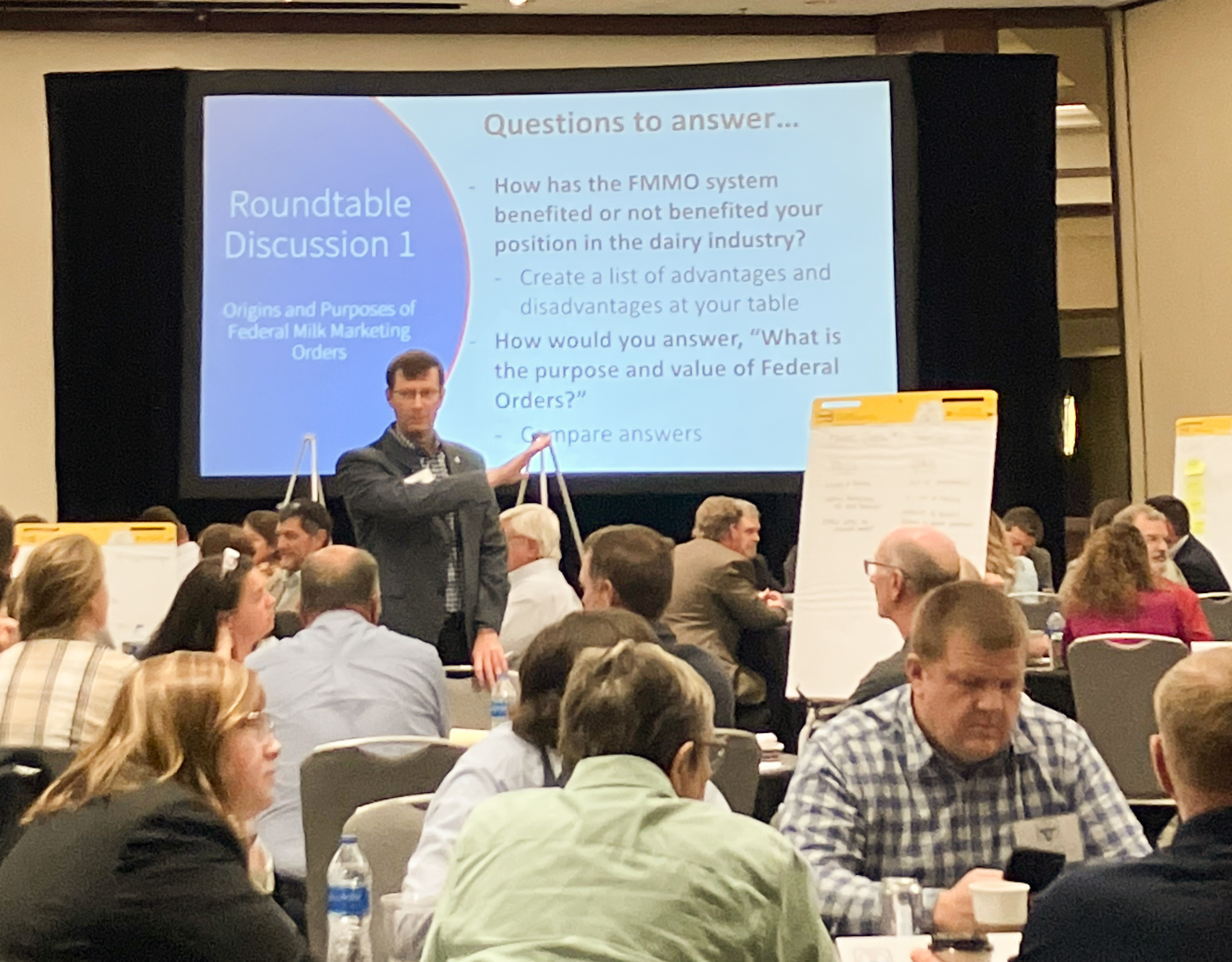
Attendees were assigned tables with a number on the back of each name tag. The goal was to mix the table-groupings for varied geographic and industry perspectives. Each table was equipped with its own large flip tablet mounted on an easel. 

According to Munch, Farm Bureau will scan and collate the information from all of the large tablets and issue a preliminary report to attendees followed by a public report later this year.

On Sunday, the open microphone was lively and most tables reported from their flip tablets. Overwhelmingly, attendees said they found value in the meeting and appreciated the platform. They reported a desire to keep the conversations going, to do this again, not just every 20 years, and not just in response to a problem, but to be forward-looking with the many challenges on the dairy horizon.

Platform for next big issue

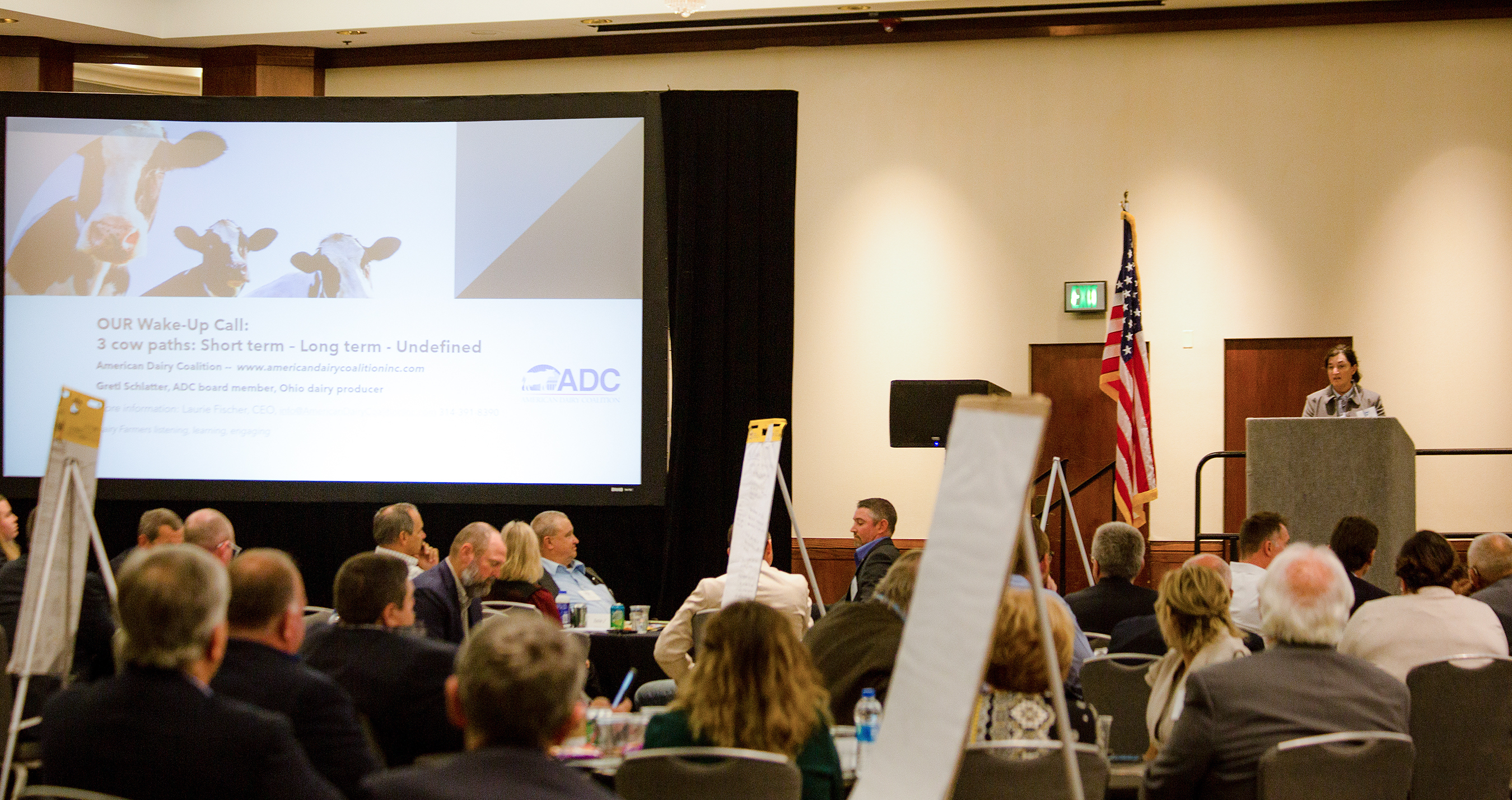
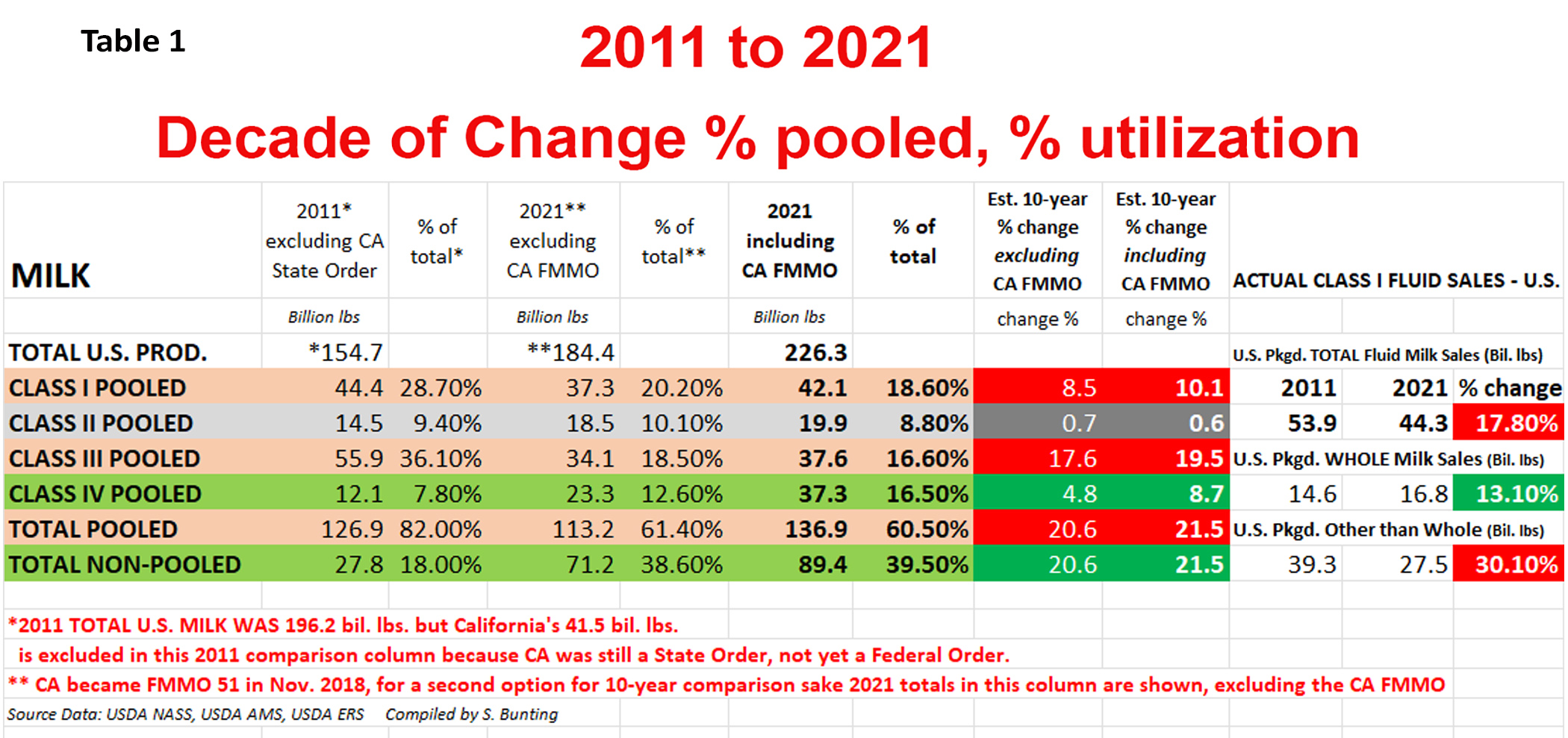
For example, Gretl Schlatter, an Ohio dairy producer on the board of American Dairy Coalition (ADC) noted that only Class I milk is mandated to participate in FMMOs, and that today, the FMMOs are weakened with only 60% of U.S. milk production participating in the revenue-sharing pools.

“Where will we be in five years? We do not want to give up on fluid milk – our nutrition powerhouse,” she said. “The issue now is federal milk pricing but the next one coming — fast — is the sustainability benchmarks, the climate scores. We need to keep meeting like this as an industry, keep talking to each other, and get ready for the next big thing affecting our farms and family businesses.”

This was touched upon by Duvall and others, but Cryan reminded everyone that, “Federal Orders are complicated enough without adding the sustainability discussion to it.”

Duvall reminded attendees that this meeting was Farm Bureau’s response to the words of Ag Secretary Tom Vilsack last year, when he said there would be no USDA hearing until the dairy industry reaches some “consensus” on solutions.

This set into motion an already dairy-active Farm Bureau that had formed its own task force, responding to grassroots dairy policy coming up from the county and state levels to national through AFBF’s grassroots process.

In fact, NMPF’s Vitaliano, noted that, “having Roger Cryan at Farm Bureau makes it easier to do this,” to partner on formulating dairy policy because of his background. Prior to coming to Farm Bureau a year ago, Cryan was an economist for NMPF and then for USDA AMS Dairy Programs.

The first hour of the first day included a recorded message from Secretary Vilsack and an in-person presentation by Gloria Montano Green, USDA deputy undersecretary for Farm Production and Conservation.

They encouraged attendees to work together and told them what the Biden-Harris administration has done and is doing for dairy. Primarily, they went through a list of funding and assistance, including the improved Dairy Margin Coverage, the PMVAP payments, Dairy Revenue Protection, Livestock Gross Margin, dairy innovation hub grants and the recent funding for conservation and climate projects that includes 17 funded pilots involving dairy. 

They told attendees that the dairy industry is “far ahead” on climate and conservation because it has been involved in these discussions and is already mapping that landscape.

Dana Coale, deputy administrator of USDA AMS Dairy Programs, took attendees through the FMMO parameters. She engaged with the largely dairy farmer crowd in a frank discussion of what Federal Orders can and cannot do. The headline here is that this current time period before a hearing is a time when she and her staff can talk freely and give opinions. Once a hearing process begins, she and her staff are subject to restrictions on ex parte communications.

Consensus to go back to ‘higher of’ formula

If there was one FMMO “fix” that achieved a clear consensus and was given priority, it was support for going back to the Class I ‘mover’ formula using the ‘higher of’ Class III or IV skim price instead of the current average plus 74 cents method that was changed in the 2018 farm bill.

Since implementation in May 2019 through October 2022, the new method will have cost dairy farmers $868 million in net reduced Class I revenue, which further erodes the mandatory Class I contribution to the uniform pricing among the 11 Federal Milk Marketing Orders (FMMO), setting off a domino effect that has led to massive de-pooling of milk from FMMOs and decreased Federal Order participation.

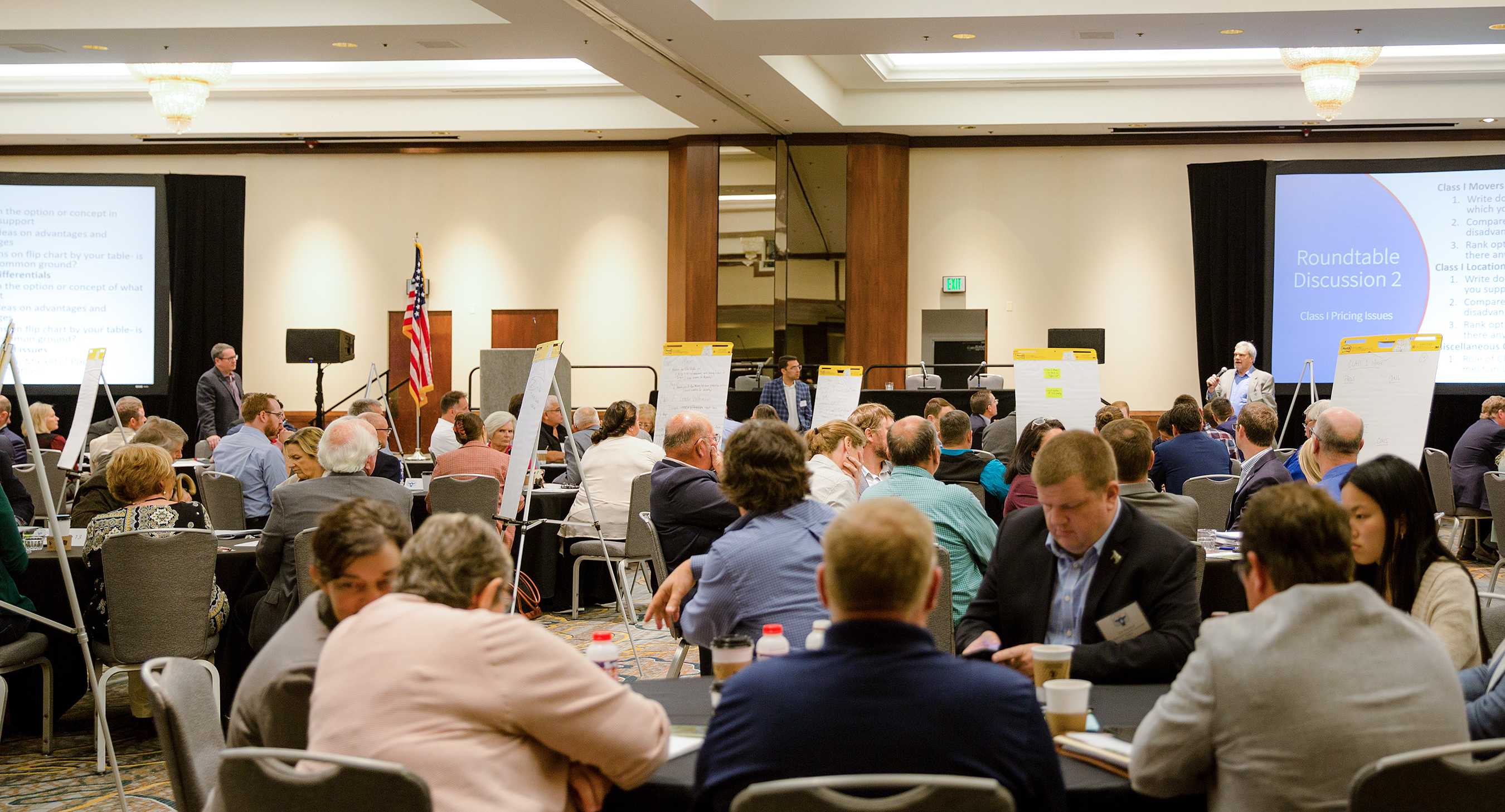
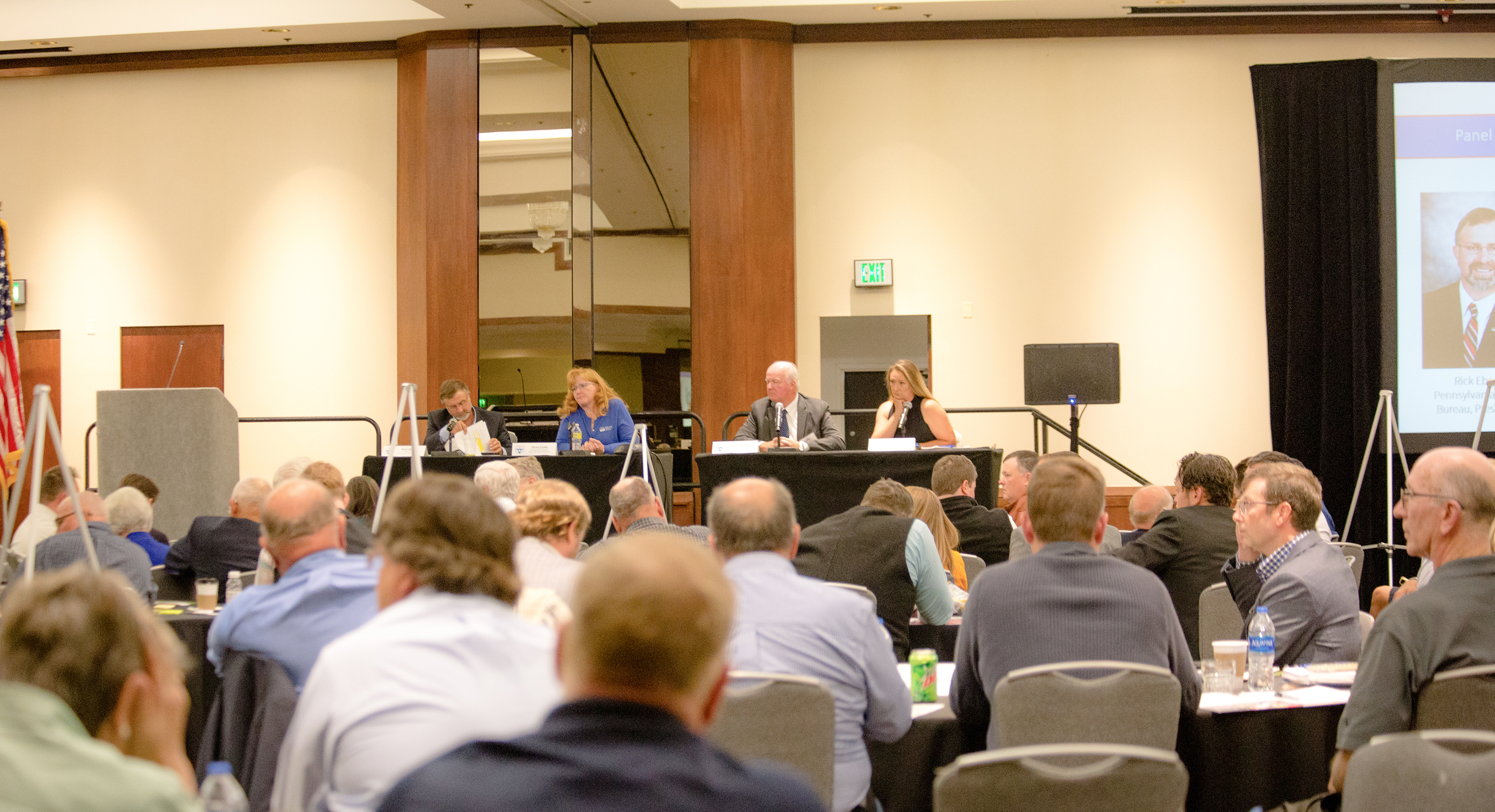
Pa. Farm Bureau presiden Rick Ebert (left), moderated the first panel Friday afternoon (l-r) Dana Coale, deputy administrator USDA AMS Dairy Programs; Calvin Covington, CEO emeritus, Southeast Milk; Anja Raudabaugh, CEO Western United Dairies. After this panel, during the first open-microphone and roundtable breakout, attendees were urged not to leave their flip tablets blank. “Groups with blank boards will have to drink the almond juice in the back,” said AFBF economist Danny Munch, taking note of the hotel offering and to have real milk on-site — provided Saturday and Sunday by Hiland Dairy.

During his presentation Friday, retired Southeast Milk CEO, Calvin Covington, said dairy farmers lost $69 million in revenue for the first 8 months of post-Covid 2022, alone. That figure will rise to an estimated $200 million when September and October Class I milk pounds are tallied. 

Noting NMPF’s task force recommends the board approve petitioning USDA to go back to the ‘higher of,’ Vitaliano cited “asymmetric risk” as the reason.

This risk scenario was also explained by others. ADC’s Schlatter, for example, noted the current averaging formula “caps the upside at 74 cents, but the downside is unlimited.”

Vitaliano noted that whenever there is a ‘black swan’ event or new and different market factors, this downside risk becomes unacceptable for farmers, and he indicated these market events that create wide spreads in manufacturing classes are likely to continue into the future.

Dr. Marin Bozic, University of Minnesota assistant professor of applied economics, observed the way this downside ‘basis’ risk becomes unmanageable via new and traditional risk management tools. In his futuristic talk on Sunday, producers asked questions, to which he responded that, “Yes, farmers show me that they can’t use the Dairy Revenue Protection because of this basis risk.”

Bozic is also founder and CEO of Bozic LLC developing and maintaining the intellectual property for risk management programs like DRP. 

He also spoke about the concerns of the Midwest as FMMO participation declines. 

Presenting his own ideas and separately the ideas of Edge Dairy Farmer Cooperativ, Bozic said Edge is seeking a consensus to support two or three lines in the upcoming farm bill to simply “enable” FMMO hearings to introduce flexibility on an Order by Order basis, so that uniform benefits can be shared instead of a uniform price. Flexibility, they believe, would enable new ‘uniform benefits’ discussion that can help maintain or encourage FMMO participation in marketing areas with low Class I utilization.

Early in the Class I formula loss scenario of 2020-21, Edge had suggested a new Class III-plus formula to determine the ‘mover.’ Bozic said that “the idea of returning to the ‘higher of’ is not a deal breaker for Edge in the short-term.”

Even Mike Brown, senior supply chain manager for Kroger, unofficially indicated IDFA “could be open to the idea” of reverting back to that previous ‘higher of’ formula. As dairy supply chain manager on everything from Kroger’s milk plants to its new dairy beverages, cheese procurement, and so forth, Brown was asked if the averaging formula allowed him to ‘hedge’ fluid milk to manage risk as a processor.

The answer? Not really. Brown said there are ways for processors to manage risk under the ‘higher of’ formula also, but that they haven’t done any hedging under the averaging formula with fresh fluid milk – and very little risk management with their new aseptically packaged, shelf-stable milks and high protein drinks.

Incidentally, he said, the aseptic, ultrafiltered, shelf-stable dairy beverage category “is growing faster than plant-based” in their retail sales.

This exchange and other discussions suggested the averaging formula may have been geared more toward price stability that would encourage processors to invest in expensive aseptic, ultrafiltered and shelf-stable milk-based beverage technologies that result in a storable product needing risk management. 

Fresh fluid milk is already advance-priced and quite perishable with a fast turnaround. Aseptic, ultrafiltered and shelf-stable products, on the other hand, can be packaged under one set of raw milk pricing conditions and sold to retail or consumers up to nine months later under another set of raw milk pricing conditions.

Frankly, it appears that the consumer-packaged goods companies (CPGs) may be driving such shifts, just as we heard from Phil Plourde of Blimling/Ever.Ag that CPGs are “all-in” on the climate scoring — the next big thing on the dairy challenge list.

Tacking de-pooling – regional or national?

Attendees came back to the specific concern about de-pooling, which Vitaliano and Cryan both described as an issue to be handled regionally and not through a national hearing.

This did not seem to satisfy some who raised the concern. Toward the conclusion Sunday, Cryan explained it this way: 

“De-pooling is a national issue in principle but a regional issue in detail. Every region will have different ideas, needs and situations. If there is consensus (on pooling rules) in a region, then changes could move forward quickly,” he said.

Make allowances are sticky wicket

Attendees appeared to agree that make allowances should be addressed or evaluated through a hearing, but ideas on how to handle this sticky-wicket varied.

Attendees questioned panelists, pointing out that if a farmer’s profit margin on milk is only around $1.00 per hundredweight, then raising make allowances an estimated $1.00 per hundredweight is going to be a tough pill to swallow.

Vitaliano said NMPF is commissioning an economic study with their go-to third-party economist Scott Brown at University of Missouri to show the actual milk check impact of raising make allowances that are embedded into the end-product pricing formulas for the four main products: cheddar, butter, nonfat dry milk and dry whey. 

He said the discussions about make allowances as a cost to farmers are “purely arithmetic” but that the “true impact” is not a straight math calculation. Instead, he said, when make allowances are set appropriately, dairy producers ultimately benefit, so in his opinion, it’s not a penny for penny subtraction.

Several other panelists and attendees observed that processors and cooperatives have been creating their own ‘make allowances’ through assessments, loss of premiums, and other milk check adjustments.

The Saturday afternoon panel of (l-r) Kevin Krentz, Peter Vitaliano, Chris Herlache, and Roger Cryan dove into Class III and IV pricing topics including make allowance formulations and structures.

Vitaliano stressed that when make allowances are set properly, the industry is stronger and better able to compensate producers. Initially, he said, raising make allowances would have a negative impact on expansion, which in turn would have a positive impact on producer prices.

When asked if raising make allowances would mean lost premiums would return to farmer milk checks, he responded by saying “that depends, and it won’t happen right away.”

In other words, raising make allowances will be painful in the short term, but in the long-term (to paraphrase) that pain leads to gain. 

Some panelists and attendees referenced an idea of “phasing in” a future raise in make allowances.

Others wondered why it is necessary with the amount of innovation happening in the 15 years since they were last raised as processors make a wider variety of dairy products – not just those bulk items that are surveyed for end-product pricing formulas.

One idea suggested by a Wisconsin dairy producer was to tie make allowance increases to plant size — much the same way that dairy farmers are only assisted up to a production cap of 5 million annual milk pounds. Cryan said he heard a similar proposal previously to use a graduated scale for make allowance increases according to plant size and presumably age.

This is the crux of the make allowance issue because the new state of the art plants produce many types of products, both commodity and value-added; whereas some of the smaller and older plants that are still vital to the dairy industry are more apt to specialize in producing a bulk commodity with a more limited foray into value-added non-surveyed products.

Modified bloc voting?

While there appeared to be consensus that changes to the FMMOs should be done by USDA petition through the administrative hearing process, not through Congressional legislation, some of the discussion at tables and the open-microphone noted the importance of a producer vote after hearings and USDA final decisions. Many felt farmers should have an individual vote on FMMO changes. 

Currently, cooperatives bloc vote for their members to assure that FMMOs are not ended inadvertently by lack of producer interest in following-through on a vote. 

One compromise suggested by Bozic was to have a preliminary non-binding vote by individual producers, followed by the binding vote done in its usual way.

This, he said, would at least increase accountability and transparency in the FMMO voting process and bring producer engagement into the FMMO hearing process. To be continued

-30-

Net loss to farmers now $824 mil. over 41 months as change to Class I formula costs farmers $132 mil. so far in 2022

By Sherry Bunting, Farmshine, August 26, 2022

WASHINGTON —  Against the backdrop of declining fluid milk sales, declining Federal Milk Marketing Order (FMMO) participation, coinciding with the accelerated pace of plant mergers, acquisitions and closures in the fluid milk sector, farm bill milk pricing reform discussions are bubbling up.

The two main issues are the negative impact from the Class I price formula change in the last farm bill, and how to ‘fix it,’ as well as how to handle or update processor ‘make allowances’ that are embedded within the Class III and IV price formulas. 

Other issues are also surfacing regarding the pricing, marketing, and contracting of milk within and outside of FMMOs as historical pricing relationships become more dysfunctional — in part because of the Class I change. 

The change in the Class I price mover formula was made in the 2018 farm bill and implemented in May 2019. It has cost dairy farmers an estimated $132 million in lost revenue so far in 2022 — increasing the accumulated net loss to $824 million over these 41 months that the new average-plus-74-cents method has replaced 19 years of using the vetted ‘higher of’ formula. 

The change was made by Congress in the last farm bill in the belief that this averaging method would allow processors, retailers and non-traditional milk beverage companies to manage their price risk through hedging while expecting the change to be revenue-neutral to farmers. No hearings or referendums were conducted for this change.

Instead of being revenue-neutral for farmers, the new method has significantly shaved off the tops of the price peaks (graph) and only minimally softened the depth of the price valleys, while returning net lower proceeds to farmers and disrupting pricing relationships to cause further farm mailbox milk check losses in reduced or negative producer price differentials (PPD), reduced FMMO participation (de-pooling) as well as disruption in the way purchased price risk management tools perform against these losses.

In 2022, we are seeing this Class I ‘averaging’ method produce even more concerning results. It is now undervaluing Class I in a way that increases the depth of the valley the milk markets have entered in the past few months (graph), and as the Class IV milk price turned substantially higher this week against a flat-to-lower Class III price, the extent of the market improvement will be shaved in the blend price by the impact on Class I from what is now a $2 to $5 gap between Class III and Class IV milk futures through at least November.

During the height of the Covid pandemic in 2020, the most glaring flaw in the Class I formula change was revealed. Tracking the gains and losses over these 41 months, it’s easy to see the problem. This new formula puts a 74-cents-per-cwt ceiling on how much farmers can benefit from the change, but it fails to put a floor on how much farmers can lose from the change.

The bottomless pit was sorely tested in the second half of 2020, when the Class III and IV prices diverged by as much as $10, creating Class I value losses under the new formula as high as $5.00/cwt.

The bottomless pit is being tested again in 2022. The most recent Class I mover announcements for August and September are undervalued by $1.04 and $1.69, respectively, as Class IV and III have diverged by as much as $4 this year.

In fact, 6 of the first 9 months of 2022 have had a lower Class I milk price as compared to the previous formula. The September 2022 advance Class I mover announced at $23.82 last week would have been $25.31 under the previous ‘higher of’ formula. 

This is the largest loss in value between the two methods since December 2020, when pandemic disruptions and government cheese purchases were blamed for the poor functionality of the new Class I formula.

No such blame can be attributed for the 2022 mover price failure that will have cost farmers $132 million in the first 9 months of 2022 on Class I value, alone, as well as leading to further impacts from reduced or negative PPDs and de-pooling.

The graph tells the story. The pandemic was blamed for 2020’s largest annual formula-based loss of $733 million. This came out to an average loss of $1.68/cwt on all Class I milk shipped in 2020.

These losses continued into the first half of 2021, followed by six months of gains. In 2021, the net gain for the year was $35 million, or 8 cents/cwt., making only a small dent in recovering those prior losses.

Gains from the averaging formula were expected to continue into 2022, but instead, Class IV diverged higher than Class III in most months by more than the $1.48 threshold. Only 2 months in 2022 have shown modest Class I mover gains under the new formula, with the other 7 months racking up increasingly significant value losses – a situation that is expected to continue at least until November, based on current futures markets.

Bottomline, the months of limited gains are not capable of making up for the months of limitless loss, and now the hole is being dug deeper. 

True, USDA made pandemic volatility payments to account for some of the 2020 FMMO class price relationship losses. Those payments were calculated by AMS staff working with milk co-ops and handlers using FMMO payment data.

However, USDA only intended to cover up to $350 million of what are now $824 million in cumulative losses attributed directly to the formula change.

Furthermore, USDA capped the amount of compensation an individual farm could receive, even though there was no cap on the amount the new formula may have cost that farm, especially if it led to reduced or negative PPDs, de-pooling, and as a result, negatively impacted the performance price risk management tools the farm may have purchased.

The estimated $824 million net loss over 41 months equates to an estimated average of 58 cents/cwt loss on every hundredweight of Class I milk shipped in those 41 months.

Using the national average FMMO Class I utilization of 28%, this value loss translates to an average loss to the blend price of 16 cents/cwt for all milk shipped over the 41 months, but some FMMOs have seen steeper impacts where Class I utilization is greater.

This 16-cent average impact on blend price may not sound like much, but over a 41-month period it has hit mailbox milk prices in large chunks of losses and smaller pieces of gains, which impact cash flow and performance of risk management in a domino effect.

The 2022 divergence has been different from 2020 because this year it is Class IV that has been higher than Class III. During the pandemic, it was the other way around.

Because cheese milk is such a driver of dairy sales nationwide, the FMMO class and component pricing is set up so that protein is paid to farmers in the first advance check based on the higher method for valuation of protein in Class III. Meanwhile, other class processors pay into the pool using a lower protein valuation method, so the differences are adjusted based on utilization in the second monthly milk check.

This means when Class III is substantially higher than Class IV, as was the case in 2020-21, there is even more incentive for manufacturers to de-pool milk out of FMMOs compared to when Class IV is higher than Class III.

The PPD, in fact, is defined mathematically as Class III price minus the FMMO statistical uniform blend. Usually that number is positive. In the last half of 2020 and first half of 2021, it was negative for all 7 multiple component pricing FMMOs, while the 4 fat/skim Orders saw skim price eroded by the variance.

Now, the situation is different because Class III has been the lowest priced class in all but one month so far in 2022. The milk being de-pooled — significantly in some orders and less so in others — is the higher-priced Class II and IV milk. The Class II price has surpassed the Class I mover in every settled month of 2022 so far — January through July — and the Class IV price also surpassed the Class I mover in 2 of those 7 months. 

-30-

From DMC to FMMOs, from price ‘movers’ to ‘make allowances’: House Ag hearing reviews farm bill dairy provisions

By Sherry Bunting, June 24, 2022

WASHINGTON — It was a lot to wade through, but after two panels and nearly four hours, many cards were on the table, even if the full deck was not counted. 

The U.S. House Agriculture Committee hearing Wednesday, June 22 was a 2022 review of the current farm bill’s dairy provisions. Chairman David Scott (D-Ga.) set the stage with his opening remarks, noting a significant part of the hearing would be devoted to the dairy safety net, namely the Dairy Margin Coverage (DMC), but also to talk about the Federal Milk Marketing Orders (FMMO) to learn if this system is “the best fit for today’s world.

“We want to continue to listen to farmers and navigate the issue for the best approaches to any changes,” he said, setting the next stage for listening sessions.

Those testifying talked about building consensus for FMMO changes, a charge handed down from Ag Secretary Tom Vilsack last December, and again more recently, when he said a consensus agreement by stakeholders on one plan was needed before a national hearing on milk pricing could be held.

On the Class I ‘mover’ change in the last farm bill, USDA AMS Deputy Administrator Dana Coale noted that the change was authorized by Congress after an agreement was reached between NMPF and IDFA to change the ‘higher of’ to a simple average plus 74 cents. This was designed to be revenue neutral, she said, but the pandemic showed how an unforeseen market shock can create price inversions that significantly change this neutrality. (testimony)

Coale noted that “market abnormalities” brought on a situation where Class I was below Class III, which doesn’t typically happen, and this created losses.

“In the 2018 farm bill Congress authorized a change to the Class I price mover. We implemented that in the department in May 2019. This change was a consensus agreement reached between NMPF and IDFA to benefit the entire industry. Implementation in the farm bill was designed to be revenue neutral. However, nobody foresaw a pandemic occurring, and no one could have projected the implications that pandemic would have on (prices), particularly within the dairy sector. What we saw occur from mid-2020 through mid-2021 was a significant change in that revenue neutrality. As you look at the Class I mover before the pandemic and moving out of the pandemic, it is maintaining pretty much a revenue neutral position compared to the prior mover. However, due to the (class) price inversions that occurred, we had some major losses incurred by the dairy sector.”

Dana Coale, Deputy Administrator, USDA AMS Dairy Programs

On the primary dairy safety net, Farm Service Agency Deputy Administrator Scott Marlow went over the Dairy Margin Coverage (DMC) and explained the beneficial changes that have been implemented since the 2018 farm bill. (testimony)

He noted that supplemental DMC would have to be made permanent in the next farm bill in order for that additional production history between the 2011-13 figure and the 5 million pound cap to be covered in future years.

“In 2021, DMC payments were triggered for 11 months totaling $1.2 billion paid to producers who enrolled for that year, with an average payment of $60,275 per operation. At 15 cents per cwt at the $9.50 level of coverage, DMC is a very cost-effective risk management tool for dairy producers. Ahead of the 2022 DMC signup, FSA made several improvements. The program was expanded to allow producers to enroll supplemental production (up to the 5 million pound cap). In addition FSA updated the feed cost formula to better reflect the actual cost dairy farmers pay for alfalfa hay. FSA now calculates payments using 100% premium alfalfa hay, rather than 50% of the premium alfalfa hay price and 50% of the conventional alfalfa hay price. This change is retroactive to January 2020 and provided additional payments of $42.8 million for 2020 and 2021. We are very concerned about the margins. It is very important the way DMC focuses on the margin. Farmers are facing inflation of costs beyond the feed that is part of this calculation. This margin based coverage has proven to a model and is something we need to look at for other costs and commodities.”

Scott Marlow, Deputy administrator usda fsa farm programs

Dr. Marin Bozic, Assistant Professor Applied Economics at the University of Minnesota gave some long range trends and observed the factors that are decreasing participation in Federal Milk Marketing Orders. (testimony)

He mentioned that a consideration not to be ignored is the status of vibrancy and competition as seen in transparency and price discovery. When asked about proposals to improve this, Bozic said the proposals need to come forward from the industry, the stakeholders, and that the role of academia is to provide numbers, trends, and analysis of proposals, not to decide and determine these marketing structures.

“Farm gate milk price discovery is challenged by this lack of competition,” he said. “If a corn producer wishes to know how different local elevators would pay for corn, all he needs to do is go online or tune in to his local radio station. Dairy producers used to be able to ‘shop around’ and ask various processors what they would pay for their milk.”

Bozic was quick to point out that, “We should not rush to generalize from such anecdotal evidence, but in my opinion, it would also be prudent not to ignore it.”

“FMMOs start from a set of farmer-friendly ideas… They have somewhat lost luster due to declining sales of beverage milk. In regions other than Northeast and Southeast, fluid milk sales no longer provide strong enough incentives for manufacturers to choose to stay consistently regulated under FMMOs. My estimates are that the share of U.S. milk production in beverage milk products is likely to fall from 18.3% in 2022 to 14.5% by 2032. Do Federal Orders suffice to deliver fair market prices to dairy producers? The critical missing ingredient is vibrant competition for farm milk. Whereas just six or seven years ago, many producers had a choice where to ship their milk, today it is difficult. When some dairy producers have asked for milk price benchmarking information from their educators or consultants, those service providers have in multiple instances faced tacit disapproval or even aggressive legal threats from some dairy processors. Further research and an honest debate on competition in dairy is merited.”

Marin bozic, ph.d., department of applied economics, university of minnesota

Where FMMO changes are concerned, Bozic noted some of the broader issues to come out of the Class I pricing change that was made legislatively in the last farm bill. For example in future reforms, when there is lack of wide public debate on proposals, he said: “It increases odds of a fragile or flawed policy design, and lack of grassroots support for the mechanism in changing markets. FMMOs have a comprehensive protocol for instituting changes through an industry hearing process. The Class I milk price formula can be modified through a hearing process.”

From Bernville, Pennsylvania, representing National Milk Producers Federation (NMPF) and DFA, Lolly Lesher of Way-Har Farms shared the benefits of the Dairy Margin Coverage (DMC) program through FSA and other risk management tools through RMA. She said they purchase the coverage at the highest level each year as a safety net for their 240-cow dairy farm. (testimony)

DMC is intended for smaller farms producing up to 5 million pounds of milk annually, but other farms can layer it in with other available tools at the tier one level on the first 5 million pounds or choose to pay the tier two premium to cover more of their milk through that program, but other tools like DRP are also available, Marlow explained.

Turning to the Class I pricing change in the last farm bill, Lesher said the change was an effort to “accommodate a request for improved price risk management for processors, while maintaining revenue neutrality for farmers… but the (pandemic) dramatically undercut the revenue neutrality that formed its foundation.”

“As valuable as the (DMC) program has been, many farmers have not been able to fully benefit because the underlying production history calculation is outdated. It is critical that the (supplemental DMC) production history adjustment be carried over into the 2023 farm bill… The events of the last two years have shined a spotlight on the need for an overall update to the FMMO system. Class I skim milk prices averaged $3.56/cwt lower than they would have under the previous ‘mover’. This undermined orderly marketing and represented net loss to producers of more than $750 million, including over $141 million in the Northeast Order. The current Class I mover saddles dairy farmers with asymmetric risk because it includes an upper limit on how much more Class I skim revenue it can generate… but no lower limit on how much less… those losses become effectively permanent.”

lolly lesher, way-har farm, bernville, pennsylvania, representing nmpf and dfa

According to Lesher’s testimony: “The dairy industry through the National Milk Producers Federation is treating this matter with urgency and is seeking consensus on not only the Class I mover, but also a range of improvements to the FMMO system that we can take to USDA for consideration via a national order hearing.”

Lesher serves on DFA’s policy resolutions committee and she noted that DFA, as a member of NMPF “is actively participating in its process (for FMMO improvements), which involves careful examination of key issues to the dairy sector nationwide… We look forward to working with the broader dairy industry and members of this committee as our efforts advance.”

Representing International Dairy Foods Association (IDFA), Mike Durkin, President and CEO of Leprino Foods Company stressed the “extreme urgency” of updating the “make allowances” in the FMMO pricing formulas. These are processor credits deducted from the wholesale value of the four base commodities (cheddar, butter, nonfat dry milk and dry whey) used in FMMO class and component pricing as well as within the advance pricing for fluid milk. (Leprino is the largest maker of mozzarella cheese in the U.S. and the world. Mozzarella cheese is not reported on the USDA AMS price survey used in the FMMO class and component pricing.) (testimony)

Durkin also noted the importance of making the Dairy Forward Pricing Program that expires September 2023 a permanent fixture in the next farm bill for milk. This program allows forward pricing of milk used to make products in Classes II, III and IV so that longer-duration contracts can be used by this milk when also pooled under FMMO regulation without fear of the authority expiring in terms of the FMMO minimum pricing. (Milk that is used to make products in Classes II, III and IV is already not obligated to participate in or be regulated by FMMOs.)

“The costs in the (make allowance) formula dramatically understate today’s cost of manufacturing and have resulted in distortions to the dairy manufacturing sector, which have constrained capacity to process producer milk. Congress can improve the current situation by directing USDA to conduct regular cost of processing studies to enable regular make allowance updates. The need to address this lag is now extremely urgent. While our proposal to authorize USDA to conduct regular cost surveys will eventually provide data to address this in the longer term, steps must be taken now to ensure adequate processing capacity remains. Updating make allowances to reflect current costs will enable producer milk to have a home. Making the (Dairy Forward Pricing Program for Class II, III and IV) permanent could also facilitate additional industry use of this risk management tool for longer durations without concern about the program expiring.”

Mike Durkin, president and ceo, leprino foods, representing idfa

Lesher also thanked House Ag Ranking Member G.T. Thompson for his Whole Milk for Healthy Kids Act, seeking to bring the choice of whole and 2% milk back to schools. The bill currently has 94 additional cosponsors from 32 states, including the House Ag Chair David Scott and other members of the Agriculture Committee. The bill was referred to the House Committee on Education and Labor.

Other key dairy provisions were reported and questions answered, including a witness representing organic dairy farmers. There’s more to report, so stay tuned for additional rumination in Farmshine and here at Agmoos.com

Recorded hearing proceedings available at this link

Written testimony is available at this link


-30-

Future of Federal Milk Pricing Forum got ‘wheels turning’

‘We need to figure out a way to get farmers’ voices incorporated into this discussion’

Table I reflects a decade of change in FMMO participation as total U.S. milk production grew 13.3% from 2011 to 2021, and the percentage of milk pooled on FMMOs fell from 82% in 2011 to 60.5% in 2021. California became an FMMO in 2018 after previously being a state order, so California’s production is not included in the 2011 pooling comparison so the pooling percentages are relative to production in FMMO and unregulated regions. Class I pounds as a percent of total production fell from 28.7% in 2011 to 18.6% in 2021. Figures for 2021 are shown both ways, including and excluding California to compare to 10 years ago when the number one dairy state had its own state order with different pooling and classification rules and incomplete data, but the percent of change is nonetheless eye-opening. Chart compiled by S. Bunting 

By Sherry Bunting, published in Farmshine, Feb. 18 and 25, 2022

GREEN BAY, Wis. — Do dairy farmers want to save the baby, save the bathwater, change the flow of the bathwater, or tighten the plug on the drain before the bathwater drains to the point of taking baby with it?

That’s a brutal take after 90 minutes and a lot of information, starting with the basics and hearing perspectives and questions during the American Dairy Coalition’s Future of Federal Milk Pricing Forum on Feb. 15.

It was a first step in what ADC sees as a continuing conversation and effort to engage dairy farmers to lead the process. They said the next forum will be in March.

Geared specifically for dairy farmers, the forum attracted 160 participants from across the country, representing every element of the dairy industry — including dairy farmers.

The virtual format was moderated by Dave Natzke, markets and policy editor with Progressive Dairy magazine. Featured presenters were Calvin Covington, retired co-op COO with 45 years of experience in federal and state marketing orders; Frank Doll, a third generation Illinois dairy farmer involved in American Farm Bureau’s dairy policy committee, and Mike McCully, industry consultant on the IDFA dairy ingredients board and economic policy committee.

Included were comments presented by attendees, who pre-registered for three-minute slots. Others typed into the queue.

“This is complicated, and many people say it can’t be fixed, but we have a great amount of expertise and value here. We covered a lot,” said Laurie Fischer, CEO of ADC at the end of the forum. “We can’t just let this drop. We need to continue to move forward.”

“We heard a lot of good information that has everyone’s wheels turning,” added ADC president Walt Moore of Walmoore Holsteins, Chester County, Pa. He encouraged producers to reach out and engage to tackle the hard topics.

The goal of this initial forum was to inform dairy producers on the Federal Milk Marketing Orders (FMMO) and pricing process to become engaged and have a greater voice in guiding future policies.

For its part, American Farm Bureau Federation spent the past couple years going through a similar working group with policy recommendations coming from states to national and back to states. 

Several commenters concurred with the position of ADC, Farm Bureau and other organizations that Class I pricing should return to the ‘higher of’ method until future policies can go through what could be a long hearing process of potential revision for the future.

In fact, one eye opener during the Forum was Doll’s confirmation that Farm Bureau policy now includes support for going back to the ‘higher of’ — plus adding 74 cents — in the calculation of the Class I mover price, while remaining open to other ideas.

Doll said consensus was hard to find in the Farm Bureau working group of 13 members from across the country due to regional differences in the makeup of processing. But general recommendations found agreement, including the reference to Class I as well as modified bloc voting where co-ops can vote for their members on Federal Orders, but farmers can cast their own votes and be encouraged to do so.

Several attendees cited the need for a vehicle for producers to have real input without fear of retribution, that farmers should collectively ask questions of their cooperatives, seek better representation and together, hold their cooperatives accountable to represent their interests. 

“We need to figure out a way to get farmers’ voices incorporated into this discussion. I hear from producers all the time, but there is fear of retribution, the threat that your milk is not going to get picked up. If you are on a board and speak up, you’re not there very long,” said Kim Bremmer, representing Venture Co-op in Wisconsin, a third-party ‘testing co-op’ qualified by USDA.

She addressed bloc voting, saying: “What’s the point of having a hearing if producers can’t vote? We don’t have great representation from some of the groups that say they represent us.”

Bottomline, said Bremmer: “We have to address how to get more of the producer voice and not just the processor voice — because they’re not the same.”

She asked: “Is it a conflict of interest if you’re a processor and you’re marketing milk and you’re also advocating for producers? I think that’s an important question that needs to be answered. We need to stay engaged in this and be able to ask the tough questions and demand some answers.”

ADC’s Fischer said the organization wants to work with farmers and their state and national organizations to provide a vehicle to bring farmers together and compose a list of pricing policy items to explore further with experts.

One clear change in the dairy industry formed the crux of the discussion: The growth of milk production in the U.S. — in concert with growing export sales and declining fluid milk sales — put export sales volume above Class I volume as a percentage of total milk solids in 2021.

McCully described this as “a seismic change.”

Covington confirmed that Class I sales — as a percentage of total milk production — fell below 20% in 2021. The percentage of Class I milk within the 137 billion pounds pooled on 11 FMMOs in 2021 was about 30%.

Contrary to the widely held belief that FMMOs regulate a majority of the milk, they simply do not. Covington confirmed that the 137 billion pounds of milk pooled on 11 FMMOs in 2021 represents only about 60% of U.S. milk production.

The FMMOs aren’t designed for this direction that the dairy industry is going toward global markets, according to McCully.

He said the world will look to the U.S. as the “go-to market,” claiming New Zealand and the EU are maxed out. He described the “white gallon jug” as being the most prime example of a low-margin commodity and predicted ‘value-added’ products will return more dollars to farmers in the future. These are recurrent themes heard from speakers at winter meetings this year.

(Author’s note: In contrast, current industry-wide discussion on the ‘sustainability’ side is for a ‘stable’ U.S. cattle herd to be an indicator of dairy’s climate neutrality. If exports grow, and the U.S. herd remains ‘stable’, then export milk will have to come from growth in output per cow and displacement of Class I production. One can see how geographic camps can set up, since fresh fluid milk sales are vital to the viability of dairy farms in areas outside of the earmarked growth areas for dairy manufacturing in the Central U.S. — the question is how to bridge it.)

At the same time, dragging feet doesn’t seem to be much of an option.

If dairy policy remains ‘status quo,’ leaving the FMMOs ‘as-is,’ they could eventually cover less and less milk and potentially collapse, according to McCully.

Covington also addressed this, noting that FMMOs “were designed for fluid milk, but today, fluid milk is a minority use. People used to drink their milk, now they are eating their milk.”

McCully noted the need for dairy innovation. He said make allowances have facilitated large-scale commodity plant construction supplied by large-scale farms, suggesting it is these built-in make allowance ‘margins’ that favor commodity production and deter innovation. 

“If end-product pricing continues, the make allowances will have to be raised,” he said, citing a new make allowance study “fresh off the press.”

In 2019, USDA commissioned Dr. Mark Stephenson, dairy economist at University of Wisconsin-Madison, to do the study. Stephenson recently announced it is complete and will soon be released by USDA. McCully’s glimpse at the report shows make allowance calculations to be “significantly higher” than the amounts embedded currently in end-product pricing formulas.

Western Pennsylvania dairy nutritionist Harry Stugart offered his concise, data-driven argument that the make allowances be removed from the formula for the ‘advance’ Class I mover price because these make allowances do not pertain to fluid milk. In January 2022, he said they amounted to $2.67 per hundredweight.

Another crucial part of the discussion was how FMMOs actually work and what they do, besides pricing.

Covington gave attendees a primer of key points to think about as discussions move forward. What he shared may be old news to some, but it’s surprising how many people do not know these facts:

— FMMOs are not required by law, they are simply “enabled” to exist by law. This means producers vote to have them (California in 2018) or to terminate them (Idaho 2004).

— Only Class I fluid milk plants are required to be regulated under FMMOs.

— Class II, III and IV plants participate voluntarily, and they tend to do so “when it’s economically feasible.” Rules of participation vary from Order to Order.

— FMMOs establish other things besides minimum pricing for regulated plants. This includes setting payment terms, providing market information and market services such as testing and auditing.

— The last FMMO reform (2000) was complicated and took four years. It was a combination of legislation (1995 Farm Bill) and an administrative rulemaking process.

— Today, there are four classes of milk, but that was not always the case.

— Today, the Class I mover (base price), as well as the Class II, III and IV prices are established to be the same in all FMMOs, but in the past different FMMOs had different mechanisms.

— Cooperatives are not required to pay FMMO minimum prices even if they own regulated Class I plants because cooperatives are viewed by the FMMOs as one big producer and can make their own decisions about distributing the revenue received to their farmer-members.

— Today, over half of the Class I fluid milk plants in the U.S. are either owned by cooperatives or by large retail supermarkets. Over the past 60 years of consolidation, FMMOs have gone from regulating 2250 fluid milk plants in 1960 to just 225 in 2021.

— Cooperatives balance the Class I market at a cost. Excess milk can go to unregulated buyers at a price that is several dollars below the minimum price. Some co-ops run their own balancing plants. These costs can result in paying farmers below minimum price.

“Milk pricing should return a fair cost to producers, processors and retailers. A chain is only as strong as its weakest link,” said Sherry Bunting, speaking on behalf of the Grassroots PA Dairy Advisory Committee. She also highlighted the Whole Milk for Healthy Kids Act, H.R. 1861, explaining how support for this legislation is essential — no matter how milk is priced.

“In the process of working on this legislation, our (Grassroots PA) committee has identified other concerns. It is hard for producers to advocate when even such a simple and good thing as whole milk in schools is rebuked,” said Bunting. “Farmers hear from leaders and inspectors: ‘If we sell whole milk in schools, do you think we can just stop making cheese and other products?’ Or ‘All you are doing is disrupting markets and creating a butterfat shortage.’ Or ‘Be careful what you wish for.’ These are veiled threats.”

Bunting highlighted the need for greater competition, accountability, transparency and timeliness of price reporting. 

“Dairy farmers have farms to run, cows to care for, and they become paralyzed by the complexity and lack of transparency in the system and their milk checks. They become overwhelmed and unconfident, even fearing retribution,” she said.

Bremmer specifically addressed milk check transparency.

“We have members with attorneys that cannot interpret their milk checks. That has to stop,” said Bremmer. “Why wouldn’t processors want to show farmers what they are paying them? What is the reason? To have attorneys and others looking at it and they can’t figure it out, that’s a real problem. We think they’re probably re-blending some things to make another ‘make allowance’. We know these things are happening all across the United States.”

Payment terms are critical in this conversation. Even the best-made plans for risk management mean nothing if farmers don’t receive timely and consistent payments for their milk due to the high capital costs and cash flow needs of running a dairy farm. 

One commenter said farmers want their income to come from consumers, not from the federal government. He wondered why Federal Milk Marketing Orders (FMMOs) are even needed to guarantee payment.

“Why? So you get paid,” replied panelist Covington. “The FMMOs all establish dates when advance and final payments are made. Having been a co-op manager working with fluid milk plants, I can’t emphasize enough how important this is.”

He also pointed out the important auditing, weights and measures, and market information the FMMOs provide.

McCully said these other services provided by FMMOs are “something we need more of going forward. We need less (price) regulation and more (market) information,” he added. “What’s not working is the milk pricing.”

Here’s where the crux comes into play: The FMMOs are not set up to regulate a global product market, and the industry has set its sights on exporting even more. This is leading the dairy industry to look at how other countries price milk as it relates to the U.S. pricing system and its ability to “be globally competitive.”

As the percentage of Class I sales have declined in relation to growth of U.S. milk production over the past decade, the percentage of milk pooled on FMMOs has also declined from 82% in 2011 to 60% in 2021 (See Table I).

Covington explained how pooling plays out within the FMMO system: “A regulated plant is required to pay its direct shippers and any co-op supplying milk a minimum blend or uniform price. Each Order takes the revenue from each class at the minimum price and pulls it together into one pool to come up with the uniform price.”

He said Class I differentials “have two purposes, to move milk to fluid use and to gain additional revenue for dairy farmers.” They range from $1.60/cwt in the extreme northern U.S. to $6.00/cwt in Miami, Florida and are added to the base Class I mover price. 

The regulated Class I plants pay the difference between the uniform price and the Class I minimum price into the FMMO. Other class plants voluntarily participate to take a draw from the FMMO to add to what they pay their producers. That’s how it has worked most of the time – until now.

Diminished Class I sales as a percentage of total milk flip this switch, and the 2018 Farm Bill change to averaging Class III and IV skim plus 74 cents — instead of the ‘higher of’ — along with the advance pricing element, have increased the de-pooling pressure on this system, especially during times of volatility.

When asked about wide price inversions that occurred in some months over the past two years, both Covington and McCully observed the impact on bottlers paying above minimum prices to attract milk away from then higher-value Class III.

In thinking about the future, Covington reminded attendees of the past. He said at one time some Orders had individual handler pools — not marketwide pools — a nod to the idea of how FMMOs could continue to regulate Class I, if handlers in the other classes lose interest in participation.

Back when California was a state order, virtually all milk was pooled. Plants had to make decisions about pooling annually by January 1. 

McCully contended that this scenario led to dumping of milk and inefficient transport to other areas. According to his analysis, the idea of making the pooling rules more restrictive and uniform across all FMMOs would lead processors to completely leave the system, and they can do that because their participation is voluntary, except for Class I.

Risk management was on the mind of several commenters, including Doll. He pointed out how the ‘holes’ in the Class I pricing change were exposed by the pandemic volatility. (Significant losses to Class I value are occurring again in the February and March 2022 Class I price.)

Joining Doll as a fellow Illinois dairy farmer was Bryan Henrichs. He said the class price inversions during the pandemic left many farmers on the losing end of what they thought were ‘safe’ $18 Class III forward contracts. The up to $9 negative PPDs kept them from achieving that price when the Class III price exceeded the contract level, but the farmer didn’t receive that price in the milk check — a double whammy.

Henrichs and others noted that milk should be priced competitively and simplified. Henrichs mentioned the idea of pricing milk at one price — no matter what it is used for — allowing market participants, including farmers, to manage risk and trade location basis, like for corn.

Arden Tewksbury’s comments from Progressive Agriculture Organization based in Meshoppen, Pennsylvania were presented by Carol Sullivan — highlighting the need for cost of production in the pricing equation, along with a realistic supply management program. 

Annual FMMO pooling decisions (instead of in and out), and his longtime support for whole milk in schools were other key points offered by Tewksbury.

One attendee stated that if processors are looking to raise their ‘make allowances,’ why not add a ‘make allowance’ for producers?

On cost of production, McCully pointed out that the range is wide between a 50,000-cow dairy in western Kansas and a 40-cow dairy in northern Vermont, for example. He said interstate movement of milk and the fact that FMMO participation is voluntary for over 80% of the milk outside of Class I creates issues for using a blanket national average cost of production.

McCully said ‘cost-plus’ contracts are being used today by some processors and producers, but this is only for milk sold outside of the FMMO system.

As confirmed by Covington, 40% of the U.S. milk supply was priced outside of the FMMOs in 2021. He said this could increase as Class I becomes a smaller slice of the growing pie, especially in areas of the country where Class I is already quite small.

-30-