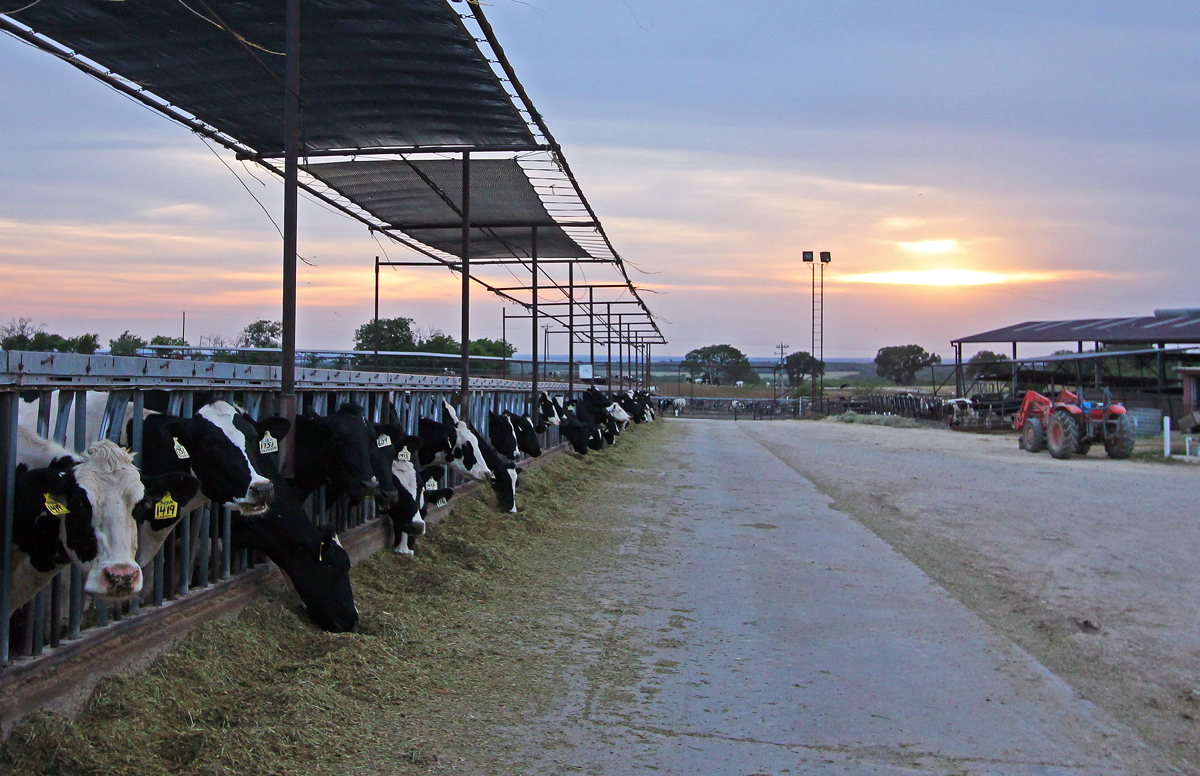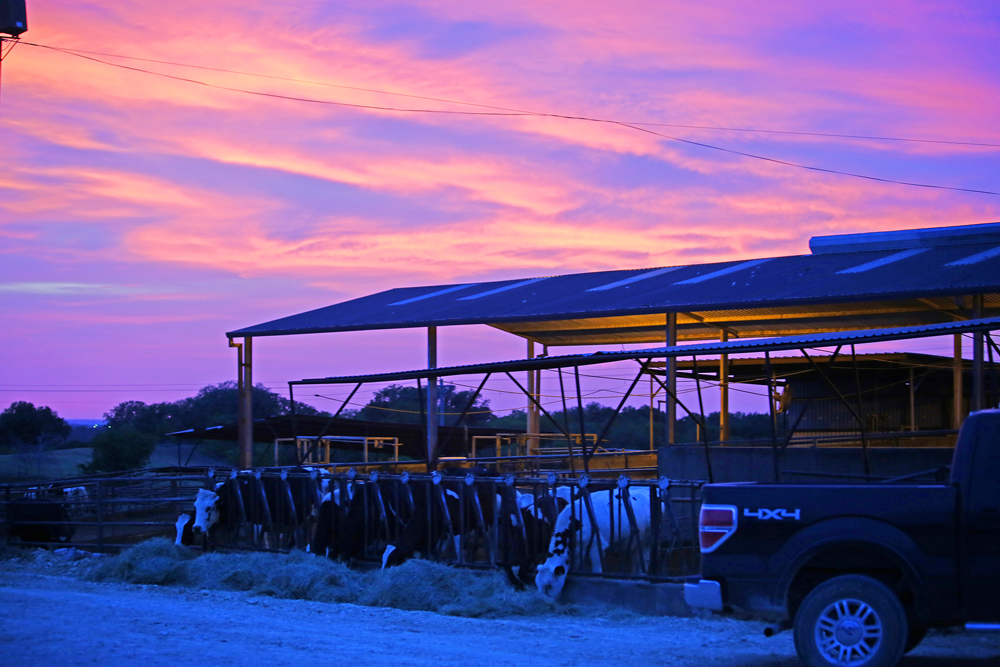
No ‘snow days’ on the farm

cows6781By Sherry Bunting, columnist, Register-Star, Feb. 21, 2015

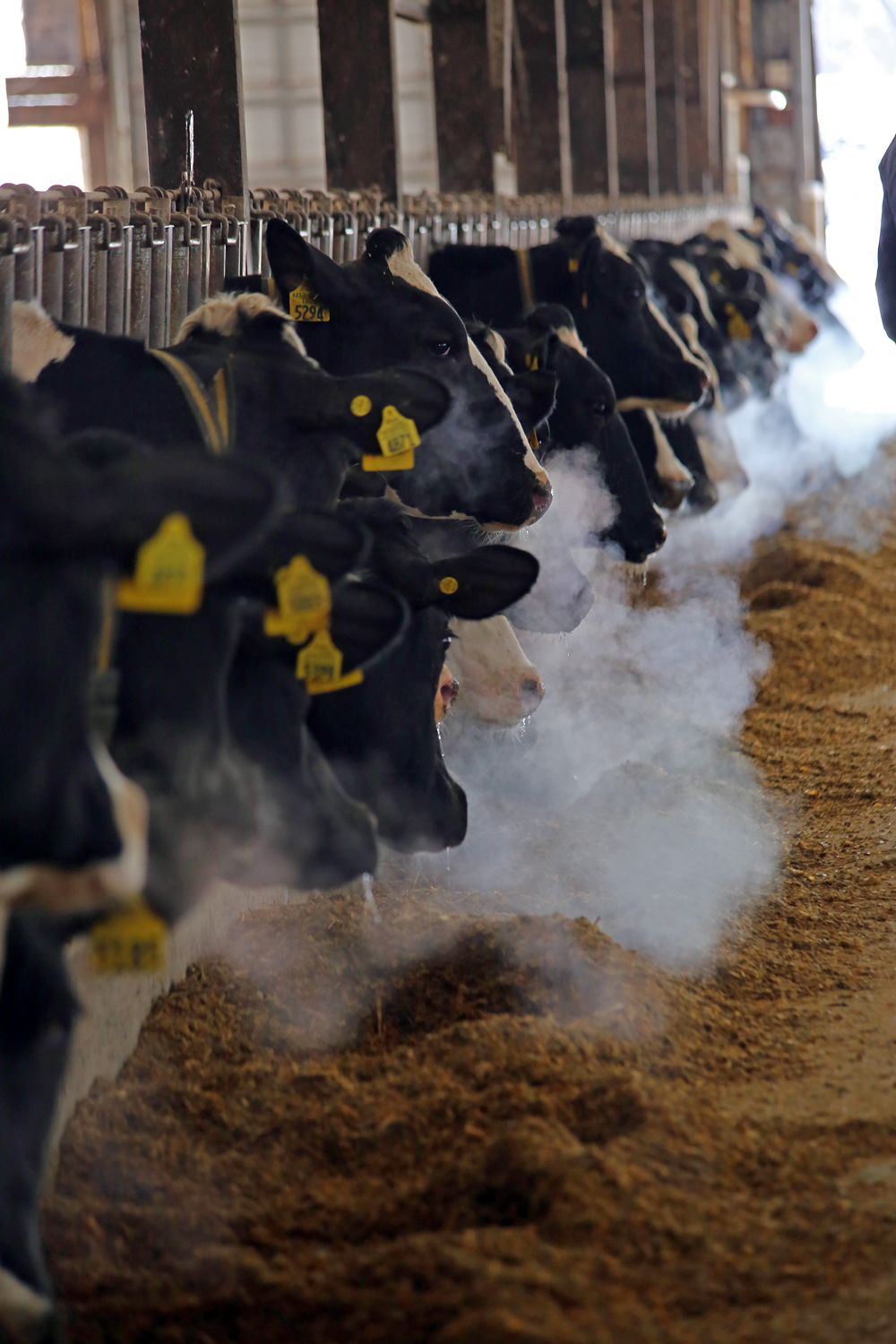
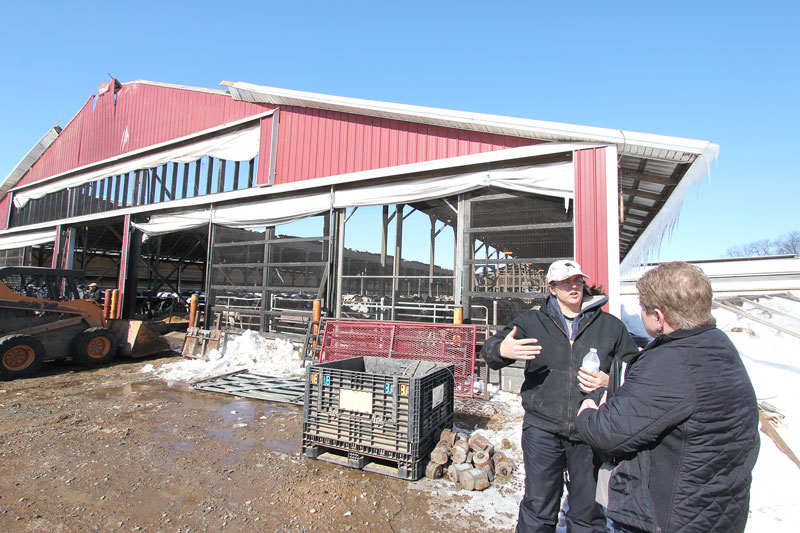
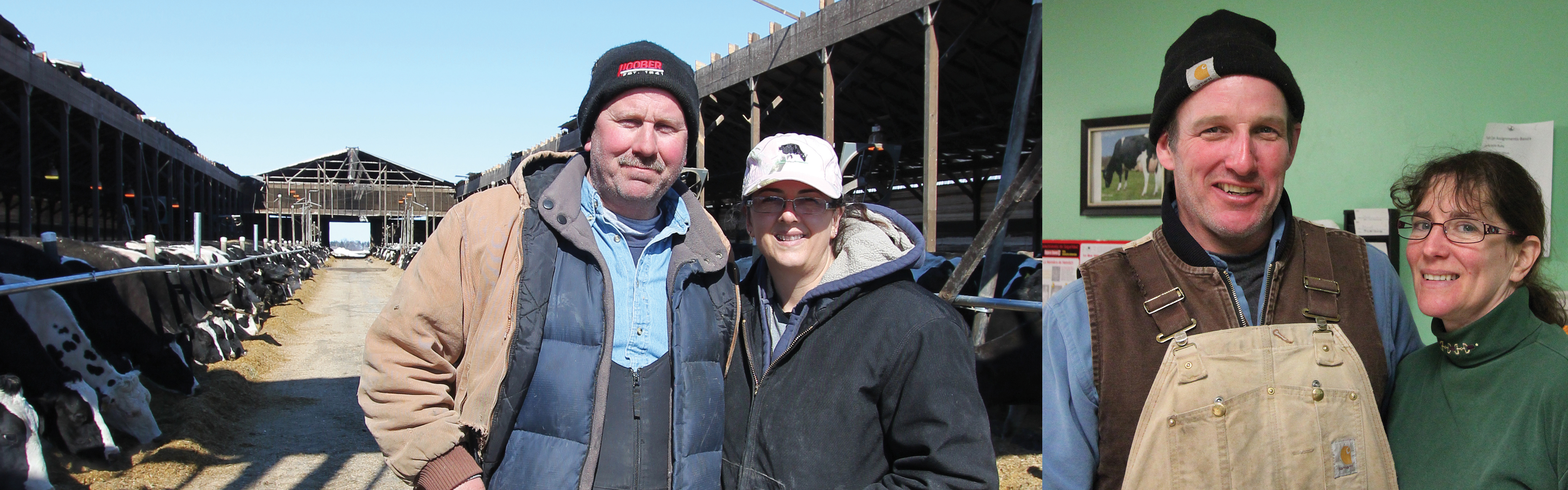
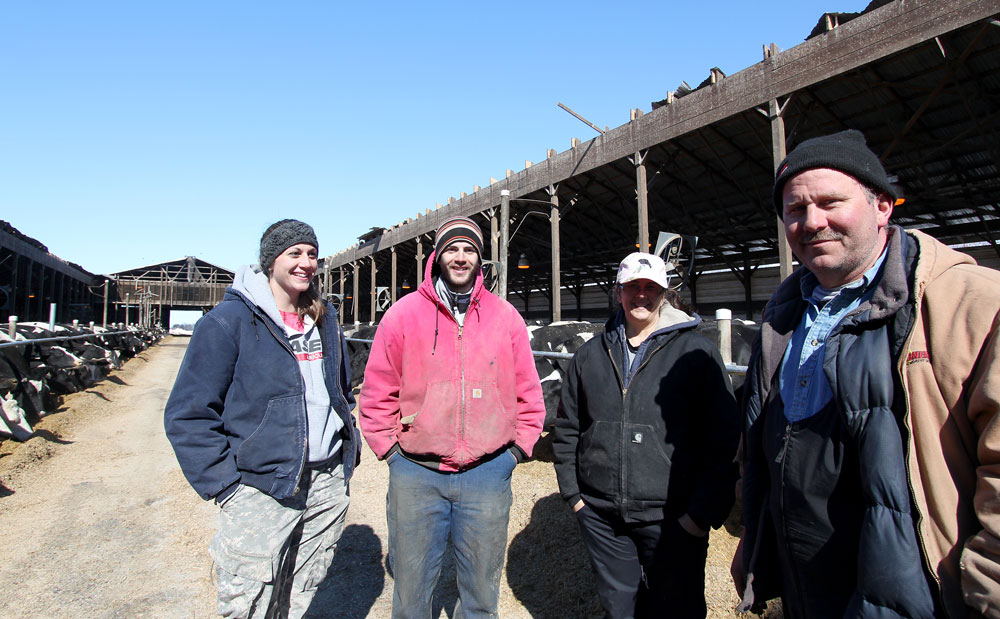
There are no ‘snow days’ on the farm. “When it is this cold, the simple every day protocols become enduring days of work,” notes Cody Williams of Wil-Roc Dairy, Kinderhook, where 1500 Holstein dairy cows are milked and cared for.

“We change our teat dip when it’s this cold, for extra moisturizing to the skin,” Cody explains. “We also adjust the cow diets to keep our cows in a positive energy balance as they burn more energy to maintain themselves during weather extremes.”

Operating a dairy or livestock farm in the extreme cold is not for the faint of heart. Veteran beef producer Phil Trowbridge of Ghent observes: “We know how to take care of ourselves. We dress in layers and give each other breaks.”

Frozen pipes, pumps, waterers, and manure — as well as difficulty in starting equipment — are commonly reported concerns. When the snow piles up and the temperatures plummet, concerns turn to keeping rooftops clear of a too-heavy burden and being vigilant about the increased risk of fires.

In closed group discussions throughout social media, farmers exchange ideas and seek support from each other.

When the Polar Vortex gripped the northern half of the country in 2014, farmers were up to the challenge.

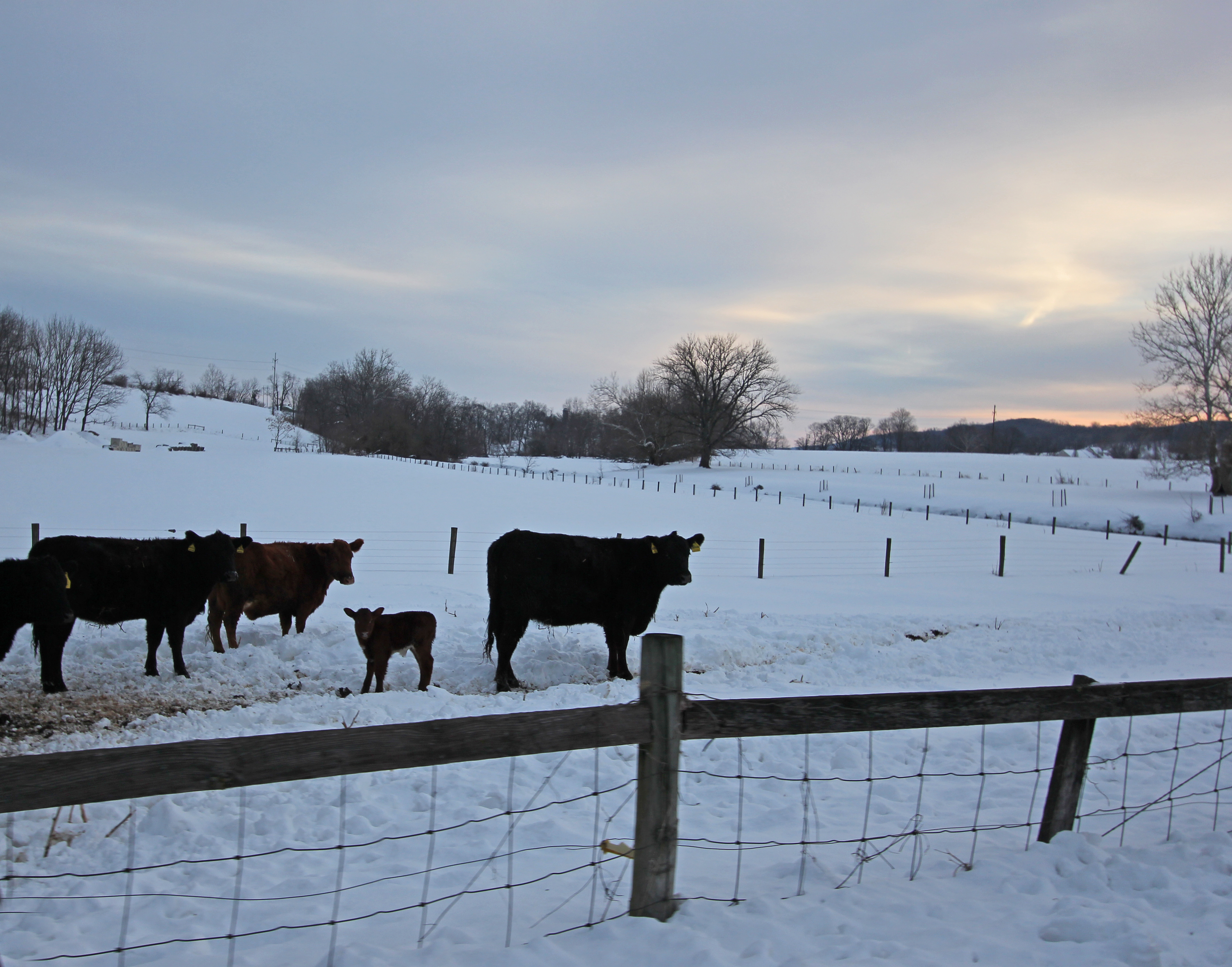
Last week the mercury hit -14 at Trowbridge Angus Farm, where it is calving season January through March. The family, and their over 300 beef breeding cows, were navigating two to three feet of snow cover.

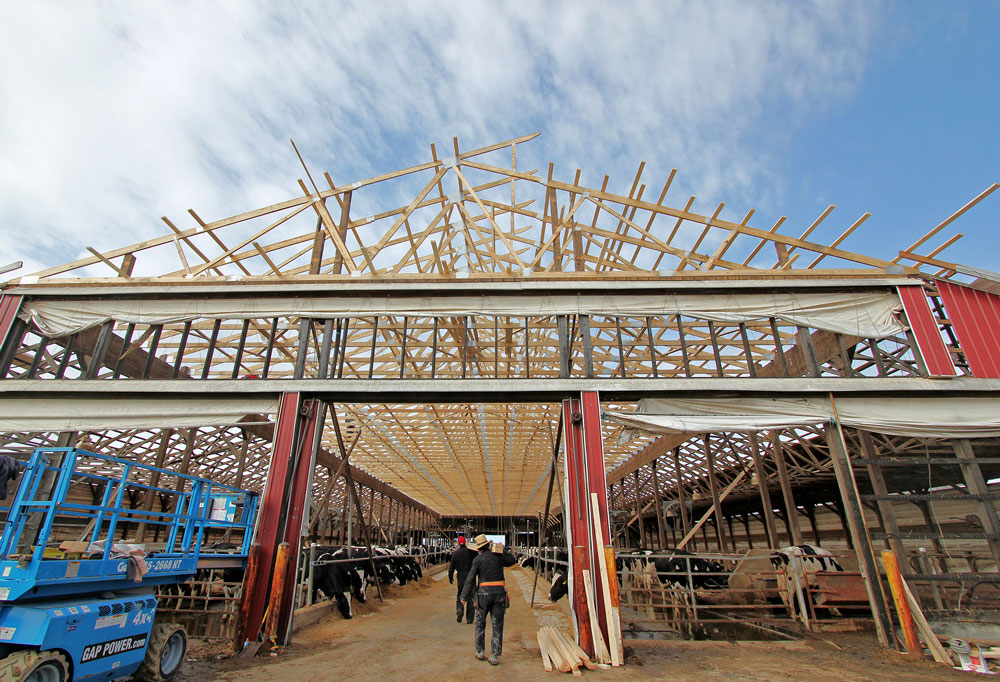
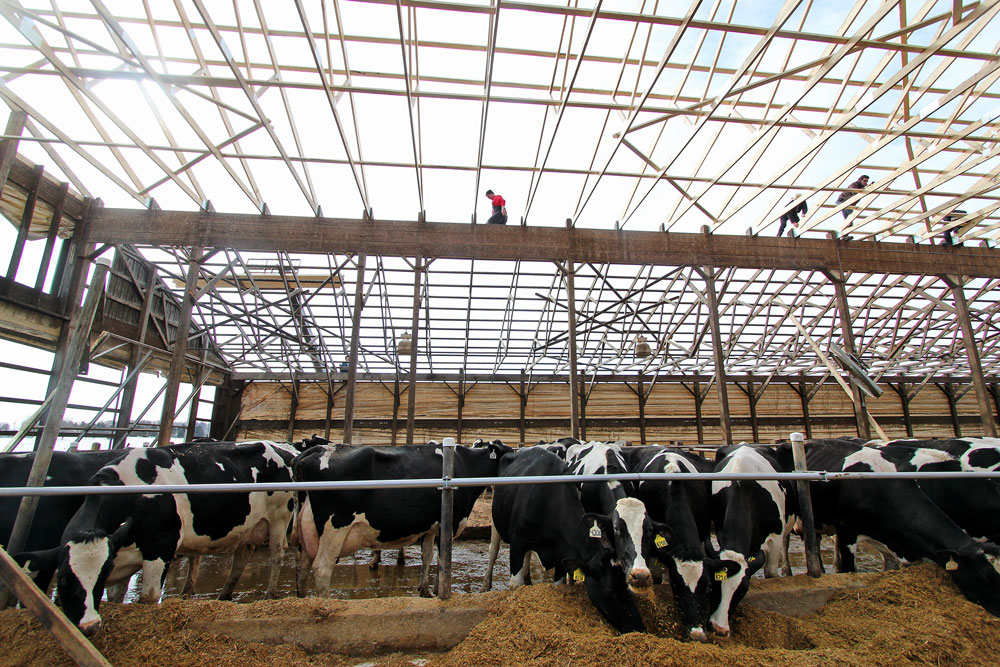
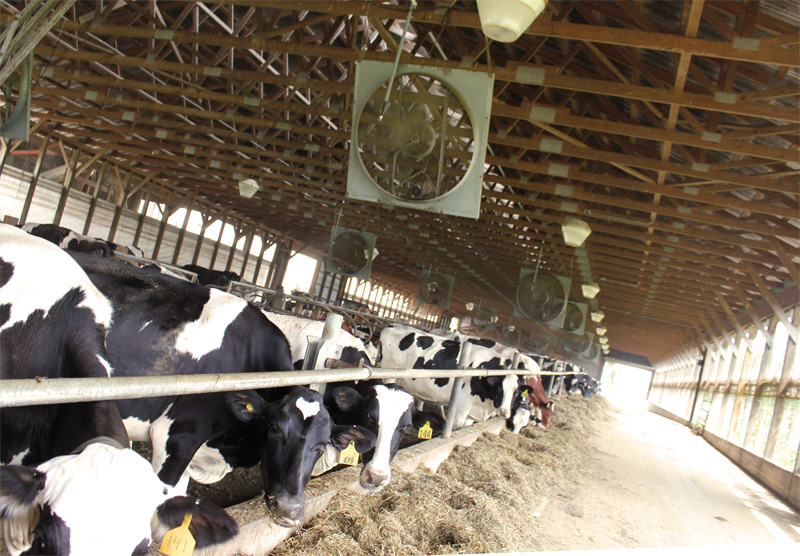
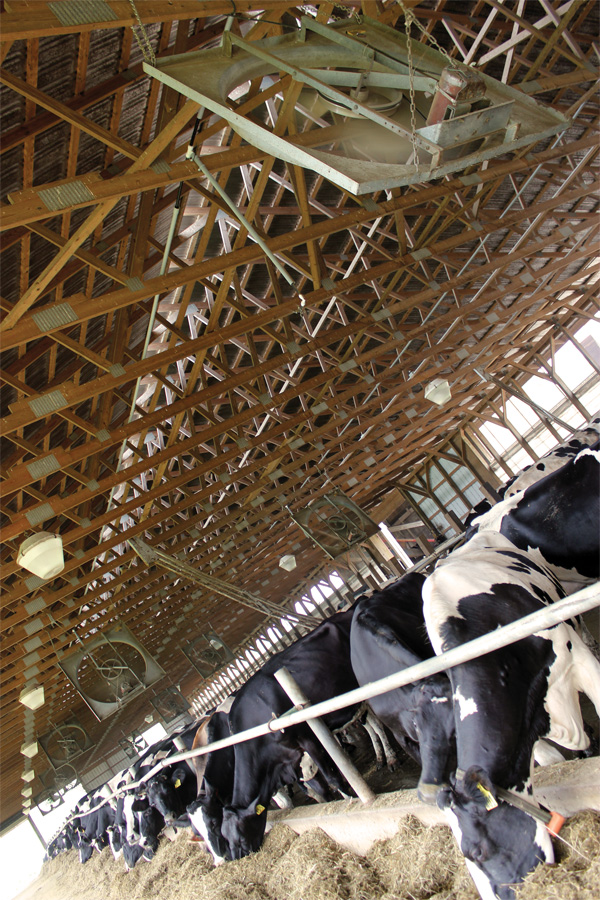
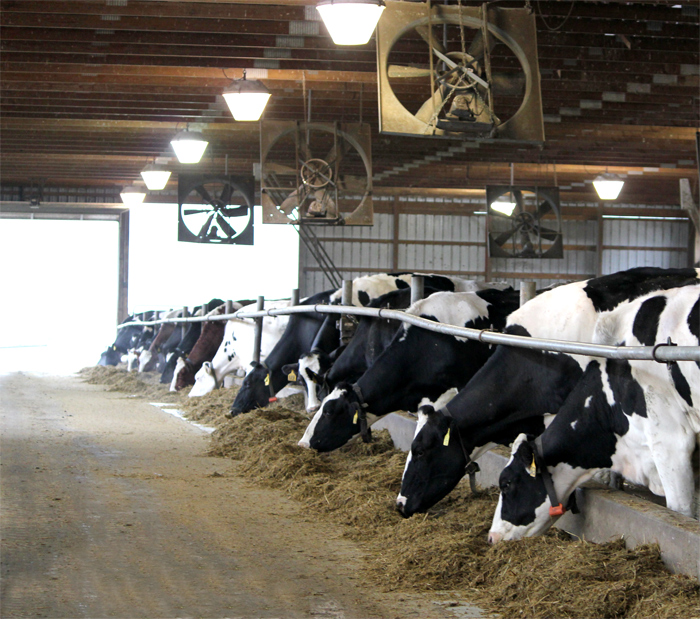
Twenty miles away near Schodack Landing, temps of -11 went virtually unnoticed by the over 700 Jersey dairy cows at Dutch Hollow Farm. They are tucked away in their barns with retractable sidewall curtains that stay open more often than not for natural light and ventilation but remain closed when the wind chills get this low.

Cattle are cold weather animals, but they do not like wind or drafts. The difference between beef and dairy breeds is the way their centuries-old partnership with man has adapted through specialized breeding and care.

IMG_1939x

Beef breed cattle are kept outside pretty much year-round, coming into the barn only at calving time. Dairy cattle, on the other hand, are typically housed in barns year-round. While beef breed cattle spend more time foraging for their food and seeking the natural and provided windbreaks to lay down, dairy cattle in freestall barns will amble short distances inside from feedbunks and waterers to the deep-bedded stalls that are groomed for them two or three times a day while they are milking.

Dairy cows are accustomed to constant human handling from the time they are calves. 10986660_10206244497857081_5937924373439440151_oThey have a different temperament about the whole calving deal.They aren’t worried about predators and trust the humans they work beside day in and day out to care for them and their offspring.

Beef breeding cows, on the other hand, are more self-sufficient and protective of their young. They raise their offspring for the more hands-off life as a non-milking breeding animal or to spend 80% of their life foraging on pasture with the last 20% of their life in the beef fattening phase.

One thing in common: Both beef and dairy producers focus on the newborns immediately at birth to make sure each calf gets a warm start and enough colostrum for the passive transfer of immunity from its dam.

“When we get real cold weather like we have seen this winter, we spend more time in the calving barn at night. We pretty much sleep here with them when it’s this cold,” says beef producer Phil Trowbridge, who has had 50 calves born since January 1. “The main thing is to get those calves dried off and warmed up as soon as they are born, and to make sure they get enough colostrum. In two or three days, they’re old enough and strong enough to go outside.”

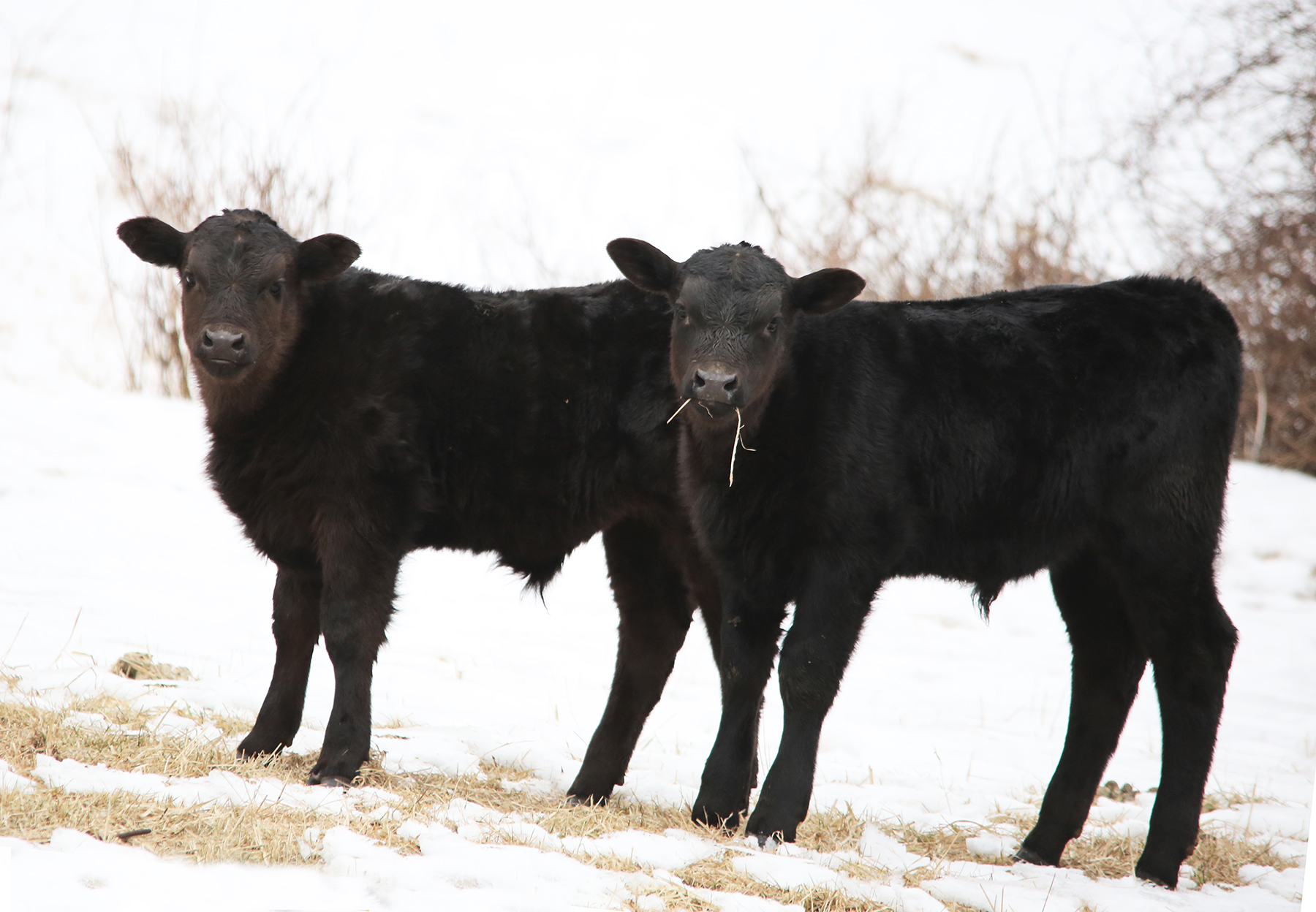
Not only are they prepared for cold weather, they frolic in it. “I took a video with my cell phone of the calves the other day when it was minus-11. We were putting out bedding for the cows, and saw those calves were feeling so good, they were just running through the snow,” Phil relates. “I like seeing that.”

calves

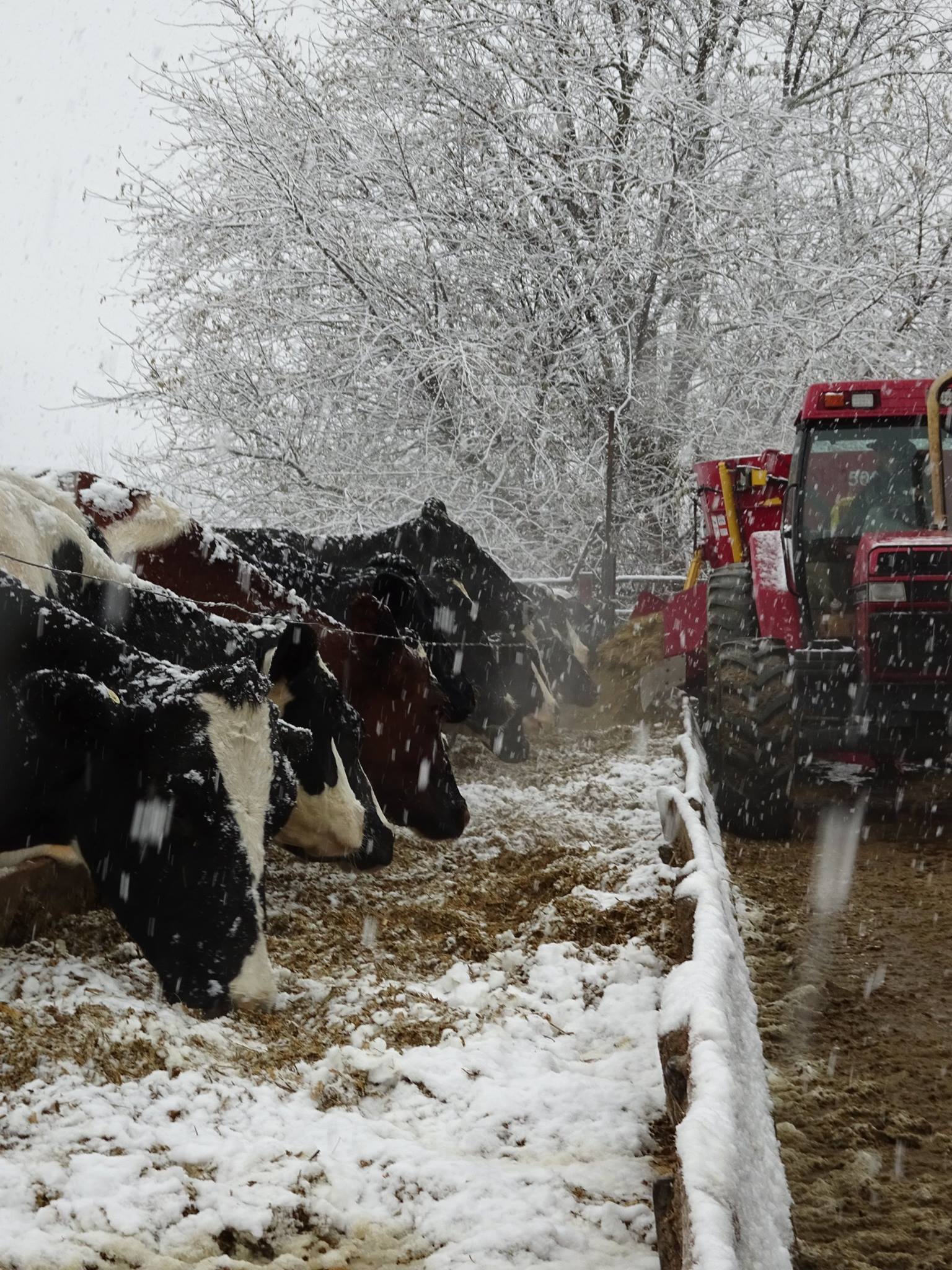
Stockpiled pasture grasses make a nice winter forage as cattle can push off a few inches or a foot of snow to graze it, and they do well getting around in the snow outdoors. But with over two feet of snow cover this winter, the Trowbridge family cuts trails to help the cattle conserve energy. They also put down extra bedding, more often, in the areas with windbreaks and feed more outdoor hay and supplement.

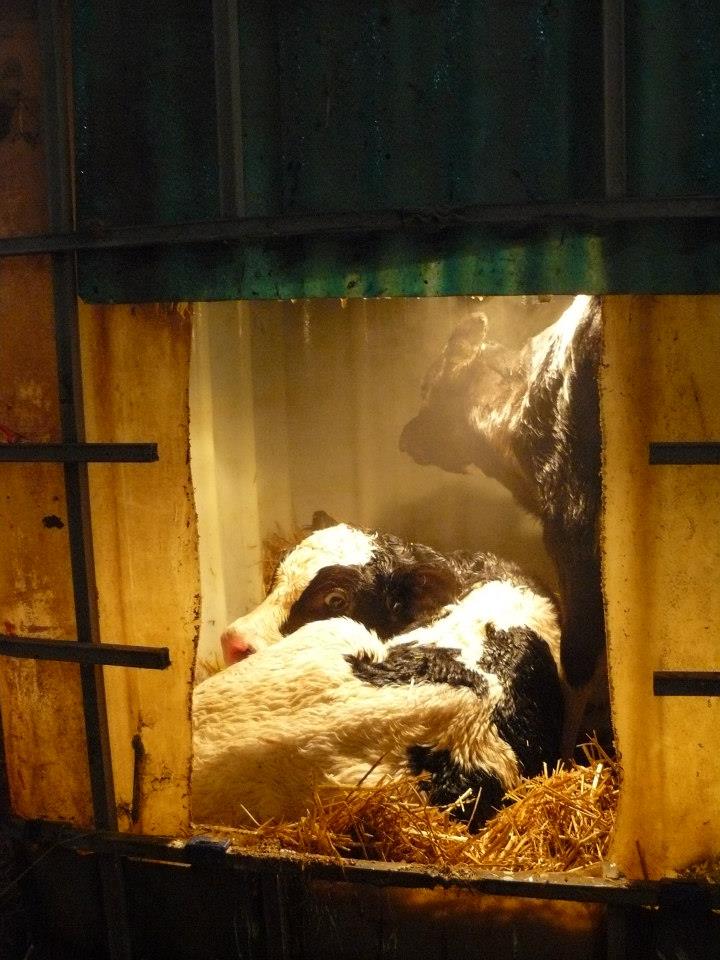
Meanwhile, on a dairy farm, the cows calve year-round. Calving pens are watched through video monitoring or by walk-throughs. The immediate newborn calf care continues through the first few weeks of life in the calf nursery or individual hutches. Newborns often get time in a heat box or wear calf jackets and sometimes earmuffs when it’s this cold, and they are fed more often for increased energy to maintain their temperature and to grow.

heated-box.jpg

Tricia Adams pictures one of the heated boxes for newborn calves at Hoffman Farms

“Taking care of the animals is pretty much routine. The feeding is very consistent day to day, and the freestalls are bedded twice a week,” says Paul Chittenden of Dutch Hollow
Farm.

“Clean and dry and plenty to eat are what we focus on — regardless of the weather,” he adds. “Cows always have dry sawdust with extra sawdust stored in the front of the stalls. This allows for plenty of dry bedding to stir around each time we groom the stalls when the cows go to the parlor for milking.”

webx073.jpg

Water is critical for drinking and cleaning, so lines are buried underground and drinking tubs are equipped with heaters.

“Cold weather management is really not too complicated,” explains bovine veterinarian and dairy farmer Dr. Tom Troxel. “Cows need to have plenty of feed and water, be out of the wind, and have a dry place to lay down. If they have these things, they can survive an awful lot.”

“No matter the weather, we have our jobs to do here,” notes Cody of Wil-Roc Dairy. “That is itself the reward. Getting our everyday tasks done and looking to see how the stressers of weather and other events can affect our system… That is how we keep improving how we do things all year long.”

Sherry Bunting is a member of North American Agriculture Journalists and has been covering beef and dairy production for 40 years. Before that, she milked cows and graded beef cattle for market reports. She can be reached at agrite2011@gmail.com

-30-

GL 022115-2

GL#23(photo-collage)

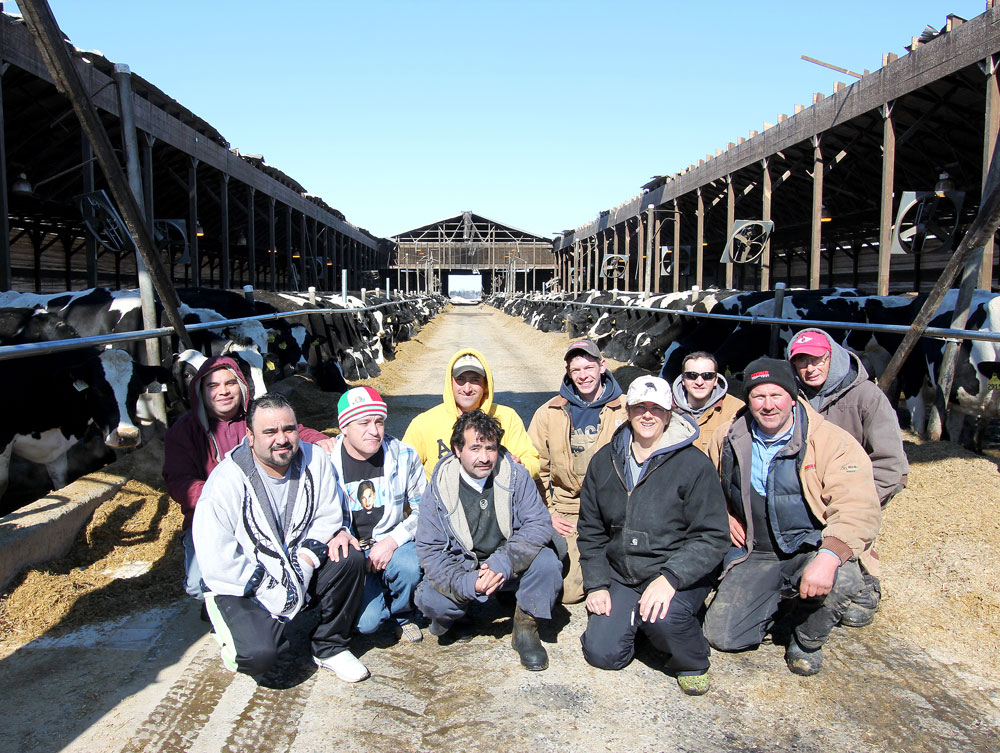
Dairy and beef cattle are adapted differently, but they all depend on their people for great care during the weather extremes we have seen here this winter. Farming is not for the faint of heart. Everyday tasks take longer to complete but it sure is rewarding to see cows thrive and calves frolic after a good start – regardless of the weather! Photos by Sherry Bunting, Tricia Adams and Evelyn Troutman.

‘Work hard. Save money. Be careful. Love the job.’

webR&J-190x

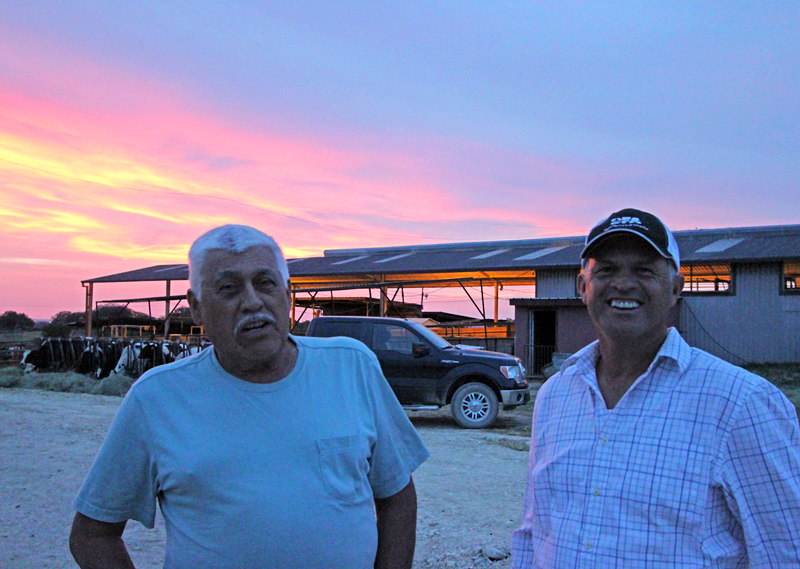
Hector Jimenez (right) and his uncle Arturo Rodriguez have been working together since the late 1970s. Two decades of saving as they worked on dairies in California led to them starting their own dairy near Dublin, Texas in 2004. In an interview last May at their R&J Dairy, they reflected on a decade of dairying on their own in Central Texas. Photo by Sherry Bunting

By Sherry Bunting, originally published in Farmshine and Texas Dairy & Ag Review during the summer of 2014

DUBLIN, Tex – The decade of 2004 to 2014 has been a volatile one for anyone starting out in the dairy business. For these two producers it took more than two decades of
work on other dairies in California to pave the way to be living their dream today in Central Texas. Hard work, disciplined saving, and hands-on management are the three keys Hector Jimenez and his uncle Arturo Rodriguez say brought them through 20-plus years of working for others and 10 years dairying on their own – including the 2009-13 era of tight to negative margins.webR&J-536

“We worked together since 1979 and always talked about one day having our own dairy,” Hector recalls. That day came in 2004 when Hector and Arturo bought a dairy near Dublin that had been vacant for a number of years after its previous owner moved west to where the dairy industry was expanding in the Panhandle.

They moved here from California with nothing, bought 110 cows and milked three months on a rented dairy, then partnered in their own R&J Dairy. They bought another 150 cows and took their time raising their own replacements to expand steadily through internal herd growth.

“WwebR&J-165e started with No. 1 and this calf, here, is No. 2869,” Hector smiles, pointing out a newborn heifer. Today their herd of 850 milking cows is 95% homebred. They produce an average of 75 pounds/cow/day and have achieve somatic cell counts at or below 200,000.

They are satisfied with the current size of their dairy as they build back their numbers after a few years of heavier culling rates while milk margins and feed costs were tight to negative. The recent memory of 2009-13 brings daily reminders of the importance of saving, working, and being cautious.

“We culled heavily because we needed that money to pay bills,” Hector relates. Today, the herd is 30% first-calf 2-year-olds.

Asked how they made it through those tough years, Hector’s wife Fabiola said: “We prayed.”

“And worked hard,” added Hector.

He and Arturo are hands-on managers. “My uncle is out here feeding cows at 4 a.m. and I start at 5 a.m.,” says Hector, who does all of the breeding. His day starts with cleaning the milk tank and the parlor, checking fresh cows, and starting the day’s breeding lineup.

“My husband is in love with what he does. He never complains. He and Arturo are always here – rain or shine, good or bad — that’s how we made it this far,” Fabiola adds.

She and Arturo’s wife Sylvia — and more recently Arturo’s daughter Christian — take care of all the calves at R&J Dairy.

webR&J-557x

Hector and Fabiola Jimenez (left) and Arturo Rodriguez (right) with his daughter Christian. Missing from photo are Hector and Fabiola’s grown children Clemente, Abel and Joann and Arturo’s wife Sylvia and son Arturo Stephen. Photo by Sherry Bunting

They employ 10 people, mainly milkers. They feel a sense of satisfaction in coming to the U.S. from Mexico in the mid-to-late 1970s, working hard, starting a new life here, including their own dairy business, raising children who are either interested in the dairy or working good jobs in the community, and now providing jobs for others in the community.

Halfway through their first decade in business together, Hector and Arturo hit the 2009 milk market train wreck followed by years of drought and surging feed prices. Cutting expenses was a big part of that picture from 2009-12, and the partners aren’t so fast to spend money now that dairy margins are good.

They have 220 acres and rent some additional property for growing coastal hay. That, and working with their nutritionist in feeding commodities like corn gluten, canola and cottonseed along with purchased corn silage — helps them manage feed costs.

They feed a dry cow ration and move the close-up cows and first calvewebR&J-125xxrs close to the house for observation. They also use Udder Comfort after each milking for a few days post-calving to reduce edema and improve recovery time.

The breeding program involves synchronization, but only for those cattle that are not showing heats. Hector and Arturo pick the bulls. “We look for high components – fat and protein – as well as calving ease,” Hector explains.

High components and high milk quality are two keys to making the most of their milk check in both high and low market times.

“The dairy business can be a tough business,” Arturo observes. “You have to enjoy it. I enjoy everything about it, getting up early, being out here. It’s all I’ve known since 1975.”

For the next generation of dairy producers dreaming of having their own dairies, Arturo has this advice: “Work hard, and sooner or later you will be rewarded,” he says. “Save money and invest in cows, but above all work hard. If it is work that you love, that won’t be hard.”

Those two-plus decades of hard work for other dairies have rewarded Hector and Arturo with more of the work they love, but now they do the work for their own dairy investment.

As these two partners have experienced over the past 10 years dairying on their own – “Even when you have your own business, the work doesn’t stop and in some ways you work even harder. You have to be here, work here, live here,” Arturo explains.

Hector agrees. “Even when I’m at the house, I’m thinking about the cows and wanting to see that they are okay. You have to like this job to do it well, and you have to like it even when you are losing money.”webR&J-151

It can be done, they say, “but you have to be careful. We had to spend money carefully,” Arturo noted. “We started this dairy during the good times in 2004. We’re still here, I think, because we were careful in the good times and the bad times. We watch every day how we feed, and when the times are tough, we cut out what is too expensive. When the going gets really tough, we shift our focus into survival mode, not to how much milk we can make.”

Cost of production at R&J Dairy runs almost $20.00/cwt at the moment (spring 2014), which includes all costs — everything. “It gets scary when milk prices fall to $16,” Arturo relates. “In 2009, the price fell below $12, and our cost of production at that time was $18. At one point we were losing $2000 per day here and borrowing to pay bills.”

He explains that they were fortunate to have built up some equity they could borrow on, and he estimates that another three months of milk prices as high as April’s may finally pay back what they lost in 2009.

“We try to stay ready for the next downturn,” the two men agree.

Arturo sees the new Margin Protection Program in the Farm Bill as something that will help dairy producers during future downturns. “It’s better insurance, better than the MILC program. When it gets tough in the dairy business, any help is nice to have.”

As for forward contracting, Hector and Arturo prefer to take on the risk. They believe that while the new insurance program will help and some folks have benefitted with forward contracting… nothing substitutes for hard work, saving during the good times, and close management and caution all the time.

The two partners worked day and night through the worst of 2009-10, and believe that is webR&J-572what got them through it. “We looked for those small daily victories,” Arturo reflects. “That’s what kept us going. We just kept thinking we would be okay — that if we worked hard, we would be rewarded for the years of suffering, and I guess we are seeing that right now.”

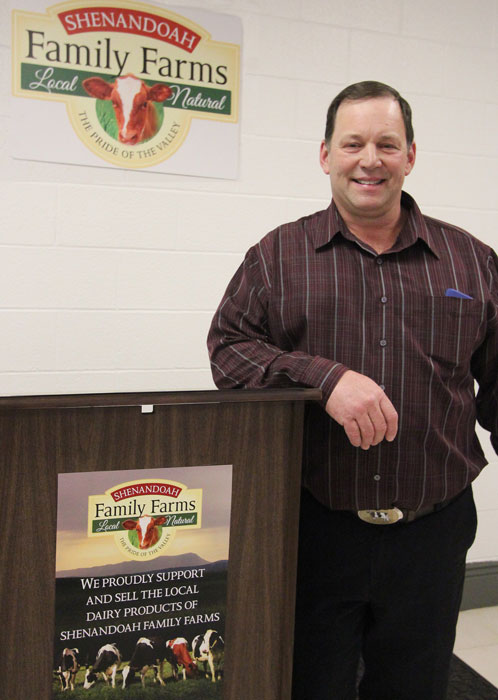
Milestone reached by Shenandoah Family Farms

BlogShenFamFarms085BlogShenFamFarms-011

By Sherry Bunting, reprinted from Farmshine March 21, 2014

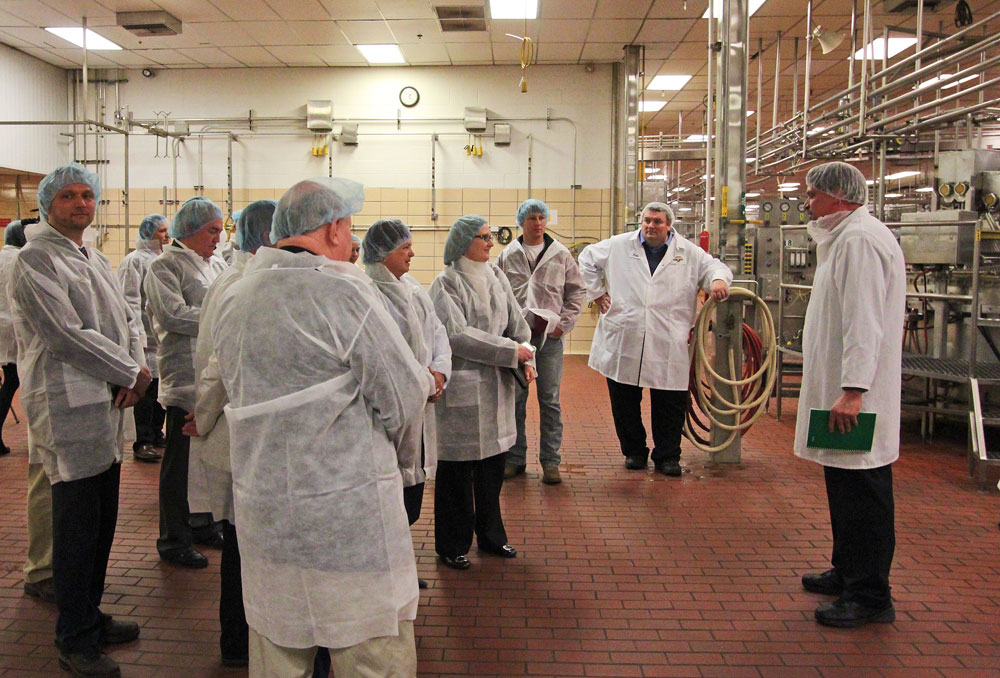
HAGERSTOWN, Md. – “Every day we reach new milestones, and today is one of them,” said Tom Francis, production manager and VIP / media tour-guide Tuesday, March 18 at the dairy plant where Shenandoah Family Farms Brand milk and cream products are made.

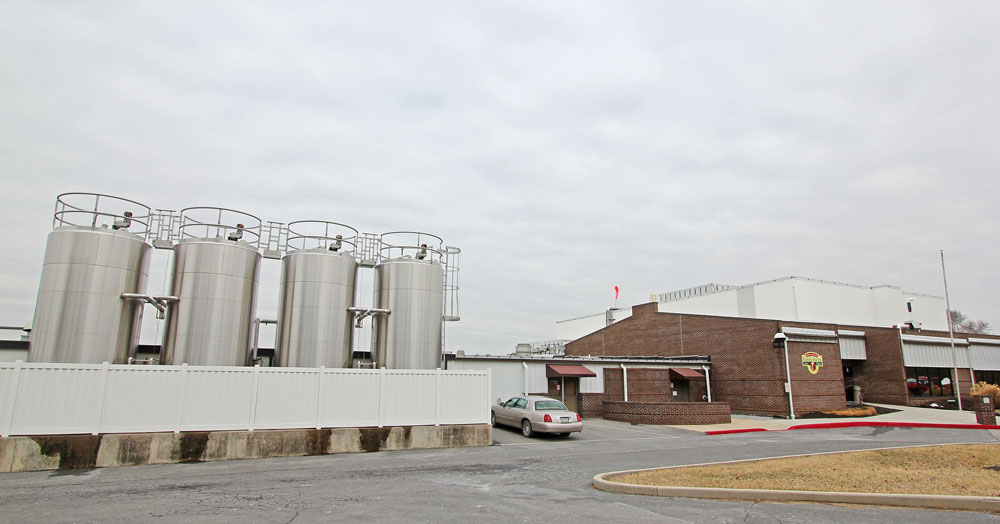
The 142,000 square foot facility in Hagerstown, Maryland was idled by Unilever in 2012, then purchased in August 2013 by Valley Pride LLC, a dairy business owned by 21 dairy farmers from the Shenandoah Valley region of Virginia. This purchase, and the separate formation of Shenandoah Family Farms Cooperative, grew from seeds planted during a 2012 meeting of the five original board members at the Thomas House restaurant in Harrisonburg, Virginia.

“We are excited to be here and look forward to moving forward,” said Randy Inman during Tuesday’s pre-tour press conference. Inman, a Harrisonburg, Virginia dairy producer, serves as vice president of Valley Pride LLC and Shenandoah Family Farms Cooperative.BlogShenFamFarms104

Over the past 18 months, they have developed a media and social media presence as they prepared for the startup of milk and cream bottling operations at the renovated plant February 24. Soft-serve ice cream mix production began last week, and hard ice cream production will begin after new equipment arrives in April.

To this point, Shenandoah Family Farms has used social media to bring farm families, farm life, farm children — even farm calves, cows, cats and dogs — right to the computers and smart-phones of thousands of customers. Brilliant photography of life on the farm and scenes of the beautiful Shenandoah Valley bring a nostalgic feel to the marketing of natural dairy products prized for their quality, flavor and wholesomeness.

“Our web presence will grow in the next three weeks with the launch of a new website with store locators and profiles of our farmers and staff,” said Shenandoah Family Farms marketing director Jennifer Churchman.

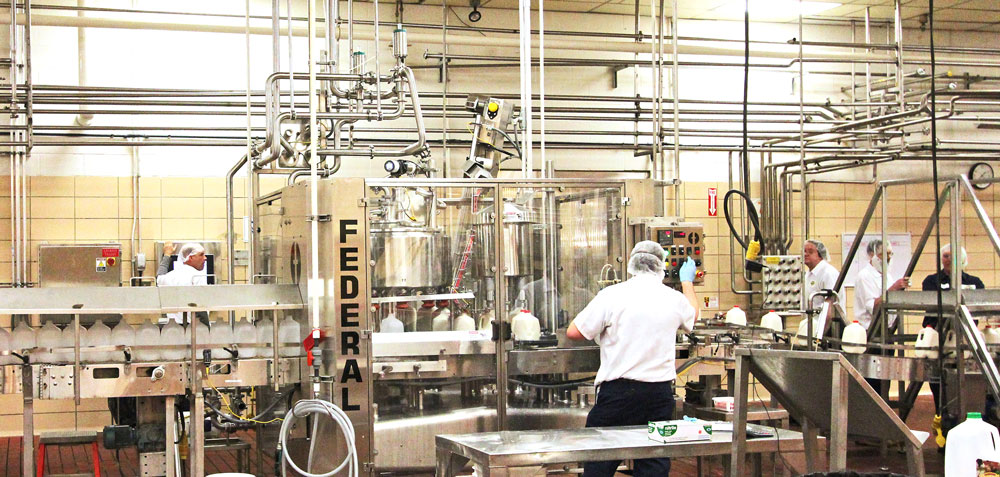
The plant is currently just scratching the surface of the demand and production capacity. The equipment has the capability of bottling 32 gallons of milk per minute, and the largest single-day of production they had since Feb. 24 was 6000 gallons. But Francis said this can be doubled with more shifts, workers and equipment as the demand grows.

BlogShenFamFarms063cropped

To-date, Shenandoah Family Farms milk goes to 170 retail and restaurant establishments along the Route 81 corridor from Shenandoah Family Farm Cooperative’s home base in Harrisonburg, Virginia, through the plant location in Hagerstown, Maryland, and north and west into West Virginia and the Waynesboro and Greencastle areas of Pennsylvania.

“We’re adding 5 to 10 new customers per day,” Churchman confirmed, explaining how end-consumers can fill out product request forms at shenandoahfamilyfarms.com and take them to the stores and restaurants they patronize. The product-request forms have also been the key in developing initial leads for the sales team.BlogShenFamFarms110

“The more requests that are submitted, the easier it is to get our product on the shelves,” aaid Inman. He noted they are close to getting their products into the local Walmarts.

“We are beginning to reach out to the Washington, D.C., area, and getting a lot of interest there,” said plant manager Fred Rodes, who has 25 years of experience working for three creameries after jumping the fence from dairy farming to dairy manufacturing in 1988 for health reasons. Rodes also said they would be open to doing private label work, but are focused right now on working directly with customers and through distributors to build their brand.

Hagerstown Mayor David Gysberts and other local city and county officials were on-hand Tuesday showing their enthusiasm for the plant’s re-start. “We are happy to see the Virginia farmers bring jobs back to our region,” said Gysberts. One-third of the 44 full time and 4 part time employees worked at the Hagerstown plant under its previous owner, Unilever, which employeed 400 at its peak before idling the plant in 2012.

“The more the community supports Shenandoah Family Farms products, the more products we can make, and the more jobs we can create here,” said Inman. “It’s a snowball effect.”

He explained that Shenandoah Family Farms products come from a small group of farms. Right now that is 21 farms average 130 milk cows per farm.

“The close proximity of our dairy farmers to our market will give customers assurance of fresh dairy products,” added Inman. “We are focused on high quality milk production and the assurance of best management practices for environmental sustainability, heritage farming practices, humane animal care, involvement in our community and involving our customers in our decisions as we grow.”

Inman said the primary goal of this enterprise is to preserve small family farms for generations to come. “We saw this as a way to take some control of our product by building a relationship with our end-consumers and taking our milk from the farm to the consumer, and to see our farmers rewarded for their high quality production with a steady milk price.”

The investment runs deep here – beyond dollars. Inman explained that the farmers and staff “worked hands-on and side-by-side” to upgrade and renovate the facility over the past six months. USDA loan-guarantees helped the group of farmers get the financing to not only purchase but also upgrade the plant and build awareness for their brand.

The facility’s milk silos, large conveyors, pasteurizer, existing ice cream equipment, coolers, and in-wall freezers were all part of the plant purchase. The owners purchased a separator, homogenizer, bottling equipment and new ice cream manufacturing equipment as well as upgrading computers, software and the ability to track milk from farm-to-store. They also upgraded the coolers and chillers and adding other conveyor capabilities throughout the plant.

BlogShenFamFarms121

“We’ve had some delays with equipment arriving and the challenges you would expect with a project like this, but we’re ready. The word is getting out about our products, and the support from the local communities has been quite encouraging,” Inman said, adding that he’s impressed with how his fellow farmers and the plant staff have worked together.

“I’m amazed by the super commitment of the farmers, and their families, to get this up and going, and by our staff as we’ve worked together,” he said.

To be bottling the Shenandoah Family Farms milk and on the verge of beginning ice cream production was described as “overwhelming” by board member and producer Dennis Trissel. “In any business like this, you always hope to put in place what’s necessary to get the product marketed,” he said. “Our farmers know how to make high quality milk and our plant managers know how to make quality products…”

Now the ball rolls into the consumer domain through product purchases and requests where they shop.

“Our store customers need to see that we are capable of being here five years and forward,” said Rodes. “We have good staff and a lot of experience. I grew up on a dairy farm and I enjoy the challenges of running a creamery. I’m willing to work hard for these guys (the farmers) because I know they care about putting out a quality product. Now the rubber meets the road in sales.”BlogShenFamFarms067

For the sales force Lyndon Jonson and Rich Muldoon, that’s a challenge they are meeting daily – “hitting the road and knocking on doors.”

“The most rewarding thing for me is getting a new account, that’s my high-point,” said Johnson, a former truck driver who is part of the Shenandoah Family Farms sales force.

When hard ice cream production begins next month, the plant will roll out vanilla, chocolate and strawberry and begin adding flavors with 11 flavors planned at this time. They will concentrate on volume packages for grocers and soft-serve mixes for restaurants before adding a line of other types of ice cream products.

“For the most part, our awareness building is getting farmers face-to-face with the end consumers,” Churchman explained how ‘engagement marketing’ is being utilized. “We will utilize all avenues such as radio, television and print advertising, but we are also sponsoring many local events and will have our farmers and staff there. They are important members of their communities and we want them right there with our customers so the customers can be part of how we grow our company.”

BlogShenFamFarms019

The 21 family farm members of Shenandoah Family Farms are all located within a 10-mile radius of Harrisonburg, Virginia. Currently three farms’ milk is going to the plant. Once all 21 farms’ milk is being utilized by the plant, another 12 producers are on-board to be added.

Churchman said they are using “test-market-moms” as an advisory group of moms and families to advise, test, and decide what to put out. “They can use their social media circles to gain additional feedback for us,” she said.

BlogShenFamFarms004

Ice cream lead Charles Evans is glad to be back to work at the plant under the new ownership. Asked what makes the Shenandoah Family Farms ice cream products stand-out in the marketplace, Evans said “the recipe. It was developed by the farmers and Fred Rodes our plant manager. It’s higher in butterfat content, making it rich and thick. Everyone who tasted our soft-serve today enjoyed it and we’re getting very positive feedback from customers.”

Rodes also stressed that the Shenandoah Family Farms ice cream (both soft-serve and hard) is 100% natural and contains no additives. “That’s kind of rare these days,” he said.

Inman said Shenandoah Family Farms is working with other cooperatives on milk supply balancing and they are working with other processing cooperatives and suppliers to combine additional products for their distribution contracts — including cottage cheese, sour cream and yogurt, as well as the full line of Turkey Hill teas.

BlogShenFamFarms125BlogShenFamFarms093

###


ShenFamFarms085

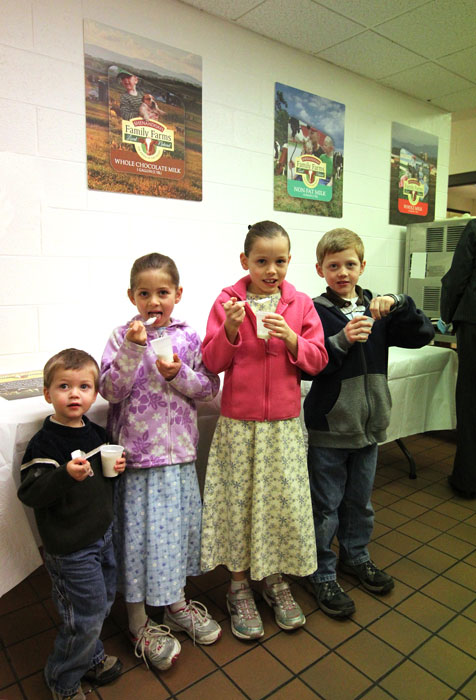
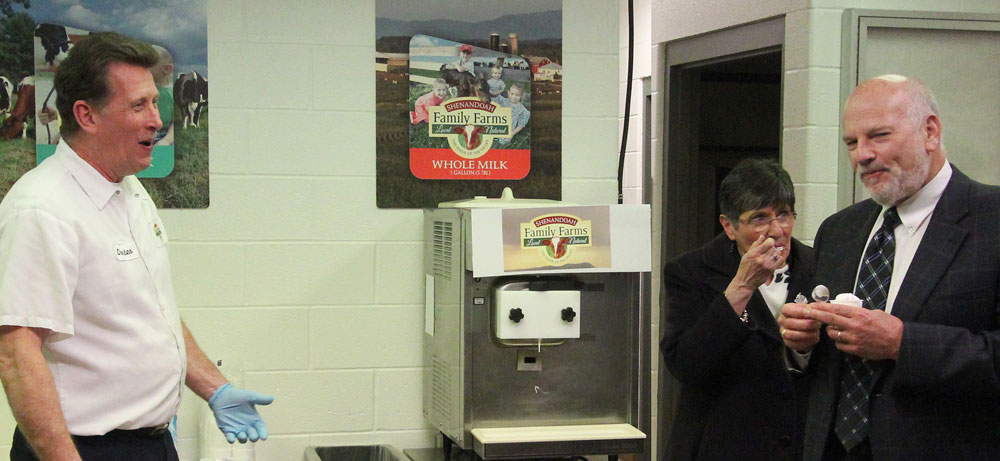
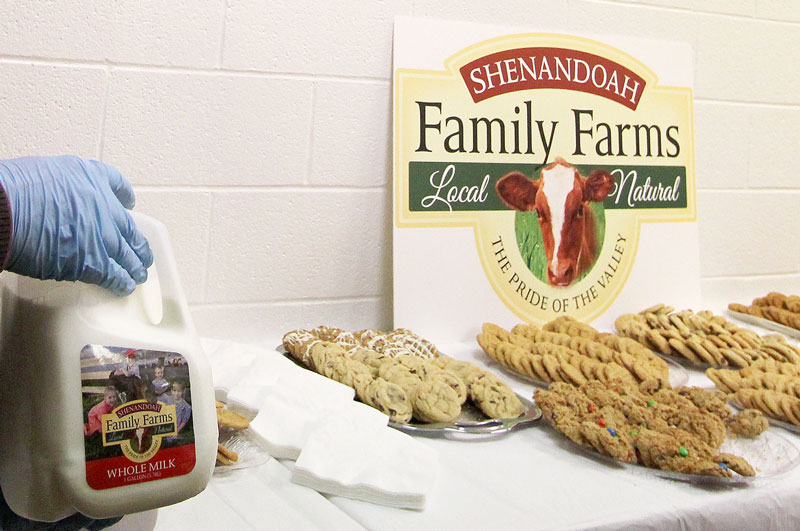
Micah Showalter, 2, is tasting Shenandoah Family Farms soft serve ice cream with brother Adrian, 8, and sisters Emily, 9, and Erica, 6. Micah and his puppy are the stars of the Shenandoah Family Farms Whole Chocolate Milk label, shown here in poster size (left) on the wall above him, and all four children with a newborn calf at the Showalter family’s Sun Dial Farm-2 are subjects of the Whole Milk label, shown here in poster-size above them (right). The Showalters are among the 21 farmers in a 10 mile radius of Harrisonburg, Virginia, who purchased and renovated the former Unilever ice cream plant in Hagerstown, Maryland. They started bottling Shenandoah Family Farms Brand fluid milk and cream products at the plant on February 24. They began making vanilla soft serve ice cream mix this week and will soon be doing chocolate. Hard ice cream production begins in April with vanilla, chocolate and strawberry and will expand to 11 flavors over the next several months. Photo by Sherry Bunting

ShenFamFarms093 or 106

Shenandoah Family Farms milk and chocolate milk were served with homemade cookies at the tour of the creamery Tuesday. Photo by Sherry Bunting

ShenFamFarms063 and 063cropped

After Unilever idled the 142,000 square foot Hagerstown, Md. plant in the fall of 2012, it was purchased last August by Valley Pride LLC, a dairy business owned by 21 dairy farmers from the Shenandoah Valley region of Virginia. In addition to updating the ice cream manufacturing equipment, they have invested in milk bottling, which started February 24. Photo by Sherry Bunting

ShenFamFarms-011

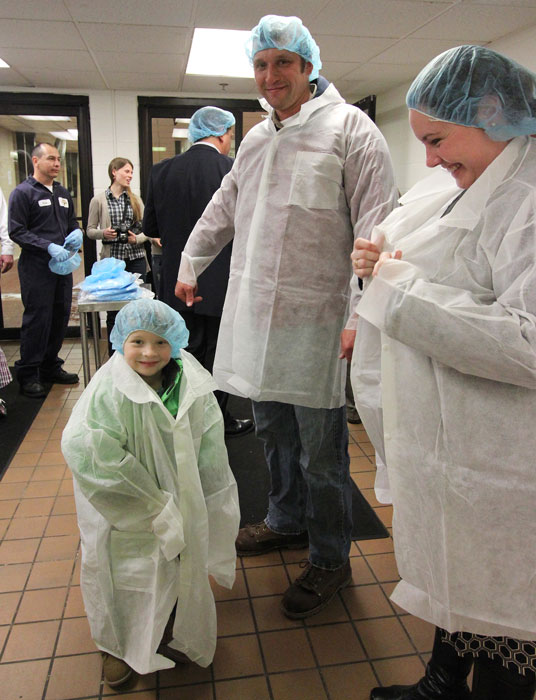
Owen Trissel is “over-the-moon” with excitement as he suits-up for the plant tour with his parents Cory and Charity. Owen, 9, and his brother Ian, 4, are the stars of the 2% milk label. One of the features of the Shenandoah Family Farms brand is to engage consumers in farm life through brilliant photography and larger labels. Photo by Sherry Bunting

ShenFamFarms-019

Production manager Tom Francis served as tour-guide Tuesday. He said hard ice cream production begins in April. The Shenandoah Family Farms brand offers chocolate milk is offered in whole milk variety, and ice cream is a higher butterfat, simple recipe made with 100% natural ingredients. Photo by Sherry Bunting

ShenFamFarms110

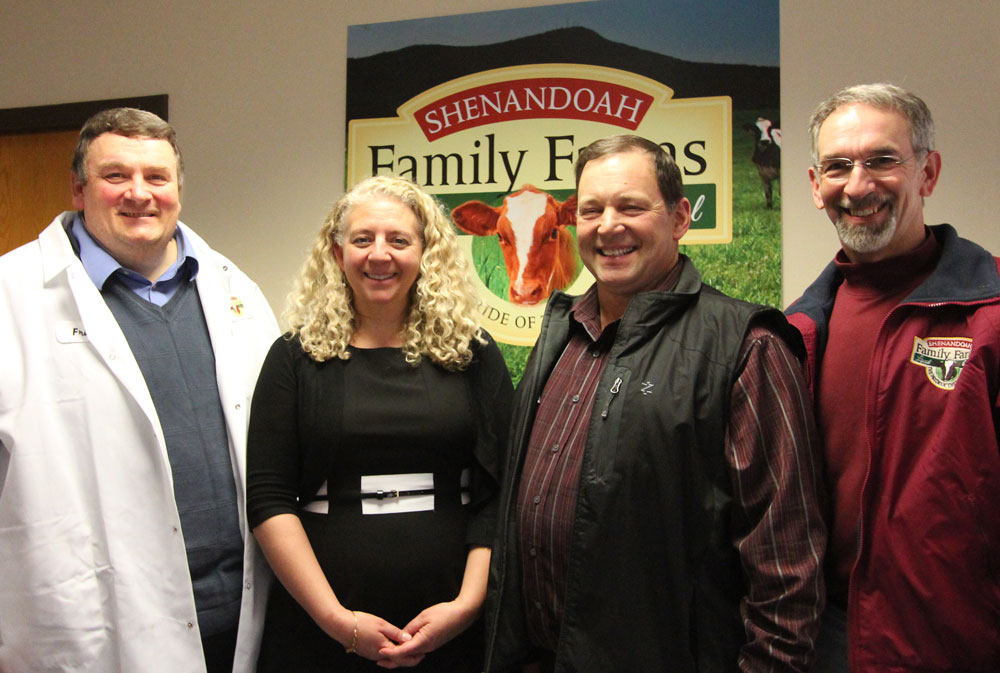
Dairy producers Dennis Trissel (right) and Randy Inman are two of the original five who met in 2012 at the Thomas House restaurant, Harrisonburg, Va., forming Shenandoah Family Farms Cooperative and planting the idea-seed for taking their milk straight from farms to consumers. They are pictured with Shenandoah Family Farms marketing director Jennifer Churchman who says “engagement marketing” is the hallmark of their campaign and plant manager Fred Rodes (left), who grew up on a dairy farm, then spent the past 25 years on the other side of the fence in the creamery world. He loves working with people, building teams, tackling challenges and tinkering with ice cream recipes. Photo by Sherry Bunting

ShenFamFarms105

Shenandoah Family Farms Cooperative vice president Randy Inman welcomed media and Hagerstown, Md. officials to the grand re-opening tour of the plant purchased by the investment of 21 members of the Valley Pride LLC, where Shenandoah Family Farms Brand milk is bottled and made into ice cream. Photo by Sherry Bunting

ShenFamFarms-Hagerstown

Hagerstown Mayor Dave Gysberts and Council member Don Munson were among the 35 suiting-up for Tuesday’s tour of the Shenandoah Family Farms dairy manufacturing facility. They are all smiles as 44 jobs have returned to the site of the former Unilever ice cream plant that once employed 400 people. Now owned and renovated by 21 dairy producers from northern Virginia, the plant began bottling milk last month, started making soft-serve ice cream mix this week and will be ramping up hard ice cream production as early as mid-April. Photo courtesy of the City of Hagerstown.

ShenFamFarms121 and/or 125

The 142,000 square-foot plant has been updated to make Shenandoah Family Farms ice cream and fluid milk and cream products. Photo by Sherry Bunting

ShenFamFarms067

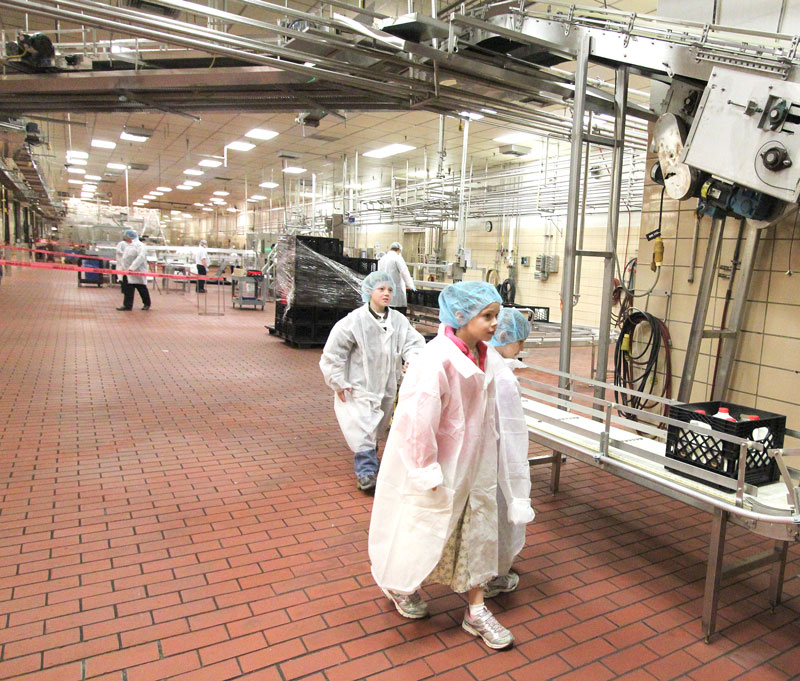
“Want to see where your milk goes?” That was all the encouragement these children needed to check out the conveyor taking crates of bottled Shenandoah Family Farms milk to the cooler where it was being loaded for delivery to 170 retail and restaurant customers — with 5 to 10 new customers being added daily.

ShenFamFarms095

A year of awareness-building through Facebook and other media brought daily photos of farm children, farm life, and farm calves, cows, dogs and cats right to the computers and mobile phones of thousands of consumers. Photo by Sherry Bunting

ShenFamFarms004

Charles Evans is the ice cream lead for Shenandoah Family Farms. He served the soft-style ice cream to local officials and media Tuesday. (I must say it was tasty!) Photo by Sherry Bunting

Collapsed barn roof reveals get’r done spirit, profound gratitude

Duane and Marilyn Hershey (front right) can't say enough about how their team of employees pulled together to free cows, restore order and keep 600 cows fed and milked in the hours after the roof collapsed Feb. 14 on about three-quarters of the main freestall barn at Ar-Joy Farms, Cochranville, Pa . They are pictured here with adaptable bovines eating TMR calmly under the open sky behind them three days later on Feb. 17

Duane and Marilyn Hershey (front right) can’t say enough about how their team of employees pulled together to free cows, restore order and keep 600 cows fed and milked in the hours after the roof collapsed Feb. 14 on about three-quarters of the main freestall barn at Ar-Joy Farms, Cochranville, Pa . They are pictured here with adaptable bovines eating TMR calmly under the open sky behind them three days later on Feb. 17

By Sherry Bunting, Farmshine, Feb. 21 and 28, 2014

COCHRANVILLE, Pa., Feb. 17, 2014 – “The first thing we did was pray. Then we hugged. Then we got to work,” Duane Hershey recalls about the first moments in the wee hours Friday morning, Feb. 14 after he and his wife Marilyn were awakened by milking employees to learn the roof had collapsed on the freestall barn at their 600-cow Ar-Joy Farms, in Chester County, Pennsylvania.

His first thought was that it was a small section, but as he walked up the hill from the house to the barn – wife Marilyn a few steps behind him – a more devastating picture emerged in the dimly lit night sky, and all he could think was that he was facing a lot of dead cows.
All told, the Hersheys say they are thankful and fortunate no employees were in the barn at the time, and the majority of their cows got through the event fairly well.

“Nothing you train for prepares you for the reality of that moment,” said Marilyn Hershey, who has participated in crisis management workshops through DMI. “The truth is, when I came to the top of the hill and saw the rubble, I lost it,” she recalled during a Farmshine visit to Ar-Joy Farms Monday. “Duane reassured me that we would get through this, but that first moment of seeing the devastation and hearing our cows in trouble was horrific to me.”

One of Marilyn’s first calls was to Dean Weaver at Farmer Boy Ag. “We prayed for wisdom to know what the next step is, and we prayed for safety,” she said. “I called Dean at 3 a.m. and he answered. He got my brains started and pulled me out of the shell-shock. He told us to call our insurance company, and three hours later Farmer Boy Ag had their first crew here.”

One of Duane’s first calls was to friend and fellow dairyman Walt Moore at Walmoore Holsteins near West Gove, Chester County and to neighboring friends and farmers Andy Laffey and Tim Barlow.

“Everyone brought gates and chain saws,” said Duane. “We figured we had 50 to 100 cows trapped. We didn’t know what we were facing until we were able to move the tin.”

In order to free the trapped cows, they first had to move the free cows so they could start clearing debris to get to the cows that were still trapped in the original main barn. Moore organized the process of sorting and moving cows.

By 8 a.m., there were four construction crews on-site. Two crews were sent earlier by Dean Weaver at Farmer Boy Ag, the Hershey’s builder. Then Chris Stoltzfus got a call at White Horse Construction from a friend who explained the situation. He also sent two crews over to help. Burkhart Excavating, a local contractor, also came out to help.

“The generosity of people Friday just blew us away,” said Marilyn. “The four crews worked side by side all day, and people just started showing up. They knew what to bring. It was an overwhelming blessing to us.”

It took four to six hours of meticulous work to clear enough debris to free the nearly 100 trapped cows. “It was amazing how calm they were,” said Marilyn.

Walt Moore also observed this, recalling the cows “cacooned” under-tin, chewing their cuds as crews and volunteers methodically worked their way through the debris to free them.

The Hersheys give a lot of credit to herdsman Rigo Mondragon and the team of Ar-Joy employees for figuring out how to keep milking and tending cows, rotating them through the portion of the freestall barn that was still intact so that all the cows would get an opportunity to eat and drink.

“Walt is the one who really organized the work of freeing the cows,” the Hersheys related. “He knew what to do and could do it more objectively – without the emotional attachment we had to what was happening.” Walt’s wife Ellen called Dr. Kristula from New Bolton Center, and helped the vet check cows.
11webRoofCollapse(Ar-Joy)007

“This has been one of the toughest years I can remember, a winter that just won’t let up,” said Moore. “I was taken back more than once to see the community effort at Ar-Joy on Friday, to see how the farming community and their church family cares about each other.”

By Monday morning, agent Sue Beshore of Morrissey Insurance, the insurance carrier for Ar-Joy Farms, said she had heard from close to 10 customers with agricultural roof collapses, but that Ar-Joy was the first to involve so many livestock.

“This is a time for hugs,” she said to Marilyn before explaining the coverages the Hersheys had for the freestall barn their employees work in part of the time and their cows live in all of the time.

“We had 12 to 18 inches of snow the day before the roof collapsed, then some rain that iced over that evening before we got another 8 inches of snow that night,” Duane recalls, adding that there was already a snow pack on the roof from earlier precipitation and frigid temps.

Penn State ag engineer Dan McFarland notes that roof systems “are truly an engineered system. What the design of the roof allows for is the buildup of snow cover as measured by ground cover maps. In Southeast and South Central Pennsylvania, that might be 30 to 35 pounds. A light snow is 5 to 20 lbs per square foot. A snow pack is 30 to 40 pounds, a snow pack with ice can be 40 to 50 pounds, so now we are getting very close to what a lot of roofs are designed for.”

According to McFarland, a roof snow pack will absorb rain, and when that turns to ice, it doesn’t move and take longer to melt. In the short term, people like to get heavy loads off .

But McFarland urged extreme caution. “Be hesitant about going up without safety harnesses and tie-off ropes,” he said. “Metal roofs are slippery, so try to remove it, if you can, with a snow rake from the ground.”

Some ag building roofs are quite wide, which makes snow load removal more difficult. “If you are going to remove it, remove it evenly,” he advised. “One thing to avoid is uneven snow loads. Trusses are designed to carry the load to the load bearing points on the sides, so don’t prop them up in the middle because that can actually weaken the design.”

Good ventilation also helps. Condensation can deteriorate roof systems. Experts suggest evaluating truss systems for bowing and to contact professionals to evaluate or assist.

Drifting of roof snow pack, warming temperatures, additional rainfall getting absorbed, and blocked roof drainage systems all contribute to uneven or excessive snow loads. Strained roofs surviving the weight from this week’s rain bear watching in additional storms later this season. Cold air is expected to return next week, bringing additional snow in some areas.
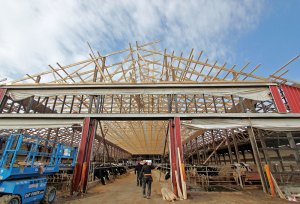
One week after the roof collapsed, rebuilding is underway at Ar-Joy Farms Thursday, Feb. 20. Farmer Boy Ag carpenters put up wood bracing after 69 trusses were set for the steel roof construction.

One week after the roof collapsed, rebuilding is underway at Ar-Joy Farms Thursday, Feb. 20. Farmer Boy Ag carpenters put up wood bracing after 69 trusses were set for the steel roof construction.

Loss gives way to profound gratitude

COCHRANVILLE, Pa. — Feb. 20, 2014 — The cattle losses at Ar-Joy Farms here in Chester County, Pennsylvania have grown to two dozen in the wake of the February 14 roof collapse over the main 275-feet of freestall barn, which left only the newer 92-foot section of roof standing. But Duane and Marilyn Hershey have not had to handle any of this alone.

By the following Saturday (Feb. 22), 69 new trusses were set and the 600 cows had a new roof — thanks to the efficiency of friends, neighbors, insurance adjusters, structural engineers, and the crews at Farmer Boy Ag.

The farming and church communities reached out to the Hersheys immediately that Valentine’s Day morning, and also had a work day one week later to prepare the site for crews to set new the trusses and raise the new roof in the three-day window of warm weather before the frigid cold and precipitation returned to Southeast Pennsylvania this week.
03webRoofRebuild(ArJoy)018

Friend and business partner in Moocho Milk hauling, Walt Moore of nearby Walmoore Holsteins, West Grove, was the first to arrive on the scene in the wee hours of that Friday morning.

“They were overwhelmed,” said Walt of his friends. He felt like it took him and his wife Ellen forever to load the service truck with whatever they could think of needing and to traverse the snow-covered and icy roads to Ar-Joy Farms.
h-m2

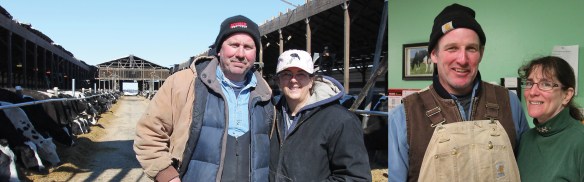
Walt and Ellen Moore got the 2 a.m. phone call Friday morning, Feb. 14 from Duane and Marilyn Hershey that 275 feet of their main freestall barn roof had collapsed upon the 320 stalls and cows below.

“The biggest thing we could do was to bring what we thought would be needed and to help organize the next steps. We have similar operations,” Walt explained. Ar-Joy milks 600 cows while Walmoore milks 850. “When we got there, it was emotional to see, but I was able to be less emotionally-attached in that moment about what to do next.”

For example, Walt immediately saw that the lights were on so he wanted to first secure the electrical situation before proceeding with freeing cows and cleaning up debris.

Marilyn says that a farmer’s impulse in a time like this is to call another farmer. Who else would understand the situation, to know what was needed, and be able to bring clarity of thought?

“Walt was a big help to me,” Duane added. “I was able to bounce ideas off him, and he could be objective and see things I couldn’t see in that moment.

“You are kind of in shock and you lose the concept of time. It’s hard to explain the magnitude of it,” Duane recalled those first moments when the roof collapsed sometime around 1:30 a.m. His first impulse to run in and try freeing some cows was barely forming in his mind when another surge of collapsing roof brought the whole thing down.

What followed was an overwhelming silence, except for the occasional sound of metal scraping metal and cows lowing in distress. The milkers had stopped milking, and they all stood frozen with Duane and Marilyn for a few moments, mulling their options in the pre-dawn darkness.

When Walt Moore, Andy Laffey and Tim Barlow arrived with gates for sorting cows, the race was on. As reported last week, four construction crews from two companies, along with scores of neighbors helped the Hersheys and their team of employees sort, milk and feed cows; clean up wreckage; and restore a semblance of order to the farm.

They had one group of cows that had found their own way through the fallen roof wreckage and were corralled in the middle of the barn with no path out. “We cut a tunnel through the fallen roof for those 200-plus cows to walk through,” Duane recalled. “Everyone kept saying they can’t believe how calm the cows are, but that’s because we had so many farmers come help us. They knew how to handle dairy cows.”

Four to six hours later, cows were freed, some were put down, others were tended by Dr. Kristula of New Bolton, a group of 100 were transported to Walmoore for temporary housing, and the milking had resumed. “We had enough barn cleaned up for the cows to eat and drink,” Duane said. “They couldn’t all lay down, but at least they could eat and drink.”

Employees cycled them through feeding areas in the upper part of the barn that was still standing and the lower bank barn where the Hersheys normally keep transition cows.
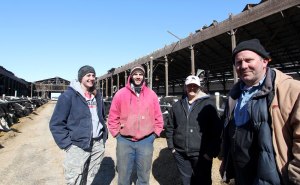
Two of the Hersheys four children who live somewhat locally and got to the farm as fast as they could -- given the condition of the roads in the early morning hours following the barn roof collapse on Feb. 14. "The first thing we did was give hugs," said daughter Kacie, who lives in Lancaster County and had been text-messaging her mother Marilyn some reassuring Bible verses. Their son Kelby lives in Maryland. He just returned from his Army tour of duty in Afghanistan two weeks ago. He said it would have been much more difficult to hear of this and be a continent away. He was glad he could be home to help. Stephen lives in New York and Robert attends college in Montana.

Two of the Hersheys four children who live somewhat locally and got to the farm as fast as they could — given the condition of the roads in the early morning hours following the barn roof collapse on Feb. 14. “The first thing we did was give hugs,” said daughter Kacie, who lives in Lancaster County and had been text-messaging her mother Marilyn some reassuring Bible verses. Their son Kelby lives in Maryland. He just returned from his Army tour of duty in Afghanistan two weeks ago. He said it would have been much more difficult to hear of this and be a continent away. He was glad he could be home to help. Stephen lives in New York and Robert attends college in Montana.

Daughter Kacie and son Kelby were able to get to the farm that morning. Kacie had been text-messaging her mother comforting Bible verses. Kelby was ready to dig in and help. He lives in Maryland and had just returned from his Army tour of duty in Afghanistan two weeks earlier. Son Stephen lives in New York and Robert attends college in Montana.

“The first thing we did was hug our parents,” said Kacie, whose text messages had provided the inspiration Marilyn needed to kick down the wall she had hit emotionally.

The Hersheys can’t say enough about their team of employees and how they worked together to keep the cows milked and fed during the ordeal. “It’s unbelievable how back-to-normal they seem,” said Marilyn. “Yes, our production is off, but the cow behaviors are back to normal.”

As for the rebuilding, the Hersheys are thankful how that came together. “Sue Beshore (Morrissey Insurance) always told us to keep that replacement value in our policy even though we were tempted sometimes to drop it,” Marilyn recalls. “We are so glad to have that.”

The Hersheys were also glad the adjuster gave them the freedom and flexibility to immediately tend their cattle and clean up so the roof replacement could be done immediately before the next round of frigid cold and snow in the forecast.
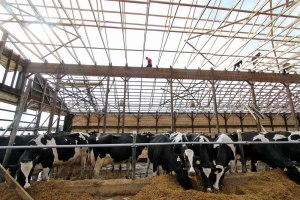
Cows were amazingly calm at Ar-Joy Farms as their new roof went up one week after the old one collapsed under the weight of extraordinary snow and ice pack. Owner Duane Hershey (red shirt) stepped out of his comfort zone to help the building crews who were pushed to get as much done as possible Thursday before the rain and wind on Friday.

Cows were amazingly calm at Ar-Joy Farms as their new roof went up one week after the old one collapsed under the weight of extraordinary snow and ice pack. Owner Duane Hershey (red shirt) stepped out of his comfort zone to help the building crews who were pushed to get as much done as possible Thursday before the rain and wind on Friday.

The bottom line in this story is how important it is for people to “hold each other up when facing a disaster,” said Duane. “To have friends and neighbors like that, just to see them there, it’s something I can’t explain. A lot of them left their own farms on a snowy morning to come here and help us. What can I say that really expresses our gratitude?”

The couple also received calls from dairy farmers in New York who had been through roof collapses. They gave advice and suggestions.

“You learn how important friendships are,” added Marilyn. “This is a tight farming community. I can’t tell you how thankful we are.”

Click here for more photos

A life lived in earnest

Tuesday was a day of significance with many shades to it. The much-debated 5-year Farm Bill got its final Congressional approval in Washington; the day was designated by American Cancer Society as World Cancer Awareness Day and Chevy developed its Purple Roads ad and “purple your profile” campaign to raise funds on facebook. Tuesday, Feb. 4, 2014 is also the day the world lost a good and courageous dairy farmer I was glad to call friend. Here are the thoughts I penned for this week’s Farmshine.

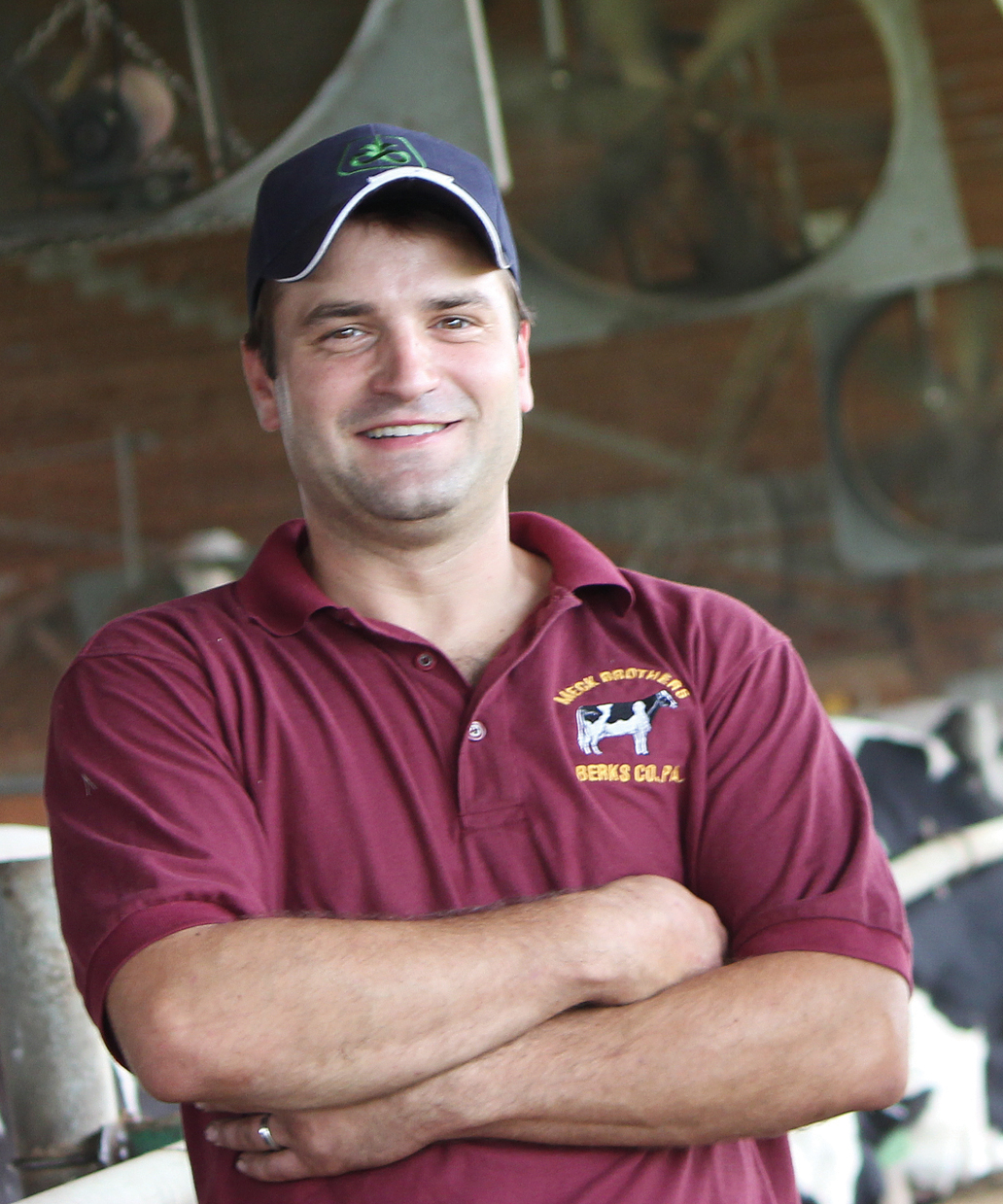
Zach Meck pictured here at Meck Brothers Dairy in Berks County, Pennsylvania in August of 2012

Zach Meck pictured here at Meck Brothers Dairy in Berks County, Pennsylvania in August of 2012

Zach Meck fought the fight, kept the faith

Zachary L. Meck, 33, of Womelsdorf, Pa., passed away Tuesday, Feb. 4 after a five-month battle with cancer. In the words of his wife Suzanne (Perdue) Meck, formerly of Whitehall, Md., “Zach saw a full healing as he was peacefully called to his heavenly home.” Over the past few months, she said, the couple felt the prayers and well wishes from around the world, and they were comforted to know so many people care.

In Zach, the world lost a good and courageous young dairyman. 2 Timothy 4:7 is the verse that comes to mind for a life gone too soon, loved by many and lived in earnest. Zach made a lasting impact on not just his family and friends, but also upon the future of the dairy industry he so loved and the solidarity he had with fellow dairymen, as well as the passion he had for the cow herd he and his brother Jeremy built up into a business through sheer determination.

It is not without notice that the next five year Farm Bill passed its final hurdle in the Senate on this same day. Zach had poured time and energy into being part of an effort to shape the future for young dairy farmers within the context of the Farm Bill’s dairy title.

Our paths crossed in 2009 when the dairy industry faced the most devastating milk prices ever endured. Zach and his brother Jeremy had built their Meck Brothers Dairy from scratch. They had started with the 4-H animals their late father Ronald bought them as youngsters growing up on their parents’ poultry farm in Lancaster County, Pa. They grew the herd in a rented barn — working all kinds of other jobs – then purchased and renovated a Berks County, Pa. farm they moved into during 2009.

Zach was not one to sit still. Sometimes it seemed he was going in multiple directions all at once. But his efforts were effective. In 2009, he was part of a group of dairymen meeting in two counties, which later became the grassroots beginnings of the Dairy Policy Action Coalition that spread beyond the borders of Pennsylvania as dairymen from various regions talked together about the future of their industry.

He also served as a Land O’Lakes delegate and ran a close race as runner up for a seat on the Land O’Lakes board in early 2013. Zach was a member of the Berks County Farm Bureau, Marion Grange, and Berks County Holstein Club. He graduated from Cocalico High School, where he was a member of FFA and was active in 4-H.

“We’ve been through a lot over the years,” wrote friend and mentor Nelson Troutman in a calendar-of-hope created for Zach in December. “Then came Suzanne, and when you made up your mind, I could tell. It was good. But with these health issues, try not to make sense of it all, it never will. Remember to always look forward and that you are not alone. Trust in the Lord with all your heart and lean not on your own understanding (Proverbs 3:5).” Wise words he heeded in his short time with his beloved Suzanne.

Having the privilege of writing a story about Meck Brothers Dairy in August of 2012, I could see the respect he and his brother Jeremy had for one another and their passion for what they worked to accomplish – with that edge of always pushing forward to do more to make the cows more comfortable, do more to tell the dairy story to the greater Berks community, do more to get the voice of the young farmer heard, do more to light a fire – even if only to send a smoke signal – that policies need to be changed to consider the context of the young farmer. Zach was impetuous, yet intuitive.

“It’s time to get the younger generation involved in the leadership of their cooperative,” Zach said during a summer of 2012 interview. “Our futures are at stake in the outcome of the decisions that are made. The mechanics of the market should be our focus. We should be looking out for our fellow dairy farmers around us. Large or small, we’re all important. We have to focus on creating opportunities and getting the mechanics of the market right.”

So we come back full circle to that verse, 2 Timothy 4:7: “I have fought the good fight, I have finished the race, I have kept the faith.” Yes, Zach, you surely have.

Born in Denver, Pa., Zach was the son of the late Ronald K. and Joyce (Stoltzfus) Meck. In addition to his wife Suzanne, Zach is survived by his mother Joyce, two brothers Matthew K., husband of Susan (St. Clair) Meck of Denver; Jeremy R. Meck of Womelsdorf; two nephews Jackson K. and Levi C. Meck of Denver; and his paternal grandmother Norma (Zimmerman) Meck of Lititz.

A visitation will be held on Friday, February 7 from 6:00 to 9:00 p.m. and on Saturday, February 8 from 9:00 to 11:00 a.m. at the Tulpehocken UCC Church, where services will be held at 11:00 Saturday.

Memorial contributions in Zach’s memory may be made to the American Cancer Society, P.O. Box 1274, Lebanon, PA 17042 or Vickie’s Angel Foundation, 511 Bridge St., New Cumberland, PA 17070.

###

How dairy farmers dealt with ‘Polar Vortex’

By Sherry Bunting, Farmshine, January 10, 2014

BROWNSTOWN, Pa. — While some of the photos posted by dairy farmers on their farm Facebook pages and Twitter were downright beautiful, others spoke volumes about the extreme challenges and dedication put forth to care for animals on farms this week during what is being called the “polar vortex.”

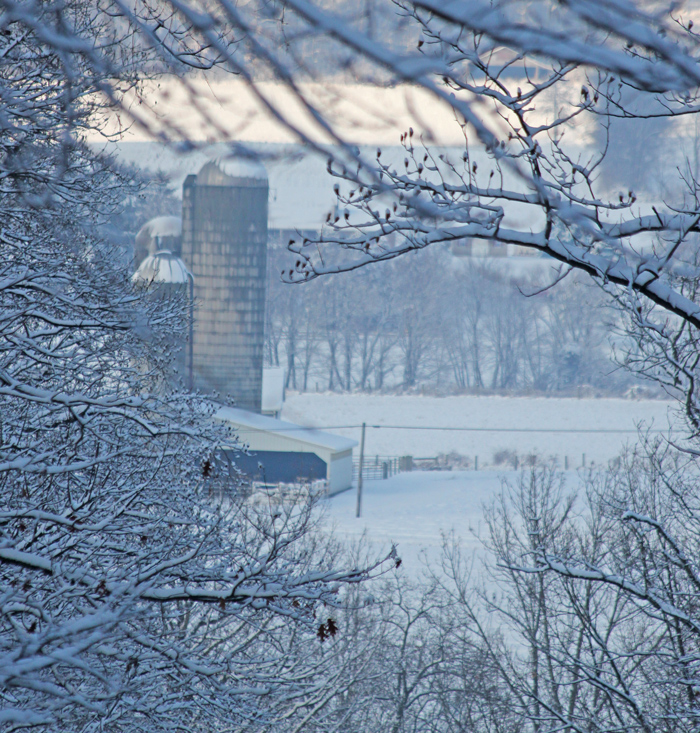
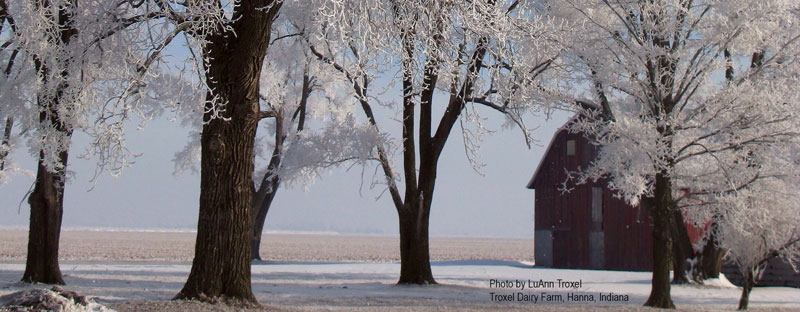
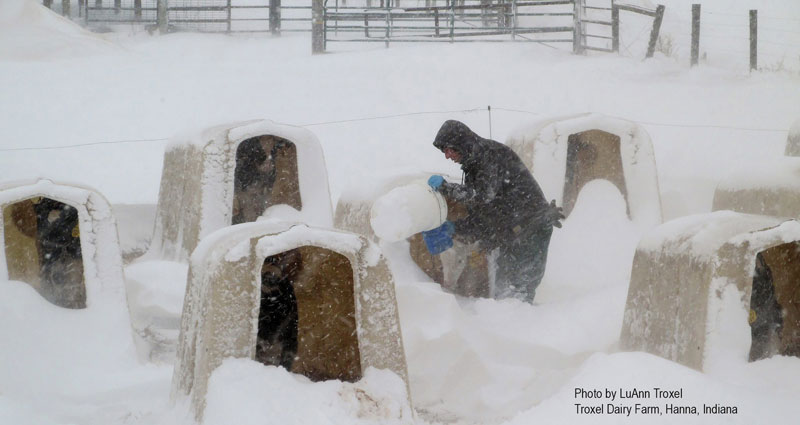
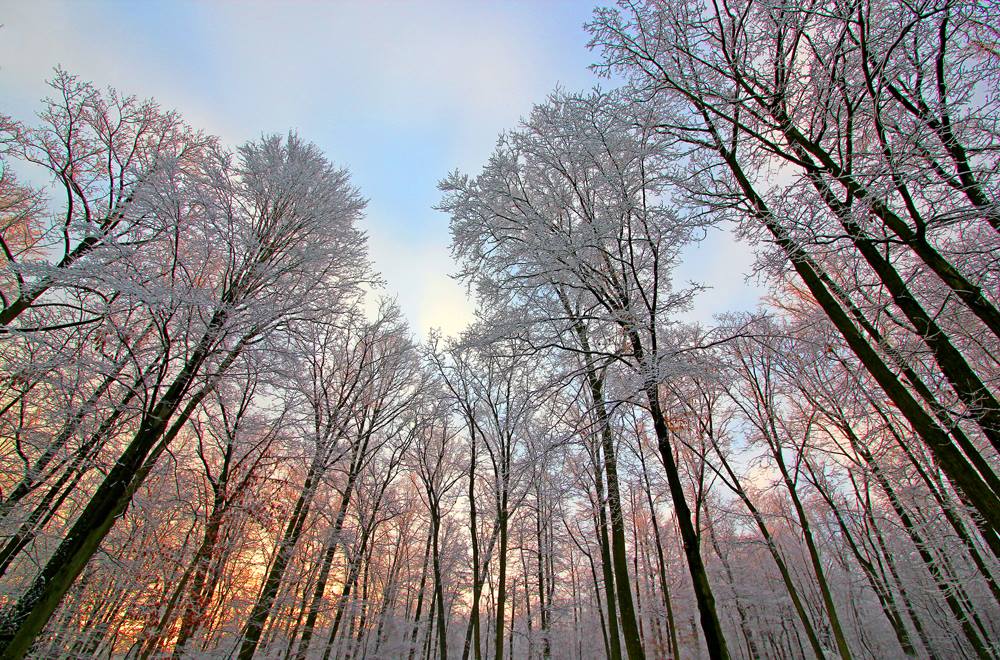
LuAnn Troxel captured this beautiful image at Troxel Dairy Farm. Behind the beauty was more snow and extreme temps.

LuAnn Troxel captured this beautiful image at Troxel Dairy Farm. Behind the beauty was more snow and extreme temps.

The extreme temperatures Tuesday and Wednesday were the talk of both the Pennsylvania Farm Show in Harrisburg and of farmers who were able to get away and attend the Keystone Farm Show in York, Pa. this week.

Frozen waterers, vacuum pumps, manure removal equipment and difficulty starting feeding equipment were the most commonly reported concerns shared by producers from New York, Pennsylvania, Maryland and Virginia who were able to get to the show in York.

Further North and West into the lake regions of the Upper Midwest, through Northern Indiana and Ohio into western New York and Northwest Pennsylvania, the “polar vortex” was amplified by the snow storm preceding it.

Thankfully, by the time you read this, warmer temperatures are forecast to prevail and bring relief to cattle and caretakers as well as equipment and transportation.

The mantra this week for farm families was to not only take care of their animals but to communicate what they were doing with their farm and non-farm “followers” on Facebook,

“There are no ‘snow days’ on the farm,” wrote Tricia Adams at her family’s Hoffman Farms page on Facebook. Three generations of the Hoffmans milk 700 cows near Shinglehouse, Potter County, Pennsylvania.

3 generations of the Hoffman family operate the 700-cow dairy.

3 generations of the Hoffman family operate the 700-cow dairy.

“The extreme weather makes us feel like we are surviving it and not thriving in it!” she said in an email interview Wednesday, reporting Tuesday’s low at Hoffman Farms was -18 with a high of -4. The mercury fi nally reaching a high of 12 degrees Wednesday. They are thankful to be spared the additional 3-feet of snow that fell just north of them in New York.

As for the polar temps and wind chills, “we run a heater in the parlor to help with frozen milkers but even that was icing up,” said Tricia, adding that the conditions for the cows in the freestall barns were “very slippery.”

The Hoffmans, like other farmers dealing with these conditions, did their best to cope with frozen, caked manure in the walkways, barns and parlor — not to mention frozen waterers, feed mixers and tractors freezing up as the off-road diesel gummed up.

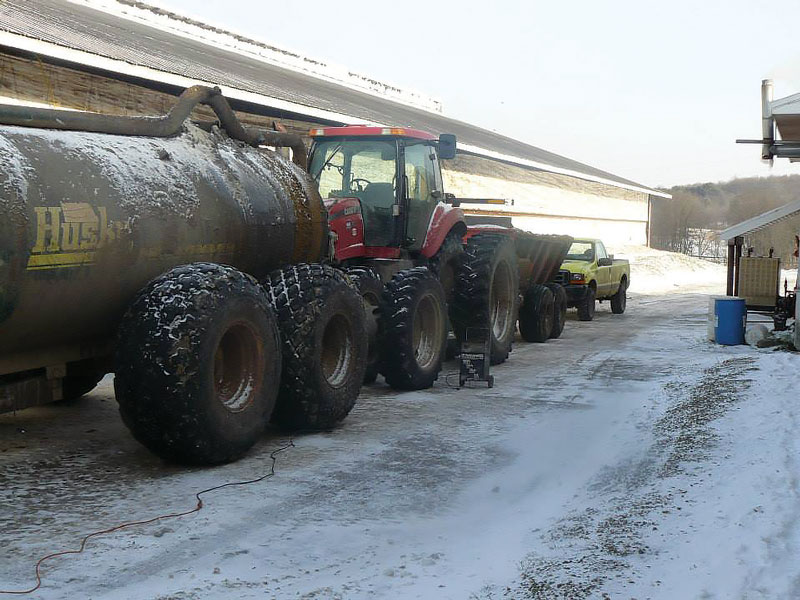
Starting equipment and dealing with manure were difficult in double-digit below zero weather, not to mention the wind chill.

Starting equipment and dealing with manure were difficult in double-digit below zero weather, not to mention the wind chill.

“We changed fuel fi lters and used additives to thin the fuel and keep our equipment running,” Tricia explained. “Winter is tough, and up here we are prepared for it; but when it gets this extreme, you know there is only so much you can prevent. What you can’t prevent you just have to deal with as it happens.”

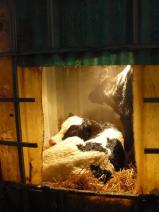
Much attention was paid to the especially important job of “tricky calvings.” At Hoffman Farms, Tricia used heated boxes for the newborn calves.

Tricia Adams pictures one of the heated boxes for newborn calves at Hoffman Farms

Tricia Adams pictures one of the heated boxes for newborn calves at Hoffman Farms

Over in Bradford County near Milan, Pa. Glenn and Robin Gorrell were thankful for the 45 degrees and rain over the weekend to melt the snow at their 600-cow dairy before the sub-zero temperatures arrived Tuesday.

Glenn reported temperatures ranging -10 to -20 depending on location in the hills or valleys.

“I think that we were lucky here and we are always happy the rest of our team helps get us through,” said Glenn in an email interview Wednesday.

“The wind was the killer. It can really drive the cold everywhere,” he said, adding that they had frozen pipes in the employee house for the first time ever.

“In the tie-stall barn we were like everybody else: Bowls on the west side were frozen. The milk house froze for the first time in years. We thought we had all the equipment ready with new fi lters and more fuel conditioner, but we were wrong,” he explained. “We needed to cut more with kerosene and put tarps around hoods of the loader tractor and feed mixer.”

The calves and youngstock at Gorrell Dairy got extra bedding and a little more grain to get them by.

“Robin always has calf jackets on them once it is below 50 degrees anyway,” Glenn reported. “We tried to double up feeding our heifers so we would have less equipment to start in the extreme cold.”

At Troxel Dairy Farm Laporte County, near Hanna, Indiana, conditions were quite severe, with extreme low temps in line with what farmers were seeing in northern Wisconsin and Minnesota this week.

Facebook followers commented that the cows must be “milking ice cream” as they read LuAnn Troxel’s posts about dairying in temps that had fallen to -12 and -17 with wind chills as low as -53 in northern Indiana on the heels of over 1-foot of snow.

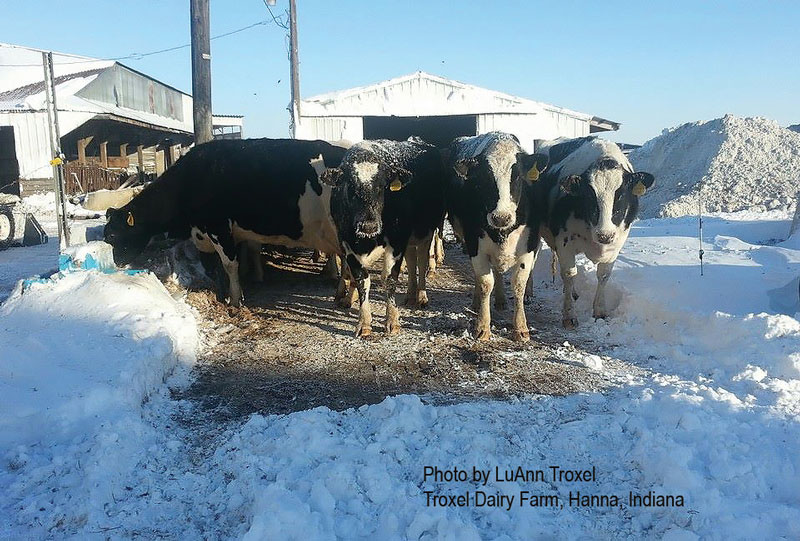
The cows were "good sports" but after three days, the extreme cold wore think on man and beast.

The cows were “good sports” but after three days, the extreme cold wore think on man and beast.

Calling the cows “good sports,” LuAnn acknowledged how tough this week has been for man and beast. She and husband Tom and son Rudy, operate the 100-cow dairy.

“Cold weather management is really not too complicated,” said Tom Troxel, DVM, who in addition to the dairy farm has South County Veterinary practice.

“Cows need to have plenty of feed and water, be out of the wind, and have a dry place to lie down. If they have these things, they can survive an awful lot,” he explained in an email interview Wednesday.

“Calves need the same thing, including increased feed (calories),” Tom advised. “But sometimes the threat of scours keeps feeders from increasing milk to calves. There is no question that cold stress can cause younger animals to be more susceptible to scours and pneumonia, but careful monitoring and feeding electrolytes can help a lot.

While it's tempting to do the bare minimum when temps are -17 with a -53 wind chill and there's 14 inches of snow on the ground, LuAnn was out feeding her calves at Troxel Dairy farm MORE frequently to keep up their energy reserves. Snow drifts also help insulate and inside the hutches they are cozy warm with fresh bedding.

While it’s tempting to do the bare minimum when temps are -17 with a -53 wind chill and there’s 14 inches of snow on the ground, LuAnn was out feeding her calves at Troxel Dairy farm MORE frequently to keep up their energy reserves. Snow drifts also help insulate and inside the hutches they are cozy warm with fresh bedding.

“It’s more important to increase feed to cold, young calves. Also, try hand feeding starter grain to young calves that are at least 2 days old,” he suggested.

As for cow nutrition during extreme cold, it comes down to “energy, energy, energy,” said dairy consultant Ray Kline, during an interview at the Keystone Farm Show in York, Pa. Wednesday. Ray has retired from the Agri-Basics team of nutritionists but is as passionate as ever about cattle nutrition.

“Feeding calves more often — 3 to 4 times a day — also helps because they do not have a rumen to heat them up,” he observed. “With the cows, the ration can be adjusted for higher energy, but without losing fiber. Cows normally eat more when it is cold, but a more dense ration also helps get more energy to them.”

He suggests picking out the “barometer cows” in the herd and watching them for Body Condition Score to know if ration adjustments to the whole herd are needed. Ray also urged dairymen to pay attention to waterers and keep them running.

“After an event like this, we can see it in the repro,” said Ray. “The cow will take care of herself first; so what she eats will go to maintaining herself through the severe weather.”

The seasoned dairy consultant also noted that “life spins its pattern back to years before.” While the “polar vortex” this week was new for some generations on the farm, others have experienced it before.

“If you look at history, we’ve had winters like this, but you have to go a long way back,” said Ray.

As for the milking equipment and transportation, Gib Martin, general manager of Mount Joy Farmers Cooperative in Pennsylvania noted that milk pickup and transport required more time and labor this week.

“We had some issues with tank compressors and one truck down, but no major interruptions in the flow of milk,” said Gib during an interview at Tuesday.

Ken Weber recommends using a heat lamp to keep compressors going for cooling the milk. Weber is retired from service calls but still works with BouMatic equipment. He suggests paying close attention to vacuum pumps outside.

“They are the last thing the dairyman uses to wash the pipe line and that moisture in there can cause them to freeze up,” he said during an interview at the Keystone Farm Show in York, Pa. Tuesday. “Just take a pipe wrench and work it back and forth to loosen it and consider using supplemental heat like a heat lamp to keep the pump warm.”

snowtrees

A thankful heart

 ChristmasBarn05Sept6691

Looking over the past year, and especially the past few months, the needs seem so great in the wake of weather events that have surpassed expectations. An early autumn blizzard in the Plains, a typhoon of immeasurable proportions in the Philippines, scores of tornadoes unleashed unseasonably in the Midwest — each event bringing its own form of devastation to a location, a people, a community.

And yet, folks in the midst of ruin are thankful. Reading the accounts or speaking with those affected personally, one common thread emerges… People who have survived a devastating event often have a more thankful heart than those of us going about our daily lives without having to face such immediate danger and loss.

As we celebrate Thanksgiving in a few days, we talk about what we are thankful for. We look around at family, friends, home, hearth, sustenance, and the Lord’s blessings in our lives.

But do we have a thankful heart? Are we full of gratitude? While giving thanks is an action we are reminded to engage in, a thankful heart, on the other hand, is a state of mind.

One example for me is the rancher in South Dakota who — when selected to receive heifers from the Heifers for South Dakota project — instead said no, let me give four of my best to someone who needs that spark of hope. In that case, the rancher had lost nearly half his herd in Storm Atlas October 4-5, but he said he would pull through. With a thankful heart, he gave four heifers to the project so that someone else in a similar situation could benefit.

After the tornadoes last weekend, farmers in some areas of the Midwest lost buildings, communities lost schools and homes. Within hours, neighboring communities and farm groups had mobilized cleanup efforts to help with the first step and most difficult step in rebuilding — grasping the devastation and sifting, sorting, cleaning up to regroup and move forward.

An ocean away in the Philippines, an even darker picture emerges, with a staggering death toll and untold survivors without food, water, shelter. As organized aid finally is able to flow to that region, stories of thankfulness follow.

We live in a world today with all the bells and whistles. We have so many distractions from the things that are most important. Each of us can be one moment away from a change or loss unexpected, which is all the more reason to not just give thanks for what we have but to embrace an attitude of thanksgiving, to have a thankful heart. 

The first Thanksgiving in 1621 was such an occasion. The celebration was of the first successful harvest, preceded by a winter of loss, disease, hunger, and fear and a spring and summer of drought but trusted still to be blessed with a harvest.

I am reminded of the Rose Kennedy quote: “Birds sing after a storm; why shouldn’t people feel as free to delight in whatever sunlight remains to them?”

A thankful heart then paves the way for optimism, faith, hope. A thankful heart allows us to see the new sunshine and sing instead of remaining quietly in the dark of the storm.

Happy Thanksgiving.birds-barn

Chillin’ with the Meck Bros… How two brothers are building their dairy business in volatile times.

Meck-Bros0016low

By Sherry Bunting, reprinted from Farmshine August 22, 2012

Zach and Jeremy lost their father last year just a couple months before this story was published. He would have been proud to read it, and they credit their father with giving them the tools to become first-generation dairymen with their own farm today. Their dad bought them a few project animals for 4-H and FFA and taught them to work hard on the family’s crop and poultry farm where the boys were raised. Here is their story of building a dairy business in volatile times.

WOMELSDORF, Pa. — It was just shy of 100 degrees outside in the shade, but the cows in the barn didn’t mind. Standing in the 170-cow freestall barn at Meck Bros. Dairy near here, was actually comfortable on a visit during the August heat wave.

Despite the extreme temperatures that summer, the Meck brothers say their cows have done better than in previous summers. (Read more about their unique cooling system at the end of this story.)

The Meck Brothers have been farming in Berks County, Pa. since 2008 when they purchased a preserved farm and spent the past four years renovating it. They were attracted to this farm when it came up for sale in 2007 because much of the farmland around it is also preserved.

But their story really begins in Reinholds, Lancaster County, where they grew up on a crop and poultry farm operated by their parents Ronald and Joyce Meck until their father passed away this past spring. Today, they are cropping 340 acres at their own Berks County farm and the 400 acres in Lancaster County that belong to their family.
Why dairy? Zach and Jeremy started their dairy business on their own in a rather unconventional way, but they are quick to point out the impact of their father’s example, and the start he gave them when he bought their first 4-H starter animals.

“We were drawn to cattle in 4-H because of being able to grow the crops to feed the cows and being able to grow our own youngstock,” Jeremy explains.

meck06

In their late father’s poultry business, the pullets were raised off the farm and brought to the farm as layers. “We had a lot of land base for the poultry, so we started grazing our cattle there and growing feed to manage the manure nutrients from the poultry,” Zach notes.

They had been building their own dairy herd on rented farms for several years. They started out milking a small herd of 12 cows for the purpose of feeding veal calves they would buy from area dairy farms and auctions.

“During those years, we learned an awful lot about calf care and homeopathic remedies,” the brothers say with a smile as they mention the stinging nettles herbal tea they found helps young calves with scours.

meck10

Today, they raise all their own youngstock on area pastures, and are preparing to relocate them to one rented facility nearby. “That will cut down a lot on our run around time,” the brothers relate.

In 2007, they learned of this Berks County preserved farm going up for sale. They bought it and tore down the existing dairy barn, working with Franklin Builders to replace it with a small freestall barn. Zach and Jeremy built the parlor themselves by putting together two used milking systems and buying new stalls from the former Brandt’s Supply. And they did the stonework on the outside with the help of Kurtzcrete.

meck05

The manure pit and sand settling lane were also installed in stages with the help of a friend (Mark Landis), who works in excavating. They engineered a two-stage flush system for the sand-bedded freestall barn, and put in a sand settling lane that has a third “speed bump” for catching sand before the slurry goes into the pit. A second pit is available for future expansion.
The barn flushes from the center to the end while the cows are in the holding area for milking. Sand is pulled from the sand settling lane and reclaimed for reuse as bedding. The brothers estimate they recycle most all of their sand, and buy two loads of fresh sand a year in the winter.
The Meck Bros. Dairy herd has grown slowly. Before buying the Berks County farm, Zach and Jeremy grew the herd from 12 to 40 to 60 to 120 cows on a rented farm. They were intent on keeping their business as manageable as possible.

“We ran the numbers and realized we would have had to go to 600 cows to afford building everything all new,” Zach affirms. “So we would have needed more land base than what is on this farm. So, we built for 170 cows in this phase.”

meck08

They moved into the renovated facilities in 2008 with 120 milking cows, mainly Holsteins, including a few Red and Whites and Brown Swiss. (And the spring 2013 addition of those cute li’l Jerseys.) With high cattle prices that first year in business, they populated the barn by purchasing an economically priced crossbred grazing herd out of West Virginia to get their numbers up to 170.

“Those cows aren’t fancy but they do okay, and we are improving the herd as we breed them and bring in replacements,” Jeremy notes.

Moving the herd to the Berks County farm in 2008 was a welcome relief after the brothers had spent months milking and switching cows at the rented farm in Ephrata at the same time they were working on the new farm and facilities in Womelsdorf.

“We would work down there and then come up here and work some more,” Jeremy reflects. “We worked ahead to get crops in here to have feed here before we moved the cattle.”

Four years later, the brothers have come through some of the worst years in the dairy business. Looking at 2012-13, they have a corn silage crop that looks decent, and they had a terrific harvest of triticale forage this spring, along with hay and haylage. But the coming year will be difficult for them as for all dairy farmers with a moderate milk price trying to cover soaring input costs.

Zach does the nutrition work here, having previously worked for a nutritionist. They feed a high forage ration with 55 pounds of corn silage and 15 to 20 of haylage and five pound of triticale silage. The ration includes less than 12 pounds of total grain per day.  They grow the forages and some of the corn, and buy soybean meal and corn distillers, wheat midds and minerals.

“It’s basically a 65% forage diet,” he says. “We double crop a triticale/Italian rye mix that we harvest before planting the corn. We got six to eight tons per acre with excellent protein this spring, and will do that again this fall for next spring.”

For corn silage, they plant Pioneer hybrids, but keep an open mind and check out the trials. “We planted 30 to 40 acres in BMR to fill one bunk as a summer feed for high digestibility,” Zach explains. “The rest is planted to a mixture to keep our seed costs down.”

Today, the brothers farm over 700 acres and milk 170 cows. The herd produces 75 to 80 pounds of milk per cow per day, with somatic cell counts around 200,000. They share responsibilities on the farm, with Jeremy taking care of the breeding, herd health and the finances, while Zach leans more toward the facilities and crops.

They sit down once a month and go over everything together and talk daily as they go about the chores on the farm.

Meck08-7884

“We started small and just worked and worked,” Jeremy relates. “We could not have done it without the foundation laid by our Dad. He bought us our first animals and lent us the barn to do it, and then he stepped away and let us do it.”

“It has been an adventure,” says Zach, who recently married Suzanne (Perdue). She brought her dairy roots in Maryland to Berks County, Pa.

Jeremy, still single, continues to renovate the old farm house near the milking parlor while living in the house across the road on the other part of the farm. He acknowledges that dairy is a family lifestyle and that being single and tied to the farm has its drawbacks.

“That’s why we both do everything here,” Zach adds. “We both know each other’s jobs so either one of us can take time off. You need to do that.”

With 15 years under their belts dairying since they were teenagers, the adventure for these brothers continues as there is always more work to be done and plans to be made.

meck11

As members of the Land O’Lakes cooperative, Zach has been active as a delegate for a few years. He also served previously as a member of the Dairy Policy Action Coalition (DPAC) board and the Berks/Lebanon County Dairy Farmers Voice.

“It’s time to get the younger generation involved in the leadership of their cooperative,” Zach affirms. “Our futures are at stake in the outcome of the decisions that are made.

“There are no ifs, ands, or buts about it, when you get half or three-quarters of a milk check — whether you are buying feed or considering the value of the crops going in the cows — dairying has to be sustainable. Where am I at the end of the day in terms of gross profit, that’s the relevant question,” he adds.

If producers here have to reduce production under the proposed dairy market stabilization program, Zach believes it would be a hardship for young and beginning farmers like he and Jeremy. “If we make 80 pounds and are paid for 70, but have higher taxes and a higher basis on our corn and soybeans and a smaller land base, how do we make that work?”

He points to the opportunity in the region fueled by the growth of the yogurt industry and other outlets for milk and consumers along the eastern seaboard.

“Why aren’t we focusing on the mechanics of the market?” he asks. “That should be our focus. We should be looking out for our fellow dairy farmers around us… Large or small, we’re all important. We have to focus on creating opportunities and getting the mechanics of the market right.”

Their Unique Cooling System  – www.cowkuhlerz.com

“We love this system,” brothers Zachary and Jeremy Meck agreed as they pointed out the elements of German cooling technology they have trialed in their freestall barn this summer. “It is simple, cost-effective, low-maintenance, and it does a great job of cooling with minimal water use.”

Instead of evaporative cooling by soaking the cow, these intermittent misters are placed in front of the circulation fans to cool the air.

Jeremy points out the conduit are kept high up in the trusses, and the nozzles drop down in front of the fans. This keeps the system out of reach of the cows and equipment so it doesn’t get bumped or broken. It’s also easy to put together and maintain, he says. “It’s a push together system.”

meck00

“Dan McFarland wanted us to try this for Hershey Ag before they start using them in dairy, hog, and poultry barns,” Zach explains. “We like the fact that it produces a light cooling mist to cool the air without getting the cows, feed, bedding, and concrete wet.”

“We put one in the milking parlor, too, for the employees, and they love it,” Zach adds. “It’s just like air conditioning.”

Despite the extreme temperatures this summer, the Meck brothers say their cows have done better than in previous summers. “We have seen heats in our cattle that we would not have seen before, and production did not drop off nearly as hard,” Zach explains. “The cows are up eating. Normally we would have high refusal rates in the summer, but no refusals this year. Dry matter intake has been steady.”

Trialing the Aroto-Asi cooler is just one example of how these two brothers continually look for simple and cost-effective solutions to manage their dairy farm.

Meck07-7991

MECK-BROS 0016

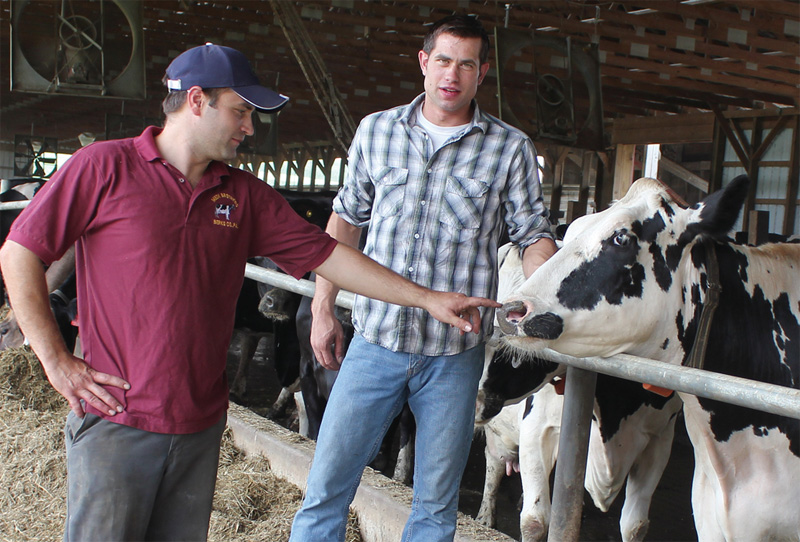
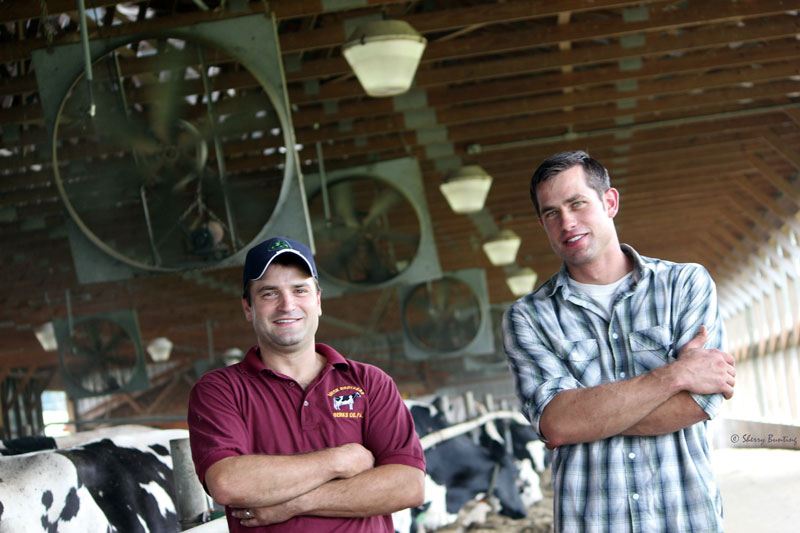
Zach (left) and Jeremy Meck love the new cooling system they’ve been trialing this summer in the 170-cow freestall barn at their Berks County, Pa. dairy farm. They’ve been dairying 15 years since they were teenagers and started out with 12 cows on their parents’ crop and poultry farm in Lancaster County.

MECK-BROS 9953

This is a long view of the conduit up in the rafters that brings water to the Arato-Asi cooler nozzles parked in front of each fan. This intermittent mist in front of the fans cools the air without getting the cows, feed, bedding, or concrete wet.

MECK-BROS 9980 or 9982 or 0001

The thermostatically controlled mist is barely visible (60 seconds on and 60 seconds off), but its cooling effect to the air in the barn and milking parlor is clearly felt by humans and animals, alike. The system uses very little water.

MECK-BROS 9965 or 9970

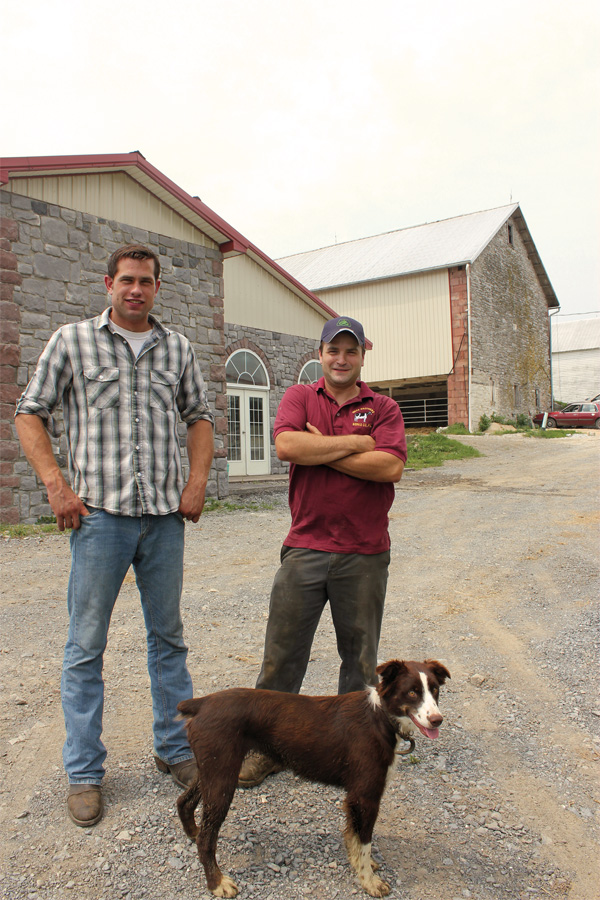
Zach (left) and Jeremy Meck own and operate Meck Bros. Dairy, milking 170 cows and farming 700 total acres in two counties with the help of three part-time employees at the dairy in Berks County where they bought and renovated a farm in 2008.

MECK-BROS 0053 or 0032

Jeremy (left) and Zach Meck recently completed the stonework, themselves, with the help of Kurtzcrete, on the milking parlor to match the existing bank barn and farmhouse.

###

NY-FARM-TO-CITY FIRST! Telling Milk’s Story at “Just Food”

Image

My friend TAMMY GRAVES wrote the guest post for my FOODOGRAPHY blog today. It also made the cover of today’s Farmshine newspaper, telling how she and dairywomen Deb Windecker and Lorraine Lewandrowski of Herkimer County NY had the rare opportunity to present a 75-minute workshop telling milk’s story at the JUST FOOD CONFERENCE in New York City. Great Job Ladies!

NEW YORK, N.Y. – For the first time, New York State dairy farmers were on the workshop list at the Just Food Conference March 29-30 in New York City. A 75-minute presentation entitled “Introduction to the New York Milk Shed” was prepared and offered by Herkimer County dairy farmers Lorraine Lewandrowski and Deb Windecker of Newport and Schuyler, respectively. Tammy Graves, a dairy farmer advocate from Otsego County also contributed by explaining the mutually dependent relationship between consumers and dairy farmers.

“We provided faces and stories about our milk for attendees. Many more conversations still need to occur, but it was a huge step in bridging the gap,” Deb Windecker reported. “So many people think there are antibiotics in our milk. We are pleased to report that we dispelled that myth by explaining the penalties and protocols that are in place at the farm, at the processing plant, and with our regulators, to ensure that never occurs.”

The presentation provided answers in four parts: 1) Where is dairy farming in New York State? 2) Why should you care about a Milk Shed and/or dairy farmers? 3) What does a dairy farmer do?  4) Why should you eat real dairy products?

Our message was “Milk is clean and safe. Milk is water. Milk means healthy cows. Milk is Local. Milk is a life’s work.”

Part One of the workshop for Just Food consumer advocates summarized the facts and included a visual overview of the NY Milk Shed: 5100 dairy farms, 610,000 cows, 113-cow average herd size. A pictorial tour of the milk regions (Lower Hudson, Upper Hudson, North Country, Mohawk Valley and Western New York) was the background for discussion. The discussion included a look at the diversity among NY dairy farms in terms of cow breeds, farm size by acreage, herd sizes and strengths and prominent resources by region.

Part Two illustrated the long-standing connection New York City has had with dairy farmers, highlighting the 1939 milk strike. As a result of the milk strike, then NYC Mayor Laguardia was an advocate and influencer for achieving adequate farm milk pricing at that time. Cheese pack boats, milk trains and today’s tractor trailers carrying 150,000 glasses of milk were mentioned. 

Additionally, Lewandrowski emphasized why the average New Yorker should be concerned about the state’s dairy farms.  A series of photos accompanied her points regarding economic development, food security, open space, watershed protection, floodplains, biodiversity, rural tradition, and the diversity of people working in New York’s dairy industry.

Part Three of the presentation evoked the most questions from attendees as it gave a micro-view of the cycle involving a dairy cow, a dairy farmer and soil. Growing seasons, equipment costs, feed storage were discussed, in addition to milking procedures and newborn calf care. 

Part Four explained that buying real dairy products translates to eating food that most closely mirrors the clean and safe milk that dairy farmers put into the milk truck. Attendees were very appreciative to learn that not all brands or types of cheese and Greek yogurt are created equal. 

“The experience provided us with invaluable insight to perspectives and beliefs of individuals that are keen on food topics,” the presenters reflected after the event. New York City residents who attended left with a better understanding.  One member of the audience approached the presenters about the possibility of chartering a bus to bring New York City food and farm-interested people to visit dairy farms upstate and to spend a day at the Fair.