Market fundamentals suggest favorable forecast, yet uncertainty jars milk futures markets

Editorial AnalysisTumultuous 2024 spills over into 2025 – Part Two

By Sherry Bunting, Farmshine, January 17, 2025

EAST EARL, Pa. – Year 2024 was tumultuous, and 2025 is shaping up to be equally, if not more so. Here’s a look at how supply, demand, and other market factors are shaping up for milk prices and dairy margins heading into 2025. This is part two of a four part series, see part one here and part three here.

We are a few weeks away from a few key yearend reports that will give us a better handle on production and cattle inventories, but the current market fundamentals favor a forecast for higher milk prices into 2025.
Better prices

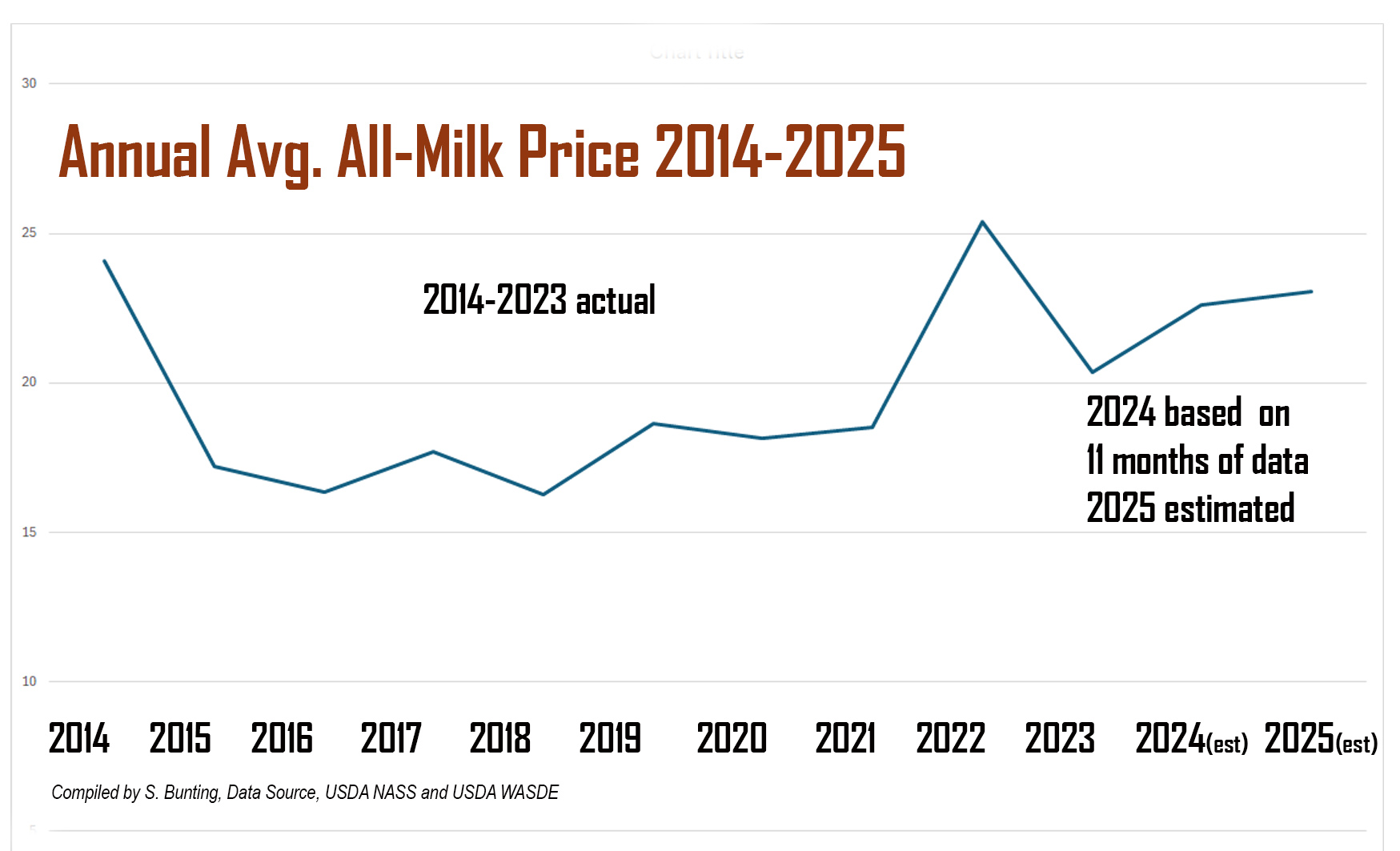
In fact, the Jan. 10th World Agriculture Supply and Demand Estimates (WASDE) just raised by 50 cents per cwt the estimated 2025 All-Milk price average at $23.05 after having lowered it the month before.

Based on 11 months of official data, however, the January WASDE shaved another nickel off the 2024 average All-Milk price, now estimated at $22.60, which would be $2.20 higher than the average All-Milk price of $20.40 for 2023 but $2.80 lower than the decade’s high point of $25.40 in 2022.

At an estimated $22.60, the average All-Milk price for 2024 would be the fourth time in the past decade and the third consecutive year that the annual average All-Milk price was above the $20 mark. (Fig. 1).

Strong demand

Positive supply and demand fundamentals for 2025 include the reported strong domestic and international demand for cheese and butter; tighter than expected milk supplies; tight to adequate dairy product inventories; growth in year over year (YOY) sales of fluid milk; and strong domestic demand for skim solids in the form of nonfat dry milk, dry whey and whey protein concentrate coupled with reduced production of these products limiting the availability for export.

A sustained price rally in the CME spot market-clearing price for the market indicator product dry whey reached a multi-year high of 75 cents per pound by the end of the 2024 and is holding at near 74 cents per pound into mid-January. Trouble is, this market-clearing price has been tardy all year in translating to sales reported on the USDA weekly price survey used in the Federal Milk Marketing Order (FMMO) price formulas.

Despite the positive supply and demand fundamentals, we saw fourth quarter 2024 milk prices decline $1 to $1.50 from the year’s high point at $25.50 in September, and even though dairy products are holding steady on the CME spot cash markets, the CME milk futures markets took a tumble into below-$20 territory across the board this third week of the New Year. 

So what’s the deal? Uncertainty.

Fewer cattle?

Uncertainty prevails about future cattle inventories after Sec. Vilsack canceled the mid-year 2024 Cattle Report last summer. The Jan. 1 Cattle Inventory Report comes out Jan. 31st. It’s unlikely to show any big surprises in the two-year trend toward reduced cattle numbers, including dairy replacement heifers. USDA says this report will give the trade an indication of producers retaining dairy heifers for their milk herds. 

With prices skyrocketing $800 to $1200 per head above year ago levels for fresh cows and springing, bred, and open heifers, a sudden rise in replacement heifer numbers is unlikely. 

Meanwhile, beef-on-dairy calves continue to give dairies an immediate $800 to $1000 check on a 3-day-old bull calf requiring very little input cost. That’s $900 in income per cow for dropping a calf, even before she starts her lactation.

The tug-of-war on breeding decisions for future dairy farm calf crops continues as the total U.S. beef and dairy calf crop, by the way, has already declined 1.6 million head in the two year period from Jan. 1, 2022 to Jan. 1, 2024. On Jan. 31st, we’ll see what the Jan. 1, 2025 numbers say.

Global trade

Uncertainty also exists around global trade amid ‘tariff talk’ against the backdrop of YOY growth in export volume, that is tempered by YOY growth in import volume. The January WASDE expects the trend of export volume growth to continue, but also expects the larger import volumes to continue. While the report specifically mentions cheese and butter, USDA FAS data show growth in the imported volume of skim milk powder, and especially YOY growth in whole milk powder (WMP) imports in each of the past four years.

FMMO changes

Uncertainty about the implementation of USDA Federal Milk Marketing Order (FMMO) price formula changes in the second half of 2025 that will impact risk management. The updated make allowances will trim class and component index prices by 75 cents to $1.00 against a CME milk futures markets that bases contracts on the FMMO formulas. That changeover will have to be dealt with.

Uncertainty about how new, efficient expansions of cheese and ingredient production capacity may be tied into sourcing from multi-site dairy farms that have planned expansions with internal heifer replacement models. What will be the impact on the rest of the industry when they start cranking out tons more cheese on the new and higher make allowance margin.

H5N1 impacts

Uncertainty about milk production trends after the impact of the bird flu outbreak in California dragged down total U.S. milk output well below expectations. The next report for December milk output will be released on Jan. 24th.

The January WASDE reduced its total milk production forecasts for 2024 and 2025, driven by “lower milk cow inventories and lower expected milk output per cow.”

This came on the heels of the November milk production report released in late December, showing California’s 9.3% drop in state-wide milk output, attributed to HPAI H5N1 hitting at that point half of the state’s dairy herds. This drove the total U.S. output down an unexpected 1% YOY.

The WASDE also forecasts “slower growth in output per cow” in its rationale for reducing the milk production estimate for 2025. This means what producers have been reporting is now showing up in the USDA data. Producers in areas hit by H5N1, especially California, report an initial 30 to 40% herd level production loss that only comes back about half-way, six to eight weeks later.

Producers also indicate a 2% increase in herd-level mortality and increased culling. Both veterinarians and producers in previously affected areas are now reporting impacts on dry cows and springing heifers, aborted calves, shaved production peaks, and emerging questions about milking performance in the following lactation.

According to APHIS data, as of Jan. 10, the virus was detected in 708 dairy herds in California since the outbreak was first reported there in September. That’s nearly 75% of the state’s dairies affected to-date. In the past 30 days, 66 California herds have been affected, with the most recent detection on Jan. 10.

Apart from the California outbreak, the only other detections of H5N1 on U.S. dairies in the past 30 days is one herd in Michigan on Dec. 30. This is good news, considering that 13 states have now been fully brought into the National Bulk Milk Testing Program announced on December 6th as a mandatory program for all 48 continental states. 

Those initial states include California, Colorado, Indiana, Maryland, Michigan, Mississippi, Montana, New York, Ohio, Oregon, Pennsylvania, Vermont, and Washington.

Better margins

For 2024, the milk over feed cost margin only fell below the Dairy Margin Coverage (DMC) program’s highest payment trigger level of $9.50/cwt in the first two months of the year. In fact, Sept. 2024 saw the highest DMC margin on record at $15.57 with an All-Milk price of $25.50 and a feed cost at $9.93. Since then, Q4 margins have declined to $14.50 as the All-Milk price fell and feed cost remained fairly constant.

This measure does not account for the higher fuel and energy costs, higher labor costs, rising cost of insurances, higher interest rates on capital, and generally higher costs for other inputs that keep a dairy farm going.
Labeling games

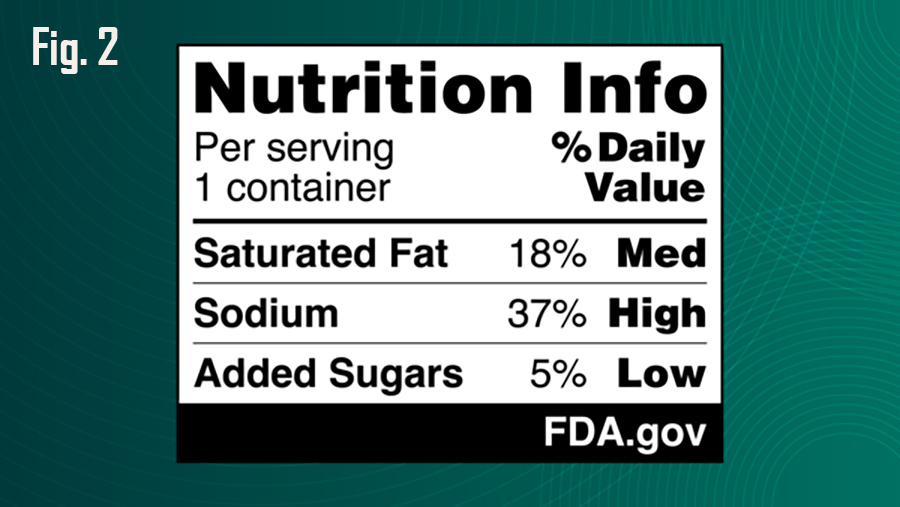
Other market factors may increasingly play a sidebar role. On the demand side, FDA’s new draft rule on Jan. 14 requires front-of-package labeling (Fig. 2 example above), which in addition to listing grams of saturated fat and percent of total recommended daily value, will now use a rating system to mark the saturated fat content of foods and beverages as high, medium, or low as the outgoing Administration attempts to further push consumers into the low-fat Dietary Guidelines regime.

Despite the noise around low-fat and anti-animal, USDA reports strong demand for real beef and dairy, with whole milk the top volume growth category in the fluid milk market.

FDA also issued new draft guidance on Jan. 14 for ‘best practices’ in naming and labeling of fake plant-based foods that are marketed and sold as alternatives for animal-derived foods. This guidance applies to fake meat, eggs, seafood, and dairy products, but does not include the labeling of fake beverage milk. FDA reminded the trade of its 2023 draft rule for plant-based fake milk.
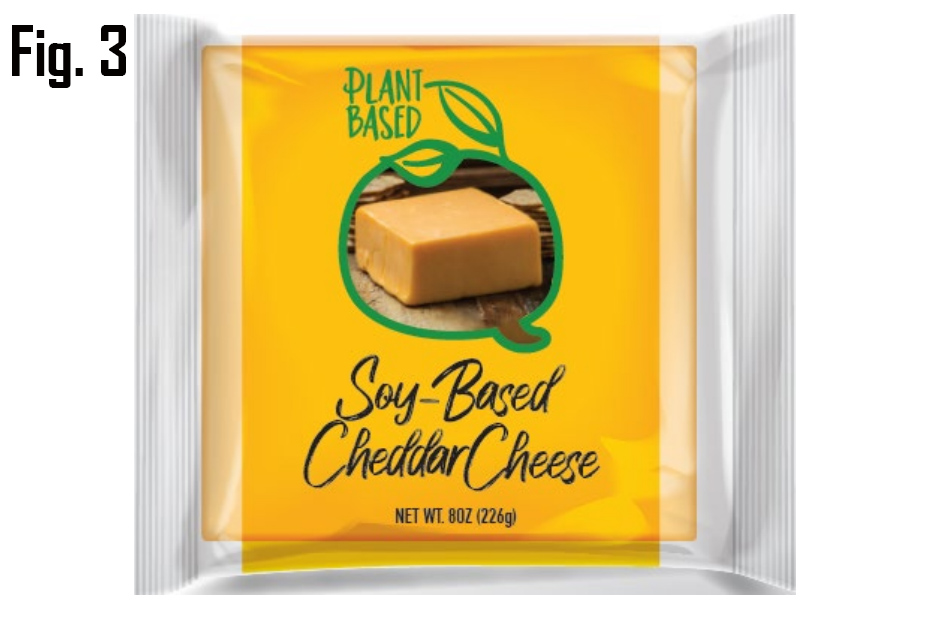
his follows the same pattern as the previous fake milk guidance – recommending that the plant-based food be “qualified by type of plant source” when using the name of a standardized animal product such as cheese or beef. (Fig. 3 above)

This is how FDA has treated fake milk for the past 15 years, by allowing for example, the ‘almond’ qualifier in front of the word ‘milk.’ The FDA’s 2023 guidance on milk, specifically, recommends, but does not require, additional nutrition statements to clarify nutritional differences.

Frankenfoods

Likewise, on the supply side, fake Frankenfood is emerging as FDA continues mulling a draft rule on what to call the products of lab-creation seeking to replace real animal-derived foods.

For dairy, this comes in the form of microbes bioengineered with bovine DNA to excrete fake dairy protein and fat analogs that USDA refers to as “precision fermentation protein products” while lab-created gene-edited cells growing into blobs of fake meat, egg, seafood, even dairy analogs are referred to as “cell-cultured” chicken, seafood, beef, dairy etc.

In late December, the USDA Economic Research Service (ERS) released its first ever report on “The Economics of Cellular Agriculture.” This means the Department has now recognized Frankenfood as part of the Agriculture domain. Yes, we’re talking about fake food from a factory, not a farm.

The 45-page ERS report notes that for 25 years, scientists in the public and private sectors have been “actively researching methods for producing food products that are physically and chemically equivalent to livestock- and poultry-produced foods (i.e., meat, dairy, eggs) but that minimally rely (if at all) on animals.”

By 2023, more than 200 private firms existed worldwide, and cumulative invested capital in the cell-culture and precision fermentation industries exceeded $5 billion. As of 2024, more than 100 patents have been filed. U.S. food agencies (FDA, USDA and FSIS) have been developing regulatory frameworks to accommodate and ensure the safety of these products, according to the report.

To-date cell-cultured fake chicken meat has been commercialized in Singapore and the U.S., largely through unique restaurant chains. This led to states like Florida banning the stuff.

Meanwhile, “precision fermentation-derived fake dairy protein analogs have been commer­cially available more broadly,” according to the ERS report.

These Frankenfoods tout smaller carbon footprints, less land and water usage, but ERS authors observe that, “Open questions remain concerning the design of bioreactors and important elements of the production process, including cell source, growth medium, and energy requirements, as well as the optimal size and configuration of production-processing plants.”

The report states so-called “precision-fermented dairy products are already on the market in the U.S., and, like their plant-based counterparts, sell for a premium over animal-based. For example, the company Perfect Day partners with other companies that sell products like ice cream and milk featuring their precision fermen­tation animal-free whey protein.”

In this way the fake dairy protein analogs are marketed as an ingredient in a business-to-business vs. business-to-consumer model. 

According to the ERS, precision fermented protein products (fake dairy analogs) are increasingly available in U.S. markets, while cell-cultured products (fake meat and seafood analogs) are not.

Short run profitability, according to ERS, will rely on consumer willingness to pay for these products with current consumer attitudes described as “mixed.” But the labeling guidance remains unclear as the fake dairy protein analogs are actually the harvested excrement of the bioengineered microbes, not the DNA-altered microbes themselves. Consumers need to know what they are buying.

The ERS report also states that despite some of these companies and investors releasing bold lifecycle ecosystem claims, the “environmental impacts are largely unknown.”

Part III in a future Farmshine will look at the yearend reports due later this month.

-30-
Good news may trump bad nutrition policies

Editorial Analysis: Tumultuous 2024 spills over into 2025 – Part One

By Sherry Bunting, Farmshine, January 3, 2025

EAST EARL, Pa. – Year 2024 was tumultuous, and 2025 is shaping up to be equally, if not more so. Spilling over from 2024 into 2025 are these three areas of potential for good news to trump bad nutrition policies that are having negative impacts on dairy farmers and consumers.

Farm bill and whole milk bill

Both the farm bill and the whole milk bill showed promise at the start of 2024. No one championed the two pieces of legislation more than House Ag Committee Chairman Glenn ‘GT’ Thompson (R-15th-Pa.). He even found a way to tie them together — on the House side.

The Whole Milk for Healthy Kids Act made it farther than it ever has in the four legislative sessions in which Thompson introduced it over the past 8 to 10 years. It reached the U.S. House floor for the first time! But even the overwhelming bipartisan House vote to approve it 330 to 99 at the end of 2023 was not enough to seal the deal in 2024.

That’s because over in the U.S. Senate, then Ag Committee Chairwoman Debbie Stabenow (D-Mich.) blocked it from consideration — despite over half her committee signing on as cosponsors.

GT Thompson, found a workaround to include it in the House farm bill, which passed his Ag Committee on a bipartisan vote in May. The language was also part of the Senate Republicans’ draft farm bill under Ranking Member John Boozman (R-Ark.)

It too fell victim to Stabenow dragging her feet in the Senate. By the time the Ag Chairwoman released a full-text version of the Senate Democrats’ farm bill, little more than 30 days remained in the 2023-24 legislative session.

Key sticking points were the House focus on dollars for the farm side of the five-year package. It put the extra USDA-approved Thrifty Food Plan funding into the overall baseline for SNAP dollars and brought Inflation Reduction Act climate-smart funds under the farm bill umbrella while removing the methane mandates to allow states and regions to prioritize other conservation goals, like the popular and oversubscribed EQIP program.

Attempts to broker a farm bill deal failed, and on Dec. 20, another one-year extension of the current 2018 farm bill was passed in the continuing resolution that keeps the government funded into the first part of 2025, without amendments for things like whole milk in schools. However, Congress did manage to provide $110 billion of disaster relief for 2022-24 hurricanes, wildfires, and other events. Of this, roughly $25 billion will go to affected farmers and ranchers, plus another $10 billion in economic disaster relief for agriculture.

Looking ahead, there is good news for the farm bill and whole milk bill in the new 2025-26 legislative session. The House Ag Committee will continue under Rep. GT Thompson’s leadership as Chairman. On the Senate side, whole milk friendly Boozman will chair the Ag Committee. With Stabenow retiring, Sen. Amy Klobuchar (D-Minn.) will serve as Ranking Member, and she previously signed on as a Whole Milk for Healthy Kids Act cosponsor in March 2024.

The whole milk bill will have to start over again in the Education and Workforce Committee with another vote on the House floor. It was enthusiastically supported by prior Education Committee Chairwoman Virginia Foxx (R-5th-N.C.). Her years of chairing this committee have expired, but the good news is Rep. Tim Walberg (R-5th-Mich.) will step in, and he was an early cosponsor of the Whole Milk for Healthy Kids Act in the 2021-22 and 2023-24 legislative sessions.

New Dietary Guidelines

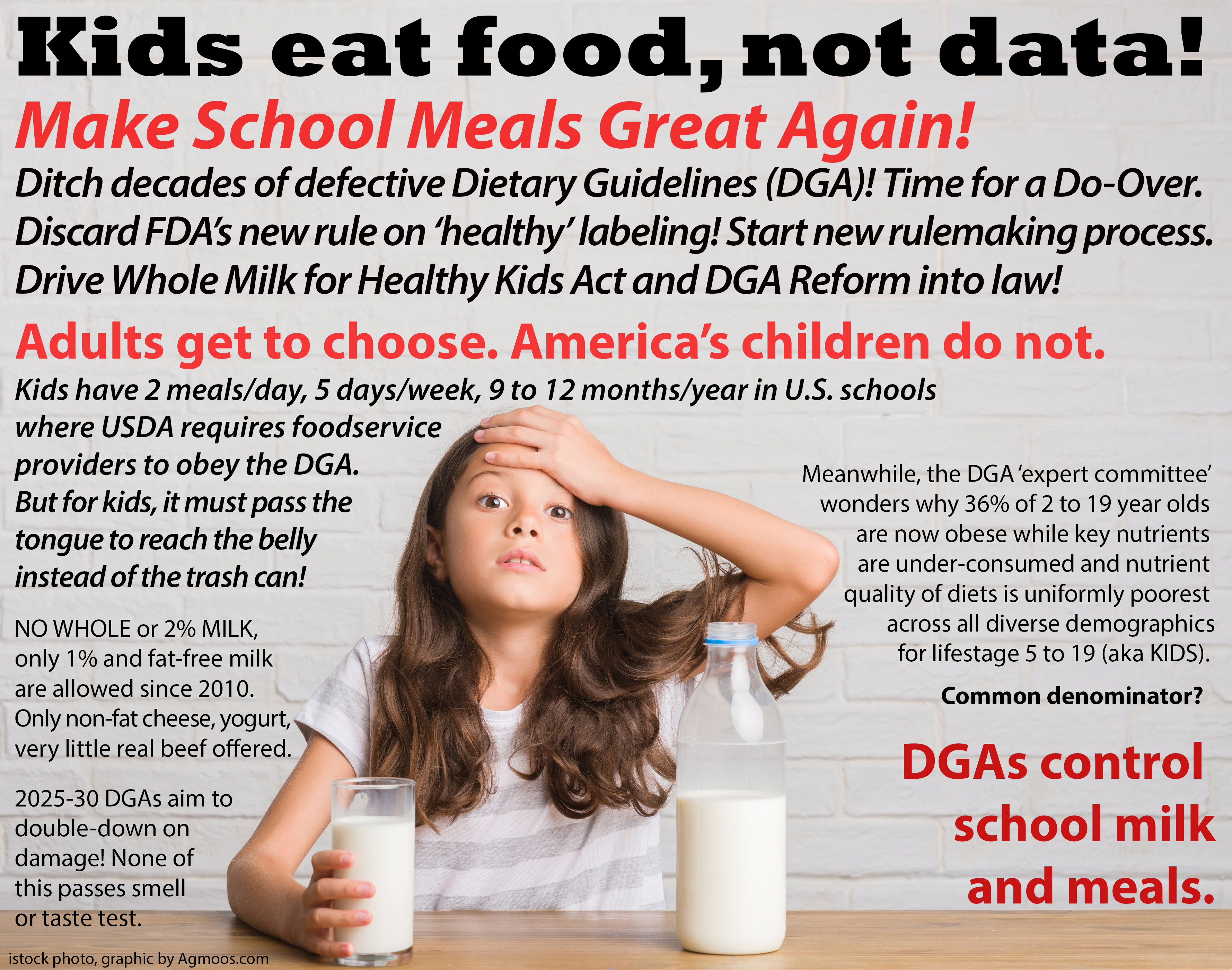
The 2025-30 Dietary Guidelines Advisory Committee (DGAC) submitted its ‘Scientific Report’ to the outgoing USDA and HHS Secretaries on Dec. 19, 2024 — just 40 days before they head out the door to be replaced by incoming Trump appointees.

The Report is the guidance of the so-called ‘expert committee’ that reviews evidence and makes recommendations for the Secretaries of USDA and HHS to formalize into the 2025-30 Dietary Guidelines for Americans (DGAs). This process occurs every five years.

The DGAs are used in all USDA feeding programs, including school lunch, childhood daycare, and eldercare institutional feeding, as well as military mess halls. They also inform food offerings in many other controlled settings. 

The bad news is the Report has gone from being increasingly pro-plants over the past nine cycles to being outright anti-animal in this 10th cycle.

The good news is that dairy keeps its special spot on the so-called ‘My Plate.’ The bad news is that despite acknowledging evidence about the benefits of milkfat in nutrient dense milk and dairy foods, the DGAC rated the evidence as ‘limited’ – largely because USDA screened much of it out of the review process.

In the section on under-consumed nutrients of public health concern, especially for children and elders, the DGAC noted that whole and 2% milk were top sources of three of the four: Vit. D, calcium and potassium. Even this was not enough to persuade them to loosen the anti-fat grip that governs milk in schools, daycares and eldercare.

The DGAC states in its Report that their ‘limited access’ to research showing positive relationships between higher fat dairy and health outcomes was “too limited to change the Guidelines.”

They even doubled-down on the beverage category by recommending against flavor-sweetened fat-free and low-fat milk and that water be pushed as the primary beverage. 

In the Report, the DGAC also doubled-down on saturated fat with recommendations to “reduce butter, processed and unprocessed red meat, and dairy for replacement with a wide range of plant-based food sources, including plant-based protein foods, whole grains, vegetables, vegetable (seed) oils and spreads.”

This opens the door for more non-dairy substitutes beyond soy-milk, which is already allowed in the dairy category. In fact, the Report looks ahead to future cycles changing the name of the dairy category to broaden what qualifies as makers of new dairy alternatives improve their nutrition profiles via ultra-processing. At the same time, the DGAC punted the ball on the question they were given about “ultraprocessed” foods and beverages, stating they didn’t have access to enough evidence on health outcomes to answer that question. (The next HHS Secretary might have something to say about that.)

Other animal-based foods such as meat and eggs took a big hit this cycle. The 2025-30 Report uses stronger methods for discouraging consumption. They recommend moving peas, beans and lentils out of the vegetable category and into the protein category and listing them FIRST, followed by nuts and seeds, followed by seafood, then eggs, and lastly meat.

Once again ‘red meat’ is mentioned throughout the report as being lumped in with ‘processed meat’ even though not one stitch of research about negative health relationships with processed meats included any unprocessed red meat in the studies! Clearly, consumption of whole, healthy foods from cattle is in the crosshairs. This 10th edition of the Scientific Report just continues the trend. 

As in past cycles, a whole core of research on the neutral to beneficial relationships between consumption of saturated fat in high-protein, nutrient-dense foods was screened out of the DGAC’s review process by current Ag Secretary Vilsack’s USDA.

This Report essentially sets the stage for ultra-processed plant-based and bioengineered alternative proteins to play a larger role in the institutional meal preps of American schools, daycares, eldercare, and military.

But here’s the good news! The DGAC was late in finishing its 2025-30 Scientific Report!

The law requires a 60-day public comment period before USDA and HHS formulate the actual Guidelines for 2025-30. This mandatory comment period ends Feb. 10, 2025. Comments can be made at the Federal Register link at https://www.regulations.gov/document/HHS-OASH-2024-0017-0001

By the time the comment period ends, Vilsack and company will have left town. Let’s hope Senators confirm Trump appointees before the public comment period ends on Feb. 10 so their eyes are on this before the bureaucracy finishes the job.

This is a golden opportunity for the dairy and livestock sectors, along with health and nutrition professionals and health-conscious citizens to weigh-in. (Look for ways to participate in a future Farmshine.)

Meanwhile, commenters can remind the incoming Secretaries of how flawed the DGA process has become; how Americans, especially children, have become increasingly obese with increasing rates of chronic illness and underconsumption of key fat-soluble nutrients during the decades of the DGA’s increasingly restrictive anti-fat, anti-animal dogma.

Commenters should point out the fact that the Committee was not provided with all of the evidence on saturated fat. This is a message that is likely to land well with USDA Secretary designate Brooke Rollins and HHS Secretary designate Robert F. Kennedy Jr. In fact, RFK Jr. is on record opposing the low-fat dictates and has said nutrition will be among his first priorities, if he is confirmed by the Senate for the HHS post.

FDA’s final rule on ‘healthy’ labeling

In the mad rush at the end of 2024, the FDA released its final rule about using the term “healthy” on the label of foods and beverages.

This process was outlined in the White House National Strategy on Hunger, Nutrition and Health. FDA’s preliminary ‘healthy’ labeling rule was released on Sept. 28, 2022, on the first day of the first White House Nutrition Conference since the 1980s.

At that Conference, Ag Secretary Vilsack said: “The National Strategy’s approach is a whole of government approach that involves the entire federal family.” And President Biden said: “We have to give families a tool to keep them healthy. People need to know what they should be eating, and the FDA is using its authority around healthy labeling so you know what to eat.”

In short, the FDA’s role here is to restrict healthy label claims to foods and beverages that meet its criteria and allow them to also use a new FDA ‘healthy’ symbol that is still under development.

“Nutrient-dense foods that are encouraged by the Dietary Guidelines – vegetables, fruits, whole grains, fat-free and low-fat dairy, lean game meat, seafood, eggs, beans, peas, lentils, nuts, and seeds – with no added ingredients except for water, automatically qualify for the ‘healthy’ claim because of their nutrient profile and positive contribution to an overall healthy diet,” the FDA final rule states.

No surprise that whole milk (3.25% fat) will not qualify, nor will real full fat cheeses, yogurts, and other dairy foods that are not fat-free or low-fat (1%). Natural, unprocessed beef, pork and poultry are off the ‘healthy’ list too.

Specifically, the FDA’s final rule states: “To meet the updated criteria for the ‘healthy’ claim, a food product must: 1) contain a certain amount of food from at least one of the food groups or subgroups (such as fruit, vegetables, grains, fat-free and low-fat dairy and protein foods) as recommended by the Dietary Guidelines for Americans, and 2) meet specific limits for added sugars, saturated fat, and sodium. 

The fat and sodium criteria are a double-whammy against most real dairy cheeses. A single 1-oz slice of American, Swiss, or Cheddar won’t make the cut on saturated fat or sodium; even part-skim Mozzarella is slightly over the limit. Furthermore, low-fat, high-protein cottage cheese barely makes the cut on saturated fat, but far exceeds the new limit on sodium. Likewise, a typical yogurt cup only qualifies if it is low-fat or non-fat, and fruited yogurts must steer clear of added sugars.

Dairy can’t win in this labeling scheme unless products are made with virtually no saturated fat and far less sodium. To sell flavorless cardboard and chalk water that fails to deliver key fat-soluble nutrients, products will undergo more ultra-processing, and Americans will consume more artificial sweeteners.

Under dairy products, FDA’s final rule for ‘healthy’ label claims states: 1) Must contain a minimum of 2/3 cup food group equivalent of dairy, which includes soy; and 2) Each serving must have under 2.5 g of added sugar, under 230 mg sodium, and under 2 g saturated fat.

This means even a serving size of exactly 2/3 cup (6 oz) of 2% milk might barely squeak by, and a full cup (8 oz) of 1% or fat-free milk would be – you guessed it – ‘healthy’. Flavoring the fat-free and low-fat milk will not qualify, except by using artificial sweeteners to stay within added sugar limits.

Under protein foods, the FDA is even more restrictive. The only protein foods listed in the ‘healthy’ labeling final rule are: game meat, seafood, eggs, beans, peas, lentils, seeds, nuts, and soy products. Furthermore, these options must meet the criteria of less than 1 g added sugars, less than 230 mg sodium and less than 1 to 2 g saturated fat.

But here’s the good news! This FDA final rule (21 CFR Part 101, RIN 0910-AI13) falls under the Department of Health and Human Services (HHS). It’s not likely to sit well with HHS Secretary designate RFK Jr. The rule becomes effective Feb. 25, 2025. The compliance date is three years later, so there is hope of requesting HHS initiate a new rulemaking process under new HHS leadership.

Bottom line is all three of these bad nutrition policies impact consumer health and dairy farm economic health and are rooted in the flawed Dietary Guidelines process.

There is good news on that front in Congress as well. House Ag Committee Chairman GT Thompson included DGA reform and oversight in the farm bill that had passed his Committee in the 2023-24 legislative session. It is critical that this issue be part of the new farm bill that moves forward in the 2025-26 legislative session.

Part II in a future Farmshine will look at the tumultuous 2024 dairy markets and margins spilling over into 2025.

-30-

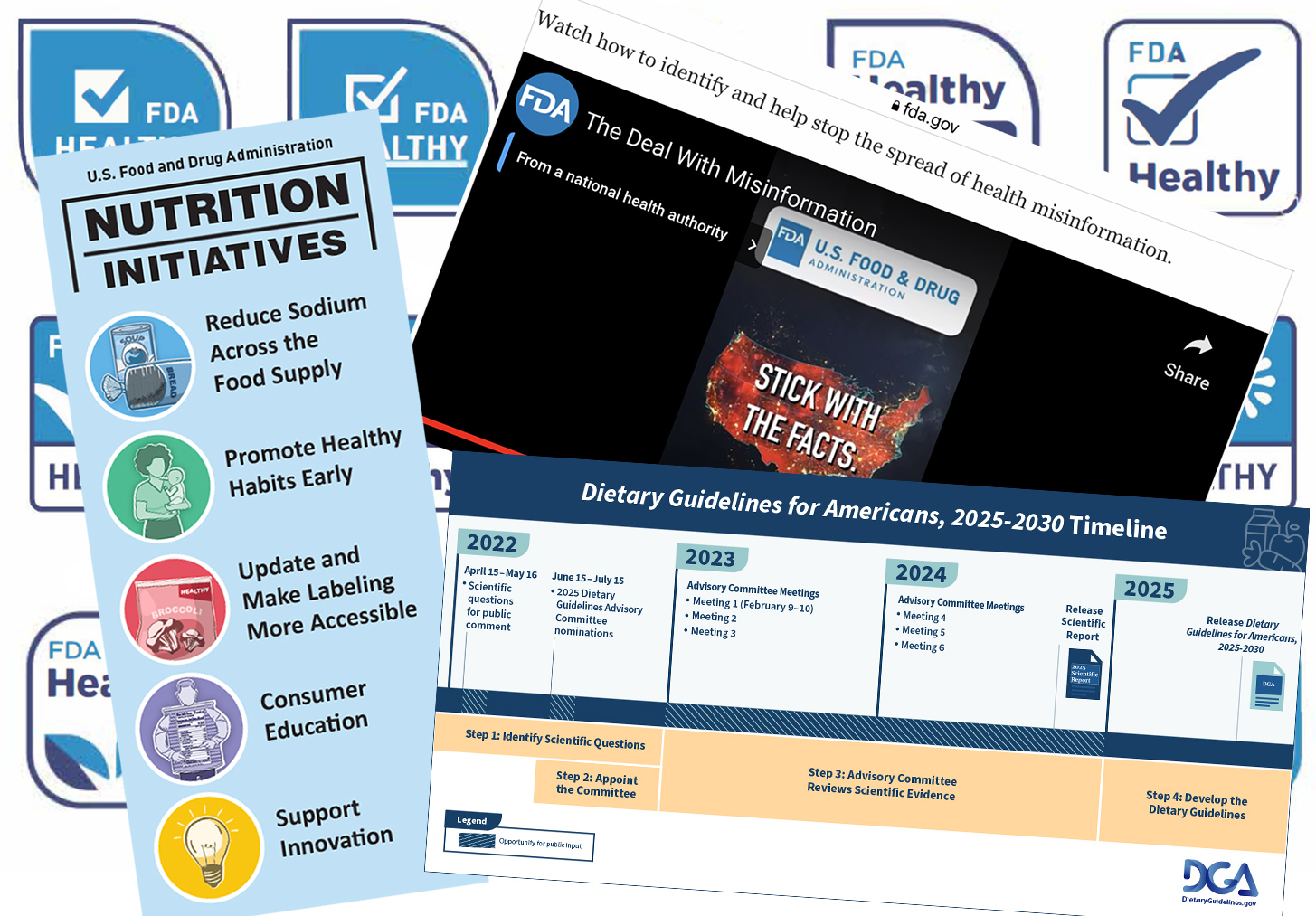
FDA launches ‘rumor control’ hub, will this eventually include its ‘nutrition initiatives’?

By Sherry Bunting, Farmshine, May 19, 2023

WASHINGTON D.C. — The Food and Drug Administration (FDA) launched a new “rumor control” webpage on May 16, described as the hub to stop what the FDA calls “false, inaccurate, or misleading health information” that is “negatively impacting the public’s health.” 

How does FDA define misinformation? “It’s information, spread intentionally and unintentionally, that is false, inaccurate, or misleading according to the best available evidence at the time,” the announcement explains.

Who decides what is the best available evidence at the time? An info-graphic recommends checking sources and cross-referencing the information with reliable sources.

What is a reliable source? FDA describes it in one section as “the federal government and its partners” and describes it in another section as “a non-profit fact-checking source or government resource.”

A video narrator at FDA rumor-control explains the next step is to read beyond the headlines on the internet for context and to “understand the purpose of the post.” 

Scrolling to the bottom of the landing page are instructions to report misinformation.

“We face the challenge of an overabundance of information related to our public health. Some of this information may be false and potentially harmful,” the FDA rumor control webpage states. “If you see content online that you believe to be false or misleading, you can report it to the applicable platform.” 

These words are followed by icons to click for administrators at Twitter, Facebook, TikTok, Instagram, LinkedIn, YouTube, and WhatsApp.

FDA has posted to this hub its ‘fact documents’ on several hot topics such as vaccines, dietary supplements, and sunscreen, stating that more topics will be added in the future.

Will nutrition become one of them, now that the Administration has placed a priority on FDA’s role as purveyors of the Dietary Guidelines as gospel?

Case in point, just three weeks prior to launching the rumor-control hub, the FDA announced it is “prioritizing nutrition initiatives to ensure people in the U.S. have greater access to healthier foods and nutrition information to identify healthier choices more easily… to improve eating patterns and, as a result, improve everyone’s health and wellness.”

These FDA initiatives came out of the “whole of government approach” pledged by President Biden and Ag Secretary Vilsack in the White House Strategy on Hunger, Nutrition and Health.

“People need to know what they should be eating, and the FDA is already using its authority around healthy labeling, so you know what to eat,” said the President during the White House Conference where the Biden-Harris National Strategy was unveiled in September 2022. 

The FDA proposed rule on ‘healthy labeling’ came out on the same day. Comments ended months ago but the final rule has not yet been published in the Federal Register.

The FDA nutrition initiatives are being pursued “to help accelerate efforts to empower consumers with information and create a healthier food supply.”

According to the FDA news release, the federal government currently believes obesity and chronic diet-related diseases are on the rise because American eating patterns are not aligning with the federal Dietary Guidelines. The press release states that most people consume too much saturated fat, sodium and added sugar, and the FDA nutrition initiatives aim to correct this.

FDA’s nutrition priorities in progress, include:

1)    Developing an updated definition and a voluntary symbol for the ‘healthy’ nutrient content claim, front-of-package labeling, dietary guidance statements and e-commerce labeling, and

2)    Supporting innovation by changing standards of identity such as labeling requirements for plant-based foods.

In addition to issuing its controversial plant-based milk labeling rule earlier this year, which would allow the pattern of fake milk proliferation to simply continue, the FDA in the first four months of 2023 sent letters of ‘no objection’ to three companies in their respective requests for GRAS (generally regarded as safe) status for cellular lab-created meat. 

Several ferrmentation-vat dairy protein analog makers — including Perfect Day with its genetically-altered yeast excrement posing as dairy protein — received their ‘no objection’ to GRAS letters from FDA in 2020.

As reported in Farmshine over the past several years, the FDA has been on its “multi-year nutrition innovation strategy” since 2018. However, the pace has accelerated since September 12, 2022, when Executive Order 14081 was signed by President Biden just 10 days before the White House Conference on Hunger, Nutrition and Health.

Entitled Advancing Biotechnology and Biomanufacturing Innovation for a Sustainable, Safe and Secure American Bioeconomy, the Presidential EO 14081 states: “For biotechnology and biomanufacturing to help us achieve our societal goals, the United States needs to invest in… and develop genetic engineering technologies and techniques to be able to write circuitry for cells and predictably program biology in the same way in which we write software and program computers; unlock the power of biological data, including through computing tools and artificial intelligence; and advance the science of scale‑up production while reducing the obstacles for commercialization so that innovative technologies and products can reach markets faster.”

(AUTHOR’S NOTE: All roads lead back to the umbrella of the Dietary Guidelines. The current DGA Committee began meeting recently in the process of formulating the 2025-30 DGAs. Entrenched in four decades of low-fat dogma, the USDA and HHS, along with the 2010, 2015 and 2020 DGA Committees, repeatedly left out of the discussion dozens of scientific papers, even research by the National Institutes of Health, that showed the neutral to beneficial impact of saturated fats on human health and the positive role of nutrient dense foods that are high in protein and essential nutrients but also contain saturated fat such as whole milk, full-fat dairy, and unprocessed red meat. Given the fact that childhood obesity and chronic diet-related disease incidence are rising rapidly, an objective fact-checker could easily determine that the Dietary Guidelines, themselves, are health misinformation. Clearly, children are the sector of the population whose eating patterns closely align with the Dietary Guidelines since 2010. They don’t have a choice. Most children today eat two meals a day, five days a week, three quarters of the year at school where the Dietary Guidelines rule with an iron hand. Let’s not forget the 2020 DGA Committee admitted that all of the DGA eating patterns came up short in essential nutrients found in animal foods, but when a committee member warned of this on final public reading, the saturated fat subcommittee chair mentioned taking vitamin pills and noted ‘new designer foods are coming.’)

Biden, Vilsack pledge “whole of government approach” in scripted White House Nutrition Conference that converged with Tufts ‘Food Compass’ and FDA’s ‘healthy labeling’ rule; Fed. Reg. comments due Feb. 16, 2023

By Sherry Bunting, updated from original publication in Farmshine, Sept. 30, 2022

WASHINGTON — Get ready for unscientific nutrition bullying. Announced more than a year ago, the White House Conference on Food, Nutrition and Health Wednesday, September 28 was cloaked in secrecy until the eve of the event, when the 44-page “Biden-Harris Administration National Strategy on Hunger, Nutrition, and Health” was released Tuesday, September 27 around Noon. 

By 5:00 p.m., the Conference agenda appeared in the inbox of registered participants, and during the overnight hours, the Biden Administration released a fact-sheet announcing $8 billion in “new commitments” from over 100 private businesses, local governments and philanthropies for what it calls a “transformational vision.”

Taking a page from the World Economic Forum’s (WEF) Davos-style approach to food transformation, the White House solicited pledges to address the five “pillars” in its playbook. 

Of note among them are a $500 million investment by Sysco (foodservice vendor), nearly $50 million by Danone, $250 million from a collaboration of the Rockefeller Foundation and the American Heart Association on a ‘food as medicine’ initiative, and an undisclosed amount for a collaboration between Environmental Working Group, the James Beard Foundation, the Plant Based Foods Association and the Independent Restaurant Coalition to prompt more plant-based alternative and vegan offerings in foodservice — to name a few.

Then, at 9:15 a.m., just 15 minutes before USDA Secretary Vilsack was set to open the Conference ahead of President Joe Biden’s remarks, the Food and Drug Administration (FDA) announced its “proposed updated definition of a ‘Healthy’ claim on food packages to help improve diet and reduce chronic disease.”

Presto: FDA provided the ‘teeth,’ describing its proposal as aligning directly with the Dietary Guidelines. For the proposed rule, click here and to submit a comment by Dec. 28, 2022, (now updated as comment period ends Feb. 16, 2023): click here

This morsel had been under development over the past four years after public hearings in 2018-19 were reported by Farmshine and then deliberations went silent – until now.

The flurry of activity appeared in scripted fashion within the 24-hours prior to the start of the White House Nutrition Conference convening stakeholders. The first such conference was over 50 years ago and had served as the launch pad for what are known today as the infamous Dietary Guidelines for Americans (DGAs).

A Senate nutrition hearing exactly one year ago in November 2021 paved the way for the September 2022 White House Nutrition Conference.

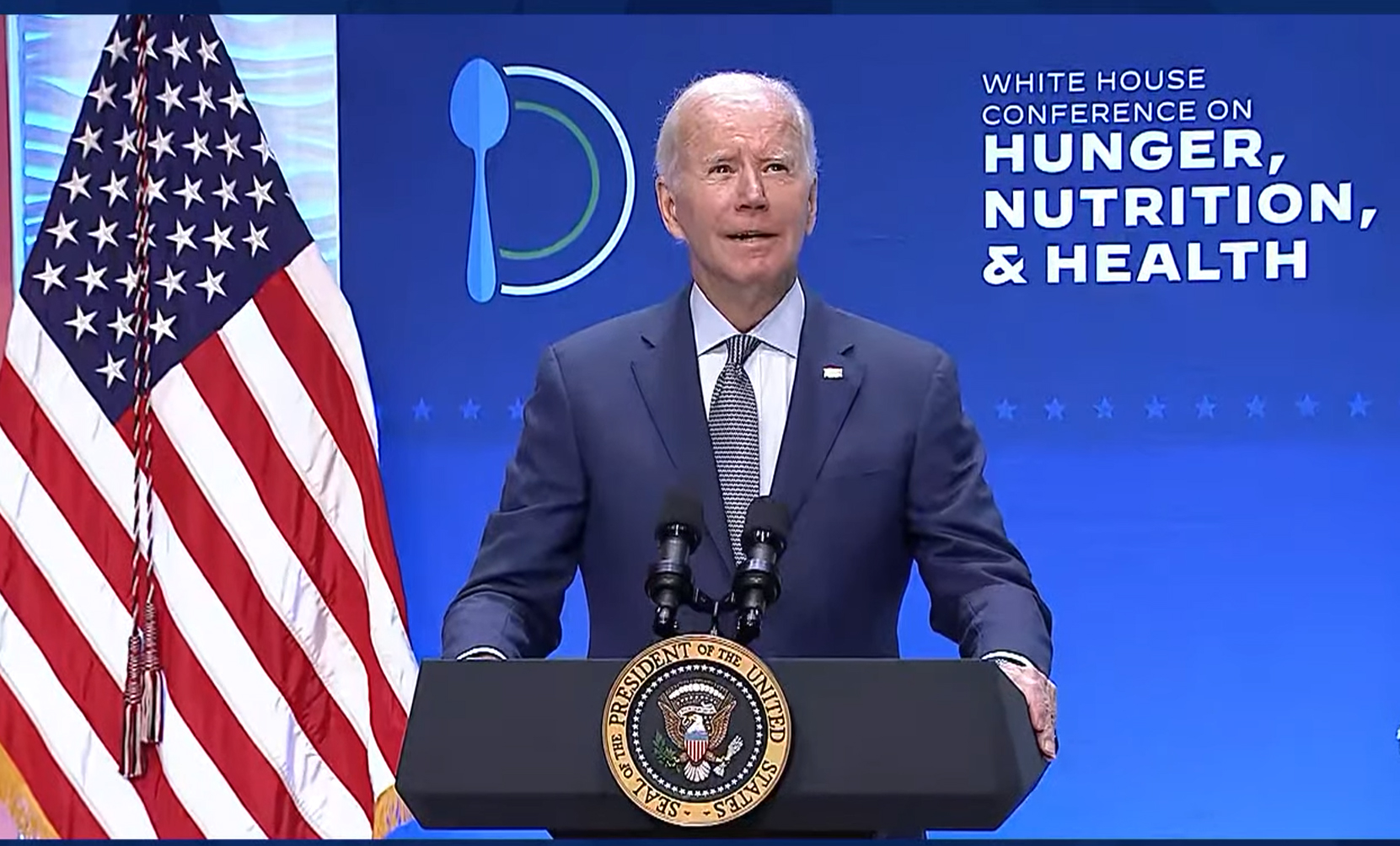
CAPTION: “We have to give families a tool to keep them healthy. People need to know what they should be eating, and the FDA is already using its authority around healthy labeling so you know what to eat,” said President Biden. White House Conference screen capture

The Conference and follow up actions, said President Biden on Sept. 28, are being devoted to “nourishing the soul of America so that no child goes to bed hungry and no parent dies of a disease that can be prevented. We can do big things,” he said about the stated 2030 goals of ending hunger, increasing healthy eating and physical activity, and reducing diet-related illnesses and other nutrition-related health inequities.

“But,” Biden declared: “We have to give families a tool to keep them healthy. People need to know what they should be eating, and the FDA is already using its authority around healthy labeling so you know what to eat.”

The President continued: “We can use these advances to do more to be a stronger and healthier nation, to achieve ambitious goals. We must take advantage of these opportunities when we have these children in a whole of government, whole of society approach. We need to think in ways we never thought before.”

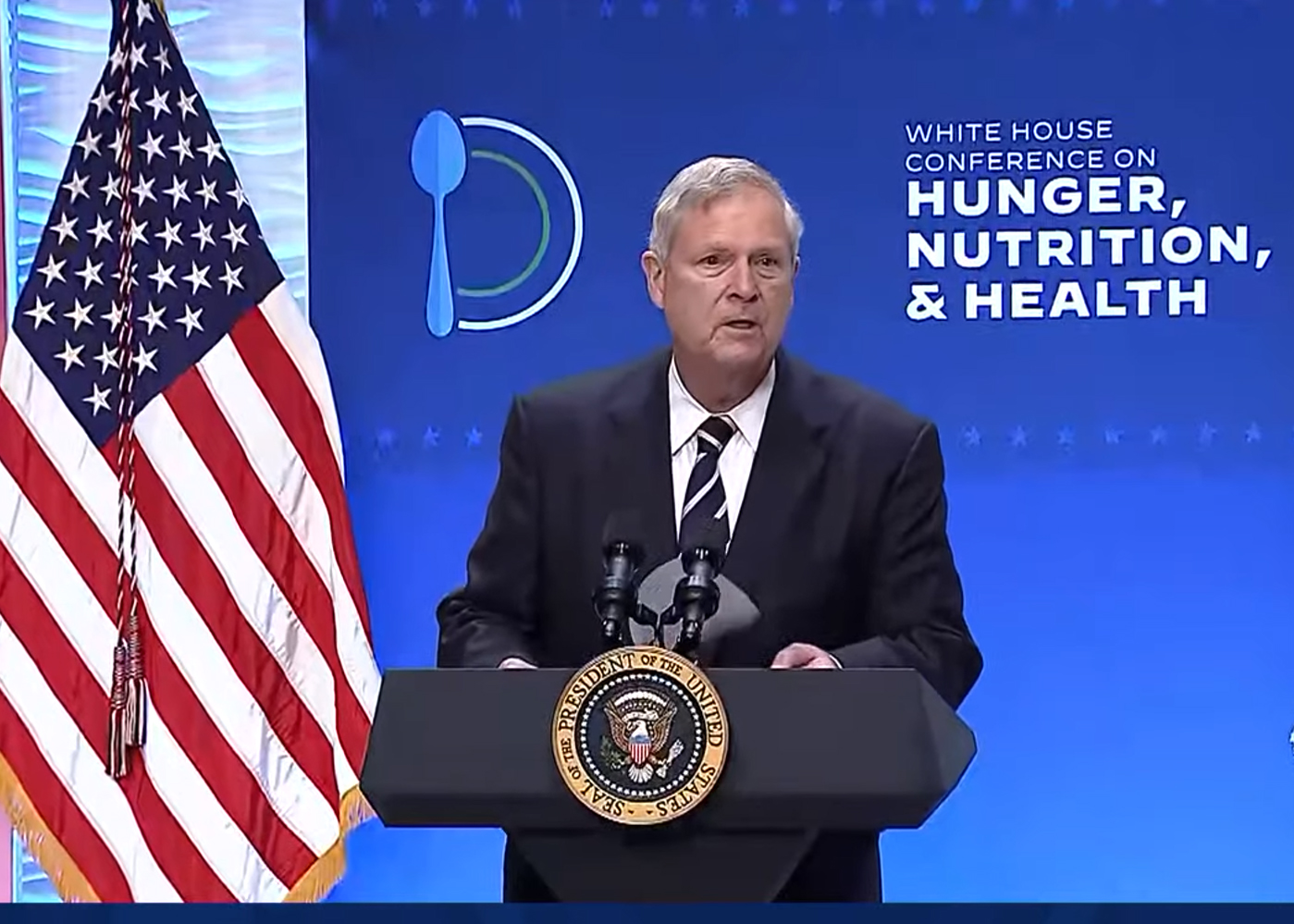
CAPTION: Ag Secretary Tom Vilsack told the White House Nutrition Conference crowd of more than 500 in-person and more than 6000 logged-in virtually that the Administration is looking to extend the child tax credits, provide more funds for more free school meals, and “take nutrition in a new direction using a whole of government approach that involves the entire federal family.” White House Conference screen capture

In his remarks ahead of the President, Ag Secretary Tom Vilsack stated that government programs feed 1 in 4 children. He and Biden both talked about expanding the child credit permanently. They talked about $2 billion in funding for food banks and schools, including $100 million for ‘incentives’ to make school meals healthier. They both noted funding to make free school meals available for 9 million additional children. A laundry-list of throwing money at a problem without re-evaluating the flawed guidelines that run the school meals and other USDA food programs despite preponderance of evidence that saturated fats are not the enemy.

There was talk of going “a new direction” but this is all process-based. There was no talk of reviewing the flawed Dietary Guidelines that helped get us here and that the Biden-Harris strategy puts so much emphasis on.

Parsing through the 44-page National Strategy, the bottom line is to expect more of the same drill-down on eliminating animal fats, only worse and with stiffer process, labeling and speech boundaries through FDA and the FTC.

We can expect nutrition bullying to commence — if we step outside of the still-vague but Dietary Guidelines-centered White House playbook. In fact, in addition to the FDA ‘Healthy’ label update, a small-print detail in the 44-page Strategy promises power and funding to the Federal Trade Commission (FTC) to scrutinize and penalize food marketing claims for being out-of-bounds on the Biden-Harris DGA-scripted nutrition field of play.

Vilsack noted the National Strategy’s approach is a “whole of government approach that involves the entire federal family.”

In preparation for the Conference, many have lamented the lack of transparency leading up to it. For months, the Conference website gave instructions on how to hold a ‘watch party,’ or a ‘satellite event,’ and how to rally support for nutrition and health ahead of time. But all of the necessary details were missing — until the day of the conference. 

Emailed invitations were sent to those who registered just three days before — requesting that they visit a web-portal and record an interview to provide input. There, people respond to White House questions and their faces are added to a streaming screen full of moving mouths — giving the appearance of broad input flowing in from Americans.

Made nervous by the lack of a published agenda or framework, over a dozen agricultural organizations had sent a letter to President Biden on September 8th asking for a “seat at the table.” Those organizations included American Farm Bureau and commodity groups for wheat, beef, sorghum, peanuts, canola, soybeans, barley, corn, sunflower, eggs and rice.

Dairy organizations were conspicuously absent from any of the pre-Conference letter-writing or other such public statements. But then, the dairy industry has its man Vilsack in play, and its DGA 3-a-day – so case-closed – can’t be bothered on the milkfat and whole milk issue.

On the agenda provided the day of the Conference, we found former DMI vice president of sustainability, Erin Fitzgerald — who now serves as CEO of the U.S. Farmers and Ranchers Alliance and who represented USFRA and referenced her boss at the dairy checkoff during a WEF panel in Davos earlier this year — leading a plenary session on “access to affordable foods.” Also, Chuck Conners of the National Association of Farmer Cooperatives led the plenary discussion on “empowering consumers to make healthy choices.”

(We learned after the Sept. Conference that National Milk Producers Federation and the National Dairy Council, funded by the mandatory dairy farmer checkoff, were invited to attend. They were represented, and they brought “student leaders” from GENYOUth. To read NMPF’s statement after the Conference, click here).

Key questions around “what are those healthy choices” to be compassed in tools and identified in FDA labeling went repeatedly unanswered as the discussions focused on approaches and processes, perhaps deeming the unsettled dietary science on fats to be settled science with no need for discussion.

Nutrition Coalition founder, advocate, author and investigative journalist Nina Teicholz has been writing about the Conference for weeks before it began, noting the lack of a pre-conference agenda and the refusal of the Administration to review the science on saturated fats ahead of this ‘landmark’ event.

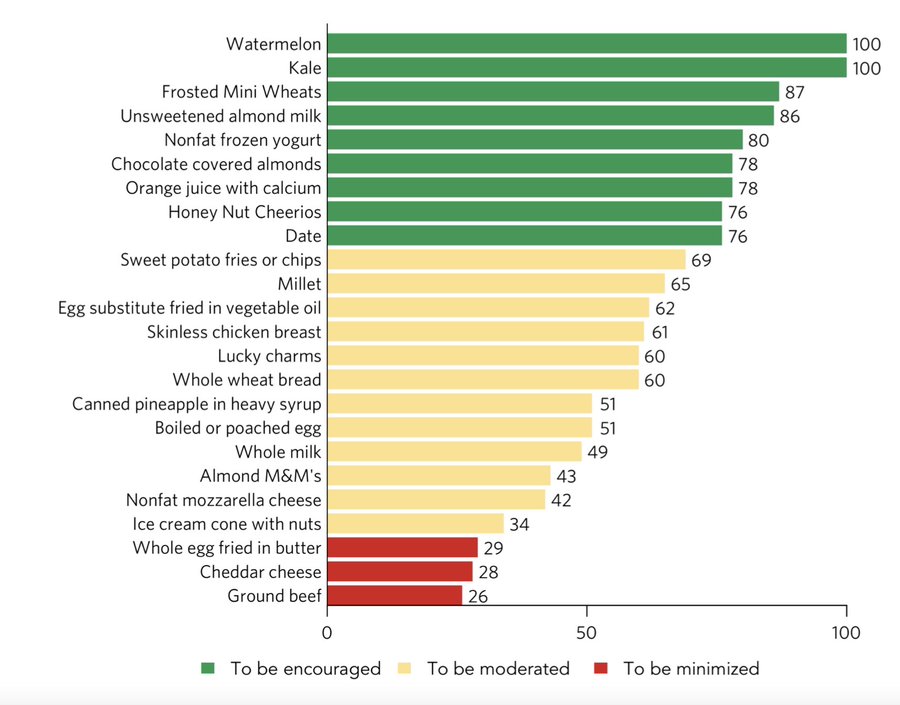
She points out that the White House delegated Conference planning to the Dean of the Tufts Friedman School of Nutrition Science and Policy at Tufts University Professor Dariush Mozaffarian — developer of the Food Compass, which is a new method for rating and ranking foods in categories to be consumed frequently, modestly, and occasionally.

To understand what the Food Compass looks like — sugary cereals rank far ahead of the milk that goes in the bowl with them. And, nearly 70 brand-named cereals from General Mills, Kellogg’s, and Post are ranked twice as high as eggs cooked in butter! Alternative fake milk beverages, such as almond juice, rank ahead of skim milk and far ahead of whole milk. Potato chips (yes, potato chips) are an example of a food that ranks ahead of a simple hard-boiled egg and light-years ahead of whole milk, most cheeses and real beef.

In fact, the only cattle-derived product to get top sector ranking is plain non-fat yogurt. (Surprise: Danone was one of the Food Compass development sponsors). Meanwhile, most cheeses, whole milk, and beef ranked near or at the very bottom of the lowest categories.

Coincidentally, Mozaffarian’s department at Tufts also received a $10 million grant from USDA in November 2021 for a five-year project “to help develop cultivated meat” (aka lab-created meat) through assessment of consumer attitudes and development of K-12 curriculum.

Teicholz laments the lack of consideration by the White House, USDA, HHS and FDA as they ignore many reviews including the most recent state-of-the-art review on saturated fats, whose authors include five former members of the Dietary Guidelines Advisory Committee.

“These are the people who wrote the guidelines saying: ‘We got it wrong,’” writes Teicholz.

Their paper was published in the prestigious Journal of the American College of Cardiologists, whose Editor in Chief named it as one of the top 5 papers of the year. Science like this appears to be off the menu of the White House nutrition playbook.

The entire playbook hinges upon the main tenets of the current Dietary Guidelines for Americans even though the DGAs are being questioned by the scientific community… Even though the DGAs have screened out sound science on dietary animal fats and proteins for at least the past three cycles (15 years)… Even though the rates of American obesity and diet-related illnesses were mostly stable pre-DGA but have risen steadily since the DGA cycles began… And even though these consequences have risen dramatically among children and teens during the past decade since school meals, school milk and a la carte competing foods and beverages were further restricted to the low-fat levels of the DGAs.

What does the White House blame for this poor performance? The playbook cites the Covid pandemic food choices of Americans — stuck at home — for the deteriorated statistics. Unbelievable! These statistics have been deteriorating for decades, especially since 2012.

Looking over the playbook, it closely follows the pattern of FDA’s Multi-year Nutrition Innovation Strategy proceedings that have been quietly underway after public hearings in 2018-19 until the ‘Healthy’ label proposal was announced Sept. 28, 2022.

Appearing in the White House playbook is the proclamation that food and beverage packaging will move toward simpler nutrition guidance under FDA, that an easily recognizable ‘healthy symbol’ will be reserved for front-of-package labeling on those foods the government deems Americans should eat, and a potential ranking system for symbols will be developed for packaging of foods and beverages the federal government deems unhealthy.

This is all coincidentally similar to the Tufts Food Compass, and the substance behind these simplified ‘healthy’ (or not) symbols is a doubling-down on the low-fat DGAs as a primary base metric. Here is a deep dive into the Tufts Food Compass that Mozaffarian, the White House Nutrition Conference Chairman, had a critical role in developing to now be the formation of future food policy. Read the comprehensive analysis here

The National Strategy calls for even more adherence to the flawed DGAs among every sector of the economy beyond government feeding programs, schools, hospitals, and military diets to include foodservice offerings, supermarket layouts, online shopping algorithms, even licensing for all daycare or childcare providers and nutrition certification for these licensed childcare providers – not just those receiving government subsidies for food. 

This is so-called “stealth-health” at its best — or rather its worst.

The Biden Administration professes to be concerned about the 1 in 10 households experiencing food insecurity and the rise in diet-related diseases among the leading causes of death and disability in the U.S. The White House cites data showing 19 states have obesity prevalence at 35% or higher with 1 in 10 citizens having diabetes, 1 in 3 with cancer in their lifetime, and nearly 5 in 10 with high blood pressure. 

Yet, there is no pause for a comprehensive review of the very dietary guidance, the DGAs, that helped get us here. 

The National Strategy reveals how the Administration is assembling executive orders, legislative prompts, calls for action among food organizations, companies, agencies, academia and state and local governments to get everyone on the same page making Davos-style pledges and to conform to the federal playbook.

In the executive summary, the President writes: “Everyone has an important role to play in addressing these challenges: local, State, territory and Tribal governments; Congress; the private sector; civil society; agricultural workers; philanthropists; academics; and of course, the Federal Government.”

(Note Biden’s only reference to farmers or food producers is as “agricultural workers.”)

The playbook’s five pillars talk about improvement, integration, empowerment, support and enhancement. It coins phrases like ‘food as medicine’ and ‘prescriptions for food.’ Reading deeper, we see a launch pad for a new method of nutrition ranking and labeling with the primary factors listed as low-sodium, low-fat and reduced added sugars.

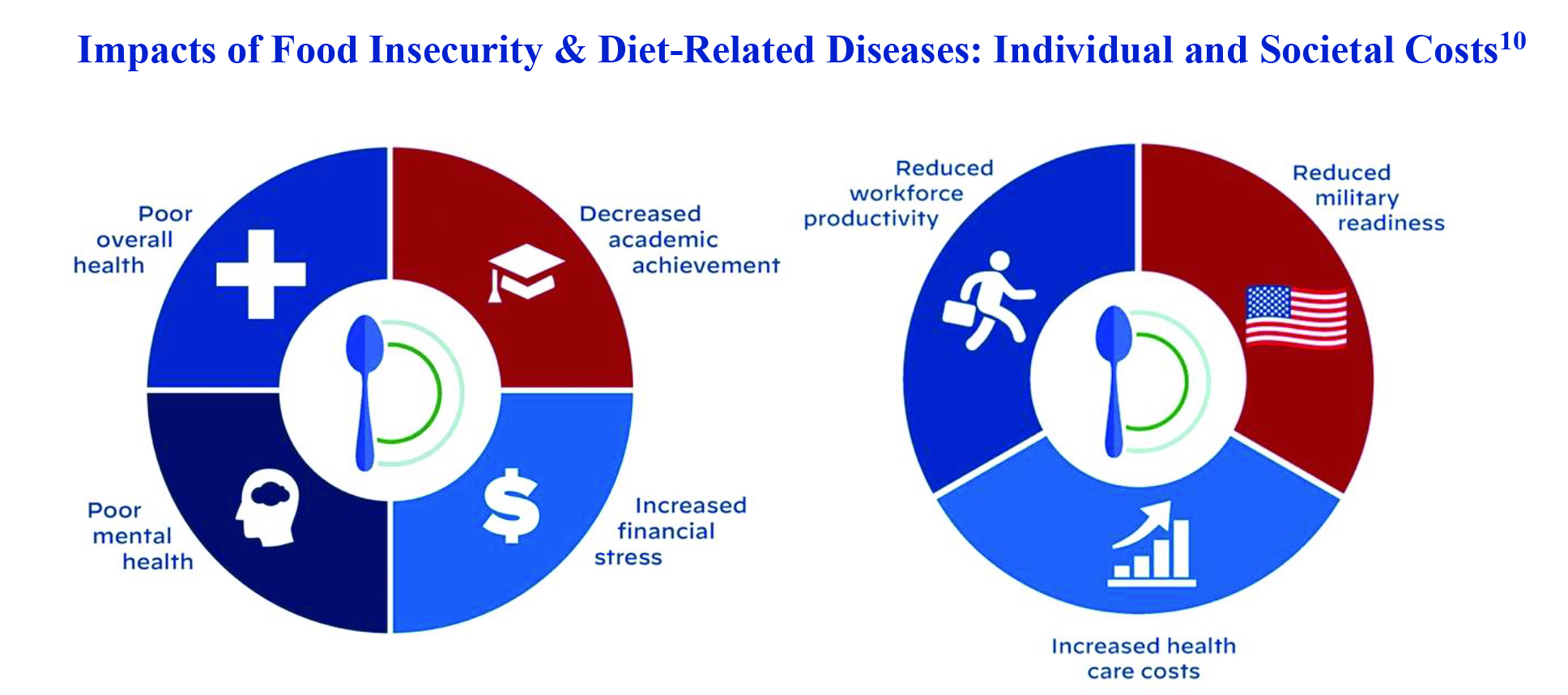
CAPTION: This diagram on page 6 of the 44-page Biden-Harris Nutrition Strategy, the White House ‘playbook,’ clearly identifies the very real concerns, but the pillars of this strategy double-down on perpetuating the problem by giving even more influence to the low-fat / high-carb Dietary Guidelines that many in the scientific community are questioning. The ‘playbook’ also increases the reach of the federal government into the diets of children in daycare and schools. 

The playbook’s diagrams show us the concerning impact of food insecurity and diet-related diseases in poor overall health, poor mental health, increased financial stress, decreased academic achievement, reduced workforce productivity, increased health care costs and reduced military readiness – but then doubles-down on the solution being more of the same low-fat / high-carb dietary path that got us here.

The White House playbook states that, “The vast majority of Americans do not eat enough vegetables, fruits or whole grains and eat too much saturated fat, sodium and added sugars.” But at the same time, on the saturated fat question, the data show per capita consumption of red meat has declined since the start of the DGAs, and milk consumption has substantially declined.

Americans are being called upon to “unify around a transformational vision,” said Biden. 

This vision includes more federal control of diets and nutrition education after failing miserably with the control it already possesses. There is no talk of revisiting the path we are on, just doubling-down on how to get more Americans onto that DGA path, to tell them what to eat, and to put the FDA stamp on ‘approved’ foods and beverages while having the FTC investigate health and nutrition claims that fall outside of the flawed DGAs.

Translation: Let the ‘nutrition bullying’ from the White House bully-pulpit begin. Some of us are ready to rumble.

-30-