Seeds of doubt being sown, Part II: ‘What will processors do with all that skim?’ Oh my!

By Sherry Bunting, Farmshine, Feb. 23, 2024

EAST EARL, Pa. — The status of the Whole Milk for Healthy Kids Act, S. 1957, has 17 Senate sponsors from 13 states, including 12 Republicans, 4 Democrats, and 1 Independent. 

Even though both NMPF and IDFA have shown support for the measure, a bit of resignation can be sensed — riding the overwhelming House vote as enough progress for one legislative session. After taking bows for the performance of the bill in the House, representatives of both NMPF and IDFA – while speaking at winter meetings – have indicated a prevailing view that Senate opposition to S. 1957, is a big barrier. 

They say they are working to get the science in front of the Dietary Guidelines Committee, which has been tried before – over and over.

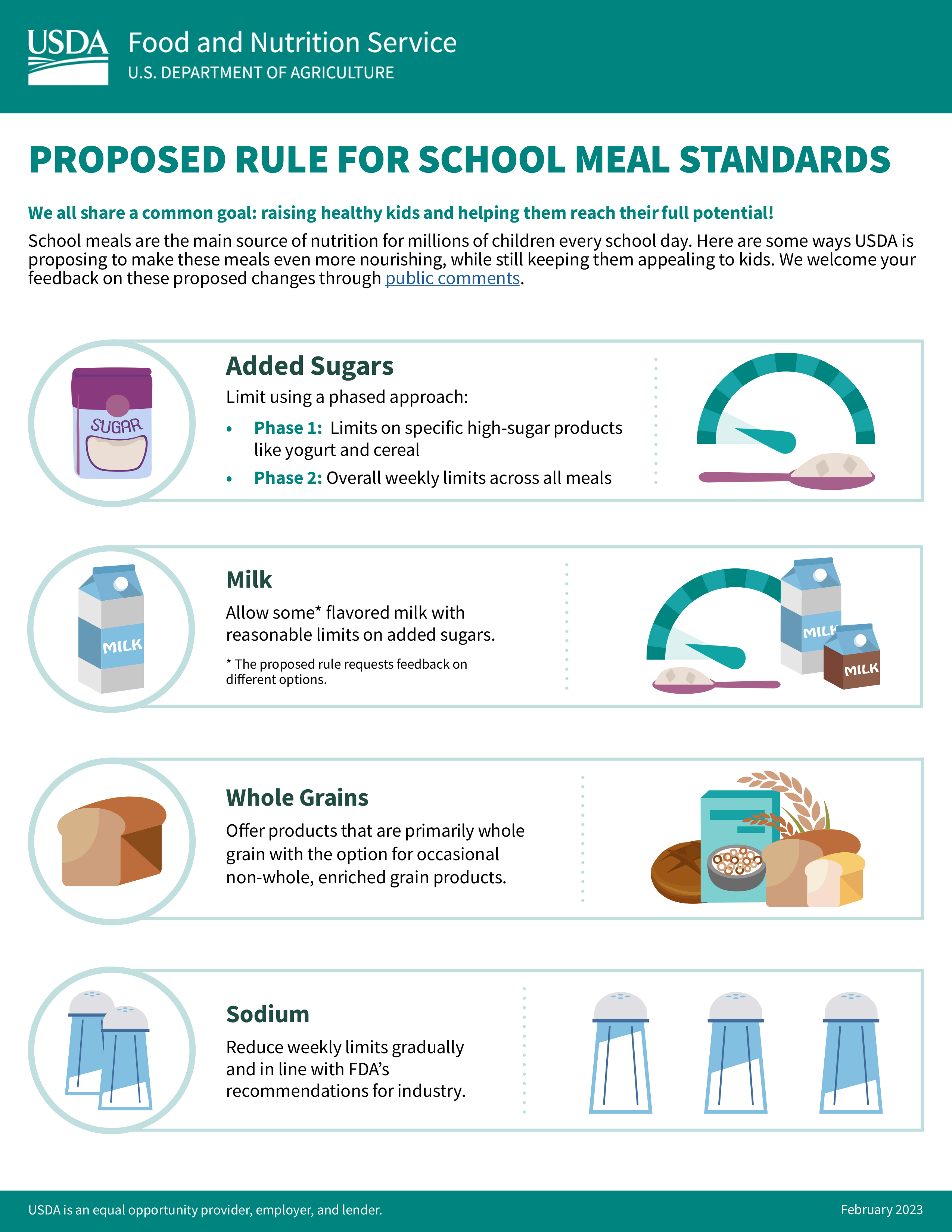
The DGA committee operates under a USDA that does not want whole milk options in schools or SNAP or WIC. This same USDA is proposing to remove chocolate milk options from schools, except for senior high students, and is proposing to reduce WIC milk by 3 gallons per recipient per month. This same USDA projects 20 billion more pounds of milk will be produced in the U.S. by 2030, according to IDFA CEO Michael Dykes, presenting future trends at the Georgia Dairy Conference in Savannah.

Seeds of doubt about the whole milk bill are being sown among farmers. Some asked me recently if their co-ops will lose money on the deal.

Last week, we discussed ‘Confusion’ — the first of 3 C’s that are facing the whole milk bill within the dairy industry. 

This week we look at the second C: ‘Consternation’ — a fancy word for fear.

“What will they do with all of our skim?” farmers asked me at a recent event. Is this something they are hearing from a milk buyer or inspector?

Here are some facts: Whole milk sales move the skim with the fat — leaving some of the fat through standardization, but not leaving any skim. Therefore, an increase in whole milk sales does not burden the skim milk market.

Surely, the practice of holding schoolchildren hostage to drinking the byproduct skim of butter and cream product manufacturing is a poor business model if we care about childhood nutrition, health, and future milk sales. 

Furthermore, the market for skim milk powder and nonfat dry milk is running strong as inventories are at multi-year lows in the U.S. and globally.

Cheese production, on the other hand, is what is cranking up, and it has been the market dog for 18 months. Like whole milk sales, cheesemaking uses both fat and skim. But cheesemaking leaves byproduct lactose and whey, and it can leave some residual fat depending on the ratios per cheese type.

Things are pretty bad for farmers right now in cheesemilk country. Some tough discussions are being had around kitchen tables. The 2022 Ag Census released last week showed the dire straits for farmers nationwide over the last five years as the number of U.S. dairy farms declined below 25,000, down a whopping 40% since 2017.

Wouldn’t an increase in whole milk sales through the school milk channels help pull some milk away from rampant excess cheese production that is currently depressing the Class III milk price, leading to price divergence and market dysfunction?

While there is no one data source to specifically document the percentage of the milk supply that is sold to schools, the estimates run from 6 to 7% of total fluid milk sales (Jim Mulhern, NMPF, 2019), to 8% of the U.S. milk supply (Michael Dykes, IDFA, 2023), to 9.75% of total fluid milk sales (Calvin Covington, independent analysis, 2024). 

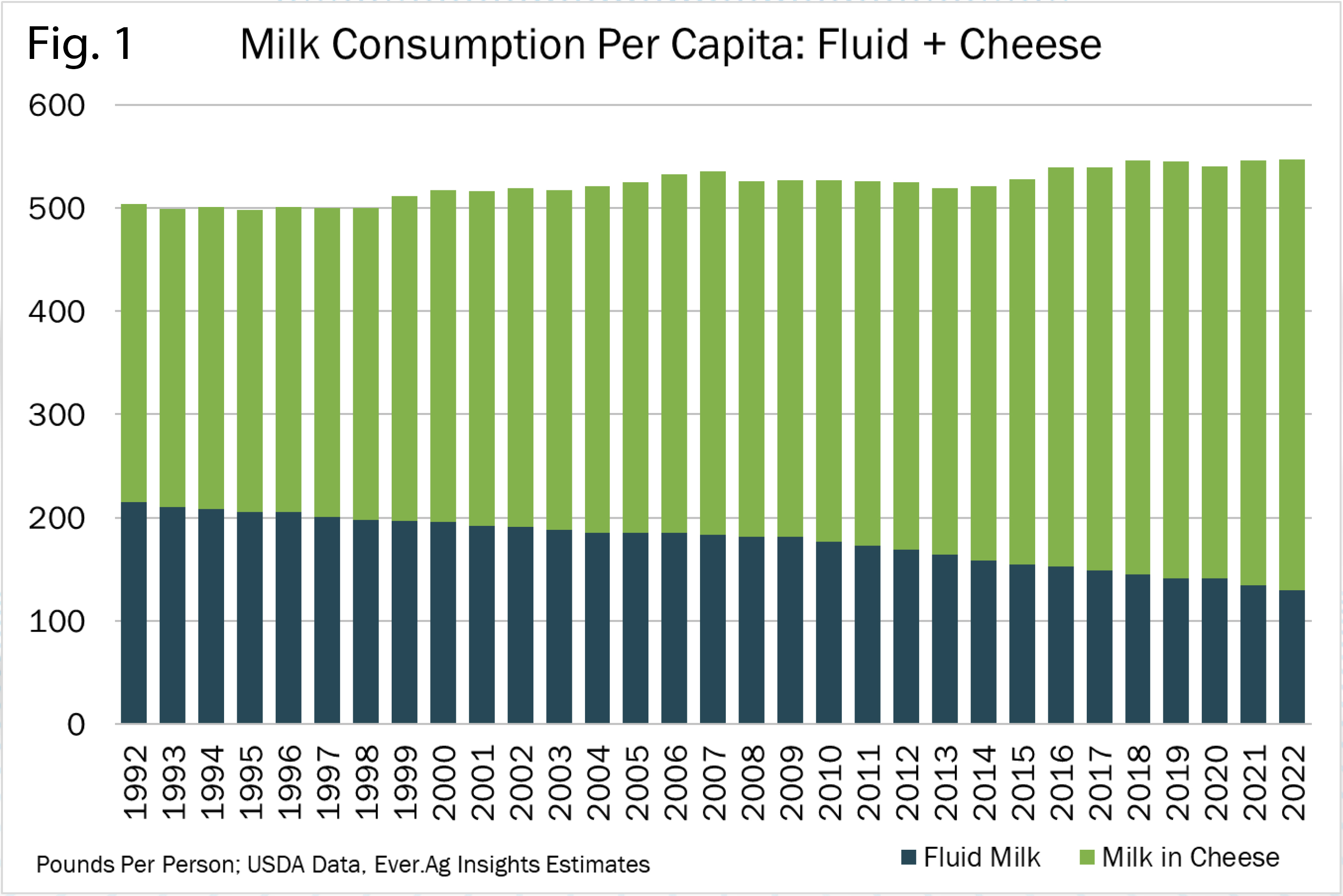
If even half of these sales became whole milk sales, it could modestly positively impact the amount of excess cheese being made even as processors say they plan to make more cheese because people eat more of their milk than are drinking it. (Fig. 1)

Meanwhile, the cheese price is under so much downward price pressure that there is a $2 to $4 divergence of Class IV over Class III causing farmers to lose money under the ‘averaging’ formula for Class I milk. In many parts of the country, farmers lose additional money when the milk that is used in Classes II and IV is depooled out of FMMOs.

Without the ‘higher of’ pricing mechanism that was in place from the year 2000 until May 2019, Class I can fall below the higher manufacturing price, removing incentive to pool, which leaves pooled producers with smaller payments for their milk and leaves the decision about what to pay depooled farmers up to the processors after they’ve succeeded in reducing the benchmark minimum by depooling.

Ultrafiltered (UF) milk represents 2.4% of fluid milk market share, having grown by more than 10% per year for four years with sales up 7.7% in 2023 vs. 2022, according to Circana-tracked market data shared by Dykes.

UF milk is also cheese-vat-ready-milk with capability to remove not just the lactose but also the whey as permeate at the front end for use in distilleries that are now funneling lactose into ethanol production in Michigan and whey into alcoholic beverages in Michigan and Minnesota.

Processors want farmers to do “a tradeoff” to decide how much revenue comes to their milk checks and how much goes to processing investments for the future. The future is being dictated by where we are in fluid milk consumption relative to cheese production.

This is one reason IDFA and Wisconsin Cheesemakers, as well as NMPF, had proposals asking USDA to increase the processor credits (make allowances) that are embedded in the dairy product price formulas. IDFA and Milk Innovation Group also put forward other proposals to further reduce regulated minimum prices.

We wonder with these new processing investments, how is it that the make allowances are too small? Only bulk butter, nonfat dry milk, dry whey, 40-lb block Cheddar and 500-lb barrel cheese (yellow not white) are surveyed for the circular class and component price formulas. Everything else that doesn’t meet CME spec for these specific product exchanges is excluded.

This means the costs to make innovative new products and even many bulk commodity-style products, such as bulk mozzarella, unsalted butter, whey protein concentrate and skim milk powder, can be passed on to consumers without being factored back into the FMMO regulated minimum prices paid to farmers.

If market principles are applied, processors wanting to encourage more milk production, to make more cheese, would pay more for the milk – not less. But when the margin can be assured with a make allowance that yields a return on investment, all bets are off. Cheese gets made for the ‘make’ not the market.

We saw processors petition USDA in the recent Federal Milk Marketing Order hearing to reduce the minimum prices in multiple ways so they can have the ability to pay market premiums to attract new milk. This would be value coming out of the regulated FMMO minimum price benchmark for all farmers to get added back in by the processors wherever they want to direct it.

Cheese is in demand globally, and the U.S. dairy industry is investing to meet this. Dykes told Georgia producers that processors want to grow and producers want to grow. He wasn’t wondering what to do with all of the skim when he asked: “Where will the milk come from for the over $7 billion in new processing investments that will be coming online in the next two to three years?”  

This is happening, said Dykes, “due to market changes from fluid milk to more cheese production (Fig. 1). There’s a lot of cheese in those plans. With over $7 billion in investment… These are going to be efficient plants. You’re going to see consolidation. If you are part of a co-op, you’re going to decide how much (revenue) comes in through your milk check and how much goes into investment in processing for the long-run, for the future. That’s the debate your boards of directors will have.” 

Even the planned new fluid milk processing capacity is largely ultra-filtered, aseptic and extended shelf life, according to Dykes.

“That’s the direction we are moving,” he said. “We are seeing that move because as we think about schools, are we still going to be able to send that truck driver 20 miles in any direction with 3 or 4 cases of milk 5 days a week? Or do we do that with aseptic so they can store it and put it in the refrigerator one night before, and get some economies of scale out of that, and maybe bring some margin back to the business?”

As the Class III milk price continues to be the market dog, we don’t see milk moving from Class III manufacturing to Class IV, perhaps because of the dairy processing shifts that have been led by reduced fluid milk consumption. 

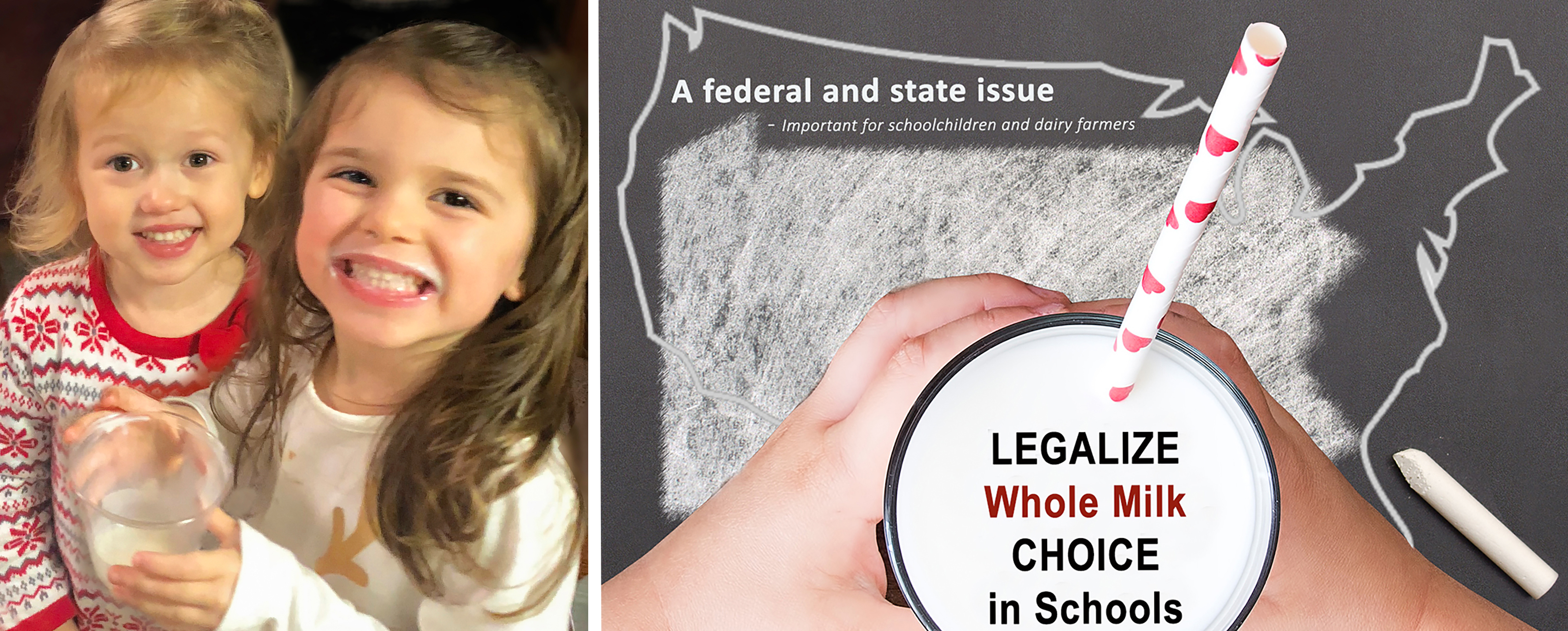
Allowing schoolchildren to have the choice of whole milk at school is about nutrition, healthy choices, future milk consumers, and the relevance of fresh fluid milk produced by local family farms in communities across the country. Having a home for skim does not appear to be the primary factor affecting milk prices where Class III is dragging things down.

Bottomline, dairy farmers should have no consternation (fear) over what processors are going to do with “all of that skim” once they are (hopefully) allowed to offer schoolchildren milk with more fat.

Next time, we’ll address the third ‘C’ – Competition – If kids are offered whole milk in schools, will it reduce the butterfat supply and impact the industry’s cheese-centered future? 

A final note, just in case the question about ‘what to do with all that skim’ still bothers anyone… What’s wrong with animal feed markets for skim milk powder? Protein is valuable in animal health, there are livestock to feed, and people spend major bucks on their pets too. Did you know dog treats made with nonfat dry milk powder, flour and grated cheese are a thing?

That idea got a good laugh from those farmers when I suggested it.

However, Cornell dairy economist Dr. Chris Wolf noted recently how China’s purchases are what drive global skim milk powder and whey protein prices, and that much of that market for both is to feed… you guessed it… Pigs. 
Seeds of doubt being sown, Part One, Confusion: ‘Will this bill really improve milk prices?”

By Sherry Bunting, Farmshine, Feb. 16, 2024

EAST EARL, Pa. — While decades of scientific debate in terms of childhood health and nutrition is the curtain opponents hide behind, the anti-animal agenda is the top hurdle for the Whole Milk for Healthy Kids Act in the Senate.

Senator Roger Marshall (R-Kan.) is the prime sponsor of the Senate bill, and he is a medical doctor in obstetrics and is taking a beating from billboards sponsored by Physicians Committee for Responsible Medicine (PCRM) in his home state of Kansas. PCRM is a known arm of PETA. This tells us quite a bit, doesn’t it?

Meanwhile, the top 3 C’s facing the bill within the dairy industry, itself, need to be addressed. 

1) Confusion… Will it really improve milk prices? Addressed in this article

2) Consternation (fear)… What will processors do with “all of that skim”? Addressed in Part II here

3) Competition… Will it reduce the butterfat supply and affect the ramp up in cheese manufacturing or other dairy products? Addressed in Part III here

Plus…. the Checkoff Commitments… Will it interfere with checkoff-funded Milk Molecules Initiative for new beverages that identify and separate specific milk molecules for specific benefits (sleep drinks, energy drinks, immune function drinks, specific protein type drinks)? 

All of these questions are quietly floating around and sowing seeds of doubt, leading to analysis-paralysis, while the industry focus is on innovation and exports, not on fresh milk, or a healthy next generation of U.S. milk consumers.

All of these questions will be answered one at a time over the next several weeks, starting with the first “C”: Confusion.

“Will this bill really improve our milk prices?” was the question I was asked by a few farmers at a recent farm show. My response was to ask them if they are concerned about kids having healthy milk options they enjoy and if they are concerned about seeing further erosion of fluid milk sales, and losing another generation of milk drinkers?

I reached out to Calvin Covington, former milk cooperative CEO in the fluid milk markets of the Southeast and a primary architect of pricing milk by component yield even before Order Reform during his years with American Jersey Cattle Breeders.

Covington ran the numbers using 2023 average prices, and calculating pounds of milk, fat, and skim, utilization, and values, which yield a gross value of a hundredweight of milk being used for fluid processing at different fat levels. 

“At a $3.00 Class I differential, a hundredweight of milk going for 3.25 fluid milk (whole milk as standardized), returns an additional 25 cents per hundredweight over skim milk,” Covington writes, noting that the difference will change based on different Class I differentials.

Even in the counties with small or zero location differentials on the map, the base differential of $1.60 per hundredweight is still included, which means at least a 13 cents per hundredweight difference.

Previously, Covington has noted in presentations that milk prices improve as the average fat level of total fluid milk sales increases. The current average of all sales, nationwide, stands at 2%. A few years ago, it was below 2%. A fractional change in either direction influences Federal Milk Marketing Order blend prices.

Fluid milk demand also plays a role in manufacturing class prices, affecting farmers in regions where prices are based almost exclusively on cheese. 

That’s especially true right now as cheese production has been exploding, and the Class III milk price has been imploding, creating a wide spread below Class IV and pushing FMMO blend prices lower as milk is not moving out of Class III to the higher value Class IV. But the Federal Milk Marketing Law gives Class I dibs to attract milk. So Class I demand is relevant for cheese milk pricing too.

As whole milk sales have increased year-over-year, whole milk became the largest category of fluid milk sales in 2021. It is a bright spot in the fluid milk category.

In 2023, gains in whole milk sales and in lactose-free milk sales are credited with boosting the entire fluid milk category for year-over-year gains in back-to-back months of October and November. This helped flatten the year-to-date loss-curve on total fluid milk sales that had been running 2 to 4% lower year-over-year to be just 1.5% lower cumulatively at year end compared with 2022, according to USDA’s December estimated packaged fluid milk sales report, released in mid-February.

Still, there is ground to make up, as fluid milk sales volume in 2023 is 7.8% lower than pre-Covid 2019, when volume totaled 46.24 billion pounds, down 1.8% from 2018. Then, during pandemic lockdowns, milk sales stabilized, putting the total at 46.2 billion pounds for 2020, virtually unchanged from 2019. In 2021, fluid milk sales volume declined 4.1% to 44.3 billion pounds, followed by a 2.4% decrease in 2022 to 43.3 billion pounds, and now a 1.5% decline in 2023 at 42.6 billion pounds.

NMPF chart, Circana Inc. full-year 2023 data

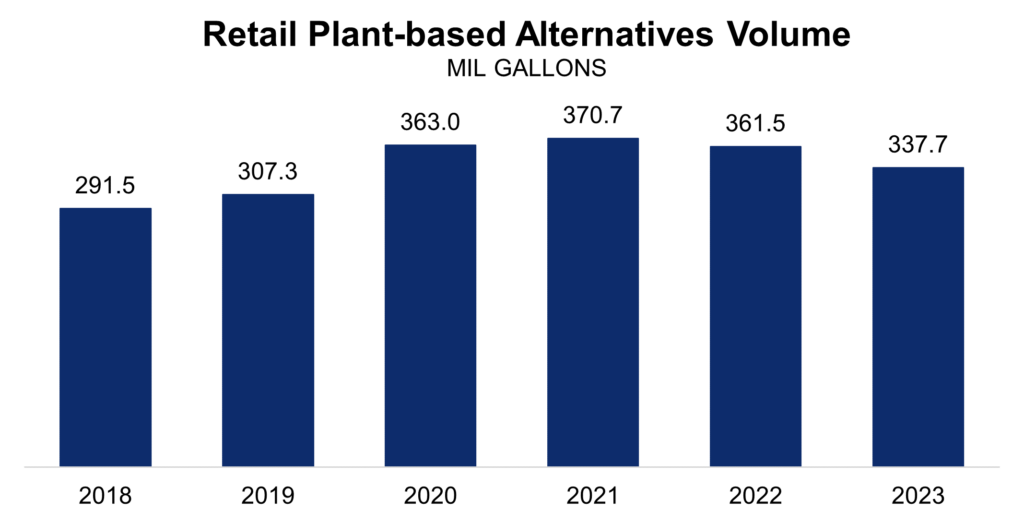
Meanwhile, the big news reported recently is that plant-based fake-milk beverages saw sales decline by 6.6% in 2023, the second straight year of declines and the smallest sales since 2019, according to data from Circana Inc reported recently. 

Real dairy milk sales volume of 42.6 billion pounds in 2023 is not only a much larger category than the lookalikes at 337.7 million pounds, real dairy milk outperformed lookalikes on a trend basis in 2023 — down just 1.5% vs. plant-based being down 6.6%.

By comparison, plant-based beverage sales volume in 2023 was a fraction of 1% (0.8%) the size of real milk sales volume.

Whole milk education and awareness have helped drive this result. Consumers are paying attention to food science, even if the Dietary Guidelines Advisory Committee, USDA (and FDA on labeling) continue to ignore it. Still, more education and freedom for children to enjoy milk is needed. The concern is that even though it is a smaller percentage loss, the 1.5% sales volume loss in the real milk category in 2023 represented 644 million pounds; whereas a 6.6% sales volume loss in plant-based beverages in 2023 represented 24 million pounds.

Speaking with a local milk bottler and ice cream maker recently – a producer handler – I learned he focuses on how his cows are fed to maintain their rolling average 5% butterfat during the summertime to make ice cream and satisfy consumer demand for whole milk. Their whole milk sales have skyrocketed, and this in turn, to the delight of the grocery store they are in, has helped boost sales of all fluid milk as a category in that store.

This has him thinking of doing a 5% butterfat, non-standardized, maybe even cream top, full-fat milk in glass bottles for the store. The store displays a 97 Milk banner at the entrance and 97milk.com website stickers at the dairy case.

Speaking with a manager at a different grocery store chain with stores in Pennsylvania and surrounding states, I learned their sales of whole milk have also increased by leaps and bounds in the past several years, boosting the entire fluid milk category by 14% at their stores throughout the region. They include the 97milk.com website and information in their sales circulars to their shoppers.

As for the schools — If even half of the schools offered a mix of milkfat choices as the Whole Milk for Healthy Kids Act would allow them to do, the amount of butterfat sold as Class I would increase. This would improve the fat side of the fat/skim pricing in the three Southeast Orders and Arizona. It would also help the Federal Order pool dollars reach after actual components are paid first in Multiple Component Pricing Orders everywhere else.

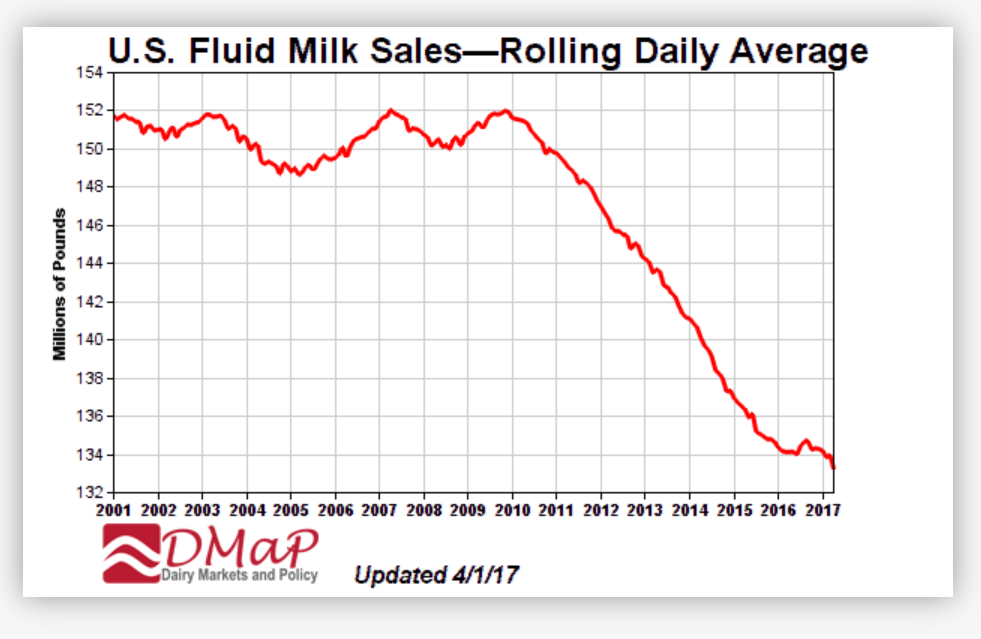
Total Class I fluid milk sales have dropped like a rock since Congress passed the Healthy Hunger Free Kids Act in 2010, which removed whole and 2% milk options from school meals, followed by USDA in 2012 further banning whole and 2% milk as a la carte or vending machine ‘competing beverage’ options in the Department’s Smart Snacks regulations.

Look at the graph above. It was shared as part of Dr. Mark Stephenson’s testimony in the recent USDA FMMO milk pricing hearing.

Improved total sales of school milk hold potential to increase total Class I fluid milk sales. A Pennsylvania school trial in 2019 showed a 52% increase in milk sales when whole and 2% milk options were offered. Students showed a 3 to 1 preference for whole milk over the 1% milk option.

When their options were expanded, more students chose milk instead of refusing it. Students were able to choose, and some of them continued to choose low-fat, and that’s okay! The Whole Milk for Healthy Kids Act is about choice.

A conservative estimate of a 25% increase in school milk sales can be anticipated if Whole Milk for Healthy Kids gets over the finish line in the Senate after its overwhelming passage in December in the House. That is half of the increase seen in the Pennsylvania school trial. If realized, a 25% increase in school milk sales equates to a little over one billion pounds of additional annual milk sales, which could raise the entire Class I fluid milk category by a little more than 2%.

This is based on the fact that kids aren’t just throwing away milk at school. Some are refusing to take the milk they are offered with school meals. This means sales are being lost.

Fluid milk sales declines will only get worse if USDA implements one of two draft proposals the Department announced a year ago. One would eliminate flavored milk from elementary and middle schools altogether. The other would require added sugar levels to be reduced dramatically in flavored milk at school. It’s widely known that when milkfat is retained in making chocolate milk, less added sugar is needed! 

Demand for whole milk is beneficial on both the milk fat and skim sides of the equation because whole milk sales move the nearly-complete product – the skim with the fat — leaving some of the fat through standardization, but not leaving any skim.

The result of these options in schools could be even better depending on how many schools choose to exercise these options.

If the industry doesn’t supply what consumers demand, sales are lost. Schoolchildren are already the dairy industry’s consumers, and they will hold the purse strings in the future.

Just as the Dietary Guidelines Committee and USDA continue to ignore science on milkfat, we are all ignoring our nation’s schoolchildren and what they are telling us about why they are turning away from nutrient-dense milk at a time when the nutrients milk delivers – that we may think they are receiving — have never been more important.

When the Pennsylvania school trial ended after one school year, a 95% reduction in the average daily volume of discarded milk was recorded. The school Student Council did an environmental project to measure this by measuring the volume of milk thrown away in unopened and partly consumed half-pint containers.

Shouldn’t we be listening to what the young people are telling us? They are our future, after all.

In the next part of this series, we’ll address the question: “What are the processors going to do with all of that skim?” Oh my!

In the meantime, consider this: Fresh fluid milk is the most notably locally-produced dairy product maintaining dairy farm relevance in regions and communities across America. What will the dairy industry look like five years from now, even one year from now? Maybe we should be asking the schoolchildren to answer that question.

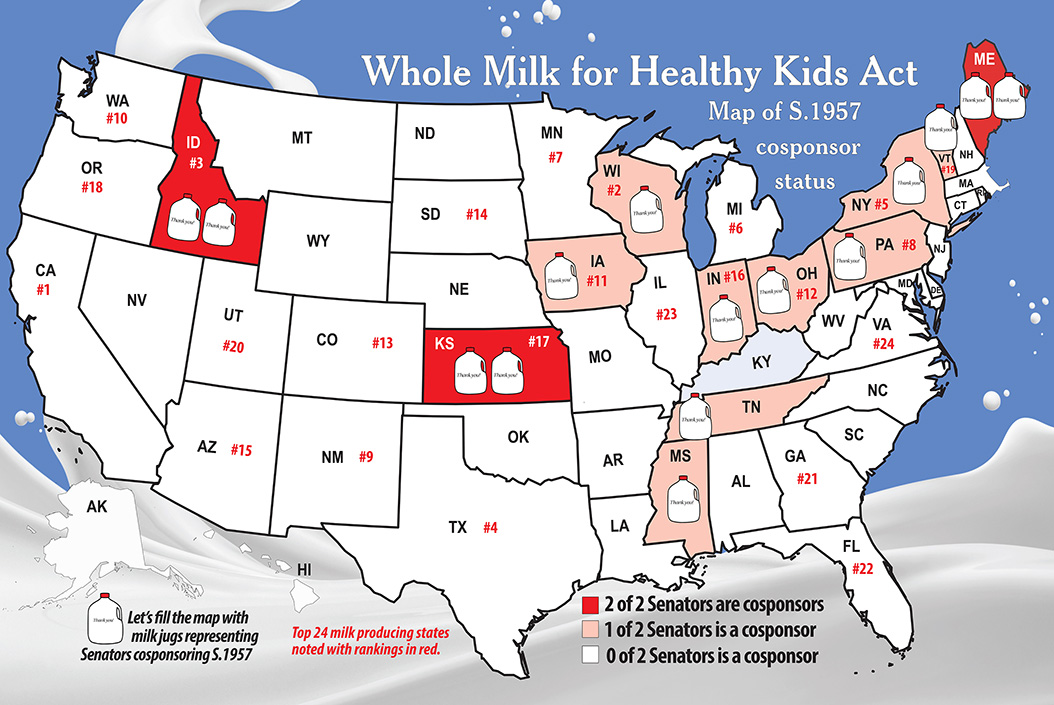
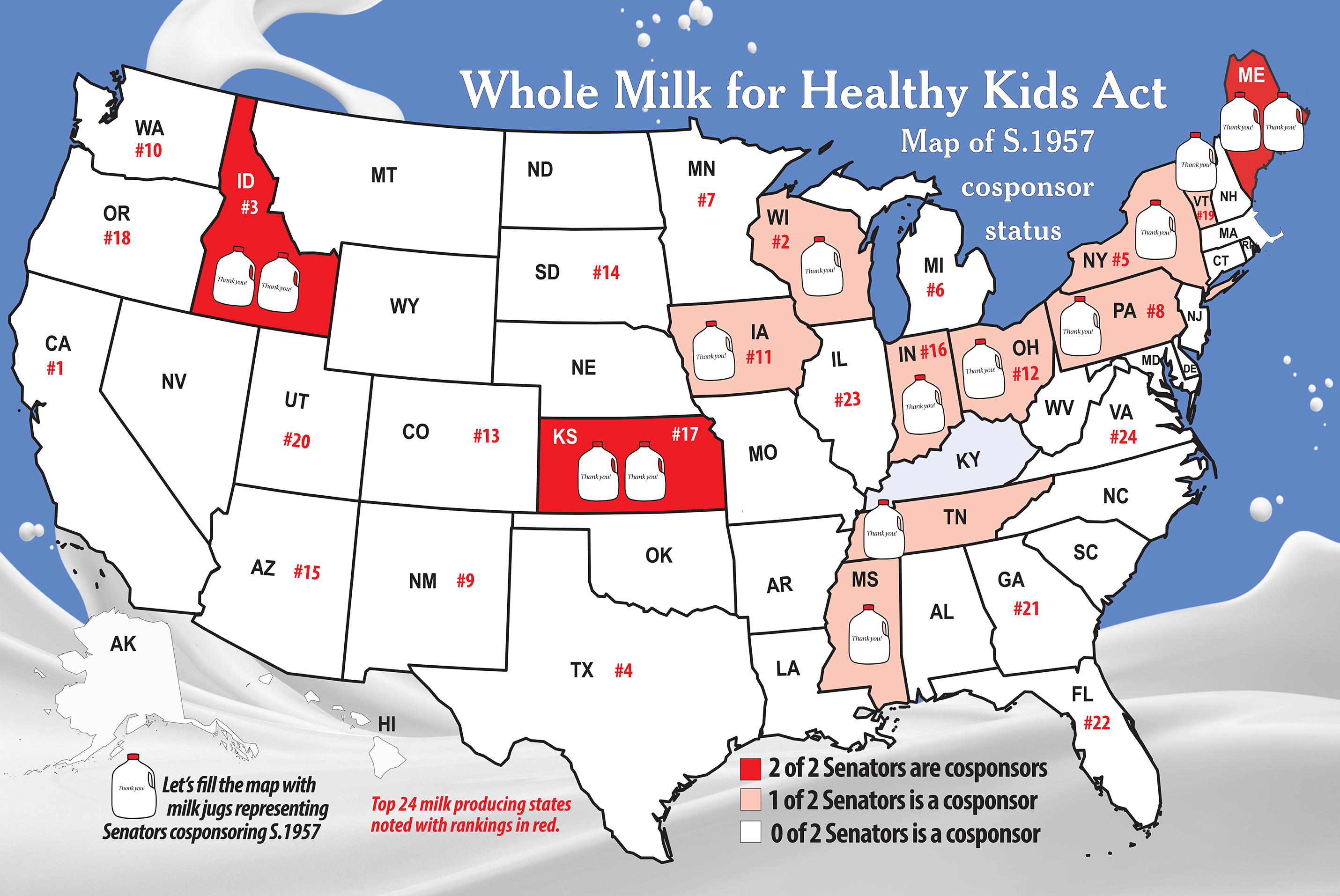
As of Feb. 14, 2024, the Whole Milk for Healthy Kids Act, S. 1957, has 15 sponsors from 12 states as illustrated on this map. Graphic by Sherry Bunting

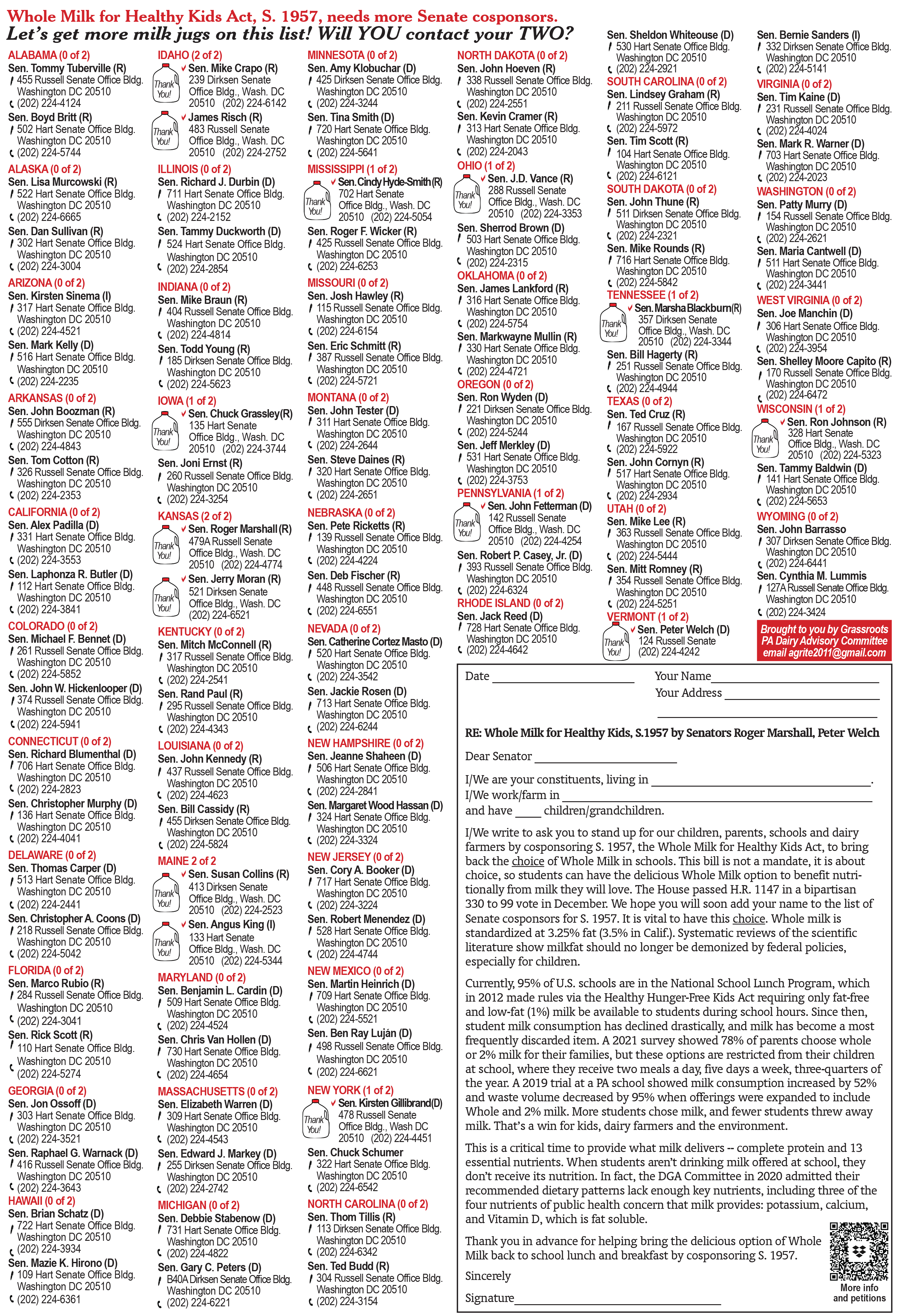
Whole Milk for Healthy Kids Act S. 1957 needs more cosponsors: We need your help! Please contact your state’s two U.S. Senators

The Whole Milk for Healthy Kids Act has moooved to the Senate. S. 1957 is identical to H.R. 1147. As of Feb. 21, 2024, the Senate bill has 15 sponsors from 12 states. This map shows what states have both Senators or one Senator signed on and which states have none. We need more cosponsors to get this bill out of the Ag Committee and onto the Senate floor for a successful vote. Will YOU call or write TWO? Map by Sherry Bunting

By Sherry Bunting, Farmshine, January 26, 2024 (Cosponsor data updated Feb. 21, 2024)

WASHINGTON — The Whole Milk for Healthy Kids Act is now up to the Senate, where more cosponsors are definitely needed to push it past some barriers and get it to the floor for a successful vote.

Senate bill S. 1957 is not a mandate for whole milk. This bill ends a mandate against whole milk, which is federally banned from schools (2% reduced fat milk is also prohibited. Only fat-free and 1% low-fat milk are allowed to be offered with meals or a la carte or in vending machines).  

In December, Senator Debbie Stabenow (D-Mich.) blocked the unanimous consent motion by Senator Roger Marshall (R-Kan.). Marshall was seeking an immediate Senate vote on H.R. 1147 – Congressman G.T. Thompson’s bill – on Dec. 14, 2023, just one day after it was overwhelmingly passed in the House of Representatives by a bipartisan 330-99 vote. It was previously passed in the House Education Committee in a bipartisan 26 to 13 vote.

Marshall chugged a glass of whole milk and gave an inspiring speech about getting the bill to the President’s desk for Christmas. Sen. Marshall is a medical doctor, an obstetrician, and a member of the Senate Ag Committee.

“This is a slam-dunk for American families,” he said.

Sen. Stabenow played the role of the Grinch stealing the opportunity for immediate whole milk passage in the Senate on the heels of the overwhelming House vote as she objected to the unanimous consent request on Dec. 14.

But that’s not the end of this story, just the beginning.

An identical Senate bill, S. 1957, The Whole Milk for Healthy Kids Act was introduced in June 2023. It was read twice on the Senate floor and referred to the Senate Agriculture Committee, chaired by — you guessed it — Sen. Stabenow of Michigan. This means she is in a ‘gate-keeper’ position for this bill. If it doesn’t come before her committee, it will have trouble getting to the floor.

This is where we can help by raising the number of Senate cosponsors! There are 15 sponsors as of Feb. 21 (updated). We need to get to one-third or one-half of the Senate. That’s 35 to 50.

While news reports indicate Sen. Stabenow will retire after this term and is not seeking re-election, her legacy in caring about childhood nutrition and agriculture may be important to her. She stated on the Senate floor that these decisions about milk in school should be made by the scientific committees. She wants to “keep having these conversations.”

Let’s take her up on that by having conversations with our Senators to cosponsor S. 1957. The Dietary Guidelines Advisory Committee has for three cycles and over 15 years refused to consider the preponderance of sound evidence about the benefits of milkfat that the USDA keeps screening out of their deliberations process. 

The DGA Committee is meeting right now for 2025-30 DGAs that seek to refine the current dietary patterns, not re-evaluate them. Even the DGA Committee in 2020 admitted their recommended dietary patterns are deficient in key nutrients that milk delivers.

Here’s the bottom line: S. 1957 was introduced in June 2023 by Sen. Marshall (R-Kan.), along with Senators Peter Welch (D-Vt.), Kirsten Gillibrand (D-N.Y.), Ron Johnson (R-Wis.), John Fetterman (D-Pa.), Chuck Grassley (R-Iowa), Cindy Hyde-Smith (R-Miss.), James Risch and Mike Crapo (both R-Idaho), Susan Collins (R-Maine), and Angus King (I-Maine).

Four more cosponsors have been gained, they are Senators J.D. Vance (R-Ohio), Jerry Moran (R-Kan.), Marsha Blackburn (R-Tenn.), and Mike Braun (R-Ind.)

As of January 24, 2024, S. 1957 has 14 sponsors from 11 states in the U.S. Senate. Of these 15, seven are on the Senate Ag Committee (Marshall, Hyde-Smith, Gillibrand, Fetterman, Welch, Grassley, Braun). 

We need the rest of the Ag Committee, including Ranking Member John Boozman (R-Ark.). If you live in Arkansas, contact him. If you live in Minnesota, contact Ag Committee Senators Amy Klobuchar and Tina Smith; in Illinois, Sen. Richard Durbin; in Ohio, Sen. Sherrod Brown; in Kentucky, Sen. Mitch McConnell; in Iowa, Chuck Grassley has already signed on, but Joni Ernst has not; in North Dakota, talk with Sen. John Hoeven; in South Dakota, Sen. John Thune; in Nebraska, Sen. Deb Fischer; in Georgia, Sen. Raphael Warnack; in New Mexico, Sen. Ben Ray Lujan; in Alabama, Sen. Tommy Tuberville; in Colorado, Sen. Michael Bennet; and in New Jersey, Sen. Cory Booker.

No matter where you live, contact your state’s two U.S. Senators. We need as many Senate cosponsors as possible, and we need Senators motivated to speak with Chairwoman Stabenow, to ask her to please stop putting the ego and agenda of Washington bureaucrats above the health and welfare of America’s children and the economic stability of America’s dairy farmers.

This bill is about choice. It is not a mandate. It simply allows schools to offer whole and 2% flavored and unflavored milk at school lunch and breakfast without financial penalties for exceeding outdated milkfat limits that are unnecessary or even harmful to children.

If we want children to benefit from the nutrition milk delivers, then we need to deliver the permission for our children to be able to choose milk they will love at school where they have two meals a day, five days a week, three-quarters of the year. That’s how they actually benefit from the complete protein and 13 essential nutrients milk delivers.

Let’s stay positive. We can’t afford to lose ANOTHER generation of milk drinkers and think we will still have a dairy industry in many parts of the U.S. The Whole Milk for Healthy Kids Act is an opportunity for dairy farmers to revitalize and renew fluid milk demand, but more importantly, it’s an opportunity for schoolchildren to choose milk they will love for life and health. It’s also an opportunity to drastically cut the amount of wasted milk in school cafeterias, a win for stewardship of resources and the environment.

A 2021 survey by IDFA showed that 78% of American parents who described themselves as voters, choose 2% or Whole Milk for their families as the most delicious and nutritious option, but their children can choose neither 2% nor Whole milk at school where they have two meals a day, five days a week, three-quarters of the year.

This survey is consistent with what a Pennsylvania school trial in 2019 showed. The students preferred Whole Milk 3 to 1 over the 1% low-fat milk. When 2% and Whole Milk were offered in the coolers, students consumed 52% more total milk and the average daily volume of discarded milk was reduced by 95%. This means more students took the offered milk instead of refusing it, and fewer students threw away the milk they took with their meals.

The Grassroots Pennsylvania Dairy Advisory Committee, under chairman Bernie Morrissey’s leadership, has launched a letter-writing and phone-calling campaign seeking cosponsors for S. 1957. They have put together the tools, but grassroots farmers and citizens must be the ones to carry it out and send the letters and make the calls.

We need to help Senate Ag Committee Chairwoman Debbie Stabenow understand this issue is about lifting the federal school lunch and breakfast ban that was placed on delicious nutritious whole milk in 2012 so that school districts, parents and students can make healthy milk choices that are enjoyed and not discarded.

This bill is not a mandate for whole milk. This bill ends a mandate against whole milk.  

This is about options, choice, and a future for kids and dairy farms. Will YOU call or write your TWO?

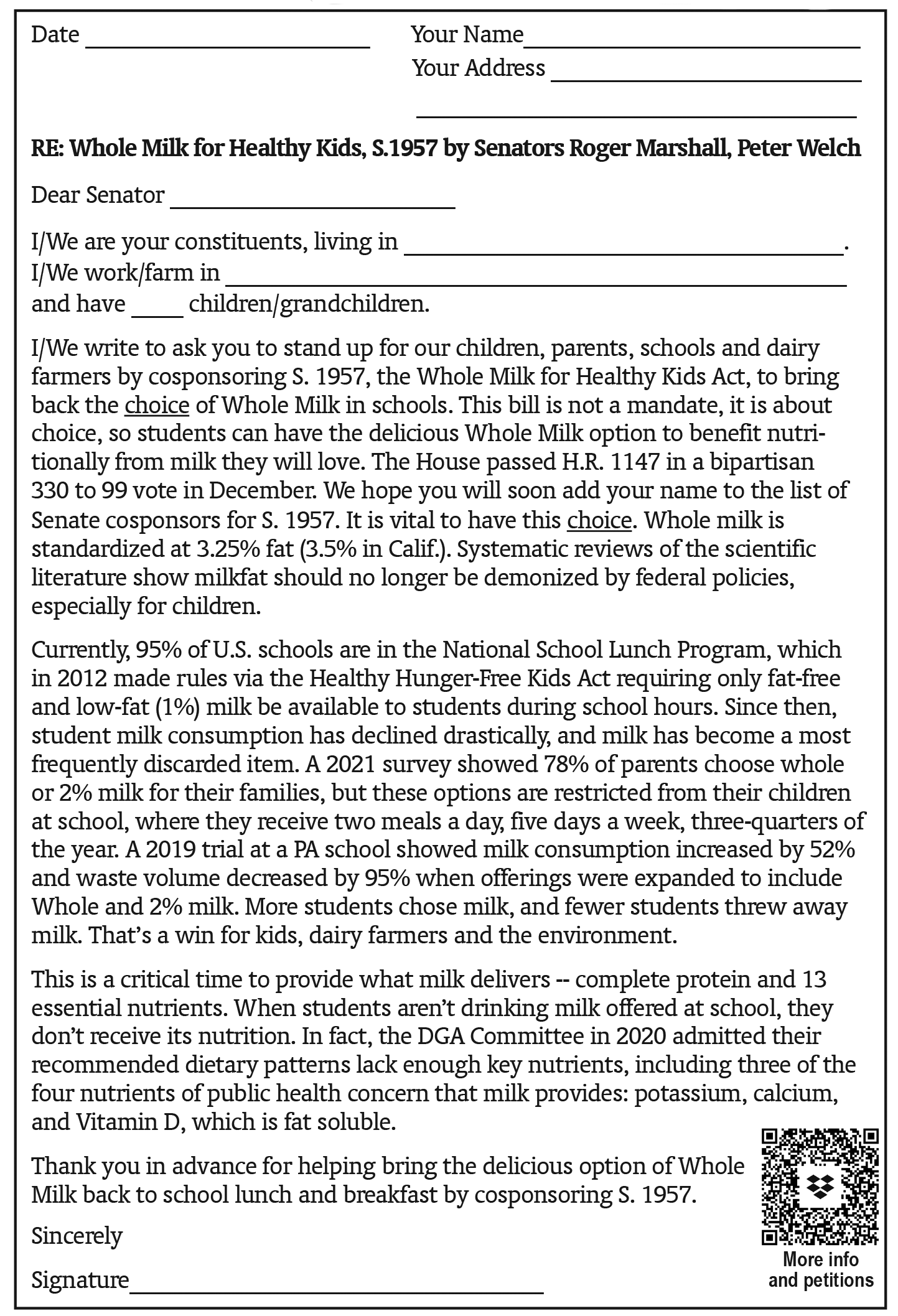
Let’s keep this bill moooving. Every state has two U.S. Senators. Click here for a sample letter.

Find the Washington addresses and phone numbers for your state’s Senators at https://www.senate.gov/ – Click the icon in the top left corner, select your state from drop-down menu to see how to contact them. Or look for your state in this printable directory.

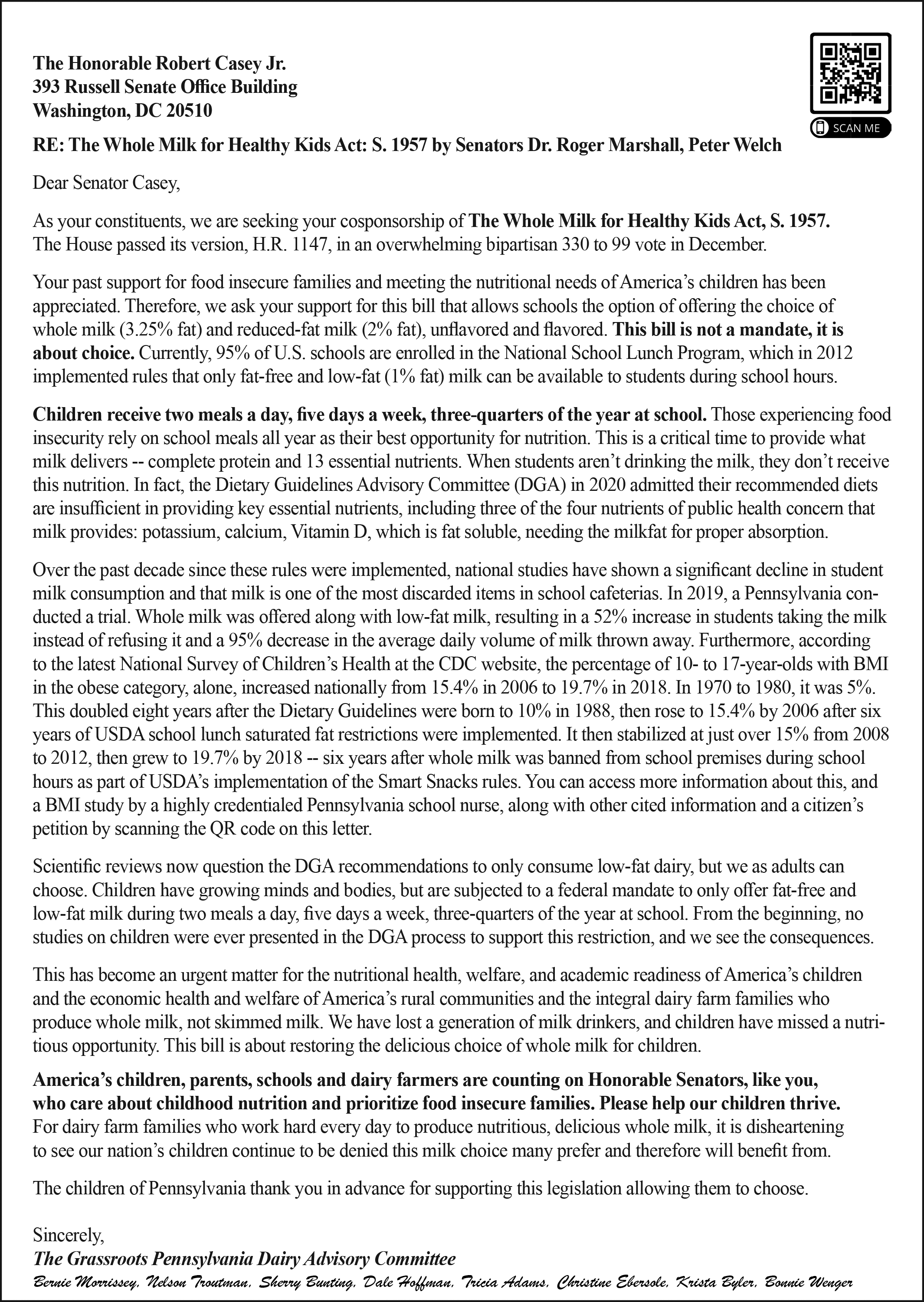
For a more detailed letter, like the one sent by the Grassroots PA Dairy Advisory Committee to Senator Robert Casey, Jr. of Pennsylvania, click here.

For a simple phone message guide for contacting Senate Ag Committee Chairwoman Debbie Stabenow, Majority Leader Chuck Schumer and Minority Leader Mitch McConnell (and if in PA Senator Robert Casey) click here.

See the complete Action Packet and find some additional resources in a folder here

To email your Senators: Go to https://democracy.io/ – type in your address, city and zip code, click submit. Your two Senators and one Rep. will show up with red check marks. Click ‘Write to them.’ Then, on the next screen, write the body of your letter. If you want, you can start with who you are, where you live, what you do. You can also mention if you have school-aged children or grandchildren. Then copy and paste from the text below or write your own message simply asking your Senators to cosponsor S. 1957 The Whole Milk for Healthy Kids Act

**************

RE: Whole Milk for Healthy Kids, S.1957 by Senators Roger Marshall and Peter Welch

I write to ask you to cosponsor S. 1957, the Whole Milk for Healthy Kids Act, to bring back the choice of Whole Milk in schools. This bill is not a mandate, it is about choice, so students can have the delicious Whole Milk option to benefit nutritionally from milk they will love. The House passed this in a 330 to 99 vote in December. We hope you will soon add your name to the list of cosponsors for the Senate. Whole milk is standardized at 3.25% fat (3.5% in Calif.). Systematic reviews of the scientific literature show milkfat should no longer be demonized by federal policies, especially for children.

Currently, 95% of U.S. schools are in the National School Lunch Program, which in 2012 made rules requiring only fat-free and low-fat (1%) milk be available to students during school hours. Since then, student milk consumption has declined drastically, and milk has become a most frequently discarded item. A 2021 survey showed 78% of parents choose whole or 2% milk for their families, but these options are restricted at school, where kids receive two meals a day, five days a week, three-quarters of the year. A 2019 school trial showed milk consumption increased by 52%, and waste volume decreased by 95%, when offerings were expanded to include Whole and 2% milk. More students chose milk, and fewer students threw away milk. That is a win for kids, dairy farmers and the environment.

This is a critical time to provide what milk delivers — complete protein and 13 essential nutrients. When students aren’t drinking the milk offered at school, they don’t receive its nutrition. In fact, the Dietary Guidelines Committee in 2020 admitted their recommended dietary patterns lack enough key nutrients, including three of the four nutrients of public health concern that milk provides: potassium, calcium, and Vitamin D, which is fat soluble.

Thank you in advance for helping bring the nutritious, delicious option of Whole Milk back to school lunch and breakfast by cosponsoring S. 1957.

**************

-30-

Letter-writing campaign launched by grassroots group seeking U.S. Senate cosponsors for Whole Milk for Healthy Kids Act

‘Will you write to your two?

By Sherry Bunting, Farmshine, January 12, 2024

EAST EARL, Pa. – In December, the House passed Congressman G.T. Thompson’s Whole Milk for Healthy Kids Act, H.R. 1147. This is a major milestone for this bill, which passed in the U.S. House of Representatives by an overwhelming bipartisan 330 to 99 vote.

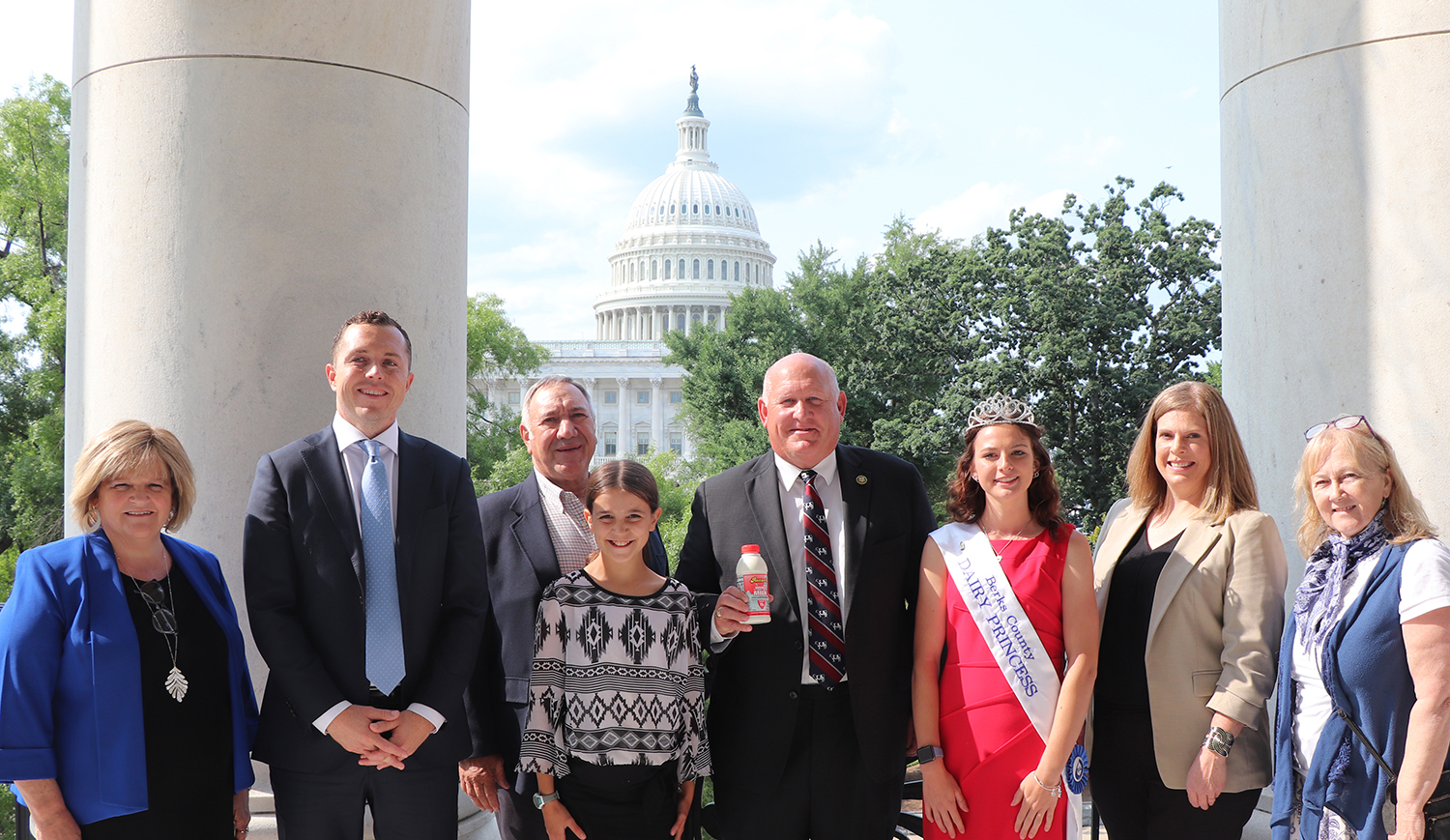
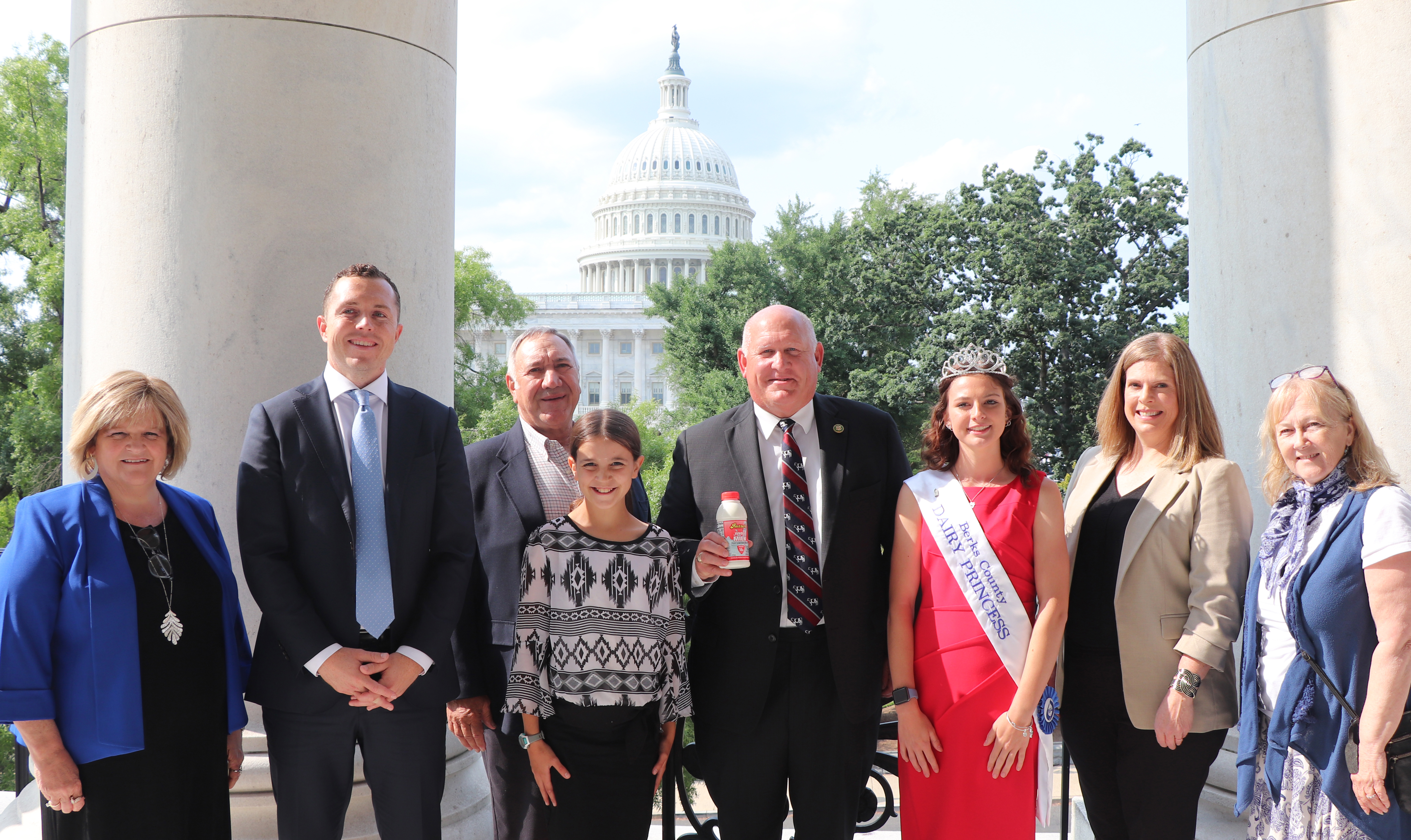
Pictured are a few of the members of the Grassroots Pennsylvania Dairy Advisory Committee and others who joined them for a staff briefing at the Capitol last summer. The focus now is on the U.S. Senate. From left are Christine Ebersole, school nurse in Blair County, Pa.; John Bates, then executive director of The Nutrition Coalition; Nelson Troutman, Berks County dairy farmer and his granddaughter Madelyn, 2022-23 Lebanon County Dairy Maid; Congressman G.T. Thompson (R-PA-15), the champion and prime House sponsor of the Whole Milk for Healthy Kids Act; Sara Haag, 2023-24 Berks County Dairy Princess; Krista Byler, school foodservice director in Crawford County, Pa.; and Sherry Bunting, Farmshine contributor and volunteer advocate for whole milk in schools. Photo courtesy Maddison Stone

“The next stop is the Senate, and we are going to have to work hard to get the Senate bill (S. 1957) to the floor and passed. In Pennsylvania, we need to work on our Senator Bob Casey. We already have Senator John Fetterman as a cosponsor of the bill, but we need Senator Casey also,” says Nelson Troutman, Berks County farmer and originator of the Drink Whole Milk 97% Fat Free baleboards that led to the 97 Milk effort and 97milk.com

“We also need more Senators to cosponsor S. 1957 from across the country,” adds Bernie Morrissey, retired agriculture advocate from Robesonia, Pa. “We need dairy farmers, agribusinesses, organizations and citizens all across the country to reach out to their Senators to cosponsor this bill.”

The Senate bill has 14 cosponsors from 11 states as of January 20th. They include Republicans, Democrats and an Independent as follows: both Dr. Roger Marshall (prime sponsor) and Jerry Moran of Kansas, Peter Welch (prime cosponsor) of Vermont, Ron Johnson of Wisconsin, John Fetterman of Pennsylvania, both James Risch and Mike Crapo of Idaho, both Susan Collins and Angus King of Maine, Kirsten Gillibrand of New York, Cindy Hyde-Smith of Mississippi, Chuck Grassley of Iowa, J.D. Vance of Ohio, and Marsha Blackburn of Tennessee.

“Every state has two United States Senators. We want every dairy farmer, every organization and business calling their two Senators. If they are already a cosponsor, thank them. If they are not a cosponsor, please write to them, and use our sample letter (or the template at the end of this article),” Bernie explains.

(Find the Washington addresses and phone numbers for your state’s Senators at https://www.senate.gov/ – Click the icon in the top left corner, select your state from drop-down menu to see how to contact them. Go to the end of this article to learn about email options. Some additional resources can be found in a folder at https://qrco.de/WholeMilk-Info )

“We have written to Senator Casey (see letter at top) to let him know how important this is to us, to the children of Pennsylvania, and to the dairy farmers. We need more people, organizations, and businesses to write to him also. If this doesn’t work, it will be our own fault for not getting involved,” he stresses, adding that constituent phone calls and visits are also welcome.

“We must also contact Senate Ag Committee Chairwoman Debbie Stabenow of Michigan. It is important that she knows how vital this bill is to come through her committee to the Senate floor,” Bernie notes. (The call-in notice below was published in the Jan. 5 Farmshine).

The Grassroots Pennsylvania Dairy Advisory Committee asks organizations and agribusinesses to use the sample letter on this page as-is or tailor it to their state’s Senators and also send it out to all their members or customers asking them to each sign it and send it to their two Senators as well.

“Let us know if you did this,” Bernie continues. “We want to know: Did YOU contact your TWO?” (Email Sherry Bunting at agrite2011@gmail.com or text or call 717.587.3706 to confirm you contacted your two.)

“After all,” Bernie observes: “If the dairy farmer’s next generation of consumers – the children — cannot choose milk they will love, what is your future as a dairy farmer? And what is their future as tomorrow’s leaders?”

“Whole milk is nutritious and delicious. Science supports this choice. It’s up to each one of us to get it done.”

-30-

To email your Senators directly, go to https://democracy.io/  – type in your own address, city and zip code, click submit. Your two Senators and one Representative will show up with red checkmarks. Click ‘Write to them,’ and on the next screen compose the body of your letter. First, say who you are and where you live/work/farm and mention if you have children or grandchildren in school, if you wish. Sample text about cosponsoring S. 1957 can then be copied and pasted from the template below:

———————————————————————————————————————-

Dear Senator,

I write to ask you to stand up for our children, parents, schools and dairy farmers by cosponsoring S. 1957, the Whole Milk for Healthy Kids Act, to bring back the choice of Whole Milk in schools. This bill is not a mandate, it is about choice, so students can have the delicious Whole Milk option to benefit nutritionally from milk they will love. The House passed H.R. 1147 in a bipartisan 330 to 99 vote in December. We hope you will soon add your name to the list of Senate cosponsors for S. 1957.

It is vital to have this choice. Whole milk is standardized at 3.25% fat (3.5% in Calif.). Systematic reviews of the scientific literature show milkfat should no longer be demonized by federal policies,
especially for children.

Currently, 95% of U.S. schools are in the National School Lunch Program, which in 2012 made rules via the Healthy Hunger-Free Kids Act requiring only fat-free and low-fat (1%) milk be available to students during school hours. Since then, student milk consumption has declined drastically, and milk has become a most frequently discarded item. A 2021 survey showed 78% of parents choose whole or 2% milk for their families, but these options are restricted from their children at school, where they receive two meals a day, five days a week, three-quarters of the year. A 2019 trial at a PA school showed milk consumption increased by 52% and waste volume decreased by 95% when offerings were expanded to include Whole and 2% milk. More students chose milk, and fewer students threw away milk. That’s a win for kids, dairy farmers and the environment.

This is a critical time to provide what milk delivers — complete protein and 13
essential nutrients. When students aren’t drinking milk offered at school, they don’t receive its nutrition. In fact, the DGA Committee in 2020 admitted their
recommended dietary patterns lack enough key nutrients, including three of the four nutrients of public health concern that milk provides: potassium, calcium, and Vitamin D, which is fat soluble.

Thank you in advance for helping bring the delicious option of Whole Milk back to school lunch and breakfast by cosponsoring S. 1957.

Sincerely

————————————————————————————————————————–

Danone’s sale of Horizon Organic fulfills transition to fake-milk brands

New owner is global giant with $47 billion portfolio

By Sherry Bunting, Farmshine, Jan. 5, 2024

PARIS — On the first day of 2024, another brand of fluid milk was sold to a private equity firm. 

This time was no surprise: Paris, France-based Danone announced on Jan.1st its agreement to sell organic dairy businesses, including flagship Horizon Organic, to Platinum Equity, based in Los Angeles, California.

The sale is said to be part of the Renew Danone Strategy announced in March 2022 and is mentioned in Danone’s 2023 Climate Transition Plan. 

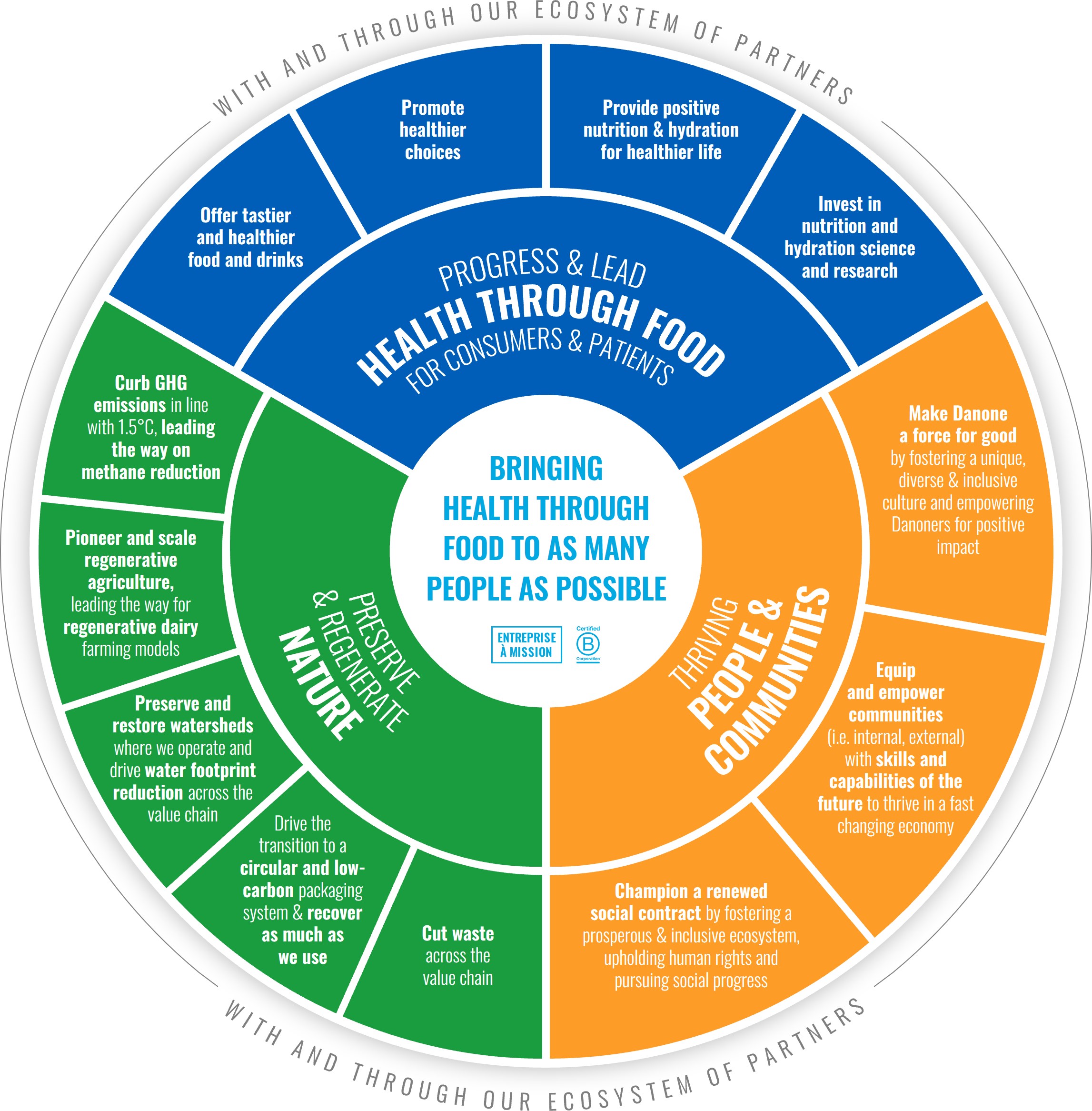
Danone graphs its “Impact Journey” this way in its 2023 “Climate Transition Plan,” which includes reducing methane emissions by 30% by 2030, aligning with the Global Methane Pledge, and achieving Net-Zero emissions by 2050 as the global giant says it will “continue to transform the food system.”  (Web image from Danone Climate Transition Plan)

The company reported its organic dairy sector represented approximately 3% of its global revenues in 2022 and had a “dilutive impact” on sales growth and operating margin.

But mainly, said CEO Antoine de Saint-Affrique, the organic dairy business “fell outside our priority growth areas of focus,” he said, reiterating his very words to investors a year ago when he first announced “eyeing sale” of Horizon Organic and Wallaby.

Terms of sale were not disclosed, but Danone will retain a non-consolidated minority stake in the business, executives said. The closing of the transaction is subject to customary conditions and regulatory approvals.

“Today marks an important milestone in delivering this (Renew Danone) commitment while giving the Horizon Organic and Wallaby businesses the opportunity to thrive under new leadership. This sale, once completed, will allow us to concentrate further on our current portfolio of strong, health-focused brands and reinvest in our growth priorities,” said de Saint-Affrique.

According to Platinum Equity’s New Year’s Day announcement of the acquisition, Horizon Organic is deemed the largest organic fluid milk company in the world and the first brand of organic milk available coast to coast in the United States. It has since grown to include organic creamers, yogurt, cheese and butter.

Platinum Equity Co-President Louis Samson said the acquisition will “build on that legacy and support Horizon Organic’s growth as a standalone company.”

Horizon Organic became the first public organic food company in 1994 and was purchased by Dean Foods in 2004, where it became part of WhiteWave holdings alongside International Delight, Silk and other fake-milk brands. A 2012 spin-off separated WhiteWave from Dean, taking former Dean CEO Gregg Engles with it as the WhiteWave CEO. In April of 2017, Danone purchased WhiteWave, and Engles continued as a current Danone S.A. board member.

Wallaby is an Australian-style organic yogurt found mostly in natural food stores as well as the Whole Foods chain throughout the U.S.

Platinum Equity estimates that the total U.S. dairy category is valued at $68 billion in sales with fluid milk comprising approximately $17 billion of that total. Of that $17 billion in packaged fluid milk sales, organic milk sales comprised 6.7% of the  volume for the first 10 months of 2023, according to the most recent USDA Monthly Packaged Fluid Milk Sales Report.

Meanwhile, Danone has launched full-force into expanding the fake side of its 2017 WhiteWave purchase, adding products and launching new brands of plant-based and AI-engineered biological concoctions of fake-milk, fake-yogurt, fake-cheese, and other fake-dairy products in its quest for so-called “Climate Transition” and “Food Transformation.”

The sale of Horizon to a global private equity firm that specializes in mergers and acquisitions also comes on the heels of Danone’s December 2021 decision to end contracts with all of its New England and eastern New York dairy farms after sourcing milk from larger organic farms to the west and south.

After the sale of Horizon Organic is completed, Danone will be able to completely withdraw from Federal Milk Marketing Orders (FMMO) to do Cost Performance Model (CPM) pricing with a much smaller number of dairy farms, just like with other ingredient sources. Only Class I fluid milk sales are required to participate in FMMOs, and the sale of Horizon Organic to Platinum Equity ends Class I milk sales for Danone because the rest of their former WhiteWave beverage holdings are plant-based.

While Danone moves on to grow its fake-dairy business, owning the largest plant-based manufacturing facility in the world located in northern Pennsylvania and launching new plant-based alternatives to disrupt the dairy case, the Managing Director of Horizon Organic’s new owner, Adam Cooper, sees organic and value-added products as the “premium offerings” that are “driving growth in the dairy milk category.

“Horizon Organic is a pioneer of that segment and is in position to continue capitalizing on and accelerating the trend,” said Cooper.

Platinum Equity has completed more than 450 acquisitions over the past 28 years, and today operates about 50 global businesses that have been shaken loose from larger corporate entities. The global firm’s current $47 billion portfolio includes a few other companies in the food and beverage sector, such as biscuits, wine, seafood, packaged meat and bakery products, and food ingredients distribution.

“We are excited about Horizon Organic’s potential as an independent business with a renewed sense of focus and a commitment to investing in its success,” said Cooper. “We look forward to partnering with Horizon Organic’s management team to ensure a seamless transition and chart a path for continued growth and expansion.”

Already deemed a “component stock of leading sustainability indexes,” Danone’s ambitions are entrenched with ESG investors, the Global Methane Pledge, Climate Transition, Food Transformation and aspirations to be the publicly-traded global company that is B-Corp certified at the global level in 2025. (Danone is already B-Corp certified in the U.S.)

Over the past seven years, Danone North America has moved toward branding its ‘sustainability’ as increasingly plant-based.

In 2022, Danone North America received a $70 million USDA Climate-Smart grant, which the company says will be used to: 1) reduce methane emissions for dairy through innovative manure management, 2) create infrastructure to sustainably grow and trace U.S. food-grade oats and soybeans, and 3) build processing for traceable organic soy.

During the White House Conference on Hunger, Nutrition and Health in September 2022, Danone announced a $22 million investment by 2030 to improve access to, and availability of, “nutritious and health-promoting foods,” the bulk of these funds will be used to “educate consumers and healthcare providers” (aka, marketing).

Shortly thereafter, the FDA Milk Labeling Proposed Rule hit the Federal Register for comment requiring only voluntary compliance for nutrition comparisons on labels of fake-milk using the term ‘milk.’ This rule has not been finalized as FDA continues to look the other way when it comes to milk and dairy label standards of identity abuses.

(Rest assured, Danone’s big goal is to become ‘net zero’ by 2050 by transforming food. Sound familiar?)

DANONE FOOD TRANSFORMATION TIMELINE

July 2016, Danone launched the Dannon Pledge for non-GMO verified, positioning its conventional milk supply around a concept of ‘almost-organic.’

Apr. 2017, Danone purchased the Dean WhiteWave spinoff, which included Horizon Organic and Silk, So Delicious, and Alpro plant-based brands. The DOJ Antitrust Division required Danone to simultaneously divest its Stonyfield Farms subsidiary.

Apr. 2018, Danone quietly notified smaller Horizon Organic dairy farms in the western states that their future contracts would not be renewed amid a glut of organic milk and differences in how USDA’s organic livestock origin rules were being applied. Some of these producers were offered conventional non-GMO milk contracts using Danone’s proprietary Cost Performance Model (CPM). Some found other markets, and many exited the business. According to Danone’s 2021 Regenerative Agriculture Report, more than half of all U.S. milk collected by Danone now comes from farms with CPM contracts. 

Feb. 2019Danone completed construction of the world’s largest plant-based yogurt factory in Dubois, Pennsylvania, where other non-dairy lookalike products are also made.

Feb. 2020, Danone told investors the rising global temperature is a business opportunity, and the company would accelerate food transformation with climate at the core of its growth strategy.

Oct. 2020, Danone announced its partnership with a bioscience startup to use artificial intelligence to explore new formulations to improve taste and texture of plant-based dairy alternatives.

Jan. 2021, Danone’s So Delicious launched its first plant-based cheese and Danone S.A. was acknowledged as the largest plant-based company in the world with 10% of total sales coming from plant-based dairy alternatives. The company told investors it would grow this with further acquisitions and a “plant-based acceleration unit.”

Apr. 2021, Danone and the EAT Lancet Commission announced a strategic partnership to promote a so-called “healthier and more sustainable food system by driving a change to planetary diets.” Danone pledged to use its ‘One Planet. One Health’ framework to “accelerate this food revolution.”

July 2021, Danone announced three new plant-based fake-milk launches for 2022, along with a list of other lookalikes. During the July 2021 earnings call, Danone executives identified the U.S. as a “key plant-based market,” but noted 60% of U.S. consumers are not in the category because of product taste and texture. They announced a plan to win them over “with new dairy-like technology under Silk NextMilk, under So Delicious Wondermilk and under Alpro Not Milk.”

Aug. 2021, Danone sent letters notifying all 89 of its organic dairy farms in New England and eastern New York that their milk contracts would be terminated in 12 months’ time. Later, under pressure from organic groups, officials and consumers, Danone agreed to a Feb. 2023 extension.

Jan. 2022, Danone launched the three new fake-milks: NextMilk, Wondermilk, and Not Milk. 

(Interestingly, the Silk NextMilk Whole Fat has 6 grams of saturated fat from processed coconut and seed oils. That’s more saturated fat per serving than Real Whole Dairy Milk naturally from cows. Danone’s Silk NextMilk is packaged in red and white cartons with the words ‘Whole Fat’ appearing directly under the brand name to mimic the Whole Milk appearance. Interestingly, the FDA’s proposed healthy labeling rule sets a tougher threshold for saturated fat in dairy products compared to saturated fats from plant-sources.)

Mar. 2022, Danone described its Horizon Organic and “traditional dairy” holdings as “troubled offerings,” telling investors: “There are no sacred cows,” as they “keep pruning” the portfolio to “boost growth” and “distance” the company from “underperformance”… by investing more in “winning products” and selling existing brands or buying new ones.

May 2022, Danone launched its “Dairy & Plants Blend” baby formula (60% plant-based, 40% dairy) “to expose children to food tastes early in life that can help shape their future food preferences… while shifting toward plant-rich diets and embracing alternative sources of protein to help reduce carbon emissions.”

Sept. 2022, Danone joined the White House Conference on Hunger, Nutrition, and Health to announce a $22 million ‘nutrition and health’ investment by 2030 with $15 of the $22 mil. Earmarked “to further nutrition education for consumers and healthcare providers.” (Sounds like marketing). This includes Danone’s new pledge to increase the nutrient density of its plant-based beverages.

Sept. 2022 — Danone was part of a team that was awarded a $70 million USDA Climate Smart grant for projects that include: 1) Reducing methane emissions for dairy through innovative manure management, 2) Creating the infrastructure to sustainably grow and trace U.S. food-grade oats and soybeans, 3) Building processing for traceable organic soy.

Oct. 2022, Danone announced it would use artificial intelligence through its bioscience partner BrightSeed, to reformulate over 70% of its plant-based fake-milk alternatives to reduce added sugars and increase nutrient density. At the same time, it allocated $15 million to “partner with retailers on healthy eating education” and $7 million to partner with community-based programs that provide nutritious foods.

(Timing is everything: Danone is among the financial supporters of the infamous Tufts University Food Compass, launched recently into the federal nutrition policy arena through the Biden-Harris Hunger, Health and Nutrition Strategy and the FDA proposed rule on  “healthy labeling.” The Food Compass nutrition profiling algorithm rates nonfat dairy yogurt high as an encouraged food, along with plant-based fake-milks; but real milk and cheese are rated lower as foods to moderate or discourage. More artificial intelligence, to be sure.)

Jan. 2023, Danone announced it was looking for a buyer for Horizon Organic, saying it fell outside of their growth areas of focus.

Feb. 2023, Contract extensions ended for terminated Horizon Organic dairy farms in the Northeast. Some have gone out of business. Others have gone to Stonyfield or Organic Valley, which eventually agreed to take on the remaining Northeast farms facing Horizon termination, along with 40 organic dairies cut last year by Maple Hill in New York.

Mar. 2023, Danone launched a fake-milk-mustache campaign for its Silk NextMilk brand using children, nieces, and nephews of three original real-milk-mustache celebrities to twist the knife.

Apr. 2023, Danone launched an organic alternative beverage: ‘So Delicious Organic Oatmilk’ in ‘original’ and ‘extra creamy.’

May 2023, Danone launched So Delicious Dairy-Free Yogurt

Jan. 2024, Danone announced its agreement to sell organic dairy businesses — Horizon Organic fluid milk and Wallaby yogurt to Platinum Equity.

-30-

Editorial: Momentum builds for whole milk in schools

Standing with U.S. House Ag Committee Chairman, Glenn ‘G.T.’ Thompson are some of the volunteers who participated in the legislative staff briefing on G.T’s Whole Milk for Healthy Kids Act, including a June Dairy Month celebratory Whole Milk Bar at the Capitol in Washington on Tuesday, June 13. Congressman G.T. says he wants to reach 150 to 200 cosponsors before it comes to the House floor for a vote. Currently, there are 128 cosponsors representing 43 states (103 R’s and 25 D’s), and the Education and Workforce Committee recently passed H.R. 1147 in a bipartisan 26-13 vote. From left are Christine Ebersole, a school nurse in Blair County, Pa.; John Bates, executive director of The Nutrition Coalition; Nelson Troutman, a Berks County dairy farmer and 97 Milk Baleboard originator and his granddaughter Madalyn, the 2022-23 Lebanon County, Pa. Dairy Maid; Congressman G.T. Thompson (R-PA-15), the champion and prime sponsor of the Whole Milk for Healthy Kids Act; Sara Haag, the 2023-24 Berks County Dairy Princess; Krista Byler, a school foodservice director in Crawford County, Pa.; Sherry Bunting, Farmshine contributor and volunteer advocate for whole milk in schools. Photo credit: Maddison Stone

By Sherry Bunting, Farmshine, June 16, 2023 with June 23 update

WASHINGTON – “Wouldn’t it be great if we could unite the country with whole milk?” That question was posed by a fellow journalist in the Southeast, Julie Walker of Agrivoice, as I was updating her about the grassroots effort to bring milk education and the choice of whole milk to schools.

After the events of the past two weeks, my answer to that question is: Yes, I believe we can and we are… seeing the fruits of the labor of grassroots volunteers.

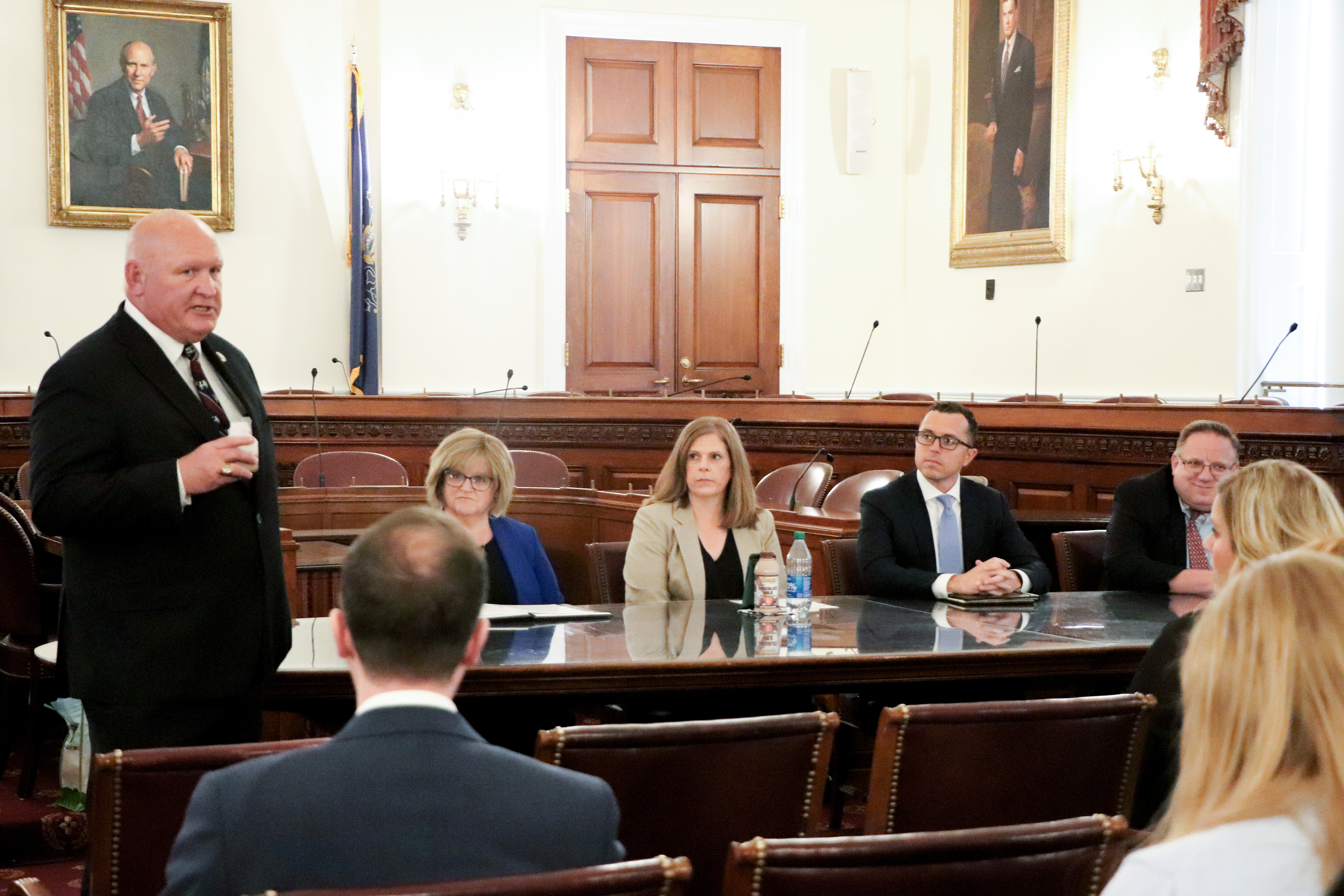
On Tuesday, June 13, the Grassroots Pennsylvania Dairy Advisory Committee and 97 Milk were part of a legislative staff briefing hosted by Congressman G.T. Thompson and his staff at the Longworth House office building on Capitol Hill in Washington. This had been planned weeks earlier, before Thompson’s bill – the Whole Milk for Healthy Kids Act, H.R. 1147 – passed the Education and Workforce Committee on June 6 in a bipartisan 26-13 vote.

This week, the identical bipartisan Senate companion bill was introduced on June 13 by prime sponsor Senator Roger Marshall, a Republican and medical doctor from Kansas and prime cosponsor Peter Welch, a Democrat from Vermont along with other bipartisan cosponsors.

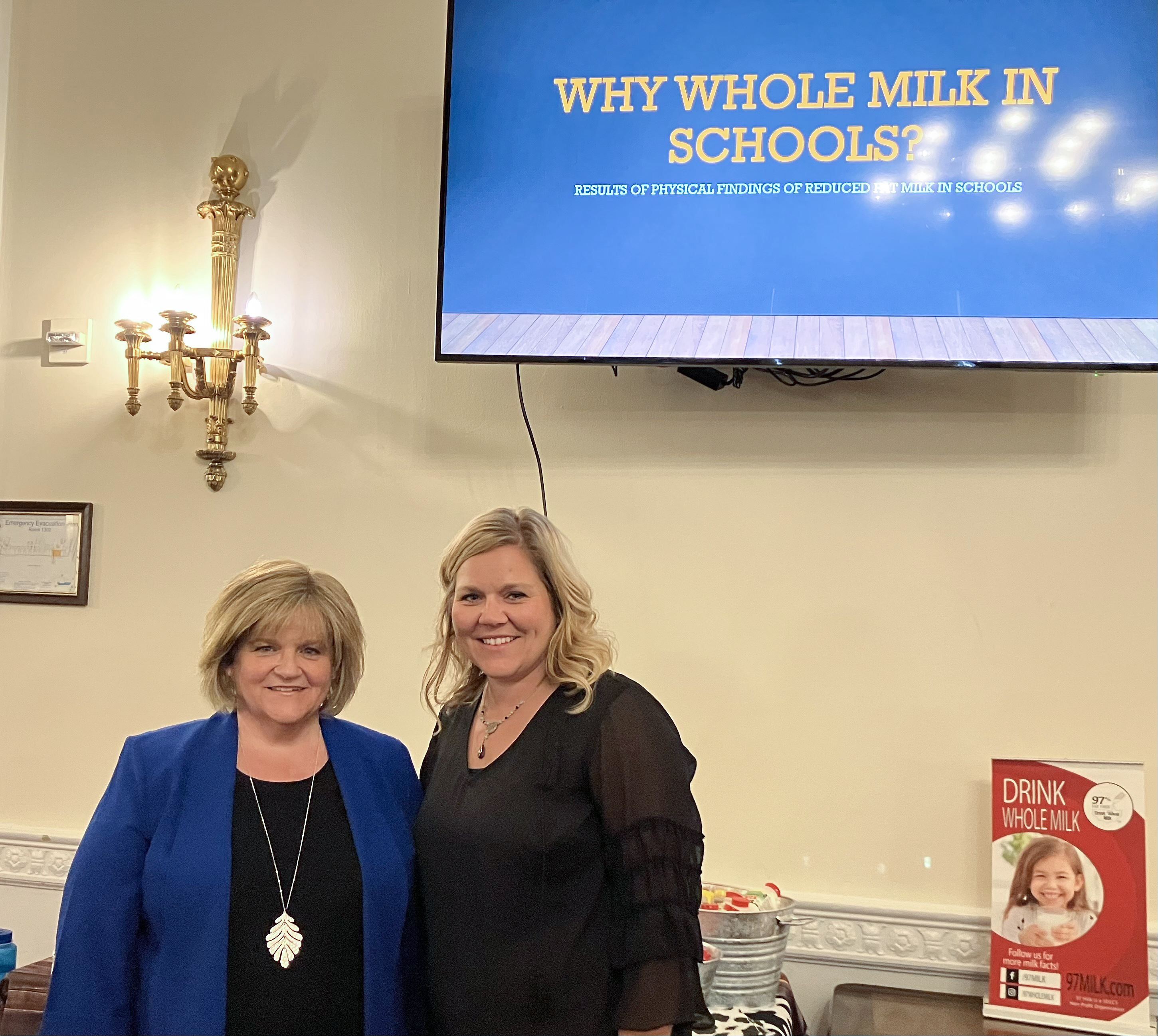
Allow me to take you behind the scenes of the June 13 legislative staff briefing on Congressman Thompson’s House bill and why it gives me hope to see people rediscovering and uniting behind the effort to legalize whole milk in schools so children have true access to the most wholesome nutritional beverage, milk.

What becomes apparent is that children are not benefiting from milk’s nutrition when their choices at school are restricted to fat free and low fat. They should be able to choose whole milk and 2% milk that are currently banned by federal nutrition standards, and they should be able to continue to choose flavored milk, which USDA is considering restricting to only high school students.

“Milkfat was demonized as a part of the child nutrition standards, especially since 2010… and we’ve seen a lot of waste and unopened milk cartons at school cafeterias because (fat-free/low-fat milk) is not a great milk experience for kids. Meanwhile, we’ve seen a significant increase in childhood obesity. If they don’t have access to milk they like, they will drink something, and the alternatives won’t give them milk’s essential nutrients or be as satisfying,” said Rep. Thompson. “Everything has its own time, and I’m pleased that we’ve gotten to this point with the bill and appreciate the panel here today to share and answer the question: ‘Why whole milk in schools?’”

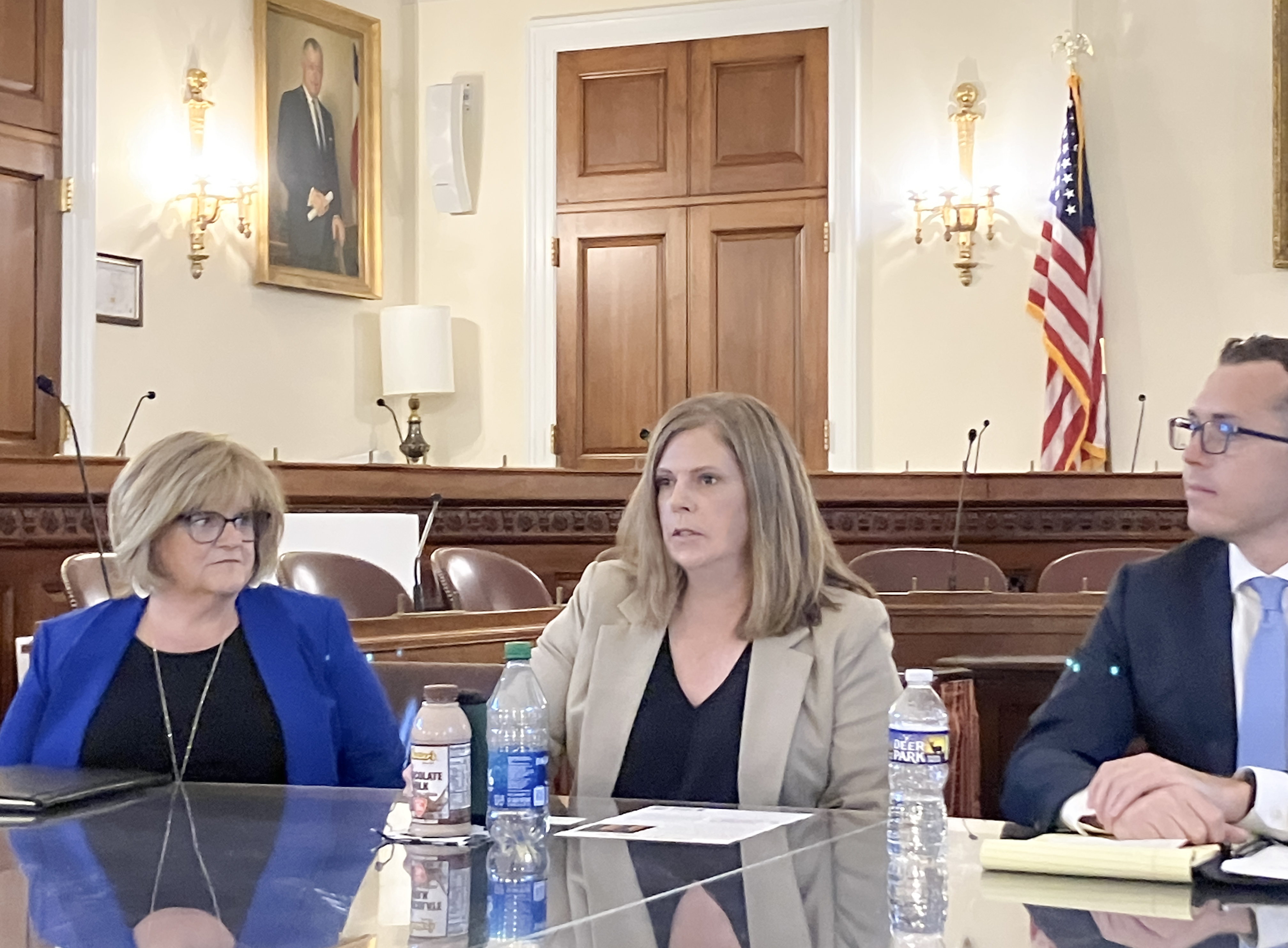
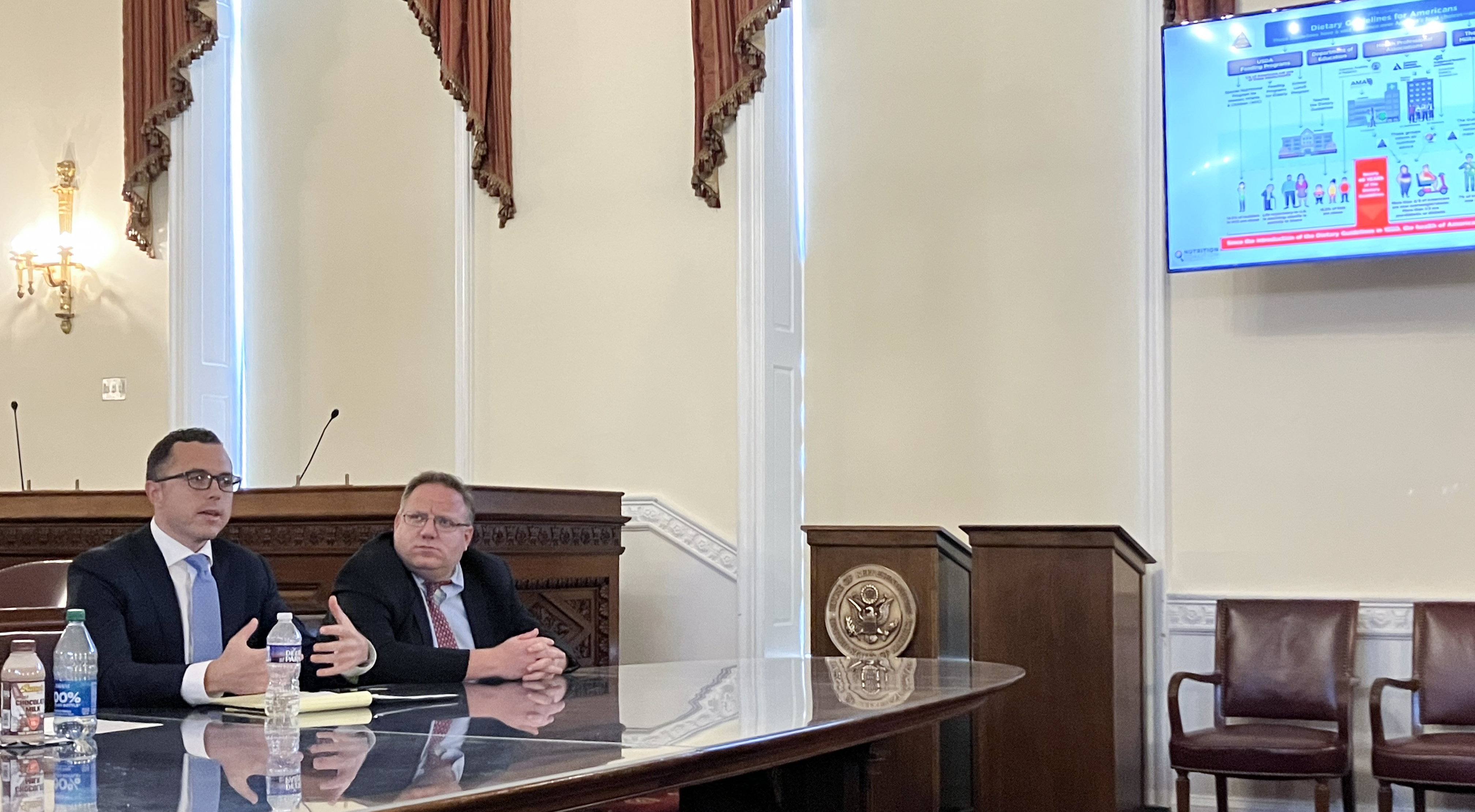
Two school professionals from the grassroots advisory group were on the panel: Krista Byler (second from left) of Spartanburg, foodservice director for Union City Area Schools and Christine Ebersole RN, BSN, CSN (left) of Martinsburg, school nurse at Williamsburg Community School District. They were joined by John Bates (second from right), executive director of the Nutrition Coalition, a nonprofit founded by Nina Teicholz, author of The Big Fat Surprise; as well as Paul Bleiberg (right) of National Milk Producers Federation.

Around 25 to 30 staff members working for Representatives and Senators from both parties attended for the entire briefing. That may not sound like a lot, but for this setting, and the constantly changing schedules during floor votes, hearings and meetings, it’s a big deal. The event was by invitation and targeted key legislative offices for an educational briefing on the bill.

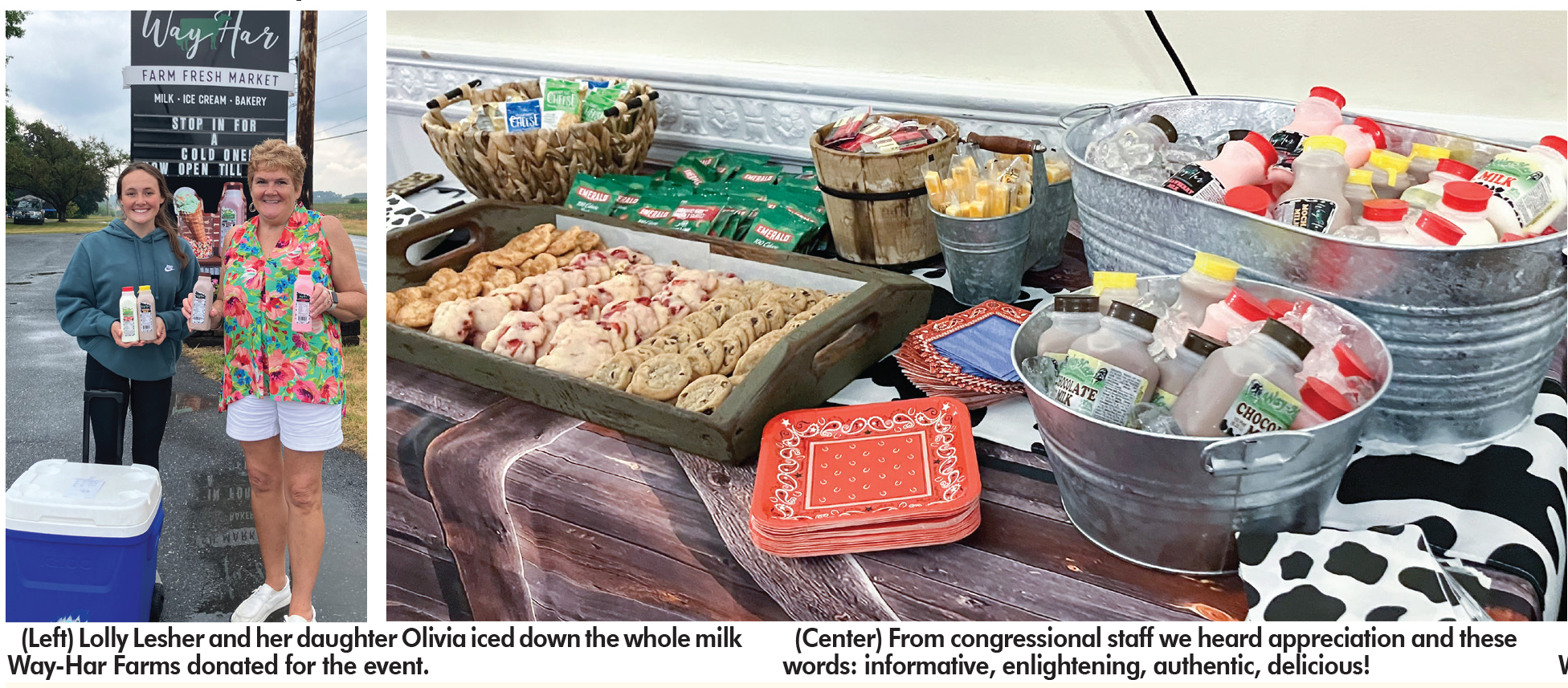
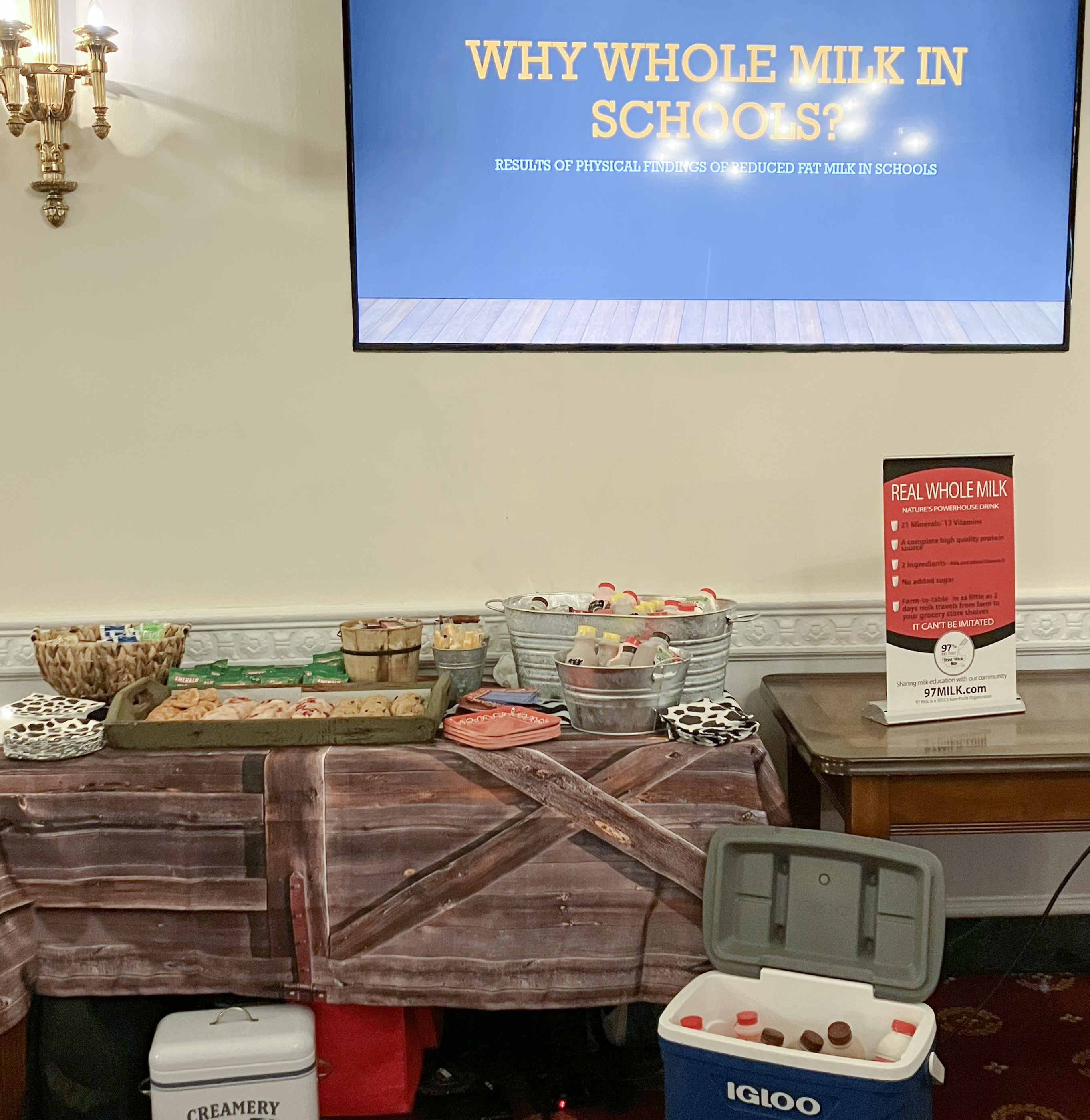
It was Congressman Thompson’s idea to have a “whole milk bar,” so our crew brought 100 half pints of whole milk — unflavored, chocolate, strawberry and mocha — donated by the Lesher family of Way-Har Farms, Bernville, Pennsylvania. We added some full pints of flavored and unflavored milk picked up at two convenience stores on the way (Rutter’s and Clover) to be sure we had enough as we heard interest in the briefing was growing.

We baked fresh strawberry cheesecake cookies with butter and cream cheese, and brought a few other types of cookies, as well as cheese snacks and nuts, arranged a nice table, kept the milk iced cold (that was a fun challenge through security scanners).

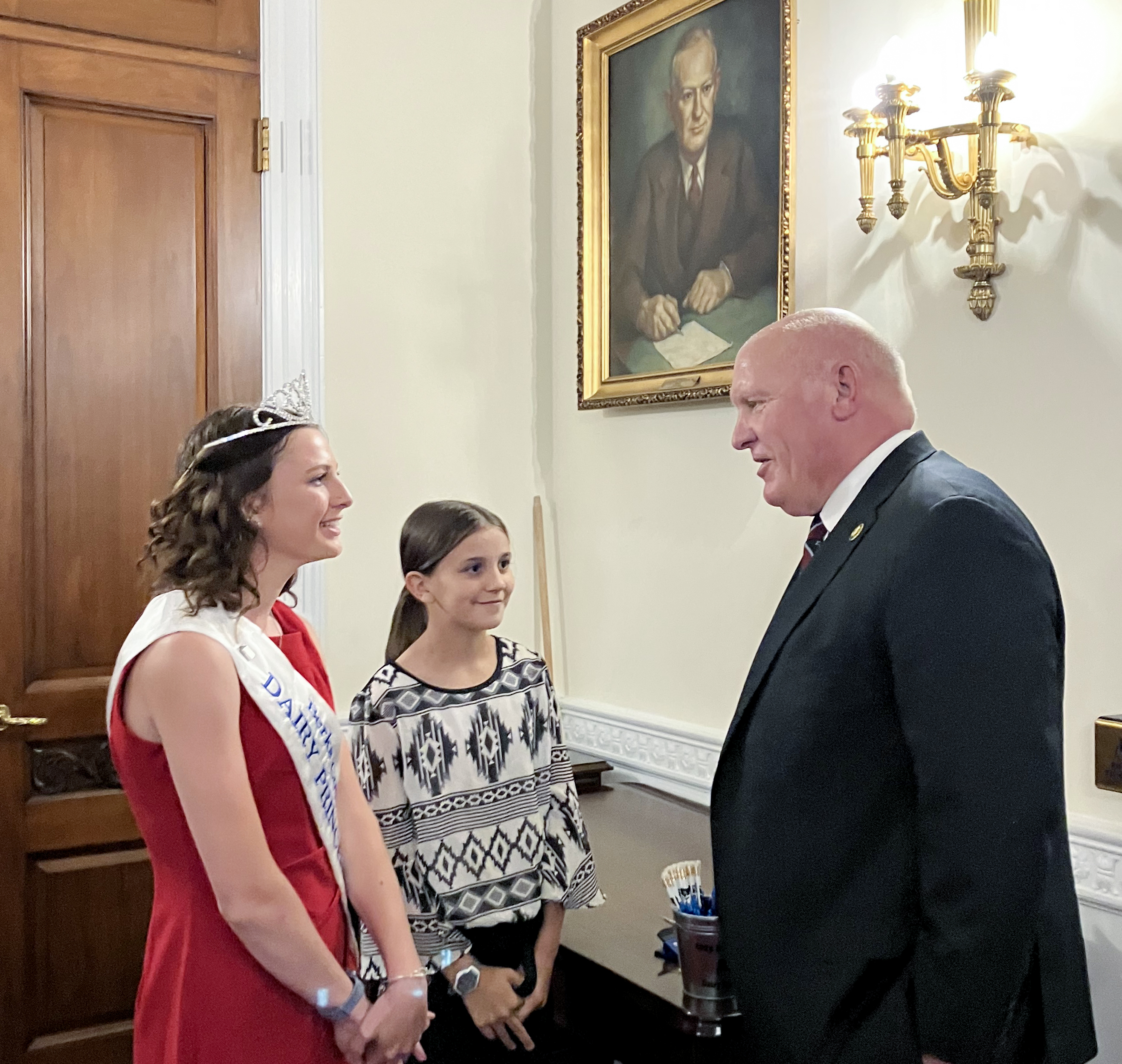
We brought with us Berks County Dairy Princess Sara Haag and former Lebanon County Dairy Maid Madalyn Troutman. Ebersole brought her daughter Vanessa Wiand, an elementary school teacher.

Nelson Troutman (right) with our driver Frank Tomko

Berks County farmer and Drink Whole Milk 97% fat free Baleboard originator Nelson Troutman was part of our crew, and he made sure the van we rented for travel had several 97 Milk magnets for the ride.

I provide these details because here’s the deal: Each person in our crew is a volunteer among the many volunteers working on the whole milk in schools issue, not just in Pennsylvania, but in other states as well.

Sara and Madalyn handed out the 6×6 cards designed by Jackie Behr at 97 Milk that visually show what milk provides nutritionally. It’s an impressive piece. They also handed staffers a business card with a QR code (above) that they could scan to reach the online folder to a video created by students and technology teacher at Krista’s school as well as finding other important information about whole milk and the Whole Milk for Healthy Kids Act. On the table next to the whole milk bar was a one page handout with bullet points, and 97 Milk provided milk education tabletop displays.

As Congressman Thompson talked about “ruining a generation of milk drinkers with failed federal nutrition policy,” he praised the bipartisan support for H.R. 1147 and noted the 107 cosponsors in the House (as of June 13, the number as of June 23 is 128 and counting).

That’s a large number by historical standards, but Thompson wants to get to 150 cosponsors by the time the bill is officially reported to the House, which will be soon.

There is still time, and it is still important to keep contacting members of Congress to ask them to consider cosponsoring the Whole Milk for Healthy Kids Act in the House, and thank them if they already have signed on.

Ebersole shared with staffers her perspective as a nurse, what she observes, what milk nutrition means for children.

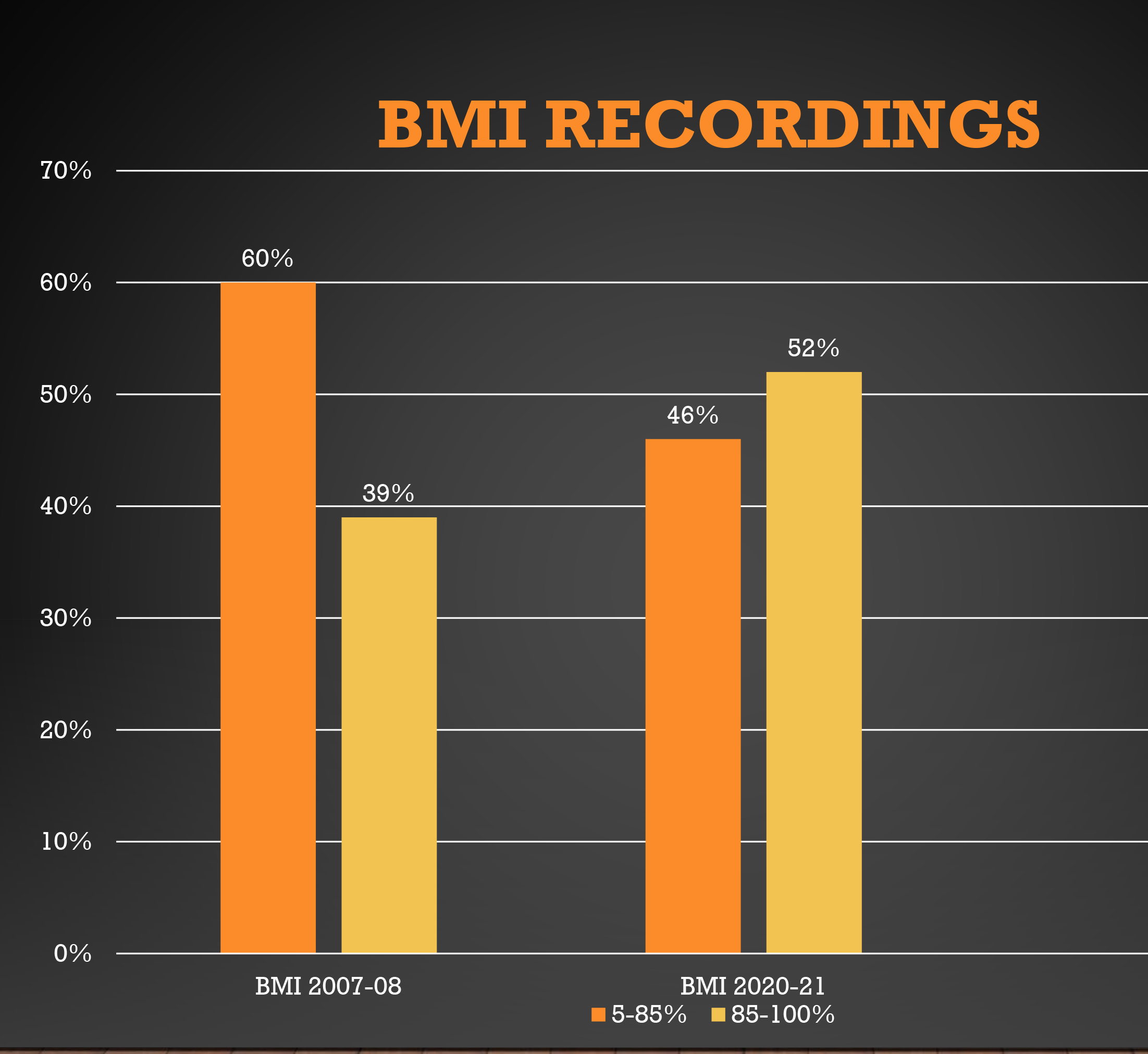
“I thought it would be interesting to compare BMI (Body Mass Index) screenings when whole milk was served in schools with the recent screening where students have been served only skim and 1% milk. The results of the comparison are striking (above). The overweight and obese categories for students in grades 7-12 in 2007-2008 school year was 39% with 60% in the proper BMI scale. In the year 2020-2021, after being served low fat milk during school hours, the overweight and obese categories were increased to 52% while the recommended range was decreased to 46%. That is a 13% increase over the past 13 years!” said Ebersole.

“While one cannot assume that the low fat milk alternatives are the only determining factors, they certainly did not have the intended outcome of reducing obesity in school age children,” she said.

Ebersole explained that, “Whole milk is a nutrient dense food and with its natural combination of protein, fats and carbohydrates, it is called Nature’s most nearly perfect food. Whole milk also provides satiety, which is stabilizing for blood sugar as well as feeling fuller longer thus decreasing food intake. Another important quality is that students prefer the taste of whole milk compared to the reduced fat and skim milk options.”

Byler talked about the trial at her school in the 2019-20 school year. She explained that the milkfat restrictions at school have led to a loss of school milk consumption with results that are far reaching.

“We are now hearing of very early onset osteoporosis and an increase in malnutrition and/or obesity. It is shameful that our youth cannot have a choice of a wholesome, nutritious product that is farm-to-table/farm-to-school,” said Byler. This, and the amount of milk wasted daily prompted the school trial.

She provided slides of the trial results and talked about how half of the students didn’t really know whole milk was not allowed. This means they didn’t know how good milk can be.

“The results of the trial were astounding. When offerings were expanded to include whole and 2% milk, the amount of wasted milk was reduced by 95% and we saw a 52% increase in students choosing milk,” said Byler, explaining that the student council did actual milk collection data as part of an environmental project.

She also shared results of her survey of the elementary school children showing that if this latest possible restriction on milk options for schoolchildren is approved by USDA, fewer than 25% of students currently taking and drinking the milk say they would continue taking milk and drinking it if flavored milk were not offered. 

“That’s huge,” said Byler.

That means we would see even more reductions in milk consumption at school and more waste. This struck a chord because when Byler presented the 2019-20 trial where her school offered whole and 2% along with fat free and 1% milk, for trial purposes, we heard audible gasps among those attending the briefing when Byler shared the data on the reduction of wasted milk. ((The students also created a video about school milk, view it here.)

We also saw reactions while Ebersole was sharing her analysis of student BMI data over the past 13 years.

Both women concluded by sharing a heartfelt message about how important dairy farmers are to communities, how they care for their cattle and work to provide a high quality nutritious product, and what it means to them for children to be able to choose milk they love so they can benefit from the nutrition the milk provides.

“As the wife and granddaughter of proud Pennsylvania dairymen, I knew the decrease in milk we were ordering for schools would impact dairy families. I know firsthand about the dairy farmers we have lost,” said Byler. “What I know based on 18 years in school nutrition, raising two children and being part of two dairy families is that restricting milk offerings to our school children does not benefit our children or our dairies. It benefits big corporations who have exponential marketing power and are preying upon our youth.”

School nurse Christine Ebersole and her daughter Vanessa Wiand, an elementary teacher at the briefing.

Ebersole noted that, “Being born and raised on a dairy farm and having lived in the dairy community all my life, I can say I know something about the American Dairy Farmer. They are on call 365 days a year and 24 hours a day.  They care about their animals and also care about their neighbors. When a tragedy happens like a fire, the neighbors come together. Dairy farmers work diligently to bring a wholesome natural food to us. Let’s do our part to support this industry by allowing students to have a choice of a delicious, nutritious whole food, whole milk,” she said.

For the Nutrition Coalition, John Bates explained they are a non-profit, non-partisan organization that seeks to improve health in America by ensuring that the public gets evidence-based nutritional advice. They emphasize good science, transparency, and methodology and receive no industry funding.

“When the Healthy, Hunger-Free Kids Act was enacted in 2010, milk became counted as part of that less than 10% of calories from saturated fat, when previously it had been in its own, separate beverage category,” said Bates.

He noted that the U.S. Dietary Guidelines that these rules for schools are based on “never reviewed studies on dietary fat specifically for children until 2020. Children have just been assumed to be like adults, but children are different: they need more protein for their growing bodies and more fat for their growing brains,” said Bates.

The Guidelines in 2020 cite a single clinical trial on school-aged children, ages 7-10 (“DISC,” funded by the NIH). It showed ‘Modestly’ lowered LDL-cholesterol, he explained. “Yet the study was not on a normal population. The expert USDA committee acknowledged this study could not reliably be generalized to a larger population

The bottom line, said Bates is that expert committees have found “insufficient evidence” to show that restricting saturated fats in childhood could prevent heart-disease or mortality in adulthood.

“In our view, a single trial on an atypical population is not enough to make population-wide guidelines to all American children,” he said.

Paul Bleiberg for National Milk Producers Federation focused his comments on the problems with underconsumption of dairy.

“Milk is the number one source of three of the four food nutrients of public health concern as identified by the DGA’s — calcium, vitamin D and potassium. Dairy delivers 7 of the 14 nutrients the American Academy of Pediatrics recommends for optimal brain development as well as nutrients vital for immune health and bone growth and development during a child’s school-aged years,” said Bleiberg. 

“The 2020 DGA Committee found that 79% of 9 to 13 year olds fall short of recommended dairy intake and the data from MilkPEP show that students take less milk and throw away more milk at schools when they do not have options they like,” he added.

Before, after and during these four short presentations on whole milk choice in schools, staffers trickled in, gathered around the whole milk bar and had conversations.

In fact, when news began to spread through texts and emails that there were milk and cookies in room 1302 — more staffers came and went. Connections were made around good food and delicious, nutritious milk.

From congressional staff we heard appreciation and these words: informative, enlightening, authentic, delicious!

Those four words give me hope that we can unite with whole milk… for our children and our dairy farmers.

June 23 UPDATE: This was another good week for the Whole Milk for Healthy Kids Act in Washington, and here’s how you can help…

As of June 23, the bipartisan Whole Milk for Healthy Kids Act, H.R. 1147 grew the number of cosponsors to 128 including prime sponsor G.T. Thompson (103 Republicans, 25 Democrats). These cosponsors represent 43 states.

Texas tops the list with 13, followed by Pennsylvania 10, New York 8, California, Florida and Wisconsin at 7. Maine, Idaho, Iowa, North and South Dakota and Wyoming have fewer Representatives and their full delegations are on board. Wisconsin is nearly 100% with 7 of their 8 Representatives signed on.

The 43 states now represented are listed in the order of number of cosponsors vs. the total number of representatives for the respective states: Texas 13 of 36, Pennsylvania 10 of 17, New York 8 of 26, California 7 of 52, Wisconsin 7 of 8, Florida 7 of 28, Georgia 5 of 14, Indiana 4 of 9, Iowa 4 of 4, Michigan 4 of 13, Minnesota 4 of 8, North Carolina 4 of 14, Illinois 3 of 17, Virginia 3 of 11, Washington 3 of 10, Alabama 2 of 7, Arizona 2 of 9, Connecticut 2 of 5, Idaho 2 of 2, Kansas 2 of 4, Kentucky 2 of 6, Maine 2 of 2, Missouri 2 of 8, New Jersey 2 of 12, Ohio 2 of 15, Oklahoma 2 of 5, Oregon 2 of 6, South Carolina 2 of 7, Tennessee 2 of 9, Arkansas 1 of 4, Colorado 1 of 8, Hawaii 1 of 2, Louisiana 1 of 6, Maryland 1 of 8, Mississippi 1 of 4, Nebraska 1 of 3, Nevada 1 of 4, New Mexico 1 of 3, North Dakota 1 of 1, South Dakota 1 of 1, Utah 1 of 4, West Virginia 1 of 2, and Wyoming 1 of 1.

To reach all 50 states, here’s what we need in the East: Delaware, Massachusetts, New Hampshire, Rhode Island, and Vermont. In the West: Alaska and Montana. Is your state on the list? Is your Congressional Representative a cosponsor? Make the call! Go to this link to see the bill’s progress and cosponsors, and click “contact your member” on the right to find your Representative.

Call Senators too. On June 13, the bipartisan Senate companion bill, S.1957, was introduced by Senator Roger Marshall, a Republican and medical doctor from Kansas, along with prime cosponsor Peter Welch, a Democrat from Vermont. Also cosponsoring right out of the gate are Democratic Senators Kirsten Gillibrand of New York and John Fetterman of Pennsylvania; Independent Senator Angus King of Maine; and Republican Senators Ron Johnson of Wisconsin, Chuck Grassley of Iowa, Susan Collins of Maine, Cindy Hyde-Smith of Mississippi, and James Risch and Mike Crapo, both of Idaho. As of June 23, that’s 11 Senate sponsors from 9 states. Maine and Idaho have both of their respective Senators on board!

-30-

Congressman G.T. Thompson’s Whole Milk for Healthy Kids Act approved 26-13 by House Education Committee

Thompson: ‘This is a win for children and dairy farmers, but we’re not done’

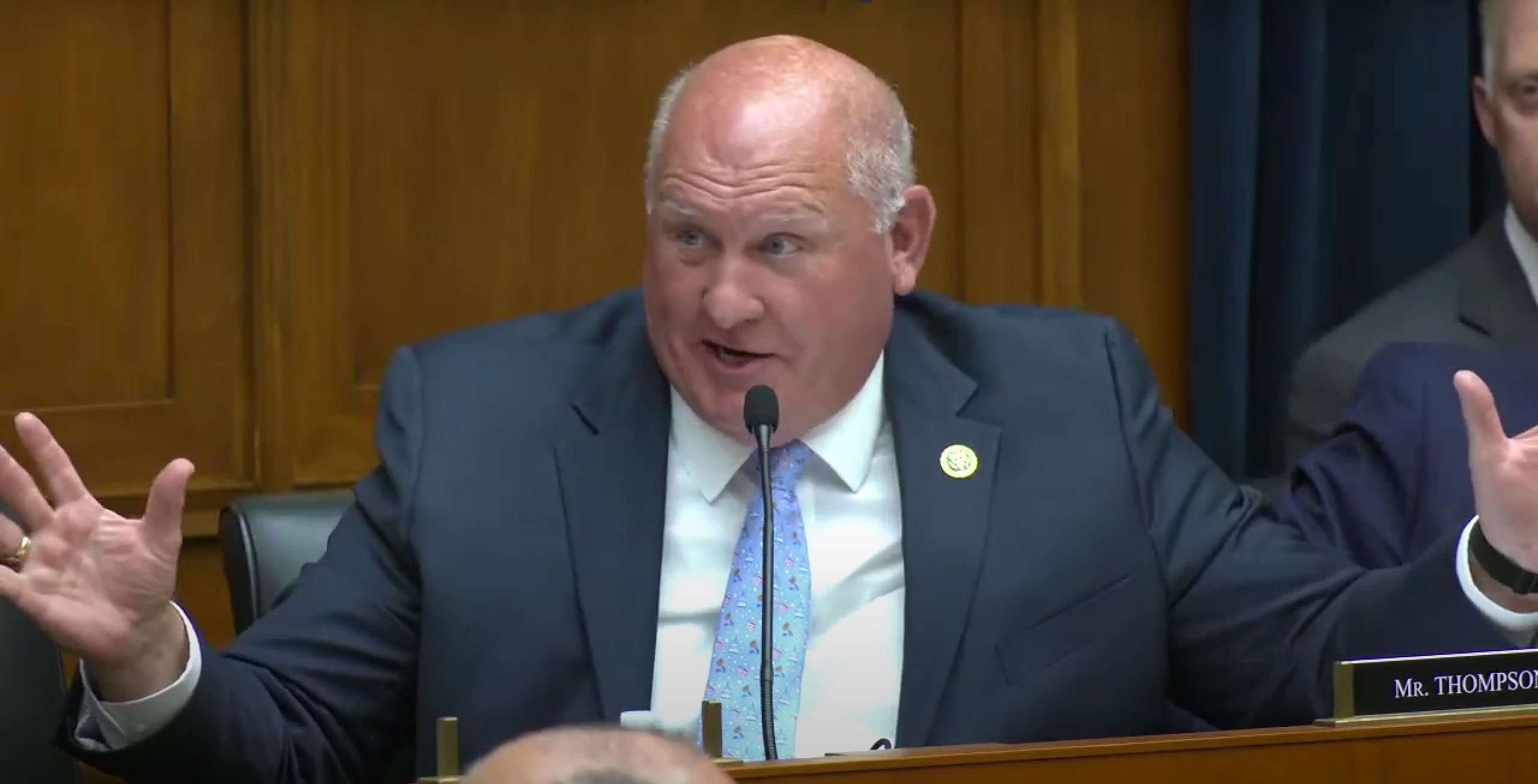
“This policy has cheated our children and has led to economic demise in Rural America as we’ve seen a loss of dairy farms and small businesses that are in that supply chain. It’s time to reverse the mistake that was made in 2010. We need to follow real science, not political science. I question the process of the Dietary Guidelines Advisory Committee. These are unelected bureaucrats, and there’s no oversight. This is our chance to actually do something positive in that process to say ‘hey we’re watching what you’re doing. We’re looking over your shoulder,’” said Rep. GT Thompson (R-PA-15). In a bipartisan 26 to 13 vote, the Committee on Education and Workforce passed Thompson’s motion to report the Whole Milk for Healthy Kids Act, H.R. 1147, to the House of Representatives with recommendation of passage. On the Republican side, 21 voted yes and 4 were absent. On the Democratic side, 5 voted yes, 13 no, and 3 were absent. The next step is getting the bill on the calendar for a vote on the House floor.

By Sherry Bunting, Farmshine, June 9, 2023

WASHINGTON — The Whole Milk for Healthy Kids Act, H.R. 1147, reached a major milestone this week, passing mark-up in the U.S. House Committee on Education and Workforce.

Dairy farmers could not have asked for a better way to kick off June Dairy Month as the committee discussion exposed the sides of this issue, and Congressman Glenn ‘GT’ Thompson, the Republican from Pennsylvania and the bill’s prime sponsor, laid out the case for children to have true access to the most nutritional beverage — milk.

In the end, the Education Committee on Tuesday, June 6 approved the bill in a bipartisan 26 to 13 vote. 

(Cross-section highlights of Education and Workforce Committee discussion and vote.)

Now that it is recommended by the House Education and Workforce Committee, the next step is scheduling of the vote on the House floor.

This is the first time in three legislative sessions that the bill to restore the choice of whole and 2% unflavored and flavored milk in schools has made it this far in the legislative process.

“This is a win for children and dairy farmers, but we’re not done. I took a deep breath to see this satisfying outcome in this first stage and another deep breath as we move to the next stage to get it onto the House calendar,” said Rep. Thompson in a Farmshine interview after committee passage.

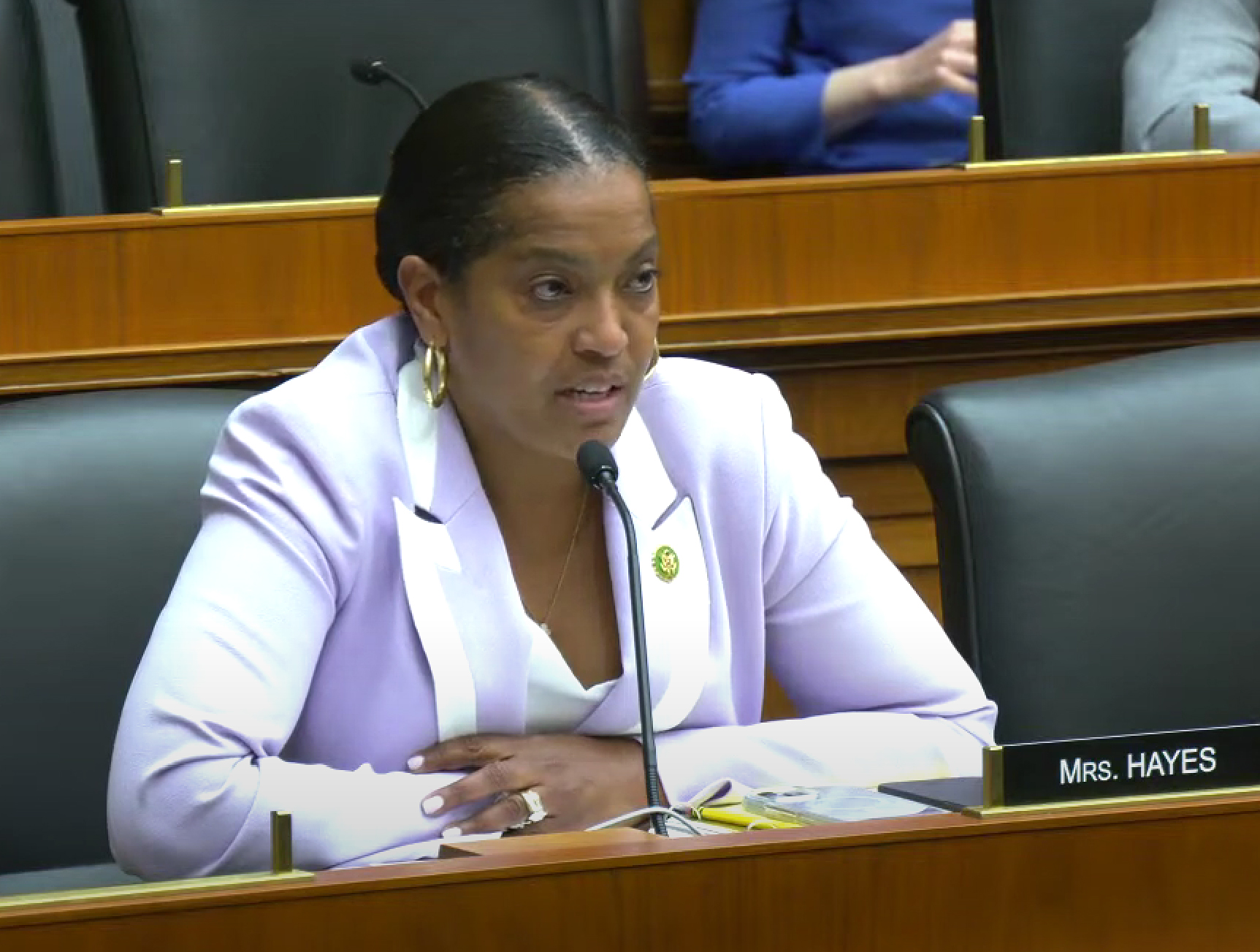
A further breath of bipartisan fresh air also came from Rep. Jahana Hayes, a Democrat and educator from Connecticut. She rose in support of the bill, quoting from the Dietary Guidelines 2020-25 report and from USDA, giving statistics about what is offered and what is consumed in recommended dairy intake, especially for children ages 2 to 18.

“I have belabored this point that children receive a huge amount of their daily nutrition at schools. Also, the school meal programs are a significant source of milk and dairy for kids,” said Hayes.

“But the part that sticks for me is that none of this matters if kids aren’t drinking the milk. We can have as much data and statistics on what kids need as dietary dairy intake, but if they’re not drinking it, then it’s all for naught,” she stressed. “We’ve seen students take less milk and throw away more milk when they don’t like the way it tastes.

“I support this amendment. I drink whole milk. My kids drink whole milk. We like it,” Hayes asserted.

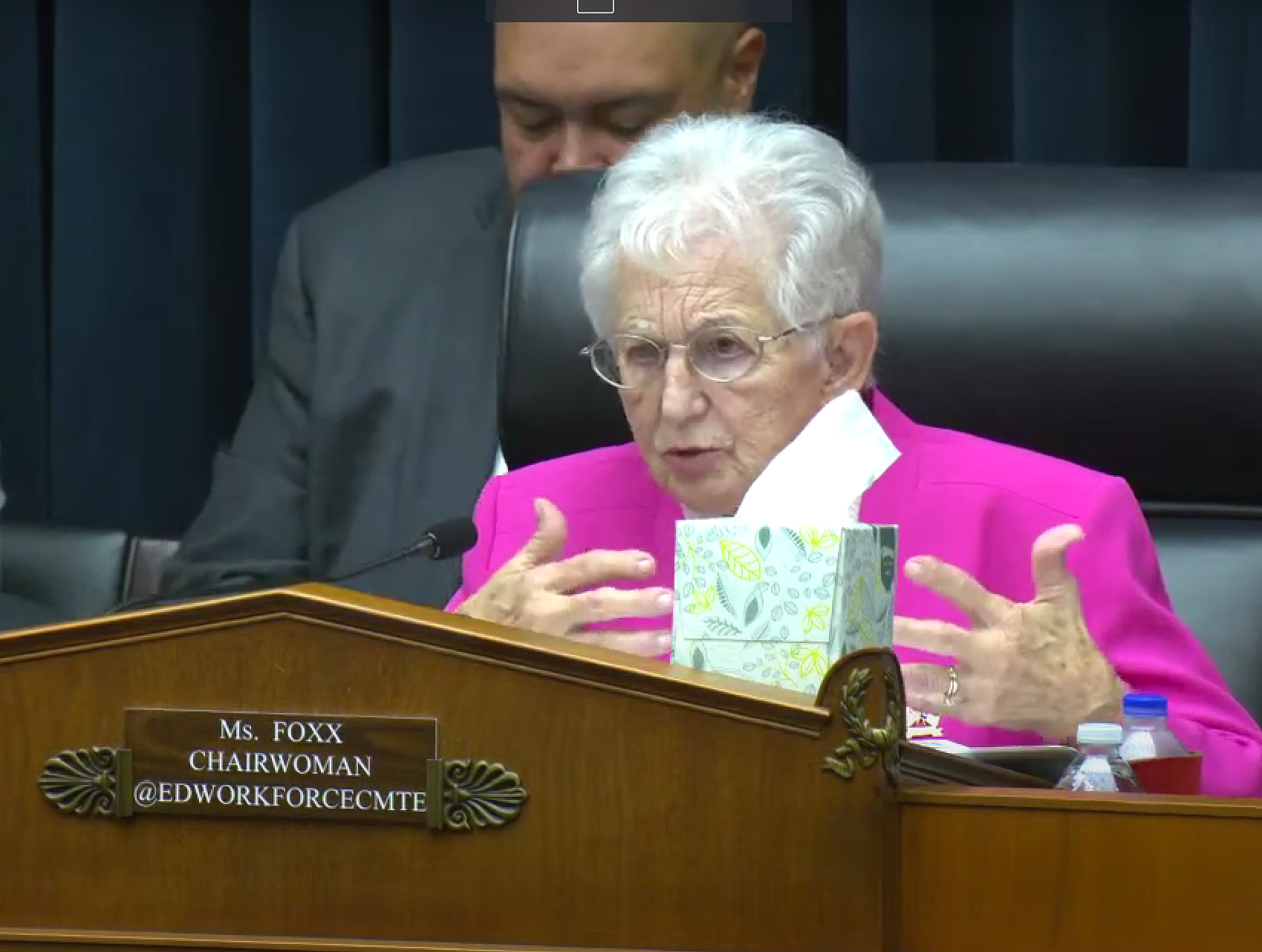
Chairwoman Virginia Foxx, a Republican from North Carolina said the debate over whole milk “takes the cake.” 

She talked about how previous recommendations have been “walked back,” and she bemoaned the fact that there are “no checks and balances” over the Dietary Guidelines process of making these recommendations.

“I was shocked last year when I learned that whole milk has only 3.5% fat content, when we are saying to students: ‘drink skim milk or 1% milk,” the Chairwoman said. 

“Surely-to-goodness, that kind of fat content is not doing the damage that some people are saying. This Dietary Guidelines Advisory Committee is just a small group of unelected, appointed people, and we want to turn children’s lives over to groups like this? We should be dealing with this,” she added.

The bill’s champion, Rep. GT Thompson is a senior member of the Education Committee, and chairs the Agriculture Committee. 

Thompson said he is discussing the next stage with the House Majority Leader to schedule the legislation for a vote on the House floor.

“The bill had 106 bipartisan cosponsors supporting it from 39 states — before this committee vote — and we can build on that,” said Thompson. (As of June 16, there are 110 from 40 states).

This cosponsor list includes 22 members of the Education Committee. It also includes bipartisan cosponsors from the Agriculture Committee. It includes prime cosponsor Rep. Kim Schrier, a pediatrician from Washington State, and numerous members of Congress who are doctors, educators, parents. It has garnered the support of schools, students, parents and families throughout America who will benefit, according to Thompson.

His staff reports that more cosponsors continue notifying their office to sign on to the bill.

“This has been a really grassroots effort. Dairy farmers, the dairy industry, all of the rural businesses who provide inputs, the folks in the schools, the parents… we’ve had great support for this bill, and all of that helps,” said Thompson with a tip of the hat to the grassroots 97 Milk effort.

In fact, while speaking on his bill, Thompson mentioned “how this policy has negatively impacted the economy in Rural America. This (federal prohibition of whole milk in schools) negatively impacts kids and dairy farmers, and it’s time to turn that around.”

The Whole Milk for Healthy Kids Act allows the 95% of schools that are participating in the school lunch program to serve all varieties of flavored and unflavored milk, including whole milk. Thompson amended the bill from previous renditions to make minor technical changes that will help ensure foodservice workers have the flexibility they need in serving the students whole milk.

“Some Democrats on the committee spoke in opposition to the bill, using the same outdated science, but in the end, the committee vote to approve it was bipartisan,” said Thompson. 

During the committee discussion, he told his colleagues that he is focused on “listening to the school professionals who serve students every day and parents who are concerned about the lack of options.

“We need to follow real science, not political science. It’s time that we push back on the notion that federal bureaucrats know what’s best for students. Although there is more work to be done on school nutrition, this bill gives students access to the milk they want and need. The bottomline is the Whole Milk for Healthy Kids Act is all about ensuring students have the necessary nutrients to learn and grow,” he said.

Thompson was quick to point out that, “We’re not force-feeding anybody anything. We’re providing children options so we don’t turn them over to less healthy beverages.

“We’ve really ruined an entire generation of milk drinkers and have cheated them out of access to the most nutritional beverage. I appreciate the comments that there is nutrition also in 1% milk, but even that’s because of the milkfat, the vehicle that delivers the nutrition,” he explained.

This bill “will improve the nutritional status of our children going forward. If we give them a good milk experience …  I would argue we will see a reduction in childhood obesity,” he said, pointing to studies showing whole milk to be an effective drink weight management because of how satisfying it is.

To his colleagues citing ‘the science’, Thompson was tactful but blunt: “I agree we ought to do things with data and science, I just question the process of the Dietary Guidelines Advisory Committee. They’re completely appointed. These are unelected bureaucrats, and there’s no oversight. This is our chance to actually do something positive in that process to say ‘hey we’re watching what you’re doing. We’re looking over your shoulder.’”

Chairwoman Foxx reminded her committee that, “This is a choice. Instead of having bureacrats tell us what to do… we give a choice and not let someone else run our lives.”

At the start of the discussion, she explained the Whole Milk for Healthy Kids Act as “empowering food service providers and parents to make decisions on the health and welfare of children.”

Ranking Member Bobby Scott (D-VA-3, right) and Rep. Jamaal Bowman (D-NY-16) read from a letter of opposition to the whole milk bill from the Physician’s Committee for Responsible Medicine (PCRM). According to Guidestar, PCRM describes its vision as “creating a healthier world through a new emphasis on plant-based nutrition and scientific research conducted without using animals. ” In 2010, Newsweek and New York Times articles identified PCRM links to extreme animal rights organizations such as PETA. 

Ranking member Bobby Scott, a Democrat from Virginia, was one of four Democrats voicing opposition, saying H.R. 1147 is “an attempt to legislate nutrition standards and disregard evidence-based recommendations made by the Dietary Guidelines for America.” He said the bill would allow schools to “violate current science-based standards. 

“If it was consistent with science, we wouldn’t be here. The science-based committees would have already done this,” he said, also objecting to considering the bill outside of doing a comprehensive childhood nutrition reauthorization.

The last childhood nutrition reauthorization by Congress was the 2010 Healthy Hunger Free Kids Act, which tied schools more closely to the saturated fat restrictions of the Dietary Guidelines in the first place.

Scott noted the American Heart Association, Association of Nutrition and Dietetics, Center for Science in the Public Interest have “expressed concerns for this bill.” But mostly, he quoted from a letter of opposition from the Physicians Committee for Responsible Medicine. (PCRM is a known animal rights group tied to PETA.)

Rebutting Scott’s assertions in his characteristic calm and methodical manner, Congressman Thompson said he appreciated the recognition of science but that, “we don’t always get it right, and that’s what we’ve found with the Dietary Guidelines process. 

“You reference the Dietary Guidelines Committee, but the most recent Dietary Guidelines reported that more than two-thirds of school age children FAIL to meet the recommended level of dairy consumption, and a big part of that is, quite frankly, we gave them since 2010 an awful milk experience,” said Thompson.

“We’re talking about 3.5% milkfat. I was here for that 2010 debate. It’s been proven since then that it was bad science. The most recent science I referenced and our practioners, the American Academy of Pediatrics, have stated that dairy plays an important role in the diet of children, and it’s the leading food source for three of the four nutrients of public health concern — calcium, vitamin D and potassium,” said Thompson, providing 15 academic studies for the record on full fat dairy.

As members of Congress, “we visit our schools and spend time in the lunch line, and we see the waste and the unopened half-pint milk containers that are discarded. Quite frankly, we’ve been contributing to childhood obesity because … children are going to drink some type of beverage, and the substitutes have been high sugar beverages that do not have healthy outcomes,” said Thompson.

“This policy has cheated our children… and has led to economic demise in Rural America as we’ve seen a loss of dairy farms, dairy herds and small businesses that are in that supply chain. It’s time to reverse the mistake that was made in 2010,” he stressed.

Rep. Jamaal Bowman, a Democrat from New York agreed that the meals at school are for some kids the most important that they receive, and he said these meals should be consistent with the “latest science on nutrition.” 

However, he maintained that the Dietary Guidelines for Americans (DGAs) are “based on up-to-date science” and said “allowing whole milk to be served to children contradicts those recommendations.”

Rep. Bowman called the bill an “inappropriate attempt to legislate nutrition standards,” but he failed to acknowledge the shortcomings observed by other independent scientific bodies calling into question the research screening methods used in the DGA process, the make-up of the DGA committee, and the predetermined questions that form the boundaries for what “up-to-date research” will be included as “relevant” to the predetermined questions in each 5-year DGA cycle.

Bowman quoted extensively from the PCRM letter, which stated that “full fat milk is both unnecessary and harmful to children’s health.” Reading from the PCRM letter, Bowman said “early signs of heart disease, high total and LDL cholesterol and other indicators of impending cardiovascular disease are appearing in children with increasing frequency.”

(If that’s the case, then how can whole milk be blamed? How can saturated fat be blamed? Whole milk is nonexistent at school, and saturated fat is limited to less than 10% of calories in school meals since 2010. Children receive one, two, or even three meals a day, five days a week for at least three-quarters of the year at school. If the poor health outcomes the PCRM letter identifies are rising, doesn’t that tell us something about the scientific validity of the DGA recommendations? The PCRM’s own letter hits that nail on the head with its own statistics. PCRM calls “whole dairy milk a troubling source of saturated fat.” And yet, kids have not been allowed to have whole milk or 2%, and in some cases not even 1% fat milk, for the past 13 years during two meals a day, five days a week, most of the year!)

Here’s an eye-opener: Quoting again from PCRM, Bowman said lactose intolerance among communities that have been impacted by “historic racism” and “health inequities” are those less likely to be able to see a doctor for the doctor’s note to have dairy substitutes at school. The letter even mentioned children needing ‘climate friendly’ beverages. 

The roots of the anti-whole-milk agenda are clear in terms of encouraging more “non-dairy substitutes” for children in schools.

Rep. Alma Adams, a Democrat from North Carolina said the bill sets a “dangerous precedent” that takes the years of building nutrition programs backward, noting this would cause poor health outcomes. (But the poor outcomes were said to be already happening by those opposing the whole milk bill. This is occurring while whole milk is prohibited.)

During the committee markup, Thompson said he is proud of the number of cosponsors to-date and the broad and bipartisan support for the whole milk bill. 

“My legislation supports students and dairy farmers across America,” he explained.  “Milk is an essential building block for a well-rounded and balanced diet offering 13 essential nutrients and numerous health benefits. However, out of touch federal regulations have imposed dietary restrictions on the types of milk that students have access to in school meals… limited to fat free and low-fat milk since 2010. For our children to excel in the classroom and beyond, they must have access to more nutritious options they enjoy.”

Thompson  also stressed that the situation could become worse if the Whole Milk for Healthy Kids Act is not enacted into law. 

“The USDA’s latest proposed guidelines could roll back options even further by restricting flavored milk only to high school students and counting milk fat against weekly saturated fat allowances,” he said, giving several reasons why these top-down regulations are harmful to students and school districts that are forced to comply.

“First, we have seen students opt out (from milk) altogether,” said Thompson. “Let’s face it, the only way to benefit from milk’s essential nutrients is to consume it, and when students turn away from milk, they often opt for far less healthy alternatives.”

Thompson noted that these regulations also “perpetuate baseless claims that milk is bad for kids, but research has shown time and time again that whole and 2% milk are not responsible for childhood obesity and other health concerns. In fact, these beverages are so nutritious that research consistently shows positive health outcomes for children who consume milk.”

Referencing the 15 academic studies submitted from researchers across the country and around the world, Thompson asserted that, “These studies, and there are more, show that full fat dairy foods have no association with high blood pressure, cardiovascular disease, type II diabetes, obesity or cholesterol. In fact, several show full fat foods helped improve or lower negative health outcomes for children who drank more full fat dairy beverages.”

He also added to the record several letters of support, including a letter from the Nutrition Coalition (founded by science journalist Nina Teicholz, author of the Big Fat Surprise), the International Dairy Foods Association, the Northeast Dairy Foods Association, and a coalition of dairy producers from across the country. 

He said the bill has the support of schools and families across the country. 

This is evident by the tens of thousands of citizen petition signatures over the past few years and a 2021 IDFA survey of parents showing 78% find whole or 2% milk healthier for their families. Trouble is, their kids can’t get it at school where most of their meals are consumed.

-30-

Rep. G.T. Thompson: Whole Milk and Dairy Pride bills ‘more urgent than ever’

By Sherry Bunting, Farmshine, March 3, 2023

WASHINGTON — Pennsylvania has dairy champions in Congress. Not only has Rep. Glenn ‘G.T.’ Thompson (R-15th) introduced the Whole Milk for Healthy Kids Act, and made it better, Rep. John Joyce (R-13th) is getting ready to launch the House version of the Dairy Pride Act to uphold real milk’s standard of identity.

It’s “more urgent than ever” that Congress act on these bills, in light of recent USDA and FDA proposed rules, said Thompson in a Farmshine phone interview as Congress returned to session Monday (Feb. 27).

The bipartisan 2023 Whole Milk for Healthy Kids Act, H.R. 1147, has been introduced for just over one week, and already the number of congressional cosponsors grows daily at 43 to-date, including prime sponsor Rep. Thompson, a Republican from Pennsylvania and prime cosponsor Rep. Kim Schrier, a Democrat and pediatrician from Washington state. 

The other 41 cosponsors so far represent both sides of the aisle from 22 states.

“I’m very honored to reintroduce this whole milk legislation. We made some real progress in the 117th Congress with not quite 100 cosponsors and broad bipartisan support. That’s what it takes to get things done,” said Thompson. “But we had headwinds with the Republicans not having the majority and the Democratic party owning the demonization of milkfat and the removal of whole milk and flavor from the school system.”

What will be different this time? 

Thompson explained it’s a new Congress and he has the support of the new Education and Workforce Committee chair Virginia Foxx, a Republican from North Carolina.

“She is very excited about this bill and has had me speaking on it at a number of events over the past year,” said Thompson.

In addition to being chairman of the House Agriculture Committee, Thompson is also a senior member of the Education and Workforce Committee through which the Whole Milk bill must pass first.

Thompson believes it will be put on the House agenda, and he is optimistic that it will get passed off the House floor.

He is also looking for a sponsor for companion legislation in the Senate.

He said he appreciated former Senator Pat Toomey of Pennsylvania who had previously introduced a version of the bill.

“With Senator Toomey’s retirement from the Senate, we now have to find someone to take the lead in the Senate,” he said.

The fact that the number of cosponsors has grown quickly for the House bill, within the first few days, is a good sign. 

This response so far has happened without Thompson “working the floor” yet.

This “speaks to the significant need that this legislation addresses,” he said.

“This bill is about providing the best nutrition for children and addressing the economic impact on rural America,” he explained. “When the Democrats did what they did in 2010 with the nutrition standards, it was a crushing blow to dairy farmers. Dairy is the number one ag commodity in my home state of Pennsylvania, and agriculture is the number one industry. This is the case not just in Pennsylvania.

“This topic comes up everywhere I go and in every state,” he added. “Part of the reason is the awareness as many people and organizations, and quite frankly the 97 Milk grassroots effort, has impacted nationally and internationally by speaking to this need.”

Thompson improved the bill with what he calls a “common sense addition.” 

He acknowledged former Senator Toomey for articulating language that would allow whole and 2% milk to fit within the meal calculation for saturated fat since the milk has been included in the meal calculation since 2010. 

This way, not only does the Whole Milk for Healthy Kids Act proclaim the permission for whole and 2% unflavored and flavored milk options in school meals, it expands the saturated fat limit to accommodate these options so school foodservice directors are empowered to actually offer them.

“Milk is the only beverage that is regulated within the meal. Meanwhile, students may have access to non-nutritious beverages with high fructose corn syrup and caffeine that are not regulated, so we’re making sure we do not have a situation where the milkfat counts against the meal,” said Thompson.

“Whole milk is only 3 to 3.5% fat compared to the low-fat milk being 1%. That means whole milk is 96.5 to 97% fat free. That extra milkfat is a positive thing in the lives of those young people,” Thompson declared, with a nod to the mountain of scientific evidence.

As the White House is moving rapidly in its proclaimed “whole of government approach” to implement the Biden-Harris Hunger, Nutrition and Health National Strategy, a flurry of bureaucratic actions could further affect milk access for children via USDA and FDA.

USDA just published proposed school nutrition rules, with comment period ending April 10, 2023, which could remove access to flavored milk in elementary and potentially middle schools, while further etching in concrete the fat-free and 1% sole options. 

FDA’s healthy labeling proposed rule also presents obstacles for whole milk, and that comment period recently ended. 

Plus, FDA last week issued draft guidance allowing imitation non-dairy beverages to be labeled as ‘milk’ with only a ‘voluntary’ recommendation that companies describe shortfalls in key nutrients. That public comment period ends April 24, 2023 (see related article in this week’s Farmshine).

Will the Whole Milk for Healthy Kids Act force revisions of any of these proposed rules?

Rep. Thompson was outspoken on this question.

“I don’t believe they have the authority to do what they are doing now,” he stated. 

“These moves are an outgrowth of the White House summit that they weren’t serious about. They failed to invite Republicans, including the Ranking Member of the Ag Committee until 48 hours before the conference. They didn’t want our input. It is more political science than science, and it is really frustrating,” he related.

“It is the Congress that determines nutritional standards, not the bureacrats. While the Whole Milk for Healthy Kids bill is mostly in the Education and Workforce Committee, I will do all I can in the Ag Committee to make sure science, not political science, is foremost.

“Science shows whole milk and whole milk with flavor added, are the most nutritious beverage available,” said Thompson.

On the FDA draft guidance for labeling fake-milk alternatives as ‘milk’, Thompson was even more blunt.

“The Dairy Pride Act is being reintroduced by Rep. John Joyce (R-PA). This bill is more important than ever given the insane draft guidance of the Biden-FDA. It is urgent to pass this one also,” said Thompson, confirming later that the Dairy Pride Act, which was introduced in the Senate this week will also be introduced in the House shortly by Rep. Joyce, along with a bipartisan cosponsor.

Thompson lamented the bombardment of parents and kids with marketing for alternative fake-milk beverages that are proliferating rapidly.

“I have a lot of friends among almond growers and soybean growers, and I like almonds, but this is about truth in advertising. The word ‘milk’ communicates a certain level of nutrition, and FDA has even acknowledged this. If FDA is going to mislead people by allowing the labeling of something as milk that is not milk, then they should be required to truly define the differences,” he said, adding that he’s not surprised.

“This administration can’t define what a woman is, and now it can’t define what milk is,” Thompson declared.

Stay tuned to Farmshine for updates!

-30-

Having already killed whole milk, USDA proposed school rule now takes aim at flavored milk with appalling lack of concern for nutrient-density

By Sherry Bunting, (updated from Farmshine print edition, Feb. 10, 2023)

WASHINGTON — USDA is taking aim at a different area of school milk with new proposed rules announced Feb. 7 that could limit flavored milk to only students in grades 9 through 12. A second option would be to allow all grade levels access to flavored milk, but with draconian cuts to the amount of added sugar they could contain, without regard for nutrient density.

We already have nonsensical restrictions on fat levels for school milk. The more fat is removed from diets, the more sugar is added. That’s a default truth, especially for chocolate milk.

With a 30-minute webinar panel moderated by Ag Secretary Tom Vilsack On Feb. 3, Vilsack cited the Tufts University Friedman School – developer of the infamous Food Compass – as an authoritative source for the Biden-Harris National Strategy on Hunger, Nutrition and Health. The proposed rule itself mentions a “Healthy Eating Index” — a rating system — was applied to align with the 2020-25 Dietary Guidelines.

In the subsequent news release, USDA stated that the proposed rule is part of this National Strategy, which was released in conjunction with the White House Conference on Hunger, Nutrition and Health in September. The conference development, incidentally, was headed up by Dariush Mozaffarian, Dean of the Tufts University Friedman School of Nutrition Science and Policy.

(Please note that the FDA Healthy Labeling proposed rule is another piece of the National Strategy. Public comments on that end Feb. 16, 2023 at this link)

The goal of the National Strategy and the Feb. 7 proposed school meal rule, said Vilsack, is to end hunger and diet-related diseases by 2030.

With that pronouncement and other platitudes about hunger and health… USDA set off to the races on a set of new standards in a proposed rule for school meals that will further limit consumption of nutrient dense foods as multi-year implementation begins when ‘transitional flexibilities’ end in the 2024-25 school year.

Reducing added sugar and sodium levels, as well as increasing the percentages of whole grains, are at the core of the new rules, but there are pages and pages of rules to analyze.

Saturated fat restrictions, including milkfat, will continue and will be more restrictive as the transitional flexibilities USDA has allowed since the Covid pandemic and supply chain disruptions will end in school year 2024-25; however, more flexibility is granted to saturated fats from plant-based sources, such as seed oils.

Secretary Vilsack insists USDA has been on the right track with school meals since 2010. He applauded the results since the Healthy Hunger Free Kids Act was passed (which set up the vehicle for USDA to further restrict saturated fat and to remove whole and 2% milk from schools).

He said that the rate of obesity has declined among children in lower income brackets in every year since 2010. (We’ll have to dig into that because we’ve seen studies and reports showing quite the opposite trend.)

In other words, Vilsack is fully committed to the fat restrictions, and now added sugar and sodium are the new screws to be tightened.

“This makes me sad for our kids,” wrote one school foodservice director in an email after reading the proposed rule.

“If they don’t want us anymore, just tell us now and save us all the misery,” a milk bottler said in conversation upon hearing the news.

“Do public comments ever really make a difference?” a prominent nutrition and health investigator and advocate wrote in an email. “It seems to me that it’s so much window-dressing.”

Friday’s panel with Secretary Vilsack could be described as window-dressing. Consisting of a school-involved mother, a teacher, and a foodservice director, they each called for greater flexibility, more resources and support and more tools to feed nutritious meals as well as more time for children to eat their meals.

Flexibility was a big part of their panel comments. However, the new proposed rule is anything but flexible.

Take a look. Public comments close April 10, 2023

According to the USDA news release Monday, the USDA Food Nutrition Service describes this as “a gradual, multi-year approach to implementing a few important updates to the nutrition standards.”

These include, according to USDA:

— Limiting added sugars in certain high-sugar products and, later, across the weekly menu;

— Allowing flavored milk in certain circumstances and with reasonable limits on added sugars;

— Incrementally reducing weekly sodium limits over many school years; and

— Emphasizing products that are primarily whole grain, with the option for occasional non-whole grain products.

In some of these areas, USDA FNS proposes different options and is requesting input on which of the options “would best achieve the goal of improving child health while also being practical and realistic to implement.”

Specifically for milk, the proposed rule open to public comment contains two options, stating: “Both options would include the new added sugars limit for flavored milk and maintain the requirement that unflavored milk is offered at each meal service.

The two options further restrict flavored milk — even after the added sugars are reduced — as follows:

• Option 1: Allow only unflavored milk for grades K-8 and allow flavored and unflavored for grades 9-12. OR Allow only unflavored milk for grades K-5 and allow flavored and unflavored for grades 6-12. Either proposal would be effective School Year 2025-26.

• Option 2: Continue to allow flavored and unflavored milks for all grades (K-12).

On added sugars affecting the milk as well as other dairy products served in schools, the proposed rule states:

• Limits for grain-based desserts, breakfast cereals, yogurts, and flavored milks, effective in school year (SY) 2025-26.2 are product-based. (This means different rules for different foods).

• Weekly added sugars limit that must average less than 10% of calories per meal, effective school year 2027-28.

Stricter sodium levels are another area of multi-year implementation that will impact cheeses served in schools.

Dairy organizations are noting in their statements that they are looking into the particulars of these changes, and are at least glad to see non-fat and low-fat milk and dairy included but share concern about the proposed flavored milk restrictions.

(In this reporter’s opinion, the food police are going too far. We must find a way to feed and nourish children at school without jeopardizing their actual consumption of nutrient-dense whole foods that strengthen them and help them learn.)

One thing is clear about children. If it doesn’t taste good, they’re not going to consume it. In fact, several surveys indicate that if flavored milk is removed at the grade levels USDA is proposing, school milk sales could drop as much as 40%. This is on top of the 30% drop seen since 2012 when USDA — under then Secretary Vilsack — issued the rule restricting school milk to be fat-free or 1% low-fat unflavored or fat-free flavored options only.

First, USDA removed the fat, which is one element of milk’s flavor, not to mention a wealth of scientific evidence USDA continues to ignore on the health and nutritional benefits of milkfat, especially for growing children. Now, USDA proposes to remove the flavored options of milk until high school (or middle school).

Offering only fat-free and 1% low-fat white milk to elementary and middle-school aged students will be a non-starter for most of them.

Count on this leading to reduced consumption of a most nutrient-dense food and beverage, more wasted milk headed to landfills as the requirement to serve the milk stays intact, and a faster decline in fluid milk consumption into the future.

The proposed rules do not address the role of ‘offer vs. serve’. Currently, many schools allow students to refuse one or two of the meal options to cut down on waste. If fat-free or 1% low-fat white milk is the only milk option for students until 9th grade or 6th grade, count on it being refused, which then produces trends that have cumulative effects on school milk orders.

USDA FNS encourages all interested parties to comment on the proposed school meal standards rule during the 60-day comment period that began February 7, 2023 and ends April 10, 2023.

To read the proposed rule and comment on the docket FNS-2022-0043-0001, click here

Or  mail comments to School Meals Policy Division, Food and Nutrition Service, P.O. Box 9233, Reston, Virginia 20195. Reference Docket # FNS-2022-0043-0001

Meanwhile, Congresswoman Elise Stefanik of New York recently introduced — again — her bill requiring schools to offer flavored milk. This was a response in the last legislative session to prevent the New York City mayor and others from removing flavored milk options from schools. It looks like now this is a bill that will directly compete with USDA’s proposed new rule. Interested parties may also want to contact their members of Congress to support the flavored milk bill and to support the choice of whole milk in schools, WIC and other government feeding programs. More on such legislative efforts later.

School lunch money scare tactics are holding up PA whole milk bill

Cousins Grace and Bella are my youngest granddaughters, pictured here in 2020 obviously enjoying their milk — mustache and all. They both started kindergarten in 2021, where for the next 12 years, their meals at school will not allow their choice of whole milk or even 2% milk — unless state and/or federal lawmakers act. Children consume 2 meals a day, 5 days a week, 75% of the year at school where they are denied the simple choice, even a la carte. A saddening and maddening state of affairs.

As adults, we should be ashamed of ourselves

By Sherry Bunting, Farmshine, July 8, 2022

I guess it’s true, good dairy bills – for more than a decade now – continue to be introduced in the Pennsylvania legislature, only to pass in the House but then die in the Senate. We’ve seen it with the many bills over the years aimed at amending the Pennsylvania Milk Marketing Law, and now we are seeing it with the Whole Milk in Pennsylvania Schools Act.

HB 2397 was introduced by Representative John Lawrence, and it passed the State House almost unanimously (196 to 2) in April. It then passed the State Senate Agriculture Committee and was re-referred to the State Senate Appropriations Committee, where it sits today digesting the “scare tactics” of its opponents – causing some heartburn for lawmakers thinking USDA could withhold all free and reduced school lunch reimbursements in Pennsylvania.

USDA is the bully waving children’s lunch money like a mighty sword demanding submissive obedience, even suggesting in May that schools lacking appropriate LGBTQ+ policies for “gender affirming” use of locker rooms, rest rooms and sports participation could be denied their free and reduced school lunch reimbursements. USDA has since recanted this notion — saying they meant only to address discrimination associated with the provision of the food. That’s more like it. But that redirection of the Department’s prior statement did not happen until more than 20 states’ Governors and Attorneys General threatened to sue the Biden Administration for using the lunch money of economically disadvantaged children to implement federalized bathroom gender policies.

On whole milk in schools, similar scare tactics are being used to prevent the Pennsylvania state bill from being voted on in the Senate chamber.

Bow thee, oh Pennsylvanians, to King Vilsack and the Dietary Police.

Even a certain farm paper published in Lancaster County has made it their business to take every point of whole milk choice supporters, the evidence, the law, and tear it apart – piece by piece. A head-scratcher, for sure.

I have been digging into the original Richard B. Russell National School Lunch Act of 1946 and the subsequent amendments through the 2010 Healthy Hunger Free Kids Act (HHFKA), as well as various memos from USDA to state nutrition program directors when the ‘Smart Snacks’ rules were implemented to govern a la carte beverages in 2012. I have also read through Pennsylvania Department of Education audits of schools, which are all publicly available. I can find no tie between a state law offering a self-select choice of whole milk (paid for with state or local or parental funds) to students as grounds for withholding free and reduced school meal reimbursements from schools. In fact, quite the contrary. 

Even the individual schools that would choose to provide the choice of whole and/or 2% milk to students could not be threatened with loss of their free and reduced lunch subsidy — as long as the meal pattern for the ‘served’ lunch is met; however, more importantly, it is clear that the only audit feature tied specifically to this reimbursement is that the financial eligibility of the recipients is properly qualified.

Here’s the key: Even if a school is deemed out of compliance on meal pattern or does not have a strong enough ‘wellness policy’ on ‘competing foods’ — as would be the case if whole milk was offered as a choice, USDA does not have the authority to yank the free and reduced school meal subsidy on that basis. This authority is linked to eligibility, financial eligibility.

Research into the 2010 HHFKA shows that the loss of this reimbursement is directly tied to how the students/families are qualified as financially eligible. There are extensive details on this in the law, and the auditing schools go through, the paper trail for eligibility, is extensive. This is a separate audit section from the meal pattern performance.

In fact, in passing the 2010 Healthy Hunger Free Kids Act (HHFKA), the U.S. Congress clearly stated — separately — that schools can receive a 6-cents per eligible meal ‘performance increase’ as an incentive to meet the new HHFKA-prescribed meal patterns and in addressing competing foods and beverages in school wellness policies per USDA. This ‘bonus’ is tied to the Food and Nutrition Board of the Academy of Sciences, not the Dietary Guidelines. (A 2018 National Academy of Sciences review was highly critical of the Dietary Guidelines process.)

In setting a 6-cent performance increase per eligible meal in the 2010 HHFKA, Congress also capped the total to be spent for this meal-pattern incentive at $50 million annually nationwide. This is over and above the separate free and reduced meal reimbursement, itself, which dwarfs the performance bonus at $14 billion annually nationwide. 

These are separate portions of the 2010 HHFKA. In Section E of the law, Failure to Comply spells out precisely what is at risk if a school is not in meal pattern compliance — the 6 cents increase per eligible meal, not the reimbursement for qualified free and reduced meals.

As for the ‘Smart Snacks’ rules promulgated by USDA and implemented fully in 2012, which govern the a la carte beverages and snacks that can be “available” on school premises during school hours? It is important to note that USDA’s own memos to state directors in 2014 clarified that the Department will “provide exemptions for certain foods that are nutrient dense, even if they may not meet all of the specific nutrient requirements.”

Whole milk is a nutrient dense food.

However, in playing ‘dictator’ with our children’s health, USDA chose its exemptions and ignored the nutrient density of whole milk. What did they use as an example in a memo to schools? “Peanut butter and other nut butters are exempt from the total fat and saturated fat standards since these foods are also nutrient dense… and we want students to consume more of these foods,” a memo to state directors stated.

Perhaps Impossible Burger is another ‘exemption’ given its calories, fat and sodium far exceed USDA rules, but it was so-impossibly approved by USDA in May 2021 for actual federal meal reimbursement. Impossible Burger is not particularly nutrient dense – but real beef is, and real beef is greatly limited in school meal pattern compliance, along with the ban on whole milk.

Bottomline, the USDA under Secretary Vilsack in 2012 took aim at beverages. In 2018, while working for DMI as one of dairy checkoff’s highest paid executives serving as President and CEO of the U.S. Dairy Export Council, Tom Vilsack was cheered and awarded during the dairy checkoff founded and funded GENYOUth Gala that year for his “success” in “finally” addressing the beverage situation in schools. 

Those were the words of former President Bill Clinton, a vegan, who spoke at length during the Gala about the beverage problem in the obesity crisis and how his friend Tom is the person who finally “got it done.”

What did he get done? He booted out the whole milk and paved the path for all of PepsiCo’s artificially sweetened and partially artificially sweetened beverages in school cafeterias – the Gatorade Zero, Mountain Dew Kickstart, Diet Coolers, Diet Cola’s, flavored waters – with that blend of high fructose corn syrup and sucralose that keeps them under 60 calories (the USDA threshold for an a la carte beverage per the Smart Snacks rules) and of course fat free – but also nutrition free. (PepsiCo got the GENYOUth Gala award the following year)

Sadly, the U.S. Congress also let dairy farmers down in 2010 by including the reference to the Dietary Guidelines in the one and only sentence on school milk in the HHFKA. All other nutritional references for the meal pattern are linked to the Food and Nutrition Board of the Academy of Sciences. 

Here’s what the HHFKA states under Nutrition Requirements for Fluid Milk Section 9(a)(2)(A) is amended to say: “shall offer students a variety of fluid milk. Such milk shall be consistent with the most recent Dietary Guidelines for Americans.” 

Even that milk sentence is ‘loose,’ and open to interpretation. Is the DGA recommendation of consuming ‘less than 10% calories from saturated fat’ a per-food, per-beverage, or per-meal ordinance or a whole-day allotment? 

We are told over and over that the DGAs are recommendations. Somehow USDA didn’t get that memo and decided to use DGAs to bully milk choices of children.

Never mind how counterproductive this is for children. When removing satiating nutrient dense fat from whole nutrient dense foods, kids compensate and replace this with nutritionally empty carbohydrates. 

Such were the early warnings of school foodservice personnel I interviewed over a decade ago as they piloted the draconian rules  before they were implemented. 

Such is also among the recent findings of the Milky Way controlled study by Australian researchers involving two sets of children — one having their milkfat consumption increased and the other having their milkfat consumption decreased. 

Care to guess which group saw a reduction in Body Mass Index percentile? Or which group had higher blood sodium levels? Or what the differences were in other biomarkers related to cardiovascular and metabolic health? (An article about this study appeared in the May 20 edition of Farmshine. It was the group of children who increased milkfat consumption that saw decreased BMI percentile and it was the group of children who decreased milkfat consumption that saw increased blood sodium levels! All other biomarkers for health were the same between the two groups.)

There are so many tentacles behind the scenes of how this whole school meal and school milk thing really work, that it boggles the mind – so much so that vested interests can come in and scare well-intentioned state lawmakers into thinking if they dare pass this bill and make nutrient dense flavorful whole milk available to schoolchildren as a CHOICE, that somehow the economically disadvantaged children of the Commonwealth could go hungry because USDA will take their lunch money. School foodservice directors are undoubtedly scared as well because the free/reduced reimbursements are a huge part of their budgets.

I’ve got news for the opponents of this bill, the State Senate Appropriations Committee, the Governor and the USDA: Our children are already suffering from hunger pangs in math class, and the absence of nutrient density in their school meals – on your watch right now, today. Do you care? Do the opponents of the whole milk bill spewing their scare tactics care?

The federal prohibition of whole milk in schools is the tip of a mighty iceberg that is failing our children while paving the path to an even less healthful future for America and a less economically healthful status for Pennsylvania dairy farms, the backbone of our state’s ag economy into the future.

We just celebrated our nation’s Independence Day, and yet our children cannot choose whole milk at school — even if their locally elected school boards want to offer it and even if their parents pay for it.

No one supporting this bill believes USDA will reimburse the actual whole milk, itself. Supporters just want the choice to be fully recognized as legal so that as parents, grandparents, farmers, citizens we can get about the business of next finding a way to provide this nutrient dense, satiating, delicious option to the children in our communities who consume two meals a day, five days a week, three-quarters of the year at school.

The issue spills out from the schools into other foodservice meals. It is heartwrenching for this reporter to listen to adults involved in dairy checkoff boast to farmers about how they are getting whole milk and cream into McDonald’s coffee drinks, into foodservice hot chocolate, into all of these trendy adult venues – while our children get a tiny fat-free chocolate milk in their happy meal because this school edict spills over into foodservice chains being bullied to do the same outside of school ‘for the kids’.

As adults, we should be ashamed of ourselves and reflect on our pathetic disregard for our children.

-30-