Good news may trump bad nutrition policies

Editorial Analysis: Tumultuous 2024 spills over into 2025 – Part One

By Sherry Bunting, Farmshine, January 3, 2025

EAST EARL, Pa. – Year 2024 was tumultuous, and 2025 is shaping up to be equally, if not more so. Spilling over from 2024 into 2025 are these three areas of potential for good news to trump bad nutrition policies that are having negative impacts on dairy farmers and consumers.

Farm bill and whole milk bill

Both the farm bill and the whole milk bill showed promise at the start of 2024. No one championed the two pieces of legislation more than House Ag Committee Chairman Glenn ‘GT’ Thompson (R-15th-Pa.). He even found a way to tie them together — on the House side.

The Whole Milk for Healthy Kids Act made it farther than it ever has in the four legislative sessions in which Thompson introduced it over the past 8 to 10 years. It reached the U.S. House floor for the first time! But even the overwhelming bipartisan House vote to approve it 330 to 99 at the end of 2023 was not enough to seal the deal in 2024.

That’s because over in the U.S. Senate, then Ag Committee Chairwoman Debbie Stabenow (D-Mich.) blocked it from consideration — despite over half her committee signing on as cosponsors.

GT Thompson, found a workaround to include it in the House farm bill, which passed his Ag Committee on a bipartisan vote in May. The language was also part of the Senate Republicans’ draft farm bill under Ranking Member John Boozman (R-Ark.)

It too fell victim to Stabenow dragging her feet in the Senate. By the time the Ag Chairwoman released a full-text version of the Senate Democrats’ farm bill, little more than 30 days remained in the 2023-24 legislative session.

Key sticking points were the House focus on dollars for the farm side of the five-year package. It put the extra USDA-approved Thrifty Food Plan funding into the overall baseline for SNAP dollars and brought Inflation Reduction Act climate-smart funds under the farm bill umbrella while removing the methane mandates to allow states and regions to prioritize other conservation goals, like the popular and oversubscribed EQIP program.

Attempts to broker a farm bill deal failed, and on Dec. 20, another one-year extension of the current 2018 farm bill was passed in the continuing resolution that keeps the government funded into the first part of 2025, without amendments for things like whole milk in schools. However, Congress did manage to provide $110 billion of disaster relief for 2022-24 hurricanes, wildfires, and other events. Of this, roughly $25 billion will go to affected farmers and ranchers, plus another $10 billion in economic disaster relief for agriculture.

Looking ahead, there is good news for the farm bill and whole milk bill in the new 2025-26 legislative session. The House Ag Committee will continue under Rep. GT Thompson’s leadership as Chairman. On the Senate side, whole milk friendly Boozman will chair the Ag Committee. With Stabenow retiring, Sen. Amy Klobuchar (D-Minn.) will serve as Ranking Member, and she previously signed on as a Whole Milk for Healthy Kids Act cosponsor in March 2024.

The whole milk bill will have to start over again in the Education and Workforce Committee with another vote on the House floor. It was enthusiastically supported by prior Education Committee Chairwoman Virginia Foxx (R-5th-N.C.). Her years of chairing this committee have expired, but the good news is Rep. Tim Walberg (R-5th-Mich.) will step in, and he was an early cosponsor of the Whole Milk for Healthy Kids Act in the 2021-22 and 2023-24 legislative sessions.

New Dietary Guidelines

The 2025-30 Dietary Guidelines Advisory Committee (DGAC) submitted its ‘Scientific Report’ to the outgoing USDA and HHS Secretaries on Dec. 19, 2024 — just 40 days before they head out the door to be replaced by incoming Trump appointees.

The Report is the guidance of the so-called ‘expert committee’ that reviews evidence and makes recommendations for the Secretaries of USDA and HHS to formalize into the 2025-30 Dietary Guidelines for Americans (DGAs). This process occurs every five years.

The DGAs are used in all USDA feeding programs, including school lunch, childhood daycare, and eldercare institutional feeding, as well as military mess halls. They also inform food offerings in many other controlled settings. 

The bad news is the Report has gone from being increasingly pro-plants over the past nine cycles to being outright anti-animal in this 10th cycle.

The good news is that dairy keeps its special spot on the so-called ‘My Plate.’ The bad news is that despite acknowledging evidence about the benefits of milkfat in nutrient dense milk and dairy foods, the DGAC rated the evidence as ‘limited’ – largely because USDA screened much of it out of the review process.

In the section on under-consumed nutrients of public health concern, especially for children and elders, the DGAC noted that whole and 2% milk were top sources of three of the four: Vit. D, calcium and potassium. Even this was not enough to persuade them to loosen the anti-fat grip that governs milk in schools, daycares and eldercare.

The DGAC states in its Report that their ‘limited access’ to research showing positive relationships between higher fat dairy and health outcomes was “too limited to change the Guidelines.”

They even doubled-down on the beverage category by recommending against flavor-sweetened fat-free and low-fat milk and that water be pushed as the primary beverage. 

In the Report, the DGAC also doubled-down on saturated fat with recommendations to “reduce butter, processed and unprocessed red meat, and dairy for replacement with a wide range of plant-based food sources, including plant-based protein foods, whole grains, vegetables, vegetable (seed) oils and spreads.”

This opens the door for more non-dairy substitutes beyond soy-milk, which is already allowed in the dairy category. In fact, the Report looks ahead to future cycles changing the name of the dairy category to broaden what qualifies as makers of new dairy alternatives improve their nutrition profiles via ultra-processing. At the same time, the DGAC punted the ball on the question they were given about “ultraprocessed” foods and beverages, stating they didn’t have access to enough evidence on health outcomes to answer that question. (The next HHS Secretary might have something to say about that.)

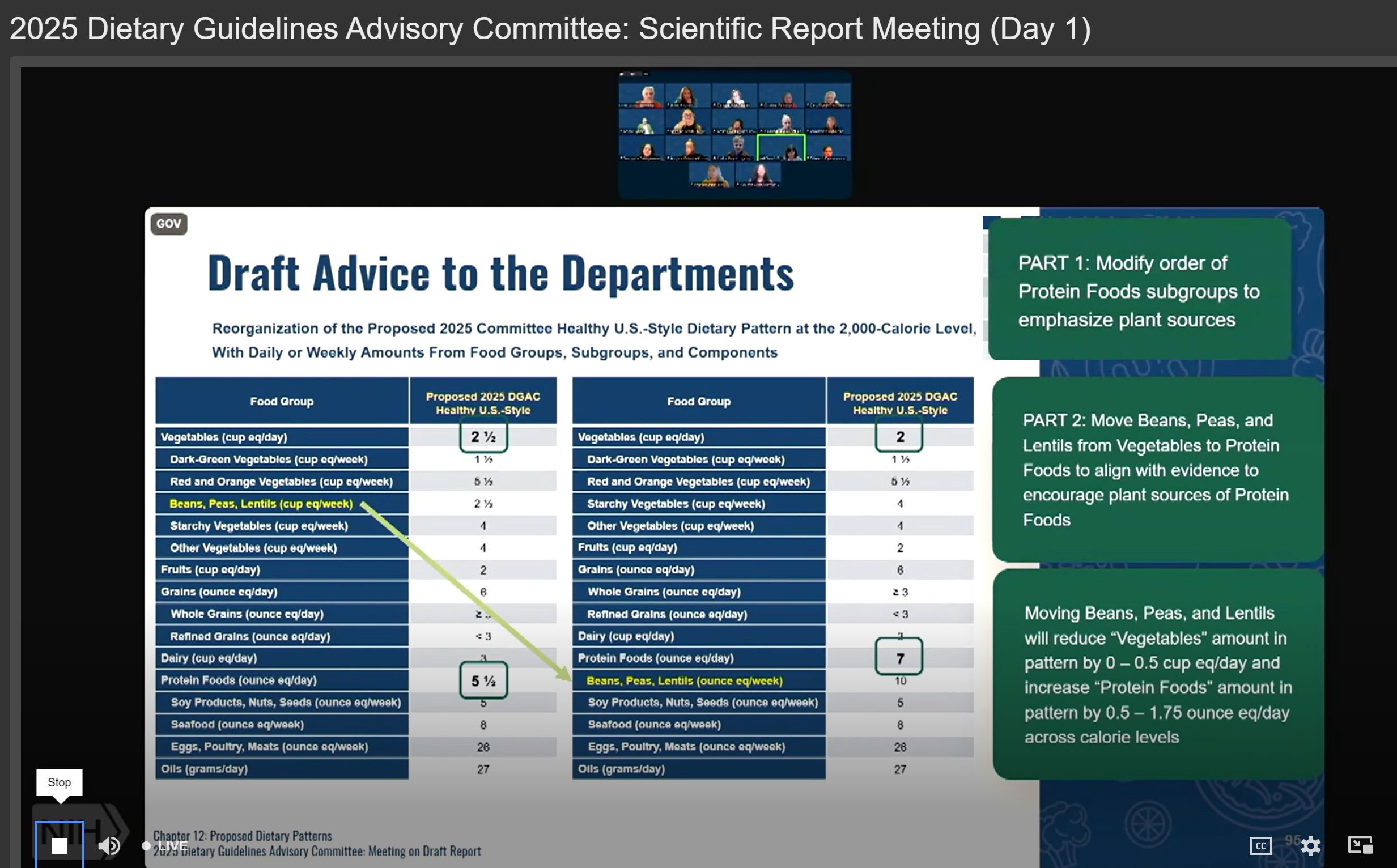
Other animal-based foods such as meat and eggs took a big hit this cycle. The 2025-30 Report uses stronger methods for discouraging consumption. They recommend moving peas, beans and lentils out of the vegetable category and into the protein category and listing them FIRST, followed by nuts and seeds, followed by seafood, then eggs, and lastly meat.

Once again ‘red meat’ is mentioned throughout the report as being lumped in with ‘processed meat’ even though not one stitch of research about negative health relationships with processed meats included any unprocessed red meat in the studies! Clearly, consumption of whole, healthy foods from cattle is in the crosshairs. This 10th edition of the Scientific Report just continues the trend. 

As in past cycles, a whole core of research on the neutral to beneficial relationships between consumption of saturated fat in high-protein, nutrient-dense foods was screened out of the DGAC’s review process by current Ag Secretary Vilsack’s USDA.

This Report essentially sets the stage for ultra-processed plant-based and bioengineered alternative proteins to play a larger role in the institutional meal preps of American schools, daycares, eldercare, and military.

But here’s the good news! The DGAC was late in finishing its 2025-30 Scientific Report!

The law requires a 60-day public comment period before USDA and HHS formulate the actual Guidelines for 2025-30. This mandatory comment period ends Feb. 10, 2025. Comments can be made at the Federal Register link at https://www.regulations.gov/document/HHS-OASH-2024-0017-0001

By the time the comment period ends, Vilsack and company will have left town. Let’s hope Senators confirm Trump appointees before the public comment period ends on Feb. 10 so their eyes are on this before the bureaucracy finishes the job.

This is a golden opportunity for the dairy and livestock sectors, along with health and nutrition professionals and health-conscious citizens to weigh-in. (Look for ways to participate in a future Farmshine.)

Meanwhile, commenters can remind the incoming Secretaries of how flawed the DGA process has become; how Americans, especially children, have become increasingly obese with increasing rates of chronic illness and underconsumption of key fat-soluble nutrients during the decades of the DGA’s increasingly restrictive anti-fat, anti-animal dogma.

Commenters should point out the fact that the Committee was not provided with all of the evidence on saturated fat. This is a message that is likely to land well with USDA Secretary designate Brooke Rollins and HHS Secretary designate Robert F. Kennedy Jr. In fact, RFK Jr. is on record opposing the low-fat dictates and has said nutrition will be among his first priorities, if he is confirmed by the Senate for the HHS post.

FDA’s final rule on ‘healthy’ labeling

In the mad rush at the end of 2024, the FDA released its final rule about using the term “healthy” on the label of foods and beverages.

This process was outlined in the White House National Strategy on Hunger, Nutrition and Health. FDA’s preliminary ‘healthy’ labeling rule was released on Sept. 28, 2022, on the first day of the first White House Nutrition Conference since the 1980s.

At that Conference, Ag Secretary Vilsack said: “The National Strategy’s approach is a whole of government approach that involves the entire federal family.” And President Biden said: “We have to give families a tool to keep them healthy. People need to know what they should be eating, and the FDA is using its authority around healthy labeling so you know what to eat.”

In short, the FDA’s role here is to restrict healthy label claims to foods and beverages that meet its criteria and allow them to also use a new FDA ‘healthy’ symbol that is still under development.

“Nutrient-dense foods that are encouraged by the Dietary Guidelines – vegetables, fruits, whole grains, fat-free and low-fat dairy, lean game meat, seafood, eggs, beans, peas, lentils, nuts, and seeds – with no added ingredients except for water, automatically qualify for the ‘healthy’ claim because of their nutrient profile and positive contribution to an overall healthy diet,” the FDA final rule states.

No surprise that whole milk (3.25% fat) will not qualify, nor will real full fat cheeses, yogurts, and other dairy foods that are not fat-free or low-fat (1%). Natural, unprocessed beef, pork and poultry are off the ‘healthy’ list too.

Specifically, the FDA’s final rule states: “To meet the updated criteria for the ‘healthy’ claim, a food product must: 1) contain a certain amount of food from at least one of the food groups or subgroups (such as fruit, vegetables, grains, fat-free and low-fat dairy and protein foods) as recommended by the Dietary Guidelines for Americans, and 2) meet specific limits for added sugars, saturated fat, and sodium. 

The fat and sodium criteria are a double-whammy against most real dairy cheeses. A single 1-oz slice of American, Swiss, or Cheddar won’t make the cut on saturated fat or sodium; even part-skim Mozzarella is slightly over the limit. Furthermore, low-fat, high-protein cottage cheese barely makes the cut on saturated fat, but far exceeds the new limit on sodium. Likewise, a typical yogurt cup only qualifies if it is low-fat or non-fat, and fruited yogurts must steer clear of added sugars.

Dairy can’t win in this labeling scheme unless products are made with virtually no saturated fat and far less sodium. To sell flavorless cardboard and chalk water that fails to deliver key fat-soluble nutrients, products will undergo more ultra-processing, and Americans will consume more artificial sweeteners.

Under dairy products, FDA’s final rule for ‘healthy’ label claims states: 1) Must contain a minimum of 2/3 cup food group equivalent of dairy, which includes soy; and 2) Each serving must have under 2.5 g of added sugar, under 230 mg sodium, and under 2 g saturated fat.

This means even a serving size of exactly 2/3 cup (6 oz) of 2% milk might barely squeak by, and a full cup (8 oz) of 1% or fat-free milk would be – you guessed it – ‘healthy’. Flavoring the fat-free and low-fat milk will not qualify, except by using artificial sweeteners to stay within added sugar limits.

Under protein foods, the FDA is even more restrictive. The only protein foods listed in the ‘healthy’ labeling final rule are: game meat, seafood, eggs, beans, peas, lentils, seeds, nuts, and soy products. Furthermore, these options must meet the criteria of less than 1 g added sugars, less than 230 mg sodium and less than 1 to 2 g saturated fat.

But here’s the good news! This FDA final rule (21 CFR Part 101, RIN 0910-AI13) falls under the Department of Health and Human Services (HHS). It’s not likely to sit well with HHS Secretary designate RFK Jr. The rule becomes effective Feb. 25, 2025. The compliance date is three years later, so there is hope of requesting HHS initiate a new rulemaking process under new HHS leadership.

Bottom line is all three of these bad nutrition policies impact consumer health and dairy farm economic health and are rooted in the flawed Dietary Guidelines process.

There is good news on that front in Congress as well. House Ag Committee Chairman GT Thompson included DGA reform and oversight in the farm bill that had passed his Committee in the 2023-24 legislative session. It is critical that this issue be part of the new farm bill that moves forward in the 2025-26 legislative session.

Part II in a future Farmshine will look at the tumultuous 2024 dairy markets and margins spilling over into 2025.

-30-
‘Stop feeding us lies’ say protesters as Dietary Guidelines Committee unbelievably doubles down against animal fat, protein

Dietary Guidelines have most negatively impacted children and youth.

Dietary Guidelines Advisory Committee holds final meeting. Draft recommendations include: Reductions in total protein; Less protein from animals, more from plants; Dairy emphasis still low-fat, non-fat; Implementation recommendations include food supply leverage

By Sherry Bunting, Farmshine, October 25, 2024

WASHINGTON, D.C. – This week is National School Lunch Week, and on Oct. 22 while USDA Secretary Tom Vilsack kicked off the so-called “largest federal-led summit in support of healthy school meals” in Las Vegas, the 2025-30 Dietary Guidelines Advisory Committee (DGAC) met publicly by zoom to gamble away the nutrients children need for the development of their brains, bodies and long-term health.

This was the seventh and final meeting of the DGAC after 22 months of subcommittee meetings and periodic full committee meetings, yielding a draft “scientific report” that is increasingly vegetarian.

Its recommendations to USDA and HHS are to develop 2025-30 Guidelines that significantly decrease the role of nutrient dense animal foods, even though they spent the first hour of the 12-hour, two-day virtual meeting puzzling over how to solve the nutrient deficiencies in their analysis.

The recommendations merge the three current DGA patterns (Vegetarian, Mediterranean and Healthy U.S.) into one dietary pattern with a draft name of “Healthy Flex U.S. Diet.” The flexibility part, according to the DGAC discussion, is the ‘how much’ and ‘how to’, which relies on ‘food pattern modeling’ and more specific strategies on how to replace animal based foods with plant based foods. 

The DGAC aims to improve its poor performance on the under-consumed nutrients by “including more nutrient-dense plant-based meal and dietary recommendation options” in its advice for 2025-30 Dietary Guidelines. 

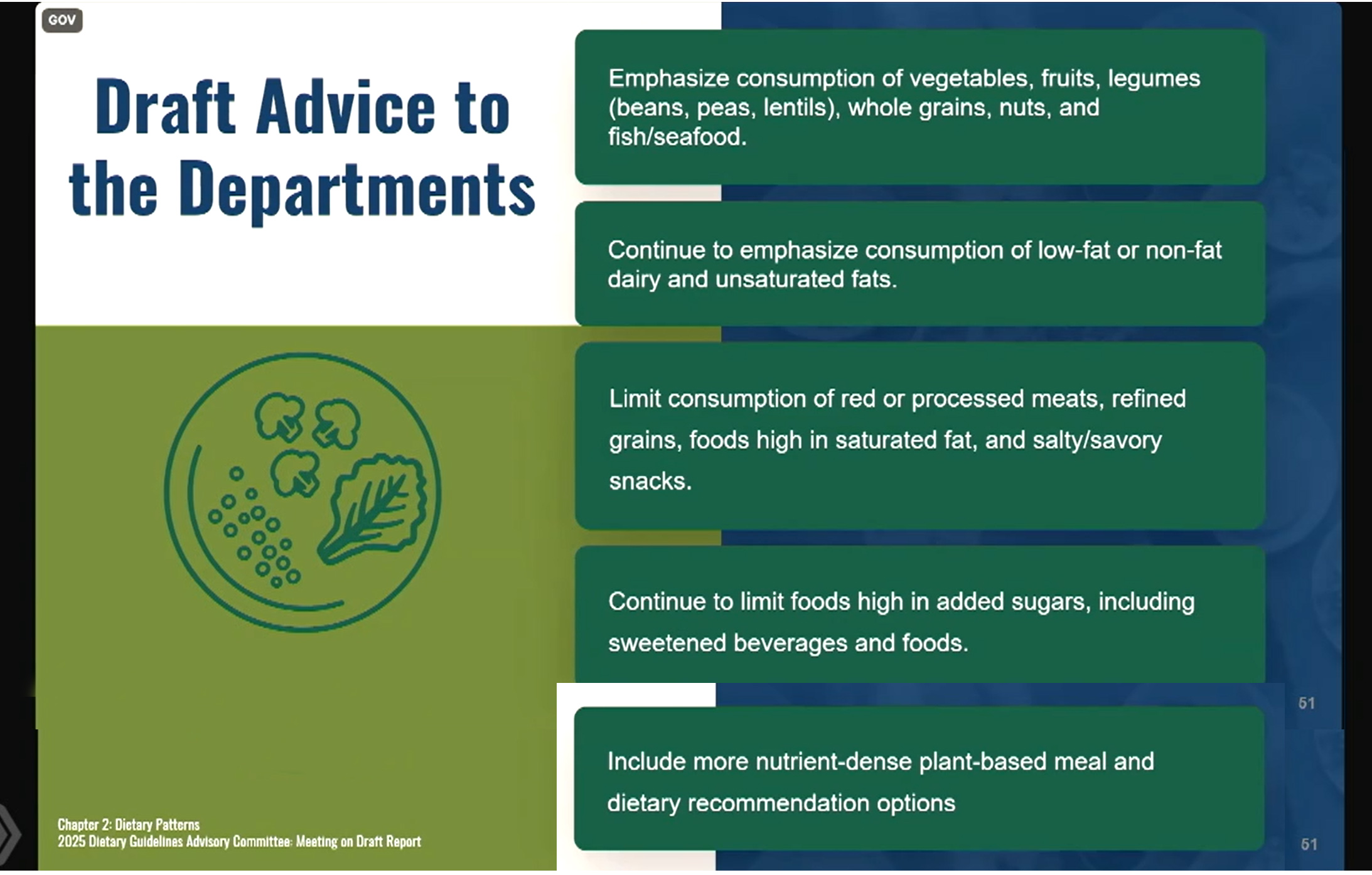
The draft advice aims to continue to “emphasize consumption of low-fat or non-fat dairy and unsaturated fats; limit consumption of red or processed meats and foods high in saturated fat; and limit foods like sweetened beverages.”

Some committee members raised the concern that further addressing one problem (fat, salt, and sugar) leads to other problems in other areas (under-consumption of key nutrients, over-consumption of carbohydrates, and impacts on metabolic health). 

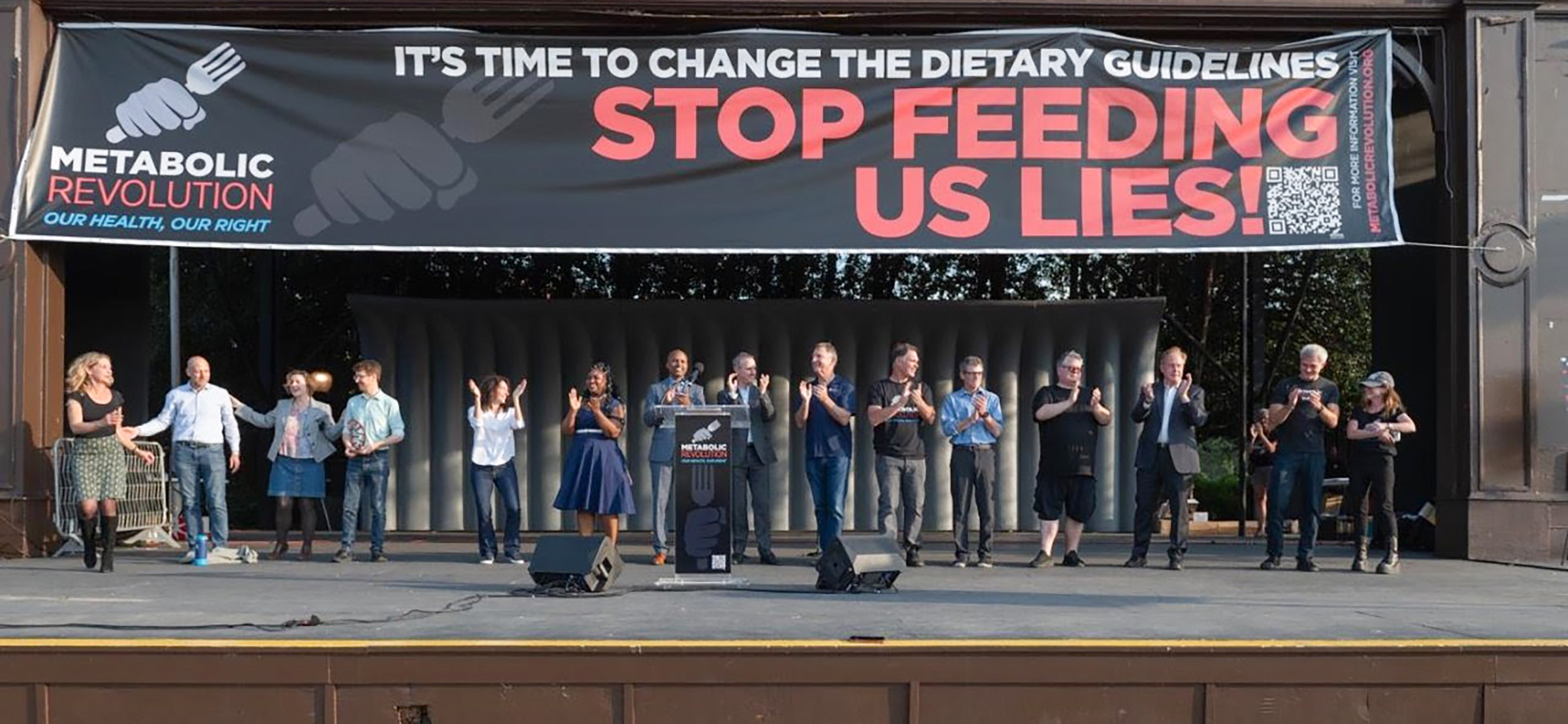
In fact, a week before the DGAC met, the first ever Change the Dietary Guidelines protest drew hundreds of people to the nation’s capitol — with Nina Teicholz, author of Big Fat Surprise, as emcee. It was organized by Metabolic Revolution with the mission of asking the Administration to “STOP FEEDING US LIES.”

Nutrition Coalition photo

Meanwhile, in the DGAC meeting, at least one member at the end of the first day noted how animal foods, specifically mentioning dairy, have all of these essential nutrients and that the bioavailability of the nutrients is important.

This didn’t make much difference. On the question of saturated fat restrictions, the 2025-30 DGAC doubled-down. These restrictions began with the first edition in 1980, and the quantitative recommendation of “limit saturated fat intake to less than 10% of calories per day starting at age 2 and replacing it with unsaturated fat, particularly poly-unsaturated” began in 2005.

The Committee’s biggest justification was that, “This has been confirmed by several previous DGACs based on the relationship between saturated fat intake and cardiovascular disease risk.” Basically saying it has been previously decided, and “we’re sticking with it.” Essentially, all evidence to the contrary was again ignored.

The Committee stated that only 1 in 5 Americans implement this limitation; so, food replacement strategies, cultural diet pathways, and diet simulations were recommended to show how to get more nutrient density from plant sources. Pre-packaged and pre-portioned implementation strategies and plated combinations of plant-based meals are suggested as ways to ensure nutrients without the fat.

This high-level academic exercise means very little to everyday Americans making choices about food, but it could fundamentally change what is available to choose from — if the “systems science, implementation science, and behavioral science” the DGAC is also recommending pushes diets even more toward highly processed, pre-packaged, pre-portioned options designed by global food giants.

Bottomline: the DGAC will recommend to the USDA and HHS to further reduce animal-based protein consumption and to further increase plant-sourced consumption in the 2025-30 Guidelines, while continuing to limit dairy to non-fat and low-fat options.

For dairy, the DGAC is also recommending that USDA update nutrition composition and dairy reference guides to reflect what they say are ‘improved’ plant-milks, and to use ‘diet simulators’ to show Americans how to be more ‘flexible’ in replacing animal foods with plant foods.

The DGAC also changed the wording of its 2025-30 mission to “reduce the focus on chronic disease risk reduction, to instead focus more on promoting growth and development and improving the healthspan.”

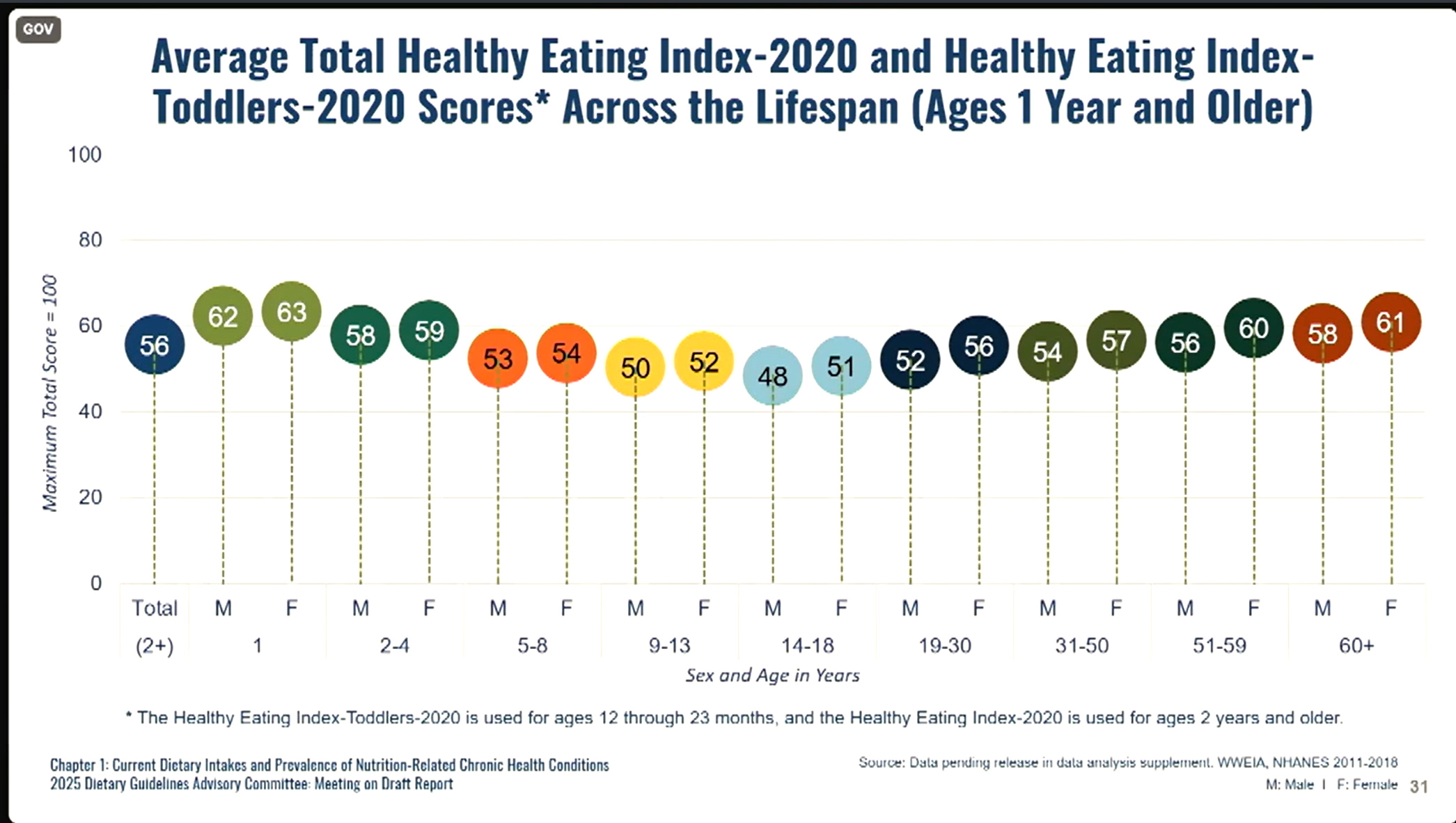
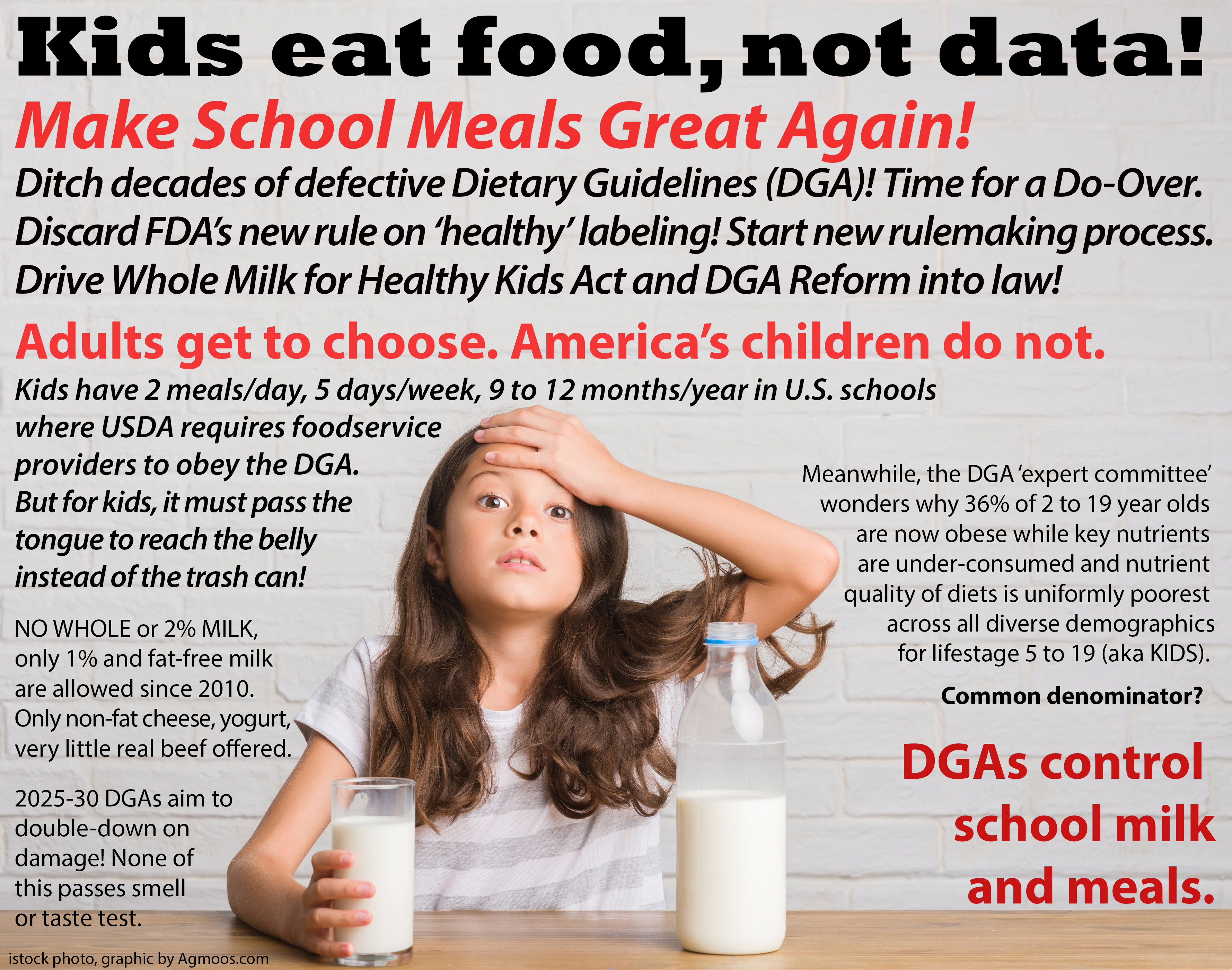
These are key takeaways despite the Committee spending the first hour of the first day stupefied by the analysis showing — uniformly across all socio-economic and cultural demographics — children ages 5-19 had the nutritionally poorest diets in terms of under-consuming key nutrients at this most critical lifestage.

Even when they picked up their Health Equity Lens to look at the data, it was uniformly bad.

The DGAC could not understand why the healthy eating index showed such uniformly poor performance in the under-consumption of key nutrients, especially among children ages 5 to 19 across all populations. (Simple. It’s because the anti-fat DGAs are enforced at school meals twice a day, five days a week, most of the year for this life stage. Kids do not get to choose; adults do.) Oct. 21 screenshot DGAC meeting 

Their interpretation? I will paraphrase: Parents need help understanding how to feed their children.

My interpretation? The Dietary Guidelines are, themselves, the problem because they are used rigidly to formulate the meals that the age 5 to 19 lifestage (kids) are presented with twice a day, five days a week, nine to 12 months of the year – at school! The body will keep snacking until it gets the nutrients it seeks. 

“Obesity is a major public health issue, impacting 36% of children ages 2 through 19 years and 41% of adults ages 20 and older,” according to the DGAC.

However, by the end of the two days, the DGAC showed it would stay on the anti-fat path and give USDA and HHS the “expert” advice to double-down on saturated fat restrictions that have prevailed over the years while Americans become less healthy, more obese, with more chronic disease, at ever younger ages. Do they not wonder why this was not the situation pre-Guidelines? So much valuable research on saturated fat and health was again left off the table.

One of many draft advice slides for 2025-30 Dietary Guidelines emphasizing non-fat and low-fat dairy and unsaturated fats; addressing nutrient density by increasing plant-based meal options and decreasing animal-based. Oct. 21 DGAC meeting 

Impacts of the DGAC draft report on Dairy:

1) Dairy’s ‘place’ in the diet remains somewhat intact, but the committee advises things like not referring to soy milk as an “alternative” because it is part of the dairy grouping. They also are questioning if ‘Dairy’ is the right term for the Dairy group. The DGAC also will advise USDA to update nutrient composition and daily reference amounts to reflect the current state of nutrition art in “plant-milks” and to use diet simulations to show Americans how to be more flexible in replacing animal-based with plant-based.

2) Nonfat and low-fat dairy will continue to be the recommendation (3 milk cup equivalents), although they mentioned that there was not enough evidence to make this a strong conclusion for ages 2 through 5. Perhaps this leaves a door open for daycares and WIC to expand to 2% and whole fat milk up to age 5 instead of the current age 2, but schoolchildren are still out of luck. Dairy fat and butter were mentioned as being consumed mostly in processed foods.

3) The Protein category has been flipped on its lid. The DGAC moved beans, peas and lentils from the vegetable category to the protein category and increased the daily quantities for beans, peas, lentils, seeds, soy, nuts, and fish, while reducing the allowance for meat, poultry and eggs. In fact, they will represent this visually by listing first in the protein category the plant sources, followed by fish, then eggs, then poultry, and lastly, red meat. The DGAC pointed to the dairy group as a source of protein that is not in the protein group, so protein level importance in plant-based comparisons can be reduced. (Several Committee members indicated their belief that Americans consume too much protein, so they wanted to show these crossovers differently.)

4) The additional considerations chapter is of particular concern for the future, advising USDA and HHS to: a) Encourage shifts to nutrient-dense plant-based meals; b) Put stricter limits on foods and beverages high in added sugars, sodium, and saturated fat; c) Use sugar limitations to exclude foods from the dietary pattern (with implications for flavored milk and dairy products); d) Make sodium reduction targets mandatory not voluntary (may impact the cheesemaking process for schools and other institutional feeding); e) Avoid referring to soy milk as “alternative”; Research name change for Protein group and determine if ‘Dairy’ is the right term for the Dairy group.

This draft report ends the DGAC’s work. In the coming days, it will be edited to reflect the discussion for submission as final recommendations to USDA and HHS.

A joint team of staff from both Departments will prepare this DGAC Scientific Report for posting at DietaryGuidelines.gov, along with data analysis, food pattern modeling and other supplemental documents. 

USDA and HHS will then open a new public comment period.

In 2025, the Secretaries of USDA and HHS (whoever they end up being), along with their joint team, will review the DGAC scientific report and the public comments to develop the actual 2025-30 Dietary Guidelines for Americans.

Expect these DGAs to continue most negatively impacting America’s schoolchildren and elderly in senior centers where meals must follow them.

However, it will have some impact on all of us if the Departments use the DGAC recommendation to implement food system science at the food supply level. We can already see what happens to choices for consumers and markets for farmers when the middlemen decide what can be put on grocery store shelves or in the dairy or meat case.

Not only did we not see a serious effort to address the need for more nutrient dense foods in the dietary pattern, the new pattern will double-down against saturated fat, along with salt and added sugar, and erode protein levels, while continuing to search for the missing nutrition profile of its increasingly vegetarian recommendations. 

None of this passes the smell test, and likely not the taste test. Kids eat food not data. Nutrients must pass the tongue to reach the belly. Look for more on that in terms of action next week from the Grassroots Pennsylvania Dairy Advisory Committee and 97 Milk.

***

Additional information:

In its report, The Nutrition Coalition notes: “The collective shift toward emphasizing more plant-based foods has lowered the quality and quantity of protein in our diets. It is time to pause and question whether these changes are endangering health in the U.S., especially among children and the elderly. Still, with plant-based advocates dominating the public comments, plant-based industries and interests lobbying the USDA, and plant-based proponents on the expert committee itself, we may see further reductions of this important macronutrient in the 2025 Dietary Guidelines.”

Nina Teicholz, Ph.D. explains that these draft recommendations “fly in the face of our knowledge that plant proteins are of lower quality than animal proteins. With the exception of soy, all plant proteins lack all the necessary amino acids to make muscle tissue (as well as perform other critical functions in the human body). Reducing the total amount of protein and replacing animal proteins with plant proteins are both harmful changes. These alterations will mean that anyone receiving USDA-funded meals, such as kids consuming school lunches, the women and infant children on the WIC program, and the elderly will receive fewer complete proteins. Also, reductions in meat, dairy and eggs are sure to exacerbate nutritional deficiencies in the guidelines, which currently fail to meet basic targets iron, vitamin D, vitamin E, choline, and folate. The Dietary Guidelines are already deficient in complete proteins. The erosion of protein in the guidelines has been happening for decades, as we wrote about in this post.”

-30-

How will fake milk, fake meat be labeled and regulated?

Say, what? New twist on standards of identity: How will fake milk and fake meat be labeled and regulated?

cows.jpg

In a time when many people have lost their connection to the values and sustainability of the circle of life, cattle have been getting an undeserved bad rap on everything from diet to environment to compassion. On all three counts, the anti-animal agenda lies behind the false narrative that is leading us down a dishonest path to more fake concoctions of ill-fated science fueling profits at the expense of our physical and emotional health and the health of the planet. Fake meat and fake milk are funded by billionaires, genetically engineered by USDA, initiated as the brain children of Silicon Valley techies, with partnership from the biggest names in corporate agriculture. Noble goals of ending hunger are the defense, but it’s difficult to believe that when we have surplus dairy and meat protein produced naturally with the real problem of hunger coming down to distribution and waste. This so-called solution has the potential to quietly dictate food choices, markets and livelihoods.

By Sherry Bunting, updated since first published in Farmshine, November 21, 2018

WASHINGTON, D.C. –  “Dairy reinvented: Sustainable. Kind. Delicious,” is the tagline of Perfect Day’s website.

“Better meat, better world” are the words that jump from the Memphis Meats website.

To be more specific, Perfect Day’s mission is to “create a better way to make dairy protein, the same nutritious protein found in cow’s milk…without the help of a single cow.”

Meanwhile, at Memphis Meats, their mission is “To bring delicious and healthy meat to your table by harvesting it from cells instead of animals… feel good about how it’s made because we strive to make it better for you… and the world.”

On the fake meat side, Memphis Meats received Series A funding from four sources in August 2017: venture capitalist DFJ, billionaire investors Bill Gates and Richard Branson, and Cargill. In January of 2018, Tyson came on board as an investor.

On the fake dairy side, Perfect Day received its Series A funding from Singapore and Hong Kong venture capital and investment companies that have relationships with some of the largest food and beverage companies and brands in the world, according to a company news release. In addition, Continental Grain was part of the early investment, and in November 2018, Perfect Day announced a partnership with Archer Daniels Midland (ADM).

The big question, at present, is how will these proteins be regulated and labeled?

The discussion is converging with FDA’s nutrition innovation strategy and modernization of standards of identity (especially dairy standards of identity), along with parallel hearings and comment periods on how to regulate and label the ‘meat’ version of lab-created cellular proteins.

Make no mistake about it folks: Both of these processes involve genetic engineering start-to-finish.

Perfect Day (fake milk protein), for example, sources yeast from USDA research labs that has been “genetically-altered” to include bovine protein stimulators and synthesizers.

Memphis Meats (fake meat) uses animal cells, mainly bovine and poultry, from cell banks that have been edited to grow only desired muscle cells — separate from their whole-animal source.

The fake dairy protein would be the end-product of the fermentation of the genetically-altered yeast, while the fake meat protein would be the protein blobs that grow from the genetically-edited cells, using neonatal bovine serum — or a plant chemical substitute that is under development — as a growth “on” button.

Both systems would require energy feed sources, using a sugar and/or starch substrate to feed the growth.

Both processes would produce waste streams.

The dairy version are grown in fermentation vats. The meat version in bioreactor towers.

While opinions vary on how quickly these technologies can scale, it is clear that the technologies are well-funded, and that agriculture’s top-tier food supply-chain processors and distributors are partnering.

We must continue to let FDA and USDA know what farmers and consumers — the two ends of the supply chain that need to be talking to each other — feel about the potential of these technologies to create captive-supply market control using interchangeable proteins in common manufactured dairy products or as protein enhancements for plant-based beverages, as well as to stretch boneless beef and poultry products with fake counterparts, namely as ground beef, hamburger, meatballs and chicken tenders and nuggets.

In a press release Friday, November 16, the U.S. Food and Drug Administration (FDA) and U.S. Department of Agriculture (USDA) announced that they will “jointly oversee the production of cell-cultured food products derived from livestock and poultry.”

There has been no similar FDA PMO-regultory process established for the fake milk proteins.

USDA and FDA had a public meeting in July and October to discuss the use of bovine and poultry “cell lines” to develop these cell-cultured, lab-created foods.

In fact, meat industry stakeholders shared their perspectives on the regulation that is needed to “foster these innovative food products and maintain the highest standards of public health,” said FDA commissioner Scott Gottlieb in an official FDA statement in November.

USDA and FDA announced their “agreement on a joint regulatory framework wherein FDA oversees cell collection, cell banks and cell growth and differentiation. A transition from FDA to USDA oversight will occur during the cell harvest stage. USDA will then oversee the production and labeling of food products derived from the cells of livestock and poultry.”

As FDA and USDA are “actively refining the technical details of the framework,” some of the aspects of the framework are said to include robust collaboration and information-sharing between the two agencies to allow each to carry out our respective roles.

The well-funded startups and their lobbying organization Good Food Institute (a misnomer in this author’s opinion) had pushed for FDA to control labeling and inspection knowing that if USDA were in charge, their efforts to scale production would be slowed.

In view of this joint approach between FDA and USDA, the original public comment period about cell-cultured ‘meat’ had been extended to December 26, 2018. Comments can be seen at the FDA docket at https://www.regulations.gov/document?D=FSIS-2018-0036-0001  and there are thoughts that this comment period could be extended again as has the dairy standards of identity comment period.

Meanwhile, on the lab-created ‘dairy’ protein front, Perfect Day, a Silicon-Valley startup, announced in a press release in November that it has formed a partnership with ADM, an agricultural processor and food ingredient provider with a mission of plant-to-plate collaboration throughout the food industry.

In fact, ADM will provide facilities for scaling this technology as part of the deal.

This partnership is billed as “teaming up” to begin supplying “the world’s first animal-free dairy proteins to the food industry in 2019,” according to Perfect Day.

“Animal-free dairy proteins will not only offer consumers the option to have a lactose-free, animal-free alternative to conventional animal-based dairy, but also provide a portfolio of nutritious and functional, high-purity proteins with similar taste and nutrition profile of dairy proteins for a wide range of food and beverage applications,” Perfect Day said in their press release.

Meanwhile, the FDA has extended — yet again — its invitation for information specifically on “the use of names of dairy foods in the labeling of plant-based products.” So far, 10,043 comments (as of December 28, 2018) have been received on this docket. To comment by the new deadline of January 28, 2019, go to the docket online at https://www.regulations.gov/docket?D=FDA-2018-N-3522.

Dairy checkoff-funded DMI completed a survey of consumers recently showing that 73% are confused about the differences in nutrition between real dairy milk and plant-based alternatives calling themselves ‘milk.’

Other surveys show that more than half of U.S. consumers want healthy foods with ‘clean’ labels having few ingredients and limited or no processing.

It would seem that these findings, among others, would indicate clearly to FDA and USDA that consumers want no more monkey-business when it comes to their food, that they want to see clarity in the enforcement of milk and dairy standards of identity, and that they want to be informed about look-alike ingredients made in laboratories instead of in the time-honored land-and-animal care-taking profession of dairy and livestock farmers and ranchers.

One thing to keep in mind when commenting is to highlight the fact that over half of U.S. consumers want food that does not have a long list of additives and that is minimally processed.

That, on top of nutritional differences and new unproven processes, are enough reason to aggressively label any food containing either the fake dairy or fake meat protein because standards of identity are in place not just for health and safety but also to prevent fraudulent misleading of consumers.

Consumers should know what they are buying and be able to choose food based on their beliefs about what is a better world, not someone else defining what is kind and good and sustainable for them and not using the government’s currently flawed dietary guidelines to decide for consumers what is deemed “healthy.”

Let FDA and USDA know that we as consumers and farmers want clear labeling if these technologies are going to scale into our food system. We want the fake versions to have all of the inspection rigor that real dairy and meat proteins are subjected to.

Above all, we do not want the government quietly removing — via its one-size-fits-all nutrition innovation strategy — our ability to choose foods and production methods with which we want to nourish our bodies and on which we wish to spend our hard-earned money.

This may come down to a battle between fake animal protein ingredients funded by billionaires aligned with Silicon Valley startups and partnered by the biggest names in corporate agriculture vs. a collaboration between individual farmers and ranchers who are the backbone of our nation, the stewards of land and livestock, along with the public at-large, the consumers who are confused by the lines that are blurring.

Now, more than ever, both ends of the supply chain — farmers / ranchers and consumers — need to engage with each other directly — and not through the industry-scripted mouthpieces.

Stay tuned.

-30-

Comment period for milk, dairy identity ends 8/27. Part 2 of 7/26 hearing right here

iStock-544807136.jpgBy Sherry Bunting, from Farmshine, August 17, 2018

WASHINGTON, D.C. – There are 10 days remaining for public comment on FDA standards of identity for milk and nearly 80 other dairy products, along with the other aspects at stake as FDA launched its Nutrition Innovation Strategy to determine – and stamp – healthy choices for consumers while taking steps to “modernize” standards of identity to “achieve nutritional goals.”

The daylong FDA hearing on July 26 was one of several relating to these issues on the FDA docket, and as previously reported in Farmshine, dairy has taken center stage for several reasons.

First, Scott Gottlieb, head of the FDA, responded to calls for FDA to take a closer look at the dairy industry standards of identity, especially for milk. He opened the hearing saying that the agency must first determine “how consumers understand and use the term ‘milk’ to know if the inherent differences between these products is well understood by consumers so we can understand how consumers are being misled.”

The public comments being received by FDA through August 27, are the first step in its multi-faceted approach.

Individual comments on any of these converging standards of identity issues and the Nutrition Innovation Strategy can be sent to FDA prior to the Aug. 27, 2018 deadline at the docket portal here.

Or, send to: Dockets Management Staff (HFA–305), Food and Drug Administration, 5630 Fishers Lane, Rm. 1061, Rockville, MD 20857. 

The second aspect of this brief comment period is to discuss the standards of identity more broadly.

“We want to hear about changes in science to review and update,” said Gottlieb. “We are hearing the standards of identity can cause the food industry to avoid reformulations that would reduce fat and calories. We want to gather this input and encourage out-of-the-box thinking with the bottom line helping consumers to identify healthier options.”

We covered some of the testimony at FDA’s July 26 listening session in Part One in Farmshine, Aug. 10, 2018.

Here, in Part Two, published in Farmshine August 17, 2018, are more of the elements from that hearing that are so important to know and understand…

Of particular interest on dairy product standards of identity were the hearing comments by Cary Frye, senior vice president of regulatory affairs for the International Dairy Foods Association (IDFA). She commended Commissioner Gottlieb for undertaking the Nutrition Innovation Strategy “to improve nutrition and health.”

While absolutely silent on enforcement of milk’s standard of identity, despite representing the nation’s milk and dairy food processors, Frye said, “the key area we are working on is to modernize the standards of identity for dairy products, which make up more than one-third of the 280 standards of identity currently on the FDA books.”

She said these standards “are outdated and stand in the way of innovations and novel processes. Current systems are not working and definitely need to be reformed.”

Frye noted that the cheese standards have been unchanged while ultrafiltered milk processes have been around for 20 years. “Clearly a new approach is needed for processes like this to be used to create new and healthful products.”

She said “processing milk by filtration to concentrate proteins and remove lactose is embraced around the world, but these new processes are not permitted in our dairy products with the current standards.”

Frye did, however, thank the FDA for what she described as FDA’s “recent guidance allowing ultrafiltered milk as an ingredient for cheeses.”

“But the agency needs to go further and make dairy a top priority for modernized standards of identity,” said Frye on behalf of IDFA. “We must incentify innovation. We can’t make these investments if we must petition for standards that take decades to complete.”

Along with standards, FDA wants to modernize label claims as a key element of the nutrition innovation strategy, to give consumers “quick signals” with important information on the nutritional benefits of food choices.

A key question FDA is looking at is: What claims best stimulate innovation to create products that are better choices?

Speakers at the hearing identified food trends, saying consumers are committed to a more balanced approach between nutrition and function, but also the idea of food, that it is part of how they experience life, with taste becoming more important to consumers than nutritional profile as they move away from “lowfat” foods.

(Unfortunately, this FDA strategy has not yet acknowledged there are health-related and nutritional reasons for consumers to move away from “lowfat” dogma of the past 30 to 40 years. My comment to the FDA docket will include sending by mail, a copy of The Big Fat Surprise, by Nina Teicholz, who will join me in sending copies of this book to FDA?)

As in many of these discussions, the generational shifts in food trends and choices are the most noticeable. Hearing presenters noted that millennials are pursuing “clean eating and natural foods” as more important than a nutrition-based label.

With that in mind, upholding and enforcing the current standards of identity for milk and dairy products becomes important since it is simple compared with concocted imitation formulations with long lists of ingredients unable to provide all of the nutrition milk has – naturally.

Hearing presenters also acknowledged that the declines in consumption of meat and dairy over the past 40 years have just begun to “shift back the other way.” People are returning to the fresh perimeter of the grocery store.

(Again, no mystery here, FDA needs to read the book: The Big Fat Surprise)

With millennial food choices driven by a so-called “return to purity,” my thoughts as I listened to the July 26 FDA Nutrition Innovation Strategy hearing is this: Will FDA move incrementally toward giving consumers what they want, while slipping into that desired food the science and innovation the FDA and food industry believe consumers need… in order to “get” the FDA ‘healthy choice’ stamp – however that is ultimately defined in this multi-year strategy and however it is ultimately designed for packaging?

These are big things to watch and participate in.

This is not to say that some new standards aren’t needed. Rob Post for Chobani, testified that they produce a nutrient dense, healthy, strained Greek yogurt, but because no standard of identity exists for this type of yogurt, they are challenged to have standardized nutrition profiles “that account for the 52% protein content in Greek yogurt” when used in institutional feeding programs like the National School Lunch Program.

“Today’s consumers have evolving demands and a new set of food values,” said Post. “Health is important, but so are other values and drivers.”

Others noted that the current standards of identity “do not allow lower salt content for cheese.”

This could be an issue when it comes to nutritional cheese getting a ‘healthy choice’ FDA stamp in the future, if such stamps are based on what are now questionable low-salt directives for healthy eating.

“Standards are important because they assure the consistency of the product, its authenticity and nutrition,” said Post.

Laura MacCleery, Policy Director, Center for Science in the Public Interest testified that, “Americans overconsume saturated fat.” They are among the contingent of wanting to work on labeling to steer consumers away from saturated fat.

Meanwhile, the American Heart Association testified to FDA that they want the standards of identity “modernized to improve the nutritional value of food by reducing both sodium and saturated fat.”

On the flipside, members of the dairy processing industry said they are looking for standards to be modernized to abolish the milk fat minimums and allow lower sodium on natural cheeses that currently have rigid standards of identity. Dairy processors testified that this is necessary to conform to the nutritional focal points of this discussion – salt and fat – that are still based on current dietary guidelines.

Will FDA grant these wishes and will we see lowfat and low salt cheeses introduced as “the real thing” because the standard has changed based on a dietary guideline many in the scientific community are already saying is a flawed guideline?

You can see the intertwined dilemma this FDA Nutrition Innovation Strategy could spawn.

Taste is king, according to the food processors speaking about low salt claims. They said they go ahead and formulate low salt varieties, they just are not always advertising it on the packaging space.

Will modernization of standards of identity low-salt and low-fat our food – our cheese for example — without our knowing it or being able to choose? Do we care if that happens as long as it tastes good? And how is that happening? With milk protein concentrates, given FDA’s already loosened grip on allowable ingredients in cheese standards of identity?

A representative for Great Lakes Cheese spoke up to say that, “Consumer transparency around label claims and that presents a huge consumer perception issue. We are interested in experimenting to reduce sodium in cheeses, but without having to put a flag saying so on our product.”

Without a change in standards, a low salt or low fat cheese would have to be labeled that way. If the fat and salt standards are abolished, no ‘flag’ is needed and consumers won’t know the fat or salt is lowered – it just may taste different.

One question asked was “If our goal is to impact consumer behavior, how do we empower consumers to look for better choices by looking to the nutrition facts instead of making changes to do it for them (with modernized standards and healthy-choice stamps)?”

Part of this process is FDA’s work to “update” the definition of “healthy” as a “voluntary” claim. What kind of symbol should be used, should it be by food group.

“What’s healthy and not healthy shifts over time, and it’s not the same for everyone. If you’re putting a stamp on something today, you may have to take it off at some time down the road,” said one hearing participant.

Dieticians were on the side of “one size doesn’t fit all” when it comes to using FDA-sanctioned ‘healthy’ stamps or symbols on food labels. They preferred to see a focus on foods and food patterns more than specific nutrients.

In fact, one anonymous dietician has already commented on the public document online to say they have spent 30 years with government food programs and this is his or her observation over those 30 years: “We have done a great disservice to the public in trying to get people to eat 6 to 12 servings of carbohydrates per day while subsisting on a lowfat diet.”

A participant from the Edge dairy farmer cooperative of 800 members in the Midwest (formerly Dairy Business Association Cooperative based in Wisconsin) said that, “Accurate labeling is the first step in FDA’s enforcement of existing standards for milk, cheese, yogurt. High nutrition and taste have come to be expected,” he said.

“Inaccurate labeling is not fair to farmers and their investment or to customers who may have been misled. We’re encouraged by FDA’s announcement and we encourage innovation in the dairy case to keep up with changing wants and needs with options for healthy products, but most people under-consume dairy products. We must have the flexibility to make what competes and to label innovative foods made with milk.”

-30-

A world without cattle?

GL45-Earth Day(Bunting).jpgCaption: The health of the dairy and livestock economies are harbingers of the economic health of rural America … and of the planet itself. Here’s some food for thought as we celebrate Earth Day and as climate change discussions are in the news and as researchers increasingly uncover proof that dietary animal protein and fat are healthy for the planet and its people.

By Sherry Bunting, published April 22 Register-Star (Greene Media)

A world without cattle… would be no world at all.

How many of us still believe the long refuted 2006 United Nations Food and Agriculture Organization (FAO) report, which stated that 18 percent of all greenhouse gas emissions, worldwide, come from livestock, and mostly from cattle?

This number continues to show up in climate-change policy discussion even though it has been thoroughly refuted and dismissed by climate-change experts and biologists, worldwide.

A more complete 2006 study, by the top global-warming evaluators, the Intergovernmental Panel on Climate Change, stated that the greenhouse gas emissions from all of agriculture, worldwide, is just 10 to 12 percent. This includes not only livestock emissions, but also those from tractors, tillage, and production of petroleum based fertilizers, pesticides and herbicides.

Hence, the UN Environmental Program disputed the UN FAO assertion to state the percentage of emissions from total agriculture, worldwide, is just 11%, and that cattle — as a portion of that total — are responsible for a tiny percentage of that 11%. While cattle contribute a little over 2% of the methane gas via their digestive system as ruminants (like deer, elk, bison, antelope, sheep and goats), they also groom grasslands that cover over one-quarter of the Earth’s total land base, and in so doing, they facilitate removal of carbon dioxide from the atmosphere to be tied up in renewable grazing plant material above and below the ground — just like forests do!

Think about this for a moment. The UN Environmental Program and the Intergovernmental Panel on Climate Change are in agreement that cattle and other livestock are not the problem the anti-meat and anti-animal-ag folks would have us believe. In fact, they are in many ways a major solution.

Think about the fact that man’s most necessary endeavor on planet Earth — the ongoing production of food — comes from the agriculture sector that in total accounts for just 11 percent of emissions!

Why, then, are major environmental groups and anti-animal groups so fixated on agriculture, particularly animal agriculture, when it comes to telling consumers to eat less meat and dairy as a beneficial way to help the planet? Why, then, has the U.S. Dietary Guidelines Council pushed that agenda in its preliminary report to the U.S. Departments of Agriculture and Health and Human Services, that somehow the Earth will be better sustained if we eat less meat?

They ignore the sound science of the benefits livestock provide to the Earth. In fact, it is no exaggeration to say what Nicolette Niman has written in her widely acclaimed book “Defending Beef” that, “Cattle are necessary to the restoration and future health of the planet and its people.”

Niman is a trained biologist and former environmental attorney as well as the wife of rancher Bill Niman. She has gathered the data to overturn the myths that continue to persist falsely in the climate-change debate, and her book is loaded with indisputable facts and figures that debunk the “sacred cows” of the anti-animal agenda:

  • Eating meat causes world hunger. Not true. In fact, livestock are not only a nutrient dense food source replacing much more acreage of vegetation for the same nutritive value, livestock are deemed a “critical food” that provides “critical cash” for one billion of the planet’s poorest people — many of whom live where plant crops cannot be grown.
  • Eating meat causes deforestation. Not true. Forests, especially in Brazil, are cleared primarily for soybean production. Approximately 85 percent of the global soybean supply is crushed resulting in soybean oil used to make soy products for human consumption and byproduct soybean meal for animal consumption. A two-fer.
  • Eating meat, eggs and full-fat dairy products are the cause of cardiovascular disease. Not true. Researchers are re-looking at this failed advice that has shaped 40-years of American dietary policy. Its source was the 1953 Keys study, which actually showed no causative link! Meanwhile, excessive dietary carbohydrates have replaced fats in the diet, which turn to more dangerous forms of fat as we metabolize them than if we had consumed the natural saturated fats themselves. When healthy fats from nutrient-dense animal proteins are removed from the diet, additional sugars and carbs are added and these have led us down the road to increased body mass and diabetes.
  • Cattle overgrazing has ruined the western prairies. Not true. While improper grazing can have a localized detrimental effect, the larger issue is the pervasive negative effect that is largely coming from not grazing enough cattle. Higher stocking densities that are rotated actually improve the health of grasslands. Large herds provide the activity that loosens, aerates and disperses moisture along with the nutrients the cattle return to the soil — for more vigorous grass growth and soil retention — much as 30 million buffalo and antelope groomed the prairies two centuries ago. Meanwhile, the Bureau of Land Management has favored controlled burns over grazing and is taking away land rights our federal government once shared with ranchers. BLM reductions in allowable stocking densities have initiated a land-grabbing cycle of ranchers losing their land and livelihoods while the land is robbed of its benefits.

The anti-animal agenda continues — groundless, yet powerful. Rural economies, farm families, consumers and the Earth pay the price.

The majority of the lifecycle of supermarket beef and dairy products is rooted in grooming the grasslands and forage croplands that are vital to the Earth and its atmosphere. In addition, farmers and ranchers reduce tillage by planting winter cattle forage to hold soil in place, improve its organic matter and moisture-holding capacity, provide habitat for wildlife while providing temporary weed canopy between major crop plantings. Not only do cattle eat these harvested winter forages, they dine on crop residues and a host of other food byproducts that would otherwise go to waste.

Our planet needs livestock and the farmers and ranchers who care for them. They not only feed us — with more high quality dietary protein with all of the necessary amino acids, calcium, zinc, iron and other nutrients per serving than plant-based sources alone — they also feed the planet by providing necessary environmental benefits.

Enjoy your meat and dairy products without fear — certainly without guilt — and with gratefulness and appreciation for the gift of life given by the animals and because of the hard work and care they have been given by the men and women who work daily caring for the land and its animals. This Earth Day, we are grateful for the circle of life and the farmers and ranchers and their cattle, which sustain our existence, our economies, and our environment.

A former newspaper editor, Sherry Bunting has been writing about dairy, livestock and crop production for over 30 years. Before that, she milked cows. She can be reached at agrite2011@gmail.com

Learn more about the latest research to measure emissions due to the dairy and livestock industries.

-30-

Images by Sherry Bunting

Reinventing milk… promotion

MilkMarketMoosHeader070914.jpg

Reprinted from FARMSHINE, April 8, 2016

Fewer Americans eat breakfast today, adding to the milk consumption woes created when families stopped eating sit-down dinners, for the most part. Both were the staples of commodity fluid milk consumption that have been diminishing over the past two generations and four decades to where we are today.

Forecasters say it will only get worse. They are projecting continued declines in ‘white milk’ consumption while consumption of milk alternatives is predicted to increase dramatically through 2021.

A major reason is that the majority of urban consumers — up to 90% — do not view white milk (aka Vit. D whole milk) as a protein drink, when clearly it is the original, the natural protein drink.

But what is DMI working on? Alternatives. Checkoff dollars continue to flow through DMI to alternatives milks. Yes they are dairy products, but they are further processed, as in the case of Fairlife, which is ultrafiltered, for example.

I have had dairymen involved in these boards excitedly tell me: “We finally have a product consumers want!”

If they are referring to Fairlife, that may be true for consumers we’ve lost to Muscle Milk (which does contain some whey) or Almondmilk (which is the equivalent of eating an almond and chasing it with water full of thickeners, sugar and chemically added calcium and vitamins.)

But I find myself confused. Isn’t dairy promotion supposed to promote what contributes most to the dairy farmer’s milk check? I mean, it is the dairy farmer’s money, is it not?

As long as the Federal Order milk pricing scheme puts the value on Class I utilization, then the milk checkoff organizations should be most diligently promoting regular, straight-from-the-cow (pasteurized of course and maybe even flavored) milk as the healthy high-protein beverage it is, naturally, because I’m sorry to tell you friends, consumers just don’t know this information.

Milk: The protein drink that’s right under our noses and costs a lot less than fancy packaged and advertised alternatives — some of them complete frauds in that they are not even milk!

Why is it that milk alternatives can claim all sorts of things, but milk is not even allowed to advertise itself as 96.5% fat free! Why can’t the milk bottle say “8 times more protein than almondmilk per 8 oz serving!”

Why can’t it say: “Want Protein? Get Milk!”

Do we really need Coca Cola to revolutionize our branding? Or should dairy farmers take the bull by the horns and demand great packaging, savvy catch phrases, eye-catching point-of-purchase education, head-on comparisons to the fraudulent beverages that so wish to be milk that they call themselves milk.

No, USDA does not allow dairy farmers to promote their product comparatively with those other commodities that have stolen some of their market share by stealing the name milk. You dairy folks must play nice of course!

That’s hardly fair since dairymilk is losing market share. If you can’t defend your own market turf with your own collected monies, then what’s the point of collecting the money? All of these joint partnerships to sell cheese on pizza and mixes through frappes at McDonalds might move some more milk, but the value is in the Class I fluid milk, so unless we’re going to change the complicated milk pricing formula and glean more value and a guaranteed minimum for the manufacturing milk via its products, then we might just as well use the money to buy-back our own fluid milk and donate it to the poor to keep the demand for Class I tight vs. the supply.

Or put the money in a kitty to develop better fluid milk labels. Make them cool and splashy with P-R-O-T-E-I-N in large letters.

Milk: The original protein drink!

Milk: Protein drink of champions!

Milk: Why pay more? We’ve got what your looking for!

I could go on all day.

If the growth of our Class I milk markets rely on the USDA school lunch program, then we’re sunk and USDA is once again to blame for this dismal failure by tying the hands of school districts who want to serve 2% and whole milk.

Analysts say that the strong growth in the milk markets of emerging countries like Chile is attributed to their school milk programs.

In the U.S., milk is stigmatized as a “commodity.” We sure don’t help that with plain white bottles and lackluster graphics.

Milk alternatives such as soymilk and almondmilk (aren’t they so tricky in creating their own new words by paring their commodity to the word milk as one word) are increasingly viewed as ‘fashionable drinks’ and a more health-conscious choice compared to white milk.

Let’s reverse this trend by making dairymilk fashionable again!

Let’s call it dairymilk (a tricky combined word!) and come up with a new standard of identity that allows us to say 96.5% fat free instead of “whole.”

Maybe even come up with a standard for protein and say to call it dairymilk it must meet that protein standard and then colorfully package and protein-promote the heck out of it.

Analysts say that consumers like innovation in their drinks and they are finding “innovation” in the “newer milk categories” which are so much more attractive than the “mature” white milk category.

Okay then, let’s give the consumer what they want. Great tasting real milk but let’s reinvent the packaging and the promotion and the name… not the beverage itself.

Just think how much money we can save on fancy equipment if all we have to do is reinvent the promotion of milk, not reinvent the milk itself. After all, it is nature’s most nearly perfect food.

Maybe instead of fighting each other for Class I sales by moving milk all over to get the best price and utilization (see chart on page 13 showing that picture for the beleagured Northeast Order)… we should be fighting, instead, together, to save our beverage from its continued depreciation at the hands of internal politics, external politics, USDA rules upon rules, fraudulent not-milk-milks whom regulators ignore and even patronize, and other assorted casts of characters.