Feds announce new actions and $200 mil to ‘combat bird flu’

Michigan issues emergency order and prohibits cow shows; now has HPAI detections in more dairies (14) than any of the other nine states.

By Sherry Bunting, May 17, 2024

WASHINGTON — The Biden Administration announced new actions and $200 million in funding on May 13th to “combat highly pathogenic avian influenza (HPAI).” 

These announcements appear to be the start of incremental expansion of federal surveillance and control of dairy, livestock and food industries to a level not seen before, but apparently planned for over the past two decades.

USDA said it is separately taking steps to make funding available through the Emergency Livestock Assistance Program (ELAP) to compensate eligible producers with positive herds, who had milk production losses.

(Note after press: National Milk Producers Federation announced May 16 that it has been awarded funding by the USDA APHIS Disease Preparedness and Response Program supporting two NMPF and FARM projects advancing dairy cattle disease preparedness, but the press release did not provide a dollar amount.)  

H5N1 was first detected in lactating dairy cows on March 25, 2024 in the Texas Panhandle, where a syndrome was noticed in February marked primarily by reduced feed intake, reduced rumination, 20% drop in herd level milk production, colostrum-like changes in milk appearance, and dry tacky manure.

New detections have spread to 49 dairy herds in 9 states, as of May 15. They are: Michigan (14), Texas (13), New Mexico (8), Idaho (5), Kansas (4), Colorado (2), Ohio (1), North Carolina (1), and South Dakota (1).

Product testing continues to confirm that pasteurized retail milk and dairy products are safe, according to the CDC and FDA. In addition, as expected, meat tests show no trace of virus. The primary concern, especially for states with poultry and dairy farms, is the potential for spread from dairy to poultry. Cattle recover from the virus, poultry do not.

USDA will control approximately $98 million of the funding announced May 13th, and the Department of Health and Human Services (HHS) will oversee $101 million in funding from budgetary appropriations. The Administration says it plans to ask Congress for more.

According to HHS, “public and animal health experts and agencies have been preparing for avian influenza outbreak for 20 years.” The department said this funding “capitalizes on the influenza foundation that has been laid over the last two decades.”

Within the new funding structure, Centers for Disease Control (CDC) is monitoring the virus to detect changes that may increase human risk and releasing PPE from the “strategic stockpile.” The Food and Drug Administration (FDA) is working with USDA to sample-test retail milk and dairy products across the country and to evaluate vaccine platforms. The National Institutes of Health (NIH) is providing supportive science.

In short, the HHS funding will be used to expand testing capacity of the national laboratory system; scale up and expand surveillance among animal and human populations; release PPE for states to distribute to farmworkers and others; beef-up animal electronic identification systems; and streamline contact tracing, not just for cattle and poultry, but people too.

Funds are also being directed to make or procure over one million additional influenza tests, evaluate ‘candidate virus vaccines’ and develop new ones, continue testing retail milk and dairy product samples, evaluate vaccine platforms, and scale up community surveillance through testing of patients with respiratory symptoms in a variety of care environments as well as monitor public waste treatment systems for viral load.

On the USDA side, direct funding will be available to affected dairies (up to $28,000 per affected dairy) to prevent the spread in the following ways:

— Up to $2000 per month per affected premises for distribution of PPE, which includes agreeing to facilitate worker participation in surveillance studies and monitoring. Separate incentives up to $100 per employee will be paid for their participation.

— Up to $1500 per month per affected dairy to develop and implement ‘secure milk supply’ enhanced biosecurity plans that USDA APHIS has already developed as a framework for disease outbreak over the past 20 years.

— Up to $2000/month per affected premises to implement heat treatment of waste milk before disposal.

— Up to $10,000 per affected premises to compensate for veterinary treatment costs.

— Offset costs of shipping samples for testing (up to $50 per shipment and up to two shipments per affected premises per month). Funds will also be provided to farms that install inline milk testing and monitoring equipment.

Testing through National Animal Health Laboratory Network (NAHLN) Labs is already free of charge to both the unaffected dairies doing premovement testing and affected dairies testing samples from symptomatic and asymptomatic cows.

These announcements are detailed and available at the continually updated APHIS webpage devoted to HPAI in livestock: https://www.aphis.usda.gov/livestock-poultry-disease/avian/avian-influenza/hpai-detections/livestock

After a quiet 10 days in terms of new detections, APHIS added 10 new ones to the chart on the day before the Biden Administration announcements, backdated May 8-11, and three more on May 14, all in just four of the affected states: Michigan, Texas, Idaho and Colorado. No new states have emerged since April 25.

In addition to the April 25 Federal Order on pre-movement testing for interstate shipment of lactating dairy cows, reported previously in Farmshine, USDA is now urging states to take stronger action in restricting movement of dairy cattle within their state borders, especially states with positive HPAI herds.

The Michigan Department of Agriculture and Rural Development (MDARD) has already issued its “HPAI Risk Reduction Response Order” – designated as a “Determination of Extraordinary Emergency” Order.

Michigan now has the highest number of HPAI-detected dairies (14), surpassing Texas (13), where the first HPAI detections were reported. Michigan has also seen the highest number of poultry flock losses due to HPAI depopulations.

The Michigan Order mandates that, “All lactating dairy cattle, and those in the last two months of pregnancy, are prohibited from being exhibited until there are no new cases of HPAI in dairy cattle in the State of Michigan for at least 60 consecutive days.” In addition, no dairy cattle of any age may be exhibited from an infected premises until further notice.

The Michigan Order also requires ALL dairy and poultry farms – whether or not they are confirmed HPAI detections — to designate a biosecurity manager, designate secure area perimeters that limit points of access, establish cleaning and disinfection practices for individuals and vehicles that include deliveries of feed and supplies, and provide training for employees.

Logbooks must be kept maintaining records of all vehicles and individuals who have gotten out of those vehicles and crossed identified access points on Michigan dairies – and their reason for doing so — which must be made available to examiners upon request.

-30-
Thompson pushes effective, transformational farm bill. Whole Milk for Healthy Kids Act included!

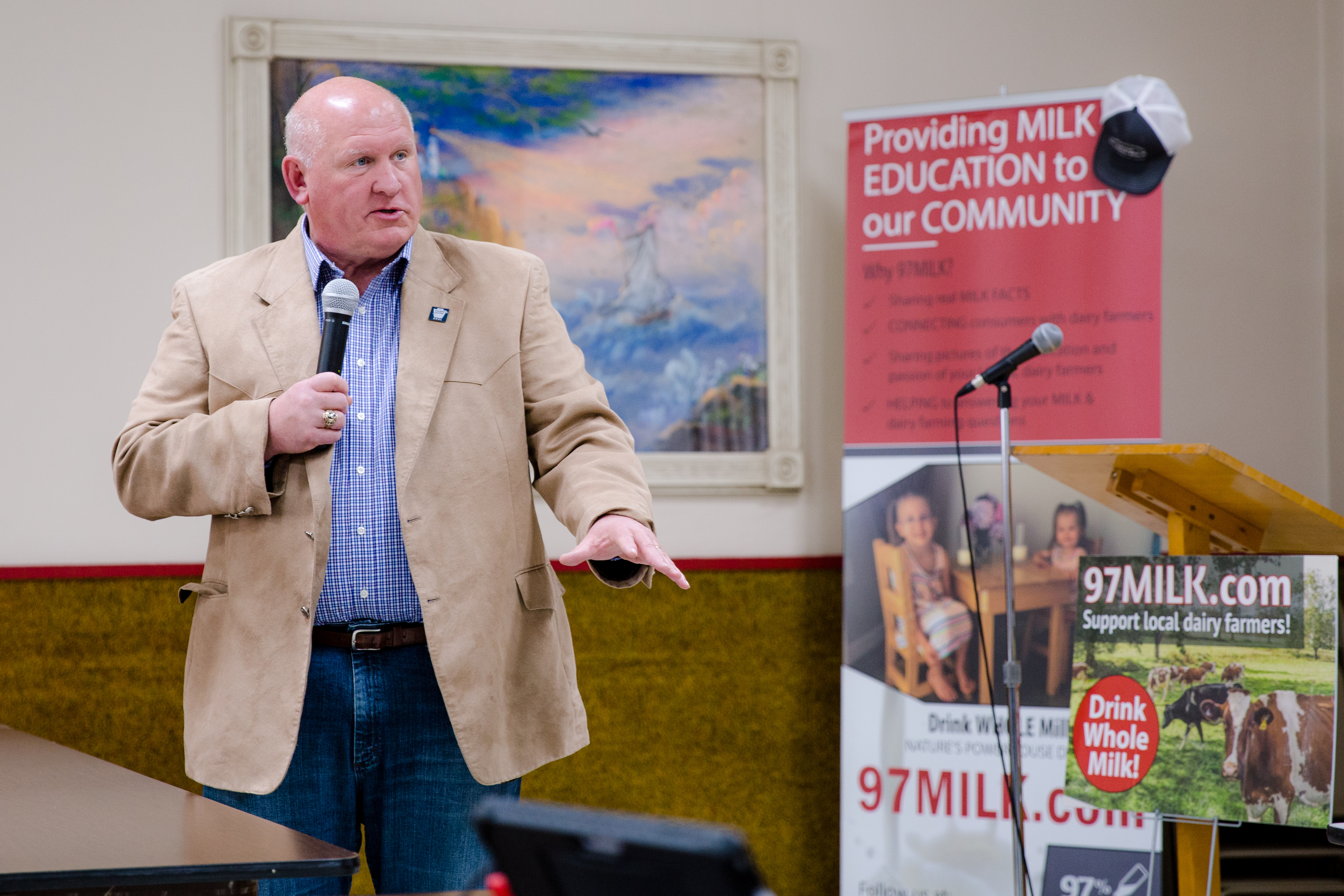
Representative GT Thompson of Pennsylvania once told a group of farmers gathered for a 97 Milk meeting that he has gone by a lot of titles and been called a lot of things over the years, and while it’s an honor to be the Chairman of the House Agriculture Committee, his favorite title is ‘Representative’ because, he said “that’s what we do. We are representing The People.” True to form, GT led the House 2023-24 farm bill process with representation in mind by making the bipartisan endeavor ‘tripartisan’ — going to great lengths to bring grassroots farmers into the process. One thing he heard repeatedly at the 85 listening sessions in 40 states was ‘bring whole milk choice back to schools,’ even though school meal rules fall under the childhood nutrition reauthorization led by the Education Committee, not the farm bill. But now he’s done that too. Bolstered by the overwhelmingly bipartisan 330 to 99 passage of H.R. 1147 on Dec. 13, 2023, he found a way to make Whole Milk for Healthy Kids part of his proposed farm bill that heads to House Ag Committee markup next week. He says he is intent on getting the whole milk legislation through the Senate blockade and “over the finish line.” File photo by Sherry Bunting

By Sherry Bunting, Farmshine, May 17, 2024

WASHINGTON – House Ag Committee Chairman Glenn ‘GT’ Thompson (R-Pa.) says the bipartisan farm bill has reached a milestone and holds the potential for being transformational.

The chairman’s mark, released ahead of committee markup set for May 23, demonstrates the listening that went on in his busy schedule traveling to 40 states and one territory for 85 listening sessions over the past two years.

“We are hopeful that the House Ag Committee markup of this chairman’s mark legislation helps feed the momentum to get this farm bill done,” said Chairman Thompson in a May 14 Farmshine phone interview.

There are important highlights here, including reforms to the Dietary Guidelines process for greater transparency and accountability with new checks and balances, as well as language to expand the reach, funding and impact of the dairy incentive and school meal programs by including full fat fluid milk, flavored and unflavored, as seen in H.R. 5099 and H.R. 1147 (Whole Milk for Healthy Kids Act).

“I was able to work with Dr. Virginia Foxx (chair of the House Education and Workforce Committee), and they will be providing a waiver after we mark this bill up, so we will be able to include Whole Milk for Healthy Kids in the farm bill,” Thompson shared.

He has previously stressed that, “This is about our kids and the outdated and harmful demonization of milkfat.”

“When we get to conference (with the Senate), it could be an issue, but Whole Milk for Healthy Kids passed the House by a 330 vote. I am intent on getting this provision over the finish line. 

“It may be the most important thing we do out of many things in this farm bill for dairy farmers,” he said.

Other dairy subtitle provisions

The dairy subtitle includes language to return the Class I ‘mover’ price to the ‘higher of’ calculation instead of the ‘average plus 74 cents’ that was implemented in May 2019.

“We obviously recognize that USDA has now gone through an extensive hearing process, and will honor what USDA comes up with, which will supersede what we’re doing,” Thompson reported. “But it was the Ag Committees in the Congress through the 2018 farm bill that eliminated the ‘higher of’ language, which has been followed by significant unanticipated losses.”

Language has also been included to mandate biennial cost of processing surveys. This also appears in the Senate farm bill.

Processors making products used in Federal Milk Marketing Order (FMMO) formulas would participate in processing cost surveys every two years. In addition to reporting costs for those products, the Dairy Pricing Opportunities Act language that is rolled into the farm bill proposal states that the cost and yield information for all products processed in the same facility be included. (Note: This would ensure accurate allocation of plant costs that apply just to the products that are actually used in the FMMO pricing formulas so that the costs to process other value-added products that are not included in FMMO pricing, but are made in the same plant, do not influence future ‘make allowance’ hearings.)

These cost surveys would be published for the purposes of informing the regulatory or administrative (hearing) process for the establishment of pricing rules (such as determining how to use that published information to set ‘make allowance’ levels that are embedded in FMMO pricing formulas).

The dairy subtitle also expands the Dairy Margin Coverage (DMC) tier one cap on annual milk production history from 5 million pounds to 6 million pounds, similar to the Senate bill.

It also includes language for updating DMC production history and provides a 25% discount in premium costs for any producer signing up for all five years of DMC coverage.

“That’s quite a savings,” Thompson observed.

IRA funds included without ‘climate sideboards’

In the Conservation Title, the chairman’s mark brings Inflation Reduction Act (IRA) conservation funds into the farm bill baseline without the ‘climate sideboards’ and arbitrary measures that ride along in the Senate version.

“All conservation programs, as long as they are locally-led and voluntary, contribute to climate and carbon sequestration. What the IRA legislation did is make it overly prescriptive with a lot of practices we know are successful not being eligible for these conservation dollars.

“We believe that the principles of locally-led and voluntary are a huge part of what has made conservation programs so successful. Agriculture sequesters 6.1 gigatons of carbon annually, over 10% more than we emit,” said Thompson.

Timelines matter

There are a couple reasons timelines matter in getting this farm bill done. The IRA funding is one of them.

“Number one is the American farmer is struggling right now. The chairman’s mark, as we prepared it in the House Committee, will be of great service to them as producers of food, and to struggling families as consumers of food, quite frankly,” said Thompson.

“The other reason timelines matter is these IRA dollars. As the Secretary of Agriculture continues to push those dollars forward, the original $19 billion – between what he already spent and what the CBO projects he will not be able to spend – that number is now down to $14 billion,” Thompson explained. “That’s opportunity lost for the future, unless and until we pass and reauthorize the farm bill and roll those dollars into its baseline.”

Thompson continued, explaining that, “Every dollar in IRA conservation funds spent between now and the passage of the farm bill is a dollar lost to the baseline for the future. One of the flaws of the IRA is these conservation dollars expire in 2031. Whatever we bring into the farm bill – into the baseline – is there for perpetuity. It will be there for the 2050 and 2055 farm bills. That’s smart, and it’s good for agriculture and great for conservation.”

The Senate proposal also brings IRA conservation funds into the farm bill baseline, but puts climate requirements on these funds, especially in regard to methane.

Tripartisan effort produces nutrition cost-savings, not cuts

“My chairman’s mark is built on solid tripartisan input from Republicans and Democrats and the hardworking people of American agriculture,” Thompson affirmed. “The Senate proposal is a partisan proposal. They did not bring Senate Republicans to the table.”

In his May 10 open letter, Chairman Thompson stated that his door is always open.

“There exists a few, loud armchair critics that want to divide the Committee and break the process. A farm bill has long been an example of consensus, where both sides must take a step off the soapbox and have tough conversations,” he wrote. “The 2024 farm bill was written for these precarious times and is reflective of the diverse constituency and narrow margins of the 118th Congress. Each title takes into consideration the varying opinions of all who produce as much as those who consume. It is not one-sided, it does not favor a fringe agenda, and it certainly does no harm to the programs and policies that feed, fuel, and clothe our nation.”

Case in point, the CBO has scored the House farm bill chairman’s mark to save $28 to $29 billion in the Nutrition Title.

“Some would have you believe we are cutting $28 to $29 billion from feeding struggling families, but we are not,” Thompson declared. “There are no cuts to individual SNAP benefits in this bill. My Democratic colleagues say we are cutting by that much, but the CBO score on my proposal reflects cost savings from increased efficiencies, reduced fraud, and things that better meet the needs of families struggling in poverty.”

Justifiably proud of the intense work he and his committee have done on the nutrition programs lightning rod that makes up more than 80% of the farm bill baseline, Thompson said his proposal actually “creates a fire wall so that a future right-leaning administration would not be able to arbitrarily cut benefits either. It exercises our Article I prerogative on how we do market basket analysis, keeps the variables and the cost of living. These things are significant factors.”

His proposal also expands access to a couple populations not eligible for SNAP in the past, including families with adult children in school up to age 21 (not 18). In the past, their part-time jobs affected family eligibility.

Putting the farm back in the farm bill

The Commodities and Crop Insurance Titles also engaged input from farmers, farm groups and industry. On reference prices, Thompson said the Senate bill picks three crops and puts in a 5% increase for base acreage.

“In our proposal, we’ve worked with the stakeholders. We’ve done the math, the financial and risk analysis on what is needed.”

This includes a more commodity-specific update to reference prices and granting the Secretary of Agriculture authority to expand base acres.

“We have been committed to putting the farmer back into the farm bill commodities title,” he said.

This scratches the surface of what is included in the farm bill chairman’s mark. An overview and title by title summary are available at https://agriculture.house.gov/farmbill/

When asked about what other dairy topics could come up during markup, Thompson said he wouldn’t be surprised to see other amendments in committee.

“There are some labeling issues that are not in our purview or jurisdiction but come under the Energy and Commerce Committee. We could get the ball rolling, but we would need them to get on board for that to go forward,” he said.

Reflecting on the milestone this week, Thompson answered our question about what he’s most proud of to this point.

“The fact that this farm bill was built using the input of American farmers, ranchers, and foresters, and it reflects what their priorities are and what their needs are, and the fact that as I look at the chairman’s mark and all 12 titles according to the goal placed early on, two years ago as I started my leadership of this process: 

“This will be not only a highly effective farm bill for our producers, processors and all of us who consume food, it will be transformational,” he said.

-30-

More questions answered on ‘bird flu’ and the new rules for interstate shipment of dairy cows

By Sherry Bunting, Farmshine, May 3, 2024

WASHINGTON – The recent USDA federal order requiring testing before transport of any lactating dairy cow from any state to any other state, effective April 29, took many in the industry by surprise after it appeared there was a lull in new cases of highly pathogenic avian influenza (HPAI) in dairy herds. Some wonder why, given the fact that cattle recover and the one and only human case in a dairy worker was a mild conjunctivitis that resolved on its own.

Stemming the spread is important, officials say, because of potential transmission from dairy cows to poultry, since it is lethal in poultry. Additionally, they explain that researchers need to understand what is an evolving in this novel situation blamed for a syndrome that began in Texas in February marked primarily by reduced feed intake, marked drop in herd level milk production, thick or colostrum-like milk in affected cows, and dry tacky manure.

On April 25, USDA Animal and Plant Health Inspection Service (APHIS) updated the number of herds with HPAI detections to 36 in 9 states: Texas (12), New Mexico (8), Michigan (6), Kansas (4), Idaho (2), Ohio (1), North Carolina (1), South Dakota (1), and Colorado (1).

The federal order includes mandatory reporting of HPAI, and the required pre-movement testing pertains only to lactating dairy cows. 

Pennsylvania State Veterinarian Alex Hamberg says the next few weeks will tell us if H5N1 is more widespread in dairies via the federal surveillance now underway through the pre-movement testing of all lactating dairy cows crossing borders from any state to any other state.

The only exception is for interstate shipment of cows directly from the farm to a federally-inspected slaughter plant. 

Any lactating cows shipped across state lines to an auction (even a slaughter-only auction) at a sale barn must have official identification, a certified veterinary inspection (CVI) and an HPAI-negative milk sample test from a qualified lab within 7 days of transport.

Lactating dairy cows can move to sale barns within the same state, with just owner/shipper statement and back tags. After the sale, they are permitted to go from the sale barn to an out of state federally-inspected slaughter plant if they proceed there directly without any stops to unload any commingled animals from that trailer to a non-slaughter premises.

Farmers and cattle dealers have questions about what is needed to ship cull dairy cows to livestock auctions, where packer buyers come from several states.

Hamberg gave examples.

“If you are going to a sale barn within your state, you don’t need the extra testing, but this would limit the sale to buyers within your state – unless that buyer takes the animal(s) directly from the auction, to slaughter,” he said. 

“Dairy cows (from Pennsylvania dairy farms) can go to a sale barn in Pennsylvania, and then go across state lines to a slaughter plant in New Jersey with just an owner-shipper statement and back tags — as long as they leave as a group, get on the trailer as a group, and don’t get off that trailer until they are at an FSIS inspected slaughter plant.” 

During the call Hamberg noted that Pennsylvania raised its testing age for non-lactating dairy cattle from 12 months to 18 months via nasal swab. These animals require testing only when coming into Pennsylvania from states that have had an HPAI detection.

Lactating dairy cow testing is only through milk samples. These milk samples must be collected by a licensed veterinarian or a designee at the farm, if the veterinarian is comfortable signing for that sample via a valid client-patient relationship (VCPR).

USDA APHIS will pay for the cost of all pre-movement and suspected illness testing for HPAI H5N1, but the costs of taking the samples and sending them to a qualified lab are not covered.

Both Hamberg and Jeff Warner, director of the Pennsylvania Department of Agriculture Bureau of Food Safety and Laboratory Services, emphasized the effectiveness of pasteurization to inactivate the virus in milk. Hamberg noted that PCR testing has a tendency to pick up dead strands of virus so that can be confusing, but pasteurized milk is safe.

Warner said there is no ban on raw milk sales from permitted farms at this time because there have been no HPAI detections in Pennsylvania; however, all permit holders have been notified by mail and email to be mindful of the signs of HPAI, and as all dairy farms are expected to do with any sick cow, withdraw that milk from sale.

“We have no cases in Pennsylvania to-date. We have done some testing, and so far, no detections. Let’s keep that trend going,” said Hamberg.

Producers asked: What happens when there is a positive test?

“If a test comes back positive,” said Dr. Ernest Hovingh, Penn State extension veterinarian and resident director of the Penn State Animal Diagnostic Laboratory System (PADLS), “we notify the national veterinary lab system and the state department of agriculture, and then Alex (the state vet) springs into action.”

“Our quarantine response says cattle can’t leave the farm without permission, but if cattle need to go to slaughter or somewhere else, we would do a risk assessment for permitting,” said Hamberg.

“We also would use 30-day increment permits for milk movement to processing, so you could move milk from this point to this processor, but while doing it, you follow these biosecurity rules like being the last stop on the truck and having additional cleaning for trucks leaving the farm, and having enhanced biosecurity plans in place,” he explained.

Hamberg has much experience with quarantine response for HPAI in Pennsylvania’s poultry industry, which this year surpassed dairy for the first time as the largest cash receipts ag sector in the Commonwealth. He noted the risk of spread from dairy cows to poultry is a big concern, since HPAI is deadly to poultry.

At the same time, he said, “we are seeing nationally a 20% drop in herd level milk production (in dairy herds where HPAI has been detected). That hurts. Dairy is tough enough, and losing 20% of your milk, that stinks, so we don’t want to compound that loss. We want to move milk in a safe way to get your milk to processing” — if HPAI is detected on a Pennsylvania dairy farm.

“This is not a big scary thing. We have steps we can do — even if we get a positive case,” said Hamberg.

Hovingh noted that having Pennsylvania dairy heifers raised out west is now a high-risk practice. “Your animals would be going west to a potentially infected state, and they would return at over (18 months of age) and be subject to state rules for testing” — if they come back from a state with HPAI detections.

USDA’s final rule on mandatory electronic identification was published in the May 1 Federal Register, Hamberg noted. In 180 days, the rule requires E-ID for all sexually intact cattle over 18 months of age, as well as bison and all cattle in exhibition (show) and rodeo.

With the HPAI pre-movement testing for interstate movement of lactating dairy cows and the mandatory E-ID at the same time, crossing state lines for shows and sales now requires additional documentation.

According to Dr. Hovingh, the state PADLS system promises a 3-day turnaround on pre-movement testing, which has to be done within 7 days of interstate transport. “But we think we can do same day turnaround, depending on volumes submitted.”

He urged producers planning herd dispersal sales to give a heads up as they prepare to “get their ducks in a row” so cattle can move on to buyers from other states on sale day.

Hovingh said now is the time for Pennsylvania dairy farmers to get their biosecurity plans in place, so they have that box checked in the event of an HPAI detection and quarantine in the state. Approved biosecurity plans would be required for those 30-day milk movement permits that are part of the state’s response.

It’s also important for farmers suspecting HPAI, to report it. “We’ll come out and test,” said Hamberg. “Our concern is that if cattle transmit it to poultry, those flocks are depopulated and control areas are set up. Following through is essential for both our dairy and poultry industries.”

Hovingh said species segregation is important on farms with both dairy cows and poultry, and biosecurity is essential for personnel tending both. The new twist is clean clothes and a shower go beyond clean boots to keep from exposing poultry to any raw milk on clothing, hands, etc.

-30-

Whole milk sales surge as Senate bill for schools remains blocked

By Sherry Bunting, Farmshine, May 10, 2024

EAST EARL, Pa. — Year-to-date Whole Milk sales for the first two months of 2024 are up a whopping 5% year-over-year (YOY) at 2.57 million pounds. Even when adjusted for Leap Year, the average daily increase is a substantial 3% surge, compared with the past several years of steady 1% increases YOY.

Flavored whole milk sales, year-to-date (YTD) are up a whopping18.6% YOY. Adjusted for Leap Year, the increase is a substantial 14%.

As the number one volume category representing more than one-third of the fluid milk category since 2020, the recent surge in whole milk sales has been enough to reverse the decline in total packaged fluid milk sales in four of the past five months.

USDA tallied 2023’s total packaged fluid milk sales down by a smaller margin of 1.5% for the year compared with previous years of decline; however, October and November sales were up 1% and 0.3% YOY for the first time since the months of the Covid shutdown when families ate at home. December’s total packaged fluid milk sales trailed year-earlier, but January and February 2024 have come back strong.

USDA estimates total fluid milk sales were up 2.4% and 2.5% YOY for January and February, respectively. When adjusted for Leap Year, the February increase is a respectable 0.8%. Similarly, when we adjust the YTD total of 7.325 million pounds in total fluid milk sales to reflect the extra consumption day in February, this is also 0.8% higher on an average daily basis vs. year ago.

This is good news! Let’s keep this upward trend MOOVING in fluid milk sales, led by surging whole milk sales — thanks to volunteers spreading the good word.

Now, if we could just get the United States Senate off the sidelines and into cosponsoring S. 1957 Whole Milk for Healthy Kids, we could really gain some ground — and America’s kids would be free to choose milk they love at school where they receive 2 meals a day, 5 days a week, 3/4 of the year. 

Thanks to the U.S. House of Representatives and the leadership of Congressman G.T. Thompson of Pennsylvania, the Whole Milk for Healthy Kids Act (H.R. 1147) passed the House on December 13, 2023 by an overwhelming bipartisan majority 330 to 99. If the U.S. Senate doesn’t have the opportunity to vote it through by December 31, 2024, we must start all over again in the next legislative session 2025-26!

Check out the map above to see how S. 1957 remains stalled for the past 60 days at just 17 sponsors from 13 states. 

Where do your state’s U.S. Senators stand? Ask them! And think about their answers when going to the polls this fall. Elections have consequences. 

Also consider asking your state senators and representatives to follow Tennessee’s lead and get a whole milk bill passed in your state and signed by your Governor. 

Pennsylvania and New York State tried to be first, but leaders are afraid of USDA’s monetary penalties. Maybe the No. 8 and No. 5 milk producing states can be second and third in state whole milk bill passage.

Just think what would happen if more states passed bills that ALLOWED choice and sought creative language to let their schools choose to let children choose. Tennessee will make it available in bulk dispensers separate from the school lunch line. Pennsylvania sought to do it as a wholly in-state proposition. 

Meanwhile, DMI sent a press release on April 29 touting their “checkoff-led pilot in Cincinnati schools that offered lactose-free chocolate milk increased milk consumption…” Specifically, the pilot schools experienced a 16% increase in milk consumption and a 7% higher meal participation, according to DMI. 

(Of course, this lactose-free pilot was also fat-free per the USDA rules for milk at school built on the Dietary Guidelines that the dairy checkoff agreed to “advance” when the memorandum of understanding was signed between the USDA, National Dairy Council, GENYOUth and the NFL in 2010).

Remember, this reporter warned several years ago that checkoff and dairy industry leaders would wait until lactose-free shelf-stable milk was firmly entrenched in schools before pushing whole milk choice through. Senate Ag Chairwoman Debbie Stabenow is the main blockade this time around. She hails from the No. 6 milk producing state of Michigan, where the foundation fairlife plant is located, collecting milk from large producers in Michigan, Indiana and Ohio.

Wonder what consumption looks like when whole milk is offered as a choice. That’s right! A Grassroots PA Dairy Advisory Committee / 97 Milk trial in a school in northwestern Pennsylvania saw consumption grow 52% and waste decline 95%.

So, drink up Senators! Talk to your constituent Moms this Mother’s Day. Sales data and surveys both show what Moms think, and most don’t even realize the federal ban, the bait-and-switch their kids face at school where milk and dairy are concerned.

Then pour a tall cold glass of delicious, nutritious whole milk. It may just strengthen those political spines!

-30- 

MILK MARKET MOOS – Bad news in this week’s mailbox, but better views ahead!

By Sherry Bunting, Portions reprinted from the May 10, 2024 column with a few preview notes for the May 17 weekly Milk Market Moos, available exclusively in Farmshine Newspaper

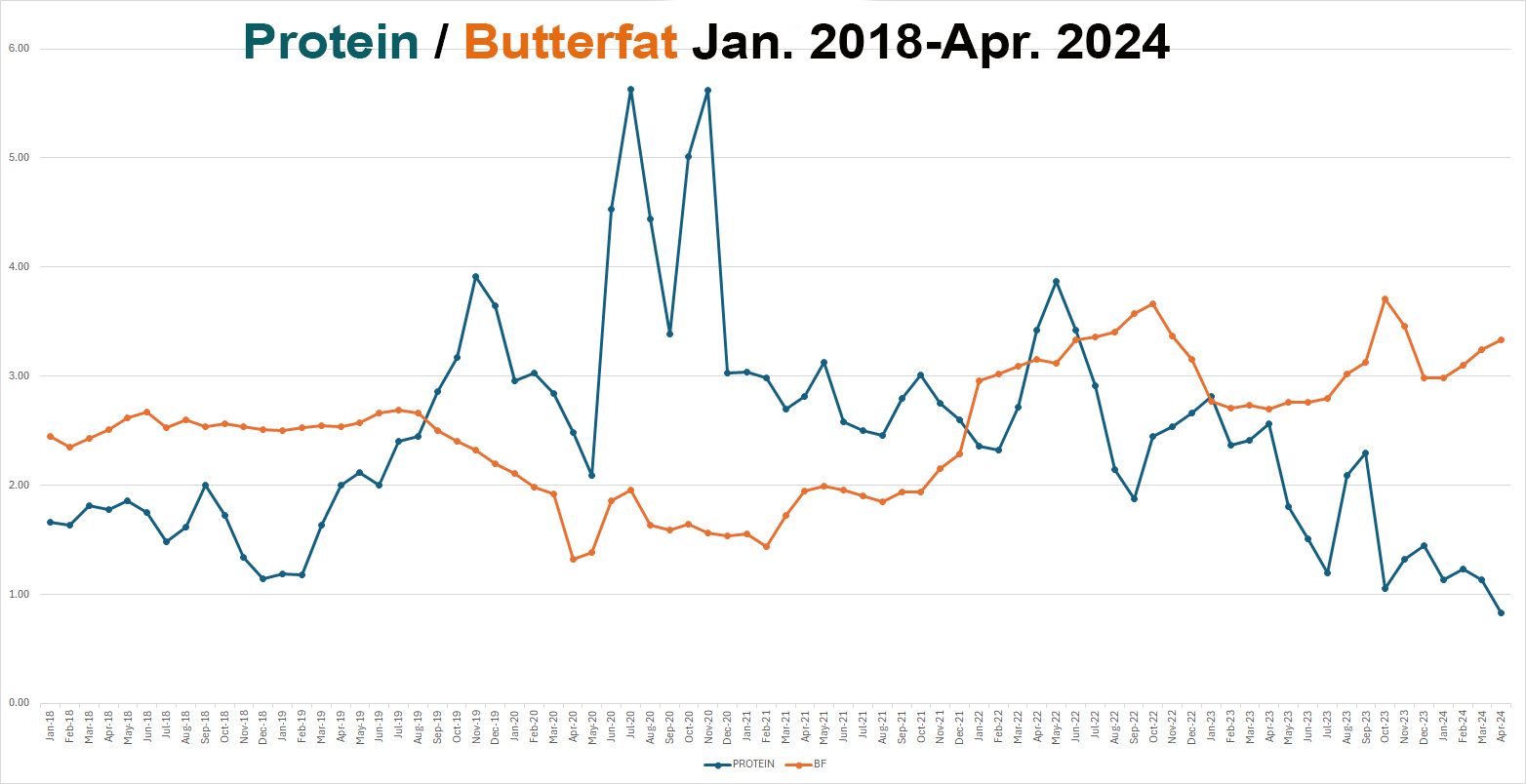
This week’s settlement checks for April milk are hard hit by the record-low protein price of $0.83/lb and the $4 to $5 spread of Class IV over III that continues to depress the Class I price via the ‘average of’ method — resulting in depooling of higher value manufacturing milk. But the good news is the cheese markets have sustained a 5-week rally that has been heating up, pushing Class III milk futures higher, while tight supplies of nonfat dry milk moved briskly at higher prices to keep Class IV forging ahead too.

First the bad news: April FO blend prices are mixed with component-pricing lower, Fat/skim-pricing generally higher

The record-low April protein price of 83 cents/lb and second lowest Class III price of the year pushed the Federal Order (FO) blend prices 25 to 45 cents lower in six of the seven FOs that use Multiple Component Pricing (MCP). The Northeast, was off just 9 cents, given the fact that processors still pooled some milk used for higher value Class II and IV products, although not as much. De-pooling of Class II and IV milk was heavier in other MCP FOs due to the whopping $5 spread between Class II and IV ($20.23 and $20.11) over Class III ($15.50) and the fact that Class II and IV were $1.00 higher than the Class I ‘mover.’

The wide spread pushed the Class I ‘mover’ price $1.00 lower using the ‘average of’ calculation than it would have been under the previous ‘higher of’ method. The May Class I mover price is even more disadvantaged — down $1.73 vs. ‘higher of’ — based on the advance pricing factors at the beginning of April before the CME cheese market rally begins filtering its way into USDA weekly surveys and FO formulas.

Three of the four fat/skim priced FOs — Florida, Southeast and Appalachian — have April blends that are mostly 20 cents higher than March. Fat/skim priced FOs benefitted from the butterfat price at $3.33/lb and a solids nonfat (skim) price at 97 cents/lb that was 14 cents higher than the protein price. This is the first time such an inversion has occurred.

Meanwhile, the fat/skim-priced Arizona FO (131) saw its April uniform price fall by 19 cents due to Class II and IV depooling, which increased the negative effect of a higher Class III utilization percentage.

The uniform price in the three southeastern region FOs (5, 6 and 7) would have netted an additional 70 to 80 cents per cwt — if Class I had been priced via the ‘higher of.’ The Mideast (FO 33) would have netted 40 cents per cwt more; the Northeast, Central, and Southwest (FOs 1, 32 and 126) 29 to 30 cents; California and Pacific Northwest (FOs 51 and 124) 20 cents; Upper Midwest (FO 30) 6 cents. All MCP FOs would have benefitted from better alignment keeping more of the higher-valued Class II and IV milk in the FO revenue sharing pools. It’s hard to say whether or how much of the windfall profits of depooling are consequently shared with dairy farmers shipping the milk.

Once again, the Upper Midwest (FO 30) had the rock-bottom uniform price of $15.95 at 3.5% butterfat, with over 92% of the utilization being Class III. If the ‘higher of’ had been used for pricing Class I, the pounds of Class II and IV utilization would likely be greater, which may have contributed to a more positive uniform blend price while yielding a little more than a nickel of additional Class I contribution. Instead, the blend price included less than 2% Class II and IV, and just over 6% Class I.

The FO 30 market administrator saw fit to send a reminder letter to handlers in March that they must show separately how milk payments were calculated for producers having both pooled and depooled milk to ensure the pooled milk was paid at the FO minimum price. Even 100% pooled producers have been seeing ‘milk check gymnastics’ such as underpayment of the FO minimum for ‘other solids’, and then using the producer’s protein premium to make up the difference in order to achieve the regulated gross minimum.

According to USDA AMS, Federal Milk Marketing Orders with multiple component pricing, use individual component values to determine the minimum gross value due to producers. The FMMOs’ primary function is to ensure that the gross payment to the producer is at least equal to the minimum payment for their pooled milk. Enforcement of individual component values may be pursued by FMMOs to prevent handler deception and maintain transparency. In FMMOs where it is common to pool only a portion of a producer’s milk, proprietary handlers are required to send statements to producers indicating the separate amounts paid for pooled and non-pooled milk.

The April 2024 uniform prices and PPDs were announced May 12 through 14 as follow (+/- change from month ago):

Now the good news! What’s UP with Class III?

For 18 months, Class III has been the underdog in milk pricing, especially rough for dairy producers in the Upper Midwest struggling under the brunt of FMMO 30 blend prices built mainly on Class III.

In fact, the April protein price hit a record low, announced May 1st at 83 cents/lb, which is 14 cents below the 97 cents/lb price for solids nonfat. This inversion has never happened before, according to our search of class and component pricing archives.

The butterfat price for April is quadruple the protein price at $3.33, creating additional divergence issues in multiple component pricing orders.

Meanwhile, the Class III milk futures haven’t offered much of a breakeven price to spend money protecting with hedges or DRP…

Until now…

Class III milk futures continued higher — skyrocketing limit-up for nearby contracts Wed., May 8, putting the exclamation point on five straight week of gains that have added $3 per hundredweight to the remaining 2024 contract months, going from the $16s and low $17s to the $19s and $20s, with 2025 contracts well into the $18s. This is the first time the Class III milk futures board has seen a $20 mark in over 18 months.

Class IV futures also made solid 20- to 30-cent gains charting over $20 and $21 across the board.

If the current Class III rally goes too far, too fast in the near-term, we could see negative PPDs in some Federal Orders in June for May’s milk because the May Class I advance base price mover was already announced in mid-April, and includes the much lower advance pricing factors of the (Class III) cheese and whey markets during the first two weeks of April.

The ‘average of’ method disadvantaged the May Class I mover by $1.73/cwt, which will undoubtedly be a factor for milk pooling / depooling decisions at the end of this month as Class I, at a base price of $18.46, will likely be rock-bottom lowest class for May, except where location differentials are high enough to boost it.

$20 finally appears on Class III futures board (June), Spot cheese hits highest price in over a year.

On Wed., May 8 the Class III milk futures for the next 12 months (May24 through Apr25) averaged $19.04, up 54 cents from the previous Wednesday. Class IV milk futures averaged $20.86, up 22 cents from the prior Wednesday.

The milk futures rally is driven by the upward momentum in CME daily spot cheese markets, reaching levels May 8 that are 50 to 55 cents per pound higher than six weeks ago.

The 40-lb block Cheddar price roared 11 1/2 cents higher to $1.95/lb in a single trading session Wed., May 8, gaining 20 cents/lb on the week, and hitting the highest level since last fall, with a single load trading. For 500-lb barrel cheese, at $1.90/lb, the gain was a dime on the week, and the highest price in over a year, with zero loads trading.

(Spoiler alert, the spot price for 500-lb barrel cheese skyrocketed well north of $2 on Tues., May 14 with a single load trading at $2.06. Conversely, Tuesday’s trading session on 40-lb block Cheddar started out moving a load as high as $2.00/lb, which would have been a 2-cent gain for the day. However, after the dust settled on the brisk trading session that moved a whopping 14 loads of blocks in a few short minutes, the market was pegged at the lowest load price of $1.93/lb — down 5 cents from the day before. A bid came in at $1.92 and was ignored after such an abnormally large clearance of blocks for a single session. More on this in the May 17 Farmshine.)

All other dairy commodity prices were higher Wed., May 8, with no trades changing hands. Dry whey gained a penny at 38 1/2 cents/lb (where it continued trading on Tues., May 14 with 2 loads changing hands). May 8th Butter was up 2 cents at $3.02/lb (but traded 16 loads at $3.00/lb Tues., May 14 and 1 load at $2.99/lb, which was a 3-cent loss since the low price is the peg for the day). Nonfat dry milk (NFDM) was up a penny at $1.13/lb on May 8 (and gained 3 1/2 cents more on May 14 at $1.1650/lb with an incredible 26 loads moving in a single session’s narrow $1.16 to $1.1650/lb range).

Dairy farmers will not see these gains in their milk checks until June, if the trend is sustained.

In the face of lower overall dairy exports, analysts tout the record volume of cheese exports in March, which were no-doubt prompted by the cut-rate January through April pricing that doesn’t pay bills on the dairy farm.

We have to go back to 2019 to find a 4-month Jan-April average Class III milk price that was lower than the first four months of 2024. We have to go back to the Covid shutdown in 2020 to find an April Class III milk price that was lower than April 2024. But even then, protein held up at $2.48/lb, not the 83 cents per pound that USDA announced for April settlement.

The difference this time is that fat is so much higher (quadruple the protein price at $3.33/lb for April). This essentially pulls a credit out of protein as an adjustment in fat values for cheese vs. butter. This is a seldom-discussed and little understood function of FMMO multiple component pricing, and another downfall of the many months of wide Class IV over III divergence.

Better views ahead… Higher Class I sales and record-high made-to-order fresh mozzarella production compete with stored product output for reduced milk supply

While the rear-view mirror shows the rough road traveled, the view ahead is improving for Class III milk and the beleaguered record-low protein price. Milk production is down. Packaged Class I fluid milk sales are UP. Processors are making record amounts of fresh (made to order) mozzarella cheese, causing Cheddar production to slow. Meanwhile, Class IV product supplies are tight. (One reason overall U.S. dairy exports were down is that inventories and production of milk powder is down!)

The most recent USDA Dairy Products Report showed Cheddar cheese production down 3.3% year-over-year (YOY) in March, with all American style cheeses down 2.9%. A positive this year that was missing last spring and summer is the draw for milk to make Italian cheeses.

Mozzarella production set records in March, up 6.8% YOY, but those products are not price-surveyed, nor are they included in the FMMO Class III pricing formula.

In addition to Cheddar cheese, the Class III price is also made up of dry whey sales via the ‘other solids’ component. Whey production for both human and animal use is accelerating as inventories of value-added whey protein concentrate (WPC) and whey protein isolates (WPI) were more than 40% below year ago at the end of March, despite March WPC production being up 1% for human use and up 40% for animal use; WPI up 73% YOY.

Dry whey is the commodity used in the FMMO Class III pricing formula with production up 2.4% for human use and 19.2% for animal use in March.

On the Class IV side, butter production was up 1.5% YOY in March with inventories up 2%.

As for powders: Whole milk powder (WMP) production was down 14.6% with inventory 36.3% lower YOY; Skim milk powder (SMP), typically made for export orders, was down 41.7%; and Nonfat dry milk (NFDM) output was down 7.9% YOY in March with inventories off 20.3%.

On the flip side, milk protein concentrate (MPC) production was the contrarian — up a whopping 38.5% YOY in March. MPCs are often used to bump cheese yields higher per hundredweight of raw milk.

These factors beg questions: Why were Class III milk prices for the first four months of 2024 at 5-year lows and protein at a record-low 83 cents per pound for April? Was it the plan to crush Q-1 2024 spot cheese and Class III milk prices to generate record cheese export volumes in March? Are cheesemakers using some of that big increase in MPC production to make more cheese from each cwt of raw milk? Are bioengineered fermentation yeast proteins that are marketed in trade publications as ‘dairy protein analogs’ diluting the supply and demand equation fractionally?

Global picture improving

The global picture is also improving. New Zealand tallied a lower output for the season, and recent reports show stable to lower milk output in EU countries.

In the Global Dairy Trade (GDT) biweekly internet auction Tues., May 7, the all products index was up 1.8% over the previous auction on April 16. This includes a whopping 8% increase in the GDT price index for bulk Cheddar sales contracted out through November, plus a 2.3% increase in bulk Mozzarella sales for July.

In fact, GDT Cheddar contracts for June were up 6.5% in Tuesday’s auction; July up 3.9%; August and September had no sales. October and November contracts were up 11.2 and 12.5%, respectively, compared with three weeks ago.

NoBull legal battle continues over contempt arrests related to 2021 livestock ultrasound investigation

By Sherry Bunting, Farmshine, May 10, 2023

HARRISBURG, Pa. – The legal battle continues for NoBull Solutions LLC partners Rusty Herr of Lancaster County and Ethan Wentworth of York County. Both Pennsylvania men have been jailed in their respective county prisons since April 10 and 11, respectively.

They were arrested for contempt of court after failing to respond to a May 2023 contempt order and failing to comply with a 2021 investigative subpoena seeking the name and address of NoBull’s custodian of records as well as the names and addresses of all members, managers, and other persons who direct its activities, according to the recently unsealed docket 325-MD-2021.

Herr and Wentworth will have served their 30-day commitments by this weekend (May 10 and 11, 2024).

According to counsel Robert Barnes, Esq. of Barnes Law LLP, a Petition for Writ of Habeas Corpus has been filed with the Pennsylvania Supreme Court after a Commonwealth Court Judge denied their motion for immediate release and unsealed the docket in two separate actions on April 29, 2024.

Barnes maintains that certain procedures must be followed in a civil contempt action. 

“To our knowledge those were not followed here. Wentworth and Herr were not given an opportunity to purge contempt in order to secure their release from prison – an essential requirement of civil contempt, which makes this de facto criminal contempt – a violation of Pennsylvania law,” Barnes states in an email response to Farmshine.

Even though the 30-day sentences will have been completed as they wait for the State Supreme Court to hear their appeal, Barnes says his office will “pursue the appeal to restore proper jurisdictional basis and to force the state agencies to adhere to the Pennsylvania Constitution and the Administrative Procedures Act.”

Former Pennsylvania Department of Agriculture counsel and current staff attorney with the Penn State Center for Agricultural and Shale Law Brooke Duer, Esq. told WPMT-Fox43 that the now unsealed docket shows the “civil processes for contempt are all there and were followed.”

The April arrests stemmed from prior actions by the State Board of Veterinary Medicine, which led to a Feb. 2020 complaint filed by the Pennsylvania Veterinary Medical Association (PVMA) one month before the Covid shutdown.

The PVMA alleged that Herr and Wentworth continued practicing veterinary medicine by ultrasounding other farmers’ cows in connection with NoBull’s breeding management service. PVMA asked for contempt charges through Commonwealth Court as part of that 2020 complaint.

The Department of State initiated its investigation in early 2021, issuing a subpoena order for the names and addresses of custodian of records and all parties involved in or directing activities in the business.

Both men failed to comply with the subpoena or to challenge it, according to the now unsealed docket.

“Some of us thought this had more-or-less gone away,” said Duer in the televised interview on May 2. “So, it’s kind of surprising. All of a sudden it’s back on again?”

Duer said there is no evidence that the men responded in any way or represented themselves since 2021.

(Prior dockets show they did represent themselves in prior State Vet Board actions, Herr in 2010 while he was still milking his own dairy herd, and Wentworth in 2018 while he was employed as an AI technician by Select Sires.)

“They had not only a few opportunities to come forward and prevent this kind of an outcome, but those opportunities were multiple…,” said Duer.

According to the unsealed documents, a Commonwealth Court judge signed “Orders to Commit” on October 6, 2023, which resulted in the April 2024 arrests.

The more immediate question is: Were they given the opportunity to purge the contempt at the time of arrest and incarceration, as would appear to be the process with civil contempt, according to an ACLU – Pennsylvania guide to contempt proceedings.

The deeper questions center around the future: What will happen next in terms of a level playing field for smaller farms looking to gain the benefits of integrating ultrasound into breeding management, but are not large enough to have employees trained to do it or vet practices willing to station their vet techs at small farms to do it. 

Of the NoBull customers who have contacted this reporter, nearly 90% want this integration, while they still intend to maintain their veterinary relationships through regular herd checks.

The Veterinary Practice Act does not mention pregnancy diagnosis. 

The Department of State says veterinary medical practice is further defined by the State Vet Board through adjudications.

The PVMA says a pregnant / not pregnant ‘diagnosis’ is a food safety concern because the not-pregnant diagnosis can involve recommendations for hormone treatments, or recommendations for culling open cows for the beef market.

PVMA also maintains that pregnancy diagnosis “by any mode or method” is veterinary practice. Yet blood and milk sample testing for pregnancy by other companies has been used and celebrated in Pennsylvania since at least 2015.

Several dairy trade magazines have published articles over the past 12 years about the differences in the laws between states and the trend toward laypersons doing ultrasound as the machines are widely available, and the technology has improved. A 2007 USDA survey of (larger) dairies in the West showed that nearly one-third (31.7%) of those performing pregnancy diagnosis used someone other than a veterinarian via ultrasound for breeding purposes. That was 17 years ago.

At least one Pennsylvania dairy producer reports that a veterinary practice places vet techs as employees on larger farms for training, and they do those ultrasounds to provide timely information between herd checks at a discount.

A January 2024 Progressive Dairy article by a Genex consultant examined how integrating ultrasound with breeding management is revolutionizing reproduction on U.S. dairies that are faced with the need for swift information to make economic decisions in a highly competitive, tight-margin dairy business.

Small dairy farmers continue to contact this reporter wondering what they can do about this. “How can we help?” they ask.

Virtually all of them continue their relationships with their veterinarians for regular monthly herd checks, in addition to having NoBull do ultrasound in connection with breeding service to achieve those same efficiencies in between.

Commonwealth Court denies immediate release, unseals docket, Supreme Court appeal next step for Herr, Wentworth

By Sherry Bunting, Farmshine, May 3, 2024

HARRISBURG, Pa.  —   It has been three weeks since Rusty Herr and Ethan Wentworth of NoBull Solutions, LLC were arrested on April 10 and 11 and separately incarcerated in Lancaster and York County Prisons — their respective counties of residence in Pennsylvania.

A motion for immediate release has been heard and denied by the Commonwealth Court of Pennsylvania.

“The Commonwealth Court failed to correct their error, so we are taking the case directly to the Supreme Court,” said Robert Barnes, Esq. in a Farmshine interview after the decision.

Judge Michael Wojcik also unsealed the docket in a separate decision.

He heard oral arguments for the motion filed by Barnes Law LLP on behalf of Herr and Wentworth as well as the answer to this request by the Department of State (DOS) Bureau of Professional and Occupational Affairs (BPOA) on April 29, 2024, at 1:30 p.m. via WebEx video conferencing.

According to the docket 325-MD-2021, the BPOA opposed the motion, stating that on May 16, 2023, the court had adjudicated NoBull Solutions in contempt of a previous order dated Nov. 30, 2021, related to enforcement of an investigative subpoena, with conditions for NoBull to purge its contempt through a monetary civil penalty, and that failure to purge may result in issuance of a warrant for their arrest and incarceration.

NoBull Solutions did not show cause why they should not be held in contempt on Nov. 30, 2021, did not appear or comply, and on May 16, 2023, the enforcement order was made absolute requiring NoBull to “purge its contempt,” including providing the BPOA with the name and address of its custodian of records as well as the names and addresses of all members, managers, and other persons who direct its activities.

“At no point during these proceedings has Mr. Wentworth and Mr. Herr challenged BPOA’s allegations that they are the principal members of NoBull Solutions and are directing its activities or made any attempt to purge the Court’s finding of contempt,” the docket reads.

The bottomline here is that Herr and Wentworth are making a stand for the right to assist farms in reproductive management. Through the 15 phone calls from customers, it’s clear they believe ultrasound makes breeding service more effective and efficient for their small farms that are not in a position to be blessed by the law’s exception for hired employees doing this work on larger farms.

Dairy farmers have continued to call into this reporter, explaining that both men, and NoBull collectively, help them be better managers and learn to do more breeding work on their own, even when it means they are purchasing fewer services from NoBull. 

Fully 12 of the 15 calls to-date affirmed they maintain a relationship and regular herd checks with their licensed veterinarians and gave clear examples of how the use of ultrasound with breeding service through NoBull had minimized their waste of costly semen, improved their knowledge, and provided information they needed for timely breeding and culling decisions made on the farm in between regular herd checks.

At issue for Herr and Wentworth, according to Barnes Law, are the Constitutional rights in the handling of the contempt enforcement. With the docket unsealed, a paper trail – including the state’s request for a default judgment that had been denied in 2021 – have been unsealed. 

The initiation of these previously sealed contempt proceedings began in 2021, 18 months after the 2020 Pennsylvania Veterinary Medical Association complaint that had requested contempt charges be pursued by the DOS, alleging both men as principals in NoBull Solutions LLC were continuing to practice veterinary medicine without a license, continuing to do and direct ultrasounding of livestock in connection with their breeding and reproductive management services. 

At this juncture, it appears that Herr and Wentworth will either have their appeal for immediate release heard by the State Supreme Court or serve out their 30 days, whichever happens first.

Then, the real work may begin. Is there a middle ground for these services in conjunction with breeding? Is the assistance providing a level playing field in a low-margin, highly competitive dairy industry where scale affords some farms the avenues to accomplish these services via employees who are proficient in ultrasound vs. smaller farms paying an independent technician for the same.

Since the Department of State maintained in a prior interview that State Veterinary Board adjudications clarify the law with the authority granted them by the legislature, and that the legislature is the body to consult for the exceptions, there’s much here to wade through from the State Capitol to the Administrative Boards and Offices to the Commonwealth Court.

-30-