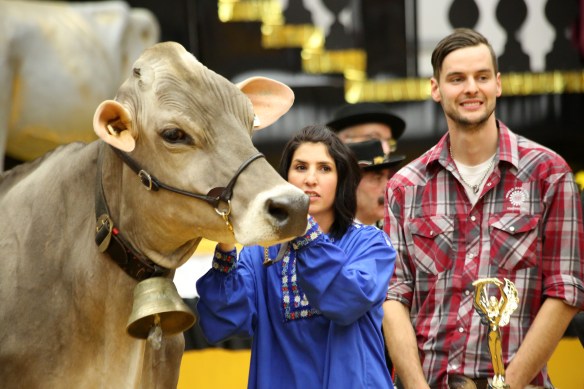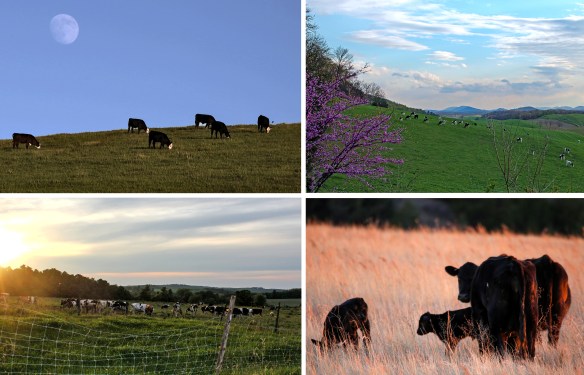
The people have spoken, let the healing begin


rainbow

By Sherry Bunting, Market Moos, Farmshine, Nov. 9, 2016

In the words of Speaker of the House Paul Ryan (R-Wisconsin) just moments before President-Elect Donald J. Trump gave his acceptance speech in the wee hours of Wednesday morning after Tuesday’s stunning presidential election: “This is the most incredible political feat I have seen in my lifetime. Donald Trump heard a voice out in this country that no one else heard. He connected in ways with people no one else did. He turned politics on its head.”

“This is unlike anything we have seen in our lifetime,” said CNN news anchor Wolf Blitzer.
buffaloprairie6872x

As election results came closer to finalizing Trump as the winner Tuesday night, along with evidence that the Republican majority would remain in the U.S. House and Senate — the global financial market futures tumbled lower in overnight trading.

WinkSunrise9986w.jpg

But as the sun came up Wednesday morning, four hours after Trump’s acceptance speech, the reality of a President-Elect Donald J. Trump began to set in, and traders began to realize the positive things such as job-stimulating corporate tax cuts, reversal of burdensome executive-branch regulations, and the repeal and replacement of Obamacare.

Just 13 hours after the election was called, Wednesday’s Stock Market rose steadily, and the Dow Jones hit a brand new record high at +310 settling +256 on the day.

Business news analysts started the morning reminding the public that 2000 new regulations had been formulated and implemented during the Barrack Obama administration — most aggregious may be the Waters of the U.S. (WOTUS).
mcreek8801x.jpg

In addition, analysts referred to Trump’s pro-economic growth plan as “very solid,” and with a Republican Congress, can be put into play. This, along with re-evaluation of trade agreements, has U.S.-based businesses thinking positively about a different future from the status-quo future they had braced for and which was built into the pre-Election levels in the financial markets.

As one business analyst put it: “Small businesses have been hungry for Trump-economics, and small businesses have been feeling the full weight of the 2000-plus new regulations and Obamacare.”
ranch.jpg


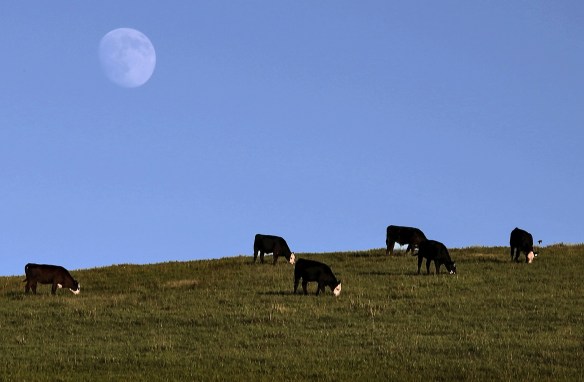
That includes farmers and ranchers, who — together with the ‘rust belt’ blue collar workers — helped swing states and formerly Democratic states add to the Republican candidate’s lead.

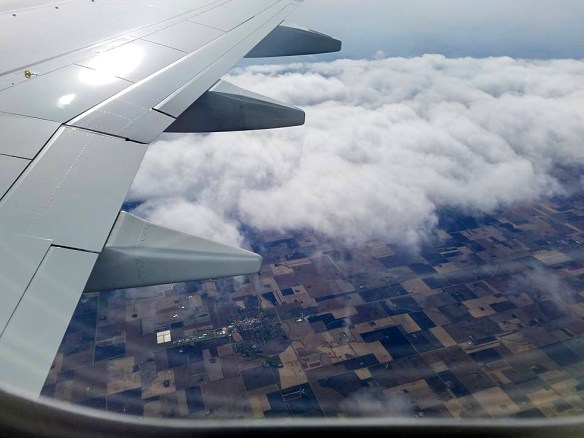
On ABC News, commentators noted “Rural America is more important than we thought.” On other news stations, the term “flyover land” was used to describe locations of folks who voted in-force and why the pre-Election polls were so wrong.
flyover.jpg

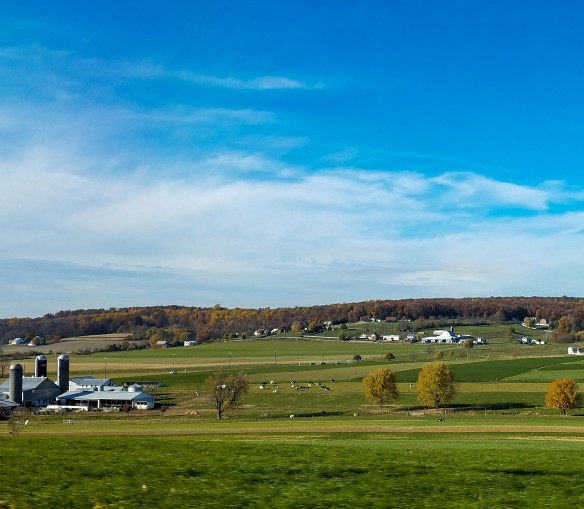
Yes, Rural and Middle America voted, and the demographics showed those votes for Trump came from a more diverse demographic than one might imagine in terms of race, gender and other factors with which the media and political pundits attempt to pigeon-hole We the People, as voters.
grazinglanccounty2

Most telling were the exit polls, that 89% of Americans interviewed after voting said the need for change was their most important election issue and that led to decisions of more people than expected voting for Donald Trump.

Political analysts note that the election was very decisive as even in the urban areas, core constituencies consolidated around Rural America and the blue collar workers of our country.
cropped-flag2.jpg

Still, as they examine “what happened” to their wrong pre-Election predictions, the mainstream media characterize Rural and Middle America repeatedly using the condescending term of “uneducated.” They will have to think some more to grasp what the people have said, as they have spoken at the ballot box in this historic election.

In fact, much of the weight for healing rests with the mainstream media and their persistent focus on our differences and demographic ‘slots,’ that tend to incite unrest.

Looking at the election results, take for example my home state of Pennsylvania. The Keystone State’s diverse people rejected the status quo and voted for a change. It was the first time Pennsylvania has voted for a Republican candidate since the senior George H. W. Bush in 1988. In fact, the map of results depicts it.
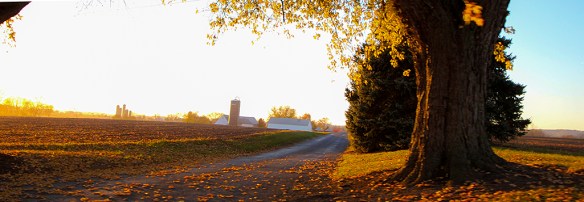
wgoldenautumn5019

In the wee hours of Wednesday morning, a humbled President-Elect Trump said: “ It is time for us to come together as one united people… I pledge to every citizen of our land that I will be President for all Americans. This is so important to me.

themomentwhenpaputtrumpoverthetopcmyk

“For those who have chosen not to support me … I’m reaching out to you for your guidance and your help so that we can work together and unify our great country,” said Trump.

“As I’ve said from the beginning, ours was not a campaign but rather an incredible and great movement, made up of millions of hard-working men and women who love their country and want a better, brighter future for themselves and for their family.

“It is a movement comprised of Americans from all races, religions, backgrounds, and beliefs, who want and expect our government to serve the people — and serve the people it will. Working together, we will begin the urgent task of rebuilding our nation and renewing the American dream…

“The forgotten men and women of our country will be forgotten no longer,” Trump said.
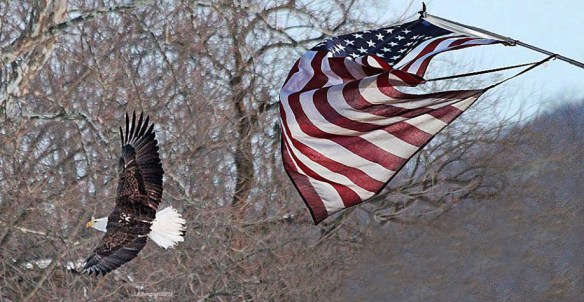
flag13.jpg

In her concession speech, Secretary Hillary Clinton encouraged her supporters to “keep and open mind” and “give him a chance to lead.”

President Obama encouraged the nation to come together because “we are all on the same team as Americans.” He said his administration would follow the professional example set by his predecessor George W. Bush in the “peaceful transition of power that is the hallmark of our democracy and which we will show the world in a few months.”

Among the first orders of business for the Trump administration appear to be the repeal and replacement of Obamacare and to deal with executive orders such as WOTUS, along with work on current and future trade agreements and incentives to keep jobs in the U.S.

But even more important will be the necessary work to heal this land, that the exchange of ideas is healthy and as the pendulum swings between them, we realize what drove this election was the desire to look inward and resist to some degree the push for globalization and the global structure in which Americans lose autonomy, identity, independence.

A few personal thoughts:

My grandparents, Ace and Dot Jacobs were married nearly 70 years until in death they did part. My grandfather, a WWII veteran, was a devout Republican, my grandmother, a seamstress, was a dyed-in-the-wool Democrat.

Papap knew better than to discuss politics, and yet he did not make his votes or views a secret.

Gramma would have been upset by this election outcome because she longed to see the first woman president and she detested Donald Trump. She was here to vote for Hillary Clinton in the Democratic primary. And she knew where I stood on the Republican side, ultimately supporting Donald Trump. We talked of it a few times, rationally, before she died in July.

If two people — who would view yesterday’s outcome so differently — can be happily and lovingly married nearly 70 years or be loving grandmother and granddaughter for over 50 years, there is hope that we as Americans can come together and solve our problems despite our differing political views.

It is crucial that we stop slapping labels on each other’s points of view before hearing where it truly comes from and what is being said. And in articulating views and courses of actions, we can take greater care to get to the issue and avoid the hyperbole that fuels this divisive labeling.

In short, this election was not about all of the negative labels the press list for us… It represented how the little folk of all races, religions and creeds did exercise their vote to make substantive change in the course of this country and in repudiating the elitism that has persisted for so long.

It would help if the media and the pollsters stop criticizing folks without college educations. Granted, I never did achieve my college degree, but I got two-thirds of the way there, and I — like many who voted for Trump with or without a college degree — work hard every day with integrity and compassion and should not be characterized as uneducated and angry as main traits.

beach9534.jpg

I am hopeful at Trump’s words that he will reach out to those who supported Hillary Clinton for their guidance on the healing course of the future. I am hopeful that our nation’s leaders will never again take the little folk who work quietly in the background for granted.

We all need each other.
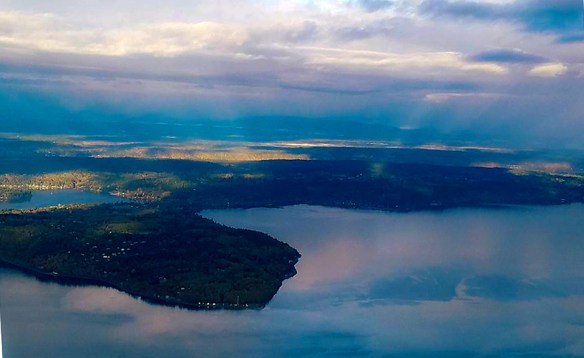
seattle

Like the differences in our American landscape from sea to sea, and everything in between, each of us have differing backgrounds, perspectives, experiences, hopes, dreams, aspirations, and other context for our lives.
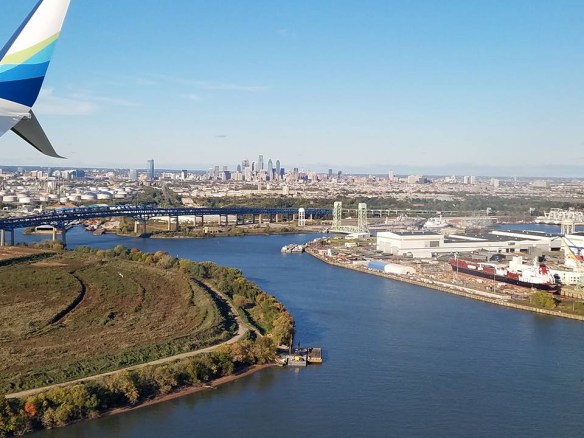
phila

We may be surprised by the positives that can come after what has been such a negative election process this year. Can this catharsis be the point from which to move forward?

Together, we make America great. Together, we make America good. Together, we make America home.
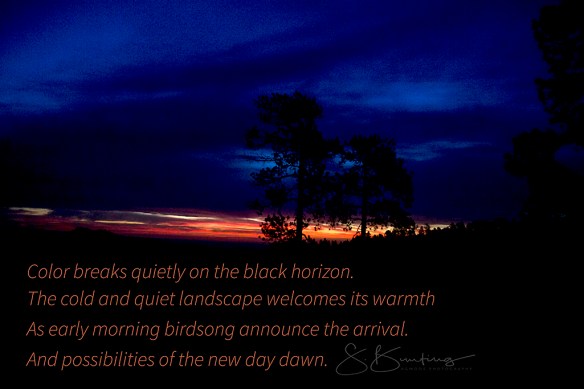
america8462custerweb


‘Bred-and-owned’ declared best of best at 50th WDE

By Sherry Bunting, Farmshine, Oct. 14, 2016 (Photos by author except where noted)

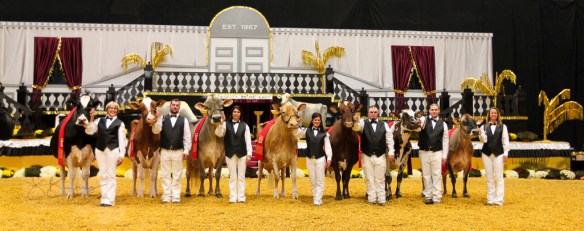
MADISON, Wis. — As the World Dairy Expo celebrated 50 years earlier this month, nostalgia could be found both in and out of the showring. For starters, the five days of shows for seven breeds yielded grand champions that were predominantly bred-and-owned, many with their breeder-owners at the halter.

In fact, six of seven open grands and four of seven junior grands were bred and owned. Let’s take them in alphabetical breed order!

day-5-96.JPG

Throughout the week, judges recognized how difficult it is to get to this show and win, and even more so to breed the animal and get her here and win. Exhibitors, judges and breeders, alike, point out in their own way that there is as much art as there is science to breeding a top cow… but also a bit of luck.

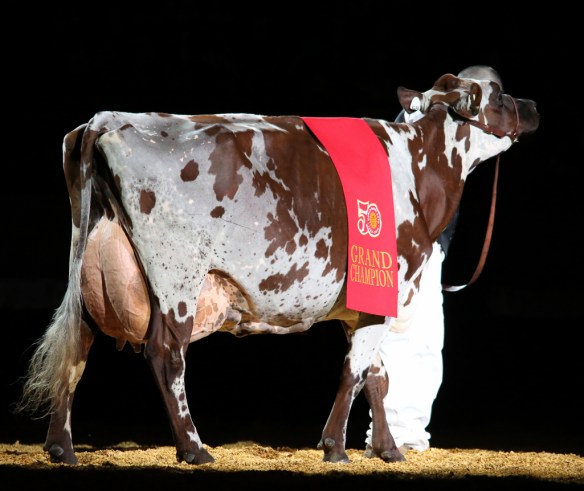
Take for example, the grand champion of the International Ayrshire Show: Margot Patagonie was bred, owned and exhibited by Expo first-timer Ferme Margot of Ste Perpétue, Quebec, Canada.

day-5-86.JPG

The striking thing about this grand champion is that not only did Ferme Margot breed the winning cow, they also bred her dam and her sire! What an achievement for the visiting World Ayrshire Conference to witness during their time in Madison, where they also saw the Expo’s largest Ayrshire show ever, with 321 entries, reportedly 60 more entries than the previous record.

AyrshireOpen(B&O)2401.jpg

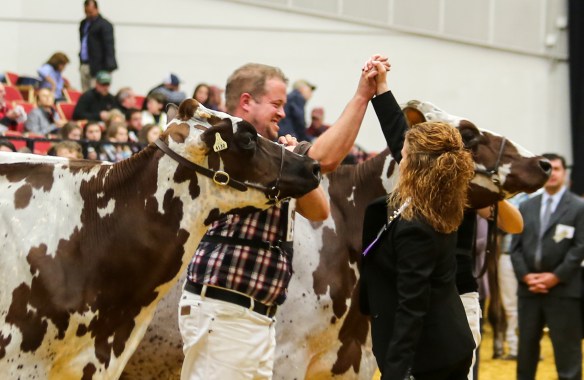
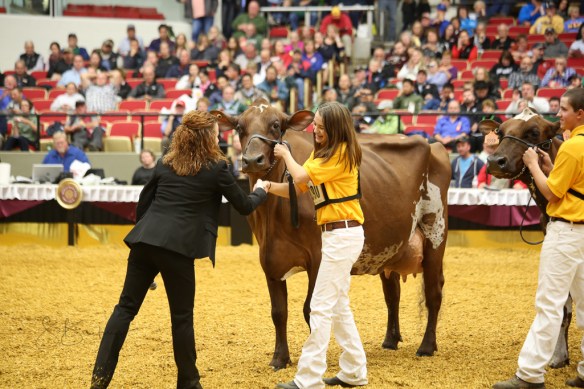
In the junior Ayrshire competition, Erin Curtis-Szalach of Cedarcut Farms, Cazenovia, New York, knabbed grand champion honors for the second straight year with her bred-and-owned Cedarcut Burdette Clove Colatta.

day-4-53.JPG

She also made a strong honorable mention grand champion and total performance winning in the Open Show where entries were up by 60.

DayFive1503.jpg

In the Brown Swiss competition, which also topped previous records with 385 entries, both grand champions were repeat show-toppers as well as bred-and-owned with owners at the halter.

DayThree2107.jpgBrown Heaven Glenn Fantasy topped the open show with Josee Charron from Ferme Brown Heaven, Vercheres, Quebec at the halter.
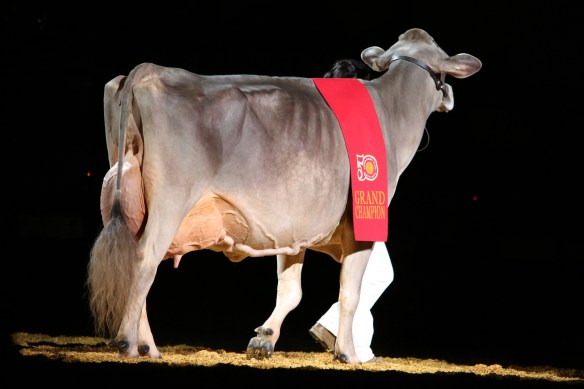
DayFive3491.jpgKyle Barton, grandson of Ken Main of Elite Dairy, Copake, New York, earned the grand champion banner in junior competition for the second year with homebred Cutting Edge T Delilah (below).

wJrBrownSwiss3096w.jpgShe went on to be reserve supreme of the Junior Show, and she was reserve grand champion of the open Brown Swiss Show, second only to Fantasy (above).
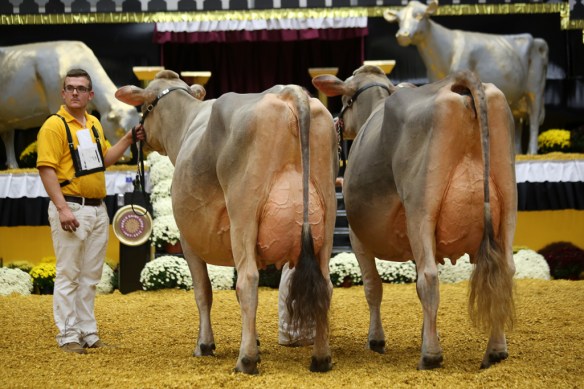
day-2-12.JPGKyle and his older brother Mickey have done quite well over the years and their grandfather is pleased that they enjoy the cattle among their other activities.
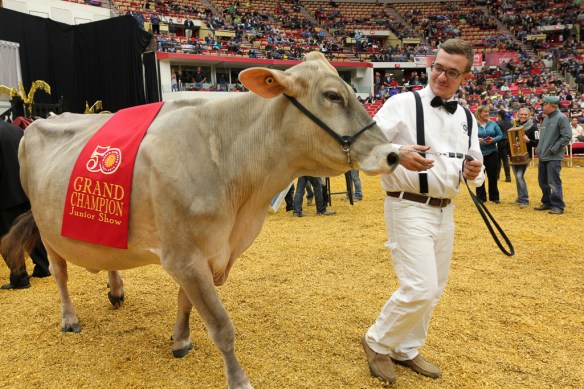
day-5-69.JPGAmong the Guernseys, it was bred-and-owned Flambeau Manor Ro Lauren-ET to go grand in the Open Show. With Tracy Mitchell again at the halter, Lauren repeated her 2014 performance as grand champion for Gary and Steve Van Doorn of Flambeau Manor, Tony, Wisconsin.
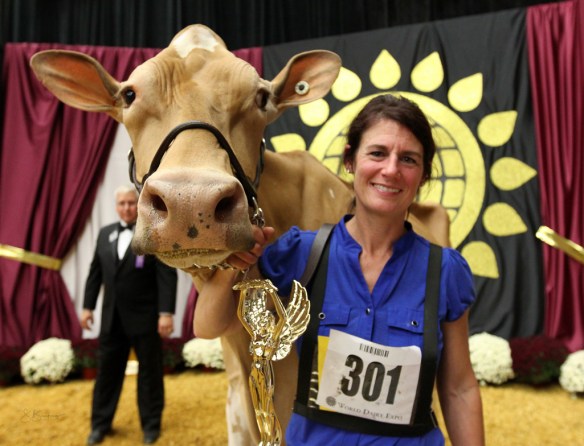
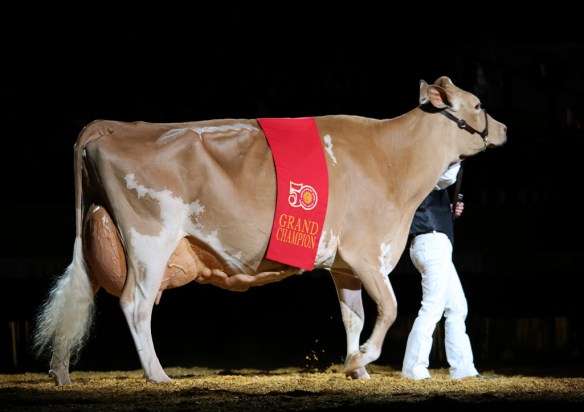
day-1-55

day-5-88.JPGAmong the juniors, Austin and Landen Knapp of Epworth, Iowa threepeated with the homebred Knapps Regis Tambourine-ET. The Knapps are premier breeders.
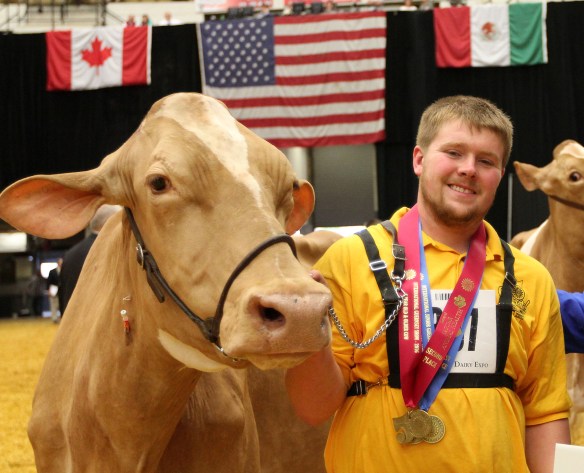
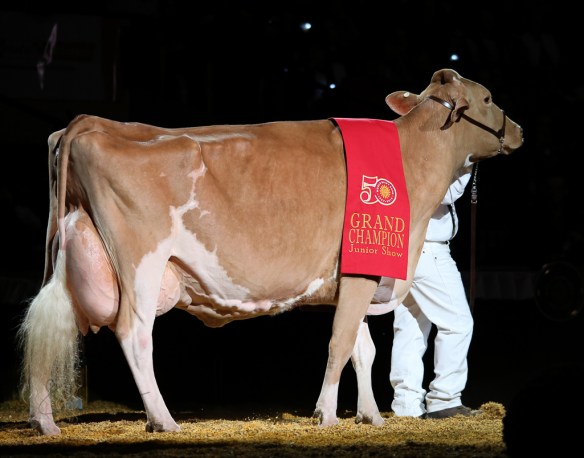
guernseyjuniorbo0109

day-5-75.JPGA large field of Holsteins narrowed down to grand champion Sheeknoll Durham Arrow. She impressed judge Pat Conroy as a cow that “lets you know she does not need to be pampered.” With Jeannette Sheehan at the halter, the aged cow moved through the ranks to achieve a storybook ending for her leadswoman, whose father Vernon Hupf — a lifelong farmer who attended every World Dairy Expo but this one as a spectator — had passed away in June.
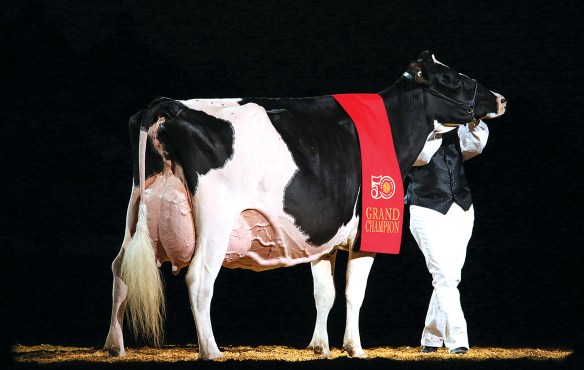
“To win the show that Dad idolized is just amazing,” said Jeannette after “Thomas” (as the cow is affectionately known to all after a grandson dubbed her as a calf in honor of Thomas the Train) went reserve supreme of the International Open Shows Saturday night.

DayFive3589.jpg“Each time the judge picked her out, I was surprised, but I didn’t have time to process what was happening. I was pretty much just trying to hang on to the cow. At one point it just felt like Dad was here, on my shoulder telling me what to do, right down to that look out of the corner of the eye.”
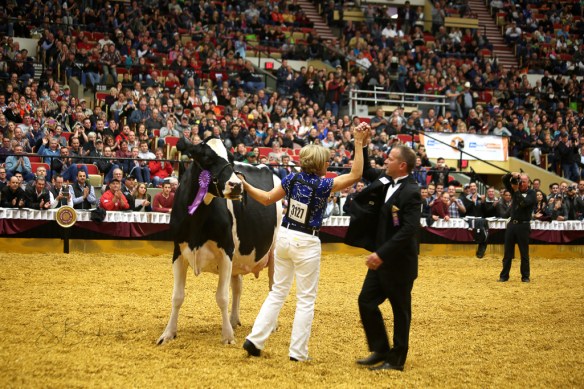
day-5-58Not only did the Sheehan family have a winner, they did so with a bred and owned animal in a highly competitive Holstein show. “We are still a little stunned. You don’t come here with expectations because this show will humble you in a hurry,” Jeannette’s husband Robert added just after her reserve supreme honors were awarded Saturday evening. “The whole thing is unbelievable. We like to breed  nice cows, the kind of cows we like to milk. Breeding is science and art with luck involved. The match has to work and every once in a while you get a cow like this.”
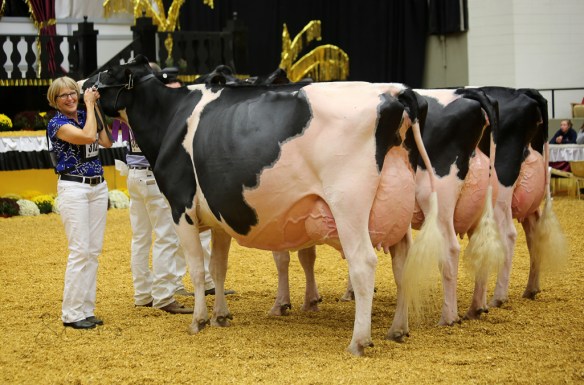
Thomas has shown a lot in the last 4 to 5 years. “This year she blossomed and matured into the kind of cow we thought she could be.” he added.

Robert and his brothers Jim and Jerome and their wives Karen, Mary and Jeannette are partners at Sheeknoll Farms, with the next generation also involved. They milk 300 cows at the farm in Rochester, Minnesota, and are known by their peers to treat them all like queens with great cow comfort and attention to detail. In fact, the mantra on their Facebook page says it all: “If we take care of the cows, they will take care of us.” They were thankful for the total team effort taking care of the EX 96 97MS Thomas in her grand journey to this surreal finish.

day-5-59.JPGSheeknoll Durham Arrow (aka Thomas) had an exciting path to her grand champion honors at the 50th World Dairy Expo, having won the 2016 Minnesota State Fair and other shows leading up to it.
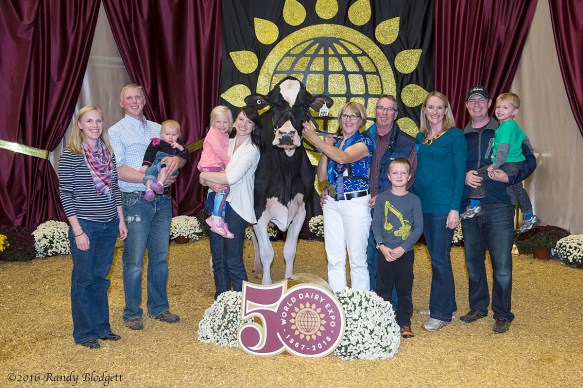
sheehanfam

Photo courtesy Randy Blodgett, Blodgett Communications

The Sheehan family, friends and Thomas’ fans watched as judge Pat Conroy and his associate Yan Jacobs placed Thomas first aged cow, best bred-and-owned, best udder, production cow, senior and grand champion, over a competitive field including last year’s supreme champion Katrysha and over this year’s reserve and honorable mention grand champions, the latter exhibited by Glamourview Farms of Walkersville, Maryland.

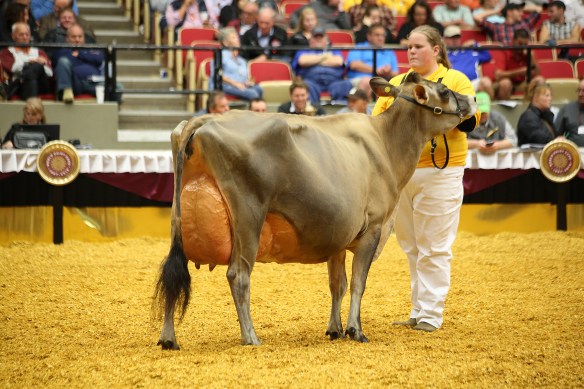
jerseyjuniorbo1164In the junior Jersey competition it was Cora and Cari of Darlington, Wisconsin. The homebred Red Rock View Cari was the grand champion Jersey of the Junior Show, with Cora Carpenter at the halter.
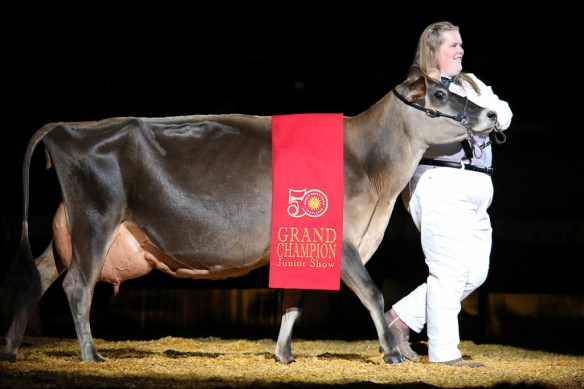
day-5-78.JPGThe Carpenter family was overjoyed to see their daughter and homebred Jersey do so well.
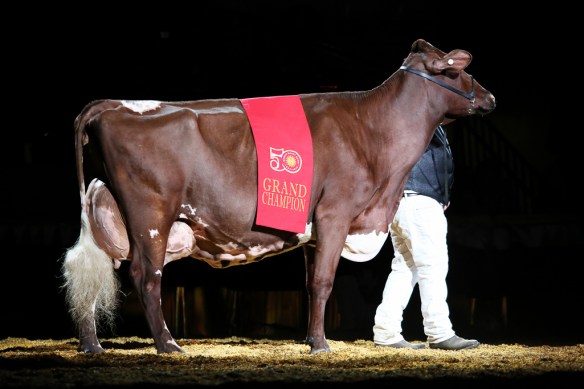
Earlier in the week, the grand champion Milking Shorthorn of the open show was Cates Ruben Tulsa-Time-EXP, bred, owned and exhibited by Peter Cate of Cornish Flats, New Hampshire for the second straight year.

day-5-91.JPGThe Milking Shorthorn Show at World Dairy Expo has grown and lasted into Wednesday evening, but was quite exciting.
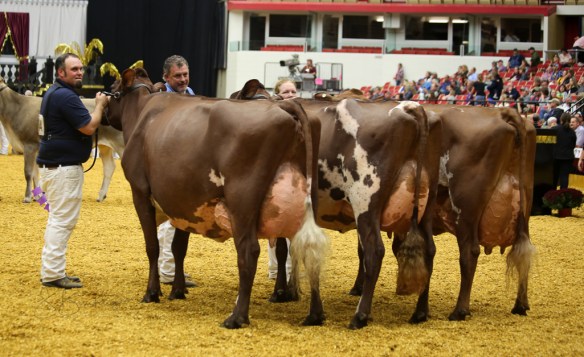
day-2-70.JPGIn the International Red & White show, Pheasant Echo’s Turvy-Red-ET was grand champion with breeder-owner Kenny Stambaugh, Westminster, Maryland, at the halter.
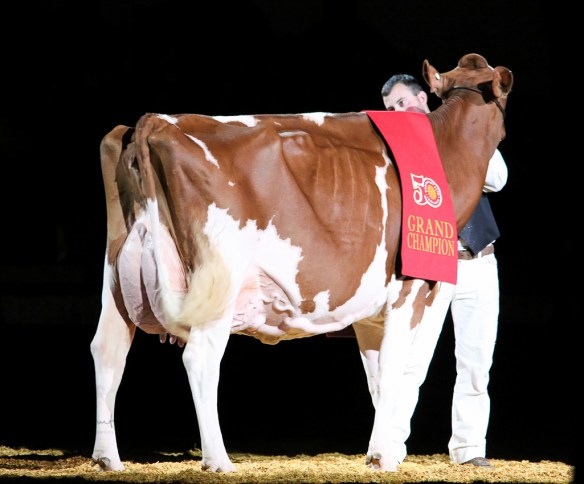
day-5-93When Kenny Stambaugh’s homebred Turvy was named grand champion of the International Red & White Show on Friday, his sister Crystal Edwards was there in person to celebrate. Most of the rest of the family could probably be heard hooting-and-hollering over a thousand miles away in Westminster, Maryland as they gathered around the television to watch Kenny show and be victorious in the online live-feed of the showring proceedings.
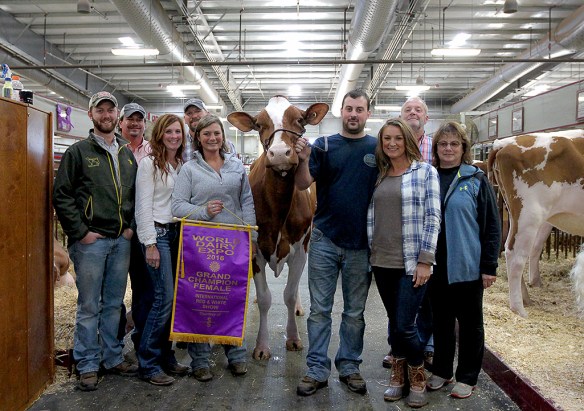
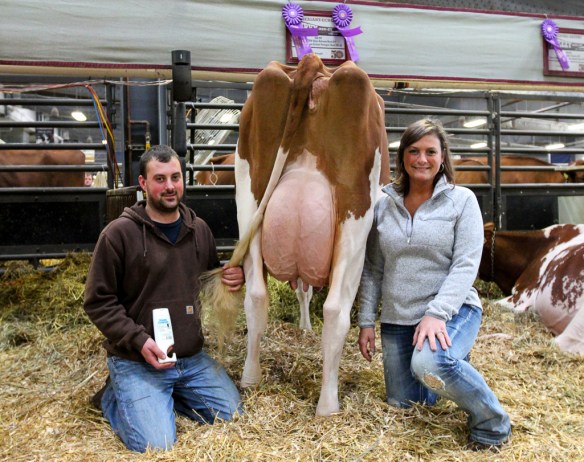
What they did next, as you might imagine, is figure out how to get everyone out there by the next afternoon to see Kenny and Turvy vie for supreme in the closing ceremonies Saturday evening.

By 9:00 p.m. Friday evening, they had secured a flight that got Kenny’s parents, siblings and spouses to Madison by 2:30 p.m. Saturday — just three hours before the closing ceremonies – to surprise Kenny, who had no idea they were coming out.

day-5-21.JPG

The Stambaugh family (photo by Sherry Bunting)

Kenny confessed he was pretty nervous in the ring, but it never showed because he had faith his cow stacked up pretty well against the competition.

When asked what gave Turvy the edge in a competitive Red & White class, Kenny and Crystal agreed: “It was her youthful udder and big frame,” said Kenny. Turby is classified EX-94 with a 96-point mammary system.

day-5-0.JPG“She also walks on an awesome set of feet and legs,” Crystal added. “But after three calves at five years old, to have that youthful udder is pretty special.”
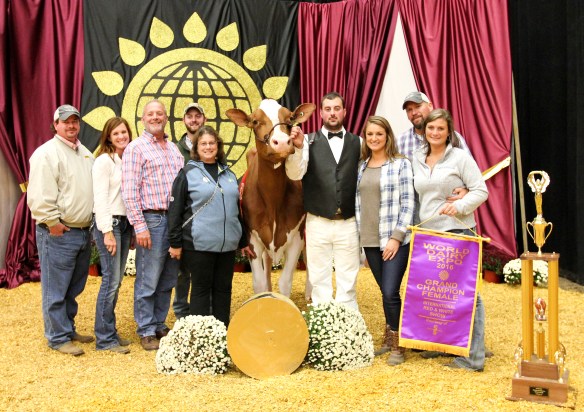
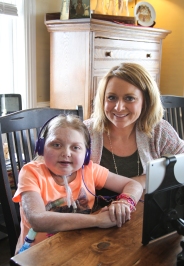
What makes the win even more special for the family is that Turvy’s dam was the Stambaugh family’s first homebred Red & White Holstein. To have a World Dairy Expo grand champion in a daughter of their first homebred Red & White just makes the win belong to everyone on the farm.

When Barney and Debbie Stambaugh started farming on their own in 1991, they purchased some Red & Whites and over the years bred them to some top black and white Holstein genetics, which yielded a red line within the herd.

“Dad had worked for Peace and Plenty as a kid, and that really sparked it in him,” Crystal recounted.

She describes the breeding philosophy at Pheasant Echo’s as one that allows them to have “a lot of old cows. We are fortunate that way,” she said. “Between the genetics and cattle care, we want cows that hang around, breed back and have productive life.”

The family sold an Armani heifer out of Turvy in the Apple Mania Sale and another out of this family at the National Red & White Convention Sale when that sale was hosted at the farm during the convention week in Maryland last summer.

Turvy had previously placed second in the junior competition at the 2014 World Dairy Expo and 7th in the open competition that year. “She has really come into her own,” said Crystal of the cow that likes to swish her tail.

“Nothing makes me happier than being able to come out and look at good cows when it’s time to milk,” said Kenny. “It sure makes it easier to get up at 3 a.m.,” Crystal added.

Kenny and Crystal agree that this will now be their favorite show memory. Prior to this win, it was the grand champion win at the 2014 All-American Dairy Show in Harrisburg.

But nothing tops winning at the 50th World Dairy Expo with a bred-and-owned cow, and being the leadsman at the halter to boot.

DayFive1751.jpg

Kenny Stambaugh and his wife Nicole and homebred WDE grand champion Pheasant Echo’s Turvy-Red are flanked by parents Byron (“Barney”) and Debbie (right) and siblings and spouses from left, Bud Stambaugh, CJ and Tanya Miller and Dan and Crystal Edwards. Photo by Sherry Bunting as appeared on Cover of Farmshine Oct. 14, 2016


-30-


Determination defined.

By Sherry Bunting, Farmshine, Sept. 23, 2016

HARRISBURG, Pa. — Before the March homecoming, Reese Burdette told the medical staff “I’ve got to get home to my cows.”

And so she did. Her cow Pantene, in fact, had just had a heifer calf she named Pardi-Gras. It was Mardi-Gras time of year and she was looking forward to a homecoming party.

When Reese Burdette did come home to Windy-Knoll-View farm after those 662 days at Johns Hopkins Children’s Center Pediatric Intensive Care Unit (PICU), she was so anxious to get back to her cows and the dairy industry she loves that she wanted to get right out on the gator with her papap to look them over.

Reese03That didn’t happen immediately, but not long after she was home, she sure did.

A few days after her March homecoming. Reese was already setting new goals for herself.

Sitting at the kitchen table on the day of our visit in mid-March, taking a break from “virtually” attending school, Reese said, matter-of-factly, and with a radiant smile (as her mother and momo exchanged glances):

“I want to be walking good enough to lead Pardi-Gras in Harrisburg in September.”

And so she did. She sure did.dsc_1142

reesepeptalkdadIt was something she had worked for daily with the support of her family, friends, therapists… and a last minute pep talk from dad, Justin Burdette.
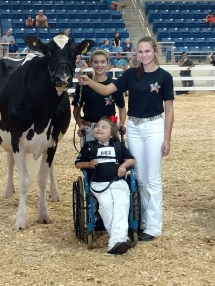
In fact, not only did she lead Pardi-Gras to a 4th place finish in her class Monday, Sept. 19 during the All-American Dairy Show at the Farm Show Complex in Harrisburg, Pa., she also led Pardi-Gras’ dam, Reese’s prize 4-year-old cow Pantene to a 1st place finish in her class… and the honors that followed as Reserve Grand Champion Holstein of the Premier National Junior Show.

Perhaps Pa. Holstein Association executive director Ken Raney put it best in a post acknowledging all of the great people and families the association works with across Pennsylvania. “It’s been my goal to share the accomplishments and recognize many people for what they do for the dairy industry, but today was different,” he wrote. “Today, we got to witness a young lady who has shown great determination and a will to not only survive but return to the industry and cows she loves. Congratulations and thank you Reese Burdette for showing us what true determination is all about.”

reesepantenereschampReese was surrounded Monday by her support team of friends and family, including friends from Johns Hopkins, who came to Harrisburg to witness how much Reese loves the dairy industry and how this dairy industry family continues to support her and her family. Her ever-faithful cousin Regan Jackson and friend Lane Kummer helped make it possible to also lead her cow Pantene.

In a video interview with The Bullvine, Reese’s mother Claire Burdette said that people wonder how they can be so strong through this journey of over two years. She said, “It’s people surrounding us that make us strong.” She described Reese’s sense of humor and tenacity that stayed with her throughout this journey.

00aareese0022As for Reese, her family, favored cow Pantene, and all who continue to support and love her… the joy of the day and its milestones was plain to see.
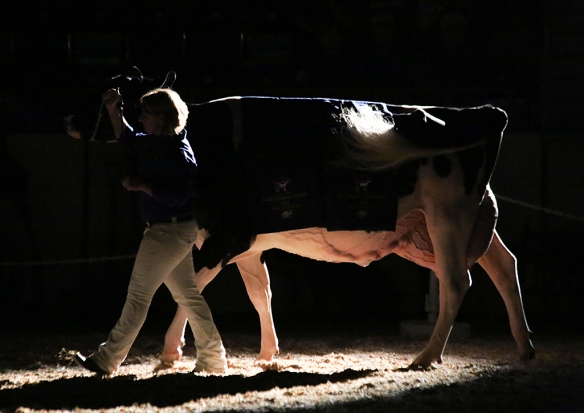
As expected, this tenacious 10-year-old has already set the next goal for herself (and loves to think in timelines): To attend school without the part-time assistance of the wheelchair by the end of the year.

We continue to root for this amazing and inspirational young lady and agree wholeheartedly with Ken Raney’s comment: “You made us all proud ‘Miss Tuff Girl!’” as she is affectionately known these days.

***

Thank you to Laura Jackson, Jean Kummer and Randy Blodgett for some of the photos above. Below, Reese’s Pantene also made the Supreme parade lineup Thursday as Grand Champion Holstein in the open competition, shown by her mom Claire Burdette.00aaPantene9930.jpg


00aachampionudders9953.jpg


00aajudges9973.jpg


00aaReese0024.jpg

00aachampsbo0042


A world without cattle?

GL45-Earth Day(Bunting).jpgCaption: The health of the dairy and livestock economies are harbingers of the economic health of rural America … and of the planet itself. Here’s some food for thought as we celebrate Earth Day and as climate change discussions are in the news and as researchers increasingly uncover proof that dietary animal protein and fat are healthy for the planet and its people.
By Sherry Bunting, published April 22 Register-Star (Greene Media)

A world without cattle… would be no world at all.

How many of us still believe the long refuted 2006 United Nations Food and Agriculture Organization (FAO) report, which stated that 18 percent of all greenhouse gas emissions, worldwide, come from livestock, and mostly from cattle?

This number continues to show up in climate-change policy discussion even though it has been thoroughly refuted and dismissed by climate-change experts and biologists, worldwide.

A more complete 2006 study, by the top global-warming evaluators, the Intergovernmental Panel on Climate Change, stated that the greenhouse gas emissions from all of agriculture, worldwide, is just 10 to 12 percent. This includes not only livestock emissions, but also those from tractors, tillage, and production of petroleum based fertilizers, pesticides and herbicides.

Hence, the UN Environmental Program disputed the UN FAO assertion to state the percentage of emissions from total agriculture, worldwide, is just 11%, and that cattle — as a portion of that total — are responsible for a tiny percentage of that 11%. While cattle contribute a little over 2% of the methane gas via their digestive system as ruminants (like deer, elk, bison, antelope, sheep and goats), they also groom grasslands that cover over one-quarter of the Earth’s total land base, and in so doing, they facilitate removal of carbon dioxide from the atmosphere to be tied up in renewable grazing plant material above and below the ground — just like forests do!

Think about this for a moment. The UN Environmental Program and the Intergovernmental Panel on Climate Change are in agreement that cattle and other livestock are not the problem the anti-meat and anti-animal-ag folks would have us believe. In fact, they are in many ways a major solution.

Think about the fact that man’s most necessary endeavor on planet Earth — the ongoing production of food — comes from the agriculture sector that in total accounts for just 11 percent of emissions!

Why, then, are major environmental groups and anti-animal groups so fixated on agriculture, particularly animal agriculture, when it comes to telling consumers to eat less meat and dairy as a beneficial way to help the planet? Why, then, has the U.S. Dietary Guidelines Council pushed that agenda in its preliminary report to the U.S. Departments of Agriculture and Health and Human Services, that somehow the Earth will be better sustained if we eat less meat?

They ignore the sound science of the benefits livestock provide to the Earth. In fact, it is no exaggeration to say what Nicolette Niman has written in her widely acclaimed book “Defending Beef” that, “Cattle are necessary to the restoration and future health of the planet and its people.”

Niman is a trained biologist and former environmental attorney as well as the wife of rancher Bill Niman. She has gathered the data to overturn the myths that continue to persist falsely in the climate-change debate, and her book is loaded with indisputable facts and figures that debunk the “sacred cows” of the anti-animal agenda:

  • Eating meat causes world hunger. Not true. In fact, livestock are not only a nutrient dense food source replacing much more acreage of vegetation for the same nutritive value, livestock are deemed a “critical food” that provides “critical cash” for one billion of the planet’s poorest people — many of whom live where plant crops cannot be grown.
  • Eating meat causes deforestation. Not true. Forests, especially in Brazil, are cleared primarily for soybean production. Approximately 85 percent of the global soybean supply is crushed resulting in soybean oil used to make soy products for human consumption and byproduct soybean meal for animal consumption. A two-fer.
  • Eating meat, eggs and full-fat dairy products are the cause of cardiovascular disease. Not true. Researchers are re-looking at this failed advice that has shaped 40-years of American dietary policy. Its source was the 1953 Keys study, which actually showed no causative link! Meanwhile, excessive dietary carbohydrates have replaced fats in the diet, which turn to more dangerous forms of fat as we metabolize them than if we had consumed the natural saturated fats themselves. When healthy fats from nutrient-dense animal proteins are removed from the diet, additional sugars and carbs are added and these have led us down the road to increased body mass and diabetes.
  • Cattle overgrazing has ruined the western prairies. Not true. While improper grazing can have a localized detrimental effect, the larger issue is the pervasive negative effect that is largely coming from not grazing enough cattle. Higher stocking densities that are rotated actually improve the health of grasslands. Large herds provide the activity that loosens, aerates and disperses moisture along with the nutrients the cattle return to the soil — for more vigorous grass growth and soil retention — much as 30 million buffalo and antelope groomed the prairies two centuries ago. Meanwhile, the Bureau of Land Management has favored controlled burns over grazing and is taking away land rights our federal government once shared with ranchers. BLM reductions in allowable stocking densities have initiated a land-grabbing cycle of ranchers losing their land and livelihoods while the land is robbed of its benefits.

The anti-animal agenda continues — groundless, yet powerful. Rural economies, farm families, consumers and the Earth pay the price.

The majority of the lifecycle of supermarket beef and dairy products is rooted in grooming the grasslands and forage croplands that are vital to the Earth and its atmosphere. In addition, farmers and ranchers reduce tillage by planting winter cattle forage to hold soil in place, improve its organic matter and moisture-holding capacity, provide habitat for wildlife while providing temporary weed canopy between major crop plantings. Not only do cattle eat these harvested winter forages, they dine on crop residues and a host of other food byproducts that would otherwise go to waste.

Our planet needs livestock and the farmers and ranchers who care for them. They not only feed us — with more high quality dietary protein with all of the necessary amino acids, calcium, zinc, iron and other nutrients per serving than plant-based sources alone — they also feed the planet by providing necessary environmental benefits.

Enjoy your meat and dairy products without fear — certainly without guilt — and with gratefulness and appreciation for the gift of life given by the animals and because of the hard work and care they have been given by the men and women who work daily caring for the land and its animals. This Earth Day, we are grateful for the circle of life and the farmers and ranchers and their cattle, which sustain our existence, our economies, and our environment.

A former newspaper editor, Sherry Bunting has been writing about dairy, livestock and crop production for over 30 years. Before that, she milked cows. She can be reached at agrite2011@gmail.com

Learn more about the latest research to measure emissions due to the dairy and livestock industries.

-30-

Images by Sherry Bunting

Reinventing milk… promotion

MilkMarketMoosHeader070914.jpg

Reprinted from FARMSHINE, April 8, 2016

Fewer Americans eat breakfast today, adding to the milk consumption woes created when families stopped eating sit-down dinners, for the most part. Both were the staples of commodity fluid milk consumption that have been diminishing over the past two generations and four decades to where we are today.

Forecasters say it will only get worse. They are projecting continued declines in ‘white milk’ consumption while consumption of milk alternatives is predicted to increase dramatically through 2021.

A major reason is that the majority of urban consumers — up to 90% — do not view white milk (aka Vit. D whole milk) as a protein drink, when clearly it is the original, the natural protein drink.

But what is DMI working on? Alternatives. Checkoff dollars continue to flow through DMI to alternatives milks. Yes they are dairy products, but they are further processed, as in the case of Fairlife, which is ultrafiltered, for example.

I have had dairymen involved in these boards excitedly tell me: “We finally have a product consumers want!”

If they are referring to Fairlife, that may be true for consumers we’ve lost to Muscle Milk (which does contain some whey) or Almondmilk (which is the equivalent of eating an almond and chasing it with water full of thickeners, sugar and chemically added calcium and vitamins.)

But I find myself confused. Isn’t dairy promotion supposed to promote what contributes most to the dairy farmer’s milk check? I mean, it is the dairy farmer’s money, is it not?

As long as the Federal Order milk pricing scheme puts the value on Class I utilization, then the milk checkoff organizations should be most diligently promoting regular, straight-from-the-cow (pasteurized of course and maybe even flavored) milk as the healthy high-protein beverage it is, naturally, because I’m sorry to tell you friends, consumers just don’t know this information.

Milk: The protein drink that’s right under our noses and costs a lot less than fancy packaged and advertised alternatives — some of them complete frauds in that they are not even milk!

Why is it that milk alternatives can claim all sorts of things, but milk is not even allowed to advertise itself as 96.5% fat free! Why can’t the milk bottle say “8 times more protein than almondmilk per 8 oz serving!”

Why can’t it say: “Want Protein? Get Milk!”

Do we really need Coca Cola to revolutionize our branding? Or should dairy farmers take the bull by the horns and demand great packaging, savvy catch phrases, eye-catching point-of-purchase education, head-on comparisons to the fraudulent beverages that so wish to be milk that they call themselves milk.

No, USDA does not allow dairy farmers to promote their product comparatively with those other commodities that have stolen some of their market share by stealing the name milk. You dairy folks must play nice of course!

That’s hardly fair since dairymilk is losing market share. If you can’t defend your own market turf with your own collected monies, then what’s the point of collecting the money? All of these joint partnerships to sell cheese on pizza and mixes through frappes at McDonalds might move some more milk, but the value is in the Class I fluid milk, so unless we’re going to change the complicated milk pricing formula and glean more value and a guaranteed minimum for the manufacturing milk via its products, then we might just as well use the money to buy-back our own fluid milk and donate it to the poor to keep the demand for Class I tight vs. the supply.

Or put the money in a kitty to develop better fluid milk labels. Make them cool and splashy with P-R-O-T-E-I-N in large letters.

Milk: The original protein drink!

Milk: Protein drink of champions!

Milk: Why pay more? We’ve got what your looking for!

I could go on all day.

If the growth of our Class I milk markets rely on the USDA school lunch program, then we’re sunk and USDA is once again to blame for this dismal failure by tying the hands of school districts who want to serve 2% and whole milk.

Analysts say that the strong growth in the milk markets of emerging countries like Chile is attributed to their school milk programs.

In the U.S., milk is stigmatized as a “commodity.” We sure don’t help that with plain white bottles and lackluster graphics.

Milk alternatives such as soymilk and almondmilk (aren’t they so tricky in creating their own new words by paring their commodity to the word milk as one word) are increasingly viewed as ‘fashionable drinks’ and a more health-conscious choice compared to white milk.

Let’s reverse this trend by making dairymilk fashionable again!

Let’s call it dairymilk (a tricky combined word!) and come up with a new standard of identity that allows us to say 96.5% fat free instead of “whole.”

Maybe even come up with a standard for protein and say to call it dairymilk it must meet that protein standard and then colorfully package and protein-promote the heck out of it.

Analysts say that consumers like innovation in their drinks and they are finding “innovation” in the “newer milk categories” which are so much more attractive than the “mature” white milk category.

Okay then, let’s give the consumer what they want. Great tasting real milk but let’s reinvent the packaging and the promotion and the name… not the beverage itself.

Just think how much money we can save on fancy equipment if all we have to do is reinvent the promotion of milk, not reinvent the milk itself. After all, it is nature’s most nearly perfect food.

Maybe instead of fighting each other for Class I sales by moving milk all over to get the best price and utilization (see chart on page 13 showing that picture for the beleagured Northeast Order)… we should be fighting, instead, together, to save our beverage from its continued depreciation at the hands of internal politics, external politics, USDA rules upon rules, fraudulent not-milk-milks whom regulators ignore and even patronize, and other assorted casts of characters.

‘I’ve got to get home to my cows’

With courage and grace, Reese comes home after 22 months

By Sherry Bunting, reprinted from FARMSHINE March 25, 2016
Reese03Author’s Note: It has been almost a month since Reese’s homecoming and she is getting back to the precious rhythms of life on the farm: Greeting her little sister off the bus on sunny afternoons, feeding her prize cow’s new calf, riding the gator with her grandfather, having tea parties with sister and cousins on Sunday afternoons, getting together with school friends, still attending school virtually via “Double,” her robot, even going to the dentist! Her journey continues to inspire. I am grateful for the opportunity to interview Reese and her mother and grandmother on the quiet first Monday after her arrival home Friday, March 18, 2016. Get ready to be inspired by this young lady, and by her family and the local farming community and worldwide dairy community who continue to think of her. Thank you to Jean Kummer, Laura Jackson and Jennifer DiDio for providing some of the photos here.
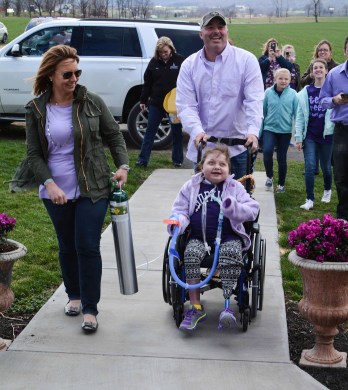
 

MERCERSBURG, Pa. — Nina Burdette tells the story of granddaughter Reese teaching her cow Pantene to lead when she was a calf five years ago. Reese was four at the time, and Nina told her “Don’t let go.”

“That calf pulled her around, and at one point she was flat on her back holding on, until that calf wrapped itself around a post,” Nina recalls she had rope burns on her hands.

Reese never let go.

So it was two years later, on May 26, 2014, when Reese arrived at Johns Hopkins Children’s Center, where she would spend the next 662 days in the Pediatric Intensive Care Unit (PICU) recovering from burns over 35 percent of her body and smoke damage to her heart and lungs after a fire at the home of her grandmother Patricia Stiles, who also recovered from significant trauma carrying her from the burning room.

Reese never let go.

Reese01

Today, she is back home at Windy-Knoll View farm in rural Franklin County, Pa., with her sister Brinkley and their parents Justin and Claire Burdette, and of course her cow Pantene and her three heifers Pretzel, Panzee and Pardi Gras.

Over and over, Reese told her doctors: “I’ve got to get home to my cows.”

Words spoken from the heart of a true dairy farmer. “Oh she has her mind set on that, just like her mom and dad,” says Nina. “We call her the junior manager.”

Driving through Mercersburg to the Burdette home on Monday, purple still proclaimed Reese’s homecoming parade from the preceding Friday. Purple and white cows stood in yards and driveways, purple balloons, welcoming TeamReese banners, home-made signs of love and support, purple bows tied to trees, poles and fence posts all along the route of young Reese Burdette’s drive home from Baltimore to Mercersburg — the 200-mile trek her family has traversed between the home farm and their second home at Johns Hopkins for nearly two years.

Reese had set a goal to be home for her 9th birthday, which she celebrated with family and friends — at home — on Sunday, March 20.

“Friday was surreal,” said Mom, Claire, during Monday’s Farmshine interview as Reese sat in the next room attending school via her robot, screen and headphones. Brinkley, 5, had also gone off to school that morning, and Reese was eager to be on the porch in a couple hours to see her little sister get off the bus — something she had envisioned for months.

A return to the ordinary rhythms of life on the farm is just what this child has longed for as she recovered from that fateful day.

Friday had dawned brisk and sunny as Claire and Justin and Brinkley waited with Reese for morning rounds. “When the doctor said ‘you’re free to go,’ it felt so good to hear those words we had waited and prayed to hear for so long,” Claire recalls.

A sendoff party was attended by hundreds the night before at Johns Hopkins where Reese has become quite the celebrity in what everyone referred to as “the sunshine room” where there was no room for worry. She shared her games, was known for her aim in shooting foam darts at a deer on the doorway, and had a machine for making snowballs and popcorn for sale with lines out the door to her room some days. Her PICU room had been transformed into a rehab that looked as much like home as possible for the past year. Toward the end of her stay, Reese surprised her family with a video of her journey.

“She’s not afraid to talk about the fire,” said Claire, noting that the hospital has learned from Reese as they tried processes for the first time with her burns. Jim tells of the time she consoled a grandmother whose granddaughter was getting a tracheotomy, explaining to her there is nothing to fear. She had become quite the advocate for her own care, face-timing Dr. Kristen Nelson about medicines and earning the name “Dr. Reese” among the residents in training (RTs).

In fact, Dr. Kristen, as she is known, is quick to point out that, “Reese has surprised me in so many ways about perseverance and strength and hope and grace and bravery, and I am forever a part of her life.”

On Friday morning, an entourage of 25 doctors, nurses, RTs, and custodians, escorted her to the white SUV sporting the large purple bow.

And so, they began their journey back home to a new normal.

Claire said the sight was “amazing. There are no words to describe riding up and seeing people after people after people.”

A sea of purple lined the streets. “There was so much joy… and tears. People were waving and hugging each other,” she said.

This slideshow requires JavaScript.

The local fire company brought every piece of equipment for the homecoming escort. They drove through the high school, where the band played, and then through the middle school and through two elementary schools where children and adults lined the streets and filled the parking lots and rooftops with banners and balloons and smiles and waves.

In town, the First National Bank closed for 15 minutes as every employee, donning purple, came out to cheer Reese homeward as the Burdette family drove by. The John Deere dealership, car dealerships, and other businesses decorated profusely in purple to welcome their hometown hero.

“I thought she was going to jump out of the car, she was so excited. Of course, we had to stop at the barn first,” Claire said with a smile. “She wanted to see her cow Pantene, and the new heifer calf she had on Tuesday.”

Reese had already named the calf Pardi-Gras because she was born during Mardi-Gras, and last week was a ‘Pardi-Gras,’ of sorts, for the two dairy families of Waverly Farms and Windy-Knoll-View… Reese was finally coming home.

“Only Reese would get another heifer calf,” her mother noted. That’s three heifers in a row for Pantene. Reese smiled at the thought. “Ha! My dad’s been getting bulls!”

Her Momo and Papap — Jim and Nina Burdette — had spent much of the past two years at the hospital. Jim says he had envisioned Reese’s homecoming a thousand times.

“It is such a great relief to have her home. We went up to the parade in town, and then beat it back home quick,” Jim said. “I wanted to be here on that porch looking down and seeing her pull in.” After which, he says, “I promptly beat it down the stairs to see her.”

He had spent some time getting Pantene all cleaned up. “We knew that’s who she’d want to see first,” Jim said. “It was too cold to take Reese into the barn, so Justin brought Pantene out to the car.”

It was a poignant moment for Justin as a father to see his young daughter greet her special cow — the cow she had shared with hundreds of Johns Hopkins staff through a photo book Nina made and through a visit by Pantene, along with coolers full of chocolate milk, at the hospital last year during June Dairy Month.

Having seen Pantene and her calf, it was time to get home. Within minutes, she was sitting proudly in her purple chair, reading with her sister, talking of everything she wanted to do.

“She fell right back into life here, as though she never left,” Claire observes.

Having ‘face-timed’ from the hospital during milking, Reese knows her cows and fought to come home to them.

“I spoiled Pantene,” a smiling Reese admits. “She leads good for me, but not so good for anybody else. You know, once a cow gets to know you, she really likes you.”

The purple sign proclaiming “Keep calm and love cows,” that hung in her hospital room, now hangs at home, next to the words from a song the medical staff would hum before every surgery: “Every little thing gonna be alright.”

The dairy community, local community, faith community and the medical staff that have become like family, have all rallied to support Reese not just because her injuries were so severe, but to celebrate the inspiration of the toughness and grace with which she has persevered, and the way God has worked in her life and through her to help others.

“It feels really good that maybe we have given something that people want to give back,” Jim says with emotion. “So many people have done so many things to help this family. We knew Justin and Claire needed to be with Reese and we would do whatever was necessary to keep the farm going for Reese to come home to.”

Their part-time employee went full-time, they hired another helper, and Nina got back into milking again, sore knees and all, but they would never have made it these past two years, says Jim, without the help of others.

“We are part of a good and kind dairy industry and the best small-town America you can find,” Nina adds. “People taking care of people.”

Claire tells of the thousands of letters and messages her daughter Reese has received. Letters that told stories of how Reese’s battle back from the fire inspired others to face their own battles. She tells of three women in the tri-state region who each sent a card to Reese faithfully every week for nearly 100 weeks. In fact, Reese asked the nurse to check her mail before departing Friday. Claire said every piece of mail has been saved, and as Reese faces new goals and challenges, the letters will be read and re-read.

And the way people rallied to help with medical bills through selling and re-selling cattle, and the various groups and clubs and fund drives too numerous to list here.
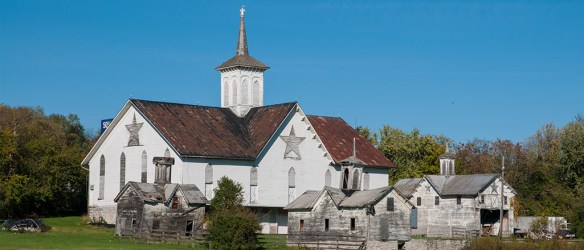
The challenges will continue. “We’ve closed one chapter and opened another,” says Claire of her daughter’s journey which continues now at home.

Getting her completely off the ventilator will be the next challenge. But she is home and off to a good start. By her second day home, she was already pestering her Papap to get her back out on the Kubota to pick up her driving lessons right where she left off two years ago. She wanted to ride through the fields and tell him every weed she saw. She wanted to walk through the cattle, and tell her Dad and Papap what they should do with this one or that one.

Her next goal? “I want to be walking good enough to lead Pardi-Gras in the All-American at Harrisburg in September,” she said with a radiant smile.

Asked what she would want to say to readers more than anything, she replied: “Thank you so much for thinking of me.”

-30-

Reese01

All smiles, Justin and Claire Burdette bring their daughter Reese to the front door of home after 662 days of surgeries and recoveries at Johns Hopkins. Photo by Jean Kummer

Reese02 or 04

First stop before stepping over the home threshold, was the barn to see Pantene. It was a bit cold Friday, so Justin brought his daughter’s cow right to the car window. Photo by Jean Kummer

Reese03

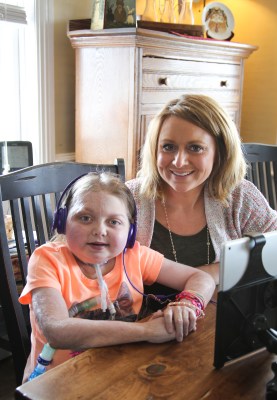
Getting back to the rhythms of daily life at home, Reese takes a break from the screen that transports her to school via robot every day for a picture with her mother Claire Burdette. Photo by Sherry Bunting

Reese05

The families of Windy-Knoll View, Mercersburg, Pa. and Waverly Farms, Clear Brook, Va., join the crowds of hometown folk lining the streets of Mercersburg for Reese’s homecoming parade. Photo by Laura Jackson

Reese06

Jim Burdette envisioned this day thousands of times over the past 22 months. He knew he wanted to be on the second story porch watching his granddaughter come home. But then he beat it down the stairs for a hug. Photo by Laura Jackson

Reese07

Reese’s cow Pantene had a sign of her own for Reese’s homecoming. Photo by Laura Jackson

Reese08

Pantene’s third heifer calf Pardi-Gras was born just three days before Reese came home. Photo by Jean Kummer

Reese09

At the one end of Reese Way (left), put in between the two home farms when she was born, is Reese’s home. At the other end of the lane (right) is the entrance to Windy-Knoll View. When the Fast Signs company that made all the TeamReese signs came to put this one up, Jim Burdette told them, “Don’t cover the farm sign, Reese will love seeing Pledge, Pala, and Promise here to greet her.” Photo by Sherry Bunting

Reese10 and/or 12 and/or 14

The land is awakening. Cattle are out grazing. A special cow has a new heifer calf. And a special young lady — ReeseBurdette — has returned home to the joy of her farm and everyday life after 22 months of recovery at Johns Hopkins. Photo by Sherry Bunting

Reese11

Reese and Brinkley share a special moment at the hospital on the morning of Reese’s homecoming. Photo by Jean Kummer

Reese13

Justin and Claire Burdette with daughters Reese and Brinkley before Reese’s most recent surgery before Christmas. Photo courtesy Jennifer DiDio Photography


‘This is the best area. We never felt alone.’

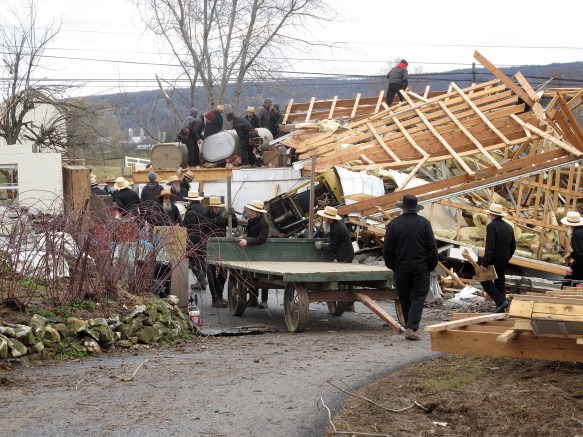
In Lancaster County, Pennsylvania, we just don’t get emergency texts on our cell phones saying “Tornado warning in this area. Take shelter now.” But in February, we did. An EF 2 tornado traveled 6 miles in eastern Lancaster County. No one was injured, and the community pulled together and set to the task of rebuilding just 8 miles from my home. 


‘This is the best area. We never felt alone’

With livelihood gone, Ebys thankful as they face major rebuilding after tornado
(Reprinted from Farmshine March 4 and 11, 2016)


SALISBURY TOWNSHIP, Pa. — With little more than a 10-minute warning for those with cell phones, the tornado had struck eastern Lancaster County after dark last Wednesday (Feb. 24). Of all the folks interviewed in the days after, no one saw it. But many felt its fury.

Corrie Eby was just trying to put her two-year-old daughter to bed. Her husband James was in Paradise at a church event with their two older daughters. Her mother-in-law called from the house next door and said she had just heard the warning. Corrie called her husband as she and her daughter headed for the basement. They spoke briefly and then lost contact.

Minutes later, she heard the roar and felt the wind rip as though right through the house above them. It lasted but a few seconds, she said: “Then complete silence. The power was out. It was absolute dark and so still.”

The house had been spared except for some damage to the slate roof. She called her husband.

“I told him something has happened. This is not normal,” Corrie recalled a week later.

wtornado01

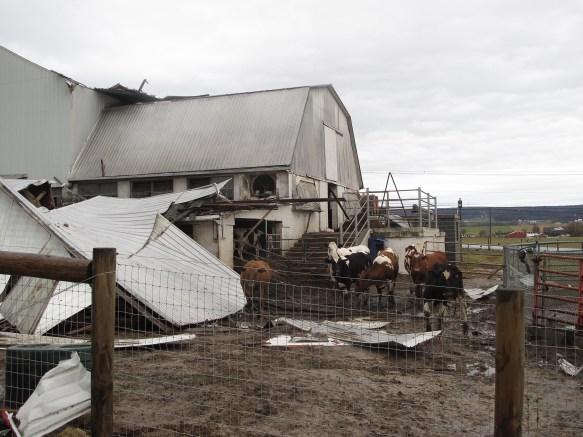
Indeed, it wasn’t. She saw the row of pines, separating their home from James’ parents’ home, was gone. She heard the generator going in the chicken houses on the hill so she didn’t give that a thought. She saw a stone’s throw from the house that the garage, shed and huge portions of the 200-year-old bank barn were gone, gates were flung everywhere and the door of the barn was crumpled-in like tin foil.

“The cows were all safe and sound, so I rigged some gates for them,” she said.

James was on his way home and received a call from the White Horse Fire Co. that his chicken houses were gone, destroyed. They were the home for the couple’s 35,000 organic cage-free layer hens — their sole source of income, apart from the small beef cow/calf herd of which all 25 cows survived.

By the time James got home, people were arriving by the dozens. “We easily had 200 people here that night,” he recalls. “Emergency management said it was too dangerous to go into what was left standing of the second chicken house until it could be evaluated in the morning.”

At first light, emergency management folks and the team from Heritage evaluated the surviving and injured poultry and set about the trying task of humanely euthanizing them.

“People just kept showing up that morning by the van loads. We had 300 people here, an incredible outpouring from friends and family, and people we never met before,” he said.

“Before we could even assess what we needed or grasp what was happening, people brought large equipment. Dumpsters came and went,” Corrie added. “The organization was phenomenal, incredible. By day two, the area was completely cleared of rubble.”

tornado(provided)01.jpg

A roller-coaster of emotion followed. Going into the weekend, the couple was invigorated. But on Monday morning, reality struck.

Their layer hens were gone, and their income along with them. A new flock at the hatchery was already tagged for them for June delivery in the normal turnover of layer flocks, so they realize they now have a narrow window to rebuild the two houses and see the difficulty of getting the building scheduled into that window. If they miss the June rebuilding date, it could be months before another flock could be scheduled for them.

One of the two chicken barns lost was built in the 1980s when James’ father Dennis operated the farm, and the other barn would have been one year old in April. Both are completely gone, except for the egg-packing house at the far end.

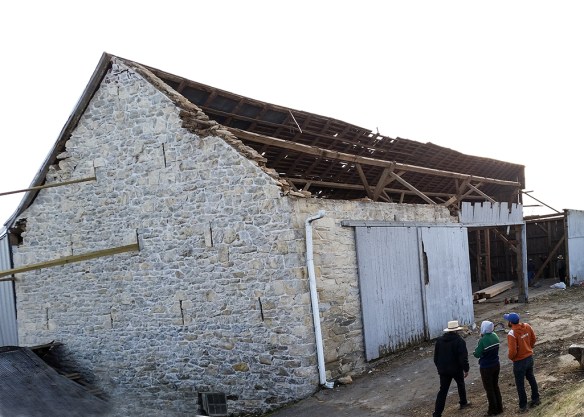
And then there is the bank barn. The stone end wall and part of the rock side wall, mortared with horse-hair plaster from over 200 years ago, still stands, but it took a major hit with much of the surrounding wood structure gone or damaged. The farm has been in the Eby family five generations. The barn houses their small herd of cattle and their hay. It has stood the test of time and is the spot where James and Corrie celebrated their marriage.

wtornado02.jpg

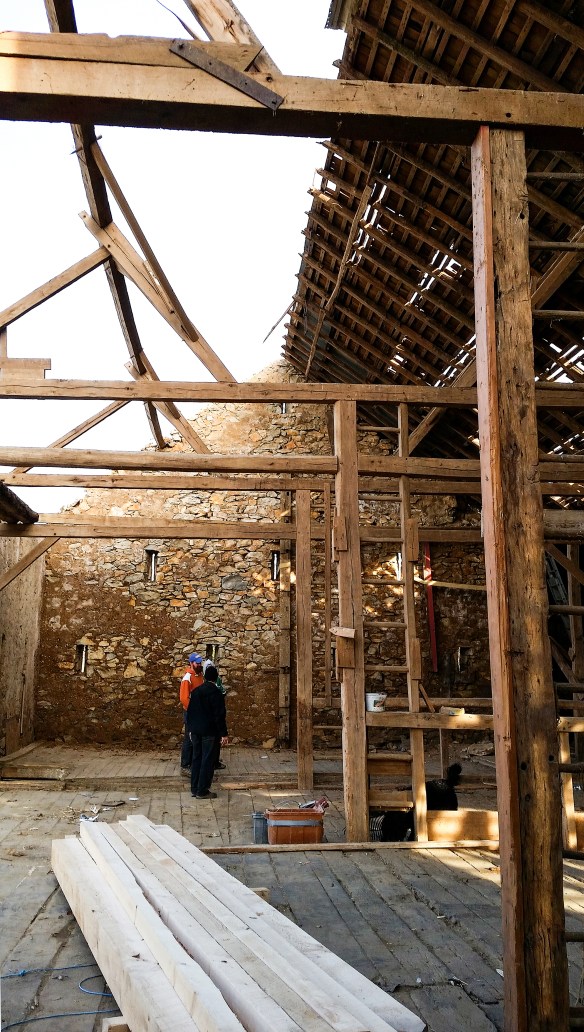
On day five after the storm, a builder, stone experts and an architect were on hand working to secure the stone wall before arrangements could be made to set new rafters and restore it.

“A lot of people have backed us this week. We never felt alone in this,” the Ebys agreed.

Sharing the thoughts of many who have worked in this community and volunteered all week to restore its homes, barns, and schools, Chris Stoltzfus of White Horse Construction noted, “This is so much bigger than any one of us are. It’s good to be part of something bigger and think beyond ourselves.”
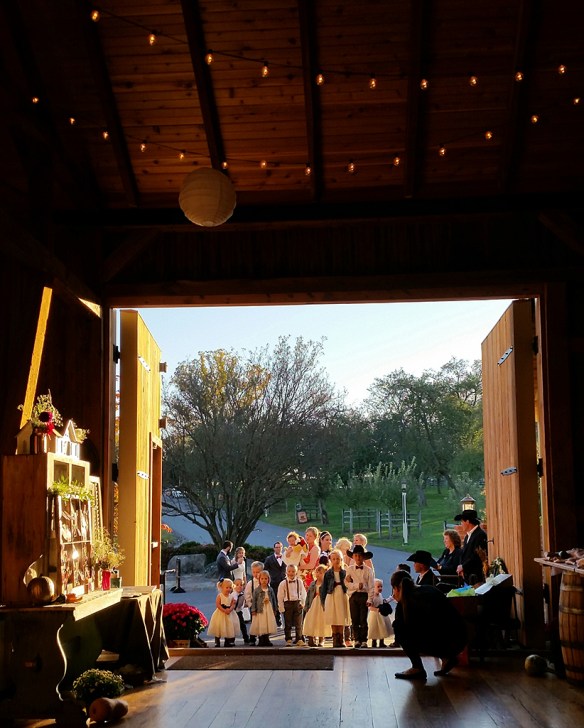
He and his crew had worked on another damage site before coming to the Eby farm on day four to work on outbuildings and the stone bank barn. Like other contractors, he had been out all week and into a second week doing this work in the tornado-stricken community.

 Stoltzfus tells of the professional network of suppliers also opening up their schedules. For example, “Rigidply Rafters got trusses to us in less than 24 hours, and the concrete and stone companies offered special pricing and kept drivers on staff to help,” he said. “AJ Bolenski suppled us with dumpsters, not free, but this took extra staffing. And Lowes gave us a 10% discount and prioritized delivery.

“The real heroes are the ones doing all the work and those behind the scenes, including the ladies at the fire hall with the food, the office staff and my wife Kate,” Stoltzfus added.

Stoltzfus and others on-site at the Eby farm Tuesday, said it was the hardest hit from an economic standpoint. When work begins on the chicken houses — once the Ebys secure a poultry house builder who can schedule it — skilled volunteer crews from the community and beyond will be coordinated to move the process along and make the deadline for the June flock. They hope to avoid going more than three months without income.
tornado2733.jpg

At the same, time, they realize, “We are so blessed no one was hurt and that our home is still standing,” the couple said. “As for the outpouring of this community, we can’t describe fully how thankful we are. We live in the best area. This has proven to be true.”
tornado1237.jpg

A friend of the family has up an Eby Tornado Restoration Fund at https://www.gofundme.com/rrr93ns8. Over $8000 has been raised toward the goal within the first 10 days.

-30-

‘Tornado seemed to find its own path of least resistance’

Community recovers, rebuilds in week after Lancaster County tornado

WHITE HORSE, Pa. — It was 7:22 p.m. last Wednesday evening (Feb. 24) when cell phone alerts warned residents in eastern Lancaster County from Gap to Caernarvon to New Holland and Terre Hill: “Take shelter now.”

The EF 2 tornado touched down just 10 minutes later, along a 6-mile stretch on both sides of Rte. 340 by the Pequea Creek, producing winds over 100 mph and doing an estimated $8 million in damage to barns, sheds, homes, and schools of this largely Amish community of farmers and craftsmen, including the loss of two-chicken houses and 35,000 hens at the non-Amish of James and Corrie Eby.

tornado(provided)05.jpg

Miraculously, not a single person was injured — even more so, considering that in a barn just across the road from the one-room schoolhouse that had been completely blown away, 150 youth were holding a benefit auction. There was no time for them to do anything but wait it out. They described feeling as though the wind lifted the roof six inches from the rafters above them without removing it. The 100-foot wide tornado veered just northeast of the barn to level the empty schoolhouse and proceed through a windbreak of trees, missing a house on the hill and diminishing in its fury just shy of the Wanner farm in Narvon.

“The tornado seemed to find its own path of least resistance,” said Melvin King of White Horse Machine, a longstanding volunteer with the White Horse Fire Co. “It could have been so much worse.”

Much of the damage along the tornado’s path lay immediately west of the fire hall. Traveling the area on day four after the storm, it was unbelievable what had been accomplished with a little organization from the fire hall and the community’s storm recovery committee, combined with the downright amazing outpouring of volunteer crews within the extended community, as well as skilled crews coming in from more than 100 miles away.

On the night of the storm, White Horse Fire Co. was busy responding to calls, checking for injuries, helping those whose homes were impacted find refuge, and securing the safety of the situation.

tornado(provided)08.jpg

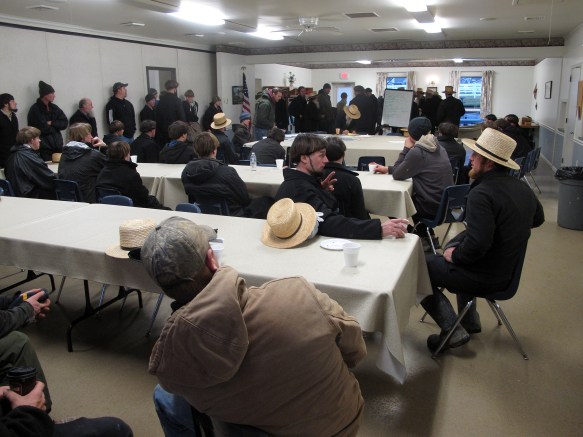
By 7:30 the next morning, over 150 people and 10 to 12 contractors showed up with their trucks, tools and skills at the fire hall, instead of going to their jobs. The efforts gradually bridged over to the community via the White Horse Storm Recovery Committee.

By days two and three, there were over 500 volunteers on one major-damage site and 300 on another. And there was plenty of food all week, donated by the area’s restaurants and grocers too numerous to name.

“Each day, every morning, people just walked in to the fire hall to help,” King recounted.

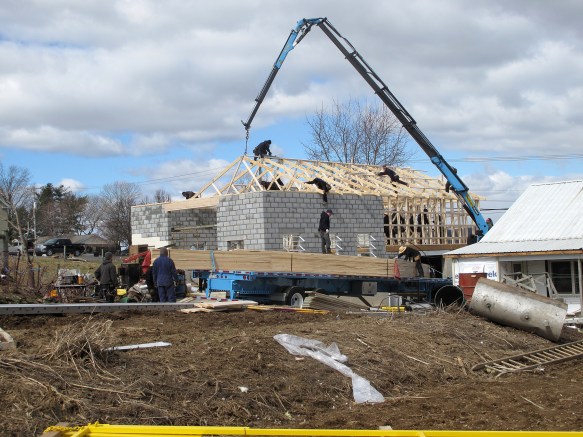
They brought vehicles, equipment, backhoes, track hoes, and contractors secured a steady flow of dumpsters. Skilled craftsmen made outbuildings at their shops and brought them to the locations sustaining losses. Taxi drivers and shuttle vans showed up donating a day of service picking up volunteers and moving them between damage sites.

tornado(provided)03.jpg

There were seven primary damage sites and a total of approximately 35 properties sustaining a range of minor to severe damage. A firefighter was assigned to each of the seven primary sites to maintain radio communications because the first priority was to secure the safety of workers as they cleared debris and evaluated and stabilized buildings.

Of the dairy farms affected, it is reported that cows were able to be milked pretty much on schedule. While the tornado lifted and scattered the second story on several bank barns, the tie-stalls below were largely spared.

tornado(provided)06.jpg

As for the rest of the largely Amish community, most were unaware of the broadcasts on local television until the national news media began to show up. They were amazed by how the outside world would be so generous to come help. People were calling the fire hall and visiting the White Horse Fire Co. website looking for ways to donate money, services, food. The fire company created a link on their website where visitors could link up with the Mennonite Disaster Service, based in Lititz, Pa.

A committee was formed for the White Horse Tornado Relief Fund so that donations there go to the folks who are facing true hardship. Once those needs are satisfied, any potential remaining funds will go to victims of other storms elsewhere through the Mennonite Disaster Service.

For those wanting to donate to the Tornado Relief Fund for Salisbury Township and the village of White Horse, donations are being received by the Mennonite Disaster Service, 583 Airport Road, Lititz, Pa. 17543. Checks should be made payable to Mennonite Disaster Service while noting “Lancaster County Tornado” in the memo line.

Skilled crews who want to be involved in current and future restoration from the impact of the tornado in Lancaster County, can contact the White Horse storm recovery committee via the fire company at whitehorsefire.org.


tornado3753

tornado3749

wtornado4522

-30-


CAPTIONS:


Tornado(provided)05 and/or Tornado(provided)07

The scene 12 hours after the tornado at 7:30 the next morning as crews arrived to begin cleanup before restoring dairy buildings on this Amish dairy farm. Photos by Jim Landis

Tornado(provided)02 and/or Tornado(provided)03

One of seven major-damage sites, this was the scene on day three as rebuilding of dairy barns was nearing completion. Photo by Jim Landis

Tornado(provided)08 and/or Tornado(provided)04

Volunteer crews met every morning at the White Horse Fire Co. and at the end of some work days to coordinate community restoration efforts. Photo by Jim Landis

Tornado2342

Over 150 youth were in the red barn at right when the tornado came through and completely blew away the one-room schoolhouse across the road. At the far left behind the trees, the rebuilt schoolhouse awaits windows and paint on day four. Photo by Sherry Bunting

Tornado3754

Another Amish dairy and heifer barn in the restoration process on day four after the tornado. Photo by Sherry Bunting


Tornado(provided)01

Within two days, all of the rubble was removed from the site of the two large chicken houses, that were home to 35,000 organic layers and the sole source of income for the Eby family. Photo by Jim Landis

Tornado3748

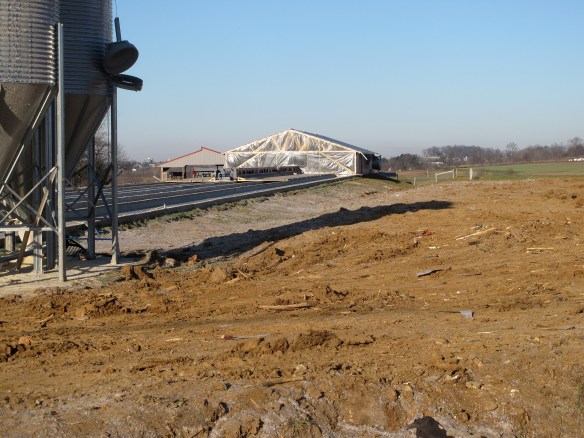
From the road above, the path of the tornado crossed the Pequea Creek to destroy outbuildings and damage a 200-year-old stone barn at the Eby farm before continuing up the hill to destroy both chicken houses that once stood a bit left of the center of this photo to the right of the small red egg-packing house that still stands. From there, the tornado continued onto the next few farms, including several Amish dairies before damaging a one room schoolhouse and barn, pushing debris into a portion of the roof of the Pequea Evangelical Congregational Church, where it crossed Rte 340 and continued northeast through the cemetary of the Pequea Presbyterian Church and across Meadville Road where it leveled another one-room schoolhouse before stalling in the windbreak where trees four days later showed the remnants of barn siding, insulation, and other telltale signs of debris from three to five miles away. Photo by Sherry Bunting

Tornado2024 and/or Tornado 2733 and/or Tornado3949

In addition to the chicken houses and some outbuilding losses, the Ebys are trying to restore the portion of the 200-year-old stone barn that still stands. Photos by Sherry Bunting

 Tornado1235

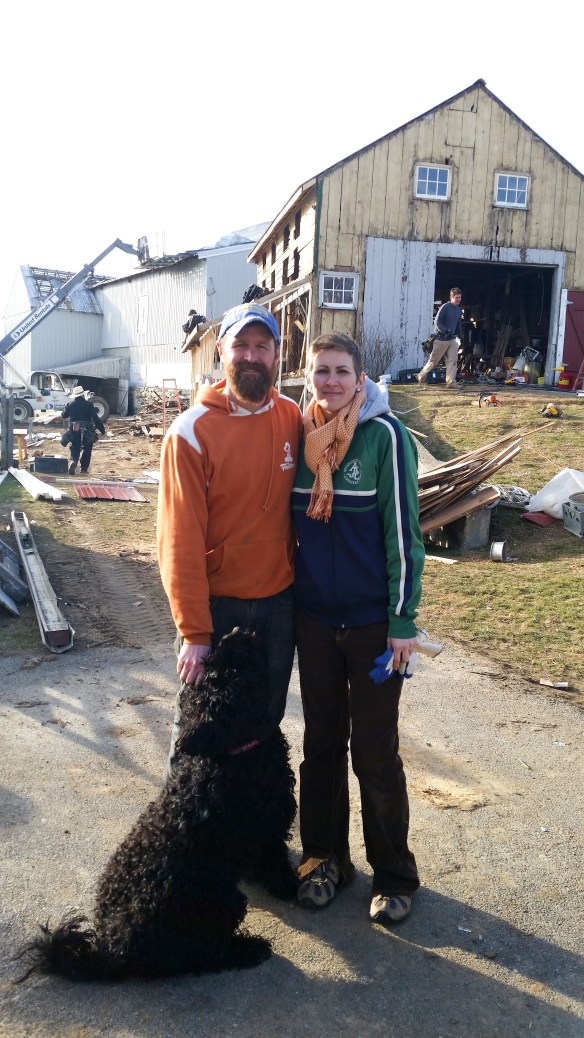
James and Corrie Eby say they have not been alone in this. They are thankful for the outpouring of the community even as the reality hit them Monday that their livelihood is gone. One of the two chicken houses lost in the tornado was not quite one year old and a new flock would be coming from Heritage in June, so they have precious little time to get them rebuilt. Photo by Sherry Bunting


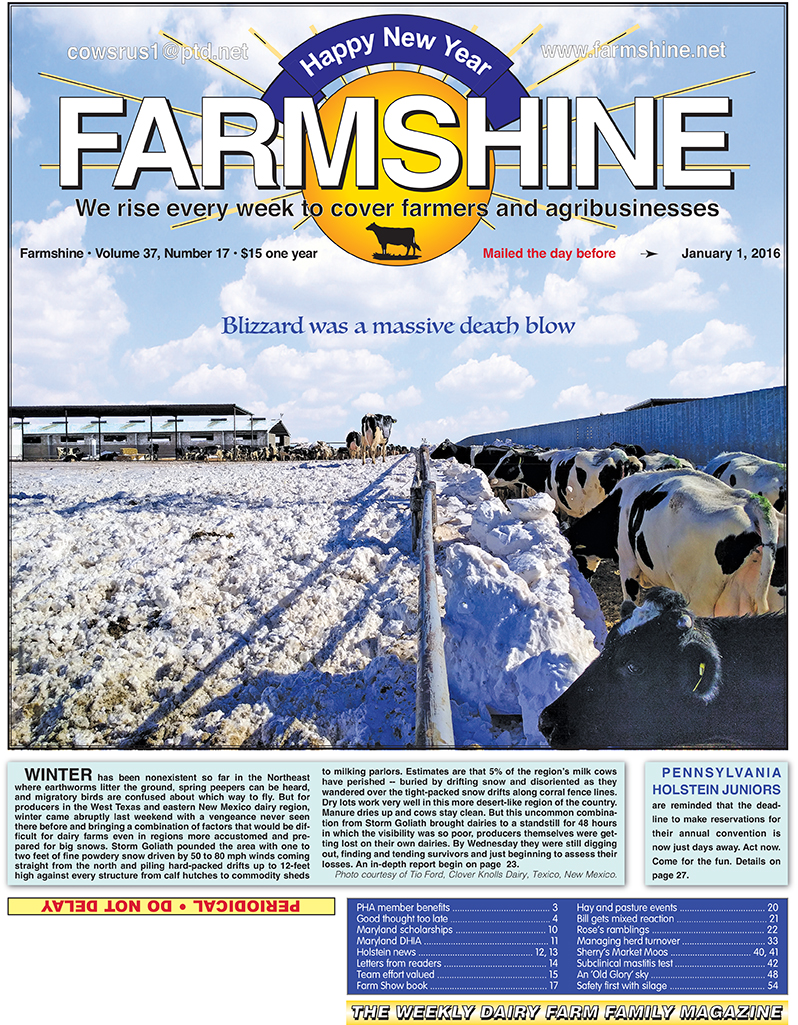
Day 12: Goliath aftermath: ‘We appreciate the prayers… they are helping’

“This is an animal story and a human story, and the most heartwarming part in this cold winter storm is that while Mother Nature strikes, and is relentless, the human spirit and hard work of people coming together to help each other, prevails.” In this space, I had planned to write Day 12 about random acts of kindness through the holidays. Telling this story seemed most appropriate as the human spirit prevails this week in the aftermath of Winter Storm Goliath’s 48-hour pounding Dec. 26-28 in the heart of the West Texas and eastern New Mexico dairy and beef region, bringing devastating losses…

NewMexico-Goliath02 (1)

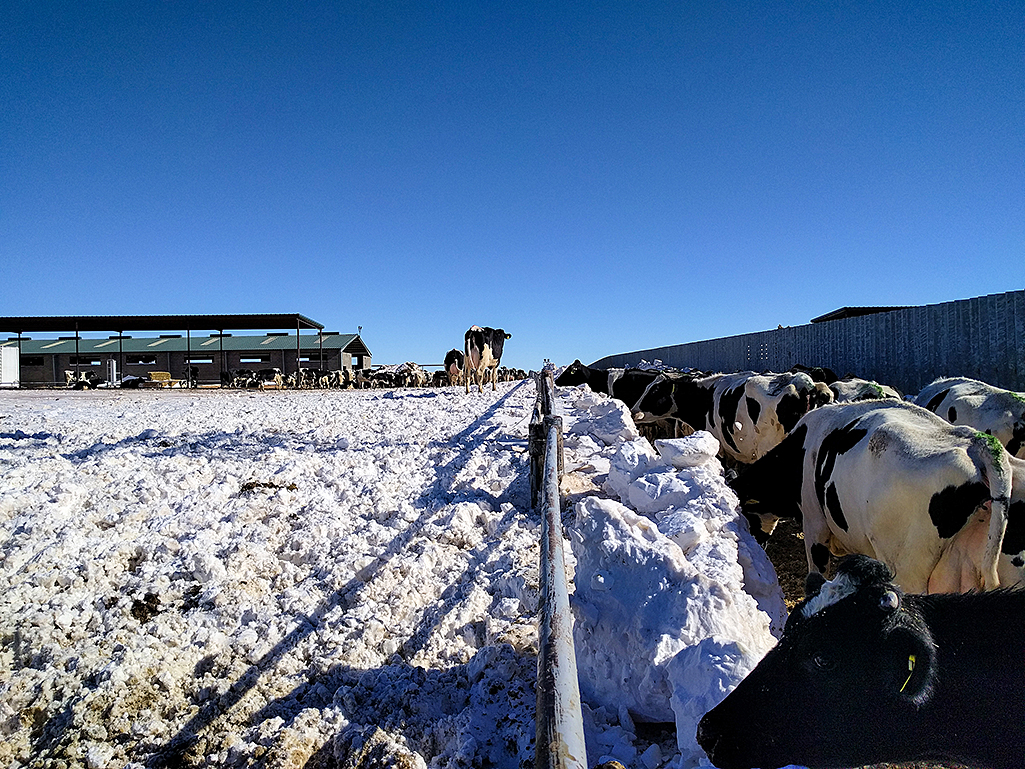
Tio Ford sent this photo two days after the storm as the dig-out was underway at his Clover Knolls Dairy, Texico, New Mexico. You can see the packed snow drifts are up to the top of corral fences. Feedlanes and alleyways were a priority Monday to get animals fed and to the parlor (left) after most cows went 30+ hours without milking.

By Sherry Bunting, Reprinted from Farmshine, January 1, 2016

CLOVIS, N.M. — Last weekend’s record-breaking blizzard in the Southwest wasn’t on anyone’s radar. It was 60 degrees with no winter in sight just a few days before Storm Goliath pounded its way through the southern High Plains. Breaking records as a 100-year storm, the combination of sustained high winds driving fine powdery snow — and the sheer 48-hour duration of the storm — conspired to bring devastating losses to the West Texas and Eastern New Mexico dairy region with early estimates that 5% of the region’s 420,000 dairy cows may have perished and double that percentage in losses of youngstock.

“We heard a monster storm was coming, and we were prepared for a foot or two of snow. That can happen, but no one could envision this type of disaster with high winds coming straight from the North to pile it all up around every structure,” said Dr. Robert Hagevoort of the New Mexico State University dairy extension in a phone interview with Farmshine Wednesday.

The 5% — or 20,000 head — loss figure on milk cows is “a place to start,” he said. “We are trying to be conservative, but it will be hard to know the true count until the region is completely dug-out and losses are tallied. Our first concern is getting the survivors fed and back in their corrals and the milking parlor.”

All of Eastern New Mexico and West Texas south of the Panhandle was hard hit, and the storm center appeared to be directly over the region from Roswell to Clovis to Plainview. While Hagevoort has heard from producers having lost 100 to 200 cows, two producers contacted by Farmshine in Portales and Texico report losses of 40 to 50 head, including the losses of hay barns and untold numbers of young stock.

TioFord5950“We lost some cows, but we have heard of herds losing 5 to 10% of their milking cows,” noted Tio Ford of Clover Knolls Dairy, Texico, New Mexico in an email response Wednesday. “People who had beef cattle on wheat pasture were really hit hard, and we uncovered quite a few deads while trying to clear 10-foot-plus drifts off the roads.” Ford’s family has been rooted in New Mexico for over 100 years. His wife Chyanne’s grandfather left the cold winters of northwestern Pennsylvania for the dryland farming and drylot dairying of eastern New Mexico in the 1950s. Her parents Doug and Irene Handy have Do-Rene Dairy in Clovis.

“The wind came from the North and everything on our dairies in this region faces south. The commodity sheds, parlors, calf hutches – all face south in the winter, so the south side of every structure was snowed in,” said Hagevoort. “The blizzard hit with the snow blowing and everything settling on the south side of every structure, snowing-in the hutches with calves inside and forcing dairies to quit milking because of the 8, 10, 12-foot drifts piling up on the south side entrances to the parlors. They couldn’t see to bring cows in.”

As the alleyways and feed lanes filled with deep drifts of wind-driven packed snow, everything came to a standstill.

The visibility became so bad that for most of those 48 hours “no one could do anything. You couldn’t see two feet beyond the hood of the truck,” he added.

The poor visibility was so dangerous that producers became lost on their own dairies. The one to two feet of snow would not be a problem, if it fell straight down, but the winds created drifts up to 12 feet high and packed so tight that cattle simply walked over corral fences and kept walking, becoming lost and disoriented. Some were buried by the driven snow.

Winter Storm Goliath began Saturday and continued “relentless” through Monday morning with sustained winds over 50 mph and gusts above 82 mph in the first 24 hours. On the second day, sustained winds of 40 mph were recorded with gusts above 65 mph.

“One to two feet of snow, we can handle that if it falls normally like wet snow, but not this fine powdery dust snow driven by high winds,” Hagevoort explained. “We still have four-foot drifts around houses in town that is packed in there heavy and the much higher drifts in the countryside require heavy equipment to dig out.”

A state of emergency was declared for both West Texas and Eastern New Mexico as major roads were closed for two to three days. Even two days after the storm, some country roads were still impenetrable with the kind of snow that blades on trucks can’t move.

“When the winds died down Monday morning and the sun came out, people could see what was going on,” said Hagevoort. “Cattle have walked everywhere, and people are still out finding them. They are digging the snow out of corrals to get surviving cattle back in and fed. There are these massive amounts of snow to move, and dairies have 3 to 4 loaders going 24/7 — digging out calves and moving cows back in and feeding and at some point milking again. The sheer manpower required is massive.”

NewMexico-Goliath01Milk haulers were also among the stranded, and Matthew Cook, a milk hauler from Kansas confirms that he was one in the line of trucks stranded for three days at Southwest Cheese near Clovis. “The roads were all closed, and the wind and blowing snow was out-of-control, so I pretty much hung out in my truck. Most of us knew it was coming so we had food and drink and plenty of fuel,” he said in an email Wednesday, confirming the plant was open again.

Reports indicate not much milk has been processed early this week and in addition to the long stretch of 36 to 40 hours when dairies were unable to milk, some milk in the region also needed to be dumped as trucks could not get out with it.

Hagevoort observed that folks are starting to get back to something remotely resembling normal by Wednesday and the focus on day-old calves and milk cows was shifting to the older young stock and dry cow pens.

In the early going, the Department of Transportation and other state agencies put a call out for large equipment as they are equipped for the occasional four to six-inch snows of the region.

“The focus was on people rescue missions on Monday. Dairymen were digging out dairies and their roads back to the main road in the hope at some point the main roads would be clear and they could meet somewhere,” said Hagevoort.

Dairymen and feedlot operators used their large loaders to help uncover cars with stranded motorists stuck 20 hours or more under the snow.

“It was a really rough weekend. They said we got between 8 and 12 inches of snow here, but I’m not sure how they came up with those amounts because the wind was gusting up to 82 mph,” Ford noted. His 3000-cow New Mexico dairy sits right on the Texas border. “We were stuck at the dairy with a skeleton crew for 36 hours before we were able to get replacements. Every dairy, feedlot, or farmer with a big tractor or loader had them out trying to clear the roads.”

Hagevoort4838 (1)Hagevoort noted that, “This is an animal story and a human story, and the most heartwarming part in this cold storm is that while Mother Nature strikes and is relentless, the human spirit and hard work of people coming together to help each other, prevails.”

Dairymen are not usually an emotional lot. They focus on the business and the work and the challenges, but the emotion is raw at the loss of these animals and the sheer devastation. Amid the heartbreak of the losses, producers have no time to dwell as they put one foot in front of the other to dig out and tend cattle and keep their employees safe as everyone works together to find the lost, feed and tend to the survivors, and get the dairies operating again.

While the USDA FSA livestock indemnity program exists as part of the last Farm Bill, it is capped, so Hagevoort says it will be difficult if the large number of losses exceeds the financial compensation available through the indemnity programs.

While size doesn’t matter in terms of the impact of Goliath’s relentless strike, larger dairies may be affected by the caps in terms of receiving compensation proportional to their levels of loss. Officials urge dairy producers to document everything to sort out the help that may be available in the future.

NewMexico-Goliath03 (1)Dairies will continue to work around the huge drifts that won’t melt any time soon as the first priority is locating and securing their animals as they dig out alleys, feed lanes and corrals.

“We can look ahead at how to mobilize resources more rapidly in the future, or how to be safer in situations like this, but the truth is… no two storms are ever the same. This one packed an uncommon combination and longtime residents say they’ve never seen anything like it,” said Hagevoort.

With temps in the teens and 20s and night time wind chills down to -18 at night during the height of the storm, there will be sick cattle and frostbite issues to deal with going forward.

Producers also reported not being able to milk cows for 36 to 40 hours, and that will also impact health and production going forward.

“The cattle have seen a lot of stress,” said Hagevoort. “But we will work through it. It’s a tough thing in times like this where the milk price is below where it needs to be.”

But just like in Dallas, where Goliath spawned tornados and floods, the remarkable human spirit prevails.

“People come together,” said Hagevoort. “On our dairies here, the employees stayed working two to three shifts and owners worked untold hours with them and cooked meals and washed clothes to keep them going. The combination of family farms with employees and owners working together to make it through a challenge like this… That’s the real story.”

NewMexico-Goliath04While the final tally is likely to show young stock losses to be twice that of the estimated 20,000 milk cows lost across the region, Hagevoort noted remarkable stories coming in about calves being found under 6-feet of snow — alive in their hutches.

“This is an incredible story of farmers taking care of the animals they are entrusted with, despite the fury Mother Nature sometimes unexpectedly unleashes,” read a post on Wednesday at the New Mexico State University Dairy Extension’s Facebook page.

On Monday, Tara Vander Dussen of Rajen Dairy with three facilities totaling 10,000 cows in the region wrote a post on her public Facebook page telling consumers and animal activists: “I wish you understood how much we care about our cows. I wish you knew that my husband, brothers, dads, uncles, family and friends got up this morning at 2:00 a.m. to go to the dairy in a blizzard with 65 mph winds, -16°F wind chill, lightning and 6-feet snow drifts. They had to leave their families and children (some families had no power) so our cows could have food and water. They went out to take care of our cows the best that they can. And they did this after working a full day on Christmas Eve and Christmas! They do all of this because they care about the health and safety of every animal on our family farm! I wish you knew.”

Two days and nearly 20,000 shares later, Vander Dussen started a New Mexico Milkmaid blog to communicate further on this topic.

All told, Goliath’s effect stretched across much of the U.S midsection. The massive storm included heavy rain, floods and tornados on the severe side and blizzards with snow and driving winds on the wintry side with ice storms in the middle around the center of Oklahoma.

The rains have put southwest totals ranging 50 to 150% above normal. Cold and muddy conditions are also impacting the beef and dairy operators from the Southern Plains through the Midwest Corn Belt.

BenSmith4577 (1)“It was a storm I can’t put into words or ever experienced,” said Ben Smith of Arrowhead Dairy, Clovis, N.M.” We have a lot of snow digging out still to do and a lot of cleanup to do as well. We have been milking and feeding again for two days, so that part is good.” When asked what people can do to help, producers say “the prayers are appreciated… and they are helping. -30-


FarmshineSee the original story in the January 1, 2016 edition of Farmshine 


CAPTIONS

Winter has been nonexistent so far in the Northeast where earthworms litter the ground, spring peepers can be heard, and migratory birds are confused about which way to fly. But for producers in the West Texas and eastern New Mexico dairy region, winter came abruptly last weekend with a vengeance never seen there before and bringing a combination of factors that would be difficult for dairy farms even in regions more accustomed and prepared for big snows. Storm Goliath pounded the area with one to two feet of fine powdery snow driven by 50 to 80 mph winds coming straight from the north and piling hard-packed drifts up to 12-feet high against every structure from calf hutches to commodity sheds to milking parlors. Estimates are that 5% of the region’s milk cows have perished — buried by drifting snow and disoriented as they wandered over the tight-packed snow drifts along corral fence lines. Dry lots work very well in this more desert-like region of the country. Manure dries up and cows stay clean. But this uncommon combination from Storm Goliath brought dairies to a standstill for 48 hours in which the visibility was so poor, producers themselves were getting lost on their own dairies. By Wednesday they were still digging out, finding and tending survivors and just beginning to assess their losses. Photo courtesy of Tio Ford, Clover Knolls Dairy, Texico, New Mexico.

A line of milk trucks was stranded for three days at Southwest Cheese, Clovis, New Mexico, and throughout the region dairies dumped to days of milk with many unable to milk cows for 36 to 40 hours. Photo courtesy of milk hauler Matthew Cook.

In New Mexico and West Texas, the humidity is very low and dry lots are the way dairy cattle are kept. Loaders are needed to dig through the 8 to 12-feet tightly packed drifts that have piled up in corrals, feed lanes and against the south side of every structure from fences to parlors to calf hutches. Photo courtesy of University of New Mexico Extension.

Finding and feeding young calves and milk cows was priority one when the storm ended Monday morning. Calves had been buried in hutches under 6-feet of snow pack, but stories are coming in that a surprising number are being found alive. Officials estimate a 10% loss of young stock throughout the eastern New Mexico and West Texas dairy region from Storm Goliath. Photo courtesy of University of New Mexico Extension.

Dairy Carrie also blogged on this with stories from four dairies here

Day 11: In the hope and restoration business

12 Days of Christmas… with a twist

Day 11: “He was born in a stable, the Lamb of God, and laid in a manger with shepherds the first to see Him. Understanding the significance of Jesus’ birth will be part of The Star Barn’s future… God is into resurrection and restoration, and that’s what we’re going to do in order to use these buildings to be shared with others.”– David Abel.   Read on to learn how restoration and hope bring together The Star Barn, Ironstone Ranch and Brittany’s Hope

By Sherry Bunting, Reprinted from Farmshine, December 5, 2015

ELIZABETHTOWN, Pa. — If you’ve traveled from anywhere in the U.S. to the Farm Show Complex in Harrisburg, Pennsylvania, you’ve no doubt passed The Star Barn — one of the most painted and photographed barns in the U.S. This historic landmark has languished and deteriorated for years in a quest for funds for a proper restoration of the icon from the 1800s.

homebanner2

Enter David and Tierney Abel of nearby DAS Companies Inc. who have purchased The Star Barn and will use their own money — no grants or tax dollars — to restore it all, after first moving it to their Ironstone Ranch, 10 miles away as the crow flies in Elizabethtown, Pa.

Ironstone0199x

David and Tierney Abel (left) and Mark and Jamie Shoemaker

The former dairy farm, turned fruit farm, turned Christmas tree farm, is now an “events with a purpose” reception venue that will be the new home for all nine buildings of the original John Motter Star Barn — including a rebirthed replica of the original farm house, pond and springhouse that were removed in the early 1970s when Route 283 was built right through the property on which they sat.

My connection to this story began when our middle son Ryan Bunting married our new daughter-in-law Vanessa Rice — daughter of Vernon and Jeanette Rice of Strasburg — at Ironstone Ranch on October 12, 2015. The bride and her attendants prepared for the big event in the original 1812 farmhouse the Abels first restored on the 150-acre farm.

The wedding was in the orchard with two roaming miniature donkeys photo-bombing the ceremony. IMG_0730xAnd the reception was held in the beautifully restored 1860 pine and brick barn original to the premises. While in the orchard doing family portraits between the wedding and reception, I learned from my 95-year-old grandmother Dorothy Jacobs, who still lives just across the street from the Ironstone Ranch at the edge of town, that my grandfather Bernard “Ace” Jacobs, a friend of an earlier owner, hunted there every year. Yes, it’s a small world.

As the wedding party, which included 12 children — the largest number of children ever in the four years of 80 weddings per year at Ironstone — prepared for their grand entrance, the farm’s manager Mark Shoemaker told wedding guests about Ironstone Ranch and its mission.

ironstone4235x

Children are at the center of Brittany’s Hope Foundation, which receives all net profits from Ironstone Ranch. These 12 children in the Bunting-Rice wedding party in October received the royal treatment from the folks who run the reception venue and ranch. In fact, chief operating officer Mark Shoemaker handed a cowboy hat to Connor Messner, 6, (my grandson) for instant confidence as he escorted Lydia Rice, 8, as the lead-off pair in the reception at the 1860 pine barn restored on the premises.

With a skeleton crew of seven full time and two part time employees, a stable of carriage and pleasure-riding horses, a few Longhorn cattle and the mascot miniature donkeys along with 250 acres of grazing, hay ground and wooded riding paths, 100% of the net profits from weddings, corporate events, and other meetings and entertainment are funneled into Brittany’s Hope Foundation.

Ironstone0189x

Named for the daughter the Abels lost in a car accident 16 years ago, Brittany’s Hope facilitates adoptions of primarily special needs children from around the world and also funds orphanages in many locations, especially Viet Nam, Kenya and Ethiopia. To-date, Brittany’s Hope has facilitated over 900 adoptions. David and Tierney, themselves, have 17 children in their blended family, 12 of them adopted.

So what has this to do with The Star Barn? Plenty.

“My wife saw The Star Barn and reached out to the preservationists,” said David. “We’ve evolved into barn chasers. I thought, if this goes through (buying The Star Barn), God definitely has a plan for it.”

There were plenty of hoops to jump through from the purchase and permits to the logistics of moving, and even getting permission to keep The Star Barn on the historical registry at its new location.

Ironstone0211x

The Ironstone Ranch is currently completing the restoration of an old 1812 barn moved there from nearby Bainbridge.


At the DAS Company warehouse, home of Stewardship Missions a few miles away, the dismantled iconic 65-feet-tall, post-and-beam 1819 antique barn with its Cathedral architecture that sat for centuries along what is now Fruitville Pike near downtown Lancaster, lies bound in cataloged clusters under a coverall waiting its turn for restoration at Ironstone Ranch.

But the focus right now is The Star Barn. The work to bring the 9-building complex to its new home for restoration began October 27, when the cupolas came down, the main cupola weighing 13,900 pounds! They are being restored to their former glory, with the main cupola expected to take 18 months, including hand-forging of new weather vanes as they were in the 1800s by craftsmen in Rhode Island.

StarBarn01x

This 13,500-lb cupola is the distinctive main cupola of The Star Barn and will take 18 months to restore, including the hand-forged weather vanes being recreated in Rhode Island to their original 1800s design.

Later this year or early in 2016, the barn itself will be moved to Ironstone Ranch. Piece by piece, it will be taken down and cataloged, then pegged together and raised manually with gin poles just as they did in the 1800s. Tickets for this event are expected to be available on a limited basis for those who want to see The Star Barn raising.

This story gets even more interesting.

David Abel explains how The Star Barn cupolas have the fleur-de-lis pattern, representing the Trinity and the sovereignty of God over every building. Furthermore, the stars on the barn were placed there as a sign of hope for the nation after the Civil War.

“God is into resurrection and restoration, and that’s what we’re going to do in order to use these buildings to be shared with others,” he said.

The nine buildings of The Star Barn complex will be placed as in their original setting with the three-fold purpose of being a working farm, an event venue raising funds for Brittany’s Hope, and a living parable for visitors to visualize many of the agriculture-based parables of Jesus.

“He was born in a stable, the Lamb of God, and laid in a manger with shepherds the first to see Him. Understanding the significance of Jesus’ birth will be part of The Star Barn’s future,” David explained. “Shepherds would know when a lamb is born. The living parables will help people understand why shepherds know and search for the Lamb. There are a vast number of parables, and we are compiling them all. So often, Jesus used agriculture to teach us God’s beautiful truths. We want to bring that to life, and The Star Barn will be a key part of that.”

It will include a thrashing floor, oxen, sheep and goats, a vineyard and 1800 time-period antique farming equipment the Abels have begun to accumulate for working the land.

“People will see in the thrashing floor the separation of wheat and chaff. In the vineyard, they will see the unpruned vine growing wild and beautiful onto itself with no fruit, and by contrast, the vine pruned by the Master’s hand beside it bearing fruit,” David explained. “We’re doing this for a purpose. People will come to see it and learn why Jesus used farming, trees, stones, vines, livestock, in His parables. We can share this gift and tell the story. Everything we do with the restorations must be God-honoring.”

Not to mention, when all the barns they are in the midst of restoring are completed, Ironstone Ranch will become a destination where visitors can see 1800s German agriculture practices and architecture with historical and biblical significance.

The Abels anticipate the process of restoring the entire Star Barn complex to take two years, including the re-creation of the original pond, farmhouse and springhouse. For these portions of the complex, they will use pictures and time-period catalogs to make replicas of the original structures. The house will become a 12-bedroom structure to provide lodging for special events.

Mark Shoemaker and his wife Jamie once operated a hay and horse farm in Schuylkill County. Today, they manage theIronstone Ranch.

“When Mark and Jamie came into our life, they made it their goal to make the property beautiful. It’s ours to share with others. God put us together and they’ve put their heart and soul into this,” said Tierney.

“God is weaving a tapestry here,” David added as they talked about their plans for the ranch, the Star Barn and Brittany’s Hope. While the Ironstone Ranch is set up as a for-profit corporation, all profit after operating costs goes to the non-profit Brittany’s Hope Foundation, created in January 2000 for the purpose of advocating for orphaned special needs children longing for the love of a family.

In starting Brittany’s Hope, the Abels reflected on their daughter’s dream of helping children with special needs “come home to loving families.”

“Out of death, comes life,” said Tierney. “The gift of Brittany’s life has not ended. Through this foundation, she touches so many lives.”

And there’s more in store…

At the 100th Pennsylvania Farm Show in January, Ironstone Ranch will have a booth near the butter sculpture where they will display The Star Barn 1/12th scale model layout for the “living parables” farm.

“God gives each of us gifts, and one of David’s is vision,” said Tierney.

“We see what can be accomplished when we cooperate with God in the unfolding of His vision as it grows and is unveiled and then confirmed by circumstances and people along the way,” David added with a smile. “We’re just walking out the vision He has for us here.”

David Abel started DAS Companies in the late 1970s with $200 selling stereos and CB’s at Lancaster County’s Roots and Green Dragon markets from the back of his father’s station wagon and the garage of his grandmother’s home. Today, DAS Companies is a global supply chain with many lines of products in truck stops all over the country. The business fuels the stewardship and mission they have undertaken.

Ironstone1105x

Horses graze in mid-November at Ironstone Ranch. This hayground will become the new home for all 9 buildings of the original Star Barn. It will remain on the National Registry of Historic Places at its new location, which has its own historical significance. During the Civil War, this was a staging area for troops, and after the war, the Liberty Bell traversed the land on its way back to Philadelphia from Harrisburg, as did President Lincoln’s funeral train as it passed between the two cities.

Ironstone1100xMichael Kleinhans, project manager, talks about The Star Barn’s future at Ironstone Ranch and the booth near the butter sculpture at the 100th Pa. Farm Show in January where a scale model of the plans for the 9-building Star Barn relocation, restoration and “living parables” farm will be on display. Photo by Sherry Bunting

A Christmas event at Ironstone December 5 raised thousands for Brittany’s Hope and the Water Street Rescue Mission. Stay tuned for more on The Star Barn from the 100th Farm Show in January.

Days 9 & 10: Paying it forward…

12 days of Christmas with a twist…

By Sherry Bunting

Days 9 & 10: We have all heard about the paying-forward at coffee shops and drive-throughs. I recently heard of a woman randomly giving cash to shoppers at a local department store. Isn’t that what Christ did for all of us? Isn’t that what God did by sending His son to be born among us that we may live? In my more than 30 years as an ag writer, what I have witnessed in the agriculture community is the profound, largely anonymous and often selfless way this community prays it and pays it forward as seen with two families — beloved cattle breeders — one suffering a tragic loss, the other continuing their over 19-month journey with an inspirational little girl. The  links in the story below take you to ways to help these two families to feel their love returned to them in abundance.  (Portions reprinted from Milk Market Moos in the Dec. 18, 2015 edition of Farmshine.)

08xmas1145

Since Farmshine did not publish on the week of Christmas, I began last week’s column, with gratitude, wishing readers a Merry Christmas, a holiday of light piercing darkness.

Thank you for your hard work, your care and pride in your cows, your passion for producing a quality, wholesome and nutritious product we can enjoy and benefit from… and above all the way you rally to help one another in a time of need.

We see this repeated time and again, and recently, as farms in Pennsylvania suffered great losses of cattle from events such as a fire and a collapse as well as in other regions  storms and floods.

Farm families rally to help each other pick up and move forward. When one is injured, others are there to help take those steps forward. And, when one is lost, others are there to remember, and to stand with their families.

During this holiday season, enjoy the fruits of your labor beyond the tangible. While margins in farming are razor thin, it is the wealth of the spirit to be thankful for when the going gets tough.

The barn is a magical place this time of year, the humble earthly place where God presented to mankind His gift of unmatched love and mercy. The opportunities I have to feed a few head of livestock here at home are daily reminders that nothing beats the feeling of putting down fresh feed as the sun sets and watching the animals eat, then lie down and chew cud.

Wishing you and your families a blessed Christmas with some time to enjoy making new family memories while also reflecting on, and holding close, the memories of the loved ones who’ve gone before us.

I think of Jeremy McDonald’s family as he passed away unexpectedly last week in an accident. In 2007, I had the privilege of visiting with him at the family’s Century Farm near Middleville, Virginia and writing about his passion for cattle. His family’s beef, dairy and produce farm in Virginia’s Shenandoah Valley represents four generations of passion for cattle and the land, and especially his Shen-Val Brown Swiss.

As fellow Brown Swiss breeder Allen Bassler puts it: “His love for cows was extra special. He had a great eye for dairy and beef. I got to watch him judge with Wayne Sliker at World Dairy Expo. It was so nice to see this event happen in his life.”

Jeremy was 39, but had already left quite an impact on others who describe the quiet and professional way in which he helped other young people find their passion for farming and registered cattle.

milestone_1450838705.5176

A devoted husband to wife Missy, loving father to son Tyler, and cherished son to Gary and Sharon, Jeremy will be missed. Halfway to its goal, A GoFundMe site has been set up for his family.

To me, nothing says what this industry is made of more than the way folks have rallied to support and champion the recovery of Reese Burdette. That kind of support is the glue that makes the dairy family, worldwide, a special one.

The healing power of love, for sure.

In June, I wrote in Farmshine about the visit of Reese’s special cow, Pantene, to Johns Hopkins in downtown Baltimore where Reese has been since May 26, 2014. Reese has been away from home for over 19 months since she was saved from a house fire that day by her grandmother Patricia Stiles. Having suffered burns on over 35% of her body, Reese has undergone countless procedures, including being in a medically induced coma for four months.

She pushes herself in physical and occupational therapy. The special visit with Pantene was a target for working hard in therapy.

Reese&Pantene03

“When the therapist asked Reese to stand longer or take more steps, it was all a build-up for ‘being strong when you see Pantene,’” Jackson explained.

“Dairy did good! This family makes a lasting impression,” Jackson observed. “Reese has brought the dairy community together like I have never seen before. She has made us all believe in the power of prayer. She has made us believe in miracles. She inspires us every day.”

The family has spent two Christmas Day celebrations in the hospital with their Reese as she recovers.

The Team Reese Blood Drive for the Red Cross had generated over 500 units of blood in its first month and another 400+ people pledged or donated blood in Reese’s honor last June, alone. The family wanted to give back by asking friends and family to help replace the blood she has needed over the past year. The Red Cross celebrity blood drive has picked up Reese’s story, and many celebrities are sharing it in the hopes of getting even more people to donate blood. Donations in her honor can be pledged online at SleevesUp for Team Reese on Facebook.

People ask what they can do to help the Burdette family, specifically, in their long journey… A giveforward fund continues for the family and Team Reese T-shirts can be ordered online