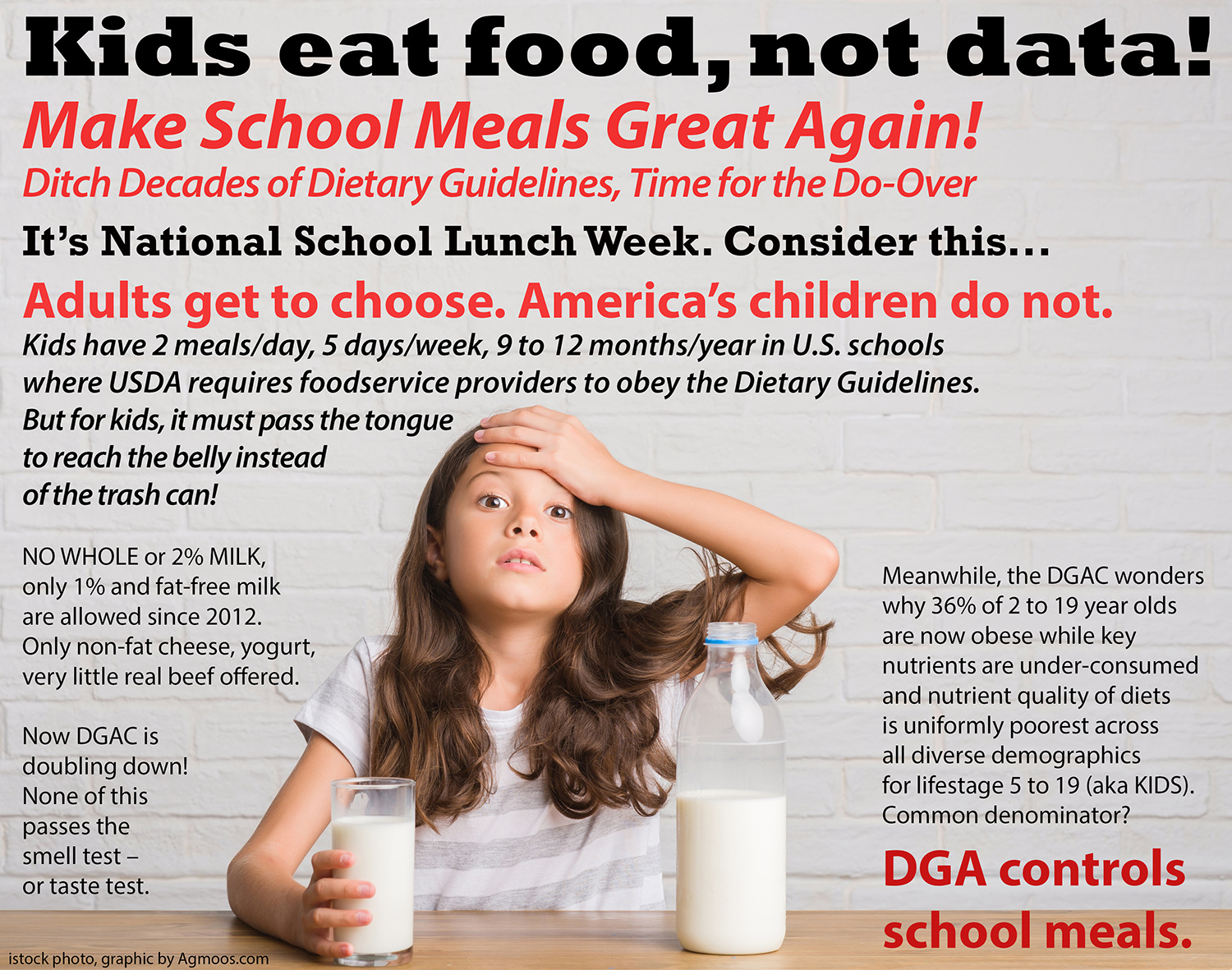
‘Stop feeding us lies’ say protesters as Dietary Guidelines Committee unbelievably doubles down against animal fat, protein

Dietary Guidelines have most negatively impacted children and youth.

Dietary Guidelines Advisory Committee holds final meeting. Draft recommendations include: Reductions in total protein; Less protein from animals, more from plants; Dairy emphasis still low-fat, non-fat; Implementation recommendations include food supply leverage

By Sherry Bunting, Farmshine, October 25, 2024

WASHINGTON, D.C. – This week is National School Lunch Week, and on Oct. 22 while USDA Secretary Tom Vilsack kicked off the so-called “largest federal-led summit in support of healthy school meals” in Las Vegas, the 2025-30 Dietary Guidelines Advisory Committee (DGAC) met publicly by zoom to gamble away the nutrients children need for the development of their brains, bodies and long-term health.

This was the seventh and final meeting of the DGAC after 22 months of subcommittee meetings and periodic full committee meetings, yielding a draft “scientific report” that is increasingly vegetarian.

Its recommendations to USDA and HHS are to develop 2025-30 Guidelines that significantly decrease the role of nutrient dense animal foods, even though they spent the first hour of the 12-hour, two-day virtual meeting puzzling over how to solve the nutrient deficiencies in their analysis.

The recommendations merge the three current DGA patterns (Vegetarian, Mediterranean and Healthy U.S.) into one dietary pattern with a draft name of “Healthy Flex U.S. Diet.” The flexibility part, according to the DGAC discussion, is the ‘how much’ and ‘how to’, which relies on ‘food pattern modeling’ and more specific strategies on how to replace animal based foods with plant based foods. 

The DGAC aims to improve its poor performance on the under-consumed nutrients by “including more nutrient-dense plant-based meal and dietary recommendation options” in its advice for 2025-30 Dietary Guidelines. 

The draft advice aims to continue to “emphasize consumption of low-fat or non-fat dairy and unsaturated fats; limit consumption of red or processed meats and foods high in saturated fat; and limit foods like sweetened beverages.”

Some committee members raised the concern that further addressing one problem (fat, salt, and sugar) leads to other problems in other areas (under-consumption of key nutrients, over-consumption of carbohydrates, and impacts on metabolic health). 

In fact, a week before the DGAC met, the first ever Change the Dietary Guidelines protest drew hundreds of people to the nation’s capitol — with Nina Teicholz, author of Big Fat Surprise, as emcee. It was organized by Metabolic Revolution with the mission of asking the Administration to “STOP FEEDING US LIES.”
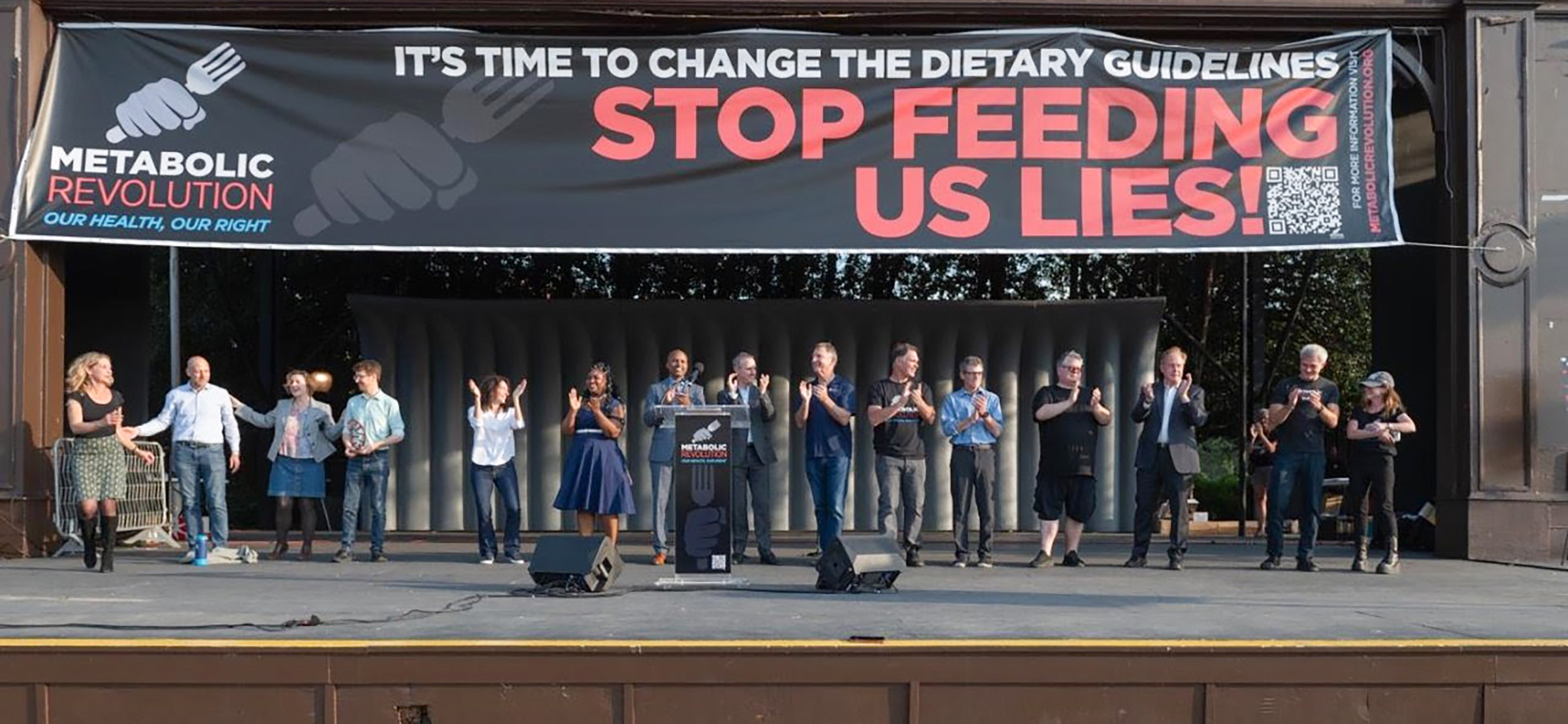
Nutrition Coalition photo

Meanwhile, in the DGAC meeting, at least one member at the end of the first day noted how animal foods, specifically mentioning dairy, have all of these essential nutrients and that the bioavailability of the nutrients is important.

This didn’t make much difference. On the question of saturated fat restrictions, the 2025-30 DGAC doubled-down. These restrictions began with the first edition in 1980, and the quantitative recommendation of “limit saturated fat intake to less than 10% of calories per day starting at age 2 and replacing it with unsaturated fat, particularly poly-unsaturated” began in 2005.

The Committee’s biggest justification was that, “This has been confirmed by several previous DGACs based on the relationship between saturated fat intake and cardiovascular disease risk.” Basically saying it has been previously decided, and “we’re sticking with it.” Essentially, all evidence to the contrary was again ignored.

The Committee stated that only 1 in 5 Americans implement this limitation; so, food replacement strategies, cultural diet pathways, and diet simulations were recommended to show how to get more nutrient density from plant sources. Pre-packaged and pre-portioned implementation strategies and plated combinations of plant-based meals are suggested as ways to ensure nutrients without the fat.

This high-level academic exercise means very little to everyday Americans making choices about food, but it could fundamentally change what is available to choose from — if the “systems science, implementation science, and behavioral science” the DGAC is also recommending pushes diets even more toward highly processed, pre-packaged, pre-portioned options designed by global food giants.

Bottomline: the DGAC will recommend to the USDA and HHS to further reduce animal-based protein consumption and to further increase plant-sourced consumption in the 2025-30 Guidelines, while continuing to limit dairy to non-fat and low-fat options.

For dairy, the DGAC is also recommending that USDA update nutrition composition and dairy reference guides to reflect what they say are ‘improved’ plant-milks, and to use ‘diet simulators’ to show Americans how to be more ‘flexible’ in replacing animal foods with plant foods.

The DGAC also changed the wording of its 2025-30 mission to “reduce the focus on chronic disease risk reduction, to instead focus more on promoting growth and development and improving the healthspan.”

These are key takeaways despite the Committee spending the first hour of the first day stupefied by the analysis showing — uniformly across all socio-economic and cultural demographics — children ages 5-19 had the nutritionally poorest diets in terms of under-consuming key nutrients at this most critical lifestage.

Even when they picked up their Health Equity Lens to look at the data, it was uniformly bad.
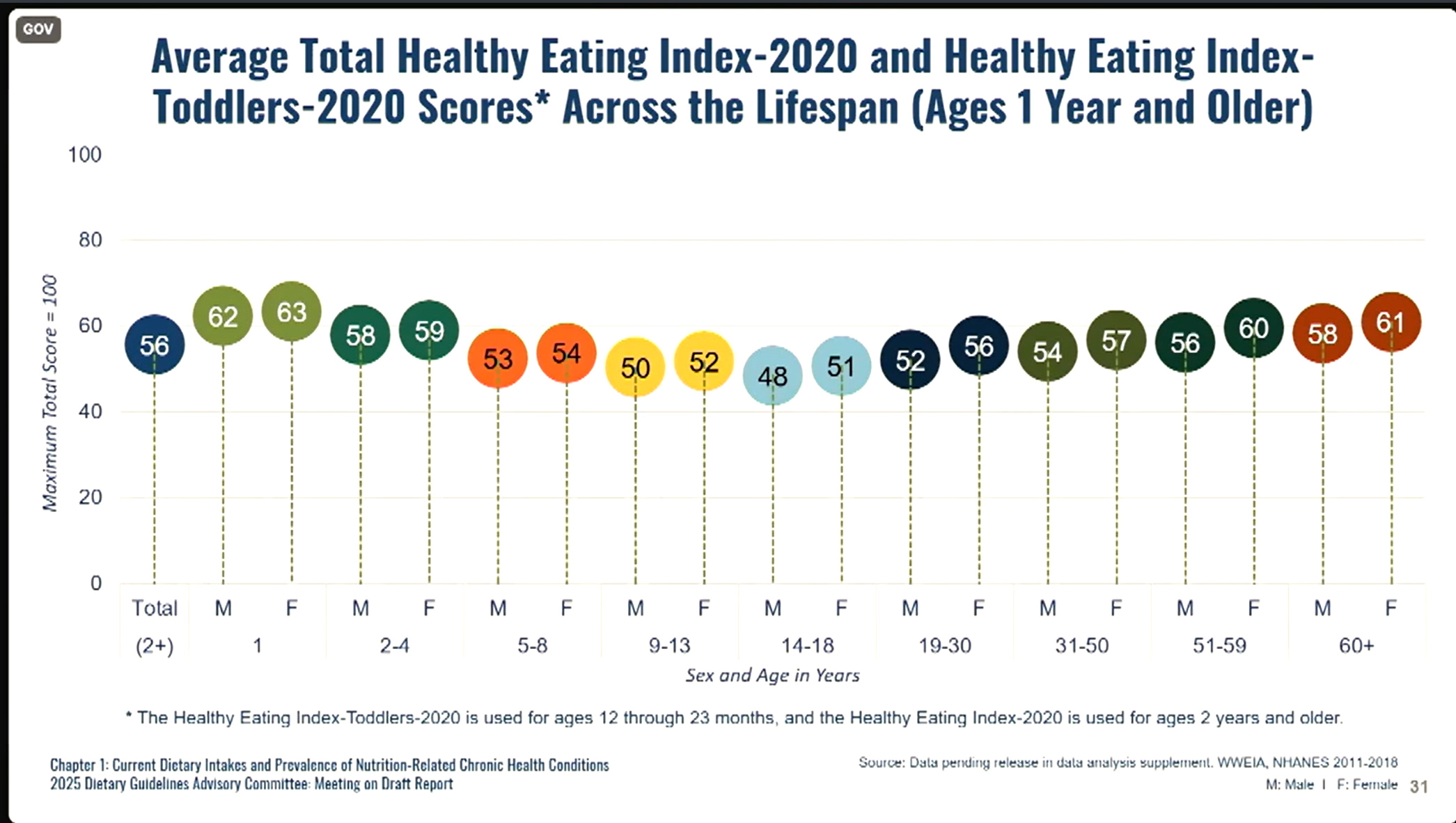
The DGAC could not understand why the healthy eating index showed such uniformly poor performance in the under-consumption of key nutrients, especially among children ages 5 to 19 across all populations. (Simple. It’s because the anti-fat DGAs are enforced at school meals twice a day, five days a week, most of the year for this life stage. Kids do not get to choose; adults do.) Oct. 21 screenshot DGAC meeting 

Their interpretation? I will paraphrase: Parents need help understanding how to feed their children.

My interpretation? The Dietary Guidelines are, themselves, the problem because they are used rigidly to formulate the meals that the age 5 to 19 lifestage (kids) are presented with twice a day, five days a week, nine to 12 months of the year – at school! The body will keep snacking until it gets the nutrients it seeks. 

“Obesity is a major public health issue, impacting 36% of children ages 2 through 19 years and 41% of adults ages 20 and older,” according to the DGAC.

However, by the end of the two days, the DGAC showed it would stay on the anti-fat path and give USDA and HHS the “expert” advice to double-down on saturated fat restrictions that have prevailed over the years while Americans become less healthy, more obese, with more chronic disease, at ever younger ages. Do they not wonder why this was not the situation pre-Guidelines? So much valuable research on saturated fat and health was again left off the table.
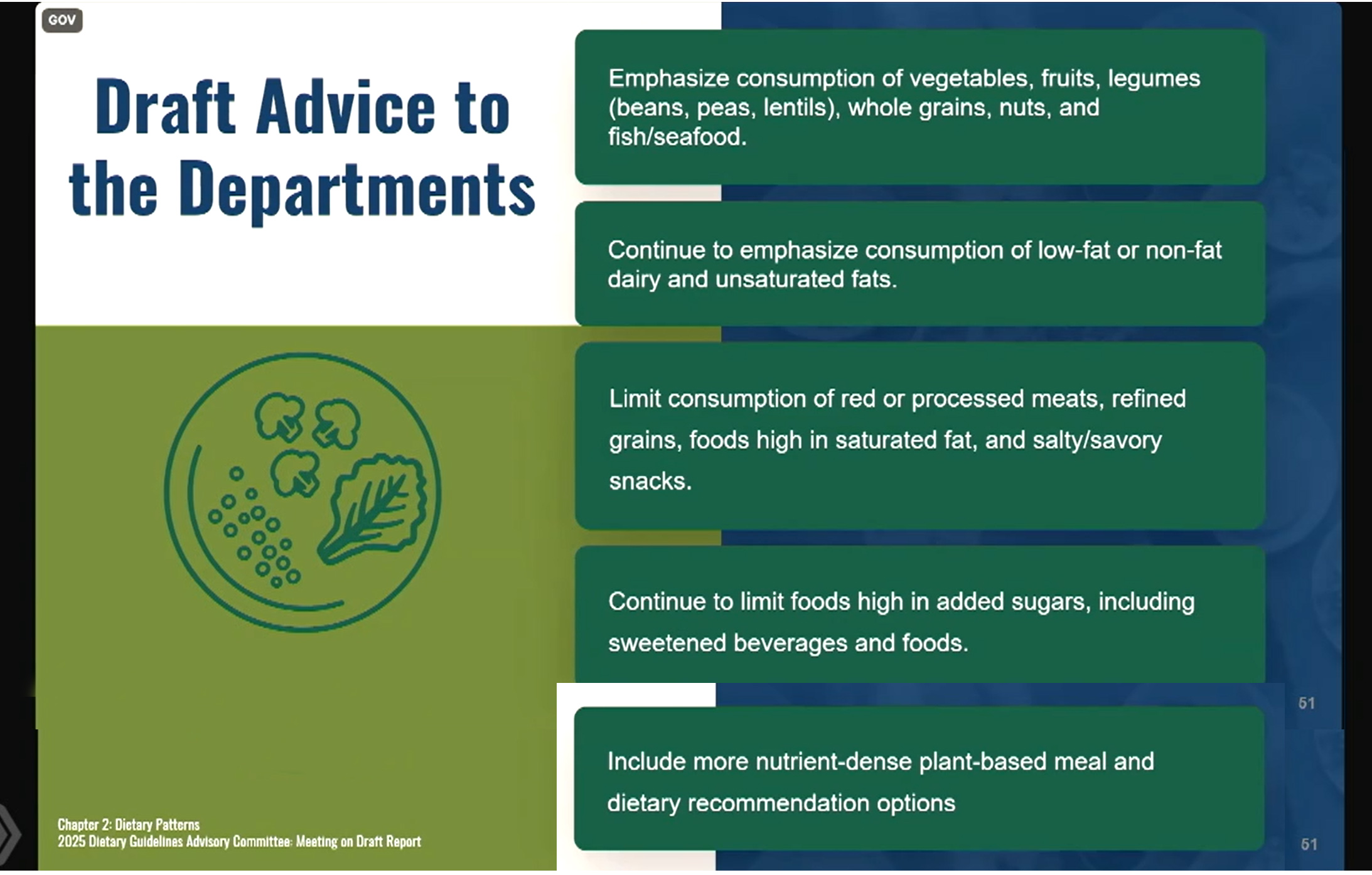
One of many draft advice slides for 2025-30 Dietary Guidelines emphasizing non-fat and low-fat dairy and unsaturated fats; addressing nutrient density by increasing plant-based meal options and decreasing animal-based. Oct. 21 DGAC meeting 

Impacts of the DGAC draft report on Dairy:

1) Dairy’s ‘place’ in the diet remains somewhat intact, but the committee advises things like not referring to soy milk as an “alternative” because it is part of the dairy grouping. They also are questioning if ‘Dairy’ is the right term for the Dairy group. The DGAC also will advise USDA to update nutrient composition and daily reference amounts to reflect the current state of nutrition art in “plant-milks” and to use diet simulations to show Americans how to be more flexible in replacing animal-based with plant-based.

2) Nonfat and low-fat dairy will continue to be the recommendation (3 milk cup equivalents), although they mentioned that there was not enough evidence to make this a strong conclusion for ages 2 through 5. Perhaps this leaves a door open for daycares and WIC to expand to 2% and whole fat milk up to age 5 instead of the current age 2, but schoolchildren are still out of luck. Dairy fat and butter were mentioned as being consumed mostly in processed foods.
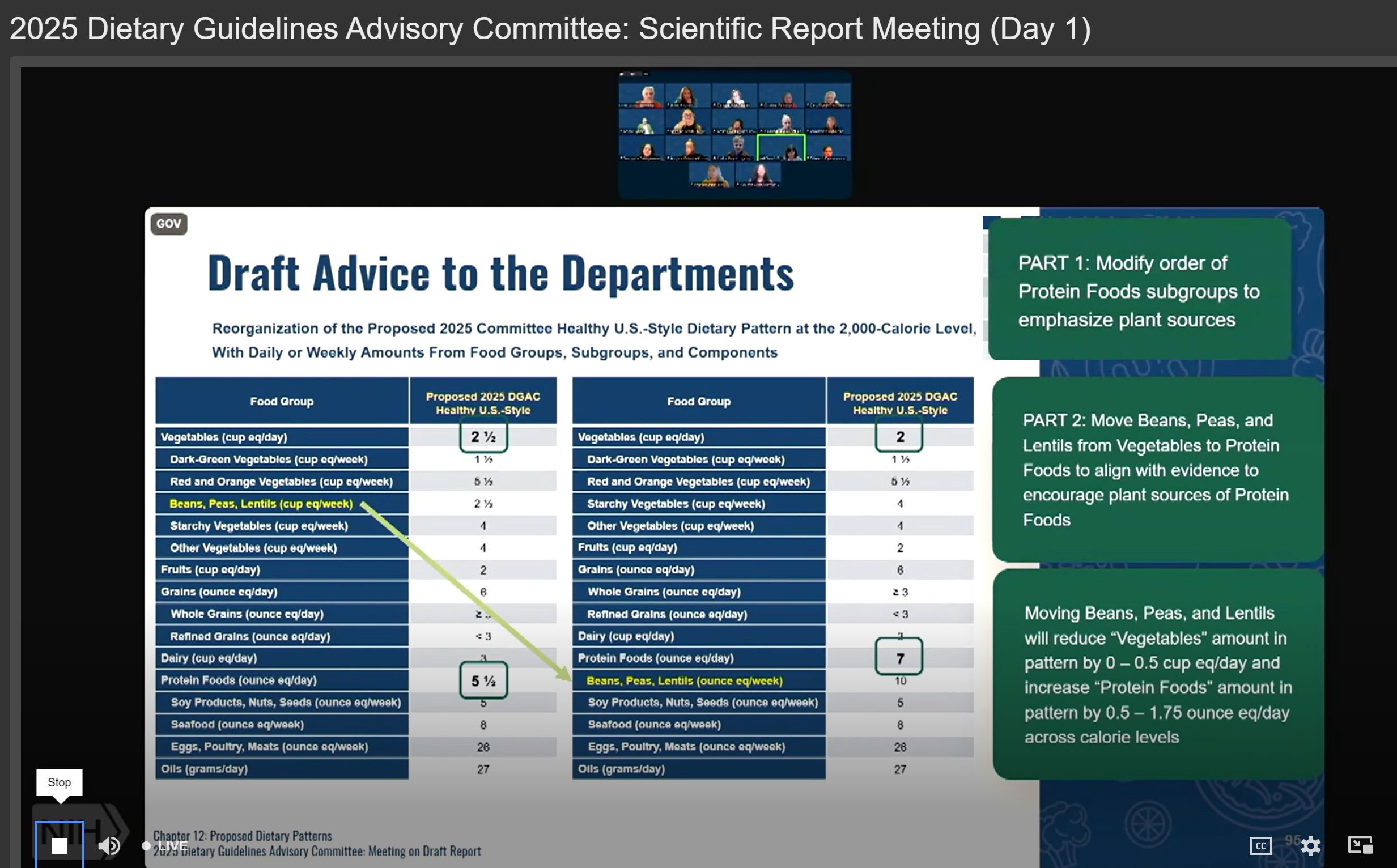
3) The Protein category has been flipped on its lid. The DGAC moved beans, peas and lentils from the vegetable category to the protein category and increased the daily quantities for beans, peas, lentils, seeds, soy, nuts, and fish, while reducing the allowance for meat, poultry and eggs. In fact, they will represent this visually by listing first in the protein category the plant sources, followed by fish, then eggs, then poultry, and lastly, red meat. The DGAC pointed to the dairy group as a source of protein that is not in the protein group, so protein level importance in plant-based comparisons can be reduced. (Several Committee members indicated their belief that Americans consume too much protein, so they wanted to show these crossovers differently.)

4) The additional considerations chapter is of particular concern for the future, advising USDA and HHS to: a) Encourage shifts to nutrient-dense plant-based meals; b) Put stricter limits on foods and beverages high in added sugars, sodium, and saturated fat; c) Use sugar limitations to exclude foods from the dietary pattern (with implications for flavored milk and dairy products); d) Make sodium reduction targets mandatory not voluntary (may impact the cheesemaking process for schools and other institutional feeding); e) Avoid referring to soy milk as “alternative”; Research name change for Protein group and determine if ‘Dairy’ is the right term for the Dairy group.

This draft report ends the DGAC’s work. In the coming days, it will be edited to reflect the discussion for submission as final recommendations to USDA and HHS.

A joint team of staff from both Departments will prepare this DGAC Scientific Report for posting at DietaryGuidelines.gov, along with data analysis, food pattern modeling and other supplemental documents. 

USDA and HHS will then open a new public comment period.

In 2025, the Secretaries of USDA and HHS (whoever they end up being), along with their joint team, will review the DGAC scientific report and the public comments to develop the actual 2025-30 Dietary Guidelines for Americans.

Expect these DGAs to continue most negatively impacting America’s schoolchildren and elderly in senior centers where meals must follow them.

However, it will have some impact on all of us if the Departments use the DGAC recommendation to implement food system science at the food supply level. We can already see what happens to choices for consumers and markets for farmers when the middlemen decide what can be put on grocery store shelves or in the dairy or meat case.

Not only did we not see a serious effort to address the need for more nutrient dense foods in the dietary pattern, the new pattern will double-down against saturated fat, along with salt and added sugar, and erode protein levels, while continuing to search for the missing nutrition profile of its increasingly vegetarian recommendations. 

None of this passes the smell test, and likely not the taste test. Kids eat food not data. Nutrients must pass the tongue to reach the belly. Look for more on that in terms of action next week from the Grassroots Pennsylvania Dairy Advisory Committee and 97 Milk.

***

Additional information:

In its report, The Nutrition Coalition notes: “The collective shift toward emphasizing more plant-based foods has lowered the quality and quantity of protein in our diets. It is time to pause and question whether these changes are endangering health in the U.S., especially among children and the elderly. Still, with plant-based advocates dominating the public comments, plant-based industries and interests lobbying the USDA, and plant-based proponents on the expert committee itself, we may see further reductions of this important macronutrient in the 2025 Dietary Guidelines.”

Nina Teicholz, Ph.D. explains that these draft recommendations “fly in the face of our knowledge that plant proteins are of lower quality than animal proteins. With the exception of soy, all plant proteins lack all the necessary amino acids to make muscle tissue (as well as perform other critical functions in the human body). Reducing the total amount of protein and replacing animal proteins with plant proteins are both harmful changes. These alterations will mean that anyone receiving USDA-funded meals, such as kids consuming school lunches, the women and infant children on the WIC program, and the elderly will receive fewer complete proteins. Also, reductions in meat, dairy and eggs are sure to exacerbate nutritional deficiencies in the guidelines, which currently fail to meet basic targets iron, vitamin D, vitamin E, choline, and folate. The Dietary Guidelines are already deficient in complete proteins. The erosion of protein in the guidelines has been happening for decades, as we wrote about in this post.”

-30-
What’s the future for fluid milk?

Fluid milk sales are up, Whole Milk for Healthy Kids Act is moving. Meanwhile industry globalists put big bets on ESL, shelf-stable, with favor from Vilsack  

By Sherry Bunting, Farmshine, October 18, 2024

EAST EARL, Pa. — Protein is all the rage right now, and consumers are turning back to real milk as they realize its natural high quality protein benefits. Year-to-date fluid milk sales continue to outpace year ago, and that’s good news. Here are some key factors in the future of fluid milk in the U.S.

Fluid milk sales up!

July’s total packaged fluid milk sales more than recovered the June slump — in a big way, and August looks promising too.

USDA estimated packaged fluid milk sales at 3.4 billion pounds in July, up 4.3% year-on-year (YOY). This amplifies the pivotal year-to-date trend above year ago for the first time in decades (except the 2020 pandemic year).

Specifically, USDA’s Estimated Fluid Milk Product Sales Report for July, released in late September, noted conventional fluid milk sales total 3.7% higher YOY, with organic up 11.7%.

Conventional unflavored whole milk sales were up 4.7% YOY in July, while organic whole milk sales were up 17.1%.

Flavored whole milk sales were mixed because these sales rely upon what processors are willing to make and offer on store shelves, not necessarily reflecting what consumers want to buy. When fewer packages of whole flavored milk are offered, the full potential of sales are restrained.

Year-to-date (YTD) sales of all fluid milk products for the first seven months of 2024, at 24.7 billion pounds, are up 0.7% YOY, adjusted for Leap Year. Of this, YTD conventional whole milk sales for the first seven months of 2024, at 8.8 billion pounds, are up 2.1% and organic whole milk sales at 914 million pounds are up 12.6%.

The August report to be released in the coming weeks is shaping up similarly. August Class I utilization pounds reported last week by USDA are up 1.1% YOY and 1.1% YTD (Jan-Aug).

Making more fat, importing it too?

Meanwhile, the monthly World Agricultural Supply and Demand Estimates (WASDE) released Oct. 9 reduced its milk price forecasts for the rest of 2024 and into 2025, expecting Class III prices to fall from September highs as cheese price declines are expected to more than offset the higher whey prices.

This report is looking at all the major new cheese capacity coming online in the next 12 months, which is expected to saturate the cheese market to drive prices lower so that U.S. cheese makers can be globally competitive and continue exporting record amounts of cheese.

But is the milk available to do this? Likely not without robbing from Classes I, II and IV channels. Still, the WASDE forecasts lower Class IV prices also due to the abruptly declining butter price being only partially offset by the higher nonfat dry milk prices.

In short, dairy farms are making higher-fat milk, and the food industry is importing more milkfat, especially in the form of whole milk powder. WMP imports have been up by a record amount YOY in each of the past four years, especially 2024.

Restoring whole milk choice for kids!

Now would be a particularly good time for whole milk choice to be restored in our nation’s schools since we apparently have too much milkfat and not enough skim. Given this scenario, how can anyone in this industry still believe the whole milk in schools would hurt the industry’s ability to make enough butter and cheese. 

Unless it is excess butter and cheese that is needed to push prices down in order to continue beating record exports at reduced prices paid to farmers. 

Getting whole milk choice into schools would help. IDFA has been touting the Whole Milk for Healthy Kids Act. NMPF says they are on board too. This means the industry is united, right?

What are the chances that GT Thompson’s bill to bring whole milk choice back to schools will finally make it all the way to the President’s desk?

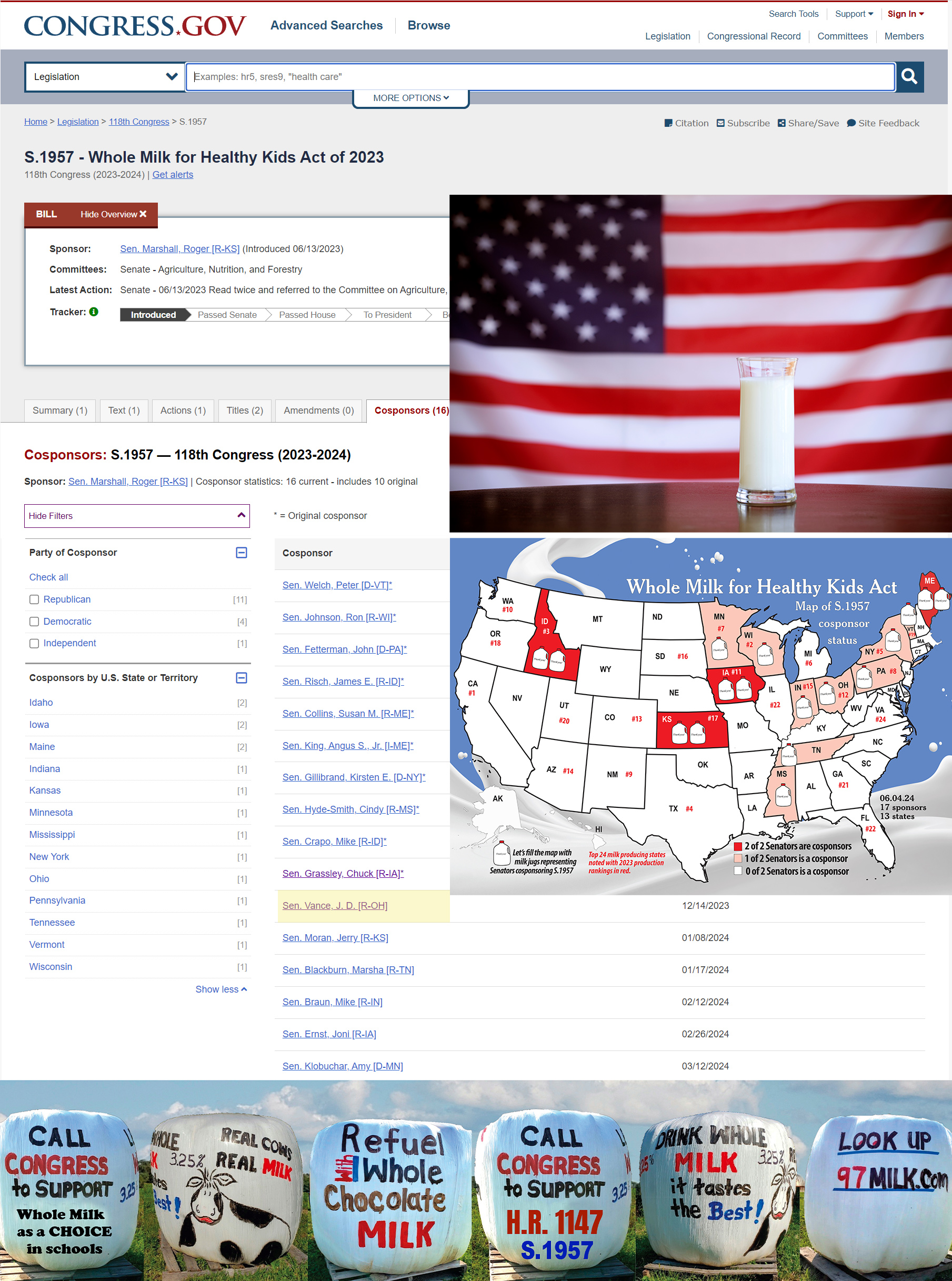
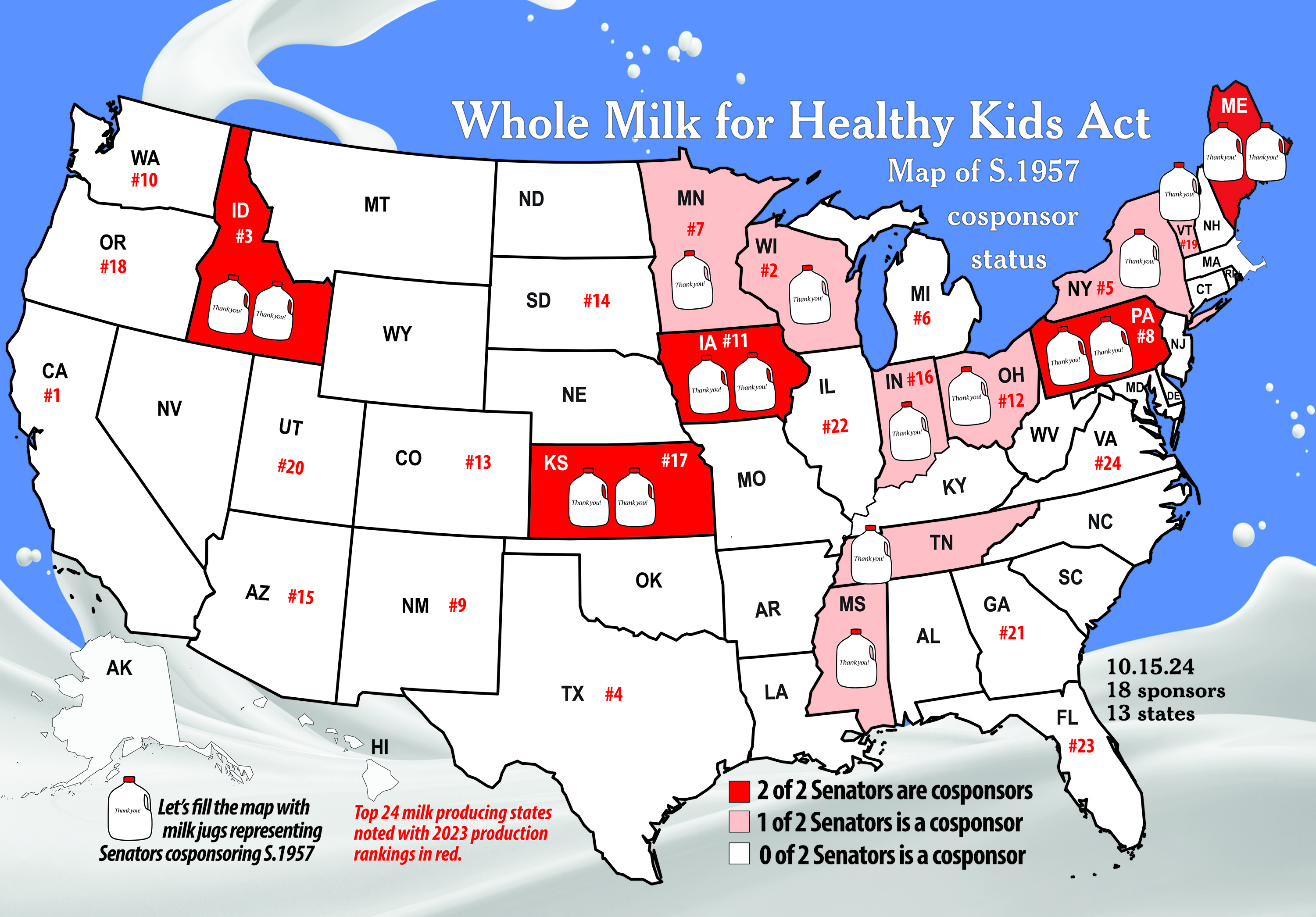
For starters, it passed the House by an overwhelming bipartisan majority last December. The Senate bill, S. 1957, has 11 Republicans, one Independent and five Democrats signed on, including notable Democrats such as Amy Klobuchar of Minnesota, Peter Welch of Vermont, Kirsten Gillibrand of New York, and John Fetterman of Pennsylvania who chairs the Senate Ag Subcommittee on Nutrition. 

The main sponsor is Republican Senator Roger Marshall of Kansas, a doctor. States represented are Pennsylvania, Vermont, Wisconsin, Idaho, New York, Iowa, Ohio, Indiana, Tennessee, Maine, and Mississippi.

In fact, Pennsylvania now has both Senators signed on. Senator Bob Casey Jr. (D-Pa.) is late to the party, but he has finally signed on as a cosponsor of S. 1957 on Sept. 19. It’s nice to see both senatorial milk jugs filled on the map for the Keystone State, but the bill needs more cosigners to fend off the blockade by Senate Ag chairwoman Debbie Stabenow (D-Mich.).

GT has included the Whole Milk for Healthy Kids Act in the House Ag Committee-passed farm bill. Word from Washington over the past few weeks is that a new farm bill is expected to get done after the elections in the lame duck session, and that GT will fight to keep the Whole Milk for Healthy Kids Act in the bill. Let’s hope so.

USDA: two movers for Class I?

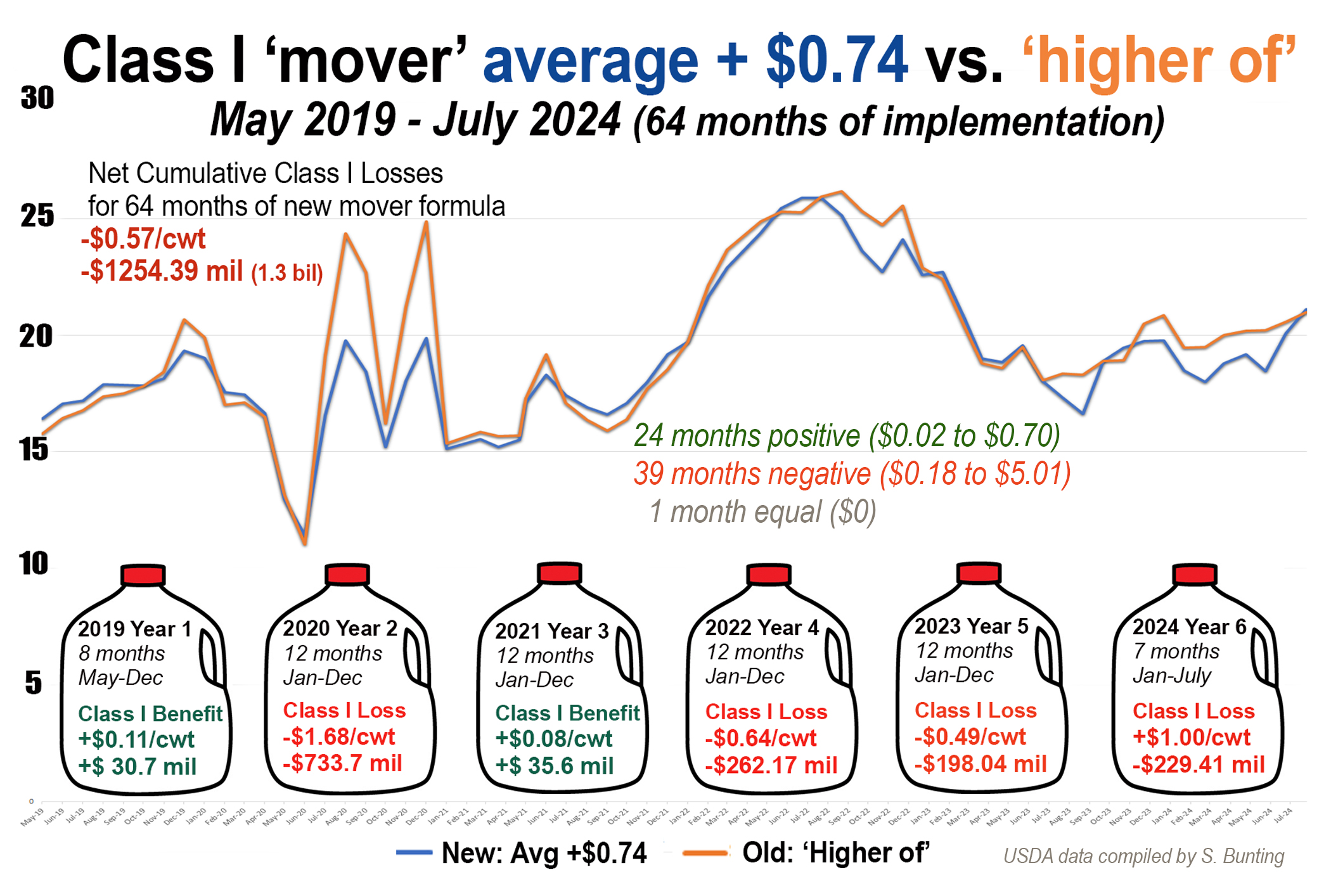
Also related to Class I fluid milk sales, the dairy industry awaits a final decision on USDA’s proposed changes to federal milk pricing formulas, which includes a surprise for fluid milk: splitting the baby and adding a fifth class of milk in the form of two Class I mover announcements each month. 

The hearing record is woefully inadequate. No proposal. No evidence. No testimony. No analysis. No parameters. No definition. Even USDA’s own static analysis shows these two movers would be as much as $1 or more apart in any given month.

Fresh, conventionally processed (HTST) milk would go back to being priced by the the higher of the Class III or IV advance pricing factors to determine the Class I skim milk base price portion of the mover. 

However, milk used to make extended shelf life (ESL) fluid milk products, defined only as “good for 60 days or more,” would continue to be priced using the average of these two pricing factors, plus-or-minus a rolling adjuster of the difference between the higher-of and average-of for 24 months, with a 12-month lag.

With two movers, fluid milk costs could be different for plants in the same location based on shelf life, with no clear definition for the new class, nor parameters established to qualify. Could we see label changes to move between movers?

Processors will know the rolling adjuster 12 months in advance, due to the “lag.” They will know the two advance-priced calculations (higher-of and average-of) a month in advance. They will have it charted in an algorithm no doubt and make decisions accordingly.

Farmers, on the other hand, will find out how their milk was used and priced two weeks after all their milk for the month was shipped. Those milk checks will be even less transparent than they are now.

Big bets on ESL, shelf stable

The dairy checkoff has openly identified ESL, especially shelf stable aseptically packaged milk, as its “new milk beverage platform,” using dairy farmer funds to research and promote it and to study and show how consumers can be “taught” to accept it.

The whole deal is driven by the net-zero sustainability targets. So, follow the money.

Dr. Michael Dykes of IDFA, at the Georgia Dairy Conference in January 2024, told dairy producers that “this is the direction we (processors) are moving… to get to some economies of scale and bring margin back to the business.”

He said the planned new fluid milk processing capacity investments are largely ultra-filtered, aseptic, and ESL — 10 of the 11 new fluid plants on the IDFA map he displayed are ESL. Some will also make ultrafiltered milk, and some will make plant-based beverages also.

Meanwhile, the linchpin of regional dairy systems is conventionally pasteurized (HTST) fluid milk, prized as the freshest, least processed, most regionally local food at the supermarket.

To be sure, this two-mover proposal fits the climate and export goals set forth by the current Ag Secretary Tom Vilsack when he was working as the highest paid dairy checkoff executive in between the Obama and Biden administrations. 

The pathway to rapidly consolidate the dairy industry to meet those goals is to tilt the table against fresh fluid milk, something he already put a big dent in when removing whole milk from schools.

They decided thou shalt drink low-fat milk and like it. Apparently, they are equally convinced about ESL / shelf stable milk as the way of the future and will continue using mandatory farmer checkoff funds to figure out how to get consumers to like that too.

Just this week, the food writer for The Atlantic did a piece on shelf-stable milk, calling it “a miracle of food science” and lamenting in her Op-Ed that it’s a product “Americans just can’t learn to love.”

Author Ellen Cushing took jabs at America’s preference for fresh natural milk from a global perspective, without a thought for the local dairy farms and regional food systems that are tied to fresh milk. She states that by worldwide standards, other countries have gone shelf-stable milk, which she describes as “one of the world’s most consumed, most convenient and least wasteful types of dairy.”

Processors are making big bets on consumer conversion to ESL and shelf-stable.  There are cards to play in every hand. TO BE CONTINUED!

-30-

‘Make allowance’ among hot topics ahead of producer vote on USDA’s proposed milk pricing changes

35 dairy farmers, industry representatives, and farm media attended “Winners and Losers: a discussion about USDA’s proposed milk pricing reforms,” hosted by the American Dairy Coalition during the 57th World Dairy Expo in Madison, Wisconsin October 3rd.

By Sherry Bunting, Farmshine, October 11, 2024

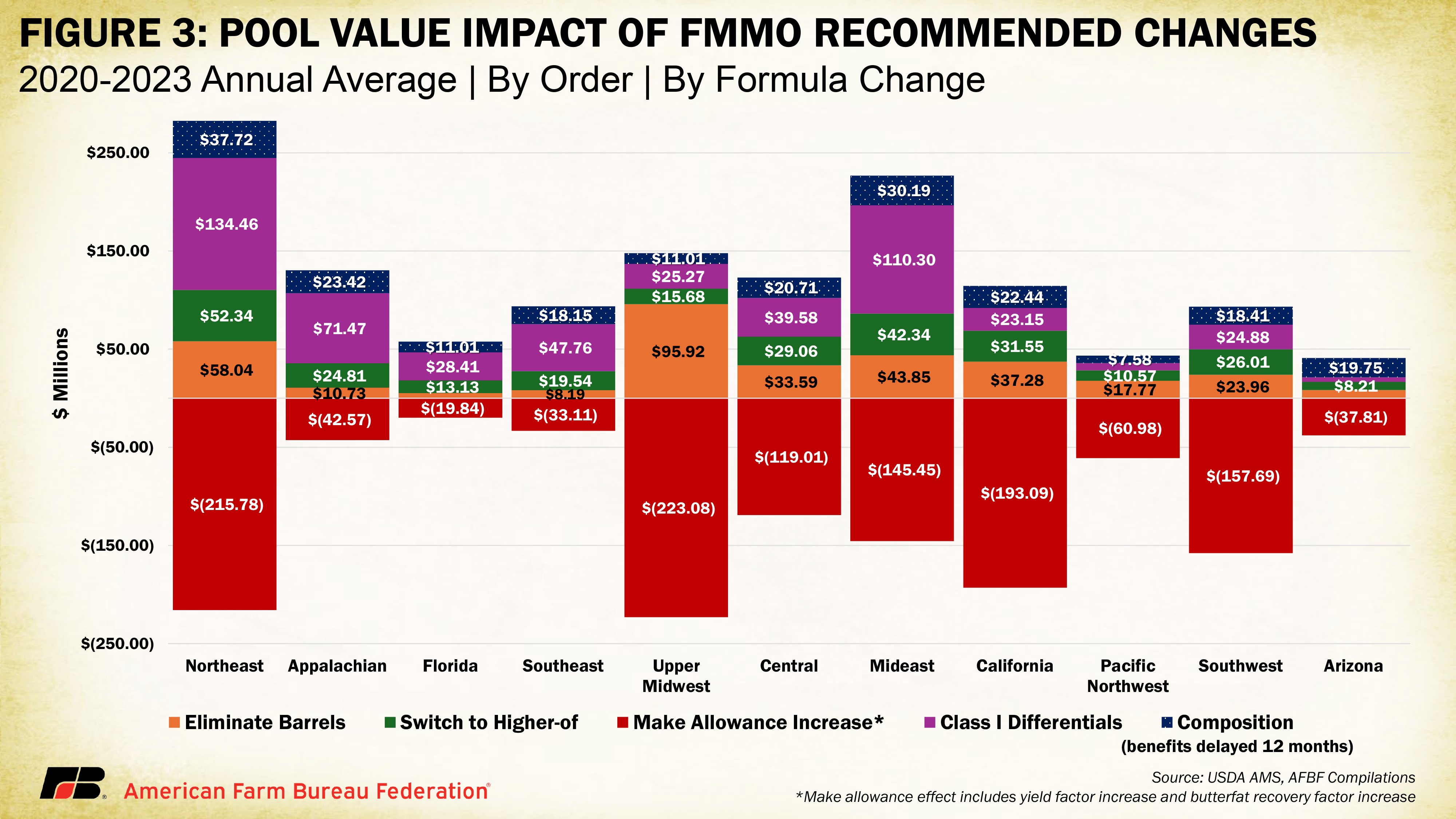
MADISON, Wis. – “I’m in Wisconsin, and on the graph (below) it looks like producers in Order 30 are having to decide between less money with an Order or even less money without an Order. Am I wrong and is there a silver lining?”

That was the crux of the question one dairywoman asked during the American Dairy Coalition’s (ADC) ‘Winners and Losers’ seminar and press conference Oct. 3 at World Dairy Expo. Over 35 farmers, industry representatives, and media professionals gathered to hear insights about USDA’s recommended decision on changes to Federal Milk Marketing Order (FMMO) price formulas.

American Farm Bureau economist Danny Munch was the invited presenter, followed by time for questions, moderated by Kim Bremmer of Ag Inspirations, and opportunities for networking and farmer-to-media connections during the remainder of the two hours.

Dairy farmers attending ADC’s press conference gave interviews after the discussion on USDA’s proposed milk pricing changes.

At issue was the impact on FMMOs with more cheese and less fluid milk, that would experience the negative impacts of a proposed hike in processor make allowances without the positive buffer of higher Class I location differentials.

Bremmer said over 126 individuals and organizations provided comments to USDA. The comment period ended Sept. 13. 

During his visit to Expo on Oct. 4, Ag Secretary Tom Vilsack said USDA would issue a final decision in mid-November. Also on Oct. 4, USDA held a webinar explaining the producer referendum expected in January. (Look for more specifics in a future Farmshine, and check out the Farm Bureau recap here)

The short answers to the above question appear to be yes, yes, and yes. With an Order, producers in some regions will see lower FMMO blend prices. Without an Order, they would lose minimum prices altogether and other important FMMO functions.

The silver lining? Munch pointed to better competition currently for milk, and he sees opportunity for milk in the future as consumers focus on protein.

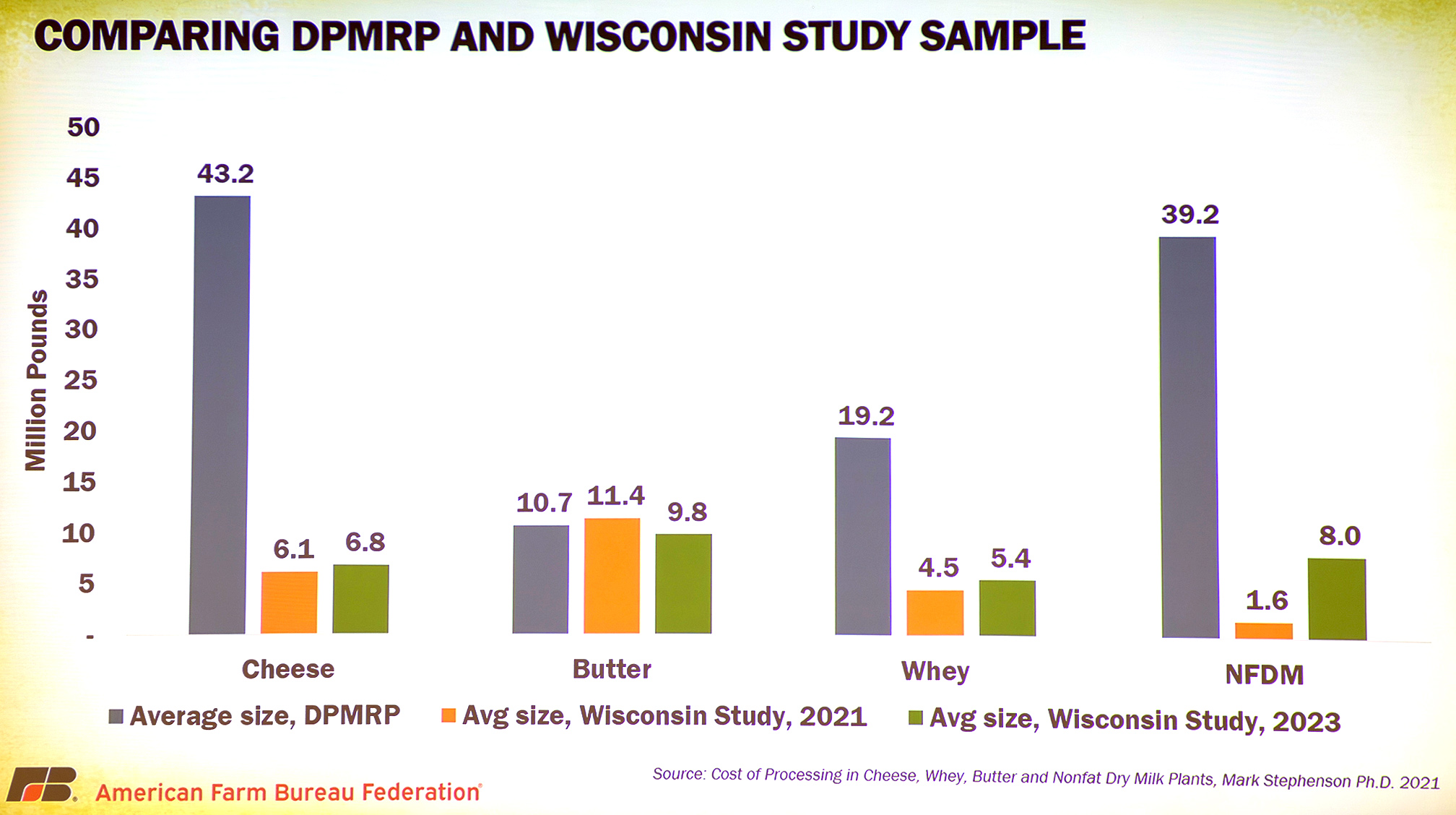
New to the discussion was make allowance data compiled by AFBF for its official comment at the Federal Register showing the average plant size of processors participating voluntarily in the Stephenson Survey relative to the average plant size of processors reporting to the NASS Dairy Product Manufacturing Survey (below)

The average size and volume of the plants in the voluntary cost of processing survey is 5 to 20 times smaller than the size and volume of plants reporting to USDA on price and production. This is further evidence that mandatory surveys are the only fair way to examine and set make allowance levels.

ADC reports that farmers have called with questions and concerns about the FMMO changes they will vote on. Part of ADC’s mission is to inform dairy farmers and help them understand factors like this that affect their businesses, said Bremmer.

For example, it’s helpful for farmers to realize that current make allowances equate to $2.17 to $3.17 per hundredweight in deductions already in the pricing formulas to cover the cost of converting milk to butter, cheddar cheese, nonfat dry milk, and dry whey. 

The proposed new make allowances add 70 cents to $1.00, depending on class utilization, bringing the total deduction to about $2.89 to $4.07 per hundredweight, maybe more.

The splitting of Class I into a two-mover pricing system is also causing discontent and concern. On the one hand, USDA would restore the ‘higher-of’ method for conventionally pasteurized fluid milk but use an ‘average-of’ method with a rolling and delayed adjuster for the extended shelf life (ESL) fluid milk products. This new milk class was not vetted nor defined during the hearing.

Also of concern is the delay in implementing positive updates to milk composition standards that have not been updated since Order Reform in 2000.

USDA’s recommended decision applies to all 11 FMMOs nationally but will be voted on by eligible (pooled) producers in each Order, individually.

A two-thirds ‘yes’ vote within each individual Order continues that Order with the changes. If the two-thirds threshold is not met by either producer numbers or volume in an Order, then the result is termination of that Order. 

Producers do not have the option of voting separately on the five pieces of the USDA decision, nor do they have the option of voting to keep the FMMO pricing formulas as they are currently.

Economists with National Milk Producers Federation have stated previously that 65 to 70% of the U.S. milk supply is marketed through cooperatives that tend to bloc vote for their producers, but this percentage can vary on an individual Order basis.

USDA determines voting eligibility, based on whether milk was pooled in the reference period selected by each Market Administrator. 

“When we get down the road to the vote, and if we vote ‘no,’ that will dissolve the Order, right?” asked one dairy farmer. “What opportunity does any geography have to reorganize a new Order to fit what works for them?”

Munch said producers could start a process to create a new Order, but it would still be required to use the same price formula rules because these will apply to ALL Orders uniformly. In contrast, he noted that USDA leaves pooling and depooling rules to be decided individually by each Order.

One member of the media pressed Munch to speculate on what happens if a western Order votes no, but an eastern Order votes yes?

“People always want me to speculate on what happens if California or the Upper Midwest vote out their Order(s). What we’ve seen in the past in unregulated areas, or areas with state orders — they still base a lot of their pricing on the nearby Federal Order system,” he responded.

“If we remove more milk out of the Federal Order system, does that system then play less of a role in pricing milk, and does that unregulated market start to dictate and suck milk out of the regulated areas, if you’ve taken out some of the large milk production states? That’s just some speculation, something to think about in the long term,” he said.

On a more immediate basis, Munch said that if an Order is terminated by this vote, “farmers lose protections like timely payments and component verifications, and the minimum prices. You could end up with a patchwork.”

He pointed out that USDA did not raise make allowances by the full amount requested by processors, but also did not go with the more modest increases requested by the cooperatives.

In their post-hearing comments, processors voiced great unhappiness with the decision, he said, because they didn’t get the multi-year increases to even higher levels.

“We don’t blame USDA for trying to come up with a middle ground… we just don’t have the data. The way hearing processes work is they collect this data brought by stakeholders and try to come up with a compromise that works for everybody,” Munch explained. “Our argument is that the data may not reflect market conditions, and we want to make sure that it does. We can’t get that assurance until there’s an audited, mandatory survey.”

As a standalone piece, AFBF estimates that USDA’s proposed increase in make allowances would remove an additional $1.25 billion annually from producer pool revenue, nationwide, based on past pooling data. However, USDA proposes a one-year delay in implementing the milk composition updates that would contribute $200 million annually in producer pool revenue nationwide.

Munch sees the 12-month delay in implementing the milk composition standards and the splitting of the Class I mover with an ESL adjuster as two things that appear to be “thrown in there,” with a lot of groups voicing discontent and confusion.

When asked by a reporter if the add-ons to Class I will create consumer resistance to what could be a 25-cents-per-gallon increase in retail fluid milk prices, Munch cited the hearing record where economists testified to the relative inelasticity of fluid milk demand.

He also sees great opportunity for milk: “When I go to the gym, I used to see no one drinking milk. Now I see tons of people drinking milk, protein shakes, and other things, and it’s not plant-based products. I think milk can take advantage of marketing the protein benefits that people in my generation are looking for and are willing to pay for.”

Munch was asked if AFBF will recommend how its dairy members should vote.

“We will not make that recommendation. We take positions based on our policy, which includes opposing any make allowance updates until we have mandatory cost of processing surveys, and other aspects related to our policy book,” he replied. “It’s up to our members to make those voting decisions, and there is a regionality to this, so we don’t get involved at that level.”

Florida producers, for example, “will be okay with the new rules” because the over 80% Class I utilization brings with it higher location differentials. The Upper Midwest, on the other hand, has been at roughly 5% Class I and 93% Class III, so there is very little benefit from the Class I changes, but those producers are subjected to the highest make allowance deductions for Class III products, which is 95% of their blend price.

-30-

Helene leaves trail of loss and disruption to farms, dairies; immediate needs for hay, feed, fencing; farmer-to-farmer efforts underway

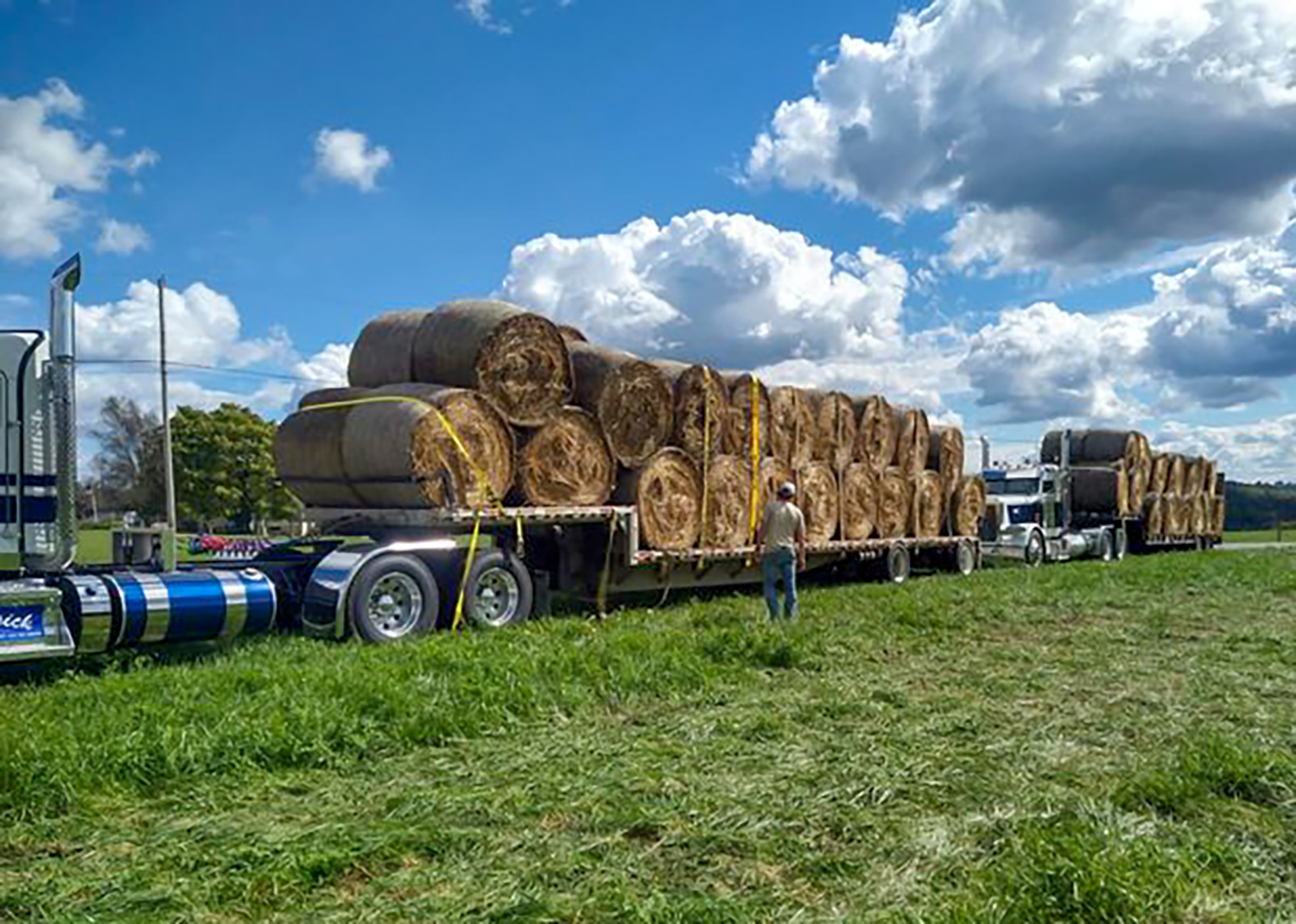
American Farm Bureau estimates 96,871 farms are located in counties impacted by Hurricane Helene in Florida, Georgia, South Carolina, North Carolina, Virginia, Tennessee, West Virginia, and Kentucky. Northwest Pennsylvania farmers filled the first tractor trailerloads of hay to go to western North Carolina via the volunteer NW PA Hay Drive. Other such farmer-to-farmer efforts are popping up in the unaffected portions of the Southeast, as well as Northeast, Midwest and Southwest. County extension offices, FFA chapters, churches and organizations like Samaritan’s Purse are organizing drop points for hay, feed, fencing and other dairy and livestock supplies. It’s important to have a contact in the region, and know where to go before participating. (Facebook photo provided by Brittany Eisenman  )

By Sherry Bunting, Farmshine, October 11, 2024

SOUTHEAST U.S. — The USDA Dairy Market News and other reports gathered by Farmshine indicate significant disruption to dairy plant operations, fluid milk production volumes, supply, transportation, distribution, infrastructure, and demand across Florida, the greater Southeast and part of the MidAtlantic region in the wake of Hurricane Helene.

This is now compounded by evacuations just 11 days after Helene’s destruction as the potential category five Hurricane Milton is forecast to make landfall Oct. 9 and 10 to affect the entire Florida Peninsula with storm surge north into Georgia and the Carolinas.

Farmers in hard-hit counties throughout the Southeast are helping others in their communities even as they face the devastation of their own livelihoods. 

One poultry farmer who lost everything his family worked to build over decades in Jeff Davis County, Georgia was interviewed by the Georgia Agribusiness Council. He put it direct: “We need help. If the government can reach out and help other countries, they need to help this country. We need the help, desperately… as quick as we can get it. We want to farm. We want to build back.”

A big pressing need in western North Carolina and eastern Tennessee is hay and feed for dairy and beef cattle. Also needed are fencing supplies, chainsaws, water pumps, generators, TPost, wire, gas jugs, gloves, hammers, water troughs, fence staples, basically items to care for or contain livestock.

Farmer-to-farmer efforts are popping up across the Northeast, Midwest and Southwest to assemble donations of hay, feed, fencing, and other livestock related items and to secure funds and trucking to get the items to drop points manned by local contacts, churches, FFA chapters, extension, and volunteer organizations like Samaritan’s Purse working in the area. 

One example is the Northwest Pennsylvania Hay Drive assembling loads for the WNC Regional Livestock Center drop point in Canton, N.C. (call or text Brittany Eisenman at 814.221.4291 if you have hay, trucking, or funds to donate or contact Mark Muir with Erie County Farm Bureau).

In addition, former dairy farmer Mark Yeazel of Ohio put a load together to drive to an East Tennessee FFA chapter drop point, working with Samaritan’s Purse.

FFA chapters in affected counties are organizing drop points in at least eight counties. Hay deliveries are also being received at Greene County Fairgrounds on Tuesday and Wednesday afternoons from 2 to 6 pm., or call the University of Tennessee Extension office at 423.798.1710 or text 423-552-4073.

Some farm supply stores in the region are also taking donations by phone to amplify their ongoing efforts to get essential farm and livestock supplies where they are needed.

For the affected farmers and rural communities, the North Carolina Extension has posted a Farm Helpline to talk to someone who understands farm stress, by calling or texting 844-325-3276 for support, available 24/7.

For other information on how to assist victims, visit the American Farm Bureau’s Hurricane Helene Webpage at https://www.fb.org/issue/hurricane-helene

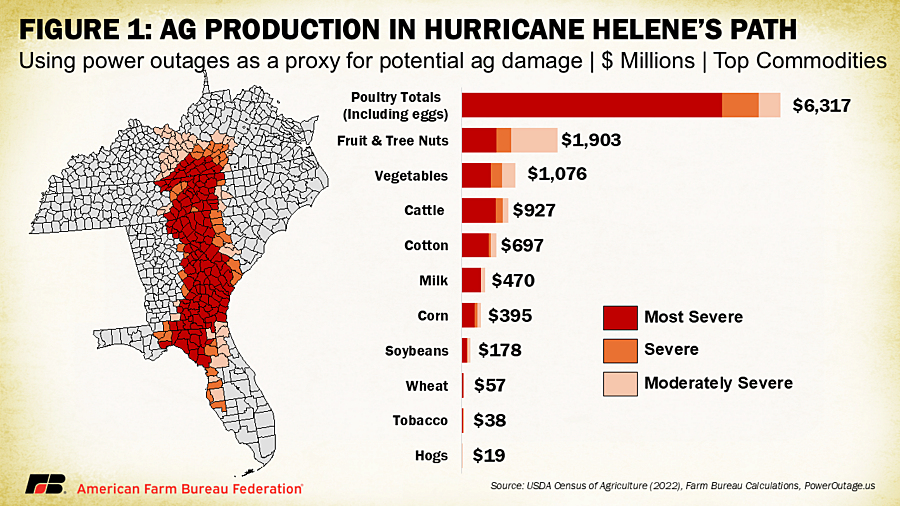
American Farm Bureau economist Danny Munch release an important preliminary economic analysis: Hurricane Helene Devastes Rural Southeast

Fig. 1 shows the agricultural production in Hurricane Helene’s path.

Concerning surprises in FMMO proposed rule; Comments due Sept. 13th

By Sherry Bunting, Farmshine, Sept. 6, 2024

EAST EARL, Pa. – “Those who don’t learn from history are doomed to repeat it.” That was the theme of the American Dairy Coalition’s webinar on the USDA’s proposed Federal Milk Marketing Order (FMMO) pricing changes, which I participated in last Thursday, August 29th.

Over 125 people participated, including state dairy and state farm bureau organization leaders and individual producers. American Farm Bureau economist Danny Munch helped producers understand the proposed changes and walked through the areas of mutual concern. Other panelists offered information, and participants’ questions were addressed.

“This webinar was a grassroots dairy producer undertaking,” said moderator Kim Bremmer of Wisconsin-based Ag Inspirations. “ADC planned it to make sure dairy farmers have a way to ask questions before the public comment period closes on Sept. 13th. We know the last update to milk pricing occurred in that 2018 farm bill, and that was without your input, and it cost dairy producers over a billion dollars across the country. It is really important that your voices are heard.”

Four primary areas of concern were discussed: the processor make allowance increase, the size of the whey make allowance relative to the price, delayed timing of beneficial updates to milk composition, and the surprising 2-mover system for Class I, effectively adding a 5th class of milk to the FMMO pricing scheme.

A 2-mover system was not vetted during the very lengthy USDA hearing. It appears to be “thrown in” as a last-minute compromise to appease processors investing in extended shelf life (ESL) fluid milk capacity.

Nestle and Fairlife had testified to sales volume growth when they offered 9 to 12-month flat-pricing after the average-of was implemented in May 2019. They said they must have average-of pricing to manage their risk so they can offer long-term pricing to grow sales.

Make allowance increases quite large

USDA proposes to raise processor make allowance credits by 29 to 33% above the current level. That equates to a 75-cents to $1.00 per hundredweight new deduction from milk checks, embedded in the pricing formulas, depending on how the milk was utilized.

Munch said make allowances are part of the formulas that start with surveying market prices for the four base commodities – 40-lb cheddar cheese blocks, butter, nonfat dry milk, and dry whey. USDA works backwards from the surveyed price to derive a value for the raw milk.

He used a cartoon imagining of “little Zippy selling cheese at his cheese stand.” (a light-hearted reference to AFBF president Zippy Duvall, a former dairyman).

“USDA is surveying the volume and value that he is selling it at — out in the marketplace — and then is using that price to derive a raw milk price,” Munch said, explaining that, “working backward, there has to be a part of the formula that accounts for the cost for Little Zippy to convert the raw milk into the cheese. He uses non-dairy ingredients like cultures and salts. It’s his own labor as well as overhead and equipment that he uses to convert raw milk into cheese. In the FMMO system, that deduction that accounts for his costs is called the make allowance,” he continued.

But today, the Little Zippys of the dairy industry are not so little, and they report much less on the USDA price survey, and they make so much more of the products that are NOT price-surveyed. These other products — such as mozzarella cheese, pizza cheese, other non-cheddar cheeses or cheddar cheeses in other bulk package sizes, whey protein concentrate, skim milk powder, whole milk powder, unsalted butter, and on and on — are not part of the formula and do not contribute value to the farmer’s milk check. Class I and II products are not price-surveyed either.

“When we look at the surveys, so many things are made out of the wonderful perfect nutrition of milk made on our farms, so what is the percent of products that are actually represented in the surveys?” asked Indiana dairy producer Sam Schwoeppe, who moderated the webinar Q&A

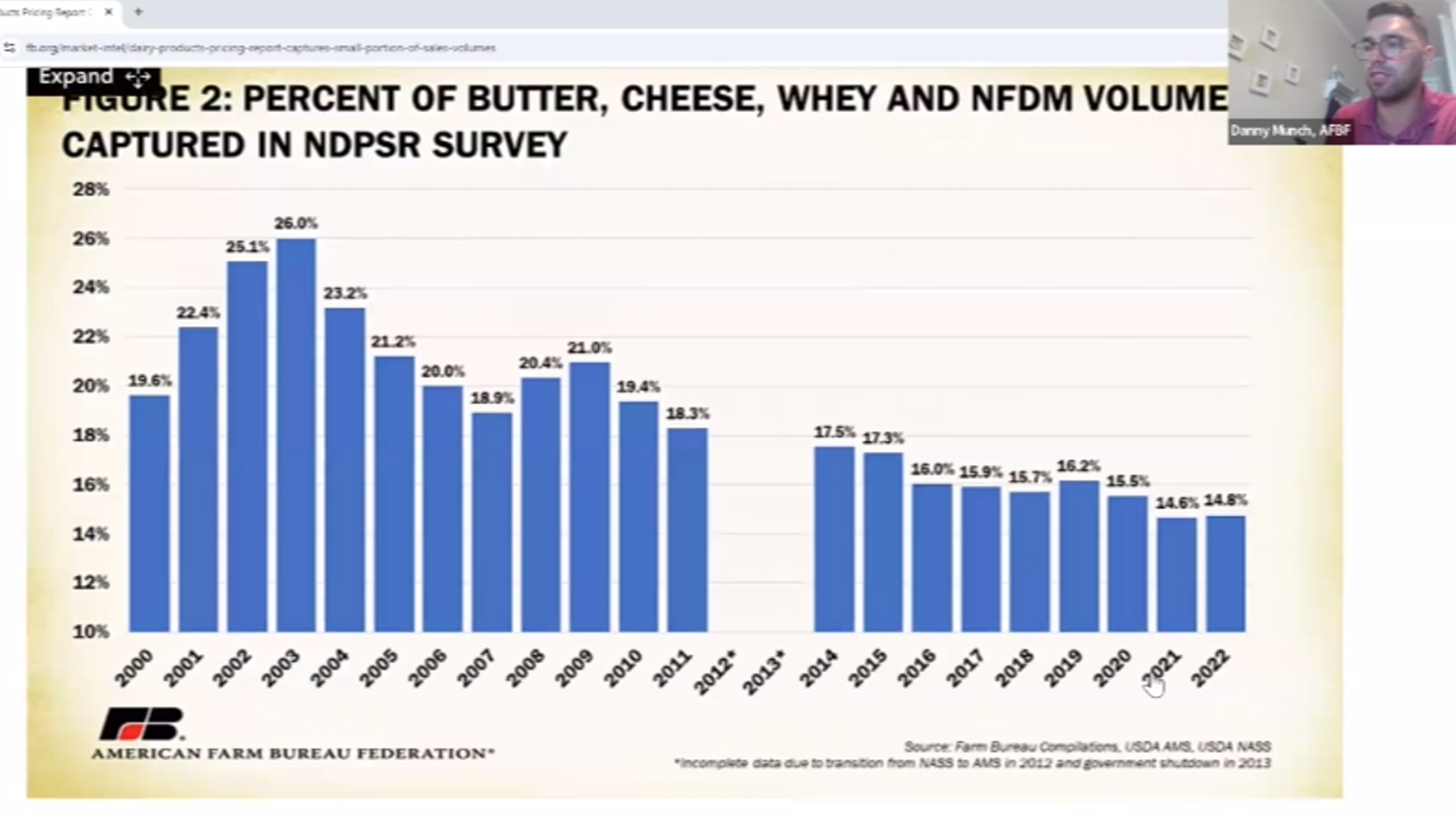
Survey volume quite small

Munch said the volume captured is “quite small and declining” to 14.8% in 2022 after being a high of 26.4% in 2002. “But those are just the products that are actually surveyed. There’s a lot of products that are not even surveyed, and that means the percent is even less.”

American Farm Bureau, American Dairy Coalition, and others pushed for some other bulk products to be added, but those proposals were rejected in this USDA decision.

So, how can current make allowance levels be too low when processors are spending billions to expand? Or, are dairy farmers expected to pay this debt service? 

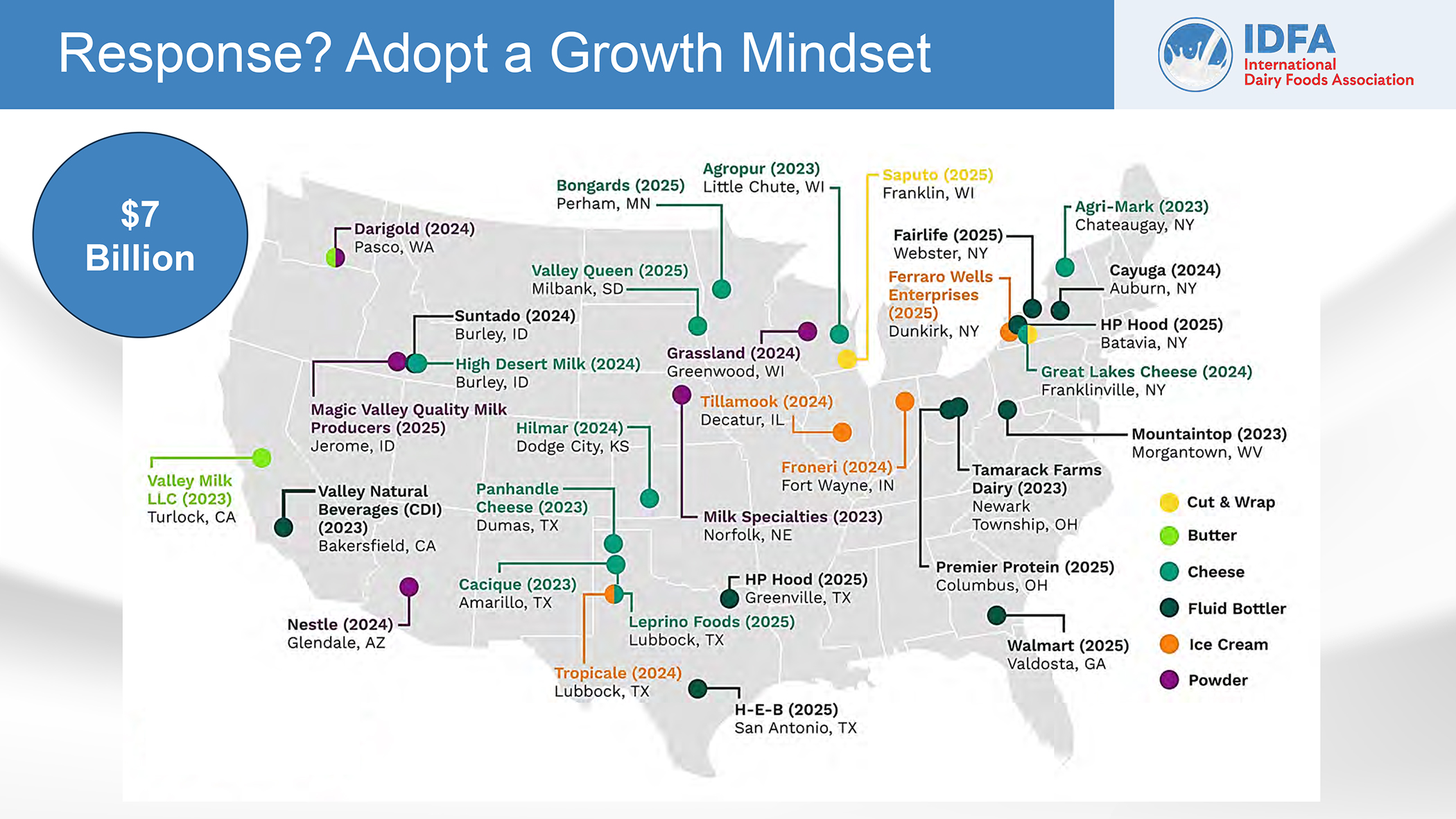
Dr. Michael Dykes, the CEO of the International Dairy Foods Association (IDFA), representing processors, told dairy farmers at the Georgia Dairy Conference in January 2024 that, “7 billion in new processing investments (below) will be coming online in the next two to three years. There’s a lot of cheese in those plans. These are going to be efficient plants. You’re going to see consolidation.”

The proposed make allowance increases of 5 to nearly 7 cents per pound across the four commodities equate to a new embedded milk check deduction of nearly $1.00 per hundredweight for Class III and around 75 cents for Class IV – over and above the current make allowances that already equate to $2.20 to $3.40 per hundredweight. Class I would see this embedded in advance skim and fat pricing factors that are used to set the base price mover.

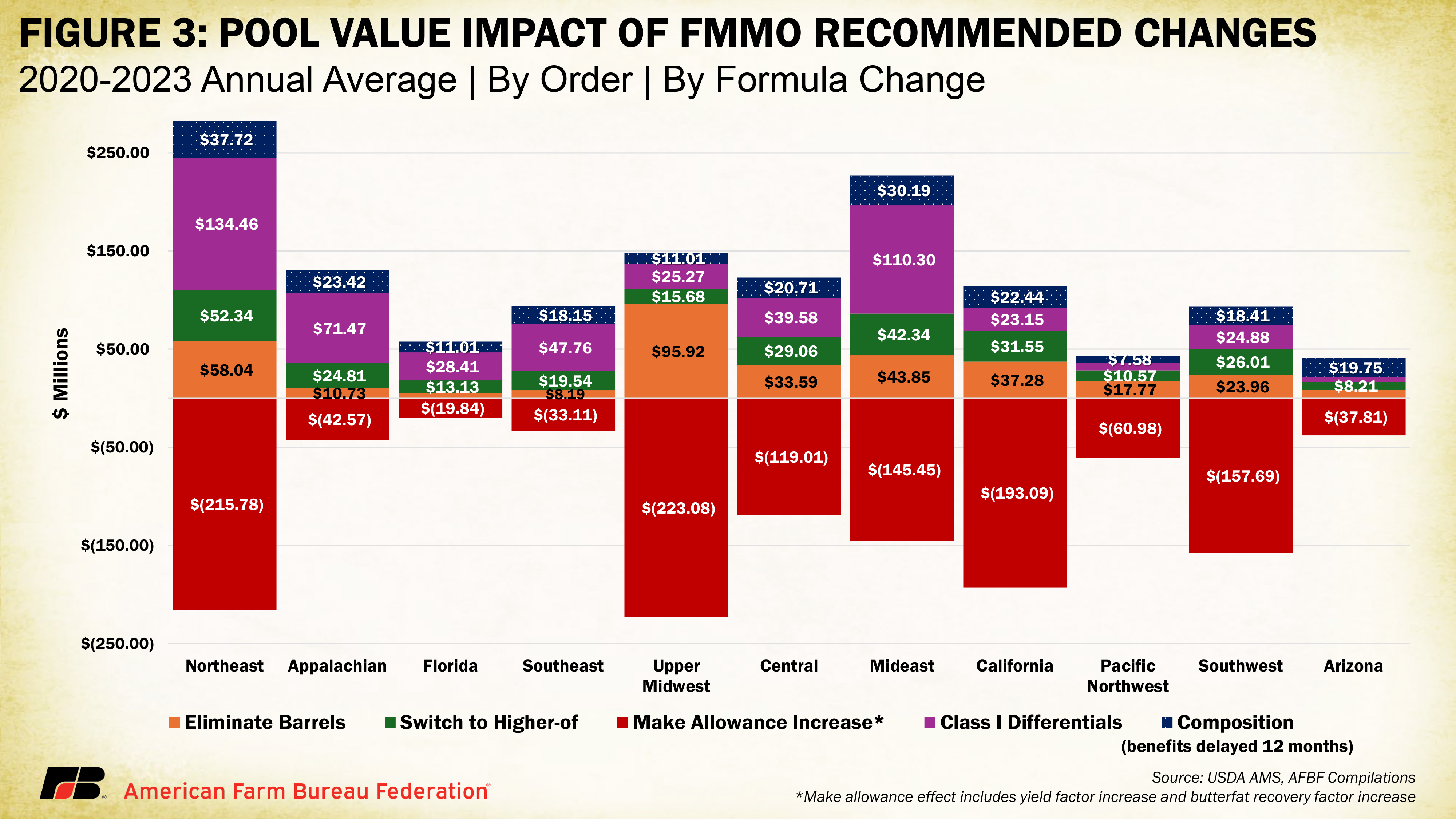
Collectively, the make allowance increases could remove $1.25 billion annually from FMMO pools, Munch showed in a 5-year static analysis based on prior pool composition, (See chart at top). Other aspects of USDA’s full proposal will defray some or all of the loss, mainly in the FMMOs with more Class I utilization. USDA’s proposal includes increases in location differentials for Class I fluid milk.

What happened in 2008-09?

Learn from the past or be doomed to repeat it? The last time make allowances were increased in 2008, a dairy market crash followed. As a webinar panelist and ag journalist, I pointed out that the dry whey price fell below the dry whey make allowance for the first seven months of that implementation from October 2008 through April 2009, resulting in penalties deducted from milk checks on every pound of other solids in the milk.

This time, the proposed dry whey make allowance is the largest of all – up 33.2% from $0.1991/lb now to $0.2653/lb. If in effect a year ago, dairy farmers would have again seen negative other solids penalties on their milk checks in July and August 2023 when milk prices were at their lowest. Meanwhile, processors made less dry whey, instead making more value-added products that are not price-surveyed.

Munch noted that only 66% of the plants on the price survey actually participated in the voluntary cost survey used by USDA to set the proposed new make allowances. AFBF, ADC and other organizations have been on record opposing make allowance increases until mandatory, audited surveys are conducted by USDA.

Conversion from fresh milk to ESL?

Learn from the past or be doomed to repeat it? On the Class I side, the 2018 farm bill changed the base price calculation. Farmers were told this would be revenue neutral, but the change cost them – at minimum — $1.25 billion over the past five years.

USDA now proposes to restore the higher-of calculation, but only for conventionally pasteurized HTST (or fresh) milk. Extended shelf life (or ESL) fluid milk products — labeled good for 60 days or more — would be priced using a new average-of method with a rolling adjuster.

Shouldn’t ESL have been defined in the hearing, and the economic impacts studied? This idea of two different Class I movers was not vetted in the hearing.

With two movers, fluid milk costs could be different from the same location based on shelf life. Webinar comments questioned USDA’s loose definition of ESL; Could processors change the label to move between the movers and pay whichever mover was lower?

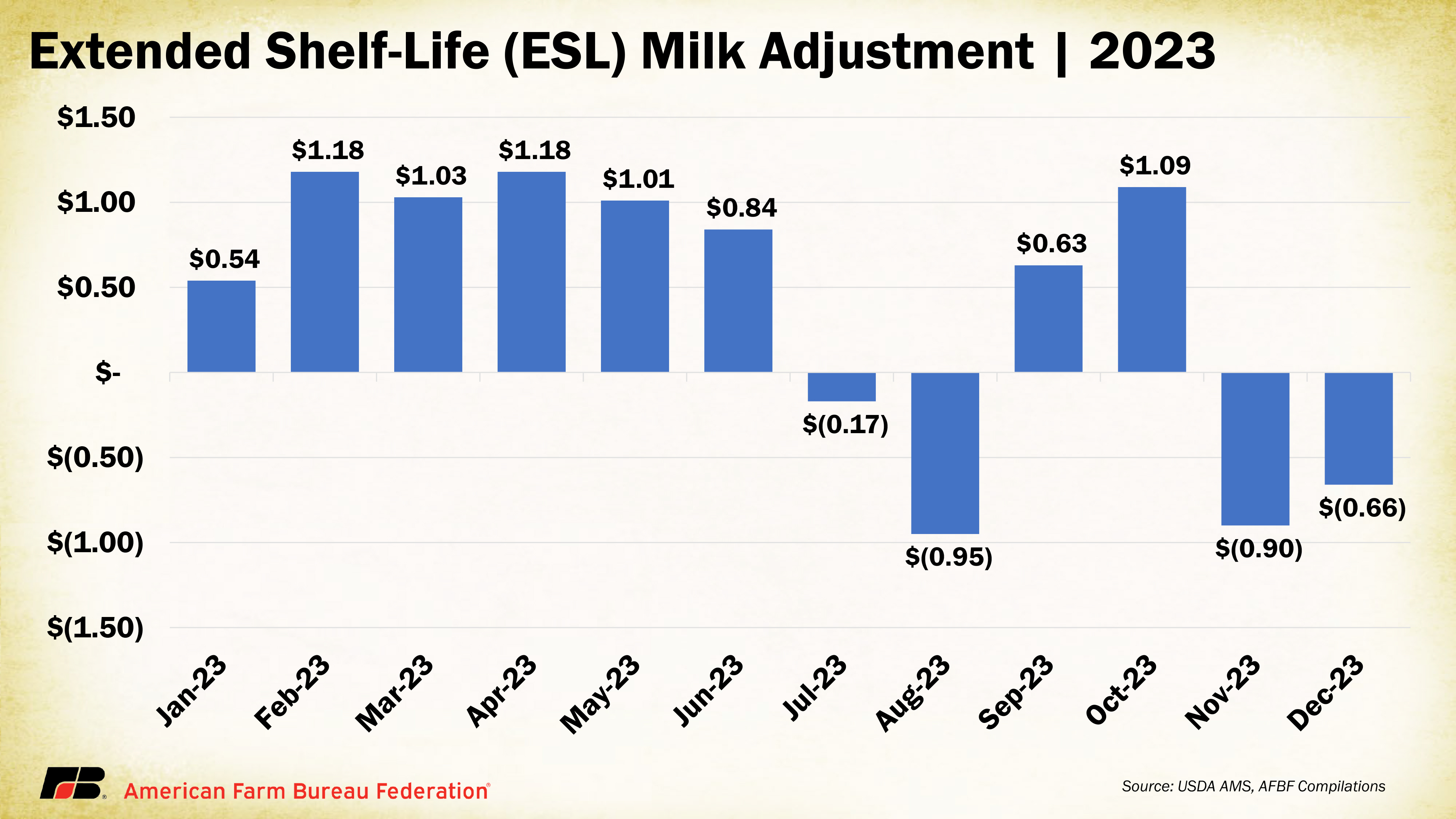
The USDA’s one-year static analysis showed the ESL Class I mover would have ranged from being $1.18 per hundredweight over to 95 cents under the HTST Class I mover in various months of 2023. That’s a big spread.

What’s at the root here? The dairy checkoff has openly identified ESL milk as the new milk beverage platform, using dairy farmer funds to research and promote it and to show consumers can be ‘taught’ to accept it.

Dr. Dykes of IDFA, at the Georgia meeting in January 2024, also told dairy producers that “this is the direction we (processors) are moving… to get to some economies of scale and bring margin back to the business.” He said the planned new fluid milk processing capacity investments are largely ultra-filtered, aseptic, and ESL. (10 of the 11 fluid milk plants on the IDFA map above are ESL and/or aseptic fluid milk plants. Some will also make ultrafiltered milk, and some will make plant-based beverages at the same location.)

Has USDA considered the purpose of the FMMO system is to promote orderly marketing and the adequate supply of FRESH FLUID MILK? Will consumers accept the taste of the not-so-fresh ESL and aseptic milk, or migrate faster to other beverages if fresh fluid milk is less available to them?

Would a 2-mover system ultimately reduce farmers’ access to milk markets in some regions and diminish the food security of those consumers? Prized as the freshest, least processed, most regionally local food at the supermarket, will the USDA decision reduce fresh fluid milk availability down the road?

How will the 2-mover system impact dairy farms located outside of the industry’s very specific identified growth centers? And will this perpetuate the wide divergence between Classes III and IV that has been an issue since 2019, further punishing dairy farmers with disorderly marketing and opportunistic depooling?

Webinar participants asked: “Will commenting even matter? Or is the USDA Secretary’s mind made up? How important is individual farmer input?”

“It’s extremely important for farmers to get involved. Even with talking points, really tell your own story with it,” said Munch. “They like hearing from you, and the stories of the impacts to your balance sheet, to your future revenue or the stability of your local community. They want to know the impact on small businesses. That’s one of the driving points.”

Not much time

With a short time remaining to comment at the Federal Register Docket AMS-DA-23-0031-0002.

American Dairy Coalition has prepared an official comment, so other like-minded organizations and individuals can sign on before the filing deadline, which is 11:59 p.m. Friday evening, Sept. 13, 2024.

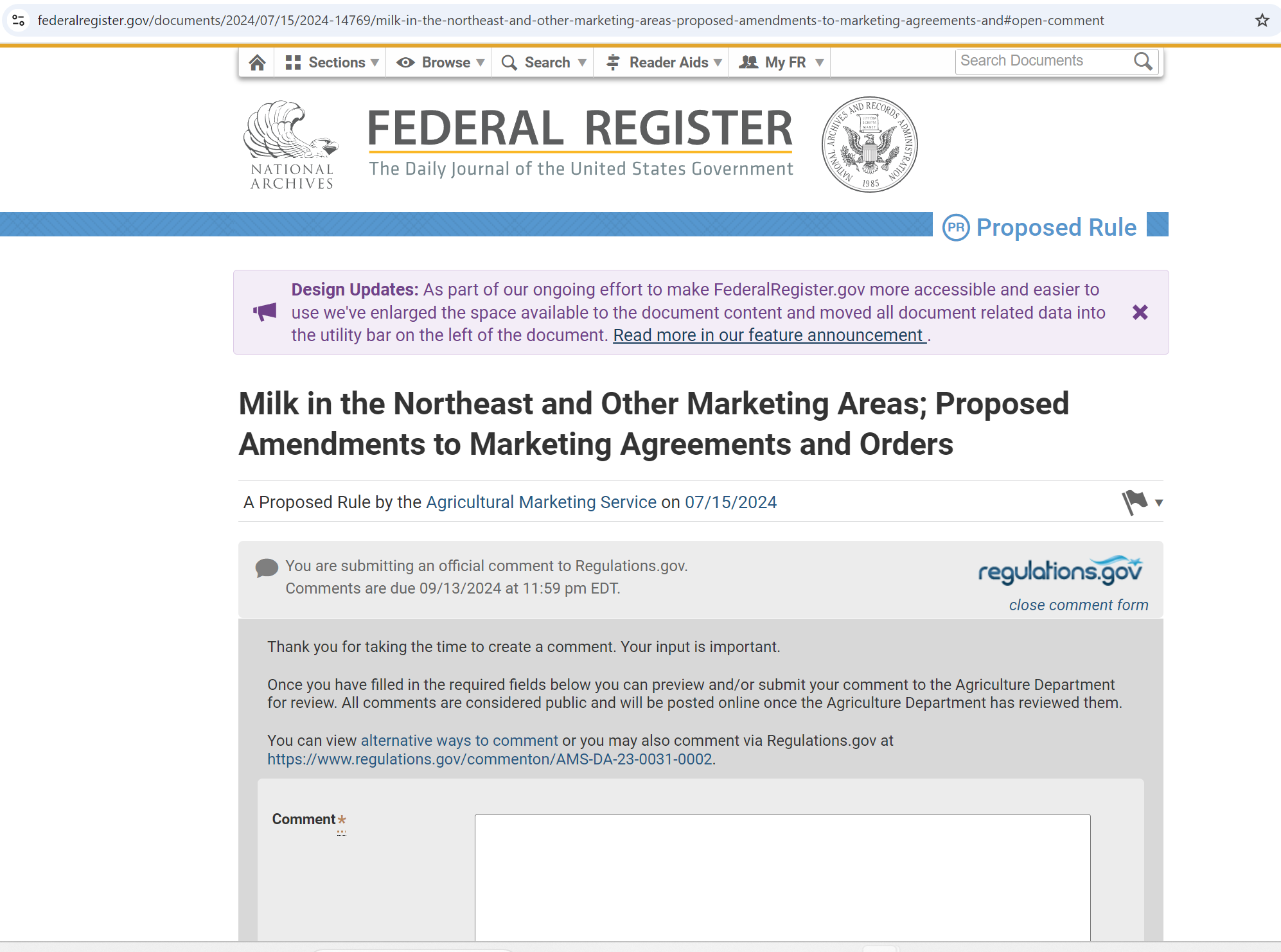
Comment directly to the Federal Register docket at https://www.federalregister.gov/documents/2024/07/15/2024-14769/milk-in-the-northeast-and-other-marketing-areas-proposed-amendments-to-marketing-agreements-and

Click here to read the ADC’s comment that will be filed before the deadline Friday evening at Sept. 13 at 11:59 p.m. Dairy farmers and organizations wanting to associate themselves with the comment can click here.

Click here to view ADC’s Aug. 29 webinar.

Click here to read Danny Munch’s at Farm Bureau Market Intel.

Milk Market Moos: Could farmers be PAYING processors to take milk’s ‘other solids’ like in 2009 after the last ‘make allowance’ raise?

By Sherry Bunting, Farmshine, August 2, 2024

No ‘snubber’ on USDA’s higher whey make allowance proposal

The whey market is the one to watch right now as the daily CME spot market sped higher again this week, and the dry whey spot price is now above the 60-cents-per-poind mark!

No ‘snubber’ on new whey make allowance means farmers would have PAID processors to take the ‘other solids’ in their milk last summer.

One thing for the industry and USDA to keep in mind regarding the proposed rule announced July 1 is that the higher make allowances, if implemented, include a nearly 7-cents-per-pound raise in the dry whey processor credit. That can be a real bully when markets go south — considering there is no ‘snubber’ to keep farmers from having to give away these ‘other solids’ or to PAY processors to take them as though worthless.

USDA is proposing to increase the dry whey make allowance from $0.1991/lb to $0.2653/lb — a nearly 7 cents per pound jump.

Farmers would have PAID processors to take other solids last summer

Guess what? If we were having this conversation a year ago, looking at July 2023 Class and Component price announcements, we would be writing in this column that your ‘other solids’ price would be essentially zero, meaning processors would get the lactose and whey free, and last August, if the proposed new whey make allowance was in effect, farmers would have paid processors $0.003 to take these components as if they are worthless.

If the proposed 7-cents-per-pound increase in the dry whey make allowance were in effect in July and August 2023, the new $0.2653/lb make allowance would have been at or slightly higher than the dry whey price for those two months.

When the make allowances were raised in 2008, we saw months in 2009 when farmers literally paid their milk buyers to take the other solids in their milk because the dry whey price had fallen below the then-new make allowance, and there was no snubber to stop the bleeding at zero.

July Butterfat up at $3.57, Protein slips to $1.95

USDA announced mixed trends on July 31 for the Class and Component prices used in Federal Milk Marketing Orders for July milk. Class II and IV at $21.82 and $21.31, respectively, were around 20 cents per cwt higher than a month ago and 20 to 70 cents higher than the July Class I base price ‘mover.’

Class III milk, at $19.79, slipped 8 cents from June and continues to be the lowest of the four classes as it has been for most of the past two and a half years.

All components were higher, except for protein, which slipped 10 cents per pound back under the $2 mark at $1.95/lb. Butterfat gained 3 cents at $3.57 for July. Solids nonfat also gained, valued at just over $1.00 per pound for July.

Other solids also gained, at 26 cents/lb. This is derived from the dry whey price vs. make allowance.

June All-Milk price up 80 cents at $22.80, fully $5/cwt above year ago

USDA announced the All-Milk price for June at $22.80, up 80 cents from May and fully $5 higher than a year ago. The national average butterfat test moved down 0.07 at 4.10, but was still 0.09 above year ago. The Pennsylvania All-Milk price for June, at $23.30, was also 80 cents higher than the previous month, and fat test fell by 0.06, reported at 4.01, just 0.01 above year ago. The June DMC margin was not published or available by press-time, but with a higher All-Milk price for June announced at 3 p.m. July 31st, and moderating feed costs, the June DMC margin is likely to be well above the $9.50 trigger margin at around $11.50/cwt. (Update, June DMC margin was announced Aug. 2 at $11.66).

Milk futures mostly higher, especially Class IV

Class III milk futures were mostly higher this week, except near-term September and October were down a few cents per hundredweight. Class IV futures were steady to higher across the board. On Wed., July 31, Class III milk futures for the next 12 months (Aug24-Jul25) averaged $19.44, down 2 cents from the Jul24-Jun25 average on the previous Wednesday. The 12-month Class IV average at $20.92 for the 12 months Aug24-Jul25, also 2 cents below the Jul24-Jun25 average a week ago.

Whey and powder skyrocket, but formula price survey lags

Trade was active with high volume movement on Class IV products, butter and nonfat dry milk powder. Trade was light for Class III products cheese and whey.

The whey market is again the big story as the daily CME spot market continues trading at price levels well above the weekly National Dairy Product Sales Report (NDPSR). The NDPSR prices are the ones that USDA collects in mandatory processor pricing surveys to use in the Federal Milk Marketing Order end-product pricing formulas. The NDPSR whey price is the one USDA AMS plugs into the FMMO pricing formula for Class III and ‘other solids.’

While spot bids for dry whey rallied to a whopping 62 cents per pound Wednesday, July 31, with 3 loads trading the first three days this week, and the weekly average price at 60 cents… the NDPSR for week ending July 27 is still back at 46 cents/lb — a 14-cent per pound deficit vs. the spot market, and 9 cents lower than the previous week’s spot market.

The CME spot market for cheese was mixed with the barrel premium over blocks widening to 7 cents per pound this week as barrels traded firm while blocks moved lower. In the weekly NDPSR, barrels are a scant half-penny higher than blocks.

The CME daily spot market for 40-lb block Cheddar was pegged at $1.9150/lb Wed., July 31 ($1.93/lb average for the week). This is 2 1/2 cents lower than the prior Wednesday with 3 loads trading the first three days this week. The 500-lb barrel cheese price, pegged at $1.9750/lb was unchanged compared with a week ago; 3 loads traded Monday through Wednesday.

The NDPSR for week ending July 27 pegs block cheese at $1.9482/lb and barrels at $1.9533/lb.

In the Class IV product complex, butter firmed up to move higher this week, shrugging off the Cold Storage Report indicating inventories were running 7% above year ago at the end of June. A whopping 26 loads of butter were traded on the CME cash market Monday through Wednesday this week. On Wed., July 31, the spot price was $3.1275/lb — up nearly 4 cents from the previous Wednesday with the weighted average for the week just over $3.10/lb — right where the NDPSR butter price landed for the week ending July 27.

Grade A nonfat dry milk trade was active again this week on the CME spot market, advancing to $1.2450/lb by Wed., July 31, up another penny from a week ago with a whopping 20 loads changing hands the first three days.

Contrary to historical patterns, the NDPSR moved the opposite direction. Again, this is the price used in FMMO pricing formulas. Nonfat dry milk for the week ending July 27 hung back at the $1.18 mark, declining a penny from the prior week despite the 7-cent spot market advance last week. CME spot prices are now at a 6-cents-per-pound premium over the NDPSR.

Total packaged fluid milk sales in May continue outpacing year ago

U.S. fluid milk sales continued outpacing year ago in May, according to the USDA’s Estimated Total Packaged Fluid Milk Sales Report released last Friday, July 19.

The report showed May sales were up 0.3% compared with a year ago, following the big 5.9% jump in April. In fact, fluid milk sales have been higher year-over-year (YOY) for six of the past eight months.

Year-to-date (YTD) sales continue to beat year ago, up 1.3% for the Jan-May period, and when adjusted for Leap Year, YTD 2024 sales are up 0.6% vs. 2023.

Leading the charge again is the largest volume category: conventional whole milk sales, up 1.8% YOY in May, plus organic whole milk sales, up 28% YOY in May.

Conventional whole flavored milk sales were down 13% from a year ago in May — a function of what fat percentage is offered, not necessarily what consumers may have selected — as the reduced fat (2%) flavored milk sales rose 3.5% in May. By contrast, organic whole flavored milk sales were up 31% YOY in May.

Total Organic fluid milk sales of all fat levels were up 6.3% in May YOY and up 7.8% (Leap Year Adjusted) for the first five months of 2024 vs. year ago. They represent 7% of the YTD total of all fluid milk sales.

The ‘other fluid milk products’ category continues to make double-digit percentage gains, up 45% YOY in May and up 37% (Leap Year Adjusted) YTD vs. year ago. This category represents 2.2% of total fluid milk sales. The report does not separate out the ESL products in each fat percentage; however, lactose-free milk brands are included in the ‘other products’ category.

Year-to-date milk production down 1%

U.S. milk production fell 0.8% in June compared with a year ago, despite the national herd reportedly having 2000 more milk cows than a year ago, according to USDA’s monthly milk report this week. The report also revised the May total lower by another 0.2% or 30 million pounds.

Year-to-date milk production for the first half of 2024 is down 0.3% compared with the first half of 2023 even with an extra day of production in 2024! When adjusted for Leap Year, first half 2024 milk production trailed year ago by 1%. It would not be surprising to see USDA come back and trim the June tally lower, later.

In the Northeast and Midatlantic Milkshed, Pennsylvania’s production fell 2.2%, Vermont down 2.8%, and New York down 1.2%.

In the Southeast, Florida gained 4.9% with 4000 more cows while Georgia dropped 8.1%, losing 8,000 cows, and Virginia saw a 4.3% drop in production vs. year ago.

The Mideast Milkshed declined with Michigan down 0.9%, Ohio 0.6%, and Indiana 1.6%, with just a 1000-head loss in cow numbers across the three states.

In the Upper Midwest and Central Plains, Iowa grew production by 1.2%, despite being hit with bird flu in June, Minnesota was down 1%, South Dakota up 8.3%, and Wisconsin up 0.9%.

Western States saw production declines, except for Texas up 3.1% with 13,000 more milk cows than a year ago.

DMI / NMPF talk supply and demand

Fluid milk, yogurt, butter and other than American-type cheese all posted positive annual growth in domestic commercial use during the March-May 2024 period, according to the July edition of the joint DMI and NMPF market report released July 23rd. The report cites significant export growth for all types of cheese and whey protein concentrate and isolate. However, when looking at domestic and export sales of all products combined, the usage is described as “relatively flat to lower” in the March through May period.

The DMI / NMPF report observes that U.S. milk production has nearly had a year’s worth of volumes charting below prior year levels, but “continued increases in average component composition of producer milk has enabled U.S. dairy farmers to supply available demand for dairy products while keeping inventories of key products relatively stable,” the report stated.

Overall supply-and-demand balance in the industry has been good enough to move dairy product and dairy farm prices and margins higher in recent months, without significantly reversing the gradual reduction trend in retail dairy product prices that has occurred over the past year, according to the report.

While dry skim milk usage is down 48% in the March-May period, this is a function of the lower production of skim milk powder (down 24.5%) and nonfat dry milk (down 12.5%). Inventories at the end of May trailed year ago by 4%. Domestic and export markets can only ‘use’ what is ‘produced’ and available in a commodity category in the first place.

But the DMI / NMPF market report did not even mention imports… So here’s the deal:

The U.S. imported 41% more Whole Milk Powder in first-half 2024 vs. 2023,
up 150% vs. 2022
!

While U.S. milk production has trailed year-ago levels for the past 10 consecutive months, U.S. food manufacturers have been quietly ramping up imports of whole milk powder (WMP), which is essentially whole milk, dried.

WMP imports were running 170% above year ago, cumulatively, for the first four months of 2024. May and June totals have slowed down from the huge front-loaded volumes January through April. Still, the cumulative year-to-date WMP import volume at 5.5 million pounds for the first six months of 2024 is 41% greater on a volume basis compared with a year ago.

This is a stunning increase because the Jan-June 2023 WMP import volume was already 77% greater than the first six months of 2022. This means Jan-June Whole Milk Powder (WMP) imports have grown 150% in two years. That’s a volume increase of 1.49 million kgs or 3.29 million pounds. WMP is basically farm milk from another country, in bulk dried form, not a specialized product. It can be used in processing virtually any dairy product, containing all of the milk components — both fat and skim solids.

Total non cheese imports at 10.4 million kgs (21 million pounds) for the first half of 2024 are up 5.9% vs. 2023 and up 41.4% vs. 2022.

Cheese imports, on the other hand are up slightly from a year ago (1.4%) and down 6.27% from 2022.

On the export side of the ledger, the U.S. sold 2% less total milk solids volume overseas in May, which is mainly because skim milk powder, whole milk powder, and other milk protein powder exports were down 8 to 12% from a year ago. Butterfat exports were down 16%.

Cheese exports, on the other hand, were up 27% in May and dry whey product exporter were up 6%. Fluid milk and cream exports were up 2%.

This makes sense because the U.S. dairy processing paradigm has shifted. The U.S. is making less butter and powder (Class IV) and more cheese and dry whey (Class III).
The U.S. is consequently exporting less milk powder and butterfat (Class IV) and exporting more cheese and dry whey products (Class III); while at the same time importing more whole milk powder and non cheese products, while cheese import volumes remain stable.

30-day H5N1 detections drop to 33 in 6 states, hot spot Colo. requires milk testing

As of July 31, 2024, the current confirmed cases of H5N1 in dairy cows within the past 30 days decreased to 33 herds in 6 states. Of these, 24 are in Colorado, the hot spot by a long shot. The state issued an order July 22nd to require mandatory bulk tank milk testing, except raw milk dairies, which are encouraged to do so voluntarily.

Other states with confirmed cases within the past 30 days are: Minnesota (3), Idaho (2), Texas (1), Iowa (1), and Michigan (1). Cumulatively, since the beginning of the outbreak on March 25, 2024, there have been 173 detections in 13 states.

Enrollments in the national voluntary dairy herd status bulk tank testing include 21 herds: Michigan (7), New Mexico (4), Pennsylvania (3), and 1 herd each in Kansas, Nebraska, North Carolina, Ohio, South Dakota, Tennessee, and Texas.

Will we see PA milk bills moove?

The Pennsylvania State Assembly has a few dairy bills waiting to moove on through both chambers again towards the end of a two-year legislative session. We’ve seen this movie before, where the House votes to allow Pennsylvania whole milk produced on Pennsylvania dairy farms to be served in Pennsylvania schools, and where the House votes to allow the state-mandated Pa. Over Order Premium (OOP) to be collected and distributed to farms by the state instead of leaving it open to loopholes that strand the dollars through creative cross-border deals.

In prior years, such milk bills would move through Committee and even get passed by the House, only to be stuck in a chairman’s desk drawer in the Senate. If we look back far enough in the history of milk bills in the Pennsylvania legislature, we see on other occasions a long awaited milk bill passed the Senate only to be stalled out in the House. Will this year be any different? Who knows? Election years are funny-seasons.

Earlier this month, Senators Elder Vogel and Judy Schwank, the chair and ranking member, respectively, of the Senate Ag Committee introduced legislation to allow the state to collect the state-mandated OOP and distribute it to farmers. A similar bill had been introduced in the past two legislative sessions on the House side by Rep. John Lawrence, but Vogel and Schwank were unconvinced to move it in the Senate.

This time, Vogel and Schwank are introducing the measure after many years of multiple hearings, task forces, and other such discussions of what on earth to do about the state-mandated OOP to make sure all of it — 100% — gets into the pockets of Pennsylvania dairy farmers, as intended.

The Vogel-Schwank rendition would “empower” the Pennsylvania Milk Board (formerly known as the Pennsylvania Milk Marketing Board) to administrate the process of collecting and distributing the premium with involvement of the Pa. Dept. of Revenue. The state would distribute the funds to farmers, milk handlers and dealers using a formula that includes cost of production, price received, and other measures.

The current method of distribution only follows the $1 premium for milk that is produced, processed, and sold in Pennsylvania, but consumers pay this $1.00/cwt premium within the minimum retail price set by the Pa. Milk Board for ALL milk sold at retail in Pennsylvania — no matter where it comes from.

For decades the debate over the Pa. OOP has had its moments where farmers thought a change would come to prevent significant gamesmanship stranding millions of dollars in premiums intended for the dairy farmers.

Yes, I am cynical. We are five months away from the end of a 2-year legislative session and four months away from an election / re-election. Forgive my gut reaction: Ho-hum…. here we go again… time and money spent on spinning this wheel of fortune. Not buying it. Stay tuned.

In June, the Senate Ag Committee passed SB 1229, which would allow the Pa. Dept. of Agriculture to provide financial assistance to dairy farmers who enroll in the federal dairy margin coverage (DMC) program.

Editorial: ‘Wouldn’t it be great if we could unite the country with whole milk?”

By Sherry Bunting, Farmshine July 26, 2024

‘Wouldn’t it be great if we could unite the country with whole milk?”

Those words were messaged to me by a friend and colleague a year ago, right after the Whole Milk for Healthy Kids Act had passed the House Education Committee in bipartisan fashion before the overwhelming passage on the House floor Dec. 13, 2023 and before Senate Ag Chair Debbie Stabenow (D-Mich.) blocked it the next day, Dec. 14, 2023.

This was my first thought, when former President Donald Trump announced Senator J.D. Vance of Ohio as his running mate in the Republican campaign. (Vance is an early cosponsor of S. 1957, the Senate’s whole milk bill.)

Like others, I’ve been involved in the effort to bring the choice of whole milk back to schools for more than a decade. It’s about natural, simple goodness — to simply strip away the federal ban and allow hungry, learning children to be nourished by milk they will love. 

Looking back at the years of this long fight, I realize that if it’s so painstakingly hard to get something so simple and so right accomplished for America’s children and farmers, we’ve got problems in this country.

With President Joe Biden now withdrawing from the campaign for a second term, and Vice President Kamala Harris as presumptive nominee launching her campaign this week in the Dairyland State, I’m reminded of where she stands on such things.

Harris is no friend to livestock agriculture. She was an original cosponsor of the Senate version of “The Green New Deal.” She has strong positions on climate change that may lead to harsher rules on methane emissions and water consumption in the dairy industry, while perhaps promoting methane digesters, which are not an equitable nor necessary solution. Cows are NOT the problem!

Some in the dairy industry are on record stating that this would be good for dairy because the DMI Net Zero goals fall in-line and tout some of the same objectives. But no matter how you slice and dice all the fancy offsets, insets, innovations, grants, projects and the billions of dollars, the bottom line leaves cattle holding the bag. 

Cattle are in the crosshairs of a very long game set to control land, food and people.

Harris has already indicated she would use the Dietary Guidelines to reduce red meat consumption on the basis of this erroneous climate impact claim about cattle that we are all being brainwashed to quite literally buy into.

As a presidential candidate in 2019, in a CNN town hall, she was specifically asked: “Would you support changing the Dietary Guidelines to reduce red meat specifically to reduce emissions?”

“Yes, I would,” Harris replied, with a burst of laughter.

It’s not funny.

Earlier, she had said she “enjoys a cheeseburger from time to time,” but the balance to be struck is “what government can and should do around creating incentives, and then banning certain behaviors… that we will eat in a healthy way, and that we will be educated about the effect of our eating habits on our environment. We have to do a much better job at that, and the government has to do a much better job at that.”

Read those words again: “creating incentives and then banning certain behaviors.” In plain English, that means dangling the carrot and then showing us the stick.

Harris joins Senators like Ag Chair Stabenow, as well as Bob Casey from Pennsylvania, as card-carrying members of perennial Ag Secretary Vilsack’s food and climate police.

Not only is Ag Chair Stabenow blocking the whole milk bill in her Committee, she is dragging her feet on the critical farm bill. 

As President Biden’s approval ratings fell, there were indications she would bring her side of the aisle to the table to negotiate a compromise to get the farm bill done this year.

Now that Biden has withdrawn from the race, and the pundits, media, and party organizers are breathless with excitement over Harris as presumptive nominee, it appears that the farm bill negotiations between the Committee-passed House version, the Republican Senate version and the Democrat Senate version have fallen apart.

House Ag Chair G.T. Thompson (R-Pa.) has called upon his colleagues to get to the table and do the work because a perfect storm is brewing in Rural America as net farm income is forecast to fall by 27% this year on top of the 19% decline last year. 

Meanwhile, there is political upheaval everywhere we look. Seeing Vance picked as Trump’s running mate and knowing he was among the early cosponsors of Senate Bill 1957 – The Whole Milk for Healthy Kids Act – offers some hope.

That bill — in true bipartisan spirit — was introduced in the U.S.Senate in June 2023 by Senator Dr. Roger Marshall (R-Kan.) with prime cosponsors Peter Welch (D-Vt.), Ron Johnson (R-Wis.), Kirsten Gillibrand (D-N.Y.), Chuck Grassley (R-Iowa), John Fetterman (D-Penna.), Mike Crapo and James Risch (R-Idaho), Susan Collins (R-Maine), Angus King (I-Maine), and Cindy Hyde-Smith (R-Miss.). The bill eventually earned cosponsorship from other Senators, including the influential Democrat from Minnesota, Amy Klobuchar.

Vance signed on as cosponsor on December 14, 2023, one day after the U.S. House of Representatives had passed their version of the bill by an overwhelming bipartisan majority of 330 to 99.

The Senate bill 1957 is identical to the successful House whole milk bill H.R. 1147, which was authored by Pennsylvania’s own Representative GT Thompson.

GT is a man of courage, conviction, compassion, of humility and humanity. I’ve heard him say more than once: “God gave us two ears and only one mouth for a reason.”

He is a determined man, doing the work. He included whole milk bill in the House Committee-passed farm bill. He’s standing firm on his pledge to put the farm back in the farm bill. He is concerned about the financial crisis in agriculture on the horizon, and held a hearing July 23 with witnesses from agriculture and banking giving stark warnings.

Even though whole milk choice in schools seems like a minor issue in the grand scheme of things today, it is really a linchpin. If we could just get something with broad bipartisan support accomplished, this could lead to other steps on common ground. 

Cows are not the climate problem. Cows are a solution. Cows are part of a carbon cycle, they don’t take carbon out of the ground and put new carbon into the air. 

Carbon is essential to life. It seems that those seeking full control of land, food, and people, are starting with carbon. 

As the whole milk choice remains hung up in the Senate, let’s pause to think about how ridiculous it is that we adults get to choose, but our growing children do not. For them, whole milk is banned at two meals a day, five days a week, three-quarters of the year at school. (The federal government, via USDA school lunch rules, only allows fat-free and 1% milk to be offered with the meal or even a la carte.)

Maybe the Harris ticket would like to ban food choice behaviors for adults as well.

We have Republicans and Democrats supporting whole milk choice in schools. Both parties say they care about our nation’s farmers and ranchers who feed us and are the backbone of our national security.

Let’s take that and run with it.

-30-

State Vet: Early H5N1 detection key to protecting dairy, poultry

By Sherry Bunting, Farmshine, July 12, 2024

HARRISBURG, Pa. – Pennsylvania State Veterinarian Alex Hamberg stressed the importance of early detection and wants to step up voluntary milk sample surveillance for the highly pathogenic avian influenza (HPAI H5N1) in dairy cows, according to comments on the July 10 Center for Dairy Excellence monthly HPAI industry call.

There have been no detections in Pennsylvania dairy herds and no active poultry detections at the present time. Hamberg wants to keep it that way, and he wants to make sure that if the virus surfaces here, it is his office — working in collaboration with dairy farmers — that are the ones who detect it, by being proactive.

A scenario playing out right now in Colorado gives clues about why.

Colorado has had 30 dairy herds affected since April, the most of any state, representing more than one-fourth of the 110 dairy farms in the 13th ranked milk state, where the average herd size is 1827 cows. Of the 30 total herds affected since April, 25 were in the past 30 days, and three in the past week.

Colorado also has the most poultry flock infections in the past 30 days — one layer operation and three meat growers (two turkey). Two workers in Colorado, one in 2022 on a poultry farm and one recently on an affected dairy, were confirmed with the virus, but recovered quickly. Public risk is extremely low do to food safety protocols, testing, and pasteurization. Precautions are in place for those working closely with infected animals, including PPE states are making available through USDA, such as eye and face protection, gloves and disposable overalls.

Even though Colorado has had bird flu in poultry locations (and wildlife) across the state since the worldwide outbreak began in 2022, the recent detections in dairy cows and poultry appear to be occurring in the northeast part of the state, especially in Colorado’s number one dairy and poultry county.

In fact, on July 9, the Colorado Governor declared a disaster for Weld County, which was necessary to receive federal support to take mitigation steps and depopulate 1.8 million layer hens on an infected poultry farm neighboring an infected dairy operation.

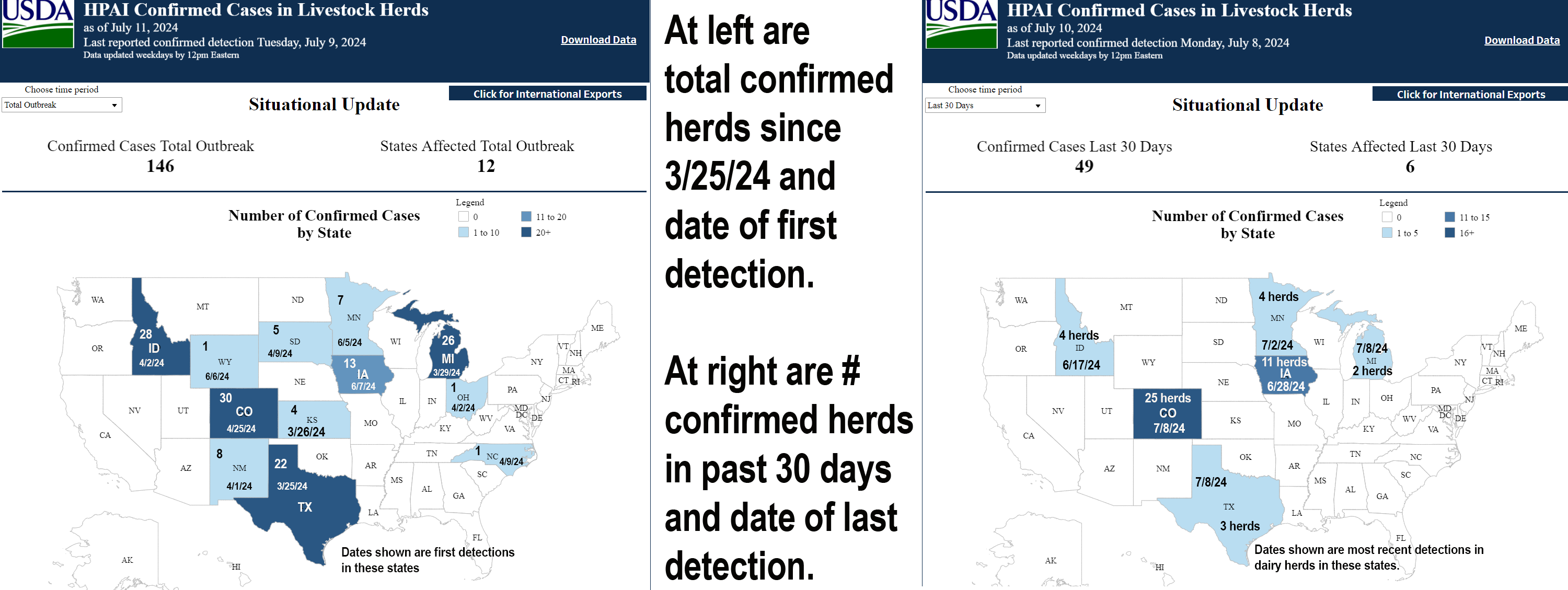
Michigan and Texas are not out of the woods. On July 8, the APHIS 30-day ‘situation’ status showed 48 herds in six states had H5N1 in the prior 30 days. Michigan was down to one and less than a week away from being dropped off the status map. Texas was down to two and 10 days away. But on July 9, the APHIS update showed both states had a new case, and Colorado had three new ones.

This put the 30-day status at 53 herds in six states, which dropped to 49 herds in six states on July 10. The U.S. total since March 25 is 146 dairy herds in 12 states.

“The positive thing is that once a herd tests positive, it is then tested on a regular basis. In Ohio, for example, there are no more cases. This shows the possibility of getting rid of this in dairy,” said Dr. Ernest Hovingh, PADLS director.

For poultry, however, the risk is ever-present with no reprieve since this particular HPAI outbreak began in 2022. It continues to be found on poultry farms and in wild birds, worldwide, according to USDA veterinarian Dr. Michael Kornreich. He reported eight commercial flocks and four backyard flocks have been detected in the past 30 days, nationwide.

Unlike dairy cows that mostly recover, HPAI is lethal to poultry. A positive test means the whole flock is promptly depopulated, and quarantine zones are established. This is a big concern for the Ag Department in Pennsylvania, where the 2022 Ag Census showed poultry surpassed dairy as the number one ag product.

Hamberg described a scenario that has occurred in at least one state where both dairy and poultry are currently affected: “Dairies waited to report sick cows for testing. By the time they did, other dairies were infected, and poultry had become infected.”

He observed that the virus appears to be shedding in milk up to two weeks prior to clinical signs in cows. Anecdotal evidence suggests that workers had conjunctivitis (pinkeye) before cows showed clinical signs in herds at the beginning of the outbreak, Hamberg noted.

Early detection is important not just to protect our own dairy farms but also our neighboring poultry operations. If you suspect HPAI, report it, work with us, and we will work alongside you to address it and protect you,” he said. “This is why we need the surveillance data.”
To-date, one Pennsylvania dairy farm has enrolled in the voluntary PA Lactating Dairy Cow Health Monitoring Program to achieve ‘monitored herd’ status.

In a separate program, one Pennsylvania processor has enrolled in testing at the milk hauling level.

Dairy farms can enroll online. They will receive a box with everything needed to collect and ship bulk tank samples at no cost. As a ‘monitored herd,’ they avoid pre-movement testing for interstate cattle transport.

Three consecutive weekly bulk tank samples are collected, followed by testing of a few animals from the sick pen to achieve ‘monitored herd’ status. Continuing the weekly bulk tank testing will continue the ‘monitored’ status. If a positive is detected, the farm keeps its ‘monitored’ status, and any movement or biosecurity concerns are addressed between the Dept. of Agriculture and the farm management.

What researchers know at this point is “transmission from farm to farm is heavily driven by ‘fomites.’ That means people, equipment, and animal movements,” said Hamberg.

“Robust testing helps us figure out where it is, to eliminate it by counter measures. We can do that while it is still definitely controllable, and not in a wildlife reservoir. But if it spills back into wild birds and circulates in them again, we may have a bigger problem,” he explained. “We need surveillance data to figure out where it is. If that is all negative, that’s great news. If we get a positive or two, we know we are doing something and have a chance to contain it.”

Could early detection have changed the course for the dairy/poultry interplay unfolding in Colorado? “Maybe,” said Hamberg. “There was no sharing of workers between affected farms, but there was cohabitation — poultry workers living with dairy workers — and this is a known transfer mechanism. Early reporting might have made a difference in that.”

-30-

While fakes campaign to BE ‘milk’, dairy checkoff aims to REINVENT milk. New ‘milk beverage platform’ deemed ultrafiltered, ESL, shelf-stable

As new milk beverage platform is developed, it sounds to me like people want the many attributes fresh whole unfooled-around-with fluid milk already delivers. It checks all the boxes! Maybe children just need to be allowed to have whole milk at school and daycare where they eat most of their meals, and maybe new generations of adults need the education about why and how the dairy protein and natural nutrition in real milk beat the imposters, hands down.

By Sherry Bunting, republished from March 2023 editions of Farmshine

SAVANNAH, Ga. — Dairy checkoff-funded researchers say a new milk beverage platform is being developed to provide “the keys to the kingdom.”

Their consumer studies show people want clean labels, and at the same time they want more attributes. On the one hand, they want energy and protein. On yet anotherhand, they want indulgent creaminess. 

Consumers also want flavor, but they want less sugar. They want sweeteners, but not artificial sweeteners. They want thickness without the thickeners. They do not want gums or gels, but they are okay with fibers and starches. 

Some consumers want higher protein products. Others want everyday nutrition that is reasonably priced. 

These are some of the highlights that were shared back in January 2023 during the Georgia Dairy Conference in Savannah. There, Dr. MaryAnne Drake, professor of food science at North Carolina State University and director of the Southeast Dairy Foods Research Center talked about the fluid milk innovation work funded through DMI.

The ‘new milk beverage platform’ leverages different processing applications for flavor and functionality around dairy protein, based on global protein trends in a rapidly growing nutritional drink market.

ESL shelf-stable milk: key to kingdom?

“We are after a shelf-stable milk that tastes great and meets our consumer’s sensory needs and our industry’s sustainability needs,” said Drake about the work of the four university research centers, including North Carolina State and Cornell, that are drilling into milk’s elements to sift, sort, and test different combinations, as part of the checkoff-funded Innovation Center for U.S. Dairy, under the DMI umbrella.

Through processes like membrane technology, ultrafiltration, and aseptic packaging, the physical, nutritional and sensory elements of milk are being isolated at a molecular level to create beverages that aim to deliver this broad list of what consumers say they are looking for. 

At the same time, researchers are using interpretive surveys to understand how consumer desires actually translate into purchases, and then work with processors to build relationships with retailers to get these new beverage products into stores.

Reinventing milk

What does all of this mean? Reinventing milk by focusing on the domains in which real milk has a clear advantage for consumers among so many plant-based and now cell-based options. 

For example, said Drake: “Consumers want to know from a credible source what the immune-boosting elements are in milk, not what we have added. They tell us they want to know the science. That’s new.” 

Drake explained that the findings from their interpretive surveys represent a huge and divergent set of innovations to sort through and capitalize on as part of a new strategy.

“Consumers don’t see the perceived value of animal protein vs. plant protein, so we had them graph what they want and don’t want, what they know and don’t know,” she said, adding that consumers gave the slight edge to plant protein over dairy protein. They rated the top three protein categories as plant protein, whey protein, and milk protein — in that order. (A large percentage believed whey protein is plant protein.)

As their familiarity with the differences between plant and animal protein increased, their liking of dairy protein increased, the researchers learned.

In other words, consumers do not know the science about the nutritional differences between plant and animal protein, and if they knew the differences, they would rank milk protein as number one. 

Clearly, this is a failure in consumer education and messaging. Isn’t that the domain of the dairy checkoff?

New strategy

Drake indicated that educating consumers about dairy protein as a ‘complete protein’ is one thing that can help. However, she said, the functionality around dairy protein is the innovation strategy that is being pursued by the industry.

“The number one label claim consumers are looking for in a protein beverage is ‘naturally sweetened.’ We own that, and this is where we can deliver,” Drake declared.

“We own protein functionality. We understand the process parameters that impact flavor and functionality, and we can leverage this over plant proteins on this platform,” she said.

Bottom line: The surveys and flavor panels showed that consumers want “desirable flavor, texture and appearance. They want a protein drink that is nutritious, naturally sweetened, and has a clean label with simple ingredients,” said Drake. 

“They also want education, messaging and positioning, and they are looking at sustainability,” she added.

“We are working on what does clean label mean? It’s not what we think it is,” Drake reported. “It’s costing us sales if what they actually want is not on the shelf. We have the opportunity to deliver what consumers still want. We just have to find those things they want — that we have — and be more strategic in how we deliver them.”

Food technology and engineering was a big part of the picture painted for attendees that day.

Diversify processing

Producers were urged to challenge the status quo and to not just add processing, but to diversify it. They were also reminded that the 10 southeastern states had lost eight fluid milk plants in the previous roughly two-year period (2020-22).

During his annual market outlook that year, retired co-op executive Calvin Covington hit the nail on the head with this reminder, saying “that’s done some damage. The major challenge for milk markets in the Southeast is we need more of them,” he said. “A lot of the fluid milk products that are sold in the Southeast are not processed here. If we are going to have a viable dairy industry in the Southeast, we need growing and stable markets for milk produced in the Southeast.”

Covington also differentiated the trends for domestic and export demand, showing that both lagged their respective 5-year-average annual growth in 2022, with domestic demand growing by just 0.5%, while exports grew by 3.5%.

Keeping in mind as exports are expected to top 20% of U.S. milk production on a total solids basis in the next two years and fluid milk sales as a percentage of total milk production have fallen to just under 20%, seismic shifts are already occurring in the heavily fluid milk market of the Southeast.

Transformation brings investors

Geri Berdak, CEO of Dairy Alliance, the Southeast regional checkoff organization, talked about “creating a path forward” with objectives centered on driving milk volume, increasing dairy’s reputation and transforming dairy while building checkoff support.

She said transformation is necessary to “identify high-growth opportunities and stimulate outside investment, technology and innovation.”

The need for processing is big as plants are closing in response to declining fluid milk demand, leaving the the need for more diverse processing assets.

Exports drive innovation

“The biggest thing exports do is to drive value and innovation,” said Patti Smith, a food technology specialist and CEO of DairyAmerica, now wholly-owned by California Dairies Inc. (CDI) milk cooperative. Earlier in her career, Smith held a leadership position with Fonterra and has served at board and officer levels with IDFA and USDEC.

“Exports are a lot more than powder today. Our biggest item is still excess powder,” she said. “But we also export many other products — even UHT (ultra high temperature) and ESL (extended shelf life) fluid milk and cream.”

What Smith sees into the future are “opportunities for the right products and the right product configurations. We have the opportunities to capitalize on them and the technologies to grow them.”

Smith said the biggest benefit of exports to-date is to have a home for milk that grows the dairy industry without relying on core domestic demand for that growth, but that U.S. dairy processing infrastructure is not quite reflective of the new export era.

“We need to make our industry world renown, through a strategic plan that the whole industry will work on together, with digitized supply chains and infrastructure for growth that is reliable and can be consistently demonstrated, and that includes shipping,” said Smith, citing the Innovation Center for U.S. Dairy as the nexus, where the industry’s “strategic plan” for global trade is being built.

Developing ‘new milk beverage platform’

Emanating from the DMI-founded and checkoff-funded Innovation Center for U.S. Dairy is the marketing and promotion arm of new product alliances and the National Dairy Research arm through several universities looking to essentially create a milk beverage platform by drilling into milk’s elements, sifting, sorting and testing different combinations.

Dr. Drake said the new milk beverage platform holds the “keys to the kingdom” as global protein trends were valued at $38.5 million in 2020 and projected to grow. Meanwhile, the nutritional drink markets are growing steadily, with 42% of consumers eating healthy as a higher priority since Covid, and the number of conversations about protein (95% positive) steadily flowing across social media platforms. 

Those keys, she said, are membrane technology, ultrafiltration, aseptic packaging and research exploring all of the physical, nutritional and sensory elements of milk at the molecular level to bottle up what consumers say they are looking for, while also gauging through interpretive surveys how this translates to purchases, and then working with processors to build relationships with retailers to get new products into stores.

Drake shared details about the roadmap to play to dairy’s strengths through nutrition, education, capitalizing on calming and immune benefits and using dairy protein functionality to limit added ingredients in beverages to satisfy the clean label trend.

She talked about how elements like fat, protein and lactose at different levels impact milk’s flavor and appearance: “We want to determine the impact of ultrafiltration levels for different concentrations of fat and protein for different sensory or physical experiences.”

She talked about ultrafiltration in conjunction with aseptic packaging for shelf-stable storage using an elaborate diagram of processes.

Bottomline, she said: “The chemistry of these (aseptic) milks is different.”

She described consumer flavor panels where shelf-stable and fresh fluid milk were served cold and compared. The flavor panels evaluated two different storage temperatures for the shelf-stable milk.

The North Carolina researchers worked with their Northeast Dairy Foods Research counterpart at Cornell and with Byrne Dairy, running grad students from North Carolina to Syracuse, New York when batches were available for study. (The Southeast and Northeast as well as Midwest and California Dairy Foods Research Centers all receive funding from checkoff and other sources.)

‘Training consumers’

“Consumer panels still liked the HTST (fresh fluid) milk best overall, but in 14-day and 6-month follow up, we found we can train them,” said Drake, reporting the two best storage temperature options for aseptic milk saw longer-term increase in acceptance.

HTST is the acronym for High Temperature Short Time pasteurization that is basically commodity fresh fluid milk vs. ‘value added’ UHT (ultra high temperature) and ESL (extended shelf life) as well as aseptically-packaged, which is milk processed for longer shelf life and then bottled in a special sterile process and package to last months without refrigeration, but will taste best served cold.

Schools are the gateway

“For 25 years, consumers have not liked aseptic milk,” said Drake, “but we are changing that. Consumers may not like it or want it, yet, but it is great for schools.”

She reported the practical applications to come up with “great tasting school lunch milk that contains no lactose (no natural sugar).” Another practical application is to  “determine the impact of storage temperature of 1% aseptic milk on physical and sensory properties.”

This partially checkoff-funded research is also working on “changing the chocolate milk formula to have zero sugar,” she said. “When we think about school milk, the question is how to get the sugar out of it. We want a chocolate milk that tastes great and new government standards on low- or no-added-sugars. Right now, chocolate milk has 8.5 grams of added sugar and 12 grams of natural sugar (lactose).”

In addition to ultrafiltration removing natural sugar, or lactose, they are exploring “non-nutritive” sweeteners like monk fruit and stevia. Additionally, they are looking at “lactose-hydrolized” to boost the flavor profile at much lower levels of sugars or other sweetener.

Whether talking about consumers or children, parents, and schools, the milk beverage platform is tricky “They want to know from a credible source what the immune-boosting elements are in milk, not what we have added. They tell us they want to know the science. That’s new.

“We have a huge and divergent set of innovations to sort through,” said Drake. 

-30-

USDA recommends changes to milk pricing formulas and other Milk Market Moos

By Sherry Bunting, Milk Market Moos column in Farmshine, July 5, 2024 (with updates)

USDA issued a 332-page recommended decision on July 1 for changes to pricing formulas in all 11 Federal Milk Marketing Orders, which was later published in the Federal Register July 15.

The bottom line is a mixed bag of positives, negatives, and questions requiring further study.

USDA AMS professionals did yeoman’s work with the 49 hearing days across five months of proceedings on 21 proposals, yielding 500 exhibits; more than 12,000 pages of transcripts of testimony from farmers, cooperatives, processors and others, along with cross-examination; and over 30 post hearing briefs and correspondence.

Once the draft decision is officially published in the Federal Register in the coming weeks, the 60-day public comment period begins, followed by 60 days of USDA evaluation of the feedback, followed by a final rule, followed by a producer referendum.

According to the FAQ section at the USDA AMS national hearing website, only producers who are pooled in the selected representative month in each Federal Order will be eligible to vote. Each of the 11 Orders votes separately.

If two-thirds of those eligible dairy farmers OR two-thirds of the pooled volume they represent in an Order vote “yes,” then that Order continues, as amended. If neither two-thirds threshold is met, then that Order is terminated. *AMS answered our question on the two-thirds determination that it is determined by the number of eligible (pooled) producers who actually participate in the vote, stating: “If a producer receives a ballot but does not return it, the producer is not included in either the numerator or the denominator of the two-thirds calculation.”

Here’s what’s in the USDA recommended decision package:

1) Milk Composition Factors: USDA recommends updating the milk composition factors to 3.3% true protein, 6.0% other solids, and 9.3% nonfat solids. This would mainly affect Class I in all Orders and the other Class prices in the fat/skim priced Orders.

2) Surveyed Commodity Products: The recommendation here is to remove the 500-pound barrel cheese prices from the Dairy Product Mandatory Reporting Program survey and rely solely on the 40-pound block cheddar cheese price to determine the monthly average cheese price used in the Class III and protein formulas. National Milk Producers Federation (NMPF) proposed this and International Dairy Foods Association (IDFA) opposed it. American Farm Bureau Federation (AFBF) had proposed adding unsalted butter and 640-lb block cheddar to the survey, and California Dairy Campaign had proposed adding bulk mozzarella. Neither of these proposals were included in USDA’s recommended decision.

AFBF chief economist Roger Cryan discussed this recently on Farm Bureau Newsline, where he also talked about USDA decision not to include AFBF’s proposal to raise the Class II differential.

3) Class III and Class IV Formula Factors: USDA chose to recommend make allowance increases that fall in between the lower increase proposed by NMPF and the higher increase proposed by IDFA and Wisconsin Cheesemakers. The USDA recommendation is to raise these manufacturing allowances from current levels to these new levels: Cheese: $0.2504; Butter: $0.2257; NFDM: $0.2268; and Dry Whey: $0.2653. The recommended decision also proposes updating the butterfat recovery factor to 91%.

By our calculations, the proposed make allowance increase would equate to roughly an additional 80 cents per hundredweight deduction from milk checks embedded in the pricing formulas. Current make allowances total up to about $2.75 to $3.60 per hundredweight, depending on product mix. New make allowances would total up to about $3.25 to $4.50 per hundredweight, depending on product mix.

AFBF economist Danny Munch was interviewed by Brownfield Ag on July 2, noting the increase is 5 to 7 cents per pound. “When we loop that into a per-hundredweight value, that means farmers will be seeing 75 cents to 87 cents less per hundredweight on their milk checks because of the increased make allowance.” He says the data used for the make allowances was based on voluntary cost of production surveys. 

Farm Bureau president Zippy Duvall did not mince words: “We strongly believe make allowances should not be changed without a mandatory, audited survey of processors’ costs. Our dairy farmers deserve fairness in their milk checks and transparency in the formula, but the milk marketing order system can’t deliver that unless make allowances are based on accurate and unbiased data,” he said in an AFBF news release.

American Dairy Coalition CEO Laurie Fischer also weighed in: “We are disappointed that USDA has proposed higher make allowance credits for processors, which are — in effect — deductions from farmer milk checks that are embedded within the pricing formulas. The industry does not yet have mandatory, audited cost surveys, and there is no connection between increased processor credits and a transparent, adequate price paid to farmers,” she said in an ADC news release, adding that these two elements have been key policy priorities for ADC since January of 2022.

4) Class I differentials: USDA recommends updating Class I differential values to reflect the increased cost of servicing the Class I market. The base differential for all counties stays at $1.60, and the county-specific Class I differentials are specified in the decision at levels higher than they are currently, but by less than the increases that had been proposed by NMPF.

5) Base Class I Skim Milk Price: USDA recommends going back to the higher-of the advanced Class III or Class IV skim milk prices to set the Class I mover each month. However, the Department did not go with Farm Bureau’s request to do this on an emergency expedited basis.

And, here’s where it gets tricky, the higher-of method would only apply to fresh fluid milk, while adopting a rolling monthly adjuster that incorporates the average-of for milk that is used to make extended shelf life (ESL) fluid products, including shelf-stable milk.

This means ESL milk would be priced differently from conventional fresh fluid milk within the same Class I category. A simple averaging method would be used as part of this special ESL adjuster, which would incorporate a 24-month rolling average (with a 12-month lag) of the difference between the higher-of minus the average-of, which is added to the current month simple average-of, and then the current month higher-of is subtracted from that sum. This adjuster could be either a positive or negative number.

In fact, we’ve learned that this ESL adjuster, using months 13 through 36 counting backward from the implementation date, would allow milk for ESL products to recoup, over time, some of the very large prior losses experienced by all dairy farmers during the average-of method that has been in place since May 2019. Because a simple average is used for the adjuster calculation, without the 74 cents, more would be recouped than the actual loss difference experienced under the years of the average plus 74 cents method. On the other hand, the rolling adjuster look back will include months in which a smaller make allowance was in effect than could be the case in the future if USDA’s make allowance recommendation becomes final.

Meanwhile, producers of milk bottled as ‘regular’ fresh fluid milk would start right out of the implementation gate at the higher-of and recoup zero prior loss endured under the current form of average-of, and be subjected to the higher make allowance, which is built into the advance pricing factors. (More on this feature of the USDA recommended decision in a future article.)

In its ‘notice to trade,’ USDA states that the ESL adjuster was developed to “provide for better price equity for ESL products whose marketing characteristics are distinct from other Class I products.”

Meanwhile, in his July 3rd CEO’s Corner, NMPF’s Gregg Doud appears to embrace what is essentially a fifth milk class given the different pricing methods proposed in the recommended decision for Class I — depending on shelf-life classification.

Doud writes: “Recognizing the need to restore orderly milk marketing, USDA decided to go back to the higher-of, with an accommodation for extended shelf-life milk, thus granting NMPF’s request for the vast majority of U.S. fluid milk. USDA’s solution is, frankly, as innovative as it is fair – a classic case of two sides not getting all that everyone wanted, but everyone getting what they most needed.”

Splitting the baby was not part of any hearing proposal that we could find; apparently processors made their case with USDA as to needing the average-of method (with calculated adjuster) to sell ESL milk products deemed the new milk beverage platform.

During the national hearing in Carmel, Indiana, representatives from Nestle, a major maker of ESL fluid milk products, said their sales increased once the average-of method was implemented in May 2019 through legislative language in the 2018 farm bill. They testified that they could manage risk when providing 9 to 12 month future pricing on shelf-stable fluid products to foodservice and convenience stores. They lamented that losing the average-of would hurt their sales.

Representatives for fairlife testified that forward pricing of their ESL products was critical to their ability to grow sales and that losing the average-of would impact future plans, including the size of the new plant being planned for New York State and other expansions elsewhere in the future.

However, since this bifurcation of Class I was not a proposal subject to vetting, no one had the opportunity to present evidence on future impacts.

Public comments on the recommended proposals will be accepted for 60 calendar days after the decision is published in the Federal Register. Comments should be submitted at the Federal eRulemaking portal: http://www.regulations.gov or the Office of the Hearing Clerk, U.S. Department of Agriculture, 1400 Independence Ave., SW, Stop 9203, Room 1031, Washington, DC 20250-9203; Fax: (844) 325-6940.

OTHER MOOS — July 3, 2024

Milk futures swap trends: Cl. IV up, III down

Class III milk futures moved lower this week especially on August and Sept. 2024 contracts; while Class IV milk futures were higher on 2024 contracts, steady to firm for 2025. On Tues., July 2, Class III milk futures for the next 12 months averaged $19.28, down 24 cents from the previous Wednesday. The 12-month lass IV milk futures average was $21.19, up 14 cents. This put the spread between Class IV over III at nearly $2.00 per cwt.

Block cheese, whey higher

Pre-holiday trade was firm to higher with little volume moved on most products. But nonfat dry milk lost ground, and the 500-lb barrel cheese trade was active at lower prices.
The 40-lb block Cheddar price was pegged at $1.90/lb on Tues., July 2, up 2 cents from the previous Wednesday, with just 2 loads trading the first 2 days. The 500-lb barrel cheese market lost 2 cents, pegged at $1.88/lb Tuesday with 12 loads trading the first two days. (Update gained it back July 3 at $1.9025/lb with 2 loads trading). Dry whey gained a half-penny on the week at 49 cents/lb; one load traded.

Butter higher, powder weak

The butter market saw no trades the first two days this week. By Tues., July 2, the daily CME spot price was pegged nearly a nickel higher at $3.1375/lb. Grade A nonfat dry milk lost a penny and a half at $1.17/lb Tuesday with 4 loads changing hands. (Update, NFDM up July 3 at $1.18/lb, 2 loads traded)

May All-Milk $22.00, DMC margin $10.52

USDA announced the All-Milk price for May at $22.00, up $1.50 from April and $2.90 higher than a year ago. The national average fat test was 4.17, up 0.02 from the previous month and up 0.11 from a year ago. The Pennsylvania All-Milk price for May, at $22.50, was just 70 cents higher than for April, and fat test fell by 0.10 from April to May.

USDA announced the May Dairy Margin Coverage (DMC) margin at $10.52/cwt, up 92 cents from April and up a whopping $5.69 per cwt from the May margin a year ago. This is the third consecutive month in which no DMC margin payments were triggered as the margin remains above the highest coverage level of $9.50/cwt. The $1.50/cwt gain in the national average All-Milk price in May outpaced the 58 cents/cwt increase in feed cost.

H5N1 detections fall to 57 in just 7 states

As of July 2, 2024, the confirmed cases of H5N1 in dairy cows decreased to 57 herds in now just 7 states as South Dakota moved past the 30-day window and off the active map. Colorado has the most detections at 23 in the past 30 days, 27 cumulatively since April 25. This has created some questions as it represents 20 to 25% of the 110 herds in the 13th largest milk-producing state. Colorado is followed by Iowa (12), Idaho (9), Minnesota (6), Texas (5), while Michigan’s previously high numbers over 25 have dropped to one, and Wyoming still has just one. Michigan and Wyoming will be past their 30 days on July 7 and 12, respectively, if no new detections are confirmed.