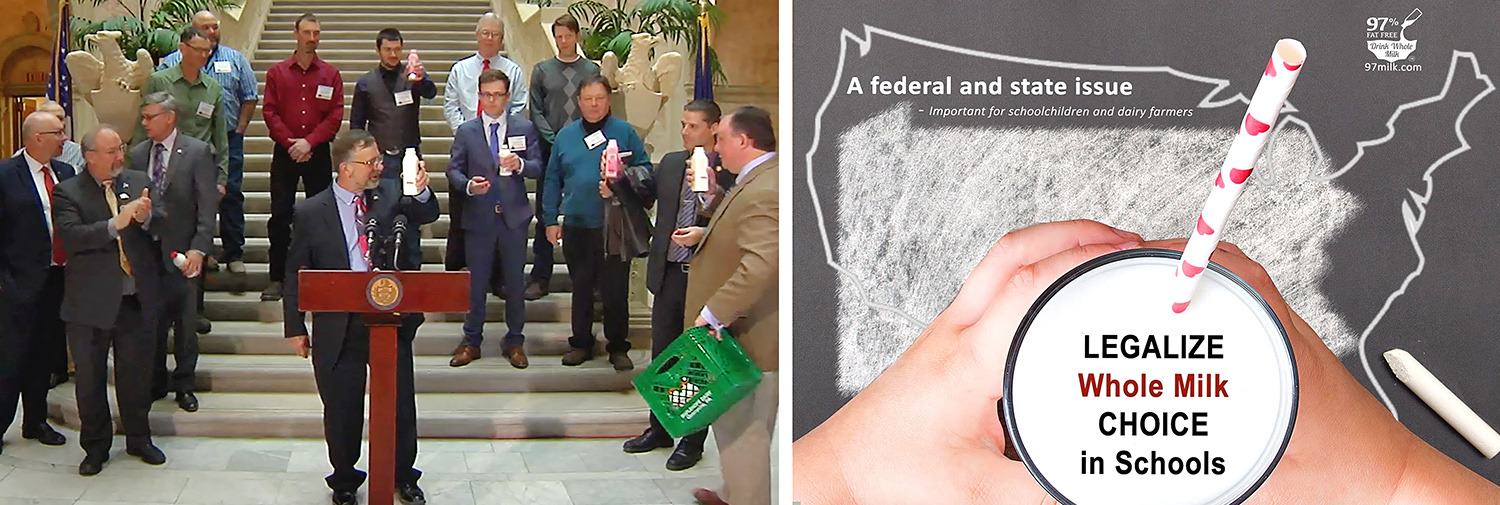
NYC Mayor leaves chocolate milk on school menu, ‘for now’

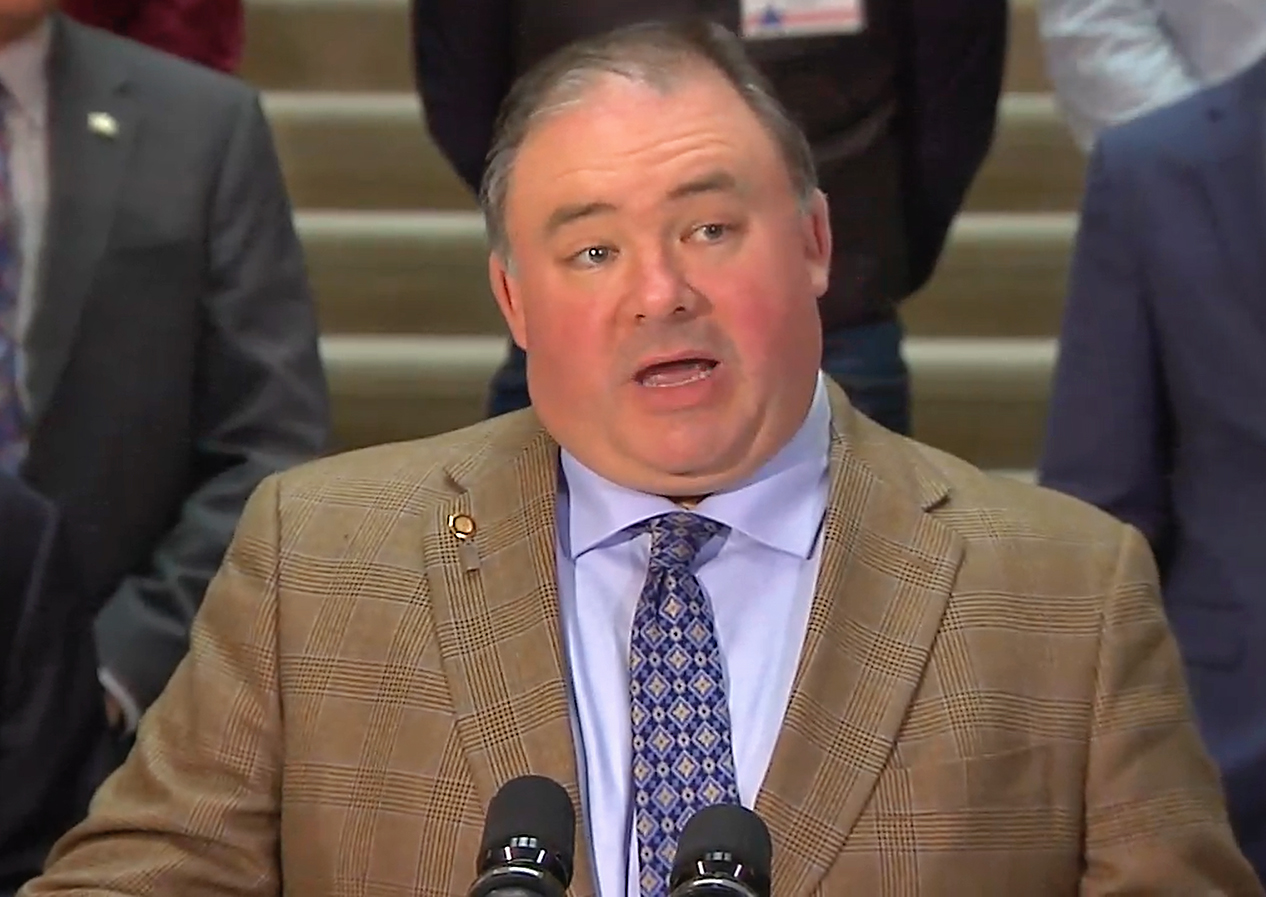
FARMSHINE EDITOR’S NOTE:  There is nothing simple about school milk today. Now there are three federal bills pending. One would legalize the options of whole and 2% flavored and unflavored milk in schools, one would restore just the 1% low-fat flavored milk option in schools, and now a third bill, a new one, would mandate that all schools offer at least one low-fat (1%) flavored milk option. At the state level in Pennsylvania, there’s also a whole milk in schools bill that recently passed the State House in a near-unanimous vote and is being considered by the State Senate as reported last week in Farmshine. Furthermore, a New York State Assemblyman has introduced a bill similar to the PA bill in the NY legislature. This week, however, the spotlight is on New York City schools as Mayor Eric Adams had proposed elimination of all flavored milk options.
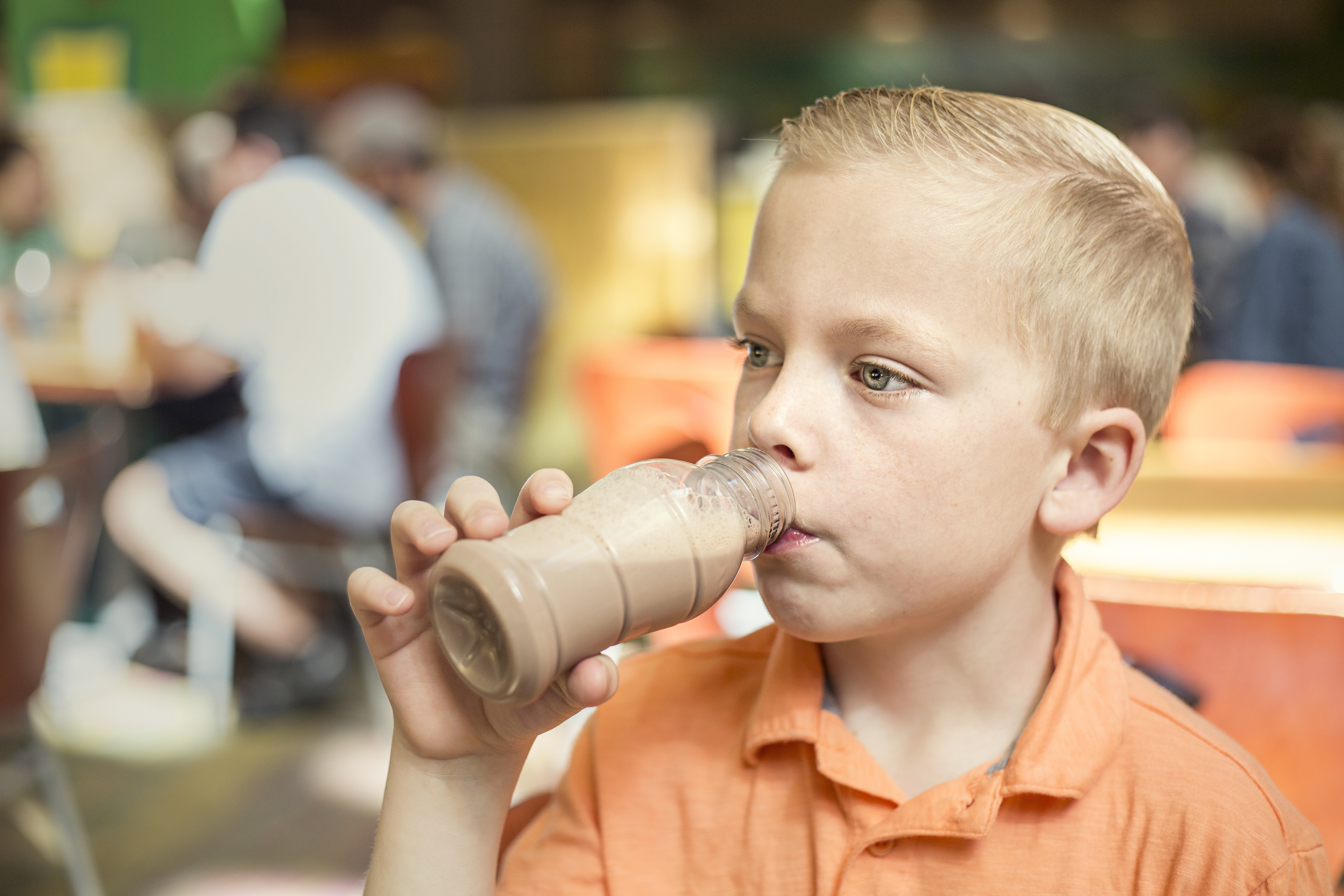
Istock Photo (PC Yobro10)

By Sherry Bunting, published in Farmshine, April 22, 2022

NEW YORK CITY — A proposed chocolate milk ban appears to be on hold in New York City schools. The April 17 New York Post reported NYC Mayor Eric Adams has “backed off” on his system-wide chocolate milk ban, while seeking USDA’s blessing to offer non-dairy alternatives.

The article cited a letter from the mayor to USDA, noting Adams will leave the flavored milk option up to the individual NYC schools — “for now.” 

Adams, who publicly follows a ‘mostly vegan’ lifestyle, who launched Vegan-Friday in NYC schools in February, and who sought to ban flavored milk in schools during his previous tenure as Brooklyn borough president, now says he is holding off on the chocolate milk ban and is seeking more input on school food and beverage options, overall.

The International Dairy Foods Association (IDFA) applauded the news in a press release Tuesday (April 19). 

“The USDA school meal standards and the federal Dietary Guidelines for Americans both support serving low-fat (1%) flavored milk in schools,” the IDFA statement reads. It also pointed out that flavored milk processed for schools today contains 50% less added sugar and fewer calories than 10 years ago, so it meets Mayor Adams’ plan for school beverages to be under 130 calories.

National Milk Producers Federation (NMPF) also issued a statement thanking in particular U.S. Representatives Antonio Delgado (D-NY) and Elise Stefanik (R-NY) “for their advocacy in support of continued flexibility for schools to serve children healthy milk and dairy products that benefit their growth and development.”

Mayor Adams’ pause on the flavored milk ban came after nine of New York’s 27 members of the U.S. Congress signed a bipartisan letter in March urging him not to implement the ban. The letter was initiated by U.S. Congressman Antonio Delgado, a New York Democrat who is the prime cosponsor of Pennsylvania Republican Congressman G.T. Thompson’s Whole Milk for Healthy Kids Act, H.R. 1861. 

In the letter, the lawmakers noted that two-thirds of current school milk sales nationwide are low-fat (1%) flavored milk. In NYC, all flavored milk is currently fat-free. The lawmakers noted that the proposed flavored milk ban would go against the mayor’s stated goals of improving childhood nutrition and health.

“As members representing both rural and urban communities, we are committed to supporting the dairy farmers, producers and agriculture partners across New York, while also ensuring that children in NYC schools have access to critical, life-enhancing nutrients. Unfortunately, for many NYC families, the meals children receive in schools are their only source of many recommended nutrients,” the bipartisan letter stated.

The letter also pointed out that members of Congress from New York and across the country are supporting expanding — not restricting — the access to milk and flavored milk choices in schools. The letter mentioned the bipartisan Whole Milk for Healthy Kids Act (H.R. 1861 with 93 cosponsors from 32 states) and the bipartisan School Milk Nutrition Act (H.R. 4635 with 44 cosponsors from 21 states). 

H.R. 1861 would end the federal prohibition of flavored and unflavored whole and 2% milk in schools. H.R. 4635 would simply restore by statute the option of low-fat 1% flavored milk so it can’t be restricted to fat-free by USDA edict.

“Both (bills) expand flavored milk options in school lunchrooms and have received support from members of the New York Congressional delegation on both sides of the aisle. We strongly urge you to continue offering children the choice of flavored milk each and every day in New York City schools,” NY members of Congress conveyed to Mayor Adams in the letter.

New York Republican Congresswoman Elise Stefanik also introduced the lastest federal school milk bill, H.R. 7070, the Protecting School Milk Choices Act. The ink isn’t even dry on this one, which has three cosponsors from Long Island, western New York State and Iowa. It would require, not simply allow, schools to offer at least one low-fat (1%) flavored milk option.

“A silent crisis is gripping our nation’s schoolchildren. In a typical school year, more than 30 million students of all ages rely on school breakfast and lunch for their daily recommended intake of critical nutrients,” wrote Keith Ayoob in an April 11 New York Daily News editorial. The associate professor emeritus at the Albert Einstein College of Medicine in the Bronx served over 30 years as director of the nutrition clinic for the Children’s Evaluation and Rehabilitation Center. 

“As a clinician working with mostlylow-income, minority families for more than 30 years, I’ve taken thousands of dietary histories on children. I can tell you that for many, a school meal is by far the healthiest meal they will consume on any given day. For some kids, sadly, these are their only meals,” Ayoob stated.

He reported that more than 60% of children and teens are not meeting their needs for calcium, vitamin D and potassium, which are three of four ‘nutrients of concern,’ and that eliminating flavored milk from NYC school meals would cause childhood nutrition to further deteriorate. 

Yes, children should not eat excess added sugar, wrote Ayoob, but “small amounts can be useful… to drive the consumption of nutrient-rich and under-consumed foods.” He cited flavored milk and yogurt as two examples of how to beneficially “spend the few added sugar calories.”

The Richard B. Russell National School Lunch Act of 1946 has long upheld milk’s unique nutritional package, allowing substitution only if it is “nutritionally equivalent to fluid milk and meets nutritional standards established by the Secretary, which shall, among other requirements, include fortification of calcium, protein, vitamin A and vitamin D to levels found in cow’s milk for students who cannot consume fluid milk because of a medical or other special dietary need…” 

In addition, there is a section of this law that prohibits restriction of milk sales in schools. It states: “A school that participates in the school lunch program under this Act shall not directly or indirectly restrict the sale or marketing of fluid milk products by the school (or by a person approved by the school) at any time or any place — (i) on the school premises; or (ii) at any school-sponsored event.”

In its press release thanking parents, physicians, dieticians and members of Congress for speaking up, IDFA cited the results of a Morning Consult survey it had commissioned. 

The survey found 90% of New York City voters with children in public schools and 85% of parents nationwide supported offering the option of low-fat (1%) flavored milk in school meals. This means parents don’t want a ban on flavored milk, and they don’t want their children’s flavored milk choices restricted to fat-free.

As reported in the March 11 Farmshine, this survey also found that 58% of NYC parents and 78% of parents nationwide selected as most nutritious the whole milk and reduced-fat (2%) milk options that are currently prohibited in schools by the federal government, whereas only 24% of NYC parents and 18% of parents nationwide selected the low-fat (1%) and fat-free milk options that are currently allowed in schools. 

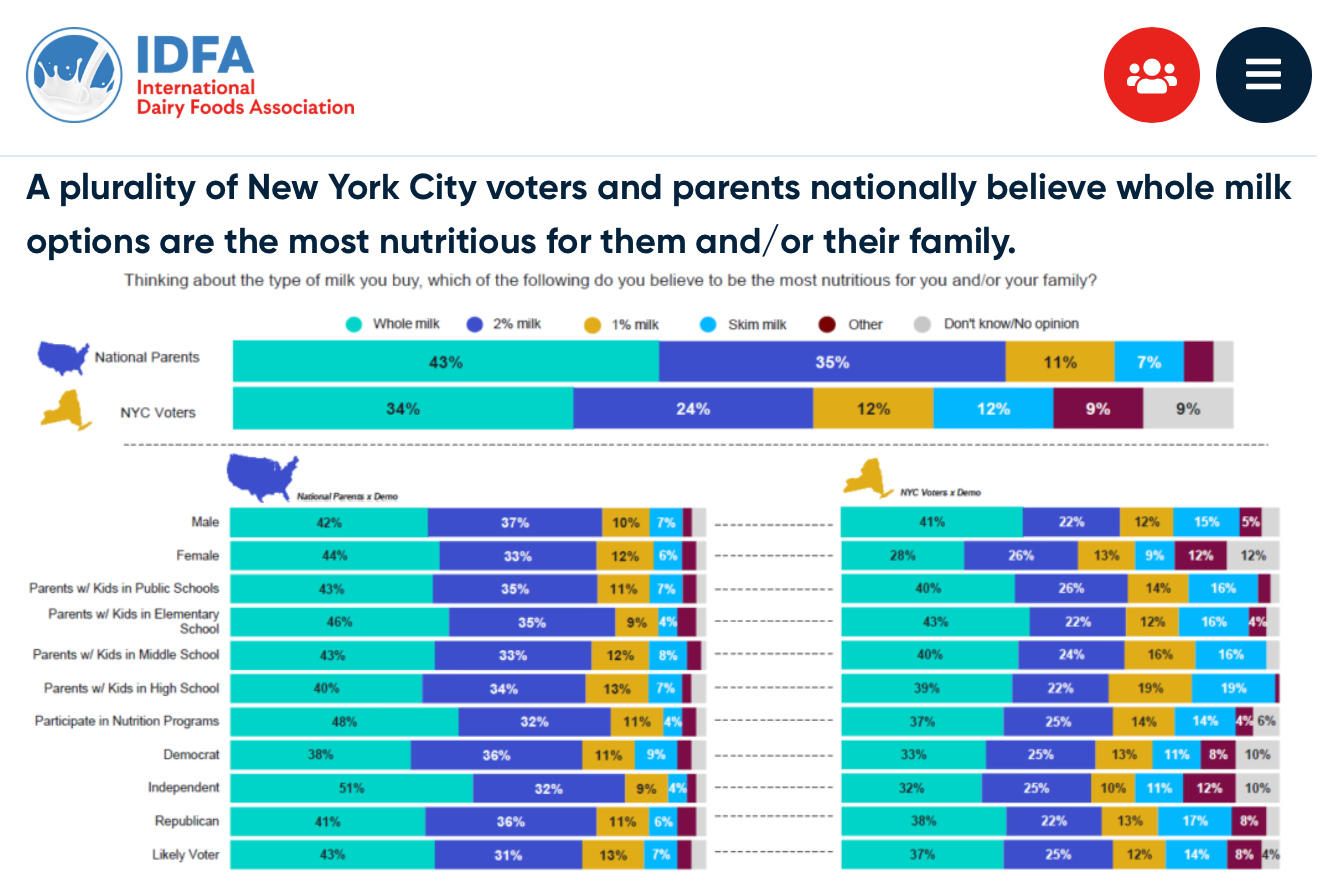
In fact, when asked what milk they “selected” as “most nutritious for them and their families,” the top pick of parents was whole milk at 34% of NYC parents and 43% nationwide; followed by reduced-fat (2%) milk at 24% and 35%; low-fat (1%) milk at 12% and 11%; and fat-free milk at 12% and 7%.

Among NYC parents, 9% selected ‘other,’ and 9% were unsure or had no opinion. Among parents, nationwide, 3% selected ‘other,’ and 1% were unsure or had no opinion.

Why do parental choices matter? Because children consume two out of three meals a day at school for a majority of the year.

How did we get here?

The Congress under a Democrat majority in 2010 passed the Healthy Hunger Free Kids Act that called for aligning government feeding programs, like school lunch, even more closely to the Dietary Guidelines for Americans (DGAs). 

Then, in 2012, the Obama-Vilsack USDA promulgated rules to outright ban whole and 2% reduced-fat unflavored and flavored milk as well as 1% low-fat flavored milk as “competing beverages” across all schools. USDA documents note that this move was based on information from an industry school wellness program that had touted three-a-day fat-free and low-fat dairy, reporting those schools that had voluntarily restricted the higher fat milk options were doing better in meeting the constraints of the Dietary Guidelines. 

Never mind the fact that the Dietary Guidelines Advisory committees admit their espoused fat-restrictive dietary patterns leave all age groups deficient in key nutrients of concern. 

During the first school year of the USDA whole and 2% milk prohibition (2012-13), which also saw all flavored milk restricted to fat-free status, USDA’s own study showed student selection of milk declined by 24%, and milk waste in schools increased 22% across two categories. That’s a double-whammy.

In 2017, the Trump-Perdue USDA provided regulatory flexibility to schools, allowing them to offer low-fat 1% flavored milk through a waiver process. This flexibility was reversed in 2021 by a court decision noting USDA erred by not providing adequate public comment before providing the new flexibilities on milk, sodium and whole grains. 

With the Coronavirus pandemic emerging in 2020, closing schools and creating supply chain challenges, USDA had implemented emergency flexibilities for school offerings.

Recently, the Biden-Vilsack USDA announced a transitional final rule for the 2022-23 and 2023-24 school years. In this rule, USDA recognized that post-pandemic schools “need more time to prepare” to meet the DGAs on fat (milk), sodium and whole grains. 

According to USDA, the Department is reviewing thousands of stakeholder comments received in March 2022 and expects to release updated child nutrition program standards in July 2022, which would then become effective for the 2024-25 school year and beyond.

USDA also announced on Friday (April 15) the opening of the next 5-year Dietary Guidelines cycle with a brief 30-day public comment period ending May 16 to weigh-in on proposed scientific questions that will guide the entire 2025-30 DGA process. Stay tuned.

-30- 
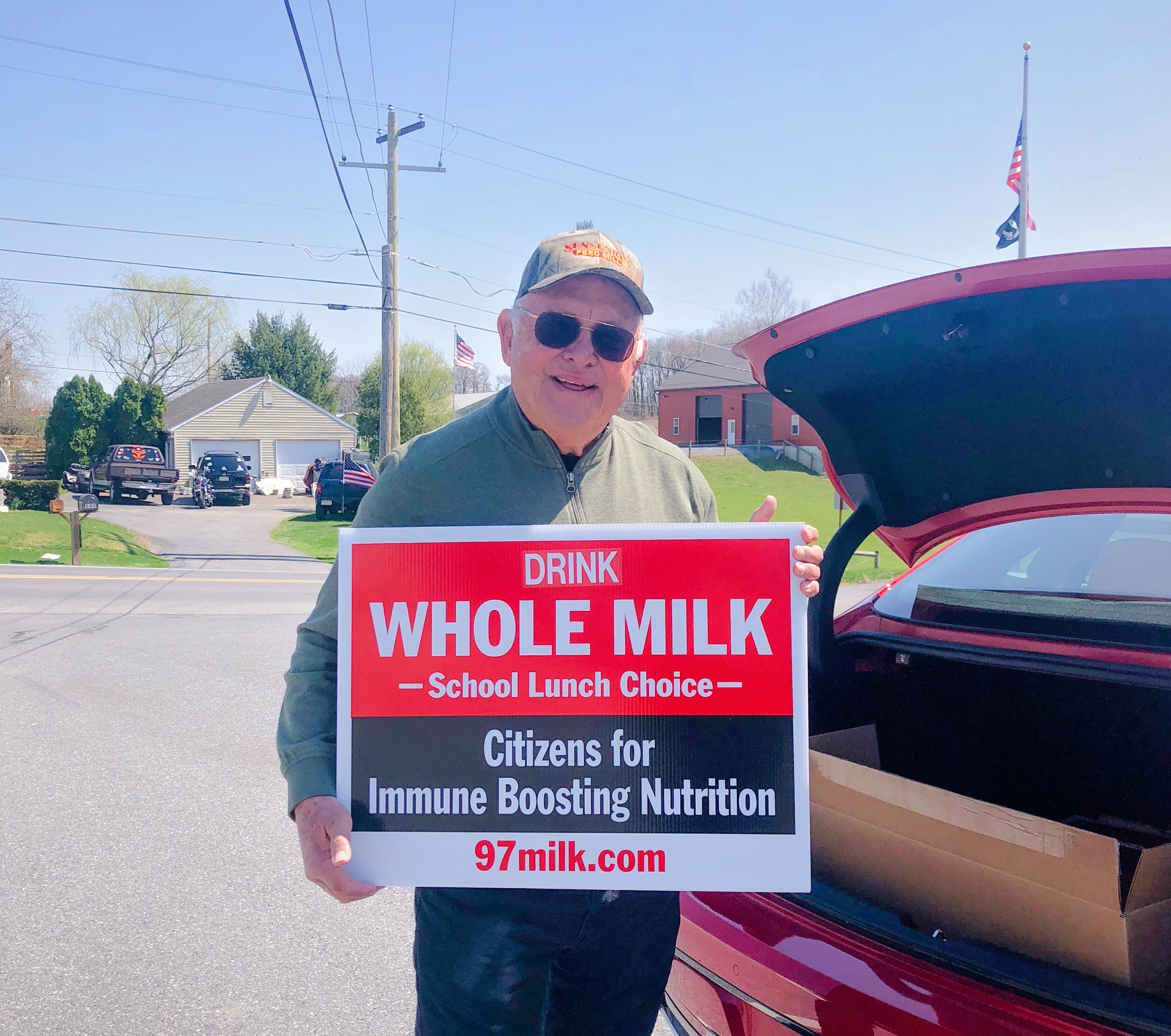
I am thankful for the folks who push for whole milk choice

And I am thankful, perhaps most of all, for the strong and stubborn big heart of retired agribusinessman and dairy advocate Bernie Morrissey.

By Sherry Bunting, Farmshine Editorial, April 15, 2022

Among the dairy bills moving in the Pennsylvania House and Senate, one rising to the top is the Whole Milk for Pennsylvania Schools Act

What appears to be a fast rise has really been the product of a long and exhausting process for those who have worked on and reported on the issue of school milk and school meals over the past 10 to 15 years.

Six years ago, the issue began heating up, and U.S. Congressman G.T. Thompson (R-15th) introduced his Whole Milk for Healthy Kids Act for the first time. Two legislative sessions later, that bill, H.R. 1861, still awaits action by the House Committee on Education and Labor, having 93 cosponsors from 32 states as of April 13.

A little over three years ago, a grassroots whole milk education movement was launched by volunteers and donations after Berks County dairy farmer Nelson Troutman painted a round bale, which led to the formation of the Grassroots PA Dairy Advisory Committee and 97 Milk LLC.

The painstaking process of working to pry federal bureacrats’ hands off the allowable school milk offerings for children has been ongoing and exhausting.

Now there is the Pennsylvania State bill, HB 2397 Whole Milk for Pennsylvania Schools, authored by State Representative John Lawrence, introduced with 36 cosponsors on March 17 and passed by the State House on April 13.

The progress would not be happening without volunteers — especially the tireless efforts of Bernie Morrissey. At 85, he doesn’t have to be doing any of this. He has shown that he cares about the future for dairy farmers in Pennsylvania, and as a grandfather and great-grandfather, he cares about school milk choices. He has continually worked to get the word out about the whole milk prohibition issue.

USDA’s own pre- and post-prohibition survey showed the significant decrease in students selecting milk and the increased throwing away of milk served — in just the very first year (2012) of the complete restriction of milk choices to be only fat-free or 1% low-fat. More recent studies show it has only gotten worse.

Dairy farmers have lost a generation of milk drinkers, and Class I fluid milk sales have declined even more dramatically since the federal ban.

In the pages of Farmshine, we’ve brought you the news each step of the way. The Dietary Guidelines debacle has been covered for over 10 years. The Congressional bills have been covered. The findings of investigative science journalist Nina Teicholz have been covered, and so much more.

Since Dec. 2018, Farmshine has covered the emerging story of Nelson’s painted round bale, how it got noticed and how that led to questions from neighbors, how more bales were painted, how Bernie took it to another level making banners and yard signs, paying to print some up and distributing them and asking other agribusiness leaders to do the same, and how folks in other states are making an impact also in the movement to get the message out of the pasture and onto buildings and by roads everywhere they can.

We’ve reported on Bernie’s efforts to do political fundraisers at the grassroots level — giving farmers and agribusiness leaders opportunities to join him in supporting lawmakers who care about these issues.

We’ve reported on the major ‘Bring Whole Milk Back to School’ petition drives (30,000 strong), visits with lawmakers, the progress of the 97 Milk education effort, and so forth.

All along the way, there have been fence-straddling skeptics parsing their words. Just one example came recently after Nelson received the Pennsylvania Dairy Innovator Award during the Dairy Summit in February. That evening, one state official said to me that he “never had a problem” with the whole milk signs, but he was quick to add that he didn’t like the way the painted bales and signs only promoted whole milk, when all milk should be promoted.

Yes, all milk should be promoted, but let’s face facts here. For the past 10 to 15 years, the mandatory dairy checkoff promotion programs have not promoted whole milk. They have repeatedly used the terminology “fat-free and low-fat milk” — in lockstep with USDA bureaucrats. They even promoted the launch of blended products where real milk and plant-based fakes were combined to make what was called a “purely perfect blend.” 

“Three-a-day low-fat and fat-free” has been the mantra. 

Some dairy princesses have even confessed being afraid to tout whole milk, others have pushed the boundaries. Some have picked up the 97 Milk vehicle magnets for their personal vehicles while towing-the-line on the fat-free / low-fat wording in their “official” capacity as princesses. 

Let’s face it, the industry has used farmers’ own mandatorily-paid checkoff funds to drill USDA’s low-fat and fat-free milk message into the minds of consumers.

Someone had to start thinking outside the box if a solution to this issue was ever going to get outside the box.

Volunteers have now taken up the slack to promote whole milk, and they are moving the needle. In fact, the whole milk movement is so successful even Danone’s new fake brand – NextMilk — is trying to capitalize by using whole milk’s signature red and white cartons and placing “whole fat” above the brand name. What does that tell us?

Now, as the Whole Milk in Schools bill gains ground in the state of Pennsylvania, we see some who are trying to pour cold water on the passion and progress by suggesting that the state bill, which uses the PA Preferred framework to assert state’s rights, could lead to retaliation by other states to try harming demand for Pennsylvania-produced milk.

This is intimidation. Bullying. We see the same argument every time efforts are made to close loopholes that keep the state-mandated Pennsylvania over-order premium from getting to Pennsylvania dairy farms as the law intended. We hear that Pennsylvania milk will be discriminated against if co-ops and processors can’t continue dipping into the premium cookie jar. 

Now, it appears the same intimidation angle is being applied to HB 2397, which defines the option of whole milk in schools as pertaining to milk that is paid for with Pennsylvania or local funds and produced by cows milked on Pennsylvania farms. The bill has no choice but to use the PA Preferred framework because it is defining a role for state action on a federal prohibition.

Remember the June 2021 Pa. Senate Majority Policy Committee hearing on ending the federal prohibition of whole milk in schools? At the end of that hearing, State Senators in attendance were interested in doing statewide school milk trials like the one done temporarily at two school districts in Pennsylvania two years ago “under the radar.” (In one trial offering all fat levels of milk, whole milk was preferred by students 3 to 1; student selection of milk increased 52% and the amount of discarded ‘served’ milk declined by 95%!)

Key lawmakers began to show stronger interest in finding a way to give schools this option and have them collect data about student consumption and not get penalized by USDA and the Dept. of Education in the process. HB 2397 does that!

A major reason why interest is surging for this bill is because more people are coming to the realization that this prohibition exists. Prior to the 97 Milk education effort, most parents, citizens, even lawmakers, did not realize whole milk is outright banned in schools, even banned as an a la carte beverage! That goes for 2% reduced fat milk also, by the way. 

HB 2397 is about choice. There is no mandate here. None, whatsoever. Just freedom for students to make a healthful choice that they are presently denied.

The Commonwealth of Pennsylvania has a state’s interest on two critical fronts: 1) Dairy farming is essential to our economy and 2) The health of our children and freedom of choice are of the utmost importance. Students receive two out of three meals at school during a majority of the year.

Shouldn’t states and schools and parents decide milk choices instead of federal bureaucrats? Shouldn’t children get to choose the best milk our farmers produce if that’s what they’ll drink and love and benefit from? Why should they be forced to choose only the industry’s leftover skim?

Bottom line, these are times to be bold and brave.

These bills are for the children and for the farmers.

As a mother and grandmother, and dairy enthusiast, I am thankful for all who are working to move these bills forward. I am thankful for the opportunity to work with so many people who care about this issue. I am thankful for the work of 97 Milk and the Grassroots PA Dairy Advisory Committee. I am thankful for the support of the Pa. Farm Bureau, Pa. Dairymen’s Association, Pa. Farmers Union, and other organizations supporting the Whole Milk in Pennsylvania Schools Act.

I am thankful for the agribusiness leaders making contributions to help farmers and other whole milk education volunteers get the message and milk facts out there. I am thankful for the 30,000 people who signed online and mailed in petitions on this issue two and three years ago. 

I am thankful for Pennsylvania lawmakers who are being bold and leading — bringing their colleagues along in a bipartisan way so that more states can be encouraged to do the same.

I am thankful for all who are standing up for our dairy farmers and our children. 

And I am thankful, perhaps most of all, for the strong and stubborn big heart of retired agribusinessman and dairy advocate Bernie Morrissey. He continually looks for every possible avenue to help dairy farmers be at the table to speak up about the policies that affect their futures. He knows what it means to them, and to children, to someday — hopefully soon — have the choice of whole milk in schools.

 -30-

Constitutionality defended as HB 2397 Whole Milk in PA Schools Act passes House 196-2

Rep. John Lawrence defends constitutionality of HB 2397 before near-unanimous House passage https://s3.us-east-2.amazonaws.com/pagopvideo/825289108.mp4

Dairy bills, including whole milk in schools, pass overwhelmingly in Pa. State House — all eyes to Senate now

By Sherry Bunting, republished from Farmshine, April 15, 2022

HARRISBURG, Pa. —  It was a good day in the Pennsylvania State Capitol Wednesday (Apr. 13) when a series of dairy bills, including the Whole Milk in Pennsylvania Schools Act, were overwhelmingly voted for final passage, now heading to the State Senate for concurrence.

In final passage of HB 2397 (The Whole Milk for Pennsylvania Schools Act), the vote was nearly unanimous 196 to 2. The bill was circulated in February via cosponsors memo to colleagues and was formally introduced March 17 by Reps. John Lawrence and Clint Owlett with 36 cosponsors in March.

Meanwhile, the Senate’s identical version, SB 1181, was introduced by Sen. Michele Brooks (R-Greenville) with 16 cosponsors on March 30, the day the House bill passed the Ag Committee. The Senate version also received unanimous support in the Senate Ag Committee as in the House and the SB 1181 received second consideration and was re-referred to Appropriations Tuesday (April 12) just before spring recess. A vote is expected when the Senate reconvenes in May.

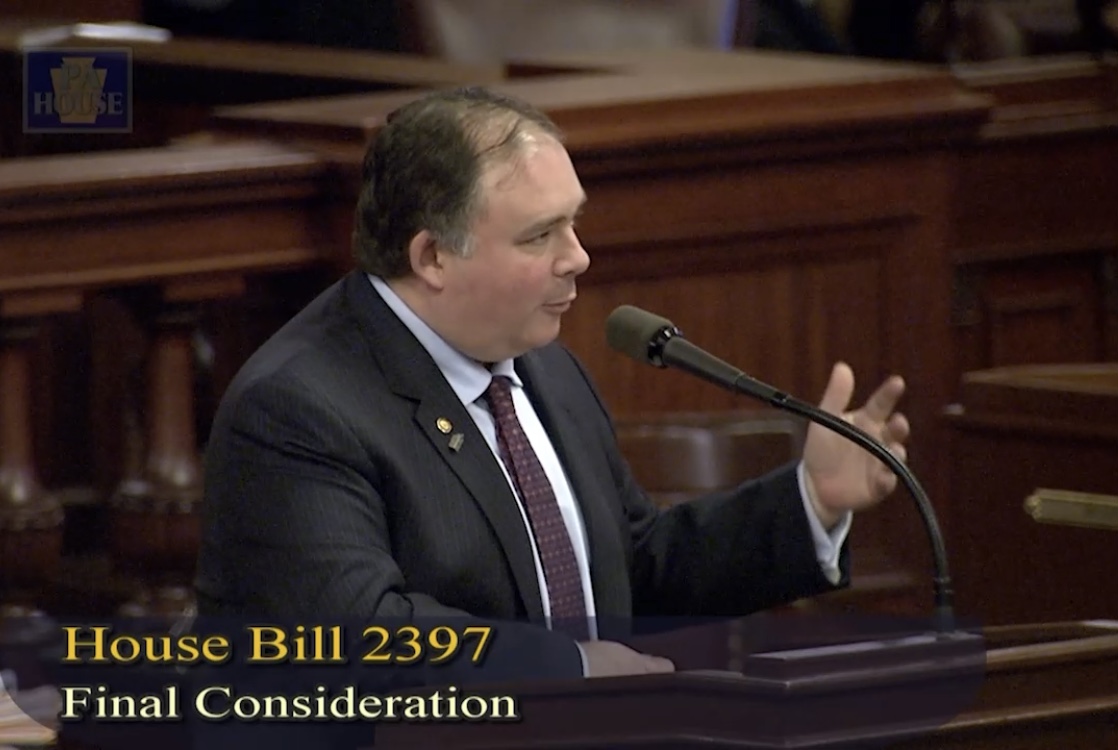
The bill’s author Rep. John Lawrence (R-Chester County) spoke eloquently to defend the constitutionality of HB 2397 before the vote on the House floor. He cited extensive case law and U.S. Supreme Court decisions showing HB 2397 “passes mustard” and does not run afoul of the supremacy clause, the interstate commerce clause, the 10th amendment of the Constitution or the 1946 Richard B. Russell National School Lunch Act.

The wording of the enabling Richard B. Russell School Lunch Act clearly puts the federal government in the position of “assisting” states, not overtaking them in providing a nutritious school lunch, said Lawrence.

Lawrence chose to make these remarks, citing many relevant Supreme Court decisions on different aspects, to be sure the record reflected this information even though the bill had overwhelming support from colleagues in the House. He said he did so because of the criticism on constitutional grounds coming from outside of the chamber and wanted the verbal record to reflect this information for the press to hear, because they likely wouldn’t read it all if he submitted it for the journal of record.

Lawrence thoroughly and methodically defended its constitutionality, even though the bill already had broad bipartisan support for near-unanimous passage.

“Some in the press contend that this law will run into problems with the Court on the interstate commerce clause,” said Lawrence. On this point, he cited Court decisions that apply in instances where it is based on economic protectionism, whereas HB 2397 is based on a factor completely unrelated to economic protectionism.

“Does this bill burden out of state milk producers? Pennsylvania is not creating a prohibition on milk produced out of the state. One can argue that the federal government has done that,” he explained. “HB 2397 does not discriminate against out-of-state milk. It is adding options, not limiting them. It is giving Pennsylvania schools assurance that they can spend Pennsylvania or local funds for Pennsylvania whole milk. It is the federal government — not Pennsylvania — that has drawn this whole milk line. And the bill makes provisions that if the federal measures again fully smile upon whole milk, then the statute created by House Bill 2397 will sunset.”

Even if 2397 did discriminate, Lawrence cited decisions of the Court that it is valid if for a purpose that cannot be adequately served by reasonable non-discriminatory alternatives. “In this case we do have a valid factor that is totally unrelated to economic protectionism,” said Lawrence, noting that there are at least four valid factors. They are:

1) The primary intent here is to provide nutrient-rich whole milk to the young minds of Pennsylvania school children.

2) It’s the longstanding intent of this body that maintaining our small herd dairy farms is good for the general welfare of the state, said Lawrence: “Many draw a straight line between milk consumption over the last 10 years and the removal of whole milk from schools. There is evidence to back up this claim. The loss of Pennsylvania dairy farms is not solely economic”

3) Parents should have options when it comes to the care of their children, and nothing is more basic to that, than food. “It is indisputable that many reliable studies from top-tier research institutions show the value of whole milk for children who choose to consume it,” said Lawrence.

4) There is a movement toward sourcing consummables closer to their end use. Milk produced and processed in Pennsylvania and sold to a Pennsylvania school is almost always going to have less environmental impact.

A vote in the State Senate is not expected until May when the Senate reconvenes. Back in June 2021, the Senate Majority Policy Committee held a hearing on the federal prohibition of whole milk in schools. I was honored to be among those testifying. (Click here to view hearing here)

Two additional bills introduced by Rep. Lawrence — HB 223 and 224 — received unanimous final passage votes also on Wednesday and were committed to the Senate for concurrence.

HB 223 provides for the creation of keystone opportunity dairy zones to facilitate the economic development of Pennsylvania’s dairy industry through tax credits and incentives for new and expanded dairy processing.

HB 224 provides additional authority to the Pennsylvania Milk Marketing Board to collect and distribute board-established premiums through a milk marketing fund, including other provisions such as auditing.

Also passing the Pa. State House by an overwhelming margin Wednesday were HB 1847, introduced by Rep. Christina Sappey (D-Kennett Square), HB 2456, introduced by Rep. Marci Mustello (R-Butler), and HB 2457, introduced by Rep. Joe Kerwin (R-Schuylkill Haven). HB 1847 would change the name of the Pennsylvania Milk Marketing Board to simply the Pennsylvania Milk Board. HB 2456 provides for expansion of penalties in lieu of suspension, and HB 2457 expands PMMB authority to set testing certification fees.

To be continued in Farmshine next week

PA Lawmakers ready to fight federal government, House Ag passes HB 2397, which would allow whole milk option in schools

By Sherry Bunting, Farmshine, April 1, 2022

HARRISBURG, Pa. – “Today became whole milk day in Harrisburg, and we hope to see these bills on the Governor’s desk soon,” said Chairman Dan Moul of the Pennsylvania State House Committee on Agriculture and Rural Affairs on Wednesday, March 30 about three pieces of legislation authored by Rep. John Lawrence.

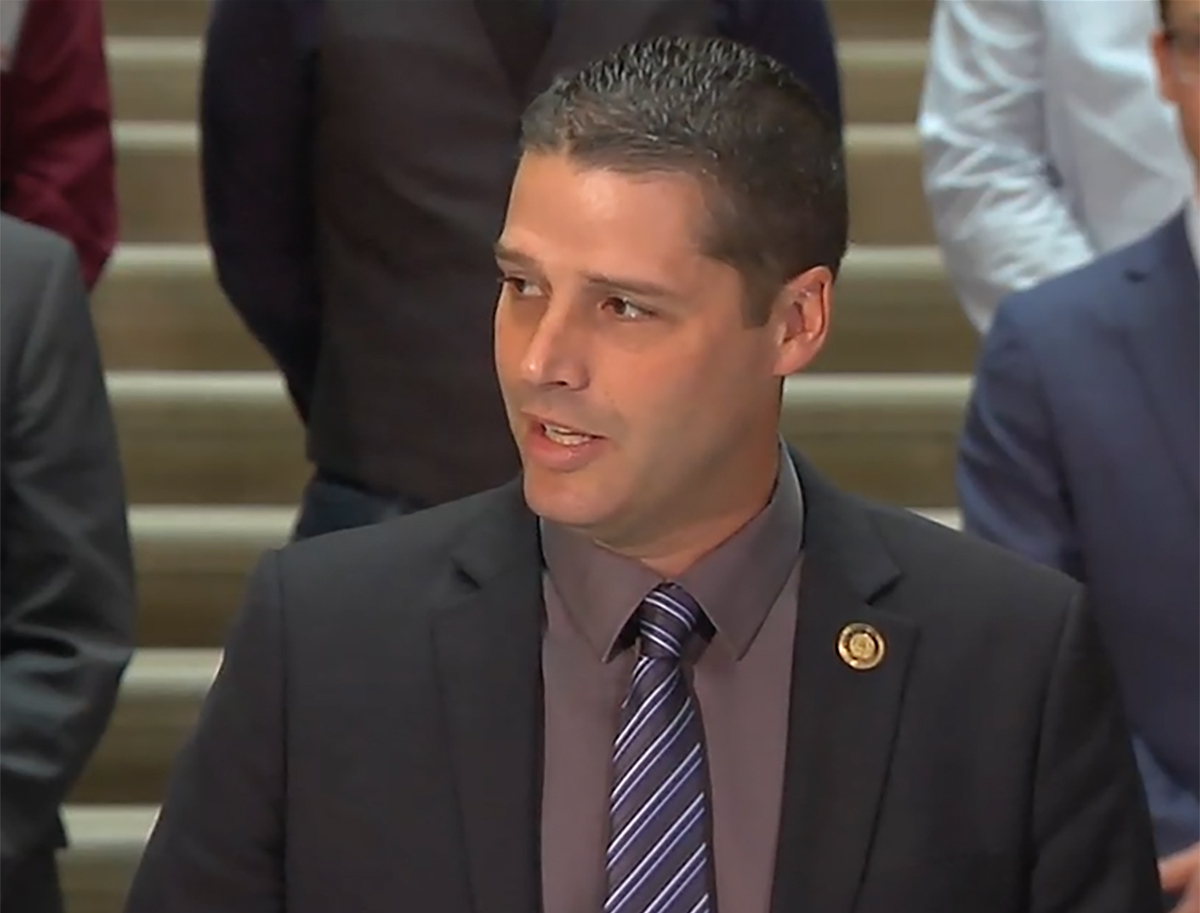
The three dairy bills were part of a six-bill package that passed the Ag Committee and are now headed to the House floor and presumably to the Senate chamber. Several State Senators also attended Wednesday’s press conference in support of the dairy bills.

Attracting the most attention, of course, was House Bill 2397 — The Whole Milk for Pennsylvania Schools Act — which was added to the package most recently with 31 cosponsors right out of the gate.

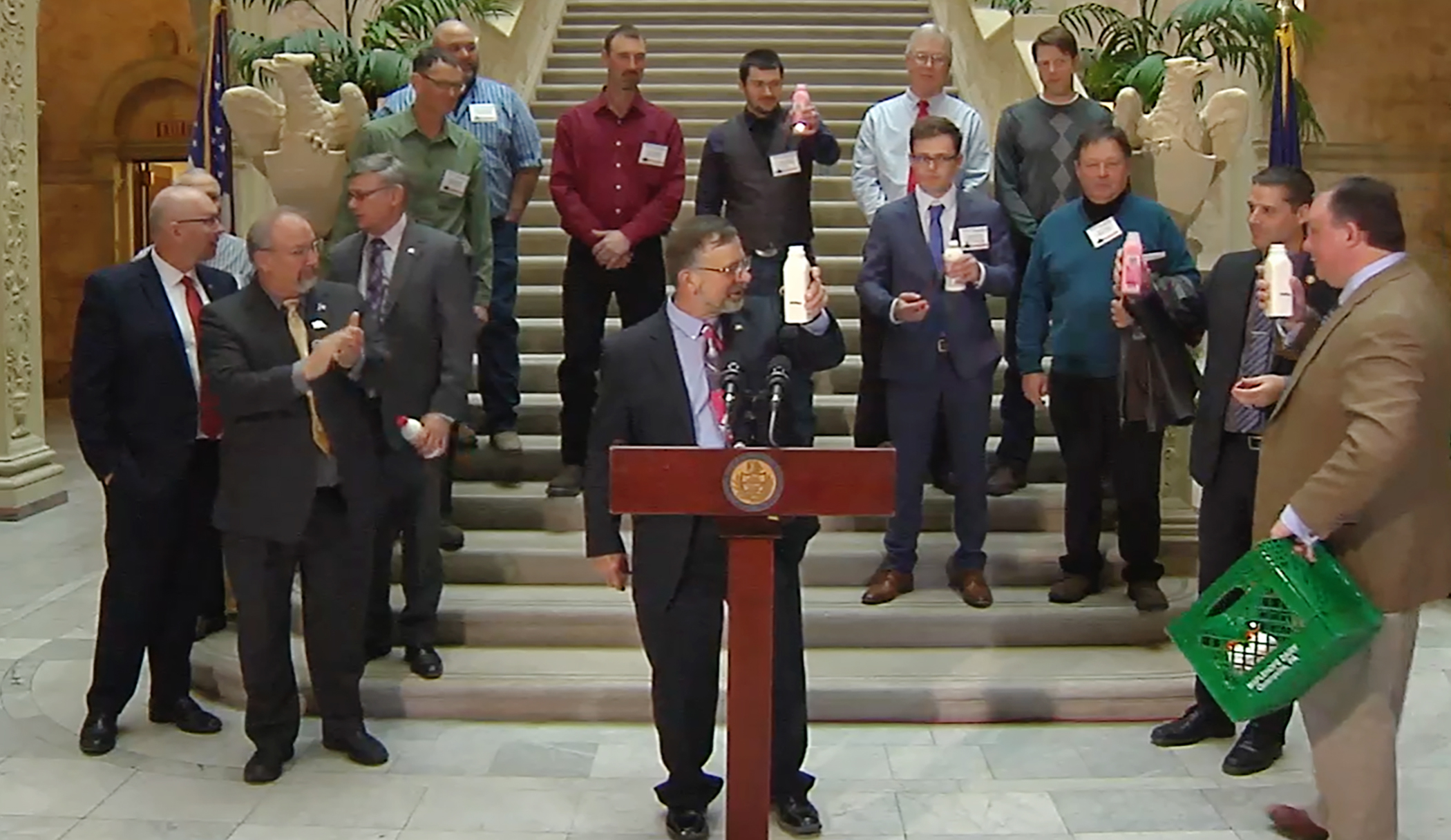
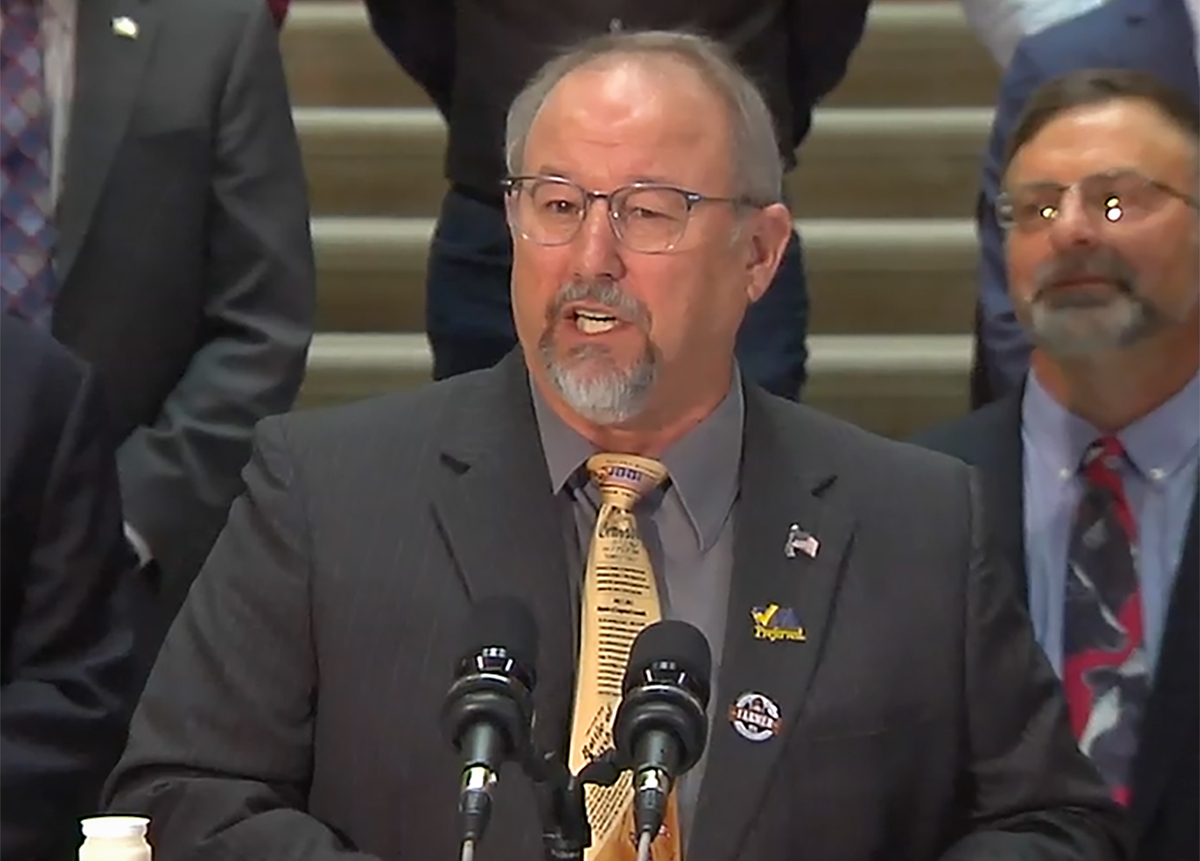
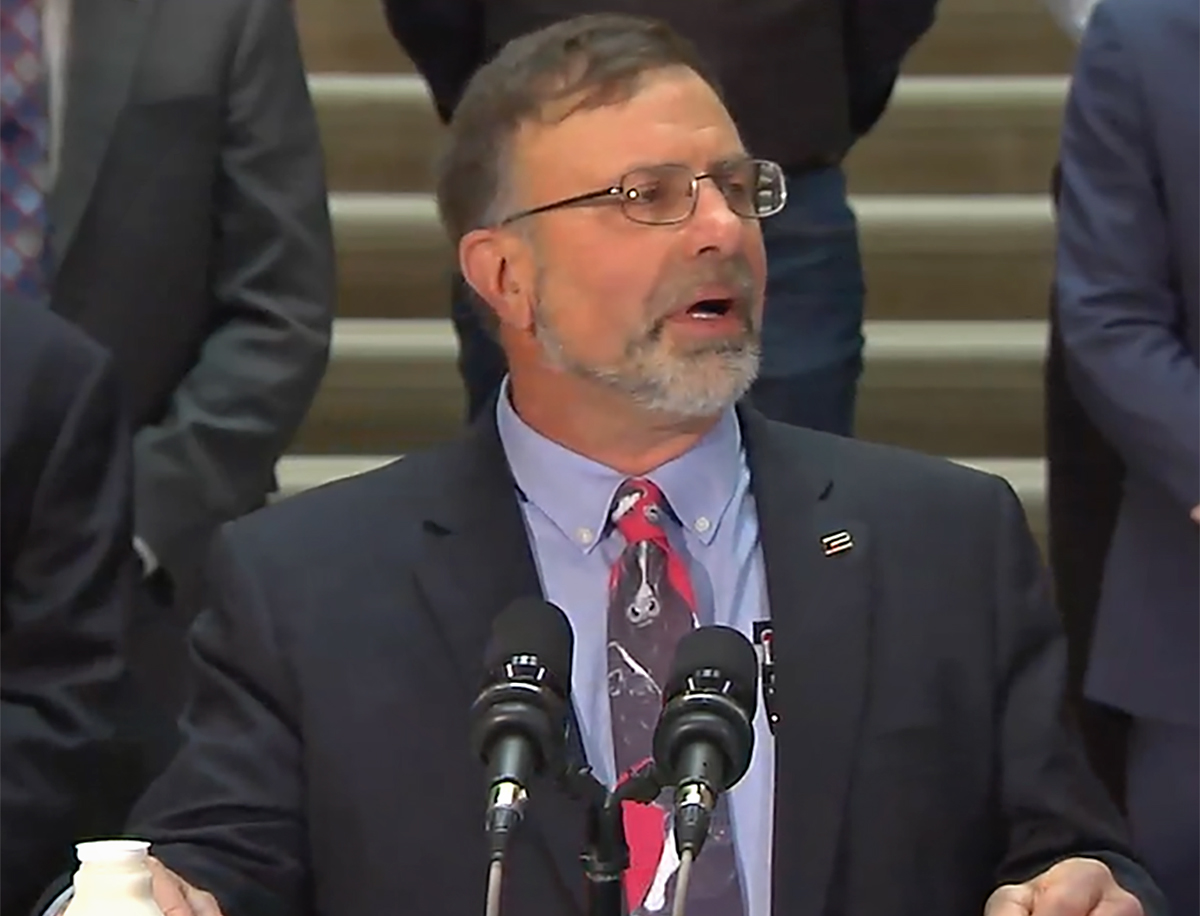
“Government has its place… but one place we do not need the government is in our daily lives in how we raise and nurture our children. Whole milk is healthy. It is proven. There is no disputing that children need this option in their lives to help grow strong. I am proud as chairman to get these bills out of my committee and on to the House floor with bipartisan support. I’m especially excited about House Bill 2397,” said Moul, joining Reps. Lawrence and Owlett, along with other cosponsors and Farm Bureau President Rick Ebert on the steps of the Atrium at the Capitol.

House Bill 2397 provides for Pennsylvania schools to buy Pennsylvania milk produced on Pennsylvania farms with Pennsylvania funds to serve to Pennsylvania children. As long as all of that happens within Pennsylvania, that’s really not an issue that is under the purview of the federal government,” said Rep. Lawrence, representing Chester County and parts of Lancaster County.

“There’s also a provision in this bill that if the federal government tries to pull funds (from a school) or tries to interfere, there will be legal action taken against the federal government so we can ensure this opportunity exists,” Lawrence explained.

Stressing that this bill would make the whole milk option voluntary for schools, Lawrence was quick to point out that, “No school would have to do this, but we know there are schools that are very interested in providing whole milk and whole chocolate milk to their students. This bill would allow them to do that.”

Lawrence went on to explain the background of the bill.

“Here in Pennsylvania, we have a robust dairy industry. We have a tradition that’s really second to none. But due to federal regulations that came down during the Obama administration, for over a decade now, school children in Pennsylvania and across the nation have been unable to enjoy whole milk or my favorite, whole chocolate milk, in school,” he said.

“More than just enjoyment, we know it is important. Leading research shows that whole milk is very beneficial for children in developing the mind,” said Lawrence.

Since the change in 2010, “we have really lost a generation of kids who actually know what milk is supposed to taste like, and oh, by the way, they have missed out on the nutrition from it as well,” said Rep. Owlett, the bill’s prime cosponsor. He represents northern tier counties of Tioga and Bradford. “This (federal regulation) took a huge part of Pennsylvania’s fluid milk market away from our farmers. Pennsylvania is a fluid milk market state.”

Owlett cited statistics showing that since 2010, Pennsylvania has lost 2,140 dairy farms, including 230 lost last year, and has slipped from seventh to eighth, being fifth before these school milk regulations were put in place at the federal level.

“When a single dairy farm sells out, the ripple effect of that is felt throughout the entire community,” said Owlett, noting that in his district, “a tremendous number of farms have been selling out in the last 10 years.”

Citing Penn State numbers from extension agent Craig Williams, Owlett noted that since 2012, Tioga County has lost at least 57 dairy farms and Bradford County at least 142.

“Without a doubt this is in part because of this failed policy that came down from D.C.,” said Owlett. “I really love House Bill 2397, and it is a great honor to work with Rep. Lawrence on this. It is a PA issue, alone, that is the beauty of this bill. If a PA school wants to offer PA whole milk with PA dollars… Guess what federal government? We’re going to do it! If you try to stop us, our attorney general is going to sue you on behalf of a school district.”

Owlett and others noted that this bill is how state lawmakers can “stand up for our farmers, our kids and our schools in Pennsylvania.”

“We want to make sure those kids get the nutrition from milk, and that it actually tastes good, instead of throwing it in the trash can,” said Owlett.

Like Lawrence, Owlett noted there are schools in his district that are looking forward to this option and need this protection to exercise that choice.

Lawmakers thanked the Pennsylvania Farm Bureau for their leadership in promoting the bill in Harrisburg. Speaking for PFB, Rick Ebert said HB 2397 will help foster a new generation of kids who like milk again.

“I have been a dairy farmer for 40 years, and we ship to Turner in Penn Hills,” said Ebert. “They put a lot of products into schools. It is nice to see this support from lawmakers to keep our Pennsylvania dairy industry strong and viable.”

When asked how much money the federal government pays in milk reimbursement right now, Lawrence noted that the overall picture of education funds shows the vast majority, 98 to 99%, comes from state and local funds.

While it is true that schools would not get reimbursed for whole milk they buy to offer students, the larger issue is their fear over education funds being pulled for federal mandates because of “disobeying” federal dietary guidelines with the offering of whole milk as a choice.

“As long as schools use state and local funds to make the whole milk available, this bill gives them protection from those actions,” said Lawrence. “This is optional. If a school wants to go down this road, they would be able to. But if they want to continue down the current path, they can do that too. We know some schools are ready for this, but the long arm of the federal government and that regulatory thrust gives them pause. For those schools that are interested in pursuing this option, the bill provides the protection to make it happen.”

Lawmakers attending the press conference made it clear that this package of bills, especially H.B. 2397, will have a positive impact on Pennsylvania dairy farmers.

When asked how much of an impact, Ebert said simply: “We’ve all seen the steady decline in milk consumption. When we lose farmers, they are not coming back. With every loss of a dairy cow (in PA), we lose $14,000 to $15,000 of economic activity in Pennsylvania. If we sell more product in Pennsylvania, then that boosts the economy for our farmers and the economy for the infrastructure that supports them.”

When asked by a reporter where the Senate stands and the leadership, State Senator Camera Bartolotta, representing Beaver, Greene and Washington counties, spoke up.

“We’ve already been talking about it,” said Senator Barolotta. “We are going to be pushing it along in the Senate as soon as it gets to our chamber. This is going to be good for our farmers, but more importantly, it helps get kids back to (being able) to drink whole milk again that is good for them. It’s time to protect our kids and our dairy farmers and our number one industry.”

Passing the Ag Committee along with H.B. 2397 are two other bills Rep. Lawrence has been working on for many years as reported on recently in Farmshine.

“House Bill 223 provides tax incentives to bring new and additional dairy processing to Pennsylvania that commit to using Pennsylvania milk to provide opportunity for our Pennsylvania dairy farmers,” said Lawrence about the other bills heading to the House floor. “House Bill 224 would provide the Milk Marketing Board with the opportunity to provide more transparency and accountability around the state-mandated over-order milk premium.”

Lawrence stated that he sees the most enthusiasm in the House for H.B. 2397 the Whole Milk for Pennsylvania Schools Act, but all three bills are important for Pennsylvania’s dairy farmers.

Tackling school milk at state level: Rep Lawrence introduces whole milk bill, HB 2397, in PA House with 31 cosponsors

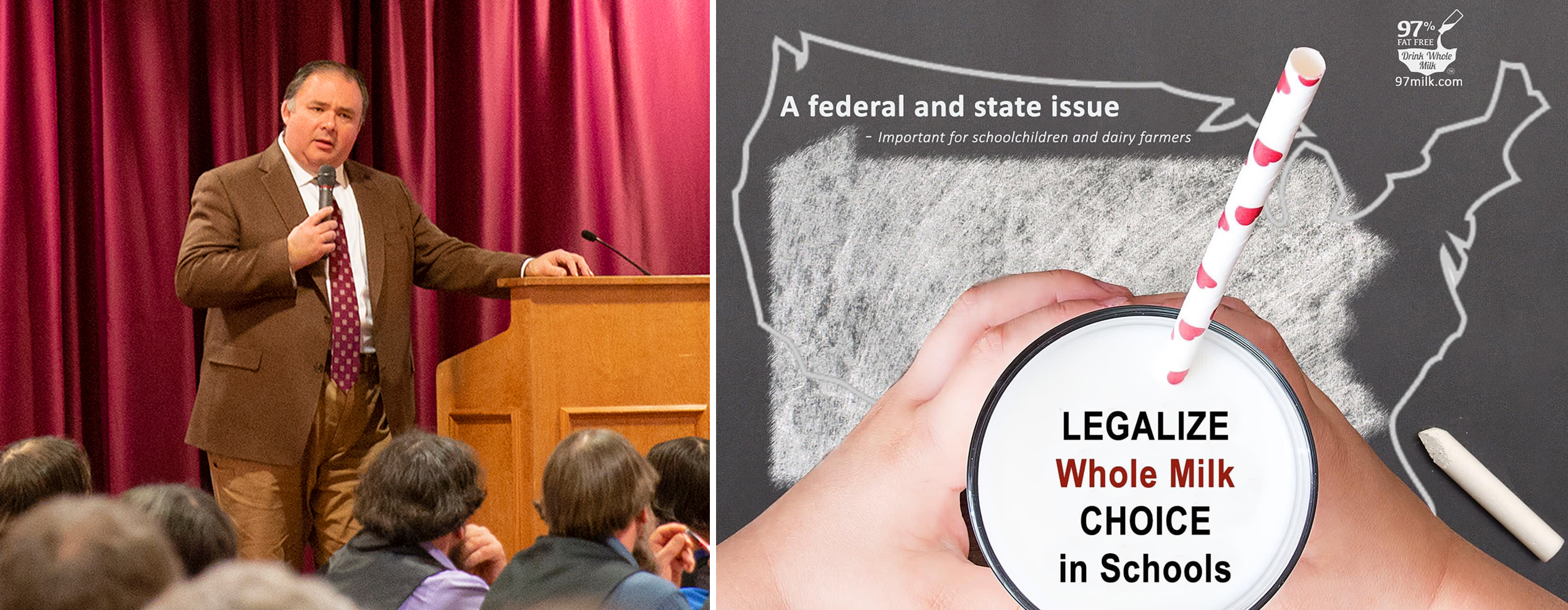
John Lawrence speaking to farmers at a winter meeting two weeks before he introduced HB 2397 Whole Milk for Pennsylvania Schools with 31 cosponsors.

By Sherry Bunting, Farmshine, March 25, 2020

HARRISBURG, Pa. — The Whole Milk for Pennsylvania Schools Act, H.B. 2397, has been officially introduced in the State House by author and prime sponsor State Representative John Lawrence (R-13th). 

Introduced with 31 cosponsors on March 17, the bill is now “pending” in the House Agriculture Committee. This is one of three dairy bills Lawrence has introduced this year.

The provisions of H.B. 2397 would become effective 30 days after passage and would include state notification of all Pennsylvania schools to alert them to the state’s provisions for the purchase and offering of whole milk and reduced fat milk to students, so long as this milk is produced by cows on Pennsylvania farms, bottled in Pennsylvania processing facilities and paid for with state or local funds.

According to Lawrence, there is broad support for the bill in the State House, and he has received favorable responses from members of the State Senate. He has heard from schools, organizations and individuals applauding the tenets of this bill over the past several weeks since circulating his cosponsor letter to colleagues.

When asked recently about the bill, Rep. Lawrence said he was tired of waiting for the federal government to act on this issue of ending the federal prohibition of whole milk in schools. 

After thinking about the dilemma for some time, he had what he described as divine inspiration a couple months ago to structure the bill as an “intra-state” jurisdiction under the 10th Amendment of the U.S. Constitution.

In fact, he thanks God for that inspiration to approach the bill as one that enables schools to voluntarily make choices and structure the voluntary provisions as being a wholly Pennsylvania deal.

“We have jurisdiction on this,” he states.

When milk produced on Pennsylvania farms and processed in a Pennsylvania plant is purchased by a Pennsylvania school with Pennsylvania or local funds, then the federal government has no jurisdiction over what can be offered to students, Lawrence explains.

Specifically, the bill would allow Pennsylvania school boards to utilize funds from state or local sources to obtain whole Pennsylvania milk or reduced fat Pennsylvania milk to provide or sell at a Pennsylvania school. 

In the bill, Pennsylvania whole milk is defined as at least 3% fat and Pennsylvania reduced fat milk is defined as 2% fat. They are further defined as “produced by the milking of cows physically located within the geographic boundaries of this Commonwealth, transported to a dairy processing facility located within the geographic boundaries of this Commonwealth, and processed as fluid milk into containers intended for distribution to consumers.”

The bill would also require the Secretary of Education to notify the superintendent or chief administrator of each Pennsylvania school to inform them of the provisions of the Act within 30 days of passage.

Further, the bill sets forth in Section 6 the right of civil action if any federal agency interferes by withholding or revoking school funds.

Specifically, this section would require the Office of Attorney General, on behalf of a Pennsylvania school, to bring a civil action against the federal government or any other entity to recover funds withheld or revoked as a result of an action taken by the school board to make Pennsylvania whole milk and 2% reduced fat milk available as choices under the “intra-state” — not interstate — provisions of the Act.

The bill also seeks a status report to the chairpersons of the House and Senate Ag Committees – no later than two years after passage. The report would be given by the Secretary of Education in consultation with the Secretary of Agriculture and the Pennsylvania Milk Marketing Board (PMMB).

This report would provide a list of Pennsylvania schools that have elected to provide or sell Pennsylvania whole milk and 2% milk, the approximate increase or decrease in the overall consumption of fluid milk at Pennsylvania schools after the effective date, and the actions taken by the Commonwealth to promote whole milk and 2% milk availability in Pennsylvania schools.

The Whole Milk for Pennsylvania Schools Act, H.B. 2397, includes an expiration section that would require the Secretary of Education to submit notice if/when Congress repeals sections of law pertaining to the National School Lunch Act that currently prohibit these milk offerings in schools or at such time that an update to the Dietary Guidelines has been published — that in either case would effectively end the federal prohibition of whole milk in schools and make these choices available nationally again.

Joining Pennsylvania State Rep. Lawrence as cosponsors of the Whole Milk for Pennsylvania Schools Act are Representatives Clinton Owlett (R-68th), Martin Causer (R-67th), Donald Cook (R-49th), Jim Cox (R-129th), Lynda Schlegel Culver (R-108th), Eric Davanzo (R-58th), Russ Diamond (R-102nd), Torren Ecker (R-193rd), Melinda Fee (R-37th), Nancy Guenst (D-152nd), Joe Hamm (R-84th), David Hickernell (R-98th), Doyle Heffley (R-122nd), Robert James (R-64th), Barry Jozwiak (R-5th), Robert Kauffman (R-89th), Ryan Mackenzie (R-134th), Steven Mentzer (R-97th), David Millard (R-109th), Brett Miller, (R-41st), Eddie Pashinski (D-121st), Tina Pickett (R-110th), Greg Rothman (R-87th), David Rowe (R-85th), Louis Schmitt (R-79th), Brian Smith (R-66th), Perry Stambaugh (R-86th), James Struzzi (R-62nd), Ryan Warner (R-52nd), and David Zimmerman (R-99th).

Lawrence said H.B. 2397 was intentionally numbered so that ‘97’ would be part of the bill number, reflecting the whole milk education efforts of the 97 Milk movement.

“I feel like we are going to see this bill get to the finish line for our Pennsylvania school children and our dairy farmers,” says Bernie Morrissey, chairman of the Grassroots PA Dairy Advisory Committee which organized petition drives with large numbers of  Pennsylvanians signing to support similar legislation at the federal level — Congressman G.T. Thompson’s Whole Milk for Healthy Kids Act.

“We can try to save everyone — and have been trying to do that for several years on this issue. But now, it’s time to focus on Pennsylvania. We can get this done in Pennsylvania and be a leader. This bill is brilliant, and a lot of people are grateful to John Lawrence for writing it,” Morrissey added.

“This is more confirmation of how important whole milk education is,” said 97 Milk chairman Gn Hursh, noting that as consumers have become aware of the benefits of whole milk and the federal prohibition in schools, they are joining farmers to seek these options for their children in schools.

In fact, two recent surveys show more parents choose whole milk and 2% milk for their families. A national Morning Consult survey for IDFA showed 78% of parents of school aged children believed whole milk or 2% milk to be most nutritious for their families. A national food preference survey for YouGov showed 53% of parents prefer whole milk for their children and only 23% preferred fat-free and 1%. 

USDA’s own data show a 24% decline in students selecting milk in the first year after the whole milk ban went into effect in 2012 and a 22% increase in discarded milk on top of that! It has only become worse since then. A recent school trial in Pennsylvania revealed a 52% increase in students selecting milk and a 95% reduction in discarded milk when students had an expanded choice that included whole milk. In that trial, students preferred whole milk 3 to 1 over the skimmed varieties.

Bottomline, milk’s unsurpassed nutritional benefits are only realized by students if they choose milk and actually consume it. 

Pennsylvania Farm Bureau is supporting H.B. 2397, according to Rep. Lawrence. “They called within an hour of seeing the cosponsor letter and said this has their full support,” he said.

PFB, along with members of the Grassroots PA Dairy Advisory Committee and 97 Milk, also testified in support of ending the federal prohibition of whole milk in schools during a Senate policy hearing in June 2021

Previously, the Pennsylvania Milk Dealers, Pennsylvania Dairymen’s Association and various other industry organizations have been on record supporting Congressman Glenn Thompson’s bill at the federal level, so the same should hold true for this bill at the state-level.

Stay tuned as the State of Pennsylvania buckles down to tackle the federal prohibition of whole milk in schools… let’s keep the momentum going.

-30-

The WHOLE story on IDFA’s school milk poll

The March 24 deadline is fast approaching to comment on future school lunch rules on milkfat and sodium. The dairy industry is focused on making sure 1% low-fat flavored milk is allowed after the next two years of ‘transitional’ flexibility. In fact, an IDFA poll of parents nationally and in New York City showed 85% of parents support the inclusion of 1% low-fat flavored milk as a school option. But here’s the WHOLE story from the poll — 78% of parents deem either whole milk or 2% as “most nutritious” for them and their families! But these were both dropped in 2008-10 as part of the meal and outright prohibited as an a la carte beverage in 2012. A 2020 paper in the Journal of Dairy Science reported just 66% of students chose milk in the 2014-15 school year compared with 75% in 2005. Low-fat 1% and fat-free milk were the rock-bottom vote getters among parents nationally and in New York City. So why in the world does USDA insist on maintaining its prohibition of whole milk and 2% milk? IDFA states that if all students were offered the type of milk they prefer, milk consumption might stop declining or increase. For a majority of Americans, the choice must include the whole milk option as well. Send your comment to USDA by https://www.regulations.gov/commenton/FNS-2020-0038-2936.

By Sherry Bunting, Farmshine, March 11, 2022

NEW YORK CITY – The International Dairy Foods Association (IDFA) announced “overwhelming support” by parents in New York City and nationally for the inclusion of 1% flavored milk in schools. But let’s look a bit deeper.

“Voters in New York City and across the country widely support offering low-fat (1%) flavored milk in public school meals,” the IDFA press release proclaimed about the new Morning Consult national tracking poll they commissioned.

“When asked about including low-fat flavored milk in school meals, parents with kids in public schools were supportive,” the IDFA press release states. “In New York, 90% of voters with kids in public school support including low-fat flavored milk in public school meals. Nationally, 85% of parents feel the same.”

But wait. Here’s the rest of the story… In the 5-part poll, parents in New York City and nationally nearly unanimously agreed that making sure meals are healthy and nutritious for children is a top or important priority.

Reading the full poll results at the link — https://www.idfa.org/resources/voter-polling-on-milk-in-school-meals-conducted-by-morning-consult, we find that nationally and in NYC, parents identified Whole and 2% milk as top choices for nutrition by a wide margin!

Nationally, a majority of parents with kids in school (78%) selected either Whole Milk or 2% reduced-fat milk as the most nutritious options for them and their families. Currently, USDA prohibits both of these choices — Whole (3.25%) and reduced fat (2%) milks — in schools.

Among the New York City school parents polled, 58% chose either Whole milk or 2% milk as most nutritious for them and their families.

Breaking this down, the national poll showed 43% believed Whole milk options to be the most nutritious for them and their families, while 34% of NYC parents chose Whole milk as most nutritious.

Nationally, 35% of parents believe 2% milk to be most nutritious, while among NYC parents that figure was 24%.

This means Whole and 2%, together, got the majority votes for NYC parents, and parents nationally.

How did fat-free and 1% low-fat milk rate above parents in the question about “most nutritious options”?

Of the parents polled nationally, 11% selected 1% low-fat milk and that figure was 12% in NYC.

The percentage of polled parents believing fat-free milk options were most nutritious was 7% nationally and 12% in NYC.

Author’s Note:

Schools should be allowed to offer children the preferred choices of parents by expanding offerings to include whole milk and 2% milk options!

Parents and other health advocates for children and teens know the powerhouse package that REAL WHOLE MILK delivers, and the benefits of milkfat in a healthy diet. But most parents still don’t know the federal government prohibits their kids from having this choice at school.

Bottomline: students (and their parents) should be able to CHOOSE whole milk for childhood nutrition at school. Read some of the big reasons why here: https://www.97milk.com/wp-content/uploads/Why-Whole-Milk.pdf

Send your comments asking USDA to end the whole milk prohibition by deadline of March 24, 2022 at this Federal Register rulemaking docket. https://www.regulations.gov/commenton/FNS-2020-0038-2936

Just keep it simple: Write who you are, why you care, and simply ask USDA to end the prohibition of whole milk in schools so children can choose the milk they love and that way consume it instead of discarding it, therefore receiving the 13 essential nutrients of concern, high quality protein, and other benefits we assume they are getting to be healthy, satisfied, and ready to learn.

Also, contact your Representative in Congress and ask him or her to cosponsor HR 1861, The Whole Milk for Healthy Kids Act, which is up slightly at 89 cosponsors from 31 states. This bill still has zero representation from the New England States as well as no Representatives yet from Delaware, South Carolina, West Virginia, New Mexico, Montana, North Dakota, Wyoming, Oregon, Colorado, Utah and Hawaii.

No matter where you are located, ask your member of Congress to sign on as a cosponsor! This is a bipartisan bill for a bipartisan issue that benefits children and farmers — Win. Win.

 -30-

Rep. Lawrence to introduce bill for Whole Milk in PA Schools

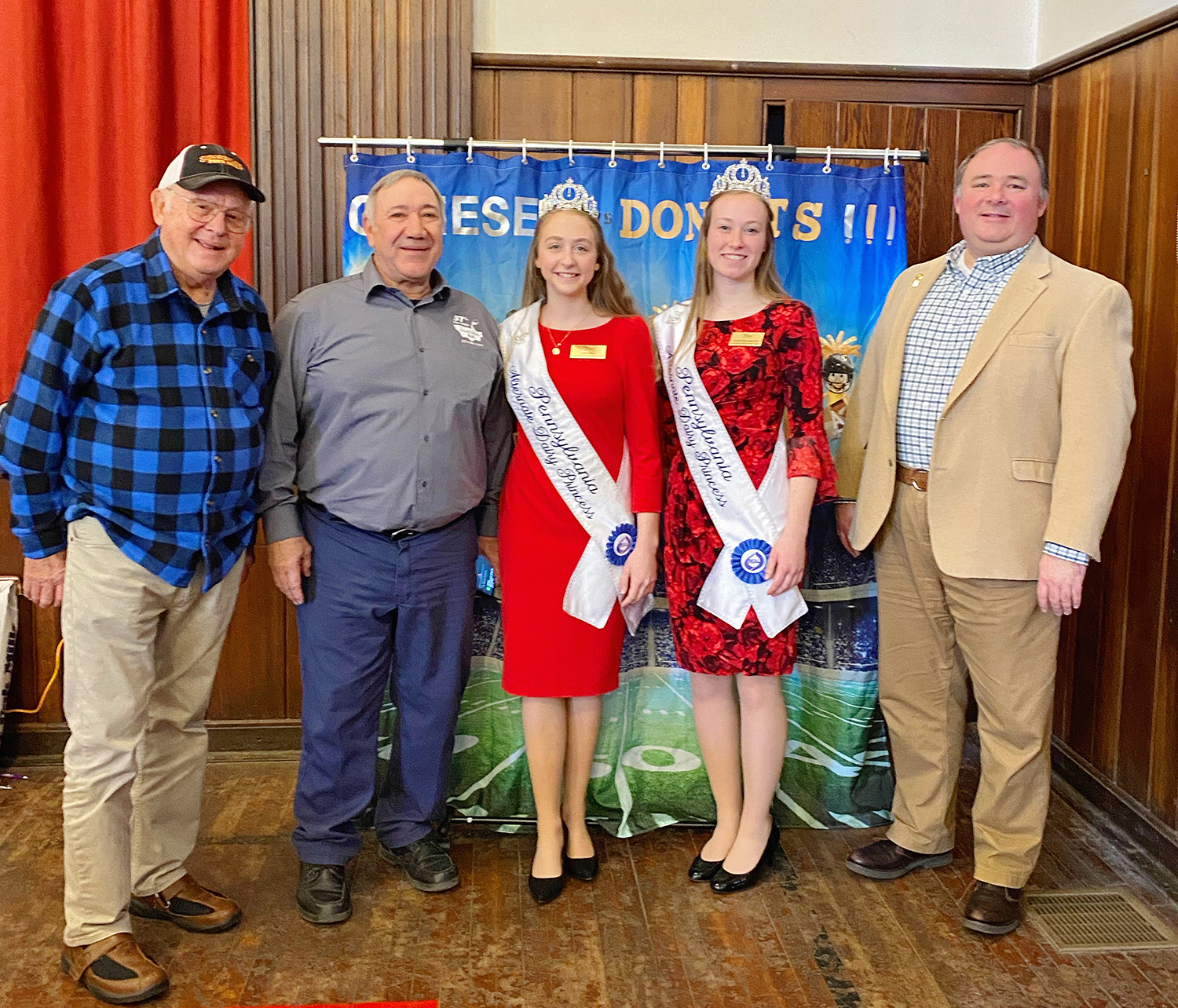
Rep. John Lawrence (right) talked about the Whole Milk in Pennsylvania Schools Act, which will soon be formally introduced in the State House. He was joined by (l-r) Bernie Morrissey, chairman of the Grassroots PA Dairy Advisory Committee, Nelson Troutman, 97 Milk Baleboard originator, Kelly Bliss, Huntingdon Co. Dairy Princess, and Crystal Bomgardner, Pa. Alternate Dairy Princess from Lebanon Co. Photo credit: Linda Gilbert

Dairy farmers hear ‘whole’ story: The 97 Milk effort and Pa. State Rep. Lawrence’s new bill

By Sherry Bunting, published in Farmshine, Feb. 25, 2022

BERRYSBURG, Pa. — A bill will soon be introduced in the Pennsylvania State House that would allow Pennsylvania schools to offer the choice of whole milk. The author of the Whole Milk in Pennsylvania Schools Act is Rep. John Lawrence. He circulated a cosponsors letter a few weeks ago.

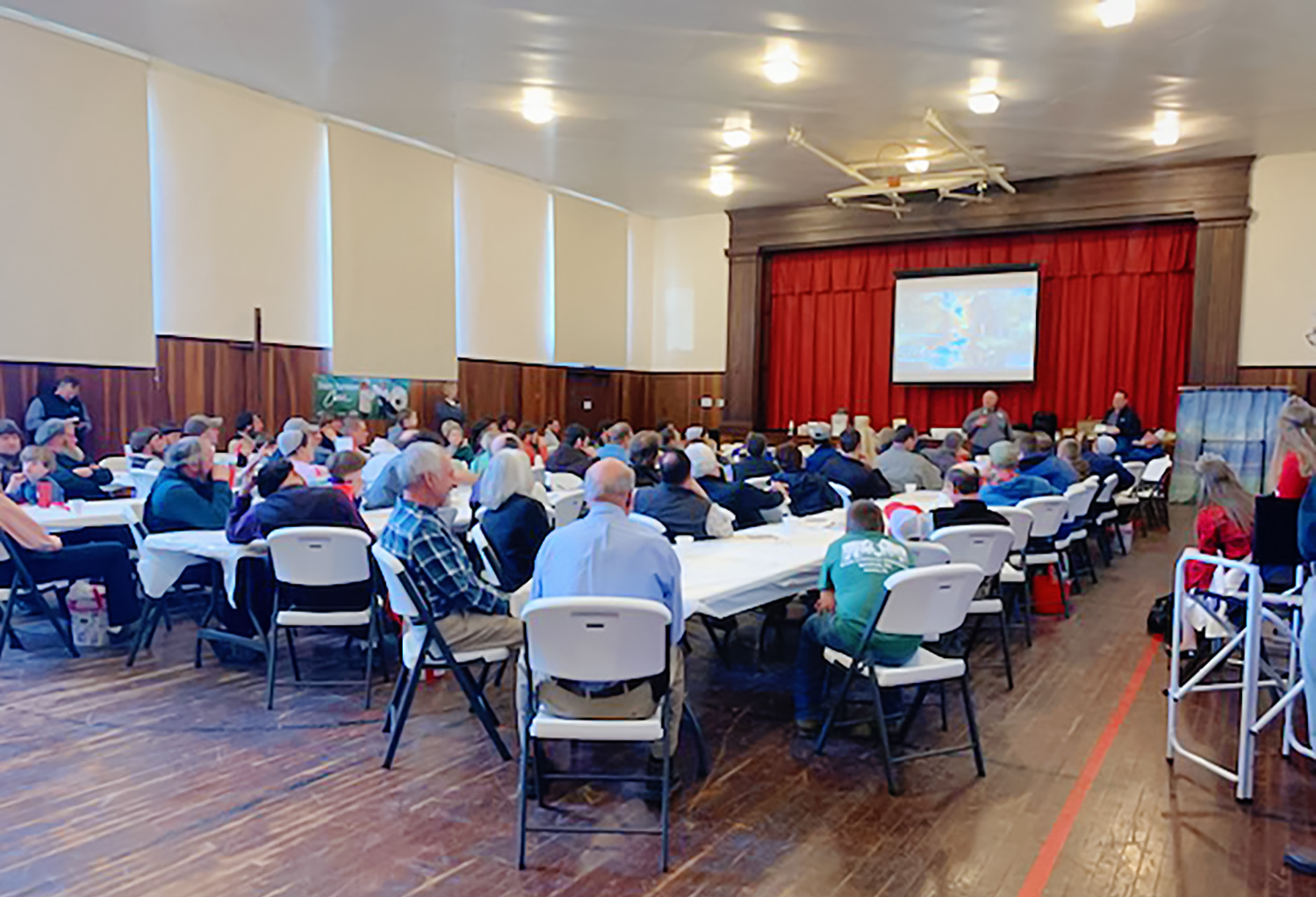
On Monday, Feb. 21, Lawrence talked about House Bill 2397 at an annual dairy day here at the Berrysburg Community Center in Dauphin County, Pa. The event, attended by over 100 producers and 30 vendors, was hosted by Great Creatures Veterinary Service as a customer appreciation luncheon and workshop.

Berks County dairy farmer Nelson Troutman — initiator of the ‘Drink Whole Milk 97% Fat Free Baleboards’ — was invited by veterinarian Dr. Joy Lenker to talk about the bale art and the progress of the whole milk education movement.

Bernie Morrissey, chairman of the Grassroots PA Dairy Advisory Committee, joined Troutman during his presentation, and they introduced Rep. Lawrence to share the good news about the Pennsylvania whole milk bill.

Lawrence, who represents parts of Lancaster and Chester counties, said he expects to officially introduce the bill with prime cosponsor Clint Owlett, representing Tioga County, when the Pennsylvania General Assembly returns to session in Harrisburg in a few weeks.

During a recent Farmshine phone interview, Lawrence confirmed that his cosponsor memo generated “good support” among colleagues and supportive responses from Pennsylvania Farm Bureau, several other farm organizations, some schools, and most importantly, from dairy farmers, who tell him they are “very grateful.”

Lawrence is concerned about dairy farmers across the state. He has been advocating for them for many years in the General Assembly. He has proposed several bills in the past on other issues related to the PMMB, over order premium distribution, and milk check transparency. Some that passed the House, did not get considered by the Senate before expiring.

“We have had some wins and some setbacks over the years,” said Lawrence. “But this whole milk bill is something I believe will get done. I think there is a lot of support for it and a lot of truth to what the farmers say — that they are losing a whole generation of milk drinkers. There are schools in Pennsylvania that want to provide this choice of whole milk for the kids.”

Lawrence said the bill is structured to deal with this as a state-level issue.

“We want the federal government to address this, to end their prohibition of whole milk in schools, but it has been quite a while now, and they are not addressing it… So we are going to see if we can address it for Pennsylvania,” he affirmed, adding that more details about the bill will be forthcoming when it is formally introduced.

In his cosponsor letter, Lawrence wrote that “due to federal regulations enacted under the Obama Administration, whole (3.25 %) and reduced fat (2%) milk are not served in schools today. Speak with any school cafeteria worker, and they will tell you students are not fans of skim milk. Speak with any dairy farmer in Pennsylvania, and they will tell you that this ill-fated federal directive of removing whole milk from schools is a top concern.”

He also cited studies about the amount of milk wasted at school.

In fact, the federal government did a before-and-after study comparing plate waste in 2011 vs. 2013 to gauge their 2012 ‘nutrition standards’ that reduced the allowable fat content in milk to fat-free or 1%, even for a la carte competing beverage options. This early USDA study showed an immediate 24% reduction in students selecting milk at school and a 22% increase in discarded milk among students who were served the required skimmed milks. 

Subsequent studies show the situation has only worsened over the past decade.

Lawrence’s cosponsor letter explains the mechanics of the state’s interest under the tenth amendment of the U.S. Constitution. 

The memo states: “In the near future, we will introduce the Whole Milk in Pennsylvania Schools Act. This legislation will ensure Pennsylvania students, at Pennsylvania schools, have the option to consume Pennsylvania whole and two percent reduced fat milk paid for with Pennsylvania tax dollars.”

Morrissey said this is welcome news for dairy farmers and the state’s dairy industry, not to mention for the schoolchildren.

He and Troutman were glad to be able to share the good news at the dairy day in Berrysburg.

Troutman showed the Channel 39 public television news video that aired two years ago featuring Troutman and Jackie Behr, marketing manager for the 97 Milk effort, as they explained how the movement got started and what was being accomplished at the start.

He updated attendees to where things are today as 97 Milk celebrated the start of its fourth year this month.

“There is so much to say, but we kept it light,” said Troutman in a phone interview. “I told them about the Pennsylvania Senate hearing back in June, how our committee testified about bringing back the choice of whole milk in schools. Senator Scavello (representing Monroe and Northampton counties) really liked the information on the 6 x 6 card Jackie Behr put together, telling what whole milk provides. I gave him one before the hearing, and he read it two times to be sure it was in the record.”

Troutman confessed he had no idea his painted round bale would lead to a milk education effort with a website, 97milk.com bringing increasing numbers of daily traffic, and social media platforms with monthly average reach of over 300,000 people, as well as some individual posts showing data reaching one million people. He thanks Behr and the 97 Milk board for that, and he thanks Farmshine for telling the story, so other farmers could get involved and bring their ideas.

“It is a team effort,” Troutman confirmed. This teamwork is helping get more cosponsors for the Whole Milk for Healthy Kids Act in Washington. The bipartisan bill was introduced in March 2021 by Rep. G.T. Thompson (R-PA) and Rep. Antonio Delgado (D-NY). It currently stands at 88 cosponsors from 31 states.

The teamwork also led to a 30,000-signature petition, multiple comment drives in USDA rulemaking, speaking engagements with ag and non-ag service groups, and a Pennsylvania school trial demonstrating a 52% increase in students selecting milk and a 95% reduction in discarded milk when students had the option of whole milk, with post-trial surveys showing whole milk was preferred 3 to 1 over low-fat 1% milk.

“I am a positive person, but after that Pa. Milk Marketing Board listening session in Lebanon three years ago, seeing we didn’t get anywhere on some things, I went home feeling like I lost my best cow. That’s the best I can describe it. I thought that listening session was going to break things open, but it didn’t,” Troutman told fellow farmers Monday. “I thought I had to do something, anything, so I painted a bale, and yes, well, this is what happened.”

He observed that one of the biggest things is how this movement is energizing dairy farmers, and agribusiness partners are joining in. There’s a renewed purpose.

“This opened people’s eyes. We finally have a way to promote whole milk, and that is spreading to other states, and we even hear from people in other countries,” Troutman said.

“It’s positive news. We need positive news, and the consumers, they want positive news too. They want to know about milk. We didn’t have a way to promote whole milk… until now. We lost a generation of milk drinkers, and we have to make up for that,” said Troutman. “I saw ADANE just did a webinar on whole fat dairy and mentioned the New Jersey Academy of Pediatrics and Nutrition. I didn’t get to watch it, but this is icing on the cake. We have to keep this going because we are finally starting to get somewhere, in the right direction.”

Nelson Troutman talks about the whole milk education effort and  97milk.com   Photo submitted

What does USDA’s ‘transitional’ standard on school milk REALLY mean?

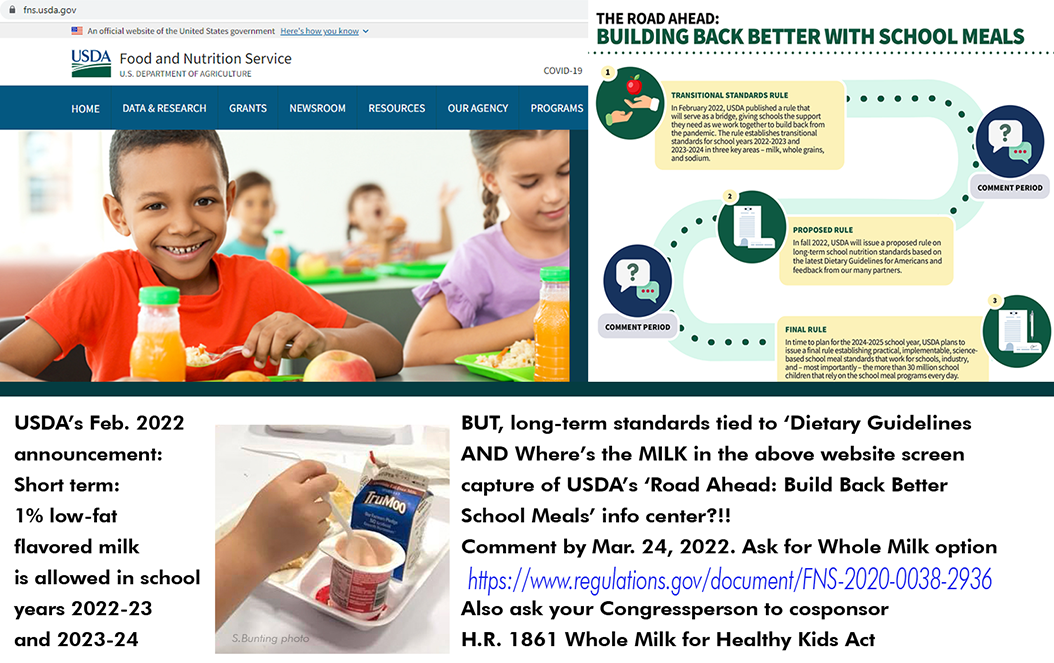
USDA announced a ‘transitional standards’ rule on Feb. 4 for milk, whole grains, and sodium for school years 2022-2023 and 2023-2024. In short, the transitional standards are only in place while USDA works with stakeholders to strengthen meal standards through a new rulemaking for the longer term. The proposed rule for the longer-term is expected in fall 2022 and will be based on the Dietary Guidelines for Americans 2020-2025 — effective school year 2024-2025. A “gradual implementation” plan for the long-term standards will be developed by USDA based on ‘stakeholder input.’ Read the transitional standards rule and comment here. Stay tuned for proposed long-term standards rule and comment period this fall. Even the American Association of School Superintendents (AASA) made a statement this week, believing the long-term standards will be ‘more stringent’ due to the Dietary Guidelines, and that “it is important to acknowledge that healthy meals are only healthy if students eat them.” That goes for the milk also. Milk consumption plummeted and waste skyrocketed since USDA’s 2012 fat-free/low-fat milk rules were set for both ‘served’ milk and competing a la carte offerings.

By Sherry Bunting, Updated (above) since published in Farmshine, Feb. 11, 2022

WASHINGTON — USDA announced ‘transitional’ nutrition standards on Friday, Feb. 4 that put low-fat 1% flavored milk back on the menu next school year, without the cumbersome waiver process. The announcement also delays the planned sodium reductions, helping the cheese side of school lunches. 

National Milk Producers Federation (NMPF) and International Dairy Foods Association (IDFA) came out with hearty applause for the news, thanking Congressmen G.T. Thompson (R-Pa.), author of the Whole Milk for Healthy Kids Act, and Joe Courtney (D-Conn.), author of the School Milk Nutrition Act, for their leadership on this issue through the years, using words that treat this USDA announcement as though it’s a done-deal, and all is good to go. 

But let’s hold our horses and examine the USDA announcement — described clearly as “transitional” based on schools “needing more time to adjust” post-pandemic. 

USDA stated that future nutrition standards will be proposed in the fall of 2022 as part of the administration’s “Build Back Better with School Meals, input will be gathered, and those will be the standards that go into place beginning with the 2024-25 school year. 

USDA also made it clear that these future long-term standards “will line up with the Dietary Guidelines” and input from schools and industry will be sought in “how to gradually implement them.”

In 2010, the Healthy Hunger Free Kids Act of Congress tied government food and nutrition programs, like school lunch, to the Dietary Guidelines. By 2012, under President Obama’s USDA — with Tom Vilsack at the helm then as now — had banned whole milk as an a la carte offering in the ‘Smart Snacks’ rules. At the same time, the Department required flavored milk to only be offered if it was fat-free and required unflavored milk to be either fat-free or low-fat 1%.

Milk sales plummeted and waste increased.

Then, the Trump-USDA in 2018, under Ag Secretary Sonny Perdue, “rolled back” some of the 2012 USDA standards, delaying the sodium rules and allowing low-fat 1% flavored milk to be offered through a waiver system at the state level. Some states, like Pennsylvania, made blanket waivers available, and many schools began offering low-fat 1% flavored milk over the next few years.

Then, a lawsuit took the Trump-era USDA to court for the rollbacks. The court ruled that the Trump-USDA did not use a proper public comment process before doing the rollbacks. So, beginning with the 2021-22 school year, the low-fat 1% flavored milk was again bumped out of school menus — except where waivers were sometimes granted for pandemic-related supply disruptions as justification for serving a higher fat milk.

Over the past year, USDA Food Nutrition Services has received comments about how to gradually implement nutrition standards to line up with the Dietary Guidelines on sodium, whole grains, and milkfat. Friday’s announcement on ‘transitional standards’ was accompanied by a detailed and lengthy rule that will be implemented July 1, 2022.

“USDA is giving schools time to transition from current, pandemic operations, toward more nutritious meals. In 2022, USDA will continue to prioritize supporting schools as they navigate the challenges of the pandemic and related operational issues,” the announcement said, adding that USDA “is also planning for the future by engaging with school meal stakeholders to establish long-term nutrition standards beginning in school year 2024-2025 that will be achievable.”

Ag Secretary Tom Vilsack was quoted in the announcement blaming the pandemic disruptions of the past two years for making schools “unprepared to fully meet those standards at this time” for milk, whole grains and sodium.

“These transitional standards are step one of a longer-term strategy to lean into the school meal programs as a crucial part of improving child health,” said Vilsack.

“Over the coming months and years, USDA will work closely with its school meal partners to develop the next iteration of nutrition requirements. We’ve got to find the right balance between standards that give our kids the best chance at a healthy future based on the latest nutrition science, and ensuring those standards are practical, built to last, and work for everyone,” Vilsack added.

The purpose of the “transitional” standards, according to the USDA announcement, is to “give schools clarity for the coming school years, allowing them to gradually transition from the extraordinary circumstances caused by the pandemic to normal program operations and meal standards that are consistent with the latest nutrition science, as required by law.”

Specifically, the transitional standards beginning with the 2022-23 school year are as follows:

1) Milk: Schools and childcare providers serving participants ages six and older may offer flavored low-fat (1%) milk in addition to nonfat flavored milk and nonfat or low-fat unflavored milk;

2) Whole Grains: At least 80% of the grains served in school lunch and breakfast each week must be whole grain-rich; and

3) Sodium: The weekly sodium limit for school lunch and breakfast will remain at the current level in SY 2022-2023. For school lunch only, there will be a 10% decrease in the limit in SY 2023-2024. (This affects school cheese).

The expressed linkage of long-term USDA nutrition standards to the anti-fat 2020-25 Dietary Guidelines was mentioned throughout the USDA announcement, giving an indication of where the school milk standards are headed, long-term.

That is, unless Congress acts to remove all doubt and make fuller fat milk — whole milk — a legal option for schools in the future.

For a true solution for the long-term, Congressional leadership is needed on the school milk issue.

-30-

U.S. Senate nutrition hearing seeks new national strategy

50-year crisis cited, but no mention of 50-year low-fat regime’s role

By Sherry Bunting, Farmshine, November 5, 2021

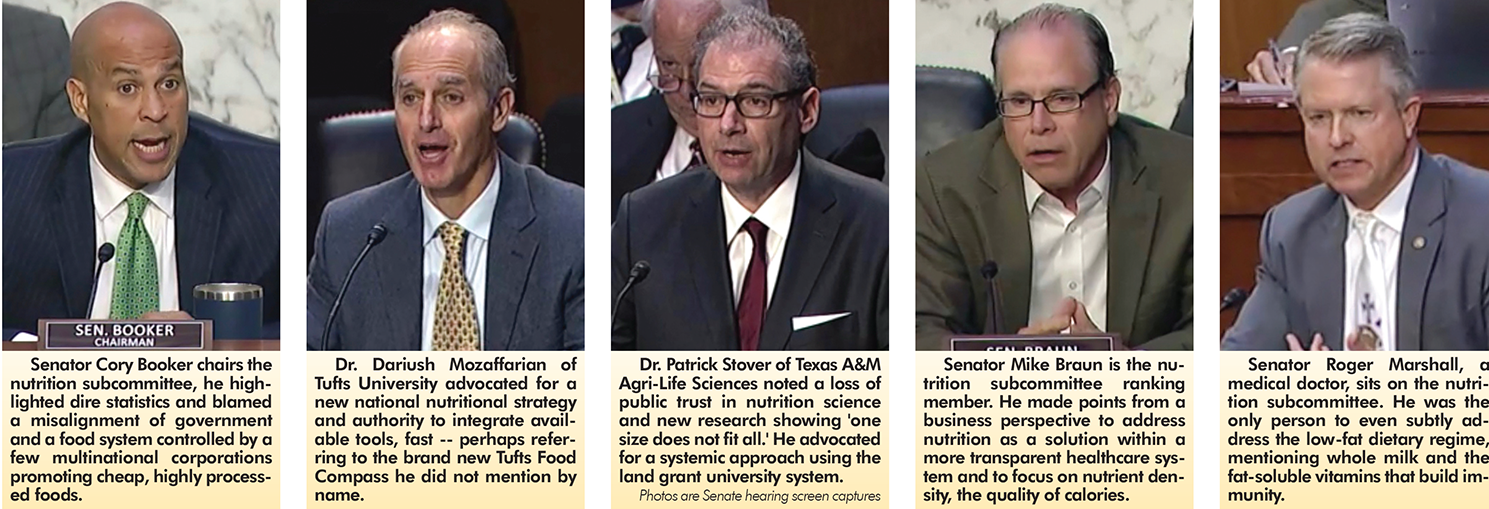
WASHINGTON, D.C. – “Half of the U.S. population is pre-diabetic or has type II diabetes, and one out of almost every three dollars in the federal budget goes to healthcare, with 80% of that spending on treatment of preventable chronic diseases,” said Senator Cory Booker (D-N.J.), chairman of Senate Ag’s nutrition subcommittee as he and ranking member Mike Braun (R-Ind.) began the hearing on the state of nutrition in America Tuesday, Nov. 2. 

Calling the situation a crisis, senators and witnesses cited statistics that have worsened over the past 50 years.

“Our healthcare costs today are 20% of GDP. In the 1960s, it was 7%. It has tripled in 50 years,” said Sen. Braun. In 1960, he said, 3% of the population was obese. Today it’s over 40%, with more than 70% of the population either obese or overweight.

“More shocking,” said Booker, “is that 25% of teenagers are pre-diabetic or have type II diabetes, and 70% are disqualified from military service” — with the number one medical reason being overweight or diabetic.

Witnesses and senators blamed the “epidemic” on a food system designed to solve 20th century problems of ending hunger by investing in cheap calories – especially carbohydrates. They indicated that 21st century goals should be focused on designing a food system that delivers nutrition and makes the nation healthier.

“We want to rethink the way we approach food and nutrition policy. Our lives literally depend on it,” said Sen. Booker, “This nutrition crisis we face is a threat — the greatest threat to the health and well-being of our country and a threat to our economic security and our national security.”

That’s why Senators Booker and Braun recently introduced bipartisan legislation to convene public and private stakeholders in what would be the second White House conference ever to be held on food and nutrition. The first was convened in the late 1960s, when then Senators George McGovern and Bob Dole formed a select nutrition committee in a time of food shortages and high prices.

That time-period was also when the precursor to the Dietary Guidelines was established, which by the 1980s had become the official and now notorious Dietary Guidelines cycle.

While Tuesday’s hearing continually hit this notion that 52 years later we have all of these devastating statistics, it was interesting that there was zero mention of the Dietary Guidelines. Those words were not uttered by any senator or any witness at any point in the over two-hour-long hearing.

Another item that did not pass through any lips Tuesday was the acknowledgment that 52 years of the low-fat dietary regime has prevailed and has progressively tightened its hold over school diets even as these statistics, especially on youth, have worsened into crisis-mode. 

The closest anyone got to mentioning dietary fat was when Senator Roger Marshall (R-Kan.), a doctor by profession, asked witnesses if they thought the CDC missed an opportunity to do public service announcements about “nutrition and building up our own immune systems” during the COVID-19 pandemic.

He talked about volunteering in the ICU and ER of a south Kansas hospital in the spring of 2020 when COVID was sweeping the land.

“There were eight ICU beds and 11 patients, all in their 50s, and all had diabetes or pre-diabetes. Immediately, I called the CDC and said, ‘this virus is going to assault this country.’” He observed that our rates of morbidity and mortality are higher with this virus than some other countries because almost half of the population is diabetic or pre-diabetic.

Sen. Marshall voiced his frustration: “We’ve had a year and a half of this virus, and I thought this might be an awakening for this country, that if we had a better, healthier immune system, that’s how you fight viruses.”

One of the five witnesses — Dr. Dariush Mozaffarian of the Tufts University Friedman School of Food and Nutrition Policy – responded to say that alongside developing vaccines, treatments and guidelines for social distancing, “the huge additional foundational effort should have been to improve our overall metabolic health through better nutrition. So, every time we talk about vaccines, social distancing, mask wearing, why aren’t we talking about nutrition?”

“Everything we need to know about nutrition I learned from my mother and my grandmother,” said Sen. Marshall. “We need to be using our medical assets for nutrition education. Doctors need to understand that Vitamins D, A, E and K are fat-soluble vitamins, so we need to be drinking our whole milk and looking at these general concepts.”

This was the hearing’s only – and subtle — reference to dietary fat. It was the only, but quiet, nod to any suggestion of the impact of federal government restrictions on the diets of children during school hours while their rates of obesity and type II diabetes continue to rise to epidemic proportions. Not one witness or senator delved into this topic in any substantial way.

Throughout the hearing, that seemed to focus on a new paradigm in food and nutrition, there were also strong references to a key part of the problem — the food industry is controlled by a handful of large multinational corporations providing nutrient-poor, addictive and ultra-processed foods.

“Farmers answered the call of a growing population and issues with malnutrition 50 years ago. Through innovation, agriculture makes more from less and works to protect our soils along the way. We’ve made progress but are still geared to address caloric intake, not the content of the calories,” said Sen. Braun. 

He focused his comments on the healthcare industry being the place to make new investments in nutrition as a preventive solution and indicated SNAP purchase restrictions are in order.

Dr. Angela Rachidi, doing poverty studies at the American Enterprise Institute said putting SNAP program restrictions on sugary beverages and incentives for purchasing fruits and vegetables would be positive steps to show SNAP is serious about nutrition. She referenced studies showing that three of the five largest purchase categories with SNAP dollars are sweetened beverages, frozen prepared meals, and dessert items.

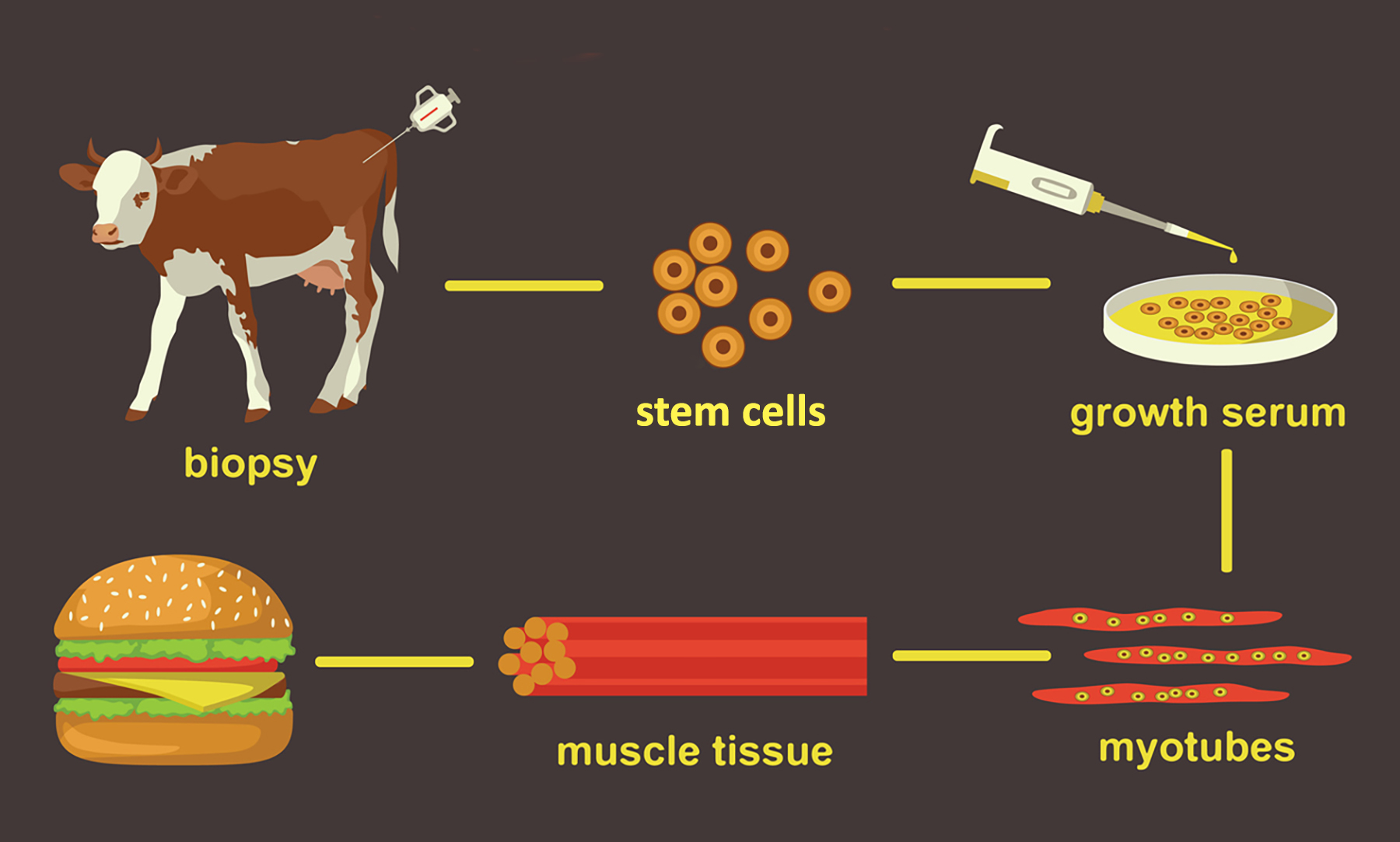
Mozaffarian was the first of the five witnesses. He did not mention his Tufts University “Food Compass” project by name, which was published three weeks ago, nor did he mention the $10 million grant received three weeks ago from USDA to develop a “cultivated meat industry,” including assessment of consumer attitudes and development of K-12 education on cell-cultured meat.

“We are on a path to disaster,” he said, calling type II diabetes America’s “canary in the coal mine,” on which the U.S. spends $160 billion annually.

Describing current food and nutrition policy as “fragmented and inefficient,” Mozaffarian said: “Nutrition has no home, no body for focus or leadership across the federal government.”

Mozaffarian’s six recommended government actions paint a picture of a centralized national structure and authority for food and nutrition policy with emphasis on integration of research, the healthcare system, programs like school lunch, and ramping up new innovation startups entering the food system.

He stressed his belief that a “real national strategy” is needed, one that “reimagines the future food system.” He said the science and tools are already available to do this, to integrate into existing programs and make changes – fast.

Perhaps the “tools” Mozaffarian was referring to are within the new Tufts Food Compass he helped create, which ranked “almondmilk” and “soymilk” ahead of skim milk and far ahead of whole milk. It also puts chocolate milk and some types of cheeses near the bottom of the ‘minimize’ category, along with unprocessed beef. 

In fact, the only high-scoring dairy product found in the ‘encouraged’ category was whole Greek yogurt. Cheerios and sweet potato chips ranked higher than dairy products, including the whole Greek yogurt.

Also testifying was Dr. Patrick Stover of Texas A&M’s Agri-Life Center. He noted the public’s “lack of trust” in nutrition science. 

He stressed that the nation’s land grant universities are “a network of extraordinary resources, a national treasure” that benefits from having public trust but lost federal investment levels over the years. 

Stover said Texas A&M is now launching an institute for advancing health through agriculture as well as an agriculture, nutrition and food science center for non-biased research on the human, environmental and economic success of proposed changes.

He supports a “systemic approach to connect people to food and health,” an approach that involves everyone from farm to consumer. He said Agri-Life is positioned to lead such an effort through the land grant university system. 

Stover noted scientists involved in the precision nutrition initiative at the National Institutes of Health are starting to understand how individuals interact with food in relation to these chronic diseases.

“One size does not fit all,” he said.

Witnesses Dr. Angela Odoms-Young, director of Food and Nutrition Education in Communities at Cornell, as well as Dr. Donald Warne, director of public health programs at the University of North Dakota School of Medicine, both talked about the cultural aspects of food. They referenced differing experiences of populations separated from lands and cultures where food was accessible and how certain demographic populations are being targeted by fast-food advertising that is leading to higher rates of chronic diet-related diseases among native Americans and people of color.

Poverty and reliance on cheap highly processed foods was part of that discussion.

“Poor diets and overconsumption of calories are a major crisis,” Dr. Rachidi stressed as a former deputy commissioner of New York City social services overseeing the SNAP program. “Nutrition assistance programs have mixed success” providing food security but also contributing to the problem of poor nutrition.

She said current nutrition policies lack a cohesive strategy. On the one hand harsh restrictions in some programs and no restrictions in others.

“We have to acknowledge the reality, the billions we spend to improve food security are used in a way that is a major contributor to poor health,” said Rachidi.

At the conclusion, chairman Booker stressed his belief that there is a misalignment of government.

“The farmer’s share of the consumer dollar from beef to broccoli has gone down 50% in a food system where everyone is losing,” said Booker. “We are losing the health of our country, seeing the challenges with farmers and the disappearance of family farms, the issues of food workers, what’s happening with animals and the environment. Let’s not be fooled. This is not a free market right now.”

He noted that farmers are “stuck in mono-cropping” without incentives to move to more regenerative agriculture. “We love farmers. They aren’t the problem. We have to figure out a way to align incentives with policy decisions because it is out of whack.”

Asked by Booker to give a ‘business perspective,’ ranking member Braun concluded that the best place to implement a solution is to do it where the most money is being spent on the problem and that is the healthcare system. Food is a bargain, which addresses hunger, “but we need to reconstitute the quality of the calories,” he said, putting the emphasis on the nutrient density of foods.

-30-

Questions of science abound, public is clueless, yet USDA seeks ‘public comments’ on labeling of lab-grown cells by Dec 2!

This infographic is an oversimplified laboratory depiction of the ‘cell cultured meat’ process. On Sept. 3, 2021, USDA Food Safety and Inspection Service (FSIS), which will oversee its harvest, processing, packaging and labeling, announced proposed label rulemaking and a 60-day comment period (NOW extended to Dec. 2, 2021) to prepare for market entry. FDA will oversee the sourcing, collection and growing of this un-natural protein process. These products are expected to hit the U.S. market in 2022 and we might not know if they are included as extenders or replacements if labeling is poor. Istock image

UPDATE: The comment period at the Federal Register has been extended an additional 30 days to December 2, 2021

By Sherry Bunting, Farmshine series

WASHINGTON, D.C. — How should ‘cell cultured meats’ be labeled? That’s a loaded question considering how many unknowns surround the commercial production of these lab-grown lookalikes — starting with what are they, really?

USDA Food Safety and Inspection Service (FSIS) announced a 60-day comment period as part of its advance notice of proposed rulemaking in the Federal Register Friday, Sept. 3. The agency seeks “specific types of comments and information that will inform the process of developing labeling regulations for meat and poultry products made using animal cell culture technology.”

Comments are now due by Dec. 2, 2021 and must reference Docket FSIS-2020-0036.

They can be submitted directly here or by going online at the Federal eRulemaking Portal at https://www.regulations.gov and following the on-line instructions; or mail comments to Docket Clerk, U.S. Department of Agriculture, Food Safety and Inspection Service, 1400 Independence Avenue SW, Mailstop 3768, Washington DC 20250-3700. 

In a press release, FSIS officials said ‘cell culture meat’ is a terminology the federal agencies use internally, but this is not necessarily the nomenclature to be used in consumer product labeling.

The actual Federal Register notice is lengthy, explaining that the labels for cell culture products fall under FSIS jurisdiction and “will be subject to premarket review under the same process as other special statements or claims. This will ensure that labeling for products developed using cell culture technology are not false or misleading, that labeling requirements are applied consistently as these novel products enter the marketplace, and that the label provides the necessary product information for consumers to make informed purchasing decisions.”

To-date, FSIS has already provided for a “generic approval” of labeling features, statements, and claims based on “demonstrated prevalent industry understanding of the effective application of those features, statements, or claims and consumer understanding of labeling statements.”

However, the document also notes that there is currently “no widespread industry understanding of the labeling requirements for cell cultured meat and poultry products” and that “consumers have not yet had experience reading these types of labels.”

Furthermore, FSIS will have to determine a process for approving additional claims on the labels of these new and combined products.

The docket language suggests that FSIS already considers these proteins analogous as derivatives of the animals from which the original cells are sourced. But are they? Even scientists debate this assumption.

As billionaire-invested startups have joint-ventured with some of the world’s largest food processing companies, much money is being thrown at certain technology hurdles to avoid having to explain the unsavory aspects of the cell culture process to the public — as these lab-grown un-natural proteins inch their way closer to commercial market entry, especially on boneless products like ground beef and chicken tenders and patties.

The label rulemaking step comes two years after the FDA and USDA entered into a joint agreement to each take responsibility for different halves of the ‘cell culture’ process.

The March 2019 agreement came after a summer 2018 public meeting previously reported in Farmshine, for which thousands of comments and two petitions have been logged. 

In 2018, the U.S. Cattlemen’s Association (USCA) filed a petition requesting that FSIS limit the definition of ‘‘beef’’ to products derived from cattle born, raised, and harvested in the traditional manner, and thereby prohibit foods comprised of or containing cultured animal cells from being labeled as ‘‘beef.’’ The petition similarly requested the same for the definition of “meat” and other common meat terms on labels.

In 2020, FSIS received a petition from the Harvard Law School Animal Law and Policy Clinic requesting adoption of a labeling approach that “respects First Amendment commercial speech protections” and specifically establishes “a labeling approach that does not require new standards of identity and does not ban the use of common or usual meat or poultry terms.”

This came after over 6000 comments were received on the U.S. Cattlemen’s petition. 

In the current rulemaking docket, FSIS states that the comments came from trade associations, consumer advocacy groups, businesses operating in the meat, poultry, and cultured food product markets, and consumers with “most comments opposing the (cattlemen’s) petition overall; however, nearly all generally agreed that cultured meat and beef should be labeled in a manner that indicates how it was produced and differentiates it from slaughtered meat products.”

To some, that kind of interpretation would mean ‘cultured beef without the cow’; to others a better definition would be ‘un-natural beef grown from gene-edited, growth-hormone-promoted laboratory cell cultures.’

Here’s the problem. The lengthy Federal Register docket does very little to explain the real process by which cell cultured un-natural protein is designed and grown before it is harvested, processed and packaged.

The docket includes a description of ‘cell culture’ meat and poultry that fails to specify any of the characteristics, even those that are being questioned by experts in science journals – things that consumers should know and understand via crystal-clear differentiation.

For example, cell culture fake-meat comes from stem cells that are identified and separated from muscle tissue of cattle, pigs, poultry and certain fish. New “continuous cell lines” are being developed from these stem cells using “transformation” processes (gene editing) to make them “immortal.” 

In other words, cells normally have a finite end to their growth, but continuous cell lines — under the right controlled environments — are ‘designed’ to keep dividing and growing, continuously, like a malignancy, without an end point.

Also, the ‘growth medium’ for these ‘cell cultures’ contains Fetal Bovine Serum (FBS), growth promoting hormones, and, when needed, antibiotics and fungicides. The controlled environment provides the exchange of oxygen and carbon dioxide akin to animal respiration, and the temperature must be warmed constantly to be the internal temperature of the bovine to keep the cells from dying. At a certain juncture in the process, the growing cells must be ‘fed’ amino acids and carbohydrates.

Reviews of chemical replacements for Fetal Bovine Serum (FBS) are mixed. Some showed the continuation of cell growth was not consistent. Others showed changes happened within the cells when the growth medium included artificial replacements for the FBS. Portions of the veterinary and medical industries also rely on FBS for culturing, and some reports indicate increased importation of FBS, already, for those uses.

Any label claims about nutrition, environmental footprint, possible changes to the actual cells due to the composition of the growth medium, and so forth, are all based on smaller-scale laboratory observation and scale speculation, while consumers have literally zero understanding of the process, and some scientists even question whether the nutrition profiles, taste and texture are similar enough to meet consumer expectations for real meat and poultry. 

These are standards of identity issues.

Here’s the other key issue for USDA’s rulemaking on ‘cell cultured meat’ labeling… USDA Food Safety and Inspection Service (FSIS) only regulates the back half of the equation. In March 2019, the agreement between USDA and FDA was to “jointly oversee the production of human food products made using animal cell culture technology and derived from the cells of livestock and poultry to ensure that such products brought to market are safe, unadulterated and truthfully labeled.”

Specifically, this agreement delegates the oversight of cell collection, growth and differentiation to the Food and Drug Administration (FDA). Then, at the stage of “harvest” FDA transfers oversight to USDA’s FSIS, which oversees the cell harvest, processing, packaging and labeling of the products.

According to the FSIS rulemaking notice, the agency believes its current food safety and HACCP systems for real meat and poultry are already “sufficient” to be “immediately applied” to the harvest, processing and packaging of these lab-grown lookalikes and that they are only looking at this final labeling piece. This gives us a clue where the labeling is headed.

Specifically, FSIS seeks comments and information from stakeholders over the next 60 days regarding these key areas of the labeling process:

— Consumer expectations about the labeling of these products, especially in light of the nutritional composition and organoleptic qualities (taste, color, odor, or texture) of the products;

— Names for these products that would be neither false nor misleading;

— Economic data; and

— Any consumer research related to labeling nomenclature for products made using animal cell culture technology.

It will be difficult for true consumer advocacy groups (not meat and poultry industry trade groups who are mostly on board for the mix-and-match) to fully consider their views on the above questions. This is further blurred by the oversimplified FSIS description of the cell culture process that does not include any reference to specific characteristics.

For example, the definition does not mention hormones as inputs, it mentions ‘growth factors’. It doesn’t talk about continuously dividing cell lines, but rather ‘creating food’.

In another section, it doesn’t mention FBS, hormones, antibiotics as inputs but rather simply states: “cells are retrieved and placed in a controlled environment with appropriate nutrients and ‘other factors to support growth’ and cellular multiplication. After the cells have multiplied, ‘additional inputs such as growth factors,’ new surfaces for cell attachment, and additional nutrients are added to the controlled environment to enable the cells to differentiate into various cell types.”

The use of innocent code words belie the specifics. 

Of course, states FSIS about the process: “Once produced, the harvested cells can be processed, packaged, and marketed in the same, or similar, manner as slaughtered meat and poultry products.”

Nowhere in this description does it mention the gene editing of the cells to get them to transform for continuous multiplication and growth, nor what evidence exists that consuming such cells is safe. Consumers will want to know what they might be consuming once the world’s largest meat processors begin to use cultured cells as real meat extenders, diluters and substitutes.

Nowhere in this description does it mention the hormones and growth promotants that are the necessary “growth factor inputs” because the cells are growing on their own without the animal’s body, designed by God, to provide the natural hormones for natural growth with natural end points.

Nowhere in this description does the docket mention other clear differences between ‘cell cultured’ un-natural protein vs. real natural meat and poultry. The description suggests they are ‘designer’ derivatives of the real thing, opening the door to claims of being more efficient with less environmental impact. Based on what? A reduction in cattle and other livestock numbers?

Like we’ve seen in dairy with plant-based fakes and lack of standards enforcement by FDA, these ‘novel’ products will get to do the more-than / less-than comparative marketing off the real natural standard while consumers assume all other aspects are equal – when clearly they are not.

Scientific journals such as Frontiers in Nutrition have published scholarly articles pointing out the speculation involved in what this process will look like at commercial scale and what impact it will have on the nutrient characteristics, especially micronutrients like iron and B12, that come from the animal’s interaction with its natural environment. (Even the scaffolds the cells grow on will have methods for stretching cell blobs to simulate movement.)

Some scholarly articles point out that even the environmental claims are suspect because land and water use comparisons for cattle are predominantly what is used in feed production. The lab-grown cell cultures will also have to be “fed”. But they won’t spend part of their ‘lifecycle’ grooming carbon-sequestering grasslands or contributing to planet health in the biogenic carbon cycle.

Furthermore, writes one scientist, the warming required for these cell cultures to grow in bioreactors also create CO2 emissions that are long-lived — potentially adding to the buildup of long-term GHG, whereas the methane emitted from real cattle is short-lived and in fact stable and declining when viewed on a total nutrients per animal basis vs. history. This means, what is seen as a reduction in CO2 equivalents for methane based on the short-term heat-trapping side could be more than lost on the long-term CO2 buildup side, a tough fix down the road.

The problem with climate and environmental label claims is that they are based on speculation about unknowns for un-natural cell culture proteins and are compared to only part of the real story about real natural livestock.

All of these unanswered questions should be part of any USDA FSIS rulemaking process on labeling.  These proteins should be labeled as ‘experimental’ and ‘un-natural’ until processes are widely known and understood by scientists, agencies, industry and consumers.

In the Sept. 2 press release, USDA Deputy Under Secretary for Food Safety, Sandra Eskin, states that, “The (proposed rulemaking) is an important step forward in ensuring the appropriate labeling of meat and poultry products made using animal cell culture technology. We want to hear from stakeholders and will consider their comments as we work on a proposed regulation for labeling these products.”

Perhaps what USDA needs to hear from commenters over the next 60 days is that there is not enough public information about how these un-natural proteins are sourced, grown, and gene-edited — or their true nutritional and environmental profiles — to call them beef or meat with a simple qualifying statement few will truly understand.

Proponents of labeling cell culture proteins as meat because the cells are derivative are already whining to FSIS about how new labeling procedures or standards of identity would “stifle innovation.”

Individuals, businesses and organizations should be standing up for the consumer’s right to know what they are consuming and what production processes they are supporting – un-natural cell factories or natural meat raised by farmers and ranchers. There are also consumer health and nutrition questions on the FDA front end that the labeling needs to address accurately on the FSIS back end.

Just because the initial cells come from a cow or a chicken or a pig, doesn’t mean the un-natural ‘culturing’ process and resulting blobs of cells, once consumed, will behave in our bodies like — or contain the same properties as — natural muscle meat from a cow or a chicken or a pig.

Processors will be able to swap a percentage of this for that and barely change their labels if new standards or full descriptions are not used. 

Labeling should not give the appearance that this is simply meat without the animal. Some would argue this is Frankenfood. Some would argue this is experimental protein that should have to go through rigorous safety tests on the long-term impacts to health and nutrition. But the climate urgency of the United Nations Food Summit this month is already alluding to fast-tracking these “innovations”, applauding Singapore and China for moving forward most aggressively… to save the planet of course.

Perhaps the question to ask is this: How will labeling clearly differentiate so consumers have a clear choice and farmers and ranchers have a real chance… 

The dairy industry is facing this music on its own score with the FDA currently evaluating standards of identity for milk and dairy and looking at the new bovine DNA-altered yeast/fungi/bacteria excrement posing as dairy protein analogs without the cow. Through a process that is in some ways different and in other ways similar to cell culture proteins, the bioengineered yeast excrements are being called “designer proteins from precision fermentation.” 

The latest marketing twist is to say the bioengineered yeast are “10 to 20 times more efficient feed converters than cows.” These proteins are already being marketed to global processors of dairy foods as ‘stretchers’ and ‘functional’ ingredients, even as ‘carbon footprint enhancers.’

The economic concern for producers on both counts – meat and dairy – is dilution of their products and captive supply price-control of their ‘markets’.

The concern for consumers is the long-term healthfulness and safety of these ingredients and the increased potential for global food control in the hands of a few, with China already figuring prominently in the protein concentration manufacturing industry, globally.

This labeling discussion is too important to ignore, too important to allow oversimplification. Some in the industry say we must encourage and work beside these new forms of food production to end hunger, control climate change and feed everyone in the future. But the foundation premises of these beliefs are not settled science. 

The simple play here, by the tech sector to align and dominate the food industry, is to position these un-natural proteins as helpful analogs grown or cultured or fermented without the animals, that these products are needed to supplement animal-sources and reduce environmental impact of livestock, that climate change urgency requires regulatory fast-tracking, and that simple process-qualifiers on a label will differentiate it while making it palatable to consumers. 

Will consumers be led to believe these “innovations” are in all other ways the same as the real thing… when in fact they are not?

-30-