ESL milk panel: Innovation? Market optimizers?

Dairy checkoff: ‘If we focus on whole milk, we miss these market optimizers’ Really?
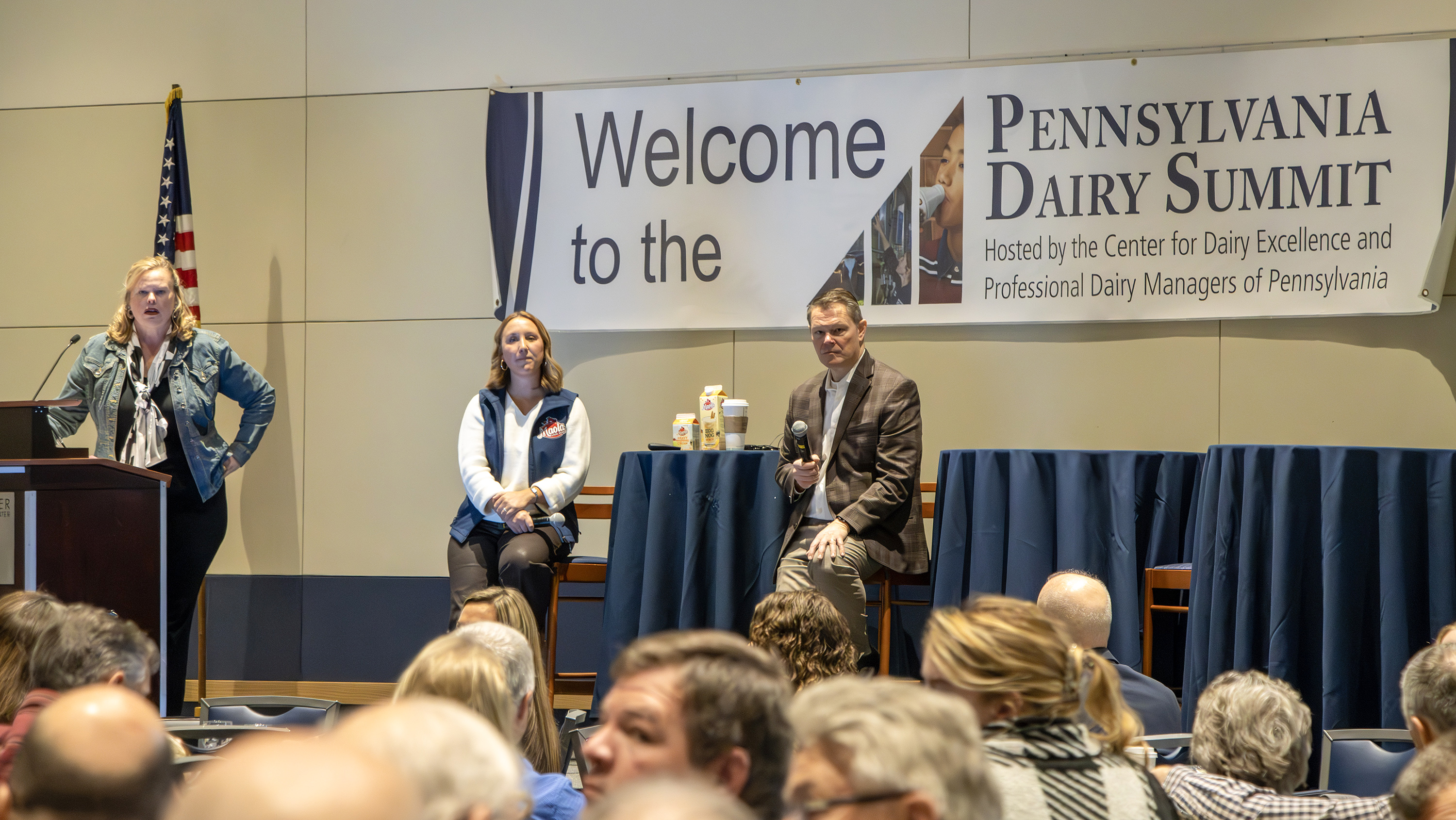
At the 2025 Pennsylvania Dairy Summit, Paul Ziemnisky, DMI’s head of wellness, innovation, and business development, and Rebecca Pfeffer, Maola brand manager, with moderator Amy Mearkle (left) spoke about fluid milk innovation in which extended shelf life (ESL), otherwise known as ultra pasteurized (UP) milk, is seen as the gateway to new products aiming to meet ‘functional needs’ of consumers.

By Sherry Bunting, Farmshine, March, 2025

STATE COLLEGE, Pa. – Food-as-medicine, food-and-medicine, fun-and-portable, young kids talking about pre-aging, on-the-go snack and beverage convenience, the quest for guilt-free ways to unwind with fewer calories than wine, the growing double-income-no-kids (DINK) consumer landscape that is focused on wellness, consumer shifts from coffees to teas, the surge in protein demand, and the growth in sales of lactose-free milk… 

These are some emerging trends mentioned during a panel about extended shelf life (ESL) milk as the gateway to dairy checkoff’s Milk Molecules Initiative during the Pennsylvania Dairy Summit last month.

In the Feb. 21st Farmshine, we brought you part one, a panel overview in this three-part series. In this second installment, we dig into what Dairy Management Inc (DMI) is doing with protein in the fluid milk space, and the technologies they are working on to separate molecules.

This public launch of the Milk Molecules Initiative (MMI) comes after 10 to 15 years of work through the pre-competitive industry collaboration vehicle – The Innovation Center for U.S. Dairy, a 501c6 established by DMI in 2008.

What we’ve learned is that MMI — as a fluid milk strategy — began even before the formation of DMI’s Fluid Milk Innovation Task Force seven years ago. It goes all the way back to 2010, right about the time whole milk choice was abolished in schools.

This strategy has been developed to discover, strip out, and repurpose the “functional benefits” of specific bioactive compounds, or molecules, in milk. The concept goes back to the early alliance between Fonterra and DMI, with headquarters less than three miles apart in the suburbs of Chicago around O’Hare Airport.

This strategy has been under development via research grants from USDA, NIH, and the National Dairy Council to the Dairy Research Institutes at four university locations, including the Barile Lab at the University of California-Davis. There, researchers have worked on isolating compounds from both human and bovine milk, and more recently, student researchers have been working on a DMI project “building a digital ecosystem and platform for these milk compounds.”

The Feb. 2022 memorandum of understanding between DMI and Mayo Clinic in Rochester, Minnesota, is tying-in the human health linkages to specific bioactive compounds in milk, and the Feb. 2024 DMI partnership with PIPA, an artificial intelligence (AI) platform, is accelerating the knowledge gain in how to break down milk’s so-called “bioactive family tree” to leverage functional milk products with new health benefits.

“We are finding the molecules in the whole milk matrix and picking things that are on the ‘whey stream’ as one area of focus, such as stripping out the lactorferrin,’” said Dairy Summit panelist Paul Ziemnisky, head of wellness, innovation and business development for Dairy Management Inc. (DMI), who has spearheaded the work of the Fluid Milk Innovation Task Force.

“We have partners talking about building a lactoferrin plant centered on just one of thousands of molecules in milk. We are looking at how to protect this molecule so it doesn’t lose its bioavailability, so we can put it back into dairy (post-processing),” he said.

Ziemnisky observed how past checkoff messaging has touted things like: “chocolate milk as a recovery beverage.”

Today, he said, “We’re going beyond that. We’re looking at ways to add milk to milk and to use these concepts to give it a different look and to capture huge value potential.”

How does DMI plan to partner with industry to capture this value? By linking milk and technology to create new products.

According to Ziemnisky, the MMI is looking aggressively at encapsulation and separation technologies as well as drying technologies that can be patented while testing the concepts with consumers to “learn how to talk about it.”

“If we focus on whole milk, we miss these market optimizers,” Ziemnisky declared. “Whole milk is for the 17% of traditionalists. We must innovate this category. We’re giving consumers a reason to understand what they need.”

He says MMI and ESL are pathways to get “milk” into more top-demand moments to capture a larger share of the $159 billion total beverage category.

(More ultra processed beverages are just what global consumer packaged goods companies are famous for. But is this what consumers really want? And will the ‘huge value potential’ trickle down to farm milk checks?)

According to Ziemnisky, there is at least $2 billion in new investment coming into the beverage space across geographies. “But it’s not your father’s Oldsmobile. Those new plants are filtration and separation, and we can add functionality to it.

“There are things we know of that we can’t even talk about yet,” he said as he gave a snapshot of where MMI is, and what is yet to come.

He cited a proliferation of ESL milk beverages that are mainly lactose-free, high protein milks as the gateway to molecular separation. Examples included the ESL capabilities at the Maola plant in Philadelphia, the national launch of Milk50 by DFA, the new nutrition line of beverages developed by Dairy Gold, Nestle’s new line made exclusively for Target, and others.

Asked if these new products are taking sales away from non-milk alternatives or traditionally branded milk, Ziemnisky said DMI’s work with MilkPEP shows that the plant-based beverages – on a volume and value basis – are “over-shelved.”

“They haven’t grown their category, their volume is declining. Those guys are eating themselves — going after each other. They’re not going after us anymore because they can’t. We win with nutrition and value. When we see all the innovation that is coming into dairy, we’re taking our space back by meeting the functional needs of the consumer. The quality of the protein is in demand now,” he said, confirming data showing that, “People are coming back to us because of the nutrition and the quality of the protein.”

During questions, he dug into the health and wellness “playbook” that checkoff has created with the help and blessing of USDA and has put into the hands of the top people at all of the big companies in food processing and retailing. 

“We’ve traditionally undersold our nutritional benefits, and that’s changing,” he said.

Where MMI comes into the picture is to identify the bioactive molecules for separation and marketing linked to specific health claims that can go on a label.

A graduate student in the audience said the presentation gave her “a lot of hope in the future as a scientist.” She asked if DMI has noticed any difference in regional trends related to consumers, and specifically wondered what is happening in California?

Ziemnisky said California was moving the other direction. “They like to try things out there,” he said, explaining that the dairy industry is so volume- and scale-focused that pilot products are not the norm. 

“California is coming back. California has assets that do smaller runs to try things. Last year, California grew (beverage milk sales) at a faster pace, whereas the Northeast market is so heavily regulated,” he said, adding that government regulation puts pressure on local retailers who want to try things.

DMI’s role is to test and learn, he explained: “We help processors prove these markets to retailers. Value-add is 30% of the dollars in the fluid milk category today. We went to 30% from just 10% just 10 years ago. We are targeting both volume and value with our retail and direct sales teams.”

One attendee asked what checkoff can do about the out-of-stock issues at retail, noting that perhaps fluid milk sales would increase if the dairy cases were consistently well-stocked.

“When we ask the store people, they say we don’t do the orders, it all comes from above us,” the questioner said.

Ziemnisky replied: “They are not telling you the truth. The real out of stock rate nationally is 3%. The problem is they are not managing their inventory. The inventory is there, but not the labor.”

“What we run into is the problem is store help,” said John Chrisman of ADANE, jumping into the conversation, noting new laser-system camera technologies are coming within the next five years to issue alerts about what is “flying off the shelves.”

In the meantime, he told attendees to report out-of-stocks to ADANE so they can get it resolved.

Another question asked was how farmers can feed or manage their herds to hit higher levels of functional bioactives like lactoferrin.

Ziemnisky said that’s a question for the milk buyers’ field service personnel, but in general, feeding cattle to hit higher component levels will raise the functional level of milk molecules like lactoferrin.

This reporter asked Ziemnisky what DMI is doing to know if there is any change in the protein structure with the further processed options: “How are we protecting that message on whey protein by protecting its structure through the ultra pasteurization process?”

(The only published research we could find was an NIH study showing heat and mechanical processes of ESL packaging change the structure of the protein, namely the whey protein.)

Ziemnisky replied that DMI is “doing significant work” on the nutrition research side to prove the efficacy of dairy’s high quality protein vs. other proteins. 

“And on the product science side, we’re investing significantly in everything from the clarity of protein, so you can put it into other products, to the quality as it goes through different processes that it stays stabilized. We work with the industry on what are the needs we can solve,” he assured.

On follow up questioning about protecting the protein, he added that, “Encapsulation is just one technology we’re doing to preserve the bioactive pull, and we have other things underway as well. We also look at the byproducts. What do we do with lactose coming through on the lactose-free? What do we do with the permeates on the cheese, the passive whey? These are where we’re doing work to create products from the bioplastics all the way to the functional ingredients.”

Bottom line, he said: “Whey was the bastard child, and now it is the largest gaining market share because of demand for high quality proteins. We are seeing the fractionation piece of this, the precision nutrition, the new players coming in and doing research on different compounds, driving whey to where it is today vs. 20 years ago.”

With an estimated 6300 molecules in milk identified by artificial intelligence, all located within the 13% of milk that is the solids, Ziemnisky expressed excitement about the future.

“We are at the cusp of this, and with our artificial intelligence partnerships, we are getting the learnings in 2 to 3 years that used to take 10 years,” he suggested. “This is moving fast toward a sustainable future with zero-waste circular milk plants.” 

-30-
Details shared on DMI’s Milk Molecules Initiative

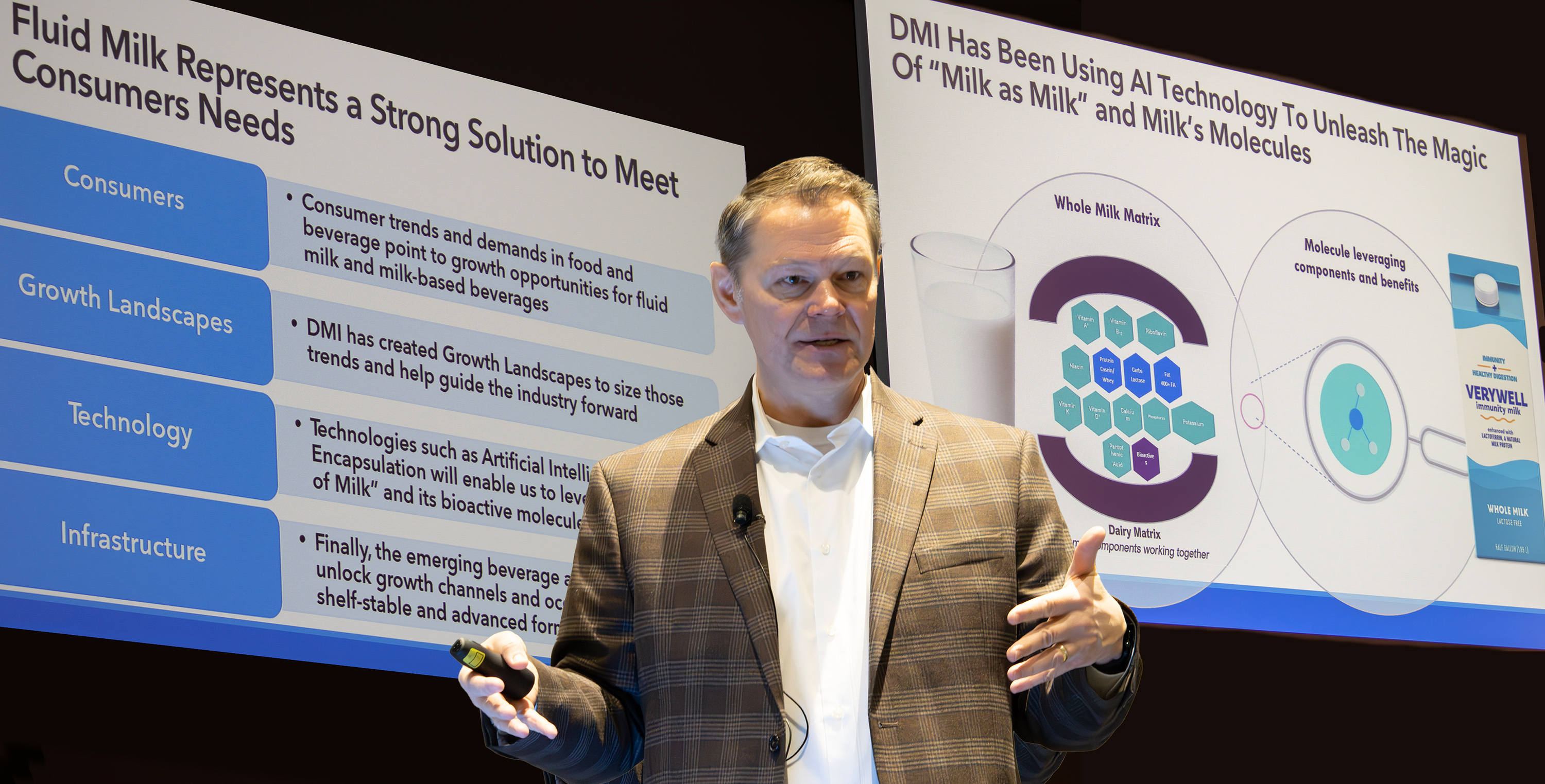
Paul Ziemnisky reported that DMI has implemented the Milk Molecules Initiative, or MMI, which focuses on the functional benefits in milk and uses their proprietary AI model to accelerate research and development to identify the molecules, create prototypes, and bring to market health and wellness branded value-added dairy beverages, using ESL (extended shelf-life) and shelf stable milk as the base.

By Sherry Bunting, Farmshine, February 2025

STATE COLLEGE, Pa. — Forward-looking presentations from farm to processing and promotion were highlights of the 20th Pennsylvania Dairy Summit attended by over 350 people at the Penn Stater Conference Center Feb. 5-6.

Many questions and much discussion came from the general session panel on the second day, entitled “Emerging Market for Fluid Dairy: Aseptic Milk and Milk Molecule Maximization.” 

Sponsored by American Dairy Association Northeast, it was presented by Paul Ziemnisky, the head of wellness, innovation and business development for Dairy Management Inc (DMI), and Rebecca Shaw Pfeffer, brand manager for Maola Local Dairies — positioned as “embracing innovation and pursuing new market opportunities for fluid milk.”

Several attendees expressed how uplifted they were by this presentation. Others had thought-provoking questions that were not entirely answered.

DMI has had a seven-year partnership with the industry through the Fluid Milk Innovation task force’s response to fluid milk demand “that has struggled.” The response has focused on milk molecule separation for value-added growth – all of which starts with extended shelf life (ESL), ultra-pasteurized, aseptic, shelf-stable milk, as the base beverage or gateway to the opportunities.

The bottom-line is dairy checkoff is focused on guiding the industry into new spaces in the beverage category, such as health and wellness. DMI develops concepts and prototypes to help guide industry investments, using its proprietary artificial intelligence (AI) database to “unlock the growth opportunities.”

Ziemnisky reported that DMI has implemented the Milk Molecules Initiative, or MMI, which focuses on the functional benefits in milk and uses an AI platform for dairy research and development. 

He said DMI’s AI model has identified 6300 molecules in milk, and the MMI is just getting started on what to target, and how.

“We are seeing growth in ultra-pasteurized and value-added, and we are taking our space back with the molecules and magic of milk,” said Ziemnisky, who oversees DMI’s domestic growth programs, much of it hinging on checkoff-funded health and wellness research, including 41 active projects with Mayo Clinic.

Part of this work is identifying the health and other associations linked to specific molecules, like lactoferrin. “We identify them and size the trends to see how to attack the spaces,” he said.

MMI is the innovation plan to get dairy past the 15% it currently holds of the $159 billion retail beverage category. To that end, Ziemnisky talked about changes in technologies that DMI is working on to “take advantage of the bioactives in milk through separation and put them back in milk or other products, using AI to accelerate our learning, faster.”

He confirmed $10 billion in new processing coming online in the U.S. in the next two years, saying “a lot of this is in the fluid milk space, using filtration and separation for functionality.”

DMI has broken the market into three categories: snacking and entertainment, vital performance, and clinical cuisine. Ziemnisky spent much of his time on the latter as the new and growing ‘food as medicine’ trend.

He talked about DMI partnering with the Calm App to produce a prototype that would add the separated molecule of tryptophan to ESL milk, for a prototype ‘calm’ or ‘sleep’ beverage.

However, Ziemnisky spent much of his time talking about the lactoferrin molecule and the technology to encapsulate and separate it during dairy processing to be added to milk to make “immunity milk” with a Very Well brand prototype.

He talked of Nestle’s new ESL lactose free milk, marketed as high protein, low sugar, called Pioneer Pastures, and available only at Target, as well as DFA’s new Milk 50 beverage as slim and fit.

He talked about how shelf-stable milk is the vehicle to deliver wellness or vitamin claims, like has been done with water drinks.

DMI is also working on bringing MMI into the arena of competing with bone health supplements in the vitamin aisle.

“We’ve baked the cake and are looking for the products to use this technology to steal market share from these areas,” he said.

“We’re looking at the molecules in the whole milk matrix,” he explained, highlighting lactoferrin with 1758 health associations in the scientific literature. 

“But you’d have to drink 20 glasses of milk, so we’ll take it out and put it back into one glass of milk and call it ‘immunity milk,’” he said.

In fact, DMI has created a ‘family tree’ of milk’s natural bioactives to then pick channels, to size the growth potential, design prototypes, and look for partners.

According to Ziemnisky, DMI has 46 proposals for women’s health, alone, and there is talk of building lactoferrin processing capacity as this molecule is also being looked at for beauty and skin health.

“But we have to make sure it doesn’t lose its bioavailability in the processing,” he said, referencing the encapsulation technology, similar to what is used to make infant formula, which is needed “to protect the molecule, and put it back into dairy.”

By combining milk with MMI technology, Ziemnisky said a molecule can be targeted, extracted, and then added back into the milk at a higher volume for a wellness claim.

“Now we can marry it out to the big retail beverage growth spaces, where there is $159 billion in consumer spending to show the industry where we (milk) can play,” he said. 

“We’re adding milk to milk with some of these concepts, with a different look and a  huge value. We are testing concepts with consumers and learning how to talk about it, and patenting our technology for our farmers,” he continued. 

“People ask, why not just promote whole milk?” Ziemnisky noted. 

His answer? “Only 17% of the market is ‘traditionalist.’ We have to innovate the category and do the research to understand what our consumers need. We’ve been baking the cake, working with the industry, doing the concepts to gain share in the top demand-moments that we only have a 15% share of now. MMI represents a really strong opportunity for us to do that.”

Extended shelf life, ultrapasteurized, and aseptic shelf-stable milk processing is the gateway to this ‘promised land,’ according to Ziemnisky, and DMI is testing proof of concept, working with startups and processors to get geared up to move prototypes from concept to consumer.

“People are realizing the value of milk,” he said. “Our biggest opportunity is making sure there is a good intro marketing plan for retailers to drive the products. If we can win the first six months, we usually can stay on the shelf. That’s our biggest opportunity to make sure they have a plan to drive awareness and trial the products.”

DMI and MilkPEP are working with companies and retailers on this, providing tools and tactics to get the higher-level consumer engagement. This includes developing the sell-story to new buyers.

“Milk is on fire in the category, and we often look at conventional milk, which is 82% controlled by the retailer,” Ziemnisky stated, emphasizing that DMI tells processors that they have to educate the retailers. “Using our analytics, there is a piece of winning even on the conventional milk side in this trajectory. Everything we’ve touched in the industry has grown.”

He showed the value-added products on the market today that were prototyped through checkoff, including high protein, lactose free, and flavored.

“Conventional has held us back because, again, we have to get the retailers using the health and wellness playbook to educate the consumers,” Ziemnisky said, noting that value-added is more than 30% of the fluid milk category dollars  and when he started at DMI nearly a decade ago, it was less than 10%. (Note that value-add products are more expensive, so dollar growth does not necessarily correspond to volume growth, and that conventional whole milk is already a large volume of the category that has been consistently growing).

In part two from this discussion, we look at what DMI is doing with protein in the fluid milk space, and our question about what DMI is doing in terms of research to ensure protein structure is protected from impacts of ultra-pasteurization.

What’s the future for fluid milk?

Fluid milk sales are up, Whole Milk for Healthy Kids Act is moving. Meanwhile industry globalists put big bets on ESL, shelf-stable, with favor from Vilsack  

By Sherry Bunting, Farmshine, October 18, 2024

EAST EARL, Pa. — Protein is all the rage right now, and consumers are turning back to real milk as they realize its natural high quality protein benefits. Year-to-date fluid milk sales continue to outpace year ago, and that’s good news. Here are some key factors in the future of fluid milk in the U.S.

Fluid milk sales up!

July’s total packaged fluid milk sales more than recovered the June slump — in a big way, and August looks promising too.

USDA estimated packaged fluid milk sales at 3.4 billion pounds in July, up 4.3% year-on-year (YOY). This amplifies the pivotal year-to-date trend above year ago for the first time in decades (except the 2020 pandemic year).

Specifically, USDA’s Estimated Fluid Milk Product Sales Report for July, released in late September, noted conventional fluid milk sales total 3.7% higher YOY, with organic up 11.7%.

Conventional unflavored whole milk sales were up 4.7% YOY in July, while organic whole milk sales were up 17.1%.

Flavored whole milk sales were mixed because these sales rely upon what processors are willing to make and offer on store shelves, not necessarily reflecting what consumers want to buy. When fewer packages of whole flavored milk are offered, the full potential of sales are restrained.

Year-to-date (YTD) sales of all fluid milk products for the first seven months of 2024, at 24.7 billion pounds, are up 0.7% YOY, adjusted for Leap Year. Of this, YTD conventional whole milk sales for the first seven months of 2024, at 8.8 billion pounds, are up 2.1% and organic whole milk sales at 914 million pounds are up 12.6%.

The August report to be released in the coming weeks is shaping up similarly. August Class I utilization pounds reported last week by USDA are up 1.1% YOY and 1.1% YTD (Jan-Aug).

Making more fat, importing it too?

Meanwhile, the monthly World Agricultural Supply and Demand Estimates (WASDE) released Oct. 9 reduced its milk price forecasts for the rest of 2024 and into 2025, expecting Class III prices to fall from September highs as cheese price declines are expected to more than offset the higher whey prices.

This report is looking at all the major new cheese capacity coming online in the next 12 months, which is expected to saturate the cheese market to drive prices lower so that U.S. cheese makers can be globally competitive and continue exporting record amounts of cheese.

But is the milk available to do this? Likely not without robbing from Classes I, II and IV channels. Still, the WASDE forecasts lower Class IV prices also due to the abruptly declining butter price being only partially offset by the higher nonfat dry milk prices.

In short, dairy farms are making higher-fat milk, and the food industry is importing more milkfat, especially in the form of whole milk powder. WMP imports have been up by a record amount YOY in each of the past four years, especially 2024.

Restoring whole milk choice for kids!

Now would be a particularly good time for whole milk choice to be restored in our nation’s schools since we apparently have too much milkfat and not enough skim. Given this scenario, how can anyone in this industry still believe the whole milk in schools would hurt the industry’s ability to make enough butter and cheese. 

Unless it is excess butter and cheese that is needed to push prices down in order to continue beating record exports at reduced prices paid to farmers. 

Getting whole milk choice into schools would help. IDFA has been touting the Whole Milk for Healthy Kids Act. NMPF says they are on board too. This means the industry is united, right?

What are the chances that GT Thompson’s bill to bring whole milk choice back to schools will finally make it all the way to the President’s desk?

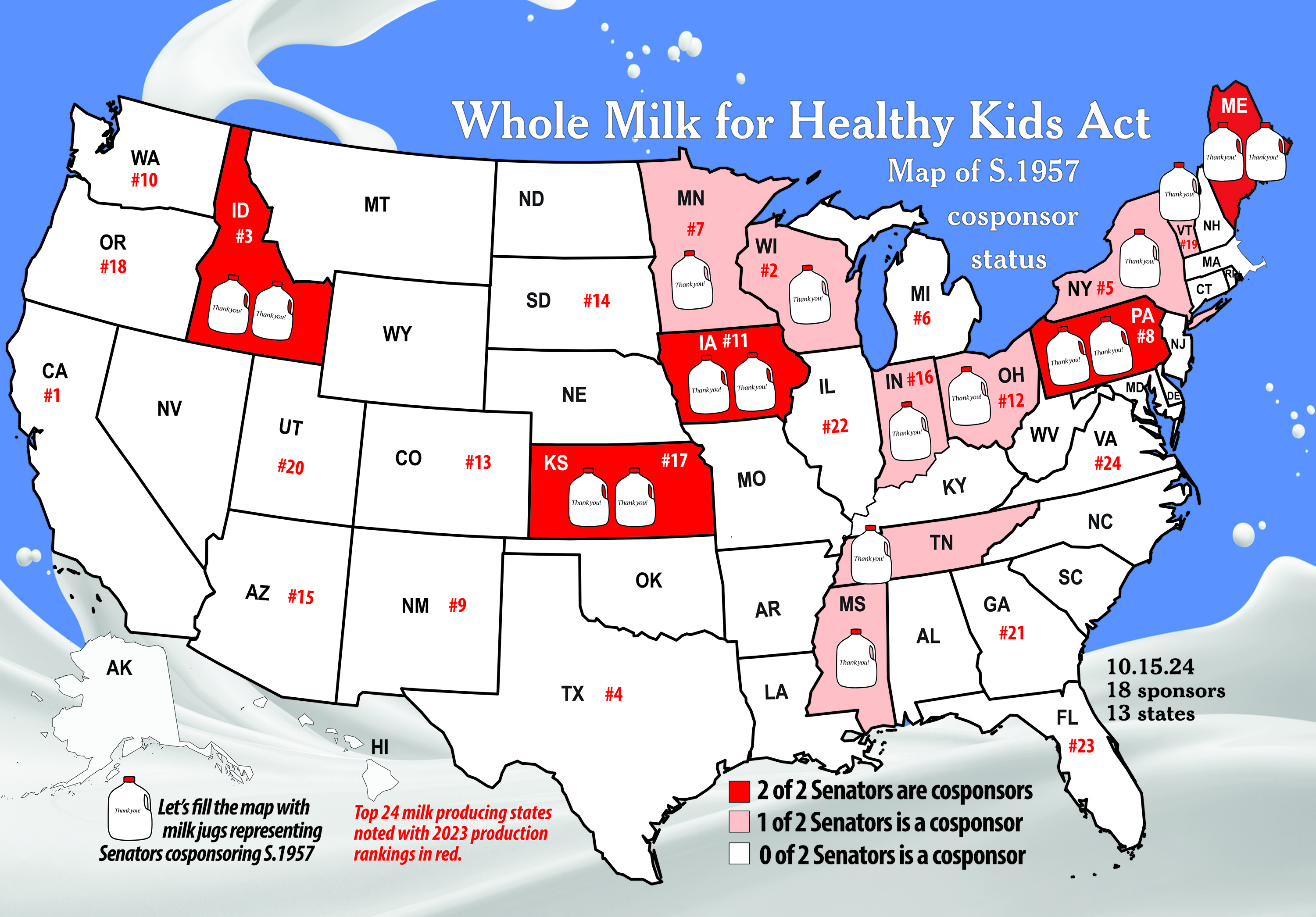
For starters, it passed the House by an overwhelming bipartisan majority last December. The Senate bill, S. 1957, has 11 Republicans, one Independent and five Democrats signed on, including notable Democrats such as Amy Klobuchar of Minnesota, Peter Welch of Vermont, Kirsten Gillibrand of New York, and John Fetterman of Pennsylvania who chairs the Senate Ag Subcommittee on Nutrition. 

The main sponsor is Republican Senator Roger Marshall of Kansas, a doctor. States represented are Pennsylvania, Vermont, Wisconsin, Idaho, New York, Iowa, Ohio, Indiana, Tennessee, Maine, and Mississippi.

In fact, Pennsylvania now has both Senators signed on. Senator Bob Casey Jr. (D-Pa.) is late to the party, but he has finally signed on as a cosponsor of S. 1957 on Sept. 19. It’s nice to see both senatorial milk jugs filled on the map for the Keystone State, but the bill needs more cosigners to fend off the blockade by Senate Ag chairwoman Debbie Stabenow (D-Mich.).

GT has included the Whole Milk for Healthy Kids Act in the House Ag Committee-passed farm bill. Word from Washington over the past few weeks is that a new farm bill is expected to get done after the elections in the lame duck session, and that GT will fight to keep the Whole Milk for Healthy Kids Act in the bill. Let’s hope so.

USDA: two movers for Class I?

Also related to Class I fluid milk sales, the dairy industry awaits a final decision on USDA’s proposed changes to federal milk pricing formulas, which includes a surprise for fluid milk: splitting the baby and adding a fifth class of milk in the form of two Class I mover announcements each month. 

The hearing record is woefully inadequate. No proposal. No evidence. No testimony. No analysis. No parameters. No definition. Even USDA’s own static analysis shows these two movers would be as much as $1 or more apart in any given month.

Fresh, conventionally processed (HTST) milk would go back to being priced by the the higher of the Class III or IV advance pricing factors to determine the Class I skim milk base price portion of the mover. 

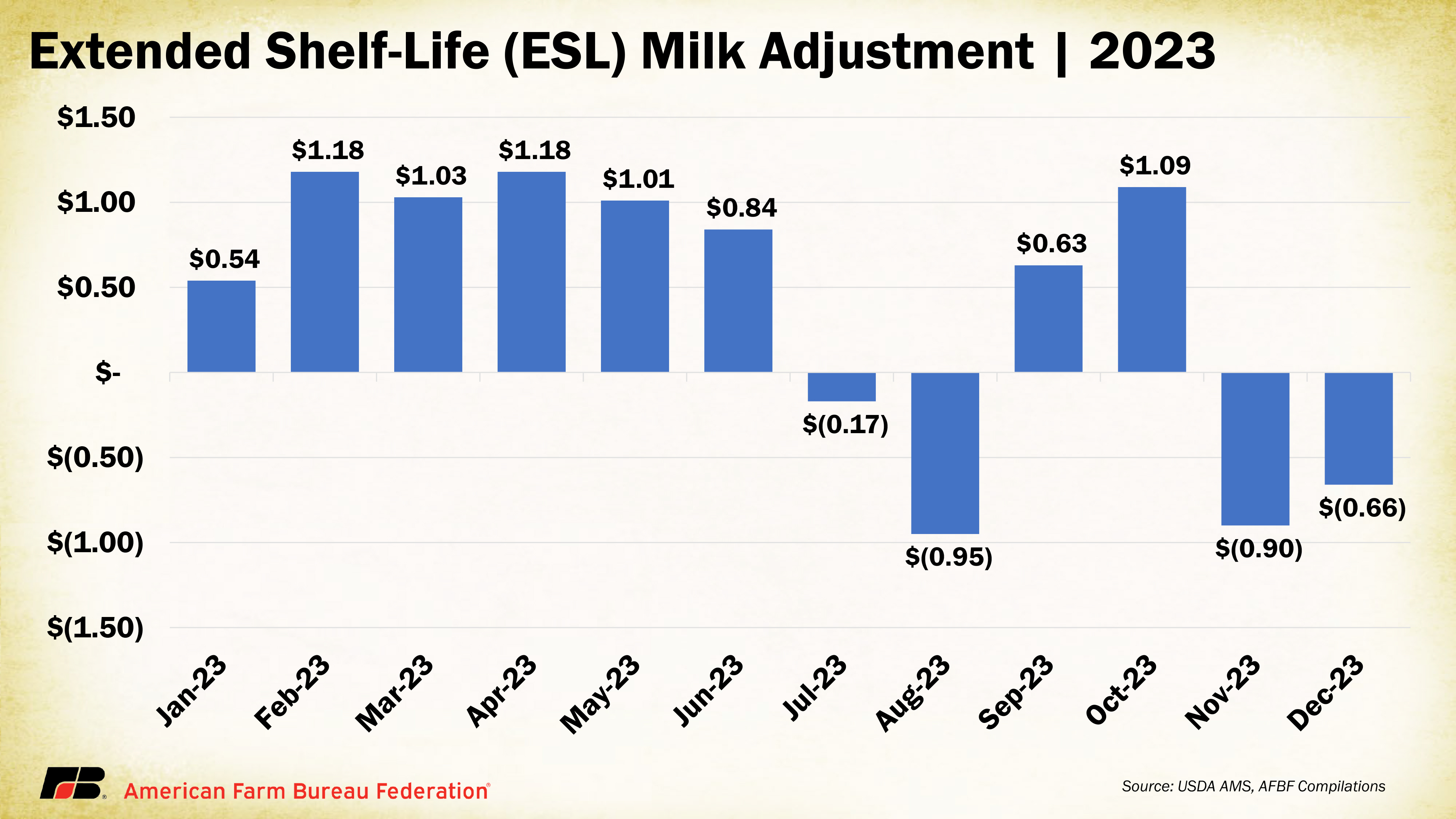
However, milk used to make extended shelf life (ESL) fluid milk products, defined only as “good for 60 days or more,” would continue to be priced using the average of these two pricing factors, plus-or-minus a rolling adjuster of the difference between the higher-of and average-of for 24 months, with a 12-month lag.

With two movers, fluid milk costs could be different for plants in the same location based on shelf life, with no clear definition for the new class, nor parameters established to qualify. Could we see label changes to move between movers?

Processors will know the rolling adjuster 12 months in advance, due to the “lag.” They will know the two advance-priced calculations (higher-of and average-of) a month in advance. They will have it charted in an algorithm no doubt and make decisions accordingly.

Farmers, on the other hand, will find out how their milk was used and priced two weeks after all their milk for the month was shipped. Those milk checks will be even less transparent than they are now.

Big bets on ESL, shelf stable

The dairy checkoff has openly identified ESL, especially shelf stable aseptically packaged milk, as its “new milk beverage platform,” using dairy farmer funds to research and promote it and to study and show how consumers can be “taught” to accept it.

The whole deal is driven by the net-zero sustainability targets. So, follow the money.

Dr. Michael Dykes of IDFA, at the Georgia Dairy Conference in January 2024, told dairy producers that “this is the direction we (processors) are moving… to get to some economies of scale and bring margin back to the business.”

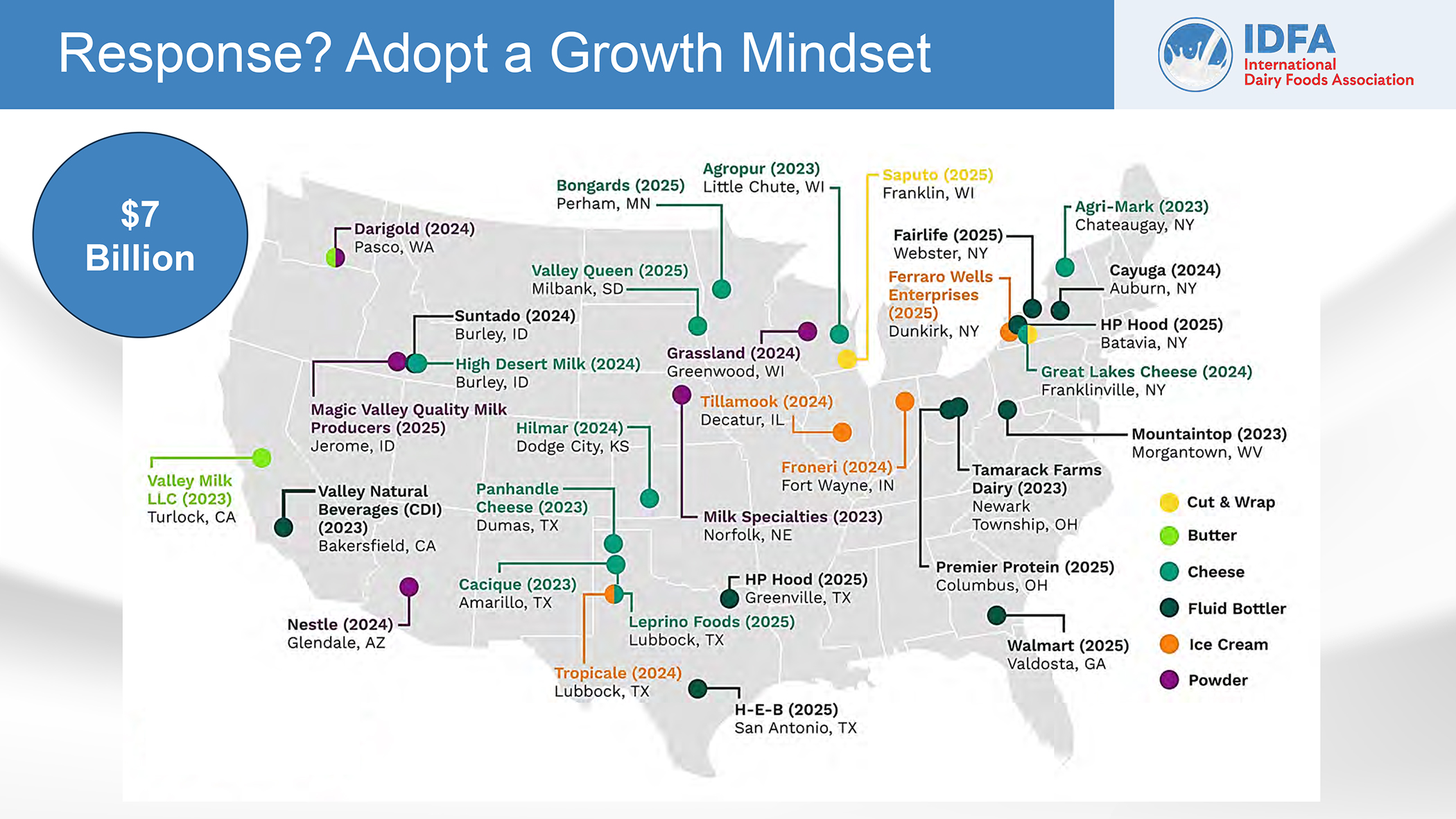
He said the planned new fluid milk processing capacity investments are largely ultra-filtered, aseptic, and ESL — 10 of the 11 new fluid plants on the IDFA map he displayed are ESL. Some will also make ultrafiltered milk, and some will make plant-based beverages also.

Meanwhile, the linchpin of regional dairy systems is conventionally pasteurized (HTST) fluid milk, prized as the freshest, least processed, most regionally local food at the supermarket.

To be sure, this two-mover proposal fits the climate and export goals set forth by the current Ag Secretary Tom Vilsack when he was working as the highest paid dairy checkoff executive in between the Obama and Biden administrations. 

The pathway to rapidly consolidate the dairy industry to meet those goals is to tilt the table against fresh fluid milk, something he already put a big dent in when removing whole milk from schools.

They decided thou shalt drink low-fat milk and like it. Apparently, they are equally convinced about ESL / shelf stable milk as the way of the future and will continue using mandatory farmer checkoff funds to figure out how to get consumers to like that too.

Just this week, the food writer for The Atlantic did a piece on shelf-stable milk, calling it “a miracle of food science” and lamenting in her Op-Ed that it’s a product “Americans just can’t learn to love.”

Author Ellen Cushing took jabs at America’s preference for fresh natural milk from a global perspective, without a thought for the local dairy farms and regional food systems that are tied to fresh milk. She states that by worldwide standards, other countries have gone shelf-stable milk, which she describes as “one of the world’s most consumed, most convenient and least wasteful types of dairy.”

Processors are making big bets on consumer conversion to ESL and shelf-stable.  There are cards to play in every hand. TO BE CONTINUED!

-30-

New Year, New Hope: 2024 will be year of reckoning, Part One

From whole milk in schools to farm bill to climate-warped food transformation, scientists and lawmakers are getting busy, farmers need to get busy too


In the global anti-animal assault, real science must lock horns with political science and defend American farmers — the climate superheroes that form the basis of our national security. Photo by Sherry Bunting

By Sherry Bunting, Farmshine, Jan. 5, 2024

EAST EARL, Pa. – It’s a New Year, and we have new hope on several fronts that are all linked together, in my analysis.

Top 2023 headlines for dairy farmers revolved around dairy markets that underperformed, successes and challenges in the quest to get Whole Milk choice back in schools, a plethora of draft USDA and FDA proposals that dilute real dairy, farm losses and governmental hearings on federal milk pricing, negotiations and extensions for the farm bill, and acceleration of ‘climate-smart’ positives and negatives buckling down for business in an area where political science is trumping real science on the rollercoaster ride ahead.

All of these headlines are inextricably linked. There is a global anti-animal assault underway, but people are wising up to the not-so-hidden agenda that is grounded in climate transitions and food transformation that give more power and control over food to global corporations while diminishing what little power farmers have in Rural America where our national security is at risk.

Real science locks horns with political science

As we head into 2024, a bit of good news is emerging as scientists are mobilizing to defend the nutritional, environmental and social honor of livestock — especially the much-maligned cow.

After an international summit of scientists in October 2022, work has been underway to bring together an international pact.

Dubbed the Dublin Declaration of Scientists, experts around the world have authored and are getting colleagues to sign-on to this document that calls for governments, companies, and NGOs to stop ignoring important scientific arguments when pushing their anti-animal agendas in the name of climate, transformation, and the Global Methane Pledge.

To date, nearly 1200 scientists have signed the Dublin Declaration, aimed foremost at the Irish government’s proposal to slaughter cows to meet methane targets. The Dublin Declaration represents the work of scientists across the globe for a global audience beyond Ireland.

Here in the U.S., we are sitting on the cusp of Scope 3 emissions targets of global milk buyers that have been hastily formulated based on the science of greed, not the science of greenhouse gas emissions. It’s time for the dairy organizations and land grant universities that represent, serve and rely on farmers to drink up on their milk and strengthen their spines.

Farmshine has brought readers the news about what has been happening in Europe, such as in the Netherlands and Ireland, regarding proposed farm seizures and cow slaughter, and the response of farmers there has been to challenge the political establishment.

The U.S. is not far behind. At COP28 recently, American cattle industries were criticized, and even Congressional Ag Leaders are miffed by what they heard. 

Still, some of our dairy organizations brag about being at COP26, 27, 28 and taking part. Even the dairy farmers’ own checkoff program is caught flat-footed. They’ve already caved to the Danone’s, the Nestles, the Unilevers, and such.

In fact, DMI’s yearend review touted its increase in U.S. Dairy Stewardship Commitment adopters to 39 companies representing 75% of the milk supply with membership in the Dairy Sustainability Alliance standing at 200 member companies and organizations. But what are they doing with those relationships to STAND UP ON SCIENCE FOR THE COWS?

The Stewardship Commitment includes DMI’s Net-Zero Initiative, where the cyclical short-lived nature of methane and the role of cattle in the carbon cycle is still not appropriately accounted for and is one of the points made in the Dublin Declaration of Scientists.

In the U.S. dairy industry, the trend on GHG revolves around DMI’s Innovation Center for U.S. Dairy, which placates large multinational corporations in the development of voluntary programs, telling farmers they are in control with their organizations as a sort of gatekeeper. That is, until those programs become mandatorily enforced by those milk buying corporations, while the science on methane and the cow’s role in the carbon cycle as well as U.S. data vs. global data continue to be ignored when they are sitting in the midst of UN Food Transformation Summits, COP26, 27 and 28, and the WEF at Davos.

In fact, during the annual meeting webinar of American Dairy Coalition in December, U.S. House Ag Chairman G.T. Thompson of Pennsylvania was asked his thoughts on some of the statements that came out of COP28 recently criticizing American dairy and livestock consumption.

“My first response was to find it laughable because it really shows you the difference between political science and real science,” he said. “It’s sad when people are so illiterate about the industry that provides food and fiber that they don’t understand how livestock contribute to carbon sequestration.

“We have a real battle,” Thompson said, adding that those putting out such statements criticizing American livestock “don’t even know which end the methane comes from. The world needs more U.S. farmers and less UN if we want a better world. The facts and the science are on our side. Let’s not let the other side control the narrative.”

Bottomline for Thompson is this: “The American farmers are climate heroes sequestering 10% more carbon that we emit. No one does it better anywhere in the world. Let’s be speaking up and speaking out. We can push it back with the facts and the science. I would encourage each of us to do that and become effective just telling that story,”

In the same ADC webinar in December, Trey Forsythe, professional staff for Senate Ag Committee Ranking Member John Boozman of Arkansas agreed.

“The language coming out of COP28, a likely European-led effort, shows what we are up against from people with no background on the role of dairy and livestock. We have to keep beating that drum on the efficiency of U.S. dairy and livestock farms,” he said.

In the same accord, scientists are getting busy, and we all need to get more involved.

In a dynamic white paper released last year, scientists made 10 critical arguments on this topic of livestock greenhouse gas emissions (GHG). Here’s what the scientists behind the Dublin Declaration are saying and why it’s so important for our land grant university scientists to sign on.

“Livestock agriculture creates GHG emissions, which is a serious challenge for future food systems. However, arguing that climate change mitigation requires a radical dietary transition to either veganism or vegetarianism, or the restriction of meat and dairy consumption to very small amounts is overly simplistic and possibly counterproductive,” the scientists wrote in a recent description of the Dublin Declaration.

“Such reasoning overlooks that dietary change has only a modest impact on fossil fuel-intensive lifestyle budgets, that enteric methane is part of a natural carbon cycle and has different global warming kinetics than CO2, that the rewilding of agricultural land would generate its own emissions and that afforestation comes with many limitations, that global data should not be generalized to evaluate local contexts, that there are still ample opportunities to improve livestock efficiency, that livestock not only emit but also sequester carbon, and that foods should be compared based on nutritional value. Such calls for nuance are often ignored by those arguing for a shift to plant-based diets,” they continued, listing these 10 Arguments with scientific explanations for each one.

Here is how the growing number of international scientists, including Dr. Frank Mitloehner of UC-Davis, situate the problem:

Argument 1 – Global data should not be used to evaluate local contexts

Argument 2 – Further mitigation is possible and ongoing

Argument 3 – Only a relatively small gain can be obtained from restricting animal source foods

Argument 4 – Dietary focus distracts from more impactful interventions

Argument 5 – Nutritional quality should not be overlooked when comparing foods

Argument 6 – Co-product benefits of livestock agriculture should be accounted for

Argument 7 – Livestock farming also sequesters carbon, partially offsetting its emissions

Argument 8 – Rewilding comes with its own climate impact

Argument 9 – Large-scale afforestation of grasslands is not a panacea

Argument 10 – Methane should be evaluated differently than CO2  

These arguments take nothing away from the technologies that are being developed to help dairy and livestock producers further reduce emissions and sequester carbon. Technology has a role in amplifying the cow’s position as a solution, not to cure a problem she does not have! And farmers deserve to get credit for what they’ve already achieved.

Farm, food, and national security interdependent

The 2018 Farm Bill was extended for another year at the end of 2023, but the urgency to complete a new one continues as a big priority for House Ag Committee Chairman G.T. Thompson. In the recent ADC annual meeting webinar, he said: “You don’t want us writing farm bill legislation — or any legislation — just listening to voices inside the Beltway in Washington. It would not work out well.”

He thanked and encouraged farmers for being part of the process, saying there’s more to do.

“We’re building this farm bill listening to your voices, the voices of those who produce, those who process, and those who consume — all around the country,” said Thompson, noting nearly 40 states were visited for nearly 80 listening sessions over 2.5 years on the House side.

“This farm bill is about farm security. It’s about food security. And it’s about national security – all three of those are interdependent,” he added.

The extension and funding of the current farm bill for another year — while Congress works on the new one — means programs like Dairy Margin Coverage will continue for 2024, but the enrollment announcement has not yet been made by USDA.

In past years, the enrollment began in October of the previous year and ended at the end of January for that program year. When DMC first replaced the precursor MPP, enrollment was announced late and continued into March of the first program year (2019). At that time, farms could sign up for five years through 2023 or do it annually.

In 2023, DMC paid out a total of $1.27 billion in DMC payments for the first 10 months of the year.

Chairman Thompson noted that effective farm policy is the key, and the extension means no disruptions, he said: “We attached good data for dairy with policy changes, including for DMC, and some positive changes for the nutrition title within the debt ceiling discussion.”

On DMC, the supplemental production history was added in the legislation extending the current farm bill that was signed by the President at the end of November.

“It provides our dairy farmers the certainty that their additional production will be covered moving forward,” Thompson confirmed, adding that they are looking at moving up the tier one cap to be more reflective of the industry.

The farm bill is also being crafted to use no new tax dollars by reworking priorities, looking at the Inflation Reduction Act (IRA) funds, administrative funds and shoring up funds from the Commodity Credit Corporation (CCC) priorities to secure the farm bill baseline for the future.

The $20 billion in IRA funds being thrown about for conservation and environmental programs as well as ‘climate-smart’ grants is already down to $15 billion without spending a dime because of how it is designed to phase down and go away in 2031 and the fact that USDA is believed to not have the authority to keep these funds outside of the farm bill, Thompson explained. Negotiations are considering bringing this into the farm bill baseline so that it is there – and used for farmers – now and in the future.

“(The IRA) is not a victory if agriculture does not get the full benefit of these dollars. We can make that happen in this farm bill,” said Thompson. “Reinvesting the IRA dollars into the farm bill baseline will allow us to perpetually fund conservation in the future.”

Conservation programs are historically oversubscribed and underfunded.

Thompson expects crafting and advancing of the next farm bill to continue in earnest. He hopes to have a chairman’s mark of the bill released by the end of January and have it before the House by the end of February. Much of this timeline depends on House leadership, and the Senate has its own time frame, said Thompson.

He urged dairy farmers to spread the word to their members of Congress that farm security and food security are national security.

He also noted that the nutrition title had some of its toughest elements ironed out during the continuing resolution process in which the farm bill was extended. 

“I’ve managed this in such a way that we’ve accomplished already the hard things in that title,” said Thompson.

Deploying dairy farmers on legislative efforts

“Passage of the Whole Milk for Healthy Kids Act is good for kids good for the dairy industry, and good for the economy. It simply restores the option, the choice, of whole milk and flavored whole milk, and holds harmless our hardworking school cafeteria folks by making sure the milkfat does not count toward the meal recipe limitations,” Thompson reported.

He wanted well over 300 votes for H.R. 1147 in the House to send a strong message to the Senate. On Dec. 13, the House gave him 330 ‘yes’ votes for Whole Milk for Healthy Kids.

“I would like to deploy you now on the Senate. The bill in the Senate (S. 1957) has the same language and it is tri-partisan with Republican Senator Roger Marshall, a medical doctor, Democrat Peter Welch and Independent Angus King as original sponsors,” said Thompson to dairy farmers gathered virtually for the ADC annual meeting webinar.

“There are other co-sponsors as well (12), and from my state of Pennsylvania, Senator John Fetterman is a cosponsor. Our other Senator (Bob Casey, Jr.) has not cosponsored and seems to be in opposition to it,” he said. “We need you to weigh in with your senators that this is about nutrition and health of our kids and the health of our rural communities. You are in a good position to tell the story of what happened in 2010 when fat was taken out of the milk in schools.”

Thompson noted that, “As you are doing that, you are developing relationships that will help us in the farm bill also. On the farm bill, talk about return on investment, the number of jobs and economic activity and taxes from agribusinesses, about the food security and national security and environmental benefits, science, technology and innovation in agriculture,” he said. 

“Less than 1.75% of what we spend nationally is the farm bill. That’s a big return on investment, again, for food security and national security.”

Questioned about the milk labeling bill of Pennsylvania Congressman John Joyce, a doctor, Thompson said it is a strong bill. He confessed his dismay with USDA caving on this question and called FDA “a problem child” on milk labeling. 

“This bill is not self-serving for dairy. This is about consumers having the information to make proper decisions on their nutrition,” he said.

To be continued

Northwest PA farmers fear future land-grab as U.S. Fish and Wildlife proposes Refuge designation for 798,000 acres of French Creek watershed

PREVIEW – By Sherry Bunting, Farmshine, June 30, 2023

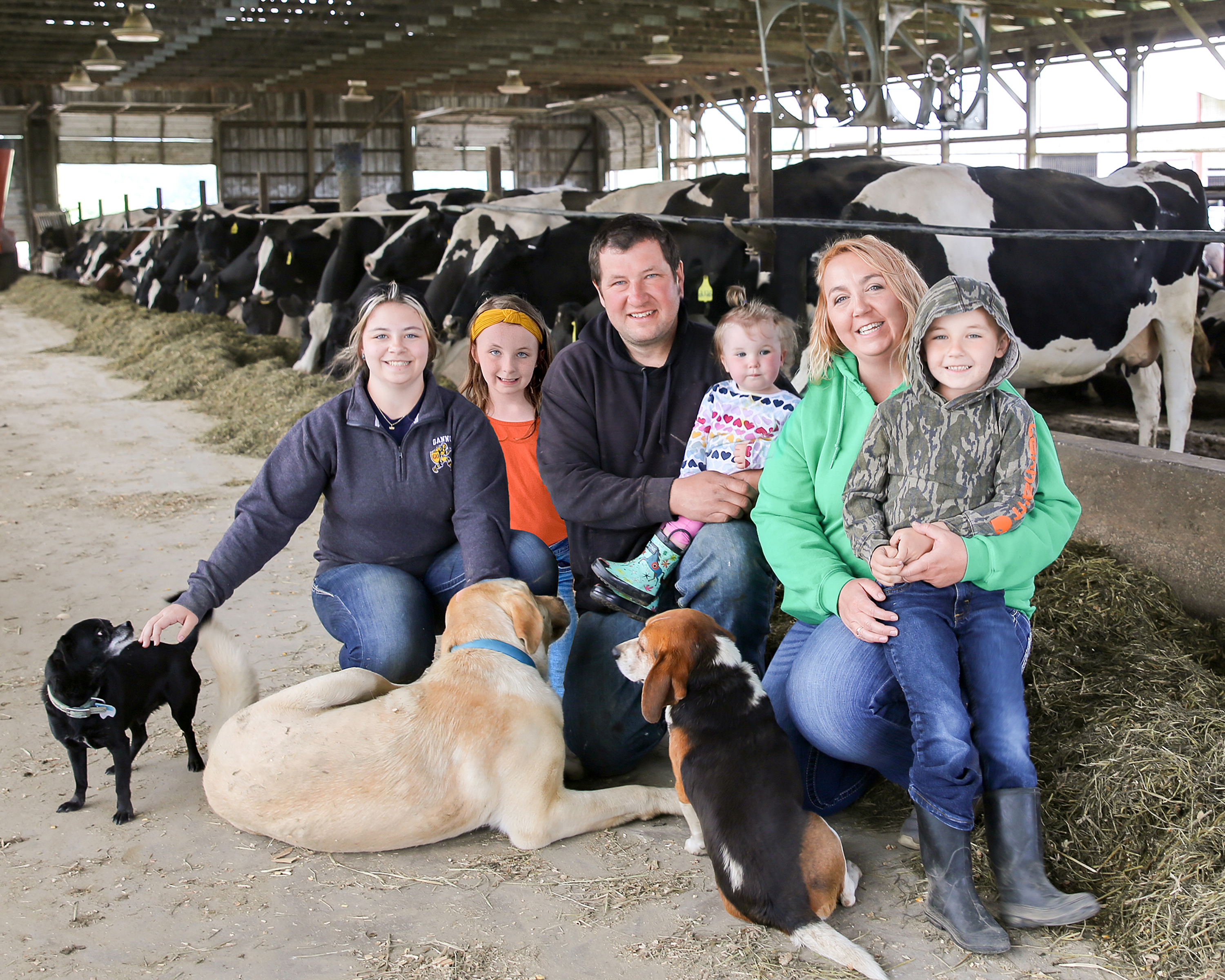
WATTSBURG, Pa. — Kevin and Amanda Bush are fourth generation dairy farmers with their children Ava, 17, Clara, 6, Jarrett, 5, Georgia, 1, and 110 milk cows. On an early June day, unseasonably cold even for Erie County, Pennsylvania, a visit to the Bush Family Farm shed light on farmers’ concerns about a U.S. Fish and Wildlife Service proposal to designate 798,000 acres of French Creek watershed as a National Wildlife Refuge. Potential land acquisitions could begin a year from now if approved by the USFWS Director later this summer. Mark Muir from Erie County Farm Bureau, who raises hay and livestock, and Brian Young, whose extended family operates a nearby seventh generation farm were part of the discussion of the proposed protection area that would stretch 117 miles from Chautauqua County, New York south through Erie, Crawford, Mercer and Venango counties, Pennsylvania. The region is home to farms and other businesses that are the lifeblood of rural towns and counties. They use conservation practices and a lot of grazing and haying, with a vested interest and pride in their stewardship and relationships with existing conservation efforts. 

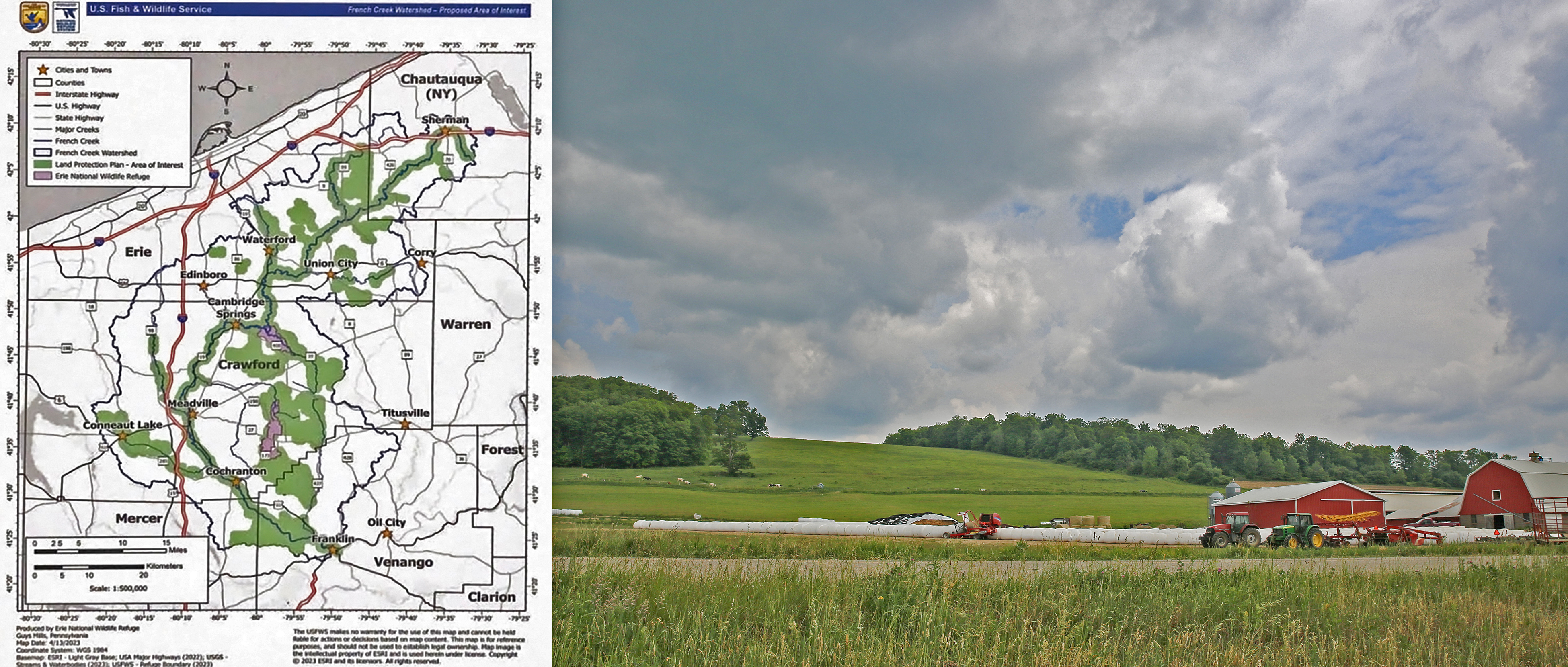
On a map showing land protection ‘areas of interest,’ whole farms are included, not just setbacks (see map in main story below). This includes many dairy farms ranging from small herds managed by young next-generation farm families, like the Bushes, to larger farms with multiple generations of families involved. USFWS wants to purchase land or use permanent easements for whole farms. ‘You can still farm it,’ they say. But when specific questions were brought to an April meeting, the locals came away with very few answers. They anticipate another meeting in July. 

Why are farmers concerned? They fear future use of eminent domain and farming restrictions as dominos start to fall. A National Refuge designation with Land Protection Plan, is perpetual. They fear the loss of rented ground to feed their cows. They worry about their towns and counties. They want to know the minimum goals of the project so they can have an intelligent conversation with USFWS. They have asked for scientific studies to be shared that show how the freshwater mussel population and other aquatic life are actually doing today vs. 10, 20, 30 years ago.

It feels like the start of what could become a gradual 30 x 30 land grab. Surely, if this was happening in agricultural communities of southeastern Pennsylvania along the Susquehanna River in the Chesapeake Bay watershed, instead of northwestern Pennsylvania in the French Creek watershed, there would be much more attention paid. See main story below as published in July 7, 2023 Farmshine, and stay tuned as we follow this developing story.

They say National Refuge for mussels will move at snail’s pace, but farmers see muddied water ahead

MAIN STORY – By Sherry Bunting, Farmshine, July 7, 2023

WATTSBURG, Pa. — The rural French Creek watershed is in the sights of the U.S. Fish and Wildlife Service for a proposed National Wildlife Refuge that could span nearly 800,000 acres, stretching 117 miles from the headwaters in Chautauqua County, New York across the Pennsylvania border through Erie, Crawford, Venango and Mercer counties.

Meetings this spring in Meadville and Edinboro were part of the ‘public scoping’ phase. They were packed with citizens and fraught with questions, deep concern and objections. 

An initial public comment period ended May 19.

From the Southwest corner of New York through the Northwest corner of Pennsylvania, the French Creek river and watershed runs through rural communities where farming is the lifeblood. If this potential land-grab were happening in southeastern Pennsylvania in the Chesapeake Bay watershed, more attention would be paid to the concerns of the farmers and communities.

Vicki Muller, the proposed Refuge’s project manager, told local television station FOX-66 that the U.S. Fish and Wildlife Service (USFWS) is “looking to protect and preserve more wildlife habitat within the French Creek watershed, so this plan is just the beginning stages of that.”

Mentioned were freshwater mussel species, said to be the only populations east of the Mississippi, along with several species of fish, wetlands, and migratory waterfowl.

Land acquisitions are about a year away, Muller confirmed.

Farmers and other community members, along with managers of existing conservation efforts, say federal land acquisition is not necessary to meet environmental goals because those who are living, working, farming in the region already work with local conservationists to manage the land in ways that have been recognized for success.

French Creek was named Pennsylvania’s “River of the Year” in 2022. 

Opponents of the Refuge argue that its designation could place federal regulation on private landowners for perpetuity. They say an accompanying Land Protection Plan (LPP) could take properties and money off local tax rolls, move land ownership away from local residents, and take products generated on the farmland away from local communities, weakening the region’s economy and food security.

To top it off, USFWS could offer no evidence that this would improve — at all — the status of French Creek and its aquatic life, nor any evidence that either are in trouble.

USFWS is currently in the process of reviewing public comments and stakeholder feedback and is developing a final plan for approval by the USFWS Director later this summer, according to a Q&A document at the webpage devoted specifically to the French Creek proposal at https://www.fws.gov/project/evaluating-new-refuge-lands-french-creek-watershed

A June 4 ‘Public Scoping Recap’ is also provided at this webpage, stating the proposal is not yet an official proposal because it is still in the ‘public scope and biological environmental assessment’ phase.

The webpage indicates that the framework would be built after they get the buy-in, after they get the National Refuge designation and LPP approved, and after they complete the biological environmental assessment. That’s when officials say they can answer the probing questions of locals about environmental and land acquisition goals.

Isn’t that putting the cart before the horse?

One of the strategies being used here is to protract the conversation and soothe public concern with assurances that the Refuge to save mussels will move at a snail’s pace.

Essentially USWFS is looking to designate land now for decades of acquisition and that it will answer specific questions as the process moves forward working collaboratively to refine the plan after the designation and plan are approved.

Such circular talk makes farmers and landowners skeptical, uneasy.

Within the “land protection areas of interest” on the ambitious map, there are both small and larger farms, many of them dairy farms as well as beef cattle, crop and produce growers.

“I started looking at the map, and I see I am an area of interest. Everything I own is an area of interest,” said Mark Troyer, a potato, corn and wheat grower, in an on-camera interview during the Edinboro meeting. “I think we can work and live hand-in-hand (with wildlife) and have been doing a great effort. We’ve already been doing a great job.”

Concerns about eminent domain were specifically raised. Muller stated this will not happen. 

Landowners are not convinced. They want to know the endgame. 

They want to know what happens once there is an approved LPP with specified land acquisition timelines. What happens to their farms if they are eventually surrounded by acquired land? What happens to the farms outside of the areas of interest that will find themselves next to a National Refuge? What is the ultimate land acquisition goal?

What are the actual environmental goals, and why does the federal government need to acquire the land to meet those undisclosed goals, instead of supporting existing local conservation efforts that show measurable success?

They share the concern that once the designation and LPP are approved, this could take on a life of its own… forever.

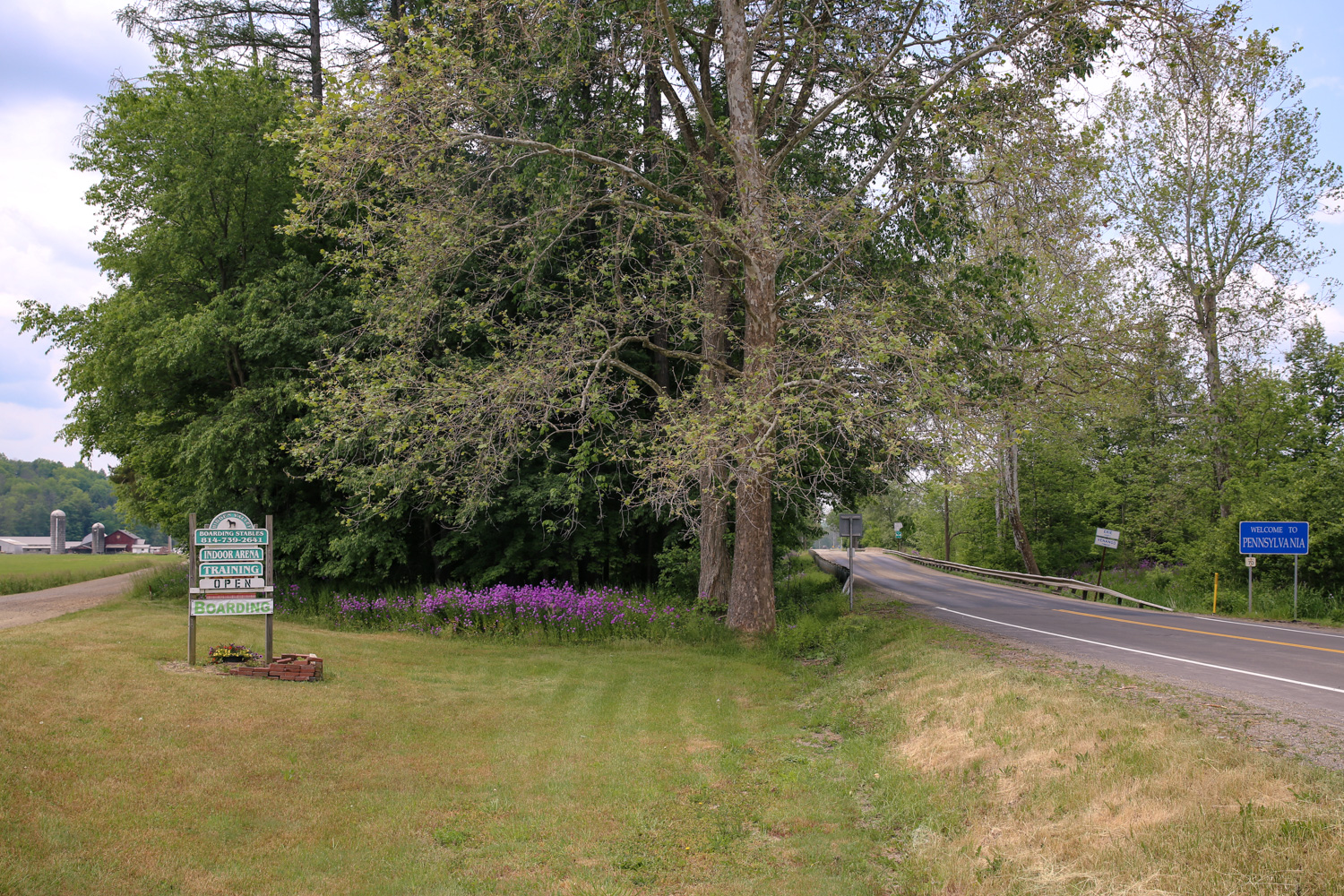
A pristine view across the road from the Bush Family Farm. Behind the trees is French Creek. The Bushes wonder why land acquisitions are needed. Farms throughout the watershed do a good job. They wonder what will happen to their farm if there are willing sellers up and down the road from them…

According to the USFWS Q&A, the land protection plan will take decades to complete as the number of willing sellers and the availability of funding will determine the timeline.

With that in mind, U.S. Congressmen Mike Kelly (R-Pa.) and Nick Langworthy (R-N.Y.), whose congressional districts cover the “areas of interest” in the draft proposal, along with U.S. House Ag Committee Chairman Glenn ‘G.T.’ Thompson (R-Pa.), led a letter calling on the USFWS to reconsider federal designations on private land.

In the letter, the members of Congress recognize that a healthy, vibrant ecosystem along French Creek must continue to be protected, but also that local farmers and residents are better suited than Washington bureaucrats hundreds of miles away to dictate how this land is best protected.

Mark Muir with the Erie County Farm Bureau grows hay and raises livestock in the area. He has been involved in the meetings, asking questions at the front end of this proposal.

Farmshine met in June with Muir at the Bush Family Farm outside of Wattsburg in Erie County. He was joined by Kevin and Amanda Bush as well as Brian Young, whose extended family operates a nearby 7th generation farm.

The Bush farm has been in the family since 1939. French Creek borders it, surrounded by grasses across the road from the dairy barn and hillside grazing paddocks. The Bushes also rent crop ground in the watershed.

They and others are concerned that once a final plan is developed and approved later this summer, land acquisitions from willing sellers could eventually morph into a land-grab that won’t stop until all of the “areas of interest” are federally owned or controlled by the USFWS.

The designation of the land as a National Wildlife Refuge and the approval of an LPP would be the first concrete steps.

“We are told there is nothing set in concrete yet,” says Muir, “But we had many questions they couldn’t answer at the meetings. We tried to talk to them about farm BMPs (best management practices), but they didn’t understand the concept.”

Because the USFWS is still in the ‘public scoping, comment review and final development’ phase,’ officials won’t engage in land use questions or what-if scenarios. They don’t answer questions that help farmers understand the ultimate impact because they say that completion of the Refuge would be “decades away.”

“Decades away” is really tomorrow for most farmers who continually look ahead at their operations and land use, making plans for future generations.

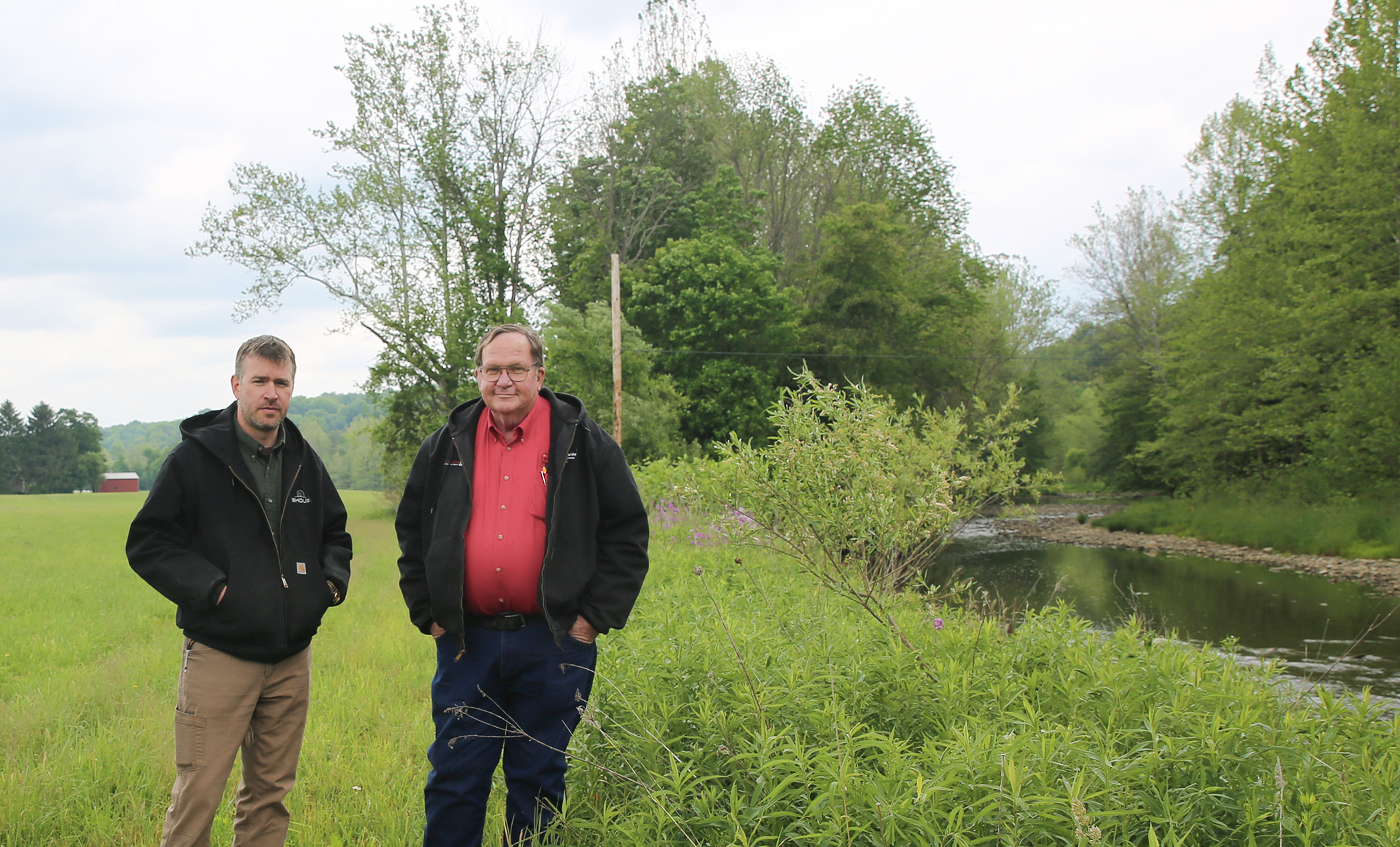
Mark Muir (right) and Brian Young stand across the road from Bush Family Farm by a section of French Creek that runs parallel. This is just one small part of what could be a massive target for federal land acquisitions and easements if the watershed is designated a National Refuge.

“At the end of the day,” says Young, “Fish and Wildlife can target any wildlife and the ecosystem areas that an environmental assessment deems necessary. They are not like the BLM or NRCS. The USFWS is comparatively small and does not have the cross-correlation to agriculture.”

Furthermore, land acquisitions are funded by duck stamp sales, land access fees, and other sources of revenue that make USFWS less reliant on tax dollars to use their authority. In other words, Congressional oversight — from an appropriations standpoint — is lacking.

If a final plan and Refuge designation are approved, the gradual creep of land acquisitions would begin, giving USFWS oversight of current working lands that could affect the fate of farming in the region, in particular dairy and beef cattle.

Without data and without answers, this becomes “a slippery slope with no guard rails,” says Muir. “We want to be objective about it, and to have those conversations at a July meeting. We need certain information to have a meaningful conversation so we can see if and where we might be able to work together.”

Meanwhile, Kevin and Amanda and their four children milk 110 cows and raise their youngstock. They are a small family dairy on land that the Bush family has been farming for 85 years.

There is not only a legacy here, but also progress as they have implemented many BMPs, just as other farms have throughout the region.

Muir notes that NRCS funding, and other cost-shares, don’t seem to flow as much in the Northwest direction of the state. 

He says BMPs on farms could improve even more with cost-sharing and a productive dialog, which is preferable to a multi-decade federal plan to acquire the land.

“If this is supposed to be to save the freshwater mussels, and they have these dollars to spend, why not try other approaches first?” Amanda wonders, adding that they could promote BMPs that farms can do even better than what they are already doing, and cost-share some of that. “It would go a lot farther instead of designating a Refuge, buying up land, and disrupting family farms, local towns and their economies.”

“We do no-till and minimum tillage here. We do cover crops wherever we can, and we are working now already with the County Conservation District,” Kevin adds.

Bottom line, these and other young farmers want to continue farming and producing food for their communities. They are part of these rural communities where cows and crops, grazing and haymaking, youth programs and showing at the county fair are part of the fabric.

Maybe it’s more important to identify the rural community fabric that is at stake — the younger generations who want to continue. As farm families of all sizes, they are accustomed to working with USDA, NRCS, county conservation districts, local conservation efforts that all have connections to agriculture, so they speak the same language.

But when Fish and Wildlife makes its entrance with a draft proposal for a National Refuge of immense proportions across so many miles, acres and counties — having no crossties to agriculture — that’s a scary place for any farm family to be, and it can lay threadbare the fabric of the communities beyond the farms.

To be continued

AUTHOR’S NOTE: A USFWS National Refuge designation and Land Protection Plan includes acquisition timelines and a “Landscape Conservation Design” to “ensure actions contribute to the landscape-level vision,” according to USFWS documents. USFWS is a Bureau within the Department of Interior and operates in a quasi-independent fashion, having federal administrative authority to establish and manage such refuges and complete them over time with its own sources of funding. In 2021, at the start of the new Administration, the USFWS updated its “Climate Adaptation Strategy” to be a framework that is part of the Administration’s “U.S. Climate Resilience Toolkit,” equipping USFWS to “take immediate action to build ecosystem resilience in the face of climate challenges.”  (One thing to keep in mind is to look overseas at the Netherlands, where the climate-based land-grab is in full swing. Farms have been ordered to cut from 15 to 90% of their production or sell their farms to the government. The farms identified for 75 to 90% production cuts to be economically unsustainable are those that are closest to the EU Nature Preserves designated decades ago.)

Congress passed joint resolution in March to block WOTUS, now Supreme Court sides with farmers on EPA overreach

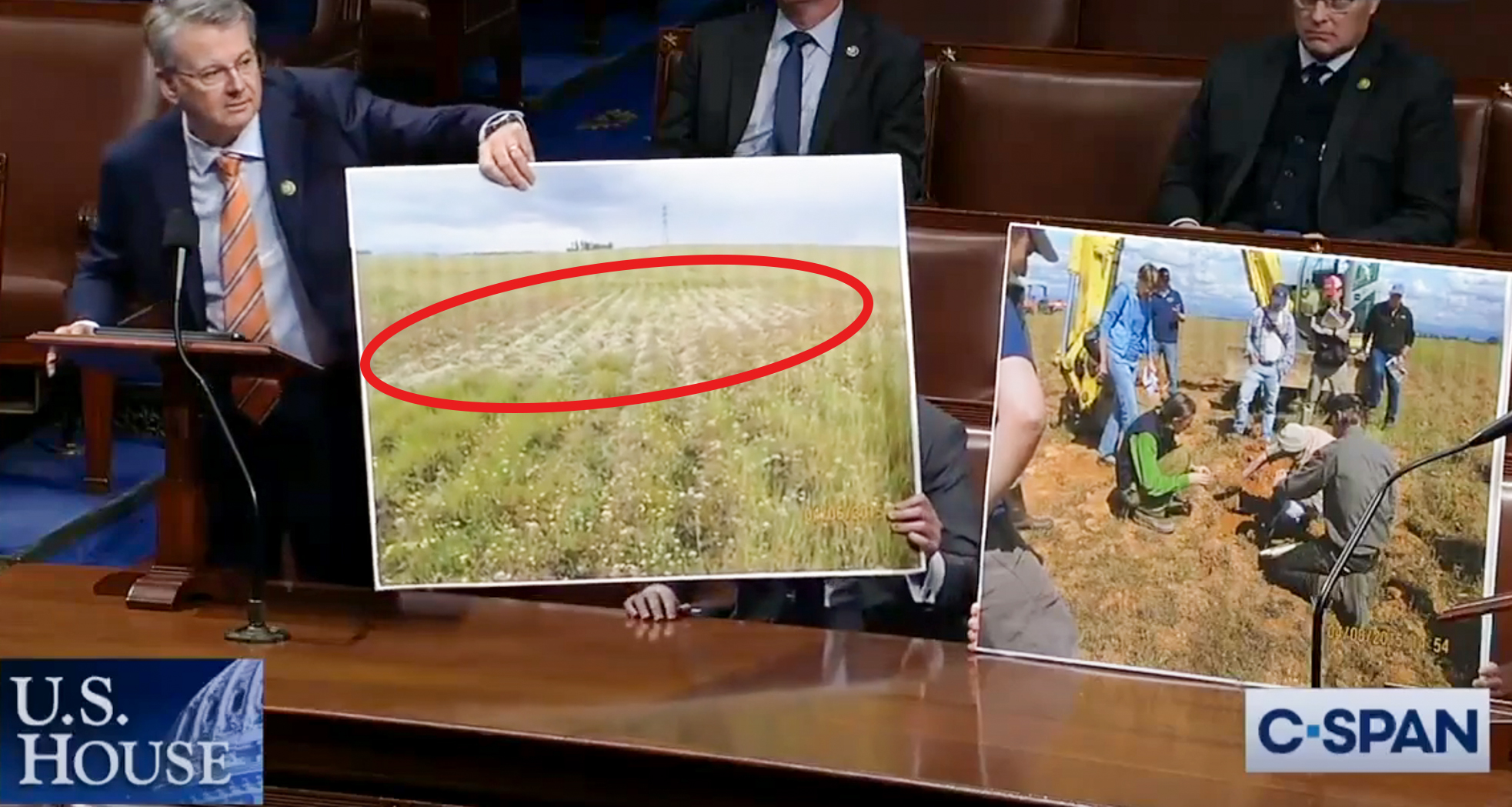
The Supreme Court ruled May 25 to overturn the Obama-Biden administrations’ broad WOTUS definition. Earlier, in March, Congress approved a joint resolution to block the Biden WOTUS definition brought back after the previous administration made commonsense changes and clarifications. In March, asking members to ‘squint,’ freshman Congressman John Duarte, a farmer from California, provided some show-and-tell on the Biden EPA’s WOTUS rule. His 5-year battle (2013-2017) with the EPA and Army Corps of Engineers boiled down to small depressions being considered ‘jurisdictional wetlands’. Screen capture from C-Span live coverage has been enhanced by Sherry Bunting with a red circle showing the so-called ‘jurisdictional wetland.’  Duarte noted that all of the surrounding grassy area in this photo would also be considered ‘jurisdictional wetland’ under the Biden EPA’s WOTUS rule.

Chairman Thompson cites ‘EPA’s appetite for power’; Rep. Duarte tells of his farm’s 5-year battle 

By Sherry Bunting, original story published in Farmshine, March 16, 2023

UPDATE 2023 – On May 25, 2023, All nine justices agreed to overturn the 9th Circuit Court of Appeals’ ruling that endorsed the Biden administration’s broad definition of waters of the United States, or WOTUS, the term for what falls under federal enforcement of the Clean Water Act. The EPA’s WOTUS regulations redefined what land and water is subject to federal requirements under the 1972 Clean Water Act. While the law references “navigable waters,” conflicting agency guidance and confusion in the courts led to new regulations aimed at clarifying the scope of the law. During the Obama and Biden administrations, the EPA exploited that confusion to significantly expand the reach of the federal law.

“If the EPA had its way, nearly 97 percent of land in Iowa would be subject to onerous federal red tape. You’d have to get permission from Uncle Sam before moving dirt on your own land under this administration’s WOTUS regulations. Farmers could’ve faced steep fines if water pooled in a ditch after a rainstorm because of the EPA’s far-reaching rules. Thankfully, the Supreme Court saw through this federal overreach and unanimously determined that it violated the Clean Water Act.  After years of uncertainty, today’s Supreme Court decision is a victory for farmers, builders, landowners and common sense,” Iowa Senator Chuck Grassley said.

See below some of the background presented in the United States House of Representatives in March.

WASHINGTON — In mid-March, the U.S. House of Representatives passed a Joint Resolution — H.J. Res. 27 – expressing Congressional disapproval of the Biden EPA’s Waters of the United States (WOTUS) rule.

This resolution of disapproval had 170 Republican cosponsors from 42 states and was passed by the House 227 to 198 under the Congressional Review Act on Thursday, March 9.  Nine Democrats voted for the resolution, including members of the House Agriculture Committee such as ranking member David Scott of Georgia.

The Senate also voted for the joint resolution, which was later vetoed by President Biden.

Prior to House passage, Republican members of the House Ag Committee called out the flawed WOTUS rule, stating that the Biden EPA undid the reasonable clarifications that were made under the previous administration.

“Make no mistake about it, this rule isn’t about clean water. It’s about the Biden EPA’s appetite for power,” said Ag Committee Chairman Glenn ‘G.T.’ Thompson of Pennsylvania prior to passage of the resolution seeking to block it. “America’s farmers, ranchers, and landowners deserve a WOTUS definition that is fair to agriculture and maintains the historical reach of the Clean Water Act—neither of which is accomplished by the Biden Administration’s flawed rule.”

Numerous members spoke to the resolution on the House floor, including the freshman Congressman from the 13th district of California, John Duarte.

As a farmer, Duarte’s 5-year battle with the EPA over plowing through an area that ‘could’ become a puddle a rainstorm is well documented and was reported in several Farmshine articles throughout 2017. 

Duarte ultimately settled his case to save the family business after fighting the EPA and the Army Corps of Engineers as long as he could under government threat seeking tens of millions of dollars in so-called ‘reparations.’

His settlement admitted no guilt and left an uncertain precedent for agriculture when WOTUS rules are unclear and subjective as in the Obama and now Biden EPA rules.

“The Supreme Court has been dealing with this for years, and if we don’t get it right here (in the legislature), and keep the agencies honest, we are going to have a real food shortage on our hands,” said Duarte.

“I am a farmer who was prosecuted under the Clean Waters Act for growing wheat in a wheat field that had been planted to wheat many times before,” he explained, asking members to squint to see the little light spot in the field on an enlarged photo poster he brought with him. “This is ‘a jurisdictional wetland’ under some definitions of the Clean Water Act — not a navigable water. There are no frogs, no fish, no storks, no egrets — and no water,” he said.

Wheat had been planted in this field many times, and it was grassland just prior to Duarte’s tillage to replant it to wheat.

“The surrounding grasslands — all the surrounding grasslands here (in the photo) — are ‘jurisdictional wetlands’ under the Biden (WOTUS) rule. They prosecuted me as a farmer for growing wheat in a wheat field that had been planted to wheat many, many times before, and they threatened me with fines of $2.8 million and reparations of up to $40 million for tilling through 22 acres of ‘wetlands’ such as this,” said Duarte of the federal case brought against him during the Obama administration.

“This is what we are talking about. This is the land grab. This is the authority. This is the threat to the American food system that we’re talking about,” Duarte declared.

On a second poster, he showed the investigative team and equipment, paid for by taxpayers through the Department of Justice, sitting in a 3-foot hole investigating his 3 to 7 inch tillage to a ‘vernal pool.’

The 10 government investigators were on his property for 10 days and issued a report that cost over $1 million. Some of the so-called ‘wetlands’, the ‘vernal pools,’ – devoid of water – were 16 square feet, the size of a card table.

“How is that a jurisdictional wetland? This (rule) is a direct attack on our farming and our food supply,” said Duarte.

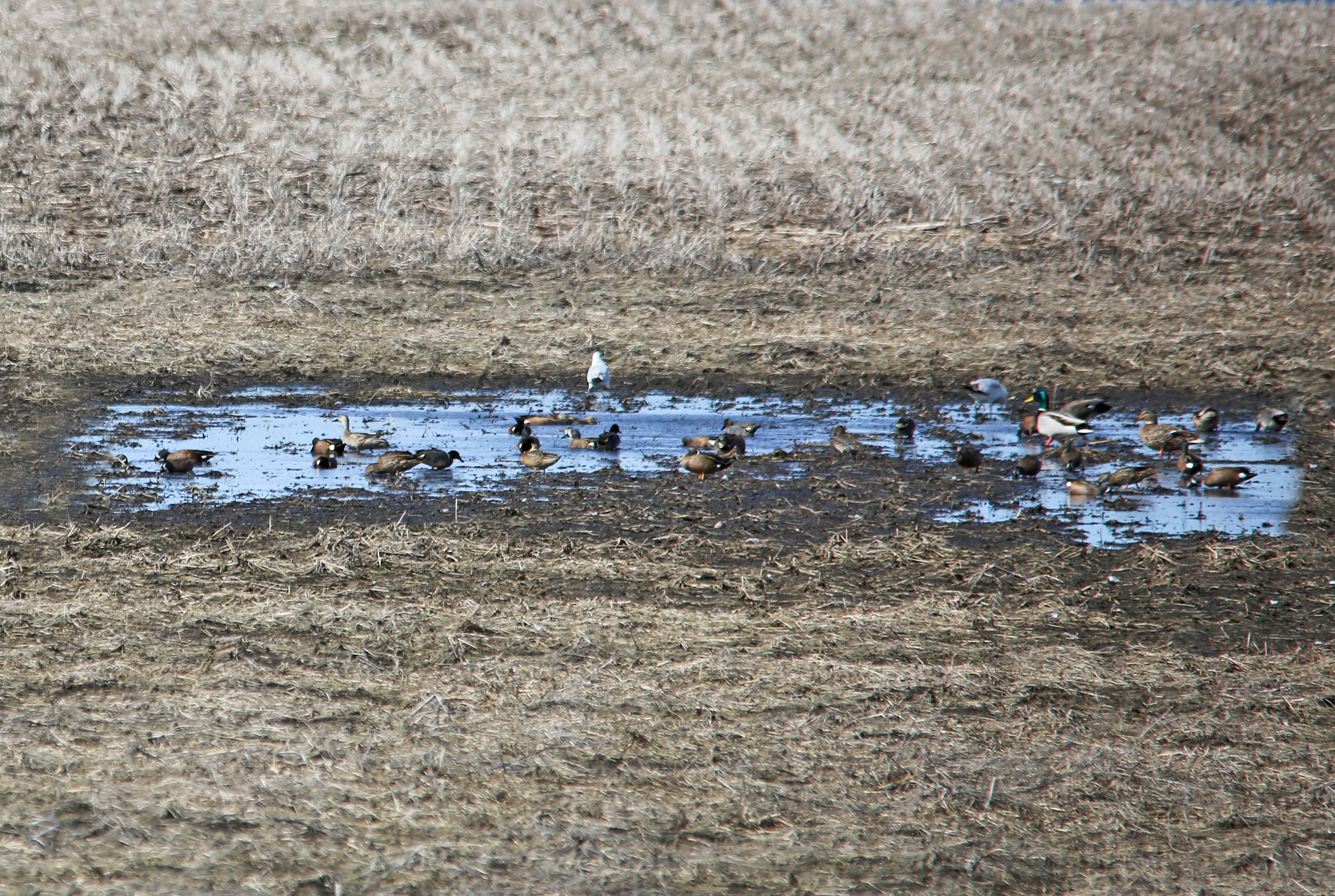
We see them in the East and Midwest also in the spring, and by summer they are mud or dirt spots in a crop field — depending, of course, on the amount of precipitation over winter through March. Pictured here are a variety of wading ducks and gulls taking to such late March puddles on a depression in a Midwest crop field, similar to the area in question in the Duarte case in California. Is this a “navigable” waters or “jurisdictional wetlands” as the 1972 Clean Water Act of Congress specified? Is this a Waters of the United States (WOTUS)? On May 25, 2023, the Supreme Court said: No. It is not. The EPA has overreached. Photo by Sherry Bunting

-30-

Under the DMI umbrella: Fonterra CEO to chair Global Dairy Platform, Danone sustainability strategist to join GDP operating committee

Global Dairy Platform launched Pathways to Dairy Net Zero Initiative in September 2021, one year after DMI’s Innovation Center for U.S. Dairy launched the Dairy Net Zero Initiative (NZI) in October 2020 (A year prior to that in 2019, the current and former Ag Secretary Tom Vilsack testified to the Senate Ag Committee as a dairy-checkoff executive, serving then as president of the U.S. Dairy Export Council, and he foretold the nuts and bolts of the not-yet launched Dairy Net Zero Initiative and asked Congress to fund pilot farms. GDP has governance in and manages the Dairy Sustainability Framework that underpins what U.S. farmers, and their cows, will have to live up to — including how livestock methane is calculated, mitigated and monitored, which may be based on inaccurate math and science in terms of CO2 equivalents.

By Sherry Bunting, Farmshine, Friday, May 5, 2023

ROSEMONT, Ill. — Fonterra CEO Miles Hurrell has been named the new board chairman of the Global Dairy Platform (GDP), a non-profit industry association representing the international dairy sector. A portion of its revenue is from membership dues, but also from the 7.5-cents per hundredweight equivalent checkoff on U.S. dairy imports as well as grants for research and program services from Dairy Management Inc (DMI).

Fonterra’s Hurrell will replace Hein Schumacher, who is leaving his position as CEO of Royal FrieslandCampina to become CEO of Unilever.

In the April 26 news release, Hurrell cites Schumacher’s leadership in “accelerating climate action via the ground-breaking Pathways to Dairy Net Zero Initiative.” 

Announced in the same release is the appointment to the GDP operational committee of French multinational Danone’s senior vice president of sustainability strategy.

According to its 501(c)6 non-profit tax filings, “GDP is a pre-competitive collaboration,” and its governance groups — the board and the operational committee — “manage a ‘Dairy Sustainability Framework’ to unify the approach being taken by dairy organizations to the broad challenges of sustainability from environmental, social, and economic perspectives.”

The Dairy Sustainability Framework is part of the Dairy Sustainability Alliance of the Innovation Center for U.S. Dairy, another non-profit founded and funded by dairy checkoff organizations under the DMI umbrella. The Innovation Center sets U.S. Dairy Stewardship Commitments that are implemented through the FARM program and reviewed every three to five years to show U.S. dairy is, according to its website, “moving the needle toward achieving the Sustainable Development Goals (SDGs) of the United Nations.”

DMI, its Innovation Center, Dairy Sustainability Alliance, Dairy Sustainability Framework, and U.S. Dairy Stewardship Commitments are all located at Suite 900, 10255 W Higgins Road, Rosemont, Illinois, and the Global Dairy Platform (GDP) address of record is Suite 820 at the same street address.

Along with New Zealand’s Fonterra, CEOs from these top-15 dairy multinationals serve on the GDP Board: Dairy Farmers of America (DFA), headquartered in Kansas; Arla Foods, headquartered in Denmark; Leprino, headquartered in Colorado; China’s Mengniu Dairy Company; Moringa Milk Industry, headquartered in Japan; Royal FrieslandCampina, headquartered in the Netherlands, and Saputo, headquartered in Canada.

Along with the board of directors, the GDP operational committee provides governance and includes sustainability executives for Arla, DFA, Fonterra, Land O’Lakes, Meiji Holdings and FrieslandCampina.

In a separate April 2023 bulletin, GDP announced the May 1, 2023 retirement of Dr. Greg Miller from his position as research lead for GDP since its inception. Known as ‘Dr. Dairy’, Miller has served as the chief science officer for the National Dairy Council for nearly 32 years and as executive vice president of research, regulatory and scientific affairs for DMI. Miller will continue as a member of the UN Food and Agriculture Organization Scientific Advisory Committee.

Key paid staff for GDP is Donald Moore, the executive director since 2010. Before that, he was a Fonterra senior executive in business development and ingredients marketing for 20 years.

Moore also serves as chairman of the governance group for the Dairy Sustainability Framework since its inception in 2013.

With Fonterra’s CEO as the new board chairman of the GDP, and with a former Fonterra senior executive serving 13 years to-date as the executive director of the GDP and the chair of the governance group for the Dairy Sustainability Framework, it’s worth noting that Fonterra announced six months ago its new start-up company for alternative dairy ingredients. According to the October 2022 press release, Fonterra has partnered with Royal DSM, a Dutch company, in creating this start-up “to accelerate the development and commercialization of (animal-free) fermentation-derived proteins with dairy-like properties.” 

With Danone’s senior vice president of sustainability strategy now appointed to the GDP operational committee, it’s worth noting that in October 2022, Danone announced it would use artificial intelligence to reformulate 70% of its plant-based fake-milk products. This followed the 2021 earnings call where Danone executives outlined new fake-milk and dairy product launches with plans to use “new dairy-like technology” to “win over” the 60% of U.S. consumers not in the plant-based category because of taste and texture. The Danone executives told shareholders their Renew strategy identifies the U.S. as a “key plant-based market.” In January 2023, Danone announced it is eyeing sale of Horizon Organic, saying it falls outside of their key areas of focus.

Global Dairy Platform (GDP) was formed in 2006 as an alliance, according to its website. Its tax filings confirm incorporation as a 501(c)6 non-profit in 2012 and its address of record at Suite 820 at 10255 W Higgins Road, Rosemont, IL 60018.

According to the GDP’s most recent IRS 990s that are publicly available for 2017 through 2019, the years when former DFA CEO Rick Smith was its chairman, GDP had revenues between $3.7 and $4.2 million annually. This increased to $4.7 million in 2020, according to an available summary of the IRS 990 for that year.

The tax returns show approximately $1 million in GDP revenue came from membership dues and approximately $2.7 million annually from granted program services and research funds (checkoff). 

The GDP revenue also included approximately $500,000 in ‘import assessments.’ The 7.5-cent import checkoff, which was implemented in 2011 amid formation of the Innovation Center and its resulting alliances and frameworks.

GDP’s executive director Donald Moore is paid a salary package of nearly $600,000 annually. The top three independent contractors in 2018-19 included DMI receiving over $800,000 annually for program services and administration; Massey University in New Zealand $451,000; Emerging Ag in Calgary, Alberta, Canada $600,000 (for UN access), and Lindsey Consulting, in the UK nearly $300,000 with Brian Lindsey serving as the GDP’s sustainability lead.

According to GDP, its membership consists of more than 95 corporations, companies, associations, scientific bodies, and other partners, with operations in more than 150 countries, collectively accounting for approximately one-third of global milk supplies.

DMI manages the national nickel from the 15 cents per hundredweight checkoff deducted from U.S. milk checks for research, education, and promotion. DMI also manages the unified marketing plan many state and regional checkoff organizations contribute toward, and DMI manages the 7.5 cents per hundredweight equivalent import checkoff, handed off to the GDP.

DMI states in its 501(c)6 non-profit tax filing that it is “investing dairy producer checkoff funds in strategic, coordinated marketing programs designed to increase consumption of U.S. dairy products domestically and internationally.”

The Innovation Center for U.S. Dairy was initiated in 2008, but according to its tax filings, was incorporated as a 501(c)6 non-profit in 2012 under the name: The Dairy Center for Strategic Innovation and Collaboration Inc., doing business as Innovation Center for U.S. Dairy.

In 2017, DMI trademarked the names ‘Innovation Center for U.S. Dairy’ and ‘Dairy Sustainability Alliance.’

Leprino CEO Mike Durkin was elected chairman of the board of the Innovation Center in January 2023.

-30-

AUTHOR’S NOTE: Why do these connections matter? Because the UN Food and Agriculture Organization is getting ready to make a decision about how livestock methane is calculated using GWP100, a 30 year old measure that the Intergovernmental Panel on Climate Change even agreed overblows the problem by 3 to 4 times, or GWP*, which includes not just the sources but also the natural sinks for methane as a short-lived greenhouse gas. Dr. Frank Mitloehner has written about this, and Farmshine readers have read my many articles about the differences between the calculations and what they mean for our cows in the future. The Global Dairy Platform put out a bulletin a few months ago and pinned it to their website exploring the differences in these calculations, saying that “GWP* is not appropriate as a benchmarking tool at less than a global level.” This is concerning because it means that global dairy multinationals have oversight through dairy checkoff non-profits and alliances into formulating and deciding what U.S. dairy farmers — and their cows — will be expected to live up to, even when the science behind the decision is highly debatable. As we now know, even scientists are becoming frustrated. It’s important to know that multinational companies investing in competing animal-free fermentation-produced DNA-altered dairy-like ingredients are in leadership positions in these collaborations.

Did we just see the tip of the iceberg designed in Davos?

Wealth from the tech sector led Silicon Valley Bank (SVB) to be central to venture capital investments in food and energy tech startups, including plant-based and cell-based fake-meat and fake-dairy. Beyond Meat is one high-profile example in SVB’s ‘Clean Tech’ portfolio amid the rampant climate/ESG-focused investment that has occurred throughout the financial sector when interest rates were low and the economy was being pumped full of capital. Now, after eight interest rate hikes by the Federal Reserve in response to record inflation, the SVB collapse is the second largest bank failure in history. Did we see a ‘bubble’ or the tip of an iceberg designed in Davos.
  Istock photo collage by Sherry Bunting

Looking back and ahead, there’s more than meets the eye

By Sherry Bunting, Farmshine March 31, 2023

The Federal Reserve policy shift to raise interest rates and restrict the money supply after more than a decade of ultra-low rates and two years of pumping money into the economy opening a Pandora’s box of unrealized losses and liquidity problems in areas of the banking system as consumers and businesses rifle through savings in the face of record inflation, and now rising interest rates.

Ongoing global banking stress, central bank interest rate hikes, tightening credit conditions, and continued inflation are affecting both the U.S. and Europe against the backdrop of two important geopolitical developments in late March.

First, the UN Secretary General accelerated ‘net-zero’ climate commitments for the U.S. and EU to 2040 instead of 2050, while China and India have until 2060 and 2070. Second, leaders of authoritarian regimes in China and Russia made a pact to “shape the new world era by cooperating on a range of economic and business areas.”

At the same time, the second largest bank failure in U.S. history — then backstopped by the federal government and run by federal regulators — re-opened as Silicon Valley Bridge Bank. Within days, it had regained its status as the darling of the tech-elite. Venture capital startups came back to it “in droves,” according to several business news reports. 

Looking back two years in my reporter’s notebook, I found harbingers of these current events from the World Economic Forum’s 2021 meeting in Davos, and the global transformation — the Great Reset — that underlies it.

Let’s review, and look ahead:

At the leading edge of the ‘banking crisis’ that emerged in March 2023 was the Silicon Valley Bank (SVB) collapse and subsequent Biden backstop for all of its deposits over and above FDIC-insured levels.

Known as the venture capital bank for the tech sector, SVB doubled its deposits from $115 billion to $225 billion from 2021 to 2022, according to a lengthy Feb. 2023 report in Forbes that eerily discussed the ramp up in ESG-investing in 2021 facing off with 20 states moving to restrict it in 2022.

In 2021, there were huge venture capital investments, and high-profile public offerings for climate-focused startups such as those in SVB’s ‘Clean Tech’ division for alternative energy, food, and biotech.

As interest rates rose in 2022, venture capital investment slowed, and these startups started eating into their deposits backed by long-term securities, leaving insufficient upfront liquidity. Many of the food tech startups banked by SVB are pre-market, others are plant-based imitations with lackluster sales and bottom line losses.

Food Dive reporters described the scene at a food tech expo when a tweet about SVB broke the news. Startup owners went into a bit of a panic, transferring, or attempting to transfer, funds from their phone apps. 

They say the Biden backstop makes these depositors whole, but not the investors. That is misleading. The deposits consist mostly of investor funds now being used for payroll and cost of business.

Why was SVB deemed ‘systemic’ enough to elicit a rapid and complete federal backstop? It’s the epitome of ESG / climate investment funding models.

In fact, one of the executive orders signed by President Biden in Jan. 2021 repealed the Trump rule that had previously restricted retirement fund managers from using ESG (Environmental, Social Governance) factors. Then, just this week on Monday (March 20), Biden vetoed legislation passed by Congress to undo his Jan. 2021 executive order, seeking to restore those restrictions.

It’s worth noting that the climate agenda focus on ESG-investing-on-steroids over the past two years may have distracted the financial sector from minding the books.

Is it a ‘bubble’? Is it the tip of the iceberg? Will there be fallout for agriculture? 

The good news, wrote American Farm Bureau chief economist Roger Cryan on March 17 is that regional banks are in a strong position, and farmers – mostly – have strong balance sheets coming out of 2022.

An article about the SVB and Signature Bank failures was shared with farmers during a Lancaster County, Pa. meeting Thursday (March 16), noting that, “As of now, these issues don’t appear to be systemic.” 

The author, Matthew Brennan, senior investment strategist and portfolio advisor for Fulton Bank, wrote: “These aren’t questions of solvency, these are questions of liquidity. While we expect the measures put in place by the government should go a long way towards providing stability to a sector that was beleaguered last week, volatility is expected to remain high.”

Meanwhile, the entire financial sector braced for the Federal Reserve meeting March 22, anticipating a 0.25% rise in interest rates as the consumer price index announced March 14 for February showed inflation was 6% higher than a year ago with core inflation on a month-to-month basis the highest of the past four months.

So, how did we get here, and is there more than meets the eye?

As mentioned, venture capital investment for climate-tech startups in energy, food and cellular ag ramped up in 2021 amid low interest rates, expansion of the monetary supply, and government incentives. 

Inflation, which followed, actually helps these alternative sectors by making their higher-cost products align better with the cost of conventional fossil energy and traditional ‘real’ foods in the meat and dairy sectors that experienced the highest inflationary surges.

As the Biden Administration and the Federal Reserve were both late to react to rising inflation, all of this money pumped into the economy created an ESG investment runway. But as startups now eat into those deposited investments, while consumers go through prior government funds and are now borrowing to keep up with inflation, reality hits home.

Analysis by experts across the financial spectrum vary from blaming ‘woke’ ESG-investing, to calling the bank failures ‘unique’ and not likely to spread, to describing these failures as ‘tips of an iceberg’, to suggesting a designed consolidation to globalized central banking.

A Stanford University report on March 20, pegs the banking sector’s ‘unrealized losses’ as high as a collective $2.2 trillion. Therefore, as Fed monetary policy has tightened, the ‘paper’ losses become real losses if depositors use or move even 10 to 20% of their funds.

Parallel to these financial unravelings, a United Nations report March 20 from the Intergovernmental Panel on Climate Change (IPCC) shortened the climate ‘crisis’ timetable in dramatic style.

Calling the report “a guide for defusing the climate time-bomb,” the UN Secretary-General promptly announced for September’s Climate Summit an “acceleration agenda for first-movers”, specifically calling upon the U.S. and EU to shave 10 years off their commitments to reach net-zero by 2040 instead of 2050, while China and India meet their commitments by 2060 and 2070.

That’s a 20- to 30- year difference, and China is already positioned to be a prime supplier for digital transformation of energy and food for us all to become dependent upon. Recent agreements made by China and Iran and by China and Russia this week make these stark climate-commitment differences even more geopolitically important.

China already has significant investments in U.S. food and agriculture, including food and energy tech startups that were just bailed-out with U.S. funds in the collapsed SVB.

Beyond EV batteries, wind turbines and solar panels, largely made in China, China is investing heavily in lab-created protein alternatives and is already the world’s largest concentrator of soy, pea, oat, and other proteins that are the mainstay of plant-based imitation meat and dairy.

China and Russia have both invested in infrastructure, along with Singapore, to ramp up cellular protein via biotech, DNA-altered fermentation products as dairy analogs and gene-edited stem-cells with no growth endpoint as cell-cultured meat analogs.

To be clear, a recent Bloomberg business report confirmed alternative cellular protein to be based on ‘immortal cells’ in the same way as cancer cells have no growth endpoint, but somehow scientists reassure us — without proof — that this will not harm us when we are expected to dutifully consume climate-saving cancer-like blobs of immortal cells, made in China. (No, I’m not a conspiracy theorist, but I am a realist. It’s looking more and more like China is attempting to call the shots for the American consumer. I’m not the only one pointing out the need to return to ‘reality.’)

In a CNBC interview over the weekend, one business analyst said what is needed in the face of disruptor-tech-gone-wild is investment in real companies making real products for real people.” (Sound familiar?)

True to form, however, what sector of the stock market is rallying this week? The tech sector and artificial intelligence. Which sectors are seeing their values fall? The staples, the real essentials. This is counterintuitive unless we recall that it’s a page directly out of the World Economic Forum (WEF) playbook that has been written in Davos for decades.

Let’s go back to the WEF-Davos meeting two years ago and have a look…

It was January 2021 when the World Economic Forum (WEF) launched its annual meeting ‘virtually’ in Davos with a transformation agenda centered on the post-Covid ‘reset.’ During that week, two things caught my eye and ears. 

First, China’s president Xi Jinping was given the status of opening the Davos 2021 ‘reset,’ talking about four global governance ‘tasks’: digital, health, climate and economic. He spoke of China’s ‘superior’ role in global digital governance and global health governance. Then he stated: “China will get more engaged in global economic governance.”

Xi had the audacity to scold any nation or region that may try to reverse globalization or to decouple supply chains. He described such moves as “arrogant.”

Never mind the fact that Covid supply chain disruptions made the world keenly aware of the dangers in over-reliance on made-in-China medical essentials or centralized, globalized food systems.

Also in my notes are comments from business news analysts, admitting Environmental, Social, Governance benchmarks for investing (ESGs) and the UN Sustainable Development Goals (SDGs) are “not well-defined” and could be “a bubble”. Some even warned ESG venture-capital in tech startups (food and energy) “will fail.”

Nevertheless, more than 60 corporations covering tech, food, pharma, energy, finance, and accounting signed the ESG agreement in Jan. 2021 to outline what is measurable and pledging to “implement and enforce ESG and SDG at the supply chain and stakeholder level to drive consumers to a ‘net-zero’ consumption level.”

Think of this as the high-speed high-occupancy lane for pass-holders on the beltway — bypassing the methodical traffic of regular folk into and out of, well, Washington D.C., for example. Move all the climate-tech startups into that bypass lane, infuse them with trillions of dollars in capital — while the steady-eddy slow-going lanes are the shunned real asset essentials.

Also in my Jan. 2021 notes, are recorded comments by BlackRock and Bank of America CEOs who led the 60-plus global corporations in signing that ESG agreement in Davos. They talked about “following and auditing” the ESG and UN Net Zero SDG “decarbonization” investments.

A week later, President Biden took office and signed a stack of executive orders, followed by congressional spending packages that, together, created a cascade of ‘green new deals’ per the WEF ESG agreement signed in Davos.

Reading the next lines in my notes from the 2021 WEF-Davos, I had to catch my breath. In quotes are the words of Bank of America CEO Moynihan at the time. He said: “It will take $6 trillion per year investment for world consumption to be Net Zero by 2050. Governments and charities cannot do it without the corporate finance sector shepherding loans and investment funds in that direction with carbon performance measurement.”

Chilling to think that two years later, we could now be witnessing a cascade of government, corporate and monetary policies aimed at essentially achieving this investment infusion like a snowball rolling downhill. 

We could be seeing the first fallout, the first sign of the ESG ‘bubble’ bursting, but right on cue, these huge investments over the past two years are now being backstopped by policies to keep the infusion of capital flowing in that special bypass lane on the climate beltway.

The structure is being set for capital to flow to the now “accelerated climate agenda”, the carbon-control agenda, whether by hook or by crook, by corporation or by government — one way or the other the push to accelerate this agenda is already occurring.

Did we just see Act 1? Did we just witness a Trojan Horse carrying tech venture capital out of Silicon Valley Bank, et. al., while the government performs a backstop flow of capital to refill it? 

Will we see more federal spending packages, and additional tools unveiled to meet the combined global government-corporation-charity investments of $6 trillion that the BlackRock and Bank of America CEOs said will be necessary annually on a global scale to “bring consumption to ‘net zero’ by 2050?”

One of the now-infamous quotes to come out of that 2021 World Economic Forum (WEF) meeting held virtually in Davos in January 2021 was Klaus Schwab predicting: “You will own nothing, and you be happy.” In 2022, the same crew talked of tracking what we eat, where we go, and how we get there.

What the Davos crowd may not have factored-into the equation is the skepticism of freedom-loving American consumers who are not keen to be globally digitized via artificial intelligence that could control the very essence of life – carbon — by consolidating the flow of capital and information to an accelerated decarbonization of essential food, health and energy.

The Davos crowd and cohort China may not realize freedom-loving Americans will resist this bitter pill. 

They certainly did not foresee American legislators and Governors standing up against out-of-control ESG-investing. 

And, they didn’t foresee the victory for Dutch farmers and their pro-farmer political party that shocked the world in last week’s elections. 

(By the way, Dutch dairy farmer Ad Baltus, whom I interviewed in the 2022 Farmshine series about the farmers’ plight and protests in The Netherlands is now among the six people helping to form Holland’s new national administration and working on the coalition parliament there. Look for a follow up interview with him in the future.)

-30-

Is the dairy checkoff getting its methane math right? Nope!

Study says dairy should aim for climate neutrality, not net-zero carbon. Dr. Frank Mitloehner explains meaningful metric, achievable goal post during webinar

Sherry Bunting, previously published in Farmshine

BROWNSTOWN, Pa. — Net-zero carbon, net-zero GHG, net-zero GHG footprint, carbon neutrality, GHG neutrality… These terms are being used to describe the dairy checkoff’s 2050 commitments via DMI’s Net Zero Initiative.

But do they consider the warming impact of methane from dairy cows over time? 

Bottomline, the so-called “Net-Zero Initiative” of DMI is a set up to be always chasing the cow’s biology without measuring her methane as the flow gas it really is — without considering the short-lived nature of methane and the biogenic cycle cattle are a part of.

If net-zero carbon is the goal, and if methane is measured on carbon dioxide equivalency without considering its short-lived cycle, then dairy farmers could find themselves in the position of unnecessarily and continually chasing the natural biology of their cows without a meaningful and accurate metric and without an achievable goal post that satisfies what all industries around the world are really being asked to do, and that is to limit additional warming.

A new study by foremost animal scientists and air quality specialists Dr. Frank Mitloehner and Dr. Sara Place is calling for the U.S. dairy industry to aim for climate neutrality (net-zero warming) rather than net-zero carbon or net-zero GHG.

The peer-reviewed study from the University of California-Davis CLEAR Center and Elanco Animal Health was published recently in the Journal of Dairy Science. It outlines a path for the U.S. dairy industry to reach climate neutrality by 2041 with small methane reductions every year, and even sooner with more aggressive reductions.

Dr. Mitloehner brought dairy farmers up to date and took questions during the American Dairy Coalition’s annual meeting by webinar in December.

One important take-home message was for dairy producers to understand that how methane’s global warming potential is quantified (whether GWP100 or GWP*) “has a profound impact on the predicted warming of your industry. The only way you can become climate neutral is by using a metric fit for purpose, one that predicts the warming, and that is GWP*,” said Mitloehner.

He explained how methane is an important and powerful greenhouse gas (GHG), but it is different from other gases because it is the only one that undergoes atmospheric removal in a chemical process that takes about a decade. This does not occur for carbon dioxide or nitrous oxide, which are stock gases that remain in earth’s atmosphere for 1000 and 100 years, respectively.

“Methane is the most important gas for agriculture, so its removal must be included in the calculation also,” he confirmed, noting that GWP* does that. “Methane is fast and furious. It has a good punch that is 28 times more trapping of heat from the sun (vs. carbon dioxide), but it is also fast. It doesn’t stay in the atmosphere for long.”

In a slide showing all global methane sources and sinks, Mitloehner noted that nearly 560 terragrams of methane are produced worldwide annually, and at the same time 550 are destroyed by this natural atmospheric process.

In terms of atmospheric growth, “the net is then 10. This is still a number we want to reduce, but it is not 560,” he said.

As the DMI Innovation Center’s Sustainability goals, Net Zero Initiative and FARM program are on the cusp of calculating these things at the farm level, both the measurement and the goal matter.

A net-zero carbon or GHG commitment poses a problem for dairy farmers. This is compounded by the CO2 equivalency for methane being calculated using GWP100. 

The GWP100 metric has been around since the 1990s, but it describes stock gases, whereas methane is a flow gas.

Using GWP100 with a net-zero carbon commitment is not only unnecessary, it’s problematic.

“It means the belches from your cows are (being calculated) in addition to what they belched last year, and the year before that, and so forth 10 years from now,” said Mitloehner. “In reality, constant herds are a constant source of methane that generates a constant warming, not a new warming. That’s what the Paris Treaty asks all sectors to do – to limit additional warming.”

Aiming for climate neutrality or net-zero warming instead of net-zero carbon would put the focus where it needs to be — on the warming impact of the emitted methane over time. This is important because methane makes up 62% of the estimated total GHG for dairy, according to the CLEAR Center study.

“If we use GWP100 to describe a relatively constant source, to characterize that methane, then we are overblowing its impact by a factor of 3 to 4, and we are overlooking the ability for the U.S. dairy industry to reduce warming when we reduce methane,” said Mitloehner, citing page 173 of the Intergovernmental Panel on Climate Change (IPCC) 2021 Assessment Report 6.

The metric GWP-star (GWP*) is also mentioned on this page of the IPCC report. GWP* was developed by the University of Oxford. It is based on GWP100, but it looks at how methane warms the planet over time. It characterizes methane as the flow gas that it is and calculates it based on CO2 warming equivalents (CO2we), not as accumulating CO2 stock equivalents (CO2e).

A white paper published with the peer-reviewed CLEAR Center study explains it this way:

“Net zero carbon refers to a state where carbon is removed from the atmosphere (through carbon sinks or other offsets) at a rate equal to carbon being emitted into the atmosphere. This balance between carbon emission and removal creates a ‘net-zero’ carbon output. Climate neutrality, on the other hand, focuses on temperature impacts from emission sources, referring to the point in which no additional warming is added to the atmosphere.”

The paper goes on to explain how “climate neutrality is analogous to net-zero carbon when dealing with long-lived greenhouse gases such as carbon dioxide, but short-lived pollutants like methane do not need to reach net-zero carbon to be climate-neutral.”

“Is it new and additional carbon being added to the atmosphere? Do constant herds add new warming? No, they do not,” said Mitloehner.

“Belched out methane is the number one source in agriculture, but again, it doesn’t stay in the atmosphere for 1000 or even 100 years like carbon dioxide and other GHG,” he explained while also noting the pathway of the carbon in this methane is already present in the atmosphere, is captured by plants, then consumed by cows. Some of this consumed carbon (energy) is converted to carbohydrate and some of it is emitted in the methane by the cow in a continuous cycle. 

Unlike fossil fuel emissions, this is not ancient carbon brought out of the ground and into the atmosphere as a one-way-street, he explained: “Do not fall for the people who are comparing cars to cows. The University of Oxford says this is a mischaracterization, and I agree.”

What is exciting, “is if we reduce methane, we can come to a point where we produce negative warming or a cooling effect. That’s what my work is about (Fig. 4). If we do a couple of things to reach no new warming, and if we then get aggressive to go further, we can sell credits as offsets,” said Mitloehner, referencing the implications, limitations and conclusions of the CLEAR Center study.

As innovations related to managing cattle diets are being developed, the good news is emerging tools show the promise of steering more of that carbon, that energy, toward milk yield and components and less of it to methane that is belched back into the cycle.

In contrast, a net-zero carbon or net-zero GHG goal that measures methane as a stock gas (GWP100) and does not accurately describe its warming impact and flow-gas status in the way GWP-star (GWP*) does, would leave dairy farmers needlessly and continually chasing what under the GWP100 scenario are accumulated and continuing belches from their cows. 

If the industry continues to chart net zero carbon, will dairy farms be forever chasing their belching cows with tech investments and offsets?

“In my opinion, you will never reach net zero carbon. Your cows will always produce methane no matter how aggressive you are. You will over promise and leave stakeholders disappointed. We are dealing with a biological system, the microbial fermentation in the rumen. It is not feasible and I have advised the industry in the past against it, but that is the direction it goes – in general,” said Mitloehner.

As for unintended consequences on the path to ‘net zero,’ Dr. Mitloehner was clear to say: “What matters is climate neutrality. If you tell the world you want to be climate neutral with no new warming and achieve it through annual reductions of 0.3 to 0.5%, you will indeed be climate neutral in less than 20 years. At a 1% per year reduction in methane, you will accelerate that timeline. But you will never achieve it with GWP100. It’s not possible and not necessary to go that way of treating methane as if it were a stock gas. It doesn’t account for the reduction.”

A piece of good news, he said, is that GWP-star (GPW*) can be used parallel to GWP100. The maitrix is a more scientific predictor of what you (dairy) has to do to bend that curve and how strongly.

“The excel spreadsheet calculator in the white paper helps you identify when in the future as a creamery or a statewide association reach the point that you are no longer creating additional warming, and that should be the goal,” Mitloehner explains.

Net zero carbon or net zero GHG is a setup to always be chasing the cow’s biology without acknowledging her gas is a flow gas, not a stock gas. It does not accumulate. Some will say “you can use offsets” for the cow’s biology. But why? They are not necessary as offsets and could be viewed as solutions if the dairy industry gets its math right. (We’ve seen this movie before)

Dutch farmer protest update: What if you woke up tomorrow and learned your farm is to be reduced or closed based on climate targets that use fuzzy math?

When food is plentiful, and climate reduction targets kick-in… How do farmers attract the strong public support they need to continue?

By Sherry Bunting, previously published in Farmshine

NETHERLANDS — Headlines here in the U.S. indicate the Dutch government is offering buy-out of up to 3000 farms and other so-called ‘peak polluters’ to reduce ammonia and nitrous oxide emissions to bring the country into compliance with EU pledged targets. They say farms will be offered more than 100% of their value to quit, but the value of these farms is now reduced by the reduction targets. 

A November 30 article in The Guardian quotes the Dutch nitrogen minister Christianne van der Wal saying “there will be a stopping scheme that will be as attractive as possible,” and that forced buyouts will follow next year if the voluntary measures this year fail. 

Some may read these headlines and figure Holland is such a progressive agricultural powerhouse that the number of planned closures is but a dent. 

Think again.

Farms in Holland and around the world are the thin green line. Challenging them with inflated climate data and restrictive targets puts world food security at risk.

Consider that the BBC reported recently that Ireland is also looking at agricultural emissions, namely methane from cattle and sheep, in terms of meeting its Climate Action Plan targets of a 25% reduction by 2030. Estimates vary on how much culling would need to occur to meet these targets, how the methane is measured, and how fast various feed additives can help farms meet new targets. The most glaring concern is how carbon equivalents and methane are measured.

What if you woke up tomorrow and learned that your farm is targeted for similar reductions or closure based on the location of your farm on a map, based on climate targets set by your state or your milk buyer or the federal government, based on making cuts from where you are now — not from where you might have been before whatever improvements you’ve already made?

We reached out to Dutch dairy farmer Ad Baltus this week for an update from Holland, having interviewed him six months ago for the story about the Dutch farmer protests in July 2022.

Baltus farms 170 acres in the village of Schermerhorn with his wife and 7-year-old daughter. They milk 130 dairy cows, grazing in summer and growing corn and collecting fresh grass and dry hay from fields as well.

In July, he reported that his farm is one of the “luckier” ones. He is in a location in North Holland that will have to reduce the amount of nitrogen (or sell cows) by 10 to 15%. Some zones have been designated to reduce by up to 75 to 90%. The percentages are to meet reduction targets, and are not based on what a farm is measured to produce. Building and infrastructure projects can’t move forward without near-term offsets, which is why the situation has reached this extreme point in the Netherlands.

“It feels like the government throws figures in the air, and they wait to see what will happen,” says Baltus. “In my point of view, they try to make farmers worried as a tactic of smoking them out. That’s what you see now. The farms (targeted for higher reductions based on location) nearby the nature areas are getting tired of it, and they sell. I see the last couple of months a lot of farms, nice farms, being sold, and that worries me. If they stop farming, and go abroad, what will be left in Holland?”

He observes that the older farmers stay on the farm until they stop for retirement.  “But when the young farmers stop and go abroad — that’s the future leaving. The young farmers are the future. The young farmers don’t want to wait for what is clear and what is going to happen. The problem is now — in the next five years,” he says, indicating a cycle of new targets that never seems to end. “Every time the government throws new figures out. This time it’s the nitrogen, then it’s the water quality, and then it’s the biodiversity, then there is CO2. Every time there comes new regulation, young farmers worry about their future.”

He sees agriculture in his country at a crossroads and warns that if this can happen in Holland, where agriculture is so progressive, it can happen anywhere.

“It could go the right way, and they will begin to appreciate farming in Holland, or it could go the other way, and farming may be over in 10 or 20 or 30 years. My biggest worry is you need some minimum amount of farmers to let the companies behind the farms live. I see it that when you have a feed company, they need a certain amount of farms to deliver their feeding products. When it comes down below some level, they say that is too small for us, and it is a spiral going down. That’s a worry for me, that we make it difficult for too many farmers, and they stop.”

Baltus confirms that the large Dutch farmer protests of the summer have quieted down, but the efforts and periodic protests continue on a different scale. “We are not giving up. We are struggling ’til the end, but it is a hard battle to convince (the government) that this is not the good way to go.

“We also see the farm groups talking to the government. We see the (symbolic) red handkerchief. The Dutch flags turned upside down for a month got attention. The protest is maybe not as loud as it was, but it is still there, and a little spark to the gunpowder barrel, it will explode again,” he says, noting that there are elections in March 2023.

As for the big picture, Baltus describes it as Dutch farmers having to ‘catch up’ quickly to the long-time networks built by the NGOs.

“Farmers have been too long on their own farms, and now you see things changing. Since 2019, when the first farmer protests began, you see farmers are now talking more to the media. They get a better speech to government officials,” says Baltus.

On the other hand, the NGOs, like Greenpeace, and a variety of others, are a small number of people relative to the population of Holland, but they have already been working 20 to 30 years on this. They are well-organized, well-funded, and have people throughout all levels of government and media, he explains.

“We are just now three or four years fighting against that, and it takes a time to change and get that understanding of nature and practice to the government,” Baltus relates, adding that it also takes time for new technologies to come to market that will help farms make further reductions, though European farms are already pretty progressive that way.

Baltus sees European farmers coming together more for each other now — even if their respective governments are not. As other countries in the EU are beginning to experience similar pressures of emissions targets that could essentially reduce dairy and livestock numbers or put farms out of business, solidarity is on the rise among those farmers who are paying attention.

Farming is hard work with a lot of risk, but as Baltus points out, Holland is a good place to farm, with good soil, good logistics, and a good climate for crops and livestock.

“It is one of the best jobs in the world. I love what I do. I want the adventure that every day is different. I like working in nature, working outside,” he says. “When the younger generation doesn’t have to worry about all of the things which are not farming, then they will go to farming because the work is that good. It is only the things that come from outside into the farm that make it hard.”

One part of a future solution is exemplified in something Baltus has done at his farm for 30 years — providing a school on the farm to teach young children how to make cheese and to make jam. His cheese school reaches a few thousand children each year.

“We do it so the children learn how much work it is to make that little piece of cheese and that little pot of jam,” he says. “When they learn the effort that goes into food, they appreciate it more, I think.”

The children get a bucket of milk, and in two hours they go home with a little cheese. They have to turn in 14 days and put on a little salt, and in another 14 days they eat their own cheese. When Baltus started the cheese school 30 years ago, maybe one or two farms did this kind of thing.

Today, more farms are doing similar memorable learning experiences. Baltus sees more farms connecting with the public in recent years. Some have cabins on the farm that they rent to the public. Others provide daycare on the farm, so children can grow up with some real-world attachment to farming. In his neighborhood, there are four farms with daycare. 

“The new generation learns what it is to farm, so maybe they will be farming or an advocate. If they go to work as a plumber or a trucker, but as a child lived a few years on a farm at a daycare, it’s good for when they are older, even if they work in other things,” he explains.

“The solution is also that everyone you speak with — say to them what you are doing. When you are at a party or on holiday, say you are a farmer, say how you do things, why you do things — explain it,” Baltus suggests. “People come to appreciate these things when they know about them. There are things (farmers) can do better, but when we explain that we need 5 or 10 years (as technology develops), they accept we’re not perfect but are working to make it more perfect.”

In general, Baltus has found the public has a good opinion of farmers. When he meets someone from the city, they say “Oh, you’re a farmer. That is good of you.” And that’s that. They think well of farmers, but have no reason to worry about food, and therefore don’t make the connection to the impact of the threat the farmers face.

“People have other worries. Do I have a job next year? Can I pay my bills for electricity? Will my children have a good education? But food? There is always food. People will worry about food when there is no food,” he says.

As it stands now in Holland, “What is happening with farms is not really their business. People can go to the supermarket, and most everything they want they can buy there,” Baltus observes, saying he understands this disconnection.

Even if there are changes to the mix of foods available in stores and restaurants, there is no fear of finding food to eat. While Holland is considered a large agricultural exporter, Baltus notes that his country is a net-importer of food when looking at it on a protein and energy needs basis. 

“We have the cheese and potatoes and cabbage, but we don’t have the coffee, the cocoa and the citrus. I see it in the way of trading. When that balance is lost, what happens when there is a shortage and we don’t have the cheese or potatoes to export?”

The bottom line, says Baltus, is that “When you are a carpenter or a plumber and there is, every day, food in the supermarket, why would you have to worry about food?

“In Africa, they know food is important. They know what it is like to not have food. But in the western world, there is food everywhere. You can pick up the phone, and in 30 minutes have a pizza on your plate.”

-30-