‘Make allowance’ among hot topics ahead of producer vote on USDA’s proposed milk pricing changes

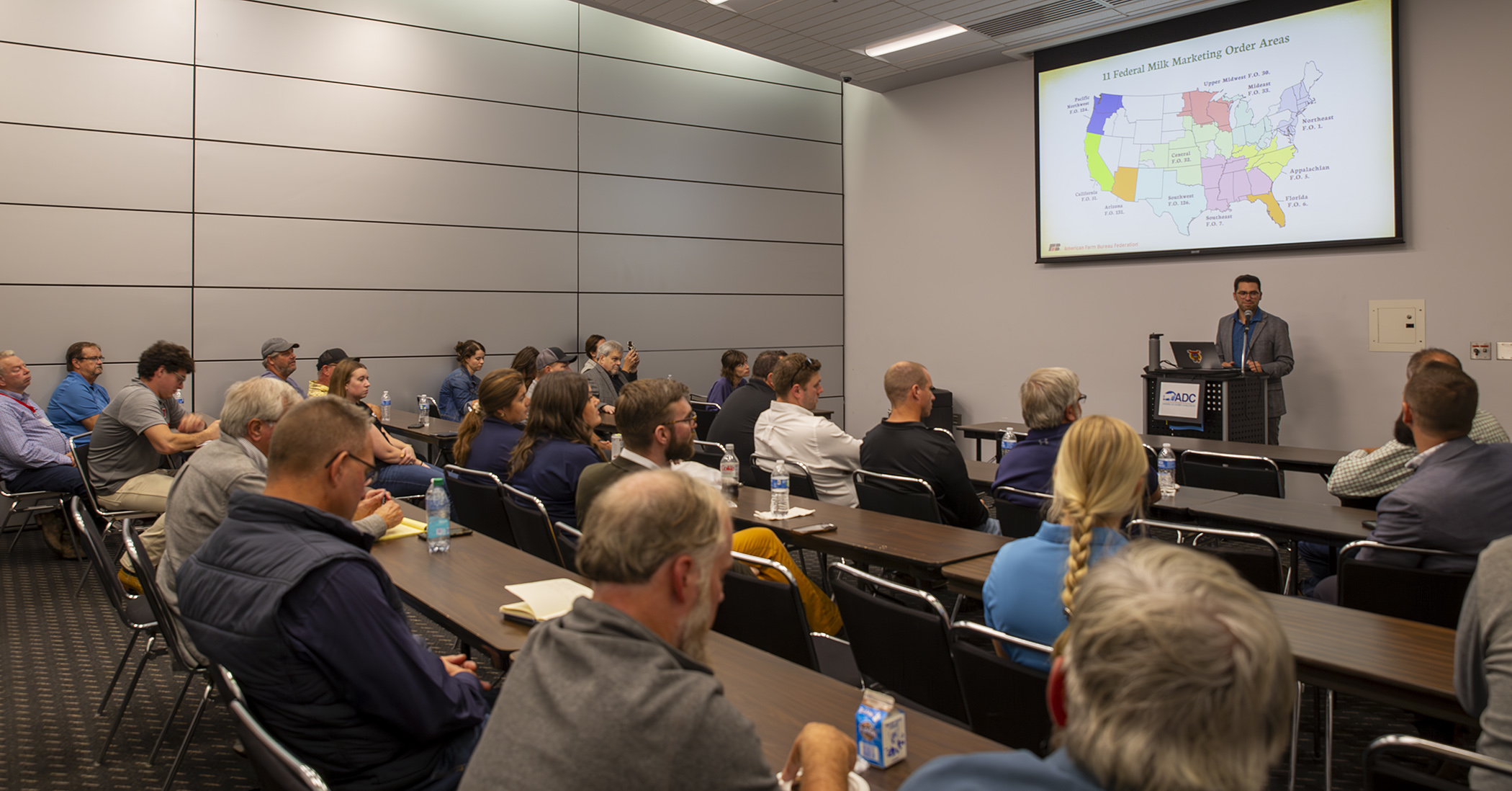
35 dairy farmers, industry representatives, and farm media attended “Winners and Losers: a discussion about USDA’s proposed milk pricing reforms,” hosted by the American Dairy Coalition during the 57th World Dairy Expo in Madison, Wisconsin October 3rd.

By Sherry Bunting, Farmshine, October 11, 2024

MADISON, Wis. – “I’m in Wisconsin, and on the graph (below) it looks like producers in Order 30 are having to decide between less money with an Order or even less money without an Order. Am I wrong and is there a silver lining?”
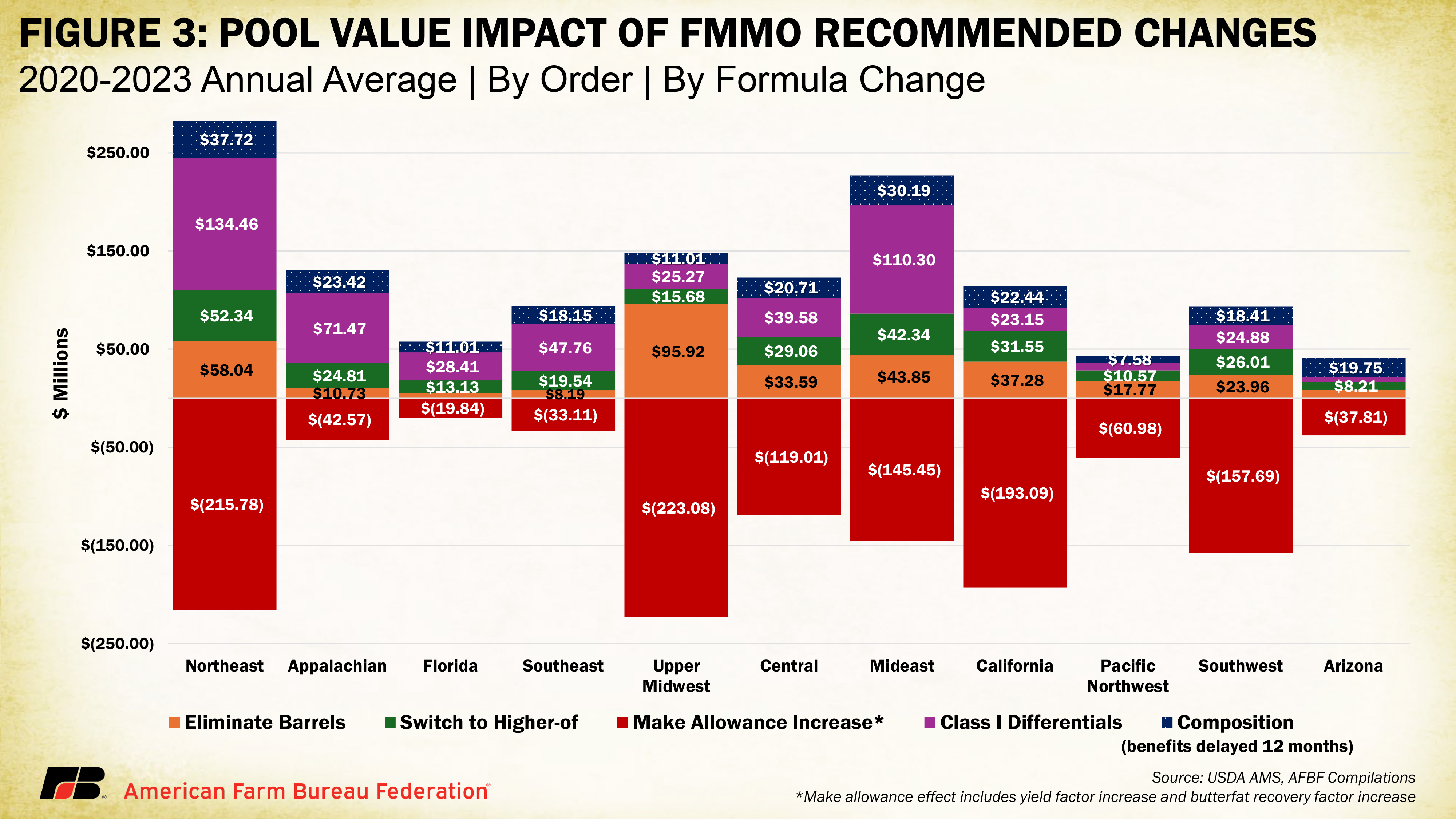
That was the crux of the question one dairywoman asked during the American Dairy Coalition’s (ADC) ‘Winners and Losers’ seminar and press conference Oct. 3 at World Dairy Expo. Over 35 farmers, industry representatives, and media professionals gathered to hear insights about USDA’s recommended decision on changes to Federal Milk Marketing Order (FMMO) price formulas.

American Farm Bureau economist Danny Munch was the invited presenter, followed by time for questions, moderated by Kim Bremmer of Ag Inspirations, and opportunities for networking and farmer-to-media connections during the remainder of the two hours.
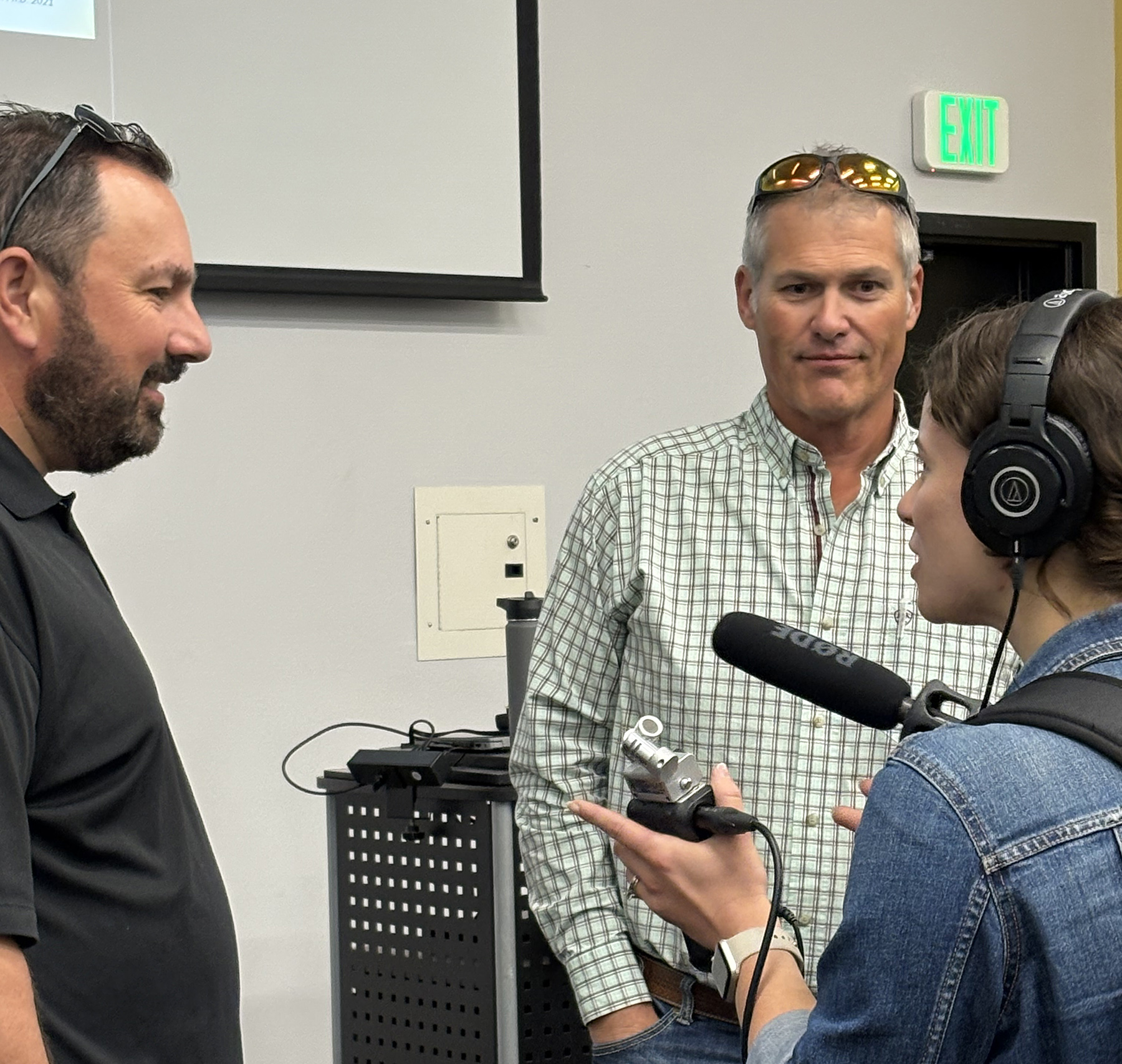
Dairy farmers attending ADC’s press conference gave interviews after the discussion on USDA’s proposed milk pricing changes.

At issue was the impact on FMMOs with more cheese and less fluid milk, that would experience the negative impacts of a proposed hike in processor make allowances without the positive buffer of higher Class I location differentials.

Bremmer said over 126 individuals and organizations provided comments to USDA. The comment period ended Sept. 13. 

During his visit to Expo on Oct. 4, Ag Secretary Tom Vilsack said USDA would issue a final decision in mid-November. Also on Oct. 4, USDA held a webinar explaining the producer referendum expected in January. (Look for more specifics in a future Farmshine, and check out the Farm Bureau recap here)

The short answers to the above question appear to be yes, yes, and yes. With an Order, producers in some regions will see lower FMMO blend prices. Without an Order, they would lose minimum prices altogether and other important FMMO functions.

The silver lining? Munch pointed to better competition currently for milk, and he sees opportunity for milk in the future as consumers focus on protein.

New to the discussion was make allowance data compiled by AFBF for its official comment at the Federal Register showing the average plant size of processors participating voluntarily in the Stephenson Survey relative to the average plant size of processors reporting to the NASS Dairy Product Manufacturing Survey (below)
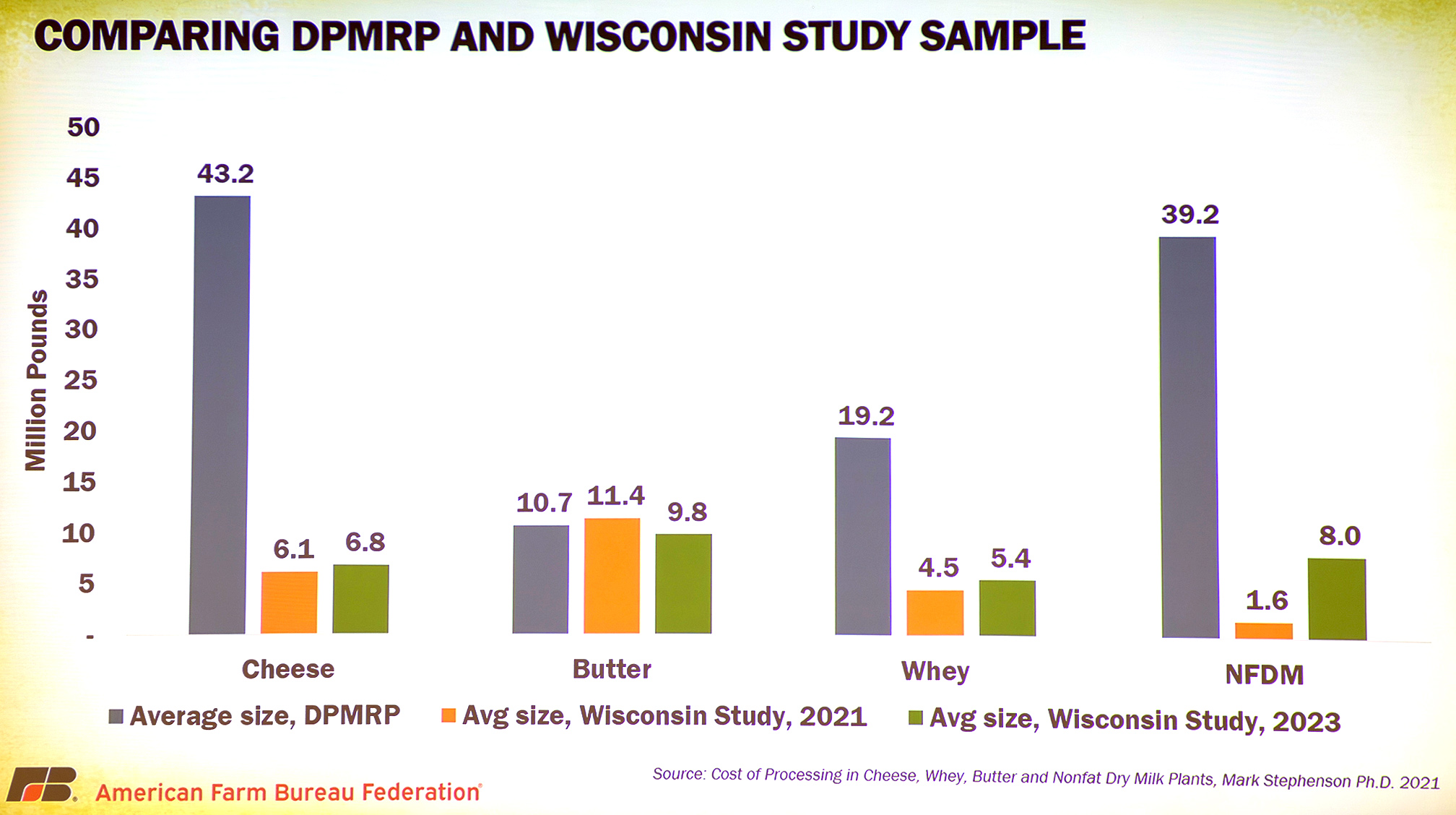
The average size and volume of the plants in the voluntary cost of processing survey is 5 to 20 times smaller than the size and volume of plants reporting to USDA on price and production. This is further evidence that mandatory surveys are the only fair way to examine and set make allowance levels.

ADC reports that farmers have called with questions and concerns about the FMMO changes they will vote on. Part of ADC’s mission is to inform dairy farmers and help them understand factors like this that affect their businesses, said Bremmer.

For example, it’s helpful for farmers to realize that current make allowances equate to $2.17 to $3.17 per hundredweight in deductions already in the pricing formulas to cover the cost of converting milk to butter, cheddar cheese, nonfat dry milk, and dry whey. 

The proposed new make allowances add 70 cents to $1.00, depending on class utilization, bringing the total deduction to about $2.89 to $4.07 per hundredweight, maybe more.

The splitting of Class I into a two-mover pricing system is also causing discontent and concern. On the one hand, USDA would restore the ‘higher-of’ method for conventionally pasteurized fluid milk but use an ‘average-of’ method with a rolling and delayed adjuster for the extended shelf life (ESL) fluid milk products. This new milk class was not vetted nor defined during the hearing.

Also of concern is the delay in implementing positive updates to milk composition standards that have not been updated since Order Reform in 2000.

USDA’s recommended decision applies to all 11 FMMOs nationally but will be voted on by eligible (pooled) producers in each Order, individually.

A two-thirds ‘yes’ vote within each individual Order continues that Order with the changes. If the two-thirds threshold is not met by either producer numbers or volume in an Order, then the result is termination of that Order. 

Producers do not have the option of voting separately on the five pieces of the USDA decision, nor do they have the option of voting to keep the FMMO pricing formulas as they are currently.

Economists with National Milk Producers Federation have stated previously that 65 to 70% of the U.S. milk supply is marketed through cooperatives that tend to bloc vote for their producers, but this percentage can vary on an individual Order basis.

USDA determines voting eligibility, based on whether milk was pooled in the reference period selected by each Market Administrator. 

“When we get down the road to the vote, and if we vote ‘no,’ that will dissolve the Order, right?” asked one dairy farmer. “What opportunity does any geography have to reorganize a new Order to fit what works for them?”

Munch said producers could start a process to create a new Order, but it would still be required to use the same price formula rules because these will apply to ALL Orders uniformly. In contrast, he noted that USDA leaves pooling and depooling rules to be decided individually by each Order.

One member of the media pressed Munch to speculate on what happens if a western Order votes no, but an eastern Order votes yes?

“People always want me to speculate on what happens if California or the Upper Midwest vote out their Order(s). What we’ve seen in the past in unregulated areas, or areas with state orders — they still base a lot of their pricing on the nearby Federal Order system,” he responded.

“If we remove more milk out of the Federal Order system, does that system then play less of a role in pricing milk, and does that unregulated market start to dictate and suck milk out of the regulated areas, if you’ve taken out some of the large milk production states? That’s just some speculation, something to think about in the long term,” he said.

On a more immediate basis, Munch said that if an Order is terminated by this vote, “farmers lose protections like timely payments and component verifications, and the minimum prices. You could end up with a patchwork.”

He pointed out that USDA did not raise make allowances by the full amount requested by processors, but also did not go with the more modest increases requested by the cooperatives.

In their post-hearing comments, processors voiced great unhappiness with the decision, he said, because they didn’t get the multi-year increases to even higher levels.

“We don’t blame USDA for trying to come up with a middle ground… we just don’t have the data. The way hearing processes work is they collect this data brought by stakeholders and try to come up with a compromise that works for everybody,” Munch explained. “Our argument is that the data may not reflect market conditions, and we want to make sure that it does. We can’t get that assurance until there’s an audited, mandatory survey.”

As a standalone piece, AFBF estimates that USDA’s proposed increase in make allowances would remove an additional $1.25 billion annually from producer pool revenue, nationwide, based on past pooling data. However, USDA proposes a one-year delay in implementing the milk composition updates that would contribute $200 million annually in producer pool revenue nationwide.

Munch sees the 12-month delay in implementing the milk composition standards and the splitting of the Class I mover with an ESL adjuster as two things that appear to be “thrown in there,” with a lot of groups voicing discontent and confusion.

When asked by a reporter if the add-ons to Class I will create consumer resistance to what could be a 25-cents-per-gallon increase in retail fluid milk prices, Munch cited the hearing record where economists testified to the relative inelasticity of fluid milk demand.

He also sees great opportunity for milk: “When I go to the gym, I used to see no one drinking milk. Now I see tons of people drinking milk, protein shakes, and other things, and it’s not plant-based products. I think milk can take advantage of marketing the protein benefits that people in my generation are looking for and are willing to pay for.”

Munch was asked if AFBF will recommend how its dairy members should vote.

“We will not make that recommendation. We take positions based on our policy, which includes opposing any make allowance updates until we have mandatory cost of processing surveys, and other aspects related to our policy book,” he replied. “It’s up to our members to make those voting decisions, and there is a regionality to this, so we don’t get involved at that level.”

Florida producers, for example, “will be okay with the new rules” because the over 80% Class I utilization brings with it higher location differentials. The Upper Midwest, on the other hand, has been at roughly 5% Class I and 93% Class III, so there is very little benefit from the Class I changes, but those producers are subjected to the highest make allowance deductions for Class III products, which is 95% of their blend price.

-30-
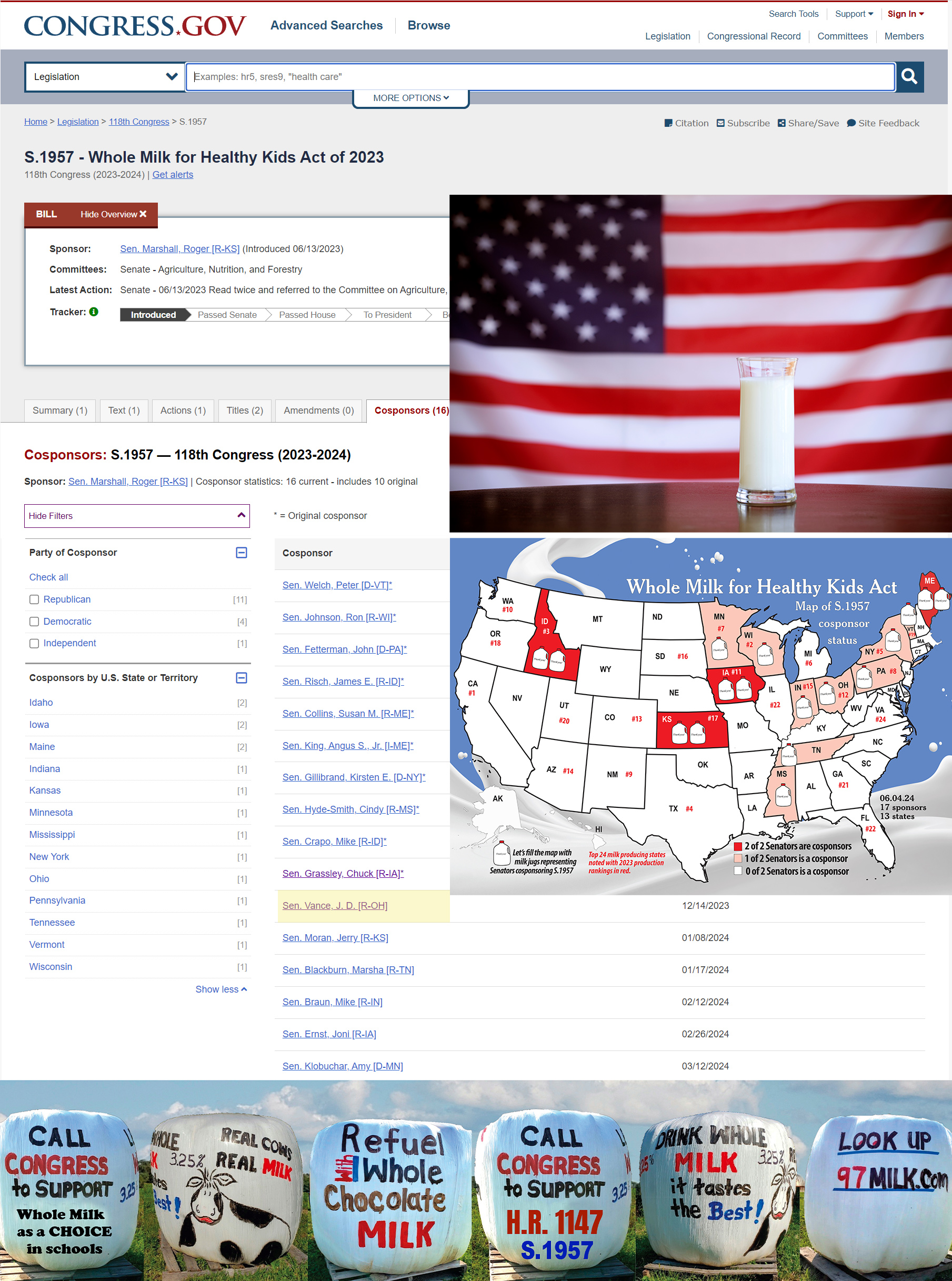
Editorial: ‘Wouldn’t it be great if we could unite the country with whole milk?”

By Sherry Bunting, Farmshine July 26, 2024

‘Wouldn’t it be great if we could unite the country with whole milk?”

Those words were messaged to me by a friend and colleague a year ago, right after the Whole Milk for Healthy Kids Act had passed the House Education Committee in bipartisan fashion before the overwhelming passage on the House floor Dec. 13, 2023 and before Senate Ag Chair Debbie Stabenow (D-Mich.) blocked it the next day, Dec. 14, 2023.

This was my first thought, when former President Donald Trump announced Senator J.D. Vance of Ohio as his running mate in the Republican campaign. (Vance is an early cosponsor of S. 1957, the Senate’s whole milk bill.)

Like others, I’ve been involved in the effort to bring the choice of whole milk back to schools for more than a decade. It’s about natural, simple goodness — to simply strip away the federal ban and allow hungry, learning children to be nourished by milk they will love. 

Looking back at the years of this long fight, I realize that if it’s so painstakingly hard to get something so simple and so right accomplished for America’s children and farmers, we’ve got problems in this country.

With President Joe Biden now withdrawing from the campaign for a second term, and Vice President Kamala Harris as presumptive nominee launching her campaign this week in the Dairyland State, I’m reminded of where she stands on such things.

Harris is no friend to livestock agriculture. She was an original cosponsor of the Senate version of “The Green New Deal.” She has strong positions on climate change that may lead to harsher rules on methane emissions and water consumption in the dairy industry, while perhaps promoting methane digesters, which are not an equitable nor necessary solution. Cows are NOT the problem!

Some in the dairy industry are on record stating that this would be good for dairy because the DMI Net Zero goals fall in-line and tout some of the same objectives. But no matter how you slice and dice all the fancy offsets, insets, innovations, grants, projects and the billions of dollars, the bottom line leaves cattle holding the bag. 

Cattle are in the crosshairs of a very long game set to control land, food and people.

Harris has already indicated she would use the Dietary Guidelines to reduce red meat consumption on the basis of this erroneous climate impact claim about cattle that we are all being brainwashed to quite literally buy into.

As a presidential candidate in 2019, in a CNN town hall, she was specifically asked: “Would you support changing the Dietary Guidelines to reduce red meat specifically to reduce emissions?”

“Yes, I would,” Harris replied, with a burst of laughter.

It’s not funny.

Earlier, she had said she “enjoys a cheeseburger from time to time,” but the balance to be struck is “what government can and should do around creating incentives, and then banning certain behaviors… that we will eat in a healthy way, and that we will be educated about the effect of our eating habits on our environment. We have to do a much better job at that, and the government has to do a much better job at that.”

Read those words again: “creating incentives and then banning certain behaviors.” In plain English, that means dangling the carrot and then showing us the stick.

Harris joins Senators like Ag Chair Stabenow, as well as Bob Casey from Pennsylvania, as card-carrying members of perennial Ag Secretary Vilsack’s food and climate police.

Not only is Ag Chair Stabenow blocking the whole milk bill in her Committee, she is dragging her feet on the critical farm bill. 

As President Biden’s approval ratings fell, there were indications she would bring her side of the aisle to the table to negotiate a compromise to get the farm bill done this year.

Now that Biden has withdrawn from the race, and the pundits, media, and party organizers are breathless with excitement over Harris as presumptive nominee, it appears that the farm bill negotiations between the Committee-passed House version, the Republican Senate version and the Democrat Senate version have fallen apart.

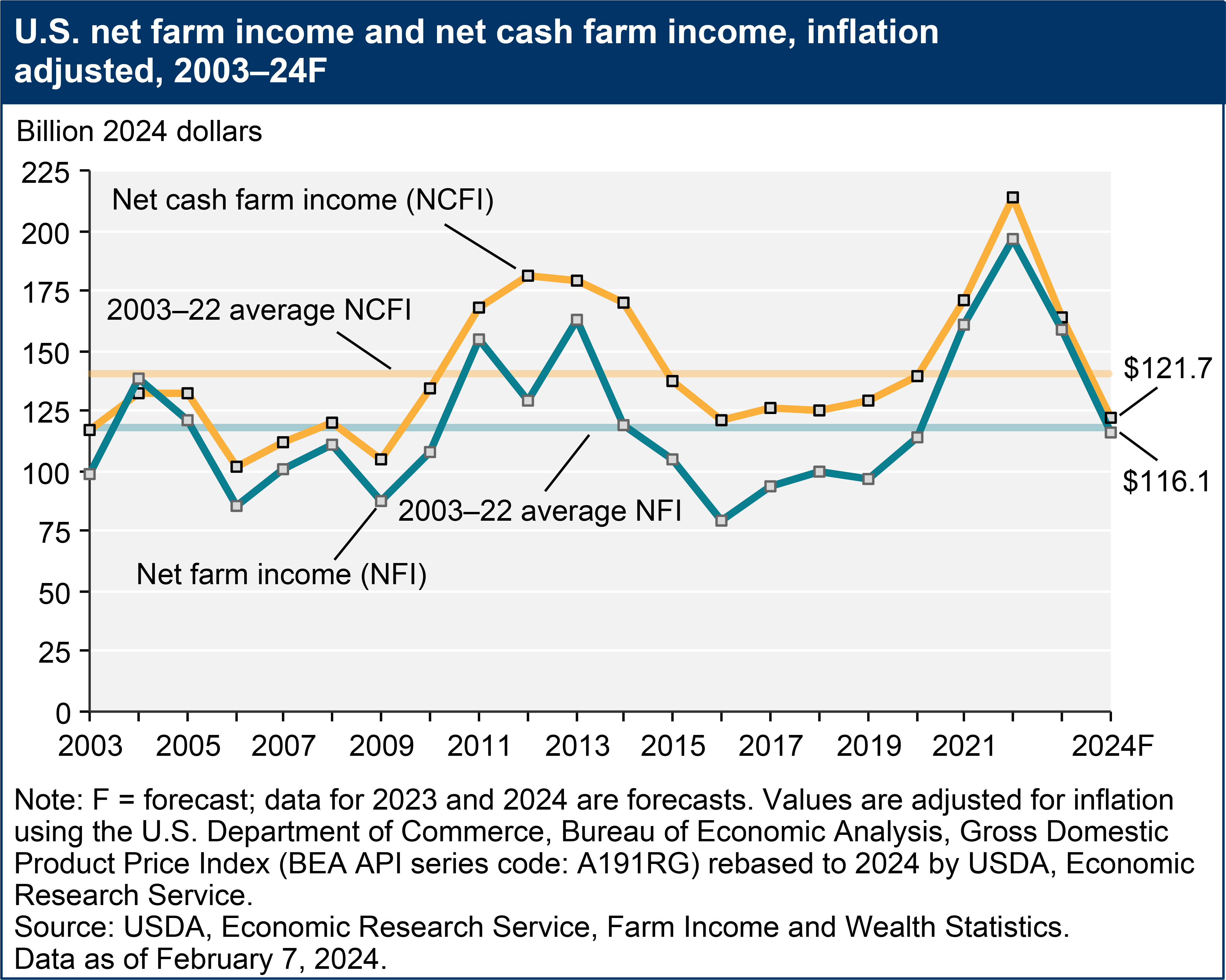
House Ag Chair G.T. Thompson (R-Pa.) has called upon his colleagues to get to the table and do the work because a perfect storm is brewing in Rural America as net farm income is forecast to fall by 27% this year on top of the 19% decline last year. 

Meanwhile, there is political upheaval everywhere we look. Seeing Vance picked as Trump’s running mate and knowing he was among the early cosponsors of Senate Bill 1957 – The Whole Milk for Healthy Kids Act – offers some hope.

That bill — in true bipartisan spirit — was introduced in the U.S.Senate in June 2023 by Senator Dr. Roger Marshall (R-Kan.) with prime cosponsors Peter Welch (D-Vt.), Ron Johnson (R-Wis.), Kirsten Gillibrand (D-N.Y.), Chuck Grassley (R-Iowa), John Fetterman (D-Penna.), Mike Crapo and James Risch (R-Idaho), Susan Collins (R-Maine), Angus King (I-Maine), and Cindy Hyde-Smith (R-Miss.). The bill eventually earned cosponsorship from other Senators, including the influential Democrat from Minnesota, Amy Klobuchar.

Vance signed on as cosponsor on December 14, 2023, one day after the U.S. House of Representatives had passed their version of the bill by an overwhelming bipartisan majority of 330 to 99.

The Senate bill 1957 is identical to the successful House whole milk bill H.R. 1147, which was authored by Pennsylvania’s own Representative GT Thompson.

GT is a man of courage, conviction, compassion, of humility and humanity. I’ve heard him say more than once: “God gave us two ears and only one mouth for a reason.”

He is a determined man, doing the work. He included whole milk bill in the House Committee-passed farm bill. He’s standing firm on his pledge to put the farm back in the farm bill. He is concerned about the financial crisis in agriculture on the horizon, and held a hearing July 23 with witnesses from agriculture and banking giving stark warnings.

Even though whole milk choice in schools seems like a minor issue in the grand scheme of things today, it is really a linchpin. If we could just get something with broad bipartisan support accomplished, this could lead to other steps on common ground. 

Cows are not the climate problem. Cows are a solution. Cows are part of a carbon cycle, they don’t take carbon out of the ground and put new carbon into the air. 

Carbon is essential to life. It seems that those seeking full control of land, food, and people, are starting with carbon. 

As the whole milk choice remains hung up in the Senate, let’s pause to think about how ridiculous it is that we adults get to choose, but our growing children do not. For them, whole milk is banned at two meals a day, five days a week, three-quarters of the year at school. (The federal government, via USDA school lunch rules, only allows fat-free and 1% milk to be offered with the meal or even a la carte.)

Maybe the Harris ticket would like to ban food choice behaviors for adults as well.

We have Republicans and Democrats supporting whole milk choice in schools. Both parties say they care about our nation’s farmers and ranchers who feed us and are the backbone of our national security.

Let’s take that and run with it.

-30-

Ag hearing: ‘Perfect storm’ could ignite farm financial crisis, House Ag Chair GT expresses frustration over Senate playing politics with farm bill

By Sherry Bunting for Farmshine, Aug. 2, 2024

WASHINGTON, D.C. — The extended 2018 farm law will expire Sept. 30 in the throes of a tumultuous election year while farm liquidity and cash flow decline in the face of an eroded farm bill safety net. 

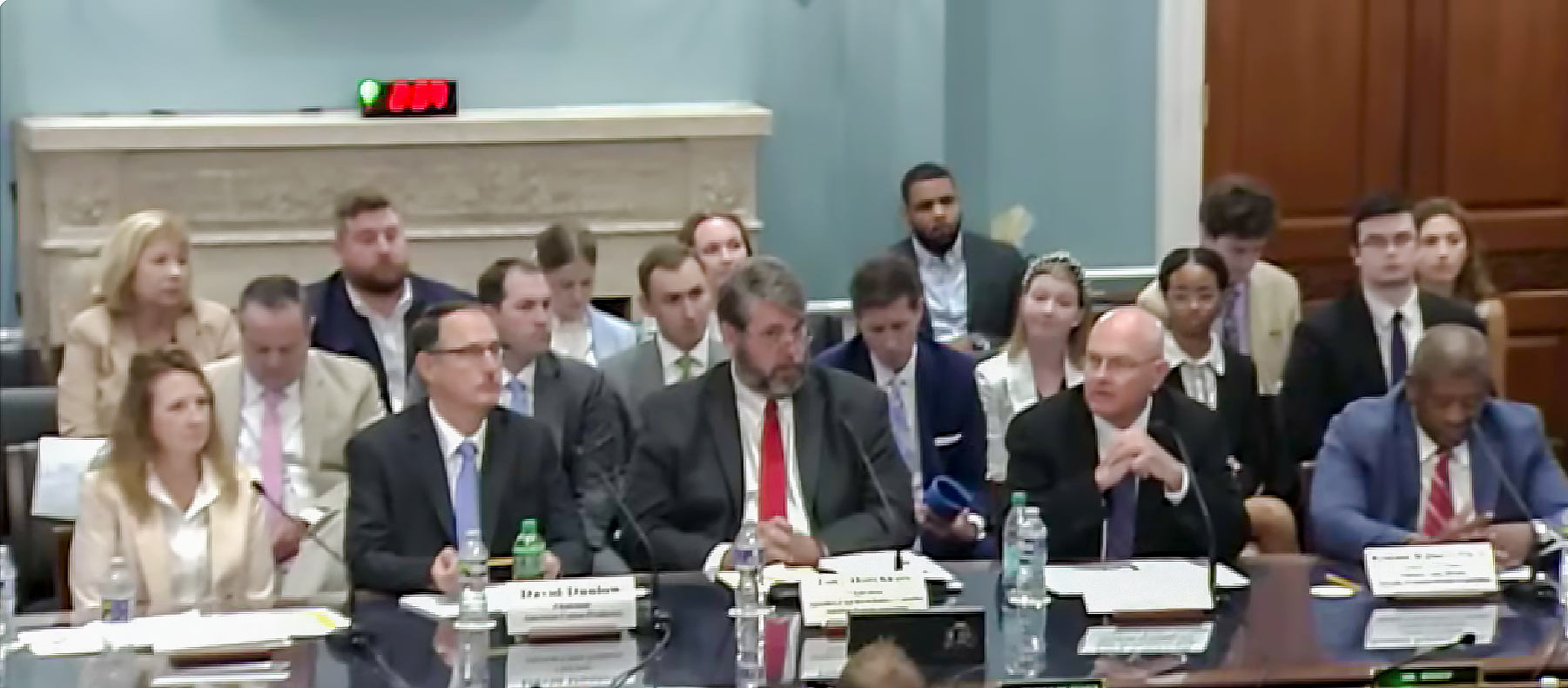
Witnesses before the House Ag Committee July 23rd were (l-r) Dr. Dana Allen-Tully for Minnesota Corn Growers, David Dunlow for American Cotton Growers, Tony Hotchkiss for Ag and Rural Bankers, Joey Caldwell for the Ag Retailers Association, and University of Arkansas ag economist Dr. Ron Rainey. Hearing livestream screen capture 

Witnesses in a July 23 House Ag Committee hearing expressed support for the House bill and made it clear that another extension is a non-starter, with one witness describing the current law as facing a category-five hurricane with no protection.

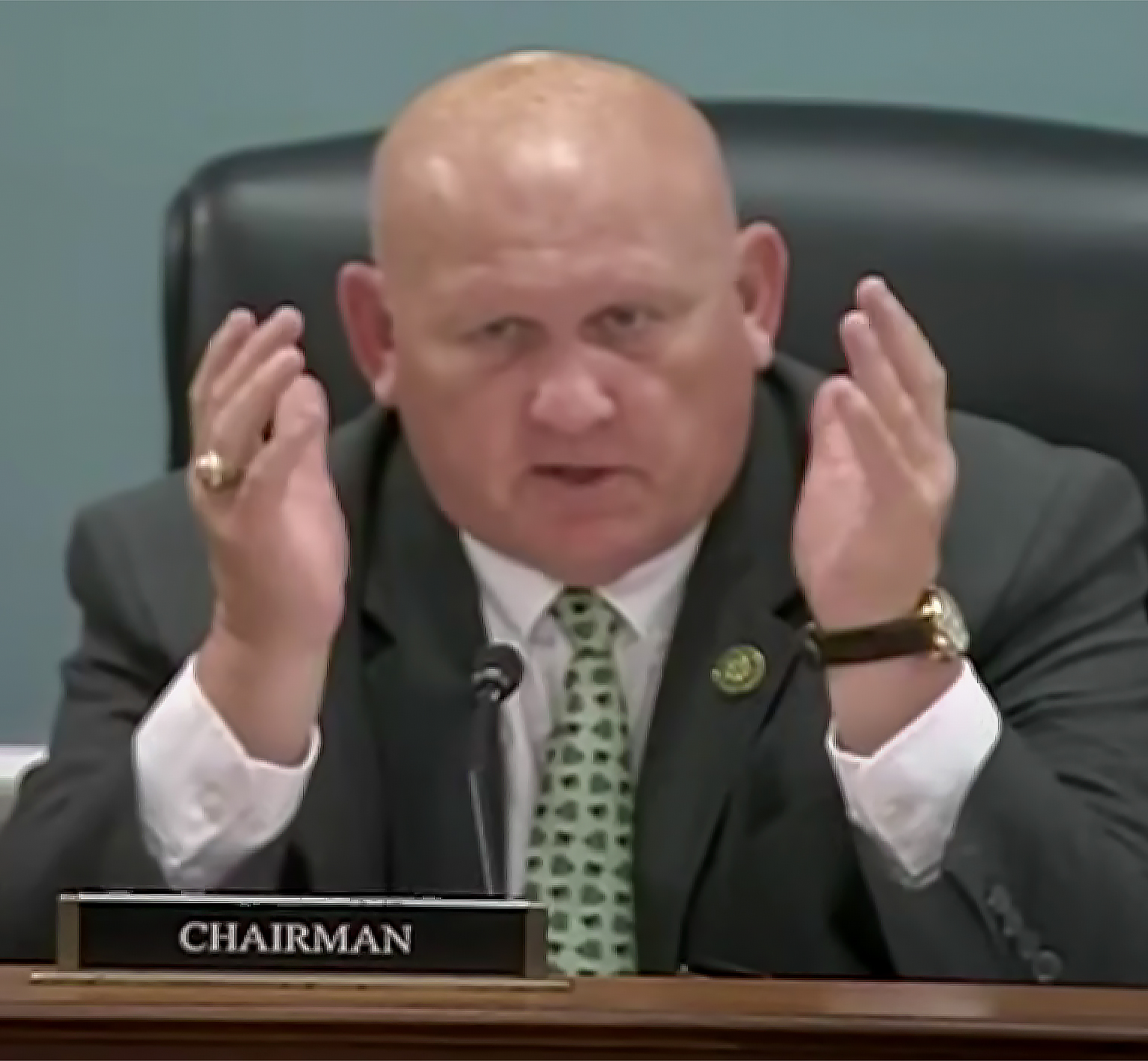
“Unprecedented challenges are facing the entire agricultural sector, threatening to ignite another farm financial crisis,” said House Ag Chairman Glenn ‘GT’ Thompson (R-Pa.) as he opened the hearing on financial conditions in farm country.

USDA estimates net farm income will see the steepest drop of $43 billion this year – down 27% from 2023 and down 40% from 2022. In its report, USDA notes that livestock farms will also see net cash farm income drop for 2024 across all specializations. Within the livestock sector, dairy farms are forecast to see the largest decrease in average net cash farm income in 2024.

“The impact won’t be fully understood until early next year when farmers are unable to secure operating loans because they can’t cash flow,” said Dr. Dana Allen-Tully, member of a diversified crop and dairy farming family near Eyota, testifying for Minnesota Corn Growers.

In addition to flooding in her region and drought elsewhere, crop producers face income losses of $150 to $233 per acre, she said, citing plummeting prices, high costs of production, doubling interest rates, natural disasters, and tightening credit.

Thompson said these factors create “a perfect storm that will compromise the foundation of our agricultural economy.”

He observed U.S. agriculture is in the largest two-year decline in farm income, and by the end of 2024, total farm sector debt will be the highest since 1970.

“Unfortunately, the farm safety net has not seen significant investment since 2002. The lack of support for those that feed the world is unacceptable,” the Chairman said, pointing to the many farm bill listening sessions across the country. 

According to Thompson, the bipartisan House Committee-passed Farm, Food and National Security Act of 2024 represents the largest permanent farm bill investment in over two decades for the farm safety net, conservation, trade promotion, specialty crops, research, and livestock biosecurity. 

“It will give renewed strength… just when producers need it most,” he declared, taking aim at “pundits spreading misinformation about this bill in order to sow division.”

Thompson said Democrats in Congress have “unilaterally added billions to climate and conservation programs, and the current Administration added one-quarter of one trillion dollars to nutrition programs — all while ignoring the farm safety net.

“I will not apologize for advancing a bill that seeks to put the farm back in the farm bill. I am tired of the politics and gamesmanship, and I know folks out in the countryside are too,” he said.

Thompson stated further that this work has been “saddled with a meddling Senate Democrat and others who do not seem to appreciate the dire circumstances in farm country.” 

The “meddling Senate Democrat” is Ag Chairwoman Debbie Stabenow (D-Mich.), who is retiring at the end of 2024 and is also responsible for holding hostage the Whole Milk for Healthy Kids Act.

As recently as last week, some Ag Committee Democrats have expressed a preference to see a farm bill fail before engaging in the process, Thompson reported, adding that his door remains open “to renegotiation from any partner willing to come to the table with a serious proposal — not more red lines.”

He stressed the difficulty in reconciling a bipartisan 900-page House bill with a partisan 90-page Senate summary.

“For negotiation to be viable, Chairwoman Stabenow needs to unveil her bill text,” he challenged.

During the hearing, witnesses cited meaningful improvements to the safety net via updates to reference prices, crop insurance, and the conservation title.

Both the current 2018 law and the incomplete Senate summary do not meet the needs of farmers, witnesses indicated. Even the stronger safety net in the House bill is not enough, they said, but would help farmers weather the storm.

While pundits say the House bill cuts nutrition programs, Thompson has repeatedly demonstrated no program cuts in the bill, even though the Congressional Budget Office (CBO) score showed $30 billion in savings on the 10-year baseline compared with earlier scores. 

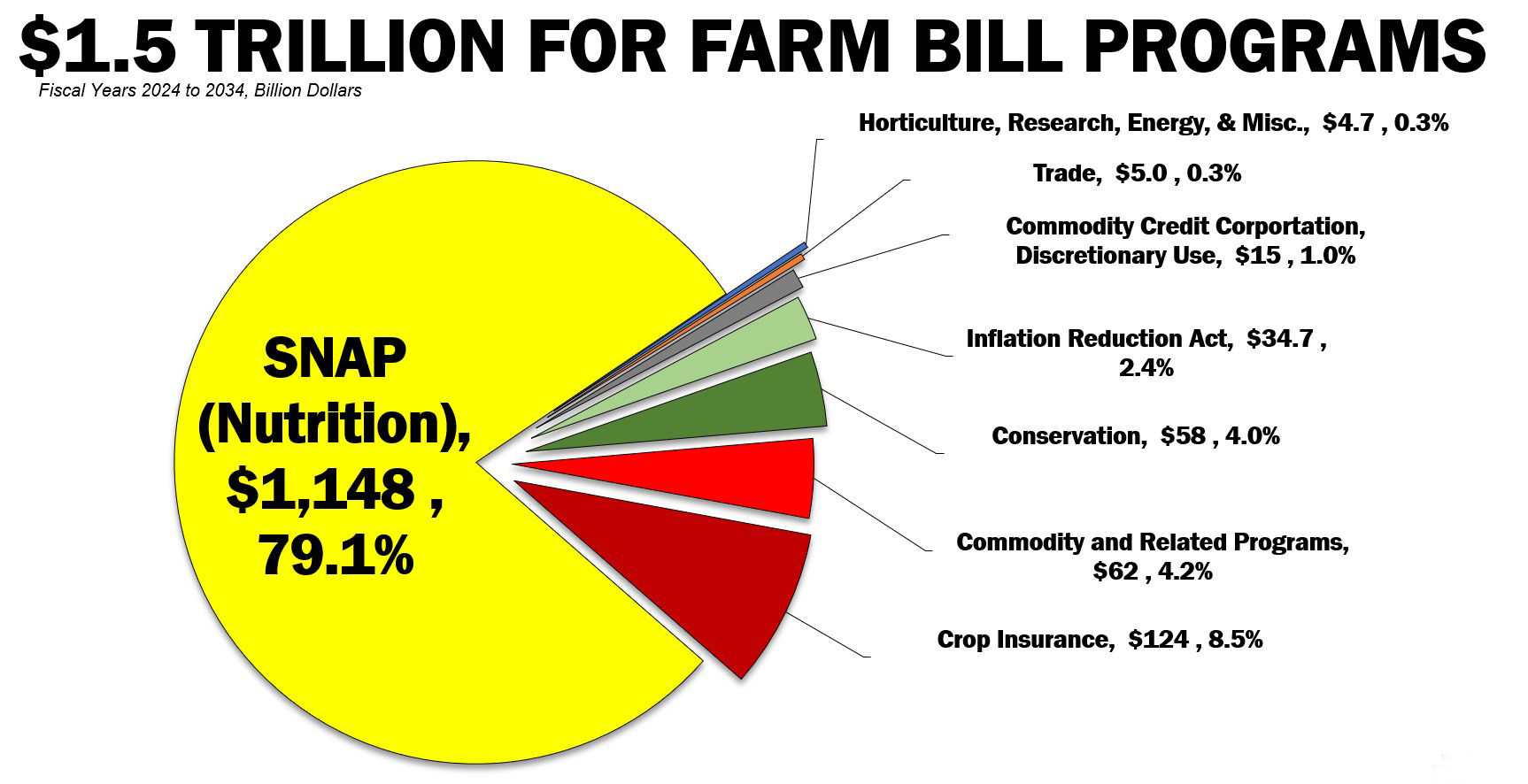
Nutrition Title spending accounts for nearly 80% of the estimated $1.5 trillion total farm bill. Nutrition spending also increases by 73% ($484 billion) since the 2018 farm bill enactment.

“Quite frankly, we are not going to have nutrition, if we do not have farmers, so our investment here is in the farm safety net,” Thompson stated. 

The House farm bill seeks a stronger farm safety net within a shrinking piece of the total farm bill pie. Senate Ag Committee minority graphic

Ranking member David Scott (D-Ga.) emphasized in his remarks the Democrat position that CCC authority remains “exclusively in the hands of the Secretary of Agriculture,” without the congressional oversight proposed in the House bill.

The witnesses didn’t bite when asked about this. Several indicated it is more desirable to have a stronger safety net so the CCC does not have to be dipped into in the first place.

At the same time, witnesses indicated the need, now, for supplemental intervention under the current price squeeze.

To that point, Rep. Mark Alford (R-Mo.) asked: “Did you know we are losing 1000 farms every month in America right now? It’s a staggering number when we consider our food security and our national security.”

“Working capital is fast depleting,” Dr. Allen-Tully testified. She called John Deere’s layoffs “a canary in the coal mine” and warned against another farm bill extension because “it won’t stop the hemorrhaging. Even a new farm bill with a strong safety net may not be timely or sufficient, though I pray Congress will pass a new farm bill this year because it will help in the long run.

“We put everything on the line for a thin and often negative margin. Young people aren’t going into farming, and that’s why the average age of farmers is nearing 60… no parent wants their kids to go through life facing constant worry. We need our full-time farm and ranch families,” she said.

North Carolina farmer, David Dunlow testified for American Cotton Growers. He noted the size of operating loans farmers in all commodities take on every spring, and the lines of credit with input companies.

“That has to be paid back – every year — before we can go and get another operating loan,” he said. “The margins are very thin … under normal conditions, and with the economy now, nothing cash flows. It’s very difficult to get those loans paid and to move on to the next year.”

Testifying for the Ag and Rural Bankers, Tony Hotchkiss said lenders are seeing changes. Farmers are working through liquidity faster than anticipated and are now beginning to leverage equity through refinancing debt. This is further challenged by the cash flow needed for the refinancing payment.

“This has made ag bankers feel as though they are looking over the cliff,” Hotchkiss stated, stressing the need for ag policy changes, many of which are included in the 2024 House farm bill.

Joey Caldwell of GreenPoint Ag Holdings in the Southeast U.S., testified for the Ag Retailers Association. He said a strong farm bill safety net is critical to Rural America: “If the farmer is not successful, the supply chain is not successful, and this impacts the very fabric of our communities.” 

University of Arkansas ag economist Dr. Ron Rainey also testified that farm debt levels are increasing as divergence between input costs over ag prices is widening, even if the overall price indices are higher.

He said more farmers need to be involved in using risk management, whether that is through better subsidy levels or technical assistance to enhance understanding and use of it.

“If they don’t have crop insurance, and if they are outside of the safety net, then they’re financing their risk on their balance sheets. The more we can move from ad hoc disaster assistance, the better off the farmers are,” said Dr. Rainey. 

“But where we are now… that’s going to require some intervention. That’s just the bottom line,” he added.

Rep. Eric Sorenson (D-Ill.) brought up sustainable aviation fuel and the inequity in how current Energy Department tax credits are given for ethanol from Brazil and used cooking oil from China, while American farmers, who can serve this need, are getting nothing.

“Sustainable aviation fuel is one of the most exciting things coming as a corn farmer,” Dr. Allen-Tully replied. “But the way the Treasury Department has their guidance written excludes us. It is almost insulting to believe that we would bring in sugarcane ethanol in place of ethanol we can grow here.”

Rep. Mary Miller (R-Ill.) asked witnesses how the climate policies of the current administration are affecting farmers, and she gave her own opinion as a farmer:  It’s painful.

Caldwell responded, pointing to energy and fertilizer as the largest costs, and they are much higher under these policies.

“Farmers need a strong farm bill,” said Caldwell. “When a farmer plants a crop, they put more than their job at risk. It is their home, their livelihood – a pillar of their community. For many, it is also their family legacy, passed down through generations that they hope to pass on to their kids… they risk losing it all.”

-30-

Pray for rain, or pray it stops, depending on where you are: Grain markets continue shrugging off weather woes

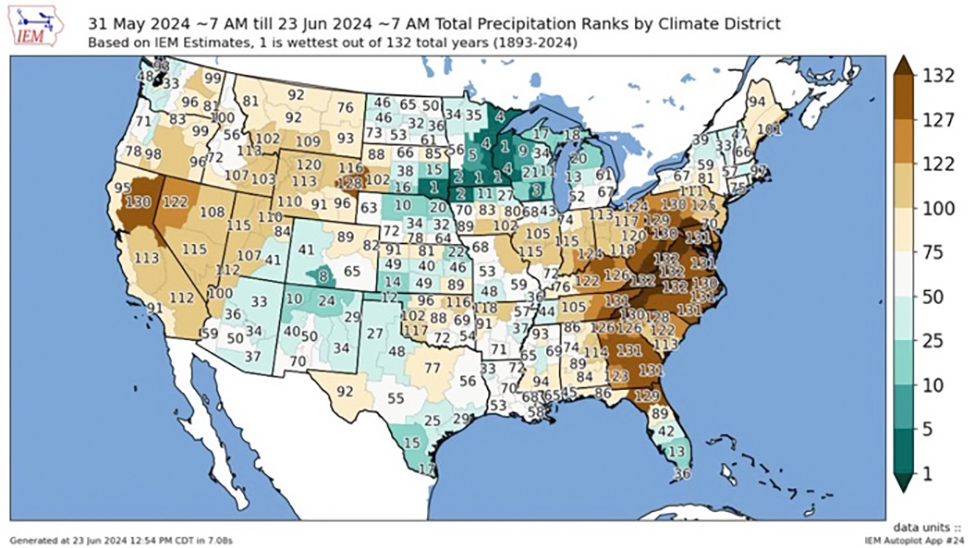
An Iowa State University IEM data graph is the picture that speaks 1000 words about the “tale of two halves”. It shows precipitation highs and lows vs.132 years of records. An April / May data capture looked about the same in the Upper Midwest and Northern Plains, but the drought in the East had not yet become as widespread into the Ohio Valley until June. Some areas are seeing the driest June on record.

By Sherry Bunting, Farmshine, June 28, 2024

EAST EARL, Pa. – Pray for rain. Pray it stops. The contrast could not be starker.

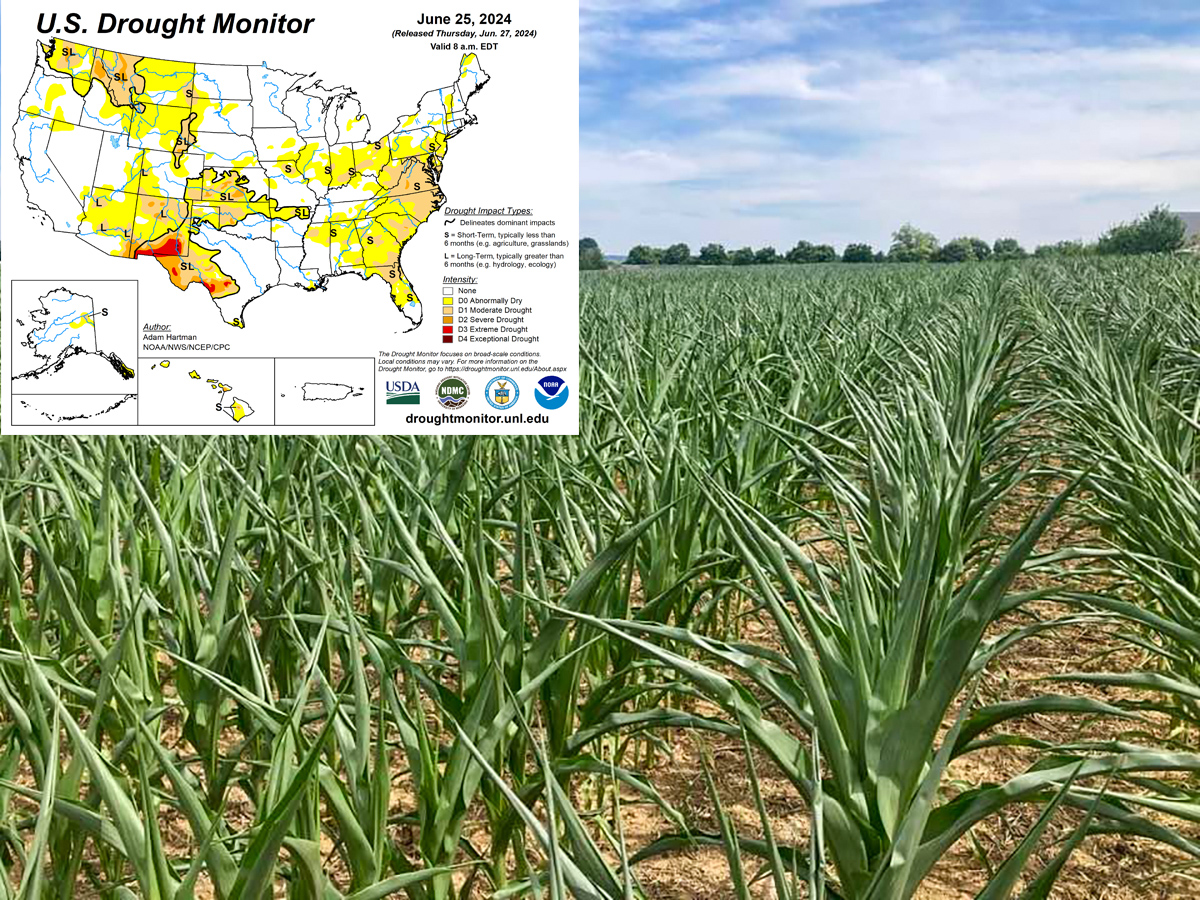
The Mid-Atlantic and Ohio Valley is in the throes of one of the driest growing seasons on record. Meanwhile, the season was already one of the wettest on record throughout the Upper Midwest and Northern Plains before the 8 to 15 inches June 21-23 led to historic catastrophic flooding in northwest Iowa, southeast South Dakota, and southern Minnesota.

The June 24th USDA Crop Progress Report showed a 3 point decline in good-to-excellent corn condition, nationally, falling to 69%. But, sticking in the market’s crawl is the earlier-projected corn crop estimates and the mere 50% good-to-excellent corn crop condition reported for this same week a year ago.

Soybean condition fell 5 points to 67% this week. Again, this beats the 51% good-to-excellent condition reported this same week a year ago.

The impacts on damaged crops and potentially lower yields from floods have yet to be assessed in a region that had already delayed planting, drained and replanted.

Grain markets are shrugging off the weather woes, appearing to be focused primarily on the demand side of the equation looking toward the upcoming end-of-month Grain Stocks report.

Some analysts are expecting an overall bearish mode to hold through at least month-end or longer, despite news emerging of untold acres of corn and soybeans under water along rivers and lakes in Iowa, Minnesota and South Dakota.

Governors of the three states declared statewide emergencies and named scores of counties under disaster declarations. President Biden has announced a federal disaster declaration in Iowa, opening up federal funding there. Other areas may not be far behind.

Lakes and rivers in the region reached levels reportedly higher than in 1993. Towns are under water, nobody in and nobody out, with boat rescues off rooftops and rescues via National Guard helicopters.

As the Big Sioux and Des Moines Rivers reached levels as much as 7 feet above previous records, a 100-year-old Minnesota dam failed, and two railway bridges collapsed that transported ag commodities.

Grain markets did not care. Early this week (June 24-25), “the markets tanked,” said Eric Relph with Commstock Investments in a Marin Bohling interview on the Commstock Channel Tuesday morning (June 25). No market strength emerged yet by Friday. Instead, more red.

“We are still fighting the mentality that rain makes grain,” said Relph.

Much of the Midatlantic region and into the Southeast and Ohio Valley are near record dry for June.

“The concern grows when we have other big chunks of other major growing regions very dry in Illinois, Indiana, and Ohio, having had no rain in three weeks, with cracks in the ground, and plants curling and temperatures up at 75 overnight.”

Analysts are looking back at reactions to the summer flooding of 1993. But as farm broadcaster Max Armstrong observed in a tweet on X (formerly Twitter) Wednesday morning (June 26): “The South America behemoth makes tragic, sickening U.S. flooding far less consequential to the world than it did three decades ago.”

Farmers have taken to social media showing aerial footage of flooded fields, updating ever-increasing rainfall totals while walking the sprayer tracks that have become rivers in a swamp, along with images of busted corn bins and piles of flood-soaked corn in rural towns of northwest Iowa, like Spencer and Rock Valley, all within the targeted dairy growth area of the I-29 Corridor.

The problem, according to Relph, is the region had full moisture profiles coming into the Spring, then more rain constantly through April and May. This was before this 8 to 15 inches of rain that inundated the region.

Aerial photos show flooding in northwest Iowa as an already wetter than normal year was inundated by more rain and storms producing historic flooding.

Relph lives and works there. He described the geographic impact as substantial:

“At the western front of this area that is receiving this kind of rain, we move straight east through Iowa, with as much as 40% of Iowa affected, and it’s up into South Dakota and even North Dakota to a degree, and into central, the southern quarter of Minnesota, over into central Wisconsin and down along the Mississippi, missing Illinois, but including eastern Iowa,” he reported.

Iowa Ag Secretary Mike Naig said state officials won’t have a full sense of the crop damage or number of livestock lost in the region until the flood waters recede.

“This was already a wet part of the state, where there were some challenges around planting and replanting. They’ve just been inundated with rain throughout the spring. We’re hearing about damaged and destroyed equipment. There are livestock facilities that folks are having trouble getting feed to because of washed-out roads, and there are power outages and water outages. These are just some of the things that are really challenging,” Sec. Naig reported.

Farmers are resilient, and they are helping each other get through the most damaging elements and waiting to see how many fields will bounce back, if not under water more than two or three days. Some analysts say growers are not likely to pour management dollars into fields, depending on what the yield losses are predicted to be. It’s virtually too late to replant, even if conditions allow.

As one set of problems affects one region and another set of problems confronts another, Relph said: “It’s a tale of two halves. Without a shift in the weather pattern, it will be detrimental.”

Other analysts interviewed on Rural Radio Wednesday morning point to U.S. and European weather models that show more rain to come in the flooded region, but also going all the way East, keeping the bears in charge of the grain markets, with corn June 25 trading under February lows.

Meanwhile, the concerns now shift as the already flooding rivers flow into the Missouri and Mississippi.

In addition, sources indicate transportation has been affected by I-29 closures in spots from Sioux City, Iowa to Sioux Falls, South Dakota, affecting movement of supplies in and milk out. Trips take four times longer via back roads, and even there, washed out roads are encountered leaving some farms in a tough spot, while suppliers in affected nearby towns face difficulty getting out.

Some roads and portions of I-29 were reopening or partially reopening late June 25 into June 26, but new areas are bracing for the Missouri and Mississippi that are forecast to crest at major levels June 26 and into the first week of July.

Meanwhile, the NOAA Weather Prediction Center map shows rain and strong storms continuing in the Upper Midwest while overspreading the Ohio Valley and into the Mid-Atlantic by June 28.

As for the Midwest, The Weather Channel warns of severe flood risk returns as meteorologists are watching a new system ejecting from the Rockieswith the potential to bring a continued risk of flooding and severe weather in already impacted areas into July.

-30-

Thompson pushes effective, transformational farm bill. Whole Milk for Healthy Kids Act included!

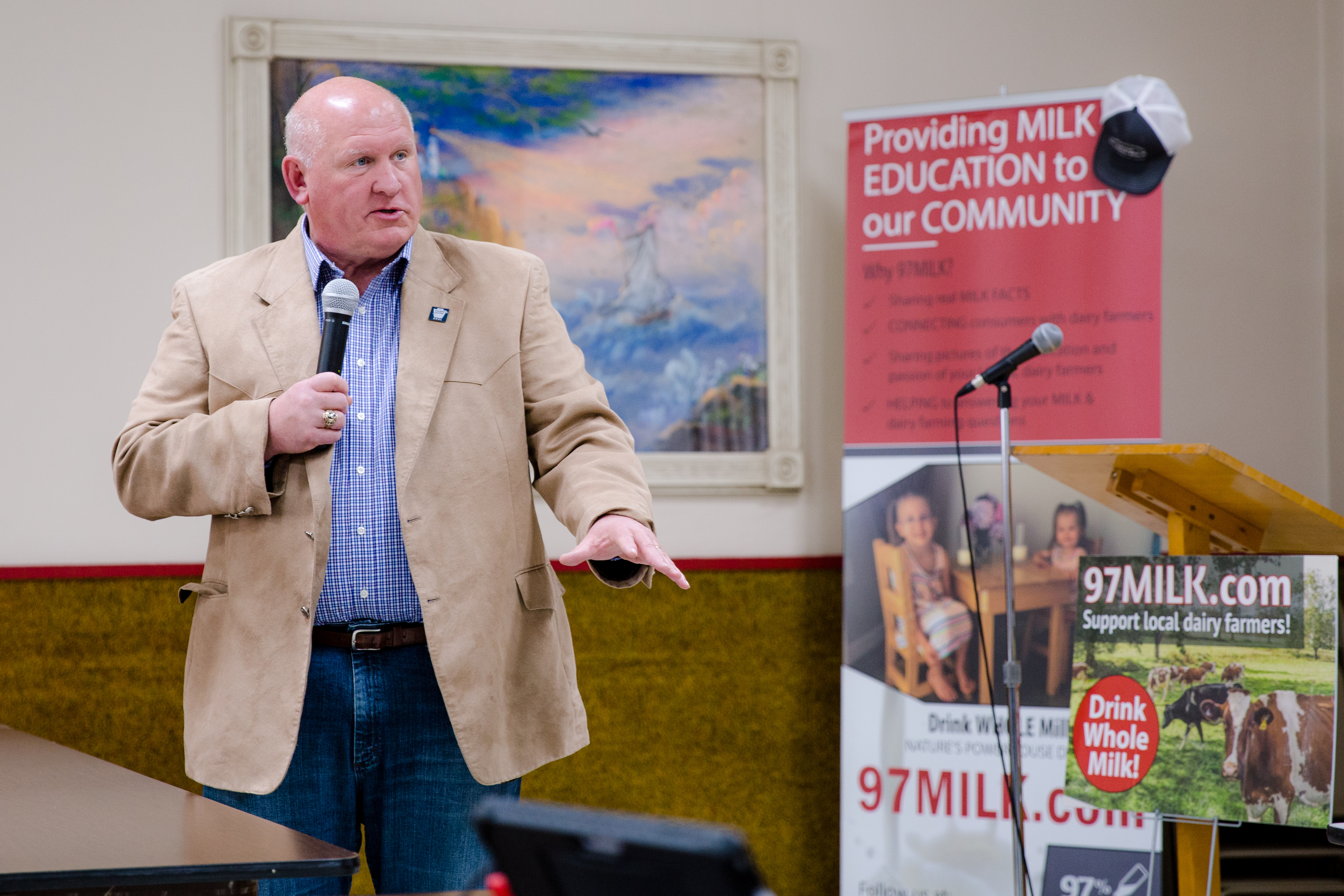
Representative GT Thompson of Pennsylvania once told a group of farmers gathered for a 97 Milk meeting that he has gone by a lot of titles and been called a lot of things over the years, and while it’s an honor to be the Chairman of the House Agriculture Committee, his favorite title is ‘Representative’ because, he said “that’s what we do. We are representing The People.” True to form, GT led the House 2023-24 farm bill process with representation in mind by making the bipartisan endeavor ‘tripartisan’ — going to great lengths to bring grassroots farmers into the process. One thing he heard repeatedly at the 85 listening sessions in 40 states was ‘bring whole milk choice back to schools,’ even though school meal rules fall under the childhood nutrition reauthorization led by the Education Committee, not the farm bill. But now he’s done that too. Bolstered by the overwhelmingly bipartisan 330 to 99 passage of H.R. 1147 on Dec. 13, 2023, he found a way to make Whole Milk for Healthy Kids part of his proposed farm bill that heads to House Ag Committee markup next week. He says he is intent on getting the whole milk legislation through the Senate blockade and “over the finish line.” File photo by Sherry Bunting

By Sherry Bunting, Farmshine, May 17, 2024

WASHINGTON – House Ag Committee Chairman Glenn ‘GT’ Thompson (R-Pa.) says the bipartisan farm bill has reached a milestone and holds the potential for being transformational.

The chairman’s mark, released ahead of committee markup set for May 23, demonstrates the listening that went on in his busy schedule traveling to 40 states and one territory for 85 listening sessions over the past two years.

“We are hopeful that the House Ag Committee markup of this chairman’s mark legislation helps feed the momentum to get this farm bill done,” said Chairman Thompson in a May 14 Farmshine phone interview.

There are important highlights here, including reforms to the Dietary Guidelines process for greater transparency and accountability with new checks and balances, as well as language to expand the reach, funding and impact of the dairy incentive and school meal programs by including full fat fluid milk, flavored and unflavored, as seen in H.R. 5099 and H.R. 1147 (Whole Milk for Healthy Kids Act).

“I was able to work with Dr. Virginia Foxx (chair of the House Education and Workforce Committee), and they will be providing a waiver after we mark this bill up, so we will be able to include Whole Milk for Healthy Kids in the farm bill,” Thompson shared.

He has previously stressed that, “This is about our kids and the outdated and harmful demonization of milkfat.”

“When we get to conference (with the Senate), it could be an issue, but Whole Milk for Healthy Kids passed the House by a 330 vote. I am intent on getting this provision over the finish line. 

“It may be the most important thing we do out of many things in this farm bill for dairy farmers,” he said.

Other dairy subtitle provisions

The dairy subtitle includes language to return the Class I ‘mover’ price to the ‘higher of’ calculation instead of the ‘average plus 74 cents’ that was implemented in May 2019.

“We obviously recognize that USDA has now gone through an extensive hearing process, and will honor what USDA comes up with, which will supersede what we’re doing,” Thompson reported. “But it was the Ag Committees in the Congress through the 2018 farm bill that eliminated the ‘higher of’ language, which has been followed by significant unanticipated losses.”

Language has also been included to mandate biennial cost of processing surveys. This also appears in the Senate farm bill.

Processors making products used in Federal Milk Marketing Order (FMMO) formulas would participate in processing cost surveys every two years. In addition to reporting costs for those products, the Dairy Pricing Opportunities Act language that is rolled into the farm bill proposal states that the cost and yield information for all products processed in the same facility be included. (Note: This would ensure accurate allocation of plant costs that apply just to the products that are actually used in the FMMO pricing formulas so that the costs to process other value-added products that are not included in FMMO pricing, but are made in the same plant, do not influence future ‘make allowance’ hearings.)

These cost surveys would be published for the purposes of informing the regulatory or administrative (hearing) process for the establishment of pricing rules (such as determining how to use that published information to set ‘make allowance’ levels that are embedded in FMMO pricing formulas).

The dairy subtitle also expands the Dairy Margin Coverage (DMC) tier one cap on annual milk production history from 5 million pounds to 6 million pounds, similar to the Senate bill.

It also includes language for updating DMC production history and provides a 25% discount in premium costs for any producer signing up for all five years of DMC coverage.

“That’s quite a savings,” Thompson observed.

IRA funds included without ‘climate sideboards’

In the Conservation Title, the chairman’s mark brings Inflation Reduction Act (IRA) conservation funds into the farm bill baseline without the ‘climate sideboards’ and arbitrary measures that ride along in the Senate version.

“All conservation programs, as long as they are locally-led and voluntary, contribute to climate and carbon sequestration. What the IRA legislation did is make it overly prescriptive with a lot of practices we know are successful not being eligible for these conservation dollars.

“We believe that the principles of locally-led and voluntary are a huge part of what has made conservation programs so successful. Agriculture sequesters 6.1 gigatons of carbon annually, over 10% more than we emit,” said Thompson.

Timelines matter

There are a couple reasons timelines matter in getting this farm bill done. The IRA funding is one of them.

“Number one is the American farmer is struggling right now. The chairman’s mark, as we prepared it in the House Committee, will be of great service to them as producers of food, and to struggling families as consumers of food, quite frankly,” said Thompson.

“The other reason timelines matter is these IRA dollars. As the Secretary of Agriculture continues to push those dollars forward, the original $19 billion – between what he already spent and what the CBO projects he will not be able to spend – that number is now down to $14 billion,” Thompson explained. “That’s opportunity lost for the future, unless and until we pass and reauthorize the farm bill and roll those dollars into its baseline.”

Thompson continued, explaining that, “Every dollar in IRA conservation funds spent between now and the passage of the farm bill is a dollar lost to the baseline for the future. One of the flaws of the IRA is these conservation dollars expire in 2031. Whatever we bring into the farm bill – into the baseline – is there for perpetuity. It will be there for the 2050 and 2055 farm bills. That’s smart, and it’s good for agriculture and great for conservation.”

The Senate proposal also brings IRA conservation funds into the farm bill baseline, but puts climate requirements on these funds, especially in regard to methane.

Tripartisan effort produces nutrition cost-savings, not cuts

“My chairman’s mark is built on solid tripartisan input from Republicans and Democrats and the hardworking people of American agriculture,” Thompson affirmed. “The Senate proposal is a partisan proposal. They did not bring Senate Republicans to the table.”

In his May 10 open letter, Chairman Thompson stated that his door is always open.

“There exists a few, loud armchair critics that want to divide the Committee and break the process. A farm bill has long been an example of consensus, where both sides must take a step off the soapbox and have tough conversations,” he wrote. “The 2024 farm bill was written for these precarious times and is reflective of the diverse constituency and narrow margins of the 118th Congress. Each title takes into consideration the varying opinions of all who produce as much as those who consume. It is not one-sided, it does not favor a fringe agenda, and it certainly does no harm to the programs and policies that feed, fuel, and clothe our nation.”

Case in point, the CBO has scored the House farm bill chairman’s mark to save $28 to $29 billion in the Nutrition Title.

“Some would have you believe we are cutting $28 to $29 billion from feeding struggling families, but we are not,” Thompson declared. “There are no cuts to individual SNAP benefits in this bill. My Democratic colleagues say we are cutting by that much, but the CBO score on my proposal reflects cost savings from increased efficiencies, reduced fraud, and things that better meet the needs of families struggling in poverty.”

Justifiably proud of the intense work he and his committee have done on the nutrition programs lightning rod that makes up more than 80% of the farm bill baseline, Thompson said his proposal actually “creates a fire wall so that a future right-leaning administration would not be able to arbitrarily cut benefits either. It exercises our Article I prerogative on how we do market basket analysis, keeps the variables and the cost of living. These things are significant factors.”

His proposal also expands access to a couple populations not eligible for SNAP in the past, including families with adult children in school up to age 21 (not 18). In the past, their part-time jobs affected family eligibility.

Putting the farm back in the farm bill

The Commodities and Crop Insurance Titles also engaged input from farmers, farm groups and industry. On reference prices, Thompson said the Senate bill picks three crops and puts in a 5% increase for base acreage.

“In our proposal, we’ve worked with the stakeholders. We’ve done the math, the financial and risk analysis on what is needed.”

This includes a more commodity-specific update to reference prices and granting the Secretary of Agriculture authority to expand base acres.

“We have been committed to putting the farmer back into the farm bill commodities title,” he said.

This scratches the surface of what is included in the farm bill chairman’s mark. An overview and title by title summary are available at https://agriculture.house.gov/farmbill/

When asked about what other dairy topics could come up during markup, Thompson said he wouldn’t be surprised to see other amendments in committee.

“There are some labeling issues that are not in our purview or jurisdiction but come under the Energy and Commerce Committee. We could get the ball rolling, but we would need them to get on board for that to go forward,” he said.

Reflecting on the milestone this week, Thompson answered our question about what he’s most proud of to this point.

“The fact that this farm bill was built using the input of American farmers, ranchers, and foresters, and it reflects what their priorities are and what their needs are, and the fact that as I look at the chairman’s mark and all 12 titles according to the goal placed early on, two years ago as I started my leadership of this process: 

“This will be not only a highly effective farm bill for our producers, processors and all of us who consume food, it will be transformational,” he said.

-30-

Is there a middle ground for the greater good? Ultrasound operators still jailed, State provides some answers; Legal team responds

By Sherry Bunting, special for Farmshine, April 26, 2024 edition

HARRISBURG, Pa. — It has been two weeks since Rusty Herr, 43, of Christiana and Ethan Wentworth, 33, of Airville were arrested on April 10 and 11 and separately incarcerated in Lancaster and York County Prisons — their respective counties of residence.

As of April 24, both men are still in jail, without bail, and without seeing a judge.

“This is an unprecedented case of lawless persecution against two farmers who help other farmers with standard breeding practices, as is their right,” said Robert Barnes, Esq. of Barnes Law LLP, who accepted the case on April 17.

“The Pennsylvania Veterinary trade organizations conspired to protect their own monopoly in violation of the law and in a manner that has hurt farmers throughout Pennsylvania. The Pennsylvania Department of State (DOS), in a secret star chamber proceeding, ordered the unlawful imprisonment of Rusty Herr and Ethan Wentworth, who have still never seen an arrest warrant, heard the charges against them, had a hearing, or seen a judge,” Barnes continued in a statement provided to Farmshine Wed., April 24.

“In short, their due process rights have been obliterated. I will seek justice for Wentworth, Herr, and their families to the fullest extent of the law,” Barnes asserted.

The only dockets available for prior orders last week were two found on the website of the Pennsylvania Veterinary Medical Association (PVMA) as part of a package on their “advocacy” page asking members to file complaints with DOS by referencing the provided docket numbers, and then report back to PVMA so they can keep track. One was a 2010 docket with Herr as respondent and the other 2018 naming Wentworth. Both orders stated civil penalty, not criminal.

All other court and DOS system searches yielded nothing, and even those docket numbers came up “nonexistent.” 

In a PVMA press release dated April 19, the veterinary trade organization stated: “PVMA is unaware of the circumstances surrounding the arrest of two individuals on April 10 and 11 for contempt of court.”

And yet, in their 2020 Complaint that they had posted at their website before it was removed this week, the PVMA specifically stated: “Since these individuals continue to practice veterinary medicine without a license after their initial order to cease and desist, we request that the state file contempt charges with the Commonwealth Court. PVMA is able to supply additional witnesses upon request.”

Farmers, veterinarians and others in the dairy industry are discussing the case. Calls, texts and emails pour in from dairy farmers who appreciate NoBull Solutions and rely on them for breeding service.

Calls, texts and emails have also come in to make further accusations against the imprisoned men — none of which are mentioned in the PVMA complaint or their links to two previous civil orders, nor in any documentation provided now by the DOS.

After initiating a request for an interview on April 15 and submitting questions to the State Board of Veterinary Medicine on April 16, Farmshine received a few answers on April 24 from the Department of State (DOS).

On the current situation, the DOS responds: “We can neither confirm nor deny the existence of an investigation or matter.”

On the question of what hearing process may or may not have been available to Herr and Wentworth regarding past civil penalties and cease and desist orders, dockets were provided, one with Herr as the respondent in 2010, and one with Wentworth and another individual who has not been arrested named together as respondents in 2018.

“Speaking generally, the Department reviews every potential license violation of which it becomes aware, whether that is through a complaint filed directly to the Department, a notification from local law enforcement or through media reports. After review, a determination is made as to whether formal action is warranted,” the DOS press office explained in their email response. 

The long and short of the DOS response here is that all respondents have due process at some point, which includes notice and an opportunity to participate in those original proceedings, call witnesses, introduce evidence, and testify on their own behalf.

Herr and Wentworth did so, on their own behalf, without legal counsel, in 2010 and 2018, respectively, according to the documents provided by the DOS.

However, they were not noticed since then by the DOS, and nowhere in the responses from DOS or the adjudications they provided is an automatic 30-day prison term without bail stated as a consequence for “continuing to violate the Act” by ultrasounding cows they do not own. No proof of the process has been shown in the responses from the DOS apart from the 2010 and 2018 actions.

On the question about where pregnancy and diagnosis are linked in the law or regulations, the bottomline is they are not. The State Board of Veterinary Medicine decides this through adjudication and orders as the legislature grants the Board this authority.

“The Board adopted the position that, ‘both the performance of a surgical procedure, such as the Gymer/Stemer Toggle Suture Repair, and the diagnosis of a physical condition, such as detecting through ultrasound whether an animal is pregnant, constitute practice of veterinary medicine,’” the DOS reported, adding that the Act contains an exception for any person or an employee of that person or agent while practicing veterinary medicine on his or her own animals. (What constitutes an ‘agent’?)

The DOS included a copy of an Amended Adjudication and Order, Docket No. 2296-57-09, which came before the State Vet Board with Herr as respondent in May of 2010. Performance of toggle on six animals he didn’t own and performing ultrasound for detection of pregnancy on animals he didn’t own were both listed specifically in the determination of civil penalty.

This was 14 years ago, and the docket from 2010 confirms that Herr responded to say he is “no longer toggling other people’s cows.”

The amended adjudication goes on to explain “should the respondent continue to violate the Act, he may be subject to the imposition of a $10,000 civil penalty per act or practice.” 

Nowhere does it mention automatic 30 days in prison for continuing to detect pregnancy through ultrasound.

For Wentworth, the docket history supplied by the DOS began Sept. of 2017 while he and another named individual, who has not been arrested, were previously employed by Select Sires. Docket No. 1928-57-17, simply states “Respondents engaged in the practice of veterinary medicine without being properly licensed to do so under the Act” and describes this as “performed pregnancy examinations on cattle using ultrasound equipment.”

Both responded, and this led to a formal hearing, eventually in April of 2018, when the state’s expert witness, a University of Pennsylvania professor, could be available. 

Both respondents appeared without representation. They testified on their own behalf and were cross-examined. In May 2018, the matter was closed and determinations were made that both men used ultrasound equipment to “determine pregnancy of customers’ cows” and to “determine if cows were in heat or had other medical issues.”

Noted in the history is this statement that begs more questions: “The economic savings to the cow’s owner, based on a positive pregnancy or negative heat result, are outweighed by the risk of harm to the cow posed by the unlicensed practice (of ultrasound).”

That brings us to April 2024, which the DOS will not comment on.

What we are left with on that is a downloaded copy of the PVMA complaint requesting contempt charges via the Commonwealth Court. Attached to the complaint were pictures from the arrested men’s facebook pages showing ultrasound pregnancy detection.

Bottomline, according to the DOS response: “The State Board of Veterinary Medicine is responsible for enforcing the Veterinary Medicine Act as enacted by the General Assembly. Questions about the provisions of the Act (including the exception in 63 Stat 485.32) should be directed to the legislature.”

This response makes the timing and manner of the arrests more curious, coming six months after the Pennsylvania House Ag Committee opened discussion to look at ways to address the statewide shortage of large animal veterinary practitioners, including the Veterinary Practice Act to see if modifications are needed for a “middle tier” to help Pennsylvania farmers cope.

For veterinary practices, the economics are increasingly difficult in attracting and keeping practitioners and vet technicians in the large animal domain. Their financial and time investments are significant, often graduating $250,000 in debt, and the trend is for more to go into small animal practice with pets to realize a return.

“No large animal practitioner is doing this — for the money,” said one central Pennsylvania vet.

Farmers identify with that. They have significant investments, see their costs rising, and in much of the state, see fewer large animal vets and prohibitive costs for basic services from consolidating companies on small farms vs. large ones, so they look for options, including doing more themselves.

“We have good vets, and I have done some ultrasounding with Rusty, but my vet comes in for herd health, and I keep a good relationship with my vet,” said a dairy farmer from Kirkwood in a Farmshine call April 24.

“Rusty is not trying to take work from vets. He is just trying to help the farmers and provide service for them. He has supported me 100% to help me make breeding decisions in my herd. He will even suggest a mating to a bull outside of his genetic lineup. Instead of just trying to get more business for himself, he highly encouraged and helped teach me how to inseminate my own cows. He’s a mentor and true hero. If anything, he’ll come out of this stronger,” the Kirkwood dairyman continued.

There must be middle ground here. Clarity, transparency and solutions are needed.

“As farmers, we put our bodies and souls into this. As everything consolidates in this industry, how do we compete? This is what extinction looks like,” said Ben Masemore, an eastern Pennsylvania dairy farmer and friend of Herr and Wentworth, who is involved in NoBull Sires, a separate business from NoBull Solutions.

He shared a partial statement written by Herr from his prison cell.

“To this day, we have never once had a farmer or caretaker complain to the state about any single issue. I know that we have a tremendous amount of support behind us, and I realize this will all get resolved. I will be a better husband, father, and person because of this entire experience, and for that I am grateful,” wrote Herr.

He expressed his hope that fair-minded people “can come together… to create a level playing field, one in which we can all work together for the greater good of the industry… I hope and pray that good can come out of this and that someday we can all look back on this time as a steppingstone for meaningful and lasting change.”

Thanking the NoBull team and supporters, and grieving what the families are enduring, Herr wrote: “Thank you all so very much for your coveted prayers and support. Thank you for your financial generosity. Keep the faith and be strong, God is always good. This will all be over soon.”

NoBull Defense Funds have been set up at two local banks to help with legal defense to get them home. Separately, an online fund has raised over $17,000 so far at https://www.givesendgo.com/nobull?utm_source=sharelink&utm_medium=copy_link&utm_campaign=nobull

-30-

Pa. orders dairy cattle movement restrictions, testing to protect against HPAI spread; detections now in 8 states

By Sherry Bunting, Farmshine, April 12, 2024

HARRISBURG, Pa. – Add North Carolina to the list of states with confirmed detections of bird flu in dairy cattle. 

While the USDA APHIS website had not yet updated its daily listing at 4 p.m. on April 10, the North Carolina Department of Agriculture and Consumer Services issued a press release at noon stating: “The National Veterinary Services Laboratory has detected Highly Pathogenic Avian Influenza (HPAI) in a dairy herd in North Carolina.”

This would bring the total to 19 dairy herds in 8 states: Texas (9), Kansas (3), New Mexico (2), Michigan (1), Idaho (1), Ohio (1), North Carolina (1), and South Dakota (1). (South Dakota was added to the list after Farmshine went to press)

“This is an evolving situation, and we are waiting for more diagnostics from NVSL and will work collaboratively with our federal partners and dairy farmers in North Carolina,” said Agriculture Commissioner Steve Troxler. “It is important to note the FDA has no concern about the safety or availability of pasteurized milk products nationwide.”

Introduction of HPAI A(H5N1) to dairy cattle has been shown to be by migratory birds, and USDA epidemiological studies show it may also be spreading between cows.

“Both are sources of introduction,” said Pennsylvania’s Assistant State Veterinarian Dr. Erin Luley, answering questions during the second Center for Dairy Excellence (CDE) weekly HPAI update conference call April 10.

USDA, in fact, reported on April 5 during a UN Food and Agriculture Organization (FAO) virtual meeting of scientists that they “have not seen any true indication that cows are actively shedding the virus and exposing it to other animals, or that it is replicating within the body of the cow — other than within the udder.”

This is why lactating dairy cattle are the focus of multiple state orders in recent days regarding restrictions, testing, and quarantine of interstate dairy cattle movement.

“The virus might be transmitted from cow to cow in milk droplets on dairy workers’ clothing or gloves, or in the suction cups attached to the udders for milking,” Dr. Mark Lyons, USDA Director of Ruminant Health, shared during the international meeting, according to a University of Nebraska Medical Center (UNMC) report.

The UNMC report also noted that dairy cattle are frequently transported from the southern parts of the country to the Midwest and north in the Spring. They are floating the possibility — without naming specific herds or locations — that all affected cows may trace back to a single farm. In fact, the confirmed positives in Idaho, Michigan, Ohio and now North Carolina are on premises where cattle had previously been brought in from Texas.

“The virus appears to replicate in mammary tissue, so those cattle that are not lactating do not have a high viral load for transmitting the virus,” noted Dr. Luley in the CDE call.

According to the epidemiologic data released by USDA, she said, the early cases, especially in Texas, New Mexico, and Kansas, show that HPAI was predominantly introduced by wild birds.

“For a few other detections, including in Michigan and Ohio, the main source seems to be the movement of animals from other states,” said Luley.

To prevent spread to dairy cattle in the Keystone State, the Pennsylvania Department of Agriculture issued an Interstate and International Quarantine Order on April 6 for the restriction of movement and pre-movement influenza testing of dairy cattle from states where HPAI has been detected in dairy cattle.

When asked how the Pennsylvania Order compares to what other states are doing, Dr. Luley said “ours is the most stringent. The goal is preventing the spread of this condition into our state — to proactively protect the animals in our state to the best of our ability.”

In short, the Pennsylvania Order applies to dairy cattle, not beef cattle. It restricts all movement of dairy cattle into the state for any reason from farms where HPAI has been detected.

Furthermore, dairy cattle coming into Pennsylvania for sale or show, must do pre-movement testing if they come from a non-affected farm in a state where HPAI has been detected. Those states to-date are Texas, Kansas, New Mexico, Idaho, Michigan, Ohio, and now North Carolina and South Dakota (updated by APHIS April 11).

The USDA APHIS website is updated daily and includes a map showing the states of HPAI detection in dairy herds at https://www.aphis.usda.gov/livestock-poultry-disease/avian/avian-influenza/hpai-detections/livestock

This should be consulted before movement of cattle from other states into Pennsylvania, to be sure the appropriate restrictions and pre-movement testing are applied.

Dairy cull cows from any state with a positive case, even if coming from a non-affected farm, that are destined for Pennsylvania slaughter facilities, are not subject to pre-movement testing if the animals are slaughtered within 72 hours of entry. However, they must go directly to a slaughter plant and cannot be commingled with other cattle at an auction center.

Calves under one year of age are considered low risk and are exempt from pre-movement testing at this time.

Pre-movement testing must be done through a laboratory in the national network, and the results must accompany the shipment. Acceptable test samples for non-lactating dairy cattle, such as bred heifers, are nasal swabs; however, the only acceptable test sample for a lactating animal is a milk sample. Again, this is because the mammary system is where HPAI viral replication is being seen.

“At present, the disease has not been shown to affect beef animals,” said Luley about why the Order is written only for dairy cattle.

She gave examples of how the Order is being implemented:

If a producer wants to import a group of bred heifers from Texas, and they come from a farm that had a confirmed positive, those heifers would not be allowed to come to Pennsylvania. If they come from a non-infected herd in Texas, they would need pre-movement testing with the farm’s veterinarian overseeing the sampling and the analysis done by a national network lab.

If a producer in Ohio wanted to move cull dairy cows directly to a slaughter facility in Pennsylvania, if they are coming from a currently unaffected farm in that state, no testing would be required. But, if they are from an affected farm in that state, those cull cows would not be permitted to come to a Pennsylvania slaughter facility.

If a producer from Virginia, where there have been no detections of HPAI, wanted to ship fresh heifers to Pennsylvania, there would be no requirement to test because no infection has been detected to-date in that state, so there is no movement restriction and no pre-movement testing requirement.

There are no quarantine orders on milk movement at this time; however, this would change if HPAI were detected anywhere in Pennsylvania. If that occurs, the state would enact its “Temporary Order Designating Dangerous Transmissible Diseases” provision, now amended to include “Influenza A Viruses in Ruminants.”

In such a scenario, a quarantine would be set up for an affected farm to work with animal health officials and their veterinarian to show appropriate biosecurity measures to qualify for a 30-day milk movement permit. With that permit, their milk could go only to a processing plant.

“The viral sequencing matches the circulating strains in the (migratory bird) flyways,” said Luley. “We can impose a quarantine, but we can’t apply it to migratory waterfowl, so that risk remains, and it is the reason why biosecurity is our best tool.”

USDA Wildlife Service biologists Tom Roland and Kyle Van Why said their winter surveillance of migratory waterfowl and raptors in the Susquehanna watershed, for example, shows the virus is here in these populations, but at lower numbers than last year.

Even though starlings and pigeons are not good transmitters of the disease, they do carry it, and the numbers of these birds are high, so they bear watching.

Roland said that with restrictions on how to handle migratory birds, including resident Canadian geese and vultures, farmers should contact the national hotline at 1.866.487.3297 to work with the Wildlife Service for case-by-case strategies to manage and mitigate bird use of the farm. They have tools that are not generally accessible.

Dr. Hayley Springer, Penn State extension veterinarian, said opportunities are available to help dairy farms build their own biosecurity plans. In-person open houses are being held across the state at county extension offices, check with yours.

“Everyday biosecurity is the first line of defense, and effective for Influenza A,” said Springer. Biosecurity Kits to assist are available from CDE.

According to Dr. Luley, one dairy farm in Pennsylvania reported signs that met the case definition closely enough to undergo the HPAI testing protocol, which thankfully turned out to be negative.

Dairy farmers seeing signs in their herd should contact their veterinarian. Clinical signs of HPAI in cattle, which the American Association of Bovine Practitioners this week announced it will rename as Bovine Influenza A, include:

1) a sudden drop in feed intake with concurrent decreased rumination and rumen motility;

2) a subsequent marked drop in herd level milk production with more severely affected cows having thickened milk that almost appears like colostrum or may have essentially no milk at all; and

3) changes in manure, especially tacky to dry manure.

Visit https://www.centerfordairyexcellence.org/hpai-industry-call/ for recordings and other valuable information.

Read Farmshine at farmshine.net for continuing coverage and previous articles April 5 and March 29

New Year, New Hope: 2024 will be year of reckoning, Part One

From whole milk in schools to farm bill to climate-warped food transformation, scientists and lawmakers are getting busy, farmers need to get busy too


In the global anti-animal assault, real science must lock horns with political science and defend American farmers — the climate superheroes that form the basis of our national security. Photo by Sherry Bunting

By Sherry Bunting, Farmshine, Jan. 5, 2024

EAST EARL, Pa. – It’s a New Year, and we have new hope on several fronts that are all linked together, in my analysis.

Top 2023 headlines for dairy farmers revolved around dairy markets that underperformed, successes and challenges in the quest to get Whole Milk choice back in schools, a plethora of draft USDA and FDA proposals that dilute real dairy, farm losses and governmental hearings on federal milk pricing, negotiations and extensions for the farm bill, and acceleration of ‘climate-smart’ positives and negatives buckling down for business in an area where political science is trumping real science on the rollercoaster ride ahead.

All of these headlines are inextricably linked. There is a global anti-animal assault underway, but people are wising up to the not-so-hidden agenda that is grounded in climate transitions and food transformation that give more power and control over food to global corporations while diminishing what little power farmers have in Rural America where our national security is at risk.

Real science locks horns with political science

As we head into 2024, a bit of good news is emerging as scientists are mobilizing to defend the nutritional, environmental and social honor of livestock — especially the much-maligned cow.

After an international summit of scientists in October 2022, work has been underway to bring together an international pact.

Dubbed the Dublin Declaration of Scientists, experts around the world have authored and are getting colleagues to sign-on to this document that calls for governments, companies, and NGOs to stop ignoring important scientific arguments when pushing their anti-animal agendas in the name of climate, transformation, and the Global Methane Pledge.

To date, nearly 1200 scientists have signed the Dublin Declaration, aimed foremost at the Irish government’s proposal to slaughter cows to meet methane targets. The Dublin Declaration represents the work of scientists across the globe for a global audience beyond Ireland.

Here in the U.S., we are sitting on the cusp of Scope 3 emissions targets of global milk buyers that have been hastily formulated based on the science of greed, not the science of greenhouse gas emissions. It’s time for the dairy organizations and land grant universities that represent, serve and rely on farmers to drink up on their milk and strengthen their spines.

Farmshine has brought readers the news about what has been happening in Europe, such as in the Netherlands and Ireland, regarding proposed farm seizures and cow slaughter, and the response of farmers there has been to challenge the political establishment.

The U.S. is not far behind. At COP28 recently, American cattle industries were criticized, and even Congressional Ag Leaders are miffed by what they heard. 

Still, some of our dairy organizations brag about being at COP26, 27, 28 and taking part. Even the dairy farmers’ own checkoff program is caught flat-footed. They’ve already caved to the Danone’s, the Nestles, the Unilevers, and such.

In fact, DMI’s yearend review touted its increase in U.S. Dairy Stewardship Commitment adopters to 39 companies representing 75% of the milk supply with membership in the Dairy Sustainability Alliance standing at 200 member companies and organizations. But what are they doing with those relationships to STAND UP ON SCIENCE FOR THE COWS?

The Stewardship Commitment includes DMI’s Net-Zero Initiative, where the cyclical short-lived nature of methane and the role of cattle in the carbon cycle is still not appropriately accounted for and is one of the points made in the Dublin Declaration of Scientists.

In the U.S. dairy industry, the trend on GHG revolves around DMI’s Innovation Center for U.S. Dairy, which placates large multinational corporations in the development of voluntary programs, telling farmers they are in control with their organizations as a sort of gatekeeper. That is, until those programs become mandatorily enforced by those milk buying corporations, while the science on methane and the cow’s role in the carbon cycle as well as U.S. data vs. global data continue to be ignored when they are sitting in the midst of UN Food Transformation Summits, COP26, 27 and 28, and the WEF at Davos.

In fact, during the annual meeting webinar of American Dairy Coalition in December, U.S. House Ag Chairman G.T. Thompson of Pennsylvania was asked his thoughts on some of the statements that came out of COP28 recently criticizing American dairy and livestock consumption.

“My first response was to find it laughable because it really shows you the difference between political science and real science,” he said. “It’s sad when people are so illiterate about the industry that provides food and fiber that they don’t understand how livestock contribute to carbon sequestration.

“We have a real battle,” Thompson said, adding that those putting out such statements criticizing American livestock “don’t even know which end the methane comes from. The world needs more U.S. farmers and less UN if we want a better world. The facts and the science are on our side. Let’s not let the other side control the narrative.”

Bottomline for Thompson is this: “The American farmers are climate heroes sequestering 10% more carbon that we emit. No one does it better anywhere in the world. Let’s be speaking up and speaking out. We can push it back with the facts and the science. I would encourage each of us to do that and become effective just telling that story,”

In the same ADC webinar in December, Trey Forsythe, professional staff for Senate Ag Committee Ranking Member John Boozman of Arkansas agreed.

“The language coming out of COP28, a likely European-led effort, shows what we are up against from people with no background on the role of dairy and livestock. We have to keep beating that drum on the efficiency of U.S. dairy and livestock farms,” he said.

In the same accord, scientists are getting busy, and we all need to get more involved.

In a dynamic white paper released last year, scientists made 10 critical arguments on this topic of livestock greenhouse gas emissions (GHG). Here’s what the scientists behind the Dublin Declaration are saying and why it’s so important for our land grant university scientists to sign on.

“Livestock agriculture creates GHG emissions, which is a serious challenge for future food systems. However, arguing that climate change mitigation requires a radical dietary transition to either veganism or vegetarianism, or the restriction of meat and dairy consumption to very small amounts is overly simplistic and possibly counterproductive,” the scientists wrote in a recent description of the Dublin Declaration.

“Such reasoning overlooks that dietary change has only a modest impact on fossil fuel-intensive lifestyle budgets, that enteric methane is part of a natural carbon cycle and has different global warming kinetics than CO2, that the rewilding of agricultural land would generate its own emissions and that afforestation comes with many limitations, that global data should not be generalized to evaluate local contexts, that there are still ample opportunities to improve livestock efficiency, that livestock not only emit but also sequester carbon, and that foods should be compared based on nutritional value. Such calls for nuance are often ignored by those arguing for a shift to plant-based diets,” they continued, listing these 10 Arguments with scientific explanations for each one.

Here is how the growing number of international scientists, including Dr. Frank Mitloehner of UC-Davis, situate the problem:

Argument 1 – Global data should not be used to evaluate local contexts

Argument 2 – Further mitigation is possible and ongoing

Argument 3 – Only a relatively small gain can be obtained from restricting animal source foods

Argument 4 – Dietary focus distracts from more impactful interventions

Argument 5 – Nutritional quality should not be overlooked when comparing foods

Argument 6 – Co-product benefits of livestock agriculture should be accounted for

Argument 7 – Livestock farming also sequesters carbon, partially offsetting its emissions

Argument 8 – Rewilding comes with its own climate impact

Argument 9 – Large-scale afforestation of grasslands is not a panacea

Argument 10 – Methane should be evaluated differently than CO2  

These arguments take nothing away from the technologies that are being developed to help dairy and livestock producers further reduce emissions and sequester carbon. Technology has a role in amplifying the cow’s position as a solution, not to cure a problem she does not have! And farmers deserve to get credit for what they’ve already achieved.

Farm, food, and national security interdependent

The 2018 Farm Bill was extended for another year at the end of 2023, but the urgency to complete a new one continues as a big priority for House Ag Committee Chairman G.T. Thompson. In the recent ADC annual meeting webinar, he said: “You don’t want us writing farm bill legislation — or any legislation — just listening to voices inside the Beltway in Washington. It would not work out well.”

He thanked and encouraged farmers for being part of the process, saying there’s more to do.

“We’re building this farm bill listening to your voices, the voices of those who produce, those who process, and those who consume — all around the country,” said Thompson, noting nearly 40 states were visited for nearly 80 listening sessions over 2.5 years on the House side.

“This farm bill is about farm security. It’s about food security. And it’s about national security – all three of those are interdependent,” he added.

The extension and funding of the current farm bill for another year — while Congress works on the new one — means programs like Dairy Margin Coverage will continue for 2024, but the enrollment announcement has not yet been made by USDA.

In past years, the enrollment began in October of the previous year and ended at the end of January for that program year. When DMC first replaced the precursor MPP, enrollment was announced late and continued into March of the first program year (2019). At that time, farms could sign up for five years through 2023 or do it annually.

In 2023, DMC paid out a total of $1.27 billion in DMC payments for the first 10 months of the year.

Chairman Thompson noted that effective farm policy is the key, and the extension means no disruptions, he said: “We attached good data for dairy with policy changes, including for DMC, and some positive changes for the nutrition title within the debt ceiling discussion.”

On DMC, the supplemental production history was added in the legislation extending the current farm bill that was signed by the President at the end of November.

“It provides our dairy farmers the certainty that their additional production will be covered moving forward,” Thompson confirmed, adding that they are looking at moving up the tier one cap to be more reflective of the industry.

The farm bill is also being crafted to use no new tax dollars by reworking priorities, looking at the Inflation Reduction Act (IRA) funds, administrative funds and shoring up funds from the Commodity Credit Corporation (CCC) priorities to secure the farm bill baseline for the future.

The $20 billion in IRA funds being thrown about for conservation and environmental programs as well as ‘climate-smart’ grants is already down to $15 billion without spending a dime because of how it is designed to phase down and go away in 2031 and the fact that USDA is believed to not have the authority to keep these funds outside of the farm bill, Thompson explained. Negotiations are considering bringing this into the farm bill baseline so that it is there – and used for farmers – now and in the future.

“(The IRA) is not a victory if agriculture does not get the full benefit of these dollars. We can make that happen in this farm bill,” said Thompson. “Reinvesting the IRA dollars into the farm bill baseline will allow us to perpetually fund conservation in the future.”

Conservation programs are historically oversubscribed and underfunded.

Thompson expects crafting and advancing of the next farm bill to continue in earnest. He hopes to have a chairman’s mark of the bill released by the end of January and have it before the House by the end of February. Much of this timeline depends on House leadership, and the Senate has its own time frame, said Thompson.

He urged dairy farmers to spread the word to their members of Congress that farm security and food security are national security.

He also noted that the nutrition title had some of its toughest elements ironed out during the continuing resolution process in which the farm bill was extended. 

“I’ve managed this in such a way that we’ve accomplished already the hard things in that title,” said Thompson.

Deploying dairy farmers on legislative efforts

“Passage of the Whole Milk for Healthy Kids Act is good for kids good for the dairy industry, and good for the economy. It simply restores the option, the choice, of whole milk and flavored whole milk, and holds harmless our hardworking school cafeteria folks by making sure the milkfat does not count toward the meal recipe limitations,” Thompson reported.

He wanted well over 300 votes for H.R. 1147 in the House to send a strong message to the Senate. On Dec. 13, the House gave him 330 ‘yes’ votes for Whole Milk for Healthy Kids.

“I would like to deploy you now on the Senate. The bill in the Senate (S. 1957) has the same language and it is tri-partisan with Republican Senator Roger Marshall, a medical doctor, Democrat Peter Welch and Independent Angus King as original sponsors,” said Thompson to dairy farmers gathered virtually for the ADC annual meeting webinar.

“There are other co-sponsors as well (12), and from my state of Pennsylvania, Senator John Fetterman is a cosponsor. Our other Senator (Bob Casey, Jr.) has not cosponsored and seems to be in opposition to it,” he said. “We need you to weigh in with your senators that this is about nutrition and health of our kids and the health of our rural communities. You are in a good position to tell the story of what happened in 2010 when fat was taken out of the milk in schools.”

Thompson noted that, “As you are doing that, you are developing relationships that will help us in the farm bill also. On the farm bill, talk about return on investment, the number of jobs and economic activity and taxes from agribusinesses, about the food security and national security and environmental benefits, science, technology and innovation in agriculture,” he said. 

“Less than 1.75% of what we spend nationally is the farm bill. That’s a big return on investment, again, for food security and national security.”

Questioned about the milk labeling bill of Pennsylvania Congressman John Joyce, a doctor, Thompson said it is a strong bill. He confessed his dismay with USDA caving on this question and called FDA “a problem child” on milk labeling. 

“This bill is not self-serving for dairy. This is about consumers having the information to make proper decisions on their nutrition,” he said.

To be continued

For farming to flourish, liberty is essential

By Sherry Bunting, Farmshine, July 1, 2022

As our nation commemorates Independence Day, we think of America’s agrarian roots and how an agrarian himself, Thomas Jefferson, the primary architect of the language so carefully chosen in our Declaration of Independence, wrote much on the subject of agriculture.

With all that is happening in the world, and in agriculture, now is the time to really ponder our nation’s birth. Liberty has proven for almost 250 years to be more than an ideal worth fighting—even dying—for. It is a condition of life in America that can be misunderstood and taken for granted.

The battle of Gettysburg, the turning in the tide of the Civil War marks this same spot on the calendar. This too is remembered every July 4th weekend with re-enactments on sacred ground where freedom was further fortified for all, lest we forget that our unity stood the test of valor and dignity from both sides—an internal struggle to recommit our nation to the freedom and responsibility of true liberty so that…

As President Abraham Lincoln said: “These dead shall not have died in vain—that this nation, under God, shall have a new birth of freedom and that government of the people, by the people, for the people, shall not perish from the earth.”

From East to West and North to South, the diverse beauty of both the land and people of our United States of America move us to do the work, the caretaking.

Diversity, too, is a key attribute of liberty.

Across the long rural stretches of prairie from the Midwest through the Great Plains—where one can go hours without seeing another vehicle—the bigness of this land and its call of freedom is, itself, liberating.

Whether it is the eastern patchwork of small farms living at the fringes of suburbia with subdivisions often sprinkled between them or the western stretches of uninterrupted farmland—we have a duty to protect America’s agriculture, the quiet essential role of family farms as the backbone of our nation’s liberty.

We can’t allow global business interests and elitists to dictate from afar, to turn our rural networks that need restoring and rebuilding into food deserts.

Thomas Jefferson once said that, “The earth is given as common stock for man to labor and live on.” He also held high the value of agriculture to the nation’s economy, which remains true centuries later in 2022.

“Agriculture is our wisest pursuit because it will, in the end, contribute most to real wealth, good morals and happiness,” Jefferson wrote.

These are not idle words. In today’s times of rapidly advancing technology, many of us lack a full understanding of how advancing technology can coexist with the essential simple goodness of the sustainability we need—that of families farming for generations in the U.S. being able to choose their path instead of having it chosen for them, with new generations staying in farming or leaving to do other important work even as new and beginning farmers are drawn to the land.

Liberty is essential for agriculture to be that beacon. No other profession sustains our communities like agriculture, multiplying earnings throughout local communities.

The billionaires at Davos know this. The global corporations taking over all sustenance, they also know this. Real riches begin with the soil, the land, the work, the families, the food that sustain us.

Ralph Waldo Emerson observed: “The glory of the farmer is that, in the division of labors, it is his part to create. All trade rests, at last, on his activity. He stands close to nature; obtains from the earth the bread, the meat. The food which was not, he causes to be.”

Science, itself, is being misused, along with our faith in doing good, feeding the hungry, caring for the earth and for others, giving God the glory. The challenge is to retain our independence, remember our nation’s birth and what it stands for and never take for granted our agrarian roots, so essential for our future.

-30-

A re-positioning of agriculture? Kohl tells farmers: ‘Get focused in an unfocused world’

By Sherry Bunting

EAST EARL, Pa. — While he sees a storm on the horizon via high inflation, rising interest rates, global unrest, Dr. David Kohl is positive on agriculture, believing agriculture is “in position for a re-positioning” and advising farmers to “get focused in an unfocused world.”

He sees the resources provided by farms with dairy, livestock and poultry will become more critical. He sees agriculture as the next big mover, the answer — if farmers are free to be creative, manage their businesses with intensity, and drive the bus. He said transparency is becoming more important for consumers, as well as for farmers.

The Virginia Tech professor emeritus engages audiences in lively discussions of economics and financial management. He also co-owns a dairy farm and creamery in Virginia, so he sees trends on a macro and micro level. He spoke recently at the Univest Bank meeting attended by 300 farmers in southeastern Pennsylvania.

“We’re already doing a good job in agriculture. We just need to be driving the train, rather than letting it run over us. If we have a food and fertilizer shortage, the importance of a safe food and fiber source will have even greater value, and we can market that,” said Kohl.

Sizing up the uncertain times ahead, Kohl urged farmers to get focused, think creatively, be innovative, be right on top of their business numbers, plan and prioritize, set goals, and work with a team of advisors.

U.S. agriculture has strategic advantages. It’s in the lifestyle, the work ethic, the soil. Kohl noted that in China, for example, there is real concern about food in the future because 23% of China’s soils have built-up metal toxicity that is unhealthy for plants and animals.

One of the most critical advantages U.S. farmers have is “return on relationship” – or ROR.

“This is a community that gives back. Too often what we see in the world is people just taking instead of giving back. That’s your advantage. You give back,” he told farmers.

On the geopolitical front, fueled by oil, Kohl observed the U.S. has “played right into the hands of OPEC and Mr. Putin. Think about it, 21 years ago, we had 9-11. The towers went down in New York City, Somerset, Pa. and the Pentagon. We said we’re going to become energy independent in 25 years, and we did it in 10. We became the number-one energy producer in the world,” he said.

The U.S. is now divesting its fossil fuels, talking about going to ‘green energy.’

“This has created a lot of instability, and 8 out of every 10 dollars you spend on your farm is connected in some way to energy,” said Kohl, adding that consumer buying behavior is also connected to energy.

“Now it’s going to be China and India — they’re going to be getting the cheap oil while we’re paying the higher price,” he said. “You’re going to have to think innovatively about what you’re going to do with that.”

The fallout from the Russian invasion of Ukraine is something that is not going away overnight. “It’s going to require a lot of management intensity. We can make it through, but we’re going to have to step-up our game plan,” he said.

Warning of recession on the backside of inflation through “demand destruction,” Kohl said every recession – except for one – was caused by an oil market shock.

When oil prices go up, people start questioning their trips. Consumers start questioning everything they buy. They start cutting back.

“These movies play over and over again because we don’t teach history, and so we’re doomed to repeat the mistakes,” Kohl declared, drawing parallels to the 1970s, when the Soviet Union said it needed wheat.

“Communist countries create these economic bubbles because they’re authoritarian, and then, all of a sudden, those markets disappear, and the American farmer is left hurting,” said Kohl. “The market can be given and taken away, and you have to be careful.”

In the 1970s, land values were spiking, and there was political and military uncertainty. The same thing is going on today, he asserted.  

“We had a very stagnant economy that was inflating, and wages weren’t keeping up with inflation. The same thing is happening now,” he said, noting inflation hit 8.5 on April 12th – the highest since 1981 when this similar pattern of events in the economy were precipitated by high energy costs and geopolitical factors and uncertainties.

What moved the U.S. forward then? The development of computer technology and the information age “brought us forward to years of wealth,” Kohl reflected.

What is going to be the ‘big mover’ this time? “Agriculture is one of the answers,” he said.

In the face of skyrocketing fertilizer price and tight availability (which he said will likely be as bad or worse next spring)… “Never has there been a time when manure was so valuable as it is today,” said Kohl, noting the “very real potential” for this to increase into the future as global impacts increase food insecurity.

“We have the solution right here,” said Kohl. “We can adjust to more manure, to poultry litter, to putting biologicals on the soil. We’re going to have to think outside the box, but we’ve got the resources right here to take care of it.”

On the labor front, Kohl noted that the current shortage of workers has every major company in the U.S. working on automation.

“Where we have people shortages now, we will have job shortages later because companies will automate,” he said.

Rising energy costs further complicate this picture as companies try to get back in the groove of work.

Supply chain disruptions will be dominant for the foreseeable future as 40% of China’s manufacturing is in cities that are locked down right now for the COVID variant, Kohl noted.

This is creating supply chain problems now, and when delayed shipments go out later, ports will be overcrowded again.

On the flip side, as China’s economy slows down because of being shut down, this also slows down oil price advances.

Regulations have also played into the issue. Kohl hears from truckers. They tell him they are retiring in droves due to so many additional regulations put on them by federal and state governments. This is leaving a shortage of truck drivers.

Everything stems back to the COVID pandemic. Prior to the pandemic, the U.S. had charted its longest monthly economic expansion in history, according to Kohl.

“Now, consumer confidence – which had been in the low-70s – is in the high-50s, showing our consumer is losing confidence, and that is what drives 70% of the U.S. economy,” said Kohl.

Another indicator Kohl looks at – and it is tied to interest rates – is the housing market. “That’s starting to crack in certain parts of the country,” he said. “We had wealth moving, cash coming out of New York and New Jersey bringing money to other parts of the country. Eventually, the shell game stops.”

Kohl also looks at the price of copper. “It’s still strong, and China is stockpiling it because they are anticipating an economic slowdown.”

So, what should farmers get ready for?

“Get ready for the economic flip,” said Kohl, “that 12- to 24-month period where your costs went up, but the costs don’t correct as fast as your price does.”

That’s what happens when inflation gives way to recession, so be aware and prepared.

Working lines of credit are getting higher right now, so when federal and state regulators all of a sudden want banks to tighten up on credit, that creates some fallout.

Whether talking about a country, a business, or a home budget, financial liquidity and the ability to generate cash is the pressure point. “Russia and China are having that problem right now,” Kohl observed.

As for Americans, “52% are living paycheck to paycheck with an average cash reserve for 13 days,” he related. “The ability to generate cash is your perseverance. Your perseverance is the thing that is going to be very very critical.”

Kohl offered business strategies to key-in on.

Position for a quick pivot to cash

“Working capital is queen on the chessboard,” said Kohl. Working capital and the ability to pivot quickly to cash and to manage debt service will be increasingly important. Cash earns flexibility.

Do cash flows and overestimate costs

Kohl said cash flows are 80% of a business plan. “You have to think about production, marketing, finance, to know your cost of production. This helps you visualize your operation,” he said, urging farmers to overestimate by a minimum of 25% in today’s inflationary time so there are better odds of good decisions. In times like this, bad decisions can be compounded.

Planning is essential

“Manage the controllables, and manage around the uncontrollables,” said Kohl. “We can’t manage what comes out of D.C., Moscow and Beijing. We can focus on the things that we can control. That’s where patience and perseverance comes in. Spend 5 to 10% of your time on planning. It’s that important.”

Just like the basketball player planning and training to spend 95% of his game time without the ball in his hands, Kohl said: “It’s the things you’re doing when the ball is NOT in your hands that help you to do something important when you get the ball.”

Work with a team of advisers.

He urged farmers to bring together a team of advisors if they don’t already do this. “Get your crop consultant, livestock consultant, lender together. Another set of ears and eyes is very important to keep you focused,” said Kohl. “Technology gets us unfocused. This is an unfocused world. Get focused in an unfocused world.”

Set goals

“Write down your goals,” he added. “This leads to better mental health and improved earnings.”

Prioritize the priorities

Life on the farm and managing the farm business can feel like a constant state of competing priorities. Kohl urged farmers to practice the art of “prioritizing your priorities.”

In other words, avoid overscheduling, and strive to achieve a work/life balance. “The best crop you’ll ever raise will be your children and grandchildren, your interactions with young people,” he said.

Kohl also urged farmers to take care of themselves, to make time each day for prayer or meditation, pay attention to diet and exercise, get enough sleep, and have a support network. 

-30-