Cattle herd continues to shrink; Milk cows flat, dairy heifers down 1%

Editorial AnalysisTumultuous 2024 spills over into 2025 – Part Three

By Sherry Bunting, Farmshine, February 7, 2025 (updated with additional information after print edition published)

EAST EARL, Pa. – A tumultuous dairy and beef market in 2024 is bound to be even more so in 2025. The long-awaited Jan. 1 Cattle Inventory Report is in, and we all saw the kerfuffle about tariffs and trade this week.

The bottom lines are…

— The U.S. beef cow herd continues to shrink, while both the beef and dairy heifer replacement numbers are notably smaller, signaling less domestic beef production and stable, if not reduced milk production in the face of strong domestic demand for beef and dairy products.

— U.S. import volumes of live feeder cattle as well as beef and dairy products have climbed over the past five years.

— Uncertainty prevails about U.S. trade policy, but export volumes of beef and dairy have leveled off already in the past several years. Dairy exports are bound to get a boost in the short-term as U.S. prices are mostly trailing current global prices. Tariffs on Canada and Mexico and potential retaliations are paused.

— Will the dairy herd continue maintaining itself at these shrinking heifer ratios now that we are five years out from the time of plentiful heifers.

Report highlights include…

Milk cow inventory has remained relatively stable over the past five years, ranging from 9.34 million head on Jan. 1, 2020 to the 5-year high of 9.45 million head on Jan. 1, 2021, then back down to just shy of 9.35 million head on Jan. 1, 2024 and Jan. 1, 2025. However, the number of dairy replacement heifers has dropped by 16% over the past five years from 4.61 million head on Jan. 1, 2020 to 3.91 million head on Jan. 1, 2025. This number is down almost 20% — or nearly 1 million head — from the record high 4.81 million dairy replacement heifers recorded on Jan. 1, 2016.

Are milk cows milking longer? Is the average dairy cow getting 16 to 20% more productive life (an additional half lactation)? Is the age at first calving continuing to decline, and are herd culling rates also declining significantly enough to maintain the current cowherd size on 16 to 20% fewer heifers expected to calve vs. 5 and 10 years ago?

According to the Jan. 1, 2025 Cattle Inventory Report, there are not quite 27 heifers expected to calve this year for every 100 cows in the current U.S. dairy herd, and a national cull rate of 29% based on January through December 2024 dairy cow slaughter totals. Five years ago, there were just over 31 heifers expected to calve for every 100 milk cows in the similarly-sized U.S. dairy herd.

Will these trends collide at the 5-year mark this year, given the average productive life of a dairy cow based on the most recent data (2020) is not quite three lactations or roughly 5 years of age? How will the $5 to $10 billion in new processing capacity be filled, or will we see existing plant closures in their stead? Are the investor dairies that put up 10, 20, and 30,000 cow facilities each year filling new barns with milking animals raised on their own calf ranches coming in under the reporting-radar of USDA NASS? Or is the pace of dairies exiting the business on one end mirroring the growth on the other end?

One inescapable conclusion is that the milk cow herd remains relatively stable, while the dairy replacement heifer numbers have shrunk by 16% vs. five years ago and by 20% vs. 10 years ago, and the record-high prices paid for dairy replacements is proof of tight supplies.

This is part three in a four-part series. Part one was published Jan. 3, 2025; Part two on Jan. 17, 2025.
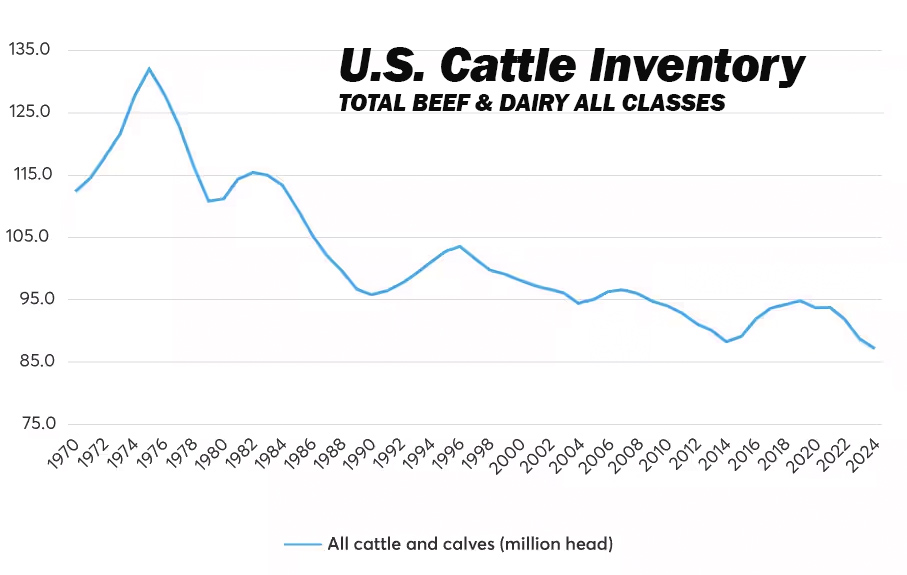
CME graph using USDA NASS Inventory data

U.S. cattle herd down… again

U.S. total cattle numbers on Jan. 1, 2025 are down 1% year-over-year (YOY), according to the All Cattle and Calf Inventory Report released by USDA on Fri., Jan. 31st.

At 86.66 million, the report counted 500,000 fewer head than last year’s total, which was already the smallest in 74 years (Jan. 1, 1951).

The total number of all cows and heifers that calved is down 0.4% YOY at 37.21 million head. That is 147,000 fewer beef and dairy cows on farms as compared with the revised-lower totals a year ago, which were already the smallest in 84 years (Jan. 1, 1941).

The total number of all heifers over 500 pounds on Jan. 1, 2025 (including heifers destined to become beef) was down 1% YOY at 18.18 million head. That’s 140,000 fewer head counted than on Jan. 1, 2024, which was already the smallest total heifer number in 34 years (Jan. 1, 1991).

In the Jan. 1, 2025 report, USDA NASS revised-lower its Jan. 1, 2024 and July 1, 2023 estimates of total animals that had calved, as well as the calf crop in those 12 to 18 month prior Inventory Reports. Statisticians went back and compared the prior estimates to the official slaughter data, the import and export data, and the relationship of this new survey information to the prior surveys.

This means the Jan. 1, 2025 numbers are now estimated at levels below the revised-lower prior reports that had already set records! (A mid-year 2024 inventory would have been helpful, but was canceled by former Ag Secretary Tom Vilsack, claiming insufficient USDA funds).

Chart compiled by S. Bunting with USDA NASS Inventory data

Milk cows flat, heifers shrink

The number of milk cows on Jan. 1, 2025 was essentially unchanged vs. year earlier, up only 2,500 to just shy of 9.35 million head.

However, the dairy replacement heifer total is down 1% YOY at 3.91 million head. At this rate, the number of heifers heading to careers as milk cows is 16% below the 5-year comparison on Jan. 1, 2020.

At 3.91 million head, there are 37,000 fewer dairy replacement heifers than a year ago, which was already the smallest number of dairy replacement heifers in 47 years (Jan. 1, 1978). 

As the graph above illustrates, milk cow numbers have held relatively stable over the past five years, while the number of dairy replacement heifers has significantly declined. Are cows experiencing longer productive life? Or are the multi-site investor dairies filling their own expansion sites via their own calf ranches, and escaping the USDA reporting radar?

According to the most recent data (2020), average dairy cow productive life in the U.S. is just shy of three lactations, roughly five years of age. With the number of dairy replacement heifers declining 16% over the past five years, will these two trends collide in the next 12 to 24 months to reduce the U.S. milking herd while escalating the already record high dairy replacement cattle prices? And, what role might HPAI H5N1 play as longer term impacts emerge?

USDA NASS reports that the average auction value of ‘average’ milking cows has increased by nearly $800 per head to $2650 for 2024 vs. $1890 for 2023; $1100 per head higher vs. the $1720 average for 2022; and double (+$1300) the average value reported at $1350 and $1300 per head four and five years ago for 2021 and 2020, respectively.

The average cost to raise dairy replacements has been estimated at $1700 to $2400 per head, which means the value of ‘average’ replacement heifers at $1720 to $2660 from 2022 to 2024 is finally starting to mirror the cost to raise them — on average.

Many dairy producers continue producing only the heifers they need, which is reducing the availability of heifers in the marketplace for those wanting to expand.

Producers continue to respond to the lure of the 3-day-old dairy-on-beef crossbred calves offering substantial margins of $800 to $1000 per head — with no investment, no rearing, no revenue-wait, and no risk.

Basically, a dairy cow can produce $800 to $1000 in revenue for the dairy as soon as she drops a live crossbred calf, no matter what the milk price or margins are doing, and with her whole lactation in front of her.

The Jan. 1 Inventory Report shows the U.S. beef herd continues to shrink, suggesting beef-on-dairy crossbreds will continue to offer bigger per-head margins than growing extra dairy heifers to sell as herd replacements — unless they are premium dairy heifers.

Expanding dairies are having to really plan ahead to raise the animals they need for growth or scramble to get them. Additional upward price momentum may be seen on dairy replacements in the next 12 to 24 months as the more abundant heifers available five years ago ‘age-out’ of the system, statistically speaking, at five years old, which is the industry average age of a milking cow in the U.S.

With the Jan. 1, 2025 U.S. milking herd holding steady at a level that is 1.1% smaller than it was in 2021, the expanding dairies are buying up the herds of the exiting dairies at high prices that make dairy farmers think about selling the cows and hanging on to the heifers, for now, if they do not have a next generation to continue the dairy.

Turnover of existing Holstein herds to include other breeds is also occurring, along with genetic improvement within the Holstein breed, as producers work to raise heifers that calve into the milking herd at younger ages, produce more component yield per hundredweight of milk, have improved productive life traits and fewer days open for a tighter average calving interval.

With a 2024 national dairy herd of 9.35 million milk cows and a 2024 national dairy cow slaughter of 2.726 million, the national culling rate last year was 29%. At that rate, even if the average age at first calving is 22-months, the U.S. dairy industry would need 28 dairy heifers to calve successfully in the next 12 months for every 100 milk cows — just to maintain the current size of the U.S. dairy herd.

According to the Jan. 1 Inventory Report, there are 2.5 million dairy heifers expected to calve in 2025 (down 0.4% or -9000 head). This calculates to 27 (actually 26.75) dairy replacement heifers expected to calve in 2025 for every 100 cows in the U.S. dairy herd as of Jan. 1st.

In 2016, when dairy replacement heifer numbers reached their peak at 4.81 million head, 3.11 million head were expected to calve that year, and the total U.S. dairy cow inventory was 9.31 million head, meaning there were 31 heifers expected to calve for every 100 cows in 2016. This has steadily eroded in part because dairy producers have stopped spending the money to grow extra heifers that were worth less than the cost to grow them until this year. They also worked to reduce age at first-calving, days open across the herd, higher component levels in the milk, reduced death loss, longevity, and began gradually re-introducing beef crossbreeding, which has become a pretty big deal over the past five years.

Some parts of the country are down significantly in heifer replacements as of Jan. 1, 2025, while others are up. For example, Pennsylvania has 15% more dairy replacement heifers on farms vs. year ago.

These estimates indicate milk production will be flat to lower for the next 12 to 24 months.

What this does not account for is the increasing milk component levels generating more dairy products per 100 pounds of milk and the increasing volume of dairy imports, particularly cheese, butter, and whole milk powder. But those increases can only do so much in the face of $5 to $10 billion in new processing assets coming online in the next 6 to 18 months.
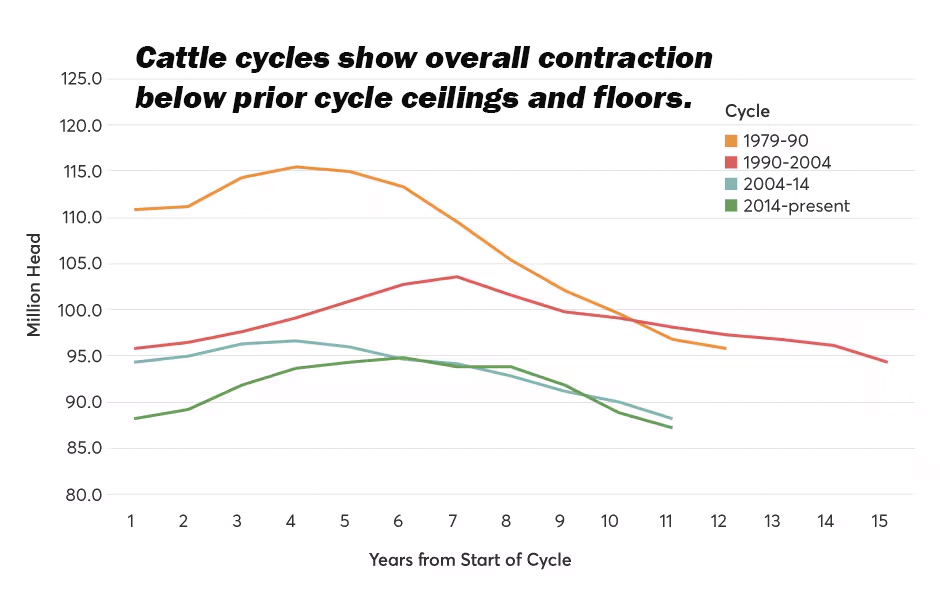
CME graph using USDA NASS Inventory data shows continued overall contraction of total cattle inventory as new cycles mostly fail to breach prior cycle ceilings, floors, and midpoints.

Beef herd shrinks more

The Jan. 1 Inventory shows the U.S. beef herd continues to shrink. At the national level, there are no signs of rebuilding, as the total number of heifers heading to careers as beef mama cows is down 1% YOY. However, in some parts of the country, such as Virginia, more heifers were retained as beef cow replacements and fewer were earmarked for feedlots.

At 4.67 million head, there are 46,000 fewer beef replacement heifers in the U.S. vs. year ago, setting another record low as the smallest number since 1948.

Even more striking is the beef replacement heifers that are expected to calve in 2025 are down a whopping 2% YOY (-50,000) nationally.

Meanwhile, the beef-on-dairy feedlot placements, while a growing segment of the beef industry, are not enough to reverse the downward beef production trend as evidenced by declines in the number of animals over 500 pounds on Jan. 1st heading to feedlots: Steers and bulls are both down 1% (-157,000 and -21,000 head YOY, respectively). Heifers over 500 pounds heading to feedlots are down 0.6%, and the number of cattle on feed as of Jan. 1, 2025 is down 1% YOY at 14.3 million head (-130,000 head).

The Inventory Report came on the heels of the January Cattle on Feed Report, which showed 3% fewer feedlot placements as of Jan. 1, perhaps because of the Mexican border closure to the live cattle imports, due to concerns about transmission of the screw-worm parasite.

Even the total number of all calves (heifers, bulls and steers) weighing under 500 pounds dropped 1% lower YOY at 13.46 million head (-30,000).

These estimates suggest domestic beef production will decline for at least the next 12 to 24 months, maybe longer.

What this does not account for are the number of live cattle crossing the border into U.S. feedlots from Mexico and Canada and the increasing amounts of beef the U.S. imports from other countries, including from Canada, Mexico and South America.
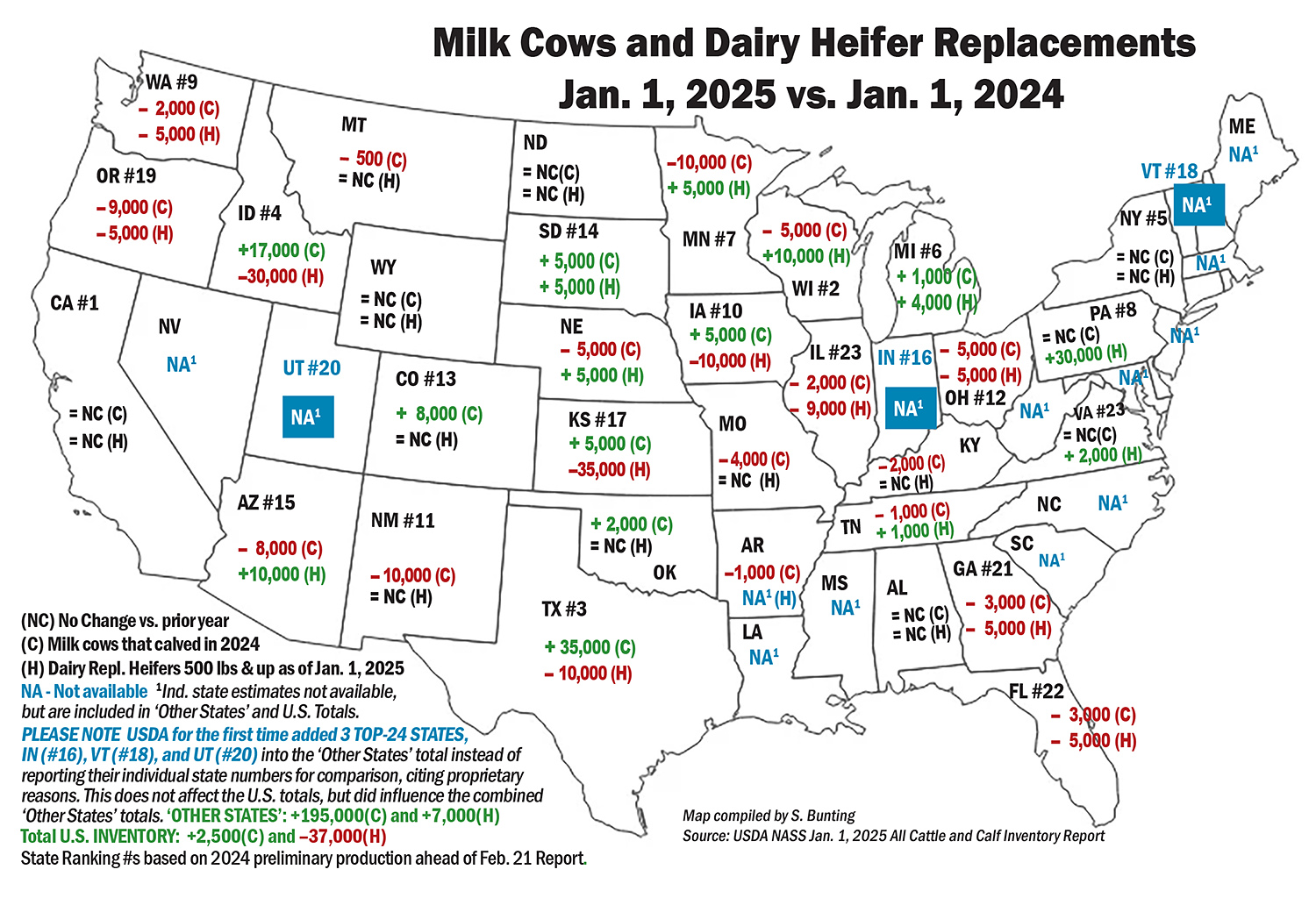
Map compiled by S. Bunting with USDA NASS Inventory data

Significant geographic dairy shifts

Breaking the dairy inventory numbers apart, we see big geographic shifts.

The West added 78,000 more milk cows in 2024 vs. 2023, except for California’s numbers being unchanged. On the other hand, the East and Upper Midwest had equal or fewer milk cows, down collectively more than 75,000 head YOY, except Michigan was up just 1000 head.

The biggest 2024 gains were tallied in Texas, up 35,000 head, and Idaho, up 17,000 head. Colorado grew by 8,000 head; Iowa, Kansas and South Dakota by 5,000 each; and Oklahoma by 2,000.

The biggest milk cow declines were in Minnesota and New Mexico, down by 10,000 head each; Oregon down by 9,000; Arizona by 8,000. Wisconsin, Ohio, and Nebraska by 5,000 each; Missouri by 4,000; Florida and Georgia by 3,000 each; Illinois, Kentucky, and Washington by 2,000 each; and Tennessee by 1,000. Smaller unranked states collectively accounted for the remainder of milk cow losses.

Interestingly, USDA pulled three Top-24 Milk Production States into the ‘Other States’ category, choosing not to report their cow and heifer numbers for proprietary reasons. They are Indiana (#16), Vermont (#18) and Utah (#20). Thus the ‘Other States’ category saw an increase of 195,000 cows simply because these three Top-24 states were included anonymously in the total.

The geographic breakdown is interesting when it comes to dairy replacement heifers as the growth is noted in the areas where the cow numbers have declined and vice versa. These shifts could reflect changes in the way heifers have tended to move across state lines for rearing, especially in light of the dairy-adapted B3.13 strain of HPAI H5N1.

Pennsylvania is the biggest outlier as the cow numbers are unchanged YOY, but farmers reported 30,000 more dairy heifers in the Commonwealth on Jan. 1, 2025 vs. year ago.

Elsewhere in the East, Virginia dairy heifer replacements are up 2,000 head; Tennessee up 1,000 head; New York and Kentucky unchanged; Georgia and Florida down 5,000 head each. Again, the ranked states of Indiana, Vermont and Utah had their replacement heifer numbers lumped into the ‘Other States’ category, which consequently showed a gain of 7,000 heifers vs. year earlier when those states were not included in that category.

Beef replacement heifers and feedlot heifers are down a combined 10,000 head in Pennsylvania, while Virginia showed signs of beef herd rebuilding, reporting 4,000 more beef replacement heifers and 4,000 fewer heifers heading to feedyards.

Looking at the Mideast, Michigan had 5,000 more dairy heifer replacements, while Indiana’s numbers were unreported. Ohio is down in dairy heifers by 5,000 head. Beef replacement heifers in that region are up by 7,000 head and feedlot heifers are up by 3,000 head.

The Upper Midwest grew their dairy replacement heifer numbers, while the West significantly decreased them. Wisconsin is up by 10,000 head YOY; while Minnesota and South Dakota grew by 5,000 head each.

In the West, the following states with significant growth in milk cow numbers had significant losses in dairy replacement heifer numbers: Kansas down a whopping 35,000 head in dairy replacement heifers; Idaho down by 30,000 head; Texas, Pacific Northwest and Iowa down 10,000 each. Dairies in Kansas, Idaho, Texas, and Iowa contended with avian influenza in 2024.

Meanwhile, in California, New Mexico, and Colorado (all three having dealt with H5N1) the number of dairy replacement heifers was reported as unchanged YOY, but Arizona, which has not had H5N1, grew its dairy heifer numbers by 10,000 head.
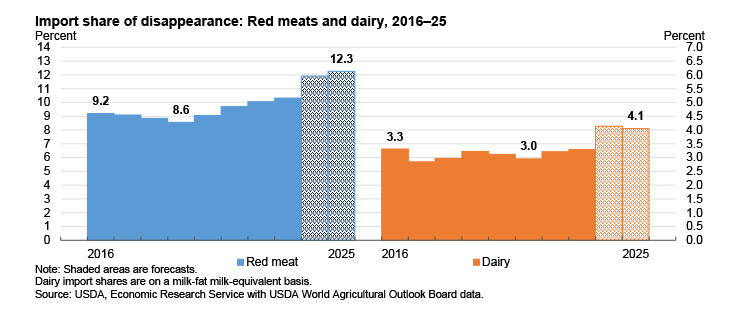
USDA Economic Research Service graph

Trade is uncertain (Imports up, Exports leveling off)

Dairy and beef imports are growing, and the industry is responding to ‘tariff talk’ with statements showing fear of trade wars harming farmers or possibly gaining concessions in the context of Agriculture’s current annual trade deficit of $45.5 billion. 

On Friday, Jan. 31, the spot cheese and Class III milk futures markets plunged lower in response to U.S. tariff announcements of 25% on goods from Canada and Mexico and 10% on goods from China.

This fear was short-lived, however, because the planned tariffs on goods from Canada and Mexico were promptly paused three days later on Monday, Feb. 3, when leaders agreed to support and combine efforts on U.S. border security, while putting teams together with the pledge to work through U.S. trade issues over the next 30 days.

The announced 10% tariffs on China went into effect Feb. 4, but discussions between the U.S. and China are said to be resuming for phase one of the trade deal struck in the prior Trump Administration just before the Covid pandemic hit globally.

Meanwhile, the total volume (not value) of dairy exports has leveled off on a total solids basis in the past two to three years as the U.S. exports more cheese and less skim milk powder and much less whey – the latter because we domestically produced less commodity SMP and far less commodity dry whey in 2024. Inventories are down for both, meaning domestic demand is using what is produced. 

On the flip-side, the U.S. imported more cheese, butterfat, and whole milk powder during the first 11 months of 2024 YOY.

We will take a closer look at the trends in U.S. dairy farm numbers, production, and trade after final 2024 trade and production data are released in late February, and with more information, perhaps, on how U.S. agricultural trade policy may be shaping up for 2025.

-30-
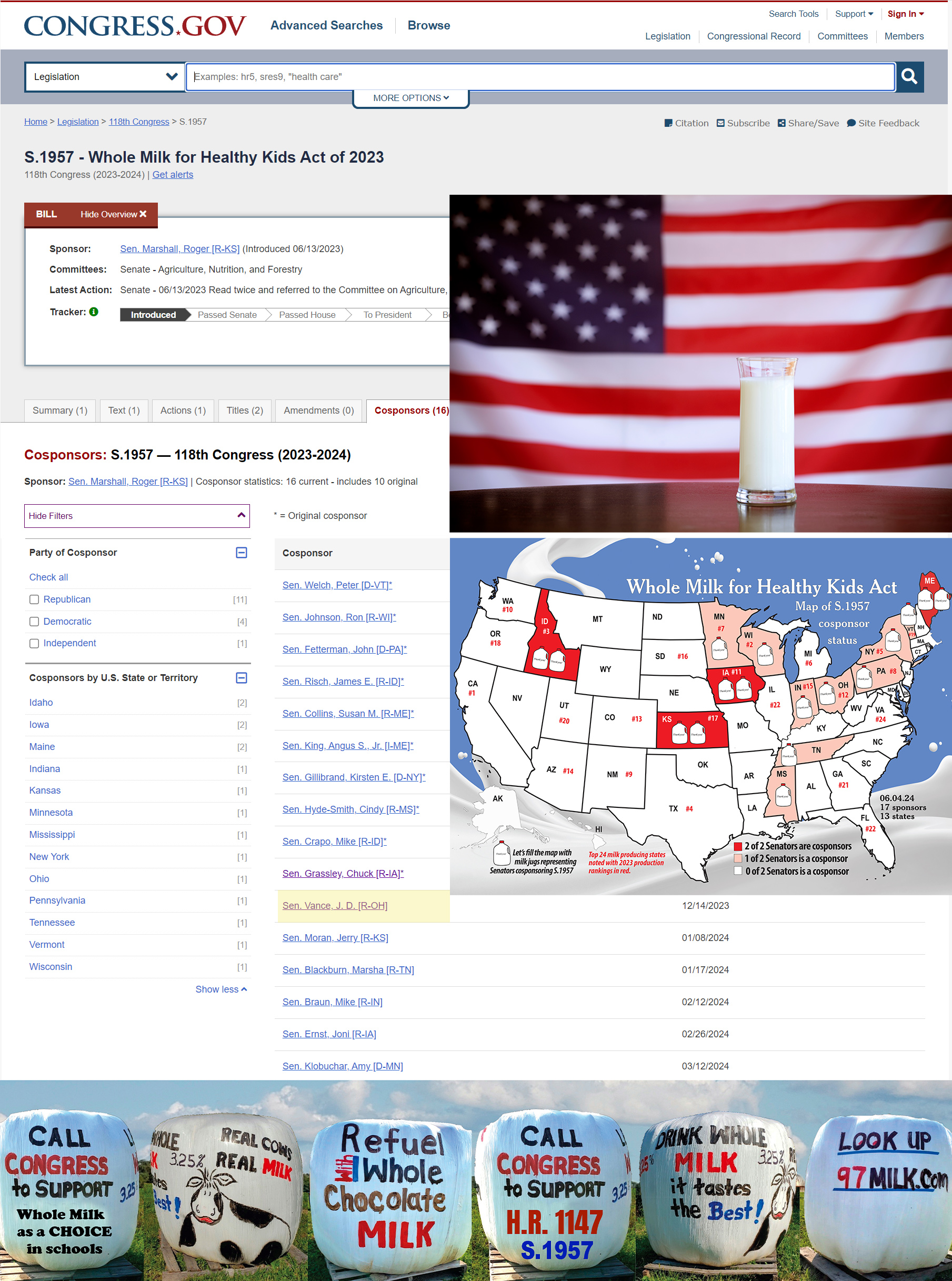
Editorial: ‘Wouldn’t it be great if we could unite the country with whole milk?”

By Sherry Bunting, Farmshine July 26, 2024

‘Wouldn’t it be great if we could unite the country with whole milk?”

Those words were messaged to me by a friend and colleague a year ago, right after the Whole Milk for Healthy Kids Act had passed the House Education Committee in bipartisan fashion before the overwhelming passage on the House floor Dec. 13, 2023 and before Senate Ag Chair Debbie Stabenow (D-Mich.) blocked it the next day, Dec. 14, 2023.

This was my first thought, when former President Donald Trump announced Senator J.D. Vance of Ohio as his running mate in the Republican campaign. (Vance is an early cosponsor of S. 1957, the Senate’s whole milk bill.)

Like others, I’ve been involved in the effort to bring the choice of whole milk back to schools for more than a decade. It’s about natural, simple goodness — to simply strip away the federal ban and allow hungry, learning children to be nourished by milk they will love. 

Looking back at the years of this long fight, I realize that if it’s so painstakingly hard to get something so simple and so right accomplished for America’s children and farmers, we’ve got problems in this country.

With President Joe Biden now withdrawing from the campaign for a second term, and Vice President Kamala Harris as presumptive nominee launching her campaign this week in the Dairyland State, I’m reminded of where she stands on such things.

Harris is no friend to livestock agriculture. She was an original cosponsor of the Senate version of “The Green New Deal.” She has strong positions on climate change that may lead to harsher rules on methane emissions and water consumption in the dairy industry, while perhaps promoting methane digesters, which are not an equitable nor necessary solution. Cows are NOT the problem!

Some in the dairy industry are on record stating that this would be good for dairy because the DMI Net Zero goals fall in-line and tout some of the same objectives. But no matter how you slice and dice all the fancy offsets, insets, innovations, grants, projects and the billions of dollars, the bottom line leaves cattle holding the bag. 

Cattle are in the crosshairs of a very long game set to control land, food and people.

Harris has already indicated she would use the Dietary Guidelines to reduce red meat consumption on the basis of this erroneous climate impact claim about cattle that we are all being brainwashed to quite literally buy into.

As a presidential candidate in 2019, in a CNN town hall, she was specifically asked: “Would you support changing the Dietary Guidelines to reduce red meat specifically to reduce emissions?”

“Yes, I would,” Harris replied, with a burst of laughter.

It’s not funny.

Earlier, she had said she “enjoys a cheeseburger from time to time,” but the balance to be struck is “what government can and should do around creating incentives, and then banning certain behaviors… that we will eat in a healthy way, and that we will be educated about the effect of our eating habits on our environment. We have to do a much better job at that, and the government has to do a much better job at that.”

Read those words again: “creating incentives and then banning certain behaviors.” In plain English, that means dangling the carrot and then showing us the stick.

Harris joins Senators like Ag Chair Stabenow, as well as Bob Casey from Pennsylvania, as card-carrying members of perennial Ag Secretary Vilsack’s food and climate police.

Not only is Ag Chair Stabenow blocking the whole milk bill in her Committee, she is dragging her feet on the critical farm bill. 

As President Biden’s approval ratings fell, there were indications she would bring her side of the aisle to the table to negotiate a compromise to get the farm bill done this year.

Now that Biden has withdrawn from the race, and the pundits, media, and party organizers are breathless with excitement over Harris as presumptive nominee, it appears that the farm bill negotiations between the Committee-passed House version, the Republican Senate version and the Democrat Senate version have fallen apart.

House Ag Chair G.T. Thompson (R-Pa.) has called upon his colleagues to get to the table and do the work because a perfect storm is brewing in Rural America as net farm income is forecast to fall by 27% this year on top of the 19% decline last year. 

Meanwhile, there is political upheaval everywhere we look. Seeing Vance picked as Trump’s running mate and knowing he was among the early cosponsors of Senate Bill 1957 – The Whole Milk for Healthy Kids Act – offers some hope.

That bill — in true bipartisan spirit — was introduced in the U.S.Senate in June 2023 by Senator Dr. Roger Marshall (R-Kan.) with prime cosponsors Peter Welch (D-Vt.), Ron Johnson (R-Wis.), Kirsten Gillibrand (D-N.Y.), Chuck Grassley (R-Iowa), John Fetterman (D-Penna.), Mike Crapo and James Risch (R-Idaho), Susan Collins (R-Maine), Angus King (I-Maine), and Cindy Hyde-Smith (R-Miss.). The bill eventually earned cosponsorship from other Senators, including the influential Democrat from Minnesota, Amy Klobuchar.

Vance signed on as cosponsor on December 14, 2023, one day after the U.S. House of Representatives had passed their version of the bill by an overwhelming bipartisan majority of 330 to 99.

The Senate bill 1957 is identical to the successful House whole milk bill H.R. 1147, which was authored by Pennsylvania’s own Representative GT Thompson.

GT is a man of courage, conviction, compassion, of humility and humanity. I’ve heard him say more than once: “God gave us two ears and only one mouth for a reason.”

He is a determined man, doing the work. He included whole milk bill in the House Committee-passed farm bill. He’s standing firm on his pledge to put the farm back in the farm bill. He is concerned about the financial crisis in agriculture on the horizon, and held a hearing July 23 with witnesses from agriculture and banking giving stark warnings.

Even though whole milk choice in schools seems like a minor issue in the grand scheme of things today, it is really a linchpin. If we could just get something with broad bipartisan support accomplished, this could lead to other steps on common ground. 

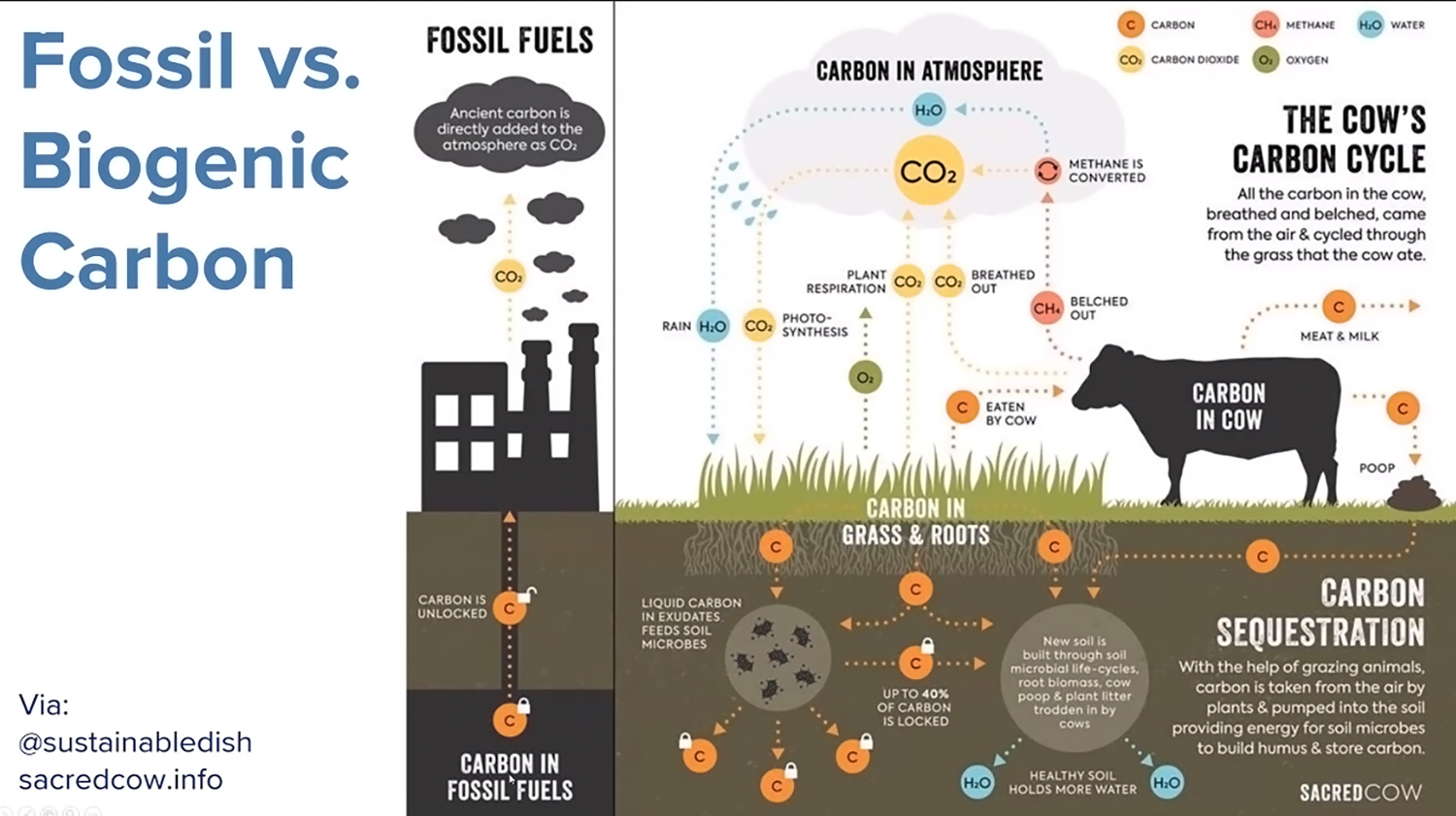
Cows are not the climate problem. Cows are a solution. Cows are part of a carbon cycle, they don’t take carbon out of the ground and put new carbon into the air. 

Carbon is essential to life. It seems that those seeking full control of land, food, and people, are starting with carbon. 

As the whole milk choice remains hung up in the Senate, let’s pause to think about how ridiculous it is that we adults get to choose, but our growing children do not. For them, whole milk is banned at two meals a day, five days a week, three-quarters of the year at school. (The federal government, via USDA school lunch rules, only allows fat-free and 1% milk to be offered with the meal or even a la carte.)

Maybe the Harris ticket would like to ban food choice behaviors for adults as well.

We have Republicans and Democrats supporting whole milk choice in schools. Both parties say they care about our nation’s farmers and ranchers who feed us and are the backbone of our national security.

Let’s take that and run with it.

-30-

Dairy biosecurity risks highlighted in two H5N1 data briefs

By Sherry Bunting, Farmshine, June 21, 2024

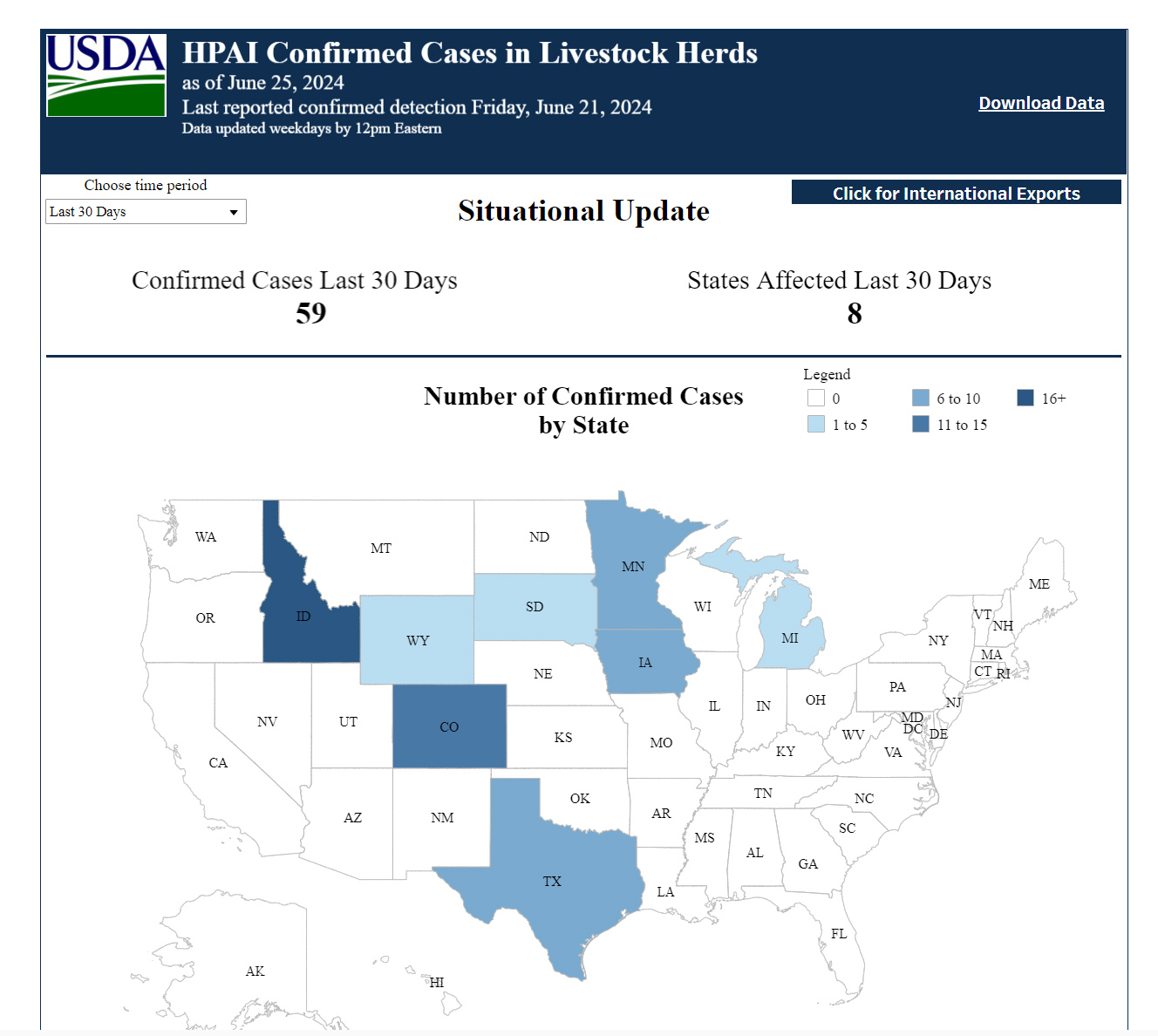
WASHINGTON – While 30-day detections of ‘bird flu’ in dairy have dropped to 59 herds in just 8 states (down from 116 in 12 states cumulatively), two epidemiologic studies published recently shed more light on dairy biosecurity risks.

Nationally, epidemiologic data were available for slightly more than half of the dairy herd premises affected by highly pathogenic avian influenza (HPAI), known as Bovine Influenza A / H5N1 in dairy cattle. These data reveal linkages reported June 8th in a National Brief, which reported “no genomic or epidemiologic evidence that wild birds are spreading H5N1 to cattle, but it cannot be ruled out.”

In fact, the key takeaway is that H5N1 spread in dairy cows — between states — is linked to cattle movements, not to independent wild bird introductions, with further local spread between dairy farms occurring in some states.

A similar epidemiologic investigation looked at Michigan data, alone. Published June 13, this report also showed that migratory waterfowl were not culprits in independently spreading H5N1 to cattle in Michigan.

Both Briefs note the disease spread between dairy cattle herds is likely multi-faceted with both direct and indirect transmission. Biosecurity remains the key to mitigation.

The National Brief reveals more than 20% of farms with HPAI detections in the data set had moved cattle into the herd within 30 days of clinical signs, and 60% of those farms continued to move cattle after the onset of clinical signs.

The linkages revealed by the Michigan report show it began via movement of infected cattle from a Texas herd, before H5N1 had been detected in that herd. It is then believed to have spread to other herds through cattle movement and other direct and indirect transmission.

Other linkages were discussed, such as visitors, shared vehicles and equipment and shared workers. (Fig. 4 below)

Employees working at more than one dairy farm or working at both dairy and poultry farms, and employees from one dairy or poultry farm sharing housing with employees working on a different dairy or poultry farm have also been noted in the epidemiologic linkages.

Operations sharing equipment and livestock trailers (62% of affected premises) have also been implicated in disease transmission as only 12% of those operations reported cleaning trailers between uses.

The National Brief reports more than 20% of the affected dairies have chickens or poultry present with nearly all of those farms observing sick or dead poultry.

In the national investigation, researchers report that more than 80% of affected farms have cats present, with over 50% of these farms observing sick or dead cats. However, the Brief provided no data — one way or the other — on whether the HPAI H5N1 genotype B3.13 was detected in cats on these premises.

The Michigan study, on the other hand, confirmed the HPAI H5N1 genotype B3.13 in wildlife and other somewhat domestic species on affected dairies.

Despite collecting a large number of samples from wild birds and animals on these dairies (such as cats, racoons, opossums, foxes, pigeons and starling), the number of individual animals and species detected was small. Whether they were affected by their access to cattle or are fomites in transmission to cattle is hard to say, particularly since the large sampling yielded only a small number of confirmed findings in comparison to the larger numbers of cows confirmed on these affected farms.

Both Briefs indicate risk from manure appears to be low, but more research is needed.

-30-

Pennsylvania announces voluntary bulk tank monitoring program as ‘bird flu’ spreads to Iowa, Minnesota

Status of H5N1 in dairy herds (cumulative with last date of detection noted) as of June 12, 2024

By Sherry Bunting, Farmshine, June 14, 2024

WASHINGTON – Bovine Influenza A / H5N1, known in birds and domestic poultry as highly pathogenic avian influenza (HPAI), has spread to dairy herds in three more states — Iowa, Minnesota, and Wyoming.

As part of emergency response plans, as many as 16 states, including Pennsylvania, are rolling out voluntary bulk tank monitoring programs as supported by USDA’s May 31 announcement for a federal pilot program.

As of June 12, 2024 (updated to June 21), there are no detections of H5N1 in dairy herds and no active HPAI in poultry flocks in Pennsylvania.

The USDA APHIS website confirmed 93 detections in dairy herds in 12 states since March 25, of which 47 have been confirmed in the past 30 days (as of June 12) in just 8 states (in order of most recent detection): Idaho, Minnesota, Iowa, Wyoming, Texas, Michigan, South Dakota, and Colorado. 

Of the other four states, Ohio and North Carolina are beyond 60 days since detection. Kansas and New Mexico reached 60 days on June 16.

During the monthly Center for Dairy Excellence call on June 12, Pennsylvania State Veterinarian Dr. Alex Hamberg said herd detections in other states have come primarily from “either sick cows or through epidemiologic tracing from positive farms.”

“It appears this is still a single bird to cow spillover that occurred in late 2023 and was not found until early 2024, so it spread out from there, and we’re now trying to catch up,” he said.

“Equipment, people, and cattle — that’s how this spreads. I can’t stress this strongly enough,” said Dr. Hamberg. Iowa is testing cattle close to positive poultry operations to provide data on species transfer risk.

Hamberg announced a Pennsylvania bulk tank monitoring program, supported by USDA. “This will be voluntary. The goal is to provide data of the status of the virus in Pennsylvania, or more likely the lack of it,” he said.

“We also need this data for quicker response time, and to protect nearby poultry farms. Even more important, is to provide a platform to engage concerned consumers and stakeholders to show we are addressing this proactively, that we are looking for it, that we have a plan, have it under control, and that pasteurized dairy products continue to be safe and wholesome,” he explained.

The status-enrollment period is three weeks, during which bulk tank and other samples will be taken. After three consecutive weeks of negative results, the dairy farm would achieve enrolled monitored herd status and continue weekly bulk tank samples thereafter to maintain that status.

An enrolled monitored herd with negative status would be able to move cattle without pre-movement testing, according to Dr. Hamberg.

“We are flying the plane while building it,” he said, noting early enrollment in the voluntary bulk tank testing program has already begun, so the testing can begin during the week ending June 21.

Those interested in enrolling can email RA-Ag_StateVet@pa.gov or call 717-307-3258. Or, to complete a web form for enrollment, go directly to this link 

The Center for Dairy Excellence has posted a downloadable enrollment form.

“We will then get back to you with an enrollment packet,” said Hamberg.

Hamberg said the May Exhibition Quarantine Order does not go into effect unless HPAI reaches dairies in Pennsylvania. However, effective now: Dairies within 3 kilometers (1.7 miles) of an HPAI-infected poultry flock cannot show dairy cows at fairs and shows. Currently, there are no active poultry infections in Pennsylvania.

Dr. Ernest Hovingh, director of the PADLS said testing is currently well under capacity and prepared to handle bulk tank monitoring.

For PADLS updates, visit http://padls.agriculture.pa.gov/InnerPages/HPAICattle.html

For details from the CDE call, to hear a recording, and see links to resources, visit https://www.centerfordairyexcellence.org/hpai-industry-call/

 -30-

USDA announces $824 million for H5N1, dairy herd monitoring pilot program launched as alternative to pre-movement testing

Status of H5N1 in dairy herds (cumulative with last date of detection noted) as of June 4, 2024

By Sherry Bunting, Farmshine, June 7, 2024

USDA announced new actions and $824 million in emergency funding from the Commodity Credit Corporation (CCC) to focus on highly pathogenic avian influenza (HPAI) known as Bovine Influenza A in dairy cattle, which is the H5N1 virus.

Call it what you will, these funds target HPAI in dairy cattle through data collection, surveillance, diagnostics, as well as vaccine research, and food safety studies to better understand and mitigate outbreak risk.

In the May 31 announcement, USDA also launched a new Voluntary H5N1 Dairy Herd Status Pilot Program to monitor the health of dairy herds and allow enrolled farms to move cows more quickly, while providing on-going testing that would expand USDA’s herd surveillance capabilities.

Dairy farms that enroll in the recently announced voluntary monitoring program would sign Herd Monitoring Plan Agreements to do weekly bulk tank testing, enabling them to move dairy cows across state lines without doing the individual pre-movement testing – as long as their weekly bulk tank tests show three consecutive weeks of negative results, and as long as they agree to continue the tests weekly going forward.

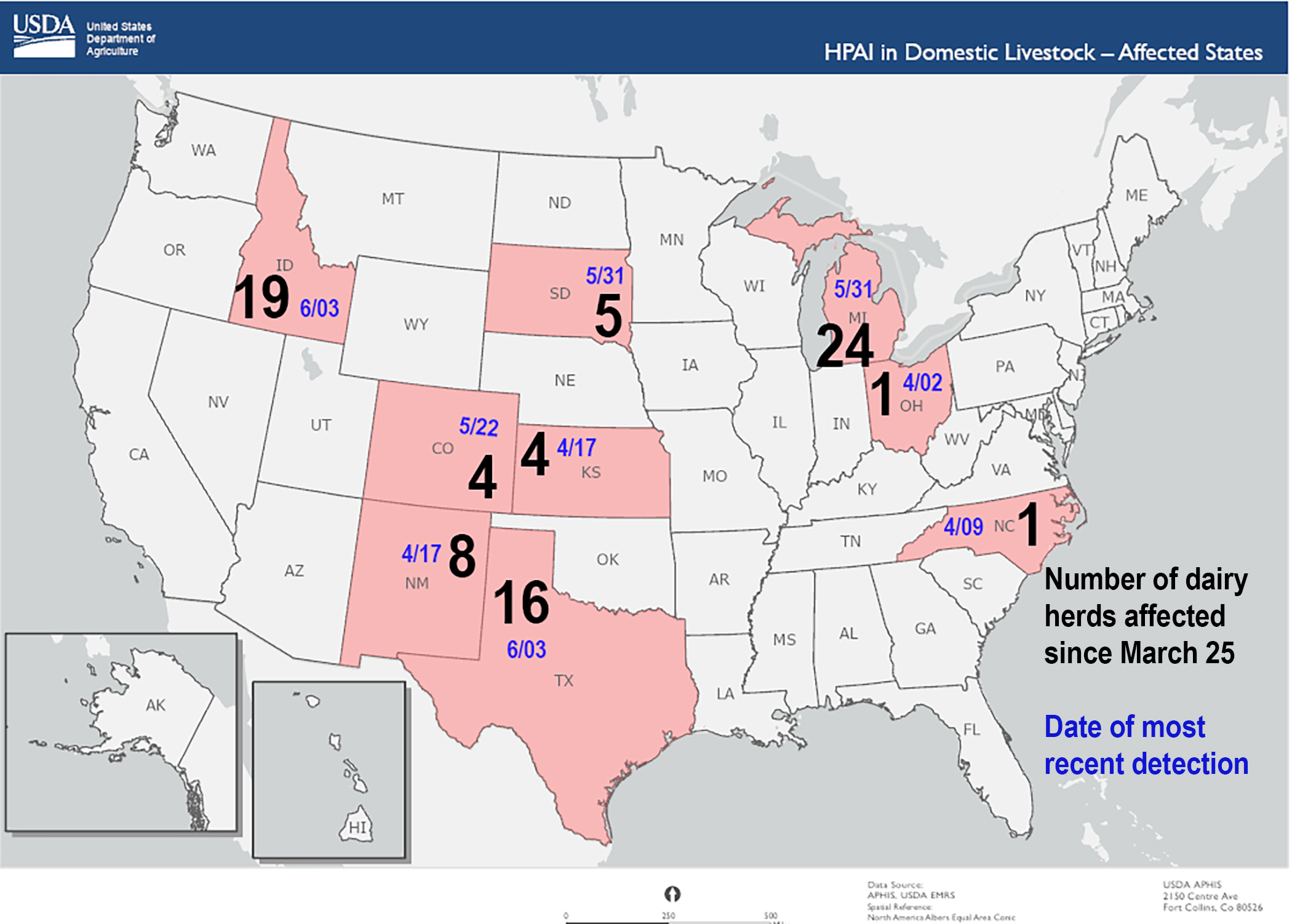
As of June 5, 2024, the APHIS website shows 82 total HPAI detections in dairy herds in 9 states since the first detection in Texas on March 25. 

Topping the list is Michigan with 24 detections, the most recent on May 31. Idaho saw a slew of new detections over the past 10 days with 19 total, the most recent on June 3. Texas has had 16 detections, the most recent on June 3; followed by South Dakota with 5 detections, the most recent May 31; and Colorado with 4, the most recent May 22.

States that have seen no new detections since April include New Mexico (8) and Kansas (4) with their last new detections on April 17; Ohio and North Carolina each only had one dairy herd detection on April 2 and April 9, respectively.

According to USDA, the new voluntary monitoring program will enable the Department to increase its monitoring and surveillance of herds that are currently not known to be infected.

APHIS is working with state animal health officials to identify states that want to participate in a pilot phase of the program. Producers from participating states can start enrolling this week (June 3), by contacting their State Veterinarian and signing a Herd Monitoring Plan Agreement.

USDA says high participation will help them establish state and/or regional “disease-free statuses” that could further ease compliance with the current Federal Order.

Those herds not enrolled in the pilot program would continue to follow the interstate testing and movement requirements published in the Federal Order. More specific guidance on the new voluntary monitoring program, including how to enroll and how to obtain and maintain a herd status, will be made available on the APHIS website in the future or by contacting state animal health officials.

USDA expects to see increased testing, yielding increased positive detections, through this voluntary monitoring, which they will analyze to learn how HPAI may spread between herds.

To-date, three people who worked with infected cows (two in Michigan and one in Texas) have tested positive with the H5N1 influenza. The symptoms were similar to pinkeye, and they recovered in a few days.

Meanwhile, the Federal Government has already put $200 million in additional funds into surveillance, testing, PPE, and vaccine development with indications they will ask Congress for more ‘bird flu’ funding.

Authorities still deem the risk to the general public as very low because pasteurization deactivates the virus, and no detections have been found in any retail meat samples. In addition, milk from sick cows is discarded and cattle at beef plants are inspected.

The $824 million will also support anticipated diagnostics, field response, other necessary surveillance and control, surveillance in wildlife (APHIS), work by the Agricultural Research Service’s (ARS) in developing vaccines for HPAI in cattle, turkeys, pigs, and goats, and food safety studies conducted by ARS and the Food Safety and Inspection Service (FSIS).

The Secretary is authorized to transfer funding from available resources including the CCC to address emergency outbreaks of animal and plant pests and diseases. The new $824 million is focused primarily on dairy cattle in addition to previously approved $1.3 billion in emergency funding to address nationwide HPAI detections in wild birds and commercial poultry operations.

More information is available at the designated APHIS page at https://www.aphis.usda.gov/livestock-poultry-disease/avian/avian-influenza/hpai-detections/livestock

States are moving to issue their own additional emergency response plans. In  Pennsylvania, for example, the Department of Agriculture recently issued its General Quarantine Order for the Exhibition of Dairy Cattle, which would apply to all dairy cows traveling to shows and exhibitions. This would ONLY take effect IF a detection is confirmed anywhere in the state. It would apply to all dairy cows traveling to shows and exhibitions. 

If that happens, the Order would require testing through the PADLS system within 7 days of the date of arrival at any animal exhibition grounds. Prior to arrival those dairy cows would have to be part of a biosecure assembled group for 30 days prior to testing with no new cattle added to that assembly.

Other quarantine measures are also detailed in the Pennsylvania Order, but again, would only be implemented IF HPAI is detected in dairy cattle in Pennsylvania.

The Center for Dairy Excellence will have its monthly conference call on the subject June 12 at 1:00 p.m. For information, go to the special events page at https://www.centerfordairyexcellence.org/about-the-center/upcoming-events/event/weekly-hpai-calls/

Pa. orders dairy cattle movement restrictions, testing to protect against HPAI spread; detections now in 8 states

By Sherry Bunting, Farmshine, April 12, 2024

HARRISBURG, Pa. – Add North Carolina to the list of states with confirmed detections of bird flu in dairy cattle. 

While the USDA APHIS website had not yet updated its daily listing at 4 p.m. on April 10, the North Carolina Department of Agriculture and Consumer Services issued a press release at noon stating: “The National Veterinary Services Laboratory has detected Highly Pathogenic Avian Influenza (HPAI) in a dairy herd in North Carolina.”

This would bring the total to 19 dairy herds in 8 states: Texas (9), Kansas (3), New Mexico (2), Michigan (1), Idaho (1), Ohio (1), North Carolina (1), and South Dakota (1). (South Dakota was added to the list after Farmshine went to press)

“This is an evolving situation, and we are waiting for more diagnostics from NVSL and will work collaboratively with our federal partners and dairy farmers in North Carolina,” said Agriculture Commissioner Steve Troxler. “It is important to note the FDA has no concern about the safety or availability of pasteurized milk products nationwide.”

Introduction of HPAI A(H5N1) to dairy cattle has been shown to be by migratory birds, and USDA epidemiological studies show it may also be spreading between cows.

“Both are sources of introduction,” said Pennsylvania’s Assistant State Veterinarian Dr. Erin Luley, answering questions during the second Center for Dairy Excellence (CDE) weekly HPAI update conference call April 10.

USDA, in fact, reported on April 5 during a UN Food and Agriculture Organization (FAO) virtual meeting of scientists that they “have not seen any true indication that cows are actively shedding the virus and exposing it to other animals, or that it is replicating within the body of the cow — other than within the udder.”

This is why lactating dairy cattle are the focus of multiple state orders in recent days regarding restrictions, testing, and quarantine of interstate dairy cattle movement.

“The virus might be transmitted from cow to cow in milk droplets on dairy workers’ clothing or gloves, or in the suction cups attached to the udders for milking,” Dr. Mark Lyons, USDA Director of Ruminant Health, shared during the international meeting, according to a University of Nebraska Medical Center (UNMC) report.

The UNMC report also noted that dairy cattle are frequently transported from the southern parts of the country to the Midwest and north in the Spring. They are floating the possibility — without naming specific herds or locations — that all affected cows may trace back to a single farm. In fact, the confirmed positives in Idaho, Michigan, Ohio and now North Carolina are on premises where cattle had previously been brought in from Texas.

“The virus appears to replicate in mammary tissue, so those cattle that are not lactating do not have a high viral load for transmitting the virus,” noted Dr. Luley in the CDE call.

According to the epidemiologic data released by USDA, she said, the early cases, especially in Texas, New Mexico, and Kansas, show that HPAI was predominantly introduced by wild birds.

“For a few other detections, including in Michigan and Ohio, the main source seems to be the movement of animals from other states,” said Luley.

To prevent spread to dairy cattle in the Keystone State, the Pennsylvania Department of Agriculture issued an Interstate and International Quarantine Order on April 6 for the restriction of movement and pre-movement influenza testing of dairy cattle from states where HPAI has been detected in dairy cattle.

When asked how the Pennsylvania Order compares to what other states are doing, Dr. Luley said “ours is the most stringent. The goal is preventing the spread of this condition into our state — to proactively protect the animals in our state to the best of our ability.”

In short, the Pennsylvania Order applies to dairy cattle, not beef cattle. It restricts all movement of dairy cattle into the state for any reason from farms where HPAI has been detected.

Furthermore, dairy cattle coming into Pennsylvania for sale or show, must do pre-movement testing if they come from a non-affected farm in a state where HPAI has been detected. Those states to-date are Texas, Kansas, New Mexico, Idaho, Michigan, Ohio, and now North Carolina and South Dakota (updated by APHIS April 11).

The USDA APHIS website is updated daily and includes a map showing the states of HPAI detection in dairy herds at https://www.aphis.usda.gov/livestock-poultry-disease/avian/avian-influenza/hpai-detections/livestock

This should be consulted before movement of cattle from other states into Pennsylvania, to be sure the appropriate restrictions and pre-movement testing are applied.

Dairy cull cows from any state with a positive case, even if coming from a non-affected farm, that are destined for Pennsylvania slaughter facilities, are not subject to pre-movement testing if the animals are slaughtered within 72 hours of entry. However, they must go directly to a slaughter plant and cannot be commingled with other cattle at an auction center.

Calves under one year of age are considered low risk and are exempt from pre-movement testing at this time.

Pre-movement testing must be done through a laboratory in the national network, and the results must accompany the shipment. Acceptable test samples for non-lactating dairy cattle, such as bred heifers, are nasal swabs; however, the only acceptable test sample for a lactating animal is a milk sample. Again, this is because the mammary system is where HPAI viral replication is being seen.

“At present, the disease has not been shown to affect beef animals,” said Luley about why the Order is written only for dairy cattle.

She gave examples of how the Order is being implemented:

If a producer wants to import a group of bred heifers from Texas, and they come from a farm that had a confirmed positive, those heifers would not be allowed to come to Pennsylvania. If they come from a non-infected herd in Texas, they would need pre-movement testing with the farm’s veterinarian overseeing the sampling and the analysis done by a national network lab.

If a producer in Ohio wanted to move cull dairy cows directly to a slaughter facility in Pennsylvania, if they are coming from a currently unaffected farm in that state, no testing would be required. But, if they are from an affected farm in that state, those cull cows would not be permitted to come to a Pennsylvania slaughter facility.

If a producer from Virginia, where there have been no detections of HPAI, wanted to ship fresh heifers to Pennsylvania, there would be no requirement to test because no infection has been detected to-date in that state, so there is no movement restriction and no pre-movement testing requirement.

There are no quarantine orders on milk movement at this time; however, this would change if HPAI were detected anywhere in Pennsylvania. If that occurs, the state would enact its “Temporary Order Designating Dangerous Transmissible Diseases” provision, now amended to include “Influenza A Viruses in Ruminants.”

In such a scenario, a quarantine would be set up for an affected farm to work with animal health officials and their veterinarian to show appropriate biosecurity measures to qualify for a 30-day milk movement permit. With that permit, their milk could go only to a processing plant.

“The viral sequencing matches the circulating strains in the (migratory bird) flyways,” said Luley. “We can impose a quarantine, but we can’t apply it to migratory waterfowl, so that risk remains, and it is the reason why biosecurity is our best tool.”

USDA Wildlife Service biologists Tom Roland and Kyle Van Why said their winter surveillance of migratory waterfowl and raptors in the Susquehanna watershed, for example, shows the virus is here in these populations, but at lower numbers than last year.

Even though starlings and pigeons are not good transmitters of the disease, they do carry it, and the numbers of these birds are high, so they bear watching.

Roland said that with restrictions on how to handle migratory birds, including resident Canadian geese and vultures, farmers should contact the national hotline at 1.866.487.3297 to work with the Wildlife Service for case-by-case strategies to manage and mitigate bird use of the farm. They have tools that are not generally accessible.

Dr. Hayley Springer, Penn State extension veterinarian, said opportunities are available to help dairy farms build their own biosecurity plans. In-person open houses are being held across the state at county extension offices, check with yours.

“Everyday biosecurity is the first line of defense, and effective for Influenza A,” said Springer. Biosecurity Kits to assist are available from CDE.

According to Dr. Luley, one dairy farm in Pennsylvania reported signs that met the case definition closely enough to undergo the HPAI testing protocol, which thankfully turned out to be negative.

Dairy farmers seeing signs in their herd should contact their veterinarian. Clinical signs of HPAI in cattle, which the American Association of Bovine Practitioners this week announced it will rename as Bovine Influenza A, include:

1) a sudden drop in feed intake with concurrent decreased rumination and rumen motility;

2) a subsequent marked drop in herd level milk production with more severely affected cows having thickened milk that almost appears like colostrum or may have essentially no milk at all; and

3) changes in manure, especially tacky to dry manure.

Visit https://www.centerfordairyexcellence.org/hpai-industry-call/ for recordings and other valuable information.

Read Farmshine at farmshine.net for continuing coverage and previous articles April 5 and March 29

Is the dairy checkoff getting its methane math right? Nope!

Study says dairy should aim for climate neutrality, not net-zero carbon. Dr. Frank Mitloehner explains meaningful metric, achievable goal post during webinar

Sherry Bunting, previously published in Farmshine

BROWNSTOWN, Pa. — Net-zero carbon, net-zero GHG, net-zero GHG footprint, carbon neutrality, GHG neutrality… These terms are being used to describe the dairy checkoff’s 2050 commitments via DMI’s Net Zero Initiative.

But do they consider the warming impact of methane from dairy cows over time? 

Bottomline, the so-called “Net-Zero Initiative” of DMI is a set up to be always chasing the cow’s biology without measuring her methane as the flow gas it really is — without considering the short-lived nature of methane and the biogenic cycle cattle are a part of.

If net-zero carbon is the goal, and if methane is measured on carbon dioxide equivalency without considering its short-lived cycle, then dairy farmers could find themselves in the position of unnecessarily and continually chasing the natural biology of their cows without a meaningful and accurate metric and without an achievable goal post that satisfies what all industries around the world are really being asked to do, and that is to limit additional warming.

A new study by foremost animal scientists and air quality specialists Dr. Frank Mitloehner and Dr. Sara Place is calling for the U.S. dairy industry to aim for climate neutrality (net-zero warming) rather than net-zero carbon or net-zero GHG.

The peer-reviewed study from the University of California-Davis CLEAR Center and Elanco Animal Health was published recently in the Journal of Dairy Science. It outlines a path for the U.S. dairy industry to reach climate neutrality by 2041 with small methane reductions every year, and even sooner with more aggressive reductions.

Dr. Mitloehner brought dairy farmers up to date and took questions during the American Dairy Coalition’s annual meeting by webinar in December.

One important take-home message was for dairy producers to understand that how methane’s global warming potential is quantified (whether GWP100 or GWP*) “has a profound impact on the predicted warming of your industry. The only way you can become climate neutral is by using a metric fit for purpose, one that predicts the warming, and that is GWP*,” said Mitloehner.

He explained how methane is an important and powerful greenhouse gas (GHG), but it is different from other gases because it is the only one that undergoes atmospheric removal in a chemical process that takes about a decade. This does not occur for carbon dioxide or nitrous oxide, which are stock gases that remain in earth’s atmosphere for 1000 and 100 years, respectively.

“Methane is the most important gas for agriculture, so its removal must be included in the calculation also,” he confirmed, noting that GWP* does that. “Methane is fast and furious. It has a good punch that is 28 times more trapping of heat from the sun (vs. carbon dioxide), but it is also fast. It doesn’t stay in the atmosphere for long.”

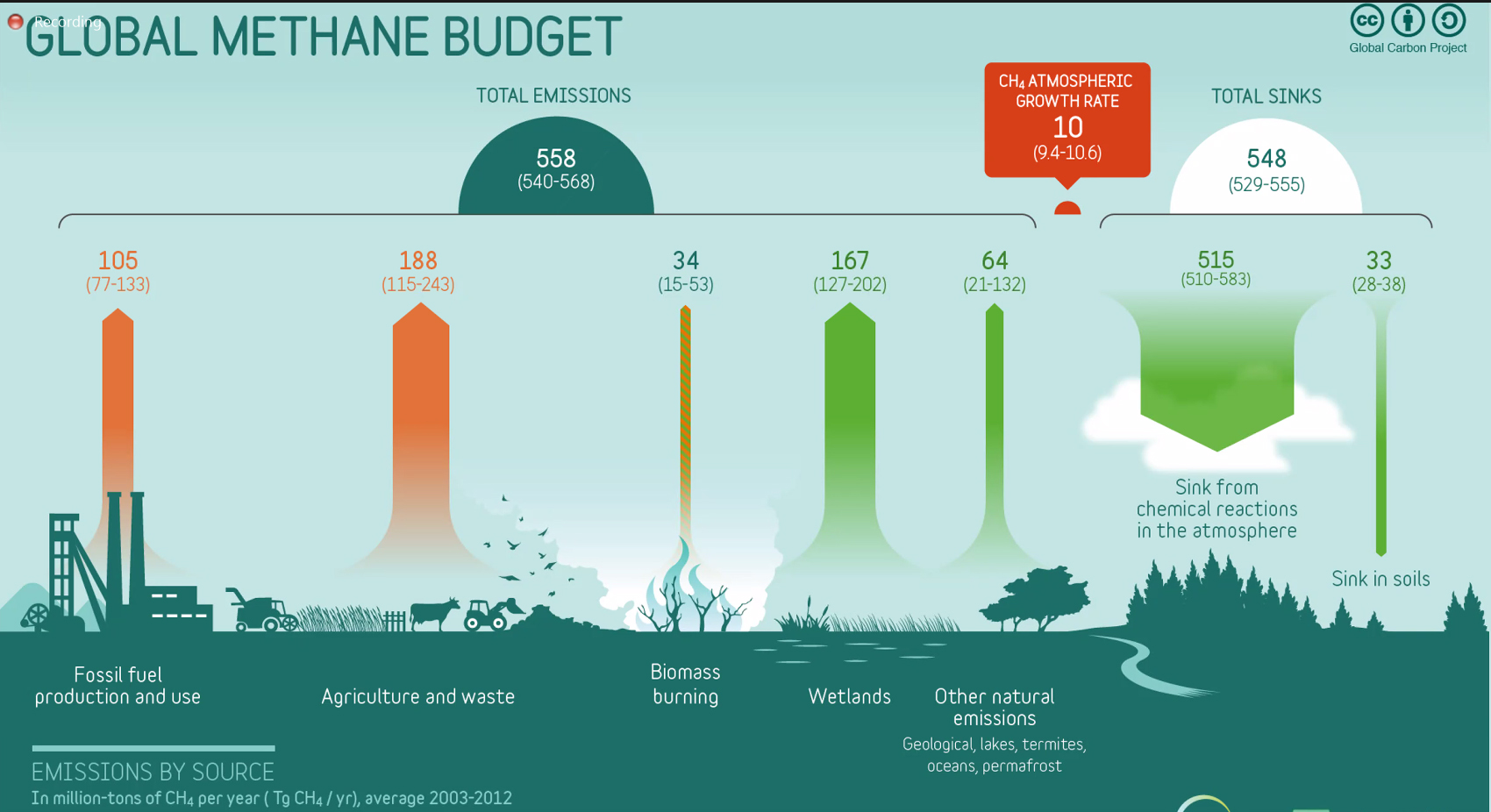
In a slide showing all global methane sources and sinks, Mitloehner noted that nearly 560 terragrams of methane are produced worldwide annually, and at the same time 550 are destroyed by this natural atmospheric process.

In terms of atmospheric growth, “the net is then 10. This is still a number we want to reduce, but it is not 560,” he said.

As the DMI Innovation Center’s Sustainability goals, Net Zero Initiative and FARM program are on the cusp of calculating these things at the farm level, both the measurement and the goal matter.

A net-zero carbon or GHG commitment poses a problem for dairy farmers. This is compounded by the CO2 equivalency for methane being calculated using GWP100. 

The GWP100 metric has been around since the 1990s, but it describes stock gases, whereas methane is a flow gas.

Using GWP100 with a net-zero carbon commitment is not only unnecessary, it’s problematic.

“It means the belches from your cows are (being calculated) in addition to what they belched last year, and the year before that, and so forth 10 years from now,” said Mitloehner. “In reality, constant herds are a constant source of methane that generates a constant warming, not a new warming. That’s what the Paris Treaty asks all sectors to do – to limit additional warming.”

Aiming for climate neutrality or net-zero warming instead of net-zero carbon would put the focus where it needs to be — on the warming impact of the emitted methane over time. This is important because methane makes up 62% of the estimated total GHG for dairy, according to the CLEAR Center study.

“If we use GWP100 to describe a relatively constant source, to characterize that methane, then we are overblowing its impact by a factor of 3 to 4, and we are overlooking the ability for the U.S. dairy industry to reduce warming when we reduce methane,” said Mitloehner, citing page 173 of the Intergovernmental Panel on Climate Change (IPCC) 2021 Assessment Report 6.

The metric GWP-star (GWP*) is also mentioned on this page of the IPCC report. GWP* was developed by the University of Oxford. It is based on GWP100, but it looks at how methane warms the planet over time. It characterizes methane as the flow gas that it is and calculates it based on CO2 warming equivalents (CO2we), not as accumulating CO2 stock equivalents (CO2e).

A white paper published with the peer-reviewed CLEAR Center study explains it this way:

“Net zero carbon refers to a state where carbon is removed from the atmosphere (through carbon sinks or other offsets) at a rate equal to carbon being emitted into the atmosphere. This balance between carbon emission and removal creates a ‘net-zero’ carbon output. Climate neutrality, on the other hand, focuses on temperature impacts from emission sources, referring to the point in which no additional warming is added to the atmosphere.”

The paper goes on to explain how “climate neutrality is analogous to net-zero carbon when dealing with long-lived greenhouse gases such as carbon dioxide, but short-lived pollutants like methane do not need to reach net-zero carbon to be climate-neutral.”

“Is it new and additional carbon being added to the atmosphere? Do constant herds add new warming? No, they do not,” said Mitloehner.

“Belched out methane is the number one source in agriculture, but again, it doesn’t stay in the atmosphere for 1000 or even 100 years like carbon dioxide and other GHG,” he explained while also noting the pathway of the carbon in this methane is already present in the atmosphere, is captured by plants, then consumed by cows. Some of this consumed carbon (energy) is converted to carbohydrate and some of it is emitted in the methane by the cow in a continuous cycle. 

Unlike fossil fuel emissions, this is not ancient carbon brought out of the ground and into the atmosphere as a one-way-street, he explained: “Do not fall for the people who are comparing cars to cows. The University of Oxford says this is a mischaracterization, and I agree.”

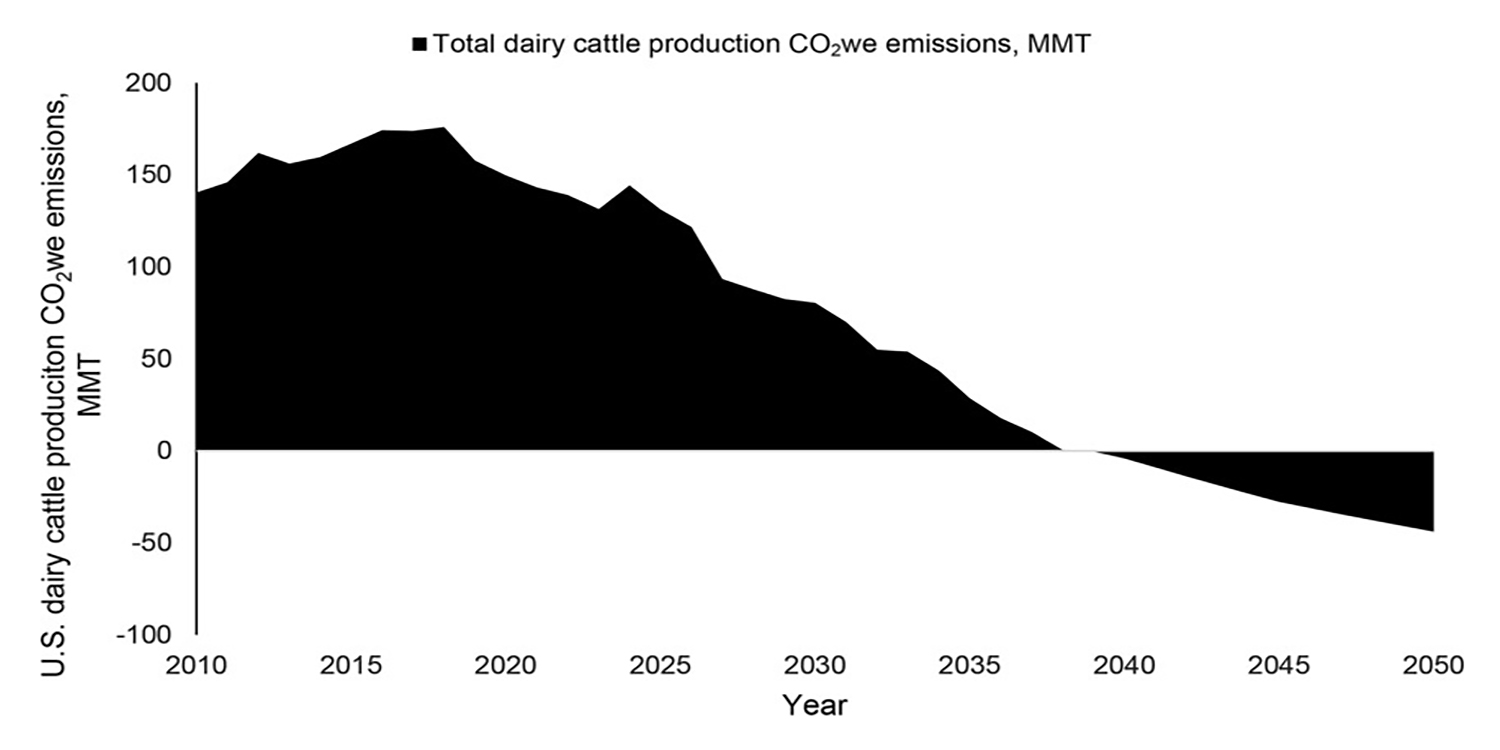
What is exciting, “is if we reduce methane, we can come to a point where we produce negative warming or a cooling effect. That’s what my work is about (Fig. 4). If we do a couple of things to reach no new warming, and if we then get aggressive to go further, we can sell credits as offsets,” said Mitloehner, referencing the implications, limitations and conclusions of the CLEAR Center study.

As innovations related to managing cattle diets are being developed, the good news is emerging tools show the promise of steering more of that carbon, that energy, toward milk yield and components and less of it to methane that is belched back into the cycle.

In contrast, a net-zero carbon or net-zero GHG goal that measures methane as a stock gas (GWP100) and does not accurately describe its warming impact and flow-gas status in the way GWP-star (GWP*) does, would leave dairy farmers needlessly and continually chasing what under the GWP100 scenario are accumulated and continuing belches from their cows. 

If the industry continues to chart net zero carbon, will dairy farms be forever chasing their belching cows with tech investments and offsets?

“In my opinion, you will never reach net zero carbon. Your cows will always produce methane no matter how aggressive you are. You will over promise and leave stakeholders disappointed. We are dealing with a biological system, the microbial fermentation in the rumen. It is not feasible and I have advised the industry in the past against it, but that is the direction it goes – in general,” said Mitloehner.

As for unintended consequences on the path to ‘net zero,’ Dr. Mitloehner was clear to say: “What matters is climate neutrality. If you tell the world you want to be climate neutral with no new warming and achieve it through annual reductions of 0.3 to 0.5%, you will indeed be climate neutral in less than 20 years. At a 1% per year reduction in methane, you will accelerate that timeline. But you will never achieve it with GWP100. It’s not possible and not necessary to go that way of treating methane as if it were a stock gas. It doesn’t account for the reduction.”

A piece of good news, he said, is that GWP-star (GPW*) can be used parallel to GWP100. The maitrix is a more scientific predictor of what you (dairy) has to do to bend that curve and how strongly.

“The excel spreadsheet calculator in the white paper helps you identify when in the future as a creamery or a statewide association reach the point that you are no longer creating additional warming, and that should be the goal,” Mitloehner explains.

Net zero carbon or net zero GHG is a setup to always be chasing the cow’s biology without acknowledging her gas is a flow gas, not a stock gas. It does not accumulate. Some will say “you can use offsets” for the cow’s biology. But why? They are not necessary as offsets and could be viewed as solutions if the dairy industry gets its math right. (We’ve seen this movie before)

Dutch farmer protest update: What if you woke up tomorrow and learned your farm is to be reduced or closed based on climate targets that use fuzzy math?

When food is plentiful, and climate reduction targets kick-in… How do farmers attract the strong public support they need to continue?

By Sherry Bunting, previously published in Farmshine

NETHERLANDS — Headlines here in the U.S. indicate the Dutch government is offering buy-out of up to 3000 farms and other so-called ‘peak polluters’ to reduce ammonia and nitrous oxide emissions to bring the country into compliance with EU pledged targets. They say farms will be offered more than 100% of their value to quit, but the value of these farms is now reduced by the reduction targets. 

A November 30 article in The Guardian quotes the Dutch nitrogen minister Christianne van der Wal saying “there will be a stopping scheme that will be as attractive as possible,” and that forced buyouts will follow next year if the voluntary measures this year fail. 

Some may read these headlines and figure Holland is such a progressive agricultural powerhouse that the number of planned closures is but a dent. 

Think again.

Farms in Holland and around the world are the thin green line. Challenging them with inflated climate data and restrictive targets puts world food security at risk.

Consider that the BBC reported recently that Ireland is also looking at agricultural emissions, namely methane from cattle and sheep, in terms of meeting its Climate Action Plan targets of a 25% reduction by 2030. Estimates vary on how much culling would need to occur to meet these targets, how the methane is measured, and how fast various feed additives can help farms meet new targets. The most glaring concern is how carbon equivalents and methane are measured.

What if you woke up tomorrow and learned that your farm is targeted for similar reductions or closure based on the location of your farm on a map, based on climate targets set by your state or your milk buyer or the federal government, based on making cuts from where you are now — not from where you might have been before whatever improvements you’ve already made?

We reached out to Dutch dairy farmer Ad Baltus this week for an update from Holland, having interviewed him six months ago for the story about the Dutch farmer protests in July 2022.

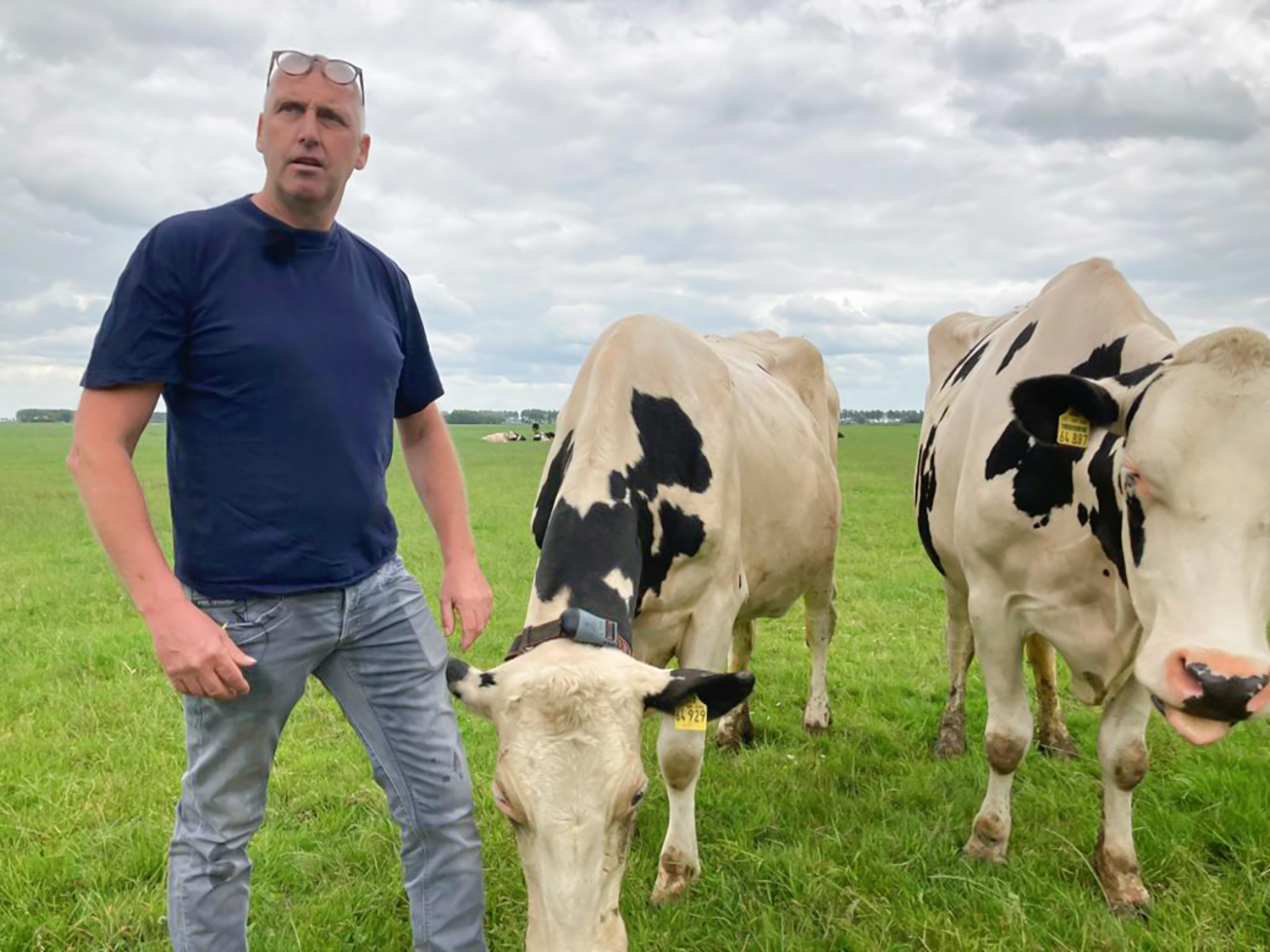
Baltus farms 170 acres in the village of Schermerhorn with his wife and 7-year-old daughter. They milk 130 dairy cows, grazing in summer and growing corn and collecting fresh grass and dry hay from fields as well.

In July, he reported that his farm is one of the “luckier” ones. He is in a location in North Holland that will have to reduce the amount of nitrogen (or sell cows) by 10 to 15%. Some zones have been designated to reduce by up to 75 to 90%. The percentages are to meet reduction targets, and are not based on what a farm is measured to produce. Building and infrastructure projects can’t move forward without near-term offsets, which is why the situation has reached this extreme point in the Netherlands.

“It feels like the government throws figures in the air, and they wait to see what will happen,” says Baltus. “In my point of view, they try to make farmers worried as a tactic of smoking them out. That’s what you see now. The farms (targeted for higher reductions based on location) nearby the nature areas are getting tired of it, and they sell. I see the last couple of months a lot of farms, nice farms, being sold, and that worries me. If they stop farming, and go abroad, what will be left in Holland?”

He observes that the older farmers stay on the farm until they stop for retirement.  “But when the young farmers stop and go abroad — that’s the future leaving. The young farmers are the future. The young farmers don’t want to wait for what is clear and what is going to happen. The problem is now — in the next five years,” he says, indicating a cycle of new targets that never seems to end. “Every time the government throws new figures out. This time it’s the nitrogen, then it’s the water quality, and then it’s the biodiversity, then there is CO2. Every time there comes new regulation, young farmers worry about their future.”

He sees agriculture in his country at a crossroads and warns that if this can happen in Holland, where agriculture is so progressive, it can happen anywhere.

“It could go the right way, and they will begin to appreciate farming in Holland, or it could go the other way, and farming may be over in 10 or 20 or 30 years. My biggest worry is you need some minimum amount of farmers to let the companies behind the farms live. I see it that when you have a feed company, they need a certain amount of farms to deliver their feeding products. When it comes down below some level, they say that is too small for us, and it is a spiral going down. That’s a worry for me, that we make it difficult for too many farmers, and they stop.”

Baltus confirms that the large Dutch farmer protests of the summer have quieted down, but the efforts and periodic protests continue on a different scale. “We are not giving up. We are struggling ’til the end, but it is a hard battle to convince (the government) that this is not the good way to go.

“We also see the farm groups talking to the government. We see the (symbolic) red handkerchief. The Dutch flags turned upside down for a month got attention. The protest is maybe not as loud as it was, but it is still there, and a little spark to the gunpowder barrel, it will explode again,” he says, noting that there are elections in March 2023.

As for the big picture, Baltus describes it as Dutch farmers having to ‘catch up’ quickly to the long-time networks built by the NGOs.

“Farmers have been too long on their own farms, and now you see things changing. Since 2019, when the first farmer protests began, you see farmers are now talking more to the media. They get a better speech to government officials,” says Baltus.

On the other hand, the NGOs, like Greenpeace, and a variety of others, are a small number of people relative to the population of Holland, but they have already been working 20 to 30 years on this. They are well-organized, well-funded, and have people throughout all levels of government and media, he explains.

“We are just now three or four years fighting against that, and it takes a time to change and get that understanding of nature and practice to the government,” Baltus relates, adding that it also takes time for new technologies to come to market that will help farms make further reductions, though European farms are already pretty progressive that way.

Baltus sees European farmers coming together more for each other now — even if their respective governments are not. As other countries in the EU are beginning to experience similar pressures of emissions targets that could essentially reduce dairy and livestock numbers or put farms out of business, solidarity is on the rise among those farmers who are paying attention.

Farming is hard work with a lot of risk, but as Baltus points out, Holland is a good place to farm, with good soil, good logistics, and a good climate for crops and livestock.

“It is one of the best jobs in the world. I love what I do. I want the adventure that every day is different. I like working in nature, working outside,” he says. “When the younger generation doesn’t have to worry about all of the things which are not farming, then they will go to farming because the work is that good. It is only the things that come from outside into the farm that make it hard.”

One part of a future solution is exemplified in something Baltus has done at his farm for 30 years — providing a school on the farm to teach young children how to make cheese and to make jam. His cheese school reaches a few thousand children each year.

“We do it so the children learn how much work it is to make that little piece of cheese and that little pot of jam,” he says. “When they learn the effort that goes into food, they appreciate it more, I think.”

The children get a bucket of milk, and in two hours they go home with a little cheese. They have to turn in 14 days and put on a little salt, and in another 14 days they eat their own cheese. When Baltus started the cheese school 30 years ago, maybe one or two farms did this kind of thing.

Today, more farms are doing similar memorable learning experiences. Baltus sees more farms connecting with the public in recent years. Some have cabins on the farm that they rent to the public. Others provide daycare on the farm, so children can grow up with some real-world attachment to farming. In his neighborhood, there are four farms with daycare. 

“The new generation learns what it is to farm, so maybe they will be farming or an advocate. If they go to work as a plumber or a trucker, but as a child lived a few years on a farm at a daycare, it’s good for when they are older, even if they work in other things,” he explains.

“The solution is also that everyone you speak with — say to them what you are doing. When you are at a party or on holiday, say you are a farmer, say how you do things, why you do things — explain it,” Baltus suggests. “People come to appreciate these things when they know about them. There are things (farmers) can do better, but when we explain that we need 5 or 10 years (as technology develops), they accept we’re not perfect but are working to make it more perfect.”

In general, Baltus has found the public has a good opinion of farmers. When he meets someone from the city, they say “Oh, you’re a farmer. That is good of you.” And that’s that. They think well of farmers, but have no reason to worry about food, and therefore don’t make the connection to the impact of the threat the farmers face.

“People have other worries. Do I have a job next year? Can I pay my bills for electricity? Will my children have a good education? But food? There is always food. People will worry about food when there is no food,” he says.

As it stands now in Holland, “What is happening with farms is not really their business. People can go to the supermarket, and most everything they want they can buy there,” Baltus observes, saying he understands this disconnection.

Even if there are changes to the mix of foods available in stores and restaurants, there is no fear of finding food to eat. While Holland is considered a large agricultural exporter, Baltus notes that his country is a net-importer of food when looking at it on a protein and energy needs basis. 

“We have the cheese and potatoes and cabbage, but we don’t have the coffee, the cocoa and the citrus. I see it in the way of trading. When that balance is lost, what happens when there is a shortage and we don’t have the cheese or potatoes to export?”

The bottom line, says Baltus, is that “When you are a carpenter or a plumber and there is, every day, food in the supermarket, why would you have to worry about food?

“In Africa, they know food is important. They know what it is like to not have food. But in the western world, there is food everywhere. You can pick up the phone, and in 30 minutes have a pizza on your plate.”

-30-

Dr. Mitloehner clears the air on ‘net zero,’ sees narrative changing on America’s cows

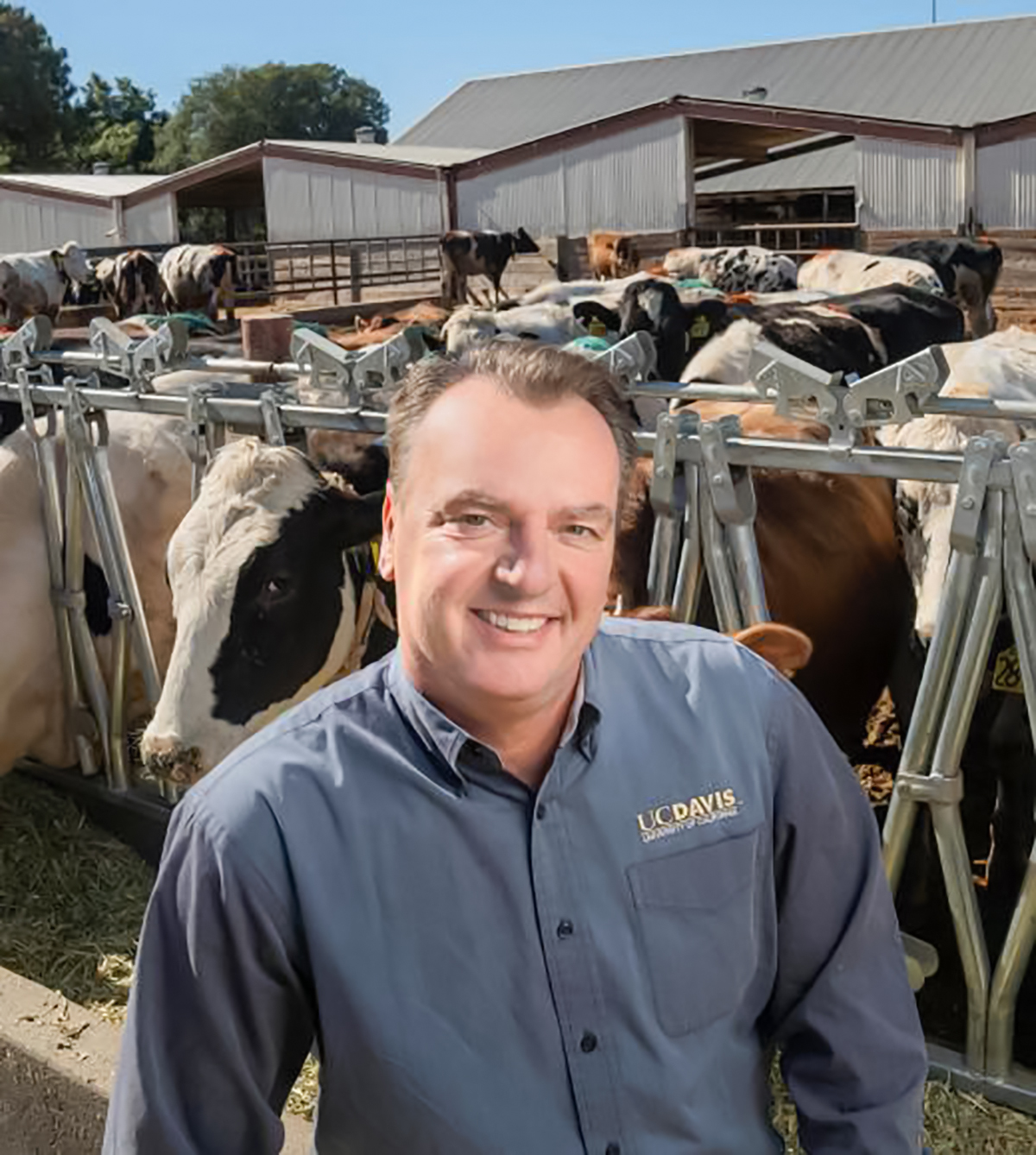
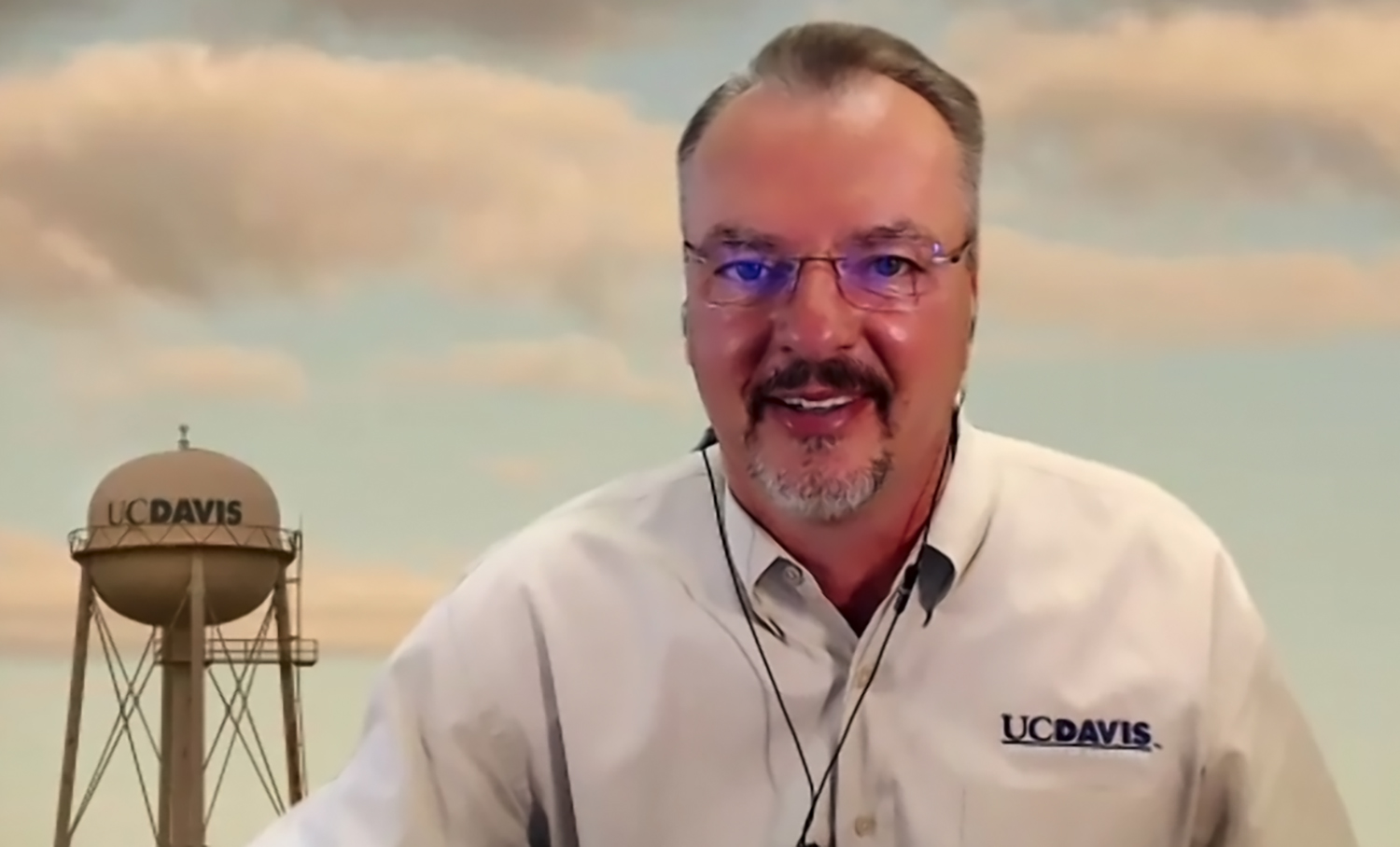
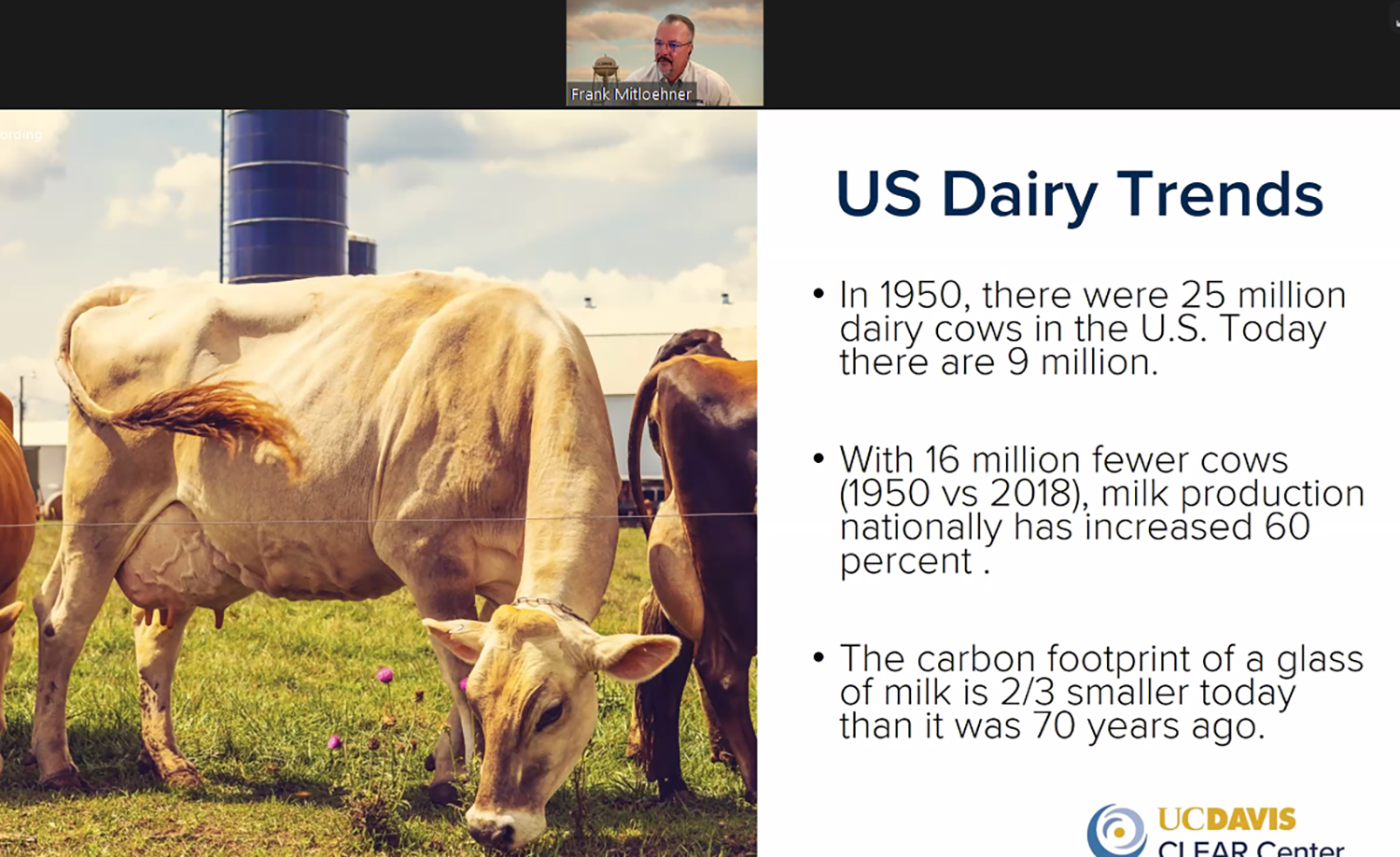
Dr. Frank Mitloehner is a foremost authority on animal science and greenhouse gas emissions. Find him on Twitter @GHGGuru and @UCDavisCLEAR (Screen capture from American Dairy Coalition webinar)

‘Climate neutrality, not net zero carbon, should be dairy’s goal.’

By Sherry Bunting

‘Net zero’ seems like a simple term, but it’s loaded, according to Dr. Frank Mitloehner, professor and air quality specialist with the Department of Animal Science at University of California-Davis. 

He firmly believes dairy can be a climate solution, but the first step is to accurately define dairy’s contribution to the climate problem. Setting the record straight is his prime focus, and he also researches ways dairy, like every industry, “can do our bit to improve.”

Presenting on what ‘net zero’ really means for dairies, Mitloehner answered questions during the American Dairy Coalition (ADC) annual business meeting in December, attended by over 150 producers from across the country via webinar.

Based in Wisconsin, ADC is a national producer-driven voice with a regionally diverse board. President Walt Moore, a Chester County, Pennsylvania dairy producer, welcomed virtual meeting attendees, and CEO Laurie Fischer shared a federal dairy policy update. 

She said the ADC board is nimble, moves quickly, and wants to hear from fellow dairy farmers. She encouraged membership to make ADC stronger and shared about the organization’s federal policy focus in 2021 — from pandemic disruptions and assistance, Federal Order pricing, depooling and negative PPDs to real dairy label integrity, whole milk choice in schools, and farmers’ questions and concerns about dairy ‘net-zero’ actions.

“Too often, farmers think they may not understand something, so they don’t speak up,” said Fischer. “But we get calls and so much great advice from our farmers. We know you get it, you know it, because it is happening to you.” 

From this farmer input, the net-zero topic became the ADC annual meeting focus.

“We are rethinking methane, and this is influencing and shaping the discussion,” Dr. Mitloehner reported. He urged producers to use the information at the CLEAR Center at https://clear.ucdavis.edu/ and to do better networking, to have a better presence on social media. 

This is necessary because the activists are well-connected, and methane is the angle they use in their quest to end animal agriculture. He said Twitter is a platform where many of these discussions are happening. His handle there is @GHGGuru and the Center is @UCDavisCLEAR.

“This is something I have told the dairy industry. They say ‘net-zero carbon’, but they shouldn’t say that because it is not possible, and it is not needed. We need to be saying ‘net-zero warming’. That’s the goal. Then, every time you reduce methane, you instantaneously have an impact that is inducing a cooling effect,” said Mitloehner.

‘Climate neutrality’ is the more accurate term he uses to describe the pathways for U.S. dairy and beef. But it requires getting accurate information into policy in a fact-based way. 

It requires arming people with the knowledge that the constant and efficient U.S. dairy and livestock herds produce no new methane, that they are climate-neutral because not only is methane continuously destroyed in the atmosphere at a rate roughly equal to what is continuously emitted by cow burps and manure, that process involves a biogenic carbon cycle in which the cow is a key part.

One of the issues is how methane from cattle is measured, he said. Current policy uses a measurement from 30 years ago that fails to acknowledge the carbon cycle and ‘sinks’ alongside the ‘emissions.’ 

Mitloehner said accurate information is beginning to change the narrative. This is critical because methane is the GHG of concern for dairy, and the narrative about it has been incomplete and inaccurate. 

As a more potent heat-trapping gas than carbon dioxide, methane becomes the ‘easy’ target to achieve the warming limits in the Paris Accord. Methane was the focal point of ‘additional warming limits’ during the UN Climate Change Summit (COP26) in Glasgow in November.

Putting together the inaccurate narrative alongside international agreements to specifically reduce methane, it becomes obvious why cattle are in the crosshairs. Producers are already in the middle of this in California as methane regulation and carbon credit systems began there several years ago.

As the narrative is beginning to change, Mitloehner sees opportunities. He described the current California ‘goldrush’ of renewable natural gas (RNG) projects where large herds both in and out of state cover lagoons to capture and convert biogas into RNG. The state’s investments and renewable fuel standard provide a 10-year guarantee with the RNG companies typically owning the offset credits that can be traded on the California exchange from anywhere.

Getting the numbers right is mission-critical

“We are far and away an outlier because of our efficiency in the U.S with all livestock and feed representing 4% of the GHG total for the U.S,” Mitloehner confirmed. “Dairy, alone, is less than 2% of the U.S. total.”

This is much smaller than the 14.5% figure that is thrown about recklessly. That is a global number that includes non-productive cattle in India as well as the increasing herds in less efficient developing countries. This number also lumps in other things, such as deforestation.

He said the true global percentage of emissions for livestock and manure is 5.8%. Unfortunately, activists and media tend to use the inflated global figure and conflate it with these other things to inaccurately describe the climate impact of U.S. dairy and livestock herds as 14.5%.

The efficiency of U.S. production and the nutrient density of animal foods must be part of the food and climate policy equation.

Methane is not GHG on steroids

“Without greenhouse gases, life on earth would not be possible because it would be too cold here,” said Mitloehner. “We need GHG, but human activity puts too much into the atmosphere, and the toll is large concentrations.” 

The way all GHGs are measured has to do with their intensity as determined 30 years ago when scientists wanted one global warming potential (GWP) unit to compare cows to cars to cement production and so forth. They came up with GWP100, which converts methane to CO2 equivalents based on its warming potential.

Methane traps 28 times more heat than CO2, but it is short-lived, Mitloehner explained.

“Looking just at the warming potential, you get this idea that methane is GHG on steroids and that we need to get rid of all of it and all of its sources,” he said.

But is this the end of the methane story? No.

Sinks and cycles must count

Mitloehner described how ‘methane budgets’ look at sources and their emissions but ignore the carbon sinks that go alongside and ignore the chemical reactions that result in atmospheric removal of methane as well.

“Plants need sunlight, water, and a source of carbon. That carbon they need comes from the atmosphere to produce oxygen and carbohydrates,” he said, explaining how cows eat the carbohydrates and convert them to nutrient dense milk and beef. In that process, the rumen produces methane.

“Is this new and additional carbon added to the atmosphere? No it is not. It is recycled carbon,” he said.

“Say you work off the farm. You drive and burn fuel, adding new CO2 in addition to the stock in the atmosphere the day before. Stock gases accumulate because they stay in the environment. Currently, agencies treat methane as if it behaves the same way. But methane is a flow gas, not a stock gas. It is not cumulative,” said Mitloehner.

If the same farm has 1000 cows belching today and 1000 belching 10 years ago, those 1000 cows are not belching new methane because in 10 years it is gone from the atmosphere. It is cyclical.

“The take-home message is the carbon that our constant livestock herds produce is not new carbon in the atmosphere. It is a constant source because similarly to it being produced, it is also destroyed. The destruction part is not finding its way into the public policy system… but it will in the future,” he predicts.

Methane drives Paris Accord and COP26

Methane targets are driving intergovernmental agreements wanting to limit the “additional warming impact” of nations and industries.

Currently, cattle are viewed as global-warmers because they constantly emit methane. However, as Mitloehner drilled numerous times, this is not new methane, it is not additive, it is not cumulative. It is recycled carbon.

“If you have constant livestock herds, like in the U.S., then you are not causing new additional warming,” said Mitloehner.

Burning fossil fuels is much different. 

“Fossilized carbon accumulated underground. Over 70 years, we have extracted half of it and burned it, so where is it now? In the atmosphere. We added new and additional CO2 that is not a short-lived gas. It is a one-way street from the ground into the air,” he explained.

The problem for dairy and beef producers is their cattle are being depicted as though their emissions are additive, cumulative, like fossil fuels, which is not true, he said.

Signs the narrative is changing

One promising sign that the message is getting through has come from Oxford researchers acknowledging the constant cattle herds in the U.S. and UK are not adding new warming.

They acknowledge the GWP100 “grossly overestimates” the warming impact of cattle and are working on a new measurement that recognizes constant cattle herds are not adding new warming, said Mitloehner.

Another promising sign is that the International Panel on Climate Change (IPCC) issued a statement recently acknowledging that the current GWP100 overblows the warming impact of cattle by a factor of four. This new information is not in current policy, but it is making its way there.

Tale of two bathtubs

Mitloehner believes it is important to visualize climate neutrality. He described two bathtubs. One has a CO2 faucet with no drain, the other a methane faucet with a drain. Open the faucets, and even at a slow and steady rate, the CO2 bathtub continues to rise, while the methane bathtub drains as it fills to remain at a constant level.

He also explained that over the past 200 years the U.S. hasn’t seen any real change in that methane bathtub because prior to settlement in America, 100 million ruminants — buffalo and other wild herds — roamed. Today, there are around 100 million large ruminants in the U.S. dairy and beef industries.

What has changed is the U.S. does have more liquid manure lagoon storage that is producing more methane than solid manure storage. “But we know of ways to further reduce that,” he said.

Mitloehner pointed out how the current GWP100 poorly estimates the warming impact three example scenarios. If, over 30 years, methane is increased 35% from a source, or reduced 10%, or reduced 35%, the GWP100 would show significant continuous addition of cow-sourced methane in CO2 equivalents for all three scenarios because the destruction of the methane – the drain that operates with the faucet – is ignored.

The proper way to look at this, if the methane increased a lot, is that it would add a lot. But if it is balanced, then there is no new or additional warming. And, in that third scenario, he said, “where we pull a lot from the atmosphere when we reduce methane, it has the same impact as growing a forest.”

Bottom line, said Mitloehner, “We can be a solution and take it to the market and get paid for that,” but current policy does not yet reflect the neutral position of the constant and efficient U.S. herd.

Bullish about the future

‘Net zero’ is a term that is not yet clearly defined, said Dr. Frank Mitloehner several times during the American Dairy Coalition annual meeting by webinar in December. He sees the real goal as “climate neutrality,” to communicate the way constant U.S. dairy herds contribute “no additional warming,” in other words “net zero warming.”

The climate neutrality of U.S. cattle must be part of public policy, he said. Only then will dairies truly be on a path to marketing their reductions as ‘cooling offsets.’

Mitloehner, a University of California animal scientist and GHG expert is bullish about the future of “turning this methane liability into an asset, so if we manage toward reducing this gas, we can take that reduction to the carbon market,” he said.

“When we hear ‘net zero’, we think about carbon, but that would mean no more GHG is being produced, and that is not possible. I have told the dairy industry this for years. Why is (zero GHG) not possible? Because cows always belch, and we can’t offset that, and furthermore, we do not need to offset that because it is not new methane,” said Mitloehner.

On the other hand, “If we replace beef and dairy made in the U.S., this does not create a GHG reduction at all. This is because we are the most productive and efficient in the world,” he said.

Just stopping beef and dairy production here in the U.S. — and picking up the slack by producing it somewhere else or producing something else in its place — creates ‘leakage.’ This leakage, he said, is where the biogenic carbon cycle becomes disrupted. In other words, the bathtub has a faucet that is out of sync with the drain.

California’s RNG ‘goldrush’

Mitloehner touched on the strict California standards that mandate a 40% reduction of methane be achieved by the state by 2030. Again, methane is targeted because of its warming potential per the Paris Accord.

The good news, he said, is California is using incentives to encourage covering manure lagoons to capture a percentage of the biogas bubble so that it doesn’t go into the atmosphere but is trapped beneath the tarp and converted into renewable natural gas (RNG) that can be sold as vehicle fleet fuel to replace diesel. 

Because this RNG comes from a captured and converted methane source, it is considered a most carbon-negative fuel in the state’s low-carbon fuel standard. 

Those credits equate to $200 per ton of CO2 replaced with a carbon-negative renewable, said Mitloehner.

“This is a huge credit. This is why dairies are flocking to get lagoons covered to trap and convert. These credits are guaranteed for 10 years in California, but the anti-agriculture activists are fuming over them,” said Mitloehner.

Of all California investments made toward achieving the 40% methane reduction goal, dairy has received just 3% of funds, but has achieved 13% of reductions so far.

This “carrot” approach has incentivized the biogas RNG projects assuming $4000 income per cow, making an estimated $1500 to $2000 per cow per year on a 10-year California fuel standard guarantee.

Mitloehner noted that the carbon intensity of the reduction is presently viewed as greater when RNG is used in vehicles vs. generating electricity, but right now there is not enough RNG suitable for vehicle use. He sees the fuel use increasing in the future and explained that dairies anywhere can sell into the California market if they capture biogas and convert it to RNG.

The state’s 10-year guarantee has stimulated companies seeking to invest in RNG projects on large dairy farms, where they then own or share the credits.

Mitloehner answered a few questions from producers about the caveats. If the bottom and top of the lagoon are covered, what happens to the sludge that accumulates? He acknowledged there is no satisfactory answer to that question presently.

Another drawback is the technology only works for larger dairies because smaller lagoons won’t have the same breakeven. Community digester models are emerging as well, he said, but they also use clusters of large farms working together.

Soil carbon sequestration

Mitloehner cited soil carbon sequestration as a way dairy farms of any size can be a solution.

It’s the process by which agriculture and forestry take carbon out of the air via the plant root systems that allow the soil microbes to take it into the soil — unless the soil is disturbed by tilling or it is released through fires. With good forest and grassland management, as well as low- and no-till farming practices, carbon can be sequestered to stay in the ground forever, according to Mitloehner.

“Agriculture and forests are the only two ways to do this,” he said, adding that USDA seeks to incentivize practices that take and keep more of the atmospheric carbon in the soil.  

Answering questions from producers, he noted that he has not yet seen a scheme that would incentivize soil carbon sequestration through marketing offsets, but the discussions are heading in that direction.

“Many of the environmental justice communities are running wild on this. They do not want farmers to get any money for it. They are putting on significant pressure and threatening lawsuits, so it’s not settled yet,” he reported.

There is also a lot of confusion around soil carbon sequestration and “regenerative” agriculture. One big problem is that producers who are doing some of these things, already, won’t get the opportunity to capitalize on those practices when offset protocols are eventually developed — if those practices are not deemed “additive.”

“If you are doing something now and are not covered by a policy of financial incentive, then four years from now, if it is developed, they’ll say you don’t qualify because you are already doing it,” said Mitloehner. 

“They are calling it ‘additionality.’ It’s about the change to doing it to qualify. That seems crazy, but it’s like if you bought an electric vehicle 10 years ago when there was no tax credit, you don’t get a tax credit now for already owning an EV because the improvement is not ‘additional,’” he explained.

What about the burps?

For farms with under 1000 cows, other technologies like feed additives can be used on any size dairy with effects realized within a week, said Mitloehner, noting one product that is commercially available and several others on the docket.

If a 10 to 15% reduction can be achieved in enteric (belching) methane reduction, then it will be marketable. Right now, these reductions are not marketable. If an offset protocol is developed for this in the future, it will be taken to the carbon market, he said.

In the meantime, incentives are being offered within supply chains, according to Mitloehner. Companies like Nestle, Starbucks and others are doing pilot projects and buying feed additives for the farmers within their supply chains to reduce their products’ GHG. He said there is some evidence these products can enhance components and feed efficiency. This is a big area of research right now.

A question was also asked during the webinar, wondering about Amish farms using horses instead of tractors. Are they contributing to cooling?

Mitloehner replied that he has not yet seen a calculation for this, and while the impact of horses would be less than the impact of burning fossil fuels, there is still an environmental impact to calculate. 

Since the international focus is on ‘additional warming impact’, methane is – like it or not — the target. Whether a dairy farm is managed conventionally or in the Amish tradition, the cows, the methane, and how governments and industry measure the ‘additional warming impact’ of cow-sourced methane, is still the crux of the issue for all dairy farms. If efficiency is reduced, then the ability to position the dairy farm as ‘cooling’ may be more complicated, or less significant, he said.

In addition to accurate definitions that acknowledge climate neutrality of constant cattle herds producing no new methane, Mitloehner’s wish is for federal policy to also take productivity (and nutrient density) into stronger consideration when evaluating emission intensity “instead of just counting heads of cattle. 

“This can be good for large or small dairies with a high or low footprint. When the relative emissions are determined by how you manage the dairy, the hope is that this is more about the how than the cow.”

-30-

‘There’s no magic in animal handling.’ Calm behavior taught, learned.

Dr. Hoglund’s low-energy cattle-handling workshops school cattle and handlers

CattleHandling3858.jpg

Dr. Hoglund talks about raising hands from below eye level to above the eye level of the cattle to add a little energy to create movement, while emphasizing the importance of using only the amount of energy needed.

 By Sherry Bunting, first published in Farmshine, Nov. 7, 2018

MARION, Pa. — When Josh and Brandi Martin attended their first low-energy cattle handling and stockmanship clinic with Dr. Don Hoglund, Josh wondered what he could learn. After all, he works cattle every day at the family’s farm where they milk 1000 cows and raise dairy replacements as well as beef cattle in Franklin County, Pennsylvania.

CattleHandling3813(Martins).jpg

Josh and Brandi Martin attended a previous clinic and learned so much they organized one as a refresher at their farm for themselves and their neighbors.

“I learned a lot, and it surprised me,” he told a dozen fellow dairy producers, employees and industry representatives at a two-day workshop organized at Martin Farms Oct. 15-16.

“There’s no magic in animal handling,” said Dr. Hoglund, who stated there’s also no definition for “emotion” because emotion is cognitive and requires language.

Fear, therefore, can’t be quantified.

He focused on the observable behavior of animals and how humans and animals learn from their interactions.

The learning for clinic attendees began in a classroom setting before heading out to the heifers and cows with the realization that just like no one in the room could know what anyone else was thinking or feeling, we also don’t know what animals are thinking or feeling.

CattleHandling3799(Hoglund).jpg

Dr. Don Hoglund

“But we can observe and measure their behavior and responses,” said Dr. Hoglund, whose educational, vocational and life experiences span decades as a veterinarian, animal behaviorist, animal trainer (including for Walt Disney Company), researcher, educator, evaluator and text book author on the subject.

A scientist with decades of experience, Hoglund stressed the importance of observing behavior, not emotion and of using specific words in conversations with consumers to convey behavior that can be observed instead of emotion, which is a guess.

As we soon found out, Hoglund’s clinics are not your run-of-the-mill stockmanship workshops. He teaches science-based and practical approaches to human and animal interaction – challenging the conventional wisdom.

“I’m not here to tell you how to handle your cattle, but rather to show you how animals learn, and how you learn affects how your animals learn,” he said.

Part of the two-day cattle course at the Martin farm involved having producers do techniques in training and handling to the point where they can teach someone else and accomplish important aspects of various farm owner and employee certifications.

Additionally, Hoglund’s techniques equipped attendees with a few ideas for “teaching” dairy animals calm parlor behavior via low-energy training as heifers.

The fascinating aspect of the clinic was evident in how both the people and the cattle demonstrated observable behaviors that showed they were both learning.

“We are seeing a revolution in the neurosciences,” said Dr. Hoglund, explaining that we really don’t know why animals run.

CattleHandling3801

A dozen dairy producers, employees and industry people attended Dr. Don Hoglund’s low-energy cattle handling clinic at Martin Farms near Marion, Franklin County, Pennsylvania recently. Photos by Sherry Bunting

“They run because they can,” he said. “There’s more than one reason why animals run, so instead of why, we should be looking at ‘when’ they run. Look at when a behavior occurs, not guessing why. You know what the cattle are doing and when they are doing it.”

He demonstrated a primary example on dairy farms.

“A dairy cow faces you all of her life. That’s how we feed and interact with her growing up. But for milking, she faces away from you and has to turn her head to see you,” Hoglund explains. “We can teach animals to calmly face away so they are ready for the parlor.”

He explained his techniques as “low-energy handling” — using just the amount of energy it takes. Preferring to speak in terms of “energy” versus “stress,” Hoglund said a key is for cattle handlers to learn to manage their own energy levels relative to the cattle.

CattleHandling3818

Dr. Hoglund instructs pairs of participants in the heifer pens at Martin Farms as the teach heifers to calmly “face away.”

“When we start doing things in the blind zone, early, we are training the cattle to handle this calmly,” he said. “Everyone is told to stay out of the cow’s blind zone, but that’s where all the milking work is done.

“How about we train her to accept that?”

In the heifer pens, attendees, working in pairs, put the principles into practice according to Hoglund’s instructions getting the heifers to learn “facing away” behavior and “see human go to food.”

It was interesting to see how quickly they settled-in to be orderly as they learned “facing away,” and how their handlers learned to step away once they got the animals where they wanted them to go.

“Your energy drops and the animal learns. That’s what we’re after, the learning,” said Hoglund. “Cattle are in the business of learning to stay alive. They will go the efficient way and that helps you get more of the milk you are investing in.

“When we work with cattle in low-energy, then we have them in the parlor in low-energy,” he explained, adding that calm behavior is observable where the term “relaxed” is a feeling term, and therefore unknown.

“We want to talk and think about these things as behavior and not emotion. Behavior is anything you can observe,” he explained. “We are teaching others to teach animals to go calmly and to face away from us.”

The biggest thing for clinic attendees was to come away doing enough to be able to teach others at their own farms. After working in a heifer pen, participants had the opportunity to ‘train’ another clinic participant.

Throughout the handling, Hoglund said that trotting is okay, but that if the animals begin to lope, that’s not what you want.

The exercises in teaching cattle to accept “facing away” are something producers or employees can do 15 minutes a day for three days in a row and get results and then periodically refresh, according to Hoglund.

“It’s not really animal handling or stockmanship, it’s animal learning,” he observed. “The animals are learning to accept compression, and the people learn to slow down, be safe, and manage themselves to use only the energy required to accomplish the task. As we lower the energy, we reinforce the learning.”

He acknowledged that it’s tough for handlers to learn when to step back. “That’s one of the hardest things to learn, but also the most important.”

Low-energy handling starts with hands at sides. For safety reasons, he advised participants not to put them down in their pockets but to thumb their pockets and keep the hands out in case they need them.

“We add energy to move them by moving our hands from below the eye level of the cattle to above the eye level to raise the energy,” Hoglund explained.

CattleHandling3839

Bred heifers calmly eat at the bunks watching some of their pen-mates ‘learn’ calm parlor entry through a makeshift chute.

When it comes to training animals and human handlers for low-energy handling, Hoglund said avoid training animals where they sleep: “You don’t want to chase animals out of their beds to train them.”

While working in the heifer pens at the Martin farm, Hoglund explained that, “Heifers learn through all five senses. To know where an animal is looking, look at her ear, not her eye. She can see two things at once, so the ear tells you more.”

This is important information for producers and employees to avoid raising the energy level in a pen.

Hoglund made the case that these techniques are also important from an economic standpoint. Citing work he has been involved with in Minnesota, he said it takes 20 minutes for a cow to get rid of that adrenaline rush from a high-energy handling.

“That 20 minutes can hold back two and a half to three pounds of milk in the next milking,” he said, adding that cattle remember “where” things happen and don’t regain the milk lost.

“These techniques will help you get the milk you’ve already invested in,” said Hoglund, explaining that  “animals repeat what they learn, and for the people working with the animals, seeing gives information but doing is learning.”

This was just one aspect of the two-day clinic and the tip of the iceberg in terms of Dr. Hoglund’s work and the services and education he provides to universities, organizations, companies and especially hands-on to groups of producers and employees on farms.

Look for more tips from this clinic in the future, and to learn more about Dr. Hoglund and his work, visit https://www.dairystockmanship.com/

-30-

CattleHandling3837