There is NO basis for two Class I movers in FMMO recommended decision!

AUTHOR’S NOTE: Who’s the wizard behind the curtain on USDA’s last-minute milk pricing surprise, the splitting of the Class I baby to favor ESL? Vilsack, of course, with a little help from his checkoff cronies at Midwest Dairy and DMI — masquerading as ‘dairy farmers.’

By Sherry Bunting

USDA’s recommended decision on Federal Milk Marketing Order Class I (fluid milk) formulas brought a big surprise getting very little attention. That surprise: “splitting the Class I baby” and adding what constitutes a “fifth Class” of milk — TWO Class I movers announced each month.

ZERO proposals to divide Class I into a two-mover system were aired at the national hearing. Even USDA’s analysis shows the two movers would differ by as much as $1 apart — or more — in any given month.

The hearing record is woefully inadequate, indeed completely void of testimony for a second Class I mover. No proposal. No evidence. No testimony. No analysis. No parameters. No definition.

What does this surprise two-mover decision mean? 

Fresh, conventionally processed (HTST) milk would go back to being priced by the prior method, using the higher of the Class III or IV advance pricing factors to determine the Class I skim milk base price portion of the mover. 

On the other hand, milk used to make extended shelf life (ESL) fluid milk products, defined only as “good for 60 days or more,” would continue to be priced using the average of these two pricing factors, plus-or-minus a rolling adjuster of the difference between the higher-of and average-of for 24 months, with a 12-month lag.

Confused yet? 

The industry is calling this surprise two-mover twist ‘innovative’ and ‘creative’, even ‘brilliant.’ But let’s hold the horses a moment. 

With two movers, fluid milk costs could be different for plants in the same location based on shelf life. Could processors change the label to move between the movers and pay whichever mover was lower? Who knows? There is no clear definition for the new class, and the parameters to qualify are non-existent.

ESL processors will know the rolling adjuster 12 months in advance, due to the “lag.” They will know the two advance-priced movers a month in advance. They will have it charted in an algorithm no doubt, and make decisions accordingly.

Dairy farmers, on the other hand, will find out how their milk was used and priced two weeks after all their milk for the month was trucked off the farm. If the two-price Class I system becomes law, dairy producers’ milk checks will be even less transparent than they are now!

Not only does the USDA hearing record and decision fail to clearly define ESL, the industry doesn’t even have an exact and generally-accepted definition or standard for ESL.

ESL is both a loose and specific term.

Generally speaking, ESL is a term covering a broad range of products — ranging from UHT (ultra high temperature) or ultra pasteurization, aseptic packaging, to the inclusion of a process that combines microfiltration, skim separation, and indirect heating (in stages). These processes yield what is more specifically referred to as ESL fresh milk with a longer shelf life in refrigeration, but is not shelf-stable.

What’s at the root here?

Dairy checkoff personnel have openly identified ESL — especially shelf stable aseptically packaged milk — as its “new milk beverage platform.” Dairy farmers’ promotion funds are being used to research and promote ESL milk, as well as studying and showing how consumers can be “taught” to accept it.

For the past few years, the four research centers supported by the checkoff have been drilling into milk’s elements to sift, sort, and test different combinations to reinvent milk as new beverages.

In 2023, North Carolina State researcher Dr. MaryAnne Drake —speaking at the 2023 Georgia Dairy Conference — talked about this “new milk beverage platform. We are after a shelf-stable milk that tastes great and meets our consumer’s sensory needs and our industry’s sustainability needs,” she said.

Bingo. Dairy checkoff funds for ESL are being driven by the net-zero sustainability targets. And now USDA’s federal milk order changes are proposing to lower dairy farmers’ Class I income and/or competitively favor, and in a way subsidize, ESL processors over fresh HTST fluid milk processors. Follow the money.

Dr. Michael Dykes of IDFA, at the Georgia Dairy Conference in January 2024, told dairy producers that “this is the direction we (processors) are moving… to get to some economies of scale and bring margin back to the business.” He said the planned new fluid milk processing capacity investments are largely ultra-filtered, aseptic, and ESL — 10 of the 11 new fluid plants on the IDFA map he displayed are ESL. Some will also make ultrafiltered milk and plant-based beverages too.

The linchpin to regional dairy systems and markets for milk from farms that fit USDA’s description of small businesses is the processing of fresh, conventionally pasteurized (HTST) fluid milk.

Meanwhile, dairy checkoff overseers, in cahoots with processors, are making big bets that consumers will embrace the obvious conversion underway to the consolidating shelf stable ESL milk, emboldened by the average-of pricing that has failed farmers miserably over the past five years and is now part of the proposed two-price Class I system mysteriously added to the USDA recommended decision when a two-price Class I system was never noticed as part of the hearing scope.

In the recommended decision, USDA notes that ESL currently represents 8 to 10% of total fluid milk sales but does not present the full picture of how the industry began aggressively converting to ESL since 2019 when Class I average-of was implemented. More of these accelerated investments will become operational in 2024-26.

Before we know it, the industry will have converted to ESL, and dairy farmers will once again experience disorderly marketing, depooling, and the basis risk of the mysterious average-of mover.

Dairy farmers have seen this movie before. 

In 2018, the average-of method — which changed how the Class I base was calculated — was portrayed by National Milk and the IDFA as “revenue neutral.” But at the recent national milk order hearing, testimony revealed that farmers experienced Class I revenue losses totaling nearly $1.25 billion from May 2019 through July 2024… and other impacts. 

Disorderly markets via the ‘average-of’ continue to result in losses and disrupt performance of risk management tools that fail to protect farmers against the intervals of extreme basis risk.

Proponents say the proposed rolling 36-to-13-month ESL adjuster on the second mover in USDA’s decision provides compensation to farmers for the difference between average-of and higher-of. However, that occurs gradually — over time — with a lagged interval. If tight milk supplies boost commodity prices and drive up all classes of milk, then dairy farmers’ incomes will at least partially lag years behind real-time markets!

ESL processors like Nestle and fairlife testified that the average-of method over the past five years allowed them to use Class III and IV hedges on the CME to offer flat 9- to-12-month pricing to wholesale customers and increase their sales. Nice to know the big corporations made money on that inequitable Class I pricing system.

Would a two-mover system ultimately reduce farmers’ access to milk markets in some regions and diminish the food security of those consumers? Watch the impact of a new, unregulated ESL plant now being built in Idaho!

Many legitimate questions lack answers

Milk is commonly prized as the freshest, least processed, most regionally local food at the supermarket. Will the USDA recommended decision accelerate consolidation and a reduction in fresh fluid milk availability for consumers?

Has USDA considered the purpose of the FMMO system is to promote orderly marketing and the adequate supply of fresh fluid milk? Will consumers accept the taste of the not-so-fresh ESL, or migrate faster to other beverages if fresh fluid milk is less available to them?

How will the two-mover system impact dairy farms located outside of the industry’s very specific identified growth centers? 

Will this perpetuate the wide divergence between Classes III and IV that has been an issue since 2019, further punishing dairy farmers with disorderly marketing and opportunistic depooling?

Who knows? The hearing failed to define, examine, or obtain evidence on any such questions… or any other questions that the hearing process is meant to be open to because this decision falls outside of the hearing scope!

Vilsack strikes again?

This proposal — a price break favoring ESL milk — fits the climate and export goals set forth by Ag-Secretary-then-DMI-executive-then-Secretary-again, Tom Vilsack. The pathway to rapidly consolidate the dairy industry to meet those goals is to tilt the table against fresh fluid milk. This is something Vilsack already put a big dent in by removing whole milk from schools.

It’s like one well respected veterinarian in the industry observed recently in conversation: “Someone decided: Thou shalt drink low-fat milk and like it.”

That “someone” is apparently equally convinced that the industry shall move to ESL and aseptic milk processing… while using dairy farmers’ checkoff funds to figure out how to get consumers to like that too.

-30-
Senate Ag subcommittee hearing on milk pricing: Agreement that Federal Orders need reform, but how? That’s the billion-dollar question

By Sherry Bunting

WASHINGTON, D.C. — Federal Milk Marketing Orders, their purpose, performance, problems and solutions — including a recent change in the Class I fluid milk pricing formula — were the focus of a Senate Ag subcommittee hearing on ‘Milk Pricing: Areas of Improvement and Reform” Wednesday, Sept. 15 in the Capitol.

“We are in the midst of a modern dairy crisis, magnified by a Class I pricing change in the 2018 Farm Bill. The pandemic and economic downturn are not the only causes of this problem, but they did exacerbate it. This system cannot adapt to market conditions and thus is not fairly compensating our dairy farmers. The formula change is a symptom of larger problems in a system that is confusing, convoluted and difficult to understand,” said Gillibrand Wednesday.

She recounted the more than $750 million in producer losses when looking at the previous Class I fluid milk ‘mover’ formula that used the higher of Class III or IV manufacturing milk prices and comparing it to the current formula that uses an averaging method plus 74 cents.

The hearing was a first step Sen. Gillibrand had previously indicated in a press conference last June, when the full extent of dairy farmer financial losses was becoming known.

As the hearing got underway, Gillibrand observed that from 2003 to 2020 there has been a 55% decrease in the number of dairy farms in the U.S.

“We are using an almost 100-year-old system with the last reform 20 years ago, where dairy farms are not operating as they were then. We need to put the power back in the farmers’ hands.” said Gillibrand.

The power to make the issues known was in the hands of three dairy farmers making up the first panel — Jim Davenport, Tollgate Farm, Ancramdale, New York; Christina Zuiderveen, Black Soil Dairy, Granville, Iowa, and Mike Ferguson of Ferguson Dairy Farm, Senatobia, Mississippi.

This was followed by a panel with Dr. Chris Wolf, ag economics professor at Cornell University, Dr. Robert Wills, president of Cedar Grove Cheese and Clock Shadow Creamery, Plain, Wisconsin, and Catherine de Ronde, vice president of economics and legislative affairs with Agri-Mark cooperative based in Massachusetts with members in New England and New York.

One thing everyone agreed on, in differing degrees, is that reforms are needed in the Federal Milk Marketing Order System.

Testifiers agreed that a key purpose of the FMMOs is to make blended payments more equitable between producers supplying different classes and uses of milk.

All three producers agreed the FMMO system should continue, although they shared differing ideas about how reforms could improve it.

There was also agreement that the new Class I ‘mover’ formula is not adequate for changing and uncertain markets. They agreed that using the USDA rulemaking process is the way to make such changes to be sure all parties are heard.

However, the current change in the Class I ‘mover’, implemented in May 2019, was made legislatively during the 2018 Farm Bill, not through the USDA hearing process.

Ferguson, a 150-cow dairy producer in Mississippi said he supported bringing back the previous ‘higher of’ method while a longer-term solution can be considered through the USDA hearing process. He noted periodic reviews of the adjuster could also be helpful, and that the situation should be addressed in the short term.

He explained that the Southeast producers across FMMOs 5, 6 and 7, produce about 45% of the annual fluid milk needs of their growing population, and when supplemental milk has to be brought in, those Southeast producers pay the price to get it there. That was very difficult and costly when class pricing inversions happened last year for a prolonged period of time.

Davenport, milking 64 cows in New York observed that the Class I price was aligning better in the past few months, but “we’re not out of the woods yet,” on Covid-19, he said.

“The FMMO system has served farmers well but needs adjusted to reflect current product mixes and market swings,” said Davenport, adding that the fluid market is very important for smaller sized dairies and regional supply systems. He proffered the hope that Class I, long-term, could be stabilized by basing it on something other than the volatility of cheese, butter and powder prices.

“The rulemaking process USDA uses will work, it just takes time,” he said, adding that the Class I price should reflect how hard it is to supply the fluid market.

Zuiderveen, whose family has dairies totaling 15,000 cows in Iowa and South Dakota, said FMMO pricing for milk of the same quality should align and foster innovation and competition instead of consolidation. It should also be transparent and promote a nimble industry that can respond to changes, she said.

“Distortions can cause the system to become unglued,” she said, noting that if producers can’t anticipate which classes will participate in the pool and don’t know how that will drive their milk price, then they can’t manage their price risk effectively, losses become compounded, and this discourages risk management.

Zuiderveen and others noted a variance as wide as $9 per hundredweight was experienced in mailbox milk prices from region to region and neighbor to neighbor at intervals last year.

“That creates a sense of helplessness among producers,” said Zuiderveen.

Dr. Wolf noted multiple reasons for the negative PPDs and milk check losses under the new formula, including declining Class I fluid milk sales and increased milk components, but said the two biggest reasons for milk check losses under the new formula compared with the old formula were the large volumes of de-pooled milk that reduced FMMO pool funds as well as the Class I change itself.

Wolf explained multiple factors in the wide divergence between Class III and IV. A primary one was government purchases being tilted to cheese during that time. “This large divergence in butter and cheese prices meant that the Class I milk prices were lower than they would have been under the former pricing rule,” he said.

Ferguson noted that the government cheese purchases were intended to support dairy producers as well as the public during the pandemic, but it ended up having a “devastating effect on our fluid market,” he said, noting that a more balanced approach may have helped.

Through difficult times in the past, price alignments were more stable in large part because of the ‘higher of’ method keeping the Class I price above the blended price so no matter what was purchased, all farmers, supplying all classes of products, benefited more equitably.

Under the current formula, the pandemic cheese purchases helped support dairy producers, but also led to distortions that contributed to large differences in milk prices at the farm level.

Dr. Wills was the only processor testifying. He said the survival of dairy depends on being able to evolve on these pricing issues. “Farmers are only better off if the premium (shared in the FMMO pools) exceeds the value of other classes, and that’s inefficient,” he said, adding his opinion that FMMOs have outlived their purpose.

“The redistribution makes it appear that all farmers are winners, when the evidence shows pricing equity is being lowered,” said Wills. “I fear for the future of the dairy industry. The federally administrated milk pricing now functions opposite of its intent, resulting in higher prices for consumers and lower prices for farmers. It responds slowly, encourages inefficient trucking and promotes consolidation.”

Wills also mentioned the wave of competition from an array of plant-based and blended products as well as cellular agriculture and bio-engineered analog proteins, none of which are included in the FMMO pricing structure.

Wills brought home the reality for rural communities when small and mid-sized farms are lost. Near the end of the hearing, he responded to a question from Senator Roger Marshall (R-Kansas) asking what are his farmers’ biggest concerns, what do they talk about when he sits down with them for coffee at a restaurant?

“My farmers tend to be smaller producers,” said Wills, president of two Wisconsin cheese companies supplied by 28 dairy farms. “They are concerned about having continued access to markets as the industry continues to consolidate. Even in Wisconsin, where we have more competition than most places, it is hard to find homes for those dairies that are cut loose from big plants.”

As consolidation accelerates, he said, there is a trend toward plants not wanting to make multiple stops. “The impact of losing all of those producers … that 10% per year loss (over time) just hollows out our communities. There’s not a restaurant in town anymore to have coffee at,” said Wills. “We lost our hardware store, our grocery store. A lot of it has to do with our rural communities being hollowed out. The ability to maintain those small farms is also important for our communities.”

On program safety nets and risk management tools, Dr. Wolf noted that the Dairy Margin Coverage program has a very positive impact on small producers vs. large producers, and that the Dairy Revenue Protection and Livestock Gross Margin are aimed at bigger farms. He said farms with those programs in place were “in a better place” last year.

However, elsewhere in his testimony and in that of others, the risk management difficulties during the unusual price inversions were also mentioned, when the Class I pricing change was exacerbated by pandemic disruptions creating those misaligned conditions.

As for simply nationalizing the FMMO pooling rules or making them more rigid, Zuiderveen said this would lead to more processors staying out of the pool, and Wills said de-pooling is the pressure relief valve processors need.

With a nod to pricing delays that affect the transparency in sending market signals through the FMMO system, Wills said he found out that week (Sept. 13) what he will be paying for the milk he bought on August 1, and his producers who sold that milk to him were also just finding out what they would be paid. That’s six weeks after shipping the milk.

Wills said this kind of inefficiency makes it difficult to plan and compete in business.

Another positive to come out of the hearing was when Davenport brought up legalizing whole milk in schools, to which Chairwoman Gillibrand, Senator Marshall, a doctor, and a few other members of the Senate Subcommittee gave hearty verbal support.  

Here is the link to the recorded Senate Ag subcommittee hearing https://www.agriculture.senate.gov/hearings/milk-pricing-areas-for-improvement-and-reform

Look for more in a future Farmshine.

-30-

Hot topic: Understanding milk pricing basics and PPD

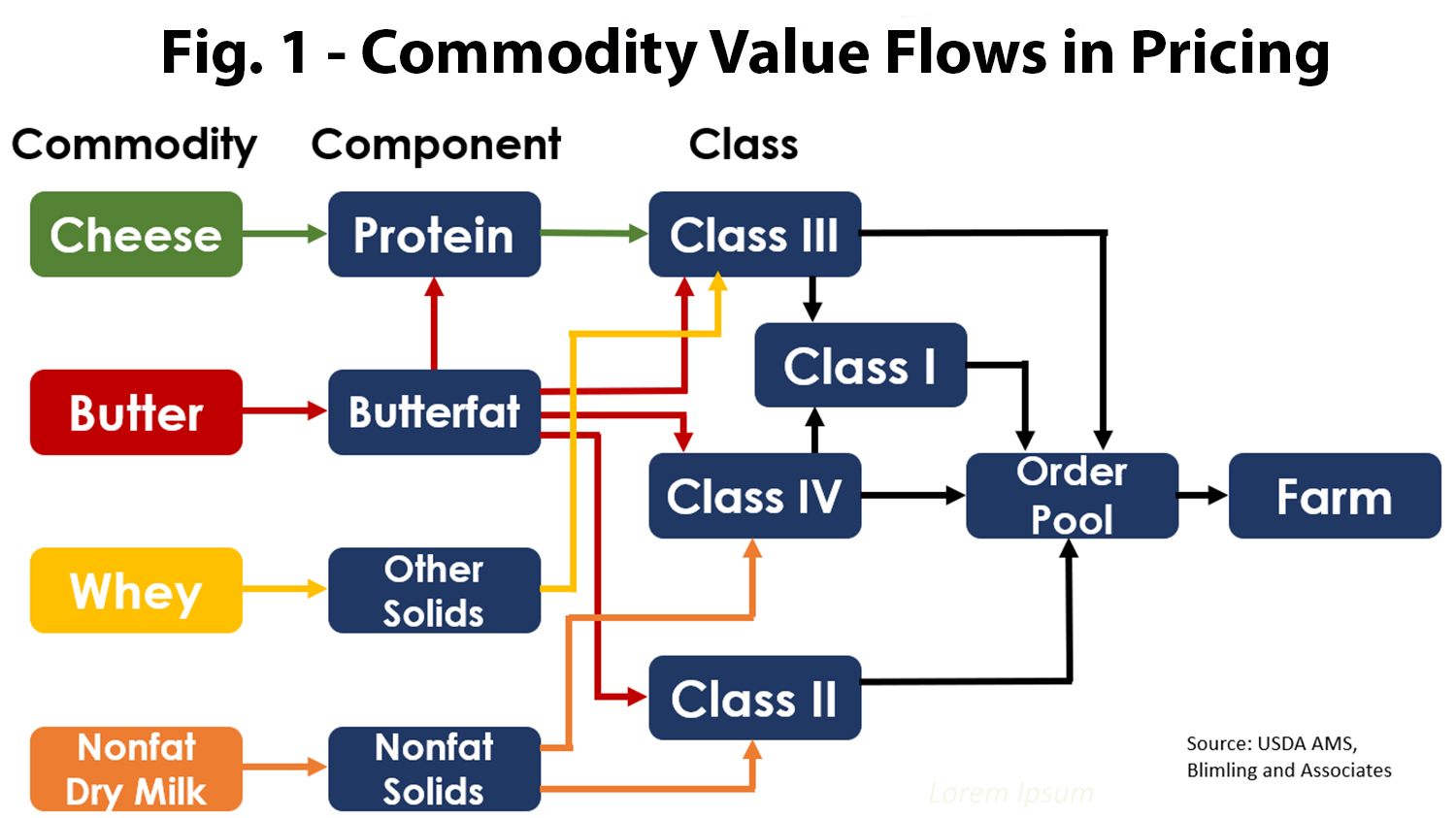
Gratitude to Blimling and Associates for this flow chart illustrating the complexity of USDA milk pricing

By Sherry Bunting, Farmshine, March 26, 2021

I challenge anyone to find a pricing system on anything in the universe as complicated as the pricing of a hundred pounds of milk (See Fig. 1).

The Federal Milk Marketing Order (FMMO) system goes back to the 1930s Ag Marketing Law.  In 2000, changes were made to use end-product pricing formulas for four base commodities – Cheese (block and barrel Cheddar average), Butter, Nonfat dry milk (NDFM) and Dry Whey.

Today, these four commodities trade daily on the spot cash market at the Chicago Mercantile Exchange (CME), where less than 1% of volume, closer to 2% on butter, is sold. Since 2018, this 10-minute daily spot auction is done completely as an electronic auction.

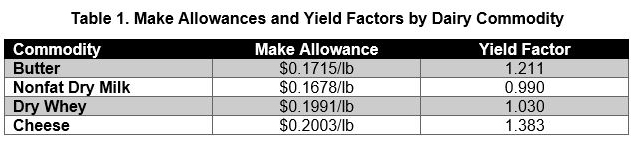
The CME spot market sets the pace for actual sales reported weekly to USDA by around 100 processors. From these weekly-reported prices, a weighted average for each of the four commodities is calculated by USDA. The weighted averages are used in formulas that account for yield and deduct specific “make allowances” (See Table 1) to then calculate Class and Component prices.

But first, these weighted price averages for just the first two weeks of each month are plugged into a multi-step formula to determine an Advanced Skim Pricing Factor for Class III (cheese/whey) and Class IV (butter, NFDM). The adjusted butter price is also used to calculate the Advanced Butterfat Pricing Factor.

Effective May 2019 — as a result of a change agreed to by National Milk Producers Federation and International Dairy Foods Association and then passed by Congress in the 2018 Farm Bill — the 2-week Class III and IV Advanced Skim Pricing Factors are averaged together, plus 74 cents to calculate the Base Skim Price.

Prior to May 2019, the Base Skim Price was simply the “higher of” either the Class III or the Class IV Advanced Skim Pricing Factor.

(Author’s Note #1: The previous ‘higher of’ method was the way the FMMOs could make sure Class I always brought the highest price to fulfill the purpose of the Federal Orders – assuring fresh milk supplies – and to keep other handlers invested in pooling their milk. We can’t lose sight of the fact that the fluid milk sales (Class I) have no market transparency as to their value – at all. In some states there are loss-leader laws or minimum pricing provisions, but in most states, Class I fluid milk sales are treated as a base commodity by large retailers like Walmart and Kroger. They loss-lead the retail consumer price of fluid milk to extreme low levels, even as low as $1 per gallon, to win shoppers. They do this because supermarket data show fresh fluid milk is in over 94% of consumer shopping carts! Because it is treated as a loss-leader in some states, and regulated with minimum pricing in other states, it’s impossible to know the real market value of Class I fluid milk apart from the value of its components in making other products.)

Next, the Base Skim Price is multiplied by a yield factor of 0.965 and the Advanced Butterfat Pricing Factor is multiplied by a yield factor of 3.5 and then added together to become the Base Class I Price. This price, known as the Class I ‘mover,’ is announced before the 23rd of each month but is used in the following month.

The various location differentials throughout the 11 FMMOs are next added to this Base Class I Price.

Whew! Now back to those weekly-reported commodity prices, yield factors and make allowances… Announced around the 5th of the next month, the other class prices are a function of the component values based on average weekly prices for the four commodities for four weeks: Component Value = Yield x (Commodity Price – Make Allowance).

In Multiple Component Pricing FMMOs like the Northeast (FMMO 1) and Mideast (FMMO 33), a Statistical Uniform Price (SUP) is calculated from these Class and Component prices according to how the milk in the FMMO was utilized. The SUP is announced around the 11th of the next month before settlement checks are paid for the previous month’s milk.

(Author’s Note#2: Another wrinkle… did you know that an uptrending cheese and butter price can leave producers with a lower protein price? It happened in March 2021. Every end-product — butter, cheddar, nonfat dry milk and dry whey — was higher in March than February, and Class III, IV and II pricing were also higher, but the uptrending butterfat portion of the cheese price creates a ‘snubbing’ effect on the ability of protein to rise within the skim portion. Yes, it’s complicated, and the answer from USDA is a story of its own in the future.)

The FMMO SUPs are based on a 3.5% Butterfat test, but the FMMOs also report for information purposes a uniform price based on the average actual fat test. Your price will differ in your milk check based on your fat, protein, and other factors. In general, producing protein and butterfat above the statistical level nets a higher price, under normal conditions. Lately this has not held out because of negative PPDs.

What are PPDs? Along with the SUP, the FMMO calculates a Producer Price Differential (PPD). This shows how money remaining in the producer settlement fund is divided across the qualified hundredweights of milk, after all components are paid. Sometimes this is a negative number, meaning there was not enough money in the producer settlement fund to pay all of the actual component value after the location differentials on Class I were paid. A negative PPD represents spreading the shortfall across qualified milk in the pool. Severely negative PPDs represent unpaid component value.

The PPD is calculated by subtracting the Class III price from the average of all classes together: PPD = SUP – Class III. In the Northeast and Mideast FMMOs, this PPD has typically been a positive number but has been shrinking in recent years and has been negative for 13 of the past 23 months.

Negative PPDs happen for any or all of four main reasons:

1) When a rapid rise in commodity price(s) is not captured in the 2-week Advanced Pricing Factors.

2) When Class II and IV are far below Class III.

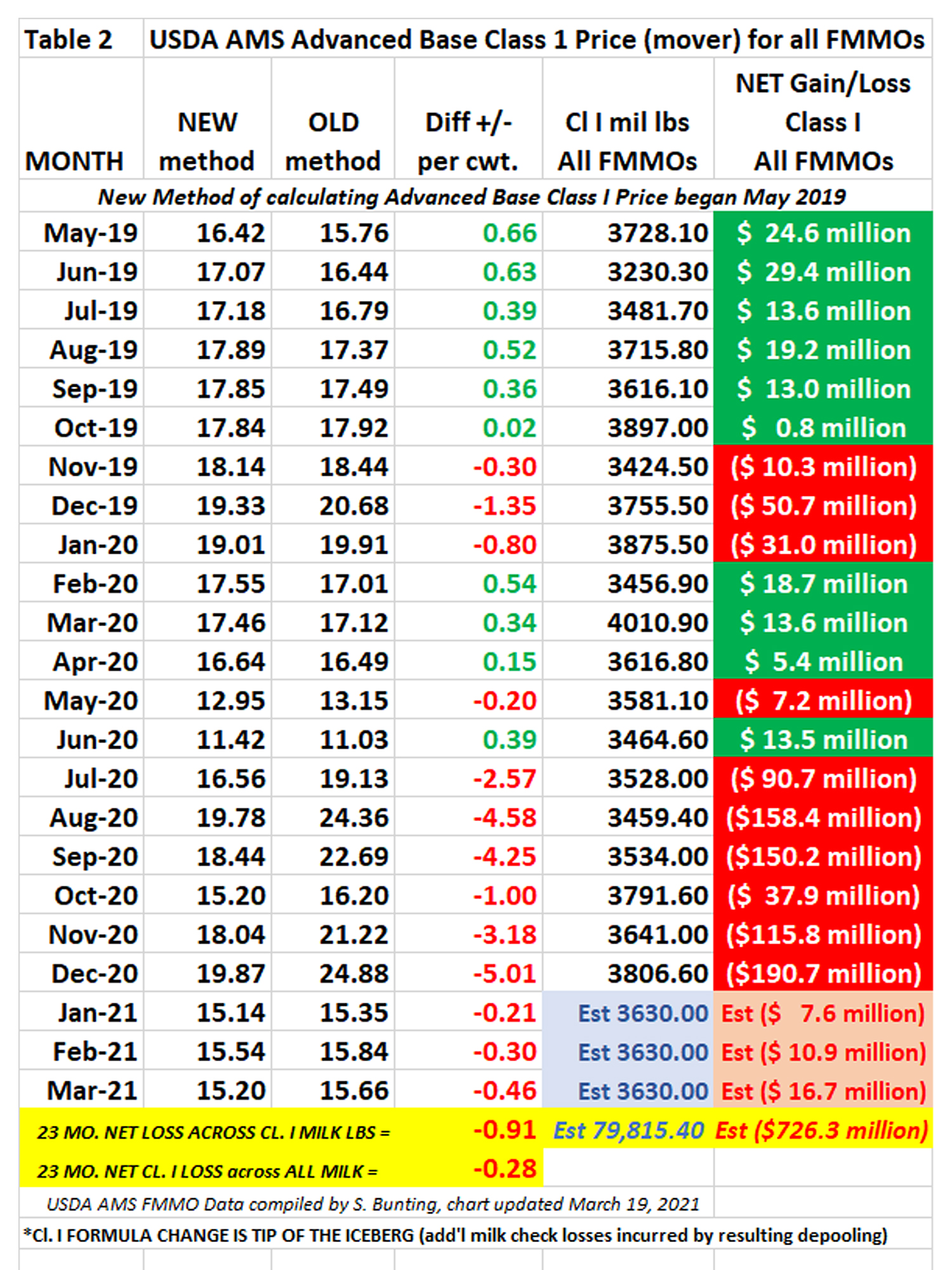
3) When Class I price falls below Class III because of the new averaging method when the spread between III and IV is greater than $1.48/cwt. Half of the months from May 2019 through December 2020 had a lower Class I Base price under the new method, representing a net loss of over $700 million on Class I pounds across all FMMOs. (See Table 2)

4) When handlers de-pool Class III milk because it is higher — to avoid paying into the pool.

Only Class I handlers are required to pool all of their milk. Other handlers can choose what non-Class I milk to pool or not pool based on what is financially advantageous. De-pooling is more likely when multiple months have negative PPDs because of wait times to re-qualify milk for the pool. Some FMMO pool-qualifying requirements are more stringent than others, and the rules have been loosening in recent years because handlers say they need more flexibility to meet fluctuating fluid milk needs.

Occasionally, when cooperatives or plants de-pool Class III milk, some will pass the higher value they withheld from the pool directly to their own producers. In most cases, however, this did not happen in 2020. Additionally, the severity of negative PPDs across FMMOs varied and this created a wide range of milk check pricing of $8 to $10 from top to bottom, when normally this range is $2 to $3, maybe $4. USDA relates that the value is still in the marketplace, so even when the PPD goes negative, some of that value is attributed to the All Milk price used in Dairy Margin Coverage margins because the value is in the market even if it is not in the “pool.”

In addition, for Pennsylvania dairy producers, all Class I milk from Pennsylvania farms that is bottled in Pennsylvania and sold in Pennsylvania stores receives the Pa. Milk Marketing Board (PMMB) over-order premium, which currently stands at $1.00/cwt. Processors can reduce this obligation by selling and sourcing milk from in and out of state as well as other methods.

Cooperatives are producers under the Pennsylvania law, so they collectively receive this premium also, where applicable, and have the ability to disburse the premium to members as they see fit.

Every farm’s mailbox price is further affected by premiums, such as quality bonuses, and deductions, such as trucking cost and marketing fees, which all vary across cooperatives and milk buyers.

This ‘primer’ just scratches the surface of current milk pricing issues. A related topic affecting many producers since May 2019 is how the new Class I pricing method, and the negative PPDs and depooling that can result when Class III and IV are so divergent, affect the way price risk management tools work, creating additional losses in many cases.

(Author’s Note #3: This article has been updated since it was previously published in R&J Dairy Consulting’s customer newsletter.)

-30-