Milk education ‘heroes’: How 97 Milk came to be

AUTHOR’S NOTE: With proof of concept in place, the support of farmers and community running strong (see graphic), and the public response rewarding these efforts, there is something powerful here with the 97 Milk effort, and it is just the beginning. 

By Sherry Bunting from Farmshine, October 23, 2019

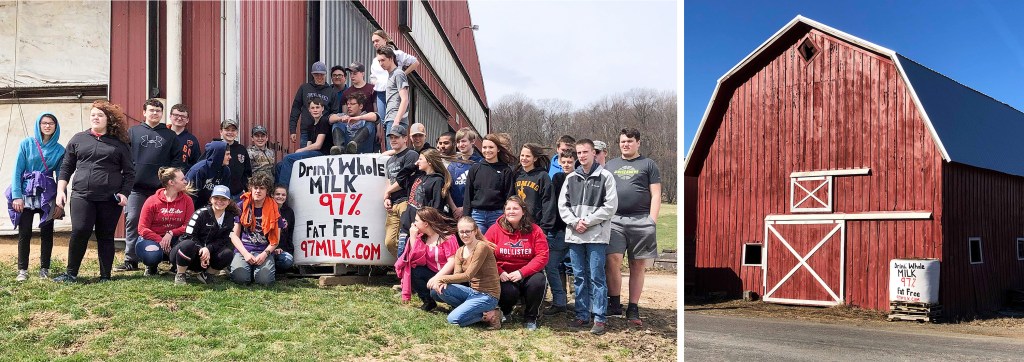
RICHLAND, Pa. — One farmer. One roundbale. And six painted words — Drink Whole Milk 97% Fat Free.

The excitement of the 97 Milk effort is contagious. What started with Nelson Troutman’s first painted roundbale in Richland, Pa., has rapidly multiplied into community-wide and nation-wide milk education efforts aimed at consumers on one hand and policymakers on the other.
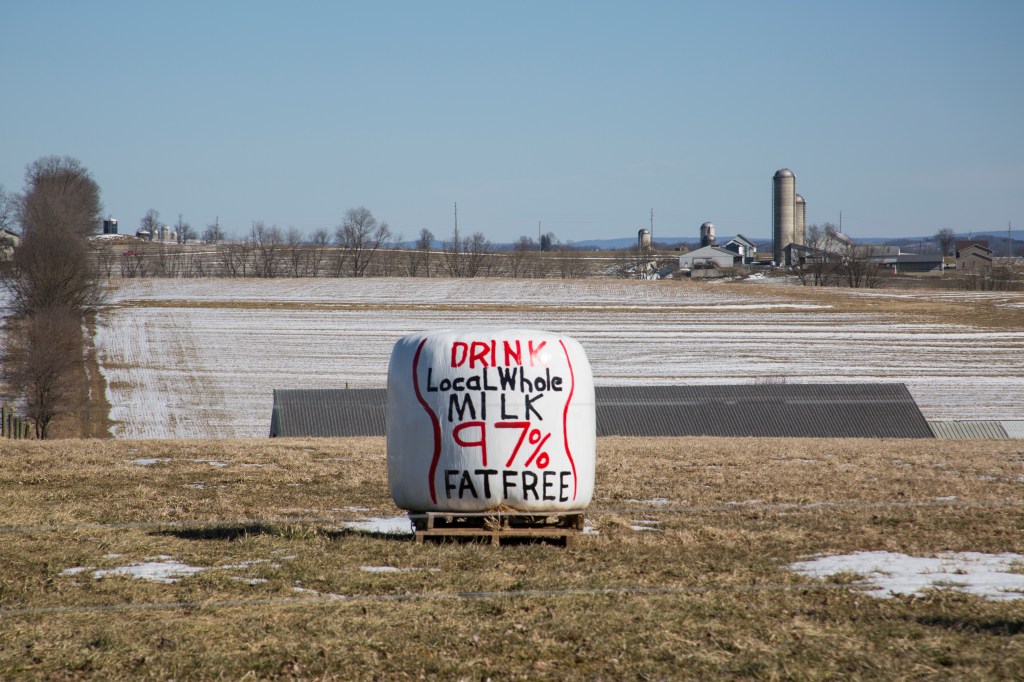
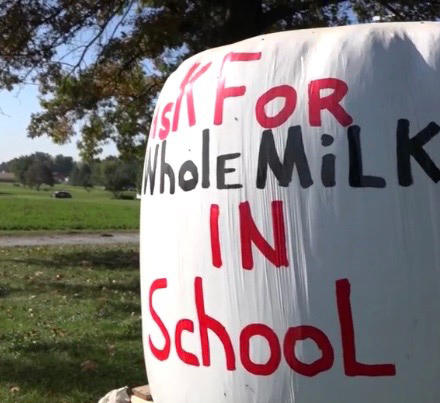
Nelson Troutman placed his first “Milk Baleboard” in a pasture by an intersection.

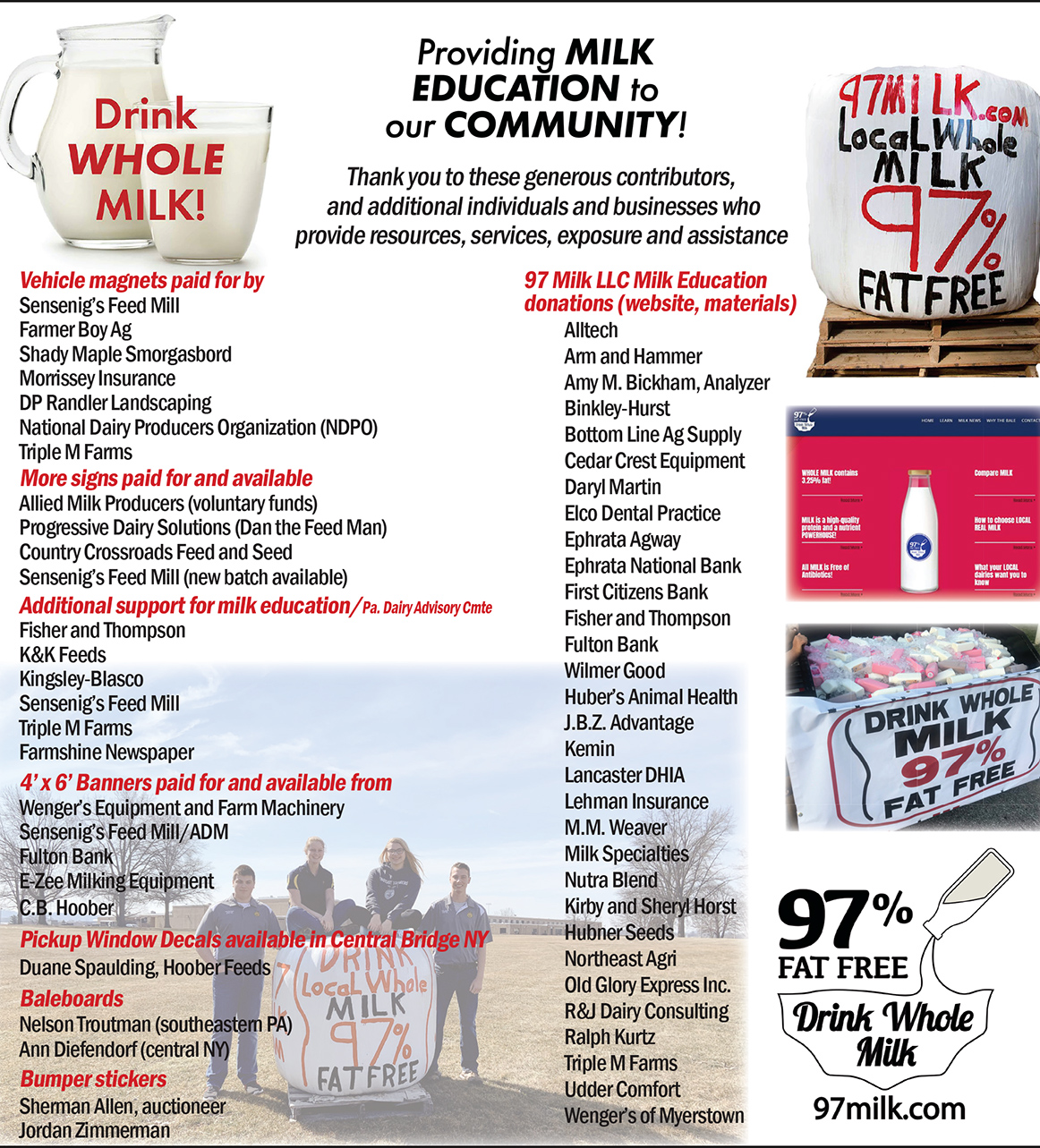
By February, retired agribusinessman Bernie Morrissey of Robesonia found five businesses to pay for the first 1000 magnetic 12” x 12” vehicle signs with the same message. Since then, more companies have joined in and some of the original businesses have printed more.

As legislators began to take notice, Morrissey and Troutman assembled a grassroots Pa. Dairy Advisory Committee of 10 farmers that meet monthly in person or by teleconference and interact with lawmakers, including the petition effort to bring whole milk back to schools. More agribusinesses joined in to help fund their expenses.

Then, 4’ x 6’ banners were created for places of high visibility and an effort to place them at stores is underway. A September Farmshine cover story helped spread the word. Morrissey reports the banners “are going like hotcakes” with additional businesses joining in to print more.

Another effort was underway simultaneously, when Rick Stehr invited a diverse group of farmers to a February meeting in Lancaster County to talk about milk education beyond the bale. Today, the joint efforts work together like two well-oiled machines comprised solely of volunteers.

Stehr recalls getting questions back in January. He invited Morrissey to talk about the milk baleboards at R&J Dairy Consulting’s winter dairy meeting. Noted expert Calvin Covington was the keynote speaker that day, and he told the 300 dairy farmers that promotion needs to focus on domestic demand, and that “we in the dairy industry need to talk about milkfat and not hide behind it not wanting things to change. Consumers want that taste, and we’re not talking about it,” he said.

Morrissey then told the crowd about Troutman’s “Drink Whole Milk 97% Fat Free” roundbales that were just starting to multiply at farms and businesses after a cover story appeared in Farmshine.

“As I talked with non-ag people, I realized many of them didn’t know quite what it meant,” says Stehr. “I thought the missing link is education. We needed to educate the public.”
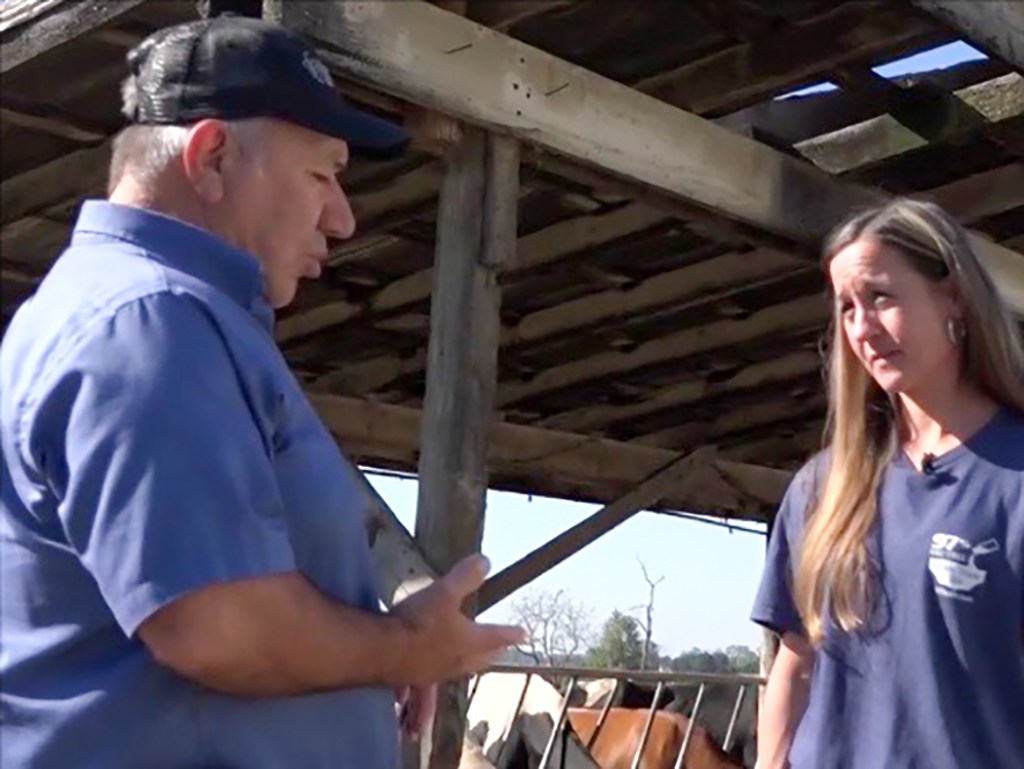
Nelson Troutman and Jackie Behr prepare for a television interview about 97 Milk.

Stehr’s daughter Jackie Behr has long believed milk sales suffer because milk education is missing. She has a marketing degree from Penn State and experience in non-ag positions before becoming R&J’s marketing manager.

Even Behr was surprised by her February focus group interviews with non-ag friends. “I was blown away by the obvious gap between dairy farms, milk nutrition and consumer perception,” she reports.

Behr shared the focus group responses at a February meeting of farmers that included Troutman. “It was an obvious eye-opener for everyone. These were educated women responding to my questions. How did we miss so much milk education all of these years?” Behr wondered.

They not only had zero knowledge of milk’s nutrition — other than calcium — their minds were full of information that was just plain false.

They said they drank organic milk because they ‘didn’t want to drink all those hormones.’ Or they chose almond beverage ‘because there are no antibiotics in it.’

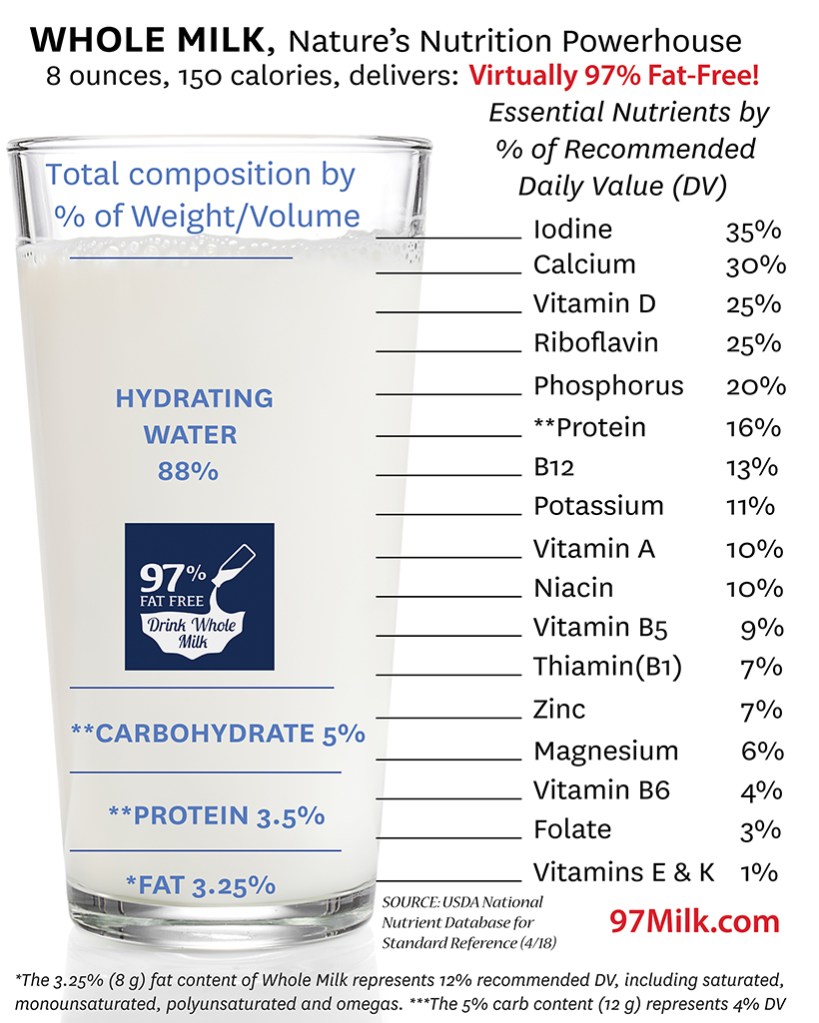
“The biggest misconception is how much fat they thought was in whole milk. Just like Nelson’s been saying. And when you tell them whole milk is standardized to 3.25% fat, their response is ‘Oh, wow!’ That alone is big,” says Behr.

Her marketing savvy kicked in. Ideas for a website were kicked around with obvious choices already taken.

Then one attendee said: “How about 97 Milk?”

It fit. And it captured attention. By the second meeting, they were ready to establish 97 Milk LLC and chose a volunteer board of Lancaster County farmers Mahlon Stoltzfus, Lois Beyer, Jordan Zimmerman and Behr, with GN Hursh serving as chairman.

The website was up and running by the end of February with a Facebook page (@97Milk) that has gained more than 8,500 followers in less than eight months and a weekly average reach of over 150,000. Individual posts have reached up to 1.2 million through thousands of shares and hundreds of interactions. Twitter (@97Milk1) and Instagram (@97Milk) are also active.
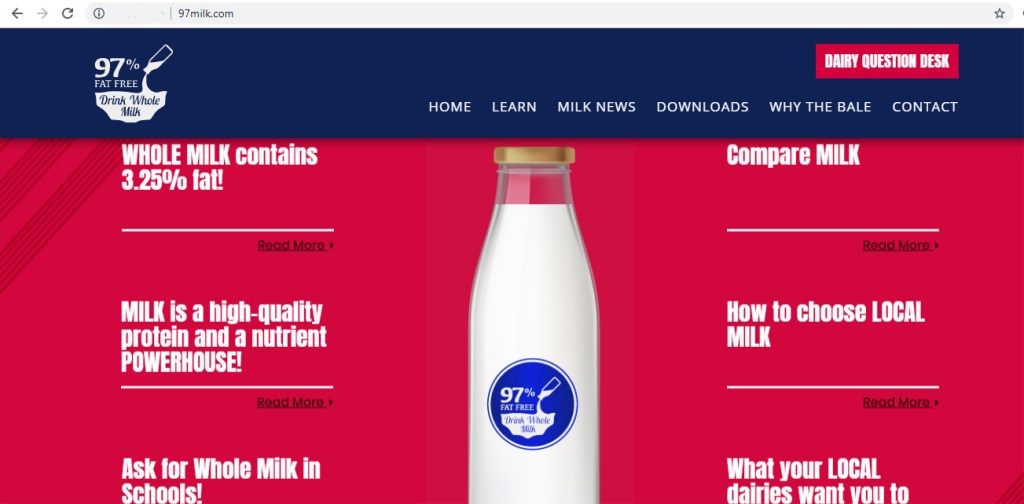
Behr says it all stems from what Troutman started, and he was happy to add 97milk.com to the bales with Morrissey making sure the website appears on signs and banners.

“To get someone to change their mind, you have to get the facts in front of them,” Behr observes. “We’ve got three seconds in front of their eyes to leave information that plants a seed.”

With some content help from others, Behr comes up with ideas, designs and coordinates Facebook posts six days a week.

The result? “People are shocked and come back and say, ‘I had no idea,’” Behr explains. “I am in the industry, and even I have learned so much about milk that I didn’t know before.”

“Now that 97 Milk has become a tool used by dairy farmers to educate the public about our product, the conversations that are happening are only the beginning,” Stehr observes. “We could have 97 Milk boards across the nation.”

As interest builds, 97 Milk LLC is looking into how different geographies could have their own chapters, with the website and materials providing some continuity.

“That’s where the power is, with the producers in each community or state,” says Stehr.

He credits Troutman and Morrissey for getting everyone’s attention and believes what they are doing creates the opportunity for the ‘beyond-the-bale’ education piece carried by 97 Milk LLC.

“The word milk has been used liberally, and the understanding of what it is has been diluted,” says Stehr. “We let that happen over the past 30 years and did nothing about it. We let them bash our product. Now we are educating people that the fat in milk is not bad, that there’s not 10% or 50% fat in whole milk, but 3.25%, that there is complete protein in milk and all of these other good things.”

From the baleboards, vehicle signs, banners and communications of the grassroots Pa. Dairy Advisory Committee, to the website, social media and educational events of 97 Milk LLC, a common bond unites these efforts — Troutman’s practical courage when he painted the first roundbale because he was frustrated and had had enough.

“We have lost market share, why? Because people don’t know what milk is and they don’t know what it tastes like,” says Troutman. “By promoting whole milk, we are opening their eyes and their tastebuds.”
While national co-ops think it’s “innovative” to develop a low-fat milk and nut juice blend, those involved in 97 Milk believe the response they see from diverse consumers tells a different story.

“People want to feel good about the products they are buying. The goal of 97 Milk is to share education, to share the dairy farmers’ stories,” says Behr. “You don’t pick up health magazines and see the benefits of milk. People need to see that positive information because they don’t know what milk provides.”

The Dairy Question Desk at the website fields a steady stream of five questions per week and when social media is included, 97 Milk fields 5 to 20 questions a day.

Every one of Behr’s original focus group have switched to whole dairy milk. The experience so far shows her consumers know very little about milk and have a real willingness to learn.

“All of our messages are simple. One fact. An infographic that’s simple to understand and that people can relate to,” says Behr. “Even if we have their eyes for just three seconds scrolling through, that little seed is huge.”

The posts fill other gaps. Behr believes people want to see that dairy farmers love their cows, that they care. The baleboard sightings and “cow kisses” have poured in for posting from several states.

The posts also help consumers fulfill a desire to be connected to their food, to buy local, and to support family-owned small businesses. “The simple fact that 97% of dairy farms are family-owned is a post that generated a lot of activity,” says Behr.

While she sees the environmental discussion as being big right now, she attributes this to the vegan activists driving it. By contrast, the 97 Milk facebook data and demographics reveal that 90% of consumers really want to hear about the health benefits, according to Behr.

She gives the example of the popular “yummy yogurt” infographic posted last week. It was visually attractive and simply listed a few health benefits.

“We get a few facts out on an infographic, and if you’re kind of hungry — or a mother like me trying to find healthy snacks for my kids — it hits,” says Behr. “It’s the simple things that get milk back in and help people feel good about buying milk products.”

The support from the agriculture community, and others, has been overwhelming.

“When someone calls, who you’re not even working with, to complement the work Jackie is doing, that’s rewarding,” says Stehr.

“When you see the response of a person in your community finding out they can drink whole milk and they really like it, that’s rewarding,” says Troutman.

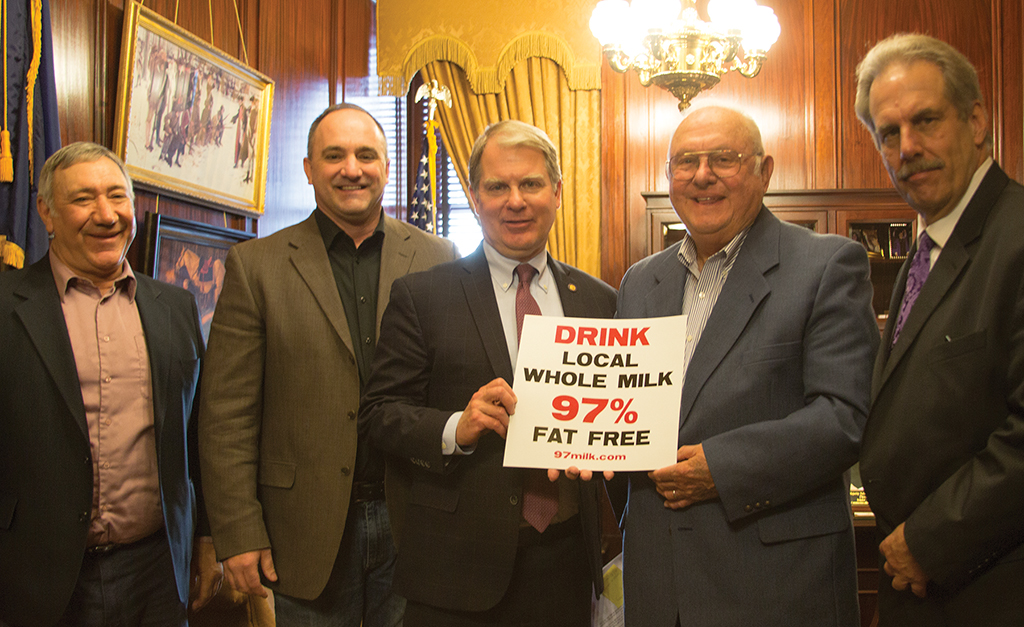
“When legislators hold up a sign, or want their picture taken with a baleboard and say ‘this is the best thing going in dairy right now’, that’s rewarding,” says Morrissey.

“When people write into the Dairy Desk and we can answer their questions, that’s rewarding,” says Behr. “But most rewarding is hearing the excitement, seeing dairy farmers wanting to be involved, understanding the importance of marketing and seeing the results of getting involved. Receiving a simple note thanking us for positive messages, that’s rewarding.”

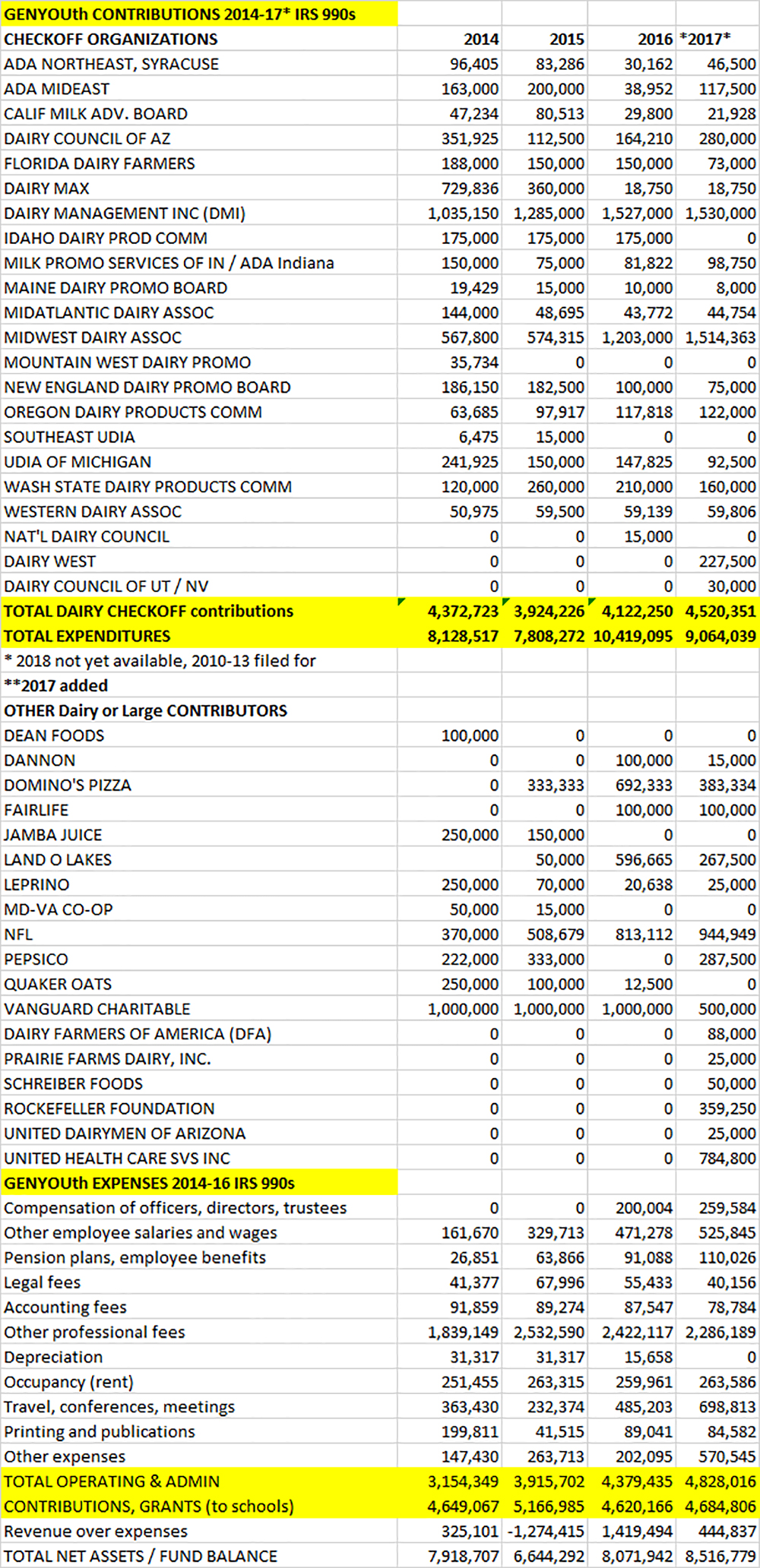
97 Milk LLC raised funds from more than 20 local and national businesses (see graphic) to cover expenses for the website and printed materials, and they’ve worked with Allied Milk Producers to have milk and dairy products available for parades, corn mazes, and other venues.

Meanwhile, individuals and communities take it upon themselves to paint bales, print bumper stickers, make signs, incorporate the message into corn maze designs, hometown parades, create farm tour handouts, initiate milk tents at athletic events, and more.
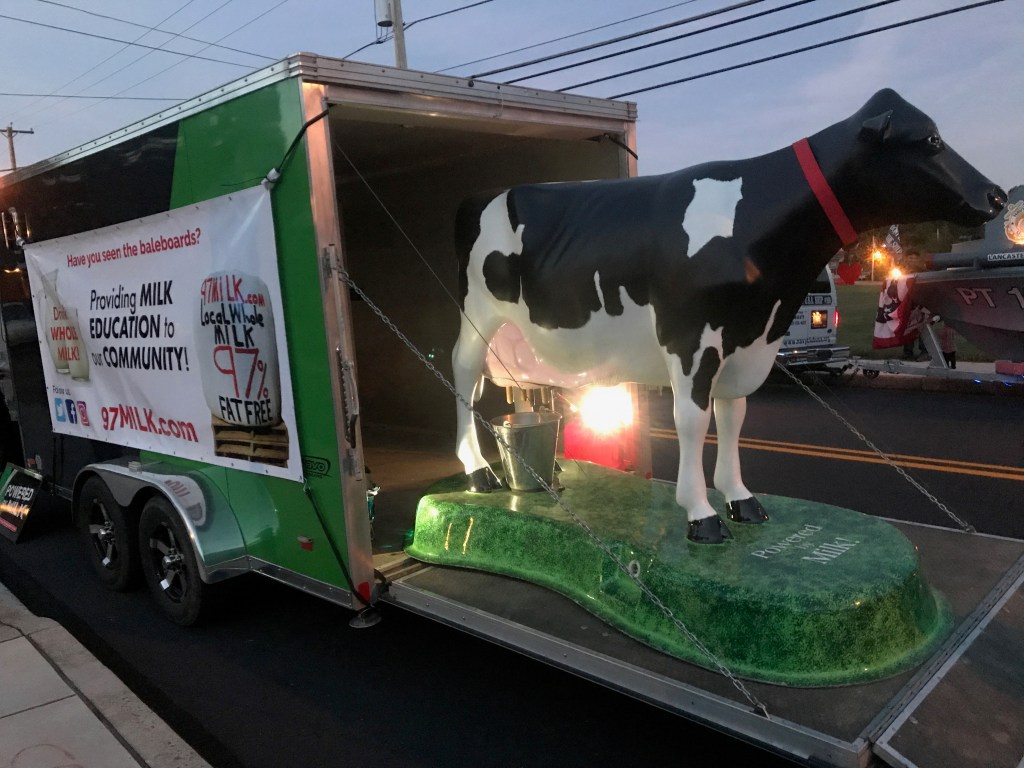
Young people are enthusiastic: FFA chapters, 4-H clubs and county dairy maids are printing their own banners and carrying the message at diverse public events. They love participating because it is real milk education, sharing the truth about milk and the life and work of America’s dairy farming families.

Morrissey and Troutman get calls from other states for banners and car magnets, and they’ve sent to these states at cost. Locally, the businesses paying for printing these items are giving them away (see graphic).

Behr has also designed items with the 97 Milk website logo, cows and farm scenes. These files are on the download area at 97milk.com and can be used to make banners, yard signs, license plates, bumper stickers, educational handouts, and more.

Troutman has added new baleboards for community events, including one that reads: Ask for Whole Milk in School. He and Behr recently did a television interview with a local PBS station.
Both the grassroots Pa. Dairy Advisory Committee and the 97 Milk LLC are running on shoestring budgets from donations (see graphic) with all volunteer effort, and the grassroots are blooming where planted to multiply the impact in ways too numerous to mention.

As a glimmer of hope, fluid milk sales nationally were up 0.2% in July, the first year-over-year increase in decades, with whole milk up 3.6% and flavored whole up 10.4%. Stores surveyed in southeastern Pennsylvania, where 97 Milk began, say whole milk sales are up significantly since January. It is also notable that many stores don’t seem to be able to keep enough whole milk on the shelves — a nationally obvious phenomenon.

Also being promoted is the petition to bring whole milk back to schools. This week, the online petition ( https://www.change.org/p/bring-whole-milk-back-to-schools ) topped 8000 signatures, plus 4000 were mailed in envelopes for a first-batch delivery in Washington Oct. 24, with a second batch goal to double that by January.

Reflecting on the past 10 months, Troutman says, “I thought if they’re not going to do it, someone has to, and here I am.”

And he’s happy. “Really, I’m thankful, thankful for so many who are helping make this work.” 

To contact the grassroots Pa. Dairy Advisory Committee about banners, magnetic vehicle signs and baleboards, call Bernie Morrissey at 610.693.6471 or Nelson Troutman at 717.821.1484.

To contact 97 Milk LLC about spreading the milk education to other communities, email 97wholemilk@gmail.com or call Jackie Behr at 717.203.6777 or write to 97 Milk LLC, PO Box 87, Bird in Hand, PA 17505, and visit www.97milk.com, of course.
 -30-
Hoffman Farms: ‘We do what we can to promote milk education’

By Sherry Bunting for Farmshine Nov. 8, 2019

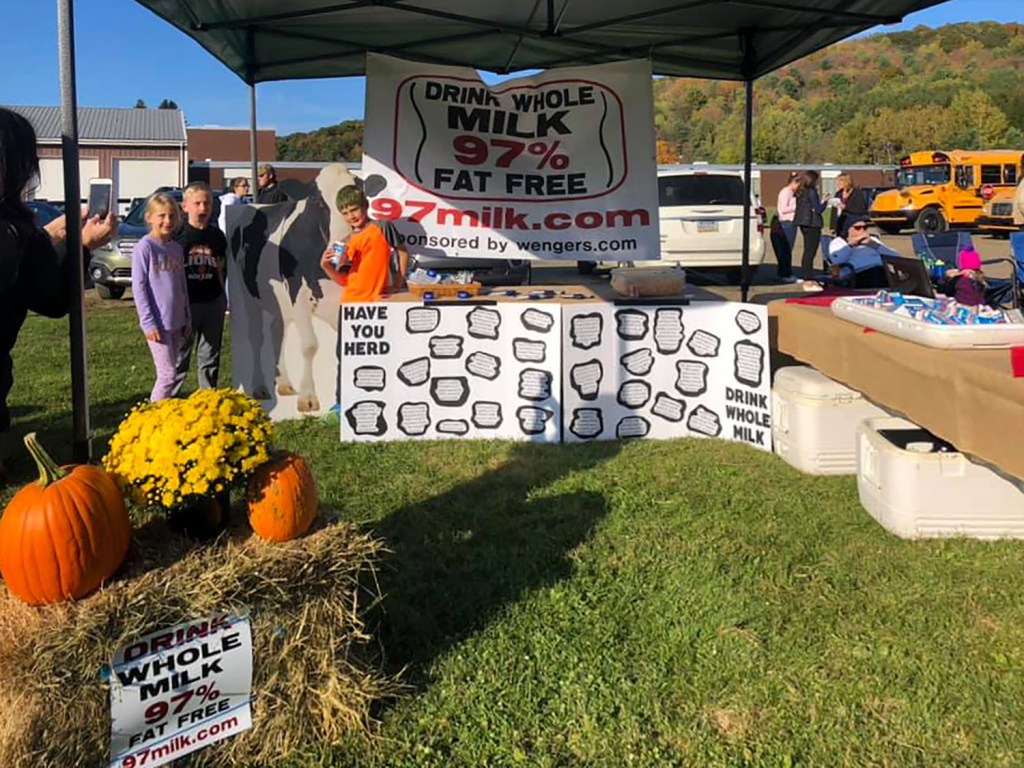
Tricia (Hoffman) Adams planned her educational exhibit for months ahead of a multi-county cross country meet at the farm on October 15.

SHINGLEHOUSE, Pa. — Educating the public has long been a passion of the Hoffman family at Hoffman Farms in Potter County, Pennsylvania. The school and home communities of the two generations (five families) involved in the 1000-cow dairy are on both sides of the Pennsylvania / New York boundary.

In fact, Tricia (Hoffman) Adams gave a presentation back in 2006 on how they set up the learning components of their school tours at a Women in Dairy Conference that year. Attendees were inspired to find ways to invite the community in, and the family was later recognized with a Pa. Pacesetter Award in part because of progressive operations on the farm and in part because of their commitment to educating the community about milk and dairy farms.

Today, with tours, community events, a facebook page and the next generation so involved in school clubs and sports activities — in addition to showing dairy animals and market steers and pigs — the family has become a recognized source for their community to ask questions about dairy, livestock and agriculture, in general.

Earlier this year, the Hoffmans were among the many farms painting round bales and placing them in visible areas with the Drink Whole Milk 97% Fat Free message. They have always served whole milk, along with other dairy treats, when schools and community groups tour the farm. The Baleboards drew attention and gave Tricia an opening to answer questions people didn’t even know they had!

She reports that the schoolchildren on tours last spring loved the ‘milk baleboards’ and wanted their pictures taken with the “cool” roundbales.

In fact, the 97 Milk effort has revitalized Tricia’s educational resources, she says. She and her father Dale Hoffman are also both serving on the grassroots Pennsylvania Dairy Advisory Committee.

In September, Tricia worked with two vendors — Dan Rosicka of Progressive Dairy Solutions and Country Crossroads Feed and Seed to help share the good news about whole milk. Each vendor purchased 50 of the 12-inch x 12-inch magnetic vehicle signs with the 97 Milk message and website to make available in the community.

Tricia also acquired a 4-foot x 6-foot banner as well as other materials with the 97 Milk message and milk education information.

And then she added her own flare. She had been thinking about it and working on it on-and-off since summer. The farm was hosting a multi-school championship cross-country meet in October, and she was providing the “recovery” beverages – whole milk and whole chocolate milk — and other goodies.

“I’m not one to sit around and wait for help,” says Tricia. Like other dairy producers she is frustrated with the negativity surrounding milk and meat. “I am upset that our children have to suffer in their school diets, with the lack of milk choice and the meatless days. I decided our farm will do what we can to promote the ag industry through ag education, ag awareness and ag positivity!”  

Each time Hoffman Farms is asked to donate money to a school club or a team sport, they donate dairy products instead — “with a side of education,” says Tricia.

For the North Tier League Championship Cross-Country Meet on October 15 at Hoffman Farms, Tricia set up two tents and tables. In addition to the 97 Milk banner, she had a Chocolate Milk Refuel and Recovery banner. For the “side of education,” she created a large cutout cow and numerous ‘spots’ with questions and answers.

As a farm that buys their own materials for these events and tours, Tricia feels strongly that whole milk products should be served and serves them when the events are after school or at the farm so that the schools are not jeopardized in any way due to the flawed diet rules they have to live by during school hours.

She reports that the young people (and adults) say they look forward to having “the good milk.”

“Whole chocolate milk as a recovery drink after a race, whole milk cheese sticks or toasted cheese sandwich supplies to add to a sports concession stand — whatever helps our industry and our future generation of students is what we are going to focus on,” Tricia explains.

She’ll admit that some days, “It feels like an uphill battle, but we have had many clubs, organizations and businesses wanting to help as well,” says Trica.

“At the end of the day, I’m not sure how many people will benefit or even how much I can change, but I would rather try by doing something constructive.”

Three generations are involved in the award-winning 1000-cow dairy at Hoffman Farms in Potter County, Pa. The farm was founded by Dale and Carol Hoffman with 30 cows. Today their daughter Tricia and sons Keith, Brad, and Josh have transitioned into leadership and a third generation is also involved.

-30-

Mixed feelings prevail after Expo

There were plenty of new things to see among the 859 trade show vendors, but the trade show was down a bit from 887 businesses exhibiting a year ago. Attendance was reported at just over 62,000, down from over 65,000 a year ago and over 68,000 two years ago. International attendance at 2,133 people from 94 countries last week was off by about about 200 compared with a year ago and 500 fewer than two years ago. Photo by Sherry Bunting

By Sherry Bunting, Farmshine, Friday, October 11, 2019

MADISON, Wis. — On the business side of the 53rd World Dairy Expo last week, I came away with feelings as mixed as the weather — gloomy skies and a deluge of rain at the beginning of the week gave way to sunny skies and brisk breezes at the end.

There were plenty of new things to see among the nearly 859 trade show vendors. Annual attendance is reported at around 62,000. U.S. and international attendance did appear to be down from previous years. 

For many, the first three days of the show felt slow in comparison even to last year. Some observed that the steep loss of family farms over the past 18 months was “being felt” at Expo.

Some pointed to the weather as heavy rains produced flooding Tuesday into Wednesday. 

Others blamed the discouraging — and twisted — headlines that came out of a town hall meeting with U.S. Secretary of Agriculture Sonny Perdue at the start of the week. The town hall was attended by around 200 dairy farmers, agribusiness representatives and organization leaders, along with dozens of reporters and television cameras.

What followed the hour of honest and detailed discussion (reported here as in Farmshine last week) were press accounts that warped Sec. Perdue’s comments and went viral through the wire services, starting with the Washington Post and Chicago Tribune and continuing into various agricultural press.

By Thursday, Wisconsin Farmers Union had sent op-ed responses to high profile news outlets, taking on the Secretary for his supposed comments about how we supposedly do things in America.

The stage was effectively set to cast the current Trump administration as purveyors of a factory farm model, attributing to the Secretary a proclamation that, “In America, the big get bigger and small get out.” This is now playing right into the hands of Democratic presidential hopefuls who are pal-ing around with HSUS in the Midwest, pretending to care about cows, farms and fly-over country.

Well, maybe some Democrats do care, but we know HSUS does not, and we know what the purveyors of the Green New Deal think of our cows. That’s another story.

Trouble is, the Secretary never said the words that have started this chain reaction. Or, at least, not in the order in which his words were parsed together in print.

You see, many other words were omitted. Context is everything.

From the sidelines and super busy with other pursuits at the Expo — but having attended the town hall meeting in person and having written my own coverage of the event in last week’s Farmshine — I began to see the headlines erupting on social media as share upon share made the news travel rapidly from Tuesday into Wednesday and then it was off to the races.

I began wondering how I could have missed such a derogatory comment. And I learned by Friday that, no, my notebook and partial recording had not failed me. Full transcripts were released by other reporters — providing that important context.

Transcripts showed clearly that the offending quote from Sec. Perdue was pulled from a very long and detailed response to a question and spliced together to make new statements. Not only is context everything, so is punctuation.

Too late, the discouraging and depressing headlines continued to beat small and mid-sized family farmers over the head all week. They began to feel as though even the USDA could care less about their survival – wanted them gone in fact to make way for “factory farming.”

The narrative was discouraging and many farmers confessed to me just how it made them feel. Several said reading those words made them feel like – why bother even going to Expo?

“Stick a fork in us. We’re done, according to Perdue,” a Wisconsin dairy farmer said to me Thursday.

Bad enough that the headlines erupted after Tuesday’s town hall were discouraging. Worse, that they were false in what they signaled to family farms. But there is also much truth in Sec. Perdue’s observation. He was describing “what we’ve seen in America,” not making a proclamation of how things will be done in America.

And the advancements in science and technology ARE what we have seen in America. Yes, they help smaller farms too, but it is science and technology that are contributing to the progress that is allowing rapid consolidation to take place.

For the record, I am pro-science and pro-technology and pro-innovation. But I also believe we are at a crossroads where it has gone so fast and so far, that we need to walk back and look at outcomes and impact and have a national conversation.

Just one day after the Expo closed, Land O’Lakes CEO Beth Ford and member farms like Dotterer’s Dairy, Mill Hall, Pa. were on CBS 60-minutes talking about how high-tech dairy is today and the market challenges being faced by dairy farmers at the same time.

The twisted quotes from Tuesday’s dairy town hall meeting at Expo gave the impression that Trump’s USDA is proclaiming a factory farm model for the future of agriculture. In a sense, as we embrace rapid technological advancement, we are embracing that transition. These are inescapable facts that must be sorted out and dealt with.

The Secretary was merely observing the reality of what has been happening in America’s rural lands with increasing speed over the past decade.

While some of Perdue’s specific answers to specific questions were disappointing and other responses were encouraging, none of those specifics were reported elsewhere with any attention. All attention was placed on the twisted quote.

We have a Secretary who can see what is happening and who can have an honest discussion about it, while being pragmatic about what the potential solutions are that can be accomplished without the help of a paralyzed Congress.

No matter what we think of Dairy Margin Coverage, it was put in place to help smaller farms withstand these difficult times and figure out their place in the future. That’s just reality.

At the same time, what was lost in those press reports is we have a Secretary that at least took time to cheer-lead for the small and mid-sized family farms by using his bully pulpit to advocate for whole milk in schools. No one picked up on that, except for Farmshine.

Perdue also touted “local” food as a way to bring value back to farms. I haven’t seen any other press reports talk about that.

Most reporters ignored those thoughts. They also ignored the fact that the stage for the rapid consolidation in dairy — that is occurring today — was set 10 years ago under former Secretary of Agriculture Tom Vilsack, who today has his salary paid by dairy farmers through their mandatory checkoff as president and CEO of the U.S. Dairy Export Council and defacto leader of the Innovation Center for U.S. Dairy that is streamlining “U.S. Dairy” through various checkoff funded innovations and programs.

Think about this for a moment: U.S. dairy has progressed with technological advancements that are unparalleled in the world. American farmers have always looked to technology and to the future to produce food for the growing population and to be good stewards of the land.

It is the love of science and technology – along with the love of cows — that draws throngs of U.S. and international visitors to the World Dairy Expo each year. They want to see what’s new. They want to learn from each other. They want to make progress to do more with less.

Technology allows farmers to do more with less. That has meant producing more food from fewer cows. At some point it also means producing more food from fewer farms.

Perhaps it is time to not just praise science and technology with the eagerness of children on Christmas morning, but to have an honest conversation about where science and technology are leading the food industry. 

Sec. Perdue was not very well informed when it came to the topics of fake meat and fake milk that are ramping up through USDA science and technology into cell-cultured and DNA-modified yeast factory vats and bioreactors. Instead of talking about factories replacing farms, he stated that “consumers will choose”, and he said currently those who are choosing fake meat and fake milk aren’t consuming the real stuff anyway.

That was the short-sighted comment that raised my eyebrow, not the parsed-together quote about big and bigger.

It’s time to dig into the structure of things.

Perhaps the real concern and conversation to be addressed is the structures and alliances that have been formed over the past 10 years as they are now coming to light. In former Secretary Vilsack’s talk at Expo about exports and dairy innovation, and in DMI’s workshop about what’s on the horizon, my initial impressions are that we are at a place where the industry is speeding up innovation and wanting more latitude on standards of identity at a time when we should be saying: “let’s push pause please.” 

The race to feed the world has produced immeasurable waste and loss already, will it now change the face of agriculture forever?

Where is science and technology supportive for the family fabric that has made our food production the envy of the world? And where is science and technology promoting a path that leads us away from that model of food production to take it out of the hands of many families enriched by competitive markets and put it into the new emerging models of fewer hands, consolidated markets and lack of competition.

Don’t blame Secretary Perdue for these wheels that have been in motion. Don’t expect the government to solve it. But what we can do is have the honest conversation, ask the questions, hold leaders accountable, and move the needle far enough to provide a more level field of play for the small and mid-sized family farms. 

You can count on Farmshine to break away from the narratives on both sides of this thing to do exactly that.

-30-

U.S. Ag Secretary Perdue: Small farms face difficult times

U.S. Secretary of Agriculture Sonny Perdue (right) and Wisconsin Secretary of Agriculture and Trade Brad Pfaff field questions and take in comments at dairy town hall meeting early Tuesday morning on the official first day of the 53rd World Dairy Expo in Madison, Wisconsin. Photo by Sherry Bunting

By Sherry Bunting, Farmshine, Friday, Oct. 4, 2019

MADISON, Wis. – Grabbing the headlines from a town hall meeting with U.S. Ag Secretary Sonny Perdue during the opening day of the 53rd World Dairy Expo, here in Madison, Wisconsin, was a comment the Secretary made about the viability of small family farms.

He was asked whether they will survive. To which he answered, “Yes, but they’ll have to adapt.”

In fact, the Secretary said that the capital needs and environmental regulations that impact farms today make it difficult for smaller farms to survive milking 50 to 100 cows.

“What we’ve seen is the number of dairy farms going down, but the number of dairy cows has not,” said Perdue. “Dairy farms are getting larger, and smaller farms are going out.”

But in additional discussion, Perdue said that consumers want local products. He said that marketing local, even without the buzzwords, can be done successfully to bring value to farms.

He noted two things about dairy farms. First, they can’t be sustainable without profitability and second, he described the dairy industry as prone to oversupply.

Picking up on these comments, recently retired northwest Wisconsin dairy producer Karen Schauf said Farm Bureau is looking at the Federal Milk Marketing Orders and how make some adjustments on the milk pricing.

“But what we really need to do is balance supply and demand of dairy products much closer,” she said. “I would ask if you would support a flexible mandatory supply management system to help producers keep that supply and demand in closer relationship.”

Perdue asked if she wanted the short answer or the long answer, stating that when his children want a quick answer, it’s always “no.”

Schauf replied, “Mr. Secretary, I just want you to think about it.” The subject went no further.

At another point in the questioning, a Wisconsin producer observed the disheartening price levels and said last year was a record high level of exports, while prices to farmers were worse than this year and worse than 2017.

He noted that exports hit 17.6% of milk produced, and settled out at 16% last year, which is a record, but his milk price averaged $14.60. He went on to say that, “our exports are off 2% this year, but I’ll probably come close to an average of $17 on my milk price.” He also noted that National Milk Producers Federation recently put out a press release stating 2015-18 as record years in domestic dairy consumption.

“This is all good,” the dairy farmer said, “but in Wisconsin we are losing 2.5 farms per day and I think the call centers are full with distressed farmers calling in, so beyond trade and some of these things you promote at the federal level, what can we be looking at so we never experience another five years like this?”

Perdue thanked the producer for his facts and said it is amazing that things “can be good and yet feel so bad.” He acknowledged that dairy has been under the most stress, and he said that the 2018 Farm Bill did “exactly the right thing” with the new Dairy Margin Coverage. He pointed out that this coverage is specifically in place for smaller dairy farms.

“Milk prices are cyclical, and I think we’ve met that trough, and things will improve for 2020,” said Perdue.

Referencing the 2% milk on the table in front of him, Perdue said: “You pretty much know what happened to milk in our schools, with the whole milk and the accusations about fat in milk. We hope to get some benefit, maybe, from the Dietary Guidelines this year, which drive a lot of this conversation.”

Noting that USDA “is leading” the Dietary Guidelines along with Health and Human Services, the Secretary said: “We have a great panel and they will bring together the best scientific facts about what is healthy, wholesome and nutritious for our young people and our older people  and all of us, so we’re looking forward to that.”

On trade, the Secretary was hopeful. He cited the recent trade agreement with Japan, but did not have exact numbers for dairy, just that it will be beneficial for dairy. On China, he was optimistic and said progress is being made, but that it has been important to take this stand because they have been “cheating” and are “toying with us.”

One area he mentioned in regard to trade with China is that U.S. agriculture has become too dependent on “what China will do.” He said the administration is really working on trade with other nations in the Pacific and elsewhere that do not represent such large chunks as to disrupt or distort markets as they come in and out of the game. This has held true for dairy exports from the U.S., which are rising in so many other parts of the world.

On the USMCA, Perdue said the outcome will depend on whether the Speaker of the House brings it to the floor for a vote. “It will pass both caucuses, but it has to come to the floor. We hope to see that happen by the end of the year, that distractions won’t get in the way,” said Perdue.

The town hall meeting covered a wide range of other questions and comments, and often, the answer to the toughest questions was “it’s complicated and we’ll be happy to look into it.”

On the Market Facilitation Program, several had questions about why alfalfa-grass is not included as a crop, just straight alfalfa. Perdue explained that alfalfa is a crop exported to China and that the crops in the eligible crops for MFP payments have to be “specifically enumerated.”

As with other questions, he emphasized the local FSA Committees who implement some of the more subjective pieces of these programs that farmers can appeal to their local committees if they’ve been denied.

In the prevent plant flexibilities for harvesting forage, Perdue said USDA is looking at this as perhaps something to be made permanent – the ability to harvest forage on prevent plant acres in September rather than waiting until Nov. 1.

Paul Bauer from Ellsworth Cooperative Creamery focused his comments on the spread between Cheddar blocks and barrels on the CME and how this is deflating the price paid to dairy farmers – especially in Wisconsin – but also across the U.S. because of how it affects the Class III pricing formula.

“For the last four years, the spread between blocks and barrels has been greater than 12 cents. Historically, the spread has been three cents or less per pound for the prior 50 years,” he said, noting that the spread at the end of the previous week stood at just shy of 35 cents per pound!

“The common thought is that this bounces back to a normal range, but it doesn’t,” said Bauer, noting that last year’s average spread cost dairy farmers 60 cents per hundredweight on their milk price. “Those farmers who ship to barrel plants, such as Ellsworth Cooperative Creamery, were affected by $1.20/cwt on their milk price due to this wide spread.

He noted that last week’s 34 ¾ cent spread between blocks and barrels cost dairy farmers $3.40/cwt, which is 20% of their base price.

Acknowledging that this is a complex issue, Bauer asked the Secretary if USDA will take the first step and admit there is a problem instead of “rolling their eyes because of the complexity.”

“This is unfavorable to our farmers and unfair to our producers,” said Bauer, explaining that all dairy products are priced off the block-barrel on the CME, ultimately.

“It’s important to get it right,” said Bauer, explaining that it is a problem when the industry can build barrel inventory to create this divergence in block / barrel prices on the CME, which in turn suppresses the price they pay to producers for the milk used in a multitude of other “modern” products.

“Barrel production comes from 16 plants (nationwide), and represents 6% of the nation’s dairy supply, and yet has had a 58% of the impact on all producers’ milk checks,” said Bauer. “When the system is out of sync, that negative value affects us all.

“It’s time for USDA to formally take action and for the data to come to light that are influencing the market,” said Bauer. 

He explained that the system is there to protect farmers and local buyers but is now being influenced by foreign cooperatives that keep one product – barrels – in oversupply in order to keep milk prices lower for products that are priced off the higher blocks in short supply. 

Bauer said the secrecy of buyers and sellers on the CME protects this practice. “It’s time to update the system to keep up with modern times to protect our farmers and our food supply also in terms of quality and safety.” 

Secretary Perdue drew laughter when he asked Bauer: “Would you repeat the question?”  But he took it in and asked for a written copy of the question to look into it. Perdue said that concerns are often raised about the Federal Milk Marketing Orders.

“They are a fairly complex issue, but we’d be happy to investigate. The government’s role in general is to be the balance between the producer and the consumer and ensure no predatory pricing practices,” said Perdue, “while not interfering with commerce and contracts.”

He gave the example of the fire at the Tyson beef plant in Holcomb, Kansas and the staggering loss to cattle prices since that fire over a month ago that have resulted in packer margins at an unprecedented $600 per head.

“We saw a spike in the delta – the difference between the live cattle price and the boxed beef price at historic highs, and we are investigating that, to make sure there was no pricing collusion,” said Perdue. “I’ve asked those packers to come in and give me their side of the story. That’s the role of USDA.”

Pete Hardin of the Milkweed asked about the cell cultured meat, citing a publicized comment by the Secretary last summer pointing to the value of this science. Hardin asked if any studies have been done on the safety of this technology.

Perdue did not know if any specific studies have been done, and he confessed to trying an Impossible Burger, adding “There’s now one restaurant I no longer attend.”

He stressed that these products cater to people who aren’t eating meat anyway for whatever reason, and he said: “In the end, consumers will be the ones to choose.”

Picking up on this in a separate question about how dairy and livestock farms can remain viable with all of the imitation products competing for consumers, the Secretary observed that, “As farmers we are independent and like to sit behind the farm gate and produce the best, most nutritious food in the world at the lowest cost anywhere in the world, but we’ve never told the story.

“It’s up to every one of us to speak out locally and statewide and federally, nationally in that area and tell the story of what’s happening. No longer can we hide behind the curtain,” said Perdue. 

“There’s a growing movement about knowing how you do your job, what’s in the milk, how the animals are treated, and there’s no going back from that. We have to engage with consumers. We have to tell the story loudly and proudly.”

-30-

Community supports family as surreal arrest adds to barn fire’s burden

The fire marshal has not determined the cause of the fire, which appears to have started in this second story of the 1800’s bank barn.  Photo courtesy Renee Troutman

Author’s Note: Since this story appeared in Farmshine Sept. 13, the petition to drop charges against Tim Getz has grown to over 36,000 signatures and counting.

By Sherry Bunting, Farmshine Sept. 13, 2019

MYERSTOWN, Pa. —  For Marlin and Gloria Getz and their sons Todd and Tim, of Myerstown, Lebanon County, Pennsylvania, the events of the barn fire Wednesday evening, Sept. 4 are a blur that took a turn no one could have expected. Amid the heartbreak of loss, the cleanup, decision-making, and now legal concerns, it is the support of their community that is holding them up.

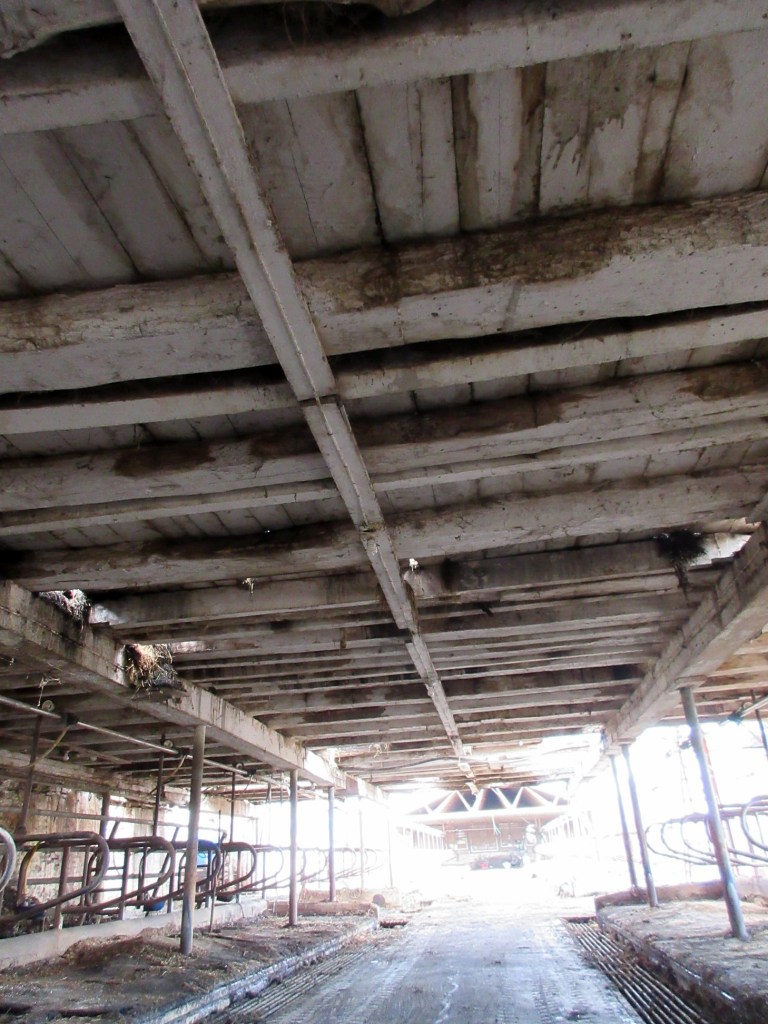
While part of the basement and the tiestalls are still standing, the rest of the two-story bank barn, and all of the feed, are a complete loss.

Of the cattle, 22 head perished in the fire, including 12 cows, 8 yearling heifers and 2 calves, with an additional cow euthanized from injuries the following day. The Getz family is milking their 45 remaining cows in nearby Schaefferstown where John Zimmerman, offered his now vacant barn while the family decides their future.

And then there is the legal concern facing Tim Getz, who was clobbered, handcuffed and arrested as he worked with his father, brother and others to rescue cows in their smoke-filled barn as the hay mow above them was burning.

A Pennsylvania State Police Trooper arrived just ahead of the firefighters, demanding they all leave the barn. He did not comprehend the dedication and knowledge of a family trying to save their cattle when they ignored him and he grabbed Tim from behind, resulting in a flailing throw of the arm interpreted by the officer as assault and leading to felony charges of assault on a police officer.

By the next morning, Carrie Boyer of Lebanon had started a petition online, now filled with 9,443 signatures and growing. 32 pages showing the first 8000 signatures were presented to Lebanon County District Attorney David Arnold on Tuesday, requesting the charges be dropped. It will be days before they learn the outcome, and a preliminary hearing has been set for October 3.

Neighbor Anna Furlow, 15, also wanted to help. She saw the fire trucks go by that night on the road that adjoins her family’s property and the farm. She started a Go Fund Me site, with a goal to raise $10,000 in donations for the family. So far $3,125 has been raised, and the link for donations can be found here.

“I have known the family my whole life, and they have always been really kind to me and my family, so I wanted to do something kind for them,” the teenager said. “They are just really good people, and now they have the financial concerns and decisions about the future.”

Anna and her mother Kristy report that many people from the community are helping out and bringing plenty of food.

“We are holding up,” says Todd Getz in a Farmshine interview Tuesday. His brother Tim is home after a friend of the family raised the $15,000 to bail him out of jail. “It’s kind of hectic, and it is heartbreaking, but we have a lot of people helping us through.”

Todd reflected on the night of the fire. “We were milking in the barn, and at a few minutes before 8 p.m., I was going to go mix feed. I saw fire at the eaves and yelled to my brother that the barn was on fire. He noticed it the same time and called it in,” Todd recounts. 

“Everything became chaotic. I ran up back to see if there was something I could do to stop it and then came down and started letting cows out. I was at the near end of the barn and heard mom yelling that a police officer said we had to get out. The next thing I knew, the officer came in and told me to get out, but I kept working at untying cows until I got to the end of the row at the split and went out with him.”

Todd says he then re-entered the barn at the far end “because I knew my dad and brother were in there. The officer stood at the doorway yelling for us to get out, and so the cows we were trying to get out could not get out the doorway because he was standing there.”

Todd recalls his father yelling back to the officer that they weren’t leaving until they got the cows out. At this point, there was smoke but no fire where they were working.

“The officer walked past my dad and went to Tim, who ignored him and kept untying cows. The electric was out, it was getting dark, there was smoke. I don’t think Tim knew it was the policeman grabbing the back of his arm when he flailed his arm backward to break free. The next thing we knew, the officer took Tim down and put him in cuffs,” Todd reports, adding that there were three other people besides Tim at that end of the barn trying to get cows out and the firefighters were already working at the other end of the barn at that point.

In fact, for a few moments, Todd wasn’t sure who was being handcuffed. “I couldn’t see clearly to the front of the barn where they were. I thought they were arresting my dad.

“I want to be clear that we are not criticizing the trooper, it’s just that I don’t think he understood the situation. I think that is what it really comes down to. He didn’t understand. In fact, the area where he arrested Tim, that part of the barn, is still standing. The fire didn’t reach it.”

With his brother under arrest and the fire raging above them, family, firefighters, the herd veterinarian and others were still stepping in and out of the barn. “You could pick your way in, and the cows were still coming,” Todd recalls.

He says the firefighters were invaluable. One went back in the barn and cut every cow loose they hadn’t gotten to. “We have a pen of calves at Zimmerman’s right now that wouldn’t be there if not for the firefighters getting them away from that end of the barn.”

The family is grateful to their longtime veterinarian Dr. Gary Brummel of Lebanon.

“When I got there, most of the cattle were out,” says Brummel, who has been the herd vet for the Getz family’s Autumn-Mist Holsteins for over 20 years. “Within an hour, the fire chief had me come look at cows under the barn. We were able to get 8 to 10 more animals out, and there were still 4 trapped with the splits. I euthanized them. Others with burns and abrasions, I treated.”

It was an hour of looking at animals and euthanizing any trapped with severe injuries that were still in the part of the barn where Tim, an hour earlier, had been working to free cows before being arrested.

“When I finally went to Marlin and Gloria to let them know I was there, that’s when I learned what had happened with Tim,” said Brummel. “They asked me to go talk to Tim and the officer. One of the firefighters was with me, he knew where the squad car had been, but when we got there, the car was gone.”

Brummel notes the firefighters and ambulance crew didn’t know what happened or where they went. They got on central dispatch to talk to the officer and learned Tim was being taken to the Jonestown barracks and placed under arrest.

He was also taken to the hospital and treated but no one in his family was ever notified.

It was 12 hours later, the next morning, before the family learned that Tim had been taken to the hospital for the injury to his head where the officer hit him with the flashlight before placing him in handcuffs.

While the primary duty of a police officer is human safety, and that may mean telling people to leave a barn that is on fire, family, friends, professionals, and now the local community and dairy community at-large argue whether the officer had the right to physically try to remove one person, leaving four other individuals still in the burning barn doing what he was doing.

The family understands the officer thought he was doing the right thing, but the situation that transpired reveals a deep void in understanding when it comes to the handling of livestock.

When asked what can be learned from this situation, Brummel had some sage advice, “Have an emergency plan. Make sure fire extinguishers are charged and that you have multiple ones. Have an exit plan. Know how you will handle it if the unthinkable happens.”

And now this situation shows additional steps. Farmers and veterinarians should consider meeting and talking with local first responders and law enforcement to have some education and integration in the handling of livestock.

Brummel notes that as communities, including first responders, become farther removed from a farming background, efforts to integrate with first responders and law enforcement may be more important than ever, perhaps even designating a local first responder with livestock knowledge.

While one press report indicates the officer, Jorge DeJesus, may have been on the force less than a year, the majority of people interviewed for this report believe the main factor in this situation is the lack of understanding about farming and livestock. And while they appreciate that the officer was doing what he thought was right to save human lives, the lack of understanding for the situation has now presented a grave legal concern for the family.

What it boils down to is Tim Getz had not committed a crime. The officer had no warrant. This reporter can find no law on the books stating that an owner can’t be in his barn freeing cows during a barn fire.

By all accounts, Tim is keeping his chin up. He spent part of that night at the hospital, then at central booking at the Jonestown State Police barracks.  He was told he would get a phone call when he was transferred to jail but was bailed out before that occurred.

A police report indicates a trooper interviewed Getz at Jonestown barracks at 9:50 p.m. In the interview, without counsel or a phone call, Getz related that he heard the trooper yelling, felt him reach the back of his arm, and he reached back and struck out, but was not sure where or who he struck with an arm up over the shoulder.

The family has hired a criminal defense attorney.

The fire marshal has not determined the cause of the fire, which started in the second story of the bank barn.

The Getz’s have insurance and are sorting out their future with so many mitigating circumstances amid an already difficult time in the dairy business.

“We can’t answer questions about what we’re going to do until we get answers to the questions we have. Our priorities right now are taking care of the animals we have and deciding where we go from here,” says Todd. “We love the cows and love milking and would like to keep doing that, but there is the matter of can we?”

The farm has been in the family four generations, and Todd says it is difficult knowing that his brother is facing charges mainly because people don’t understand that these dairy cows are not just their heritage and livelihood, “they are an extension of our family.”

“People have really rallied around us, and it is amazing and humbling, what that means to our family,” says Todd. “The number of people who were here that night to get cows loaded to go to another barn and coming here after cleaning up. It’s humbling and means the world to us right now.

Despite the heartache, Todd says, “We have seen how big everybody’s heart is in these past few days.”

-30-

While part of the basement and tiestalls are still standing, the rest of the two-story bank barn, and all of the feed, are a complete loss. Of the cattle, 22 head perished in the fire, including 12 cows, 8 yearling heifers and 2 calves. Photos courtesy Renee Troutman

Value added? Or subtracted? DMI, DFA partner on new blend

By Sherry Bunting, Farmshine, July 26, 2019

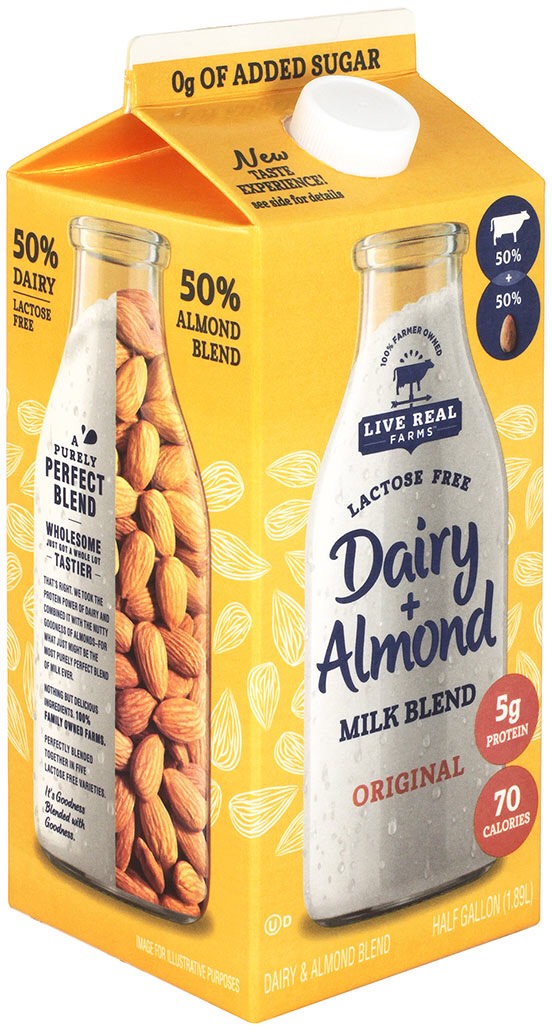
MINNEAPOLIS, Minn. – The news of DFA’s new Dairy Plus Blends – a half lactose-free low-fat milk / half plant-based beverage concoction broke mid-July. DFA’s Live Real Farms brand website showed Lund and Byerly’s stores as the place to buy the Dairy + Almond and Dairy + Oat, but a visit to two stores on the list at the Minneapolis city limits did not have the beverages in the dairy case – yet.

Looking at the packaging, a first impression is: Wow, why doesn’t 100% milk packaging look this good. If only the agencies managing mandatory milk promotion funds and dairy-farmer-owned co-ops put as much thought into packaging and marketing 100% Real Whole Milk as they do for a diluted “innovation,” imagine what could be accomplished!

A further examination of the new Dairy Plus Blends packaging brought this thought: Why use words such as “Purely Perfect” and “Original” for a blend, when such words would seem best reserved for marketing the actual original, purely perfect 100% Real Whole Milk that the DFA member-owner dairy farmers produce and that actually results in the dairy-checkoff promotion funds.

We asked DFA for some background. In fact, we sent 11 questions to DFA and to DMI communications staffs because we were aware that DFA’s Live Real Farms brand is part of a checkoff-supported partnership between DMI and DFA to innovate products in the fluid milk space under the auspices of DMI’s Innovation Center for U.S. Dairy.

We first wanted to know, why the blend? Why not just create an almond FLAVORED 100% real milk beverage? Because, after all, the new Dairy Plus Blends have half the calories, but they also have half the natural nutrients and only slightly more than half the protein of real 100% dairy milk.

It seemed like value was being subtracted, not added.

We all know that almond beverage has barely any almond in it, being mostly filtered water and some additives, so it seemed like the product is an offering of diluted milk. Since we couldn’t find any on the shelf yet at Lund and Byerly’s in Minneapolis, we aren’t sure if consumers will be asked to pay more – for less.

Of course, the packaging does have more. It touches all the right chords.

DFA was kind enough to answer some of our questions, although we have heard nothing back yet from DMI.

“In an effort to meet the demands of modern consumers, Live Real Farms has launched a new beverage, Dairy Plus Blends, which combines all the nutritional benefits of real cow’s milk with the flavor and texture of alternative beverage options like almond or oat,” stated Rachel Kyllo, senior vice president of growth and innovation at Live Real Farms, a DFA-owned brand.

The reply came by email to the questions we submitted.

“All the nutritional benefits of real cow’s milk”? (The label says 5 grams of protein per 8-ounce serving, not 8, and the other naturally occurring nutrients in real cow’s milk are also reduced.)

Kyllo continues in the reply:

“Nearly 50% of consumers who buy plant-based beverages also have dairy milk in the fridge, so they’re buying both products,” she writes. “This product is not about pivoting away from dairy, instead we saw an opportunity to fulfill a need as people like almond or oat drinks for certain things and dairy for others. This product combines the two into a new, different-tasting drink that’s still ultimately rooted in real, wholesome dairy.”

We wanted to know DMI’s part in developing this concept, seeing that dairy farmers mandatorily pay a checkoff promotion fee on every 100 pounds of milk they sell.

DFA’s response stated that, “The overall product concept for Dairy Plus Blends was developed along with DMI and the Innovation Center for U.S. Dairy. Consumer focus groups were conducted with Millennial and Gen X primary shoppers. Overall feedback was positive regarding the product concept, taste and packaging.”

We wanted to know more about how the product will roll out.

“Dairy Plus Blends are now being test marketed at more than 300 retail stores in Minnesota,” the DFA response stated. “If successful in test, the brand plans to roll out more broadly across the United States, beginning in the Central and Northeastern regions of the U.S.”

DFA has already been bottling plant-based alternatives in copacking arrangements in the Midwest. And, the Cumberland Dairy plant in New Jersey, formerly owned by the Catalana family, and purchased in 2017 by DFA, bottles plant-based beverages also as the Catalanas still operate the plant and retained ownership of their plant-based beverage investments.

We also wanted to know how the real dairy milk that makes up 50% of the new Dairy Plus Blends is classified for Federal Order pricing, but that question was not answered.

And, we wanted to know if DFA in its “partnership to innovate” with DMI has any plans to innovate the marketing and packaging of 100% Real Whole Dairy Milk in such a pleasing and attractive way as they have with the Dairy Plus Blends? That question was not answered either.

We also wondered if this “blend” will pull dairy milk drinkers as they hear all this talk about becoming “flexitarian” – cutting back on foods that come from cows and adding more foods that come from plants to, you know, save the earth and all.

Along these lines, DFA’s response attributed to Kyllo at Live Real Farms was: “We’re confident milk will continue to have a place on family tables for years to come, but we also understand and appreciate that consumers have choices in what they drink today. We think Dairy Plus Blends offer a refreshing taste experience and provides a unique way to get dairy in front of consumers who might explore other beverage options.”

We wonder if this is an invitation by a dairy-farmer-owned cooperative, funded in part by dairy-farmer-checkoff to lure consumers into experimenting with something new instead of dairy milk or will it appeal to people who have no intention of drinking 100% real dairy milk? It’s hard to tell, but it’s worth watching.

Some advocates of this kind of experimentation say that the fluid milk market needs more lactose-free choices. There are already lactose-free milk choices, there is also A2 for other types of digestive sensitivity, and there’s one thing everyone seems to be forgetting. Whole milk is more easily digested by people with these sensitivities. There’s actual real proof of this now, not just personal experience, but that’s a story for another day.

In this time of continued fluid milk sales losses, farm milk prices below breakeven for five years and dairy farms exiting the business, why does the dairy-checkoff not re-brand and re-market and innovate the packaging and promotion of Real 100% Whole Milk that is virtually 97% fat-free and loaded with natural goodness? Why not actually partner to innovate the brand-promotion MILK? What a novel idea!

Oops, that’s right. I think USDA lawyers would have a problem with that.

One thing that is impressive coming out of Live Real Farms is the Wholesome Smoothie line of Whole Milk yogurt smoothies last year. DFA says it plans to develop “a robust product line with the launch of additional, innovative products over the next three to five years.”

We’ll be paying attention to all of them.

-30-

Congressman to dairy farmers: ‘Government is between you and the consumer’

Dairy Advisory Committee formed, meets with federal, state lawmakers

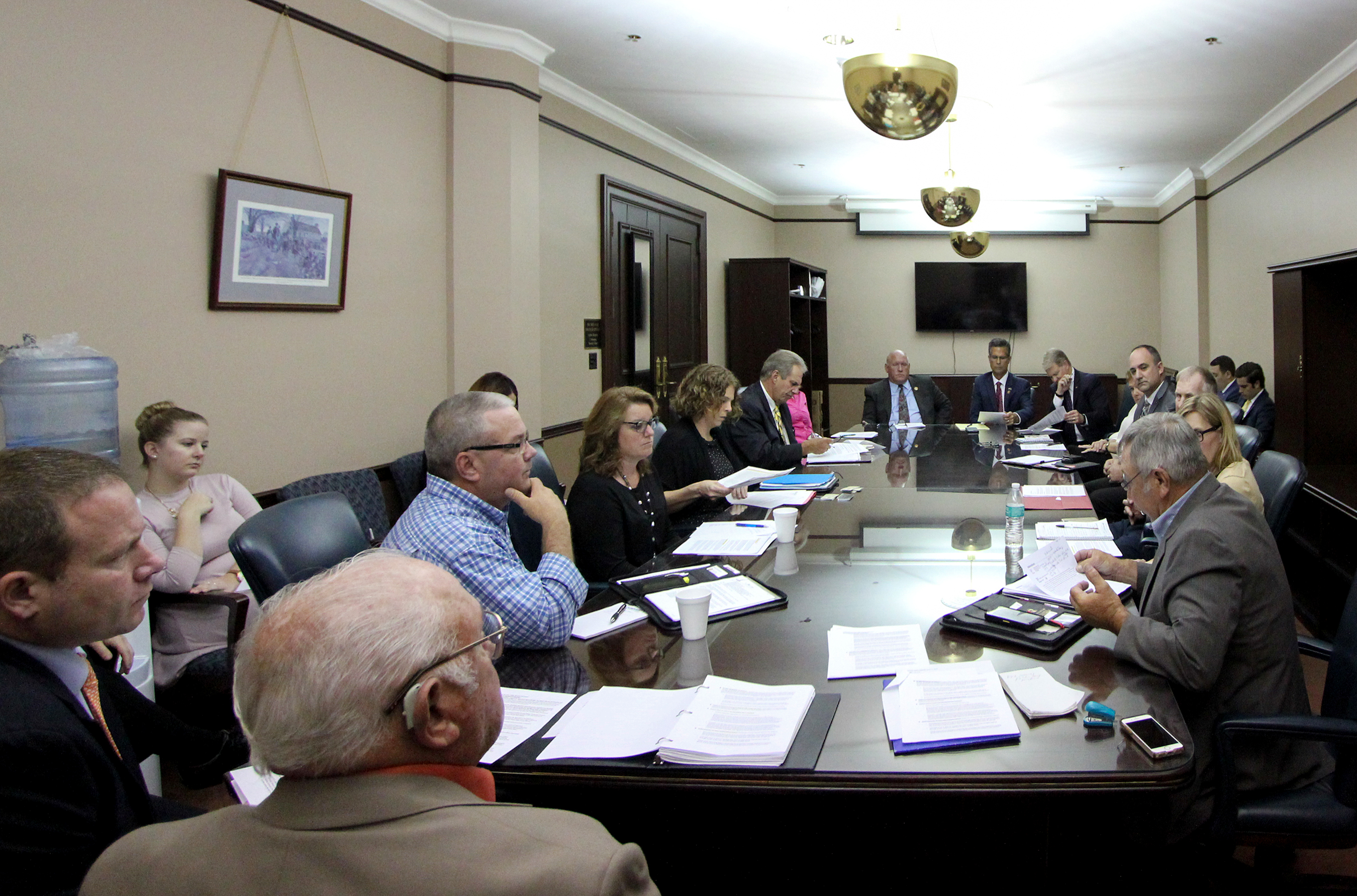
During a June 3 roundtable discussion between dairy stakeholders and Pennsylvania state and federal lawmakers, Nelson Troutman (right) said Pennsylvania is a fluid milk island with milk and consumers right here, but pressure pushing in from all sides. He said the state is losing its ability to compete as federal dietary rules suppress fluid milk sales while the state’s antiquated milk marketing law incentivizes more milk-swaps along the four borders as fluid milk sales decline. Clockwise from top left are U.S. Congressmen G.T. Thompson (R-15th) and Dan Meuser (R-9th), State Senator David Argall, Lolly Lesher, Mike Eby, Dale Hoffman, Tricia Adams, Nelson Troutman, Bernie Morrissey, State Senator Scott Martin, Karl Sensenig, Bonnie Wenger, Krista Byler, Craig Lutz for Sen. Argall’s office, and Katie Sattazahn. Also present were various legislative staff. Attendees shared USDA data showing that in the past 12 months, Pennsylvania lost more cows (29,000 head) and more production (66 mil. monthly pounds) than any other state in the nation, with the potential see even greater losses in the next 12 months without substantial change.

By Sherry Bunting, Farmshine, June 14, 2019

HARRISBURG, Pa. — “What I’m hearing here is that the government is between you and the consumer. You would have no problem marketing milk if you could get your message and product to the people,” said U.S. Congressman G.T. Thompson, representing Pennsylvania’s 15th legislative district over a swath of central and northcentral and northwest Pennsylvania.

That summed up the concerns related to school milk, dairy checkoff, fake milk labeling and other issues during a meeting between 11 dairy stakeholders and a dozen state and federal lawmakers and staff in Harrisburg on June 3.

It was a listening session that was followed by a productive work session as the grassroots group will continue to meet and correspond as a Dairy Advisory Committee.

(l-r) Nelson Troutman, Mike Eby, Pa. State Senator David Argall, Bernie Morrissey, Craig Lutz.

Retired agribusinessman Bernie Morrissey and 97 Milk Baleboard initiator Nelson Troutman worked with Pa. State Senator David Argall of Berks and Schuykill counties to set up the meeting.

They pulled together an advisory committee of 11 people, including Troutman and Morrissey, along with Dale Hoffman and his daughter Tricia Adams of Hoffman Farms, Potter County; Mike Eby, a Lancaster County farmer and president of National Dairy Producers Organization; Lolly Lesher of Way-Har Farms, Berks County; Katie Sattazahn of Zahncroft Farms, Womelsdorf; Krista Byler, foodservice director for Union City School District in Crawford and Erie counties, whose husband operates a crop and dairy farm in Spartansburg; Bonnie Wenger of Wen-Crest Farms, doing custom cropping and heifer raising for dairies in Lebanon and Berks counties; and Karl Sensenig of Sensenig Feed Mill, New Holland. 

I was privileged to moderate the discussion, for which an outline was provided in advance.

Congressman Thompson was joined by Congressman Dan Meuser, who represents Pennsylvania’s 9th district covering Carbon, Columbia, Lebanon, Montour and Schuykill counties along with portions of Berks, Luzerne and Northumberland.

In addition to State Senator David Argall, State Senator Scott Martin of Lancaster County attended, as ded legislative aids for Senators Ryan Aument, Elder Vogel, and Mike Folmer with additional interest from State Representatives John Lawrence and David Zimmerman.

Lawmakers said they left the discussion with “more work to do” and an “elevated awareness.” Their message to dairy farmers was: “Keep it up. Keep doing what you’re doing (a nod to the 97 Milk campaign and the planned rally for the Whole Milk for Healthy Kids Act on June 18 at the state Capitol). They said raising public awareness is crucial.

“Every few days, the bill gets another cosponsor,” said Rep. Thompson of HR 832 introduced in late January. “It will take public support and momentum to reverse this. It’s a challenging task.”

Even with evidence that bad science led to the federal school lunch milkfat restrictions, Thompson said the House Committee on Education and Labor must take up the bill in order for it to move forward. He noted that current leadership of that committee is the same as in 2010 when The Healthy Hunger Free Kids Act tightened the vice grip on milk fat. (Learn more about the school lunch changes over the past 10 to 20 years here.)

The 2010 legislation with the blessing of former Ag Secretary Tom Vilsack not only prohibited whole milk in the National School Lunch Program, it also reduced total calories, required less than 10% calories from saturated fat and made the milk part of the meal’s nutrient analysis.

With a nod to Krista Byler, Thompson said he understands more is needed beyond HR 832. “We need to eliminate the beverage information from the nutrient standards limitations,” said Thompson.

Discussion followed about the current Childhood Nutrition Reauthorization process currently underway in the Senate and what opportunities might exist for a regulatory change there.

Byler noted that while every child gets a milk, many students throw the milk away and buy sugary drinks that don’t offer milk’s nutrition.

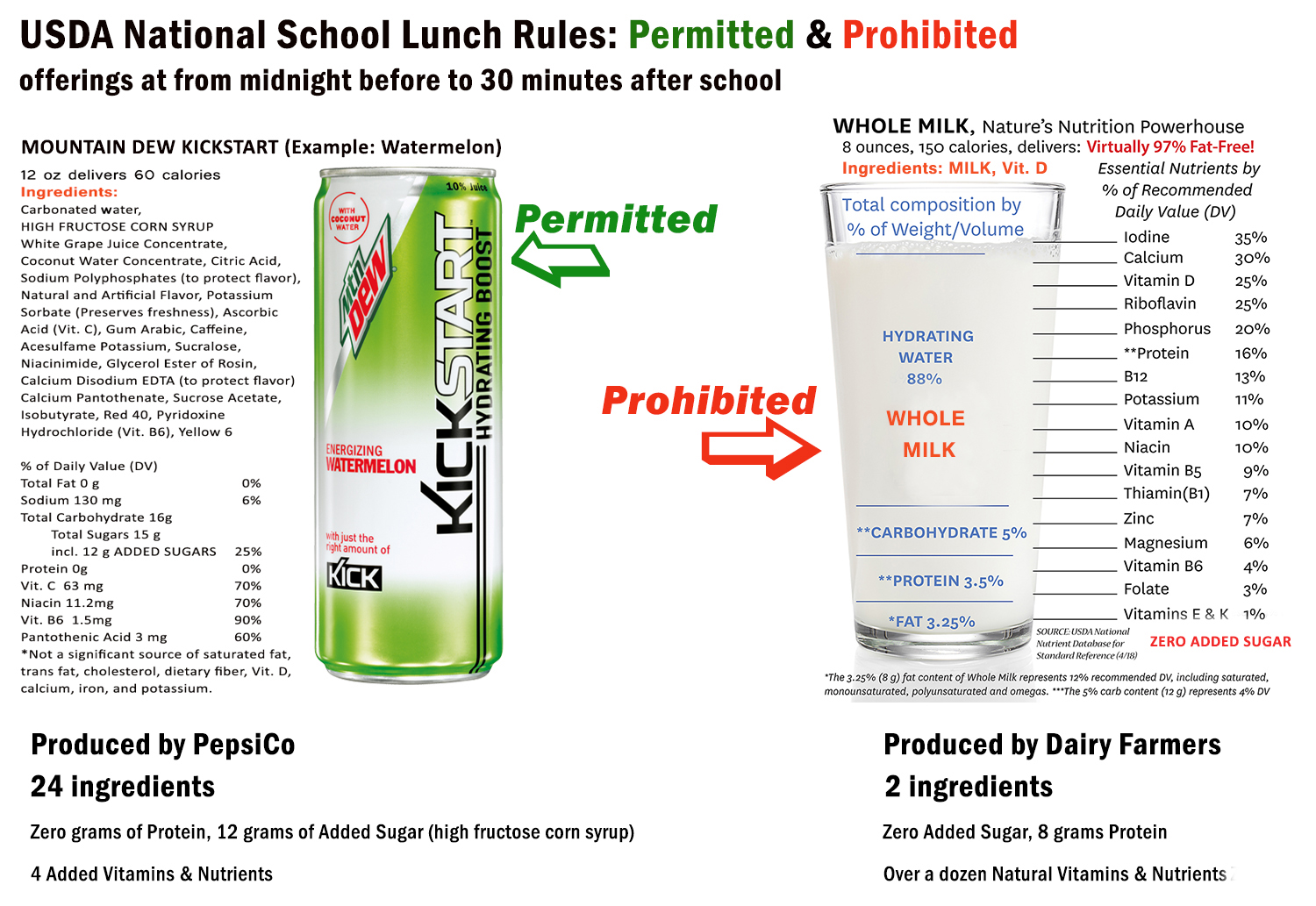
Legislators were surprised to learn that high school students can’t buy whole milk but they can buy Mountain Dew Kickstart at school. This 80-calorie beverage made by PepsiCo — the company that also created a Smart Snacks website for school foodservice directors and received the GENYOUth Vanguard Award last November — is deemed “okay” by the current USDA Dietary Guidelines because it has fewer calories than milk, zero fat and a list of added, not natural, vitamins and minerals. But it also has 20 grams of carbohydrate, 19 grams of sugar in the form of high fructose corn syrup and zero protein, whereas whole milk has 12 grams of natural carbohydrate and 8 grams of protein.

In addition to Mountain Dew Kickstart, students in high schools and middle schools across the U.S. can buy other sweetened drinks like PepsiCo’s Gatorade as well as iced tea coolers. In addition, high schools are also permitted to have coffee bars.

Yet schools are prohibited from offering whole milk (3.25% fat) or reduced-fat (2%) with its high-quality protein and long list of natural nutrients – unless a child has a medical note from a physician.

On the flip side, schools must provide non-dairy substitutes like soy and almond beverage if a parent, not a physician, writes a note. And no notes are needed for students to throw away the milk and grab a sweetened high-carb beverage from PepsiCo.

“My purpose in coming here, after speaking with other foodservice directors across the state, is the changes that were made to allow 1% flavored milk last spring are having disheartening results. Schools have been doing the fat-free flavored milk as a requirement for so long, they don’t all understand the new rule,” Byler explained.

Part of the issue, she said, is they have their cycle menus done far in advance, and the changes to the milk — even if whole milk were suddenly allowed — do not fit into the nutrient analysis of the meal.

Before 2010, the milk was not included in the nutrient analysis of the school lunch or breakfast.

“It’s a breath of fresh air to hear members of Congress talk about this,” said Byler. “This bill (HR 832) is amazing, but it doesn’t have legs to stand on without the regulatory change to exclude milk from the nutrient analysis of the meal. For schools to have this choice, this bill needs to pass, and the milk needs to be a standalone component of the meal, otherwise schools won’t be able to make it work.”

She said the same goes for the Smart Snacks program. An exception to regulations is needed so schools can offer whole milk, just as they can offer PepsiCo’s energy drinks.

At the federal level, Rep. Thompson said the Pennsylvania Congressional delegation is working on getting a companion bill for HR 832 in the U.S. Senate. (This actually did happene a day after this report was filed for press — Senators Pat Toomey (R-Pa.) and Ron Johnson (R-Wis.) introduced the Milk In Lunch for Kids (MILK) Act this week. Bill number and text have not yet been posted)

“The biggest thing we need is to generate enough public support,” said Thompson.

The Dairy Advisory Committee urged Pa. State Senators to support a resolution on the federal bills.

On The Dairy Pride Act, Thompson was more optimistic. He believes FDA is giving an indication that the public has been misled by competing alternative beverages that infer by the name “milk” to have the nutritional attributes of milk.

Tricia Adams spoke of the many school tours she conducts at Hoffman Farms in the spring and summer, and what the kids tell them about school milk.

She says the kids are “brutally honest. They tell us, ‘This is the good milk!’ But just to get whole milk for a tour, I have to special order weeks in advance,” she says. “It’s a struggle to get enough of it at one time. It’s just not available.”

 Her father Dale Hoffman observed that farmers are so busy, it’s tough to be involved in these things. He said it is scary how fast Pennsylvania is dropping in cow numbers and production.

“Somewhere, we need to get our foot in the door. This has got to be done if Pennsylvania is going to compete. We have the milk and the consumers right here,” said Hoffman. “We need your help. We hear it’s tough to get done, but it’s time to get whole milk back in the schools.”

Mike Eby said he sold his cows three years ago, but producers selling today “are getting half of what I got.” He said the dairy situation is increasingly difficult for farm families to manage whether they are staying in, or getting out, as the value of their assets shrink along with income.

“Where is our milk going to be coming from when we all go out?” he asked.

Eby describe the power of whole milk. He has been part of an effort to give out whole milk that is standardized to 3.5% fat instead of 3.25% to meet the California standards. 

“We give the milk away at four parades a year,” he said, and the math adds up to over 10,000 individual servings. “We could give more! They love it. People are screaming for that milk.”

Circling back to Rep. Thompson’s point. The problem isn’t the product, the problem is the government getting between the farmer and the consumer when it comes to marketing the high value, nutritious and delicious product they produce.

State issues were also discussed, including needed reforms to the Pennsylvania Milk Marketing Law. Each participant also gave a fast view of the long dairy situation.

“The average dairy farmer we serve is under 150 cows, and our feed mill has 107 years in the business. We’ve seen a lot, but nothing as bad as this,” said Karl Sensenig. “We are greatly concerned about what is the future for the generations to come in our business and on the farms. We have become their bank. The situation is beyond dire, and I’m afraid we haven’t begun to see the true loss of farms. Even if the price gets a little better, many are so far gone that there’s no way out.”

Katie Sattazahn also questioned the future. She is integral to the farm operated by her husband and his brother, and she works off the farm. They upgraded their facility three years ago, never expecting a downturn of this duration and magnitude.

“The biggest thing is, we are supposed to be glad when we have a breakeven year, but that has to change. As dairy farmers, we need to be profitable to put something back into our operations,” she said. “Every dollar we spend is spent locally. Our farms provide open space and benefits for the environment, and the money we spend in our business helps the economy.”

With two young children, Sattazahn says, “If it stays the way it is, why would we encourage them to do this?”

Bonnie Wenger explained the conditions she sees in the community of dairy farmers. She explained to lawmakers the added difficulty of this year’s prevented plantings, a struggle that will get worse this fall in terms of feeding cows.

Byler also talked about the dire situation in her county. “The dairy farms support our communities. They support other businesses and bring in revenues for our school districts,” she said. “What will be left for our small rural communities?”

On the school front, she showed examples of the marketing foodservice directors see, pushing them away from animal protein. This included visuals from Fuel Up To Play 60 and its focus on fat-free and low-fat. She wonders why they can’t just talk about milk, why they have to pound home the fat-free, low-fat with every caption, every sentence, over and over. She has trouble seeing the value in it from the side of the dairy farmer or the school program.

Lawmakers and staff were taking notes, writing in the margins and circling things on the outline provided. By the end of the session, Sen. Argall said, “You’ve created a lot of work for us.”

Congressman Meuser noted this is now an even higher priority for him.

Sen. Martin said this is on the Pennsylvania Assembly’s radar, and he mentioned a package of bills coming that are “just a start.” He mentioned the dairy commission being put together to advise the legislature on dairy. 

They reminded the group to urge others to attend the rally on June 18 at 11:00 a.m. at the Capitol Rotunda in Harrisburg to support the federal dairy bills on whole milk in schools and mislabeling of non-dairy beverages. The media will be there, and this is a chance to get the public involvement that is necessary.

Here is another link to 8 ways you can help. (Swipe to read second page of this pdf).

-30-

And the winner is: MILK!

By Sherry Bunting

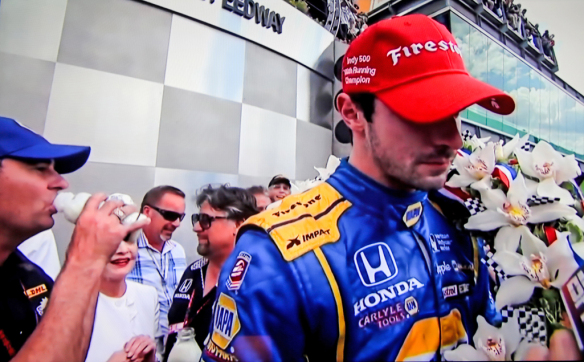
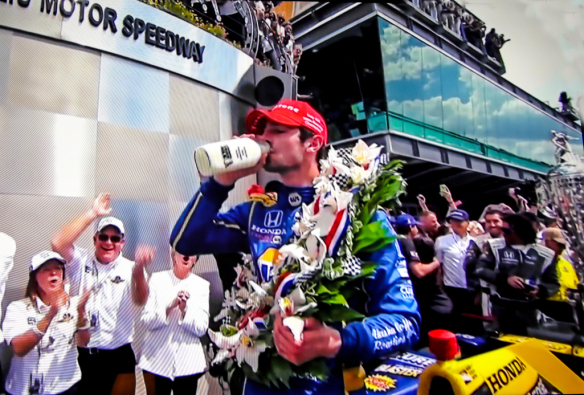
INDIANAPOLIS, Ind. – It’s a roar not soon forgotten when the field of 33 drivers rounds the curve to the paddock straightaway and the pace car exits the track. The thrill of the Indianapolis 500 is unmatched in motorsports, and the refreshing, replenishing, refueling and revered beverage associated with this great race is MILK — Real Dairy Milk!

Wait for it… The patriotic blend of freedom and speed after the recognition of our military, the moment of silence and playing of Taps for fallen heroes, the Blue Angels flyover, the singing of America the Beautiful and the National Anthem, and Back Home in Indiana, the anticipated “Drivers Start Your Engines”, the breaking free of the pace cars as the field of Indy cars passes the paddock with Old Glory in tow!

For 103 years, on the Sunday of Memorial Day weekend, a patriotic display, Blue Angels fly-over, recognition of our military and moment of silence for our fallen precede the 500-mile race at the Indianapolis Motor Speedway (IMS).

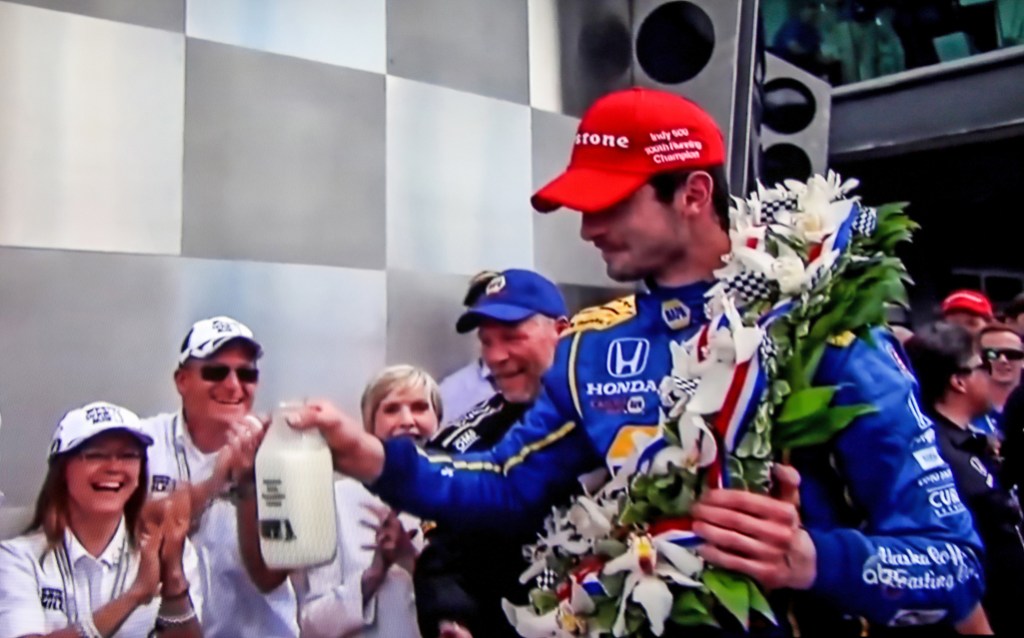
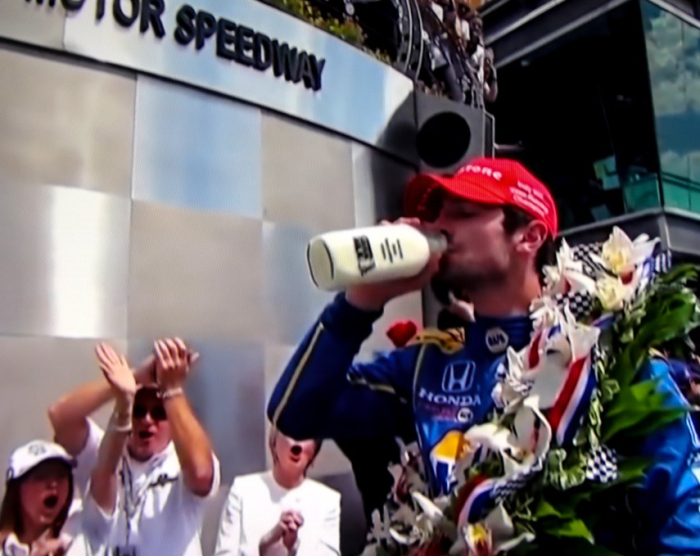
And for 83 years, the legendary race is complete with the ice cold Drink of Milk in Victory Circle — deemed the “coolest trophy in sports”, awarded for the “greatest spectacle in racing,” also known as the largest single-day sporting event in the world.

Indy5294
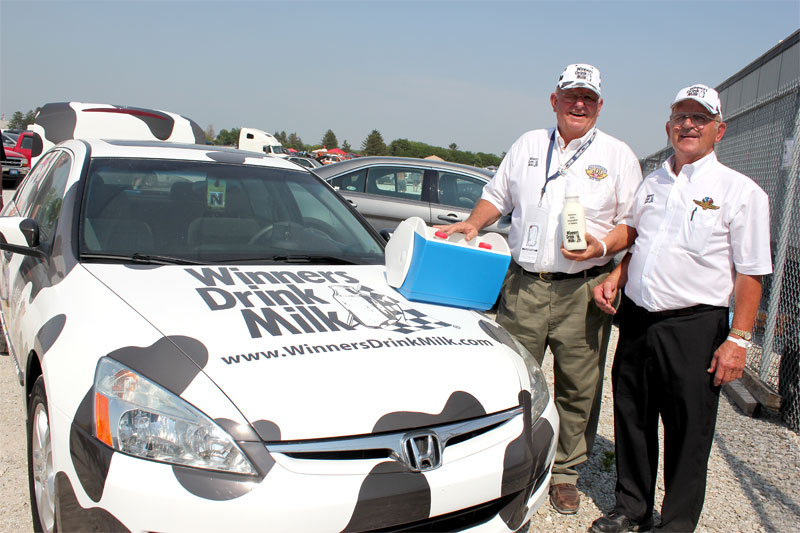
2012 Milkman Dave Forgey (left) of River-View Dairy Farm, Logansport and his rookie Duane Hill of MayHill Farm, Fountain City.

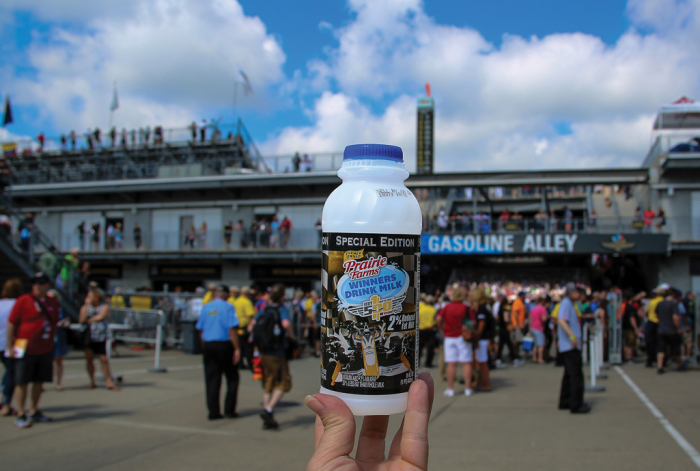
Dave Forgey of Logansport was an Indy500 spectator for years before having the chance to be the ‘Milkman.’ As a dairy farmer he was enthusiastic when the Indiana milk promotion board began choosing dairy farmers, instead of executives, to be the ones to give the famed bottle of milk to the winning driver each year. After serving as the ‘rookie’ in 2011, he was lead Milkman in 2012.

“As dairy farmers, we bring a personal touch to the award, that brings it to the common level of the fans. At the end of the race, the Milk is always first,” said Forgey with a broad grin standing in front of the IMS Pagoda race day morning talking to fans in 2012.

The job of the Indy500 Milkmen (or women) begins long before Sunday, and continues throughout the year in venues such as Rotary Club presentations and small town parades, as well as other competitive events that capitalize on the Winners Drink Milk slogan of American Dairy Association Indiana.

By Sunday, the Milkmen are focused on keeping the Milk iced for Victory Lane and promoting milk and dairy farming to race-day fans. They ask all the drivers to choose between Whole, 2% and fat-free and have those selections ready since they don’t know who the winner will be. Whole milk has been topping the choices 2 to 1 over the past few years, and two top drivers, Ed Carpenter and James Hinchcliffe in 2019 said they would return to the buttermilk choice of 3x winner Louis Meyer in 1936, if it were an option!

In short, the Indy500 milkmen are charged with protecting the future of this unique sports award ruled tops for its “cool factor” according to Sports Illustrated writer Pete McEntegart, who in his si.com column ranked milk #1 among the Sports World’s top-10 unique trophies.

And in a recent interview, champions rate the Milk as the top tradition of this famed race that is certainly steeped in many traditions.

“It is certainly a tradition that everyone respects. What else can we do that is this national and international in scope?” Forgey observes. He said he came home to find an email from a friend in New Zealand who saw the whole thing on television.

“The fans are interested. They want to talk about our dairy farms,” says Forgey. When fans realized he was giving the bottle of mlk, they wanted to know how he qualified for the job. When Forgey explained that he and his rookie are Indiana dairy farmers, the fans were eager to know more. Of course, they also want to see the milk. Standing by the milkmen in front of the IMS Pagoda on race day morning, enthusiasm for “the milk” is evident. Fans paused to take pictures, and ask questions.

“There is always a lot of excitement for the milk among the racing fans,” says Forgey. “They know the tradition. They know about the milk. And when we can help them connect it back to the farmer, that generates interest.”

Indy500-4137
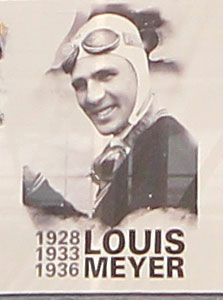
Thanks to Louis Meyer, 3-time winner who started the Winning Drink of Milk!

Initiated 83 years ago when the first three-time winner, Louis Meyer, asked for buttermilk to quench his thirst after the grueling 500-mile race, the Drink of Milk tradition has endured. Today, scientific evidence shows Louis Meyer knew what he was doing back in 1936, when he turned after that grueling race to the unique, natural and un-matched combination of hydrating re-fuel found in Real Dairy Milk with it’s healthy maitrix of fat, protein, carbohydrate, a dozen essential nutrients and refreshment. In fact, in those days, buttermilk was the name given to full-fat milk with extra heavy cream! Today’s drivers tend to choose Whole Milk (standardized at 3.25% fat) more than the reduced fat (2%) or fat-free options.

ADA Indiana coordinates the Indy500 Drink of Milk promotion today, and 45 years ago they added to the heritage by sponsoring the “Fastest Rookie” award on the Tuesday before the big race. The coveted award recognizes the first-year driver who achieves the fastest four-lap average speed from among fellow rookie competitors during time trials.

“The rookies are very interested in the milk and getting their pictures taken with the milk,” says Forgey.

Fast forward to 2016 with the 100th running of the Indy500 and what a celebration it was! Nearly half a million people attended in person. To put this into perspective, the largest-ever attendance of the NFL Superbowl was just over 100,000 people. The 100th running of the Indy500 in 2016 clocked in at 350,000 in the gates and another estimated 100,000 outside the gates just wanting to “be there.”

Prairie Farms, American Dairy Association Indiana and the IMS together gave commemorative, specially-packaged bottles of milk to fans for a winning milk toast and they were available in stores throughout the region.

After 500 miles, 200 laps, 54 lead changes and 13 different leaders, the winning of the 100th Indy500 came down to a fuel strategy that put Alexander Rossi — the 9th rookie ever, and the first since 2001 — into Victory Lane at the Indianapolis Motor Speedway for the sweet taste of victory — the 80th traditional ice cold drink of milk, delivered in 2016 by Milkwoman Janet Dague, a dairy farmer from Kewana, Indiana and rookie Joe Kelsay of Kelsay Farms, Whiteland.

“I was so excited to see our rookie win the 500,” said Dague, an avid race fan and dairy farmer after delivering the Drink of Milk to Rossi in Victory Circle. “I was jumping up and down, cheering when he crossed the finish line. I even said to Joe ‘I told you I wanted our rookie to win!’

By “our rookie,” Dague was referring to Rossi earning the 42nd Fastest Rookie award given annually by the ADA-Indiana at a special dairy-and-racing-focused luncheon on the Tuesday before the race. There, Rossi was honored as the qualifying rookie with the fastest 4-lap average speed on qualification day, at an average 228 mph.

Dague described Rossi as “so gracious about winning. I think because of the rookie luncheon that just took place, he understood how important this was for the ADA-Indiana and every other dairy farmer around the world,” she explained. “In every picture, he made sure to take a drink of the milk and even made sure our logo was facing front and center. We couldn’t ask for a better spokesperson.”

The whole crew was celebrating that win with their milk, along with race fans given commemorative bottles on the 100th anniversary. Owners Michael Andretti and Bryan Herta were toasting each other, drinking their milk. Andretti, in particular, was happy to taste the elusive beverage right from driver Rossi’s official bottle while Rossi did his victory interview with ESPN, and their chief mechanic was next for the taste of victory!

Rookie Milkman Kelsay was excited to be there for the first time with the Drink of Milk in that 100th year of the Indy500.

“To have the spotlight shine on the nutrition of milk in this way is just awesome,” he said during the parade honoring military and the heritage of the race on the day before. “It is an honor to represent fellow dairy farmers who are back home milking and feeding and listening to the race on the radio. It has been a humbling experience so far. It seems as important to the fans as it is to dairy farmers. Even one of the police officers mentioned what an honor it was to meet us, saying he would be sure to keep me safe if something happens.

“We just thank Louis Meyer for starting this trend over 80 years ago that we can highlight the healthy choice of milk and deliver that message to a global audience here at the Indy500,” Kelsay adds.

“What better way could we as dairy farmers promote our product than to be out in the forefront of this event, which is so significant worldwide?” says Forgey, who appreciated the honor of spending 2011 and 2012 representing the dairy farmers in Indiana and across the U.S., who work hard to produce a healthy product.

After all, #WinnersDrinkMilk because #RealMilkAlwaysWins #TasteTheVictory

2018 winner: Milk!
Hubs and I at the 100th Indy500 in 2016 in the paddock straightaway. He has followed the race his entire life. I was drawn in when we met in 1978 and was happy we could cover the 100th Anniversary run for Farmshine as farm media in 2016!

The horrors of hormones? Truth is, we can’t live (or eat) without them.

These Jersey cows are healthy high producing cows. They lie on deep bedded sand and congregate with their own social herd pecking order. Of all the cattle breeds, Jerseys seem to be the most curious.  Photo by Sherry Bunting

By Sherry Bunting

A while back, I tackled the subject of food labeling in a consumer column. We covered the rigorous testing by which ALL milk is actually antibiotic free. But people still had questions. They kept hearing about hormones in milk and meat, and they see labels stating “hormone free” and wonder what to make of it all.

So we’ll turn our attention to the hormone question and the labels we see.

The biology news flash of the day is that there are hormones in pretty much everything we eat — that is, if it was derived from a living organism.

And yes, that goes for the plant-derived foods we consume also!

In fact, endocrinologists and reproductive physiologists explain hormones as small chemicals that are produced naturally by and circulate throughout all living things! These hormones instruct cells and tissues on how to adjust, grow, reproduce and thrive.

Without hormones, life could not exist. All foods come from living things — both plant and animal. Technically, all life requires hormones. Thus, all living things, plants and animals, contain hormones.

So, if someone tries to sell you ‘hormone-free’ products, and you know it did not come from a rock, well, technically, it can’t be ‘hormone-free’.

In the hormone conversation, the most important thing that is missing these days is perspective and context!

Jude Capper, a livestock sustainability consultant and former university professor, explains it this way:

“The amount of estrogen in the steak from the implanted animal is miniscule: 5.1 nanograms. One nanogram (one-billionth of a gram or one-25-billionth of an ounce) is roughly equivalent to one blade of grass on a football field. By contrast, one birth-control pill, taken daily by over 100 million women worldwide, contains 35,000 nanograms of estrogen. That’s the equivalent of eating 3,431 pounds of beef from a hormone-implanted animal every single day. To put it another way, it’s the annual beef consumption of 59 adults. Doesn’t that put it into perspective?”

To repeat: One birth control pill contains the hormone equivalent to the amount of beef eaten by 59 adults in one year. So one month of birth control is equivalent to the amount of beef 59 adults would eat in 30 years.

Perspective.

Here’s another comparison from Dr. Troy Ott, a professor of reproductive physiology at Penn State:

“If you set the amount of estrogenic activity in a 3 oz steak equal to one M&M candy, then 3 oz of tofu (made from soy plants) would contain a tractor-trailer full of M&M – that’s 19 million times more. Big difference! But fear not, eat your tofu because your liver is there to deal with any substances that enter your body from the food you eat.”

Whew! Whether you are a vegetarian, carnivore or omnivore, it’s good to know the hormone food topic is not so scary after all.

Hormones are the beneficial agents of life on the planet Earth. They regulate every process of life. When we consume plant and animal foods, we are consuming hormones that our bodies recognize as nutrients!

Perhaps the confusion about hormones stems from all of the talk in sports these days about steroid use. That’s a much different conversation. The hormones in plants and animals – that we consume – are first of all digested and secondly recognized by our human bodies as nutrients, not steroids.

Trent Loos, a seventh generation rancher, explains it this way: “Misinformation and misunderstanding of the value of hormones to our everyday life have perpetuated the concern over hormones. Some of that has certainly been the result of activists and those attempting to remove technology and efficiency from the food production system. However, some also has been the result of misleading messages…” in the area of marketing.”

He cites researchers from Lafayette College, who have shown how hormones regularly improve our lives. Many common foods naturally contain estrogen (or in the case of plants, phytoestrogen) at levels hundreds or thousands of times higher than the levels in any dairy or meat product to come from animals — even those animals that may have been given additional hormone to more efficiently produce food at a more affordable price for a growing world.

In fact, if you tested milk from rbST-treated cows versus cows that did not receive rbST (recombinant bovine somatotropin) you would find no difference in the milk. Likewise for beef that comes from a steer (neutered male) that received hormone replacement at a specific time in its growth and the appropriate withdrawal time observed before harvest. The beef from that hormone-implanted steer would test pretty close to the natural hormone levels in the beef from an untreated, non-pregnant female beef animal.

As we read labels and marketing materials about the food we feed our families, here is a checklist to consider:

— Context is everything, so keep a perspective about this topic and the various label claims when determining how to spend your food dollar.

— The hormones being debated (either at naturally-occurring or at enhanced levels for production efficiency) are protein hormones, not steroid hormones.

— Our bodies do not recognize these protein hormones as hormones, but rather as nutrients! It’s pretty cool to think about how wonderfully we are made.

— Hormones are found in every living thing – be it plant or animal! In other words – food!

— There is no difference in the hormone content of milk whether or not the cows received hormone treatments for enhanced productivity at any point in their life. But that said, most dairy farms have given up this practice for many years because of consumer confusion. Most milk in stores is produced from cows not treated with rBST or rbGH and is labeled this way as well.

— In the long run, animal productivity benefits consumers by helping to keep food costs more affordable than they would otherwise be. Food prices are rising but the farmer’s portion of the consumer dollar is at an all-time low of 14 cents today.

While some want to debate hormone-free meat and milk and create fear in the minds of consumers, the truth is that we encounter far higher levels in plant foods, which we readily consume without question.

Here is a short-list showing just some of the eye-opening example comparisons compiled by the researchers at Lafayette College. (ng = nanogram)

  • 4 ounces of beef from untreated steer: 1.2 ng of estrogen
  • 4 ounces of beef from non-pregnant heifer: 1.5 ng of estrogen
  • 4 ounces of beef from steer given hormones: 1.6 ng of estrogen
  • 3 ounces of milk from cow given recombinant bovine somatotropin (rbST): 11 ng of estrogen
  • 3 ounces of milk from non-rbST-treated cow: 11 ng of estrogen
  • 4 ounces of raw peas: 454 ng of estrogen
  • 4 ounces of raw cabbage: 2,700 ng of estrogen
  • Average soy latte (one cup of soy milk): 30,000 ng of estrogen
  • 3.5 ounces of soy protein concentrate: 102,000 ng of estrogen
  • 3 ounces of soybean oil: 168,000 ng of estrogen
  • Average level in a woman of childbearing age: 480,000 ng of estrogen per day
  • Average level in a pre-pubertal girl: 54,000 ng of estrogen per day

A former newspaper editor, Sherry Bunting has been writing about dairy, livestock and crop production for over 35 years. Before that, she milked cows. She can be reached at agrite2011@gmail.com

Gov. speech rules; producers have little say

Creation of GENYOUth in 2010 brought Dairy Checkoff and USDA into closer alignment

By Sherry Bunting, Farmshine, February 22, 2019

BROWNSTOWN, Pa. — Examining the public record over the past six weeks, we find no specific language in the Dairy Research and Promotion Order requiring commodity checkoff organizations to promote USDA Dietary Guidelines. Legal and other challenges may have fostered this association as the federal government’s defense of mandatory checkoff programs in the 2006 time frame offered protection as “government speech.”

A slippery slope, but the shoe fit as Congress authorized these programs in 1983, and USDA oversees them, appoints the boards that manage them and enforces the assessments paid by producers to fund them.

With the government declaring checkoff advertising to be “government speech” as a defense to challenges, producers cannot claim they are forced to support private or commercial speech with which they disagree. Instead, they are said to be supporting “government speech,” which is protected from such challenges, according to a scholarly articles published by Parke Wilde, a Cornell-educated professor of nutrition science and policy at the Friedman School at Tufts University. 

Wilde is the author of several editions of “Food Policy in the United States.” His 2010-12 article, entitled Federal Communication about Obesity in the Dietary Guidelines and Checkoff Programs explored this relationship, with special focus on dairy and meat checkoff programs. In fact, he wrote in 2018 about diet as a means of reducing greenhouse gas emissions late in 2018 previewing the EAT Lancet Commission’s report released officially in January 2019.

While Congress has never acted to require checkoff promotion within the boundaries of USDA Dietary Guidelines, the path to align the two was chosen by dairy checkoff in 2010 to protect it from external and internal challenges.

Dairy collects, by far, the largest pot of money among all checkoffs – approximately $350 million annually. Much of this money over the past 10 years has been spent through various partnerships in pre-competitive environments to potentially drive category demand, particularly for cheese.

The creation of GENYOUth in 2010 brought Dairy Checkoff and USDA into closer alignment. 

Unanswered questions remain. On February 11, specific questions and document requests were sent by email to Marilyn Hershey. A Chester County, Pennsylvania dairy producer with her husband Duane, she has served on the DMI board for almost seven years and has been chairperson for almost two years.

We asked specific questions about GENYOUth and Fuel Up to Play 60 (FUTP60) and other aspects of DMI alliances, including a request for information about the role of Edelman in the founding of GENYOUth.  As mentioned last week, Edelman is the world’s largest marketing, communications and public relations (PR) firm, and they have done social marketing and communication strategies for DMI for 20 years, including the 2017 creation of the Undeniably Dairy social ‘trust’ campaign.

We also asked if DMI had knowledge or concern about Edelman’s simultaneous involvement as social marketing and communications strategist for the EAT Lancet Commission, EAT Forum, and in particular the EAT FReSH Initiative — funded by 41 corporations, many of them Edelman clients.

We asked what specific entities received the more than $2 million paid annually in 2014-17 for “professional services” from the GENYOUth fund, which is by DMI’s own 2016-17 audit, described as being primarily funded by DMI “as the primary source of unrestricted funds for administration and operations” to the tune of more than $2.5 million annually.

We asked why the audit shows those numbers funding GENYOUth, which are much larger amounts than the $1.5 million listed annually as DMI contributions on the GENYOUth 990 forms filed with the IRS.

We asked for a full copy of the Memorandum of Understanding (MOU) signed by National Dairy Council, USDA and the NFL in 2011 after the agreement for GENYOUth was solidified in 2010.

We asked for specific dairy sales tracking data from FUTP60 schools before and after receiving a grant for implementation, since we have learned from current and former board members and staff of DMI that this information is available and in fact part of the grant process.

We asked for comments about the benefits of GENYOUth programs to dairy farmers, such as what has been mentioned in the articles already in terms of breakfast carts containing dairy offerings, asking for specific information about recorded dairy sales via the breakfast carts.

And we asked for comments about the GENYOUth alliances being formed, and how they are beneficial for the dairy farmers funding the checkoff, which remains the foundation’s primary sponsor for operations – given the example of PepsiCo’s specific goals to be a leader in plant-based diet transformation through the incubator and ‘oat milk’ the company CEO touted when receiving the Vanguard Award at the 2018 GENYOUth Gala.

These questions were presented, and two options were offered — answering the questions point-by-point or providing a letter of response.

Marilyn Hershey chose the latter, providing Farmshine with a letter of response on Feb. 18, which was published on page 17 of the Feb. 22 edition (see it included at the end of this report).

As an editor’s note, the DMI letter of response by Hershey highlights the June 23, 2014 Time Magazine “Eat Butter” cover story, by Brian Walsh, as a checkoff accomplishment that changed the conversation on fat. However, Walsh in fact wrote the revealing cover story one month after his May 14, 2014 review of The Big Fat Surprise, by Nina Teicholz, which made the New York Times Best Sellers List at that time.

Walsh had reviewed her book before his “Eat Butter” story, stating: “It’s nutrition dogma: saturated fat is bad for you. But a new book makes the case that our obsession with low-fat diets has made us, and he went on to tell of the “6 facts about saturated fat that will astound you” as revealed in Teicholz’s book.

In fact, the checkoff-funded full fat dairy research mentioned by Hershey in her DMI response is said to be within the past five years, which would be since the publication of Teicholz’s book, which lays out the 10 years of investigation Teicholz conducted as an independent investigative science journalist, beginning in 2004. She accepted no industry funds for this work.

Walsh in his Time cover story retraced the steps of Teicholz’s book, leading with: “The taste of my childhood was the taste of skim milk. We spread bright yellow margarine on dinner rolls, ate low-fat microwave oatmeal flavored with apples and cinnamon, put nonfat ranch on our salads. We were only doing what we were told” (And what we are still told).

He then retraced the history Teicholz laid out in her book, beginning at the point in the book where a Senate committee, led by George McGovern in 1977, codified the Dietary Guidelines by 1980.

And, like today with the EAT Lancet Forum unfolding before our eyes, the food industry jumped in step – overnight — filling shelves with lowfat offerings and effectively replacing fat with sugar and carbs.

“… beef disappeared from the dinner plate, eggs were replaced … and whole milk almost wholly vanished,” Walsh wrote in the 2014 Time article patterned from the work of Teicholz he had reviewed a month earlier. “We had embarked on a vast nutrition experiment… Nearly four decades later, the results are in: The experiment was a failure.”

We will leave it to readers to determine whether the letter of response (below the chart) answers these questions.

———————————————————-

DMI chair Marilyn Hershey responds

Marilyn Hershey

I am thankful that Farmshine gave me the opportunity to comment on the series of recent articles that have been published about the work of the checkoff.

Let me introduce myself, I’m Marilyn Hershey, a fourth-generation dairy farmer from Pennsylvania and have been Chairman of Dairy Management Inc., for a little more than a year.

As a dairy farmer, like all of you, I’m experiencing the same economic difficulties and challenges. I invest in the checkoff just like every dairy farmer in the U.S. does. And just like everyone else I expect a solid return on my investment. Like you, I too want to ensure that my checkoff investment is used effectively to increase sales and trust. So does every member of both the DMI Board and the State and Regional Promotion Boards.

My fellow board members and I take great care in knowing and watching how every penny is spent by the checkoff to improve sales and trust on behalf of all dairy farmers. And we take program measurement and accountability seriously.

I have recently read Farmshine articles where GENYOUth and other checkoff related matters are discussed. Many of the statements and conclusions are out of context. 

As a dairy farmer, I am extremely proud of the programming that has been put into place to help raise healthy and high-achieving youth for decades. While my aim is not to provide a counter to each point, I do want to share a few key facts about the achievements we’ve made through farmers’ investments in dairy promotion and youth wellness.    

First, the fact is, dairy processors’ milk promotion board MilkPEP and DMI programs are limited to promoting school milk as governed by the Dietary Guidelines set by USDA. But we have had a laser focus on bringing full fat milk, and its benefits, back to the diet.

As you are aware, the benefits of milk fat are finally being recognized in the public health community as essential in the diet. Why? The checkoff. The checkoff research on the value of dairy fat was an important foundation for the health professional community to rethink the role of dairy fat in the diet, ultimately leading to the Time Magazine cover headline, “Eat Butter.”

This change in thinking, plus the powerful voices of leaders like Nina Teicholz, are why full-fat dairy products such as whole milk are enjoying a resurgence with consumers. For more on farmer-funded NDC research over the last five years, people can visit  http://researchsubmission.nationaldairycouncil.org.

Given all that has been accomplished in this arena, we are hopeful that the next round of Dietary Guidelines will include whole milk. I am also hopeful that the new Dietary Guidelines Committee will include voices around the table that support and stand behind whole milk.

Second, GENYOUth, just like the Gala it hosts, brings a net return of other organizations’ resources and money well above any farmer expenditure.

Through the Fuel Up to Play 60 program, the money coming from other companies has been used to fund school breakfasts and breakfast carts, which always include milk along with rotating options like yogurt, whole grain granola bars, string cheese, oatmeal, and fruit. The resources have also helped translate Fuel Up to Play 60 into Spanish for the increasing number of Hispanic students in America’s schools.

Through our efforts, we have increased millions of school breakfast meals each year consumed by kids, all of which include servings of milk and possibly yogurt and cheese. As a farmer, I’m very proud of this achievement.

As we look at our American Dairy Association North East specifically, we served 104,226 additional breakfasts in 2018. The new dairy occasions were over and above 2017’s numbers. Dairy is optimized in the breakfasts. We calculate that three-quarters of the kids choose milk as their drink of choice in this breakfast opportunity. 

Another recent example of unlocking GENYOUth’s network in partnership with the local promotion group includes securing funds from five new benefactors leading up to Super Bowl 53 — Georgia Power, Delta, The Home Depot, Arby’s Foundation and WellCare. These companies contributed $400,000 to get 53 breakfast carts into Atlanta schools, increasing access to 5.3 million breakfasts over the course of a school year.  

Being a part of GENYOUth, gives us the ability to work with other companies and health professional organizations to extend the message of dairy’s role in the diet. It also gives us the ability to educate others on the exceptional things dairy farmers do on their farm and in their communities.

What’s more, when we need coalition partners to address things like plant-based diets, attacks on dairy farmer practices and/or on animal agriculture in general, we benefit by having partners who speak on our behalf. For example, Domino’s, who sits on the GENYOUth board and funds GENYOUth, has been a strong proponent for dairy farmers. Domino’s has donated $1 million to the future of farming through FFA.

It’s unrealistic to expect to combat animal agriculture detractors without allied partners in health and wellness, environment and agriculture across a wide range of industries. This is a fact.

Since the articles have been published, I am not going to address each point. However, I contribute posts to a checkoff blog at www.dairy.org/blog where I will include more information about GENYOUth and youth wellness programming, as well as keep you informed of other activities the checkoff is implementing locally, nationally and internationally on dairy farmers behalf. Thank you for listening.

-30-