How these dairies manage with innovation, diversity

By Sherry Bunting, Farmshine, November 15, 2024

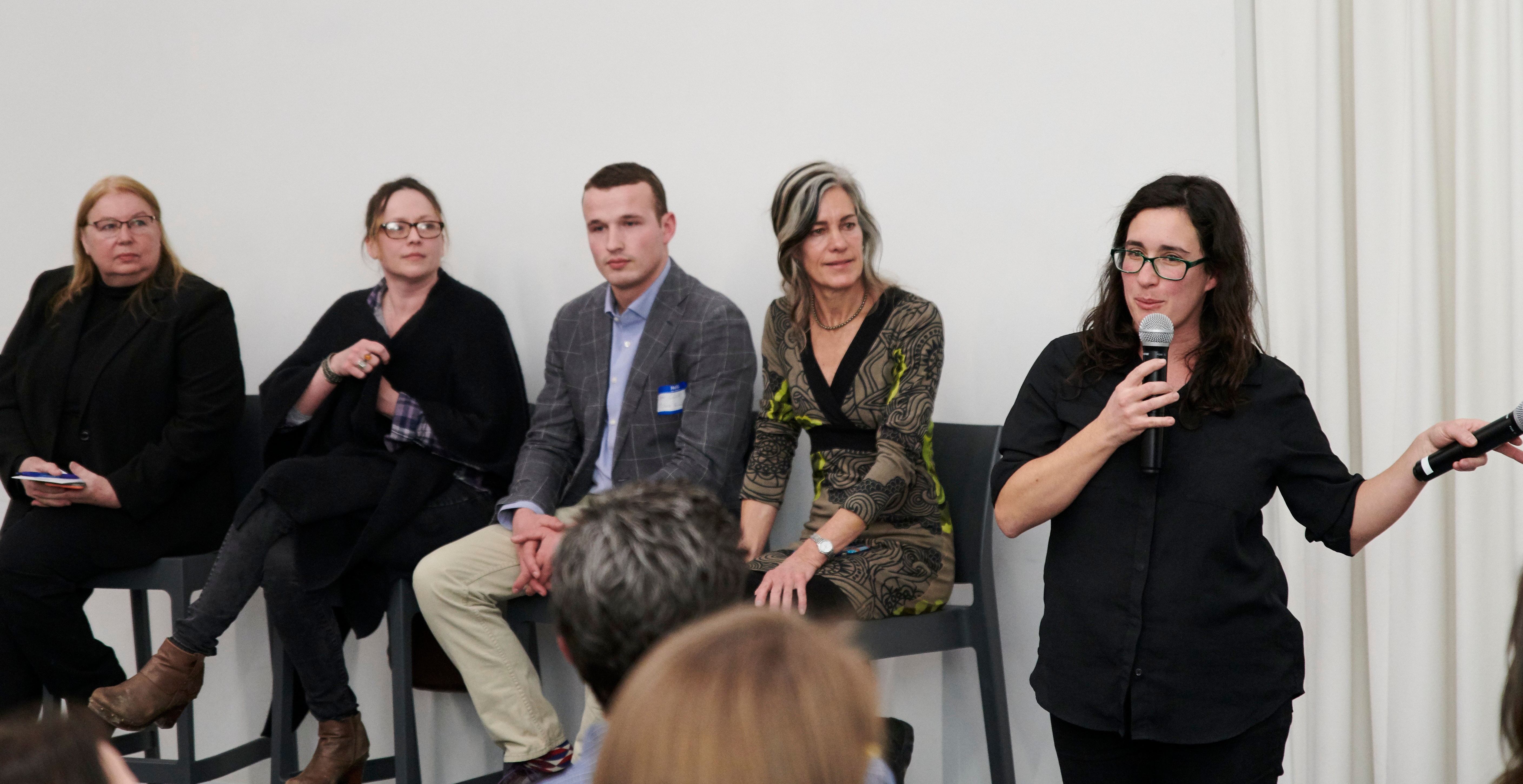
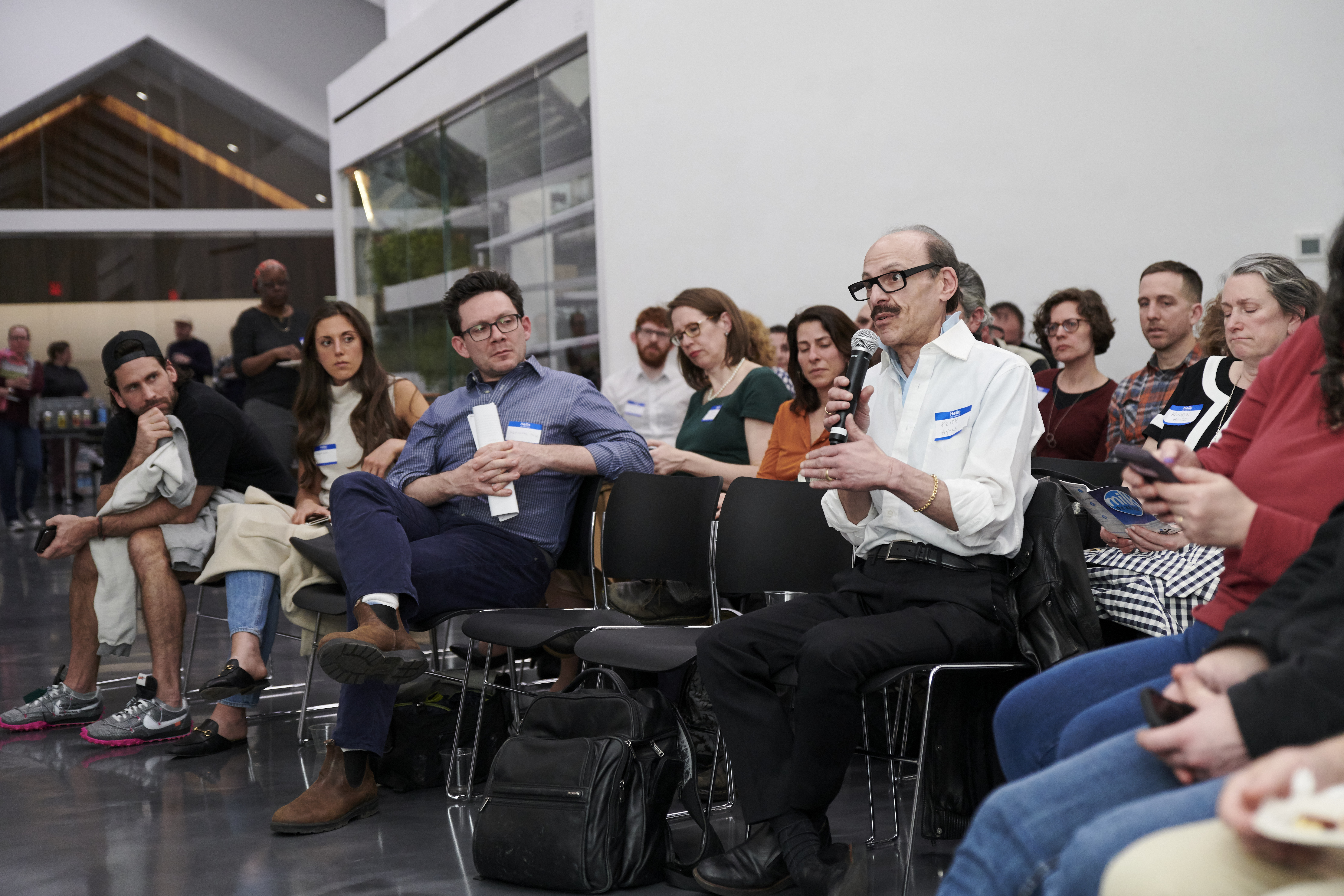
HARRISBURG, Pa. – Innovation on the dairy farm isn’t just the big investments that come to mind, but a mix of changes and a mindset to improve. Three distinctly different Pennsylvania dairy farms were showcased in a producer panel during the 2024 Dairy Financial and Risk Management Conference hosted by the Center for Dairy Excellence recently.

The audience of mainly ag lenders and industry representatives along with some fellow dairy farmers, had the opportunity to see how producers think through the challenges, progress, and investments, and how they manage their risk in areas such as herd health, feed and nutrition, as well as adversities they can’t control like weather, markets, and labor.
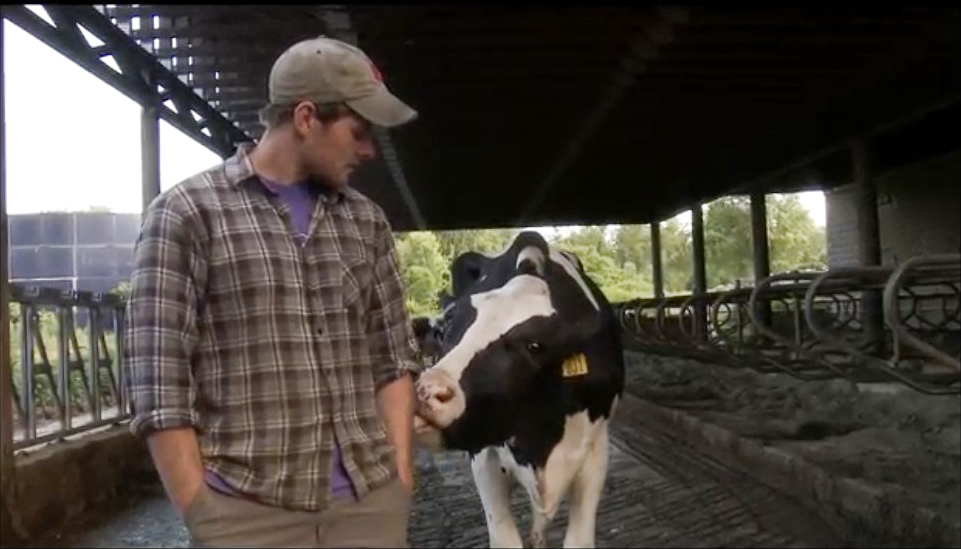
Automation at Oakleigh

For Matt Brake of Oakleigh Farm, Mercersburg, the five-year plan was accelerated in a different direction after a barn fire in December of 2019 forced the family to ask the question whether they would even continue in dairy. No animals were lost, and the 1950s parlor was saved, but they had big decisions to make about the future without a facility.

“We did a lot of praying and had a lot of difficult conversations,” he recalls.

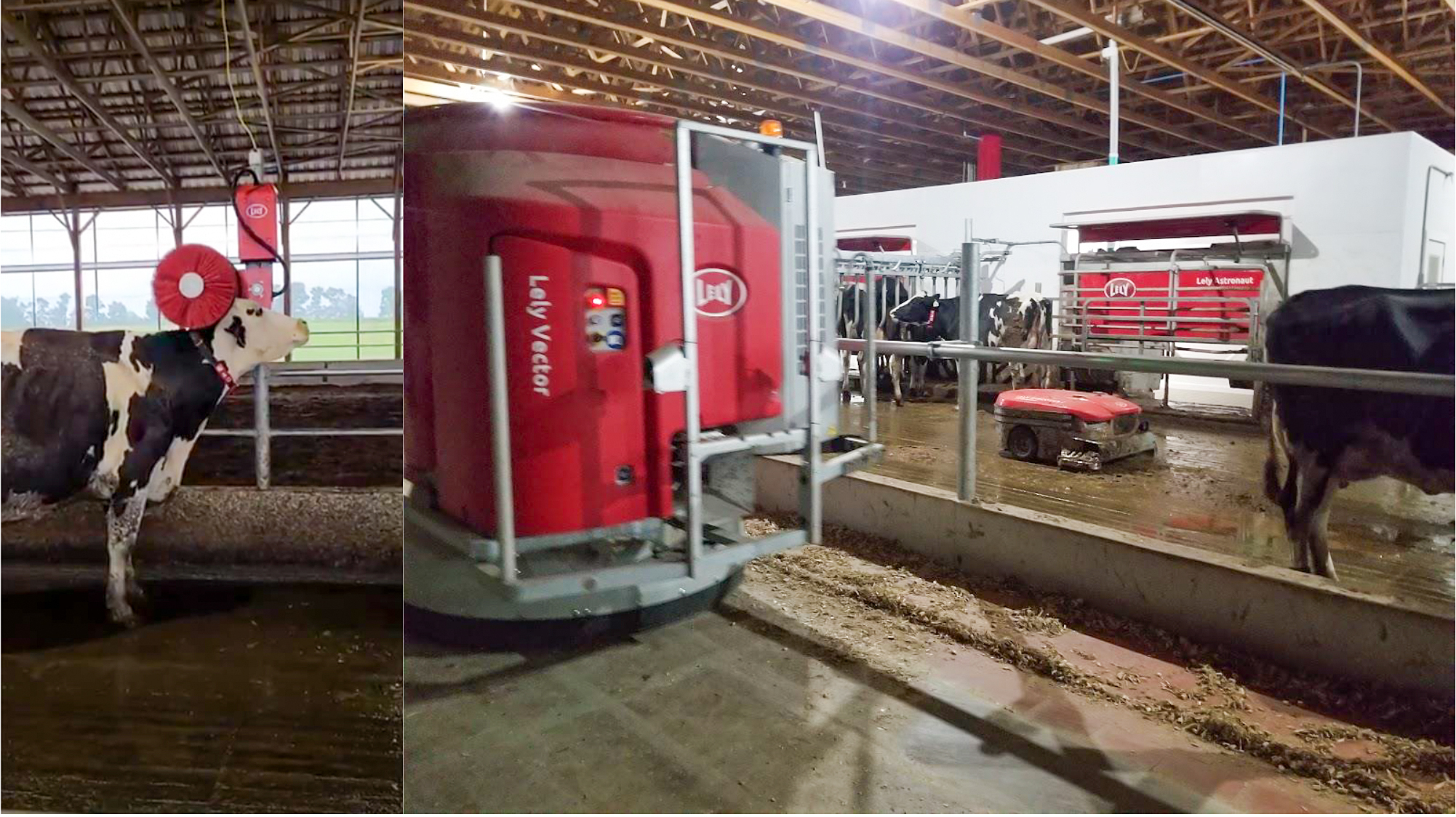
By July 2020, they were milking 120 registered Holsteins with two Lely robots, automated feeding, automated bedding, and retained their preference for a bedded pack barn rebuilt within the existing footprint.

“We really appreciate the cow comfort we get from a bedded pack, and the longevity, which is something we are really seeing now, more than ever,” Brake explains.

They didn’t know — at first – that they would go robotic, but they did know the Lely Vector feeding system would be used for feeding in place of buying a new tractor and mixer and firing it up twice a day.

“It’s amazing to see how all these different pieces of technology play together,” says Brake.

The curtains and fans are all automated and integrated. All data points for the herd are displayed on every single milking. The system ranks cows from zero to 100 on percentage chance of illness, and the automatic sorting for individual attention is based on things like activity, rumination, production, and intakes.

“Everything just plays together in real time, without guessing. We’re still involved as managers, but the data and automation are the tools we didn’t have before. We saw an increase in production, but farming is still farming,” Brake relates, giving examples of ration changes that had to be made with a forage quality issue, and how data systems helped with early detection.

Overall, the animals are doing better in this system, and they are treating fewer cows because they are getting to them earlier.

“It’s really true that an ounce of protection is better than a pound of cure. The quicker we can give those cows the attention, the less likely they are to really nosedive on us,” he says.

Brake sees how automation saves labor in some respects, but it’s more accurate to say that, “With automation, we are better utilizing our skills. We’re able to spend our time better with the cows or focusing on priorities – like chopping corn or getting the alfalfa harvested at the right time.

“We don’t have to stop those activities two times a day or worry about if we have enough help in the parlor, and do we trust that person to stand in the parlor. The robot might ‘call in sick’ temporarily here and there, but in general, compared with some of the employees we’ve had, it’s reliable.”

Moving from just the paper DHIA to incorporating this into the electronic records, changes how they manage culling to be more voluntary than involuntary.

“We can look at space and overcrowding and begin to evaluate cows not just on milk but how efficient they are in the robots looking at deviation from the average with rankings on everything from performance in the robot to reproductive performance and past treatments and other metrics,” he explains.

Better management of the culling decisions also gives them the ability to plan how many heifers to raise. “One of the things we are doing is using more beef semen and using the system to decide who to use it on,” he says.
Renovation at Mount Rock

For Alan Waybright, innovation was the focus when he purchased Mount Rock Dairy from the Mains five years ago near Newville.

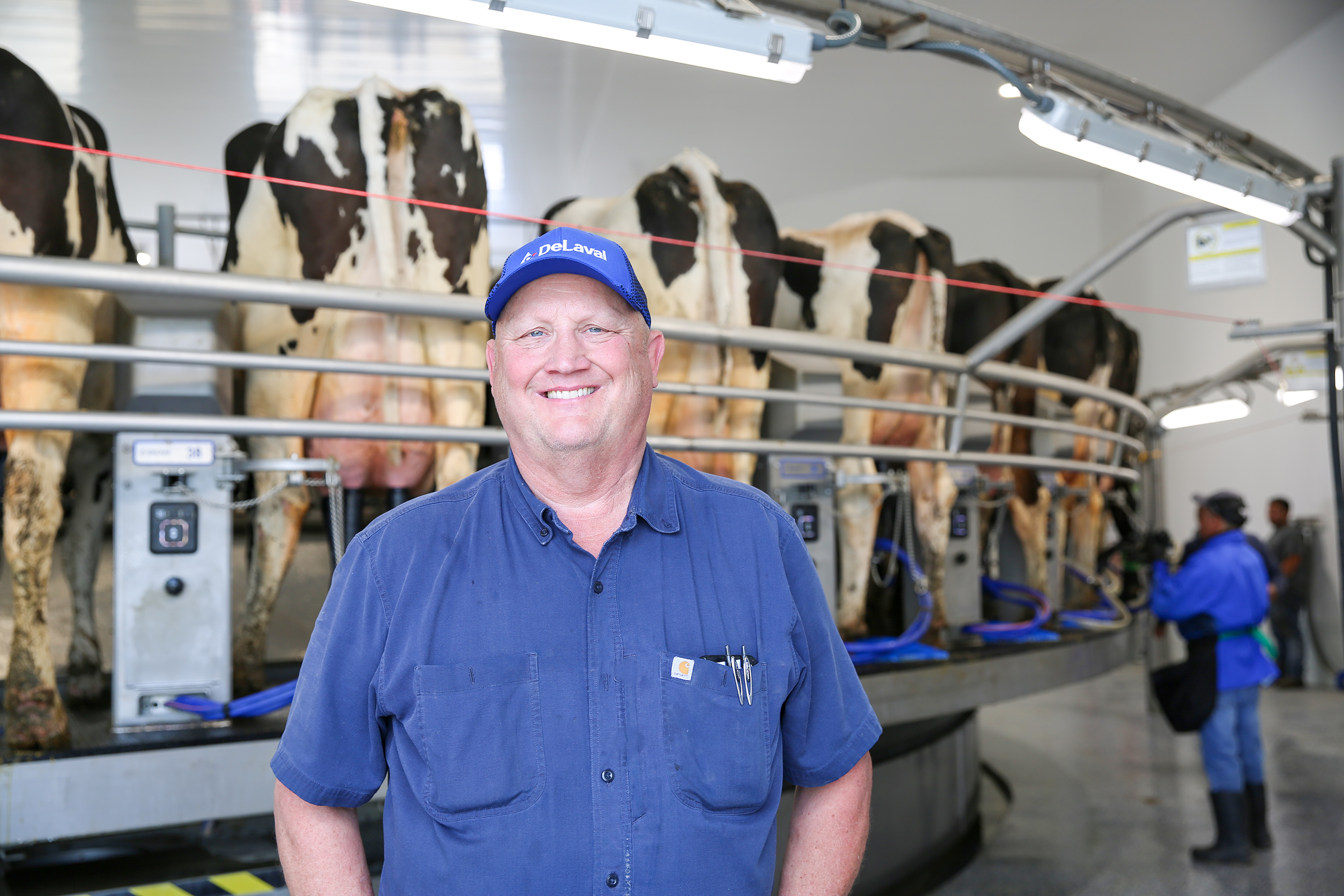
A building project was in order to update the over 30-year-old milking systems. About a year ago, they began milking in a 50-stall rotary, which changed the milking time on 2.5 times a day with each milking in a double-12 taking 9 hours, to now milking 4 times a day with each milking taking 3 hours and 45 minutes.

Waybright has been expanding from the 650 cows and 150 bred heifers he brought to Mount Rock from his prior home farm involvement at Mason Dixon, to milking 940 cows today with a 92-pound average, 4.2F and 3.3P.

Automation features were part of the rotary to reduce labor, and the calf barns include the wet barn to get them started before grouping for automatic feeders where they receive four to five feedings a day, resulting in healthier, better growing calves.

With the automated pre- and post-dipper, Waybright says the milking procedure in the DeLaval 50-stall rotary is very consistent, requiring just two employees, the first to wipe and forestrip and the second to dry and attach.

“This is a labor savings, yes, but there have been other benefits for udder health too,” Waybright reports. “When we went from the double-12 where we were hand dipping to the sprayer, a 50-gallon drum used to last seven days, now it’s three days.”

One of the innovative things he has worked on is the use of manure solids for bedding while keeping somatic cell counts low. His system uses two screw-presses dropping manure into the drum, leaving about two days’ worth of bedding at the other end with moisture levels around 50%.

They bed stalls every day during the week to use the solids as they come right out of the separator drum, adding acidifying ag lime to control mastitis.
Diversity key at Slate Ridge

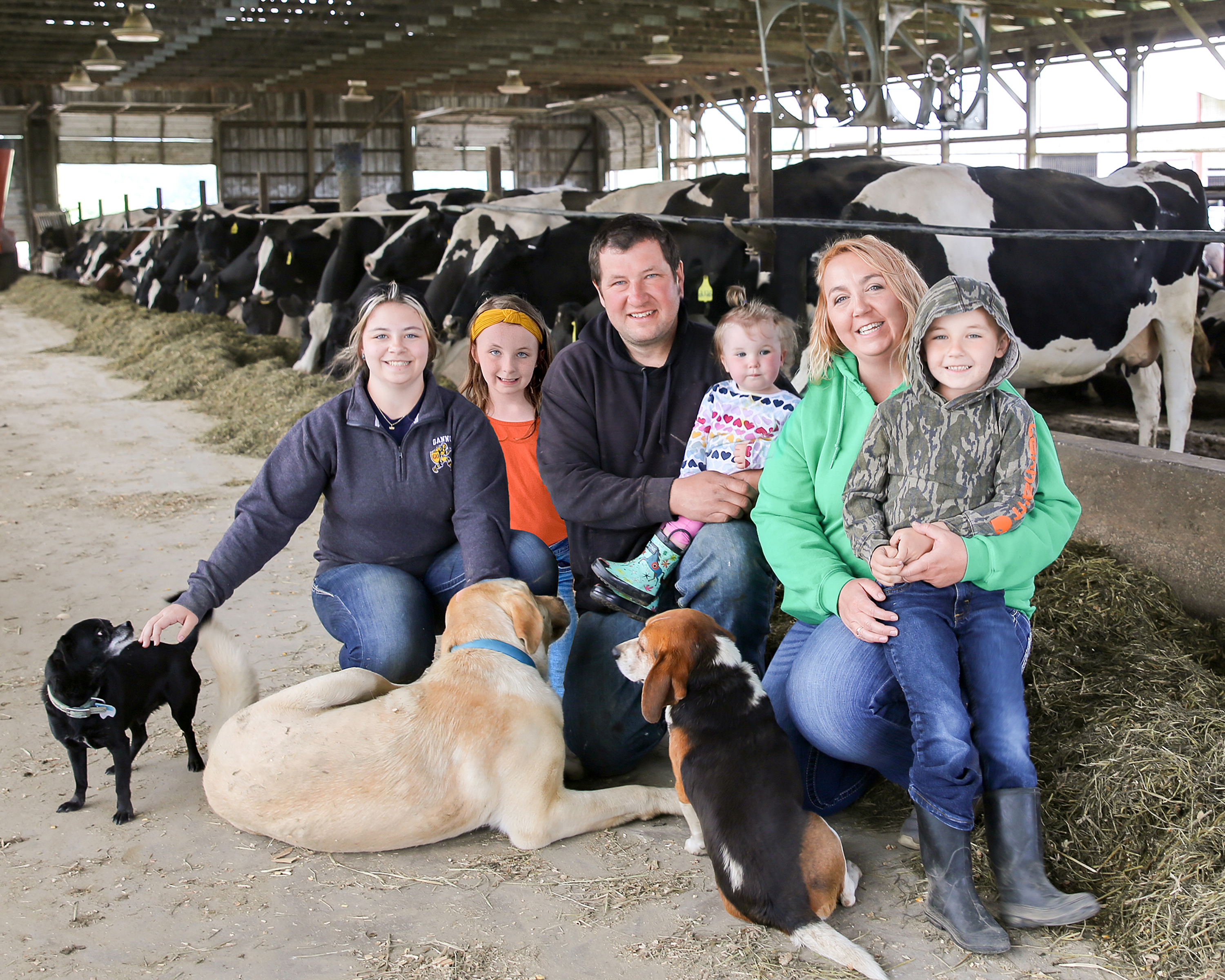
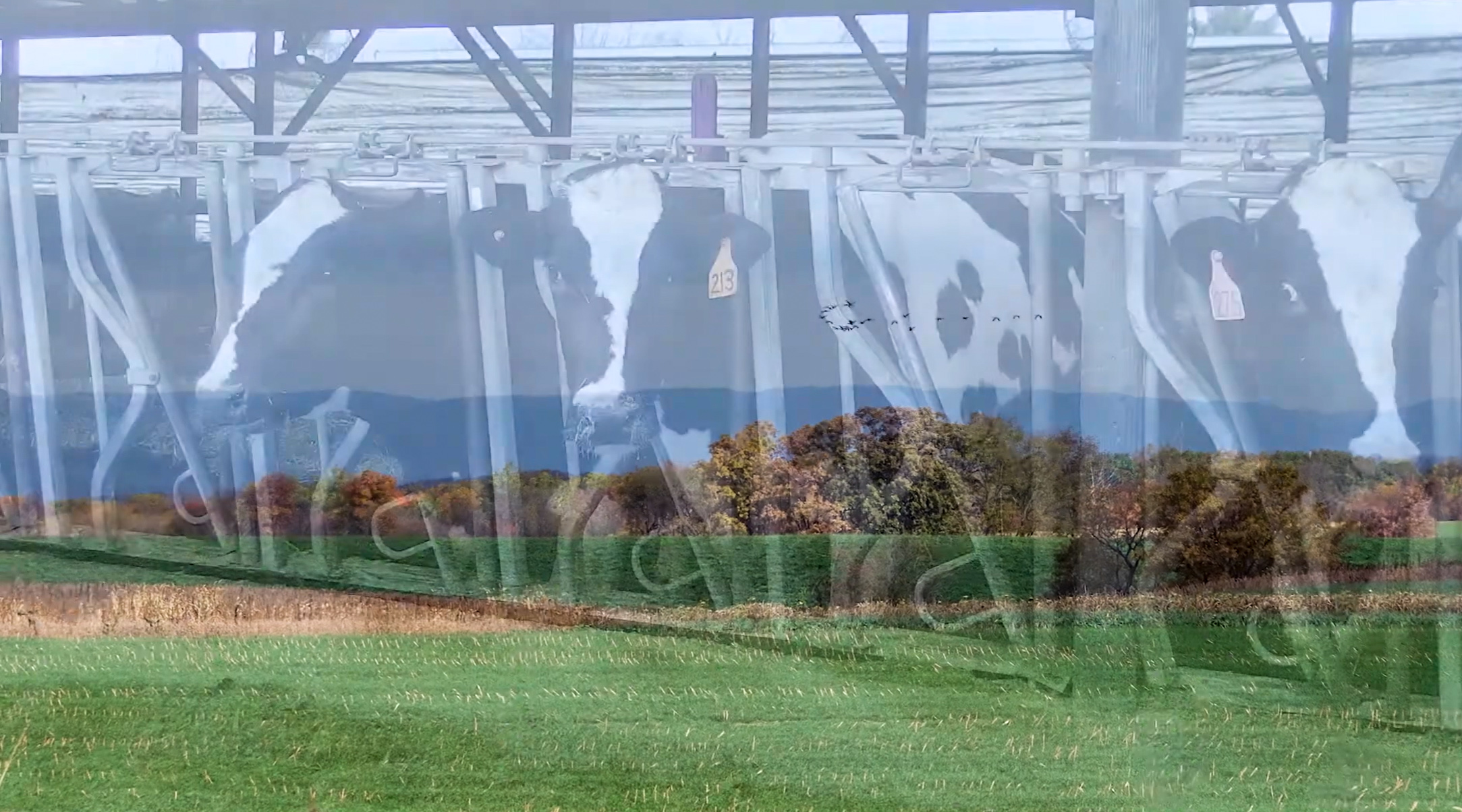
“For us the secret weapon is diversity,” says Ben Peckman of Slate Ridge Dairy, Thomasville. He and his wife and high-school aged children milk 150 cows and raise 100 heifers, also feeding out all bull calves as steers.

He says there’s not one multi-million-dollar investment here, just the things that altogether add up to make a large impact.

At the dairy, he looks for ways to streamline, like ovsynch for repro. “It’s the little pieces here and there, he says, mentioning the machine with a smart phone app he purchased to do daily dry matter analysis on feedstuffs before mixing.

“Instead of always looking at the past for those adjustments, I can go out and see what the DM is right now,” says Peckman.

He fills the small sampler with three samples to get an average. “I have feed charts on my phone, pop in that number, and it changes out what I put in the mixer to get the same DM pounds,” he explains.

With feed stored in drive over piles, this is even more important to get the accurate measures each day, according to Peckman, who sees how it changes daily, firsthand.

“On a rainy day, it goes up, and on a dry, hot day, it goes down,” he says. “When changes happen day to day, testing every two weeks is not enough. My spreadsheet smooths out the changes by using the average of the past three days. When we started doing this we saw better production and components.”

A robotic feed pusher is another feed technology that’s made a difference. “We see higher intakes, fresher feed, labor savings and the ability to do this when I’m not there,” Peckman relates.

Bankers asked what ‘calculus’ goes into making such investments. For Peckman, the answer was blunt. “It’s something that improves how my herd performs but the robotic pusher does something I’m not willing to do. I’m not getting out of bed at 2:30 a.m. to push up feed.”

Other barn updates include ventilation controls and ceiling fans above bed pack areas. It’s better for cow comfort but there’s also a cost savings. “We use half as much straw and bedding with the new fans drying the air.”

His wife’s mobile milk pasteurizer is another innovation. They always fed whole milk and had a few problems when they fed it unpasteurized.

With the mobile pasteurizer, it’s two-fold: “the milk is better, but also the temperature is much better. It keeps the milk warmer, and we have healthier, better growing calves.”

Peckman really enjoys the cropping side, farming 1100 acres of diversified crops to feed the cowherd and take advantage of other markets.

“Diversity is how I mitigate risk. It’s my key technology. Diversity can’t be bought, but it pays. It helps me combat weather, combat markets, and combat other adversities in general,” he says, adding that it’s “not rocket science,” just looking at things other farmers are doing and adapting.

He does use GPS guidance for his tractors for planting and spraying, which saves seed and inputs and work off field monitoring with yield maps.

In addition to traditional corn for grain and silage and alfalfa haylage, they grows high oleic soybeans at Slate Ridge Dairy. “We saw a drastic increase in butterfat percentage,” Peckman reports.  
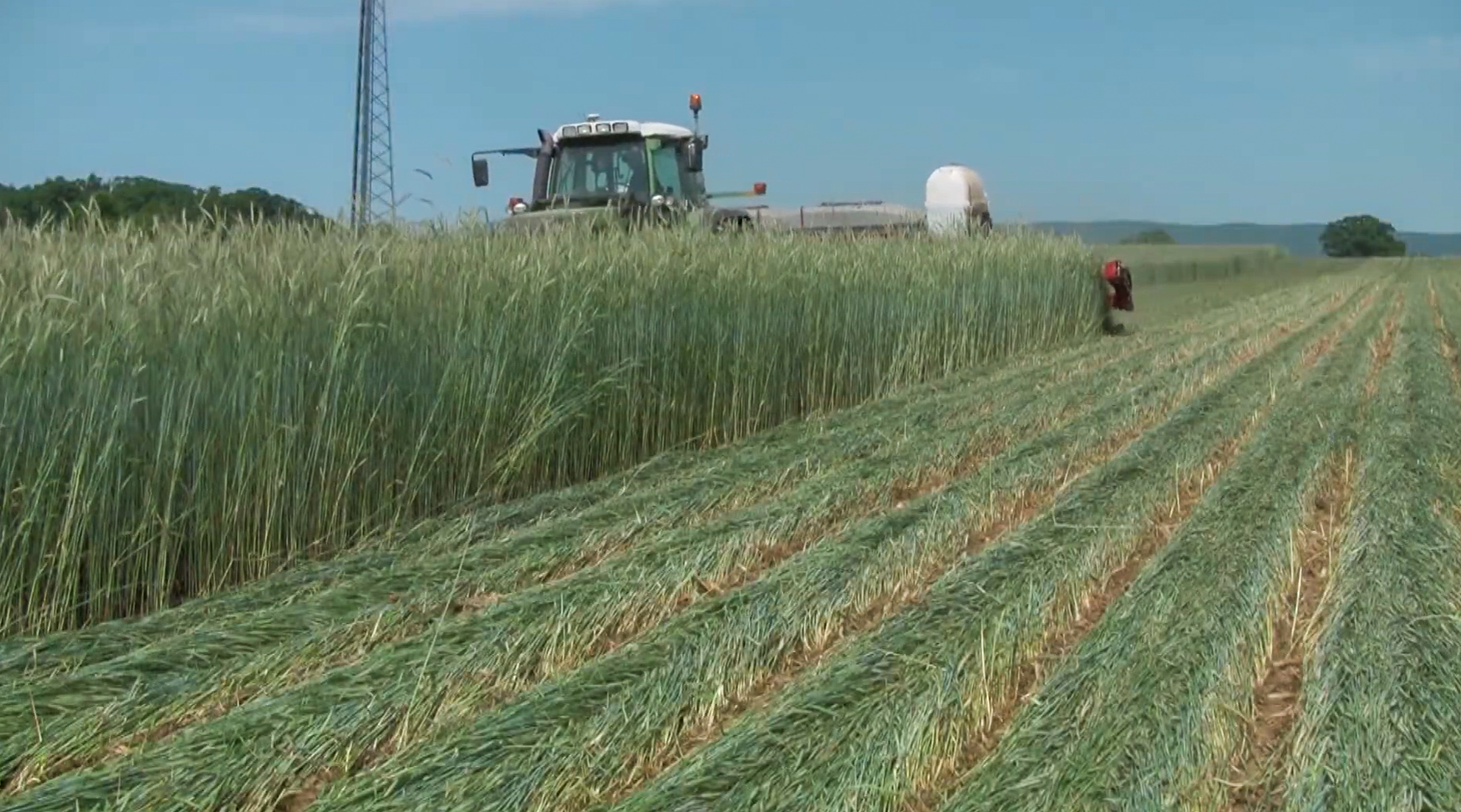
On his silage ground, small grains are grown — triticale, wheat, and barley. The barley he harvests after it gets the head, two weeks before it would be a grain harvest, as silage for feeding heifers.

One “big new innovation” he’s excited about is male sterile forage sorghum.

“It puts a head on without developing grain in the head,” Peckman explains. “This allows the plant to concentrate on putting energy into a plant that is a high sugar crop not a high starch crop. It’s very comparable to corn silage. I take a pound of corn silage out of the ration and put a pound of this stuff right in.”

He has replaced up to 40% of his corn silage with this particular sorghum silage and would like to get to 50% because “it’s a very economical feed to grow, the seed is cheap and inputs are less. It’s working well for me, but you have to have a way to harvest it as the BMR forage sorghums don’t ‘stand’ all the way to harvest.

“We started feeding this two years ago, and our components are up.”

Another newer crop in Peckman’s diversified portfolio is milo, or grain sorghum. He says it’s economical to grow and drought resistant, and they have a market for bird seed.

The wheat is grown as a cash crop but it has been fed too. The barley he harvests is a supplement for dry corn, depending on the year. He likes to grow these crops because they make good straw to bed the cows.

Peckman is a big believer in keeping his soil covered at all times, so some of the decisions and rotations are tweaked with weather and calendar. Over the past couple years, he has added a few acres of sunflowers to the crop rotations.

“We can double crop sunflowers after wheat, and there is a viable bird seed market for those,” he says.

“Mainly, they are beautiful, and I see people enjoying them. Nobody is paying me for that part of it, but it warms my heart to see neighbors stopping with the families, taking pictures and looking at my flowers. With everything going on in the world today, if I can see someone go out and smile a little, it’s worth it.”

Is there a middle ground for the greater good? Ultrasound operators still jailed, State provides some answers; Legal team responds

By Sherry Bunting, special for Farmshine, April 26, 2024 edition

HARRISBURG, Pa. — It has been two weeks since Rusty Herr, 43, of Christiana and Ethan Wentworth, 33, of Airville were arrested on April 10 and 11 and separately incarcerated in Lancaster and York County Prisons — their respective counties of residence.

As of April 24, both men are still in jail, without bail, and without seeing a judge.

“This is an unprecedented case of lawless persecution against two farmers who help other farmers with standard breeding practices, as is their right,” said Robert Barnes, Esq. of Barnes Law LLP, who accepted the case on April 17.

“The Pennsylvania Veterinary trade organizations conspired to protect their own monopoly in violation of the law and in a manner that has hurt farmers throughout Pennsylvania. The Pennsylvania Department of State (DOS), in a secret star chamber proceeding, ordered the unlawful imprisonment of Rusty Herr and Ethan Wentworth, who have still never seen an arrest warrant, heard the charges against them, had a hearing, or seen a judge,” Barnes continued in a statement provided to Farmshine Wed., April 24.

“In short, their due process rights have been obliterated. I will seek justice for Wentworth, Herr, and their families to the fullest extent of the law,” Barnes asserted.

The only dockets available for prior orders last week were two found on the website of the Pennsylvania Veterinary Medical Association (PVMA) as part of a package on their “advocacy” page asking members to file complaints with DOS by referencing the provided docket numbers, and then report back to PVMA so they can keep track. One was a 2010 docket with Herr as respondent and the other 2018 naming Wentworth. Both orders stated civil penalty, not criminal.

All other court and DOS system searches yielded nothing, and even those docket numbers came up “nonexistent.” 

In a PVMA press release dated April 19, the veterinary trade organization stated: “PVMA is unaware of the circumstances surrounding the arrest of two individuals on April 10 and 11 for contempt of court.”

And yet, in their 2020 Complaint that they had posted at their website before it was removed this week, the PVMA specifically stated: “Since these individuals continue to practice veterinary medicine without a license after their initial order to cease and desist, we request that the state file contempt charges with the Commonwealth Court. PVMA is able to supply additional witnesses upon request.”

Farmers, veterinarians and others in the dairy industry are discussing the case. Calls, texts and emails pour in from dairy farmers who appreciate NoBull Solutions and rely on them for breeding service.

Calls, texts and emails have also come in to make further accusations against the imprisoned men — none of which are mentioned in the PVMA complaint or their links to two previous civil orders, nor in any documentation provided now by the DOS.

After initiating a request for an interview on April 15 and submitting questions to the State Board of Veterinary Medicine on April 16, Farmshine received a few answers on April 24 from the Department of State (DOS).

On the current situation, the DOS responds: “We can neither confirm nor deny the existence of an investigation or matter.”

On the question of what hearing process may or may not have been available to Herr and Wentworth regarding past civil penalties and cease and desist orders, dockets were provided, one with Herr as the respondent in 2010, and one with Wentworth and another individual who has not been arrested named together as respondents in 2018.

“Speaking generally, the Department reviews every potential license violation of which it becomes aware, whether that is through a complaint filed directly to the Department, a notification from local law enforcement or through media reports. After review, a determination is made as to whether formal action is warranted,” the DOS press office explained in their email response. 

The long and short of the DOS response here is that all respondents have due process at some point, which includes notice and an opportunity to participate in those original proceedings, call witnesses, introduce evidence, and testify on their own behalf.

Herr and Wentworth did so, on their own behalf, without legal counsel, in 2010 and 2018, respectively, according to the documents provided by the DOS.

However, they were not noticed since then by the DOS, and nowhere in the responses from DOS or the adjudications they provided is an automatic 30-day prison term without bail stated as a consequence for “continuing to violate the Act” by ultrasounding cows they do not own. No proof of the process has been shown in the responses from the DOS apart from the 2010 and 2018 actions.

On the question about where pregnancy and diagnosis are linked in the law or regulations, the bottomline is they are not. The State Board of Veterinary Medicine decides this through adjudication and orders as the legislature grants the Board this authority.

“The Board adopted the position that, ‘both the performance of a surgical procedure, such as the Gymer/Stemer Toggle Suture Repair, and the diagnosis of a physical condition, such as detecting through ultrasound whether an animal is pregnant, constitute practice of veterinary medicine,’” the DOS reported, adding that the Act contains an exception for any person or an employee of that person or agent while practicing veterinary medicine on his or her own animals. (What constitutes an ‘agent’?)

The DOS included a copy of an Amended Adjudication and Order, Docket No. 2296-57-09, which came before the State Vet Board with Herr as respondent in May of 2010. Performance of toggle on six animals he didn’t own and performing ultrasound for detection of pregnancy on animals he didn’t own were both listed specifically in the determination of civil penalty.

This was 14 years ago, and the docket from 2010 confirms that Herr responded to say he is “no longer toggling other people’s cows.”

The amended adjudication goes on to explain “should the respondent continue to violate the Act, he may be subject to the imposition of a $10,000 civil penalty per act or practice.” 

Nowhere does it mention automatic 30 days in prison for continuing to detect pregnancy through ultrasound.

For Wentworth, the docket history supplied by the DOS began Sept. of 2017 while he and another named individual, who has not been arrested, were previously employed by Select Sires. Docket No. 1928-57-17, simply states “Respondents engaged in the practice of veterinary medicine without being properly licensed to do so under the Act” and describes this as “performed pregnancy examinations on cattle using ultrasound equipment.”

Both responded, and this led to a formal hearing, eventually in April of 2018, when the state’s expert witness, a University of Pennsylvania professor, could be available. 

Both respondents appeared without representation. They testified on their own behalf and were cross-examined. In May 2018, the matter was closed and determinations were made that both men used ultrasound equipment to “determine pregnancy of customers’ cows” and to “determine if cows were in heat or had other medical issues.”

Noted in the history is this statement that begs more questions: “The economic savings to the cow’s owner, based on a positive pregnancy or negative heat result, are outweighed by the risk of harm to the cow posed by the unlicensed practice (of ultrasound).”

That brings us to April 2024, which the DOS will not comment on.

What we are left with on that is a downloaded copy of the PVMA complaint requesting contempt charges via the Commonwealth Court. Attached to the complaint were pictures from the arrested men’s facebook pages showing ultrasound pregnancy detection.

Bottomline, according to the DOS response: “The State Board of Veterinary Medicine is responsible for enforcing the Veterinary Medicine Act as enacted by the General Assembly. Questions about the provisions of the Act (including the exception in 63 Stat 485.32) should be directed to the legislature.”

This response makes the timing and manner of the arrests more curious, coming six months after the Pennsylvania House Ag Committee opened discussion to look at ways to address the statewide shortage of large animal veterinary practitioners, including the Veterinary Practice Act to see if modifications are needed for a “middle tier” to help Pennsylvania farmers cope.

For veterinary practices, the economics are increasingly difficult in attracting and keeping practitioners and vet technicians in the large animal domain. Their financial and time investments are significant, often graduating $250,000 in debt, and the trend is for more to go into small animal practice with pets to realize a return.

“No large animal practitioner is doing this — for the money,” said one central Pennsylvania vet.

Farmers identify with that. They have significant investments, see their costs rising, and in much of the state, see fewer large animal vets and prohibitive costs for basic services from consolidating companies on small farms vs. large ones, so they look for options, including doing more themselves.

“We have good vets, and I have done some ultrasounding with Rusty, but my vet comes in for herd health, and I keep a good relationship with my vet,” said a dairy farmer from Kirkwood in a Farmshine call April 24.

“Rusty is not trying to take work from vets. He is just trying to help the farmers and provide service for them. He has supported me 100% to help me make breeding decisions in my herd. He will even suggest a mating to a bull outside of his genetic lineup. Instead of just trying to get more business for himself, he highly encouraged and helped teach me how to inseminate my own cows. He’s a mentor and true hero. If anything, he’ll come out of this stronger,” the Kirkwood dairyman continued.

There must be middle ground here. Clarity, transparency and solutions are needed.

“As farmers, we put our bodies and souls into this. As everything consolidates in this industry, how do we compete? This is what extinction looks like,” said Ben Masemore, an eastern Pennsylvania dairy farmer and friend of Herr and Wentworth, who is involved in NoBull Sires, a separate business from NoBull Solutions.

He shared a partial statement written by Herr from his prison cell.

“To this day, we have never once had a farmer or caretaker complain to the state about any single issue. I know that we have a tremendous amount of support behind us, and I realize this will all get resolved. I will be a better husband, father, and person because of this entire experience, and for that I am grateful,” wrote Herr.

He expressed his hope that fair-minded people “can come together… to create a level playing field, one in which we can all work together for the greater good of the industry… I hope and pray that good can come out of this and that someday we can all look back on this time as a steppingstone for meaningful and lasting change.”

Thanking the NoBull team and supporters, and grieving what the families are enduring, Herr wrote: “Thank you all so very much for your coveted prayers and support. Thank you for your financial generosity. Keep the faith and be strong, God is always good. This will all be over soon.”

NoBull Defense Funds have been set up at two local banks to help with legal defense to get them home. Separately, an online fund has raised over $17,000 so far at https://www.givesendgo.com/nobull?utm_source=sharelink&utm_medium=copy_link&utm_campaign=nobull

-30-

Does a watched pot boil? National Refuge proposal ‘paused’ in NW PA and SW NY; Fish and Wildlife says new draft coming

AUTHOR’S NOTE: National Wildlife Refuge designations and land protection plans are long-simmering recipes, so it’s important to keep eyes on the pot while the heat is presumed to be turned down. Will a watched pot boil? One thing to keep in mind is to look overseas at the Netherlands, where the government, thrown this week into disarray to where the farmer-citizen party may gain strength, has been using climate-based targets to begin pushing buyout or closure of an estimated 3000 farms. Dutch farms have been zoned for a range of production-cuts from 15 to 90% with options to sell their land to the government. The Dutch farms identified for the largest production cuts of 75 to 90% would obviously be economically unsustainable and therefore more apt to sell. These are the farms that are located closest to EU Nature Preserves that were designated decades ago. When I spoke with a Dutch dairy farmer last year about this, he explained that the nature they have has been built, improved, by the farmers, but those close to the network of EU preserves are in the current crosshairs. Yes, these are long-simmering recipes. Here in the U.S., Northwest Pennsylvanians are being told it will take decades to complete a land protection plan if a French Creek National Wildlife Refuge is eventually designated for the watershed by the U.S. Fish and Wildlife Service Director. They are told that farming can continue, that they want to ‘help’ local conservancy efforts and that only willing sellers would be pursued. That’s not how it went when the Erie Refuge was completed at the center of the French Creek watershed in the 1970s. Some saw farmland fall to eminent domain two decades after that Refuge was established.
Bottomline: Keep an eye on the pot, even if doing so draws accusations of claiming a tepid pot is about to boil. Every cook knows what happens when looking away. Here’s an update since the meeting between elected officials and the U.S. Fish and Wildlife Service.

By Sherry Bunting, Farmshine

MEADVILLE, Pa. – The U.S. Fish and Wildlife Service (USFWS) has “committed to a ‘pause’ and will draft a new proposal that could potentially limit the size and scope of a National Wildlife Refuge in the French Creek watershed,” according to a press release from Congressman Mike Kelly’s office.

The proposed refuge and concerns shared by farmers were first reported in the June 30 Farmshine, followed by a more detailed report in the July 7 edition.

Congressman Kelly and elected officials from affected counties met on July 6 at the Crawford County Courthouse in Meadville to discuss the proposed Refuge with USFWS representatives Vicki Muller, the project manager, and Mark Maghini, a realty chief.

This comes after the ‘public scoping’ phase where opposition and concerns were raised by farmers, members of Congress, county leaders, local residents, as well as questions about its necessity being raised by those involved in local land trusts and conservation efforts already operating in the watershed.

The ‘planned Refuge’ would create new federal ownership and oversight of lands in the watershed of nearly 800,000 acres along the 117-mile French Creek through portions of Crawford, Erie, Mercer and Venango counties, Pennsylvania and Chautauqua County, New York.

According to Congressman Kelly’s office, the USFWS acknowledged it did not properly engage and inform the communities of impact and will include elected officials in future planning.

“A pause on the proposed French Creek National Wildlife Refuge is absolutely necessary. Officials from the U.S. Fish and Wildlife Service have told us there is no official plan or size for this refuge, and I believe that’s exactly the problem — this has been a solution in search of a problem with farmers and landowners caught in the middle. The federal government does not need to have control of French Creek,” said Rep. Kelly in the statement.

“We all support a healthy and vibrant French Creek, but I believe local conservation efforts are already accomplishing what the USFWS is trying to do,” he noted.

Nothing to see here. Just go about your business…

Meanwhile, Maghini, the realty chief (land acquirer) for the Northeast region of the Fish and Wildlife Service indicated in an email to the Meadville Tribune that there is “no proposal,” pointing to a June 4 update at the special webpage for the project with these words highlighted in bold type.

He insists that the goal of the meetings and input-gathering this spring was to “identify whether there’s a role USFWS can play in the French Creek watershed.”

However, the agency’s own documents at the site show it already has a plan and has identified the next steps, which indicate it is already in the process of evaluating those public comments to develop a final proposal, which had a summer 2023 timeline.

Specifically, the “Schedule for Establishing the Proposed French Creek National Wildlife Refuge” on the second page of the May 9 FAQ document at the project webpage, is as follows:

1) Develop draft Land Protection Plan (LPP) and Environmental Assessment (EA) in the Spring of 2023;

2) Conduct public review and comment on proposal in the Spring of 2023; and

3) Evaluate the comments and develop the final plan for approval in the summer of 2023.

The customary procedure is for comments from the public scoping phase to be used when USFWS develops a land protection plan and environmental assessment. The ‘pause’ may extend this schedule to allow more time for the agency to evaluate the comments it received and to include elected officials in its planning.

Whenever a final plan is developed, the public then has 45 days to review and comment before it is ultimately left to the USFWS director, who has the sole authority to approve or disapprove a plan, according to the agency’s FAQ.

Residents tell Farmshine they hope a new draft provides more detail and a much smaller scope, but they also hope the ‘pause’ allows time for more public input on whether or not the Refuge designation is even needed.

The designation of the French Creek as 2022 River of the Year by Pennsylvania Organization for Watersheds and Rivers came largely due to the success of the existing local conservation efforts in promoting the health and biodiversity of French Creek in the first place, they say.

This brings the feeling that one can farm for generations, keep the working lands clean and natural, and then find out this can lead to being more, not less, vulnerable to having a Refuge designation with potential impacts for the future.

Pennsylvania Farm Bureau legislative director Nick Mobilia said as much to the Corry Journal: “I feel we have presented our issues with the refuge as positively as we can. We asked what USFWS thought was wrong with the waterway — they did not have any areas of concern.

“We as a local collective maintain French Creek and take pride in it — of course we are going to fight for it to be left as it is,” he said. “I think this was realized on (July 6) and (USFWS) will walk away from French Creek and focus on waterways that do need the government’s help.”

Will USFWS walk away? Doubtful.

Maghini, the USFWS realty chief for the region told the Meadville Tribune Friday (July 7) that the agency “looks forward to working with local officials once a plan that incorporates local feedback already collected has been prepared.”

Interestingly, the title of the FAQ document on the project webpage refers to the project as a “Proposal to Expand Refuge Lands in the French Creek Watershed.” 

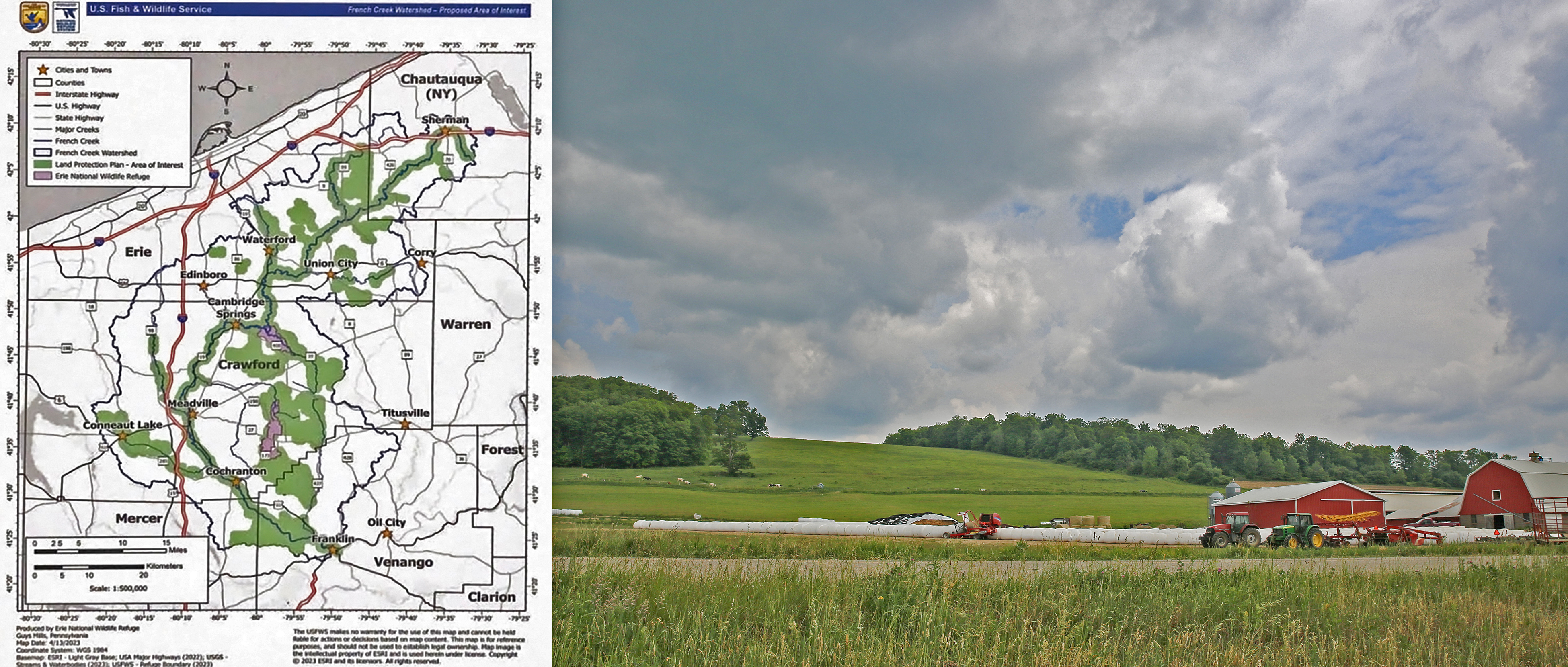
This reference to “expansion” is significant. At the center of the land protection plan “areas of interest” on the USFWS conceptual map (above) lies the already existing Erie National Wildlife Refuge (shaded pink within the green). Previously managed by Muller, the existing Erie National Refuge encompasses 8,777 acres of the 798,000-acre French Creek watershed.

At public meetings this spring, a farmer recalled his family’s farmlands eventually falling into eminent domain in the 1970s – more than a decade after private lands within what is today the Erie National Wildlife Refuge were originally designated by the USFWS in the late 1950s. 

According to local newspaper accounts, Muller responded by telling the crowd that the USFWS “doesn’t do that anymore.”

The other significant aspect of ‘expanding’ an existing refuge vs. declaring a new one is that the Inflation Reduction Act provided climate resiliency and biodiversity funds for 2023 through 2026, including more than $121 million to the USFWS for restoration, rebuilding and expansion of existing wildlife refuges and $125 million for endangered species recovery.

The latter identifies 32 initial plant and animal species to be recovered “wherever found.” One, for example, is the snufflebox mussel with one area shown on its map as the French Creek watershed.

Will the public get more input? Will it help?

USFWS documents explain that when land protection plans are drafted and approved, they include land acquisition timelines that follow a “Landscape Conservation Design to ensure actions contribute to the landscape-level vision.”

Will a ‘pause’ give farmers, landowners and communities more say in the vision for their landscape, one they want to retain locally? Will the USFWS commitment to include elected officials in the planning happen before or after the new draft is presented?

Revamped ‘live text’ at the special webpage for the proposal notes that the USFWS review of public comments in April and May boil down to the following beliefs held by residents that USFWS says it agrees with: 

1) Residents have a deep affection for French Creek; 

2) They believe maintaining use of prime agricultural lands is important; 

3) They value the rural character of the watershed and want to ensure its persistence; and 

4) They value local land trusts within the community and trust them in their land protection efforts.

USFWS states further that a National Refuge designation is what authorizes the agency to pursue the land acquisitions from willing sellers and that it does not detail how USFWS would manage the lands it acquires through fee-title or easement. 

USFWS also states that it does not fund local conservation efforts because it must show a dollar of federally-acquired land for every federal dollar it spends.

However, within this two-page “Proposal to Expand Refuge Lands,” the agency lists goals for “new refuge lands” (beyond the existing Erie National Refuge) that would allow the agency to “protect and manage the French Creek and its tributaries and wetlands.”

It also purports to “help” local conservancies by adding federal acquisitions to local acquisitions since none of these entities have access to unlimited funds. The only way it can “help” is to federally acquire land.

The U.S. Fish and Wildlife Service is a Bureau within the U.S. Department of Interior that operates in a quasi-independent fashion, having federal authority to establish and manage protected lands within its National Wildlife Refuge System, and to complete approved land protection plans over subsequent years, through its Land Acquisition and Realty division.

According to that division’s section of the USFWS website, funding for land acquisition comes from the Migratory Bird Conservation Fund through federal Duck Stamps and import duties on arms and ammunition as well as through the Land and Water Conservation Fund from offshore oil and gas leases.

In 2021, at the start of the Biden Administration, the USFWS updated its “Climate Adaptation Strategy” to be a framework that is part of the Administration’s “U.S. Climate Resilience Toolkit.” 

Several documents available at the USFWS website explain that this toolkit has now equipped USFWS to “take immediate action to build ecosystem resilience in the face of climate challenges.”  

As noted in the previous Farmshine articles, this is a process that moves at a snail’s pace — with or without a ‘pause.’ 

The ‘pause’ is expected to move the project from the front-burner to the back-burner — for now — amid the public heat surrounding it, but this doesn’t mean it is off the stove.

National Wildlife Refuge designations and land protection plans are long-simmering recipes, so it’s important to keep eyes on the pot while the heat is presumed to be turned down. Does a watched pot boil?

-30-

Photos by Sherry Bunting

Northwest PA farmers fear future land-grab as U.S. Fish and Wildlife proposes Refuge designation for 798,000 acres of French Creek watershed

PREVIEW – By Sherry Bunting, Farmshine, June 30, 2023

WATTSBURG, Pa. — Kevin and Amanda Bush are fourth generation dairy farmers with their children Ava, 17, Clara, 6, Jarrett, 5, Georgia, 1, and 110 milk cows. On an early June day, unseasonably cold even for Erie County, Pennsylvania, a visit to the Bush Family Farm shed light on farmers’ concerns about a U.S. Fish and Wildlife Service proposal to designate 798,000 acres of French Creek watershed as a National Wildlife Refuge. Potential land acquisitions could begin a year from now if approved by the USFWS Director later this summer. Mark Muir from Erie County Farm Bureau, who raises hay and livestock, and Brian Young, whose extended family operates a nearby seventh generation farm were part of the discussion of the proposed protection area that would stretch 117 miles from Chautauqua County, New York south through Erie, Crawford, Mercer and Venango counties, Pennsylvania. The region is home to farms and other businesses that are the lifeblood of rural towns and counties. They use conservation practices and a lot of grazing and haying, with a vested interest and pride in their stewardship and relationships with existing conservation efforts. 

On a map showing land protection ‘areas of interest,’ whole farms are included, not just setbacks (see map in main story below). This includes many dairy farms ranging from small herds managed by young next-generation farm families, like the Bushes, to larger farms with multiple generations of families involved. USFWS wants to purchase land or use permanent easements for whole farms. ‘You can still farm it,’ they say. But when specific questions were brought to an April meeting, the locals came away with very few answers. They anticipate another meeting in July. 

Why are farmers concerned? They fear future use of eminent domain and farming restrictions as dominos start to fall. A National Refuge designation with Land Protection Plan, is perpetual. They fear the loss of rented ground to feed their cows. They worry about their towns and counties. They want to know the minimum goals of the project so they can have an intelligent conversation with USFWS. They have asked for scientific studies to be shared that show how the freshwater mussel population and other aquatic life are actually doing today vs. 10, 20, 30 years ago.

It feels like the start of what could become a gradual 30 x 30 land grab. Surely, if this was happening in agricultural communities of southeastern Pennsylvania along the Susquehanna River in the Chesapeake Bay watershed, instead of northwestern Pennsylvania in the French Creek watershed, there would be much more attention paid. See main story below as published in July 7, 2023 Farmshine, and stay tuned as we follow this developing story.

They say National Refuge for mussels will move at snail’s pace, but farmers see muddied water ahead

MAIN STORY – By Sherry Bunting, Farmshine, July 7, 2023

WATTSBURG, Pa. — The rural French Creek watershed is in the sights of the U.S. Fish and Wildlife Service for a proposed National Wildlife Refuge that could span nearly 800,000 acres, stretching 117 miles from the headwaters in Chautauqua County, New York across the Pennsylvania border through Erie, Crawford, Venango and Mercer counties.

Meetings this spring in Meadville and Edinboro were part of the ‘public scoping’ phase. They were packed with citizens and fraught with questions, deep concern and objections. 

An initial public comment period ended May 19.

From the Southwest corner of New York through the Northwest corner of Pennsylvania, the French Creek river and watershed runs through rural communities where farming is the lifeblood. If this potential land-grab were happening in southeastern Pennsylvania in the Chesapeake Bay watershed, more attention would be paid to the concerns of the farmers and communities.

Vicki Muller, the proposed Refuge’s project manager, told local television station FOX-66 that the U.S. Fish and Wildlife Service (USFWS) is “looking to protect and preserve more wildlife habitat within the French Creek watershed, so this plan is just the beginning stages of that.”

Mentioned were freshwater mussel species, said to be the only populations east of the Mississippi, along with several species of fish, wetlands, and migratory waterfowl.

Land acquisitions are about a year away, Muller confirmed.

Farmers and other community members, along with managers of existing conservation efforts, say federal land acquisition is not necessary to meet environmental goals because those who are living, working, farming in the region already work with local conservationists to manage the land in ways that have been recognized for success.

French Creek was named Pennsylvania’s “River of the Year” in 2022. 

Opponents of the Refuge argue that its designation could place federal regulation on private landowners for perpetuity. They say an accompanying Land Protection Plan (LPP) could take properties and money off local tax rolls, move land ownership away from local residents, and take products generated on the farmland away from local communities, weakening the region’s economy and food security.

To top it off, USFWS could offer no evidence that this would improve — at all — the status of French Creek and its aquatic life, nor any evidence that either are in trouble.

USFWS is currently in the process of reviewing public comments and stakeholder feedback and is developing a final plan for approval by the USFWS Director later this summer, according to a Q&A document at the webpage devoted specifically to the French Creek proposal at https://www.fws.gov/project/evaluating-new-refuge-lands-french-creek-watershed

A June 4 ‘Public Scoping Recap’ is also provided at this webpage, stating the proposal is not yet an official proposal because it is still in the ‘public scope and biological environmental assessment’ phase.

The webpage indicates that the framework would be built after they get the buy-in, after they get the National Refuge designation and LPP approved, and after they complete the biological environmental assessment. That’s when officials say they can answer the probing questions of locals about environmental and land acquisition goals.

Isn’t that putting the cart before the horse?

One of the strategies being used here is to protract the conversation and soothe public concern with assurances that the Refuge to save mussels will move at a snail’s pace.

Essentially USWFS is looking to designate land now for decades of acquisition and that it will answer specific questions as the process moves forward working collaboratively to refine the plan after the designation and plan are approved.

Such circular talk makes farmers and landowners skeptical, uneasy.

Within the “land protection areas of interest” on the ambitious map, there are both small and larger farms, many of them dairy farms as well as beef cattle, crop and produce growers.

“I started looking at the map, and I see I am an area of interest. Everything I own is an area of interest,” said Mark Troyer, a potato, corn and wheat grower, in an on-camera interview during the Edinboro meeting. “I think we can work and live hand-in-hand (with wildlife) and have been doing a great effort. We’ve already been doing a great job.”

Concerns about eminent domain were specifically raised. Muller stated this will not happen. 

Landowners are not convinced. They want to know the endgame. 

They want to know what happens once there is an approved LPP with specified land acquisition timelines. What happens to their farms if they are eventually surrounded by acquired land? What happens to the farms outside of the areas of interest that will find themselves next to a National Refuge? What is the ultimate land acquisition goal?

What are the actual environmental goals, and why does the federal government need to acquire the land to meet those undisclosed goals, instead of supporting existing local conservation efforts that show measurable success?

They share the concern that once the designation and LPP are approved, this could take on a life of its own… forever.

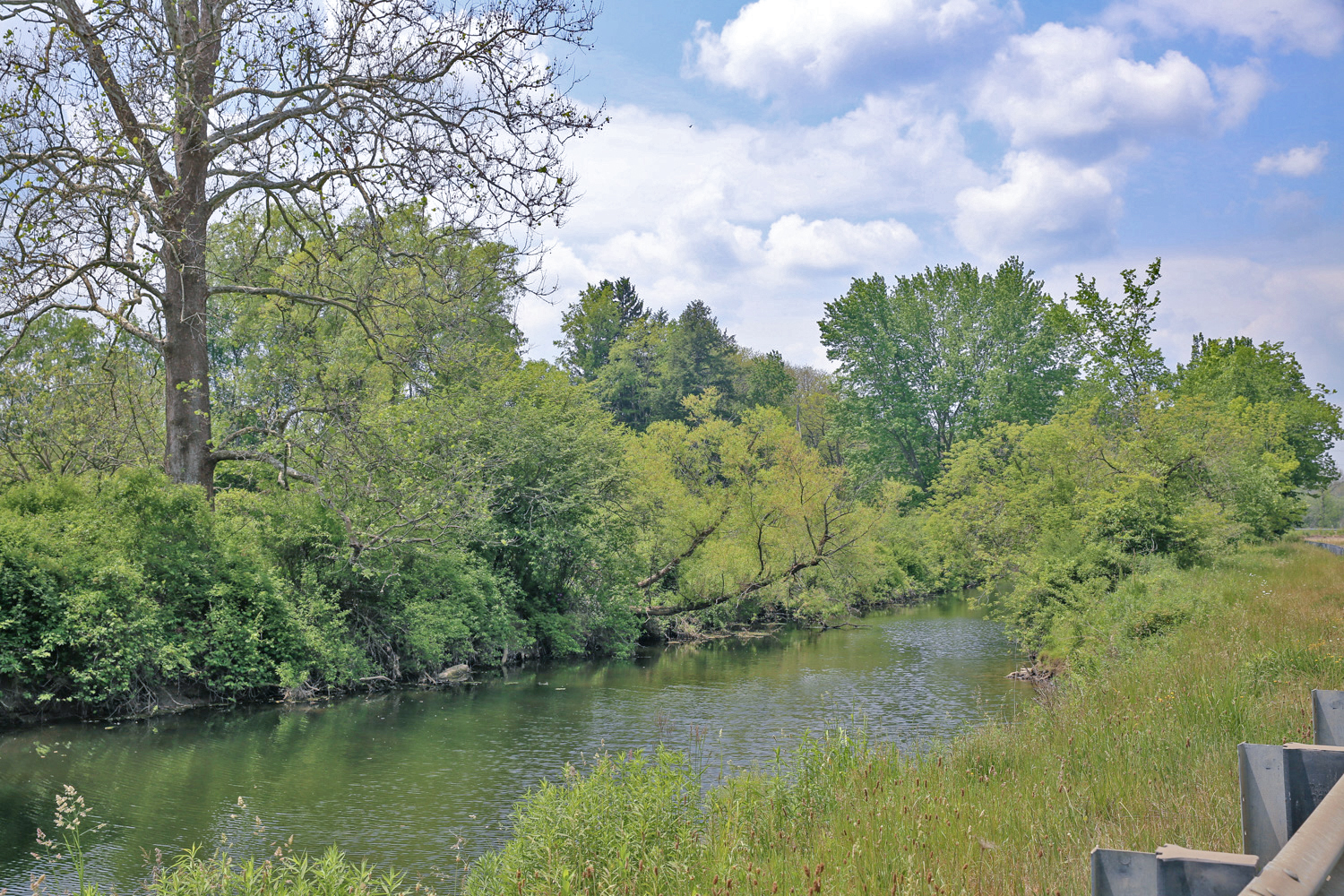
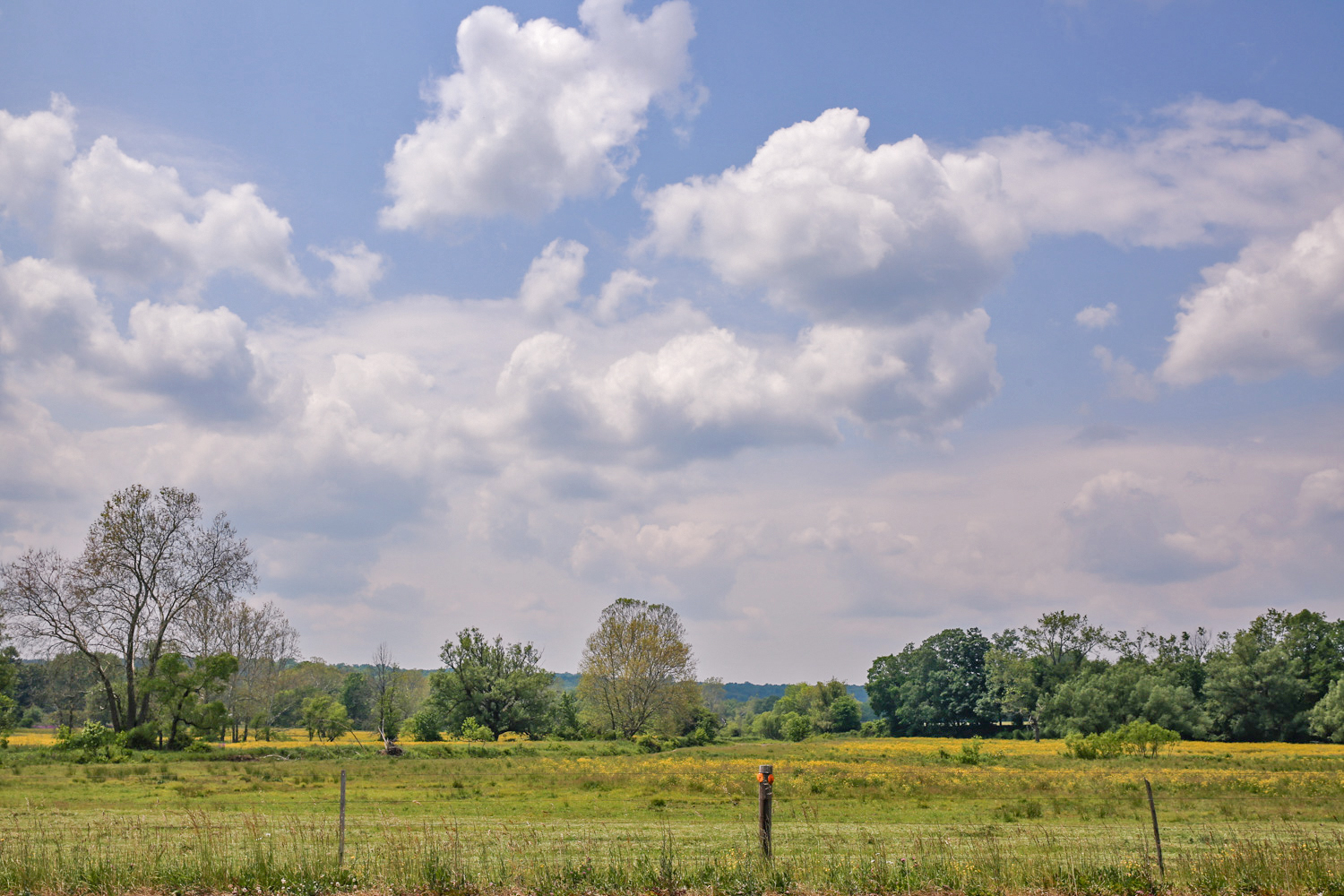
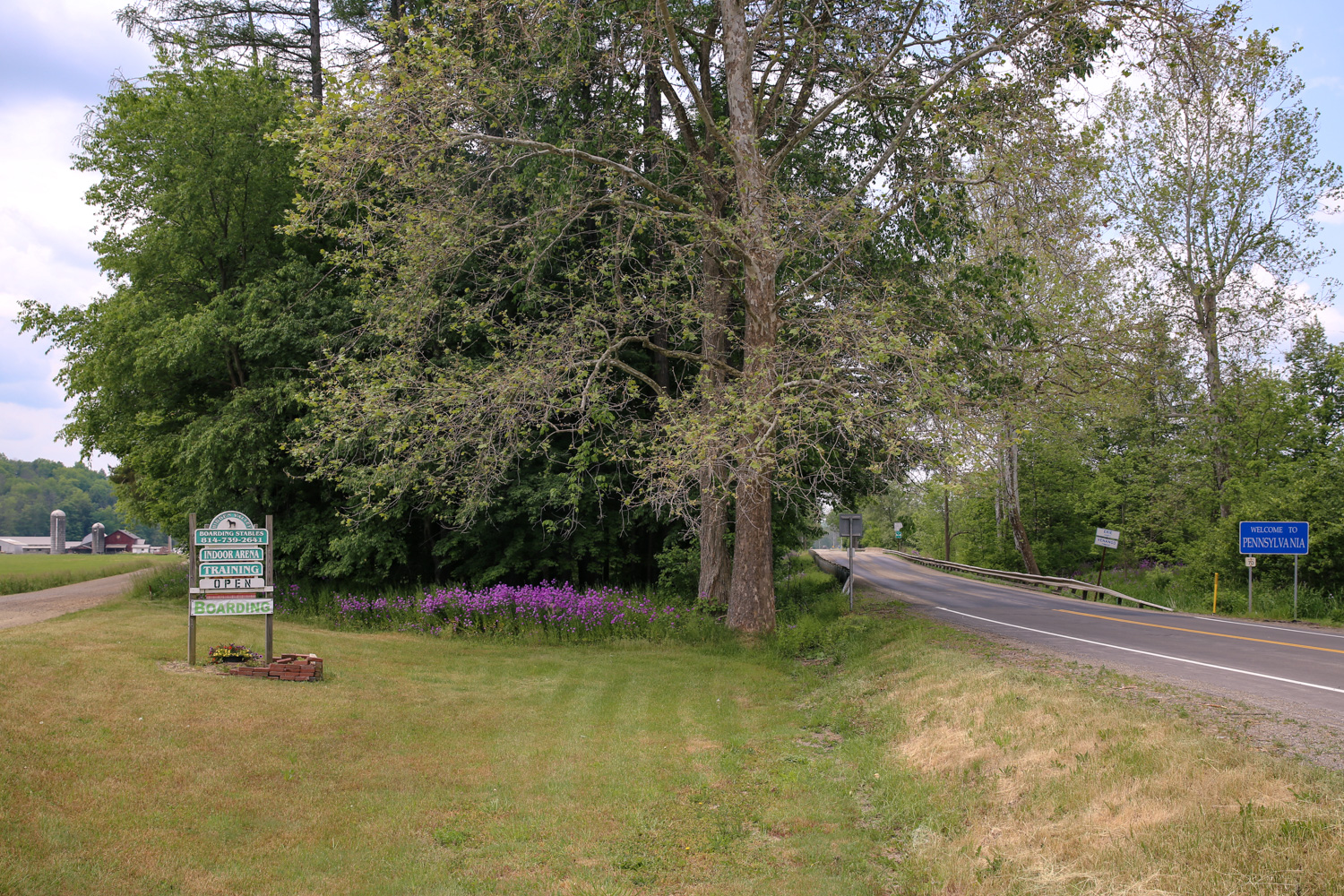
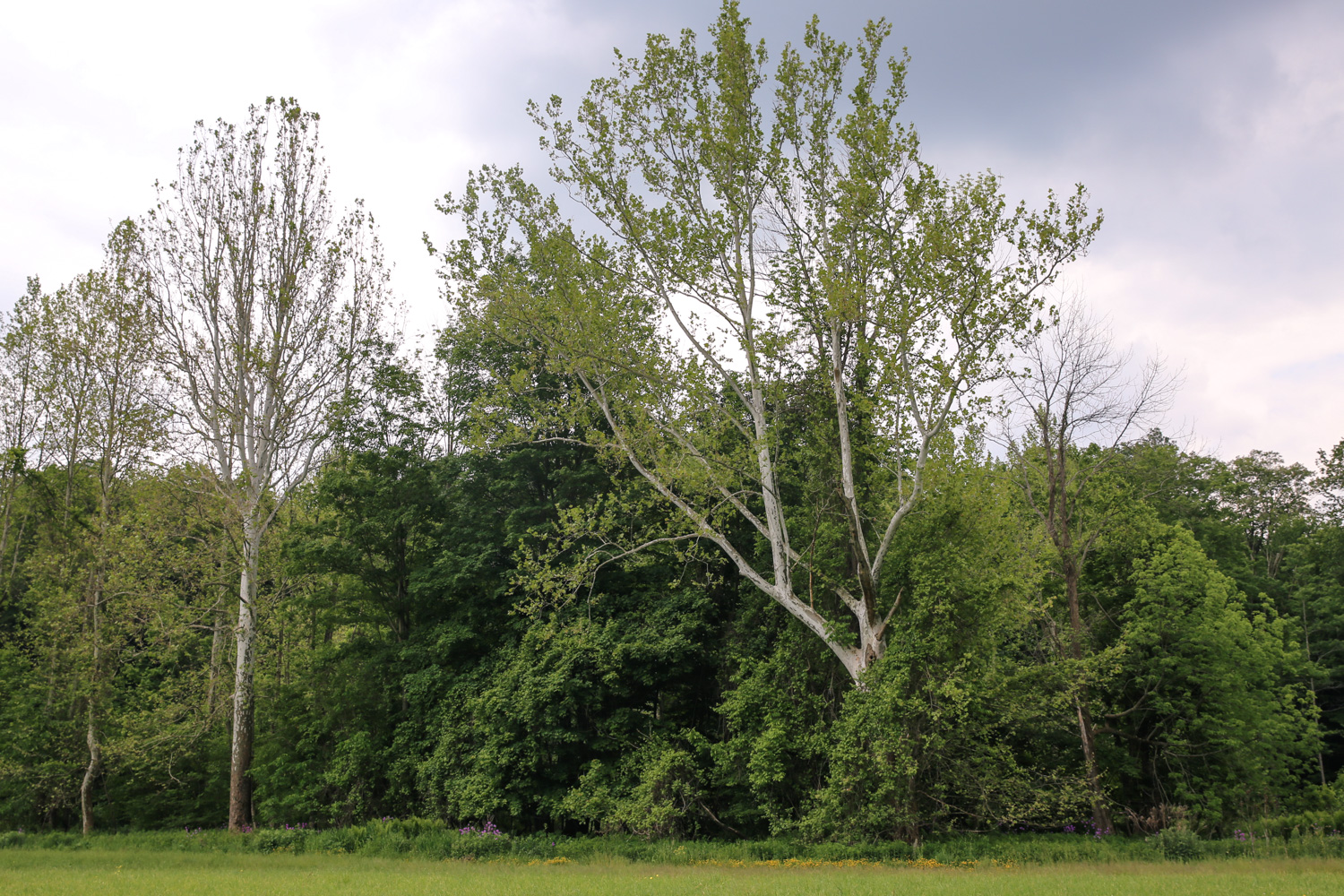
A pristine view across the road from the Bush Family Farm. Behind the trees is French Creek. The Bushes wonder why land acquisitions are needed. Farms throughout the watershed do a good job. They wonder what will happen to their farm if there are willing sellers up and down the road from them…

According to the USFWS Q&A, the land protection plan will take decades to complete as the number of willing sellers and the availability of funding will determine the timeline.

With that in mind, U.S. Congressmen Mike Kelly (R-Pa.) and Nick Langworthy (R-N.Y.), whose congressional districts cover the “areas of interest” in the draft proposal, along with U.S. House Ag Committee Chairman Glenn ‘G.T.’ Thompson (R-Pa.), led a letter calling on the USFWS to reconsider federal designations on private land.

In the letter, the members of Congress recognize that a healthy, vibrant ecosystem along French Creek must continue to be protected, but also that local farmers and residents are better suited than Washington bureaucrats hundreds of miles away to dictate how this land is best protected.

Mark Muir with the Erie County Farm Bureau grows hay and raises livestock in the area. He has been involved in the meetings, asking questions at the front end of this proposal.

Farmshine met in June with Muir at the Bush Family Farm outside of Wattsburg in Erie County. He was joined by Kevin and Amanda Bush as well as Brian Young, whose extended family operates a nearby 7th generation farm.

The Bush farm has been in the family since 1939. French Creek borders it, surrounded by grasses across the road from the dairy barn and hillside grazing paddocks. The Bushes also rent crop ground in the watershed.

They and others are concerned that once a final plan is developed and approved later this summer, land acquisitions from willing sellers could eventually morph into a land-grab that won’t stop until all of the “areas of interest” are federally owned or controlled by the USFWS.

The designation of the land as a National Wildlife Refuge and the approval of an LPP would be the first concrete steps.

“We are told there is nothing set in concrete yet,” says Muir, “But we had many questions they couldn’t answer at the meetings. We tried to talk to them about farm BMPs (best management practices), but they didn’t understand the concept.”

Because the USFWS is still in the ‘public scoping, comment review and final development’ phase,’ officials won’t engage in land use questions or what-if scenarios. They don’t answer questions that help farmers understand the ultimate impact because they say that completion of the Refuge would be “decades away.”

“Decades away” is really tomorrow for most farmers who continually look ahead at their operations and land use, making plans for future generations.

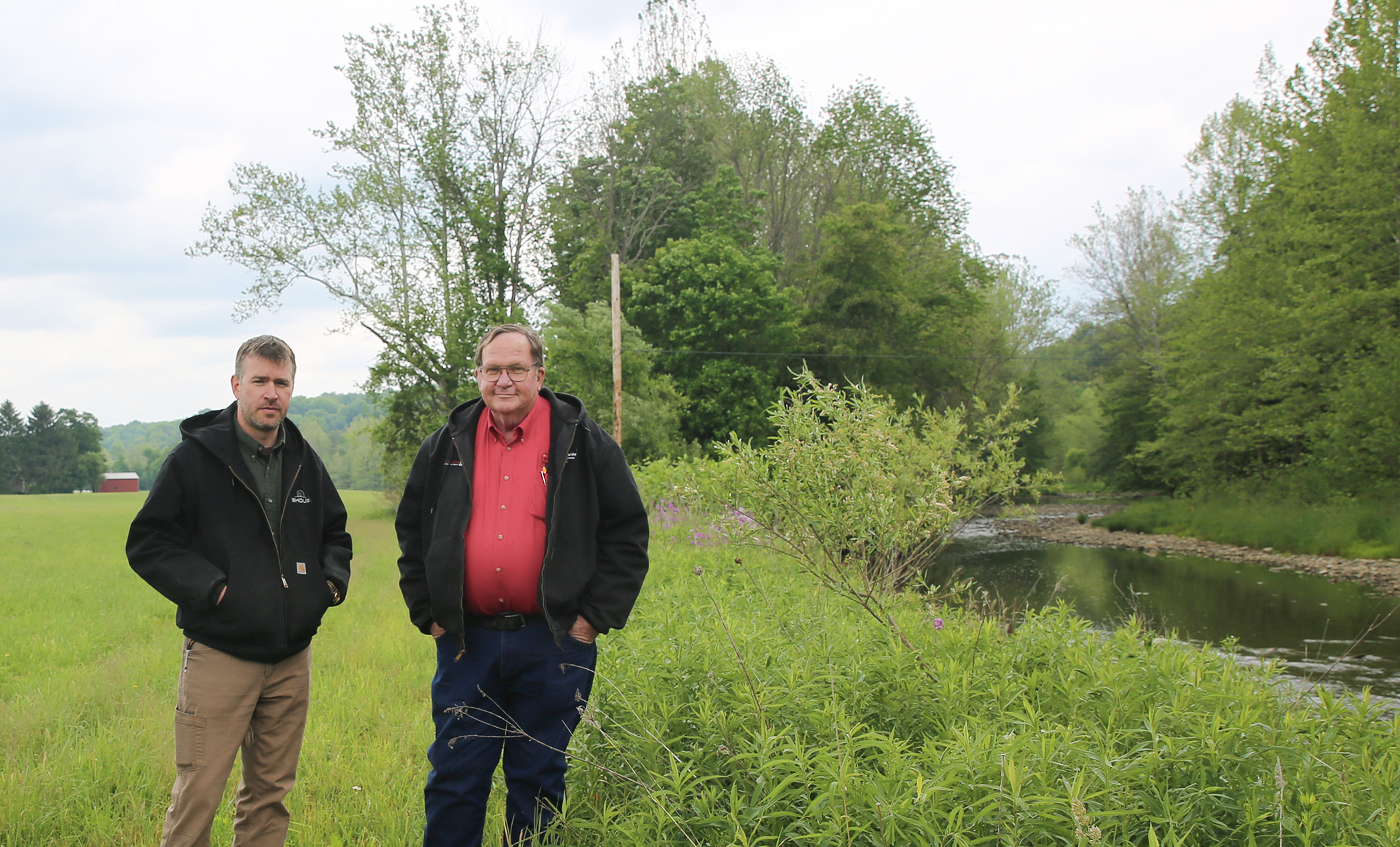
Mark Muir (right) and Brian Young stand across the road from Bush Family Farm by a section of French Creek that runs parallel. This is just one small part of what could be a massive target for federal land acquisitions and easements if the watershed is designated a National Refuge.

“At the end of the day,” says Young, “Fish and Wildlife can target any wildlife and the ecosystem areas that an environmental assessment deems necessary. They are not like the BLM or NRCS. The USFWS is comparatively small and does not have the cross-correlation to agriculture.”

Furthermore, land acquisitions are funded by duck stamp sales, land access fees, and other sources of revenue that make USFWS less reliant on tax dollars to use their authority. In other words, Congressional oversight — from an appropriations standpoint — is lacking.

If a final plan and Refuge designation are approved, the gradual creep of land acquisitions would begin, giving USFWS oversight of current working lands that could affect the fate of farming in the region, in particular dairy and beef cattle.

Without data and without answers, this becomes “a slippery slope with no guard rails,” says Muir. “We want to be objective about it, and to have those conversations at a July meeting. We need certain information to have a meaningful conversation so we can see if and where we might be able to work together.”

Meanwhile, Kevin and Amanda and their four children milk 110 cows and raise their youngstock. They are a small family dairy on land that the Bush family has been farming for 85 years.

There is not only a legacy here, but also progress as they have implemented many BMPs, just as other farms have throughout the region.

Muir notes that NRCS funding, and other cost-shares, don’t seem to flow as much in the Northwest direction of the state. 

He says BMPs on farms could improve even more with cost-sharing and a productive dialog, which is preferable to a multi-decade federal plan to acquire the land.

“If this is supposed to be to save the freshwater mussels, and they have these dollars to spend, why not try other approaches first?” Amanda wonders, adding that they could promote BMPs that farms can do even better than what they are already doing, and cost-share some of that. “It would go a lot farther instead of designating a Refuge, buying up land, and disrupting family farms, local towns and their economies.”

“We do no-till and minimum tillage here. We do cover crops wherever we can, and we are working now already with the County Conservation District,” Kevin adds.

Bottom line, these and other young farmers want to continue farming and producing food for their communities. They are part of these rural communities where cows and crops, grazing and haymaking, youth programs and showing at the county fair are part of the fabric.

Maybe it’s more important to identify the rural community fabric that is at stake — the younger generations who want to continue. As farm families of all sizes, they are accustomed to working with USDA, NRCS, county conservation districts, local conservation efforts that all have connections to agriculture, so they speak the same language.

But when Fish and Wildlife makes its entrance with a draft proposal for a National Refuge of immense proportions across so many miles, acres and counties — having no crossties to agriculture — that’s a scary place for any farm family to be, and it can lay threadbare the fabric of the communities beyond the farms.

To be continued

AUTHOR’S NOTE: A USFWS National Refuge designation and Land Protection Plan includes acquisition timelines and a “Landscape Conservation Design” to “ensure actions contribute to the landscape-level vision,” according to USFWS documents. USFWS is a Bureau within the Department of Interior and operates in a quasi-independent fashion, having federal administrative authority to establish and manage such refuges and complete them over time with its own sources of funding. In 2021, at the start of the new Administration, the USFWS updated its “Climate Adaptation Strategy” to be a framework that is part of the Administration’s “U.S. Climate Resilience Toolkit,” equipping USFWS to “take immediate action to build ecosystem resilience in the face of climate challenges.”  (One thing to keep in mind is to look overseas at the Netherlands, where the climate-based land-grab is in full swing. Farms have been ordered to cut from 15 to 90% of their production or sell their farms to the government. The farms identified for 75 to 90% production cuts to be economically unsustainable are those that are closest to the EU Nature Preserves designated decades ago.)

Measure every decision by cow comfort and know your numbers: ‘That’s how you fight inflation’

By Sherry Bunting, Farmshine, December 23, 2022

NEW HOLLAND, Pa. – “Too much money chasing too few assets,” that’s the definition of inflation, said Gary Sipiorski, ag lender and financial consultant from Wisconsin.

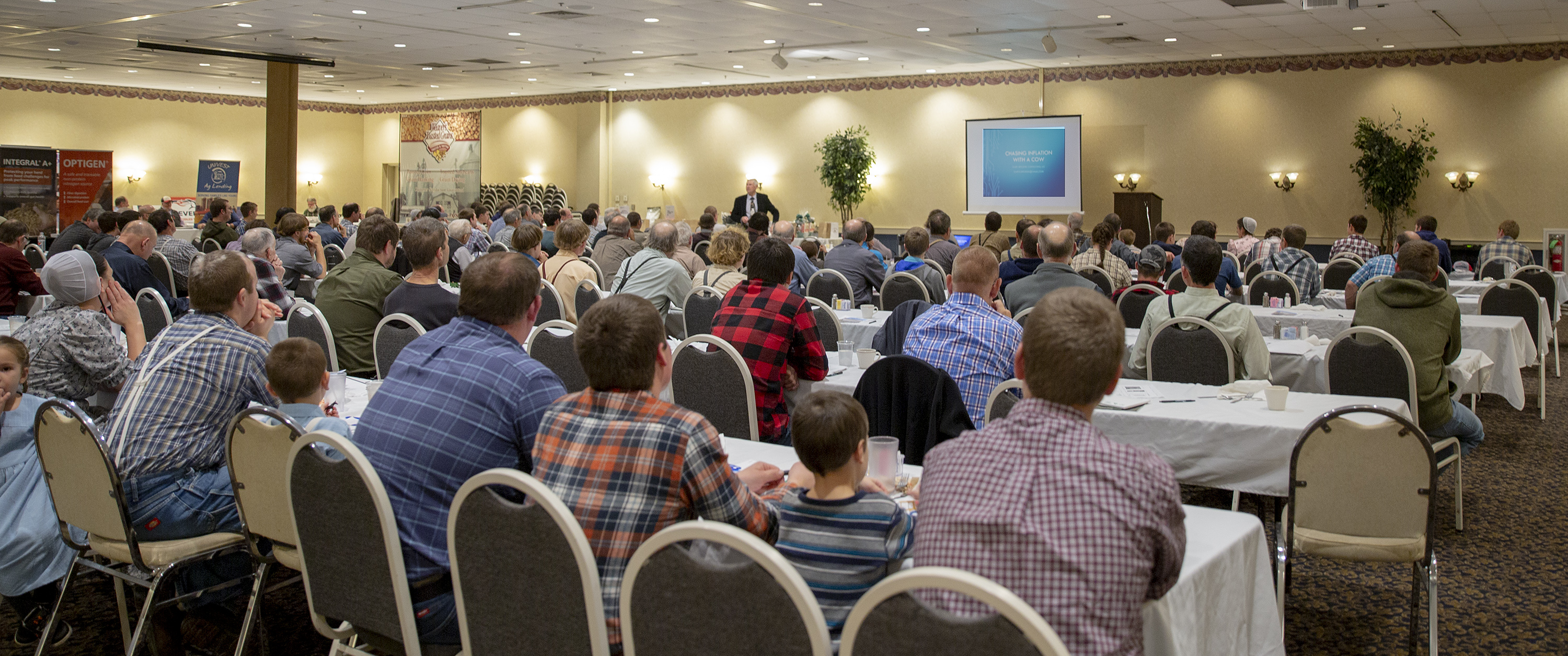
He didn’t have to tell the over 250 dairy farmers attending Homestead Nutrition’s dairy seminar at Yoder’s Restaurant in New Holland on December 7 that inflation is real, because they are feeling it.

His bottom line is to measure every decision by its impact on cow comfort and manage the net income the cows generate.

As president and CEO of Citizens State Bank of Loyal, Wisconsin, Sipiorski is also an advisor to the Federal Reserve Board of Chicago. He expected the Fed would raise interest rates another half a percent, and several days later, that’s what they did.

Raising interest rates is meant to slow things down enough to curb that inflation, and as farmers, “you’re feeling the effects of both,” he said.

Sipiorski described the effects of both the disease and the cure as something that creeps up gradually to squeeze the margin.

“You can be taking good care of things and don’t see this happening, as the temperature gradually increases. It sneaks in slowly,” he said. “The war on inflation will continue for at least the next 12 months, and we are likely to see interest rates continue higher before stabilizing around the middle of next year.”

The good news for dairy, he said, is that even though consumers are drinking a little over half as much milk per capita as they did 50 years ago (18 gallons vs. 30 per person per year), they are eating more than double the gallons of milk in the form of all dairy products, combined.

In 2021, Americans consumed 667 pounds (77 gallons) of dairy products per capita. That’s 12 more pounds per capita than in 2020.

“We didn’t drink the 77 gallons, we ate it,” said Sipiorski, adding that dairy exports have also become crucial.

“By the end of this year, 20% of your milk production will be going elsewhere,” he said. “That shows the faith the rest of the world has in the superior product you make.”

Inflation, rising interest rates and supply disruptions are slowing the rate of dairy expansion, as the industry focus turns inward to manage margins even more tightly as feed costs have doubled, cropping costs have quadrupled, lines of credit cost more and are harder to get, machinery and parts cost more and are harder to find, and some farms must deal with a milk base program from their milk co-op or buyer — putting penalties on overbase milk in the output side of that margin equation.

Sipiorski shared his insights on the most important things the top 30% of dairy producers do in a talk he titled ‘Chasing inflation with a cow.’

The top third of dairy producers double-down on managing these primary areas: feed, debt, labor, cow comfort, and knowing their numbers.

Minimize feed shrink

With feed and cropping costs so much higher, Sipiorski told dairy farmers the 10 to 20% they can be losing in feed shrinkage is a significant area to manage.

“Losing 10 to 20% of the feed from field to rumen is a big cost to the dairy,” he said. “We are seeing more investment in feed storage sheds, bringing the mixing indoors and thinking about how you mix the feed, in what order.”

Pay down lines of credit, not term debt

Choosing carefully what debt to pay down at this time of rising rates is also critical. Paying down lines of credit that have adjustable interest rates and keeping some of that cash liquidity may make more sense than paying additional principal on longer-term fixed rate loans.

“Your thought process may be to pay down that term debt, but if the rate is locked-in, and you pay it down, that money is gone, and you may need that money later, and then pay a higher interest rate for it,” Sipiorski explained, advising farmers to talk with their lenders about their debt structure.

Push pencil on machinery

“Do the math on whether to lease or buy machinery,” Sipiorski urged. “If it is something you use three months of the year, can you afford it? Can you afford the cost to have and maintain that piece of equipment?”

He noted that the top dairy farms push the pencil to compare costs of owning new equipment, leasing it, or hiring custom operators for segments of their field work.

Time is money, spend it wisely

In addition to dealing with hired labor cost and availability, Sipiorski advised farmers to “count your steps and measure your time.”

In other words, know what your time is worth and find ways to streamline chores for yourself and your employees. One example he gave was to put tools around where they will be used to minimize time spent going back and forth for tools needed.

Keep improving cow comfort

“Cow comfort is a place to keep improving to fight that inflation with that dairy cow,” Sipiorski declared.

It’s the accumulation of a lot of simple little things the top third of producers do, such as providing enough space at the feedbunk, waterer and in the dry cow area.

“The dry cows are working just as hard for you, so don’t cheat them” he said, adding that top producers are absolutely passionate about cow comfort.

The cows require a lot of investment, and the top producers benchmark the investment per cow at $8,000 to $20,000, while benchmarking gross income per cow at $5,000.

“Cow comfort is an area of investment that brings you the most return. Every decision you make, ask yourself, are you making money with that decision?” he said. In other words, “are you making cows more comfortable with that decision?”

Keep improving milk components, quality

Producing milk with higher component levels and lower somatic cell counts (SCC) is what the top third of producers are doing, said Sipiorski.

“This is even more important if your co-op has a base program. If you can’t produce more milk, make the milk you are producing better,” he said, noting that components drive value.

Quality as measured in SCC will also increasingly drive value and market access. Sipiorski sees the industry getting to the place where milk will eventually have to be under 150,000 SCC.

While he didn’t specifically mention transformation in the processing sector, it’s becoming clear that ultrafiltration and microfiltration in some of the newer dairy plants is aimed at removing the lactose from the milk to be used in making cheese, other dairy products and lactose-free high protein milk beverages.

Those working with this technology have repeatedly said it requires farm-level SCC thresholds to be even lower because, as the water and lactose are removed through membranes and reverse osmosis, the remaining solids are condensed. This includes the SCC being concentrated with those valuable solids, so those processors expect a lower-SCC limit at the starting point.

Get educated on marketing

Sipiorski advised farmers to be “educating yourself on marketing and risk management.”

He noted that milk markets are volatile, and marketing through a broker or a cooperative program or other risk management can be good or bad.

“You won’t know if it’s a good deal or not, if you don’t know your cost of production, your margin,” he said.

Know the numbers, focus on high quality forage production, and look at areas where changes and investments can help fight inflation, he advised.

One thing he has seen more farms moving toward – to reduce marketing costs – is to increase milk storage to go from once a day to every-other-day pickup to reduce fuel costs, transportation and ‘stop’ charges.

This is something that has been occurring at the retail end for years, with less frequent deliveries from processors to retailers becoming the norm today.

Benchmark against industry or self

Benchmarking the dairy to itself year over year or to industry averages is important financial management, according to Sipiorski.

The numbers that are needed to do this are found on the balance sheet, income statement, and accrual accounting of yearend income – not the IRS tax return. 

He said that doing a business plan with projected cash flows helps make better financial decisions.

Sipiorski gave farmers some financial benchmarks to keep in mind, noting again that the numbers need to be based on accrual accounting, not the year end IRS tax return.

“In that tax return, you have prepayments and depreciation,” he said. This skews the cost of production calculation, for example, because the cost of inputs are not directly aligned with the output revenue.

Sipiorski ticked through some industry benchmarks to be aware of: Equity position (50%), liquidity (2:1), net profit margin (10%), cost of production ($17-22.00/cwt), operating expense as a percentage of gross income (65-80%), and debt to revenue ratio (1:1).

The bottom line, he said, is “you need to produce 100 pounds of milk for less than you sell it for.”

On that point, he noted the most recent USDA forecasts at the end of November are for Class III milk to average $19.80 in 2023 with the All-Milk price next year forecast to average $22.70, while the cost of production in 2022 is averaging $20 to $22.00 across the industry, but the range is wide.

“Pennies (per hundredweight) are a big deal,” he said, showing that the 47-pennies per hundredweight difference in a Q2 2022 comparison of the net margin per hundredweight of $6.64 for all herds vs. $7.11 for the ‘top 30% of herds’ amounts to just shy of $113 per cow annually.

“That’s $2800 on 25 cows, $11,280 for a 100-cow dairy. That’s how we fight inflation with a cow,” he said. “Who in this room wouldn’t want another $11,000 in the pocket to fight inflation?”

Sipiorski described dairy as a dynamic business full of chaos and volatility, but with that comes lots of opportunities.

He sees a ‘barbell-shaped’ future for dairy, where there will be opportunities for small and mid-sized family dairies even if a large portion of the milk supply comes from much larger dairies.

-30-

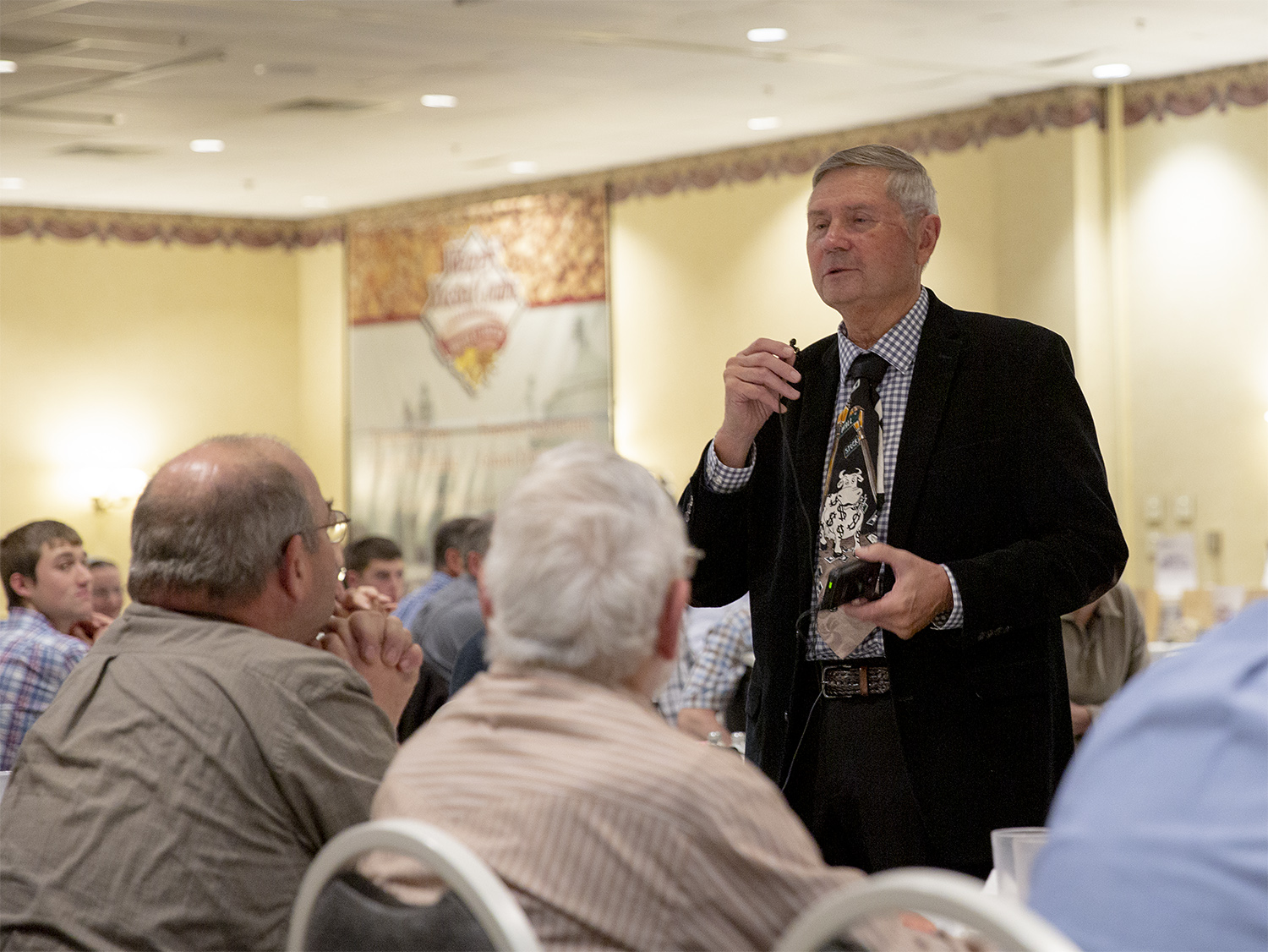
Gary Sipiorski, a lender from Wisconsin, talked about dairy financial management in these inflationary and volatile times. Despite the chaos and consolidation, he sees opportunities for small and mid-sized family dairies in the future, even if a large portion of the milk supply comes from much larger dairies. Photo by Sherry Bunting

Dream in progress at BAD Farm, where they DON’T live up to their name

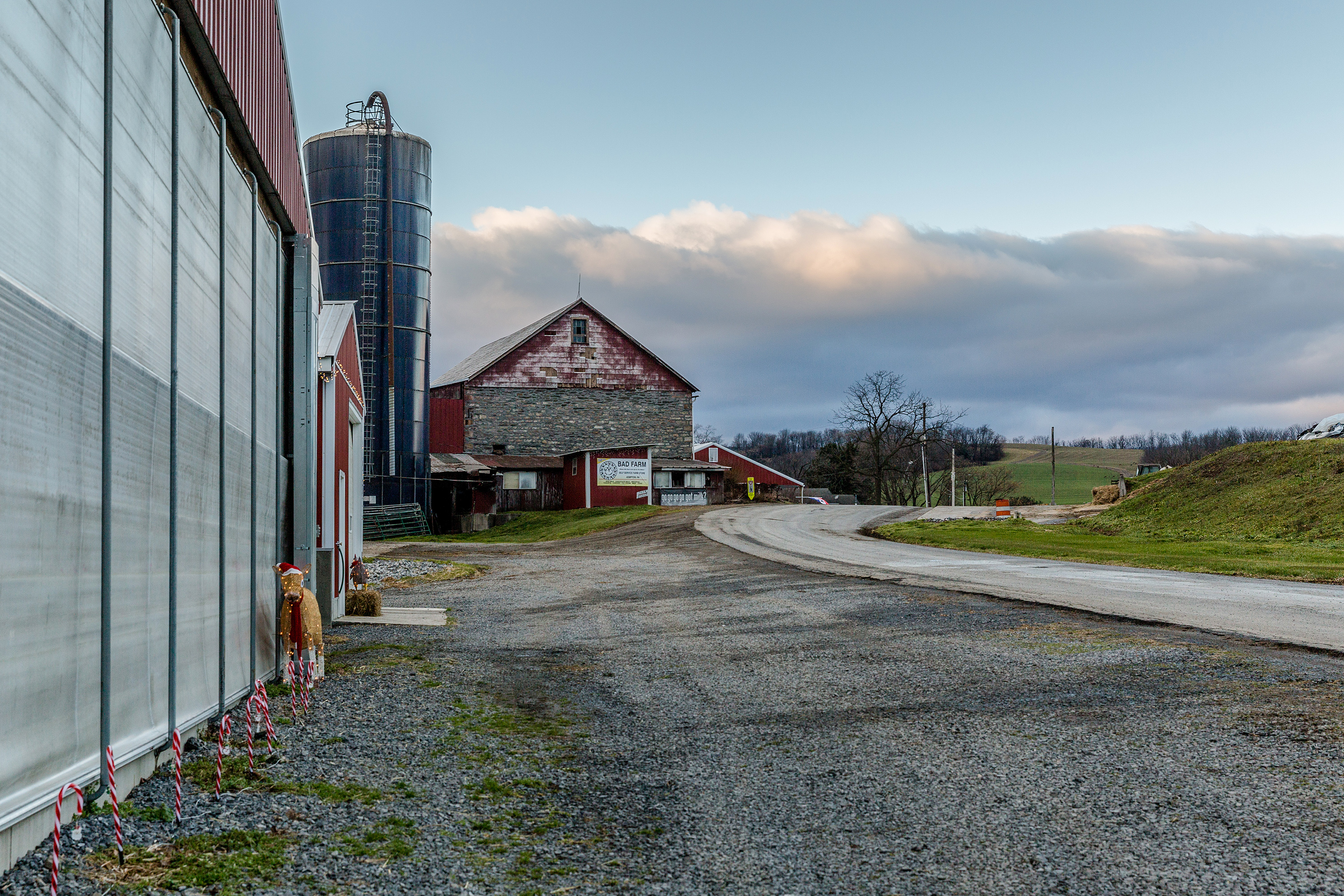
‘Tis the season for something special. Their story began with raw milk sales over 10 years ago, today it is becoming so much more.

By Sherry Bunting, Farmshine, December 16, 2022

KEMPTON, Pa. — ‘Tis the season for something special. It’s Christmastime, and diversified consumer-facing dairy farms are featuring special products, memories and events, complete with decorations, milk (or hot chocolate) and cookies, wagon rides, Christmas settings and on-site photographers for on-the-spot family Christmas portraits – you name it, and dairy farmers are doing it.

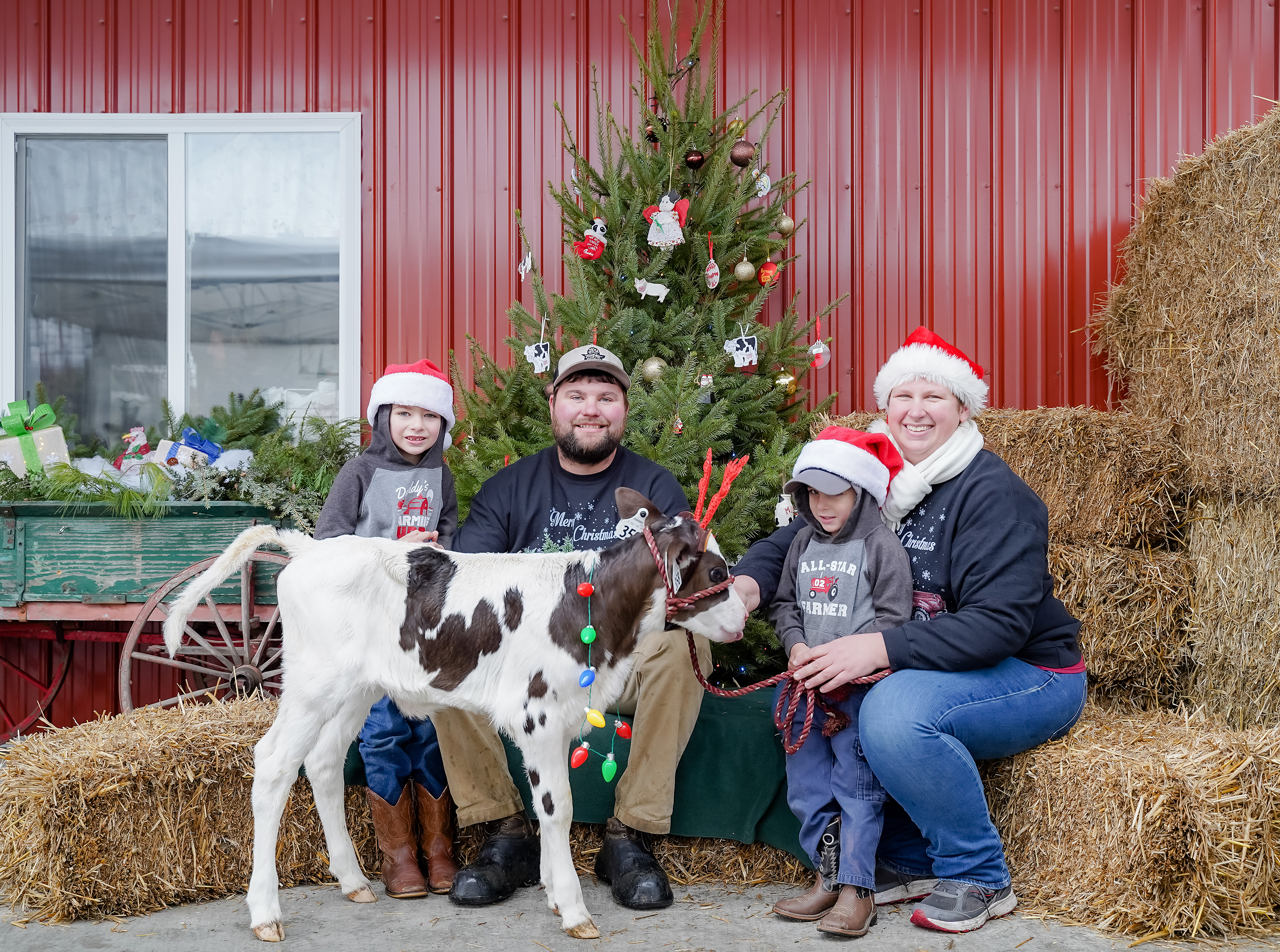
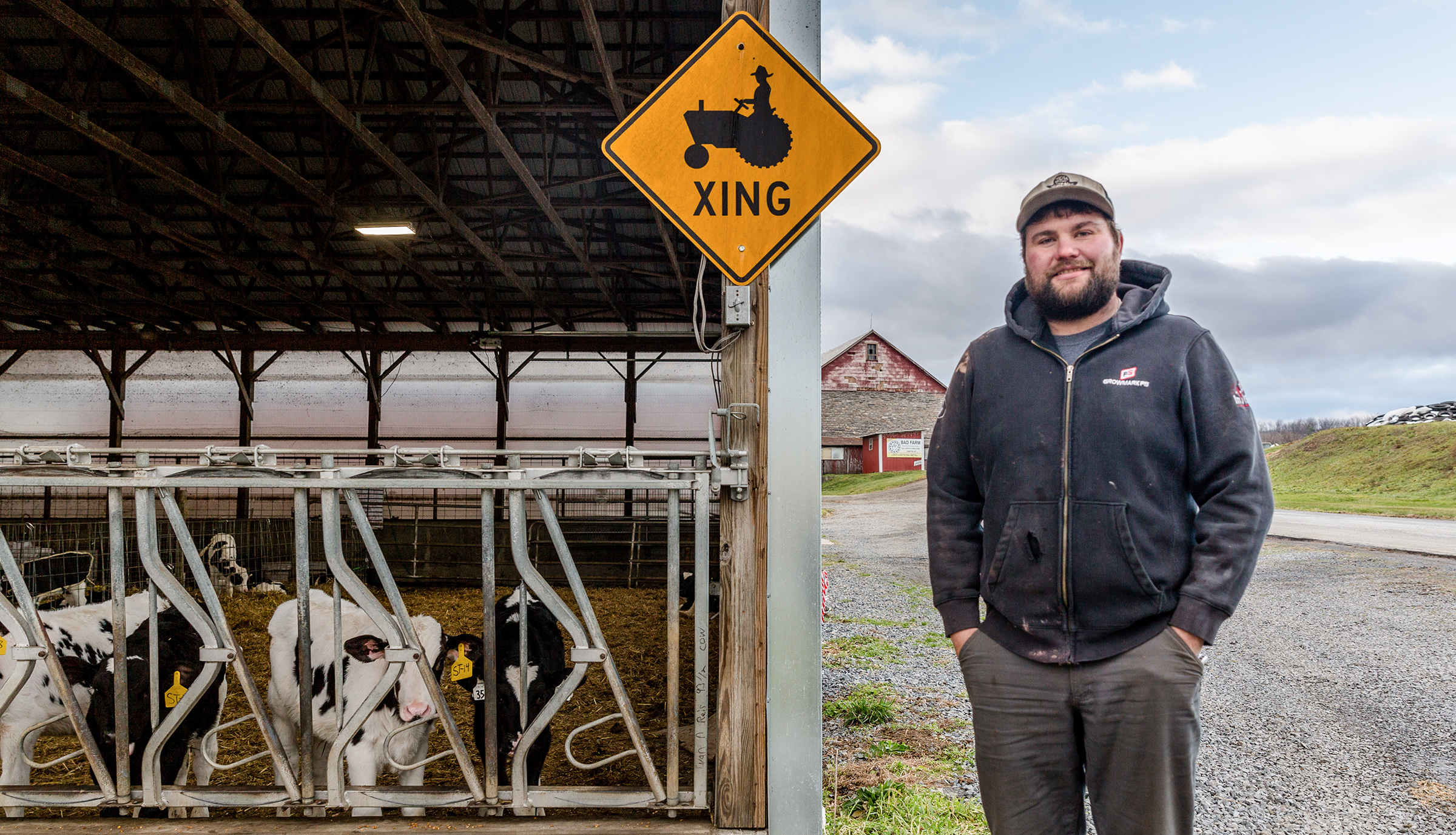
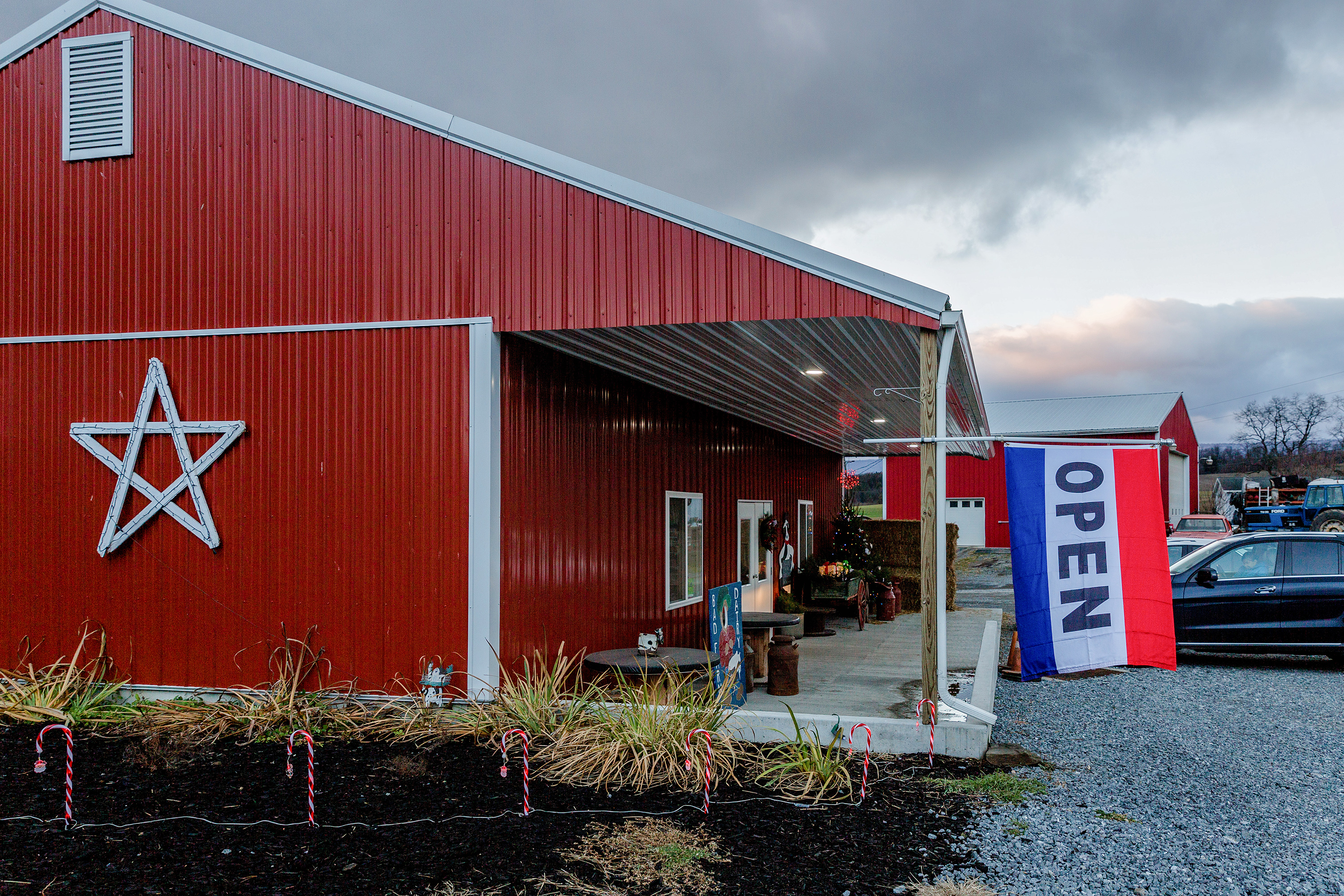
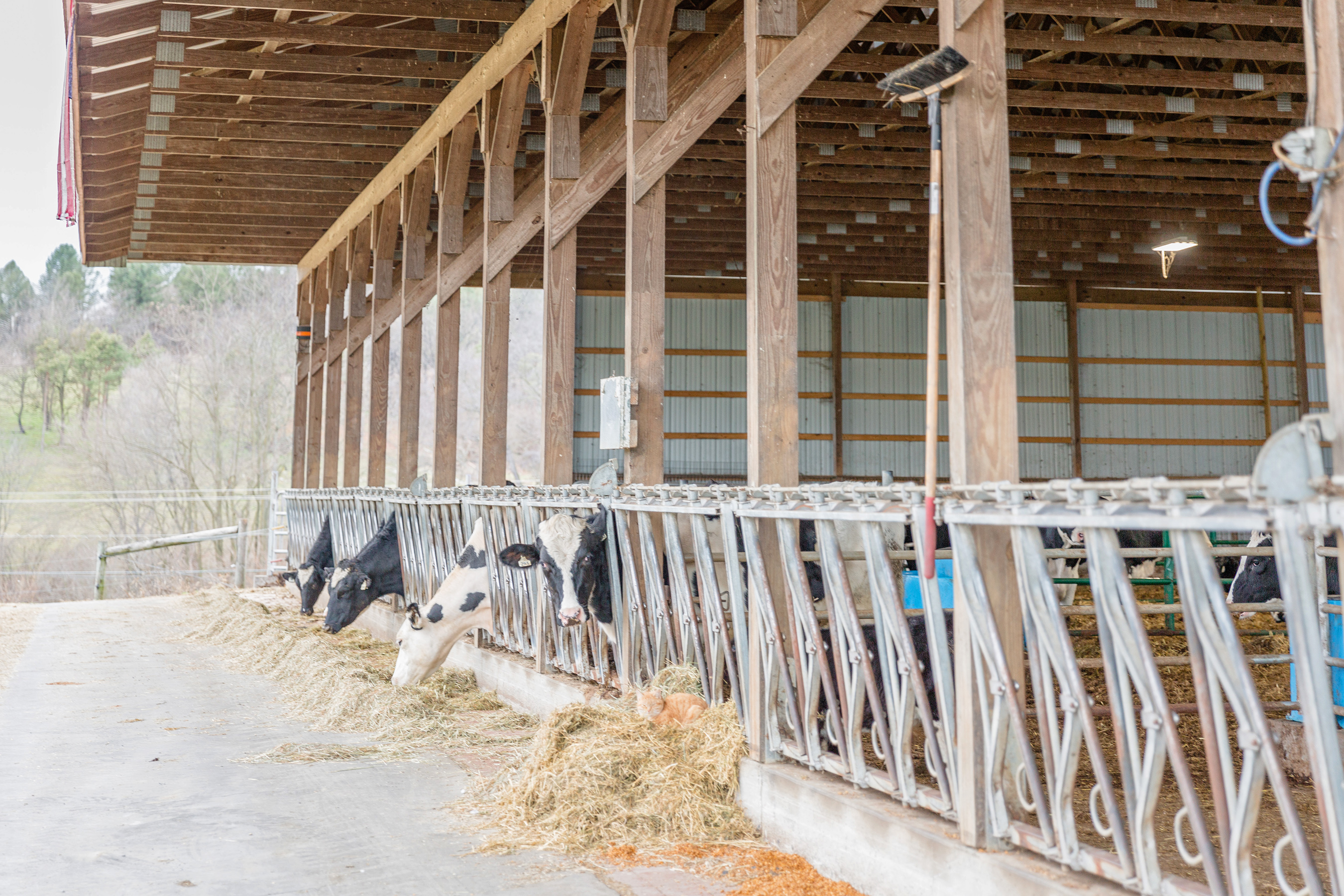
Recently Jason and Kacey Rice (and sons Emmit, 6, and Ellis, 4) had such a “Christmas on the farm” event at their BAD Farm near Kempton, Pennsylvania. Delicious dairy products, made with the milk from their 60 cows, were combined with holiday festivities, opportunities to see a working farm, visits with Santa, and, yes, portrait sessions with a holiday setting, a festively outfitted calf and a photographer.

Almost 100 people dodged the raindrops on the first Saturday in December to attend the event at the store the Rice’s built on the farm in 2020 as they began offering more products.

But their journey began with selling just raw milk and eggs more than a decade earlier.

In addition to the store, BAD Farm products are sold at pop-up farmers markets in Emmaus and Lehighton. Jason’s dad manages the meat sales. His mom is the point person for the farmers markets, staying in touch with Kacey, who runs the on-farm processing of the items they do on-site and ordering those products that are processed for them elsewhere — all using the milk from their own cows.

The farm’s name gets some attention, notes Jason during a Farmshine visit Monday (Dec. 12).

His parents, Beth and Dave Rice (the original B and D Farm) found themselves and others abbreviating the initials BAD. Jason’s middle name is Dave and his wife Kacey’s middle name is Beth – so they kept the acronym after transitioning the farm.

Today, BAD Farm milk and dairy labels state the motto: “Where we DON’T live up to our name.”

“It’s a conversation starter at the farmers’ markets,” says Jason. “People remember it.”
When he came home from SUNY Mohrsville in 2009, it was a rough time for dairy farms. He already had a vision for the farm to get closer to consumers, and his parents already had done the work for a raw milk permit.

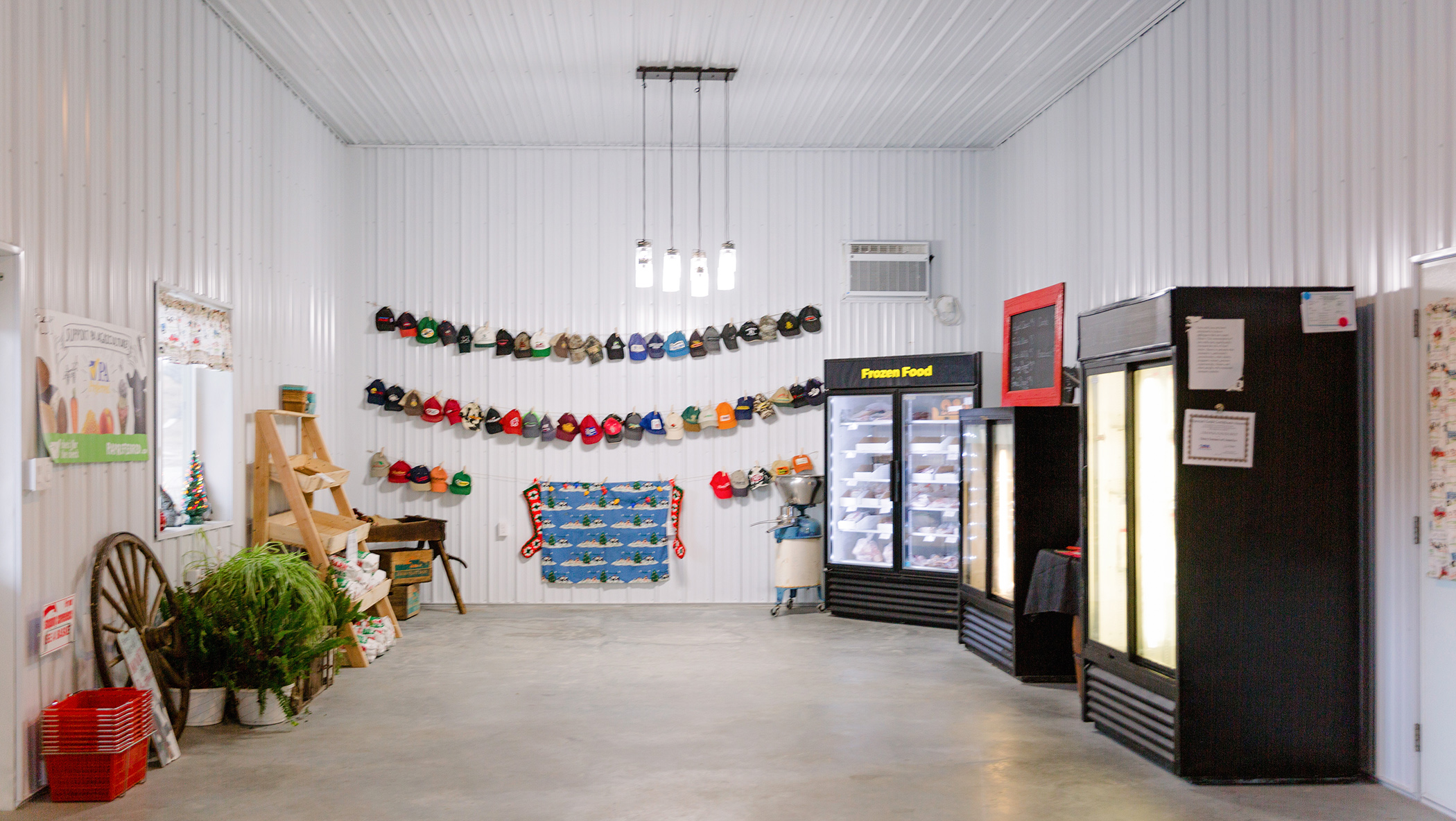
For more than 10 years, they sold raw milk and eggs in a tiny outbuilding by the barn and did freezer beef as well. Today, the coolers in the new farm store hold fruited regular and Greek yogurts as well as aged cheeses and cheese curds in some popular flavors — all made with their farm’s milk by two different processors. 

The beef in the freezer is from their own Holstein calves that are fed out at another location. The eggs are from their own chickens, cage-free but in a poultry building on the farm due to their location at the base of Hawk Mountain. The prepared meals are made for them by a commercial kitchen, featuring items like shepherd’s pie, meatloaf, quiche Lorraine – all dishes that use the dairy, eggs and beef produced at BAD Farm.

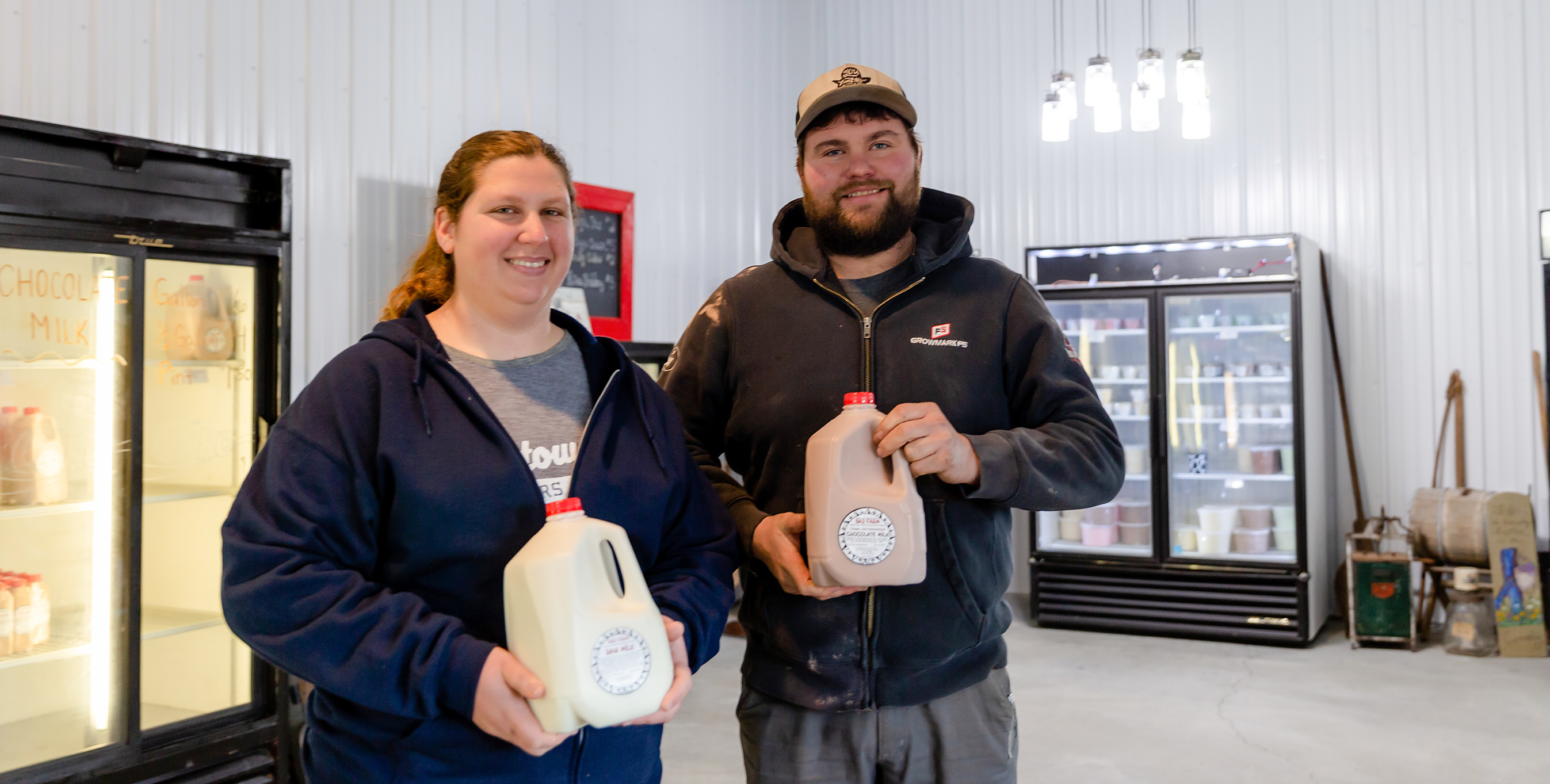
This year, they realized a dream making their own ice cream and chocolate milk.

In Pennsylvania, raw milk can be sold with a permit, but raw milk cream cannot. Jason’s ultimate dream of making their own chocolate milk and Kacey’s dream to make their own ice cream, from scratch, became reality when a Pa. Department of Agriculture innovation grant helped them invest in this processing infrastructure.

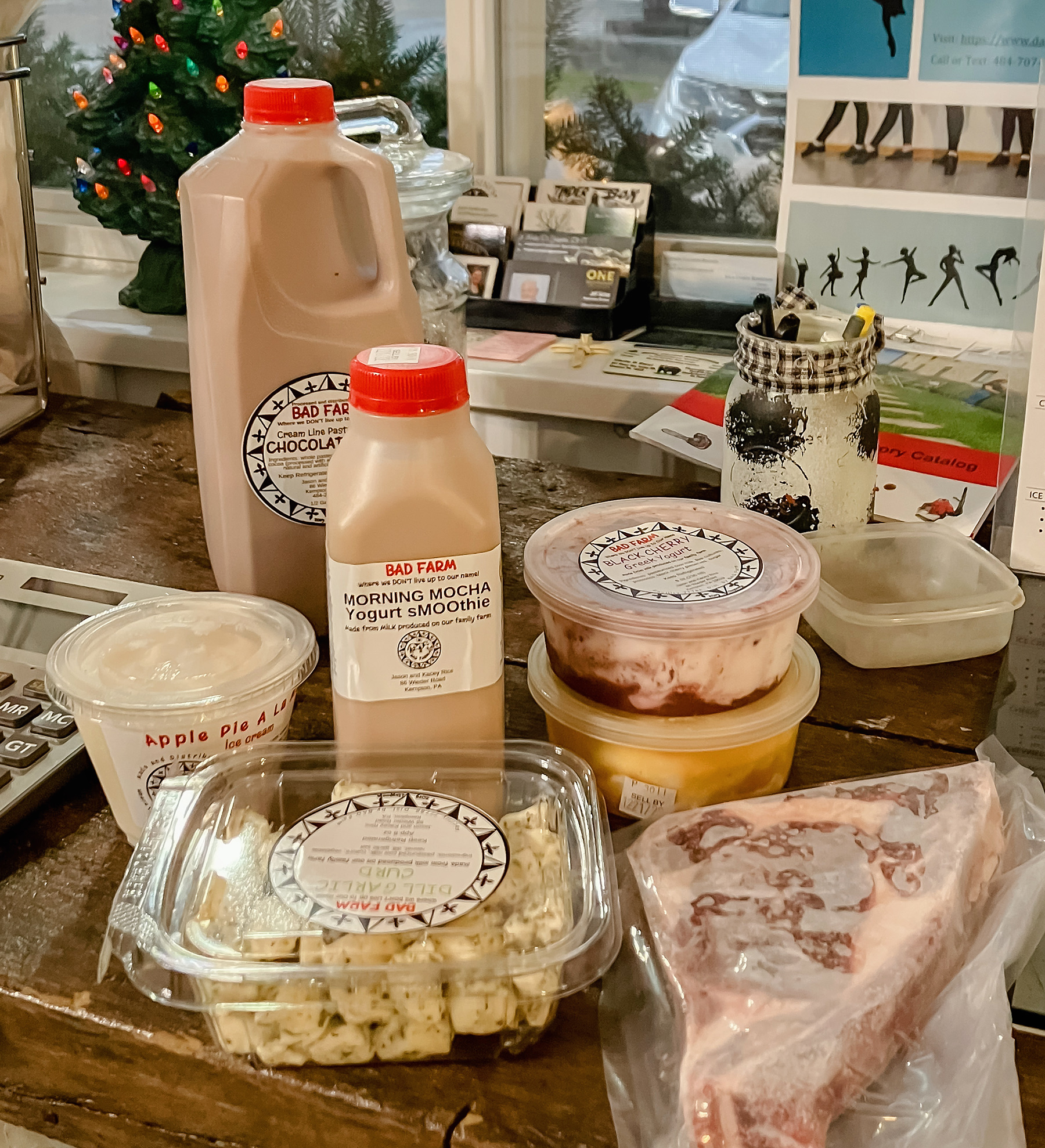
Previously, these products were made for them elsewhere. They have also started a line of coffee creamers, with peppermint in the cooler for the holidays, pumpkin spice in the fall, and traditional vanilla and salted caramel. They now do pasteurized creamline milk in addition to raw milk, and they offer yogurt sMOOthies, which are a big seller in fruit flavors, mocha, and a peppermint for the holidays.

For Jason, the chocolate milk is the big one. His enthusiasm about it is clear. It’s an area he has always believed the industry can do better. 

“We wanted to make a really good chocolate milk — something people can be proud to put on their dinner table,” he says.

(Yes, they succeeded. BAD Farm’s chocolate milk is super GOOD. I brought some home, and found it has a really smooth and silky finish to go with that creamy texture. I also took along a Mocha Morning yogurt sMOOthie, which was quite a treat, finishing it before I was 5 miles down the road.) 

As for the BAD Farm chocolate milk, it is a pasteurized non-homogenized creamline chocolate milk. It is 90% whole milk with 10% heavy cream added. They don’t standardize the whole milk, and their herd test is right around 4.0 butterfat.

“We found we could really pull back on the added sugar this way,” Jason reports.

With the processing infrastructure, Kacey was able to start making old-fashioned ice cream. “I always wanted to do ice cream from scratch, and the innovation grant helped with that,” she says. 

Kacey works with seven ice cream flavors, rotating in some seasonal specials. Her philosophy is to focus on quality and marketing and “getting the products to the people,” rather than trying to make every flavor under the sun. 

They shoot for memorable ice cream experiences. Their chocolate blast uses three kinds of chocolate for a signature blend. They work with orchards on custom flavors. They offer peaches and cream in the summer and apple pie ala mode in the fall. They rotate core flavors to keep it interesting. 

Neither Jason, nor Kacey, studied dairy processing specifically in college, but they learned concepts that contributed to their vision. They read, and ask questions, talk to peers and seek advice from those who’ve done it. They are constantly learning and looking for trends and ways to extend what comes from their farm — milk, eggs and beef – and turn it into what consumers are looking for. 

“We don’t have hired help except one high school employee to help milk,” says Kacey.  “Instead, we pay people to process some of the products we offer that are made with our milk while we are focusing on building our connection to consumers.” And they are gradually doing more of their own processing also.

“To do this, you have to want to talk to people. You have to want to have those consumer conversations. Our store is right in the middle of everything on the farm. People can see the cows as they walk down to the calf barn. They can see the farm tractors coming and going through the seasons. They see it all,” says Jason, noting that they don’t do group tours, as such, but “we’re here, and we’re available. We could be in the middle of doing corn silage and someone stops and has a question. We need to stop what we’re doing and talk to them. It’s a priority. That’s the commitment we make.”

And that’s okay with Jason and Kacey because connecting with consumers has been part of their vision for the farm since the transition began. 

With their on-farm self-serve store completed in April 2020, just as the Covid pandemic hit, the couple had to pivot quickly to meet customer demand for more staples and more products as consumers were faced with shortages in stores and became more tuned-into where their food comes from and were looking for things to do, places to go.

Being somewhat off the beaten trail, BAD Farm is a destination, not a quick stop on the way home from work, but the raw milk sales on the farm and the connections made at the farmers’ markets off the farm give the Rices core customer bases to build on.

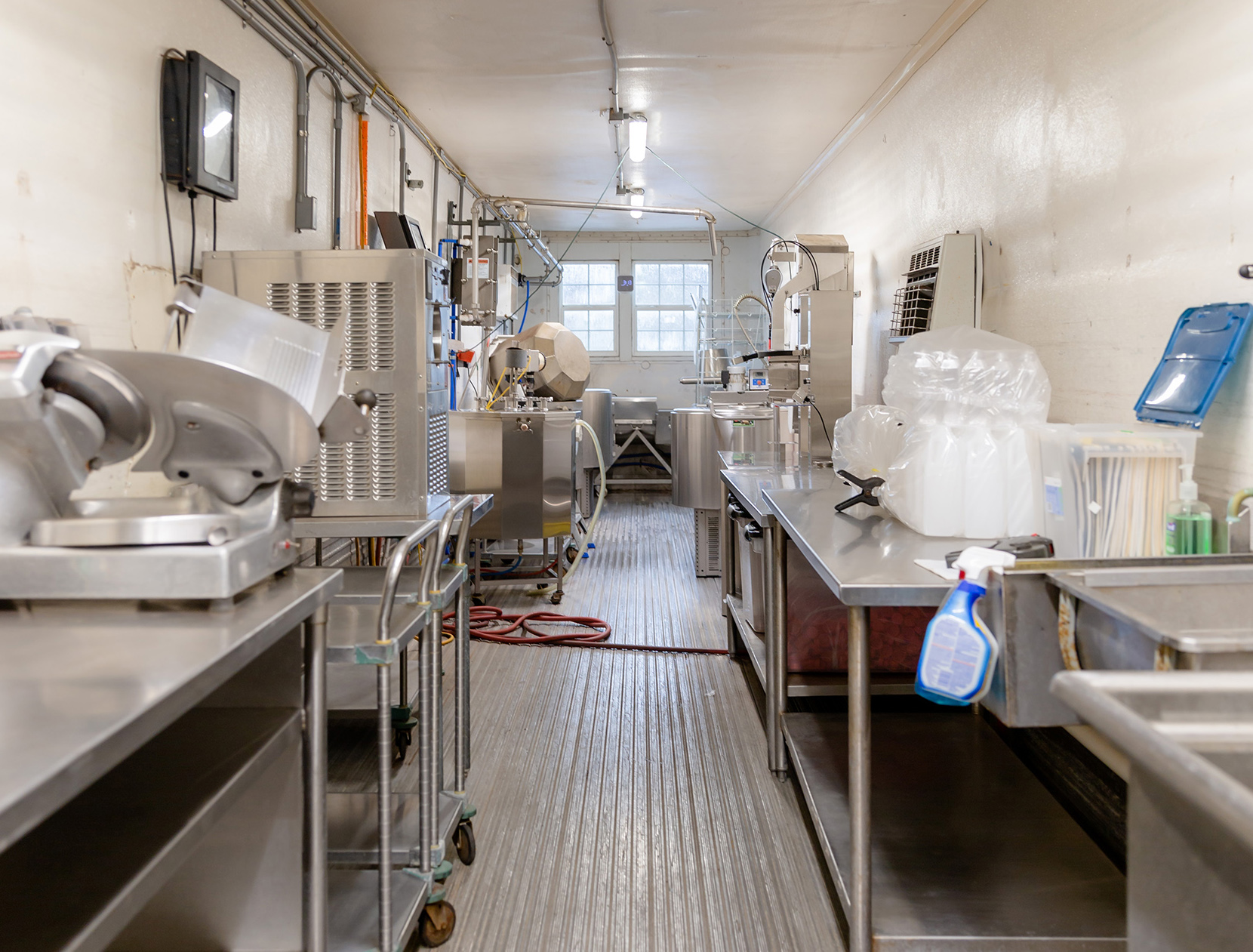
The store is built on the other side of the barn toward the house. The dairy innovation grant helped the Rices add processing with three uniquely incorporated trailers.

Jason’s grandfather David Rice, an electrician and retired contractor, came back for a long visit from Nebraska where he had moved many years ago (helping Jason’s uncle, Dan Rice, when he was still a partner in Prairieland Dairy, before the processing part of that business was sold).

The Rices had purchased a ‘processing trailer’ and revamped it with some new equipment to do the pasteurized creamline milk, chocolate milk and ice cream. They purchased a frozen foods trailer and turned it into their refrigerated storage cooler and another trailer for their storage freezer. The infrastructure adaptations are smart and practical. The three trailers back up into the back of the store building, with a buffer area for storage in between — and each with its own sets of sealed entry doors.

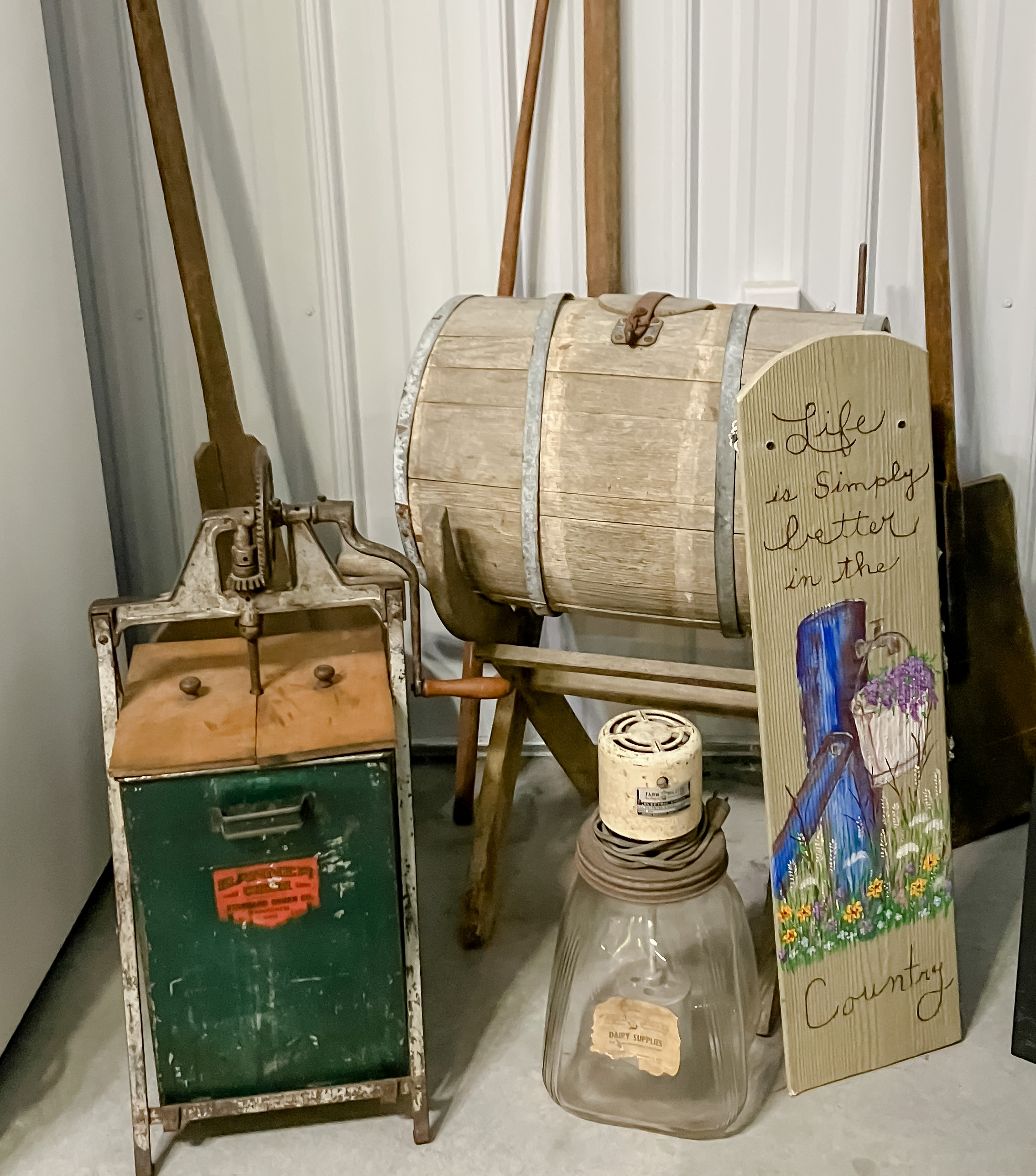
While grandfather David helped with the electrical work and mapping out the flow in processing, storage and retail, grandmother Gloria painted country art for the vintage displays of old farm and dairy equipment interspersed between coolers — giving the space that country store feel. 

Jason and Kacey have known each other since high school. He went to SUNY Mohrsville for animal science and ag business management. She went to Penn State for ag education. For the past 10 years, Kacey was an ag teacher, until August 2022. Now she is full time at the farm, where she enjoys the processing and marketing. They have two young boys, Emmit, 6, and Ellis, 4, keeping them busy as well.

As their dream progresses, the Rices are methodical, taking incremental steps with eyes on how they invest and where they put their focus to continue diversifying, while staying rooted in using the dairy, eggs and beef produced on BAD Farm, where they DON’T live up to their name. To be continued.

A re-positioning of agriculture? Kohl tells farmers: ‘Get focused in an unfocused world’

By Sherry Bunting

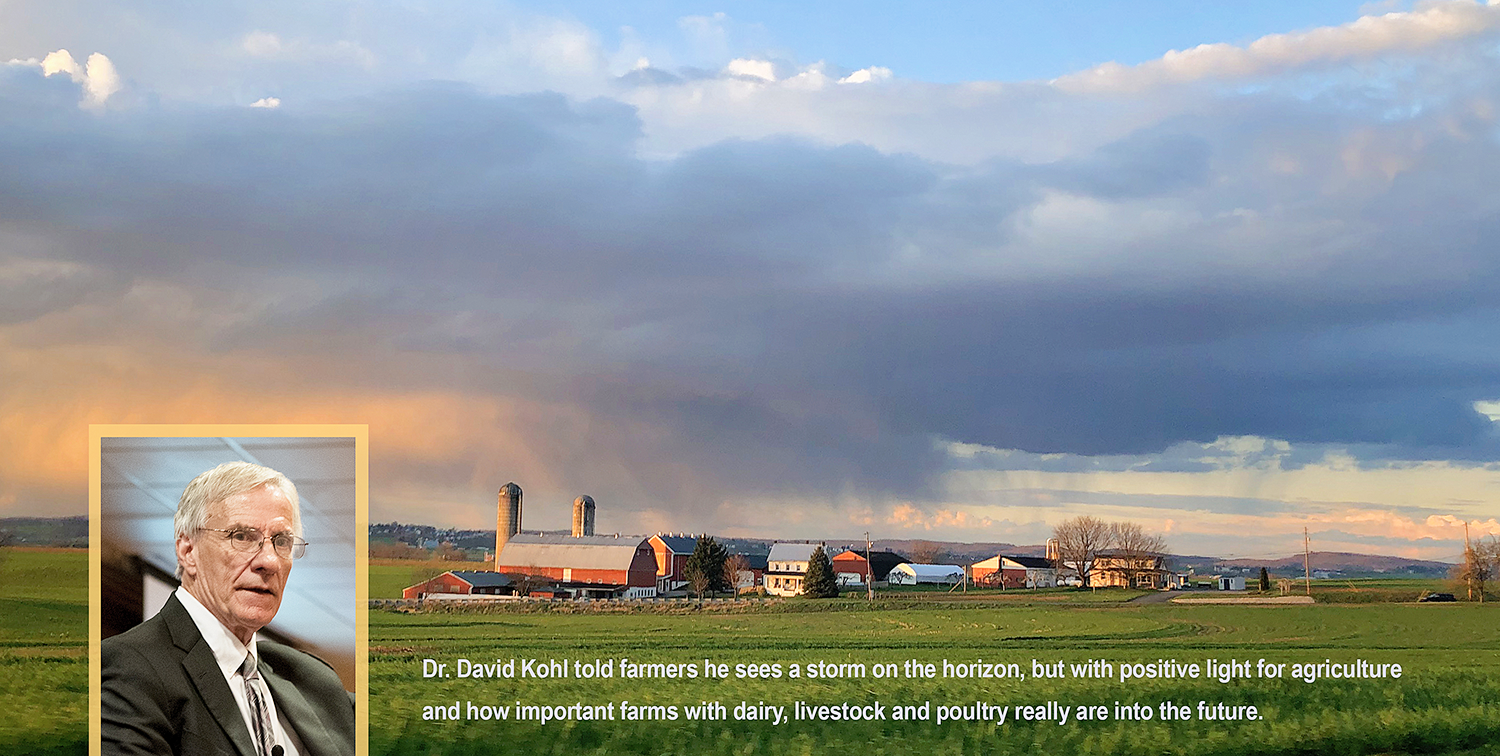
EAST EARL, Pa. — While he sees a storm on the horizon via high inflation, rising interest rates, global unrest, Dr. David Kohl is positive on agriculture, believing agriculture is “in position for a re-positioning” and advising farmers to “get focused in an unfocused world.”

He sees the resources provided by farms with dairy, livestock and poultry will become more critical. He sees agriculture as the next big mover, the answer — if farmers are free to be creative, manage their businesses with intensity, and drive the bus. He said transparency is becoming more important for consumers, as well as for farmers.

The Virginia Tech professor emeritus engages audiences in lively discussions of economics and financial management. He also co-owns a dairy farm and creamery in Virginia, so he sees trends on a macro and micro level. He spoke recently at the Univest Bank meeting attended by 300 farmers in southeastern Pennsylvania.

“We’re already doing a good job in agriculture. We just need to be driving the train, rather than letting it run over us. If we have a food and fertilizer shortage, the importance of a safe food and fiber source will have even greater value, and we can market that,” said Kohl.

Sizing up the uncertain times ahead, Kohl urged farmers to get focused, think creatively, be innovative, be right on top of their business numbers, plan and prioritize, set goals, and work with a team of advisors.

U.S. agriculture has strategic advantages. It’s in the lifestyle, the work ethic, the soil. Kohl noted that in China, for example, there is real concern about food in the future because 23% of China’s soils have built-up metal toxicity that is unhealthy for plants and animals.

One of the most critical advantages U.S. farmers have is “return on relationship” – or ROR.

“This is a community that gives back. Too often what we see in the world is people just taking instead of giving back. That’s your advantage. You give back,” he told farmers.

On the geopolitical front, fueled by oil, Kohl observed the U.S. has “played right into the hands of OPEC and Mr. Putin. Think about it, 21 years ago, we had 9-11. The towers went down in New York City, Somerset, Pa. and the Pentagon. We said we’re going to become energy independent in 25 years, and we did it in 10. We became the number-one energy producer in the world,” he said.

The U.S. is now divesting its fossil fuels, talking about going to ‘green energy.’

“This has created a lot of instability, and 8 out of every 10 dollars you spend on your farm is connected in some way to energy,” said Kohl, adding that consumer buying behavior is also connected to energy.

“Now it’s going to be China and India — they’re going to be getting the cheap oil while we’re paying the higher price,” he said. “You’re going to have to think innovatively about what you’re going to do with that.”

The fallout from the Russian invasion of Ukraine is something that is not going away overnight. “It’s going to require a lot of management intensity. We can make it through, but we’re going to have to step-up our game plan,” he said.

Warning of recession on the backside of inflation through “demand destruction,” Kohl said every recession – except for one – was caused by an oil market shock.

When oil prices go up, people start questioning their trips. Consumers start questioning everything they buy. They start cutting back.

“These movies play over and over again because we don’t teach history, and so we’re doomed to repeat the mistakes,” Kohl declared, drawing parallels to the 1970s, when the Soviet Union said it needed wheat.

“Communist countries create these economic bubbles because they’re authoritarian, and then, all of a sudden, those markets disappear, and the American farmer is left hurting,” said Kohl. “The market can be given and taken away, and you have to be careful.”

In the 1970s, land values were spiking, and there was political and military uncertainty. The same thing is going on today, he asserted.  

“We had a very stagnant economy that was inflating, and wages weren’t keeping up with inflation. The same thing is happening now,” he said, noting inflation hit 8.5 on April 12th – the highest since 1981 when this similar pattern of events in the economy were precipitated by high energy costs and geopolitical factors and uncertainties.

What moved the U.S. forward then? The development of computer technology and the information age “brought us forward to years of wealth,” Kohl reflected.

What is going to be the ‘big mover’ this time? “Agriculture is one of the answers,” he said.

In the face of skyrocketing fertilizer price and tight availability (which he said will likely be as bad or worse next spring)… “Never has there been a time when manure was so valuable as it is today,” said Kohl, noting the “very real potential” for this to increase into the future as global impacts increase food insecurity.

“We have the solution right here,” said Kohl. “We can adjust to more manure, to poultry litter, to putting biologicals on the soil. We’re going to have to think outside the box, but we’ve got the resources right here to take care of it.”
On the labor front, Kohl noted that the current shortage of workers has every major company in the U.S. working on automation.

“Where we have people shortages now, we will have job shortages later because companies will automate,” he said.

Rising energy costs further complicate this picture as companies try to get back in the groove of work.

Supply chain disruptions will be dominant for the foreseeable future as 40% of China’s manufacturing is in cities that are locked down right now for the COVID variant, Kohl noted.

This is creating supply chain problems now, and when delayed shipments go out later, ports will be overcrowded again.

On the flip side, as China’s economy slows down because of being shut down, this also slows down oil price advances.

Regulations have also played into the issue. Kohl hears from truckers. They tell him they are retiring in droves due to so many additional regulations put on them by federal and state governments. This is leaving a shortage of truck drivers.

Everything stems back to the COVID pandemic. Prior to the pandemic, the U.S. had charted its longest monthly economic expansion in history, according to Kohl.

“Now, consumer confidence – which had been in the low-70s – is in the high-50s, showing our consumer is losing confidence, and that is what drives 70% of the U.S. economy,” said Kohl.

Another indicator Kohl looks at – and it is tied to interest rates – is the housing market. “That’s starting to crack in certain parts of the country,” he said. “We had wealth moving, cash coming out of New York and New Jersey bringing money to other parts of the country. Eventually, the shell game stops.”

Kohl also looks at the price of copper. “It’s still strong, and China is stockpiling it because they are anticipating an economic slowdown.”

So, what should farmers get ready for?

“Get ready for the economic flip,” said Kohl, “that 12- to 24-month period where your costs went up, but the costs don’t correct as fast as your price does.”

That’s what happens when inflation gives way to recession, so be aware and prepared.

Working lines of credit are getting higher right now, so when federal and state regulators all of a sudden want banks to tighten up on credit, that creates some fallout.

Whether talking about a country, a business, or a home budget, financial liquidity and the ability to generate cash is the pressure point. “Russia and China are having that problem right now,” Kohl observed.

As for Americans, “52% are living paycheck to paycheck with an average cash reserve for 13 days,” he related. “The ability to generate cash is your perseverance. Your perseverance is the thing that is going to be very very critical.”

Kohl offered business strategies to key-in on.

Position for a quick pivot to cash

“Working capital is queen on the chessboard,” said Kohl. Working capital and the ability to pivot quickly to cash and to manage debt service will be increasingly important. Cash earns flexibility.

Do cash flows and overestimate costs

Kohl said cash flows are 80% of a business plan. “You have to think about production, marketing, finance, to know your cost of production. This helps you visualize your operation,” he said, urging farmers to overestimate by a minimum of 25% in today’s inflationary time so there are better odds of good decisions. In times like this, bad decisions can be compounded.

Planning is essential

“Manage the controllables, and manage around the uncontrollables,” said Kohl. “We can’t manage what comes out of D.C., Moscow and Beijing. We can focus on the things that we can control. That’s where patience and perseverance comes in. Spend 5 to 10% of your time on planning. It’s that important.”
Just like the basketball player planning and training to spend 95% of his game time without the ball in his hands, Kohl said: “It’s the things you’re doing when the ball is NOT in your hands that help you to do something important when you get the ball.”

Work with a team of advisers.

He urged farmers to bring together a team of advisors if they don’t already do this. “Get your crop consultant, livestock consultant, lender together. Another set of ears and eyes is very important to keep you focused,” said Kohl. “Technology gets us unfocused. This is an unfocused world. Get focused in an unfocused world.”
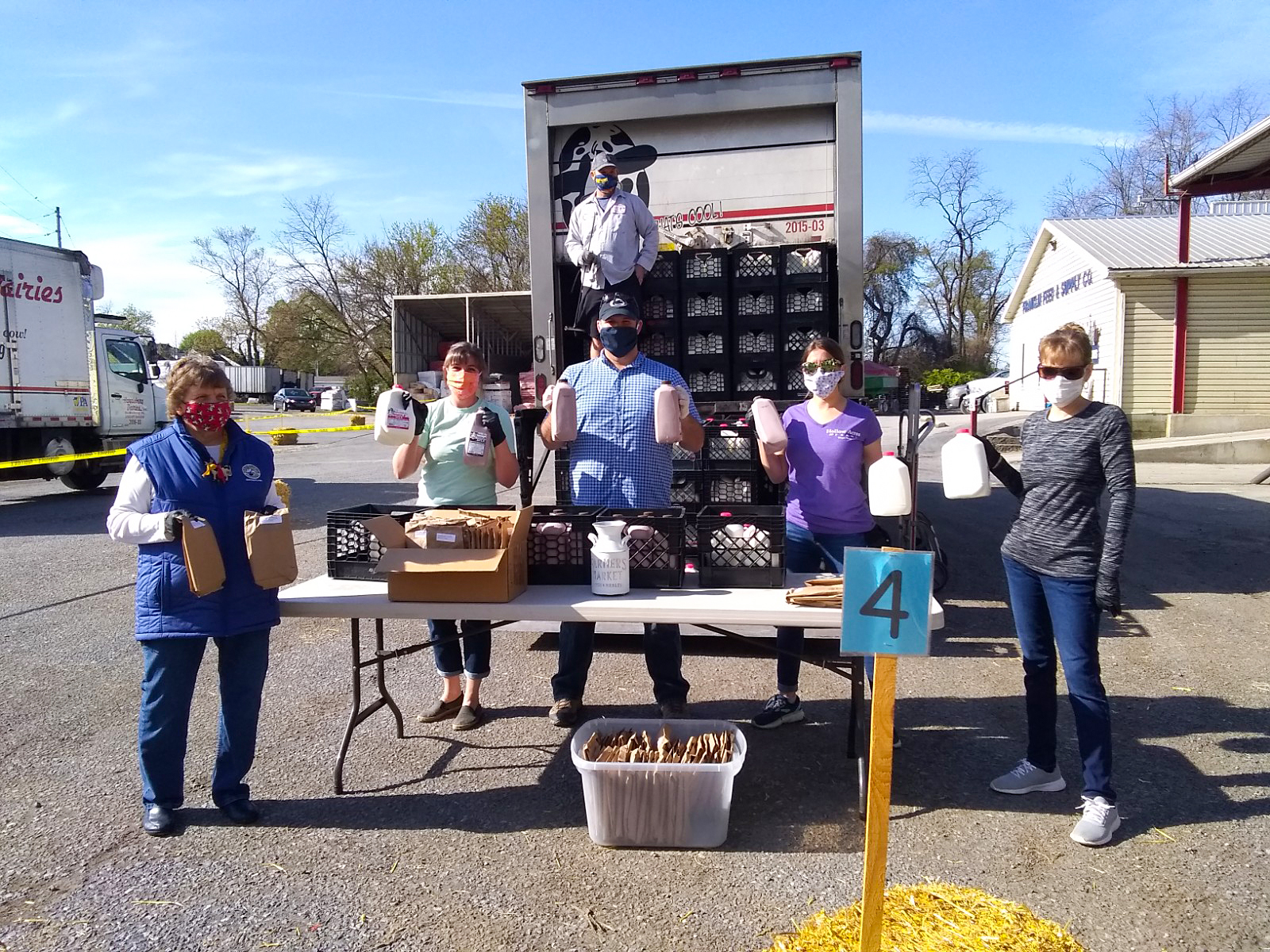
Set goals

“Write down your goals,” he added. “This leads to better mental health and improved earnings.”

Prioritize the priorities

Life on the farm and managing the farm business can feel like a constant state of competing priorities. Kohl urged farmers to practice the art of “prioritizing your priorities.”

In other words, avoid overscheduling, and strive to achieve a work/life balance. “The best crop you’ll ever raise will be your children and grandchildren, your interactions with young people,” he said.

Kohl also urged farmers to take care of themselves, to make time each day for prayer or meditation, pay attention to diet and exercise, get enough sleep, and have a support network. 

-30-

National Dairy Shrine 2021 Pioneer Dieter Krieg, ‘a trailblazer with energy, enthusiasm, dedication’

By Sherry Bunting, Farmshine, October 8, 2021

MADISON, Wis. – “It is impossible to overstate the impact Dieter Krieg and Farmshine have had on the dairy industry in 42 years visiting dairy farms and dairy events across the United States. His interviews with top dairymen and dairy leaders have implanted ideas of change to almost all his readers at one time or another over the years,” writes Carl Brown of F.M. Brown Sons, who nominated Dieter for the National Dairy Shrine Hall of Fame Pioneer Leader award.

On Sept. 30 at the National Dairy Shrine (NDS) dinner, Dieter was one of four 2021 Pioneers to be recognized.

Dieter Krieg

“Dieter has been a trailblazer in dairy journalism and occupies a special place in supporting and educating dairy producers and youth. I personally realized the impact that Farmshine was having during one of our Dairy Science Club spring trips,” writes Dale Olver, Penn State Dairy and Animal Science assistant teaching professor in a letter of recommendation.

“Our group traveled to Arizona to visit some of the leading dairies in that state. One producer wanted to know (the students’) opinions about a recent article published in Farmshine. It was at that point that our students gained a perspective that this publication was not just reaching dairy producers in Pennsylvania but had begun to develop a much broader following,” Olver states.

Yes, Dieter is known for thought-provoking editorials. A free press is not something he takes for granted, having been 10 years old when his family left communist East Germany for liberty in the United States.

Olver notes that, “Dieter is a humble, caring man who does not seek attention, although he readily provides publicity to others.”

Surprise! There are more pictures and publicity on these two pages than Dieter may be comfortable with, but each one illustrates a connection that can be multiplied many times over — stretching far beyond the few examples here from the NDS awards dinner.
In fact, if you ask him what he has enjoyed most as a publisher, Dieter will tell you it’s the people.

Ever since the June NDS announcement of the 2021 Pioneer recognition, we have been hearing from some of those people — readers, producers, advertisers, colleagues, and former interns who credit Dieter as a mentor, “taking a chance” on them, “giving them a start” that blossomed into careers today that continue that network, touching the lives of others in the dairy industry.

The response has been so overwhelming, we can only capture the essence of so many responses.

Whether the first Farmshine off the press in September 1979 (right) or one of the most recent ‘favorite covers’ 42 years later in September 2021 (left), Dieter Krieg has been publishing the dairy news to Farmshine subscribers across Pennsylvania, across the United States and even in other countries 51 weeks a year. That’s 2,142 weeks, and it doesn’t get old. In that time, he has touched the lives of many as they have touched his. From the chronicles of Rudolph, his famed Oldsmobile driven over 730,000 miles to the most memorable April Fools’, and from the big stories and thought-provoking editorials to the weekly DHIA’s and announcements, Dieter has established a relationship with thousands of readers who look forward to Farmshine every week. The staff and contributors to Farmshine each week are grateful, and we echo what Dieter said in his award acceptance speech that the readers are to be thanked for helping make Farmshine what it is. After all, it’s about cows and farming, but it’s really about the people.

From the paper paste-up and wax-board days to the digital era, Dieter continues Farmshine’s mission of rising each week to cover farming and agribusiness as the first and likely only weekly dairy-focused newspaper with over 13,000 subscribers nationwide.

In his letter of recommendation, former Pennsylvania Holstein Association executive director Ken Raney explains that, “Dieter has ‘done it all’ for Farmshine, he is the editor, feature writer, advertising manager, layout, etc., as the paper has grown. His personal approach to stories has created friendships all over the world. Farmshine not only has current dairy information but features successful dairymen of all types, so readers can garner new ideas.”

Ken also describes Dieter as we know him, “an unassuming enthusiast who welcomes ideas, looks for innovative ways to share the dairy industry story and has been a leader in print media, before many publications of this type were available.”

Writes Stephanie Meyers of Merck, “I was Dieter’s first Farmshine intern in 1989. I stopped by the NDS reception to congratulate him and thank him for giving me my start in dairy journalism, communications and marketing. I’m so thankful he hired me and for teaching me the ropes of dairy journalism and encouraging me to pursue my dreams of a career in dairy communications and marketing. It’s a joy to see him recognized for his many contributions to the dairy industry and for his commitment to telling the stories of dairy farmers.”

Josh Hushon of Cargill writes of what it meant to also be an intern with the paper. “This award is so well deserved. Dieter took a chance on me as a summer intern before anyone else was willing. I was 19 at the time, didn’t really know what I was going to do in life, and had a minuscule portfolio of writing. Despite what I didn’t have, Dieter saw what I did have, which was a passion for the dairy industry and work ethic developed on our farm. He opened the first door for me and I am eternally grateful for that.”

Giving back what he learned, Josh seeks to mentor others and wrote a blog a couple years ago after looking back on his own career path and pointing out moments when the right mentor came along with the right opportunity at the right time.

“One of those mentors is Dieter Krieg, who I recently reconnected with through the Holstein Foundation. He was a huge mentor early in my career as I was learning how to be a storyteller and communicator,” writes Josh.

Andrea Haines echoes these sentiments. Today she operates her own business, ALH Word and Image, and she also looks back on her pivotal internship with Dieter at Farmshine.

“I am forever thankful for Dieter and the opportunity he and his family provided me early on in my career. Finding an ‘internship’ within Farmshine for two summers really taught me how to write, edit, piece together a newspaper (wax-adhered layouts), and most importantly, how to network with people of the dairy industry. I will never forget the many rides in Rudolph (the famed 730,000-plus mile Oldsmobile) and long nights putting together the newspaper,” Andrea recalls.

Karen Wheatley, another intern with a career in the dairy industry notes “Dieter was my mentor too, and the man who got me interested in ‘really’ writing!”

Former Lancaster Farming editor Andy Andrews notes that, “Dieter has been the voice of dairy agribusiness for four decades! He is the publisher and editor the industry has come to rely on; great reporting and fearless with his observations. Dairy farmers have been blessed with his hard work and ‘udder’ devotion.”

Dairy producers also express their appreciation, and friends recount stories. Dave Bitler of Berks County, Pa., notes that he has always been very proud to call Dieter a friend. Recalling the summer of 1973, Dave writes: “We milked together at Dr. Carl Troop’s south of Quarryville. I always enjoyed Dieter’s company and his sharing about his family’s history in Germany and their coming to the United States. Looking back on my life back then as a new high school graduate, I was probably annoying, but Dieter was always kind.”

John and Linda Kisner of northern Pennsylvania write their thoughts as Farmshine readers. Linda recalls Dieter driving through a local town and stopping for gas, seeing the paper that had pictures of their triplet calves on the cover. “He looked us up, came out and took pictures (in Rudolph). Dad loved it.”

“Sometimes it just takes someone in a position to shine a light on certain issues,” adds John. “I think being independent with his own publication has allowed him the opportunity to do that a few times over the years. Where would we be without that sort of initiative?”

Another Pennsylvania farmer, Jeremy Meck, recalls being in 4-H with Dieter as one of the CowsRus 4-H leaders. “I remember learning that he had a small barn and milked a few cows. Even though he was the editor of a great farming newspaper, he still woke up every morning to milk cows before work,” writes Jeremy. “He is a role model for the industry.”

So many more thoughts have been written, but this one brings us back full circle. You see, Dieter wanted to be a dairy farmer, to follow in his father’s footsteps. As his father and brother moved the dairy from Pennsylvania to Florida and grew it to over 500 cows in the 1970s, Dieter wanted to find a farmer to work for in Pennsylvania and maybe find a transition situation where he could work toward having a smaller farm of his own. He confesses that was the reason he took that first newspaper job as editor of the farm page in the Pennsylvania Mirror.

What better way to meet farmers and build connections?

In his last semester at Penn State in Dairy and Animal Science, Dieter had taken a creative writing course because he did enjoy writing letters to family still in Germany, and he enjoyed writing about life on the farm (which later became a popular Farmshine column).

Right off the bat, he innovated that farm page in the Pennsylvania Mirror using a photo of a barn and placing various ag news stories on the side of that barn.

“I was told it wasn’t normal newspaper style, but my goal was that people would not overlook the farm page,” Dieter recalls. To this day, Dieter loves creating page layouts and using big pictures.

It was a hit, and he was a natural, and he found that he loved the job. So the job that was taken originally to meet and connect with more farmers to potentially work into a farm management position turned out to be the calling he was born to follow, which led him to blaze a trail for a weekly all-dairy newspaper in 1979 — no small feat.

After 42 years, what has he loved most? You guessed it: the people. While there is satisfaction in writing the stories and putting the finished product together, for Dieter, it’s really all about the people.

Like agriculture, the newspaper business has its ups and downs, and getting started meant many years of long hours putting the paper together and much travel gathering news and stories. When he looks back, even those early 100-hour weeks, though trying, were enjoyable. Sitting at a banquet, for instance, isn’t really work when you enjoy it, he says.

The mission of Farmshine, he says, always was and still is to get the word out, to tell the story, to cover the issues.

When he looks back at how it all came together, Dieter told the NDS awards dinner crowd, it is obvious God’s hand was working through it because all the pieces came together even before he realized Farmshine would be born. He expressed sincere gratitude for all who had a hand in it, including those who saw something in him to encourage along the way.

In her letter, Mary Shank Creek of Palmyra Farms notes that, “Dieter and his staff address all aspects of the dairy industry from commercially producing milk to the purebred sector and including alternative niche market opportunities. They do a wonderful job of highlighting individuals and unique accomplishments to shine a light on the personal side of our industry. Dieter is not afraid to tackle controversial issues and takes great effort to show an unbiased report while allowing editorials that stimulate thought.”

She sums up what so many feel, including me, having worked with Dieter on staff and in the later years as a freelance Farmshine contributor…

Mary says it so well: “The things I admire most about Dieter are his energy, enthusiasm and dedication. He is relentless in his commitment to serving agriculture and the dairy industry.”

Thank you Dieter for being a dairy journalism trailblazer, for starting Farmshine, the unique weekly all dairy newspaper 42 years ago, for shining a light, telling the stories, building connections, and touching the lives of others through the news, and so much more.

-30-

Dairy farmers prompt Franklin County, Pa. Milk Drop

Over 2000 families blessed with 3600 gallons of whole milk

Franklin_Milk_Drop03

Zach Meyers (center), Franklin County Farm Bureau president among the volunteers ready with gallons of whole milk and half gallons of whole chocolate milk

By Sherry Bunting, Farmshine, May 15, 2020

CHAMBERSBURG, Pa. — “Watching Franklin County help Franklin County is the best way I can summarize this. Seeing the community come together was a blessing to witness,” says Lucy Leese who helped organize the 3600-gallon Milk Drop at Franklin Feed and Supply, Chambersburg, Pa. on Saturday, May 2. Leese is the office manager for the Franklin County Farm Bureau, and she works part-time on a local dairy farm.

The idea came from dairy farmers in the county seeing other such events in Lancaster and Tioga counties. Franklin County Farm Bureau president Zach Meyers, an area feed nutritionist, was contacted about it by one of his dairy clients.

“They knew Farm Bureau could reach more people to make this work, so we helped organize it,” says Meyers. “But the farmers get the credit. They made most of the donations. With this event, they basically sent a personal message to the entire community — that dairy farmers love you and care for you.”

May 1st dawned sunny, and people were itching to get out. They came in droves for the Milk Drop, some even breaking out their restored cars for the lineup.

Organizers say some people came because of true need in these hard times, others simply to show support for the dairy industry, and others just wanting something to do — to take a drive and be part of something. Whatever the reason or season – sunshine or rain – these Whole Milk Donation Drops, Drive-throughs, Challenges, call them what you will, are really catching on and spreading all over.

Franklin_Milk_Drop01

Lucy Leese works for a local dairy farm and as office manager for Franklin County Farm Bureau. Along with the whole milk, they gave out goodie bags with dairy facts, recipe and coloring books from county dairy promotion. Photos submitted

From idea to event, a whirlwind eight days transpired. Leese communicated with county Farm Bureau members and others by email and social media about the plan, and she quickly saw the high level of community interest through donation pledges as well as people expressing interest in coming out.

“We also reached out to others who have done this. Mike Sensenig (New Holland) had a lot of insight and gave us some things to think about ahead of time,” she said.

“Our biggest thought was that we wanted to be sure to use Pennsylvania milk, so we worked with Harrisburg Dairies,” Meyers relates in a Farmshine interview. “Most of the dairy farmers here are already producing milk at a significant income loss, and yet they still gave money to buy milk for the Milk Drop.”

According to Meyers, the vast majority of funds were donated by dairy farmers and supportive agribusinesses. A few donations also came from individuals and businesses with no connection.

“We wanted it to be whole milk,” said Meyers. “What is better than giving a gallon of whole milk and a half gallon of whole chocolate milk and having our community actually taste something good?”

Over 2000 vehicles, in about a five-hour time frame, snaked through the Franklin Feed property off Rte 11 into four lines on either side of two Harrisburg Dairies trucks with 30 volunteers handing out milk and a goodie bag with a dairy fact sheet, recipe book and coloring pad courtesy of Franklin County dairy promotion.

The size of the event exceeded early expectations. They initially had money pledged for 500 gallons on Sat., April 25. By Monday evening, when they had their video chat to organize the event, they had funds to buy more than 2000 gallons. By Wednesday, April 29, three days before the event, they had pledges and paypal funds for seven times the original amount and confirmed their final count with Harrisburg Dairies for Saturday morning.

Franklin_Milk_Drop05

Pretty cool to see 15 tons of milk come in on three box trucks. Harrisburg Dairies sent employees to man the lifts and keep the milk moving to the distribution tables between four lines of cars. 

“It was pretty cool to see 15 tons of milk come in on three box trucks,” says Leese. “Harrisburg Dairies sent their own guys to man the lifts and keep the milk moving to the distribution tables.”

The community was eager. “We had cars coming in at 7:45 a.m. right behind the trucks, so we started letting them through at 9 instead of 10,” says Leese, describing the initial rush of cars that gave way to a steady flow into the early afternoon.

In the end, Shippensburg Food Pantry sent a refrigerated truck for the 150 gallons that were left at 2:15. Earlier in the day, folks from a nursing home in Waynesboro had come through for 40 gallons. “They said they weren’t able to get whole milk, and their folks needed milk,” Leese reports.

Hearing the emotion in Leese’s voice as she described the experience in a Farmshine phone interview, it’s obvious that an event like this truly touches the givers and the receivers.

“Several times people asked for additional milk for their neighbors or grandparents. We said from the beginning all are welcome, no questions asked, because we are all in a tough situation right now,” Leese explains.

Franklin_Milk_Drop06

Two teams of volunteers kept milk moving from three trucks. Throughout the 5 hours, area dairy producers took shifts. For them, it was personal, to show love for their community.

“It was encouraging for us as volunteers to be able to serve and give back to the community here at a time that we have felt helpless for so many weeks. This was an opportunity to be active and to serve,” she adds. “The folks coming through were just so grateful with words of thanks and blessings, and if they could, they gave money to pay forward for other Milk Drops.”

The way the lines flowed into Franklin Feed from Rte 11 gave the event a special touch for homebound families getting out. Wide-eyed children looked around at the sights of grain bins and feed equipment and then the milk trucks as they lined up between them.

Franklin_Milk_Drop02

Over 2000 vehicles, in the space of five hours, filed off route 11 in Chambersburg, snaking around the grain bins at Franklin Feed and Supply before breaking into four lines on each side of two Harrisburg Dairies trucks.

“People actually thanked us for the tour,” Leese said. “We needed to move quickly so the line wouldn’t back up to route 11, so we had four lines, and the volunteers came in shifts.”

While the Franklin County Farm Bureau is not planning another, others in the community are talking about more milk drops.

“As people are seeing and recognizing the need and the positive response, the idea is really taking off,” Leese observes, adding that they’ve been contacted by their peers in Centre County wanting to do one. Also, Harrisburg Dairies has been involved in other events like this, but this was likely their largest one-day, one-location event.

“We learned that people will give whatever they can to support something like this,” she says.

Leese’s advice for others includes: Overplan your volunteers, have popup tents for shade, wear gloves and masks.

“When you are standing there giving something to people, you can still smile with your eyes and be pleasant — even wearing a mask,” says Leese.

“People have been missing interactions, so we wanted to be cheery and welcoming, and people noticed. It helps raise everyone’s spirits,” she reflects.

Leese is grateful to the dairy farmers who had the idea, the many volunteers, and to Franklin Feed and Supply for providing the accommodations and being so helpful.

Franklin_Milk_Drop04

Ron Wenger, county Farm Bureau vice president, directed traffic into four lines to keep traffic from backing up onto rte. 11.

She says Farm Bureau first vice-president Ron Wenger, a dairy farmer from Pleasant Hall, was instrumental in figuring out the traffic patterns to make sure they had things flowing well.

“Coming from a farm background, working for a farm and the Farm Bureau, I know what farmers are going through, what they are facing, and it’s not pretty. Yet a portion of the donations came directly from dairy farmers, and they were out here to share and to give and to protect people. To see the community respond in such a positive way to this outpouring from the dairy farmers was gratifying.

“People understood that they were getting something good for them from farmers who care for them, so we got some kind of understanding happening here,” she observes.

“Now the question is how to hold on to that, and make it flourish.”

-30-

‘Forgotten Farms’ will be remembered in NYC

Over 100 food-thinkers and influencers attend Forgotten Farms film premier in New York City, bring questions and perspectives

Forgotten_Farms_02 (1)

Lorraine Lewandrowski (left) and Forgotten Farms film creator Sarah Gardner (second from right) take questions from attendees after the premier showing at Project Farm House in Manhattan on March 9. Photo CADE / Zachary Schulman

By Sherry Bunting, Farmshine, May 8, 2020

MANHATTAN, N.Y. — While new farmers are celebrated by food-thinkers and thought-influencers, there’s another farmer mostly left out of the local food celebration. Traditional dairy farmers are underestimated and seen as declining, when in fact, they remain the backbone of rural communities and are integral to a renewal of regional food systems — their farms have served urban neighbors in some cases for a century.

Yet these essential farms have been essentially forgotten by the food movement as they fight for survival…

On March 9, they were remembered and celebrated thoughtfully during a premier showing of the acclaimed Forgotten Farms film in New York City. A group of upstate dairy farmers hosted the occasion. The documentary shows the cultural divide between the new food movement and traditional farming. It can be streamed at http://www.forgottenfarms.org or by purchasing a DVD.

After months of work and years of time invested in building relationships with food-thinkers in the metropolitan area, Herkimer County, N.Y. dairy producer and attorney Lorraine Lewandrowski — working closely with the Center For Agricultural Development and Entrepreneurship (CADE) — secured a beautiful Manhattan venue at Project Farmhouse to show the documentary film.

Lewandrowski is @NYFarmer on Twitter with near 33,000 followers and has tweeted nearly a quarter of a million times over the past decade spanning everything from issues of the day to simple photos of a day on the farm.

Always looking for ways to connect dairy farmers with food-interested people, Lewandrowski and other dairy producers tag-teamed as hosts for the Forgotten Farms film premier in Manhattan on March 9 and had a booth at the International Restaurant Show at the Javits Center on March 10.

Forgotten_Farms_19 (1)

Photo CADE / Zachary Schulman

For many of the 100 food-thinkers, food-writers, and food-influencers attending the film, it was their last congregating event before New York City began safe-at-home policies as the novel Coronavirus pandemic hit the region a few days after. In the throws of the pandemic’s impact on global and national food supply chains, the Forgotten Farms documentary brings a timely message — looking into the past and ahead at a vision for a future regional food system.

“This event was made possible by (CADE) in Oneonta, New York and event coordinator, Lauren Melodia of Brooklyn,” writes Lewandrowski in an email interview with Farmshine recently. “We had seating for 100 New York City food-thinkers, influencers, writers and students. In just over an hour, the film told the stories of Northeast dairy farmers. Actual dairy farmers, some of them ‘real unique characters,’ were the stars of this award winning film created by Sarah Gardner and David Simonds.”

forgottenfarmsproducers

Sarah Gardner and David Simonds (Photo S.Bunting)

Gardner was also present to join Lewandrowski on a panel taking questions from attendees as they enjoyed the beautiful cinematography while learning about a few central themes: The challenges of farming, milk pricing, history of farm communities, abundant natural resources of the Northeast and the feeling in dairy farm communities that dairy farmers were forgotten by the popular urban food movement.

IMG_8026_forgottenfarms

Photo capture from Forgotten Farms preview trailer

“The event was also a ‘deep listening’ session for us as farmers while attendees expressed their ideas, asked questions of us and gave us information from their perspectives,” Lewandrowski reflects. She notes that for the group of New York farmers the opportunity to really hear what is on the minds of city food-thinkers is essential to bridge the gaps and communicate about the future of food systems and dairy farming.

All the more telling in the eight weeks of COVID-19 impact to the national and global food supply chain, were the regional themes of the Forgotten Farms film showing the wealth of resources tended by farmers within a short drive of New York City.

Forgotten_Farms_18 (1)

Dr. Keith Ayoob tells the audience his concerns about public belief that imitations are ‘equivalent’ to dairy milk. Photo CADE / Zachary Schulman

“A young coffee bar owner asked what she should say to the increasing number of consumers who ask for oat ‘milk.’ A pediatric nutritionist, Dr. Keith Ayoob, told the audience his concerns about public belief that imitations are ‘equivalent’ to dairy milk,” Lewandrowski relates. “Dr. Ayoob brought copies of a letter he had written in the March 7, 2020 New York Daily News rebutting Brooklyn Borough President, Eric Adams, who has called for ‘plant based’ milks and for dairy farmers to transition out of producing milk.”

Attendees asked the farmers if they knew which New York City officials are interested in regional food and who they should support politically.

Lewandrowski described these encounters:

One consumer asked how to respond to fellow environmentalists who disparage dairy milk while urging almond beverages as better for the environment.

A group of food studies students told how the film inspired them to question food “shockumentaries” they have seen in their programs and to seek trustworthy sources of information.

“Each of these questions and comments gave us ideas on other projects we as farmers can do during future trips into the City,” writes Lewandrowski.

forgottenFarmsCapture

Photo capture from Forgotten Farms preview trailer

“A high point of our Project Farmhouse event was the support shown for the Cobleskill Dairy Judging team by attendees, most of whom have never touched a cow,” she notes. “Our announcement that the students from SUNY Cobleskill had placed first in the nation in junior college dairy judging was met with a big round of applause. We sold raffle tickets for a gift basket of New York food products to benefit these students, and the atendees gave generously to support the dairy students that they saw as their “home team.”

In speaking with guests after the film, Lewandrowski reports they were invited to do more showings in Queens, Brooklyn, Manhattan and Westchester County.

“We also met New York City food policy leaders and some of the people who have quietly worked behind the scenes as the ‘guardian angels’ of the farmers and NYC food security,” she writes. “It is the work of these unsung people that has built an extensive network of farmers markets in NYC and who are now connecting with more rural dairy farmers who sell into commodity networks.

Forgotten_Farms_60
Photo CADE / Zachary Schulman

“Now is the time that the work of these people will be recognized and respected as city planners think about regional food in the years following the Coronavirus impact,” she adds. “Young urban supporters of farmers showed us the seaport area of southern Manhattan and invited us to return to host a NYC Dairy Festival. They urged that the public would love to see and sample cheeses, ice creams, and other products of our rich dairy region. How could such an event be accomplished?”

On the following day, Jacob Javits Center hosted the combined International Restaurant Show, the Natural Foods Show and the Coffee Festival. The dairy presence was very thin, while imitation “milks” had several booths, Lewandrowski reported. CADE organized a booth for dairy farmers where they proudly handed out fresh whole milk bottled by Clark Farm in Delhi, New York.

“Although the dairy and beef checkoffs were absent, we were happy to see booths from Belgioioso Cheese and Tillamook Creamery, both of whom drew enthusiastic cheese sampling,” Lewandrowski explains. “The Government of Quebec had multiple booths showcasing their dairy, cheeses, beef, bison and specialty lamb. Irish beef also had a presence, catering to specialty marketing in New York City.”

To be continued